
African Statistical Journal Journal statistique africain
|
|
|
- Yves Michel
- il y a 10 ans
- Total affichages :
Transcription
1 African Statistical Journal Journal statistique africain International Comparison Program for Africa: Towards Economic Convergence Measurement Construction and Civil Engineering Work: Designing a Time-Space Index Estimating National Annual Average Prices within the ICP-Africa Framework: Back to Surveys Détermination des parités de pouvoir d achat élémentaires dans le cadre du PCI-Afrique : la méthode CPD Comparative Consumption and Price Levels in African Countries: First Results of the International Comparison Program for Africa Consommation et niveaux des prix dans les pays africains : premiers résultats du Programme de comparaison internationale pour l Afrique Nouveaux défis en statistiques agricoles : initiatives de la FAO Analysing Data from Participatory On-farm Trials Invigorating the Celebrations of the African Statistics Day : Lessons Learned from the 2006 Edition Mentoring Young Statisticians: Facilitating the Acquisition of Important Career Skills Volume 4 May / Mai 2007 African Development Bank Group Groupe de la Banque africaine de développement
2 Editorial Board Chairpersons / Présidents du comité de rédaction 1. Dr. Charles Leyeka Lufumpa Director, Statistics Department African Development Bank Group, Tunis, Tunisia 2. Prof. Ben Kiregyera International Statistical Consultant and Chairman, Board of Directors, Uganda Bureau of Statistics Kampala, Uganda Editorial Board Members / Membres du comité de rédaction 3. Prof. H.B.S. Kandeh UNDP Statistics Advisor, Sudan (formerly Statistician General, Statistics Sierra Leone) 4. Mr. Koffi N Guessan Director, ENSEA, Abidjan, Cote d Ivoire 5. Dr. Parin Kurji Head of Biometry Department, University of Nairobi, Kenya 6. Dr. Dimitri Sanga United Nations Economic Commission for Africa, Ethiopia 7. Prof. Rosalia Katapa Head of Statistics Depatment, University of Dar es Salam, Tanzania 8. Mr. Naman Keita Food and Agriculture Organization of the United Nations, Rome, Italy 9. Prof. James P. M Ntozi Makerere University, Uganda (formerly Director, ISAE) 10. Mr. Martin Balepa Directeur Général, Afristat, Mali Designations employed in this publication do not imply the expression of any opinion on the part of the African Development Bank or the Editorial Board concerning the legal status of any country or territory, or the delimitation of its frontiers. The African Development Bank accepts no responsibility whatsoever for any consequences of its use. Les dénominations employées dans cette publication n impliquent, de la part de la Banque africaine de développement ou du comité de rédaction, aucune prise de position quant au statut juridique ou au tracé des frontières des pays. La Banque africaine de développement se dégage de toute responsabilité de l utilisation qui pourra être faite de ces données. Design/Layout by Phoenix Design Aid Printing by Scanprint, Denmark ISO certified and EMAS-approved

3 The African Statistical Journal, Volume 4, May 2007

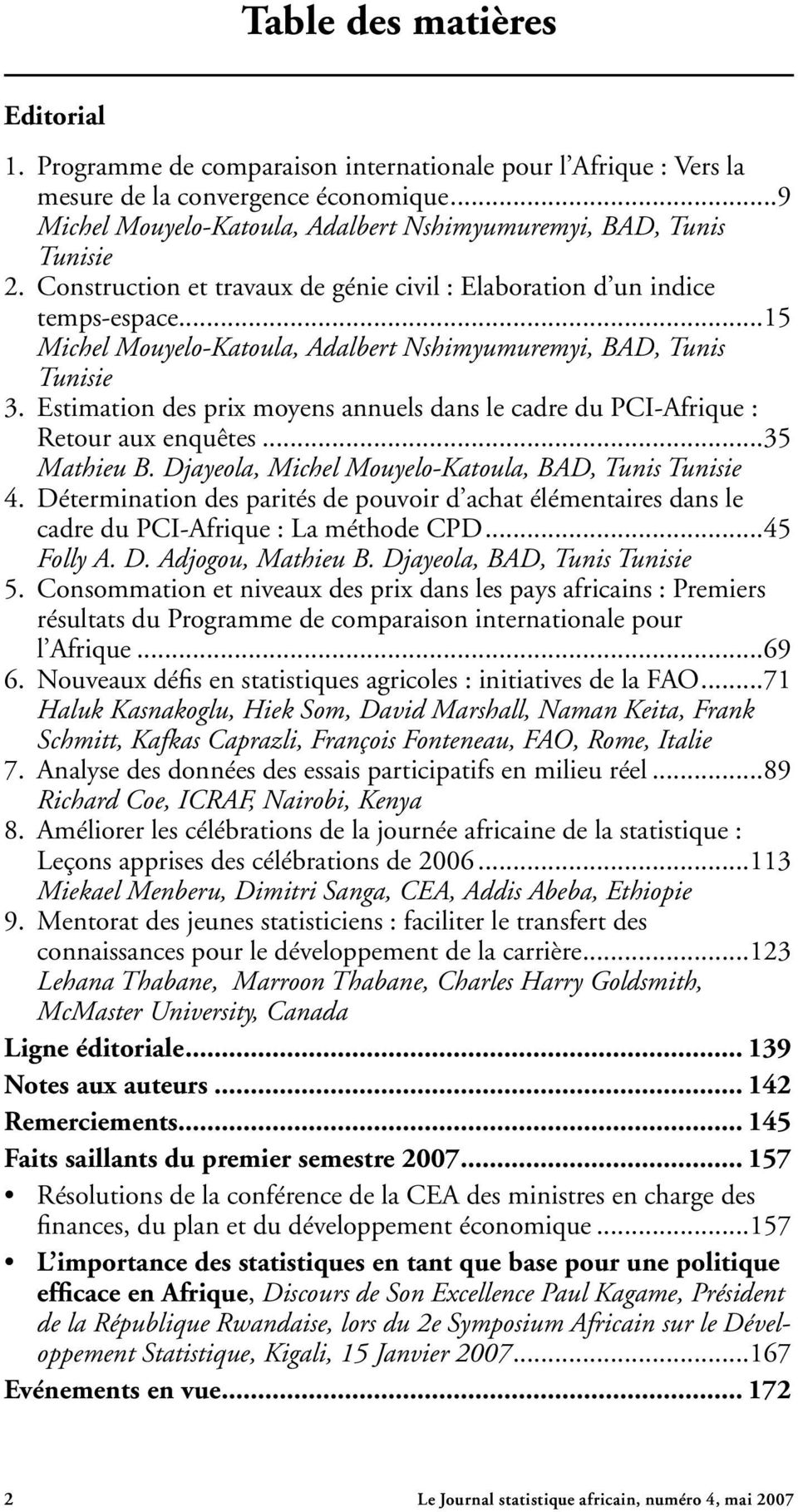
4 Table des matières Editorial 1. Programme de comparaison internationale pour l Afrique : Vers la mesure de la convergence économique...9 Michel Mouyelo-Katoula, Adalbert Nshimyumuremyi, BAD, Tunis Tunisie 2. Construction et travaux de génie civil : Elaboration d un indice temps-espace...15 Michel Mouyelo-Katoula, Adalbert Nshimyumuremyi, BAD, Tunis Tunisie 3. Estimation des prix moyens annuels dans le cadre du PCI-Afrique : Retour aux enquêtes...35 Mathieu B. Djayeola, Michel Mouyelo-Katoula, BAD, Tunis Tunisie 4. Détermination des parités de pouvoir d achat élémentaires dans le cadre du PCI-Afrique : La méthode CPD...45 Folly A. D. Adjogou, Mathieu B. Djayeola, BAD, Tunis Tunisie 5. Consommation et niveaux des prix dans les pays africains : Premiers résultats du Programme de comparaison internationale pour l Afrique Nouveaux défis en statistiques agricoles : initiatives de la FAO...71 Haluk Kasnakoglu, Hiek Som, David Marshall, Naman Keita, Frank Schmitt, Kafkas Caprazli, François Fonteneau, FAO, Rome, Italie 7. Analyse des données des essais participatifs en milieu réel...89 Richard Coe, ICRAF, Nairobi, Kenya 8. Améliorer les célébrations de la journée africaine de la statistique : Leçons apprises des célébrations de Miekael Menberu, Dimitri Sanga, CEA, Addis Abeba, Ethiopie 9. Mentorat des jeunes statisticiens : faciliter le transfert des connaissances pour le développement de la carrière Lehana Thabane, Marroon Thabane, Charles Harry Goldsmith, McMaster University, Canada Ligne éditoriale Notes aux auteurs Remerciements Faits saillants du premier semestre Résolutions de la conférence de la CEA des ministres en charge des finances, du plan et du développement économique L importance des statistiques en tant que base pour une politique efficace en Afrique, Discours de Son Excellence Paul Kagame, Président de la République Rwandaise, lors du 2e Symposium Africain sur le Développement Statistique, Kigali, 15 Janvier Evénements en vue Le Journal statistique africain, numéro 4, mai 2007
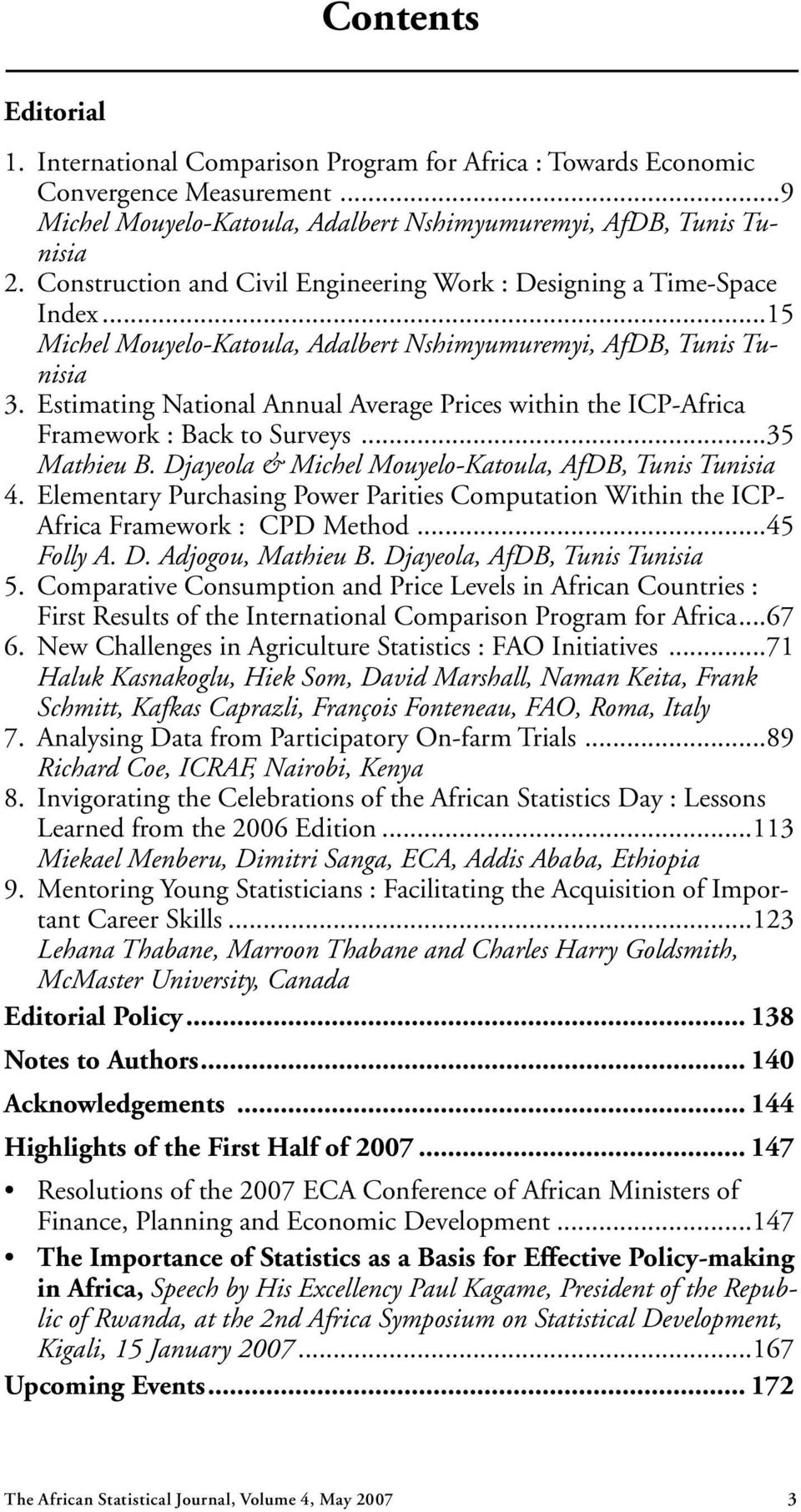
5 Contents Editorial 1. International Comparison Program for Africa : Towards Economic Convergence Measurement...9 Michel Mouyelo-Katoula, Adalbert Nshimyumuremyi, AfDB, Tunis Tunisia 2. Construction and Civil Engineering Work : Designing a Time-Space Index...15 Michel Mouyelo-Katoula, Adalbert Nshimyumuremyi, AfDB, Tunis Tunisia 3. Estimating National Annual Average Prices within the ICP-Africa Framework : Back to Surveys...35 Mathieu B. Djayeola & Michel Mouyelo-Katoula, AfDB, Tunis Tunisia 4. Elementary Purchasing Power Parities Computation Within the ICP- Africa Framework : CPD Method...45 Folly A. D. Adjogou, Mathieu B. Djayeola, AfDB, Tunis Tunisia 5. Comparative Consumption and Price Levels in African Countries : First Results of the International Comparison Program for Africa New Challenges in Agriculture Statistics : FAO Initiatives...71 Haluk Kasnakoglu, Hiek Som, David Marshall, Naman Keita, Frank Schmitt, Kafkas Caprazli, François Fonteneau, FAO, Roma, Italy 7. Analysing Data from Participatory On-farm Trials...89 Richard Coe, ICRAF, Nairobi, Kenya 8. Invigorating the Celebrations of the African Statistics Day : Lessons Learned from the 2006 Edition Miekael Menberu, Dimitri Sanga, ECA, Addis Ababa, Ethiopia 9. Mentoring Young Statisticians : Facilitating the Acquisition of Important Career Skills Lehana Thabane, Marroon Thabane and Charles Harry Goldsmith, McMaster University, Canada Editorial Policy Notes to Authors Acknowledgements Highlights of the First Half of Resolutions of the 2007 ECA Conference of African Ministers of Finance, Planning and Economic Development The Importance of Statistics as a Basis for Effective Policy-making in Africa, Speech by His Excellency Paul Kagame, President of the Republic of Rwanda, at the 2nd Africa Symposium on Statistical Development, Kigali, 15 January Upcoming Events The African Statistical Journal, Volume 4, May 2007
6 Editorial Nous souhaitons la bienvenue aux lecteurs du volume 4 du Journal et remercions tous les lecteurs qui nous ont envoyé des commentaires sur le volume 3. Ce volume met l accent sur le cycle 2005 du Programme de Comparaison Internationale (PCI) dont la mise en œuvre en Afrique a été coordonnée par la Banque Africaine de développement (BAD). Le programme PCI-Afrique a apporté une grande contribution au renforcement des capacités au niveau des statistiques économiques en particulier et au développement de la statistique d une façon générale. De plus ce volume consacre un article spécial à la Journée africaine de la statistique qui est célébrée le 18 novembre de chaque année depuis les années Les lecteurs se souviendront que les ministres africains responsables de la planification économique et du développement ont adopté le Plan d action d Addis-Abeba pour le développement statistique en Afrique dans les années 90 dans le but de conjurer le déclin de la production statistique en Afrique. Ce plan a consacré le 18 novembre comme Journée africaine de la statistique à célébrer chaque année pour améliorer la prise de conscience publique sur le rôle important que la statistique joue dans tous les aspects de la vie sociale et économique. Dans le passé, les célébrations de ce jour ont été intermittentes et généralement insatisfaisantes. Cependant, les célébrations de l année 2006 ont été marquées par une augmentation remarquable des activités y relatives. Nous publions un article sur ces célébrations et les leçons tirées de cette expérience. Un événement clé du deuxième semestre 2007 est le 2ème Symposium africain sur le développement statistique qui a été organisé avec succès à Kigali, Rwanda, en janvier Le symposium a été officiellement ouvert par Son Excellence Paul Kagame, président de la République Rwandaise, qui a partagé son point de vue sur l importance de la statistique comme base d une politique efficace en Afrique. Nous publions ce discours avec la permission des organisateurs du Symposium. La conférence 2007 des ministres de la CEA en charge des finances, du plan et de l économie, organisée à Addis Abeba du 2 au 3 avril 2007, a aussi fourni une autre occasion de plaidoyer en faveur de la statistique. Les premiers résultats du PCI ont été présentés aux réunions scientifiques de la conférence et les ministres ont réaffirmé leur grand soutien au renforcement des capacités statistiques en Afrique. Les résolutions de la conférence des ministres sont publiées dans le présent volume à titre d information générale. 4 Le Journal statistique africain, numéro 4, mai 2007
7 Enfin, nous voudrions féliciter la Communauté Economique des Etats de l Afrique de l Ouest (CEDEAO) d avoir relevé le profil de la statistique à la Commission en transformant l unité statistique en un Département de la recherche et de la statistique à part entière. Dr. Charles Leyeka Lufumpa Co-Président du Comité de rédaction Directeur du Département Statistique Groupe de la Banque africaine de développement Tunis, Tunisie Professeur Ben Kiregyera Co-Président du Comité de rédaction Président du Conseil d Administration Bureau des Statistiques de l Ouganda Kampala, Ouganda The African Statistical Journal, Volume 4, May 2007

8 Editorial We welcome readers to Volume 4 of the Journal and thank all those readers who sent us comments on Volume 3. This volume has a special focus on the 2005 round of the International Comparison Program (ICP) whose implementation in Africa has been coordinated by the African Development Bank (AfDB). The ICP-Africa program has made a great contribution to capacity building in economic statistics in particular and statistical development in general. Furthermore, the current volume features a special article relating to African Statistics Day which has been celebrated on 18 th November of each year since the 1990s. Readers would recall that African Ministers responsible for Economic Planning and Development adopted the Addis Ababa Plan of Action for Statistical Development in Africa (AAPA) in the 1990s in an effort to reverse the decline in statistical production in Africa. The Plan set aside the 18 th of November as African Statistics Day to be celebrated each year in order to increase public awareness about the important role statistics play in all aspects of social and economic life. In the past, celebrations of this day have by and large been intermittent and generally unsatisfactory. However, 2006 witnessed an upsurge in activities to mark African Statistics Day. We are publishing a paper on these celebrations and lessons learnt. A key high point in the first half of 2007 has been the second Africa Symposium on Statistical Development which was successfully held in Kigali, Rwanda in January The symposium was officially opened by His Excellency Paul Kagame, President of the Republic of Rwanda, who shared his thoughts on the importance of statistics as a basis for effective policymaking in Africa. With permission of the symposium organizers, we are publishing the speech. The 2007 ECA Conference of African Ministers of Finance, Planning and Economic Development held in Addis Ababa from 2-3 April, 2007 provided yet another high point for statistical advocacy. The first ICP results were disseminated at the scientific meetings of the conference and the Ministers reaffirmed their strong support for building statistical capacity in Africa. The Ministerial Resolutions are published in this volume for general information. Le Journal statistique africain, numéro 4, mai 2007
9 Finally, we would like to take this opportunity to congratulate the Economic Community of West African States (ECOWAS) Commission for raising the profile of statistics at the Commission by upgrading the statistics function into a fully fledged Research and Statistics Department. Dr. Charles Leyeka Lufumpa Professor Ben Kiregyera Co-Chair Co-Chair Editorial Board Editorial Board Director, Statistics Department Chairman, Board of Directors African Development Bank Group Uganda Bureau of Statistics Tunis, Tunisia Kampala, Uganda The African Statistical Journal, Volume 4, May

10 Michel Mouyelo-Katoula and Adalbert Nshimyumuremyi Le Journal statistique africain, numéro 4, mai 2007

11 International Comparison Program for Africa Towards Economic Convergence Measurement. Michel Mouyelo-Katoula 2 and Adalbert Nshimyumuremyi 3 Summary: The purpose of this paper is to highlight the main advantages that can be derived from the International Comparison Program for Africa (ICP-Africa), in terms of its contribution to statistical harmonization in the areas of price and national accounts statistics, in the context of monitoring economic convergence processes in the Africa region. Key words: ICP, convergence, prices, national accounts, harmonization. Résumé: Cet article met en relief les principaux avantages qui peuvent être tirés de la mise en œuvre du Programme de comparaison internationale pour l Afrique (PCI-Afrique), en tant que contribution à l harmonisation des statistiques de prix et de comptabilité nationale, dans le cadre des processus de suivi de la convergence économique de la région Afrique. Mots clés: PCI, convergence, prix, comptes nationaux, harmonisation. 1. Introduction African countries are striving towards the formation of the African Economic Community (AEC). The African Development Bank (AfDB), the African Union (AU), and the United Nations Economic Commission for Africa (ECA) are working together on a regional integration agenda to promote policies and programs that would: (i) speed up the formation of the AEC, (ii) promote intra-african trade, (iii) harmonize and coordinate policies and programs in Regional Economic Communities (RECs), and (iv) promote and develop infrastructure policies and programs. In order to assess the economic and social integration process within their zone, these economic and monetary unions need convergence and surveillance 1 The views expressed in this paper are those of the authors and do not necessarily represent those of the African Development Bank. 2 Manager, Statistical Capacity Building Division, AfDB, Tunis, Tunisia 3 ICP Principal Statistician, Statistical Capacity Building Division, AfDB, Tunis, Tunisia. The African Statistical Journal, Volume 4, May 2007
12 Michel Mouyelo-Katoula and Adalbert Nshimyumuremyi statistical indicators, including indicators of population, external trade, public finance, prices, income, employment and national accounts. To increase the comparability of these indicators across countries, some unions have created statistical units aimed at strengthening the harmonization of national statistics and building sustainable capacities in member states. However, the quality of statistical information in the majority of African countries remains poor and needs improvement. Lack of statistical capacity as manifested in the inadequacy of human and financial resources to plan surveys, collect, process and disseminate data in a timely manner is one of the key constraints facing the many African countries today. In recognition of this challenge, the AfDB has launched a major statistical capacity building program aimed at addressing these problems through the provision of financial and technical support under the framework of the International Comparison Program for Africa (ICP-Africa). The ICP is a global statistical initiative established to produce internationally comparable price and expenditure levels to facilitate cross-country comparisons of Gross Domestic Product (GDP) and its sub-aggregates in real terms and free of price and exchange rate distortions. The purpose of this paper is to highlight the main advantages that can be derived from the ICP-Africa, in terms of its contribution to statistical harmonization in the areas of price and national accounts statistics. 2. Background - African Monetary Cooperation The African Monetary Cooperation Program (AMCP) involves adoption of collective policy measures to achieve a harmonized monetary system and common management institution. It envisages the harmonization of the monetary cooperation programs of the various sub-regional groupings as building blocks with the ultimate aim of evolving into a single monetary zone by the year 2021 with a common currency and a common Central Bank at the continental level. The achievement of macroeconomic stability and convergence in key macroeconomic aggregates is a necessary condition for the creation of a monetary union. Thus, there has always been the need to adopt convergence criteria in order to minimize within a time period, the degree of divergence among the economies of countries intending to undertake monetary and economic cooperation. A common feature in monetary cooperation programs of the various regional groupings in Africa is the requirement for member countries to comply with a set of macroeconomic convergence criteria. 10 Le Journal statistique africain, numéro 4, mai 2007
13 International Comparison Program for Africa Towards Economic Convergence measurement Given the importance of macroeconomic convergence, the measures to achieve the objective of the African Monetary Cooperation Program would include, the adjustment of exchange rate of member countries to their equilibrium levels, eventual liberalization of current and capital account transactions, adoption of harmonized exchange rate system, harmonization of ceiling on central banks credit to government in order to ensure fiscal policy harmonization and the adoption of market-oriented approach to the conduct of monetary policy. Building on the progress so far achieved in the various sub-regional groupings, all countries should attain the following Primary and Secondary criteria before the launching of the African Monetary Union. Primary Criteria Overall budget deficit/gdp ratio (excluding grants) of less than 3 per cent. Inflation rate of less than 3 per cent. Minimization of Central Bank financing of budget deficit. External reserves of equal to or more than six months of imports of goods and services. Secondary Criteria Domestic fiscal receipts/gdp ratio of equal to or more than 20%. Salary mass/total domestic fiscal receipts ratio of less than 35%. Real exchange rate stability to be maintained by each country. The souring of minimum of 20% government investment capital from fiscal receipts. Interest rates - The maintenance of positive real interest rates. 3. Leveraging on ICP-Africa for GDP and price related criteria 3.1 Major requirement: statistical harmonization GDP and inflation related indicators require relevant statistical systems to be harmonized at sub-regional and regional levels, in terms of: Proposing common definitions of indicators to be used to monitor convergence criteria; Underscoring the scope of the indicators, their main components or the indicators they are derived from, their main components, status as well as desired frequency; The African Statistical Journal, Volume 4, May
14 Michel Mouyelo-Katoula and Adalbert Nshimyumuremyi Determining the statistical framework which would ensure data comparability; and Providing guidelines for future activities in order to set up a harmonised statistical system in Africa. 3.2 Selected advantages of the ICP-Africa approach Given the nature and features of the ICP-Africa, it is envisaged that it should be used by all African countries, the AfDB and all its other partners in the region as the reference framework for the harmonization of GDP and price statistics and the timely generation of relevant indicators for all African countries. ICP price survey activities are conducted for all main uses of GDP: (i) household consumption; (ii) Equipment goods; (iii) Construction and civil engineering; and (iv) Non market services relating to Government consumption. ICP household price surveys have a nationwide scope in most of the countries, covering all regions/provinces in each participating country. The geographical stratification provides for the urban/rural dichotomy to be taken into consideration in the identification of locations where prices are collected. Outlets in urban and rural areas were selected to adequately address poverty issues. While building on the existing CPIs wherever possible, the ICP surveys broaden the scope of CPI price collections. The samples of outlets are larger, including all possible categories of points of sales patronized by consumers. The baskets of goods and services represent all categories of household consumption as defined by international classification of individual consumption by purpose. In this regard, AfDB developed the ICP-Africa classification that served as the basis for the selection and description of items to be priced. The AfDB and participating countries developed Structured Product Descriptions (SPDs) and defined about 3,000 products among which 853 were retained for actual pricing in the context of the program. Price collection for Gross Fixed Capital formation is not yet part of countries routine statistical activities. Countries are expected to take advantage of the implementation of the program to set up a permanent system of surveying equipment goods and construction and civil engineering works, using methods developed by the World Bank and the AfDB. 12 Le Journal statistique africain, numéro 4, mai 2007
15 International Comparison Program for Africa Towards Economic Convergence measurement Surveys on equipment goods take place in all major cities or, depending on the structure of the national market for such items, restricted to capital cities. SPDs and a sample of about 500 items to be priced were designed by the World Bank and reviewed by the AfDB and the countries. Price data for construction and civil engineering works are obtained from architects; contractors and quantity surveyors using a method of SPDbased basket of construction components (BOCC). 34 construction components representing the major categories of the construction and civil engineering sector were defined, comprehensively described and submitted to the countries for pricing by their construction specialists. National Accounts activities constitute the backbone of the program, as the immediate objective of the program is to facilitate cross-country comparisons of real income, using PPP-deflated GDP expenditures. Given the poor quality of national accounts in most countries, due emphasis is put on the need for all participating countries to shift to the implementation of the 1993 System of National Accounts (SNA 1993) and improve the compilation of their GDPs. 4. Issues to be addressed in the harmonization process Four types of issues are to be considered if the harmonization process is to be implemented effectively : General issues to be considered require a common definition of inflation, covering all GDP components, to be agreed across the countries, the same GDP classification to be used (the ICP-Africa classification was successfully used by 48 African countries), and a clear distinction to be made between basic headings in the classification for which price indices can be computed directly from surveyed prices and other basic headings which reference price indices will be required. Issues pertaining to price statistics point to the need to: (i) re-affirm general principles of item selection and leveraging on relevant methods used in the ICP-Africa such as the structured product description method (SPD); (ii) ensure effective outlet sampling and product-outlet mapping; (iii) use the ICP method of baskets of construction; (iv) build on existing ICP survey manuals and country s survey frameworks; (v) improve data quality by applying ICP quality control packages (SEMPER, SEMPER TIME LINE, ELFA); (vi) establish a system of measurement of regional inflation where weighting factors will be PPPadjusted; and (vii) striving towards CPI-ICP integration. The African Statistical Journal, Volume 4, May
16 Michel Mouyelo-Katoula and Adalbert Nshimyumuremyi Issues related to National Accounts are centered on the implementation of the 1993 SNA which needs to be improved by: (i) extending the production boundary and addressing the non-observed economy; (ii) assessing each country s implementation of the system using the SNA 1993 compliance check-list; and (iii) acknowledging NPISHs in National Accounts. 5. Conclusion The availability of comprehensive, timely and accurate statistical information is crucial for effective national development policy making, decision taking as well as for establishing and monitoring economic convergence processes. In terms of convergence criteria, African countries will be expected to meet GDP related criteria and have sustainable price performance and their annual average inflation rate should not exceed a given threshold determined in relation to best-performing countries in terms of price stability. This requires a permanent statistical monitoring system to be put in place, which can build on relevant efforts being made at sub-regional level, as well as on lessons learned from the International Comparison program for Africa. References Oyedije, T. (2000), Policies for regional integration in Africa, Economic research papers N 62, African Development Bank; Michel Mouyelo-Katoula (2006), Statistical Capacity Building in Africa Towards Economic Convergence, Paper presented at the Meeting of the Association of African Central Banks, Nairobi, Kenya, April 3-7, 2006 Commission of the European Communities (Eurostat), International Monetary Fund, Organisation for Economic Cooperation and Development, United Nations, World Bank, System of National Accounts, 1993 (Brussels/Luxembourg, New York, Paris, Washington, 1993) Commission of the European Communities (Eurostat), Organisation for Economic Cooperation and Development, Eurostat/OECD PPP Methodological Manual (Eurostat website < dsis/palojpi/library?l=/methodological_papers/ppp_manual&vm=detaile d&sb=title>, 2006) 14 Le Journal statistique africain, numéro 4, mai 2007

17 Construction and Civil Engineering Work: Designing a Time-Space Index Michel Mouyelo-Katoula 2 and Adalbert Nshimyumuremyi 3 Summary: Pricing in the construction sector is resource intensive compared to many other sectors. In most of the countries participating in the ICP, prices collection for the program has been largely disconnected with the regular price collection processes aiming at producing inter-temporal price indices. Inter-temporal price indices for the construction sector are often calculated using a basket of construction material and labor prices. This approach doesn t permit to take into account the inter-temporal fluctuations of productivity nor to address correctly the problem linked to the trade-off between labor and equipment tradeoff. This article presents the Basket of Construction Components (BOCC) approach that was developed with a view to eradicate both these problems. The BOCC approach provides a much simpler and better defined price comparison tool that can help to drastically reduce the resources and the expertise required for price data collection. Due to its simplicity, it is plausible that the basket can be adapted to be used in national inter-temporal price comparisons. Key words: Price indices, basket of construction components approach, ICP Résumé : La collecte des prix dans le secteur de la construction requiert des moyens importants comparativement à plusieurs autres secteurs. Dans la plupart des pays participant au PCI, la collecte des prix a été en grande partie déconnectée du processus de collecte régulier des prix nécessaires au calcul des indices des prix temporels. Les indices temporels des prix pour le secteur de la construction sont souvent calculés en utilisant des prix correspondant à un panier de matériaux de construction et de travail. Cette approche ne permet pas de prendre en compte les fluctuations de productivité dans le temps, ni de traiter correctement le problème lié à la distinction entre le travail et les équipements. Cet article présente l approche du panier de composantes de construction (BOCC) qui a été développé afin de répondre à ces deux problèmes. L approche BOCC fournit un outil de comparaison des prix beaucoup plus simple et mieux défini qui peut aider à réduire de façon significative les ressources et l expertise exigées pour la 1 The views expressed in this paper are those of the authors and do not necessarily represent those of the African Development Bank. 2 Manager, Statistical Capacity Building Division, AfDB, Tunis, Tunisia Manager 3 ICP Principal Statistician, Statistical Capacity Building Division, AfDB, Tunis, Tunisia. The African Statistical Journal, Volume 4, May

18 Michel Mouyelo-Katoula and Adalbert Nshimyumuremyi collecte des prix. Sa simplicité permet d adapter le panier à des comparaisons temporelles des prix au niveau national Mots clé s: Indices des prix, approche du panier de composants de construction, PCI 1. Introduction The International Comparison Program (ICP) is a global statistical initiative aimed at producing estimates of price levels, expenditure values, and purchasing power parities (PPPs) that allow for cross-country comparisons of price levels, and economic aggregates in real terms. The Africa component of the program is managed and coordinated by the African Development Bank (AfDB) and is commonly referred to as ICP-Africa. Tasks involved in the ICP-Africa include: (i) compiling GDP aggregates in compliance with the 1993 System of National Accounts (SNA); (ii) disaggregating GDP into detailed categories for which expenditure and price data can be obtained; (iii) conducting nation-wide price surveys for samples of items representing all main components of GDP; (iv) computing price ratios for identical/comparable items across countries/space, thus generating elementary PPPs; and (v) aggregating elementary PPPs for all GDP components. As an important GDP component, Gross Fixed Capital Formation (GFCF) is divided into Machinery and Equipment, and Construction and Civil Engineering for which specific data collection exercises are being conducted by countries participating in the ICP-Africa. Pricing in the construction sector is resource intensive compared to many other sectors. The pricing of the components involved in a construction project requires expertise that is not normally available within National Statistics Offices (NSO). The expertise that is required includes a familiarity with the usual means and methods of the sector as well as experience with recent evolution of the construction costs. This kind of expertise must be mobilized by the NSOs (typically on a consulting basis) from construction, engineering, or architectural companies or Government departments. Given that the level of effort required, and the related cost of that effort, is directly linked to the number and the complexity of the construction 16 Le Journal statistique africain, numéro 4, mai 2007
19 Construction and Civil Engineering: designing a time-space index components to be priced, there is a need to focus on a relatively short list of components. These selected components might be representative and comparable with regards to means and methods, and can be broadly illustrative of the major capital-intensive systems in the constructed facilities. In this regard, the Basket of Construction Components (BOCC) approach was developed with a view of reaching this objective. In September 2004, the Technical Advisory Group (TAG) for the International Comparison Program (ICP) recommended the use of the Basket of Construction Components (BOCC) approach for price comparisons in the construction sector. This recommendation was based on detailed studies that were conducted under the aegis of the AfDB and World Bank between 2002 and The BOCC approach was formalized in a series of three reports that were produced and submitted to the AfDB and the World Bank. (Walsh and Sawhney, 2002, 2004, 2005). The first report entitled An Implementation Framework for the Basket of Construction Components Approach provides the theoretical and conceptual underpinnings for the BOCC method. The second report entitled Process for Implementation of the Basket of Construction Components Approach highlights and explains the hierarchical structure of the BOCC approach. Key definitions of the BOCC concepts are also provided in this report. The third report entitled Identification of Construction Systems and Components for the BOCC Approach provides a list of Construction components in the form of Standard Product Descriptions (SPD). The report serves as a basic guideline for the complete implementation of the BOCC approach at the national level. This article synthesizes the contents of these three reports, first as a guideline for the ICP national coordinators and second as a tool for further improving national price data collection in the construction sector. The AfDB is currently preparing a technical complement to this work in order to address the question of the inter-temporal comparisons under the BOCC approach. 2. The complexity of comparisons in the construction sector The complex and variable nature of the construction sector makes it a difficult sector to integrate into standardized econometric systems and in many ways can be termed as a comparison resistant sector. The construction industry consists of a fragmented array of contractors, subcontractors, The African Statistical Journal, Volume 4, May

20 Michel Mouyelo-Katoula and Adalbert Nshimyumuremyi and suppliers. The construction industry supply chain is extremely complex as there are no formalized industry structures that represent all of its stakeholders. Its primary output is a series of projects, each resulting in a uniquely constructed facility. The industry is typified by temporary, contract-driven relationships between the participants of a given project, and this condition makes satisfactory characterization and collection of national statistics very difficult to achieve. The lifecycle and timeline of construction projects further complicates collection of prices and their relationship to expenditures in national accounts. It is common to find construction projects with duration ranging from a few months to several years. Furthermore, the industry does not really exist within a given nation as all projects at some point in their supply chains for materials, equipment, or labor, reach out into the interconnected global industry. Construction products are highly customized to the needs and wishes of the construction consumer. In fact, there is no production line for constructed facilities; each and every project is specific to the eventual owner, at the foundation level at a minimum. The net result of this customization from the perspective of international comparison is that it becomes very difficult to compare one project to another. The external influences that are at work on the constructed product are correspondingly unique, and exist primarily at the project level (see figure below). Economic activity in the construction sector consists of the conversion of materials, labor, and equipment into the unique constructed facility. Variations in these inputs and in the common means and methods used to orchestrate and install them, exist between regions of the world, between nations, and even internally within nations. The figure below depicts the conversion of inputs to a constructed facility output, and the influencing factors at the project and industry levels. Inputs Construction Materials Construction Labor Construction Equipment Construction Sector Output Unique Constructed Facility Project-Specific Indirect Factors Variations in Construction Materials Variations in Construction Labor Productivity Variations in Construction Equipment Usage Variations in Construction Means and Methods Changes in Weather Conditions Variations in Soil Conditions Other Environmental Conditions Industry-Specific Indirect Factors Standards of Quality Anticipated Use Contracting Practices Safety Policies Stakeholders 18 Le Journal statistique africain, numéro 4, mai 2007

21 Construction and Civil Engineering: designing a time-space index Because these factors never combine in quite the same way twice, each constructed facility is unique. The cost of a construction project is directly influenced by the selection of means and methods of putting materials in place, the materials themselves, and the labor and equipment rates in use at that time and place. However, there are a number of indirect influences that affect these choices. A number of these indirect factors are represented in the figure above, termed indirect here because they modify the selection of materials, equipment, labor, or methods, but do not appear on the bills of quantities themselves. Because construction outputs are inherently difficult to compare, this study was conceived and conducted to further develop concepts for the necessary price comparisons in the construction sector. 3. The different methods used for price comparisons in the construction sector Spatial comparison of construction sector pricing can be performed using a number of approaches. In a broad sense these approaches can fall under one of the following three categories: 1. Pricing a basket of standard (hypothetical) construction projects : This approach has been used for the past rounds of ICP comparisons. The crux of this approach is to ask countries to price using the unit price approach a number of standard construction projects. The instrument used in the pricing effort is called the bill of quantities (BOQ). BOQs for standard residential, non-residential and civil engineering projects are used for price collection. 2. Pricing a basket of construction inputs material, labor, and equipment : This approach is primarily used for temporal construction indices developed by countries or regions. Such use makes the method appealing, at least at first blush, as it carries the suggestion that temporal comparisons already available might be fit within the framework of spatial comparison and augment the utility of both types of comparison. This approach requires only that one monitors the prices for goods and/ or services included in the basket, and compare them to prices at some other time (or, in the case of PPP, at some other place). 3. Pricing a basket of construction components : This approach resembles the basket of construction inputs approach in that it revolves around the concept of pricing a fixed set of items. As the name suggests the basket that is used for price comparison consists The African Statistical Journal, Volume 4, May
22 Michel Mouyelo-Katoula and Adalbert Nshimyumuremyi of construction components. Construction components are tangible units of a construction project that consume inputs such as material, labor, and equipment. In hierarchical terms construction components lie somewhere between the construction inputs and construction projects. Traditionally price calculations for the construction sector in the framework of the ICP are realized by generating estimated costs for 20 standard construction projects, for which bills of quantities (BOQ) and specifications have been developed. According to the procedures that were established by Eurostat in the early stage of the ICP, each bill of quantities requires price estimation for 10 to 20 chapters, each consisting of 100 to 1000 individual construction items. The 1993 ICP round was conducted using this particular method and significant concerns arose regarding the resources needed to collect these price data. Subsequently the standard project method (SPM) was modified. A reduced bill of quantities approach was set-up, in which many of the individual items were eliminated. However, a substantial number of prices still remained to be gathered. There is today a strong concern that the level of efforts and of resources required for this process may hamper the development, and even the continued undertaking, of price comparisons in the construction sector. Some partners of the ICP program have also cast their doubts on the accuracy of the data collected and on the credibility of the price estimation process in the construction sector. In addition the price estimation at the construction project level has many pitfalls. Many authors have pointed out that there can be a very wide range in project cost estimates, and that these estimates can compare very poorly to the actual cost of the construction projects. The primary predictor of estimate accuracy is the effort expended to produce the estimate, which raises obvious concerns about the ICP given the disparate resources among NSO s. Given that the level of effort required, and the related cost of that effort, is directly linked to the number and the complexity of the components to be priced, there is a need to focus on a relatively short list of components. These selected components might be representative and comparable in regards to means and methods, and which can be broadly illustrative of the major capital-intensive systems in the constructed facilities. The BOCC approach is aimed at reaching this objective. 20 Le Journal statistique africain, numéro 4, mai 2007
23 Construction and Civil Engineering: designing a time-space index 4. The BBOC approach in 2005 ICP round The construction sector can be divided into 3 categories of works referred to as basic headings. These are: residential buildings, non-residential buildings, and civil engineering works. Codes attached to each category relate to the ICP-Africa classification. 502 Construction Residential Buildings Non-Residential Buildings Civil Engineering Works One-family and multi-family dwellings, detached, semidetached and terraced houses All non-residential farm buildings; all industrial buildings; office buildings; buildings for health, educational, cultural and religious purposes Roads, streets, and highways; railroads; harbors; airports; canals and waterways; pipelines for gas, water and sewer systems; telephone and telegraphs systems; electricity transmission infrastructure; oil wells, gas wells, mine shafts, dams, dikes etc. The BOCC approach builds on three main concepts: project, system and component. A project is the entirety of a construction enterprise, resulting in a relatively well defined facility for essentially a single purpose. Examples include the construction of a building, the construction of a campus of buildings more-or-less simultaneously, or the construction of a section of roadway including interchanges, bridges, and drainage appurtenances. A system is a set of related components within a project that satisfy a given function. For example, the structural system within a building is intended to denote that set of components that serve the purpose of supporting the building, and would include foundations, columns, beams, girders, headers, and so on. It would not include the heating and ventilation equipment or non-structural exterior cladding. Systems are defined as shown in the following tables : The African Statistical Journal, Volume 4, May
24 Michel Mouyelo-Katoula and Adalbert Nshimyumuremyi Construction Systems for the Residential Sub-sector System Name Site-work Substructure Superstructure Exterior Shell/Building Envelope Interior Partitions Interior and Exterior Finishes Mechanical and Plumbing Electrical System Explanation Construction components related to site preparation of a residential construction project Structural components and related work items below the ground surface that are part of a residential construction project. These components are load-bearing and transfer all the loads from the superstructure to the ground below Structural components and related work items above the ground surface that are part of a residential construction project. These components are load-bearing and provide resistance to live and dead load on the building Construction components that form the exterior shell of a residential construction project. They are non-load-bearing members that rest upon the superstructure of the building All interior walls and opening in the building All construction components in place for the purpose of satisfying a cosmetic function, including for example paint or plaster. All construction components related to providing climate control or water services such as heating and cooling systems, hot and cold water systems, fire fighting systems etc. All construction components related to distribution of alternating current and direct current including electrical fixtures for a residential construction project 22 Le Journal statistique africain, numéro 4, mai 2007
25 Construction and Civil Engineering: designing a time-space index Construction Systems for the Non-Residential Sub-sector System Name Site-work Substructure Superstructure Exterior Shell/Building Envelope Interior Partitions Interior and Exterior Finishes Mechanical and Plumbing Electrical System Explanation Construction components related to site preparation of a non-residential construction project Structural components and related work items below the ground surface that are part of a non-residential construction project. These components are loadbearing and transfer all the loads from the superstructure to the ground below Structural components and related work items above the ground surface that are part of a non-residential construction project. These components are loadbearing and provide resistance of all types of live and dead load on the building Construction components that form the exterior shell of a residential construction project. They are non-load-bearing members that rest upon the superstructure of the building All interior walls and opening in the building All construction components in place for the purpose of satisfying a cosmetic function, including for example paint or plaster All construction components related to providing climate control or water services such as heating and cooling systems, hot and cold water systems, fire fighting systems etc. All construction components related to distribution of alternating current and direct current including electrical fixtures for a non-residential construction project Construction Systems for the Civil Engineering Works Sub-sector System Name Site-work Substructure System Explanation Construction components related to site preparation of a civil engineering project including earthwork, earthmoving, and surface treatments such sidewalks and pavements Structural components and related work items below the ground surface that are part of a civil engineering project. These components are load-bearing and transfer all the loads from the superstructure to the ground below The African Statistical Journal, Volume 4, May
26 Michel Mouyelo-Katoula and Adalbert Nshimyumuremyi System Name Superstructure Mechanical Equipment Electrical Equipment Underground Utility System Explanation Structural components and related work items above the ground surface that are part of a civil engineering project. These components are loadbearing and provide resistance to live and dead loads Equipment installed on civil engineering projects such as pumps, turbines, boilers, air handling equipment, cooling towers, vessels etc. including all connecting pipes and valves. Mechanical includes utility systems (steam, compressed air, and refrigeration), process systems (rotating pumps, compressors, agitators, filters, etc.) special vessel design (tanks, pressure vessels), etc. Equipment installed on civil engineering projects for power distribution systems, substations, power distribution panels, motor control centers, lighting, communications, etc. Any underground line, system or facility used for producing, storing, conveying, transmitting, or distributing communication or telecommunication, electricity, gas, petroleum and petroleum products, coal slurry, hazardous liquids, water under pressure, steam, or sanitary sewage. These include wires, ducts, fiber optic cable, conduits, pipes, sewers, and cables and their connected appurtenances installed beneath the surface of the ground A component is a combination of materials in their final intended location which can be clearly identified to a simple purpose within the project; the building blocks of a system. For example, a column is a component. A component will in general consist of some materials manipulated in some way, transported to a final location at the project site, and connected to other components with labor and equipment as appropriate to means and methods employed in a given country. The relationship between projects, systems, and components is illustrated in the figure below. In this figure a hypothetical project is shown consisting of three systems. Each system is further broken down into its constituent components; with each component made up of material, labor and equipment. In essence, this taxonomy supports a hierarchical decomposition of the project into smaller chunks. The cost contribution of each component to the total system and project costs can then be developed, using standard construction cost estimating and accounting principles, by 24 Le Journal statistique africain, numéro 4, mai 2007
27 Construction and Civil Engineering: designing a time-space index rolling up along the branches of the tree. Costs for any given component can be developed from the unit costs of materials (including any necessary consumables) and the expected quantity of materials to create that component, labor rates and labor factors, and equipment rates and factors. Experts specialized in the estimation of construction costs are generally very skilled and experienced in making these calculations. A similar breakdown could be conducted for any of the systems in a project, of course. Project System-1 System-2 System-3 Component-1 Component-2 Component-3 Component-8 Component-9 Component-10 Component-4 Component-5 Component-6 Component-7 Breakdown not shown due to space limitation Material Labor Equipment The fundamental conceptual basis of the BOCC is to measure relative prices at the level of the construction component. A construction component is a production unit that can be fully defined as a portion of a complete construction project. The construction component thus falls between a construction project (e.g., a complete structure) and a construction work item (e.g. a piece of reinforcing steel). The construction component can be thought of as an aggregation of several construction work items, including the material actually put in place, the labor and equipment required to accomplish that task, and any consumables that might be required (e.g. formwork, blades, or waste lumber). Because the labor, equipment, and consumables are directly included in the price, the construction component also inherently accommodates differences in productivity, the labor equipment tradeoff, and differences in means and methods of construction. Pricing of the construction components is intended to include the price of the good itself, any consumables required in the construction process, and the cost of the labor or equipment required to install it. The price could be further adjusted to include appropriate markups (taxes, fees, profit, etc.). The African Statistical Journal, Volume 4, May
28 Michel Mouyelo-Katoula and Adalbert Nshimyumuremyi The advisability of and methods for inclusion of markups depend to some extent on the methods used in the national accounts. To ensure that all countries price the same construction components, 34 specific forms have been provided which need to be completed by each country. Each form relates to the Structured Product Description (SPD) of a particular component. Each form is identified by the code and name of the component (Example: Aggregate Base). It contains 3 sections - (a) Source Information, (b) Quantity and details, (c) Pricing information which must be completed carefully. Any additional comments has also to be provided. All 34 forms have to be completed. These forms are completed at the country level. 5. Expenditure weights in the BOCC approach Some components can be appropriate to more than one construction basic heading (sub-sector). The Civil Engineering Works sub-sector poses specific problems as it includes a wide array of possible projects. This subsector equally incorporates a small drainage enhancement project, with a value equivalent to a few thousand dollars, and an enormous dam or airport with a value of several billion euros. Finding common building blocks for both of these projects is not easy. Of course, this problem would arise for any system of measurement, but for this sector some common elements may still be identifiable. Earthwork is nearly always a part of civil engineering works, as is concrete placement. Additional civil engineering related components such as site preparation, haulage, mass concrete, asphalt concrete, and utility/drainage works represent systems of civil engineering works that are almost included in every projects. System of weights The BOCC approach uses three types of weights: W1, for the aggregation at the level of the construction sub-sectors, i.e. for the residential, non-residential and civil engineering baskets, W2, for the aggregation at the level of the systems, W3, at the level of the components for the inclusion of labor productivity and of the labor/equipment tradeoff. 26 Le Journal statistique africain, numéro 4, mai 2007
29 Construction and Civil Engineering: designing a time-space index These three levels of aggregation are shown in the table below. Construction W1 Residential BOCC Non-Residential BOCC Civil BOCC System-1 System-2 System-3 W2 Component-1 Component-2 Component-3 Component-4 Component-5 Component-6 Component-7 Component-8 Component-9 Component-10 W3 Basket Material Labor Equipment Breakdown not shown due to space limitation The weights W3 are designed within the BOCC approach and are not required to be identified explicitly. Procedure for Calculating W2 National experts have to review the listing of the systems for the residential, non-residential, and civil engineering sub-sectors. They review pricing information on ongoing projects for the three sub-sectors and tabulate the percentage contributions of the systems. The procedure for calculating W2 involves the following steps : Step 1: Selection of Bills of Quantities. The experts retrieve samples of bills of quantities (BoQ) related to construction projects that were designed in 2005 as well as those designed in These BoQs are requested from architects, contractors or from the Ministry of work. The samples must relate to the following projects: The African Statistical Journal, Volume 4, May
30 Michel Mouyelo-Katoula and Adalbert Nshimyumuremyi For residential buildings o Single-family residences o Bungalows o Apartment buildings and the like, For non-residential buildings o Farm buildings o Office buildings o Buildings for heath purpose (e.g. hospital ward) o Buildings for educational purpose (e.g. a primary school) o Buildings for cultural or religious purpose (e.g. a church or a mosque) For civil engineering works o Metalled roads o Farm track o Laterite track o Bridge o Water and sewer systems o Telecommunication structures It is recommended that at least 2 categories of projects be selected under each sub-sector. For instance, under residential building, single-family residences and apartment buildings could be selected. Under civil engineering works, metalled roads, laterite tracks and bridges could be included in the samples. Categories included in the selection of BoQs must reflect the construction market in the country (or at least in the capital city and some other major towns), in terms of the representativity of relevant construction projects. For each category, there is a need to use as many project BoQs as possible. For example, for single-family residences, 3 (or more) types of villas of different sizes and costs can be selected. There is no need to generate new data for this process; rather, the data collection required consists of the collection of cost data for past projects. Step 2: Mapping BoQ into construction systems 28 Le Journal statistique africain, numéro 4, mai 2007
31 Construction and Civil Engineering: designing a time-space index Every item in the priced BOQ needs to be classified as belonging to one of the systems. Each line item in the BOQ must be mapped to a particular system. It is not necessary to have an extremely detailed BOQ for this purpose. A roll-up BOQ that lists only the principal divisions and a few major categories within each division is sufficient and somewhat easier to work with for this stage. With such a BOQ, the mapping of the line items to the appropriate systems can be accomplished in a few minutes. Suppose that we have a BOQ. We must arrange the BOQ in the form of a table where the first column will show the item descriptions, the second column will indicate the units, the third relates to quantities and the fourth to unite rates or unit costs or unit prices. The fifth column contains the item costs. Item Description Unit Quantity Unit Rate Item Cost 3.1 Building concrete 150 kg cement 5 cm thick m foundations reinforced concrete for strip and independent foot ings 350 kg cement m Rough formwork for item 3.2 m Reinforced concrete for anchor ages lintels parapet and upright m Rough formwork for item 3.4 m Reinforced concrete 250 kgs for slab 10 cm thick m We have to map each of the 6 BOQ items into construction systems. We will add a sixth column to the table, to indicate the system which a particular item belongs to. For instance, the first item belongs to substructures whereas the other items belong to superstructures. The table below illustrates the result of the mapping process. The African Statistical Journal, Volume 4, May
32 Michel Mouyelo-Katoula and Adalbert Nshimyumuremyi Item Description Unit Quantity Unit Rate Item Cost System Identification 3.1 Building concrete 150 kg m Substructure cement 5 cm thick 3.2 foundations reinforced con m Superstructure crete for strip and independ ent footings 350 kg cement 3.3 Rough formwork for item m Superstructure Reinforced concrete for an m Superstructure chorages lintels parapet and upright 3.5 Rough formwork for item m Superstructure Reinforced concrete 250 kgs for slab 10 cm thick m Superstructure Step 3: Aggregation of BOQ costs by systems At this stage, costs shown in the fifth column must be aggregated by system, so that the total cost for each system contained in the project can be estimated. For example, the total cost for substructures is equal to 400 in the example above as only one BOQ item belongs to substructures. The total cost for superstructures is equal to (i.e ). In the example above, the project cost by system is as follows: Systems Total cost Substructure 400 Superstructure This process is repeated for all systems in each of the three baskets. 6. Conclusion Information on construction and civil engineering has a particular interest to Africa, particularly in view of its critical link to infrastructure development, a key area of emphasis in the New Partnership for Africa s Development (NEPAD). PPPs and price level indicators in general, and related data on construction costs and expenditure in particular, provide extremely 30 Le Journal statistique africain, numéro 4, mai 2007
33 Construction and Civil Engineering: designing a time-space index useful information about the macroeconomic environment within which investment is taking place. However in most of the countries participating in the ICP, prices collection for the program have been largely disconnected with the regular price collection processes aiming at producing inter-temporal price indices. Inter-temporal price indices for the construction sector are often calculated using a basket of construction material and labor prices. This approach doesn t permit to take into account the inter-temporal fluctuations of productivity nor does it address correctly the problem linked to the trade-off between labor and equipment. There is therefore a need for a method that could possibly eradicate both these problems. The BOCC approach provides a much simpler and better defined price comparison tool that can help to drastically reduce the resources and the expertise required for price data collection. Due to its simplicity, it is plausible that the basket can be adapted to be used in national inter-temporal price comparisons. These two features together will also further the goal of making the ICP more sustainable. Because it is less resource intensive to price, the proposed basket can easily be used to generate multiple observations. By using the BOCC approach, the NSOs can collect prices for the construction sector at a larger number of locations within their country including both urban and rural locations, and at several times over the course of a year. Due to the design features of BOCC it can also potentially impact the national accounting procedures used for the construction sector in a country. The accounting procedures used by national accounts in ICP countries for the construction sector show large variations. Probably most countries base their estimates on building permits, public works budgets, and some ad hoc valuation of non-permit buildings and private non-building projects. It is likely that the BOCC approach could improve existing valuation methods and thereby improve the accounting procedures for the construction sector within the national accounts. The BOCC approach can provide some guidance in comparing other comparison resistant sectors, such as the rental housing sector. The comparison in the rental housing sector is often complicated due to the importance of government programs (such as subsidies) and limited availability of rental housing in some areas. One suggested improvement is to use the quantity approach in which the volume of housing is derived by multiplying The African Statistical Journal, Volume 4, May
34 Michel Mouyelo-Katoula and Adalbert Nshimyumuremyi the quantity indicator and the quality indicator. The BOCC approach for residential sector has enough flexibility to be applied for various studies related to housing. References Dubner, M., and McKenzie, R. (2002) Construction Industry Purchasing Power Parities Obtaining Comparable Prices. Conference on the International Comparison Programme. Australian Bureau of Statistics. Washington, D.C. Heston, A. (1999) ESCAP Comparisons of Real Gross Domestic Product and Purchasing Power Parities, 1993 United Nations, Bangkok, OECD (2001) Source and Methods: Construction Price Indices. Stapel, S. (2002) The EuroStat Construction Price Survey: History, Current Methodology and New Ways for the Future, World Bank Report, June United Nations (1992) Handbook of International Comparison Program. Walsh, K.D. and Sawhney, A. (2002) International Comparison of Cost for the Construction Sector: Toward a Conceptual Model for Purchasing Power Parity, World Bank Report, June Walsh, K.D. and Sawhney, A. (2004), An Implementation Framework for the Basket of Construction Components Approach, African Development Bank and World Bank Consultants Report, June Walsh, K.D. and Sawhney, A. (2004), Process for Implementation of the Basket of Construction Components Approach, African Development Bank and World Bank Consultants Report. Walsh, K.D. and Sawhney, A. (2005), Identification of Construction Systems and Components for the BOCC Approach, African Development Bank and World Bank Consultants Report, February Le Journal statistique africain, numéro 4, mai 2007
35 Construction and Civil Engineering: designing a time-space index Ward, M. (2003) Pricing Construction Projects Using Prototype Models, paper presented to the 1st Regional Meeting on the International Comparison Program in Western Asia, June 2003, Beirut, Lebanon, available at htm (last accessed 8 July 2004). World Bank (2006), ICP Handbook. The African Statistical Journal, Volume 4, May
36 Michel Mouyelo-Katoula and Adalbert Nshimyumuremyi 34 Le Journal statistique africain, numéro 4, mai 2007
37 Estimating national annual average prices in the ICP-Africa context: Back to surveys Mathieu B. Djayeola & Michel Mouyelo-Katoula 1 Summary: In most African countries participating in the 2005 ICP round, the collection of prices of goods and services consumed by households covered only the last 6 months of the reference year But national coverage and data collection during the entire period of the reference year 2005 are necessary to comply with the PPPs calculation requirements. If these conditions are not met then some adjustments are needed to come up with sound estimates of annual national average prices. This article proposes a survey data validation approach towards the estimates of 2005 annual averages for the ICP-Africa participating countries. It suggests that intra-country data validation activities are conducted to a final stage in the participating countries. It concentrates exclusively on price survey and so frees survey averages prices of any inflation-type time dimension in spatial analysis context. It ensures the integrity of survey data for countries that undertook price collection throughout the year Key words: International comparison - price survey - data validation Résumé: Dans la plupart des pays africains participant au cycle 2005 du PCI, la collecte des prix des biens et services consommés par les ménages s est déroulée uniquement sur les 6 derniers mois de l année de référence Mais la couverture nationale et la collecte de données durant la période entière de l année de référence 2005 sont des conditions nécessaires pour se conformer aux exigences de calcul des PPA. Si ces conditions ne sont pas réunies, alors quelques ajustements sont nécessaires pour obtenir des estimations des prix moyens nationaux annuels cohérentes. Cet article propose une approche de validation de données d enquêtes conduisant à l estimation de moyennes relatives à l année 2005 pour les pays participants au PCI-Afrique. Elle suggère que des activités de validation de données intra-pays soient menées à une étape finale dans les pays participants. Elle porte exclusivement sur l enquête prix et évite ainsi l interférence de l inflation résultant de la dimension temporelle dans l analyse spatiale sur les prix moyens. Elle privilégie les données d enquêtes pour les pays qui ont effectué la collecte tout au long de l année ICP-Africa is coordinated by Mr. Mouyelo-Katoula Michel. Mr. Djayeola B. Mathieu played a key role in the implementation of data quality initiatives. The African Statistical Journal, Volume 4, May
38 Mathieu B. Djayeola & Michel Mouyelo-Katoula Mots clés: Comparaison internationale - enquête prix - validation de données 1. Background The International Comparison Program (ICP) is a global statistical initiative established in 1970 to produce internationally comparable price and expenditure levels to facilitate cross-country comparisons of GDP and its sub-aggregates in real terms and free of price and exchange rate distortions. From an initial number of ten countries that participated in the program in 1970, the ICP has grown into a worldwide program with some 140 countries participating worldwide. The African Region launched ICP field operations with three countries namely Egypt, Mauritius and Zimbabwe starting collecting commodity prices in January Some countries began their field operation in May the same year while the remainder started in June-July. Box 1 Quaranta Tables The Quaranta tables are quality control tools used ( ) to identify and correct outliers in price data provided by countries participating in the Program. Named after their creator Vincenzo Quaranta of National Institute of Statistics, Italy, the Quaranta tables are designed to provide an indication of consistency with respect to basic headings, and to provide an analysis of the variability of surveyed prices, between items and across countries. Both the Eurostat and the OECD use the Quaranta tables in their PPP program. Source: World Bank: ICP News Vol 2, No. 2, April 2005 Earlier in June 2005, acknowledging the importance of an intra-country price data validation tool, the AfDB based ICP-Africa regional office developed the first version of the Semper 2 Validation Software and provided it to the countries to crosscheck their field data before onward submission. 2 The Semper Validation Software is a user-friendly application to assist countries in their price survey data validation activities. 36 Le Journal statistique africain, numéro 4, mai 2007
39 Estimating national annual average prices in the ICP-Africa context: Back to surveys In December 2005, building on more than six month of data collection, the need for monthly time series analysis was emphasized by a number of participating countries. In response, the African Development Bank appended the Semper with a Time Line procedure. Using canned trends analysis far from any inflation analysis the Time Line set a framework for spatial and time data analysis thus providing a time dimension to Quaranta based analysis. This paper proposes a survey data validation approach towards the estimates of 2005 annual averages for the participating countries. It ensures the integrity of survey data for countries that undertook price collection throughout the year Objectives The analysis of price spatial indices in the context of internationally heterogeneous consumer price indices points to the need to address critical issues related to price variability and consistency over time and space. The technological context in which the ICP-Africa was conducted required the development of ad-hoc applications comprising specific data capture, structure, and statistical validation modules. A few technical constraints needed to be addressed with respect to the amount of data to be handled. 3. Analyzing spatial data with inflation-type indicators According to the literature and empirical ICP work, the analysis of ICP data with an inflation factor usually shows semantic problems related to the nature of ICP indices being spatial and international in opposition to the use of temporal indices for inflation measurement in a purely national economic context 3. With experience, other approaches were proposed in terms of considering ICP prices in their original essence, considering that even if the prices were collected on a monthly basis, they are meant to be used for spatial analysis. The round of ICP data collection has demonstrated that when the product list is long and involves a group of countries with heterogeneous economic situations 4, price variation is the rule and not the exception. This calls for a sound methodology of price averaging. 3C.f. for example Alan Heston and Robert E. Lipsey in International and Interarea Comparison of Income, Output, and Prices, National Bureau of Economic Research at the University of Chicago, Chicago and London, The survey covered 853 products clustered in 113 basic headings and prices were collected in a continuum of such different economic and cultural environment like in Tunisia, South Africa, Senegal and Ethiopia, and forty countries between. The African Statistical Journal, Volume 4, May
40 Mathieu B. Djayeola & Michel Mouyelo-Katoula The proposed data validation process includes a number of steps that need to be conducted with care as the current round of data collection was made mainly processed under Microsoft Excel environment which is limited in terms of number of records that can be processed simultaneously. 4. Major technological constraints Intra-country data validation in the African context is based on one monthly spreadsheet containing all records from field surveys. There is a limitation of about 65,000 records that can be processed on a single spreadsheet under Excel 2003 and earlier versions. Available computers also showed some limitation in terms of memory when the number of records to be processed using the Semper approach is more than 30,000. These technical constraints suggest that data collected by the countries should be reorganized for effective processing. All country data collected in 2005 and 2006 have to be combined into a single database and processed with the same means as when each country was validating data on a monthly basis. Concerning the scope of data to be analyzed, the minimum number of monthly records for this round is about 3,000 and the maximum is above 40,000 with an average around 11,000. All in all, five million records are included in the database. For quality purposes, the treatment of such a large database requires a step by step approach to strictly comply with database integrity and data preservation at each stage. Experience from selected countries ranging from the lowest to the highest in terms of price quotations suggests that it takes a day to manage the resulting database. As concerns the duration of the data validation process, it depends on the speed of carrying out monthly time series, and quarterly data analysis. All in all, one week of work would be enough at the country level to generate a workable price database. 5. The proposed approach The proposed approach consists of five steps: (1) describing the methodology for reorganizing the data validation process, (2) determining the storage platform, (3) defining the best procedures for data integrity and trace-ability, (4) undertaking the data validation process, and (5) setting a closure rule to ensure that no data was lost during the data handling process. These steps are described in the following sections. 38 Le Journal statistique africain, numéro 4, mai 2007
41 Estimating national annual average prices in the ICP-Africa context: Back to surveys 5.1. The methodology The original configuration of price data collected by countries followed a cube presentation with rows representing the products, columns the months and depth for price quotations. Each month (Dimension 1), price quotations from surveyed outlets (Dimension 2) were analyzed against the corresponding information from other months, as far as a particular product (Dimension 3) is concerned. A monthly average price was then calculated per product: the price is in a cubic graphic represented by these three dimensions. Outlet Quotations * * * * * * * Products * * * * * Products Months Outlet Quotations(*) t * * * * * * * * (*) In the ICP context, the price is function of the product, the place where it is sold, the time of data collection and the condition of the transaction. The symbol materializes this level of complexity. Graph 1 : ICP-Africa survey databases From cubic to matrix representation In the proposed structure, all the twelve monthly databases are merged into one annual database. For each product (Dimension1), all outlet price quotations (Dimension 2) for the whole year are checked against one another, and annual average can be easily computed. The approach is holistic in the sense that it deals with the entire product list, with all months and all outlets. It ensures data integrity while complying with statistical principles such as spatial and time representativity, and also, it is free of non survey inferences A holistic platform The proposed platform is based on the extension of the CountryData concept 5 used by the countries during the field operations. The main idea 5The CountryData file provides the standardized structure for price collection database at the country level. It contains information on the product description, the quantity, the price, the outlet, and the price collection center identification. It serves as input to the Semper Validation Software. The African Statistical Journal, Volume 4, May
42 Mathieu B. Djayeola & Michel Mouyelo-Katoula is to create a super CountryData containing all price quotations from a particular country. If for logistical reasons (memory, disk space, and file capacity etc.), more than one file is needed, a partitioned CountryData can be created. Ideally, to launch the process, a twelve-spreadsheet CountryData file must be crated for each country. Each sheet refers to one month. Of course, countries with more than twelve months of data collection would need a larger number of sheets. This approach can be extended to a regional process aimed at creating a regional database Data integrity and trace-ability The records coding structure used by the countries is a sequential series of five digits index ranging from to merely in a country with a very high number of quotations. It is suggested that for each month, the code should be processed by adding a four-digit prefix. The first digit (5 for 2005and 6 for 2006) identifies the year of data collection. The code also includes a month identifier in the form of a three-digit sub-code such as APR for April. Whatever language is used for data collection, the following are the monthly identifier to be used: JAN - FEB - MAR - APR - MAY - JUN - JUL - AUG - SEP - OCT - NOV - DEC. The last part in the string is the original five digits index in the Country- Data file. The resulting nine-position string ranges from 5JAN00002 to 6JUN50000 for each country Data validation The database can be safely sorted by product categories. A back-up of the CountryData file is critical at this very stage. The reason is that here start non reversible data management processes. Sorting procedures are usually based on the fastest process to reorder records in databases and the subsequent algorithms do not provide room for reverting to the original database in case of need. It is the responsibility of the data manager to ensure the reversibility. For this, one of the most common options is a good indexing system such as the one described in stage 3 above. Once the database is sorted, it is proposed to split it in as many portions as necessary for onward validation. Each portion can relate to bunches 40 Le Journal statistique africain, numéro 4, mai 2007
43 Estimating national annual average prices in the ICP-Africa context: Back to surveys of ten basic headings: , , , In the hypothesis of twelve months of data collection, depending on the country specifics, the new CountryData file will have between one and ten spreadsheets. At this point, it is important to highlight a feature of the Semper Validation Software not yet fully applied by the countries. The software treats only the active sheet of the CountryData file, this means that if price quotations cover several sheets, the user can implement the validation on each individual spreadsheet. This process ensures that the resulting CountryData file is clean of any unnecessary aspect and brings back to the spatial objective of ICP. Once this is secured, one can split the database in as many parts as required. For instance, 2005 data can be separated from It is also suggested to set a threshold for price variation in the database. The mostly used indicators for variation analysis in the Semper context are the Outlier indicator 6 in the Semper output file (ValidationBook) and the coefficient of variation which scales the Standard Deviation to a percentage of a product average price. It is further suggested that no ValidationBook should contain any Outlier indicator beyond 500 in absolute terms. This is in line with ICP practice and leads to a reasonable level of coefficient of variation. In particular, it avoids cases where commas are misplaced or misprint such as 1500 instead of 150 or these are known as zero typing mistakes Closing mechanism The user may need to verify that no data was lost during the database reorganization process. This is important for data integrity and quality purposes as database handling is a risky process unless it is surrounded by tight verification procedures. Selected indicators can be used in this regard. Two of them are listed below: 6 The Outlier Indicator in the Semper Validation software is a mix of central tendencies and dispersion indicators combing the Mean, the Minimum, the Maximum, and the Standard Deviation. It produces an index number as high as a price diverges from the average of the product and is scaled by tens to alert on the observed arithmetic distance. The African Statistical Journal, Volume 4, May
44 Mathieu B. Djayeola & Michel Mouyelo-Katoula (1) the number of records before and after running this process, and (2) the price levels obtained in national currency at the beginning and at the end of the process. Estimated average prices need to be individually checked against the known price level for each product on the item list. In addition to this, a list of tasks aiming at completing the validation process at the national level is proposed in the following section A quick checklist of proposed tasks The checklist includes the following tasks: a. Have a single Excel file containing all monthly country data - each sheet containing one month of data - and re-code the records accordingly. Keep a clean copy of this file. b. Sort the database by product code to bring all price quotations for a particular product together. c. Create a dedicated database for product groups a cluster will include 5 to 10 basic headings, but not more than 30,000 records per sheet. d. Check the integrity of the resulting file by ensuring that the number of records is the same as before the beginning of the process. Make sure that a copy of the initial file was secured before starting the data\ validation process. e. Validate the data in the resulting country data file following the same rule as was done during data collection activities. Conclusion How suitable is it to use six months data collection for annual averaging purposes? This question certainly goes beyond the time dimension and, apart from the fact that in 2005, prices were mainly surveyed in the second half of the year, we could express it the other way round: How suitable is it to use survey data to estimate actual unknown values? 42 Le Journal statistique africain, numéro 4, mai 2007
45 Estimating national annual average prices in the ICP-Africa context: Back to surveys In the past ICP rounds and also in other regions for the current ICP round, survey activities were carried out only during few months in selected areas (quarterly, one survey over three months, only in capital cities, in major cities, etc.). The robustness of methodology and experience showed that under controlled conditions, this sampling approach does not affect the quality of the PPPs. In the African ICP exercise, all participating countries have survey data for at least twelve months but these months were spread over two calendar years. It is also established that all participating countries have CPI data for basic categories for which ICP results will be published. To put more emphasis on survey data, a simple back-cast methodology for missing months in 2005 is to adjust the corresponding 2006 survey data with 2006/2005 CPI indices. Each monthly database would therefore be adjusted accordingly. References African Development Bank. (2005). Training of Field Supervisors and Price Data Collectors, A Trainer s Guide, ADB, Tunis, Tunisia, 1-77 Alan H. and Robert E. L. (1999). International and Interarea Comparison of Income, Output, and Prices, National Bureau of Economic Research, University of Chicago, Chicago and London, Astin, J. (2004). ICP 2004 Operational Manual, What National Coordinators Need To Know, Canterbury, UK, Djayeola B. M. & Rittenau R. (2006). Experiencing the Semper Validation Software: Genuine African solutions for data validation within the International Comparison Program. The African Statistical Journal, Tunis, Tunisia, 32 p. Eurostat-OECD (2005). PPP Methodological manual - Annex IV Quaranta editing procedure, Luxembourg, Luxembourg, 1-6 Rittenau, R. (2005). The quality of data in ICP-Africa, ADB, Tunis, Tunisia, 1-6 The African Statistical Journal, Volume 4, May
46 Mathieu B. Djayeola & Michel Mouyelo-Katoula Sergeev, S. (2003). Description of the VBA program for the computation of the EKS-PPP at the basic heading level and the Quaranta tables, Vienna, Austria, World Bank (2005). ICP News: An e-newsletter for the International Comparison Program, Volume 2, No. 2 - April 2005, Washington, USA, Le Journal statistique africain, numéro 4, mai 2007
47 Détermination des parités de pouvoir d achat élémentaires dans le cadre du PCI-Afrique: La méthode CPD Folly A. D. Adjogou et Mathieu B. Djayeola 1 Résumé : Les parités de pouvoir d achat (PPA) sont destinées aux comparaisons transnationales d agrégats économiques tels que le Produit intérieur brut ou ses emplois. Si l interprétation économique des PPA est relativement simple, leur estimation requiert la maîtrise de procédures plutôt complexes, et le recours à la programmation économétrique dans un environnement informatique. Cet article présente de façon détaillée l une des méthodes de calcul des PPA appelée méthode du Country Product Dummy (CPD). Trente ans après ses premières ébauches, dans un souci de vulgarisation à grande échelle, cet article expose sous forme matricielle les étapes méthodologiques du CPD afin de faciliter son opérationnalisation. Mots clés : Parité de pouvoir d achat, CPD, Programme de comparaison internationale Summary: Purchasing power parities (PPP) are intended for inter-country comparisons of economic aggregates such as Gross domestic product or its components. While the economic interpretation of the PPPs is relatively easy, their estimate requires mastering rather complex procedures, including econometric modelling in a data-processing environment. This article presents in a detailed way one of the PPP computation methods called Country Product Dummy (CPD) method. Thirty years after its first implementation, this paper shows its various methodological stages in a matrix form to facilitate its utilization. Key words: Parité de pouvoir d achat, CPD, Programme de comparaison internationale 1 Ingénieurs Statisticiens Economistes assistants de recherche à la BAD: (f.adjogou@afdb. org) et ([email protected]). The African Statistical Journal, Volume 4, May
48 Folly A. D. Adjogou et Mathieu B. Djayeola 1. Introduction La méthode Country Product Dummy (CPD), développée en 1973 par l Economiste Robert Summers est une procédure de régression économétrique utilisée pour calculer des Parités de pouvoir d achat (PPA). Dans leur forme la plus simple, les Parités de pouvoir d achat sont des prix relatifs, ou autrement dit, des rapports de prix en monnaies nationales d un même bien ou service dans différents pays. Les PPA sont utilisées essentiellement par les organisations internationales, les instances gouvernementales, les universités, les instituts de recherche et autres acteurs socio-économiques comme instrument pour la recherche économique et l analyse politique dans les comparaisons internationales. Dans le cadre du Programme de comparaison internationale pour l Afrique (PCI-Afrique) qui est mis en œuvre en tant que partie intégrante du programme global du PCI 2003, la méthode CPD est utilisée pour estimer les PPA au niveau des positions élémentaires 2. Ce papier explore une présentation matricielle du CPD tel qu utilisé par le PCI-Afrique. Les notions exposées ont permis de développer une application Visual Basic qui génère les Parités de pouvoir d achat. 2. Quelques méthodes de calcul de PPA La méthode CPD a été utilisée dans les premières phases du Programme de comparaison internationale, principalement comme un outil pour l agrégation des données de prix en dessous du niveau des positions élémentaires. Dans des phases plus récentes des travaux du PCI, la méthode Elteto-Koves-Szulc (EKS), a remplacé la CPD en tant que procédure de remplissage des données de prix manquants. On note cependant un regain d intérêt dans la méthode CPD depuis les récents travaux de Prasada Rao (1995) 3. Un certain nombre de propriétés de la méthode du CPD ont en effet été passées en revue par Rao (2001,2002) 4 en l occurrence, la CPD pondérée a été utilisée pour obtenir un certain nombre de méthodes alternatives pour les comparaisons multilatérales. Diewert (2002) 5 montre 2 Position élémentaire: Regroupement homogène de produits ou services ayants des caractéristiques communes 3 Rao, D.S. Prasada (1995), On the Equivalence of the Generalized Country-Product- Dummy (CPD) Method and the Rao-System for Multilateral Comparisons 4 D.S. Prasada (2001), Weighted EKS and Generalised CPDMethods for Aggregation at Basic Heading Level and above Basic Heading Level 5 Hedonic Regressions : A Review of Some Unresolved Issues 46 Le Journal statistique africain, numéro 4, mai 2007
49 Détermination des parités de pouvoir d achat élémentaires dans le cadre du PCI-Afrique: La méthode CPD comment de nouvelles spécifications et de nouvelles pondérations peuvent être utilisées dans le cadre de la CPD pour tirer des formules connues d indices de prix. Diewert (2003, 2004) 6 a également examiné les propriétés variées de la méthode du CPD dans le cadre de la comparaison entre régions. En effet, le choix de la méthode d agrégation pour construire les PPA est débattu depuis deux décennies. Les premières études sur le thème des comparaisons internationales, telles que l étude pionnière de Kravis, Heston et Summers (1982), ont fourni un large éventail de méthodes d agrégation. Un travail de référence de l OCDE et Eurostat a comparé les méthodes de Geary-Khamis (GK) et de Elteto-Koves-Szulc (EKS). L agrégation s effectue après qu on a calculé la moyenne des indices des prix pour les biens et services de base pour obtenir des parités non pondérées pour des petits groupes de produits homogènes. Il faut ensuite pondérer et agréger les parités non pondérées s appliquant aux groupes de produits pour obtenir des PPA et des valeurs réelles pour chaque catégorie de dépenses en remontant jusqu au niveau du PIB total. Les deux méthodes diffèrent sensiblement. La méthode EKS considère que les pays sont un ensemble d entités indépendantes : chaque pays reçoit un poids identique. Dans la méthode EKS, on obtient les prix en minimisant les différences entre d une part, les PPA binaires au niveau multilatéral, et d autre part les PPA binaires bilatérales. Les PPA de la méthode EKS ne sont guère différentes des PPA qui auraient pu être obtenues si chaque couple de pays avait été comparé individuellement. La méthode GK considère que les pays font partie d un groupe. Chaque pays reçoit une pondération représentant sa part dans le PIB total et les prix qui sont calculés sont représentatifs plus généralement du groupe. Les deux méthodes présentent des avantages et des inconvénients: Pour des pays possédant des structures des prix très différentes de moyenne, l approche GK produit des estimations des volumes (et du PIB par habitant) plus élevées que celles qui auraient été calculées si on avait eu recours à des prix plus spécifiques au pays. Cette surestimation est particulièrement importante lorsqu on compare des pays présentant de fortes différences de niveau de revenu. Toutefois, les résultats de l approche GK satisfont au critère d additivité, ce qui implique que la valeur réelle des agrégats est égale à la somme de la valeur réelle de ses 6 Diewert, E.W. (2004) On the Stochastic Approach to Linking Regions in the ICP The African Statistical Journal, Volume 4, May
50 Folly A. D. Adjogou et Mathieu B. Djayeola composantes. C est un atout dans la perspective des comptes nationaux, car cela permet de comparer les structures de prix et de volume d un pays à l autre. La méthode EKS produit des résultats qui reflètent davantage les caractéristiques des prix de chaque pays. On obtient ainsi des estimations du PIB par habitant relativement semblables à celles résultant de l utilisation de prix spécifiques. Cependant, ses résultats ne satisfont pas au critère d additivité. La méthode CPD constitue une alternative intéressante aux indices de prix standard utilisés dans les comparaisons internationales. Du fait qu elle repose sur des techniques économétriques, elle confère aux utilisateurs une commodité qui leur permet d exploiter plus efficacement les données de prix notamment dans le traitement des données manquantes. Au-delà de cette succincte présentation de la méthode CPD, ce travail revêt un caractère purement pédagogique. L accent qui est mis ici sur la présentation matricielle a pour but d élucider les grandes étapes de la technique afin d en permettre une mise en œuvre rapide et efficace. En effet, l intérêt majeur du travail consiste à mettre à la disposition des statisticiens des prix et organismes internationaux ainsi qu aux écoles de formation de statisticiens en Afrique, un outil didactique simple et concis pouvant conduire à des programmations informatiques de la méthode CPD selon le langage de préférence. 3. La matrice générale des prix 3.1 La matrice initiale des prix La matrice générale des prix est constituée des données de prix moyens annuels disponibles pour l ensemble des pays et pour tous les produits. Il s agit d une matrice qui dispose en colonnes les pays participant au Programme et en lignes, tous les produits identifiés par positions élémentaires. Soit F le nombre total de produits et G le nombre de pays participant au Programme. Après l identification du pays de base, la matrice des données P se présente de la façon suivante: 48 Le Journal statistique africain, numéro 4, mai 2007
51 Détermination des parités de pouvoir d achat élémentaires dans le cadre du PCI-Afrique: La méthode CPD P = G... F 3.2 La matrice des prix renseignés L étape suivante consiste à éliminer les produits pour lesquels aucun des pays n a fourni de prix. Soit N le nouveau nombre de produits renseignés, donc de lignes pour la matrice P. La nouvelle représentation matricielle est indiquée par la matrice Q suivante: Q = G... N 4. La matrice des prix par position élémentaire 4.1 La matrice de base des prix par position élémentaire La matrice générale des prix Q présente les relevés de prix des N produits dans tous les G pays. Ces produits sont regroupés en différentes positions élémentaires. Soit x une position élémentaire. L on désigne par n x le nombre de produits appartenant à x. La matrice P(x) ci-dessous présente les données de prix relatives à x. Elle est déterminante pour le calcul des PPA The African Statistical Journal, Volume 4, May
52 Folly A. D. Adjogou et Mathieu B. Djayeola pour la position élémentaire x. En d autre termes, chaque position élémentaire x a sa matrice de prix P(x) G 1 P ( x ) = 2... n x 4.2 La matrice finale des prix renseignés par position élémentaire Il peut arriver qu un pays, parmi les G pays de départ, ne dispose de relevés de prix pour aucun des produits de la position élémentaire x. Dans ce cas, ce pays est retiré de la suite des opérations matricielles afférentes à la position élémentaire x 7. Soit px le nombre de pays disposant de données pour les produits relatifs à x. La matrice P(x) est transformée en une nouvelle matrice P*(x) qui se présente sous la forme suivante: p x P * ( x ) = 2... n x C est cette matrice P*(x) qui fera l objet des prochaines opérations relatives à la position élémentaire x. On peut l appeler matrice récapitulative de x. 7 En effect, ce pays est momentanément exclu et sa PPA par rapport au pays de base sera considérée comme indisponible. Mais grâce à la propriété de la méthode CPD qui est basée sur un modèle et présentée en Section VI, ce pays sera réintégré plus tard et sa PPA pourra être estimée 50 Le Journal statistique africain, numéro 4, mai 2007
53 Détermination des parités de pouvoir d achat élémentaires dans le cadre du PCI-Afrique: La méthode CPD 5. Les variables indicatrices Country et Product Les étapes suivantes conduisent à l élaboration des variables indicatrices relatives aux pays et aux produits de la position élémentaire x. Ces variables indicatrices sont doublement importantes dans la procédure de régression. Elles traduisent le fait que la méthode CPD repose essentiellement sur le principe dual Pays et Produit et elles servent d input à la technique du SWEEP OPERATOR 8. Afin de mieux exploiter la méthode par l analyse matricielle, trois types de vecteurs sont nécessaires: Le vecteur des prix, le vecteur des pays, le vecteur des produits. 5.1 Le vecteur des Prix Considérons la matrice P*(x) indiquée ci-dessus. On redresse les relevés de prix en une matrice unicolonne appelée Prix_x. Supposons que la matrice P*(x) s écrive sous la forme P* (x) = (ai,j) avec i allant de 1 à nx (produit) et j allant de 1 à px (pays).(pays). Le redressement en colonne concerne uniquement les termes ai,j pour lesquels l emplacement est non vide. Considérons l exemple suivant: * P ( x ) = (1,1) (1, 2) (1, 3) 2 (2,1) (2, 2) (2, 3) 3 (3,1) (3, 2) (3, 3) 4 (4,1) (4, 2) (4, 3) Les éléments de la matrice qui sont soulignés se référent à des cellules vides. Par exemple le pays 3 ne dispose pas de relevé de prix pour les produits 2 et 4.On obtient le vecteur des prix suivant: 8 Voir page 14 Pr ix _ x 1 (1,1) 2 (2,1) 3 (3,1) Vecteur _ prix = 4 (1, 2) 5 (2, 2) 6 (4, 2) 7 (1, 3) 8 (3, 3) The African Statistical Journal, Volume 4, May
54 Folly A. D. Adjogou et Mathieu B. Djayeola Il faut signaler que le redressement en colonne a été effectué colonne par colonne en parcourant à la suite, toutes les colonnes de la matrice P *(x). Si le redressement est effectué ligne par ligne, la structure du vecteur des prix sera changée et l on obtiendrait le vecteur suivant: Pr ix _ x 1 (1,1) 2 (1, 2) 3 (1, 3) Vecteur _ prix = 4 (2,1) 5 (2, 2) 6 (3,1) 7 (3, 3) 8 (4, 2) Ce changement dans la structure du vecteur des prix modifie les structures du vecteur des pays, du vecteur des produits et de la matrice des indicatrices qui sont obtenus à partir de la disposition des éléments dans le vecteur des prix. Mais ceci n a aucun impact sur les résultats de la régression et donc sur l estimation des Parités de pouvoir d achat. En effet, ce changement de disposition des éléments du vecteur des prix aura simplement pour conséquence de modifier les positions des relevés de prix. Par exemple, le prix du produit 3 dans le pays 1 est considéré comme le 6ème relevé de prix dans le premier cas et le 3ème dans le second cas. Mais ceci n occulte en rien l information fondamentale qui est : ce prix est celui du bien 3 dans le pays 1 et son coût est connu. De façon générale, soit f x le nombre de relevés de prix pour la position élémentaire x, c est-à-dire le nombre de cellules contenant des prix. Le vecteur colonne des prix se présente de la façon suivante: 1 Vecteur _ prix = 2 Pr ix _ x... f x 52 Le Journal statistique africain, numéro 4, mai 2007
55 Détermination des parités de pouvoir d achat élémentaires dans le cadre du PCI-Afrique: La méthode CPD 5.2 Le vecteur des pays Pour chacun des prix dans la colonne des prix, on recherche le pays correspondant. On obtient la matrice unicolonne Pays_x. De façon générale, elle se présente comme suit: 1 Vecteur _ pays = 2 P ays _ x... f x L application est faite sur l exemple précédent. On obtient comme vecteur des pays, le vecteur suivant: P ays _ Vecteur _ pays = x 5.3 Le vecteur des produits Pour chacun des prix dans la colonne des prix, on identifie le produit correspondant. On obtient la matrice unicolonne Produit_x. La forme générale de cette matrice unicolonne est la suivante: The African Statistical Journal, Volume 4, May
56 Folly A. D. Adjogou et Mathieu B. Djayeola 1 Vecteur _ produit = 2 Pr oduit _ x... f x Lorsqu on applique cette technique à l exemple précédent, on obtient la représentation suivante: Pr oduit _ x Vecteur _ produit = La suite de l opération consiste à construire une matrice des variables indicatrices qui opérationnalise le processus. 5.4 La matrice des Indicatrices A partir des matrices unicolonnes (vecteurs) Pays_x et Produit_x construites, on crée les variables indicatrices Country_i et Product_j avec i allant de 1 àn x et j allant de 1 à p x. 54 Le Journal statistique africain, numéro 4, mai 2007
57 Détermination des parités de pouvoir d achat élémentaires dans le cadre du PCI-Afrique: La méthode CPD Country_i prend la valeur 1 si un prix donné a été relevé dans le pays i et prend la valeur 0 sinon. Product_j est égal à 1 si le prix en question correspond au produit j et est égal à 0 dans le cas contraire (s il s agit de tout autre produit). Considérons l exemple cité plus haut. On obtient les Dummy variables suivantes: c correspond aux pays et p correspond aux produits. c1 indique le pays 1 et p1 indique le produit 1. c1 c2 c3 p1 p2 p3 p Dummies _ C & P = La matrice de régression Après l étape de création des matrices unicolonnes et des variables indicatrices, on crée le vecteur colonne des logarithmes népériens des prix. Pour l exemple traité précédemment, ce vecteur s écrit de la façon suivante: Vecteur _ Ln(Pr ix) = LnP [ ] [ ] [ ] [ ] [ ] [ ] [ ] [ ] 1 Ln (1,1) 2 Ln (2,1) 3 Ln (3,1) 4 Ln (1, 2) 5 Ln (2, 2) 6 Ln (4, 2) 7 Ln (1, 3) 8 Ln (3, 3) NB: Il est bien entendu que les éléments du vecteur des prix sont des réels positifs non nuls. Il est aberrant et absurde de trouver un prix nul ou négatif. The African Statistical Journal, Volume 4, May
58 Folly A. D. Adjogou et Mathieu B. Djayeola Cette variable constitue la variable d intérêt pour le modèle d estimation. Lorsqu on combine les variables indicatrices des pays et produits et la colonne représentant les logarithmes népériens des prix, on obtient la matrice M suivante:... M = c c c p p p P 1 2 p x 1 2 n x ln f x Toutes les colonnes de la matrice M ne participeront pas à la régression car la technique du SWEEP OPERATOR nécessite un format d input spécifique. La matrice M sera privée de sa première colonne (C 1 ) qui correspond au pays de base. En effet, cette colonne sera exclue des variables explicatives du modèle afin d éviter une multicolinéarité. La colonne de la variable d intérêt est mise après toutes les autres variables afin de respecter la logique du SWEEP OPERATOR. Soit la matrice X* suivante: * X c c c 2 3 p x p p p 1 2 n x ln P Posons = X = c c... c p... p y = 2 3 p x 1 2 n x [ ln P] On a donc [, ] * X = X y 56 Le Journal statistique africain, numéro 4, mai 2007
59 Détermination des parités de pouvoir d achat élémentaires dans le cadre du PCI-Afrique: La méthode CPD 6. La régression La méthode d estimation utilisée est le SWEEP OPERATOR. Le SWEEP OPERATOR est un algorithme développé par Beaton en Il est conçu pour des calculs de régression économétrique. Soit une régression d une variable d intérêt z sur une matrice A des variables explicatives. Le SWEEP OPERATOR consiste en des transformations sur des éléments de la matrice S=( A* A*) où A*=[A, z] Dans le cas du CPD, on procède au calcul de la matrice S=( X* X*). Il faut rappeler que X* = [ X, y] où y est la variable d intérêt ln_prix et X représente les variables explicatives définies par les variables indicatrices Country et Product. Il ne s agit pas d une régression de la variable y sur X étant donné qu il existe une colinéarité entre les Pj. Mais l on sous entend un modèle sans terme constant. C est la matrice S qui constitue la matrice Input au SWEEP OPERATOR. La matrice S s écrit: S = X ' X y' X X ' y y' y Après les transformations matricielles du SWEEP OPERATOR, on obtient la matrice D dont on récupère les coefficients de la régression. En effet, le modèle de régression peut s écrire sous la forme: p x x ln P = ac + b p i i j j i= 2 j= 1 Les coefficients a i et b j constituent les paramètres à estimer. a i mesure le logarithme espéré du ratio de prix P ji / P j 1. Exp (a i ) est donc la Parité de pouvoir d achat estimée du pays i par rapport 1 au pays de base 9. Ainsi, les ( X ' X ) ˆ β coefficients de l estimation constituent D = les logarithmes 10 népériens des Parités de pouvoir d achat. Le vecteur ˆ β de la RSS matrice D est composé des n x + p x 1 paramètres estimés et ses ( p x 1) termes constituent les coefficients de régression relatifs aux variables indicatrices Country. 9 Voir Annexe 10 RSS constitue le Residual Sum of Squares et 1 ( X ' X ) ˆ β D = ˆ β RSS 1 ( X ' X ) ˆ β D = ˆ β RSS n est la matrice des coefficients de l estimation The African Statistical Journal, Volume 4, May
60 Folly A. D. Adjogou et Mathieu B. Djayeola Cette expression de la matrice D montre que le SWEEP OPERATOR procède, en réalité, à une estimation des paramètres du modèle par la méthode des moindres carrés ordinaires (MCO). L on suppose que les hypothèses d application d une méthode MCO sont remplies et surtout que l hypothèse de stationnarité pour la variable dépendante du modèle est valide. La Parité de pouvoir d achat pour un pays C est obtenue en calculant l exponentielle du coefficient de régression correspondant à la variable indicatrice explicative relative au pays C. 6.1 Interprétation économique La méthode CPD représente une simple approche par la régression économétrique pour expliquer les niveaux de prix des biens et services dans différents pays. De façon fondamentale, la méthode postule que le prix observé Pij d un bien i dans un pays j est le produit de trois composantes: la Parité de pouvoir d achat PPAj ou le niveau général des prix (exprimés en monnaies nationales) du pays j par rapport aux autres pays, le niveau de prix P i du bien i par rapport aux autres biens et un terme d erreur V ij. La formule de base peut être écrite sous la forme: P ij = P P A j * P i * V ij Sous forme logarithmique, la réécriture donne: Ln( P ) = Ln( PPA ) + Ln( P ) + Ln( V ) ij j i ij = α + β + μ j i ij où a j = LnPPA j, B i = LnP i et µ ij = LnV ij. C est pour estimer les paramètres a i et B j qu intervient l introduction des variables indicatrices Country et Product dans le modèle. Les parités de pouvoir d achat (PPA) sont des taux permettant de convertir les prix dans une monnaie commune tout en éliminant les différences de pouvoir d achat entre monnaies. En d autres termes, leur utilisation permet d éliminer l effet des différences de niveau des prix entre pays lors de la conversion. 58 Le Journal statistique africain, numéro 4, mai 2007
61 Détermination des parités de pouvoir d achat élémentaires dans le cadre du PCI-Afrique: La méthode CPD 6.2 Estimation de données manquantes La méthode CPD a été conçue à la base pour traiter des données de prix manquantes dans le cadre de la comparaison internationale. Le traitement est basé sur les caractéristiques du pays par rapport aux autres pays où le prix du produit est disponible. En effet, en théorie il existe deux niveaux d estimation de données manquantes: 1. Estimation des prix moyens manquants des produits à l intérieur d une position élémentaire. Elle est fondée sur le modèle et possède l avantage de fournir des prix moyens estimés en phase avec la parité élémentaire déjà obtenue. 2. Estimation des parités élémentaires manquantes dues à l absence de données pour certains pays dans les positions élémentaires. La deuxième estimation relance dans la comparaison globale, les pays exclus dans la section II. 2). Sur une base purement économétrique, le CPD est utilisé pour estimer des Parités de pouvoir d achat dans un pays au niveau de positions élémentaires pour lesquelles l information disponible n est pas assez suffisante pour calculer directement les PPA. Ainsi, les PPA disponibles (par position élémentaire et par pays) déterminent la variable d intérêt du modèle. Le principe fondamental du CPD qui est la dualité Pays-Produit devient une dualité Pays-Position élémentaire. La parité de pouvoir d achat manquante d un pays i pour une position élémentaire k est obtenue comme produit des exponentielles des coefficients estimés correspondants aux variables indicatrices relatives au pays i et à la position k. Le modèle s écrit sous la forme: ln P M ppa = ac + b pe ik i i k k i= 2 k= 1 P désigne le nombre de pays et M, le nombre de positions élémentaires. c i correspond au pays i et pe k correspond à la position élémentaire k. Pour un pays i et relativement à la position élémentaire k, on a: c i = 1; pe k = 1 et donc: In ppa ik = a i + b k d où ppa ik = exp (a i + b k ) = exp (a i )* exp (b k ). 7. Application avec Visual Basic Dans le cadre du PCI-Afrique, le calcul des Parités de pouvoir d achat au niveau des positions élémentaires a nécessité la mise au point d une The African Statistical Journal, Volume 4, May
62 Folly A. D. Adjogou et Mathieu B. Djayeola application utilisant la méthode Country Product Dummy. Il s agit d un programme écrit sous le langage Visual Basic d Excel et qui parcourt les grandes étapes de la méthode CPD jusqu à la génération des Parités de pouvoir d achat des pays participants au PCI-Afrique. L interface de l application se présente comme suit: Figure 1: Maquette de l application dans Visual Basic On considère la matrice initiale des prix (P) sur la feuille de démarrage. du classeur Excel contenant l application. Au départ, la colonne B est laissée vide sur la feuille. Le programme est exécuté à partir de la feuille de lancement. L étape 1 consiste à définir le pays de base pour le calcul des PPA. Lorsqu un pays est choisi, ses données sont automatiquement reportées dans la colonne B. En d autres termes, la colonne B contient désormais les données relatives au pays de référence. On passe ensuite à l étape d initialisation. Au niveau du bouton 2, le programme lit les données sur les prix, par produit et par pays et supprime les lignes entièrement vides par produit. On obtient donc la matrice des prix renseignés Q sur une nouvelle feuille: delta. On passe à l étape CPD METHOD Le bouton 7 constitue le cœur du programme. A cette étape, le programme invite l opérateur à indiquer les positions élémentaires (1 à 155) dont il souhaite calculer les PPA. Pour chaque position élémentaire x, le programme retient à partir de la feuille delta uniquement les 60 Le Journal statistique africain, numéro 4, mai 2007
63 Détermination des parités de pouvoir d achat élémentaires dans le cadre du PCI-Afrique: La méthode CPD produits relatifs à cette position élémentaire. Il recopie ensuite cette matrice P(x) sur une feuille Posi_x. Sur cette feuille, le programme génère la matrice P*(x), les vecteurs des prix, pays et produits. Une nouvelle feuille Pour_x est créée sur laquelle le programme calcule la matrice des indicatrices, la matrice de régression et les valeurs estimées des Parités de pouvoir d achat. On passe ensuite à l étape RESULTS. L étape 4 correspond à la présentation des résultats. En effet les PPA sont affichées sur la feuille RESULTS du classeur pour toutes les positions élémentaires spécifiées et pour l ensemble des pays. Le bouton EXIT permet de mettre fin au programme. A l aide de cette application, les PPA peuvent ainsi être disponibles pour toutes les 155 positions élémentaires. 8. Conclusion Parmi les méthodes usuelles d estimation des PPA, la méthode CPD est appréciée pour le fait qu elle repose sur des outils économétriques. Il est d ailleurs recommandé par le Groupe consultatif technique du PCI pour le calcul des PPA au niveau des positions élémentaires. Le modèle élémentaire du CPD peut être étendu pour inclure d autres facteurs comme des caractéristiques qualitatives du produit : par exemple estce un produit représentatif ou non représentatif dans le pays de la collecte? En ajoutant la variable de représentativité, le modèle obtenu est dénommé méthode Country Product Representativity Dummy (CPRD) et permet également de calculer les PPA dans une région donnée. LE CPRD fournirait de meilleurs résultats par rapport à la méthode CPD lorsque l information sur la représentativité des produits est disponible, fiable et complète. Et même dans ce cas, il vaut mieux s en tenir au CPD lorsque, globalement les produits sont équi-caractéristiques. Références bibliographiques 1. Adam, A. (2004). Estimation of the Country Product Dummy (CPD) equations, Paper presented at the Regional workshop of ICP-Africa in Yaoundé, Cameroon 2005; 2. Beaton, A.E., The Use of Special Matrix Operators in Statistical Calculus (Ed.D. thesis, Harvard University, Reprinted as Research Bulleting 64-51, Educational Testing Service, Princeton, New Jersey). The African Statistical Journal, Volume 4, May
64 Folly A. D. Adjogou et Mathieu B. Djayeola 3 Diewert, E.W. (2002). Weighted Country Product Dummy Variable Regressions and Index Number Formulae mimeographed, Department of Economics, University of British Columbia, Vancouver. 4. Diewert, E.W. (2004).On the Stochastic Approach to Linking Regions in the ICP. Paper prepared for the DECDG of the World Bank, Washington DC. 5. Noumon, C. N. Maxime (2006). Elaboration d une méthode d estimation des prix des enquêtes du Programme de comparaison internationale non relevés au cours du premier semestre Rapport de stage BAD/ ENSEA. 6. Rao, D.S. Prasada (2004). The Country-Product-Dummy Method: A Stochastic Approach to the Computation of Purchasing Power parities in the ICP. Paper presented at the SSHRC Conference on Index Numbers and Productivity Measurement, June 30-July 3, 2004, Vancouver, Canada. 7. Schreyer, Paul & Pilat, Dirk. (2001). Mesurer la productivité. Revue économique de l OCDE n 33, 2001/II. 8. The ICP Newsletter. (Juin 2006). Volume 3, Numero World Bank (2005), ICP Handbook. Chapter 10: The estimation of PPPs for basic headings, Rev 1. Annexe: Quelques notions générales sur la méthode CPD) Le CPD (Country Dummy Product) est une méthode d estimation pour le calcul des indices spatiaux de prix, et des Parités de pouvoir d achat (PPA), dans le cadre du Programme de comparaison internationale (PCI). Le modèle de cette méthode peut être perçu comme la modélisation d un certain nombre d influences : l influence des pays qui fournissent une estimation des PPA, et l effet de chacun des produits qui fournissent une estimation des prix internationaux pour le produit concerné. Soit p nc le prix d un produit n dans un pays c (n = 1, 2,...N ; c = 1, 2,..., C). Le modèle statistique de base à l origine de la CPD peut être décrit par l équation: 62 Le Journal statistique africain, numéro 4, mai 2007
65 Détermination des parités de pouvoir d achat élémentaires dans le cadre du PCI-Afrique: La méthode CPD p nc = a c b n µ nc (n = 1, 2..., N ; c = 1, 2,..., C) [1] b n est l effet du produit n; a c est l effet du pays c, et µ nc est un effet résiduel. Le modèle postule que ces perturbations sont lognormalement distribuées avec 1n( µ nc ) B( 0, σ 2 ). Sous sa forme logarithmique, le modèle est linéaire et s écrit: E(ln p ) = ln a + ln b = α + γ nc c n c n [2] Le paramètre a c s interprète comme le niveau général des prix dans le pays c relativement aux prix dans les autres pays concernés par la comparaison ; il est généralement exprimé par rapport à un pays de base; a c représente dans ce cas, la PPA du pays c, exprimant le nombre d unités monétaires du pays c, ayant le même pouvoir d achat qu une unité monétaire du pays de base. Dans ce cas la PPA du pays c est donnée par : PPA c = exp (a c ) Le modèle de base du CPD peut être exprimé comme une équation de régression pour chaque prix observé correspondant à un produit n dans le pays c. Il est exprimé par l équation [2] et peut être réécrit de la manière suivante : C N y = ln p = ln a D + ln b D + ε * ij ij j j i i ij j= 1 i= 1 C N * α jd j + γidi + εij j= 1 i= 1 = C N p ij est le prix du i eme produit dans le j eme * yij = ln pij = ln a jd j + lnpays bi Di ; + εij est un terme d erreur j= 1 i= 1 aléatoire ; (D j ) j =1,...,c et (D i ) i =1,...,N sont deux ensembles de variables indicatrices. Chaque pays concerné C par la comparaison, N hormis le pays de base, * est représenté par une variable = α jdindicatrice j + γidi D, + εijet chaque produit relatif à j= 1 i= 1 une position élémentaire est représenté par une variable indicatrice D*. L équation [2] peut se mettre sous la forme: [3] avec et ; les valeurs des indicatrices étant déterminées par les observations ij. En empilant les nc observations (pour i = 1,..., N et j = 1,..., C), on obtient l écriture matricielle du modèle: [4] The African Statistical Journal, Volume 4, May
66 Folly A. D. Adjogou et Mathieu B. Djayeola Cette équation est un modèle de régression générale avec NC observations et (N + C 1) variables explicatives. De plus la matrice X est de rang N + C 1. Sous l hypothèse que les perturbations sont identiquement et indépendamment distribuées, le meilleur estimateur sans biais de ß, et la matrice de covariance associée sont donnés par : [5] Etant donné ces expressions, on montre que : 1 N N N 1 pij ˆ j pij pi 1 a j α j Var ˆ α j N i= 1 i= 1 pi 1 2 ˆ α = ln ln ou = exp( ) = et ( ) = σ 2 N Ainsi, en plus de l estimation des paramètres inconnus, l approche par la régression fournit également une estimation des écarts types pour tous les coefficients. En utilisant les résidus d estimation pour chaque C N ; j = 1,..., C et i = 1,..., N) et l hypothèse selon * = ln a D + laquelle ln b Dles + ε sont indépendants et identiquement distribués de moyenne j= 1 nulle i= 1 et de variance σ 2, un estimateur de σ 2 est donné par : ij j j i i ij C N * α jd j + γidi + εij j= 1 i= 1 = C εij 2 j= 1 i= 1 ˆ σ = ( N 1)( C 1) N L estimateur est un estimateur sans biais de et sa variance est donnée c par : 2 2 EstVar( ˆ α j ) = ˆ σ N Déduction des estimations des PPA: Etant donné que la PPA du pays c, est une fonction non linéaire de c donnée par c il est d usage, en pratique, de déduire un estimateur de PPA c en utilisant la formule: Puis d estimer sa variance par: [6] = [7] 64 Le Journal statistique africain, numéro 4, mai 2007
67 Détermination des parités de pouvoir d achat élémentaires dans le cadre du PCI-Afrique: La méthode CPD Il faut noter cependant que l estimateur dans l équation [6] n est pas un estimateur sans biais (ESB), et la variance estimée dans l équation [7] n est qu une approximation. Une des limites de la méthode CPD est qu elle n est plus valide en présence d autocorrélation spatiale dans les résidus, mais ce problème se résout facilement par l utilisation d une matrice d autocorrélation. The African Statistical Journal, Volume 4, May
68 Levels in African Countries: First Results of the International Comparison Program for Africa 66 Le Journal statistique africain, numéro 4, mai 2007
69 Comparative Consumption and Price Levels in African Countries: First Results of the International Comparison Program for Africa The African Development Bank Group (AfDB) has published the first of two main ICP reports to provide details of purchasing power parity (PPP) adjusted real GDP expenditures, PPP indices, and price level indices (PLIs) for countries participating in the International Comparison Program for Africa (ICP-Africa). The results have been generated for the 48 participating African countries. The results cover final household consumption expenditure but do not include expenditure on housing services. These will be included in the second publication to be released by December The second publication will also include information on gross fixed capital formation and consumption expenditures by government and non-profit institutions which is currently being collected in the countries. Information from several countries for whom only partial data are currently available will be included too. Due to the multilateral nature of PPP and real expenditure estimates, the inclusion of additional price, expenditure and country data will most likely alter the final results in respect of existing price level indices, expenditure patterns and the ranking of countries. Consequently, the results shown in this publication are subject to revision and should be regarded as preliminary. All real expenditure results are expressed in terms of a notional African regional currency (AFRIC). This is done intentionally to avoid the semblance of favoring one particular African currency. The results of ICP comparisons should, however, not be affected by the choice of currency used in their computation. One of the key findings relates to the observed difference in each country between the official exchange rate of the currencies and their PPP equivalents reflecting in a way the extent of currency undervaluation or overvaluation. The nominal expenditures reflect both price levels and volumes of goods and services. The real expenditure levels, which are the more appropriate measures to use for international comparisons, are obtained by deflating the nominal values using the PPPs. Thus, the PPP-adjusted GDP expenditures are expressed at the same set of international prices so that comparisons between countries reflect only differences in the volume of goods and services and free of price and exchange rate distortions. The African Statistical Journal, Volume 4, May
70 Levels in African Countries: First Results of the International Comparison Program for Africa The ICP results show that out of the 48 African countries surveyed, only 7 had per capita household expenditure levels above 1,000 and most in fact had per capita expenditure levels of less than 500. The effect of using PPPs (the more appropriate currency converter) rather than exchange rates is very substantial for many countries. For example, using PPPs shows that per capita household expenditure in Ethiopia is nearly twice as high as when nominal exchange rates are used. For Gabon, on the other hand, using PPPs reduces per capita expenditure by about a third compared with the nominal estimates. The ICP results are critical for policy management and decision making at both national and international levels. Besides their usefulness for facilitating cross-country comparison of GDP and related aggregates, the results are useful for comparing regional poverty incidences and for poverty analysis across countries and across regions within the same country. The PPP adjusted $1 per day poverty line is also used as a threshold for poverty measurement. ICP information can also facilitate the process of harmonizing economic policies across countries thus fostering regional integration. ICP data can be used for analysis of a country s comparative advantage and hence facilitate policy decisions relating to investment and trade. Information generated on wage differentials and cost of production in general can be used for decisions on where to invest. In view of the importance of ICP data for development policy management, it is important that the Bank and African countries sustain ICP activities beyond the current round. In particular, it would be necessary for countries to make ICP activities integral part of their regular activities with a specified resource envelope. The international community, on the other hand, should ensure that country efforts are adequately supported in order to maintain the credibility of the process and the results. The report can be consulted on the Bank s website : 68 Le Journal statistique africain, numéro 4, mai 2007
71 Consommation et niveaux des prix dans les pays africains Premiers résultats du Programme de comparaison internationale pour l Afrique Le Groupe de la Banque africaine de développement vient de publier le premier document d une série de deux publications sur les dépenses réelles du produit intérieur brut (PIB) déflatées par les parités de pouvoir d achat (PPA) d une part, et d autre part, les PPA et les indices de niveau des prix (INP) des pays participant au Programme de comparaison internationale pour l Afrique (PCI-Afrique). Les résultats calculés concernent 48 pays africains. Les résultats portent sur les dépenses finales de consommation des ménages hors les services de logement. Ces services seront inclus dans la deuxième publication dont la parution est prévue d ici à décembre La deuxième publication comprendra aussi la formation brute du capital fixe, les dépenses de consommation des administrations publiques et des institutions sans but lucratif au service des ménages, dont les données sont en cours de collecte dans les pays. L ensemble des données sur les pays dont uniquement des informations partielles sont actuellement disponibles seront incluses aussi dans cette publication. En raison du caractère multilatéral des PPA et des données sur les dépenses réelles, l incorporation de données additionnelles sur les prix, les dépenses et les pays, changera probablement les résultats définitifs relatifs aux indices de niveau des prix, à la structure des dépenses et au classement des pays. Par conséquent, les résultats de cette publication sont sujets à d éventuelles révisions et doivent être considérés comme préliminaires. Toutes les dépenses réelles présentées dans ce document sont exprimées en devise dénommée Monnaie africaine d intégration régionale (AFRIC). Ceci est fait à dessein, pour éviter de donner l illusion de favoriser une quelconque monnaie africaine. Les résultats de la comparaison sont, dans tous les cas, invariants par rapport à la monnaie utilisée dans les calculs. L un des principaux résultats pour chaque pays concerne la différence observée entre le taux de change officiel de sa monnaie et la PPA correspondante qui reflète dans une certaine mesure l ampleur de la sous-estimation ou de la surestimation de cette monnaie. Les dépenses nominales sont composées à la fois des niveaux de prix et des volumes des biens et services. Les niveaux de dépenses réelles, en tant que mesures les plus appropriées pour les comparaisons internationales, sont obtenues en déflatant les valeurs nominales par les PPA. Ainsi, les dépenses du PIB déflatées par les The African Statistical Journal, Volume 4, May
72 Premiers résultats du Programme de comparaison internationale pour l Afrique PPA sont exprimées à partir d un même ensemble de prix internationaux de sorte que les comparaisons entre les pays reflètent uniquement les différences en volume de biens et services tout en éliminant les effets de prix et les distorsions des taux de change. Les résultats du PCI montrent que sur les 48 pays enquêtés, seuls 7 ont des niveaux de dépenses des ménages par habitant au dessus de 1000 AFRIC et la plupart en dessous de 500. L utilisation des PPA, (convertisseur de devises plus approprié) plutôt que les taux de change, a un effet substantiel pour beaucoup de pays. Par exemple, en Ethiopie, on trouve qu une dépense de consommation réelle par habitant est presque le double de celle obtenue avec le taux de change. Au Gabon par contre, l utilisation des PPA réduit de 1/3 les dépenses nominales par habitant. Les résultats du PCI sont, par ailleurs, utiles pour la gestion des politiques et la prise de décision aux niveaux national et international. En plus de leur utilisation dans la comparaison inter pays des PIB et leurs principaux agrégats, ces résultats peuvent servir à la comparaison régionale de l incidence de la pauvreté et à l analyse de la pauvreté aussi bien entre pays qu entre les régions d un même pays. Le seuil de pauvreté de 1 dollar des E.U. déflaté par les PPA sert aussi de seuil de mesure de la pauvreté. En outre, les informations du PCI contribuent à faciliter le processus d harmonisation des politiques économiques à travers les pays et favorisent ainsi l intégration régionale. Les données du Programme sont également utiles pour évaluer l avantage comparatif d un pays et faciliter ainsi les prises de décision sur les choix d investissement et de commerce. Les résultats sur les différentiels de salaires et les coûts de production en général peuvent être utilisés pour les décisions relatives aux lieux d investissement. Compte tenu de l importance des données du PCI pour la gestion des politiques de développement, il est impératif que la Banque et les pays africains soutiennent les activités du Programme au-delà de ce présent round. En particulier, il serait indispensable pour les pays d intégrer les activités du PCI dans leurs travaux réguliers et de leur allouer une enveloppe de ressources spécifique. D autre part, la communauté internationale devrait s assurer que les efforts des pays soient convenablement soutenus en vue de maintenir la crédibilité du processus et des résultats. Le rapport peut être consulté sur le site web de la Banque : 70 Le Journal statistique africain, numéro 4, mai 2007
73 Nouveaux défis en statistiques agricoles: initiatives de la FAO Haluk Kasnakoglu, Hiek Som, David Marshall, Naman Keita, Frank Schmitt, Kafkas Caprazli, François Fonteneau 1 Résumé : Dans un contexte marqué par une demande en information statistique toujours croissante et plus diversifiée, la Division de la Statistique de la FAO poursuit ses efforts afin de renforcer durablement les capacités des pays à produire et utiliser des statistiques agricoles de qualité. Ainsi, la FAO poursuit son plaidoyer en faveur de la mise en place de systèmes nationaux intégrés. Cette approche permet une utilisation optimale des ressources disponibles en considérant le système statistique national dans son ensemble et en y intégrant les statistiques agricoles au sein d un cadre institutionnel clair. Forte de son expérience, la FAO propose aussi de revoir la stratégie pour l organisation des recensements agricoles, dans le cadre plus large des systèmes statistiques intégrés. L approche modulaire du recensement agricole, la collecte de données au niveau communautaire et la coordination avec le recensement de la population sont les innovations majeures du nouveau Programme mondial du recensement de l agriculture pour les années La FAO travaille également à la modernisation de son système FAOSTAT, afin de répondre aux exigences de qualité de ses utilisateurs. Le nouveau système, basé sur un cadre conceptuel rénové, fournit des outils à jour pour estimer et analyser les données, ainsi qu un système centralisé intégré de metadonnées. Enfin, la FAO développe un cadre à destination des pays, CountrySTAT, qui répond à leurs besoins en matière de système d information permettant l harmonisation et la diffusion des statistiques agricoles. Mots clés : statistiques agricoles, système statistique intégré, recensement de l agriculture, base de données, FAOSTAT, CountrySTAT, FAO Summary: In a context marked by increasing demand for more diversified statistical data, FAO Statistics Division continues its efforts to develop countries capacities for producing and using quality agriculture statistics. Thus, FAO continues its advocacy for establishing integrated national systems. This approach allows an optimal use of available resources by considering the national statistical system as a whole and integrating the agricultural statistics within a coherent institutional framework. Based on its sound experience, FAO also proposes to 1 Les auteurs sont fonctionnaires de la Division de la Statistique de la FAO (Rome, Italie) respectivement: Directeur, Chef de service, Statisticien principal, Statisticien principal, Manager FAOSTAT, Manager CountrySTAT, Statisticien. The African Statistical Journal, Volume 4, May
74 Haluk Kasnakoglu, Hiek Som, David Marshall, Naman Keita, Frank Schmitt, Kafkas Caprazli, François Fonteneau re-examine the strategy for agricultural censuses organization, within broader framework of the integrated statistical systems. Agriculture census modular approach, data collection at community level and coordination with population census are the major innovations of the new agriculture census global Program for the period To meet the users quality requirements, FAO also works on its FAOSTAT system modernization. The new system, based on a renovated conceptual framework, provides up to date tools to estimate and analyze data, as well as an integrated centralized metadata system. Lastly, FAO is designing countries framework, named CountrySTAT, an information system allowing agriculture statistics harmonization and dissemination. Key words: agriculture statistics, integrated statistical system, agriculture census, databases, FAOSTAT, CountrySTAT, FAO 1. Introduction Les deux dernières décennies ont été marquées par une amélioration sensible de la production de statistiques agricoles dans les pays en développement. La demande en information statistique de qualité va quant à elle toujours croissante, tant à l échelon national qu international. Ces demandes sont de plus en plus diversifiées, notamment avec l effort porté ces dernières années sur la réduction de la pauvreté, la lutte contre l insécurité alimentaire et le suivi des objectifs du millénaire pour le développement. La situation varie d un pays à l autre, mais des lacunes, voir de graves carences, subsistent malgré les efforts consentis. Certains pays se trouvent dans une situation paradoxale où des données sont produites mais peu utilisées, souvent en raison d une analyse statistique précaire, d une diffusion inexistante ou tout simplement parce qu elles ne répondent pas aux besoins des utilisateurs. Dotés de moyens humains et financiers suffisants, les systèmes de statistiques agricoles ont pourtant prouvé qu ils étaient capables de produire les résultats que l on attendait d eux. Dans ce contexte, la Division de la Statistique de la FAO poursuit ses efforts afin de renforcer durablement les capacités des pays à produire et utiliser des statistiques agricoles de qualité. Ainsi, la FAO poursuit son plaidoyer en faveur de la mise en place de systèmes nationaux intégrés. Forte de son expérience, elle propose aussi de revoir la stratégie pour l organisation des recensements agricoles, dans le cadre plus large des systèmes statistiques intégrés. La FAO travaille à la modernisation de son système FAOSTAT, afin de répondre aux exigences de qualité de ses utilisateurs. Enfin, elle développe un cadre à destination des pays, CountrySTAT, qui 72 Le Journal statistique africain, numéro 4, mai 2007
75 Nouveaux défis en statistiques agricoles : initiatives de la FAO répond à leurs besoins en matière de système d information permettant l harmonisation et la diffusion des statistiques agricoles. L objectif de ce papier est de présenter et développer ces quatre initiatives majeures de la FAO, qui répondent directement aux priorités de ses Etats Membres. 2. Les systèmes intégrés de statistiques agricoles 2.1 Qu est-ce qu un système intégré de statistiques agricoles? Un système intégré de statistique est un système dans lequel les opérations de production de statistiques sont effectuées de façon concertée et coordonnée. Chaque opération de production (collecte, analyse, diffusion) est conçue comme un élément du système statistique dans son ensemble. Les différentes composantes d un tel système produisent des résultats qui s inscrivent dans un ensemble cohérent et complémentaire, en soutien à la prise de décision dans les secteurs de l alimentation, de l agriculture et du développement rural. 2.2 Avantages d un système intégré de statistiques agricoles Parmi les avantages d un système intégré de statistiques agricoles, on peut souligner les points suivants: Il permet de planifier et de concevoir un programme de statistique complet et détaillé, en évitant les doubles emplois ou la diffusion de statistiques contradictoires, tout en garantissant une utilisation efficiente et rationnelle des ressources statistiques disponibles; Il permet de garantir la compatibilité des concepts, des définitions et des classifications utilisés dans les différentes activités statistiques, ce qui facilite l interprétation et l analyse des données provenant de différentes sources; Il permet de restreindre toutes les opérations de collecte de statistiques (comme le recensement de l agriculture) à un ensemble de rubriques cohérentes et faciles à gérer, sachant que d autres données connexes peuvent être fournies par d autres sources, sous une forme comparable. 2.3 Quelques outils d intégration La FAO recommande l adoption d un cadre institutionnel adapté et soutenu par une infrastructure légale. Un cadre légal cohérent et définissant clairement le rôle des différentes institutions qui interviennent dans la The African Statistical Journal, Volume 4, May
76 Haluk Kasnakoglu, Hiek Som, David Marshall, Naman Keita, Frank Schmitt, Kafkas Caprazli, François Fonteneau production des statistiques de l alimentation et de l agriculture permet d assurer une meilleure complémentarité des activités et de minimiser les duplications. L élaboration d une Stratégie Nationale de Développement de la Statistique (SNDS) couvrant l ensemble des secteurs du système national constitue un processus essentiel pour assurer l intégration du système de statistiques agricoles. La SNDS facilite aussi l intégration des statistiques agricoles dans le système national de statistique. L intégration au niveau des données primaires peut être réalisée grâce à l utilisation de certains outils techniques, notamment: Utilisation d unités statistiques communes (exploitation agricole) pour les enquêtes et recensements agricoles; Utilisation d un échantillon maître pour les différentes enquêtes; Utilisation de nomenclatures et classifications communes pour les différentes enquêtes; Choix des classes et catégories identiques pour la présentation des résultats de différentes enquêtes permettant la comparabilité. Au niveau des données secondaires, la FAO a conçu un cadre statistique cohérent qui facilite l intégration et la diffusion des données provenant de différentes sources (FAOSTAT au niveau global et CountrySTAT au niveau pays). Ce cadre repose sur l utilisation des systèmes de classifications internationales, l emploi de méthodologies statistiques adaptées et la documentation des métadonnées. 2.4 Système intégré et programme pluriannuel de recensements et d enquêtes agricoles Un système intégré de statistiques agricoles s appuie sur un programme pluriannuel d activités statistiques dont l objectif est de répondre à la demande en informations. Dans le cadre du système intégré, le recensement de l agriculture joue un rôle capital car il permet de collecter auprès des exploitations agricoles les données qui peuvent être utilisées pour construire des bases de sondage adaptées aux enquêtes agricoles par sondage, qui lui sont complémentaires. L approche intégrée permet de planifier et réaliser avec la meilleure efficacité un programme d enquêtes agricoles. 74 Le Journal statistique africain, numéro 4, mai 2007
77 Nouveaux défis en statistiques agricoles : initiatives de la FAO Un programme d enquêtes agricoles de grande ampleur (avec l exploitation agricole comme unité statistique de base) comprend des enquêtes périodiques sur la production agricole et des enquêtes approfondies sur des éléments tels que les coûts de production et l emploi du temps. Les enquêtes sur l alimentation et l agriculture, dont l unité statistique de base n est pas l exploitation agricole (les enquêtes sur la consommation alimentaire, les revenus et les dépenses, la population active rurale, la sécurité alimentaire des ménages, etc.) sont une source de données importante sur l agriculture. Elles couvrent généralement tous les ménages ruraux. Enfin certaines enquêtes liées à l agriculture couvrent des types d unités complètement différents par exemple une enquête sur les établissements de services agricoles. Les données collectées lors des différentes enquêtes sont souvent interdépendantes et couvrent généralement divers thèmes connexes. Par exemple, dans une enquête agricole, il est intéressant de rapprocher les données sur l aquaculture des données sur la terre, les cultures et l élevage, et d examiner les apports en main d œuvre et d autres pratiques agricoles. Certaines questions, relatives au genre ou à la sécurité alimentaire des ménages, sont transversales dans diverses enquêtes. La complexité de l agriculture et des problématiques associées à l alimentation plaide en faveur de l approche intégrée pour le système statistique. 2.5 Système intégré et développement statistique dans les pays La planification et la mise en œuvre d un système intégré de statistiques agricoles nécessitent une organisation efficace, un personnel qualifié aux divers niveaux et des crédits assurés sur un certain nombre d années. L efficacité de l organisation nécessite une étroite collaboration entre les producteurs et les utilisateurs des statistiques agricoles. Les diverses activités statistiques ne relevant pas toutes nécessairement de la même administration (le service statistique national est souvent chargé du recensement de l agriculture, alors que les enquêtes annuelles sur la production agricole sont effectuées par le ministère concerné), il est primordial d établir une coordination effective entre les diverses institutions afin de garantir une production statistique qui réponde aux besoins exprimés, malgré les rigidités institutionnelles rémanentes. De nombreux pays sont pénalisés par une pénurie de personnel statistique qualifié et /ou par le manque de moyens financiers, et il leur faudra du temps pour mettre en place un système intégré de statistiques agricoles. La The African Statistical Journal, Volume 4, May
78 Haluk Kasnakoglu, Hiek Som, David Marshall, Naman Keita, Frank Schmitt, Kafkas Caprazli, François Fonteneau FAO recommande que tous les efforts de développement statistique aient pour objectif à long terme de fournir un flux permanent de données fiables et à jour intéressant tous les aspects de l alimentation, de l agriculture et du développement rural. 3. Le programme mondial de recensement de l agriculture Les grandes lignes du Programme mondial du recensement de l agriculture La FAO vient de lancer le neuvième Programme mondial du recensement de l agriculture (programme de 2010) afin d aider les pays à planifier et effectuer leur recensement national de l agriculture qui aura lieu durant une des années de la décennie Un recensement agricole est une opération statistique de collecte, traitement et diffusion de données sur la structure du secteur agricole couvrant la totalité, ou une grande partie, du pays. Jusqu ici, les recensements de l agriculture ont principalement été axés sur la collecte de données structurelles concernant les unités de production agricole (exploitations). Le programme de 2010 a la même orientation mais propose des innovations majeures, notamment par son approche modulaire et la collecte de statistiques communautaires. Pour le programme de 2010, l accent a été mis sur l élaboration du recensement de l agriculture dans le cadre global du système intégré de recensements et d enquêtes agricoles. Ce système peut être considéré comme constitué de deux éléments: i) le recensement de l agriculture qui est le noyau du système; et ii) le programme d enquêtes agricoles par sondage. Le recensement lui-même s articule autour d un module de base et de modules complémentaires optionnels, ce qui constitue la nouvelle approche modulaire. Les données fondamentales sont recueillies dans le cadre du module de base, par un inventaire complet de toutes les exploitations agricoles, alors que les données structurelles plus détaillées sont rassemblées par échantillonnage dans le cadre des modules complémentaires. 3.2 Changements par rapport aux précédents programmes de recensement de l agriculture Le programme de 2010 a été élaboré en tenant compte de l expérience des pays avec le programme de 2000, et d une évaluation des nouveaux besoins et des changements à apporter aux rubriques, compte tenu de l évolution des pratiques agricoles. Les principales nouveautés du programme 2010 sont résumées ci-dessous. D autres améliorations d ordre méthodologique ont par ailleurs 76 Le Journal statistique africain, numéro 4, mai 2007
79 Nouveaux défis en statistiques agricoles : initiatives de la FAO été apportées: changements spécifiques concernant les unités statistiques, le contenu des données, les concepts, les définitions ou les classifications. L approche modulaire Pour aider les pays à répondre à la demande en fournissant une plus large gamme de données à partir du recensement de l agriculture, tout en minimisant le coût de l opération, la FAO recommande l adoption d une approche modulaire comprenant: Un module de base du recensement, reposant sur un dénombrement exhaustif, qui fournira un éventail restreint de rubriques structurelles clés, essentielles pour la formulation des politiques nationales, pour les comparaisons internationales, pour la constitution de bases de sondage et pour l analyse des données ventilées par zones géographiques ou en fonction d autres critères. Le module de base est analogue au recensement traditionnel de l agriculture, mais il contient une gamme de rubriques beaucoup plus restreinte; Un ou plusieurs modules complémentaires du recensement, effectués par sondage, à réaliser simultanément ou immédiatement après le module de base pour fournir des données structurelles plus détaillées ou des données qui ne sont pas nécessaires au niveau des plus petites unités administratives. Pour les modules complémentaires du recensement, l échantillon sera sélectionné à partir des bases de sondage extraites du module de base. La FAO recommande une liste de 16 rubriques pour le module de base, constituant l ensemble minimal de données recommandé pour le recensement de l agriculture. Les pays peuvent insérer d autres rubriques de base pour fournir les données additionnelles requises ou pour constituer des bases de sondage pour les modules complémentaires du recensement ou pour le programme d enquêtes agricoles. Par exemple, si une enquête approfondie sur les engrais doit être réalisée, on peut ajouter au module de base une rubrique complémentaire sur l utilisation des engrais pour faciliter la sélection de l échantillon nécessaire pour cette enquête. La FAO fournit aussi une liste de 89 rubriques que les pays peuvent envisager d inclure dans les modules complémentaires du recensement. Les pays ne sont pas censés effectuer tous les modules complémentaires du recensement ou collecter des données sur les 89 rubriques complémentaires. Chacun conduira un ou plusieurs modules complémentaires, selon ses besoins. Par exemple, un pays dans lequel l irrigation et l élevage tiennent une place importante pourrait effectuer le module de base, plus deux modules complémentaires sur l irrigation et l élevage. The African Statistical Journal, Volume 4, May
80 Haluk Kasnakoglu, Hiek Som, David Marshall, Naman Keita, Frank Schmitt, Kafkas Caprazli, François Fonteneau Les données au niveau communautaire En plus des données collectées au niveau des exploitations, il est également prévu de recueillir des données relatives aux infrastructures auprès des communautés, ce qui est important dans beaucoup de pays. Les données au niveau communautaire (village ou commune) peuvent servir à examiner l infrastructure et les services disponibles pour les exploitations et aider à formuler, exécuter et évaluer des projets communautaires. Des données indiquant si la communauté est sujette aux catastrophes naturelles ou aux pénuries vivrières saisonnières peuvent également être utiles pour une analyse de la sécurité alimentaire. La collecte des données au niveau communautaire peut englober des données concernant l agriculture qui ne seraient pas recueillies auprès des exploitations, comme l étendue des terres communautaires. Étant donné la forte demande de données de niveau communautaire, une composante communautaire a été incluse dans le programme 2010 et les pays sont invités à intégrer cette composante en fonction des conditions locales et des données nécessaires. L intégration des recensements de l agriculture et de la population L accent est également mis sur l intégration des recensements de l agriculture et de la population. Les recensements nationaux sont des initiatives de grande envergure extrêmement coûteuses. Il existe de nombreux points communs entre le recensement de la population et du logement et le recensement de l agriculture. C est pourquoi la FAO collabore étroitement avec la Division des statistiques des Nations Unies pour trouver le moyen de renforcer les liens entre ces deux activités afin d épargner sur les coûts et d accroître l utilité des données. Ces points communs sont les suivants: Utilisation de concepts, définitions et classements communs; Partage de la documentation; Utilisation du recensement démographique comme cadre pour le recensement agricole; Utilisation des données relatives à l agriculture provenant du recensement démographique; Recueil de données complémentaires sur l agriculture dans le recensement démographique; Intégration des données provenant des deux recensements; Conduite des deux recensements comme une opération de terrain conjointe. Le programme 2010 souligne qu il importe, dès les premiers stades du processus de planification des opérations, de chercher le moyen de coor- 78 Le Journal statistique africain, numéro 4, mai 2007
81 Nouveaux défis en statistiques agricoles : initiatives de la FAO donner les différentes activités nationales et de les prendre en compte dans l élaboration des plans statistiques nationaux. Les pays devront prendre les mesures administratives nécessaires pour assurer une étroite collaboration entre les équipes chargées du recensement et veiller à exploiter toutes les possibilités de coordination. Elargissement de l objectif et de la portée du recensement de l agriculture Etant donné que certains pays souhaiteront probablement recueillir un plus large éventail de données que par le passé, deux options sont proposées: i) effectuer un recensement de l aquaculture, en combinaison avec le recensement de l agriculture; et ii) fournir des données complémentaires sur l agriculture, concernant des ménages qui ne sont pas des producteurs agricoles mais qui interviennent d une manière ou d une autre dans ce secteur, par exemple sur les ménages qui vivent en zone rurale ou qui tirent leur revenu d un emploi dans l agriculture. De telles enquêtes peuvent être menées après le recensement proprement dit. 4. Le nouveau système FAOSTAT 4.1 Une modernisation attendue FAOSTAT est un produit bien connu au sein des agences des Nations Unies, ainsi que dans les milieux statistiques et universitaires. Les concepteurs de politiques, les décideurs et beaucoup d autres acteurs, tant au niveau national qu international, en sont les utilisateurs principaux. On estime qu un quart des visites aux pages web de la FAO ont pour objectif de rechercher des données statistiques. L environnement de traitement de FAOSTAT est opérationnel depuis plus d une décennie. Ces dernières années, ses limitations techniques et fonctionnelles sont devenues plus évidentes, notamment en raison des attentes croissantes des utilisateurs. La FAO travaille actuellement à la modernisation de FAOSTAT. Le nouveau système fournit des outils à jour pour compiler, valider, estimer et analyser les données, ainsi qu un système centralisé intégré de metadonnées statistiques. Le système est fondé sur des méthodologies statistiques révisées et une démarche qualité qui est appliquée de façon systématique et uniforme. Le système fournit également un accès amélioré aux données pour l utilisateur. Une vue d ensemble des flux de données dans le système FAOSTAT (voir le schéma 1), depuis les données nationales jusqu aux utilisateurs finaux, montre la portée de la modernisation de FAOSTAT. The African Statistical Journal, Volume 4, May
82 Haluk Kasnakoglu, Hiek Som, David Marshall, Naman Keita, Frank Schmitt, Kafkas Caprazli, François Fonteneau Schéma 1. Flux de données au sein du système FAOSTAT Pays FAOSTAT Data Warehouse Utilisateurs internes FAO Utilisateurs exterieurs Collecte des données Cadres statistiques Produits Publications Questionnaires Internet Editing des données Agroalimentaire Economie Prix Commerce Ressources Intranet FAOSTAT Internet FAOSTAT Site web CDs DVDs Annuaires Validation Validation Methodologies Qualité des données Symboles et unités Concepts et définitions Classifications Notes explicatives Suivi de la qualité et des flux de données 4.2 Le module central et les modules satellites Le nouveau système FAOSTAT s articule autour d un module central et de modules satellites. Ce modèle fournit une approche souple puisqu il suffit de relier les modules satellites au module central et entre eux afin de permettre l intégration et l échange de données. Le module central contient les metadonnées statistiques standard pour faciliter cette intégration. Toutes les données statistiques du module central emploient les définitions et les classifications standard. 4.3 Le cadre conceptuel de l intégration Les cadres méthodologiques intégrés portent sur les domaines principaux de l agriculture et l agroalimentaire (production, utilisation, commerce et consommation); des ressources (disponibilité, utilisation et commerce des facteurs de production); de l économie (facteurs de production, prix des facteurs de production, production, prix de la production); des prix (prix des facteurs de production, prix de la production, prix du commerce); du commerce (importations, exportations). Les cadres méthodologiques intégrés comprenent les données consolidées du module central de FAOSTAT (voir le schéma 2). 80 Le Journal statistique africain, numéro 4, mai 2007
83 Nouveaux défis en statistiques agricoles : initiatives de la FAO Figure 2. Les cadres méthodologiques du module central de FAOSTAT Commerce Prix commerce Commerce Ressources Economie Prix intrants Prix production Facteurs de production Production Prix Consommation Agriculture et agroalimentaire 4.4 Méthodologies statistiques Les méthodologies statistiques les plus pertinentes ont été développées, testées, validées par des pairs et mises en œuvre pour estimer, calibrer, équilibrer, et ainsi produire un ensemble de données cohérent pour chacun des domaines statistiques de FAOSTAT. Ces méthodologies statistiques sont aussi employées pour produire des données pour la prochaine génération d indicateurs statistiques clés. L approche suivie emploie des techniques robustes d estimation particulièrement adaptées pour les situations où les données disponibles sont limitées. 4.5 Metadonnées La disponibilité de metadonnées structurées, complètes et centralisées est une caractéristique nouvelle de FAOSTAT. Le système de gestion des metadonnées fournit les procédures et les mécanismes pour éviter les duplications dans la collecte et la gestion des metadonnées, pour résoudre les incohérences, et pour permettre la large diffusion de ces informations. FAOSTAT coopère avec l initiative d Echange de données statistiques et de metadonnées (SDMX). 4.6 Classifications L ancienne liste des produits agricoles de FAOSTAT servait les besoins spécifiques des statistiques de production agricole. Cette liste, initialement basée sur la classification standard internationale du commerce (SITC), The African Statistical Journal, Volume 4, May
84 Haluk Kasnakoglu, Hiek Som, David Marshall, Naman Keita, Frank Schmitt, Kafkas Caprazli, François Fonteneau avait été adaptée au cas par cas par la FAO. Une réunion d experts sur les classifications pour l agriculture, organisée en août 2004, a recommandé que les produits de FAOSTAT soient classés selon les classifications internationales en vigueur. Ainsi une nouvelle liste basée sur le Système harmonisé (HS) a été développée. Puisque les liens entre les classifications HS, CPC (Classification des produits centrale), SITC et les listes de FAOSTAT sont explicites, il est désormais possible de comparer CPC et la liste de FAOSTAT en passant par HS, qui fournit l ossature de CPC. 4.7 Qualité des données Le nouveau système FAOSTAT permettra de suivre et d évaluer la qualité des données à toutes les étapes de leur flux international (depuis le pays jusqu à la diffusion par la FAO). L aspect fondamental de cette approche est qu elle se focalise sur les trois étapes du processus statistique (quand la donnée entre dans le bureau national, quand elle sort du bureau national, et quand elle est diffusée par la FAO). En suivant la qualité des données à ces trois points clés, il est possible d évaluer la valeur ajoutée par chaque étape du processus et d en évaluer la performance. Des indicateurs de qualité des données sont en cours d identification pour chacune de ces étapes. 4.8 Diffusion Les produits dérivés de FAOSTAT (publications: annuaires, cd) sont actualisés dans le cadre de la redéfinition de la stratégie de diffusion. Cette stratégie se focalise sur les besoins des utilisateurs, les nouvelles fonctionnalités du système statistique, les nouvelles technologies et les évolutions générales dans le domaine de la diffusion d informations. L amélioration des possibilités offertes par le portail de FAOSTAT permettra aux utilisateurs d effectuer un travail analytique plus approfondi. En particulier, les utilisateurs trouveront une interface améliorée, avec la possibilité de visualiser les données ou de les télécharger dans différents formats pour une utilisation ultérieure dans le programme de leur choix. 5. Le système CountrySTAT 5.1 Qu est-ce que CountrySTAT? CountrySTAT est cadre et un système d information statistique national sur l alimentation et l agriculture. CountrySTAT favorise l harmonisation des données et des metadonnées nationales, favorise leur analyse et soutient ainsi la prise de décision politique. Le système, basé sur l Internet, 82 Le Journal statistique africain, numéro 4, mai 2007
85 Nouveaux défis en statistiques agricoles : initiatives de la FAO a été testé en 2005 dans les institutions statistiques du Kirghizstan, du Kenya et du Ghana. CountrySTAT vise à renforcer la capacité des pays à stocker et diffuser les données qu ils collectent et produisent. CountrySTAT est un système jumeau de FAOSTAT. Par définition, FAOSTAT et CountrySTAT évoluent ensemble dans la synchronisation complète de leurs principes sur l organisation et la classification des données et metadonnées. 5.2 Le cadre de CountrySTAT L organisation des données dans le système CountrySTAT correspond au cadre analytique du module central et des modules satellites, partagé avec FAOSTAT. Ceci est d ailleurs la base du lien sémantique entre CountryS- TAT et FAOSTAT. Le module central se trouve dans l interface web sous la section Module central de CountrySTAT. Dans ce module central, les tableaux statistiques sont organisés par thèmes. Tous les modules centraux des systèmes CountrySTAT en activité partagent cette même structure, ce qui facilite la diffusion et la comparabilité. En plus du module central, les pays ont la possibilité sous la section CountrySTAT détails d organiser leurs données à des niveaux plus détaillés (découpage administratif, périodicité), ainsi que sur d autres thématiques. Ces modules satellites présentant les données détaillées et spécialisées sont organisés dans un système de dossiers thématiques ajustables aux besoins du pays. Il faut noter qu un même tableau statistique peut être associé à plusieurs dossiers thématiques, aussi bien du module central que d un module satellite. 5.3 Le système CountrySTAT Production dynamique de tableaux statistiques L utilisateur peut choisir le tableau qui l intéresse dans un dossier thématique. Dans une fenêtre de dialogue, il sélectionne pour chaque variable les valeurs qui l intéressent et exécute sa requête sur la base de données. Le résultat de sa requête est traité par PX-Web, le moteur sous-jacent du système CountrySTAT, et est affiché sous forme de tableaux qui peuvent être présentés selon ses besoins analytiques ou ses préférences (utilisation de modèles types, transposition des tableaux, etc.). Le système permet également de visualiser des tableaux prédéfinis par l administrateur. Diagrammes analytiques Les tableaux statistiques résultant d une requête peuvent être visualisés sous forme graphique en utilisant une fonction intégrée à CountrySTAT. Les The African Statistical Journal, Volume 4, May
86 Haluk Kasnakoglu, Hiek Som, David Marshall, Naman Keita, Frank Schmitt, Kafkas Caprazli, François Fonteneau options possibles incluent: barres verticales et horizontales, lignes, secteurs, points, pyramides, radar, histogramme, barres empilées, etc. Chaque diagramme peut ensuite être retouché et réutilisé dans un autre logiciel approprié. Cartes Lorsque les données sont spatialisées et associées aux régions, districts ou autres zones du pays, les tableaux statistiques peuvent être cartographiés. La fabrication de cartes à une seule couche d information est ainsi facile dans CountrySTAT. Chaque carte peut ensuite être retouchée et réutilisée dans un autre logiciel approprié. Echange de données et metadonnées Les tableaux statistiques résultant d une requête sont générés en format HTML. Ils sont facilement convertibles dans tous les formats usuels et spécifiques d échange: MS Excel, CSV, PC-Axis. Les tableaux qui sont téléchargés contiennent exactement les vecteurs choisis dans l ordre déterminé par l utilisateur, ce qui s avère très utile pour restructurer de grands tableaux multidimensionnels, en particulier lorsque l administrateur du système décide d exploiter la possibilité de créer des tableaux avec 16 variables! L intégralité des données et des metadonnées du tableau demandé est téléchargeable, quel que soit le format souhaité. L intégralité des données et metadonnées d un thème peut être téléchargée en employant le format XML/SDMX, qui est un fichier statique préparé par les administrateurs du système. SDMX est un fichier XML validé pour le DTD (définition du type de données) comme défini par l initiative SDMX (Echange de données et metadonnées statistiques). Metadonnées intégrées CountrySTAT est basé sur le système PC-Axis, qui utilise des tableaux multidimensionnels. Les metadonnées font partie intégrale de ces tableaux, qui reprennent les mêmes classifications et systèmes de codage que FAOSTAT. CountrySTAT permet l utilisation des langues nationales, ou l agrégation des rubriques selon les priorités locales. Lorsque cela est possible, les codages et appellations géographiques sont ceux de la classification GAUL, sinon ils sont conformes à ceux employés dans les classifications nationales et utilisés dans FAOSTAT. Extensibilité du système L extensibilité de CountrySTAT a été examinée à deux niveaux : Extensibilité d un tableau: un tableau simulant les données commerciales de 184 pays sur 40 ans pour 120 produits (883,200 données, chacune avec 8 chiffres) a été produite et manipulée en quelques fractions de seconde 84 Le Journal statistique africain, numéro 4, mai 2007
87 Nouveaux défis en statistiques agricoles : initiatives de la FAO sur un ordinateur portable. La performance d exécution sur un serveur devrait être encore plus rapide. Le facteur limitant dans l affichage est la création de la grille du tableau par le navigateur Internet; Extensibilité des structures de la matrice: 2,000 tableaux ont été produits et placés dans différentes dossiers thématiques. La structure de navigation entre ces tableaux a été créée en moins d une minute par l opérateur du système. 5.4 Partenariats pour CountrySTAT L objectif de CountrySTAT est de répondre aux besoins des producteurs et des utilisateurs nationaux, notamment les politiciens et les chercheurs, en employant les méthodologies statistiques de FAOSTAT. La FAO a installé avec succès des prototypes de systèmes CountrySTAT en partenariat avec les institutions statistiques nationaux du Kirghizstan, du Kenya et du Ghana. Ces études pilotes ont été menées dans les conditions réelles des pays où le secteur primaire est d importance capitale tant pour leur sécurité alimentaire que pour leur développement. Ces études confirment que le cadre statistique, la technologie utilisée et l approche employée conviennent pour satisfaire les besoins des institutions statistiques nationales, comme les besoins de FAOSTAT. Les données et les metadonnées sont consultées et échangées facilement, les classifications et les systèmes de codification sont adaptables à l environnement technologique employé, et la durabilité des systèmes mis en place peut être espérée. Plus de 15 pays et trois organismes régionaux ont déjà demandé une adaptation de CountrySTAT pour leurs institutions statistiques. À partir de cette année 2006, grâce à la mobilisation de financements des gouvernements et des bailleurs internationaux, l expansion de CountrySTAT s accélère. La Division de la Statistique de la FAO se tient à la disposition de ses Etats Membres pour les aider à répondre de façon appropriée aux défis auxquels ils sont confrontés. Pour ce faire, elle cherche à bâtir des partenariats avec eux, avec les autres institutions statistiques internationales et les donateurs afin d engager un cercle vertueux de production et d utilisation de statistiques agricoles. La durabilité de ce système revient toujours aux décideurs nationaux, y compris les responsables statistiques, qui sont les seuls à pouvoir garantir la pérennité d un système qui réponde véritablement à leurs préoccupations. The African Statistical Journal, Volume 4, May
88 Haluk Kasnakoglu, Hiek Som, David Marshall, Naman Keita, Frank Schmitt, Kafkas Caprazli, François Fonteneau Références bibliographiques D.J. Casley and D.A. Lury, Data Collection in Developing Countries, EUROSTAT, Quality work and quality Assurance within Statistics, DGINS Conference in Stockholm, 1999 Food and Agricultural Organization of the United Nations, Un système intégré de recensements et d enquêtes agricoles. Volume 1 Programme Mondial de recensement de l agriculture Collection Développement Statistique No 11, 2005 Food and Agricultural Organization of the United Nations, Programme du recensement mondial de l agriculture Collection Développement Statistique No 5, 1995 Food and Agricultural Organization of the United Nations, Conducting agricultural censuses and surveys, Collection Statistical Developement No 6, 1996 Food and Agricultural Organization of the United Nations, Kasnakoglu, FAOSTAT and CountrySTAT: Integrated Global and National Food and Agriculture Statistical Databases, April 2006 Food and Agricultural Organization of the United Nations, Les statistiques de l alimentation et de l agriculture dans le cadre d un système national d information, Collection Développement Statistique No 1, 1986 Food and Agricultural Organization of the United Nations, Zarkovich, Quality of statistical data, 1966 Food and Agricultural Organization of the United Nations, Report of the 2005 Session of the FAO International Advisory Group on Agricultural Statistics, 2005 Food and Agricultural Organization of the United Nations, Modernization of FAOSTAT - An Update, 2002, MEETING/004/Y6298e.htm Food and Agriculture Organization of the United Nations (2003), FAOSTAT Statistical Database, 86 Le Journal statistique africain, numéro 4, mai 2007
89 Nouveaux défis en statistiques agricoles : initiatives de la FAO Food and Agricultural Organization of the United Nations, Presentations - Informal Expert Consultation on CountrySTAT, 17 to 19 March 2003, Food and Agricultural Organization of the United Nations, Final Report - Informal Expert Consultation on CountrySTAT, 2003, org/es/ess/meetings/fin_rep.asp Food and Agricultural Organization of the United Nations, FAOSTAT Project, 2004, Food and Agricultural Organization of the United Nations, H. Kasnakoglu and R. Mayo, FAO Statistical Data Quality Framework: A multi-layered approach to monitoring and assessment, Conference on Data Quality for International Organizations, Wiesbaden, Germany, May 2004, Food and Agricultural Organization of the United Nations, CountrySTAT, 2004, Food and Agricultural Organization of the United Nations, K. Caprazli, Report on the implementation of CountrySTAT in pilot countries, AFCAS_05_6_5.pdf Golan, A., Judge, G. and Miller, D., Maximum Entropy Econometrics: Robust Estimation with Limited Data, New York: John Wiley & Sons Inc Heckelei, T., Mittelhammer, R., Britz, W. (2005), A Bayesian Alternative to Generalized Cross Entropy, Solutions for Underdetermined Models, Paper presented at the 89th EAAE Seminar, February 3-5, Parma, Italy Hodrick, R.J. & E.C. Prescott (1997), Postwar U.S. Business Cycles: An Empirical Investigation, Journal of Money, Credit, and Banking, 29, 1 16 The African Statistical Journal, Volume 4, May
90 Richard Coe 1 88 Le Journal statistique africain, numéro 4, mai 2007
91 Analysing Data from Participatory On-farm Trials Richard Coe 1 Summary: Researchers carrying out participatory on-farm trials, particularly variety selection trials, often have difficulty analyzing the resulting data. The irregularity of designs means that some of the standard tools based on analysis of variance are not appropriate. In this paper some simple extensions to analysis of variance, using general linear models and linear mixed models, are shown to facilitate insightful analysis of these awkward designs. Key words: Variety selection trials, analysis of variance Résumé: Les chercheurs effectuant des essais participatifs en milieu réels, en particulier des essais de sélection variétale, éprouvent souvent des difficultés à analyser les données qui en résultent. Le manque de régularité dans les dispositifs expérimentaux fait que certains des outils standards basés sur l analyse de variance ne sont pas appropriés. Dans cet article, il est présenté des prolongements simples de l analyse de variance, en utilisant les modèles linéaires simples et des modèles mixtes pour permettre une analyse plus appropriée des dispositifs expérimentaux compliqués. Mots clés: Essais de sélection variétale, analyse de la variance 1. Introduction Data from on-farm trials is of many types, from crop yields measured on individual plots to the reported consensus of participants at a group meeting. Any set of data that includes multiple observations which are not all identical will require some sort of statistical analysis in order to summarise the common patterns. Choice of appropriate analysis methods depends on: 1. The objectives of the analysis. 2. The design (who compared what treatments or varieties under which conditions). 3. The type of measurements taken. 1 ICRAF, Nairobi, [email protected] The African Statistical Journal, Volume 4, May
92 Richard Coe 1 In Section 2 of this paper I discuss differing styles and objectives of analysis. A formal approach, similar to that commonly carried out, for example, on crop yields measured in a classical variety trial using analysis of variance and reporting variety means, has a role in analysis of some participatory trials. The irregularity of designs often means that the well-known methods may be inappropriate. In Section 4 I show how some extensions to the usual methods can be used. Many researchers report that results from on-farm trials are highly variable. Section 5 shows how some of this variation may be interpreted to gain further insights, particularly into differing responses in different situations, or G x E interaction. Examples used to illustrate the methods are introduced in Section 3. The methods described in this paper are appropriate for responses measured on a continuous scale, such as a crop yields. Analysis of responses recorded as scores or ranks are the subject of a companion paper (Coe 2007). The methods described in this paper are not new nor described in depth. Technical descriptions can be found in numerous publications including Kempton and Fox (1997) and Hildebrand and Russell (1998). 2. Approaches to Analysis An assumption of this paper is that participation and the systematic collection, analysis and interpretation of data are not contradictory activities. Among some practitioners there is a belief that adoption of a participatory paradigm removes the need for, or even makes it impossible for, researchers to collect and analyse data. The purpose of participation is seen as empowerment of local people, which is inconsistent with researchers conducting activities that meet their own objectives. However many researchers recognise that generalisable conclusions, of relevance beyond the immediate participants, are still necessary, and that part of this research must be the collection and interpretation of data. Coe and Franzel (2000) summarise the research design principles that must still be followed if the research is to lead to valid inferences. A participatory approach does, however, have implications for the collection, analysis and presentation of data. Data collection is discussed elsewhere. Analysis can be for and, to some extent by, different participants, each of whom will have their own interests and objectives. In the case of participatory crop breeding trials, participants might include farmers, researchers, extension staff and regional planners. While a farmer is interested in making decisions about varieties to select for their own farm, a regional planner might be interested in average performances and a researcher in 90 Le Journal statistique africain, numéro 4, mai 2007
93 Analysing data from participatory on-farm trials reasons for heterogeneous responses. Each will require a different type of analysis. As the researcher is often also the facilitator of the whole process it is the researcher s responsibility to ensure each participant has the data they need in a format that is useful. It is particularly important for a researcher to make data and results available to farmers. There are at least 3 reasons 1. Farmers are supposed to be beneficiaries of the activities, and can only benefit if information gets back to them. 2. Giving farmers results is a courtesy as they have made the research possible though their involvement. 3. Farmers can provide considerable insights into the analysis and results. It is very common to hear the complaint that data from on-farm trials are very variable. This variation is part of the real world, and understanding its causes should be an objective of the research. Such an understanding will eventually lead to improved farmer decision making. Farmers understand some of the reasons for the variation and their insights can often provide a framework or hypotheses for analysis. When plant breeders did classical, on station experiments, the analysis done often followed a standard pattern for example analysis of variance followed by tabulation of means and application of means separation procedures. Often little attention was paid to exploratory analysis, designed to detect the main patterns and surprising observations. Nor was much effort made at imaginative presentation of results researchers knew how to read the tables and they were the intended audience. When participatory approaches gained popularity, analysts made attempts to find interesting and informative presentations of data, but tended to forget about formal analysis and hence sometimes reached invalid conclusions. Of course both approaches to analysis are needed and reinforce each other. Graphical and exploratory method show the important results, reveal odd observations and unexpected patterns. Formal methods allow measures of precision to be attached to results and allow extraction of estimates from complex data structures. We can not say that either approach is better - both are needed in differing roles. In this document I have concentrated on formal analysis as requested. It is also easier to find general methods and approaches that can be described and applied in many situations. Presentation and analysis are not the same. The method of presenting results will depend on the nature of the result and the story that is to be told with them, as well as the audience. I am not aware of any work that shows The African Statistical Journal, Volume 4, May
94 Richard Coe 1 that literate farmers find it easier to interpret graphs than numerical information. Indeed it seems likely that a simple numerical table may be more familiar than a quantitative graph. The steps in analysis of any data set can be summarised as: 1. Define the analysis objectives. These drive the rest of the analysis. It is impossible to do a good analysis of data without clear objectives. Often the key graphs and tables can be defined at this stage, even without having results yet to fill them in. 2. Prepare the data. Data sets will have to be entered and checked, suitable transformations made (eg to dry weight per unit area), relevant information from different sources (eg farm household data and plot level yields) extracted to the same file, and so on. 3. Exploratory and descriptive analysis. The aim is to summarise the main patterns and notice further patterns that may be relevant. 4. Formal statistical analysis. The aim is to add measures of precision and provide estimates from complex situations 5. Interpretation and presentation. Iteration between the steps will be necessary. Training materials by Coe et al (2001) provide much more information on analysis of experiments. A spreadsheet package such as Excel is useful for much of the descriptive analysis. Flexible facilities for data selection and transformation, tabulation and graphics are useful. However dedicated statistical software is needed for the analyses described here. They can not be done in Excel. There are several packages with roughly equivalent facilities. All the examples given use Genstat (2000) as I find it often the easiest to understand, particularly as methods for different problems can be addressed with a similar set of commands and most convenient. SPSS is widely used by social scientists but is not particularly useful for the analyses described here. There are further comments on software at the end of this paper. The example results in this paper have been copied directly from the outpt produced by the software. These would normally need some editing and improved presentation for publication. 3. Examples 1. Agroforestry of soil fertility in Malawi This is not a breeding trial but is included as the design is typical of many participatory on farm trials. Three soil fertility strategies are compared 92 Le Journal statistique africain, numéro 4, mai 2007
95 Analysing data from participatory on-farm trials over a number of years: g mixed intercropping of maize and gliricidia s relay planting of maize and sesbania c the control of continuous maize. 41 farmers each compared the control with one or both of the other treatments. Crop yield is the response of interest. A number of covariates were measured at the plot or farm level to help understand the reasons for variation across farms. In the analyses below, the data structure name identifies the farmers, trt the treatments to compare and yield98 is the yields response of interest. 2. Maize varieties in Zimbabwe This was a baby trial. 12 maize varieties were compared. 146 farmers in 25 different sites took part, each one testing 4 of the 12 varieties. The varieties for each farmer to test were chosen by the researcher. Some household and field covariates were recorded. The actual crop yields obtained were not available for analysis, so the examples here use simulated yield data but the original field design. In the analyses below, the data structure FARM identifies farmers, ENTRY the varieties to compare and simyield the response of interest. 4. Average treatment effects Example 1 Data trt Average of yield 98 Count of yield 98 c g s Grand Total The starting point for the analysis should be simple explorations, such as the table of means above that gives the mean yield in the 98 season for each treatment, together with the number of observations. The formal analysis aims generally to do two things: 1. Improve the estimates. In this case we know that the treatments do not all occur on each farm so some adjustment for farm effects may be needed (see Example 2 for more on this). The African Statistical Journal, Volume 4, May
96 Richard Coe 1 2. Provide measures of precision standard errors and confidence intervals. This is the role of analysis of variance and associated procedures in regular designs. Exactly the same ideas can be used here. Genstat commands to complete the analysis are: model yield98 fit [p=a;fprob=y] name+trt predict trt ***** Regression Analysis ***** *** Accumulated analysis of variance *** Change d.f. s.s. m.s. v.r. F pr. + name < trt <.001 Residual Total Response variate: yield98 Prediction S.e. trt c g s Standard errors of differences (sed) can also be found. They are: sed g - c s - c g - s While this analysis is correct and technically efficient it is possibly a little opaque! An alternative which is easier to understand follows. The researcher is interested in comparison of the treatments and in the change in performance (eg yield) realizable by changing from one treatment to another. Farmers are also interested in this comparison, though the criteria for comparison may be different from those of researchers. Experiments are designed to assess this change. It is therefore natural to approach analysis of the data by focusing on these changes. The steps are: 94 Le Journal statistique africain, numéro 4, mai 2007
97 Analysing data from participatory on-farm trials 1. Choose a treatment pair the comparison of which is of interest eg (maize intercropped with gliricidia) and c (sole maize). 2. For each farm on which this pair occurs calculate the difference in response g c. 3. Summarise this set of differences. In this trial 31 farms have yield data for this pair of treatments in The column of differences is y98g_c. Summary statistics for y98g_c Number of observations = 31 Number of missing values = 10 Mean = Median = Minimum = Maximum = Lower quartile = Upper quartile = Variance = Standard deviation = The mean difference of has a standard error of (0.791/31) = A 95% confidence interval for the mean difference is thus 1.01 ± = (0.69, 1.33). A statistical test of the hypothesis of no difference in mean yield from the two treatments would use the t statistic t=difference/ se(difference) = 1.01/0.16 = 6.3. This mean, together with its standard error, is almost identical to that produced by the modelling analysis above. Differences are due to: (1) the modelling analysis uses part of the information from 3 farmers with sesbania and gliricidia but not the control treatment [If we can estimate g-s and s-c within farms then we also estimate g-c = (g-s)-(s-c)] and (2) All the data is used to estimate the residual variance, not just part of it. The summary statistics above emphasise the fact that looking at the mean difference is only the start of the analysis. There is considerable variation in the difference across different farms that needs understanding and interpreting. This is the subject of Section 5. Example 2 The first step must be to check the data for errors and oddities. This is not illustrated. Next simple summaries - numerical and graphical are needed. The following table gives the mean, 25%, 50% and 75% points for each entry The African Statistical Journal, Volume 4, May
98 Richard Coe 1 together with the number of plots from which it is calculated. Note Excel is very good for this type of tabulation but can not give the % points. tabulate [class= ENTRY; p=nobs,means,quant; percent=!(25,50,75)] data=simyield Nobservd Mean _25.0% Median _75.0% ENTRY Similar information is presented graphically in a boxplot: X 185 X 191 XX 1376 X 175 This particular boxplot has highlighted some outlying observations which should be checked for possible errors. These overall summaries are unlikely to be of interest to farmers in any one location, but the data from their neighbourhood should be very relevant. A simple table of farm by entry for each site may be a useful tool for discussion with this group of 8 farmers, as it highlights both variation between entries and the variation between farmers who test the same things. It is likely that farmers can tell you something about the reasons for variation. This may help direct formal analysis. For example, if they identify some of the low yields as coming from plots known to be infertile, some measures of fertility should be built into the formal analysis. They may also be able to tell you something about the tradeoffs between different assessment criteria for example, expressing satisfaction with a variety which is not the highest yielder because of some other desirable property. The data may need converting to units that farmers use and understand. 96 Le Journal statistique africain, numéro 4, mai 2007
99 Analysing data from participatory on-farm trials SITE 1 Average of simyield FARM ENTRY Grand Total Grand Total Any of these tables can be rearranged to clarify important information for example, sorting by mean may make the table easier to read: SITE 1 Average of simyield FARM ENTRY Average Average The African Statistical Journal, Volume 4, May
100 Richard Coe 1 The formal analysis of this data is needed to give means corrected for site and farm effects, together with correct standard errors of differences. The usual starting point would be an analysis of variance. However the analysis has to account for expected variation due to differences between farms and sites, and the design used ended up with a rather irregular distribution of varieties across farms and sites. For example, in Site 1 (table above) entries occur between 1 and 5 times. The design is described as unbalanced (differing amounts of information about each treatment comparison) and treatments are non-orthogonal to farms and sites. The later implies that treatment means adjusted for site and farm effects are more realistic summaries of treatment differences than raw means. The need for some sort of adjustment can be seen by looking at the table above for Site 1. Entries 5, 7 and 9 have low means. However they all occur on farm 2, which may be a poor farm, hence depressing the means for these entries. Calculation of these adjusted means is described below. The results taking just the data for Site 1 show that the ranking of the Entries is changed considerably, but the logic of the changes is visible if compared with the data. For example, Entry 1 has the lowest adjusted mean. Looking at the raw data shows that this entry appeared on just 2 farms, both of which seem (from looking at the performance of other entries) to be good ones. Entry Raw mean Adjusted mean The adjusted means are found by fitting a model with farm and entry effects. This model can be used to predict the performance of each entry on 98 Le Journal statistique africain, numéro 4, mai 2007
101 Analysing data from participatory on-farm trials each farm, and the adjusted mean is then the average of these predictions across all the farms. The commands to do this in Genstat are simple, the last one being needed to get the standard errors of differences between adjusted means. The results below are now for the whole dataset, not just Site 1. model simyield fit [p=*] FARM+ENTRY predict ENTRY rpair!p(entry) Response variate: simyield Prediction S.e. ENTRY rpair!p(entry) ***** Pairwise differences ***** ***** Regression Analysis ***** Response variate: simyield Fitted terms: Constant + FARM + ENTRY Standard errors of pairwise differences 1 * * * * * The African Statistical Journal, Volume 4, May
102 Richard Coe * * * * * * * Note that the seds are not all the same, due to the irregularity in the design. However they are close enough that it would be sense to quote a single sed of If these adjusted means are compared with the raw means the differences are not as great as when we analysed just one site. The means are averages over more farms, so the effects of good and bad farms on individual means tend to cancel out. Entry Raw mean Adjusted mean In this case the model could also have been fitted as model simyield fit [p=a] SITE/FARM+ENTRY 100 Le Journal statistique africain, numéro 4, mai 2007
103 Analysing data from participatory on-farm trials ***** Regression Analysis ***** *** Accumulated analysis of variance *** Change d.f. s.s. m.s. v.r. + SITE SITE.FARM ENTRY Residual Total This analysis of variance can be interpreted in the usual way, and shows that some of the between farm variation actually occurs between sites. That is, farms within a site tend to be more similar than farms in different sites, as expected. The analysis presented above is valid. However it does not capture all the information in the data and hides some of the structure. An alternative approach is to treat sites and farms within sites as if there were a random selection from those available and use a model that describes this. REML procedures handle these problems and are easy to use in Genstat. VCOMPONENTS [FIXED=ENTRY] RANDOM=SITE/FARM REML [PRINT=model,components,waldTests,means; PSE=differences] simyield The option FIXED=ENTRY specifies that we want to estimate separate means for each of the entries. The parameter RANDOM=SITE/FARM tells Genstat that there are sites which are expected to vary and there are farms within each site which also vary. Genstat automatically adds the plot level or residual variance, but this could be put in explicitly if the dataset had another factor labelled PLOT by specifying RANDOM=SITE/FARM/PLOT. The output is shown below. Note that the trial was originally planned with a replicate being a set of all the varieties (spread across 3 farms) with 3 replicates per site. However due to lack of available land and some mistakes this is not how the design was implemented. Replicates therefore do not correspond to any physical source of variation in the experiment so it does not make much sense to include them in the analysis. On the other hand both sites and farms correspond to physical layout factors that it is reasonable to expect will influence results, so these must be allowed for. The African Statistical Journal, Volume 4, May
104 Richard Coe 1 ***** REML Variance Components Analysis ***** Response Variate: simyield Fixed model Random model : Constant+ENTRY : SITE+SITE.FARM Number of units : 584 * Residual term has been added to model *** Estimated Variance Components *** Random term Component S.e. SITE SITE.FARM *** Residual variance model *** Term Factor Model(order) Parameter Estimate S.e. Residual Identity Sigma *** Wald tests for fixed effects *** Fixed term Wald statistic d.f. Wald/d.f. Chi-sq prob * Sequentially adding terms to fixed model ENTRY <0.001 * Message: chi-square distribution for Wald tests is an asymptotic approximation (i.e. for large samples) and underestimates the probabilities in other cases. *** Table of predicted means for Constant *** Standard error: *** Table of predicted means for ENTRY *** ENTRY ENTRY Standard error of differences: Average Maximum Minimum Average variance of differences: The first part of the output reports variance components, interpreted in the next section. 102 Le Journal statistique africain, numéro 4, mai 2007
105 Analysing data from participatory on-farm trials The Wald test is equivalent to the F-test for treatment effect in the usual anova. The highly significant effect says that there are real differences somewhere between these 12 variety means. The table of predicted means gives means for each entry adjusted for farm and site effects. In this case most of the means are close to the unadjusted means. This will not always be the case. The adjustments allow for the fact that some farms are better (give higher average yields) than others. Entries that are tested on good farms will have their means biased upwards compared with entries tested on bad farms. In this design each entry is tested on about 50 farms, so the good and bad farms tend to cancel out. However if there were fewer farms this would not be the case. These predicted means are the ones that should be reported and interpreted, not the raw means presented earlier. The sed values for comparing predicted means are not all equal, so Genstat reports the minimum, maximum and average. They are not equal because different pairs of means are compared with different precision. For example, counting shows that entries 1 and 2 occur together in the same farm 14 times. Treatments 9 and 10 only occur together on the same farm only 5 times. We would therefore expect the sed for comparing 1 and 2 to be lower than that for comparing 9 and 10. In this case the range in seds is not large, so we do not go far wrong if the average (or, more conservatively, the maximum) is used. The output does not contain information on which entries are different for which other ones, just that overall there are some variety differences. We have not put any information about possible differences between entries into the analysis, so the only possibility would be an analysis based on ignorance, for example one that attached letters to varieties deemed to be not significantly different from each other. There are both technical and philosophical problems with this approach and it should be avoided. Suppose that the entries came from 3 groups, depending on pedigree, as follows. Group a b c Entry 1, 5, 7, 9, 12 4, 10, 11 2, 3, 6, 8 Then we can look for differences between and within groups by replacing the fixed model by FIXED=GROUP/ENTRY. The African Statistical Journal, Volume 4, May
106 Richard Coe 1 *** Wald tests for fixed effects *** Fixed term Wald statistic d.f. Wald/d.f. Chi-sq prob * Sequentially adding terms to fixed model GROUP <0.001 GROUP.ENTRY <0.001 * Message: chi-square distribution for Wald tests is an asymptotic approximation (i.e. for large samples) and underestimates the probabilities in other cases. *** Table of effects for GROUP *** GROUP a b c Standard error of differences: Average Maximum Minimum The Wald tests show there is considerable variation between groups of entries, but still some remaining variation between entries within a group. The table of effects for GROUP summarises the difference between groups entries in Group b have means yields 2.06 higher than those in Group a. Comparing approaches In Example 1 we based an analysis of the difference between yields of two treatments either on a linear model or on the set of difference within each farm. The two methods gave almost identical results. Why not use the difference method in the Example 2? Some of the reasons are: 1. With the 3 treatments of Example 1 there are 3 pairs of treatments that could be used to form differences. Hence we might repeat the analysis 3 times. These analyses are not independent but that does not matter. However with the 12 treatments of Example 2 there are 12 11/2 = 66 pairs that we could choose to make differences. Analysis of all these would not only be tedious, it would involve a lot of repetition of the same information (there are only 11 df in 12 treatments). But which subset of pairs should be chosen? 2. The set of treatments of any farm is small only 4 out of 12. Thus, for example, treatment 1 occurs on 50 farms and treatment 2 on 47, yet they occur together on only 14. So if we work with the Entry 1- Entry 2 difference we would use data from just 14 farms. However there is much more information about the two treatments. This is reflected in the 104 Le Journal statistique africain, numéro 4, mai 2007
107 Analysing data from participatory on-farm trials differing seds from the two approaches. Modelling gave an sed of for Entry 1 Entry 2 and the difference method gives This may seem a small change but is equivalent to a 42% increase in trial size. 3. Other limitations of the difference methods will be described later. The difference between the analysis that takes farms and sites as fixed and the REML analysis that takes them as random lies in what it is reasonable to assume about farm and site differences. If they are different, but we can make no realistic assumptions about the nature of those differences then they should be taken as fixed. This means each site or farm has its own characteristic mean, unconnected with any other, and these have to be estimated. The information on treatment differences then comes from differences within each farm. However if sites or farms can be thought of as a random sample from the set of possible sites or farms, and have effects which roughly follow a normal distribution, then we estimate the variance of that normal distribution. This changes the estimates of the treatments effects as between-farm and between-site information is recovered. The source of this information can be understood as follows. If all farms that had treatment 1 had a high mean, and all those that had treatment 2 had a low mean, it is evidence that treatment 1 is better than treatment 2. If farms really are a random sample then treatment 1 is unlikely to end up on all the best farms by chance. Hence there is some information from the farm effects to add to our evidence for treatment 1 having a higher mean than treatment 2. The REML method combines this information with the within-farm information. The estimates of treatment effects, and sed values are therefore modified compared with the earlier fixed effect analysis. If the assumptions of the random site and farm effects are realistic then this analysis will always be more efficient. 5. Understanding variation and GxE interaction Example 2 The analysis above has produced estimates of variance components as follows: component estimate standard error SITE FARM PLOT or residual What do these tell you? The African Statistical Journal, Volume 4, May
108 Richard Coe 1 The model used to analyse the data, as specified in the VCOMPONENTS command, is yield = mean + site effect + farm effect + variety effect + residual The residual is thus the deviation of an individual plot yield from the average for that site, farm and variety. It is all the unexplained variation from plot to plot, due to local environmental effects (soil, pests), management, measurement error and so on. The variance of says the standard deviation of this plot to plot variation is = If the data have roughly a normal distribution then most observations lie within 2 standard deviations of the mean. Thus the plot to plot variation represents variation of about ±1.4 about the mean for a farm growing a uniform variety. This is a typical level of variation in such trials. The farm variance can similarly be interpreted. It shows how much the average yield for a very large number of plots varies between farms within the same site. Explaining variation interaction and risk Example 1 In Section 4 we analysed Example 1 by taking the 31 differences in yield for g-c and looking at their mean and variation. Here I want to take this analysis further. The mean difference of 1.01 tha-1 is of course of interest in some analyses and this is the quantity most often reported, together with a proud statement that it is significantly greater than zero. However for an individual farmer it is uninteresting. A farmer s decision on whether to use g rather than c will depend on many things, but the yield component of the decision will be based on the yield increase they might achieve on their farm. In the absence of any other information the mean is the best guess for what this might be, but there is of course a lot of variation around this mean. This variation is an indication of the level of risk of a decision based on the mean. In the figure below the risk of obtaining a yield increase less than any specified amount is plotted. There is roughly a 10% change that a farmer will achieve lower yield with g than c and 55% chance of and increase less than 1 tha-1. However 20% of farmers achieve an increase of more than 2 tha-1. A simple model for the variation is obtained by assuming a normal distribution, also shown on the graph. It is not a particularly good fit but still has some value, explained later. Note that if there were many more than 31 farmers in the study we would expect a better (more precise) estimate of the mean difference between g and c but would not 106 Le Journal statistique africain, numéro 4, mai 2007
109 Analysing data from participatory on-farm trials expect a reduction in the variation in this difference across farms. More farms would give a better estimate of the chance of getting less yield with g than c, but it would still be around 10%. Knowing what distinguishes a +2 tonne farmer from a +0 tonne farmer is important, both for the farmer s decision making and the researcher s understanding probability data model g-c (tha -1 ) An approach to the problem should be clear. We have a set of 31 differences and want to know what determines them. Hypotheses of possible causes may come from farmers or researchers. The hypotheses are then tested by collecting suitable data and statistical analysis. Suppose that the slope of the plot and cec of the soil are hypothesised causes of the variation in this case so we can explore evidence for that in the data. Slope is in this case a categorical variable. A boxplot may be useful it shows little evidence of a consistent difference in the size of g-c for different slope categories. Likewise we could use a scatter plot of g-c against cec. This does not show a clear relationship but does show some outlying points which could be followed up. The farm in the top right of the scatter, for example, used fertilizer, suggesting further ideas for investigation. The African Statistical Journal, Volume 4, May
110 Richard Coe slope g - c Note that what we are doing here is identifying GxE interaction. The Gs are just the 3 treatments and the Es are characterised by slope and cec. A formal statistical analysis would now use usual regression modelling approaches to quantify any effects. If y ij is the yield on farm i under treatment j then the differences being analysed are d i = y ig y ic with variance σ d2. This is the variation reflected in the graph above and in the simple risk model. A regression model to look at the effect of a farm level covariate x would then be: d i = c + b gc x i + e i Here b gc is the regression effect when considering the g-c difference and e i the residual. The variance of the residual is σ r2. This measures the still unexplained variation in d, or the risk still remaining with knowledge of the covariate. Again, if a normal distribution model is acceptable then the parameters of the regression model, with σ r2, allow predictions of the risk of changes in yield in switching from c to g conditional on the value of the covariate. The usual analysis of variance model for this data, with treatments and farms in the design, would be: y ij = c + f i + t j + e ij with the variance of these residuals σ 2. Then the g-c differences are d i = t g t c + e ig e ic 108 Le Journal statistique africain, numéro 4, mai 2007
111 Analysing data from participatory on-farm trials The connection between the analysis of variance approach and the analysis of plotwise differences then becomes clear. The variance of the differences σ d 2 = 2σ 2. The effect of the covariate could be included in the analysis of variance model as y ij = c + f i + t j + b j x i + e ij The term b j x i describes how the treatment effect is modified on farms of different type (ie with different values of the covariate x). It is thus a treatment by farm interaction, and is often the basis of the most useful results from an on farm trial. With information on such interactions we can refine predictions and recommendations and reduce the risk associated with decisions based on the data. The covariates useful for this may be social variables (gender, household size etc), biophysical variables (soil type, slope etc) or management variables (weeding, planting time etc). A common misunderstanding in experimental design is that farm x treatment interaction can not be detected if only a single replicate is placed on each farm. The types of farm x treatment interaction that are important are those that are structured in some way to show consistent patterns across farms. These can be explained and predicted in terms of explanatory variables, and can be estimated from designs with no more than 1 replicate per farm, as shown here. This does not mean design is unimportant. If is known which covariates will be of interest before the trial starts then more effective designs can be used. The analysis above identifies and describes what has always been known by breeders as GxE (genotype x environment) interaction. The classical approach to this has been a complete trial in each of a number of locations, these locations representing different environments. Once a variety x location interaction is detected an attempt is made to find which aspects of the environmental variation is responsible for the interaction. The approach used here allows GxE interaction to be detected and described when only a subset of the genotypes are tested in a large number of locations, each in an unreplicated trial. It does require that the locations be characterised by measurement of appropriate covariates. One reason for doing participatory breeding trials is that critical GxE interaction is due to varying social or economic environment. For example, it is often hypothesized that men and women will favour different varieties, or farmers assessment of genotypes will depend on level of market integration. These types of interaction can be detected and described as long as the design covers sufficient variation and suitable indicators of the social or economic variables are recorded. The African Statistical Journal, Volume 4, May
112 Richard Coe 1 6. Summary The key points from this paper are: Analysis of data from participatory trials can and should use a combination of exploratory/descriptive methods and formal statistical modelling. The analysis may be complicated by the irregular layout of the experiment and multiple layers of variation introduced by the hierarchical design. Approaching the analysis by calculation of treatment contrasts on each farm can simplify many complex problems and lead to new insights into the data. However it can be inefficient or too repetitive if there are many treatments. Approaching the analysis by fitting regression models or their equivalent with multiple error terms allows many designs to be analysed within a common framework. However the analysis can be opaque and estimates non-intuitive. The two approaches can often be made to be equivalent The most useful analysis is often one that concentrates on finding explanation for variation in treatment effects across farms. Variation (at any level in the design) can be interpreted as risk, not just as unexplained noise. 7. Note on software Since the original version of this paper was published 5 years ago there have been important changes in statistical software suitable for this type of analysis. Genstat, used here to illustrate methods, has been up dated to the 9th Edition. The basic commands needed to do the analyses illustrated have not changed. All are available to users through simple menus and dialogue boxes. Some details have changed. For example, the PREDICT command will now give standard errors of differences of predicted means. More importantly, VSNi, the company that produces Genstat, have made the Discovery Edition available free to researchers and educators in the developing world. Details are available from or A second source of high quality statistical software free to all is R. Development of this open source software has been by a consortium with many contributors. Details are available and the software can be downloaded from Le Journal statistique africain, numéro 4, mai 2007
113 Analysing data from participatory on-farm trials It can take new users a while to learn the basics of R, but the effort is repaid by giving access to a very wide range of statistical tools, often including the very latest developments in statistics methods. As a starter, the following commands will give the analyses of Example 2 from this paper. #Read the data, in this case from the clipboard after copying in Excel baby<-read.table( clipboard, header=true, na.strings= * ) attach(baby) #Change SITE, FARM and ENTRY to factors as this is not the default FARM<-as.factor(FARM.) ENTRY<-as.factor(ENTRY.) SITE<-as.factor(SITE.) #Fit the fixed effect model and look at results fixedmodel<-lm(simyield~farm+entry) summary(fixedmodel) anova(fixedmodel) #Calculate and plot the adjusted ENTRY means library(effects) ENTRY.means<-effect( ENTRY, fixedmodel) plot(entry.means) #Fit the random effects model library(lme4) randommodel<-lmer(simyield~entry-1+(1 SITE)+(1 SITE:FARM)) summary(randommodel) Acknowledgments This paper was originally published as Coe R (2002) Analyzing data from participatory on-farm trails in Bellon M. R. and J. Reeves (eds). Quantitative analysis of data from participatory methods in plant breeding. Mexico, DF: CIMMYT. We thank CIMMYT for permission to republish in this journal. The African Statistical Journal, Volume 4, May
114 Richard Coe 1 8. References Coe R (2007) Analysing ranking and rating data from participatory onfarm trials. (This volume) Coe R and Franzel S. (2000) Keeping research in participatory research. Paper presented at Third International PRGA Conference, Nairobi, 6-11 November. Coe R, Stern R and Allen E (2001) Analysis of data from experiments. Training materials. SSC/ICRAF, 250pp. Genstat (2000) Genstat for Windows (5th Edition). Oxford: VSN International. Hildebrand PE and Russell JT (1998). Adaptability analysis. Iowa State U.P. Kempton RA and Fox PN (1997). Statistical methods for plant variety evaluation. London; Chapman and Hall. 112 Le Journal statistique africain, numéro 4, mai 2007
115 Invigorating the Celebrations of the African Statistics Day: Lessons Learned from the 2006 Edition By Miekael Menberu 1 and Dimitri Sanga 2 Summary One of the effective advocacy mechanisms used in Africa to raise awareness of the importance of statistics in the development process of countries is the celebration of the African Statistics Day (ASD). Celebrated every year on the 18 th of November, this event was initiated by one of the former subsidiary bodies of the United Nations Economic Commission for Africa (ECA), the Joint African Conference of Planners, Statisticians, and Demographers. Although it has been celebrated since the nineties, this event has benefited from the renewed interest in the up scaling of statistical capacity building activities on the continent. A survey conducted by the African Centre for Statistics (ACS) of the ECA shows that countries intensively use the material prepared by the ECA for the celebrations of the ASD. They also use the proposed theme with the exception of a few countries that used alternative themes and materials tailored to fit national agendas and circumstances. The majority of countries do involve stakeholders from the entire National Statistical Systems (NSS) in the celebrations including high-level officials such as vice presidents and ministers. The media are also invited in order to convey the message to the general public. Finally, countries seize the opportunity offered by the ASD to launch forthcoming statistical activities or products namely surveys, censuses, and publications. Keywords: Advocacy, National Strategies for the Development of Statistics, African Statistics Day, Résumé L un des outils de plaidoyer utilisés par la communauté statistique africaine pour sensibiliser les parties prenantes sur l importance de la statistique dans le processus de développement est la célébration de la journée africaine de la statistique (JAS). Célébrée annuellement le 18 novembre, cet outil de plaidoyer a été initié par l un des organes subsidiaires de la Commission économique des Nations Unies pour 1 Intern, African Centre for Statistics, United Nations Economic Commission for Africa. 2 Acting Director, African Centre for Statistics, United Nations Economic Commission for Africa. The opinions expressed in this paper are ours. They do not represent those of the United Nations Economic Commission The African Statistical Journal, Volume 4, May
116 By Dimitri Sanga and Miekael Menberu l Afrique (CEA), la conférence conjointe des planificateurs, statisticiens et démographes. Bien que cette journée soit célébrée depuis les années 90, celle-ci a pris de plus en plus d ampleur avec le temps et notamment lors de la dernière édition suite à une attention plus particulière accordée au renforcement des activités statistiques à l échelle du continent. En effet, une enquête conduite auprès des pays africains par le Centre Africain pour la Statistique (CAS) de la CEA montre que les pays ont abondamment utilisé le matériel qui leur a été envoyé par ce dernier. Le thème proposé par la CEA a aussi été retenu par la majorité des pays à quelques exceptions près. Certains pays ont, en plus du matériel et du thème proposé, choisi des thèmes et matériels plus adaptés à leurs agendas respectifs et situations particulières. La majorité des pays a aussi impliqué les intervenants et parties prenantes de l ensemble du système statistique national incluant des hauts dignitaires tels que les vice-présidents et les ministres dans les célébrations. De plus, les media ont participé à la plupart des activités. Finalement, plusieurs pays ont profité de l occasion pour lancer ou annoncer quelques évènements statistiques d envergure comme le lancement des enquêtes et recensements ainsi que d autres produits statistiques comme les publications. Mots clés : Plaidoyer, stratégies nationales de développement de la statistique, journée africaine de la statistique 1. Introduction It is widely recognized that quality statistics are, among other things, needed for evidence-based policy making, planning, and for the tracking of progress towards nationally and internationally agreed upon development agendas. African countries have witnessed an increase in the demand for quality statistics during the last decades because of, inter alia, initiatives such as the Millennium Development Goals (MDGs), poverty reduction strategies (PRSs), and the New Partnership for Africa s Development (NEPAD). Accordingly, African countries are expected to develop their statistical capabilities in order to support their economic, political and social development efforts in a sustainable manner and to ensure the production of good statistics for planning, monitoring progress and evaluating the outcomes and impacts of development initiatives. Despite the wide recognition of the importance of statistics in accompanying the development agenda, it is likely that more needs to be done to advocate in favour of elevating statistics to the top of the international development agenda as well as to promote statistical literacy in Africa. Advocating for statistics includes raising awareness of their importance among statistical producers, users, and other stakeholders. This can be achieved by 114 Le Journal statistique africain, numéro 4, mai 2007
117 Invigorating the Celebrations of the African Statistics Day: Lessons Learned from the 2006 Edition putting statistics firmly onto national agendas, demonstrating to government planners, policy makers, managers, administrators, legislators and other users the power of statistics, promoting a culture of making policy and decisions based on real evidence, and mobilizing national and international resources for developing strong National Statistical Systems (NSS). The African Statistics Day (ASD) has been established as an advocacy tool aimed at raising awareness of the importance of Statistics in economic and social development in Africa. Celebrated every year on the 18 th of November, this event was initiated by one of the former subsidiary bodies of the United Nations Economic Commission for Africa (ECA), the Joint African Conference of Planners, Statisticians, and Demographers. Although the ASD has been celebrated since the nineties, the 2006 edition witnessed tremendous participation of countries and stakeholders across the continent as a result of a general momentum in the scaling up of statistical activities in the region. Several facts confirm this momentum. It is worth mentioning that African Ministers of Finance, Planning and Economic Development have renewed their support for statistical development on the continent during their last conference held in Ouagadougou in May 2006, and key regional players have strongly resolved to put statistics at the forefront of their respective agendas. The continent has also witnessed the creation of the African Centre for Statistics (ACS) at the ECA, an upgrade of the statistical function at the African Development Bank (AfDB) to the level of a department, and the renewed interest of the African Union Commission (AUC) in advocating for statistics at the highest level. Moreover, the last meeting of the Forum on African Statistical Development (FASDEV) held in Addis Ababa in February 2006 endorsed the Reference Regional Strategic Framework for Statistical Capacity Building in Africa (RRSF) as a guide for statistical development on the Continent. One of the recommendations of the RRSF 3 is to invigorate the celebration of the ASD and to consider it as an important event in the national development agenda. This paper presents the results of a survey conducted by the ACS to gather information on the celebrations of the 2006 edition of the ASD by Afri- 3 AfDB, ECA, PARIS21, and The World Bank, The Reference Regional Strategic Framework for Statistical Capacity Building in Africa: Better Statistics for Improved Development Outcomes, ECA Documents Publishing and Distribution Unit (DPU), August 2006 (Recommendation 8). The African Statistical Journal, Volume 4, May
118 By Dimitri Sanga and Miekael Menberu can countries. It is meant to share experiences between countries on the celebrations of the ASD and ultimately to encourage those countries that have not celebrated to do so using already existing mechanisms and tools as reported on by other countries. The paper is organized as follows. After the introduction, the second section presents the process of the selection of the theme as well as the materials forwarded to countries by the ECA for the celebration of the ASD. The third part gives an overview of the survey while the fourth deals with the importance of the 2006 theme. The fifth section presents the results of the survey. Finally, the last section concludes the paper. 2. The Process Since the inception of the ASD, the ECA has been mandated to yearly identify and propose a theme for its celebration. Following the selection of the theme, it is submitted to the Advisory Board in Statistics in Africa (ABSA) for endorsement. The ECA then prepares a series of advocacy tools that are forwarded to countries at least six weeks before the 18 th of November. These usually include but are not limited to a note explaining the importance of the theme, a press Communiqué, and a poster to be distributed for promotional purposes. Although it is expected that the celebrations of the ASD be around the proposed theme, topics to be covered may be specific to the agenda of the respective countries and the material to be used for advocacy purposes may vary from country to country. The theme of the 2006 edition of the ASD was National Strategies for the Development of Statistics: Strategic Planning at the Service of Dynamic Development. For the first time since its inception, the material for the celebration of the ASD was available in Arabic and Portuguese in addition to English and French languages. Moreover, the ECA also coordinated the preparation of a DVD featuring the UN Under-Secretary General and Executive Secretary of the ECA, Mr. Abdoulie Janneh, the Chairman of the Development Assistance Committee of the Organization for Economic Cooperation and Development (DAC/OECD), Mr. Richard Manning, and the South African Finance Minister, Honourable Trevor Manuel, all advocating for the NSDSs. 3. The Survey The ACS of the ECA designed a questionnaire and forwarded it to the 53 member States in order to collect the information necessary to compile 116 Le Journal statistique africain, numéro 4, mai 2007
119 Invigorating the Celebrations of the African Statistics Day: Lessons Learned from the 2006 Edition African countries experiences with the celebration of the ASD. The questionnaires were sent by and copies of both the French and English versions were also distributed during the Africa Symposium on Statistical Development held in Kigali in January From the 53 member States, we received 41 filled questionnaires, a 77% response rate. The filled questionnaires were checked for consistency and for missing values according to standard rules. 4. The 2006 Theme The choice of the theme of the ASD is subject to a large consultation process involving major stakeholders in statistics in Africa especially member States. The theme has to be in line with major statistics and development related issues of the continent. The 2006 edition of the ASD was devoted to raising awareness of the importance of NSDS as a new benchmark in statistical planning aimed at facilitating the development of statistics in a coordinated manner using modern management principles. There is an important fact to remember. In 2004, the conference on Managing for Development Results held in Marrakech, Morocco, gave birth to the Marrakech Action Plan for Statistics (MAPS), and African countries committed themselves to the results agenda. The results agenda calls for a focus on performance and the achievement of outputs, outcomes and impact. It underlines the need to have clear and systematic measurement and reporting on the achievement of outputs, outcomes, and the impact of development policies and programs using better statistics. A key recommendation of the MAPS is that each developing country designs an NSDS by the end of This recommendation was re-emphasised in the RRSF. Before the recommendations of the MAPS, several countries elaborated plans with various names, including: National Statistical Development Plans, Statistical Strategic Plans, and Statistical Master Plans. However, the majority of the previous plans faced many constraints in their implementation, including uncoordinated donor-driven programmes and projects, which did not often match countries priorities. These distortions contributed to the non-sustainability of the programmes, and to a situation where the management of the National Statistical Offices (NSOs) has often had to work on an ad-hoc basis without predictable perspectives. The African Statistical Journal, Volume 4, May
120 By Dimitri Sanga and Miekael Menberu Clearly much work still needs to be done across the continent in order to meet the goals set by the MAPS. In summary, by November 2006 only three (3) countries have adopted their NSDS and twenty-eight (28) countries were designing their NSDS; seventeen (17) countries had a statistical master plan, and five (5) had no plan at all 4. Given this gloomy picture, the 2006 ASD s theme aimed to increase advocacy on this issue and to urge all African countries to meet the commitment of designing their NSDS by the end of Results of the Survey The survey was sent to all Fifty-Three African countries and Forty-One, 77%, of the countries on the continent responded. Burkina Faso, Cape Verde, Chad, Egypt, Equatorial Guinea, Guinea, Lesotho, Libya, Mauritania, Nigeria, Sao Tome and Principe and Sierra Leone all failed to respond to the survey. Among the survey respondents, Thirty-Five of the countries, 85%, reported celebrating the 2006 ASD, and six countries, Comoros, Eritrea, Liberia, Madagascar, Tanzania and Tunisia responded as not having participated in the celebration. Given the importance of a theme in organizing and publicizing the ASD, countries were asked if they used the theme proposed by the ECA, National Strategies for the Development of Statistics: Strategic Planning at the Service of Dynamic Development in their respective celebrations. Thirty-Three countries, 94% of countries that reported celebrating the ASD, responded that they used the proposed theme, the only exception, South Africa, reported using an alternative theme for the Day. South Africa instead decided to use the theme Promoting Statistical Literacy Through Accessibility and Outreach. Algeria did not respond as to whether or not it used the proposed theme or an alternative one. When asked whether or not they used the promotional materials prepared by the ECA, such as posters and press communiqués, Thirty-Two countries, 91 %, answered yes. One country, Uganda, answered no instead opting to provide presentations in dissemination workshops in order to raise public awareness of the upcoming ASD. Two of the 2006 ASD participants provided no response. Many countries also used other means for promoting the event. Rwanda hung banners, and publicized the event on radio and television. Mass media was utilized in Somalia as well, in the form of radio and television. Sudan and 4 PARIS21 assessment. For more details, see Le Journal statistique africain, numéro 4, mai 2007
121 Invigorating the Celebrations of the African Statistics Day: Lessons Learned from the 2006 Edition Zambia also reported utilizing media, and Kenya prepared a newspaper pullout publicizing their celebration of the ASD. Other countries distributed materials published by their respective NSO s publicizing the event. Ghana held a series of lectures and Gabon distributed T-Shirts in their publicity campaign as did Zambia. South Africa prepared DVDs on censuses, posters on statistical literacy initiatives and designed a website promoting the 2006 ASD. Increasing statistical capacity building efforts on the continent requires a joint effort by different stakeholders within countries and cannot only be an endeavour undertaken by countries respective NSOs. In this vein, we asked countries if other stakeholders, outside of their respective NSOs, were involved in the celebration of the 2006 ASD. Thirty countries, 86% of the ASD participants, reported that there were stakeholders outside of the NSO involved in the celebration, only three countries responded that no other stakeholders were involved and two countries offered no response. Among the stakeholders outside of the NSO s involved in the celebration were other line ministries and members of the civil society. Thirty countries, 86%, also reported that a high ranking government official was invited to the Day. Rwanda noted that the minister of finance and economic planning was invited as well as all directors of planning from every ministry. Zimbabwe and Ethiopia reported the attendance of their deputy ministers of finance. Somalia invited members of the transitional federal government, and Ghana s vice president was invited to its celebration. Angola invited the speaker of parliament and the minister of planning. Congo also invited its state minister for planning. Judging by the various high ranking government officials invited to the event, many African countries placed a high degree of importance on the celebration. Along with the various government officials invited, many countries also reported that members of the press were invited to the events. In fact, Thirty-Two countries, 91%, invited the press. Only one country responded as not having invited members of the press, and two countries provided no response to the question. The large number of countries that welcomed members of the press to the celebration is an encouraging sign as the press plays a vital role in conveying to the general public the emphasis that countries are placing on statistical activities. Along with raising awareness of a general need for the elevation of statistical activities on the national agenda, the annual ASD also serves as an opportunity for countries to announce upcoming surveys, censuses and other statistical activities. When countries were asked if they used the cele- The African Statistical Journal, Volume 4, May
122 By Dimitri Sanga and Miekael Menberu bration of the 2006 ASD as an opportunity to announce the launching of an upcoming statistical activity like a census or survey, twenty-eight countries, 80%, responded yes. Three countries failed to use the day as such a platform, and one country stated that no such activities were planned in the near future. Some of the best practices in the celebrations of the ASD are worth mentioning. Uganda devotes an entire week to the celebrations beyond the recommended one day. In 2005, many African countries converged to Kampala for an entire statistics week celebration that included several statistical events such as the meeting of the International Comparison Programme for Africa (ICP-Africa) which cumulated in the opening of the Statistics House, the new home for the Uganda Bureau of Statistics (UBOS). In 2006, Angola organized a statistics week during the first week of December. Several African countries and stakeholders converged to Luanda for a number of statistical events including a meeting on organization and management of NSOs for Southern Africa Development Community (SADC) countries. The climax of this week was the special African statistics day opened by the speaker of the Angola parliament and chaired by the minister of planning on 7 December This was attended by high ranking officials from across the continent including the UN Under-Secretary General and Executive Secretary of the ECA and the Commissioner for Economic Affairs of the AUC. 6. Conclusion Although the ASD has been celebrated since the nineties, the 2006 edition has witnessed an increased participation of countries as a result of a renewed interest in statistical capacity building activities on the continent. According to the survey, countries made extensive use of the materials and tools sent to them by the ECA even if some of them didn t limit themselves to these materials. The proposed theme was also used by the majority of countries while other countries used themes in line with their national agenda, priorities, and circumstances. More importantly, the celebrations were attended by stakeholders from the entire NSS including high ranking officials such vice-presidents, ministers, deputy ministers etc. denoting the increased importance accorded to statistical activities in African countries. Members of the press were also invited in most countries conveying the importance of the Day to the general public. Finally, most of the NSOs seized the opportunity offered by the ASD to launch a number of statistical activities (surveys/censuses) or announce new products. 120 Le Journal statistique africain, numéro 4, mai 2007
123 Invigorating the Celebrations of the African Statistics Day: Lessons Learned from the 2006 Edition References AfDB, ECA, PARIS21, and The World Bank (2006). The Reference Regional Strategic Framework for Statistical Capacity Building in Africa: Better Statistics for Improved Development Outcomes, ECA Documents Publishing and Distribution Unit (DPU), Addis Ababa: ECA. PARIS21 (2006). African Statistics Day 2006: Media Review, Paris: OECD. PARIS21 (2004). Making the Case: National Strategy for the Development of Statistics, Paris:OECD. PARIS21 (2005). The Role of Statistics in Evidence-based Policy -making, Paris:OECD. OECD et al (2004). Action Plan on Managing for Development Results, Second International roundtable, Marrakech, Morocco. ECA (2006). Conference of Ministers of finance and Economic Development: Ministerial Statement, Ouagadougou, Burkina Faso. ECA, PARIS21, The African Statistical Journal, Volume 4, May
124 Lehana Thabane, Marroon Thabane and Charles Harry Goldsmith 122 Le Journal statistique africain, numéro 4, mai 2007
125 Mentoring Young Statisticians: Facilitating the Acquisition of Important Career Skills Lehana Thabane 1, Marroon Thabane 2 and Charles Harry Goldsmith 3 Summary Statistics plays a very important role in science and research. The future of statistics as a field depends heavily on the training and mentoring of young statisticians by mature, experienced statisticians. The purpose of this paper is to discuss the role of mentoring in the development of future statisticians. We describe the importance of mentoring young statisticians and strategies that young statisticians can use to select a mentor. Mentoring of young statisticians is a model that can facilitate knowledge transfer and experience sharing for the betterment of statistics and human development. We offer suggestions for ways in which the mentor can and help their mentee acquire important career skills including suggestions for other things that young statisticians can do on their own to enhance career development. We share our experiences on mentoring and offer suggestions that people can use in their mentoring relationships. Keywords: Mentoring, mentur, mentee, protégé Résumé La statistique joue un rôle important en science et dans la recherche. L avenir de la statistique en tant que discipline dépend en grande partie de la formation de jeunes statisticiens et de leur mentorat par des statisticiens plus âgés et expérimentés. Le but de cet article est de discuter du rôle du mentorat dans le développement des futurs statisticiens. Nous présentons l importance du mentorat des jeunes statisticiens et des stratégies qu ils peuvent développer pour se choisir un mentor professionnel. Le mentorat de jeunes statisticiens est un modèle qui peut faciliter le transfert de connaissance et le partage d expérience pour l amélioration de la statistique et du développement humain. Nous proposons des voies par lesquelles le mentor professionnel peut aider son protégé à acquérir des compétences professionnelles, en suggérant notamment d autres actions que les jeunes statisticiens peuvent entreprendre par eux-mêmes pour améliorer leur carrière. Nous partageons notre expérience de mentors et présentons des suggestions qui peuvent être utilisées par les mentors professionnels dans les conseils destinés à leurs protégés. 1 Assistant Professor, Department of Clinical Epidemiology & Biostatistics, McMaster University and Centre for Evaluation of Medicines, St Joseph s Healthcare, Hamilton, Canada. [email protected] 2 Research Associate, Division of Gastroenterology, Department of Medicine, McMaster University, Canada 3 Emeritus Professor, Department of Clinical Epidemiology & Biostatistics, McMaster University and Centre for Evaluation of Medicines, St Joseph s Healthcare, Hamilton, Canada The African Statistical Journal, Volume 4, May
126 Lehana Thabane, Marroon Thabane and Charles Harry Goldsmith 1. Background The Canadian English Dictionary and Thesaurus [1] defines a mentor as a wise and trusted advisor or guide and mentoring as the practice of assigning a junior member of business staff to the care of a more experienced person who assists him [her] with his [her] career. Mentor is synonymous with guide, teacher, coach, advisor, tutor, instructor, counselor, guru [1]. A formal definition for mentee is not provided in this dictionary, but we shall use mentee to refer to a [young] person whose career is under the care of an experienced adult. We will occasionally use protégé as a synonym for mentee. Thus, mentoring is a relationship between a mentee [usually a young a person] and a mentor [usually a caring and more experienced adult] whose primary purpose is to help the mentee to define individual career and life goals and find ways to achieve them. A mentors need not necessarily be a friend although he/she may become so in the course of the mentoring process. Mentoring can take place in various forms including face-to-face interactions, by , telephone or telefax. There is mounting evidence in the literature indicating that mentoring is an important element for career development of young scientists. Our initial search of Pubmed using the terms mentoring or mentorship or mentor revealed 4251 hits. A scan of the literature shows the use of mentoring to be prevalent in several medical fields, including medicine [2-6], nursing [7-10], and surgery [11-13]. We expanded our search to Web of Science (WOS) and Journal Storage (JSTOR). Table 1 shows the results of the search based on different search strategies in the three databases. Table 1: The Number of Hits in Pubmed, Web of Science and JSTOR As searched on March 3, 2006 Search strategy Pubmed Web of science jstor (mentoring or mentorship or mentor) and statistician (mentoring or mentorship or mentor) and biostatistician (mentoring or mentorship or mentor) and biostatistics (mentoring or mentorship or mentor) andstatistics (mentoring or mentorship or mentor) and (statistics OR statistician) Le Journal statistique africain, numéro 4, mai 2007
127 Mentoring Young Statisticians: Facilitating the Acquisition of Important Career Skills JSTOR yielded the largest number of hits for each search strategy. However, many of the retrieved publications did not appear to be relevant to the topic. Overall, these numbers indicate the prevailing scarcity of literature on mentoring in the statistics field. This may also be an indicator of lack of systematic mentoring of young statisticians. The purpose of this article is to discuss the role of mentoring in the development of future statisticians. The rest of the article is organized as follows: In the next section, we describe the importance of mentoring young statisticians; Section 3 describes strategies that young statisticians can use to select a mentor. In Section 4, we discuss the role of a mentor and provide some examples of things that the mentor can do to help their mentee acquire important career skills. Section 5 discusses some additional measures that young people can take on their own to enhance career development, and Section 6 presents some concluding remarks. 2. The Importance of Mentoring Young Statisticians The training of statisticians takes place in many statistics programs across all of the five continents. While the curricula may vary from program to program, there is sufficient evidence that there is some consensus on the key skills that all statistics training programs should endeavor to deliver [14-22]. However, there is little on how to help young statisticians to develop their careers once they join the work force. Many programs, whether undergraduate or graduate, do not incorporate mentoring as part of their elements. Mentoring is different from supervision. The latter usually focuses on guiding a student on their education plan through proper selection of courses and thesis write-up. On the other hand, mentoring goes beyond graduate education to foster career development at the workplace. Once they join the workforce, many young statisticians are left to learn important career skills by trial-and-error. There are some tips on career development for statisticians in the pharmaceutical industry [23, 24], research [25] and women in academia [26]. We propose that mentoring can greatly shorten the learning period and improve the process of acquiring skills that are important for career development. Bruce Alberts (from the US National Academy of Science) [27] states that, The Future of Science so important that the health and prosperity of the worlds depends on skillful mentoring of the new generation by the one that precedes it. This sentiment is shared by several scientists including El Hoover [28] who writes that, Mentoring is an essential component of a successful career in The African Statistical Journal, Volume 4, May
128 Lehana Thabane, Marroon Thabane and Charles Harry Goldsmith any profession. So important is mentoring that Garfield [29] describes it as an ethical imperative and pragmatic necessity. The science fiction writer, H. G Wells [30], predicted in the early 1900s that, with developments in technology, statistical thinking will one day be as necessary for efficient citizenship as the ability to read and write. As in the past, today statistics continues to play a very important role in science and research, and it is a key ingredient in the advancement of human development [31-34]. It is, therefore, crucial that the young generation of statisticians is mentored appropriately to help them acquire the skills needed for the responsibilities they will take on in the future. In the next section, we describe some techniques that young statisticians can use to identify individuals that can act as mentors to them. 3. Identifying a Mentor We now focus our attention to the mentee and provide some advice on how to select a mentor. We offer no scientific evidence to support our advice and/ recommendations, but these are based on the personal experience of one of the authors [Lehane Thabane] in his mentoring relationship with the third author [Charles Herry Goldsmith], and some of the mentees of both authors. The following steps can be used to guide the selection of a mentor: I Identify your career goals: Prior to engaging in a mentoring relationship, it is essential to identify one s career goals. Some can be short-term while others may be long-term. For example, depending on the type of job and level, you may identify goals that relate to research, teaching (education) or organizational politics. Some young people may find it difficult to identify specific career goals and this may be sufficient reason for one to get a mentor. If this is the case, then move to Step II. Part of the mentor s role is to help the mentee identify career goals and to focus on the feasibility of these goals. It is important to be pragmatic in performing this step: the goals should be achievable. II. Identify a potential mentor who matches the goals identified in Step I: Experience and anecdotal evidence suggest that people who make good mentors are those that set out to become mentors. Therefore, it is important that [the mentee] identify someone who has a real interest in mentoring young people. Do not hesitate to ask potential mentors if they are really interested in mentoring. Below are some desirable attributes for a mentor [35]: 126 Le Journal statistique africain, numéro 4, mai 2007
129 Mentoring Young Statisticians: Facilitating the Acquisition of Important Career Skills a. Competence a mentor has to be competent in some area of statistics; b. Respect (s)he should have respect of his or her peers; c. Power/Influence (s)he should have power, particularly for dealing with organizational politics; d. Experience (s)he must have experience in the role as a statistician, educator or researcher; e. Political Acceptance this is somewhat related to power/influence\ and having respect of his or her peers locally or outside the institution; f. Honesty a mentor should be honest in giving both positive feedback and constructive criticism. This is essential in building trust between the mentee and the mentor; g. stablished Record of Mentoring an ideal mentor would be someone with an established track record of working successfully \ with young statisticians. However, there are many individuals who \ may care about developing young people but may not have a formal mentoring relationship with them; and h. Respect Confidence The mentor should keep the discussions to him/herself and not broadcast them to others who may need to evaluate the mentee for tenure, promotion or career awards. III.Set up a schedule of regular meetings with the mentor: The first the meeting with mentor sets the tone for the relationship. It is important to document the minutes of the meetings for later reference. Clarify the goals of the mentoring relationship; discuss methods of communication, how to resolve disagreements or conflicts when they arise and ask for feedback on goals and discuss strategies to achieve them. Subsequent meetings should provide feedback on the progress made on tasks related to the goals. The discussions may also be on the pros and cons of different choices at different times in the mentee s career. It is essential to keep the curriculum vitae (CV) up-to-date in the format required by the institution and ensure that it properly reflects accomplishments. It is important to acknowledge feedback and the efforts of the mentor. The mentee should do their best to follow on the advice that the mentor provides unless there is a good eason not to, which should then be discussed openly. A good mentor has a real interest in their mentee s success. Both the mentee and the mentor should regularly evaluate the relationship and look for ways to make it better. The African Statistical Journal, Volume 4, May
130 Lehana Thabane, Marroon Thabane and Charles Harry Goldsmith The Internet provides further information on mentoring. Examples include which provides several resources on peer mentoring including a list of top publications on the topic; and nwrel.org/mentoring/resources.html, which maintains a list of web resources on mentoring. 4. The Responsibilities of a Mentor 4.1 Montor s role Being a mentor is an important role with serious responsibilities. Here we describe some of the practical things that a mentor can do to advance career development of their mentees [35-37]. A mentor s role is to: open doors provide opportunities for the mentee. These would normally be opportunities that would not normally be available without a mentor s intervention or help; act as a coach provide guidance on how to define career goals, where to get resources, help with networking, etc; act as an advisor provide specific advice on how to achieve the mentee s stated career goals, provide alternatives and realistic measures of success; act as a protector protect the mentee from internal system or organizational politics; provide honest and timely feedback provide personal time and meet regularly with the mentee to provide feedback or supportive criticism on issues as requested by the mentee; and act as a guide look after the mentee s interest and guide him/her to a successful career. It is important to remember that the mentor is not a supervisor, but an advisor whose primary role is to nurture the mentee. 4.2 Some practical suggestions for nurturing mentees There are several practical things that a mentor can do to help a mentee to grow. We have used some of the below in varying degrees and they seem to work well. Because of their experience, most mentors serve on several professional, local, national or international committees, or have connections with people who do. Serving on review committees: A mentor can help to get a mentee to serve on committees such as: o Research Ethics Boards (REB) (or Institutional Review Boards). This can provide good learning experience and insight to young statisticians 128 Le Journal statistique africain, numéro 4, mai 2007
131 Mentoring Young Statisticians: Facilitating the Acquisition of Important Career Skills on how to deal with ethics in design and analysis of research studies; o Grant Review Committees: Serving on these committees can provide valuable experience in research design and grant proposal writing. Both of these let the mentee know the types of projects that are being conducted at the institution as well as how a grant is worded to successfully get through the funding hurdles. Reviewing Manuscripts: A mentor can write to editors of journals that publish work in the mentee s areas of research interest to request them to consider the mentee for manuscript reviewing. Reviewing manuscripts is one way to learn how to write good manuscripts. If a mentee is doing a review (whether it is journal manuscript or an REB submission), a mentor can provide blinded examples for illustrations to help him/her get started. The mentor can provide feedback on the first draft of the review until the mentee has acquired the skills to perform reviews on him/her own. Serving on local administrative committees: This will enable the mentee to serve the local community. Often, young people are excluded from administrative committees under the pretext of inexperience. It is recommended that they be introduced to serving on these committees under the guidance of a mentor. At first, a mentor can bring them to attend the committee meetings as observers, then facilitate for them to join the committee if they express an interest to serve. This also allows mentees to learn how the system works faster than if they were not involved. Serving on professional committees: Participation in professional activities is also crucial for career development and networking. The mentor should encourage the mentee to get involved in local chapters, sections and association-level activities. Provide feedback on presentations and manuscripts: Advancement of presentation skills, whether verbal or written, is one of the most neglected skills and an important aspect of career development for young statisticians. o A mentor can watch a mentee practice their oral presentations prior to formal presentations at meetings or seminars. This provides an opportunity for feedback and improvement in a friendly environment. The African Statistical Journal, Volume 4, May
132 Lehana Thabane, Marroon Thabane and Charles Harry Goldsmith o Similarly, a mentor can provide feedback on written work and guidance to appropriate resources for further information. It is important to keep a list of resources on different issues that are essential for career advancement. Examples include references on making presentations, reviewing a paper, writing a thesis, publishing research papers, teaching, research ethics, developing creativity, supervising (graduate) students, mentoring, job hunting, preparing for an interview, leadership, management, etc. These are important issues that every young statistician needs to know about, but are not exposed to systematically during their formal training. Appendix 1 provides a good example of a resource list that a mentor can use to guide their protégés. Protect the mentee from internal politics: If requested, the mentors should accompany the mentees to meetings that are important for the mentees career. Examples include annual meetings for career review or performance appraisal. Provide networking opportunities: Networking is an essential part of career development. Part of the mentor s role is to introduce his/her mentee to different individuals that can help the mentee s career. For example, a mentor can introduce the mentee to other more experienced researchers that work in the same areas of research as the mentee. The selection of individuals for networking can also be based on the career goals of the mentee. 5. Suggestions on Things That a Mentee Can Do on Their Own Mentoring can improve productivity, enhance career development and facilitate on-the-job learning. The success of a mentoring relationship depends on several factors, including enhanced communication between the parties, clear mentoring goals, increased commitment to the relationship, and a sense of mutual benefit. However, mentoring cannot guarantee career advancement. There is much more that a mentee needs to do on their own to complement the efforts of mentorship. Read! Read! And read some more! Reading is key in acquiring new knowledge and ideas. It is important that mentees update and expand their knowledge base through reading resources related to their work; Attend appropriate professional meetings or workshops: It is recommended that individuals set goals for attending meetings or workshops, and be selective in the meetings that they plan to attend 130 Le Journal statistique africain, numéro 4, mai 2007
133 Mentoring Young Statisticians: Facilitating the Acquisition of Important Career Skills each year. For example, it may be important to attend meetings only if one plans to: o give a presentation; o present a poster; o attend a continuing education workshop; or o attend presentations by particular speakers with the additional goal of networking with them. Attend workshops in non-statistical areas: While it is important to attend workshops in statistical areas where one needs improvement, attending non-statistical workshops is also recommended. For example, most statisticians work in multi-disciplinary environments where they have to deal with the challenging dynamics of human interactions. Taking workshops on [time or people] management, stress management, team building, communication skills, financial management, etc. would preferred to attending a workshop in statistics field with which one already has familiarity. Attend or give (inter)departmental seminars/rounds: This provides a good opportunity for networking and to learn the culture of other fields or researchers. For instance, if a mentee works in health research where (s)he is expected to collaborate with clinicians, it is desirable to attend medical rounds/seminars given by clinicians to learn more about what is important in their field. Another example is to give seminars to users of statistics from one s office. Interaction with users enhances understanding between the parties and improves collaboration. Be a good citizen and contribute to the development of the discipline: Being a reviewer for granting agencies, journals, REB and so on, is one way to support the academic development of statistics. Be constructive in this role, without belittling the receiver of your comments. Additional benefits of getting involved in these activities include networking, knowledge improvement and better insight on many fronts. Ask for help and direction when you do not know. It is equally important to realize when to ask for help. This can save a mentee s time and resources. 6. Concluding Remarks The future of statistics depends heavily on the training and mentoring of young statisticians. We call on experienced statisticians to increase their (to borrow the words of the Premier of West Cape, South Africa, Mr Rasool [38] at recent Conference of Commonwealth Statisticians), commit- The African Statistical Journal, Volume 4, May
134 Lehana Thabane, Marroon Thabane and Charles Harry Goldsmith ment to go beyond what is usual to enhance career development of young statisticians. We have provided strategies that both mentees and mentors can use to facilitate their mentoring relationship. We hope that readers will find the ideas helpful and practical. Mentoring of and collaboration with young statisticians is a model that can facilitate knowledge transfer and experience sharing for the betterment of statistics and human development. References 1. Canadian English Dictionary and Thesaurus. Collins, Koopman R.J., Thiedke C.C. Views of Family Medicine Department Chairs About Mentoring Junior Faculty. Med Teach 2005;27(8): Luckhaupt S.E., Chin M.H., Mangione C.M., Phillips R.S., Bell D, Leonard A.C., Tsevat J. Mentorship in Academic General Internal Medicine. Results of a Survey of Mentors. J of Gen Intern Med 2005;20(11): Farrell S.E., Digioia N.M., Broderick K.B., Coates W.C. Mentoring for Clinician-Educators. Acad Emerg Med 2004;11(12): Marco C.A., Perina D.G. Mentoring in Emergency Medicine: Challenges and Future Directions. Acad Emerg Med 2004;11(12): Am J Respir Crit Care Med Jan 1;173(1): Rockman P, Salach L, Gotlib D, Cord M, Turner T. Shared Mental Health Care. Model for Supporting and Mentoring Family Physicians Can Fam Physician 2004;50: Gibson T, Heartfield M. Mentoring for Nurses in General Practice: an Australian Study. J of Inter-prof Care 2005;19(1): Hill J.J., Del Favero M, Ropers-Huilman B. The Role of Mentoring in Developing African American Nurse Leaders. Res Theory Nurs Pract 2005;19(4): Tourigny L, Pulich M. A Critical Examination of Formal and Informal Mentoring Among Nurses. Health Care Manag (Frederick) 2005;24(1): Block L.M., Claffey C, Korow M.K., McCaffrey R. The Value of Mentorship Within Nursing Organizations. Nurs Forum 2005;40(4): Singletary S.E. Mentoring Surgeons for the 21st century. Ann of SurgOncol 2005;12(11): Rosser J.C. Jr, Herman B, Giammaria L.E. Telementoring. Seminars in Laparosc Surg 2003;10(4): Gaissert H.A., Casale A.S., Creswell L.L., Ferguson T.B. Jr, Fullerton D.A., Kernstine K.H., McMullan D.M., Ring W.S., Putnam J.B. 132 Le Journal statistique africain, numéro 4, mai 2007
135 Mentoring Young Statisticians: Facilitating the Acquisition of Important Career Skills Jr; Society of Thoracic Surgeons Workforce on Clinical Trials. Mentoring Clinical Trials in Thoracic and Cardiovascular Surgery: a New Role for the Society of Thoracic Surgeons. Ann Thorac Surg May;77(5): Committee on Training of Statisticians for Industry Preparing Statisticians for Careers in Industry: Report of the ASA Section on Statistical Education. Am Statistician. 1980;34(2): Tobi H., Kuik D.J., Bezemer P.R., Ket R. Towards a Curriculum for the Consultant Biostatistician: Identification of Central Disciplines. Stat Med. 2001;20: Iman RL. New Paradigms for the Statistics Profession. J Am Stat Assoc 1995;90(429): Hammond D. The Training of Clinical Trials Statisticians: a Clinician s View. Biometrics. 1980;36: Hogg R.V. Statistical Education: Improvements are Badly Needed. Am Statistician 1991;45(4): Federer W.T. Some Remarks on Statistical Education. Am Statistician 1978;32(4): DeMets D.L., Anbar D, Fairweather W, Louis T.A., O Neill R.T. Training the Next Generation of Biostatisticians. Am Statistician. 1994;48(4): Watts D.G. A Program for Training Statistical Consultants. Technometrics 1970: 12(4): Iman R.L. New Paradigms for the Statistics Profession. JASA 1995; 90(429): Chuang-Stein C. On-the-job Training of Pharmaceutical Statisticians. Drug Inf J 1996;30: Liss C.L. Career Development of Statisticians in the Pharmaceutical Industry. Drug Inform Journal2003; (available at diahome.org/content/abstract/2003/dij1954.pdf. Last date of access: March 3, 2006) 25. Altman N, Bankis D, Chen P, Duffy D, Hardwick J, Leger C, Owen A, Stukel T. Meeting the Needs of New Statistical Researchers. Statistical Science 1991; 6(2): Nolan D. Women in Statistics in Academia: Mentors Matter. Stat Scie 1992; 7(2): Alberts B. Science and World s Future. 136th Annual Meeting of the National Science Academy Speech, Washington DC, 1999 (available at pdf?docid=941) [last date of access: February 24, 2006] 28. Hoover E.L. Mentoring surgeons in private and academic practice. Arch Surg 2005;140(6): The African Statistical Journal, Volume 4, May
136 Lehana Thabane, Marroon Thabane and Charles Harry Goldsmith 29. Garfield E. Mentoring Young Scientists Is An Ethical Imperative-- And A Pragmatic Necessity. The Scientist 1992; 6(24) : Snee R.D. Statistical Thinking and Its Contribution to Total Quality. Am Statistician 1990; 44(2): Pocock S.J. Role of Statistics in Medical Research. Brit J of Psychiatry 1980;137: Ruberg S.J, Mason R.L. Increasing Public Awareness of Statistics as a Science and a Profession-Starting in the High Schools. Am Statistician 1988: 42(3); Joiner B.L. The Key Role of Statisticians in the Transformation of North American Industry. Am Statistician 1985;39(3): Lievesley D. Making a Difference: A Role for the Responsible International Statistician? Am Statistician 2001;50(4): Berk R.A., Berg J, Mortimer R, Walton-Moss B, Yeo TP, Measuring the Effectiveness of Faculty Mentoring Relationships. Acad Med. 2005; 80: Hawkey K. Roles, Responsibilities, and Relationships in Mentoring: a Literature Review and Agenda for Research. J of Teach Educ. 1997; 48: Ensher E, Murphy S. Power Mentoring. How Successful Mentors and Proteges get the Most out of Their Relationships. Jossey-Bass: San Francisco, CA Rasool E. Opening Remarks of Premier of Cape Town at the 14th Conference of Commonwealth Statisticians: September 5-9, 2005; Cape Town, South Africa. Topic Mentoring Grant/Proposal Writing Resources 1. Grigsby K. Five Potential Pitfall for Junior Faculty at Academic Health Centers. Academic Physician & Scientist 2004; Ensher E, Murphy S. Power Mentoring. How Successful Mentors and Protégés get the Most out of Their Relationships. Jossey-Bass: San Francisco, CA (provides a list oftop mentoring 1. Miner LE, Griffith J. Proposal Planning and Writing. Phoenix: Oryx Press, Ogden TE, Goldberg IA. Research Proposal: A Guide to Success, 3rd ed. NY: Aacdemic Press, Le Journal statistique africain, numéro 4, mai 2007
137 Mentoring Young Statisticians: Facilitating the Acquisition of Important Career Skills Topic Writing Skills Management Skills Teaching Ethics in Research Time and Stress Management Conflict Resolution Resources 1. Boice R. Professors as Writers: A Self-help Guide to Productive Writing. Oklahoma: New Forums Press, Peat J, Elliott E, Baur L, Keena V. Scientific Writing: Easy When You Know How. London: BMJ Books, Biech E. Successful Team-building Tools. CA: Jossey- Bass, Sapienza AM. Manging Scientists: Leadership Strategies in Research and Development. NY: Wiley, Boice R. First-Order Principles for College Teachers: Ten Basic Ways to Improve the Teaching Process. Boston, MA: Anker Publishing, Pregent R. Charting Your Course: How to Prepare to Teach More Effectively. Madison WI: Magma Publishing, Rozovsky F.A, Adams RK. Clinical Trials and Human Research: A Practical Guide to Regulatory Compliance. John Willey: New York, Emanuel E.J, Crouch A.R., Arras JD, Moereno JD, Gardy C (eds). Ethical and Regulatory Aspects of Clinical Research: Readings and Commentary. John Hopkins University Press: Baltimore, Murphy T.F. Case Studies in Biomedical Research Ethics. MIT Press: London, Beach D. The Responsible Conduct of Research. NY: VCH Publisher, Macrina F.L. Scientific Integrity: An Introductory Text with Cases, 2nd Ed. Washington DC: ASM Press, Covey S.R, Merril AR, Merrill RR. First Thinsg First. NY: Simon & Schuster, Allen D. Getting Things Done: The Art of Stress Free Productivity. NY: Penguin, Griessman B.E. Time Tactics of Very Successful People. NY: McGraw-Hill, Ury W. Getting Past No: Negotiating Your Way From Confrontation to Cooperation. Bantam Books, Uereli F, De Waal F. Natural Conflict Resolution. CA: Univ. of California Press, 2000 The African Statistical Journal, Volume 4, May
138 Lehana Thabane, Marroon Thabane and Charles Harry Goldsmith Topic Communication Skills Reporting Statistical Results Resources 1. Briscoe M.H. Preparing Scientific Illustrations: A Guide to Better Posters, Presentations and Publications. NY: Springer, Booth V. Communicating in Science: Writing a Scientific Pager and Speaking at Scientific Meetings, 2nd ed. NY: Cambridge Univ., Lang T.A, Secic M. How to Report Statistics in Medicine. American College of Physician Medical Writing and Communication. Philadelphia, PA: Moher D, Schutz K.F, Atman DG. The CONSORT Statement: Revised Recommendations for Improving the Quality of Reports of Parallel- group Randomized Trials. Lancet 2001;357: Campbell M.K, Elbourne D.R, Altman D.G. CON- SORT Statement: Extension to Cluster Randomized Trials. BMJ 2004;328: Bossuyt P.M et al. Towards Complete Reporting of Studies of Diagnostic Accuracy: The STARD Statement. Ann Int Med 2003;138: Des Jarlais D.C, Lyles C, Crepaz N. Improving the Reporting of Nonrandomized Evaluations of Behavioral and Public Health Interventions: The TREND Statement. Amer J. Pub Health 2004;94(3): Stroup D.F et al. Meta-analysis of Observational Studies: A Proposal for Reporting: The MOOSE Statement. JAMA 2000; 283: Moher D, Cook D.J et al. Improving the Quality of Reports of Meta-analysis of Randomized Controlled trials: The QUOROM Statement. Lancet 1999; 354: Speigelhalter D.J, Myles J.P, Jones DR, Abrams KR. Bayesian Methods in Health Technology: A Review. Health Techology Assessment 2000; 4(38): 133 pages (Chapter 8). Reprinted with corrections 136 Le Journal statistique africain, numéro 4, mai 2007
139 Mentoring Young Statisticians: Facilitating the Acquisition of Important Career Skills The African Statistical Journal, Volume 4, May
140 Editorial policy The African Statistical Journal was established to promote the understanding of statistical development in the African region. It focuses on issues related to official statistics as well as application of statistical methodologies to solve practical problems of general interest to applied statisticians. Of particular interest will be exposition of: how statistics can help to illuminate development and public policy issues like poverty, gender, environment, energy, HIV/AIDS, etc.; development of statistical literacy; tracking national and regional development agenda; development of statistical capacities and effective national statistical systems; and the development of sectoral statistics e.g. educational statistics, health statistics, agricultural statistics, etc. In addition to individual academic and practicing statisticians, the Journal should be of great interest to a number of institutions in the region including National Statistical Offices, Central Banks, research and training institutions and sub-regional economic groupings, and international development agencies. The Journal serves as a research outlet and information sharing publication among statisticians and users of statistical information mainly in the African region. It publishes, among other things: articles of an expository or review nature that demonstrate the vital role of statistics to society rather than present technical materials, articles on statistical methodologies with special emphasis on applications, articles about good practices and lessons learned in statistical development in the region, opinions on issues of general interest to the statistical community and users of statistical information in the African region, notices and announcements on upcoming events, conferences, calls for papers, and recent statistical developments and anything that may be of interest to the statistical community in the region. The papers which need not contain original material, should be of general interest to a wide section of professional statisticians in the region. All manuscripts will be reviewed and evaluated on content, language and presentation. 138 Le Journal statistique africain, numéro 4, mai 2007
141 Ligne éditoriale Le Journal statistique africain a été établi pour favoriser la compréhension du développement statistique dans la région africaine. Il se concentre sur des questions liées aux statistiques officielles aussi bien que l application des méthodologies statistiques pour résoudre des problèmes pratiques d intérêt général pour les statisticiens de métier. L intérêt particulier est de montrer comment les statistiques peuvent aider à mettre en exergue les problèmes de développement et de politique publique tels que la pauvreté, le genre, l environnement, l énergie, le VIH/ SIDA, etc.; le développement de la culture statistique ; la prise en compte des questions de développement régional et national; le développement des capacités statistiques et des systèmes statistiques nationaux efficaces; et le développement des statistiques sectorielles comme les statistiques d éducation, de santé, des statistiques agricoles, etc. En plus des universitaires et des statisticiens de métier, le Journal devrait revêtir un grand intérêt pour les institutions de la région, notamment les offices nationaux de statistiques, les banques centrales, les instituts de recherche et les organisations économiques sous-régionaux et les agences internationales de développement. Le Journal constitue un document de recherche et d information entre les statisticiens et les utilisateurs de l information statistique, principalement dans la région africaine. Il publie entre autres: des articles sur le plaidoyer en matière de statistique qui démontrent le rôle essentiel des statistiques dans la société plutôt que la présentation des outils techniques, des articles sur les méthodologies statistiques, avec un accent particulier sur les applications, des articles sur les meilleures pratiques et les leçons tirées de la région, des avis sur des questions d intérêt général pour la communauté statistique et les utilisateurs de l information statistique dans la région africaine, des informations et des annonces sur les prochains événements, les conférences, les appels à contribution pour des papiers, et les développements statistiques récents et tout autre aspect susceptible d intéresser la communauté statistique dans la région. Les articles, qui n ont pas besoin de contenir du matériel original, devraient intéresser une grande partie des statisticiens professionnels dans la région. Tous les manuscrits seront passés en revue et évalués sur le contenu, la langue et la présentation. The African Statistical Journal, Volume 4, May
142 NOTES TO AUTHORS Submission Manuscripts in English or French should be sent by to the Co-Chairpersons, Editorial Board, at and com with a copy to [email protected]. Title The title should be brief and specific. The title page should include the title, the author s name, affiliation and address. The affiliation and address should be given as a footnote on the title page. If the manuscript is coauthored, the same information should be given for the coauthor(s). Summary, Key Words and Acknowledgements A short summary of about 150 words must be included at the beginning of the manuscript together with up to 6 key words used in the manuscript. The key words should not repeat words used in the title. Acknowledgements, if any, should be inserted at the bottom of the title page. Sections Sections should be numbered. Subsections may be used. Tables and Figures Tables and figures should be numbered and given a title. These should be referred to in the text by number, not by page or indications such as below or above. Equations Any equations in the paper should be numbered. The numbers should be placed to the right of the equation. References A list of references should be given at the end of the paper. The references should be arranged alphabetically, and for the same author chronologically. The references should give author s name and year of publication, title and details of the publication name of Journal. Use a, b, c, etc. to separate publications of the same author in the same year. Examples Kish, L. (1988a). Multipurpose Sample Designs, Survey Methodology, 14, Kish, L. (1988b). A Taxonomy of Elusive Populations, Proceedings of the Section on Survey Research Methods, American Statistical Association, Le Journal statistique africain, numéro 4, mai 2007
143 Herzog, A.R. and Dielman, L. (1985). Age Differences in response Accuracy for Factual Survey Questions, Journal of Gerontology, 40, In the text, the author s surnames only should be given, followed by the year of publication in parentheses e.g. Kish (1988a). For three or more authors, only the first surname should be given, followed by et al. Abbreviations ibid, opt. cit. should not be used. The African Statistical Journal, Volume 4, May
144 NOTES AUX AUTEURS Soumission Les manuscrits en anglais ou en français doivent être envoyés aux présidents du comité de rédaction par aux adresses suivantes afdb.org et avec copie à Titre Le titre devrait être bref et détaillé. La page de titre doit inclure le titre du papier, le nom de l auteur, l affiliation et l adresse. L affiliation et l adresse doivent figurer comme note de bas de page. Si le manuscrit est produit par des coauteurs, la même information doit être donnée pour les coauteurs. Résumé, mots clés et reconnaissance Un résumé court d environ 150 mots doit être inclus au début du manuscrit ainsi qu environ 6 mots clés utilisés dans le manuscrit. Les mots clés ne doivent pas répéter les mots utilisés dans le titre. Les signes de reconnaissance, s il y en a, doivent être insérés en bas de la page titre. Section Les sections doivent être numérotées. Des sous-sections peuvent être employées. Tableaux et graphiques Les tableaux et les graphiques doivent être numérotés et comporter un titre. Ceux-ci devraient être mentionnés dans le texte par le nombre correspondant, et non par une indication de page ou par d autres indications telles que ci-dessous ou au-dessus de. Équations Toutes les équations dans le papier doivent être numérotées. Les nombres doivent être placés à la droite de l équation. Références Une liste de références doit être fournie à la fin du papier. Les références doivent être classées par ordre alphabétique, et pour le même auteur chronologiquement. Les références doivent donner le nom de l auteur et l année de publication, le titre et autres détails concernant la publication. Employer a, b, c, etc. pour séparer les publications du même auteur au cours der la même année. 142 Le Journal statistique africain, numéro 4, mai 2007
145 Exemples Kish, L. (1988a). Multipurpose Sample Designs, Survey Methodology, 14, Kish, L. (1988b). A Taxonomy of Elusive Populations, Proceedings of the Section on Survey Research Methods, American Statistical Association, Herzog, A.R. and Dielman, L. (1985). Age Differences in response Accuracy for Factual Survey Questions, Journal of Gerontology, 40, Ne doivent figurer dans le texte que les noms de famille des auteurs, suivi de l année de la publication entre parenthèses par exemple Kish (1988a). Pour trois auteurs ou plus, seulement le premier nom de famille devraient être donnés, suivi des autres. Les abréviations, comme ibid, opt, cit ne doivent pas être employées. The African Statistical Journal, Volume 4, May
146 Acknowledgments The Editorial Board would like to express its appreciation to all authors who submitted papers for publication in this issue of the African Statistical Journal. The Editorial Board also conveys its gratitude to its members and staff of the African Development Bank s Statistics Department who assisted with the review of the papers published in this volume. 144 Le Journal statistique africain, numéro 4, mai 2007
147 Remerciements Le comité de rédaction voudrait exprimer sa gratitude à tous les auteurs qui ont soumis des articles pour la publication dans cette édition du Journal statistique africain. Le comité de rédaction également étend ses remerciements à ses membres et au personnel du Département de la statistique de la Banque Africaine de Développement qui ont assisté pour passer en revue les articles publiés dans ce volume. The African Statistical Journal, Volume 4, May
148 146 Le Journal statistique africain, numéro 4, mai 2007
149 United Nations Economic Commission for Africa Conference of African Ministers of Finance, Planning and Economic Development/Fortieth session of the Commission Fortieth session of the Commission Addis Ababa, Ethiopia 2-3 April 2007 MINISTERIAL STATEMENT 1. We, African Ministers of Finance, Planning and Economic Development, meeting in Addis Ababa 2-3 April 2007, under the auspices of the United Nations Economic Commission for Africa (ECA), reaffirm our commitment to the Millennium Development Goals (MDGs), which together with other internationally agreed goals, have become our shared framework for development and global partnership. We reiterate that the MDGs constitute the minimum targets for sustainable economic growth and development, as well as for reducing poverty and inequality. 2. We recall our statement following our conference on the theme Achieving the MDGs in Africa, held in Abuja in 2005, which critically reviewed progress and obstacles encountered towards meeting the MDGs. We further recall the 2000 Millennium Declaration; the 2002 United Nations Conference on Financing for Development in Monterrey; the 2005 World Summit; the 2005 United Nations High-Level Dialogue on Financing for Development; the 2005 G8 Summit in Gleneagles; the 2006 African Ministers of Finance meeting in Nigeria; the 2006 African Plenary on Poverty Reduction Strategies held in Cairo; and the 2005 African Union (AU) Summit of Heads of State and Government in Sirte, Libya. In this context, we acknowledge that some progress has been made in implementing these commitments and urge that implementation be accelerated. 3. We reaffirm the importance of the New Partnership for Africa s Development (NEPAD) as the framework for Africa s development and support the decision made by the Summit of the NEPAD Heads of State and Government Implementation Committee in Algiers, Algeria, in March 2007 to establish a NEPAD Planning and Coordinating Authority and further support its subsequent integration into the AU structure. We commend the role of the Economic Commission for The African Statistical Journal, Volume 4, May
150 Africa (ECA) in coordinating the efforts of United Nations agencies in support of the implementation of NEPAD and the revitalization of the cluster system. 4. We welcome ECA s support to African countries to track the progress in implementing the commitments emanating from regional and global conferences and summits, including the World Summit on Sustainable Development (WSSD), the World Summit on the Information Society (WSIS) and the Brussels Programme of Action on the Least Developed Countries (LDCs). On the basis of the reports prepared by ECA, we note with concern that many African countries are not on track towards meeting the agreed goals and targets. Sustaining high economic growth and achieving the MDGs 5. We note with satisfaction the strong overall growth performance in Africa, but remain concerned about the high within-region variation, the low impact on employment creation, and the fact that the majority of African countries are off-track to meeting the MDGs by As we approach the mid-point for the MDGs in 2007, our governments must act urgently to scale up public sector investments in infrastructure, agriculture, health and education, which are the foundation for private-sector-led growth. We urge our countries, in keeping with the commitment made in the Abuja Declaration on HIV/AIDS, Tuberculosis and other related infectious diseases to allocate 15 per cent of their budgets to health. We note the efforts of our countries to increase domestic resource mobilization but recognize that closing the substantial funding gaps will necessitate external resources. 6. We reaffirm that efforts to end conflicts are necessary to accelerate progress towards achieving development across Africa. In this regard, we urge our governments to sustain and enhance security and stability across the continent in order to enable effective scaling-up of investments to achieve the MDGs. We commend the efforts of the AU in the promotion of peace, security and stability and call upon it to enhance its role in the exercise, particularly through its Peace and Security Council. 7. Recalling the solemn commitment made at the Millennium Summit to respect human rights and promote the rule of law, we consider that juridical safeguards, respect for human rights and enhancement of the 148 Le Journal statistique africain, numéro 4, mai 2007
151 ECONOMIC COMMISSION FOR AFRICA foundations of the rule of law and democracy constitute a necessary and even obligatory environment for achieving the MDGs. 8. We further note with concern the effects of climate change across the continent. They increase our countries vulnerability to natural disasters, threaten future economic growth and development, and pose a major challenge to reducing poverty in Africa. We note with appreciation the outcomes of the 12 th Conference of Parties of the United Nations Framework Convention on Climate Change (UNFCCC COP12), held in November 2006 and the January 2007, AU Summit on the theme of science and technology and climate change. 9. We applaud the remarkable progress that some of our countries have made in raising agricultural productivity, increasing primary school enrolment, increasing access to water supply, controlling malaria, and other quick-impact initiatives. We also take note of the results achieved by the Millennium Villages to show how the MDGs can be achieved in poor communities. These successes demonstrate the feasibility of achieving the MDGs. They underscore that the Goals can be met if sound policies and practical strategies for scaling-up investments in agriculture, infrastructure, science and technology, gender equality, education, health, and other vital areas are backed-up with adequate financing. Planning and framework for action 10. We reiterate our strong commitment to align our comprehensive national development strategies including the Poverty Reduction Strategy Papers (PRSPs) with the MDGs and other internationally agreed goals. We commend the strong partnership between ECA, the African Development Bank (AfDB), and the United Nations Development Programme (UNDP) in supporting the preparation and implementation of strategies to achieve the MDGs across Africa and their effective support for capacity building around MDGbased planning and scaling-up of investments. We also support the collaboration among ECA, AUC, AfDB and UNDP in monitoring and evaluating the attainment of the MDGs. 11. We also commend ECA, AUC, and the regional economic communities (RECs) for their support to Africa s regional integration and economic development. However, we note with concern the slow pace of The African Statistical Journal, Volume 4, May
152 implementing existing regional integration programmes in Africa and underscore the importance of scaling-up investments in Africa s regional infrastructure and other regional public goods to increase intra-african trade as an essential component for achieving higher growth, meeting the MDGs, and long-term development. 12. We are concerned by the wide disparity between the growing demand for high-quality statistics on the one hand and the weakness of statistical systems on the other. In particular, inadequate human and financial capacity, coupled with poor compliance with international standards, contribute to unsatisfactory data on the MDGs and other key socioeconomic variables in most countries. In this context, we commend ECA for strengthening its focus on statistics and statistical capacity by settingup the African Centre for Statistics (ACS) and note with satisfaction the tremendous progress made by member States in assembling data under the International Comparison Programme (ICP). Partnership for development 13. We note with grave concern that, despite promises to double aid by 2010, Official Development Assistance (ODA) to Africa, excluding one-off debt relief, actually fell during Moreover development partners are yet to provide time frames as to how they will increase ODA in each African country. We emphasize that in the absence of predictable commitments to scale-up aid, African countries are seriously constrained in planning the necessary increases in public investments and drawing-up Medium-Term Expenditure Frameworks (MTEFs) to achieve the MDGs. 14. We welcome the Aid for Trade (AfT) initiative and applaud its focus on strengthening African countries supply capacities, building traderelated infrastructure, and dealing with adjustment costs related to trade liberalization. We underscore the complementarity of AfT with other sources of development assistance, and note that public private partnerships should play a key role as an implementation vehicle of the AfT initiative at both national and regional levels. 15. Recognizing the role that the diaspora can play in financing the development of African countries, we commit ourselves to use all necessary strategies to mobilize the saving of this diaspora within the framework of public-private partnership. 150 Le Journal statistique africain, numéro 4, mai 2007
153 ECONOMIC COMMISSION FOR AFRICA A call for action to scale-up for succcess 16. The need to act now: With time running out to achieve the MDGs by 2015, we resolve to shift the emphasis from discussing principles to working out the practicalities for enhanced action. We underscore the urgency for us to follow through, in collaboration with the international community, on commitments. The year 2007 must be the year of redoubled effort at national, regional, and global levels. 17. Ownership and self-belief: We are determined to ensure that comprehensive national development strategies are country owned with a strong sense of belief in ourselves that the task can be achieved. In particular, we require sufficient policy space to design strategies adapted to the specific needs of our countries with a view to ending aid dependency over time and use that space effectively. We commit to redouble our efforts to share experiences among member States, to promote peer learning, and to build strong African leadership to guide the process. 18. MDG-based comprehensive national development strategies: We commit, by the end of 2007, to align our comprehensive national development strategies and medium-term expenditure frameworks with the MDGs and other internationally agreed goals. In particular, these include sound economic policies and clear accountability frameworks in support of sustaining high economic growth. Moreover, we will prepare practical strategies for implementing the Quick Impact Initiatives as agreed at the 2005 World Summit and reaffirmed at the 2006 Conference on Financing for Development held in Nigeria. These immediate steps, which can save and improve millions of lives within the span of only a few years, include the free distribution of mosquito nets and effective antimalarial treatments, the expansion of school meal programmes using home-grown foods, and the elimination of user fees for primary education and health-care services, all of which are made possible by timely and predictable increases in ODA. 19. Monitoring and evaluation: We undertake to put in place, by the end of 2008, a mechanism in our member States for monitoring, tracking, and evaluating progress towards the MDGs. In this regard, we commit to promote peer learning and knowledge sharing as one such mechanism and commend ECA for setting-up the Learning Group on PRSs and MDGs. Within the context of peer learning, we recommend that the conference of ministers in 2010 should focus on the progress in the scaling-up effort. The African Statistical Journal, Volume 4, May
154 20. Domestic resource mobilization: As part of national strategies to achieve the MDGs and other internationally agreed goals, we resolve to increase domestic spending on the MDGs, ensuring that resources from debt relief, revenues from natural resources and other sources are channelled towards meeting the Goals. In addition, we resolve to strengthen and deepen our financial sector, promote microfinancing in order to facilitate access to credit for the most vulnerable groups, harness remittances for development, and further improve the business and investment environment to attract increasing flows of FDI. 21. Investment in gender equality: We recognize that improving the position and condition of women in our countries is central to achieving the MDGs. We resolve to increase investments in gender equality and women s empowerment that improve the status of women, including the provision of water, energy, education and health; improve incomegenerating opportunities; and strengthen policies to reduce violence against women. 22. Generating employment: We recognize the central role of employment in the fight against poverty and the attainment of the MDGs and pledge to integrate employment-creating policies in our national development programmes and to increase investments towards employment creation. 23. Revitalizing African agriculture: We take note of recent commitments, in particular the AU Summit on Food Security and the Summit on Fertilizer, and will do our utmost to launch by end 2008 the African Green Revolution to raise agricultural productivity by ensuring the access of smallholder farmers to fertiliser and improved seeds, with the help of targeted subsidies as necessary; investing in water management; strengthening agricultural extension services; expanding rural infrastructure, especially roads and energy services; and promoting regional cooperation in intra-african trade and investment in agriculture. We reiterate our commitment to the implementation of the NEPAD Comprehensive Africa Agriculture Development Plan (CAADP) and to allocate 10 per cent of our budgets to agriculture as per the Maputo Decision of Climate change and development: We request ECA in collaboration with AUC, AfDB and other international institutions to develop and implement the Climate Information for Development in Africa (ClimDev-Africa) Programme and to report on progress at each Conference of this Commission. We also request our governments to 152 Le Journal statistique africain, numéro 4, mai 2007
155 ECONOMIC COMMISSION FOR AFRICA integrate climate adaptation and mitigation measures into their national development strategies with support from our development partners and the RECs. 25. Statistics and statistical capacity: We resolve to improve availability, timeliness and quality of data in conformity with international standards. We further commit to harmonize statistics across the continent and endorse the Reference Regional Strategic Framework for statistical capacity building in Africa (RRSF). We call on ECA, AUC and AfDB to continue their coordination and leadership role in statistical development in Africa, and to further strengthen the collaboration with regional bodies and subregional organizations, including the RECs. In this regard we call on the Friends of the ECA to continue their valuable support for this endeavour. Moreover, we resolve to lend our full support to the Africa Symposia on Statistical Development (ASSD) and its recommendations as well as its focus on the 2010 Round of the Population and Housing Censuses. In addition, we recommend that the ICP Africa be continued in order to facilitate intra-country and international comparisons and call upon ECA, AUC, AfDB and other partners to support its sustainability. 26. Regional Integration: We commend ECA, AUC, AfDB, and the RECs for preparing detailed infrastructure action plans, which now need to be implemented. In particular, we call on our governments and development partners to finance the implementation of the NEPAD Infrastructure Programme. We also support current efforts by the AUC in collaboration with ECA and AfDB in rationalizing the RECs and developing a minimum integration programme. To that end, AUC will collaborate with civil society organizations in order to engage the support of the African people. 27. Financing for development: We request ECA, in collaboration with the AUC, to organize an assessment of the status of implementation of the Monterrey Consensus in Africa and to propose practical ways in which all African countries can effectively access financing for development in preparation for the Global Mid-Term Review of the Monterrey Consensus to be held in Qatar in early We commit to strengthen south-south cooperation as a complementary source of development finance. 28. Aid for Trade: We strongly support the AfT initiative and urge development partners to expedite the ongoing work on AfT to make The African Statistical Journal, Volume 4, May
156 it operational and ensure adequate funding on a predictable basis. We ask ECA to work with the AUC and the AfDB to support African governments in implementing this initiative. This includes defining new mechanisms through national and regional AfT programmes in addressing Africa s trade-related challenges. Moreover, it will be necessary to identify the contributions of the three institutions to the follow-up and evaluation mechanisms for these programmes in the countries concerned. Finally, we underscore that funding for the AfT needs to be adequate and predictable. 29. Economic Partnership Agreements (EPAs): We acknowledge the challenges that the Economic Partnership Agreements (EPAs) between EU and African countries and the related trade liberalization could present to our member States. In this regard, we request the EU to make available additional resources to meet the adjustment and other associated costs and urge that a new EPAs framework be adopted before the expiration of the current one in December Implementation of ODA commitments: We call on the G-8 Leaders, at their 2008 Summit in Heiligendamm, Germany, to make explicit a clear action plan for the implementation of their Gleneagles commitment to double aid to Africa in order to ensure effective and predictable delivery of aid. We acknowledge the progress made by the European Union (EU) towards meeting their commitments in raising ODA to Africa. We further call on the EU and other development partners to implement the Paris Declaration commitments on aid effectiveness. We request development partners in our countries to share their plans for scaling-up aid with our governments during 2007 and beyond. 31. Enhanced support from international organizations: We request the United Nations and international financial institutions to assist our governments in preparing and implementing MDG-based comprehensive national development strategies and quick impact initiatives. In particular, we call on them to support opportunities for scaling-up investments to meet the MDGs and the mobilization of necessary domestic and external resources. We call on them to prepare, in consultation with member States, their plans of support in this regard by end Le Journal statistique africain, numéro 4, mai 2007
157 ECONOMIC COMMISSION FOR AFRICA Positioning ECA to effectively meet Africa s challenges 32. We recognize ECA s key role in promoting economic and social development in Africa. We note with satisfaction the strengthened collaboration among ECA, AUC, and AfDB. Further, we have taken note of the ECA Business Plan , which articulates the strategic direction of the Commission and lays out a bold and enhanced programme in support to member States, and commend the Executive Secretary for his vision and leadership. In this regard, we urge our member States and development partners to support the Plan with adequate resources. 33. In conclusion, we thank ECA for successfully convening the Fortieth session of the Conference of African Ministers of Finance, Planning and Economic Development. We are grateful to the Federal Democratic Republic of Ethiopia for the excellent leadership during our deliberations. We wish also to thank the Government and the people of Ethiopia for their generosity and warm hospitality accorded to us during our stay in Addis Ababa. The African Statistical Journal, Volume 4, May
158 156 Le Journal statistique africain, numéro 4, mai 2007
159 Nations Unies - Commission Economique pour l Afrique Conférence des ministres africains des finances, de la planification et du développement économique Quarantième session de la Commission Addis-Abeba 2 et 3 avril 2007 DÉCLARATION MINISTÉRIELLE 1. Nous, Ministres africains des finances, de la planification et du développement économique, réunis à Addis-Abeba les 2 et 3 avril 2007, sous les auspices de la Commission économique pour l Afrique (CEA), réaffirmons notre engagement en faveur des Objectifs du Millénaire pour le développement (OMD), qui, avec d autres objectifs convenus à l échelon international, constituent notre cadre commun de développement et de partenariat mondial. Nous réaffirmons que les OMD constituent des objectifs minimaux de croissance économique et de développement durable, ainsi que de réduction de la pauvreté et des inégalités. 2. Nous rappelons la Déclaration issue de notre Conférence tenue à Abuja en 2005 sur le thème «Réaliser les OMD en Afrique», qui présentait un examen critique des progrès accomplis et des obstacles rencontrés dans la réalisation des OMD. Nous rappelons également la Déclaration du Millénaire de 2000, la Conférence des Nations Unies sur le financement du développement tenue à Monterrey en 2002, le Sommet mondial de 2005, le débat de haut niveau de l ONU en 2005 sur le financement du développement, le Sommet du G-8 à Gleneagles en 2005, la réunion des ministres africains des finances au Nigéria en 2006, la Réunion plénière africaine sur les stratégies de réduction de la pauvreté au Caire en 2006 et le Sommet des chefs d État et de gouvernement de l Union africaine à Sirte (Libye) en À ce propos, nous reconnaissons que des progrès ont été faits pour ce qui est d honorer ces engagements et demandons instamment que la mise en œuvre soit accélérée. 3. Nous réaffirmons l importance du NEPAD en tant que cadre de développement de l Afrique, nous appuyons la décision, prise lors du Sommet du Comité des chefs d État et de gouvernement chargé de la mise en œuvre du NEPAD tenu à Alger en mars 2007, de créer une The African Statistical Journal, Volume 4, May
160 autorité de planification et de coordination du NEPAD et nous sommes favorables à l intégration de cette autorité dans la structure de l UA. Nous saluons le rôle de la Commission économique pour l Afrique (CEA) dans la coordination des efforts déployés par les organismes des Nations Unies à l appui de la mise en œuvre du NEPAD, ainsi que la relance de la formule des groupes sectoriels. 4. Nous saluons l appui que la CEA fournit aux pays pour suivre les progrès accomplis dans la mise en œuvre des engagements découlant des conférences et réunions au sommet organisées aux niveaux régional et mondial, notamment le Sommet mondial pour le développement durable, le Sommet mondial sur la société de l information et le Programme d action de Bruxelles en faveur des pays les moins avancés. Au vu des rapports établis par la CEA, nous notons avec préoccupation que de nombreux pays africains ne sont pas en voie de réaliser les Objectifs et les cibles fixés. MAINTIEN D UNE CROISSANCE ÉCONOMIQUE FORTE ET RÉALISATION DES OMD 5. Nous notons avec satisfaction la forte croissance globale de l Afrique, mais demeurons préoccupés par sa forte irrégularité et son faible impact sur la création d emplois, ainsi que par le fait que la plupart des pays africains ne sont toujours pas en bonne voie de réaliser les OMD d ici à Comme nous sommes pratiquement à mi-parcours de la mise en œuvre des OMD en 2007, nos gouvernements doivent sans tarder prendre des mesures pour effectuer des investissements publics supplémentaires dans les infrastructures, l agriculture, la santé et l éducation, qui constituent le fondement d une croissance alimentée par le secteur privé. Nous exhortons nos pays à allouer 15% de leur budget à la santé, conformément à l engagement pris dans la Déclaration d Abuja sur le VIH/sida, la tuberculose et les autres maladies infectieuses connexes. Nos prenons note des efforts de nos pays visant à accroître la mobilisation des ressources intérieures, mais nous reconnaissons que des ressources extérieures seront nécessaires pour combler d importants déficits de financement. 6. Nous réaffirmons que les efforts visant à mettre fin aux conflits sont nécessaires pour accélérer le développement de l ensemble du continent. À cet égard, nous nous engageons à favoriser et à améliorer la sécurité et la stabilité sur tout le continent pour permettre l accroissement des 158 Le Journal statistique africain, numéro 4, mai 2007
161 COMMISSION ÉCONOMIQUE POUR L AFRIQUE investissements nécessaires à la réalisation des OMD. Nous saluons les efforts de l Union africaine dans la promotion de la paix, de la sécurité et de la stabilité, et l appelons à renforcer son rôle dans ce domaine, en particulier à travers son Conseil de la paix et de la sécurité. 7. Rappelant l engagement solennel fait lors du Sommet du Millénaire de respecter les droits de l homme et de promouvoir l Etat de droit, nous considérons que la sécurité juridique, le respect des droits de l homme et le renforcement des fondements de l Etat de droit et de la démocratie constituent un environnement nécessaire et même obligatoire pour atteindre les OMD. 8. Nous notons en outre avec préoccupation les effets du changement climatique sur tout le continent. Ils rendent nos pays encore plus vulnérables aux catastrophes naturelles, compromettent la croissance économique et le développement futurs et constituent un grand défi pour la réduction de la pauvreté en Afrique. Nous prenons note avec satisfaction les conclusions de la douzième session de la Conférence des Partis à la Convention-cadre des Nations Unies sur les changements climatiques tenue en novembre 2006 et du Sommet de l UA sur le thème de la science, de la technologie et des changements climatiques, tenu en janvier Nous nous réjouissons des progrès remarquables accomplis par certains pays qui ont augmenté la productivité agricole, accru la scolarisation dans l enseignement primaire, étendu l accès à l approvisionnement en eau, maîtrisé le paludisme et pris d autres initiatives à effet rapide. Nous prenons également note des résultats obtenus par les Villages du Millénaire, pour montrer comment réaliser les OMD dans des collectivités pauvres. Ces succès démontrent qu il est parfaitement possible de réaliser les OMD. Ils soulignent que les Objectifs peuvent être réalisés, si un financement adéquat appuie des politiques judicieuses et des stratégies concrètes visant à intensifier les investissements dans l agriculture, les infrastructures, la science et la technologie, l égalité des sexes, l éducation, la santé et autres domaines cruciaux. Planification et cadre pour l action 10. Nous réaffirmons que nous sommes résolus à aligner nos stratégies globales de développement national, notamment les documents de stratégie pour la réduction de la pauvreté, sur les OMD et autres objectifs convenus à The African Statistical Journal, Volume 4, May
162 l échelon international. Nous saluons le partenariat remarquable que la CEA, la Banque africaine de développement (BAD), et le Programme des Nations Unies pour le développement (PNUD) ont établi pour appuyer l élaboration et la mise en œuvre des stratégies visant à réaliser les OMD partout en Afrique et pour appuyer efficacement le renforcement des capacités en matière de planification fondée sur les OMD et augmenter les investissements. Nous sommes également favorables à la collaboration entre la CEA, la CUA, la BAD et le PNUD dans le cadre du suivi et de l évaluation des efforts visant à réaliser les OMD. 11. Nous félicitons également la CEA, la CUA et les communautés économiques régionales pour leur appui à l intégration régionale et au développement économique de l Afrique. Nous notons cependant avec préoccupation la lenteur de la mise en œuvre des programmes d intégration régionale existants en Afrique et soulignons qu il est important d augmenter les investissements à effectuer dans l infrastructure régionale de l Afrique et autres biens publics régionaux pour stimuler le commerce intra-africain, qui est une composante essentielle de l augmentation de la croissance, de la réalisation des OMD et du développement à long terme. 12. Nous sommes préoccupés par l écart important qui existe entre la demande croissante de statistiques de qualité, d une part, et la faiblesse des systèmes statistiques, d autre part. En particulier, la faiblesse des capacités humaines et financières, conjuguée au non-respect des normes internationales, contribue à la mauvaise qualité, dans la plupart des pays, des données sur les OMD et des autres variables socioéconomiques clefs. Dans ce contexte, nous félicitons la CEA de renforcer l accent sur les statistiques et les capacités statistiques en créant le Centre africain pour la statistique et nous notons avec satisfaction les progrès considérables que les États membres ont accomplis pour réunir des données dans le cadre du Programme de comparaison internationale (PCI). Partenariat pour le développement 13. Nous notons avec une vive préoccupation qu en dépit de la promesse de doubler l aide avant 2010, et excepté des cas isolés de remise de dette, l aide publique au développement (APD) pour l Afrique a en fait baissé durant l année En outre, les partenaires de développement n ont pas encore fourni de calendriers sur l augmentation de leur APD pour chaque pays africain. Nous soulignons que, sans engagements prévisibles à accroître l aide, les pays africains auront beaucoup de mal à planifier 160 Le Journal statistique africain, numéro 4, mai 2007
163 COMMISSION ÉCONOMIQUE POUR L AFRIQUE les nécessaires augmentations des investissements publics et à élaborer un cadre de dépenses à moyen terme pour réaliser les OMD. 14. Nous nous félicitons de l Initiative Aide pour le commerce et de l accent qui y est mis sur le renforcement des capacités de production des pays africains, l amélioration des infrastructures commerciales et la gestion des coûts d ajustement liés à la libéralisation des échanges. Nous soulignons la complémentarité entre l Initiative et les autres formes d aide au développement et estimons que les partenariats public-privé devraient jouer un rôle clef dans la mise en œuvre de cette initiative aux échelons national et régional. 15. Reconnaissant le rôle que peut jouer la diaspora dans le financement du développement des pays africains, nous nous engageons à utiliser toutes les stratégies nécessaires pour mobiliser l épargne de cette diaspora dans le cadre d un partenariat public-privé. APPEL À L ACTION POUR LA RÉUSSITE 16. Nécessité d agir sans délai: Le temps nous étant compté pour réaliser les OMD d ici 2015, nous sommes décidés à passer du débat sur les principes à l élaboration de modalités pratiques pour une action à plus grande échelle. Nous soulignons combien il est urgent d honorer les engagements prix, en collaboration avec la communauté internationale. L année 2007 doit être celle d un redoublement d efforts à l échelle nationale, régionale et mondiale. 17. Maîtrise et confiance en soi: Nous sommes résolus à faire en sorte que nos pays aient la maîtrise des stratégies nationales globales de développement et qu ils aient la ferme conviction que la tâche peut être accomplie. En particulier, il nous faut disposer d une marge de manœuvre politique suffisante et l utiliser à bon escient - pour concevoir des stratégies adaptées aux besoins spécifiques de nos pays, le but étant de mettre fin progressivement à la dépendance vis-à-vis de l aide. Nous nous engageons à redoubler d efforts pour amener les pays membres à mettre en commun leurs données d expérience, à promouvoir l apprentissage mutuel et à bâtir un leadership africain fort pour conduire le processus. 18. Stratégies nationales globales de développement basées sur les OMD: Nous nous engageons à aligner, d ici à la fin de 2007, nos stratégies nationales globales de développement et nos cadres de dépenses The African Statistical Journal, Volume 4, May
164 à moyen terme sur les OMD et les autres objectifs internationalement convenus. Il s agit notamment d adopter des politiques économiques saines et des cadres d obligation redditionnelle clairs en faveur d une croissance économique forte et durable. En outre, nous élaborerons des modalités pratiques de mise en oeuvre des initiatives à effet immédiat adoptées au Sommet mondial de 2005 et réaffirmées à la Conférence de 2006 sur le financement de développement tenue au Nigeria. Parmi ces mesures immédiates, susceptibles de sauver et d améliorer des millions de vies en quelques années seulement, figurent la distribution gratuite de moustiquaires et de traitements antipaludiques efficaces, l élargissement des programmes de cantines scolaires utilisant des produits alimentaires locaux et la suppression des frais d inscription pour l enseignement primaire et des frais médicaux, que rend possibles l augmentation rapide et prévisible de l APD. 19. Évaluation et suivi des progrès: Nous nous proposons de mettre en place d ici à la fin de 2008, dans nos États membres, un mécanisme de suivi et d évaluation des progrès effectués vers la réalisation des OMD. A cet égard, nous nous engageons à promouvoir l apprentissage mutuel et la mise en commun des connaissances, qui feront partie de ce mécanisme, et nous félicitons la CEA d avoir créé le groupe de réflexion sur les SRP et les OMD. Nous recommandons, en ce qui concerne l apprentissage mutuel, qu en 2010 la Conférence des ministres examine les progrès réalisés dans l accroissement de l effort. 20. Mobilisation des ressources intérieures: Dans le cadre des stratégies nationales pour réaliser les OMD et les autres objectifs internationalement convenus, nous nous engageons à accroître les dépenses intérieures sur les OMD, en veillant à ce que les ressources provenant de l allégement de la dette et les revenus créés par les ressources naturelles ou provenant d autres sources soient orientées vers la réalisation de ces objectifs. En outre, nous nous engageons à renforcer et à approfondir notre secteur financier, à promouvoir la microfinance pour faciliter l accès au crédit pour les plus vulnérables, à mettre les envois de fonds au service du développement et à améliorer davantage le climat des affaires et des investissements afin d attirer plus d IED. 21. Investissements en faveur de l égalité entre les sexes: Reconnaissant l importance cruciale pour la réalisation des OMD de la condition des femmes et de la place qu elles occupent dans nos pays, nous prenons la résolution d accroître les investissements susceptibles d améliorer leur statut notamment en leur assurant l accès à l eau, à l énergie, à 162 Le Journal statistique africain, numéro 4, mai 2007
165 COMMISSION ÉCONOMIQUE POUR L AFRIQUE l éducation et à la santé; de promouvoir les activités rémunératrices et de renforcer les mesures de répression de la violence à l égard des femmes. 22. Création d emplois: Nous reconnaissons le rôle central de l emploi dans la lutte contre la pauvreté et pour la réalisation des OMD et nous nous engageons à intégrer des politiques de création d emplois dans nos programmes nationaux de développement et à accroître les investissements en faveur de l emploi. 23. Revitalisation de l agriculture africaine: Nous prenons acte des engagements pris récemment, en particulier lors du Sommet de l UA sur la sécurité alimentaire et du Sommet sur les engrais, et nous ferons tout pour lancer, avant fin 2008, la Révolution verte africaine visant à accroître la productivité agricole en garantissant l accès des petits exploitants agricoles à des engrais et à des semences améliorées, avec l aide de subventions ciblées selon que de besoin; en investissant dans la gestion de l eau; en renforçant les services de vulgarisation agricole; en développant l infrastructure rurale, en particulier les routes et les services énergétiques; et en facilitant la coopération régionale pour le commerce intra-africain et l investissement dans l agriculture. Nous réitérons notre engagement à mettre en œuvre le Programme intégré du NEPAD pour le développement de l agriculture en Afrique et à allouer 10% de nos budgets à l agriculture, conformément à la Décision de Maputo de Changements climatiques et développement: Nous demandons à la CEA, en collaboration avec la Commission de l Union africaine, la Banque africaine de développement et d autres institutions internationales, de mettre au point et d exécuter le Programme d informations climatiques pour le développement en Afrique (ClimDev Afrique) et de faire rapport sur les progrès accomplis à chaque Conférence de notre Commission. Nous demandons également à nos Gouvernements d intégrer des mesures d adaptation aux changements climatiques et d atténuation des effets de ceux-ci dans leurs stratégies nationales de développement, avec le concours de nos partenaires de développement et des communautés économiques régionales. 25. Statistique et capacités statistiques: Nous sommes déterminés à améliorer la disponibilité, la pertinence et la qualité des données dans le respect des normes internationales. Nous nous engageons par ailleurs à harmoniser les statistiques dans tout le continent et à adopter le Cadre The African Statistical Journal, Volume 4, May
166 stratégique régional de référence pour le renforcement des capacités statistiques en Afrique. Nous demandons à la CEA, à la CUA et à la BAD de continuer à jouer leur rôle de coordination et de direction dans le développement de la statistique en Afrique, et de renforcer encore la collaboration avec des organismes régionaux et des organisations sousrégionales, y compris les communautés économiques régionales. À cet égard, nous demandons aux Amis de la CEA de continuer d apporter leur appui précieux à cet effort. En outre, nous décidons d apporter notre soutien sans réserve au Symposium africain pour le développement de la statistique et à ses recommandations, et nous souscrivons à l importance accordée à la série de recensements de la population et de l habitat de De plus, nous recommandons la poursuite du Programme de comparaison internationale (PCI) pour l Afrique afin de faciliter les comparaisons nationales et internationales, et demandons à la CEA, à la CUA, à la BAD et à d autres partenaires de veiller à sa viabilité. 26. Intégration régionale: Nous félicitons la CEA, la CUA, la BAD et les CER d avoir établi des plans d action détaillés sur l infrastructure, qui doivent être désormais mis en œuvre. Nous demandons en particulier à nos gouvernements et aux partenaires de développement de financer l exécution du Plan d action du NEPAD sur l infrastructure. Nous soutenons également les efforts que la CUA, agissant en collaboration avec la CEA et la BAD, déploie actuellement pour rationaliser les CER et élaborer un programme minimum d intégration. A cet effet, la CUA se doit de collaborer également avec les organisations de la société civile afin d obtenir l appui des populations africaines. 27. Financement du développement: Nous demandons à la CEA, en collaboration avec la Commission de l Union africaine, d évaluer l état d application du Consensus de Monterrey en Afrique et de proposer des moyens concrets permettant à tous les pays africains d avoir effectivement accès au financement du développement dans le cadre des préparatifs de l Examen mondial à mi-parcours du Consensus de Monterrey, qui se tiendra au Qatar au début de Nous nous engageons à renforcer la coopération Sud-Sud comme source complémentaire de financement du développement. 28. Aide pour le commerce: Nous soutenons fermement l initiative Aide pour le commerce et invitons les partenaires de développement à accélérer les travaux en cours pour qu elle devienne opérationnelle et à garantir un financement suffisant et prévisible. Nous demandons à la CEA de collaborer avec la CUA et la BAD pour aider les gouvernements 164 Le Journal statistique africain, numéro 4, mai 2007
167 COMMISSION ÉCONOMIQUE POUR L AFRIQUE africains à mettre cette initiative en œuvre. Il s agit notamment de définir des mécanismes nouveaux à travers les programmes nationaux et régionaux d aide pour le commerce afin de résoudre les difficultés de l Afrique au plan commercial. De plus, il faut identifier les apports des trois institutions aux mécanismes de suivi et d évaluation de ces programmes pour les pays concernés. Enfin, nous insistons sur le fait que le financement de l aide pour le commerce doit être approprié et prévisible. 29. Accords de partenariat économique: Nous sommes conscients des difficultés que présenteront pour nos Etats membres les Accords de partenariat économique entre l Union européenne et les pays africains ainsi que la libéralisation des échanges qui va de pair avec les Accords. A cet égard, nous prions l Union européenne de dégager des ressources supplémentaires pour leur permettre de faire face au coût de l ajustement et aux coûts connexes, et nous demandons qu un nouveau cadre pour les APE soit adopté avant l expiration du cadre actuel en décembre Concrétisation des engagements relatifs à l APD: À l occasion du Sommet du G-8 de 2008, qui sera organisé à Heiligendamm (Allemagne), nous demandons aux dirigeants du G-8 d indiquer un plan d action clair pour la concrétisation de leur engagement pris à Gleneagles de doubler l aide accordée à l Afrique, afin que l aide soit fournie de manière effective et prévisible. Nous saluons les progrès accomplis par l Union européenne pour ce qui est d honorer leurs engagements d accroître l APD en faveur de l Afrique. Nous appelons en outre l UE et les autres partenaires de développement à donner suite aux engagements pris dans la Déclaration de Paris sur l efficacité de l aide. Nous demandons aux partenaires de développement dans nos pays respectifs de communiquer à nos gouvernements leurs plans de renforcement de l aide pendant l année 2007 et au-delà. 31. Accroissement de l appui des organisations internationales: Nous demandons à l ONU et aux institutions financières internationales d aider nos Gouvernements à établir et à exécuter des stratégies nationales globales de développement axées sur les OMD, ainsi que des initiatives à impact rapide. Nous leur demandons en particulier de promouvoir les possibilités de renforcement des investissements pour réaliser les OMD et la mobilisation des ressources nationales et externes nécessaires. Nous les invitons à élaborer, en consultation avec les États membres, leurs plans de soutien à cet égard d ici fin The African Statistical Journal, Volume 4, May
168 Positionner la CEA de façon à relever efficacement les défis de l Afrique 32. Nous reconnaissons le rôle fondamental de la CEA dans la promotion du développement économique et social en Afrique. Nous notons avec satisfaction le renforcement de la collaboration entre la CEA, la CUA et la BAD. En outre, nous avons pris note du Plan d activités de la CEA, qui définit l orientation stratégique du programme de travail de la Commission et qui décrit un programme ambitieux et renforcé d appui aux États membres, et nous félicitons le Secrétaire exécutif de sa vison et de son leadership. À cet égard, nous exhortons nos États membres et nos partenaires de développement à appuyer le Plan avec des ressources appropriées. 33. En conclusion, nous remercions la CEA d avoir organisé avec succès la quarantième session de la Conférence des ministres africains des finances, de la planification et du développement économique. Nous sommes reconnaissants à la République fédérale démocratique d Éthiopie de l excellente conduite des débats. Nous souhaitons également remercier le Gouvernement et le peuple éthiopiens de leur générosité et de l hospitalité chaleureuse dont nous avons bénéficié pendant notre séjour à Addis-Abeba. 166 Le Journal statistique africain, numéro 4, mai 2007
169 The Importance of Statistics as a Basis for Effective Policy-making in Africa Speech by His Excellency Paul Kagame President of the Republic of Rwanda Kigali, Intercontinental Hotel, January 15 th 2007 Your Excellencies, Heads of Rwandan Higher Institutions Mr Abdoulei Janneh, Executive Secretary of UNECA Honourable Ana Dias Lourenco, Minister for Planning, Republic of Angola Heads of National Statistical Offices Distinguished Ladies and Gentlemen, Let me begin my remarks by acknowledging the important role played by the United States Economic Commission for Africa, and the Government of South Africa, for spearheading the strengthening of Africa s statistical capabilities. I also thank Honourable Ana Dias Lourenco, Minister for Planning, the Republic of Angola for joining us today in this important meeting on statistical development on our continent. For our continent to transform we must build a strong statistical basis and so this ongoing endeavour is vital indeed. It is my pleasure to address the 2007 Africa Symposium on statistical Development. This important meeting, I am told, is to review preparations for a complete enumeration of the African Population during the 2010 round of Population and Housing censuses. I have no doubt that you will have a fruitful symposium and valuable discussions that will in turn enable our continent to successfully undertake Population and Housing Censuses as envisaged. Besides the census rounds, however, I believe that this is an important forum for discussion of improving policy-making on our continent, more specifically, the imperative of basing the process on robust evidence. My remarks this morning focus on the importance of statistics, and generally evidence-based policy-making in Africa, an area that, I am afraid, still leaves a lot to be desired on our continent. LADIES AND GENTLEMEN, Let us consider for a moment what is evidence-based policy-making. In simple terms, evidence-based policy-making is a means by which policies and programmes intended to improve lives are based on clearly defined, time-bound, and measurable milestones. This allows timely modification, The African Statistical Journal, Volume 4, May
170 consolidation or change of policy as the case may require, thus ensuring urgent response to challenges. It is in this context that statistics become part and parcel of evidence-based policy-making, statistics understood here to mean more than a routine collection and storage of numbers, but rather as credible and scientifically derived evidence intended to evaluate the impact of policy-making. That is why national offices charged with producing official statistics must be capacitated for greater effectiveness and efficiency. These offices must be empowered to utilize modern methods of gathering evidence for good policy-making, including issue-based demand-driven surveys, dedicated and timely conducted censuses, tailor-made research, cost/benefit analysis, economic modeling, forecasts and projections. These constitute different tools for planning, measuring and monitoring development policy outcomes, all of which share one important element: reliable statistics upon which policy development and management depend. How do we get there? The first step is to abandon previous approaches to policy-making that essentially did not deliver quality services to African people. These approaches, generally operating in poor governance environments, were influenced, for example, by personal gain, powerful interests, or purely ideological considerations that were simply not people-centred. It can be stated that, the noted approaches to policy-making disregarded the utility of statistics altogether. We must make a decisive break with this past. I put it to you that this is the very reason why we are here today: an assembly of African statisticians to explore practical ways and means of reinforcing our national statistical agencies and systems so as to provide the foundation for evidence-based policy-making. In our case in Rwanda, we are determined to engender a statistics culture that must place us on an effective path of evidence-based policy-making. That is why we are reinforcing our national statistics agency and systems that incorporate not only central, but all levels of Government. We must accelerate our agenda of building Ministerial planning, monitoring, and evaluation units by equipping them with professionals, as well as with infrastructural capacity, to enable them to become the basis of evidence-based policy-making. There is no other basis for executing, monitoring, and evaluating the work we do as leaders or professionals in public service. 168 Le Journal statistique africain, numéro 4, mai 2007
171 The Importance of Statistics as a Basis for Effective Policy-making in Africa The African Statistical Journal, Volume 4, May
172 YOUR EXCELLENCIES, If we form consensus here in Kigali that evidence-based policy-making is urgently required, and that statistical capacities are the basis, we must address at this symposium two related critical issues: First, we must continue to probe why current capacities of Africa s statistics agencies and systems remain weak. Second, we have to propose how to formulate and implement an achievable agenda of re-positioning our national statistics agencies and systems in order to support evidence-based policymaking in Africa. Most importantly, a strategy of training a critical mass of statisticians is vital, if we are to make evidence-based policy-making a reality on the continent. We are not only talking of professional statisticians in central statistics bureaus; rather, a whole range of policy makers, business operators, civil society, and indeed, engendering a culture of statistics across the board. It is in this sense that decision makers in central Ministries or local government, have to abandon anecdotal approaches in the execution of their daily responsibilities. We must also begin to address the generally inadequate state of infrastructure on our continent, including limited use of frames and ICT in scientific sampling methods, data collection, data quality, analysis, and dissemination of official statistics. With regard to the Kigali meeting, I urge you to reflect on why previous efforts on statistical capacity building have not led to desired outcomes. DISTINGUISHED LADIES AND GENTLEMEN, In your discussions at this Kigali symposium, you must appreciate the imperative of national ownership of policy-making and development management. It is my view that only when national governments and domestic stakeholders take charge of policy management, will effective developmental results become realized. This is also true of statistical capacities. I am told, for example, that there is almost no single African country that does not depend on some donated statistics from development agencies. The burning questions are: Where are such data collected from that national governments do not have access to? Why does this dependency persist? Statistical capacity building must, therefore, become a national, regional, and continental priority anchored in the broader attempt at policy-ownership, as well as evidence-based policy-making. At the end of this symposium, we expect well-thought out resolutions that should guide us 170 Le Journal statistique africain, numéro 4, mai 2007
173 as we build strong statistical institutions and systems on our continent. In this sense, we ought to challenge ourselves to draw lessons and good practices from within the continent and beyond. It is critical that we incorporate lessons into building our statistical systems and urgently, as opposed to participating in annual meetings that cover the same issues and same grounds. We should devise practical and effective strategies on how the Kigali resolutions can add significant value to Africa s statistics agencies and systems. Distinguished Ladies and Gentlemen, I wish you a productive meeting and I thank you for your attention. The African Statistical Journal, Volume 4, May
174 Upcoming events / Evénements en vue Regional workshop on GDP breakdown under the framework of the International Comparison Program for Africa (ICP-Africa), Yaoundé, Cameroon, June 2007; Sub-regional workshop on PPP computation methods, Yaoundé, Cameroon, September 2007; Sub-regional workshop on PPP computation methods, Dar Es Salaam, Tanzania, September 2007; Sub-regional workshop on PPP computation methods, Kampala, Ouganda, October 2007; Sub-regional workshop on PPP computation methods, Abidjan, Côte d Ivoire, October 2007; ICP-Africa Regional workshop on the final PPP results; Tunis, Tunisia, September 2007; Advisory Board on Statistical Activities (ABSA), Addis Ababa, Ethiopia, 30 May 2007 CODI Meeting, Addis Ababa, Ethiopia, 1-4 June 2007 OECD s World Forum on Statistics, Knowledge and Policy, Istanbul, Turkey, June 2007 ISI, 56th Biennial Session, Lisbon, Portugal, August 2007 Fourth International Conference on Agricultural Statistics Advancing Statistical Integration and Analysis(ICASIV-ASIA), Beijing, China, October Le Journal statistique africain, numéro 4, mai 2007
175 The African Statistical Journal, Volume 4, May
176 AFRICAN DEVELOPMENT FUND BANQUE AFRICAINE DE DEVELOPPEMENT FONDS AFRICAIN DE DEVELOPPEMENT ADB/BAD, 2007 Statistics Department Département des statistiques Temporary Relocation Agency (TRA) Agence Temporaire de Relocalisation (ATR) 13 Avenue du Ghana BP. 323, 1002 Tunis Belvedère Tunis, Tunisia / Tunisie Tel: (+216) Fax: (+216) [email protected] / Internet:
Natixis Asset Management Response to the European Commission Green Paper on shadow banking
 European Commission DG MARKT Unit 02 Rue de Spa, 2 1049 Brussels Belgium [email protected] 14 th June 2012 Natixis Asset Management Response to the European Commission Green
CEPF FINAL PROJECT COMPLETION REPORT
 CEPF FINAL PROJECT COMPLETION REPORT I. BASIC DATA Organization Legal Name: Conservation International Madagascar Project Title (as stated in the grant agreement): Knowledge Management: Information & Monitoring.
Discours du Ministre Tassarajen Pillay Chedumbrum. Ministre des Technologies de l'information et de la Communication (TIC) Worshop on Dot.
 Discours du Ministre Tassarajen Pillay Chedumbrum Ministre des Technologies de l'information et de la Communication (TIC) Worshop on Dot.Mu Date: Jeudi 12 Avril 2012 L heure: 9h15 Venue: Conference Room,
Quatre axes au service de la performance et des mutations Four lines serve the performance and changes
 Le Centre d Innovation des Technologies sans Contact-EuraRFID (CITC EuraRFID) est un acteur clé en matière de l Internet des Objets et de l Intelligence Ambiante. C est un centre de ressources, d expérimentations
BASE DE DONNÉES DES ASPECTS SOCIOÉCONOMIQUES EN MÉDITERRANÉE OCCIDENTALE
 BASE DE DONNÉES DES ASPECTS SOCIOÉCONOMIQUES EN MÉDITERRANÉE OCCIDENTALE CETMO-ASE Version 08.01 Année de référence 2008 Février 2013 BASE DE DONNÉES DES ASPECTS SOCIOÉCONOMIQUES EN MÉDITERRANÉE OCCIDENTALE
Application Form/ Formulaire de demande
 Application Form/ Formulaire de demande Ecosystem Approaches to Health: Summer Workshop and Field school Approches écosystémiques de la santé: Atelier intensif et stage d été Please submit your application
PIB : Définition : mesure de l activité économique réalisée à l échelle d une nation sur une période donnée.
 PIB : Définition : mesure de l activité économique réalisée à l échelle d une nation sur une période donnée. Il y a trois approches possibles du produit intérieur brut : Optique de la production Optique
Improving the breakdown of the Central Credit Register data by category of enterprises
 Improving the breakdown of the Central Credit Register data by category of enterprises Workshop on Integrated management of micro-databases Deepening business intelligence within central banks statistical
Deadline(s): Assignment: in week 8 of block C Exam: in week 7 (oral exam) and in the exam week (written exam) of block D
 ICM STUDENT MANUAL French 2 JIC-FRE2.2V-12 Module Change Management and Media Research Study Year 2 1. Course overview Books: Français.com, niveau intermédiaire, livre d élève+ dvd- rom, 2ième édition,
COUNCIL OF THE EUROPEAN UNION. Brussels, 18 September 2008 (19.09) (OR. fr) 13156/08 LIMITE PI 53
 COUNCIL OF THE EUROPEAN UNION Brussels, 18 September 2008 (19.09) (OR. fr) 13156/08 LIMITE PI 53 WORKING DOCUMENT from : Presidency to : delegations No prev. doc.: 12621/08 PI 44 Subject : Revised draft
NOM ENTREPRISE. Document : Plan Qualité Spécifique du Projet / Project Specific Quality Plan
 Document : Plan Qualité Spécifique du Projet Project Specific Quality Plan Référence Reference : QP-3130-Rev 01 Date Date : 12022008 Nombre de Pages Number of Pages : 6 Projet Project : JR 100 Rédacteur
United Nations, World Population Prospects, CD ROM; The 2008 Revision.
 SOURCES SOURCE Data Sources Population : Labour Force: Production: Social Indicators: United Nations, World Population Prospects, CD ROM; The 2008 Revision. International Labour Organisation (ILO). LaborStat
AUDIT COMMITTEE: TERMS OF REFERENCE
 AUDIT COMMITTEE: TERMS OF REFERENCE PURPOSE The Audit Committee (the Committee), assists the Board of Trustees to fulfill its oversight responsibilities to the Crown, as shareholder, for the following
Name of document. Audit Report on the CORTE Quality System: confirmation of the certification (October 2011) Prepared by.
 AUDIT REPORT ON THE CORTE QUALITY SYSTEM: CONFIRMATION OF THE CERTIFICATION (OCTOBER 2011) Name of document Prepared by Audit Report on the CORTE Quality System: confirmation of the certification (October
INDIVIDUALS AND LEGAL ENTITIES: If the dividends have not been paid yet, you may be eligible for the simplified procedure.
 Recipient s name 5001-EN For use by the foreign tax authority CALCULATION OF WITHHOLDING TAX ON DIVIDENDS Attachment to Form 5000 12816*01 INDIVIDUALS AND LEGAL ENTITIES: If the dividends have not been
Editing and managing Systems engineering processes at Snecma
 Editing and managing Systems engineering processes at Snecma Atego workshop 2014-04-03 Ce document et les informations qu il contient sont la propriété de Ils ne doivent pas être copiés ni communiqués
Technical Assistance for Sustainable National Greenhouse Gas Inventory Management Systems in West Africa (West Africa GHG Project)
 Technical Assistance for Sustainable National Greenhouse Gas Inventory Management Systems in West Africa (West Africa GHG Project) Dr. Sabin Guendehou, Regional Project Coordinator Cluster Francophone
Forthcoming Database
 DISS.ETH NO. 15802 Forthcoming Database A Framework Approach for Data Visualization Applications A dissertation submitted to the SWISS FEDERAL INSTITUTE OF TECHNOLOGY ZURICH for the degree of Doctor of
UPFI URBAN PROJECTS FINANCE INITIATIVE
 UPFI URBAN PROJECTS FINANCE INITIATIVE Union pour la Méditerranée Union for the Mediterranean Lors de la conférence ministérielle des 9 et 10 novembre 2011 à Strasbourg sur le développement urbain durable,
Mise en place d un système de cabotage maritime au sud ouest de l Ocean Indien. 10 Septembre 2012
 Mise en place d un système de cabotage maritime au sud ouest de l Ocean Indien 10 Septembre 2012 Les défis de la chaine de la logistique du transport maritime Danielle T.Y WONG Director Logistics Performance
that the child(ren) was/were in need of protection under Part III of the Child and Family Services Act, and the court made an order on
 ONTARIO Court File Number at (Name of court) Court office address Applicant(s) (In most cases, the applicant will be a children s aid society.) Full legal name & address for service street & number, municipality,
WEST AFRICA INTERNET GOVERNACE FIFTH GLOBAL INTERNET GOVERNACE FORUM. 14th to 17th Septembre 2010 VILNIUS, LITHUANIA. Participants REPORT
 WEST AFRICA INTERNET GOVERNACE FIFTH GLOBAL INTERNET GOVERNACE FORUM 14th to 17th Septembre 2010 VILNIUS, LITHUANIA Participants REPORT Introduction : The fifth Global forum on internet governance was
INSTITUT MARITIME DE PREVENTION. For improvement in health and security at work. Created in 1992 Under the aegis of State and the ENIM
 INSTITUT MARITIME DE PREVENTION For improvement in health and security at work Created in 1992 Under the aegis of State and the ENIM Maritime fishing Shellfish-farming Sea transport 2005 Le pilier social
Sub-Saharan African G-WADI
 Sub-Saharan African G-WADI Regional chapter of the Global network on Water and Development Information for Arid Lands Prof. Cheikh B. Gaye G-WADI Workshop 20-21 April 2010 Dakar, Senegal 35 participants
APPENDIX 6 BONUS RING FORMAT
 #4 EN FRANÇAIS CI-DESSOUS Preamble and Justification This motion is being presented to the membership as an alternative format for clubs to use to encourage increased entries, both in areas where the exhibitor
Calculation of Interest Regulations. Règlement sur le calcul des intérêts CONSOLIDATION CODIFICATION. Current to August 4, 2015 À jour au 4 août 2015
 CANADA CONSOLIDATION CODIFICATION Calculation of Interest Regulations Règlement sur le calcul des intérêts SOR/87-631 DORS/87-631 Current to August 4, 2015 À jour au 4 août 2015 Published by the Minister
First Nations Assessment Inspection Regulations. Règlement sur l inspection aux fins d évaluation foncière des premières nations CONSOLIDATION
 CANADA CONSOLIDATION CODIFICATION First Nations Assessment Inspection Regulations Règlement sur l inspection aux fins d évaluation foncière des premières nations SOR/2007-242 DORS/2007-242 Current to September
iqtool - Outil e-learning innovateur pour enseigner la Gestion de Qualité au niveau BAC+2
 iqtool - Outil e-learning innovateur pour enseigner la Gestion de Qualité au niveau BAC+2 134712-LLP-2007-HU-LEONARDO-LMP 1 Information sur le projet iqtool - Outil e-learning innovateur pour enseigner
EN UNE PAGE PLAN STRATÉGIQUE
 EN UNE PAGE PLAN STRATÉGIQUE PLAN STRATÉGIQUE EN UNE PAGE Nom de l entreprise Votre nom Date VALEUR PRINCIPALES/CROYANCES (Devrait/Devrait pas) RAISON (Pourquoi) OBJECTIFS (- AN) (Où) BUT ( AN) (Quoi)
APPENDIX 2. Provisions to be included in the contract between the Provider and the. Holder
 Page 1 APPENDIX 2 Provisions to be included in the contract between the Provider and the Obligations and rights of the Applicant / Holder Holder 1. The Applicant or Licensee acknowledges that it has read
ETABLISSEMENT D ENSEIGNEMENT OU ORGANISME DE FORMATION / UNIVERSITY OR COLLEGE:
 8. Tripartite internship agreement La présente convention a pour objet de définir les conditions dans lesquelles le stagiaire ci-après nommé sera accueilli dans l entreprise. This contract defines the
Cheque Holding Policy Disclosure (Banks) Regulations. Règlement sur la communication de la politique de retenue de chèques (banques) CONSOLIDATION
 CANADA CONSOLIDATION CODIFICATION Cheque Holding Policy Disclosure (Banks) Regulations Règlement sur la communication de la politique de retenue de chèques (banques) SOR/2002-39 DORS/2002-39 Current to
NORME INTERNATIONALE INTERNATIONAL STANDARD. Dispositifs à semiconducteurs Dispositifs discrets. Semiconductor devices Discrete devices
 NORME INTERNATIONALE INTERNATIONAL STANDARD CEI IEC 747-6-3 QC 750113 Première édition First edition 1993-11 Dispositifs à semiconducteurs Dispositifs discrets Partie 6: Thyristors Section trois Spécification
Préconisations pour une gouvernance efficace de la Manche. Pathways for effective governance of the English Channel
 Préconisations pour une gouvernance efficace de la Manche Pathways for effective governance of the English Channel Prochaines étapes vers une gouvernance efficace de la Manche Next steps for effective
Consultants en coûts - Cost Consultants
 Respecter l échéancier et le budget est-ce possible? On time, on budget is it possible? May, 2010 Consultants en coûts - Cost Consultants Boulletin/Newsletter Volume 8 Mai ( May),2010 1 866 694 6494 [email protected]
Lean approach on production lines Oct 9, 2014
 Oct 9, 2014 Dassault Mérignac 1 Emmanuel Théret Since sept. 2013 : Falcon 5X FAL production engineer 2011-2013 : chief project of 1st lean integration in Merignac plant 2010 : Falcon 7X FAL production
Working Group on Implementation of UNGCP Meeting
 United Nations Guidelines on Consumer Protection Working Group on Implementation of UNGCP Meeting 24 March 2014 10 a.m. and 3.00 p.m. (Geneva time) SUMMARY OF THE MEETING Participants: - Chair: Permanent
Support Orders and Support Provisions (Banks and Authorized Foreign Banks) Regulations
 CANADA CONSOLIDATION CODIFICATION Support Orders and Support Provisions (Banks and Authorized Foreign Banks) Regulations Règlement sur les ordonnances alimentaires et les dispositions alimentaires (banques
Archived Content. Contenu archivé
 ARCHIVED - Archiving Content ARCHIVÉE - Contenu archivé Archived Content Contenu archivé Information identified as archived is provided for reference, research or recordkeeping purposes. It is not subject
Exemple PLS avec SAS
 Exemple PLS avec SAS This example, from Umetrics (1995), demonstrates different ways to examine a PLS model. The data come from the field of drug discovery. New drugs are developed from chemicals that
Comprendre l impact de l utilisation des réseaux sociaux en entreprise SYNTHESE DES RESULTATS : EUROPE ET FRANCE
 Comprendre l impact de l utilisation des réseaux sociaux en entreprise SYNTHESE DES RESULTATS : EUROPE ET FRANCE 1 Objectifs de l étude Comprendre l impact des réseaux sociaux externes ( Facebook, LinkedIn,
SMALL CITY COMMERCE (EL PEQUEÑO COMERCIO DE LAS PEQUEÑAS CIUDADES)
 CIUDADES) ES/08/LLP-LdV/TOI/149019 1 Project Information Title: Project Number: SMALL CITY COMMERCE (EL PEQUEÑO COMERCIO DE LAS PEQUEÑAS CIUDADES) ES/08/LLP-LdV/TOI/149019 Year: 2008 Project Type: Status:
EU- Luxemburg- WHO Universal Health Coverage Partnership:
 EU- Luxemburg- WHO Universal Health Coverage Partnership: Supporting policy dialogue on national health policies, strategies and plans and universal coverage Year 2 Report Jan. 2013 - - Dec. 2013 [Version
Projet de réorganisation des activités de T-Systems France
 Informations aux medias Saint-Denis, France, 13 Février 2013 Projet de réorganisation des activités de T-Systems France T-Systems France a présenté à ses instances représentatives du personnel un projet
The new consumables catalogue from Medisoft is now updated. Please discover this full overview of all our consumables available to you.
 General information 120426_CCD_EN_FR Dear Partner, The new consumables catalogue from Medisoft is now updated. Please discover this full overview of all our consumables available to you. To assist navigation
MANAGEMENT SOFTWARE FOR STEEL CONSTRUCTION
 Ficep Group Company MANAGEMENT SOFTWARE FOR STEEL CONSTRUCTION KEEP ADVANCING " Reach your expectations " ABOUT US For 25 years, Steel Projects has developed software for the steel fabrication industry.
POLICY: FREE MILK PROGRAM CODE: CS-4
 POLICY: FREE MILK PROGRAM CODE: CS-4 Origin: Authority: Reference(s): Community Services Department Cafeteria Services and Nutrition Education Division Resolution #86-02-26-15B.1 POLICY STATEMENT All elementary
RISK-BASED TRANSPORTATION PLANNING PRACTICE: OVERALL METIIODOLOGY AND A CASE EXAMPLE"' RESUME
 RISK-BASED TRANSPORTATION PLANNING PRACTICE: OVERALL METIIODOLOGY AND A CASE EXAMPLE"' ERTUGRULALP BOVAR-CONCORD Etwiromnental, 2 Tippet Rd. Downsviel+) ON M3H 2V2 ABSTRACT We are faced with various types
Loi sur la remise de certaines dettes liées à l aide publique au développement. Forgiveness of Certain Official Development Assistance Debts Act
 CANADA CONSOLIDATION CODIFICATION Forgiveness of Certain Official Development Assistance Debts Act Loi sur la remise de certaines dettes liées à l aide publique au développement S.C. 1987, c. 27 L.C. 1987,
Les contraintes de financement des PME en Afrique : le rôle des registres de crédit
 Les contraintes de financement des PME en Afrique : le rôle des registres de crédit Ondel ansek Kay Sommaire Il ressort du débat sur le développement économique de l Afrique subsaharienne (ASS) que les
Credit Note and Debit Note Information (GST/ HST) Regulations
 CANADA CONSOLIDATION CODIFICATION Credit Note and Debit Note Information (GST/ HST) Regulations Règlement sur les renseignements à inclure dans les notes de crédit et les notes de débit (TPS/ TVH) SOR/91-44
Sustainability Monitoring and Reporting: Tracking Your Community s Sustainability Performance
 Sustainability Monitoring and Reporting: Tracking Your Community s Sustainability Performance Thursday, February 11 th, 2011 FCM Sustainable Communities Conference, Victoria, BC The Agenda 1. Welcome and
RULE 5 - SERVICE OF DOCUMENTS RÈGLE 5 SIGNIFICATION DE DOCUMENTS. Rule 5 / Règle 5
 RULE 5 - SERVICE OF DOCUMENTS General Rules for Manner of Service Notices of Application and Other Documents 5.01 (1) A notice of application or other document may be served personally, or by an alternative
Présentation par François Keller Fondateur et président de l Institut suisse de brainworking et M. Enga Luye, CEO Belair Biotech
 Présentation par François Keller Fondateur et président de l Institut suisse de brainworking et M. Enga Luye, CEO Belair Biotech Le dispositif L Institut suisse de brainworking (ISB) est une association
CONVENTION DE STAGE TYPE STANDART TRAINING CONTRACT
 CONVENTION DE STAGE TYPE STANDART TRAINING CONTRACT La présente convention a pour objet de définir les conditions dans lesquelles le stagiaire ci-après nommé sera accueilli dans l entreprise. This contract
Action concrète 14 Répertoire des compétences Féminines Africaines en Diaspora : Coopérer pour transcender en réalité
 NGO official partner of UNESCO (consultative status) and in Special consultative status with the United Nations ECOSOC since 2012 Millennia2015, "An action plan for women's empowerment", Foresight research
Disclosure on Account Opening by Telephone Request (Trust and Loan Companies) Regulations
 CANADA CONSOLIDATION CODIFICATION Disclosure on Account Opening by Telephone Request (Trust and Loan Companies) Regulations Règlement sur la communication en cas de demande téléphonique d ouverture de
Cliquez pour modifier les styles du texte du masque
 Cliquez pour modifier les styles du texte du Building & Utilities maintenance at SOLEIL Journée SINERGY 1 Utilities parameters The group Bât Infra guarantees the supply of the utilities in the SYNCHROTRON:
Paxton. ins-20605. Net2 desktop reader USB
 Paxton ins-20605 Net2 desktop reader USB 1 3 2 4 1 2 Desktop Reader The desktop reader is designed to sit next to the PC. It is used for adding tokens to a Net2 system and also for identifying lost cards.
Face Recognition Performance: Man vs. Machine
 1 Face Recognition Performance: Man vs. Machine Andy Adler Systems and Computer Engineering Carleton University, Ottawa, Canada Are these the same person? 2 3 Same person? Yes I have just demonstrated
Consultation Report / Rapport de consultation REGDOC-2.3.3, Periodic Safety Reviews / Bilans périodiques de la sûreté
 Consultation Report / Rapport de consultation REGDOC-2.3.3, Periodic Safety Reviews / Bilans périodiques de la sûreté Introduction Regulatory document REGDOC-2.3.3, Periodic Safety Reviews, sets out the
RÉSUMÉ DE THÈSE. L implantation des systèmes d'information (SI) organisationnels demeure une tâche difficile
 RÉSUMÉ DE THÈSE L implantation des systèmes d'information (SI) organisationnels demeure une tâche difficile avec des estimations de deux projets sur trois peinent à donner un résultat satisfaisant (Nelson,
INDUSTRY CANADA / INDUSTRIE CANADA RFP #IC401468/ DDP #IC401468. Retirement Planning Training / Cours de planification de la retraite
 INDUSTRY CANADA / INDUSTRIE CANADA RFP #IC401468/ DDP #IC401468 Retirement Planning Training / Cours de planification de la retraite AMENDMENT NO. 1 / AMENDEMENT NO.1 This document is issued to answer
Revision of hen1317-5: Technical improvements
 Revision of hen1317-5: Technical improvements Luca Felappi Franz M. Müller Project Leader Road Safety Consultant AC&CS-CRM Group GDTech S.A., Liège Science Park, rue des Chasseurs-Ardennais, 7, B-4031
BELAC 1-04 Rev 1-2015
 BELAC 1-04 Rev 1-2015 PROCEDURE ET MODALITES D APPLICATION POUR L ACCREDITATION DES ORGANISMES D EVALUATION DE LA CONFORMITE OPERANT AU DEPART DE PLUSIEURS SITES (ORGANISMES MULTI-SITES) Les versions des
Small Businesses support Senator Ringuette s bill to limit credit card acceptance fees
 For Immediate Release October 10, 2014 Small Businesses support Senator Ringuette s bill to limit credit card acceptance fees The Senate Standing Committee on Banking, Trade, and Commerce resumed hearings
PLAN DIRECTEUR DES PARCS, MILIEUX NATURELS ET ESPACES VERTS PARKS, NATURAL HABITATS AND GREEN SPACES MASTER PLAN
 PLAN DIRECTEUR DES PARCS, MILIEUX NATURELS ET ESPACES VERTS PARKS, NATURAL HABITATS AND GREEN SPACES MASTER PLAN Présentation publique du jeudi 10 septembre, 2009 Public presentation of Thursday, September
Statement of the European Council of Medical Orders on telemedicine
 Statement of the European Council of Medical Orders on telemedicine The CEOM statement on telemedicine was formally adopted by its participating organisations during the CEOM plenary meeting held in Bari
CLIM/GTP/27/8 ANNEX III/ANNEXE III. Category 1 New indications/ 1 re catégorie Nouvelles indications
 ANNEX III/ANNEXE III PROPOSALS FOR CHANGES TO THE NINTH EDITION OF THE NICE CLASSIFICATION CONCERNING AMUSEMENT APPARATUS OR APPARATUS FOR GAMES/ PROPOSITIONS DE CHANGEMENTS À APPORTER À LA NEUVIÈME ÉDITION
Export Permit (Steel Monitoring) Regulations. Règlement sur les licences d exportation (surveillance de l acier) CONSOLIDATION CODIFICATION
 CANADA CONSOLIDATION CODIFICATION Export Permit (Steel Monitoring) Regulations Règlement sur les licences d exportation (surveillance de l acier) SOR/87-321 DORS/87-321 Current to August 4, 2015 À jour
LOI SUR LE RÉGIME D ASSURANCE COLLECTIVE DE LA FONCTION PUBLIQUE PUBLIC SERVICE GROUP INSURANCE BENEFIT PLAN ACT
 PUBLIC SERVICE GROUP INSURANCE BENEFIT PLAN ACT LOI SUR LE RÉGIME D ASSURANCE COLLECTIVE DE LA FONCTION PUBLIQUE Application of this Act 1(1) This Act applies to the following (a) persons employed by the
Interest Rate for Customs Purposes Regulations. Règlement sur le taux d intérêt aux fins des douanes CONSOLIDATION CODIFICATION
 CANADA CONSOLIDATION CODIFICATION Interest Rate for Customs Purposes Regulations Règlement sur le taux d intérêt aux fins des douanes SOR/86-1121 DORS/86-1121 Current to August 4, 2015 À jour au 4 août
Critères à l attention des fabricants et des fournisseurs de biens ou de services : dispositifs mécaniques pour bingo
 Alcohol and Gaming Commission des alcools Commission of Ontario et des jeux de l'ontario Gaming Registration & Lotteries Inscription pour les jeux et loteries 90 Sheppard Avenue East 90, avenue Sheppard
Le projet WIKIWATER The WIKIWATER project
 Le projet WIKIWATER The WIKIWATER project Eau et assainissement pour tous Water and sanitation for all Faire connaitre facilement les moyens techniques, financiers, éducatifs ou de gouvernance pour faciliter
For the attention of all Delegations/ A l attention de toutes les Délégations
 Postal address Adresse postale F-67075 Strasbourg Cedex France With the compliments of the Human Resources Directorate 17 September 2013 Avec les compliments de la Direction des Ressources Humaines DRH(2013)529
Public and European Business Law - Droit public et européen des affaires. Master I Law Level
 Public and European Business Law - Droit public et européen des affaires Stéphane de La Rosa Master I Law Level Delivered Lectures Jean Monnet Chair «Droit de l Union Européenne et Mutations de l intégration
Instructions Mozilla Thunderbird Page 1
 Instructions Mozilla Thunderbird Page 1 Instructions Mozilla Thunderbird Ce manuel est écrit pour les utilisateurs qui font déjà configurer un compte de courrier électronique dans Mozilla Thunderbird et
INVESTMENT REGULATIONS R-090-2001 In force October 1, 2001. RÈGLEMENT SUR LES INVESTISSEMENTS R-090-2001 En vigueur le 1 er octobre 2001
 FINANCIAL ADMINISTRATION ACT INVESTMENT REGULATIONS R-090-2001 In force October 1, 2001 LOI SUR LA GESTION DES FINANCES PUBLIQUES RÈGLEMENT SUR LES INVESTISSEMENTS R-090-2001 En vigueur le 1 er octobre
Règlement sur le télémarketing et les centres d'appel. Call Centres Telemarketing Sales Regulation
 THE CONSUMER PROTECTION ACT (C.C.S.M. c. C200) Call Centres Telemarketing Sales Regulation LOI SUR LA PROTECTION DU CONSOMMATEUR (c. C200 de la C.P.L.M.) Règlement sur le télémarketing et les centres d'appel
Tier 1 / Tier 2 relations: Are the roles changing?
 Tier 1 / Tier 2 relations: Are the roles changing? Alexandre Loire A.L.F.A Project Manager July, 5th 2007 1. Changes to roles in customer/supplier relations a - Distribution Channels Activities End customer
Contrôle d'accès Access control. Notice technique / Technical Manual
 p.1/18 Contrôle d'accès Access control INFX V2-AI Notice technique / Technical Manual p.2/18 Sommaire / Contents Remerciements... 3 Informations et recommandations... 4 Caractéristiques techniques... 5
Panorama des bonnes pratiques de reporting «corruption»
 Panorama des bonnes pratiques de reporting «corruption» L inventaire ci-après, présente des bonnes pratiques des entreprises du CAC40 ainsi que des bonnes pratiques étrangères et, est organisé dans l ordre
AMENDMENT TO BILL 32 AMENDEMENT AU PROJET DE LOI 32
 THAT the proposed clause 6(1), as set out in Clause 6(1) of the Bill, be replaced with the following: Trustee to respond promptly 6(1) A trustee shall respond to a request as promptly as required in the
IDENTITÉ DE L ÉTUDIANT / APPLICANT INFORMATION
 vice Direction des Partenariats Internationaux Pôle Mobilités Prrogrramme de bourrses Intterrnattiionalles en Mastterr (MIEM) Intterrnattiionall Mastterr Schollarrshiip Prrogrramme Sorrbonne Parriis Ciitté
Railway Operating Certificate Regulations. Règlement sur les certificats d exploitation de chemin de fer CODIFICATION CONSOLIDATION
 CANADA CONSOLIDATION CODIFICATION Railway Operating Certificate Regulations Règlement sur les certificats d exploitation de chemin de fer SOR/2014-258 DORS/2014-258 Current to September 10, 2015 À jour
Francoise Lee. www.photoniquequebec.ca
 Francoise Lee De: Francoise Lee [[email protected]] Envoyé: 2008 年 11 月 17 日 星 期 一 14:39 À: 'Liste_RPQ' Objet: Bulletin #46 du RPQ /QPN Newsletter #46 No. 46 novembre 2008 No. 46 November
Loi sur la Semaine nationale du don de sang. National Blood Donor Week Act CODIFICATION CONSOLIDATION. S.C. 2008, c. 4 L.C. 2008, ch.
 CANADA CONSOLIDATION CODIFICATION National Blood Donor Week Act Loi sur la Semaine nationale du don de sang S.C. 2008, c. 4 L.C. 2008, ch. 4 Current to June 9, 2015 À jour au 9 juin 2015 Published by the
Formulaire d inscription (form also available in English) Mission commerciale en Floride. Coordonnées
 Formulaire d inscription (form also available in English) Mission commerciale en Floride Mission commerciale Du 29 septembre au 2 octobre 2015 Veuillez remplir un formulaire par participant Coordonnées
POSITION DESCRIPTION DESCRIPTION DE TRAVAIL
 Supervisor Titre du poste de la superviseure ou du superviseur : Coordinator, Communications & Political Action & Campaigns Coordonnatrice ou coordonnateur de la Section des communications et de l action
IPSAS 32 «Service concession arrangements» (SCA) Marie-Pierre Cordier Baudouin Griton, IPSAS Board
 IPSAS 32 «Service concession arrangements» (SCA) Marie-Pierre Cordier Baudouin Griton, IPSAS Board 1 L élaboration de la norme IPSAS 32 Objectif : traitement comptable des «service concession arrangements»
MELTING POTES, LA SECTION INTERNATIONALE DU BELLASSO (Association étudiante de lʼensaparis-belleville) PRESENTE :
 MELTING POTES, LA SECTION INTERNATIONALE DU BELLASSO (Association étudiante de lʼensaparis-belleville) PRESENTE : Housing system est un service gratuit, qui vous propose de vous mettre en relation avec
We Generate. You Lead.
 www.contact-2-lead.com We Generate. You Lead. PROMOTE CONTACT 2 LEAD 1, Place de la Libération, 73000 Chambéry, France. 17/F i3 Building Asiatown, IT Park, Apas, Cebu City 6000, Philippines. HOW WE CAN
BILL 203 PROJET DE LOI 203
 Bill 203 Private Member's Bill Projet de loi 203 Projet de loi d'un député 4 th Session, 40 th Legislature, Manitoba, 63 Elizabeth II, 2014 4 e session, 40 e législature, Manitoba, 63 Elizabeth II, 2014
Marie Curie Individual Fellowships. Jean Provost Marie Curie Postdoctoral Fellow, Institut Langevin, ESCPI, INSERM, France
 Marie Curie Individual Fellowships Jean Provost Marie Curie Postdoctoral Fellow, Institut Langevin, ESCPI, INSERM, France Deux Soumissions de Projet Marie Curie International Incoming Fellowship Finance
THE OUAGADOUGOU RECOMMENDATIONS INTERNET INFRASTRUCTURE FOR AN AFRICAN DIGITAL ECONOMY 5-7 MARCH 2012
 THE OUAGADOUGOU RECOMMENDATIONS INTERNET INFRASTRUCTURE FOR AN AFRICAN DIGITAL ECONOMY 5-7 MARCH 2012 We, the participants, assembled in Ouagadougou, Burkina Faso, from 5-7 March 2012, for the meeting
Life Companies Borrowing Regulations. Règlement sur les emprunts des sociétés d assurance-vie CONSOLIDATION CODIFICATION
 CANADA CONSOLIDATION CODIFICATION Life Companies Borrowing Regulations Règlement sur les emprunts des sociétés d assurance-vie SOR/92-277 DORS/92-277 Current to August 4, 2015 À jour au 4 août 2015 Published
LE FORMAT DES RAPPORTS DU PERSONNEL DES COMMISSIONS DE DISTRICT D AMENAGEMENT FORMAT OF DISTRICT PLANNING COMMISSION STAFF REPORTS
 FORMAT OF DISTRICT PLANNING COMMISSION STAFF REPORTS LE FORMAT DES RAPPORTS DU PERSONNEL DES COMMISSIONS DE DISTRICT D AMENAGEMENT A Guideline on the Format of District Planning Commission Staff Reports
Borrowing (Property and Casualty Companies and Marine Companies) Regulations
 CANADA CONSOLIDATION CODIFICATION Borrowing (Property and Casualty Companies and Marine Companies) Regulations Règlement sur les emprunts des sociétés d assurances multirisques et des sociétés d assurance
Notice Technique / Technical Manual
 Contrôle d accès Access control Encodeur USB Mifare ENCOD-USB-AI Notice Technique / Technical Manual SOMMAIRE p.2/10 Sommaire Remerciements... 3 Informations et recommandations... 4 Caractéristiques techniques...
La création et la mise à jour de votre profil de fournisseur d Accenture
 ACCENTURE FRANCE GUIDE DU FOURNISSEUR POUR LA FACTURATION A ACCENTURE (french) Cher fournisseur, Nous vous remercions de l intérêt que vous portez à Accenture. Afin de vous aider, vous trouverez dans ce