
Environmental Reporting and Information Exchanges in the Southern and Eastern Mediterranean Countries
|
|
|
- Josselin Larochelle
- il y a 10 ans
- Total affichages :
Transcription
1 Environmental Reporting and Information Exchanges in the Southern and Eastern Mediterranean Countries Current situation and preliminary needs assessment in Egypt, Syria, Morocco, Tunisia and Israel Regional Management and Support Unit of the Euro-Mediterranean Programme for the Environment (SMAP RMSU) January
2 Contents Preface...6 Summary...8 PART I International Environmental Conventions The RIO Conventions (Climate Change, Desertification and Biodiversity) Signature and Ratification Status Reporting Obligations Additional International Conventions on Climate, Biodiversity, Chemical Pollution and Waste, Air and Marine pollution Signature and Ratification Status Reporting Obligations Other UN Initiatives The Commission for Sustainable Development (CSD) The Millennium Development Goals (MDGs) The Barcelona Convention The Barcelona Convention and its Protocols Reporting Obligations Information and Data Management The Mediterranean Commission for Sustainable Development (MCSD) MSSD Follow-up Indicators Regional programmes Med Pol Programme Med Pol Reporting Activities and Data Management SAP MED SMAP and its Environmental Information Exchange System The SMAP Clearinghouse The Medstat Programme Data Exchange and Management System EMWIS Exchange and Management of Water Information: the EMWIS portal Horizon Med-ReportNet The Arab League Indicators PART II COUNTRY REPORTS...29 EGYPT Overall institutional and regulatory framework for environmental management in Egypt Main international and regional conventions signed or ratified by Egypt National regulations for the protection of the environment National institutional framework for environmental management and reporting activities Reporting for the international conventions and regional programmes: institutional framework, reporting mechanisms and tools The three UN conventions The UN Convention on Biodiversity (CBD)

3 6.1.2 The UN Convention to Combat Desertification (UNCCD) The UN Framework Convention for Climate Change (UNFCCC) The Millennium Development Goals (MDGs) The Commission for Sustainable Development (CSD) Barcelona Convention The Mediterranean Action Plan/ Mediterranean Commission on Sustainable Development Indicators The Arab League Indicators and the Egyptian Environmental Policy Program (EEPP) The Africa Environment Outlook (AEO) and the Africa Environmental Information Network (AEIN) National information exchange and information systems: State of the Environment reports produced and national information systems The Egyptian Environmental Information System (EEIS) The Egyptian "State of Environment Report" Annual Guide for Environmental Data and Indicators Conclusion...45 SYRIAN ARAB REPUBLIC Overall institutional and regulatory framework for environmental management in Syria Main international and regional conventions signed or ratified by the Syrian Arab Republic National regulations for the protection of the environment National institutional framework for environmental management and reporting activities Reporting for the international conventions and regional programmes: institutional framework, reporting mechanisms and tools The three UN conventions The UN Convention on Biodiversity (CBD) The UN Convention to Combat Desertification (UNCCD) The UN Framework Convention for Climate Change (UNFCCC) The Millennium Development Goals (MDGs) The Commission for Sustainable Development (CSD) Barcelona Convention The Arab League Indicators and the activities under the Bali Strategic Plan for Technology Support and Capacity Building National information exchange and information systems: State of the Environment reports produced and national information systems The Environmental Information System (EIS) The "State of Environment Report" Exchanges of information between the GCEA and other national institutions working with environmental information Conclusion...58 MAROC Cadre réglementaire Conventions internationales relative à l environnement Lois Nationales pour la protection de l environnement

4 14 Cadre institutionnel et mécanismes de reporting aux conventions internationales et régionales Les 3 conventions des Nations Unis La convention sur les Changements Climatiques et le Protocole de Kyoto La Convention sur la diversité biologique La Convention sur la lutte contre la désertification Le projet ANCRE dans le cadre de la mise en œuvre des trois conventions de Rio La Convention de Barcelone Contribution au programme MED POL Les indicateurs de l Environnement et du développement durable Les autres réseaux nationaux de surveillance et systèmes d information touchant à l environnement au Maroc Les réseaux de surveillance des eaux Le Système d Information Nationale sur l Eau (SNIE) Le Programme National de Gestion des Déchets Ménagers et Assimilés Conclusions...70 TUNISIE Cadre règlementaire Conventions internationales relative à l environnement- ratifiées par la Tunisie (rappel) Lois Nationales pour la protection de l environnement Lois/Décrets généraux Lois sectorielles Cadre institutionnel et mécanismes de reporting aux conventions internationales et régionales Les 3 conventions des Nations Unis La Convention sur les Changements Climatiques (CCNUCC) et le Protocole de Kyoto La Convention sur la diversité biologique La Convention sur la lutte contre la désertification Le projet ANCR dans le cadre de la mise en œuvre des trois conventions de Rio La Convention de Barcelone Contribution au programme MED POL et cadre institutionnel national les Indicateurs de l Environnement et du Développement Durable Les autres réseaux nationaux de surveillance et systèmes d information touchant à l environnement en Tunisie Réseaux de contrôle de la pollution de l eau et de l air Contrôle de la pollution de l eau Le réseau de surveillance de la qualité de l air (RNSQA) La gestion des données de ces deux réseaux de surveillance Le Programme National de Gestion des Déchets Solides (PRO.NA.G.DE.S) L observatoire côtier et son système d information géographique La carte agricole de la Tunisie Les statistiques environnementales nationales Conclusions...84 ISRAEL
5 21 Overall institutional and regulatory framework for the environment in Israel Inventory of the main international and regional conventions signed or ratified by Israel National regulations for the protection of the environment National institutional framework for environmental management Ministries Government Agencies Technical and Research Institutions Reporting for the international conventions and regional programmes: institutional framework, reporting mechanisms and tools The UN Convention on Biodiversity (CBD) The UN Convention to Combat Desertification (UNCCD) The UN Framework Convention for Climate Change (UNFCCC) Barcelona Convention MEDPOL Programme The Mediterranean Action Plan/Blue Plan Indicators National information exchange and information systems: State of the Environment reports produced and national information systems The Israel State of Environment Reports Environmental indicators Internet site of the Ministry of the Environment: the Interactive Map National GIS activities Geographic Information Centre (GIS) of the Central Bureau of Statistics Applied Research Institute-Jerusalem (ARIJ)...98 Medstat : List of Exchanged Environmental Indicators (May 2008)
6 Preface In the wake of the 1995 Barcelona Declaration 1, the Euro-Mediterranean Conference on the Environment held in Helsinki in November 1997 established the Short and Medium-term Priority Environmental Action Programme (SMAP, ) as a politically and financially-oriented framework, at both regional and national levels, to foster sustainable development and priority environmental activities in the region. It includes five priorities for national and stakeholder interventions: integrated water management, integrated waste management, hot spots (polluted areas and areas whose biodiversity is threatened), the integrated coastal zone management (ICZM) and combating desertification. The Regional Management and Support Unit (RMSU) was created in 2003 to boost the SMAP projects management capacities (phases I and II), and improve the follow-up and reporting of the SMAP-funded projects, facilitate information exchange, foster cooperation among SMAP partners, and best practices in the field of sustainable development, as well as to raise awareness on environmental issues in the Mediterranean area. The Italian Institute for Environmental Protection and Research (ISPRA, former APAT-Italian Agency for Environmental Protection & Technical Services) and the Finnish Environmental Institute (SYKE) managed the RMSU jointly. In 2004 the RMSU launched the SMAP Clearinghouse (a Web-based information system set-up in collaboration with the European Environment Agency, EEA) to facilitate access to, and the exchange of, valuable environmental information regarding the Euro-Mediterranean region, and the MEDA countries in particular. On several occasions, the informal network centred upon the SMAP Clearinghouse has made it possible to bring together regional and national players to discuss and exchange views on the circulation of environmental information in the Mediterranean area: results and challenges, bearing in mind new Mediterranean initiatives such as Horizon The conclusions of the regional meeting of the SMAP network held in December 2007 emphasized that the review and monitoring component of the Horizon 2020 initiative could be a suitable framework for pursuing the SMAP Clearinghouse initiative, due to the requirement of integrating the various available data retrieval, storage and analysis tools within a coherent and rationalised system for the Mediterranean area. This is indeed a longterm process requiring in-depth dialogue and a good comprehension of shared experiences and national tools. As a first step towards the said objective, the EEA, which hosts the SMAP Clearinghouse portal and will ensure its maintenance in the future, has installed a test version of Med-ReportNet in the SMAP Clearinghouse. The test version, based upon the European reporting system ReportNet, needs to be further developed and adapted to the Mediterranean context, and to the reporting obligations pursuant to the Barcelona Convention, MSSD and Horizon 2020, bearing in mind also the need to streamline reporting and data-exchange efforts in the region. During 2008, the SMAP RMSU team, in agreement with EuropeAid, EEA, the MAP/UNEP Regional Activity Centres, and MEDSTAT, organised four targeted national meetings with the purpose of raising national awareness and identifying the strengths and weaknesses of environmental information management, the institutional and legal constraints, as well as the national capacity-building requirements in the field of environmental information exchange and management. The opportunities deriving from ongoing inter-governmental initiatives and programmes (Horizon 2020 and Med-ReportNet in particular) were also introduced and discussed in the meetings held in Tunisia (July 2008), Egypt (August 2008), Syria and Morocco (October 2008). The meeting reports and participants list are available on the Clearinghouse, under 1 Signed by the 15 EU member states and the 12 Mediterranean partners (Algeria, Cyprus, Egypt, Israel, Jordan, Lebanon, Malta, Morocco, the Palestinian Territories, Syria, Tunisia, and Turkey). 6

7 The information contained in this report is the outcome of the compilation and analysis of information and documents available within SMAP Clearinghouse, completed by the information collected in the four above-mentioned countries in the course of SMAP RMSU expert missions, and by the main conclusions of national meetings, namely those centred on current national capacities in terms of using and contributing effectively towards the EU and regional environmental information exchange systems. The report is made up as follows: The first part summarises the principal international and regional environmental conventions signed and ratified by all the South and East Mediterranean countries, and the reporting obligations entailed in said Conventions. Furthermore, there is a short overview of environmental programmes dealing, among other things, with pollution in the Mediterranean, such as Med Pol, SMAP, Medstat and EMWIS, which have developed an environmental and sometimes data - information exchange and management system. This chapter has been drafted both in French and English. The second part describes current status of environmental information and reporting in the four countries visited, namely Egypt, Syria, Tunisia and Morocco, with an additional chapter on Israel which was the object of a simple desk study. For each country there is an overview of the national and international institutional framework (reminder); national institutions involved in reporting activities, and mechanisms setup for environmental information exchange and processing; existing reports; national environmental information and data management systems, and capacity-building requirements. The strengths and weaknesses of environmental information management, institutional and legal constraints, as well as national capacity-building requirements in the field of environmental information exchange and management have been compiled during the national meetings. The national reports have been drafted in English for Syria, Egypt and Israel, in French for Tunisia and Morocco. 7
8 Acknowledgements The SMAP RMSU offers grateful acknowledgements to: Moheeb Abdel Sattar Ebrahim and Hend Nassar, Egyptian Environmental Affairs Agency -EEAA (Egypt), Sonia Afesa and Shaka AlSoleman, General Commission for Environmental Affairs - GCEA (Syria), Saida Bourous, Ministry for Energy, Mining, Water and Environment/Environment Department/ONEM (Morocco), Sabria Bnouni, Ministry for Environment and Sustainable Development/General Directorate for Environment and Quality of Life MEDD/DGEQV (Tunisia), Nouri Soussi, OTEDD (Tunisia). All of them greatly supported the SMAP RMSU in the organisation of the national meetings in Egypt, Syria, Morocco and Tunisia and in the collection of the information used to prepare this report. This report has been produced by the SMAP RMSU. Monique Viel elaborated the Part I and the synthesis concerning Morocco and Tunisia (in French). Alessandro Candeloro elaborated the synthesis concerning Egypt, Syria and Israel (in English). Our thanks go also to Simone Sbarsi, ISPRA (previously APAT) which contributed to the research and the preliminary organisation of information. Disclaimer This document has been produced with the assistance of the European Union. The content of this report is the sole responsibility of SMAP RMSU project and can in no way be taken to reflect the views of the European Commission or of the countries concerned by the report. 8

9 Summary In the framework of its 2008 activities, the SMAP RMSU team organised targeted national meetings in the South and East Mediterranean countries concerned, with the purpose of introducing and discussing the opportunities offered by the initiatives and the ongoing inter-governmental programmes (namely Horizon 2020); the aim was to contribute towards the current regional integration process of the different tools available for collecting, stocking and analysing environmental information/data, within a coherent, rationalised system for the Mediterranean. This report is the outcome of the compilation and analysis of the documents available in the SMAP Clearing House, integrated with the information collected by the SMAP RMSU experts in the course of their missions, and with the main conclusions of the national meetings in four Mediterranean countries (Egypt, Morocco, Syria, Tunisia), concerning namely current national capacities in using and contributing effectively to the EU and regional environmental information exchange systems (such as ReportNet and Med-ReportNet). The report supplies: 1) A summary of the main international and regional environmental conventions signed and ratified by the South and East Mediterranean countries, and of the reporting obligations connected to said conventions, as well as a summary of environmental programmes such as MED POL, SMAP, MEDSTAT, SEMIDE, which have developed an environmental information and sometimes data - management and exchange component. 2) For the 4 countries visited (Egypt, Morocco, Syria, Tunisia), an overview of the national and international institutional frameworks for environmental information management; the national institutions involved in reporting activities, the tools setup to exchange and process environmental information, and the reports produced; the national environmental information and data management systems and the capacity-building requirements. 3) For Israel, which was the object of a desk study based on the revision of the documents contained in the SMAP Clearing House, the most significant information on the institutional and operational framework regarding national and international environmental reporting. The first part illustrates how all the South and East Mediterranean countries have several international environmental conventions to meet, and a considerable number of reports to draft. Some conventions already have mechanisms, such as the CBD clearing-house, the Biosafety Clearing House (BCH), or the Basel Convention or Stockholm on-line reporting databases that offer assistance both in the preparation and transfer of national reports, as well as in their management by the convention secretariats. Others, such as the Barcelona Convention, have drafted a new reporting format (2007) to simplify the reporting procedures to the Convention and its protocols, while a computerised reporting system is currently being studied and should be soon made available on the Web for the signatory countries of the Convention. The different programmes developed in the framework of the Barcelona Convention, such as MED POL and CMDD, are not yet supported by information tools enabling user-friendly and transparent information access. However, the MED POL information system is currently being elaborated, while the UNEP/MAP Regional Activity Centre/Blue Plan is developing the Mediterranean Environment and Sustainable Development Information System (SIMMED). Programmes developed within the framework of the Euro-Mediterranean partnership, such as SMAP, MEDSTAT and EMWIS have supplied Mediterranean countries with a range of tools to facilitate information circulation at a regional level: the SMAP Clearing House, the water portal created in the framework of EMWIS, the tools supplied to the countries in the framework of MEDSTAT, to process, store, manipulate, calculate and improve multidimensional statistical data. This has been useful to train officers from the Mediterranean countries the in the use of new information communication and management tools, and in creating standard regional formats facilitating access to environmental projects, information and reports. 9
10 The above-mentioned experiences and tools should not be disregarded in the framework of new initiatives, such as Horizon 2020, supported through the European Neighbourhood and Partnership Instrument (ENPI). The information collected and the meetings held in Egypt, Morocco, Syria and Tunisia, have made it possible to underscore: The various programmes and initiatives setup in these countries to develop the environmental information sector, their different typologies (regional and national programmes, projects funded by donors), their results, the role played by international cooperation in their design and implementation, and the related sustainability concerns. The shared requirement of enhancing, standardising and integrating the different initiatives, both at national and regional levels, to better support decision-making processes concerning environmental management. The difficulties encountered by the countries in ensuring continuous and reliable environmental reporting, and the consequent need to rationalise/streamline the international reporting requirements (conventions) that add-up to the daily tasks of the competent ministries and agencies. The lack of certain fundamental data necessary for international environmental reporting mechanisms, which often originates out of lack of financial means and human resources. The institutional and regulatory frameworks, as well as the operational mechanisms needed to improve coordination among the different institutions in charge of environmental reporting, and those responsible for collecting, analysing and managing environmental data. The existence of different data management systems setup by different institutions, which cannot be considered yet as actual national environmental information systems. The still very limited availability of environmental data and consultation and analysis tools on Internet public platforms. Technologies such as WebGIS or IDS (Infrastructure of Spatial or Geospatial Data) that allow for the consultation of geographical data on the Internet, are still not used by the administrations of these countries As for capacity-building in terms of data and information exchange, even within the context of the future programmes planned in the framework of the Horizon 2020 initiative, namely MERM-MED coordinated by EEA, it is essential that: The development of a shared Mediterranean Information System, within the framework of Horizon 2020, be accompanied by a range of capacity-building measures methodological, technological, technical in order to assist countries in implementing a national information system with regional (Mediterranean) and local (sub-national) interconnections. This Mediterranean system must take into account the information systems currently under construction, as well as the lessons learned from previous experiences. The definition of regional follow-up indicators and the respective standard data, as well as the establishment of coherent metadata necessary for exchanging and using data be based upon the methods and tools currently developed in Europe (i.e. the European Directive INSPIRE 2 ). The creation of a Mediterranean data and report exchange platform, on the basis of the proposed Med-ReportNet model, entails the training of and the consultation with several national focal points in charge of elaborating the required international and regional reports. Furthermore, it is advisable that a system of this kind, conceived for the Mediterranean, be unique and acknowledged by the different regional authorities, namely UNEP/MAP Furthermore, the different countries have stressed that the various capacity-building programmes that Europe plans to setup should give proper consideration to: The priority actions already planned in this field by each country, so as to increase the mutual benefits of Euro-Mediterranean cooperation, The potential role of south-south cooperation
11 PART I 1 International Environmental Conventions The international conventions considered in this document signed and/or ratified by the countries in the South and East of the Mediterranean deal with: Climate change and the ozone layer Desertification, biodiversity and forests Chemicals, waste The sea 1.1 The RIO Conventions (Climate Change, Desertification and Biodiversity) Signature and Ratification Status The status - signature, ratification and entry into force - of the three RIO conventions UNFCCC United Nations Framework Convention on Climate Change (1992) and the Kyoto Protocol (1997) 3 UNCCD United Nations Convention to Combat Desertification (1994) )4 UNCBD United Nations Convention on Biological Diversity (1992) and the Cartagena Protocol on Biosafety (2000) 5 in each MEDA country is indicated in the following table: COUNTRY UNFCCC KYOTO PROTOCOL ALGERIA - Party Non 2005 (R), Annexe I: 2005 (EiF) 1993 (R), 1994 (EiF) - Rapports EGYPT JORDAN ISRAEL - Party Non Annexe I : 1994 (R), 1995 (EiF) - Rapports - national web site - Party Non Annexe I: 1993 (R ), 1994 (EiF) - Rapports - national web site - Party Non Annexe I: 1996 (R ), 1996 (EiF) 2005 (R ), 2005 (EiF) 2003 (R ), 2005 (EiF) 2004 (R ), 2005 (EiF) UNCCD UNCDB CARTAGENA PROTOCOL (S), Party since - Party since 2004 (R) Rapports: 1997, (S), 1996 (R ), 1996 (EiF) - Rapports: 1999, 2002, (S), 1995 (R ), 1996 (EiF) - Rapports : 1999, 2002, (S), 1996 (R ), 1997 (EiF) - Rapports : 2000, 2002, (S), 1996 (R ), 1996 (EiF) - Rapports comme pays atteint : (S), - Party since Rapports: 1998, 2004, (S) - Party since Rapports: 2002, (S), - Party since rapports: Party since 2004 (R) Party since 2004 (R) NON PARTY 3 et et 11
12 Part I LEBANON MOROCCO SYRIA TUNISIA TURKEY - Rapports 2000,2002, Rapports comme pays développé : 2000, Party Non Annexe I: 1994(R ), 1995 (EiF) - Rapports - national web site - Party Non Annexe I: 1995(R ), 1996 (EiF) - Rapports - national web site - Party Non Annexe I: 1996(R ), 1996 (EiF) - Rapports - Party Non Annexe I: 1993(R ), 1994 (EiF) - Rapports - national web site - Party Annexe 1: 2004 (R ), 2004 (EiF) - Rapports 2006 (R ), 2007 (EiF) 2002 (R ), 2005 (EiF) 2006 (R ), 2006 (EiF) 2003 (R ), 2005 (EiF) (S), 1996 (R ), 1996 (EiF) - Rapports : 2000, 2002, (S), 1996 (R ), 1997 (EiF) - Rapports : 1999, 2002, (S), 1997 (R ), 1997 (EiF) - Rapports : 2000, 2002, (S), 1995 (R ), 1996 (EiF) - Rapports : 1999, 2002, 2004 NON PARTY (S), 1998 (R ), 1998 (EiF) - Rapports as affected country: 2000,2002, Rapport as developed country: , 2001, (S), - Party since Rapports: 1998, 2003, (S), - Party since Rapports: 1998, 2003, (S), - Party since Rapports: 1999, 2002, (S), - Party since Rapports: 1998, 2002, (S), - Party since Rapports: 1998, 2 en 2007 NON PARTY NON PARTY Party since 2004 (a) Party since 2004 (R) Party since 2004 (R) a :accession s : signature R : ratification EiF : Entry into Force Table 1 : Signature/Ratification of the 3 RIO conventions by the MEDA countries Reporting Obligations The reporting obligations for each of the three RIO conventions are listed below: United Nations Framework Convention on Climate Change The type of national communication to be submitted and the time schedule of their submission differ between the countries that are parties to Annex I, and those that are not parties to Annex I. Party to Annex I : (industrialised countries, OECD Organisation for Economic Cooperation and Development members in 1992, and countries in transition, including the Russian Federation, the Baltic States and several Central and Eastern European States (e.g. Turkey)). Countries parties to Annex I must submit: On a yearly basis: information on national inventories Periodically: national communications (according to the schedule established by the COP) The parties to Annex I that have ratified the Kyoto protocol must also include additional information in their national communications, such as their yearly greenhouse gas emission rates and absorption inventories, proving compliance with Protocol commitments. Not Party to Annexe I: (essentially developing countries: countries that are particularly vulnerable to the negative impacts of climate change and to the potential 12
13 Part I economic impacts of measures against climate change). No deadlines have been set for the submission of national communications. The communications shall nevertheless be submitted in the course of the 4 years following the initial financial resource allocation to support their preparation. The principal elements that Countries, either party or not party to Annex I, are requested to communicate, are the following: Information regarding greenhouse gas emission and absorption rates; Details on activities undertaken by each Party in view of implementing the Convention; Information on national circumstances, vulnerability assessments, financial resources and technology transfer, education, training and public awarenessraising. Kyoto Protocol Reporting obligations concern only the Annex I parties; they are defined under articles 5 and 7 of the Protocol: Establishment of a national system for the estimation of anthropogenic emissions by sources, and of removal by sinks, of all greenhouse gases not controlled by the Montreal Protocol. Annual inventory of anthropogenic emissions by sources and removals by sinks, of greenhouse gases not controlled by the Montreal Protocol. United Nations Convention to Combat Desertification The reports are submitted by affected countries and developed countries, as well as by United Nations organisations and other intergovernmental and non-governmental organisations. The COP determines report intervals and submission format. Affected countries must supply a description of the strategies set-up according to article 5, including their implementation details, as well as a detailed description of the related programmes and their implementation. Furthermore, the countries must issue a joint communication on the measures taken at subregional and/or regional level(s) within the framework of the action programmes. Developed countries are to report any measures taken to support the preparation and implementation of action programmes, including information on financial resources allocated presently or in the past. United Nations Convention on Biological Diversity (UNCBD) According to art. 26 of the Convention, each Contracting Party shall, at intervals established by COP, present reports on any measures taken to implement the Convention provisions, and on their effectiveness in meeting its objectives (Next report expected: March 2009). There is also a voluntary programme for the provision of complementary information on the thematic programmes. Information Management: A Clearinghouse mechanism has been established within the framework of the convention (according to Article 18.3) to promote and facilitate information exchange among the parties, the other governments and the other stakeholders,. The Clearing House should also promote technical and scientific cooperation among a wider network of partners. The Convention Secretariat made available toolkits and technical support to assist Parties in establishing their respective clearinghouse mechanisms, ensuring adherence to formats, terminology and metadata. The table below illustrates the development status (2008) of the national Clearinghouses for the South and East Mediterranean countries. Country Focal Point/Institute National CHM Website ALGERIA M. Kamel Issad / - Direction Générale de l Environnement EGYPT Dr. Taher Issa / Egyptian Environmental Affairs Agency ISRAEL Dr. Eliezer Frankenberg Nature and National Parks Protection Authority - 13
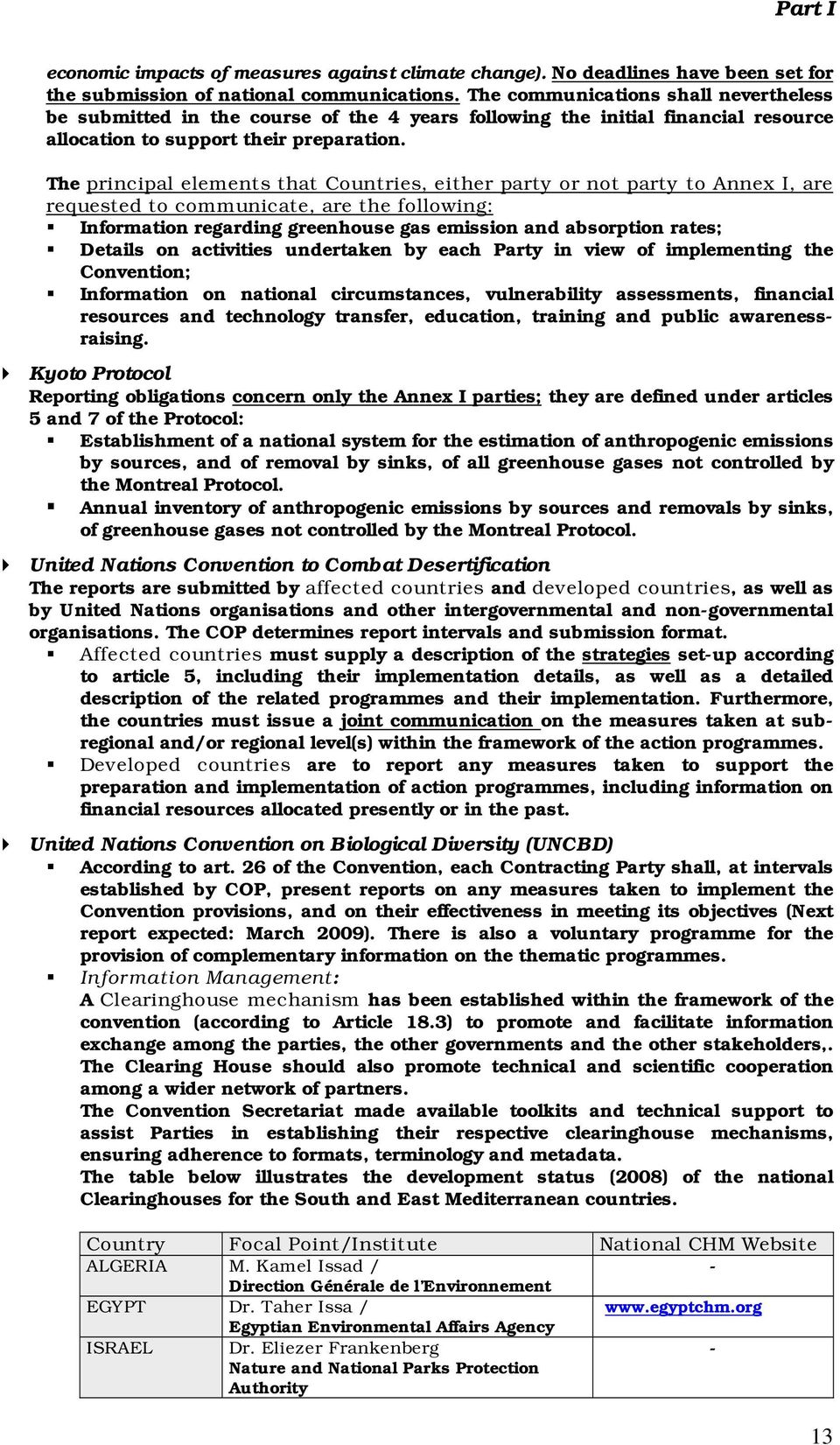
14 Part I JORDAN - - LEBANON Ms. Lara Samaha/ biodiversity.moe.gov.lb Ministry of Environment MOROCCO M. Jaâfar Boulejiouch/ ma.chm-cbd.net Secrétariat d Etat auprès du Ministère de l Energie, des Mines, de l Eau et de l Environnement, Chargé de l Eau et de l Environnement SYRIA Dr. Akram Issa Darwish / - General Commission for Environmental Affairs TUNISIA M. Maher Mahjoub / Ministère de l Environnement et du - (under developoment) Développement Durable TURKEY - - Table 2: Development Status of UNCBD National Clearinghouses Cartagena Protocol on Biosafety According to Article 33 of the Protocol, each Party shall monitor the implementation of its obligations under this Protocol, and shall report to the COP on measures taken to implement the Protocol. The reports are to be submitted on a 4-year interval. Information Management: The Biosafety Clearinghouse (BCH) 6 The Biosafety Clearinghouse is a mechanism setup by the Cartagena Protocol on Biosafety to facilitate the exchange of information on living modified organisms (LMOs) and assist Parties in better complying with their obligations under the Protocol. Global access to a variety of scientific, technical, environmental, legal and capacity-building information is provided in the six UN languages. 1.2 Additional International Conventions on Climate, Biodiversity, Chemical Pollution and Waste, Air and Marine pollution Signature and Ratification Status Climate and Ozone Layer: Vienna Convention for the Protection of the Ozone Layer 7 adopted in 1985, entry into force: Montreal Protocol on Substances that Deplete the Ozone Layer, adopted in 1987, entry into force: COUNTRY VIENNA CONVENTION MONTREAL PROTOCOL ALGERIA 1992(a) 1992(a) EGYPT 1985(s)/1988(R) 1987(s)/1988(R) JORDAN 1989 (a) 1989(a) ISRAEL 1992(a) 1988(s)/1992(R) LEBANON 1993 (a) 1993 (a) MOROCCO 1986(s)/1995(R) 1988(s)/1995(R) SYRIA 1989 (a) 1989(a) TUNISIA 1989 (a) 1989(a) TURKEY 1991 (a) 1991(a) Table 3 : Signature/Ratification of the Vienna Convention and of the Montreal Protocol by the MENA countries. Biodiversity and Forests Ramsar Convention (wetlands) 8 adopted in 1971, entry into force: CEPRB 7 Vienna Convention 14
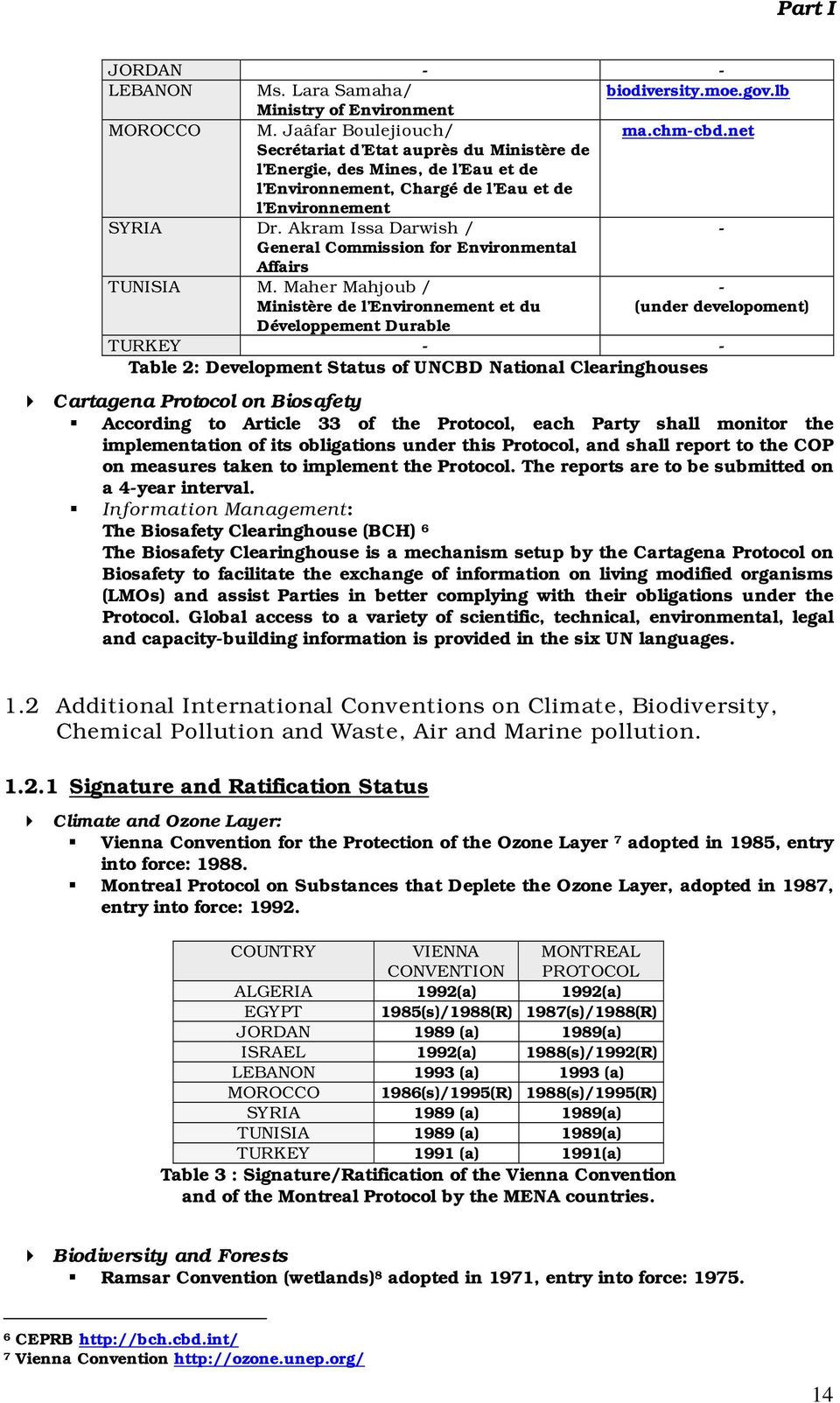
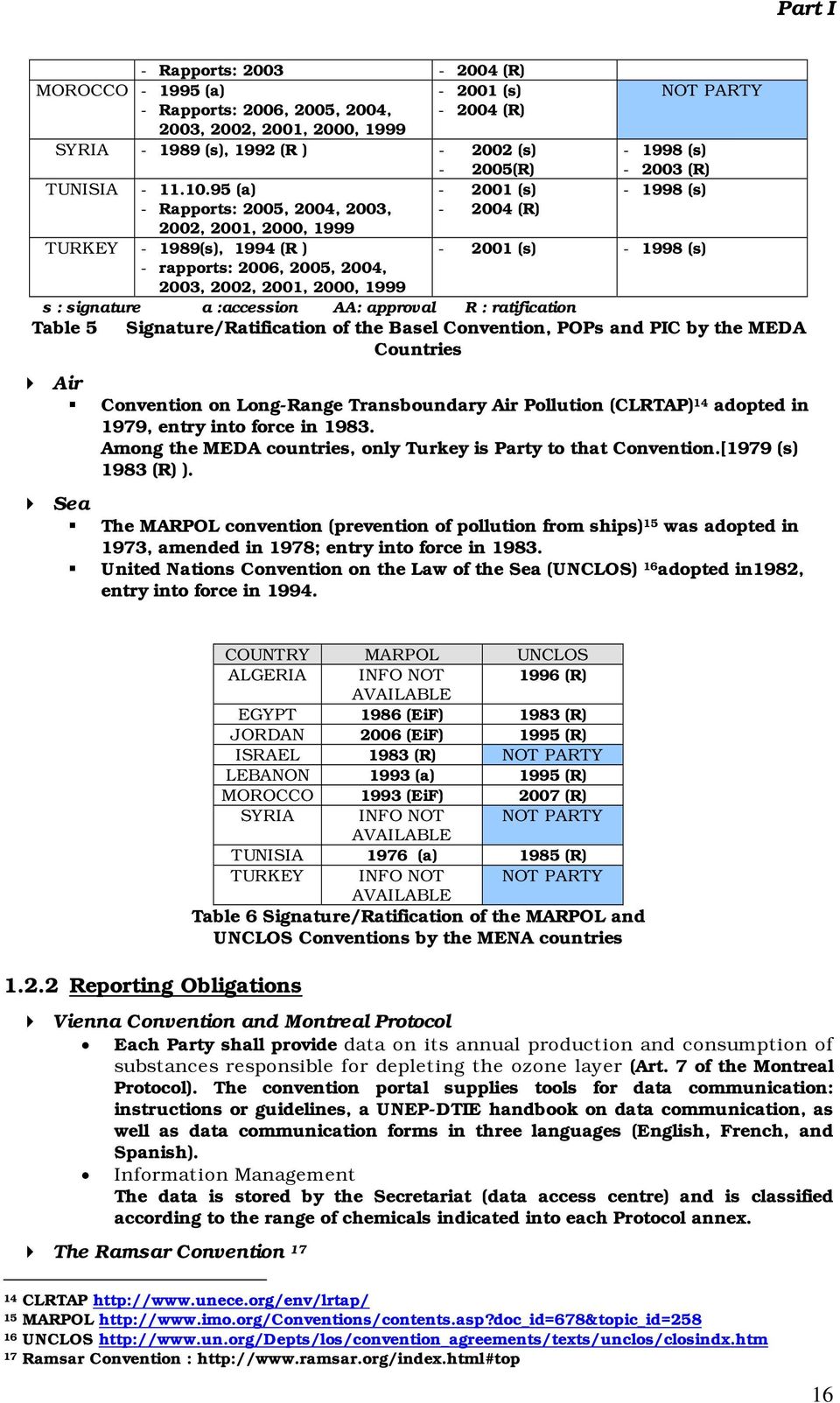
15 Part I At an international level, the Ramsar Secretariat has signed a Protocol of Understanding with UNCDB, CMS (Bonn Convention), the UNESCO World Heritage Convention, UNCCD, UNFCCC. At a regional level, in February 2001, the Secretariat also signed a Protocol of Understanding with the MAP Coordination Unit of the Barcelona Convention, followed by a Cooperation Protocol in February Bonn Convention (terrestrial, marine and avian migratory species) 9 adopted in 1979, entry into force: Convention on International Trade in Endangered Species of Wild Fauna and Flora - CITES 10 adopted in 1973, entry into force in 1975 COUNTRY RAMSAR BONN CITES CONVENTION ALGERIA 1984 (EiF) 2005 (EiF) 1983 (a)/1984 (EiF) Rapports: 2002, 2003, 2004, 2005, 2006, 2007 EGYPT 1988 (EiF) 1983 (EiF) 1978 (a)/1978 (EiF) Rapports: 2002, 2003, 2004 JORDAN 1977 (EiF) 2001 (EiF) 1978 (a)/1979 (EiF) Rapports: 2002, 2003, 2004 ISRAEL 1997 (EiF) 1983 (EiF) 1979 (R)/1980 (EiF) Rapports: 2002, 2003, 2004, 2005 LEBANON 1999 (EiF) NOT PARTY NOT PARTY MOROCCO 1980 (EiF) 1993 (EiF) 1975 (R)/1976 (EiF) Rapports: 2002, 2003, 2004, 2005, 2006 SYRIA 1998 (EiF) 2003 (EiF) 2003 (a)/2003 (EiF) TUNISIA 1981 (EiF) 1987 (EiF) 1974 (R)/1975 (EiF) Rapports: 2002, 2003, 2004, 2005 TURKEY 1994 (EiF) NOT PARTY 1996 (a)/1996 (EiF) Rapports: 2002, 2003, 2004, 2005, 2006 EiF : Entry into force Table 4 : Signature/Ratification of the Ramsar, Bonn and CITES Conventions by the MEDA Countries Chemicals, Wastes Basel Convention on the Control of Transboundary Movements of Hazardous Wastes and their Disposal 11, adopted in 1989, entry into force in Stockholm Convention POPs (persistent organic pollutants) 12 adopted in 2001, entry into force in 2004 Rotterdam Convention (PIC) 13 adopted in 1998, entry into force in 2004 COUNTRY BASEL CONVENTION POPs CONVENTION PIC CONVENTION ALGERIA (a) - Rapports: 2006, 2005, 2004, 2002, 2001, 2000 EGYPT (a) - Rapports:2003, 2002, 2001, 2000, 1999 JORDAN (s), 1989 (AA) - Rapports: 2002, 2001, 2000 ISRAEL (s), 1994 (R ) - Rapports: 2005, 2004, 2003, 2002, 2001, 2000, (s) (R) (s) (R) (s) (a) (R) (s) (s) LEBANON (s), 1994 (R) (s) (R) NOT PARTY NOT PARTY 8 Ramsar Convention 9 Bonn Convention 10 CITES 11 Basel Convention 12 Stockholm Convention 13 Rotterdam Convention 15

16 Part I - Rapports: (R) MOROCCO (a) - Rapports: 2006, 2005, 2004, (s) (R) 2003, 2002, 2001, 2000, 1999 SYRIA (s), 1992 (R ) (s) TUNISIA (a) - Rapports: 2005, 2004, 2003, 2002, 2001, 2000, 1999 TURKEY (s), 1994 (R ) - rapports: 2006, 2005, 2004, 2003, 2002, 2001, 2000, (R) (s) (R) NOT PARTY (s) (R) (s) (s) (s) s : signature a :accession AA: approval R : ratification Table 5 Signature/Ratification of the Basel Convention, POPs and PIC by the MEDA Countries Air Convention on Long-Range Transboundary Air Pollution (CLRTAP) 14 adopted in 1979, entry into force in Among the MEDA countries, only Turkey is Party to that Convention.[1979 (s) 1983 (R) ). Sea The MARPOL convention (prevention of pollution from ships) 15 was adopted in 1973, amended in 1978; entry into force in United Nations Convention on the Law of the Sea (UNCLOS) 16 adopted in1982, entry into force in Reporting Obligations COUNTRY MARPOL UNCLOS ALGERIA INFO NOT 1996 (R) AVAILABLE EGYPT 1986 (EiF) 1983 (R) JORDAN 2006 (EiF) 1995 (R) ISRAEL 1983 (R) NOT PARTY LEBANON 1993 (a) 1995 (R) MOROCCO 1993 (EiF) 2007 (R) SYRIA INFO NOT NOT PARTY AVAILABLE TUNISIA 1976 (a) 1985 (R) TURKEY INFO NOT NOT PARTY AVAILABLE Table 6 Signature/Ratification of the MARPOL and UNCLOS Conventions by the MENA countries Vienna Convention and Montreal Protocol Each Party shall provide data on its annual production and consumption of substances responsible for depleting the ozone layer (Art. 7 of the Montreal Protocol). The convention portal supplies tools for data communication: instructions or guidelines, a UNEP-DTIE handbook on data communication, as well as data communication forms in three languages (English, French, and Spanish). Information Management The data is stored by the Secretariat (data access centre) and is classified according to the range of chemicals indicated into each Protocol annex. The Ramsar Convention CLRTAP 15 MARPOL 16 UNCLOS 17 Ramsar Convention : 16
17 Part I Every three years, the Parties submit their National Reports to the COP, in a format adopted by the Parties which reflect the structure of the Strategic Plan of the Convention. The Parties shall report to the Secretariat any change or ecological hazard threatening their national classified wetlands, and shall also respond to requests concerning the reports received by third parties. Each country shall update its Information Sheet on Ramsar Wetlands (RIS) every six years, with the following information: - Reasons for including wetlands in the Ramsar List, and evaluation of their importance vis-à-vis the agreed Criteria; - Data regarding the ecological aspects, the value and threats to those aspects which need to be faced in order to manage the site effectively; - A snapshot of the site for the benefit of the general public; Information Management Support: o The Ramsar database is hosted on the Wetlands International Website 18 (1700 sites/158 countries); it includes a search engine. The sites can be visualised on geographical maps. The data used were extracted from the descriptive forms and the national reports provided by the Contracting Parties. o The «Centre for International Earth Sciences Information Network» (CIESIN) at Columbia University (USA), has developed the Ramsar Wetlands Data Gateway 19 a multidisciplinary database for each Ramsar site (1198 sites designed until 2002). A search engine is available to facilitate the access to information. The Bonn Convention The Parties must submit national reports (in a questionnaire based format) on the implementation of the Convention (Article VI (3)). The latest report submission dates back to May A list of the States within the range of the migratory species (listed in Annexes I and II of the Convention) shall be updated by the Secretariat, according to the information received from the Parties on: - The migratory species (listed under Annexes I and II) regarding which the Parties consider themselves as Range States; - The measures taken by the Parties to apply the provisions of the present Convention with regard to those species (=every three years). Convention on International Trade in Endangered Species of Wild Fauna and Flora - CITES An annual report (Article VIII, paragraph 7) containing a summary of the information regarding, namely, the number and type of permits and certificates granted; the States with which such trade occurred; the numbers or quantities and types of specimen; names of species as included in Annexes I, II and III. Updating data and reports helps national decision-makers to define, apply and evaluate their trade orientations and the management of wild species. A biennial report on the legislative, regulatory and administrative measures taken to enforce the Convention, whose purpose is also to be a self-evaluation tool for countries. Guidelines are supplied for the preparation, submission and standard presentation of yearly and biennial reports. Information Management: All the reports are computerised; the Secretariat keeps a table on the submission of yearly and biennial reports. Basel Convention Each Party shall submit, before the end of each calendar year (Article 13: Transmission of Information), a report on, among other things, the trans- 18http://ramsar.wetlands.org/Database/Searchforsites/tabid/765/Default.aspx 19Ramsar Wetlands Data Gateway: 17
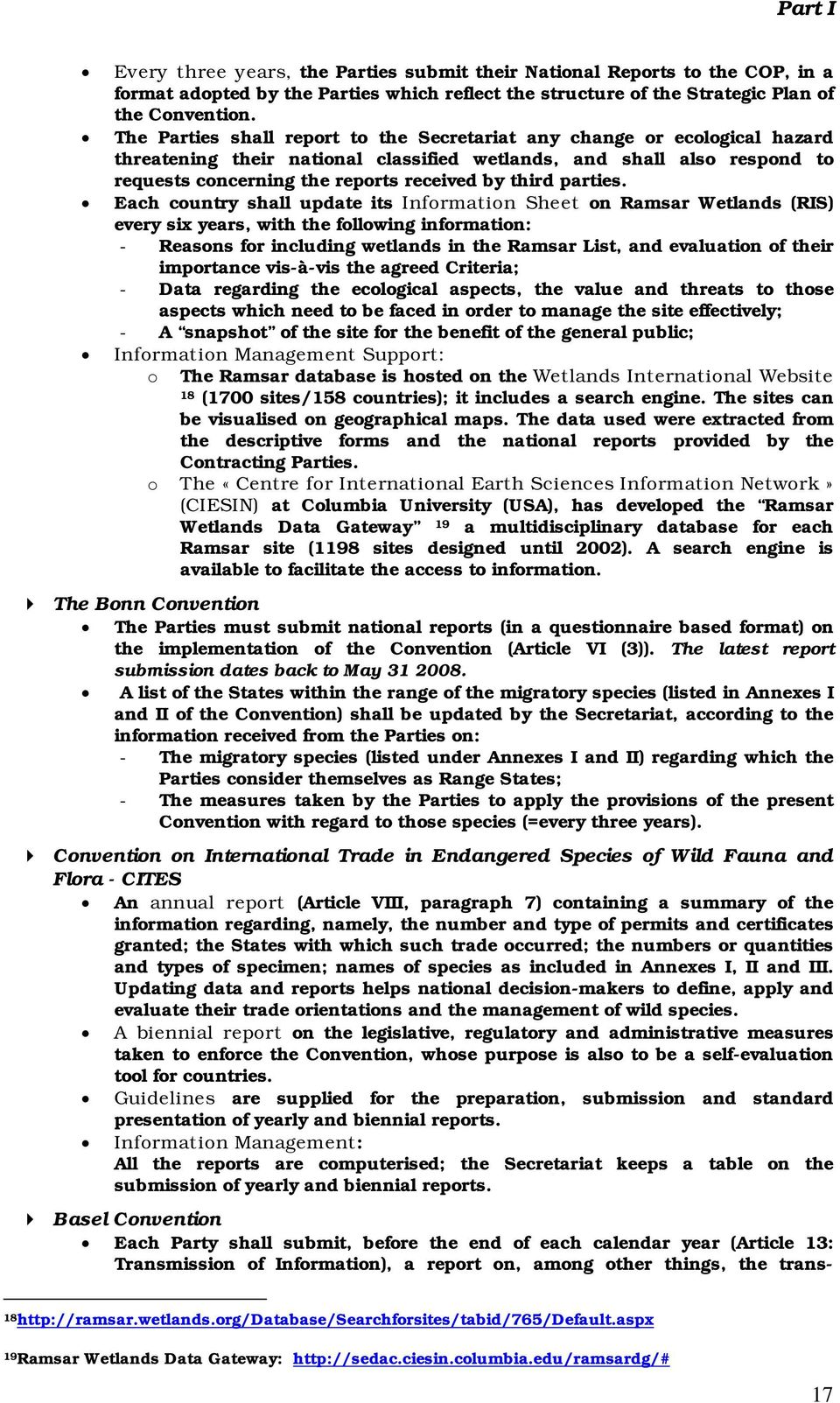
18 Part I boundary movements of hazardous wastes, or of other wastes (quantity, categories and characteristics, destination, any transit country, disposal method), in which it has been involved. They also have to supply qualified statistics on the effects of the generation, transportation and disposal of hazardous wastes, or other wastes, on human health and the environment. Information Management: In line with the Basel Convention, the Online Reporting Database (questionnaire based) contains data and information on hazardous wastes and other wastes, as transmitted by Parties, according to article 13(3) of the Convention. Stockholm Convention Every four years, each Party shall report (Article 15 of the Convention) to the COP on the measures taken to implement the provisions of this Convention, and on the effectiveness of such measures in meeting the objectives of the Convention. Each Party shall provide the Secretariat with: - Statistical data on the total quantities of of the chemicals listed in Annex A and Annex B produced, imported and exported, or a reasonable estimate of these data; - A list of the States from which it has imported each such substance and the States to which it has exported each such substance. Information Management: An Electronic Reporting System has been setup and is accessible on the Internet 20 Rotterdam Convention The ratification of the convention does not entail any reporting obligation. MARPOL 73/78 The ratification of the convention does not entail any regular reporting obligation. The only exception concerns the obligation for the Parties deriving from the amendments adopted in 1996 (entry into force in 1998) to the Protocol I that contains provisions for reporting incidents involving harmful substances. United Nations Convention on the Law of the Sea (UNCLOS) Article 205 of the Convention does not specify reporting intervals. The reports are informative and concern the measures adopted to mitigate activities that are potentially polluting for the sea. Obligations are general and the Convention supplies no further specifications concerning reporting obligations

19 Part I 2 Other UN Initiatives 2.1 The Commission for Sustainable Development (CSD) Following the 1992 Rio de Janeiro UN Conference on Environment and Development, a Commission for Sustainable Development (CSD) was created to monitor and assist in the implementation of Agenda 21, a global action plan for sustainable development. To this end, and in cooperation with several international organizations and research bodies, the CSD developed a set of 134 indicators with the aim of monitoring the progress, both globally and nationally, of achieving sustainable development. These indicators have been grouped into themes and subthemes representing different dimensions and lines of action for sustainable development. Within the four identified dimensions (social, environmental, economic and institutional), a final framework of 15 themes and 38 sub-themes covering issues generally common to all countries, have been agreed to. 2.2 The Millennium Development Goals (MDGs) The Millennium Development Goals (MDGs) include eight goals to be achieved by 2015 that respond to the world's main development challenges. The MDGs are drawn from the actions and targets contained in the Millennium Declaration that was adopted by 189 nations-and signed by 147 heads of state and governments during the UN Millennium Summit in September The eight MDGs break down into 21 quantifiable targets that are measured by 60 indicators. Goal 7- Ensure environmental sustainability is monitored through the following indicators: 1. Target 7a: Integrate the principles of sustainable development into country policies and programmes; reverse loss of environmental resources 2. Target 7b: Reduce biodiversity loss, achieving, by 2010, a significant reduction in the rate of loss 7.1 Proportion of land area covered by forest 7.2 CO2 emissions, total, per capita and per $1 GDP (PPP) 7.3 Consumption of ozone-depleting substances 7.4 Proportion of fish stocks within safe biological limits 7.5 Proportion of total water resources used 7.6 Proportion of terrestrial and marine areas protected 7.7 Proportion of species threatened with extinction 3. Target 7c: Reduce by half the proportion of people without sustainable access to safe drinking water and basic sanitation 7.8 Proportion of population using an improved drinking water source 7.9 Proportion of population using an improved sanitation facility 4. Target 7d: Achieve significant improvement in lives of at least 100 million slum dwellers, by Proportion of urban population living in slums UN Country Teams helped the countries to prepare national reports that measure progress towards the MDGs. National MDG reports were published in over 140 countries. 19

20 Part I 3 The Barcelona Convention 3.1 The Barcelona Convention and its Protocols Since 1994, the Barcelona Convention (1975) and its protocols for the Protection of the Marine Environment and the Coastal Region of the Mediterranean have brought together: The need of sustainable development; The commitment of parties to apply precautionary and polluter pays principles; The need of informing the general public and involving the civil society in the decisionmaking processes. The following table displays the status of the signature and ratification of the Barcelona Convention by the Southern and Eastern Mediterranean countries (April 2008). Country ALGERIA EGYPT ISRAEL JORDAN LEBANON Barcelona Convention r/ac AoA s r/ap AoA s r AoA s r/ac MOROCCO s r AoA SYRIA r/ac AoA Dumping Protocol amended text not yet EiF r/ AC s r/ AP AoA s r s AC s r r/ AC Prevention & Emergency Protocol 1 LBS Protocol amended text not yet EiF SPA and Biodiversity Protocol EiF 2004 EiF s r/ac s - r /AC r/ac s r s s r OFFSHORE Protocol not yet EiF HAZARD Protocol 2008 EiF ICZM Protocol not yet EiF s s s s s NOT PARTY s s r s s s r s r r AoA s r/ac r s AoA TUNISIA TURKEY s r AoA s r AoA s r AoA s r AoA s s r AoA r r/ac AoA s r s r s r r r r - S = signature R =ratification AC= accession AP=approval AoA= (Acceptance of Amendments) EiF= Entry into Force 1 This Protocol replaced the Protocol Concerning Cooperation in Combating Pollution of the Mediterranean Sea by Oil and other Harmful Substances in Cases of Emergency which was in force since 12 February This Protocol replaced the Protocol concerning Mediterranean Specially Protected Areas which was in force since 23 March pending notification from Depositary country Source Reporting Obligations Reporting Obligations are stated under article 26 of the Barcelona Convention and regard the following: The legal, administrative and other measures taken by the Parties for the implementation of the Convention, of the Protocols and of the recommendations adopted by their meetings; 20

21 Part I The effectiveness of these measures and problems encountered in the implementation of the instruments mentioned above. The format of the reports and the frequency of submission are determined by COP (every two years in average). Since 2007, a new reporting format (performance indicators) for the application of the Barcelona Convention and of its Protocols has been drafted 21. The new format was designed following a comparative analysis of the MAP reporting system and the reporting systems of other international conventions and EC directives 22. Example of Performance Indicators for the Barcelona Convention 1) State of ratification 2) Bilateral, sub-regional and regional agreements 3) Multilateral tools 4) Legal measures 5) Political measures: integration of the protection and conservation of the marine environment and coastal areas in development policies a) National sustainable development strategy b) Regional strategies adopted within the MAP framework c) ICZM and land use planning 6) Economic tools 7) Resource allocation for: a) The creation of institutions b) The setting-up of a permanent monitoring programme c) Public access to information 8) Further measures Reporting Support Tools An web based information system to support the Barcelona Convention reporting process is currently being developed and should soon be available for testing to the signatory Parties to the Convention Information and Data Management An information and data management system (INFOMAP) managed by the Barcelona Convention Secretariat and its Regional Activity Centres is currently being developed. In this framework, The Blue Plan is developing a Mediterranean Information System on Environment and Sustainable Development (SIMMED). The aim of the system is to facilitate the retrieval, management, processing and use of the data necessary for the Blue Plan activities, such as indicator calculation, prospective and systemic analyses of priority issues. A preliminary version should be available by the end of The Mediterranean Commission for Sustainable Development (MCSD) The MCSD 23 was setup in 1996 as an advisory body for MAP. MCSD meets once a year and its membera are representatives of the Convention Contracting Parties (22) and of Civil Society (5 NGO, 5 representatives of the socioeconomic world, and 5 local authorities). MCSD deals with the following eight priority areas: Sustainable management of coastal areas; Water Demand Management; Sustainable Development Indicators in the Mediterranean; Tourism and Rural Development in the Mediterranean; Industry and Environment; Awareness Raising and Information; Free-trade and Environment in the Euro- Mediterranean Context; Urban Management and Sustainable Development. 21 UNEP(DEPI)/MED WG 320/ (UNEP(DEC)/MED WG.270/Inf.7, 2005) 23 CMDD ds=&s_title=&s_year=&s_category=&id=&page=&s_descriptors=&s_type=&s_author=&s_final=&s_mnu mber=&s_sort=&lang=fr 21
22 Part I MCSD has elaborated a Mediterranean sustainable development strategy (MSSD) that has officially been approved by the Contracting Parties during the 14 th Meeting held in Slovenia in November The Strategy (MSSD) 24 is founded upon four objectives and seven priority fields of action. The four main objectives are: Contribution to economic development by enhancing Mediterranean assets, Reduction of social disparities by implementing the UN Millennium Development Goals and improve cultural integration, Change unsustainable production and consumption patterns and ensure the sustainable management of natural resources, Governance improvement at the local, national and regional levels. The seven priority fields of action are: 1. Improving integrated water resource and demand management; 2. Managing energy demand and mitigating the effects of climate change; 3. Ensuring sustainable mobility through appropriate transport management; 4. Promoting sustainable tourism; 5. Promoting sustainable agricultural and rural development; 6. Promoting sustainable urban development; 7. Promoting balanced development and integrated management of the coastline, urgently halting the degradation of coastal areas; MSSD Follow-up Indicators Following the creation of the Mediterranean Commission on Sustainable Development (MCSD) in 1996, the UNEP/MAP Blue Plan Regional Activity Centre was entrusted with promoting and monitoring the implementation of sustainable development in the Mediterranean countries. Similarly to the UN CSD sustainable development indicators framework, the MCSD facilitated the identification of indicators significant to sustainable development in the Mediterranean basin, and specific to it, arriving at a set of 130 indicators (with only 40 of them common to the UN CSD framework). Out of these, 34 priority indicators have been selected in 2005 to follow-up the strategy (10-15 complementary indicators were to be proposed for a more precise follow-up in each of the different priority fields). National programs were initiated for indicator calculation and monitoring. The MSDD reviews the implementation of the Strategy every two years and revises it every five. Example of MSSD follow-up indicators (see the complete list in the MSSD document): Priority field: Promote balanced development and integrated management of the coastline Actions N Indicators Push back urbanisation to prevent artificialization of coasts. Avoid linear and continuous urbanisation. N. 23 Share of artificialised coastline Total linear coast (strip 0-1 km and 1-10 km) Eliminate operational pollution from ships by N. 24 Operational pollution from ships Reduce pollution from land-based sources. N. 25 Proportion of coastal urban population connected to a sanitation network Promote the sustainable management of the sea and of the coasts and urgently halt coastal degradation. Halt or reduce substantially marine and coastal biodiversity loss by Bring at least 10% of the marine and coastal surface under some form of protection. N. 26 Surface of protected coastal and marine areas. 24 Mediterranean Sustainable Development Strategy (WSSD) 22
23 Part I 4 Regional programmes 4.1 Med Pol Programme The MED POL programme of the Barcelona Convention is funded by the Mediterranean Trust Fund, which is supported by all the Contracting Parties to the Convention. Since its creation in 1975, the MED POL programme has enabled the creation in each country of a pollution follow-up programme and of a pollution data quality improvement programme. Phase IV of the MED-POL programme ( ) 25 continues to deal with the assessment and control of marine and coastal pollution, through constant monitoring, capacity-building, assessments, and preparation of pollution reduction measures. The objective is to better integrate its activities (e.g. constant monitoring) with the Strategic Action Plan and the Protocols ( land-based, dumping and hazardous waste ), and to establish operational ties with other pertinent international initiatives (the Europan Marine Strategy, Horizon 2020, the Conventions of Stockholm, Basel and London, the Global International Waters Assessment). Furthermore, MED POL participates in applying the MAP ecosystem approach. The progress achieved in the implementation of the SAP and the Protocols are evaluated by monitoring suitable indicators; the implementation approach and tools (data quality programme, training, capacity-building) is then modified consequently Med Pol Reporting Activities and Data Management Every two years, each participating country shall prepare a detailed report on the activities performed and on the outcome of the national monitoring programmes in the framework of the Med Pol programme. All the data supplied by the countries are mainly being stored by Med Pol in two databases (Microsoft Access): Pollution rate (measured on different parameters: water, sediments and biota) Pollution sources (emission and discharge data, classification by sectors), data regarding the position of the evaluated sites and the institutions involved. The MED POL Phase III Monitoring Activities 26 Website offers access to some of the information (maps bearing the site positions and type of analysis made), though only for a limited number of countries. Reporting formats for the different variables can be downloaded as Excel or Word tables. The validated MED POL Phases I and II ( ) data are available on the above-mentioned website. The MED POL information system is currently being elaborated. It will be made up of 6 modules: Inventory and support Data retrieval GIS Remote sensing Operational oceanography Simulation (modelling) module The data management protocols will be compatible with those of the other RACs and the EEA, thus enabling MED POL to exchange data and information in a simple and reliable manner. 25 MED POL - PHASE IV Operational Document ( ) (Juin 2007)
24 Part I SAP MED The Strategic Action Plan (SAP MED), a MED POL Programme initiative, has made it possible to pinpoint priority target-categories of substances and polluting activities 27 that the Mediterranean countries need to eliminate or control. In this framework, between 2004 and 2005, the countries prepared a national inventory, quantifying all the pollution sources along the coasts (basic emission and discharge evaluation), and drafted a national diagnosis indicating the priority issues. Furthermore, the countries elaborated National Action Plans (NAPs) to address pollution from land-based activities, which were formally adopted by the Contracting Parties in SAP MED is the cornerstone for the implementation by Contracting Parties of the Landbased Protocol, which came into force on May The countries identified 131 Pollution hotspots within the framework of the UNEP Strategic Action Plan (SAP). The hotspots are pollution sources, or coastal sectors, that could affect human health, ecosystems, biodiversity, sustainability or the economy. 26% of these hotspots are urban, 18% are industrial and 56% are combined (urban and industrial). Figure 1 Distribution of Coastal Pollution Hotspots (UNEP/MEDU, 2000) 4.2 SMAP and its Environmental Information Exchange System. A web-based information exchange system dealing with environmental topics in the Mediterranean region has been created within the framework of the SMAP programme: the SMAP Clearinghouse The SMAP Clearinghouse The portal has been set up by SMAP RMSU, building upon IT tools developed by the European Environment Agency. SMAP RMSU collaborated with national stakeholders, principally from the South and East Mediterranean. The portal is available in three languages: Arabic, French and English. 27 The main PAS MED activities directly concern the urban environment and industrial activities, focusing namely on those responsible for discharging toxic, persistent substances, likely to engender bioaccumulation, in particular persistent organic pollutants (POP). 24
25 Part I The information collected concerns the following environmental topics: Desertification Integrated coastal zone management Waste Water Hotspots: polluted areas (industrial) Hotspots: biodiversity Cleaner production and sustainable consumption Climate change Energy The topics are organised into 5 sections: 1. Projects : inventory of regional and national environmental projects organised around the five SMAP priority fields (integrated water management, integrated waste management, hotspots, integrated coastal zone management and combating desertification); 2. Regional: information relevant to the policies and regulations implemented in the Mediterranean region, as well as studies and other sources of information; 3. National: national environmental information, environmental organisations and institutions: laws, regulations, strategies and environmental action plans; studies, reports and datasets, other sources of national information (reviews, media, web portals, etc.); 4. Management tools: this section contains references to best practices, economic instruments, various evaluations and assessments, as well as guidelines, plans and manuals to mitigate environmental degradation and manage environmental resources sustainably. 5. Experts Database: a directory of environment experts around the Mediterranean region. The clearinghouse currently has over 5000 references distributed as follows: Inf. Rég. Inf pays (10) Outils gestion Projets Experts GeoMap provides a simple geographic navigation tool enabling access to information stored in the Clearinghouse. Currently, the two main information categories accessible through this tool are: o good/best practice projects dealing with pollution abatement (especially industrial emissions, municipal waste and urban waste water) implemented in the South and East Mediterranean countries. o Waste water-treatment plants in Italian coastal cities, classified according to the nature of the treatment (preliminary, primary, secondary and tertiary). This information is based upon the data supplied by ISPRA (former APAT) in 2005, in the framework of the reporting obligations to the Council Directive 91/271/EEC dated May on the treatment of urban waste water. 25
26 Part I During 2008, a new section was added to the Clearinghouse by the EEA: Med-ReportNet. Med-ReportNet is the test version of a tool aimed to to assist Mediterranean countries in complying with their environmental reporting obligations; it is based upon the ReportNet system already used by the European countries (also see 3.5.1). 4.3 The Medstat Programme The broad outline of the MEDSTAT project is: 1) Sustainable consolidation of the capacities of Mediterranean National Statistical Systems (NSS) for the production and diffusion of environmental statistics; 2) Regional standardisation of environmental information systems in compliance with European and international standards; 3) Development of the exchange of data and of experiences among the partner countries; 4) Broadening the dissemination of environmental statistical data. The programme was implemented in two stages: and The second stage aimed essentially at: 1) Consolidating the technical and institutional experience gathered in the first stage; 2) Improving environmental statistics by means of a new approach integrating economic and environmental issues, and broadening the range of topics (e.g. marine environment; environment protection expenditure); 3) Developing a national inter-institutional network; 4) Exchanging data and setting-up an adequate data exchange system covering all the sectors of MEDSTAT. A list of the principal environmental indicators exchanged in the framework of the Medstat programme is supplied under annexe Data Exchange and Management System The tool proposed is a combined SAM -MIS application, supported in the long-term by Eurostat. SAM (Statistical Administration and Management) has been created for processing, filing and handling statistical data, and calculating multidimensional statistics. One of the four independent MIS (Management Information System) modules is the Statistical Data Module that can be connected to an existing statistical database (a local database or the one managed by SAM), thus enabling users to share and retrieve data easily. The main purpose of the application is therefore to: Generate questionnaires for data collection, including data from previous years Visualise dynamic tables extracted in real time from any origin, thus exploiting data from an existing database. SAM and MIS are two different applications that can be used independently, though MIS enables the use of SAM. The combination of the two components provide a tool that covers the whole statistical: Data collection via questionnaires, if need be, Data collection according to personalised validation rules, including specific functionalities to follow-up the collection process A functionality table enabling real time data visualisation/extraction. (The application is available and operational since October 2008 in all the programme partner countries.) 26
27 Part I 4.4 EMWIS Created in 1997, EMWIS is a Euro-Mediterranean initiative aimed at fostering information and knowledge exchange in the water sector, among the Euro-Mediterranean partnership countries. A Steering Committee and a Coordination Committee are the governing bodies. Operations are managed nationally by a network of National Focal Points, and regionally, by a central Technical Unit. National Focal Points are in charge of identifying information sources of which they guarantee the quality. EMWIS has three main objectives: Ensure easy access to water information Improve information exchange among stakeholders Work with stakeholders on common products and cooperation programmes Exchange and Management of Water Information: the EMWIS portal The EMWIS portal currently contains a large amount of information on the following: Institutions Documentation Training Research and development Data management It contains metadata pointing to information in other sources. In the next stage, currently under preparation, EMWIS should become a regional water observation mechanism, based upon the exchange of information and data from National Water Information Systems. To this end, a strategic collaboration has been set-up with the European Environment Agency, to: Develop the Interface between WISE (Water Information System for Europe) and the Mediterranean Water Observatory/Information system Encourage data production and sharing among Mediterranean partner countries Prepare information dissemination tools/methods (indicators, thematic maps, reports). 4.5 Horizon 2020 The European Commission Communication Establishing an Environment Strategy for the Mediterranean launched the Horizon 2020 initiative, with the objective of tackling the top sources of Mediterranean pollution by year A timetable for the implementation of the initiative was adopted by the Euro-Mediterranean Environment Ministers during the third Ministerial Conference, held in Cairo on November The European Commission is coordinating the Horizon 2020 initiative through a steering committee. Synergies were established with other related initiatives, such as the MAP Strategic Action Plan (SAP) to address pollution from land-based activities. The Horizon 2020 activities are grouped under 4 headings: Pollution reduction Capacity-building Research Review, Monitoring In June 2007, the steering committee met for the first time and 3 sub-groups were created: Pollution Reduction (chaired by the European Investment Bank), Capacity Building (chaired by the EC) and Review, Monitoring and Research (chaired by the EEA). In this framework, the EEA, in cooperation with UNEP/MAP and its Regional Activity Centres, the Parties of the Barcelona Convention, and other players working at a regional level in the Mediterranean area, shall: Build a process and coherent framework to assess and compare the progress of the initiative with the help of indicators (Scorecard). Facilitate the development of national information systems with the aim of producing reliable and comparable statistical data supporting Horizon 2020 objectives. 27
28 Part I Follow-up the progress of the initiative by publishing a biannual report on the state of the project in each country (country profile), as well as a five-year report on the state of the Environment in the Mediterranean area. In October 2008, the first meeting of the Review, Monitoring and Research group was held in Athens. 3 working groups were proposed: the first focused on the pilot project for the biennial report and the scorecards (Morocco and Tunisia proposed to participate in the works); the second group worked on the development of specific Mediterranean environment indicators; the third was in charge of the Horizon 2020 research component. A four year EEA-coordinated project ( ), funded by EuropAid in the framework of the European Neighbourhood Policy (ENP), will support the works of the Review, Monitoring and Research component of the Horizon 2020 initiative (e.g. by producing follow-up indicators and first experiments, consolidating country capacities in terms of information exchange, and setting-up a shared information system for the Mediterranean (SEIS) on the principal Horizon 2020 topics waste-water, waste, industrial emissions) Med-ReportNet In the framework of the preparatory activities for the Horizon 2020 initiative, the EEA has developed a new section in the clearinghouse: Med-ReportNet - This section was set-up on the basis of ReportNet, the European IT infrastructure for environmental reporting, created by the EEA to support European countries in their reporting obligations, in compliance with EU and international directives. Med-ReportNet was established essentially to extend ReportNet to the non-european signatory parties of the Barcelona Convention (Algeria, the Palestinian Authorities, Egypt, Israel, Lebanon, Libya, Morocco, Tunisia, Syria 28 ). It enables the on-line creation of reports according to the reporting formats developed for the Barcelona Convention. Two presentations in English and in French - Example of how to use Reportnet for reporting to the Barcelona Convention - explain the general rules for creating reports and filling them in on-line. This new instrument was introduced in Egypt, Morocco, Syria and Tunisia, during the meetings organised by the SMAP RMSU (see Part II, conclusions country by country). The test version of Med-ReportNet must be developed further and adapted by the EEA to the Mediterranean context and to the reporting obligations of the Barcelona Convention, MSSD and Horizon 2020, also bearing in mind the need to rationalise reporting efforts and data exchange in the region. 4.6 The Arab League Indicators In 1997, the Arab League (LAS), through its General Department for Economic Affairs, selected a set of 29 indicators from the core set of 58 indicators and methodology sheets developed in chapter 40 of Agenda 21, to assess the environmental status in Arab States. LAS Member countries were invited to select and calculate the indicators more relevant with the national context in view of the future preparation of a regional environmental report 29 for the Arab Region. Six countries are voluntarily calculating a selection of 29 of such indicators: Egypt, Morocco, Qatar, Saudi Arabia, Syria and Tunisia. 28 Turkey is already party to the EEA Eionet network. 29 The Environment Outlook for the Arab Region (EOAR) report was requested by the 7th Session of the Council of Arab Ministers Responsible for the Environment (CAMRE) that was held in December 2005 in Cairo, Egypt. The resolution invites UNEP to prepare an Environment Outlook for the Arab Region in collaboration with Arab Specialised Centres and GEO Collaborating Centres in the Region. The report aims to provide an up-to-date, comprehensive, reliable, scientifically credible, policy-relevant and legitimate regional assessment and outlook of the interaction between environment and society. The document will be used by CAMRE and other regional and national stakeholders for sound decisionmaking and policy formulation to improve environmental management and achieve progress towards sustainable development in the region. The report was expected to be launched at the end of
29 PART II COUNTRY REPORTS 29
30 EGYPT 5 Overall institutional and regulatory framework for environmental management in Egypt 5.1 Main international and regional conventions signed or ratified by Egypt Egypt has ratified the following conventions : UNFCCC-Kyoto Protocol, CBD-Cartagena Protocol, UNCCD, The Vienna Convention for the Protection of the Ozone Layer & The Montreal Protocol on Substances that Deplete the Ozone Layer, Ramsar Convention, Bonn Convention, Convention on International Trade in Endangered Species of Wild Fauna and Flora, Basel Convention, Stockholm Convention, MARPOL and UNCLOS conventions, Barcelona Convention and its protocols: Dumping Protocol, LBS Protocol, SPA and Biodiversity Protocol. (See Part 1 for more details). 5.2 National regulations for the protection of the environment The Environmental Protection Law (Law 4/1994) 30 defines the overall institutional and administrative frameworks for environmental protection in Egypt. It sets the tasks and the responsibilities of the Egyptian Environmental Affairs Agency (EEAA), including its interrelations with the other sectors of the government: Preparation of draft legislation and decrees pertinent to environmental management Collection of data both nationally and internationally on the state of the environment Preparation of periodical reports and studies on the state of the environment Formulation of a national plan and its projects Preparation of environmental profiles for new and urban areas, and setting up standards to be used in planning for their development. Preparation of an annual report on the state of the environment to be prepared and submitted to the President With reference to environmental information, the provisions of the Law 4/1994 indicate that the Egyptian Environmental Affairs Agency (EEAA) is mandated, in order to achieve its objectives, to regularly collect national and international information on the environmental status and their changes, in collaboration with information centres in other entities, assess and employ these information in environmental management and disseminate such information (Article V, chapter II). The law defines also the provisions for the Environmental Protection Fund. The Egyptian law of Punishment is related to the protection of trees, water streams and the Nile River, and the combat against desertification. The measures of the Agricultural Law No. 53 (1966) are also related with combating desertification, as well as with the protection of the agricultural environment from deterioration and conservation of cultivatable lands. The Law No. 124 (1983) is related to the protection of water resources and it regulates also fishing, conservation of marine animals and fish farming. Law 102/1983 for the Establishment of Protected Areas 31 is the most valuable law for nature conservation in Egypt. The law provides legal framework for the creation and
31 management of protected areas. The Egyptian Environmental Affairs Agency (EEAA) is mandated as the competent authority for implementing this law. The National Environmental Action Plan (NEAP ) 32 The primary aim of the NEAP is to provide the ground for a national participatory and demand-driven environmental planning process. It lays the foundations of a partnership between environmental stakeholders and development actors, and of a constructive and responsible working climate among all parties involved leading to effective formulation of plans and to their implementation. The NEAP was developed in consultation with central and local public bodies, and non- government agencies. It includes Egypt s agenda for environmental actions for years The major environmental issues and concerns indicated in the plan are the degradation of land, of air quality and of water resources, and the need to preserve the country s culture heritage and natural biodiversity. In 2005, EEAA assessed the implementation status of the NEAP in collaboration with the National Planning Institute (body of the Ministry of Economic Development Former Ministry of Planning) through a consultative process involving the concerned ministries and authorities. Difficulties were encountered in this assessment, due to the absence of an indicator system in the NEAP. In this respect, the need for a framework of performance indicators to be calculated, monitored and used for reporting by different entities involved in the NEAP implementation was recognized. Moreover, the importance of strengthening the coordination between EEAA and the environmental departments in concerned ministries and entities to promote the implementation of the NEAP was emphasized. The importance to ensure the integration of the environmental and natural resources management activities within the five year Egypt Development Agenda prepared by the Ministries of Planning and Environment, was also recognized as paramount. Egypt Sixth Five-Year Plan for development ( ) 33 The plan, prepared by the Ministry of Development (formerly Planning and Local Development) includes both investment programs and projects aiming at expanding production capacities and improving social services and infrastructure: Creating employment through stimulating investments; Enhancing economic reforms to foster development; Promoting private sector participation in economic activities; Chapter six is focused on sustainable environment and development. It includes programs for water and sanitation, environmental improvement, the empowerment of women, social security. It covers also air quality, industrial pollution, waste management, nature conservation and public awareness. The Plan includes a chapter on the Performance Evaluation of the Fifth Five Year Plan (2002/ /07). This evaluation is mostly indicator based. Concerning the environment, indicators are reported for the water and sanitation sector only. The National Accounts published on yearly basis by the Ministry of Economic Development do not contain environmental data. In the Sixth Plan, specific improvements targets are set for the water and sanitation sector including the indication of the foreseen investments. For the other environmental sectors, a simple list of projects is indicated. National Strategy for Cleaner Production in Egyptian Industry (2004) 34 The document was produced by the Environmental Pollution Abatement Project (EPAP) of EEAA. EPAP local and international consultants reviewed the existing practices in different industrial sectors in Egypt, identified the existing or perceived barriers against cleaner production implementation, and proposed a framework for encouraging cleaner production uptake in Egypt. The national strategy for CP draws a policy for encouraging the adoption and implementation of cleaner production in the Egyptian industry;
32 presents the necessary actions that the Egyptian Government should take to facilitate the uptake of cleaner production in the Egyptian industry; prioritizes these actions on the basis of a set of pre-determined criteria; and identifies prerequisites, time frame and resources for each action. The strategy includes the proposal of a monitoring and reporting system, as well as a list of proposed quantitative indicators to determine the progress towards achieving cleaner productions goals for each industrial sector. No report on the implementation of the strategy was identified. 5.3 National institutional framework for environmental management and reporting activities The project National Capacity Self-Assessment in Egypt (NCSA), was funded by the Global Environment Facility (GEF) and implemented by the United Nations Development Program and the EEAA with the aim of identifying and analysing national priorities and needs for capacity development in the context of the three Multilateral Environmental Agreements (MEAs) (UNCBD, UNFCCC, UNCCD). The NCSA project set up a technical inter-institutional working group with the objective of involving in the project activities representatives of the ministries of priority concern for environmental sustainability. This involvement was considered particularly important for the environmental reporting activities. For the preparation of this working group, the NCSA project reviewed the national environmental priorities falling within the fields of competence of the various ministries 35. The results are summarised in the table below: By Ministry Ministry of Agriculture Combat of Desertification Waste Management Water Quality Air Quality Land Ministry of Electricity Air Quality Waste Management Ministry of Health Water Quality Waste Management Ministry of Housing and Urban Planning Water Quality Land Combat of Desertification Waste Management Ministry of Irrigation and Water Resources Water Quality Combat of Desertification Ministry of Local Development Combat of Desertification Waste Management Biodiversity Land Ministry of Economic Development (former Planning) Umbrella for planning and reporting activities By environmental area Combat of Desertification Ministry of Agriculture Ministry of Housing and Urban Planning Ministry of Irrigation and Water Resources Ministry of Local Development Ministry of Planning Egyptian Environmental Affairs Agency Waste Management Ministry of Agriculture Ministry of Electricity Ministry of Health Ministry of Housing and Urban Planning Ministry of Local Development Ministry of Planning Egyptian Environmental Affairs Agency Water Quality Ministry of Agriculture Ministry of Health Ministry of Housing and Urban Planning Ministry of Irrigation and Water Resources Ministry of Planning Egyptian Environmental Affairs Agency Air Quality Ministry of Agriculture Ministry of Electricity Ministry of Planning Egyptian Environmental Affairs Agency
33 Egyptian Environmental Affairs Agency Water Quality Air Quality Combat of Desertification Waste Management Biodiversity Land Ministry of Agriculture Ministry of Housing and Urban Planning Ministry of Local Development Ministry of Planning Egyptian Environmental Affairs Agency Biodiversity Ministry of Local Development Ministry of Planning Egyptian Environmental Affairs Agency With specific regards to environmental statistics, the Central Agency for Public Mobilisation and Statistics (CAPMAS) has the following mandate: Collecting data from data providers in different fields Being the official source of data, statistics and reports to support policy formulation, development and evaluation processes, for all national and international institutions and organizations. CAPMAS collects environmental data from EEAA and other institutions and aggregate them. As EEAA has also the mandate of collecting environmental information from other national institutions, this potential overlapping may lead to different information sets. CAPMAS is the national focal point of the MedStat II programme. 33
34 6 Reporting for the international conventions and regional programmes: institutional framework, reporting mechanisms and tools. 6.1 The three UN conventions The National Capacity Self-Assessment in Egypt (NCSA) project identified weak information management, monitoring and observations as a major constraint to effective policy and decision-making 36 with regard to all the three UN conventions in Egypt The UN Convention on Biodiversity (CBD) Egypt ratified the CBD in Its most recent report to the secretariat was submitted in Egypt ratified the Convention on International Trade in Endangered Species of Wild Fauna and Flora in 1978 and submitted its latest report to the secretariat in Egypt signed the Biosafety Protocol in December 2000 and ratified it in November Egypt submitted its first national report on Biosafety in Jan The National Strategy and Action Plan for Biodiversity Conservation was finalised in The overall primary target for the action plan is to protect some 15% of the total area of Egypt, by However, no other quantitative targets are specified within the eleven programs of the action plan. To fulfil the country s obligations under the Biodiversity Convention, a National Biodiversity Unit (NBU) was established within the Nature Conservation Sector in EEAA. The BioMAP (Biodiversity Monitoring and Assessment Project) project, funded by the Italian Cooperation and managed by the Nature Conservation Sector of EEAA, developed the Egyptian National Biodiversity Database, in the form of a National Clearing House Mechanism on Biodiversity, to facilitate the monitoring and management of Egypt s biological resources. The database is based on advanced methodologies and tools for managing environmental information. The activities of the BioMAP project included the adoption of methods for data quality assurance, in view of improving the consistency of data and the overall functionality and effectiveness of the information system. The National Capacity Self-Assessment in Egypt (NCSA) project highlighted the following capacity constraints for the implementation of the provisions of the CBD related to information management and reporting 37 : Limited proper institutional capabilities Limited proper capacity building due to shortage in staffing, equipment and tools Limited self-sustained financing and management mechanisms Limited national knowledge, awareness and management skills The UN Convention to Combat Desertification (UNCCD) The UNCCD was ratified by Egypt in The main institutions and organisations dealing with combating desertification in Egypt are: Ministry of Agriculture and Land Reclamation. Ministry of State for Environmental Affairs. Ministry of Water Resources and Irrigation. Ministry of Higher Education and Scientific Research. Ministry of Rural Development ithout_logos.doc 34
35 Ministry of State for Foreign Affairs Ministry of Planning and International Cooperation. Universities and Research Institutions. NGO's and private sector. The Egyptian National Action Program (NAP) to Combat Desertification 38 was finalised in 2005 by the Desert Research Center (DRC) of the Ministry of Agriculture and Land Reclamation. In the Action Program, generally, no quantitative targets are specified. The National Coordination Committee (NCC) is headed by the Minister of Agriculture and Land Reclamation and involves representatives of all the above mentioned ministries. It is mandated of the following tasks: formulation of general policies in accordance with the commitments of Egypt on the UNCCD; endorsement of local, regional and international agreements and projects; coordination among ministries, authorities, NGO`s and stakeholders concerned with combating desertification. The Scientific Committee (SC) was also established to be affiliated to the National Coordinating Committee (NCC). The members of the Scientific Committee are high level experts in the fields of combating desertification from various institutions. The Scientific Committee is in charge of: Survey, compile and analyze previous and ongoing activities to combat desertification. Assessment and monitoring of desertification processes. Coordination of activities with the various stakeholders. Follow up the implementation of commitments of Egypt towards the UNCCD agreement. Follow up the implementation of the NAP and assessment of the impacts of its activities. Three national reports were submitted to UNCCD during the period These reports were mostly general overviews on desertification factors and processes and on the previous and ongoing activities, the institutional aspects, the basic features of the identified agro-ecological zones with particular emphasis on climate, physiography, natural and human resources and specific desertification aspects of each agroecological zone. During the preparation of Egypt s NAP, several efforts were made to strengthen the cooperation between the concerned ministries, authorities, institutions, organizations, NGO`s, and stakeholders. These efforts included an inventory of relevant data for desertification assessment and monitoring and the preparation of standard database for the most relevant agro-ecological zones. The NCSA project identified, among the national weaknesses in the implementation of the UNCCD, the absence of a national indicator system for evaluating and monitoring programmes and activities for combating desertification 40. Of special importance is the absence of standards for pesticide residuals, chemical fertilizes and sediments as well as nitrate, organic and ammonium nitrogen effluents into water ways, especially drains, which are blended with Nile water and reused for irrigation. The NCSA project identified also the following capacity constraints related to information management: Lack of scientific knowledge and technical expertise Weak technical capabilities of some institutions Non unique indicators, monitoring programme and easy warning systems Absence of country data, networking system and information exchange
36 6.1.3 The UN Framework Convention for Climate Change (UNFCCC) The UN Framework Convention for Climate Change was ratified by Egypt in According to the NCSA project, Egypt, as a developing country has met its obligations with the UNFCCC 41 : Full participation in COP/MOP meetings. Submission of the first National Communications in June 1999 and of the second in 2008 Submission of the first National Environmental Action Plan in August The second National Environmental Action Plan of Egypt was issued in Active participation in the Clean Development Mechanism (CDM). Egypt has signed the Kyoto Protocol in 1999 and ratified it in Egypt established its Designated National Authority (DNA) in March However, to achieve the overall objective from the UNFCCC, the country is still facing capacity challenges. The NCSA project identified the need of developing national capacities for monitoring, evaluation, reporting and learning 42, and in particular the need for formulating an information management process (and system) for collecting and disseminating knowledge and information about all UNFCCC related issues. In the National Action Plan on Climate Change, produced by the Ministry of State for the Environment and the Egyptian Environmental Affairs Agency in 1999, no quantitative targets are indicated. Although the need for indicators for monitoring the implementation of the plan is recognized, none of them was identified. The official focal point for the implementation of the UNFCCC in Egypt is the Climate Change Unit (CCU) of EEAA. The CCU is also in charge of the Clean Development Mechanism (CDM) activities in Egypt, and it hosts the Egyptian Designated National Authority (DNA). The Designated National Authority is composed of: 1- The Egyptian Council for CDM (EC-CDM) 2- The Egyptian Bureau for CDM (EB-CDM) which is the permanent secretariat of the Egyptian Council for CDM The DNA Egyptian Council for CDM includes 12 high level representatives from the ministries and 4 from NGOs and Banks. Council members from the ministries include: Ministry of Agriculture Electricity Finance Foreign Affairs Foreign Trade and Industry Higher Education & Scientific Research International Cooperation Petroleum Environmental Affairs Tourism Transportation Water Resources and irrigation The NCSA project indicated that the CCU/EEAA, which is delegated to collect and manage the information related to climate change, has no capabilities (legal, technical and financial) to perform this function 43. Concerning existing capacities to monitor and evaluate the implementation of the UNFCCC, the NCSA indicates the following needs of EEAA and of the other UNCCD stakeholders: Legislative support for collecting data and information, Equipment for performing measurement, data manipulation, data transfer,
37 Specific on the job training, Funding, An appropriate information system. 6.2 The Millennium Development Goals (MDGs) In Egypt the first (2002) and second (2004) 44 Reporting on the Millennium Development Goals at Country Level were produced by the Public Administration Research and Consultation Centre (PARC). The third (2005) and fourth (2008) MDGs Report were produced by the Ministry of Economic Development (former Ministry of Planning and Local Development) with contributions from the Central Agency for Public Mobilisation and Statistics (CAPMAS), the Ministry of Environmental Affairs, the Ministry of Education, the Ministry of Health and Population. The 2002 report highlights four main areas that present major challenges to development in Egypt: solid waste management, land degradation, air pollution and water pollution. In that report, the national capacities for environmental data collection are described as fair, but still not sufficient. The need to further develop and support data sources, and necessary human and technical resources is highlighted. A major point of weakness identified in the report is concerned with the statistical tracking (analysis) of information. The Arab Region Sustainable Development Indicators Portal 45, managed by CEDARE, provides access to some information related to the MDG indicators for Egypt and other Arab countries. Although not updated, this portal represents an interesting example of environmental information system for the Arab region. The National Capacity Self-Assessment in Egypt (NCSA), identified two general guiding principles for the nationalization of Goal 7 of the MDG in Egypt 46 : the involvement of concerned entities outside MSEA/EEAA in the nationalization process from its initial phase in order to ensure a strong sense of ownership of the initiative. This was deemed crucial for the long term sustainability of the initiative particularly with regards to reporting. The initial focus on a limited set on indicators, preferably already being measured and with the needed data regularly collected and available. This was deemed important to secure the success of the initiative and to consolidate its sustainability. According to these principles, a technical working group was set up with the involvement of representatives of MSEA/EEAA and other ministries concerned with environmental management. These ministries included Agriculture, Electricity, Health, Housing, Planning and Local Development. The members of the technical working group identified environmental indicators and targets measured within their respective institutions in the framework of previous national initiatives or international activities, as well as the needs for MDG 7 reporting. Identified indicators were thoroughly discussed by the technical working group members, addressing issues of indicator calculation, indicator definitions, data sources and availability. Based on these discussions, two sets of indicators were compiled, the first encompassing indicators which are currently being measured by the different entities involved in the technical working group, while the second set includes indicators which fall within identified priority areas, but which are currently not measured. Suggested reporting activities are to initially focus on the first set, and then be expanded to the indicators of the second set. The NCSA project highlighted the need of putting in practice and institutionalizing the contributions of the technical working group to this process and of developing clear reporting mechanisms using existing reporting structures
38 6.3 The Commission for Sustainable Development (CSD) No specific initiatives have been developed for the adoption of CSD indicator framework, as such, in Egypt. However, a number of CSD indicators were adopted in other frameworks (UNEP/MAP MCSD, Arab League) and initiatives for setting up sustainable development monitoring systems in Egypt. (Source NCSA project 47 ). 6.4 Barcelona Convention Egypt signed the Barcelona Convention and ratified it in Three Barcelona Convention protocols have been already signed and ratified: Dumping protocol (signed 1976 and ratified 1978), Protocol for the Protection of the Mediterranean Sea against Pollution from Land- Based Sources (LBS) ratified in 1983 and Specially Protected Areas and Biodiversity Protocol (signed 1995 and ratified 2000). The MedPol Programme and the EIMP network for monitoring the quality of the Mediterranean coastal waters According to the web site of the MED POL Phase III Monitoring Activities 48, Egypt didn t participate to this activity of the programme. The EEAA reports that the quality of the coastal waters along the Mediterranean and Red Sea coastlines in Egypt is monitored through a network of 84 sampling stations (45 on the Mediterranean). The location of the sampling station is shown on the map below. The monitoring network was set up with assistance from the Danish Government as part of the Environmental Information and Monitoring Program (EIMP) of EEAA, and is fully
39 operational measuring various chemical, bacteriological and biological parameters of the water on a bi-monthly basis: Basic parameters (vertical profiles of salinity and temperature, total suspended matter (SPM), visual observations (litter, oil, tar on beaches, slicks any visual disturbance of e.g. corals, etc.). Bacteriological parameters (total coliform, Faecal coliform and Faecal streptococci). Eutrophication parameters (water transparency (Secchi depth), nitrate/nitrite, ammonia, total N and P, phosphate, silicate and chlorophyll). The monitoring operations are directly managed by the Institute of Graduate Studies and Research (IGSR)-Alexandria University, which is responsible for monitoring the Mediterranean coast, and by the National Institute of Oceanography and Fisheries responsible for monitoring the Red Sea coast. The two institutions collect data through the stations, process and analyse them and report the results to EEAA. EEAA then stores the data on the internal coastal waters database. The data stored in the database are accessible via the retrieval and visualisation facilities - graphical queries and maps - of the EEAA Environmental Information Portal. The Portal can be accessed through the EEAA LAN. The opportunity of opening the Portal to the wider public is currently under discussion. The dissemination of the coastal water quality data is regularly done by EEAA. Reports on coastal water quality are made available (in Arabic) on a bi-monthly basis on the EIMP website 49. These outputs are also used to establish quantitative and causal relations between pollution sources and pollution impacts. The marine water sampling is usually done in the vicinity of: Identified major industrial pollution sources along the Egyptian coastal waters Pollution from sewage discharges from the major coastal cities Pollution from sewage discharges at the major tourist resort areas Outlets from the river Nile and the major lakes. The Coastal Water Monitoring component of the EIMP provides a good example of sustainable and well managed international cooperation programme: the collaboration between national institutions and universities is effective, the handing over of project management responsibilities from Danida to EEAA was successful as well as the handing over of the information system to the EEAA Computer Centre. 6.5 The Mediterranean Action Plan/ Mediterranean Commission on Sustainable Development Indicators Within the framework of the Mediterranean Commission on Sustainable Development (MCSD) activities on the sustainable development indicators, the Egyptian Environmental Affairs Agency (EEAA) started in 2000 a national initiative for the operationalization of the MCSD set of 130 indicators in Egypt in collaboration with the Blue Plan. This entailed the identification of the indicators which were potentially applicable to the Egyptian context, followed by the identification of the Egyptian government entities potentially responsible for the calculation and monitoring of such indicators. A survey was done on the indicators which were being calculated and monitored by various ministries, authorities and projects. The survey was further updated in The results showed that a significant number of the indicators of the Blue Plan fall within the scope of a number of ministries and authorities in Egypt, and that they are calculated and monitored periodically. Moreover, these entities also calculate, monitor and report additional indicators, specific to Egyptian needs, priorities and policies. However, the Blue Plan initiative lacked a set mechanism for regular reporting. Being an EEAA-driven initiative, it relied on EEAA personnel continuously contacting identified representatives within concerned ministries and authorities, providing them with updated Blue Plan indicators, and requesting the reporting on ones falling within their respective fields of competence
40 6.6 The Arab League Indicators and the Egyptian Environmental Policy Program (EEPP) In 1997, the Arab League (LAS), through its General Department for Economic Affairs, selected a set of 29 indicators to assess the environmental status in Arab States. This selection was made from the core set of 58 indicators and methodology sheets developed in chapter 40 of Agenda 21. LAS Member countries were invited to select and calculate some of these indicators in view of the future preparation of a regional environmental report for the Arab Region 50. Six countries are voluntarily calculating a selection of these 29 indicators: Egypt, Morocco, Qatar, Saudi Arabia, Syria and Tunisia. In Egypt these indicators were used, along with the MCSD ones in the Egyptian Environmental Policy Program (EEPP) initiative whose overall objective was to establish a set of environmental indicators applicable to Egypt, and a system for managing them. The EEPP also addressed issues related to data collection, indicator calculation and monitoring, as well as reporting. The recommendations issued by the EEPP initiative on how to establish and maintain this system were focused on the importance for EEAA to identify necessary partners in this regard, and establish cooperation agreements with them (either informally, or formally through cooperation protocols) delineating their respective roles and responsibilities with regards to data collection and availability, data manipulation, as well as indicator calculation and monitoring. 6.7 The Africa Environment Outlook (AEO) and the Africa Environmental Information Network (AEIN) The AEO report is produced by the UNEP Division of Early Warning and Assessment Africa (DEWA AFRICA) using the Integrated Environment and Assessment and reporting (IEA) methodology derived from the UNEP Global Environment Outlook (GEO) process. The mission of DEWA-Africa is to improve access to meaningful environmental data and information, and increase capacity in Africa to use environmental information for decisionmaking and action. At the 8th Session of the African Ministers Conference on Environment (AMCEN), in April 2000, the African Ministers of Environment decided that an Africa Environment Outlook (AEO) Report should be prepared to provide a comprehensive scientific assessment of the environment, policies, and environmental management programmes. The first report, AEO- 1, was launched in 2002, and has been used as the primary background document in the preparation of the New Partnership for Africa's Development Environment Action Plan (NEPAD-EAP). At the 9th Session of AMCEN (1-5 July, 2002) the African Ministers of Environment endorsed the AEO process as "a monitoring and reporting tool for sustainable environmental management, as well as a framework for national and sub-regional integrated environmental assessment and reporting.". The second report, Africa Environment Outlook 2 Our Environment, Our Wealth was published in The AEO report: Incorporates sound data, information and science, sub-regional, national and multistakeholder perspectives, priority emerging issues with a strong orientation toward sustainable development; 50 The Environment Outlook for the Arab Region (EOAR) report was requested by the 7th Session of the Council of Arab Ministers Responsible for the Environment (CAMRE) that was held in December 2005 in Cairo, Egypt. The resolution invites UNEP to prepare an Environment Outlook for the Arab Region in collaboration with Arab Specialised Centres and GEO Collaborating Centres in the Region. The report aims to provide an up-to-date, comprehensive, reliable, scientifically credible, policy-relevant and legitimate regional assessment and outlook of the interaction between environment and society. The document will be used by CAMRE and other regional and national stakeholders for sound decisionmaking and policy formulation to improve environmental management and achieve progress towards sustainable development in the region. The report was expected to be launched at the end of
41 Examines the state of the environment over the last 30 years, the driving forces behind environmental change, and the consequences for social and economic development Examines the vulnerability of human populations to floods, droughts, earthquakes, pests and diseases; Explores the links between environmental change and poverty, and identifies appropriate intervention; Presents a series of possible alternatives for the future based upon potential decisions and actions by policy makers; Recommends priority actions; Marks significant collaboration between UNEP and AMCEN ; Source (UNEP DEWA Africa web site) The Arab Region Sustainable Development Indicators Portal ( managed by CEDARE, provides access to some (not updated) information related to the AEO indicators for Egypt and other Arab countries. The Africa Environmental Information Network (AEIN) is a multi-stakeholder capacity building process that aims to strengthen the capacity of African countries to use good quality information on environmental assets to make informed investment choices at subnational and national levels, and manage these assets on a sustainable basis". Africa Environment Information Network (AEIN) is a direct outcome of the AEO process. It constitutes the response to the political and technical needs, expressed by African Ministers of Environment, to promote access to, and harmonisation of data in the Africa region, and act as a basis for tracking environmental changes using quantitative indicators focusing on national needs. AEIN is mostly targeted to build capacity for integrated environmental assessments and reporting at the country level, and to provide data and information support to the AEO process. The Egyptian activities under AEIN include among others: a national AEIN implementation plan (submitted to the Centre for Environment and development for Arab Region & Develop (CEDARE)) a national implementation structure for AEIN (secretariat, supported by technical committees and working groups) an integrated environmental assessment and reporting platform a data exchange platform a National Environment Outlook report a comprehensive compendium of environmental data and indicators for integrated environmental assessment and reporting in Egypt an updated national website for environmental information, including environmental data and indicators a comprehensive report for submission to UNEP on the lessons learnt, results and impact of the AEIN implementation process in Egypt. The most important outcomes of the AEIN process in Egypt are the Egyptian Environmental Information System (EEIS) (see 3.2) and the State of the Environment Report (see 3.3). Most of the outputs of the AEIN process are available through 41
42 7 National information exchange and information systems: State of the Environment reports produced and national information systems 7.1 The Egyptian Environmental Information System (EEIS) The Egyptian Environmental Information System is the key national initiative to streamline environment and sustainable development information in the country. The development of the Egyptian Environmental Information System (EEIS) was started by the Information and Computer Centre of EEAA in 1997 with the support of the Canadian International Development Agency (CIDA). So far, the EEIS has achieved remarkable progress in environmental information-sharing among EEAA departments. The development of EEIS was also supported by Danida. The EEIS was mostly built by streamlining and aggregating the information components of various donor-funded environmental projects, along with a predefined EEAA Environmental Information Strategic Plan, thus ensuring their relevance and sustainability. Those projects, often implemented through the technical assistance of Agencies of the European countries, adopted European methodological and technical standards for environmental information. The EEIS encompasses a number of sectoral information systems, portals and databases: The Web site of the Ministry and of the Agency The Agency intranet providing a number of working tools to EEAA s employees including databases of projects, donors, laws and international conventions, events, staff, documents templates and electronic forms. The Regional Branches database providing access to information on EIAs, environmental complaints and inspections Environmental Impact Assessment Projects and Consultants Information System (EIAPC) Air Quality information system (based on 76 stations) and Quality of Coastal waters information system (based on 45 stations on the Mediterranean and 39 on the Red sea), both implemented by the Environmental Information and Monitoring Programme (EIMP) 51 Database for monitoring ships carrying solid waste passing through the Suez canal The information system for the national solid waste management action plan The Executive Environmental Information System (ExecEIS), a decision support system The Industrial Pollution Information System which manages and analyzes industrial data to locate potential sources of pollution and support the process of environmental planning and decision-making. The Industrial Zones Information System which manages and analyzes industrial and environmental data about New Industrial Zones, comparing collected data against permissible values. The Urban & Rural Development Areas Information System (URDAIS) The Egyptian Hazardous Substances Information & Management System (EHSIMS) Various remote sensing applications (percentage of green areas in the new districts of greater Cairo, Oil pollution in the Suez Gulf, Air Pollution in Cairo) The Egyptian Environmental Information Portal (EIP) which allows EEAA staff to elaborate charts, indexes, reports and maps using the data of various existing EEAA 51 In each of these two sectors, two different station networks and two different information systems exist (for air quality Ministry of Health and EEAA, for Nile water quality Ministry of Irrigation and EEAA). Each of the two parallel networks produces information in different formats leading to non comparable data sets. 42
43 Databases (Air Quality, Coastal Water, Noise, Industries, Biodiversity, Wastes, Regional EEAA Branches ). It was not possible to review and analyse the functionality of all these components. The databases which are accessible through the EIP appear to be the more informative in terms of data and the more integrated in terms of functionalities. The constraints encountered during the implementation of the EEIS provide a clear example of the challenges faced by the exchange and integration of environmental information in Egypt: The availability of financial resources and of trained workforce for environmental information production and management should be improved at all levels. The turnover of specialised IT and information management staff is very high in the public sector due to low salaries. The exchange of existing environmental data and information among the national institutions is not sufficient. Reliable or timely information on the environmental impact of the various economic sectors is not currently available in EEAA. The institutional and regulatory frameworks do not support effective information exchange processes among the Government Agencies in Egypt. The production and dissemination of environmental information is not transparent among the various actors. A national shared multilevel methodological and operational framework for environmental information management is not yet in place in Egypt, in particular for data validation and quality control. 7.2 The Egyptian "State of Environment Report" The "State of Environment Report" of the Arab Republic of Egypt was issued for the first time in 2004 as a significant step in the political commitment of the Government of Egypt towards the environment. The report was produced by the Information and Computer Centre of EEAA in application of Law no. 4/1994 on Environment Protection and its executive regulation, which mandated EEAA to develop an annual "State of Environment" report. This report is the result of a joint effort made by environmental experts, organizations, ministries, and technical agencies that collaborated with the Ministry of State for Environmental Affairs (MSEA) and the EEAA. The scientific approach used in preparing the report is compliant with the Integrated Environment and Assessment and reporting (IEA) methodology derived from the UNEP Global Environment Outlook (GEO) process, and includes a comprehensive analysis of all environmental information and data collected in Egypt. The following releases of the Egypt State of the Environment Report are available on EEAA web site 52 : Egypt State of the Environment Report 2007 (in Arabic) - (Issued August 2008) Egypt State of the Environment Report 2006 (in English) - (Issued December 2007) Egypt State of the Environment Report 2006 (in Arabic) - (Issued June 2007) Egypt State of the Environment Report 2005 (in English) Egypt State of the Environment Report 2005 (in Arabic) - (Issued December 2006) Egypt State of the Environment Report 2004 (in English) Egypt State of the Environment Report 2004 (in Arabic) - (Issued May 2005) 7.3 Annual Guide for Environmental Data and Indicators The Annual Guide for Environmental Data and Indicators, was produced by the EEAA in collaboration with the Italian Agency for Environmental Protection (APAT, now
44 ISPRA - Institute for Environmental Protection and Research), with funding provided by the Italian Environment Ministry. Through this collaboration the Italian experience with environmental indicators (based on a shared European methodology) was adapted to the Egyptian context using the data available in the EEAA information systems. 44
45 8 Conclusion This preliminary assessment of the national Egyptian capacities to contribute to a Mediterranean environmental reporting mechanism was done on the basis of the documentation published on the SMAP Clearing House by the Egyptian partners, the outcomes of the national meeting on Environmental Information Exchange and Reporting Mechanisms in the Mediterranean, organised in Cairo on the 19 August 2008, and the results of meetings and discussions held with officers of EEAA and of others organisations working with environmental information at national and international level in Egypt. A great deal of environmental information appears to be produced in Egypt by different institutions, organisation and projects. Unfortunately, this information is not adequately streamlined, exchanged, valorised and used to support the decision making processes. The strengths and weaknesses of the environmental information sector in Egypt can be summarised as follows: The EEAA is the national body officially mandated to regularly collect national and international information on the environmental status and their changes, in collaboration with information centres in other entities, assess and employ these information in environmental management and disseminate such information (Law 4/1994). However, the national institutional and regulatory frameworks do not support effective information exchange processes among the Government Agencies. Their institutional mandates often overlap or have gaps. The coordination and interactions among the various national bodies are frequently not effective. The commitment and the capacities of the Information and Computer Centre of the EEAA, and in particular of its Director Eng. Moheeb Abdel Sattar are the key drivers for the progresses made in the development and integration of environmental information systems in Egypt. Specific reference is made to the methodology for the development of the Egyptian Environmental Information System. However, the efforts of the Information and Computer Centre of the EEAA are hampered by the very high turnover of specialised IT and information management staff. The development of environmental information initiatives is mostly done on donor funded project basis and with the technical assistance of agencies of the UN or of the EU countries. The EEAA Environmental Information Strategic Plan allows streamlining and aggregating the information components of various donor-funded environmental projects thus contributing to ensure their relevance and sustainability. However, the handing over of management responsibilities at the end of the project and the sustainability aspects of these initiatives remain a concern. The availability of financial resources and of trained workforce for environmental information production and management needs to be improved at all levels In the framework of two programmes, National Capacity Self-Assessment in Egypt (NCSA) and Egyptian Environmental Policy Program (EEPP), two important studies were done to define a set of environmental indicators applicable to Egypt and to identify the capacity building requirements in view to set up a national system for collecting data, calculating and monitoring these indicators, and producing environmental reports. Both these studies started from the lists of indicators proposed by international organisations (CSD, MDG, LAS). However, the follow up to the conclusions of these studies is not visible. A national shared multilevel methodological and operational framework for environmental 45
46 information management is not yet in place in Egypt, in particular for data collection, validation and quality control. In this context, the EU experience in establishing environmental information systems both at national and regional level could be potentially very beneficial for the activities of the EEAA environmental information sector, with specific reference to examples and advice on approaches, methodologies and tools to address the following issues: shared responsibilities and better coordination between the national actors data standards and use of indicators for environmental monitoring harmonisation and comparability of different datasets high turn-over of qualified technical staff in the public sector sustainability and interoperability of the existing systems With specific reference to the implementation of MedReportNet or any other regional environmental information exchange mechanism, it is recommended to put in place, in parallel, the IT tools and the capacities to effectively use them, taking into consideration the national context for environmental information, the previous national experiences in this field and the related lessons learned. It is suggested the involvement of three departments and one unit of EEAA in the activities of the monitoring and reporting component of Horizon 2020: International cooperation department responsible for international projects/donors and for the Horizon 2020 activities Planning and follow up department responsible for the coordination with other line ministries Information & computer centre department responsible for the management of environmental information within EEAA and for the exchange of information with the other line ministries Environmental indicators and reporting unit responsible for calculating indicators and preparing reports on the basis of the data collected and made available by the Information & computer centre In particular, the Environmental indicators and reporting unit and the Information & computer centre department indicated their availability to collaborate with the EEA on a pilot project to start using MedReportNet with the already existing data. They are interested in developing their capacities on techniques and methodologies for the standardisation of the existing data compatibility/interoperability of the existing systems with MedReportNet. 46
47 SYRIAN ARAB REPUBLIC 9 Overall institutional and regulatory framework for environmental management in Syria 9.1 Main international and regional conventions signed or ratified by the Syrian Arab Republic Syria has ratified the following conventions : UNFCCC (1996)-Kyoto Protocol (2006), CBD(1993)-Cartagena Protocol (2004), UNCCD (1994), The Vienna Convention for the Protection of the Ozone Layer & The Montreal Protocol on Substances that Deplete the Ozone Layer (1989), Ramsar Convention (1998), Bonn Convention (2003), Convention on International Trade in Endangered Species of Wild Fauna and Flora(2003), Basel Convention (1989), Stockholm Convention (2002), Rotterdam Convention (1998), Barcelona Convention (1978) and its protocols: Dumping Protocol (1978), Prevention & Emergency (2002), LBS Protocol (1993), SPA and Biodiversity Protocol (2003), Offshore Protocol (1995). 9.2 National regulations for the protection of the environment Environmental law number (50) issued in 8\7\ The law established the Council for Environmental Protection and Sustainable Development headed by the Prime Minister with 17 member Ministries and the Ministry of State for Environmental Affairs specifying its responsibilities and mandate. Forest law number (7) issued in 20\6\ Water legislation law number (31) issued in 16\11\2005. The tenth social and economic development plan for The five year plan is prepared by the State Planning Commission and sets objectives, and the framework for the social and economic development of the country. The tenth plan includes a chapter on the Environmental sector and disasters management which indicates the following priorities: mitigating all pollution aspects, combating desertification and conserving biodiversity. designing a national plan to address environmental emergencies and mitigate pollution including a time-table for implementation. National Environmental Action Plan for The Syrian Arab Republic 57 - NEAP (2003). The NEAP was prepared with the support of the World Bank and the United Nations Development Program. It indicates some priority actions related to environmental information: Develop environmental water resource data collection and management system (percentage of completion: 30%) trategy_and_action_plan E_.doc 47
48 Set-up a computerized network for access to environmental water resource data between the various ministries Train personnel of water quality laboratories in water sampling, analysis, and analytical quality control Training in the monitoring and analysis of solid, liquid and gaseous wastes Evaluate the effectiveness of adopted measures to improve urban air quality based on monitoring and measurement data Conduct a comprehensive survey of industrial wastes generated from small manufacturing plants Establish a national information database on chemicals, and a network for information and data exchange between relevant agencies National strategy for sustainable development. A project was funded in 2005 by the GEF Small Grants Programme. The main objective of the project was to "prepare the National Strategy for Sustainable Development in Syria". The project was coordinated by the Fund for Integrated Rural Development Of Syria (FIRDOS) on behalf of the Ministry of Local Administration and Environment/General Commission for Environmental Affairs, which was the major beneficiaryalong with the State Planning Commission. This strategy was supposed to operate as a framework for sustainable development at the national level. The project organised a series of workshops and consultation sessions aimed at prioritizing sustainable development areas and fields. These events involved public sector, private sector, universities, and NGOs. The Ministries participating included Industry, Irrigation, Agriculture, Transport, Local Administration and Environment. The National Strategy was finalized but it is pending the approval of the Council for Environmental Protection and Sustainable Development. The Council meets every six months, however no exact date was defined for the approval. The framework of the strategy include the following themes: Poverty reduction and decrease of unemployment. Improve rational utilization of resources. Development of education sector. Sustainable use of land resources. Sustainable management of water resources. Participation of the private sector. Agriculture and rural development. Sustainable tourism. 9.3 National institutional framework for environmental management and reporting activities According to the National Environmental Action Plan (NEAP) and the Environmental Law Number 50 of the year 2002, the Council for Environmental Protection and Sustainable Development was established with the responsibility of setting national environmental policies and coordinating environmental management and sustainable development activities. The council involves representatives from the following ministries: local administration and environment, irrigation, agriculture, transport, industry, petroleum and minerals, housing, interior, health, finance, electricity, tourism, education and social affairs. Additional members of the Council are representatives from the state planning commission, and a number of public organizations, chambers of industry and commerce, and vocational syndicates. The Ministry of Local Administration and the Environment has regulatory, coordination, and research functions, and is responsible for: Identifying current environmental problems, and participating in research studies for their remedy, in addition to preventing the occurrence of future environmental problems. Planning the environmental protection policy, and preparing the necessary national strategy, including action plans and programs for implementation. 48
49 Utilizing all means and methods to raise public awareness on the importance of protecting the environment, and its resources. Measuring and monitoring environmental parameters in laboratories approved by the Council for Environmental Protection and Sustainable Development, through a specific accreditation process. Preparing specifications and allowable limit-standards for the environmental parameters, and establishing the criteria and methodology for conducting environmental impact assessments. Undertaking and supporting environmental research studies, and evaluating the environmental risks associated with the use of various types of materials. Monitoring the activities impacting the environment and undertaken by public and private establishments to verify their conformance to the limits set by the environmental standards and specifications. The Ministry of Local Administration and the Environment operates through two executive agencies: The General Commission for Environmental Affairs (GCEA), that is responsible for advising the Ministry on policy and technical issues at both the central and local levels The Scientific and Environmental Research Centre (SERC), that concentrates on environmental research studies, and has the authority to conduct pollution monitoring, and to coordinate with international research organizations. The GCEA is organised in nine central directorates: biodiversity and natural protected areas land safety planning, statistics and follow-up climatic changes chemical safety & waste management water safety administrative, legal and financial affairs environmental impact assessment training, environmental awareness & information systems and twelve local offices based in the governorates. The Central Bureau of Statistics (CBS) is the national body officially mandated to produce and make available statistical data. CBS was established in 1968 and reports directly to the Prime Minister. The Economic Statistics Department of the CBS is the National Coordinator of MedStat II Environment. 49
50 10 Reporting for the international conventions and regional programmes: institutional framework, reporting mechanisms and tools The three UN conventions The National Capacity Self-Assessment in Syria (NCSA) 58 project, funded by GEF and managed by the UNDP, indicated in its final report 59 that the information required for decision making and carrying out the activities under the Conventions and reporting to the Conference of the Parties is insufficient. One of these causes of this problem is related to the underdevelopment of environmental process indicators. The available data seems to be inadequate for the COP reporting commitments. When preparing the COP reports, data are collected from various authorized sources, and they are not always consistent with the required formats The UN Convention on Biodiversity (CBD) The Syrian National Focal Point of the CBD is the General Commission of Environmental Affairs in the Ministry of Local Administration and Environment. Syria has submitted three national reports to the Secretariat of the Convention in , and In view of producing the third national report, the GCEA set up a national Technical Committee headed by the GCEA Director General and involving representatives from the following national bodies: Ministries: Ministry of Agriculture and Agrarian Reform, Ministry of Irrigation, Ministry of Tourism, Ministry of Education, Ministry of Higher Education, Universities and Research Centres Public Organizations: Women Union, Farmers Union, Youth Union and Handcraft syndicate, Regional and International Organizations working in Syria: ICARDA, ACSAD and AOAD and Non Governmental Organizations: Wildlife Protection Organization, Syrian Environment Organization. The latest release of the National Strategy and Action Plan for Biodiversity Conservation was finalised in 2006 (available only in Arabic). The third national report 63 defines a set of indicators for each specific objective of the National action Plan. The need to improve the national monitoring capacities for biodiversity is also highlighted along with some specific actions. Currently there is no database or information system for biodiversity in Syria. Syria submitted its first national report on Biosafety in September The Biodiversity and Protected Areas Directorate of GCEA manages the national Biosafety Clearing House 58 The main objective of the Self Assessment of National Capacity Building Needs in Syria (NCSA) is to assist the Syrian Government and the national stakeholders to assess capacity-building needs, identify major constraints and priority areas, and develop a strategy and action plan for global management of environmental issues _biodiversity E_.pdf 61 on_biodiversity E_.pdf 62 _biodiversity E_.pdf
51 (BCH) portal, currently in the trial phase. The Syrian BCH was set up in the framework of the Cartagena Protocol on Biosafety to facilitate the exchange of scientific, technical, environmental, legal and capacity building information on Living Modified Organisms (LMOs) and assist the national public and private sectors' stakeholders to better act in accordance with the requirements of the Protocol. The National Capacity Self-Assessment in Syria (NCSA) project highlighted the following national capacity development priorities for the implementation of the provisions of the CBD related to information management and reporting: Develop linkages between research and policymaking, and develop national policies for regional and international technology transfer Develop a strategic coordination mechanism among stakeholders working in Biodiversity Strengthen capacity for mobilizing financial resources available for biodiversity Develop a national knowledge management and data processing system for monitoring and reporting on Biodiversity Develop biodiversity information base The UN Convention to Combat Desertification (UNCCD) The National coordinating body (NCB) for the UNCCD in Syria is the Department of Soil and Land Conservation of the Ministry of Local Administration and Environment. The main institutions and organisations dealing with combating desertification in Syria are: 1) Council for Environmental Protection and Sustainable Development 2) Ministry of Local Administration and Environment 3) State Planning Commission 4) Ministry of Agriculture 5) Ministry of Irrigation 6) Ministry of Housing and Construction 7) Ministry of Information 8) Educational Institutions and Research Centres 9) Public Organizations 10) Non-governmental Organizations. The Syrian National Action Plan (NAP) to Combat Desertification 64 was released in 2002 by the Ministry of State for Environmental Affairs (now Ministry of Local Administration and the Environment). Three national reports have been submitted to UNCCD in 2000, 2002 and These reports were mostly general overviews on desertification factors and processes, previous and ongoing activities, institutional aspects and basic features of the identified agro-ecological zones. The 2006 report mentions that there's no observatory or system to study and evaluate the NAP. The National Capacity Self-Assessment in Syria (NCSA) project highlighted the following national capacity development priorities for the implementation of the provisions of the UNCCD related to information management and reporting: Develop a national indicators system to monitor desertification, drought and knowledge management Identify the role and responsibilities of stakeholders working on desertification control and develop a coordination mechanism among them Strengthen capacity for outreach and networking with regional and global organizations and programs Strengthen linkages between scientific research and policymaking 64 _to_combat_desertification_in_syria.doc 51
52 The UN Framework Convention for Climate Change (UNFCCC) In June 2007 a GEF funded project started to support the Atmosphere Safety Directorate of the GCEA, the National UNFCCC Focal Point, in the preparation of the first national communication to the Convention Secretariat. The project is managed by the UNDP and is due to finish at the end of The first two stages of the communication, the introductory part and the chapter on vulnerability and adaptation to climate change have been completed. The national inventory of Green House Gases is currently under implementation. Relevant data (agriculture, industry, oil, electricity, transportation) is being collected from the various national institutions and the national emissions are being calculated according to the methodology of the IPCC. The chapter on communication, to be prepared in 2009, will include the national mitigation strategy. At present there is no information system supporting the production of the first national communication. The Director of the Atmosphere Safety Directorate of the GCEA suggested that the efforts of GCEA to strengthen the collection of data on the Green House Gases (GHG) from all national economic sectors and to improve the national reporting capacities to the UNFCCC secretariat would greatly benefit of the EU experiences and possible advices on GHG data collection systems and methods. The National Capacity Self-Assessment in Syria (NCSA) project highlighted the following national capacity development priorities for the implementation of the provisions of the UNFCCC related to information management and reporting: Capacity development for knowledge management and networking Develop quality national communication reports, and capacity development for national GHG inventory Develop linkages between policymaking and research, and national policies of technology transfer at the regional and international levels 10.2 The Millennium Development Goals (MDGs) UN Country Teams helped the countries to prepare national reports that measure progress towards the MDGs. National MDG reports were published in over 140 countries. In Syria the first (2000) and second (2005) 65 National Report on the Millennium Development Goals were produced by the State Planning Commission of the Presidency of the Council of Ministers in cooperation with other national parties concerned, especially the Central Bureau of Statistics, and the United Nations System in Syria. In the 2005 report, running monitoring networks to detect pollution sources and strengthen the environmental database are indicated as actions needed to contribute to the achievement of MDG The Commission for Sustainable Development (CSD) No specific initiatives have been taken for the adoption of CSD indicator framework, as such, in Syria. However, a number of CSD indicators were adopted in other frameworks (UNEP/MAP MCSD, Arab League) and initiatives for setting up sustainable development monitoring systems in Syria Barcelona Convention The National Focal Points of UNEP/MAP and of the MedPol Programme confirmed that national MedPol reports are regularly submitted to the UNEP/MAP Secretariat. The last MedPol report dates However, the new reporting format proposed by UNEP/MAP, although very accurate and comprehensive, didn t consider the actual availability of data in Syria. In order to have Syria using effectively the proposed format, capacity building support is needed
53 The MedPol Phase III Monitoring Activities Syria has participated to the MED POL Phase III Monitoring Activities. The following tables indicate national parties involved in monitoring.. Institute Name Main Monitoring Activity Higher Body MEDPOL National Coordinating Unit (MNCU) Lattakia Environment Laboratory (LEL) Tartous Environment Directorate (TED) Directorate of Pollution Control (DPC) High Institute for Marine Research (HIMR) Environment Research Laboratory (ERL) Environment Protection Division (DEP) Quality Assurance Office (QAO) 1.Coordination 2.Reporting 3.Compliance Monitoring in Effluents 4.Trend monitoring in loads from land-based point 1.Compliance Monitoring in Bathing Water 2.Compliance Monitoring in Effluants Effluents 3.Trends monitoring in effluent of hot spot 4.Trend monitoring in loads from land-based point 1.ComplianceMonitorinin in Effluants Effluents 2.Trend monitoring in costal zone 3.Trends monitoring in of hot spot (chemical effluent contaminants) 4.Trend monitoring in loads from land-based point 5.Trend monitoring of biological effects 1.Trend monitoring in coastal zone 2.Trends monitoring of hot spot (chemical contaminants) 3.Trend monitoring in loads from pilot airborne pollution 1.Compliance monitoring in Effluent 2.Trend monitoring in coastal zone 3.Trend monitoring in loads from land-based point 4.Trend monitoring in loads from pilot airborne pollution 5.Organizing, intercomparison-monitoring analytical methods-statistical control Ministry of State for Environmental Affairs (MSEA) Ministry of Irrigation (MoI) Tishreen University (TU) Higher Institute for Applied Sciences and Technology (HIAST) Atomic Energy Commission of Syria (AECS) The monitoring stations and the related activities are listed in the table below. Lattakia Outfall Station Location Lattakia Outfall (Al Kabeer Al Shimali River) Jableh Outfall Baniyas Outfall Baniyas Refinery Tartus Outfall Hamidieh Outfall Ras-Al Basit Lattakia Jableh Baniyas Tartous Lattakia Outfall Baniyas Refinery Compliance - effluents Compliance - effluents Compliance - effluents Compliance - effluents Compliance - effluents Compliance - effluents Compliance - effluents Trend reference Trend at coastal waters Trend at coastal waters Trend at coastal waters Trend at coastal waters State at hot spots State at hot spots Lattakia (Al kabir Al Shamali River Estuary) Trend at hot spots Baniyas Refinery Lattakia (Al Kabeer Al Shamali River) Lattakia (Al Kabeer Al Shamali River) Banyas (Marqieh River) Trend at hot spots Trend-loads (rivers) Trend-loads (rivers) Trend-loads (rivers) Monitoring Activity 53
54 Tartous (Al Hussine River) Hamidieh (Al Kabeer Al Janoubi River) Ras-Al Basit Baniyas Thermal power plant Tartous port Tartous cement plant Lattakia port North of Lattakia Trend-loads (rivers) Trend-loads (rivers) Trend-loads (atmosphere) Trend-loads (atmosphere) Trend-loads (atmosphere) Trend-loads (atmosphere) Biological effects at hot spots Biological effects at hot spots Syrian Data seems not to be available online on the MedPol Phase III web site 66. The Mediterranean Action Plan/ Mediterranean Commission on Sustainable Development Indicators Within the framework of the Mediterranean Commission on Sustainable Development (MCSD) activities on the sustainable development indicators, the General Commission for Environmental Affairs (GCEA) started working on the adoption of the MCSD indicator framework in collaboration with the Blue Plan. This work includes the identification of indicators (from the general list of 130 indicators) which are potentially applicable in Syria and national bodies responsible for the calculation and monitoring of such indicators The Arab League Indicators and the activities under the Bali Strategic Plan for Technology Support and Capacity Building In 1997, in the framework of the Arab initiative for sustainable development, the Arab League (LAS), through its General Department for Economic Affairs, selected a set of 29 indicators to assess the environmental status in Arab States. This selection was made from the core set of 58 indicators and methodology sheets developed in chapter 40 of Agenda 21. LAS Member countries were invited to select and calculate some of these indicators in view of the future preparation of a regional environmental report 67 for the Arab Region. Six countries are voluntarily calculating a selection of these 29 indicators: Egypt, Morocco, Qatar, Saudi Arabia, Syria and Tunisia. In Syria GCEA has started working on the pilot use of these indicators. The Bali Strategic Plan for Technology Support and Capacity Building (BSP) is an intergovernmentally agreed framework for strengthening the capacity of governments in developing countries and countries with economies in transition to coherently address their needs, priorities and obligations in the field of the environment. The activities under the BSP in Syria are managed by the UNEP Regional Office for West Asia (UNEP/ROWA), based in Bahrain. UNEP/ROWA also manages BSP activities in Egypt, Jordan, Lebanon, and Palestine. In this framework, the regional programme of the Division of Early Warning and Assessment (DEWA) - West Asia aims to improve access to meaningful environmental data and information, and increase capacity in West Asia to use environmental information for decision-making and action The Environment Outlook for the Arab Region (EOAR) report was requested by the 7th Session of the Council of Arab Ministers Responsible for the Environment (CAMRE) that was held in December 2005 in Cairo, Egypt. The resolution invites UNEP to prepare an Environment Outlook for the Arab Region in collaboration with Arab Specialised Centres and GEO Collaborating Centres in the Region. The report aims to provide an up-to-date, comprehensive, reliable, scientifically credible, policy-relevant and legitimate regional assessment and outlook of the interaction between environment and society. The document will be used by CAMRE and other regional and national stakeholders for sound decisionmaking and policy formulation to improve environmental management and achieve progress towards sustainable development in the region. The report was expected to be launched at the end of
55 Syria is actively involved in the capacity building activities of the DEWA-West Asia regional programme that focuses on the following areas: Strengthening the scientific basis for decision-making by undertaking and supporting national, sub-regional and regional institutions in carrying out integrated environmental assessments and state of environment reporting. Facilitating access to environmental data and information, and supporting indicator development and networking. Early warning of emerging threats: timely identification and vulnerability assessment of emerging environmental threats. Building and strengthening capacity at the regional and national levels on integrated environmental assessment, early warning and information systems. 55
56 11 National information exchange and information systems: State of the Environment reports produced and national information systems 11.1 The Environmental Information System (EIS) The Environmental Information System (EIS) is the key national initiative for the management of environmental information in Syria. The EIS includes different components; most of which are still under development: The Syrian Hazardous Substances Information Management System (SY HSIMS), developed, with the support of the Swiss Agency for Development and Cooperation, in the framework of the national activities under the Basel Convention on the Control of Transboundary Movements of Hazardous Waste and their disposal. The system is currently being populated by the various partners' institutions: Ministry of Local Administration and the Environment, Ministry of Industry, Ministry of Health, Ministry of Agriculture, and General Directorate of Customs. The POPs Information System, in the framework of the national activities under the Stockholm Convention on Persistent Organic Pollutants (POPs) is developed with GEF funds. The system will contain an inventory of POPs in Syria and will provide the information necessary for the reporting activities to the Convention. An information system is being developed to support the implementation of the Rotterdam Convention on the Prior Informed Consent Procedure for certain hazardous chemicals and pesticides in international trade. The LABS System, which enables the reporting functions on water quality and air quality of the GCEA offices in the Syrian Governatorates?. Currently, data are simply transmitted from the Governatorates? to the Head Quarters of GCEA. Central data elaboration facilities would be needed to perform aggregated analysis of these data. The Follow Up System, through which the GCEA offices in the Governatorates? report to the Headquarters on the implementation of local environmental projects. The Administrative System. A number of common challenges can be drawn from the process of setting up the EIS in Syria: Decision makers are aware of the importance of having environmental information systems to facilitate the decision making process and they generally support these initiatives. External technical and financial support (JICA, SDC, UNEP-ROWA) has been fundamental for implementing the information systems. The institutional, technical and human capacities for working on environmental information matters need to be improved in GCEA. The implementation of these initiatives requires lot of time and effort. The high turn over of qualified personnel (from the public sector to the private) is jeopardising the sustainability of these initiatives The availability of coherent data should be improved A national strategy for the management of environmental data is needed to streamline environmental information management in Syria The "State of Environment Report" A first State of the Environment Report was prepared in 2002 by the Ministry of State for Environmental Affairs with the support of the UNDP and the World Bank in view of the definition of the Strategy & National Environmental Action Plan. It is included, as chapter three, in the National Environmental Action Plan 68. A more comprehensive National State of the Environment Report was prepared by the Ministry for year This Report has not yet been released
57 11.3 Exchanges of information between the GCEA and other national institutions working with environmental information The information produced by the General Commission for Environmental Affairs (GCEA) and the Scientific and Environmental Research Centre (SERC) is mostly exchanged through the Ministry of Local Administration and the Environment. However, both of them would greatly benefit from a better knowledge of the respective activities and from a facilitated access to the information collected and processed by each of them. The Ministry of Local Administration and the Environment and its bodies are currently being reorganised. The Ministry of Agriculture considers the improvement of the circulation of information within the Ministry a priority. Currently information exchanges among the Ministerial Departments are mostly done through personal contacts. A central database is not yet available. Concerning the exchanges between the GCEA and the Ministry of Agriculture, they are mostly limited to the information needed by the GCEA for the preparation of the report to the UNCCD. Other information produced by the Ministry of Agriculture is potentially interesting for GCEA and vice versa. In view to put in place effective exchange mechanisms more communication on this theme between the two institutions would be needed. The IT infrastructure standards of the two entities are fully compatible, which makes it easy to develop them towards an interoperable system in the long run. The Ministry of Health is a potential user of environmental information. Currently information is exchanged between the two institutions only on paper. A common GIS system would be the optimal solution for sharing data and making joint analysis of the impact of the environment on the health of the population. The Ministry of Health is at a more advanced development stage of information management compared to the Ministry of the Environment. A National Strategy for the establishment of a Health Information System was prepared and endorsed by the Prime Minister. The strategy includes a work plan and a list of projects to be possibly financed by the government and by international donors. Currently there is no complete health information system in place; however some components have already been set up and provide very useful services. This same approach could be adopted and replicated by the Ministry of the Environment. Although an Environmental Directorate exists in the Ministry of Industry, the exchanges of information between the Ministry of the Industry and the GCEA are very limited. The Ministry of Industry is mainly concerned with issues related to production, employment and investments. The information on environmental impact and pollution is mostly collected by the GCEA, which, in principle, makes available the related data to the Ministry of Industry. The Ministry of Industry collects data on pollution generated by government owned industrial plants through questionnaires. This information is not shared with the GCEA. GCEA is in charge of controlling the pollution generated by the private and public industrial plants and makes its own measurements. The pollution data collected by the two entities is not comparable. The collaboration and the exchange of information between the Central Bureau of Statistics (CBS), the national body officially mandated to produce and make available statistical data, and the GCEA, seems good and effective. This collaboration was developed under the MedStat II Environment Programme, which was launched in The Economic Statistics Department of CBS collaborated with the Ministry of the Environment and GCEA in the whole information management process, from the preparation of questionnaires to the analysis of data collected. The surveys were jointly done on municipal solid waste, waste water and medical waste. 57
58 12 Conclusion This preliminary assessment of the national Syrian capacities to contribute to a Mediterranean environmental reporting mechanism was done on the basis of the documentation published on the SMAP Clearing House by the Syrian partners, the outcomes of the national meeting on Environmental Information Exchange and Reporting Mechanisms in the Mediterranean, organised in Damascus on the 13 October 2008, and the results of meetings and discussions held with officers of GCEA and other Ministries working with environmental information at national and international level in Syria. As a result of a political climate inspired by technological innovation and transparency of decisions, several initiatives to develop information management of the Syrian government institutions have been started. IT literacy is high in the country as well as the use of electronic media. On the other side the capacities to systematically collect, organise, analyse and report information, in particular environmental information, needs to be developed. Various projects, institutions and programmes working on the environment in Syria produce environmental information. This information needs to be better streamlined and valorised to effectively support decision making. In addition there is a need to improve the exchange of environmental information among the national institutions in general. According to current practices exchanges must be duly motivated and activated through formal requests, often signed by highest management of the institutions. The strengths and weaknesses of the environmental information sector in Syria can be summarised as follows: There is a positive and collaborative climate on information management subjects in the country. On the other hand, the national institutional and regulatory frameworks do not support effective information exchange processes among the Government Institutions and the scientific community. Operationally, the coordination and interactions mechanisms among the various national bodies working with environmental information are frequently not in place. An internal strategy for the management of environmental information within GCEA and the Ministry of Local Administration is necessary as well as its extension to the other Ministries and national institutions. The IT capacities are generally quite developed in the country as well as the interest of decision makers to use these capacities to improve the information base for the decision making processes. On the other hand, the number of experts specialized in modern methods and techniques of analysis required to monitor and asses environmental processes and their interrelations with economic development, and to effectively support decision making are insufficient. As an example, environmental process indicators are generally underdeveloped. This aspect is complicated by the high turnover of specialised IT and information management staff in the public institutions. Also the data gathered by existing monitoring systems seems to be generally inadequate for the international reporting obligations. In this sense international environmental reporting formats should better consider the actual availability of data in Syria and proper capacity building support should be provided to the country for their adoption. The development of environmental information initiatives is mostly done on donor funded project basis and with the technical assistance of agencies of the UN or of the EU countries. The sense of ownership of these initiatives by the national institutions is good and reinforces their sustainability. Nevertheless the budget allocations for these activities remain largely insufficient. 58
59 In this context, the EU support and technical assistance could be beneficial to: define approaches, methodologies and techniques to streamline environmental information at national level, improve the coordination among the national environmental reporting actors, identify and remove obstacles to effective environmental information exchange at national level. In this respect the experience of other non-eu Mediterranean countries could also be valuable. With specific reference to the implementation of MedReportNet or any other regional environmental information exchange mechanism and monitoring system, it is recommended that: A Mediterranean information exchange mechanism and reporting system should take into account and valorise previous regional experiences, national activities and systems and other international initiatives in the same field. A regional indicators process on the environment and sustainable development should take into consideration previous regional initiatives which supported the Mediterranean countries in the identification of the more appropriate indicators for the national context and in the calculation of these indicators on the basis of the available data. In particular the UNEP/MAP Blue Plan activities on the basis of the 130 SD indicators and the Arab League and UNEP initiative on the basis of a proposed list of 82 indicators. It is suggested to take into consideration the specific actions identified during the Syrian workshop, in the preparation of the activities of the monitoring and reporting component of Horizon 2020: Designing and developing, with the EU support, a national information system on waste management based on the European experiences. Formulating, with the EU support, an internal strategy and work plan for the management of environmental information within GCEA on the basis of the European experiences. This process should be supported by the improvement of the information management capacities of GCEA and by a clear mandate to the departments in charge of information management. This internal strategy could be then extended to the other Directorates of the Ministry of Local Administration and Environment and, in a third phase, to the other Ministries and national institutions and become the national environmental information strategy. Strengthening the collection of data on the production of Green House Gases (GHG) from all national economic sectors to improve the national reporting capacities to the UNFCCC secretariat. This could be done on the basis of EU experiences with GHG data collection systems and methods and through the EU support and advice. 59
60 MAROC 13 Cadre réglementaire 13.1 Conventions internationales relative à l environnement Le Maroc est partie des Conventions du Changement du Climat-Protocole du Kyoto, de la Biodiversité, de la Désertification, des Espèces en Danger, des Déchets Dangereux, de la Décharge Marine, de la Protection de la Couche d Ozone, de la Pollution des Navires, des Zones Humides et de la Chasse à Baleine, de la loi de la mer, MARPOL et de Barcelone et ses protocoles. (voir aussi PART I) Lois Nationales pour la protection de l environnement Différentes lois marocaines (décrets et arrêtés) ratifiées récemment traitent de l environnement dans son ensemble mais aussi des lois sectorielles couvrent des thèmes importants comme l air, l eau et les déchets Lois générales : Loi (2003) relative à la protection et à la mise en valeur de l environnement Loi (2003) relative aux études d impact sur l environnement (EIA) Lois sectorielles : Loi (2003): lutte contre la pollution de l air : cette loi a pour but de prévenir, réduire et limiter les émissions de polluants dans l atmosphère Loi (2006) relative à la gestion des déchets et à leur élimination qui fournit des outils utiles pour une gestion des déchets solides appropriée en termes d environnement. Loi et loi (1999) relative au code de l eau (protection et préservation des ressources en eau, rejets et réutilisation des eaux usées) et création des agences de bassin hydrologiques (6). Les normes de qualité ont été établies par l'onep (Office National de l Eau Potable), le ministère de la Santé et le ministère de l Intérieur pour l eau potable (NM ) et le suivi des systèmes d approvisionnement en eau (NM ). Loi relative à la planification urbaine (ex : création des décharges pour déchets solides). En outre, est à l étude une loi sur le partage des données environnementales afin de faciliter l échange des données entre les organisations compétentes dans ce domaine et de gérer de manière plus rationnelle les ressources investies dans le domaine du suivi et contrôle de l environnement Les Nouvelles Lois de Protection de l Environnement. 2007, Ministère de l Aménagement du Territoire, de l Eau et de l Environnement avec l appui de GTZ. 60
61 14 Cadre institutionnel et mécanismes de reporting aux conventions internationales et régionales 14.1 Les 3 conventions des Nations Unis Un cadre institutionnel a été créé au Maroc pour la mise en œuvre des conventions de Rio composé du Département de l Environnement (Ministère de l Energie, des Mines, de l Eau et de l Environnement) qui est le point focal pour la Convention sur les changements climatiques et la Convention sur la Diversité Biologique, le Département des Affaires Etrangères et le Haut Commissariat aux eaux et Forêts et à la lutte contre la Désertification (Ministère de l Agriculture) qui est le point focal pour la convention sur la lutte contre la désertification. En outre à ces départements et Haut commissariat participent : les autres départements du MATEE (aujourd hui Ministère de l Energie, Ministère de l Energie, des Mines, de l Eau et de l Environnement), les ministères de l agriculture, industrie et commerce, le tourisme et l artisanat, la santé, l intérieur, les finances, etc. Les organes de consultation (11) comme le Conseil National de l Environnement Les Centres d études et Instituts de recherche spécialisée comme l INRA, INRH, CDER, etc., les Universités et les Ecoles d Ingénieurs (16) La convention sur les Changements Climatiques et le Protocole de Kyoto Cadre institutionnel Les structures suivantes assument le suivi des actions pour la convention : Un Service Changement Climatique (SCC) - Département de l Environnement (Ministère de l Energie, des Mines, de l Eau et de l Environnement) un Comité National des CC (CNCC), un Comité National Scientifique et Technique CC (CNST-CC), une Autorité Nationale Désignée Mécanisme Développement Propre (AND MDP), un Centre d Information sur l Energie Durable et l Environnement (CIEDE). Le Département de l Environnement, point focal national de la CCNUCC, s appuie également sur d autres institutions telles que: la Direction de la Météorologie Nationale -(DMN), point focal du Groupe Intergouvernemental des Experts sur l évolution du Climat (GIEC), le Conseil Supérieur de l Eau et du Climat (CSEC) le Comité Interministériel pour l Aménagement du Territoire (CIAT). Reporting La communication initiale du Maroc à la CCNUCC a été publiée en Ce document contient les principales informations devant être transmises à la COP selon le cadre tracé par la décision 10/CP2. Ce rapport s appuie sur le résultat d études plus spécifiques, notamment : l inventaire des émissions de gaz à effet de serre du Maroc pour 1994 l étude de vulnérabilité du Maroc aux impacts des CC, l étude des possibilités d atténuation des émissions des gaz à effet de serre Le Maroc est en train de préparer sa deuxième communication. Gestion de l information et bases de données La communication initiale de 2001 reporte que des banques de données se constituent progressivement dans ces organismes mais elles ont cependant besoin d être consolidées et coordonnées. La Direction des statistiques, qui centralise les données d intérêt socioéconomique et publie un annuaire depuis les années 1930, constitue une base pour cette coordination et le traitement des données collectées. Plusieurs organismes sont impliqués dans le processus d observation systématique et dans la création de bases de données, principalement: 61
62 la Direction de la Météorologie Nationale (DMN), le Centre Royal de Télédétection Spatiale (CRTS), la Direction Générale de l Hydraulique (DGH) les Instituts et Centres de recherche, qui assurent l essentiel des observations effectuées sur le climat et les Changements Climatiques En particulier, les observations terrestres sont assurées par: des réseaux de mesures climatiques, de mesures des ressources en eau, de suivi et de surveillance de la qualité des eaux, un réseau d annonce des crues et un réseau d observation de la sécheresse. Les observations spatiales et océanographiques sont assurées respectivement par: Centre Royal de Télédétection Spatiale (CRTS) Institut National de Recherche Halieutique (INRH). Le Centre d informations sur l Energie Durable et l Environnement (CIEDE) a été créé en février La mise en place du CIEDE a été le fruit d'un partenariat entre le Centre de Développement des Energies Renouvelables (CDER), le Département de l'environnement, le Ministère de l'energie et des Mines, le Programme des Nations Unies pour le Développement/Fonds Mondial pour l'environnement (UNDP/GEF) ainsi que d'autres départements représentés au sein du Comité National sur les Changements Climatiques (CNCC). Le CIEDE s'est impliqué, dès sa création, avec d'autres partenaires nationaux et internationaux, notamment par la réalisation d'une étude relative au Mécanisme de Développement Propre (MDP/CDM) pour 5 projets d'énergies renouvelables et d'efficacité énergétique. L'application du MDP aux Parcs éoliens de 140 et 60 Mw au nord et au sud du pays L'application du MDP à la Valorisation énergétique de la Décharge de Marrakech L'application du MDP aux Micro centrales hydroélectrique d'el Borj et Tanafnit à Khénifra de 20 MW et 18 MW L'application du MDP à la Biométhanisation des rejets liquides de la grande Wilaya d'agadir En outre, ce site donne accès aujourd hui au Système d'information sur l'énergie Durable et les Changements Climatiques «SIEDCC» 73 qui fournit de nombreuses informations techniques sur ses thèmes et donne accès entre autres aux données recueillies pour les inventaires GES 1994 (sous forme de tableaux détaillés) et 1999 (sous forme de graphiques) et aux analyses de projection 2010 et La Convention sur la diversité biologique Cadre institutionnel Les institutions membres du Conseil National sur la Biodiversité au Maroc sont les suivants : Départements de : - Environnement (PF de la convention) - Eaux et Forêts - Agriculture - Pêches Maritimes - Enseignement Supérieur - Education Nationale - Eau - Affaires culturelles - Intérieur - Tourisme - Affaires Etrangères et de la Coopération Instituts
63 - Institut Scientifique - Institut Agronomique et Vétérinaire Hassan II - Ecole Nationale Forestière d'ingénieurs - Centre National de Recherche Forestière - Institut National de Recherche Halieutique - Centre National de Coordination de la Recherche Scientifique - Centre des Energies Renouvelables - ONGs : SPANA, AMAB, GREPOM, ASMAPE Reporting Depuis l entrée en vigueur de la convention, le Maroc a fourni : - Etude nationale sur la biodiversité - Les 3 rapports sur la biodiversitè (1998, 2003, 2005) - Rapports thématiques (zones protégées, écosystèmes de montagne, initiative globale de la taxonomie - Stratégie et Plan d Action National sur la biodiversité. Gestion de l information et base de données : Le CHM-Maroc Le CHM (Clearing House Mechanism) Maroc représente une plate-forme d'information sur le web sur les actions entreprises par le Maroc dans le domaine de la diversité biologique (cadre juridique, stratégies et plans d actions nationaux, espaces protégées, projets, coopération multilatérale et bilatérale, etc.) 74. Tous les documents et reporting produits dans le cadre de la CBD sont accessibles sur le site du CHM. On trouve en outre dans le CHM des fiches descriptives et des tableaux de synthèse sur : - faune et flore au Maroc (nombre total espèces, nombre espèces endémiques, nombre espèces rares ou menacées). - Agrobiodiversité - Les écosystèmes forestiers et sahariens (21) - Ressources génétiques (plantes alimentaires, médicinales, pastorales, ornementales, intérêt industriel ou autres) - Espaces protégés (Les espaces protégés au Maroc sont gérés par le Haut Commissariat aux Eaux Forêts et à la Lutte contre la Désertification): sites d intérêt biologique et écologique (154) et parmi ceux ci les, sites à statuts internationaux ( Ramsar et réserves de Biosphères) et sites à statuts nationaux. Il est possible de consulter à partir de ce site une base de données des compétences nationales scientifiques au profit du développement dans le domaine de la recherche scientifique et de l'innovation technologique au Maroc : 922 experts sont enregistrés (décembre 2008). Cette base de données a été mise au point et est gérée par l IMIST (Institut Marocain de l Information Scientifique et Technique) 75. Il est important de souligner qu il existe aussi une autre base de données experts (selon 30 domaines d expertises relatives à l environnement) et gérés par le Département de l Environnement 76 du SEEE. Ces deux bases de données sont construites par l adhésion libre des chercheurs à remplir les fiches descriptives. Ces deux bases sont organisées selon des critères différents et difficiles à comparer La Convention sur la lutte contre la désertification Cadre institutionnel Les principaux partenaires institutionnels sont: Haut Commissariat des Eaux et Forêts et la Lutte contre la Désertification (HCEFLCD) MADRPM: Ministère de l'agriculture, du Développement Rural et des Pêches Maritimes
64 Ministère de l Energie, des Mines, de l Eau et de l Environnement : Secrétariat à l Eau ONEM Direction des statistiques CRTS Centre Royal de Télédétection Spatiale Reporting Depuis l entrée en vigueur de la convention, le Maroc a établi un Plan d Action Nationale de lutte contre la désertification (2001) et fournit 3 rapports nationaux à la Convention CNULCD (1999, 2002, 2004). Gestion de l information et banque de données Des réalisations importantes concernant les systèmes de suivi et évaluation et la gestion des données/informations ont été entrepris (rapport 2004) : 1 La mise en place d un dispositif de suivi-évaluation dans le cadre d un projet de coopération avec l OSS, moyennant un concours financier de l Union Européenne (programme SMAP/CE) 77. Le dispositif est conçu pour le suivi des écosystèmes, l évaluation des impacts des actions de terrain, et pour le suivi du processus de mise en œuvre de la convention et du PAN. 2 L élaboration d une carte de sensibilisation à la désertification à l échelle de la reconnaissance, dans le cadre du programme DIS-MED. Ce programme, associant les deux rives de la Méditerranée, notamment (les pays de l Afrique du Nord et ceux de l Europe méditerranéenne de l annexe IV de la Convention) a permis de disposer en 2003, d un système de cartes élémentaires au 1/ : carte qualité des sols, carte qualité du climat, carte qualité de la végétation. Ces cartes sont synthétisées en carte de sensibilité à la désertification. 3 La réalisation, dans le cadre de la coopération avec l Union Européenne, (programme LIFE- Pays tiers) d une carte sur les indicateurs de changements de l état des ressources naturelles par télédétection à travers le Maroc, en rapport avec la lutte contre la désertification. Cette carte est de nature à orienter les priorités d intervention dans ce domaine. Deux séries d'indicateurs de suivi évaluation au niveau national et régional qui intègrent l'information de plusieurs acteurs institutionnels ont été développées. Ils permettront d'établir un tableau de bord destinés aux décideurs à tous les niveaux et servent de base à l'élaboration des rapports nationaux. Les indicateurs nationaux suivi/évaluation recouvrent 8 thèmes et sont au nombre de 42 : Pauvreté (10), Ressources en eau (7), Forêts (8), Parcours (3), Terres pluviales (7), Terres irriguées (8), Oasis (2), État global (2). (voir annexe 1). En parallèle au projet SMAP/CE, le SCID Maroc (géré par le HCEFLCD) a été développé afin de fournir de l'information pertinente et d'actualité sur la désertification au Maroc. Il s'intègre dans un réseau de Systèmes d'information et de Suivi de l'environnement sur Internet (SISEI) 78. Sur le site du SCID, il est possible de consulter : les différents rapports nationaux à la Convention CNULCD (1999, 2002, 2004) Les cartes (images) de synthèse à grande échelle : sensibilité à la désertification, zones agroécologiques, risque d érosion, fragilité des milieux, changement de la végétation. des données et tableaux de synthèse sur les indicateurs nationaux Les données brutes ne sont pas disponibles sur le site web. Elles sont gérées par les institutions responsables de leur récolte et élaboration : Météorologie Nationale (données sur le climat) Centre Royal de Télédétection Spatiale (végétation et utilisation des terres) Ministère de l Agriculture, du Développement Rural et des Pêches Maritimes - Haut Commissariat aux Eaux et Forêts et à la Lutte contre la Désertification (végétation et utilisation des terres 77 Mise en place de systèmes de suivi-évaluation des programmes d action de lutte contre la désertification dans les pays maghrébins de la Méditerranée ( )
65 Secrétariat d Etat Chargé de l Eau (ressources en eau) Ministère de l Energie et des Mines (énergie) Ministère de l Agriculture, du Développement Rural et des Pêches Maritimes - Haut Commissariat aux Eaux et Forêts et à la Lutte contre la Désertification (type de dégradation des terres et remise en état) Annuaire Statistique du Maroc, 2003 (Direction des statistiques) Le projet ANCRE dans le cadre de la mise en œuvre des trois conventions de Rio Afin d évaluer les besoins en renforcement des capacités (institutionnelles, humaines, financières et technologiques) dans le cadre de la mise en œuvre des trois Conventions de Rio au Maroc, l UNDP a financé le projet ANCRE ( ) 79 Ce projet fournit de nombreuses informations sur les institutions mises en place, les niveaux de responsabilité et les réalisations accomplies par la Maroc pour la mise en œuvre des Conventions de Rio. Il met en exergue pour chaque convention les besoins humains, financiers et technologiques et a démontré que malgré les améliorations sensibles, le Maroc nécessite encore de nombreuses interventions de renforcement des capacités dans tous les domaines couverts par les 3 Conventions qui doivent être soutenues par une volonté politique et un engagement des acteurs. En particulier, il a été identifié les besoins communs de renforcement des capacités et parmi ceux-ci le renforcement des capacités à gérer l information, tant sur le plan humain, institutionnel, financier et technologiques avec deux propositions : Etendre le CHM (Centre d Echange d Information sur la Biodiversité) Maroc aux deux autres Conventions et le renforcer par des moyens techniques, technologiques et humains (formation) Créer des supports multimédia d information sur les technologies La Convention de Barcelone Contribution au programme MED POL Depuis sa création en 1975, le programme MED POL (phases I, II, III et IV) a permis de créer dans chaque pays un programme de suivi de la pollution et un programme assurance qualité des données. Récemment toutes les parties contractantes ont convenu sur un plan de réduction de la pollution jusqu en Le dernier rapport national «Evaluation de La Pollution Tellurique véhiculée vers la Méditerranée marocaine entre Tanger et Nador». (MATEE, Direction de la Surveillance et de la Prévention des Risques) sur les activités de surveillance a été publié/ transmis à MED POL en Cadre institutionnel national Le programme est coordonné pour le Maroc par le Ministère de l Energie, des Mines, de l Eau et de l Environnement (avant 2007, le Ministère de l Aménagement du Territoire, de l Eau et de l Environnement (MATEE) Direction de la surveillance et de la Prévention des risques). Un point focal nominé par le Ministère assure la transmission des informations et participe à toutes les réunions organisées par MED POL et est responsable du reporting.. La méthode de collecte, de traitement et d'analyse des échantillons est pratiquée conformément aux méthodes publiées dans les séries de rapports techniques MED POL relatifs aux techniques analytiques standardisées à l échelle internationale. Les institutions participantes et leur rôle: Institut National de Recherches Halieutiques (INRH) Casablanca : Surveillance des tendances (métaux lourds)dans les biotes
66 Office National de l Eau Potable (ONEP), Rabat : Physico-chimie et métaux lourds dans les effluents Institut National d Hygiène (INH), Rabat : Surveillance des tendances (métaux lourds et pesticides) dans les biotes Laboratoire National (LNE)/Département de l Environnement (MATEE) (Rabat) : Physico-chimie et métaux lourds dans les effluents Surveillance des tendances dans les sédiments Laboratoire de Recherches et d Analyses Techniques et Scientifiques de la Gendarmerie Royale (LARATES) Rabat : Physico-chimie et métaux lourds dans les eaux et les sédiments. Radio-éléments dans les eaux et sédiments. Centre National de l Energie, des Sciences et des Techniques Nucléaires (CNESTEN), Rabat : Radio-éléments dans les eaux et sédiments Faculté des Sciences d Oujda (FSO) : Inter-calibration Collecte et gestion des données Les stations MED POL sur la côte méditerranée sont localisées à Tanger, Tétouan, Al Hoceima et Nador. Les analyses effectuées sur différent matrices : eau, sédiment et organismes portent sur les substances chimiques classées dangereuses pour la vie marine et la santé humaine (comme Métaux lourds et hydrocarbures halogènes) afin de déterminer les niveaux de pollution et les éventuelles tendances des polluants chimiques et biologiques. Les stations de mesure ont été localisées en tenant compte de la distribution des sources de pollution principales et des zones de baignade. Les données recueillies sont transmises au programme MED POL sous forme de fichiers excel ou word. Le rapport 2005 fournit des tables de synthèse relatives aux différents paramètres et sites suivis, interprétations et recommandations Les indicateurs de l Environnement et du développement durable L Observatoire National de l Environnement du Maroc (ONEM) (Département Environnement /Ministère de l Energie, des Mines, de l Eau et de l Environnement) est en charge de la publication des rapports nationaux sur l Environnement et sur les indicateurs de l Environnement et du Développement Durable. Le premier Rapport sur l Etat de l Environnement au Maroc (REEM) a été publié en Ce rapport représente un premier test basé sur la combinaison des indicateurs Pression- Etat-Réponse (PER) adoptée par l OCDE et par un certain nombre de pays du bassin méditerranéen. Le second est en préparation et devrait être publié fin début Les indicateurs pertinents du développement durable au Maroc sont au nombre de 65 (PER) qui ont été choisis au travers d un test national de pertinence (2003) parmi les 130 indicateurs de la Commission Méditerranéenne de Développement Durable. Parmi les 65 IDD retenus au niveau national: 18 indicateurs représentent le domaine social, 13 indicateurs le domaine territorial, 18 indicateurs sont relatifs à l activité économique et 18 indicateurs sont spécifiques à l environnement 82 (ex: taux de mobilisation des ressources en eau; indice de qualité générale de l'eau, taux de branchement au réseau d'assainissement et de traitement des eaux usées, taux d'envasement des barrages, superficie des sols affectes par l'érosion, la salinité et la désertification, etc). Seulement 14 de ces indicateurs du DD sont aussi choisis comme indicateurs nationaux pour le suivi des différentes cibles des objectifs du millénaire (69 ). Il serait donc important de rechercher une meilleure synergie entre les deux processus afin de capitaliser les données de ces deux processus. ONEM travaille maintenant sur les indicateurs DPEIR (Driving Force, Pression, Etat, Impact, Réponse) avec une approche couplage/découplage. Collecte et gestion des données Un Comité National des Indicateurs de Développement Durable aide l ONEM dans sa tache pour la collecte des informations et la vérification de leur qualité. Ce comité est formé par Les indicateurs du Développement Durable au Maroc _glossare, Janvier
67 les représentants des principaux ministères, de l institut National de la statistique, des organisations spécialisées comme INRH, CRTS, CDER et des ONGs (AMAB). Différentes bases de données ont été développées au sein de l ONEM et certaines sont disponibles sur Internet: Base de Données sur les déchets non dangereux (réalisée en 2002) Base de Données sur les études et les projets liés à l'environnement et le Développement Durable (réalisée en 1994) Base de Données sur les statistiques environnementales (réalisée en 2003) Base de Données sur les réalisations nationales en matière d'environnement et de développement durable (base de données multicritères qui donne la liste des programmes, mesures, projets mis en place au Maroc jusqu en 2004). 83 Base de données sur les Indicateurs de Développement Durable (fournit indicateurs par ordre alphanumérique et pour chaque indicateur sa fiche descriptive) 84 L ONEM aujourd hui est en train de mettre en place une étude de faisabilité d un SIG environnemental national et sub-national (régions) Bases de données des projets et réalisations dans le domaine de l environnement et du développement durable au Maroc. Rapport. Juin 2007, ONEM/MATEE
68 15 Les autres réseaux nationaux de surveillance et systèmes d information touchant à l environnement au Maroc 15.1 Les réseaux de surveillance des eaux Le suivi régulier de la qualité des eaux superficielles et souterraines est assuré par les différentes agences de bassin (6). La Direction Générale de l Hydraulique (DGH) a mis sur pied depuis 1984 un réseau national de surveillance pour connaître et caractériser la qualité des eaux superficielles et souterraines (paramètres physico-chimiques, pollution organique et chimique, nitrates, sulfates, phosphates, paramètres bactériologiques). Le Programme de surveillance des eaux de baignade fournit des données sur leur qualité microbiologique (coliformes et streptocoques fécaux) et chimique. Ce programme est instituée au Maroc depuis 1993 et implique les institutions suivantes: Le Laboratoire National des Etudes et de Surveillance de la Pollution (LNSP) du Ministère de l Energie, des Mines, de l Eau et de l Environnement le Laboratoire Public d Essais et d Etudes (LPEE) du Ministère de l Equipement et du Transport. En 2007, le nombre de plages contrôlées s élève à 93 plages. Sur la façade méditerranéenne 24 plages sont suivies. En outre, le Ministère de l Energie, des Mines, de l Eau et de l Environnement et le Ministère de l Intérieur ont lancé en 2006, le Programme National d Assainissement Liquide et d Epuration des Eaux Usées. Ce programme concerne 260 villes et centres dont 43 sur le littoral (10 millions d habitants). Il vise d atteindre un taux de raccordement de 80% en milieu urbain et réduire la pollution de 60% d ici Le Système d Information Nationale sur l Eau (SNIE) Sous la responsabilité du Secrétariat d Etat chargé de l eau (SEEE) auprès du Ministère de l Energie, des Mines, de l Eau et de l Environnement, un Système d Information Nationale sur l Eau (SNIE) est en cours de développement (durée : 24 mois, Fonds de Modernisation de l Administration Publique - FOMAP et SEEE) et devrait être disponible fin Les acteurs concernés sont: Le Secrétariat d Etat chargé de l eau (SEEE) et le Point Focal National du SEMIDE Les Agences de Bassins Hydrauliques (ABH) (7) ONEP (Office Nationale de l Eau Potable) Le Ministère de l Intérieur/Direction de l Eau et de l Assainissement+Direction des Régies et des Concessions Ministère de l Agriculture et des Pêches Maritimes Le Haut Commissariat aux Eaux et Forêts et à la Lutte contre la Désertification. La première phase du projet est achevé et a comporté : Installation du SW Badre 21 dans toutes les Agences de Bassins Hydrauliques (ABH) et Départements régionaux d hydraulique (DRH) Mise à niveau des logiciels ; Déploiement et Formation du personnel Maintenance et Saisie des données. Mise à disposition des pré requis techniques pour le passage à une configuration Web (serveurs, Oracle AIS, etc.) Lancement du développement du portail du SEEE qui assure le lien avec BADRE21 en mode Web sécurisé Le SW Badre 21 est un système d information décentralisé. La saisie des données se fait au niveau des ABH et le système central est alimenté grâce au module de transfert des données. 85 Surveillance de la qualité des eaux de baignade Rapport national , Ministère de l équipement et Ministère de l Aménagement du Territoire, de l Eau et de l Environnement et
69 Les données gérées par Badre 21 sont relative à : climatologie ( pluviométrie) hydrométrie hydrogéologie (piezométrie) barrages (bilan hydraulique) qualité de l eau. données géographiques : point d eaux et points de rejets Le développement d un tel système a pour objectifs aussi de contribuer : 1) au développement du partage de l information au niveau national; 2) à une meilleure coordination et optimisation de la gestion des ressources en eau au niveau national ; 3) à informer, sensibiliser, impliquer tous les intervenants et le grand public dans la problématique de l eau ; 4) à la préparation de l intégration du système national dans des systèmes régionaux (Observatoire Méditerranéen de l Eau) Le Programme National de Gestion des Déchets Ménagers et Assimilés Ce Programme d une durée de 15 ans (37 milliards de Dirhams) a commencé en 2008 concerne tous les centres urbains (Le programme est géré par les Ministère de l Intérieur et le Ministère de l Energie, des Mines, de l Eau et de l Environnement). La production actuelle des déchets ménagers et assimilés en milieu urbain est estimée à 5 millions de tonnes par an, pour une population de 17,83 millions d habitants et un ratio de 0,76 kg par habitant et par jour. Ce programme devrait permettre, outre à la formation des opérateurs et réduction des couts, d améliorer la collecte des déchets ménagers, réaliser des décharges contrôlées pour toutes les communes et réhabiliter toutes les décharges existantes, augmenter le recyclage pour atteindre 20% de récupération. Pour la zone méditerranéenne, 4 municipalités sont concernées : Tétouan, Tanger, Al Hoceima and Nador Le Système Euro-Méditerranéen d Information sur les savoir-faire dans le Domaine de l Eau (SEMIDE) au Maroc, M. A. Skim, Coordinateur du Point Focal National Marocain du SEMIDE Présentation faite au cours de la réunion nationale organisée le 15 octobre 2008 par la RMSU et l ONEM
70 Pour une meilleure gestion des déchets industriels, un projet d étude de faisabilité d un site (près de Casablanca) pour le dépôt des déchets spéciaux est en cours avec le support de GTZ. 16 Conclusions De la documentation stockée dans la Clearing House du SMAP, de la documentation/ rapports examinés et synthétisés dans les pages précédentes et finalement des interviews de différents fonctionnaires et des discussions qui ont eu lieu au cours de la réunion organisée par la RMSU du SMAP et le ONEM, nous pouvons brosser une première synthèse des points de force et de faiblesse identifiés dans le cadre du reporting environnementale et de la gestion des informations/données environnementales et les nécessités de renforcement des capacités au niveau national. Points forts : Les lois environnementales au Maroc sont nombreuses et couvrent tous les principaux domaines environnementaux (eau, air, sol, biodiversité, déchets). En outre le Maroc travaille sur un projet de loi relative au droit du public à l accès à l information environnementale et à la prise de décision dans le domaine de l Environnement (en cours d étude au Secrétariat Générale de Gouvernement). La mise en application d une telle loi devrait faciliter l échange des données entre les organisations compétentes dans ce domaine et permettre de gérer de manière plus rationnelle les ressources investies dans le domaine du suivi et contrôle de l environnement. Le Maroc a ratifié toutes les principales conventions internationales qui touchent l environnement et a créé les autorités, comités et commissions nationales nécessaires afin de répondre à ces obligations. De nombreuses institutions qualifiées s occupent de la gestion et de la protection de l environnement et de la production d informations environnementales au niveau national : o les départements ministériels agissant dans le domaine de l'environnement en général et dans la gestion de l espace littoral en particulier : Départements de l Equipement; de l'agriculture, de la Santé; de l'intérieur; de l'industrie; le l'habitat; du Tourisme, des Pêches Maritimes, de l Aménagement du Territoire, de l Eau et de l'environnement. o des organismes spécialisés comme : Institut National de Recherches Halieutiques (INRH) ; Institut National d Aménagement et d Urbanisme (INAU) ; Institut National de la Recherche Agronomique (INRA) ; Office National de l Eau Potable (ONEP) ; Institut National d Hygiène (INH), Laboratoire National (LNE)/Département de l Environnement (MATEE) ; Laboratoire de Recherches et d Analyses Techniques et Scientifiques de la Gendarmerie Royale (LARATES) ; Centre National de l Energie, des Sciences et des Techniques Nucléaires (CNESTEN), Météorologie Nationale ; Centre Royal de Télédétection Spatiale ; Institut Agronomique et Vétérinaire Hassan II ; Ecole Nationale Forestière d'ingénieurs ; Centre National de Recherche Forestière ; Centre National de Coordination de la Recherche Scientifique, Centre des Energies Renouvelables Le Maroc travaille depuis plusieurs années sur le choix et le calcul des indicateurs Environnement et Développement Durable et autres comme ceux d évaluation et suivi de la désertification et dispose donc d experts formés et compétents en la matière. Un service du Département de l Environnement (ONEM) est en charge de la collecte, du calcul et du suivi des indicateurs du DD. L ONEM collabore aussi avec le Département des Statistiques dans le cadre du projet MEDSTAT II pour le développement des statistiques environnementales. Des bases de données environnementales sectorielles existent dans différents organismes nationaux et le Maroc travaille actuellement pour la mise au point de SI national sur l eau (en cours) et sur l environnement (phase conceptuel). Un effort a été fait par le Maroc afin de rendre certaines d entre elles visibles et consultables sur Internet. Difficultés /besoins : 70
71 Renforcement des moyens financiers et ressources humaines pour permettre au Maroc d appliquer de manière adéquate toutes les conventions internationales. Manque aujourd hui d un cadre réglementaire qui formalise la collecte et l échange d informations et de données entre les producteurs et les utilisateurs. De grandes quantités d informations environnementales sont produites par différentes institutions et organisations dans le cadre de projets. Malheureusement, ces informations sont souvent non adéquatement harmonisées, échangées, valorisées et utilisées pour le support aux processus de décisions au niveau national et régional. Renforcement des liens institutionnels entre le Département des Statistiques et les Départements de l Eau et Environnement. Nécessité d instaurer un cadre institutionnel pour assurer la durabilité des systèmes d informations (eau, environnement). Ce cadre devrait définir les tâches et les responsabilités de chacune des parties prenantes. Il devrait être accompagné par des conventions et des protocoles d échanges signés afin de définir les tâches et les responsabilités à l échelle nationale et locale (cas des agences de bassin, des observatoires régionaux, etc..). Ce modèle est actuellement suivi pour la construction du Système National d Information sur l Eau et devrait être pris en considération pour le développement du SI environnement. Les technologies telles que WebGIS ou IDS (Infrastructure de Données Spatiales ou Géospatiales) qui permettent de consulter des données géographiques sur Internet ne sont pas encore utilisées au Maroc dans le cadre des administrations. Du point de vue des renforcements des capacités dans le domaine des échanges des données et des informations et en vue des futurs programmes prévus dans le cadre de l initiative Horizon 2020 et en particulier MERM-MED coordonné par l AEE, il est essentiel que : Le développement d un Système d Information partagé au niveau Méditerranéen dans le cadre d Horizon 2020 soit accompagné de mesures de renforcement des capacités (méthodologiques, technologiques, techniques) de manière à aider le Maroc à mettre en place un système d information national ayant des relais aux niveaux régional (méditerranéen) et local (sub-national). Ce système «méditerranéen» devra tenir compte des systèmes d information qui sont déjà en construction (ex : SNIE). la création d une plate-forme d échanges de données et rapports en Méditerranée sur le modèle de «Med-ReportNet» implique la concertation et la formation des différents points focaux nationaux chargés d élaborer les rapports aux obligations internationales et régionales. Il est recommandé en outre qu un tel système conçu pour la Méditerranée soit unique et accepté par les différentes instances régionales, en particulier PAM/PNUE. 71
72 TUNISIE 17 Cadre règlementaire 17.1 Conventions internationales relative à l environnement- ratifiées par la Tunisie (rappel) La Tunisie est part des Conventions du Changement du Climat-Protocole du Kyoto, de la Biodiversité et son Protocole sur la Biosecurité, de la Désertification, des Espèces en Danger, des Déchets Dangereux, de la Protection de la Couche d Ozone, des Zones Humides, de la loi de la mer, des espèces migratrices, de la Convention MARPOL, de la Convention de Barcelone et ses protocoles et de la convention de Stockholm sur les polluants organiques persistants. 89 (voir PARTIE I de ce rapport) Lois Nationales pour la protection de l environnement Différentes lois tunisiennes (décrets et arrêtés) ratifiées récemment traitent de l environnement dans son ensemble mais aussi des lois sectorielles couvrent des thèmes importants comme l eau, les déchets, le sol, l énergie, le territoire et l air Lois/Décrets généraux Loi n du 2 août 1988 portant création d'une agence nationale de protection de l'environnement Décret n du 11 juillet 2005, instituant l'obligation de l'étude d'impact sur l'environnement fixant les catégories d unités soumises à l étude d impact sur l environnement et les catégories d unités soumises aux cahiers des charges Lois sectorielles Loi n du 04/06/2007 sur la qualité de l'air Loi n du 26/11/2001, modifiant le code des eaux promulgué par la loi n du 31 mars 1975 ; Loi n du 17/07/1995, relative à la conservation des eaux et du sol ; Loi n du 19/04/1993 relative à l'office National de l'assainissement ; Loi n du 02/08/1988 complétant le code des eaux, Loi n du 31/03/75, portant promulgation du Code des eaux Loi n 96-41du 10/06/1996 relative aux déchets et au contrôle de leur élimination. Les cinq principales catégories de déchets selon les dispositions de la loi cadre sont :Les déchets ménagers et assimilés; les déchets dangereux; les déchets inertes, les déchets d emballages; les déchets particuliers (Déchets de soins; boues des STEP; déchets des abattoirs, margines et autres) Loi n du 17 juillet 1995 relative à la conservation des eaux et du sol Loi n du 29 décembre 2003, modifiant et complétant le code de l aménagement du territoire et l urbanisme. Beaucoup d autres textes de lois concernent la protection et la sauvegarde de la biodiversité et la lutte contre la désertification, la maitrise de l énergie n%20ratification site web Ministère Environnement Tunisien : 90 Références : Clearing House du SMAP : Cadre Normatif Tunisien. 72
73 18 Cadre institutionnel et mécanismes de reporting aux conventions internationales et régionales 18.1 Les 3 conventions des Nations Unis La Convention sur les Changements Climatiques (CCNUCC) et le Protocole de Kyoto Cadre institutionnel Le cadre institutionnel est formé de : un Comité National sur les Changements Climatiques (CNCC) crée en 1996 et devenu une structure focale à partir de Il relève du MEDD et a pour mission de coordonner, collecter et diffuser l information auprès du secrétariat de la convention et de la COP, de représenter la Tunisie dans les négociations internationales et régionales. la Cellule d'information sur l'energie Durable et l'environnement (CIEDE) créée au sein de l'agence Nationale pour la Maîtrise de l'energie (ANME) en avril La création de la CIEDE a bénéficié de l'appui financier du FEM / PNUD. Parmi ses domaines d intervention et activités sont à signaler : la sensibilisation et l information, la formation et la coopération Internationale. 91 La Structure Focale sur les Changements Climatiques Créée en 2001 en remplacement du Comité National sur les Changements Climatiques. C'est une structure informelle dont la mission principale est d assurer la coordination et la concertation entre les acteurs concernés par les changements climatiques en Tunisie, en vue de formuler la position nationale qui sera défendue lors des négociations internationales. L Autorité Nationale Désignée (AND) Créée sous l égide du MEDD en décembre 2004, elle a pour missions principales de : o suivre le processus des projets proposés et évaluer leur degré de réponse aux conditions du MDP (Mécanisme de Développement Propre) et notamment aux objectifs du développement; o coordonner avec les parties extérieures et notamment le conseil exécutif du MDP dans le cadre de la conférence des parties de la CCNUCC ; o coordonner et assurer le suivi avec les autres parties nationales et la préparation des requêtes de financement dans le cadre du MDP. L'AND, présidée par le Ministre de l Environnement et du Développement Durable ou son représentant, est formée des représentants des parties concernées par le Mécanisme de Développement Propre (MDP) et par les changements climatiques. Le point focal de la CCNUCC joue le rôle de coordinateur et de secrétariat permanent des travaux de l'and qui comprend les représentants de la plupart des Ministères, des groupes représentatifs de l industrie, du commerce et de l agriculture (Union Tunisienne de l agriculture et de la Pêche, Union Tunisienne de Commerce, Industrie et de l Artisanat, ANME, Groupe Chimique Tunisien, Société Tunisienne de l Electricité et du Gaz) et de la Banque Centrale de Tunisie. Dans le but de pérenniser les activités initiées dans le domaine des changements climatiques, la Tunisie s est dotée en outre d une structure informelle qui regroupe les principaux organismes scientifiques et techniques concernés par la problématique des changements climatiques sous la coordination du point focal de la Convention sur les Changements Climatiques : la Direction de la Coopération Internationale et la Direction des Affaires Juridiques du Ministère de l'agriculture, de l'environnement et des Ressources Hydrauliques (MARH) la Direction Générale de l'energie l'agence Nationale pour la Maîtrise de l'energie (à travers le CIEDE) l'agence Nationale de Protection de l'environnement l'agence de Protection et d'aménagement du Littoral 91 et 73
74 la Direction Générale des Forêts l'institut National de la Météorologie l'institut National Agronomique de Tunis l'ecole Nationale des Ingénieurs de Tunis l'association des Géographes Tunisiens Reporting La Communication Nationale Initiale (CNI) à la CCNUCC de 2001 comprend une synthèse de l inventaire national des émissions de gaz à effet de serre pour l année 1994 et une évaluation de la vulnérabilité du littoral tunisien face à l Elévation Accélérée du Niveau de la Mer (EANM). Elle présente également les principales initiatives tunisiennes en liaison avec l atténuation des émissions des GES et avec la sensibilisation et l éducation dans le domaine des changements climatiques. Afin d élaborer la Seconde Communication Nationale (SCN), le MEDD a reçu le financement du PNUD pour le Projet «Préparation de la seconde Communication nationale de la Tunisie au titre de la Convention Cadre des Nations Unies sur les Changements Climatiques» (démarrage avril 2008). Cette seconde communication devra décrire les progrès réalisés et toutes les actions initiées par la Tunisie au titre de sa contribution à l effort global de traitement de la problématique des changements climatiques. Les actions prévues par le projet comprennent notamment la réalisation : o d un inventaire des gaz a effet de serre (GES), o d un programme d adaptation aux Changements Climatiques (CC), o d un plan d atténuation des GES, o des actions d accompagnement couvrant la recherche, l observation systématique, la formation, l éducation, la sensibilisation, l information, le renforcement des capacités et le développement de réseaux. De même, le projet contribuera à asseoir un cadre institutionnel durable et à favoriser l intégration des préoccupations liées aux CC dans les plans de développement sectoriels. Différent projets MDP dans les secteurs de l énergie et de l industrie en Tunisie sont en cours (avril 2008) : 18 sur l énergie renouvelable, 3 sur les déchets, 2 dans le domaine de l agriculture et forêts, 1 dans le domaine des transports et 1 sur les procédés industriels La Convention sur la diversité biologique Cadre institutionnel Le dispositif institutionnel de mise en oeuvre de la CDB comprend le Conseil National de Développement Durable, la structure focale et le point focal de la CDB rattaché la Direction Générale de l Environnement et de la Qualité de la Vie (MEDD/DGEQV) du MEDD, la Commission nationale sur la bio-sécurité (créée en 1999 au sein du MEDD) et le point focal du Protocole de Carthagène (désigné en 2002 au sein du MEDD/DGEQV). A ces institutions s ajoutent les ministères et les institutions qui ont la gestion de la convention sur la biodiversité et l utilisation durable des ressources en général : le MARH, et la Santé Publique ainsi que des institutions de la recherche scientifique et des institutions liées à d autres protocoles et conventions internationales. Reporting Depuis l entrée en vigueur de la convention, la Tunisie a fourni: - une Stratégie et Plan d Action National sur la biodiversité (1998) - 3 rapports sur la biodiversité (1998, 2002, 2006) - 2 Rapports thématiques (écosystèmes de montagne, initiative globale de la taxonomie) Gestion de l information et bases de données La Stratégie Nationale pour la Diversité Biologique (1998), prévoit entre autre la création d une banque de données multicritères et multisectorielles. La mise en place de cette banque de données serait compétence de l INRAT (établissement public à caractère
75 scientifique placé sous la tutelle du Ministère de l Agriculture) et se rattachant à l IRESA (Institut de la Recherche et de l Enseignement Supérieur Agricoles), en collaboration avec l Institut National Agronomique, le CITET et l INSTM, sous l égide du MEDD. Le projet «Evaluation des besoins en renforcement des capacités et contribution a la mise en place d un centre d échange sur la biodiversité» d une durée de 2 ans ( ), vise à évaluer les besoins en renforcement de capacités associées aux domaines prioritaires de conservation et d utilisation durable de la diversité biologique en Tunisie. Il a pour objectifs de contribuer à la mise en oeuvre des objectifs de la Convention sur la diversité biologique, de renforcer et développer les capacités des ressources humaines existantes en matière de planification et de gestion de la diversité biologique, de promouvoir l échange d information entre les différentes parties prenantes aux échelles nationales et internationales pour un meilleur suivi-évaluation de la diversité biologique et les programmes de sensibilisation et d éducation environnementale. L établissement et le développement du Centre d échange national sur la biodiversité sur le web (CHM-Tunisie) est en cours et devrait être mis en place fin 2008 début La Convention sur la lutte contre la désertification Cadre institutionnel Un Comité National pour la Lutte Contre la Désertification, élevé en juin 2005 (grâce au décret n du 13 Juin 2005) au statut de Conseil National de Lutte contre la Désertification (CNLCD), agit en tant que comité consultatif permettant de définir les orientations et les stratégies à adopter pour la prévention et la lutte contre la désertification, sous l égide de la Commission Nationale du Développement Durable (CNDD). Ce Conseil est présidé par le Ministre chargé de l environnement ou son représentant et comprend les membres représentants les différents ministères (agriculture et ressources en eau, infrastructure, finances,etc), organismes (CNT, INS, OTEDD, IRESA, IRA, Union Tunisienne de l Agriculture et de la Pêche, etc) et ONGs concernés par la lutte contre la désertification. Depuis 2001 le Conseil National de Lutte Contre la Désertification s est doté d un Secrétariat Permanent (point focal tunisien) qui s occupe de la mise en oeuvre de la convention. Le CNLCD est chargé de coordonner le suivi et l évaluation de la mise en oeuvre du PANLCD, des impacts des programmes, des projets réalisés et de l évolution de l état de la désertification dans le pays et de toutes les activités connexes (ex : superviser la préparation et évaluer les rapports périodiques concernant la mise en oeuvre du PANLCD; adopter une charte d échange d information concernant la lutte contre la désertification, etc). Reporting Depuis l entrée en vigueur de la convention, la Tunisie a produit : un Plan d Action National de lutte contre la désertification (PANCLD) (2000), 3 rapports nationaux (en 1999, 2002 et 2004) Gestion de l information et base de données Des réalisations importantes concernant les systèmes de suivi et évaluation et de gestion des données/informations ont été entrepris. 1) Développement d un Système de la Circulation de l Information sur la Désertification en Tunisie (SID) 93. Le SID est un produit du Réseau de Développement Durable tunisien, instance nationale de coordination des systèmes de circulation de l'information relatifs au développement durable, dans le cadre de la mise en œuvre de l'agenda 21 national et des Conventions internationales, ratifiées par la Tunisie. Le SID constitue une plateforme entre tous les acteurs concernés par la LCD en leur permettant de faire circuler et d'échanger leurs données et informations sélectionnées 93 Le prototype a été élaboré dans le cadre du programme SID-SISEI de l'observatoire du Sahara et du Sahel et de l'unitar avec l'appui de la Coopération allemande [GTZ] et de la France. La version actuelle a été complétée dans le cadre de projets de coopération bilatérale et multilatérale coordonnés par l'oss. Cette version sera améliorée et alimentée progressivement par de nouvelles informations, données et indicateurs utiles à la mise en œuvre du PAN en Tunisie. 75
76 (base de métadonnées, bibliothèque virtuelle, serveur cartographique, etc), validées et mises à disposition sous formes compréhensibles. Au Niveau national les acteurs et partenaires concernés sont : le MEDD, l OTEDD, le Centre National Télédétection, le Centre de Recherche et d Etudes Documentation et Information sur la Femme, le Ministère de la Recherche Scientifique et de la Technologie et du développement des compétences, le Ministère de l'agriculture et des Ressources Hydrauliques, le Ministère de l'intérieur et du Développement Local, le Ministère du Développement et de la Coopération Internationale, l Institut National de la Météorologie, l Institut National Statistique, l Institut des Régions Arides, l Institut de la Recherche et de l'enseignement Supérieur Agricoles, l Office de l'elevage et des Pâturages, l'observatoire National de l'agriculture, le Comité National Lutte Contre la Désertification, ONGs Indicateurs de suivi et impact du PAN de lutte contre la désertification La mise en place d'un système de suivi-évaluation des politiques nationales en matière de protection des ressources naturelles et de leur gestion durable est considérée comme une activité prioritaire dans le cadre du PAN 94. La mise en place de ce système en Tunisie a été effectuée en s appuyant sur deux projets cofinancés : Le Projet tuniso-italien «SE-PAN/LCD Tunisie»(Tunisie/ Italie/ OSS 95,) qui a démarré en octobre 2001, a abouti, en collaboration avec le projet SMAP, à une première version du SID (octobre 2003), contenant tous les indicateurs de base disponibles et produites actuellement d une manière régulière par les différentes institutions partenaires en leur qualité de sources officielles. Ces données constituent la "matière première" pour le calcul des indicateurs synthétiques Le projet SMAP (Tunisie/CE/OSS) 96, a poursuivi le renforcement et la consolidation du processus de suivi-évaluation. Le dispositif est conçu pour le suivi des écosystèmes, l évaluation des impacts des actions de terrain, et pour le suivi du processus de mise en œuvre de la convention et du PAN. (consulter (Liste des indicateurs en annexe 1). 94 Indicateurs de suivi et impact du PAN de lutte contre la désertification 95 Les institutions tunisiennes qui participent au réseau OSS sont : le MEDD, le CITET, l IRA, l ONA, l ANPE, la CIEDE, l Observatoire National de l'agriculture et Institut National de la Météo 96 Le projet Mise en place de systèmes de suivi-évaluation des programmes d action de lutte contre la désertification dans les pays maghrébins de la Méditerranée ( ) financé par EuropeAid dans le cadre du programme SMAP phase 2 (La coordination générale du projet est assurée par un comité de pilotage dirigé par l OSS et comprenant le secrétariat de l UMA et les responsables des ONC de la Tunisie et du Maroc. Au niveau national (Tunisie), l ONC a la charge et la responsabilité d impulser et de suivre les activités prévues par le projet) a en plus de sa mission de doter le PAN d un dispositif de suivi-évaluation. Le projet a introduit et soutenu une dynamique d échange et de formation/information à plusieurs niveaux, en particulier, celui : (i) des connaissances informatiques de base indispensables pour la tenue de portails d échange de l information ; (ii) des technologies en matière de conception et de configuration de plates-formes d échange de l information sur la désertification ; (iii) de l identification, de l analyse et de la synthèse des indicateurs de suivi du PAN ; (iv) de la conception et de l élaboration des tableaux de bord ; et (v) de l initiation des partenaires au travail en réseau en tant que membres du SCID. 76
77 Parmi les observatoires pour le suivi de la désertification, on peut citer : 1) l Observatoire de suivi de la désertification par télédétection combinée à l'observation sur terrain. Il est concentré essentiellement dans la Jeffara tunisienne (sud-est de la Tunisie). Une base des données physiques et satellitaires est disponible au laboratoire de cartographie et télédétection de l'institut des Régions Arides de Médenine (IRA Médenine) ; 2) l'observatoire de Haddej-Bouhedma mis en œuvre par l'ira, en collaboration avec le MEDD, l'oss et l'instm (IRD), dans le cadre des observatoires labellisés par l'oss. Depuis 1997, des observations écologiques et socio-économiques sur deux ans, une carte d'occupation des sols et des analyses scientifiques sont disponibles ; 3) l'observatoire de Menzel Habib mis en œuvre par l'ira, en collaboration avec l'orstom (IRD) et le CNT, et labellisé par l'oss. Il fait l'objet d'un suivi écologique et socio-économique à court et moyen terme par le projet «Dynamique des populations rurales et évolution des milieux naturels DYPEN» depuis 1997 et à long terme par le projet «Changes in Arid Mediterranean Ecosystems on the Long term and Earth Observation-CAMELEO» depuis Le projet ANCR dans le cadre de la mise en œuvre des trois conventions de Rio Comme pour le Maroc, le programme ANCR 97 financé par le PNUD a fourni (2007) une analyse comparative des différentes stratégies et plans d actions mis en œuvre pour les 3 conventions internationales de Rio et un ensemble de recommandations pour le renforcement des capacités pour la mise en oeuvre de chaque convention et l amélioration des synergies. Parmi les nombreuses axes stratégiques (46) proposés, nous pouvons citer en ce qui concerne l amélioration des échanges et gestion de l information/données environnementales, les propositions suivantes : Création de l ONC (Organe National de Coordination) comme seule structure au sein du MEDD - Direction Générale de l Environnement et de la Qualité de la Vie (DGEQV) qui puisse assurer la synergie entre les trois conventions. L ONC (Organe National de Coordination) qui devra assurer la coordination politique générale en matière de mise œuvre et de suivi des conventions en veillant à l intégration de la planification de l environnement mondial dans le cadre des plans et des programmes nationaux de développement et en assurant le développement d un dispositif de coordination et de suivi des trois conventions. Renforcement de la Commission Nationale pour le Développement Durable : cette commission (créée en 1993) a permis d assurer la coordination entre les stratégies sectorielles de l environnement et les acteurs nationaux de développement et de recherche. Elle a élaboré l agenda 21 national en Depuis 1993, elle publie régulièrement un rapport annuel sur l état de l environnement qui est intégré par un chapitre concernant les changements climatiques et les GES, la désertification et la biodiversité et qui traitent des aspects synergiques des différentes conventions. Harmonisation des systèmes d observations précoces et de bases de données d alertes (sur le plan systémique) L harmonisation du système d observation, de recueil de données, de l analyse de la gestion des ressources naturelles et d élaboration d indicateurs pertinents pour les trois conventions pourrait déboucher sur des systèmes nationaux d information environnementale qui s intégreraient dans des systèmes stratégiques déjà existants Egalement, le système de suivi-évaluation développé dans le cadre de la CLCD avec l appui de l OSS, pourrait servir de base pour un Dispositif d Observation et de Suivi- Environnemental (DOSE) général. Développement de la collaboration entre les institutions de Recherche en matière LCD, CC et DB. En effet, l échange des acquis entre les différentes institutions de recherche impliquées à des degrés variables dans les activités liées aux trois conventions n a pas toujours lieu aujourd hui
78 Il est donc recommander d organiser d une manière systématique l échange d information entre les institutions de recherches sur l environnement au travers d un dispositif d échanges d information sur les résultats entre le MEDD et le Ministère de l Enseignement Supérieur, de la Technologie et de la Recherche Scientifique. Il est aussi essentiel de prévoir dans le cadre des projets pilotes de synergie un mécanisme de financement des actions recherche-développement La Convention de Barcelone Contribution au programme MED POL et cadre institutionnel national La mise en œuvre du programme MED POL 98 en Tunisie est assignée au MEDD (Orientation et approbation des grandes lignes du Programme National de Surveillance Continue) et à l ANPE (qui en est le point focal national et assure les tâches de coordination, collecte, traitement statistique et interprétation des données analytiques) sous l égide du Programme National de Surveillance de la Qualité du milieu marin. A ces deux s ajoutent les institutions suivantes : DHMPE (Direction de l'hygiène du Milieu et de la Protection de l'environnement du Ministère de la Santé Publique) : Pilotage du réseau national, surveillance de la qualité microbiologique des eaux de baignade INSTM: Surveillance des tendances et contaminants chimiques dans les sédiments et les biotes (Points chauds et conformité) et bio surveillance. Institut Pasteur de Tunis : Surveillance de la qualité microbiologique des eaux de baignade. Conformité, tendances et charges. ONAS: Surveillance chimique des effluents côtiers domestiques et industriels, conformité effluents et charges. CITET: Surveillance physico-chimique des effluents des eaux usées en collaboration avec l ONAS (conformité) et bio surveillance APAL: Cartographie des stations de surveillance. Surveillance des eaux de baignade et sable de plages. Contribution au traitement et à l analyse des données. Collecte et gestion des données Le programme national de surveillance continue de la qualité (physico-chimique et microbiologique) du milieu marin de la Tunisie comprend la surveillance des sources de pollution tellurique, des points chauds de pollution (estuaires, stations d épuration côtières), la surveillance de la conformité des eaux de baignade et des eaux conchylicoles, l analyse des zones côtières, la bio surveillance des tendances et les mesures d appui (système de coordination et d information en matière d assurance qualité des données). En Tunisie, les stations de surveillance sont au nombre de 39 dont : 29 pour les activités de contrôle des données relatives aux eaux usées, 7 des zones côtières, 2 des points chauds de pollution, 1 pour la surveillance des eaux destinées à l aquaculture. Les données recueillies qui sont stockés dans une base de données de l ANPE sont transmises au programme MED POL sous forme de fichiers Excel ou Word. 99 Dans le cadre de MED POL Phase III, une évaluation de l eutrophisation dans le golfe de Gabes (phase pilote) a été en outre réalisée par l INSTM (Institut National des Sciences et Technologies de la Mer) sur la base de deux campagnes 2006 (printemps et été) Les Indicateurs de l Environnement et du Développement Durable L observatoire Tunisien de l Environnement et du Développement Durable (OTEDD) est l organisation (sous l égide de l ANPE) qui est en charge de la collecte et traitement des Evaluation de l Eutrophisation dans le golfe de Gabès phase pilote. INSTM, MED POL Phase III, Convention INSTM-ANPE-UNEP. Fevrier
79 informations environnementales et du développement durable afin de produire des statistiques et des indicateurs sur l environnement et du développement durable. Il assure en outre le secrétariat de la Commission Nationale du Développement Durable, le point focal du Centre d Activités Régionales/Plan Bleu du PAM/PNUE et le point focal du Réseau d Information environnementale en Afrique_ AIEN (PNUE). Il est aussi le point focal de la Clearing House du SMAP pour la Tunisie. L OTEDD est le responsable depuis 1993 de la publication des rapports nationaux de l environnement en trois langues (arabe, française, anglais). Cette publication constitue une synthèse des progrès enregistrés et des réalisations accomplies dans le domaine de la protection des ressources naturelles et l amélioration de la qualité de vie du citoyen. Tous les rapports ( ) sont accessibles sur internet 101. Les indicateurs pertinents du développement durable en Tunisie qui sont au nombre de 120 ont été choisis au travers d un test national de pertinence entre les 134 indicateurs des Nations Unis et les 130 de la Commission Méditerranéenne de Développement Durable. Ils sont divisés entre 40 Indicateurs pertinents prioritaires de développement durable en Tunisie, 50 Indicateurs régionaux d amélioration des conditions de vie et 30 indicateurs sectoriels touchant la pêche, l industrie, l énergie, l eau, la forêt, etc. Exemples d indicateurs : Espaces verts par habitant, nombre de stations d épurations et leur évolution, % de raccords au réseau d assainissement, quantité produite de déchets domestiques et similaires, quantité de déchets plastiques récoltés, évolution mensuelle de NOx, % de ressources en eau mobilisé, évolution des zones irriguées équipées (/réutilisation des eaux traitées), etc. Collecte et gestion des données. L OTEDD collecte les données/informations pertinentes qui ont été récoltées par les départements ministériels de compétence : MEDD+ organismes sous tutelle : ANPE, ONAS, APAL, CITET, ANGED, Banque des Gênes) Ministère du Développement et de la Coopération Internationale/ Institut National de la Statistique (INS) Ministère de l Agriculture et des Ressources Hydrauliques Ministère du Tourisme/Office National du Tourisme Tunisien-ONTT/ Agence Foncière Touristique-AFT Ministère de l Industrie, de l Energie et des Petites et Moyennes Entreprises/Agence Nationale de Maitrise de l énergie Ministère de la Santé Publique Ministère de l Enseignement Supérieur et de la Recherche Scientifique et de la Technologie Ministère de l Intérieur et du Développement Local Ministère de la Défense Nationale/Centre National de Télédétection (CNT) ONGs à vocation environnementale Pour la gestion de l information, l OTEDD possède : une base de données : GIED (Gestion des Indicateurs de l Environnement et du Développement Durable) qui rassemble environ 125 indicateurs définis au niveau national et sub-national divisés selon 3 classes : environnement, sociale et économique. Pour chaque indicateur, en plus de sa valeur, sont enregistrées les informations concernant sa définition, unité de mesures, périodicité, source et méthode de calcul de l indicateur. La base de données permet d éditer des états des différents indicateurs sous forme de tableaux, graphiques et sous forme cartographique (voir ci-dessous). Un Système d Information Géographique (SIG) permettant la gestion, l élaboration des indicateurs et leur illustration cartographique par découpage administratif. Ex : Carte de localisation des décharges contrôlées en Tunisie, carte de localisation des stations d épuration en Tunisie ou les derniers sont aussi déchargeables de la Clearing House du SMAP. 79
80 En outre, la carte d occupation des terres en Tunisie élaborée sur la nomenclature européenne CORINE Land Cover (projet MedGéobase) et la carte environnementale de la Tunisie y sont aussi disponibles. 80
81 19 Les autres réseaux nationaux de surveillance et systèmes d information touchant à l environnement en Tunisie 19.1 Réseaux de contrôle de la pollution de l eau et de l air L ANPE est responsable des réseaux de contrôle de la pollution de l eau et de l air Contrôle de la pollution de l eau Une unité mobile est en fonction depuis 2004 et couvre principalement le nord de la Tunisie (oueds and Sebkhas, lagunes). Les paramètres mesurés sur place sont les paramètres physico-chimiques, les métaux lourds, l ammonium. Les cyanures, les sulfures, les nitrates, fluorures et chlore. Les autres paramètres sont analysés en laboratoire (DBO, Hg, paramètres microbiologiques, détergents, pesticides). Depuis 2007 et pour une durée de 3 ans, la CE (LIFE Pays Tiers) finance un projet (COPEAU) 102 pour renforcer les capacités de l ANPE dans sa mission de contrôle de la pollution hydrique (renforcement des compétences, amélioration de la coordination entre les différents acteurs, acquisition de 2 laboratoires mobiles pour couvrir le centre et le sud de la Tunisie, élaboration de manuel de procédures, diffusion des résultats par l intermédiaire du web). En effet, un projet précédent (PISEAU : Projet d Investissement dans le secteur de l eau) a révélé l existence de près de 756 sources potentielles de pollution des eaux de surface et souterraines et qu il existe au moins 216 milieux hydriques nécessitant des suivis de leur qualité en vue de prévenir la pollution. Grace au projet Copeau, les points de mesure dans le Nord de la Tunisie ont été augmentés : depuis 1 janvier 2008 quinze milieux récepteurs ont été contrôlés avec un total de 129 points de mesures et de 1609 analyses effectuées. Le contrôle des sorties des stations d épuration est en revanche dans le cahier des charges de l ONAS (L Office National de l assainissement) : en 2007, le nombre des stations d épuration s élevait à 98 stations, y compris celles réalisées dans les zones rurales. Sur le site de l ONAS, on trouve pour chaque gouvernorat les informations utiles relatives à la population raccordée au réseau d assainissement et les ouvrages mis en place et les volumes d eau collectés et traités par an : Exemple : Gouvernorat de Tunis Données 2007 Population Totale : Population Urbaine : Les communes prises en charge : 8 sur 8 : Tunis ville, La Marsa, Carthage, Sidi Bou Said, La Goulette, Le Kram, Le Bardo, Sidi Hassine Population dans les villes prises en charge : Population branchée : Taux de branchement : 94,1% Linéaire du réseau : Nombre d'ouvrages : Volume d eau collectée par an : Volume d eau traitée par an : 2102 km 2 stations d épuration, 62 stations de pompage 47.3 millions de m millions de m3 102 Projet COPEAU. 81
82 On trouve aussi sur le site de l ONAS une liste des projets réalisés et en cours de réalisation (nom du projet, caractéristiques techniques, coût (MDinars), période de réalisation et parties participantes au financement) Le réseau de surveillance de la qualité de l air (RNSQA) Depuis 2001, un réseau de surveillance de la qualité de l air est en place. Ce réseau compte aujourd hui 15 stations fixes (Grand Tunis, Bizerte, Kairouan, Sousse, Sfax, Gabès) reliées au poste central situé à l ANPE. Des mesures de qualité de l air et des paramètres météorologiques (direction et vitesse du vent, T et pression atmosphérique) sont aussi assurées par un laboratoire mobile. Les paramètres mesurés sont: SO2, NOx, particules en suspension, Ozone, CO, Hydrocarbures et composés organiques volatiles, Pb La gestion des données de ces deux réseaux de surveillance Toutes les données relatives à l air et à l eau comme celles relatives au milieu marin - sont stockées et gérées dans des base de données à l ANPE. Les données sont élaborées par l ANPE et des rapports annuels sur la qualité de l air et de l eau en Tunisie sont publiés. Le rapport 2007 sur la qualité des eaux sur les cours d eau (oueds Medjerda, El Bey, Tahouna, Bou Argoud, Meliane), Sebkahs (Essijourmi, Ariana), lagunes (Korba, Halg El Mengel, Bizerte, Ghar El Melh) et lac de Ichkeul, donne les résultats et interprétation des diverses campagnes d analyse depuis Les rapports annuels sur la qualité de l air donnent un résumé des activités et acquis de l année en cours et fournissent des statistiques journalières ou mensuelles pour différentes stations fixes et polluants (oxydes d azote, particules en suspensions, ozone) ainsi que des comparaisons pluriannuelles. Depuis 2007 (année de promulgation de la loi sur la qualité de l air), les résultats sur la qualité de l air sont communiqués au public soit par le biais de tableaux lumineux implantés au centre de Tunis soit par le biais d internet sur les pages web de l ANPE 104. L ANPE est en train se doter d un Système d Information Géographique et d un système de la modélisation de la pollution atmosphérique pour la prévision, la simulation et l optimisation des réseaux de surveillance) Le Programme National de Gestion des Déchets Solides (PRO.NA.G.DE.S) Un Programme National de Gestion des Déchets Solides (PRONAGDES) existe depuis 1993 en vue de faire face aux nuisances générées par les déchets et d améliorer leur gestion, en ce qui concerne la production, la collecte, le transport, l élimination et le traitement. Depuis 2005, l agence nationale de gestion des déchets (ANGed) a été créée sous la tutelle du MEDD L observatoire côtier et son système d information géographique L APAL - Agence de Protection de l'aménagement de Littoral outre à acquitter ses fonctions relatives principalement à : gestion du domaine publique maritime ; gestion de l espace côtier, études d évaluation et recherche relatives à la protection de la ligne côtière, des zones naturelles et fragiles ; réhabilitation des zones côtières naturelles et fragiles (zones humides, iles, etc.. a développé un observatoire côtier qui recueille un ensemble de données géographiques de support aux preneurs de décision. Le système d information géographique (SIG) disponible à APAL est construit sur une base cartographique à 1/5000 et contient la localisation des 103 Réseau de contrôle de la pollution de l eau- rapport annuel ANPE, COPEAU, 39pp La qualité de l air en Tunisie (RNSQA)- rapport annuel 2007, MEDD/ANPE, 43 pp. 82
83 infrastructures côtières, la localisation et description des sources de pollution côtières, la localisation et description des zones humides, et des zones fragiles côtières. En outre, l APAL a adapté (en coopération avec l Université de Cantabria, Espagne) aux caractéristiques du littoral tunisien : le CMS_ Coastal Modelling System composé de différents modules pour une meilleure gestion des plages (dynamique, évolution des profiles, etc.) 19.4 La carte agricole de la Tunisie La carte agricole de la Tunisie a été réalisée par le Ministère de l Agriculture et des Ressources Hydrauliques (MARH). Elle trace les orientations des exploitations agricoles sur la base des données sur les ressources naturelles, les eaux, les sols, la végétation et les choix stratégiques du pays. Cette «carte» est un véritable Système d Information Géographique «SIG» qui vise à identifier le rapport en matière de ressources naturelles entre l état de l attribution actuelle des ressources et l écart noté entre les affectations réelles aux cultures d une part, et les options de développement durable ou de développement compétitif, d autre part. La carte agricole se compose des cartes de base, des cartes d occupation des sols, des cartes à vocation agronomique et des cartes à vocation socio-économique Les statistiques environnementales nationales L Institut National de la statistique est le point focal du projet MEDSTAT II en Tunisie. Le travail de récolte des données statistiques environnementales a été réalisé au travers de la création des questionnaires de collecte par source de données et l interaction avec les partenaires nationaux responsables des données. Le contrôle et l intégration dans la base SAM-Environnement sont assurés par l INS ainsi que l extraction et l envoi des données pour l échange MEDSTAT- Environnement (correspondant à la liste de variables relative à air, eau, environnement marin, déchets, sols, biodiversité, indicateurs du DD). En outre les données Euro-Med retournées sont aussi intégrées dans la base de données centralisée INS 106 Schéma de la procédure de travail et échanges des données Des compendiums sur les statistiques de l environnement sont publiés chaque année. En annexe 2 est présentée la liste des indicateurs échangés pour l année D après la présentation de Mr Mohamed CHIHA, Coordinateur national MEDSTAT II au cours de la réunion du 2 juillet 2008, organisée par la RMSU du SMAP et le MEDD. 83
84 20 Conclusions De la documentation stockée dans la Clearing House du SMAP, de la documentation/rapports examinés et synthétisés dans les pages précédentes et finalement des interviews de différents fonctionnaires et des discussions qui ont eu lieu au cours de la réunion organisée par la RMSU du SMAP et le MEDD 107, nous pouvons brosser une première synthèse des points de force et de faiblesse identifiés dans le cadre du reporting environnementale et de la gestion des informations/données environnementales et les nécessités de renforcement des capacités au niveau national. Points forts : Les lois environnementales en Tunisie sont nombreuses et couvrent tous les principaux domaines environnementaux (eau, air, sol, biodiversité, déchets) La Tunisie a ratifié toutes les principales conventions internationales qui touchent l environnement et a créé les autorités, comités et commissions nationales nécessaires afin de répondre à ces obligations. La Commission nationale pour le Développement durable supportée par son comité technique, représente un bon exemple en Tunisie dans le domaine des échanges d informations au niveau national puisqu elle offre une plate-forme réglementaire qui permet la réalisation annuellement du rapport national sur l état de l environnement, facilitant les échanges d informations et données entre les différentes institutions impliquées. De nombreuses institutions qualifiées s occupent de la gestion et de la protection de l environnement et de la production d informations environnementales au niveau national : o l Agence Nationale de Protection de l'environnement (ANPE), o l Observatoire Tunisien de l Environnement et du Développement Durable (OTEDD), o le Centre International des Technologies de l'environnement de Tunis (CITET), o l Agence Nationale de Protection et d'aménagement de Littoral (APAL), o l Institut des Régions Arides (IRA), o l Institut National de Recherche en Génie Rural, Eaux et Forêts (INRGREF), o l Institut National des Sciences et Technologies de la Mer (INSTM), o l Agence Nationale des Energies Renouvelables (ANER), o l'institut National de la Statistique (INS), o l Office National de l'assainissement (ONAS) o l Agence Nationale pour la gestion des déchets solides (ANGed) o la Société Nationale d'exploitation et de Distribution des Eaux (SONEDE). La Tunisie travaille depuis plusieurs années sur le choix et le calcul des indicateurs Environnement et Développement Durable et autres comme ceux d évaluation et suivi de la désertification et dispose donc d experts formés et compétents en la matière. Des systèmes d informations environnementales (SIG ou base de données) existent dans différents organismes nationaux (ANPE, OTEDD, APAL, MARH) et l INS est en train de renforcer sa base de données par les données statistiques environnementales. De nombreux projets à financement international et bilatéral permettent de renforcer régulièrement les capacités des fonctionnaires/experts ainsi que les unités de traitement des données et de mesures des paramètres environnementaux. Difficultés /besoins : Les difficultés rencontrées pour le reporting environnemental sont dues au manque de certaines données de base nécessaires du en partie à l insuffisance de moyen financier et de ressources humaines. Il existe aussi un besoin de rationaliser/simplifier les instances internationales de reporting (conventions) qui s ajoutent aux tâches quotidiennes de fonctionnement des ministères et agences de compétence
85 Manque d un cadre réglementaire qui formalise les réseaux pour la collecte des données et les échanges d informations/données environnementales entre les institutions. Les différents systèmes de gestion des données sont construits pour répondre aux besoins spécifiques des institutions. Il serait donc nécessaire de les interconnecter dans le cadre d un réseau national d informations environnementales. Augmenter l interopérabilité entre les systèmes nationaux d informations environnementales est donc vital. Outre à l interopérabilité informatique, il est nécessaire une harmonisation de terminologie, de méthodologie et de nomenclature entre les différents acteurs. Il est en outre essentiel de continuer à développer les processus de validation des données et leur contrôle de qualité. La technologie webgis qui permet d améliorer la visibilité sur les SI et SIG et leurs contenus n est pas encore utilisée de manière systématique en Tunisie. En effet, toutes les institutions environnementales disposent, certes de sites web, seulement il s agit de sites peu fournis en données et informations techniques en liaison avec les projets et les programmes. La production écrite en matière d environnement demeure peu développé à l exception du rapport national sur l état de l environnement qui constitue actuellement la référence dans le domaine et des rapports d activités des différentes institutions environnementales qui sont souvent caractérisés par une portée générale et politique. La Tunisie consciente des difficultés et des besoins de rationalisation dans le domaine de l échange des informations et des données et de leur gestion, cherche à mettre en place, en particulier au sein du MEDD, des mécanismes institutionnels et technologiques afin d augmenter les synergies entre les différentes institutions (ex : proposition de réaliser des connections entre les différents IS existants dans les différentes agences sous-tutelles inter connectivité et interopérabilité). Du point de vue des renforcements des capacités dans le domaine des échanges des données et des informations et en vue des futurs programmes prévus dans le cadre de l initiative Horizon 2020 et en particulier MERM-MED coordonné par l AEE, nous pouvons ajouter que : La mise à disposition d un instrument tel que Med_ReportNet (version test préparée par EEA) pour faciliter le reporting aux conventions et en particulier à la convention de Barcelone (support à la saisie des informations requises pour chaque pays par la convention et ses protocoles) est vue comme une opportunité pour mettre en place au niveau national mais aussi méditerranéen un système commun de reporting. Il serait important d accompagner le développement d un tel instrument ou similaire d une formation spécifique aux experts/fonctionnaires tunisiens. La construction d un système nationale d information/données environnementales tenant compte des systèmes déjà existants ou prévus et de leur possible interopérabilité et des technologies existantes comme le WebGIS demande un support qui pourrait se baser sur les expériences faites en Europe dans ce domaine comme celle de l AEE actuellement impliquée dans le concept et la réalisation d un SEIS européen ou bien celle des pays européens la construction de métadonnées cohérentes nécessaire pour l échange des données et leur utilisation pourrait se faire en se basant sur les méthodes actuellement développées en Europe dans le cadre de la directive INSPIRE et le support d experts européens dans ce domaine. 85
86 ISRAEL 21 Overall institutional and regulatory framework for the environment in Israel 21.1 Inventory of the main international and regional conventions signed or ratified by Israel Israel has ratified the following conventions: UNFCCC-Kyoto Protocol, the Convention on Biological Diversity, UNCCD, the Vienna Convention for the Protection of the Ozone Layer & the Montreal Protocol on Substances that Deplete the Ozone Layer, Ramsar Convention, Bonn Convention, Convention on International Trade in Endangered Species of Wild Fauna and Flora, Basel Convention, Stockholm Convention, MARPOL, Barcelona Convention and its protocols (except Hazardous Waste and Coastal Zone Management Protocols). (See Part 1 for more details) National regulations for the protection of the environment The first important element of the national regulatory framework on the environment is the National Sustainable Development Strategy (NSSD). In the spirit of the decisions taken in the Johannesburg World Summit, the Israel government resolved, in its decision of May 14, 2003, that government policy will be based on sustainable development principles" 108. More specifically, the decision states: The policy of the Government of Israel shall be based on the principles of sustainable development practice, that combine a dynamic economy, wise use of natural resources, protection of ecosystems, and the granting of equality of opportunity to all, in order to respond to the needs of the present and future generations. 109 In setting the foundation for a sustainable development process in Israel, a careful analysis of the experience in other countries was conducted with the intention of choosing the process most appropriate for Israel. Based on this analysis, it was decided to have each ministry prepare its own strategy in accordance with sustainable development principles and with the participation of the public. Each government ministry drafted a strategic plan for sustainable development until the year 2020 which includes a ministerial action plan and means of implementation. A bi-annual report on the implementation of the government decision on sustainable development is to be presented to the government by the Ministry of Environment and the sector specific strategies prepared by the Ministries are to be updated every three years 110. Israel's environmental legislation encompasses laws for the protection of natural resources (environmental protection law, air, water and soil), for the abatement and prevention of environmental nuisance (prevention of pollution of air, noise, water and marine), and for the safe treatment of contaminants and pollutants (hazardous substances, radiation and solid and liquid waste). The main environmental laws of Israel 111 include: Environmental Protection Law (Polluter Pays) (Legislative Amendments), Strategic Plan for Sustainable Development in Israel: Government Decision no May 2003, Strategic Plan for Sustainable Development in Israel: Government Decision no May 2003, NSSD in Israel from the SMAP III SD Guide. To be published in Zone&enDispWho=mar_qual&enZone=lawsRegulations& 86
87 The aim of the Polluter Pays Law, which was enacted in July 2008, is to protect and preserve a proper quality of the environment and to improve it, to prevent damage to the environment or to public health and to negate the economic benefit in causing damage to the environment, inter alia, by means of penalties that take account of the value of the damage caused, the benefit derived or the profits reaped from implementing the offences dealing with the aforesaid damage. Amendment to the Freedom of Information Law (Environmental Information), 2005 Israel s Freedom of Information Law was enacted in 1998 to assure open access to public information. The law enables individuals and public organizations to apply to a public authority for information. The 2005 amendment to the Freedom of Information Law specifically relates to the publication of environmental information with relevance to public health, including data on substances that are emitted, spilled, discharged or released to the environment and the results of measurements of noise, odours and radiation, not on private property. The objective is to make environmental information which exists in government agencies more accessible, through its publication on websites and by other means, and to avoid the need for applications and fees. Clean Air Law (CAL) The aim of the law is to improve air quality and prevent and reduce air pollution, inter alia, by establishing prohibitions and obligations according to the precautionary principle, in order to protect human life, health and quality of life and to protect the environment including natural resources, ecosystems and biodiversity, for the public and for future generations, while considering their needs. In the CAL, procedures for monitoring and assessment of air pollutants, for compilation of air quality data, and air pollution forecasts are included. Wastewater Numerous regulations have been promulgated under the Water Law in order to protect Israel's water resources from the impacts of industrial effluents. For instance the regulations of 1992 requiring secondary treatment of wastewater to a minimum baseline level of 20 mg/litre BOD and 30 mg/litre suspended solids in every community with a population exceeding 10,000 people. Moreover, according to a 1981 law, no plant can be approved until it ensures adequate treatment of its industrial wastewater prior to discharge into the municipal system. In recent years, new regulations were promulgated in order to protect Israel s water resources from the impacts of industrial effluents. Protection of the Coastal Environment Law, 2004 The stated aims of this law, which came into force on November 15, 2004, are: o To protect the coastal environment, its natural and heritage assets, to restore and preserve them as a resource of unique value, and to prevent and reduce as far as possible any damage to them; o To preserve the coastal environment and the coastal sand for the benefit and enjoyment of the public, for present and future generations; o To establish principles and limitations for the sustainable management, development and use of the coastal environment. Prevention of Sea Pollution from Land-Based Sources Regulations, 1990 These regulations relate to permits for the discharge of waste or sewage into the sea from a land-based source which may or may not be granted by the Permits Issue Committee. The committee decides whether a permit is warranted, and if so under what conditions and for how long. Permits are only issued under special conditions when the waste or wastewater does not contain toxic materials harmful to the marine environment, as specified in the annexes to the regulations. In cases where such materials are contained in the waste, the plant must prove that it undertook and operated the best available technology for treatment of the waste prior to discharge to sea. The conditions and 87
88 criteria for presentation of permits and the types of waste and wastewater prohibited to discharge at sea were established in accordance with the provisions of the Land-Based Sources Protocol of the Barcelona Convention National institutional framework for environmental management Ministries 112 Ministry of Environmental Protection Established in December 1988, the Ministry of Environmental Protection operates on three different levels: national, regional and local. At the national level, the ministry is responsible for formulating an integrated and comprehensive national environmental policy and for developing specific strategies, standards and priorities for environmental protection and resource conservation. At the regional level, the ministry operates through six regional offices. At the local level, the ministry is professionally responsible for the operation of 41 municipal environmental units, regional environmental units and associations of towns for the environment, several of which serve the Arab sector. Ministry of Health This ministry is involved in preventative environmental health services (monitoring and preventing environmental health hazards) and in protecting public health. It is responsible for the country s drinking water quality and for monitoring and regulating chemicals and pesticide residues in food. Ministry of Agriculture and Rural Development The ministry is responsible for agricultural development and is also involved with integrated pest management, organic agriculture, and promotion of sustainable agriculture. Ministry of Construction and Housing The ministry s environmental aims include: planning and developing residential areas, including public institutions, commercial space, and recreational and leisure facilities; providing sanitation infrastructure (trash disposal; pollution and noise prevention in residential zones); and developing national, regional, and local road networks for vehicular traffic. Ministry of Finance The Ministry of Finance is responsible for planning and implementing the Government of Israel s overall economic policy and preparing the state budget. Inter alia, the ministry approves budgetary allocations for environmental investments and projects. Ministry of Foreign Affairs This ministry represents the state vis a vis foreign governments and international organizations and fosters cooperation with developing and developed countries. It is responsible, inter alia, for international environmental conventions and, through its centre for international co-operation (MASHAV), for a wide variety of environmental training programs in Israel and overseas. Ministry of National Infrastructure This ministry is responsible for planning and developing national infrastructures, the most important of which are the country s water and energy resources. Specifically, it is responsible for developing water and wastewater resources (including alternative water sources such as desalination), promoting conservation and efficient use of energy and developing alternative water sources Government Agencies 113 Central Bureau of Statistics (CBS)
89 Affiliated with the Prime Minister s Office, the CBS processes publishes data on Israel s environment and on environmental indicators. It publishes information on energy, greenhouse gases, air pollution, water quality, water resources, sewage and effluents, solid waste and recycling, biodiversity, quality of marine water and hazardous substances and hazardous waste. It has also published an Environment Data Compendium Cleaner Production Center The Israel Cleaner Production Centre was established in 2001 by the Ministry of Environmental Protection and the Manufacturers Association of Israel in the headquarters of the Association in Tel Aviv. Since Israel's environmental problems largely relate to water scarcity, soil and aquifer salinization by effluent irrigation, and limited land reserves for waste disposal and treatment, the Centre has initially focused on the following activities: reduction of solid and hazardous waste at its source and by recycling it; and reduction of brine emission to the environment from industrial processes. Reduction of hazardous waste at the source is undertaken by two means: a feasibility study of implementing clean production in industry with the aid of experts and Good Housekeeping Practices. The objectives of the Cleaner Production Centre include: (i) accumulating and sharing information on cleaner production issues by means of seminars and a website; (ii) enhancing awareness of the cleaner production process, its significance and its benefits, by providing assistance to cleaner production programs; (iii) initiating projects incorporating cleaner production principles by local industry. Israel Water Authority This government authority was established in January 2007 as the Government Authority for Water and Sewage. The authority concentrates the authorities which were dispersed among several government agencies in one authority and is responsible for the overall management and supervision of Israel s water sector. Different units within the Water Authority relate to water quality, water security, desalination, efficient water use, development of sewage infrastructure, research, drainage and the urban water sector. The Hydrological Service within the Water Authority provides hydrological data for the operation and planning of Israel s water sources while the Kinneret Authority is responsible for the management of the Sea of Galilee and of human activities in its watershed area for the purpose of preventing pollution and protecting water quality. Standards Institution of Israel This is Israel's official body for the preparation and publication of Israeli standards, whose mandate was set in "The Standards Law of 1953." It prepares standards and certifies the quality of products which are produced locally or imported. With laboratories in almost all technological areas, it provides testing and inspection services to industry and commerce, as well as regulatory services to government. It has published standards for environmental management systems, green labels, green building and more. Geophysical Institute of Israel This company, affiliated with the Ministry of National Infrastructures, specializes in geophysical exploration and research for the oil and gas industry, water resource exploration and development, environmental studies, geophysical engineering and earthquake seismology, in Israel and abroad. Israel Meteorological Service Founded in 1936 operating under the supervision of the Ministry of Transport since 1948, the IMS operates as an independent subsidiary unit. Its overall task is to observe and study the weather and climate of Israel and to provide meteorological information required by Israel's national needs and international obligations. Activities include: forecasts of air pollution potential, rainfall, evaporation and evapotranspiration regime as a basis for water management for irrigation, rainfall intensity regime, including probability of extreme occurrences, climate change studies in Israel, climatic indices for heating and airconditioning and assessment of potential air pollution climates in Israel 89
90 Technical and Research Institutions115 Israel Oceanographic and Limnological Research (IOLR) This national research institution (non-profit governmental corporation) was established in 1967 to generate knowledge for the sustainable use and protection of Israel's marine, coastal and freshwater resources. It is affiliated with the Earth Sciences Research Administration of the Ministry of National Infrastructures and includes the three centres indicated below. It conducts scientific research in the fields of oceanography, limnology, mariculture and marine biotechnology, addressing issues of national, regional and global relevance and importance. IOLR affiliated bodies Israel Marine Data Center (ISAMAR) The ISRAMAR, established in 2001, serves as Israel s national repository and dissemination facility for oceanographic data and data products. The ISRAMAR acquires, maintains and distributes near real-time data and historical data sets. Kinneret Limnological Laboratory (KLL) Located on Lake Kinneret (Sea of Galilee), the KLL monitors major environmental factors that determine the state of the lake and conducts limnological research aimed at understanding how present and future conditions might affect the ecosystem of the lake and the quality of its water. The research and monitoring results provide scientific support for decision-making on the management of the Kinneret as a sustainable source of national water supply and on its other major uses (recreation and fisheries). National Institute of Oceanography (NIO) The NIO, located in Haifa on the Mediterranean shore, conducts a multi-faceted research program in oceanography and marine biotechnology and provides information and advice to government agencies and public and private sectors on the utilization and conservation of Israel's marine and coastal resources. Israel Academy of Sciences and Humanities The Israel Academy of Sciences and Humanities is an entity established by law in 1961 whose main objectives are to cultivate and promote science and research. Within this framework, the academy is involved in environmental science, in the applications of environmentally oriented research and in cultivating experts in environmental science. The Academy has, inter alia, promoted the documentation and collection of specimens of all the known species of fauna and flora in Israel. Israel Marine Mammals Research & Assistance Centre (IMMRAC) IMMRAC is dedicated to field research and rescue and rehabilitation of marine mammals. Its activities include: updating the list of cetacean species that range into Eastern Mediterranean Basin, conducting near-shore surveys to study habitat use, site fidelity, home-range extent, trends in population size and genetic profiles of coastal bottlenose dolphins, the most common local species, and manning a 24 hour alert net which responds to real-time reports of distressed-at-sea, floating, beached and stranded dolphins, as well as a modest rehabilitation facility for sick/injured animals. Jerusalem Institute for Israel Studies - The Environmental Policy Centre The Environmental Policy Centre was founded in 2000 within the framework of the Jerusalem Institute for Israel Studies, an Israeli policy research centre established in The Centre runs research projects and publishes its findings. It provides data to policy makers on environmental issues and assists in policy implementation. Principal topics for research and publication currently include indicators of sustainable development, strategy for the management of eroding cliff shores, policy for the future of the Dead Sea, urban quality of life, and environmental law enforcement Local Sustainability Centre
91 The Local Sustainability Centre was established as a joint initiative of the Ministry of the Environmental Protection, the Heschel Centre and Tel Aviv University to advance the capacity for sustainability in local government. It was supported by the European Commission Life Programme and has benefited from cooperation with ICLEI, the International Centre for Local Environmental Initiatives. The Centre s activities include developing state-of-the-art tools for local sustainability in municipal planning, management and legislation on the one hand, and for recruiting, training and networking advocates, municipal professionals and mayors, to engage a critical mass of local governments in sustainable development on the other. The Centre has succeeded in creating awareness, initiating change and gaining acceptance of new planning paradigms in urban, regional and local authorities. The Centre offers resources such as a local sustainability tool kit containing assessment tools, training plans, pedagogic materials, and guidelines for topics such as clean energy, green building and eco-procurement. 91
92 22 Reporting for the international conventions and regional programmes: institutional framework, reporting mechanisms and tools The UN Convention on Biodiversity (CBD) Israel ratified the Biodiversity Convention in The National Israeli Focal Point is the Ministry of the Environment. Israel has submitted three national reports to the secretariat: o First National Report to the Biodiversity Convention, 1997 o Second National Report to the Biodiversity Convention, 1999 o Third National Report to the Biodiversity Convention, 2005 The Nature Reserves Authority, acting under the Minister of the Environment, is Israel s scientific advisory body to the Convention. An inter-ministerial committee for conservation of biodiversity was appointed in It includes 12 representatives from the Ministries of Finance, National Infrastructures, Defence, Education, Foreign Affairs, Agriculture, Science, Commerce and Industry, Interior, Transport, Tourism and Environment. Several other governmental and non-governmental organizations are also collaborating with the interministerial committee in the formulation and implementation of Israel s National Biodiversity Strategy and Action Plan (NBS and AP). The initiative to prepare a NBS and AP was spearheaded by the Ministry of the Environment in 2003 and is now being implemented by a joint task force of government ministries and public bodies including the Nature and Parks Authority, the Ministries of Education, Science and Agriculture, representatives of academic institutions and NGOs including the Society for the Protection of Nature and Jewish National Fund. The First National Report (1998) 116 is mainly descriptive: Israel s role in implementing the Convention, the legal and policy framework for Israel s national strategy plan, objectives of Israel s biodiversity strategy, description of flora and fauna etc. The information included was collected from different stakeholders: Nature Reserves Authority, the Department of Aquatic Ecology of the Nature Reserves Authority, the Ministry of the Environment, the Ministry of Science, the Rotem Plant Information Centre, the Institute for Desert Research of Ben (Gurion University of the Negev) and the Society for the Protection of Nature. The Second National Report (2001) 117 was questionnaire-based. It was jointly produced by the Ministry of the Environment, the Israel Nature and National Parks Protection Authority, the Ministry of Foreign Affairs, the Ministry of Science and the Ministry of Agriculture; in collaboration with the Hebrew University of Jerusalem, the Nature and National Parks Protection Authority, the Jewish National Fund and the Israel Gene Bank (under the responsibility of the Ministry of Science and the Ministry of Agriculture). The report describes ways by which Israel intended to facilitate the implementation of the Global Taxonomy Initiative: the Biodiversity Information System (BioGIS) 118. Launched by the Hebrew University of Jerusalem, BioGIS, a Geographical Information System, has been established to create a national database of Israel s flora and fauna. The database is open to the public and provides advanced tools for querying, analyzing, modelling and visualizing patterns of species distribution in Israel. The BioGIS database compiles records of plant and animal species from herbaria and museum collections and from surveys carried out by academic institutions, individual scientists, government authorities and nongovernmental organizations in Israel. The BioGIS data are provided by the GIS Centre, the National Collections of Natural History at the Hebrew University of Jerusalem, the National Collections of Natural History at Tel Aviv University, the Israel Nature and Parks Authority, and the Society for the Protection of Nature in Israel
93 For the production of the Third National Report (2005) 119, which was also based on a questionnaire, the partnership was further enlarged to the Israel Oceanographic and Limnological Research, experts from the Tel Aviv University, and the Keren Kayemeth Leisrael/Jewish National Fund (KKK-JNF) The UN Convention to Combat Desertification (UNCCD) Israel ratified the UNCCD in 1996 and its National Focal Point is the Hebrew University of Jerusalem (Department of Evolution, Systematics and Ecology). Several institutions and organisations are involved in the national UNCCD management framework: Ministry of the Environment (through the Departments of International Relations, the Chief Scientist, and other departments) Ministry of Foreign Affairs (through the Centre for International Cooperation - MASHAV) Ministry of Agriculture and Rural Development (through the Centre for International Agricultural Development Cooperation-CINADCO) Ministry of Agriculture and Rural Development (through the Agricultural Research Organization (ARO Volcani Center, Bet Dagan) The Peres Centre for Peace Friends of the Earth Middle East (FoEME) Bar-Ilan University (BIU) Ben-Gurion University of the Negev (BGU) Hebrew University of Jerusalem (HUJ) Israel Institute of Technology (IIT) Tel Aviv University (TAU) An intra-governmental Steering Committee on Desertification was established to coordinate the activities of government departments related to combating desertification along with an advisory professional committee which advises the Steering Committee. It is chaired by a representative of the Centre for International Cooperation of the Ministry of Foreign Affairs and involves representatives of: the Department of International Organizations and the Peace Wing of the Ministry of Foreign Affairs, the Ministry of Environment, the Ministry of Agriculture the Ministry of Science. KKL-Jewish National Found (the Keren Kayemeth LeIsrael - Jewish National Fund an Israeli NGO) The Steering Committee coordinates the desertification-related activities of the different governmental departments, and allocates budgets for these activities. The advisory professional committee is composed by representatives of: the Technion Israel Institute of Technology, the University of Haifa, the Hebrew University of Jerusalem, the Tel-Aviv University, Ben-Gurion University of the Negev and the Volcani Centre for Agricultural Research. Israel has not produced an Action Plan to combat desertification; however the Steering Committee for Combating Desertification has initiated and completed a National Master Plan for the hyper-arid and part of the semiarid parts of Israel and a process of exploring, together with stakeholders and experts, the country s options for sustainable development and modalities for the joint implementation of the Rio Conventions. The Master Plan also calls upon universities and research institutions in the country to redirect research efforts toward combating desertification
94 Israel has produced three reports 120 on the implementation of the UNCCD (2000, 2002 and ).The first report is mostly a description of the national context related to the subject of the convention. The Second Report illustrates the activities carried out in It also lists some urgent activities that may constitute a framework for an Israeli NAP including actions for assessing, combating and monitoring soil salinisation, sheet and galley erosion and for improving the management of rangeland, woodland fires and road construction and use. The report notes that it s necessary to increase the awareness of the public and decision makers about the already occurring and possible future damages of desertification. The Third Report illustrates the activities carried out in , including the drought and desertification monitoring activities done at national level. From the perspective of monitoring drought and desertification patterns Israel is relatively advanced. With the advent of GIS programs, mapping of the country became extremely common in numerous contexts. Considerable information exchange takes place between different agencies and researchers. Yet on the whole, existing state-of-the-art monitoring techniques, in particular remote sensing methods, have not been readily employed to assess the condition of Israel's lands and identify trends of desertification. It has been many years since a soil erosion inventory took place throughout the country. The Remote Sensing Lab in the Department of Solar Energy and Environmental Physics at the Blaustein Institutes for Desert Research at Ben-Gurion University has extensive experience in using remote sensing to identify trends in desertification. Yet, most of its recent research has been directed at regions outside the Middle East and there has been little financial support for local Israeli monitoring of soil conditions. The Ministry of Agriculture's Erosion Control Station has considerable interest in establishing a long-term monitoring program using remote sensing and historic aerial photographs to track desertification trends, but has been unable to gather the necessary resources The UN Framework Convention for Climate Change (UNFCCC) Israel ratified the Climate Change Convention in 1996 and signed the Kyoto Protocol (1998) which entered into force in Israel is classified as Non Annex I party (developing country) under the Convention although its CO2 emissions are comparable to those of developed countries. A government decision established an Inter-ministerial Committee on Climate Change, including representatives from the Ministries of the Environment, Finance, Infrastructures, Transport, Agriculture, Science, the Jewish National Fund, the Israel Electric Corporation and the Manufacturers Association of Israel. The Committee was mandated with the tasks of formulating a national policy on the reduction of GHG and preparing reports to the convention. Israel submitted its First National Communication to the Conference of the Parties to the Climate Change Convention in The report includes Israel s national inventories of anthropogenic emissions and of greenhouse gases (provided by the Soreq Nuclear Research Centre) for the year The Ministry of the Environment and the Inter-ministerial Committee on Climate Change were the main contributors for the report. A 2001 government decision calls for actions to limit/reduce greenhouse gas emissions on the basis of the findings and conclusions of the inter-ministerial committee on climate change Barcelona Convention Israel signed the Barcelona Convention in 1976 and ratified it in Israel is also signatory party of some of the Barcelona Protocols: the Dumping protocol (ratified 1984), Emergency Protocol (ratified 1978), the New Emergency Protocol (signed in 2003) the
95 Protocol for the Protection of the Mediterranean Sea against Pollution from Land-Based Sources (LBS) ratified in 1991 and Specially Protected Areas and Biodiversity Protocol (signed 1995), and the Offshore Protocol (signed 1994) MEDPOL Programme Israel participates to the MED POL Phase III Monitoring Activities 121 and the appointed institutes submitting data from Israel are: 1. Israel Oceanographic & Limnological Research, whose main monitoring activity is the state and trend monitoring in coastal and hot spot areas, 2. Israeli Public Health Laboratories, in charge of compliance monitoring of bathing waters and 3. private laboratories (under the standards of the Israel Laboratory Accreditation Authority) or academic institutes which are responsible for the monitoring of effluents The MEDPOL monitoring sites in Israel are shown on the map below The Mediterranean Action Plan/Blue Plan Indicators In Israel the two institutions (besides the Ministry of Environment) collaborating in this framework are the Central Bureau of Statistics and the ARIJ (Applied Research Institute Jerusalem)
96 23 National information exchange and information systems: State of the Environment reports produced and national information systems 23.1 The Israel State of Environment Reports 122 The Ministry of Environment publishes both general and subject-specific bulletins, information booklets, reports and books describing the national state of environment. The information on the state of environment is included in: the Israel Environment Bulletin, a semi-annual publication available online the Environment in Israel, a 2002 which surveys the state of the environment and reports to national and international organizations on different aspects of the environment. a series of subject specific e-bulletins, published in Besides the Ministry of Environment, the institutions, agencies, organisations and authorities which usually contribute to the elaboration of these environmental reports are: the Nature and Parks Authority, the Central Bureau of Statistics, the Hydrological Service, Water Commission, the Ministry of National Infrastructures, Ministry of Health, Ministry of Finance, Israel Airports Authority, the Kishon River Authority, the Kinneret Authority and the Kinneret Limnological Laboratory, the Jewish National Fund, the Institute of Technology, the Desert Research Institute of Ben-Gurion University of the Negev, the Science Ministry and various NGOs Environmental indicators 123 Israel established the Ministry of the Environment in December At that time environmental data were not collected systematically. There were no guidelines as to what data should be collected, who was responsible, how it should be collected, analysed and presented in order to support evidence-based decision processes. There were two main reasons for developing sustainable development and environmental indicators: to increase public awareness on the state of the environment in Israel, and to communicate information to decision makers on environmental and sustainable development trends. Work on SD indicators started with the participation in 2000 in the MEDERMIS Programme, funded by the OECD and coordinated by the government of Greece. The Israeli partner was the Hebrew University of Jerusalem. The objective of this Programme was to establish an environment and SD information system, shared by the participating countries, with reporting capabilities in line with international standards and agencies (e.g. Mediterranean Action Plan and the Barcelona Convention, the European Environmental Agency, the UN Commission for Sustainable Development, etc.). Additionally, National Environmental Observatories were to be set up or enhanced in countries where they already existed. Following this, the Sustainable Development Indicators in Israel project was implemented by the Jerusalem Institute for Israel Studies in cooperation of the Ministry of the Environment and the Central Bureau of Statistics, the bodies responsible for data collection. A list of 65 indicators was published in The starting point were seven lists of sectoral (e.g., open spaces, air, water, transport, etc.) environmental indicators identified by national experts. These were integrated with the indicators identified as necessary in Israel s draft strategy on sustainable development (2003) and a series of indicators proposed by the Mediterranean Action Plan. The resulting 65 indicators were classified into six groups: o sustainable economic growth o social and environmental equity in the present generation o ability to cope with environmental issues o protection of the interests of future generations o efficient utilization of resources Source: Indicators in Israel extracted from the SMAP III TA SD Guide, to be published in
97 o quality of life of the present generation) The indicators were scrutinized, aggregated, when possible, and the availability of necessary data was checked. A further 15 indicators related to the environmental, economic and social dimensions of sustainability, were selected for initial analysis and publications. They were based on data which were already available in Israel, and helped to reveal trends and to show to what extent these trends correspond to or contradict efforts to advance sustainable development. The involvement of the three main national SD monitoring and reporting bodies in the MEDSTAT II-Environment project further strengthened national capacities to produce and publish complete, reliable and relevant environmental statistics and indicators. This collaboration led to the publication of the Environmental Indicators Compendium 124, a minimal data set for the general public interested in the environment. The data presented in the compendium reflects current environmental conditions in Israel, as well as core trends wherever reliable supporting data are available. The compendium consists of six chapters: General (including geography, demography and public expenditure on the environment), Land and Land Conservation (including land cover and biodiversity), Air Quality (including pollutant emissions, pollutant concentrations and greenhouse gas emissions), Water, Waste and Sustainable Development Indicators. Greenhouse gases emissions (GHG), biodiversity and sustainable development indicators are the new subjects developed under the MED-ENV II project. The Sustainable Development Indicators (SDI), chapter developed by the Israeli Central Bureau of Statistics, the Ministry of Environment and the Jerusalem Institute for Israel Studies, includes indicators related to land cover and population density, water, air and the impact of economic activity on the environment, in terms of motorization rates and energy consumption. Also included is the human development index which is a complex, indirect environmental index of SDI. It presents a comprehensive development indicator for the country's economy and population. The data included were obtained from organizations collecting or accumulating data on the listed subjects for research or administrative purposes and from the annual data on environmental statistics published by the Central Bureau of Statistics in the publication Statistical Abstract of Israel Internet site of the Ministry of the Environment: the Interactive Map 125 The Internet site of the Ministry of the Environment makes available an interactive environmental map in Hebrew. It makes information on the environment more accessible to professionals and the general public. Currently this interface enables access to 10,000 unique information items. The interactive map is based on layers of information which allows the production of thematic maps. Users can navigate through the maps in four directions, focus on specific geographical areas, locate local authorities or rivers, measure distances between two points, identify impact and buffer zones, and print any map at a variety of scales, from 1:10,000 to 1:1,000,000. Information on eleven environmental issues (including noise exposure forecasts from airports, sensitivity of open space, environmental impact assessments, location of cellular antennas, national master plans, and associations for animal welfare) is already accessible to the public National GIS activities Geographic Information Centre (GIS) of the Central Bureau of Statistics 126 In preparation for the population and housing census of 1995, the streets and buildings of 193 urban settlements (containing 2,000 or more residents) were mapped for the first time in the history of the country using a uniform digital format, in order to create a comparative
98 base allowing the uniform handling of all settlements and producing uniform products for the census. For this purpose, a Geographic Information System (GIS) unit has been established at the Bureau, the function of which is to handle the geographical information system. Addresses and street names were assigned to all the buildings and streets that were mapped. The addresses and street names were taken from Population Registry data or were gathered by thorough fieldwork. After concluding the census, the questionnaire data gathered from the field was cross-matched with building addresses in the GIS. This means that the Bureau currently has building-level data allowing it to perform regional analyses not only by the traditional divisions (quarter, sub-quarter and statistic area) but also according to the needs of the user, on the condition that the area cells are large enough and no violation of the secrecy of information on individuals is caused. The Bureau's GIS unit expanded its geographical analysis and information services, now also dealing with the production of cartographic products, regional statistical analyses, updating of databases and layers, and more. Currently the Bureau maintains the following layers of the digital vector map of the urbanized settlements in Israel at a scale of 1:2,500 (suitable for geographical information system environments) : Buildings - including addresses and building designation. Addresses - including street and address name and code. Streets - including street name and code. Settlements - including all settlements in Israel with data (settlement table). Statistical areas - delineation of statistical areas in 86 municipal settlements having 10,000 residents or more. Voting districts - delineation of voting districts in settlements (updated once a year) Sub-quarters and quarters - delineation of sub-quarters and quarters in 26 urban settlements of 40,000 residents or more. Tel Aviv metropolis - division into core, rings and sectors. Haifa metropolis - division into core, rings and sectors. o Natural areas - national division into natural areas Applied Research Institute-Jerusalem (ARIJ) 127 ARIJ is a non-profit organization founded in ARIJ is dedicated to promoting applied research, technology transfers, sustainable development, and the self-reliance of the Palestinian people through greater control over their natural resources. ARIJ s research units include: Urbanization Monitoring Department, Geographical Information System (GIS) & Remote Sensing, Water & Environment Research (WERU) Biodiversity & Agricultural Research (BARU), Computer & Information Systems (CISU). The GIS unit 128 operates on ARCGIS 8.3 and PAMAP 5.1 software and it has acquired professional image processing software ERDAS Imagine 8.5 and PCI 9.0 which makes it possible to accurately analyse and interpret satellite images and aerial photos to extract valuable Land use\land cover data (LULC).The unit is carrying out the following ongoing projects: Artas Project is building an integrated GIS. The expected output will be used as decision support system for future development in the Village. Agro-biodiversity project aims at promoting the conservation and preservation of important wild relatives and landraces of agricultural species. The GIS Unit has successfully finished working on designing and producing the digital atlas of Palestine on a CD. The seven chapters of the atlas, which is included in the hard copy atlas published on 2000, are included in this CD of 2008 in acrobat format. The GIS unit is currently working on following topics:
99 To continue building and maintaining ARIJ's spatial database for Palestine. It plans to publish new atlas entitled Historical Atlas of Palestine and is therefore collecting historical maps and information. Building a GIS which links the engineering section data (Auto Cad files) of Beit Sahour municipality to spatial data. The system will be used as a demo for other municipalities and local government on how they can use the power of GIS to facilitate and enhance their daily services. GIS unit future projects: TRANSMED Research on Transport Systems in Mediterranean Countries. The general objective of TRANSMED is to enhance the interoperability of transport systems in the Mediterranean region and between the EU and the Mediterranean and to provide a sound basis for the extension of the Trans-European Transport Networks (TETN) in the Mediterranean Partner Countries. TENMED Transport Experts Network for the Mediterranean. Aims to develop a network of experts drawn from across the Mediterranean region, and from the rest of the EU, to enable the transfer of skills and knowledge from previous European and National research. Impact of Urbanization on the Land Use and Local Communities in the West Bank. The main objective is to assess the impacts of rapid urbanization in the West Bank on the availability of land and water resources and their likely implications on the Palestinian economy and local communities. 99
100 Annexe 1 Medstat : List of Exchanged Environmental Indicators (May 2008) Land and Forests 1. Total agricultural land 2. Forest and other wooded land 3. Built-up and related land (except for dispersed farm building) 4. Wetland Open land 7. Waters 1 to 6 Land surface 1 to 7 Total area Area affected by erosion Area affected total erosion Area affected by desertification Forest Forest protection rate Total area burned every year Irrigated agricultural land Waste Generation of waste by sector and waste stream Agriculture and forestry Industrial activities - Mining and quarrying - Manufacturing industries - Energy production - Construction Other sectors Municipal waste - Household waste Total waste produced - Hazardous waste Municipal waste per inhabitant Municipal Waste Management Collected municipal waste Municipal waste imported to be treated/disposed of Municipal waste exported to be treated/disposed of Municipal waste managed in the country - Recycled - Composted - Incinerated - With energy recovery - Placed in a landfill - In a controlled landfill other, please detail Total population percentage served by the municipal waste collection Urban population percentage served by municipal waste collection Rural population percentage served by municipal waste collection Metals Organic materials Other inorganic materials Hazardous Waste Management Hazardous waste production Imported waste Exported waste Hazardous waste that is to be managed in country - Of which recycled - Of which incinerated - Of which placed in a landfill Others, please detail Waste Treatment Facilities Treatment facilities, number Treatment facilities, yearly capacity Incineration plants, number Incineration plants, yearly capacity Number of landfills Yearly supply from the landfills Number of landfills Yearly supply from controlled landfills Other plants (specify), number Other plants (specify), yearly capacity Composition of Municipal Waste Paper and cardboard Textiles Plastics Glass 100
UPFI URBAN PROJECTS FINANCE INITIATIVE
 UPFI URBAN PROJECTS FINANCE INITIATIVE Union pour la Méditerranée Union for the Mediterranean Lors de la conférence ministérielle des 9 et 10 novembre 2011 à Strasbourg sur le développement urbain durable,
CEPF FINAL PROJECT COMPLETION REPORT
 CEPF FINAL PROJECT COMPLETION REPORT I. BASIC DATA Organization Legal Name: Conservation International Madagascar Project Title (as stated in the grant agreement): Knowledge Management: Information & Monitoring.
Quatre axes au service de la performance et des mutations Four lines serve the performance and changes
 Le Centre d Innovation des Technologies sans Contact-EuraRFID (CITC EuraRFID) est un acteur clé en matière de l Internet des Objets et de l Intelligence Ambiante. C est un centre de ressources, d expérimentations
Préconisations pour une gouvernance efficace de la Manche. Pathways for effective governance of the English Channel
 Préconisations pour une gouvernance efficace de la Manche Pathways for effective governance of the English Channel Prochaines étapes vers une gouvernance efficace de la Manche Next steps for effective
EU- Luxemburg- WHO Universal Health Coverage Partnership:
 EU- Luxemburg- WHO Universal Health Coverage Partnership: Supporting policy dialogue on national health policies, strategies and plans and universal coverage Year 2 Report Jan. 2013 - - Dec. 2013 [Version
AUDIT COMMITTEE: TERMS OF REFERENCE
 AUDIT COMMITTEE: TERMS OF REFERENCE PURPOSE The Audit Committee (the Committee), assists the Board of Trustees to fulfill its oversight responsibilities to the Crown, as shareholder, for the following
Sub-Saharan African G-WADI
 Sub-Saharan African G-WADI Regional chapter of the Global network on Water and Development Information for Arid Lands Prof. Cheikh B. Gaye G-WADI Workshop 20-21 April 2010 Dakar, Senegal 35 participants
EUROPEAN NEIGHBOURHOOD
 EUROPEAN NEIGHBOURHOOD TWINNING NEWS 28 European Neighbourhood Twinning Projects Pipeline for August, September and Twinning number ALGERIA Project title Renforcement des structures, pouvoirs et compétences
Technical Assistance for Sustainable National Greenhouse Gas Inventory Management Systems in West Africa (West Africa GHG Project)
 Technical Assistance for Sustainable National Greenhouse Gas Inventory Management Systems in West Africa (West Africa GHG Project) Dr. Sabin Guendehou, Regional Project Coordinator Cluster Francophone
Working Group on Implementation of UNGCP Meeting
 United Nations Guidelines on Consumer Protection Working Group on Implementation of UNGCP Meeting 24 March 2014 10 a.m. and 3.00 p.m. (Geneva time) SUMMARY OF THE MEETING Participants: - Chair: Permanent
BASE DE DONNÉES DES ASPECTS SOCIOÉCONOMIQUES EN MÉDITERRANÉE OCCIDENTALE
 BASE DE DONNÉES DES ASPECTS SOCIOÉCONOMIQUES EN MÉDITERRANÉE OCCIDENTALE CETMO-ASE Version 08.01 Année de référence 2008 Février 2013 BASE DE DONNÉES DES ASPECTS SOCIOÉCONOMIQUES EN MÉDITERRANÉE OCCIDENTALE
POSITION DESCRIPTION DESCRIPTION DE TRAVAIL
 Supervisor Titre du poste de la superviseure ou du superviseur : Coordinator, Communications & Political Action & Campaigns Coordonnatrice ou coordonnateur de la Section des communications et de l action
Le projet WIKIWATER The WIKIWATER project
 Le projet WIKIWATER The WIKIWATER project Eau et assainissement pour tous Water and sanitation for all Faire connaitre facilement les moyens techniques, financiers, éducatifs ou de gouvernance pour faciliter
iqtool - Outil e-learning innovateur pour enseigner la Gestion de Qualité au niveau BAC+2
 iqtool - Outil e-learning innovateur pour enseigner la Gestion de Qualité au niveau BAC+2 134712-LLP-2007-HU-LEONARDO-LMP 1 Information sur le projet iqtool - Outil e-learning innovateur pour enseigner
Application Form/ Formulaire de demande
 Application Form/ Formulaire de demande Ecosystem Approaches to Health: Summer Workshop and Field school Approches écosystémiques de la santé: Atelier intensif et stage d été Please submit your application
Présentation par François Keller Fondateur et président de l Institut suisse de brainworking et M. Enga Luye, CEO Belair Biotech
 Présentation par François Keller Fondateur et président de l Institut suisse de brainworking et M. Enga Luye, CEO Belair Biotech Le dispositif L Institut suisse de brainworking (ISB) est une association
Paxton. ins-20605. Net2 desktop reader USB
 Paxton ins-20605 Net2 desktop reader USB 1 3 2 4 1 2 Desktop Reader The desktop reader is designed to sit next to the PC. It is used for adding tokens to a Net2 system and also for identifying lost cards.
Consultation Report / Rapport de consultation REGDOC-2.3.3, Periodic Safety Reviews / Bilans périodiques de la sûreté
 Consultation Report / Rapport de consultation REGDOC-2.3.3, Periodic Safety Reviews / Bilans périodiques de la sûreté Introduction Regulatory document REGDOC-2.3.3, Periodic Safety Reviews, sets out the
Editing and managing Systems engineering processes at Snecma
 Editing and managing Systems engineering processes at Snecma Atego workshop 2014-04-03 Ce document et les informations qu il contient sont la propriété de Ils ne doivent pas être copiés ni communiqués
REVITALIZING THE RAILWAYS IN AFRICA
 REVITALIZING THE RAILWAYS IN AFRICA Contents 1 2 3 4 GENERAL FRAMEWORK THE AFRICAN CONTINENT: SOME LANDMARKS AFRICAN NETWORKS: STATE OF PLAY STRATEGY: DESTINATION 2040 Contents 1 2 3 4 GENERAL FRAMEWORK
Rountable conference on the revision of meat inspection Presentation of the outcome of the Lyon conference
 Rountable conference on the revision of meat inspection Presentation of the outcome of the Lyon conference Brussels 18 May 2010- Dr Pascale GILLI-DUNOYER General Directorate for Food Ministry of Food,
Sustainability Monitoring and Reporting: Tracking Your Community s Sustainability Performance
 Sustainability Monitoring and Reporting: Tracking Your Community s Sustainability Performance Thursday, February 11 th, 2011 FCM Sustainable Communities Conference, Victoria, BC The Agenda 1. Welcome and
APPENDIX 2. Provisions to be included in the contract between the Provider and the. Holder
 Page 1 APPENDIX 2 Provisions to be included in the contract between the Provider and the Obligations and rights of the Applicant / Holder Holder 1. The Applicant or Licensee acknowledges that it has read
Natixis Asset Management Response to the European Commission Green Paper on shadow banking
 European Commission DG MARKT Unit 02 Rue de Spa, 2 1049 Brussels Belgium [email protected] 14 th June 2012 Natixis Asset Management Response to the European Commission Green
First Nations Assessment Inspection Regulations. Règlement sur l inspection aux fins d évaluation foncière des premières nations CONSOLIDATION
 CANADA CONSOLIDATION CODIFICATION First Nations Assessment Inspection Regulations Règlement sur l inspection aux fins d évaluation foncière des premières nations SOR/2007-242 DORS/2007-242 Current to September
that the child(ren) was/were in need of protection under Part III of the Child and Family Services Act, and the court made an order on
 ONTARIO Court File Number at (Name of court) Court office address Applicant(s) (In most cases, the applicant will be a children s aid society.) Full legal name & address for service street & number, municipality,
THE OUAGADOUGOU RECOMMENDATIONS INTERNET INFRASTRUCTURE FOR AN AFRICAN DIGITAL ECONOMY 5-7 MARCH 2012
 THE OUAGADOUGOU RECOMMENDATIONS INTERNET INFRASTRUCTURE FOR AN AFRICAN DIGITAL ECONOMY 5-7 MARCH 2012 We, the participants, assembled in Ouagadougou, Burkina Faso, from 5-7 March 2012, for the meeting
BNP Paribas Personal Finance
 BNP Paribas Personal Finance Financially fragile loan holder prevention program CUSTOMERS IN DIFFICULTY: QUICKER IDENTIFICATION MEANS BETTER SUPPORT Brussels, December 12th 2014 Why BNPP PF has developed
Archived Content. Contenu archivé
 ARCHIVED - Archiving Content ARCHIVÉE - Contenu archivé Archived Content Contenu archivé Information identified as archived is provided for reference, research or recordkeeping purposes. It is not subject
COUNCIL OF THE EUROPEAN UNION. Brussels, 18 September 2008 (19.09) (OR. fr) 13156/08 LIMITE PI 53
 COUNCIL OF THE EUROPEAN UNION Brussels, 18 September 2008 (19.09) (OR. fr) 13156/08 LIMITE PI 53 WORKING DOCUMENT from : Presidency to : delegations No prev. doc.: 12621/08 PI 44 Subject : Revised draft
Annex 1: OD Initiative Update
 Fondements du D Cadre de travail stratégique Stratégie de Stratégie de programmes rédigée et Projet de stratégie de programmes partagée avec la Commission programmes Consultative Statut Commentaires/problèmes/
BELAC 1-04 Rev 1-2015
 BELAC 1-04 Rev 1-2015 PROCEDURE ET MODALITES D APPLICATION POUR L ACCREDITATION DES ORGANISMES D EVALUATION DE LA CONFORMITE OPERANT AU DEPART DE PLUSIEURS SITES (ORGANISMES MULTI-SITES) Les versions des
CLIQUEZ ET MODIFIEZ LE TITRE
 IUFRO International Congress, Nice 2015 Global challenges of air pollution and climate change to the public forest management in France Cliquez pour modifier le style des sous-titres du masque Manuel Nicolas
EN UNE PAGE PLAN STRATÉGIQUE
 EN UNE PAGE PLAN STRATÉGIQUE PLAN STRATÉGIQUE EN UNE PAGE Nom de l entreprise Votre nom Date VALEUR PRINCIPALES/CROYANCES (Devrait/Devrait pas) RAISON (Pourquoi) OBJECTIFS (- AN) (Où) BUT ( AN) (Quoi)
Improving the breakdown of the Central Credit Register data by category of enterprises
 Improving the breakdown of the Central Credit Register data by category of enterprises Workshop on Integrated management of micro-databases Deepening business intelligence within central banks statistical
Discours du Ministre Tassarajen Pillay Chedumbrum. Ministre des Technologies de l'information et de la Communication (TIC) Worshop on Dot.
 Discours du Ministre Tassarajen Pillay Chedumbrum Ministre des Technologies de l'information et de la Communication (TIC) Worshop on Dot.Mu Date: Jeudi 12 Avril 2012 L heure: 9h15 Venue: Conference Room,
Name of document. Audit Report on the CORTE Quality System: confirmation of the certification (October 2011) Prepared by.
 AUDIT REPORT ON THE CORTE QUALITY SYSTEM: CONFIRMATION OF THE CERTIFICATION (OCTOBER 2011) Name of document Prepared by Audit Report on the CORTE Quality System: confirmation of the certification (October
Forthcoming Database
 DISS.ETH NO. 15802 Forthcoming Database A Framework Approach for Data Visualization Applications A dissertation submitted to the SWISS FEDERAL INSTITUTE OF TECHNOLOGY ZURICH for the degree of Doctor of
Cheque Holding Policy Disclosure (Banks) Regulations. Règlement sur la communication de la politique de retenue de chèques (banques) CONSOLIDATION
 CANADA CONSOLIDATION CODIFICATION Cheque Holding Policy Disclosure (Banks) Regulations Règlement sur la communication de la politique de retenue de chèques (banques) SOR/2002-39 DORS/2002-39 Current to
CADETS CATO 11-06 OAIC 11-06
 OFFICIAL CADET WEBSITES PURPOSE 1. This policy details the creation, management and approval process of official Cadet websites. AUTHORITY 2. The Director Cadets (D Cdts) is responsible through the Vice-Chief
Institut d Acclimatation et de Management interculturels Institute of Intercultural Management and Acclimatisation
 Institut d Acclimatation et de Management interculturels Institute of Intercultural Management and Acclimatisation www.terresneuves.com Institut d Acclimatation et de Management interculturels Dans un
RESTRUCTURATION DES PROGRAMMES DE SOUTIEN AUX GOUVERNEMENTS INDIENS REDESIGN OF THE INDIAN GOVERNMENT SUPPORT PROGRAMS. Chef et membres du Conseil,
 REDESIGN OF THE INDIAN GOVERNMENT SUPPORT PROGRAMS RESTRUCTURATION DES PROGRAMMES DE SOUTIEN AUX GOUVERNEMENTS INDIENS Dear Chief and Council, I am writing to update you on the progress that has been made
NORME INTERNATIONALE INTERNATIONAL STANDARD. Dispositifs à semiconducteurs Dispositifs discrets. Semiconductor devices Discrete devices
 NORME INTERNATIONALE INTERNATIONAL STANDARD CEI IEC 747-6-3 QC 750113 Première édition First edition 1993-11 Dispositifs à semiconducteurs Dispositifs discrets Partie 6: Thyristors Section trois Spécification
APPENDIX 6 BONUS RING FORMAT
 #4 EN FRANÇAIS CI-DESSOUS Preamble and Justification This motion is being presented to the membership as an alternative format for clubs to use to encourage increased entries, both in areas where the exhibitor
Statement of the European Council of Medical Orders on telemedicine
 Statement of the European Council of Medical Orders on telemedicine The CEOM statement on telemedicine was formally adopted by its participating organisations during the CEOM plenary meeting held in Bari
NOM ENTREPRISE. Document : Plan Qualité Spécifique du Projet / Project Specific Quality Plan
 Document : Plan Qualité Spécifique du Projet Project Specific Quality Plan Référence Reference : QP-3130-Rev 01 Date Date : 12022008 Nombre de Pages Number of Pages : 6 Projet Project : JR 100 Rédacteur
INVESTMENT REGULATIONS R-090-2001 In force October 1, 2001. RÈGLEMENT SUR LES INVESTISSEMENTS R-090-2001 En vigueur le 1 er octobre 2001
 FINANCIAL ADMINISTRATION ACT INVESTMENT REGULATIONS R-090-2001 In force October 1, 2001 LOI SUR LA GESTION DES FINANCES PUBLIQUES RÈGLEMENT SUR LES INVESTISSEMENTS R-090-2001 En vigueur le 1 er octobre
General Import Permit No. 13 Beef and Veal for Personal Use. Licence générale d importation n O 13 bœuf et veau pour usage personnel CONSOLIDATION
 CANADA CONSOLIDATION CODIFICATION General Import Permit No. 13 Beef and Veal for Personal Use Licence générale d importation n O 13 bœuf et veau pour usage personnel SOR/95-43 DORS/95-43 Current to June
FÉDÉRATION INTERNATIONALE DE NATATION Diving
 QUALIFICATION SYSTEM - 2 ND SUMMER YOUTH OLYMPIC GAMES - NANJING 2014 FÉDÉRATION INTERNATIONALE DE NATATION Diving A. Events (5) MEN S EVENTS (2) WOMEN S EVENTS (2) MIXED EVENTS (2) 3m individual springboard
INDIVIDUALS AND LEGAL ENTITIES: If the dividends have not been paid yet, you may be eligible for the simplified procedure.
 Recipient s name 5001-EN For use by the foreign tax authority CALCULATION OF WITHHOLDING TAX ON DIVIDENDS Attachment to Form 5000 12816*01 INDIVIDUALS AND LEGAL ENTITIES: If the dividends have not been
Tier 1 / Tier 2 relations: Are the roles changing?
 Tier 1 / Tier 2 relations: Are the roles changing? Alexandre Loire A.L.F.A Project Manager July, 5th 2007 1. Changes to roles in customer/supplier relations a - Distribution Channels Activities End customer
Export Permit (Steel Monitoring) Regulations. Règlement sur les licences d exportation (surveillance de l acier) CONSOLIDATION CODIFICATION
 CANADA CONSOLIDATION CODIFICATION Export Permit (Steel Monitoring) Regulations Règlement sur les licences d exportation (surveillance de l acier) SOR/87-321 DORS/87-321 Current to August 4, 2015 À jour
Mon Service Public - Case study and Mapping to SAML/Liberty specifications. Gaël Gourmelen - France Telecom 23/04/2007
 Mon Service Public - Case study and Mapping to SAML/Liberty specifications Gaël Gourmelen - France Telecom 23/04/2007 Agenda Brief presentation of the "Mon Service Public" project (main features) Detailed
Presentation of the French National Climate Change Observatories Network IFRECOR (NAP 2011 2015)
 Presentation of the French National Climate Change Observatories Network IFRECOR (NAP 2011 2015) Allenbach M. (1) Touraivane (1), Malau A (2), Porcher M. (3) Hoibian T. (1). (1) University of New Calédonia,
L ESPACE À TRAVERS LE REGARD DES FEMMES. European Economic and Social Committee Comité économique et social européen
 L ESPACE À TRAVERS LE REGARD DES FEMMES 13 European Economic and Social Committee Comité économique et social européen 13 This publication is part of a series of catalogues published in the context of
ETABLISSEMENT D ENSEIGNEMENT OU ORGANISME DE FORMATION / UNIVERSITY OR COLLEGE:
 8. Tripartite internship agreement La présente convention a pour objet de définir les conditions dans lesquelles le stagiaire ci-après nommé sera accueilli dans l entreprise. This contract defines the
Projet de réorganisation des activités de T-Systems France
 Informations aux medias Saint-Denis, France, 13 Février 2013 Projet de réorganisation des activités de T-Systems France T-Systems France a présenté à ses instances représentatives du personnel un projet
Instructions Mozilla Thunderbird Page 1
 Instructions Mozilla Thunderbird Page 1 Instructions Mozilla Thunderbird Ce manuel est écrit pour les utilisateurs qui font déjà configurer un compte de courrier électronique dans Mozilla Thunderbird et
Credit Note and Debit Note Information (GST/ HST) Regulations
 CANADA CONSOLIDATION CODIFICATION Credit Note and Debit Note Information (GST/ HST) Regulations Règlement sur les renseignements à inclure dans les notes de crédit et les notes de débit (TPS/ TVH) SOR/91-44
SMALL CITY COMMERCE (EL PEQUEÑO COMERCIO DE LAS PEQUEÑAS CIUDADES)
 CIUDADES) ES/08/LLP-LdV/TOI/149019 1 Project Information Title: Project Number: SMALL CITY COMMERCE (EL PEQUEÑO COMERCIO DE LAS PEQUEÑAS CIUDADES) ES/08/LLP-LdV/TOI/149019 Year: 2008 Project Type: Status:
Stratégie DataCenters Société Générale Enjeux, objectifs et rôle d un partenaire comme Data4
 Stratégie DataCenters Société Générale Enjeux, objectifs et rôle d un partenaire comme Data4 Stéphane MARCHINI Responsable Global des services DataCenters Espace Grande Arche Paris La Défense SG figures
THE LAW SOCIETY OF UPPER CANADA BY-LAW 19 [HANDLING OF MONEY AND OTHER PROPERTY] MOTION TO BE MOVED AT THE MEETING OF CONVOCATION ON JANUARY 24, 2002
![THE LAW SOCIETY OF UPPER CANADA BY-LAW 19 [HANDLING OF MONEY AND OTHER PROPERTY] MOTION TO BE MOVED AT THE MEETING OF CONVOCATION ON JANUARY 24, 2002](/thumbs/19/276456.jpg "THE LAW SOCIETY OF UPPER CANADA BY-LAW 19 [HANDLING OF MONEY AND OTHER PROPERTY] MOTION TO BE MOVED AT THE MEETING OF CONVOCATION ON JANUARY 24, 2002") 2-aes THE LAW SOCIETY OF UPPER CANADA BY-LAW 19 [HANDLING OF MONEY AND OTHER PROPERTY] MOTION TO BE MOVED AT THE MEETING OF CONVOCATION ON JANUARY 24, 2002 MOVED BY SECONDED BY THAT By-Law 19 [Handling
2-aes THE LAW SOCIETY OF UPPER CANADA BY-LAW 19 [HANDLING OF MONEY AND OTHER PROPERTY] MOTION TO BE MOVED AT THE MEETING OF CONVOCATION ON JANUARY 24, 2002 MOVED BY SECONDED BY THAT By-Law 19 [Handling
DOCUMENTATION - FRANCAIS... 2
 DOCUMENTATION MODULE CATEGORIESTOPMENU MODULE CREE PAR PRESTACREA INDEX : DOCUMENTATION - FRANCAIS... 2 INSTALLATION... 2 CONFIGURATION... 2 LICENCE ET COPYRIGHT... 3 SUPPORT TECHNIQUE ET MISES A JOUR...
Frequently Asked Questions
 GS1 Canada-1WorldSync Partnership Frequently Asked Questions 1. What is the nature of the GS1 Canada-1WorldSync partnership? GS1 Canada has entered into a partnership agreement with 1WorldSync for the
WEST AFRICA INTERNET GOVERNACE FIFTH GLOBAL INTERNET GOVERNACE FORUM. 14th to 17th Septembre 2010 VILNIUS, LITHUANIA. Participants REPORT
 WEST AFRICA INTERNET GOVERNACE FIFTH GLOBAL INTERNET GOVERNACE FORUM 14th to 17th Septembre 2010 VILNIUS, LITHUANIA Participants REPORT Introduction : The fifth Global forum on internet governance was
Ships Elevator Regulations. Règlement sur les ascenseurs de navires CODIFICATION CONSOLIDATION. C.R.C., c. 1482 C.R.C., ch. 1482
 CANADA CONSOLIDATION CODIFICATION Ships Elevator Regulations Règlement sur les ascenseurs de navires C.R.C., c. 1482 C.R.C., ch. 1482 Current to September 10, 2015 À jour au 10 septembre 2015 Last amended
POLICY: FREE MILK PROGRAM CODE: CS-4
 POLICY: FREE MILK PROGRAM CODE: CS-4 Origin: Authority: Reference(s): Community Services Department Cafeteria Services and Nutrition Education Division Resolution #86-02-26-15B.1 POLICY STATEMENT All elementary
Support Orders and Support Provisions (Banks and Authorized Foreign Banks) Regulations
 CANADA CONSOLIDATION CODIFICATION Support Orders and Support Provisions (Banks and Authorized Foreign Banks) Regulations Règlement sur les ordonnances alimentaires et les dispositions alimentaires (banques
Import Allocation Regulations. Règlement sur les autorisations d importation CONSOLIDATION CODIFICATION
 CANADA CONSOLIDATION CODIFICATION Import Allocation Regulations Règlement sur les autorisations d importation SOR/95-36 DORS/95-36 Current to May 17, 2011 À jour au 1 er 17 mai 2011 Published by the Minister
Manager, Construction and Engineering Procurement. Please apply through AECL website:
 Position: Location: How to Apply: Manager, Construction and Engineering Procurement Chalk River, Ontario Please apply through AECL website: http://www.recruitingsite.com/csbsites/aecl/en/jobdescription.asp?jobnumber=709148
Deadline(s): Assignment: in week 8 of block C Exam: in week 7 (oral exam) and in the exam week (written exam) of block D
 ICM STUDENT MANUAL French 2 JIC-FRE2.2V-12 Module Change Management and Media Research Study Year 2 1. Course overview Books: Français.com, niveau intermédiaire, livre d élève+ dvd- rom, 2ième édition,
L outil FASEP Formation Professionnelle FASEP tool for vocational training. Development and sustainability of vocational water training centres
 L outil FASEP Formation Professionnelle FASEP tool for vocational training Forum mondial de l'eau Marseille 13 mars 2012 Development and sustainability of vocational water training centres FASEP Formation
If the corporation is or intends to become a registered charity as defined in the Income Tax Act, a copy of these documents must be sent to:
 2014-10-07 Corporations Canada 9th Floor, Jean Edmonds Towers South 365 Laurier Avenue West Ottawa, Ontario K1A 0C8 Corporations Canada 9e étage, Tour Jean-Edmonds sud 365 avenue Laurier ouest Ottawa (Ontario)
Practice Direction. Class Proceedings
 Effective Date: 2010/07/01 Number: PD - 5 Title: Practice Direction Class Proceedings Summary: This Practice Direction describes the procedure for requesting the assignment of a judge in a proceeding under
We Generate. You Lead.
 www.contact-2-lead.com We Generate. You Lead. PROMOTE CONTACT 2 LEAD 1, Place de la Libération, 73000 Chambéry, France. 17/F i3 Building Asiatown, IT Park, Apas, Cebu City 6000, Philippines. HOW WE CAN
Coopération Transfrontalière dans le cadre de la Politique Européenne de Voisinage et de Partenariat ENPI-CBC. Préparation des Programmes D R A F T
 D R A F T Coopération Transfrontalière dans le cadre de la Politique Européenne de Voisinage et de Partenariat ENPI-CBC Préparation des Programmes Guide à la préparation des Programmes ENPI- CBC INDEX
Sagemcom EDI with Suppliers
 Sagemcom EDI with Suppliers Edition 1 Direction des Achats/Ph.Longuet [email protected] Date: 28/03/13 Sagemcom portal Content of presentation Sagemcom presentation Foreword Turnover distribution,
Mise en place d un système de cabotage maritime au sud ouest de l Ocean Indien. 10 Septembre 2012
 Mise en place d un système de cabotage maritime au sud ouest de l Ocean Indien 10 Septembre 2012 Les défis de la chaine de la logistique du transport maritime Danielle T.Y WONG Director Logistics Performance
Règlement relatif à l examen fait conformément à la Déclaration canadienne des droits. Canadian Bill of Rights Examination Regulations CODIFICATION
 CANADA CONSOLIDATION CODIFICATION Canadian Bill of Rights Examination Regulations Règlement relatif à l examen fait conformément à la Déclaration canadienne des droits C.R.C., c. 394 C.R.C., ch. 394 Current
Marie Curie Individual Fellowships. Jean Provost Marie Curie Postdoctoral Fellow, Institut Langevin, ESCPI, INSERM, France
 Marie Curie Individual Fellowships Jean Provost Marie Curie Postdoctoral Fellow, Institut Langevin, ESCPI, INSERM, France Deux Soumissions de Projet Marie Curie International Incoming Fellowship Finance
Railway Operating Certificate Regulations. Règlement sur les certificats d exploitation de chemin de fer CODIFICATION CONSOLIDATION
 CANADA CONSOLIDATION CODIFICATION Railway Operating Certificate Regulations Règlement sur les certificats d exploitation de chemin de fer SOR/2014-258 DORS/2014-258 Current to September 10, 2015 À jour
Séminaire EIFR 7 Mars 2012. Sébastien Rérolle
 Séminaire EIFR 7 Mars 2012 Sébastien Rérolle 1 Focus sur le risque de crédit L approche basée sur les notations internes de Bâle 2, qui concerne la totalité des grandes banques françaises, requiert l évaluation
MELTING POTES, LA SECTION INTERNATIONALE DU BELLASSO (Association étudiante de lʼensaparis-belleville) PRESENTE :
 MELTING POTES, LA SECTION INTERNATIONALE DU BELLASSO (Association étudiante de lʼensaparis-belleville) PRESENTE : Housing system est un service gratuit, qui vous propose de vous mettre en relation avec
For the attention of all Delegations/ A l attention de toutes les Délégations
 Postal address Adresse postale F-67075 Strasbourg Cedex France With the compliments of the Human Resources Directorate 17 September 2013 Avec les compliments de la Direction des Ressources Humaines DRH(2013)529
Enhancing cybersecurity in LDCs thru multi-stakeholder networking and free software
 WSIS cluster action line C5 22-23 may 2008 Pierre OUEDRAOGO, Institut de la Francophonie Numérique (IFN) [email protected] Enhancing cybersecurity in LDCs thru multi-stakeholder networking
Provide supervision and mentorship, on an ongoing basis, to staff and student interns.
 Manager, McGill Office of Sustainability, MR7256 Position Summary: McGill University seeks a Sustainability Manager to lead the McGill Office of Sustainability (MOOS). The Sustainability Manager will play
La solution idéale de personnalisation interactive sur internet
 FACTORY121 Product Configurator (summary) La solution idéale de personnalisation interactive sur internet FACTORY121 cité comme référence en «Mass Customization» au MIT et sur «mass-customization.de» Specifications
CADRE JURIDIQUE INTERNATIONAL POUR LA DÉVELOPPEMENT DE PROGRAMMES CONTRE LA CORRUPTION
 CADRE JURIDIQUE INTERNATIONAL POUR LA DÉVELOPPEMENT DE PROGRAMMES CONTRE LA CORRUPTION International Legal Framework for Development of Anti-Corruption Programs 1 AUGMENTATION DES ACCORDS CONTRE LA CORRUPTION
Township of Russell: Recreation Master Plan Canton de Russell: Plan directeur de loisirs
 Township of Russell: Recreation Master Plan Canton de Russell: Plan directeur de loisirs Project Introduction and Stakeholder Consultation Introduction du projet et consultations publiques Agenda/Aperçu
Bourses d excellence pour les masters orientés vers la recherche
 Masters de Mathématiques à l'université Lille 1 Mathématiques Ingénierie Mathématique Mathématiques et Finances Bourses d excellence pour les masters orientés vers la recherche Mathématiques appliquées
Action concrète 14 Répertoire des compétences Féminines Africaines en Diaspora : Coopérer pour transcender en réalité
 NGO official partner of UNESCO (consultative status) and in Special consultative status with the United Nations ECOSOC since 2012 Millennia2015, "An action plan for women's empowerment", Foresight research
affichage en français Nom de l'employeur *: Lions Village of Greater Edmonton Society
 LIONS VILLAGE of Greater Edmonton Society affichage en français Informations sur l'employeur Nom de l'employeur *: Lions Village of Greater Edmonton Society Secteur d'activité de l'employeur *: Développement
LOI SUR LE RÉGIME D ASSURANCE COLLECTIVE DE LA FONCTION PUBLIQUE PUBLIC SERVICE GROUP INSURANCE BENEFIT PLAN ACT
 PUBLIC SERVICE GROUP INSURANCE BENEFIT PLAN ACT LOI SUR LE RÉGIME D ASSURANCE COLLECTIVE DE LA FONCTION PUBLIQUE Application of this Act 1(1) This Act applies to the following (a) persons employed by the
«Rénovation des curricula de l enseignement supérieur - Kazakhstan»
 ESHA «Création de 4 Ecoles Supérieures Hôtelières d'application» R323_esha_FT_FF_sup_kaza_fr R323 : Fiche technique «formation des enseignants du supérieur» «Rénovation des curricula de l enseignement
CONVENTION DE STAGE TYPE STANDART TRAINING CONTRACT
 CONVENTION DE STAGE TYPE STANDART TRAINING CONTRACT La présente convention a pour objet de définir les conditions dans lesquelles le stagiaire ci-après nommé sera accueilli dans l entreprise. This contract
The new consumables catalogue from Medisoft is now updated. Please discover this full overview of all our consumables available to you.
 General information 120426_CCD_EN_FR Dear Partner, The new consumables catalogue from Medisoft is now updated. Please discover this full overview of all our consumables available to you. To assist navigation
Règlement sur le télémarketing et les centres d'appel. Call Centres Telemarketing Sales Regulation
 THE CONSUMER PROTECTION ACT (C.C.S.M. c. C200) Call Centres Telemarketing Sales Regulation LOI SUR LA PROTECTION DU CONSOMMATEUR (c. C200 de la C.P.L.M.) Règlement sur le télémarketing et les centres d'appel
CIHEAM. Année académique Academic Year. Programmes Master of Science et de spécialisation post-universitaire
 Année académique Academic Year CIHEAM 2015 2016 Programmes Master of Science et de spécialisation post-universitaire Master of Science & Postgraduate Specialisation Programmes Productions alimentaires
Must Today s Risk Be Tomorrow s Disaster? The Use of Knowledge in Disaster Risk Reduction
 Must Today s Risk Be Tomorrow s Disaster? The Use of Knowledge in Disaster Risk Reduction Website: https://dce.yorku.ca/crhn/ Submission information: 11th Annual Canadian Risk and Hazards Network Symposium