
COUNCIL CONSEIL CONSEJO
|
|
|
- Clémence Turgeon
- il y a 10 ans
- Total affichages :
Transcription
1 April 2013 Food and Agriculture Organization of the United Nations Organisation des Nations Unies pour l'alimentation et l'agriculture Продовольственная и cельскохозяйственная организация Объединенных Наций CL 146/PV Organización de las Naciones Unidas para la Alimentación y la Agricultura T COUNCIL CONSEIL CONSEJO Hundred and Forty-sixth Session - Cent quarante-sixième session 146.º período de sesiones Rome, April 2013 VERBATIM RECORDS OF PLENARY MEETINGS OF THE COUNCIL Rome, avril 2013 PROCÈS-VERBAUX DES SÉANCES PLÉNIÈRES DU CONSEIL Roma, de abril de 2013 ACTAS TAQUIGRÁFICAS DE LAS SESIONES PLENARIAS DEL CONSEJO
2

3 COUNCIL CONSEIL CONSEJO Hundred and Forty-sixth Session - Cent quarante-sixième session 146.º período de sesiones Rome, April 2013 VERBATIM RECORDS OF PLENARY MEETINGS OF THE COUNCIL Rome, avril 2013 PROCÈS-VERBAUX DES SÉANCES PLÉNIÈRES DU CONSEIL Roma, de abril de 2013 ACTAS TAQUIGRÁFICAS DE LAS SESIONES PLENARIAS DEL CONSEJO

4

5 Table of Contents Table des matières Índice FIRST PLENARY MEETING PREMIÈRE SÉANCE PLÉNIÈRE PRIMERA SESIÓN PLENARIA (22 April 2013) 1. Adoption of the Agenda and Timetable... (CL 146/1; CL 146/INF/1 Rev.1; CL 146/INF/4) 1. Adoption de l'ordre du jour et du calendrier 1. Aprobación del programa y el calendario 7 2. Election of three Vice-Chairpersons, and Designation of the Chairperson and Members of the Drafting Committee 2. Élection des trois vice-présidents et nomination du Président et des membres du Comité de rédaction 2. Elección de los tres Vicepresidentes y nombramiento del Presidente y los miembros del Comité de Redacción Other Constitutional and Legal Matters 11. Autres questions constitutionnelles et juridiques 11. Otros asuntos constitucionales y jurídicos Applications for Membership in the Organization... (C 2013/10 Rev.1) 11.2 Demandes d'admission à la qualité de Membre de l'organisation 11.2 Solicitudes de ingreso en la Organización Any Other Matters 21. Autres questions 21. Asuntos varios Appointment of the Deputy Director-General (Knowlwdge)...(CL 146/LIM/4) 21.2 Nomination du Directeur général adjoint (Connaissances) 21.2 Nombramiento del Director General Adjunto (Conocimiento) Final Management Report on IPA Implementation and the FAO Reform Process... (C 2013/26; CL 146/LIM/7) 5. Rapport final de la Direction sur la mise en œuvre du Plan d action immédiate et le processus de réforme de la FAO 5. Informe final de la Administración sobre la ejecución del PIA y el proceso de reforma de la FAO 15 Page SECOND PLENARY MEETING DEUXIÈME SÉANCE PLÉNIÈRE SUGUNDA SESIÓN PLENARIA (22 April 2013) 5. Final Management Report on IPA Implementation and the FAO Reform Process (continued)... (C 2013/26; CL 146/LIM/7) 5. Rapport final de la Direction sur la mise en œuvre du Plan d action immédiate et le processus de réforme de la FAO (suite) 5. Informe final de la Administración sobre la ejecución del PIA y el proceso de reforma de la FAO (continuación) 33

6 ii CL 146/PV 3. Reviewed Strategic Framework... (C 2013/7) 3. Cadre stratégique révisé 3. Marco estratégico revisado Medium Term Plan and Programme of Work and Budget (Recommendation to Conference on budget level)...(c 2013/3; C 2013 Sup.1; C 2013 Information Notes 1; 2) 4. Plan à moyen terme et Programme de travail et budget (Recommandation à la Conférence concernant le montant du budget) 4. Plan a plazo medio para y Programa de trabajo y presupuesto para (recomendación a la Conferencia sobre la cuantía del presupuesto) 61 Page THIRD PLENARY MEETING TROISIÈME SÉANCE PLÉNIÈRE TERCERA SESIÓN PLENARIA (23 April 2013) 4. Medium Term Plan and Programme of Work and Budget (Recommendation to Conference on budget level)...(c 2013/3; C 2013 Sup.1; C 2013 Information Notes 1; 2) 4. Plan à moyen terme et Programme de travail et budget (Recommandation à la Conférence concernant le montant du budget) 4. Plan a plazo medio para y Programa de trabajo y presupuesto para (recomendación a la Conferencia sobre la cuantía del presupuesto) FAO strategy for Partnerships with Civil Society... (CL 146/8) 9. Stratégie de la FAO en matière de partenariats avec la société civile 9. Estrategia de la FAO para las asociaciones con la sociedad civil 113 FOURTH PLENARY MEETING QUATRIÈME SÉANCE PLÉNIÈRE CUARTA SESIÓN PLENARIA (23 April 2013) 9. FAO strategy for Partnerships with Civil Society (continued)... (CL 146/8) 9. Stratégie de la FAO en matière de partenariats avec la société civile (suite) 9. Estrategia de la FAO para las asociaciones con la sociedad civil (continuación) Report of the Joint Meeting of the 113 th Session of the Programme Committee and the 148 th Session of the Finance Committee (20 March 2013)... (CL 146/5) 6. Rapport de la Réunion conjointe de la 113 ème session du Comité du Programme et de la 148 ème session du Comité financier (20 mars 2013) 6. Informe de la Reunión conjunta del Comité del Programa en su 113.º período de sesiones y el Comité de Finanzas en su 148.º período de sesiones (20 de marzo de 2013) FAO Strategy for Partnerships with the Private Sector... (CL 146/LIM/5) 6.1 Stratégie de la FAO en matière de partenariats avec le secteur privé 6.1 Estrategia de la FAO para las asociaciones con el sector privado Report of the 113 th Session of the Programme Committee... (CL 146/4; CL 146/4 Add.1) 7. Rapport de la 113 ème session du Comité du Programme (18-22 mars 2013) 7. Informe del 113.º período de sesiones del Comité del Programa (18-22 de marzo de 2013) 145

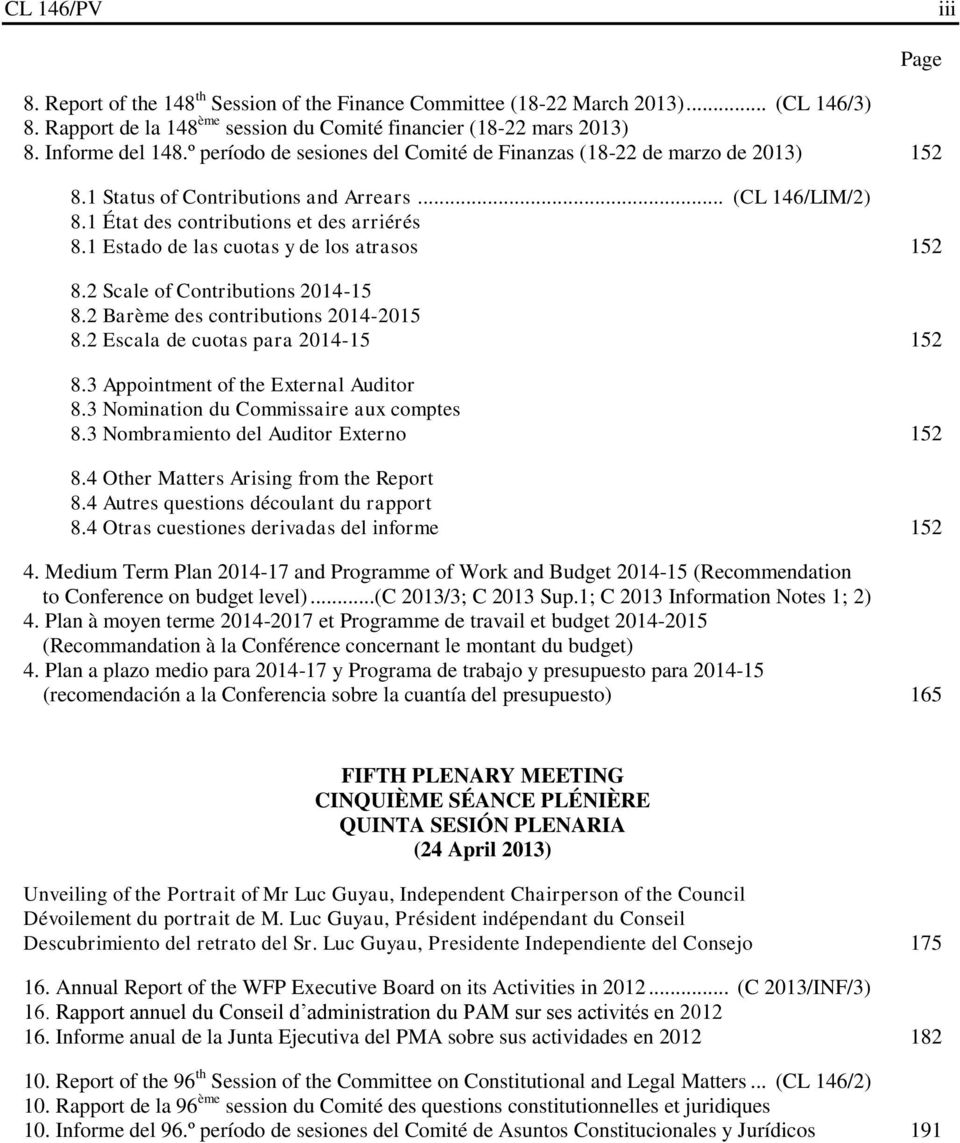
7 CL 146/PV iii 8. Report of the 148 th Session of the Finance Committee (18-22 March 2013)... (CL 146/3) 8. Rapport de la 148 ème session du Comité financier (18-22 mars 2013) 8. Informe del 148.º período de sesiones del Comité de Finanzas (18-22 de marzo de 2013) Status of Contributions and Arrears... (CL 146/LIM/2) 8.1 État des contributions et des arriérés 8.1 Estado de las cuotas y de los atrasos Scale of Contributions Barème des contributions Escala de cuotas para Appointment of the External Auditor 8.3 Nomination du Commissaire aux comptes 8.3 Nombramiento del Auditor Externo Other Matters Arising from the Report 8.4 Autres questions découlant du rapport 8.4 Otras cuestiones derivadas del informe Medium Term Plan and Programme of Work and Budget (Recommendation to Conference on budget level)...(c 2013/3; C 2013 Sup.1; C 2013 Information Notes 1; 2) 4. Plan à moyen terme et Programme de travail et budget (Recommandation à la Conférence concernant le montant du budget) 4. Plan a plazo medio para y Programa de trabajo y presupuesto para (recomendación a la Conferencia sobre la cuantía del presupuesto) 165 Page FIFTH PLENARY MEETING CINQUIÈME SÉANCE PLÉNIÈRE QUINTA SESIÓN PLENARIA (24 April 2013) Unveiling of the Portrait of Mr Luc Guyau, Independent Chairperson of the Council Dévoilement du portrait de M. Luc Guyau, Président indépendant du Conseil Descubrimiento del retrato del Sr. Luc Guyau, Presidente Independiente del Consejo Annual Report of the WFP Executive Board on its Activities in (C 2013/INF/3) 16. Rapport annuel du Conseil d administration du PAM sur ses activités en Informe anual de la Junta Ejecutiva del PMA sobre sus actividades en Report of the 96 th Session of the Committee on Constitutional and Legal Matters... (CL 146/2) 10. Rapport de la 96 ème session du Comité des questions constitutionnelles et juridiques 10. Informe del 96.º período de sesiones del Comité de Asuntos Constitucionales y Jurídicos 191
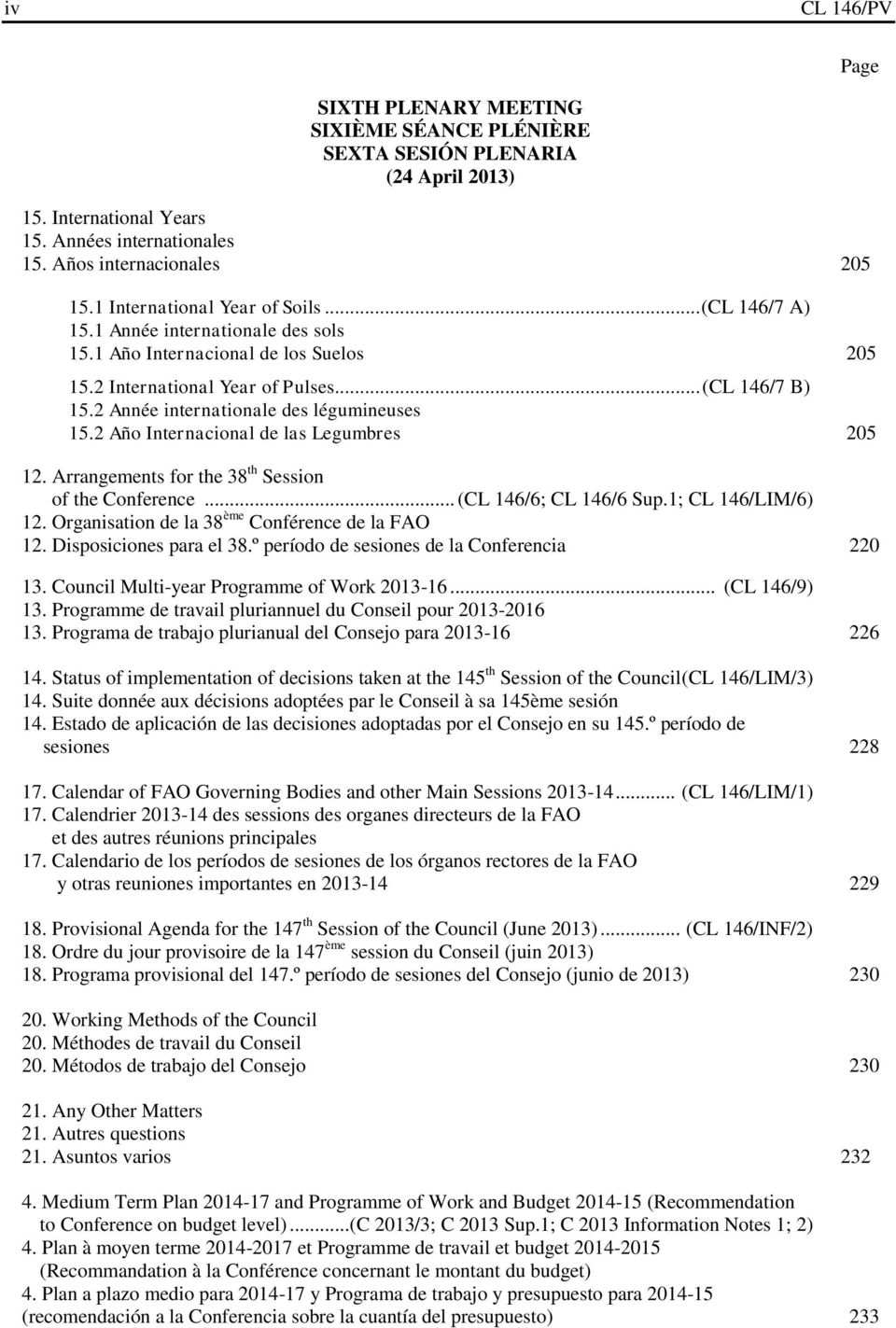
8 iv CL 146/PV Page SIXTH PLENARY MEETING SIXIÈME SÉANCE PLÉNIÈRE SEXTA SESIÓN PLENARIA (24 April 2013) 15. International Years 15. Années internationales 15. Años internacionales International Year of Soils... (CL 146/7 A) 15.1 Année internationale des sols 15.1 Año Internacional de los Suelos 15.2 International Year of Pulses... (CL 146/7 B) 15.2 Année internationale des légumineuses 15.2 Año Internacional de las Legumbres Arrangements for the 38 th Session of the Conference... (CL 146/6; CL 146/6 Sup.1; CL 146/LIM/6) 12. Organisation de la 38 ème Conférence de la FAO 12. Disposiciones para el 38.º período de sesiones de la Conferencia Council Multi-year Programme of Work (CL 146/9) 13. Programme de travail pluriannuel du Conseil pour Programa de trabajo plurianual del Consejo para Status of implementation of decisions taken at the 145 th Session of the Council (CL 146/LIM/3) 14. Suite donnée aux décisions adoptées par le Conseil à sa 145ème sesión 14. Estado de aplicación de las decisiones adoptadas por el Consejo en su 145.º período de sesiones Calendar of FAO Governing Bodies and other Main Sessions (CL 146/LIM/1) 17. Calendrier des sessions des organes directeurs de la FAO et des autres réunions principales 17. Calendario de los períodos de sesiones de los órganos rectores de la FAO y otras reuniones importantes en Provisional Agenda for the 147 th Session of the Council (June 2013)... (CL 146/INF/2) 18. Ordre du jour provisoire de la 147 ème session du Conseil (juin 2013) 18. Programa provisional del 147.º período de sesiones del Consejo (junio de 2013) Working Methods of the Council 20. Méthodes de travail du Conseil 20. Métodos de trabajo del Consejo Any Other Matters 21. Autres questions 21. Asuntos varios Medium Term Plan and Programme of Work and Budget (Recommendation to Conference on budget level)...(c 2013/3; C 2013 Sup.1; C 2013 Information Notes 1; 2) 4. Plan à moyen terme et Programme de travail et budget (Recommandation à la Conférence concernant le montant du budget) 4. Plan a plazo medio para y Programa de trabajo y presupuesto para (recomendación a la Conferencia sobre la cuantía del presupuesto) 233
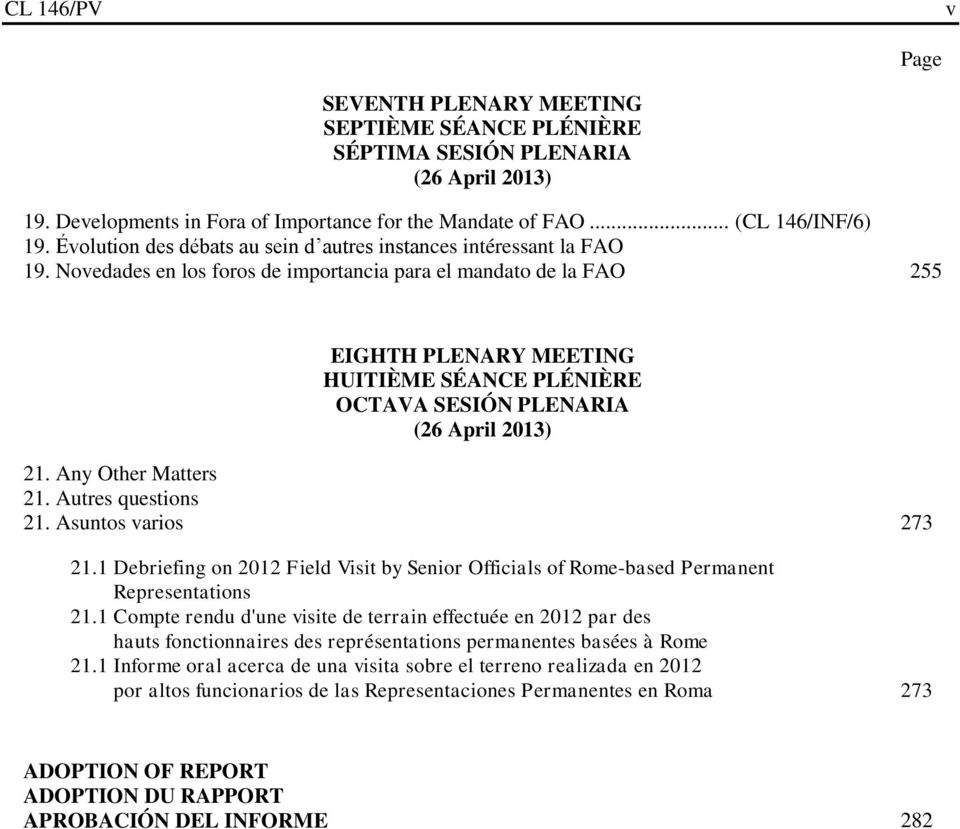
9 CL 146/PV v Page SEVENTH PLENARY MEETING SEPTIÈME SÉANCE PLÉNIÈRE SÉPTIMA SESIÓN PLENARIA (26 April 2013) 19. Developments in Fora of Importance for the Mandate of FAO... (CL 146/INF/6) 19. Évolution des débats au sein d autres instances intéressant la FAO 19. Novedades en los foros de importancia para el mandato de la FAO 255 EIGHTH PLENARY MEETING HUITIÈME SÉANCE PLÉNIÈRE OCTAVA SESIÓN PLENARIA (26 April 2013) 21. Any Other Matters 21. Autres questions 21. Asuntos varios Debriefing on 2012 Field Visit by Senior Officials of Rome-based Permanent Representations 21.1 Compte rendu d'une visite de terrain effectuée en 2012 par des hauts fonctionnaires des représentations permanentes basées à Rome 21.1 Informe oral acerca de una visita sobre el terreno realizada en 2012 por altos funcionarios de las Representaciones Permanentes en Roma 273 ADOPTION OF REPORT ADOPTION DU RAPPORT APROBACIÓN DEL INFORME 282
10

11 COUNCIL CONSEIL CONSEJO Hundred and Forty-sixth Session Cent quarante-sixième session 146.º período de sesiones Rome, April 2013 Rome, avril 2013 Roma, de abril de 2013 FIRST PLENARY SESSION PREMIÈRE SÉANCE PLÉNIÈRE PRIMERA SESIÓN PLENARIA 22 April 2013 The First Plenary Meeting was opened at 9.37 hours Mr Luc Guyau, Independent Chairperson of the Council, presiding La première séance plénière est ouverte à 9 h 37 sous la présidence de M. Luc Guyau, Président indépendant du Conseil Se abre la primera sesión plenaria a las 9.37 bajo la presidencia del Sr. Luc Guyau, Presidente Independiente del Consejo
12

13 CL 146/PV 1 LE PRÉSIDENT Mesdames et Messieurs, je déclare ouverte la 146 ème session du Conseil et souhaite la bienvenue aux membres du Conseil et aux observateurs de cette session. Avant de commencer nos travaux, je donne la parole à Monsieur Louis Gagnon, Secrétaire général de la Conférence et du Conseil, pour une brève annonce. SECRÉTAIRE GÉNÉRAL L Union européenne participe à cette session conformément aux paragraphes 8 et 9 de l article II de l Acte constitutif de la FAO. La déclaration de l Union européenne et de ses États Membres, qui figure dans le document d information CL 146/INF/4, est portée à l attention des Membres. LE PRÉSIDENT Mesdames et Messieurs les Ministres et Chefs de délégation, Monsieur le Directeur général, Mesdames et Messieurs les Délégués et observateurs, Mesdames, Messieurs, Chers amis: Je vous souhaite à tous la bienvenue à cette 146 ème session du Conseil. Je remercie particulièrement ceux qui ont fait un long voyage pour être avec nous toute cette semaine, et enrichir nos débats par leur présence et leurs interventions. La force du Conseil, c est la participation active de ses Membres. Je compte sur vous pour une implication optimale sur chacun des points de l ordre du jour. Nous sommes à un moment de transition très important pour l Organisation. Le plan de réforme - Plan d action immédiate - a été réalisé pour l essentiel, et le Conseil aura l occasion de s exprimer sur ses acquis. Nous entrons maintenant dans une nouvelle phase du renouveau de la FAO, sur la base de vos propositions, Monsieur le Directeur général, soutenues par les Membres. Ce processus de consolidation et de croissance a pour fondations les bénéfices de la Réforme, et prend en considération les évolutions du monde qui nous entoure. Il témoigne de la capacité de la FAO de s adapter pour assumer au mieux le mandat qui lui a été confié par la communauté internationale il y a près de 70 ans. Ainsi, conformément à notre ordre du jour, nous aurons à examiner le Cadre stratégique révisé, le Plan à moyen terme et le Programme de travail et budget du biennium à venir, La poursuite du processus de Décentralisation, la mise en place d Objectifs stratégiques et d un cadre organisationnel nouveaux, ainsi que des stratégies de partenariats avec la société civile et le secteur privé, constituent les éléments majeurs de notre feuille de route cette semaine. Les conclusions du Conseil seront déterminantes pour les travaux de la Conférence en juin. Je me permets d appeler votre attention sur ces enjeux, afin que vous en mesuriez toute l importance et que vos interventions contribuent à fixer le cap pour la FAO de demain, sur la base des propositions du Directeur général, pour une Organisation forte et dynamique. Pour avancer, il nous faudra statuer sur la proposition concernant le PTB et formuler notamment une recommandation concernant le niveau de budget régulier. Ce débat et cette décision vous appartiennent. Il vous faudra examiner le programme et les mesures garantissant une plus grande efficacité de l Organisation, puis indiquer quelle est l ampleur de la mobilisation financière que les Membres doivent mettre en place. Si les montants retenus seront essentiels, ils ne vaudront toutefois que par les garanties obtenues sur une utilisation optimale des fonds et sur la qualité du programme biennal adopté. Plus que tout autre, ce sujet impose une parfaite collaboration entre le Secrétariat et les Membres, en laquelle j ai toute confiance. Au cours de cette session, le Conseil aura à se prononcer également sur la désignation du Directeur général adjoint (Connaissances). C est également une étape essentielle pour la mise en place de la nouvelle équipe que le Directeur général constitue. Je saisis cette occasion pour saluer les nouveaux arrivants et remercier ceux qui nous ont quitté pour d autres horizons. Tous demeurent mobilisés vers notre objectif commun: éradiquer la faim. Je vous demande, à chaque instant de nos débats et lors de nos décisions, que nous pensions à ceux pour qui nous sommes là, et en particulier à ces enfants, ces femmes et ces hommes qui ne mangent
14 2 CL 146/PV pas à leur faim. Nous aurons aussi une pensée solidaire pour ceux qui subissent des catastrophes naturelles, comme les récents tremblements de terre en Iran, au Japon et en Chine, il y a quatre jours. Avant de terminer je voudrais souligner, en particulier auprès des Représentants arrivés récemment, que le processus de Réforme a permis une véritable modernisation du Conseil, de ses règles et de ses pratiques. Nous disposons désormais d un Organe directeur plus performant, d une gouvernance consolidée, pour le plus grand bénéfice de la FAO, qui demeure votre Organisation. Mais les structures les plus modernes ne valent que par la qualité des interventions. Alors exprimezvous, prenez la parole, de manière claire et concise bien entendu, présentez vos positions et faites vivre le Conseil. C est également un des enjeux de cette session, et non des moindres. Je vous remercie de votre attention. J ai le plaisir à présent de passer la parole au Directeur général, José Graziano Da Silva. DIRECTOR-GENERAL Mr Luc Guyau, Independent Chairperson of the Council; His Excellency Gilberto Carvalho, Minister for the Secretary-General of the Presidency of Brazil; His Excellency Rigobert Maboundou, Minister for Agriculture and Livestock of Congo; His Excellency Ahmed Ayad Al-Urfi, Minister for Agriculture, Livestock and Marine Wealth of Libya; His Excellency Samuel Santos López, Minister for Foreign Affairs of Nicaragua; Your Excellencies Deputy Ministers from Bangladesh and Pakistan; Your Excellencies State Ministers from Cameroon, Gabon and Malawi, Members of the Council, Permanent Representatives, Colleagues of UN Agencies and FAO, Ladies and Gentlemen. It gives me a great pleasure to welcome you to FAO for this the Council. It gives me an opportunity to share with you where we stand in implementing the Vision I presented to you last year. It is also the occasion to share some of next steps forward. The Vision, our shared Vision, is that of a renewed FAO, in sync with our times and up to challenges we face. We are speaking of an ambitious transformation that has just started. Its impact is not always immediately visible. But it is, nevertheless, essential so that FAO can function in the 21 st Century and fulfill the role for which it was created. We are working to establish a comprehensive accountability framework, a much improved performance evaluation system, and change the Organization s culture to bring real excellence to our working modalities and many more issues. When I spoke to Council last June, I asked you to judge me by the proposals made and by the results of my work. Let s look briefly at what we have achieved in four key areas over the past 16 months. The first area I want to highlight is the reduction of unnecessary bureaucracy in FAO, and large increase in efficiency. In 2012, we identified unprecedented levels of savings and efficiency gains. On top of the USD 6.5 million mandated by the Council, we saved an additional USD 19.3 million, mainly in administrative areas at Headquarters. Immediately after I took up office we embarked on a critical review of posts, which led to the abolition of 85 mainly administrative positions at Headquarters. Taking into account other transformational changes in , there has been a net reduction of 54 posts during the current biennium. I also believe in leading by example, which is why the savings start with my own office. The total cost of the Office of the Director-General fell over 10 percent in 2012 in comparison with the previous four-year average. I have flown on low-cost airlines several times. This has contributed to a reduction of over 30 percent in my office s travel expenses in comparison with the previous 4-year average even though I still visited over 40 countries in my first year in office.

15 CL 146/PV 3 The second area I want to highlight is how we have used the reduction of unnecessary bureaucracy in FAO to increase our technical and operational capacity where it was most needed. We reallocated over USD 10 million to the Decentralized Offices; nearly 7 million to interdisciplinary work; and 1 million each to strategic planning and field security. The targeted abolition of excessive administrative posts explains how we were able to decentralize working within the approved budget level for without increasing the costs, the overall number of posts or without weakening our technical capacity at Headquarters. This brings me to my third point: Decentralization. Since I took up office there has been an increase of 55 professional posts at Decentralized Offices, strengthening our capacity to respond to the specific needs of each region identified in the Regional Conferences. As we have proven, Decentralization does not weaken our global technical and normative work, or our capacities in Headquarters. As I have argued before, I believe that a strong presence in the field is the way to truly make FAO a knowledge Organization with its feet on the ground. Finally, the fourth point I want to make is our effort to improve the performance of our FAO Representatives, which is part of the Decentralization Process. We have introduced performance evaluation for current FAO Representatives and adjusted their chain of command. Now they report to the Regional Representative and participate in the planning at the sub-regional level. This new configuration assures the coherence of our programme of work at sub-regional and regional level. We also have changed their selection procedure and added an independent assessment of management skills to the process. Since the beginning of 2012, we have appointed over 20 FAO Representatives selected through the new procedures. These positions have been filled with a mix of internal and external candidates, with a view on improving the rotation between Headquarters and the field. Let me point out as well that I have also built my Senior Management Team in Rome. In 2012, I have appointed over 20 Senior Managers to positions ranging from the Director-Level to the Deputy Director-General level. And at this session you will consider my appointment for the DDG- Knowledge, Ms Maria Helena Semedo, who has been our Regional Representative for Africa since FAO transformational changes, of which I only mentioned a few examples, have been possible because of the trust that has been rebuilt between Members and the Secretariat, and because of the constant dedication of a growing number of FAO staff members who are actively engaged in this process. I am also particularly pleased to note that the last Joint Meeting of the Programme and Finance Committees has recommended that Council endorse the Final Management Report on the Immediate Plan of Action Implementation and the FAO Reform Process for approval by Conference. This will complete an important cycle for FAO, which was the first UN Agency to conduct such an extensive Independent External Evaluation. Ladies and gentlemen, at this Session of Council you will analyze two documents that are key to maintain the momentum of the transformational change we are undergoing. The first one, the reviewed Strategic Framework, defines the five cross-cutting Strategic Objectives and the Sixth Technical Objective that will guide our future work. The Sixth Objective was incorporated to reassert our commitment to the public goods that FAO produces, our normative work, analysis, statistics, treaties, agreements and so on.
16 4 CL 146/PV The Programme and Finance Committees have reviewed the Framework and have recommended that Council endorse the document for approval by the Conference. This Framework is the basis for the second document you will discuss, my proposed Medium Term Plan and the next Programme of Work and Budget This document presents in very concrete terms how we will translate FAO transformational change into meaningful results. The Joint Meeting of the Finance and Programme Committees undertook productive technical discussions on this document. I look forward to continuing them through this Council and the Conference. To facilitate your deliberations this week, let me address five important points. First point: Let me start by saying that for the first time in FAO s history, its budget will be driven by the objectives and outcomes we aim to achieve, and not by simply by the activities we carry out. I also ask you to keep in mind the efforts we have made since 1 January 2012 to deliver best value for money: the unprecedented savings, the overall reduction of established posts and the net increase in decentralized positions. The Programme of Work and Budget you are considering is part of this effort. Second point: The changes in the organizational structure. We will have a trio of Senior Managers responsible for the coordination of the main areas of the Organization: management of our operations capacity for technical cooperation; the integrated management of productive natural resources, and economic and social development work. Also, the communications, partnerships and advocacy function will be separated and strengthened. Third point: we have identified four key areas that need to be reinforced. They include: First, the Technical Cooperation Programme the TCP; Second, social protection as it directly relates to Strategic Objective number 3 reducing rural poverty; Third, communication, partnerships, advocacy and capacity development; and, Fourth, the evaluation function. Allow me to continue my speech in Spanish, as I elaborate a little more on each one of these areas that I mentioned, starting with the TCP. Continúa en Español En la propuesta mejorada de PCT que ustedes aprobaron en el último Consejo, el PCT se transforma en un instrumento más estratégico, mejor integrado con los Marcos de Programación por País, y relacionado con nuestro nuevo conjunto de Objetivos Estratégicos. Esperamos que este diseño ayudará a catalizar una movilización complementaria de recursos a nivel del país. El fortalecimiento del PTC también responde a lo señalado en la Resolución 9/89 de la Conferencia de FAO que solicitó que el financiamiento del TCP debería ser restablecido en el 14 por ciento del presupuesto y, en lo posible, alcanzar a un 17 por ciento. Desafortunadamente, nos hemos movido en la dirección contraria desde En aquel bienio, el PCT recibió el 14,6 por ciento del presupuesto. En el bienio el PCT recibió solo el 11,5 por ciento del presupuesto. La propuesta del Programa de trabajo y presupuesto aumenta el financiamiento del PCT a 13,1 por ciento del total. Esto está todavía por debajo del nivel solicitado por la Conferencia, pero significa que nos estamos moviendo dos puntos en la dirección correcta. También estoy proponiendo aumentar la capacidad de la Organización en lo que dice relación con la protección social. El razonamiento detrás de esta propuesta es muy simple. La principal misión de FAO, erradicar el hambre, ha cambiado mucho desde que la Organización fue creada después de la Segunda Guerra Mundial. La principal causa del hambre era la insuficiente producción alimentaria. En ese entonces, la primera y única prioridad era aumentar la producción. Hoy, en cambio, después de un impresionante aumento de la producción de alimentos, todavía tenemos cerca de 870 millones de personas en estado de desnutrición crónica.
17 CL 146/PV 5 El problema ahora es más complejo. La principal causa del hambre hoy es la falta de acceso a los alimentos y mejorar la protección social es la manera más efectiva de aumentar la capacidad de los pobres para que adquieran en el corto plazo el alimento que necesitan. Como tal, la protección social es un componente relevante de las estrategias de seguridad alimentaria y de reducción de pobreza. En relación con el área de Asociaciones, Actividades de Promoción y Creación de Capacidad, los nuevos recursos solicitados serán utilizados para diferentes propósitos, entre los cuales destacan, el establecimiento de un sistema de seguimiento y evaluación de las asociaciones, y el generar y compartir conocimientos, buenas prácticas, y lecciones aprendidas en modelos de asociación y creación de capacidades. Además, queremos fortalecer nuestra capacidad de promoción, especialmente en lo que dice respecto a género, derecho a la alimentación, derecho de los pueblos indígenas y la Alianza Contra el Hambre y la Malnutrición. En relación a la comunicación y al manejo del conocimiento, los recursos adicionales serán utilizados en mejorar la comunicación interna y externa y en reforzar la diseminación de nuestras publicaciones, asegurar una mayor calidad del material y aumentar la cobertura de idiomas. También estamos proponiendo mejorar nuestra función de evaluación en línea con la Acción 2.78 del Plan Inmediato de Acción que determina que el presupuesto de la Oficina de Evaluación debería alcanzar el 0,8 por ciento de la consignación total neta en el bienio Cuarto punto: para reforzar estas cuatro áreas necesitamos 31.5 millones de dólares, de los cuales más de la mitad será para reforzar el PCT. Pero no les estamos pidiendo a ustedes toda esta plata sino solo 10 millones de dólares adicionales. Después de analizar cuidadosamente nuestro presupuesto, hemos visto que podemos absorber una parte significativa de esta cifra: 21.5 millones de dólares. Haremos esto a través de la re-asignación de fondos dentro del actual nivel de presupuesto y a través de nuevos ahorros por eficiencia. Por lo tanto, lo que les estamos solicitando para implementar el Programa de trabajo basado en los resultados que hemos propuesto es un aumento real del presupuesto para el bienio de menos de un uno por ciento. Y ese es un aumento real de menos de un por ciento que vendría después de una pérdida de valor real del presupuesto de la Organización del orden del 27 por ciento desde que la política de Zero Nominal Growth, Crecimiento Nominal Cero, fue introducida en el bienio Eso ocurre porque el concepto de Crecimiento Nominal Cero, a pesar de que contiene en su formulación la palabra crecimiento, no es crecimiento sino que todo lo contrario: significa una reducción real del presupuesto en la magnitud de la devaluación monetaria cumulada en el bienio. Podemos afirmar que la política del Crecimiento Nominal Cero se rompió por primera vez en la 35ª Conferencia en el año 2007, cuando se observa un pequeño crecimiento real del presupuesto que fue de solo 0,1 por ciento. También hubo un leve cambio en la 36ª Conferencia celebrada en 2009, cuando hubo acuerdo por introducir una Reform with Growth, Reforma con Crecimiento. En esa oportunidad el incremento real fue de 1.1 por ciento, que incluyó 36.4 millones de dólares para el Plan Inmediato de Acción. En la 37ª Conferencia celebrada en junio de 2011 también se aceptó un leve aumento de 0,5 por ciento nominal como señal positiva de confianza al nuevo Director General elegido en esa misma oportunidad, aunque el resultado final fue una reducción en términos reales de un 2,3 por ciento. Por lo tanto, la pesada herencia que dejaron los años de Crecimiento Nominal Cero, todavía la estamos cargando sobre los hombros, a pesar de que ahora vemos con satisfacción que estamos transitando desde un pasado donde no había confianza en la capacidad de la Organización de implementar la Reforma solicitada, hacia un presente donde se establecen los lazos de confianza y de aprecio basado en el diálogo y en la transparencia. Estoy seguro que en este Consejo y en la próxima Conferencia los Miembros sabrán encontrar el equilibrio necesario entre las dificultades internas que enfrentan en sus países con las necesidades de no seguir recortando en términos reales el presupuesto de la FAO.

18 6 CL 146/PV Es importante también tener presente que la Conferencia va a examinar la nueva escala de asignación de cuotas pagadas por los Estados Miembros, que se deriva directamente de la Escala de Cuotas de Naciones Unidas que es aprobada por los Países Miembros en Nueva York. De acuerdo a la nueva Escala, 7 de los actuales 10 mayores contribuyentes al presupuesto del Programa Regular de FAO se verán favorecidos por una disminución neta de sus obligaciones financieras con la Organización en el próximo bienio, a pesar del incremento real del presupuesto que hemos propuesto. Si dividimos esta cifra entre los más de 190 Países Miembros de la FAO, el aumento de los 10 millones de dólares que hemos solicitado es claramente una cifra muy pequeña. Al mismo tiempo, este mínimo aumento será una gran señal de vuestro compromiso de apoyo a los esfuerzos de cambio en la FAO. En efecto, yo quiero ir aun más allá. Deseo invitar a los Estados Miembros que tendrá reducidas su contribución regular que mantengan la diferencia en la Organización. A través de contribuciones voluntarias que apoyen nuestros Objetivos Estratégicos, o apoyando a los programas de Jóvenes Profesionales o de Profesionales Asociados, que son programas que ayudan a traer jóvenes talentos nacionales a la Organización, la que ha sido una recomendación clave del PIA para el manejo de los recursos humanos de la FAO. Es para mí un placer poder informarles que en 2012 hemos reclutado a 15 Profesionales Jóvenes y asociados y otros 10 deberían incorporarse en los próximos meses. También me gustaría mencionar un tema relacionado con el nivel del presupuesto que es el aumento de los costos de personal. En el bienio , el total de los costos de personal representaba cerca del 70 por ciento del presupuesto de nuestro Programa Regular. Esto llegó a cerca del 75 por ciento en el Programa de trabajo y presupuesto aprobado en la última Conferencia. Esto se explica principalmente por decisiones adoptadas a nivel del Sistema Común de las Naciones Unidas. En la FAO, yo mantendré el mismo compromiso de manejo responsable de la Organización que he mostrado desde que asumí. Y durante mi mandato estoy determinado a reducir gradualmente la proporción de los costos de personal versus los servicios que proveemos a los Países Miembros. Sobre este punto necesito vuestra orientación. Agradecería enormemente que me hicieran ustedes sugerencias y me dieran orientaciones claras sobre las medidas que deberían ser adoptadas. Quinto punto: Como parte del Marco estratégico revisado, el Programa de trabajo y presupuesto introducirá un cambio radical en la manera de trabajar en la FAO a partir del año Estamos ya analizando la estructura y los procesos que permitirán ser más efectivos en sus funciones a los Coordinadores de los Objetivos Estratégicos, para que trabajando estrechamente con los Jefes de Departamentos y Unidades, se pueda obtener el máximo impacto. Esto hará posible que estemos listos para implementar el nuevo Programa de trabajo y presupuesto a partir del 1 de enero de Con esta finalidad, hemos reforzado nuestros mecanismos internos de gobernanza, creando, por ejemplo, el Comité de Seguimiento del Programa Corporativo o CPMB en su sigla en inglés- que yo mismo presido. A fin de establecer un puente para la transición de este bienio al siguiente, estamos ya implementando seis Iniciativas Regionales en el 2013 una para cada Región y dos para África. Cada iniciativa tiene un presupuesto de un millón de dólares, que son aportados por el Fondo Multidisciplinario. Estas iniciativas son dirigidas por los Coordinadores de los Objetivos Estratégicos en estrecha colaboración con los Representantes Regionales. Las lecciones que aprendamos este año sobre cómo trabajar unidos entre diversas disciplinas y lugares geográficos será aplicado para el trabajo de la FAO en el futuro. Señoras y señores, la FAO se está adaptando a un nuevo contexto de un mundo globalizado. Hoy existe un buen número de otros actores clave involucrados en la seguridad alimentaria, la agricultura y el desarrollo internacional. Ellos incluyen, entre otros, a otras agencias multilaterales y regionales, organizaciones no gubernamentales y de la sociedad civil, y un muy activo sector privado.

19 CL 146/PV 7 Esta es la razón por la cual para mí es muy prioritario reforzar las relaciones entre la FAO y sus socios. Y estoy muy satisfecho de ver que este Consejo considerará para la aprobación la Estrategia de la FAO para las Asociaciones con la Sociedad Civil, y la Estrategia de la FAO para las Asociaciones con el Sector Privado, tal como lo ha recomendado la última Reunión Conjunta del Comité del Programa y del Comité de Finanzas. Lo he dicho antes y lo voy a repetir ahora: yo no podré hacer nada, sino aquello que podamos hacer juntos. Hemos avanzado un largo camino. Todavía tenemos muchas cosas que hacer. Tengo la confianza y la certeza de que juntos podremos hacer nuestros sueños realidad. Muchas gracias a todos ustedes. Applause Applaudissements Applausos LE PRÉSIDENT Monsieur le Directeur général, au nom du Conseil, je vous remercie. Je demande à nouveau à M. Gagnon de prendre la parole pour donner un bref compte-rendu sur la documentation de cette session, au Conseil. SECRÉTAIRE GÉNÉRAL La liste des documents de cette session du Conseil comprend 15 documents principaux, dont trois rapports de réunions qui se sont achevées peu avant le 25 mars, date prévue pour la publication des documents. Douze documents principaux ont été publiés avant ou à la date limite de distribution du 25 mars; un autre document a pu être rendu disponible la semaine suivante et les deux derniers l étaient dans le courant de la deuxième semaine précédant l ouverture du Conseil. LE PRÉSIDENT C est désormais une habitude de bien donner le calendrier d arrivée des documents et je remercie globalement le Secrétariat d avoir fait diligence en la matière. 1. Adoption of the Agenda and Timetable 1. Adoption de l'ordre du jour et du calendrier 1. Aprobación del programa y el calendario LE PRÉSIDENT Nous passons au point 1 de l ordre du jour et du calendrier, «adoption de l'ordre du jour et du calendrier». Ceci est dans les documents CL 146/1 et CL 146/INF/1 Rev.1. L ordre du jour provisoire a été communiqué aux Membres du Conseil le 21 février 2013, en même temps que l invitation à la présente session. D abord, je propose l élimination du sous-point 11.1 «Invitations à assister à des réunions de la FAO adressées à des États non membres», dans la mesure où aucune invitation n a été adressée à des États non membres. D autre part, suite aux délibérations du Comité financier et de la Réunion conjointe des Comités financier et du Programme du mois dernier, il est proposé au titre du point 6 «Rapport de la Réunion conjointe de la 113 ème session du Comité du Programme et de la 148 ème session du Comité financier (20 mars 2013)», d ajouter un sous-point 6.1 intitulé «Stratégie de la FAO en matière de partenariats avec le secteur privé», et au titre du point 8 «Rapport de la 148 ème session du Comité financier (18-22 mars 2013) d ajouter un sous-point 8.3 intitulé «Nomination du Commissaire aux comptes». Le Conseil est-il d accord avec ces modifications proposées à l ordre du jour provisoire ou avez-vous des commentaires à faire? Pas de commentaires. Merci. L ordre du jour est adopté avec les modifications proposées.
20 8 CL 146/PV Adopted Adopté Aprobado À présent, pour le calendrier de la session, qui figure dans le document CL 146/INF/1 Rev.1, je vous invite à consulter l encadré qui devrait nous aider à bien gérer notre temps et à structurer les discussions sur des points particuliers. Ainsi, un certain nombre de sujets seront abordés séparément et non pas dans le cadre des rapports des Comités du Programme et financier, et de leur Réunion conjointe. Il s agit du point 3 - Cadre stratégique révisé, du point 4 - Plan à moyen terme et Programme de travail et budget , du point 5 - Rapport final de la Direction sur la mise en œuvre du PAI et le Processus de réforme de la FAO, et du point 9 - Stratégie de la FAO en matière de partenariats avec les organisations de la société civile. Les références aux rapports et aux paragraphes concernés sont indiquées en italique dans le calendrier et nous en parlerons dans le détail lorsque nous aborderons ces points. Je rappelle que cette procédure n est pas nouvelle mais c est une procédure utilisée depuis deux ou trois Conseils qui améliore la fluidité et le travail du Conseil, évitant de reprendre plusieurs fois le même sujet et en le globalisant. Le Conseil est-il donc d accord sur l ensemble de ce calendrier, qui comportera bien entendu les amendements faits à l ordre du jour? Avez-vous des remarques? Pas de remarques? Le calendrier de la session est donc adopté. Adopted Adopté Aprobado Je me permets de vous donner deux informations complémentaires. La première, comme nous l avons fait aux deux derniers Conseils, nous commencerons impérativement nos journées ou demi-journées aussitôt que le quorum sera atteint, c est-à-dire, la moitié plus un et le plus près possible de l heure de convocation. Au dernier Conseil, vous avez été très respectueux de ces modalités, ce qui nous a permis de gagner en efficacité et je vous en remercie. Et deuxième élément, je vous demande d ores et déjà de prévoir pour ce soir une session complémentaire, de 17h30 à 20h30, c est-à-dire, que cet après-midi, nous commencerons la séance à 14 h 30 pour terminer à 20h30, sans s arrêter. J ai préféré envisager une séance complémentaire tout de suite le lundi, plutôt que d attendre le mardi ou le mercredi où nous serons bousculés. Comme cela, nous jugerons ce soir après cette session si nous avons besoin éventuellement de faire d autres sessions complémentaires. Bien sûr, ce temps sera occupé en particulier à discuter du Programme de travail et de budget. Mesdames et Messieurs, avant de poursuivre nos travaux, nous allons regarder une brève présentation vidéo sur les mesures de sécurité en cas d incendie, que nous ne souhaitons pas, mais la sécurité c est avant tout essentiel. Video Presentation Présentation video Videopresentación
21 CL 146/PV 9 2. Election of three Vice-Chairpersons, and Designation of the Chairperson and Members of the Drafting Committee 2. Élection des trois vice-présidents et nomination du Président et des membres du Comité de rédaction 2. Elección de los tres Vicepresidentes y nombramiento del Presidente y los miembros del Comité de Redacción LE PRÉSIDENT Nous allons donc continuer nos travaux par le point 2 à l ordre du jour, l élection des trois viceprésidents et nomination du Président et des membres du Comité de rédaction. Après consultation entre les groupes régionaux, les trois vice-présidents proposés sont: Son Excellence M. Mohammed Shahdat Hossain, du Bangladesh; Son Excellence M. Gianni Ghisi, de l Italie; et Son Excellence, Mme Gladys Francisca Urbaneja Durán du Venezuela. Y a-t-il des commentaires ou des objections? Pas d objections? Je félicite donc les trois vice-présidents qui viennent d être nommés. Pour les encourager, je vous propose de les applaudir. Applause Applaudissements Aplausos En ce qui concerne le Comité de rédaction, les groupes régionaux ont proposé Monsieur Abdul Razak Ayazi de l Afghanistan pour la Présidence du Comité et les délégations des pays suivants comme membres, au nombre de 13. Je les cite: l Allemagne, l Australie, le Bangladesh, le Cap-Vert, la Chine, l Équateur, l Égypte, les États-Unis d Amérique, la Fédération de Russie, l Irlande, le Japon, la Jordanie, et l Ouganda. Y a-t-il des remarques? Des demandes de précision? Il en est ainsi décidé. Mes félicitations et mes encouragements pour ce travail, avant jeudi, mais particulièrement jeudi. Je voudrais aussi rappeler des éléments de nos méthodes de travail, que je vous ai communiqués dans ma lettre le 4 avril dernier, et inviter les Membres à faire, pour plus d'efficacité et de concision, des interventions succinctes et ciblées, ainsi que, dans la mesure du possible, des déclarations de groupes de pays pour éviter les répétitions. De mon côté, je tirerai les conclusions des débats afin de faciliter la rédaction du Rapport, qui consistera en conclusions, décisions et recommandations, tandis que les débats figureront intégralement dans les procès-verbaux de la session. Le Secrétariat s efforcera quant à lui de produire des projets de rapport concis, portant essentiellement sur les conclusions et décisions du Conseil, ce qui facilitera la tâche du Comité de rédaction et lui permettra d achever ses travaux plus rapidement. Je vous prierais de remettre à l avance vos interventions au Secrétariat, de préférence à l adresse courriel indiquée dans l ordre du jour, afin que les interprètes puissent les rendre au mieux dans les autres langues. De même, les interventions orales faites à un rythme raisonnable permettront une meilleure qualité de l interprétation. Enfin, je rappelle que vous pouvez remettre une version intégrale de vos interventions pour l inclusion dans les procès-verbaux et présenter oralement une version plus condensée. Dans ce cas, une annonce sera faite à cet effet.
22 10 CL 146/PV 11. Other Constitutional and Legal Matters 11. Autres questions constitutionnelles et juridiques 11. Otros asuntos constitucionales y jurídicos 11.2 Applications for Membership in the Organization 11.2 Demandes d'admission à la qualité de Membre de l'organisation 11.2 Solicitudes de ingreso en la Organización LE PRÉSIDENT Je vous propose donc, après la désignation des vice-présidents et du Comité de rédaction sa présidence et ses 13 membres, de passer au point suivant qui est le point 11, sous-point 11.2 «Demandes d admission à la qualité de Membre de l Organisation». Monsieur le Secrétaire général, vous avez la parole. SECRÉTAIRE GÉNÉRAL Le Directeur Général a reçu une demande d admission à la qualité de Membre de l Organisation du Brunéi Darussalam par lettre du 17 janvier En attendant la décision de la Conférence concernant cette demande et conformément à l article XXV, alinéa 10 du Règlement général de l Organisation, et aux paragraphes B1, B2 et B5 des principes régissant l octroi du statut d observateur aux nations, le Conseil peut autoriser le Directeur Général à inviter le pays ayant présenté une demande d admission à participer en qualité d observateur aux sessions du Conseil et aux réunions régionales et techniques de l Organisation qui l intéressent. LE PRÉSIDENT Merci, le Conseil a-t-il des objections à inviter le Brunéi Darussalam à participer en tant qu observateur aux sessions du Conseil aux réunions régionales et techniques qui l intéressent? Pas d objection, il est ainsi décidé. La demande d admission du Brunéi Darussalam sera soumise avec celle de la République du Soudan du Sud à la prochaine session de la Conférence en Any Other Matters 21. Autres questions 21. Asuntos varios 21.2 Appointment of the Deputy Director-General (Knowlwdge) 21.2 Nomination du Directeur général adjoint (Connaissances) 21.2 Nombramiento del Director General Adjunto (Conocimiento) LE PRÉSIDENT Nous passons au point suivant, le point 21: Nomination du Directeur Général adjoint (Connaissances), document CL 146/LIM/4. Vous trouverez le Curriculum Vitae de Madame Maria Helena Semedo dans le document de référence. J invite donc le Directeur Général à prendre la parole. 13. DIRECTOR-GENERAL Ladies and Gentlemen, it is my great pleasure to inform you that I intend to appoint Ms Maria Helena Semedo to the position of Deputy Director-General for Knowledge. The position was advertised online with established procedures and attracted 101 candidates, of which 71 were men and 30 were women. Based on the Terms of Reference and the qualification requirements for the post, the Office of Human Resources submitted the names of four candidates for interview.
23 CL 146/PV 11 Based on educational background, professional experience, managerial skills and the unanimous recommendation of the selection panel that interviewed the candidates and conducted the process, I decided to appoint Ms Semedo. Ms Semedo has been with FAO for nearly 10 years, serving at different professional and managerial levels. She began her tenure as FAO Representative in Niger, served as FAO Representative in Ghana, Sub-regional Coordinator for West Africa, and Assistant Director-General and Regional Representative for Africa. Before joining FAO in 2003, Ms Semedo was a Member of Parliament in her native Cape Verde, and served as Minister of Fisheries, Agriculture and Rural Affairs, Minister of Marine Affairs, and the Minister of Tourism, Transportation and Seas. Ms Semedo has all the qualities we were looking for. This includes political experience, consensusbuilding abilities and great knowledge of the Organization. I would appreciate the confirmation of this appointment by the Members of the Council. Thank you. Mr Patrick HENNESSY (Ireland) I am honored to speak on behalf of the European Union and its 27 Member States. I would like to congratulate Ms Maria Helena Semedo on her appointment as Deputy Director-General for Knowledge. Her experience both as a member of Parliament and as a Minister in the Government of Cape Verde, and her distinguished service in various positions on behalf of the FAO equip her well for the important position she has now assumed. I assure her that she will have the full cooperation of the European Union and its Member States in this task. Mr Seyed Aminollah TAGHAVI MOTLAGH (Iran, Islamic Republic of) I am speaking on behalf of the Near East Group. First off, I would like to congratulate Ms Maria Helena Semedo for this position which has been given to her. The Near East Group supports the appointment of her for the post of Deputy Director-General. The reappointment of the post of DDG is one of the transformational aspects of the FAO in order to pay more attention of the Organization to the management of natural resources in the field of agriculture, fisheries, forest, agriculture, vegetation and genetic resources. The Near East Group is of the view that the appointment of the DDG instantaneously contributes to a better implementation of FAO s goals and objectives in general, and to the enhancement of the knowledge of the Organization in particular. Therefore, we support the appointment of Ms Maria Helena Semedo for the post of Deputy Director-General. M. Rigobert MABOUNDOU (Congo) Je voudrais m exprimer au nom du Groupe Afrique pour naturellement traduire toute la satisfaction que nous éprouvons à l issue de la proposition du Directeur général de porter Madame Semedo à cette importante fonction. Au-delà des qualités qui ont été évoquées par le Directeur général, et qui sont si justes, il faut aussi ajouter le rôle que Madame Semedo a joué dans le rayonnement de l Organisation au niveau de l Afrique et la capacité de consensus qu elle continue d exercer. C est pour cela que nous nous réjouissons de cette proposition, et nous espérons d ailleurs qu elle va se déplacer avec toutes ses qualités pour qu elle puisse continuer à mettre dans la balance du succès la Réforme de la FAO, en tout cas tout le poids de sa compétence. Mr XIA Jingyuan (China) (Original language Chinese) China would like to invite Viet Nam to take the floor on behalf of the Asia Group. Ms Thi Thu QUYNH NGUYEN (Observer for Viet Nam) I speak on behalf of the Asia Group. The Asia Group supports the appointment of Ms Maria Helena Semedo for the post of Deputy Director-General of Knowledge, as mentioned in the proposed Medium Term Plan for The reappointment of the post of the DDG, DDK is one of the
24 12 CL 146/PV transformational aspects of the FAO in order for the Organization to pay more attention to the management of natural resources in the fields of agriculture, fisheries and forests, agricultural habitats and genetic resources. The Asia Group believes that with her knowledge, experience, and capability in FAO activities in the past, Ms Maria Helena Semedo will successfully fulfill her DDG mandates. The Asia Group assures her of our full cooperation, and wish her the very best. M. Moungui MÉDI (Cameroun) Le Cameroun joint sa voix à celle de Monsieur le Ministre du Congo qui a parlé avant nous au nom du Groupe Afrique et également aux autres membres du Conseil, des Groupes régionaux qui ont pris la parole avant nous pour soutenir la candidature de Madame Maria Helena Semedo au poste de Directeur général adjoint (Connaissances). Notre soutien est essentiellement motivé par l évidence de son expérience avérée dans les domaines se rapportant au mandat de la FAO, mais aussi de sa longue et positive expérience managériale à des niveaux de responsabilités très élevées, d abord dans son pays d origine et par la suite sur le plan international, et notamment elle possède une excellente connaissance de la FAO. En outre la présence d une femme dans l équipe de la haute direction de la FAO va réduire, nous en sommes convaincus, le déséquilibre actuel en matière de genre. Nous sommes donc convaincus de la justesse de ce choix du Directeur général. M. Manuel AMANTE (Cap-Vert) Le Cap-Vert prend d abord la parole pour féliciter chaleureusement Madame Marie Helena Semedo pour son élection au poste de Directeur général adjoint (Connaissances) de notre Organisation. Nous profitons de l occasion pour remercier Monsieur le Directeur général, José Graziano da Silva, son staff et tous les Membres de la FAO, pour la confiance déposée à Madame Semedo. Ayant connu depuis des années Madame Semedo pour sa détermination, son courage et son plein engagement envers le processus complexe du développement, je reste convaincu que notre nouvelle Directrice générale adjointe a toutes les qualités, qualifications et expérience pour mener à bien cette fonction. Prenant la parole pour la première fois devant cette importante assemblée, je réitère tout notre appui à Monsieur le Directeur général et son équipe pour la mise en œuvre de la vision claire des engagements de la FAO vers son efficacité et la réduction de la famine dans le monde. Mr David LANE (United States of America) On behalf of North America, the United States joins with Canada and all those who have expressed their congratulations so far to the Director-General for the appointment of Ms Maria Helena Semedo as Deputy Director-General. We re very impressed by her experience. We believe she is extremely well qualified for this position and we look forward to working with her in her new and very important position. Ms Gothami INDIKADAHENA (Observer for Sri Lanka) I actually take the floor to speak on behalf of the Group of 77 and China. We welcome this appointment. I think it is one of the wisest decisions that the Director-General has taken in order to maintain the balance between the OECD and the G77 and China. By taking this decision to appoint Ms Maria Helena Semedo as the Deputy Director-General of this Organization, he has brought balance into this institution. We are also delighted that the Director-General, through this appointment, has tried to maintain the gender balance. These two positions just below him have been distributed equally and he has maintained the gender balance. So we are quite impressed with her qualifications and her experience, particularly in the political and multilateral arena. So I think her qualifications and her experience justify her holding this post. We wish to congratulate her on the assignment, and also wish her well in her future endeavors in this institution.
25 CL 146/PV 13 Mr Abdul Razak AYAZI (Afghanistan) In complimenting the statement from our Chair, Iran, on behalf of the Near East, I wish to congratulate Ms Maria Helena Semedo for her appointment as Deputy Director-General Knowledge. Because of her lengthy experience in high government positions in her own country, Cape Verde, and her involvement with several important initiatives and efforts, as well as her more recent assignment as ADG of FAO in Africa, she is very capable to assume this new position. As a responsible Officer for Natural Resources, the responsibilities of our office are heavy, especially in the light of the outcome of the document Rio+20. So we wish Ms Semedo all the best in her important responsibilities. We also wish to congratulate the Director-General for appointing a capable person as your new Deputy Director-General and future coordinator for natural resources. We are sure that Ms Semedo will be an effective member of the triumvirate structure which you are proposing in your Programme of Work and Budget. Sra. María Victoria SALCEDO BOLIVAR (Observador de Colombia) Hago esta intervención en nombre del GRULAC. Acogemos con gran satisfacción la designación de la señora María Helena Semedo, y consideramos que su amplia trayectoria profesional y su experiencia serán definitivas en este proceso de transformación y en el logro de los Objetivos Estratégicos. El GRULAC manifiesta su abierta voluntad de cooperación a la gestión de la Señora Semedo, así como reitera su compromiso en el logro de los Objetivos Estratégicos propuestos por nuestro Director General. Quisiera simplemente abusar de este derecho de palabra para referirme a una enmienda que solicita el Grupo Regional en el punto anterior, en la elección del Comité de redacción, en el cual por alguna omisión no aparece señalado Argentina. Nuestros Miembros son de Argentina y Ecuador. Ya la Secretaría nos ha anunciado que se ha hecho el cambio. Mr Matthew WORRELL (Australia) Australia is speaking on behalf of the Southwest Pacific Region. The Region supports the appointment of Ms Maria Helena Semedo to the position of Deputy Director-General Knowledge. We look forward to working closely with Ms Semedo in her new position. The appointment is critical in a number of ways, including improving the gender balance of the Senior Management Team. We congratulate the Director-General for his decision. Mr Robert SABIITI (Uganda) Uganda also takes the floor to support the nomination of Ms Maria Helena Semedo for the position of Deputy Director-General Knowledge. In line with all previous delegations, we believe that her vast experience and qualifications will be a great asset to the Organization. We look forward to working very closely with Ms Semedo in her new assignment. Mr J Luis COELHO SILVA (Portugal) With the intervention made by the President of the European Union regarding this agenda item, Portugal would also like to congratulate the appointment of Ms Maria Helena Semedo, and graciously wish her well in the post because in addition to her curriculum and skills, she is a representative of a Portuguese-speaking country. Mr Vladimir KUZNETSOV (Russian Federation) (Original language Russian) I am speaking on behalf of the Russian Federation because, unfortunately, we did not have the opportunity to express our congratulations together with our European colleagues. A statement was made only on behalf of the Members of the European Union. However, we would like to take this opportunity to extend our congratulations to Ms Maria Helena Semedo, and to show her that we look forward to the best possible and fruitful cooperation with her. She has been appointed to the very important post of Deputy Director-General Knowledge and we believe that she will have, as part of
26 14 CL 146/PV her responsibilities, management of environmental resources. We would like to wish her the very best in this endeavour. We believe that she has considerable management experience, as well as considerable policy and political experience. She also has considerable experience at the country level, and her professional skills are well known. We believe that this is a well-thought-out and appropriate decision taken by the Director-General. We believe this nomination is a very good one. Mr Moetar OULDDAHI (Observateur de la Mauritanie) (Original language Arabic) A la lumière de la présentation du Directeur Général et sur la base du Curriculum Vitae de Madame Semedo, nous soutenons sa nomination au poste de Directeur General Adjoint Connaissances. Nous pensons que cette décision est extrêmement justifiée, et qu elle sera vraiment un plus pour l équipe du Directeur Général menant donc à la réalisation des Objectifs stratégiques de la FAO. Nous nous félicitions de cette décision, et nous vous en remercions. Ms Carla Elisa MUCAVI (Observer for Mozambique) Allow me to associate myself with the statement made by the Minister of Congo, our regional Chair. We really welcome him to Rome and we are very satisfied that he is in our midst. I would also say, together with the previous speakers, and on behalf of the Africa Regional Group, that we really welcome the appointment of Madame Semedo to the position of FAO Deputy Director- General for Knowledge. I also take the floor on behalf of the CPLP, the Portuguese-speaking countries, that my country, Mozambique, has the honour to Chair. We recognize Madame Semedo s professional skills and longstanding experience in matters pertaining to agriculture gained through her work in the field, where FAO knowledge should produce concrete results to improve the living conditions of the majority of smallholder farmers, particularly women. We are confident that her performance will be of the highest standard. Africa feels very privileged to have been given such an opportunity through Madame Semedo to serve the FAO Organization in this important position, bringing to Headquarters the reality in the field that can transform FAO into a knowledge Organization with its feet planted on the ground, as the Director-General said. According to the 2012 edition of the State of Food Insecurity in the World, the number of undernourished people in Africa rose from 175 million in to 239 million in Those are the challenges that we, the Member Nations, expect FAO to confront, taking into account its basic attributes and comparative advantages. In this regard, we recognize and support the efforts that the Director-General has been undertaking to improve the services FAO can offer to Member Nations in supporting their efforts to advance towards hunger-free and sustainable development. Africa and the rest of the world can no longer wait to see those efforts translated into reality. Rest assured, Madame Semedo, of our full support for the successful outcome of these important and challenging responsibilities entrusted to you. LE PRÉSIDENT Merci à tous pour vos interventions. Je ne vois pas d autres demandes d intervention. Donc, nous pouvons considérer que le Conseil confirme la nomination de Madame Semedo. Avant de donner la parole à Monsieur le Directeur Général je voudrais adresser officiellement toutes mes félicitations à Madame Semedo, mais aussi tous mes encouragements parce que c est bon d avoir beaucoup d expressions favorables, mais pour ceux qui les reçoivent c est aussi une exigence. Mais je sais que vous êtes capable de les relever et bienvenue ici à Rome, puisque pas la FAO, vous êtes déjà dans la FAO. Monsieur le Directeur Général, vous avez la parole.
27 CL 146/PV 15 DIRECTOR-GENERAL I thank the Council for its confidence in this appointment and also, I have to say, this is the first time that a national of Africa has held the post of FAO Deputy Director-General. Thank you. LE PRÉSIDENT Monsieur le Directeur Général ne dit pas qu il vient d un pays lusophone et qu il parle français. Il a été dit tout à l heure lors de l intervention de la Colombie que dans le cadre du Comité du rapport il fallait rajouter l Argentine qui y avait été omise. Y voyez-vous des objections? Pas d objections, donc l Argentine fera partie du Comité du rapport. Deuxième information que je voulais vous donner. Dans l ordre des interventions, je n ai pas tenu compte sur ce sujet volontairement des Membres du Conseil et des Membres qui ne sont pas du Conseil. Mais la règle pendant le débat du Conseil c est que je donnerai la parole systématiquement d abord aux Membres du Conseil. Ce n est qu à l issue des interventions des Membres du Conseil que je donnerai la parole aux Membres qui ne sont pas du Conseil. Je voulais quand même vous rappeler cela puisque c est la règle, mais pour un sujet comme celui que nous avions avant, j ai pensé qu il fallait laisser librement la parole à chacun d entre vous. Merci. Nous allons maintenant attaquer les dossiers de fond, même si les dossiers que nous avons vus sont aussi des dossiers importants pour le fonctionnement. 5. Final Management Report on IPA Implementation and the FAO Reform Process 5. Rapport final de la Direction sur la mise en œuvre du Plan d action immédiate et le processus de Réforme de la FAO 5. Informe final de la Administración sobre la ejecución del PIA y el proceso de reforma de la FAO LE PRÉSIDENT Le point 5, Rapport final de la Direction sur la mise en œuvre du Plan d Action immédiate et du processus de Réforme de la FAO. Les documents sont le C 2013/26 et le CL 146/LIM/7. Il s agit, comme son titre l indique, du rapport de la Direction sur le processus des réformes de la FAO depuis leur lancement en 2005 jusqu à la fin de Le document passe en revue l historique de la mise en œuvre du Plan d action immédiate, les progrès réalisés et l impact de la Réforme ainsi que l intégration des actions du plan dans le programme régulier de l Organisation, intégration qui a cours et se poursuivra durant toute l année Les éléments qui se référent à ces points dans les rapports du Comité du Conseil, comme indiqué dans le calendrier provisoire, seront aussi pris en compte. Avant d inviter Monsieur David Benfield, Directeur de l Unité de Gestion du Programme d exécution du PAI à présenter ces rapports dans le détail, je signale que nous nous pencherons également sur l examen, sur la question de l examen indépendant à l appui de l évaluation des réformes de la gouvernance qui est l Action 2.74 du PAI et qui fait l objet du document CL 146/LIM/7. Cette action du PAI prévoit que la Conférence évaluera l introduction de la Réforme concernant la gouvernance, notamment le rôle et le fonctionnement des Conférences régionales, avec un examen indépendant à l appui de ce processus. Le programme de Réforme s achevant en 2013, l examen indépendant lui-même sera présenté à la 39 e session de la Conférence en juin 2015 et couvrira la période depuis novembre 2009, lorsque les reformes concernant la gouvernance sont devenues opérationnelles. Il s agit donc de voir dès à présent comment les Membres conçoivent le déroulement de cet examen indépendant qui sera pris en considération par la Conférence lors de son évaluation des reformes concernant la gouvernance en juin Je signale que la réunion conjointe des Comités du Programme et Financier dans son rapport de mars 2013, CL 146/5, a par ailleurs estimé, je cite «que l évaluation des avantages de la Reforme prévue en 2015 devrait être menée conjointement par le Bureau de l Inspecteur Général et le Bureau d Évaluation». Il est attendu du Conseil durant la présente session qu il fasse une recommandation à ce sujet pour examen par la Conférence en juin 2013, afin que soit lancée d une façon méthodique
28 16 CL 146/PV l examen indépendant envisagé à l Action 2.74, comme partie intégrante de l évaluation des reformes concernant la gouvernance qui sera faite par Conférence de Je donne donc la parole maintenant à Monsieur Benfield pour nous présenter en détail le rapport final de la Direction sur la mise en œuvre du Plan d action immédiat et le processus de la Réforme de la FAO. Après vos interventions si c est nécessaire, nous nous arrêterons quelque peu justement pour la recommandation que nous devons faire à la Conférence pour que ce soit bien clair entre nous. Monsieur Benfield est avec nous. Je salue aussi la présence du Professeur Noori qui a aussi encadré ce travail. Merci, Monsieur Noori, d être avec nous. Monsieur Benfield, vous avez la parole. Mr David BENFIELD (Director, Programme Management Unit) Thank you very much, Mr Chairman and good morning to you all. I would like to take a few moments of your time to recap on the FAO Reform Process as contained in the final Management Report on the IPA and the Reform Process. Copies of this presentation are available at the documents desk, and as on previous occasions, many on the project leaders from the main project are here in Council this morning to answer any detailed questions that you might like to raise. Now the Reform document covered three main areas. First of all, a little information about the Reform Process itself, a historical perspective, rates of completion, and the costs of the Reform. And then, as indicated by the Director-General and moving forward to our new agenda, the impact of the Reform, how we look at the benefits and what benefits have been achieved as a result of the Reform. Finally, beyond the Reform, how we are mainstreaming a few outstanding actions and some of the benefits yet to be achieved, and how those will be reported back to Members. And I would like to briefly cover those topics. I ll start with the FAO Reform itself and just take a look at its history. Indeed, the Independent External Evaluation of the Organization, probably the most extension review of any UN Organization, started way back in Conference in The main work was carried out in 2006, and reported back to Conference in Following that Report in 2007, the Conference Committee on the Independent External Evaluation was established and very rapidly, as the result of intense work of that Conference Committee in 2008, an Immediate Plan of Action following on from that Independent External Evaluation was developed. And so, the time up until the end of 2008 was actually spent in the assessment of the Organization and the development of a Plan of Action. The year 2009 and onwards really saw the implementation of that Immediate Plan of Action, although there was what you will see there, RBR, the Root and Branch Review, because the Independent External Evaluation recommended a thorough review of administration. So that was undertaken because it was part of the implementation and added to the number of actions that the Organization was asked to undertake. And finally in 2012, the Director-General said we needed a new direction for the Reform. Instead of finishing at the end of 2013, we should accelerate the Reform with a view to completing it at the end of 2012, and we should move our focus of attention from the rate of completion to the impact of the Reform. And we should look to mainstream into the ongoing work of the Organization many of the outcomes from the Reform. So that is a very brief historical perspective. As a result of the IPA, the Immediate Plan of Action and the Root and Branch Review, the Secretariat and Members were faced with implementation of 274 individual actions in that Plan. In terms of completions, at the end of 2012, some 92 percent of all of those Actions had been completed, and here you see the completion rate. A very large percentage were completed early in the process because all Actions were not equal. There were many relatively straightforward Actions that were easy to implement. Those were implemented in the first year, in And obviously, as we move through the Reform process, some of the more complex and difficult Actions have been completed. That is why you see changes in the numbers of completions as we go through.
29 CL 146/PV 17 So 252 Actions were completed. That left us with 8 percent or 22 Actions still outstanding at the end of Nineteen of those were open Actions, and three were Actions that the Members asked us not to close, but to consider parked. So of those 22 Actions that were not completed, seven have substantial activity still to be completed. The Director-General asked if we could complete as many as possible by 2012, but some could not be completed by the end of 2012 because they still had some substantial outstanding activity. Seven will be completed prior to Conference of this year. Two were in the nature of reviews, and the Chair indicated Action 2.74 which was a review of the Governance Reform. Clearly, those types of Actions cannot be completed until the Programme is complete. Three were parked and three are actually the responsibility of Members to implement rather than the Secretariat. So that is an assessment of those 22 Actions, seven of which have substantial activity to complete in In terms of the financial aspects, if we look at the IPA in terms of the gross budget that was made available to the Programme through savings that were generated or the net budget that was made available, we can see three distinct periods of funding. The year 2009, which was when IPA implementation began, was mid-biennium. Therefore, Members were asked to make voluntary contributions to fund the start of the IPA implementation. There you can see a significant level of voluntary funding that was made available by Members in 2009, the savings, which were small in the first year, and then the net budget. In and , the IPA was funded through Assessed Contributions, and there you can see the level of the gross funding, as well as the savings. And as you can see, the savings have almost doubled from to as the Actions have been completed. When you look at the overall funding situation in the period from 2009 until 2013, the gross funding was almost 107 million, and the savings was just in excess of 15 million. Therefore, net IPA funding from all sources, voluntary and assessed, is USD 91 million. So that is the financial situation of the FAO Reform. The Director-General indicated we should concentrate more in this last year in particular, the year of 2012, on the Reform impact. This was really looking at the benefits that the reform has delivered to the Organization. I would like to briefly cover those benefits. Our first problem was to find a way, with 274 Actions which generated over three hundred benefits, regarding how to represent them. We looked at the structure of the IPA, which was fine as a Plan of Action, but didn t help us to express the benefits well. Management had structured the programme into individual projects, but that didn t help us either. What we needed was a framework that described the flow of work through the Organization, so that we could identify where in that flow of work the benefits had an impact. And so we developed a benefits framework which comprised four quadrants. The first is planning; how the Organization determines its Strategic Objectives and how it generates from those Strategic Objectives, its plans for the Medium Term and its budget for the next two years, that is, how it plans its work and how it prioritizes that planning into its budget. The next was delivery, that is, how we deliver against those plans. And by delivery here, we mean how FAO maximizes the use of the resources available to deliver against those plans. So the resources and the assets that the Organization has available, obviously its workforce, is the prime asset and resource. Its worldwide coverage is an asset that it utilizes, as well as its partnerships, its knowledge, and its administration of effective delivery of support services. This also covers how it best uses its finances to make sure that the maximum possible percentage of its finances goes into delivery of services. The third area of this quadrant is assessment. Having delivered, how we monitor that performance and how we report that performance back internally to Management and to the Governing Bodies is important.
30 18 CL 146/PV And the fourth quadrant is governance, that is, how governance sets the global direction for the Organization, exercises oversight, and in particular looking at some of the observations of the IEE, how that shared responsibility is exemplified in terms of accountability, transparency, and trust. And this feeds back into the planning process. This was the framework that we used to identify the benefits of the FAO Reform. In the Report, for each of those individual bullet points that you see there you have the starting point. Then you have what it was that the Independent External Evaluation said about FAO, what the IPA instructed us to do, what was achieved, and the benefits of those achievements. Now, for this presentation, I am going to cover those points just once for each of the quadrants, picking up some key points. So if we start with planning, what did the IEE say? For all practical purposes, the question where is FAO going lacks a clear answer. Those are the comments of the IEE. They said that the system and architecture for determining our direction is incomplete, burdensome, costly, disconnected, and poorly-governed. There is only one way to go from there, and that is to improve. The IPA suggested that FAO should decide its Vision and global goals and develop Strategic and Functional Objectives from that and incorporate them within its Medium Term Plan and its Programme of Work and Budget. It should then decide how to apply that results-based framework. The achievements are that in 2009, the Strategic Objectives, the Functional Objectives, the Core Functions, and Organizational Results were all developed. In 2010, the Programme and Budget Cycle was restructured to fit into this new model, and Assessed and Voluntary Contributions were combined in developing the Programme of Work and Budget. But changing a planning process is not something that can be done in such a short time period and, indeed, it is part of organizational learning here. We learned a lot from that process, but it does take more than one biennium to be fully introduced. The process was reviewed and changed, and the Director-General led the Strategic Thinking Process in 2012 that looked externally at the global trends and challenges to FAO as well as FAO s comparative advantages. The process ensured participation of staff, management and external partners and, of course, extensive dialogue with Members at Headquarters and through the Regional Conferences. The results of this process were the five Strategic Objectives that were developed for the future work of the Organization. So what does that mean in terms of benefits? Compared with the Independent External Assessment, we now have a process for developing Strategic Objectives which is based on the global trends and challenges within our mandate, reflects the regional priorities, takes into account our technical competences and our comparative advantages, and gives us limited and focused priorities and objectives. So that is the process for planning. Moving onto delivery, and of course there are many points here in delivery, I am just going to select one or two. The IEE recommended a radical change in the structure, model, and processes to provide a better link to countries and regions. It stated that partnerships with the private sector and at the country level were very weak, and that we didn t have a strategy or a plan and the staff were without guidance in the area of partnerships. While the Financial and Human Resources administration were effective in applying the systems and rules, this was achieved by a very heavy and expensive bureaucracy. Those were some of the comments from the IEE. The IPA had a lot to say in this area. It suggested a Culture Change Team take forward the development of the enabling environment for our workforce to develop an Internal Vision, introduce a Staff Appraisal System, a Young Professional System, a policy for rotation of staff, and that the funds available to staff training be increased. So those are all issues relating to the workforce. It also suggested changes to the reporting lines of FAO Representatives, delegations of authority, decentralization of the TCP. As we delegate more, so we have to invest in the telecommunications infrastructure to ensure that those Decentralized Offices remain in good contact with Headquarters. Also suggested was the development of guiding principles for partnerships, short-term action plans,
31 CL 146/PV 19 and improved working collaboration with the Rome-based Agencies. And in terms of administration, it was agreed that a fundamental review of administration should be undertaken. The achievements, and we now have an Internal Vision, are included in that final Report that you have. We have many local change teams in place at Headquarters and in the Decentralized Offices. We have a Young Professional Scheme that is operational. We have what we call the PEMS Staff Appraisal System which is now in use by all staff, and we have increased significantly the number of staff rotating geographically. The lead role of the Regional Offices has been consolidated, the TCP has been decentralized, increased delegations of authority have been introduced and significant investment has been made in the telecommunications infrastructure, and a single corporate administrative system is being deployed to all Country Offices. The strategies for partnership in terms of non-governmental organizations, an item that is on your agenda for today, civil society, and the private sector are being developed, and there has been improved collaboration with the Rome-based Agencies. And the Global Resource Management System has been developed for Headquarters and for the Decentralized Offices to provide a single corporate administrative system. This is the basis for compliance with the International Public Sector Accounting Standards, IPSAS. The benefit of those activities is an enabled working environment which is aligned to the Strategic Objectives of the Organization, and a better understanding by staff of their contribution to those Objectives. The improvements in telecommunications and the increased delegations, the TCP, all enhance the delivery capability of our Decentralized Offices. And we are in the process of more effectively achieving our outcomes through the partnerships. We have reduced costs through our collaboration with Rome-based Agencies. In terms of costs, as indicated earlier, significant financial savings in excess of USD 15 million have been made throughout the period of the Reform. Moving on to assessment, the IEE stated that the monitoring and evaluation system suffers from major weaknesses and does not function as a coherent whole. It recommended a performance appraisal system with a strategy to set the performance and results targets to which FAO should be held accountable. The IPA supported that view and also suggested that a comprehensive Enterprise Risk Management Study should be undertaken, and that the evaluation function should be established as a separate and operationally-independent office. This was achieved. Also, the work of the Office of the Inspector General was extended to cover all major risk areas. The PEMS Staff Appraisal System was introduced which links staff performance to the organizational objectives, and the end of biennium assessment was undertaken to provide an assessment of achievements against the unit and organizational results. The benefits are an improved availability of financial and operating information through reports and dashboards. FAO is better able to demonstrate and report, as a result, on its performance. That leads to improved decision-making by Management and by Members, and also to increased confidence in the Organization. And finally moving to governance, the IEE stated that FAO has a serious Governance problem and the system is not well-equipped to discharge its functions. The IPA followed through and made recommendations relating all aspects of Governance, including its priorities, each of the Governing Bodies, and also the role of the Independent Chairperson of Council, as well as actions to improve the effectiveness of FAO Governance. In terms of achievements, there have been clarifications on the roles of the various Governing Bodies. The role of the Technical Committees and of the Regional Conferences has been enhanced. The Finance Committee, the Programme Committee, and the CCLM have been opened up to observers, and there are informal quarterly briefings from the Secretariat to Members which improve the understanding of the key issues facing the Organization. Many of the Governing Bodies now have multi-year Programmes of Work. So those are some of the achievements in this area.
32 20 CL 146/PV As a result, we believe there is greater policy coherence on the global food and agriculture situation. The Regional Conferences and Technical Committees are more effective at supporting FAO in achieving its outcomes, and there is an improved trust and continuity in the relationship between Members. The relationship between Members and Management, and the programme cycle, through the timing of the Regional Conferences, has also been improved. That was a rather quick tour through those four areas, looking in each case at the situation as reported by the IEE, the IPA recommendations, what was achieved, and the benefits derived. There are over three hundred benefits identified, but were reduced to basics. What were we trying to achieve? We were trying to achieve Strategic Objectives that are based on real-world needs, reflect regional priorities, and take account of FAO s comparative advantages. We were looking for a results-based framework that translates those objectives into tangible results that the Organization is accountable to achieve. We were looking for the targeted use of our staff, of our coverage, of our partnerships to deliver the results against those Objectives. We were looking for improved monitoring and assessment of our performance in delivering those results, and we were looking for effective reporting of the extent to which those results have been achieved. That is a very brief summary of those 274 Actions. Against that brief summary, solid achievements and benefits have been made in all areas. But it is a major change process. It is a learning process and some of these actions have taken more than one biennium to introduce. You see continuous improvement in the results-based framework, and there have been changes that impact on staff that. Because of the necessary but extensive consultation process, these have taken longer than anticipated to introduce. But the new direction and the transformational changes outlined by the Director-General this morning have been made possible as a result, partly, of the IPA achievements. Moving beyond the Reform in terms of mainstreaming, I indicated 22 Actions not completed at the end of Nineteen are for Management, and in the Report we have indicated the responsible officer for their completion, the date for completion, and the Governing Body through which progress will be reported. We have also indicated the issues that are open for Members and these will be pursued through the good offices of the Independent Chairperson of Council. The work is, therefore, being fully mainstreamed into our ongoing work. In summary, the FAO Reform has been completed, that is, the FAO Reform in terms of the IPA Programme. FAO is in the process of building on from that Reform of continuous improvement. LE PRÉSIDENT Merci de votre présentation M. Benfield. Je donne maintenant la parole à Monsieur Médi, Président du Comité financier, de même que de la Réunion conjointe. M. Médi va présenter les conclusions ou les recommandations de la Réunion conjointe du Comité du programme et du Comité financier, du 20 mars dernier à ce sujet. Mr Moungui MÉDI (Chairperson, Finance Committee) Mr Chairperson and Members of the Council, I am really pleased here to be before you to present the outcome of the discussions on this item. The discussion was held first in the Finance Committee at its 148 th Session and also at the Joint Meeting of the Finance and Programme Committees. First, let me introduce what we discussed in the Finance Committee and the main conclusion we arrived at. Mr Chairperson of the Council, the Finance Committee discussed and essentially focused its discussions on the financial aspects of the IPA implementation reported in the document. Some of these discussions were outlined by Mr Benfield a while ago. The Committee welcomed the Final Management Report on the Immediate Plan of Action Implementation in the FAO Reform Process. The Committee noted the assurances from the Secretariat that there are outstanding IPA actions and that they are the responsibility of the Secretariat and will be fully implemented in And that the planned budget for 2013 will be fully expended on IPA activities in 2013, with no carryover foreseen.
33 CL 146/PV 21 The Finance Committee acknowledged the process for mainstreaming future reporting to the FAO Governing Bodies, as indicated in the Report, and requested that the Report of the 2013 IPA expenditures be presented to the autumn session of the Finance Committee. What did we discuss in the Joint Meeting, Mr Chairman of the Council? The Joint Meeting also reviewed the Report and considered that funds made available for the purpose of IPA implementation had been fully spent effectively and efficiently, and expressed appreciation for the many Actions successfully implemented. It also requested completion of those still outstanding. The Joint Meeting further recognized the benefits associated with IPA implementations, especially on the impact on Culture Change, and looked forward to continued internalization and mainstreaming of these benefits. The Joint Meeting requested the Secretariat to provide an update to the June 2013 Conference on the seven IPA Actions scheduled for completion prior to the Conference. The Joint Meeting now, through me, expresses its high appreciation for the work carried out by Professor Mohammad Saeid Noori Naeini and the entire staff of the Programme Management Unit in the follow-up of the FAO Implementation Report. In that sense, the Committee appreciated that the Islamic Republic of Iran could make available Professor Noori to undertake this tremendous job. LE PRÉSIDENT Merci Monsieur le Président de ces commentaires sur les travaux du Comité financier et de la Réunion conjointe. Je donne maintenant la parole tout d abord aux Membres du Conseil, et ensuite aux autres Membres qui souhaiteraient intervenir. Mr Patrick HENNESSY (Ireland) I am honored to speak on behalf of the European Union and its 27 Member States. The acceding country to the Union, Croatia, and the candidate countries to the European Union, Iceland, The former Yugoslav Republic of Macedonia and Turkey align themselves with this statement. We find the document useful, especially since it gives a good overview of the comprehensive Reform Process. It is important to build on the achievements of the IPA Reform to date, and to avoid regression in progress. The very good cooperation and trust between Member Nations and the Secretariat, and among Member Nations themselves, is an achievement that must be maintained. We believe that the Member Nations could have implemented a few more of the Actions allocated to them, and hope that this will prove possible in the future. As there are few IPA Actions that remain to be taken, we look forward to a further update at the Conference in June. Looking forward, benefits must be clarified and Actions which have no end date, such as Culture Change, must continue to retain momentum. We therefore welcome the fact that Members will receive progress reports on Culture Change through the Joint Meetings of the Finance and Programme Committees. There will be lessons to be learned from the IPA Process that will stand FAO in good stead in its continuous efforts to update and modernize the Organization, which should include continued improvements in gender balance. In the context of lessons learned, we welcome the upcoming assessment of Governance Reforms as called for by IPA Action 2.74 and its applicability to the post-ipa Reform period. We expect that Membership will be kept informed on an ongoing basis of Management s monitoring of progress with regard to IPA implementation arrangements through existing Governing Bodies. Finally, we firmly believe that the benefits in terms of efficiency gains and savings achieved in the past biennium due to the IPA should be taken into account when considering the baseline for the budget. Mr Seyed Aminollah TAGHAVI MOTLAGH (Iran, Islamic Republic of) I am speaking on behalf of the Near East Group. First of all, I would like to thank Mr Benfield for his presentation which was very informative. The Near East Group welcomes the Final Management Report on IPA Implementation and the Reform Process which is comprehensive, informative, and candid in assessing the progress of implementation.
34 22 CL 146/PV The structure of the Report is acceptable to the Near East Group, and we are pleased to see that its focus is on the benefit of the Reform and beyond. We find the contents of the Annexes to be very useful for our Group, especially Annex 8, IPA Benefit Information in original IPA sequence format, Annex 6, Revised Culture Change Approach, and Annex 4, Detailed IPA budget and Expenditures Chairperson, the IPA has been a lengthy undertaking in which Membership and Management worked together in a cooperative manner to make FAO a better and more dynamic organization capable of responding to the challenges that the world s agriculture is facing in the 21 st century. The cost of the effort extended over five years is estimated at USD 91 million. Was this money well spent? The Near East Group is of the opinion that the money was reasonably well spent. Although difficult problems were encountered, Membership and Management working together kept implementation of IPA on course. In this connection, the Near East Group wishes to express its gratitude to Dr. Noori and his Management unit who, as the Independent Chairperson of the Council, leads the IPA process. So what is the outcome of IPA? Well the Report spells it out with sufficient clarity. Many IPA projects were successfully completed, and those not yet completed are now part of FAO normal work because the IPA ended officially on December The Near East Group wishes to make a brief comment on four areas of IPA work. The first is the reform of programming, budgeting, and results-based monitoring which have been restructured and reinforced, and subsequently further integrated through the Strategic Thinking Process initiated by the Director-General. So this area of IPA s work is improving in a stable manner. However the evaluation of Regional Offices for the Near East and North Africa and the Regional Office for Europe and Central Asia point to the need for the further strengthening of the Country Programming Frameworks. The Near East Group maintains the view that the strengthening of the TCP which we will be discussing under agenda item 4, can play a strategic role, especially in creating opportunities for investment and for other funding resources at country level. Secondly, this group of work and authority of the Decentralized Offices has been strengthened for delivering valuable services to Member Nations, including their enhanced role in the agenda of the Regional Conferences and in streamlining regional priorities. However, the Near East Group maintains the view that more needs to be done through the Programme of Work and Budget to maintain the momentum of further strengthening the outreach of FAO Decentralized Offices. In this regard, there are opportunities to explore, such as the Near East and North Africa Solidarity Trust Fund. Third, the new instruments for delivery of services and improving their quality is noteworthy, such as the Global Resource Management System and the Performance Evaluation and Management System. Culture Change has made progress, and this has been pointed out in Annex 6 of the Report on Revised Culture Change Approach. But the Near East Group wishes tangible information as to how culture Change is affecting working methods, improving dialogue both horizontally and vertically, the extent to which Culture Change is improving synergy between Headquarters and Decentralized Offices, and the impact of Culture Change on gender issues. In particular, the Membership wishes to know more about the progress of Culture Change in the Regional and Sub-regional Offices. Finally, the Near East Group recognizes that it will take two to three years before the full benefits of measured IPA Actions are fully materialized. We, therefore, wish to support the decision of the Joint Meeting of the Programme and Finance Committees of 20 March that the 2015 evaluation of the benefits of the IPA be undertaken jointly by OED and OIG. Mr John SANDY (Trinidad and Tobago) A very pleasant morning to all, and it is indeed a pleasure once more to meet and greet our FAO colleagues. The delegation of Trinidad and Tobago joins earlier speakers in congratulating our new Deputy Director-General, Ms Maria Helena Semedo, on her appointment. The delegation of Trinidad
35 CL 146/PV 23 and Tobago also wishes to congratulate the Management Unit on its report on the implementation of the Immediate Plan of Action, IPA, and Reform Process. We further acknowledge the significant achievements made by the FAO in its transformation towards excellence through the implementation of the IPA and Reform Process. Additionally, my delegation recognizes, in particular, the tremendous role that the results-based management, RBM approach, has played in achieving the benefits of the IPA and Reform Process since this approach involved the development, in a participative and collaborative manner, of Strategic Objectives based on needs assessments, regional priorities, and FAO s comparative advantages. Accordingly, the delegation of Trinidad and Tobago supports the findings of the Management Report on the Immediate Plan of Action, IPA, and the Reform Process. The delegation of Trinidad and Tobago also endorses the findings and recommendations of the Joint Meeting of the Programme and Finance Committees. Mr David LANE (United States of America) On behalf of the North America Region, the United States thanks the Secretariat for providing this excellent, in-depth document. We acknowledge the work of the Secretariat to implement the 252 Actions of the Immediate Plan of Action. We were satisfied by the Secretariat s efforts to accelerate implementation of the FAO Reform in Over the course of the last five years, the United States and Canada as well have been actively involved in the implementation of FAO s Reform agenda, specifically the IPA. This has been one of the important issues for us with regard to the FAO and improving its functioning. We re gratified by the results and the many benefits of IPA Implementation outlined in this report, including the establishment of the results-based framework, the development of the fewer Strategic Objectives, more coherent financial planning strategies, and transparent programme and budget planning, and increased partnership across sectors and organizations. However, we note that while the IPA Final Report states that the implementation of the IPA was completed in 2012, at the time the Report was published, there were 22 Actions remaining incomplete. Of those 22 remaining Actions, seven were very important Actions which still require substantial activity to complete. While we appreciate the desire to transition out of this Reform Process, the United States urges FAO Management to take necessary steps to ensure that all 22 open Actions, including the seven requiring substantial activity, are completed. As an additional point we d like to make, we d like to echo what our colleague from Ireland said on behalf of the EU, that the savings accrued from IPA implementation need to be considered when developing the baseline for the Programme of Work and Budget. Mr XIA Jingyuan (China) (Original language Chinese) We are grateful to the Secretariat for having prepared this Report. We believe that the Report is a global one, a succinct one, and one which is also extremely clear. We would like to express our thanks to the Chairman of the Programme Committee for the additional information that he supplied in his Report. He has given us not only a picture of what was done in the Finance Committee, he has also provided information on the Joint Meeting. He has, therefore, given us an overall and clear picture of IPA Implementation. As a member of the Programme Committee, we actually participated in the discussion which took place there and the discussion which took place in the Joint Meeting. Through our participation in these meetings, we have come to appreciate the way in which the IPA has been implemented. We have noted that through the number of Actions which have been concluded, we have completed 252 out of the 274. In other words, 93 percent of our actions which were due to be taken have been concluded. Furthermore, as far as financing goes, we note that the amounts USD 91 million to about 76 million has been disbursed and that means that 83 percent of resources have already been disbursed. That means not only the implementation level of our expense is very good, but that the resources spent have been real and have been properly handled.
36 24 CL 146/PV In addition, and perhaps the most important thing, through the implementation of the IPA, we have managed to achieve a very high level of specific results for a specific advantage. We greatly appreciate the work which has been accomplished. There are two points in which we wish to express support. First of all, we support the idea put forward by the Director-General about speeding up the implementation of Reform. Secondly, we emphasize the importance of results-based management when it comes to IPA implementation. We would also like to emphasize the need for unified action and human resource management. At the same time, we would stress administrative reforms and governance, reform and the issues of Decentralization and Culture Change as being extremely important. In conclusion, we have three proposals we would like to make. We hope that FAO will continue to implement the other Reform Actions which are currently not concluded within the agreed timetable. This should ensure that the 22 remaining Actions are concluded before the opening of this year s Conference. Secondly, we hope that we will be able to consolidate follow-up to the implementation of the IPA. Last but not least, we hope that we will continue to engage in appropriate risk management, resource savings, and evaluation follow-up. Mr Hideya YAMADA (Japan) First of all, we would like to thank Mr Benfield and the Chairperson of the Finance Committee for the presentation and offer him congratulations on the completion of the IPA programme. Japan thanks the report which gives us a comprehensive summary in the progress and process of the Reform. We support that the Report be submitted to the Conference for approval, and we hope that this report is used as the required document, not only for the current staff, but also for new staff who will join FAO in the future. We have three general comments. In the Joint Meeting of the Programme and Finance Committees last month, Professor Noori stressed that the culture of FAO has changed. We agree with that, and we think that the biggest benefit of the Reform should be seen as the Culture Change, the improvement of mindsets, and a paradigm shift. The Reform spirit should be embedded in FAO s DNA and the accrued benefits should be internalized in the Organization. If this DNA is inherited, we will not have to set up another Reform programme in the future. Second, as previous speakers commented, we recognize that there still are open and parked actions, and some of the benefits will not be fully realized by the Conference this summer. So monitoring should be continued, and subsequent reports on benefit realization should be made periodically by the competent office, namely by OSP. In Italy, parked cars are often stolen, but parked actions must not be forgotten. Third and finally, we have a comment on funding. As the Chairperson of the Finance Committee introduced, we do not envisage that further carryover of the IPA resources to the next biennium will be requested. In this regard, we support the comments by Ireland and the United States of America. At the same time, we would say that we could consider utilizing the remaining balance, if any, for other purposes, in case that savings are yielded after completing the required Actions. So please don t waste resources. Please use resources efficiently. We would like to discuss it in the next Finance Committee and the Council Session after this summer. M. Patrick MVONDO NNA (Cameroun) Le Cameroun prend la parole sur ce point de l ordre du jour au nom du Groupe Afrique. Nous accueillons favorablement ce rapport, y compris les Annexes Web qui s y rattachent, qui fait le point du processus de réforme de la FAO sur la période de 2005 à 2012, en passant notamment en revue l'historique, les progrès accomplis dans l'exécution du Plan d'action immédiate (PAI), l'impact de la réforme et l'intégration des activités en cours en 2013 dans un contexte de renouveau institutionnel continu.
37 CL 146/PV 25 Nous prenons acte des commentaires du Comité du programme et du Comité financier lors de leurs sessions respectives et de leur réunion conjointe ayant examiné ce rapport. Le Groupe Afrique exprime, d une manière générale, sa satisfaction quant à la mise en œuvre des actions retenues dans le PAI et la conduite de tout le processus de la réforme initiée à partir de l Evaluation externe indépendante (EEI). La stratégie adoptée par la Direction générale de la FAO dès la première année de la réforme, de commencer par les actions les plus simples dont la mise en œuvre présentait moins de complexité, était certainement la bonne. Cette approche a en effet permis de mettre en œuvre, en un temps record, un grand nombre d actions, même si celles-ci ne représentaient, en termes relatifs, qu un pourcentage faible (près de 20 pourcent) de l ensemble des actions du PAI. Ceci a néanmoins donné à la FAO une période de temps supplémentaire pour initier des actions plus complexes dont la mise en œuvre requérait des délais plus longs. Un autre point qui mérite d être relevé est la décision prise par le Directeur général d accélérer et de mener à bien le processus de réforme de la FAO, tout en précisant que l'organisation ne pouvait poursuivre des réformes indéfiniment. À cet égard, la décision d achever les actions du PAI à la fin de 2012 et de les intégrer dans les activités de l'organisation se justifiait amplement. Le Groupe Afrique note que le programme d'exécution du PAI a pris fin officiellement en décembre 2012, avec 252 actions ayant été intégralement exécutées. Par ailleurs, nous nous interrogeons sur la finalisation de 7 des actions du PAI jugées importantes. Nous prenons acte de l information donnée par le Secrétariat, de l intention de terminer certaines de ces actions avant la Conférence de 2013, et attendons qu un rapport mis à jour nous soit présenté à ladite Conférence. En outre, nous encourageons tous les États membres, à qui revient la responsabilité de la mise en œuvre de 3 actions, à savoir: i) l examen par la Conférence de la FAO des qualifications souhaitables pour le poste de Directeur général définies par le CoC-EEI en 2009 en vue de leur approbation; ii) tout changement qui serait jugé souhaitable relatif au nombre et à la représentation régionale des Membres du Conseil et; iii) la soumission à la Conférence, par le Conseil, d une recommandation claire concernant la résolution portant sur le Programme de travail et le budget, précisant notamment le montant du budget et se penchant sur le meilleur moyen de les mettre en œuvre. Enfin, s agissant des actions en rapport avec l examen et le contrôle interne du processus de réforme dont on ne peut constater la clôture que lorsque toutes les autres actions du PAI seront closes, nous convenons que le Conseil mette en place un processus de facilitation à la lumière de la décision de la Conférence de 2009 qui disait, je cite: «La Conférence évaluera l introduction des réformes concernant la gouvernance, notamment le rôle et le fonctionnement des Conférences régionales, avec un examen indépendant à l appui de ce processus». Pour les actions non encore terminées, il se posera certainement la question de savoir comment elles seront rapportées aux membres. Sur ce plan, nous convenons avec les Comités du programme et financier sur la mise en place, au lendemain de la Conférence de 2013, d un mécanisme qui permettrait de rendre compte de la mise en œuvre de ces actions. S agissant des questions financières, nous tenons à remercier tous les pays qui ont contribué au Fonds fiduciaire du PAI avant l incorporation du PAI dans le budget ordinaire de l Organisation. Avec le Comité financier, nous prenons acte de l engagement du Secrétariat selon lequel le budget prévu pour 2013 serait employé en totalité pour des activités liées au PAI, sans report prévu. Monsieur le Président, il apparait évident que nombre d'éléments essentiels de la nouvelle orientation dessinée dans le PMT et le PTB sont le fruit des travaux réalisés dans le cadre du PAI, qui a jeté les bases du changement transformationnel, faisant de la FAO une organisation budgétisée, gérée et évaluée sur la base de sa contribution tangible à ses Objectifs stratégiques. Le Groupe Afrique, tout en appréciant la qualité des informations contenues dans le rapport final de la Direction sur la Mise en œuvre du PAI et de la réforme, est heureux de constater que le processus engagé en 2005 a abouti à la mise en place de plusieurs outils de management et de gouvernance, notamment la mise en place d'un cadre axé sur les résultats, qui englobe la formulation participative et
38 26 CL 146/PV collaborative des Objectifs stratégiques sur la base des besoins mondiaux réels, des priorités nationales ou régionales et des avantages comparatifs de la FAO; un cadre axé sur les résultats qui nécessite que les Objectifs stratégiques soient transcrits sous la forme de résultats tangibles que l'organisation doit obtenir; une utilisation ciblée des ressources de la FAO, qui permette d'obtenir les résultats en s appuyant sur l engagement total du personnel, sur la présence mondiale de la FAO et sur les partenariats; le suivi et l'évaluation des performances de l'organisation dans l'obtention des résultats; et une information réelle sur le degré d'obtention de ces résultats. Ces résultats continueront à se mesurer dans la durée et nous en apprendrons davantage avec les résultats de l évaluation du processus de la réforme sur la gouvernance de la FAO et l impact global du processus de réforme. Ms LEE Eun Jeong (Republic of Korea) Thank you, Mr Benfield, for your excellent presentation. The Republic of Korea would like to express its appreciation for the Secretariat s effort in IPA implementation from 2009 to 2012 in the context of the FAO Reform Process, and also appreciation for the effort of the Programme Committee, and Finance Committee and Joint Meeting to review the IPA implementation. We also wish to thank the Secretariat. We hope that the achievements will be effectively reflected in the regular work of FAO. We note that among the 22 Actions with the status of open or parked, two actions cannot be completed until the completion of the IPA and Action 7.104, implementation of IPSAS, is planned to be completed by January In this regard, we urge that continuous efforts be exercised to complete 19 IPA Actions by After integrating them into the regular work of FAO, IPSAS will contribute to enhance the financial balance, conditions, and prevent deterioration through increased transparency. Once again, we commend the Secretariat for its efficiency and poise with the Committee Members in dealing with the implementation of IPA Actions. Sra. Alba COELLO DE BARBOZA (Ecuador) Primero queremos agradecer la presentación de los informes del Comité del Programa y del Comité de Finanzas, y luego el Ecuador quiere expresar su satisfacción por el cumplimiento de la casi totalidad de las medidas del Plan Inmediato de Acción, incluyendo las siete medidas previstas antes del Consejo, a lo cual, creemos, contribuyo el requerimiento del director general para acelerar su cumplimiento. La visión del Director General respecto a que la FAO no puede permanecer en una Reforma permanente es completamente compartida por el Ecuador. Creemos que ahora es fundamental pasar a la obtención de los beneficios. La Conferencia del 2008 señaló que la aplicación del Plan Inmediato de Acción deberá mejorar la posición de la FAO para ayudar a impulsar de forma sostenible, para ayudar a impulsar la producción agrícola de forma sostenible, y reforzar la contribución general de la agricultura al desarrollo y los medios de vida. Esos son los beneficios y resultados concretos que deberán conseguirse y evaluarse. Mr Zulfiqar Haider KHAN (Pakistan) We would like to thank the Secretariat for this comprehensive report and Mr Benfield for his clear presentation of the Reform impact and, of course, Mr Médi for the additional information provided. We note that the IPA contained 274 Actions and implementations begun in At the end of 2012, 252 IPA Actions had been completed. The remaining 22 IPA Actions have been mainstreamed and integrated into the regular work of the Organization. Also, the required resources previously identified have been integrated into the relevant budgets of 2014 and We also note that out of the net budget of USD 91 million, 75.8 have been spent at the end of We see from the Finance Committee s Report that the planned budget for 2013 will be fully spent on IPA activities in 2013, with no carryovers foreseen. We are pleased to learn that the Finance Committee will be considering a Report on the IPA expenditure at its autumn Session. We also note with satisfaction the comments of the Joint Meeting and the funds made available for the purpose of IPA implementation had been spent effectively and efficiently.
39 CL 146/PV 27 Finally Mr Chairman, we look forward to the reports which the document indicates will be received on a regular basis from the relevant units who will be responsible for completion of the mainstreamed actions. Sra. Milagros Carina SOTO AGÜERO (Cuba) La delegación Cubana quiere agradecer a la Secretaría por la presentación de la información contenida en el documento C 2013/26 sobre la Ejecución del Plan Inmediato de Acción. Los resultados alcanzados son remarcables. En particular, los incrementos generados por eficiencia y los beneficios financieros reportados por ahorro de recursos generados del programa ordinario, los cuales han beneficiado, entre otras áreas, el Programa de Cooperación Técnica y sus proyectos técnicos. Alentamos a que las mejoras alcanzadas en el marco de la Reforma en la Organización sigan concretándose en una adecuada entrega de asistencia a los Estados Miembros que lo necesitan como complemento a los esfuerzos que realizan los Gobiernos para garantizar la seguridad alimentaria de sus poblaciones. En ese sentido, sugerimos continuar el intercambio sobre el estado de ejecución de los Programas de Cooperación Técnica entre la Administración, los Estados Miembros, las Oficinas de los Países y las Oficinas Regionales. Mr Matthew WORRELL (Australia) Australia welcomes the final Management Report on IPA Implementation and FAO Reform. We thank the team responsible for compilation of the detailed report, and support its submission to Conference. Australia with many other countries has been a key contributor to the discussions that have taken place in FAO at the last half dozen years to develop and implement the IPA reforms. These discussions have been largely focused on how FAO carries out its business. We want FAO to succeed in its Mission, and a core element of achieving this is for FAO to be a well-run and governed Organization. The IPA reforms are critical in ensuring that FAO catches up with best practice in relation to business systems and governance arrangements. Significant progress has been made but FAO cannot afford to stand still. We support the Director-General s proposal to mainstream the IPA reforms as we believe it is imperative that FAO embed a culture of continuous improvement in its day-to-day business. We strongly support the Director-General s efforts to speed up the implementation of the IPA reforms and to build further on these reforms. As I said before, the IPA was largely focused on how FAO carries out its business. The Director-General is now leading a discussion on the what. That is, what should be the priority focus of FAO in the future? However, before moving completely to focus on the what, and don t forget the how much, we highlight that there are a number of significant and complex IPA reforms still to be fully implemented. These initiatives must be completed by the end of 2013 if FAO is to be able to move forward in a strong position, and we call on Management to provide adequate oversight and direction to ensure that this occurs. We note the importance of continued efforts to improve the budgeting and reporting results-based management system. This issue is particularly critical in the further development of the work underpinning the Medium Term Plan and the Programme of Work and Budget. We look forward to the Independent Review of Governance Reforms. We also expect that Members will continue to be updated on IPA-related reforms as part of regular discussions at Governance committees. We note that there are a small number of incomplete recommendations that are the responsibility of Members, and Australia continues to be willing to engage with other Members on these issues. Sr. Oscar GODOY ARCAYA (Chile) Agradecemos este informe completo, global y sintético que satisface las demandas de información y búsqueda también de confianza y de convicciones por parte de los Representantes de los países por las tareas que realiza la FAO. Agradecemos también la posición del señor Benfield y del Presidente del Comité de Finanzas.
40 28 CL 146/PV A nosotros nos parece importante que 250 medidas del PIA se hayan realizado, y evidentemente, como lo han manifestado otras delegaciones, nos preocupan las 22 restantes, que aún están en proceso de finalización o de realización. Nos llama la atención el que junto con darnos cuenta acerca del número de medidas que se han realizado, se nos diga que se han concretado 300 beneficios. Allí hay algo que quizás convenga esclarecer por parte de la Secretaría. Esos beneficios son los beneficios buscados obviamente por la planificación, el establecimiento de prioridades, el volcamiento de los grandes propósitos de la organización para la extinción del hambre, de la malnutrición y de la pobreza; y otros que son como funcionales para que la FAO pueda regenerar sus energías y hacer transformaciones en la cultura de trabajo y de presencia en el mundo. Y quizá algo de lo cual se ha hecho mucho énfasis en las exposiciones de las presentaciones de los países. Pero obviamente que cuando hablamos de beneficios habrá que distinguir. Hay beneficios que se concretan materialmente. Y ahí en ese caso yo querría plantear la pregunta si acaso en su evaluación se incluye un análisis científico costo-beneficio, que también puede incluirse en su planificación. Efectivamente eso nos daría luces acerca de cómo se están invirtiendo nuestros recursos y cuáles son sus resultados como beneficios. No? Y también me interesa que cuando se habla de otros instrumentos se especifiquen. En relación con la Descentralización y el hecho de que las Oficinas Regionales hoy día tengan mayor poder para tomar decisiones en la aplicación de medidas PIA, es obvio, digamos, de que hay que abrir un amplio abanico. Probablemente las Oficinas Regionales en conjunto con los Gobiernos, o con aquellos Gobiernos que acepten medidas que no son clásicas y que están en práctica en otras dimensiones de la sociedad, especialmente en el ámbito de la economía, del comercio, etcétera pudieran recurrir a la realización de proyectos a través de la contratación de entidades que sean capaces de hacerlo. Eso obedece al termino de outsourcing, de buscar fuentes externas a la entidad misma que está proponiendo la medida. E incluso la cooperación entre esas organizaciones, es este caso la FAO y los Gobiernos, puede significar enormes ahorros y, por lo tanto, digamos, solucionar problemas que hoy día son cruciales para nuestras instituciones del Sistema de Naciones Unidas. Es decir, el conseguir las necesarias fuentes financieras para nuestras actividades es muy importante. Mr Achmad SURYANA (Indonesia) My delegation would like to thank the Secretariat for releasing a comprehensive document on the Final Management Report on the Immediate Plan of Action Implementation and the FAO Reform Process. My delegation fully supports the FAO efforts in accelerating the reformative actions which are quite successful even though, due to technical circumstances, they still cannot be fully achieved. However, we are certain that 19 of 20 IPA Actions can be finalized this year. And with this reformative acceleration, we hope that the efficiency and effectiveness of FAO s work can be reached. It is also important to establish a sense of unity in FAO Membership to meet the challenges to reduce poverty and hunger. Furthermore, we also would like to remind Management to follow-up on the Joint Meeting recommendations on several aspects of the Report. LE PRÉSIDENT Nous allons arrêter les interventions de pays avant le déjeuner et reprendrons ensuite. Mais si je peux me permettre, en tant que Président, j aimerais attirer votre attention pendant l heure du déjeuner sur un point très important. Nous allons devoir tirer des conclusions: en ce qui concerne les conclusions globales. Je me sens tout à fait apte à vous proposer des conclusions sur la satisfaction et ce qu il faut faire, je vous les proposerai tout à l heure. Par contre, je me verrai dans l obligation de vous demander des réponses très précises sur les conclusions qui concerne la gouvernance: la suite à donner aux qualifications du Directeur général, la composition du Conseil, les recommandations pour le budget à la Conférence et la mise en place de l évaluation de l article Il n est pas possible de faire des conclusions globales sur ces sujets.
41 CL 146/PV 29 Donc, je propose que vous en parliez aussi peut-être en groupes de régions pour continuer ou arrêter les discussions sur ces sujets car on ne peut pas simplement dire «Nous avons constaté que». J en profite aussi pour dire que si nous devons remettre le chantier en marche, nous pouvons, bien sûr, le faire en partie avant ou après la Conférence du mois de juin, mais c est vous qui le déciderez. Louis Gagnon a une communication à vous faire et, avant de lui donner la parole, je vous rappelle que de 13h à 14h30 dans la Salle verte il y a un side event sur la Promotion de la sécurité alimentaire et la nutrition en Afrique, et je vous invite tous à y participer. J invite particulièrement les organisateurs à rester dans les temps pour que nous puissions bien commencer nos travaux à 14 h 30 jusqu à 20 h 30. SECRETARY-GENERAL I have an announcement to make. The Organization is promoting the use of Quick Response, or QR codes, to download publications and meeting documents into mobile devices such as tablets and smart phones. Delegates are encouraged to avail themselves of the Help Desk at the entrance of the Red Room to obtain information on how to set up the equipment and a get a demonstration on how to use this technology. In addition, delegates will find in their pigeonholes a USB card called "FAO Collection" containing a selection of FAO publications in the languages of the Organization. Its purpose is to provide the latest publications available in a portable and easy to access manner to facilitate access without incurring additional printing costs. LE PRÉSIDENT Merci, Monsieur Gagnon. La séance est donc levée, suspendue pour deux heures. À 14 h 30 précises, nous recommencerons. Merci et bon appétit. The meeting rose at hours La séance est levée à 12 h 31 Se levanta la sesión a las horas
42
43 COUNCIL CONSEIL CONSEJO Hundred and Forty-sixth Session Cent quarante-sixième session 146.º período de sesiones Rome, April 2013 Rome, avril 2013 Roma, de abril de 2013 SECOND PLENARY SESSION DEUXIÈME SÉANCE PLÉNIÈRE SEGUNDA SESIÓN PLENARIA 22 April 2013 The Second Plenary Meeting was opened at hours Mr Luc Guyau, Independent Chairperson of the Council, presiding La deuxième séance plénière est ouverte à 14 h 40 sous la présidence de M. Luc Guyau, Président indépendant du Conseil Se abre la segunda sesión plenaria a las bajo la presidencia del Sr. Luc Guyau, Presidente Independiente del Consejo
44
45 CL 146/PV Final Management Report on IPA Implementation and the FAO Reform Process (continued) 5. Rapport final de la Direction sur la mise en œuvre du Plan d action immédiate et le processus de réforme de la FAO (suite) 5. Informe final de la Administración sobre la ejecución del PIA y el proceso de reforma de la FAO (continuación) LE PRÉSIDENT Le quorum étant atteint nous pouvons recommencer nos travaux. Avant de commencer, pour qu il n y ait pas d ambiguïté sur la question que j ai posée à la fin de la session de ce matin concernant les sujets qui touchent à la gouvernance et qui ne sont pas terminés. Il n est pas dans mon intention d en discuter directement ici puisque nous n avons pas de documents, mais ce que je souhaite c est que nous nous prononcions pour savoir si nous relançons les discussions ou pas. Nous ne pouvons pas être dans la situation ou nous laissons simplement mourir ces sujets sans en parler. Mr Vladimir KUZNETSOV (Russian Federation) (Original language Russian) Our delegation would like to echo what is being said by many other delegates who took the floor at an earlier stage in the discussion. We would like to express our appreciation for the work which has been done by the Secretariat and by the Organization and the supportive Member Nations on the implementation of the IPA. We are of the opinion that it is, on the whole, being implemented successfully. We believe that the IPA has become the foundation on which we will be able to build and continue with our reforms for the whole and adapt the Organization under the leadership of the Director-General. I believe that FAO has already emerged from this process more effective and more in step with the times, more flexible, and more ready to react to new challenges. Of course, the IPA was, when the decision to implement it was taken, the right decision. It has been effective and it has been well implemented. We agree with the majority of our colleagues that we need to complete the remaining measures which have not yet been concluded, including those seven which should be concluded before the opening of the Conference Session this year and the three which have been parked. We believe that they should be dealt with within the framework of budgetary resources which were agreed for the implementation of the IPA last year. I would also like to add one or two more specific points if I may. With respect to the parked actions, there are five which are considered to be important, and they refer to the translation of various official texts into all languages of the Organization. It goes without saying that we support its full implementation. With the establishment of the Special Fund, it should make it possible to finance such translations. There is a particular backlog of texts in respect of certain languages including Russian which has become an official language of the Organization. The same is true of Action We re talking about the setting up of mirror sites in the Arabic and Chinese languages of the Organization s Website. Here we would like to emphasize the importance of this work, and at the same time we would like to remind all that there is a Russian language site too that is used by a lot of countries, not only the Russian Federation. There are many users in our target audience in many countries worldwide. We would therefore like to remind all of the need to pay careful attention to the Russian language site as well, and ensure that it is made a fully-mirrored site in due time. As we understand it, this session does have some very important decisions to take, including on the future work of this Organization and on the path that the new leadership has sought to take with the support and assistance of Member Nations of the Organization. That being the case, we wish Council a successful Session and we hope you will be able to take the appropriate decisions on issues as important as the size of the budget and the approval of the Strategic Framework of the Organization.
46 34 CL 146/PV Mr Yohannes TENSUE (Eritrea) Eritrea associates itself with the statement made by Cameroon on behalf of the Africa Group. I would like to stress the following issues. The Report of the Independent External Evaluation contains 330 Actions which were adapted by the Conference, with seven outstanding. We also decided to establish the Conference Committee to review these 330 Actions. The Independent External Evaluation Report found that FAO was surviving on a life support machine, and it concluded that it could recover if Reform took place with growth. This means that Reform would need to increase the budget. But if you squeeze the budget, then it will go back to its life support system again and all of the efforts will have been lost. The Conference Committee, with the support of Management, identified 238 Actions. What happened to the 92 Actions? They are not simply ignored, but either they are considered not important, or they didn t find consensus among the Members in the Conference Committee discussions. So the Conference Committee adopted a strategy in its discussion. If an item has been thoroughly discussed and it didn t receive any consensus, then it was concluded. That item will not be presented again. With that policy, the Conference Committee has managed to conclude all of the other IPA Actions. We commend the Director-General for the new direction he provided to bring the IPA implementation to its successful conclusion. When we talk of the remaining IPAs, they are those out of the 178 reviewed by the Conference Committee and approved by the Special Session of the Conference in During its discussions, the Conference Committee, as I said before, adapted a strategy that if an item had been discussed and if there was no consensus, it was brought to a conclusion and not raised again. However, I have noticed that several times, some items were given to the CCLM for consideration or to the Finance Committee to facilitate discussions. These were all procedural flaws. This morning, some Member Nations noted that when we discussed Governance, we should be specific as to which part of Governance we were referring to. Did they mean the number of Council Members, or the qualifications for the post of the Director-General? All of these discussions have failed as there was no consensus. To raise these issues, it is a waste of time, energy and limited resources. We will continue to have discussion and there will not be a conclusion. Going through a shortcut of undertaking discussions in the CCLM, Finance Committee, or Programme Committee is a procedural flaw. We should not be practicing this. It should be stopped at some stage, and it should be told to the group clearly. Some of them may be new, but people like me who have been here as a Member of the Conference Committee are aware of the situation. In fact, as a Bureau Member, I remember the discussions and conclusions that were reached. Finally, Mr Chairman, I agree with the comment of the Independent External Evaluation that the fruit of a successful implementation of the IPA would be that FAO would be fit for the 21 st Century and would have set a new standard of excellence for multinational organizations. This rewarding achievement could also be fruitless if the Reform with Growth is not respected. I support the Management s Report for endorsement by the Council, and the consideration by the Conference. Sra. Maria Cristina LAUREANO (Observador de la República Dominicana) La delegación de la República Dominicana celebra los logros alcanzados por la Administración al avanzar con decisión y con rapidez en la implementación de las medidas contenidas en el Plan Inmediato de Acción. Deseamos subrayar que estas acciones sirven para potenciar la capacidad de ejecución de las Oficinas descentralizadas en sentido general, y permiten una más efectiva labor por parte de las oficinas regionales y subregionales. Mi delegación aplaude estos progresos e invita al Consejo a tomar nota de la importancia que reviste para una organización global el aumentar progresivamente el número de funcionarios involucrados en rotación entre la Sede y la Red Descentralizada.
47 CL 146/PV 35 En este orden, apoyamos al Director General en la búsqueda de mecanismos que faciliten una cada vez más fluida rotación del personal. La rotación ha de fortalecer las capacidades técnicas multidisciplinarias, ha de garantizar un adecuado equilibrio operacional entre la Sede y las Oficinas Descentralizadas y ha de salvaguardar la solvencia de la FAO en el cumplimiento de su mandato. La comunicación permanente entre, por un lado, la Sede en Roma y las Oficinas Descentralizadas a nivel regional, sub-regional y nacional, y por otro lado, los Gobiernos Nacionales y los Órganos rectores, tanto en esta casa como en ocasión de las Conferencias Regionales, es la clave esencial para el éxito de la FAO como entidad global de conocimiento. Aprovechamos para sumar nuestra voz a la necesidad de que continuemos fortaleciendo el marco de resultados. Y por último, en cuanto a otra necesidad fundamental, la de profundizar y ampliar la confianza entre los Estados Miembros celebramos la tendencia creciente que lleva a Órganos rectores y Mesas directivas a abrir sus puertas a observadores exigentes. El más reciente paso hacia adelante en términos de transparencia ha sido dado por la mesa del Comité de Agricultura. Mr Jostein LEIRO (Observer for Norway) We would like to congratulate FAO on presenting a very well-structured and informative Final Management Report and presentation this morning on IPA Implementation and the FAO Reform Process. We welcome the many benefits and improvements that are reported to have resulted from the IPA. FAO needs to constantly change, adapt, and adjust itself in order to be fit for the challenges of the 21 st Century. We agree with the Director-General s focus on renewal to accelerate the Reform Process, to concentrate on benefits rather than rates of completion, and to mainstream the IPA into the work of FAO. We disagree when the Director-General states that the Organization cannot go on reforming forever, but our disagreement may be semantic rather than substantive. The Report itself points to many areas where continued reforms and improvements are still necessary. Some important examples are the work on the Results Framework which will remain a work in progress still for some time, development of the competency framework for staff development and performance appraisal, the need to develop effective partnerships with civil society and the private sector where the new strategies that we will be addressing later in this Session provide timely and important direction, and not least, the continuing work on Culture Change where a culture of transparency and flow of information, participation, and encouragement to present different views and internal discussions will help raise the quality and solidity of the sessions. In our view, the real test of the success of the IPA is to what extent it has made FAO able to constantly change, adapt, and adjust itself to ensure that the Organization remains relevant and delivers results effectively and in accordance with its mandate which puts the continued efforts on renewal and improvements, including in the areas mentioned will show that FAO lives up to this expectation. M. Hubert POFFET (Observateur de la Suisse) J aimerais tout d abord remercier le Secrétariat pour l excellente présentation ainsi que pour le rapport final sur la mise en œuvre du Plan d action immédiate et le processus de Réforme de la FAO. La Suisse se félicite de la réalisation et des avantages qui ont résulté de la mise en œuvre du Plan d action immédiate et de la mise en place d une gestion axée sur le résultat. Nous constatons qu un certain nombre d'actions, 22, ne sont pas encore terminées, et nous souhaitons qu elles le soient le plus rapidement possible. Nous encourageons également le Secrétariat à poursuivre ses efforts dans la mise en œuvre du changement de culture et de la politique de ressources humaines. Notamment pour ce qui est du développement de l interdisciplinarité des équipes de travail, et de la reconnaissance du mérite et de la réduction des délais de recrutement. Nous souhaitons également que le Conseil soit régulièrement informé sur la mise en œuvre de la Réforme et des Actions qui n ont pas encore été terminées.
48 36 CL 146/PV Mr David BENFIELD (Director, Programme Management Unit) Thank you very much, Mr Chairman and thank you to Council Members for your very supportive and constructive comments. I don t think there were many questions, but just to respond to one or two observations. I would like to confirm that the Secretariat will report to Conference on the seven IPA Actions that we said are due to complete prior to Conference, and also to the fall Session of the Finance Committee on IPA expenditure. On the comment relating to the impact of the IPA on the baseline for the PWB , perhaps this will be better discussed under item 4, the Medium Term Plan and PWB. One clarification which was sought from the delegate from Chile which was about the classification of the 300 benefits, and Annex 8 to the Report does list these 300 benefits and it does classify each benefit in terms of whether it relates to the provision of inputs, the delivery of outputs, or to the achievement of positive outcomes. I think those were the main points made. A number of comments were also made about items which have not yet been completed in terms of the IPA. I would just re-emphasize that in the Final Report, we have indicated the officer who is responsible for each item, the target date for completion of that item, and the Governing Body through which that person will report. So hopefully there is some assurance for Members there that all of these items have been mainstreamed. You have in front of you the proposed reporting arrangements. If I might pass the floor with your permission, Mr Chair, to Dr. Noori to answer one or two points? Dr Mohammed Saeid NOORI NAEINI (Special Adviser to the Director-General) There are no specific questions. I will just take this opportunity to thank the Council for valuable comments and recommendations, and for accepting the recommendation of the Joint Meeting of the Programme and Finance Committees to endorse the Report and submit it for approval to the Conference. This Report is a brief summary of thousands and thousands of hours of dedicated and sincere work by both Member Nations and the Secretariat. I don t want to go through details because of the time limit that I have, but only in the year 2007, we had more than 650 hours of work meetings. This was the Plenary of the Committee on the Conference for Implementation of IEE and its three Working Groups. In each of these meetings, we had at least 50, and sometimes more than 110 participants. So you see the amount of work that only you, the Members of the Council and the Members of the Organization have put into this. And I have to mention that it was so important that we had an Extraordinary Conference in 2008 only to endorse the IPA as a result of all of these deliberations. And I have to add that we had three projects with three project leaders who worked with sincerity and dedication, who worked for two years and three years to deliver these results that you are now seeing. I think the main message that I got from the Conference regards the 22 Actions that have not yet been completed, and I would say that the Board of IPA which included the Deputy Director-General Operations, Director of Cabinet, Director of the IPA, and myself, extended our meetings this year and focused on these 22 Actions which had not yet been finalized. We do have a Plan of Action for all these Actions that have not been implemented or that have been parked. I would add that the Director-General himself is also very active in this regard, and he follows up on the whole process on a regular basis, especially on the actions which have not been completed. He receives a regular progress report from the PMU. So I can say with a high degree of confidence that all of the Actions will be completed and, more importantly, all will be mainstreamed in the dayto-day work of this Organization. All responsible management for these Actions have been identified, and we are in constant contact with them to achieve the promise that we gave to the Programme and Finance Committees and now to the Council, that we will complete successfully, all of the Actions, and bring all of this very impressive seven-year work of yours to a successful conclusion.
49 CL 146/PV 37 M. Moungui MÉDI (Président du comité financier) Je voudrais dire merci à tous les Membres du Conseil qui ont entériné le Rapport que nous avons présenté au nom de la Réunion conjointe. Ma collègue Cécilia m avait beaucoup soutenu dans le travail de la présidence de cette Réunion conjointe quand on est arrivé à cette question-là. Je voudrais, à la suite du homework que vous avez donné tout à l heure avant de sortir de cette salle, Monsieur le Président, dire quelques petites choses. D abord, la Réunion conjointe en considérant cette question, avait clairement été informée de ce que le Secrétariat s engage à mettre à exécution toutes les actions pendantes. Et Monsieur Noori vient de nous le confirmer, qu un premier rapport sera présenté d ici à la Conférence, aux Membres, pour les actions qui seront couvertes jusque-là. Il est vrai qu il y a des actions qui ne pourront pas être couvertes avant que toutes les actions ne soient terminées. Ces autres actions, il faudrait que le Conseil à ce niveau, donne des directives, des orientations, sur la manière de faire, pour pouvoir rendre compte de la mise en œuvre puisque ceci est le dernier rapport. Il faut trouver un moyen de rendre compte aux Membres de la mise en œuvre des actions qui vont au-delà de la Conférence de C est une orientation que nous souhaiterions avoir du Conseil. La Réunion conjointe avait également compris qu il y a des actions qui sont indépendantes du Secrétariat. Alors comment faire ces actions qui sont indépendantes du Secrétariat et qui dépendent des Organes directeurs ou des États Membres. Comment faire pour rendre compte? Parce que l évaluation que la Conférence devra présenter en 2015 fera également l évaluation de ces actions. C est un élément à prendre en considération par les Membres pour pouvoir donner des orientations précises de comment effectivement mener à terme ces actions qui dépendent des Membres. Et je crois que, dans la déclaration du Cameroun, ces trois actions ont été bien relevées. Vous-même, Monsieur le Président, tout à l heure, vous avez répété ces éléments. Nous avons donc là un challenge peut-être qui demande une prise de décision ou bien des orientations précises des Membres. Ensuite, nous avons la décision de la Conférence de 2009, par rapport à l évaluation que la Conférence présentera en Il faut mettre en place un processus de gouvernance pour cette évaluation. Et ça également, nous avons commencé, vous avez initié la discussion, lors de réunions informelles que vous avez convoquées, Monsieur le Président. Mais nous n avons toujours pas d indications précises, de comment est-ce que cette gouvernance sera amorcée, de comment elle se fera. Voilà donc quelques points que je voudrais mettre à votre appréciation. Je remercie tous les Membres du Conseil pour l accueil favorable de notre Rapport de la Réunion conjointe, au nom de ma collègue du Comité de Programme également. LE PRÉSIDENT Merci, Moungui. Merci aussi à Monsieur Benfield et au Professeur Noori d avoir rappelé la quantité de travail effectuée par tous, c est-à-dire, par les collègues qui nous ont précédés ou ceux qui sont encore là. C est un travail remarquable. Nous arrivons à l issue, c est-à-dire, à la mise en place. Il faut donc faire le bilan. D après tout ce qui a été dit, je voudrais rappeler les projets de conclusion. Nous sommes assez d accord. Mais, sur les derniers points qu a évoqués Moungui et que j ai évoqués tout à l heure, je souhaite que l on soit clair. Il y a trois points qui concernent la gouvernance, dont nous n avons pas vu l issue. J ai entendu les déclarations de mon collègue de l Érythrée tout à l heure, et je vais quand même un peu les modifier, ou un peu les rectifier. La première question concerne la composition du Conseil. Le Professeur Noori doit avoir travaillé quatre ans sur ce sujet, moi-même j y ai travaillé deux ans pour aboutir à la Conférence de 2011 à une situation non-consensuelle. Nous avions dit à l époque que nous suspendions cette discussion jusqu au bilan de Nous y sommes aujourd hui. Il serait bon que le Conseil se prononce si nous remettons la discussion en chantier d ici 2015, ou si le Conseil confirme sa suspension. Deuxième question. Celle de les qualifications des candidats au poste de Directeur général. Il y a eu plusieurs discussions sur ce sujet, y compris dans le cadre informel, depuis deux ans, nous n avons pas mesuré notre peine pour essayer de trouver un consensus. Comme le consensus n a pas été
50 38 CL 146/PV obtenu, j ai proposé de voir ce qui pouvait se faire dans le cadre du CCLM. Le CCLM a été clair, «dans la mesure où il n y a pas de texte consensuel, je ne peux pas prendre de position». Là aussi, sur ce sujet, notre responsabilité peut être de reprendre la discussion, car nous avons quelques notes de base, ou bien, nous arrêtons cette discussion une bonne fois pour toutes et transmettons à la Conférence que le Conseil propose de suspendre, ou plutôt de supprimer, cette demande. Parce que nous ne pouvons pas finir avec des points qui n auraient pas été abordés. La troisième question qui nous concerne est celle que nous allons évoquer tout à l heure, c est-à-dire, la position du Conseil vis-à-vis du budget, où nous devons donner à l issue du Conseil, une recommandation précise pour la Conférence. Je ne peux pas juger avant la fin du Conseil, mais personnellement, je souhaite et mettrai tout en œuvre d ici vendredi pour que nous puissions assumer cette situation. Donc, sur ce point-là, c est notre action, nous y reviendrons. Sur les deux premiers points, si des délégués veulent intervenir, ils peuvent le faire, après quoi je poserai la question: «On continue, ou on ne continue pas?». Et dernière chose, comme l a dit Moungui, il est clair que nous devons faire une évaluation pour Aussi, dans les conclusions, à partir de ce qui a été évoqué, je vous ferai la proposition de faire une recommandation à la Conférence, pour qu elle confie au Conseil du mois de décembre le soin de mettre en place cette évaluation, en passant auparavant par le Comité financier et le Comité du Programme, pour établir, en lien avec le Bureau d évaluation de cette maison et la méthode à suivre pour cette évaluation. Y a-t-il des remarques sur ces trois points, donc sur l évaluation, les qualifications souhaitables pour le poste de Directeur général et la composition du Conseil? Quelqu un a-t-il un avis? Si ce n est pas le cas, j émettrai la proposition de suspendre ces sujets. Bien sûr, il y a également la question du niveau du budget, qui sera le résultat de la volonté exprimée par tous au cours du débat que nous mènerons ce soir et peut-être après, en lien avec le Secrétariat, parce que ce sujet nous importe à tous et le Secrétariat pourra dire «ce que vous demandez est possible ou ne l est pas». C est le travail que nous allons devoir réaliser pendant le Conseil. Donc, nous ne revenons pas sur ce point-là. Sur les autres points, et bien je vais poser les questions les unes après les autres. Sur la composition du Conseil, souhaitez-vous que nous relancions la discussion avant la Conférence de 2015? Mr Matthew WORRELL (Australia) It would be remiss of me at this point not to mention that at the recent meeting of the Southwest Pacific Agriculture Ministers Meeting in Apia, Samoa which the Director-General attended, Ministers of Agriculture for the Pacific Islands identified their intent to pursue additional Council seats for the Southwest Pacific. So on this basis, I would not like the Council to shut off completely the possibility of future discussions on the issue of Council membership. Ms Gothami INDIKADAHENA (Observer for Sri Lanka) I will be speaking on behalf of the G77 and China, not on behalf of the Asia Group. Sri Lanka now hosts the Chairmanship. Thank you very much for that understanding. Like Australia, I think the G77 also favors any decision the Council will be taking to retain the agenda item on the discussion of the enlargement of the Council Membership. I think this issue is important in a lot of regions. There are a lot of countries who will like or who will favor such a decision to enlarge because they also have certain new countries coming in. A new Asia Group, for example, will be blessed with Brunei Darussalam, a new Member coming in, so we feel that we need more Members from our G77 Region. I think you wanted us to comment only on this agenda item. Maybe that will also indicate what the G77 feels on the second item, thet is on the DG qualifications, when you ask us to comment on that item.
51 CL 146/PV 39 LE PRÉSIDENT Donc sur la question de la composition du Conseil après les deux interventions, y en a-t-il d autres? S il n y a pas d autre intervention, je considère qu il n y a pas consensus pour rejeter la question et qu en revanche qu'il y a volonté de rouvrir le dossier sur la composition du Conseil. Pour ceux qui sont moins habitués ou arrivés depuis moins longtemps, je ferais remarquer qu il y a tous les éléments dans les archives pour reprendre la discussion qui a duré au moins quatre ou cinq ans. Après la Conférence, car la question ne pourra pas aboutir avant, mon successeur, comme moi-même et comme le Professeur Noori, relancera la discussion pour essayer d avoir un avis consensuel à la Conférence de Voilà ce que je peux tirer comme conclusion que l on mettra dans le Rapport. Sur le point concernant les qualifications souhaitables pour le poste de Directeur général, quel est votre avis? Êtes-vous d avis de rouvrir le débat ou bien devons-nous dire dans nos conclusions qu il y a consensus contre et que personne ne veut le rouvrir? Mr Neil BRISCOE (United Kingdom) Could we revert to this later in the week? We would like to consult on whether this issue should be closed down. Ms Adair HEUCHAN (Canada) We could follow the recommendation of the United Kingdom. We feel there have been good discussions about this which had almost come to a resolution, and unfortunately broke down sort of at the last minute. So if we are leaving the first item on the Agenda for after the Conference, I would suggest that we leave this one on the Agenda as well. I think there is a possibility of achieving a resolution here. Mr Yohannes TENSUE (Eritrea) Just to talk about the qualifications of the post of the DG. It is very offending because persons who are coming to compete should be well-prepared, well-dignified, reputable, well-qualified, and possess other excellent qualifications. And those who are saying that they want to contact their capitals were the ones who proposed discussion of this matter at the beginning. How did they propose it at the beginning, by consulting their capitals. Those two countries were the ones who were the initiators, and now they are going back to their capitals. Would they ask that the candidate should be from their capital or which? So the person who presents should not be undermined. It is a most important, high post, and people who present themselves, for example, with a lower post, or with lower qualifications or experience, will not have a chance to be accepted or recognized or supported. So we don t need to include a criterion that the candidate should be a graduate from Oxford or Cambridge or other things. It is not necessary. Everyone in every country is creating standards for this post, up to the highest levels. So I feel expecially offended by the treatment of this issue at FAO. Yes, we have to wait. There were previous DGs with less qualifications, and yet they were running this Organization. Okay? That can be an example, but we need to be more specific as to what we are asking. So with this, I don t think that we need to discuss and talk about this any more. Ms Gothami INDIKADAHENA (Observer for Sri Lanka) I agree with Eritrea. I beg your indulgence as I speak on behalf of the G77 and China to reflect the views of the Group on this particular issue. Of course, we deeply appreciate the efforts that you made as the Chair of the Council in facilitating the process of elaborating proposals for desirable qualifications for the post of the Director-General. This issue has been discussed at the G77 and China meetings, plenary and other meetings, and the outcome of these discussions is that Members are not in a position to accept this proposal in its current form. They are of the view that the treatment of this issue should follow the standard procedure for FAO which means that the discussion should begin and develop within the Committee
52 40 CL 146/PV on Constitutional and Legal Matters. But now you let us know that these discussions have not yielded any concrete results there because there is no consensus there. So I think like Eritrea and all of the other Members of the Group that this is an issue for the Member Nations to decide because when they are tendering a nomination for the post of Director-General, so it is up to them to nominate a qualified and a suitable person to hold that post. So it is a governance matter we are dealing with, and it is up to the particular countries to take a decision. So if we are going to define these qualifications, it means that we are going to really challenge or to trespass their sovereignty to decide who should be really the person eligible to be nominated. I think then with these sentiments that were expressed by the G77 and China, we do not believe that it is the right time to proceed on this issue any further. So we favor the suspension of discussion on this item. LE PRÉSIDENT J avais mal entendu tout à l heure pour la proposition du Royaume Uni, je croyais qu il souhaitait une suspension de séance pour en discuter. Il souhaite simplement que l on puisse en rediscuter éventuellement ou donner un avis d ici la fin de la semaine puisqu il n y a pas encore de consensus. Si d ici la fin de la semaine un consensus s est formé, on réintègre le sujet dans le dossier. Pour l instant il n y a pas de consensus pour maintenir ce sujet. Mr Antonino MARQUES PORTO (Brésil) Je prends la parole pour appuyer vos propos car en réalité, je crois qu il n y a pas de consensus pour maintenir le sujet à notre Ordre du jour. Les raisons ont été très bien exprimées par le Représentant du Groupe 77 et Chine et surtout le point très important pour nous est que le candidat soit candidat du Gouvernement. C est donc au Gouvernement de juger qui a les qualifications requises. LE PRÉSIDENT Sur ce point, soit on prend une décision tout de suite disant «la conclusion est que ce sujet là ne sera plus abordé» ou attendre la fin de la semaine. Je me tourne vers le Canada et le Royaume Uni pour savoir s ils maintiennent leur décision d en rediscuter encore d ici la fin de la semaine ou si clôt ce sujet tout de suite, ce qui nous ferait gagner du temps. Mais, je respecterai votre choix. Mme Adair HEUCHAN (Canada) Nous voudrions garder la discussion pour cette fin de semaine parce que c est un peu une que d annuler ou pas les sujets qui sont dans les PAI. Nous n avons pas eu l occasion de les discuter en groupes ou même entre nous. Comme vous le savez, nous avons fait beaucoup de travail sur ce sujet et, bien que j accepte l avis des autres, je maintiens qu il y a d autres avis. Alors, si vous me permettez, je voudrais que ce sujet soit laissé pour la fin de la semaine. Mr Vladimir KUZNETSOV (Russian Federation) (Original language Russian) It is clear that if we can t reach agreement on these two extremely complicated issues and that over a period of years, it is unlikely that we will manage to do so in the course of today s Plenary Session. For that reason, we support the proposal made by the United Kingdom and Canada that consultations be held within groups. It is possible that we could also think about the establishment of some kind of informal group of Friends of the Chair. Maybe that would help us to sort this issue out. Sr. Oscar GODOY ARCAYA (Chile) Es simplemente para apoyar el planteo que ha hecho el Grupo de los 77 más China, Sri Lanka y Brasil, en sentido de que los Estados Miembros son soberanos para presentar a candidatos más idóneos y adecuados para dirigir esta Organización. Obviamente si esos candidatos quieren competir en buenas condiciones presentarán a sus respectivas personas más optimas y por lo mismo entrar a definir cuáles son las cualidades que debería cumplir parece en cierta medida sin sentido e inoficioso. Y por lo tanto, yo planteo que no sigamos discutiendo este tema. No tiene sentido seguir
53 CL 146/PV 41 discutiéndolo. Y quizás como dijo el Representante de Sri Lanka, consultar a los Estados Miembros porque, en fin, cada Estado Miembroes soberano de hacerlo, verdad? Una consulta no nos va a conducir a nada porque no habrá consenso final a este respecto. LE PRÉSIDENT Je tiens à dire qu à ce sujet, le Président indépendant du Conseil essaie simplement de voir comment l examen d un point du PAI, accepté par tous, soit se poursuit de façon positive soit s arrête. J ai moi aussi mon avis sur ce sujet-là, mais c est un dossier qui a été mis à l ordre du jour et qui est dans le cadre du PAI. Comme je vois qu il n y a pas de consensus pour prendre une décision tout de suite, je vous propose de voir au sein des groupes régionaux et entre groupes régionaux, d ici mercredi soir, car je rouvrirai le débat, non pas pour reprendre tout le débat de fond mais pour savoir si on demande ou non la suppression de ce point. Donc je suspends. L Afghanistan a demandé la parole. Mr Abdul Razak AYAZI (Afghanistan) Sorry to raise the problem. The IPA Report has not been seen by the Conference yet, so we do not know what decision the Conference will take. I think the guidance of the Conference on all issues, including these three issues, is very essential. My advice would be let s not rush. We cannot solve this issue this week. It is a very complicated problem. We are going through it. Dr. Noori knows very well. He chaired for, I don t know, for hundreds of hours. We couldn t reach an agreement on the Council here. So it may be advisable to wait until the Conference approves the Report for us to know what the Conference decision and the advice on the Report will be. It will be the Conference that will advise the Council whether to pursue this matter or not. LE PRÉSIDENT Monsieur Ayazi, vous me permettrez de vous faire remarquer que nous devons, nous aussi, faire une proposition à la Conférence et nous ne pouvons pas non plus attendre que la Conférence nous en fasse une. Il est hors de question que je vous demande de prendre une décision définitive, c est simplement un avis du Conseil. S il est consensuel, c est mieux s il ne l est pas, nous l écrirons pour faire une proposition à la Conférence dans cette décision de continuer ou non. De toute façon, il faudra que dans le rapport du Conseil nous puissions indiquer sur ce point-là un avis positif, négatif ou non consensuel du Conseil. Je propose que mercredi soir nous prenions un quart d heure pour que vous donniez vos avis par groupes et nous écrirons la phrase correspondante pour la transmettre à la Conférence. Je pense que cette discussion était utile. Si je n ai pas répondu à la demande de mettre un Groupe des amis du Président, c est parce que je considère que compte-tenu de tout le travail que nous avons fait, des discussions que nous avons eues en groupes informels des Présidents de groupes régionaux, ce serait abuser de votre temps que de faire un Comité des amis du Président pour arriver aux mêmes conclusions. Donc, mercredi soir, en fin de séance, on verra la phrase que l on indique pour envoyer à la Conférence. Je vous donne maintenant le projet de conclusion sur l ensemble du débat. Le Conseil a examiné le Rapport final de la direction sur la mise en œuvre du Plan d action immédiate et le processus de Réforme de la FAO et salué les efforts de Monsieur Noori et de la Direction concernant le suivi de la Réforme et de sa mise en œuvre du PAI. Le Conseil a) a pris note des recommandations de la 148 ème session du Comité financier sur les éléments financiers fournis dans le Rapport et celles de la Réunion conjointe de la 148 ème session du Comité financier et de la 113 ème session du Comité du programme sur les aspects fondamentaux fournis dans le Rapport.
54 42 CL 146/PV b) a estimé que les fonds mis à disposition en vue de la mise en œuvre du PAI avaient été dépensés judicieusement et efficacement. c) a exprimé sa satisfaction quant aux nombreuses actions menées à bien et demandé que celles encore à achever le soient. d) a pris note du fait que les actions du PAI non encore achevées seraient sous la responsabilité du Secrétariat intégralement menées à bien en 2013 et a demandé au Secrétariat de fournir à la 38 ème session de la Conférence en juin 2013 des informations actualisées sur les 7 actions du PAI dont l achèvement était prévu avant la tenue de la Conférence. e) a pris note du fait que le budget prévu pour 2013 serait intégralement dépensé pour les activités liées au PAI sans report prévu. f) a salué les avantages découlant de la mise en œuvre d une PAI, et plus particulièrement l impact sur le changement des cultures, et déclaré attendre avec intérêt la suite de l internalisation et de l intégration de ces avantages. g) a pris acte du processus d intégration des modalités futures d établissement de rapport aux Organes directeurs de la FAO tel qu indiqué dans le rapport. h) a recommandé au Secrétariat de mettre en œuvre un examen indépendant réalisé en 2014, afin que la Conférence évalue en juin 2015 les travaux en matière de Réforme de la Gouvernance. i) Le Conseil devra, à l occasion de sa 148 ème session en octobre 2013, analyser les modalités spécifiques de cet Examen indépendant étant entendu que son budget sera d environ dollars. j) a approuvé le document et recommandé qu il soit transmis à la Conférence pour approbation à sa 38 ème session en juin Ce sont les points dans le projet de conclusion que je vous propose. Si mercredi soir, nous avons un libellé pour arrêter la question concernant les qualifications du Directeur nous l ajouterons. Dans le cas contraire, elle sera considérée comme les autres points qui doivent être résolus avant la Conférence de J ai essayé d être le plus précis possible. Mr Hideya YAMADA (Japan) Yes, thank you very much, Mr Chairperson. I m sorry, I didn t catch your summary exactly, but I think you said that the resources will be fully spent by the end of this year. I agree with that but our delegation said that the resources should be fully spent in an efficient manner. So I would like to suggest to include the word "efficiently". LE PRÉSIDENT Moungui me disait: «mais ce dont on a discuté concernant la composition du Conseil n a pas été remis.» Non, parce que cela fait partie des mesures qui n ont pas été retenues et on demande donc qu elles soient mises en œuvre avant la future Conférence. Donc, il n est pas besoin de le réécrire car c est dans le compte rendu mais, si vous souhaitez, nous pouvons le préciser encore puisqu il est demandé que toutes les mesures qui n ont pas été mises en place le soient. Il nous reste celles des qualifications du Directeur que nous ajouterons ou retirerons mercredi. Est-ce clair? On essaiera donc de faire un Rapport satisfaisant. Merci Monsieur Noori, merci Monsieur Benfield, merci Moungui. Nous allons pouvoir passer au prochain sujet. 3. Reviewed Strategic Framework 3. Cadre stratégique révisé 3. Marco estratégico revisado LE PRÉSIDENT Le point 3 est le Cadre stratégique révisé, document C 2013/7. Le réexamen du Cadre stratégique qui advient tous les quatre ans et présenté dans ce document est le fruit d une réflexion stratégique, à laquelle ont participées toutes les parties prenantes.
55 CL 146/PV 43 Cette réflexion s est appuyée sur le processus de transformation de l Organisation lancée par le Directeur général en 2012, dans le but d en recentrer l orientation stratégique à la suite des réformes engagées au cours des années passées. Comme indiqué dans le calendrier, les aspects des rapports des Comités relevant du point que nous examinons seront pris en compte. Mr Boyd Haight, Directeur du Bureau de la stratégie, de la planification et de la gestion des ressources va prendre la parole pour nous présenter le document. Et je demande à Madame Cecilia Nordin, de nous rejoindre. Et Moungui Médi, s il vous plait, restez ici pour faire le Rapport. Monsieur Haight, vous avez la parole. Mr Boyd HAIGHT (Director, Office of Strategy, Planning, and Resources Management) The Strategic Framework provides the overarching strategic direction for the work of the Organization. In doing so, it lays the groundwork for FAO s future Medium Term Plan and Programme of Work and Budget which you will discuss under the next agenda item. During the whole of 2012 we have, together, reviewed the Strategic Framework as part of the established planning system. The review was guided by the analytical and consultative Strategic Thinking Process launched by the Director-General to determine FAO s future strategic direction. The document before you is the final product of this process, so let me touch on a few of the key elements. FAO s Vision is clear, compelling and unchanged: A world free from hunger and malnutrition, where food and agriculture contribute to improving the living standards of all, especially the poorest, in an economically, socially, and environmentally-sustainable manner. As part of this Vision, the Membership established three goals in 1999 and refined them in The current review has resulted in the revision of the first goal and confirmation of the second and third goals, which are, briefly: First, Eradication of hunger, food insecurity and malnutrition. Now, you will recall that the Council last December recommended this revision from the present wording of reduction of the absolute number of people suffering from hunger. The second goal is the Elimination of poverty and the driving forward of economic and social progress for all. And the third goal is the Sustainable management and utilization of natural resources. FAO s Vision and goals are aspirational. They help to guide the formulation of more concrete development outcomes the Strategic Objectives - which Members seek to achieve through FAO in the next ten to fifteen years. In reviewing the Strategic Framework, we have used an iterative, analytical, and consultative review process to derive new Strategic Objectives. First, we looked at external factors. Through a staff working group and expert outside advice, 11 major global trends were identified relating to the major development problems in the immediate future. From these trends, taking into account FAO s broad mandate, seven development challenges were formulated as having special significance and urgency for Member Nations. Then we looked at internal factors. We undertook a critical review of FAO s Core Functions in the context of the Organization s basic attributes, such as intergovernmental status and neutral forum. The seven revised Core Functions are our critical means of action to achieve results, as follows. FAO facilitates and supports the development and implementation of normative and standard-setting instruments such as international agreements and Codes of Conduct. We assemble, analyze, monitor, and improve access to data and information. We facilitate and support policy dialogue at global, regional and country levels linked to the norms, standards, and information. In doing so, we support capacity development at country level for evidence-based policies, investments and programmes, and we advise and support on the uptake of knowledge, technologies and good practices.
56 44 CL 146/PV And finally, we do not work in isolation. We facilitate partnerships between Governments, development partners, civil society organizations and the private sector that are critical to achieving outcomes, and we advocate and communicate in the areas of FAO s mandate. These are all of the Core Functions of the Organization. Then, through the analysis of external trends and challenges and the application of these Core Functions, and the consultative process with Members through the Governing Bodies over the past year, five cross-cutting Strategic Objectives for FAO were derived. The first is to contribute to the eradication of hunger, food insecurity and malnutrition. The second is to increase and improve the provision of goods and services from agriculture, forestry, and fisheries in a sustainable manner. And the third is to reduce rural poverty. You ll note that these three are directly linked to the three goals of the Organization. The fourth objective is to enable more inclusive and efficient agricultural and food systems at local, national, and international levels. And the fifth objective is to increase the resilience of livelihoods to threats and crises. These are the developmental outcomes that the Membership seeks to achieve through FAO, and they were endorsed by the Council at a Session in December. Now, the reviewed Strategic Framework includes two innovations to enhance the work of the Organization. The first, as mentioned by the Director-General this morning, is a sixth Objective derived to reassert our commitment to the technical quality and knowledge work of FAO - the public goods that FAO produces including norms, standards, statistics, analyses and perspective studies. Another innovation is that gender issues and improvements in Governance will be mainstreamed across and within all of the Strategic Objectives as critical to their achievement. In this way, gender and Governance issues will be treated holistically while being integrated into the Programme of Work of each Strategic Objective. We have come a long way in the past year in formulating a new strategic direction for the Organization in line with FAO s Vision and global goals. The five new cross-cutting Strategic Objectives, the sixth Objective and cross-cutting themes, and the Core Functions are set out in the reviewed Strategic Framework for your endorsement. They have been derived from a year-long analytical and consultative process, and set the scene for our future, more focused Programme of Work. Ms Cecilia NORDIN van GANSBERGHE (Chairperson, Programme Committee) The Programme Committee emphasized that the success of the Strategic Framework lies in its implementation which largely is in the hands of the Member Nations. The indicators, which remain to be established, are key to measuring the success in FAO s contribution to the targets. We underlined the importance of maintaining and measuring the technical quality, knowledge, and services of FAO s work. Finally, the focus on Decentralization should be maintained. With this, the Programme Committee recommended that the Council endorse the reviewed Strategic Framework for approval by the Conference. Mr Moungui MÉDI (Chairperson, Finance Committee) I am pleased to be before you to introduce our discussion, first, on the 148 th Session of the Finance Committee, and the second on the Joint Meeting of the 148 th Session of the Finance Committee and 113 th Session of the Programme Committee. The discussion on the reviewed Strategic Framework as presented in document C 2013/7. First, the Finance Committee s work. Globally, we arrived at the simple recommendation. First we noted the reviewed Strategic Framework within the context of the document on the Medium Term Plan and Programme of Work and Budget which, in line with its mandate, was the focus of consideration. Then in the Joint Meeting, the Joint Meeting found satisfaction for the inclusive and participatory nature of the Strategic Thinking Process from which the Reviewed Strategic Framework was derived,
57 CL 146/PV 45 and noted that the document accurately reflected previous guidance from the Council. I recall that we had a long discussion on the Reviewed Strategic Framework on the 145 th Session of the Council and also in the Regional Conferences and many, many informal consultations. The Joint Meeting considered the Strategic Framework as the results-based structure that guides FAO s work in support of the agreed goals and objectives set by the Members and recalled that ultimately, the success of the Reviewed Strategic Framework would rely on its implementation. Finally, after considering the Reviewed Strategic Framework, the Joint Meeting, as my colleague from the Programme Committee said, is requesting you, the Council, to endorse this document for presentation to the Conference for approval. Sra. Maria Eulalia JIMÉNEZ ZEPEDA (El Salvador) Señor Presidente, con su venia quería solicitarle conceder la palabra a la delegación de Colombia, quien hará una declaración sobre este tema en nombre del Grupo de Países de América Latina y el Caribe. Sr. Juan Manuel PRIETO MONTOYA (Observador de Colombia) Hago esta declaración en mi calidad de presidencia pro tempore del Grupo de Países de Latino América y el Caribe, GRULAC. Haciendo referencia tanto al tema 3 sobre Marco estratégico como también al tema siguiente, el 4, sobre el Programa de trabajo y presupuesto , nuestro Grupo Regional le da la bienvenida a los documentos C 2013/3 y C 2013/7, presentados por el Director General, y que constituyen el primer plan de trabajo elaborado durante su gestión. El GRULAC comparte la meta central del Marco estratégico consistente en erradicar el hambre y, por tanto, coincide con los objetivos planteados para tal fin. Sobre el particular, deseamos dar nuestro más firme respaldo a los esfuerzos realizador por el Director General con miras a obtener una eficiente convergencia entre el Marco estratégico, el Plan de trabajo plurianual revisado y el Presupuesto ordinario presentados para combatir el hambre, la inseguridad alimentaria, la malnutrición, lo cual está en línea con los Objetivos Estratégicos discutidos y apoyados por los Estados Miembros. Damos la bienvenida a esta nueva visión transectorial del Programa de trabajo plurianual, alineada con la eficiencia y transparencia a los objetivos finales que queremos lograr. En ese sentido, instamos al Consejo y a la Conferencia a respaldar firmemente la implementación de los Objetivos Estratégicos a fin de avanzar en la consecución de esta nueva orientación. Sobre este tema apreciamos el trabajo del secretariado y solicitamos que se nos mantenga informados de los avances de este enfoque a partir de junio. Apoyamos decididamente los cambios propuestos por el Director General en la estructura de la Organización. La mayor relevancia otorgada al área de recursos naturales, mediante el establecimiento de una coordinación general a nivel de Director General Adjunto contribuirá a un mejor uso de la capacidad de la FAO, en un manejo sostenible e integrado de los recursos naturales. El GRULAC reconoce los esfuerzos del Director General para efectuar ahorros en el ámbito administrativo. Instamos al Director General a que continúe por este camino, para que concentre la mayor cantidad de recursos en alcanzar el mandato fundamental de la FAO, que es la erradicación del hambre. Tal como lo solicitó esta mañana el Director General Graziano, seremos puntuales en donde creemos se pueden lograr ahorros en la FAO. Por ello, resaltamos los significativos beneficios que representa la política de ahorros emprendida por el Director General. Y a tal propósito, lo alentamos a contribuir por esa vía conforme se mencionen los documentos a que me he referido siguiendo en la búsqueda de soluciones innovadoras que demanda la actual coyuntura económica mundial y que deben reflejarse en políticas internas de austeridad, con un mayor impacto en la gestión de los recursos humanos.
58 46 CL 146/PV Sr. Crisantos OBAMA ONDO (Guinea Ecuatorial) También aprovecho a felicitar al Señor Haight por esta presentación clara, que siempre sus presentaciones son claras. Y por ser la primera vez que tomo la palabra esta mañana efectivamente permítame felicitar sinceramente a la Señora Semedo por esta alta responsabilidad que el Consejo le acaba de confirmar esta mañana, indicando efectivamente que la Oficina Regional de la FAO para África la va a echar de menos, porque ella ha desplegado un excelente trabajo allá en esta Oficina de la FAO de África. Señor Presidente, tomo la palabra en nombre del Grupo Africano para indicar que el Grupo Africano apoya el proceso de reflexión estratégica lanzado por el Director General desde el pasado mes de enero de 2012, tendente a fijar las futuras orientaciones estratégicas de la Organización, y acoge con suma satisfacción el documento presentado del Marco estratégico revisado de la FAO para el período , documento C 2013/7. El Grupo Africano aplaude el carácter abierto, participativo e inclusivo de este proceso, y aprueba el marco de definición de las siete funciones básicas, reconoce la implicación de las tres metas mundiales de los Estados Miembros, la FAO y la comunidad de desarrollo, y los cinco Objetivos Estratégicos al igual que el sexto, relativo a la calidad, conocimiento, los servicios técnicos asociados y los dos temas transversales sobre el género y la Gobernanza, los cuales representan los dominios de acción de la FAO e invitamos a la Dirección de esta institución a armonizar el marco de programación por país con los nuevos Objetivos Estratégicos teniendo en consideración el proceso de Descentralización. Señor Presidente, el Grupo Africano valora sinceramente el trabajo emprendido por la FAO sobre el Marco estratégico en fase de finalización, e invita a la FAO a proceder a una clara repartición de las responsabilidades entre los coordinadores de los Objetivos Estratégicos y los directores de unidades. Las felicitaciones del Grupo Africano al proceso de revisión de este Marco estratégico incluyen otras reflexiones más estratégicas para acompañar la Visión de la FAO de un mundo libre de hambre y de malnutrición, en el que la alimentación y la agricultura contribuyan a mejorar los niveles de vida de todos sus habitantes, especialmente los más pobres. Como usted sabe, Señor Presidente, varios estudios realizados por la FAO y otros socios al desarrollo indican zonas y regiones concretas del mundo afectadas básicamente por los problemas de inseguridad alimentaria y pobreza extrema. Y teniendo en cuenta las tendencias de desafíos mundiales, las funciones básicas, las ventajas comparativas de la FAO, así como sus Objetivos Estratégicos, creemos, aunque pueda parecer ilusoria, que el Marco estratégico podría incluir acciones estratégicas de priorización regional que permitan concretar esfuerzos especiales (en recursos humanos, materiales y financieros) para atacar los problemas del hambre, la malnutrición y pobreza en las zonas y regiones más afectadas del mundo. En otras palabras, se podría llegar a reflexionar sobre el establecimiento de un mecanismo de ataque contra el hambre en las zonas más afectadas o planes mundiales de ataque contra el hambre y la malnutrición en zonas y regiones afectadas, lo cual podría ayudar a la reducción en cifras absolutas del número de hambrientos que no cesa de aumentar a pesar de los esfuerzos de los Estados Miembros, la FAO y los socios al desarrollo. Finalmente, Señor Presidente, el Grupo Africano refrenda el Marco estratégico, y considera que el éxito del mismo reside en la búsqueda de mecanismos, de su pragmatismo y de su aplicación. Mr Antonino MARQUES PORTO (Brazil) At the onset, the Brazilian delegation wishes to thank the Secretariat for the document C 2013/7 and Boyd Haight for his presentation. We understand it was prepared according to the directions given by the Director-General, and under his personal supervision in the light of the mandate he received from the 2011 Conference. It presents his evaluation of the role of the Organization has to play in a world where peace is first and foremost dependent upon food security. The Strategic Thinking Process comprised the work of external consultants especially invited for the project, consultations with Member Nations, and to FAO personnel. It aimed at identifying the main constraints for the agrarian development in the coming years, the consequent challenges, and FAO s
59 CL 146/PV 47 comparative advantages to accomplish its mandate. It is in consequence, the central piece in the exercise of planning the activities of the Organization which determines the proposal of work and the respective associated costs. The document under consideration by the Council and later by the Conference reflects the pillars upon which the Director-General's campaign was based. There is one particular point we would like to make more precise. Strategic Objective three deals with the reduction of the rural poverty, but to be more coherent with the Strategic Objectives one and two, it would perhaps be more appropriate to change it to the eradication of rural poverty. In short, my delegation is pleased to support the document C 2013/7 and recommends its approval. Mr Segfredo R. SERRANO (Philippines) We have a text of comments but this will be submitted for the record of this Council. With profuse thanks to the Director-General and the Secretariat for facilitating the Reviewed Strategic Framework, in appreciation of the extensive discussions undertaken by the Programme and Finance Committees and their Joint Meeting, as well as the other Governing Bodies of this Organization, and for recommending the inclusive and participatory process that faithfully captured the views and insights of Members and in particular, the guidance provided by the Council, the delegation of the Philippines hereby strongly supports the recommendation for this Council to endorse the Reviewed Strategic Framework document for approval by the Conference. Mr Chalit DAMRONGSAK (Thailand) Thailand welcomes the Reviewed Strategic Framework submitted by the Director-General, and in particular FAO s Vision, Global Goals and Strategic Objectives. The Thai delegation wishes that the Reviewed Strategic Framework will translate into concrete action. Mr Achmad SURYANA (Indonesia) First of all, I would like to express my appreciation to the FAO Secretariat for the good quality of documents provided to us on the Reviewed Strategic Framework. My delegation welcomes the Strategic Thinking Process as a new way of working for FAO to be more focused in achieving priorities, to work more as a cooperative team, and to have greater impacts through partnerships. As such, all Members, together with FAO, need to work hand-in-hand to achieve our common vision of a world free from hunger and malnutrition. With regard to partnerships, as stated in the document, FAO has also the core function to facilitate partnerships for food security and nutrition, agriculture and rural development within Governments, development partners, civil society, and the private sector. Therefore, there is a need to intensively develop and create partnerships in a sustainable way for increasing food production and poverty eradication. Related to Strategic Objective number four, that is more inclusive agriculture and food systems at local, national, and international levels, my delegation comments that FAO should give more attention and address more effort in collaboration with Member Nations and related stakeholders to move forward, and take on a stronger focus in linking small farms into markets through partnerships. I am of the view that we have to align small farmers into food supply and value chains which may provide benefits to small farmers in terms of price guarantees, market access, and at the end, a fair share of the profits. This will help to accelerate efforts due to the fact that 80 percent of the worldwide farmers are small farmers, especially in the Asia and Pacific Region. Mr Patrick HENNESSY (Ireland) I am honoured to speak on behalf of the European Union and its 27 Member States. The acceding country to the European Union, Croatia, and the candidate countries to the European Union, Iceland, The former Yugoslav Republic of Macedonia, and Turkey align themselves with this statement. We commend the broad, inclusive and thorough process undertaken in revising the Strategic Framework. We commend the objectives of the new Framework which will serve to break down
60 48 CL 146/PV existing silos and promote a greater programmatic approach in order to achieve a one FAO which will perform more effectively at all levels. The success of the Strategic Framework now lies in its timely implementation. The Strategic Objectives are very broad and, for the most part, the responsibility for ensuring their successful completion depends on Member States with FAO in a supporting role. However, it must be possible to evaluate to what extent the FAO fulfills its mandate. This places a special onus on FAO being able to report on the achievements of the Organization. Such reporting depends on appropriate indicators, targets, and baselines yet to be defined. This is a challenge as the indicators need to be measureable, cost-effective and attributable. We find the sixth Objective to be especially important for FAO given FAO's role as a provider of global public goods in the areas of food and agriculture, fisheries, and forestry. However, this aspect of the FAO's work has received little mention in the Strategic Objectives. It must be explicitly reflected in the Programme of Work and Budget, and especially in the sixth Objective which needs further clarification. With regard to Decentralization, we reiterate the need for FAO to implement transparent rules for accountability, oversight, and governance of the Decentralized Offices. Mr Abdul Razak AYAZI (Afghanistan) I am making this intervention on behalf of the Near East Group. The Near East Group welcomes the Reviewed Strategic Framework and takes note that it has benefited from the Strategic Thinking Process which is briefly sketched in figure one, page five of C 2013/7. The Near East Group wishes to make the following five observations on the Reviewed Strategic Framework. Firstly, we subscribe to the 11 global trends and recognize their links to FAO s mandate. We welcome the change in the character of trend number 11 which now reads Rural poverty: evolution and emerging problems. Our preference would have been to include two other trends: one, aging population and two, the continuation of agricultural subsidies in developed countries which distort agricultural trade and food and fuel subsidies in developing countries and which is causing fiscal instability and social unrest. However, we do not wish to insist on these two inclusions. Secondly, we accept the seven global challenges and particularly appreciate challenge number three, to improve the quality and balance of food consumption and nutrition and challenge seven, to strengthen the governance mechanism of the need for food, agriculture, forestry, and fishery systems in national, regional, and global levels. Challenge one is overarching and a great part of FAO s normative work is linked to it. The Near East Group also wishes to point out that all of the Regional Conferences, including the North America Informal Regional Conference, have agreed to the seven global challenges and have indicated preferences for any of the priorities falling within some of the seven global challenges. Thirdly, the Near East Group supports the six attributes as listed in paragraph 66, but wishes to make two minor suggestions: one, to change the term a staff in paragraph 66(e) to dedicated staff, and two, to include specialized commissions and networks as part of attribute six. Fourthly, the Near East Group agrees with the seven Core Functions as listed in paragraph 68 and appreciates the further elaboration over the version that was submitted to the 144 th Session of the Council. However, we would like to see the inclusion of innovation and interdisciplinary work in Core Function D or E. We also support the two cross-cutting issues of gender and governance. Fifthly, the Near East Group is satisfied with paragraph 73 and 74 regarding FAO s competitive advantages in relation to the seven challenges and especially welcomes the contents of the four dimensional matrix included in CL 144/14 Web Annex. With respect to the five Strategic Objectives and the sixth Objective, the Near East Group wishes to say a few words to the Council when agenda item 4 is discussed.
61 CL 146/PV 49 Mr Md Mafizur RAHMAN (Bangladesh) Thanks to Mr Boyd Haight and the Chairpersons of the Programme and Finance Committees for the clear and brief presentation. FAO has reviewed its Strategic Framework as part of the established planning, programme and budget system. The Reviewed Strategic Framework is the outcome of the Strategic Thinking Process which was started by the present Director-General after taking office in 2012, aiming at the modernization and transformation of FAO. The purpose is to improve the delivery and impact of FAO s programmes through effective transformation of normative work into country-level impact. It was the requirement at the time to update the Strategic Framework for transformational change. It was developed through a Strategic Thinking Process, which provided the conceptual and analytical framework for reorienting the strategic direction of FAO by reviewing its Strategic Framework. The Reviewed Strategic Framework provides the overarching strategic direction for the Organization. It is the result of the work through a wide consultation among the FAO staff, advice from external experts, and substantive inputs from the Member Nations. Therefore, it is a bottom up and a participatory approach of the thinking process. The first key outcome of the process is the realization of the Member Nations to commit the Organization to the eradication of hunger by elevation of FAO s first global goal from reducing to eliminating hunger, as recommended by the Council. The second key outcome is the identification of the five new cross-cutting Strategic Objectives, along with a sixth objective focused on technical knowledge, quality, and services. The third key outcome is a refined set of seven Core Functions as means of action for the Organization through normative work and standard-setting instruments, data and information, policy dialogue, capacity-development, uptake of knowledge and technologies, facilitating partnerships, and advocacy and communications. The Reviewed Strategic Framework offers a new way of working for FAO and we expect that it will help to focus on priority, to work more as a corporate team spirit, and to achieve the greater impact through building partnerships. The Reviewed Strategic Framework has guided the formulation of the Medium Term Plan and Programme of Work and Budget Bangladesh strongly supports the document and endorses it for approval. Mr John TUMINARO (United States of America) The United States fully supports the Strategic Framework. We view the reduction of the previous 11 Strategic Objectives to a more focused, manageable, and concise number of five, and the inclusion of gender in FAO s normative work as cross-cutting objectives as important improvements. One of the core goals and priorities of FAO is to eliminate hunger by promoting food security through a variety of methods. However, we note that many of the priorities supporting this fundamental goal do not receive adequate resources from the assessed budget in the Programme of Work and Budget. These priorities include promoting sustainable crop intensification through agricultural technologies, containing livestock disease and threats to agriculture, governance of fisheries and aquaculture, improvement of regulatory standards, sustainable forest management, information management, and development of policy instruments for biodiversity and genetic resources, provision of technical and policy assistance to improve trade for smallholders, improvement of nutrition for women and vulnerable groups, and increases in public and private investment. Thus, the United States requests the allocations of Assessed Contributions to the line items addressing food security, sustainable production, food systems, and resiliency and that they be increased. And we are confident that we can achieve this without increasing the overall budget. This would mean reducing proposed increases in the allocations of other line items that are not core to eliminating hunger such as outreach. We also ask that FAO s work on rural poverty alleviation, until
62 50 CL 146/PV better defined, be well coordinated and complimentary to work on that subject performed by the World Bank, IFAD, and other organizations. The United States endorses the reviewed Strategic Framework, and we look forward to seeing FAO address the above-mentioned priorities in the biennium. Ms Kristina KURBET (Russian Federation) (Original language Russian) In accordance with the decisions taken by the Joint Meeting and the Programme Committee, Russia supports the proposal that we recommend that the FAO Conference approve the Revised Strategic Framework for , including the Vision of FAO and its global and strategic goals. We would like to emphasize the significance of the work done thus far by the Secretariat on bringing FAO s tasks and functions into line with this role in ensuring sustainable development and by taking into account the process has already begun in Rio de Janeiro to set a direction for development post The beginning of implementation of the Strategic Framework and the Medium Term Plan , plus the Programme of work and Budget for mean a conclusion to the long-standing Reform Process and a move to practical work to ensure the growth of world agriculture. By 2050, we are going to need to increase agricultural production by 70 percent in order to feed nine billion people. As part of its current Presidency of the G20 and as President of the G8 in 2014, the Russian Federation will continue to promote its joint work with FAO to help us achieve these goals. Sr. José Antonio CARRANZA (Ecuador) Ante todo, mi delegación se suma a la declaración hecha por Colombia en su calidad de Presidente pro tempore del Grupo de Países de América Latina y el Caribe, y agradece también la presentación realizada por la Secretaría y los Presidentes del Comité del Programa y de Finanzas. Ecuador quiere expresar una vez más su respaldo al Marco estratégico revisado, que ha sido producto de un proceso de reflexión llevado adelante por el Director General de una manera transparente y participativa. Este documento da una nueva orientación a la FAO, cuya metal mundial ha pasado de reducir a eliminar el hambre. Este es un compromiso necesario de un contexto internacional caracterizado por el hecho de que en el año 2015 vence el plazo para alcanzar los objetivos de desarrollo del milenio, y se ha iniciado un proceso para una agenda post Este Marco estratégico, con miras a alcanzar las metas de la Organización, ha reducido los Objetivos Estratégicos sobre la base de las ventajas comparativas de la FAO. El Ecuador apoya esta Visión más pragmática con su eje en la Descentralización, la cual está dirigida a tener una Organización más eficiente y una obtención más rápida de los resultados. Sin embargo, el apoyo que los Estados Miembros han dado a esta Visión del Marco estratégico revisado a través de los Comités de Finanzas y del Programa, así como del Consejo, requiere igualmente el apoyo a los demás instrumentos y mecanismos que permitan la aplicación de este Marco. Sra. Milagros Carina SOTO AGUERO (Cuba) Nuestra declaración se suma a la del GRULAC. Cuba desea hacer patente su reconocimiento a la Secreteriía por la preparación del documento en el que se sintetiza el proceso llevado a Ccabo en la FAO desde enero de 2012 bajo el liderarzgo del Director General para transformar la Organización. Una de las bases de esta necesaria y urgente transformación fue el proceso de reflexión estratégica cuyo resultado se plasma en este documento. Debe destacarse que este Marco estratégico marca una nueva forma de trabajo de la FAO. En lo adelante, para que las modificaciones acordadas sean efectivas, debemos garantizar que la FAO opere centrandose en sus prioridades, que labore como un verdadero equipo y que obtenga mayores impactos, para lo cual, el papel de las asociasiones es clave. El proceso de revisión del Marco estratégico se caracterizó por la consulta oportuna con los Estados Miembros y otras partes interesadas. Lo que nos permitió ser parte en la labor y que se enriquecieraá de los resultados logrados.
63 CL 146/PV 51 Este estilo de alta partecipación sugerimos mantenerlo como premisa del trabajo de la Organización. La visión y las metas mundiales de la FAO, la tendencia de desafios mundiales, los atributos, funciones básicas y ventajas comparativas de la FAO, los cinco Objetivos Estratégicos y los temas transversales de géneros y gobernanza marcan definitivamente el trabajo futuro de una Organización renovada. Quisieramos destacar también el trabajo realizado para la formulación del Plan Imediato de Acción de cada uno de los objetivos que aparece en el documento: C 2013/3, Anexo 12 para la web. Para la nuestra región, en especial, resulta relevante que se haya incluido en el Objetivo Estratégico 1, como iniciativa regional, la iniciativa America Latina y el Caribe sin Hambre 2025, lo que, sin dudas, constituye un reconocimiento a los avances de nuestra región en la lucha contra el hambre y la pobreza. Por todo lo anteriormente expresado, apoyamos que se recomiende a la Conferencia la aprobación del Marco estratégico revisado. Mr John SANDY (Trinidad and Tobago) Trinidad and Tobago aligns itself with the statement made by Colombia on behalf of GRULAC and wishes to reiterate our support for the Strategic Thinking Process launched by the Director-General in My delegation acknowledges that the Reviewed Strategic Framework would require transformational change in the FAO which would necessitate a greater focus on priorities, a greater effort work as a cooperating team, and greater impacts by working through partnerships. Additionally, my delegation wishes to emphasize the power of partnerships in achieving results and impacts. In particular, the partnership approach is critical at national, regional, and multilateral levels in implementing effective policies and programmes for achieving the Strategic Objectives of the FAO. Nevertheless, in implementing these Strategic Objectives, the peculiar circumstances of Small Island Developing States, such as those in the Caribbean, must be given focused attention, especially since these States carry specific vulnerabilities and endure several challenges. Finally, the Trinidad and Tobago delegation supports the recommendations that the Conference of the FAO in June 2013 endorse the Reviewed Strategic Framework and, in particular, the Organization s Vision, global goals, and Strategic Objectives. Ms LEE Eun Jeong (Republic of Korea) The Republic of Korea strongly supports this document and appreciates the work of the Secretariat and its efforts in creating a more consistent Strategic Framework. We would like to make a short comment on these matters. The inputs and outputs for each entry are clear, but the emphasis area within the Strategic Objectives and the Action Plans embedded in the Medium Term Plan and PWB are not fully clarified. We kindly ask the Secretariat to make an effort to clarify this. We also have a comment regarding technical quality, knowledge, and service aspects of the additional objective. Member Nations have clearly stated that the Secretariat create standards, indicating how and to whom these will be applied. However, the provision of information is somewhat insufficient and incomplete. Hence, the Republic of Korea requests that the Secretariat develop and determine the criteria in more detail because this objective is important to implement stable programmes and to achieve targetted goals. Sr. Luis Alberto ÁLVAREZ FERMÍN (Venezuela) Por ser nuestra primera intervención, la República Bolivariana de Venezuela desea agradecer a los Miembros del Consejo, la confianza depositada en esta delegación al confiarnos el ejercicio de una de las vicepresidencias para este período de sesiones, y felicitamos a todos los miembros de mesa por su elección. Asimismo, la República Bolivariana de Venezuela desea agradecer al Director General y su equipo la preparación y presentación del documento C 2013/7 sobre el Marco estratégico revisado. Esta
64 52 CL 146/PV propuesta se ha nutrido de las consultas con los Órganos rectores de la FAO (las Conferencias Regionales, los Comités técnicos, el Comité del Programa, el Comité de Finanzas y el Consejo) a lo largo del año Apoyamos la Visión de la FAO que consiste en "un mundo libre del hambre y de la malnutrición en el que la alimentación y la agricultura contribuyan a mejorar los niveles de vida de todos sus habitantes, especialmente los más pobres, de forma sostenible desde el punto de vista económico, social y ambiental." En ese sentido, creemos que los cinco Objetivos Estratégicos planteados representan las esferas de trabajo en las que la FAO centrará sus esfuerzos en apoyo de los Estados Miembros, con las correspondientes metas e indicadores de consecución; lo que a su vez permitirá fortalecer el proceso de Descentralización; y otras áreas surgidas del Proceso de Reflexión Estratégica y de cambio para la transformación iniciados por el Director General en Si bien la República Bolivariana de Venezuela ha cumplido con el Objetivo de Desarrollo del Milenio n.º 1, el Presidente constitucional de la República Bolivariana de Venezuela, Nicolás Maduro Moros, ha señalado como una de las principales prioridades de su mandato la erradicación del hambre y la pobreza para el año 2019, objetivo que se orienta perfectamente con los componentes del Marco estratégico de la Organización, así como con la visión de los resultados que deben tener las acciones de la FAO en el terreno. Por tanto, apoyamos que el Consejo recomiende a la Conferencia aprobar el Marco estratégico revisado, tal y como ha sido sugerido por las gestiones conjuntas de los Comités del Programa y de Finanzas, incluida su Reunión Conjunta. Asimismo nos sumamos a la intervención realizada por la delegación de Colombia a nombre del Grupo de América Latina y el Caribe. Ms Lisa GUINDON (Canada) On behalf of Canada, I would like to thank the FAO for providing Member Nations with an opportunity to review the framework. Canada applauds the transformational change which now includes a more limited set of Strategic Objectives supported by cross-cutting goals for gender and governance and, in particular, the normative work of the FAO. We wish to emphasize the need for maintaining and strengthening the FAO s comparative advantage and standard-setting. We also believe that innovative agricultural technologies including biotechnology play a critical role in food security globally by increasing productivity and by helping achieve a sustainable food supply. We encourage FAO to continue to prioritize its work in this area. Mr Hideya YAMADA (Japan) Japan also supports that the document as submitted to the Conference for approval. During the previous discussions, we have pointed out that the Framework should not only be for eradicating hunger, but also for using the agriculture, forestry, and fisheries resources in a sustainable manner, which benefits both developing and developed countries. We are pleased that we now have a solid and balanced Framework with which all Member Nations can cooperate in reaching the global goals. We have two short comments: one, we should have a long-term point of view for pursuing the Strategic Objectives. The target year of this Revised Framework is 2019 which is the same as the original framework, and we should always keep these long-term objectives in our mind when doing our day-to-day work. Second, a smooth transition from the current Strategic Framework is important. It is a Revised Framework, but it is a de facto new Framework. So a preparatory exercise and simulation in which all staff participate is necessary. We may not need to worry about it because we have been informed that virtually the Strategic Objective teams have been implemented, but we still would like to reiterate that it is necessary for every staff member to clearly recognize his/her role and responsibility in the Organization.
65 CL 146/PV 53 Sr. Oscar GODOY ARCAYA (Chile) Deseo, en primer lugar, manifestar mi total apoyo a la declaración que hizo el GRULAC a través de su Presidente, el Excelentísimo Señor Embajador de Colombia; y en seguida manifestar nuestro apoyo al documento referente al Marco estratégico revisado, felicitar a quienes trabajaron en el mismo, y obviamente agradecer la claridad con que se expone la concepción del Director General para su mandato como tal en los próximos años. No obstante, querría hacer dos o tres indicaciones que están destinadas a perfeccionar el texto, porque nunca una obra humana es perfecta. La primera indicación que quiero hacer se refiere al Objetivo Estratégico n.º 5, que habla de incrementar la resiliencia de los medios de vida ante la amenaza y crisis. Primero, quiero disculpar, pero la palabra "resiliencia" no existe en español y oficialmente en castellano. Y en todo caso significa resistencia, fuerza para resistir. El problema es que está aquí aplicada a los medios de vida. Más adelante, cuando se habla de los grandes desafíos, de los desafíos que se enumeran en el texto, al referirse a este tema, queda claro que se quiere decir que hay que fortalecer, especialmente, a las comunidades más vulnerables para que sean capaces de gestionar las crisis y de crear redes de protección. Creo que esto sería más pertinente, en lugar de resiliencia de los medios. Qué significa eso? Se entiende poco o se entiende mal, o se puede entender mal. Más bien se entiende con claridad que se trata de fortalecer a las comunidades frente a distintos tipos de crisis: alimentarias o financieras, etcétera, a gestionar la crisis, que es un tipo de conocimiento técnico muy difundido, y a crear o fortalecer redes de protección. Propongo que se realice un cambio, siguiendo la línea del Representante del Brasil, que sugirió un cambio que yo también tenía consignado: erradicar la pobreza rural, en sustitución a lo que dice el texto. En segundo lugar, quiero decir que el hablar de las condiciones externas de las tendencias mundiales, y al referirse en los párrafos 37 y 38 a ciencia y tecnología, se dicen cosas que no son claras. En primer término, se sostiene que la producción de alimentos, entre 1981 y el 2000, ha crecido desde millones de toneladas, me imagino, a millones en el 2000, como producto de la acción pública, y que el sector privado ha producido En seguida se dice que el sector privado aumenta la productividad o la producción más velozmente que el público. Pero no se compara, sino que se da una cifra absoluta que dice que en el año 2000 el sector público generó toneladas, toneladas contra qué? Habría que tomar el año 1981 para hacer la equivalencia y comparar lo que produjo el sector privado en esa fecha, con lo que produjo el sector privado, las millones toneladas en el año Ese es un pequeño error, pero creo que relevante. Lo que me parece un error más grave es que se señala que la producción por hectárea ha aumentado en los últimos tiempos, y se asigna un papel muy importante a los cereales y a las oleaginosas a ese respecto. Pero se agrega algo que, a mi juicio, está cargado de misterio. A lo mejor soy yo el único que está perplejo y todo el mundo sabe lo que quiere decir. Yo confieso aquí mi ignorancia porque sospecho justamente que no soy el único. El texto dice lo siguiente: la inversión en producción agrícola ha caído del 3,2 por ciento anual en el año 1960 hasta el 1,5 por ciento en el año Pero esa tasa de caída se refiere, según dice acá, a tasas de rendimientos exponenciales. Qué significa rendimiento exponencial? Se refiere acaso a la tasa de rendimientos acelerados de Moore y Kurzweil, que son teorías bastante complejas respecto a la aplicación de tecnología, a la producción de bienes, y en este caso a la producción de bienes agrícolas? A qué se refiere esta caída de tasas de rendimiento exponencial? A qué se debe, si por otro lado dice que ha aumentado la producción? No se entiende. Quizás se quiso resumir dos cosas complejas en un solo texto, que los han pegado y que no les dan un sentido claro. En consecuencia, invito a la Secretaría a dar una explicación al respecto y a corregir, en lo posible, el texto, aclararlo, o incluso, yo diría, suprimir esa parte del texto. Son dos o tres líneas del texto. No querría decir más de lo que ya estoy diciendo, en realidad podría decir más sobre la Ley de Inversión Acelerada, que es una ley muy compleja que se ha desarrollado a partir de la aplicación de la tecnología, que hay un autor que dice, por ejemplo, que en el Siglo XX, si se podía expresar el desarrollo y el progreso en términos lineales, en el Siglo XXI ya no se puede, y en consecuencia, por ejemplo, habremos crecido, a fines del Siglo XXI, veces más que en el siglo anterior. Bueno,
66 54 CL 146/PV son todas hipótesis de científicos que trabajan con el futuro, que son muy complejas, y yo querría saber si acaso se aplicó algún modelo de ese tipo para calcular esta extraña tasa que no comprendo. Mr S. K. VASHISHTHA (India) India supports the Reviewed Strategic Objective document, in particular FAO s Vision, global goals, and Strategic Objectives. These global goals are relevant for India, and India would like FAO to come up with concrete recommendations and guidelines, particularly in reference to the Strategic Objectives of FAO to pursue the goal. Sra. Maria Eulalia JIMÉNEZ ZEPEDA (El Salvador) Nuestra delegación respalda la declaración hecha por el Embajador de Colombia en su carácter de Presidente pro tempore del GRULAC. La delegación del Salvador comparte positivamente y apoya este Marco estratégico revisado, resultado obtenido a través de un proceso de reflexión estratégica que lideró el Director General a partir de enero de Reiteramos la importancia de las tres metas mundiales con las modificaciones propuestas y los cinco Objetivos Estratégicos, incluyendo el objetivo sobre calidad, conocimiento y servicios técnicos, y los dos temas transversales sobre género y gobernanza. Estimamos que todos ellos marcan claramente la futura orientación estratégica de la FAO. Consideramos, Señor Presidente, oportuno que este Consejo solicite a la Conferencia la aprobación de este Marco estratégico revisado e instamos a la Organización a continuar trabajando teniendo como norte este importante instrumento. M. Manuel AMANTE (Cap-Vert) Ma délégation prend la parole pour soutenir les interventions des délégations qui nous ont précédées, notamment la délégation de Guinée Équatoriale. Le rapport du Directeur général fait d importantes références et mesures stratégiques qui méritent d être considérées, avec le temps, dans un climat de réflexion, nécessaire et profonde. Le rapport a toutes les spécifications pour se constituer en base de discussions qui se dérouleront jusqu à notre Conférence, en juin prochain. Pour son importance, ma délégation envisage qu on doit continuer, sans avoir de limites précises sur les propositions envisagées, trouver le consensus nécessaire pour la mise en œuvre des Objectifs stratégiques indiqués dans le document sujet à notre appréciation, notamment sur le Cadre stratégique. Mr Matthew WORRELL (Australia) Australia, as Representative of the Southwest Pacific Region, supports the Director-General in his intent to focus the work of FAO in only those areas where it has a comparative advantage and can make a real difference. Thus, we strongly support the switch to fewer Strategic Objectives, and we reiterate the importance of the normative work of FAO which is fundamental to its role. Once endorsed by the Conference, the Director-General and FAO face a massive challenge in implementing this Strategic Framework and installing a new way of working vertically across the Organization in the shift to genuine matrix management. Australia will continue to provide constructive assistance to support in this fundamental shift. As Australia has previously stated, FAO will need to clearly demonstrate real prioritization of work so as to ensure that all of its activities are contributing directly and significantly to the new Strategic Objectives. FAO also needs to work more closely with other Rome-based Agencies and international organizations. Measuring progress will now be of critical important for the FAO to show the world that the new Strategic Objectives are making a real difference and providing a clear line of sight, from the Basic Texts, to the farmers in the field. We strongly promote FAO to continue to further improve the Action Plans, outcomes, and indicators for each of the Strategic Objectives. Australia supports the Strategic Framework document being submitted to the Conference.
67 CL 146/PV 55 Sr. Gustavo INFANTE (Argentina) Argentina agradece a la FAO la preparación de este documento y el proceso llevado a cabo para su debate y elaboración. Argentina respalda la declaración efectuada por el GRULAC y, consecuentemente, la aprobación de la Visión, de las metas mundiales y de los Objetivos Estratégicos de la FAO. Mantenemos, al mismo tiempo, observaciones respecto a determinadas tendencias, y no coincidimos plenamente con algunas de ellas. En particular, reiteramos que para alcanzar la seguridad alimentaria mundial le corresponde un rol central al comercio multilateral y a las normas que se le aplican. La mejora sustancial al acceso a los mercados para los pequeños productores de alimentos se logrará a través de la promoción de condiciones de comercio internacional abierto y transparente. En ese sentido, tiene una importancia clave concluir las negociaciones agrícolas de la Ronda de Doha en el marco de la OMC, conforme a su mandato. Asimismo, Argentina considera sumamente relevante señalar que la proliferación de estándares y esquemas privados que afectan al comercio internacional presenta riesgos y potenciales efectos negativos para los pequeños productores agrícolas, especialmente en los países en desarrollo. También queremos recordar que el marco apropiado para conseguir un incremento de la producción agrícola es el concepto del desarrollo sostenible, concepto acordado a nivel multilateral, el cual contiene, de manera equilibrada y balanceada, sus tres pilares: el económico, el social y el ambiental. No sería adecuado dar preponderancia a alguno de estos elementos sobre otros. Subrayamos, también, el rol insustituible de los Estados Miembros en la aplicación de las acciones del Marco estratégico. Señor Presidente, recomendamos que estas observaciones sean tenidas en cuenta y les facilitaremos una copia de esta presentación a fin de que sea registrada nuestra opinión. Finalizo repitiendo lo que dije al comienzo en el sentido de respaldar la declaración efectuada por el GRULAC. LE PRÉSIDENT Merci, votre note complémentaire sera donc enregistrée dans les procès-verbaux. Mr Khalid MEHBOOB (Pakistan) We thank Boyd for the very clear presentation and an excellent document. We congratulate the Director-General for an inclusive process of review of the Strategic Framework. The five new Strategic Objectives have been laid out with clarity. It is important that FAO concentrate its efforts on contributing to the eradication of hunger, ensure food security, and eliminate malnutrition. Elimination of rural poverty should remain a center point of FAO s efforts. We appreciate the fact that climate change and vulnerability to natural and economic shocks have been included among the main global challenges. We in Pakistan, Mr Chairman, face immense challenges due to climate change and natural disasters. We need the support and technical expertise of international organizations such as FAO for combatting such disasters. Finally, Mr Chairman, we appreciate the focus on gender in the Strategic Framework, and we support a strong recommendation from the Council to the Conference to endorse the new Strategic Framework, in particular FAO s Vision, global goals, and Strategic Objectives. Mr XIA Jingyuan (China) (Original language Chinese) We would thank Mr Haight for his Report, and every time his introduction is complete and very comprehensive. We are grateful to him as it is very clear, of course. We agree with the Strategic Framework. We agree with the analysis of the 11 main global trends and seven challenges. We also support the five Strategic Objectives and two cross-cutting themes in the Report. We highly appreciate the five Strategic Objectives because they cover all main priorities and important matters in the field of food security and agriculture. If we can follow and implement these five Strategic Objectives, I believe that the credibility and the contribution of FAO will be more important in the world. At the same time, we highly appreciate the matrix management approach for the implementation of the Strategic Framework. I think it is a very
68 56 CL 146/PV modern approach which will help us to use, more effectively, the resources that we have. If we can implement them effectively, I believe that our five Strategic Objectives can be achieved. We highly appreciate this. Here, I still have three recommendations to make. First, I would once again emphasize the matrix management approach. I think that even though it is a good model and approach, there are nevertheless many difficulties in implementing it. So we hope that the Strategic Objective Coordinators can work with Divisions, Departments, and field entities. The cooperation among all of these actors should be strengthened. Without good cooperation, it will be very difficult to implement the matrix management model. We are very concerned with this issue. This is the first point. Second, we hope that FAO can develop rapidly measurable indicators to monitor the Strategic Objectives. Without good monitoring indicators, it will be difficult for us to measure the impact of our work done. So this is a very important matter as well. Third, now we have new objectives but we shouldn t forget about the old Objectives. There should be a good and smooth transition and linkage as well as integration between old and new Strategic Objectives. I think coherence is very important here. Sra. Emma María José RODRÍGUEZ SIFUENTES (Mexico) Nosotros quisiéramos alinearnos y respaldar la intervención que fue hecha por Colombia a nombre de los dos temas que vamos a ver esta tarde. En segundo lugar, señalar que nosotros respaldamos el Marco estratégico revisado y el proceso de consultas a través del cual se elaboró. También, Señor Presidente, agradecemos la franca y directa intervención del Director General de la FAO, precisamente sobre otros temas y el tema general de la Organización que a él le toca ahora liderar. Nosotros solo quisiéramos referirnos a un tema transversal que consideramos muy importante: el tema de género. Para nosotros el tema de género debe de verse a la luz de lo que la FAO nos ha dicho sobre él. En el Estado Mundial de la Agricultura y la Alimentación (SOFA ) se señala que si las mujeres rurales tuvieran el mismo acceso que los hombres a la tierra, la tecnología, los servicios financieros, la educación y los mercados, se podría incrementar la producción agrícola y reducir entre 100 y 150 millones el número de hambrientos en el mundo. Esta cifra, Señor Presidente, es muy importante cuando, conforme a las propias cifras de la FAO, 850 millones de personas hoy padecen hambre. En ese sentido, creemos que el tema de género debe de aplicarse en nuestra Organización con la mejor energía y la mayor seguridad y certeza. Es por eso que apoyamos las medidas que se encuentran señaladas en los párrafos 115, 116, 117 y 118 del Marco estratégico revisado que hoy respaldamos y que será aprobado por la Conferencia. En particular, hacemos un llamado al Secretariado de la FAO para que la recomendación que se encuentra contenida en el párrafo 118 subinciso (c), en sentido de que se defina y se aplique un conjunto de normas mínimas antes de 2015 para garantizar la inclusión de las cuestiones de género en toda la labor de la Organización, y para llevar a cabo intervenciones especificas no tome dos años y medio. Debe reducirse este tiempo, sabemos que se puede hacer y nos importa mucho que la política transversal de género que lleva la FAO pueda no solo aplicarse en esta sede, en las oficinas fuera de la Sede, en los diferentes países, sino, sobre todo, en los proyectos, programas e iniciativas de la FAO en el campo, a las mujeres y hombres que les hace falta, a los niños y a los ancianos que se verán beneficiados por esta política de género. Sra. Maria Cristina LAUREANO (Observador de la República Dominicana) Suscribimos las intervenciones realizadas por la delegación de Colombia en nombre del GRULAC. La delegación de la República Dominicana reafirma su respaldo al Proceso de Reflexión Estratégica puesto en marcha por el Director General, por entender que proporciona un marco conceptual y analítico para reorientar la dirección estratégica de la FAO hacia la eficiencia y la eficacia en el cumplimiento de su mandato. Al reconocer que el Marco estratégico revisado mejora la Planificación Estratégica, define prioridades claras y crea una ordenación más coherente de objetivos y programas,
69 CL 146/PV 57 sugerimos que sería positivo identificar indicadores que muestren, con cada vez más nitidez, los aportes concretos de la FAO. Es decir, en cuáles áreas y en qué cuantía el trabajo de la Organización consigue marcar diferencias. Deseamos recordar los debates de la Trigésimo segunda Conferencia Regional de América Latina y del Caribe celebrada en abril del año pasado en Buenos Aires, para recalcar el interés de que la FAO organice un debate amplio y dinámico con todos los actores incluyendo organizaciones de la sociedad civil y el mundo académico, para analizar el concepto de soberanía alimentaria y nutricional. En cuanto concierne al incremento de la vulnerabilidad a causa de catástrofes naturales y los nuevos retos planteados por las enfermedades transfronterizas de plantas y animales, debemos destacar la importancia crucial de que los Estados Miembros renovemos el llamado a que la FAO sostenga y profundice el trabajo que le hemos encargado sobre estos temas de tanta relevancia actual y proyección de futuro. M. Hubert POFFET (Observateur de la Suisse) La Suisse soutient le Cadre stratégique révisé, et nous nous félicitons que ce dernier ait été le fruit d un processus de consultation extensif. Nous nous félicitons également tout particulièrement de l inclusion du thème de la parité homme/femme, comme thème transversal. Nous voulons une FAO qui joue un rôle clé au service de l éradication de la faim, une FAO qui fixe mieux ses priorités, et améliore son efficacité au travers de la collaboration avec les autres Agences romaines, mais aussi de partenariat, notamment avec le secteur privé. Finalement, j aimerais souligner deux points qui sont importants pour nous. Le premier c est l importance que nous accordons à la question de la gestion et à l usage durable des ressources naturelles. Et le deuxième point, c est l objectif 6, le sixième objectif, centré sur la qualité, les connaissances et les services techniques de la FAO. Cet objectif est pour nous très important, mais devrait selon nous, encore faire l objet de clarifications. Ms Cecilia NORDIN van GANSBERGHE (Chairperson, Programme Committee) Just to say that I am very cheered by the fact that Member Nations really are taking on board this extremely difficult task because as we said in the Programme Committee, the implementation largely lies with Member Nations and that is, of course, the starting point for FAO to be able to contribute to these goals. And on a personal note, I would like to say that I also find it very cheering that many Member Nations have specifically mentioned the cross-cutting theme of gender which, of course, is key to the large impact that the Strategic Framework will have. M. Moungui MÉDI (Président du Comité financier) Je pense que je souscris totalement à ce que vient de dire ma collègue, Cécilia. Sauf que je voudrais, au nom du Comité de la Réunion conjointe et du Comité financier, remercier tous les Membres pour leur soutien, qu ils ont apporté, au travail de notre Comité quand on a examiné cette question. Je pense que, ayant souscrit aux recommandations de notre rapport jusqu à maintenant, malgré quelques questions qui sont sorties de l audience, je pense que ça nous conforte. Je voudrais, au nom de tous mes collègues, du Comité financier et de la Réunion conjointe, remercier les Membres pour l appréciation qu ils ont apportée à notre travail. Mr Boyd HAIGHT (Director, Office of Strategy, Planning, and Resources Management) At the outset, I would like to express my deep appreciation for the support of the Council to the Strategic Framework. I think you all know that we have been in a dialogue on this for over a year particularly on the analysis, the trends and challenges. We have taken note of the suggestions given here. I would like to say that trying to distill these very complex trends and challenges into two or three paragraphs in the document was a bit of a challenge. A more detailed analysis has been published almost one year ago, in June of last year, in the Web Annex on the trends and challenges, which provides some clarification, particularly on the question that was posed by the distinguished delegate of Chile and perhaps we could, if necessary, take that up outside the meeting.
70 58 CL 146/PV I would like to echo the comments that have been made by the Chairs of the two Committees about implementation of the Strategic Framework and I see three important signals here. First of all, the strong support for developing indicators of the Strategic Objectives. This clearly shows that the Membership is serious about trying to achieve these Objectives because the indicators will be about developments in countries with a contribution of FAO. So I think this is a very important indication from you. The second signal is the emphasis put on partnerships, recognizing that these Objectives cannot be achieved by any one party, whether government, international organization, civil society organization, or the private sector. This too is a very important realization from the debate. The third is about comments that were made concerning the internal work lying ahead of us in FAO to implement the Strategic Framework which, in fact, we ll be discussing under the next item. But it is about change, about a different way of working and I think that is the important message there. There also have been several comments about the importance and the need to clarify the sixth Objective. This objective is about ensuring that FAO has in place the technical capacity and the technical bodies necessary to produce norms and standards, but is not itself about norms and standards, which are a Core Function of FAO and they are part of the Strategic Objectives. For example, the international treaty bodies such as the International Treaty on Plant Genetic Resources, the International Plant Protection Commission, as well as the Codex Alimentarius Commission are supported in their technical work by the Organization s departments that ensure that the highest qualified staff members work with the respective Secretariats. Objective 6 also provides for the statistical function of the Organization, embodied by the Chief Statistician. As you know, Article I of the Constitution of FAO lists as the first function of the Organization the collection, analysis, interpretation and dissemination of information, and this happens no matter what are the Strategic Objectives of the Organization. The third part of strategic objective 6 provides the core support for the cross-cutting themes on gender and governance to ensure that FAO has the technical capacity to support the Strategic Objective teams, and to ensure that gender and governance is incorporated within and across the Strategic Objectives. LE PRÉSIDENT Merci Monsieur Haight. Et merci à chacun d entre vous pour l expression et l appui apportés. Si l intérêt d un sujet se réfère au nombre d interventions, je dois dire que vous avez montré tout l intérêt important de ce sujet. D autant plus qu ils vont dans la demande de complément, mais surtout d appui à la démarche. Alors je vais essayer de vous faire une synthèse pour le projet de conclusion pour le Comité de rédaction. Le Conseil a examiné le Cadre stratégique révisé, et a) s est félicité que le document reflète fidèlement les indications qu il avait précédemment données, en particulier de relever le premier des objectifs mondiaux de la FAO, qui vise désormais à éradiquer la faim, l insécurité alimentaire et la malnutrition, et à bâtir progressivement un monde offrant à tous la possibilité de disposer à tout moment d une nourriture suffisante, saine et nutritive, leur permettant de satisfaire leurs besoins et préférences alimentaires et de mener ainsi une vie saine et active; b) a accueilli avec satisfaction le caractère trans-sectoriel ouvert et participatif du processus de réflexion stratégique dont ce cadre était issu; c) a rappelé que les cinq Objectifs stratégiques représentaient les domaines d action dans lesquelles la FAO concentrerait ses efforts pour apporter son appui aux États Membres; d) a recommandé que L objectif stratégique 3, soit modifié pour se lire désormais: «éradiquer la pauvreté rurale»; e) a souligné qu il importait de maintenir et de mesurer au moyen d indicateurs précis la qualité technique du travail de la FAO, ainsi que les connaissances et services associés, de même que leur impact, au niveau global, régional et national;
71 CL 146/PV 59 f) a souligné l importance des thèmes transversaux, notamment la parité homme/femme; g) a rappelé que la réussite du Cadre stratégique révisé tenait à son application et notamment aux moyens de partenariat avec la société civile et le secteur privé; et h) a approuvé le document et recommandé qu il soit approuvé par la Conférence. Je pense avoir à peu près fait le tour de l ensemble des choses. Je pense qu il n y a pas d éléments essentiels qui n auraient pas été repris. Les autres étant bien-sûr dans la discussion générale. Bien, nous transmettrons cela au Comité de rédaction du rapport. Mr Matthew WORRELL (Australia) Could we just have a clarification before you move on? Could you kindly re-read one of you summary points concerning Strategic Objective Three. That would be gratefully appreciated. LE PRÉSIDENT Oui, je peux vous le relire. Je l ai mis puisqu un certain nombre de pays, qui ne venait d ailleurs pas tous de la même région, avait formulé la même demande. Alors: a recommandé que l Objectif stratégique 3 soit modifié pour se lire désormais: «éradiquer la pauvreté rurale». Ceci pour mettre cet Objectif en conformité avec l Objectif 1 qui est devenu «éradiquer la faim» et non pas «réduire la faim». Comme on avait gardé «réduire la pauvreté», la proposition, qui est donc une recommandation, est de voir si veut mettre «éradiquer la pauvreté» au même niveau qu «éradiquer la faim». C est ce qui avait été demandé, mais, libre à vous. Le Brésil. Non, le Brésil non plus. Est-ce que pour l Australie c est suffisamment clair? Comme cette proposition est venue de l ensemble, je vous la soumets, mais s il y a blocage, on ne la met pas. Mais vous avez compris qu il s agit d équilibrer par rapport à l objectif «éradiquer la faim». Enfin, comme c est une recommandation à la Conférence, on la laissera juge de voir si elle reprend ou pas. Mr Neil BRISCOE (United Kingdom) I just want to be clear as well, particularly following the discussion held during the last Council. I think there may be some confusion between the global goals, which are absolute, and the Strategic Objectives. I note that you are talking about parallelism between Objectives one and three. Objective one was amended during the last Session of the Council to read contribute to the eradication and, therefore, we lifted the absolute goal to the three global goals, eradication of hunger. But if I understand what you are proposing now, you will not retain that parallelism because you are making Strategic Objective 3 an absolute one. This is obviously not undermining the importance of the goal. Mr Abdul Razak AYAZI (Afghanistan) Strategic Objective One has been changed from contributing to the eradication of hunger to eradicate rural poverty. Rural poverty is not totally dependent on agriculture. It also depends on health, education, sanitation and good governance. These are all sectors which are not within the mandate of FAO, so the proper wording should be exactly like Strategic Objective One, contribute to the reduction of rural poverty. Mr Seyed Aminollah TAGHAVI MOTLAGH (Iran, Islamic Republic of) We just want to say what the distinguished Members from the United Kingdom and Afghanistan have just mentioned. Thank you for inserting this in the contributions received. Mr John TUMINARO (United States of America) We would like to also agree with what our colleagues from Afghanistan, United Kingdom and Australia said. Specifically the global goals, as I understand, were meant to be aspirational, whereas the Strategic Objectives were meant to be a bit more absolute. So changing "reducing rural poverty" to the aspirational goal in a sense of eliminating rural poverty, doesn t fit as a Strategic Objective.
72 60 CL 146/PV LE PRÉSIDENT Donc si l on entend ce que vous dîtes et pour faire le parallèle avec l article 1, si l on met «contribuer à éradiquer la pauvreté», est-ce que cela vous conviendrait? Puisque à ce moment-là, ce n est pas aussi absolu, ce n est pas que de notre responsabilité mais notre engagement est de contribuer à éradiquer la pauvreté. Est-ce que vous préférez comme cela? Est-ce que là cela fait consensus pour ceux qui sont intervenus? Sr. Gustavo INFANTE (Argentina) En principio, no tendríamos inconveniente con el consenso, pero realmente me pregunto si la modificación que estamos cambiando el texto en función de una propuesta que se había realizado y que lo había modificado. Quisiera reflexionar si estamos justificados para hacer este cambio con las condiciones que estamos viendo. Y recuerdo, para el caso, que la medida que está puesta en la Decision Box del documento C 2013/7 invita a la Conferencia a aprobar el Marco estratégico revisado, en particular, la Visión, las metas mundiales y los Objetivos Estratégicos de la FAO. Me pregunto si realmente se justifica hacer el cambio a esta altura de los acontecimientos. No nos vamos a oponer a un consenso, si es que realmente existe, pero creo que el debate que se ha generado no sé si es apropiado hacerlo o no. Yo quizá propondría que incluyéramos en el resumen una frase como la que tenemos en esta Decision Box, en el sentido en que se invita a la Conferencia a aprobar el Marco estratégico revisado, en particular, la Visión, las metas mundiales y los Objetivos Estratégicos de la FAO, y dejarlos sin cambios. Gracias. LE PRÉSIDENT Bien alors si j ai repris cet élément là c est que plusieurs interventions avaient employé ce terme «éradiquer la pauvreté rurale». J ai bien compris les réactions qui considéraient que c était trop absolu et pas directement ou pas uniquement le rôle de la FAO. Nous ne sommes qu un maillon, qu un élément. A titre personnel, je trouve que «de contribuer à éradiquer la faim» peut être quelques chose qui garde l Objectif, qui affirme plus fortement nos positions, mais bien sûr, c est un avis, et c est au Conseil de décider. Mr Matthew WORRELL (Australia) I can t really understand the difference though between the meaning of what you are proposing there as a compromise with what the wording is actually in the document. It is reducing rural poverty, so you re contributing to the reduction of rural poverty. So I don t particularly see a need to change the Strategic Objective three to be slightly revised wording to be something about contributing to the eradication of rural poverty. In my mind, it means exactly the same thing as what we ve already got there, reducing rural poverty. LE PRÉSIDENT Souhaitez-vous modifier quelque chose ou pas? Si vous souhaitez en rester à la situation antécédente. Vous seriez plus favorables à ce qu on en reste au document initial, qu on ne fasse pas d amendement, de contribution? Je vois des approbations. Sr. Gustavo INFANTE (Argentina) Sigo con esta propuesta que usted está haciendo: mantenerlo sin alteración. Y creo que sería inclusive oportuno colocar esta frase que está como parte del resumen, la frase que indiqué previamente, la que está en la Decision Box del documento C 2013/7, que es justamente el propósito que tiene el documento. LE PRÉSIDENT Je le relis: «Cinq nouveaux Objectifs stratégiques représentant les principaux domaines d activités sur lesquels la FAO concentrera ses efforts pour tenter de concrétiser sa vision et ses objectifs mondiaux ont ainsi été définis par extrapolation, à savoir».
73 CL 146/PV 61 Sr. Gustavo INFANTE (Argentina) Quizá no me estoy expresando apropiadamente. No propongo incluir los Objetivos en el resumen. Simplemente, yo manifiesto mi acuerdo con la redacción que tienen los Objetivos ahora. Lo que propongo incluir en el resumen es la última frase que está en esa Decision Box, que dice: Se invita a la Conferencia a aprobar el Marco estratégico revisado, en particular la Visión, las metas mundiales y los Objetivos Estratégicos de la FAO". Punto. No incorporar nada más, ni cambiar ningún texto. LE PRÉSIDENT Oui parce qu on a déjà mis au point (h): «a approuvé le document est recommandé qu il soit approuvé par la Conférence». Donc à ce moment-là on met «a approuvé le document et invite la Conférence à approuver le Cadre stratégique révisé en particulier la Vision, les Objectifs mondiaux et les objectifs stratégiques de la FAO.» Est-ce que c est consensuel? Sra. Emma María José RODRÍGUEZ SIFUENTES (México) Estoy segura de que en la redacción que se logre al final habrá una manera de incorporar la importancia de los dos temas transversales que se encuentran debajo de la sección de Objetivos Estratégicos que es, por supuesto, género y gobernanza. LE PRÉSIDENT Point (f): «à souligner l importance des domaines transversaux, notamment la parité homme-femme». Et on enlève le «notamment» en mettant «la parité homme-femme et la gouvernance». C est ça. D accord? On clôt le dossier? Merci pour ce travail, merci Moungui, merci Cécilia, Merci Boyd. 4. Medium Term Plan and Programme of Work and Budget (Recommendation to Conference on budget level) 4. Plan à moyen terme et Programme de travail et budget (Recommandation à la Conférence concernant le montant du budget) 4. Plan a plazo medio para y Programa de trabajo y presupuesto para (recomendación a la Conferencia sobre la cuantía del presupuesto) LE PRÉSIDENT Je tiens à vous dire que vous restez à la tribune parce que vous n avez pas terminé votre travail comme moi d ailleurs et comme tout le monde, puisque nous allons prendre maintenant le point 4: «Plan à moyen terme et Programme de travail du budget ». Puisque les Comités financier et du Programme et celui de la Réunion conjointe ont discuté de ces sujets-là et qu il y a eu des questions qui étaient posées au Secrétariat, je vous propose de donner la parole d abord aux deux Présidents des Comités pour que Boyd réponde ensuite aux questions qui sont posées. À toutes les questions, je l espère! Ms Cecilia NORDIN van GANSBERGHE (Chairperson, Programme Committee) In the Programme Committee, we obviously looked at the programmatic aspects of the Programme of Work and Budget and the Medium Term Plan, and we emphasized the importance of the sixth objective on technical quality, knowledge, and services, as well as the need to develop clear performance indicators for this work. For all Objectives, there need to be measurable, cost-effective, attributable indicators of achievement. FAO s role as a main global player in the provision of public goods in the areas of food, agriculture, fisheries, and forestry is of vital importance. The new structure that is being set up requires effective management and a shift to results-focused business mind sets. As this is a difficult process, the Programme Committee requested a reassessment. Furthermore, the roles, responsibilities, accountability, and resource management between the Strategic Objective coordinators and the managers of organizational units must be clarified.
74 62 CL 146/PV We also wanted clarity on the distribution of resources and posts between Headquarters and the Decentralized Offices. Finally, the Programme Committee requested further clarification on work in the area of social protection and on natural resources in relation to the proposed organizational structure. Mr Moungui MÉDI (Chairperson, Finance Committee) I think we discussed this topic both in the Finance Committee and the Joint Meeting. I must confess before the Council that it was not an easy topic at all. The discussions were, indeed, intense but very fruitful. At least, I presume so. I will, therefore, give you the highlights of what was discussed in the Joint Meeting and in the Finance Committee meeting. The discussions in the Finance Committee focused on a technical review of the proposal within its mandate, whereas the Joint Meeting made observations acknowledging the outcome of the separate deliberations of the two Committees and we just had the deliberation as they went in the Programme Committee. Both the Finance Committee and the Joint Meeting noted that the document benefitted from the Strategic Thinking and this transformational change process launched in The Finance Committee and the Joint Meeting urged further elaboration of the results model, including the monitoring and evolution framework, and definition of cost-effective and attributable indicators. The Finance Committee and the Joint Meeting reviewed the implementation arrangements and in welcoming the efforts of Management, stressed the importance of a clear delineation of roles, responsibilities, and accountability. They also reviewed the proposed changes to the organizational structure, including social protection. The Joint Meeting requested that due visibility be given to gender. It requested further clarification on the work of the Natural Resources Department while the Finance Committee requested further information including costing on the proposed reallocation of resources to higher priority areas. In the meantime, this happened on Saturday, there was an Information Note that was circulated. This is Information Note no. 2 for those who have looked into the Website. You will notice that the Information Note is available in the Permanent Representatives' Website, and also in the document proposed for the Council. So the Information Note is available. It was a response to the request by the Finance Committee and the Joint Meeting on additional information. All of the information that is required, you can find it there and read it. It could be a bit complicated for some. It was a bit complicated for me also, but I think I could grasp the significance because we had requested this information from Managment. You can also make use of that document, Information Note no. 2. In its technical review of the proposals the Finance Committee endorsed are the revised chapter structures which decreased from 17 to 14 chapters. This is a major achievement because it was endorsed by the Finance Committee. It also reviewed in detail the anticipated cost increases, and welcomed the additional information provided by the Secretariat during the session on cost increases, assumptions, and estimates. By the way, we must say that in the Working Methods of the Finance Committee, we had some informal consultations prior to the decision to form a session and it was during that informal consultation that we requested the Secretariat to produce additional information that was circulated prior to the Session itself. This information was included in Information Note no. 1. We discussed it at length, and we requested the Secretariat to make that Information Note also available to Members. I must say that there is some sensitive information contained in that Information Note. That is why it was first circulated to the Members of the Finance Committee only. Then, in their capacity, they decided that that Information Note should be circulated to all Members. So it is available as Information Note no. 1 for this Council. In discussing the resource requirements for the proposed Programme of Work, the Finance Committee did not reach consensus on the proposal budget level. However, it did make the following three
75 CL 146/PV 63 observations. One, the Finance Committee underlined the importance of supporting the proposed Programme of Work within the context of the Organization s vision of a world free from hunger and malnutrition. Two, the Finance Committee is first concerned about potential impacts of the budget on Members Assessments within the prevailing global economic and financial climate. And three, the Finance Committee recalled that the net appropriation budget of USD billion, including USD 8.6 million for one-time IPA investment costs. Furthermore, the Finance Committee requested the Secretariat to propose further efficiency gains and other savings in areas it identified during its deliberations, such as the unit costs of staff, the overall post distribution, and the ratio of Professional to General Service posts. In this regard, the Joint Meeting noted the request for guidance from Members on the issue of staff cost increases, and the Finance Committee requested continued close and careful monitoring and reporting of cost increase assumptions. Finally, the Finance Committee resolved that a comprehensive review to improve the financial health of the Organization would take place at its October 2013 session, including alternative options to address the funding gap of the After-Service Medical Coverage liability. This is, in summary, some of the elements that we discussed and the recommendation we arrived at during the 148 th Session of the Finance Committee and the Joint Meeting. Mr Boyd HAIGHT (Director, Office of Strategy, Planning, and Resources Management) The Medium Term Plan for provides the four-year results frameworks for FAO s strategic and functional objectives and Organizational outcomes, with performance indicators and targets to be achieved through the application of our core functions. The Programme of Work and Budget quantifies the costs to carry out the two-year Programme of Work, lays out the Organizational structure and implementation arrangements, and makes provision for long-term liabilities and reserve funds. The MTP and PWB document before you has been prepared in line with the reform of the programming, budgeting, and results-based monitoring system put in place by the Conference in They will implement the reviewed Strategic Framework that you have just considered. And, as emphasized by the Director-General this morning, the MTP and PWB maintain the momentum of the ongoing transformational changes, with a focus on achieving measurable results. I will provide a brief overview of the MTP and PWB proposals and then turn to the issues raised by the Programme and Finance Committees. Concerning the proposed Medium Term Plan for , I would like to highlight five new features that are part of transformational change. First, the MTP is driven by what needs to be done to achieve the 17 Organizational Outcomes under the five Strategic Objectives that is the changes at country, regional and global level arising from the use of FAO s outputs, products and services, as set out in an Action Plan for each Strategic Objective. This provides the opportunity to focus the Programme of Work as we prepare our plans and as mentioned in the Director-General s remarks this morning. Second, a sixth Objective has been defined to ensure and improve the technical quality, knowledge, and services provided by the Organization, including those technical services needed to produce the global public goods such as statistics. We discussed this in the previous item. Third, the cross-cutting areas of work on gender and governance are integrated across and within the Strategic Objectives, with areas of focus developed within each Action Plan. The resources and performance indicators for these two areas of work are included in the sixth Objective. Fourth, the Functional Objectives, which provide the enabling environment to support implementation of the Strategic Objectives, have been reformulated based on our experience during the present Medium Term Plan The Functional Objective on Administration remains, which is focused on efficiency and effectiveness. The Functional Objective on collaboration with Member Nations and stakeholders, which you know as Functional Objective X in the current MTP, has been broken into three new and more focused functional objectives on: outreach; information technology; and on FAO governance, oversight, and direction. This will allow for more transparent budgeting and
76 64 CL 146/PV measurement of contributions to achieving the Strategic Objectives, as well as opportunities for further efficiencies. And finally, a concerted effort is being made to define the indicators of achievement of the Strategic Objectives which is a first. As you know, this was supported in the discussion of the Strategic Framework, as well as indicators, baselines, and targets of the Organizational Outcomes which the FAO is held accountable for achieving and are linked to the Objectives. This will facilitate the monitoring and evaluation of performance, as well as accountability for results inside of the Organization. Let me now turn to the proposed Programme of Work and Budget for the biennium. The Programme of Work is defined by the five Strategic Objective Action Plans, and the enabling environment provided by the sixth Objective, and the Functional Objectives, as well as the Technical Cooperation Programme. All of these elements work together to achieve the defined outcomes in the Medium Term Plan. To deliver this Programme of Work, a number of priority areas require incremental resources in , totaling USD 31.5 million, as highlighted by the Director-General in his opening remarks this morning. These include the Technical Cooperation Programme, work on communications and partnerships as part of outreach, on social protection under Strategic Objective 3, and evaluation as mandated by the Conference. Some of the required resources allocated to other areas in the current PWB have been identified for reallocation towards these priority areas in the next biennium, totaling USD 21.5 million. These include budgeted resources for one-time IPA costs that will no longer recur in , a small reduction in the Multidisciplinary Fund, and the abolition of the Office of Assistant Director-General in the Natural Resources Management and Environment Department, as well as expected efficiency savings. The balance required of USD 10 million is proposed as the real increase in the budgetary appropriation to deliver the proposed Programme of Work. Additional resources are needed to be able to deliver the Programme of Work to take account of inflation, which is known as cost increases. Cost increases were mentioned by the Chair of the Finance Committee. These were estimated at USD 54.4 million in the Programme of Work document which is before you and which was published in early February. But since then, they have been adjusted downwards, based on new and updated information in March. As requested by the Finance Committee, the Information Note no. 1 on cost increase assumptions and estimates has been made available to all Members. It sets out how the assumptions on the Actuarial Valuation of staff-related liabilities have changed since the PWB was published. As a result, the estimated increase in the budgeted current service costs of After-Service Medical Coverage has dropped by USD 10.8 million, bringing the biennial cost increase estimates down from USD 54.4 million to USD 43.6 million. The Secretariat will continue to keep the cost increase assumptions and estimates under close review, and any significant changes arising from new information or decisions that affect the inflation factors will be reported to the Conference. Therefore, the budget proposal of the Director-General is for one billion fifty-nine point two million dollars (USD 1,059.2 million) this being the current net appropriation level of one billion five point six million dollars (USD 1,005.6 million), ten million dollars real growth plus cost increases of USD 43.6 million. The Programme and Finance Committees requested four sets of information to be provided to the Council. Three of these have been provided in Information Note no. 2 that was published on Saturday. First, the proposed reallocation of resources to the higher priority areas, which I have already mentioned and which has been explained this morning by the Director-General in his remarks, and I will not repeat here. Second, on the work in the area of social protection, which was also covered this morning by the Director-General. I think he s much better at it than me at explaining this necessity of our work in
77 CL 146/PV 65 social protection, as well as on natural resources in relation to the proposed organizational structure. On the latter point, the proposal is to place the two divisions and five small offices of the Natural Resources Management and Environment Department under the Deputy Director-General Knowledge, who becomes the Coordinator for Natural Resources. At the same time, the Assistant Director-General for Economic and Social Development will report directly to the Director-General rather than the DDG Knowledge, the capacity development and knowledge management functions of the Office of Knowledge Exchange will be absorbed into the Office for Partnership, Advocacy and Capacity Development and the Office for Corporate Communication will be given their corporate nature. The PWB proposal ensures and enhances FAO s capacity and attention to gender-related work in support of Members objectives. In addition, the request of the Programme and Finance Committees for greater visibility for gender within the organizational structure is under consideration. Concerning the implementation measures, this morning in his remarks the Director-General pointed out that we are already testing the structure and processes which will enable those Strategic Objective Coordinators to work effectively hand-in-hand with the heads of the Departments and Offices for maximum impact. This will ensure that we are ready to implement the new Programme of Work and Budget on the first of January And to this end, we have strengthened the internal governance mechanisms by creating a high-level Corporate Programmes Monitoring Board chaired by the Director-General. It brings together the Deputy Directors-General, the Assistant Directors-General at FAO Headquarters and the Regions, and the Strategic Objective Coordinators. This high-level board of Senior Managers is helping to define the process and implementation process for next biennium, as well as overseeing elaboration of the Strategic Action Plans. In this way, we intend to identify and mitigate the risks in putting in place a matrix management approach. The Information Note no. 2 also provides more detail on the distribution of resources and posts between Headquarters and the Decentralized Offices since the transformational change process started, as was requested by the Programme and Finance Committees. Finally, let me turn to the request of the Finance Committee that the Secretariat propose further efficiency gains and other savings, including in such areas as staff cost increases, the proportion of staff costs in the budget, job audit and workforce planning, and the ratio of General Service to Professional Staff. As you heard from the Director-General this morning, he has demonstrated his commitment to find additional efficiency savings by reducing bureaucracy and staff costs, particularly to address and offset as much as possible of the USD 43.6 million in the estimated cost increases. This will not be an easy task. It requires change, and it requires support from the Membership, but it is necessary to protect the Programme of Work. So what is the road ahead? The MTP and PWB document, which was published in early February, provides the starting point for our internal detailed planning of our work for the next biennium. This includes the ongoing effort to finalize the indicators, baselines, and targets for the Objectives and Outcomes. Following the Conference decision in June on the Programme of Work and the budget level, the Director-General will prepare adjustments to the Programme of Work and Budget at the approved budget level, also taking account of any guidance provided by the Conference. The Adjustments will include a full set of indicators, baselines, and targets, as well as the implementation arrangements. This is in line with the programme and budgeting system that was put in place by the Conference in The Council in December 2013, therefore, will consider the adjustments to the PWB for implementation from the first of January As the Director-General said in his opening remarks this morning, we have come a long way, but there is still a lot to be done for the benefit of those who need us most. The proposed Medium Term Plan for and the Programme of Work and Budget , which are submitted for the
78 66 CL 146/PV consideration of Council, aim to transform and focus the way FAO works efficiently and with measurable impact. Mr Rajeev KUMAR (India) First of all, I would like to compliment Management and the Director-Genral in producing such a good Programme of Work and Budget India fully supports the Programme of Work proposed by the Director-General in line with the five cross-cutting Strategic Objectives already endorsed by the Council. We also underline the importance of protecting this proposed Programme of Work as essential for FAO in striving to meet its visions and goals in We welcome the priority areas identified in the PWB for incremental resource allocation. Particularly, we would like to fully support the proposed increase in allocation to the Technical Cooperation Programme. This is the only instrument available for FAO to respond directly and in a timely manner to the needs of Members at country level. Concomitantly, its enhanced form was approved by the Council last year and shows that TCP activities will be fully aligned to the new Strategic Objectives acting earlier as the catalyst for resource mobilization in the field. On project nomination, we have found that the TCP allocation has been gradually eroded in real terms over the last five biennia and its increase as a proportion of the overall budget has been long overdue. We also support the need to build up capacity for rural development, in particular social protection including migration, remittance, and cash transfers. This is a proven area of importance in effectively tackling chronic hunger and malnutrition. We fully recognize that FAO has brought an imperative, as well as a comparative advantage, in building upstream social protection capacity. Let me also inform this Council and the other Members that India had experience on social protection activities targeted at reducing rural poverty and food insecurity. We are very proud to inform the Council and the Members here that India had essentially introduced a successful cash transfer programme for ensuring a hundred days of employment to poor families. India also supports the proposed changes to the Headquarters organizational structure and particularly we proudly note that there are no changes in the Decentralized Office Network, not to the area of reporting to the DDO. We also support the elevation of integrated management of natural resources by transforming DDK to DDG, Coordinator for Natural Resources, as this will enable cross-cutting between the Agriculture, Forestry, and Fisheries Departments. India also notes the consequent abolition of Natural Resources as a Department, and welcomes the savings ensuing from abolition of the post and office of the ADG. We also support the separate reporting line of the ADG, Economic and Social Development Department directly to the Director-General which both recognizes the importance of this function as ES activities are fundamentally different from the offices and departments linked to natural resources. In the end, India would like to support the proposed real increase of one percent to the budget net appropriation level in order to deliver the Programme of Work in LE PRÉSIDENT Je donne la parole au Brésil et je profite de l occasion pour saluer le Ministre d État Monsieur Carvalho, Secrétaire général de la Présidence de la République. Merci d être avec nous. M. Gilberto CARVALHO (Brésil) Je veux saluer encore les Présidents du Comité financier, du Comité du Programme et leurs secrétariats. Je voudrais, au nom de notre Présidente Dilma Rousseff, vous transmettre un fraternel salut de tout le peuple brésilien.
79 CL 146/PV 67 Nous félicitons le Secrétariat pour le Plan à moyen terme (PMT) et le Programme de travail et budget (PTB) et saluons le document qui représente pour la FAO un Plan d'action estimable, en vue de réaliser, dans les années à venir, les objectifs communs de l'organisation et de ses Membres. Monsieur le Président, le Brésil a acquis une expérience directe de la lutte contre la faim chronique et la malnutrition, fléaux intrinsèquement liés aux inégalités sociales et à la pauvreté rurale qu'il a combattus avec succès. C'est sur la base d'un engagement politique ferme, lors du premier mandat du président Luiz Inâcio Lula da Silva, que nous avons lancé l initiative la plus importante dans l'histoire du Brésil pour lutter contre la faim et mis en œuvre une stratégie visant à assurer à tous un accès de base à l alimentation: le «Fome Zero». Le programme comportait une série d'initiatives, notamment des mesures pour soutenir l'agriculture familiale et encourager le microcrédit et des programmes de transfert de revenus. Nous avons démontré qu il était possible d affranchir des millions de personnes de la faim et de l'extrême pauvreté d'une manière durable, dans une période de temps relativement brève. Par ailleurs, nous continuons à mettre à profit l expérience acquise dans le cadre de «Fome Zero», notamment à travers des partenariats avec le secteur privé et les organisations de la société civile au Brésil, qui sont la clé du succès de ce programme. Nous souhaitons à présent partager avec la FAO les éléments fondamentaux, les principales expériences et leçons tirées de ce succès dans la lutte contre la faim et l'insécurité alimentaire à l échelle mondiale. Le Brésil soutient avec ferveur la FAO et ses activités, non seulement parce que sa mission est noble et urgente, mais aussi parce que l Organisation dispose d un mandat et de compétences en matière d alimentation et d'agriculture uniques dans le système multilatéral. Elle dispose d importantes capacités techniques et opérationnelles, d'une expertise remarquables en matière de travaux normatifs et de produits d'information à l'échelle mondiale, ainsi que d'un vaste réseau de bureaux à travers le monde. C est la raison pour laquelle le Brésil est heureux de soutenir la vision du changement transformationnel de la FAO, visant à ce que les travaux normatifs de l Organisation se traduisent par des effets au niveau des pays, et que le savoir mondial qu elle produit conduise à des changements perceptibles des politiques et des pratiques. Avec les autres Pays Membres, nous souscrivons également à la nouvelle orientation stratégique, basée sur des Objectifs stratégiques moins nombreux et plus transversaux, pour orienter les futurs travaux de l'organisation. À cet égard, nous saluons le fait que les propositions contenues dans le PMT et le document du PTB se fondent sur les priorités stratégiques approuvées par les Membres en 2012, et que les directives et les décisions des Organes directeurs aient été dûment respectées. Le Brésil souligne l'importance de protéger le Programme de travail proposé et approuve les domaines prioritaires identifiés dans le document. En particulier, nous nous félicitons de la priorité donnée au Programme de Coopération technique, qui permettra à l'organisation de mieux répondre aux besoins et aux priorités des Membres au niveau des pays. Nous soutenons également la nécessité pour la FAO de renforcer ses capacités en matière de protection sociale en conformité avec son mandat et ses avantages comparatifs. Nous reconnaissons l'importance d'adapter la structure organisationnelle afin d'assurer la réalisation des objectifs révisés, en particulier en élevant le niveau d expertise de l'organisation en matière de développement économique et social et en renforçant le rôle de la gestion intégrée des ressources naturelles. Monsieur le Président, nous soutenons pleinement le montant du budget proposé en vue de mener à bien le Programme de travail en Comme vous le savez, les contributions que le Brésil devra verser seront beaucoup plus importantes, tandis que celles d'autres pays diminueront, en raison des changements effectués dans le barème des contributions.
80 68 CL 146/PV Concrètement, cela signifie que la contribution nette que le Brésil versera à la FAO augmentera d'environ 15 millions de dollars en par rapport à l'exercice biennal en cours. Toutefois, nous sommes résolus à envoyer un signal clair de notre engagement politique envers la FAO et la direction du Directeur général, en faveur de sa première proposition de budget. En 2012, nous avons approuvé la vision pour le changement transformationnel, ainsi que l'orientation stratégique révisée. Nous estimons qu'il est désormais temps d'y donner suite de manière concrète en soutenant le budget présenté par le Secrétariat. Selon nous, ce n'est le moment ni d'hésiter ni de se dérober à nos responsabilités, mais celui de réaffirmer notre engagement collectif. Monsieur le Président, comme je l'ai mentionné plus tôt, nous possédons au Brésil une expérience concrète de la lutte contre la faim chronique, que nous avons combattue avec succès au niveau national. Ce que nous avons fait ne relève pas de la magie, nous l'avons réalisé avec conviction et détermination. Par-dessus tout, nous avons obtenu ce succès grâce à un engagement politique fort, fondé sur un axiome simple: dans un monde de progrès et de développement rapides, où de nombreuses personnes jouissent d'un bien-être sans précédent et connaissent même l'abondance de nourriture, personne ne doit être oublié et ne doit vivre sous la menace de la faim. Aujourd'hui, nous nous engageons de la même manière auprès de la FAO pour lutter contre la faim et l'insécurité alimentaire au niveau mondial. Et nous exhortons les autres Pays Membres à en faire autant. Mr Patrick HENNESSY (Ireland) I am honored to speak on behalf of the European Union and its 27 Member States. The acceding country to the European Union, Croatia, and the candidate countries to the European Union, Iceland, The former Yugoslav Republic of Macedonia, and Turkey align themselves with this statement. We are committed to supporting the implementation of the Programme of Work and Budget in accordance with the five Strategic Objectives while preserving the normative and standard-setting capacity of FAO inherent in its role as a knowledge Organization. We will comment on those areas that relate to the FAO s work, its delivery of results, and the proposed budget. FAO s work: FAO must focus on using its comparative advantage on food, agriculture, fisheries and forestry, coupled with effective collaboration with partners to add real value to its work. We note FAO provides real added value in the development of global public goods, norms, and standards, including capacity-building. However, this aspect of FAO s work has received little mention in the Strategic Objectives. It must be explicitly reflected in the Programme of Work and Budget. In this regard, the sixth objective needs further clarification. Regarding the proposed reallocation of USD 31.5 million to priority areas: a) we support the budget increase for Evaluation Function as agreed by Conference in 2011; b) regarding FAO s Partnerships and Communications, we would like to see a better justification for the allocation of USD 7 million; c) allocations to the social protection area cannot be supported at this stage in the absence of a clear articulation of the FAO s value added to this area. We agree with the advice of the Committees regarding the renaming of the ESW division. We would prefer to keep the word "gender", referring to gender equity and women s empowerment; d) the justification for the proposed USD 15.8 million reallocation to the Technical Cooperation Programme, based on a recommendation from the 1989 FAO Conference, needs to be further explained. We are concerned about the proposed organizational change regarding natural resources. We strongly believe that FAO has to continue its role as the leading global food and agriculture Organization, including agro-ecological issues such as adaptation to climate change, conservation of biodiversity, soil, and water. We will closely follow developments on this issue. We remain concerned about how FAO will deliver and fund the key thematic areas of gender and improved governance. We need more transparency on how FAO is going to assure that gender and governance are appropriately considered in all of FAOs activities.
81 CL 146/PV 69 We would like to know exactly how much funding for the CFS will be allocated in the PWB. We strongly reiterate the need for the FAO to highlight areas of emphasis and de-emphasis. Regarding the delivery of results, optimal use of human resources is imperative. Matching the right people with the right skills to the right posts is essential in order to maximize FAO's impact. We welcome FAO's emphasis on results-based management. As a priority, FAO needs to clearly demarcate the responsibilities of FAO and Governments, respectively. We need clarity on proposed outcomes and outputs, as some outputs are themselves outcomes, mindful of what FAO actually delivers. We also need accurate tracking of how resource allocations are translated into results. We appreciate the establishment of Strategic Objective Coordinators empowered and accountable for delivering results. The proposed matrix management structure is very challenging. We need a better explanation of how Strategic Objective Coordinators will be able to engage with Departments as required and to follow the implementation of the programmes, disbursements, results, etc. There is a need for clearer delineation of roles and responsibilities, greater accountability, and improved resource management by Strategic Objective Coordinators and Managers of Organizational Units. We remain concerned that internal transaction costs will increase. The achievement of results will to a large extent be dependent upon effective inter-agency collaboration between UN Agencies and development partners. We support paragraph 252 of the PWB document, and are pleased that FAO is actively involved in Quadrennial Comprehensive Policy Review implementation at country level. We remain convinced that the development of standard operating procedures for UN Country Teams will enhance their overall effectiveness. Turning to the FAO s proposed budget, according to FAO rules, this Council shall make a recommendation to the Conference on the level of the budget. We are ready to engage in this important discussion, as it is a key precursor to the more important job of looking at the FAO's Programme of Work and Budget for the next biennium. We do not believe that the budget level should be the only topic for discussion between now and the June Conference. We want to emphasize from the outset that we are committed to protecting the Programme of Work of FAO. We are the biggest provider of funding, i.e. core and voluntary contributions, to FAO and we are ready to support the Organization in improving its overall performance and efficiency. However, we also believe that savings and efficiencies must be addressed on non-programmatic expenses. Given the current global economic crisis and its severe financial impact on the budgets of many Member States, we cannot support any budget increase. In this context we recall the recent agreement on restraining growth to the administrative budgets of IFAD and WFP. We are convinced that there is room to protect the FAO Programme of Work without any increase. The first step is to establish a more appropriate and justifiable baseline for the PWB. We believe that the proposed baseline of USD 1,005.6 million needs to be reassessed, in particular by taking into account the removal of one-time costs of the IPA during the last biennium; two, funding outstanding for the IPA at the end of 2013; and three, recurrent savings and efficiency gains achieved thanks to the IPA. We request the Secretariat to provide us with a new baseline figure and explanatory note this week. We welcome savings and efficiencies achieved by the FAO to date. We firmly believe that FAO can implement the Programme of Work more efficiently than is currently proposed. Over the longer term, an efficiency plan is needed in order to achieve maximum value for money. We would like to receive and discuss a list of further efficiency gains along the lines discussed at the 148 th Session of the Finance Committee, especially with regard to staff costs, and a reassessment of the cost increase assumptions. From the figure provided to the Finance Committee, we note that from the current workforce of 8,059 employees, only one third is staff on PWB-budgeted posts. We urge FAO to undertake, as a matter of urgency, a detailed human resources review, including a comprehensive Job Audit.
82 70 CL 146/PV We are very concerned by the deteriorating financial health and increasing deficits of FAO over the last decade. This trend must be arrested. We endorse the recommendations of the148 th Session of the Finance Committee with regard to the proposals to improve FAO's financial health, liquidity, and reserves. We endorse the request that a comprehensive review take place at the Finance Committee s October 2013 Session concerning the replenishment of the Working Capital Fund and the Special Reserve Account, and options to address the funding gap of the After-Service Medical Coverage and the Terminal Payment Fund liabilities. This means that the present Budget Resolution will not cover additional assessments for improving the Organization s financial health to the extent proposed. Finally, in order for us to understand the evolution of FAO s budget proposals, FAO needs to ensure that it is possible to track actions from the previous to the current Strategic Framework. M. Mohamed DIOUMESSI (Guinée) La délégation guinéenne intervient au nom du Groupe régional Afrique. Sur le point 4 de l ordre du jour du Conseil relatif au Plan à moyen terme et au Programme de travail et budget , la région Afrique note sa satisfaction quant au caractère exhaustif du document présenté à cet effet et souhaite faire ses commentaires en deux étapes successives, à savoir: la première partie traitant du Plan à moyen terme par la délégation guinéenne et la deuxième partie se rapportant au Programme de travail et budget , par la délégation ougandaise. En guise d introduction, il y a lieu de rappeler que la nouvelle approche de programmation et de budgétisation de la FAO a été introduite par la 36 ème session de la Conférence de novembre Elle s inscrit en droite ligne des mesures prévues dans le Plan d action immédiate (PAI) , et se focalise sur les priorités et les programmes des États Membres de l Organisation. Nous apprécions cette nouvelle approche qui s est traduite en matière de planification, par l élaboration d un Cadre stratégique révisable tous les quatre ans, impliquant désormais les Organes directeurs de la FAO dont les Conférences régionales et nationales sont prises en compte. Il est aussi important de noter que le Cadre de programmation par pays (CPP) dont l élaboration a été initiée en 2012 par les États Membres en est un instrument de référence pour aider à définir ces priorités. La Guinée a finalisé cet exercice depuis décembre Dans ce même cadre de reformes, l occasion est opportune pour le Groupe de la Région Afrique de saluer les mérites de l initiative qui a guidé le processus de réflexion stratégique lancé par le Directeur général de la FAO en janvier Cette initiative a permis d actualiser le Cadre stratégique et de fixer les futures orientations intégrant les objectifs mondiaux des États Membres et les objectifs stratégiques de l Organisation, tout en recentrant le mandat de la FAO sur ses fonctions essentielles et ses avantages comparatifs. Dans ce processus, les principaux Objectifs stratégiques et opérationnels complétés par les thèmes transversaux ont été redéfinis comme présenté ce matin lors de l examen du point trois de l ordre du jour relatif au Cadre stratégique révisé. En effet, nous estimons que le PMT et le PTB présentés à cette session du Conseil ont été bâtis sur la nouvelle approche de programmation du Cadre stratégique révisé qui prend en compte ces Objectifs stratégiques, et également se recentre sur les ressources sur lesquelles les objectifs des États Membres sont fixés et aussi sur le renforcement des capacités institutionnelles et opérationnelles de la FAO. Le Groupe de la Région Afrique se félicite de la mise en vigueur de ces nouvelles orientations stratégiques qui ont constitué la base référentielle et le fil conducteur de l élaboration du document du Programme de travail et budget présenté au Conseil. Nous estimons que, dans une large mesure, sa traduction sur le terrain permettra de contribuer à relever les nouveaux défis mondiaux pour mieux répondre aux préoccupations majeures de notre Région, très sensible aux aléas économiques, climatiques et environnementaux. Il est important de noter que dans le document présenté, le suivi des actions est pris en compte sur la base du principe de l évaluation des résultats par objectif, a pour effet de contribuer à la réalisation des objectifs mondiaux. Il y apparaît notamment, les mesures de l Organisation en matière de
83 CL 146/PV 71 développement à l aide d indicateurs et de cibles qui y sont définis. Évidemment, il est aussi important de mettre à jour continuellement et constamment ces objectifs et de mettre constamment ces indicateurs à jour. Monsieur le Président, après ces commentaires sur le Plan à moyen terme, il est aisé de constater que le Programme de travail et budget (PTB) résulte du mode de programmation budgétisé aligné sur les objectifs stratégiques visés, en vue de produire des résultats avec un impact plus significatif. Ainsi sur ce volet, nous voudrions très respectueusement, Monsieur le Président, vous demander de bien vouloir passer le relais à la délégation de l Ouganda qui, au nom du groupe régional Afrique, fera ses commentaires sur le Programme de travail et budget Nous vous remercions. Mr Khalid MEHBOOB (Pakistan) Mr Chairman, we thank the Secretariat for this comprehensive document, which presents the Director- General s proposals for the four-year Medium Term Plan and the two-year Programme of Work and Budget for We note that these proposals are the result of the review driven by the Strategic Thinking Process launched in 2012 and are in line with the five cross-cutting Strategic Objectives already endorsed by the Council. The document identifies the major global trends that would frame agricultural development over the medium term. It also identifies the main developmental challenges for Member Nations and other development institutions to increase agricultural production. To meet these challenges, the five Strategic Objectives together with the sixth objective on technical quality and knowledge, will represent the main areas of focus for FAO to concentrate its efforts to achieve its goals. We welcome the priority areas identified in the Programme of Work and Budget for incremental resource allocation. In particular, we fully support the proposed increase in allocation to the Technical Cooperation Programme. This is the programme of FAO which responds directly to the needs of Member Nations. Also, its enhanced form approved by the Council last year, will ensure greater alignment of TCP activities with the Strategic Objectives and better delivery and impact in response to country-level needs. The proposed increase will allow the level of the TCP appropriation to converge towards the target agreed by the Conference of fourteen percent of net appropriation. We also support the need to build up capacity for rural development, in particular social protection. This is an area which needs to be addressed if hunger and malnutrition are to be tackled. FAO has a mandate to build up social protection. In order to get maximum benefit, it must be complemented, coordinated, and/or integrated with agricultural and broader rural development initiatives. Mr Chairman, in order to finance the high-priority areas, we support the proposal that the incremental requirement be met by reallocation of resources within the PWB base and an additional amount of USD 10 million, representing a one percent real increase over We support this real increase of one percent in order for FAO to deliver its Programme of Work in Moreover, it is important that the Programme of Work and Budget be protected, as it is essential for FAO in striving to meet its Vision and goals in Consequently, we concur with the proposed cost increases. Mr Chairman, we offer some further comments on specific issues. The transformational change of FAO which we support, builds on reforms approved by the Governing Bodies over the past years, including the decisions and actions taken in All of the elements of the transformational change process are predicated on a clear and more focused strategic direction, and on enhanced capacity and functioning of the Decentralized Offices, working in a mutually-supportive way with Headquarters. These transformative measures will enhance and better align the structure and functions of the Organization to deliver effectively. We are also pleased to note the importance being given to measures for increased accountability, value for money, and efficiency.
84 72 CL 146/PV Mr Chairman, in our view, it is important and necessary that FAO expertise is organized so as to achieve the cross-cutting Strategic Objectives and to maintain and enhance technical quality, knowledge, and services. Consequently, we support the proposed adjustments to the organizational structure as set out in paragraphs In particular, we support the elevation of the management of natural resources by transforming DDK to DDG (Coordinator for Natural Resources), as this will enable close interaction with the other Technical Departments, namely Fisheries, Forestry, and the Agriculture Departments. We note that this will entail the abolition of the Natural Resources Department, but this will result in savings from the abolition of the post of the ADG and his office staff, and we welcome these savings. We also support the separate reporting line of the ADG/ES directly to the Director-General, as this recognizes that economic and social activities are essentially different from the offices and units linked to natural resources. Further, we agree with the proposal to separate corporate communication functions from the current Office of Communication, Partnerships and Advocacy, and to create two separate and distinct functions. This will result in a more focused approach for the delivery of their mandates. Mr Chairman, regarding the proposals for the Finance Division, we are pleased to see the emphasis being placed on the strengthening of internal control and financial accounting processes, both at Headquarters and in the Decentralized Offices. We also note with satisfaction, that the outposted officer principle is being re-established. This will contribute to the strengthening of accountability and internal control, as it will reintroduce the concept of segregation between approvals of a programmatic nature and those of a fiduciary nature. In this respect, we would recommend that consideration be given to also classifying the HR Officers in the Regional Offices as outposted HR Officers. This obviously would entail transfers of budgets between Regional Offices and the Department at Headquarters. This would also restore the FAO business model which had been recommended by external management consultants, and which had proved very efficient and effective. Finally, Mr Chairman, we can agree with the elevation of the post of the Director de Cabinet to that of an Assistant Director-General, since this would recognize what has existed for over a decade on an ad personam basis. Moreover, this would be offset by the cancellation of the ADG natural resources post. Sr. José Antonio CARRANZA (Ecuador) Gracias, Sr. Presidente. Ante todo mi delegación desea sumarse a la declaración realizada por Colombia en su calidad de Presidente pro tempore del Grupo de América Latina y el Caribe revisada en el punto anterior que abarcaba el tema 4. Agradecemos a la Secretaría por la presentación realizada, los documentos y la circulación en días previos de las dos Notas Informativas adicionales que dan mayores detalles sobre la asignación de los recursos y los cambios propuestos en la estructura de la Organización. El Ecuador respalda el Plan a plazo medio y el Plan de trabajo presentado por el Director General, desarrollado sobre la base del Marco estratégico revisado y con un enfoque más pragmático y basado en resultados, que incluye cambios en los fundamentos de la planificación que consideramos permitirán una mejor rendición de cuentas y consecución de los Objetivos. Para el Ecuador, la característica particular de la FAO de ser una organización de conocimientos debe plasmarse en el terreno. Es decir, que sin dejar de perder esa característica, la FAO debe convertirse en una organización con un fuerte trabajo en el campo. Solo así se podrán alcanzar sus Objetivos Estratégicos. Esta presencia en el terreno solo se logrará con una mayor Descentralización y con un refuerzo en el Programa de Cooperación Técnica. Por eso, el Ecuador respalda la asignación de los recursos propuesta, ya que se dirigen a áreas clave como son las antes mencionadas así como la reducción de la pobreza rural.
85 CL 146/PV 73 La Visión propuesta por el Director General apunta a convertir a la FAO en una organización más eficiente, con el objetivo de conseguir resultados más concretos y rápidos. El Director General, además, desde el inicio de su gestión, ha conseguido importantes ahorros por eficiencia, y la propuesta del PTP identifica entre otras fuentes nuevos ahorros para financiar las actividades, de lo cual se congratula mi delegación. Por otro lado, al Ecuador le preocupa el gran peso que tienen para el presupuesto de la FAO los altos costos del personal. Los recursos humanos son fundamentales, más aún en una organización con la característica que tiene de ser de conocimientos. Eso es indiscutible. Sin embargo, el porcentaje de recursos que se destina a los costos de personal no debe ser tal que afecte el porcentaje que se destina para actividades de la Organización. Caso contrario, no será una Organización viable. Al menos, no lo será para lograr los Objetivos Estratégicos y las metas mundiales que tiene. El Ecuador insiste en la importancia de los recursos humanos. Pero debe existir un equilibrio necesario para que justamente sea ese personal con gastos adecuados el que contribuya a alcanzar los objetivos de la FAO, objetivos que son la razón de existencia de la Organización. Por esa razón, Ecuador respalda el compromiso del Director General para poner en marcha medidas en los próximos años a fin de reducir el componente del costo del personal en la consignación neta, sin afectar la capacidad de la Organización. Finalmente, mi delegación quiere resaltar el hecho de que si se ha apoyado la Visión y la nueva orientación que el Director General quiere dar a la FAO a través del Marco estratégico revisado, también se debe apoyar y brindarle los medios y mecanismos necesarios para la implementación de dicho Marco. Mr Robert SABIITI (Uganda) I am honoured to make this statement on behalf of the Africa Regional Group in continuation of what the distinguished delegation of Guinea started. I would like to start by making a common observation on the feature of our meetings in recent sessions, in that one of the aspects that is normally presented or discussed is how the financing of the Organization should be used. The second aspect is normally a presentation of the grander picture of the African continent, that is, the numbers of the hungry and the poor are increasing. We are definitely prepared to engage in more dialogue if that can make a difference. First, we thank the Chairpersons and Members of the Finance and Programme Committees for their tireless oversight role in guiding preparation of this well-articulated and comprehensive MTP and Programme of Work and Budget document. We also thank the Secretariat for putting the document together for presentation to Council. The Africa Regional Group commends the Director-General s Vision with which he spearheaded the preparation of the Medium Term Plan and Programme of Work and Budget proposals for Council endorsement and for consideration by the Conference in June Please allow me to make the following specific comments related to the Medium Term Plan First, the five overarching and cross-cutting Strategic Objectives coupled with the six regional initiatives provided in the Programme of Work and Budget are positive developments. The Africa Regional Group is encouraged by the attention given to the results-based framework, and is confident that a robust monitoring and evaluation system will provide the Membership with a basis for evaluating the extent to which the Organization is meeting its objectives. We acknowledge the arrangements that the Director-General is putting in place for the implementation of the Programme of Work and Budget , including Strategic Objective Coordinators to lead and control the use of most of the net appropriation in each Technical Department. We also note the change in the title of the DDG, Knowledge to the DDG, Coordinator for Natural Resources, which has resulted in the abolition of the post of ADG, Natural Resources. Three, the Director-General proposes a US dollar ten million, one percent increase in net appropriation for the biennium, which in our view is pretty modest. Having been following
86 74 CL 146/PV global events on food security and nutrition very closely, we are aware that the same biennium coincides with the deadlines of both the World Food Summit and Millennium Development Goals. Also aware that meeting the goals of the two initiatives is still remote, the Africa Regional Group espouses the view that great efforts should be directed towards marshalling more resources to support implementation of this proposal in light of the efforts of the Organization to realize its post-2015 Development Agenda objectives. Four, linked to limited financing, we note proposals are being made to shift resources from some critical budget chapters, namely Chapter 1 on Contribution to the Eradication of Hunger, Food Insecurity and Malnutrition of 2.3 percent, Chapter 4 on Food Systems of 2 percent, Chapter 5 on Improving Resilience of Livelihoods, 2.3 percent. Our conviction is that resources should not be shifted from the budgetary chapters that directly address hunger and food insecurity and ensure provision of social safety nets, which are elements that constitute the core mandate of the Organization. On the other hand, we note a positive step where resources are proposed to be shifted to Chapter 7 on TCP by 13.6 percent, towards the target of fourteen percent of net appropriation agreed by the Conference. Five, while Decentralization is of great interest to Africa and most developing countries in general, we realize that the proposed net appropriation allocated to Decentralized Offices is 2.6 percent less than the PWB This situation notwithstanding, the Africa Group welcomes the progress being made to decentralize operations. We are, however, mindful that for the Decentralized Offices at different levels to be fully functional, they need requisite technical staff, and hope that the process of staffing the Decentralized Offices will be affected with speed and followed by appropriate training to give such staff the necessary orientation and skills to execute the mandate of the Organization. Additionally, there is need for improved communication regarding the respective roles of Decentralized Offices, and the division of labour between Regional and Sub-regional Offices. Six, based on the decision of the UN General Assembly, we note a positive development where the share of 65 developing countries in Assessed Contributions for will increase by about 50 percent. Seven, the Africa Group is gratified by the focused attention that the Director-General is paying to gender mainstreaming in FAO programmes, as that provides a clear demonstration that at country level, FAO programmes should put more women farmers at the centre to ensure that they receive necessary support. This is very important for the Africa Region as women farmers produce 80 percent of the food in Sub-Saharan Africa. We accordingly encourage FAO's technical support to uphold the DG s trust and commitment to ensure prominent visibility and function of the Gender Unit. Eight, one of the strengths that FAO can be justly proud of is its technical knowledge. We maintain that the Organization must continue to be a source of knowledge and that the generated knowledge has to be made more accessible to Member Nations. In this regard, we welcome the DG's commitment to enhance the exchange of knowledge and experience through South-South Cooperation. Lastly, the Africa Regional Group is committed to working with the other Regional Groups and the Director-General to ensure that the budget discussions come to a successful and logical conclusion that would enable the Organization to meet the Strategic Objectives that have been identified through a consultative process. In the meantime, the Africa Regional Group endorses the PWB for consideration by the June 2013 Conference. Mr Mogens K. KJORUP (Denmark) This statement is made on behalf of the Nordic Countries: Iceland, Finland, Norway, Sweden, and Denmark. We would like to make the following observations and suggestions with regard to the draft Programme of Work and Budget
87 CL 146/PV 75 We appreciate the inclusion of the section on Core Functions in the Medium Term Plan. FAO is the only global agency that houses agriculture, forestry and fisheries under the same roof. Therefore, FAO is in a unique position to formulate a holistic approach towards managing global resources in these fields as the main global player in provision of public goods. The unique mandate in fisheries, forestry, and natural resources management should be more adequately reflected in Strategic Objective Two. This SO and the corresponding action plan and results framework should be revised to better reflect the priorities of the Organization to achieve the global goal of sustainable management and utilization of natural resources. Reducing the number of Strategic Objectives to five is positive as it may facilitate prioritization and sharpen FAO s profile. The Strategic Objectives must be clear as to what the main priorities of the Organization are, and what FAO should do to achieve these. This makes it even more important that the Strategic Objectives and the specific actions plans are supported by a robust and well-designed results framework that facilitates effective prioritization, monitoring and reporting of results. The results-based model, as presented in paragraph 33 of the PWB document, is a good basis. In particular, we agree that at the outputs level, deliverables should be directly attributable to FAO s interventions. However, many of the suggested outputs for the different SOs are formulated in a manner which makes direct attribution of results to FAO very difficult. We suggest a thorough revision of the formulation of targets and indicators at the output level to enable the Organization to report in accordance with the results model. There is no specific Strategic Objective for gender equality and women s empowerment. Instead this has been incorporated as a cross-cutting concern in strategic objective 6. Gender mainstreaming is one of the two approaches specified in FAO s Policy on Gender Equality. To avoid that gender mainstreaming results in streaming gender away, it is essential to incorporate gender across all Strategic Objectives. This is currently not the case, except for Strategic Objective 3. The references made in strategic objective 6 do not make up for the lack of clear reference to gender in the SOs. The SO, the Strategic Objective, Action Plans and the results framework need to be made more specific to correct for this omission. FAO s gender policy contains several specific targets and indicators that can and should be directly included in the PWB results framework, including the minimum standards for 2015 and 2017 established in the policy. Regarding the communication functions of FAO, we agree that the communication functions of FAO need to be strengthened. However, in our view, this is first and foremost not a question of increasing the resource allocation to this area. Much improvement can be achieved by more effective and better targeted communication and by better use of, for example, new forms of communication such as social media. We therefore question the suggested USD 7 million allocation from internal reallocation and the total increase to Communication and Partnership from USD 29 million in the current biennium to USD 33.3 million to Communication alone for Finally, we question the USD 15.8 million reallocation to the Technical Cooperation Programme, which is based on a recommendation from the 1989 FAO Conference. We need further clarification on this point. Mr Md. Malizur RAHMAN (Bangladesh) At the outset, I would like to thank the Director-General of FAO and his team for preparing a 159- page comprehensive document containing Medium Term Plan and Programme of Work and Budget , and the Joint Meeting of the Programme Committee and Finance Committee for welcoming the efforts of Management to design the implementation arrangements of the Programme of Work and Budget. The MTP was developed under the guidance of Strategic Framework through a Strategic Thinking Process. The MTP introduces a new programmatic approach and new ways of working for the FAO. MTP describes the FAO s results-based model and its Strategic Objectives,
88 76 CL 146/PV functional objectives, and core functions. It provides the necessary ingredients for preparation of the Programme of Work and Budget for Mr Chairperson, the Programme of Work and Budget is a two-year programme to be implemented and it spells out the five Strategic Objectives, 17 Organizational Outcomes, 60 outputs under each outcome, and related targets, 54 indicators for organizational outcomes, level of net appropriation, and estimates extra-budgetary resources for each organizational outcome. The building blocks of the Programme of Work and Budget are to achieve a hunger-free Latin America by 2025, rice-based production system in Asia and water scarcity in Near East, rural poverty in Africa, agrarian structure in the Europe and Central Asian regions, and increase resilience in the Sahel and Horn of Africa. Mr Chairperson, the total integrated budget, net appropriation plus all extra-budgetary resources, is only 2.3 percent higher than the current biennium, but it is only one percent real growth. The Programme of Work and Budget in pursuing FAO s five Strategic Objectives will require only an incremental allocation of resources, approximately USD 31,5 million towards three main areas: a) enhanced technical cooperation b) bolstering of the Organization s social protection capacity relating to Strategic Objective 3, and strengthening of the communication and partnership functions. Out of these additional resources of USD 31,5 million, only USD 10 million will come through net appropriation. I repeat, only USD 10 million, and a left-over large amount has been identified from efficiency savings, the Multidisciplinary Fund, and one time IPA resources. Mr Chairperson, if we consider the budget chapter, the increase in net appropriation is modest, only one percent, which is not an increase more than the percentage increase in the current biennium and lower than the percentage in biennium It is found from the integrated budget chapters that a total of 49.2 percent of the net appropriation is tied to five Strategic Objectives, almost one percent less than the current biennium. There is a sharp rise in the case of TCP, 13.6 percent plus and the Outreach Programme, 13.9 percent, almost 14 percent, but the highest decline is in efficient and effective administration. That means a 15.9 percent decline. Out of the total amount of net appropriation, 75.6 percent will be used for personnel services and 24.4 percent for goods and services. The administrative cost increases are about 5.4 percent, out of which a major portion is for personnel services, especially After-Service Medical Coverage. Mr Chairperson, in the biennium , FAO will deploy its efforts under five Strategic Objectives, including Strategic Objective 3, relating to social protection in three directions: Number one, at the country level, providing support to and strengthening capacities of countries in creating an enabling environment for effective social protection policies to enhance food security and nutrition and rural poverty reduction. Two, at the global level, enhancing current partnerships - World Bank, UNICEF, ILO, UN Women, Rome-based Agencies - and developing new collaboration with other development partners, including civil society networks, to make the Organization a strong and credible partner for agriculture, food security and nutrition, and rural livelihoods-related social protection policies. Within FAO, strengthening capacities and coordination across Departments, Offices, and locations and applying a corporate approach to social protection work and effective contribution to the delivery of the reviewed Strategic Framework will be important. Mr Chairperson, under the transformational changes launched by the Director-General in 2012, there has been an increase in posts in the outposted stations located in Country, Regional and Sub-regional Offices. The increase in number of posts is now 43.3 percent when it was 42.9 percent before in the Decentralized Offices, with the total number of posts remaining the same. A total of 17 posts have been transferred from Headquarters to Decentralized Offices. Moreover, the proposal for the change in title of DDG Knowledge to DDG, Coordinator of Natural Resources, abolition of the ADG, Natural Resources post and transfer of the two divisions under that to the office of DDGC and splitting of the Communication, Partnership and Advocacy Office into two
89 CL 146/PV 77 offices, one for Communications and the other for Partnerships and Advocacy, are some of the other transformational changes in the Organization. Now, if we consider the proposed arrangements for implementation of the Programme of Work and Budget , it is found that each Strategic Objective will be managed by a Strategic Objective Coordinator. They will identify opportunities for FAO to deliver high-impact Organizational Outcomes and secure agreements for them from key stakeholders. Moreover, ADGs and Directors will also maintain and enhance the technical strength and capacity to deliver in the areas of their mandate. It is proposed that a new Corporate Programme Monitoring Board will be created under the leadership of the Director-General with all other high officials to strengthen internal monitoring. We expect that it will help to implement the Programme of Work and Budget efficiently. Mr Chairperson, all of the Member Nations appreciate the transformational changes in FAO. That is the positive change, and we do believe that positive change is the necessary condition for making development happen, but a little bit more money is needed. And also, in case of SO1, we have come to "eradicating hunger" in place of "reducing hunger". So for this one also, we need some additional money. From that aspect, we strongly support only one percent real growth in budget. This can be justified on different grounds such as the recommendation of the IEE, the Independent External Evaluation of FAO, as summarized in three words:" Reform With Growth", the introduction of the five new Strategic Objectives, the Transformational Changes introduced by the DG and their approval by the last Council and the new Priority Areas suggested by the Director-General. In a nutshell, we support the Programme of Work and Budget with its new priorities, and the additional monies requested for the TCP, social protection initiatives, efficiency savings, building partnership and communication, and changes in the structure of the Organization. We are also urge reducing the costs, especially staff costs, that had been reduced in Finally, Bangladesh supports the endorsement by the Council of the document, as well as its approval in the Conference, and urges that all Member Nations support it. Mr Abdul Razak AYAZI (Afghanistan) I am taking the floor on behalf of the Near East Group, and the Near East Group wishes to make the following eight observations on the MTP and the Programme of Work and Budget. One, we can live with the formulation of the five Strategic Objectives as stated on page 12 of document C 2013/3. We would have preferred to change Strategic Objective 3 to read contribute to the reduction of rural poverty. But we do not want to insist on that. We can live with the formulation as it is, reduce rural poverty. The Near East Group agrees with the sixth objective entitled technical quality, knowledge, and services and the four Functional Objectives, especially the outreach, the two cross-cutting themes, gender and governance, and the seven Core Functions. We were reluctant to entertain any suggestion to change strategic objective 6 into a Strategic Objective. I don t think that would be proper because strategic objective 6 is only confined to FAO and not to Member Nations, and other stakeholders as the other five Strategic Objectives are. However, there is one issue which I would like to raise. In the Programme of Work and Budget , only five percent of the net appropriation is allocated to strategic objective 6. I was wondering if this is adequate. We support the six areas singled out for special attention, costing USD 31.5 million, of which 50 percent is for TCP which we strongly support. And we note with appreciation that 68 percent of the USD 31.5 million comes from efficiency savings, one-time IPA resources, and other reallocations, and only USD ten million is incrementally increased. That is only one percent of the proposed budget. On this basis, we endorse the level of the proposed budget at USD 1,015.6 billion before cost increases.
90 78 CL 146/PV Four, the Near East Group notes with favor that 91 percent of the estimated Core Voluntary Contributions of USD million is devoted to the five Strategic Objectives. However, we regret the fall of 30 percent in Core Voluntary Contributions compared with those estimated for the current biennium. Five, the Near East Group welcomes the content of paragraph 238 of C 2013/3 on Support of Decentralization. With transformational changes, the Decentralized Offices gained 15 Professional posts and their share in total established posts increased slightly. And according to the Information Note no.2, the level of net appropriate rose by an additional sum of USD 5.8 million. We welcome these developments. However, with regard to net appropriations for , the situation is somewhat different. Based on Annex 7, net capital appropriations for the budget of the Decentralized Offices combined, and I am excluding TCP, is USD 277 million compared with USD 285 million for the current biennium. This is a reduction of one percentage point, again, excluding TCP. The net appropriations for the budget of the Decentralized Offices in the Near East Region are USD 1.2 million, or three percentage points. We think these reductions in net appropriations for the budget of Decentralized Offices are not in harmony with the spirit of paragraph 238. Six, the Near East Group supports the organizational changes proposed in paragraphs 209 to 232 of the document C 2013/3. These include the DDG Knowledge to the DDG, Coordinator of Natural Resources, splitting the Office of Communication, Partnership, and Advocacy into two units, OCC and OPC, adding the title of Coordinator for Economic and Social Development to the title of the ADG, ES, and raising the status of this Office within the organigramme, elevating the position of the Director of Cabinet to the level of ADG, and creating the triumvirate structure as described in paragraph 214. The Near East Group has no problem in renaming ESW to Social Protection Division. Seven, the Near East Group notes with interest the implementation arrangements as proposed in paragraphs 196 to 201. As the five Strategic Objectives are cross-sectoral, cross-disciplinary, crossdepartmental, and even cross-locational, so the need for a Strategic Coordinator is absolutely justified. We have no problem with that. What is essential is to prepare clear terms of reference about the role and authority of the Strategic Objective Coordinator vis a vis ADGs and other units. Is he or she managing only net appropriations, Core Functions, all of the contributions, or all extra-budgetary resources? These are issues to be clarified. I say this because 50 percent of the net appropriation is devoted to the five Strategic Objectives. Ninety-five percent of the Core Voluntary Contributions are devoted to the five Strategic Objectives and 98 percent of the other extra-budgetary resources. So it s a big sum in all. This clarification is highly desirable because, from January 2014, the staff will have to adapt to a different style of work than they are used to today. In this connection, we think it will not be a bad idea if the TORs of the Strategic Objective Coordinators are discussed in a one-day meeting of the Joint Session of the Programme Committee and Finance Committee in early September this year. Eight, and my final point, I think more work is needed on indicators, and the Secretariat is well aware of this with respect to the indicators of the five Strategic Objectives, but more so about the indicators of the 17 Organizational Outcomes. Mr David LANE (United States of America) The United States fully supports the new structure of the Programme of Work and Budget for and of the Medium Term Plan for However, as the Finance Committee noted, the current global fiscal reality makes significant increases to the budget difficult to justify. As a starting point, we believe additional work needs to be done in calculating the correct baseline to remove one-time investments, update inflationary assumptions, and find additional efficiencies in savings that need not necessitate a negative impact on programmatic work.
91 CL 146/PV 79 We commend the Director-General for the focus on staff costs he mentioned this morning in his opening remarks. While the FAO is known as a knowledge institution and is justifiably proud of its ability to attract and retain talented staff, no modern institution can remain healthy and sustainable without taking a hard look at related staff costs. Indeed, I m sure all Member Nations have been forced to review and adjust their own government staff costs during these challenging times; I know mine has. Measuring outcomes is very important to the United States and is a key metric on which we peg our support to various international organizations. With that view, regarding the Medium Term Plan , the United States notes that the key purpose of results-based budgeting is to identify estimated costs for achieving intended results so that the Secretariat and Governing Bodies can make informed programme and budget decisions. The linkage of resources to intended results also provides a solid basis for assessing programme performance, both during and after implementation. The United States believes that the Organizational Outcomes and Outputs contained in the Medium Term Plan, and intended to be the yardstick by which to measure success toward achieving the Strategic Objectives, are vague and difficult to quantify. While we acknowledge that it is sometimes difficult to produce concrete, measurable, and tangible metrics that quantify indicators and targets of achievements, they are, nonetheless, critically important. We believe FAO needs to determine the baseline, short-term goals and long-term goals to be achieved for each Strategic Objective. We view this as the first building block for the formulation of the next Programme of Work and Budget. Whereas a lot of emphasis has been centered on the drafting of the new cross-cutting objectives, it is now time to start evaluating exactly what will be achieved in the next biennium. Mr XIA Jingyuan (China) (Original language Chinese) I would like to thank the Secretariat for having submitted this excellent report to us. The Secretariat has worked very hard on this document, and we would like to thank also the Chairs of the Finance and Programme Committees for their supplementary Reports. Coming to the Medium Term Plan , China considers that this document contains a good number of elements including a transformational vision, results-based framework, follow-up processes, essential strategic functions and Strategic Objectives. All of these elements as contained in the document reflect the spirit of the Strategic Framework, and we believe they are in conformity with the Strategic Framework. Therefore, we endorse the proposals and support them in principle. We would like to point out one element. We would like to see measurable results-based indicators developed rapidly because being able to measure is extremely important. Moving on to the Programme of Work and Budget, my delegation also would support this document. We would like to, in particular, emphasize three points which we endorse. As regards the transformational change of FAO, we support the changes being made at Headquarters and the adjustments made in some Departments. We fully support the measures that have been taken at Headquarters. We also endorse the Decentralization Process and the strengthening of the Regional and Country Offices. In the same way, we think that it is important to support and strengthen South-South cooperation in the Country Offices, in particular, Country Offices located in countries in transition. The second point that China would like to make is that we support the Director-General s position regarding efficiency gains. And we have noted that the efficiency gains registered in 2012 were highly satisfactory, and that is an excellent starting point. The Director-General this morning discussed some excellent measures, including reducing travel costs, and we think the work that is being done is essential. The work done in the Director-General s office is very positive.
92 80 CL 146/PV Thirdly, we would support the modifications to the budget as proposed. In particular, we support the increased resources, up to fourteen percent of the budget, appropriated for the Technical Cooperation Programme. In our estimation, this is extremely important, in particular because FAO is a knowledge Organization and therefore it is important that this investment be made. Without a high level of technical competence, our work will not have the same impact. We support the poverty reduction work in rural areas that is being done. This is crucial for us, a work of vital importance, and therefore we would emphasize three different points. First we would hope to see FAO develop indicators to follow-up the implementation of the Strategic Objectives. In developing these indicators, we think that two in particular would be extremely important, namely the first one being the geographic representation, and the language balance. It would be important to have two indicators with which to follow-up the implementation of the work done in these two different areas. A second point that China wishes to emphasize is the need to adopt tangible measures to support the GIAH, Globally-Important Agriculture Heritage System. The idea in paragraph 377 is an idea that we support in having these indicators introduced on a temporary basis, but we also think that this is not enough. We would hope to see FAO set aside resources from the regular budget, and also mobilize human resources to be able to finalize this work. China has emphasized the importance of protecting this agricultural heritage, and has done so recently in a number of different sites. We consider it to be a very important task. We are aiming now at achieving sustainable development and, therefore, supporting and protecting our agricultural legacy is an important factor in achieving this form of sustainable development that we are striving for. Protecting our agricultural heritage in many areas means promoting food security, as well as protecting the environment in a stable way, and also protection of society. So protecting this agricultural heritage is very important from all of these different standpoints. This is especially true in less developed, rural areas. Considering that this work has been carried out so far not only in China but also in Japan, Brazil, India, and in a number of African countries. We would hope to see this work receive special attention from FAO as it is very important. Finally, Chairman, to conclude, we would like to stress resources dedicated to personnel, to staff members. The Director-General this morning also addressed this subject and currently 75 percent of the resources are now being used to cover personnel costs, which is a very high percentage. FAO is a knowledge Organization. I think what would be most important for the Organization is to have a real impact on agriculture thanks to our knowledge, through the implementation of our techniques, and therefore if most resources are absorbed by staff costs, this may restrict our impact throughout the world. In China we say that we have resources to feed the soldiers, but not enough resources to wage war. Sr Manuel Eduardo CLAROS OVIEDO (Venezuela) La República Bolivariana de Venezuela agradece al Director General y a su equipo la presentación del documento C 2013/3 sobre el Plan a plazo medio para , y Programa de trabajo y presupuesto para , así como las recomendaciones que sobre este tema han hecho al Consejo los Comités de Programa y de Finanzas. A este respecto, nos complace el carácter innovador de este documento, el primero que prepara el Director General de la FAO, Dr. José Graziano da Silva, durante su gestión, que presenta una visión clara de los nuevos objetivos transversales estratégicos de la FAO y los Planes de acción relacionados con los resultados que la FAO se compromete alcanzar. El PTP contiene una estructura revisada de capítulos presupuestarios dentro del contexto del nuevo marco de resultados, con el fin de posibilitar la aplicación de los Planes de acción relacionados con cada Objetivo Estratégico. En la distribución presupuestaria figuran también los Objetivos Funcionales, así como otras esferas de actividad y operaciones de la Organización necesarias para respaldar la ejecución del Programa de trabajo.
93 CL 146/PV 81 Asimismo, consideramos importante las transformaciones en la estructura de la Sede propuestas por el Director General, estimamos que la creación de nuevas unidades como el Subdirector General, Coordinador de Desarrollo Económico y Social, y la transformación de la actual Oficina del Director General Adjunto para Conocimientos en Director General Adjunto, Coordinador de Recursos Naturales, así como el fortalecimiento de la Oficina Regional para África, contribuirán a una mejor gestión para que se cumplan las metas previstas para En cuanto a las necesidades de recursos del PTP, este tema ha sido ampliamente debatido en los comités de Finanzas y del Programa, vemos con satisfacción el ajuste del aumento estimado de los costos para el bienio que se ha revisado a la baja en 10.8 millones de dólares, partiendo de 54.4 millones hasta llegar a 43.6 millones de dólares, lo que a su vez ha generado que la estimación de la consignación presupuestaria neta propuesta para el bienio baje de los 1.070,1 millones propuestos inicialmente a 1.059,2 millones de dólares (al tipo de cambio presupuestario de ). El nivel de presupuesto que está siendo examinado por los Miembros debe asegurar la ejecución del PTP en los términos planteados por el Director General, ya que el crecimiento de las líneas presupuestarias propone atender importantes áreas de trabajo para la FAO, tales como fortalecer el Programa de cooperación técnica, mejorar la comunicación y las funciones de las asociaciones, reforzar la capacidad de protección social para reducir la pobreza rural y aumentar el presupuesto de la Oficina de Evaluación. Por tanto, nos sumamos a la intervención realizada previamente por la delegación de Colombia a nombre del GRULAC y reiteramos el respaldo de la República Bolivariana de Venezuela al Programa de trabajo propuesto por el Director General, con la plena confianza de que la administración seguirá manejando los recursos durante con la eficiencia demostrada en el presente bienio para hacer realidad la Visión de la Organización de un mundo sin hambre y pobreza. Sra. María Eulalia JIMÉNEZ ZEPEDA (El Salvador) La delegación de El Salvador desea reiterar nuevamente su total respaldo a la declaración hecha por la delegación de Colombia en nombre de los países de América Latina y el Caribe. Señor Presidente, el Director General nos ha presentado un documento muy bien estructurado que está íntimamente vinculado con los Objetivos Estratégicos indicados en el Marco estratégico revisado y que presenta una estructura innovadora que conlleva a una coordinación más eficiente de los recursos a través de responsables por objetivos, logrando entrelazar adecuadamente el accionar de la FAO en la búsqueda del cumplimiento del mandato para el cual ha sido creada. Nuestra delegación respalda plenamente la nueva estructura presentada por el Director General. Estimamos, Señor Presidente, que el Programa de trabajo y presupuesto (PTP) presentado reúne todos los elementos necesarios para ser aprobado, incluyendo el nivel de presupuesto que nos ha sido sometido. Las tres áreas principales hacia las que el Director General orientará los recursos obtenidos a través de la reasignación de ahorro por eficiencia, así como el incremento propuesto del 1 por ciento que él solicita, merece nuestro total respaldo. El Programa de Cooperación Técnica, el refuerzo de la capacidad de protección social de la FAO y el refuerzo de las funciones de comunicación y de las funciones de las asociaciones son tres objetivos que, desde nuestro punto de vista, deben ser respaldados fuertemente. Apoyamos también el proceso de Descentralización que se está ejecutando. Para El Salvador, la protección social representa un objetivo fundamental, ya que nuestro Gobierno se encuentra fuertemente comprometido en programas sociales que lleven al mejoramiento de los sectores más pobres de la población. Proyectos como Ciudad Mujer, llevados adelante por el Gobierno Salvadoreño a través de la Secretaría de Inclusión Social, han dado resultados excelentes, y creemos que en este esfuerzo, el apoyo de la FAO es imprescindible. A través de este programa, Señor Presidente, se garantizan los derechos fundamentales de las mujeres salvadoreñas, y por ende, de la familia salvadoreña. Nos unimos, Señor Presidente, al llamado hecho por el Director General, para que no obstante las dificultades económicas que atraviesan nuestros países, demos nuestro pleno respaldo a este Programa de trabajo y presupuesto como ha sido presentado por el Director General. Como señaló hace un
94 82 CL 146/PV momento el Ministro de Estado de Brasil, este no es el momento de vacilar. Tenemos que darle nuestro pleno respaldo a la Organización. Sra. Milagros Carina SOTO AGÜERO (Cuba) En primer lugar, deseamos reiterar nuestro respaldo a la declaración realizada a nombre de nuestro grupo regional, el GRULAC, por la Representación de Colombia en el pasado punto, que abarcó los puntos 3 y 4. Cuba agradece a la Secretaría la preparación del documento C 2013/3, así como las Notas Informativas que nos fueron presentadas. El Plan y el Programa de trabajo se han formulado a partir del Marco estratégico revisado, y reflejan el nuevo enfoque programático y las nuevas formas de trabajo de la Organización, centrando los recursos en las áreas donde las ventajas comparativas de la FAO son mayores para alcanzar resultados de más impacto. Notamos con satisfacción que parte de los recursos requeridos se han obtenido por la reasignación de ahorros obtenidos por el aumento de la eficiencia y se han destinado a áreas claves del trabajo de la Organización, a saber: la cooperación técnica, la protección social y las funciones de la comunicación y las asociaciones. Debe destacarse que se requerirá un enfoque cooperativo e integrador para la realización de las actividades asociadas a los Planes de acción, resaltando que la estructura combina el liderazgo de los coordinadores de los Objetivos Estratégicos con el de los subdirectores generales y directores de departamento y divisiones, lo cual resulta novedoso, como lo es el que son los objetivos trazados los que deben determinar la estructura necesaria. Respaldamos firmemente el compromiso manifestado por el Director General de poner en marcha medidas destinadas a reducir los costos de personal y administrativos. Coincidimos en que es insostenible el incremento de estos gastos. Alentamos a que se presenten a los Órganos rectores, tan pronto como sea posible, las alternativas que propone la Secretaría. Por todo lo anteriormente expresado, apoyamos el Plan a plazo medio y el Programa de trabajo , para que sea sometido a la Conferencia. Mr John SANDY (Trinidad and Tobago) The delegation of Trinidad and Tobago concurs with the statement made earlier by Columbia on this topic on behalf of GRULAC, and joins our colleagues in completing the excellent and detailed work of the respective Committees and of the Secretariat. My delegation notes that the Medium Term Plan, MTP and the Programme of Work and Budget, PWB , are the first of such documents prepared within the context of the Revised Strategic Framework. We acknowledge that Organizational Outcomes will be implemented by FAO in a new programmatic approach with a more robust monitoring framework. In particular, the Decentralized Offices will focus their work under the Organizational Outcomes, on priorities identified in Country Programming Frameworks. In the case of Trinidad and Tobago, the three priority areas and related outcomes identified in its Country Programming Framework with the FAO are one, food and nutrition security with a proposed outcome of enhanced national capacity to formulate and manage policies, national agricultural data, and information monitoring programmes for agriculture and food security. Two, agriculture and rural productivity and business development with the outcome of enhanced national capacity to reduce productivity gaps of rural micro and small enterprises in agricultural and related sectors. And three, modernization of the food and agriculture sector with the proposed outcome of improve agricultural development service systems, applied research, and technology adoption in the agricultural sector. It is in this context in particular that my delegation welcomes the approach adopted by the Director- General to focus efforts in the MTP and PWB on those areas where FAO s comparative advantages are greatest, as well as aims to deliver results where impacts are most significant. Accordingly, Trinidad and Tobago supports the MTP and PWB of FAO.
95 CL 146/PV 83 Ms Adair HEUCHAN (Canada) Canada would like to thank the Director-General for his proposals for the Medium Term Plan and the Programme of Work and Budget for the biennium We appreciate and support the important work of FAO, its efforts to increase its relevance and impact at both country and global levels, and the Director-General s commitment to modernization, a new way of doing business for the Organization. We would like to recognize the real and significant savings which the Director-General has already found within the current Programme of Work and Budget, and express our sincere appreciation again for this welcome accomplishment. In the interest of saving time, we wish to align ourselves with the detailed comments and questions by Ireland for the EU and its Member States, Denmark for the Nordic Countries, and the United States of America. We also support the comments by Afghanistan for the Near East about the worrying decline in funding for the core work of FAO, namely norms and standard-settings and for strategic objective 6. We will focus our comments tonight on the overall budget level and its baseline. With respect to the overall level of the budget, we know this will need to be the subject of further discussion and reflection. We fully support the recognition in the report of the Finance Committee that the financial crisis has had, and continues to have, a significant impact on many Member Nations. In our view, the proposed budget level, unfortunately, does not sufficiently take into consideration the current economic situation. Our Government, as many represented here, has made difficult choices in order to streamline and re-orient public spending, seizing the opportunity presented to thoroughly review our programmes and spending to ensure that they remain within available resources and address emerging priorities. We therefore urge FAO to use this opportunity of the PWB to do the same, and request that the Secretariat further review the baseline of the proposed budget as well as look further for additional efficiencies and savings. We thank the Secretariat for the additional information provided this weekend on the budget proposal. However, we feel that it doesn t fully address the fundamental issues raised at the Joint Meeting of the Programme and Finance Committees. Finally, Canada is committed to working with Member Nations to reach a consensus on an appropriate baseline for these budget discussions, followed by an appropriate budget level. Mr Hideya YAMADA (Japan) We are afraid that it is a long statement. Before making comments, we thank the Secretariat for briefing the MTP and PWB informally before the Governing Bodies. Discussion in a formal setting could create mutual confidence, and we hope that such open and frank environments will be maintained until the Conference. Moving to our comment, the first half is the comment on the MTP. Three points. First, areas of emphasis and de-emphasis should be identified before implementing Strategic Objective Action Plans. We repeatedly stressed the important areas that FAO has its comparative advantages, such as agricultural statistics, standard-setting, capacity-building for preventing animal and plant diseases, genetic resources for food and agriculture, evaluation of forestry resources, and Globally Important Agricultural Heritage Systems, GIAHS, as China emphasized. We strongly support the intervention of China. Also, as Bangladesh referred to, development of the rice strategy for Asia is the regional priority. Emphasis should be placed on the actions in these areas. Second, work by the Secretariat for finalizing the indicators and targets should be intensified and accelerated. Mr Haight just said that indicators and targets will be finalized together with the adjustments of the budget, so we look forward to them.
96 84 CL 146/PV Third, Mr Haight stated that the matrix approach is ready to function, but please allow us to repeat that intense preparation should be made so that the cross-departmental Strategic Objective teams and vertical departments will function in harmony. The matrix approach is virtually an unprecedented exercise, and we don t want to see that the staff members wander around like stray sheep in January next year. The second half of our comment is on the PWB. We have comments on the Programme of Work and cost increases. Regarding the Programme of Work, we appreciate the enormous effort in finding efficiency gains and savings in the current biennium. For the next biennium, we would say that the nominally same level as the current biennium would be adequate to make necessary activities to achieve the Global Goals and Strategic Objectives. We are not trying to punish FAO, but this is an instruction. In this sense, we would like to request the Management to revise the proposal and reduce the budget level. As examples, we would like to point out four areas in which we think savings could be possible. One, further savings could be made such as traveling, non-staff human resources, Senior-level staff and procurement as is stated in the document. Second, according to Information Note no.2, USD 31.5 million of savings has been identified in the current budget such as one-time IPA resources, adjustment to the Multidisciplinary Fund and abolition of the immediate office of the ADG, NR. The level of activities of FAO could be maintained in the next biennium without reallocating these resources. We have to point out that if we deduct these savings, the proposed ten million dollars real increase is not equivalent to one percent increase. It is more than one percent. Three, allocating sufficient resources for priority areas is welcome, very much welcome, but the real increase of the total budget is not necessarily required. For example, a seven point zero million increase for strengthening communication, advocacy, and partnership is hardly acceptable for us. Zero point two million for a DG-elect is too generous, and should be reduced to the minimum level. The fourth area that we think savings is possible is human resources and structural changes. Further savings can be made by reducing the total cost of staff without diminishing the current staff. It was surprising for us that only two posts were proposed for decreases, although 16 percent of the posts are vacant in Headquarters. The cost for upgrading the Director of the Cabinet should be found from reducing the total number of posts or downgrading other posts. Our understanding is that abolishing the ADG, NR post is not for creating resources for upgrading the Director of the Cabinet. We are not convinced of the proposal of splitting OCP into the Office for Communications and the Office for Partnerships, if the aggregated costs of the two offices is unjustifiably higher than the cost of the current OCP. We would like to continue discussing this issue in the context of the budget allocation for communications, advocacy, and partnership. Next, comments on cost increases. This is the final part of the comment. It is appreciated that the latest and lower estimate of current service costs of After-Service Medical Coverage is provided as shown in the Information Note no.1. However, it is not the result or the effort of cutting down the cost increase. We would like to request efforts for reducing the cost increase. Finally, measures must be taken to reduce staff-related past service liabilities, especially After-Service Medical Coverage past service liabilities. A common approach in the United Nations-wide System should be sought, and in that context, changes to the conditions will need to be considered. Ms LEE Eun Jeong (Republic of Korea) The most important comments were already made by the other Member colleagues. To avoid repetition, the Republic of Korea would share just one comment. The Republic of Korea fully agrees with the comment to reduce the cost amount, and we note here that the channel for the budget has been reduced to 14 for , from 17 for according to the Strategic Framework. We think that the Secretariat's effort will bring transformational change to the budget. However, as mentioned by the Secretariat, its details are not sufficiently explained. This may raise several
97 CL 146/PV 85 questions regarding transparency. The Republic of Korea is aware that the Secretariat made a lot of efforts, but we are afraid that some detailed explanation is necessary on how the budget has been revised according to the modified strategy and the Core Functions and we would like to request further information on this. Sr. Gustavo INFANTE (Argentina) Voy a tratar de ser breve pero quiero iniciar con dos agradecimientos; creo que son debidos. Uno de ellos es a los intérpretes porque creo que hoy estuvieron cerca de batir varios récords de velocidad de traducción. Así que muchas gracias a ellos porque no han facilitado mucho el trabajo. Y también, un agradecimiento a los Presidentes de los Comités de Programa, de Finanza y a Boyd Haight por todo el trabajo que ellos y sus colaboradores han realizado. Señor Presidente. Ustedes ya conocen la posición de Argentina porque han escuchado la declaración que hizo GRULAC. Pero además de ello, me uno a lo que ha manifestado la delegación de Brasil, de India, de China, de Pakistán, de Uganda, Venezuela, El Salvador y tantos otros países de Asia, África y América Latina, que con precisión y con claridad han respaldado el presupuesto y las propuestas de Reforma que ha presentado la administración. Ha sido mencionado, pero es bueno tener en cuenta que este presupuesto está destinado a sustentar la aplicación del Marco estratégico que, como bien dijimos cuando tratamos el punto anterior, ha sido elaborado con una activa participación de los Miembros de la Organización, tanto a través de los Órganos Rectores como con otras consultas. Es cierto que el presupuesto de la FAO se sostiene en gran medida con las cuotas que aportamos los Estados Miembros. Y no quiero mezclar temas ni hacer juego de números, pero en el caso de Argentina, nuestra cuota aumenta un 55 por ciento; y en varios casos de países de América Latina, ese aumento, ese porcentaje de aumento, es aún mayor. Como dije, no quiero hacer juego de números, pero si pensamos entre estos porcentajes y el 1 por ciento que está planteado para el conjunto del presupuesto, las diferencias son apreciables. Pero quizás, y creo que no hace falta ahondar en todo lo que otros expositores han hecho con mucho mayor detalle y análisis. Lo que creo que es muy importante destacar es que desde que asumió el Director General, los Estados Miembros le hemos dado un firme apoyo político cuando ha hecho las presentaciones, sus propuestas, y creo que debemos mantenernos en esa línea. Muchos países han expresado dudas sobre la estructura, sobre los gastos, las posibilidades de mayores ahorros. Son todas legítimas y merecen adecuada respuesta. Pero no sé si estaremos en condiciones esta semana de poder contar con esa información y de poder procesarla para tener un esquema de negociación adecuado que seguramente nos va a permitir llegar a un consenso. Por eso, creo que necesitamos tiempo para considerar toda esta situación. Y es cierto que nos encontramos en una situación de crisis económica, pero esa crisis es internacional, nos está afectando a todos. Y sin duda es una realidad pero, justamente, de eso se trata. Como estamos atravesando esta crisis, es necesario que la FAO tenga una participación aún mayor y que cuente con los recursos para poder hacer lo que se nos propone en el Marco estratégico. De lo contrario, seguramente va a haber restricciones en cuanto a la aplicación de lo que ya está haciendo. Es decir, si no se cuenta con los recursos, no solo la FAO no va a poder hacer lo que quiere hacer sino lo que está haciendo ahora. Y, finalmente, creo que la voluntad que ha sido expresada por parte de todos los que han intervenido previamente es la base firme para que lleguemos a un consenso y para que tengamos entonces una FAO más eficiente y efectiva. Mr Matthew WORRELL (Australia) Given the time of night and the many interventions already made, Australia will largely restrict its comments to the PWB and the budget level. Australia would first like to express its ongoing support for the efforts of the Director-General in leading significant change in FAO. We applaud his efforts to
98 86 CL 146/PV move FAO to a more outcome-oriented and efficient Organization. We recognize the Director- General s efforts in his drive for efficiencies. With this in mind, we are keen to engage in meaningful discussions to achieve a unanimous decision on the final budget level for However, we cannot support the budget level currently proposed by the Secretariat. This position echoes the interventions made by a large number of other delegations this evening. We strongly support the Finance Committee, Programme Committee and Joint Committee s deliberations and advice to the Council on the Medium Term Plan and Programme of Work and Budget. Prime among this was general support for the Programme of Work with some queries on specific initiatives and a request for identification of further efficiencies and cost savings so as to reduce the proposed budget figure. Following these meetings, we thank the Secretariat for the additional information provided to inform this Council discussion, but we express our disappointment that the Secretariat has not been in a position to comply with the Finance Committee s request for the Secretariat to propose further efficiency gains and other savings in the areas and along the lines indicated by the Committee during its extensive deliberations. Australia sees no reason to delay the identification of further efficiencies and administrative cost savings and for this to inform our discussions on the budget level. FAO is in transition to a true results-based budgeting and reporting system. In such a context, we still do not have a detailed understanding of the true linkage between inputs, outputs, and outcomes. In such a scenario, we believe it is appropriate to establish a more appropriate baseline budget number. As Australia pointed out in the recent Finance Committee meeting, we do not agree with the base figure being used as a starting point for this discussion. For example, the net appropriations budget included USD 8.6 million for one-time IPA costs. There is no clear rationale to automatically assume that this funding should be included in the budget for the next biennium, particularly when the earmarked IPA investment has already been undertaken. We request the technical issues around the base budget figure, which is the starting point for this discussion, be further examined. Further, we do not support Members providing additional funding to cover the increased cost base of FAO. We appreciate the challenge that exists for all organizations in managing increasing costs while still needing to deliver tangible outcomes. However, in the current economic climate, we recommend these costs be absorbed by FAO with further efficiency savings found. We note also that the transition to the new Strategic Framework with a stronger focus on fewer outcomes is a perfect opportunity to identify areas of work that should be de-emphasized. As the Director-General himself has said, he is seeking to further reduce administrative inefficiencies and costs, and is specifically seeking guidance from Members on how to deal with the important issue of staff cost increases. As discussed extensively in the Finance Committee, there are a number of specific areas in FAO s cost base that Members provide a guidance to the Secretariat to examine. The Finance Committee discussed issues such as the After-Service Medical Cost Benefits, the proportion of General Service staff to Professional officers, and the need for a comprehensive Post Audit. These are all areas that the Secretariat should target when looking at cost savings and efficiencies to offset the significant cost increases flagged in the draft Programme of Work and Budget, while protecting the Programme of Work. As a Member Nation, we are undertaking similar exercises domestically in order to maximize our ability to deliver results with limited resources. We believe the United Nations must similarly look for ways to deliver more efficiently and effectively on the mandates we entrust to it.
99 CL 146/PV 87 Mr Vladimir NAVARA (Russian Federation) (Original language Russian) The Russian Federation welcomes on the whole, the new format and structure of the Strategic Framework, Medium Term Plan and Programme of Work and Budget and the actions of FAO on the basis of which there is a linkage between Strategic Objectives of the Organization and the measurable results of the work. We welcome what is set out in the Programme of Work and Budget for The stress on the Technical Cooperation Programme, and the increase in the information work and partnership of FAO with interested parties and stakeholders is important. We also believe that the FAO and its work remain highly required and unchangingly relevant regarding knowledge, standard-setting and normative work. We welcome the Director-General s aims to increase the productivity and action of the FAO. There are further measures for the FAO Reform, including organizational structure. Regarding the specific figures for the PWB presented by the Director-General, Russia is not ready to support it completely. However, we do support the majority of the initiatives of the Director-General. As a result of the global economic crisis, we are also concerned by a number of parameters presented in this document. There is no need to repeat the words of other countries regarding doubts on the basic figures for the calculation of the budget, inflation and other figures used in the PWB. We are also concerned by the FAO s aims to have cost reductions and optimization of resources. LE PRÉSIDENT Il n y a pas d autres interventions? Bien. Il est huit heures vingt. Il y a six heures que nous sommes assis. Je ne souhaite pas donner la parole à Boyd pour qu il fasse une réponse en cinq minutes, puisqu il n y a plus le temps. Je pense que si Boyd fait une réponse en cinq minutes, il ne répondra pas aux questions. Alors je préfère qu il prenne un quart d heure, vingt minutes, demain matin pour répondre à toutes les questions qui ont été posées et que nous établissions la façon de discuter de ces sujets demain. Voilà la proposition que je vous fais: nous commençons demain matin à neuf heures et demie par l intervention de Cécilia et Médi; et ensuite, les réponses de Boyd aux différentes questions qui ont été posées. En sachant que la question en particulier du niveau du budget n a pas été traitée, puisqu on a dit que c était trop mais on n a pas dit combien. On a dit qu il fallait faire des études. Je vous propose donc de faire ça comme ça demain matin, après quoi nous suspendrons le débat sur ce sujet. Nous continuerons notre Conseil normalement et à l issue de l ordre du jour de demain, nous reprendrons la discussion, que je vous propose de commencer par une réunion dans une autre salle que celle-ci, de façon informelle, pendant une heure pour échanger entre nous, comme le font les Amis du Président, et de se retrouver en séance ici, pour essayer d aller plus loin dans la discussion et la prise de position. Je tiens à dire quand même, que dans ce que nous avons entendu, il y a un grand nombre de points qui font consensus, sur la présentation du PMB. Mais il y a des points qui méritent d être éclaircis et bien sûr, le dernier qui sera sans doute le plus compliqué, de produire un niveau de budget. C est notre objectif, vous le savez, on doit essayer de le faire pendant ce Conseil. En ce qui me concerne, je mettrai tout en ordre pour que jusqu à vendredi, on puisse aller le plus loin possible sur ce sujetlà. Estce que ça vous paraît clair? Donc demain matin, neuf heures et demie, nous commençons: réponse de la tribune sur les différentes questions; on laisse mûrir toute la journée, on se retrouve après avoir vu tous les sujets de la journée. Donc il est fort probable que demain nous devions faire une séance complémentaire après cinq heures et demie. SECRETARY-GENERAL The Chairperson of the 27 th Regional Conference for Africa, Rigobert Maboundou, Minister of Agriculture and Livestock of the Republic of Congo, is inviting Members of the Africa Regional
100 88 CL 146/PV Group to a meeting to be held tomorrow, 23 April at 5:30 in the afternoon in the Ethiopia Room, that is, room C285. The purpose of the meeting is to identify the regional priorities of Africa in line with the new Strategic Objectives of FAO. LE PRÉSIDENT Bien, alors je tiens quand même à vous dire que l objectif c est quand même le travail du Conseil et d essayer de prendre des décisions, alors il ne faudra pas qu il y ait trop de réunion concurrentes les unes avec les autres. Donc nous verrons ça demain, je vous souhaite une bonne nuit, réfléchissez bien, neuf heures trente demain matin. Aussitôt que nous sommes vingt-cinq, nous commençons, voilà. Bonne nuit! The meeting rose at hours La séance est levée à 20 h 25 Se levanta la sesión a las horas
101 COUNCIL CONSEIL CONSEJO Hundred and Forty-sixth Session Cent quarante-sixième session 146.º período de sesiones Rome, April 2013 Rome, avril 2013 Roma, de abril de 2013 THIRD PLENARY MEETING TROISIÈME SÉANCE PLÉNIÈRE TERCERA SESIÓN PLENARIA 23 April 2013 The Third Plenary Meeting was opened at 9.44 hours Mr Luc Guyau, Independent Chairperson of the Council, presiding La troisième séance plénière est ouverte à 9 h 44 sous la présidence de M. Luc Guyau, Président indépendant du Conseil Se abre la tercera sesión plenaria a las 9.44 bajo la presidencia del Sr. Luc Guyau, Presidente Independiente del Consejo
102
103 CL 146/PV Medium Term Plan and Programme of Work and Budget (Recommendation to Conference on budget level) (continued) 4. Plan à moyen terme et Programme de travail et budget (Recommandation à la Conférence concernant le montant du budget) (suite) 4. Plan a plazo medio para y Programa de trabajo y presupuesto para (recomendación a la Conferencia sobre la cuantía del presupuesto) (continuación) LE PRÉSIDENT Mesdames et Messieurs, bonjour! J espère qu après cette longue journée d hier vous vous êtes bien reposés, parce qu il n est pas impossible que la journée d aujourd hui soit aussi longue. Mais tout dépend de nous, tout dépend de vous, et tout dépend du dialogue que nous devons avoir. Je vous propose que nous reprenions le point 4 de l ordre du jour relatif au Plan à moyen terme et le PTB pour les recommandations à la Conférence concernant le montant du budget. Je vais demander d une part à la Présidente du Comité de programme si elle a quelque chose à dire là-dessus. Ensuite à midi, Boyd répondra aux différentes questions qui ont été posées hier, le plus précisément possible. Il y a des questions très précises qui ont été posées. Bien sûr d autres éléments concernent la relation à l intérieur du Conseil, nous n engagerons pas ce matin le débat de fonds après la réponse des questions, sauf s il y a une question précise qui demande une réponse. Mais, nous suspendrons ce point pour continuer notre ordre du jour normal. Je vous propose donc après le déroulement normal de notre session d aujourd hui aussitôt la fin de l ordre du jour d organiser une réunion informelle dans la salle verte pour échanger entre nous sur le fonds et la forme de la discussion du budget pour l avenir. Cette réunion, qui ne devrait pas excéder une heure, sera suivie d une réunion de deux heures en séance plénière pour continuer à discuter et à rapprocher les points de vue en ce qui concerne le budget. Je ne vous donne pas d horaire puisque ce sera à l issue du travail. Si nous faisons plus vite sur l ordre du jour ce sera plus tôt, si nous faisons moins vite, ce sera plus tard. Je propose cela parce que nous sommes dans la démarche où nous devons sur ce point du budget donner un avis, et je mettrai tout en œuvre pour que d ici vendredi nous ayons avancé sur ce sujet. Bien sûr, cela dépend de vous, de nous, et du Secrétariat. C est pour cela qu il faut essayer de nous comprendre et de rapprocher les points de vue. Cecilia, si vous voulez bien donner votre avis sur les points d hier, vous avez la parole. Mme Cecilia NORDIN van GANSBERGHE (Président du Comité du Programme) Merci M. Le Président, je ne crois vraiment pas que je sois en position de dire quoi que ce soit. Mr Segfredo SERRANO (Philippines) May we please request that the floor be given to the delegation of Sri Lanka, who will speak on behalf of the Group of G77 and China? Ms Gothami INDIKADAHENA (Observer for Sri Lanka) Mr Chairperson, you just stated that you intend to have a parallel track or a separate session to deal with the issues in our hands, particularly to determine the level of budget. The Group of G77 and China does not favour this approach due to the following reasons: Mr Chairperson, I know that the delegations from other regions eloquently expressed their views on the different aspects of this budget, but unfortunately we feel that the Group requires more time to really dwell on the positions that other delegations have taken. We also know that at Conference we will be having Commission II to look into the issues that are pending regarding the budget, with the view to take a formal decision in that Body for endorsement by the Members. So we do not favor such process, and we would like to continue with the discussions to be in a better position to take a decision in Commission II.
104 92 CL 146/PV Mr Patrick HENNESSY (Ireland) We were very struck by the very useful exchanges we had yesterday, and we feel that there is indeed a readiness, as one would expect, to move forwardly rapidly with the work on this particular item, bearing in mind, of course, that we are mandated to bring forward specific recommendations in this area. We, therefore, feel that the proposal of a Group to meet, as you suggest, is a useful way forward where all of the different viewpoints can be brought to the table, mindful of course, that there is great deal of agreement expressed around protecting programmes. Obviously, there is much to discuss around the opportunities to examine how the budget is structured in other areas. We note, in particular, that yesterday quite a number of rather technical questions were asked. There are requests which have been lodged and expressed yesterday for further notes, and documents to be provided, for example with relation to the baseline. So, therefore, we think it would be useful to proceed with the sort of Group that you suggest, and we think that is a helpful way forward. Mr Seyed Aminollah TAGHAVI MOTLAGH (Iran, Islamic Republic of) Mr Chairman, the Near East Group also supports what has been mentioned by the Chair of G77 and China, the delegation of Sri Lanka. Actually, we have heard yesterday s discussion and the points from different countries different members. We now need more time to make an analysis of this, and to have a consultation with our capital. Therefore, we suggest that we leave this matter at this moment. Mr Khalid MEHBOOB (Pakistan) Mr Chairman, I also agree with the position of Sri Lanka and Iran on this issue. We feel it s premature and it s too soon to have such a group discussion, like my colleagues from Sri Lanka and Iran have said. We need to consult our capitals. We need to analyze what other colleagues have said on this item, so we would not be in favor of the approach which you have proposed. Ms Adair HEUCHAN (Canada) I see we're starting with some challenges already. Canada feels that we have an obligation to work, as according to the IPA we are supposed to try to move towards even a consensus on the budget. I realize that this is probably going to be challenging for this Council, but we can make progress. I think what I heard yesterday is that there are lots of points of convergence, and there are some other areas, of course, where we need to dig and capitals need to engage. But I think, as you have proposed, we could have an offline meeting perhaps to look at process. Friends of the Chair, as you described I think last night, or Technical Friends of the Chair, could help us to move forward in terms of this meeting, and then we would need to assess where we're going to go next. So we would propose to continue with your plan for the offline meeting, particularly as a procedural meeting. Mr Abdul Razak AYAZI (Afghanistan) Afghanistan wishes to agree with Sri Lanka, Iran and Pakistan. I do not understand why we should have a night session or an extra meeting because this Council is not supposed to do the work of the Programme Committee or the Finance Committee. They have done their work. So the features and the details of the Programme of Work and Budget are all mentioned in the document, discussed by the Programme Committee, and discussed by the Finance Committee. Yesterday, we discussed it here. Now the Secretariat will reply to the questions raised yesterday, and we can have another discussion. But to have a special session to try to settle on the budget is premature. Many, many countries would like to consult their capitals before they make any commitments which lead us to not being able to make a specific recommendation to the Conference at this state. Sr. Antonino MARQUES PORTO (Brazil) Yo estoy totalmente de acuerdo con lo que ha dicho el Grupo 77 más China, con Irán, con Pakistán y con Afganistán. Ahora, yo creo que vamos a tener una serie de contestaciones para las preguntas que
105 CL 146/PV 93 fueron presentadas ayer. Tendremos un debate muy interesante aquí, pero no veo razón para que tengamos una sesión especial, o para que nos reunamos nuevamente en la noche para hacer un poco lo que, como ha dicho nuestro colega de Afganistán, ya fue en gran parte hecho y es responsabilidad de los Comités de Finanzas y del Programa. Yo no creo que sea prematuro pensar en este momento antes de escuchar las contestaciones que vamos a tener, quizás algún debate más que tengamos aquí. Yo creo que sería razonable suponer que una de las conclusiones que se podría sacar es que hay un cierto grado de convergencia. Esto sí es para ser guardado y muy bien guardado, porque después, cuando empecemos realmente la discusión y sabemos todos que la idea de tener un Grupo de Amigos del Presidente que empiece funcionar después de este Consejo, es algo que ya fue utilizado y que tuvo su utilidad en su momento. Yo, entonces, Señor Presidente, resumiendo, yo creo que para Brasil es prematuro ahora seguir en la línea que Usted sugirió, pero no es prematuro ya empezar a ver cuáles son los puntos de convergencia. Las divergencias son claras ahora porque es esto lo que va a ser la pauta de las discusiones que vamos a tener imagino, desde el fin de este Consejo hasta el momento que tendremos que tomar nuestra decisión, que es durante la Conferencia. Sr. Gustavo INFANTE (Argentina) Yo coincido plenamente con lo que ha sido expresado por la presidencia del G77 más China, y el resto de los Estados Miembros, y en particular coincido con lo que ha dicho la Representación de Brasil. Aún no hemos escuchado la respuesta de la Administración sobre las numerosas consultas que se hicieron ayer, y ya estamos considerando un tema de procedimiento para seguir el tema. Necesitamos escuchar la respuesta de la Administración y necesitamos hacer las consultas y análisis correspondientes. Ayer numerosos países hicieron presentaciones muy detalladas, resultado de mucho análisis y tenemos que seguir con ese criterio. Queremos también tener posiciones analizadas y evaluadas, y para eso necesitamos tiempo. Y vamos a necesitar, luego de este Consejo, un espacio de negociación, donde seguramente, vamos a encontrar y vamos a mantener los puntos de convergencia que se han visto en estos días. Y sobre ello vamos a construir un consenso. Pero eso ocurrirá, a nuestro modo de ver, de mejor manera después de terminada esta sesión y en el marco de un Grupo de Amigos del Presidente. Mr Robert SABIITI (Uganda) Uganda is taking the floor on behalf of the Africa Regional Group. We support the statement made by Sri Lanka on behalf of the group of G77 and China, and supported by other countries from the G77 namely Iran, Pakistan, Afghanistan, Brazil and Argentina. Mr Yohannes TENSUE (Eritrea) I also assert myself with the statement made by the Chair and all the Members of the G77. The discussion on the level of the budget which has been taking place according to my judgment, has been the most agreeable, the most sensible, reasonable discussion that we've ever enjoyed. There was tremendous support. Just because there are a few countries indicated, they cited the economic crisis as a matter of habit. I can't remember any time that there was any mention that said we had a very good economic situation in the previous Governing Body discussions. That is always the excuse given. But if even just very recently we look to the level of budget approved at the Ninth Replenishment of IFAD, 25 percent increment, we should consider the case of FAO, and just soon after the IPA which was completed with Reform for Growth budget. So if we talk against it, it will be counter-productive because we strove to have this reform process undertaken, and what was the conclusion? Reform with Growth with an increased budget. But we are creating different excuses. Only a few countries are calling for a parallel meeting. But they are a small number of countries compared to the 49 Member Nations comprising the Council. A discussion in the Friends of the Chair for the benefit of a few countries will cause damage to the negotiation. So it should be undertaken here in this room.
106 94 CL 146/PV Ms Adair HEUCHAN (Canada) I think that the Ambassador of Brazil and our colleague from Argentina have given us a way out and a way forward here to continue to listen, because there were many, many questions posed yesterday. But to keep your idea in advance for Friends of the Chair, Technical Friends of the Chair, you could propose this again later or tomorrow, depending on where we get in the discussions. It sounded to me like that was a very sensible way forward, and then we'll see what offline discussions are necessary if at that point you think that's necessary. Sra. Maria Eulalia JIMÉNEZ ZEPEDA (El Salvador) Nuestra delegación desea respaldar la declaración hecha por la Presidente del Grupo de los 77 más China, de Sri Lanka, así como Pakistán y, en particular, las declaraciones hechas por Brasil y Argentina, cuyos planteamientos compartimos plenamente, por lo cual no los vamos a repetir, Señor Presidente. Mr Matthew WORRELL (Australia) The Southwest Pacific Region supports the proposal of the EU and Canada to continue the progress of discussions on the Medium Term Plan and Programme of Work and Budget. It was clear to every country coming into this meeting that the Council was charged with progressing this important matter. All Members participated in the negotiations on the IPA reforms that mandated the Council to make a firm recommendation on the budget. There has been plenty of time for consultation with capitals about the budget levels. This should not be an impediment to continue the scheduled discussions on this matter. The Council has an obligation to continue these discussions so as to best position the Conference. There are a number of technical and procedural issues raised yesterday that should be discussed. These build on issues flagged at the Finance and Programme Committees. These are actually not new issues, and so there is no reason to delay further discussion on these. Mr Hideya YAMADA (Japan) We are not in favor of having a Friends of the Chair meeting if it is held as a night session, because we don't want to urge Mr Haight to overwork. But we think that some kind of informal consultation could help. On the other hand, if a majority of the Members are not ready to discuss, we cannot negotiate in a Friends of the Chair meeting. We couldn't have a substantial discussion. But we could have a sort of discussion, for example as a Q&A session for the purpose of seeking clarifications. That kind of informal consultation could be helpful for us, because we have just received Information Notes 1 and 2, and we have some questions about them. So this kind of clarification would be helpful for us in achieving progress during the Council Session. Mr Rajeev KUMAR (India) India would also like to support the position taken by G77 and China and endorsed by our colleagues from Brazil, Argentina, Afghanistan and Pakistan. As suggested by our Brazilian colleague that a number of questions have already been raised, we must hear the replies from FAO to those questions. I think that is the plausible way of going forward. Sr. Carlos VALLEJO LÓPEZ (Ecuador) Yo quisiera entender que, en base al clamoroso pedido de la mayoría de los delegados que han participado esta mañana, usted ha aceptado continuar con el debate por un tiempo cómodo, suficiente, para ampliar criterios. Me quiero sumar al planteamiento de Brasil y Argentina. Por qué? Porque luego del debate, señor Presidente, alguien debe recoger estas inquietudes y luego de este Consejo y antes de la Conferencia, trabajar con este llamado nombre de Amigos del Presidente, espero que sean amigos, y puedan definir una propuesta para la Conferencia.
107 CL 146/PV 95 Señor Presidente, se le están pidiendo al Director General cambios profundos, y hay que pedirle más cambios todavía, en una estrategia de confrontar realmente los graves problemas del sector rural. El Director General habla de un gran esfuerzo en base a rebajar gastos y financiar en mejor forma el nuevo presupuesto. Si 10 millones de dólares no puede poner el mundo financiero para la FAO, dando como explicación o justificativo el problema de la crisis financiera, el mundo estaría en quiebra y no creo que el mundo haya quebrado todavía, señor Presidente. Mr Thomas WRIESSNIG (Germany) This Council has a clear mandate. We have to give a recommendation on the level of the budget. I don't talk about figures, numbers or so, but we have to give a recommendation on the level of the budget. There were several questions posed yesterday at the discussion where we need answers. We can't leave all that to the Conference. We need answers before. We have to find a mechanism to discuss this beforehand, and we need to clarify in what direction we would have to define the level of the budget. It doesn t mean automatically that we have to find a clear figure, but we need to give at least some directions on the level of the budget to the Conference. That's what we are asked for, particularly this Council. So we have to find a mechanism to discuss in what way we can fulfill that task, that is, to give the recommendation on the level of the budget. Mr David LANE (United States of America) Given the number of Member Nations lacking in enthusiasm for having a Friends of the Chair session today, I realize it would be perhaps not so productive. But we want to suggest the idea that at least informal consultations over the next few days would be very constructive. We think it s very important to come to some greater understanding of each other s positions. We are eager to share some of our analyses with others, and we would urge the Chair to at least reserve the option in the coming days to call for a Friends of the Chair session if there's enough progress made through informal discussions and the Q&A that we're about to hear. Mme Christine TON NU (France) Je souhaiterai soutenir la déclaration de l Union européenne, et en particulier celle de mon collègue allemand également, puisque dans les fonctions du Conseil qui sont indiquées dans les Textes fondamentaux, le Conseil doit faire une recommandation à la Conférence concernant le niveau de budget. Alors, je pense que nous sommes tous prêts à travailler là-dessus avant la fin de la semaine. Je pense que nous avons tous besoin d un peu plus de temps et votre proposition permettrait en fait de continuer l ordre du jour du Conseil de façon normale et de se réunir ce soir pour creuser cette question qui nécessite effectivement un peu plus de débat et éventuellement, comme disent certains des Membres, permettrait d aboutir à une séance de questions et réponses pour creuser un peu plus des questions techniques et puis des consultations informelles. Si au moins le Conseil pouvait se terminer avec une fourchette concernant le niveau du budget, je pense que ce serait intéressant et ce serait un pas en avant la Conférence qui aura à traiter de beaucoup d autres sujets. Je pense que nous devons tout faire pour arriver à nous mettre d accord sur au moins une fourchette en ce qui concerne le niveau de budget. Donc, nous réitérons notre soutien sur tous les efforts qui seront faits pour atteindre cet objectif avant la fin de la semaine. Ms Hedwig WOGERBAUER (Observer for Austria) Austria as an observer of the Council supports the statement made by the EU, and also the contribution made by Germany and France. M. Marc HEIRMAN (Observer for Belgium) Belgium also endorses the statement of the EU and supports what Germany and France have been saying. I think there is no reason to delay the discussion. We have to continue to discuss, and I think this Council has a responsibility to do so.
108 96 CL 146/PV Mr Lubomir IVANOV (Observer for Bulgaria) We are also Observers. It is clear that we are part of the EU and support fully the statement and the intervention made by the Irish Presidency of the EU. We are also in agreement with what was said by Germany and France. I just want to stress that we fully share the views expressed by many countries in this discussion, that there was a good atmosphere yesterday. There was a good impulse, I would say, that gives us a lot of grounds to go ahead and try to foster an agreement, at least on the range of the budget as it was said. And it would be, I think, a pity if we lose this momentum instead of building on the common points that we have, by delaying the discussion. I don t think that we need that much time for getting the instructions from the capitals. This can be done quite quickly nowadays, and I appeal to everybody to not lose the momentum, and to continue with the discussion and the efforts to meet the responsibilities of the Council. Otherwise, I am not sure that we are doing a good favour to the Conference. We have to try to make the decision of the Conference easier, and not put it under a question mark. Ms Gerda VERBURG (Observer for Netherlands) I would like to take the floor to commend you for your good proposal and to align the Netherlands with the statement of the Presidency of the EU. It is wise to have the opportunity to sit together in the Green Room and sort out whether it will be possible to reach agreement on the level of the budget and on the Programme of Work and Budget at the end of this Council. Mr David THOMAS (Observer for Namibia) We take the floor also to support the statement made by the G77 and China, and the Africa Group. Sr Oscar GODOY ARCAYA (Chile) Yo quiero decir que no me parece muy sensato la manera como Usted ha planteado el tema. Deberíamos haber seguido la dinámica de la sesión pasada y escuchar la respuesta de las cuestiones que quedaron pendientes. Y una vez escuchadas esas respuestas, quizás era pertinente y lógico que Usted hubiera hecho el planteo que ha hecho. Ahora estamos dispensando una enorme cantidad de tiempo para saber si nos vamos a reunir o no de una manera distinta como es normal, digamos. Y yo comparto plenamente lo que ha planteado el Grupo de los 77 más China, y enseguida endoso absolutamente los conceptos vertidos por Brasil y Argentina. El orden lógico, me parece a mí, es escuchar las respuestas a las preguntas que se han planteado en el día de ayer y enseguida tomar una decisión acerca de cómo se prolonga la sesión, el tratamiento del tema. Pero aquí estamos haciendo las cosas de una manera ilógica, a mi juicio, y estamos perdiendo mucho tiempo. Sr Jorge Enrique FERNÁNDEZ ESPERÓN (Cuba) Cuba apoya lo expresado por el grupo del G77 más China y, a su vez, apoya la propuesta hecha por las delegaciones de Brasil y Argentina en el orden que lo han propuesto en cuanto a cómo proceder con las deliberaciones. Sr. Santiago MENÉNDEZ DE LUARCA (Observador de España) Muchas gracias, Presidente, y ya que ha recibido críticas personales sobre su labor como presidencia, yo, desde nuestra perspectiva, le apoyo porque yo creo que está conduciendo adecuadamente la reunión para buscar una salida para que el Consejo cumpla con sus funciones y llegue efectivamente a la Conferencia con una postura más clara. Por tanto, desde nuestra postura de Observador, quisiera decir que apoyamos plenamente lo que han expresado el resto de los países de la Unión Europea e Irlanda a su cabeza. Ms Marieta OKENKOVA (Observer for Slovakia) I would like to join my colleagues from the European Union, and support the position presented by the Irish Presidency and other colleagues.
109 CL 146/PV 97 Mme Karima BOUMBAKEUR (Algérie) L Algérie appui la proposition du G77 et la Chine. Mr Gianni GHISI (Italy) Actually, I didn t want to take the floor because Italy fully endorses, of course, what the Irish Presidency of the European Union has just said. But I listened to the different interventions and see that two countries, Japan and the United States, which share the same position supporting your idea of having a break and a Friends of the Chair meeting and then to resume discussions, are proposing something as a compromise. The fact is the main argument made, if I am not wrong, by the G77 and China is that they need some time to consult with their capitals. Okay. If this is the point, this doesn t mean that the discussion couldn t take place at this Council Session. So, if this is the case, just to have time, as Japan and the United States of America have hinted, we could find another way, leaving a form of consultation to the Regional Groups themselves if they don t like it. Italy, in fact, likes your idea of having a meeting of the Friends of the Chair, and then a discussion during this Council to sum up. And, I agree, this will not mean that we lose the momentum stemming from yesterday s discussions. So my proposal is that we listen to the responses, and then continue with today s agenda, bearing in mind that, before the conclusion of this Council, we will come back to the discussion on item 4, with a view to proposing some action for the Conference to take. LE PRÉSIDENT Merci, alors j ai encore trois demandes de parole. Je vous propose d arrêter le débat sur ce sujet-là après ces trois interventions; je tirerai la conclusion et nous avancerons, parce que je pense qu au point où nous sommes rendus, si les 192 Membres prennent une position chacun leur tour, ça n apporte rien de plus au débat. Le débat est clair, mais je donne la parole aux troix dernières délégations. Il n y en aura pas d autre sur ce sujet dans l immédiat. Mr Neil BRISCOE (United Kingdom) Obviously, the United Kingdom aligns itself with the opinions and statements of other colleagues in the EU, particularly around the point of our responsibility to try to take this as far forward as we can during the current Council Session. We do agree also with the point made by Chile of the need to be efficient on this and also with Italy s point. We haven t yet gone as far as we can. I agree that we should move to hear the feedback from the Secretariat, and then see how far we can take this during this Council Session. Mr J Luis COELHO SILVA (Portugal) We, of course, support the position expressed by the Presidency on the European Union and the other colleagues from the European Union, mainly France and Germany, regarding the responsibility of this Council to provide a clear message with regard to the level of the budget. But we also support the view of other Members who indicated that there was a good momentum in the discussions. I believe that it is important to proceed, and continue with the discussion. Sr. Crisantos OBAMA ONDO (Guinea Ecuatorial) Quiero coincidir con lo que dijo un orador en el sentido que efectivamente sólo para definir cómo vamos a hacer, cómo vamos a avanzar, estamos perdiendo muchísimo tiempo, un tiempo bien sagrado que estamos perdiendo para definir esta decisión. Yo creo que el Consejo de la Asamblea aún tiene posibilidad de seguir trabajando. Pues, con los comentarios de ayer, la Asamblea está esperando efectivamente los comentarios de la Administración, que efectivamente quizás puedan ayudar a que tengamos ya una línea de trabajo más clara para poder cumplir con el mandato del Consejo, que es dar una redacción clara a la Conferencia. Por tanto,
110 98 CL 146/PV coincido con lo dicho, con la declaración de Sri Lanka, en nombre del G77 y China, sostenido por Uganda y Eritrea. LE PRÉSIDENT Alors, plusieurs réactions. Je tiens à vous affirmer que je ne suis pas sous influence pour la proposition que je vous ai faite. Elle émane de moi-même, parce que je pense qu elle pouvait être le moyen de faire avancer nos consultations entre nous pour arriver à une décision. Mais comme je ne peux pas convoquer une Réunion informelle dite «des Amis du Président» sans le consensus, il n y aura pas de Réunion informelle. Il faut être clair. Il n y a pas consensus, et nous verrons plus tard. Ceci dit, je rappelle cependant que les textes sont clairs. Alors je vous les lis. Celui du PAI: «Le Conseil soumettra à la conférence une recommandation claire concernant la Résolution portant sur le Programme et le budget, précisant notamment le montant du budget.» Et je tiens ici à vous réaffirmer devant le Professeur Noori, que le PAI a été accepté à l unanimité par acclamation. Je tiens à le dire. Par conséquent, cette partie de texte est dans le document des Textes fondamentaux qui vous a été remis la semaine dernière, corrigé et ajusté. Je tiens simplement à dire que nous sommes tout à fait dans notre mission en poursuivant nos réflexions et notre travail pour essayer d arriver à un consensus. Je dis bien essayer. Je suis tout à fait pragmatique et j en suis conscient. Donc, je vous propose que nous continuions notre travail avec les interventions de Cecilia, Médi et de Boyd, en espérant que nous aurons des réponses précises à certaines des questions, que nous suspendions le point 4 et que nous reprenions le point 4 dans la conformation actuelle à l issue des travaux de la journée. Le temps que nous avons passé n est pas du temps perdu parce, à mon sens, il permet à chacun de prendre un peu plus conscience de nos responsabilités. En début d après-midi, en fonction de l évolution de nos dossiers, nous aviserons si nous faisons une réunion supplémentaire ce soir ou pas, une réunion supplémentaire formelle puisqu il n est pas question pour l instant d une réunion des Amis du Président. Nous verrons par la suite si nous tirerons définitivement des conclusions pour le Conseil ou si nous continuerons jusqu à vendredi d une façon ou d une autre, pour décider de la discussion sur ce sujet. Voilà, je vous remercie malgré tout et malgré la longueur de ce temps. Merci pour la discussion. Quand j ai fait la proposition, j avais bien pris la précaution de dire «proposition». Dans la mesure où vous avez pris la parole; si personne n avait rien dit, j aurais considéré que c était consensuel. J ai constaté que ça ne l était pas. Ms Cecilia NORDIN van GANSBERGHE (Chairperson, Programme Committee) Thank you very much for giving me this opportunity for a brief comment. I listened with great interest to the declarations made yesterday. There were many valid points that were made and I think there is quite a broad agreement, for instance, on the vital role of gender work. As Uganda, for Africa, said, putting women farmers at the center, this agreement is very positive. I do hope the discussion can continue in the spirit of the Basic Texts. I can see that we will get more information this morning. There is a very strong Secretariat team on the podium, which is appreciated, especially since the Information Notes arrived very late and did not address certain points that have been stated, for instance, the risk assessment that was requested by the Programme Committee. M. Moungui MÉDI (Président du Comité financier) Depuis hier, nous sommes en train de discuter ce point. Je pense que beaucoup de points valides ont été exprimés par les Membres ici. Je voudrais néanmoins revenir sur certains aspects avec votre permission, Monsieur le Président.
111 CL 146/PV 99 D abord, hier sur la demande du Comité financier, et de la Réunion conjointe, un certain nombre d informations complémentaires avaient été demandées au Secrétariat. Et en vous présentant le Rapport hier, j ai dit que nous avons reçu la Note d information numéro 2, qui retrace un peu certains aspects de ce que nous avons demandé, et notamment les questions de protection sociale et la question de la gestion des ressources naturelles. Sur ce plan, je crois que pour ceux qui ont lu la Note d information, elle est, selon moi, éloquente à ce niveau. Mais, certainement peut-être elle ne peut pas remplir les attentes de tout le monde. Mais je crois qu à ce niveau, il y a un certain nombre d informations qui sont données dans cette Note d information numéro 2. En même temps on a parlé de la réallocation des ressources pour les domaines prioritaires. Et nous avons entendu également beaucoup de choses dans la salle. Certains ont pensé que certains de ces domaines n étaient pas prioritaires, notamment la question de la phase de transition pour les directeurs généralement élu; d autres ont même voulu que ce point saute parmi le domaine prioritaire. Mais ça, c est certainement au Secrétariat de présenter cela. Monsieur le président, il y a également la question de changement organisationnel, nous avons écouté longuement les Membres et leurs points de vue, notamment en ce qui concerne la transformation du Directeur général adjoint chargé des Connaissances, et en le faisant coordinateur de la gestion des ressources humaines. Il y a quelques points de vue divergents sur cette question. Je pense que le Secrétariat est prêt de nous donner davantage d information, parce que ce sont des domaines sur lesquels, au Comité financier et au Comité de la Réunion conjointe, nous avons demandé plus de clarifications. Peut-être que, à ce niveau également, le Secrétariat pourra donner d autres domaines de clarifications. Pour ce qui concerne les gains d efficience et les économies, en faisant un rapport hier, Monsieur le Président, j avais dit que avant la réunion du Comité financier, il y a eu la Note d information numéro 1 qui avait été produite et qu elle identifiait déjà presque 10,8 millions de dollars d économies dans le domaine des augmentations de coûts. Le Comité financier avait demandé que le Secrétariat puisse continuer à chercher davantage d économies dans ce contexte-ci. Je suppose que d ici à la Conférence, les efforts continueront à être faits, notamment pour ce qui concerne les domaines d actualisation et les valeurs actuarielles des fonds dus au personnel. Je crois que pour cela, ils peuvent encore prospecter à l intérieur pour pouvoir trouver des économies. Maintenant pour le niveau du budget, Monsieur le Président, selon ce que j ai entendu hier, beaucoup de Membres ont demandé qu on trouve une nouvelle base de calcul. Je ne vous ai pas rapporté ça hier, mais je souhaite pour l information du Conseil dire qu il est vrai que certains Membres pendant la réunion du Comité financier ont proposé un réaménagement de la structuration de la présentation du budget. Mais ce qui nous dérange, c est que le Secrétariat ne se soit pas prononcé sur cette nouvelle restructuration. Or, nous aurions eu devant nous une proposition du chef du Secrétariat, c'est-à-dire, du Directeur général, qui nous permettait de discuter. Maintenant, par rapport à ce qui nous avait été présenté au Comité financier, on attendait que le Secrétariat ou le chef du Secrétariat se prononce sur cette manière de voir les choses, ce qui n était pas le cas. Donc on n avait pas d argument pour se pencher sur cette nouvelle proposition. Le seul argument qu on avait, c était la proposition du Directeur général. Et c est dans ce contexte que nous avons travaillé, et c est le seul document, qui de notre point de vue, fait référence pour le moment. Bon, maintenant peut-être qu il y a des propositions pour la revue, pour pouvoir voir ce niveau de budget ou la structuration de la base de calcul. Je pense que ceux qui ont des arguments à faire valoir dans cette direction, je crois qu il gagnerait à avoir l assentiment du chef de Secrétariat pour que tous les Membres puissent s approprier de cette nouvelle proposition. Tant que le chef de Secrétariat, qui présente, et ne l oublions pas, c est la présentation du Directeur général que nous examinons, ce n est pas la présentation des États Membres. Ça ne devient la présentation des États Membres que quand c est approuvé. Donc maintenant tant que le chef de Secrétariat ne peut pas dire «oui, voilà cette proposition de budget,» je vais avec les Membres qui essaient d examiner cela. Ça devient difficile et c était même très difficile au niveau du Comité financier de se pencher dessus sans cet aval.
112 100 CL 146/PV Voilà les quelques commentaires à ce point que m inspirent la discussion que nous avons eue ensemble depuis hier. Cependant, je ne souhaiterais pas m aventurer dans votre proposition, Monsieur le Président, qui a connu une levée de boucliers ici ce matin. Je pense que vous en avez pris connaissance, et que vous êtes en train d utiliser votre bureau pour pouvoir amener le Conseil à prendre la décision idoine. Je m en remets à votre sagesse sur ce plan, Monsieur le Président, sans donner une position du Comité financier là-dessus, parce que nous n avons pas discuté de cela. LE PRÉSIDENT Je voudrais rappeler que l objectif des réponses est bien sûr d éclairer les Membres en fonction des questions qui ont été posées. Elles ont été nombreuses, certaines ont bien confirmé les évolutions du budget, et donc il ne faut surtout pas rester dans le schéma où il n y a que des questions qui se posent. Il y a une grande partie de ce qui a été présenté qui est assimilé, qui est accepté par l ensemble des Membres, on est bien d accord. Donc, évidemment la discussion va porter beaucoup plus sur les points où il n y a pas d accord, c est normal. Mais ce n est pas pour autant, comme vous l avez dit, qu il n y a pas eu un grand progrès de fait dans la compréhension. Je me permets, Monsieur Haight, de vous rappeler quatre ou cinq grandes questions sur lesquelles il faut bien éclairer les Membres. La première sur tout ce qui est relation avec le budget et le PAI, le passé et le présent. La deuxième qui a été posée aussi, c est de détailler un peu plus les financements qui sont à destination des Partenariats et de la Communication. Le troisième point est une question qui a été posée et qui ne semble pas très claire, c est quels sont les nouveaux coûts des transactions internes entre les différences services compte-tenu de l approche matricielle? Ensuite, une question a été posée, je le rappelle, sur le financement de l objectif 6 avec le genre et la gouvernance. Puis le dernier point, qui est un point un peu récurrent, sur les économies en ce qui concerne les voyages mais aussi les pourcentages importants de postes vacants. Quelle est vraiment la marge de manœuvre que nous avons en matière budgétaire? Nous avons besoin d être éclairés plus précisément sur la marge de manœuvre. Voilà. M. Haight, vous prenez le temps qu il faut pour que nous soyons tous bien informés par la suite. Mr Boyd Haight (Director, Office of Strategy, Planning and Resource Management) Thank you, Mr Chairperson. The Secretariat is, of course, always at the disposal of the Council and the Membership to provide the clarifications or answers required. And, for that purpose, I have requested a number of Senior Managers to be present to provide clarifications. I will ask them to reply on the areas of the Technical Cooperation Programme, Communications and Partnerships, and Gender and Social Protection after I have spoken. First, I wish to say that we, as the Secretariat, have certainly heard very clear calls to protect the Programme of Work. And the clarifications provided today in the priority areas that I just mentioned are intended to assist the Membership better understand the Director-General's proposals in these areas. We have also heard very clear calls for efficiency savings, in particular regarding the reduction of staff costs. We, therefore, welcome the support that I believe has been given by the Council to the Director-General's efforts in this regard. The Director-General's proposal is very clear regarding the level of the budget, which is one billion fifteen point six million dollars (USD 1,015.6 million) to carry out the Programme of Work, plus the cost increases. As I said yesterday and as the Director-General said in the morning in his opening remarks, we are committed to reducing these cost increases and to find further efficiency savings. In particular, we mentioned some areas for such savings, such as components of staff cost increases, the proportion of staff costs in the budget, job audit and workforce planning exercise, as well as the ratio of General Service to Professional Staff and so forth. So there are certainly opportunities for us to reduce and offset these cost increases.
113 CL 146/PV 101 In terms of the Immediate Plan of Action, the Finance Committee itself noted that the USD 8.6 million for the one-time costs were included in the USD million appropriation for the current biennium. To respond to a specific question that was posed by the European Union about the use of the efficiency savings that arose from the IPA, the appropriation resolution of 2011 for the current biennium specifically states that there are USD 22.4 million in net recurrent costs for IPA actions as part of the Resolution. That is net of USD 10.6 million in efficiency savings. The PWB indicates, and I believe it may also be in the IPA Reports prepared by Mr Benfield, that there are actually USD 33 million of recurrent costs in the appropriation related to the IPA. Those USD 33 million include the spending of the efficiency savings of USD 10.6 million, meaning that those efficiency savings are effectively recurrent and being utilized. I will like to reiterate that the Director-General's proposal of one billion fifteen point six million dollars (USD 1,015.6 million) is the figure proposed in the document to carry out the Programme of Work. I will now reply to clarifications sought on a few areas before I hand over to my colleagues. The first is on the implementation arrangements. As we have said several times, we're taking this very seriously. We have engaged high-level consultants. We are working very closely with, and listening to the experience of, other organizations. One of the Senior staff of the Organization, Mr Ren Wang who recently joined FAO, has worked for many years in the Consultative Group on International Agricultural Research (CGIAR), helping with the CGIAR reform process as it went through a similar exercise. The acting Assistant Director-General of the Corporate Services Department comes to us from many years of management experience in the World Health Organization. And those of you who were here during the IEE will remember that the World Health Organization was held up by the IEE as the comparator for the Reform of this Organization concerning the programme and budgeting aspects. They were about 2-3 years ahead of us, and he is also helping us identify the risks and the best practices that we need to put in place. Over the last two months, we have been preparing, in consultation internally with our senior staff but also taking on-board the views of the advisors, guidelines including terms of reference for the Strategic Objective Coordinators, the Heads of Departments and Offices as well as the core teams to ensure that we address any risks that may come from implementation. I think we all know that management of any organization is a tricky exercise, and that matrix management is not something that's new in the world. It's been tried by many Governments and many organizations, and we are trying to learn from that and address the risks as we go forward. In terms of Results-Based Management, I believe many good comments that have been made. I don't think they are many questions in that regard, but I think implementing Results-Based Management is a challenge for everybody. I can look around the room and know that we have had dialogue with several countries before us. In fact, the Director-General told me the other day that he had a very good conversation with the Secretary of Agriculture of Australia, and the Permanent Representative has also confirmed that to me, on how we can learn from the experience of Results-Based Management in Australia. Similarly in Canada, we've had many interactions and we used high-level advisors also coming from Canada. The United Kingdom has offered to provide us support from what they have learned in their own experience with RBM in international development. So we are taking the effort seriously. We recognize that Results-Based Management is not easy to implement, that we're all struggling with the same challenges about identifying indicators that are meaningful, and that can differentiate between what FAO does and what countries are doing because we are an international organization. You are in a compact together to achieve a set of objectives and
114 102 CL 146/PV have tasked this Organization to produce a set of outputs, products and services to help you toward those indicators. So we are being flexible. We are being serious about how we can better prepare and formulate those indicators, as well as have firm baselines and reasonable targets to achieve for the indicators. The process we are using internally is a three-phase work planning process. We are now in the highlevel work-planing phase, to revise the outputs and develop the indicators that I've just mentioned. As part of this process, and as part of the Culture Change aspect of the IPA, we will be providing training and hands-on experience. Our Senior Managers and many of our staff have been trained in Results-Based Management over the past years. We have used outside groups, including universities from the United Kingdom, from consultants from Canada and other outside agencies who have good experience in RBM. But we need now to take a step back and make sure that we have a corporate approach to Results- Based Management, particularly for our Strategic Objective Coordinators. The work planning is phased through the high-level preparation of the outputs and indicators and verification of the priorities that are emerging, where we expect to see the areas of emphasis and deemphasis emerging very clearly from the work planning process because this process is led by the Strategic Objective Coordinators. This was emphasized yesterday in the Director-General's remarks. You will have noticed that I refer repeatedly to the Director-General's views because he is driving this process forward, and I think all of us in the Secretariat can tell you that there is a commitment that the Organization has to get results. That's why you see fewer objectives in the Strategic Plan and it's why we're trying to use those objectives to drive what the Organization does, not the existing activities. Please let me repeat that under this new approach individuals in the Organization are not planning from their individual existing activities, but they are asking: what do we need to do to achieve the outcomes. How can we therefore formulate outputs and indicators that have to be delivered by the Organization itself so that they contribute to the planned outcomes and the objectives? So, it is out of this process that we expect to see the areas of emphasis and de-emphasis and therefore come in after the Conference and the adjustments to the Programme of Work and Budget. I think you can expect to see areas drop, but there may also be new areas of work. Some of those are already reflected in the priorities that the Director-General has put forward, not only in the TCP but also in social protection, in communications and in partnerships. I spoke about strategic objective 6 in my introductory remarks. I will repeat today that this objective is not intended to be external. It's not a Strategic Objective and it has three parts to it. One is to ensure the technical quality of the work of the Organization; that the staff who are recruited are the right staff to deliver the Strategic Objectives, as well as to produce the normative public goods work of the Organization which are also contributing to the Strategic Objectives. It includes some of the consultative mechanisms in the Governing Bodies, the Technical Committees, the Committee on Agriculture, Committee on Fisheries, Committee on Forestry, and the CCP. It includes the State of the World publications on agriculture, fisheries and aquaculture and forestry. It also includes the Commission on Genetic Resources for Food and Agriculture. This is to ensure that we can maintain our preeminence in all of these technical areas of work, in the fields of agriculture including crops and livestock, nuclear applications and agricultural services, in fisheries and aquaculture, and in forestry. The second part of strategic objective 6 relates to the statistics function of the Organization. You will recall that the Director-General has designated a Chief Statistician who is the Director of the Statistics Division and has therefore, as a Chief Statistician, the overview in terms of standards and quality of all the statistics in the Organization in all fields, not just in agriculture and economics, but also in fisheries and in forestry. So the resources are programmed within strategic objective 6, together with the indicators for the delivery of this work.
115 CL 146/PV 103 The third part of strategic objective 6 is the kernel of the work on gender and governance, not the application, but rather ensuring that we have key specialists in place who can help us in ensuring that gender and governance are mainstreamed across and within the Strategic Objectives. Mr Chairperson, I'm just trying to make sure that I have addressed the five points that you have just raised, and I would like to go on to some specific questions that were asked. The European Union asked about the budget for the Committee on World Food Security (CFS). As you know, in the current biennium, the contributions of the three Rome-based Agencies to the CFS is about USD 4 million, 50 percent of which comes from FAO, amounting to USD 2 million and the remaining 50 percent split in two 25 percent shares each between WFP and IFAD. My understanding is that the level and the share of the budget is now under discussion among the three Rome-based Agencies and will be brought to the CFS Bureau, so we are ready to fund whatever our requirement is in the next biennium. The budget for the CFS is part of Strategic Objective 1 because it directly contributes to it and, therefore, would need to be taken into account in the planning of Strategic Objective 1 by Kostas Stamoulis who is not only the leader of Strategic Objective 1 but he's also at the moment the Secretary of the CFS. The Delegate from Japan asked a couple of questions. You noted that the post of the Directeur de Cabinet is upgraded from D2 to ADG level. That incremental cost of USD 117,000 for the biennium has been absorbed within the existing budget of the Office of the Director-General. You will see in Annex 7 of the PWB that there's an increase in the Office of the Director-General of USD 200,000. That is purely for the resources for a Director-General elect. We have put that in the budget as we were requested to do by the Council, so it s for the Council to decide whether that should continue there or not. You have also noted the level of vacancies and quoted a figure of 16 percent. I think it is important to understand that there's a more general issue here. Sometimes, I get the impression that people talk about posts as if the staff is not doing anything. Remember that this is a knowledge Organization, it is about specialists, and about people who have to carry out very specialized work. We already have, within the budget, non-staff resources that are used to hire specialized consultants. Whenever a post is vacant, the work that is planned for those positions has to continue. The activities do not stop. Therefore, we will hire people on short-term posts, short-term staff, or consultants to cover the work of vacant posts. In fact, I think the delegate from Japan also quoted from the HR data pack that was provided to the Finance Committee, I believe something like 8,000 employees. Many of these are carrying out very specialized work. If we're going to start cutting positions and the resources associated with them, we should remember that there is work also associated with those posts, and this could affect the Programme of Work. So, although we have to find efficiency savings as the Director-General has done in the current biennium by cutting administrative posts and finetuning savings within the bureaucracy, when it comes to reducing posts that are programmatic or technical, we have to ensure that work is either carried out in another way, perhaps by lower cost short-term consultants or that work is not done anymore. If so, it should be related to priorities and the preparation of the Programme of Work. Mr Chairman, if I could perhaps ask you to call upon the other Senior Managers present. May I suggest that Laurent Thomas provide some clarifications on the TCP first, and after that Marcela Villarreal on several issues, and then Robert Vos on social protection. Thank you, Mr Chair. Mr Laurent THOMAS (Assistant Director-General, Technical Cooperation Department) Yesterday, a number of delegates made some queries on the rationale for increasing the TCP allocation. As the Assistant Director-General in charge of the Technical Cooperation Department, I have the responsibility for the oversight and reporting on the TCP problem. It will be my pleasure to give you some clarifications.
116 104 CL 146/PV First of all, I would like to recall briefly what a TCP is and then I will elaborate on the rationale for increasing the share from the current 11.5 percent of the PWB to the proposed 13 percent. Of course, I would be pleased to meet individually with delegations should there be a need for more extensive clarification on the functioning of the TCP. The TCP was created in 1976 to provide technical expertise to Member Nations through targeted short-term catalytic projects. The projects are aimed at filling critical technical gaps that prevent Member Nations from implementing their development programmes. The TCP contributes to one of FAO key constitutional functions, namely to provide such technical assistance as Governments may request. Since 1976, FAO has approved more than 10,000 TCP projects, with a total expenditure of more than USD 1.2 billion. The TCP appropriation for was USD 106 million, approximately 11 percent of the PWB. For the biennium , we are speaking of approximately 11.5 percent of the appropriation. Since its creation, the TCP has gone through many improvements. In fact, in 2009, the Governing Bodies approved the Decentralization of the TCP from management by a single Headquarters office to regional, sub-regional and country office management. In 2012, the Council approved further measures for the improvement of the TCP, including the use of the Country Programming Framework, the CPF, as a starting point for the prioritization of in-country TCP technical assistance. TCP projects are governed, for their approval and for their management, by very well-elaborated and rigorous criteria: country eligibility; priority countries; received TCP allocation; alignment with country and regional priorities; in the countries, alignment to the country Programming Framework; alignment to our Strategic Framework and, for the coming biennium, to the revised Strategic Framework; critical gap of problem to be resolved, ensuring Government commitment; ensuring that each TCP project has major capacity-building dimensions, not forgetting about gender sensitivities; and ensuring the TCP privilege partnership and participation. TCP projects are projects aiming at achieving concrete and measurable results in the field. I think, in fact, the TCPs are the concrete illustration of what the Director-General often refers to: FAO as a knowledge Organization with their feet on the ground, or how to apply the knowledge of FAO to respond to concrete problems and developments of countries at country level. Eighty-two percent of the TCP funds are allocated to regional countries. Thirteen percent were for emergency projects and 3 percent were for international projects. Every biennium sees an award, the Edouard Saouma Award, that prizes the most performing TCPs, and there are so many. I will give you a few examples. If we speak of emergencies, without the TCP, we would not have succeeded in 2004 in being able to react immediately to the Avian Influenza crisis that spread all over the world. We approved regional TCPs that were the first kick-off to then allow donors to come and join FAO in the fight to control the influenza pandemic. In 2008 also, when in 20 countries there were riots because of hunger caused by the soaring food prices, immediate TCP approval allowed us to catalyze more resources, including more than a 300 million dollars allocation from the European Union to address the challenges of soaring food prices. If I speak of the development projects, I could mention TCP for the development of aquaculture in Bosnia and Herzegovina that received the Saouma Award in 2011 and that facilitated the increase in aquaculture production in this country of 12 percent, and enabled it to begin exporting to the European Union. We could also mention a project in the Philippines on forest resources management that facilitated the mobilization of resources, not only from the Government itself for more than USD 30 million, but from the Asian European Bank for more than USD 200 million as a follow-up to protect and restore the forest in Mindanao Province. Let s name a project developed in Sichuan to control the rodents, as well as a project in Nicaragua for implementing support to rural women s cooperatives to name a few.
117 CL 146/PV 105 The proposed increase of the allocation of the TCP is meant to use the strategic instrument more effectively to achieve results, in keeping with the Strategic Framework at country, regional, and global levels. We are now requesting an increase in absolute terms of USD 15.8 million, corresponding to an increase to 13 percent of the PWB. In 1989, the Conference, in its wisdom, proposed an increase of the TCP share of the budget to 14 percent and ideally to 17 percent. I can say that today, more than ever, this recommendation is appropriate. Now that we are embarking on a new Strategic Framework where we want to achieve concrete results at country level, at regional level and at global level, the TCP is a diamond instrument to help us progress and achieve results, as well as to mobilize and catalyze additional resources beyond Government priorities. We believe that with the strategic use of the TCP resources to support priority programmes, as defined by governance in the CPF, we will be able to mobilize even more resources to achieve the target of USD 1.4 billion of extra-budgetary resources highlighted in the Programme of Work and Budget The approval of the TCP, or the increase in the share of the TCP allocation of the regular budget, is a right step in the right direction to rebalance the respective share of staff and non-staff resources of FAO as a knowledge Organization. As a conclusion, the rationale for the recommendation made by the 1989 Conference that the share of the TCP be increased in the budget is more than ever valid. At this stage in the history of FAO, when we embark on the new Strategic Framework, TCP resources are more than ever needed to support the strategic priorities of the Organization and the achievement of results, particularly at country level. Thank you very much. Ms Marcela VILLARREAL (Director, Office for Communication, Partnerships and Advocacy) I would like to refer to some of the issues that were raised by many of you yesterday, and in particular we note the concerns that several of you raised regarding the visibility of gender issues in the work of the Organization. Just to name a few, the Nordic Countries said that strategic objective 6 did not make up for the loss of visibility of gender. The Africa Group wanted to be reassured about the visibility of the gender function, and also of the unit. Mexico referred to the need to ensure the cross-cutting address of gender issues throughout the Organization, both in Headquarters and in field operations. We also note that there were very specific requests, like that from the European Union, to ensure the funding, the mainstream functions and, of course, the integration of gender issues throughout the Strategic Objectives. I would like to reassure you that in order to best ensure the visibility of gender issues, to enhance the mainstreaming function, to guarantee the integration of gender issues throughout concrete results in each and every one of the Strategic Objectives, and in order to have better coordination of gender activities between Headquarters and the field, we will now be addressing the gender function from the apex of the Organization, which is under the direct attention of the Director-General. I would also like to refer to a request that several of you made yesterday for a better clarification of what we mean by outreach, and the request for internal reallocation of fund for that function. Yesterday, there was clear recognition of the centrality of the normative work of the Organization from many Members, the European Union in particular, Australia, but also several others, as a priority for the work of the Organization. Many of you refer to as a defining characteristic of the Organization, the fact that it is a knowledge Organization. Several of you also referred to the importance of the Organization s production of global public goods, and this is what makes us unique as an Organization because we re able to integrate work in forestry, fisheries, agriculture and natural resources. We also recognize that several of you referred to the need to have measurable results and outcomes. The request for resources for the specific communications function will not lead to these resources being used separately or apart from the Strategic Objectives. Quite the contrary, communications funds will be used directly to enhance the impact of those normative products, of those standards, and of those global public goods.
118 106 CL 146/PV Let me just give you an example. Yesterday, the United States said that we should be concentrating ourselves on issues that are directly under our mandate, and they gave some examples, like livestock diseases, nutrition for women and vulnerable groups. The extra mile that we need to take from the normative work into going through those results includes a very clear communications perspective. For example, we can have very specialized, very good and very technical normative products on livestock diseases. But the difference in using that knowledge in order to change what is being done in the fields by addressing those diseases lies in a very clear and concrete communications approach. Therefore, the funds requested for communications activities are to ensure that what we do as an Organization does have that impact on the field, which we will be able to measure in terms of changes that are actually happening in the field. Likewise, we may be very good at producing normative products on, for example, nutrition. Will those products be reaching the women, the vulnerable groups that need this knowledge in order to change their habits and, as a result, improve their nutrition levels? That requires communications, and this is why we feel that the resources requested for communications are necessary in obtaining better results in the field. They are not separate from the Strategic Objectives themselves. The additional funding requested for Partnerships has the same rationale. If we want partnerships to be able to have an impact in the field and actually bring the changes needed in order to reduce hunger and rural poverty, we need to have very good, strong, and solid partnerships. And, incidentally, the next two items in our discussions today are precisely about partnerships. Once the Strategies are approved, we need to ensure that they will be effective, and that they will be providing the support to each and every one of the Strategic Objectives. To that effect, we are currently purposefully targeting what partnerships need to be developed in order for us to be effective in delivering the five Strategic Objectives, and we are doing so Strategic Objective by Strategic Objective. That requires funding. Implementing those strategies needs capacity-development at the Decentralized Office level because that is where the bulk of the work on partnerships will take place, within the context of the Country Programming Frameworks. We need to ensure that the FAO staff has the capacities to identify, implement, follow and monitor those partnerships. We need a system to ensure that FAO maintains its fundamental characteristics as an impartial Organization and a neutral forum. This necessitates monitoring and continuous assessment, with the definition of results and the measurement of those results within each of the five Strategic Objectives. We have a small team at Headquarters, and we therefore need to develop the mechanisms to ensure that partnerships have the required impact. So, the request for additional resources will enable us to ensure that FAO has an impact, and we will be able to measure this impact within a Results-Based Framework. Therefore, these resources would not be taken away from the Strategic Objectives. On the contrary, they would be contributing towards the Strategic Objectives by having a real, clear, measurable impact. Mr Rob VOS (Director, Gender, Equity and Rural Employment Division) I would like to address the questions raised by several Member Nations, and particularly the European Union, regarding FAO s value added in the area of social protection. While many have supported it, let me just emphasize for the sake of brevity, in four points, why we feel this is an important area. First, it starts with the understanding that social protection should be seen as part of FAO s mandate. As stressed by the Director-General as well as several delegations yesterday, social protection is key to food security and rural poverty reduction, and we agree to that. It would belong to FAO s mandate. We see social protection as a critical tool, as a risk management tool to reduce income insecurity and to divide the shortcomings of any of the four dimensions of food and nutrition security, namely availability, access, food utilization, and stability.
119 CL 146/PV 107 To be clear, it is not about social protection in general, but how it supports food nutrition, security, and rural poverty reduction, two of FAO s agreed Strategic Objectives. The second point, in line with this, is that FAO is already working on social protection, and this is apparent in its analytical work and its support to countries. As part of the work of the Ending Hunger Initiative, providing relief to emergencies and rebuilding agricultural livelihoods mmore broadly. It is part of its policy support, focusing on improving livelihoods by promoting agriculture production and rural development. Third, the experience of doing so shows not only that social protection can be very effective for food and nutrition security, but also that it requires very careful design of the many modalities that social protection can take and fit that to the particular context of specific countries. It also requires very careful design, assuring consistency of various alternative social protection measures with policies that try to strengthen agricultural productivity and improve rural livelihoods. This is also where other partners we are working with recognize the value added of FAO, particularly WFP, ILO, UNICEF, UNDP, the World Bank, as well as many civil society networks and agencies which, in doing so, also recognize FAO s leadership in the area of food and nutrition security and also its role in addressing social protection. I think that yesterday this value added was recognized also by several of the Member Nations that are engaging in social protection measures as part of their agricultural development and food and nutrition security strategies, and also those that have been receiving support from FAO in this field. Fourth, and my final point, while we have the starting expertise, there is still a need to strengthen FAO s work in this area, both in its coordinating role vis-à-vis our partner agencies, as well as in enhancing our capacity to continuously increasing demands posed by the new Strategic Framework, as well as by requests from our Member Nations, particularly in assessing the various alternative modalities to optimize the synergies between social protection, broad agricultural development interventions, and empowering women in rural areas and so on and so forth, all aiming at ending hunger and rural poverty. The Information Note no.2 gives you some further clarifications on how we expect to deploy the proposed additional allocation of resources in this area. But if needed, we can give further clarification on this point. Mr Daniel J. GUSTAFSON (Deputy Director-General, Operations) There are just a couple of points that I would like to highlight to perhaps reinforce what my colleague said, to get across a point that I think has not been made sufficiently in the discussion. The shift to managing for results has a number of complications to it. What we often miss out on, and is really the exciting part and the big change in a positive way, is what this represents. And it is, in fact, a really exciting change. It has implications not only for the budget, but for all of the pieces that were just discussed now. I think that when we talk about Results-Based Management, at least in the English phrase, it often sounds a bit like jargon. But really what we re talking about is a major shift, to start with results and manage our resources so that we deliver those results rather than starting with the resources that we have and then deciding what it is that we think we can or how we think we can apply those during the biennium. And this creates some anxiety, on how this will work in practice. More than anxiety, however, I think it really is an opportunity for us to do what, in fact, we often do very well already but not necessarily in such a planned way, through our dedication to the large Objectives that are now very well specified in the Organization, by putting together teams across the existing hierarchy, the existing Departments, the same technical expertise, the same technical emphasis, but now putting together those teams both at Headquarters and at Regional Offices and in the field to deliver on those results. How to do that has a number of implications. For example, with regard to the TCP, the central piece or a central piece of the process is the Country Programming Frameworks, the CPFs. Until now, the
120 108 CL 146/PV connection between the overall country programming, the work at Headquarters and the relationship between extra-budgetary project resources and the TCP Programme has been tenuous. Now, within the new system, all of the resources have to be seen as a common package that will apply both from Regular Programme, from the technical resources of the expertise, from TCP resources, and from extra-budgetary projects, all going towards the objectives identified in the Country Programming Frameworks. To do that, the TCP programme is absolutely critical. It is not a question really of saying what the additional 1.5 percent would do, but that those resources within the overall package are absolutely critical, because of the importance of the CPFs. Similarly with regard to gender, for example, it s not an issue of separating out where expertise on gender goes. The issue, exactly as Marcela Villarreal has said, is how all of the Strategic Objectives and all of the Technical Divisions, Country Offices, Regions, and so on address the gender objectives within all of the programmes, and this has to be done in a coordinated way, again, within the new setup of the matrix, looking at it across the technical division and department hierarchy and across all of the Strategic Objectives. And the way to do that, I believe, as she explained I think very clearly, really has to be done at the highest level, within the Apex. In conclusion, I think it is this excitement of the new way of working, of really managing our human and financial resources starting from the results, which you have agreed, that we need to achieve, and that we need to keep sight of, even as we discuss budget and the other issues that they have mentioned. LE PRÉSIDENT Je vous remercie tous pour vos réponses assez précises. Nous avons bien pris le temps, ce qui montre que c était mieux de le faire ce matin plutôt qu hier soir et je pense que cela nous permet à chacun d avoir des débuts de réponse à nos préoccupations. Comme convenu, je vous propose de ne donc pas continuer la discussion sur ce point, de le suspendre et compte-tenu de l horaire, je vous propose que nous fassions comme hier une séance continue de 17 h 30 à 20 h 30, c est-à-dire que nous prenons l Ordre du jour normal, tel qu il est prévu, avec les points 9, 6, 7, 8 et à l issue, nous continuerons en séance plénière le débat sur le budget. Nous pourrons commencer par un échange questions/réponses avec le Secrétariat et nous essaierons ensuite de rapprocher les points de vue pour essayer d avoir un début de proposition de recommandations pour la Conférence, et à ce moment-là nous aviserons à quel point nous en sommes. Mais d ici là, je demande au Secrétariat qu il intervienne aussi auprès du Directeur général pour bien lui transmettre, les questionnements et de voir quels sont les mouvements éventuels qui peuvent être faits. Mais je ne doute pas que cela a déjà été fait. D un autre côté, je demande aussi à tous ceux qui se sont exprimés, hier particulièrement, sur les questions qui ont été posées et sur le fait qu il y avait trop de dépenses, de dire plus précisément les niveaux de budget qui peuvent être acceptables. Chacun travaille individuellement, mais vous avez tout le loisir de vous consulter, concerter à l intérieur des Groupes régionaux ou entre les Groupes régionaux. Les couloirs sont aussi un lieu de travail. Si le Pakistan et l Afghanistan veulent intervenir sur le budget, je vous propose de ne pas vous donner la parole maintenant mais de vous la donner en commençant la séance ce soir. Si je vous donne la parole, cela recommence comme ce matin. Donc, je vous demande à tous les deux et vous avez suffisamment, en plus, d expérience pour comprendre ce que je veux dire. Est-ce que je peux avoir l acceptation du Pakistan et de l Afghanistan pour reporter leur intervention en début de séance ce soir? Pour l Afghanistan, c est clair. Le Pakistan maintient sa position. Je préfère toutefois que nous reportions à ce soir.
121 CL 146/PV 109 Le Pakistan, vous souhaitez la parole, vous l avez. Je vous demande que votre intervention soit courte et ce sera la seule intervention. Mr Khalid MEHBOOB (Pakistan) I don t mean to take up the time of the Council on this issue, but wouldn t it be better to take a pause, Mr Chairman, in view of the debate yesterday? I didn t see much convergence on the question of the budget level. It s like two parallel stances which just to carry on, to keep repeating the same things, won t serve any objective. When we say we need to have consultations with our capitals and I hear colleagues say: yes, you can, and these days you can do it quickly, I don t think you can. Each country, each government, has a different process, and we need to consult our capitals to clarify our situation, to crystallize some of the issues, and even to brief authorities on the position of some of the other colleagues. I believe we need a pause. I don t see why we are rushing it the way we are. If we need a Group, we can have group discussions after the Council. LE PRÉSIDENT Excusez-moi, il peut y avoir des groupes de discussion après le Conseil, ce peut être une issue mais au Conseil nous allons devoir, de toute façon, donner un avis sur le point 4. Je vous propose que nous nous réunissions. Si certains refusent de discuter, je le respecte, mais cela veut dire entacher la Résolution du Conseil, la proposition de Résolution du Conseil en direction de la Conférence. On ne peut pas, au Conseil, laisser un point en suspens sans avoir donner un avis. Donc, sauf s il y a des avis contraires, je maintiens la proposition de faire une séance sur le point 4 à l issue des travaux de la journée. Y a-t-il des objections sur cette proposition? Mr Seyed Aminollah TAGHAVI MOTLAGH (Iran, Islamic Republic of) As Pakistan has mentioned, you are coming in the first part of the night because a lot of countries gave their observation that they need time. But I think you have to consider it. LE PRÉSIDENT Bien sûr, nous devons tenir compte ce qu ils ont dit. Mais je tiens à vous dire, à vous rappeler qu au dernier Conseil, nous avions obtenu du Secrétariat, et je les en remercie, de publier les projets de budget un mois plus tôt qu il ne l avaient été les années précédentes. Nous avons eu deux réunions informelles: une organisée par le Directeur général, une par moi-même. Il y a eu aussi les débats au Comité financier et la discussion au Comité conjoint. Je conçois que les capitales sont dures d oreilles, mais quand même, il ne faut pas dire que les capitales, aujourd hui, ne sont pas au courant du débat. Que vous n ayez pas les réponses, je le comprends mais de là à dire que vous avez besoin d informer vos capitales, l argument, je m excuse et je le dit clairement, n est pas valable. Que vous n ayez pas les réponses, je l accepte mais que vous n ayez pas eu le temps de contacter vos capitales, ce n est pas acceptable. Donc, s il n y a pas d objections, nous maintenons une réunion complémentaire, à l issue du travail de la journée. Le point est clos. Vous allez m en faire baver pour mon dernier Conseil! Mr Rajeev KUMAR (India) I would like to offer a suggestion here for the consideration of the Chair. Since our Pakistan colleague has said he needs to consult the capital, perhaps instead of having the meeting today in the evening which may go into the wee hours, I would like to suggest that we may come back to this on Thursday.
122 110 CL 146/PV LE PRÉSIDENT Il n est pas question de se réunir jeudi à ce propos. Nous devons terminer nos parties délibératives mercredi soir pour que le Comité de rédaction puisse faire son travail. Et pendant que le Comité de rédaction se réunit, il n est ni possible ni envisageable de faire des séances plénières compte tenu que les 14 membres du Comité de rédaction seront occupés. Nous pouvons clore mercredi soir, y compris, nuitamment s il le faut. Mais je pense que nous avons tout intérêt, pour le bon déroulement de notre Conseil de mercredi, de le faire ce soir. Et, si nous n avons pas pu avoir le consensus pour prendre une position, nous finirons la rédaction de la position mercredi, mais au moins que nous parlions le plus possible de ce sujet ce soir. Sr. Gustavo INFANTE (Argentina) No voy a cuestionar lo que se ha estado expresando. Simplemente es un comentario sobre lo que se ha estado haciendo referencia respecto al trabajo con las capitales. En ese momento yo estaba siguiendo su exposición en inglés. No la estaba haciendo en español. Los intérpretes han estado haciendo un excelente trabajo así que no creo que sea un tema de traducción. Pero, digamos, el hecho que cuando estamos hablando de que tenemos que hacer consultas con nuestras capitales, no es un argumento. Es una necesidad. O sea, tenemos que hacer consultas con las capitales. Entonces, Señor Presidente, con todo respeto y el mejor ánimo, siendo este su último Consejo, no hagamos opiniones o consideraciones sobre cómo trabajamos los Representantes con nuestras capitales. Porque este es un tema de mucha importancia y el representante de Pakistán lo dijo con toda claridad. Tenemos que informar a nuestras capitales sobre cómo evoluciona el tema, sobre la posición de otros países, sobre las consecuencias que va a tener esto cuando sea considerado en la Conferencia, donde se van a considerar otros temas. Por eso, Señor Presidente, simplemente hago la intervención para puntualizar esto. No hagamos consideraciones sobre el tema de cómo trabajamos con nuestras capitales. Lo hacemos justamente con toda la intención de llegar a los consensos que nos permitan tener resultados exitosos, tanto en el Consejo como en la Conferencia. LE PRÉSIDENT Je ne remets pas en cause le travail que vous faites avec les capitales, que je respecte. Je dis simplement, que nous avons œuvré depuis les deux derniers Conseils pour que nous disposions de plus de temps, justement pour permettre une relation concrète avec les capitales. Que vous ayez besoin de les informer au fur et à mesure, j en conviens. Nous ne tirerons pas une conclusion définitive ce soir, mais nous continuerons à travailler. Si nous ne trouvons pas une position, nous la différerons jusqu à mercredi soir. Mais elle sera transmise mercredi soir au Comité de rédaction, afin que nous puissions l adopter vendredi. Ms Gothami INDIKADAHENA (Observer for Sri Lanka) I speak on behalf of the Group of 77 and China. I think a couple of G77 Members also spoke before me, and stated their positions very clearly. Mr Chairperson, I think in the beginning of this discussion we made it clear that the Group Members require more time to dwell on the comments that we received from the Secretariat, as well as certain positions that were taken by the Member Nations. These are very important deliberations that we need to dwell on. I think the Member Nations also flagged that the Secretariat provided some information by way of certain notes. I think some delegations really flagged that these documents were only in English and they needed more time to really go through these documents, particularly the capitals. So I think these aspects lead to one conclusion, Mr Chairperson, that everybody needs, particularly the G77 Members, more time. And I think your intention to convene a meeting, an extended Council meeting beyond 6:00 p.m. is not a problem at all, but we have certain reservations if you are going to draw certain conclusions on
123 CL 146/PV 111 the level of the budget. I think it's too hurried. It's too quick because the Member Nations require more time to dwell on the issues at hand. So if you intend to convene this meeting with a view to really concluding the discussion on this item, we will have much difficulty in accepting such a process. What we can agree at this point of time, Mr Chairperson, is that you convene this extended Bureau or extended Council session with a view to identifying the language that needs to be recorded in the minutes of this meeting. Then we will not be hemmed in, because we have to, anyway, make certain decisions on the way forward. If you cannot conclude the discussion, then we must identify a process through which we can arrive at such an agreement. So if it is your intention to really give us some way forward as to how we can carry forward this discussion, we will not have any problem. But if you are going to dwell on the same issues over and over again, then we will have more difficulties in accepting your proposal. LE PRÉSIDENT Je tiens à vous rappeler que les décisions du Conseil seront formulées lors de l adoption du rapport vendredi après-midi. Tout le travail que nous faisons au préalable sert à préparer ce Rapport. Si nous trouvons un consensus, cela facilite le travail du Comité de rédaction. Sinon, et cela s est déjà produit, le travail se finalisera au moment de l adoption du rapport. L idée n est pas de vous contraindre à prendre une position ce soir, mais d essayer d avancer sur un certain nombre d éléments pour vous permettre de travailler avec vos capitales et d'envisager avant vendredi une position consensuelle. Mr Abdul Razak AYAZI (Afghanistan) I just want to ask you one question. You have ruled that there will be a night session at the end of this meeting this afternoon. May I ask you please to clarify what is the particular topic on the Programme of Work and Budget that we are going to discuss? The Programme of Work and Budget is made up of 14 Chapters. We are not going to open discussion on the 14 Chapters, are we? I presume, I do not know, what is your opinion? The discussion will be focused only on the USD 31.5 million that the Director-General is asking for his five specific areas. It s there that more than 10 million dollars of additional incremental increase is mentioned. Is that correct? If that is correct, then we prepare ourselves for that session, as well as the Secretariat, not the whole Programme of Work and Budget we discussed yesterday during the Report of the Programme and Finance Committees. Mr Khalid MEHBOOB (Pakistan) Mr Chairman, I come back to the issue of the discussions with capitals, and your comments that the document was issued a month earlier and there was plenty of time for discussions. By discussions we don't mean that there's somebody sitting at the other end of the telephone line, and we ring and we get a clearance. There are discussions between Permanent Representatives and the authorities. There are discussions within the relevant authorities in the capital before a policy decision is made and given to us. So the discussions with capital is not the sort of thing where because a document has been issued one month earlier there was time to do the briefing, we still have to brief the capitals on the debate here. We've heard colleagues saying various things about the level of the budget. There is a split on that issue. There is almost a parallel sort of view. I don't see any convergence there. You read out from a document that the Council is supposed to make a recommendation to the Conference. Mr Chairman, that is the objective of the Council to do that, but we've had Councils where we've not been able to reach that objective. I don't believe an extra two-and-a-half hours this evening will enable us to reach that objective.
124 112 CL 146/PV Sra. Emma María José RODRÍGUEZ SIFUENTES (México) Esta es mi primera intervención en este tema después de haber respaldado la intervención de nuestro Grupo Regional de América Latina y el Caribe. Yo quisiera mencionar que respecto al tema de la posición de cada delegación, de un grupo importante de delegaciones que han señalado muy claramente que no estarían en posibilidad de negociar el tema a nivel del presupuesto. Nosotros, como lo hacemos con todas las delegaciones, respetamos las posiciones que ya se han planteado aquí en la mesa. Al mismo tiempo entendemos que se deben hacer esfuerzos en el Consejo para avanzar en la medida de lo posible. Podemos hacer muchos esfuerzos pero las posiciones están ahí. Pero un tema que no quisiéramos perder de vista es que para nosotros, para mi delegación, es muy importante el intercambio transparente y directo de información entre los Estados Miembros, el Secretariado y la información que el propio Director General nos ha proporcionado. Nosotros, después de la primera ronda de intervenciones y después de la ronda de respuestas por parte de los miembros del Secretariado, quisiéramos profundizar en algunos temas que consideramos importantes. Solo quisiéramos subrayar que la decisión que tome el Consejo no debe dejar de lado la importancia de que haya un intercambio profundo de información entre las delegaciones, al menos con algunos temas específicos, de las delegaciones con el Secretariado que creemos que benefician el debate sobre la sustancia de los programas, sobre los propios objetivos y los recursos que tenemos. Creemos que no debemos debatirlo, sea en este formato, sea en el Grupo de Amigos del Presidente, sea conviniendo Grupos Regionales, sean sesiones abiertas presididas por Usted para profundizar en temas que no son de importancia. Y no los mencionaría ahorita, Señor Presidente, porque quisiera que existiera esa oportunidad, sea hoy más tarde o sea de manera posterior. Sra. María Victoria SALCEDO BOLIVAR (Observador de Colombia) Colombia, al igual que mi colega de México, que me antecedió en el uso de la palabra, es la primera vez que solicita el uso de la palabra en la discusión que se ha llevado a cabo en el día de hoy. Yo quiero manifestar respetuosamente, Señor Presidente, que Colombia hará el mejor esfuerzo convocando hoy mismo una reunión del Grupo Regional para lograr el avance que usted nos ha propuesto en el día de hoy. No obstante, yo sí quisiera llamar la atención sobre algunos asuntos. El primero es que llevamos una mañana, es decir, media jornada del Consejo debatiendo sobre una propuesta que no estaba en agenda. Yo, que confío mucho en sus capacidades y las he elogiado públicamente, no es la primera vez que lo digo. Permítame decirle que la sesión de esta noche la veo muy comprometida en términos de tiempo. No entendería Colombia cómo no hemos logrado salir de una propuesta que se hizo esta mañana al iniciar el debate en relación con una reunión, y no hemos podido avanzar. Y yo me siento en este momento, con todo el respeto, en el punto de inicio de la sesión de la mañana. Varios países, porque cuando habla el G-77 más China, estamos hablando de un Grupo Regional de un número significativo de países, hemos expresado nuestra preocupación sobre esta reunión y obviamente sobre el alcance de la misma. Y aún así continuamos debatiendo. Yo quiero simplemente pedirle, Señor Presidente, que para que Colombia pueda llevar un mensaje muy propositivo y de sustancia al Grupo Regional en la reuniones y en las consultas que vamos a tener ahora al mediodía usted me indicara, de la misma manera que ha pedido Pakistán, y como acaba de referir la delegada de México, cuál va a ser el manejo que va a tener de la reunión de esta noche, de tal manera que nosotros sepamos sobre qué tema se va a concentrar y poder lograr los avances que sinceramente en la mañana de hoy no hemos visto que vayan a tener un buen destino. Mr Patrick HENNESSY (Ireland) I actually find myself in sympathy with some of the views expressed by Sri Lanka on behalf of the G77 and China and also the comments by Mexico. As I understand it, we recognize that there are a number of issues out here that raise questions as to the need for further information.
125 CL 146/PV 113 I think it's fully understood that the session that is being referred to is not necessarily about forcing decisions on anybody, it s about continuing discussion, continuing debate, continuing to try to elaborate on the issues that are uncertain or unknown for delegations. So, proceeding in that way seems to me entirely sensible. At the same time, it will help us to move towards complying with the absolute requirements on us that the Council shall make a recommendation to the Conference. As you say we really don't have a great deal of time left. LE PRÉSIDENT La réunion de ce soir, puisque nous avons mis de côté la réunion informelle, nous permettra de continuer la discussion sur le point 4. En effet, hier nous avons trouvé un consensus sur un certain nombre de points du Plan à moyen terme et sur certains éléments du PTB. Je vous propose que cette réunion commence par un échange avec le Secrétariat sur quelques questions pointues qui n auraient pas encore eu de réponses. Que dans un deuxième temps nous fassions l inventaire de tout ce qui nous réunit, et dans un troisième temps, des points qui méritent, et en particulier, le niveau des dépenses et des recettes pour la suite. Nous prendrons acte des points sur lesquels nous avons à avancer, et si nous avons des avancées nouvelles sur les autres points, nous en prendrons acte aussi. Si tel n est pas le cas mercredi soir, nous clôturerons sur les constats de carences de position communes entre nous. Je tiens à trouver des solutions pour que le Rapport du Conseil soit cohérent par rapport à ses orientations. Le Conseil ne peut pas clore la discussion et laisser le problème à régler par la Commission II de la Conférence. Si nous ne trouvons pas de consensus en fin de séance, nous définirons comment nous préparer pour la Conférence et faciliter son travail. 9. FAO strategy for Partnerships with Civil Society 9. Stratégie de la FAO en matière de partenariats avec la société civile 9. Estrategia de la FAO para las asociaciones con la sociedad civil LE PRÉSIDENT Nous passons au point 9 sur la Stratégie de la FAO en matière de partenariats avec la société civile. Auparavant, je voudrais vous informer qu à 12 h 30, dans cette même salle, il y aura une présentation et discussion sur la crise des criquets à Madagascar. Je donne sans plus attendre le parole à Marcela Villarreal pour nous présenter le point 9 qui a fait l objet de discussions lors de notre dernier Conseil puis, qui a connu quelques évolutions dans le cadre des Comités conjoints. Ms Marcela VILLARREAL (Director, Office for Communication, Partnerships and Advocacy) Now we go to an easy subject, and it's an easy subject because we have been discussing it for a long time. And I think that finally we have in front of us a document that through a very extensive process of consultations that obviously included the stakeholders, FAO Members within the Decentralized Offices and Headquarters, as well as extensive consultations with the EU that were both bilateral and regional group meetings whenever you requested them. We finally have a document that we can consider definitely ours. I think we come together very much on this document after all our different discussions and exchanges. We have a product that I think we can clearly claim to have joint ownership on. I really would like to thank you for all the very, very useful comments, exchanges and debates that we had with you either individually or through your regional groups when you requested them. Now I don't think I need to go very much into all the details of the document, but as I just said before for the previous item, the Strategy for Partnership with the Organizations of Civil Society comes from a fundamental recognition that the new Strategic Framework, the five new Strategic Objectives,
126 114 CL 146/PV simply cannot be achieved by FAO alone. Of course, they are not intended for FAO alone, but not even by the Members on their own. They cannot be achieved if we don't engage in a very clear, purposeful and targeted way the organizations of the civil society and all the other actors that have a role to play in the elimination of poverty and of hunger. Therefore, this is not a new strategy. It's not a new area of work. We've always had for a very long time different kinds of partnerships with civil society organizations. What is new now is that because of this transformational change and because we have a new Strategic Framework, we have a very clear role for the organizations of the civil society and they will be assessed Strategic Objective by Strategic Objective, in a very clear and as I said before, in a very measurable way. And we will ensure that partnership, whatever form it takes, will have a clear and measurable contribution for us to achieve the Strategic Objectives together. Now the document you have in front of you has gone through a long process of discussions, as I said both formally and informally, as you will recall. It was presented to the Joint Meeting of the Programme and Finance Committees last November. At that time, the document was welcomed. We had another discussion of the document which have been in the meantime modified to address comments that you had raised at the last Council in December where the document was accepted in its current form. But there were changes requested which we proceeded to make and we proceeded, as I said before, to discuss with you in order to have a finalized version that we are now presenting today for final approval. At the last Joint Meeting, those of you who were present you will remember that the Joint Meeting pronounced itself and I would say very dynamically and very energetically. We had a considerable number of people who wanted to intervene, which is not always the case at the Joint Meeting, but this time all of the members present requested the floor for intervention. So at that point, I could say that the recommendation was unanimous that the text be sent to council for endorsement. Now, just as a reminder, the final version that you have before you does clearly emphasize that the main interlocutors for the Strategy are the Governments. It makes very clear links to the Country Programming Frameworks, and it states very clearly that all partnerships at country level will be taken up through the Country Programming Frameworks, responding to the priorities identified by the Governments. The Strategy, and this we would like to emphasize once more, does not address the Governing Bodies at all, neither in terms of composition, memberships, rules or procedure or decisions. The Strategy simply does not touch upon the Governing Bodies of the Organization. The Strategy does include, as you requested, a revised and improved risk assessment process which is very much in line with the rest of the common best practices of the United Nations System, and it includes a need for reporting back to you every year. So we will be coming back to you every year to see where we are, to report what we have achieved, and also to hear from you whether we need to make any modifications in the Strategy or not, as it continues to be a living document. Now, the next steps will regard implementation and that implementation, as I said earlier today, is about rolling out the Strategy at the regional and country levels and ensuring that the FAO Members without the house, both at Headquarters and in the field, have the capacities to address these issues. We will, of course, develop and provide all the tools that are necessary for them to do so, in addition to promoting capacity-development opportunities. We will also be setting up a monitoring system, as you have requested, not only for the new partnerships that we will be engaging with, but also for the partnerships that are already in place and that also need to be assessed for any kind of impact they may have or any kind of risk they may carry regarding reputational risk, conflicts of interest, and so on.
127 CL 146/PV 115 Finally, I would just like to thank you very much for having worked together with us so hard. You put in lots and lots of hours into this happening, so thank you very much for us being able to work together. This is very much in line with the IPA, and with the reformed Organization where we work together to achieve common products and attain common goals. Mr Moungui MÉDI (Chairperson, Finance Committee) I am pleased today to be here to present the outcome of the discussion of the Joint Meeting of the 130 th Session of the Programme Committee and 148 th Session of the Finance Committee on the FAO Strategy for Partnership with Civil Society. And as you can see, document CL146/8 is before you. I wish to confirm that what Marcela said earlier. It was indeed a lively discussion and we have shared the views of almost all of the members of the general team. I think the report that was presented to you is a reflection of the outcome of that meeting, which I wish to introduce now. The Joint Meeting reviewed the updated version of the FAO Strategy for Partnership with Civil Society Organizations and expressed satisfaction with comments and observations made by the Joint Meeting during its November 2012 Session and by the Council at its 145 th Session had been fully addressed. They commended the Secretariat for the dynamic and inclusive consultation process adopted for its finalization. The Joint Meeting welcomed the Strategy as a move in the right direction in relation to FAO s mandate in pursuit of its Strategic Objectives in collaboration with key stakeholders. The Joint Meeting emphasized the need for maintaining FAO s neutrality and impartiality. The Joint Meeting welcomed the fact that a yearly report on implementation of the strategy would be made available. The Joint Meeting reasserted the central role of Member Nations in implementing the strategy at a country level with a modus operandi defined in Country Programming Frameworks. They underlined, in the context of those Country Programming Frameworks, the importance of national civil society organizations which have outreach capacities and detailed knowledge of grassroots realities within the regional context. Then, the key decision taken by the Joint Meeting was to recommend approval of the updated version of the FAO Strategy for the Partnership of the Civil Society by the Council. This is before you, dear Members of the Council, for final decision. Sra. Alejandra GUERRA (Chile) Deseo hacer uso de la palabra para traspasar este derecho a la delegación de Colombia, que va hablar en nombre del GRULAC. Sra. María Victoria SALCEDO BOLIVAR (Observador de Colombia) Hago esta declaración a nombre de los treinta y tres países que conforman el Grupo de América Latina y el Caribe. Agradecemos al Secretariado las iniciativas y el trabajo de preparación entorno a esta estrategia, que es la primera de un paquete de lineamientos dirigidos a los diferentes grupos de interés, que por sus particularidades en el trabajo con la FAO, merecen un tratamiento especializado. Estrategias como las presentadas para las organizaciones de la sociedad civil facilitarán el trabajo de la FAO en el terreno, y serán definitivas en mejorar la calidad y el impacto de las acciones de la FAO para el logro de los Objetivos Estratégicos. Nuestro Director General ha subrayado la importancia que le otorga a una decisión positiva sobre esta propuesta de strategia. decisión positiva que recobra aún más valor para los países en desarrollo donde las decisiones en el terreno reclaman de la Organización mecanismos de inclusión aplicables e inmediatos. Señor presidente, nuestro Grupo Regional respalda el documento que tenemos al frente y consideramos que el mismo otorga una base sólida de fundamental importancia. Consideramos, Señor Presidente, como ya lo hemos expresado en otros foros, que, primero, dada la naturaleza intergubernamental de la FAO, las decisiones finales serán competencia y responsabilidad de los Estados Miembros.
128 116 CL 146/PV Segundo, pensamos que esta Estrategia, como documento vivo, deberá apegarse en su alcance y efectos a los Textos fundamentales de la FAO que establecen la política para las relaciones con las Organizaciones no gubernamentales. Tercero, la base para el trabajo en el nivel nacional es el Marco programático de país como el único instrumento para la implementación de esta Estrategia. Cuarto, la Estrategia deberá incorporar un sistema de rendición de cuentas del Secretariado de la FAO al Consejo a través de un informe anual. El GRULAC mantendrá el mismo nivel de compromiso reflejado en sus deliberaciones en el tiempo y esfuerzo que han dedicado sus miembros al estudio de los Textos y a la presentación de propuestas constructivas para garantizar el impacto deseado. No me resta más que reiterar el firme respaldo del Grupo de Países de América Latina y el Caribe, GRULAC, a esta iniciativa del Director General, y hacer un llamado a los demás Grupos Regionales para que también le brinden su apoyo. Señor Presidente, finalmente y en vista de que esta vez usted no me ha solicitado que retire mi solicitud de palabra, quisiera aprovechar este momento para confirmarles a los miembros del GRULAC que tendremos consulta en la sala Malasia a partir de las 12:30. Mr Segfredo R. SERRANO (Philippines) The Philippines welcomes the document on FAO s Strategy for Partnership with Civil Society and appreciates the key elements in this paper. We commend the FAO for recognizing the important role that civil society organizations play in achieving global food security, while recognizing the entire governmental nature of the FAO decision-making process and reaffirming that the Basic Texts and composition of the FAO Governing Bodies will have to be modified by this Strategy. This inclusive approach, Mr Chairman, is mainstreaming a policy that the Organization has in various ways already practiced in the past. We support the various levels of partnerships with CSOs at the international, regional, and national levels. We welcome the enhanced roles that CSOs could play at the country level, in the Country Programming Frameworks, in food security advocacy, and in the implementation of emergency programmes. The proposed risk assessment for potential CSO partners will be a useful tool to preserve the neutrality of FAO and its status as a knowledge Organization. We also welcome the periodic evaluation of the proposed partnership. In terms of implementation, this Strategy should be an iterative process. FAO could learn from the CFS civil society mechanism and practices. Many Member Nations could share their experiences regarding CSO partnerships. The Philippines, Mr Chairman, is certainly willing to share its experience and best practices with the FAO. The Philippines Department of Agriculture has long instituted multi-stakeholder participation and partnership in all aspects of governance, ranging from planning, programming, budgeting, to climate change and trade negotiations, with very meaningful results. Finally, Mr Chair, our delegation endorses the adoption of this Strategy paper. Mr Seyed Aminollah TAGHAVI MOTLAGH (Iran, Islamic Republic of) First of all, I would like to thank Ms Marcela Villarreal for her presentation, and also I would like to thank her and her colleague for the presentation and clarifications they gave us during our Regional Group meeting on this issue. Chairperson, I am making this intervention on behalf of the Near East Group. The Near East Group expresses its general agreement to the Strategy of FAO s engagement with civil society, and appreciates the underlying principles embodied in document CL 146/8. The Near East Group recognizes that the partnership with civil society organizations and the private sector constitute one pillar of the Strategic Thinking Process initiated by the Director-General. We support a proactive approach by FAO in engaging with civil society and in ensuring that the
129 CL 146/PV 117 neutrality, independence, and impartiality of FAO as an intergovernmental institution is in no way compromised. In particular, FAO s engagement with civil society organizations at the country level must respect the national legislation in place. The Near East Group also wishes to underscore the following factors. We give preference to the 1998 UN definition of the civil societies, as mentioned in paragraph 20. We agree with the typology of civil societies as given in paragraph 21 and further elaborated in paragraphs 23 through 28, and we think social movements should be kept separate from civil society organizations. We support the principle of FAO s civil society organizations engagement as it is spelled out in the box under paragraph 19. We acknowledge that the CSOs are valuable partners for FAO in reaching the vulnerable, dispossessed, and indigenous populations, as stated in the box under paragraph 21, and endorse the type of mutual benefits listed in the box under paragraph 34. We appreciate the decentralized level in the implementation of strategy as mentioned in paragraph 38. We support the multi-donor trust fund to support FAO s CSO partnerships, particularly for capacity building and facilitating the participation of CSOs from developing countries to participate in the technical committee of FAO and the regional conference as stated in paragraph 15. We wish to emphasize the need to strengthen FAO s internal capacities, especially at country and regional levels to be able to work harmoniously, efficiently, and effectively with different groups of civil society. We also are satisfied with the risk management aspect of CSOs as explained in section E. We wish to emphasize the role of South-South cooperation in the exchange of knowledge and experience among civil societies in different regions. Finally, with these observations, the Near East Group wishes to support FAO s strategy for partnership with civil society. I thank you on behalf of the Near East Group. Mr Md. Mafizur RAHMAN (Bangladesh) Document CL 146/8 containing the FAO Strategy for Partnership with Civil Society is an updated version of the document which was placed before the 145 th Session of Council in FAO has been working for many years with a number of civil society organizations. Over the period of time, the participation of CSOs has evolved in terms of coordination, structure, outreach, mobilization, and advocacy capacity. On the other hand, FAO has also reviewed its Strategic Framework and given a new impetus to Decentralization. Therefore, a review of the present FAO policy and strategy developed in 1999 for cooperation with non-government organizations and CSOs was very much needed. The final version of the Strategy is the result of the extensive consultations with FAO staff, CSOs, and Member Nations at different levels for several months. The Strategy identifies six areas of collaboration and two levels of interaction with different rationales and modus operandi, for both the Headquarters and Decentralized office, as well as regional, national and local levels. The document identifies six areas. These are the field programme, knowledge sharing and capacity development, joint use of resources in emergency situations, policy dialogue, normative activities, and advocacy and communication. We believe the main focus of the Strategy is to work with the civil society at the decentralized level. We expect that the joint programmes and initiatives there will be particularly effective in ensuring food security in emergency situations. Bangladesh is an example of this sort of cooperation in cases of emergency. For that reason, we gladly accept this cooperation with civil society organizations. It is very important to maintain the impartiality of building partnerships with CSOs. In the documents, there is a clear indication of a mechanism to maintain the impartiality of the Organization. We expect that developing partnerships with CSOs will not compromise FAO s neutrality and impartiality. The Strategy foresees a risk assessment process and a monitoring and evaluation system to measure outcomes and impacts of the intended collaboration with CSOs.
130 118 CL 146/PV The strategy itself proposes some arrangements for effective implementation, the establishment of a risk management system, and the development of impact indicators in the future as part of a monitoring mechanism and evaluation process that will measure the performance and ensure transparency and accountability of the partnerships. We acknowledge these as being good initiatives to maintain this type of neutrality and impartiality of FAO. To achieve the five Strategic Objectives identified in Reviewed Strategic Framework, the Organization is seeking to expand its collaboration with CSOs committed to these Objectives. We expect that the Strategy will ensure the mutual benefits for both FAO and CSOs, with the ultimate goal of the betterment of the poorer people. Finally, we strongly support partnerships with CSOs aligning with the Programme and Finance Committees, and expect that the Council will endorse this document. Sr. Crisantos OBAMA ONDO (Guinea Ecuatorial) Felicitaciones a la Señora Marcela Villarreal por el trabajo realizado y sobre todo por la presentación del documento. La delegación de Guinea Ecuatorial toma la palabra en nombre del Grupo de los Estados Africanos miembros de la FAO, alrededor de cincuenta y cuatro países, para expresar nuestro sincero agradecimiento a la Secretaría por el carácter inclusivo, transparente y dinámico del proceso de consultación llevado a cabo para la finalización de este importante documento, CL 146/8, relativo a las Estrategias de la FAO con la asociación de la sociedad civil. Nuestros agradecimientos van igualmente dirigidos de manera muy especial al Director General de la FAO por su manifiesto interés en la impulsión de esta iniciativa prometedora, encaminada a definir un marco y conducir un nuevo espíritu en el partenariado con las organizaciones de la sociedad civil, con el objetivo de hacer frente a los desafíos del hambre y la malnutrición del mundo. Y para nuestro Continente, el Continente Africano, es uno de los más afectados por este desgraciado mal del hambre. En este caso, el Grupo Africano, como primer interesado en la noción de este importante documento de estrategia, y con la esperanza de su repercusión positiva sobre el terreno, saluda las importantes novedades que aporta este nuevo informe, fruto de una reflexión consensuada y contribución determinada de todos los Grupos Regionales. Precisamente quiero subrayar el importante proceso llevado a cabo por el Grupo Africano desde el último de la FAO en diciembre del 2012, concretado por los intercambios fructíferos con las capitales, varias reuniones internas y una reunión especial con el ministro de Agricultura de África durante su participación del último Consejo de gobernadores del FIDA en Roma. Además de indicar la necesaria convergencia con el marco del Programa Detallado del Desarrollo de la Agricultura de África, CAADP, sobre las alianzas. Como documento político, el Grupo Africano acoge con satisfacción el reconocimiento en el nuevo informe del rol principal de los Estados Miembros en la implementación y ejecución sobre el terreno de este partenariado y la capacidad neutral de la FAO del proceso de facilitación de estas alianzas, así como la importancia del marco de programación de cada país como principal referente de las acciones de la sociedad civil y los programas de la FAO al nivel de los países. El Grupo Africano aplaude igualmente el informe al subrayar la importancia de las organizaciones nacionales de la sociedad civil y el papel significativo que dichas organizaciones podrían desempeñar sobre la base de sus conocimientos de las realidades locales y los contextos regionales relativos al hambre, la malnutrición y la pobreza. El Grupo Africano desea reiterar la importancia del papel de la FAO en el reforzamiento de las capacidades de los Gobiernos para asociarse con la sociedad civil y con ello garantizar impactos anticipados. Asimismo, los Estados Miembros de la FAO de la Región Africana desean reivindicar a la FAO la necesidad de realizar evaluaciones regulares de las capacidades de la sociedad civil y del sector privado con el fin de asegurar que los Gobiernos adquieran buena base para desarrollar tales alianzas.
131 CL 146/PV 119 Finalmente, pensando ya en la adopción y el futuro de implementación de esta Estrategia, el Grupo Africano recomendaría que el impacto de esta Estrategia fuera evaluado después de un período prudencial, de manera que los Miembros de la FAO puedan beneficiarse de un análisis de las mejores prácticas de los desafíos, así como permitir la identificación de los dominios de acción que podrían ser mejorados. Sobre la base de estos comentarios, el Grupo Africano reitera su compromiso de apoyar y asistir al Director General en su Reflexión Estratégica Transformacional de la FAO, y en su iniciativa concreta de promover las alianzas con las organizaciones de la sociedad civil. Desearíamos solicitar a esta joven asamblea del Consejo para que apruebe esta iniciativa del partenariado de la FAO con las organizaciones de la sociedad civil. LE PRÉSIDENT Merci mais je me vois contraint de suspendre la session puisqu il est 12 h 30 et que la présentation sur la crise des criquets à Madagascar est sur le point de commencer. Nous reprenons notre séance à 14 h 30. The meeting rose at hours La séance est levée à 12 h 31 Se levanta la sesión a las horas
132
133 COUNCIL CONSEIL CONSEJO Hundred and Forty-sixth Session Cent quarante-sixième session 146.º período de sesiones Rome, April 2013 Rome, avril 2013 Roma, de abril de 2013 FOURTH PLENARY SESSION QUATRIÈME SÉANCE PLÉNIÈRE CUARTA SESIÓN PLENARIA 23 April 2013 The Fourth Plenary Meeting was opened at hours Mr Luc Guyau, Independent Chairperson of the Council, presiding La quatrième séance plénière est ouverte à 14 h 36 sous la présidence de M. Luc Guyau, Président indépendant du Conseil Se abre la cuarta sesión plenaria a las bajo la presidencia del Sr. Luc Guyau, Presidente Independiente del Consejo
134
135 CL 146/PV FAO strategy for Partnerships with Civil Society (continued) 9. Stratégie de la FAO en matière de partenariats avec la société civile (suite) 9. Estrategia de la FAO para las asociaciones con la sociedad civil (continuación) LE PRÉSIDENT Nous partons dans un grand voyage de six heures. Il ne faut donc pas partir trop en retard, si nous voulons arriver à l heure. Je rouvre la séance de l après-midi pour le point 9, Stratégie de la FAO en matière de partenariat avec la société civile. Mr XIA Jingyuan (China) (Original language Chinese) We would like to thank the Secretariat for the presentation of this document now before us. We feel that the Secretariat did a considerable amount of work in the areas of communication, coordination and presentation. We're very grateful for all the efforts deployed. We feel that in today's world where the majority of countries, including the most developing ones, are in a situation where although agriculture is a major asset, there are many problems associated with it. We welcome this new policy initiative because we need to try to integrate all possible and potential resources towards the development of agriculture. Therefore FAO is proposed to bolster partnerships with CSOs, and this is a very wise decision. We feel that the strengthening of cooperation with civil society organizations would be a way to foster and promote food and nutrition security, and assist in the battle against rural poverty. The development of agriculture in China has achieved considerable positive results in this area. Therefore, we support FAO's Strategy for Partnerships with Civil Society Organizations. We are likewise convinced that the implementation of this Strategy will serve to reinforce FAO's impact, and strengthen its role and function in development efforts. Moreover, we also feel that this will be a way to strengthen the Decentralization of this Organization. Hence, we resolutely support this Strategy set out before us. Nonetheless, there are four points we would venture to underscore. First, we feel that cooperation with civil society should in no way go against the Basic Texts of FAO, nor be in any way contrary to the rules and procedures of our Organization. In concrete terms, this means that cooperation should not in any way compromise the neutrality and partiality or non-biased nature of our Organization. Hence, we trust and hope that the decision is supported by and is fully acceptable to the Legal Counsel is supported and endorsed by the Legal Affairs Department of FAO in that sense. Second of all, cooperation should in no way go contrary to the interests of the Member Nations. This means that when the partner is chosen, it is necessary to respect the opinion of the Member Nation or ensure the Member Nation's participation or involvement in the choice. Number three, importance must also be attached to the equilibrium in the selection of the cooperation partner. Due account must be taken of differing types of expertise, skills, geographic areas, and the different sizes or magnitude of the partner in question. Therefore, we feel that the procedure for the selection of partners should be very strict and very clearly laid out. The fourth point I wish to dwell upon, and the last one I shall venture to address, regards the need to keep a close eye on and control potential risk factors, and to regularly report to the Member Nation the progress in this partnership arrangement with civil society organizations. Also, I would like to highlight the element of transparency as being very important. Sr. Jorge Enrique FERNÁNDEZ ESPERÓN (Cuba) Apoyamos lo expresado previamente por la representación de Colombia en nombre de los países de América Latina y el Caribe. Señor Presidente, diferentes aspectos sobre las relaciones con la sociedad civil están previstos en varias resoluciones del Sistema de Naciones Unidas, la Asamblea General y el Consejo Económico y
136 124 CL 146/PV Social, vías por las que se han fortalecido los vínculos con la sociedad civil de una manera organizada. En sintonía con lo anterior, la estrategia de la FAO, en sus relaciones con la sociedad civil que analizamos hoy, actualiza lo previsto por la Organización desde el año Cuba apoya la propuesta del documento que se nos ha presentado, y destacamos que en este se prevé un mecanismo o sistema de seguimiento de las colaboraciones que se desarrollen. Aspiramos a que este sistema de seguimiento tenga en cuenta, como aspecto importante, la evolución del tratamiento al tema en el Sistema de las Naciones Unidas. Mr Patrick HENNESSY (Ireland) I'm honored to speak on behalf of the European Union and its 27 Member States. The acceeding country to the European Union (Croatia) and the candidate countries to the European Union (Iceland, Montenegro, The former Yugoslav Republic of Macedonia and Turkey) align themselves with this statement. FAO's Strategy for Partnerships with Civil Society Organizations is an important living document which should guide the Organization s work, in particular at the decentralized level, in reaching the outcomes and outputs for the Organization, and must therefore contribute to the Strategic Objectives and goals of the Organization. We note that our preliminary concerns have been taken on board, and would like to highlight that it is of utmost importance for FAO that its reputation as a neutral discussion and decision forum is maintained, no changes in the terms of reference and Working Methods of the Governing Bodies are decided or envisaged, the appropriate monitoring and risk assessment methods are in place before the Strategy is fully operational, and the appropriate Governing Bodies are informed on an annual basis on the implementation with special emphasis on successes, failures and challenges and the presentation of the implementation guidelines. We would also appreciate if some timeframe for the implementation of this Strategy, as well as the one on the Private Sector, could be provided. Further clarification on the classification of farmer organizations is necessary, as well as consistent treatment depending on category assigned, for example, civil society or private sector. In the future, for the development of FAO Strategies, we request transparent, inclusive, timely and equal consultation for all Member States and Regional Groups. Finally, we are also looking forward to the presentation and inclusive transparent consultation on the other outstanding strategies for partnerships which are equally important in reaching our set goals i.e. for academia and research institutions, for foundations as well as corporate guidelines, and for the rules of procedure of multi-stakeholder partnerships. Mr Gregory GROTH (United States of America) The United States of America, on behalf of the North America Region, wishes to thank Marcela and her team for all of their work. It supports the approval of the FAO Strategy for Partnerships with Civil Society Organizations. FAO has worked with hundreds of CSOs over the years. The evolution of these CSO changes at FAO and the emphasis on Decentralization have all made these sorts of collaborative efforts, especially at country level, more essential than ever. Small-scale producers, in particular, women and youth, have important perspectives, perspectives that will surely continue to inform FAO's pursuit of hunger eradication through its Strategic Objectives. Sr. José Antonio CARRANZA (Ecuador) Ante todo, el Ecuador se suma a la declaración realizada por Colombia en su calidad de Presidente pro tempore del Grupo de América Latina y el Caribe. El Ecuador respalda la Estrategia de la FAO para las asociaciones con la sociedad civil en su versión actualizada. Considera que la FAO está para apoyar a los Estados Miembros en las políticas y programas por ellos definidos, y en las actividades de los Gobiernos, tanto con la sociedad civil como
137 CL 146/PV 125 con el sector privado. Estos son actores que actúan dentro de los Estados Miembros, y es a través de los Estados Miembros que la FAO debe relacionarse con esos sectores. Por esto concuerda el Ecuador con que, en el ámbito descentralizado, los marcos de programación por países son el único instrumento para la aplicación de esta estrategia. En el plano global, respalda la Estrategia cuando busca una adecuada representación geográfica de las organizaciones de la sociedad civil, ya que las organizaciones procedentes de América Latina, África, Asia y Cercano Oriente no suelen contar, en los organismos internacionales, con suficientes organizaciones que promuevan los intereses de sus países, que son principalmente agrícolas y en desarrollo. Sobre todo, la Estrategia deberá asegurarse que las organizaciones de la sociedad civil tengan afinidad temática y estén relacionados con los asuntos de competencia de la FAO, y que los objetivos y principios de las organizaciones de la sociedad civil estén en concordancia con el mandato de la FAO. Estos planteamientos están recogidos en los Principios y Directrices para la Cooperación con la Sociedad Civil de la Política y Estrategia de la FAO de En el documento de la Propuesta de Estrategia con el Sector Privado, los principios son incluidos en un anexo a dicha Estrategia. Sin embargo, no sucede lo mismo en el documento de la Estrategia con la sociedad civil. Por esta razón, el Ecuador solicita que se incluya como anexo la Estrategia, y los mencionados principios y directrices para la Cooperación con la sociedad civil. Además, como continuación a este proceso de definición de la Estrategia, debería seguir una evaluación y depuración de las organizaciones con las que la FAO ha venido trabajando en los últimos años en este ámbito global. Por otro lado, sin prejuicio del respaldo que Ecuador da a la Estrategia, le preocupa que los pequeños agricultores no tengan un claro y específico tratamiento. En el documento de la sociedad civil, se señala que la FAO suele considerar a los pequeños productores en el ámbito de la sociedad civil. En el documento del sector privado, se menciona que las organizaciones de los pequeños productores, en tanto tienen fines de lucro, en principio, serán consideradas como del sector privado. Establece, además, que el tema será examinado caso por caso. Luego de ese examen, de ser ubicada una organización de pequeños agricultores en la Estrategia del sector privado, Ecuador considera que los pequeños productores no pueden tener el mismo tratamiento de las fundaciones privadas o las multinacionales, ya que las características y las necesidades de los pequeños agricultores son muy diferentes de las de aquellas. Para el Ecuador, el trabajo de los pequeños agricultores es fundamental y tiene una vinculación directa con el mandato de la FAO. El Marco estratégico revisado reconoce esa import ancia, y enfatiza sobre el rol de los pequeños productores y la agricultura familiar. Es la consecución de los Objetivos Estratégicos. Sobre todo, el Marco estratégico resalta ese rol en cuanto a la reducción de la pobreza rural. Sin embargo, ese reconocimiento no se lo hace de la misma manera en las Estrategias. Por esa razón, el Ecuador quiere resaltar la necesidad de que los pequeños agricultores tengan un tratamiento especial y diferenciado en cuanto a la generación, por parte de la FAO, de asociaciones con ellos, tanto para el ámbito descentralizado como para el global. Con estas observaciones, el Ecuador respalda la Estrategia con la sociedad civil. Sra. Maria Eulalia JIMENEZ ZEPEDA (El Salvador) Con su venia, Señor Presidente, y con la venia de este Consejo, quería solicitarle dar la palabra al ministro de Relaciones Exteriores de la República de Nicaragua, Samuel Santos López, quien hará una declaración en nombre de los Países Miembros del Sistema de Integración Centroamericano, el SICA. LE PRÉSIDENT C est bien-sûr accepté et c est tout l honneur que vous nous faites Monsieur le Ministre des Relations Extérieures du Nicaragua, d être avec nous. Vous avez la parole.
138 126 CL 146/PV Don Samuel SANTOS LÓPEZ (Observador de Nicaragua) Muchísimas gracias, Señor Presidente, y gracias al Salvador y al SICA por darnos esta oportunidad. Nosotros, por supuesto, estamos de acuerdo con la posición del GRULAC sobre estos temas que se están tocando, y nos vamos a permitir aprovechar este momento para tocar algunos otros temas que tengan que ver. Por supuesto que tengo el honor de intervenir, tanto a nombre de la República de Nicaragua como del Sistema de Integración Centroamericana (SICA). Me dirijo a este Consejo en nombre de los Países Miembros del Sistema de Integración Centroamericano (SICA) para hacer referencia al Programa de trabajo propuesto para el próximo bienio presentado por el Director General, Señor José Graziano Da Silva, así como el Plan a plazo medio. Estos documentos son el resultado de los esfuerzos realizados durante este proceso de Reflexión estratégica, lanzado por el Director General, con espíritu de multilateralismo y empeño común, orientado a que la Organización quede inscrita en un nuevo sistema de gobernanza más transparente, más eficaz y resueltamente anclado en los resultados. En el contexto de la Reforma, se ha inscrito el proceso de transformación de la FAO, cuyo alcance justifica la inversión que hemos realizado para su fortalecimiento y renovación. Es por ello que consideramos que su sostenibilidad es posible únicamente en un marco concertado que permita a la Organización centrar su labor en el cumplimiento de sus Objetivos Estratégicos de forma eficaz y eficiente. El documento que nos ha presentado nuestro amigo, el compañero Director General, integra, desde una perspectiva holística, los principales elementos del Marco basado en resultados, los cinco Objetivos Estratégicos, los ámbitos prioritarios de acción, y una cuantificación de los costos derivados. Si bien se trata de un trabajo en progreso, valoramos que se hayan tomado en consideración las prioridades establecidas por las Conferencias Regionales, los Comités Técnicos y los demás Organos rectores. Dentro del plan que se presenta, consideramos oportuno reiterar la importancia que tiene la profundización del proceso de Descentralización en curso, encaminado a fortalecer la capacidad del sistema descentralizado, incluyendo las oficinas nacionales y regionales. Por tal razón, alentamos a que se siga trabajando en la política de Descentralización vinculada con el Programa de cooperación técnica, para que resulte un instrumento estratégico mejor integrado con los programas nacionales y alineado con las nuevas estrategias de colaboración de la FAO con la sociedad civil y el sector privado. El Gobierno de Nicaragua se siente altamente reconocido, por supuesto, también, por el anuncio anticipado que nuestro amigo, el Director General, compañero José Graziano, gentilmente me hizo llegar, a través de su representante en Managua, sobre la distinción que la FAO entregará al Presidente, compañero Daniel Ortega Saavedra, en la próxima Conferencia General de la institución a celebrarse aquí mismo en Roma en el próximo mes de junio por los logros de Nicaragua en la lucha contra la pobreza y la pobreza extrema. Estos logros corresponden a una lucha sistemática y organizada. Nada ha sido espontáneo. Todos los avances corresponden a la correcta aplicación del Plan Nacional de Desarrollo Humano elaborado por primera vez en la historia de Nicaragua en el año 2007, un plan desarrollado en consulta con todos los sectores sociales de la población, incluyendo el sector privado. De ahí los logros de su aplicación. Aprovecho para agradecer a la cooperación internacional su apoyo a este Plan, en particular, el apoyo que corresponde a la FAO. El Plan Nacional de Desarrollo Humano se fundamenta en la propuesta ética del modelo socialista cristiano y solidario del Gobierno de Nicaragua que pone en el centro del desarrollo a los ciudadanos. Son estos los protagonistas de su propio desarrollo. Este modelo ha demostrado que el sistema económico altamente concentrador de la riqueza es ineficiente para la construcción de sociedades justas. Por el contrario, Nicaragua ha puesto en evidencia la relevancia que tiene el estado nacional para la función distributiva del ingreso. Por eso, es importante coordinar la cooperación internacional con las políticas públicas de cada país para garantizar un desarrollo con justicia social, por cierto, Señor Presidente, un objetivo propio del nuevo programa de la FAO.
139 CL 146/PV 127 Nicaragua puede afirmar con propiedad que la inclusión social como mecanismo de reducción de la pobreza requiere además el complemento jurídico de la restitución de derechos de las clases marginadas. El Plan Nacional de Desarrollo Humano concentra todos sus esfuerzos en la inclusión social y la restitución de derechos. Concretamente en la lucha contra la pobreza y la pobreza extrema, el Plan Nacional de Desarrollo Humano de Nicaragua establece tres tipos de política pública: una, dedicada a la agricultura familiar comunitaria asociativa y cooperativa; otra dedicada al desarrollo de la micro, pequeña y mediana empresa relacionada con la producción de alimentos; y una tercera dedicada a la producción familiar de alimentos. Permítame, Señor Presidente, explicar a ustedes y a todos los delegados y amigos presentes, aunque sea brevemente, los programas insignes de cada una de estas políticas. En el ámbito de la agricultura familiar y comunitaria, el programa Hambre Cero está destinado a la distribución de bienes, animales, vegetales y materiales de construcción para las familias rurales, a fin de que los reproduzcan para su propia alimentación y la comercialización del excedente. Lo importante, y al mismo tiempo novedoso, es que este programa va dirigido exclusivamente a la mujer rural. Existen otros dos programas dentro de esta misma política: uno referido a la producción de granos básicos, y el otro está dirigido a la producción de alimentos a nivel familiar. En el ámbito de la política para el desarrollo de las micro, pequeñas y medianas empresas en el sector alimentario, el programa insigne es Usura Cero. Este programa reconoce y restituye el derecho de los sectores tradicionalmente excluidos a acceder a un financiamiento apropiado para impulsar pequeños negocios agrícolas, y consiste en otorgar créditos a mujeres, otra vez privilegiando a la mujer, a una tasa altamente concesional. El programa Usura Cero, que es de carácter productivo, está complementado con otro de asistencia alimentaria y nutricional, dirigido, fundamentalmente, a mujeres embarazadas, niños en situación de emergencia y, en general, a la población en condiciones de vulnerabilidad, principalmente en los municipios de la zona seca del país. Finalmente, Señor Presidente, Señores Delegados, amigos y amigas, la política correspondiente a la producción de alimentos familiares incluye una serie de programas que tienen que ver con la agroindustria, la inserción en cadenas de valor y el desarrollo de programas productivos agrícolas, pesqueros y forestales destinados exclusivamente a la región de la costa Caribe de Nicaragua, que es una zona con un peso específico muy grande en términos de extensión territorial. Tradicionalmente es asistida por los Gobiernos neo-liberales y rescatada plenamente desde los años 80, con la llegada al poder del Frente Sandinista de Liberación Nacional. Todos estos programas le han permitido a Nicaragua convertirse en un país en franco avance en la lucha por la erradicación de la pobreza y la pobreza extrema, modificando, incluso, la estructura productiva en el campo agropecuario. Permítame, Señor Presidente, algunos ejemplos relacionados con el cambio de estructura. El 94 por ciento de los productores del país son pequeños y medianos, logrando producir el 90 por ciento de frutas, hortalizas y miel de abeja, el 80 por ciento de los granos básicos, el 65 por ciento de la carne y el 60 por ciento del café. Ha habido también un incremento de casi un 150 por ciento en el número de cooperativas nacionales. Los resultados de la correcta aplicación de estos programas han sido reconocidos primero por la FAO, Señor Presidente, declarando, en 2012, a Nicaragua como el único país que logró reducir la malnutrición y subrayando que es el único en América Latina en lograr tal hazaña. Pero además, Señor Presidente, los éxitos de estos programas han permitido el acceso de la población infantil a una alimentación balanceada: una cantidad de niños equivalente al 15 por ciento de la población total del país. Es tan importante este logro que recientemente, este año 2013, la UNICEF señaló que Nicaragua registra las cifras más positivas a nivel latinoamericano y caribeño en la mejoría de la desnutrición infantil. En términos de la erradicación de la pobreza, tal como lo confirma la FAO, Nicaragua ha pasado del 55 al 20 por ciento, de acuerdo al panorama de la seguridad alimentaria y nutricional en América Latina y el Caribe en el año Mientras que la pobreza extrema ha pasado del 17.2 por ciento a 8.2 por ciento, según la encuesta realizada por una institución independiente financiada por el Banco
140 128 CL 146/PV Mundial para el periodo Esta reducción de la pobreza general y extrema implica también una reducción de la desigualdad social, de tal forma que Nicaragua ocupó, durante el periodo , el segundo lugar en América Latina y el Caribe con un 9.8 del coeficiente de Gini. Quiero insistir en el hecho que todos estos resultados son productos de políticas públicas perfectamente bien diseñadas y aplicadas, casi todas en consenso con el sector privado, y por supuesto y obviamente, con el apoyo popular. A propósito de FAO, me complace, Señor Presidente, Señores Delegados, amigos y amigas, anunciar que Nicaragua encuentra positivo el nuevo programa que el Consejo de la FAO presentará a la Conferencia General el próximo mes de junio, sobre todo, Señor Presidente, en la decisión de profundizar el proceso de Descentralización en curso. En el caso concreto de Nicaragua, la expectativa sobre este nuevo programa está centrada en la propuesta de pasar de proyectos de cooperación a la modalidad de gestión de programas y resultados, en el acoplamiento de estos programas a las políticas públicas propias de este país, y en la decisión de establecer un diálogo respetuoso multisectorial de alto nivel para garantizar la cooperación actual y futura en este caso concreto para la Región Centroamericana. Para concluir, deseo expresar nuevamente la satisfacción por este reconocimiento que ha anunciado la FAO por los programas sociales que han permitido a Nicaragua dar un salto significativo en la lucha contra la pobreza y la pobreza extrema una lucha que continuará con la misma intensidad en los próximos años, de tal forma que, con toda seguridad, a mediano plazo Nicaragua será un país mucho más justo y con una distribución más equitativa del ingreso. Permítame también hacer dos acotaciones adicionales, Señor Presidente. Uno, para expresar nuestras más sinceras y cariñosas felicitaciones al nuevo Gobierno de Venezuela presidido por el compañero Nicolás Maduro, y además el respeto a Venezuela por unas elecciones que fueron realmente ejemplo. Y en segundo lugar, mi querido Presidente, para expresar en este foro también el respeto y el apoyo que hay que darle a Cuba ante ese bloqueo que tiene y que padece, y que ya es totalmente anacrónico. Muchas gracias, Señor Presidente. Y estamos para servirle a la FAO, y a todos los compañeros que aquí están. Saludos. Ms LEE Eun Jeong (Republic of Korea) The Republic of Korea endorses the FAO Strategy for Partnership with Civil Society Organizations. We believe that this Strategy will meet the objective of providing FAO staff guidance on how to establish effective partnerships with the Civil Society Organizations to achieve goals according to the different circumstances, resources, and the natures of each country without risking FAO neutrality. However, in regard to risk assessment, we would like to encourage the FAO to present the required measures to ensure objectivity when gathering information of proposed partners at the preliminary screening stages. M. Gilberto CARVALHO (Brésil) Nous voulons, en appuyant la déclaration des pays du GRULAC, manifester notre satisfaction par rapport à ce document qui discute la Stratégie de la FAO par rapport aux partenariats avec les organisations de la société civile. Nous considérons un fait extrêmement positif que ce Conseil puisse se mettre d accord autour de l importance et de la nécessité de ce partenariat Gouvernement société civile, et nous pensons que nous sommes dans un long chemin, un processus d apprentissage mutuel où on part de l expérience d une démocratie représentative pour arriver à une nécessaire combinaison ou cohabitation avec une démocratie participative. Notre expérience progressive, si vous me permettez, nous a appris que le véritable travail social ne peut pas se développer avec efficacité sans cette dimension de la participation. Pour notre pays, les organisations sociales incluant les églises, et les mouvements sociaux sont les responsables pour grande partie de l attention et du travail auprès de la population extrêmement pauvre. L État n est pas définitivement capable d une attention humanitaire continué et efficace sans cette participation. D où vient notre préoccupation d aujourd hui d institutionnaliser ce rapport en
141 CL 146/PV 129 créant un cadre normatif capable de donner une assurance soit aux organisations sociales soit aux gouvernements. Et encore plus, nous considérons essentielle ce partenariat ainsi au niveau des discussions des propositions des politiques et des initiatives. Nous croyons que ceux qui vivent la souffrance de l exclusion ont un rôle à jouer dans la discussion et la prise des décisions par rapport au chemin qui est la résolution de leurs problèmes exigés. Dans la politique, on ne peut pas séparer la forme du contenu. C est pour cela qu on a créé au Brésil, auprès de la Présidence de la République, un Ministère spécial qui a le rôle et la responsabilité de coordonner justement les partenariats avec la Société civile, recevoir et traiter dans le Gouvernement même les demandes des mouvements sociaux et les protestations, et surtout organiser les simples mécanismes de consultation comme les Conférences nationales, les conseils, les audiences publiques, etc. Pour finir, je dois témoigner qu une partie importante des politiques sociales plus efficaces de notre Gouvernement ont été créées comme résultat de ce partenariat qui est toujours certes difficile mais essentiel pour la démocratie. C est pour cela que nous sommes heureux de voir approuver ce document. Mr Achmad SURYANA (Indonesia) We welcome document CL 146/8 on FAO s Strategy for Partnerships with Civil Society. We believe that CSOs become important partners to support government programmes in the development of sustainable agriculture, in the improvement of livelihoods and in eradicating hunger at the ground level. Therefore, these organizations will also have an important role in the implementation of FAO programmes at national level. My delegation welcomes the review of the 1999 FAO Policy and Strategy for Cooperation with Non-governmental and Civil Society Organizations. We appreciate FAO s desire as a neutral forum to breach views, comments, and recommendations from small farmers, fishers, women, youth, and other related commodity-based institutions in terms of accommodating their concerns and interests within the governmental goals and objectives. We may also appreciate CSOs efforts in achieving community welfare and sustainable food security in, and in the long-term, in reducing poverty. We also recognize that there are big differences among those organizations in terms of resources, knowledge, and experience among countries and within countries. Therefore, my delegation is of the view that with the spirit of Decentralization, FAO needs to establish the policy in cooperation with the CSOs. FAO should not only empower the CSOs at the national level, but it should also improve their capacity in organization, management, and knowledge. Mr Khalid MEHBOOB (Pakistan) First of all, we should like to thank Marcela for her very clear and effective presentation. Mr Chairman, the Strategy in document CL 146/8 has some salient features which I would like to highlight. The first is that the Strategy is the result of extensive consultations. Two, the Strategy considers Civil Society as those non-state actors that work in the areas related to FAO s mandate. Three, the main focus of the Strategy is in working with Civil Society at the decentralized level. Four, the main interlocutors for FAO will be Member Governments and the Basic Texts and rules will not be modified. Five, implementation at the decentralized level will take place within the context of Country Programme Frameworks, and in consultation with Governments. Six, in its Reviewed Strategic Framework, FAO has defined five Strategic Objectives to eradicate poverty and food insecurity. So, to achieve these, FAO is seeking to expand its collaboration with Civil Society Organizations committed to these Strategic Objectives. And seven, it is important to ensure that partnerships will not compromise FAO s neutrality and impartiality. The Strategy foresees a risk assessment process and a monitoring and evaluation system to measure outcomes and impacts of collaboration endeavours.
142 130 CL 146/PV Mr Chairman, the Joint Meeting of the Finance and Programme Committees also reviewed this proposal. As the Chairman reported, their report indicated that they were satisfied that the previous comments and those of the Council had been fully addressed in the current document. For these reasons, we support and endorse the strategy as outlined in document CL 146/8. Mr Hideya YAMADA (Japan) Japan also supports the Strategy. There was a hiccup in the process last year, but we think the Members now unanimously support the Strategy document. On this occasion, we would like to make two general comments. First is the objective of the partnership. What we would like to see now is how the partnerships with CSOs link and contribute to achieving FAO s five Strategic Objectives and global goals. A partnership is not for the sake of partnership, but it is a means for achieving global goals and Strategic Objectives. We hope that this will also be demonstrated in the Progress Report. What FAO did is necessary information in the Report, but we would like to be informed how and to what extent FAO achieved its Strategic Objectives through the partnerships. In this connection, we hope to receive visual reports occasionally on the website without additional costs in addition to the formal narrative reports to the Governing Bodies, because seeing is believing. My second comment regards the importance of prompt action. We would like to encourage prompt actions rather than spending time for precautionary measures for averting risks. It may sound strange because Member Nations usually request deliberate and cautious actions, but we would like to request quick actions now that we agree with the Strategy. This should be kept in mind, particularly at the decentralized level where we have the front lines of FAO s work for beneficiaries. Risk assessment processes must be gone through based on the Strategy, of course, but it should not be a bureaucratic and prolonged process. Small flaws and errors can be fixed by ex-post remedial measures. In closing, as our request, please don t say that this is a final version or a final adoption. We don t think we need to repeat the reason. Sra. Gladys Francisca URBANEJA DURÁN (Venezuela) La República Bolivariana de Venezuela agradece al Director General y su equipo, especialmente a la Sra. Marcela Villareal, la presentación del documento CL 146/8 Estrategia de la FAO para las Asociaciones con la Sociedad Civil. Esta Estrategia representa una de las principales herramientas que tendrá el Director General para reforzar las disposiciones del PTP referidas a mejorar la comunicación y la función de las asociaciones. La FAO ha venido trabajando durante muchos años con cientos de organizaciones de la sociedad civil (ONG, organizaciones de base comunitaria, asociaciones profesionales, redes, etc.) en trabajos técnicos, operaciones de emergencia sobre el terreno, actividades de formación y capacitación, y de promoción de buenas prácticas agrícolas. Sin embargo, llamamos a que las organizaciones y las nuevas que puedan incorporarse a partir de la aprobación de esta Estrategia sean aquellas que han renovado su compromiso para hacer frente a los problemas del hambre y la pobreza rural, y que responsablemente se comprometan a contribuir conjuntamente con la FAO a la vigilancia de los resultados y de los compromisos que se adquieran. Consideramos importante que esta Estrategia tenga, como uno de sus principales objetivos, estrechar los nexos con las organizaciones de pequeños agricultores, considerando su relación directa con todas las áreas del mandato de la FAO. Esta Estrategia reconoce que los principales interlocutores de la FAO son sus Estados Miembros, con quienes la Organización armonizará los Marcos de planificación por países, para que, de acuerdo con los Textos fundamentales, las normas, los procedimientos, o la composición de los Órganos rectores de la FAO, pueda ejecutarse esta Estrategia. Estos Marcos de planificación por países permitirán la identificación de actores locales fundamentales que, bajo el mandato del Gobierno, puedan contribuir a la ejecución de la Estrategia en el terreno.
143 CL 146/PV 131 El Gobierno de la República Bolivariana de Venezuela, en diferentes escenarios internacionales sobre seguridad alimentaria y nutricion, ha promovido la inclusión de los movimientos sociales como forma de organización colectiva de los procesos sociales, y ha propuesto la inclusión del término otros actores sociales involucrados para abarcar la participación de todos aquellos colectivos y personas vinculados a la seguridad alimentaria o a la cadena de producción y consumo de alimentos. Esta posición ha sido reflejada en las resoluciones de las cumbres de la Comunidad de Estados Latinoamericanos y Caribeños (CELAC), la Unión de Naciones Suramericanas (UNASUR), y la Alianza Bolivariana para los Pueblos de Nuestra América (ALBA), así como ha sido defendida por nuestro país en la Conferencia Regional de la FAO y en la III Cumbre América del Sur-África (ASA). Por tanto, creemos que la Cooperación Sur-Sur podría ser una herramienta disponible para apoyar a la FAO en la puesta en marcha de esta Estrategia, y nos complace que la misma recoja estos conceptos, y deseamos que oriente sus trabajos en el terreno a promover la participación de los sectores excluidos más necesitados y afectados por el hambre y la pobreza. Mr Ivan KONSTANTINOPOLSKIY (Russian Federation) (Original language Russian) In accordance with the recommendation of the Joint Meeting, Russia supports the proposal that the Council approved, the finalized Strategy for Partnerships between the FAO and Civil Society Organizations. We welcome the intention of the Secretariat and FAO s work to ensure development in its mandate areas and on food security, to involve the widest circle possible of interested parties, and to ensure the necessary level of cooperation with important stakeholders in this area. We welcome FAO s efforts to ensure that this activity is systematic on the basis of the general practices adopted in the UN System, and the monitoring through the submission of the relevant regular reports. We hope that the Strategy will become an effective instrument for the achievement of the Functional Objectives for outreach work, and will facilitate progress in the implementation of the Organization s Strategic Objectives as a whole. We believe that Member Nations have a central role to play and a deciding voice in the implementation of the provisions of this document. Sr. Gustavo INFANTE (Argentina) Brevemente, nosotros estamos asociados a la presentación que hizo GRULAC, lo cual respaldamos y simplemente quería agregar, porque creo que ya muchos expositores han destacado los aspectos positivos de esta estrategia, pero sí quiero agregar un, un reconocimiento al proceso por el cual fue elaborada de una manera participativa y abierta. Oportunamente, ya hemos expresado esta posición en la Sesión Conjunta cuando expresamos nuestro reconocimiento a Marcela Villareal y a todo el equipo que ha estado trabajando con este tema. Creemos que la manera en que se trabajó brinda una base y es un modelo, podríamos decir, para poder gestionar y trabajar conjuntamente otra iniciativa que tenga la Administración. Y finalmente muestra un buen resultado cuando tenemos suficiente tiempo para considerar los temas, y poder negociar adecuadamente. Mr Rajeev KUMAR (India) First of all I would like to congratulate Management and particularly the Office for Communication, Partnerships and Advocacy, and its Director, Ms Marcela Villarreal, for producing such a document which is very comprehensive in my view. And on behalf of India, I would like to associate and support this document on the Strategy of the Civil Society Organizations. Having said that, I would also like to deliberate a little bit on our experience in India. Despite the impressive growth rate that we have in India over the past few years, a sizeable proportion of our population is still out of that growth story. So the key challenge is to insure that the economic growth is inclusive, and that it leads to significant reduction of rural poverty.
144 132 CL 146/PV We as the Government have been trying to make many such efforts, but we have realized that rural poverty is a big challenge and we need partnerships with civil society organizations. In that spirit, we have recently launched a programme which is called National Rural Livelihood Mission, where the core belief is the poor have innate capabilities and have a strong desire to come out of poverty. In that spirit, the experience in India has been that all our civil society organizations have been here and demonstrated social mobilizing principles, social inclusion, formation of women, self-help groups and their federation, micro-finance, bank linkages for self-help groups, livelihood promotion, etc. So the learning from their rich grassroots experiences have influenced the Ministry of Rural Development, which is the Ministry in the Government of India through which we run such programmes with the state departments to formulate new strategies and fine-tune existing strategies for poverty eradication. The National Rural Livelihood Mission has developed a framework for partnership with civil society organizations. The partnership assists both the Strategy and acts at the implementation level. The partnership is guided by the core beliefs and the value of this National Rural Livelihood Mission, as well as by mutual agreement regarding processes and outcomes. The areas where we should have partnership with civil society organizations include the places where civil society organizations have a significant presence and where they could be supported for both upscaling and deepening various thematic interventions in the area. We feel they could also be helpful in areas of their core competence, such as knowledge management, capacity-building and training, technology transfers and livelihood promotions. They could be helpful in linking self-help groups, which is one of the flagship programmes of the Government of India, and in presenting various initiatives of different Ministries. The partnership programme is usually implemented in specified clusters of villages or blocks, and they provide considerable innovative approaches regarding poverty reduction initiatives. We promote continuous dialogue with all civil society organizations to improve the National Rural Livelihood Mission strategies and their implementation. Sr. Rawell TAVARES ARBAJE (Observador de la República Dominicana) La delegación de la República Dominicana saluda el documento CL 146/8, y se vale de la ocasión para exhortar al Consejo que acoja las sugerencias relativas al estrechamiento de los vínculos de la FAO con las organizaciones y movimientos de la sociedad civil. El Director General, gracias a sus anteriores experiencias, que incluyen responsabilidades como alto funcionario gubernamental, como investigador y catedrático universitario y como Director Regional de esta Organización, comprende de primera mano la vital importancia de lanzar asociaciones con todos los actores comprometidos con la lucha contra la pobreza y la malnutrición. La Estrategia de alianzas permitirá a la FAO y a sus Estados Miembros lograr acercamientos cada vez más efectivos y eficaces a los pequeños y medianos productores, a quienes participan de las cadenas de valor en la producción agro-alimentaria y a los consumidores en general. La política de asociaciones propuesta por la Administración pone un foco especial sobre el papel que pueden y deben desempeñar las Oficinas Descentralizadas en la búsqueda de aumentar y ensanchar las relaciones y los lazos de colaboración como fórmula que servirá para contribuir al proceso de Reforma y fortalecimiento de la FAO. Del mismo modo, la cooperación con los movimientos sociales que invierten recursos humanos y financieros para promover la seguridad alimentaria debe ser gradualmente enriquecida, a fin de abrir y mantener canales de diálogos conectados con la realidad concreta de las comunidades más pobres, que son las más necesitadas del concurso de la FAO y sus asociados sobre el terreno.
145 CL 146/PV 133 Saludamos la idea que en este sentido aporta el documento que tenemos sobre la mesa y apoyamos que los representantes de los movimientos sociales amplíen su participación consultiva en los distintos comités técnicos. Finalmente, mi delegación suscribe la intervención realizada por la delegación de Colombia a nombre del GRULAC. M. Hubert POFFET (Observateur de la Suisse) La Suisse remercie le Secrétariat d avoir soumis une version complète et actualisée de la Stratégie en matière de partenariat avec les organisations de la société civile. Nous soutenons cette Stratégie, et nous nous félicitons du fait qu elle a été le fruit d un vaste processus de consultations. Il s agit à nos yeux d un document vivant qui doit contribuer à la réalisation des Objectifs stratégiques de la FAO. Il est maintenant important que cette stratégie se traduise par des actions de collaboration concrète avec la société civile et nous souhaiterions connaître, ou avoir des indications quant au calendrier de mise en œuvre. La transparence est importante et nous nous félicitons à cet égard du fait que la stratégie prévoit des indicateurs d impact afin de mesurer les résultats obtenus, l établissement de rapports annuels fournissant des informations précises sur les fonds affectés, les organisations sélectionnées, les résultats produits et l impact des partenariats. Nous accordons également beaucoup d importance au fait qu il est prévu une information régulière des organes directeurs. Sr. Oscar GODOY ARCAYA (Chile) Mi representación desea manifestarse a través de la declaración del GRULAC y se suma a los conceptos vertidos por la delegación de Argentina del carácter abierto o fructífero que tuvo el diálogo con la Secretaría para la elaboración de este documento y un procedimiento y métodos de trabajo que estoy seguro los Estados Miembros agradecen, puesto que enriquecieron el texto e hicieron posible llegar a, en el caso del GRULAC, a un total consenso de apoyo a este importante documento que define la Estrategia de asociación con organizaciones y movimientos de la sociedad civil y la FAO. Mr Moungui MÉDI (Chairperson, Finance Committee) Let me at the onset thank the Members of the Council for this rich discussion. It was indeed very rich in the Joint Meeting, and I understand that many of the Members of the Joint Meeting also took the floor here to express what they said already in the Joint Meeting. I think this gives to the debate in the Council its importance, and hopefully, as everybody mentioned, the details will be implemented in the Strategy, and every country will own that Strategy within its Country Programming Framework. And the reporting procedure and system will be put in place by the Secretariat. And indeed, beyond all, there will be a monitoring system that may help to carry-on or evaluate the impact of the implementation of such a strategy. I really want to take the floor on behalf of all the Members of the Joint Meeting, including those who participated as silent observers, to thank the Council for endorsing all our suggestions. I really thank you very much and eventually everything will be implemented in the field. Ms Marcela VILLARREAL (Director, Office for Communication, Partnerships and Advocacy) Actually, I am the one who wants to thank you, and to thank all of you for the support that you gave us on this but mostly for all the time that you provided and invested in having discussions with us. In the end, I think I reflect what you have been saying. We feel that this is a joint document where we all have an input and where we all have a stake. We all want this to come to a successful implementation. I just wanted to very briefly reiterate some of the points that you raised which are very essential in the Strategy and in the next steps regarding how the document actually looks, at how to preserve impartiality. We cannot compromise impartiality. This is an essential element of the Organization, as
146 134 CL 146/PV well as being a neutral forum. Therefore, we can reassure you that this is a central element of the Strategy, and will be a central element throughout its implementation. I can reassure you that yes, our Legal Department has given us all the clearances and that the risk assessment procedure that is in place will be followed to the dot. Again, if there is room for improvement as we go down the road of implementation, we will certainly do so by listening to you. I just want to reiterate once more the importance of the decentralized nature of implementation through the Country Programming Frameworks, where local actors will be identified together with the Government naturally. As we implement the document, we will be taking account of the evolution within the UN System. We have experience in this area and we are, of course, following that experience, learning from it, and adhering veryclosely to ehat they will be doing. We take note that several of you have identified the inclusive nature of the Strategy as a very important point. I think that through the Strategy we will be able to improve policy discussions at country level, improve consultation, bringing forward the voice of the small-holders, the marginalized and vulnerable groups whose voices are key for any sound policy regarding the agricultural sector, food security and social policy. You asked me about the timeframe. Japan asked us to have some quick actions, and I think we couldn't agree with you more. If you know our Director-General, he has no time to lose. He wants action immediately. He would like to move forward on things as soon as we can, and now with your approval we can move forward. The timeframe for implementation is, of course, very much linked to the implementation of the Strategic Framework. Now we have already started conversations with each of the five Strategic Objective teams to start from the very beginning as they are formulating their organizational outcomes, their results and their indicators. We are working together with them from the point of view of partnerships so we can identify at this stage what are the strategic partnerships and who are the partners that we need to bring to the table in a systematic and targeted way in order for them to contribute to the realization of these Strategic Objectives. This is something we are already doing. The timeframe for the implementation of the Strategy is, of course, pegged to the implementation of the Strategic Framework itself. Now several of you mentioned the small-holders. We couldn't agree more with you in this aspect, and in each one of the Strategic Objectives there is a direct reference to small-holders. So we are working together with the Strategic Objectives teams in order to insure that the small-holders are afforded the primary attention that they require if we are serious about reducing hunger. We will, of course, report back to you. We will have an evaluation of the impact of the Strategy in due time, but we will be, of course, hearing back from you as this is a living document in the implementation process. I would also like to note how happy we are with the process itself, how much we learned from this very close interaction with you, how much we believe that this is the way to move ahead through consultation and exchanges of views in a very open, transparent and frank manner. I again take the opportunity to thank you for the amount of time that you dedicated to this Strategy. And finally, I would like to thank you for the experiences with CSOs indicated in your deliberations, including those of Bangladesh, Philippines and India. This is what this is about. We want to learn from your experiences, so that we can contribute to identify better ways of eliminating hunger from the planet. LE PRÉSIDENT Merci á tous et á chacun d entre vous. Je vais donc tirer les conclusions qui seront envoyées au Comité de rédaction.
147 CL 146/PV 135 Le Conseil a examiné et approuvé la version actualisée de la Stratégie de la FAO en matière de partenariat avec les organisations de la société civile et a adopté les recommandations de la Réunion conjointe du Comité du Programme et du Comité financier relatives á cette Stratégie. En outre, le Conseil: a) a convenu que les précédents commentaires et observations du Conseil et de la Réunion conjointe ont été pleinement pris en compte; b) s est félicité du processus de consultation dynamique et ouvert mis en œuvre pour l actualisation de la Stratégie; c) a insisté sur l importance de la Stratégie pour les travaux de l Organisation; d) a souligné qu il est important de préserver la neutralité et l impartialité de la FAO en conformité avec les Textes fondamentaux de la FAO; e) a réaffirmé le rôle fondamental que joue les Membres dans la mise en œuvre de la Stratégie au niveau des pays, la définition du modus operandi apparaissant dans les cadres de programmation par pays, et f) a demandé aux Membres de fournir chaque année un rapport intérimaire sur la mise en œuvre de la stratégie. Voilà les propositions que je vous propose d envoyer au Comité de rédaction. Pas de remarques particulières? Merci, il en est ainsi décidé. Nous allons donc passer au point suivant mais avant de commencer le point suivant, je voudrais vous faire une petite suggestion. C est que nous essayions tous de réduire quelque peu nos interventions. Je rappelle qu il y a la possibilité d en faire une synthèse, et que nous publions l intégralité de l intervention dans les comptes rendus. Parce que là, nous avons passé 2h15 sur ce point, compte tenu des autres points que nous avons à voir dans la journée, nous ne terminerons pas l ordre du jour normal á 20 heures ou 20 h 30. Donc, je vous demande de dire ce que vous avez à dire en faisant un peu de synthèse et puis dire que vous avez un document plus complet et de le transmettre. Merci d avance. 6. Report of the Joint Meeting of the 113 th Session of the Programme Committee and the 148 th Session of the Finance Committee (20 March 2013) 6. Rapport de la Réunion conjointe de la 113 ème session du Comité du Programme et de la 148 ème session du Comité financier (20 mars 2013) 6. Informe de la Reunión conjunta del Comité del Programa en su 113.º período de sesiones y el Comité de Finanzas en su 148.º período de sesiones (20 de marzo de 2013) 6.1 FAO Strategy for Partnerships with the Private Sector 6.1 Stratégie de la FAO en matière de partenariats avec le secteur privé 6.1 Estrategia de la FAO para las asociaciones con el sector privado LE PRÉSIDENT Nous examinons à présent le point 6 - Rapport de la Réunion conjointe de la 113 ème session du Comité du Programme et de la 148 ème session du Comité financier (20 mars) sous le point 6.1 qui touche à la Stratégie de la FAO en matière de partenariats avec le secteur privé (CL 146/5 et CL 146/LIM/5). Avant de donner la parole à M. Médi, Président du Comité financier et de la Réunion conjointe du 20 mars, je rappelle que quatre des points examinés par la Réunion conjointe ont déjà été traités, à savoir: le Cadre stratégique révisé, le Plan à moyen terme et Programme de travail et budget qui est en cours, le Rapport final de la Direction sur la mise en œuvre du Plan d action immédiate et le processus de réforme de la FAO et la Stratégie de la FAO en matière de partenariat avec les organisations de la société civile. Il nous reste donc uniquement à examiner la Stratégie de la FAO en matière de partenariat avec le secteur privé.
148 136 CL 146/PV Mr Moungui MÉDI (Chairperson, Finance Committee) As I mentioned for the first document on the Strategy with the Civil Society Organizations, I think the debate was also very, very interesting in the Joint Meeting. I think it was a very enlightening debate, and I presume we came up with good recommendations. As it was mentioned, this is the last item which was not an agenda item per se but with the concurrence of the ICC, we agreed to introduce this Strategy for Partnership with the Private Sector as an agenda item. That's why it is coming up now under the Report of the Joint Meeting of the 113 th Session of the Programme Committee and the 148 th Session of the Finance Committee. Considering the document which was an agenda item, it was a document of the Joint Meeting, not of the Council. Now it is brought to the Council for consideration. The Joint Meeting reviewed the updated version of the FAO Strategy for Partnership in the Private Sector, expressed satisfaction that the comments and observations made by the Joint Meeting during November 2012 Session and by the Council at its 145 th Session had been fully addressed. In this regard, the Joint Meeting commended the Secretariat for the dynamic and inclusive consultation process adopted for finalization of the document. The Joint Meeting highlighted the importance of the Strategy in relation to FAO's mandate in pursuit of its Strategic Objectives, in collaboration with key stakeholders. The Joint Meeting emphasized the need for maintaining FAO's neutrality and impartiality and reasserted the central role of the Member Nations in its implementation at the country level with the modus operandi defined in the Country Programming Frameworks. The Joint Meeting welcomed the fact that the yearly report on implementation of the Strategy will be made available to members. As a final recommendation, which the Committee put to you through me, is that Council approve this Strategy now. LE PRÉSIDENT Comme vous l avez bien compris, c est un document présenté à la Réunion conjointe. Nous avons souhaité qu il devienne un document parallèle si on peut dire à celui de la société civile pour qu il soit présenté au Conseil et à la Conférence, sur le même niveau. Sr Carlos VALLEJO LÓPEZ (Ecuador) En el análisis del documento anterior sobre la sociedad civil que fue aprobado, Ecuador hizo una intervención y me ratifico en lo que se dijo. No faltara más, nos sumamos a la posición que tomó el GRULAC y a las intervenciones de los países de ese sector, y apoyamos la posibilidad de incorporar en las actividades que la FAO realiza en los países como organizaciones del sector privado. Y ahora está el sector privado y en otro lado está la sociedad civil. Permítame que exprese en voz alta una preocupación sobre la terminología. A veces, Señor Presidente y compañeros, nos especializamos en usar una terminología que dice mucho y no dice nada, que es gelatinosa y confunde, y permite hacer cualquier cosa: sociedad civil y sector privado. Señor Presidente, en las estructuras institucionales de todo país en el mundo, hay dos sectores: sector público y sector privado. No hay más sectores. Y en el sector privado, si se habla del sector productivo están: grandes, medianos y pequeños productores; y estos últimos están especialmente organizados en cooperativas, asociaciones, etc. Por otro lado, en el mundo entero, en todos los países, hay sólo dos sociedades: la sociedad civil y la sociedad militar. La sociedad militar no es parte de nuestros análisis porque no son ni deliberantes ni participativos. Qué es la sociedad civil? Es el conjunto de seres humanos que conforman una Nación, y allí está sector privado, sector rural, sector urbano, sector servicios, sector comercio. Eso es la sociedad civil. Entonces mi pregunta es, Señor Presidente, en dónde están los límites que queremos poner en la FAO a los que les vamos a llamar sociedad civil? Son las ONG? Son las fundaciones que dan
149 CL 146/PV 137 servicios de apoyo a los sectores de pequeños productores para mejorar su estructura productiva? A eso le vamos a llamar sociedad civil? Pongamos la definición clara y precisa. A quién le vamos a llamar a sector privado? A los empresarios de productores del sector rural, pequeños, medianos y grandes? Porque aquí en el documento, me preocupa que dice que la FAO considera la posibilidad de asociarse con las distintas entidades que componen el sector privado de pequeñas y medianas empresas e inclusive compañías hasta empresas multinacionales. La FAO, por sí y ante sí, con poderes, lo mínimo dos, por sobre los Gobiernos va a decidir trabajar para las multinacionales. Así dice el documento. Definamos entonces bien a quiénes vamos a atender primero. Vamos a atender al sector rural, al sector productivo para que los pequeños y medianos productores especialmente mejoren sus condiciones de producción y productividad para incrementar el volumen de alimentos y alimentar mejor al mundo? Esa es nuestra común tela. A través de quién? De las políticas que en los Estados Miembros establecen los Gobiernos. Porque vuelvo a insistir aunque hayamos apoyado el documento anterior: la FAO da su cooperación técnica a través de las políticas que establecen los Gobiernos que representan a los Estados Miembros. No puede la FAO, por sí y ante sí, tratar como dice el documento de la posibilidad de asociarse con distintas entidades hasta con empresas multinacionales. Vamos a dar asistencia técnica a las multinacionales? Nos necesitan? Vamos a desperdiciar esfuerzos con quienes saben hacer mejor que nosotros, o es a los pequeños y medianos productores como clientela que deciden los Gobiernos y que la FAO apoya con cooperación técnica? Señor Presidente, me preocupa la terminología porque se dice y no se dice. En el documento anterior ya aprobado dice: que va a desempeñar un papel catalizador, antes decía un papel de mediador. No, señor Presidente. Los Gobiernos sabrán con qué organizaciones del sector privado que dan cooperación técnica a los pequeños productores, les permite participar en las acciones, en los programas y proyectos del sector público, que es con el que la FAO tiene que trabajar. Desde ese punto de vista, señor Presidente, aprobado ya el documento anterior, dejo constancia de nuestra preocupación por la necesidad de ser más definidos en la terminología, más precisos. Sector privado, queremos decir sector al que le vamos a atender en nuestras actividades, especialmente a los pequeños y medianos? Y por otro lado, sociedad civil, ONG y fundaciones, que por cierto, dan y enriquecen el accionar en el sector rural. Sí, pero pongamos el nombre preciso, o sea, la definición precisa para que no haya confusiones. Ms Ann DERWIN (Ireland) I am honored to speak on behalf of the European Union and its 27 Member States. The acceding country to the European Union, Croatia, and the candidate countries to the EU, Iceland, Montenegro, The former Yugoslav Republic of Macedonia, and Turkey align themselves with this statement. In line with the findings of the Programme Committee Report, we endorse the Strategy for Partnerships with the Private Sector. We are happy to note that our main concerns have been taken on board. It is very important that FAO now takes up the partnership with the private sector and starts the implementation of the Strategy as soon as possible, as this is vitally important to support economic growth and sustainable livelihoods. Nevertheless, we would like once more to point out that the present agreed rules for the Governing Bodies of FAO are not subject to any changes due to the implementation of this partnership. Nor should FAO s role as an honest broker and a neutral forum for discussion at all levels be questioned. Adequate monitoring and accountability mechanisms which will guide the partnership should give us the appropriate information on how this partnership is contributing to the achievement of the outcomes and the outputs of the Organization. As the private sector is included in several multi-stakeholder partnerships established by FAO, we encourage the development of Corporate Guidelines covering the Rules of Procedure for such partnerships. And finally, we look forward to the First Report on the Implementation, which should include obstacles encountered as well as lessons learned.
150 138 CL 146/PV Mr Seyed Morteza ZAREI (Iran, Islamic Republic of) I am speaking on this item on behalf of the Near East Group. We welcome the document and also the presentation made by the Chairperson of the Finance Committee. We appreciate the Report in which the Reviewed Strategic Framework, the MTP and PWB, Final Report on the Progress of IPA and the FAO s partnerships with the private sector and civil society organizations were discussed. We underlined the fact that the sustainable use of natural resources and partnerships are all too essential a feature of the Reviewed Strategic Framework. On the MTP and PWB, we welcome the three additional points emerged from the Joint Meeting which are, first, the Secretariat identify areas of emphasis on and de-emphasis when elaborating the Action Plans. Second, I request that further clarification work in the area of natural resources in relation to the proposed organizational structure take place. And, third, that the Director-General request Members for guidance on the issue of the cost increases. We appreciate the Joint Meeting proposal on the partnerships with the private sector and civil societies, and the recommendation for approval by the Council. We reiterate the fact that both of the Strategies are living documents and subject to further improvement, and we emphasize the decentralized level approach. We emphasize the importance of neutrality and impartiality on behalf of the FAO in dealing with the private sector, and also civil society. We recognize the importance of effective partnership with the private sector which can help the fight against hunger and malnutrition by enhancing FAO s work in various fields. We also assess the importance of country leadership in dealing with the private sector and also the civil society. In fact, this is a very important issue and some countries from our Region also show their concern in this regard. So the Near East Group believes that all aspects of the partnership should carefully be considered and partnerships in any case, should not limit the role of Member Nations in governing the Organization. Also we would like to emphasize the importance of justified and effective criteria for selection of the right partners with the clear definition, as mentioned by a previous speaker. Actually, this is an important point that we want to take into consideration. With that, we endorse the approval of the document by the Council. M. Mohamed MELLAH (Algérie) L Algérie intervient sur ce point au nom du groupe Afrique. Tout d abord, nous remercions l excellent travail de Madame Marcela Villarreal, ainsi que son équipe. Le groupe Afrique a examiné le document CL 146/5 relatif au rapport de la Réunion conjointe du Comité du programme à sa 113 ème session et le Comité financier à sa 148 ème session tenue le 20 mars passé. Le groupe Afrique souscrit aux conclusions de la Réunion conjointe sur la Stratégie de la FAO avec le secteur privé, et exprime sa satisfaction quant à la prise en compte des observations formulées par notre Groupe. Néanmoins, nous insistons sur le fait que ce document est en évolution constante, et qu il est nécessaire d élaborer un rapport tous les ans sur la mise en œuvre en mettant l accent sur le rôle central que peuvent jouer les États Membres au niveau national selon les modalités définies dans les cadres de programmation par pays. Notre Groupe insiste également sur la nécessité de préserver la neutralité et l impartialité de la FAO sur ce sujet, et sur la nécessité de faire la distinction entre le secteur privé national et le secteur privé international. Sr. Oscar GODOY ARCAYA (Chile) Nuestra representación quiere manifestar su aprobación al documento que se nos presenta sobre la Estrategia de la FAO en su relación con el sector privado. Durante el transcurso de las discusiones sobre la sociedad civil, se debatió y se discutió, e incluso con la Secretaría General, definiciones importantes de los términos que han sido evocados por el representante del país hermano del Ecuador, distinguido amigo mío, por lo demás. Y en esa ocasión, se introdujo el término plural de organizaciones de la sociedad civil para distinguirlo de ese término general universal sociedad civil
151 CL 146/PV 139 en singular. Y la razón que se dio es que en la teoría política más consistente y coherente y desplegada en el tiempo, siempre se ha entendido que los pueblos organizados políticamente está dotados del Estado que es el decisor supremo, que delibera y que decide en el caso de la democracia a través del Parlamento y a través de un Gobierno Ejecutivo, cualquiera sea su estructura. Y, por otro lado, la sociedad civil que se despliega en el ámbito de los intereses particulares en contraste con el Estado, que promueve y conduce el bien general o la utilidad pública, etc. El carácter pluralista de la sociedad civil no permite hablar de la sociedad civil, sino más bien de organizaciones de la sociedad civil y, metafóricamente, de la sociedad civil, evidentemente. Se incluyen en general dentro de sociedad civil las actividades que realizan de toda índole que realizan los individuos asociándose entre sí en general, creando asociaciones para distintos propósitos a partir de la libertad de opinión, la libertad de pensamiento, la libertad de asociación, la libertad de publicitar y promover las propias opiniones e ideas. Y ese conjunto plural de la sociedad civil le interesa, digamos fundamentalmente a la FAO porque allí encontramos una cantera de asociaciones que coinciden con nuestros propósitos, con nuestros fines, y que, en consecuencia, la sinergia que se puede crear entre la FAO y las organizaciones que buscan la promoción de la extinción del hambre, la malnutrición y la pobreza, obviamente que está alineado con los propósitos de la FAO, y en consecuencia, la utilidad es obvia. Pero también forman parte de la sociedad civil y aquí se hace una separación por muchos autores y se incluye, dentro de sociedad civil al sector privado, cuya vocación es producir bienes y servicios a través de una entidad que modernamente, desde el Siglo XIX en adelante, o quizás el Siglo XX, con mayor énfasis ha denominado empresa privada; empresa privada que tiene distintas dimensiones. Las PME son empresas privadas, muchas de ellas, verdad? Las cooperativas también son consideradas hoy en día empresas privadas, muchas de ellas; las empresas medianas y las grandes, como ya se ha dicho. Es obvio digamos que para mi país, que es un país donde hay un modelo económico de economía de mercado abierta, la asociación entre lo público y lo privado y la empresa privada es muy importante, puesto que el Estado no produce bienes. Sí genera servicios públicos importantes que son básicos y fundamentales y que están consagrados en la Constitución. Pero la producción alimentaria, por ejemplo, está en manos del sector privado. Está en manos de empresas privadas. Está en manos de medianas, pequeñas y grandes empresas que, por lo tanto, es fundamental. Y ese modelo es el modelo que aproximadamente, con más y con menos, está vigente en una gran cantidad, yo diría la mayoría, de los Estados Miembros de nuestra Organización. Y, por lo tanto, cuando el documento desarrolla una Estrategia para que la FAO se vincule con los Estados Miembros, con las empresas, con el sector privado, en el marco de la voluntad de cada Estado Miembro y a la luz del Principio de neutralidad e imparcialidad de la FAO, está reconociendo un hecho: la existencia de la economía de mercado en el mundo, igual que pequeños ensayos colectivistas que desgraciadamente no han generado o no han estado a la altura de las expectativas que se pusieron en ellos. Por lo tanto, ese documento, que se somete a nuestra consideración, no hace sino recoger esa tendencia, llamémosla así, un diálogo y día vigente, hasta el momento vigente. Que pueda cambiar es probable. Pero que hoy día está vigente. Esa tendencia en forma masiva, podríamos decir, es así. Y hay que considerar además verdad, como algo relevante para nosotros, los Estados Miembros de la FAO, que el Estado en general, para todos los tipos de organizaciones políticas vigentes en el mundo hoy día, nunca ha claudicado ni ha dejado de ser regulador y supervisor superintendente de las actividades del sector privado, imponiéndole las condiciones que cree conveniente para el bien o la utilidad común. Por ejemplo, en nuestro país la inversión extranjera es muy bien recibida. Es por eso que tenemos una fuerte inversión extranjera en nuestro país que tiene una tasa de crecimiento del 5.5, sostenida por muchos años, y que ha significado de que hemos pasado del subdesarrollo al desarrollo, que hoy día es un país desarrollado y que es miembro de la OECD, etc. Entonces, esta relación, que muchas veces en forma indirecta quiere ser satanizada, tiene que ser reconocida realísticamente, digámoslo así.
152 140 CL 146/PV Y la FAO me parece que ha sido muy prudente en su documento. Cuando se habla de asociarse no significa ponerse al servicio. No puede entenderse bajo ningún punto de vista que se ponga al servicio de las grandes empresas. Significa buscar una relación sinérgica con el sector privado a efectos del cumplimiento de nuestros grandes Objetivos Estratégicos. Si queremos, por ejemplo, suprimir la pobreza rural. Es obvio que en muchos de nuestros países donde hay un régimen de economía de mercado, el sector público debe asociarse al sector privado, a la empresa. Debe buscarse la capacidad no solamente del Estado sino de la empresa privada, del sector privado para generar nuevas tecnologías productivas y aumentar la productividad y la eficiencia de la generación de la producción de bienes alimentarios. Y, en ese sentido, asociarse, no exponer ese servicio, es aunar esfuerzos para conseguir la meta, en este caso, de la FAO. Sra. Gladys Francisca URBANEJA DURÁN (Venezuela) La República Bolivariana de Venezuela agradece al Director General, a su Equipo y a los Presidentes del Comité de Finanzas y del Programa, la presentación de los documentos CL 146/5 Informe de la Reunión conjunta del Comité del programa y Finanzas, y el CL 146/LIM/5 Estrategia de la FAO para las asociaciones con el sector privado. Coincidimos con el criterio expresado en la Reunión Conjunta de que esta Estrategia es un documento vivo que será sujeto a nuevos ajustes en el futuro, reafirmamos el papel central de los Estados Miembros en su aplicación en el plano nacional de acuerdo con el marco de planificación por países. Como ha sido identificado por la Reunión Conjunta, la aplicación de la Estrategia debe distinguir claramente el sector privado nacional del internacional, ya que consideramos es muy importante diferenciar los actores del sector privado que podrían contribuir al logro de los Objetivos Estratégicos de la Organización, de otros factores los llamados "Grandes Capitales", que buscan condicionar las inversiones con fines o propósitos distintos a los intereses de los más pobres y afectados por el hambre. En cualquier caso, estas organizaciones deben estar exentas de haber cometido violaciones a los derechos humanos, económicos, políticos, sociales y culturales, así como la destrucción generalizada y a veces irreversible del ambiente y total supresión de los medios de vida y bienestar de los grupos más vulnerables, tales como lo pueden ser, en nuestra Región, las comunidades rurales pobres y las comunidades indígenas. Ratificamos por tanto las declaraciones que con motivo del Día Mundial de la Madre Tierra expresan que la Tierra sigue siendo nuestro origen irrenunciable de subsistencia. Yo remito a cualquiera de los Miembros de este Consejo que estemos atentos para vigilar las denuncias y los procesos que se le siguen en los órganos internacionales a empresas que han estado en estas circunstancias. Nos parece importante y reconocemos que dentro de este marco de acción, las cooperativas y organizaciones de pequeños agricultores, habida cuenta de su naturaleza específica y relación directa con el mandato de la FAO, tengan un tratamiento especial. Ratificamos que los principales interlocutores de la FAO son sus Estados Miembros, con quienes la Organización armonizará los Marcos de planificación por países para que de acuerdo con los Textos fundamentales, las normas, los procedimientos y la composición de los Órganos rectores de la FAO pueda ejecutarse esta estrategia. Si bien somos consientes que deben adelantarse diferentes marcos de cooperación que coadyuven al logro de los Objetivos Estratégicos de la FAO, ratificamos como lo han hecho otros oradores que me han antecedido, la responsabilidad exclusiva de los Estados Miembros en la formulación de las políticas, así como la definición y puesta en marcha de proyectos intergubernamentales en los cuales la FAO es sabemos -y lo ha sido siempre- un elemento articulador y de apoyo para lograr el éxito de dichas políticas. Paea finalizar queremos sumarnos a lo expresado por la delegación de Colombia a nombre de todo el GRULAC, y reiterar el criterio de que la FAO junto a sus Estados Miembros son los actores fundamentales en la lucha contra la inseguridad alimentaria, la malnutrición y la pobreza rural.
153 CL 146/PV 141 Mr XIA Jingyuan (China) (Original language Chinese) We would like to thank the Secretariat for the tireless efforts deployed in preparing and presenting this document. Much like with the Partnership with Civil Society Organizations, we feel that the FAO Strategy for Partnerships with the Private Sector can play a very important role in ensuring food and nutrition security, and in reducing poverty. The implementation of this Strategy is advantageous with a view to pursuing and entertaining the five Strategic Objectives of our Organization. Therefore, we support the approval of this FAO Strategy for Partnerships with the Private Sector. Just as in the case of the other Strategy, the one with the Civil Society Organizations, I would like to underscore four points. First of all, we have to absolutely ensure there must be neutrality and impartiality of this Organization. Another important aspect is this. We have to stress the non-commercial nature of our Organization. In cooperation with private enterprise, it becomes all too commercial. This may have a negative impact on the image projected by FAO. Number two, we also have to ensure that everything is done in the interest of Member Nations. Considering the fact that private companies or private enterprises may have complicated dealings that do not meet with the approval of Member Nations, things they do may be contrary to the interest of Member Nations. Thirdly, we as partners are selected. It s necessary to take into consideration the question of geographic conditions, the realm of their activities, their size, etc. In a certain sense, we have to avoid setting up clubs of international corporations. Otherwise, this would be catastrophic. The fourth point I wish to touch upon regarding the actual operation of this Strategy is that everything has to be done in a crystal clear and transparent manner. Without transparency, we would also be embarking upon a catastrophe. We trust and hope that this new Strategy will have a positive effect in its implementation. Mr Ivan KONSTANTINOPOLSKIY (Russian Federation) (Original language Russian) We agree with the proposal to approve the Strategy for Partnership with the Private Sector. Everything expressed regarding the similar document on partnerships with Civil Society Organizations is fully applicable to this Strategy also. We hope that thanks to its implementation, FAO will manage to further strengthen its cooperation with business structures, which will, in turn, facilitate progress in achieving the Organization's fundamental objectives on the basis of neutrality and impartiality, coupled with the determining role of Member Nations in this process. Mr Achmad SURYANA (Indonesia) First of all, I would like to extend my appreciation to the Joint Meeting of the 113 th Session of the Programme Committee and 148 th Session of the Finance Committee, who have come up with positive deliberations and recommendations. However, please allow me to seek clarification with regard to the information on FAO programmes or efforts in aligning the Results-Based Framework as the background to the structure that guides FAO's normative and operational work in support of the agreed goals and objectives set by the Membership. Based on my understanding, FAO would synchronize the findings and recommendations of programmes and the national policy of the respective Member Nations partners. We believe that in understanding the methods involved in FAO's restructuring, Member Nations would be able to identify concrete and focused efforts to support them. I would like to seek an explanation regarding the importance of the Secretariat in identifying further areas of programmatic emphasis and de-emphasis when elaborating the Strategic Objective Action Plans. I also wish further clarification on work in the area of natural resources in relation to the proposed organizational structure. How would you manage to reconcile these aspects?
154 142 CL 146/PV Lastly, in the context of FAO Partnership with Private Sector, we are of the few who feel that this pattern should encourage a bottom-up model. We need to consider them as stakeholders who are very much relevant to provide inputs and knowledge based on concrete problems at the grassroots level both as producers and business partners. In the implementation of private sector partnerships, we underline the need for maintaining FAO's neutrality and impartiality between the national and international private sectors. Mr Hideya YAMADA (Japan) Japan also supports the Strategy for Partnerships with the Private Sector and has one brief remark. Engaging in partnerships with the private sector is a good opportunity for FAO to look back at its own behaviour. FAO screens and selects its partners, but at the same time FAO is examined by the private sector. FAO will not be selected as a partner by the private sector if it does not demonstrate its competency. FAO can grow and improve its way of doing business through interactions with the private sector partners. Mr John SANDY (Trinidad and Tobago) Trinidad and Tobago concurs with the statement presented by GRULAC, and joins previous speakers in congratulating and thanking the Programme Committee, the Finance Committee and the Secretariat for their respective documents. Our delegation is of the view that the FAO Strategy for Partnership with the Private Sector provides a suitable framework for the use of partnerships to achieve the Organization's Strategic Objectives. Additionally, we support the general principles for such partnerships outlined in Annex 1 of document CL 146/LIM/5. In particular, the principle of neutrality is emphasized, since if this principle is compromised then the credibility and reputation of FAO is put at risk. In this regard, my delegation notes that at the national level the Country Programming Frameworks, CPFs, identify the conditions under which FAO can implement the Strategy for Partnership with the Private Sector. It is primarily in this context that the delegation of Trinidad and Tobago endorses the adoption of FAO's Strategy for Partnerships with the Private Sector as outlined in document CL 146/LIM/5. Sr. Carlos VALLEJO LÓPEZ (Ecuador) Muy rápidamente y para completar mi intervención anterior. Yo lo único que he pedido es mayor precisión en la terminología y desde este punto de vista, tengo que expresarle mi profundo agradecimiento a mi colega, compañero y especialmente amigo, el representante de Chile, el Embajador que me ayudó a precisar la terminología. Entendemos igual que él e igual que muchos la importancia del sector privado. Mi país no es un país que sueña con novelerías colectivistas, no. Es un país que cree profundamente en la empresa privada y en un estado regulador, capaz de no cederle todo el derecho al mercado, sino en la capacidad de los Gobiernos y los Estados Miembros de regular. El sector privado es el sector productivo, el sector agropecuario: grandes, medianas y pequeñas empresas. El sector privado son las cooperativas, porque hay solo dos sectores: el público y el privado; y las cooperativas son privadas; las asociaciones de productores son privadas. A lo que yo voy es a que la empresa grande, la multinacional, no necesita del aporte de la cooperación técnica de la FAO. Los que necesitan la cooperación técnica de la FAO a través de las políticas de Gobierno son los pequeños y medianos productores. Mi país también crece porque cree en el sector privado y porque ha habido una gran inversión en el sector privado. Creemos en la necesidad de robustecer el apoyo de la FAO a los Gobiernos para lograr mayor y mejor producción de los pequeños y medianos productores que son del sector privado.
155 CL 146/PV 143 Mi país también crece, y mucho más que al 5 por ciento crece al 8 en forma sostenida, pero no por eso queremos ser un país desarrollado. Mientras nosotros sepamos que todavía hay pobres en mi país, no encubrimos. En el país hay pobres, y por lo tanto seguimos siendo un país en proceso de desarrollo. Ms Manar AL-SABAH (Observer for Kuwait) (Original language Arabic) Kuwait welcomes and supports the Strategies for Partnerships with Civil Society and with the Private Sector. In principle, however, let us stress that this Strategy should be based on neutrality and transparency. We should focus on the importance of collaboration with local civil society organizations and the local private sector, while consulting permanently with the Governments. We should not restrict ourselves to the international private sector. The Strategy should also be reviewed periodically to assess its weaknesses, in an effort to avoid them in the future. Mr Hubert POFFET (Observer for Switzerland) Switzerland supports the FAO Strategy for Partnerships in the Private Sector. It is important t for this Strategy to be rapidly implemented and turned into concrete deeds. As we see, transparency is a very important element and we trust and hope that the implementation of this Strategy would be the object of regular reporting back to Council. Ms Marcela VILLARREAL (Director, Office for Communication, Partnerships and Advocacy) Once again, thanks to all of you very much. This continues to be a learning process from which we can very much profit. I think that there is a wide consensus on the central importance of impartiality and neutrality, and that this Strategy needs to be there. It is there. We have inserted it very clearly. We need to ensure that these characteristics will be preserved not only in the identification of the partners, but throughout the entire process of the implementation of the partnership. So we fully agree with you, and we have included very clear risk assessment procedures that will help to safeguard us against any kind of reputational risk, as well as any kind of conflicts of interest that may arise. And our risk assessment procedure also indicates any kind of human rights violations or any other kinds of improper records that the partners that we are going to be engaging may have. So we are very confident that with our risk assessment procedure, we will be safeguarding the Organization against these risks. We will definitely be assessing the risks periodically and we will also be reporting back to you as you have requested, not only as regards the successes and partnerships as indicated by the EU, but very specifically on obstacles and lessons learned. That is the way in which we, as a Knowledge Organization, can continue to learn as we move ahead down this road. I would like to reiterate once more what you have brought to the table, which is the centrality of the role of the Governments and the importance of country leadership in the entire implementation of the strategy at country level, in other words the articulation of the Strategy through the Country Programming Frameworks. We will also ensure that there is a balance in the selection of partners and that the criteria for the selection of these partners are always kept very open and very transparent. I'd like to underline one point on why we partner with the private sector. I think that you have raised the issues very clearly as to why it is in the interest of the Organization to partner with the private sector. They have a very important role to play in the elimination of hunger and rural poverty. I think that role is very clearly recognized. But the central issue here is who are we partnering for? It is not for the Organization. It is for the interests of the rural poor. It is for the interests of the small-holders. So we're partnering for them, and it is through their eyes that we will be measuring how effective we are in our common efforts to eliminate hunger and poverty. Therefore, we will not be partnering, for example, with big enterprises to assist them and provide technical assistance. The idea is that we bring in what the big, medium and small enterprises have to offer in terms of poverty and hunger reduction for the world.
156 144 CL 146/PV Now let me give you one example. We have partnered with an enterprise that produces solar cookers for regions where you have extreme poverty with a really acute shortage of energy. Because energy is so expensive, solar cookers were introduced. They were produced by a big multinational company and we got through that company to provide them at low cost and to ensure that it was the small producers in the rural areas who did not have electricity or other access to energy in order to be able to dry and preserve fish to be the recipients. The result was that the company played a role in reducing food insecurity. So this is what we intend when we say that we would partner with a big enterprise, with multinational corporations. There are more than funds that come from the private sector. There's a lot of technological innovation that can be easily marketed and that address specific obstacles for the smallholders, in this case with regard to energy access. If a woman doesn't need to spend many hours bringing in firewood to dry out fish and she can instead use this solar cooker that instantly liberates her time, it also has a positive impact on the environment because she is using less firewood, as a result of the partnership with a multinational corporation. So our concern is one of bringing in innovations that will address very specific rural development and food security needs. Continúa en Español Bueno, quisiera referirme al tema de la terminología. Y en ese sentido le quisiera agradecer al Profesor y al Embajador de Chile, y al Embajador del Ecuador, por recordarnos constantemente que tenemos que ser muy cuidadosos y muy precisos en el uso de terminología. Gracias a los aportes que Ustedes han hecho, nos hemos asegurado que en el documento nos referimos a las organizaciones de la sociedad civil, como dijo el Embajador de Chile, no como estaba originalmente en el documento, es decir con referenci a la sociedad civil en general. Entonces, quisiera agradecerles estos aportes que nos ayudan siempre a clarificar, a ser más precisos y a mejorar la terminología para estar seguros que estamos en la misma página, que entendemos claramente a qué nos estamos refiriendo y a dónde quisiéramos llegar. Continues in English We've received requests for special treatment of cooperatives and organizations of small producers. I would like to refer to how we are organized internally in OCP. In order to address the partnerships, we have a unit that is looking at partnerships with organizations of civil society. We have a unit that's looking at partnerships with the private sector. And although they are part of the private sector, we have a different unit to address cooperatives and producer organizations because we want to give them much more relevance and special treatment. We also have a unit that will be developing partnerships with academia and research institutions. This is just a point just to clarify how we are reflecting the way in which we are organizing ourselves institutionally and the importance that we attach to cooperatives and to producer organizations. One very last point, again Japan thank you for reminding us we have a lot to learn from the private sector, including a results-based orientation based on efficiency. So we also have a lot of lessons to learn. We will demonstrate our competency to the private sector so that they will be willing to partner with us. We hope that we will be a good partner for the private sector. M. Moungui MÉDI (Président du Comité financier) Je vois que nous sommes en train de terminer un processus initié depuis le deuxième semestre de l année dernière. Nous avons commencé avec beaucoup d appréhension la préparation de ces deux Stratégies. On en a déjà adopté une, il en reste une et nous sommes déjà plus ou moins au bout du processus. Au début, je pense que la leçon principale que je retiens, Monsieur le Président, c est que quand on décide de travailler ensemble, on arrive toujours à de bons résultats. À cet instant précis et dans ce contexte précis, nous sommes allés d itération en itération, de discussion en discussion, d information
157 CL 146/PV 145 en retour d information et nous avons développé un document qui reste, c est vrai, perfectible, mais il est quand même la base qui nous permet de travailler maintenant. Je crois que tout ceci nous valorise tous ici parce car nous savons que nous travaillons pour le bien des populations rurales qui ont faim, et qui ont besoin d augmenter leur capacité de production. C est cette valeur ajoutée que je voudrais intégrer dans cette discussion. Je voudrais remercier au nom de tous les collègues de la Réunion conjointe, le Conseil ici présent pour avoir entériné nos propositions. Nous serons heureux dans nos sessions à venir d avoir le retour d information sur la mise en œuvre de cette Stratégie. LE PRÉSIDENT Je vais vous énoncer les projets de conclusion que je formule après avoir entendu la présentation et vos interventions. 1. Le Conseil a approuvé le Rapport de la Réunion conjointe du Comité du programme et du Comité financier. 2. Le Conseil a souscrit aux recommandations de la Réunion conjointe concernant la version actualisée de la Stratégie en matière de partenariat avec le secteur privé et approuvé, en conséquence, la Stratégie. En outre, le Conseil: a) a souligné l importance de la Stratégie pour les activités de l organisation; b) a pris acte que la Stratégie était un document en évolution constante; c) s est félicité que la Stratégie suive une approche décentralisée; d) a souligné qu il fallait préserver les valeurs étiques, la neutralité et l impartialité de la FAO ainsi que les intérêts des Membres; e) a souligné la distinction à faire entre secteur privé national et secteur privé international; f) a demandé qu un rapport intérimaire sur la mise en œuvre de la Stratégie soit fourni chaque année aux Membres. C est donc le projet que nous enverrons au Comité de rédaction. Pas de demande supplémentaire? Il sera transmis ainsi. Merci à chacun et à tous ceux qui ont travaillé surtout sur ces deux sujets, parce que c est un aboutissement très important. Je ne vous cache pas que le Président indépendant que je suis, originaire de la société civile, apprécie à sa juste valeur cet engagement de la FAO. 7. Report of the 113 th Session of the Programme Committee (18-22 March 2013) 7. Rapport de la 113 ème session du Comité du Programme (18-22 mars 2013) 7. Informe del 113.º período de sesiones del Comité del Programa (18-22 de marzo de 2013) LE PRÉSIDENT Nous passons au point 7: Le rapport de la 113 ème session du Comité du programme qui s est tenue du 18 au 22 mars 2013, et qui se trouve dans le document publié sous la cote CL 146/4. On trouvera également un rapport d étape sur l état d avancement du Programme de travail pluriannuel du Comité dans le document du CL 146/4 Add.1. J ai le plaisir maintenant de donner la parole à Madame Nordin, Présidente du Comité du Programme. Ms Cecilia NORDIN van GANSBERGHE (Chairperson, Programme Committee) I would like first to thank the members of the Programme Committee for their unstinting work which is admirable since the workload can be heavy. The best way to deal with this, as I know many Regional Groups do, is to share the burden in the group and have a meeting before Finance and Programme Committees to be able to give Members views to transmit.
158 146 CL 146/PV In this way of working, I hope that our recommendations to Council become more operative. I would also like to thank Mr Robert Moore, the present Director of Evaluation, who, in spite of looking very youthful, has told me that he will be retiring which is mandatory in this Organization, but which we regret of course, but this will happen to us all if we are lucky. The process for selecting the new Director of Evaluation, I have been informed, is well on its way. There should be a short list reaching the panels very soon, so I hope that we will have an able person in good time before Mr Moore leaves us to go on to new adventures. As you know, we have already heard what the Programme Committee discussed on the Strategic Framework and the Programme of Work and Budget. I will now go into the points that were particular to the Programme Committee. We had an evaluation on FAO s role in investment for food and nutrition security, agriculture, and rural development. This was a very timely and interesting evaluation, especially as the RAI process is going forward. We were happy to note the participatory methodology, and the fact that Management has accepted all the recommendations. The Programme Committee underlined that work in this area should both be strengthened and be firmly linked to policy assistance. The investment strategy to be developed must obviously fit in under the Strategic Framework and with the Strategies for Partnership which were, of course, encouraged, especially with financial institutions. We emphasized that FAO s neutrality and independence must always be preserved and that work must be focused on FAO s comparative advantages. The importance of oversight, monitoring, and evaluation was also underlined. As concerns capacity development, it is an activity that requires organizational levels support of our regional evaluations, after the Near East one, This was the evaluation of FAO s Regional and Sub-regional Offices for Europe and Central Asia. The Evaluation Team has worked with a consultative methodology which is much appreciated. Decentralization in this Region of great differences is still work in progress. The Programme Committee supported this while underlining that FAO must continue to work in a unified fashion, and cautioned that the new matrix Organization will mean further challenges in this regard. Also in this connexion, gender work must be strengthened and speeded up. The Programme Committee did not endorse the suggestions of having the Regional Conference and the European Commission on Agriculture to meet in alternate years, but recognized that this is a question for the European Regional Conference. We called on the Regional Conference planned for 2014 to deal with the governance issues raised. The Programme Committee suggested that the Regional Conference should have a control function vis-a-vis the Regional Technical Commissions. We also underlined the importance of Host Country commitment. For the item on the Rapid Assessment of the Internal Evaluation Function, the Programme Committee was left with very little material to consider. While looking forward to a more substantive discussion at the Committee s next meeting, the Programme Committee encouraged Management to continue to finetune the functions that allow for monitoring and oversight of FAO s work, to provide the necessary basis for the leadership of the Organization while cautioning that creating additional layers in the structure could burden the Organization. We then had the first Follow-up to Regional Evaluation, which was the Evaluation of FAO s Regional Office for the Near East and Sub-Regional Office for North Africa. An added value was brought by having the new ADG Regional Representative, Mr Abdel Salam Ould Ahmed present at our meeting. The Programme Committee appreciated the clear follow-up to the Regional Evaluation, and welcomed the progress made in a rapidly-changing Region. The Programme Committee encouraged FAO to continue to further strengthen efforts, especially for integrating emergency and development work, implementing gender mainstreaming, and operationalizing the Solidarity Trust Fund. We look forward to continuing discussion on the Regional Evaluations and their follow-ups. I am sure you have all noted, for the next Conference, all the
159 CL 146/PV 147 Regional Evaluations will have been concluded and we will have a summary document where we can see where we are globally with regional work in FAO. On the Mid-Term Synthesis Report on IPA for 2012, we welcomed this informative and useful document and commended FAO for the progress achieved, particularly in the areas of Decentralization and savings, as well as overall meeting the targets. We highlighted again the need to step up gender work. I think we re much encouraged by the information provided by Marcela Villarreal that gender work will now be at the Apex of the Organization. We suggested that future reports could contain more information on indicators, timelines, and also specific examples of achievement. We also considered a Report of Progress on the Multi-Year Programme of Work, the MYPOW of the Programme Committee, and it is submitted for, hopefully, endorsement by the Council. Finally, I just wanted to say that due to all Members working diligently during the week, it was a pleasure to note that we did, indeed, have time for informal presentation on the vital work of connecting all FAO s Offices wherever they might be located, through the Global Resource Management System. This connects information on travel, procurement, financial management, and human resources, and will be available to all of FAO s employees wherever they are. It will be deployed to more than one hundred offices by May this year with real-time links, approvals, multiple users in one location, etc. This can take place after successful completion of the Pilot Phase where the FAO s Offices in Bangladesh, Benin, Bolivia, India, Lebanon, Nigeria, and Turkey indicate the way forward. I think that will mean a huge step for FAO in working both more efficiently and in a more unified manner. Finally, as you know, it is time soon to elect new Committees, and I have no doubt that the new Members will be able to carry the work forward in an excellent manner. My one plea would be to carefully consider the fact that since the workload has increased, it is difficult for Members not stationed in Rome to fully participate. Furthermore, the mandate of the Committee is two years and as membership is in a personal capacity, the Committees benefit from a stable membership, i.e., in the optimal case, each member would serve the full two years. Ms Ann DERWIN (Ireland) I am honored to speak on behalf of the European Union and its 27 Member States. The acceding country to the EU, Croatia, and the candidate countries to the EU, Iceland, Montenegro, The former Yugoslav Republic of Macedonia, and Turkey align themselves with this statement. We would like to thank both the Chair and the Secretariat of the Programme Committee for the efficient and effective manner in which the Session was conducted. We would like to limit our comments to the following points. a) Evaluation of FAO s role in investment for food and nutrition security, agriculture, and rural development. The evaluation clearly states that FAO s work on investment must be strengthened and linked to its work on policy assistance, especially given the ongoing process of Decentralization. In this context, we would like to get some further information on how this recommendation, which was endorsed by FAO management and the Programme Committee, will materialize in the context of the Medium Term Plan and the Programme of Work and Budget To date, no clear reference is given in the Programme of Work and Budget to those particular areas which will be strengthened. Furthermore, we urge FAO to subsume the stil-to-be-developed Investment Strategy into the Strategic Framework in a coherent manner with other FAO partnerships being developed. The appropriate Governing Bodies and Committees of FAO should be properly informed on the steps envisaged by FAO. b) Evaluation of FAO s Regional and Sub-Regional Offices for Europe and Central Asia. We welcome the constructive methodology used for the evaluation of FAO s Regional and Sub-Regional Offices for Europe and Central Asia. We fully endorse the Management response and the comments
160 148 CL 146/PV made by the 113 th Session of the Programme Committee, as reflected in the Report. We would like to highlight once more the importance of gender work in the Region. In line with recommendation one and the Management response, we believe that it is the European Region s duty to finalize the outstanding governance issues of the Region for the next European Regional Conference in Mr Seyed Aminollah TAGHAVI MOTLAGH (Iran, Islamic Republic of) First of all, I would like to thank the Chair of the Programme Committee for her effective leadership of the Programme Committee, and also thanks to the Secretariat for this very well done work. I am speaking on behalf of the Near East Group. I have some observations. We assess the need for risk assessment of the programming process, underline the importance of indicators on the role and responsibility on each of the five Strategic Objective Coordinators, the Management Unit in the Organization, the distribution of resources and posts between Headquarters and Decentralized Offices and also the new Social Protection Division. We commend the review of two Strategic Evaluation Reports: one on FAO s Role on Investment for Food and Nutrition Security, Agricultural and Rural Development, and another on the Evaluation of FAO s Regional and Sub-regional Offices for Europe and Central Asia. Both Evaluations are well done, and we emphasize the importance of the findings and recommendations of both Evaluations. The Evaluation on the Role of Investment recommends to FAO to undertake an Investment Strategy based on intensive partnerships and to seek private sector participation in investment. So we emphasize on upstream approach also in this regard. We also consider the two weak points that have emerged from the Evaluations, one that the TCI does almost no work with the Regional Banks and two, that there are few TCI-led missions for investment purposes. The Programme Committee reviewed the progress on the evaluation of the FAO Regional Office for the Near East and Sub-regional Office for North Africa. The Progress Report was introduced by Mr Abdel Salam Ould Ahmed, the newly-appointed ADG in Cairo. We urge FAO particularly to enhance the performance of Country Offices, engage members of the Region to support the Near East and North Africa, and proceed with the Solidarity Trust Fund which the Regional Conference endorsed last year. It is our understanding, however, that no progress has been made on the Trust Fund to date. We also wish to endorse the Report. Mr Ivan KONSTANTINOPOLSKIY (Russian Federation) (Original language Russian) On the whole, Russia approves the recommendations contained in the Report of the 113 th Session of the Programme Committee, together with the conclusions of the Committee regarding the Reviewed Strategic Framework and the Programme of Work and Budget. We agree with the need to step up the Organization s work on investment in connection with policy assistance to Member Nations. We also support the idea of strengthening FAO s cooperation with Regional Financial Organizations, with the understanding that these activities be closely monitored. We welcome the results of the Evaluation of FAO s Regional and Sub-regional Offices for Europe and Central Asia. This was carried out by a Group of Independent Experts in the context of the Decentralization Policy. Overall, I particularly support recommendation seven. This underlines the need to allocate further resources for the translation of FAO publications into Russian, and suggests that mastery of the Russian language is an advantage when hiring people for work in the relevant countries. We are certain that such an approach, taking due account of the professional qualifications of the candidates, will have a positive impact on the Organization s activities on the ground. Separately, we would like to note the conclusion of the Evaluation Report that the lack of a sufficient number of translations could be a basic hindrance for the wider use of FAO products in the Region. We welcome the fact that, in its response to the Report, the Secretariat fully took on board
161 CL 146/PV 149 recommendation seven regarding translations into the Russian language, and we urge that the necessary attention continue to be paid to this problem. Sr. Crisantos OBAMA ONDO (Guinea Ecuatorial) Guinea Ecuatorial toma la palabra en nombre del Grupo Africano para felicitar, en primer lugar, a la Secretaría y a los Miembros del Comité del Programa por el magnífico trabajo efectuado presentando a esta Asamblea del período de sesiones del Consejo, un excelente Informe con conclusiones y recomendaciones consecuentes para la efectividad de la institución. Efectivamente, en las sesiones anteriores el Grupo Africano ya hizo sus comentarios sobre el Marco estratégico revisado. También ya emitió sus comentarios sobre el Plan a plazo medio y el Programa de presupuesto para Básicamente queremos limitarnos en el Informe de las Evaluaciones para indicar efectivamente que el Grupo Africano acoge con satisfacción los Informes de las Evaluaciones porque este proceso efectivamente refleja un trabajo excelente realizado por la Secretaría, sobre todo por haber subrayado la importancia de la conexión entre los programas de emergencia y los programas de desarrollo. África siempre ha subrayado la necesidad de que los programas de emergencia efectivamente tengan conexión directa con los programas de desarrollo, sobre todo, como dice precisamente la Evaluación, por dar un énfasis especial al género. Nos sentimos satisfechos por indicarnos que el Objetivo Estratégico sobre género tendrá que funcionar tanto eficaz como trasversalmente para poder ser reflejado en todos los Objetivos Estratégicos de la FAO, teniendo en cuenta efectivamente el factor de la mujer en la producción de los productos alimentarios. Terminamos alertando a la FAO para que también tenga en consideración los pequeños aspectos deficitarios señalados en el Informe de Evaluación para garantizar su eficacia. Y con eso, Señor Presidente, quiero agradecerle por cederme la palabra. Sr. Gustavo INFANTE (Argentina) Reiteramos nuestro reconocimiento y agradecimiento a la Presidenta del Comité, que ha permitido con una conducción muy clara, simpática y participativa obtener muy buenos resultados en nuestros trabajos. Hago tres comentarios puntuales, nada más. Uno, coincido con lo expresado por la Federación Rusa en cuanto a la importancia de los idiomas y contar con las traducciones en tiempo y forma. Sé que se hacen esfuerzos y en numerosas ocasiones contamos con los documentos en tiempo; y es bueno mantener esa buena respuesta por parte de la Administración para contar con todos los documentos en los idiomas de trabajo. Segundo, respecto a las inversiones y a la Estrategia, esperamos que las actividades que se realicen en relación a su revisión y elaboración sigan el mismo proceso participativo y de consulta que tuvimos durante la elaboración de las Estrategias para la sociedad civil y el sector privado, particularmente porque las estrategias de inversión están muy vinculadas a ambas estrategias mencionadas. Y finalmente, para hacer una referencia a una de las recomendaciones que figuran en el Informe del Comité, concretamente en el punto 6(g) que dice textualmente que el Comité manifestó su opinión favorable al mantenimiento de la palabra género en la denominación de la División de Protección Social. Nos parece que ese punto es importante para darle la adecuada visibilidad al tema género. Y entendemos que condice perfectamente con las intenciones de la administración de trabajar en ese sentido. Sr. Benito Santiago JÍMENEZ SAUMA (México) Mi delegación también quiere reconocer el trabajo de la Presidencia del Comité del programa por su labor en estas reuniones. Al igual como lo mencionó Argentina hace un momento, mi delegación quisiera apoyar que el tema de género quede debidamente reflejado en el Marco estratégico revisado. Igual que en la intervención anterior de Argentina, apoyamos el contenido del párrafo 6(g) y apoyamos que se mantenga la palabra género en la denominación de la división de protección social. En general, mi delegación apoya que la cuestión de género se refleje de manera amplia en el Marco estratégico revisado porque creemos que la cuestión de género en el terreno debe ser un tema al que la FAO dedique una parte importante de sus trabajos y que sea prioritaria para la Organización.
162 150 CL 146/PV Mr XIA Jingyuan (China) (Original language Chinese) As a member of the Programme Committee, China participated in this Review. We would like to thank the Chairperson of the Programme Committee. She is very competent and has done a good job. I have two comments to make. Firstly, we support the recommendation of the Russian Federation s delegation: translation work into Russian should be strengthened. As I have said in the past, language is our tool for communication. Without good translation, I predict that we will not be able to communicate. This is the first comment. Secondly, I would like to talk about agricultural investments. I think this is a very important aspect for the modernization of agriculture. The success of Chinese agriculture was mainly dependent on three factors. First, we had very good agricultural policies. Second, we used a lot of advanced technologies. And, third, we invested a huge amount of funds in agriculture. So I think it s very appropriate for FAO to stress the importance of agricultural investments. But, at the same time, civil society organizations and private sector participation in these activities should not affect FAO's impartiality and neutrality. The interests of Member Nations should not be affected. That's all I have to say. Ms Cecilia NORDIN van GANSBERGHE (Chairperson, Programme Committee) I would like to thank again all the Members because it is a fact that we have had a very good atmosphere which I believe has actually helped us very much to be constructive and creative. I don't think that there were any specific questions addressed to me, but maybe Mr Moore would like to comment. Mr Robert MOORE (Director, Office of Evaluation) I don't think there were any questions about the Evaluations themselves that were asked, although I was very pleased to hear the support that was given to the work of the office by the Members of the Council. And after the kind words that were said by the Chair of the Programme Committee, I would also like to say that working with this Programme Committee has been a great pleasure for me personally. This was the last one. And working with the Committee has been a challenge. They've always asked a lot of good questions, and I've really enjoyed working with all of you who are on the Committee. Ms Cecilia NORDIN van GANSBERGHE (Chairperson, Programme Committee) I would like to say likewise to Mr Moore. You've always been there and given us good explanations and assisted us in our deliberations in an extremely competent manner. And maybe Mr Boyd Haight or Mr Laurent Thomas would like to make a comment on the question raised by the European Union. M. Laurent THOMAS (Sous-Directeur général du Département de la coopération technique) En réponse à quelques commentaires qui ont été faits sur le rôle de la FAO dans la programmation d investissement, pour l agriculture, la nutrition, la sécurité alimentaire et le développement rural et nommément les commentaires qui ont été faits par l Union européenne, l Iran, l Argentine, le Mexique et les derniers commentaires qui ont été faits par la Chine. L investissement dans l agriculture est un élément fondamental pour la réussite de la mise en œuvre du futur Cadre stratégique de la FAO et du Programme de travail et de budget intégré. La FAO a la responsabilité pour la programmation d investissement dans l agriculture pour un montant d à peu près deux milliards et demi à trois milliards de dollars par an sur financement d institutions financières internationales, en appui aux pays. Ce qui veut dire un montant 5 fois le montant du Programme de travail de budget que vous êtes en train de discuter aujourd hui. Il est clair qu il n y aura pas de succès dans aucun des Objectifs stratégiques sans une augmentation de l investissement. Il n y aura pas de succès dans nos objectifs d éradication de la faim ou de réduction de la pauvreté sans un investissement plus important.
163 CL 146/PV 151 Ce que nous pensons faire, suivant les recommandations de l Évaluation indépendante du rôle de la FAO dans l investissement, est de nous assurer que les activités de la FAO dans le domaine de l investissement appuient chacun des Objectifs stratégiques. En fait, l investissement dans l agriculture fait partie des core functions, des fonctions centrales. En fait c est mentionné comme fonction centrale numéro, au sein de la fonction centrale numéro 4 en appui à tous les Objectifs stratégiques. Nous avons déjà désigné des points focaux au sein du Centre d investissement pour participer au travail de formulation des chacun des Objectifs stratégiques. Mais nous voulons être sûrs aussi que le nouveau cadre des Objectifs stratégiques et les 5 nouveaux cadres stratégiques puissent influencer les partenariats futurs avec les Institutions financières internationales. Donc c est un travail des deux côtés, à la fois l investissement influençant la formulation et la mise en œuvre des Objectifs stratégiques, mais aussi le nouveau Cadre stratégique influençant les partenariats anciens ou nouveaux à mettre en œuvre avec les Institutions financières internationales pour appuyer les investissements au niveau des pays. Donc, pour répondre simplement, il est fondamental que les activités de la FAO dans le domaine de la programmation des investissements soient bien intégrées, qu elles soient bien en ligne avec le travail développé pour la mise en œuvre du Cadre stratégique de la FAO. Il a été mentionné aussi la nécessité pour la FAO et en particulier le Centre d investissement de diversifier les partenariats. En effet, aujourd hui les partenariats pour la programmation de l investissement sont limités à un certains nombres d institutions, nommément la Banque mondiale, le FIDA, La Banque européenne pour la reconstruction et le développement, la Banque asiatique, la Banque interaméricaine de développement pour en nommer les principaux, mais nous devons continuer la diversification. D autres partenaires seraient intéressés de pouvoir bénéficier de l appui de la FAO dans le domaine de la programmation et de l investissement, et nous pensons que c est une demande à laquelle nous devons répondre. Troisièmement, il a été mentionné l importance pour que la FAO soit attentive à maintenir sa neutralité lorsqu elle travaille sur les questions d investissement, et en particulier dans la facilitation d investissements privés dans l agriculture. Nous sommes tout à fait d accord avec ce commentaire. Nous pensons que, en fait, la priorité pour la FAO est de travailler au niveau des Gouvernements pour faciliter l investissement de toute nature, mais en particulier l investissement privé dans l agriculture. Mais la FAO ne travaille pas directement avec les institutions privées. La FAO travaille en priorité avec les Gouvernements pour créer un environnement favorable à l investissement dans l agriculture, y compris par le secteur privé national ou international. Donc ce sont les commentaires que je pourrais faire en réponse aux demandes de clarification qui ont été émises. Je peux vous dire en conclusion que les recommandations de l Évaluation qui a été revue lors de la dernière session du Comité du programme seront mises en œuvre au plus vite. Nous pensons que cette Évaluation est excellente. Elle nous donne un cadre qui nous permettra d améliorer la contribution du travail de la FAO à l obtention de résultats dans le Cadre stratégique de la FAO. LE PRÉSIDENT Pas d autres commentaires? Je vais essayer de vous donner ce qui peut être proposé comme conclusions de ce travail énorme. Le Conseil a approuvé le rapport de la 113 ème session du Comité du Programme. Le Conseil s est félicité de l «Examen à mi-parcours - Rapport de synthèse 2012», et: a) a salué les progrès accomplis en matière de mise en œuvre du Programme de travail et budget approuvé pour ; b) a indiqué attendre avec intérêt, les futurs rapports de synthèse sur l examen à mi-parcours qui donneraient davantage d informations sur les indicateurs et les délais ainsi que les exemples spécifiques de réalisations. Troisièmement, le Conseil s est félicité de la qualité de l «Évaluation du rôle de la FAO en matière d investissement pour la sécurité alimentaire et nutritionnelle, l agriculture et le développement
164 152 CL 146/PV rural». A noté avec satisfaction que la Direction avait accepté toutes les recommandations et souligné qu il serait nécessaire d intégrer une Stratégie d investissement dans le Cadre stratégique, conformément aux Stratégies de la FAO en matière de partenariat avec les organisations de la société civile et le secteur privé. Quatrièmement, le Conseil a accueilli avec satisfaction, l «Évaluation du Bureau régional et sous régional de la FAO pour l Europe et l Asie centrale» et la réponse de la Direction et approuvé les recommandations du Comité à cet égard. En particulier, le Conseil a invité la Conférence régionale pour l Europe à examiner, à sa session de 2014, les problèmes de gouvernances mentionnés dans l Évaluation. Cinquièmement, le Conseil a noté que la forme dans laquelle était présenté ce rapport d évaluation, constitue un progrès clair de recherche de moyens de gestion durable et de ressource et de réduction dans le coût de traduction des documents du Comité. Sixièmement, le Conseil a pris note des dernières informations concernant l examen rapide de la fonction d évaluation interne et: a) a encouragé le renforcement des fonctions d assurance qualité et de suivi des résultats nécessaires à une gestion efficace, b) a noté que le Comité du Programme continuerait de recevoir des informations actualisées sur les examens futurs de l évaluation interne. Septième point, le Conseil s est félicité des mesures prises pour donner suite à l «Évaluation du Bureau régional de la FAO pour le Proche-Orient et du Bureau sous régional de la FAO pour l Afrique du Nord», et a approuvé les recommandations du Comité du Programme à cet égard. Et enfin huitièmement, le Conseil a accueilli avec satisfaction le Rapport d étape sur l état d avancement du Programme de travail pluriannuel du Comité du Programme. C est un peu long mais c est toute la réalité du travail qui a été fait par le Comité. Voilà ce qui sera transmis au Comité de rédaction. Encore une fois, Cécilia, merci, M. Moore, merci de votre compterendu mais aussi du travail. Et puis félicitations à Cécilia parce qu il y a quand même beaucoup de monde qui ont apprécié ta présidence. Merci. 8. Report of the 148 th Session of the Finance Committee (18-22 March 2013) 8. Rapport de la 148 ème session du Comité financier (18-22 mars 2013) 8. Informe del 148.º período de sesiones del Comité de Finanzas (18-22 de marzo de 2013) 8.1 Status of Contributions and Arrears 8.1 État des contributions et des arriérés 8.1 Estado de las cuotas y de los atrasos 8.2 Scale of Contributions Barème des contributions Escala de cuotas para Appointment of the External Auditor 8.3 Nomination du Commissaire aux comptes 8.3 Nombramiento del Auditor Externo 8.4 Other Matters Arising from the Report 8.4 Autres questions découlant du rapport 8.4 Otras cuestiones derivadas del informe LE PRÉSIDENT Nous allons passer au point 8 - le rapport de la 148 ème session du Comité financier tenu du 18 au 22 mars. Le document de référence porte la côte CL 146/3. Nous passerons en revue les questions autres que le PAI, le Cadre stratégique révisé, le Plan à moyen terme, le Plan de travail et de budget qui ont été déjà traités et nous aborderons les sous-points suivants:
165 CL 146/PV État des contributions et des arriérés. Les informations pertinentes se trouvent dans le document CL 146/LIM/ Barème des contributions Nomination du Commissaire aux comptes; et enfin Autres questions découlant du rapport. Je vais donc donner la parole au Président Médi, qui va vous faire la présentation globale du rapport du Comité, et nous reprendrons les questions une à une en discussion. Mr Moungui MÉDI (Chairperson, Finance Committee) Mr Chairperson and Members of Council, I am pleased to introduce the Report of the 148 th Session of the Finance Committee which considered, mind you, 27 items. So please bear with me. The Report is submitted to the Council in document CL 146/3. In addition document CL 146/LIM/2 has been prepared to provide the Council with an update of the Status of Contributions and Arrears, as at 17 April As agreed with the Independent Chairperson of the Council, I shall now present to you certain highlights of the Report of the Finance Committee meeting, except for those matters referring to the Reviewed Strategic Framework and the Medium Term Plan for and Programme of Work and Budget , and a Final Management Report on the IPA implementation in the FAO Reform Process, which I'll cover separately under items 3, 4 and 5, respectively, of the agenda of this Session of the Council. Let me start with the Financial Position of the Organization. The Committee reviewed the financial position of the Organization as of 31 December 2012 and noted that a significant increase in the General Fund Deficit of USD million at 31 December 2012, from USD million as of 31 December 2011, was mainly due to a change in the Organization s accounting treatment for the recording of staff-related liabilities during The Committee welcomed improvements in the estimated cash position of the Organization and that no recourse to external borrowing was foreseen to be required during Mindful of cash shortages in recent year due to non-payment of contributions, the Committee urged Member Nations to continue to make timely and full payment of Assessed Contributions to ensure that FAO continues to meet the operating cash requirements for the Programme of Work. The Committee reviewed the effectiveness of costs of the Incentive Scheme for prompt payment of contributions. Considering the process of sending a strong-signal to Members regarding the importance of making timely payment of Assessed Contributions, the Committee agreed to maintain the Incentive Scheme. The Committee supported a recommendation of the Conference at its 33 rd Session that requests for restoration of voting rights be referred to the Director-General for submission to the Spring Session of the Finance Committee in Conference years, and requested the CCLM to further examine the legal aspects of this matter. The Committee also reviewed and supported all measures currently in place to encourage timely payment by Members, and stressed the importance of insuring that these were vigorously applied, including requests for Instalment Plans to be submitted to the forthcoming Conference. The Committee reviewed the 2012 Actuarial Valuation of Staff-Related Liabilities, noted an increase of USD 100 million from the valuation of previous years, and observed that the After-Service Medical Coverage (ASMC) liability remains seriously under-funded. While this liability did not present a risk of an immediate financial crisis, the Committee requested that the Comprehensive Review to Improve the Financial Health of the Organization at its October 2013 Session include alternative options to address the funding gap of the ASMC liability which would lead to reductions in the liability, including by consideration of the composition of the medical plan members and plan benefits.
166 154 CL 146/PV The Committee reviewed and endorsed the proposed Scale of Contributions for the biennium and transmitted to Council the Draft Resolution set out in paragraph 14 of CL 146/3, for adoption of the FAO Scale of Contributions for by the Conference. Let me continue the budgetary matters. The Committee reviewed the Annual Report on Budgetary Performance and Programme and Budgetary Transfers for the biennium. The Committee noted that full utilization of the appropriation is currently foreseen in the Strategic and Functional Objectives and authorized the forecasted budgetary Chapter Transfers in favor of Chapters 7 and 13 from the older budgetary Chapters 1 through 12. Human Resources: The Committee considered an updated Progress Report on Implementation of the Human Resource Strategic Framework and Action Plan The Committee welcomed the information provided during the presentation of the items, including the comprehensive workforce data report and clear explanations about current staffing numbers in relation to budgeted PWB posts. The Committee requested that continued efforts be made with priority ongoing Human Resource initiatives and the implementation of additional priority areas of the HR focus in 2013, such as the establishment of a Strategic Workforce Planning Capability in FAO. Administrative and Information System Frameworks: The Committee considered an update on progress made under Global Resource Management System Programme, and noted that plans are on track to complete the deployment in May 2013 and to produce IPSAS-compliant Financial Statements from 2014 onwards. The Committee requested the Secretariat to continue to monitor the capacity gaps and the risks identified by the Office of the Inspector General, and to provide further information on the plan costs for 2013 prior to the 146 th Session of the Council, as well as further details of the post implementation arrangements and costs. This was done. Oversight: As agreed at its 143 rd Session in May 2012, a Working Group of Finance Committee Members had met to review and draw up a shortlist of candidates for the provision of External Audit services to the Organization. At its 148 th Session, the Committee considered the overall presentation of the three shortlisted candidates, and following consideration of the presentations and proposals, the Committee agreed to recommend to Council for its consideration, the proposal submitted by the Commission of Audit of the Philippines. The Committee recommended the resolution to the Council, presented in paragraph 36 of CL 146/3, for the Appointment of the External Auditor for a six-year period, The conduct of this process gives me the opportunity to congratulate openly here Mr Gerry Murphy for the professionalism that he put in supporting the process initiated by the Committee. The Committee examined the Annual Report of the Ethics Committee, acknowledging that this was the first Annual Report of the Ethics Committee. The Committee noted that Ms Anne Marie Taylor had resigned as an external member of the Ethics Committee, and expressed its appreciation for her services on the Committee. The Committee then recommended the appointment of Ms Suomi Sakai as an external member of the Ethics Committee until December 2013, for approval by the Council. The Committee welcomed the 2013 Annual Activity Report of the Office of the Inspector General that presented a summary of the results of audits and investigative work of the Office of the Inspector General in 2012, as well as its internal management. The Committee welcomed the quality of the Report and the analysis of issues presented, noting that the work of the Office of the Inspector General presented was a very relevant and a useful tool for the management and governance of the Organization. The Committee stressed the importance, conveyed in the Report, of implementing structured enterprise risk management processes and a robust accountability and internal control framework within FAO to support the transformational change of the Organization.
167 CL 146/PV 155 The Committee also stressed the importance of the Organization meeting its commitment to produce its IPSAS-compliant financial statements in 2014, and expressed concern on the length of time taken to close outstanding recommendations, especially high-risk recommendations, and encouraged Management to continue in its effort to reduce this situation. The Committee considered the 2012 Annual Report of the FAO Audit Committee to the Director- General, presented by the Chairman of the Audit Committee and the Director-General s comments accompanying the Annual Report. The Committee welcomed the Report and the positive remarks and conclusions of the operations of the Office of the Inspector General in implementing its risk-based Audit Programme in 2012, as well as the issues it raised which were very pertinent and useful to the Director-General and the Committee in its deliberations. The Committee reviewed and concurred with the proposed date regarding the Terms of Reference of the Audit Committee submitted by the Director-General, which included the changes requested by the Finance Committee at its 147 th Session. The Committee considered the Director-General s recommendation for the extension of the terms of two current FAO Audit Committee Members, as well as the appointment of two new members to fill the vacancies arising from the departure from the Committee of two current members. The Committee endorsed the Director-General s recommendation to extend the terms of the Committee of Mr Claud Andreasen and Mr Adnan Khan for a further one year which will bring them to a total of six years each on the Committee, and that Ms Lesedi Lesetedi and Mr Juan Manuel Portal Martínez be appointed as members of the FAO Audit Committee for an initial period of three years, renewable thereafter, up to a maximum of six years in total. The Committee agreed to submit to the Council its endorsement with the extensions and the appointments to be made by the Director-General to be effective from the date of approval by the Council. So when you approve these today, these will be effective. The Director-General will make the appointments, and they will become effective from the date of today. The Committee considered the Review of Article XIV Bodies, with the view to allowing them to exercise greater financial and administrative authority while remaining within the framework of FAO, and concurred with the proposed criteria for increased delegation of authority. It reiterated the need for a differentiated approach to the matter, given the specific characteristics of Article XIV Bodies. The Committee also acknowledged, in view of FAO s general accountability for the operation of Article XIV Bodies, the need for Management to follow a flexible but prudent approach by recognizing the functional requirement of these Bodies while ensuring, as far as appropriate, observance of FAO s policies and proceedings. I must confess before you, Members of the Council, that this was not an easy issue to handle given its complexity. In conclusion, the Session of the Committee was very productive, and in particular, I believe that it was possible to address a number of important issues facing the Organization. On behalf of the Members of the Committee, I would like to extend our appreciation to the Secretariat for this assistance in our delegations and our gratitude to the Member Nations of FAO for providing us this opportunity to further the important work of the Organization. I would be pleased to provide any further explanation you may need regarding the Report. Also, in a final note, I wish to express my gratitude to all the Members of the Committee that supported the Chair in handling the matters and in enabling me to report to you today. Mr Chairperson, I have made my case. LE PRÉSIDENT Merci Monsieur le Président de ce rapport complet, parce que le travail a été aussi un travail important. Alors, je vous propose de vous donner la parole sur le point 8 en général, et puis nous prendrons pour les réponses en fonction des 4 sous-points. Mais pour les interventions, vous faites le global, je vous rappelle, comme c est un sujet quand même assez technique, d être assez précis. Et puis si vous avez
168 156 CL 146/PV un rapport beaucoup plus long, vous pouvez en faire la synthèse. C est mieux, il sera transmis dans le compte rendu. Mr Khalid MEHBOOB (Pakistan) Mr Chairman, I will deal with the one item only, as you suggested, because the sub-items will be dealt with separately. First of all, we would like to thank the Chair of the Finance Committee for his very comprehensive presentation. We will not be making any comments on the Programme of Work and Budget, as we made our views clear in the debate in this Council on item 4. So we only have comments on one item. We note the Committee s comments on the Financial Position of the Organization, and are pleased to learn of the improved cash position of FAO. As a result, it will not have to resort to external borrowing. Related to the question of payment of contributions, the Incentive Scheme to Encourage Prompt Payment of Contributions was a scheme which was introduced some years ago, and has been reviewed by the Finance Committee on a number of occasions. Upon the request of the Finance Committee, even a survey was carried out by sending a Questionnaire/Survey to Member Nations requesting their views. The result of this Survey was that the substantial majority of the countries replied by saying that their respective payment of contributions were governed by their internal parliamentary processes for approval of the budget, and that the Incentive Scheme had no influence. It was for this reason that the Finance Committee recommended on several occasions to discontinue this Scheme. Quite apart from this, Mr Chairman, it would not seem logical for countries to insist that for the discharge of their legal obligations, they have to be provided with incentives in the form of a discount. As for the conclusion stated in the Committee s Report (for the reasons I have just stated), we do not quite agree with paragraph (a), where it recommends continuing the Incentive Scheme, and we also do not consider the Incentive Scheme as being indicative of an important signal for the Membership, as the Finance Committee s Report seems to state. LE PRÉSIDENT Je m excuse auprès du Pakistan. Je pense que vous n avez pas bien compris. Je demande à ce que vous fassiez les interventions sur l ensemble du point 8. Nous séparerons les interventions pour répondre mais on fait l intervention globale sur tous les points. Si vous avez d autres points, vous pouvez les prendre tout de suite. Mr Khalid MEHBOOB (Pakistan) Mr Chairman, I got your point, that s why I said I didn t make any comments on other items. I just had one item to comment on as part of the general comments on the Report. On the sub-items, they ll come when we come to that point. Ms Ann DERWIN (Ireland) I am honored to speak on behalf of the European Union and its 27 Member States. The acceding country to the EU, Croatia, and the candidate countries to the EU, Iceland, Montenegro, The former Yugoslav Republic of Macedonia, and Turkey align themselves with this statement. We would like to thank both the Chair and the Secretariat of the Finance Committee for the manner in which the Session was conducted. We welcomed the Report of the Finance Committee, and wish to highlight the following issues. We welcomed the Report on the Financial Position of the Organization. We particularly welcomed the improvement in the cash position of the Organization. The payment of arrears by Member Nationss is positive, but we also call on all Member Nations to pay their dues on time, in full, and without conditions. We welcomed the recommendation to maintain the Incentive Scheme to encourage prompt payment of contributions. Moreover, we would like to recommend further study and development of a carrot-and-stick mechanism to improve payments, and to fully adhere to Article III of the Basic Texts.
169 CL 146/PV 157 We take note of the Staff-Related Liabilities, in particular the After-Service Medical Coverage, and the potential long-term impact of these liabilities on the General Fund. We endorse the Finance Committee decision to refer this issue to the Autumn Session, with a presentation by the Secretariat of different scenarios on the financial impacts. These liabilities need to be addressed through a long-term and sustainable solution which could be UN-wide. We note the report on Implementation of the Human Resources Strategic Framework and Action Plan We wish to underline the importance of Strategic Workforce Planning, which is essential for the delivery of the Programme of Work, effective use of FAO s staff skills, cost-effectiveness and transparency, and the maintenance and development of knowledge and excellence, which is essential for FAO as a knowledge-based Organization. We welcomed Management s commitment to start such an exercise as soon as possible. We would also appreciate being informed on the results of the Review of Staff Posts. On the selection and the appointment of External Auditor, we are of the opinion that a lessons-learned review needs to be done on the current process, with a view to optimizing the recruitment process and procedures in line with international audit standards. Finally, we wish to underline the importance of keeping the rollout of the Global Resource Management System on schedule. This System is the backbone of all activities of FAO, both at Headquarters and in the field, and the reporting thereon and is a source of potential efficiency gains and savings. Mme Pakponedong ALI-TILOH SOLITOKE (Togo) La délégation togolaise intervient au nom du Groupe Afrique. Tout d abord permettez nous d adresser nos remerciements au Président du Comité financier pour la clarté de la synthèse du rapport qu il vient de présenter, et sur lequel notre intervention sera focalisée sur le sous-point 8.1 relatif à l État des contributions et arriérés. Le Groupe Afrique, au nom duquel nous nous exprimons, note avec satisfaction que la situation de trésorerie de l organisation à l heure actuelle connaît une nette amélioration, ceci pour des raisons liées à l amélioration du taux de recouvrement des contributions, au règlement en partie des arriérés ainsi qu à l augmentation du montant des contributions reçues à l avance pour l année Nonobstant cette amélioration la situation financière de l organisation reste à parfaire. A cet effet, nous devons reconnaître, que seul, le paiement de façon intégrale et dans les délais des contributions mises à recouvrement pourront permettre de garantir la santé de la trésorerie de l Organisation en vue de l exécution efficace de son Programme de travail en faveur de la sécurité alimentaire mondiale. Pour y parvenir, le Groupe Afrique exhorte tous les Etats Membres de l Organisation à s acquitter de leurs obligations financières afin de permettre à la FAO de répondre efficacement aux activités de développement rural et agricole. Par ailleurs, le Groupe Afrique fait sien, le plan d incitation et autres mesures destinés à encourager le paiement rapide des contributions. La délégation togolaise, au nom du Groupe Afrique, après avoir apprécié l état des contributions et des arriérés arrêtés lors de la 148 ème session du Comité financier, voudrait pour terminer inviter le Conseil à adopter les informations contenues dans le document CL 146/LIM/ 2. Mr Hideya YAMADA (Japan) Japan thanks the Chairperson, Mr Médi, the Management including Mr Aiman Hija, the Secretary Mr McSherry, and Mr Murphy for their enormous work. We especially thank the efforts of the Secretariat for settling the arrears. Japan endorses the entire Report. We have two comments which do not fall under the sub-items. One is about the human resources, and the other is about the Article XIV Bodies. Firstly, about the human resources, specifically about vacancies.
170 158 CL 146/PV If we understand Mr Boyd Haight s explanation of this morning correctly, the number of staff in the PWB proposal is the post count, and it is customary that a part of the resources are used for short-term and/or consultants depending on the expertise that is necessary to FAO. And there is always a certain percentage of vacances. We don t necessarily object to it. However, if that is the case, posts for Regular Programme fixed-term staff and posts for temporary staff should be distinguished in the PWB proposal because we understand that PWB is for the Regular Programme, mainly for achieving the Strategic Objectives, and the work needs a long-term point of view, as our delegation stated under the item of the Reviewed Strategic Framework. Perhaps this issue could be discussed under the item dealing with the PWB, not in this item. But we would like to reiterate our position. Secondly, about the Article XIV Bodies, we concur with the Management approach which intends to delegate the authority to the Article XIV Bodies, with the recognition of the different nature of the Bodies. We would like to request that Management continue to listen to the voice of each individual Body, and also expect that occasional reports will be submitted to the relevant Governing Bodies. Also, the Programme Committee and CCLM may wish to consider this issue according to their respective mandates. Mr XIA Jingyuan (China) (Original language Chinese) We would like to thank the Secretariat for this Report. The Chair of the Finance Committee gave us an excellent and extremely clear presentation of this Report. We support the Membership of the Philippines in the Finance Committee. I would like to correct that we support the appointment of the Philippines as External Auditor. And second point, we also support the decision of the Finance Committee regarding the Statutory Bodies under Article XIV. We agree with the decision which was taken by the Finance Committee with respect to those Bodies. However, we would like to point out that in paragraph 50, we think that this statement, the wording of this sub-paragraph is a little ambiguous. According to this subparagraph and taking into account FAO s general accountability for the operation of Article XIV Bodies as stated here, we think that, and I quote "Management should follow a flexible but prudent approach," unquote, but perhaps flexible is an ambiguous word because all rules must be complied with it. So perhaps the word "flexible" here is not appropriate. And also in this sub-paragraph, we see reference being made to, and I quote "recognizing the functional requirements of these Bodies, while ensuring as far as appropriate observance of FAO s policies and procedures," unquote. I think that the policies and procedures of FAO should be observed in a strict way, and so I think that the language here should be reworded. I think it should be clearer because we do acknowledge the fact that these Bodies operate within the framework of FAO and, therefore, it is important that the spirit of the Organization is respected. And it is also important that the interests of the Member Nations are not contradicted or, in any way, undermined or compromised. Mme. Clémentine ANANGA MESSINA (Cameroun) À la suite de la République du Congo, le Cameroun a l honneur de prendre la parole sur le point 8 de l ordre du jour. Et en particulier, le point 8.3, traitant de la nomination du Commissaire aux Comptes, tel que présenté dans le rapport de la 148 ème session du Comité financier, et le point 8.4, qui traite des autres questions, découlant du même rapport. Nous parlerons également au nom du Groupe Africain. Concernant le point 8.3, le Groupe Africain félicite le Comité financier pour la manière professionnelle avec laquelle cette question hautement sensible a été conduite. Le Groupe Africain entérine la proposition du Comité financier sur la nomination du Commissaire aux Comptes de la FAO, pour une période de six ans, commençant en Nous tenons à féliciter en passant la Commission de Vérification des Comptes de la République des Philippines pour la confiance qui lui a été renouvelée. Alors le Groupe Africain adopte, par conséquent, le projet de résolution à l attention du Conseil, présenté par le Comité Financier, et invite tous les membres à en faire autant. Concernant le point 8.4: nous tenons à féliciter les membres du Comité financier pour le travail effectué, ayant abouti à informer le Conseil sur ses décisions, mais aussi à faire des recommandations sur des questions parfois sensibles, qui permettent au Conseil de délibérer et de décider en toute
171 CL 146/PV 159 confiance. Ainsi donc, nous prenons acte des décisions du Comité financier concernant le maintien du Plan d incitation au règlement rapide des contributions, l autorisation des virements prévus entre les chapitres budgétaires, découlant de l exécution du Programme de travail , son assentiment relatif à l actualisation proposée du mandat du Comité de Vérification de la FAO, son assentiment relatif aux critères proposés pour de plus grandes délégations de pouvoir aux Organes statutaires, relevant de l article XIV, et enfin, la demande faite au Comité des questions constitutionnelles et juridiques d examiner les aspects juridiques des procédures, liées au rétablissement du droit de vote. Pour toutes ces questions, nous attendons avec intérêt un rapport sur leur mise en œuvre, notamment dans le cadre du Rapport sur l exécution du programme Pour ce qui est des questions portées à l attention du Conseil, le Groupe Africain souhaite entériner toutes les recommandations, notamment celles relatives au règlement ponctuel des contributions mises en recouvrement, au barème des contributions proposées au Plan à moyen terme , et au Programme de travail et budget Nous entérinons également la nomination et la prolongation du mandat des membres du Comité de Vérification, et la nomination des membres externes du Comité de l Éthique. Ayant par ailleurs pris note des indications données au Secrétariat par le Comité financier, pour toutes les autres questions relevant de son mandat, notamment l examen des rapports de l inspection de l Inspecteur général, du Comité d éthique, et du Comité d audit, ainsi que les initiatives de nature à améliorer ses propres méthodes de travail, nous les approuvons et demandons que le Conseil les entérine. LE PRÉSIDENT Merci, Madame le Ministre, et j en profite par la même occasion pour vous remercier de votre présence assidue à notre Conseil. Merci en tous les cas d avoir participé toute la journée avec nous. M. Marc MANKOUSSOU (Congo) Monsieur le Président, nous tenons à vous remercier pour la qualité de conduite des débats. Le Congo prend la parole au nom du Groupe Afrique. Mais d ores et déjà, je vais indiquer que les déclarations faites par le Cameroun et le Togo rentrent dans le même cadre. Le Congo intervient sur quatre points: l état des contributions et des arriérés, le barème des contributions , la nomination du Commissaire aux comptes et autres questions découlant du Rapport. À propos de la situation de l'organisation, le Groupe Afrique se félicite du fait que la situation de la trésorerie a connu une amélioration par rapport à la période de décembre À propos du barème, le Groupe Afrique note avec satisfaction que le barème des contributions de la FAO, pour la période , dérive directement du barème des quotes-parts de l'onu, en vigueur à partir de 2013 jusqu'à En conséquence, le Groupe Afrique accueille avec satisfaction ce barème de contributions et souscrit aux recommandations du Comité. Au sujet de la nomination du Commissaire aux comptes, le Groupe Afrique apprécie l'approche utilisée, notamment la procédure ouverte et transparente, suivie par la sélection et la nomination du Commissaire aux comptes. La Région Afrique appuie la Résolution proposée par le Comité et invite les membres du Conseil de l'adopter. Au sujet des autres questions, notamment la démission de Mme Anne-Marie Taylor du Comité d'éthique, la Région Afrique prend note de cette démission. La Région Afrique reconnait les qualités et les services rendus par Mme Taylor à l'organisation. La Région Afrique appuie la nomination de Mme Saoumi Sakaï comme membre externe dudit Comité. La région Afrique appuie l'adoption du Rapport de la 148 ème session du Comité financier. Mr Abdul Razak AYAZI (Afghanistan) I am speaking on behalf of the Near East Group, and I will limit my intervention to three brief comments. First, we thank the Chairman of the Finance Committee and Members of the Finance Committee for their very clear and concise Report.
172 160 CL 146/PV Point number two. We are pleased to see the Commission on Audit of the Republic of the Philippines to be appointed as External Auditor of FAO, as recommended by the Finance Committee of FAO. My third point is a query. I'm not so sure when the Members of the Finance Committee received Information Note 2, because in that Information Note 2, on paragraph 43, there is a reference made to a decline in net appropriation for the Decentralized Offices amounting to USD 7.3 million for the biennium budget This is not reflected in the Report of the Finance Committee. I wondered was there a time lag or what? Ms Lisa GUINDON (Canada) I'd like to thank the Committee for this Report which we endorse. Canada's comments pertain specifically to item 8.1. As a matter of principle, Canada has always been a strong proponent of the early payment Incentive Scheme. By always paying in full and on time, Members can enjoy significant savings on Assessed Contributions. Canada takes its financial obligations very seriously, and always pays its dues in full and on time and without conditions. We urge other countries to do likewise. Doing so would represent a significant step towards a more predictable resource base. Mr Seyed Aminollah TAGHAVI MOTLAGH (Iran, Islamic Republic of) First of all, I would like to thank the Chairperson of the Finance Committee and also the Members for the valuable job that they have done. Actually, we are in line with what Mr Ayazi from Afghanistan has mentioned, but I have two observations I want to support from two other Members. First of all, we want to support the observation made by our colleague from Pakistan on the Incentive Scheme. In addition to what he has mentioned, you and all Members may know that the financial year of some countries is different from the FAO financial year. And we also think that the effectiveness of this Incentive Scheme is doubted. Therefore, we are not endorsing this part of this document. The second observation that I want to support relates to what has been mentioned by our colleague from Japan about the Human Resources, specifically as regards the distinctions between temporary and permanent posts in Human Resources. Mr Md. Mafizur RAHMAN (Bangladesh) I would like to align with my colleague from Afghanistan, and I support his statement. Mr Moungui MÉDI (Chairperson, Finance Committee) Mr President, we have here the ADG/CS ad interim and the Legal Counsel for Article XIV Bodies. But let me very briefly say something on the issue of the Incentive Scheme. We discussed this issue on two occasions, and I think the debate was a little bit difficult. The discussions were a little bit difficult whether there is a recognized impact of this Incentive Scheme or not. It s true, we requested the Secretariat to do some homework and to give us information about whether it has a positive impact or not, and we concur with what Iran, and I presume it was Pakistan, who said that it has no impact per se because, as I mentioned in the Report, it is to send a signal if the Committee decided to maintain that Scheme. It's not because it has any positive impact or whatsoever. It is to send a signal to Members to pay their contributions on time, just for that sake and nothing else. I think the statement made by Canada to that effect is an element of recognition of the need to pay the Assessed Contributions in full and on time. That will help the Organization to operate. The other issue I want to address is what Afghanistan asked when we received Information Note 2. As I said this morning, we received it over the weekend. The Information Note was published on Saturday, and I was still having my nap when my Blackberry was vibrating and when I looked at it, it was Information Note 2 that was coming. So, unfortunately, what you have addressed could not be addressed in our Report. It is true I could have rearranged the Report, taking that into consideration, but I'm sorry your point is valid and is worth considering.
173 CL 146/PV 161 And what China mentioned about the approach through the difference in financial years, I think the Legal Counsel will say something about it because it is a statement that we put in our Report. So, Mr Chairman, with your permission, would you please be so kind as to give the floor to the ADG/CS, and the Legal Counsel for these clarifications? Mr Denis AITKEN (Assistant Director-General ad interim, Corporate Services, Human Resources and Finance Department) I would like to address three points that Members of the Council raised. The first relates to the contributions, the second to the staff, and the third to the Global Resource Management System. First on the contributions, I think Canada said the key point which was paying on time is what does the job in terms of keeping the Organization's financial position sound. I don't think there's a better message that the Council and others can send to the Conference on that point. As regards to various mechanisms for ensuring this happens, I can see that there are some differences between the Members that they will have to work out among themselves in terms of the way of achieving it but I know, from a Secretariat point of view, that the solution is to pay in accordance with the rules, and the Organization's financial position would be perfect on that basis. Thank you also for all the other comments relating to the positive approach that you have all adopted towards paying those Contributions, in particular the comments made by the Africa Group. On the staff side, there were two comments. One related to the framework and the other related to Japan's question of how to present this in the budget. On the second, I think it would be better if we, perhaps Mr Chairman, did that during the budget point because Boyd is in a better position than I am to orient Members on that area. On the first, perhaps the Director of HR could say a word when I have finished my comments. The last point I wanted to comment on was the Global Resource Management System which we've seen from your Report is a critical element and which was also mentioned by the Chairperson of the Programme Committee in this Organization's future coherence across the Organization and in its Decentralization process. I just want to confirm that we are on track for delivering that System in accordance with the proper schedule, and I hope to be able to give a full Report on this issue to the Membership after the deployment of the system comes to an end. My past experience tells me, of course, that deployment is only the first step in ensuring that a System works properly. We're going to keep a very close eye on how the data that is put into the System is maintained in terms of its accuracy so that when we come to pulling together, for example, the accounts based on that System, we can have full confidence in the quality of the data as well as in the stability of the System. Ms Monika ALTMAIER (Director, Office of Human Resources) I would like to respond to the different questions and comments you have raised. Thank you very much for the rich comments, and the very pertinent questions you have asked. With regard to the Strategic Workforce Planning, of course, we will start planning once the operating model has been defined in all areas and once we have identified the workforce model, because this depends on the overall Business Strategy. Perhaps we would then like to adapt the HR Strategy that is currently being developed to this overall Business Strategy? We will, of course, take into account the effective use of staff skills and competencies. At the moment, we are undertaking a major review of generic job titles, and we shall be looking not only at generic job profiles in the Professional category but also at those in the General Service category. We will link these to competencies based on the Immediate Plan of Action, and provide a Progress Report at the next Session. We also looked at a Review of Staff Posts and, rest assured, we will update you regularly on the review of the different departments that we are undertaking step-by-step. Given the magnitude of the
174 162 CL 146/PV organizational design and of the potential impact, we will do this on a step-by-step basis. This means that we shall start with those departments where we see anomalies: either because they are top-heavy, or because the G to P ratio is not what it should be. We will then, step-by-step, address the different cases, both at Headquarters and in the Decentralized Offices. As regards vacancy rates and their monitoring, I and my team have taken a closer look and checked the posts in the PWB that are encumbered and those that are not. At the moment, this is a manual exercise. We will identify a mechanism to resolve this issue, so that at a forthcoming Session we can, once this is automated and once we have finalized the necessary clean-up, be in a position to indicate precisely what the vacancy rate is (at the moment it is about 15 percent for Headquarters) and indicate exactly which posts are encumbered and which are not. For Headquarters, I'm in a position to do that, but for field staff this is not yet possible based on the GRMS roll-out because, as Denis has just explained, we still have about 40 countries to be rolled out. So at the June Conference, I will be more than happy to give you an update and inform you of progress in making sure that we can see in the System whether a post is truly vacant. That will mean no warm body-sitting on a post versus what we have right now. LEGAL COUNSEL In connection with the issue of the review of Article XIV Bodies, I will be very brief but would point out that this is a matter that has been under discussion for a while. It s not a new issue and it is not an easy one, because in FAO we have a number of Bodies that have a life of their own, if I may say so. They are established by Treaty, and we sometimes had difficulty in reconciling the fact that we have a number of procedures in FAO while, at the same time, in order to operate efficiently these Bodies need to be recognized by some facilities. This is not new and, in fact, in a meeting, I think, of the Finance Committee, I mentioned that this question goes back to the end of the 1940s. We have a letter of the former Secretary of State of the United States, Marshall enquiring whether or not these Bodies are within FAO or not, and the extent of FAO s accountability towards them. Some of them are entirely financed by the Members, while others have elected Secretaries. So we need to reconcile these two layers, i.e. the fact that we have the FAO overall structure, and a number of Bodies established by Treaty. Now that we seem to be reaching the end of this process, I wanted to reassure Members that we are taking very active steps to accommodate any concerns and any needs that may arise. More specifically, turning to the question that the Representative of China has raised about flexibility and the need to comply with the Rules, in fact, these Bodies, their Secretaries and their constituencies indeed need to comply with FAO Rules. So we are not giving them any treatment outside our Rules, but we wish that our Rules could foresee the need for specific treatment for these Bodies. As a matter of principle, therefore, they are within FAO. At the same time, we are prepared to extend them some facilities, provided that these remain compatible with the framework of FAO. As you have seen from the Report, we will be prudent when dealing with these Bodies. But I want to reassure the Members that we are not going to take initiatives that are inconsistent with the FAO framework, and with our policies. I trust that the Representative of China will find these assurances satisfactory. We will be complying with the policies of the Organization. At times, we may need to adjust them, but they will continue to act within the FAO framework. M. Moungui MÉDI (Président du Comité financier) Merci à toute l'équipe du Secrétariat qui est intervenue pour donner des informations complémentaires sur les questions des Membres du Conseil. Monsieur le Président, je voudrais revenir sur un point soulevé par l'irlande au nom de l'union européenne, qui est la question de la sélection du Commissaire aux comptes et qu'il faudrait tirer une leçon de cette expérience pour l'avenir. Je pense que c'est une suggestion importante que le Conseil devrait entériner. Je me dis que la sélection du Commissaire aux comptes est du ressort des Membres, ce n'est pas du domaine de l'exécutif. Il serait peut-être intéressant que les Membres pour les
175 CL 146/PV 163 expériences futures, puissent, si l'union Européenne est d accord, entrer dans un processus de révision des procédures, si cela est envisageable. La question était très, très, très difficile, mais fort heureusement, nous avons pu la résoudre sans que cela laisse des séquelles, mais je pense que l'on peut toujours améliorer la procédure plus tard. Monsieur le Président, avant que vous ne concluiez, j aimerais une confirmation, à savoir je suppose qu en adoptant le Rapport, nous adoptons également les recommandations sur les Membres du Comité d'audit que nous avons donné, et aussi les Membres du Comité d'éthique. Donc ce sont autant de décisions qu'on prend en même temps que nous adoptons le Rapport. Ceci dit, je voulais dire merci pour cette opportunité qui nous a été donnée de présenter ce Rapport. Mr Segfredo R. SERRANO (Philippines) We would just like to clarify whether, at a later stage in this meeting, we will be addressing the other points that you referred to, for example, item 8.3 on the External Auditor. Because, if not, we shall proceed with our statement now. LE PRÉSIDENT Tous les points 8.1, 8.2, 8.3 et 8.4 ont été mis à la discussion. Ils seront adoptés dans les conclusions de façon globale, donc si vous avez quelque chose à dire sur le point 8.3, il faut le dire maintenant. Mr Segfredo R. SERRANO (Philippines) We would like to add our voice to those who congratulated the Chair of the Finance Committee for his very clear, concise, and comprehensive presentation. The Philippines would also like to express utmost appreciation for the Council s decision to appoint the Philippines Commission on Audits or COA, as this Organization s External Auditor for a period of six years, commencing with the year We would like to thank, in particular, the Finance Committee for their rigorous work in arriving at their recommendation to the Council. We likewise appreciate other delegations who conveyed support for the Philippines appointment, such as Viet Nam on behalf of the Asia Group and China, as well as Cameroon and Congo, on behalf of the Africa Group and Afghanistan on behalf of the Near East Group. Our delegation would like to assure that the COA will continue to exert its best efforts to provide accurate, complete, balanced, and constructive outputs. Such efforts have been merely drawn from the COA s internal auditing experience, its familiarity with the FAO s goal systems and procedures, its competence and qualification of the team, and its independence. We look forward to maintaining close working relationships with the concerned units, officers, and staff, and Members of this Organization in fulfilling the mandate of External Auditor. Ms Thi Thu QUYNH NGUYEN (Observer for Viet Nam) Actually, it is a little bit confusing because I thought at first we would now discuss agenda item 8 in general, and later we would go into specific sub-items. That s why we waited a little bit. But now, I would like to make a statement on behalf of the Asia Group. First, the Asia Group would like to thank Mr Moungui Médi as the Chair of the Finance Committee for the very comprehensive presentation of the Committee Report, and through him to express our Group s appreciation to all members of the Finance Committee for their dedication and hard work. With specific regard to sub-item 8.3, the Asia Group welcomes and fully supports the Finance Committee decision to select and recommend the Philippine Commission on Audits as External Auditor of the Organization for a period of six years starting from We congratulate the Philippine Commission on Audits for the appointment. We firmly believe that with the international experience and recognition of the auditing area, the COA, the Commission on Audits, the Philippines will continue to deliver an excellent job as an FAO External Auditor.
176 164 CL 146/PV LE PRÉSIDENT Je réitère que nous sommes intervenus sur l'ensemble du point 8 avec les quatre sous-points et que les conclusions que je vais tirer vont tenir compte de l'ensemble du point 8, y compris les quatre souspoints. Donc, quand j'aurais fait les conclusions, nous ne reviendrons pas sur cet aspect-là. Je vais donc lire les propositions de conclusion concernant le point 8. Le Conseil a approuvé le Rapport de la 148 ème session du Comité financier, et plus particulièrement, a) a exhorté tous les membres à régler ponctuellement leur contribution ordinaire, pour que la FAO puisse faire face à ses besoins de trésorerie, liés à la mise en œuvre de son Programme de travail; b) a pris note de la décision du Comité financier relative au maintien du plan d'incitation au paiement rapide des contributions; c) a recommandé que le projet de résolution sur le barème des contributions pour soit présenté pour adoption à la 38 ème session de la Conférence; d) a noté que le Comité financier avait autorisé les virements prévus entre chapitres budgétaires, découlant de l'exécution du Programme de travail , des chapitres 1 à 12 vers les chapitres 7 à 13; e) a adopté la résolution contenue au dossier CL 146/3 concernant la nomination de la Commission de vérification des comptes de la République des Philippines, en qualité du Commissaire aux comptes de l'organisation, pour un mandat de 6 ans, allant de 2014 à 2019; f) a suggéré que le Comité financier se penche sur le processus de sélection du Commissaire aux comptes, afin de tirer les leçons qui s'imposent; g) a pris note de la recommandation du Comité financier, comme indiqué dans le Rapport d'activité annuel du bureau de l'inspecteur Général pour 2012, relative à la mise en place des procédures structurées de gestion des risques de l'organisation, ainsi qu'un cadre robuste de révision des comptes et de contrôle interne afin de favoriser les changements transformationnels de l'organisation; h) a noté que le Comité financier avait souscrit aux mises à jour proposées concernant le mandat du Comité de vérification de la FAO; i) a approuvé la prolongation d'une année du mandat de Monsieur Claus Andreasen, Danemark, et de Monsieur Adnan Khan, Pakistan, et la nomination de Madame Lesedi Lesedeti, Botswana, et de Monsieur Jun-Manuel Portal Martínez du Mexique, pour une période initiale de trois ans, renouvelable jusqu'à concurrence de six ans, comme membres du Comité de vérification de la FAO; j) a noté que le Comité financier avait souscrit aux critères pour des plus grandes délégations de pouvoir, aux Organes relevant de l'article XIV, proposé dans le document FC 148/21, et à la nécessité d'adopter une approche différenciée, compte tenu des caractéristiques spécifiques de ces Organes; k) a noté que compte tenu du fait que la FAO était globalement responsable des activités des Organes relevant de l'article XIV, le Comité financier reconnaissait qu'il convenait d'adopter une approche prudente, en reconnaissant les besoins fonctionnels de ses Organes, tout en veillant de façon pragmatique au respect des politiques et procédures de la FAO, et l) a approuvé la nomination de Madame Suomi Sakaï, du Japon, au poste de membre externe du Comité de l'éthique, jusqu'au 31 décembre En deuxième point: en outre, le Conseil a approuvé les recommandations adressées par le Comité financier au Secrétariat sur toutes les autres questions relevant de son mandat, ainsi que les initiatives visant à améliorer ses propres méthodes de travail. C'est ce qui sera transmis au Comité de rédaction.
177 CL 146/PV Medium Term Plan and Programme of Work and Budget (Recommendation to Conference on budget level) (continued) 4. Plan à moyen terme et Programme de travail et budget (Recommandation à la Conférence concernant le montant du budget) (suite) 4. Plan a plazo medio para y Programa de trabajo y presupuesto para (recomendación a la Conferencia sobre la cuantía del presupuesto) (continuación) LE PRÉSIDENT Comme convenu en fin de matinée, nous reprenons en séance commune le point 4 sur lequel vous êtes intervenu hier. Ce matin, des réponses ont été données par le Secrétariat. Je vous redonne maintenant la parole sur les sujets du Plan à moyen terme et Programme de travail et budget. Nous reprenons les discussions pour que Conseil puisse transmettre à la Conférence une position qui tiendra compte des points d'accord et des points éventuels de non- accord. Ms Gothami INDIKADAHENA (Observer for Sri Lanka) Sri Lanka speaks on behalf of the Group of 77 and China. Mr Chairperson, I seek your indulgence to make a request at this particular point in time. Mr Chairperson, as we stated in our previous interventions, we are a Group with a large number of countries. We seek your indulgence to adjourn this meeting for a brief time, maybe half an hour, during which we plan to have an informal meeting of the G77 and China so that we can continue with the discussion. This is to request that we adjourn the meeting for a half an hour so that we will have the opportunity to consult with our Members, the G77 and China Members. We request to resume in half an hour s time. LE PRÉSIDENT Le Conseil a-t-il une objection à ce que nous fassions une suspension de séance d'une demi-heure maximum? Comme il n'y a pas d'objections, je suspends la séance jusqu à sept heures quarante. Ms Gothami INDIKADAHENA (Observer for Sri Lanka) Thank you very much, Mr Chairperson, for understanding and also the Council Members. Just a short announcement for the G77 and China Members. We will be meeting shortly in the Malaysia Room, that is in B227, just after this meeting. We will meet there to discuss agenda item 4. The meeting was suspended from to hours La séance est suspendue de 19 h 10 à 19 h 58 Se suspende la sesión de las a las LE PRÉSIDENT Je crois que nous avons le quorum. Oui, ça va. Je vous fais remarquer simplement que nous avons pris 20 minutes de plus, pour la suspension de séance, et que nous n avons plus que 30 minutes de discussion pour ce soir. Mais bien sûr, nous avons toute la nuit devant nous, puisque nous avons toute la journée de demain. Sra. Milagros Carina SOTO AGUERO (Cuba) Solicito ceder este turno en la palabra a Sri Lanka en nombre del Grupo de los G77. Ms Gothami INDIKADAHENA (Observer for Sri Lanka) First, I would like to really thank you and the Council Members for giving us this valuable opportunity to consult our constituents since we have nearly 80 countries to consult. It was not an easy task to do as the Chair of the G77 and China, but we actually managed to undertake that consultation with the time you permitted. And I know that we exceeded very slightly the time allocated for this consultation, and sorry for that.
178 166 CL 146/PV And, let me convey to you the decisions that the G77 and China has taken. On your proposal to conduct further discussions on Agenda Item 4, of course, we value these discussions because they clarify certain points that everybody would benefit from them. So in that spirit, we are ready and in a mood to carry out this discussion in an informal session, considering that it will be only an information session. We are not ready to convert this forum into a negotiating forum. We feel it is not the right time for us to negotiate on the issues that we have at hand. I think we had two sessions on this Agenda Item yesterday and today. We spoke on many issues, particularly the Programme of Work and Budget. I think there were a lot of very positive ideas and we all spoke in one voice on the Programme. I don't think that we had very divergent views on the Programme. We intend to allow DG to carry out with the support of his staff for the next few years. So I don't think that we had many differences on the Programme of Work and Budget. But on the level of budget, how we're going to finance it. We have a lot of divergent views, so therefore as we said, we need time to dwell on those interventions, the various proposals presented by various delegations, as well as the responses provided by the Secretariat. So, therefore, we are not in a position to convert this forum into a negotiating forum with a view to decide on the level of the budget. That's the first thing that I'm privileged to convey on behalf of the G77 and China. The second aspect, of course, is that we know that we need to decide on the level of budget and we are ready to negotiate or commence discussion and negotiate on that particular point in a different environment. What we intend to propose is that we will, under your guidance, conduct such a consultation in an informal manner in the Friends of Chair after the conclusion of this consultation until the Conference. We will, therefore, be in a position to participate in such a consultation that you are going to hand over to Friends of Chair with the view to agree, or to come to some agreement, or an understanding, on the level of budget. So we like that kind of approach and process. If you can comply with this, we would really appreciate it. I think the Regional Groups which come under the G77 will take the floor to further supplement the ideas around these two approaches that I just outlined. LE PRÉSIDENT Merci, puis-je vous poser deux questions? La première est sur le premier point concernant la discussion. Je vous fais remarquer que nous ne sommes pas en informel, mais nous sommes en Conseil avec un point à l ordre du jour qui a été adopté. Donc, moi je ne préjuge pas des discussions de savoir s il y aura un niveau ou pas. Mais ce point 4 à l ordre du jour, il faudra bien le mener au bout, pour tirer une conclusion. Je ne préjuge pas de la décision, mais il faudra bien avant demain soir qu il y ait un projet de conclusion sur ce point 4, avec les points d accord, et les points de désaccord, mais il faudra bien qu on l ait, en séance plénière. Ou alors on décide de changer l ordre du jour, et de retirer ce point de l ordre du jour. Donc, il faut d abord, première chose, être clair. Deuxième chose, sur la proposition d Amis du Président, je vais peut-être vous surprendre, mais pour le faire il faudrait que le Président soit d accord. Il ne peut pas le faire sans l accord du Conseil, mais on ne peut pas le faire sans l accord du Président. Et que si on doit faire dépenser de l argent, de l énergie, entre aujourd hui et la Conférence, pour causer et qu à aucun moment le Secrétariat puisse me faire des propositions d aménagement du budget, moi je refuse. Donc, à ce moment-là, je renvoie directement à la Commission II de la Conférence, parce que je n ai pas de temps à perdre, ni d argent à perdre pour discuter sans avancer. Les autres fois qu il y avait des discussions sur les Amis du Président, il y a eu vraie négociation, y compris avec le Secrétariat qui propose de, ou qui écoute. Aujourd hui ce n est pas le cas, il n y a pas de proposition, donc tant qu il n y a pas l espoir d une proposition de changer. Moi, je ne donnerai pas mon accord pour les Amis du Président.
179 CL 146/PV 167 Sra. Alejandra GUERRA (Chile) Quiero ceder el uso de la palabra a Colombia en su calidad de Presidente del GRULAC. Sra. María Victoria SALCEDO BOLIVAR (Observador de Colombia) Antes de hacer la intervención en nombre de los países del GRULAC, yo quisiera preguntarle a Usted, porque Usted dijo que iba a hacerle dos preguntas a nuestra representante del G-77. No sé si la intervención que Usted acaba de hacer es a título de pregunta o, en las dos posiciones, es una afirmación, para entonces ceder el espacio a que responda la presidencia del G-77 más China, o prosigo con la declaración que ha preparado el GRULAC. Usted me dirá. LE PRÉSIDENT Vous avez la parole, vous vous exprimez. Sra. María Victoria SALCEDO BOLIVAR (Observador de Colombia) Como le decía hago esta declaración en nombre de los treinta y tres países que conformamos el Grupo de Latinoamérica y el Caribe. Primero, teniendo en cuenta el debate de esta mañana, el GRULAC apoya y reitera las declaraciones efectuadas a lo largo del día, la tarde y ya, en este momento, la noche por el G-77 más China, en el sentido de que cualquier intento por llegar a una negociación sobre la cuantía del presupuesto que no tenga en cuenta las posiciones expresadas resulta prematura y podría polarizar las posiciones. Segundo, el GRULAC, también como lo ha venido haciendo en el trascurso del día, agradece la información suministrada hasta el momento y espera que se siga proporcionando información amplia y puntual sobre la propuesta de Programa de trabajo y presupuesto a través de reuniones de carácter abierto. La información recibida en la presente sesión del Consejo permitirá que las consultas con nuestras capitales y entre los Grupos Regionales se den. Finalmente, proponemos que durante el período intersesional, entre el Consejo y la Conferencia, se siga trabajando en grupos de carácter abierto para buscar aunar posiciones. Ms Gothami INDIKADAHENA (Observer for Sri Lanka) Sorry to have asked for the floor again. I think the delegate from Colombia also asked whether there were questions, but I thought it s my duty to at least make some clarifications on the points that you made, Mr Chairperson. I do not think the G77 and China considers the extended Plenary that we are now in as an informal session. No, what we said is that the discussion that you're going to carry forward in this extended session is considered as an informal session as far as the G77 is concerned, and we are not going to form any negotiating forum here. We consider any decisions taken in this extended Bureau, of course, as outcomes or decisions. And the second point, about the Chairperson, we will leave it in your hands because we know you are our Chairperson and so it is according to your wise decision. You will decide whether it will be handed over to Friends of Chair or whether you prefer to carry it forward yourself. We do not have any preference or weight, but judging from the past practice, I think always there had been Friends of Chair who have offered you their good offices to conduct negotiations, and arrive at certain decisions. So we will leave it to you to decide. It's in your hands, Mr Chairperson. The premise is that the delegations in our G77 believe that we need more time, particularly to dwell on many issues that were discussed at this Council during the last two sessions. So I think it is in fairness to every delegation in the G77 that we make this proposal to you. I hope the other delegations will also understand our position, and that we are not going to stay away from any negotiations. We will be involved in the negotiations, but in the right forum, in the right environment.
180 168 CL 146/PV LE PRÉSIDENT Pour répondre avec précision à ce que vous dites, je tiens à dire que ce que j ai dit concernant la nécessité de discuter pendant le Conseil. Donc il est 8 h 20, il nous faudra bien à un moment demain, vous me direz quand reprendre la discussion pour au moins établir les conclusions du point 4. Sur tous les autres éléments qui ont été évoqués, y compris sur celui du niveau, qui peut être: on a fixé un niveau, on n a pas fixé de niveau. Il n y a pas d accord, mais il faut bien à un moment donné, l écrire pour le Conseil. Donc vous me direz à quel moment demain, il sera le plus opportun de reprendre cette discussion. Quant à la discussion sur les Amis du Président, je tiens simplement à vous dire que je respecte le statut qui m est donné. Je suis Président indépendant. Dans le rôle du Président je dois assurer les fonctions du Conseil. Et le PAI et les Organes statutaires disent qu au Conseil on doit définir un niveau de budget. Tant que le rapport n est pas voté vendredi après-midi, moi j en reste sur cette situation-là. Si vendredi en votant le rapport, le Conseil dit dans l unanimité «nous n avons pas pu nous mettre d accord et nous souhaitons qu il y ait un travail qui continue», et bien on verra. Mais d ici à vendredi, moi je ne peux pas d avance dire «on s engage sur des réunions d Amis du Président, entre le Conseil et la Conférence». Vous déciderez, donc, vendredi si on doit faire un Groupe des Amis du Président. Et je rajoute que si on fait le groupe des Amis du Président, il faudra tous négocier, les États Membres bien sûr, mais aussi le Secrétariat. Puisque je rappelle que c est le projet de budget du Directeur général. Si le Directeur général a décidé, ou veut décider qu il ne bougera pas d un centime son budget d ici à la Conférence. Je ne vois pas pourquoi nous gaspillerions du temps et de l argent à faire un Groupe des Amis du Président. Voilà la logique qui est la mienne. Nous ne sommes pas deux à négocier, le G77 et les autres, nous sommes trois, le G77, les autres et le Secrétariat. Voilà, faites moi savoir à quel moment demain, vous préférez que nous reprenions la discussion pour tirer les conclusions de tout ce que nous avons dit. Parce que comme vous l avez dit, il y a quand même beaucoup de points qui ont été évoqués dans le point 4, qui doivent faire consensus entre nous tous. On est d accord, mais il faut au moins les acter et puis trouver les formules pour dire les points de désaccord. Avez-vous d autres remarques ou des propositions à me faire concernant le moment où nous aborderons le sujet? Mme Adair HEUCHAN (Canada) Monsieur le Président, merci de rouvrir ce débat. J ai beaucoup de sympathie avec ce qu a dit le Groupe de G77, du fait qu ils ne sont pas prêts pour le moment à aller de l avant, ils veulent de l information. J ai aussi un certain respect pour ce que vous avez dit, que c est nécessaire que les trois soient à table. Alors, peut-être qu on peut poser la question maintenant à la gestion, est-ce qu ils sont prêts à jouer avec nous, du sens qu ils sont prêts? S ils sont prêts, peut-être qu on peut aller de l avant comme vous dites à la fin de la séance pour créer le Groupe des Amis du Président. Je respecte que vous ayez un peu de colère là-dessus, mais je pense qu il y a toujours un moyen d avancer. LE PRÉSIDENT La colère ne m a jamais empêché de continuer la discussion, rassurez-vous. Je crois que ce soir c est terminé pour arriver à avoir une discussion sur le fond. Donc, mettons-nous au moins d accord dans les 15 minutes qu il reste, pour établir la façon de travailler demain.
181 CL 146/PV 169 Mr Jarlath O CONNOR (Ireland) We would also like to acknowledge the process being proposed by the G77. I mean, certainly, we acknowledge that there is a further dialogue required on this issue and, I mean, we would welcome the opportunity to explore a number of the issues that we raised during the course of our statement yesterday afternoon with FAO Management, if they are in a position to come back and help us out with some of those issues. So we would welcome that opportunity. Mr Daniel J. GUSTAFSON (Deputy Director-General, Operations) We will see if we can have more information tomorrow, but we don t have any additional information at this point other than what was presented. Mr Thomas WRIESSNIG (Germany) And your appeal to the responsibility of all participants here and a part of the responsibility lies with the Secretariat. There are some open questions where we still ask for clarification. On the baseline, for example, when the current budget for the PWB decided unanimously everybody agreed to adopt the Resolution 5/2011 and that resolution established a baseline of, it s just one example, USD one billion, or five million, and this baseline included a certain amount for one-time investment costs on the IPA. And then there was some adjustments later, but there are still some 8.6 million or so left over, and this is now brought into the budget for the biennium and we need explanations on this. Why is that done? There is no reason to do so, and the same would apply to other possibilities for cost savings. At least we would expect some sort of flexibility from the side of the Secretariat on that issue to give us room and I am referring to all the groups, the G77 and the other regional groups. We would undertake discussions on the basis of the new information provided. If you just say bluntly we can t discuss this any further; you have to take it or leave it. We need to try to find a sort of compromise, and to find ways where we can establish a future possible agreement. I would also appeal to the Secretariat to give us some hints where we could start that process. Mr Khalid MEHBOOB (Pakistan) Mr Chairman, It is like I mentioned in the morning. We are on a parallel track, and we are going round and round, and the situation is getting more polarized. Is there any need for this further discussion? We ve had a lengthy discussion ever since item 4 was started. Various delegations spoke. The Secretariat gave their answers. If there is more information needed from the Secretariat, I am sure they would be willing to provide it. But just to keep going round and round won t solve the situation. It reminds me of a tadpole in a bowl of water going around and around, biting its own tail. We ve got the position of various delegations. The Chair of the Group of 77 has made it clear that because of the information given by the Secretariat, because of the various interventions by colleagues in the Council, we need time to consult our capitals. Some Members feel that consultation can be very quick, but as I mentioned in the afternoon, there is nobody sitting on the telephone line waiting for us to call them to get their answers. There have to be discussions between us and the authorities in our capitals. There have to be discussions among the authorities in the capital before they give us some guidance, and I don t see why there is this hurry. This is not the first time that the Council is facing the question of the Programme of Work and Budget. It comes up every biennium, and I am sure if we look at past Reports, you will find that there were times when there was a consensus in the Council, and frequently there were times when there wasn t. We should follow the situation as in the past where either the Friends of the Chair or the discussions before the Conference, helped sort out the situation. But in the way we are proceeding, I feel very, very pessimistic. LE PRÉSIDENT Je vous propose, pour essayer de ne plus tourner en rond, puisque nous avons un ordre du jour qu il nous faut absolument terminer, de prendre demain l ordre du jour dans sa composition normale et à l issue, de reprendre le débat que nous avons évoqué sur ces sujets-là avec, comme objectif premier
182 170 CL 146/PV déjà d établir tous les points dans le cadre d une conclusion sur lequel il n y a pas d opposition entre nous tous, où nous pouvons être consensuels, et plus particulièrement sur celui du niveau, c est clair qu il n y a pas consensus, et il faut voir ce que nous pouvons dire. Mais auparavant, je demanderai comme cela a été demandé par un certain nombre de pays, que, en début de cette réunion-là, donc dans 24 heures ou presque, le Secrétariat nous donne des réponses plus précises comme l a évoqué l Ambassadeur d Allemagne, pour que nous puissions être plus clairs dans nos positions. Nous prendrons donc une conclusion qui tiendra compte de cet état de fait. Il y a aura les parties consensuelles. Si par hasard tout était consensuel, ce serait parfait mais ce ne sera pas le cas. Il y a aura les parties consensuelles, les parties qui sont non consensuelles mais qui tout à fait doivent s écrire dans la conclusion. En fonction de cela, nous déciderons ou nous verrons la suite à donner entre le Conseil et la Conférence. Je ne préjuge pas à l avance de la façon dont nous le ferons. Nous le ferons en fonction de cette situation. Bien sûr, vous n aurez pas le temps tous de voir votre capitale aller et retour d ici là mais je vous engage, tous ceux qui peuvent le faire, à avoir quand même un minimum de retour pour faciliter le dialogue entre nous tous. Donc, comme je le redis, nous sommes bien trois, il y a les pour, il y a les contre et il y a le Secrétariat. Le pour et le contre, ce n est pas suffisant, il faut que les trois soient autour de la table. Il faut que les trois fassent des efforts si nous voulons aboutir. Voilà, et moi je ne rêve que d une chose, comme vous l avez dit, c est qu à la fin nous arrivions à un consensus. J ai participé aux débats il y a deux ans, et ça n était pas facile. Compte-tenu des exigences du PAI nous avons tous ensemble pris des positions pour demander au Secrétariat de fournir les documents plus tôt, ce qui n a pas été facile pour M. Haight mais il l a fait, à 8 jours près. Ça correspondait à ce que l on avait demandé. On a fait deux réunions informelles, une par le Directeur Général, une par moi-même, pour le plus tôt possible, dès le mois de février, pour pouvoir informer les gens. Vous avez eu le temps au moins pour partie d envoyer. Alors je suis d accord que les discussions qui ont lieu, là ne sont pas forcément en lien avec les capitales et vous avez besoin de le travailler encore, mais arrivera toujours. Je vous le rappelle que, à la Conférence il y aura une décision, donc arrivera bien un moment où il faudra trancher. Si c est utile de faire du travail entre le Conseil et la Conférence, nous le ferons, à condition qu il y ait des engagements. Si ça n est pas utile, nous ne le ferons pas, parce qu on n a pas d argent à dépenser. Je vous rappelle quand même que trois heures supplémentaires, il y a votre temps, le travail, et puis il y a les interprétes. C est aussi de l argent, non pas gaspillé, mais qui coûte. Voilà donc ce que je peux vous proposer. Nous nous retrouverons demain matin à 9 h 30. Nous voyons notre ordre du jour normal. Nous prévoyons d ores-et-déjà, sauf si vraiment nous gagnons beaucoup de temps, mais nous verrons cela à midi. Nous ferons sans doute une session supplémentaire pour tirer des conclusions, quelles qu elles soient, mais tirer des conclusions demain soir pour le Rapport puisque nous en avons besoin. Ms Carla Elisa MUCAVI (Observer for Mozambique) I want to go along with your summary, but I wanted to propose maybe a way forward when we come back to look at item 4. We propose that when we come back to discuss this issue, we listen to the Secretariat, of course. We want to know from the Secretariat if there is something else to add to what they have already indicated. And then after we listen to the Secretariat, we want to hear from you, the conclusions of our debate, because we have already debated this issue. We don t want to come again and express the same positions that were already expressed. So after the Secretariat, Mr Chairman, you have to summarize the debate that we have and it is after you summarize that if there is anything that we want to add, we will add. I will propose that.
183 CL 146/PV 171 LE PRÉSIDENT Nous commencerons donc notre réunion par écouter le Secrétariat général s il a quelque chose à nous dire. Ensuite, je vous ferai lecture de la proposition de conclusion sur tous les points, et nous déciderons de savoir ce que nous écrirons sur le dernier point concernant le niveau de budget, puisque sur les autres, je pense que nous avons quand même beaucoup de points communs qui peuvent s écrire dans une conclusion. Voilà, la nuit portant conseil. Je vous souhaite de bien dîner, de bien dormir et d être en forme demain matin, 9 h 30. The meeting rose at hours La séance est levée à 20 h 27 Se levanta la sesión a las horas
184
185 COUNCIL CONSEIL CONSEJO Hundred and Forty-sixth Session Cent quarante-sixième session 146.º período de sesiones Rome, April 2013 Rome, avril 2013 Roma, de abril de 2013 FIFTH PLENARY SESSION CINQUIÈME SÉANCE PLÉNIÈRE QUINTA SESIÓN PLENARIA 24 April 2013 The Fifth Plenary Meeting was opened at 9.48 hours Ms Gladys Francisca Urbaneja Durán, Vice-Chairperson of the Council, presiding La cinquième séance plénière est ouverte à 9 h 48 sous la présidence de Mme Gladys Francisca Urbaneja Durán, Vice-président du Conseil Se abre la quinta sesión plenaria a las 9.48 bajo la presidencia de la Sra. Gladys Francisca Urbaneja Durán, Vicepresidenta del Consejo
186
187 CL 146/PV 175 EL PRESIDENTE Buenos días. Esperamos que todos los Miembros del Consejo y demás participantes, observadores, invitados especiales tomen asiento. Buenos días, señoras y señores. Declaro abierta la Quinta Sesión del 146 período de Sesiones del Consejo de la FAO. Es un honor presidir esta parte de la sesión en vista de que ha llegado el momento de develar el retrato del Sr. Luc Guyau. Aunque el mandato del Sr. Luc Guyau como Presidente Independiente del Consejo no concluirá hasta la Conferencia de junio de este año, este es el último periodo de sesiones del Consejo que él va a presidir. Su retrato ahora se unirá a los retratos de los otros Presidentes que han dirigido el Consejo de la FAO desde 1945 en esta Sala Roja. Inmediatamente entonces, quisiera invitar al Director General, Sr. Graziano Da Silva, al Presidente Independiente del Consejo, Sr. Guyau, al Director General Adjunto de Operaciones, Sr. Gustafson, y al Secretario General del Consejo, Sr. Gagnon a unirse a mí ante el retrato. A todos Ustedes les agradezco que permanezcan en sus asientos durante esta breve ceremonia de develación del retrato de nuestro querido presidente Sr. Luc Guyau. Gracias. Permítanme darle la bienvenida al panel a la Directora Adjunta de Conocimiento, Sra. Semedo. Buenos días, bienvenida. A continuación, de acuerdo a lo previsto en este sencillo acto, pero emotivo a la vez, quisiera darle la palabra al Director General de la FAO, Dr. José Graziano Da Silva. DIRECTEUR GÉNÉRAL M. Luc Guyau, Excellences, Mesdames et Messieurs. Je tiens à exprimer ma profonde gratitude à M. Guyau pour son engagement ferme envers l'organisation en tant que Président indépendant du Conseil. Au cours de ses deux mandats, nous avons à de nombreuses occasions pu constater et apprécier son dévouement personnel et professionnel à la recherche de consensus. Sa participation aux Conférences régionales a été essentielle à leur intégration au sein de la structure de gouvernance de l'organisation, tel que décidé par les États Membres et prévu dans nos efforts de Réforme. Sous sa présidence, l Organisation est actuellement en train d achever avec succès le Plan d'action immédiate et le processus de Réforme, qui a commencé suite à l'évaluation externe indépendante. M. Guyau a grandement contribué aux résultats positifs de nombreuses négociations difficiles et nous lui sommes particulièrement reconnaissants pour son objectivité. M. Guyau, nous vous remercions beaucoup. Et personnellement, je souhaite souligner que vous et moi bien que ne parlant pas la même langue sommes la preuve que lorsque l on respecte la ligne rouge qui sépare la «guidance» de l administration, il est possible d'avoir une compréhension institutionnelle commune de ce qui est le mieux pour notre Organisation. Luc, je vous souhaite bonne chance tant dans votre vie professionnelle que personnelle! Ms Gothami INDIKADAHENA (Observer for Sri Lanka) I take this opportunity on behalf of Group 77 and China to express a few words of appreciation at this very auspicious time of unveiling the portrait of Mr Luc Guyau, who is the Independent Chairperson of the Council. As we all know, Mr Guyau had been in this post for nearly four years and we have had the opportunity to interact with him very closely. Personally, and then of course professionally, we actually gained a lot of experience regarding certain traits of Mr Guyau because he led this Council in a diplomatic and participative manner, for which he should be commended for a job well done. On behalf of Group 77 and China, we would like to wish him all the very best in his endeavours and also in his activities after his term of office.
188 176 CL 146/PV Personally, Mr Guyau has advised me as the Chairperson of the Committee on Community Problems. At a very crucial, time he took extra efforts to make sure that all the Governing Bodies actually functioned well under respective Chairmanships. It is a trait that I value at this particular moment. So on behalf of all the Members I'd like to wish him well and good luck in his future endeavours. Mme Adair HEUCHAN (Canada) De la part de l Amérique du Nord, nous voulons vous remercier Luc de tout votre travail et votre engagement à arriver, comme a dit Madame, à un consensus et a dit le Directeur Général à des consensus. Je sais qu on a travaillé ensemble pendant des heures et des heures, et nous vous remercions infiniment. M. Thomas WRIESSNIG (Allemagne) Je ne sais pas si notre Chef de groupe, le Pays-Bas, est prêt à s exprimer mais je veux bien le faire en tant qu OCDE, je préfère le faire maintenant pour manifester notre gratitude envers le travail du Président indépendant du Conseil. Je n ai suivi son travail que pendant un semestre, je viens d arriver, mais je crois pouvoir le dire, qu'il a fait un excellent travail. De très grands défis nous attendent et je suis sûr que vous pourrez nous guider de façon souveraine comme vous l avez fait jusqu ici. Bonne chance pour le travail qui nous attend. Mr Matthew WORRELL (Australia) The Southwest Pacific Region would like to thank Mr Guyau for his substantial contribution. His endurance and dedication were significant in his undertaking of the role of the Independent Chairperson. We wish him the best for the future. Ms Gerda VERBURG (Observer for Netherlands) On behalf of the European Regional Group, I would like to underscore that we are very grateful to our Independent Chairperson. Although he has to continue his job, we are sure that he will succeed in doing the job until he finishes here. You were most of the time in a good temper so that we were able to discuss the difficult and complex issues in a very good atmosphere. Many times you were walking around here in the building or wherever with a big smile and with a good attitude to do the job. You were there and made yourself availabl, with a smile on your face, because you were happy to do the job. So I would say on behalf of the European Regional Group, merci beaucoup. Ms Ann DERWIN (Ireland) On behalf of the European Union and the 27 Member States I would like to take this opportunity to express our appreciation to Mr Luc Guyau and to thank him for his collaboration over the last years. We acknowledge his expertise and his guidance during the challenging Reform Process. He handled discussions in a very professional way. I would like to wish him well in the future. M. Antonino MARQUES PORTO (Brasil) À l occasion de votre départ Monsieur Guyau, nous voulons vous remercier pour votre travail et nous vous souhaitons bonne chance et bonne continuation pour votre retour en France. Nos meilleurs vœux pour vous et votre famille. Continúa en Español Sra. Presidente, con su permiso, me gustaría pasar la palabra a la Representante de Colombia que hablará en nombre del GRULAC. Sra. Milagros Carina SOTO AGUERO (Observador de Colombia) Hago mías las palabras de nuestro colega de Brasil y, en nombre del GRULAC, me uno a todos los saludos de felicitación expresados por quienes me han antecedido en el uso de la palabra. En esta
189 CL 146/PV 177 Sala, Sr. Guyau, no solamente ha quedado su presencia en el retrato que acabamos de develar, sino en la memoria de quienes tuvimos la oportunidad de trabajar a su lado durante su mandato. Auguramos para su futuro personal y profesional los mejores éxitos y un buen viento y una buena mar. Mr Seyed Aminollah TAGHAVIMOTLAGH (Iran, Islamic Republic of) Mr Guyau, on behalf of the Near East Group I extend our appreciation to you for the tireless efforts that you have made during the two terms of this office. We will not forget your positive view, your friendly manner and your patience during the different meetings we had with you. During this short term in which I've had different meetings with you, I realize that you are very patient and always want to make the meeting friendly. Your successful guidance of the implementation of IPA which was very important for FAO, and your efforts in consensus-building in difficult situations are really appreciated. We wish you all the best wherever you go. Mr Yohannes TENSUE (Eritrea) Kindly pass the floor to the Ambassador of Zimbabwe to speak on behalf of Africa. Ms Mary Sibusisiwe MUBI (Observer for Zimbabwe) On behalf of the Africa Region, I would like to thank Mr Luc Guyau for his visibility. I recall that during our Africa Regional Conference he was there. He started with the Civil Society Forum and he joined the officials and the ministers, so we want to thank you for your visibility, for your consensusbuilding skills and for generally defending the rights of Member Nations to participate and to see their desires within the Organization realized. During your tenure, you have seen the growth and importance of Regional Conferences, and we thank you for highlighting the importance of this forum for decision-making. We wish you the very best in your future, and we hope that you continue to smile because your portrait will remind us of the smile that you occasionally used to give us. So thank you very much. We wish you the best. M. Mougui MÉDI (Cameroun) Merci, Madame la Présidente, nous sommes contents de vous voir présider cette session en votre capacité de Vice-Présidente et savons vos compétences en matière de gestion de réunion. Vous pouvez compter sur nous pendant cette séance pour soutenir votre action. Pour revenir à Luc, je prends la parole ici avec le chapeau de Président du Comité financier pour dire combien nous avons apprécié la collaboration que nous avons eu ensemble. Le Comité financier étant un des Comités techniques du Conseil, je voudrais dire que nous avons pendant longtemps bénéficié des orientations du Président indépendant du Conseil, notamment lors des réunions informelles qu il a organisées, soit pour préparer les sessions du Conseil, soit pour préparer les réunions des Comités techniques. Nous vous savons gré, Monsieur Guyau, pour toutes les orientations à cet égard. Nous savons que vous avez pris la Présidence du Conseil à un moment crucial lorsque la FAO était à la croisée des chemins avec l initiation du PAI. C était un gros challenge et je crois que nous devons reconnaître que vous avez été à la hauteur. Un petit mot à l endroit de la France qui vous a soutenu pendant tout votre travail. Je pense que nous devons remercier la France, non seulement de vous avoir mis à la disposition de la FAO, mais en plus de vous avoir donné un collaborateur qui connaissait déjà la FAO et qui vous a aidé dans votre travail. Et ceci dit, nous vous remercions et vous souhaitons bon vent dans vos travaux futurs et notamment lorsque vous allez retrouver vos responsabilités dans le cadre de la société civile. Bon vent. Mme Bérengère QUINCY (France) Nous sommes heureux que les États Membres aient donné à Monsieur Luc Guyau la capacité de mettre son expérience, ses compétences, son bon sens, et son engagement au service de notre
190 178 CL 146/PV communauté au service de la FAO et des objectifs qu elle poursuit, et qu il ait été soutenu en cela par le concours du Secrétariat tout entier et plus particulièrement du Secrétariat de la Conférence. Nous voulons à la fois remercier Monsieur Guyau, remercier les États Membres et remercier le Secrétariat. Vous nous avez guidé depuis plus de trois ans dans des processus difficiles que mes collègues ont rappelés, le processus de réforme, d adoption d un Cadre stratégique, et l adoption d un Programme de travail et de budget. Ce sont des œuvres sur lesquelles vous nous avez guidé et nous vous en sommes reconnaissants. Vous avez ainsi voulu contribuer à faire connaître mieux la FAO dans un certain nombre d enceintes. Vous avez aussi justement pensé, et je crois que c est une orientation qui est la notre maintenant pleinement, que la FAO ce n était pas seulement ici à Rome, mais aussi dans les Régions et vous avez voulu participer à toutes les Conférences régionales. Je crois que c est une tendance qui est maintenant bien intégrée dans nos pratiques, mais pas seulement dans nos pratiques, mais aussi dans nos politiques. Je ne voudrais pas que ce moment de dévoilement de tableau soit la fin de nos éloges et de nos encouragements. J ai l impression qu il nous reste encore du travail et donc que vous ne pourriez pas vous reposer maintenant. Je souhaite que l esprit de consensus, que vous avez tenu à maintenir jusqu ici, perdure jusqu à la fin de notre mandat et jusqu à l heureux aboutissement de nos travaux. Ms LEE Eun Jeong (Republic of Korea) On behalf of the Asia Group, I would like to take the opportunity to thank Mr Guyau for his excellent leadership, especially in a period of transformation and change. Mr XIA Jingyuan (China) (Original language Chinese) We highly thank Mr Guyau, the Independent Chairman of the Council, for his efforts in the last four years in the Reform of FAO. We would like to join our voices to all the expressions of congratulations that have been voiced. His thoughts, his skills and competence have been put to effective use during his two terms. We can say that his skills and qualifications have impressed us deeply. We hope that in addition to his portrait on the wall, we shall also maintain his good methods and good spirit in the future. Lastly, we would like to wish all the best to him in the future. Sr. Gustavo INFANTE (Argentina) Brevemente yo subscribo lo que ha sido expresado por el GRULAC y también coincido con todas las apreciaciones y comentarios positivos que se han hecho sobre el Sr. Guyau, pero quiero destacar particularmente su optimismo, porque esa es la base de todos los esfuerzos que él ha estado permanentemente haciendo, aun cuando parecía que los temas son sin solución o sin avance. Ese optimismo creo que lo vamos a tener siempre presente. El cuadro que se ha develado hoy realmente lo refleja, es muy colorido, y con esos colores estamos seguros que vamos a recordarlo y agradecerle toda su ayuda. Pero un comentario adicional: viendo el cuadro vemos que quedan dos espacios que están desocupados. Uno ya sabemos cómo será ocupado. Queda otro más, el último. Falta tiempo para eso, pero creo que va a ser oportuno ir pensando que lo ocupe una mujer. Mr Mogens KJORUP (Denmark) Mr Luc Guyau, this is my second session at the Council. I have not covered the Nordic seat more than during the half year, but I would also, on behalf of the Nordic Countries, like to express our gratitude for you and never giving up your positive attitude in this Council. You have been very professional, you have worked with personal integrity and you have always strived for reaching consensus together with the Member Nations, but also, of course, together with the Director-General. I think that we are going to miss your guidance during these Council sessions. But of course, everything comes to an end when your portrait has been unveiled. But I don t think you have been released right now from your job in the seat, as a few weeks remaining in your term of
191 CL 146/PV 179 office as Independent Chairman of the Council, and there are still some tasks to be fulfilled I think. But I will, again, on behalf of the Nordic Countries, Iceland, Finland, Norway and Sweden, in addition to Denmark, wish you all of the best in the future and in the second or next half in your life, professionally as well as personally. Ms Tehmina JANJUA (Pakistan) It is a pleasure to see you chairing the session. I take this opportunity to express our great appreciation for Mr Guyau for the way he has conducted the meetings, for the way he has been independent as an Independent Chair of the Council, and for his calm composure despite all odds, often difficult in these meetings. We wish him all success. And I agree with those who said yes, the portrait has been revealed but the work has yet to be completed. We will continue to work with you to have that work completed with great success. My colleague from Argentina took the words out of my mouth. I completely agree with him. There are too many men on the walls. I said that a long time ago. It is time for women to be seen on the wall as well, and there are only two spaces left. I agree that there may be one space that may already be filled, but the other space has to be for a woman. That is a promise I think we should all make for women, for the rights of women. Applause Applaudissements Aplausos And I assure you, a woman Independent Chairperson of the Council will be very independent. Mr Claudio MISCIA (Italie) J aimerais seulement ajouter ma voix à celle des Représentants des États Membres pour saluer cordialement M. Guyau, le remercier sincèrement pour toute sa disponibilité, sa compétence et sa dévotion mises dans son travail, et lui souhaiter beaucoup de chance pour l avenir, au plan professionnel et personnel. Mr Victor FEDORINOV (Russian Federation) (Original language Russian) The Russian Delegation would like to join in with the many other Representatives who expressed their thanks to Mr Guyau for his fruitful work as Independent Chair of the Council, and for his commitment to the activities and the goals of this Organization. We would like to deeply and warmly wish him every success in his future endeavours. EL PRESIDENTE Permítanme brevemente expresarle al Señor Luc Guyau nuestro sincero agradecimiento. Asumió la Presidencia del Consejo, como lo han indicado algunos que me antecedieron en la palabra. En momentos difíciles, estábamos concluyendo en el 2009 el proceso de Reforma, iniciamos el Plan Inmediato de Acción, y él fue una de las personas fundamentales para hacer seguimiento a ese Plan Inmediato de Acción. Creo que el Señor Guyau ha jugado un papel trascendental en el trabajo aguas debajo de la Conferencia, Comités Técnicos, Conferencias Regionales de manera muy profesional, muy dinámica y muy participativa, lo cual quiere decir muy política. En otras palabras, queremos que ponga todo ese esfuerzo y todo ese corazón y esa voluntad de trabajo que nos ha manifestado en estos dos períodos, para que desde ahora hasta la Conferencia durante estas semanas, esta Organización pueda ponerse de acuerdo en uno de los aspectos fundamentales para proseguir el trabajo hacia el cumplimiento de su mandato. Le agradezco todo el servicio que ha puesto a los Estados Miembros, dirigiendo este Consejo, de la manera tan digna como lo ha hecho, y como le han resaltado todos nuestros colegas. Tenga presente, Señor Guyau, nuestro aprecio. Como Venezuela hicimos un excelente trabajo, tanto en la Presidencia del GRULAC como en la Presidencia del G-77, conjuntamente con Usted, y nos consta, efectivamente, ese profesionalismo y esa capacidad de diálogo que Usted nos manifestó.
192 180 CL 146/PV Muchas gracias, Señor Guyau, y el mejor de los éxitos, seguramente, en su vida futura al retorno a su país, y a su familia también, muchas gracias por haber colaborado con Usted. Gracias, colega, por permitirme estas palabras. Monseigneur Luigi TRAVAGLINO (Observateur de la Saint Siège) J aimerais seulement joindre ma voix à celle des Représentants des États Membres pour saluer cordialement Monsieur Guyau, le remercier sincèrement pour sa disponibilité, compétence et dévotion dans son travail et lui souhaiter beaucoup de chance pour l avenir sur les plans professionnel et personnel. Mr Md. Mafizur RAHMAN (Bangladesh) I speak on behalf of the Asia Group. Actually, we would like to thank Mr Luc Guyau for his independent roll as the Independent Chair of the Council. We found him very calm, quiet, and effective. Particularly, he has a very good smiling face when there are some inconsistencies. We found that with the Council Members, if we could not come to a consensus at that precise moment, he played his role of a catalytic agent. So we wish him much success. We appreciate and we thank him, and we wish all the best in his professional and personal life. M. Luc Guyau (Président indépendent du Conseil) Permettez moi d intervenir debout, cela me rappelle des souvenirs de sociétés civiles et particulièrement de syndicalistes et je suis beaucoup plus à l aise debout pour intervenir que lorsque je préside assis. Monsieur le Directeur général, Mesdames et Messieurs les Ministres, Mesdames et Messieurs les Ambassadeurs, chers amis, je dois vous remercier pour les mots que vous avez eus en mon égard. J apprécie toute la valeur de ce que vous avez dit pour le travail qui m a conduit pendant ces presque trois années et demi. J aimerais faire plusieurs remarques, vous avez parlé de mon sourire et de mon optimisme, je suis fait comme cela, et je pense que la vie sur terre est tellement difficile que cela ne sert à rien d être pessimiste. Il vaut mieux toujours voir l avenir de façon optimiste et pour tout ce qui nous importe, pour la lutte contre la faim dans le monde, il n y a que l optimisme qui peut nous engager à relever vraiment ces défis. Deuxième réflexion, quand je suis arrivé ici j avais deux handicaps majeurs, il y en avait d autres mais là je vais vous citer mes handicaps majeurs: le premier étant la langue, bien sûr, dans ma scolarité lointaine j avais fait quelques années d anglais et quelques rattrapages, et j ai eu quand même beaucoup de de mal à parler l anglais, et je ne parle pas du chinois, du russe, de l arabe ou de l espagnol, quoiqu au niveau de la consonance en espagnol, je pense que je pourrais y arriver. Je voulais vous remercier pour avoir remis un peu plus la langue française dans les discussions depuis mon arrivée, et je remercie tous ceux qui sont intervenus en français, en premier lieu le Directeur général qui ce matin a fait son intervention en français. Deuxième handicap majeur, je ne suis pas issu d une famille de diplomates et malgré mon sourire et mon attitude toujours optimiste, il y a une vingtaine d années ce n était pas les premières de mes qualités, je dois dire que je me suis surpris moi-même car la diplomatie c est tout un métier. Je ne suis pas encore tout à fait au point, mais je pense avoir fait quelques progrès. Je dois dire qu avec toutes ces interventions, je prends conscience de ma responsabilité par rapport à cette succession de 17 Présidents parmi lesquels un compatriote, André Mayer en 1945, ceci montre la continuité et la diversité sauf pour le genre. Là j ai compris qu il y avait un engagement solidaire, que la prochaine fois ce serait une femme, alors avis aux candidates, je pense que ce sera une bonne chose pour la FAO. Bien sûr, la responsabilité du Président indépendant du Conseil a évolué ces dernières années et je suis celui qui assume cette transition qui matérialise un peu plus l engagement des pays. Je veux aussi rendre hommage à tous ceux qui m ont accompagné. Les délégations qui changent très vite, depuis que je suis arrivé, il y en a très peu d entre vous qui étaient déjà ici en Les membres du staff avec un turn-over qui s est accéléré ces derniers temps. Nous avons même changé de Directeur
193 CL 146/PV 181 général, ce qui n est pas très fréquent puisque les deux prédécesseurs sont restés chacun 18 ans. Il n y a pas beaucoup de Présidents qui ont vu la transition de Directeur général. Permettez-moi aussi de remercier mon pays, la France, de m avoir permis dans un premier temps d être candidat, de m avoir soutenu dans la démarche électorale pour être élu et aussi durant ces trois années et demi, les Ambassadeurs de France auprès de la FAO, Madame Quincy aujourd hui et Madame Guigaz hier avec leurs collaborateurs. Je remercie aussi l ensemble des Ministères français qui m ont soutenu et permis en mettant Monsieur Jean-Jacques Soula à ma disposition et à la disposition de tous de pouvoir être encore plus opérationnel, je dois dire que surtout au début, il m a rendu beaucoup de services car il connait très bien la maison. Permettez-moi aussi, en cet instant, de remercier les collaborateurs proches. Je ne les citerai pas tous, mais j ai parlé de Jean-Jacques, mais je vais parler aussi d Elaine, mon assistante, de Louis, et je n oublie pas Ali qui a été pendant deux ans avec moi comme Secrétaire général du Conseil, et puis bien sûr tous ceux qui travaillent avec moi en permanence. Je dois aussi rémercier tout le personnel que ce soit les services de sécurité ou les messengers avec qui j ai toujours eu un rapport sympathique. Je me permets aussi de rémercier devant vous mon épouse, Annie, qui est ici présente aujourd hui pour son acceptation de mes absences et son soutien. Nous sommes ici devant une œuvre, un portrait qui a été réalisé par une artiste peintre du nom de Maguy Héraud, qui est ma sœur. Je suis fier, Maguy, de ta réalisation. Pour un premier portrait, car Maguy peint, dans son style, mais elle ne s était jamais engagée sur un portrait. La commande était simple: en dehors des dimensions à respecter, la mission que je lui avais confiée était claire, je cite: «Il faut que l on me reconnaisse et que tu gardes ton style». Je crois qu elle a à peu près réussi la mission qui lui a été confiée. Merci encore, Maguy, tu rentres aujourd hui dans la notoriété internationale, tu ne pouvais pas faire mieux ici, en plus du fait qu il y a un mois, tu es allée faire un salon en Chine. Je ne vais donc pas m étendre plus longtemps sur le bilan de ma gouvernance pendant ces quatre années passées. Ce sera l occasion de mon intervention à la Conférence en juin. J y rajouterai, si vous me le permettez, mais si vous ne me le permettez pas, je le ferai quand même, quelques analyses et commentaires sur l évolution de la gouvernance du Président, du Conseil et des Conférences régionales. Donc, je vous ferai quelques analyses là-dessus. De même que je reprends à mon compte ce qu a dit le Directeur général, simplement pour l anecdote, quand nous nous rencontrons en tête-àtête, Graziano parle en anglais et moi, je parle en français et nous nous comprenons sans interprète. Mais comme il l a dit, il existe une ligne rouge, et à chacun son travail. Mais comme je lui ai dit l autre jour, il n est pas interdit de parler au-dessus de la ligne rouge. Ce sont des rapports personnels qui peuvent rendre service à l un comme à l autre. Merci de s en souvenir. Mais aujourd hui, ce sera tout pour la discussion. Comme vous l avez dit, nous avons encore du travail d ici la Conférence de juin, d ici ce soir et d ici vendredi soir. Et comptez bien sur moi pour continuer cette Présidence, pour une bonne préparation de la Conférence. Encore une fois, merci à tous. Applause Applaudissements Aplausos EL PRESIDENTE Quisiera unirme finalmente a nuestros colegas y rendirle homenaje por su dedicación a las metas de la FAO, su papel en este importante período de cambios de la Organización y sus sabios consejos. Su retrato será una presencia benévola e inspiradora para todos nosotros. Pido, antes de la pausa breve para permitir al Director General que deje la sala, un aplauso. Pongámonos de pie para aplaudir en homenaje.
194 182 CL 146/PV Applause Applaudissements Aplausos LE PRÉSIDENT Nous reprenons maintenant l Ordre du jour. Je voudrais quand même remercier particulièrement Gladys, l Ambassadeur du Venezuela, pour m avoir suppléé pendant ce moment agréable, au moins pour moi, et donc merci encore de votre disponibilité. 16. Annual Report of the WFP Executive Board on its Activities in Rapport annuel du Conseil d administration du PAM sur ses activités en Informe anual de la Junta Ejecutiva del PMA sobre sus actividades en 2012 LE PRÉSIDENT Je suis heureux d accueillir ce matin, avec un petit peu de retard et nous nous en excusons, nos collègues du Programme alimentaire mondial (PAM), car nous allons examiner au titre du point 16 le Rapport annuel du Conseil d administration du PAM et ses activités en Le document de référence, je le rappelle, est le C 2013/INF/3, et je souhaite la bienvenue à Madame Elisabeth Rasmussen, Sous-directrice exécutive du Département des services concernant le partenariat et la gouvernance, qui vient d ailleurs de prendre tout récemment ses nouvelles fonctions. «Congratulations». Je lui donne la parole pour présenter ce point de l Ordre du jour. Ms Elisabeth RASMUSSEN (Assistant Executive Director, Partnerships and Governance, World Food Programme) Good morning. As it was said, I'm very new to this position as Assistant Executive Director of the World Food Programme. As a matter of fact, I've only been in the position for one week. I'm very pleased to be here this morning and to have this opportunity to present the Annual Report of the World Food Programme on its activities in 2012, which was approved by our Executive Board in February this year. As you are aware, this Report is presented in line with the 2004 General Assembly Resolution 62/206 on the Triennial Comprehensive Policy Review of Operational Activities for Development or the TCPR. The Report provides a summary of WFP's contributions to the coherence and effectiveness of the UN System in achieving the MDGs and in bolstering sustainable food security through inter-agency, multilateral and NGO partnership. We have also included sections on Rome-based Agency collaboration and on humanitarian reform. The Rio+20 Conference on sustainable development in June was the main global UN event in It marked a milestone in setting the stage for merging the social, economic and environmental dimensions of development towards the 2015 and beyond. It was a success for food security and RBA collaboration. In the Rio+20 outcome document The Future We Want, food security and nutrition were among the top priority areas alongside resilience-building and gender equality. The RBAs worked closely together also within the Secretary General's High-level Task Force to present joint positions for Rio+20 and the follow-up. In Rio, WFP, FAO, IFAD and Bioversity organized a successful High-level Food Security Event in which the RBA heads were joined by key Government leaders and the UN Secretary General who launched his Zero Hunger Challenge. Under the auspices of UNDG, FAO and WFP co-led the global thematic consultation on hunger, food security and nutrition from November 2012 until April this year in close collaboration with IFAD, and
195 CL 146/PV 183 with the support of the SRSG for food security and nutrition, and a wide group of contributing agency partners, civil society and private sector representatives, and with Spain and Colombia as co-sponsors. The last phase of this consultation has been the High-level Meeting in Madrid on 4 April which aimed at garnering political support at the highest level for a stand-alone goal on food security and nutrition, post Findings from all the UNDG consultation processes will inform the report of the SGs High-level Panel of Eminent Persons to the SG in May 2013, and both will inform the SGs Report to the 68 th Session of the General Assembly in September later this year. WFP played a particular role in promoting multilateral coherence and action on nutrition as a member of the lead group of the SUN movement led by the SG, in REACH, and as a Chair of the SCN working closely with UNICEF, as well as WHO, FAO and others including SUN and High-level Task Force members, the World Bank and NGOs. WFP continued engagement in the G20 food security and development groups under the Mexican Presidency working with RBAs and the High-level Task Force partners, UNDP, World Bank and ILO in particular, on achieving concrete results in Los Cabos, namely: 1) confirming the exemption of WFP food from export restrictions, 2) commending SUN, 3) creating a social protection board, and 4) setting the stage for further work on the integrated approach to social safety nets and food security under the Russian Presidency in As a core member of the UNDG, WFP was actively involved in developing joint inter-agency positions for the QCPR and supporting System-wide Coherence. With Regional Country Directors engaged in UNDG at regional and country level, supporting Delivering as One Pilots such as Mozambique and self-starters, WFP was working to support the Delivering as One in the field. WFP remained a key partner of the Committee on World Food Security, the CFS. The 39 th CFS Session in October 2012 brought further momentum to the work of the CFS. WFP chaired a Policy Roundtable on Social Protection for Food Security and Nutrition, resulting in key recommendations to link social protection systems and food security. WFP is a full member of the CFS Secretariat together with FAO and IFAD, and it s also an active member of the Advisory Group to the CFS Bureau. Partnerships were also furthered and strengthened with WFPs large number of NGO partners, regional entities and the private sector. The largest ever annual WFP Partnership Consultation took place in October last year, with the participation of 48 NGOs, three IOs, including 21 CEOs, as well as 4 UN Agencies. The event had a broader geographical representation of current and potential NGO partners, and set a new tone for more strategic and frank dialogue, and resulted in practical recommendations to further develop collaboration. In the area of humanitarian reform, WFP continued to play a central role within the IRC together with UNHCR, UNICEF and others in implementing the Transformative Agenda that was launched by the Emergency Relief Coordinator in WFP was building on the well-established and well-functioning Cluster System where WFP leads logistics, telecoms, and coordinates food security putting into place protocols for rapid deployment, empowered leadership and enhanced the accountability in emergencies. So overall, 2012 was a very rich, active and productive partnership year in promoting food security and nutrition. Thank you very much for your attention. Mr Robert SABIITI (Uganda) Uganda is honored to make this statement on behalf of the Africa Regional Group. First, we thank the Secretariat and WFP management for a well-articulated and detailed Report. We note that after adopting this Annual Report, the First Regular Session of the WFP Executive Board of 18 and 19 February 2013 requested that it be forwarded to ECOSOC and FAO Council, in accordance with decision 2004/EB.A/11.
196 184 CL 146/PV Noting diverse positive roles played and contributions made by WFP in the fight against hunger and malnutrition, the Africa Regional Group would like to welcome WFP participation in the UN Systemwide Coherence, and its contribution to attainment of the MDGs related to hunger, malnutrition and food insecurity. We welcome the collaborative manner in which WFP engaged with other Rome-based UN Agencies and other players in the poverty-food security nexus. We acknowledge WFP s increased focus on aspects of gender and well-being, food security and sustainable development, as they are especially fundamental for rural communities. We note the increased policy focus on safety nets for social protection, and the efforts to establish a strong link between social protection and food security. We also note WFP s positive role in spearheading different initiatives in the one UN pilots. Regarding efforts to improve resource management and accountability, we note that the WINGS is expected to go live by In this regard, the Africa Regional Group would appreciate being kept abreast of implementation as it progresses. We appreciate the introduction of the Forward Purchase Facility as an innovative approach that has enhanced WFP s emergency capacity. We note that the Facility saw the Sahel Country Offices gain an average of 56 days of supply lead time; and enabled Country Offices purchasing from the corporate inventory to achieve an average gain of 62 days. Regarding funding for operational activities, we note that utilization of the Immediate Response Account as a channel for multilateral funding-enhanced rapid responses to emergencies in the Sahel and the Greater Horn of Africa. Towards gender equality and women s empowerment, we note the existence of a WFP Gender Innovations Fund that was specifically established in 2010 to promote initiatives on gender mainstreaming and fostering partnership at country level. We welcome future progressive updates on performance of this facility. Regarding capacity development, we would encourage more focus to be directed at involving active participation of national stakeholders to enhance efficiency and sustainability of initiatives underway. We welcome WFP s efforts to foster South-South and Triangular Cooperation. We also acknowledge the partnership among the Rome-Based UN Agencies in support of P4P implementation in developing countries. With these comments, Mr Chairperson, the Africa Regional Group endorses the Report. Sr. Nazareno MONTANI CAZABAT (Argentina) Quisiera solicitarle que le ceda la palabra a la delegación de Colombia, que intervendrá en nombre del GRULAC. Sra. María Victoria SALCEDO BOLIVAR (Observador de Colombia) Hago esta declaración en nombre del Grupo de Latinoamérica y el Caribe. El GRULAC agradece al Programa Mundial de Alimentos la presentación de su Informe Anual correspondiente a 2012 a este Consejo de la FAO. A pesar de los grandes esfuerzos realizados en las últimas décadas, el reto del hambre sigue siendo uno de los grandes temas pendientes en la agenda internacional. El Secretario General de Naciones Unidas lanzó el reto Hambre Cero, con el ánimo de reforzar la lucha global contra el hambre, impulsando la colaboración entre países, instituciones, sector privado y organizaciones de la sociedad civil. Este, Señor Presidente, es un esfuerzo donde las Naciones Unidas necesitan trabajar como una sola entidad con mayores esfuerzos de coordinación.
197 CL 146/PV 185 La FAO y el PMA son organismos con tareas y mandatos complementarios. El Informe que estamos examinando resalta varias actividades que ambas instituciones han realizado para cumplir sus labores, y subraya las tareas llevadas a cabo por el PMA para incrementar la coherencia en todo el Sistema de las Naciones Unidas. Al GRULAC le complace esta colaboración y exhorta a ambas entidades a reforzarla en el marco de sus respectivos ámbitos de labor. El Grupo de América Latina y el Caribe da la bienvenida al Informe presentado por el PMA y lo alienta a continuar su colaboración con otras entidades del Sistema de Naciones Unidas. Mr Antonino MARQUES PORTO (Brazil) The Brazilian delegation fully supports the statement made by the delegation of Colombia on behalf of GRULAC, and wishes to highlight the following points. During 2012, WFP has continued to consolidate its mandate on food assistance. On the one hand, it has effectively responded to pressing humanitarian needs in emergencies providing timely assistance to the affected population. On the other hand, it has made significant progress towards providing durable solutions and promoting structural changes in the field. To this end, WFP has deployed innovative tools promote sustainable solutions and build resilience for the most vulnerable, such as the Cash for Change initiative, Purchase for Progress, and the Center of Excellence Against Hunger, initiatives that have already born fruits. However, there is still a long road ahead. Building self-reliance and promoting long-term impacts are challenges the international community should face together working through partnerships, from the design of a programme to the implementation and evaluation. We believe there is a strong potential for building synergies among WFP and FAO, as well as other partners here in Rome and in the field, so we can promote food security and nutrition more efficiently. During 2012, WFP's Executive Board had the opportunity to review and discuss Strategic Evaluation Reports on central issues such as WFP's role in ending long-term hunger, WFP's School Feeding Programme, its work in building partnerships, its work as the Coordinator of the Global Logistics Cluster, among others. These Strategic Evaluations have been a very useful tool for assessing the results of WFP programmes and operations, for adjusting to the lessons learned and for strengthening WFPs mandate on food assistance. Still, during last year WFP had an important organizational realignment in order to make it more results-driven and efficient. Similarly to FAO, WFP has been promoting Decentralization to empower Country Offices and Regional Bureaux in building their capacity to better respond to the reality faced on the ground. With these comments, Brazil would like to commend WFP for the work carried out in 2012 and to lend its support to the approval for the Annual Report. We look forward to approving WFP's Strategic Plan for next summer, which we expect will further consolidate WFP's transition to food assistance. Ms Adair HEUCHAN (Canada) First we would like to welcome Ms Rasmussen and congratulate you on your new position. Canada is very pleased to read and approve this Annual Report. This has been a very successful year for the WFP. As noted in this Report, we commend all the efforts for working together in partnership with both the UN, the Rome-based Agencies, the CFS and, most particularly for us, the humanitarian reform and the transformative agenda, we applaud you on the work you've been doing. We also acknowledge, as did Brazil, the simplification and harmonization of practices, the internal reform that has been going on - not easy, but very successful. We also wish to note that your new partnership arrangements with the CSOs and the private sector are moving along very well.
198 186 CL 146/PV The focus on gender equality and women's empowerment and nutrition are dear to our hearts, and most importantly, for our discussions at this FAO Council this week. We wish to applaud your leadership in social protection and safety nets, and most particularly the School Feeding Programmes which Canada is very proud to be the principal donor of. Mr Hideya YAMADA (Japan) We appreciate the Annual Report and endorse it for approval at the FAO Conference. We think that last year WFP experienced a big change, inauguration with a new Executive Director, Rapid Organizational Assessment, reshuffle of the Organizational structure, and reassignment of staff. Now we think that every staff member has been settled in, and we are pleased that we are working for developing the Strategic Plan in a good cooperative environment. Just one point as a reminder. Since we are discussing in FAO Council, we would like to reiterate the importance of WFP's commitment for the inter-agency cooperation, including the work of the Committee for the World Food Security, CFS. It has been just stated by Madame Assistant Executive Director, and it is appreciated that WFP has shown its commitment by creating the post of the Assistant Executive Director, Partnerships and Governance and the Unit for Rome-based Agencies cooperation. It is commendable and we hope that WFP makes further active and substantial contribution in the area of inter-agency collaboration including CFS which is an important global forum for a world without hunger. We look forward to the in-depth discussion in the Annual Executive Board as well. Mr Seyed Aminollah TAGHAVI MOTLAGH (Iran, Islamic Republic of) First of all, I would like to praise the Report. I am making this intervention on behalf of the Near East Group. The Near East Group considers the WFP 2012 Annual Report to ECOSOC and FAO Council as comprehensive, informative with wide-ranging topics and useful information. It is understood that this Report is not meant to be an accountability report. The Report covered 23 separate topics under four major headings, and there is a unity of purpose among the topics. The question of balance among the four major headings may be an issue: out of the 16 pages related to the four major headings, 44 percent is devoted to the first major heading, "Contribution to the coherence and effectiveness of the United Nations System". This is understandable because the topics are of keen interest to ECOSOC. The second major heading, Coherence in achieving food security, makes up for 31 percent of the 16 pages and is obviously of vital interest to the FAO Council, especially under the umbrella of the reformed CFS. The coverage under the third major heading, Partnership Initiatives, takes up another 22 percent of the 16 pages. This is of interest to all Member Nations and to other stakeholders. However, only three out of the 123 paragraphs are devoted to "Institutional Governance", the fourth major heading. There may be a good reason for this, but to the average reader it looks somewhat off-balance. With these observations the Near East Group endorses the Annual Report of WFP for Sr. Jorge Enrique FERNÁNDEZ ESPERÓN (Cuba) La delegación de Cuba, en primer lugar, quisiera expresar que apoya la intervención realizada por Colombia en representación de los países de América Latina y el Caribe. En adición, la Delegación Cubana quisiera expresar que apoya la aprobación del Informe de la Junta Ejecutiva del PMA al ECOSOC. El documento contiene abundante información sobre los aportes del PMA a la lucha contra la desnutrición y el hambre en el mundo, no solo a través de sus propias operaciones, sino mediante las asociaciones desarrolladas con diferentes actores, de forma efectiva, y fundamentalmente con los mecanismos multilaterales.
199 CL 146/PV 187 Se destaca en el Informe una movilización de recursos que constituyó el primer aumento de la financiación de la PMA desde Y en este punto debemos, a la vez, reconocer el aporte de todos los países, sin distinción, que contribuyeron con el PMA durante el año. En particular, debe valorarse el aporte de las contribuciones recibidas en el marco de acuerdos plurianuales de asociación estratégica, que permiten una financiación flexible y previsible, así como una asistencia alimentaria a quienes lo necesitan de una manera oportuna. Las contribuciones denominadas multilaterales, aportadas sin condición alguna, comprendieron un 12 por ciento de las contribuciones totales. Y se debe señalar que este tipo de operaciones que lleva a cabo el PMA requiere un mayor nivel de financiamiento. Asimismo, son remarcables los resultados alcanzados en el 2012, con los acuerdos de emparejamiento, que permiten vincular los fondos de los donantes con contribuciones en especie de los países anfitriones y nuevos donantes para la recuperación total de los gastos de transporte, distribución y seguimiento. Entre las novedades alcanzadas en el año 2012, complace mucho la mención que se hace en el informe al inicio del programa Compras a los africanos en favor de África para la recuperación agrícola de los pequeños agricultores, con compras locales, en el que participa Brasil. Por otra parte, alentamos al PMA a continuar fortaleciendo y desarrollando la reducción del riesgo de desastres y el fomento de las capacidades nacionales para afrontar eventos naturales de diferentes tipos. En ese sentido, reiteramos al PMA la disposición de Cuba para apoyar conjuntamente a otros países, compartiendo nuestras experiencias en las respuestas a huracanes que tanto azotan a la Región del Caribe. La Delegación Cubana no quisiera concluir esta intervención sin antes reiterar su agradecimiento al PMA y al Gobierno de Italia por el apoyo recibido en la respuesta al Huracán Sandy, que afectó grandemente a tres provincias cubanas a finales del Mr Md. Mafizur RAHMAN (Bangladesh) I would like to thank the presenter from WFP and also the Executive Director of WFP, Ms Ertharin Cousin. We refer to the document C 2013/INF/3 - Annual Report of the WFP Executive Board to ECOSOC and the FAO Council on its activities in The Report is comprehensive and self-explanatory. We appreciate the briefness of the Report. We all know WFP is playing a vital role for the distressed people, particularly in emergencies created either by nature or human beings. We do appreciate the partnership built with Rome-based Agencies, and other agencies and CSOs throughout the block, and WFP. I would like to mention here that Bangladesh has very much benefitted from WFP, both in vulnerable group development and vulnerable group funding. Particularly, I would like to mention the School Feeding Programme for achieving nutrition in Bangladesh. We especially thank WFP for the assistance to the Rohingya refugees coming from Myanmar to Bangladesh. The role of the WFP in the field of distressed people, particularly in the Middle East during 2012 and earlier, is very much appreciated and helpful for the distressed people. We expect that WFP will be able to achieve more success in achieving Zero Hunger by building partnerships with others. Bangladesh supports the document, and endorses it for approval at the next Conference. Ms Ann DERWIN (Ireland) I am honored to speak on behalf of the European Union and its 27 Member States. We would like to thank the WFP for this Report, and we would echo many of the positive comments made by previous delegates. In reaction to the statement made by the Japanese delegation about WFP s role in CFS, we would like to reiterate our strong support for CFS. We also very much welcome the increasing engagement of WFP and CFS in their efforts towards achieving global food and nutrition security.
200 188 CL 146/PV M. Mohamed DIOUMESSI (Guinée) La délégation guinéenne soutient la déclaration faite par l Ouganda au nom de la Région Afrique. Cependant, elle encourage les avancées innovantes du PAM qui se positionne désormais en tant que partenaire privilégié pour la sécurité alimentaire. Nous saluons dans cette démarche le PAM qui, audelà des appuis humanitaires, contribue à préparer la population vulnérable à la résilience pour promouvoir une agriculture durable. C est pourquoi nous encourageons le PAM dans son rôle de développement, permettant d améliorer la production locale et l ouverture sur le marché en faveur de l augmentation des revenus des petits exploitants agricoles. Mr Victor FEDORINOV (Russian Federation) (Original language Russian) We would like to express our satisfaction with the Report prepared on WFP s activities in At the same time, we would like to thank Ms Rasmussen for presenting the Report. We would like to wish her every success in her work in one of the most important posts in the World Food Programme. The Russian Federation is in favor of a further increase in the WFP s contribution to the System-wide actions of the UN, and its coordinated actions to achieve harmonized development goals, first and foremost for those fighting to overcome hunger and achieve food security. Keeping this problem on the agenda of the largest international fora is important, and we support WFP s work in promoting the G8 and the G20 aims, including addressing humanitarian needs and reducing needs. We support the work of the WFP in addressing the consequences of large humanitarian crises, and we welcome the steps taken forward to increase its donor base, including the private sector and multilateral funds. We note what was decided last year for the first time since 2008, that is, an increase in the financial support provided by donors to the WFP. We hope that the adoption of a renewed strategy of the WFP on partnership with the private sector and mobilization of resources will lead to an increase in the effectiveness of the work of the Secretariat in this area. The Russian delegation favors the approval of this Annual Report. Mr Segfredo R. SERRANO (Philippines) The Philippines would like to join other delegations in thanking WFP and the Secretariat for the presentation of its Annual Report which faithfully reflects the Organization s accomplishments in 2012, and describes as rich the activities that contribute to addressing hunger, food security, and nutrition. The report demonstrates, once again, the global reach of WFP in delivering humanitarian assistance where it is needed most. As many of us are aware that, partnership is key to the work of WFP. The transition from humanitarian response to social protection and development is a continuum that can only be adequately addressed through partnerships. WFP partnerships with Rome-based Agencies in facing the challenges of food insecurity, particularly at the country level, is most welcome. Giving recognition to the Country Offices for their excellent efforts in this cooperation is a policy in the right direction. My Government likewise attaches great importance to the issue of nutrition. We commend WFP s focus on nutrition and its humanitarian work. We welcome the collaboration with other UN Agencies, such as UNDP and UNICEF, as well as the private sector in scaling up and in seeking financial resources for its programmes. Finally, let us take this opportunity to thank WFP for its unwavering assistance to the Philippines, especially in the wake of the recent devastating typhoons that hit our country. In this light, our Delegation endorses the adoption of this Report. Mme Bérengère QUINCY (France) Je voudrais d abord saluer la présence de Madame Rasmussen parmi nous, et me réjouir avec vous de la visite de deux jours que Madame Ertharin Cousin a fait hier à Paris, visite qui a été l occasion de dialogues très fructueux sur les défis d aujourd hui mais aussi sur tous les enjeux que ce Rapport
201 CL 146/PV 189 rappelle, qui sont les enjeux d une meilleure gouvernance globale de la sécurité alimentaire et de la lutte contre la faim et la malnutrition. Je voudrais remercier le PAM de son engagement au service de cette lutte contre la faim et la malnutrition et ceci dans les situations de crise où il met tous ses efforts au service des populations qui en ont le plus besoin. Je voudrais aussi saluer les processus en cours pour permettre au PAM de parachever sa réforme d une organisation d aide alimentaire à une organisation d assistance alimentaire avec le développement de nouveaux outils comme, par exemple, les transferts d espèces qui sont à chaque fois examinés pour un emploi judicieux dans un certain nombre de situations, comme on le voit aujourd hui, par exemple dans des camps de réfugiés. Je voudrais aussi remercier le PAM pour son engagement dans les processus de dialogue et les efforts pour renforcer la gouvernance globale de la sécurité alimentaire. Que ce soit sur le terrain, avec un rôle renforcé des clusters ou, par exemple, avec son implication dans le programme REACH sur la nutrition, ou que ce soit dans les processus mondiaux comme celui où il a participé dans le cadre de Rio +20 ou dans celui du Post J ai eu l occasion d assister, en tant qu observateur, à la Réunion de Madrid et je remercie le PAM d avoir, avec la FAO, dans un bel élan conjoint, préparé l ensemble de nos travaux et de nos rapports sur ce sujet. Je voudrais aussi remercier le PAM de son engagement dans les travaux du G20. Mon collègue russe a eu l occasion de citer les exemptions ou restrictions aux exportations à destination du PAM, qui est un effort qui a été réalisé dans le cadre du G20. Je voudrais aussi saluer sa participation dans la mise en place du système AMIS sur l observation des marchés internationaux de produits agricoles. Je voudrais accompagner ce qu a dit mon collègue irlandais au nom de l Union européenne sur l engagement du PAM dans le CSA. Nous avons eu un bel exemple lors du précédent CSA avec les travaux sur la protection sociale et le rôle des filets de protection sociale organisés autour d actions visant à une meilleure sécurité alimentaire. Je voudrais encourager le PAM à développer son implication dans les travaux du CSA, mais à développer aussi son implication budgétaire dans le soutien au Secrétariat. Nous aurons l occasion d en parler dans son organe de gouvernance. Naturellement, tout ce qui peut renforcer la coopération entre les trois Agences Romaines dédiées à la sécurité alimentaire et à la lutte contre la faim et la malnutrition est salué par l ensemble des États Membres. Je crois que le PAM s est engagé résolument dans une coopération qui non seulement s est occupée des domaines administratifs et de la coordination des politiques, mais vise aussi à une programmation conjointe. Nous avons eu l occasion, par exemple, de financer un projet au Niger axé sur la résilience, réalisé en collaboration avec la FAO. Je voudrais saluer cet effort et insister sur l intérêt d avoir un dialogue plus poussé encore entre les trois organisations sur ce thème de la résilience, notamment au Sahel où le PAM a aussi organisé un événement le 20 février dernier pour renforcer la mobilisation en faveur d un développement durable au Sahel. Enfin, comme la FAO, le PAM est engagé dans des processus de Réforme qui, comme la FAO, portent sur une plus grande décentralisation, sur l adoption d un certain nombre de stratégies comme la stratégie avec le secteur privé, sur l adoption d un nouveau cadre stratégique, laquelle est en cours, et nous sommes heureux de pouvoir participer à ces travaux. Donc, avec ces commentaires, je voudrais donner l approbation de mon pays au rapport qu ils nous ont soumis, et encourager le PAM dans tous ses efforts. Mr XIA Jingyuan (China) (Original language Chinese) We would like to thank the Secretariat of WFP for this excellent Report. We noted that in the year 2012, WFP, under the leadership of the new Executive Director, Ms Cousin, attained great achievements, strengthened internal management and increased efficiency. At the same time, WFP has extended operations and activities externally, which has increased the impact of WFP. This is a very good result. Therefore, we appreciate the efforts made by the new Executive Director of WFP, and we also support the approval of the Annual Report of WFP here at Council.
202 190 CL 146/PV I would like to stress two points here. Firstly, as regards capacity-building, the Executive Director stressed the importance of capacity-building, and we quite agree with her. When emergencies strike, we need to have the capacity to deal with them. There are three aspects which should be factored in: firstly, predictability; secondly, action; and thirdly, dealing with emergencies. China is a very vast country that is facing different kinds of catastrophes all the time. We think that China has gained vast experience in this field, and thus would like to cooperate with WFP regarding capacity-building. Secondly, we suggest that the Rome-based Agencies should strengthen cooperation in order to ensure food security and rural poverty eradication. We have a common objective, so we think we need to cooperate among ourselves. Cooperation should particularly be strengthened at country level because all three agencies face the problems of integrating resources at country level, and this is very important. By doing so, we can concentrate our resources in the field of emergencies. Mr Rajeev KUMAR (India) First of all, India concurs with the sentiments of others here in applauding the WFP s Secretariat for the preparation and presentation of the Annual Report of the WFP to ECOSOC and FAO on its activities in India feels that the Report is very comprehensive and contains not only WFP s activities, but also many new ideas for attaining the Rio+20 outcomes and IDGs. India endorses the Report, and welcomes the presentation to the FAO Council today. While complimenting the various innovative initiatives by WFP in 2012, India would like to highlight the three important features of this Report. First, WFP has continued its tradition of working under the UN System within the framework of the One UN initiative and with the Rome-based Agencies in order to take the world one more year further to achieving the International Development Goals. Second, we particularly appreciate the efforts of WFP in strengthening South-South Cooperation and its activities, particularly through capacity-strengthening and capacity-building initiatives in Latin America, Asia, and Africa. Finally, we applaud WFP for initiating innovative measures such as progress with cash voucher food purchases. We are sure that WFP will continue to pursue such measures in order to take us closer to ensuring food security and a world free of hunger. Sr. Rawell TAVARES ARBAJE (Observador de la República Dominicana) La Delegación de la República Dominicana saluda el Informe anual de la Junta Ejecutiva del PMA sobre sus actividades en el 2012, y se vale de la ocasión para resaltar el rol protagónico desempeñado por el PMA en materia de asociaciones y colaboración con el sector privado. Las cifras y estadísticas de los recursos movilizados por el PMA durante el pasado año, destinados a los diversos programas de asistencia alimentaria, agricultura, nutrición e igualdad de género, merecen atención y respaldo. Estos logros se hicieron realidad gracias al éxito de la estrategia desplegada por el PMA en materia de asociaciones y cooperación con el sector privado. Es preciso destacar que, a nivel político, los Estados y Gobiernos cuentan con recursos limitados, y que la necesidad impone establecer canales de diálogos y asociación con el sector privado cada vez más amplios. Debemos también destacar los buenos resultados que ha rendido el programa de Compras para el Progreso, P4P, en diversos países de la Región, en particular en Centroamérica, a través del cual, pequeños productores han pasado de una agricultura de subsistencia a una agricultura de comercialización, entrando así en los mercados para beneficio propio y de los consumidores locales y, en ciertos casos, internacionales. En este sentido, animamos a los Órganos rectores y a la administración a proseguir los esfuerzos que vienen realizando, orientados a una colaboración cada vez más estrecha con el PMA.
203 CL 146/PV 191 Finalmente, suscribimos la intervención realizada por la Delegación de Colombia en nombre del GRULAC. LE PRÉSIDENT Merci à la République Dominicaine et merci à vous tous car, au-delà de l aspect formel de ce rapport et de la discussion, vous avez montré tout l intérêt que vous portez au travail du PAM, mais aussi à la confrontation des partenariats et du travail en commun. Je vous en remercie. Les Secrétariats ont l habitude de travailler ensemble, et les occasions de le faire sur le terrain sont en augmentation continue. J appelle aussi de mes vœux que nous puissions avoir une fois tous les ans ou tous les deux ans, une relation des pays sur le sujet et les rapports entre la FAO et le PAM. Je pense que ceci est essentiel pour l avenir. Vous avez maintenant la parole pour répondre ou donner des informations complémentaires. Ms Elisabeth RASMUSSEN (Assistant Executive Director, Partnerships and Governance, World Food Programme) Thank you very much for your positive and extremely useful comments and inputs. We have noted also your requests, which we, of course, take very seriously including that of being kept abreast of developments related to WINGS. I just want to take this opportunity to thank you very much on behalf of WFP. LE PRÉSIDENT Voici le projet de conclusion: Le Conseil a accueilli favorablement et a adopté le Rapport annuel du PAM au Conseil économique et social et au Conseil de la FAO sur ces activités En particulier le Conseil: a- A noté avec appréciation les efforts du PAM en vue de renforcer la collaboration avec les autres agences romaines, notamment au sein du CSA; b- A noté avec appréciation la participation du PAM dans les efforts de partenariat et de coordination pour réaliser les objectifs internationaux de développement, de concert avec les organisations internationales concernées, en particulier les actions au post-2015 concernant la protection sociale et la nutrition; c- A signalé les importants changements programmatiques et structurels qui ont été mis en place au PAM au cours de la dernière année. Voilà les conclusions que nous proposons pour le Comité de rédaction. 10. Report of the 96 th Session of the Committee on Constitutional and Legal Matters (4-6 March 2013) 10. Rapport de la 96 ème session du Comité des questions constitutionnelles et juridiques 10. Informe del 96.º período de sesiones del Comité de Asuntos Constitucionales y Jurídicos LE PRÉSIDENT Nous passons maintenant au point 10 - Rapport de la 96 ème session du Comité des questions constitutionnelles et juridiques (4 au 6 mars 2013). Le document est le CL 146/2. Mr Hassan JANABI (Chairperson, Committee on Constitutional and Legal Matters) (Original language Arabic) The Report is included in document CL 146/2. Regarding the 96 th Session of the Committee on Constitutional Legal Matters, it was the last session in this biennium. It was a very nice Session, where there was a high level of harmony between all Members.
204 192 CL 146/PV We had a number of very important debates. The agenda of the 96 th Session had four items. The first item was the Review of the Annual Report of the Ethics Committee. As we know, the Committee has an advisory role, and it generally monitors issues related to ethics in the Organization. It also has the oversight function for the Ethics Programme in the Organization. It was established by the Council in April 2011 based on the recommendations of the IPA on FAO Reform for an initial period of four years, with the possibility of extension. The CCLM took note of the first Annual Report of the Ethics Committee, but at the same time noted that it was still very early to begin an evaluation process of the activities of this Committee which must work for four years, as I already said. Our Committee observed the Organization needed a longer period of time to decide whether or not to continue with this Ethics Committee. The second item on the agenda related to Amendment proposed to Rule XXXIII of the General Rules of the Organization on the Committee on Food Security (CFS). Our Committee noted that the CFS had noted these amendments and it approved them during its 39 th Session. Therefore, the CCLM approved the draft Conference Resolution which you have in document CL 146/2. We decided, however, that it should first be referred to the Council before being subsequently submitted to the Conference. As regards to the third item, the CCLM examined the document which is already well-known. It was a long debate. This document refers to the qualifications for the post of Director-General of the Organization. The CCLM took note of the huge efforts undertaken by the Independent Chairperson of the Council to implement the contents of this document. However, our Committee was not able to examine this topic, given the lack of consensus within the Organization itself regarding its approval. We agree that there needs to be an agreement on this matter before we can undertake a constitutional and legal review of it. There was a debate which had left it very clear that, in fact, there was not an agreement regarding this topic. Item4 also related to the activities of the Ethics Committee. On 17 January, we were told that Ms Ann Marie Taylor of the Ethics Committee who holds three nationalities, French, Canadian and United States and who is an external Member of this Ethics Committee, had submitted her resignation. I believe there had only been one meeting of the Ethics Committee up to then. The CCLM said that there are a number of detailed standards established for election, so that we could renew the external Members once every two years. However, we had not adopted an alternative process in this regard if during the first period of activities one of the Members stepped down. We had not contemplated this possibility so the only alternative that we had was rather a practical solution. The CCLM approved the proposal to work practically in order to achieve a solution for this issue. We agreed to nominate Ms Suomi Sakai who is Japanese. She's a well-known person in this area in UNICEF. We proposed her as the external Member as a replacement for the remainder of the mandate. So this is the nomination of Ms Suomi Sakai to replace Ms Taylor. I would also like to note that the work of the CCLM has been exciting and interesting. I had the great pleasure of working with everybody, Gregory, Monica, Lawrence, Essam and others. It was also a pleasure for me to work with the Legal Counsel and the Secretary of the Committee, and the rest of the team. I would like to thank all of you. I am not going to submit my name as a candidate for the next period. My term of two years shall end shortly, and I'm going to leave open the opportunity for others to present a nomination in order to respect the principle of rotation. LE PRÉSIDENT Avant de poursuivre nos travaux, je tiens à rappeler à tous les membres qui ne l ont encore fait, qu ils doivent s inscrire au Centre de la Turquie situé à l entrée du bâtiment A. D autre part, au terme de la
205 CL 146/PV 193 réunion de ce matin, une réunion de coordination de l Union Européenne se tiendra à 12 h 30 dans la German Room pour 30 minutes avant le side event. Mr Yohannes TENSUE (Eritrea) We wish to thank Mr Janabi for the excellent content of the CCLM during his Chairmanship and for this comprehensive and brief introduction of the agenda item of today. Eritrea has taken the floor on behalf of the Africa Regional Group. We welcome the view taken by the CCLM regarding the first Annual Report of the Ethics Committee. The CCLM commented on the observations of the Ethics Committee concerning duplication of FAO field staff-related functions such as the ethics function, the endorsement of staff relations, the mediation programmes, and the desirability of seeking to rationalize and make these functions more efficient. We are pleased to note that Management has sought to examine the 11 job descriptions, and to keep in focus the long-term clarification of the Ethics Committee. The CFS at its 39 th Session from 15 to 20 October 2012 endorsed the proposed amendments of the CFS as embodied in Rule XXXIII of the General Rules of the Organization, and agreed to transmit them to the CCLM. The CCLM agreed on the proposed amendments to Rule XXXIII and endorsed the draft Conference Resolution, as set out in the appendix of the Report, and submitted it to the Council for consideration and to the Conference for final approval. The Africa Group supports the consideration of the above-proposed amendments by the Council, and for subsequent submission to the Conference. The Africa Group believes that the CCLM examines matters referred to it by the FAO Council or the Director-General of the Organization. It welcomes the legal step taken by the CCLM on the Desirable Qualifications to the Post of the Director-General. The Ethics Committee was established for a trial period of four years beginning in January 2012 and with three external and two internal members to be appointed by the Council and the Director- General. External members were up for renewal every two years. On 17 January 2013, Ms Ann Marie Taylor, an external member of the Ethics Committee, resigned and the replacement was needed. The Director-General submitted the nomination of Ms Suomi Sakai of Japan as an interim replacement until the end of December The CCLM endorsed a proposal to proceed with a one-time solution and recommended that it be approved by the Council. The Africa Group endorses the proposal and supports the appointment of Ms Suomi Sakai as an external member of the Ethics Committee until December Thank you. Mr Claudio Roberto POLES (Brazil) Brazil welcomes the Report of the CCLM at its 96 th Session held last March, and thanks the Office of the Legal Counsel for the clear and concise nature of document CL 146/2. In reference to some of the specific topics in the Report, first in regards to the duration of the mandate of the Ethics Committee and whether it should function on a permanent basis, Brazil agrees with the CCLM that judging from the period of two years of its functioning to this date, a conclusive assessment of the work of the Ethics Committee would be premature. The Ethics Committee has, however, shown positive results, and that should be taken into consideration, and should be kept in mind when reviewing the issue of the duration of its mandate. Of course, we say this always taking into consideration budgetary aspects involved, as well as the issue of duplication of functions. On another topic, we support the proposed draft Conference Resolution on the Reform of the CFS, amending Rule XXXIII of the General Rules of the Organization, as has been endorsed by the CFS itself in its 39 th Session.
206 194 CL 146/PV And finally Mr Chair, on another topic briefly mentioned in the CCLM Report, that is, the suspension of the activities of the International Rice Commission. Brazil will be following with interest the process that will lead to a decision by consensus on this matter. That will be all. Ms Ann DERWIN (Ireland) I am honored to speak on behalf of the European Union and its 27 Member States. The acceding country to the EU (Croatia) and the candidate countries to the EU (Montenegro, The former Yugoslav Republic of Macedonia, and Turkey) align themselves with this statement. Regarding item two on the Annual Report of the Ethics Committee, we note the activities carried out by the Ethics Committee to-date. As the Ethics Committee is almost halfway through its original fouryear mandate, it is important to critically assess the contribution made by the Ethics Committee to the work of FAO. It seems that the work of the Ethics Committee is limited to-date and with questionable added value but we will not pre-judge developments that may occur over the second half of the Committee s mandate until However, we are happy to see that the Ethics Committee has sought to highlight duplication in some FAO staff-related functions, such as the Ethics Function, the ombudsman, Staff Relations and the Mediation Programme. The Committee has suggested rationalization of these functions to increase efficiency. We recall the decision of both the 144 th and 145 th Sessions of Council to implement the recruitment of the ombudsman, as soon as possible. While we have agreed to the replacement of a Member of the Ethics Committee with an interim appointee, this has once again highlighted the practical difficulties of constituting Committees with Members who need to travel long distances to attend Committee meetings. On the issue of the Desirable Qualifications for the Post of Director-General, we once again reiterate our support for the insertion of these and to the Basic Texts of FAO in accordance with Action 100 of the Immediate Plan of Action for FAO Renewal The 144 th Session of Council requested that this Action be completed. However, no consensus was achieved among Regional Groups. We are disappointed at this outcome but we remain committed to delivering on an agreed set of qualifications in order to respect the actions required by the IPA. Mr Seyed Aminollah TAGHAVI MOTLAGH (Iran, Islamic Republic of) I would like to thank the Secretariat and the Chairperson of the Legal Counsel for this Report. And also I would like to thank Mr Janabi, the Ambassador of Iraq for his effective role in leading the CCLM. Unfortunately, he doesn t want to continue. We welcome the Report of the Ethics Committee, but as the Chair of the Committee has mentioned, we also recognize that it is early to make an assessment of its work. So the Report could be prepared and presented in the due course for further consideration and assessment. We welcome endorsement of the proposed amendment to Rule XXXIII of the General Rules of the Organization on CFS. Considering the Desirable Qualifications for the Post of Director-General, while we appreciate what has been done by the Independent Chairperson of the Council, we could ultimately not achieve consensus within the G77 and within our Group. It is clear we do not see any room for this matter to be followed up. Mr Chairman, with that intervention on behalf of the Near East Group, we approve the Report. Mr XIA Jingyuan (China) (Original language Chinese) The Secretariat has provided a succinct and clear Report of the CCLM meeting. The Chair of the CCLM made a very clear presentation of the document as well.
207 CL 146/PV 195 First of all, we would like to voice our support for the proposal to amend Rule XXXIII of the General Rules of the Organization, which is the implementation of the Reform of the Committee on World Food Security. Moreover, we also support the appointment of Ms Suomi Sakai as an external member of the Ethics Committee. We have two concerns I would like to share with you, Mr Chairman. First of all, regarding the Desirable Qualifications for the Post of Director-General, we discussed this at length but without reaching any concrete result. On the basis of past experience, when the candidatures are presented, all Member Nations take into consideration the qualities of the candidates being presented for that post including skills, qualifications, background, professional experience, expertise and organizational abilities. This also includes his position on the world scene. These are important elements because quite obviously, countries attach alternate and varied importance to such candidatures. It is very difficult to set some sort of guidelines that would suit the purposes of one and all. So we feel it is not necessary to pursue this matter of Desirable Qualifications for the Post of Director-General. Second of all, the International Rice Commission. According to the Report, reference is made to the suppression of this Commission. We feel that rice is a very important commodity, right behind wheat, especially in Asian countries. Eighty percent of rice is produced in Asia. More than 75 percent of the Asian population lives off of rice. And on the international scene, except for the International Rice Research Center, we do not have any international body on rice that has any kind of real impact. We, therefore, feel that setting up a Commission is difficult, whereas its suppression is easy. Now, could the termination of this Commission have an impact on the production of rice? We feel that this issue has to be dealt with utmost care and attention. Mr Rajeev KUMAR (India) On behalf of the Republic of India, I would like to congratulate the Chairperson of the Committee on Constitutional and Legal Matters for presenting the Report today. The work done by his Excellency Mr Hassan Janabi of Iraq is very, very exemplary. The Report which is contained in the document CL 146/2 covers most of these issues. India particularly has two comments on the Report. First of all, India agrees completely with the proposal of the Committee for the appointment of Ms Suomi Sakai as an external member of the Ethics Committee until December Secondly, on the qualifications of the Director-General, India fully supports the views expressed by China. In the end, India really appreciates the views of the Chairperson, His Excellency Mr Hassan Janabi of Iraq, for respecting the principle of rotation as regards the appointment of the Chairperson of the Committee. And following that principle, he has expressed his views that he would not run for another term in order to give opportunity to other members of the Council. India totally agrees with these sentiments and supports him on this. India, however, wishes that the Chairpersons of other Committees follow his example, and respect the principle of rotation. Mr Neil BRISCOE (United Kingdom) The United Kingdom fully aligns itself with the EU s statement. We realize that the issue for desirable criteria for the position of Director-General has been discussed in detail in the past, and we note and fully accept that there is currently no consensus to take this further forward. As the CCLM Report noted, agreement of the Membership is necessary before the CCLM can exercise its usual legal review function. However, given the partial discussion on this subject earlier this week at which point you expressed your desire to find a way forward, we would like to ensure that our position is fully understood. It is
208 196 CL 146/PV important to stress that the reference to desirable, note, desirable, not necessary, qualifications or criteria is in no way an infringement on national sovereignty. It is appropriate, and we fully understand that it is within Member Nations rights to nominate whomever they wish. It is clear that they will put forward their best candidates. However, the IPA process, the Director-General and we as Member Nations, have made very significant and successful efforts to ensure that FAO is a modern and effective Organization. We believe that setting out basic desirable criteria with Terms of Reference as part of vacancy announcements reinforces that. This is international good practice. It is recommended by the UN Joint Inspection Unit, and we think FAO should take pride in aligning itself without UN Agencies on this. Such guidelines exist in other normative, standard-setting Agencies such as WHO and UNESCO. The Governments of all of us who are represented in those Agencies have endorsed them there, and we consider it important that we show consistency. Removing this permanently from the agenda would, we believe, send an unnecessary signal that could reflect to the detriment of FAO. As I already stated, we note and accept that there is currently no consensus on this. However, since practice is continuing to evolve in the UN System on this, we would appeal to colleagues to leave the issue open rather than to remove it permanently from the agenda. We hope the colleagues can agree with this request. Mr Md. Mafizur RAHMAN (Bangladesh) We agree with the contents of document CL 146/2 containing the Report of the 96 th Session of the Committee on Constitutional and Legal Matters. We are grateful to Dr. Hassan Janabi, the Chair of the CCLM, for doing a tremendous job during his tenure because we know the legal matters can sometimes be very difficult. So still, he and his team have done a tremendous job and we thank from our corner. We appreciate the Report. This is a very small and clear report with two to three main issues, the Annual Report of the Ethics Committee, the Committee on Food Security's proposed amendments, Desirable Qualifications for the Post of Director-General, and any other matters. We fully endorse the Report, except the Desirable Qualifications for the Post of Director-General, as indicated by my colleagues from China and India. We are fully aligned with their statement. I have only one small query regarding the Report of the Ethics Committee. It is in page 3 under paragraph II (5). It is stated that the CCLM noted that the Ethics Committee had expressed general satisfaction with the activities, and so on. My question is that what is general satisfaction? It should be specific. It indicates that the Committee is not fully satisfied. If we can get some more information, it would be clearer for us. And finally, we endorse the appointment of Ms Suomi Sakai and we hope and expect that she will be also able to contribute in this Committee as who has resigned from the Committee. Mr Anton MINAEV (Russian Federation) (Original language Russian) The Russian Federation has taken note of the Report of the 96 th Session on the Committee on Constitutional and Legal Matters and agrees with its recommendations. In particular, we took note of the first yearly Report of the Ethics Committee and we approve of the Conference Resolution regarding amendments to Rule XXXIII of the General Rules of the Organization and the context of the reform of CFS. At the same time, we would like to note the conclusions of the CCLM as regards the need to achieve agreements with Member Nations on the qualifications required for the post of Director-General. We would like to underline that the Director-General of the FAO is a political figure on an international scale and therefore, when considering putting forward candidates, countries need to take decisions about the relevant qualifications of their candidates, with an expectation of that person working in that particular post.
209 CL 146/PV 197 Ms Adair HEUCHAN (Canada) Canada would like to just indicate that they fully support the statement made by our colleagues from the United Kingdom with regards to the desirable qualifications of the Director-General. We feel the statement accurately portrays our views. Mr Yohannes TENSUE (Eritrea) Mine is a question to the Legal Counsel to provide clarifications. What we are involved in is a procedural flaw because, Mr Chairman, you put this item on the agenda and some Member Nations, during the Conference Committee debate which endorsed the IPA, noted that there were 330 draft IPA actions presented by the Independent External Evaluation to be completed. Ninety-two IPA actions, and this is not the only one, did not receive consensus or were not considered important, and they were dropped. Just picking this item and bringing it to the Council as a shortcut is a procedural flaw. It is the wrong means to bring it to the attention of the Council. Some Member Nations get a chance to bring it up for discussion in the Council. That is a way of putting it to the Council through a shortcut. The CCLM reviews items referred to it by the Council and the Director-General first. So we would like for the Legal Counsel to explain to us how this particular item, without the consensus of the Council, has been reviewed by the CCLM. Has the Independent Chairman of the Council the right to put this on the agenda and offer this opportunity for discussion? Is this the right procedure? Thank you. Mr Matthew WORRELL (Australia) Australia would like to first thank the Ambassador of Iraq for his leadership as Chair of the CCLM. The Southwest Pacific Region is represented on the Committee by a colleague from Papua New Guinea, and we greatly value the guidance provided the Committee on Constitutional and Legal Matters. I ll restrict my comments to two matters that are discussed in the Report. Firstly, we strongly support the views expressed by the United Kingdom and reinforced by Canada regarding the IPA recommendation to develop desirable qualifications for the position of Director- General. We note and fully accept that there is no consensus on this matter, but would also seek Members agreement to keep this matter alive. Secondly, regarding the issue of the International Rice Commission, I would note that all regions have participated in a Working Group process to discuss this matter and the future of the Commission and have agreed to draft resolutions recommending the suspension of the Commission. This was on the basis that the Commission has not been operating effectively due to a lack of participation of Members. This is for a variety of reasons. We look forward to the Special Session of the International Rice Commission that is scheduled for the period immediately before the Conference, to specifically consider the draft Resolution. Sr. José Antonio CARRANZA (Ecuador) El Ecuador quiere agradecer al Presidente del Comité de Asuntos Constitucionales y Jurídicos por la presentación del Informe. Mi Delegación respalda en su totalidad las recomendaciones del Comité. Particularmente quiere enfatizar lo señalado por el Comité de que no podía conocer un proyecto de Resolución de la Conferencia en cuanto a las cualificaciones deseables al puesto de Director General, en tanto primeramente los Estados Miembros no hayan llegado a un acuerdo al respecto. Sobre este mismo punto el Ecuador quiere señalar brevemente que considera que no es justamente deseable establecer cualificaciones para el puesto de Director General, en vista de que ésta no es una vacante más a llenar dentro del personal de la FAO. Esto no es por un proceso de selección. Esto tiene que ver con una elección, en la cual los Estados Miembros presentan a su candidato y el resto de los Estados Miembros evalúan y consideran si reúne ciertos criterios para su elección y dependiendo de eso, votan al respecto. Es decir, queremos enfatizar el hecho de que ésta es una elección y no se puede limitar el poder de los Estados Miembros para presentar un candidato.
210 198 CL 146/PV Mr Segfredo R. SERRANO (Philippines) This is just to briefly follow on from the intervention by Australia, particularly on the issue of the International Rice Commission. Indeed, there has been a Working Group established since the November Commission Session, and it has worked for several months. So far it has come up with the Draft Resolution put on the table to the Commission at a Special Session this coming June. Hopefully, by next month all the documents will be circulated to all Members in all languages. We look forward to the comments by Members on these documents so as to enable us to reach a decision on the future of the International Rice Commission. Until then, we hope for the cooperation of all of the Members, and that they will come to the IRC Special Session on 13 and 14 June. Mr Gregory GROTH (United States of America) Very briefly, the United States would like to first of all thank Chairman Janabi for his excellent leadership of the CCLM. We would like to suggest endorsement. We endorse the approval of the CCLM Report, and would like to align ourselves with the statements already made by the United Kingdom, Canada, and Australia regarding the advisability of continuing our efforts to fulfill the IPA action regarding qualifications for the post of FAO Director-General. Sr. Rawell TAVARES (Observador de la República Dominicana) La Delegación de la República Dominicana saluda el Informe del 96 o período de sesiones del Comité de Asuntos Constitucionales y Jurídicos, y se vale de la ocasión para sugerir que, con respecto al informe rendido por el Comité de Ética, se proceda a prolongar su mandato por igual número de años, fijando como término eventual de dicho mandato el cumplimiento de los fines y objetivos de dicho Comité. Finalmente, somos de la opinión que el Consejo debería proceder sin mayores demoras al establecimiento de la figura del ombudsman. Ms Gothami INDIKADAHENA (Observer for Sri Lanka) I take the floor on behalf of the G77 and China. Like others, we also join in commending the work done by the Committee under the chairmanship of Ambassador Hassan Janabi and the Secretariat, and for its excellent documentation. My intervention is particularly focused on the item on Desirable Qualifications for the Post of Director-General. I think we note the interventions made by many delegations on this agenda item with great interest, and the Group is of the view, I think, that you have already decided that you will be taking a decision on the issue of whether or not to retain this item on the agenda of the Council and the appropriate forum for discussion. We would like to reserve our right to come back to this agenda item at that appropriate time and offer our comments in that regard. Mr Hassan JANABI (Chairperson, Committee on Constitutional and Legal Matters) Thank you very much to all colleagues and friends who took part in this discussion. As I said at the beginning, our meeting was perhaps easier because we, as a Committee, have the luxury of saying this work is not complete, so therefore we can ask others to complete it before it gets referred to us. So this, of course, applied to the Desirable Qualifications of the Post of Director-General. That is why we did not enter into a discussion among ourselves. Of course, like every one of you, we had good arguments on both sides. I think there are two sides when it comes to the Director-General s qualifications. But we, the CCLM, could not take a position on this so we have left it to the Members to make a determination, because this is obviously a post that is elected and not directly appointed. When it comes to the Director-General s qualifications, really, we can t express more than what has been written in the Report. My friend, Yohannes, thank you very much, you have also been a member of this Committee. You are very familiar with the work of the CCLM and you obviously know the issues when it comes to the Ethics Committee Report. There are references to some duplication. They held two meetings, and I think that in one of the interventions it was said that members come from
211 CL 146/PV 199 long distances to meet, so the first meeting is obviously for them to get to know each other and to get to know FAO. They are not necessarily familiar with FAO and the staff. So perhaps the first meeting is not very productive, and not as we expected when the decision to create this Committee was taken. At the second meeting, I think one of the Committee members did not attend and then there was a resignation and the Report was given to us. It related to the first year; I think our distinguished Representative of Brazil said two years, but it was just one year. So one year was not really enough to formulate a very strong opinion on the positive or negative aspects, if you wish, of the work of this Committee. However, they endorsed the Ethics Programme in FAO. Now, there is a question about general satisfaction from our friend from Bangladesh. I think I will ask the Legal Counsel to perhaps provide some clarity on this. I note that, regarding the discussion on the issue of desirable qualifications, we reopened the discussion on this matter. I think this was discussed on the first day of our meeting, and the views were very clear. Now, as the CCLM, we cannot recommend to leave it open or close it, but the Independent Chairperson of the Council was definitely with us when we discussed this and he immediately realized that the position of the Committee was the right one, as a political agreement had not been reached on this issue. As I said, there is a mention in the Report itself of the Ethics Committee, and of the duplication that has been mentioned by so many. I don t want to go through this one by one. When it comes to the International Rice Commission (IRC), of course, I did not mention that in my introduction. The document on the IRC was presented to us as an information document, and presented to us orally. It was not really a written document, so we had no position. We just listened and did not try to form an opinion, whether pro or against the existence of the IRC. I thank very much my colleague from India for his sentiments, and hope I did not miss anyone. But there was a question posed by our colleague from Eritrea. Perhaps the Legal Counsel can address that one. LEGAL COUNSEL Just a few points of clarification. I know there has been general support for the Report, except for one or two points which required clarification. I wish, first, to respond to some observations that were made about this Session of the CCLM. CCLM does not have a standing agenda like other Committees and it meets and it deals with matters that are referred to it. It meets, let s say, on a "when needed" basis. There were periods where we had a lot of issues and we convened up to six Sessions per year, and there are periods where we have had a bit less activity, and this is a specific feature of the work of the Committee. As Legal Counsel, I must take the defense of the CCLM and I would say that there is a document on the website, submitted at the 88 th Session in 2009, which describes the work of the Committee over a period of 50 years. You can see that the topics sometimes are extremely interesting, although they remain legal topics. A few points of clarification on issues that were raised, indeed, regarding the International Rice Commission. At a certain point in time, we had the intention of dealing with this matter in the CCLM and treat the issue, essentially, as a legal question. Meanwhile, however, a process of discussion among the Members was initiated, as to whether the Commission should continue or should be terminated. The termination of this Commission, which was established by a Treaty and to which there are now some 70 parties, is necessarily a complex process. There is a process going on now and there will be a Special Session of the Commission in some two months time, before the Conference Session. I would invite the Members who have expressed doubts as to whether the Commission should be terminated to take part in this process and to obtain information on the situation as it stands so that the Special Session of the Commission can take a decision on its future.
212 200 CL 146/PV Regarding the Ethics Committee, just two points of clarification in addition to what Ambassador Janabi mentioned. The Committee was established on a trial basis for a period of four years, and it began its operations in January So we have a period of four years which is running its course, and a determination will be made as to whether the Committee should continue its operations and whether it should be established on a permanent basis, or whether changes to its mandate should be made. It is a unique feature within the UN System. There is no other organization with an Ethics Committee with this format, so the Members will be requested to offer their views on this matter in due course. The Committee, and I am referring specifically to a question posed by the Representative of Bangladesh, had expressed general satisfaction with the work of the Ethics Office. This does not mean in any case that there was any reservation. But the Ethics Committee does not exercise a supervisory function vis-à-vis the Ethics Office, and there was a desire to ensure the independence of this function without the mediation of the Ethics Committee. The Ethics Committee expressed satisfaction with the Programme of Work of the Ethics Officer, but it would certainly not be asked to indicate whether the Ethics Officer has been performing well or not, and this is reflected in this form of wording. Now, I turn to the question of the Desirable Qualifications for the Post of Director-General. It is an issue that has been on the agenda since, I think, The Conference was supposed to approve the desirable qualifications already in There was a lot of discomfort about this initiative at the time, and it seems that the situation continues now. From a procedural viewpoint, this matter was on the agenda of the CCLM that was supposed to review this proposal. This could not be done because there was no consensus. And it is not normal practice to send to the CCLM two sets of documents with two proposals, because normally the CCLM would review a specific text. The Committee could make proposals in respect to that specific text, but it is not up to the CCLM to arbitrate differences of views among Members. As a consequence, the CCLM could not take a position on this matter, and could not advise you. So this item was on the agenda of the CCLM, and at the same time it was also on another agenda item regarding the Implementation of the IPA. Sometimes we have, in the Council, matters that are covered in more than one agenda item. As Legal Counsel, I cannot say that the item is not on the agenda now. It is on the agenda of the CCLM. But it is also under the agenda item regarding the IPA. So it is in two agenda items. I understand that there is a desire to complete the IPA. Whether or not the matter should continue to be on the table is a decision for the Council. And ultimately, I would imagine, also for the Conference since the matter will be reported to the Conference. But it is not for us in the Secretariat. I trust you will understand this position. At most, we can provide information on what other Organizations do and what they do not do, but we cannot intervene on this decision which falls under the purview of the Council. I should also like to express our appreciation in the Secretariat for the work of Ambassador Janabi, and we regret that he will no longer be with us. All of my colleagues and I were very pleased to work with Ambassador Janabi, and we want to put this on record. LE PRÉSIDENT Je vous propose les conclusions provisoires en quatre points: 1- Le Conseil a pris note du premier Rapport annuel du Comité de l éthique et des délibérations du CQCJ. 2- Le Conseil a approuvé le Projet de résolution de la Conférence relatif aux Amendements proposés à l article XXXIII du Règlement général de l Organisation concernant le Comité de la sécurité alimentaire mondiale (CSA) qui figure à L annexe du présent rapport et a décidé de transmettre le Projet de résolution à la Conférence pour approbation.
213 CL 146/PV Le troisième point, qui je le rappelle, est dans le cadre du CQCJ mais je reviendrais pour le reste après, le Conseil a pris note des délibérations du Comité sur la question des qualifications souhaitables pour le Directeur général et, en particulier, de la nécessité pour les Membres de faire consensus sur la question avant que celle-ci puisse faire l objet d un examen juridique par le Comité dans le cadre de sa compétence générale d examen, d amendement et de mise à jour des Textes fondamentaux. C est en lien avec le CQCJ. 4-Le Conseil a approuvé la candidature de Madame Suomi Sakai du Japon, proposée par le CQCJ et le Comité financier, pour remplacer un membre extérieur démissionnaire du Comité de l éthique jusqu au 31 décembre Voilà les conclusions concernant le CQCJ. Je pense que c est conforme aux discussions. Lorsque dans le cadre des discussions sur le PAI nous avons abordé le sujet concernant les qualifications des candidats au poste de Directeur général, nous avons décidé d y revenir aujourd hui. Il est clair qu il n y a pas de consensus pour faire un texte là-dessus. Mais il n y a pas non plus de consensus pour supprimer le point du PAI. Donc, je propose tout simplement que, dans le rapport du PAI, nous fassions abstractions de tout commentaire, c est-à-dire que ce sujet reste un sujet qui est dans le PAI et qui n est pas traité. Tant qu il n y a pas de consensus sur un texte, il n y a pas de consensus pour le supprimer. Si vous êtes d accord, cela sera reflété ainsi dans le rapport sur le point du PAI et nous n y reviendrons pas. Pas d objections? Merci. The meeting rose at hours La séance est levée à 12 h 40 Se levanta la sesión a las horas
214
215 COUNCIL CONSEIL CONSEJO Hundred and Forty-sixth Session Cent quarante-sixième session 146.º período de sesiones Rome, April 2013 Rome, avril 2013 Roma, de abril de 2013 SIXTH PLENARY SESSION SIXIÈME SÉANCE PLÉNIÈRE SEXTA SESIÓN PLENARIA 24 April 2013 The Sixth Plenary Meeting was opened at hours Mr Luc Guyau, Independent Chairperson of the Council, presiding La sixième séance plénière est ouverte à 14 h 37 sous la présidence de M. Luc Guyau, Président indépendant du Conseil Se abre la sexta sesión plenaria a las bajo la presidencia del Sr. Luc Guyau, Presidente Independiente del Consejo
216
217 CL 146/PV International Years 15. Années internationales 15. Años internacionales 15.1 International Year of Soils 15.1 Année internationale des sols 15.1 Año Internacional de los Suelos 15.2 International Year of Pulses 15.2 Année internationale des légumineuses 15.2 Año Internacional de las Legumbres LE PRÉSIDENT Mesdames et Messieurs je déclare ouverte la sixième séance de la 146 ème session du Conseil. Tout d abord j insiste pour rappeler aux membres qui ne l ont pas encore fait, qu il est important de s inscrire au Centre de la Turquie situé à l entrée du bâtiment A. Si on me demande de le redire, c est signe qu il y en a encore quelques-uns qui ne l ont pas fait. Nous reprenons donc nos travaux sur le point 15 qui concerne les Années internationales. Les documents de référence portent les codes C 2015/LIM/15, CL 146/7 A, et CL 146/7 B. Je voudrais signaler à ce sujet que la première page du document CL 146/7 A, la dernière phrase du résumé doit être fait en référence au paragraphe 4 et non au 6. C est une petite erreur. Le Conseil est appelé à examiner deux documents portant sur les propositions des pays membres de proclamer comme indiqué, au sous-point 15-1, une Année internationale des sols, proposée par la Thaïlande, et au sous-point 15-2, une Année internationale des légumineuses proposée par le Pakistan et la Turquie. Pour nous y aider, nous nous référons à la politique de la FAO sur la proclamation et la célébration des Années internationales qui a été approuvée lors de notre 144 ème session en juin 2012, et qui figure dans le document C 2013/LIM/15. Ce document sera également porté à la connaissance de la prochaine session de la Conférence qui va se pencher sur la question des Années internationales en Commission I. Je vous propose que le Secrétariat nous présente successivement les deux sous-points 15-1 et Pour le premier, Année internationale des sols, je donne la parole à Monsieur Pasquale Steduto, responsable de la Division des terres et des eaux, puis la parole sera donnée à Monsieur Clayton Campanhola, Directeur de la Division de la production végétale et de la protection des plantes. Ils font leurs deux interventions successivement sans débat entre les deux. Mr Pasquale STEDUTO (Principal Officer, Natural Resources Management and Environment Department) I'll try to start to say that soil is the Cinderella of the natural resources. There is a dangerous lack of awareness of the value of soils and of their function to sustain our lives and this lack of awareness is reflected negatively in political agendas, financial allocations and several other major initiatives. It is about time that we position the soil under the spotlight of everybody's attention and this we would like to do through the International Year of Soils. Let me briefly bring your attention and remind you what are the fundamental functions of soils. Among them, we know that they are the basis for the provision of food, fiber, fuel and medicinal products. They store and release water both for plants to grow and for water supply. They are the greatest pool of soil organic carbon, more than biomass, much more than biomass, than wood. This is an important role in climate change mitigation. They regulate carbon oxygen in plant and nutrient cycles, sustain biological activity, diversity and productivity. They are the habitat for seeds dispersion and dissemination of the gene pool. They play a central role in buffering, filtering and moderating the biological cycle that again has an important dimension for climate change adaptation.
218 206 CL 146/PV Last not least it s a substrate for urban settlement and they are materials for construction. For sure, there are additional important functions but just to remind you how fundamental they are to sustain our lives. However, soils are finite resources. Under natural conditions it takes between 1,000 to 2,000 years to form 10cm of soils but also we have a threatening process, the degradation of these soils. For instance, among them in 2011 alone, 24 billion tons of soil was lost by soil erosion, one of the processes of degradation. Therefore, we needed to consider soils as a non-renewable resource. There is a cost for this degradation of soils and estimate talks about USD 70 per person per year. Considering about 7 billion population as today we have a rough estimate of USD 490 billion lost every year by the planet. These costs however are mostly due to loss of production and they do not include yet environmental and social costs. So the challenge that we have ahead for the future are quite enormous, are quite heavy. We know that there are several of them from climate change and urbanization, but I would like to mention at least the major driver. The most important one, the population growth. We know that just for providing the food for this population we need by 2050 at least 60 percent more food in addition to other ecosystem services. This of course will put additional pressure on soils like we have already today for all the fundamental functions that they provide. Are we ready for those challenges? We lose a lot of soils. Unfortunately here is the problem. There is very poor awareness of the importance of value of soil. Soil is always a secondary priority in the decision making process. Sometimes it s the lowest priority. Even at RIO +20, soils debate came with a very low profile and with silent discussions. The investment in soils is far below what is required. Soil degradation continues and very limited efforts are in place to stop it or restore degraded soils. Another important aspect is the soil information which is outdated. We don't have a mechanism for monitoring the soil status. We use this outdated information also to make predictions of agricultural production scenarios. We cannot think of soils like something that is static. They are living systems and they evolve over time and we cannot consider them just with a map of several years ago. Therefore we think that through the establishment of an International Year of Soils we can put in place a mechanism that will be very effective for advocacy, communication and awareness building. This initiative was taken by the Government of the Kingdom of Thailand already starting the process in 2011 that has proposed within the framework of the Global Soil Partnership the year 2015 as the International Year of Soils and use this as a platform for raising awareness on the importance of sustainable soil management being the basis for food system, fuel and fiber production, essential ecosystem function, and better adaptation to climate change for present and future generations. This is a great opportunity for establishing goals and action to promote healthy soils in the different regions of the world and therefore contributing to the zero hunger initiative towards sustainable development goals in the RIO +20 agenda. Now in your document you have more details about the objective and expected results if the International Year of Soils will be approved. And I would like to conclude by recalling that generally the International Years are considered, especially when they are approved by the UN General Assembly, they are considered very effective for communication, advocacy, and awareness building. Several crops have their International Year. Forests have the International Year. Water has even a decade dedicated to its advocacy and communication. Soil has nothing yet. Therefore please support the International Year of Soils. Thank you very much. Applause Applaudissements Aplausos
219 CL 146/PV 207 LE PRÉSIDENT Nous allons passer à la 2 ème présentation de l Année internationale des légumineuses. Monsieur Clayton Campanhola. Mr Clayton CAMPANHOLA (Director, Plant Production and Protection Division) First of all I would like to mention that pulses or leguminous crops are represented by lentils, beans, peas and chickpeas. The proposal has been submitted by the Government of Pakistan and Turkey and set out in the annexed document CL 146/7 B. The main objective in declaring 2016 as International Year of Pulses would be to raise awareness of the contribution of pulses to food security, to better neutralize pulse-based proteins, further their global production, improve crop rotations, and address the challenge of trade in pulses. As noted in the proposal, pulses are important food crops and offer significant nutritional and health advantages as part of a healthy diet and play an important role in food aid initiatives. In addition, they are found to have a relatively low carbon footprint compared to other crops, due to their nitrogen fixing properties from nitrogen gas present in the air. The proposal to include this item on the Agenda received broad support from Member Countries at the 145 th Council Session last June. It s important to keep in mind that should the UN Director General decide to declare 2016 as International Year of Pulses, there are projectory implications for FAO. There are no provisions for this work in the FAO's PWB Extra budgetary funds in the range of two and a half to three million dollars would be needed starting late next year for staff initiative, Secretariat to plan and better implement activities in connection with International Year. The FAO policy of International Year comprises two subsections as already mentioned by the Chairman. The first criteria for selection of teams and the second on procedures to be followed in requisite order. In document CL 146/7 B, it is suggested that you analyze the proposal presented by Pakistan and Turkey taking into consideration FAO's policy. So I invite you to discuss very carefully this issue and I hope you can support the realization of this International Year for Pulses. Applause Applaudissements Aplausos Mr Chalit DAMRONGSAK (Thailand) As we all know, we are living in a time of great challenge on food security dilemma. The accelerating pace of climate change, combined with the increasing number of global population, threatens food security in every country nowadays. The sustainable management of soil resource will contribute enormously to global food security, which is the greatest interest to the world population. Given the fact that soil is a natural resource, covering one-fourth of the planet s surface, it is a finite and non-renewable resource, which is the key elements and foundation for all agricultural development, including ecosystem and food security. We cannot exist without soils. Therefore, healthy soils are essential to reduction of world hunger and poverty in a sustainable way, which is in line with FAO s vision and mandate. The Council approved at its last session in December 2012 the proposal to annually celebrate World Soil Day on 5 December and requested that a Draft Resolution be submitted to the 38 th Session of Conference in June 2013 for adoption, calling the Director-General to transmit the Resolution to the United Nations General Assembly in order to institutionalize the annual observance of World Soil Day on 5 December as a platform for raising awareness on the importance of soils for food security and ecosystem functions. Moreover, in the framework of the Global Soil Partnership, FAO and Thailand have arranged a celebration of World Soil Day at FAO Headquarters on last December 5. FAO Director-General, Ministers, Ambassadors, Permanent Representatives attended this celebration by which Deputy
220 208 CL 146/PV Minister of Agriculture of Thailand also attended as one of the keynote speakers, in view of future implementation of World Soil Day at International Level. By recognizing of the importance of soil and all related activities, Thailand would like to propose and request the International Year of Soils be the first theme of International Year to be celebrated after the International Year of Family Farming 2014, and requests to forward this proposal to the 38 th Session of FAO s Conference for approval. This celebration is the urgent need to raise awareness and to promote and facilitate actions toward sustainable management of soils which are in line with the agreed Sustainable Development Goals of zero-hunger and land-degradation stated at the Rio+20 Conference and the adopted Global Soil Partnership (GSP) Strategic Work Plan. Thailand has proposed a draft Conference resolution for declaration of International Year of Soils which is now submitted to Council review as annex of document number CL 146/7A. Finally, let me conclude by inviting all Member Countries and Donors to contribute financial resources for the celebration of International Year of Soils to conserve, campaign, and utilize soil in sustainable manner for the healthy living of the mankind. May I would like to invite Turkey then follow by Vietnam to speak in the capacity of Asia Group Chairperson. Mr Isa OZKAN (Observer for Turkey) First of all I, would like to thank you. As you may be aware, there are two separate initiatives for the declaration of an International Year, one for soils and another one for pulses. These initiatives are bid by the Kingdom of Thailand and Governments of Pakistan and Turkey respectively. Both of them have received a lot of attention. We believe that both of the subjects are very important for agriculture, reduction of poverty and sustaining food security. They both deserve an International Year of their own. During the 145 th Session of FAO Council in December 2012, the issue was raised and there was extensive support for the addition of the International Year of Pulses to the agenda of the 146 th Council session. We are well aware that the development of countries new policy on International Years has to be considered for the competition of these two International Years and Article 4 of the policy that requires two years interval between two International Years has created some challenge. In particular, there has been confusion about the interpretation of two years interval. To address the pressing needs of furthering the production of pulse crops as the largest source of protein for mankind as well as the need to educate for healthy soil as the foundation of a food secure world, that is currently facing a rapid soil degradation process. Having in mind both pulses and soils are essential for sustainable agriculture, for eradication of malnutrition, for reaching the objective of the world without hunger, and for guaranteeing the provision of diverse ecosystem services critical to human life. The Governments of Thailand, Turkey and Pakistan have decided to bring together their efforts for the declaration of an International Year of Soils and an International Year of Pulses and has tried to find an approach that accommodates both years so that there will be continuity and complimentary between them. Thus with the support of many countries, they have raised their intentions to have an International Year of Soils in 2015 and the International Year of Pulses in Your delegations received a joint letter by Turkey, Pakistan and Thailand about this proposed resolution on 16 th April While creating an orderly transition on the new FAO policy on the proclamation and implementation of International Years, the compromise was developed that allows both years to move forward. In this regard, an exception is sought to Article 4 of the Countries Policy on International Years that would allow soils to proceed in 2015 and the pulses to proceed in In our joint efforts the other aspects of the policy such as clear objectives, stakeholder engagement and extra-budgetary funding are well respected. In this, we note the strong support of the international pulse sector, farmers, traders, and processors who have made a commitment to provide a large portion
221 CL 146/PV 209 of the funding and in-kind services for the International Year based on the proposal we provided in October. In addition, we have had early indications of interest from many other donors interested in the impact of pulses on health, nutrition and the environment. In this context as Turkey we request your kind support for proclamation of the International Years of Soils and Pulses in 2015 and 2016, respectively. We believe that although soils and pulses are really important components of agriculture, people are not enough aware of the benefits and value of both of them. By the declaration of International Years of Soils and Pulses, one after another, the importance of soils and pulses will be emphasized with various activities and raised awareness for them at the local, regional and nation levels. Thank you very much, Chair. Mr Taimur Azmat OSMAN (Pakistan) Distinguished delegates, members of the Council, as rural population is expected to rise from seven billion to nine billion by 2050, global food demand will increase simultaneously, but the surface area of arable land will be decreased and protein-rich plants will play a bigger role in human nutrition. Pulses are important not only for developing countries, but pulses are part of a healthy diet globally and have been shown to have an important role in preventing illnesses such as cancer, diabetes, and heart diseases. This is important for all of us as changing diets are increasing the prevalence of noncommunicable diseases. Eating pulses means a healthier life and a healthier generation. Pulses play a role for sustainability. Legumes are part of the rotational crops farmers can use to maintain soil fertility and their high level of nitrogen fixation means they produce less emissions than livestock and other crops. The International Year of Pulses would provide an opportunity to focus on some areas of specific needs, including drylands and priorities for research. The International Year of Pulses 2016 is expected to be a catalyst for increased production and consumption of pulses, with its role of better nutrition, health, sustainable agriculture, biodiversity, and environment by contributing to food security, sustainability, and poverty and hunger eradication in support of the Millennium Development Goals. Ladies and gentlemen, as we are here to find solutions to improving food security and nutrition, sustainable agriculture, and alleviating poverty, the International Year of Pulses 2016 presents a unique opportunity to work together for a shared goal. We are all connected to the food system and by spreading awareness, we can ensure that the work of the International Year of Pulses 2016 will increase far beyond Thus we would request your support for the proclamation of 2015 and 2016 as International Year of Soils and International Year of Pulses respectively, as proposed in the joint letter of Pakistan, Turkey, and Thailand, and sent to all of the Permanent Representatives on 16 April Thank you very much for your attention. Ms Thi Thu QUYNH NGUYEN (Observer for Viet Nam) I speak on behalf of the Asia Group. My statement will be on two aspects, one on the International Year of Soils and the other one is in regard to Turkey s proposal. Mr Chairperson, distinguished delegates, at its last session in December 2012, the Council approved the proposal to annually celebrate World Soil Day on 5 December and requested that a draft resolution be submitted to the 38 th Session of the Conference in June 2013 for adoption, recommending the Director-General to transmit the resolution to the United Nations General Assembly in order to institutionalize the annual observance of the World Soil Day on 5 December as a platform for raising awareness on the importance of soil for food security and ecosystem function.
222 210 CL 146/PV Moreover, as said by the delegation of Thailand, in the framework of the Global Soil Partnership, 5 December last year, World Soil Day had been celebrated right here at the FAO Headquarters with attendance from Ambassadors, Ministers, Permanent Representatives, and also the Director-General. The Deputy Minister of Agriculture of Thailand was a key note speaker and in view of the future implementation of the World Soil Day at international level,. the Council session in June 2012 also decided to include in the provisional agenda of the current Council, the item we are now discussing on, to decide the International Years and more in particular, the International Year of Soils and the International Year of Pulses. Mr Chairperson, soil is a key element and foundation for all agricultural development, ecosystem functions, and food security. No plant, no fodder, no fiber, no pulse, no rice can exist without soil. Therefore, healthy soils are essential to the reduction of world hunger and poverty in a sustainable way, which is in line with FAO s vision and mandate. Moreover, in response to the urgency to raise awareness and promote and facilitate action towards sustainable management of soil in order to contribute to the agreed sustainable development goal of zero hunger and land degradation free world as stated at the Rio+20 Conference and in view of the momentum offered by the adoption of the Global Soil Partnership strategic work plan, the Asia Group fully supports Thailand s proposal. The International Year of Soils will be the first International Year to be celebrated after the International Year of Family Farming to be held in The Asia Group requests the Council to forward this proposal to the 38 th session of the FAO Conference for approval. And with regard to the proposal of Turkey, the Asia Group supports the proposal made by Turkey, to make an exception to the rule number four of the FAO policy on the International Year adopted by the Council in June The rule says that there will be an interval of at least two years between two International Years, and a longer interval between years concerning similar subjects. And moreover, that the Conference will not call for proclamation of more than one International Year at a time. However, due to the urgent need to raise awareness and to promote and facilitate action towards sustainable management of soils, in order to contribute to the agreed sustainable development goal that I mentioned and that you can see from the presentation at the beginning of the discussion of this item. And recalling the approval by FAO Council at its last session in December 2012, a proposal to annually celebrate World Soil Day on 5 December and the Council decision that a draft resolution to be submitted to the 38 th Session of the Conference in June 2013 for adoption, calling on the Director- General to transmit the resolution to the United National General Assembly in September So the Asia Group supports the proposal made by Turkey to make an exemption to the article four of the policy of FAO on the proclamation and implementation of International Years in order to allow a celebration of the International Year of Soils in 2015 immediately after the International Year of Family Farming in 2014, and followed by the International Year of Pulses in Sr. José Antonio CARRANZA (Ecuador) Quisiera solicitarle si pudiera pasar la palabra a la delegación de Colombia que hará una declaración en nombre de los países de América Latina y el Caribe. Sra. María Victoria SALCEDO BOLIVAR (Observador de Colombia) Hago esta declaración en nombre de los países que conformamos el grupo de América Latina y el Caribe. Señor Presidente, a partir del 2011 algunos Estados miembros expresaron preocupación por el limitado impacto de los años internaciones celebrados en el pasado. Las principales preocupaciones giraron en torno a la necesidad de una adecuada planificación estratégica, la identificación de fuentes de financiación extrapresupuestarias y la evaluación de resultados. A los fines de hacer más eficaces y efectivos los años internacionales, el Consejo adoptó un marco de referencia contenido en el documento CL 144/13, el cual será sometido a la próxima Conferencia General como documento C2013/LIM/15. En su artículo 4.º, dicho documento establece una moratoria de dos años entre la celebración de años internacionales. El éxito del año internacional de las cooperativas en el 2012, los logros que se están produciendo durante este Año Internacional de la Quínua en el 2013, así como los
223 CL 146/PV 211 progresos concretos que se están verificando en la preparación del Año Internacional de la Agricultura Familiar para el 2014, demuestran que las preocupaciones expresadas sobre este tema y que dieron lugar al artículo 4 del documento C 2013/LIM/15 han quedado superadas. Reconociendo el creciente valor añadido de los Años Internacionales a la lucha contra el hambre y la malnutrición, así como los avances registrados desde la elaboración del documento de políticas sobre la designación de los mismos, el GRULAC propone que el artículo 4.º del documento referido sea eliminado. Esta medida primero reconoce la transformación positiva que la FAO y sus Estados Miembros han introducido al diseño e implementación de los años internacionales. En segundo término, permite la aprobación del 2015 como el Año Internacional de los Suelos y del 2016 como el Año Internacional de las Legumbres. Finalmente, abre las puertas a la celebración de Años Internacionales consecutivos a partir del año 2017, para con ello acelerar y profundizar las acciones de la comunidad internacional contra el hambre y la malnutrición. El GRULAC reitera su apoyo a que la FAO, como entidad de conocimiento, continúe utilizando todos los medios a su alcance para colocar el foco de la atención mundial, de forma efectiva y eficaz, sobre los temas que nos permitirán lograr la erradicación definitiva del hambre y la malnutrición. Es una lucha a la que estamos dedicados todos los días, todos los meses y todos los años. Señor Presidente, los hambrientos no pueden esperar. Mme Hazar SASSI NAILI (Tunisie) J aimerais tout d abord remercier les deux orateurs pour la clarté de leurs exposés ainsi que le Secrétariat pour la qualité des documents fournis. La Tunisie prend la parole au nom du Groupe Afrique et souhaite intervenir sur le point 15-1 pour appuyer l initiative du Gouvernement Thaïlandais consistant à proclamer une Année internationale des sols, sous le thème: Des sols sains pour une vie saine. Reconnaissant le rôle fondamental des sols en tant que ressource naturelle essentielle pour l alimentation humaine et animale, la Tunisie estime qu il est nécessaire de sensibiliser davantage l opinion publique internationale aux différentes menaces auxquelles est sujette cette ressource, notamment l urbanisation excessive, la mauvaise gestion, et la dégradation des sols fertiles, d où l intérêt de lui consacrer une Année internationale. La Tunisie appuie par conséquent le Projet de résolution contenu dans le document CL 146/7 A, et tout en tenant compte de la politique de l Organisation en matière de proclamation et de célébration des Années internationales, recommande de soumettre ce Projet de résolution à la 38 ème session de la Conférence pour décision. Mr Md. Mafizur RAHMAN (Bangladesh) I will be very brief because the list of speakers is too long. We all know the soil is one of the backbones of all physical and geographical structures of the globe, and without soil food production is almost impossible. As well, pulses are very important because they are the cheapest plant-based proteins for the poorest. So, maintaining the quality of the soil as well as the importance of the pulses is unquestionable. For that reason, and for raising awareness throughout the globe, both of the issues are very important. My question is whether we will be able to celebrate these two years, if 2014 is the Internaitonal Year of Family Farming, 2015 Soils, 2016 Pulses. In that case, I do not know how the funds will be available, but these issues are all very important. So, as was proposed by the Asia Group, Pakistan, Thailand, and Turkey, we also endorse and support the proposal and we need to make some arrangements for celebrating all of these three International Years. Ms Ann DERWIN (Ireland) I am honoured to speak on behalf of the European Union and its 27 Member States. The acceding country to the EU, Croatia, and the candidate countries to the EU, Montenegro and The former Yugoslav Republic of Macedonia, align themselves with this statement. Firstly, in relation to item 15.1, International Year of Soils, soil is the foundation for food production, key to providing a range of eco-system functions, and an important repository of organic carbon.
224 212 CL 146/PV However, fertile soils are increasingly subject to degradation, poor management, and loss to urbanization. Stopping soil degradation and restoring degraded soils is a fundamental component of achieving a land- degradation neutral world, as underlined in the Rio+20 outcome document, The future we want. At the 144 th Session of the Council in June 2012, the FAO document entitled FAO Policy on Proclamation and Implementation of International Years, CL 144/13, was approved. We would like confirmation that the stipulations of this Policy have been adhered to before determining our position on any International Year. Subject to such clarification, we welcome, in principle, the proposal by the Government of the Kingdom of Thailand, supported by the Asia Group, to celebrate an International Year of Soils. Secondly, in relation to item 15.2, the International Year of Pulses, we acknowledge the importance of pulses as a source of protein for the human diet, as well as their environmentally-sustainable cultivation and their health benefits as part of a balanced diet. We note the proposed budget of USD 2.5 to USD 3 million, and would require some clarification as to the substantial increase in budget compared to other International Year proposals. At the 144 th Session of the Council in June 2012, the FAO document entitled FAO Policy on Proclamation and Implementation of International Years, CL 144/13, was approved. We would again like confirmation that the stipulations of this Policy have been adhered to before determining our position on this International Year. Subject to such clarification, we welcome, in principle, the proposal to celebrate an International Year of Pulses. Ms Lisa GUINDON (Canada) Canada supports the motion to establish 2016 as the International Year of Pulses. Pulses are an excellent source of plant-based protein for people around the world. They form part of the standard food basket used by the World Food Programme in response to emergency food situations, and can also play a positive role in improving the sustainability of agriculture. Due to their lower carbon footprint and ability to biologically fix nitrogen when used in crop rotation, pulses can also play a positive role in improving the sustainability of agriculture. Canada believes that the proposal by Turkey effectively sets out key objectives and activities to ensure the success of this initiative, in particular, the identification of resources external to FAO s budget to support a Trust Fund for the implementation of activities to be undertaken by the Secretariat. We would like to thank the Government of Turkey, as sponsor of this motion, for putting forward such a well-developed proposal that takes these issues into careful consideration. Canada fully supports FAO s policy on the Proclamation and Implementation of International Years. However, given that both International Year proposals were developed concurrently with the development of the FAO s Policy, we can allow an exception to the two-year interval requirement for these two International Years. However, we expect that the other elements of the Policy will be respected. Canada encourages other Member Nations to support the recognition of 2016 as the International Year of Pulses and of the important contribution of pulses to global food security, nutrition, and agricultural sustainability. Mr Achmad SURYANA (Indonesia) In addition to Asia Group s support for the proposal from Thailand, as well as that of Turkey and Pakistan to celebrate the International Year of Soils and International Year of Pulses, my delegation is of the view that those two proposals are important and could be implemented based on the order from when they were proposed, and discussed or approved in the Council. My delegation welcomes the proposal from Turkey that the celebration of the International Year of Soils be undertaken in 2015, and that the International Year of Pulses take place in With regard to Thailand s proposal, my delegation welcomes the celebration of the International Year of Soils with the title "Healthy Soil for Healthy Life". Indonesia is of the view that this is very relevant to the
225 CL 146/PV 213 critical condition of soil degradation nowadays, as a result of intensification of agricultural venues and land conversion arising from population and economic growth. Indonesia, that has similar conditions, would also like to promote global awareness of this matter so that we may be able to provide policies and programmes that would ensure responsible land utilization and implementation of good farming practices. In this context, we consider the importance of sharing best practices in soil management and regulation to ensure land availability and food security at the national, regional, and global levels. My delegation also welcomes the celebration of the International Year of Pulses proposed by Turkey and Pakistan. Pulses are also important as secondary crops in Indonesia, second to rice. They are grown as sources of nutrients locally. Their significance is becoming more important in recent years because they are also important for sustainable food security. The major pulse crops in Indonesia are soybeans, peanuts, and mung beans. At present, the productivity of these crops in Indonesia is relatively low due to limited resource allocations and the fact that research on these commodities has been very slow. The celebration of the International Year of Pulses is expected to increase awareness by the world community of the importance of pulses as a source of food for global food security. Therefore, it is very important to mobilize efforts nationally and internationally to increase productivity of these commodities in FAO Member Nations by increasing investment, research technology transfers, and exchanges of genetic materials. Mr Michael MICHENER (United States of America) The United States thanks the FAO Secretariat for producing this document. As you may recall, our position remains that an International Year should not be proclaimed unless full financing and all organizational arrangements are confirmed. International Years can put significant stress on the budgetary and human resources of an organization. Therefore, the entire impact to the Organization needs to be understood before a decision can be made. In addition, we would like to reiterate our position that all expenses should be based on extrabudgetary resources. Finally, International Years must have global applicability and significant positive impact. We trust that both of the proposed International Years meet these requirements. We would also like to express support for Turkey s compromise proposal for an exception to Article 4 of the previous Resolution on International Years. The intent of this Resolution, to have such events every two years, may have been misunderstood by the Secretariat and had the potential to lead to an impasse as to when International Years for Pulses or Soils could take place. We support the creative solution proposed by the Representative of Turkey, as it allows a consensus decision and only slightly delays the implementation of the previous Resolution on International Years. We likewise support Canada s statement that this is a one-time exception to FAO policy, and therefore must oppose GRULAC's proposal to delete Article 4 entirely. Ms LEE Eun Jeong (Republic of Korea) On behalf of the Asia Group, I would like to add a short comment. The Republic of Korea welcomes the proposal made by the Kingdom of Thailand, of the declaration of 2015 as the International Year of Soils within the framework of the Global Soil Partnership. The declaration of the International Year of Soils gives a chance to reconsider the problem of climate change and to prepare for better adaptation for present and future generations. We also fully support the proposal of my colleagues from Pakistan and Turkey. The declaration of 2016 as the International Year of Pulses will lead us closer to the achievement of the Strategic Objectives, especially number one, "Contribute to the Eradication of Hunger, Food Insecurity and Malnutrition". Mr Matthew WORRELL (Australia) Australia recognizes the importance of soils and pulses in sustainable agriculture and food production. In this very specific situation, Australia supports both proposals for International Years.
226 214 CL 146/PV We support the application of the new FAO Policy on the Proclamation and Implementation of International Years. But in this particular instance, we are prepared to support an exception to Article 4 of the new Policy so as to allow for two consecutive International Years. In our view, the other elements of the new Policy should be applied, and these proposals appear to meet these requirements. We believe that given the very specific circumstances primarily relating to the concurrent introduction of these proposals during the transition period to the new Policy, there needs to be some flexibility. However, Australia would like to stress that this support is exceptional, and in the future we will require the full application of the new Policy, including Article 4. Sr. Crisantos OBAMA ONDO (Guinea Ecuatorial) Señor Presidente, como verá, el Grupo Africano acuerda con especial importancia con esas dos iniciativas. Y tal como hizo Túnez, una aclaración al punto 15.1 en nombre del Grupo Africano, rogamos se conceda la palabra a Togo para que él remita la declaración del Grupo Africano sobre el punto Mme Pakponedong ALI-TILOH SOLITOKE (Togo) À la suite de la délégation tunisienne, ma délégation intervient au nom du Groupe Afrique et félicite le bureau et le Secrétariat pour la parfaite conduite de nos travaux. Notre intervention porte sur le sous point 15.2 à l ordre du jour du Conseil relatif à l Année internationale des légumineuses. Monsieur le Président, nul n ignore l importance et le rôle que jouent les légumineuses dans l alimentation de la population mondiale en général, et celle d Afrique en particulier. Ainsi, pour le Groupe Afrique, instituer une Année internationale des légumineuses permettra non seulement de sensibiliser l opinion, mais aussi de mettre en valeur l apport de cette précieuse famille d'aliments, dont les vertus demeurent diversifiées, entre autres nutritionnelles, substituts aux protéines animales, atout pour la santé, atout écologique, et j'en passe. A cet effet, l'année Internationale des Légumineuses permettra de promouvoir une denrée qui renforcera la sécurité alimentaire, la lutte contre la pauvreté et l amélioration de la biodiversité. Cela vise aussi à rendre hommageaux agriculteurs qui pérennisent cette culture à travers les âges. C est pour nous l occasion de remercier les Gouvernements pakistanais, turc et thaïlandais, promoteurs de cette démarche de proclamation des sols et des légumineuses. Monsieur le Président, au vue de ce qui précède, la délégation togolaise, au nom du Groupe Afrique, appuie le choix porté sur les légumineuses, et invite le Conseil à approuver la proposition d instituer l Année internationale des légumineuses. Pour ce faire, le Groupe Afrique reste favorable à l'idée de marquer une exception de l'article 4, ceci afin de permettre de façon exceptionnelle que les Années internationales des sols et des légumineuses demeurent respectivement 2015 et Aussi, vu l'importance que revêtent les sols et les légumineuses, le Groupe Afrique demande- t-il que le Projet de résolution soit soumis à la 38 ème Session de la Conférence en juin 2013 pour approbation. Mr XIA Jingyuan (China) (Original language Chinese) We would like to thank the two previous speakers who have illustrated to us the importance of these two International Years. As far as soils are concerned, I think that everyone is only too well aware of their importance. However, at the moment, we have a lot of challenges to meet, particularly the challenge inherent in soil degradation and production. There are a lot of problems we have to face relating to soil and soil quality. If we don't tackle these problems, we're going to be increasing the number of potential threats both to food security and to our environment. Therefore, proclaiming an International Year of Soils, in our opinion, helps because it would build awareness among people of the importance and the valuable nature of soils and, indeed, the importance of making good and reasonable use of the soils available.
227 CL 146/PV 215 It is extremely important, therefore, to have an International Year of Soils. The Government of Thailand has for some time been focusing on soil management issues. Last year, I believe a Day of Soils was organized under FAO auspices. We were very impressed by that. Therefore, we believe that the Government of Thailand most certainly has the ability to do something very significant in the International Year of Soils, and as such, we would give our support to the proposal made by Thailand of proclaiming an International Year of Soils in We also support the proposal which is being made by Pakistan and Turkey concerning the International Year of Pulses. As you will already be aware, pulses are very multi-talented, so to speak, in comparison with some other plants. They are not only crops which indirectly produce oil, since there are also other services which they can render. Pulses most certainly have a very important role to play in food security and, indeed, in agricultural production more generally. We would, therefore, also give our endorsement to the proclamation of an International Year of Pulses to be held in We have, of course, noted that these two International Years would be consecutive. That actually runs counter to the new FAO Policy on International Years. Since we are in a transition phase between our old policy and our new policy, I think we can give ourselves the luxury of making an exception to that new policy. The Africa Region and, indeed, Australia as well have made a proposal concerning making an exception to the new policy. Sr. Gustavo INFANTE (Argentina) Y gracias a la Secretaría por las presentaciones realizadas. Respaldamos plenamente la presentación hecha por GRULAC y reiteramos también nuestro respaldo a la celebración de los dos Años Internacionales de Suelo y de las Legumbres, ya que somos conscientes de la importancia de ambos temas. En ese sentido, también reiteramos nuestro respaldo a la recepción solicitada a la política de la FAO sobre este tema. Quiero hacer así una consideración particular respecto a las legumbres. Argentina es un importante productor de legumbres. En la temporada agrícola de los años la superficie cultivada llegó a 523,000 hectáreas, y la producción alcanzo a 680,000 toneladas. Pero proponemos un cambio en la redacción del Borrador de Resolución propuesto para llevar la cuestión a la Conferencia. Este Borrador se encuentra en la cuarta página del documento CL 146/7 B. En el cuarto punto, se efectúan consideraciones sobre la huella de carbono de las legumbres, y sobre esta base se le indica como una de las opciones alimentarias sostenibles desde el punto de vista ambiental. Este concepto se encuentra todavía en discusión. Y deberíamos tener una definición más acabada sobre el mismo. No obstante, estamos de acuerdo con la importancia de las legumbres y el aporte que realizan en ese sentido. Y proponemos una nueva redacción más simple que diría lo siguiente; y la digo en inglés para hacer más rápido: "Recognizing that the properties of pulses make them one of the environmentally-friendly food choices." Nos parece una redacción más apropiada. Hemos consultado esta redacción con los países patrocinadores de esta propuesta, y hemos tenido una buena recepción. Y esperamos que el Consejo también lo tenga. Reiteramos entonces nuestro pleno respaldo a la celebración de los dos Años Internacionales del Suelo y de Legumbres. Mr Seyed Morteza ZAREI (Iran, Islamic Republic of) I have the honor to speak on behalf of the Near East Group. We welcome the document and also the informative presentation, and wise interventions of previous speakers. We thank Pakistan and Turkey for their proposal for the International Year of Pulses on We know that pulses are very important for many people around the world for their diet and they deserve greater attention due to high protein content and other nutritional aspects, as well as for their nitrogenfixation properties.
228 216 CL 146/PV In this regard, increased awareness is necessary and there should be more investment in research, production, and processing of pulses in contributing towards world hunger eradication. Concerning the proposal by Thailand for the International Year of Soils, perhaps it s needless to talk about the importance of soil and its role in producing a variety of products in such an organization as FAO. What we have heard is true and it s obvious that we have this asset now which is imperative for our lives and for programme to combat hunger. Unfortunately, what we are seeing as mentioned by Mr Steduto that 24 billion tonnes of fertile soil have been lost by erosion in one year. This is a catastrophe. Of course, we have the responsibility to preserve it by all means that we have. And of course one of the ways is through raising public awareness. We are eager to know, beyond all the mere ceremonies, the outcomes, measurable effects and tangible results that these International Years have later on. And in this context, we propose results assessment studies for these two International Years. We support these two initiatives. Mr Rajeev KUMAR (India) India supports both initiatives by the Kingdom of Thailand to celebrate 2015 as the International Year of Soils and by the Government of Turkey and Pakistan to celebrate 2016 as the International Year of Pulses. We feel that both initiatives are noble ones, and intend to raise awareness about their importance to food security. If we have to make exceptions to Article 4 regarding the celebration of International Years to accommodate both initiatives, India strongly advocates for the same. We all know that soil health is critical to agriculture's sustainable growth, while pulses are a chief source of vegetable proteins in the human diet. We in India know their importance very well. For example, our Green Revolution experiments in India in the 1960's clearly focused on enhancing the soil and nutrients in order to increase our food production. Because of this, we managed to switch from a food-deficit country to a food-surplus one. But we feel that even now soil health is critical in maintaining that status. Pulses in India are cultivated on more than 12 percent of the country s total cultivated area, and they constitute more than 4 percent of output of crop sector in value terms. But in order to enhance its production, India has initiated a scheme called Accelerated Pulses Production Programme, A3P with a focus on planned nutrient and planned protection-centric technologies in the pulse crops. Therefore, Mr Chairperson, we are of the view that with these two initiatives back-to-back, we would be able to create awareness among all the stakeholders, and help ourselves in achieving the Rio+20 outcome and insuring food security in our fight against malnutrition. To conclude, we'd like to thank the Kingdom of Thailand and the Governments of Turkey and Pakistan in suggesting Soils and Pulses as the two important themes for International Years in 2015 and 2016, respectively. Mr Hideya YAMADA (Japan) Japan appreciates the proposals by Thailand, Pakistan and Turkey and the presentations by Management. We support the statement by the Chairperson of the Asia Group and, in principle, we support both proposals and agree that the Draft Resolutions are submitted to the General Assembly of the United Nations through the FAO Conference in June. With regard to the frequency of International Years, consecutive proclamation may cause International Year fatigue, and have an adverse effect on the objective to raise awareness. So we, FAO Members, should obey the Policy with an exception allowed only to these two International Years.
229 CL 146/PV 217 Finally, with regard to the amendment proposed by Argentina, we are flexible about the wording and we can go along with the majority of the Council Members. Mr Segfredo R. SERRANO (Philippines) Briefly the Philippines would like to align itself with the statement made by the Republic of Korea on behalf of the Asia Group. We only wish to add an emphasis on the impact of climate change on soil, water and environment. Interactions among these elements have direct impacts on the productivity of crops and on agriculture. The effects of extreme climate events, such as natural disasters or typhoons, on soil are well-known, but we would recommend further study on the impact of slow onset events such as rise in the global temperature and sea level rise on soils. With regard to pulses, we support raising awareness on this protein pillar of nutrition, especially for many developing countries. Pulses are important in meeting the nutritional requirements, particularly for young people and future generations. We, therefore, join other delegations in endorsing the declarations of the International Years for Soils and Pulses, and would like to thank the Governments of Thailand, Turkey and Pakistan for their proposals. Mr Yohannes TENSUE (Eritrea) Also I align myself with the statement made by Togo and Tunisia on behalf of the Africa Group. I support these two important issues. I need some clarification. The reason I raised my flag is because many Members alluded to "the International Year celebration". The "International Year observance" is more appropriate. The phrasing should be corrected, and "celebration" should not be reflected in any of the FAO documents. "Celebration" may be associated with birthdays. So that should be clarified to those who talk about "International Year celebration". It's not a celebration. The amendment of some of the words provided by Argentina, I think is a good one, but it should be discussed and agreed with the soil experts. Sr. Mario ARVELO CAAMAÑO (Observador de la República Dominicana) Señor Presidente, como ya explicó la representante del GRULAC, en 2011 varias delegaciones observaron deficiencias metodológicas en la planificación y ejecución de los Años Internacionales, argumentando que dichas imperfecciones limitaban su impacto y ponían en duda su efectividad. El debate, presidido por Usted y en el cual representé al GRULAC, concluyó con la elaboración de términos de referencia para fortalecer futuros Años Internacionales. El Acuerdo, como ya hemos escuchado, puede ser encontrado como Anexo al Informe de la Reunión conjunta del 110. Comité del Programa y el 143. Comité de Finanzas, en el documento CL 144/INF/7 Rev.2. Este Acuerdo está pendiente de ser aprobado por la próxima Conferencia como documento C 2013/LIM/15. Ese acuerdo incluyó una moratoria entre Años Internacionales, la cual ha generado alguna confusión. Mi delegación, como la de Estados Unidos y otros países que han intervenido sobre el tema, entiende que se había previsto saltar un año entre Años Internacionales, los cuales serían celebrados cada segundo año, no cada tercer año. Ahora, ante la continua realidad del hambre y la malnutrición, el Consejo ha sido invitado a declarar dos Años Internacionales: Suelos 2015 y Legumbres Estos serían el octavo y el noveno de celebración consecutiva. Las peticiones de espacio para la difusión de productos y técnicas para combatir la inseguridad alimentaria demuestran que la experiencia acumulada, así como la incorporación de buenas prácticas a partir de las lecciones aprendidas, han creado un nuevo clima alrededor de los Años Internacionales.
230 218 CL 146/PV Vemos un fortalecimiento de capacidades institucionales, incluyendo la identificación de Objetivos Estratégicos en comunión con el Mandato de la FAO. Vemos una creciente armonía con las prioridades acordadas en los Órganos rectores. Vemos un compromiso de financiación extrapresupuestaria, así como una adecuada utilización de recursos humanos y financieros. Vemos que las asociaciones con el sector privado, la sociedad civil, la academia y otros actores no gubernamentales crecen y se profundizan. Vemos planificación de actividades a nivel nacional, regional y global. Vemos evaluación y seguimiento a resultados concretos. Vemos también un giro positivo en la percepción de los Años Internacionales. Crece la confianza y, a consecuencia de ello, el calendario se hace pequeño para acomodar iniciativas que, desde ya, están teniendo repercusión global. Apenas un ejemplo: en la anterior Conferencia, quien habla abrió el debate que concluyó con la designación de 2013 como Año Internacional de la Quinua. En aquel momento, una delegación expresó reservas, porque, aunque sus propios científicos determinaron que la quinua es el alimento más completo del mundo, esta semilla era prácticamente desconocida fuera de los países andinos. Apenas dos años después, el Estado Miembro que levantó aquella objeción inicial se ha convertido en el primer productor y en el primer consumidor mundial de quinua. Por cierto, la quinua está disponible desde esta semana en el economato de esta casa. Señor Presidente, las objeciones que motivaron desarrollar términos de referencia para los Años Internacionales eran razonables y bien fundadas. Desde entonces, la FAO y sus Miembros hemos tomado las medidas necesarias para corregir aquellos inconvenientes. Por estas razones, mi delegación suscribe la propuesta de eliminar la moratoria entre Años Internacionales. Cómo podemos explicar a los hambrientos y a los malnutridos que la FAO se va a abstener, saltando años completos, de llamar la atención global sobre la plaga del hambre? Cómo se puede justificar que la FAO desperdicie la oportunidad de promover herramientas para luchar contra el hambre? He oído hablar de un Miembro del Consejo sobre la "fatiga" de la comunidad internacional respecto a la celebración de Años Internacionales. La verdadera fatiga es la del hambre, Señor Presidente. Los hambrientos, quienes sufren el hambre, los que mueren - entre 70 y 100 mil al día - esos son los que están fatigados. Si aún persistieren dudas, el Consejo podría revisar esta medida y los demás criterios en una próxima sesión. Porque, para terminar, Señor Presidente y distinguidos colegas, quienes no están en capacidad de producir o de comprar comida para sí mismos y para sus hijos, es decir, una sexta parte de la humanidad - porque todos los que estamos aquí tenemos nuestra comida asegurada - uno de cada seis seres humanos, especialmente mujeres y niños en el mundo en desarrollo, no son capaces de producir o de comprar comida. Ellos necesitan y exigen que cada año, que cada mes, que cada semana, que cada día y que cada instante la FAO coloque la desesperación de los hambrientos y de los malnutridos, y los medios para erradicar el hambre en el foco de la atención global. No es el momento de mirar a otro lado o de taparnos los ojos. Es el momento de actuar. Gracias. Mr Gudni BRAGASON (Iceland) Iceland supports both proposals. Allow me to especially mention the International Year of Soils since Iceland has been fighting land erosion for many centuries and this is a matter, therefore, of vital importance to us. Celebration of soils will give the international community an excellent opportunity to draw attention to the serious problem of land degradation. We have gained considerable know-how in these matters, and in order to transfer our knowledge to those countries in need, we established two years ago a United Nations University Land Restoration Programme in Iceland. Soil and water also in the context of food security, are issues we will increasingly have to deal with in the future, and the FAO and the Global Soil Partnership have a central role to play in this respect. Finally Mr Chairman, I especially would like to draw attention to soil as a repository of organic carbon and to emphasize that Iceland is hosting an International Conference on Soil/Carbon Sequestration for Climate, Food Security, and Eco-systems Services, to be held in our country at the end of next month.
231 CL 146/PV 219 Ms Gothami INDIKADAHENA (Observer for Sri Lanka) I speak on behalf of the G77 and China, and for my own country Sri Lanka. The G77 and China supports the initiative of the Kingdom of Thailand on the proclamation of International Year of Soils, in order to recognize the noble objective of highlighting the importance of soils as a critical component of food security and eco-system assistance, and as a vital contributor to human well-being through its contribution to food, water, and agriculture security, and in order to mitigate biodiversity loss and climate change. The speakers who made deliberations spoke in one voice, and identified the imperative need to proclaim and implement the International Year of Soils. In a similar vein, they also recognized that the International Year of Pulses may be declared to raise awareness of the contribution of pulses to food security, as proposed by Turkey and Pakistan. In order to accommodate both proposals to be launched in 2015 and 2016, respectively, this Council may require taking an important decision on the FAO Policy on Proclamation and Implementation of International Years. The G77 and China do not see any difficulty with the proposal to suspend the criteria for the selection of themes, outlined in document C 2013/LIM/15. We do not see a legal impediment to give effect to these proposals. It was the Council which established this Policy regarding International Years and in our view, the Council has legal authority to change, suspend it wholly or in part, to postpone its implementation, or even to repeal the Policy. The G77 and China therefore seek the indulgence of this Council to agree to the suspension of Article 4 of the criteria for selection of themes outlined in the document which I referred to before, and thereby accommodate both proposals, namely the International Year of Soils in 2015 and the International Year of Pulses in 2016 to be proclaimed by the Council. LE PRÉSIDENT Merci à tous pour les interventions. Je crois qu'il y a globalement consensus pour accepter les deux Années. Il y a quelques demandes d'éclaircissement sur certains sujets, et il n'y a pas forcément consensus pour supprimer le texte. Mais je crois qu'on peut trouver un consensus pour donner une dérogation pour ces deux Années. Je crois que ce sera la position. Si plus tard on veut changer le texte, on le fera. On ne change pas le texte à l'occasion d'une demande spécifique. Donc, je crois qu il y a consensus sur les Années, de dérogation. Il y a quelques questions qui ont été posées sur lesquelles vous pouvez répondre en particulier sur l'aspect budgétaire. Mr Pasquale STEDUTO (Principal Officer, Natural Resources Management and Environment Department) Maybe a couple of points in response to some of the questions on the financial resources. There is no question that we are talking only about extra-budgetary resources with the involvement of a broad range of stakeholders. As it has been mentioned, this includes civil society and the private sector. We are mobilizing these resources and, in addition to that, the Global Soil Partnership has already taken some commitments in terms of the Plan of Action. The point raised regarding Strategic Planning is, in fact, there. The implications that we have considered are, in fact, taking into account the impact we are expecting from this intervention. Regarding the financial resources that we have seen also in the document, they are quite limited and are mostly related to the campaigns that we are going to put in place. One additional point that I would like to make is that when we look at the International Year of Soils in 2015 that coincides with the target date for completion of the Millennium Development Goals, we are going to have great momentum in place. We have been building a critical mass of interventions from the GSP, the Global Soil Partnership, to regional action programmes, to the sort of mass intervention that would result in the International Year of Soils. There will be propagation of positive impact.
232 220 CL 146/PV Concerning the observations from the delegate of Colombia about the limited impact of the International Years, this is, in a way, true. But we need to contextualize. I have been in several dedicated events for water, and we have the World Water Day, as well as several World Water Weeks. We have the Decade of Water. When we reach a saturation point for these issues, it might be that the impact goes down. In the case of soil or in the case of pulses, we are in an initial stage in the process with very strong momentum. We are at the beginning, and consequently our intervention will result in a high impact. I think it is worth doing it. Mr Clayton CAMPANHOLDA (Director, Plant Production and Protection Division) I just want to emphasize the issue of the budget. I think we all agree that we need extra-budgetary funds for the celebration or proclamation of the International Year of Pulses and for the International Year of Soils. Actually, in contrast to the Global Soil Partnership, for pulses we don t have a structure. We don t have an initiative to begin this work, so we have to create a team. We have to create a structure to do this in a very efficient way. We have to identify means on how to better plan the implementation and also how to better assess the results and their impact so that we actually proceed in a very efficient and effective manner. So that is why I emphasize the resources because I think it is very important that they be mentioned. Also, taking into account the Argentinean amendment, I think it is very important, a very good opportunity to link food security to sustainable production. I think it is key to renew FAO s Strategic Framework, that we link soil, water, natural resources, biodiversity, to agricultural production. Pulses can be a very important example and very important exercise in moving in a different way of producing a different way of moving towards sustainable production. Thank you very much for your support and for all of your words. LE PRÉSIDENT Bien, je vous remercie également de la contribution que vous avez apportée. Je vous propose les projets de conclusions en un seul paragraphe, en un seul point. Il n'y aura pas de point 15.1 ni de point Il y aura un seul paragraphe pour le point 15: Nonobstant les dispositions du paragraphe 4 de la Politique de la FAO relative à la proclamation des Années Internationales, le Conseil a approuvé la proposition: a) concernant l'année internationale des sols en 2015, en tant que plateforme de sensibilisation à l'importance des sols pour la sécurité alimentaire et des fonctions éco-systémiques essentielles, et il a convenu que le Projet de résolution de la Conférence établie dans le document CL 146/7 A sera présenté à la 38 ème session de la Conférence pour adoption, et b) concernant l'année Internationale des Légumineuses en 2016, en tant que plateforme de sensibilisation à l'importance des légumineuses pour la sécurité alimentaire, il a convenu que le Projet de résolution de la Conférence, établi dans le document CL 146/7 B serait présenté à la 38 ème session de la Conférence pour adoption, sous réserve des amendements apportés au quatrième paragraphe de ce projet de Résolution, qui se lira désormais comme suit: «reconnaissant que les propriétés légumineuses en font un choix alimentaire respectueux de l'environnement.» Voilà les propositions que je vous fais en termes de conclusion. Bien, écoutez, merci, nous y avons passé du temps, mais c'était profond et je crois que c'était important que chacun s'en mêle, et puis merci à vous aussi. 12. Arrangements for the 38 th Session of the Conference 12. Organisation de la 38 ème Conférence de la FAO 12. Disposiciones para el 38.º período de sesiones de la Conferencia LE PRÉSIDENT Nous passons au point 12, Organisation de la 38 ème Conférence de la FAO. Les documents sont les documents CL 146/6, CL 146/6 Sup. 1 et CL 146/LIM/6. Je rappelle que le Conseil, à sa dernière session, avait pris les décisions sur:
233 CL 146/PV le débat général de la Conférence qui aurait pour thème «Des systèmes alimentaires durables au service de la sécurité alimentaire et de la nutrition», - la nomination, comme Président de la Conférence, de Son Excellence Monsieur Mohammad Asif Rahimi, Ministre de l'agriculture, de l'irrigation et de l'élevage de l'afghanistan, et - la recommandation que la Présidence de la Commission 1 soit assurée par un représentant d'un pays du Groupe des 77 et de la Chine, et celle de la Commission 2 par un représentant d'un pays non membre du Groupe 77 et de la Chine. Aujourd'hui, le Conseil est invité: - à adopter le calendrier provisoire de la 38 ème session de la Conférence et, - à proposer des candidats pour les postes du Bureau de la Conférence, à savoir: Président de la Commission 1, Président de la Commission II, trois Vice-présidents de la Conférence, sept élus du Bureau, neuf membres de la Commission de vérification des pouvoirs, et sept membres du Comité des Résolutions. En ce qui concerne le calendrier, il a été proposé, lors des dernières réunions informelles avec les Présidents et Vice-présidents des Groupes régionaux que j'ai convoquées au mois de février et d'avril 2013, de revoir la procédure d'attribution des cinq prix décernés pendant la Conférence. Ceci, dans le but d'optimiser le temps à disposition pour la Conférence, d'une part, et de mettre en valeur cette cérémonie, d'autre part. Les informations à ce sujet sont disponibles dans le document CL 146/LIM/6, qui contient un Projet de résolution pour la Conférence que le Conseil pourrait prendre en considération ou amender comme il le souhaite. Étant donné que la Conférence décide de son ordre du jour sur la recommandation du Conseil, cette recommandation devra être faite à l'unanimité. Ainsi, vous trouverez dans l'annexe A du document CL 146/6, le calendrier «traditionnel», et dans le document CL 146/6 Sup. 1, un Projet de calendrier qui prend en compte la proposition concernant la question des prix décernés pendant la Conférence. Je vais donner à présent la parole à Madame Marcela Villarreal, Directrice du Bureau de la communication, des partenariats et des activités de plaidoyer, pour expliquer au Conseil les avantages qu'offrirait une cérémonie de remise des prix, en dehors de la session de la Conférence à l occasion de la Journée mondiale de l'alimentation. Ms Marcela VILLARREAL (Director, Office for Communication, Partnerships, and Advocacy) I would like to refer to the awards that are conferred by the Conference during the afternoon of the first day of Conference, and these are the B.R. Sen, the A.H. Boerma Award, the Edouard Saouma Award, Jacques Diouf Award for Food Security, as well the Margarita Lizárraga Medal. As you know, these prizes and awards are conferred by Conference Resolution and throughout the years, we have been seeing that these awards, which are quite important and are usually the result of excellent innovations and ideas normally don t have enough media impact. They are awarded, specifically on the first day of Conference in the afternoon. Not everybody, I must say, is at the Conference in the Plenary Hall at that time, and usually delegates come and go. The awards, then, do not have the impact that they could have. So what we would like to do is to have an Awards Session that would bring the media attention and the media potential that these awards can have. We would like to ensure that by conferring these awards, we would be giving them the impact that they could have in terms of visibility for the Organization, and very much so for those who receive the Awards. Most importantly, however, they will bring more visibility to the issues that prompted the Award, which are the issues for which we are here, reducing hunger and rural poverty. Therefore, what we would like to propose is to have a Special Event that would do all of these things for the Awards, which would highlight the impact that they have, bring out the motivational potential, and make them much better known. People would therefore aspire to receive these Awards. They
234 222 CL 146/PV would compete openly and internationally, in worldwide competition to receive these awards. And therefore, it would be a win-win situation for all. I would also like to add that doing this would bring no additional costs, because we would proceed as we do currently, but we would just separate them from the venue of the Conference, therefore gaining media attention with no additional costs. Now, this would also allow more time for the Conference itself to engage in substantive discussions. As you know, when these Awards came about, the Conference used to be much longer. With the reduced timeframe of the Conference, every minute counts. By taking the Awards out of the timetable, this would allow the Conference to use the time in a more substantive way. Now, what we would like from you is your guidance on three possible alternatives. The first alternative is that we would apply this approach already now, from the forthcoming Conference in June. The second possibility is to have a decision by the Conference itself because, of course, these Awards are conferred by Conference, so we have to propose this measure to Conference. It is Conference that takes the decision, so it would be a decision by the Conference to change the timing of the Awards Ceremony for the subsequent Conference. With tis scenario, we would keep the status quo, but we would start this new arrangement afterwards. And the third possibility is to have no change, and to continue as we do, as we have always done. So this is up to you. We would like to hear from you, to see which one of the alternatives would be more suitable for you. LE PRÉSIDENT Juste une petite précision. Si j ai dit tout à l heure que sur ces changements éventuels de programmation, il fallait l unanimité. C est à la fois un aspect matériel, puisque l on ne peut pas demander au Service de préparer ou de ne pas préparer, de ne pas présenter, et à la fois politique, parce que l on ne peut pas s aventurer à demander à la Conférence de choisir son programme, alors que l on n a pas la possibilité de l appliquer. Donc, si tout le Conseil est d accord pour le changer, à ce moment-là on peut prendre le risque de le présenter. Mais si tout le Conseil n est pas d accord, nous différerons les choses. Voilà pour que ce soit bien clair pour chacun. Sra. María Eulalia JIMENEZ ZEPEDA (El Salvador) Quería solicitarle si podía darle la palabra a la delegación de Colombia, quien va a intervenir en nombre del grupo de América Latina y el Caribe sobre este tema. Sra. María Victoria SALCEDO BOLIVAR (Observador de Colombia) Muchísimas gracias, Señor Presidente. Muchísimas gracias también a Marcela por la presentación de esta iniciativa. Colombia, en nombre de los países de América Latina y del Caribe, va a pronunciarse probablemente con una propuesta que se acercaría a una especie de 1 (bis), sería una cuarta alternativa. Tenemos el agrado de referirnos a la Medalla Margarita Lizárraga que fue otorgada a OSPESCA, que es la Organización del Sector Pesquero y Acuícola del Istmo Centroamericano. Esta Medalla fue otorgada a OSPESCA en junio de 2012 en el marco del 30 período de sesiones del COFI y endosada por el Consejo en su 145 período de sesiones. Desde el momento en que se seleccionó a OSPESCA para recibir la Medalla Margarita Lizárraga se han venido programando una serie de actividades a nivel ministerial en los cinco Países Miembros sobre la base de esta fecha de entrega originalmente establecida, es decir el 15 de junio de 2013, en el marco del 138 período de sesiones de la Conferencia de la FAO, como lo declaró el doctor Mario González Recinos, Director Regional de la Unidad Regional de Pesca y Acuicultura SICA-OSPESCA en una nota a la presidencia pro témpore del SICA ante las Agencias de Naciones Unidas en Roma. Lo anterior sumado a que en la pasada Reunión de Ministros competentes de las actividades pesqueras realizada en el marco del Consejo Agropecuario Centroamericano el 12 de febrero de este año en Costa Rica, los Ministros acordaron lo siguiente, y me voy a permitir citar entre comillas la
235 CL 146/PV 223 declaración, abro comillas dar por recibida con satisfacción la información concerniente a que la FAO entregará la Medalla Margarita Lizárraga a OSPESCA por ser considerada una Organización coherente con la promoción de la pesca responsable. El acto de entrega será en la 138 Conferencia de la FAO prevista del 14 al 22 de junio en Roma y a la cual procurarán participar y acompañar los Señores Ministros a la Presidencia pro témpore de OSPESCA a recibir esta distinción. El Comité de Dirección, y particularmente la Presidencia pro témpore del SICA ha estado de acuerdo que después de recibir la Medalla en Roma se organicen en cada país unos actos de réplica de la entrega con la participación del Representante de la FAO y el Ministro y otras autoridades, líderes de pescadores, artesanales e industriales y acuicultores, así como la prensa, para darle un mayor realce y que se apoderen del premio los centroamericanos. En mérito a lo expresado, el GRULAC entiende apropiado mantener, en el caso de esta Medalla, la entrega en la fecha inicialmente establecida para el sábado 15 de junio y como parte de las actividades ceremoniales del primer día de la Conferencia de la FAO, como estaba establecido. Por lo tanto y en relación con el Proyecto de Resolución y los premios que aún no han sido otorgados o cuyas fechas de entrega aún no han sido consensuadas, el GRULAC respalda las consideraciones expresadas en la reunión oficiosa del 3 de abril, presidida por usted Presidente, para que en futuras ceremonias restantes, los premios de la FAO se trasladen al próximo Día Mundial de la Alimentación, el 16 de octubre del 2013, y que se mantenga la fecha para esta Medalla en razón a las actividades que ya, como he explicado, han sido previstas en los cinco países que se han hecho acreedores a la distinción. Sr. Fernando SÁNCHEZ CAMPOS (Costa Rica) Gracias, Marcela por su explicación. La República de Costa Rica, Presidente pro tempore del Sistema de la Integración Centroamericana en nombre de sus ocho Países Miembros (Belice, El Salvador, Guatemala, Honduras, Nicaragua, Panamá, República Dominicana y Costa Rica), suscribimos plenamente la declaración hecha por el Grupo Latinoamericano y del Caribe, en mérito al Proyecto de Resolución en relación al tema de los premios de la FAO, y en particular al premio de la Medalla Margarita Lizárraga a OSPESCA, la Organización Centroamericana del Sector Pesquero. Los Países Miembros del SICA consideran oportuno mantener la entrega de la Medalla Margarita Lizárraga en la fecha que fue originalmente establecida, o sea para el 15 de junio. Hacemos esta petición, Señor Presidente y Señores Miembros del Consejo, en consideración de que los Países Miembros del SICA están organizando una serie de actividades paralelas en los diferentes países en concomitancia con la entrega de la Medalla en Roma, tal y como nos fue comunicado el año pasado. En este sentido solicitamos y apoyamos la propuesta, y suscribimos plenamente la declaración del Grupo Latinoamericano. Mr Colm O'CRIBIN (Ireland) I am honored to speak on behalf of the European Union and its 27 Member States. The acceding country to the EU (Croatia) and the candidate countries to the EU (Iceland, Montenegro, The former Yugoslav Republic of Macedonia, and Turkey) align themselves with this statement. We welcome the document CL146/16 on the Arrangements for the 38 th Session of the FAO Conference. With respect to the theme for the General Debate for the 38 th Session of the FAO Conference, we are happy to support the recommendation, "Sustainable food systems for food security and nutrition". The debate on sustainable food systems should include pragmatic and effective approaches to reduce food losses and waste, means of developing innovative approaches that assess environmental, social and economic aspects of both production and consumption sides, promotion of adoption of climate smart agriculture techniques and practices, and consideration of links between energy, water, food security and nutrition. This will give the opportunity to all Ministers to address the Conference on a subject of critical importance not only to food security, but also in relation to nutrition.
236 224 CL 146/PV Mr Md. Mafizur RAHMAN (Bangladesh) We fully endorse the Arrangements contained in document CL146/6. I would like to thank Marcela for the presentation on giving the awards in a benefiting manner. We have reiterated our interest that this should be done in a very nice, very benefiting manner, so that the people become interested and compete to receive these FAO Awards in different fields. So, we totally agree and endorse the proposal that all the FAO Awards should be given in a benefiting manner, with enhanced media coverage so that everyone around the globe will know what is going on, and will be inspired by the Awards Ceremony. I especially support the second proposal because by this time, a lot of elements have been set in motion for this current year. So it would be wise to present the proposal to the 38 th Conference and if it is approved, as of next year all the Awards can be given in a benefiting manner in another special occasion. Mme Karima BOUBEKEUR (Algérie) L Algérie intervient sur ce point au nom du Groupe régional Afrique. Le Groupe africain a examiné le document CL 146/6 relatif à l Organisation de la 38 ème Conférence de la FAO, qui se tiendra du 15 au 22 juin 2013, et souscrit au Calendrier provisoire mentionné dans ce document. Concernant le point relatif à l organisation de la cérémonie de remise des prix, le Groupe africain souscrit à la proposition B comme indiqué dans le document CL 146/LIM/6, paragraphe 7, à savoir, que la Conférence décide, à sa session de juin 2013, de modifier le calendrier de la cérémonie de remise des prix à partir de juin 2015, de sorte que celle-ci se tiendrait pour la dernière fois lors de la 38 ème Conférence. À cet égard, notre Groupe propose de supprimer le paragraphe 7 du Projet de résolution qui stipule: «il convient que les prix décernés par la FAO pour l exercice seront remis à l occasion de la Journée mondiale de l alimentation 2013 et non pas lors de la 38 ème session de la Conférence. Notre Groupe se félicite également du choix du thème du Débat général de la Conférence, à savoir «Les systèmes alimentaires durables au service de la sécurité alimentaire et de la nutrition», au titre du point 9 de l ordre du jour «Examen de la situation de l alimentation et de l agriculture». Ce sujet revêt une importance capitale de par son actualité mais également en raison des différents aspects qu il sous-tend, à savoir l environnement, la nutrition, la santé, l équité, la résilience économique. Bureau de la 38 ème session de la Conférence de l Organisation, le Groupe Afrique propose les candidatures suivantes: la présidence de la Commission I: l Afrique du Sud; la Vice-présidence de la Conférence: la Côte d Ivoire; le Comité général: le Zimbabwe; le Comité de vérification des pouvoirs: l Algérie; le Comité des résolutions: la Guinée Équatoriale. Mr Hideya YAMADA (Japan) We have a comment on FAO Awards. Actually, we are flexible. We can support the proposal to make FAO awards a self-standing event. Also, we are flexible about the two options, A or B, but we support the proposal made by Bangladesh and the Africa Group, and prefer option B. The reason is the same, because prospective awardees in the current selection process may be looking forward to the originally-scheduled Ceremony. And at this opportunity, let me make one small comment. Media attention and visibility are important, but other important aspects are the warm environment to celebrate the Awards, our affection and warm welcome to the recipients of Awards. Awardees should take the center stage in the Ceremony, but all of the Members and FAO staff should cooperate to create a warm environment to celebrate the Ceremony. Mr XIA Jingyuan (China) (Original language Chinese) We would like to thank Marcela for her presentation which is extremely clear. We think that separating the Awards from the Conference would be the right thing to do. That way we will be able
237 CL 146/PV 225 to focus on the main activities of the Conference, and we will also at the same time be able to and give greater importance to the Awards Ceremony. As Marcela said, this will be a win-win situation. That is why we would support that particular decision. On paragraph 7, we think option B is the better one, because it gives us sufficient time to ensure a smooth transition between the old policy and the new one. Mr Gudni BRAGASON (Observer for Iceland) As previously stated, Iceland aligns itself with EU statements. I especially would like to draw attention to the wording on the debate on Sustainable Food Systems, where the links between energy and food security was highlighted. In this respect, I would like to also draw attention to the importance of utilization of clean and renewable energy resources, as called for in the Rio+20 outcome document. Harnessing geo-thermal energy could be of great value to the important work of FAO, especially in the context of food preservation and storage, and in reducing post-harvest losses and waste along the food chain. Plus the use of this technology in many developing countries with geo-thermal potential could increase resilience in vulnerable communities. We welcome the ideas outlined by Marcela Villarreal of giving the Awards Ceremony as much publicity as possible. Ms Thi Thu QUYNH NGUYEN (Observer for Viet Nam) First of all, I wish to inform you of the Asia Group nomination for the vacancies of the Conference. For the Vice-Chairperson we nominate Pakistan; for the General Committee: Sri Lanka; for the Credentials Committee: China; for the Resolutions Committee: Bangladesh; for the Drafting Committee of Commission I: Bangladesh and Indonesia, and for the Drafting Committee of Commission II: Japan and China. With regard to the FAO Awards proposed by Ms Villarreal, I would like to speak on behalf of my own country. We support the proposal made by China, that is, option B, in order to insure the smooth transition from the previous system to the new one, and to have more time from now to the Conference for the preparation of the Awards. We support the proposal of Ms Villarreal to attract more media attention for the event. LE PRÉSIDENT Y a-t il d autres demandes d intervention? Je pense que la majorité souhaite rester au status quo pour cette année, cela me parait clair. Il y a aussi une grande majorité qui est d accord pour innover dans la façon de remettre les prix plus tard. Donc, je crois que ce qui est sage, c est de faire la proposition status quo pour cette année, mais décision à la Conférence pour qu entre les deux sessions il y aurait le nouveaux prix et la nouvelle formule. Ms Marcela VILLARREAL (Director, Office for Communication, Partnerships and Advocacy) I would like to thank you for this. I think we arrived at a perfect solution, thank you for your support. I think that with option B, we can ensure a smooth transition. We can also ensure that we will have a warm environment also for the awardees, which is quite important. We can also ensure that the Margarita Lizárraga Medal is granted to OPESCA at the time originallyforeseen. We will have time to ensure that FAO Awards will be something where we will have media attention and visibility for the topics that we are all engaged in. LE PRÉSIDENT Je vous propose le projet de conclusion suivant sur l ensemble des sujets qui ont été abordés au point 12: Le Conseil a convenu de soumettre à l approbation de la Conférence: 1) l Ordre du jour provisoire et les dispositions proposées dans le document CL 146/12; et
238 226 CL 146/PV 2) la proposition d organiser la Cérémonie de remise des prix indépendamment de la Conférence conformément au Projet de résolution décrit au document CL 146/LIM/6, étant entendu que ce changement interviendra après la 38 ème session de la Conférence en juin En point 2, en application de l'article XXIV.5 du Règlement général de l Organisation, le Conseil a approuvé les nominations suivantes pour la Conférence: a) Président de la Commission I: Son Excellence Mme Nomatemba Tambo de l Afrique du Sud. b) Président de la Commission II: Son Excellence Mme Gerda Verburg des Pays-Bas. c) Vice-présidents de la Conférence: Son Excellence M. Thomas Wrissnig de l Allemagne, Son Excellence Mme Janine Tagliante Saracino du Côte d Ivoire, Son Excellence Mme Tehmina Janjua du Pakistan. Je vous ferai remarquer que la parité est bien réelle. d) Membres du Bureau de la Conférence: le Costa Rica, les États-Unis d Amérique, la Nouvelle Zélande, la Slovaquie, le Soudan, le Sri Lanka et le Zimbabwe. e) Membres de la Commission de vérification des pouvoirs: l Algérie, le Canada, la Chine, la Colombie, le Honduras, la Hongrie, la Nouvelle Zélande, l'oman et la République tchèque. Le Conseil a pris note des sept nominations suivantes adoptées à l unanimité au Comité des résolutions: l Australie, le Bangladesh, le Canada, l Estonie, la Guinée Équatoriale, l Irak et l Uruguay. J espère que cela est conforme aux propositions que vous avez faites. Ce document sera donc transmis. 13. Council Multi-year Programme of Work Programme de travail pluriannuel du Conseil pour Programa de trabajo plurianual del Consejo para LE PRÉSIDENT Nous passons donc au sujet suivant. Le point 13. Nous attaquons les travaux de l après-midi, nous venons juste de terminer les travaux de la matinée, mais enfin, on va y arriver. Au point 13, Programme de travail pluriannuel du Conseil pour , vous avez le document CL 146/9. Il s agit du Programme de travail pluriannuel du Conseil, établi selon les Textes fondamentaux pour une période d au moins quatre ans, le programme figure comme point permanent à l Ordre du jour car il a été reconnu par la Conférence à sa 37 ème session en 2011, comme un bon outil de planification. Les changements apportés au Programme de travail pluriannuel par rapport à la version soumise lors de la précédente session sont signalés dans le document par un astérisque. Une mise à jour a été effectuée dans ce document qui sera actualisée pour la session du Conseil de décembre 2013, en vue de l adoption du Programme de travail pluriannuel pour Je vous donne donc la parole sur ce sujet. Y a-t-il des demandes? Le Cap-Vert. Mme. Sónia Cristina MARTINS (Cap-Vert) Le Cap-Vert prend la parole sur ce point de l ordre du jour au nom du Groupe régional Afrique. Monsieur le Président, le Groupe Afrique se félicite de la qualité de ce document, qui est un bon outil de planification pour les travaux du Conseil dans les prochaines années. Nous apprécions globalement les ajustements introduits dans ce plan de travail, notamment les actions du Plan d action immédiate qui devraient être menées à bien en 2013 et qui seront intégrées dans les travaux des Organes directeurs. Le groupe Afrique souligne l importance de l examen régulier des rapports intérimaires sur la mise en œuvre du PAI dans le but d améliorer l efficacité de la gouvernance au sein de la FAO. Nous nous réjouissons de l attention particulière qui sera accordée à la question de l évaluation des réformes de la gouvernance prévue dans l'action 2.74 et le rôle et le fonctionnement des Conférences régionales à travers un examen indépendant à l appui de ce processus.
239 CL 146/PV 227 Le Groupe Afrique juge très positif le principe des ajustements réguliers au calendrier des sessions des Organes directeurs, étant donné que des événements prévisibles peuvent avoir un impact sur l ordre du jour du Conseil. Le Groupe Afrique se félicite du processus entamé par le Directeur général sur la vision des changements transformationnels de l Organisation, et souhaite que ces changements soient une réalité dans les prochaines années. Le Groupe Afrique réitère son appui au Directeur général pour l initiative de promouvoir des partenariats avec la société civile et les secteurs privés visant à éradiquer la faim, l insécurité alimentaire et la malnutrition dans le monde. Pour conclure, le Groupe régional Afrique approuve le Plan de travail pluriannuel Mr Gregory GROTH (United States of America) The United States thanks the FAO Secretariat for improving the draft of the Council Multi-Year Programme of Work. The United States is pleased to see that the Secretariat redrafted Section G of the Multi-Year Programme of Work to be consistent with the Final Report on IPA Implementation, and with the FAO Reform Process. Assuring such accuracy across FAO papers not only adds to their functionality, but also reflects favorably on FAO s reputation. However, the United States would like to reiterate its statement from the 145 th Council that Sections A through F should showcase clear output indicators, and more detailed activities and methods to better fulfill the MYPOW s charge of being, quote clear and precise, unquote. We expect the Secretariat will take the opportunity to create a more thorough and detailed MYPOW for the cycle of Council Sessions leading up to the 39 th Conference in Mr Colm O CRIBIN (Ireland) I am honoured to speak on behalf of the European Union and its 27 Member States. The acceding country to the EU, Croatia, and the candidate countries to the EU, Iceland, Montenegro, Serbia, The former Yugoslav Republic of Macedonia and Turkey align themselves with this statement. We welcome document CL 146/9, Council Multi-Year Programme of Work We note that the MYPOW reflects many of the actions in the Immediate Plan of Action, and consider this document a good planning tool for the work of the Council for the coming years. We think that the proposed consultations on governance, including the role, responsibilities and resources of the Independent Chairperson of the Council, should be included in the MYPOW. We would like to stress the importance of approving the Calendar of the biennium to ensure the planned sequence of the Regional Conferences, Technical Committees, Finance and Programme Committees, and the Council. We also wish to take this opportunity to express our appreciation of the inter-sessional work done by the Independent Chair of the Council, using existing and former structures. This work helps to maintain a good dialogue among the Membership. Finally, we endorse the MYPOW for LE PRÉSIDENT Les remarques qui ont été formulées seront toutes prises en compte pour préparer la prochaine évolution. Voici donc la conclusion de ce point: «le Conseil a pris connaissance des amendements apportés à son Programme de travail pluriannuel depuis sa dernière version». Le secrétariat a pris note des remarques formulées à cet égard, et les intégrera dans les prochaines décisions.
240 228 CL 146/PV 14. Status of implementation of decisions taken at the 145 th Session of the Council 14. Suite donnée aux décisions adoptées par le Conseil à sa 145 ème session 14. Estado de aplicación de las decisiones adoptadas por el Consejo en su 145.º período de sesiones LE PRÉSIDENT Le point 13 est maintenant clos, et nous allons passer au point 14: «Suite donnée aux décisions adoptées par le Conseil à sa 145 ème session», qui s est tenue en décembre Les informations sont contenues dans le document CL 46/LIM/3. Comme Le Conseil est donc invité à prendre note des informations sur la suite donnée aux décisions prises lors de sa dernière session. Mr Gregory GROTH (United States of America) The United States thanks the FAO Secretariat for producing document CL146/LIM/3. We understand that reporting to the Council on the Status of Implementation of Decisions of previous Councils is required in the Multi-Year Programme of Work. However, we ask that, while noting this document, additional details be provided in future documents as to how decisions were or will be addressed. Our delegation finds that simply listing documents produced, or those that will be produced, provides little information on this important endeavour. Mr Ivan KONSTANTINOPOLSKIY (Russian Federation) (Original language Russian) On agenda item 14, we would like first of all to thank the Secretariat for having prepared the document on the Status Of implementation of Decisions taken at the previous sessions of Council. On the document itself, we have just two brief comments we would like to make. On paragraph 16 in the document, the one dealing with the further development of the sixth Strategic Objective, including performance indicators, we would like to make the following comment. According to the decision of Council that was reflected in 16(a) of document CL 145/REP, strategic objective 6 is supposed to improve the quality of technical work related to norms and standard-setting and the creation of knowledge. Here, we would like to address a question to the Secretariat. We wondered if they could explain precisely which of the key performance indicators for the implementation of strategic objective 6 actually track that precise aspect, the one about the quality of FAO s work, it s normative and standard-setting work. Now, moving on to paragraph 53 which deals with the promoting of the language balance in the work of the Governing Bodies of FAO, here we welcome the inclusion, as a priority for the period , as a part of the implementation of the functional goal of management, monitoring, and leadership within the Organization, the improvement of its language services. In this context, we would like to highlight the importance of ensuring that there is a language balance in the activity of the Governing Bodies of FAO, and that includes the Strategic Objectives, and the Bodies set up under Article XIV of the Constitution of the Organization. LE PRÉSIDENT C est Boyd Haight qui pourra répondre à la question que vous avez posée précédemment, mais comme il n est pas arrivé, je vous propose de lui demander la réponse quand il arrivera. Pour l ensemble de ce point, je vous propose les conclusions suivantes: Le Conseil a pris connaissance de la suite donnée à ses décisions prises lors de la 145 ème session en date du 3 et 7 décembre 2012, et a sollicité une mise en œuvre rapide et efficace de ses décisions.
241 CL 146/PV Calendar of FAO Governing Bodies and other Main Sessions Calendrier des sessions des organes directeurs de la FAO et des autres réunions principales 17. Calendario de los períodos de sesiones de los órganos rectores de la FAO y otras reuniones importantes en LE PRÉSIDENT On passe au point 17, Calendrier des sessions des Organes directeurs de la FAO et des autres réunions principales (document CL146/LIM/1). Pour éviter le chevauchement des réunions des Organes directeurs et des réunions autres que celles des Organes directeurs mais qui intéressent la majorité des Représentants permanents, ce calendrier est établi en étroite coordination avec le FIDA et le PAM. Parmi les changements indiqués, vous voudrez bien noter la proposition concernant la session du Conseil qui suit immédiatement celle de la Conférence. Elle avait été programmée sur deux jours, les 24 et 25 juin 2013, mais il est proposé de la ramener à un jour comme par le passé, puisqu il s est avéré que les points qui figuraient sur l ordre du jour pouvaient être traités dans la journée. Cette décision permettra en outre de réaliser d ultérieures économies. Par ailleurs, comme vous le savez, les responsables des trois Organisations chargés de la programmation des réunions travaillent avec un calendrier commun qui peut être consulté par tous sur le site des Représentants permanents. Les délégués qui souhaitent intervenir peuvent le faire maintenant, et j insiste sur ce sujet parce que chaque fois que l on doit ajouter des nouvelles Réunions ou Conférences, il est toujours très difficile de retrouver un créneau en fonction des emplois du temps de chacun. Vous savez donc que vous pouvez consulter ces plannings. Avez-vous des remarques à faire sur le calendrier qui vous est proposé et amendé uniquement pour la session du Conseil de fin juin? Mr Gregory GROTH (United States of America) Speaking for the North America Region, the United States thanks the Secretariat for this document and supports its approval. The United States would also like to inform the 146 th Session of Council that the North America Region has decided to hold its third North American Regional Conference in Washington D.C. in April 2014, with the exact dates to be determined later. LE PRÉSIDENT Merci aux États-Unis d Amérique. Y a-t-il d autres remarques sur ces différentes questions du calendrier? Si tel n est pas le cas, je vous propose les conclusions suivantes, même s il n y a pas eu beaucoup d interventions: Le Conseil a pris note du calendrier des sessions des Organes directeurs de la FAO, et des autres réunions principales pour Il se félicite des efforts consentis en vue d une meilleure coordination des réunions grâce notamment à la mise en place d un calendrier commun et a convenu de fixer la date de sa 147 ème session au 24 juin Je donne la parole à Monsieur Haight pour répondre à la question qui a été posée par la Fédération de Russie. Mr Boyd Haight (Director, Office of Strategy, Planning, and Resources Management) The question is to what extent we have put in place the indicators for strategic objective 6. These are shown in the Programme of Work and Budget document in paragraphs 408 to 410, including a table of provisional performance indicators following paragraph 410. We continue to work on these indicators, in particular to find the relevant measures for standard-setting, knowledge, and provision of public goods. We already have in this list of eight indicators, some relating to data and statistics,
242 230 CL 146/PV which are all part of the public goods aspect of FAO s work. We continue to elaborate on these, as I have indicated in the presentations of the MTP and PWB for the past two days. LE PRÉSIDENT J espère que cela a répondu à vos questions. Si ce n est pas suffisant, je vous invite à prendre contact directement avec M. Haight. 18. Provisional Agenda for the 147 th Session of the Council (June 2013) 18. Ordre du jour provisoire de la 147 ème session du Conseil (juin 2013) 18. Programa provisional del 147.º período de sesiones del Consejo (junio de 2013) LE PRÉSIDENT Nous passons au point 18, Ordre du jour provisoire de la 147 ème session du Conseil (juin 2013), qui se trouve dans le document de référence CL146/INF/2. Il s agit de la session qui se tiendra immédiatement après la Conférence, et qui est traditionnellement et principalement dédiée aux élections des comités du Conseil. Avez-vous des questions ou des remarques à poser sur ce sujet? Pas de question? Les conclusions proposées sont: Le Conseil a approuvé l Ordre du jour provisoire de sa 147 ème session prévue en juin On a mis prévu en juin 2013, on peut mettre la date exacte puisque la date est fixée, c est le 24 juin, donc prévue le 24 juin, au lieu de mettre, prévue en juin. 20. Working Methods of the Council 20. Méthodes de travail du Conseil 20. Métodos de trabajo del Consejo LE PRÉSIDENT Nous passons au point 20, Méthodes de travail du Conseil. Je donne la parole au Secrétaire général pour nous informer des initiatives prises en vue d améliorer nos méthodes de travail. SECRÉTAIRE GÉNÉRAL Merci Monsieur le Président. Dans l optique d une amélioration constante des services fournis aux États Membres, voici ce qui a été mis en place récemment. 1) Le Bureau de l Inspecteur général a mis à disposition sur l espace sécurisé du Site web des Représentants Permanents des Rapports de vérification interne, et des Rapports sur les enseignements à tirer des enquêtes, qui peuvent être consultés sur demande dans leur version finale ainsi qu en version originale. 2) L application mobile permettant l accès au site des Représentants Permanents qui était disponible pour les utilisateurs d IPhone est à présent disponible également pour les utilisateurs d appareils de type Androïd. Grâce à cette application mobile, les Représentants Permanents sont en mesure de recevoir des notifications de messages envoyés sur leur profil. Ils ont également accès au calendrier commun des réunions des Représentants Permanents programmés à la FAO, au FIDA, et au PAM. 3) Un code QR, Quick Réponse Code, sera porté en première page des documents des réunions et des publications de la FAO, ce qui permettra au lecteur d accéder rapidement aux versions électroniques. 4) Les Résolutions de la Conférence en version numérique ont été indexées de façon chronologique et alphabétique, et sont publiées sur le Site web des Organes directeurs et statuaires. Enfin, comme annoncé à la dernière session, le Salon slovaque vient de terminer ses travaux de façon de pouvoir être un vrai salon pour les Représentants Permanents des États Membres, et il est opérationnel depuis le 15 avril dernier.
243 CL 146/PV 231 LE PRÉSIDENT Merci, Monsieur Gagnon, de ces précisions et de ces informations qui sont plus ou moins nouvelles, mais qui sont prises en compte. Mr Yohannes TENSUE (Eritrea) The Secretary General said that the Slovak Lounge is designated for the Permanent Representatives here. So is this in addition to the G77 offices, or would the G77 offices be closed and transferred to the other venue? In the Slovak Lounge there are screens which are supposed to be connected to the Meeting Rooms for observation from there. That should not happen because the Permanent Representatives should be in the meeting, not to sit and observe from the Slovak Lounge. I feel there shouldn t be any screens for the Permanent Representatives. They have to be in the meeting, not observing. Please explain why you put in screens. SECRETARY-GENERAL When we had this discussion with Permanent Representatives in the course of meetings chaired by the Independent Chairman of Council, it was noted that, at times, delegates have more than one meeting running at the same time. For example, during the next Conference in June, there will be delegates in the Plenary Hall following the General Debate, but simultaneously there will be deliberation taking place in Commission I and in Commission II. So, for those of you or your colleagues from the same delegation who feel that it is easier to follow all these deliberations at once, one option would be to go into the Slovak Lounge and see what is happening. Ultimately, you are quite right. It is better to have delegates present in the room when issues are being debated. As to what you referred to as the recommendation from the G77, it has, at the moment, use of a suite of rooms on the first floor. There is no change to this. If you are referring to the room where we have workstations, computers put at disposal of delegates, the plan was to bring them into the Slovak Lounge, in the section on the right-hand side where there are already six or seven computers available. Of course, if this presents a difficulty, we can adjust our plans in that respect. But the idea was to put all the resources in one location, including the human resources that we have at the moment. Sra. María Eulalia JIMÉNEZ ZEPEDA (El Salvador) Una pregunta con relación a lo que acaba de explicar la Secretaría: se mencionó que se piensa pasar a la Sala de Eslovaquia el equipo que se encuentra ya al final de este piso. No? Pero si ustedes ponen, eso nos va a quitar puestos de trabajo, digamos. Porque ahorita hay seis lugares aquí más los que están en la Sala de Eslovaquia. O sea que se reducirían las opciones que tienen los delegados para poder utilizar los computadores o los puestos de trabajo. Es solo una pregunta. Gracias. Y posteriormente, Señor Presidente, me parece que nuestra Presidente ya se encuentra en la sala, si le puede dar la palabra. Sra. María Victoria SALCEDO BOLIVAR (Colombia) Muchísimas gracias, Señor Presidente. Muchísimas gracias por darme este compás de espera. Parece que Usted ha hecho con mucha eficiencia esta tarde de hoy. Y quiere dejarnos más pronto de lo que estamos esperando, por favor que no sea así. Alarguemos estas horas para que Usted esté más tiempo con nosotros. Hago esta declaración en nombre del GRULAC, y quisiera referirme al tema 20, relativo a los Métodos de trabajo del Consejo. Al respecto, antes que nada, quisiéramos agradecer las medidas adoptadas por la Administración para mejorar la disponibilidad de los documentos en formato electrónico, lo cual genera ahorros y es responsable además con el medio ambiente. Consideramos que adicionalmente a dichas medidas se pueden llevar a cabo otras que pueden también mejorar los Métodos de trabajo del Consejo, así como de los otros Órganos rectores de la FAO, ya que son de aplicación general. Son prácticas de aplicación general.
244 232 CL 146/PV Cabe destacar que varias de estas medidas ya han sido adoptadas por otros Organismos del Sistema de las Naciones Unidas, y brevemente me voy a permitir enumerarlas. Primero, colocar tableros de información en lugares visibles que contengan la información relativa a todas las reuniones que se realizan en todo momento en la Sede de la FAO. Segundo, adecuar la nueva aplicación para dispositivos móviles, a fin de que opere con los diferentes sistemas que existen e incluya toda la información relativa a las sesiones, no solo programas y calendarios preliminares sino también los documentos de trabajo. Tercero, crear una versión para dispositivos móviles en la página de internet de la FAO. Cuarto, crear una base de datos de archivos de video, tipo webcast, de las reuniones previas del Consejo disponibles para consulta de la página de internet de la FAO. Y finalmente, actualizar el sistema electrónico de votación en la Sala del Plenario, instalando uno similar al de la sede de la ONU que muestre el voto de cada Estado Miembro en el momento en que se efectúa y el resultado del mismo. Es decir, a favor, en contra o abstención. Muchísimas gracias, Señor Presidente. SECRETARY- GENERAL In response to the comments made by the Distinguished Delegate from Colombia, there is at the moment a board on the Permanent Representative Website. But of course, if there are any suggestions for improving the system, we're quite ready to welcome these comments. As I've mentioned just a few minutes ago, we now have mobile applications in both iphone format and Android that will facilitate the access by delegates to the Permanent Representative Website with mobile devices. Regarding webcasting, we had it two years ago for a Conference. We will arrange for it to take place again this year, and we are now looking into the arrangements necessary to have webcasting available as a regular feature for the Council. In response to the point made by the Delegate from El Salvador, yes, the idea is to move all the working stations for the delegates in the Slovak Lounge onto the right-hand side of the room as you go in. At the moment, if I'm not mistaken, there are five computers in this room. We could bring the total number up to eight and, of course, depending on the demand, on the need for such a service, we will adapt if necessary by keeping two rooms open. Of course our original idea was to streamline this service as much as possible, making efficiency gains by putting all the computers in one location only. LE PRÉSIDENT Merci. Pas d autre demande d intervention sur le point 20? Les conclusions que je peux proposer: Le Conseil a pris note avec satisfaction des initiatives du Secrétariat, et s est félicité du résultat de ses constants efforts consentis pour améliorer ses services et ses Méthodes de travail. 21. Any Other Matters 21. Autres questions 21. Asuntos varios LE PRÉSIDENT Bien, le point 21. Autre question. Sra. Emma María José RODRÍGUEZ SIFUENTES (México) Solo de manera muy breve, sobre todo por el tema de la traducción y por el tiempo. Solo señalar que respecto a la última propuesta que hicimos, una propuesta muy anterior que significa solo actualizar el sistema de votación para que sea similar al de los pares del Sistema en Naciones Unidas, es decir, que al lado del país se refleje claramente el sentido del voto. Es un tema que, como sabe el Secretariado, sería ya momento simplemente de ponerlo en marcha, y el sentido tendría que reflejarse en la decisión del Consejo. Muchas gracias. Si el Secretario quisiera comentar, también se lo agradeceremos. SECRETARY GENERAL We are at the moment looking into ways to improve the electronics overall. As you know, it is the only meeting room where we have an electronic system.
245 CL 146/PV 233 When we have a vote, except for an election, if I'm not mistaken, when you look at the Board there is a tally of the results of the vote. I believe this is what you are referring to. However, this system is very old, and we have to have specialized operators to make it function. So yes, at the moment I can assure you we are looking at ways to improve this system. But perhaps I did not understand the question precisely? Sra. Emma María José RODRÍGUEZ SIFUENTES (México) Señor Presidente, solo por claridad. Sí, conocemos el sistema, depende mucho del esfuerzo que hace la gente prácticamente en la Sala. El tema es que creo que el Secretariado tiene claro, porque ya es un tema que viene de hace mucho, es un tema técnico viejo. Solo para subrayar la parte fundamental aquí. Si uno va a otros Organismos, es muy sencillo. Uno alza los ojos, ve el nombre de su país y ve directamente si votó a favor, en contra, o se abstuvo. Es una situación que no tenemos aquí, que data de hace varias décadas y que técnicamente es muy incómoda y que todos conocemos. Entonces, le pedimos que eso se mejore a la brevedad, y que nos actualicemos como en otros Organismos internacionales. Gracias. SECRETARY GENERAL Thank you. I understand your point very well. So this is an issue we're very much aware of, and we are working on this now. LE PRÉSIDENT Y a-t-il d autres questions que vous souhaitez poser ou aborder en dehors de la continuité du point 4 qui va venir par la suite? Pas d autres questions? Le point 21 est donc conclu, sans prise de position, puisqu il n y a pas de question. 4. Medium Term Plan and Programme of Work and Budget (Recommendation to Conference on budget level) (continued) 4. Plan à moyen terme et Programme de travail et budget (Recommandation à la Conférence concernant le montant du budget) (suite) 4. Plan a plazo medio para y Programa de trabajo y presupuesto para (recomendación a la Conferencia sobre la cuantía del presupuesto) (continuación) LE PRÉSIDENT Je vous propose de continuer nos travaux concernant le point 4, Plan à moyen terme et Programme de travail et budget , recommandations à la Conférence concernant le montant du Budget. Je ne vous demande pas de recommencer tous les débats, mais je demande au Secrétariat et aux Membres, s ils ont des déclarations nouvelles complémentaires à faire, avant que je vous fasse une proposition de conclusion sur ce sujet. Au nom du Secrétariat vous souhaitez dire quelque chose? Monsieur Haight, vous avez la parole. Mr Boyd Haight (Director, Office of Strategy, Planning and Resources Management, OSP) I would like to provide a few additional clarifications following the discussion that we had yesterday. I would like to particularly clarify how we have built the budget, since several Members have raised some questions. The starting point for our Programme of Work is the figure of USD 1,005.6 million (one billion five point six million dollars) that was voted by the Conference in 2011, in Conference Resolution 5/2011. Now within that amount, and it is specified in the Conference Resolution, in operative paragraph 1(b), that includes two sets of costs that are earmarked for IPA. One was the net recurring costs for IPA actions, which were USD 22.4 million net of USD 10.6 million in efficiency savings. You can see in the original Programme of Work and Budget document for , document C 2011/3, Tables 4 and 5, that the gross costs of the recurring IPA costs are USD 33 million. We
246 234 CL 146/PV found, in implementing the IPA, USD 10.6 million in efficiency savings, and it was agreed during the IPA that it would be applied to the recurring costs. So that explains how the efficiency savings arising from the IPA are incorporated on a recurring basis. They are brought into this biennium, and they will be in the next biennium to offset some of the recurring costs that are incurred for the IPA Actions. The other part of the costs within the appropriation relate to investment costs. These were specified in the Appropriations Resolution at USD 16.8 million. Now, in approving the appropriations, the Conference authorized the Director-General to use any unspent balance of the appropriations for full implementation of the IPA, including one-time IPA investment costs to be incurred during the financial period. You can see that statement in Conference Resolution 5/2011, operative paragraph 2. The final surplus balance that was carried over to be applied to the IPA was USD 8.2 million. These were applied to the IPA investment costs, thereby reducing the amount in the budget used to fund these costs. And they also contributed to the savings target of USD 34.5 million of the current biennium. So as a result, the authorized carryover of unspent balance, USD 8.2 million of the USD 16.8 million, one-time investment costs voted in the Appropriations Resolution for , was funded by the one-time carry over, which leaves the USD 8.6 million of one-time IPA investment costs funded from the net appropriation. This explanation is found in document CL 144/3, Further Adjustments to the Programme of Work and Budget , paragraphs 33, 34 and 35, as was approved by the Council in June of So on the point of USD 1,005.6 (one billion five point six million dollars), the Director-General looked at the priority areas that needed to be addressed in the next biennium and identified six higher priority areas, as we have discussed here: the Technical Cooperation Programme, strengthening Communications and Partnership functions, Reinforcing the work on Social Protection, increasing the Budget of the Office of Evaluation, the Transitional Resources for a Director-General elect, as requested by the Council, and other areas such as Technical Networks, Statistics, Flagship Publications, Internal Audit and Strategic Planning. Now, we have provided additional information on several of these areas, as requested by the Programme and Finance Committees, on the Technical Cooperation Programme, Communications Functions, Partnerships and Social Protection. We provided that in Information Note 2, and you have also heard from several Senior Managers here yesterday with additional information. We are ready to provide any other clarifications that will help the Membership and the Council understand the priority assigned to these areas. Now, at the same time, in recognizing the difficulties that all Members have in paying additional Contributions, the Director-General looked within the appropriation for areas where resources could be reallocated to these higher-priority areas, and he found four of those areas. The first is the one-time IPA resources that were funded from the net appropriation of USD 8.6 million. There are savings of USD 1.6 million from the abolition of the Office of the Assistant Director-General of the Natural Resources Management and Environment Department, as part of the restructuring, and a reduction in the Multi-Disciplinary Fund of USD 1.3 million. He also set a target of USD 10 million in Efficiency Savings to be found and reapplied to these priority areas. So the requirement is USD 31.5 million funded with reallocations of USD 21.5 million. The resulting proposal of the Director-General for the net appropriation is USD 1,015.6 million (one billion fifteen point six million). Now, that is at the current cost levels, the current unit cost levels before taking into account inflation as well as what we call biennialization, which are the unforeseen cost increases that will happen this year in that need to be brought into the next biennium.
247 CL 146/PV 235 The estimated cost increases have been the subject of discussion in the Finance Committee three weeks ago, and have also been adjusted downwards based on information that we have obtained since the document was issued in early February. On this I must say, by issuing the PWB document earlier than usual, we have also had to make estimates and to make assumptions one year in advance of implementation that are being carefully monitored. The estimated cost increases are shown in Information Note 1, which is now USD 43.6 million. So the total net appropriations proposal, after taking into account the cost increases, is USD 1,059.2 million (one billion fifty-nine point two million). Now, of course, the Director-General and the Secretariat are open to negotiating, taking into account the Council guidance that is provided by Members in coming to an agreed budget level, as long as the proposed Programme of Work is preserved. And as I mentioned yesterday, and I think others have mentioned, there seems to be strong support for the Programme of Work. So the question is how can we reduce some of the costs, without affecting the Programme of Work? As you have also heard the Director-General, myself, and others say many times, we re looking particularly at the cost increases. In the first instance, we re monitoring the assumptions and estimates that we made. We expect to be able to come back before the Conference with some adjustments related to the cost increases relating to changes in cost of professional pensions that are arising from decisions of the International Civil Service Commission in New York, and the medical insurance premiums. The Director-General, and I had explained this in the Finance Committee, has also taken action to change the Organization s rental subsidy scheme for Professional Staff and to discontinue Service Differential for General-Service staff members. So we expect within the next two to three weeks to be able to update the estimated cost increase figures, but I can t give you an actual figure now. You may recall that the same thing happened two years ago. We were able to update the cost increase estimates based on changed assumptions and external developments. Now, many of you have recalled the significant efforts that the Organization has made to find efficiencies. In fact, the current appropriation would be as much as USD 250 million higher if we had not found substantial efficiency savings over the last twenty years. We were asked and we found USD 34.5 million in efficiency savings for the current biennium during the negotiation of the budget. And of course these savings carry over into the next biennium. That amount almost fully offset the cost increases of USD 37.8 million that we incurred in the current biennium. So the Director-General is committed, with your support, to continue to pursue these savings, particularly looking at the components of the staff costs, and this has been a point of discussion in the Finance Committee. We are looking at such areas as the medical plans and the After-Service Medical Coverage, the latter will affect not only the budget but could also have a positive impact on the past service liabilities of the Organization. We are working with the Chief Executive s Board and Highlevel Committee on Management in their engagement with the International Civil Service Commission on staff salaries and benefits, these being out of the control of any one organization. There is an initiative that has started with the High Level Committee on Management and the CEB in this regard. And as you have heard from the Director of Human Resources, another intiative is to carry out a job on audit and workforce planning. We ve already started work on standard job profiles and as we prepare the Action Plans for the Strategic Objectives, this will allow us the chance to have a critical look at the staffing both at Headquarters and in our Decentralized Offices, and also to look at the ratio of General Service to Professional posts, and to pursue further administrative savings. Now as we have in the past biennium, we will need time to quantify these savings. You recall that in June of 2011, when the Conference agreed and asked the Director-General to find USD 34.5 million of savings while implementing the Programme of Work. It took us a total of a year to come up with all of the savings. In December of 2012, we quantified USD 22 million and those were presented in the adjustments to the Programme of Work and Budget. And then the Director-General found another USD 12.5 million in June 2012 in the further adjustments, because we needed to make sure that these
248 236 CL 146/PV savings were, indeed, efficiency savings or others types of savings that would not affect the Programme of Work, and that they were sustainable and realistic. In fact, the Finance Committee heard, and it was reported in the Annual Report of Budgetary Performance, that we are still incurring some residual costs for some of the savings that were implemented as part of the USD 34.5 million for the current biennium. All the savings will be in place by the end of the biennium. Finally, I think it is important to recall the challenging budgetary circumstances that FAO has faced over the past twenty years. This is an Organization that has a compelling and essential vision of a world free from hunger and malnutrition, and yet the Organization has sustained a real reduction in the regular budget or the Organization of over 25 percent during this time. We continue to seek efficiency savings and ways that we can deal with the increased costs, recognizing that many Member Governments are cutting back on staff costs and services. There is tremendous demand for the services of FAO. We hear it in the Council. We hear it from Members. The Director-General hears it when he spends his time in the field. Last week we had, in the Green Room, the Commission of Genetic Resources for Food and Agriculture calling on the Organization to carry out many very important areas of work in genetic biodiversity. We have calls for data and information to build up the capacity of countries to generate and use information, to apply the norms and standards, and to use technologies, innovations, and good practices. So the demand is there. We respond. Of course, we are also able to mobilize extrabudgetary resources and as you know, extra-budgetary resources are now the majority of the budget for the Organization. So as we seek efficiency savings and other savings, we need to be realistic, and to do this not at the expense of the Programme of Work and the core functions of the Organization. LE PRÉSIDENT Je vous remercie Monsieur Boyd Haight de cette précision, et de l esprit d ouverture dont vous faites preuve pour continuer les discussions jusqu à la Conférence. Ms Gothami INDIKADAHENA (Observer for Sri Lanka) I wanted to take the floor before we commence the presentation from the Secretariat because at the request of our 130 Members, I wish to convene an informal meeting of the G77 and China. For that, we seek your indulgence and that of the Council Members because we really need to consult quite urgently on many issues. So I seek your indulgence to give us this opportunity for half an hour. If that is acceptable to you, Mr Chairperson, I would invite the G77 Members and China to come to the Green Room immediately after this. We ll be coming back to the Plenary in 30 minutes time. LE PRÉSIDENT Le Conseil a entendu votre demande. Est-ce qu il y a une objection à cette suspension de séance? Pas d objection? Elle est accordée. Madame, si je peux me permettre, essayez de faire respecter les 30 minutes. Vous n aurez pas de déplacement puisque c est la Salle juste à côté, mais une demi-heure seulement. Donc à 18 h 20, nous recommençons, merci. The meeting was suspended from to hours La séance est suspendue de 17 h 51 à 18 h 27 Se suspende la sesión de las a las LE PRÉSIDENT Bien je vous cède toujours la parole, vous avez loisir d intervenir pour faire des déclarations ou des compléments d information avant que nous tirions les conclusions sur le point 4. Mr Matthew WORRELL (Australia) I'd like to thank Boyd for his presentation and additional information. Australia is a strong supporter of the Director-General's efforts to improve the effectiveness and efficiency of FAO.
249 CL 146/PV 237 We believe that the Director-General is on the right track, and we want to recognize this and support his efforts. The Director-General has our mandate to continue with a strong focus on reducing the administrative costs and inefficiencies of the Organization, and on continuing the transformation process he has been leading. We want a win-win budget outcome for the Organization and for Member Nations concerned about financial discipline. We believe that it is highly achievable to get to a point where we can have unanimous support for the next biennium's budget. In considering the proposed budget, Members need to be very clear about what is before us. As Boyd has just pointed out, we are not simply considering a proposal for Members to provide an additional USD 10 million or a one percent increase. We are being asked to consider an increase in the vicinity of USD 60 million from what might otherwise have been expected if the budget were to be maintained at its current level. As Boyd has pointed out, there are three elements of the proposal. Members are being asked to fund FAO cost increases of USD 49 million. We are being asked to support an increase in the Work Programme of USD 10 million. And we are being asked to give FAO additional funding of USD 8.6 million, the same amount that was included in the budget for one specific IPA investment that has been undertaken. Thus the actual proposal represents a very substantial increase. Let us be very clear about this. It is not just one percent. We might squabble over an exact number, but it is clearly well in excess of five percent. From Australia's perspective, this is not an acceptable increase for Members to be asked to fund in the current economic climate. I want to reinforce that Australia is a strong supporter of the Director-General. We want FAO to regain the mantel of being seen as the pre-eminent international institution for food and agriculture, and we wish to work constructively with all Members and the Secretariat to ensure that FAO succeeds in its mandate. We are not singling out FAO in respect of our position on the budget. Our position in these budget discussions is consistent with our position in similar discussions for all UN Agencies. These other Agencies are facing the same cost pressures, and yet are managing to find a way to manage these without receiving a substantial increase in Member Assessed Contributions. As I said in my last intervention on this matter, as a Member Nation, we are undertaking similar exercises domestically in order to maximize our ability to deliver results with limited resources. We believe the United Nations must similarly look for ways to deliver more efficiently and effectively. We support FAO's core Programme of Work. Our strong preference is not to jeopardize FAO's Work Programme. But to allow this to occur, FAO needs to further reduce the administrative expenses, particularly personnel and administrative costs. As I stated previously, we don't support the request for Members to provide additional funding to cover FAO's unsustainable cost-base increases. We also support a clear recognition at this point that, if FAO were to receive the requested USD 8.6 million loosely tagged as relating to the one-time IPA investment, this would constitute close to the one percent increase requested by the Secretariat. We are heartened by the Director-General's re-stated commitment to find further cost savings and efficiencies. Australia does not want to micro-manage this process but, as requested, we provided guidance and support in our previous intervention which was consistent with the recent Finance Committee's discussion on the areas we would like the Secretariat to closely examine. We are keenly interested in the bottom line figure quantifying these further efficiencies and cost savings, and recognition of a more appropriate baseline comparison. This needs to be provided in advance of the Conference, as the Secretariat has proposed.
250 238 CL 146/PV I would also like to restate the point that the transformational changes outlined in the proposed Medium- Term Plan and Programme of Work and Budget, with a stronger focus on fewer strategic activities, should lead to greater prioritization of the activities carried out by FAO. This is the real test of the effectiveness of the new arrangements. It is also another way to free up resources for potential reinvestment and identification of savings, and should be considered as part of the current budget discussions. Australia supports an informal process being established after this Council meeting to support constructive dialogue on the Medium Term Plan and Programme of Work, with the aim of advancing on this matter so as to best position Conference for a decision. Mr John TUMINARO (United States of America) We would also like to extend our thanks to Mr Boyd Haight for his explanation, and his facts and figures. We will examine them very closely. A key element of the Finance Committee s recommendation was that current economic realities must be taken into account when preparing a budget and a Programme of Work for UN Agencies worldwide are all working within the constraints of these fiscal realities, and are not increasing their budgets. For example, the World Health Organization is proposing a budget with no growth to its assessed portion, and the ILO is proposing a budget of less than 0.3 percent growth, which, I might add, is still under review. Constraining growth is not a reflection on the Vision, leadership or role of these institutions. We believe we can work within the fiscal realities we collectively face without negatively impacting core programmes. We stress the need to continue finding greater efficiencies and reducing expenditures. We echo the statements made by several other countries on the urgent need to review staff costs, among others. Starting with the discussion of the baseline is a standard approach to budgeting because it provides a clear sense of institutional growth over time, and value for money. We believe the current baseline proposed in the budget put forward includes one-time costs from previous budgets and reallocated efficiencies in one-time savings that should be omitted, such as the USD 11.5 million in non-recurring activities and the USD 8.6 million in IPA savings. It is our view that funds derived from one-time savings should not be assumed to be free for reallocation. Rather, to us, savings means just that, and that money should be removed from the budget proposal. When costs like these are included in the baseline, we are looking at a budget with significantly greater growth than what is described in the budget documentation. We need a starting figure that accurately reflects base costs as part of the budget considered by Conference. As a way forward, we urge the Secretariat to revisit baseline assumptions and report back to its Membership. M. Moungui MÉDI (Cameroon) Avant que vous ne concluiez cette question, je souhaiterais peut-être lancer un appel au Secrétariat. Je voudrais aborder la question des ajustements demandés dans le cadre du biennium en cours, les gains d efficience de 34,5 millions de dollars. Est-il possible d avoir des informations globales sur cet argent? Je pense que c était de l argent non-budgetaire, mais sur lequel la Résolution de 2011 donnait des indications précises sur comment il fallait en rendre compte, et il avait été demandé au Conseil à sa 143 e session de prendre une décision. Est-ce que globalement on peut avoir des informations là-dessus? Pas tout de suite, si le Secrétariat peut donner une information globale sur cela, je vous en serais reconnaissant.
251 CL 146/PV 239 Mr Boyd Haight (Director, Office of Strategy, Planning and Resources Management) The question from the Distinguished Delegate of Cameroon, the accounting of the USD 34.5 million in efficiency savings in the current biennium is given in document CL 144/3, which is the Further Adjustments to the Programme of Work and Budget for the current biennium, as well as in the adjustments to the PWB document in CL 143/3, so the facts and figures are there. I suppose we could pull out the relevant extracts and put them in a LIM document for example. LE PRÉSIDENT Je voudrais une nouvelle fois vous remercier Monsieur Haight et le Secrétariat de nous avoir apporté quelques informations complémentaires ce matin et d avoir, comme je vous l ai dit tout à l heure, fait des ouvertures sur des propositions qui peuvent se faire plus tard, sans préjuger ni de ce qui se fera. Je pense que cela a été perçu au moins par moi comme quelque chose de positif dans le déroulement de notre action. Sra. Emma María José RODRÍGUEZ SIFUENTES (México) Siguiendo al Presidente del Comité de Finanzas también sería muy útil que los datos desglosados tal y como fueron dados hace un momento nos pudieran también ser puestos en algún documento de alcance, como los que ya se han puesto en el Sitio Internet a disposición de las Delegaciones. Sería muy útil que nos dieran la información adicional que se nos ha proporcionado hoy. LE PRÉSIDENT Sur cette demande par rapport aux explications que vous avez données tout à l heure, est-ce possible de les transférer à l ensemble des Membres? Je crois que l on va peut-être décider de mettre en place des réunions informelles à ce sujet et que c est plus dans le calendrier qu il faut intégrer tout cela. Comme je vous le disais, je vais maintenant aborder quatre grands points avec quelques sous-points. Je vous en informe car s il y a un point qui vous choque ou qui vous bloque, vous pourrez me le dire ensuite en vous référant au point car c est un document de deux pages et demie. Premier point: le Conseil a examiné le Plan à moyen terme et le Programme de travail du budget , et a noté les recommandations du Comité du programme et du Comité financier et de leur Réunion conjointe. Point 2. Le Conseil a noté d une part que les propositions avaient bénéficié des apports des processus de réflexion stratégique et de changements transformationnels lancés en D autre part, elles sont conformes aux orientations des Organes directeurs. Il a apprécié le complément d informations mis à sa disposition à la demande du Comité du programme et du Comité financier. Point 3. Au sujet de la teneur du PNB PTB, le Conseil: a) a souligné que la vision de la FAO était celle d un Monde libéré de la faim et de la malnutrition, et qu à ce titre, il était important d appuyer la proposition du Programme de travail de l Organisation; b) a approuvé la proposition de structure des chapitres budgétaires; c) a rappelé que les cinq Objectifs stratégiques représentaient les domaines d action dans lesquels la FAO concentrerait ses efforts pour apporter son appui aux États Membres; d) a insisté sur l importance que revêt le sixième objectif relatif à la qualité, aux connaissances et aux services techniques; e) a souligné qu il importait de disposer pour tous les objectifs d indicateurs de réalisation mesurables et attribuables et d un bon rapport coût/efficacité; f) a salué les efforts concernant les modalités d exécution et souligné qu il importait de bien délimiter les rôles et les responsabilités ainsi que les obligations redditionnelles; g) a approuvé la proposition de structure organisationnelle; h) a souligné l importance des activités liées à la parité homme/femme et a noté le renforcement de leurs dimensions trans-sectorielles; i) a demandé que l on continue de suivre attentivement et de communiquer les hypothèses d augmentation de coûts, et que l on fasse le point des estimations avant la Conférence;
252 240 CL 146/PV j) s est félicité des efforts constants que le Directeur général consacre à la recherche de gains d efficience et d économie, et a demandé que des propositions concrètes concernant d autres gains d efficience et d économie soient présentées notamment au niveau des coûts en personnel, et que les résultats obtenus dans ce domaine soient communiqués aux Membres avant l ouverture de la prochaine Conférence; k) a demandé que le Secrétariat explique de façon plus détaillée le fonctionnement et le coût de la gestion matricielle et les mécanismes de collaboration prévus entre les Coordinateurs d objectifs stratégiques et les Sous-directeurs généraux; l) a demandé que les résultantes de l Organisation et les produits de l Organisation soient rédigés de manière à identifier clairement qui en sera responsable; m) a demandé au Secrétariat de fournir une nouvelle évaluation des données de base utilisées pour calculer les augmentations budgétaires prévues dans le PTB , prenant en considération l impact budgétaire du PAI dans le PTB ; n) a demandé que le Secrétariat identifie avant la 39 e session de la Conférence les options possibles afin de réduire les augmentations de coûts liés au personnel; o) a demandé que les systèmes ingénieux du Patrimoine agricole mondial continue à recevoir un financement adéquat, et p) a noté que le Comité financier conduirait un examen complet des propositions visant à améliorer la santé financière, la trésorerie et les réserves de la FAO, à la session ordinaire en octobre 2013 et pour l exercice , a recommandé à la Conférence de continuer à suivre l approche précédemment approuvée concernant le financement partiel des 14,1 millions de dollars américains de l obligation au titre des services passés relatifs à l assurance-maladie après cessation de services. Point 4. Concernant le budget pour , le Conseil: a) s est dit conscient des contraintes auxquelles font face certains États Membres dans le climat économique mondial actuel; b) a noté qu il n y avait pas de consensus sur le niveau du budget pour et a recommandé que de nouvelles consultations aient lieu et convenu de tenir des réunions informelles au sein d un Groupe des Amis du Président, afin de favoriser un dialogue constructif avant la Conférence. C est un peu long, mais c est le résultat aussi de toutes les interventions que vous avez faites pendant les différentes heures où nous nous sommes retrouvés. Est-ce qu il y a des points fondamentaux que j aurais oubliés? Ou un point fondamental que vous souhaiteriez qu on occulte? Ms Gothami INDIKADAHENA (Observer for Sri Lanka) It is of course a lot to digest, but anyhow I hope everyone got the point. I speak on behalf of the G77 and China. We would like to comment on the fourth point which you outlined, how the Council is going to move forward in determining the budget level. Mr Chairperson, I think everybody agrees that we have a very difficult and time-consuming effort before us in reaching the budget-level agreement. Over the past few days, we listened to many delegations and we recognize their concerns. I think it s wise that you took this decision to have a consultation process to reach agreement on a compromise budget level. We have been observing closely the way that you conducted the proceedings of this Session, particularly on this agenda item, and you actually gave us a lot of flexibility to have meetings. We are very thankful for that. We have a lot of confidence in you, Mr Chairperson, and we know that you can be a person who can guide us. So, therefore, we actually feel that you should conduct these consultations rather than handing them over to a Friends of Chair, because we have a lot of trust in you, Mr Chairperson. That has to be reiterated. I m not able to express this fully because English is not my mother-tongue. It is very
253 CL 146/PV 241 difficult for me to find abstract words at this particular moment to praise the role that you have played. We have a lot of confidence in you, so we would like you to continue these consultations for reasons of integrity and continuity, because we feel that we are in a better position in these consultations. So that is the FAO that we like to make at this particular point to you, Mr Chairperson. Having said that, we would also like to thank the other delegations for their very constructive and effective interventions, and for giving us a lot of room to take these consultations further. I think that these consultations have been very good, because we know that what we wanted to preserve here is the Programme of Work - the essence of this entire exercise - those programmes that are going to help most of the countries, particularly developing countries, very much. And so we are very thankful to the Members for agreeing to preserve the Programme of Work. The Governing Bodies worked hard over the past two years, particularly the Chairpersons of the Programme Committee, the Finance Committee and other Governing Bodies, in enhancing and also identifying the effective programmes for the benefit of most of these countries. Therefore, I think we need to maintain that understanding. That is to say, we would like to preserve these programmes which were presented by the Director-General. Mr Yohannes TENSUE (Eritrea) Can you give the floor to the Ambassador of Mozambique to speak on behalf of the Africa Group? Ms Carla Elisa MUCAVI (Observer for Mozambique) Speaking on behalf of the Africa Group, we associate ourselves with the statement made by the Chair of the G77 and China. We really welcome your ruling, Mr Chair, and thank you for the comprehensive and very understanding conclusions that you just made. We would like also to say that we welcome the very useful information provided by the Secretariat that allowed this Body to have a better understanding of the PWB, as proposed by the Director- General. As the Chair of the G77 and China indicated, the Africa Group is very intent on ensuring that the Programme of Work maintains its importance so that we can really meet the goals set for this Organization. It is also important to provide resources for the implementation of those activities. What I would like to add is that based on what the Secretariat has committed, it was clear for us that we could not really decide on the level of the budget today. So we welcome what you said. You have understood our claim. Therefore, we are in agreement on establishing a forum where we can continue consulting and negotiating to achieve consensus on the budget, and so that we provide this Organization with the resources that are necessary to really fulfill the mandate that we have set for it. I wanted to conclude by saying, that the costs on saving are really welcome to Africa, but they should not jeopardize the Programme of Work. Otherwise, we will miss the opportunity to allow this Organization to fulfill its mandate. This is what I wanted to say on behalf of the Africa Group. Mr John TUMINARO (United States of America) I wish to extend my thanks for your rather comprehensive summary. I do want to ask for a point of clarification with regards to some language that I had heard within point 3, sub-point (m). I had heard the term basic data when referred to for a new calculation, but during the course of the discussion of this agenda item throughout the last several days, I heard many Governments, including my own, refer to use the term baseline, and I am wondering if I just misheard your summary. LE PRÉSIDENT Pour répondre tout de suite à votre question, mon spécialiste en anglais-français me dit que «baseline» c est la traduction en français de donnée de base. Je ne suis pas un spécialiste mais j entends bien ce
254 242 CL 146/PV que vous dites. On va bien vérifier que pour chaque langue propose le bon terme. Merci d avoir soulevé ce point. Mr Md. Mafizur RAHMAN (Bangladesh) I totally agree and support the statement by the G77 and China, and by Sri Lanka. Additionally, I would like to request the Council that this is the first Programme of Work and Budget of the present Director-General after taking his chair in FAO, so the Programme of Work should be kept as it is. What you have proposed in your summary regarding the budget level finalized through a consultation process, is important. So our view is to that the Programme of Work should be kept as it is, and budget can be decided through consultation after identifying the different cost savings requested by the Membership. Ms Adair HEUCHAN (Canada) Thank you, Mr Chair, and thank you for your extensive work in summarizing for us what was discussed on the budget. I also have the same question as the United States on sub-point (m) and I have heard your explanation. Would you be kind enough to read sub-point (m) again please? LE PRÉSIDENT Le sous-point (m) dit: «Le Conseil a demandé au Secrétariat de fournir une nouvelle évaluation des données de base utilisées pour calculer les augmentations budgétaires prévues dans le PTB , prenant en considération l impact budgétaire du PAI dans le PTB ». Sr. Gustavo INFANTE (Argentina) Mi pregunta era también en el mismo sentido que la Delegación de Estados Unidos y de Canadá, más alguna otra, porque veo que en este punto Usted ha utilizado casi todas las letras del alfabeto y estamos tratando de analizarlas. Pero me da la impresión de que en este punto en el que acaba de leer, el punto (m), mi impresión es que lo que hemos pedido es más información. No sé si hemos pedido una revisión del nivel de base, al menos como lo he escuchado en la traducción. Entiendo que sí, que se ha pedido más información sobre los términos. Pero no es mi impresión que haya sido una revisión del nivel de base. Pero lo planteo como una consulta al plenario. Mr Hideya YAMADA (Japan) I don t think we could take down your summary perfectly, but basically we can support your summary. Thank you very much for the elaboration. From our side, I have one question about subpont (g) of the third point. If I caught your summary correctly, "the Council approved the organizational structure", am I correct? But our delegation questioned the proposal of the organizational structure change because it relates to the budget of the next biennium, for example the split of OCP. So if your summary is "approved the organizational structure", we have to reserve it. The details can be discussed in the Drafting Committee, but the alternative language could be "the Council noted the importance of strengthening the organizational structure", something like that. LE PRÉSIDENT Si vous permettez puisque je n ai fait que lire, je vous le relis précisément pour que ce soit bien clair, ce que j avais proposé «a approuvé la proposition de structure organisationnelle». Et donc vous souhaitez que l on écrive «a noté l importance de renforcer la structure organisationnelle». Est-ce que cette nouvelle formulation aurait votre agrément: «a noté l importance de renforcer la structure organisationnelle». Ça vous irez? Je vous propose donc de le reformuler à moins d un avis contraire. Mr Seyed Aminollah TAGHAVI MOTLAGH (Islamic Republic of Iran) First of all, I would like to thank you for your summary, and would also like to support the observation by the Chair of the G77 and China.
255 CL 146/PV 243 Mr Segfredo R. SERRANO (Philippines) We would also like to thank you for your summary, and likewise give our full support to the intervention made by Sri Lanka on behalf of the G77 and China. I just would like to seek a point of clarification and distinction between two items that you listed. First, if I could request a re-read of point 3, sub-point (n). It is about the request of the Secretariat to identify before the Conference possible options to reduce cost increases linked to personnel. I am just trying to distinguish the difference of this recommendation to that in sub-point (j), "welcome constant efforts by the Director-General in seeking efficiency gains and savings and requests that concrete proposals be presented, in particular terms of personnel costs", meaning that personnel costs and actions to be taken are mentioned twice if I am not mistaken. Please re-read point 3(n) and then point 3(j) please. LE PRÉSIDENT À moins de me tromper, mais je crois qu il y a un point qui est le constat de ce qui est fait, et l autre qui demande d identifier les options possibles. Monsieur Haight propose d expliquer ce qu on a présenté dans les conclusions sur la complémentarité ou le double-emploi de cette chose-là. Mr Boyd Haight (Director, Office of Strategy, Planning, and Resources Management) My understanding of your summary is that point 3(n) refers to monitoring the cost increases, as we stated in the document and as I stated in my statements, the assumptions and the estimates of cost increases. We will update those if there are any changes and that is different from what is in 3(j), which is about efficiency savings. Mr Chair, if I might make a suggestion also, that point 3(p), on the financial health, be put into a separate paragraph because it is not really about the budget. Normally, it is treated separately. So we don t want to confuse it with the other things. That is also the way it was handled also in the Finance Committee. LE PRÉSIDENT Merci, Boyd. Donc sur la question posée, il est bien compris que c est complémentaire mais ce n est pas la même chose. C est bien ce qu il m avait semblé, il y en a un qui est plus le constat et l autre la prospective. Et sur la deuxième proposition que vous faites, je suis tout à fait d accord. On peut très bien le mettre complètement en fin, puisqu on a vu le budget, et ensuite c est le rôle du Comité financier. Donc je vous propose qu on mette le point 3(p) directement en numéro 5, à la fin. On le sépare complètement de la partie budgétaire. On garde le texte mais on le change de place. Mr Abdul Razak AYAZI (Afghanistan) First, I want to thank you for the excellent summary that you made. I have two points. One has already been answered by Boyd regarding financial health. My second question is whwther you mentioned the five priority areas in the Programme of Work and Budget that was said aloud, involving USD 31.5 million? I didn t hear it. I do not know whether you mentioned it or not. LE PRÉSIDENT Au 3(c) j ai dit «a rappelé que les cinq Objectifs stratégiques représentaient les domaines d action dans lesquels la FAO concentrerait ses efforts pour apporter son appui aux États Membres», donc sans mettre de référence de niveau de budget. Mme Bérengère QUINCY (France) Merci, Monsieur le Président. Je vous ai écouté en français, donc je voudrais être sûre que nous avons bien tous compris la même chose sur trois points.
256 244 CL 146/PV Le premier point c est votre paragraphe 1. «les recommandations du Comité du Programme et du Comité financier», il me semblait qu on pouvait les soutenir, vous avez simplement dit «a noté». Il y a des recommandations que vous n avez pas prises comme, par exemple, le maintien du terme parité dans le nom de la Division de la protection sociale. Il me semblait que ça avait été largement discuté. Donc, peut-être on peut simplifier la discussion en disant simplement «on soutient les recommandations du Comité du Programme et du Comité financier». Le deuxième point c est votre 3(e) et je vous remercie d avoir structuré vos conclusions de manière à nous permettre de nous y retrouver. Quand vous dites qu il est important de disposer d indicateurs mesurables et attribuables, je crois que c est à la FAO, c est bien de la FAO dont nous parlons. Donc peut-être il serait linguistiquement plus correct de le dire «et attribuables à la FAO». C est bien de ça dont il s agit dans nos discussions. Et, écoutant mes collègues sur le 3(m), je me demande s il ne faut pas faire deux lignes, enfin, deux phrases, parce qu il y a d un côté la «baseline». Alors c est vrai qu en français la traduction n'est pas évidente parce que pour moi, «données de base» je ne sais pas ce que c est, mais «baseline» je sais ce que c est. Il y a d une part ça et d autre part les paramètres, c est-à-dire, les données d augmentation de l inflation et des coûts. Je vous remercie, Monsieur le Président. LE PRÉSIDENT Alors pour le premier point que vous évoquez, mettre «soutient» à la place de «noté», je pense que c est plus clair. Donc je suis d accord. Pour le 3(e). Rajouter «à la FAO», je veux bien le mettre, mais c était la Résolution du Conseil pour la Conférence de la FAO. On va voir comment on le met dans le texte pour y faire référence. Et puis, le troisième point sur les données de base et votre compréhension en anglais, je ne sais pas dire autrement. Par contre je n ai pas bien compris ce que vous demandiez c est de séparer les deux, puisque on parle de l évaluation des données de base utilisées pour calculer les augmentations budgétaires. Je relis le 3(m) «a demandé au Secrétariat de fournir une nouvelle évaluation des données de base utilisées pour calculer les augmentations budgétaires prévues dans le PTB , prenant en considération l impact budgétaire du PAI dans le PTB ». On ne parle pas d inflation, on parle des impacts budgétaires. Voilà. Bien. Le Pakistan. Mr Khalid MEHBOOB (Pakistan) First of all, I should like to also support the statement made by Sri Lanka and also to thank you for your summary. I just have a clarification on one point. Perhaps I didn t get it down correctly. When speaking about staff costs, I thought I heard that the staff costs were to be reviewed and the information provided before the Conference. Would the Secretariat be able to do this since most of these costs are governed by common views and Common System rules and regulations? So I just wanted some clarification there, whether the Secretariat would be in a position to do this. LE PRÉSIDENT On a posé la même question tout à l heure à Monsieur Boyd et il m a dit «peut-être» mais que s il peut-il les fournira. C est d ailleurs ce sur quoi je reviendrai tout à l heure. La première réunion des Amis du Président, nous n allons pas la tenir la semaine prochaine. Nous allons prendre un peu de temps pour s assurer que l on puisse avoir des informations. S il y a des données, bien sûr, je demande, j exige même que le Secrétariat nous les donne. Mr Jarlath O CONNOR (Ireland) Again, thanks for the efforts to summarize discussions that have occurred here on this particular point. Obviously, we received a lot of information here quite quickly and it is a little bit difficult to understand some of the points. So we would actually request clarification on points 3(i), 3(j), and 3(p). I wonder with your permission, whether you might repeat those points for us, please? LE PRÉSIDENT 3(j): «S est félicité des efforts constants que le Directeur Général consacre à la recherche de gains d efficience et d économie, et a demandé que des propositions concrètes concernant d autres gains
257 CL 146/PV 245 d efficience et d économie soient présentés notamment au niveau des coûts en personnels et que les résultats obtenus dans ce domaine soient communiqués aux Membres avant l ouverture de la Conférence.» Et le 3(p), alors c est celui qu on a transféré en fin puisqu il concerne le Comité financier: «A noté que le Comité financier conduirait un examen complet des propositions visant à améliorer la santé financière, la trésorerie et les réserves de la FAO, à la session ordinaire en octobre 2013, et pour l exercice A recommandé à la Conférence de continuer à suivre l approche précédemment approuvée concernant le financement partiel des 14,1 millions de dollars américains de l obligation au titre des services passés relatifs à l assurance-maladie après cessation de services.» Voilà. Les deux éléments. Autre chose? Vous voulez un complément? Mr Jarlath O CONNOR (Ireland) We actually also asked for clarification on point 3(i), following point 3(h). LE PRÉSIDENT Le point 3(i): «a demandé que l on continue de suivre attentivement et de communiquer les hypothèses d augmentation de coûts, et que l on fasse le point des estimations avant la Conférence.» J en profite pendant que j ai la parole pour vous dire qu au 3(n), nous avons fait une erreur puisque nous avons dit «a demandé que le Secrétariat identifie avant la 39 ème session de la Conférence» et en réalité, c est la 38 ème session de la Conférence» M. Moungui MÉDI (Cameroun) Je suppose que le point 3(i) et 3(j) et les autres points sur lesquels on a demandé des informations avant la Conférence et en se référant au quatrième point qui met en place le Groupe des Amis du Président, je suppose que toutes ces informations devraient alimenter le débat au sein des Amis du Président. Il faudrait peut-être qu au niveau du Comité, on repense ça car nous avons besoin de ces informations pour alimenter le débat au sein des Amis du Président. Deuxième chose, Monsieur le Président, si vous le permettez, je ne sais pas si c est au sein des Amis du Président que nous allons commencer à examiner l avant-projet de résolution sur le budget. Parce que vous n avez fait mention de cela nulle part. Pourtant il faut une Résolution sur le budget, et je ne sais pas si il y a déjà même une première mouture qui serait présentée sur la base des choses sur lesquelles on s est déjà mis d accord, et on laisserait le vide qu on remplirait quand on se serait mis d accord sur ces questions exactes. Voilà mes deux points. LE PRÉSIDENT Sur la première partie, je n ai pas répondu encore sur les Amis du Président, mais j ai dit tout à l heure que ce serait bien si nous pouvions, dans la mesure du possible, fixer la date de la première réunion d ici vendredi afin que chacun se programme. Mais on ne peut pas la faire immédiatement, il faut donner le temps. Hier j ai plus ou moins dit que si rien n avançait, je ne ferais pas de réunion des Amis du Président. Si aujourd hui je suis prêt à présider une réunion des Amis du Président d ici la Conférence, c est que je considère qu il y a eu des signes qui ont été donnés, qui nous permettent d avancer. Mais ne nous mettons pas dans une situation ou le Secrétariat ne pourrait rien nous donner en plus. Il faut trouver la partie du calendrier qui nous permette à la fois de consulter nos capitales et au Secrétariat de donner un peu de matière sur laquelle travailler. Je pense que nous aurons du mal à faire cette première réunion avant au moins quatre semaines. C est-à-dire à partir du 20 mai. Mais je regarderai le calendrier pour vous donner éventuellement une position. Je réponds à votre question, Madame la Représentante du Sri Lanka. Oui je présiderai les réunions du Comité des Amis du Président, et si vous me le permettez je demanderai de m adjoindre à titre informel deux personnes: le Président du Comité financier et la future Présidente du Comité de la Conférence. Comme cela, nous ferons un peu équipe ensemble, pour préparer la continuité entre le Conseil et la Conférence.
258 246 CL 146/PV Sr. Gustavo INFANTE (Argentina) Sus recientes palabras responden a mis inquietudes. Quería agradecerle que haya confirmado todas las felicitaciones y agradecimientos que recibió esta mañana. Porque el entusiasmo que muestra para ejercer la Presidencia del Grupo de Amigos y poder llevar adelante estos trabajos lo hacen meritorio de esos saludos. Nosotros reiteramos que estamos dispuestos a trabajar en ese Grupo de Amigos. Y nuevamente, le agradecemos su entusiasmo y su optimismo. LE PRÉSIDENT Au sujet de la demande d une Résolution sur le budget, il me semble qu il y a déjà dans le cadre du PTB un Projet de résolution qui a été plus ou moins établi, n est-ce-pas? Mr Boyd Haight (Director, Office of Strategy, Planning and Resources Management) There is a Draft Resolution in the Programme of Work and Budget, after paragraph 342, and normally this is finalized in Commission II based on the outcome of the deliberations. So, whatever is decided then is included, not just in the Resolution, but also the Conference Report. If you look at the Report of the Conference on the budget discussions from Conference in 2011, there is quite a bit of text that comes before the Budgetary Resolution that only came out of the discussions. It was actually the Report of Commission II that fed into the Conference Report. LE PRÉSIDENT Ceci n empêche pas, dans le cadre de la réunion des Amis du Président, et à partir des documents à disposition que nous puissions donner des commentaires ou faire des propositions, même informelles, à la Conférence ou à la Commission II de la Conférence. Ceci sera donc établi lors des discussions. Sr. José Antonio CARRANZA (Ecuador) En el punto 3(n), me parece, no sé si anoté mal el número del punto, pero en todo caso es el referido a que se pidió a la Secretaría que identifique antes de la Conferencia las opciones posibles para reducir los aumentos de costos de personal, que fue mencionado anteriormente también por otro orador. No sé si esto en realidad pueda ser presentado antes de la Conferencia por parte de la Secretaría, y me parece que en el debate hubo la opinión de varios países en el sentido más bien que era de apoyar al Director General en la iniciativa de explorar medidas para reducir ese incremento en los costos de personal. Es decir, algo más a largo plazo implicará más tiempo que el presentarlo ya antes de la Conferencia. No sé si eliminando la palabra antes de la Conferencia se podría recoger esto que menciono. LE PRÉSIDENT Bien entendu, je ne peux pas affirmer que le Secrétariat pourra faire des présentations à ce sujet avant la Conférence, mais c est une demande qui est formulée. Le Secrétariat serait dans l obligation de suivre les indications de la Conférence. Cependant, le Secrétariat pourra, le cas échéant, expliquer pourquoi il n a pas été en mesure de mettre en œuvre ces indications. Je pense que c est la seule solution possible et que l on ne peut pas faire plus. Mr Jarlath O'CONNOR (Ireland) Sorry for coming back on this issue, but we would just seek additional clarification around points 3a of your summing up which refers to the Programme of Work. It's really just to understand what action has been said to have occurred with the Programme of Work. In other words, please read out that point again. Second point we would seek clarification on would be with regard to the proposed Friends of the Chair. Could you please clarify for us the composition of the Group, and also please let us know the role of the Secretariat and Senior Management will play in this Group. LE PRÉSIDENT Bien, je vais donc relire le point 3(a): «A souligné que la vision de la FAO était celle d un monde libéré de la faim et de la malnutrition et qu à ce titre, il était important d appuyer la proposition du Programme de travail de l Organisation», c est un rappel que nous sommes guidés par le Programme
259 CL 146/PV 247 de travail de l Organisations et que notre mission et que tout ce que l on disait après allait dans ce sens. Quant à la deuxième question demandant des clarifications sur les modalités des réunions des Amis du Président, je confirme que tous les Membres sont invités à y participer mais qu il serait bon que chaque Groupe régional définisse ce que j appellerais un porte-parole, pour faciliter le travail. C est une réunion de type informel à laquelle chacun peut participer. Cependant, pour faciliter la concertation, je vous demanderais de désigner un Chef d équipe pour chacune des Régions. Tous les Membres auront le droit à la parole, mais le Chef d équipe pourra faire la synthèse des travaux ou de la position régionale. S il ne devait pas avoir de position régionale, chacun d entre vous pourra s exprimer. Le déroulement de la réunion des Amis du Président se fait de façon consensuelle, selon la technique du cliquet, en avançant d un pas à la fois et en prenant note, jusqu à arriver au bout, à la satisfaction de tous. Le dernier pas sera durant la Conférence. Les réunions des Amis du Président ont donc comme mission de faciliter le travail de la Commission II de la Conférence, ainsi que la prise de décision pour le vote du budget et des différents éléments. Une structure solide est donc nécessaire et, dans ce cadre, le Secrétariat nous appui bien entendu. Par exemple, lors de la réunion informelle que j ai organisée au mois de février, le Secrétariat était présent pour nous aider, mais je présidais la réunion. Par contre, la réunion qui a eu lieu début février était organisée par le Secrétariat à laquelle nous étions conviés. Pour résumer, durant les réunions des Amis du Président, ce dernier préside en présence de tous les Membres qui souhaitent participer, et reçoit l appui du Secrétariat. Comme je l ai dit hier, il est clairement impossible d avancer jusqu à la Conférence sans faire le lien avec le Secrétariat puisque nous parlons d un budget, d un projet de budget qui est présenté par le Directeur général via le Secrétariat. A cet égard, je demande au Président du Comité financier et à Madame la future présidente de la Commission II de bien vouloir m accompagner pour préparer la structure de ce Groupe, avant de définir, demain je l espère, les dates pour se réunir. M. Moungui MÉDI (Cameroon) Monsieur le Président, il se fait tard et je m excuse vraiment de revenir sur mes préoccupations. Tout à l heure, je ne sais pas si on s était bien compris sur le point 3(i) et 3(j). On a demandé un certain nombre d informations qui doivent être fournies avant, vous avez dit «avant l ouverture de la Conférence». Mais ma préoccupation était ailleurs. Pourrait-on ajouter un commentaire précisant que, bien que ces informations devraient être données avant l ouverture de la Conférence, elles devraient alimenter les discussions au sein des Amis du Président, comme mentionné au point 4? Vous avez répondu sur la date de la première réunion, mais ma question ne portait pas sur la date. Je souhaitais recevoir des informations qui devraient alimenter les débats au sein des Amis du Président. Et ensuite, mon autre point porte sur le Projet de résolution. Je sais très bien qu un Projet de résolution existe déjà. Mais ce n est pas la Commission II qui rédige les résolutions, mais le Comité des résolutions. Cependant, je pense que nous devons peut être, si vous le souhaitez, Monsieur le Président, commencer à alimenter ce Projet de résolution, qui est déjà présent dans le document du PTB. Nous nous sommes accordés ici sur un certain nombre de points, comme les chapitres et autres points. C est pourquoi je pense que déjà, durant cette session, on pourrait déjà commencer à alimenter et à finaliser plus ou moins ce Projet de résolution qui devra être complété par le Rapport de la Commission II avant d être soumise au Comité des résolutions. Voilà un peu ce que je voulais dire sur cette question. Bien entendu, tout dépendra de l agenda que vous allez mettre en place pour les réunions des Amis du Président. Je vous remercie. LE PRÉSIDENT Sur la deuxième question, au risque de me tromper n ayant pas une grande expérience des Conférences, j avais cru comprendre que les Commissions éclairaient le Comité des résolutions. Dans
260 248 CL 146/PV mon esprit, on ne peut pas concevoir ce que le Comité des résolutions ferait sans tenir compte des différents organes. Mais Monsieur Haight a de l expérience en matière, et est prêt à nous la faire partager. Mr Boyd Haight (Director, Office of Strategy, Planning and Resources Management) The normal procedure is that the Programme of Work and Budget document contains the Draft Budgetary Appropriation Resolution. The draft has all the normally-required minimum elements of a budgetary resolution, along with the proposed figures. The Draft Resolution is then updated with whatever figures are finally agreed upon after the negotiation process and with any other subparagraphs that may emerge. My experience has been that because normally the Budgetary Appropriation Resolution is agreed at the last minute, it does not go through the Resolutions Committee. It goes directly from Commission II into the Conference. In fact, normally the Conference adopts the Report of Commission II as Commission II and then votes the budgetary resolution as Plenary. LE PRÉSIDENT Voilà, tout est clair! Si on se met d accord sur le rapport financier 15 jours avant, le Projet peut passer par le Comité des résolutions. Si ce n est pas le cas, il ira directement. Et sur l autre question que tu as posée Médi, je vous propose de mettre un petit ajout à la dernière phrase du quatrième point. Alors je la lis: 4: «a noté qu il n y avait pas consensus sur le niveau de budget et a recommandé que de nouvelles consultations aient lieu et est convenu de tenir des réunions informelles au sein d un groupe des Amis du Président afin de favoriser un dialogue constructif», et on rajouterait «sur la base des informations additionnelles qui seront fournies par le Secrétariat». Comme ça, on y fait référence et il faudra qu on se mette d accord pour voir la fenêtre la plus propice pour envoyer les convocations quelque temps à l avance. Mais on va tâcher de trouver une solution! Bien, Monsieur Ayazi doit être content puisqu on est en train de travailler sérieusement pour préparer le Rapport! Mr Gothami INDIKADAHENA (Observer for Sri Lanka) I speak on behalf of the Group of 77 and China. I tend to agree with Cameroon on many points. Particularly some of the inputs that we received from the Secretariat are useful and essential documents for us to really conduct the consultations which you are going to chair. The formulation that you just read out to us would suggest that if we don't have these documents, we would not be able to hold the consultations. Of course, those are some preliminary documents that we would require in order for us to arrive at an agreement, but whether they are available or not, I think we need to have further consultations. So that's my only concern. As I said, English is not my mother tongue but we try to give that message that irrespective of whether the documents are going to be made available or not, the consultation has to continue. That's the first point that I would like to have clarified. And about the US proposal as to how we are going to proceed in the discussion, of course, as you said it has to be open-ended. I think the group would like to emphasize these points. It has to be openended and transparent, and allow anyone really to make their comments known during this consultation. So we welcome the concept of having a Spokesperson for the Region so that we progress effectively and efficiently. I think we do not have any objection to having such Regional Spokespersons. The decisions, of course, as you might mention would be reached by consensus and the Secretariat of course will support the Membership by providing clarifications and responses.
261 CL 146/PV 249 What the Group would like to avoid here is that because it cannot be a two-sided dialogue, we would like the Secretariat to be left as a neutral party because they are going to facilitate our process and so to preserve the integrity and other kind of qualities. So I think we would like the Secretariat to serve in a facilitating capacity with the Members, because this is a Member-driven Organization, and we have to make our own decisions after having sought the required clarifications from the Secretariat. That is the kind of approach we would like to adopt in these consultations. I think these are all the very basic aspects that we would like to present to this Council in addition to, of course, approving the formation of this Working Group or Friends of the Chair. Ms Adair HEUCHAN (Canada) My point was very much along the lines of Cameroon and Sri Lanka. There are some mixed-up things. We have statements, and then we have requests for input and the input requests, if I am not mistaken. Secretariat input is required for points 3(i), 3(j), 3(k), 3(l), 3(m) and 3(n). So I think it is fine to start the consultations, but it is important and you have already referred to this that we link back to where there are specific pieces of information required, and those are the ones. So I don t know how you want to do this, but somehow we have to reference what is a statement and what is a request for the Secretariat. LE PRÉSIDENT Je crois qu il y a deux choses dans ce que vous dites. Il y a la structuration des réunions pour qu on ne parte pas dans tous les sens. Il faut prendre les points les uns après les autres. Et c est la première chose. Deuxième chose, dans les conclusions on formule des demandes précises au Secrétariat. Certaines relèvent de sa responsabilité directe pour les fournir, et d autres sont le résultat d informations peutêtre extérieures. Donc, comme il sera sans doute difficile d avoir tous les éléments, il nous faut programmer la première reunion en étant sûrs d avoir vraiment des éléments, parce que la pire des choses serait de convoquer une réunion sans rien avoir. Donc, le Secrétariat, et je le dis à Boyd, mais aussi au Directeur général adjoint, doivent veiller à ce que ce soit le plus tôt possible et de vous en informer aussitôt que possible. Mais ne demandez pas de fournir les documents trois semaines à l avance. Il y aura peut-être des documents qui ne seront pas prêts trop longtemps avant. Je préfère le dire d avance parce que si on dit: «Allez! On doit tout avoir trois semaines à l avance», je ne suis pas sûr qu on puisse faire la réunion dans les temps impartis. Mais on va essayer d organiser cela au mieux, et j y veillerai personnellement. Ms Gothami INDIKADAHENA (Observer for Sri Lanka) Why we do not inquire as to when the Secretariat can make available these documents, because the documents are actually for different purposes? So I think we would like to have the benefit of some of the documents before we actually come for this consultation because, as you know, we have 130 countries to consult and it is not an easy job to do so. So, therefore, we would prefer if the Secretariat could provide them beforehand. I know it is a lot of additional work that we are burdening them with, but we need these documents as a matter of urgency before the meeting. So whatever is possible for the Secretariat to release in advance, we would prefer to have. Some documents may require a lot of time to prepare, so the Secretariat would be in a position to let us know. Maybe we don t have to have these dates in the Report, but maybe next week the Secretariat can let us know when they can make available the documents. It would be really helpful for us to organize our coordination meetings by knowing this. Mr Jarlath O CONNOR (Ireland) I m sorry for coming back on this, but we would just like to make one brief point. With regard to the process that has been proposed here, we understand that there can be practical difficulties with getting information documents together. However, we really would like to underline the necessity that every
262 250 CL 146/PV effort be made for this information to be made available. It has been requested for quite a while now, and you have a clear mandate from here to go and work on that information. We really need to receive it in order to make adequate progress. Some of the language in this document is quite loose with regard to the timing. Some of the information is said to be received before Conference, but we must insist that the documents be made available in a timely manner. We support the necessity of having documents available in advance of meetings so that we can make the kind of progress that I think we all want to achieve. LE PRÉSIDENT C était un peu l esprit de ce que nous avons rajouté au point 4(b) en disant: «sur la base des informations additionnelles qui seront fournies par le Secrétariat», donc pour alimenter les «Amis du Président». Boyd, est-ce que vous pouvez nous donner une fourchette? Mr Boyd Haight (Director, Office of Strategy, Planning, and Resources Management) This is based on my transcription of what you said, and I may not have the full view until I see the written Draft Report. Point 3(i) relates to the monitoring of cost increases and, of course, we can only provide information if the cost increase assumptions or estimates change, so that would only happen if there was a change in the cost increases. Otherwise, it would simply be an oral report saying nothing has changed. But I would anticipate, as I mention in my remarks, having something on that by the middle of May, if the information we re getting now bears out results and changes. Point 3(j) relates to the efficiencies and proposals presented related to personnel costs. I realize now that 3(j) and 3(n) are probably the same thing. They would probably be the same, and Philippines is correct because I had missed 3(i). So I would imagine that 3(j) and 3(n) would be the same, and it is possible that there may be successive Information Notes on this matter. We may have some earlier information and later information. Point 3(k) explains in more detail the function of Matrix Management. I think that we should have that at the middle of May sometime. Point 3(l). I do not see this as a request for the Committee. It is about outcome and output responsibility. LE PRÉSIDENT 3(l): «a demandé que les résultantes de l Organisation et les Produits de l Organisation soient rédigés de manière à identifier clairement qui en sera responsable». Mr Boyd Haight (Director, Office of Strategy, Planning, and Resources Management) I would understand that this would not be something we would do prior to the Conference Committee. Put it this way, it would be impossible to do it. It is something that has to come out after the approval of the PWB, and go into the further adjustments to the PWB after the Conference. Point 3(m) is about the information on how the budget is put together. In fact, I would see that as being what I presented now. So there was an earlier request, and this would be something similar to that. As I mentioned, points 3(n) and 3(j) could be combined. They are similar. So there could be one, two, three, maybe four. LE PRÉSIDENT Mais s il y a quatre notes, il ne faut pas attendre que la quatrième soit prête, aussitôt que vous en avez une, vous l envoyez! Ou cinq notes puisque Madame Quincy en a trouvé une cinquième, la «m». Donc l objectif, c est que nous ayons le maximum d informations complémentaires pour faire notre réunion des «Amis du Président». Nous le verrons demain, elle pourrait se situer autour du 20 mai, dans presque 4 semaines. Puis, si vraiment des notes supplémentaires arrivent par la suite, nous verrons si nous pourrons convoquer une réunion aussi avant la Conférence entre le 20 mai et le 15 juin.
263 CL 146/PV 251 Mr Yohannes TENSUE (Eritrea) Since the Ambassador of Zimbabwe is a good negotiator and a friend, if she needs any clarification or additional information, can I give her the floor to say something? Ms Mary Sibusisiwe MUBI (Observer for Zimbabwe) I think everything is clear. I think the explanation that has been given to the questions posed by the Chair of the G77 are very clear. We are ready to participate and we hope that the documents will be available. I would only like to suggest that it appears that different groups have information that they need to share. I mean, aside from the Secretariat which obviously is required to provide information, I think it is also important, in order to build consensus, for the various groups to be able to provide insights and information, because we all come to the process from different perspectives. It may be that in order to reach consensus, we need to be able to discuss the information we have among ourselves, and what insights we have. So I hope that that this spirit will prevail, so that we can reach some consensus. LE PRÉSIDENT Moi, je crois que nous sommes au moins tous d accord sur la procédure, et que nous demandons à avoir le maximum d informations pour être opérationnels et d avoir ces informations le plus tôt. Donc je crois que le Secrétariat a bien entendu, et a bien enregistré. Et je m engage avant vendredi soir d essayer de fixer la réunion des Amis du Président, la première si nous devons en faire plus, pour que chacun prépare et prévoie ces réunions de Groupe régionaux si nécessaire et que, aussi, le Secrétariat se calque sur cette réunion pour accélérer la fourniture de ces documents. Bien, donc voilà le document que nous allons transmettre. Vous m aviez promis, Madame, que c était la dernière fois mais je vous redonne la parole. Le Sri Lanka, vous avez la parole, je vous en prie. Ms Gothami INDIKADAHENA (Observer for Sri Lanka) Sometimes you have to change your own words, and you are compelled to do that. A minor point maybe. You mentioned that you, of course, will have the benefit of having the inputs of the Chairs of the Programme and Finance Committees. Of course that is a welcome move. But maybe my interpretation was not very clear, but I heard you saying that you will also be consulting the Chairperson of the Commission II. If what I heard is true, I think we have manyconcerns about this because this is a Chairperson who has not yet been elected. She will be elected only by the Conference. So if you consult your Council Vice- Chairpersons, we do not have a problem. But if you are going to consult someone who has not been appointed yet, we have manyconcerns. So I hope that you will not pursue that path. LE PRÉSIDENT Je n insisterai pas, mais je rencontrerai personnellement et en tête à tête qui je voudrai, quand je voudrai. Bien, je vous remercie de cette contribution pour faire la proposition de conclusion. Mais attendez, ce n est pas tout à fait fini. On a encore quelques informations à vous donner! Donc je souhaite bon vent à l équipe du Comité de rédaction, et en particulier au Président pour reprendre tout ce qui a été dit pendant ces trois jours longs de travail. Alors le point 4 est donc conclu après ces conclusions. Le Comité de rédaction se réunira demain matin, jeudi 25 avril à 09 h 30 dans la Salle du Liban. Juste pour l anecdote, vous n êtes pas obligés de battre le record de la dernière fois, 12 heures! Si vous pouvez faire plus court, c est autorisé. Vendredi matin, le 26 avril à 09 h 30, nous traiterons au titre du point 19, L évolution des débats au sein d autres instances s intéressant à la FAO. Vous vous souvenez habituellement c était le mercredi, mais on l a mis le vendredi matin, qui sera suivie, donc cette présentation, d un évènement parallèle dans cette même salle de 11 h 30 à 12 h 30. Il s agira d une séance d information sur "L évolution de la situation en ce qui concerne la grippe aviaire H7N9".
264 252 CL 146/PV Ensuite, dans le Salon de la Corée, à la sortie de la Salle rouge, à partir de 12 h 30, vous pourrez découvrir le quinoa avec séance de dégustation. Nous nous retrouverons ensuite le vendredi après-midi pour écouter le compte rendu d une Visite de terrain effectuée en 2012 par les hauts fonctionnaires des Représentations permanentes à Rome. C est la Visite qui a été faite en Amérique du Sud, qui figure au point 21.1 de l ordre du jour. Et enfin, nous procèderons à l adoption du rapport. L heure précise sera communiquée dans l ordre du jour de vendredi. La séance est levée. The meeting rose at hours La séance est levée à 19 h 59 Se levanta la sesión a las horas
265 COUNCIL CONSEIL CONSEJO Hundred and Forty-sixth Session Cent quarante-sixième session 146.º período de sesiones Rome, April 2013 Rome, avril 2013 Roma, de abril de 2013 SEVENTH PLENARY SESSION SEPTIÈME SÉANCE PLÉNIÈRE SÉPTIMA SESIÓN PLENARIA 26 April 2013 The Seventh Plenary Meeting was opened at 9.50 hours Mr Luc Guyau, Independent Chairperson of the Council, presiding La septième séance plénière est ouverte à 9 h 50 sous la présidence de M. Luc Guyau, Président indépendant du Conseil Se abre la séptima sesión plenaria a las 9.50 bajo la presidencia del Sr. Luc Guyau, Presidente Independiente del Consejo
266
267 CL 146/PV Developments in Fora of Importance for the Mandate of FAO 19. Évolution des débats au sein d autres instances intéressant la FAO 19. Novedades en los foros de importancia para el mandato de la FAO LE PRÉSIDENT Mesdames et Messieurs, bonjour. Je déclare ouverte la 7 ème séance de la 146 ème session du Conseil. Nous avons ce matin à voir le point 19 : Évolution des débats au sein d autres instances intéressant la FAO, pendant une grande partie de la matinée, et qui sera suivi d un side event. Pour ce point 19, c est le document CL146/INF/6 qui fait référence. Nous aurons successivement six interventions et nous ferons comme d habitude, pour chaque intervention, vous préparez vos questions. Il n y aura pas de débat dans l immédiat, mais à la fin de toutes les présentations. Ensuite aura lieu le débat, puis les réponses à vos questions par les six intervenants. Je vais tout de suite donner la parole à M. Eduardo Rojas Briales, Sous-directeur général du Département des forêts. Ensuite, nous aurons M. Shakeel Bhatti, Secrétaire du Traité international sur les ressources phytogénétiques pour l alimentation et l agriculture au Département de l agriculture et de la protection des consommateurs. Le troisième orateur sera M. Jomo Sundaram, Sous-Directeur général du Département du développement économique et social. Ensuite, Mme Linda Collette, Secrétaire de la Commission des ressources génétiques pour l alimentation et l agriculture du Département de la gestion des ressources naturelles et de l environnement. Puis, Mme Maria-Helena Semedo, Directrice générale adjointe (Connaissances). Et nous terminerons par l intervention de Mme Marcela Villarreal, Directrice du Bureau de la communication, des partenariats et des activités de plaidoyer. Sr. Eduardo Rojas Briales (Subdirector General del Departamento forestal) Permítanme que les presente los avances en la implementación del Día Internacional de los Bosques. Como ustedes saben, en el 1971, a la propuesta de la Confederación Europea de Agricultura, la FAO aprobó el establecimiento del Día Forestal Internacional el 21 de marzo, pero por causas desconocidas, no se implementó ni se registró en Naciones Unidas. Por lo tanto, en el marco del Año Internacional de los Bosques 2011, la reunión de COFO justo anterior acordó reactivar esta propuesta y la propia Conferencia de 2011 la aprobó, así como el Foro Forestal de Naciones Unidas, el ECOSOC y también la Asociación de Colaboración de Bosques, el CPF. En el año 2012, no obstante no se consiguió que ningún país presentase la Resolución a la Asamblea General, y por lo tanto no pudo ser posible. Pero en el año 2012, Argelia, en tanto que Presidente del Grupo de los 77 y China, presentó en Nueva York la Resolución que finalmente fue aprobada por unanimidad el 21 de diciembre pasado. Esta Resolución, la número 67/2012, proclama el 21 de marzo como el Día Internacional de los Bosques, con el objetivo de celebrar y aumentar la sensibilización social sobre la importancia de todos los tipos de bosques y árboles fuera del bosque, invitando a los Estados Miembros a promocionar actividades concretas relacionadas con todo tipo de bosques y árboles fuera de bosque. Se solilcitó, además, que el Foro Forestal de Naciones Unidas, que está apreciativamente bajo DESA en Nueva York, en colaboración estrecha con la FAO, implemente el Día Internacional de los Bosques, colaborando también con los Gobiernos y los miembros de la Asociación de Colaboración de Bosques, el CPF, y otros procesos regionales y organizaciones de la sociedad civil, y solicitó que el Secretario General remitiese de aquí a cuatro años un reporte sobre la actividad del Día Internacional de los Bosques. La FAO, en continuidad con la actividad que se desarrolló en 2011 con el Año Internacional, preparó inmediatamente todos los elementos, no solo para comunicación propia sobre el Día Internacional de
268 256 CL 146/PV los Bosques, sino especialmente de apoyo a los países y a nuestros partners también de la sociedad civil (ya han estado discutiendo precisamente cómo reforzar la comparación de la sociedad civil en este Consejo), para que el Día alcanzara la máxima visibilidad, estableciendo la página web al efecto. También se elaboró con mucha diligencia, puesto que esto se aprobó a final de diciembre y el día era el 21 de marzo, un vídeo que han podido visionar. No lo vamos a visionar ahora, pero si no lo conocen lo pueden ver en la página web de la FAO, en 9 idiomas; los 6 oficiales y algunos más que ha sido difundido en diversas cadenas internacionales, como CNN, Deutsche Welle, Euronews y otras cadenas nacionales. Igualmente reclamó a todos los Estados Miembros, en una correspondencia directa con nuestros corresponsales de COFO, con los responsables de los servicios forestales de los países, para que la información fuese difundida y se optimizase el efecto del Día. También se elaboró un logo profesional del Día Internacional de los Bosques, que han visto en la fachada de la FAO durante las semanas anteriores. Para celebrar este evento se organizaron diversas actividades. La primera fue una apertura solemne del Día Internacional de los Bosques y un seminario técnico que abrió el Director General con su presencia. Igualmente, y honrando también el liderazgo de Argelia al presentar esta Resolución, se alineó la celebración de la Tercera Semana Forestal Mediterránea con la celebración del Día Internacional de los Bosques en Tlemcen, Argelia, a la vez que se presentaba el Estado de los Bosques Mediterráneos. Por otro lado, y dada nuestra histórica colaboración a escala de la Región Europea y Centro-Asiática con la Comisión Económica para Europa basada en Ginebra, se colaboró con ellos en la celebración de un acto central en Ginebra para todas las Agencias basadas en esta ciudad. De la información que hemos recibido, y pese a la premura del tiempo, 43 países aquí en la lista, y seguro algunos más y otras organizaciones de la Asociación de Colaboración de Bosques, celebraron el Día Internacional de los Bosques utilizando el material preparado por la FAO. Estos son los que realmente nos han respondido directamente, o a través de nuestras Oficinas Descentralizadas, pero estoy seguro de que habrán sido más países que lo han utilizado. Evidentemente esta primera actuación fue una actuación que podríamos decir de choque, por falta de tiempo de preparación y al igual que en el año 2011 donde se elaboró una estrategia conjunta en el marco de la Asociación de Colaboración de Bosques, el Collaborative Partnership of Forests, que engloba 14 organizaciones del ámbito internacional y de la Naciones Unidas que trabajan sustantivamente en el ámbito forestal. La FAO propuso, como Presidente de esta asociación, a los Miembros de establecer en los próximos meses una estrategia a medio plazo para celebrar el Día Internacional de los Bosques de una forma coordinada. Dentro de estas posibilidades, está la utilización del Día Forestal, el Forest Day, que se ha venido celebrando en las COPs de cambio climático, en el marco del Día Internacional de los Bosques. Esta es una de las opciones que están sobre la mesa y que se decidirán en la próxima reunión del CPF, a celebrar en Roma los días 2 y 3 de julio. Simplemente les adjunto aquí 10 fotos, las más relevantes realizadas en estos 43 países con el mensaje final que era plantar árboles para el futuro. Muchas gracias por su atención, y espero cualquier pregunta o aclaración por su parte al final de esta sesión. LE PRÉSIDENT Je donne ensuite la parole à M. Shakeel Bhatti qui va nous faire un exposé sur le thème : «Partage des avantages dans le cadre du Traité international sur les ressources phytogénétiques pour l alimentation et l agriculture.» Mr Shakeel BHATTI (Secretary, International Treaty on Plant Genetic Resources for Food and Agriculture) It is an honour for me to report to you on progress with the benefit-sharing under the International Treaty, and other relevant developments in the Treaty as you have requested.
269 CL 146/PV 257 As of course you know, the International Treaty establishes a global gene pool which now includes 1.6 million samples of plant genetic material. This multinational system of access and benefit-sharing contains four benefit-sharing mechanisms. First of those is exchange of information about plant genetic resources. Second, transfer of technology. Third, capacity-building. These are the non-monetary benefit-sharing mechanisms. And then there is the sharing of monetary benefits, which is done through the Benefit-Sharing Fund of the Treaty, which is the first multilateral fund to be established to share on a multinational basis the benefits deriving from the use of plant genetic resources here in FAO, and where we have had a very successful and rapid start-up of the monetary benefit-sharing. These benefits will be derived from the use of genetic material that is contained in the gene pool and that results in products that come from plant breeding. They will be commercialized and a percentage of those revenues from commercialization will be channeled through this mechanism. This, of course, is a very slow process because of the length of the plant breeding cycle which takes 7-10 years. Therefore, the Governing Body of the Treaty has focused its initial work on the establishment of two benefit-sharing mechanisms, that is, transfer of technology on the non-monetary side and the monetary benefit-sharing through the Benefit-Sharing Fund on the other. In the last two years, we have had a very rapid start-up of monetary benefit-sharing with a tenfold increase of funds shared through the mechanism in the last biennium.this has allowed us, for example, to support farmers in Peru to conserve the potato diversity which is the basis of their own livelihoods, but is also the basis of global plant breeding and adaptation of potato production to climate change. At the same time, we have undertaken studies on the evolution of the system which show that the usebased revenue will accrue to the Benefit-Sharing Fund with a relatively long lead time. Therefore, the Governing Body has decided to bridge this interim lead time through a voluntary benefit-sharing, or a voluntary contribution approach. That has allowed a rapid start-up of the benefit-sharing. At the same time, however, we also want to be realistic and acknowledge that we are in a global financial crisis. Therefore, the targets that were set before the global downturn are no longer realistic, and there will be a shortfall of the voluntary contributions to the Fund. We flagged this early to the Contracting Parties of the Treaty, and they are fortunately already responding to this and are addressing that evolution primarily through two recent work tracks they have undertaken. First is to develop innovative approaches for monetary benefit-sharing with new benefit-sharing formulas. Second is to develop technology transfers as non-monetary benefit-sharing mechanisms. I would like to give you a brief overview of these two parts. On the first part, in the last two years we were able to expand the benefit-sharing portfolio of the Fund more than tenfold in the last biennium. To date, there are more than 100 organizations in more than 35 countries working on benefit-sharing with the Treaty to provide support to small-holder farmers in conserving and using their plant genetic resources. We have initiated the field initiative which was launched to support small-holder farmers to stay ahead of climate change impacts through on-farm management and conservation. This initiative and the Treaty and its mechanisms have been recognized by the UN Framework on Conventional Climate Change, specifically as regards its adaptation funding inter-phase, as an innovative adaptation financing mechanism. And we have established the implementation architecture for the mechanism with UNDP, among others, as implementing entities. Here you see the global portfolio of benefit-sharing projects that are now underway. They mapped onto the global hunger map, and as you see many of the projects which are decided by the countries themselves on a merit basis are located in highly food-insecure areas.
270 258 CL 146/PV At the same time, this is the map of diversity of vascular plants. You will see that these conservation projects are concentrated in areas of centers of diversity of plant genetic resources for food and agriculture. Who are we funding through this benefit-sharing process? As you can see, the majority of beneficiaries are farmers and farmer organizations or other NGOs, followed by national governmental institutes who support farmers in developing countries to use and conserve their plant genetic resources. For example, we have projects in India that have allowed women farmers communities and NGOs to establish micro-enterprises to bring neglected crops to the market. Those are now self-sustaining organizations and enterprises. In summary, the focus of the projects is on three areas: strengthening rural development through onfarm management of crop diversity; second, linking farmers to gene banks which are a critical link that is often missed, and third, promoting co-development and transfer of science and technology for the benefit of farmers, especially for them to be able to adapt to the impact of climate change. As I mentioned, due to the recent developments in the global financial climate, there is a downturn and the Governing Body has established a committee which is working on responding to these developments. We have undertaken studies which show that use-based revenue from the gene pool is foreseen, and will accrue significantly to the mechanism, but with a relatively long lead time. The Governing Body in 2010 has made sfforts to bridge this period of financial climate stagnation, through voluntary contributions but the Contracting Parties are addressing this through innovative approaches and technology transfers as well as through the development of new benefit-sharing formulas. They are, in particular, focusing on technology transfers where the Governing Body has invited innovative approaches in their implementation. This is due to the high importance which the countries attach to technology transfers for plant genetic resources, in particular as it affects food security. And there are currently no technology transfer platforms in agriculture which are specifically dedicated to crop genetic diversity. Those which do exist are mostly focused on a regional basis, or on an agrological zone basis, and rarely have a multilateral global scale. There are also no mechanisms at present to manage the technologies and information that result from the benefit-sharing projects which you have just seen and which are now generating a massive amount of genetic material, information and related know-how. And there are also at present no models for Contracting Parties to discuss how to exchange these technologies. Consequently, the countries are now working on establishing a platform for technology transfers under the Treaty. And the final part I would like to brief you on is a study that has been performed on the monetary benefit-sharing where we have been able to compile all the data on the global holdings of plant genetic resources into a set of algorithms, and an agrologic metric model that was produced of the entire multilateral system. And here you see some of the data. And with that modeling we have been able to project different scenarios of the evolution of the system and benefit-sharing. Those include, as you can see here, the development of the mechanism and the benefit-sharing depending on different rates of contribution of genetic material from countries to the gene pool. As you can see, the red line is the current inclusion of genetic material. There the annual income to the mechanism would cost USD 10 million per year by If additional or further material is included, it would by that time cost USD 25 million annually of income. The complexity of the system depends on many factors, including the amount of genetic material that is included, the number of members and the number of crops that are included therein. The membership, if it is expanded, will also significantly affect the income generation, as you can see, by 2050.
271 CL 146/PV 259 With the current membership, the Fund would cost approximately USD 40 million annually. Whereas if there was universal membership, of course, this is only a theoretical model, it would by that time have cost almost USD 70 million per year. Also, the income generated by the Fund depends on the number of crops which are included in the system. As you can see here, this is a summary table. The lowest red line shows the current number of members of the Treaty, with the current number of crops and the current inclusions of genetic material. Here we would cost approximately USD 50 million per year by 2035 or 40 and if additional crops are included. You see the purple line at the top, then income would accrue much faster and much more extensively. And this is, again I stress, a theoretical model based on the data available. It could rise up to USD 100 million income per year by Consequently, there are a number of lessons to be learned. The first one which I would like to stress is that this is a model that has been developed by a team of agricultural economists at five universities working with extensive data that was available and using a super computing facility in the UK. It is not an immediate one-to-one reflection of reality. It is a way to help the Contracting Parties to think about how they wish the system to evolve, and that is an important disclaimer. Nevertheless, there are a number of lessons to be learned. On the one hand, the income depends on a number of factors. Income can be forecast and foreseen, but only with an extensive timelag because of the length of the breeding process. Secondly, the amount of genetic material which you, the Contracting Parties, include in the system will determine the amount of benefits generated by the system. Therefore, it is important for Contracting Parties to include genetic material in the system. This is a one conclusion and lesson learned. Secondly, the model has shown the importance of seeds to collections, especially international collections, and those will have an important impact, as well as the inclusion of additional crops. And finally, the aspect of voluntary payments needs to be sustained in the current transition phase, until income from mandatory payments pick up. LE PRÉSIDENT Je donne tout de suite la parole à M. Jomo Sundaram pour faire le point sur la «Deuxième Conférence internationale sur la nutrition.» Mr Jomo Kwame SUNDARAM (Assistant Director-General, Economic and Social Development Department) Allow me to make a brief presentation on the forthcoming Second International Conference on Nutrition, due to be held in November next year. This is a joint effort between the FAO and the World Health Organization, but also includes other partners such as the Consultative Group on International Agriculture Research, IFPRE, the High-level Task Force of the Secretary General, IFAD, UNESCO, UNICEF, the World Bank, World Food Programme, and the WTO. Basically as you come into this building, I would like to remind you that the first item on the preamble of our Organization is to raise levels of nutrition and standards of living of the peoples of the world under their respective jurisdictions. This is basically the main motivation for our continued commitment to working on nutrition, and trying to improve nutrition for the peoples of the world. The basic background and rationale is going to be described very quickly in the following presentation. As some of you will remember, in 1992 the first International Conference on Nutrition was held here in Rome through a joint effort between the FAO and the WHO.
272 260 CL 146/PV Unfortunately, many of the decisions made by the Conference were not fully implemented, and we also have a situation of worsening nutritional indicators on some fronts, although there has been significant progress in reducing the number of hungry people if we use the main indicator of undernutrition namely for dietary energy. As you know, it is estimated that about 868 million people were under-nourished in 2010, and it is estimated that close to ten million children die before their fifth birthday every year for reasons associated with food and nutrition. Over one hundred and seventy million children are stunted due to chronic malnutrition. One hundred and 48 million children are underweight, and an additional over forty million children are overweight. I will come back to this in a moment. Around two billion people are affected by various micro-nutrient deficiencies, both minerals as well as vitamins. The numbers of under-nourished is a subject which we have been monitoring for years, particularly in the State of World Food Insecurity document which is published every year, and will once again be published this year in October. Earlier I mentioned the number of children who are overweight. It is also important to mention that about half a billion adults are considered to be obese. This is a very major problem because it puts a great number of strains not only on individual health and well-being, but also on health and other associated systems. As regards the background, I have already emphasized the slow progress achieved on malnutrition. It is also important to recognize that it is very difficult to work on nutritional challenges. Part of the reason is that in most Governments, there is no single clear authority on nutrition. Nutrition is a shared responsibility between many different Ministries, the Ministry of Health, Ministry of Agriculture, Food, and so on and so forth. So it becomes especially challenging to work on nutritional challenges. Our recognition of nutritional challenges have also changed very significantly over the decades. The need to have such a Conference is partly because of the fact that it is very difficult to bring together people working on nutrition because of the jurisdictional character and the different dimensions of nutrition which I referred to earlier. There is, however, a growing political commitment, and a growing political recognition of the need to improve nutrition, especially with the recent publicity associated to problems of under-nutrition and to what is sometimes referred to as over-nutrition. It is necessary not only to consider what is important to be done at a national level, but also to define much more clearly the possibilities for international collaboration in ways which will be much more effective than what has been the case thus far. The participants envisaged for the Conference next year are at the Ministerial level, and this is meant to be a High-level Conference. The heads of different international organizations, including regional organizations and various other associated experts, are also expected. The intention is to ensure a global perspective on the various challenges, and to seek to improve nutrition throughout the life cycle, from conception to expiration. Now, there are various objectives of the Conference which I will not have time to go into in great detail, but I think it is important for us to recognize that there has been significant progress in recent years on a number of fronts. However, many of these initiatives have been, unfortunately, mobbed by a certain degree of provincialism if you will. The need to try to develop a coherent and mutuallysupporting framework is compelling, not only at the national, but also at the international, level. As many of you will remember, in June last year at the Rio+20 Conference, the UN Secretary General issued his Zero Hunger Initiative, and this challenge has been the source of inspiration for what is now being undertaken by the entire UN System to what is called the Zero Hunger challenge with five objectives: ensuring adequate access to food for all, eliminating stunting of children, ensuring that all food systems are sustainable, ensuring the improvement of small-holder incomes, and also eliminating waste and losses throughout the food system.
273 CL 146/PV 261 The preparations for the Conference have been going on for the last two years. This has involved the preparation of country nutrition papers, conduct of various regional meetings, as well as of various online discussions among experts. At the end of this year, from13 to 15 November, there will be a Technical Preparatory Meeting here at FAO Headquarters leading to the High-level Conference next year from 19 to 21 November. I will not report on the regional meetings or the country case studies, or all of the various expert meetings and consultations here, but I will be happy to answer questions afterwards. As far as the Technical Preparatory Meeting is concerned at the end of this year, the idea is to try to bring together our current understanding, as well as the scientific understanding of the situation we face, and of options available to the international community and to national governments, and to try to bring this knowledge together in developing a consensus for the High-level Conference for the following November. The High-level preparatory meeting will identify not only ways and means by which national policy priorities on nutrition can be achieved, but will also elaborate a new framework for effective international collaboration on nutrition issues. The architecture for the ICN2 is slightly complex because of the number of stakeholders involved, and I won t go into much detail on that right now. Thank you very much for your attention. LE PRÉSIDENT Nous passons au sujet suivant, l exposé sur la «Première session de la Plénière de la Plateforme intergouvernementale scientifique et politique sur la biodiversité et les services écosystémiques.» Vous avez la parole, Mme Collette. Ms Linda COLLETTE (Secretary, Commission on Genetic Resources for Food and Agriculture) It is a pleasure for me to present the main outcomes of the First Session of the Plenary of IPBAS. My presentation is going to be in three parts. First, a little bit of background regarding the creation of IPBAS, secondly the FAO s decision regarding this Body, and thirdly, the decision of the First Plenary Session of IPBAS. So maybe just as a background and in order to put some visibility on the issue of bio-diversity and eco-system services, the scientists decided that it would be adviseable to create the IPCC live body for biodiversity. IPCC, as you all know, is the Intergovernmental Panel on Climate Change, and was created by the conference that was held in Paris in So after that meeting, there was some discussion regarding how to go about the creation of this Body and four institutions were approached as being core to this Body, namely UNEP, UNDP, FAO, and UNESCO. So the objective is to strengthen the science policy interface for biodiversity and eco-system services for the conservation and sustainable use of bio-diversity, long-term human well-being, and sustainable development. This independent intergovernmental body was created on 21 April Between the time of the idea and the time of the creation, FAO was approached and the Council and the Conference of FAO provided some decision in regards to the creation of this Body and also, addressed what could be the involvement of FAO in general terms. So in 2011, the Conference welcomed the decision to establish IPBAS, and authorized the Director- General to offer to establish and co-host or otherwise support IPBAS with other relevant international organizations, provided that costs would be met through extra-budgetary resources. This is in Resolution 14/2011. More recently in 2012, the Council here welcomed the close cooperation between UNEP, FAO, UNDP, and UNESCO in the preparation of a joint proposal for these organizations to agree and cohost the Secretariat of the Platform. And it reaffirmed FAO s commitment to co-host IPBAS Secretariat with other UN Bodies.
274 262 CL 146/PV Now, as to what happened in January when the First Plenary of IBPAS met. They mainly decided on institutional and administrative arrangements. So the Plenary took note of the joint proposal for managing the Secretariat, and this joint proposal was submitted by FAO, UNEP, UNESCO, and FAO. The Plenary expressed appreciation for the four institutions in further developing the proposal. So we had some guidance in April, and then the results of the discussion between the institutions were presented in January. It requested, in fact, that UNEP provide the platform Secretariat which will be solely accountable to the IPBAS Plenary on policy and programmatic matters. So the other institutions are requesting all of us to work together to establish institutional links with the Platform through a collaborative partnership. It also invited FAO, UNESCO, and UNDP to second or post dedicated staff to the IPBAS Secretariat. So this is where we are now. The next step is to come up with the discussion regarding the establishment of institutional links, and we have had discussion with the UNEP and other institutions to establish those linkages. I would say that the next meeting is in December At least, this is what we have as a tentative date. So we should be prepared to present how we are going to link the institutions and not necessarily host the Secretariat. We will discuss how we will work together at the next meeting in Bonn. LE PRÉSIDENT Mme Semedo a la parole pour la «Réunion de haut niveau des dirigeants africains internationaux sur «les nouvelles approches unifiées pour mettre un terme à la faim en Afrique», réunion qui aura lieu à Addis-Abeba en Éthiopie le 30 juin et le 1 er juillet.» Ms Maria Helena SEMEDO (Deputy Director-General, Knowledge) I have the pleasure to present to you the forthcoming event, the High-level Meeting of Africans and International Leaders New Unified Approach to End Hunger in Africa, to be held in Addis Ababa, from 30 June to 1 July. I will start with the basis of the partnership, giving you some background. What are the principles leading us to organizing this meeting? You may remember in 2009, after the food crisis in 2008, a World Food Summit was organized in Rome where the Heads of States and the Ministers agreed upon the five Rome principles to eradicate hunger from the world. As in April 2012, we organized in Africa the FAO Regional Conference where the Member Nations, the Ministers, together with the civil society reaffirmed their commitment to fight against hunger, food insecurity and malnutrition in Africa. Later on in June, during the Rio+20 Conference, Ban Kimoon, the Secretary-General of the United Nations, launched the Zero Hunger Challenge to which my colleague referred, based on five principles, and stating that we can eradicate hunger during our lifetime. We have now, in this year, again, the reaffirmed political commitment from the African Heads of States on the principles of the CADEP, the comprehensive framework to develop African agriculture. And one of the principles, or I can say the major goal of the CADEP, is to eliminate hunger, especially how we can eliminate hunger and poverty through agriculture. On the other side, although the figures were referring to food insecurity in Africa presented by my colleague, we have successful stories in Africa we can learn from and we can scale up in our region. And these successful stories are not only in Africa, but are also outside our continent. We should learn from those successful stories, not only what was successful but what hasn't worked so as not to have a repeat in our continent. The major step towards this High-level Meeting was on 21 November when the Chairperson of the African Union, Ms Zuma, the Director-General of FAO, and Mr Lula, former President of Brazil, met in Addis Ababa. They officially launched a partnership between the three institutions to strengthen the political commitment to eradicate hunger in Africa in a sustainable manner, and they agreed, in the
275 CL 146/PV 263 same vein, to convene a High-level Meeting for Africa which will serve as a landmark advocacy event and where the milestones and the principles of the partnership will be highlighted and put forward. You have here the photo where they established this partnership to work together in Africa towards the same goal. What are the goals of the partnership? The first one is to develop a common vision and to buy in. It is not only a vision. It is a vision for Africa from the Africans, but the stakeholders should be part of this vision and we should have a buy-in toward a unified action to end hunger in Africa. One of the major principles, and it has been referred to several times, is the high level political commitment. The third is not a new initiative. It s a partnership and this partnership will be building in gaps existing in the countries. We are not creating. We are not inventing the wheel, but we will be working with what exists already in the countries. We will define the gaps, and try to fill them and link the different sectors and, as I referred, building on and scaling up successful actions and stories. Another principle is that you should promote food security governance through social participation. It has been, again, one of the principles of the Committee on Food Security (CFS). We should have an inclusive governance process on food security where all the actors at all levels should be part of the governance. And we should establish a results framework. What we realized is that sometimes in the countries you have the Government, you have the partners, you have the civil society working towards the same goal, but not working together, and the proposal is that we should establish a common accountability framework towards the same goal where the government, partners, and all stakeholders should be together. And the last principle is to promote investment in agriculture by saying that investment in agriculture is not only under the responsibility of the Government, but we should mobilize internal resources coming from the private sector, through partnerships and we should identify other financial mechanisms towards this endeavour. This partnership is fully aligned with the CADEP, which as I referred, is the framework to develop agriculture in Africa, and it is completely in line with the pillar three of the CADEP. The pillar three aims to increase food supply and reduce hunger across the Africa Region. We have the same principles as I referred already: policy framework implementation, food governance architecture, and the generation of knowledge and creation and strengthening of a robust national advocacy and awareness. Now I would like to share with you the roadmap towards the High-level Meeting, as I mentioned, to be held in Addis Ababa from 30 June to 1 July. One of the first milestones was the side event we organized this week, on Monday here in Rome, where we showcased experiences from four countries because, as we said, this partnership should be both at downstream and upstream levels. The downstream level is to learn or to pilot experience in some countries, and those countries are Angola, Ethiopia, Malawi and Niger. I am quite sure you attended the side event, and those countries shared with us their experience. Next week, on 7 May, we will organize in Addis Ababa what we call the pre High-level Consultative Workshop. During this workshop, we ll be having sixty experts coming from different backgrounds: Africa and non-africa. Non-African will have Brazil with the experience of Zero Hunger, but we ll be listening to the experiences of China and Viet Nam, explaining how they have been successful in fighting in a sustainable manner for reduced food security and malnutrition. On the same side, we will be having African countries with successful stories, as we have in the case of Rwanda, Morocco, and other countries which have also been invited to this pre High-level Workshop. The idea of the pre High-level Workshop is to prepare the recommendations to be endorsed by the Heads of States during the High-level Meeting. The High-level Meeting will be one of African and international leaders working towards the theme of a new unified approach to end hunger in Africa. It will be a two-day High-level event. It will be in the African Union in Addis Ababa. We are expecting 150 participants and they will be the African Heads of States, as well as the leaders of international organizations and foundations. Here we have our partners. We ll have dignitaries from the academic world and the representatives of the civil
276 264 CL 146/PV society, and the private sector. For sure, all the stakeholders will be invited and will be participating in this meeting. The objectives of this meeting will be, first of all, to call upon the political commitment at the highest level. It has been referred to several times that to end hunger there should be a high-level political commitment. As I mentioned, we will be learning lessons from different African and non-african countries, and will be promoting South-South Cooperation. We will promote partnership and innovative financial mechanisms such as the Africa Solidarity Trust Fund. During the Regional Conference for Africa, the Ministers attending stated that we are Africans. We have some oilproducing countries. We have some countries which can contribute to African development in agriculture, and we decided to establish an Africa Solidarity Trust Fund. We have already some donations from some countries, and we are expecting, during the High-level Meeting, to have more announcements from countries contributing to this African Solidarity Trust Fund. And I may refer that the first contribution we receive is from the African civil societies. They have already given us a symbolic contribution. And we will be highlighting the added value of bringing together political will coming from the Government, from public and private investment, and from civil society in a common force for coordinated action to end hunger in Africa. The objective will be, at the end of the meeting, to agree on a set of principles and strategies and a concrete roadmap to eradicate hunger, food insecurity and malnutrition in Africa. This is the information I can share with you at this stage and we hope we will have a successful Highlevel Meeting in Addis Ababa, and I will be open to questions later on. LE PRÉSIDENT La dernière présentation sera faite par Mme Marcela Vilarreal sur la «Collaboration entre les organisations dont le siège est à Rome.» Ms Marcela VILLARREAL (Director, Office for Communication, Partnerships and Advocacy) It is a pleasure to address you at the Council with this item which as you know is a standing item. It is an item in which we have set our hearts. As you know throughout the years we've been trying to strengthen very visibly the collaboration between the Rome-based Organizations, the Food and Agriculture Organization, FAO, the World Food Programme, and the International Fund for Agricultural Development, IFAD, at all levels. I may say that the collaboration has been very much strengthened throughout the years. Now we have tools for monitoring this collaboration, and we are also seeing very clear results of this collaboration at all levels from both the global and the country levels. Now, let me give you just a few highlights. I don't think I will have time to go into all the details of the collaboration that is happening as we speak, so I'd just like to indicate a few highlights of these collaboration endeavours. Regarding high-level global processes, for example, the post-2015 UN Development Agenda, as you know and many of you have participated in this consultation, we held a Global Thematic Consultation on hunger, food security and nutrition which was hosted by the Governments of Spain and Colombia. It was co-led by FAO and the World Food Programme in collaboration with IFAD, the High-level Taskforce on the Global Food Security Crisis and Bioversity International. This consultation concluded just recently, on 4 April in Madrid, with a high-level meeting where there was considerable participation from the UN, Governments from all regions of the world, civil society and the private sector. At that Consultation, we all agreed that hunger, food and security and malnutrition could be ended sustainably by We wanted to be ambitious, as you heard from the Zero Hunger Challenge. We would like to be able to end hunger in our lifetimes.
277 CL 146/PV 265 Hopefully some of us here will live longer than Therefore, we're having a more ambitious target which is to end hunger sustainably by the year And some of you, I believe, participated in the side event that we held here at Council with the details of that High-level Consultation. Another example is the Expo Milan which will be held in 2015, with the topic of Feeding the Planet, Energy for Life. The Rome-based Agencies together have been leading the UN's participation in the Expo Milan, and bringing in the collaboration of the rest of the UN System to this Expo. This Expo is going to be different in nature from other Expos. There won't be a specific stand for the UN separate from, for example, the country stands, but the topics of the UN will be incorporated throughout all the topics of the Expo. There will be a lot of attention given, for example, to biodiversity so we are going to have a direct influence on how these topics are developed and therefore what the visitors who will visit the Expo 2015 will take home as messages. They are expecting 20 million visitors and outreach to one billion online visitors. So by our joint collaboration in this endeavour, we hope to have an impact among all of these people. Ban Ki-moon has recently named Eduardo Rojas as Commissioner General for the UN participation, whom you all know. There are also a number of different kinds of collaboration endeavours at the country-level including South-South Cooperation. We are sure, as you have noted during the Programme of Work deliberations this week, that South-South Cooperation is a very effective way of reaching our Strategic Objectives. This is necessarily most effective when we act in collaboration with the Romebased Agencies. In Angola, for example, we have a market-oriented, small-holder agricultural product, MOSA, with IFAD. In Sierra Leone, we have another South-South Cooperation Programme project with IFAD focusing on rice production, aquaculture and agro-trade promotion systems. FAO has long been engaged with the World Food Programme and with IFAD in the Purchase for Progress initiative, the P4P Pilot Programme begun in You will recall that we convened the Fourth Annual Consultation of the P4P here in FAO where we worked towards developing a joint strategy with WFP so that our future work will benefit from the different competencies of each agency. In the Horn of Africa and the Sahel, the three Rome-based Agencies, regional institutions, the UN System, Governments and donors effectively cooperate to improve food and nutrition security and to enhance the resilience of vulnerable livelihoods through agriculture-based interventions. Examples of these collaborative efforts can be found in the Sahel where FAO and World Food Programme implement the Disaster Risk Reduction Roadmap spearheading food security clusters. Disaster Risk Reduction and Disaster Risk Management is also taking place between FAO and WFP in the Horn of Africa. The Rome-based Agencies (RBAs) have very effectively collaborated at country level, and we have provided an award for these outstanding efforts. This year, we awarded this for the first time at the IFAD Governing Board, specifically to the Mozambique country team for outstanding collaboration between the three Rome-based Agencies at country level. It was very difficult to choose the winner because we found really extraordinary examples in different countries of excellent collaboration efforts at the country level between the three Rome-based Agencies. We opted for Mozambique this time aroind. We will continue awarding these prozes in order to provide an incentive to continue and enhance the collaboration at country level between the three Rome-based Agencies. And we will continue identifying other activities where there is scope for collaborating with our partners from the Rome-based Agencies. By working together, joining efforts and building on each
278 266 CL 146/PV other's comparative advantages we are better able to reach our results and to contribute to reducing hunger in the world. LE PRÉSIDENT Nous avons donc terminé nos six interventions. Et, comme je vous l ai dit au départ, vous avez la parole sur les six thèmes présentés. Mme Laurence ARGIMON PISTRE (Communauté européenne) Je voulais simplement faire une précision. Il s agit de la présentation qui a été faite sur le Traité international sur les ressources phytogénétiques pour l alimentation et l agriculture. Je me réfère au document qui a été distribué, dans lequel on relève un certain nombre de contributions financières. Je voudrais le compléter en vous indiquant que la Commission a octroyé en début d année 2012 une contribution financière de cinq millions d euros au Traité. Et cette contribution financière s appliquera au cycle de projets «Leading the Field» qui nous a été présenté. En fait, cela fera de l Union européenne, sans doute, le premier contributeur au Fonds pour le partage de bénéfices monétaires «Benefit-Sharing Fund». Mr Muhamad SABRAN (Indonesia) We thank the Secretary of the International Treaty for the comprehensive presentation on the benefitsharing mechanisms and for the hard work undertaken to implement the Treaty. Indonesia supports the Governing Body of the Treaty in We have also initiated with other partners the co-development and transfer of technology to developing countries as part of the implementation of the non-monetary benefit-sharing of the Treaty. In the upcoming meeting in Bandung, Indonesia from 1 to 4 July this year, we will finalize this portion and expect its adoption in the next Governing Body Session in Oman in September of this year. In this regard, we wish your full support to this particular portion. Mme Christine TON NU (France) Je voudrais tout d abord remercier tous les intervenants de ce matin. Je pense que ce point de l ordre du jour du Conseil est toujours intéressant. Il est toujours intéressant pour nous d écouter ce qu il se passe dans d autres programmes. Je ne m adresserai pas aux six intervenants, ce serait trop long, mais je voulais poser quelques questions. Tout d abord, une remarque à Marcela Villarreal. Nous sommes toujours intéressés de savoir quels sont les progrès dans la collaboration entre les trois organisations romaines. Elle n a pas mentionné le Comité de la sécurité alimentaire mondiale parmi les initiatives mondiales sur lesquelles les trois organisations collaborent. Mais je pense que c est un Comité qui vaut la peine d être noté. Nous sommes toujours contents de voir la collaboration de la FAO, du PAM et du FIDA en ce qui concerne le CSA, et nous l encourageons fortement. J aurais également une question pour Jomo Sundaram sur sa présentation sur la nutrition. Cette année 2013 verra beaucoup d événements internationaux autour de la question de la nutrition. Ce serait peutêtre intéressant qu on nous présente les progrès, qui sont jalonnés par tous ces événements internationaux, avant la Conférence de novembre, et montrer le lien également qu il pourrait y avoir avec le Programme de développement pour l'après Comment est-ce que la nutrition peut être poussée dans le Programme pour l après 2015? Enfin, j ai une question pour Linda Colette, qui nous a expliqué les arrangements que la FAO pourrait prendre, pour participer à la Plateforme IPBES. Je pense que la participation et la contribution, y compris intellectuelle de la FAO aux travaux de l IPBES, est fondamentale. Et j aimerais savoir, puisque nous allons parler aussi du Programme de travail et du budget de la FAO pour la prochaine réunion, quels sont les arrangements concrets que la FAO a prévus pour participer à cette Plateforme?
279 CL 146/PV 267 M. Mougui MÉDI (Cameroun) Je voudrais dire merci à tous les intervenants, surtout pour la mise à jour d informations relatives aux réunions prochaines, que ce soit sur le plan de la nutrition ou sur le plan des initiatives en Afrique. Mais j ai un petit commentaire, par rapport à la présentation de M. Bhatti sur le Traité international des ressources phytogénétiques avec le système de modernisation qu il a présenté. C est vrai que les modèles sont ce qu ils sont. Ils peuvent traduire la vérité comme ils peuvent ne pas la traduire, mais tel que c est parti je considère les ressources génétiques comme étant une denrée de plus en plus rare. Et parce que c est une denrée de plus en plus rare, sur le plan international nous avons le devoir de mettre en place des mécanismes qui permettraient de faciliter les échanges de cette denrée-là. Maintenant, dans le cadre du système multilatéral tel qu il est mis aujourd hui en œuvre, j ai des soucis par rapport à ça. Est-ce que, de manière consistante, on peut dire que nous pouvons, dans le cadre de la modernisation qui est présentée, atteindre la grande courbe violette qu a montrée Shakeel? Même si on l atteint, est-ce que cela pourra effectivement constituer un motif satisfaisant pour l échange de ces ressources phytogénétiques qui se font de plus en plus rares? Parce que tout le problème est là! Est-ce qu on aura suffisamment d initiatives ou de motivations pour arriver à des résultats probants? Mr J Luis COELHO SILVA (Portugal) We would like to thank all the presenters and all the work done by FAO regarding these initiatives. We have a question for Ms Maria-Helena Semedo regarding the Partnership for Food Security in Africa. All of us, of course, agree with the importance of reinforcing regional and national policies regarding food security, but we would like to have more information regarding the role of CFS and the global food security initiatives in this endeavour. We also have another question for the Secretary of the Commission for Genetic Resources: we have two points where we require additional information. The first one concerns the effects of climate change. It may be useful to give some insights about these effects and about the process beyond the presentation you made. The second question concerns the possibility of having some figures about the real amount of money that reaches the office of genetic research. What is the role of communities that maintain genetic research? M. Mohamed DIOUMESSI (Guinée) Nous nous félicitions de la tenue prochaine de la Réunion de haut niveau des dirigeants africains et internationaux en vue de mettre en commun les approches pouvant permettre d éradiquer la faim en Afrique. Nous notons avec optimisme, que cette rencontre permettra de donner un nouvel élan au Programme détaillé pour le développement de l'agriculture africaine qui est le cadre de référence de la nouvelle vision de la croissance pour la croissance de l agriculture africaine qui a démarré depuis dix ans. C est l occasion aussi de remercier Mme Maria-Helena Semedo, qui a œuvré inlassablement auprès de l Union africaine et de sa communauté économique régionale, pour créer les conditions de mise en œuvre des plans nationaux d investissement agricole et de sécurité alimentaire découlant du PDDAA. En perspective, nous avons l espoir que le PDDAA, au cours des dix prochaines années verra se compléter l éradication de la faim grâce à la coopération internationale, notamment avec la coopération Sud-Sud à travers les expériences «Fome Zero» au Brésil et les autres expériences avérées comme les expériences du Viet Nam, de la Chine et d'autres pays émergents. Mr Edoardo Rojas BRIALES (Assistant Director-General, Forestry Department) I would just want to thank all of the countries that have developed the activities and to perhaps underline the rationale behind them. If we understand the entire coverage of sches covered by FAO, which is really broad, there is a big difference between agriculture and forests. You always have to
280 268 CL 146/PV eat, so agriculture is always in clear demand, whereas in the case of forests, the most important demands in many places are the environmental services of forests and they are, in some way, elusive. There is a certain risk that in this view, together with the fact that society is becoming more and more urban in all of the regions, with more or less a fifty percent total of urban population, even in Africa, that forests are just perceived as providing environmental services. Because people are moving to the cities, there is a loss regarding the understanding that forests, for the remaining rural populations, are crucial for their livelihoods and for their economic survival. Because everyone is migrating to the cities, other aspects of forestry such as the supply of wood, bamboo, and other products important for a green economy, are often overlooked. So in keeping this balance, we can only have a long lasting impact in urban societies by proactive communication activities that are totally aligned with one of the seven core functions of FAO, that is, advocacy. It is important to note that the ability to communicate globally is intrinsic to this effort. As we understand, there are many countries that have difficulties in identifying partners because of poor capacity. We are now working on capacity-building in this sense. We have been working on establishing regional forest communication networks. There has been fifty years experience in Europe that was very useful. There is a communications network in the frame of the Collaborative Partnership of Forests, and we are now doing the same in Africa, both Francophone and Anglophone, in Latin America, in Asia Pacific, and also in the Near East. By creating capacity, in fact, we are initiating discussions with several donors to set up Trust Funds for capacity-building activities both on a regional and national levels because it is going to be crucial to have consistent forest policies at a later stage. It is the kind of investment in software that is much cheaper than hardware. Governments understand that with long-lasting resources like forests, there needs to be a continuous commitment. The communication capacity is therefore crucial to achieve a balanced approach on forests, and to ensure that focus on them is of a long-lasting nature. Mr Shakeel BHATTI (Secretary, International Treaty on Plant Genetic Resources for Food and Agriculture) I would first of all very much and very strongly like to thank both the European Union for the contribution that it has made of five million Euros to the third round of the Benefit-Sharing Cycle in the benefit-sharing mechanisms of the Treaty, and I would like to thank Norway for their contributions as well. I was simply reporting on past progress, and therefore did not mention the forthcoming next Third Round of benefit-sharing, but I would like to formally and thankfully acknowledge their extremely important contributions. Also, the events mentioned by Indonesia, including the Second Working Partners Meeting for the Technology Transfer Platform and the Third High-level Round Table will be very crucial in the preparation of the Fifth Session of the Governing Body of the Treaty that will take place in Oman in September of this year, where the Contracting Parties and the Governing Body will discuss these important and exciting questions. The Third High-level Round Table will take up the Rio six-point Action Plan and other developments that have taken place in the past biennium. Thirdly, as regards the question from Cameroon, from Mr Médi, I think it is absolutely right and I completely agree that the planned genetic resources are becoming ever scarcer and are being ever more eroded. This is the most fundamental problem that we need to address, and therefore the most important objective is to facilitate exchange of PGR for food security, exactly as you had pointed out. And as regards the projections and the implementation of the mechanisms that are foreseen in the Treaty, that work is currently underway through the Contracting Parties in the Committees that I mentioned, and they are already compiling the approaches that they foresee will be necessary and feasible in order to update, adjust and evolve the system, in light of the recent developments, to be able to sustain the kind of projections that they have undertaken. Regarding the questions from Portugal, indeed the relationship with climate change is a very close and direct link. In the second round of the benefit-sharing cycle, there are two windows. The first one deals with Strategic Action Plans for climate adaptation through on-farm management of planned
281 CL 146/PV 269 genetic diversity. This is a systematic and comprehensive planning exercise that the countries have chosen and that they are undertaking. And the second window refers to the so-called immediate impact projects for farmers, especially small-holder farmers who need to cope with the impact of climate change locally. And those projects are addressing the urgent needs of small-holder farmers who are hardest hit and often least able to adapt to climate change because they have the least means. So the two windows of the Second Round are focused very much on this objective, and I would be very happy to provide further details to you. Finally, on the question about the funds reaching the actual beneficiaries and stakeholders, we have just published and released the Final Report of the First Round of the Benefit-Sharing Cycle. The results from that Round show that the systems that have been established by the Contracting Parties were able to reach beneficiaries. More than six thousand small-holder farmers have been reached in the First Round which was a small-scale pilot round. More than two thousand exceptions of new varieties of adapted crops have been developed, and there is a lot of additional data in this Report which I would be glad to make available. Mr Jomo Kwame SUNDARAM (Assistant Director-General, Economic and Social Development Department) Allow me to express my appreciation to the delegate from France for reminding us about the importance of reviewing and following what is happening with other events and initiatives, as well as Conferences. This is especially important because of the diversity of stakeholders involved in nutrition. We particularly note, for example, that the Director-General has been invited to participate in the G8 meeting on Food and Nutrition which is being convened in June this year, and a variety of other initiatives, most notably a major EU initiative on nutrition. The challenge really for us in organizing this Conference is to ensure that the diverse stakeholders involved, are fully involved. This is a particularly challenging task with regards to nutrition because of the variety of stakeholders involved. The leadership for this Conference is coming from the FAO and the WHO, but clearly there is a great deal to be done by other stakeholders. For instance, a greater understanding of nutrition education, the need to use new types of communication in terms of conveying messages about nutrition, the need for new types of initiatives and combining insights from nutrition with, for example, new initiatives on social protection are also important. We have found, for example, that nutritionally-informed school feeding programmes have been very, very successful in improving the nutritional status of young children. This is something which needs to be disseminated and conveyed. And so, the interconnections which are involved are a major challenge, and we would most really welcome the involvement of Governments. Ultimately, this Conference is an intergovernmental Conference, but we have much to learn from the private sector, from civil society, and various other stakeholders. Mme Linda COLLETTE (Secrétaire, Commission des ressources génétiques pour l'alimentation et l'agriculture) Je remercie la France pour sa question concernant la participation de la FAO dans la Plateforme. La Conférence a autorisé le Directeur général à participer à condition que des fonds extra-budgétaires y soient associés pour faciliter la participation de la FAO. Donc, à l heure actuelle, je tiens à remercier la France pour avoir apporté un appui à la FAO en permettant à un fonctionnaire de travailler avec nous, qui facilitera le travail de consultations au sein de la FAO et d interface avec IPBES. Cette personne nous aidera à mieux coordonner nos interventions et elle pourra s appuyer sur un groupe de travail sur la biodiversité au sein de la FAO. Donc, puisque que la Conférence nous a demandé de trouver une aide extra-budgétaire pour participer, nous remercions la France de cette aide extrabudgétaire. Ms Maria-Helena SEMEDO (Deputy Director-General, Knowledge) I have only one question coming from Portugal. As you mentioned, this is a regional process. We are working on regional policy, but under the guidance of the global principles of the CFS. As I
282 270 CL 146/PV mentioned, we are trying to bring to the Region the principles of the governance of food security as part of an inclusive process. One of the points of the agenda will be the discussion on the Voluntary Guidelines on Governance and Land Tenure of Fisheries and Forestry. I consider the point made as a very good comment, and we shall be sure that the linkage with the CFS will be clear in the process. Suite en français La deuxième n est pas une question, c est un commentaire de la Guinée. Merci pour tout le soutien et nous comptons sur vous et sur votre pays pour mobiliser autant de chefs d État et de délégations pour le rendez-vous à Addis-Abeba. LE PRÉSIDENT Merci bien, Madame Semedo. On ne doute pas que dans vos nouvelles fonctions, vous allez aussi suivre ce sujet de très près puisque vous l avez préparé et allez bien sûr le continuer. Mme Marcela VILLARREAL (Directrice du Bureau de la communication, des partenariats et des activités de plaidoyer) Merci à la France de mentionner le CSA. Bien sûr, le CSA est un vrai modèle de collaboration au sein du Système des Nations Unies, en particulier en ce qui concerne les trois organisations qui ont leur siège à Rome. C est un vrai modèle d ouverture et de bonne gouvernance mondiale sur la sécurité alimentaire qui ouvre la voie à la société civile, y compris le petit producteur, les peuples autochtones, les organisations de femmes et de jeunes, les pêcheurs artisanaux entre autres, et aussi, bien sûr, au secteur privé. Je n ai pas mentionné aujourd hui le CSA parce que j avais très peu de temps à disposition et j ai voulu mettre l accent sur les éléments nouveaux. Mais bien sûr, je suis tout à fait d accord, c est un modèle exceptionnel de collaboration et à promouvoir aussi dans d autres domaines. LE PRÉSIDENT Merci à tous les six de vos interventions et des réponses importantes que vous avez apportées puisque cela permet aux Membres du Conseil, et plus largement, d être mieux informés du rôle et de la place de la FAO dans ces différentes instances. Je ne regrette pas l initiative prise en transférant ce débat du mercredi après-midi au matin du vendredi puisque nous sommes un peu plus détendus et nous savons que le mercredi soir en général, entre la discussion du budget et les différents sujets qui ne sont pas terminés, ce n aurait pas été idéal pour aborder ces sujets-là. Nous sommes donc un peu plus sereins ce matin. Comme il s agissait du point 19 à l ordre du jour, la liste des thèmes présentés sera inscrite dans le rapport. Comme nous l avons fait auparavant, au titre de ce point figurera uniquement la liste des thèmes sans aucune prise de position particulière. Ainsi le point 19 est clos. Alors je vous rappelle que cet après-midi, la séance commencera à 15h avec le point 21.1 de l ordre du jour : le «Compte rendu d une visite de terrain effectuée en 2012 par les hauts fonctionnaires de représentations permanentes à Rome», qui sera suivi, de l adoption du rapport. La séance du Conseil est levée, mais vous pouvez assister dans cette Salle, à un événement parallèle annoncé de 11 h 30, mais qui va pouvoir commencer tout de suite et durera jusqu à midi trente, «Séance d information sur l évolution de la situation en ce qui concerne la grippe aviaire H7N9». Ensuite, vers 12 h 30, vous pourrez passer au salon de la Corée, pour découvrir le quinoa! Séance de dégustation offerte par l Ambassade de Bolivie! The meeting rose at hours La séance est levée à 11 h 20 Se levanta la sesión a las 11.20
283 COUNCIL CONSEIL CONSEJO Hundred and Forty-sixth Session Cent quarante-sixième session 146.º período de sesiones Rome, April 2013 Rome, avril 2013 Roma, de abril de 2013 EIGHTH PLENARY SESSION HUITIÈME SÉANCE PLÉNIÈRE OCTAVA SESIÓN PLENARIA 26 April 2013 The Eighth Plenary Meeting was opened at hours Mr Luc Guyau, Independent Chairperson of the Council, presiding La huitième séance plénière est ouverte à 15 h 10 sous la présidence de M. Luc Guyau, Président indépendant du Conseil Se abre la octava sesión plenaria a las bajo la presidencia del Sr. Luc Guyau, Presidente Independiente del Consejo
284
285 CL 146/PV Any Other Matters 21. Autres questions 21. Asuntos varios 21.1 Debriefing on 2012 Field Visit by Senior Officials of Rome-based Permanent Representations 21.1 Compte rendu d'une visite de terrain effectuée en 2012 par des hauts fonctionnaires des représentations permanentes basées à Rome 21.1 Informe oral acerca de una visita sobre el terreno realizada en 2012 por altos funcionarios de las Representaciones Permanentes en Roma LE PRÉSIDENT J ouvre la dernière partie de notre Conseil : 8 ème séance. Comme il est convenu dans notre calendrier nous allons entendre au titre 21-1 «Autres questions», le Compte rendu d une visite de terrain effectuée depuis 2012 par les hauts fonctionnaires des représentants permanents à Rome. Vous vous souviendrez qu il avait été annoncé à la 145 ème session que le compte-rendu de la visite de terrain effectuée en Amérique latine en Octobre 2012 serait présenté à cette session. C est donc devenu une habitude à notre Conseil de le présenter devant tout le monde. Je demande aux différentes personnes dont le nom est à la tribune de bien vouloir venir nous rejoindre pour faire leurs présentations. Comme il est convenu, nous n engageons pas de grands débats mais s il y a des questions, bien-sûr, nous pourrons y répondre. Je remercie Monsieur le Directeur général et une partie de son équipe d être présents car le contact avec le terrain est aussi très important. Les six représentants sont: Emily Collins de l Australie, Nie Chuang de la Chine, Orlando Guzman du Costa Rica, Evgenia Denisova de la Fédération de Russie et Mme Manar Sabah Mohammad Al-Sabah du Kowait, ainsi que son Excellence Mary Sibusisiwe Mubi de Zimbabwe. Ms Mary Sibusisiwe MUBI (Zimbabwe) The Permanent Representatives from the following countries - Australia, China, Costa Rica, Kuwait, Russian Federation and Zimbabwe visited Nicaragua and Bolivia. This was an incredible experience for all of us. One of the most incredible things about the experience is that all of us are coming from different perspectives and the Report we give is one which is informed by our different perspectives. I suppose this is the importance of the fact that all the Regions are represented. As the senior citizen on the delegation, I have senior citizen privileges which means that I do not necessarily have to give the presentation. The presentation is being given by some very able people. I only wish to say that the journey was one which was very challenging. I must admit, Bolivia, in terms of the logistics and our health, I recall one of the Secretariat members coming to me and saying, Ambassador Mubi, do you suffer from sickle cell anemia? Because if you suffer from sickle cell anemia, you are likely to die if you go to Bolivia. So you can imagine the fear that we had in making the Visit, but we survived to tell the story. I hope that the perspectives that we are sharing with you are ones that can highlight certain issues that we have been discussing both in Council and in Conference because this is what it is supposed to do. Thank you very much. So I will give the floor to our Australian representative who is going to start the ball rolling. Ms Emily Collins (Australia) We had a very interesting field trip to the Latin America and Caribbean Region. The countries that we visited were Bolivia and Nicaragua. I think we took about 11 flights for about an eight-day trip and it
286 274 CL 146/PV was a very grueling challenge, but it was certainly a very beautiful and a very informative visit that we undertook. We really did learn a lot. So as Ambassador Mubi said before, we were represented by different countries and different regions, specifically from Australia, China, Costa Rica, Kuwait, the Russian Federation and Zimbabwe. The value of the Visit was really immeasurable. We had such a fantastic opportunity. We got to really see what the FAO programmes were like on the ground. We had the opportunity to discuss at first hand experiences of the FAO staff and, most importantly, we got to meet the people who were benefiting from the work of the FAO programmes at the country level. That was really something that was brought home to us, because we spend a lot of time in this meeting room and we certainly have spent a lot of time in this meeting room this week. But we got the opportunity to chat first-hand with people who were benefiting from the work that we are undertaking here in Rome. So we were talking mostly about emerging challenges and opportunities at the country level and, unfortunately, we were not able to visit the Regional Office in Santiago, Chile, because we had a very tight visit programme, but we certainly talked a lot. We had teleconferences both before and after with the Regional Office, and we also certainly very much looked into trying to find out what the Country Offices perspectives were regarding the Regional Offices. We had some interesting discussions about sort of the flow-through of what we are doing in Rome, and how that flows through to the country level. Some things were very positive and some things we had a few questions about. But we certainly got an understanding of how the tools and the documents that we are creating here in Rome follow through to the country level. Instead of going from a country to country basis, we have divided the Report to reflect the themes which we have been discussing at the Council and which we hope will be facilitating discussions and future thoughts. So we are talking today about the staffing and funding situation, partnerships, the Decentralization, and also governance and policy development. So I will hand the programme over to my colleague from Costa Rica, Orlando Guzmán, and he will talk about partnerships. Sr. Orlando Guzmán (Costa Rica) En nombre de la República de Costa Rica, Presidente pro tempore del Sistema de Integración Centroamericana, permítame agradecerle en nombre de las ocho Repúblicas del Sistema y de los Países Miembros por todos sus buenos servicios, oficios y experiencia que han brindado a esta Organización en estos últimos años. Han transcurrido seis meses desde que hicimos el viaje a Nicaragua y a Bolivia a finales de octubre de Muchas cosas han cambiado desde entonces. Como Representante del GRULAC, me referiré a temas específicos convenidos con el grupo de viaje, relacionados, sobre todo, con los Socios Estratégicos de la FAO y la coordinación con las Agencias ONU presentes en los territorios que visitamos, todo esto a la luz de las discusiones previas y que durante este período de sesiones del Consejo que hemos tenido acá en la FAO. Los Socios Estratégicos de la FAO en el terreno. En Nicaragua y Bolivia tuvimos la excelente oportunidad de experimentar el fortalecimiento de los mecanismos de gobernanza para la seguridad y la soberanía alimentaria gracias a la acción gubernamental, a la participación de la sociedad civil, de las cooperativas, de la academia, de las municipalidades, de los sistemas de integración regional, y del sector privado, entre otros, todos estos, en esfuerzos o reforzando los esfuerzos para la reducción de la pobreza y el hambre en ambos países. Mientras que en Roma se discutían las nuevas Estrategias con la sociedad civil y el sector privado, nosotros podíamos tocar con la mano esa sana colaboración implementada en el campo y experimentar el trabajo formidable que desarrollan las agencias en estos dos países de América Latina. Fue una experiencia y una vivencia extraordinaria que nos permitió obtener elementos clave
287 CL 146/PV 275 de interpretación y de contextualización, y que fueron muy útiles para entender las nuevas estrategias FAO y para favorecer el intercambio de ideas al interno de nuestros Grupos Regionales. En ambos países, los socios de la FAO poseen gran experiencia sobre el terreno. Aprovechan al máximo su red de contacto, su capacidad para movilizar recursos humanos y financieros, y su apoyo a la causa de la lucha contra el hambre y la malnutrición. Estos elementos coadyuvan el trabajo de la FAO en el campo en beneficio de los sectores más vulnerables, sobre todo las mujeres y los jóvenes. La Oficina de la FAO en Nicaragua trabaja en sinergía con socios estratégicos en temas relacionados con la seguridad alimentaria y la agricultura. Gracias a un proceso de reflexión y concertación al interno de la sociedad nicaragüense, fue aprobada la Ley de Soberanía y Seguridad Alimentaria y Nutricional, Ley , que es el eje transversal de todos los planes de desarrollo en Nicaragua. Esta ley garantiza a sus ciudadanos un futuro más prometedor, más justo y más participativo. La FAO proporcionó su conocimiento para cooperar con el Gobierno de Nicaragua en la formulación del Marco regulatorio y normativo que permitiera una mejor articulación y armonización de los esfuerzos institucionales y multisectoriales para dar respuestas efectivas a los nicaragüenses. Lo mismo sucede en el Estado Plurinacional de Bolivia, que aprobó la Ley 144, relativa a la Revolución Productiva Comunitaria Agropecuaria, estableciendo así los pilares fundamentales para enfrentar el problema de la seguridad alimentaria y la soberanía alimentaria. En Bolivia, esta ley cambió el concepto del derecho humano a la alimentación y se rescató la cosmovisión indígena y sus valores ancestrales. El proceso se realiza a través de las nuevas tecnologías de la comunicación y de la información, incorporando sistemas gobernativos, cooperativos, y municipales de la sociedad civil y del sector privado, entre otros. Se construyen capacidades para que las comunidades se desarrollen autónomamente. La participación de las mujeres en los procesos productivos está dejando atrás siglos de ignorancia, superstición, timidez y machismo. En diciembre de 2012, dos meses después de nuestro viaje, se firmó el acuerdo entre el Gobierno del Estado Plurinacional de Bolivia y el Sistema de las Naciones Unidas, en el Marco de la Cooperación para el Desarrollo para el período Este Marco se concentra en cuatro áreas estratégicas fundamentales: Derechos Civiles y Políticos, Derechos Sociales y Culturales, Derechos Económicos y Derechos Ambientales. Las partes contrayentes convienen en trabajar conjuntamente durante los próximos cinco años para asegurar el logro de los resultados planteados en favor del bienestar de los habitantes de Bolivia, y para el desarrollo integral y sostenible del país. La cooperación en el terreno entre las Agencias ONU en Bolivia y Nicaragua. En Nicaragua, siete agencias residentes y seis no residentes, así como programas y fondos especiales, constituyen el Sistema de las Naciones Unidas en la tierra del General Augusto Cesar Sandino. Esas trabajan en armonía para acompañar al país en los esfuerzos para lograr un desarrollo integral que asegure un mejor futuro a los nicaragüenses. La ONU y Nicaragua trabajan en forma conjunta y coordinada en temas de importancia que han sido identificados por el Gobierno de la República de Nicaragua. La FAO y el FIDA desarrollan proyectos conjuntos en la producción de granos básicos, que son fundamental para la economía nicaragüense. El objetivo es sacar de la pobreza las familias en las áreas rurales y urbanas, mejorando así la seguridad alimentaria, y dando oportunidad de empleo y capacidad de generar y diversificar los ingresos, a través de la inserción en las cadenas de valor y en los mercados nacionales e internacionales, basados fundamentalmente en principios como son la sustentabilidad, el comercio justo y el consumo solidario. Los resultados han sido excelentes. El PMA también en coordinación con la FAO desarrollan proyectos de emergencia, relacionados con los desastres naturales, igual que aquellos para mejorar la seguridad alimentaria de las familias a través de programas de comedores escolares, y los programas dedicados a la nutrición, lactancia infantil, asistencia a las mujeres embarazadas y apoyo a los proyectos para combatir el SIDA. En el Estado Plurinacional de Bolivia, el Sistema de las Naciones Unidas está conformado por un conjunto de 15 Agencias, Programas y Fondos Especiales. Está dirigido por una Coordinadora Residente. Gracias a la planificación conjunta y al trabajo Inter-Agencias, se ha visto fortalecido y unido para lograr un mayor impacto en ese país.
288 276 CL 146/PV El Sistema de las Naciones Unidas en Bolivia definió así su Misión: contribuir a una cultura de paz y contribuir a reducir la pobreza a través de la promoción del desarrollo humano sostenible y la plena vigencia de los derechos humanos. Los valores que guían estas acciones son el respeto y la interculturalidad, la reciprocidad y la solidaridad para lograr una sociedad participativa, próspera, con equidad y justicia. Consolidar el Estado Democrático de Derecho y promover la modernización del país. Conclusiones y recomendaciones. Dado el compromiso adquirido por la FAO y los Países Miembros, consideramos oportuno acelerar el proceso de Descentralización, mejorando el diálogo y la colaboración entre los actores gubernamentales, no-gubernamentales y el sector privado pertinentes en el ámbito local, nacional, regional e internacional. Estas iniciativas fortalecerán los procesos en acto en la FAO sobre el terreno, que serán fundamentales para mejorar la calidad, la implementación y el impacto de los nuevos Objetivos Estratégicos de esta Organización. La erradicación de la pobreza, el hambre y la malnutrición son parte de un esfuerzo titánico de la humanidad que sólo se puede alcanzar aunando los esfuerzos de todos los actores comprometidos. En los dos países que visitamos, pudimos constatar la importancia de los mecanismos incluyentes de diálogo y participación holística, como también la gestión y el intercambio de experiencias y conocimientos multisectoriales. Mr Nie CHUANG (China) First I would like to take the opportunity to give my thanks to the staff in Headquarters from FAO, the staff in the Country Offices, and also the Host Country Governments since they organized the work. I will identify the foundation and the staff first. I will continue with the staff. I should say that, according to our impression, both Offices in each country are functioning very well. From the table you can see that in the FAO Office in Nicaragua there are four international staff, and they also have 140 national staff or local staff members. In Bolivia the Country Office has one international staff member and 160 national and local staff members. You see the size of the office is much, much bigger than the size of China's representation of four. You see China, in terms of our size and population, is almost 30 to 40 times bigger than those two countries, but the FAO Offices in the two countries are much bigger than the FAO Office in China. So they give a very good impression. Those are the staff members in the picture. The office in Nicaragua you can see from the picture also has a very nice office building. They also have the required equipment such as cars and computers, as well as communications and training facilities. That is very important for the field office. You can see from the picture. They have a really very nice office. That is the Office in Nicaragua. And in Bolivia you can also see that the office building is also very nice, including the equipment, although the equipment in Bolivia is a little bit poorer than that of Nicaragua. And regarding the characteristics of the staffing situation, I should say that in both Country Offices, the bulk of the support to the Country Office is provided by the local staff or the Rome-based Agencies. That means Headquarters, since there are few staff members from the Regional Office, perhaps as a result of the projects underway. And also the Country Offices have long delays in filling their vacancies, but of course the situation is improving. In Nicaragua, you see the increased human resources with the GPO for FAO and also the GPO from the other partners. And in Nicaragua the gender balance and also the young staff, 7-4 which means the proportion of staff is very reasonable. Regarding the funding, from the table you can see that in Nicaragua the ongoing projects are 31. The budget is USD 31.3 million. The projects are primarily TCP Projects, as well as the GCP project and the Emergency Project.
289 CL 146/PV 277 In Bolivia you see there are 25 ongoing projects. The total budget is 19.9 million, which is close to 20 million. That is a lot. I should say, if you compare with China, again you see another picture. I am very proud the FAO Offices in those two countries are really running very well. That is my impression. Then regarding the funding, they normally use the funds from the traditional partners or the traditional donors. You see very few from the Regional Office, but now the situation has changed. In both Nicaragua and Bolivia, the substantial portion of the funding raised is at the country level. You see Nicaragua, the figure is about 90 percent. In Bolivia, it is about 70 percent, which means the Country Office plays a key role in fundraising. So that is very important. That is a very important issue. Ms Manar Sabah Mohammad AL-SABAH (Kuwait) I would like to continue our presentation talking about the Decentralization and governance and oversight. I will discuss the Country Office Reports on the programme delivery and outcomes and go to Governments and lead technical units in FAO Headquarters, as they do not appear to be shared at the regional level. Regional Offices manage regional, and sub-regional programmes, and regional-wide country programmes. The Regional Conference appears to be the only opportunity for interaction between the Country, Regional and Sub-regional levels in order to set the priorities for the Region. Nicaragua has completed its Country Programming Framework. At the time of the visit, the Bolivian office was still in the process of completing its Country Programming Framework. We have since been informed that the process had been completed. There is no clear demarcation between country, sub-regional and regional priorities. From the field visit it was not clear how these various levels related to each other in the implementation of the Strategic Objectives. Regional priorities were very important to both countries. In both countries, the Decentralization process had led to the increased delegation of authority and increase in funds available for the Country Director to use at his or her discretion in support of country initiatives. Both Country Offices had a strong commitment to mainstreaming gender into the Programme of Work, and had dedicated technical staff to ensure that all programmes had a gender dimension. In both countries, the national Government had well-articulated policies on gender mainstreaming. In both countries the Country Programming Framework was developed in partnership with national Governments and partners, but with little involvement by the United Nations Sister Agencies. In Nicaragua, FAO and WFP were jointly working with the Government in order to enhance the policy frameworks to support robust food security and nutrition programmes. Country Programming Frameworks were dependent on Country Offices. It was unclear if these were reviewed by the FAO Regional Offices or a Headquarters office in Rome. Country Programming Frameworks should be updated to reflect the new Strategic Objectives, as many did not take these into consideration. Ms Evgenia DENISOVA (Russian Federation) Distinguished delegates, let me first express my sincere gratitude on behalf of our Group to the Secretariat and to the Country Offices for taking care of us throughout our visit. Indeed, it was a lifetime experience, and I sincerely hope that the work done is useful in the future. I will be delivering the conclusions which are fortunately the shortest spoken part of the presentation. After the visit in general, our view is that the visits should help focus discussion within the Governing Bodies on governance issues in order to provide better insight.
290 278 CL 146/PV To achieve its goals, the visit should be planned in good time, should be more targeted and focused to ensure efficiency. With respect to gender, we are wondering how FAO is addressing the gender imbalance in Country Offices in the Region, and in other Regions. As partnerships are crucial, should there be performance indicators for Decentralized Offices on the issue of partnerships? With respect to technical support for the Country Office, should the support be sourced from the Regions, Sub-regional Offices, FAO Headquarters or local universities? Both Country Offices in Nicaragua and Bolivia were not aware of the Voluntary Guidelines on the Governance of Tenure of Land, and the work being carried out by FAO and IFAD together to support countries in this regard. We recommend that this issue be addressed by a better communication strategy through FAO. Given funding constraints from traditional donors, should FAO look at more normative financing mechanisms, including joint funding by national Governments, UN Agencies and partnerships with the private sector? We should draw attention to finding positions in country-level offices either through Junior Professional Programmes or Volunteer arrangements. There is no secret that a lot of responsibility lies within the Country Office regarding development of partnerships, fundraising, policy development, prioritization, and development of Country Programming Frameworks. How can we ensure that the persons occupying the positions in Country Offices, especially the Country Representatives, have the information and support they need to fulfill the tasks assigned to them? With a shifting donors profile, it is likely to have an impact on the funding architecture and longer-term impacts at country level. Thank you ladies and gentlemen for your attention, and now I guess we are making ourselves available for any comments and questions. Ms Emily COLLINS (Australia) Thank you very much to all of my colleagues for presenting the outcomes of our visit. I just would like to include something that I was very remiss in my introduction, and it was to really, very much thank the help and the support that was given to us by the FAO staff both within OSD and also at the country level. They really did a lot of work to get the programme together, especially Daud Khan and Simone Borelli who were very, very helpful in answering all of our questions and making sure that we had the requisite information before travelling. So thank you very much. I also hope that our thanks will be passed on to the FAO colleagues in both Country Offices because really, we were very much welcomed by them. So I hope that you will come to us with any questions or answers you may have and we will provide some response. LE PRÉSIDENT Un débat sur tout ce qui vient d être dit n est pas prévu, mais s il y a des personnes qui veulent poser une question ou donner un commentaire, ils peuvent le faire. Le Bangladesh a demandé la parole. Mr Md. Mafizur RAHMAN (Bangladesh) I would like to thank all of the presenters for their nice presentations on the field visit to Nicaragua and Bolivia. And I have two small questions. I have heard from the report that partnerships are dependent on the capacity of the Director and largely due to his/her personal capacity and network, not as a result of FAO policy. So my question is what are the lapses of the policy that are not found by the team in the field visit, because they have said that the global partnership depends on the quality of the Director, not on the success of the policy. Number two, I did not find any comments or successive indicators of the programme projects in these two countries. It would be very helpful if we could find some of the indicators that were applied to the projects in the two countries. Thank you, Mr Chairman and thank you again to the presenters for a nice presentation.
291 CL 146/PV 279 Ms Adair HEUCHAN (Canada) Thank you to all of those who attended the visit to Latin America and the Caribbean and for your great reporting. I had the pleasure to participate in the field visit to the Near East a couple of years ago and we benefitted from an evaluation that had been done. I do not think there has been an evaluation of these Offices, and I wondered what your thoughts were about whether it would be timely, whether it would be helpful to the Regional, Sub-regional, and Country Programmes to have such an evaluation. And the other point I noticed was there was not much communication between these levels of various office,s and we found something similar in the Near East even though sometimes they were colocated or similarly located. There was not enough communication. So I would be very interested in knowing if you have any suggestions in that regard. Sr. Oscar GODOY ARCAYA (Chile) También agradezco a los miembros de la Misión que visitó Bolivia y Nicaragua. Yo querría subrayar una de las conclusiones que se sacaron de esta visita y que, en definitiva, nos señalan que estas visitas, en general, no producen aquello que los países desearían, que es una evaluación técnica de los beneficios que a través de los proyectos que realiza la FAO conjunto con los países que se visitan se han producido durante un determinado período, y que esa evaluación permita una comparación entre los proyectos y entre los países, incluso en que ellos se han desplegado. A mí me parece, digamos, que estas Misiones deberían ser re-evaluadas ellas mismas, en el sentido de preguntarse si acaso si no se hace una debida preparación, tanto en el terreno como por parte de las personas que van a hacer la visita para hacer una real evaluación. Creo que ellas tienen un valor ilustrativo, digamos, casi, yo diría retórico e incluso sentimental, y no aquello que necesita una Organización moderna y eficaz como debería ser la FAO. Mr Seyed Aminollah TAGHAVI MOTLAGH (Iran, Islamic Republic of) I think one thing which I learned and I can say that the direction of the report was very informative and very clear in understanding is that I appreciate the way of presenting this report. And I have two other things that I have to mention that maybe we have to learn from this kind of report. We have to think about, for example, the information provided by our colleague from China on the the number of staff members in the Country Offices. I do not know if there are many people, if it is it good or bad? I do not know what we have. We need clarifications in this regard. The second one which I learned here confirms what I thought before, that a lot of guidelines or papers which are adopted here, when we travel to the Country Office, we cannot see any sign of this paper. As mentioned by one of the presenters, the Counctry Offices had not seen the Voluntary Guidelines. This is, I think, important in that we have to elevate the work which we are doing, and see the effect of this work which we are doing at country level. LE PRÉSIDENT Avant de donner la parole, je voudrais juste rappeler le rôle de ces missions. Ce ne sont pas des missions d audit, ni d évaluation. Nous devons nous référer à ce qui est dit, mais, je tiens bien à le souligner, ce n étaient pas des missions d audit ni d évaluation. Je tiens à être clair pour faciliter vos réactions. Qui veut répondre aux questions? Mr Chi CHUANG (China) I only want to reply to my friend from Bangladesh. This is regarding the indicators. This was a mission of Permanent Representatives, not an evaluation trip. It is a field visit. Before we went there, we did not set any indicators for that, but we did find some very good performance there. I will tell you three things. One thing is that in Nicaragua, there are projects that work with the Government of Nicaragua, especially as regards food security and food sovereignty, and they have been very successful for the time being. The Nicaragua Government declared that the country is free of hunger. This is a very good indicator, easy for you to judge. This is the first one.
292 280 CL 146/PV Second, there are mant ongoing projects that can tell you what is working well there. You can imagine the situation in a small country. They have twenty million dollars in ongoing projects in Bolivia. In Nicaragua, they have about thirty-one million dollars in ongoing projects. That is a lot, as you can imagine, and is indicative of a good performance. These are good indicators. And the third one relates to farmer satisfaction. You see farmers, and realize that their judgment is a very good indicator. We see that farmers are very realistic. I will tell you a story. When we visited the FAO Office in Nicaragua, the FAO Representative whose name was Gero is from Germany. The Representative is very clever. He can speak four languages, and can very easily communicate in Spanish with the local farmers. You see, when the local farmers learned that Gero was being transferred to the Dominican Republic as a Representative through the rotation process, the farmers sent their regards and thanks to him, and some of them even sent their flag to show their appreciation. We are very much impressed. So I think you see farmer satisfaction. If you have done something, the farmer can judge you and if the farmer advances, then you are okay. That is the realistic thing. That is what I wanted to reply. Ms Mary Sibusisiwe MUBI (Zimbabwe) I think the issue on evaluation has been adequately covered. We never, at any moment, thought that we were evaluating. We simply picked up issues which we thought were current. We had been debating these issues here, and we felt that they were important and that it was important to get this perspective from two countries. We may not have the full picture, but I think it is a picture that also assists us to see what may be the reality on the ground. With respect to the communication between the Country, Regional and Sub-regional Offices, I do think that there needs to be a clear division of labour and also because I think from region to region. I would say that coming from the Africa Region, there is a different role and therefore there needs to be some discussion, both at regional level and also here to discuss what are the lines of communication. What are the divisions of labour? It was clear, for instance, in Nicaragua, that for technical support they were still going to Rome. Was this desirable, or should they be getting technical support much nearer? We simply are flagging the issues. With respect to the products that FAO is producing, the incredible products, there is really need for a robust way of communicating these products because it is sad that there is so much technical knowledge that is here at FAO, but somehow it is not getting to the people that require it. And in both case, these are countries that are looking at delineating assistance. It would have been very useful to get insights on the ongoing programmes between FAO and IFAD. Sr. Orlando Guzmán (Costa Rica) Es muy difícil llegar acá a hablar concretamente y particularmente de cada uno de los proyectos que nosotros tuvimos la posibilidad de ver y de apreciar, sobre todo por el tiempo. Pero lo hablamos en general, son proyectos que van identificados para la producción de semillas, para la producción familiar, para mujeres, para los hombres y para los jóvenes, y fundamentalmente se desarrollan en los dos países. Pero es muy difícil entrar a especificar todos los proyectos que nosotros vimos, porque nos tomaría demasiado tiempo. Eso es una aclaración. Ms Emily COLLINS (Australia) I would just quickly add a few points onto what my colleagues have been so kind to reply and certainly to reiterate your point that we are not here as part of an evaluation function. The visit is really for the benefit of the Representatives themselves, but we certainly do have recommendations that we feel are important to make because it is very useful to be able to share our experiences with the Council. So on the partnerships issue, I think certainly when we had undertaken this visit, the partnership strategy was not yet in place. We would hope very much that moving forward the results of the partnership strategies, which we have been talking about this week, will start to make improvements
293 CL 146/PV 281 by quantifying the positive partnerships that are working within the regional and country levels. So certainly, it is not a criticism, but we feel that it is a work in progress. With regard to the question raised by Canada on Evaluation, certainly I think that it is a very useful exercise to undergo the evaluation. We did read the Evaluation of the Near East, and we look forward to the Programme Committee continuing that work in the various other regions to evaluate their programmes. We would certainly encourage that because while we are able to make our own informal recommendations, a structural evaluation would be much, much more useful in terms of providing concrete policy guidance. With regard to the communication, it is an issue which we have to look at. I am not sure if I can provide any particular answers. With regard to the evaluation for re-evaluating the value of field visits, the question raised by the delegate of Iran is very interesting. I think that it would be very useful to look at how best to structure the visits and help to provide more concrete outcomes or concrete recommendations because we did have a good insight into what goes on at the country level. We would certainly hope that perhaps in the future, there would be more possibilities to tie in the preparation and the facilitation, as well as the reporting of the outcomes of the visit more formally, in order to be able to advise the Governing Bodies. LE PRÉSIDENT Monsieur le Directeur général vous vouliez participer au débat, je vous en prie. EL DIRECTOR GENERAL Quiero decir unas palabras, más como Representante Regional de América Latina que como Director. Empezando por recordar que la misión se realizó en octubre. O sea, unos meses después de que empezamos a implementar la Descentralización. Menos de seis meses. Y mi primer comentario va por ahí. O sea, hasta entonces, las Oficinas Nacionales reportaban directamente a Roma, no tenían nada que ver ni con las Subregionales, ni con la Regional. Yo nunca fui consultado, en seis años, sobre el nombramiento de ningún representante nacional, tampoco sobre su remoción, ni su programa de trabajo ni nada. Así que creo que pueden ver que eso va cambiando bastante. Creo que eso va a mejorar mucho esa coordinación de la FAO en el terreno. El segundo comentario es reconocer que sí, el Representante es fundamental. La persona que está ahí, al frente de la FAO, encarna la FAO. Su cara es la cara de la FAO para todos, para el Gobierno, para los farmers, para todos. Así que el proceso de selección y de designación el Representante de la FAO es fundamental. Y fue por eso que nosotros iniciamos el tema de la Descentralización con un cambio radical en la manera como se van designando a los Representantes Nacionales. Ustedes han visto que hemos procedido a una rotación, han visto que hemos procedido a una renovación y que los nuevos ahora son designados a partir de un proceso de selección en el cual participa el Coordinador aquí en Roma, pero también el Representante Regional y Subregional. Además se somete a un test de performance por una empresa autónoma para evaluar la capacidad gerencial, porque el Representante de la FAO es también un manager que representa a la FAO en esos países. Tercer comentario, es la importancia del rol de la comunicación. Ustedes han visto que cada país es una FAO, y desafortunadamente, así lo es. Han visto que algunos desconocen temas que son fundamentales en la FAO, como las Directrices Voluntarias, por ejemplo, en Bolivia. Yo tuve la sorpresa de encontrar ahora, en mis últimos viajes, que la mayoría de las oficinas locales, incluso algunas Subregionales, ignoran por completo el strategic planning que estamos implementando. Desconocen las cinco prioridades, y la sexta. No tienen idea de qué estamos haciendo acá. La comunicación, como ustedes saben, interna y externa, es fundamental. No sólo para que los países puedan saber lo que hacemos, para que otros puedan saber lo que hacemos, para que otros puedan saber qué hacemos con la plata que ponen en la Organización, sino también porque la FAO puede ser una sola FAO, y no cada país una FAO distinta. Por último, quiero hablar sobre la relación del tamaño de la Oficina. Ustedes han encontrado que no hay una relación con el tamaño del país, sino más bien una relación inversa, como apuntó el
294 282 CL 146/PV Representante de China. La relación del tamaño de la Oficina es con el tamaño de los programas. Y particularmente, la Oficina de Nicaragua estaba inflada por el aporte recibido de la Unión Europea en esos años desde la crisis con los facilities de la Unión Europea para enfrentar el tema de la crisis alimentaria. Pero nosotros hemos hecho una propuesta que quiero recordar al Representante de China, que era en países grandes como China, como Rusia, como Brasil, India y otros tantos, sobre todo en países federativos, tener Oficinas sub-nacionales para estar más cercanos a la realidad y al terreno y a un nivel regional. Y eso está siendo considerado incluso por el Gobierno de China, lo que me parece, es un avance que podemos tener en los países de ingreso mediano para tener una mejor cobertura en el país, dada la diversidad del desarrollo regional. Quiero terminar diciendo que creo que para la FAO es muy importante hacer visitas. Y creo que para Ustedes, los Representantes, también lo es, para que tengan una idea de que la FAO no es solamente lo que se ve aquí entre los muros del Headquarters. LE PRÉSIDENT Je vous remercie, Monsieur le Directeur général. C était très bien que vous soyez là, parce que comme cela vous avez pu entendre directement et exprimer un certain nombre de sujets, et je pense que c était opportun. Je voudrais aussi remercier chaleureusement l ensemble des Membres, j aimerais vous demander de les applaudir pour la qualité du Rapport qu ils ont établi. Applause Applaudissements Aplausos Et cela me donne l occasion de vous expliquer comment fonctionnent nos bureaux. Dans le cadre du groupe des Présidents et Vice-présidents de Groupes régionaux, Groupes informels qui assistent le Président dans ses responsabilités et fait fonction de bureau informel, nous préparons nos voyages de terrain. Il y a deux ans, nous avions décidé de faire deux voyages par an et de les répartir au fur et à mesure des Régions. Nous avions aussi décidé à ce moment-là qu au lieu de faire un Rapport en catimini à mettre au fond du tiroir, nous le ferons au Conseil, car je pense que c est une belle occasion de partage. Je voudrais vous informer que nous n avons pas fait de voyages, de déplacements sur le terrain durant le premier semestre, compte-tenu de l intensité des travaux avec les Comités et la préparation du Conseil et de la Conférence, mais nous avons prévu deux déplacements dans le deuxième semestre qui sont en train de se préparer et sont presque finalisés. Il s agit d une parte, de l Europe et l Asie centrale et d autre part, le Sud-est Pacifique. L Europe et l Asie centrale est presque bouclé et, pour le Sud-est Pacifique, c est préparation, n est-ce pas Emilie? Je pense que c est une très bonne chose que nous ayons pu nous exprimer tous ensemble et on peut ajouter que c était un voyage périlleux parce que partir d ici avec douze heures de voyage et plus deux mille mètres d altitude de différence, c'est difficile. Mais, comme vous pouvez le constater, Madame l Ambassadeur du Zimbabwe est en pleine forme. Donc, il n y a pas de problème, c est réalisable par tout le monde. ADOPTION OF REPORT ADOPTION DU RAPPORT APROBACIÓN DEL INFORME LE PRÉSIDENT Nous allons procéder à l Adoption du Rapport. Le document de référence porte la cote CL 146/REP, et je donne sans plus attendre la parole à Monsieur Abdul Ayazi, Président du Comité de rédaction, pour nous présenter le projet de Rapport.
295 CL 146/PV 283 Mr Abdul Razak AYAZI (Chairperson, Drafting Committee) It was an honour for me to Chair yesterday the Drafting Committee of the 146 th Session of the Council. The Members of the Drafting Committee consisted of distinguished personalities from the follow 14 Member Nations in alphabetical order: Argentina, Australia, Bangladesh, Cape Verde, China, Ecuador, Egypt, Germany, Ireland, Japan, Jordan, the Russian Federation, Uganda and United States of America. The Drafting Committee worked for 8.5 hours yesterday. The atmosphere at the meeting was cordial, open, very engaging and with good spirit on the part of the Members of the Drafting Committee. Some sections of the Report were approved very quickly. Yet approval of other sections took more time. Chairperson, I must assure you and Members of the Council that the Drafting Committee relied fully, if not word-by-word, on your summary of each agenda item. On some issues, it was not easy to reach a consensus, but thanks through the cooperative spirit prevailing, the Drafting Committee and clarifications provided by the Secretariat, we were able to reach agreement on all items of the Draft Report in a very friendly manner. For this, I sincerely thank my colleagues of the Drafting Committee for their friendly attitude, and their willingness to compromise when needed. It was at 8:30 in the evening that we completed our Report. The interpreters were very helpful, and I wish to thank them for their patience and cooperation. I also wish to thank the Secretariat for facilitating our task, particularly the staff assisting the Council and the Conference. I thank the room messengers and their help. I also thank the FAO Management for providing the nourishment. Mr Chairperson, some Members of the Council may not find the Draft Report to their full satisfaction. I can understand that. However, it is the product of a consensus after an extensive debate of the Members of the Drafting Committee representing all Regions of FAO. You may find some typing errors here and there. The Report has been put together in a few hours, so please leave the drafting errors in languages to the Secretariat. But if you feel that there is an important mistake from English to Arabic, Chinese, Spanish, French or Russian, please provide this information to the Secretariat. Chairperson, given the value that the Members of the Drafting Committee place on consensus, I have been authorized by the Members of the Drafting Committee to humbly request you to propose to the distinguished Members of the Council to approve the draft Report of the 146 th Session of the FAO Council en bloc. Mr Chairperson, Members of the Drafting Committee wish to thank you for your leadership and support. Applause Applaudissements Aplausos LE PRÉSIDENT Merci aux membres du Comité de rédaction, merci Président et toutes nos félicitations pour le travail accompli. Comme vous l avez demandé et comme vous l avez souhaité, y a-t-il un accord massif et total pour accepter le Rapport dans son intégralité par consensus? Applause. Applaudissements Aplausos
296 284 CL 146/PV C est un vrai plaisir de voir comment ce Rapport a été adopté parce qu habituellement on demande s il n y a pas d objection, et vous avez pu voir que j ai tellement eu confiance en vous que cette fois j ai demandé si vous étiez tous d accord. Et vous l avez vraiment affirmé. Je pense que c est dû à tout le travail que nous avons réalisé pendant ces trois jours: 27 heures de séances, enfin, exactement 26 h 30, plus le travail remarquable qui a été fait par le Comité de rédaction, et comme l a dit le Président Ayazi, aussi grâce à l appui du Secrétariat permanent et aussi de chacun d entre vous qui a accepté de faire bouger les choses, et c est tant mieux. De temps en temps, il y a eu des petites tensions mais «La vie n est pas un long fleuve tranquille», il faut qu il y ait de temps en temps quelques remous pour que le calme revienne par la suite, c est ce qui s est passé et tant mieux! Nous avons, donc, la base d un travail important, encore plus important que d autres Conseils, parce que c est celui qui prépare la Conférence et pas n importe laquelle. Je vous rappelle que c est la Conférence qui agrée la finitude du PAI de la Réforme, c est la première Conférence du nouveau Directeur Général, ce n'est pas le Directeur Général et qui met en application tout cela. Donc c est un travail très important, et c est un Conseil très important pour préparer cette Conférence. Alors bien sûr, nous n avons pas tout à fait terminé nos travaux puisque dans le cadre budgétaire nous n avons pas pu aboutir à proposer un niveau de budget heu clôt, et donc, comme vous me l avez demandé, comme nous l avons voté dans le rapport, il y aura des réunions des Amis du Président. Je prévois pour l instant deux réunions et s il y en a besoin que d une, on verra. Après en avoir parlé avec Louis et Boyd pour faire en sorte que cette réunion soit efficace et opérationnelle, il faut quand même un peu de temps. Boyd m a promis qu une grande partie des notes supplémentaires qui lui sont demandées, je dis bien une grande partie, parce qu il a pas pu m assurer que toutes seraient prêtes pour la prochaine réunion du Comité. Donc je vous propose cette réunion des Amis du Président pour la première fois le 22 mai, à 14 h 30, et, en prévoir une autre si nécessaire le 13 juin à 9 h 30. Je vais vous faire un courrier pour le signaler bien sûr, mais aussi pour vous demander, à chaque Groupe régional de désigner deux porte-paroles de votre Région, mais ces réunions des Amis du Président sont ouvertes. Vous pouvez tous y venir et y participer. Mais pour être plus opérationnels, je souhaite qu il y ait deux membres par Région. Puis, je vais même m appuyer sur mes deux collègues présidents du Comité financier et du programme, et mes trois Vice-présidents pour préparer matériellement cette réunion quelques jours auparavant. Alors puisque, attendez, il ne faut pas non plus que j oublie quelque chose de règlementaire parce qu après j aurai des problèmes. Sr. Gustavo INFANTE (Argentina) No tengo comentarios sobre lo que acaba de proponer, más allá de respaldarlo, porque nos parece muy interesante y muy importante el trabajo que va a tener el Grupo que ha conformado y que Usted preside. Pero yo tomo la palabra para expresar una vez más mi coincidencia con lo que ha manifestado el Dr. Ayazi en cuanto al trabajo que realizó el Comité de Redacción, que fue muy intenso, pero también en muy buen ambiente. Pero es justo reconocer que el rol del Presidente del Comité de Redacción fue clave. Y creo que expreso la opinión de mis compañeros del Comité de Redacción en agradecerle al Dr. Ayazi la energía, la vitalidad, la atención, su capacidad de consenso, sus recomendaciones y su experiencia, todo lo cual realmente permitió llegar al resultado que tuvimos. Ms Gothami INDIKADAHENIA (Sri Lanka) We all are in a very happy mood because we were able to adopt the Report. We take this opportunity on behalf of the Group 77 and China to congratulate the work carried out by the Drafting Committee under the Chairmanship of Mr Ayazi from Afghanistan.
297 CL 146/PV 285 I think the outcome of this Report satisfied everyone. We would have preferred to have certain issues incorporated, but we didn't really want to risk that for the sake of the spirit of compromise and of the give-and-take process, so we acknowledge the outcome as a very good one. We would also like to acknowledge that you notified us of the meetings that you are planning to line up to carry out the consultations on the issue of agenda item 4. I think we would really appreciate that you initiate them as a matter of urgency. You are already on track, so I think we appreciate this initiative. So at the outset as we noticed, the Report indicated the importance of the Programme of Work which gives us a lot of flexibility regarding activities to be undertaken with the approval of the budget. So we would like to acknowledge that spirit as well. Sra. María Victoria SALCEDO BOLIVAR (Colombia) Brevemente, quiero en nombre del Grupo de Países de América Latina y el Caribe, unirme a las palabras de la Argentina y de la Representante del G77 más China. Brevemente, para felicitarlo a Usted, para felicitarl al Profesor Ayazi, y a los 14 representantes de todas y cada una de las Regiones quienes en un gran espíritu de trabajo, nos llevaron a este consenso. Este resultado es, sin duda, el producto no solo del esfuerzo, sino del trabajo hecho dentro de un alto componente de flexibilidad y de compromiso que nos permitirá avanzar. Tenemos un gran desafío de cara al 38.º período de sesiones de la Conferencia, la primera Conferencia bajo el mandato del Profesor Graziano Da Silva, un Director General que ha logrado transformaciones tangibles en un corto mandato y que propone su primer Plan de trabajo y de presupuesto que reclama, sin duda, un voto de confianza por parte de todos. Señor Presidente y Señor Director General, el GRULAC va a mantener su compromiso en extensión y en profundidad, antes, durante y después de la Conferencia. Sin prisa, pero sin pausa. DIRECTOR-GENERAL I want to start by thanking all of you for the spirit of dialogue that was present during your deliberations this week. This is the result of the trust that has been rebuilt among FAO Members and the Secretariat, and the result of the work we are doing together. In this context, I want to thank you for approving the FAO Strategies for FAO Partnerships with Civil Society and Private Sector. We have repeated many times that it is possible to end hunger if we work together. These Strategies show that we are committed to working in partnership. Ladies and gentlemen, your constructive comments and questions this week provide us with guidance we need to take the next steps. We have listened carefully. We have heard your support for the transformational change process. We have heard your recognition of our efforts in delivering best value for money and in reducing unnecessary bureaucracy. We have heard the ample consensus on the Reviewed Strategic Framework. This is a strong foundation on which to build our future work, that was made possible through the Strategic Thinking Process. We have heard your discussions on the Medium Term Plan and Programme of Work and Budget that I have presented. We have heard you say that it is important to support this Programme of Work, that translates into concrete proposals the Reviewed Strategic Framework that this Council session has endorsed for approval by the FAO Conference.
298 286 CL 146/PV We have heard your support for our efforts to strengthen the organizational structure. We welcome this support. We have also heard the concerns you have expressed over specific points of the Programme of Work, and your requests for further information and clarifications. We have heard your concerns about the implementation of the matrix approach. They are valid concerns. And they are also my concerns. That is why I am personally leading this process and why I am chairing the Corporate Programme Monitoring Board, the CPMB, composed of DDGs, the ADGs at Headquarters and in the regions, Strategic Objective Coordinators and OSP. This is where we will discuss the Action Plans and the implementation mechanisms. Let me add that we are not losing time. In fact, this morning the CPMB had its second meeting. In this framework, we are already testing this approach with the six pilot regional initiatives one for each Region and two in Africa. It s a learning process and a necessary one. We need to break from the silo mentality that for too many years has been present in FAO. We are committed to transforming FAO for the better. The new programmatic approach and new ways of working for the Organization are essential. We also heard the debates regarding the budget level needed to implement the Programme of Work. We welcome the establishment of the Friends of the Chair mechanism that will help the dialogue on the Programme of Work and Budget in the forthcoming months. Ladies and gentlemen, as I stressed in my opening remarks to Council, we need an additional 31.5 million dollars to deliver the Programme of Work we are discussing. But we are not asking you for this full amount. We have already identified ways to absorb most of this increase. What we do need is a very small increase of 10 million dollars, which represents a one percent real increase in the budget level. It is a small increase to ask for, but one that has a high symbolic value of our commitment to the goals of the Organization. I want to recall that with the changes in the Scale of Contributions that will be adopted by Conference, 8 out of the 10 current major contributors to FAO s Regular Programme budget will see a net reduction in their financial obligations to the Organization. That means that many countries will be paying less, despite the requested increase. I also want to recall what I said at the opening session of the Council on Zero Nominal Growth. Zero nominal growth is not really growth, but quite the opposite: it means a real reduction of the budget because of the reduction in nominal purchasing power accumulated during the biennium. Since , the FAO budget has lost 27 percent of its real value. This has a tremendous negative impact in the Organization. In fact, it is as if we have forced an economic recession upon the Organization. The impacts of this forced recession are not only financial. It has affected our capacity to assist countries in the areas of our mandate. It has affected our capacity to deliver the public goods we are responsible for. And it has forced us to look for Voluntary Contributions and work in areas which are not aligned to a coherent strategic direction. In turn, this has been one of the reasons that have led us to spread our resources too thin and to lose our focus.
299 CL 146/PV 287 We are in the process of reversing this negative spiral. But if we take a step back now, we actually risk losing the gains we have achieved in the last 16 months. I also want to point out that we have prepared this Programme of Work and Budget in a truly resultsbased approach. If we need to reduce the budget, there is a high possibility that we will have to close some of these posts before they are even filled. But with the same transparency and the same frank dialogue we have had until now, I am confident that we will overcome the small differences that still exist with regard to the budget. Ladies and gentlemen, we have listened carefully to your deliberations at Council this week. We have taken note of your comments and requests. We have offered further clarifications during this Session of the Council. We will respond to your requests in the next months until the Conference. And, after the Programme of Work and Budget is approved, we will still have six months for the final adjustments before beginning to implement the Programme of Work and Budget on 1 January On the road to the Conference, we will support Members of FAO in the Friends of the Chair Group. And we will continue to provide information and clarifications you need, in an open and transparent manner. This is not only our duty as Secretariat, but it is also incumbent on the leadership role which you have entrusted me. I am confident that we will find the consensus we need for the Conference. The support you have expressed for the Programme of Work and the emphasis that many countries have given to the need to protect the Programme of Work is the baseline we should start from. I thank all of you for the hard work done. Applause Applaudissements Aplausos LE PRÉSIDENT À mon tour, j'aimerais prendre un peu de temps pour vous transmettre quelques sentiments. Je remercie l ensemble des personnes qui a concouru au bon déroulement de ce Conseil: le Secrétariat, les messengers, les gens de la Sécurité, le Protocole, les interprètes qui ne sont pas forcément toujours les mêmes et sans qui nos réunions ne pourraient pas avoir lieu. Donc, un grand merci à chacun d entre vous. Deuxième point, c est le dernier Conseil de ce biennium et en ce qui me concerne, c est mon dernier Conseil, le dixième, et comme je vous l ai dit mercredi matin je prendrai dans mon intervention de la Conférence le temps de faire un peu le bilan, mais aussi de faire quelques analyses prospectives parce que je pense que au point de vue gouvernance nous avons encore des progrès à faire. Ce matin dans mon bureau j ai eu la visite de Monsieur Ali Mekouar. Nous avons reparlé des Conseils que j ai présidés il y a quatre ans. Nous avons bien amélioré le fonctionnement et les évolutions dus à la Réforme et aussi à ce que chacun d entre nous a voulu faire. Il y a quatre ans, je venais de la Société Civile et je remercie le Gouvernement français d avoir fait le pari de présenter quelqu un de la Société Civile à ce poste. Ce n est pas courant. Je remercie les diplomates qui m ont élu car «je n étais pas du corps» comme on dit. Ils m ont bien accepté, mais la première souffrance a quand même été un peu pour moi puisque, même si je connaissais les instances internationales, pour tout ce qui était négociations internationales ce n était pas tout à fait le cas.
300 288 CL 146/PV Juste pour vous donner un exemple, je savais ce que voulait dire "consensus" mais je ne l avais jamais pratiqué. Puisque dans les organisations professionnelles que j ai présidées pendant trente ans, quand on dépassait 55 pour cent d un avis positif, je frappais sur la table et on passait au sujet suivant. J ai découvert en venant ici que le "consensus", ce n était pas tout à fait cela. Quand je fais des conférences en France, on me demande souvent comment cela fonctionne, je vais vous dire la définition du "consensus" aujourd hui pour moi: «Le "consensus", c est quand tout le monde est d accord, sauf ceux qui ne sont pas d accord mais qui se taisent». C est pourtant la réalité et c est comme cela que j ai compris qu on devait tenir compte des 192 pays quelle que soit leur dimension, un pays une voix, de rapprocher les points de vues, mais si le plus petit pays dit: «la virgule n est pas au bon endroit, je veux la changer», il faut en tenir compte dans ce cadre-là. Je ne vous cache pas que cela a été un apprentissage un peu dur au départ. Ces presque quatre ans ont représenté un moment de plénitude dans ma carrière et dans ma vie professionnelle. J ai été trente ans responsable agricole à différents niveaux, mais ici j ai appris beaucoup sur la connaissance du monde et des mondes. Les continents et les conférences régionales m y ont aidé aussi. J ai compris qu on ne fait pas du développement de la même façon en Thaïlande, en Colombie ou au Burkina Faso. La différence est facilement explicable avec la structure, le climat, l expérience, et surtout les gens. Et nous sommes tous ici pour œuvrer tous en commun pour une mission qui est la nôtre: éradiquer la faim. Souvenez-vous, Monsieur le Directeur général, quand vous avez proposé il y a un an de changer le terme "éradiquer la faim", il y a eu des débats. Personne, je crois, ne le regrette aujourd hui parce que c est quand même l objectif, on n a pas décidé de délai exact, mais je crois que c est important. Je voudrais ajouter que, fort de ma présence venant de la Société civile et très respectueux de la représentation et de la représentativité des différents Membres, j explique que la Réforme a donné le pouvoir aux pays d être des acteurs permanents. C est-à-dire, qu on vient à une Conférence, on dicte au Directeur général et au staff la mission qu ils ont à suivre et on revient après deux ans pour voir ce qui a été fait et pendant ces deux ans, on doit être des acteurs permanents pour faire avancer les choses, les faire changer et les faire évoluer. Quand nous voyons aujourd hui à quelle vitesse change le monde, même entre deux Conférences, on peut avoir beaucoup de différences. Je me permettrai comme je vous l ai dit de faire quelques suggestions de travail complémentaire dans le cadre, bien sûr, de la gouvernance. Je pense qu il y a encore des choses à faire. J ai observé, je suis allé observer à l extérieur de la FAO voir comment les choses se passaient. Je suis allé dans les organismes internationaux pour leur demander pour leur poser des questions et on me disait: «mais à la FAO, ce que vous avez fait c est important et il faut que vous continuez». Il faut, donc, être conscients que ce que le PAI a mis en œuvre est porteur pour l avenir de la FAO et aussi pour l ensemble des Organisations des Nations Unies. J aimerais ajouter une dernière chose. J ai encore deux mois à faire avec vous puisque mon mandat s arrête le 21 au soir à l élection de mon successeur, qui sera un homme puisqu il n y a qu un seul candidat. Quant au souhait que vous avez formulé de mettre le portrait d une femme, il faudra attendre un peu. Le travail continue jusqu au 21 juin, et je suis à l entière disposition de la FAO jusqu au bout de mon mandat. Un certain nombre d entre vous m ont demandé ce que j allais faire ensuite. Bien sûr, il y a une vie après la FAO: la famille et les petits-enfants et aussi les liens de carrière qui me restent ainsi que mon travail à la FAO. J entends bien continuer l action, avec en particulier la Société civile, dans mon pays ou plus largement si nécessaire. Encore une fois, en tant que Président mais aussi à titre personnel, je vous adresse un grand merci pour tout ce que vous avez contribué à faire pour que je vive pleinement ces quatre ans. Merci et à bientôt. Avant de lever la séance, je vous indique que la prochaine séance du Conseil aura lieu le 24 juin La séance est levée.
301 CL 146/PV 289 The meeting rose at hours La séance est levée à 16 h 37 Se levanta la sesión a las horas
Application Form/ Formulaire de demande
 Application Form/ Formulaire de demande Ecosystem Approaches to Health: Summer Workshop and Field school Approches écosystémiques de la santé: Atelier intensif et stage d été Please submit your application
COUNCIL OF THE EUROPEAN UNION. Brussels, 18 September 2008 (19.09) (OR. fr) 13156/08 LIMITE PI 53
 COUNCIL OF THE EUROPEAN UNION Brussels, 18 September 2008 (19.09) (OR. fr) 13156/08 LIMITE PI 53 WORKING DOCUMENT from : Presidency to : delegations No prev. doc.: 12621/08 PI 44 Subject : Revised draft
Comprendre l impact de l utilisation des réseaux sociaux en entreprise SYNTHESE DES RESULTATS : EUROPE ET FRANCE
 Comprendre l impact de l utilisation des réseaux sociaux en entreprise SYNTHESE DES RESULTATS : EUROPE ET FRANCE 1 Objectifs de l étude Comprendre l impact des réseaux sociaux externes ( Facebook, LinkedIn,
EU- Luxemburg- WHO Universal Health Coverage Partnership:
 EU- Luxemburg- WHO Universal Health Coverage Partnership: Supporting policy dialogue on national health policies, strategies and plans and universal coverage Year 2 Report Jan. 2013 - - Dec. 2013 [Version
Francoise Lee. www.photoniquequebec.ca
 Francoise Lee De: Francoise Lee [[email protected]] Envoyé: 2008 年 11 月 17 日 星 期 一 14:39 À: 'Liste_RPQ' Objet: Bulletin #46 du RPQ /QPN Newsletter #46 No. 46 novembre 2008 No. 46 November
Bureau 17 septembre 2013 à 18h00 GSD 211. Board September 17, 2013 at 6:00 PM GSD 211 ITEM. Appel à l ordre : 18h10. 1 Call to Order: 6:10 pm
 Procès verbal Bureau 17 septembre 2013 à 18h00 GSD 211 Appel à l ordre : 18h10 Présent.e.s: Interne, vie étudiante, externe, affaires universitaires, finances, Najib Khan, Nicholas Jobidon, coordonnateur
Instructions Mozilla Thunderbird Page 1
 Instructions Mozilla Thunderbird Page 1 Instructions Mozilla Thunderbird Ce manuel est écrit pour les utilisateurs qui font déjà configurer un compte de courrier électronique dans Mozilla Thunderbird et
L ESPACE À TRAVERS LE REGARD DES FEMMES. European Economic and Social Committee Comité économique et social européen
 L ESPACE À TRAVERS LE REGARD DES FEMMES 13 European Economic and Social Committee Comité économique et social européen 13 This publication is part of a series of catalogues published in the context of
AUDIT COMMITTEE: TERMS OF REFERENCE
 AUDIT COMMITTEE: TERMS OF REFERENCE PURPOSE The Audit Committee (the Committee), assists the Board of Trustees to fulfill its oversight responsibilities to the Crown, as shareholder, for the following
Quatre axes au service de la performance et des mutations Four lines serve the performance and changes
 Le Centre d Innovation des Technologies sans Contact-EuraRFID (CITC EuraRFID) est un acteur clé en matière de l Internet des Objets et de l Intelligence Ambiante. C est un centre de ressources, d expérimentations
Ordre du jour et programme
 BUREAU INTERNATIONAL DU TRAVAIL Conseil d administration 320 e session, Genève, 13-27 mars 2014 GB.320/(Rev.1) et programme Section institutionnelle INS 1. Adoption des procès-verbaux de la 319 e session
affichage en français Nom de l'employeur *: Lions Village of Greater Edmonton Society
 LIONS VILLAGE of Greater Edmonton Society affichage en français Informations sur l'employeur Nom de l'employeur *: Lions Village of Greater Edmonton Society Secteur d'activité de l'employeur *: Développement
WEST AFRICA INTERNET GOVERNACE FIFTH GLOBAL INTERNET GOVERNACE FORUM. 14th to 17th Septembre 2010 VILNIUS, LITHUANIA. Participants REPORT
 WEST AFRICA INTERNET GOVERNACE FIFTH GLOBAL INTERNET GOVERNACE FORUM 14th to 17th Septembre 2010 VILNIUS, LITHUANIA Participants REPORT Introduction : The fifth Global forum on internet governance was
Bureau 10 décembre 2013 à 18h00 GSD 307. Board December 10, 2013 at 6:00 PM GSD 307 ITEM. 1 Call to Order: 6:03 pm. Appel à l ordre : 18h03
 Procès verbal Bureau 10 décembre 2013 à 18h00 GSD 307 Appel à l ordre : 18h03 Présences : Commissaire à l interne, commissaire aux finances, commissaire à l externe, commissaire aux affaires universitaires,
ONTARIO Court File Number. Form 17E: Trial Management Conference Brief. Date of trial management conference. Name of party filing this brief
 ONTARIO Court File Number at (Name of court) Court office address Form 17E: Trial Management Conference Brief Name of party filing this brief Date of trial management conference Applicant(s) Full legal
that the child(ren) was/were in need of protection under Part III of the Child and Family Services Act, and the court made an order on
 ONTARIO Court File Number at (Name of court) Court office address Applicant(s) (In most cases, the applicant will be a children s aid society.) Full legal name & address for service street & number, municipality,
The assessment of professional/vocational skills Le bilan de compétences professionnelles
 The assessment of professional/vocational skills Le bilan de compétences professionnelles 03/06/13 WHAT? QUOI? Subject Sujet The assessment of professional/vocational skills (3 hours) Bilan de compétences
First Nations Assessment Inspection Regulations. Règlement sur l inspection aux fins d évaluation foncière des premières nations CONSOLIDATION
 CANADA CONSOLIDATION CODIFICATION First Nations Assessment Inspection Regulations Règlement sur l inspection aux fins d évaluation foncière des premières nations SOR/2007-242 DORS/2007-242 Current to September
Le passé composé. C'est le passé! Tout ça c'est du passé! That's the past! All that's in the past!
 > Le passé composé le passé composé C'est le passé! Tout ça c'est du passé! That's the past! All that's in the past! «Je suis vieux maintenant, et ma femme est vieille aussi. Nous n'avons pas eu d'enfants.
Dans une agence de location immobilière...
 > Dans une agence de location immobilière... In a property rental agency... dans, pour et depuis vocabulaire: «une location» et «une situation» Si vous voulez séjourner à Lyon, vous pouvez louer un appartement.
8. Cours virtuel Enjeux nordiques / Online Class Northern Issues Formulaire de demande de bourse / Fellowship Application Form
 F-8a-v1 1 / 7 8. Cours virtuel Enjeux nordiques / Online Class Northern Issues Formulaire de demande de bourse / Fellowship Application Form Nom de famille du candidat Langue de correspondance Français
For the attention of all Delegations/ A l attention de toutes les Délégations
 Postal address Adresse postale F-67075 Strasbourg Cedex France With the compliments of the Human Resources Directorate 17 September 2013 Avec les compliments de la Direction des Ressources Humaines DRH(2013)529
Working Group on Implementation of UNGCP Meeting
 United Nations Guidelines on Consumer Protection Working Group on Implementation of UNGCP Meeting 24 March 2014 10 a.m. and 3.00 p.m. (Geneva time) SUMMARY OF THE MEETING Participants: - Chair: Permanent
Small Businesses support Senator Ringuette s bill to limit credit card acceptance fees
 For Immediate Release October 10, 2014 Small Businesses support Senator Ringuette s bill to limit credit card acceptance fees The Senate Standing Committee on Banking, Trade, and Commerce resumed hearings
Stéphane Lefebvre. CAE s Chief Financial Officer. CAE announces Government of Canada participation in Project Innovate.
 Stéphane Lefebvre CAE s Chief Financial Officer CAE announces Government of Canada participation in Project Innovate Montreal, Canada, February 27, 2014 Monsieur le ministre Lebel, Mesdames et messieurs,
IDENTITÉ DE L ÉTUDIANT / APPLICANT INFORMATION
 vice Direction des Partenariats Internationaux Pôle Mobilités Prrogrramme de bourrses Intterrnattiionalles en Mastterr (MIEM) Intterrnattiionall Mastterr Schollarrshiip Prrogrramme Sorrbonne Parriis Ciitté
de stabilisation financière
 CHAPTER 108 CHAPITRE 108 Fiscal Stabilization Fund Act Loi sur le Fonds de stabilisation financière Table of Contents 1 Definitions eligible securities valeurs admissibles Fund Fonds Minister ministre
SMALL CITY COMMERCE (EL PEQUEÑO COMERCIO DE LAS PEQUEÑAS CIUDADES)
 CIUDADES) ES/08/LLP-LdV/TOI/149019 1 Project Information Title: Project Number: SMALL CITY COMMERCE (EL PEQUEÑO COMERCIO DE LAS PEQUEÑAS CIUDADES) ES/08/LLP-LdV/TOI/149019 Year: 2008 Project Type: Status:
We Generate. You Lead.
 www.contact-2-lead.com We Generate. You Lead. PROMOTE CONTACT 2 LEAD 1, Place de la Libération, 73000 Chambéry, France. 17/F i3 Building Asiatown, IT Park, Apas, Cebu City 6000, Philippines. HOW WE CAN
Discours du Ministre Tassarajen Pillay Chedumbrum. Ministre des Technologies de l'information et de la Communication (TIC) Worshop on Dot.
 Discours du Ministre Tassarajen Pillay Chedumbrum Ministre des Technologies de l'information et de la Communication (TIC) Worshop on Dot.Mu Date: Jeudi 12 Avril 2012 L heure: 9h15 Venue: Conference Room,
Annex 1: OD Initiative Update
 Fondements du D Cadre de travail stratégique Stratégie de Stratégie de programmes rédigée et Projet de stratégie de programmes partagée avec la Commission programmes Consultative Statut Commentaires/problèmes/
Natixis Asset Management Response to the European Commission Green Paper on shadow banking
 European Commission DG MARKT Unit 02 Rue de Spa, 2 1049 Brussels Belgium [email protected] 14 th June 2012 Natixis Asset Management Response to the European Commission Green
Provide supervision and mentorship, on an ongoing basis, to staff and student interns.
 Manager, McGill Office of Sustainability, MR7256 Position Summary: McGill University seeks a Sustainability Manager to lead the McGill Office of Sustainability (MOOS). The Sustainability Manager will play
CONVENTION DE STAGE TYPE STANDART TRAINING CONTRACT
 CONVENTION DE STAGE TYPE STANDART TRAINING CONTRACT La présente convention a pour objet de définir les conditions dans lesquelles le stagiaire ci-après nommé sera accueilli dans l entreprise. This contract
NOM ENTREPRISE. Document : Plan Qualité Spécifique du Projet / Project Specific Quality Plan
 Document : Plan Qualité Spécifique du Projet Project Specific Quality Plan Référence Reference : QP-3130-Rev 01 Date Date : 12022008 Nombre de Pages Number of Pages : 6 Projet Project : JR 100 Rédacteur
APPENDIX 6 BONUS RING FORMAT
 #4 EN FRANÇAIS CI-DESSOUS Preamble and Justification This motion is being presented to the membership as an alternative format for clubs to use to encourage increased entries, both in areas where the exhibitor
Présentation par François Keller Fondateur et président de l Institut suisse de brainworking et M. Enga Luye, CEO Belair Biotech
 Présentation par François Keller Fondateur et président de l Institut suisse de brainworking et M. Enga Luye, CEO Belair Biotech Le dispositif L Institut suisse de brainworking (ISB) est une association
GEIDE MSS /IGSS. The electronic document management system shared by the Luxembourg
 GEIDE MSS /IGSS The electronic document management system shared by the Luxembourg Social Security Ministry and IGSS Introduction: The administrative context IGSS missions Legal and international affairs
How to Login to Career Page
 How to Login to Career Page BASF Canada July 2013 To view this instruction manual in French, please scroll down to page 16 1 Job Postings How to Login/Create your Profile/Sign Up for Job Posting Notifications
1.The pronouns me, te, nous, and vous are object pronouns.
 1.The pronouns me, te, nous, and vous are object pronouns.! Marie t invite au théâtre?!! Oui, elle m invite au théâtre.! Elle te parle au téléphone?!! Oui, elle me parle au téléphone.! Le prof vous regarde?!!!
LOI SUR LE RÉGIME D ASSURANCE COLLECTIVE DE LA FONCTION PUBLIQUE PUBLIC SERVICE GROUP INSURANCE BENEFIT PLAN ACT
 PUBLIC SERVICE GROUP INSURANCE BENEFIT PLAN ACT LOI SUR LE RÉGIME D ASSURANCE COLLECTIVE DE LA FONCTION PUBLIQUE Application of this Act 1(1) This Act applies to the following (a) persons employed by the
DISTRICT 5 (COCHRANE-TEMISKAMING) RTO/ERO MINUTES / PROCÈS-VERBAL
 DISTRICT 5 (COCHRANE-TEMISKAMING) RTO/ERO MINUTES / PROCÈS-VERBAL Executive meeting / Réunion d exécutif 10h00 Feb. 5, 2014 / 5 fév. 2014 CSCDGR (896, promenade Riverside) 1. Call to order / Appel à l
Improving the breakdown of the Central Credit Register data by category of enterprises
 Improving the breakdown of the Central Credit Register data by category of enterprises Workshop on Integrated management of micro-databases Deepening business intelligence within central banks statistical
Gestion des prestations Volontaire
 Gestion des prestations Volontaire Qu estce que l Income Management (Gestion des prestations)? La gestion des prestations est un moyen de vous aider à gérer votre argent pour couvrir vos nécessités et
CEPF FINAL PROJECT COMPLETION REPORT
 CEPF FINAL PROJECT COMPLETION REPORT I. BASIC DATA Organization Legal Name: Conservation International Madagascar Project Title (as stated in the grant agreement): Knowledge Management: Information & Monitoring.
Township of Russell: Recreation Master Plan Canton de Russell: Plan directeur de loisirs
 Township of Russell: Recreation Master Plan Canton de Russell: Plan directeur de loisirs Project Introduction and Stakeholder Consultation Introduction du projet et consultations publiques Agenda/Aperçu
MODERN LANGUAGES DEPARTMENT
 MODERN LANGUAGES DEPARTMENT Common Assessment Task 3 YEAR 9 Je m appelle Ma classe Mark 20 10 19 22 16 13 Total Effort Instructions For this extended piece of homework, you are going to learn and write
Deadline(s): Assignment: in week 8 of block C Exam: in week 7 (oral exam) and in the exam week (written exam) of block D
 ICM STUDENT MANUAL French 2 JIC-FRE2.2V-12 Module Change Management and Media Research Study Year 2 1. Course overview Books: Français.com, niveau intermédiaire, livre d élève+ dvd- rom, 2ième édition,
Le projet WIKIWATER The WIKIWATER project
 Le projet WIKIWATER The WIKIWATER project Eau et assainissement pour tous Water and sanitation for all Faire connaitre facilement les moyens techniques, financiers, éducatifs ou de gouvernance pour faciliter
LE FORMAT DES RAPPORTS DU PERSONNEL DES COMMISSIONS DE DISTRICT D AMENAGEMENT FORMAT OF DISTRICT PLANNING COMMISSION STAFF REPORTS
 FORMAT OF DISTRICT PLANNING COMMISSION STAFF REPORTS LE FORMAT DES RAPPORTS DU PERSONNEL DES COMMISSIONS DE DISTRICT D AMENAGEMENT A Guideline on the Format of District Planning Commission Staff Reports
UNIVERSITE DE YAOUNDE II
 UNIVERSITE DE YAOUNDE II The UNIVERSITY OF YAOUNDE II INSTITUT DES RELATIONS INTERNATIONALES DU CAMEROUN INTERNATIONAL RELATIONS INSTITUTE OF CAMEROON B.P. 1637 YAOUNDE -CAMEROUN Tél. 22 31 03 05 Fax (237)
MANAGEMENT SOFTWARE FOR STEEL CONSTRUCTION
 Ficep Group Company MANAGEMENT SOFTWARE FOR STEEL CONSTRUCTION KEEP ADVANCING " Reach your expectations " ABOUT US For 25 years, Steel Projects has developed software for the steel fabrication industry.
Support Orders and Support Provisions (Banks and Authorized Foreign Banks) Regulations
 CANADA CONSOLIDATION CODIFICATION Support Orders and Support Provisions (Banks and Authorized Foreign Banks) Regulations Règlement sur les ordonnances alimentaires et les dispositions alimentaires (banques
BNP Paribas Personal Finance
 BNP Paribas Personal Finance Financially fragile loan holder prevention program CUSTOMERS IN DIFFICULTY: QUICKER IDENTIFICATION MEANS BETTER SUPPORT Brussels, December 12th 2014 Why BNPP PF has developed
Instaurer un dialogue entre chercheurs et CÉR: pourquoi? Me Emmanuelle Lévesque Centre de génomique et politiques Université McGill
 Instaurer un dialogue entre chercheurs et CÉR: pourquoi? Me Emmanuelle Lévesque Centre de génomique et politiques Université McGill Perceptions de perte de confiance dans la littérature récente: des exemples
MASSEY COLLEGE & UNIVERSITY OF TORONTO
 MASSEY COLLEGE & UNIVERSITY OF TORONTO The William Southam Journalism Fellowships Les Bourses d études de Journalisme William Southam Application Form Formule de demande Application deadline March 2 limite
AIDE FINANCIÈRE POUR ATHLÈTES FINANCIAL ASSISTANCE FOR ATHLETES
 AIDE FINANCIÈRE POUR ATHLÈTES FINANCIAL ASSISTANCE FOR ATHLETES FORMULAIRE DE DEMANDE D AIDE / APPLICATION FORM Espace réservé pour l utilisation de la fondation This space reserved for foundation use
The new consumables catalogue from Medisoft is now updated. Please discover this full overview of all our consumables available to you.
 General information 120426_CCD_EN_FR Dear Partner, The new consumables catalogue from Medisoft is now updated. Please discover this full overview of all our consumables available to you. To assist navigation
Rountable conference on the revision of meat inspection Presentation of the outcome of the Lyon conference
 Rountable conference on the revision of meat inspection Presentation of the outcome of the Lyon conference Brussels 18 May 2010- Dr Pascale GILLI-DUNOYER General Directorate for Food Ministry of Food,
ETABLISSEMENT D ENSEIGNEMENT OU ORGANISME DE FORMATION / UNIVERSITY OR COLLEGE:
 8. Tripartite internship agreement La présente convention a pour objet de définir les conditions dans lesquelles le stagiaire ci-après nommé sera accueilli dans l entreprise. This contract defines the
Nouveautés printemps 2013
 » English Se désinscrire de la liste Nouveautés printemps 2013 19 mars 2013 Dans ce Flash Info, vous trouverez une description des nouveautés et mises à jour des produits La Capitale pour le printemps
&KQBOFJ"UB@RQFSBP0. Notre métier: «offrir aux entreprises la possibilité. d accéder de façon temporaire à des. cadres supérieurs, rapidement, sans
 &KQBOFJ"UB@RQFSBP0 Our Business: the temporary provision of additional senior management resources, when and where they are needed, without long- term obligations, at an optimal cost Notre métier: «offrir
RULE 5 - SERVICE OF DOCUMENTS RÈGLE 5 SIGNIFICATION DE DOCUMENTS. Rule 5 / Règle 5
 RULE 5 - SERVICE OF DOCUMENTS General Rules for Manner of Service Notices of Application and Other Documents 5.01 (1) A notice of application or other document may be served personally, or by an alternative
Projet de réorganisation des activités de T-Systems France
 Informations aux medias Saint-Denis, France, 13 Février 2013 Projet de réorganisation des activités de T-Systems France T-Systems France a présenté à ses instances représentatives du personnel un projet
Tier 1 / Tier 2 relations: Are the roles changing?
 Tier 1 / Tier 2 relations: Are the roles changing? Alexandre Loire A.L.F.A Project Manager July, 5th 2007 1. Changes to roles in customer/supplier relations a - Distribution Channels Activities End customer
PHOTO ROYAUME DE BELGIQUE /KINDOM OF BELGIUM /KONINKRIJK BELGIE. Données personnelles / personal data
 1 ROYAUME DE BELGIQUE /KINDOM OF BELGIUM /KONINKRIJK BELGIE Service Public Fédéral Affaires Etrangères, Commerce et Coopération au développement Federal Public Service Foreign Affairs, External Trade and
Cheque Holding Policy Disclosure (Banks) Regulations. Règlement sur la communication de la politique de retenue de chèques (banques) CONSOLIDATION
 CANADA CONSOLIDATION CODIFICATION Cheque Holding Policy Disclosure (Banks) Regulations Règlement sur la communication de la politique de retenue de chèques (banques) SOR/2002-39 DORS/2002-39 Current to
Discours de Eric Lemieux Sommet Aéro Financement Palais des congrès, 4 décembre 2013
 Discours de Eric Lemieux Sommet Aéro Financement Palais des congrès, 4 décembre 2013 Bonjour Mesdames et Messieurs, Je suis très heureux d être avec vous aujourd hui pour ce Sommet AéroFinancement organisé
SCHOLARSHIP ANSTO FRENCH EMBASSY (SAFE) PROGRAM 2015-2 APPLICATION FORM
 SCHOLARSHIP ANSTO FRENCH EMBASSY (SAFE) PROGRAM 2015-2 APPLICATION FORM APPLICATION FORM / FORMULAIRE DE CANDIDATURE Note: If there is insufficient space to answer a question, please attach additional
AXES MANAGEMENT CONSULTING. Le partage des valeurs, la recherche de la performance. Sharing values, improving performance
 AXES MANAGEMENT CONSULTING Le partage des valeurs, la recherche de la performance Sharing values, improving performance Abeille (apis) : les abeilles facilitent la pollinisation en passant d une fleur
La solution idéale de personnalisation interactive sur internet
 FACTORY121 Product Configurator (summary) La solution idéale de personnalisation interactive sur internet FACTORY121 cité comme référence en «Mass Customization» au MIT et sur «mass-customization.de» Specifications
ROYAUME DE BELGIQUE / KINGDOM OF BELGIUM / KONINKRIJK BELGIE
 1 ROYAUME DE BELGIQUE / KINGDOM OF BELGIUM / KONINKRIJK BELGIE Service Public Fédéral Affaires Etrangères, Commerce extérieur et Coopération au Développement Federal Public Service Foreign Affairs, External
RETHINKING JACQUES ELLUL AND THE TECHNOLOGICAL SOCIETY IN THE 21ST CENTURY REPENSER JACQUES ELLUL ET LA SOCIETE TECHNICIENNE AU 21EME SIECLE
 CALL FOR PAPERS / APPEL A COMMUNICATIONS RETHINKING JACQUES ELLUL AND THE TECHNOLOGICAL SOCIETY IN THE 21ST CENTURY REPENSER JACQUES ELLUL ET LA SOCIETE TECHNICIENNE AU 21EME SIECLE The Conference Rethinking
calls.paris-neuroscience.fr Tutoriel pour Candidatures en ligne *** Online Applications Tutorial
 calls.paris-neuroscience.fr Tutoriel pour Candidatures en ligne Online Applications Tutorial 1/4 Pour postuler aux Appels d Offres de l ENP, vous devez aller sur la plateforme : calls.parisneuroscience.fr.
INDIVIDUALS AND LEGAL ENTITIES: If the dividends have not been paid yet, you may be eligible for the simplified procedure.
 Recipient s name 5001-EN For use by the foreign tax authority CALCULATION OF WITHHOLDING TAX ON DIVIDENDS Attachment to Form 5000 12816*01 INDIVIDUALS AND LEGAL ENTITIES: If the dividends have not been
Name of document. Audit Report on the CORTE Quality System: confirmation of the certification (October 2011) Prepared by.
 AUDIT REPORT ON THE CORTE QUALITY SYSTEM: CONFIRMATION OF THE CERTIFICATION (OCTOBER 2011) Name of document Prepared by Audit Report on the CORTE Quality System: confirmation of the certification (October
Must Today s Risk Be Tomorrow s Disaster? The Use of Knowledge in Disaster Risk Reduction
 Must Today s Risk Be Tomorrow s Disaster? The Use of Knowledge in Disaster Risk Reduction Website: https://dce.yorku.ca/crhn/ Submission information: 11th Annual Canadian Risk and Hazards Network Symposium
Bourses d excellence pour les masters orientés vers la recherche
 Masters de Mathématiques à l'université Lille 1 Mathématiques Ingénierie Mathématique Mathématiques et Finances Bourses d excellence pour les masters orientés vers la recherche Mathématiques appliquées
Faits saillants et survol des résultats du sondage
 NORMES PROFESSIONNELLES NATIONALES pour les gestionnaires de ressources bénévoles Préparer les prochaines étapes Résultats du sondage d'octobre 2012 Merci aux membres qui ont pris le temps de répondre
MELTING POTES, LA SECTION INTERNATIONALE DU BELLASSO (Association étudiante de lʼensaparis-belleville) PRESENTE :
 MELTING POTES, LA SECTION INTERNATIONALE DU BELLASSO (Association étudiante de lʼensaparis-belleville) PRESENTE : Housing system est un service gratuit, qui vous propose de vous mettre en relation avec
POSITION DESCRIPTION DESCRIPTION DE TRAVAIL
 Supervisor Titre du poste de la superviseure ou du superviseur : Coordinator, Communications & Political Action & Campaigns Coordonnatrice ou coordonnateur de la Section des communications et de l action
RESTRUCTURATION DES PROGRAMMES DE SOUTIEN AUX GOUVERNEMENTS INDIENS REDESIGN OF THE INDIAN GOVERNMENT SUPPORT PROGRAMS. Chef et membres du Conseil,
 REDESIGN OF THE INDIAN GOVERNMENT SUPPORT PROGRAMS RESTRUCTURATION DES PROGRAMMES DE SOUTIEN AUX GOUVERNEMENTS INDIENS Dear Chief and Council, I am writing to update you on the progress that has been made
Lesson Plan Physical Descriptions. belle vieille grande petite grosse laide mignonne jolie. beau vieux grand petit gros laid mignon
 Lesson Plan Physical Descriptions Objective: Students will comprehend and describe the physical appearance of others. Vocabulary: Elle est Il est Elle/Il est Elle/Il a les cheveux belle vieille grande
Miroir de presse. International Recruitment Forum 9-10 mars 2015
 Miroir de presse International Recruitment Forum 9-10 mars 2015 Contenu 1. L Agefi, 9'510 ex., 02.03.2015 2. Market, online, 12.3.2015 3. Studyrama, online, 13.3.2015 4. Venture Magazine, online, 15.3.2015
Appointment or Deployment of Alternates Regulations. Règlement sur la nomination ou la mutation de remplaçants CONSOLIDATION CODIFICATION
 CANADA CONSOLIDATION CODIFICATION Appointment or Deployment of Alternates Regulations Règlement sur la nomination ou la mutation de remplaçants SOR/2012-83 DORS/2012-83 Current to August 30, 2015 À jour
Action concrète 14 Répertoire des compétences Féminines Africaines en Diaspora : Coopérer pour transcender en réalité
 NGO official partner of UNESCO (consultative status) and in Special consultative status with the United Nations ECOSOC since 2012 Millennia2015, "An action plan for women's empowerment", Foresight research
UPFI URBAN PROJECTS FINANCE INITIATIVE
 UPFI URBAN PROJECTS FINANCE INITIATIVE Union pour la Méditerranée Union for the Mediterranean Lors de la conférence ministérielle des 9 et 10 novembre 2011 à Strasbourg sur le développement urbain durable,
Calculation of Interest Regulations. Règlement sur le calcul des intérêts CONSOLIDATION CODIFICATION. Current to August 4, 2015 À jour au 4 août 2015
 CANADA CONSOLIDATION CODIFICATION Calculation of Interest Regulations Règlement sur le calcul des intérêts SOR/87-631 DORS/87-631 Current to August 4, 2015 À jour au 4 août 2015 Published by the Minister
THE EVOLUTION OF CONTENT CONSUMPTION ON MOBILE AND TABLETS
 THE EVOLUTION OF CONTENT CONSUMPTION ON MOBILE AND TABLETS OPPA investigated in March 2013 its members, in order to design a clear picture of the traffic on all devices, browsers and apps. One year later
EN UNE PAGE PLAN STRATÉGIQUE
 EN UNE PAGE PLAN STRATÉGIQUE PLAN STRATÉGIQUE EN UNE PAGE Nom de l entreprise Votre nom Date VALEUR PRINCIPALES/CROYANCES (Devrait/Devrait pas) RAISON (Pourquoi) OBJECTIFS (- AN) (Où) BUT ( AN) (Quoi)
F-7a-v3 1 / 5. 7. Bourses de mobilité / Mobility Fellowships Formulaire de demande de bourse / Fellowship Application Form
 F-7a-v3 1 / 5 7. Bourses de mobilité / Mobility Fellowships Formulaire de demande de bourse / Fellowship Application Form Nom de famille du candidat Langue de correspondance Français Family name of participant
Formulaire de candidature pour les bourses de mobilité internationale niveau Master/ Application Form for International Master Scholarship Programme
 Formulaire de candidature pour les bourses de mobilité internationale niveau Master/ Application Form for International Master Scholarship Programme Année universitaire / Academic Year: 2013 2014 A REMPLIR
Notice Technique / Technical Manual
 Contrôle d accès Access control Encodeur USB Mifare ENCOD-USB-AI Notice Technique / Technical Manual SOMMAIRE p.2/10 Sommaire Remerciements... 3 Informations et recommandations... 4 Caractéristiques techniques...
Conseillère : Stephanie Penwarden
 REPORT OF THE FINANCE AND BY-LAWS AND REGULATIONS RESOLUTIONS COMMITTEE To the 6 th NATIONAL CAPITAL REGION TRIENNIAL CONVENTION of the PUBLIC SERVICE ALLIANCE OF CANADA May 9-11, 2014 HÔTEL LAC LEAMY,
LOI SUR LE PROGRAMME DE TRAVAUX COMPENSATOIRES L.R.T.N.-O. 1988, ch. F-5. FINE OPTION ACT R.S.N.W.T. 1988,c.F-5
 FINE OPTION ACT R.S.N.W.T. 1988,c.F-5 LOI SUR LE PROGRAMME DE TRAVAUX COMPENSATOIRES L.R.T.N.-O. 1988, ch. F-5 INCLUDING AMENDMENTS MADE BY S.N.W.T. 1997,c.3 S.N.W.T. 2003,c.31 In force April 1, 2004;
Demande d inscription
 Demande d inscription Section Viti-Vini "Films Techniques & d'entreprise" du Festival international de films sur la vigne et le vin Oenovidéo Madame, Monsieur, Vous envisagez de participer à la Section
Editing and managing Systems engineering processes at Snecma
 Editing and managing Systems engineering processes at Snecma Atego workshop 2014-04-03 Ce document et les informations qu il contient sont la propriété de Ils ne doivent pas être copiés ni communiqués
Sub-Saharan African G-WADI
 Sub-Saharan African G-WADI Regional chapter of the Global network on Water and Development Information for Arid Lands Prof. Cheikh B. Gaye G-WADI Workshop 20-21 April 2010 Dakar, Senegal 35 participants