
Dr. SEKIBIBI Ezéchiel The Rector
|
|
|
- Florine Nadeau
- il y a 10 ans
- Total affichages :
Transcription
1 Editorial The financial system of most countries today is part of a seamless international financial system where markets and products of many firms are defined on an international scale. Within those markets, national firms and products are subject to international market disciplines and buffeted by international storms where market liberalization transformed systemic risk from a primary national into primary international phenomenon because the system is susceptible to contagion when financial tremors spread from their epicenter to countries and markets that have seemingly little connection with the initial problem. There is a need to know what might be the connection between international financial liberalization and its widespread deterioration in performance. Throughout his research NYIRISHEMA Emmanuel, a Lecturer in the department of Economics at ULK has sought to spell out the link between international financial liberalization and its widespread deterioration in performance. The researcher also suggests solutions as how the system can be improved if a broadly liberal world financial order is to survive. The author points out that the history has confirmed the need for regulation and lender of last resort in domestic markets; the same sorts of measures are therefore required internationally if a broadly liberal world financial order is to survive. OKOKO OSAMBO, a Lecturer at ULK and Pulchérie NGENDO jointly publish a research paper with the aim of presenting a brief and descriptive analysis upon the contribution of the African Development Bank into the rise of various sectors of the Rwandan Economy through funding the farming (rearing) sector through the PADEBL Project. Additionally, this journal shares a research paper written by NIYIKIZA Gaston whereby he highlight the factors which can help public and private organizations to put an end to poor service delivered to customers. The Customers constitute one of important assets of any enterprise and the interdependence between organization and customers is obvious because the business survival depends on the satisfaction of customers. Unfortunately in, poor customer care is frequently noticed within public and private institutions in Rwanda. The aim of this paper is to invite leaders and founders of institutions to examine if their decisions, practices and policies are really promoting and systematizing good service for the interest of customers..
2 As ULK has always promoted the coupling of teaching and research we salute the endeavor of the authors who wrote the articles of this journal. The findings and suggestions of the research they carried out will benefit actors of development in general and actors in business in particular. We believe that the echo of this publication will reverberate across the globe. Dr. SEKIBIBI Ezéchiel The Rector

3 GLOBAL FINANCE AT RISK OF LIBERALIZATION By NYIRISHEMACELESTIN

4 ABSTRACT The topic Global Finance at Risk of Liberalization presents the weakness of today s international financial system and analyses the origin and history of today s financial crises which are threatening us. It demonstrates also how and why the recent financial crises are a result of deregulation of International finance system working in anarchy regime. Problemstatement Today financial system of most countries is part of a seamless international financial system where markets and products of many firms are defined on an international scale. Within those markets, national firms and products are subject to international
5 market disciplines and buffeted by international storms where market liberalization transformed systemic risk from a primary national into primary international phenomenon because the system is susceptible to contagion when financial tremors spread from their epicenter to countries and markets that have seemingly little connection with the initial problem. When financial systems on domestic level have a Lender of last resort to regulate financial markets, by contrast there is no global financial authority to regulate international financial markets. These cause economies of many countries to not resist on heavy shocks and storms of unregulated international financial markets. Using Bretton Woods s financial system qualified as the golden age of finance (due to its performance regulating international financial markets) as reference, the problematic points are: 1. What might be the connection between international financial liberalization and its widespread deterioration in performance? 2. How to improve the system if a broadly liberal world financial order is to survive? To complete this work, we shall have an overlook to some works produced by the experts in Economics as well as other highlights from other financial institutions and practitioners. I.FROM BRETON WOODS FINANCIAL SYSTEM TO INTERNATIONAL FINANCIAL LIBERALIZATION This new international financial liberalization began in the late 1950s when American and British banking authorities permitted external Eurocurrency credit markets to emerge, beyond their regulatory control. However, the crucial change
6 came in the early 1970s with the collapse of the Bretton Woods system of fixed exchange rates buttressed by capital controls of varying effectiveness. This starts with order of USA President Richard Nixon in 1971 who instructed his Secretary of Treasury to suspend all sales and purchase of gold. In so doing the international economy took another direction as it was the beginning of the end of Breton Woods system then used since 1944 to manage global finance and trade where exchange rates between major currencies was tied to gold at US guaranteed price of thirtyfive dollars per ounce. (Global Finance at Risk The case for International Regulation P.1) During twenty-five years of Breton Wood system had maintained remarkable stability in exchange rates because it was protected by powerful controls on the flows of capital between countries. Therefore, Since the collapse of Breton Woods s system in 1971 and subsequent free- float of currencies, the capital markets have been deregulated and the benefits of international financial liberalization have been tarnished by considerable costs-namely, more volatile foreign exchange and domestic interest rates, a greater susceptibility to contagion, and threat of destabilizing financial crises. This was the beginning of Diabetes of Global Finance. Global Finance a diabetic It is clear that the global finance works as a system. It is known also that a survival or death of every system depends on how it is equilibrated or regulated in the time and in the space. If we apply this principle in our topic, today financial crises which are threatening us all are the result of a deregulation (disequilibrium) of the global finance system. The point can be clearly illustrated by a malady called Diabetes which deregulates the rate of sugar (glucose) in the human blood circulation system. This disease occurs when the sugar concentration is elevated or very low. The insulin hormone secreted by the Beta cells in the pancreas is normally the principal regulator of the blood sugar concentration. When this hormone is not produced efficiently, the blood sugar concentration rises or become very low, thus causing numerous maladies like hypertension, kidney attacks, skin ulcers and gangrene, brain attack, blindness etc...the malady is evidenced by exaggerated
7 need to urinate where excess sugar is expelled and the person becomes irritable, fatigued, weak and exhausted. The same, today the world financial system is like a diabetic person as it is deregulated as a result of missing an efficient regulator on global level in the same way a diabetic person misses efficient insulin produced by pancreas to regulate sugar in the blood. In the same logic, international financial maladies are evidenced by many recent financial crises. This diabetes of global finance was caused by liberalization of international financial system which occurred in During twenty-five years, Breton Wood system had maintained remarkable stability in exchange rates because it was protected by powerful controls on the flows of capital (like efficient insulin controls flow of sugar in blood circulation system) between countries. Once Breton Woods collapsed financial diabetes begun and significant fluctuations in exchange rates became a commonplace, opportunities for profits proliferated, regulatory structures inhibiting flows of capital were challenged as inefficient and against the national interests and machinery of speculation were constructed as result of international hypo and hyper financial diabetes. Following the privatization of risk and the consequent abolition of controls, the volume of international capital flows has grown exponentially. It is not by accident that growth of international capital flows coincided with the demise of fixed exchange rates. Under this new international liberalization, crises followed crises which occurring with disturbed frequency. Latin American s Southern Cone crisis of 1979 and of 1982, the Mexican crisis of , the Asian crisis of , the Russian crisis of 1998, and the Brazilian crisis of 1998, the crisis of Swedish financial market in the 1980 and 1992 that saw overnight interest rates exceed 200 percent and derivatives which used to be $1000 has risen from just over $1,000 billion in 1986 to more than $100,000 billion (three times the world s GDP) in 1998.(Global Finance at Risk: The case for International Regulation P5). These crises also affected developed countries in 1992 and 2008; now are affecting Euro zone from Greece and Italy and it will affect other countries. All of these crises have revealed two important characteristics of the diabetes of the new international financial system:

8 -The new international financial system is highly volatile, with exchange rates, interest rates, and assets subject to both large short-term fluctuations and longertime swings. -The new system is susceptible to contagion when financial tremors spread from their epicenter to countries and markets that have seemingly little connection with the initial problem. This means that today financial system of most countries is part of a seamless international financial system where markets and many firms and products are defined on an international scale. Within those markets, national firms and products are subject to international market disciplines and buffeted by international storms. So, market liberalization transformed systemic risk from a primary national into primary international phenomenon. Therefore, if markets are to operate efficiently and the greatest social benefit is to be attained, then systemic risk must be regulated on an international scale. Like the Physicians control and regulate diabetes of patients by imposing them an adequate diet regimen or by injecting in their whole blood artificial insulin; the same a World Financial Authority with powers to establish best practice financial regulation and risk management everywhere is needed to maintain a remarkable stability in exchange rate, to control flows of capital between countries. In light of the above recent international financial crises (in Asia, Russia, Brazil, USA etc.), calls to overhaul global financial authorities such as International Monetary Fund and World Bank in order to create a new international financial architecture have proliferated. Some scholars advocate the creation of more powerfully regulatory agency, The World Financial Authority. They argue that global economic problem will continue and that there must be some sort of global safety net to resolve them before they get out hand. (John Eatwell and Lance Taylor 1999). To rectify this hole in the soul of capital markets, they propose a World Financial Authority, to be built on the back of the Bank for International Settlements (BIS), which would spearhead and manage international capital market regulation, make policy, oversee the markets, and provide an enforcement mechanism as necessary. The authors don t fuss: their current grain in OECD (Organization for Economic Cooperation and Development) countries for
9 restrictions on short term capital inflows to developing countries during time of crises and for the management of foreign exchange rates between the U.S. dollar, euro and yen. Similar calls for financial intervention have been made recently most notably by George Soros in the Crisis of Global Capitalism (Public affairs: Perseus, 1999). II. LINKS BETWEEN FINANCIAL LIBERALIZATION AND DETERIORATION IN ECONOMIC PERFOMANCE Addition to the consequent abolition of capital controls, the volume of international capital flows has grown exponentially, and there was a privatization of risks. With the collapse of Bretton Woods Financial System, foreign exchange risk, previously borne by the public sector, was privatized. Global Finance at Risk P.2. The assumption of forex risk by the private sector required the dismantling of exchange controls to permit the hedging of risk, and so precipitated the development of the plethora of new financial instruments and the explosion of trading which characterize present day financial markets. Together with increased private sector risk went increased opportunity for profit: from the provision of risk-bearing services, from the potential for speculative profit inherent in fluctuating exchange
10 rates, and, of course, from the extensive new opportunities for profitable arbitrage. Combined with domestic pressures for the removal of financial controls, the collapse of Bretton Woods was a significant factor driving the worldwide deregulation of financial systems. Exchange controls were abolished. Domestic restrictions on cross-market access for financial institutions were scrapped. Quantitative controls on the growth of credit were eliminated, and monetary policy was now conducted predominantly through the management of short-term interest rates. A highly geared global market in monetary instruments was created. Today the scale of activity in this market dwarfs payments associated with foreign trade. Daily flows approach 10% of the world's annual GDP. In stark contrast to most domestic financial markets, it is largely unregulated. II.1.The Bretton Woods System and New Financial order performance in G7 Financial liberalization and the massive increase in financial flows have undoubtedly brought some benefits to some countries at some times. Flows of investment toward emerging markets were seen, in the early 1990s, as a welcome replacement for official development financing. The relaxation of external capital constraints led to increases in growth and reductions in inflation. However, the overall economic record of the post-liberalization period, 1970 to the present, is less satisfactory. There has been the series of severe financial crises. But as well as these shocks and the associated losses in real income, trend growth rates have slowed throughout the world. In every G7 economy trend growth in the 1980s and 1990s has slowed to around two-thirds of the rate in the 1960s.The following tables clearly show the case as are presented by John Eatwell and Lance Taylor (2000 pp.107; 108; 109). Growth in the G7, , and (percent per year) Canada France Germany Italy

11 Japan UK US Unemployment in the G7, , , and 1998 (Percentage of the labor force) mid-1998 Canada France Germany Italy Japan UK US Note: Annual standardized unemployment rates as percent of the labor force, averaged for each Ten-year period. Figures for Germany are for West Germany, except 1998 which is for reunited Germany. Overall Productivity Growth,

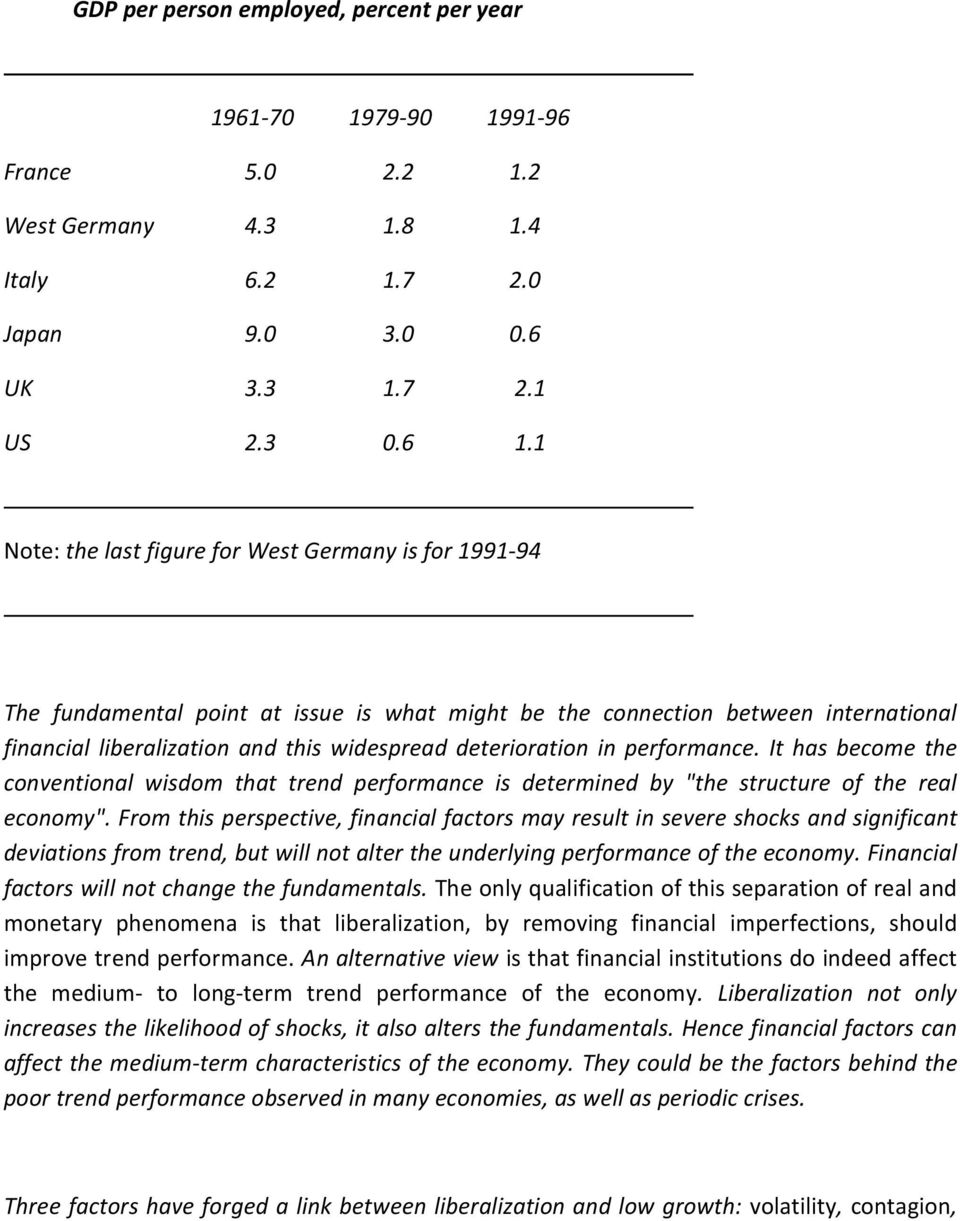
12 GDP per person employed, percent per year France West Germany Italy Japan UK US Note: the last figure for West Germany is for The fundamental point at issue is what might be the connection between international financial liberalization and this widespread deterioration in performance. It has become the conventional wisdom that trend performance is determined by "the structure of the real economy". From this perspective, financial factors may result in severe shocks and significant deviations from trend, but will not alter the underlying performance of the economy. Financial factors will not change the fundamentals. The only qualification of this separation of real and monetary phenomena is that liberalization, by removing financial imperfections, should improve trend performance. An alternative view is that financial institutions do indeed affect the medium- to long-term trend performance of the economy. Liberalization not only increases the likelihood of shocks, it also alters the fundamentals. Hence financial factors can affect the medium-term characteristics of the economy. They could be the factors behind the poor trend performance observed in many economies, as well as periodic crises. Three factors have forged a link between liberalization and low growth: volatility, contagion,
13 and changes in public and private sector behavior. Liberalization has undoubtedly resulted in financial markets becoming more volatile, whether measured by short term swings in exchange rates and interest rates, or the longer swings such as that in the real value of the dollar from an index of 100 in 1980, to 135 in 1985, down to 94 in 1990, and up again to 134 in Volatile financial markets generate economic inefficiencies. Volatility creates financial risk, and even if facilities exist for hedging that risk, the cost of capital formation is raised. The impact of financial market volatility is felt not only in Latin America and East Asia. In the face of higher and more volatile real interest rates, US corporate defaults have increased enormously since the early 1970s. And the damage done by financial volatility is not confined to countries with real economic imbalances - volatility is contagious. The Mexican bond crisis of 1994 propagated the "tequila effect" throughout Latin America. The Asia financial crisis has spread throughout emerging markets, including Eastern Europe, Latin America, and South Africa. The stock market crash of 1987 spread rapidly from New York to all financial markets. A recent study of the 1992 crisis has concluded that systemic contagion makes the link between domestic macroeconomic conditions and the size of currency devaluations, let alone the likelihood of a crisis, "tenuous". Indeed, the link may even have the "wrong" sign, with the financially virtuous suffering the greater punishment! It will be argued that the volatility, contagion, and hence uncertainty associated with liberal financial markets have not only imposed short-term shocks on the real economy of affected countries and regions, but have in fact led to changes in trend performance by inducing changes in behavior in both public and private sectors.that there has been a significant change in public sector behavior is incontestable, and that change is typically attributed to the "discipline" imposed on governments by the international financial markets. In contrast to the 1950s and 1960s when public sector objectives were typically expressed in terms of employment and growth, objectives are now defined in terms of financial and monetary targets, typically summarized as "macroeconomic discipline". It is clearly true that lack of macroeconomic discipline is no way to secure sustainable growth. But what is most striking about the superior economic performance of the 1960s, when objectives were customarily defined in terms of growth and employment, is that fiscal balances typically displayed lower deficits than has been the case since liberalization, and, indeed, fiscal surpluses were not uncommon. The reason for this outcome was, of course, the interdependence between public

14 sector and private sector balances. High levels of investment by the private sector, encouraged by a public sector commitment to growth and employment, in turn resulted in healthy fiscal balances, a result reinforced by relatively small current account deficits. Macroeconomic discipline is a necessary component of sustained economic growth. Burgeoning fiscal deficits and high and rising inflation will undermine any growth strategy. But discipline needs to be associated with a public sector commitment to high levels of investment and employment. Small fiscal deficits, or even fiscal surpluses, may be more readily achieved when private sector investment is encouraged both by the financial environment and by public sector commitment to employment. If private sector investment is discouraged by an absence of public sector commitment to the high levels of employment and growth, fiscal prudence may be combined with recession. Three elements link international financial liberalization to this change in public sector behavior: the potential threat posed to financial stability and the real economy by large capital flows, the belief that those flows are motivated by a particular view of "sound finance", and the additional belief that contagious financial crises may strike without warning. As the Bank for International Settlements (1995) has argued: "In the financial landscape which has been emerging over the past two decades, the likelihood of extreme price movements may well be greater and their consequences in all probability further reaching.... At the macro level, the new landscape puts a premium on policies conducive to financial discipline. Strategically, a firm longer-term focus on price stability is the best safeguard, one which can only be achieved with the support of fiscal discipline". However, the Bank if International Settlement (BIS) then warn, "yet such a safeguard is by no means always effective". The identification of changed behavior in the private sector is more problematic. Ratios of investment to GDP have typically been lower in all countries since liberalization, suggesting a fall in private sector confidence. More specifically, defaults on US corporate bonds, which were at an all time low in the 1950s and 1960s, have increased significantly since the early 1970s. This finding may be explained by higher and more volatile real interest rates post Unsurprisingly, US business failures, which were also low in the 1950s and 1960s have been
15 much higher since, and are correlated with high real interest rates and high debt-equity ratios. These patterns suggest, at very least, a less propitious climate for investment. A decline in confidence in the private sector would also produce an increased desire for the opportunity of exit, further reinforcing the possibility of extreme swings in market sentiment which inflict both short-term and long-term damage. These negative effects are reinforced by the emergence of pro-cyclical forces associated with liberalization. The ability of governments to moderate cyclical forces by monetary policy has been severely diminished both by international liberalization and by the shift in corporate finance from the banks to the securities market. The result is that all monetary policy is now focused on manipulating the demand for money via major swings in increasingly high shortterm interest rates, damaging private sector investment. In developing countries, the recent round of crises has been associated with clearly destabilizing behavior by the private sector. The tell-tale signs included rapidly rising ratios of foreign and domestic debt to GDP as a consequence of external deficits readily financed by capital inflows (at least for a time), together with maturity and currency imbalances in national balance sheets. Standard market practices pushed local financial sectors toward taking long positions in domestic assets and short positions in foreign holdings. A private sector build-up of foreign currency borrowing (without proper hedging, despite the alleged ability of international capital markets to provide such services) was an immediate precursor of both the Mexican and East Asian crises. It was abetted by pro-cyclical financial regulation. Finally, the macroeconomic effects of liberalization can generate instability on a global scale. Industrialized economies can be destabilized by imbalances between flows and stocks induced by capital movements, although the time spans are likely to be longer and institutional responses more robust than those recently observed in Latin America, Eastern Europe, and Asia. In the case of the major economies there can be important feedbacks from national developments to the global system: Does the major borrower or lender, for example, behave in stabilizing or destabilizing fashion? What are its own weak points in terms of changes in stocks and flows? Such situations evolve over time. It seems likely that when imbalances
16 emerge they are lagging indicators of the more fundamental processes which international financial liberalization has set in train. It follows that the global system can be at substantial "market risk," in the phrase that regulators use for dangers transcending mere price fluctuations. If international financial liberalization has indeed led to a change both in the environment for investment and in public and private sector attitudes toward investment, and has resulted in the mutually reinforcing hurt of severe swings in market sentiment and a general deterioration in medium-term confidence, then a deterioration in rates of growth and levels of employment is to be expected. I.2.Thepolicy chalenge The policy challenge is clear: Is it possible to secure the benefits of a flexible financial system, capable of mobilizing capital on a large scale, whilst at the same time ensuring that national economies and the wider world economy are protected from the systemic risks which financial liberalization brings in its wake? The basic components of a new international financial order may be gleaned from the above analytical sketch: since international financial liberalization results in a major increase in risk to the national and the international real economy, an effective policy toward capital markets must be international in character. That is in the best interests of all. The performance of international financial institutions should be assessed in terms of their contribution to growth and stability of the real economy. Financial stability requires an effective lender of last resort. Efficient regulation is a necessary condition for there to be an effective lender of last resort. In the face of the sheer scale of capital movements today an international financial policy will only be possible if there is a high degree of mutually reinforcing co-operation between national monetary and financial authorities. The international economy is made up of national economies at widely differing levels of development in both real and financial sectors. It is most improbable that one simple policy

17 prescription will be appropriate to all. National policies must be respected and supported within the context of an overall international financial framework. A blanket commitment to liberalization, openness, and transparency will end in failure, and will endanger the development of the international market economy. It is a commonplace, accepted by virtually all, that national financial markets should be regulated. But once financial markets are open there is no meaningful distinction between the operations of national markets and the international market. Thus the regulatory principles which apply to the former also apply to the latter. The objectives of national regulator are consumer protection, the maintenance of the highest possible standards of integrity, market conduct and professional skills in the financial services industry, and the minimization of systemic risk. These should be the objectives of international financial regulation. The predominant task of international financial regulation is to minimize systemic risk arising from the operations of securities and futures markets. At the same time, the regulator must avoid the creation of moral hazard. It is vital to guard against the failure of firms endangering the effective operation of the market as a whole. Yet securities firms that make bad judgments must be allowed to fail. The demands of international financial regulation cannot be coped with by purely co-operative structures. A new international regulatory entity with appropriate powers is required. An agreed framework should link that entity and national regulatory structures which will play a vital component part. The history of the modern world economy teaches us that the disadvantages of the spread of liberal financial markets can be offset by sensible public intervention. After all the 25 years after World War II were characterized by strategic liberalization within a controlled international environment, and by the enjoyment of the highest rates of growth and employment in modern times. But in recent years indiscriminate deregulation has dominated domestic and international economic policy, and re-regulation has been in political disfavor. The Asian crisis should have changed all that. Some commentators continue to seek explanations of the crisis in the peculiar characteristics of the Asian economies - the same characteristics which about twenty years ago were typically lauded for their contribution to the Asian miracle. But increasingly, economic policy-makers are recognizing the global risks inherent in international liberalization. The political equation will certainly change if western markets crash or global macro performance deteriorates significantly. It would be better to
18 revise the system to avoid such misfortunes before they happen. III. PROPOSED REFORMS TO IMPROVE PORFOMANCE OF FINANCIAL LIBERALIZATION The overall objective of these proposals is to arrive at a pragmatic consideration of the relationship between capital market liberalization and economic performance, and to create an institutional framework that can put such a pragmatic consideration into effect. If liberal financial markets are not to be perceived as imposing unacceptable costs on national economic performance, then markets must be regulated. If necessary restrictions must be placed on capital flows, national governments must have the opportunity to exercise control over the opening of their own capital markets. Nothing brings liberal financial structures into disrepute so much as the spectacle of national economies being forced into recession by "contagion" effects that bear no relation to their real economic circumstances. The success of Chilean and Chinese restrictions on short-term capital movements in limiting the damaging impact of contagion has been a salutary lesson. The creation of an international body within which national policies on market openness can be debated and coordinated provides a route, perhaps the best route, to maintaining the benefits of liberal financial markets whilst minimizing the costs. The international body would also have the responsibility, in co-operation with national authorities, for directing and maintaining international regulatory structures. It was the Bank for International Settlements

19 (BIS) which pioneered international financial regulation with the formation of the Committee on Bank Supervision and Regulation in It was that Committee which formulated the capital adequacy requirements for banks in the 1980s to which all 13 then BIS members agreed to adhere and use as a tool to keep foreign banks not adhering out of their markets. The result was that countries voluntarily signed on to BIS requirements in order to achieve market credibility. The BIS has also sponsored a tripartite committee of banking, securities and insurance regulators to propose regulatory standards for financial conglomerates. The International Organization of Securities Commissions (IOSCO) is the forum within which national regulators are developing common standards, and developing techniques of cross-border regulation. But IOSCO is essentially a co-operative organization. This is not enough. An executive authority with surveillance capabilities is required. The World Trade Organization (WTO) illustrates that it is possible to establish an international executive authority with enforcement powers. The key task will be to devise a set of arrangements geared to the maintenance of national and international financial stability, and supportive of high levels of growth and employment. The following is a resume of recommendations provided by John Eatwell and Lance Taylor (2000 pp ): III. 1.A World of Financial Authority It is proposed that a World Financial Authority (WFA) be established. This organization would be complementary to the WTO. A central task of the WFA would be the development of policies to manage systemic risk. The objectives of the WFA should include the requirement to pursue policies to maintain high rates of growth and employment. It would be the task of the WFA both to develop rules which would ensure the adoption of best regulatory practice and effective risk management procedures, and to oversee the development of a credible guarantor and lender of last resort function. It will therefore need to build on the achievements of IOSCO to develop a framework for international financial regulation (including risk management procedures) and to ensure, via the powers ceded to it, that those rules are implemented.

20 But the WFA should not simply be a body that develops and imposes regulatory procedures. It should also be a forum within which the rules of international financial co-operation are developed and implemented. Many of the goals of an efficient international financial policy can be achieved by effective co-ordination of the activities of national monetary authorities. The problem is that the means of achieving that co-ordination are, at the moment, very limited. The WFA will fill that gap. It will also be the responsibility of the WFA to ensure that once national polices have been agreed by the WFA, states support each other's national policies. It is that mutual support which is the key to success. The WFA should also be given the responsibility of ensuring transparency and accountability on the part of international financial institutions such as the IMF and the World Bank. There is at present no systematic evaluation of the activities of the Bretton Woods institutions, and this lacuna may well have contributed to the damaging criticism that the IMF in particular is imposing an essentially political program in the guise of technical conditionality. Martin Feldstein, for example, has argued that the IMF "should not use the opportunity to impose other economic changes that, however helpful they may be, are not necessary to deal with the balance of payments problem and are the proper responsibility of the country's own political system". Making the Bretton Woods institutions accountable to the WFA would introduce a "safety valve" of evaluation and accountability that would make the IMF more effective. Finally, the WFA should provide the necessary regulatory framework within which the IMF can develop as an effective lender of last resort. In many countries the WFA would simply certify that domestic regulatory procedures are effective. In those countries in which financial regulation is unsatisfactory, and which would therefore not have access to the IMF in a financial crisis, the WFA would assist with regulatory reform. III.2. A reorganized IMF and World Bank It is clear that there is no appetite today (especially in Washington) for the creation of a new international bureaucracy. Fortunately, the infrastructure for the WFA already exists in the

21 form of the BIS and the co-operative cross-border regulatory framework already developed by IOSCO. With the backing of international agreement, adequate resources, and surveillance "teeth", these institutions could be developed into the needed world. The IMF should be reorganized to take responsibility on behalf of the WFA for coordinating and partially funding international rescue operations when the need arises and when WFAapproved regulatory procedures are in place. There should be explicit consideration of how the IMF procedures should be developed to deal with problems of liquidity, and the development of a lender-of-last resort function. For example, the IMF could develop procedures to ensure that in the case of liquidity crises creditors should be "bailed-in" to support the rescue rather than have their own positions "bailed-out". Whilst reducing systemic risk, care should be taken to minimize moral hazard. To the extent that creditors are protected, this should be at not insignificant cost. Most importantly, rescues should be based on prompt injections of liquidity instead of the current disastrous policy of prolonged attempts to restructure national economic systems using conditionality-laden credit disbursements as bait. The World Bank should direct its lending activities toward poorer countries unlikely to get access to open credit markets, subject to oversight from the WFA. It should also act as a coordinator and guarantor for a new global closed-end investment fund for emerging markets, a task completely in accord with the powers and functions incorporated in the Bank's charter. The fund could be capitalized by purchasing and holding government securities of the industrial countries in proportion to its shares held by residents of these countries. It would concentrate on long-term investments in the production of goods and services in developing countries, rather than short-term portfolio placements. The fund's shares could be bought and sold freely in many markets and many currencies. Although its share values would fluctuate, the fund would not be forced to sell off its underlying portfolio in the event of a downswing. This would protect emerging markets from abrupt fluctuations in capital movements of the sort observed in Mexico, East Asia, and elsewhere, reducing the need for capital controls. The creation of such a fund should improve the efficiency of investment by significantly reducing the cost of information needed by investors to put together balanced and diversified portfolios.
22 III.3. The Roles of Governments Governments should be required by the WFA to improve control of national financial systems by imposing risk-weighted capital and/or reserve requirements on all major institutions, banks, mutual funds, insurance and pension funds, for all on-shore and off-shore and onbalance sheet and off-balance sheet operations (recognizing how difficult the identification of some of these operations may be). It should be recognized that traditional notions of capital adequacy monitoring are seriously inadequate in today's capital markets. Capital is no substitute for effective management. Risk management should be central to regulatory activity, internalizing, as far as may be possible, risk externalities, though the authorities will need to be aware of the pro-cyclical nature of risk assessment by firms. Particular attention should be paid to the management of foreign exchange risk. The goals of the development of a new financial framework are to give the authorities leverage over both the supply and demand sides of credit markets, and to prevent imbalances in which national financial systems have long internal and short external net positions or blatant stock-flow disequilibrium positions. The former task will take some of the pressure off short-term interest rates and limit the pro-cyclical consequences of a monetary policy that is directed only at the demand side. The latter task will reduce systemic risk by focusing more attention than at present to system-wide implications of individual agents' attempts to take 000 animaux de ras hedge and insure their portfolios. III.4. The management of capital movements The experience of the past twenty years has demonstrated that complete liberalization is inefficient. Unmanaged financial markets are too prone to volatility and contagion to provide the stable financial framework necessary for high rates of growth and employment. Instead, a regulated international system, operating through a WFA will create the possibility of securing the benefits of capital mobility, whilst diminishing the costs. Indeed, such management
23 necessary if there is not to be a swing back to widespread protectionism. Campaigns to rewrite the IMF articles to require full capital market liberalization by all nations, and OECD proposal to write full capital liberalization requirements into a multilateral agreement on investment, are without sound intellectual foundation and should be abandoned. National governments, after appropriate consultations with the WFA, should be empowered to impose restrictions on external capital movements as they see fit. Effective controls, particularly on short-term capital inflows may well be necessary if free trade in goods and services is to be sustained. Yet there is a significant difference between limiting short-capital flows into a country, and closing markets to foreign goods. In the latter case a country may attempt to acquire a beggar-my-neighbor advantage. The same argument does not apply to the former case. So the usual requirement of regulatory capital and reserve ratios imposed on firms may be supplemented with quantitative or tax-based obstacles to cross-border flows of funds. Whilst there should be a presumption in favor of national policies, the form, scale and duration of such restrictions (which may, if necessary, be deemed permanent) should, however, be determined in consultations with the WFA. Once particular conditions for the management of capital movement have been agreed then member states of the WFA should be required to provide assistance to fellow members in their operation. III. 5. Financial insurance To diminish the damaging effects of moral hazard on institutional decision making, national compulsory deposit insurance and similar financial guarantee insurance systems should be associated with individuals and households rather than institutions. IV. GENERAL FINDINGS AND CONCLUSION: In this topic our problematic point was to know what might be the connection between
24 international financial liberalization and this widespread deterioration in performance. It has been demonstrated that the conventional wisdom that trend performance is determined by "the structure of the real economy". From this perspective, financial factors may result in severe shocks and significant deviations from trend, but will not alter the underlying performance of the economy. Financial factors will not change the fundamentals. The only qualification of this separation of real economy and monetary phenomena is that liberalization, by removing financial imperfections, should improve trend performance. An alternative view is that financial institutions do indeed affect the medium- to long-term trend performance of the economy. Liberalization not only increases the likelihood of shocks, it also alters the fundamentals. Hence financial factors can affect the medium-term characteristics of the economy. They could be the factors behind the poor trend performance observed in many economies, as well as periodic crises. Furthermore we have seen that there are three factors that have forged a link between liberalization and low growth: volatility, contagion, and changes in public and private sector behavior. About this the policy challenge is clear: is it possible to secure the benefits of a flexible financial system, capable of mobilizing capital on a large scale, whilst at the same time ensuring that national economies and the wider world economy are protected from the systemic risks which financial liberalization brings in its wake? The basic components of a new international financial order may be gleaned from this analytical sketch: Since international financial liberalization results in a major increase in risk to the national and the international real economy, an effective policy toward capital markets must be international in character. That is in the best interests of all. The performance of international financial institutions should be assessed in terms of their contribution to growth and stability of the real economy. Financial stability requires an effective lender of last resort. Efficient regulation is a necessary condition for there to be an effective lender of last resort. In the face of the sheer scale of capital movements today an international financial policy will only be possible if there is a high degree of mutually reinforcing co-operation between national monetary and financial authorities. The international economy is made up of national economies at widely differing levels of development in both real and financial sectors. It is most improbable that one simple policy prescription will be appropriate to all. National policies must be respected and supported
25 within the context of an overall international financial framework. A blanket commitment to liberalization, openness, and transparency will end in failure, and will endanger the development of the international market economy. It is a commonplace, accepted by virtually all, that national financial markets should be regulated. But once financial markets are open there is no meaningful distinction between the operations of national markets and the international market. Thus the regulatory principles which apply to the former also apply to the latter. The objectives of national regulator are consumer protection, the maintenance of the highest possible standards of integrity, market conduct and professional skills in the financial services industry, and the minimization of systemic risk. These should be the objectives of international financial regulation. The predominant task of international financial regulation is to minimize systemic risk arising from the operations of securities and futures markets. At the same time, the regulator must avoid the creation of moral hazard. It is vital to guard against the failure of firms endangering the effective operation of the market as a whole. Yet securities firms that make bad judgments must be allowed to fail. The demands of international financial regulation cannot be coped with by purely cooperative structures. A new international regulatory entity with appropriate powers is required. An agreed framework should link that entity and national regulatory structures which will play a vital component part. Furthermore the history of the modern world economy teaches us that the disadvantages of the spread of liberal financial markets can be offset by sensible public intervention. After all the 25 years after World War II were characterized by strategic liberalization within a controlled international environment, and by the enjoyment of the highest rates of growth and employment in modern times. But in recent years indiscriminate deregulation has dominated domestic and international economic policy, and re-regulation has been in political disfavor. Now it clear that this new global financial order has revealed its potential to self-destruct and it is at risk. As it has been demonstrated, the global economic problem will continue and that there must be some sort of global safety net to resolve them before they get out hand. It would be better to revise the system to avoid such misfortunes before they happen. If history s experience has confirmed the need for regulation and lender of last resort in domestic markets; the same sorts of measures are now required internationally if a broadly liberal world financial order is to survive. BIBLIOGRAPHY
26 William Baumol in Welfare Economics and Theory of the State Cambridge MA, Havard University Press, 1967 Peter Bohm in external Economies, London Mac Millan 1987 Inge Kaul, Isabelle Grunberg and Marc Stern in Global Public Goods, New York, Oxford University Press, 1999 David Llewellyn in The Economic Rationale for Financial Regulation, London, and Financial services Authority, Ocasional Paper Series, nimber1, Jan Joost Teunissen, in Reguratory and Supervisory Challenge in the new Era of Global Finance, Hague, Forum on Dept and Development,1998). John Eatwell and Lance Taylor (2000) in Global Finance at Risk BIS (Bank for International Settlements) (2005) Triennial Central Bank Survey: Foreign Exchange and Derivatives Market Activity in 2004 (Basel: BIS). Brock, P.L. and Rojas-Suarez, L. (2000) Understanding the behavior of bank spreads in Latin America. Journal of Development Economics, 63(1), pp Calvo, G. (1998) Varieties of capital-market crises, in: G. Calvo and M. King (eds) The Debt Burden and its Consequences for Monetary Policy, (New York: St. Martin's Press), pp Demir, F. (2004) A failure story: politics and financial liberalization in Turkey, revisiting the revolving door hypothesis. World Development, 3 2(5), pp Diaz Alejandro, C. (1985) Good-bye financial repression, hello financial crash. Journal of Development Economics, 19(1-2), pp Fanelli, J. M., Rozenwurcel, G. and Simpson, L. M. (1998) Financial reform in developing countries: Argentina, in: J. M. Fanelli and R. Medhora (eds) Financial Reform in Developing Countries, (New York: St. Martin's Press), pp Felix, D. (1998) Asia and the crisis of financial globalization, in D. Baker, G. Epstein, and R. Pollin (eds) Globalization and Progressive Economic Policy, (Cambridge University Press), pp.163- Fitzgerald, E.V.K. (2001) Short term capital flows, the real economy and income distribution in
27 developing countries, in: S. Griffith Jones, M.F. Montes and A. Nasution (eds) Short Term Capital Flows and Economic Crisis, (UNU/WIDER: Oxford University Press), pp Gabriele, A., Boratav, K. and Parikh, A. (2000) Instability and volatility of capital flows to developing countries. The World Economy, 23(8), pp THREATS, VULNERABILITIES AND CHALLENGES AGAINST CUSTOMER CARE SYSTEM IN RWANDAN ORGANIZATIONS By NIYIKIZA Gaston
28 ABSTRACT After the tragic genocide against Tutsi of 1994, Rwanda resurrected and recovered life politically, economically, socially and diplomatically. This new life of Rwanda triggered a process of reorganizing and creating new organizations that are functional today. That process brings the need of changing some practices so that it becomes benefic generally to the humanity and particularly to Rwandans. Using documentation, observation, investigation and experimentation we highlighted the factors that can cause to an organization to enforce poor service delivered to customers. The aim of this paper is to invite leaders and builders of institutions to examine if their decisions, practices and policies are really promoting and systematizing good service for interest of the people the organization is built for, customers. NIYIKIZA Gaston: Lecturer in computer science at Kigali Independent University, BA in Information Management from Adventist University of Central Africa (Kigali), MASTER in Information System Audit from Université de Marne la Vallée (Paris, France). 1. General introduction 1.1. Background Customers constitute one of important assets of any enterprise. The interdependence between organization and customers is a concept that should be understood as it is; and managed in perspective of not only to maintain and keep good state of our business but also to make the business perennial and sustain our good reputation. Unfortunately in different speeches of Rwandan leaders and citizen s complaints, poor customer care is frequently expressed as well as in public and private institutions.
29 As they are located in a country found the best one moving forward in doing business 1, the country which has been proved moving fast toward development and the country integrated in deferent international organizations like Commonwealth, EAC, COMESA, CEPGL, etc., Rwandan organizations, public and private need to systematize the customer care in order to take profit from the different opportunities offered by the membership of Rwanda in international organizations and the good considerations (country of security, an army highly disciplined, gender development, good governance led by HE Paul KAGAME the President of Rwanda, noble culture, country of thousand hills, experience in unit and reconciliation after Genocide, country among of few others having the mountain gorillas, etc.) the country has in the region and in international organizations. None ignores that organizations are pleased to see the number of customers increasing but few is ones constantly worry to lose one customer among many ones. The kind of attitude of organization constitutes an indicator of lack of quality service delivery and customer care that can be caused by many factors that are classifiable into threats, vulnerabilities or challenges that organization is facing. This article will focus on differentiating and classifying the factors that affect negatively a perfect customer care system generally in any organization and particularly in Rwandan institutions Clarification of the key words This topic is founded on three words and one group of words. In this subtitle each one of them is taken in general context while the specific context will be presented in the second part of this article. They are: Threat, Vulnerability, Challenge and Customer Care System Threat According to different dictionaries, a threat can be a person or group of people, a system, an organization, a structure or something else whose existence or activity and practice constitute a blockage or paralysis to the development and right functionalities of others Vulnerability The Certified Information Systems Auditor (CISA) defines Vulnerability as a weakness or absence of a protective control that makes the probability of one or more threats more likely 2. To fight against threats the potential victims have to reduce its vulnerability. This leads us to the following formula 3 : 1 Word Bank report Doing Business PETER H. GREGORY et al. (2010), CISA Exam Guide, MC Graw Hill, p Université de Marne la Vallée par Bernard MINOT(2008), Audit informatique
30 RISK=THREAT X VULNERABILITY The formula here above shows that the problem is dwelt on the risk. Threat is nothing if your vulnerability is Zero. However, threats may be absent during a long or short period but finally, the vulnerable will be attacked, because vulnerability can attract or invite threats towards the vulnerable. In other words, Vulnerability constitutes a set of doors or windows that are welcoming threats Challenge It is a situation of being faced with something needing great mental or physical effort in order to be done successfully and which therefore tests a person s ability 4. A challenge is not avoidable or escapable because it develops our experience in solving and surmounting problems. After surmounting a challenge, we become mature and more equipped for the future, meaning that our vulnerability is reduced Customer Care System This group of three words needs to be contextualized basing on the general meaning of each word. Generally, Customer is defined as any physical or moral, internal or external person representing sales opportunity and needing to be treated with an appropriate service level 5. This article considers customer as any person having to do with the business or duties of somebody in an organization. Depending on the context Care can mean protection, attention, worry etc. No matter of the considered context, customer care should be understood as combining protection, attention and worry towards customer. System is generally used to signify a SET or METHOD or MECHANISM 6. The word system in this article refers to method or mechanism than set. The systematization of customer care means planning for enriching and sustaining the way customers are or will be treated or served, especially in perspective of introducing into customer s mind, the need and interest to come back or to continue working with you. In other words, systematization of customer care is the process to make customer care the culture of an organization Customer care and Customer Relationship Management (CRM) Most of time, the concept of CRM is more utilized by many authors than Customer care, not because customer care is not important for them or it has been replaced, but simply because CRM includes customer care. The customer care refers to a positive attitude towards the customer for the first time he interacts with the organization while CRM is a corporate wide approach to understanding customer behavior, influencing it or him through continuous 4 Cambridge University Press (2003), Cambridge Advanced Learner s Dictionary 5 Duane Sharp, P.Eng. (2003), Customer Relationship Management Systems Handbook, AUERBACH, p.2 6 Cambridge University Press, Op.cit
31 relevant communication and developing long-term relationships to enhance customer loyalty, acquisition, retention, and profitability Classification of factors influencing customer care system The factors affecting customer care system are going to be classified basing on their origin or nature. The following table lists the factors with their classes. Factors Origin Nature Subjectivity in employees recruitment Organization Vulnerability & Challenge Decentralization process Organization Challenge & Vulnerability Monopoly Environment Threat Bureaucracy Organization Vulnerability Insufficient skills in IT of employees Organization Vulnerability Employees insufficiency skills in usable languages Organization Vulnerability Bad history or background Environment Threat Discrepancies between Customer s perception and expectation and organizational choice of service delivery management Environment Challenge Lack of employees satisfaction Organization Vulnerability & Challenge Poor planning of activities Organization Vulnerability Source: Our own observation 2.1. Subjectivity in employees recruitment The recruitment as a process of acquiring the right person for specific functions constitutes an occasion for the leader of institution to make one of the crucial decisions. One of the secrets of success of any institution is to have the employees committed to the mission of organization. Sometimes, the authorities of institutions fall in temptation to confuse the occasion to make decision about recruitment with the occasion to solve financial problems of their relatives. It happens that people are employed in an institution just because they are relatives of the highest decider of the organization. The first person to undergo the consequence of that kind of bad decision is 7 Duane Sharp, P.Eng, Op.cit
32 the customer, because it is difficult to that employee to keep in mind that customer is always right 8. The situation becomes worst when the competence and competency of the employed person are too low. Can you imagine what will happen to the customers if the kind of employee occupies the head of the organization? When the above described practice in recruitment of employees is present in an institution, then the customer care system is vulnerable. Naturally, human is social being. To avoid subjectivity in recruitment is a challenge, because it requires distinguishing clearly the social interest from the business interest. Illustrative example Imagine the situation where you have been victim of a poor service from one of employees in an institution. When you try to explain the matter to his chief, then he says: You see Sir, that guy you are accusing is untouchable here, because the super authority of this institution is his uncle. So I m sorry and patient please. The opinion expressed here above is not to avoid employment of our relatives, but to encourage leaders of organizations to keep in their mind a clear distinction between themselves and the organizations they have to manage. The organizational leaders must set and respect policies that will make all employees accountable to customers Decentralization process The decentralization itself targets to make more and more accessible the service to the customers. However as the decentralization needs to promote the power delegation to the low level entities of an institution, as the power is inseparable with responsibility, and as the basic authorities are not familiar with new decision making system during the decentralization process, customers are subject to a poor service especially when the basic entities are not yet sufficiently experienced and stable. The challenge of the basic entities dwells on how to serve qualitatively and quantitatively the customers while the human and material resources are limited! The customer care system becomes vulnerable because the decentralization process start with few equipments and experiences for facilitating decision making of the low level entities to deal with many problems from customers. Another thing about decentralization process vis-à-vis the customer care is that the lowest level authorities receive many and different orders and instructions from many and different supervisors (chiefs). This situation makes the supervisors of the lowest authorities to requisition all other people under their authorities. During that kind of situation, the priority will be to please the chief than to satisfy customers. Then do you think that the customer is still King as it is always said? I can see you saying: absolutely no. 8 consulted on April,
33 Illustrative example It had been about 10 years ago that I have moved from a rural former Commune to the city of Kigali. The decentralization process was started and changed the names and location of local government entities when I have all ready left the rural ex Commune. When I went to look for single status certificate, in a city sector in which I was residing since two years ago, the supposed person to serve me said that the right sector to provide the document is the one which gave me the ID card. I said it is ok, let me go there. Thinking that the practice is known and official, I went in rural sector seeking that certificate. Arrived there, the person in charge said you know? I said no, this document you are looking for is critical. First of all I do not see why you didn t look for it in the sector of your residence. I said you are right, but that sector you are talking about sent me to you. She said, now to get it, you have to go to look for village and cellule authorities for signature of approbation. The territories and authorities had been changed; really the local authorities are not the right people to know what happened to me after 10 years. I asked the person in charge: Do you think that you are treating me as Rwandan? Fortunately after a long discussion with other employees the person finished by accepting my request, but with doubt and fear saying: I feel risky to sign this document. Note: With the illustrative example here above, the idea expressed is that when a system is being decentralized, it is prudent and better to think about what will happen to the customers during that process. Otherwise, the consideration of customer will be lost while it could be possible to keep good relationship with customers even during that transitional period Monopoly Monopoly means simply a gap in business competition which avoids or limits churn. More than 80% of customers in Rwanda lack alternative services and are forced to shop or visit the same businesses no matter how their services are 9. This factor constitutes one hundred percent a threat against customer care system; because most of time the product or service providers will realize that there is no need of furnishing efforts to attract customers. In other words, lack of quality service seems unavoidable there. 9 consulted on 29/11/2010
34 As the purpose of producing is to make money, the products or services providers will not limit the number of customers even their capacities are not infinite. In that case product/service providers consider that the access to the service/product constitutes itself a favor or a chance. Carelessness about customer satisfaction there is abundant. The absence of monopoly involves the presence of churn which could help the institutions in: Learning about their business, learning about who/whom their customers are, learning about what their customers want, learning about what their company should do next. Churn gives you the information, the opportunity, and the justification you need to turn your organization into exactly what you want it to be 10. With this attitude, permanently, institution will care about customer Bureaucracy It is a system for controlling or managing a country, company or organization that is operated by a large number of officials who are employed to follow rules carefully 11. More customer has to look for many different people in order to be served, more is exposed to a poor service, because this people have different attributions, different working schedules and different urgencies. In addition, with bureaucracy system none in the chain of serving the customer poorly served is directly responsible of that poor service, because every one in the chain has right to say That is normally the procedure. We can t change the habitual practices because of you. Once again, let me ask: is customer the King there? Illustrative example One day I asked for a document in one of departments A of an organization. This department was organizationally parallel to another department B of the same organization. When the chief of the two departments received my document for an approval signature, then he resent back the document unsigned saying that the department which received me is A while the right one should be B! Then the process should restart. Can you imagine! 2.5. Insufficient skills in IT of employees Today, information technology is crucial in every domain of human life. The information technology (IT) is not only the producer of useful information whenever this is needed but also the facilitator to do things transparently, rightly and quickly. When employees of an organization are sufficiently equipped in terms of competence and 10 Rob Mattison (2005), THE TELCO CHURN MANAGEMENT HANDBOOK, XiT Press, Oakwood Hills, Illinois, USA. 11 Cambridge University Press, Op.cit
35 competency in IT, quick service with few mistakes is the main characteristic of customer care system in that organization. Illustrative example You remember the problem of salaries payment that many employees faced in February Mostly its cause was the lack of experience in IT exploitation of salary statement makers, rather than the software of money transfer of National Bank of Rwanda (BNR). One employee, one of my friends, met that problem and when he pursued the case of non payment of his salary, he discovered that the personnel in charge of elaborating the list of salary payment to be sent at BNR for transfer, made a mistake of recording wrong account number of that employee. It was not the first time this account number was going to be used for the same purpose, meaning that the right account number was recorded in the files created for the payment of the previous month. Now, as each month, the person in charge of salary payment has to reproduce the same account numbers for elaboration of list of salary payment, it was sufficient to copy from a file of previous payment and paste the new file of the current payment, in order to avoid the mistake caused by recording and rerecording. A Continual, progressive and practical training in IT skills to employees, may prevent many mistakes, promote quick service and permit the easiness in activities planning Employees insufficiency skills in usable languages in an organization A language is a basic tool for communication, learning and working. It means that employees must be sufficiently equipped in terms of languages that are mostly used in his/her organization, in order to serve effectively customers. More to that, if an employee is limited in a usable language in the organization, his/she is blocked, frustrated and afraid when he/she has to serve customers through the usage of a particular language. In that case, customer care system of that organization is vulnerable. Illustrative example A clerk in one of Rwandan banks had to check an account balance for a customer. After asking that service to her, the customer was surprised by the way she was looking at him as if he was wrong to request to check for him his account balance. The surprise has been enforced by seeing that employee to leave the sit without any word of excuse. Fortunately after five minutes from her depart another employee came and served the customer. The customer tried to explain to the employee, the problem he faced because of his colleague; then the employee said: that woman doesn t understand English and unfortunately the software we are using now recently has been shifted from French to English. The problem is that she was blocked.
36 It is really a mistake to appoint a person to the position of clerk, who is lacking skills of usable languages because communication is one of important factors to make happy customers and the clerk gives the first impressions to people entering in the institution. Communication skills must be a crucial criterion to choose the right person who has to clerk for organization Bad history or background Most of time, the history or background makes one or affects what and how one is today. This is because history or background constitutes a synergy that affects positively or negatively according to how well or bad is that history or background, throughout and generations by generations. Political, cultural and colonial background of Rwandans has been an obstacle to their entrepreneurship and competitiveness development 12. When the background of a person is bad, then it constitutes a threat to the customer care system of all institutions that person will work in or with. However this threat finishes by becoming progressively first a challenge, next an opportunity for learning and finally a foundation for a better future. This process is only possible when the source of that bad background has been totally or progressively destroyed. Rwanda is on a good way of that process, the reason why all Rwandans could say CONGLATULATIONS to H.E the President of Republic of Rwanda for having cultivated in most of Rwandans the culture of patriotism instead of division philosophy Discrepancies between Customer s perception and expectation and organizational choice of service delivery management According to the quality service model of Zeithaml Parasuraman and Beny, five discrepancies or gaps may impinge on service quality 13 : 1. The discrepancy between customers expectation and managements perception of these expectations; 2. The discrepancy between managements perceptions of customers expectations and service quality specification; 3. The discrepancy between service quality specifications and actual service delivery; 4. The discrepancy between actual service delivery and what is communicated to customers about it; and 5. The discrepancy between customers expected service and perceived service delivery Countrywide Customer Care campaign in offing, consulted on 29 November, 2010, 13: consulted on 14/04/2011
37 The above discrepancies come from environment of an organizational customer care system. They challenge that system because people who generally are customers and service providers are different in their expectations and perception. To systemize customer care needs to consider all those differences as normal and positive so that an appropriate way of dealing with them effectively can be found Lack of employees satisfaction The single most important factor that affects customer satisfaction is employee satisfaction. Employees who feel satisfied and happy at their jobs naturally tend to be more helpful and considerate towards customers. It s simple logic. If I like my job and the company I work for, I m going to communicate to customers that we have a good product 14. It is impossible to give what you don t have. Unsatisfied employee is mostly able to provide unsatisfactory service/product. As employees are human beings, it may be a challenging task to ensure their satisfactions because persons are different by their perceptions and expectations. However it is possible if the employer takes time to interact continually and effectively with his employees Poor planning of activities The lack of proper planning is a sure ticket to failure 15. Poor planning gives place to a disorder where each activity seems to be realized urgently; anybody is subject to do anything which is done anyhow and anytime. In other words few are done rightly. In this case, customer is the first victim of the bad consequences of poor planning. 3. Conclusion Customer care plays a crucial role in the invitation, attraction and retention of customers. Remember that 96 percent of unhappy customers never complain. But if their problem remains unsolved they usually tell ten other customers! 16 The systematization of customer care is a complicated task to the entire organization. And the number of complications increases when the organization ignores the nature of the factors making this task complicated. The factors not depending on the organizational will, are threats, while the ones organizational leaders may deal with; are either vulnerabilities or challenges consulted on 14/04/ Pankaj Jalote (2008), A Concise Introduction to Software Engineering, Springer-Verlag London Limited 16 Customer Relationship Management-Economic of Customer Care, Thorogood Publishing Ltd.
38 Organization should understand that publicities are most inviting than attracting. Managerial practices like bureaucracy, decisions making like recruitment, appointment and decentralization, and employee s motivation like continual training, good communication and more have in one way or another, directly or indirectly a positive or negative impact on how customers are treated. It is prudent for organizational deciders, planners and all employees to think about the consequence of their activities on customers attraction and satisfaction, otherwise the organization will pay expensive to invite without gaining, simply because attraction remain poor. To each employee or employer s representative of an organization, we advise to keep in their minds that they are there only because people are there. The presence of people is the only source of the opportunity from which your job or business has been created. Do not forget that a Customer is King. Whatever you are planning as a leader of an organization, make sure that the following points will be kept safe: To solve Your Customers Problems; To Treat Customers with Respect; To connect with Your Customers Emotions; To Set the Fairest (Not the Lowest) Prices and To Save Your Customers Time 17 BIBLIOGRAPHY Books 1) Duane Sharp, P.Eng. (2003), Customer Relationship Management Systems Handbook, AUERBACH. 2) PETER H. GREGORY et al. (2010), CISA Exam Guide, MC Graw Hill. 3) Rob Mattison (2005), THE TELCO CHURN MANAGEMENT HANDBOOK, XiT Press, Oakwood Hills, Illinois, USA. 4) Pankaj Jalote (2008), A Concise Introduction to Software Engineering, Springer-Verlag London Limited. 5) Cambridge University Press (2003), Cambridge Advanced Learner s Dictionary. 6) Harvard Business Review On Customer Relationship Management (1998, 1999, 2000, 2001), USA. Electronic references 1) consulted on April, ) consulted on 29/11/ ) Countrywide Customer Care campaign in offing, consulted on 29 November, 2010, 13: Harvard Business Review On Customer Relationship Management (1998, 1999, 2000, 2001), USA
39 Report 4) consulted on 14/04/ ) consulted on 14/04/ ) Word Bank report Doing Business 2010 Other documents 1) Customer Relationship Management-Economic of Customer Care, Thorogood Publishing Ltd. 2) Université de Marne la Vallée par Bernard MINOT(2008), Les differentes approches de l_audit. ANALYSE DESCRIPTIVE DE LA CONTRIBUTION DES PROJETS FINANCÉS PAR LA BAD AU DÉVELOPPEMENT DES DIVERS SECTEURS DE L ÉCONOMIE DU RWANDA. CAS DU PROJET PADEBL, DU SECTEUR DE L ÉLEVAGE, Par Okoko OSAMBO 19 et Pulchérie NGENDO 20 ABSTRACT 18 Cet article est essentiellement issu du travail de mémoire présenté par Mme NGENDO Pulchérie en vue de l obtention du grade de Licence en Gestion à l Université Libre de Kigali, Kigali, Rwanda. 19 Okoko OSAMBO enseigne la gestion à l Université Libre de Kigali (ULK), il est titulaire d une Maitrise en Sciences Commerciales, de l Université de Western Cape en Afrique du Sud. Il est également titulaire d un Diplôme d Etudes Spécialisées en Gestion, de l Université de Cape Town, en Afrique du Sud. Okoko OSAMBO a également une licence en Gestion Financière, de l Université Catholique de Bukavu. Il a effectué une formation approfondie sur l usage des techniques multimédia appliquées à la formation, aux Facultés Universitaires Notre Dame de la Paix à Namur, en Belgique, ainsi qu à l université de Liège, en Belgique. 20 Pulchérie NGENDO est titulaire d une licence en Gestion, de l Université Libre de Kigali, au Rwanda. Elle a travaillé dans plusieurs entreprises locales, dont : Ameki-Color et Kabuye Sugar Works. Elle est actuellement intéressée par les activités commerciales du secteur de l élevage au Rwanda.
40 Cet article a pour objet, celui de présenter une brève et descriptive analyse sur l apport de l intervention de la Banque Africaine de Développement dans l essor des divers secteurs de l économie du Rwanda. Le Secteur de l élevage, par le Projet PADEBL, constitue ici, le cas d analyse. The aim of this paper is to present a brief and descriptive analysis upon the contribution of the African Development Bank into the rise of various sectors of the Rwandan Economy. The Farming (rearing) sector, through the PADEBL Project, are herein, the case study sector as well as the case study project. INTRODUCTION La Banque Africaine de Développement (BAD) fait partie des institutions financières multilatérales qui interviennent sur le continent africain, comme partenaire du développement de ce dernier. Comme son
41 nom l indique, la BAD a été créée dans le but de permettre au continent africain, considéré comme étant le plus pauvre de la planète, de sortir petit à petit du sous-développement. 21 En effet, face à l ampleur et à la progression de la pauvreté, d une part, et face à la menace sérieuse qu elles font peser sur la stabilité économique et sociale du reste de l humanité, de l autre part, on ne peut manquer de se demander si les institutions financières telle que la BAD jouent effectivement leur rôle de promotion du développement pour l Afrique, aspect considéré comme étant le plus grand défi pour ce siècle et pour les siècles à venir 22. Le développement économique du Rwanda, pays africain, ne peut se concevoir sans l assistance des partenaires au développement. Parmi ces derniers, la BAD (Banque Africaine de Développement), qui est vue comme étant l une des institutions financières qui apporte une assistance considérable au Gouvernement Rwandais à travers ses multiples programmes de développement économique, visant divers secteurs, dont le secteur de l élevage, avec pour finalité, de lutter contre la pauvreté. Rappelons que le Rwanda a vécu un contexte de guerre de 1990 à Cette période a été caractérisée par une situation politico-économique difficile qui a débouché sur la guerre et le génocide de 1994, venus tous deux, anéantir les tissus sociaux, économiques et politiques déjà affaiblis par la pauvreté. La relance de ces tissus meurtris, a impliqué différentes institutions tant régionales qu internationales, dont la Banque Africaine de Développement (BAD). L objet de cet article est celui de mener une brève analyse sur l apport effectif de l intervention de la Banque Africaine de Développement dans l essor des divers secteurs de l économie du Rwanda. Le Secteur de l élevage, par le Projet PADEBL, constitue ici, le cas d analyse. Ainsi, l analyse du soussecteur économique évoqué ci-haut, constitue le point focal de l article. Les techniques et les méthodes suivantes nous ont permis de récolter les données, de les analyser, et ainsi, de réaliser ce travail : 21 BAD, Vision de la Banque Africaine de Développement, 3è Edition, BAD, Tunis, 2005, p HUGUES G., et al, La lutte contre la pauvreté en Afrique subsaharienne, Economica, Paris, 1999, p.7
42 - Technique documentaire Cette technique nous a aidé à récolter des données et informations en fouillant des ouvrages de différents auteurs ainsi que des rapports. Elle nous a également permis d exploiter les documents de la BAD et du PADEBL pour réaliser ce travail. - Technique d interview libre Grâce à cette technique, nous avons procédé à des entretiens au cours desquels nous avons interrogé des personnes susceptibles de nous fournir des informations relatives à ce sujet d étude. Cette technique nous a permis de récolter des données orales relatives à la création, au fonctionnement ainsi qu à l évolution du projet PADEBL. Quant aux méthodes, nous nous sommes servis de quatre méthodes ci-après : - Méthode Historique Elle consiste à faire une analyse des faits ou des données d une période bien précise, un temps bien délimité dans le passé. Evidemment, l accent a été mis sur l évolution des faits étudiés, de leur genèse à leur situation actuelle. Cette méthode nous a été utile pour connaître le projet PADEBL, dès sa création jusqu à son terme. - Méthode Analytique Elle porte sur l analyse de chaque cas et chaque élément d un tout. Elle nous a permis de traiter les différentes données récoltées. Ainsi, grâce à elle, nous avons été à mesure de comprendre le déroulement des activités d ensemble tant de la BAD que du projet PADEBL pour la période de 2003 à 2007.
43 - Méthode statistique C est une méthode qui permet au chercheur de quantifier et de chiffrer les résultats de sa recherche. Elle nous a permis de récolter une série de données chiffrées qui traduisent l intervention de la BAD sur la période qui fait l objet de notre étude. - Méthode comparative Celle-ci aide le chercheur à trouver les éléments de ressemblance et de dissemblance entre les faits comparés. Elle nous a permis de comparer les différentes années d une façon successive en vue de mieux dégager la contribution de la BAD au développement socio-économique du Rwanda à travers le projet PADEBL. 1. LE CONCEPT DE «BANQUE DE DEVELOPPEMENT» Les banques de développement sont des banques dont l activité principale consiste dans la participation au capital d entreprises et dans l octroi des crédits à moyen et long terme. Accessoirement, elles peuvent accorder des crédits à court terme aux entreprises dont elles détiennent la majorité du capital par exemple, ainsi qu aux entreprises dont elles financent les projets Banques des Etats ou des Nations Cette catégorie de banque rassemble toutes les institutions financières internationales (IFI) et régionales (IFR). A titre d exemple, nous pouvons citer la Banque Mondiale (BM), le Fond monétaire International (FMI) et la Banque Africaine de Développement (BAD). 23 MARTIS, J., Monnaie et banque, Edition Economica, Paris, 2002, p.310
44 Les banques classiques ne parvenant pas à couvrir tous les secteurs du développement d une région ou d un pays donné, les institutions supra nationales sont venues pour les épauler dans leurs activités et dans l accomplissement de l objectif souligné ci-haut. C est dans cette optique que les IFI et les IFR ont vu le jour ; comme réponse attendue contribuant à l éradication de la pauvreté dans le monde Institutions financières internationales Selon Martis, J., ces institutions sont les principales sources de financement du monde en développement. Leurs priorités s inscrivent dans l action visant à aider les pays les plus pauvres à réduire la pauvreté, à accélérer la croissance de leurs économies et à améliorer la qualité de la vie de leurs populations 24. Les institutions financières internationales ainsi que les organismes de développement des Nations Unies sont tous des partenaires de développement pour les pays membres. Parmi ces institutions, nous avons : Le Groupe de la Banque Mondiale, le FMI, diverses institutions financières dont les financements s orientent dans le cadre sous régional ou régional. A titre d exemple : la BEAC : Banque des Etats de l Afrique Centrale ; la BOAD : Banque Ouest Africaine de Développement ; la BID : Banque Interaméricaine de Développement ; la BAD : Banque Africaine de Développement ; la BIRD : Banque Internationale pour la Reconstruction et le Développement ; la BDEGL : Banque de Développement des Etats des Grands-Lacs ; la BADEA : Banque Arabe pour le Développement Economique en Afrique ; la BID : Banque Islamique de Développement et le FIDA : Fonds International pour le Développement Agricole, etc. 2. LA BANQUE AFRICAINE DE DEVELOPPEMENT (BAD) EN BREF Créée le 10 Septembre 1964, la BAD, objet de notre étude, est la première institution panafricaine de financement du développement dont l objectif est de promouvoir la croissance économique et le progrès social en Afrique. La BAD mobilise des ressources tant à l intérieur qu à l extérieur du continent et fournit une aide financière et une assistance technique aux projets et programmes de développements réalisés en Afrique Idem, p LEFEVRE, F., Le service Annonces classées, In JAI, n 2019, Septembre 1999, p.87
45 Lefevre continue en montrant que la BAD est engagée dans la mission de développement et se positionne en tant qu institution leader pour le financement du développement en Afrique. Elle est également engagée dans la lutte contre la pauvreté sur le continent. 26 Le comité des chefs d Etats africains chargé de la mise en œuvre a choisi la BAD pour coordonner les activités liées aux infrastructures et aux normes bancaires et financières. Cette nouvelle initiative est une vision et un cadre stratégique pour la renaissance de l Afrique ; elle offre aux pays africains la possibilité de prendre un nouveau départ dans le cadre des actions qu ils mènent en vue d asseoir leur développement sur les bases durables VUE DU SECTEUR AGRICOLE RWANDAIS Le secteur agricole constitue la base de l économie rwandaise puisqu il représente de manière structurelle, en moyenne, 34% du PIB rwandais. Ce secteur a contribué, de 2003 à 2007, pour plus de 80% aux recettes en devises et pour plus de 90% de la population active en emploi. Près de 1,3 millions d hectares (soit 47,6% de la superficie totale du pays) sont cultivés. 28 En définitive, la valeur ajoutée du secteur agricole s est accrue grâce aux différents sous secteurs qui le composent ; le sous secteur «élevage» occupe la deuxième place après celui de la culture vivrière. Le tableau suivant illustre sa contribution. Tableau 1: Contribution de l élevage aux statistiques du secteur agricole rwandais, en milliards de RWF Années Culture vivrière Culture d exportation Elevage Sylviculture Pêche ibidem 27 KABBAJ, O., Une nouvelle vision du développement, In JAI, n 2157 mai 2002, p MINECOFIN, Rapports annuels , Direction de la Statistique, Kigali, 2008, p.5
46 Source : Extraits du PIB par branche d activités en prix courants, du document : Minecofin, Annual Report, Kigali, 2008, inédit. De ce tableau, on note l importance du sous-secteur «élevage», qui a réalisé 25.7 milliards de RWF en 2007 ; ce qui exprime sa contribution dans le développement du secteur agricole. Au Rwanda, les besoins en superficie cultivable ne sont couverts qu à hauteur de 67%, ce qui pose un problème foncier très aigu. En 2003, la densité de la population par rapport à la superficie cultivable était estimée à 600 hab./km². Plus de 30% de la population agricole dispose de moins de 0,5 ha par ménage. Plus de 35% des exploitations sont dirigées par des femmes. 29 Malgré ces contraintes, le pays recèle des potentialités favorables au développement de l agriculture, au rang desquelles une climatologie propice, des écosystèmes variés et des terres de marais riches et encore inexploitées (environ ha). L existence d une paysannerie en majorité jeune, ouverte à l innovation est aussi une facteur rare. Par ailleurs, la position géographique du pays lui permet au besoin, d exporter ses excédents de produits agricoles dans la sous-région. 30 La BAD finançait, fin 2008, certains projets au Rwanda, qui sont en cours d exécution, et qui ont quelques réalisations notables. Il s agit du projet de développement du Mutara (PDM), du projet de développement rural de Byumba et le projet de réduction de la pauvreté et d actions en faveur des femmes (PREPAF) 31. Ces projets ont chacun, une composante «élevage» qui vise : l amélioration des pâturages, la santé animale, la réhabilitation de quelques infrastructures et l amélioration génétique. Dans le cas du PDM, cette composante ne s exécute que dans 4 entités sur 10 que comptait le Mutara alors. En conformité avec la vision de la Banque, la stratégie d intervention de la Banque au Rwanda, est axée sur les priorités sectorielles suivantes: l agriculture y compris l élevage ; l Industrie et les Banques ; et le Multi secteur. 29 FAD, Rapport d évaluation du projet PADBEL, 2003, p.1 30 AFDB, Projects-operations, (online), consulté le 07/03/ MINAGRI, Rapport annuel d évaluation de l assistance de la BAD, Kigali, 2003, p.9
47 Le PADEBL, un projet rwandais du sous-secteur de l élevage, aussi financé par la Banque Africaine de Développement, cadre bien avec la vision et la stratégie d intervention de celle-ci. En prenant en compte les leçons tirées des projets similaires au Rwanda, le PADEBL a mis l accent sur une bonne gestion du projet, en veillant à se doter d un bon outil informatique de gestion, appuyé par un suivi externe efficace et doté d une organisation des missions de supervision rapprochée de celle de la Banque. 32 Le sous-secteur de l élevage au Rwanda, de son coté, soulignons-le, de part la politique d intégration agriculture-élevage, présente une interdépendance réelle entre les produits d élevage et les produits agricoles 33. Les éleveurs utilisent des fertilisants en provenance de la fumure et leurs champs deviennent de plus en plus productifs. D autre part, le fait de planter des fourrages sur les talus, permet une érosion réduite. L élevage occupe une place importante dans le système de production paysanne et sur le plan socioéconomique. Sa contribution au PIB rwandais est passée de 2,4 % en 2003 à 5,3 % en Les animaux sont à la fois une réserve d aliment pour l homme, une source de fumure, de revenus et d épargne. En 1997, par exemple, les effectifs étaient estimés à bovins, caprins, ovins, porcins, volailles et lapins. L élevage bovin est pratiqué suivant trois systèmes différents: L élevage existe en extensif, en semi-intensif et en intensif. Illustration de ce qui précède, le tableau ci-dessous, présentant les paramètres de production des animaux issus des différents systèmes d élevage. 35 Tableau 2: Paramètres de production des animaux issus des différents systèmes d élevage Paramètres Race Age 1 ère Taux Mortalité Mortalité Pdt /an. lait Poids vif Rdt Pdt mise fécondité jeunes adulte commercial. adulte carcass fumier Système d élevage bas e Extensif Ankolé 4 ans 65% 12 % 3 % 300 litres 250 0,45 2,3 t Semiintensif Croisé 3 ans 68% 10% 2 % 400 litres 300 0,50 2, 7 t Intensif Améliorée 2,5 ans 70% 5% 1 % 3000 litres 400 0,55 3,5 t 32 BAD, Rapport d évaluation du projet PADBEL, 2003, p.6 33 INERA, Intégration agriculture-élevage, Paris, 2005, p MINECOFIN, Rapports officiels 2003 à 2007, Direction de la Statistique, Kigali, 2008, p AFDB, projects-operations, (online), projects operations, consulté le 07/03/2011
48 Source : MINAGRI, Rapport Annuel 2007, Kigali, 2007, inédit Les vaches sont en stabulation permanente; de race améliorée, pure, importée (Jersey, Sahiwal, Frisonne, Brun Suisse), ou de race croisée, très productives. Les effectifs par exploitation varient de 1 à 150 vaches avec une moyenne de 20 têtes. Les ressources fourragères sont estimées à environ 775 millions d unités fourragères (UF), (Une unité fourragère équivalent à calories pour les ruminants), soit une capacité de charge équivalent à bovins et 2 millions de petits ruminants. L analyse par région laisse apparaître des disparités entre les effectifs et les ressources disponibles. La région de l Est du pays compte près de 40 % des effectifs bovins du pays mais ne possède que 20% des UF disponibles, d où la nécessité de déstocker le cheptel de cette région vers les régions déficitaires en bovin. 36 Sur le plan qualitatif, l alimentation animale accuse un déficit protéique important, lié à la faible qualité des fourrages, composés essentiellement de graminées. Certains éleveurs du système intensif font des cultures fourragères pour palier à cette situation et importent à des coûts prohibitifs, des aliments concentrés en complément. Le manque de disponibilité en eau, en quantité et en qualité, particulièrement en saison sèche est une contrainte majeure pour l élevage dans les régions de Mutara et Bugesera. Ce qui nécessite la construction de retenues d eau (Valley Dam) ou des couloirs d accès aux cours d eau, afin de limiter les déplacements du bétail sur de grandes distances et particulièrement dans le parc de l Akagera. 4. LE PROJET PADEBL (FINANCÉ PAR LA BAD) ET LE DÉVELOPPEMENT DU SECTEUR DE L ÉLEVAGE AU RWANDA. Ce point présente l analyse menée sur le projet PADEBL (Projet d Appui au Développement de l Elevage Bovin Laitier) en tant que projet financé par la BAD. La finalité de l analyse est de permettre au lecteur de comprendre la contribution du financement de ce projet et de ses réalisations, au développement du secteur de l élevage au Rwanda, et par extension, la contribution de la Banque Africaine de Développement au développement du secteur de l élevage au Rwanda en particulier et au développement du pays, en général. 36 MINAGRI, Rapport Annuel 2007, Kigali, 2007, inédit
49 Notons que ce projet s insère harmonieusement dans les orientations de la Banque, particulièrement, dans l orientation qui vise la réduction de la pauvreté en milieu rural et dans les zones urbaines. Il s inscrit aussi parfaitement dans les priorités du Gouvernement Rwandais en matière de développement rural Origine et historique du projet PADEBL Le Rwanda est un pays de vieille tradition pastorale où l élevage a de tout temps joué un rôle économique et social très important. La pression démographique, sans cesse croissante a engendré des besoins en produits d élevage, supérieurs à la production nationale, poussant le pays à des importations massives de lait et de viande. Ceci, du fait que la situation économique difficile ne permet pas au pays de faire face au financement de la totalité de son programme de développement. Ainsi, le Rwanda a sollicité, en 1990, auprès de la BAD, un financement pour entreprendre une étude du sous-secteur de l élevage, afin d identifier les solutions concrètes susceptibles d augmenter les productions animales et les revenus des opérateurs du sous-secteur. A cet effet, deux études ont été réalisées dans le cadre du projet de développement du Mutara, financé par la BAD, visant l établissement d un Plan Directeur de l Elevage et aux perspectives de la Filière Lait et Viande bovine. 37 Les événements de 1990 à 1994, dont le génocide, ont retardé l exécution des études précitées et ont causé d énormes pertes du cheptel (80% des bovins, 90% des petits ruminants et 95% de volailles) et du personnel de l élevage, de sorte que ces études n ont pu commencer qu en février 1997 et les rapports soumis et approuvés par la Banque, rendus disponibles uniquement en Après réception de la requête de financement en décembre 1998, la Banque a entrepris avec les autorités rwandaises, en février 1999, la préparation d un projet d appui au développement de l élevage bovin laitier (PADEBL). Ce projet vise à satisfaire la demande intérieure en lait et en viande bovine sur l ensemble du territoire national, tout en accroissant les revenus des producteurs. Tous les indicateurs socio-économiques montrent que la filière lait et viande offre des avantages comparatifs et des coûts d opportunité meilleurs que les autres productions animales. D où l importance du projet PADEBL. 37 BAD, Rapport d évaluation du projet PADEBL, Kigali, 2003, p.1
50 Le projet est issu, d une part, des résultats des différentes études et, d autre part, du rapport de préparation et des entretiens que la mission de la Banque a eu avec les autorités, les partenaires au développement, les ONG et l ensemble des opérateurs, lors des missions de préparation et d évaluation. Les conclusions des études précitées avaient mis en évidence le rôle que pourrait jouer la filière lait et viande pour la satisfaction urgente des besoins alimentaires du pays tout en réduisant le volume d importation des produits laitiers 38. Le projet couvre l ensemble du territoire national, réparti en districts administratifs. En 2003, le nombre des exploitations d élevage est estimé à sur les ménages que compte le pays. Trois groupes vulnérables ont été identifiés au Rwanda : les groupes vulnérables structurels que constituent les ménages agricoles dont la propriété est trop petite pour leur permettre de vivre correctement ; les groupes vulnérables conjoncturels qui sont souvent composés de ménages rapatriés qui font face à des problèmes d'habitat, de santé et de scolarisation ; et les groupes rendus vulnérables par le génocide de 1994 qui sont constitués: (a) d enfants non accompagnés (orphelins et enfants séparés de leurs familles) ; (b) d enfants chefs de ménage ; (c) d enfants de la rue ; (d) de personnes âgées, isolées et sans soutien familial ni ressources ; et (e) de personnes handicapées. 39 Les interventions du projet touchent directement au moins 10% des exploitations d élevage, soit ménages et indirectement l ensemble des éleveurs. Les éleveurs ayant perdu leur bétail pendant la guerre ont bénéficié d un crédit pour le reconstituer. Les éleveurs de la région du Mutara, confrontés au problème d espace, ont été encouragés à déstocker leur bétail et à intégrer l amélioration génétique dans leur système d élevage. Les éleveurs périurbains, du système semi-intensif et intensif ont été encadrés à 38 MINAGRI, Rapport annuel 2007, Kigali, 2008, p PADEBL, Rapport annuel 2005, Kigali, 2006, p.20
51 la demande. Les centres de collecte du lait sont de préférence gérés par les femmes, car une proportion de plus en plus importante des ménages pauvres est dirigée par des femmes. L objectif sectoriel du projet est de contribuer à l amélioration de la sécurité alimentaire et à la réduction de la pauvreté. L'objectif spécifique est de contribuer à la satisfaction, annuellement, de la demande intérieure en lait et en viande bovine, tout en accroissant les revenus des producteurs. Pour atteindre ces objectifs, le projet vise les réalisations suivantes 40 : organiser, former, équiper et encadrer les opérateurs à la base, afin de leur permettre de participer, dès le départ, à l exécution du projet et de s en approprier ; améliorer la race bovine locale avec des races performantes afin d améliorer sa productivité, puis vulgariser les métis issus de ces croisements ; assurer des services vétérinaires appropriés par la mise en place d un réseau de surveillance épidémiologique, d un service de contrôle de qualité, l organisation des campagnes de prophylaxie et la mise à disposition des intrants vétérinaires ; assurer une gestion rationnelle des parcours et améliorer l alimentation du bétail ; construire et rendre opérationnelles les infrastructures de collecte, de stockage et de commercialisation des produits d élevage ; renforcer les capacités des services nationaux impliqués dans l exécution du projet ; et créer et rendre opérationnelle, une cellule de gestion du projet. Le rapport d achèvement montre que l objectif global et les objectifs spécifiques du projet PADEBL ont été atteints et sont même allés au-delà des attentes Le PADEBL, la Production et la consommation du lait ainsi que de la viande au Rwanda La production de la viande contrôlée était estimée en 2003 à tonnes pour les bovins. La consommation totale de la viande s élevait pour la même année, à tonnes, soit, 1,6 fois la production nationale. Elle est de 2,7 kg /hab/an en moyenne nationale, avec des disparités entre Kigali (17 kg/hab/an) et la zone rurale (1,7 kg/hab/an). 40 PADEBL, Manuel des procédures, Kigali, Mars, 2002, p.23
52 Le Rwanda produit environ litres de lait par an en 2003 pour un besoin global estimé à litres par an (0,2 l /hab / jour), soit un déficit de litres. Dans la même période, la consommation réelle du lait est estimée à litres par an. Le pays importe environ 80 % de sa production actuelle, soit litres, pour combler une partie de son déficit de production. Pour promouvoir la production locale, le Gouvernement a pris des mesures visant à interdire l importation du lait cru. Les résultats du projet PADEBL à son accomplissement, en 2008, pour ce qui concerne le lait et la viande, se résument comme suit : Tableau 3: Résultats du projet PADEBL à son accomplissement (production du lait) 1. Production de lait (en litres) 2. Production de la viande (en Tonnes) Résultat attendu (2003) Résultat actuel (2007) Source : PADEBL, Rapport d achèvement du projet PADEBL, Kigali, 2008, inédit Les résultats du projet PADEBL à son accomplissement comme cela est décrit dans le tableau ci-haut montrent que le projet a réalisé en 2007 des résultats de loin supérieurs à ceux qui étaient estimés en Grâce au projet PADEBL, la production a augmenté de litres en 2003 à litres en 2007, celle de la viande de tonnes en 2003 à tonnes en Sa valeur ajoutée a triplé passant de 11 milliards de RWF à plus de 30 milliards respectivement pour 2003 et Cela s explique notamment par l adoption de techniques d élevage moderne (alimentation, insémination artificielle, importation d animaux reproducteurs 41. Cela a été réalisé grâce à 4000 reproducteurs de race améliorée, la préparation de doses de semence bovine provenant de 10 taureaux et l insémination de vaches ankolés SOUDAN F., le Rwanda et son potentiel économique, CIDCOM, Paris, 2005, p.9 42 PADEBL, Rapport annuel 2007, Kigali, 2008, p.27
53 Le projet vise à satisfaire la demande intérieure en lait et en viande bovine sur l ensemble du territoire national. Grâce au projet PADEBL, plusieurs centres de collecte de lait ont été créés. De plus, il a permis la création des associations des commerçants à bétail et des bouchers pour leur permettre de se prendre en charge. Notons qu environ bovins sont commercialisés par an, à partir d une cinquantaine de marchés, répartis sur l ensemble du pays. Près de 40 % de l offre passe par des circuits informels. Les importations du bétail, estimées à bovins, sont difficiles à contrôler. Le pays dispose de 385 abattoirs dont la grande majorité a été détruite. 43 Les abattages clandestins représentent 65 % des animaux abattus. Les bouchers travaillent dans des conditions insalubres, sans formation et sans aucune forme de contrôle vétérinaire. Le pays importe 10 % de ses besoins en viande. Le Rwanda exporte, près de 800 tonnes de peaux de bovins et 140 tonnes de peaux de chèvres et de moutons par an. Le manque d unité de transformation sur place constitue une perte pour l économie rwandaise Apport du projet PADEBL dans le secteur élevage au Rwanda Les principales composantes du projet sont 45 : l animation et la vulgarisation, l intensification de l élevage bovin, les actions vétérinaires, la promotion des produits d élevage bovin, le renforcement institutionnel, et la gestion du projet. Les analyses menées montrent que la contribution du projet PADEBL au développement du secteur de l élevage se manifeste par les apports aux composantes ci-haut énumérées et de la manière ci-après 46 : APPORT 1 : Animation et vulgarisation 43 ibidem 44 ibidem 45 ibidem 46 AFDB, projects operations, (online), projects operations, consulté le 07/03/2011, p.2
54 Animation Le projet a animé et facilité l organisation de 300 associations d éleveurs au niveau des districts (dont 150 nouveaux et 150 déjà existants). Ces groupements constituent un cadre privilégié d intervention et de concertation (encadrement, conseils techniques, formation, approvisionnement en intrants etc.). Une attention particulière a été portée aux groupements féminins. Ils sont constitués autour de centres d'intérêts tels, la gestion d'un centre de collecte du lait, d une pharmacie vétérinaire, d'un point d'eau ou d'une pharmacie villageoise, d un point d eau ou d une zone pastorale etc. Par ailleurs, les bouchers et les commerçants sont organisés au niveau des villes et au plan national afin de leur permettre de défendre leurs intérêts et de lutter contre les abattages clandestins et les fraudes. L exécution de ce volet relevait de la Direction de l élevage qui s est appuyée sur un réseau de vulgarisateurs déployés dans l ensemble des districts du pays Vulgarisation Elle a été menée par une approche participative où le vulgarisateur implique les éleveurs dans le processus d identification et de recherche des solutions à leurs problèmes réels. Le projet a financé, sur une courte durée, les services d un formateur qualifié pour la formation des agents en technique de vulgarisation. Le projet a aussi favorisé la disponibilité en langue nationale, des manuels pédagogiques sur les techniques d élevage bovin laitier, comme support à la vulgarisation. Des émissions radio en langue nationale, ont été développées à destination de l ensemble des éleveurs bovins du pays. Des fermes modèles, choisies auprès des éleveurs privés et appuyés par le projet servent de sites de démonstration. Les structures spécialisées du Ministère (ISAR, LNVR, CNIA et ISAE 47 ), interviennent dans la vulgarisation de manière ciblée et en fonction de leur compétence ISAR : Institut de Recherches Agronomiques du Rwanda ; LNVR : Laboratoire National Vétérinaire du Rwanda ; CNIA : Centre National d Insémination Artificielle ; ISAE : Institut Supérieur d Agriculture et d Elevage. 48 MINAGRI & BAD, Success stories du projet PADEBL, Octobre.2007, p.12
55 APPORT 2 : Intensification de l élevage bovin Cette composante comprend trois sous-composantes : l amélioration génétique et le repeuplement, le développement des ressources alimentaires et l intégration agriculture-élevage. Chaque souscomposante est appuyée par un programme de recherche-développement. Des formations sont programmées pour améliorer les compétences des cadres et agents du CNIA et de l ISAR dans certains des domaines précités Amélioration génétique Elle vise l amélioration de la race locale «Ankolé» à travers un programme de croisement d absorption avec les races pures les plus performantes et adaptées aux conditions climatiques du pays. L appui du projet porte sur le renforcement du programme d IA, et la diffusion des génisses et géniteurs. L IA a été payante tandis que les animaux ont été distribués à crédit aux éleveurs intéressés. L objectif est d arriver à la fin du projet, à inséminer au moins vaches ; diffuser génisses et 2000 reproducteurs en milieu paysan. Le CNIA est chargé du suivi de cette activité chez les éleveurs et de développer, en collaboration avec l ISAR, un programme de recherche-développement concernant ces aspects. La situation actuelle du CNIA, inadéquate dans les locaux du LNVR a amené le Gouvernement à entreprendre son transfert sur un site mieux approprié. Le projet a financé les travaux de réhabilitation de ce centre, son équipement et une partie de son fonctionnement 49. A partir de la cinquième année, le CNIA devra s autofinancer. Des moyens appropriés ont été fournis à l ISAR pour lui permettre d assurer la recherche sur l évaluation des performances des animaux croisés, leur adaptation, et les modes d élevage efficients, etc Développement des ressources alimentaires Quatre volets sont concernés. Il s agit: o du système d alimentation pour lequel le projet a permis de tester, d évaluer et d élaborer les systèmes d alimentation rationnelle des animaux, 49 BAD, Project completion, PADEBL project 2007, Kigali, 2008, p.6
56 o o o de l aménagement des pâturages et des cultures fourragères où sont vulgarisées les techniques de gestion rationnelle des pâturages; de cultures fourragères, de restauration des domaines fourragers et de conservation des fourrages, de l abreuvement des animaux, grâce à la construction dans les régions déficitaires en eau, des retenues d eau (Valley Dam) et des couloirs d accès aux cours d eau souvent abrupts et de la transformation des aliments où les privés sont encouragés à installer des petites unités de fabrique d aliments concentrés, grâce au fonds de garantie que le projet a mis en place 50. Pour atteindre ces objectifs, le projet a appuyé l ISAR dans la réhabilitation du laboratoire d analyse des aliments, et l achat du petit matériel d analyse et de fonctionnement, afin de lui permettre de bien mener ses activités de production des semences fourragères de base. La multiplication et la distribution des semences à grande échelle se font par le service national semencier qui reçoit un appui du projet à cet effet Intégration agriculture-élevage C est l une des composantes de l intensification de l élevage bovin à côté de celle de l amélioration génétique et du développement des ressources alimentaires. Cette composante s occupe de la production de la semence fourragère et bovine ainsi que de l évaluation de leur potentiel en vue de leur multiplication et distribution 51. Le projet a favorisé, grâce au fonds de crédit qui est mis en place, le repeuplement bovin des régions déficitaires, par l acquisition de animaux de race améliorée et la construction des étables à fumier par les agro-éleveurs. Dans le cadre de la préservation de l environnement, les techniques de biogaz, de planting des haies vives, de valorisation des résidus de récolte pour l alimentation du bétail sont vulgarisées. Des modèles sont implantés localement chez quelques éleveurs à titre de démonstration APPORT 3 : Actions vétérinaires Cette composante a pour objectifs la lutte contre les épizooties, le contrôle des mouvements de bétail, le contrôle de la qualité des aliments d origine animale et l appui aux éleveurs en matière d analyse et de traitement de diverses pathologies. Le projet a favorisé la création d un réseau d épidémio-surveillance, la réalisation des campagnes de vaccination, la réhabilitation des laboratoires régionaux et l appui au 50 MINAGRI, Politique et stratégie de l élevage, Kigali, Septembre 2003, p INERA, Intégration agriculture-élevage, Paris, 2006, p.3 52 RARDA, Rapport annuel 2004, Sept.2005, p.12
57 LNVR. Il a favorisé l adhésion du Rwanda à l OIE (World Organisation for Animal Health) pendant les deux premières années du projet. Au début du projet, les groupements d éleveurs légalement reconnus, ont bénéficié d un fonds de roulement, ne dépassant pas la somme de RWF, chacun, sous forme de médicaments, pour lancer une petite pharmacie villageoise APPORT 4 : Promotion des produits d élevage Cette composante vise la valorisation et la promotion des produits d élevage. La valorisation de ces produits consiste à améliorer les circuits de transformation et de commercialisation ainsi que la mise en place d un fonds de garantie pour les privés de la filière et d un fonds de crédit pour les petits producteurs. A cet effet, le projet a financé, avec la participation des bénéficiaires, la construction, l aménagement et l équipement des centres de collecte et de refroidissement du lait ; les marchés à bétail, et le désenclavement de la région de Giswhati, propice à la production laitière, par la réfection de 50 km de pistes endommagés pendant la guerre. Des campagnes de promotion de la consommation des produits laitiers sont organisées pour sensibiliser la population. Des associations d éleveurs et des commerçants signent avec le MINAGRI un contrat de gestion des centres de collecte et des marchés. L utilisation de ces infrastructures est payante et une partie de ces fonds est utilisée pour leur entretien. Des concours annuels de meilleurs éleveurs sont organisés pour les stimuler et favoriser les échanges Crédit pour l élevage Le projet a mis en place deux types de fonds pour le crédit. Un fonds de garantie et un fonds de crédit. Un cadre spécialiste en crédit est chargé, dans la CEP, de la coordination et du suivi du crédit Fonds de garantie 53 BAD, Rapport d achèvement du projet PADEBL, Kigali, 2008, p.8 54 MINAGRI, Politique et stratégie de l élevage, Kigali, Septembre 2003, p.11
58 Le fonds de garantie d un montant de 300 millions de RWF est destiné à appuyer les demandes de prêts auprès des institutions financières de la place. Le fonds sert à couvrir les risques financiers à concurrence de 50 % du prêt. Il est réservé aux privés pour le financement des activités relatives aux petites exploitations agro-pastorales, des fermes de production laitière bovine, l installation de petites unités de fabrique d aliments pour le bétail, les pharmacies vétérinaires privées, la commercialisation et la transformation du lait, l embouche, le traitement artisanal des peaux, etc. Ce fonds est logé auprès de la Banque Nationale du Rwanda (BNR), avec laquelle un protocole de gestion est signé et soumis préalablement à l approbation de la Banque Fonds de crédit Le fonds de crédit, d un montant de 400 millions de RWF est destiné aux petits opérateurs pour la reconstitution du cheptel et aux activités de développement ou d amélioration de leurs élevages (construction d étables, aménagement de pâturages, installation d une unité de biogaz etc.). Pour les activités de production, il a été tenu compte du cycle de reproduction des bovins dans le délai de remboursement du crédit. Le montant minimum d un tel crédit est estimé à RWF et le montant maximum à RWF. Aucun opérateur ne peut bénéficier d un second crédit s il n a pas remboursé en totalité le premier crédit. Ce fonds de crédit est géré par des institutions proches du monde rural, capables de fournir un service de proximité à un coût raisonnable et disposant d une expertise éprouvée dans la gestion du micro-crédit. Les modalités de gestion de ce fonds de crédit sont détaillées dans le cadre de la convention que le projet a signé avec ces institutions. Cette convention est préalablement soumise à l approbation de la Banque. Le taux d intérêt qui est pratiqué tient compte du taux du prêt, majoré des charges d exploitation de l organisme de gestion du crédit. Il est au moins égal au taux du marché APPORT 5 : Renforcement institutionnel La Direction de l'élevage (DE) a été renforcée en équipement et en matériel afin de lui permettre d assurer la présidence du comité de pilotage du projet, le suivi des agents de terrain, l organisation et l exécution des campagnes de vaccination et de prophylaxie, les contrôles vétérinaires et la mise en œuvre du réseau d épidémio-surveillance. Le projet a aidé à l actualisation des textes relatifs à la réglementation de l élevage, de la profession vétérinaire et a fourni les moyens à la DE pour la 55 PADEBL, Rapport annuel 2005, Kigali, 2006, p Idem, p.24
59 capitalisation des acquis du projet 57. Des formations ont été prévues pour améliorer les compétences des cadres et agents de la DE Productions, marchés et prix Le projet a été exécuté par une cellule d exécution du projet (CEP), au sein du MINAGRI. Le faible effectif du personnel qualifié dans l administration nécessite du personnel additionnel pour l exécution du projet. Il a été donc prévu de recruter dans le privé, 5 cadres pour la CEP dont les salaires ont été payés sur les fonds du projet. La cellule d exécution du projet (CEP), au sein du MINAGRI a pour rôle essentiel la maîtrise de l exécution du projet. Ce staff s est appuyé sur le personnel national de terrain (Directeurs régionaux de l élevage, agents vulgarisateurs, inséminateurs, cadres du CNIA, du LNVR l ISAR, l ISAE et de RALDA) que le Gouvernement a mis à la disposition du projet pour sa mise en œuvre. Pour favoriser une bonne gestion financière et une transparence dans l exécution du projet, un comité de pilotage a été créé, avec des projections précises d addition de la production. Compte tenu de son importance, le Gouvernement a mis à la disposition du projet des locaux adéquats pour abriter la CEP 58. Dans le cadre de ce qui précède, le tableau ci-dessous donne, en illustration, les productions additionnelles projetées et attendues, de 2001 a 2005 : Tableau 4: illustration des productions additionnelles attendues du projet, projetées de 2001 à 2005 Sans Projet Avec PROJET Année population rwandaise besoins en lait (l /an) besoins en viande (t / an) BAD, Project completion, PADEBL, 2008, p MINAGRI, Rapport annuel , Kigali, 2008, p.38
60 nombre des têtes bovines d espèce Ankolé acquises b bovins Ankolé nombre des têtes bovines d espèce croisée acquises nombre des têtes bovines d espèce exotique acquises nombre des têtes bovines d espèce pure acquises production du lait (l/an) production de la viande bovine (t/an) couverture des besoins en lait (%) couverture des besoins en viande bovine (%) ,5 10,2 13,3 20,0 29,1 38,4 49,0 49,2 56,6 64,0 72,5 79,7 Source : Extrait du Rapport d évaluation du PADEBL, La production, sans projet, est estimée à litres de lait et tonnes de viande. Cette production a été multipliée par 4,7 pour le lait et par 1,9 pour la viande grâce au projet. Cela s explique notamment par l adoption de techniques d élevage moderne (alimentation, insémination artificielle, importation de vaches reproductrices, etc.) 59. Conformément à la politique de déstockage du cheptel de race Ankolé, à l intensification de l élevage et à l amélioration des facteurs de production, les effectifs de la race locale Ankolé ont diminué pour passer de à têtes en la cinquième année 5 du projet et ceux des races améliorées sont passés de à têtes dans la même période. Cette production additionnelle a permis d améliorer le niveau de la couverture nationale des besoins en lait et en viande respectivement de 38% et 80% (contre respectivement 9,5% et 49% en année sans projet). 59 SOUDAN F., Le Rwanda et son potentiel économique, CIDCOM, Paris, 2005, p.9.
61 Si la viande est en général consommée partout, le marché du lait au niveau national, est actuellement limité aux grands centres urbains. La proportion des ménages consommant le lait permet de donner une indication sur ce marché du lait : Mutara (51%), Cyangugu (23%), Kibungo (20%), Kigali ville (20%), Gitarama (14%), Kibuye (13%), Gikongoro ( 9%), Butare (7%) et Kigali rural (6%) 60. Le marché du lait est loin d être saturé. La moitié du lait ( litres) est consommée dans la ville de Kigali. Les autres localités disposent des marchés potentiels mais sont confrontées au manque d infrastructures de transport, de stockage et de distribution. Une sensibilisation de la population à consommer les produits laitiers a amélioré la demande. Il existe des possibilités d exportation du surplus de la production, le cas échéant. La commercialisation du lait cru, qui est produit localement, fait intervenir quatre sortes d opérateurs : o o o o le producteur chez qui le lait est acheté en moyenne 100 RWF/litre, le collecteur qui livre à 150 RWF/litre, les laiteries qui vendent à 300 RWF/litre et le détaillant qui vend à son tour à 400 RWF le litre. Le producteur ne peut améliorer son revenu que s il livre lui même son lait aux grossistes à 150 RWF le litre, soit une plus value de 50 RWF par litre. L organisation des éleveurs, leur implication dans la gestion des centres de collecte, la sensibilisation et la formation contribuent à améliorer leur revenu Coûts du projet Le coût total du projet est estimé à 7 732,32 millions de RWF, soit 15,68 millions d UC, hors taxes et hors douane. Ce coût se répartit en 4 216,64 millions de RWF, soit 8,55 millions d UC et 3 515,68 millions de RWF en monnaie locale, soit 7,13 millions d UC 61. Le tableau suivant donne le résumé des coûts par composante. Tableau 5: Résumé illustré des coûts du projet PADEBL par composante, en MINAGRI, Rapport annuel , Kigali, 2008, p BAD, Rapport d évaluation du projet PADEBL, Oct.2003, p.9
62 Millions RWF Millions UC Composantes Devise Mon.loc Total Devise Mon.loc Total % devise Animation/Vulgarisation 604,45 927, ,10 1,23 1,88 3,11 39,54 Intensification de l Elevage 772,25 677, ,40 1,57 1,37 2,94 53,40 Actions Vétérinaires Promotion des produits de l élevage 386,52 316,08 702,60 0,78 0,64 1,42 54, ,13 341, ,50 2,07 0,69 2,76 75,00 Renforcement Institutionnel 150,75 302,05 452,80 0,31 0,61 0,92 33,69 Gestion du Projet 761,50 474, ,90 1,54 0,96 2,51 61,35 Coût de base 3 695, , ,30 7,49 6,16 13,66 54,83 Imprévus Physiques 320,26 246,97 567,23 0,65 0,50 1,15 56,52 Marge pour hausse de prix 200,79 230,00 430,79 0,41 0,47 0,87 47,12 Total 4 216, , ,32 8,55 7,13 15,68 54,52 Source : PADEBL, Rapport d évaluation 2003 du PADEBL, Kigali, 2003, Inédit Les coûts ont été estimés sur la base des prix en vigueur en février Il a été appliqué 10% d'imprévus physiques sur tous les coûts de base à l'exception du personnel national, et de l'assistance technique. Une provision pour hausse de prix de 7% sur les coûts en monnaie locale et 5% sur les coûts en devises a été appliquée sur l'ensemble des composantes Sources de financement et calendrier des dépenses Le projet a été conjointement financé par la BAD, le Gouvernement du Rwanda et les bénéficiaires, conformément au tableau ci-après :
63 Tableau 6: Sources de financement des activités du projet PADEBL, en Millions RWF Millions UC Pourcentage Sources Devises Mon.loc Total Devises Mon.loc Total % BAD 4 216, , ,66 8,55 4,95 13,50 86,10 Gouvernement 0,00 863,57 863,57 0,00 1,75 1,75 11,17 Bénéficiaires 0,00 211,09 211,09 0,00 0,43 0,43 2,73 Total 4 216, , ,32 8,55 7,13 15,68 100,00 Source : PADEBL, Rapport d évaluation 2003 du PADEBL, Kigali, 2003, inédit La BAD couvre 86,10 % du coût total du projet, soit 13,50 millions d unités de compte ( UC). Ce financement a pris en charge la totalité des coûts en devises et 69,43 % des dépenses en monnaie locale, soit 31,56 % du coût total du projet. Il s agit du financement notamment de la main d œuvre locale (utilisation de techniques à haute intensité de main-d œuvre), de matériaux disponibles localement, de prestations des ONG, du microcrédit pour les bénéficiaires, de la formation et de l animation. 62 La contribution du Gouvernement est de 863,57 millions de RWF, soit 1,75 millions d UC. La contribution du Gouvernement couvre la totalité des salaires des agents de l Etat impliqués dans l exécution du projet, les coûts de location des bâtiments destinés à abriter certains services du projet, une partie des coûts relatifs aux études topographiques et architecturales des travaux d aménagement des pâturages, des retenues d eau, ainsi qu une partie des dépenses de fonctionnement. Dans ce point (point 5), il a été question de faire une analyse de la situation du sous-secteur de l élevage, et du projet PADEBL en particulier. Compte tenu de la nature du projet, dont les activités essentielles s adressent aux petits agriculteurs éleveurs, il vise la réduction de la pauvreté, objectif principal de la BAD et du gouvernement rwandais. 62 MINECOFIN, Rapport annuel 2003 à 2007, Kigali, 2008, p.43
64 Ce projet a été étudié comme celui qui répond le mieux à la satisfaction des besoins des populations pauvres, vivant des activités d élevage. Les différents apports vus dans ce chapitre constituent des éléments qui permettent de comprendre la contribution effective économique du projet sur la population rwandaise. De ce qui précède, nous constatons que la BAD contribue au développement du secteur de l élevage au Rwanda, à travers le projet PADEBL et confirmons ainsi, que l intervention de la BAD, à travers le projet PADEBL, a un apport multivarié au développement du secteur de l élevage au Rwanda. CONCLUSION Cet article avait pour objet, celui de présenter une brève et descriptive analyse sur l apport de l intervention de la Banque Africaine de Développement dans l essor des divers secteurs de l économie du Rwanda. Le Secteur de l élevage, par le Projet PADEBL, constitue ici, le cas d analyse. Ainsi, ce qui précède constitue le point le plus important de l article. Apres une analyse consacrée à l apport du projet PADEBL financé par la BAD au développement du secteur de l élevage au Rwanda, apport de nature multi-variée, ce qui suit a été constaté : Le secteur agricole rwandais a constitué le pôle d intervention de la BAD pour un temps relativement long ; la raison se trouve dans le fait que ce secteur est le fondement de l économie rwandaise, car 90% de la population en dépend. Il contribue à 45% au PIB et à 80% aux exportations du pays. Son essor apparaît comme étant l une des stratégies efficaces du développement socio-économique du Rwanda. La BAD intervient dans ce secteur à travers plusieurs projets dont le PADEBL. Le PADEBL est un exemple concret d une structure ayant un apport au développement du secteur de l élevage au Rwanda, car il a contribué, entre autres, à l augmentation de la production animale passant de tonnes en 2003 à tonnes en 2007 et sa valeur ajoutée a triplé passant de 11 milliards de RWF à plus de 30 milliards respectivement pour 2003 et Ce projet a un impact positif sur la réduction de la pauvreté car certains citoyens ont été engagés par le projet et ont déjà construit leurs propres maisons et acquis autant des biens meubles et non-meubles, à ce jour.
65 Par rapport à ce qui a été dit plus haut, il nous revient de confirmer le fait que l intervention de la BAD, à travers le projet PADEBL a un apport multi-varié au développement du secteur de l élevage au Rwanda et ainsi, à la réduction de la pauvreté. L appui de la BAD à la reconstruction du Rwanda s est avéré donc nécessaire et extrêmement important pour aider le pays à sortir du drame humanitaire et des pertes considérables qu il a connu dans un passé très récent.
66 BIBLIOGRAPHIE OUVRAGES ARNODT, H.W., Développement économique, Nouveaux horizons, Chicago, 1987 BICHOT J. et al, Lexique d économie, 7è édition, Dalloz, Paris, 2000 BREMOND J. et al, Dictionnaire économique et social, 2è édition, Hatier, Paris, 1981 BRIDIER, M., et MICHAILOF, S., Guide pratique d analyse des projets, 1 ère édition, Economica, Paris, 1982 CHERVEL, M., les méthodes d évaluation des projets, PUBLISUD, 1987 GOFFAUX J.P., Action sociale et développement, Armand Colin, Paris, 1989 GRAWITZ, M, Méthodes des sciences sociales, Dalloz, Paris, HOUDAYER, R., Evaluation financière des projets, 2 ème édition, Economica, Paris, 1999 HUGUES G., et al, La lutte contre la pauvreté en Afrique subsaharienne, Economica, Paris, 1999 INERA, Intégration agriculture-élevage, Burkina Faso, 2005 MARTINET, A. Et SILEM, A., Lexique de gestion, 5 ème édition, Dalloz, Paris, 2000 MARTIS, J., Monnaie et banque, édition Economica, Paris, MOREAU-NEROT.O, Les Banques de Développement dans le Monde, Tome I, Dunod, Paris, 1964 SOUDAN F., Le Rwanda et son potentiel économique, CIDCOM, Paris, 2005 TOUSSAINT E., La bourse ou la vie: La Finance contre les peuples, Ed. Lucpire, Bruxelles, 1998 TSUNGU, B., Méthode de travail scientifique, PUF, Paris, RAPPORTS ET AUTRES PUBLICATIONS ABDELAZIZ B., Une solide quadragénaire, in JAI, n 2280, sep.2004 BAD, Aperçus des activités et initiatives dans le secteur de l eau, Tunis, 2005 BAD, Document de stratégie par pays, Tunis, 2005 BAD, Indicateurs sur le genre, la pauvreté et l environnement sur les pays africains, Tunis, 2004 BAD, Information de base : Groupe de la BAD, Tunis, 2005 BAD, Perspectives économiques en Afrique, Tunis, 2005 BAD, Politique de prêt relative au FAD VI, Abidjan, 1992
67 BAD, Politique en matière de la coopération économique et d intégration régionale, Abidjan, 2000 BAD, Politique en matière du genre, Abidjan, 2002 BAD, Secteur privé, Abidjan 2005 BAD, Vision de la Banque Africaine de Développement, 3è Edition, BAD, Rapport d achèvement du projet PADEBL, 2007 BAD, Rapport Annuel 2005, Tunis, 2006 BAD, Rapport d évaluation du projet PADEBL, 2000 BAD, Project completion, PADEBL project 2007 BAD, Rapport d évaluation du projet PNEAR, Tunis, 2003 BM, Œuvrer pour un monde sans pauvreté, Washington DC, 2005 BM, Rapport sur le développement dans le monde, 2005 BM, Le groupe de la Banque Mondiale œuvre pour un monde sans pauvreté, Washington DC, 2006 KABBAJ O., Une nouvelle vision du développement, In JAI, n 2157, mai 2002 LEFEVRE F., Le service Annonces classées, In JAI, n 2019, Septembre 1999 MINALOC, Rapport annuel 2005, Kigali, 2006 MIGEPROF, Politique en matière du genre, Kigali, 2002 MINAGRI, Rapport annuel d évaluation de l assistance de la BAD, Kigali, 2003 MINECOFIN, Rapports annuels , Direction de la Statistique, Kigali, 2008 MINECOFIN, Journaux officiels 2003 à 2007, Direction de la Statistique, Kigali, 2008 PADEBL, Project completion report (PCR), Kigali, 2006 PADEBL, Rapport annuel 2006, Kigali, 2007 PAFOR, Rapport annuel, 2005, Kigali, 2006 PNEAR, Rapport sur la coordination des programmes 2006, Kigali, 2006 REFERENCES ELECTRONIQUES ANSWERS.COM. Développement, (online), http :// Développement, consulté le 24/2/2011 AFDB, Projets-operations, (online), projects operations, consulté le 07/03/2011 MINAGRI, Politique nationale agricole, (online), Politique nationale agricole, consulté le 20 Mars 2011
Natixis Asset Management Response to the European Commission Green Paper on shadow banking
 European Commission DG MARKT Unit 02 Rue de Spa, 2 1049 Brussels Belgium [email protected] 14 th June 2012 Natixis Asset Management Response to the European Commission Green
PIB : Définition : mesure de l activité économique réalisée à l échelle d une nation sur une période donnée.
 PIB : Définition : mesure de l activité économique réalisée à l échelle d une nation sur une période donnée. Il y a trois approches possibles du produit intérieur brut : Optique de la production Optique
AUDIT COMMITTEE: TERMS OF REFERENCE
 AUDIT COMMITTEE: TERMS OF REFERENCE PURPOSE The Audit Committee (the Committee), assists the Board of Trustees to fulfill its oversight responsibilities to the Crown, as shareholder, for the following
Tier 1 / Tier 2 relations: Are the roles changing?
 Tier 1 / Tier 2 relations: Are the roles changing? Alexandre Loire A.L.F.A Project Manager July, 5th 2007 1. Changes to roles in customer/supplier relations a - Distribution Channels Activities End customer
Discours du Ministre Tassarajen Pillay Chedumbrum. Ministre des Technologies de l'information et de la Communication (TIC) Worshop on Dot.
 Discours du Ministre Tassarajen Pillay Chedumbrum Ministre des Technologies de l'information et de la Communication (TIC) Worshop on Dot.Mu Date: Jeudi 12 Avril 2012 L heure: 9h15 Venue: Conference Room,
CEPF FINAL PROJECT COMPLETION REPORT
 CEPF FINAL PROJECT COMPLETION REPORT I. BASIC DATA Organization Legal Name: Conservation International Madagascar Project Title (as stated in the grant agreement): Knowledge Management: Information & Monitoring.
Small Businesses support Senator Ringuette s bill to limit credit card acceptance fees
 For Immediate Release October 10, 2014 Small Businesses support Senator Ringuette s bill to limit credit card acceptance fees The Senate Standing Committee on Banking, Trade, and Commerce resumed hearings
Nouveautés printemps 2013
 » English Se désinscrire de la liste Nouveautés printemps 2013 19 mars 2013 Dans ce Flash Info, vous trouverez une description des nouveautés et mises à jour des produits La Capitale pour le printemps
APPENDIX 6 BONUS RING FORMAT
 #4 EN FRANÇAIS CI-DESSOUS Preamble and Justification This motion is being presented to the membership as an alternative format for clubs to use to encourage increased entries, both in areas where the exhibitor
INVESTMENT REGULATIONS R-090-2001 In force October 1, 2001. RÈGLEMENT SUR LES INVESTISSEMENTS R-090-2001 En vigueur le 1 er octobre 2001
 FINANCIAL ADMINISTRATION ACT INVESTMENT REGULATIONS R-090-2001 In force October 1, 2001 LOI SUR LA GESTION DES FINANCES PUBLIQUES RÈGLEMENT SUR LES INVESTISSEMENTS R-090-2001 En vigueur le 1 er octobre
Improving the breakdown of the Central Credit Register data by category of enterprises
 Improving the breakdown of the Central Credit Register data by category of enterprises Workshop on Integrated management of micro-databases Deepening business intelligence within central banks statistical
EN UNE PAGE PLAN STRATÉGIQUE
 EN UNE PAGE PLAN STRATÉGIQUE PLAN STRATÉGIQUE EN UNE PAGE Nom de l entreprise Votre nom Date VALEUR PRINCIPALES/CROYANCES (Devrait/Devrait pas) RAISON (Pourquoi) OBJECTIFS (- AN) (Où) BUT ( AN) (Quoi)
Stratégie DataCenters Société Générale Enjeux, objectifs et rôle d un partenaire comme Data4
 Stratégie DataCenters Société Générale Enjeux, objectifs et rôle d un partenaire comme Data4 Stéphane MARCHINI Responsable Global des services DataCenters Espace Grande Arche Paris La Défense SG figures
COUNCIL OF THE EUROPEAN UNION. Brussels, 18 September 2008 (19.09) (OR. fr) 13156/08 LIMITE PI 53
 COUNCIL OF THE EUROPEAN UNION Brussels, 18 September 2008 (19.09) (OR. fr) 13156/08 LIMITE PI 53 WORKING DOCUMENT from : Presidency to : delegations No prev. doc.: 12621/08 PI 44 Subject : Revised draft
Projet de réorganisation des activités de T-Systems France
 Informations aux medias Saint-Denis, France, 13 Février 2013 Projet de réorganisation des activités de T-Systems France T-Systems France a présenté à ses instances représentatives du personnel un projet
OUVRIR UN COMPTE CLIENT PRIVÉ
 OUVRIR UN COMPTE CLIENT PRIVÉ LISTE DE VERIFICATION Pour éviter tous retards dans le traitement de votre application pour l ouverture d un compte avec Oxford Markets ( OM, l Entreprise ) Veuillez suivre
Consultants en coûts - Cost Consultants
 Respecter l échéancier et le budget est-ce possible? On time, on budget is it possible? May, 2010 Consultants en coûts - Cost Consultants Boulletin/Newsletter Volume 8 Mai ( May),2010 1 866 694 6494 [email protected]
Support Orders and Support Provisions (Banks and Authorized Foreign Banks) Regulations
 CANADA CONSOLIDATION CODIFICATION Support Orders and Support Provisions (Banks and Authorized Foreign Banks) Regulations Règlement sur les ordonnances alimentaires et les dispositions alimentaires (banques
that the child(ren) was/were in need of protection under Part III of the Child and Family Services Act, and the court made an order on
 ONTARIO Court File Number at (Name of court) Court office address Applicant(s) (In most cases, the applicant will be a children s aid society.) Full legal name & address for service street & number, municipality,
Application Form/ Formulaire de demande
 Application Form/ Formulaire de demande Ecosystem Approaches to Health: Summer Workshop and Field school Approches écosystémiques de la santé: Atelier intensif et stage d été Please submit your application
Lean approach on production lines Oct 9, 2014
 Oct 9, 2014 Dassault Mérignac 1 Emmanuel Théret Since sept. 2013 : Falcon 5X FAL production engineer 2011-2013 : chief project of 1st lean integration in Merignac plant 2010 : Falcon 7X FAL production
Les contraintes de financement des PME en Afrique : le rôle des registres de crédit
 Les contraintes de financement des PME en Afrique : le rôle des registres de crédit Ondel ansek Kay Sommaire Il ressort du débat sur le développement économique de l Afrique subsaharienne (ASS) que les
Francoise Lee. www.photoniquequebec.ca
 Francoise Lee De: Francoise Lee [[email protected]] Envoyé: 2008 年 11 月 17 日 星 期 一 14:39 À: 'Liste_RPQ' Objet: Bulletin #46 du RPQ /QPN Newsletter #46 No. 46 novembre 2008 No. 46 November
Examen Final. Indications
 DANS LE SECTEUR BANQUE-ASSURANCE NOM : MATRICULE : PRENOM : Examen Final Problèmes Indications Veuillez respecter les indications suivantes: 1. Vous avez 3 heures à disposition 2. Veuillez vérifier que
RISK-BASED TRANSPORTATION PLANNING PRACTICE: OVERALL METIIODOLOGY AND A CASE EXAMPLE"' RESUME
 RISK-BASED TRANSPORTATION PLANNING PRACTICE: OVERALL METIIODOLOGY AND A CASE EXAMPLE"' ERTUGRULALP BOVAR-CONCORD Etwiromnental, 2 Tippet Rd. Downsviel+) ON M3H 2V2 ABSTRACT We are faced with various types
FORMULAIRE D OUVERTURE DE COMPTE ENTREPRISE
 FORMULAIRE D OUVERTURE DE COMPTE ENTREPRISE LISTE DE VERIFICATION Pour éviter tous retards dans le traitement de votre application pour l ouverture d un compte avec Oxford Markets ( OM, l Entreprise )
INSTITUT MARITIME DE PREVENTION. For improvement in health and security at work. Created in 1992 Under the aegis of State and the ENIM
 INSTITUT MARITIME DE PREVENTION For improvement in health and security at work Created in 1992 Under the aegis of State and the ENIM Maritime fishing Shellfish-farming Sea transport 2005 Le pilier social
Préconisations pour une gouvernance efficace de la Manche. Pathways for effective governance of the English Channel
 Préconisations pour une gouvernance efficace de la Manche Pathways for effective governance of the English Channel Prochaines étapes vers une gouvernance efficace de la Manche Next steps for effective
Forthcoming Database
 DISS.ETH NO. 15802 Forthcoming Database A Framework Approach for Data Visualization Applications A dissertation submitted to the SWISS FEDERAL INSTITUTE OF TECHNOLOGY ZURICH for the degree of Doctor of
Institut français des sciences et technologies des transports, de l aménagement
 Institut français des sciences et technologies des transports, de l aménagement et des réseaux Session 3 Big Data and IT in Transport: Applications, Implications, Limitations Jacques Ehrlich/IFSTTAR h/ifsttar
EU- Luxemburg- WHO Universal Health Coverage Partnership:
 EU- Luxemburg- WHO Universal Health Coverage Partnership: Supporting policy dialogue on national health policies, strategies and plans and universal coverage Year 2 Report Jan. 2013 - - Dec. 2013 [Version
INDIVIDUALS AND LEGAL ENTITIES: If the dividends have not been paid yet, you may be eligible for the simplified procedure.
 Recipient s name 5001-EN For use by the foreign tax authority CALCULATION OF WITHHOLDING TAX ON DIVIDENDS Attachment to Form 5000 12816*01 INDIVIDUALS AND LEGAL ENTITIES: If the dividends have not been
Scénarios économiques en assurance
 Motivation et plan du cours Galea & Associés ISFA - Université Lyon 1 [email protected] [email protected] 18 octobre 2013 Motivation Les nouveaux référentiels prudentiel et d'information nancière
POSITION DESCRIPTION DESCRIPTION DE TRAVAIL
 Supervisor Titre du poste de la superviseure ou du superviseur : Coordinator, Communications & Political Action & Campaigns Coordonnatrice ou coordonnateur de la Section des communications et de l action
Name Use (Affiliates of Banks or Bank Holding Companies) Regulations
 CANADA CONSOLIDATION CODIFICATION Name Use (Affiliates of Banks or Bank Holding Companies) Regulations Règlement sur l utilisation de la dénomination sociale (entités du même groupe qu une banque ou société
How to Login to Career Page
 How to Login to Career Page BASF Canada July 2013 To view this instruction manual in French, please scroll down to page 16 1 Job Postings How to Login/Create your Profile/Sign Up for Job Posting Notifications
CONVENTION DE STAGE TYPE STANDART TRAINING CONTRACT
 CONVENTION DE STAGE TYPE STANDART TRAINING CONTRACT La présente convention a pour objet de définir les conditions dans lesquelles le stagiaire ci-après nommé sera accueilli dans l entreprise. This contract
Cheque Holding Policy Disclosure (Banks) Regulations. Règlement sur la communication de la politique de retenue de chèques (banques) CONSOLIDATION
 CANADA CONSOLIDATION CODIFICATION Cheque Holding Policy Disclosure (Banks) Regulations Règlement sur la communication de la politique de retenue de chèques (banques) SOR/2002-39 DORS/2002-39 Current to
BNP Paribas Personal Finance
 BNP Paribas Personal Finance Financially fragile loan holder prevention program CUSTOMERS IN DIFFICULTY: QUICKER IDENTIFICATION MEANS BETTER SUPPORT Brussels, December 12th 2014 Why BNPP PF has developed
We Generate. You Lead.
 www.contact-2-lead.com We Generate. You Lead. PROMOTE CONTACT 2 LEAD 1, Place de la Libération, 73000 Chambéry, France. 17/F i3 Building Asiatown, IT Park, Apas, Cebu City 6000, Philippines. HOW WE CAN
Export Permit (Steel Monitoring) Regulations. Règlement sur les licences d exportation (surveillance de l acier) CONSOLIDATION CODIFICATION
 CANADA CONSOLIDATION CODIFICATION Export Permit (Steel Monitoring) Regulations Règlement sur les licences d exportation (surveillance de l acier) SOR/87-321 DORS/87-321 Current to August 4, 2015 À jour
Sustainability Monitoring and Reporting: Tracking Your Community s Sustainability Performance
 Sustainability Monitoring and Reporting: Tracking Your Community s Sustainability Performance Thursday, February 11 th, 2011 FCM Sustainable Communities Conference, Victoria, BC The Agenda 1. Welcome and
NOM ENTREPRISE. Document : Plan Qualité Spécifique du Projet / Project Specific Quality Plan
 Document : Plan Qualité Spécifique du Projet Project Specific Quality Plan Référence Reference : QP-3130-Rev 01 Date Date : 12022008 Nombre de Pages Number of Pages : 6 Projet Project : JR 100 Rédacteur
LOI SUR LE RÉGIME D ASSURANCE COLLECTIVE DE LA FONCTION PUBLIQUE PUBLIC SERVICE GROUP INSURANCE BENEFIT PLAN ACT
 PUBLIC SERVICE GROUP INSURANCE BENEFIT PLAN ACT LOI SUR LE RÉGIME D ASSURANCE COLLECTIVE DE LA FONCTION PUBLIQUE Application of this Act 1(1) This Act applies to the following (a) persons employed by the
Groupe d'experts No.5 sur les questions relatives aux services financiers LE TRAITEMENT DES MESURES PRUDENTIELLES DANS L AMI
 Non classifié DAFFE/MAI/EG5(96)1 Organisation for Economic Co-operation and Development 15 octobre 1996 Organisation de Coopération et de Développement Economiques Groupe de négociation de l Accord multilatéral
Quatre axes au service de la performance et des mutations Four lines serve the performance and changes
 Le Centre d Innovation des Technologies sans Contact-EuraRFID (CITC EuraRFID) est un acteur clé en matière de l Internet des Objets et de l Intelligence Ambiante. C est un centre de ressources, d expérimentations
Archived Content. Contenu archivé
 ARCHIVED - Archiving Content ARCHIVÉE - Contenu archivé Archived Content Contenu archivé Information identified as archived is provided for reference, research or recordkeeping purposes. It is not subject
Deadline(s): Assignment: in week 8 of block C Exam: in week 7 (oral exam) and in the exam week (written exam) of block D
 ICM STUDENT MANUAL French 2 JIC-FRE2.2V-12 Module Change Management and Media Research Study Year 2 1. Course overview Books: Français.com, niveau intermédiaire, livre d élève+ dvd- rom, 2ième édition,
First Nations Assessment Inspection Regulations. Règlement sur l inspection aux fins d évaluation foncière des premières nations CONSOLIDATION
 CANADA CONSOLIDATION CODIFICATION First Nations Assessment Inspection Regulations Règlement sur l inspection aux fins d évaluation foncière des premières nations SOR/2007-242 DORS/2007-242 Current to September
Comprendre l impact de l utilisation des réseaux sociaux en entreprise SYNTHESE DES RESULTATS : EUROPE ET FRANCE
 Comprendre l impact de l utilisation des réseaux sociaux en entreprise SYNTHESE DES RESULTATS : EUROPE ET FRANCE 1 Objectifs de l étude Comprendre l impact des réseaux sociaux externes ( Facebook, LinkedIn,
Discours de Eric Lemieux Sommet Aéro Financement Palais des congrès, 4 décembre 2013
 Discours de Eric Lemieux Sommet Aéro Financement Palais des congrès, 4 décembre 2013 Bonjour Mesdames et Messieurs, Je suis très heureux d être avec vous aujourd hui pour ce Sommet AéroFinancement organisé
Règlement sur le télémarketing et les centres d'appel. Call Centres Telemarketing Sales Regulation
 THE CONSUMER PROTECTION ACT (C.C.S.M. c. C200) Call Centres Telemarketing Sales Regulation LOI SUR LA PROTECTION DU CONSOMMATEUR (c. C200 de la C.P.L.M.) Règlement sur le télémarketing et les centres d'appel
SMALL CITY COMMERCE (EL PEQUEÑO COMERCIO DE LAS PEQUEÑAS CIUDADES)
 CIUDADES) ES/08/LLP-LdV/TOI/149019 1 Project Information Title: Project Number: SMALL CITY COMMERCE (EL PEQUEÑO COMERCIO DE LAS PEQUEÑAS CIUDADES) ES/08/LLP-LdV/TOI/149019 Year: 2008 Project Type: Status:
La BDP. Système financier International. La Balance des Paiements I- Le Compte courant. Identité du Revenu National.
 La BDP Système financier International La Balance des Paiements I- Le Compte courant ESC-Février 2015 Balance des paiements = relevé statistique annuel de toutes les transactions de biens, services et
Contrôle d'accès Access control. Notice technique / Technical Manual
 p.1/18 Contrôle d'accès Access control INFX V2-AI Notice technique / Technical Manual p.2/18 Sommaire / Contents Remerciements... 3 Informations et recommandations... 4 Caractéristiques techniques... 5
TÅÎCHÔ COMMUNITY GOVERNMENT ACT LOI SUR LE GOUVERNEMENT COMMUNAUTAIRE TÅÎCHÔ RÈGLEMENT SUR LES DETTES (GOUVERNEMENT COMMUNAUTAIRE TÅÎCHÔ) R-142-2009
 TÅÎCHÔ COMMUNITY GOVERNMENT ACT LOI SUR LE GOUVERNEMENT COMMUNAUTAIRE TÅÎCHÔ DEBT (TÅÎCHÔ COMMUNITY GOVERNMENT) REGULATIONS R-142-2009 RÈGLEMENT SUR LES DETTES (GOUVERNEMENT COMMUNAUTAIRE TÅÎCHÔ) R-142-2009
APPENDIX 2. Provisions to be included in the contract between the Provider and the. Holder
 Page 1 APPENDIX 2 Provisions to be included in the contract between the Provider and the Obligations and rights of the Applicant / Holder Holder 1. The Applicant or Licensee acknowledges that it has read
RÉSUMÉ DE THÈSE. L implantation des systèmes d'information (SI) organisationnels demeure une tâche difficile
 RÉSUMÉ DE THÈSE L implantation des systèmes d'information (SI) organisationnels demeure une tâche difficile avec des estimations de deux projets sur trois peinent à donner un résultat satisfaisant (Nelson,
WEST AFRICA INTERNET GOVERNACE FIFTH GLOBAL INTERNET GOVERNACE FORUM. 14th to 17th Septembre 2010 VILNIUS, LITHUANIA. Participants REPORT
 WEST AFRICA INTERNET GOVERNACE FIFTH GLOBAL INTERNET GOVERNACE FORUM 14th to 17th Septembre 2010 VILNIUS, LITHUANIA Participants REPORT Introduction : The fifth Global forum on internet governance was
Paxton. ins-20605. Net2 desktop reader USB
 Paxton ins-20605 Net2 desktop reader USB 1 3 2 4 1 2 Desktop Reader The desktop reader is designed to sit next to the PC. It is used for adding tokens to a Net2 system and also for identifying lost cards.
Name of document. Audit Report on the CORTE Quality System: confirmation of the certification (October 2011) Prepared by.
 AUDIT REPORT ON THE CORTE QUALITY SYSTEM: CONFIRMATION OF THE CERTIFICATION (OCTOBER 2011) Name of document Prepared by Audit Report on the CORTE Quality System: confirmation of the certification (October
Exemple PLS avec SAS
 Exemple PLS avec SAS This example, from Umetrics (1995), demonstrates different ways to examine a PLS model. The data come from the field of drug discovery. New drugs are developed from chemicals that
Marie Curie Individual Fellowships. Jean Provost Marie Curie Postdoctoral Fellow, Institut Langevin, ESCPI, INSERM, France
 Marie Curie Individual Fellowships Jean Provost Marie Curie Postdoctoral Fellow, Institut Langevin, ESCPI, INSERM, France Deux Soumissions de Projet Marie Curie International Incoming Fellowship Finance
de stabilisation financière
 CHAPTER 108 CHAPITRE 108 Fiscal Stabilization Fund Act Loi sur le Fonds de stabilisation financière Table of Contents 1 Definitions eligible securities valeurs admissibles Fund Fonds Minister ministre
Frequently Asked Questions
 GS1 Canada-1WorldSync Partnership Frequently Asked Questions 1. What is the nature of the GS1 Canada-1WorldSync partnership? GS1 Canada has entered into a partnership agreement with 1WorldSync for the
Manager, Construction and Engineering Procurement. Please apply through AECL website:
 Position: Location: How to Apply: Manager, Construction and Engineering Procurement Chalk River, Ontario Please apply through AECL website: http://www.recruitingsite.com/csbsites/aecl/en/jobdescription.asp?jobnumber=709148
MANAGEMENT SOFTWARE FOR STEEL CONSTRUCTION
 Ficep Group Company MANAGEMENT SOFTWARE FOR STEEL CONSTRUCTION KEEP ADVANCING " Reach your expectations " ABOUT US For 25 years, Steel Projects has developed software for the steel fabrication industry.
IPSAS 32 «Service concession arrangements» (SCA) Marie-Pierre Cordier Baudouin Griton, IPSAS Board
 IPSAS 32 «Service concession arrangements» (SCA) Marie-Pierre Cordier Baudouin Griton, IPSAS Board 1 L élaboration de la norme IPSAS 32 Objectif : traitement comptable des «service concession arrangements»
THE LAW SOCIETY OF UPPER CANADA BY-LAW 19 [HANDLING OF MONEY AND OTHER PROPERTY] MOTION TO BE MOVED AT THE MEETING OF CONVOCATION ON JANUARY 24, 2002
![THE LAW SOCIETY OF UPPER CANADA BY-LAW 19 [HANDLING OF MONEY AND OTHER PROPERTY] MOTION TO BE MOVED AT THE MEETING OF CONVOCATION ON JANUARY 24, 2002](/thumbs/19/276456.jpg "THE LAW SOCIETY OF UPPER CANADA BY-LAW 19 [HANDLING OF MONEY AND OTHER PROPERTY] MOTION TO BE MOVED AT THE MEETING OF CONVOCATION ON JANUARY 24, 2002") 2-aes THE LAW SOCIETY OF UPPER CANADA BY-LAW 19 [HANDLING OF MONEY AND OTHER PROPERTY] MOTION TO BE MOVED AT THE MEETING OF CONVOCATION ON JANUARY 24, 2002 MOVED BY SECONDED BY THAT By-Law 19 [Handling
2-aes THE LAW SOCIETY OF UPPER CANADA BY-LAW 19 [HANDLING OF MONEY AND OTHER PROPERTY] MOTION TO BE MOVED AT THE MEETING OF CONVOCATION ON JANUARY 24, 2002 MOVED BY SECONDED BY THAT By-Law 19 [Handling
Editing and managing Systems engineering processes at Snecma
 Editing and managing Systems engineering processes at Snecma Atego workshop 2014-04-03 Ce document et les informations qu il contient sont la propriété de Ils ne doivent pas être copiés ni communiqués
Sub-Saharan African G-WADI
 Sub-Saharan African G-WADI Regional chapter of the Global network on Water and Development Information for Arid Lands Prof. Cheikh B. Gaye G-WADI Workshop 20-21 April 2010 Dakar, Senegal 35 participants
Le passé composé. C'est le passé! Tout ça c'est du passé! That's the past! All that's in the past!
 > Le passé composé le passé composé C'est le passé! Tout ça c'est du passé! That's the past! All that's in the past! «Je suis vieux maintenant, et ma femme est vieille aussi. Nous n'avons pas eu d'enfants.
RULE 5 - SERVICE OF DOCUMENTS RÈGLE 5 SIGNIFICATION DE DOCUMENTS. Rule 5 / Règle 5
 RULE 5 - SERVICE OF DOCUMENTS General Rules for Manner of Service Notices of Application and Other Documents 5.01 (1) A notice of application or other document may be served personally, or by an alternative
Le projet WIKIWATER The WIKIWATER project
 Le projet WIKIWATER The WIKIWATER project Eau et assainissement pour tous Water and sanitation for all Faire connaitre facilement les moyens techniques, financiers, éducatifs ou de gouvernance pour faciliter
iqtool - Outil e-learning innovateur pour enseigner la Gestion de Qualité au niveau BAC+2
 iqtool - Outil e-learning innovateur pour enseigner la Gestion de Qualité au niveau BAC+2 134712-LLP-2007-HU-LEONARDO-LMP 1 Information sur le projet iqtool - Outil e-learning innovateur pour enseigner
UML : Unified Modeling Language
 UML : Unified Modeling Language Recommended: UML distilled A brief guide to the standard Object Modeling Language Addison Wesley based on Frank Maurer lecture, Univ. of Calgary in french : uml.free.fr/index.html
Présentation par François Keller Fondateur et président de l Institut suisse de brainworking et M. Enga Luye, CEO Belair Biotech
 Présentation par François Keller Fondateur et président de l Institut suisse de brainworking et M. Enga Luye, CEO Belair Biotech Le dispositif L Institut suisse de brainworking (ISB) est une association
Mise en place d un système de cabotage maritime au sud ouest de l Ocean Indien. 10 Septembre 2012
 Mise en place d un système de cabotage maritime au sud ouest de l Ocean Indien 10 Septembre 2012 Les défis de la chaine de la logistique du transport maritime Danielle T.Y WONG Director Logistics Performance
ETABLISSEMENT D ENSEIGNEMENT OU ORGANISME DE FORMATION / UNIVERSITY OR COLLEGE:
 8. Tripartite internship agreement La présente convention a pour objet de définir les conditions dans lesquelles le stagiaire ci-après nommé sera accueilli dans l entreprise. This contract defines the
Instructions Mozilla Thunderbird Page 1
 Instructions Mozilla Thunderbird Page 1 Instructions Mozilla Thunderbird Ce manuel est écrit pour les utilisateurs qui font déjà configurer un compte de courrier électronique dans Mozilla Thunderbird et
The impacts of m-payment on financial services Novembre 2011
 The impacts of m-payment on financial services Novembre 2011 3rd largest European postal operator by turnover The most diversified European postal operator with 3 business lines 2010 Turnover Mail 52%
L ESPACE À TRAVERS LE REGARD DES FEMMES. European Economic and Social Committee Comité économique et social européen
 L ESPACE À TRAVERS LE REGARD DES FEMMES 13 European Economic and Social Committee Comité économique et social européen 13 This publication is part of a series of catalogues published in the context of
Import Allocation Regulations. Règlement sur les autorisations d importation CONSOLIDATION CODIFICATION
 CANADA CONSOLIDATION CODIFICATION Import Allocation Regulations Règlement sur les autorisations d importation SOR/95-36 DORS/95-36 Current to May 17, 2011 À jour au 1 er 17 mai 2011 Published by the Minister
AXES MANAGEMENT CONSULTING. Le partage des valeurs, la recherche de la performance. Sharing values, improving performance
 AXES MANAGEMENT CONSULTING Le partage des valeurs, la recherche de la performance Sharing values, improving performance Abeille (apis) : les abeilles facilitent la pollinisation en passant d une fleur
PRESENTATION. CRM Paris - 19/21 rue Hélène Boucher - ZA Chartres Est - Jardins d'entreprises - 28 630 GELLAINVILLE
 PRESENTATION Spécialités Chimiques Distribution entreprise créée en 1997, a répondu à cette époque à la demande du grand chimiquier HOECHTS (CLARIANT) pour distribuer différents ingrédients en petites
Life Companies Borrowing Regulations. Règlement sur les emprunts des sociétés d assurance-vie CONSOLIDATION CODIFICATION
 CANADA CONSOLIDATION CODIFICATION Life Companies Borrowing Regulations Règlement sur les emprunts des sociétés d assurance-vie SOR/92-277 DORS/92-277 Current to August 4, 2015 À jour au 4 août 2015 Published
Institut d Acclimatation et de Management interculturels Institute of Intercultural Management and Acclimatisation
 Institut d Acclimatation et de Management interculturels Institute of Intercultural Management and Acclimatisation www.terresneuves.com Institut d Acclimatation et de Management interculturels Dans un
NORME INTERNATIONALE INTERNATIONAL STANDARD. Dispositifs à semiconducteurs Dispositifs discrets. Semiconductor devices Discrete devices
 NORME INTERNATIONALE INTERNATIONAL STANDARD CEI IEC 747-6-3 QC 750113 Première édition First edition 1993-11 Dispositifs à semiconducteurs Dispositifs discrets Partie 6: Thyristors Section trois Spécification
Don't put socks on the Hippopotamus. Bill BELT Emmanuel DE RYCKEL
 Don't put socks on the Hippopotamus Bill BELT Emmanuel DE RYCKEL BEECHFIELD ASSOCIATES 2009 or you will screw up your Supply Chain. BEECHFIELD ASSOCIATES 2009 HIPPO ATTITUDE - inappropriate behavior -
Eléments de statistique
 Eléments de statistique L. Wehenkel Cours du 9/12/2014 Méthodes multivariées; applications & recherche Quelques méthodes d analyse multivariée NB: illustration sur base de la BD résultats de probas en
Rountable conference on the revision of meat inspection Presentation of the outcome of the Lyon conference
 Rountable conference on the revision of meat inspection Presentation of the outcome of the Lyon conference Brussels 18 May 2010- Dr Pascale GILLI-DUNOYER General Directorate for Food Ministry of Food,
http://www.international.umontreal.ca/echange/cap-udem/guide.html#finaliser
 Requisitos de conocimiento de idioma* CANADÁ Université de Montréal http://www.international.umontreal.ca/echange/cap-udem/guide.html#finaliser Une attestation de votre connaissance du français, si ce
Consultation Report / Rapport de consultation REGDOC-2.3.3, Periodic Safety Reviews / Bilans périodiques de la sûreté
 Consultation Report / Rapport de consultation REGDOC-2.3.3, Periodic Safety Reviews / Bilans périodiques de la sûreté Introduction Regulatory document REGDOC-2.3.3, Periodic Safety Reviews, sets out the
Integrated Music Education: Challenges for Teaching and Teacher Training Presentation of a Book Project
 Integrated Music Education: Challenges for Teaching and Teacher Training Presentation of a Book Project L enseignement intégré de la musique: Un défi pour l enseignement et la formation des enseignants
BILL 203 PROJET DE LOI 203
 Bill 203 Private Member's Bill Projet de loi 203 Projet de loi d'un député 4 th Session, 40 th Legislature, Manitoba, 63 Elizabeth II, 2014 4 e session, 40 e législature, Manitoba, 63 Elizabeth II, 2014
&KQBOFJ"UB@RQFSBP0. Notre métier: «offrir aux entreprises la possibilité. d accéder de façon temporaire à des. cadres supérieurs, rapidement, sans
 &KQBOFJ"UB@RQFSBP0 Our Business: the temporary provision of additional senior management resources, when and where they are needed, without long- term obligations, at an optimal cost Notre métier: «offrir
Conférence EIFR du 5 octobre Impact de solvabilité 2 sur l Asset Management. Marie-Agnès NICOLET Présidente de Regulation Partners 06 58 84 77 40
 Conférence EIFR du 5 octobre Impact de solvabilité 2 sur l Asset Management Marie-Agnès NICOLET Présidente de Regulation Partners 06 58 84 77 40 2 Contexte : Contribution des OPCVM aux fonds propres des
MELTING POTES, LA SECTION INTERNATIONALE DU BELLASSO (Association étudiante de lʼensaparis-belleville) PRESENTE :
 MELTING POTES, LA SECTION INTERNATIONALE DU BELLASSO (Association étudiante de lʼensaparis-belleville) PRESENTE : Housing system est un service gratuit, qui vous propose de vous mettre en relation avec