
Child Welfare Report 2012
|
|
|
- Colette Thibodeau
- il y a 10 ans
- Total affichages :
Transcription
1 Child Welfare Report 2012
2 b Child Welfare Report 2012

3 Table of Contents An Introduction to OACAS... 2 The Work of Children s Aid Societies... 3 Trends in Child Welfare in Ontario... 4 Recommendations to Government... 6 Ensure that Children s Aid Societies are able to provide the right services at the right time... 6 Deliver on the obligation to give Aboriginal authority over the practice of child welfare to Aboriginal communities... 6 Raise the age of protection from 16 to Give Children s Aid youth the support they need to complete their education or training... 8 Ensure that Children s Aid have sufficient funds to keep all children safe What Ontarians Say Children s Aid Societies and their MPPs... 14
4 An Introduction to OACAS Established 100 years ago, the Ontario Association of Children s Aid Societies (OACAS) is the voice of child welfare in the province. OACAS promotes the welfare of children, youth and families through leadership, services excellence and advocacy. We represent Children s Aid Societies and the children and families that are served by these agencies in their communities. On behalf of our 45 Children s Aid Society member organizations, we provide advocacy and government relations, public education, and member services such as training, information management and system support. Governed by a voluntary board of directors, OACAS consults with and advises the provincial government on issues of legislation, regulation, policy, standards, and review mechanisms. The Association participates in public forums, makes presentations to standing committees of the Ontario Legislature, and meets with political leaders, party caucuses, and government staff. We value our partnership with government. There have been significant changes to Ontario s child welfare system over the past 15 years, and OACAS has worked closely with the province in implementing many positive reforms. We are dedicated to continuing to move forward with government in achieving the best outcomes for children and families. OACAS works with the Ontario Government, including the Ministries of: Children and Youth Services Community and Social Services Education Training, Colleges and Universities Finance Aboriginal Affairs Government Services Attorney General Community Safety and Correctional Services Ontario Women s Directorate 2 Child Welfare Report 2012
5 The Work of Children s Aid Societies Children s Aid Societies have the exclusive statutory mandate to provide child protection services in Ontario. They are the safety net for infants, children, and youth who are experiencing or at risk of physical, sexual and/or emotional abuse, neglect, or abandonment. Children s Aid Societies are incorporated not-for-profit agencies governed by volunteer boards of directors elected from the local community and funded by the province. Children s Aid may be best known for more intrusive types of roles (such as removing children from unsafe conditions and taking them into its care) but the vast majority of Children s Aid efforts are directed to working with families to mitigate risk and keep children at home. These functions are set out in the Child and Family Services Act (CFSA) 1. This legislation requires Children s Aid to: Investigate allegations or evidence that children who are under the age of sixteen years are in need of protection Protect children who are under the age of sixteen years Provide guidance, counselling and other services to families for protecting children or for the prevention of circumstances requiring the protection of children Provide care for children assigned to its care Supervise children assigned to its supervision Place children for adoption Beyond investigation and assessment, the Children s Aid role in guiding to protect and prevent further harm is aimed at intervening and helping before a family s problems escalate or become too entrenched. It involves earlier identification, providing tailored responses at the front end, intensive and specialized counselling and coaching, and ongoing supervision of how that parent is caring for the child. It also involves strong community service sector partnerships. Within this protect and prevent role, there is a growing emphasis on prevention which evolved from a landmark policy direction initiated by the provincial government (Child Welfare Transformation 2005: A Strategic Plan for Flexible, Sustainable and Outcome Oriented Service Delivery Model: also known as the Transformation Agenda) which called for intensive individualized work with families to try to help them keep their children and keep their children safe. In the last decade, Children Aid Societies have focused even more of their efforts on this family-based support. It is estimated that approximately 90% of their cases now involve safeguarding children while they remain at home and strengthening parenting skills. Coupled with the continuing protection role, this prevention focus promises significant long-term gains. Recent research 2 shows that this approach: Promotes better outcomes for children and families Represents good value for money as it reduces the need for more intrusive, longerterm and more costly public services later It is also the right thing to do. Changes to the Child and Family Services Act in 2000 recognized that truly protecting children requires much more than responding when harm has already occurred. The dual protection and prevention approach is having a positive impact on child welfare in Ontario the number of children in the care of Children s Aid has declined by almost 10% since 2007 even though the overall caseload has increased during that period. But these positive results come with significant effort. This dual role is not less work; it is different work. Children s Aid Societies use this role to ensure that high risk families, and sometimes reluctant families, receive the services they need. It should be noted that even with increased emphasis on early intervention, an admission to care is sometimes required to protect a child. Children s Aid Societies have both the authority and the responsibility to monitor high-risk situations and to step in to protect children if the risk to their safety and well-being escalates. It is essential that the full spectrum of mandated services be adequately resourced to keep children safe. 1 For the complete mandated functions of a Children s Aid Society, see Child and Family Services Act, Munroe Review of Child Protection: Better front-line services to protect children Department of Education, Government of the United Kingdom Child Welfare Report
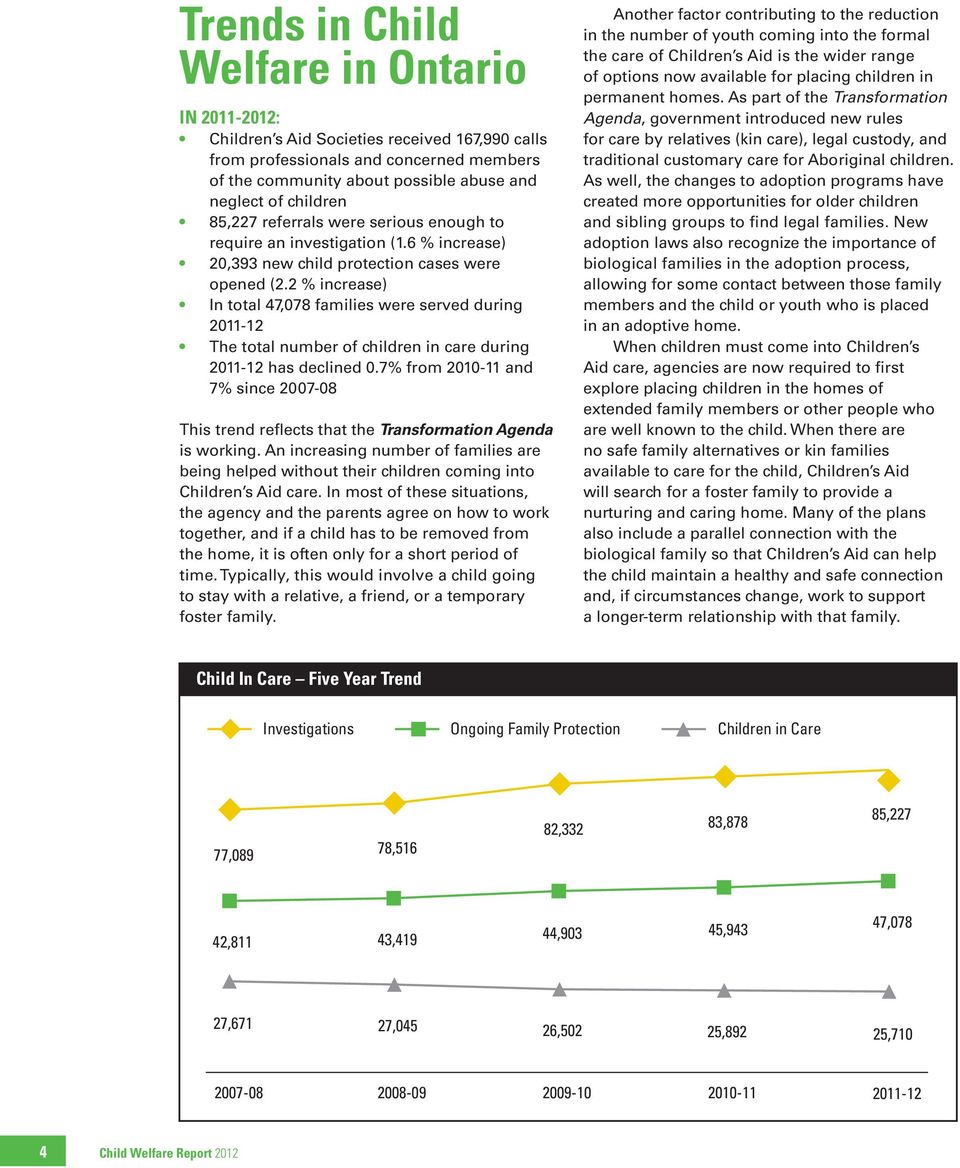
6 Trends in Child Welfare in Ontario In : Children s Aid Societies received 167,990 calls from professionals and concerned members of the community about possible abuse and neglect of children 85,227 referrals were serious enough to require an investigation (1.6 % increase) 20,393 new child protection cases were opened (2.2 % increase) In total 47,078 families were served during The total number of children in care during has declined 0.7% from and 7% since This trend reflects that the Transformation Agenda is working. An increasing number of families are being helped without their children coming into Children s Aid care. In most of these situations, the agency and the parents agree on how to work together, and if a child has to be removed from the home, it is often only for a short period of time. Typically, this would involve a child going to stay with a relative, a friend, or a temporary foster family. Another factor contributing to the reduction in the number of youth coming into the formal the care of Children s Aid is the wider range of options now available for placing children in permanent homes. As part of the Transformation Agenda, government introduced new rules for care by relatives (kin care), legal custody, and traditional customary care for Aboriginal children. As well, the changes to adoption programs have created more opportunities for older children and sibling groups to find legal families. New adoption laws also recognize the importance of biological families in the adoption process, allowing for some contact between those family members and the child or youth who is placed in an adoptive home. When children must come into Children s Aid care, agencies are now required to first explore placing children in the homes of extended family members or other people who are well known to the child. When there are no safe family alternatives or kin families available to care for the child, Children s Aid will search for a foster family to provide a nurturing and caring home. Many of the plans also include a parallel connection with the biological family so that Children s Aid can help the child maintain a healthy and safe connection and, if circumstances change, work to support a longer-term relationship with that family. Child In Care Five Year Trend Five Year Trend Investigations Ongoing Family Protection Children in Care 77,089 78,516 82,332 83,878 85,227 42,811 43,419 44,903 45,943 47,078 27,671 27,045 26,502 25,892 25, Child Welfare Report 2012
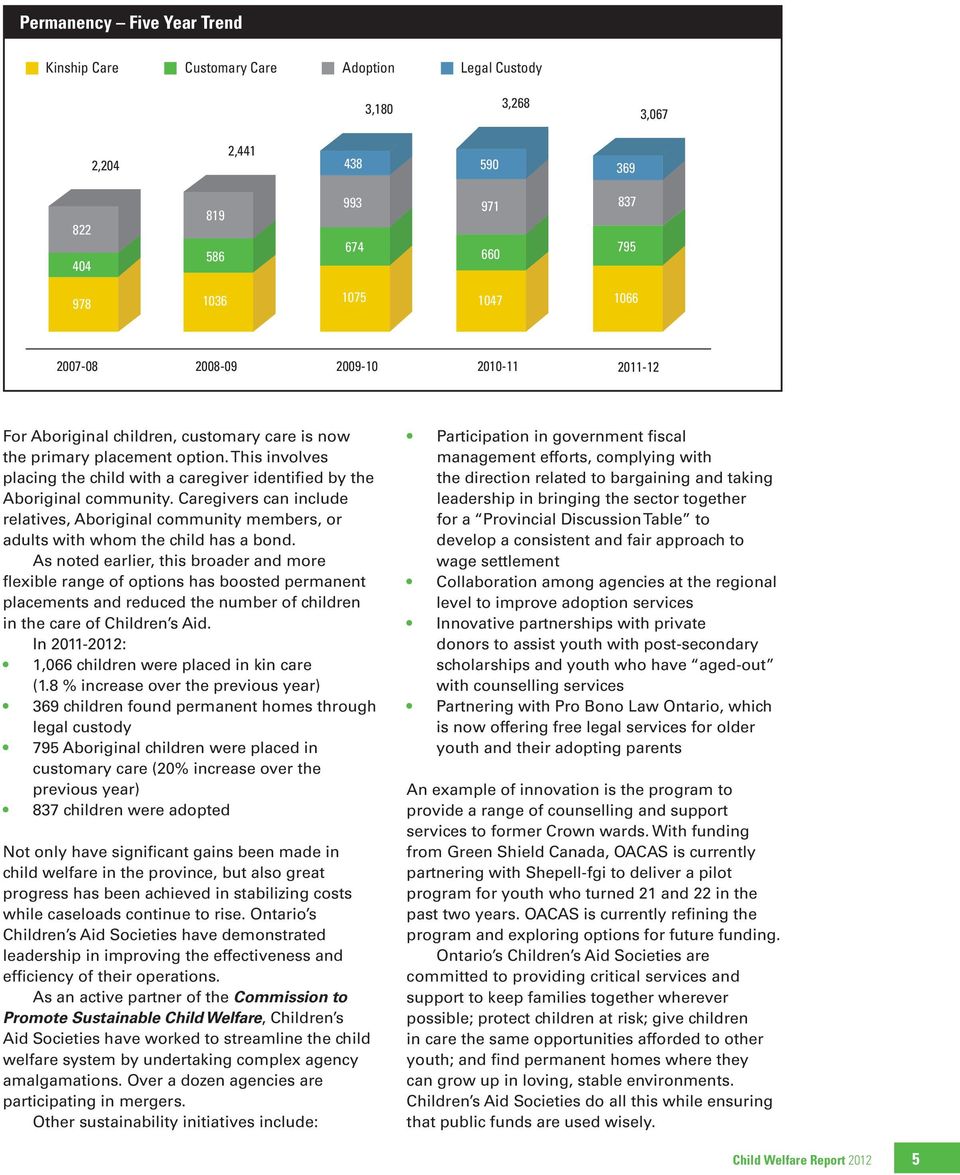
7 Permanency Five Year Trend Permanency Five Year Trend Kinship Care Customary Care Adoption Legal Custody 3,180 3,268 3,067 2,204 2, For Aboriginal children, customary care is now the primary placement option. This involves placing the child with a caregiver identified by the Aboriginal community. Caregivers can include relatives, Aboriginal community members, or adults with whom the child has a bond. As noted earlier, this broader and more flexible range of options has boosted permanent placements and reduced the number of children in the care of Children s Aid. In : 1,066 children were placed in kin care (1.8 % increase over the previous year) 369 children found permanent homes through legal custody 795 Aboriginal children were placed in customary care (20% increase over the previous year) 837 children were adopted Not only have significant gains been made in child welfare in the province, but also great progress has been achieved in stabilizing costs while caseloads continue to rise. Ontario s Children s Aid Societies have demonstrated leadership in improving the effectiveness and efficiency of their operations. As an active partner of the Commission to Promote Sustainable Child Welfare, Children s Aid Societies have worked to streamline the child welfare system by undertaking complex agency amalgamations. Over a dozen agencies are participating in mergers. Other sustainability initiatives include: Participation in government fiscal management efforts, complying with the direction related to bargaining and taking leadership in bringing the sector together for a Provincial Discussion Table to develop a consistent and fair approach to wage settlement Collaboration among agencies at the regional level to improve adoption services Innovative partnerships with private donors to assist youth with post-secondary scholarships and youth who have aged-out with counselling services Partnering with Pro Bono Law Ontario, which is now offering free legal services for older youth and their adopting parents An example of innovation is the program to provide a range of counselling and support services to former Crown wards. With funding from Green Shield Canada, OACAS is currently partnering with Shepell-fgi to deliver a pilot program for youth who turned 21 and 22 in the past two years. OACAS is currently refining the program and exploring options for future funding. Ontario s Children s Aid Societies are committed to providing critical services and support to keep families together wherever possible; protect children at risk; give children in care the same opportunities afforded to other youth; and find permanent homes where they can grow up in loving, stable environments. Children s Aid Societies do all this while ensuring that public funds are used wisely. Child Welfare Report
8 Recommendations to Government There can be no keener revelation of a society's soul than the way in which it treats its children. Nelson Mandela Children s Aid staff and volunteers, some 14,000 strong across the province, are on the frontlines of child welfare every day. If you ask them, they ll tell you that they re motivated by a simple but powerful idea that all children deserve a chance to realize their full potential. And in striving towards this goal, they come to see first-hand what s working well in the child welfare system, and what could be improved. It is their collective experience and wisdom that shapes our recommendations in this report. Recommendation #1 Ensure that Children s Aid Societies are able to provide the right services at the right time. Providing help protective services early is essential to prevent problems from intensifying and becoming entrenched, leading to possible harm to children. A timely response involving a range of differential, customized supports and services is required as was envisioned by the Government s Transformation Agenda which was launched in Not only is it better for children and families, it costs less and results in better long-term outcomes. Approximately 90% of the child protection cases served by Children s Aid involve the tears of relief flowed down my face I will be eternally grateful for the help we were given that allowed me to both heal and care for my children, while keeping my pride. Denise, mother previously in crisis agencies working with the children and parents together keeping the children at home where and when it is safe to do so. The services could include home visiting (supervising the care of children), helping parents to learn effective and safe parenting skills, intervening and facilitating treatment for mental health, substance abuse, physical challenges, and/or other factors that could impair the parents ability to care for their children. These proactive programs are producing excellent results, but they are not adequately funded in the current child welfare funding model. In fact, in July 2012, government reduced the support for admission prevention, further hampering Children s Aid Societies ability to provide these tailored services. The most efficient investment in child welfare is doing the up-front work to protect children and prevent them from coming into care. The funding model must recognize this. Late interventions mean that children are more likely to come into care, their connections to their families may be damaged, and the province will bear the burden not only of less optimal outcomes, but of costs of up to $60,000 per year until the child leaves the system at 21. We ask that Children s Aid funding encompass the protect and prevent mandate to ensure the right services are available at the right time for all Ontario children and families. Recommendation #2 Deliver on the obligation to give Aboriginal authority over the practice of child welfare to Aboriginal communities, and adequately fund the services needed. Since 1990 the Child and Family Services Act has recognized the rights of Aboriginal communities to provide services to Aboriginal children and families. Yet, as of 2012, over 40% of Aboriginal children in care are still served by non-aboriginal Children s Aid Societies and are isolated from their First Nations. The traditional models of child welfare, practiced in non-aboriginal settings does not work. First Nations people have very different needs and have developed more culturally appropriate service models. It is time to move forward on the obligation to devolution, which must be demonstrated by a public statement of commitment, an inclusive process, and resources. 6 Child Welfare Report 2012
9 Having an Aboriginal Children s Aid worker really helps. She s helping me find out more about my heritage. I can relate to her and I feel more comfortable with her. She understands me more. Sarah, former youth in care and current Children s Aid client Aboriginal agencies require adequate funding for child protection and care services for diverse Aboriginal populations on-reserve, off-reserve, remote, rural, and urban. Aboriginal communities and agencies are faced with challenges which outstrip those of non-aboriginal communities. When compared to non-aboriginal communities: The rate of poverty is twice as high Youth suicide is five to six times higher The incidence of abuse and neglect is eight times greater Teen pregnancy is nine times higher Children, youth and families have greater emotional, developmental, mental, and physical health challenges, and substance abuse problems Children and youth are more likely to be admitted to care. The Aboriginal population represents 2% of the population, yet are 22% of Ontario s Crown wards Communities, especially on-reserve and/or northern and remote communities, are likely to have major deficits in basic infrastructure including safe water, housing, education, and health services. Many Aboriginal communities have limited or no internet connectivity The needs of Aboriginal communities, families, and children are great, with many of these deficits stemming from a legacy of colonization, isolation, removal of lands, rights, and loss of culture. Legislative and service standards require cultural support and notification and consultation with Bands. This is the right thing to do, but moving forward requires time and expertise hence resources are essential to support culturally appropriate services. A unique funding model for Aboriginal Children s Aid Societies has often been promised, but has yet to be delivered. The current model does not reflect the needs of these communities and agencies. Over the years Aboriginal Children s Aid Societies have suffered from insufficient resources for services (when they tend to be crisis driven) but also a shortage of funding for administrative requirements. They have struggled to establish the infrastructure necessary to deliver statutory child protection services and retain qualified staff to deliver culturally appropriate services, while operating within the extraordinary infrastructure deficits of many of the communities they serve. In times of economic stress, when most Children s Aid Societies are being asked to operate with less funding, Aboriginal agencies have nowhere to cut. They do not have established bases to work from, and unlike agencies that were established over a century ago, Aboriginal Children s Aid Societies have little or no access to foundations or donations. They rely on child welfare funding to support mandated services as well as other social, emotional, and recreational supports. The province has a legal, moral, and social obligation to Aboriginal people. Children s Aid Societies ask government to: Move forward with devolution, including the approval of new Aboriginal agencies, giving them the resources needed to build their capacity and enable the transfer of Aboriginal children and families from non-aboriginal services to agencies designated under the Child and Family Services Act to serve Aboriginal people Endorse culturally appropriate practices for providing care and protection of Aboriginal children, families, and communities Establish an Aboriginal child welfare funding model and adequate funding to support culturally appropriate programs that encompass the unique experiences of diverse Aboriginal populations on-reserve, off-reserve, remote, rural, and urban. Invest in capacity building to enable the proper recruitment, training and retention of child welfare professionals in emerging Aboriginal Children s Aid Societies Child Welfare Report
10 Recommendation #3 Raise the age of protection from 16 to 18. Incredibly, Children s Aid Societies are not permitted to protect children who come to their attention after their 16 th birthday. If a new case of possible abuse or neglect comes to the attention of a Children s Aid and the youth is 16 or older, the agency is powerless to act. This has to change. Kids at 16 and 17 are far too young to be able to protect themselves in situations where they are at risk of, or suffering from, abuse or neglect. Evidence shows they often respond by running away and living on the street. 3 The lack of protection limits their prospects for a healthy, productive adulthood and leaves them vulnerable to substance abuse, teen pregnancy, depression, dropping out of school, exploitation, and involvement in criminal activity. Ontario is out of step with other provinces. According to a study by the Centre of Excellence in Child Welfare, five provinces and territories have already defined 18 or 19 as the age of protection in child welfare. Ontario s is out of step with the UN Convention on the Rights of the Child 4, which defines child as a person below the age of 18. And Ontario s definition of child in the Child and Family Services Act is out of step with the province s many other laws which clearly establish 18 as the age of majority. For example, all children are required by law to attend school until age 18, and young people under 18 require an adult representative to take part in legal proceedings. 5 Children s Aid Societies ask that the age of protection be raised to 18. The Children s Aid Society saved my life and it is hard to imagine where I d be without their support. Thank you doesn t quite seem to cover it, but for now that s all I ve got. So, thank you. For everything. Melissa, former youth in care Recommendation #4 Let Children s Aid youth stay at home until they complete their education or training. Many children in the care of Children s Aid grow up in foster or group homes, and in accordance with government regulations, they are required to leave these homes before they turn 18. They do not have a family they can turn to for support. Often by age 16 or 17, they are expected to find a place to live, pay the bills and rent, grocery shop, do laundry, cook and clean, hold a part-time job, and at the same time keep up with their school work. Not surprisingly, many fall behind in their studies and drop out. Relative to their peers, Children s Aid youth are far less likely to graduate from high school (44% 6 compared to the provincial average of 81% 7 ) or to enroll in postsecondary institutions (again about half the rate in the general population). At the age of 21, they are cut off all financial assistance. They must pay for their own housing, prescription medications, and dental care. In the broader society, young adults are now living longer at home with their parents because of economic challenges, educational pursuits, and other factors. Just over 40% of Canadian adults aged between 20 and 29 live with their parents. 8 Children s Aid youth do not have this option. Unprepared and largely unsupported, they must move out at by age 18. Then a few years later, when they turn 21, their access to basic services and supports is ended, even though 83% of these kids are diagnosed special needs 9 and 46% require psychotropic medication. 10 At the most critical stage of their lives, in the transition to adulthood, they are left on their own. Their cases are closed at the direction of the provincial government. A large number disappear into homelessness and poverty, becoming chronically dependent on hostels, food banks, public housing, and social assistance. Over the next 12 months alone, approximately 1,300 children turning 18 will be required to leave their foster or group homes. And another 775 turning 21 will be cut off from all assistance. 3 Youth on the Street and Youth Involved with Child Welfare: Maltreatment, Mental Health and Substance Use, (2011) 4 United Nations Convention on the Rights of the Child, Age of Majority and Accountability Act, R.S.O. 1990, c. A.7 8 Child Welfare Report 2012
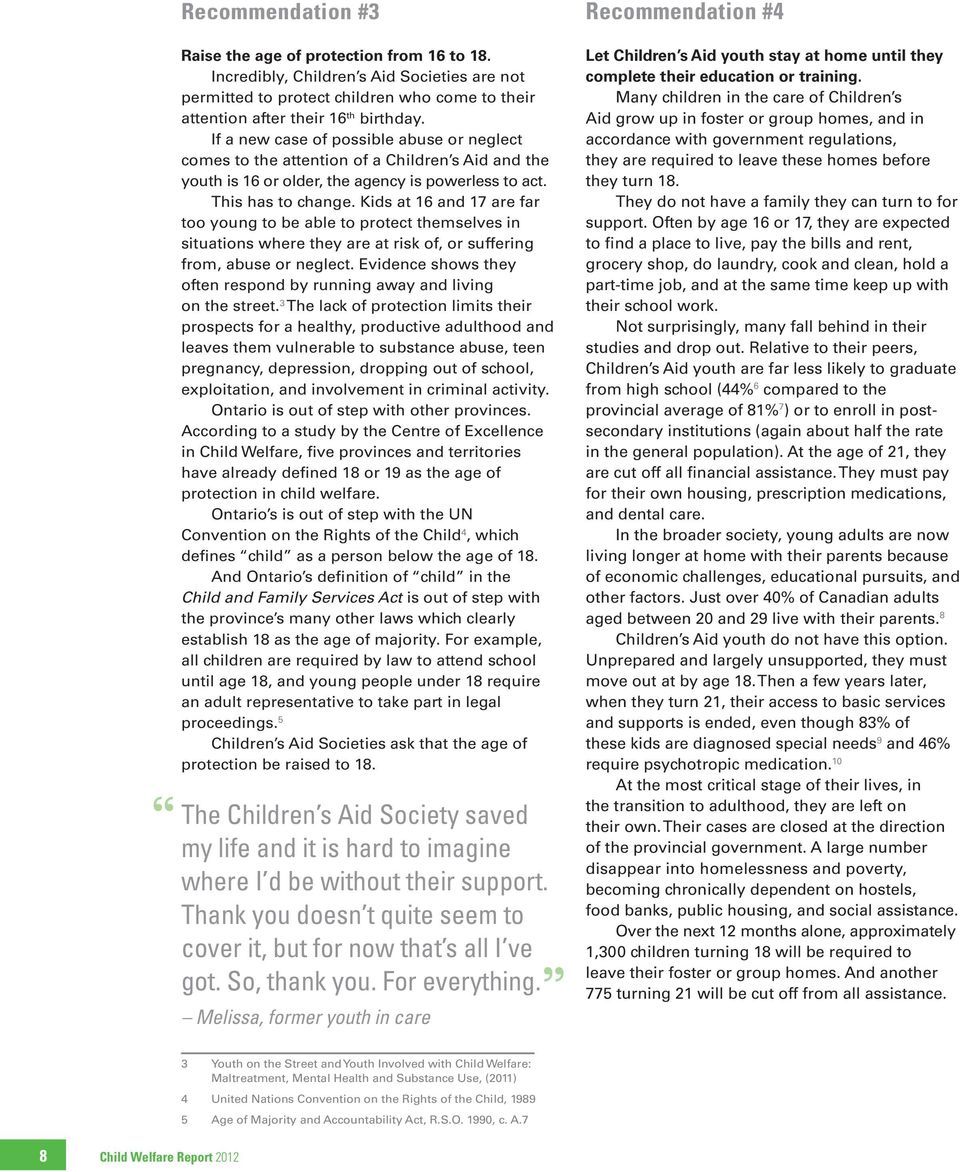
11 I want to thank all of those dedicated, hardworking, devoted, and caring people: from the day workers, case workers, and support workers, to the doctors, foster parents, and volunteers. You are forever in my heart, and in every song I sing! Miles, former youth in care After years of investment by the province and Children s Aid, why are we walking away from these kids when they are simply not ready emotionally, psychologically or financially to fend for themselves? Why would we not provide a few more years of modest support to ensure that they have every chance of success? These youth require more time to grow into healthy adults, to become self-sufficient, resilient members of our community. They deserve the same opportunity as every other youngster in Ontario to finish school and begin building their lives. We ask the provincial government to make the necessary regulatory changes so that: Children s Aid youth can, if they wish, stay in their foster or group homes until they have completed their education or training and gained full-time employment (or until age 21) Supports for housing, health and dental, and education are extended to the age of 25. This would bring Children s Aid youth more in line with broader Canadian experience 6 Gateway to Success, Cycle Two, June 2010, OACAS 7 inistry of Education ( M en/2011/03/81-per-cent-of-high-school-students-graduating.html) 8 Statistics Canada 2011 (September 2012) 9 Child Welfare Review Ontario s Crown Wards Summary Report, 2008/2009 (Dec. 2010) 10 Child Welfare Review Ontario s Crown Wards Summary Report, 2008/2009 (Dec. 2010) Child Welfare Report
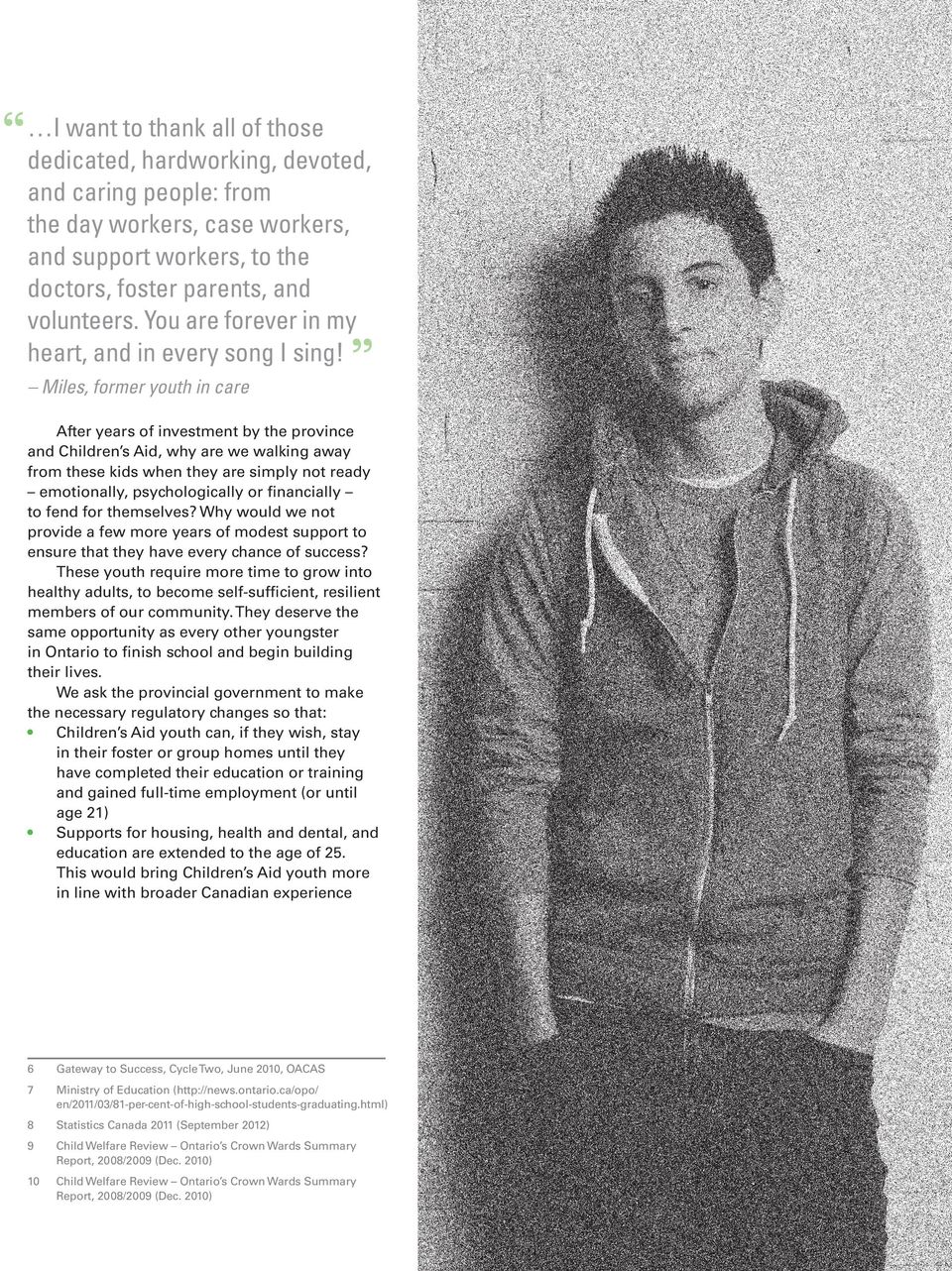
12 Recommendation #5 Ensure that Children s Aid Societies have sufficient funds to keep all children safe. Children s Aid Societies understand the economic crisis and their role in helping to find solutions and are prudently managing services and costs while achieving the intended good outcomes for children and families. Despite the increase in children and families who need protection services, Children s Aid Societies cost curve has steadily dropped over the past five years. Difficult economic times mean more children and families will experience stress and need child protection services. Children s Aid Societies have invested in new programming that has resulted in positive and cost-effective outcomes for children and families: Number of referrals and investigations are up Number of children coming into care is down Cases going to court are reduced, more work is done with consent of families Children who do come into care are placed in permanent alternative families sooner It is critical to continue to invest in programs that contain costs and get good results. Reducing funding services, particularly admission prevention services, will result in more children in long-term care and more families needing services that span generations. Ministry of Children and Youth Services reviews have demonstrated that Children s Aid Societies are responsible managers who have practiced cost containment over multiple years and who manage within budgets, without compromising the delivery of statutory services. The cost of providing child protection service has gone up in this last year because: Staffing costs are higher following two years without salary increases, modest increases were negotiated in good faith and within parameters set by the provincial government Group home operating rates set by government have increased The Government of Canada now applies HST to group home rates, which is a cost passed on to Children s Aid Legislated pension costs have increased this year and must be paid by employers The funding model does not have a mechanism to address increased costs related to population growth, and many Children s Aid Societies are serving areas with exponential growth on funding bases that were established decades ago In addition, the administrative burden on Children s Aid continues. Administrative requirements are often cumbersome, duplicative and do not improve protection services. Total Total CAS Children s Net Expenditures Aid Net Expenditures 1997 to to 2012 Net Expenditures Percentage of Change Year over Year Net Expenditures in Millions/Billions Child Welfare Report % % 17.7% % , % 11.3% ,294 1,329 1,221 1, % 5.9% 4.0% 2.8% ,386 1,409 1, % 1, % 0.8% 2.2% % 22.0% 20.0% 18.0% 16.0% 14.0% 12.0% 10.0% 8.0% 6.0% 4.0% 2.0% Percentage of Change Year over Year
13 As of the middle of September 2012, there is an estimated $67M gap between the amount of funding allotted and the amount needed by Children s Aid Societies to deliver child protection services. The gap relates to a combination of increased need for service and increased cost of providing that service, which means Children s Aid Societies have less money to spend on each child in need of protection. Managing child protection service volume increases within a fixed envelope is not feasible and certainly not at this time when Children s Aid Societies are being asked to absorb significant increased costs. With the specific encouragement of the Ministry of Children and Youth Services, many Ontario communities came together in good faith to undertake Children s Aid amalgamations. They were told that amalgamations would lead to more sustainable agencies and better services for children and families. The current funding allocation is destabilizing to newly amalgamated Children s Aid Societies. While they are establishing themselves, funding shortfalls have the potential to undermine both their capacity to provide statutory services and the confidence their communities have placed in them. A number of Children s Aid Societies have experienced massive growth in the population of their catchment areas. The increase in volume experienced in these high-growth agencies must be fully funded to ensure continued excellence in service. While Ontario tries to balance its books, it cannot effectively transfer the debt burden to Children s Aid Societies which increasingly rely on Lines of Credit to bridge funding gaps. Reliance on Lines of Credit to finance child welfare is unsustainable it distorts the real costs, transfers burden of liability to Boards, and the carrying costs add to a very stretched system. Furthermore, lending institutions are starting to limit credit to Children s Aid. Change of this magnitude takes time to do right. Much work has been done in the past two years to reconfigure the system (amalgamation of some agencies, sharing services) and this work will continue. Decisions which may affect programming must be based on evidence, and sufficient time must be taken to consider all potential options and their impacts. Children s Aid Societies need a short-term strategy to get through this year, but many Societies will need two to three years to manage the reduction so as not to destabilize their ability to deliver on the statutory mandate. A go-forward strategy needs to: Continue the commitment to a strategic direction that works Continue to support diffierential response at the front door, preventing crises and longer-term problems Permanency and community capacity building Ensure that any major change is rooted in research that demonstrates good outcomes for children and families Children s Aid Societies are working to find ways to close the gap within agencies by continuing to bring down their costs, but cannot fully address the gap without significant impact on the safety and well-being of children. We ask that the government continue the commitment to the Transformation Agenda and: Assure funding for the specific services for preventing admission to care, including early help which is directly related to child protection concerns Recognize the full and legitimate costs of providing services and fund agencies so that the can address each case as required under government statue, regulation, and policy Address the gap in current year funding and work with Children s Aid Societies to discharge prior year debts Develop a multi-year plan with the sector to reconfigure, stabilize, and manage expenditures essentially a new funding model to address known and demonstrated flaws in how Children s Aid are currently funded Address historical issues related to catchment areas with extremely high population growth Recognize that amalgamation and restructuring takes time and resources to support the transition Deliver on the obligation to give Aboriginal authority over the practice of child welfare to Aboriginal communities, supported by a new funding model and resources to build capacity in Aboriginal agencies and communities Child Welfare Report
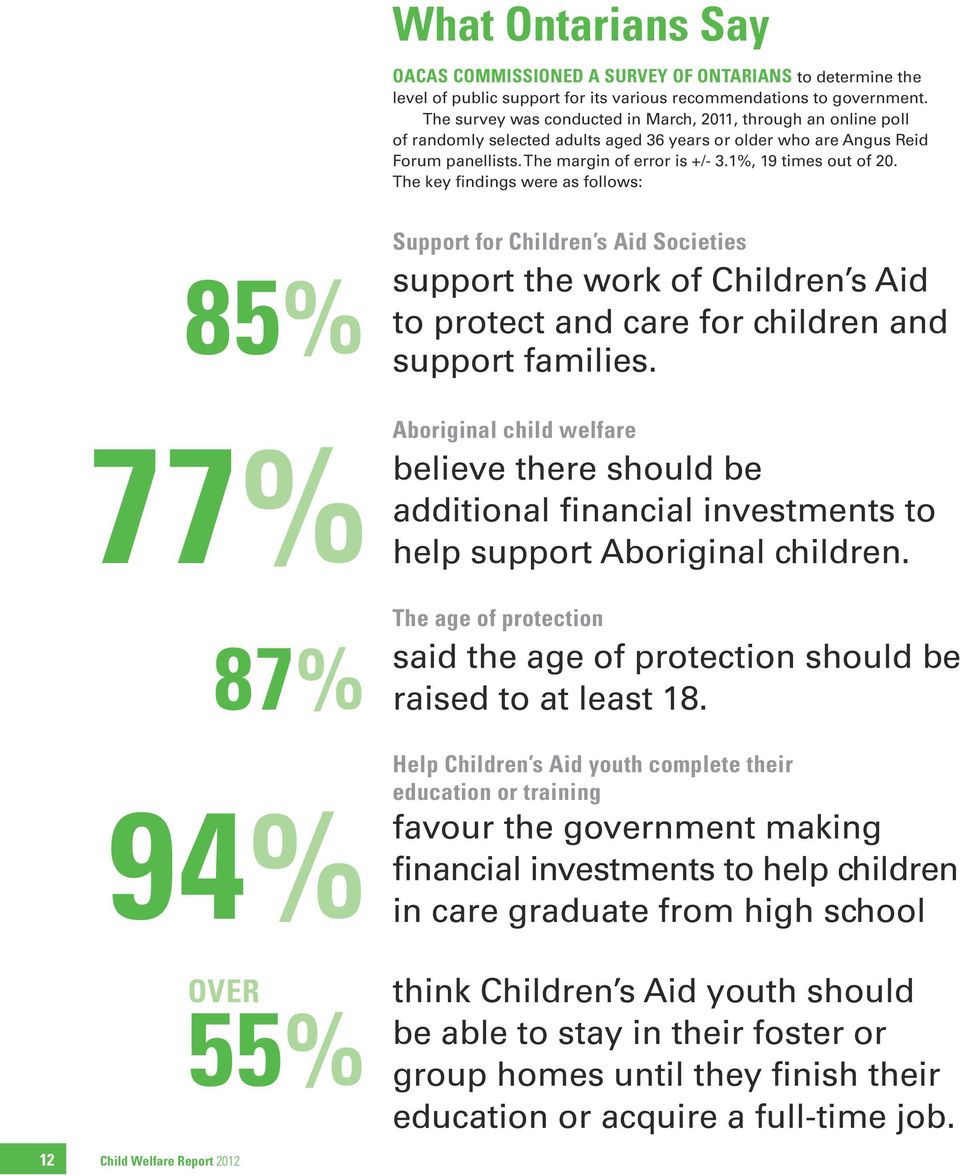
14 What Ontarians Say OACAS commissioned a survey of Ontarians to determine the level of public support for its various recommendations to government. The survey was conducted in March, 2011, through an online poll of randomly selected adults aged 36 years or older who are Angus Reid Forum panellists. The margin of error is +/- 3.1%, 19 times out of 20. The key findings were as follows: 85% 77% 87% 94% Over 55% Support for Children s Aid Societies support the work of Children s Aid to protect and care for children and support families. Aboriginal child welfare believe there should be additional financial investments to help support Aboriginal children. The age of protection said the age of protection should be raised to at least 18. Help Children s Aid youth complete their education or training favour the government making financial investments to help children in care graduate from high school think Children s Aid youth should be able to stay in their foster or group homes until they finish their education or acquire a full-time job. 12 Child Welfare Report 2012
15 Child Welfare Report

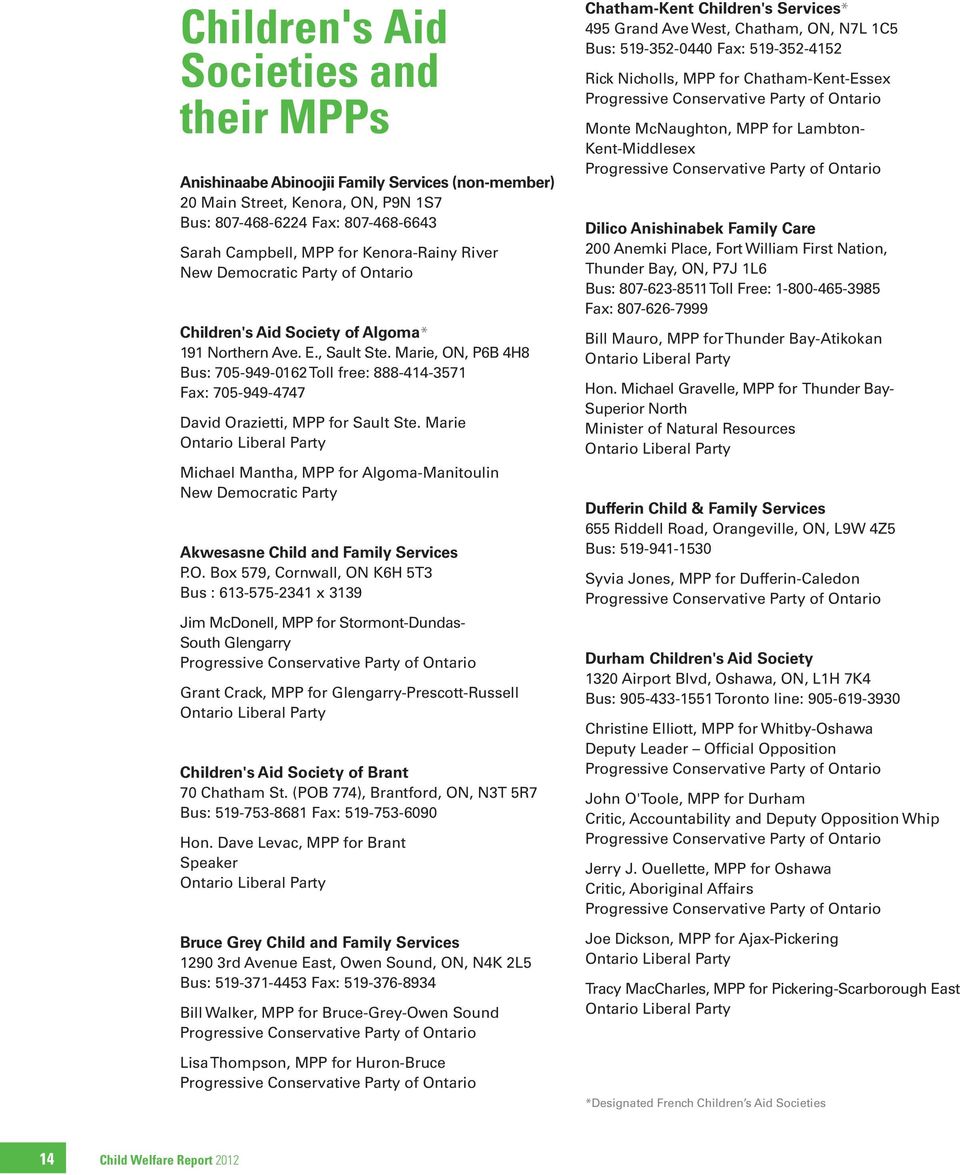
16 Children's Aid Societies and their MPPs Anishinaabe Abinoojii Family Services (non-member) 20 Main Street, Kenora, ON, P9N 1S7 Bus: Fax: Sarah Campbell, MPP for Kenora-Rainy River Children's Aid Society of Algoma* 191 Northern Ave. E., Sault Ste. Marie, ON, P6B 4H8 Bus: Toll free: Fax: David Orazietti, MPP for Sault Ste. Marie Michael Mantha, MPP for Algoma-Manitoulin New Democratic Party Akwesasne Child and Family Services P.O. Box 579, Cornwall, ON K6H 5T3 Bus : x 3139 Jim McDonell, MPP for Stormont-Dundas- South Glengarry Grant Crack, MPP for Glengarry-Prescott-Russell Children's Aid Society of Brant 70 Chatham St. (POB 774), Brantford, ON, N3T 5R7 Bus: Fax: Hon. Dave Levac, MPP for Brant Speaker Bruce Grey Child and Family Services rd Avenue East, Owen Sound, ON, N4K 2L5 Bus: Fax: Bill Walker, MPP for Bruce-Grey-Owen Sound Lisa Thompson, MPP for Huron-Bruce Chatham-Kent Children's Services* 495 Grand Ave West, Chatham, ON, N7L 1C5 Bus: Fax: Rick Nicholls, MPP for Chatham-Kent-Essex Monte McNaughton, MPP for Lambton- Kent-Middlesex Dilico Anishinabek Family Care 200 Anemki Place, Fort William First Nation, Thunder Bay, ON, P7J 1L6 Bus: Toll Free: Fax: Bill Mauro, MPP for Thunder Bay-Atikokan Hon. Michael Gravelle, MPP for Thunder Bay- Superior North Minister of Natural Resources Dufferin Child & Family Services 655 Riddell Road, Orangeville, ON, L9W 4Z5 Bus: Syvia Jones, MPP for Dufferin-Caledon Durham Children's Aid Society 1320 Airport Blvd, Oshawa, ON, L1H 7K4 Bus: Toronto line: Christine Elliott, MPP for Whitby-Oshawa Deputy Leader Official Opposition John O'Toole, MPP for Durham Critic, Accountability and Deputy Opposition Whip Jerry J. Ouellette, MPP for Oshawa Critic, Aboriginal Affairs Joe Dickson, MPP for Ajax-Pickering Tracy MacCharles, MPP for Pickering-Scarborough East *Designated French Children s Aid Societies 14 Child Welfare Report 2012
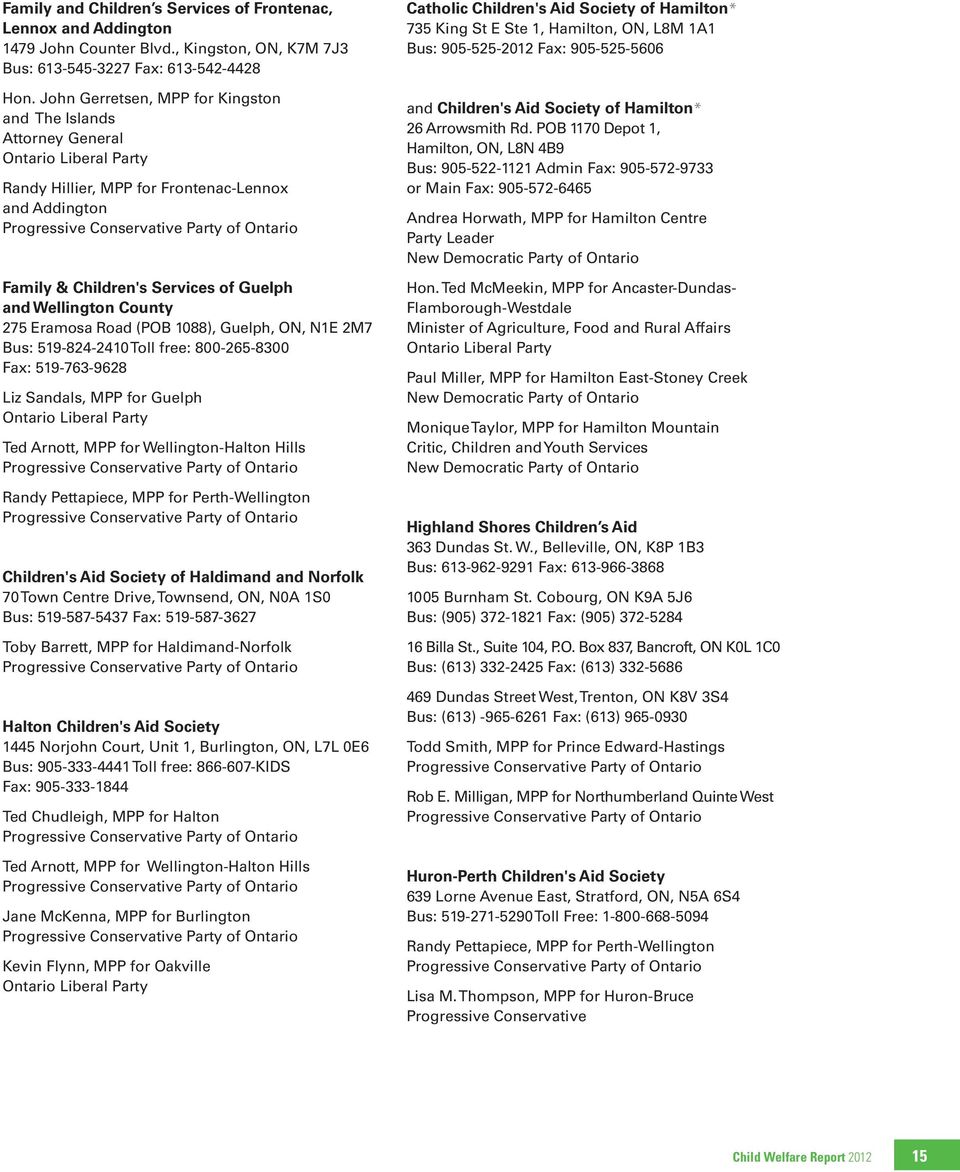
17 Family and Children s Services of Frontenac, Lennox and Addington 1479 John Counter Blvd., Kingston, ON, K7M 7J3 Bus: Fax: Hon. John Gerretsen, MPP for Kingston and The Islands Attorney General Randy Hillier, MPP for Frontenac-Lennox and Addington Family & Children's Services of Guelph and Wellington County 275 Eramosa Road (POB 1088), Guelph, ON, N1E 2M7 Bus: Toll free: Fax: Liz Sandals, MPP for Guelph Ted Arnott, MPP for Wellington-Halton Hills Randy Pettapiece, MPP for Perth-Wellington Children's Aid Society of Haldimand and Norfolk 70 Town Centre Drive, Townsend, ON, N0A 1S0 Bus: Fax: Toby Barrett, MPP for Haldimand-Norfolk Halton Children's Aid Society 1445 Norjohn Court, Unit 1, Burlington, ON, L7L 0E6 Bus: Toll free: KIDS Fax: Ted Chudleigh, MPP for Halton Ted Arnott, MPP for Wellington-Halton Hills Jane McKenna, MPP for Burlington Kevin Flynn, MPP for Oakville Catholic Children's Aid Society of Hamilton* 735 King St E Ste 1, Hamilton, ON, L8M 1A1 Bus: Fax: and Children's Aid Society of Hamilton* 26 Arrowsmith Rd. POB 1170 Depot 1, Hamilton, ON, L8N 4B9 Bus: Admin Fax: or Main Fax: Andrea Horwath, MPP for Hamilton Centre Party Leader Hon. Ted McMeekin, MPP for Ancaster-Dundas- Flamborough-Westdale Minister of Agriculture, Food and Rural Affairs Paul Miller, MPP for Hamilton East-Stoney Creek Monique Taylor, MPP for Hamilton Mountain Critic, Children and Youth Services Highland Shores Children s Aid 363 Dundas St. W., Belleville, ON, K8P 1B3 Bus: Fax: Burnham St. Cobourg, ON K9A 5J6 Bus: (905) Fax: (905) Billa St., Suite 104, P.O. Box 837, Bancroft, ON K0L 1C0 Bus: (613) Fax: (613) Dundas Street West, Trenton, ON K8V 3S4 Bus: (613) Fax: (613) Todd Smith, MPP for Prince Edward-Hastings Rob E. Milligan, MPP for Northumberland Quinte West Huron-Perth Children's Aid Society 639 Lorne Avenue East, Stratford, ON, N5A 6S4 Bus: Toll Free: Randy Pettapiece, MPP for Perth-Wellington Lisa M. Thompson, MPP for Huron-Bruce Progressive Conservative Child Welfare Report
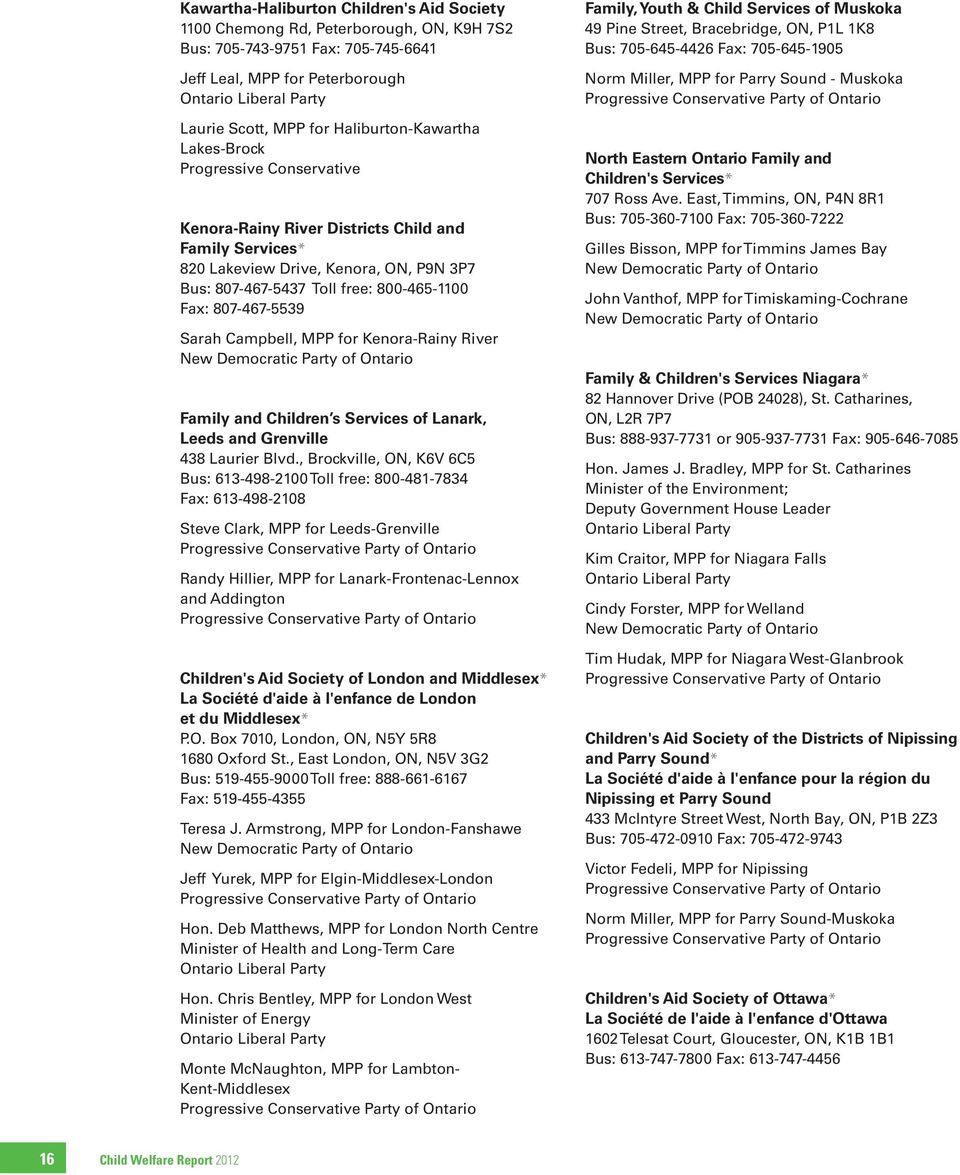
18 Kawartha-Haliburton Children's Aid Society 1100 Chemong Rd, Peterborough, ON, K9H 7S2 Bus: Fax: Jeff Leal, MPP for Peterborough Laurie Scott, MPP for Haliburton-Kawartha Lakes-Brock Progressive Conservative Kenora-Rainy River Districts Child and Family Services* 820 Lakeview Drive, Kenora, ON, P9N 3P7 Bus: Toll free: Fax: Sarah Campbell, MPP for Kenora-Rainy River Family and Children s Services of Lanark, Leeds and Grenville 438 Laurier Blvd., Brockville, ON, K6V 6C5 Bus: Toll free: Fax: Steve Clark, MPP for Leeds-Grenville Randy Hillier, MPP for Lanark-Frontenac-Lennox and Addington Children's Aid Society of London and Middlesex* La Société d'aide à l'enfance de London et du Middlesex* P.O. Box 7010, London, ON, N5Y 5R Oxford St., East London, ON, N5V 3G2 Bus: Toll free: Fax: Teresa J. Armstrong, MPP for London-Fanshawe Jeff Yurek, MPP for Elgin-Middlesex-London Hon. Deb Matthews, MPP for London North Centre Minister of Health and Long-Term Care Hon. Chris Bentley, MPP for London West Minister of Energy Monte McNaughton, MPP for Lambton- Kent-Middlesex Family, Youth & Child Services of Muskoka 49 Pine Street, Bracebridge, ON, P1L 1K8 Bus: Fax: Norm Miller, MPP for Parry Sound - Muskoka North Eastern Ontario Family and Children's Services* 707 Ross Ave. East, Timmins, ON, P4N 8R1 Bus: Fax: Gilles Bisson, MPP for Timmins James Bay John Vanthof, MPP for Timiskaming-Cochrane Family & Children's Services Niagara* 82 Hannover Drive (POB 24028), St. Catharines, ON, L2R 7P7 Bus: or Fax: Hon. James J. Bradley, MPP for St. Catharines Minister of the Environment; Deputy Government House Leader Kim Craitor, MPP for Niagara Falls Cindy Forster, MPP for Welland Tim Hudak, MPP for Niagara West-Glanbrook Children's Aid Society of the Districts of Nipissing and Parry Sound* La Société d'aide à l'enfance pour la région du Nipissing et Parry Sound 433 McIntyre Street West, North Bay, ON, P1B 2Z3 Bus: Fax: Victor Fedeli, MPP for Nipissing Norm Miller, MPP for Parry Sound-Muskoka Children's Aid Society of Ottawa* La Société de l'aide à l'enfance d'ottawa 1602 Telesat Court, Gloucester, ON, K1B 1B1 Bus: Fax: Child Welfare Report 2012
19 Hon. Madeleine Meilleur, MPP for Ottawa-Vanier Deputy Government Whip; Minister Responsible for Francophone Affairs; Minister of Community Safety and Correctional Services Hon. Bob Chiarelli, MPP for Ottawa West-Nepean Minister of Infrastructure; Minister of Transportation Yasir Naqvi, MPP for Ottawa Centre Hon. Dalton McGuinty, MPP for Ottawa South Premier; Minister of Intergovernmental Affairs Phil McNeely, MPP for Ottawa-Orléans Jack MacLaren, MPP for Carleton-Mississippi Mills Lisa MacLeod, MPP for Nepean-Carleton Children's Aid Society of Oxford County 92 Light St., Woodstock, ON, N4S 6H1 Bus Toll Free: Fax: Ernie Hardeman, MPP for Oxford Payukotayno James and Hudson Bay Family Services 50 Bay Road P.O. Box 189, Moosonee, ON, P0L 1Y0 Bus: Toll free: Fax: Gilles Bisson, MPP for Timmins James Bay Peel Children's Aid Society* 6860 Century Avenue, West Tower, Mississauga, ON, L5N 2W5 Bus: Toll free: Fax: Bob Delaney, MPP for Mississauga-Streetsville Dipika Damerla, MPP for Mississauga East-Cooksville Hon. Harinder Takhar, MPP for Mississauga-Erindale Minister of Government Services Vic Dhillon, MPP for Brampton West Hon. Linda Jeffrey, MPP for Brampton-Sprindale Minister of Labour; Minister Responsible for Seniors Hon. Charles Sousa, MPP for Mississauga South Minister of Citizenship and Immigration; Minister Responsible for 2015 Pan and Parapan American Games Sylvia Jones, MPP for Dufferin-Caledon Amrit Mangat, MPP for Mississauga-Brampton South Jagmeet Singh, MPP for Bramalea-Gore-Malton Valoris for Children and Adults of Prescott-Russell* Valoris pour enfants et adultes de Prescott-Russell 173, Ancienne route 17/Old Highway 17 (POB 248), Plantagenet, ON, K0B 1L0 Bus: Toll free: Fax: Grant Crack, MPP for Glengarry Prescott-Russell Children's Aid Society of the County of Prince Edward 16 MacSteven Drive (POB 1510), Picton, ON, K0K 2T0 Bus: Toll free: Fax: Todd Smith, MPP for Prince Edward-Hastings Family and Children's Services County of Renfrew, City of Pembroke* 77 Mary St. Ste. 100, Pembroke, ON, K8A 5V4 Bus: Fax: John Yakabuski, MPP for Renfrew Nipissing-Pembroke Children's Aid Society of the City of Sarnia and the County of Lambton 161 Kendall St, Pt. Edward, ON, N7V 4G6 Bus: Fax: Robert Bailey, MPP for Sarnia-Lambton Child Welfare Report
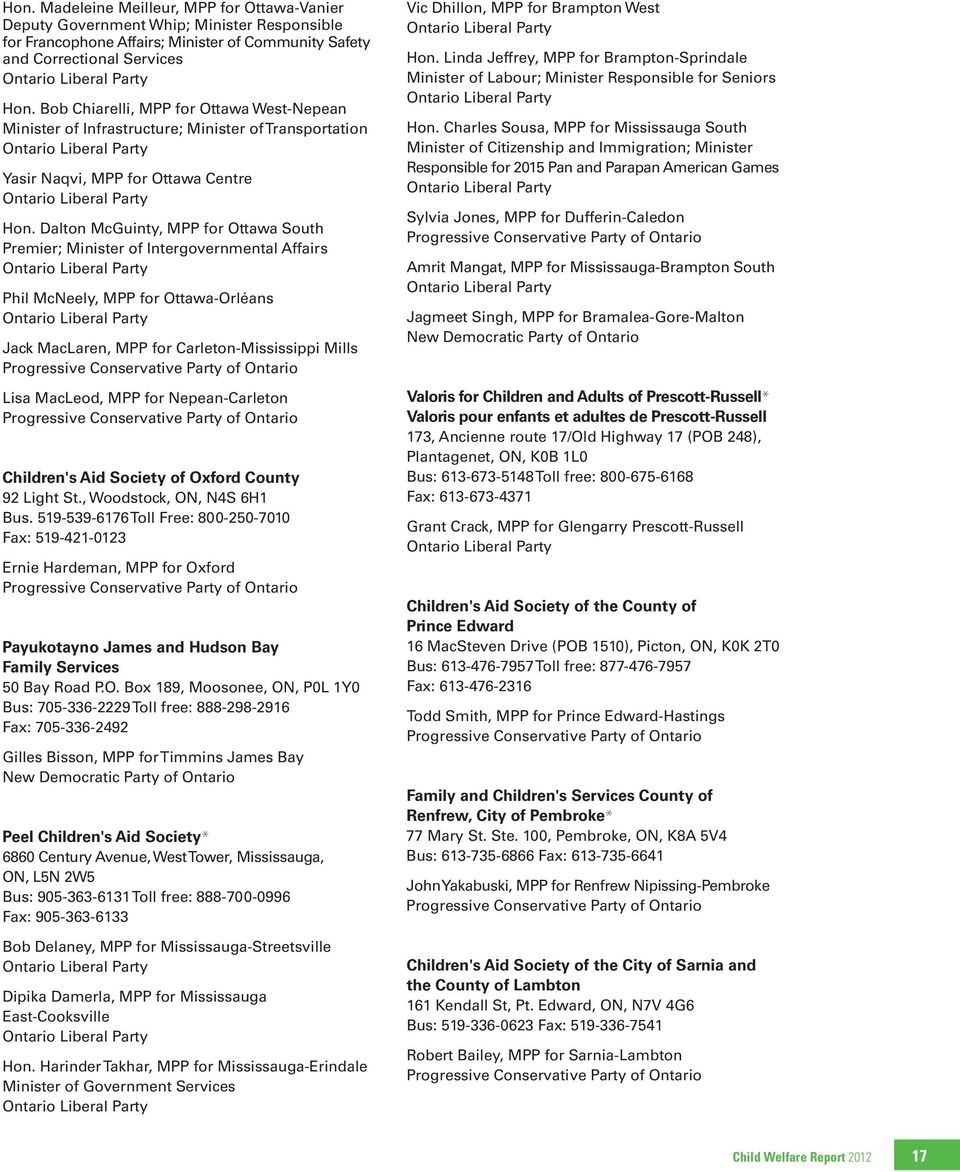
20 Children's Aid Society of Simcoe County 60 Bell Farm Road Unit 7, Barrie, ON, L4M 5G6 Bus: or Fax: Rod Jackson, MPP for Barrie Jim Wilson, MPP for Simcoe-Grey Julia Munro, MPP for York-Simcoe Garfield Dunlop, MPP for Simcoe North Children's Aid Society of the United Counties of Stormont, Dundas & Glengarry* La Société d'aide à l'enfance des comtés unis de Sormont, Dundas et Glengarry 150 Boundary Road, P.O. Box 983, Cornwall, ON, K6H 5V1 Bus: Toll free: Fax: Jim McDonell, MPP for Stormont-Dundas- South Glengarry Grant Crack, MPP for Glengarry-Prescott-Russell Children's Aid Society of the District of Thunder Bay* 1110 Jade Court, Thunder Bay, ON, P7B 6M7 Bus: Fax: Hon. Michael Gravelle, MPP for Thunder Bay Superior North Minister of Natural Resources Bill Mauro, MPP for Thunder Bay-Atikokan Tikinagan Child & Family Services P.O. Box 627, Sioux Lookout, ON, P8T 1B1 Bus: Fax: Sarah Campbell, MPP for Kenora-Rainy River Catholic Children's Aid Society of Toronto* La Société catholique de l'aide à l'enfance ville de Toronto 26 Maitland St, Toronto, ON, M4Y 1C6 Bus: Fax: and Children's Aid Society of Toronto* 30 Isabella Street, Toronto, ON, M4Y 1N1 Bus: Fax: Family & Children's Services of St. Thomas and Elgin County 410 Sunset Drive, St. Thomas, ON, N5R 3C7 Bus: Toll free: Fax: Jeff Yurek, MPP for Elgin-Middlesex-London Children's Aid Society of the Districts of Sudbury and Manitoulin* La Société d'aide à l'enfance des district de Sudbury et du Manitoulin 319 Lasalle Blvd, Unit 3, Sudbury, ON, P3A 1W7 Bus: Toll free: Fax: Hon. Rick Bartolucci, MPP for Sudbury Minister of Development and Mines; Chair of Cabinet Michael Mantha, MPP for Algoma-Manitoulin France Gélinas, MPP for Nickel Belt and Jewish Family & Child Services 4600 Bathurst St. 1st Flr., North York, ON, M2R 3V3 Bus: Fax: and Native Child and Family Services of Toronto 30 College St, Toronto, ON, M5G 1K2 Bus: Fax: Laura Albanese, MPP for York South-Weston Bas Balkissoon, MPP for Scarborough-Rouge River Lorenzo Berardinetti, MPP for Scarborough Southwest Hon. Margarett Best, MPP for Scarborough-Guildwood Minister of Consumer Services Hon. Laurel Broten, MPP for Etobicoke-Lakeshore Minister of Education; Minister Responsible for Women s Issues 18 Child Welfare Report 2012
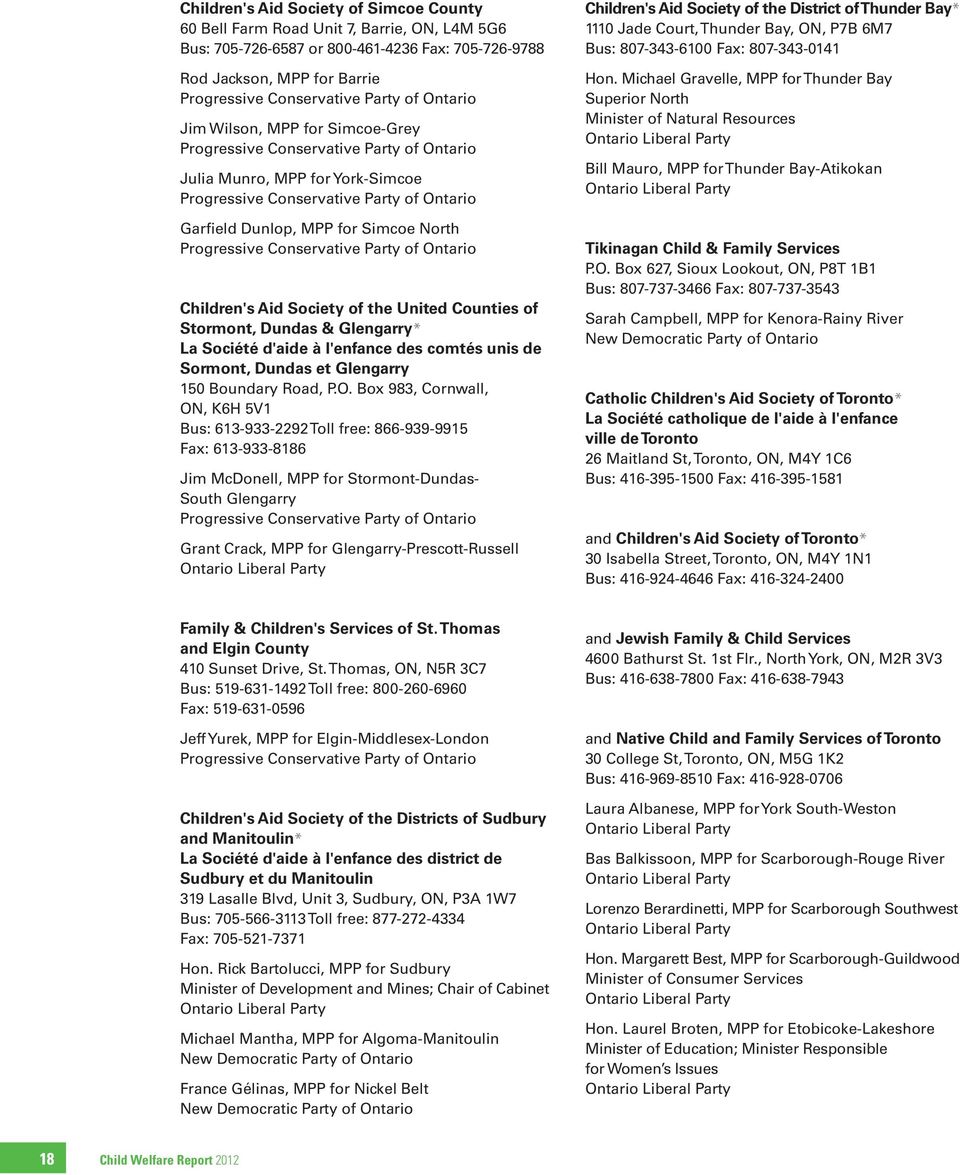
21 Donna Cansfield, MPP for Etobicoke Centre Mike Colle, MPP for Eglinton-Lawrence Michael Coteau, MPP for Don Valley East Cheri DiNovo, MPP for Parkdale-High Park Hon. Brad Duguid, MPP for Scarborough Centre Minister of Economic Development and Innovation Hon. Eric Hoskins, MPP for St. Paul's Minister of Children and Youth Services Monte Kwinter, MPP for York Centre Tracy MacCharles, MPP for Pickering-Scarborough East Rosario Marchese, MPP for Trinity-Spadina Hon. Glen R. Murray, MPP for Toronto Centre Minister of Training, Colleges, and Universities Michael Prue, MPP for Beaches-East York Shafiq Qaadri, MPP for Etobicoke North Jonah Schein, MPP for Davenport Mario Sergio, MPP for York West Peter Tabuns, MPP for Toronto-Danforth Soo Wong, MPP for Scarborough-Agincourt Hon. Kathleen Wynne, MPP for Don Valley West Minister of Aboriginal Affairs; Minister of Municipal Affairs and Housing David Zimmer, MPP for Willowdale Family & Children's Services of the Waterloo Region 200 Ardelt Avenue (at Hanson Ave), Kitchener, ON, N2C 2L9 Bus: Fax: Michael Harris, MPP for Kitchener-Conestoga Hon. John Milloy, MPP for Kitchener Centre Minister of Community and Social Services Rob Leone, MPP for Cambridge Catherine Fife, MPP for Kitchener-Waterloo Windsor-Essex Children's Aid Society* 1671 Riverside Drive East, Windsor, ON, N8Y 5B5 Bus: Toll free: Fax: Hon. Dwight Duncan, MPP for Windsor-Tecumseh Minister of Finance; Deputy Premier Taras Natyshak, MPP for Essex Teresa Piruzza, MPP for Windsor West York Region Children's Aid Society* 85 Eagle St. W. (P.O. Box 358), Newmarket, ON, L3Y 4X7 Bus: Toll free: Fax: Frank Klees, MPP for Newmarket-Aurora Hon. Michael Chan, MPP for Markham-Unionville Minster of Tourism, Culture and Sport Helena Jaczek, MPP for Oak Ridges-Markham Julia Munro, MPP for York-Simcoe Reza Moridi, MPP for Richmond Hill Peter Shurman, MPP for Thornhill Steven Del Duca, MPP for Vaughan Weechi-it-te-win (non-member) P.O. Box 812, Fort Frances, ON, P9A 3N1 Bus: Sarah Campbell, MPP for Kenora-Rainy River Child Welfare Report
22 Rapport des Sociétés de l aide à l enfance 2012
23 b Rapport des Sociétés de l aide à l enfance 2012
24 Table des matières Une introduction à l AOSAE... 2 Le travail des sociétés d aide à l enfance... 3 Tendances du bien-être de l enfance en Ontario... 5 Recommandations au gouvernement... 8 S assurer que les SAE sont en mesure d offrir les bons services au bon moment... 8 Respecter l obligation de donner aux communautés autochtones l autorité en matière de pratique du bien-être de l enfance autochtone, et financer adéquatement les services requis... 9 Faire passer l âge de protection de 16 à 18 ans Faire en sorte que les jeunes des SAE puissent rester dans leur foyer jusqu à ce qu ils aient terminé leurs études ou leur formation S assurer que les SAE ont des fonds suffisants pour garantir la sécurité des enfants Ce que disent les Ontariens... 16
25 Une introduction à l AOSAE Établie il y a 100 ans, l Association ontarienne des sociétés de l aide à l enfance (AOSAE) est la voix du bien-être de l enfance dans la province. L AOSAE favorise le bien-être des enfants, des jeunes et des familles grâce au leadership, à l excellence des services et à la défense des intérêts. Nous représentons les sociétés d aide à l enfance (SAE) ainsi que les enfants et les familles qui obtiennent des services de ces agences dans leur collectivité. Au nom de nos 45 SAE membres, nous offrons de la représentation et des relations avec les gouvernements, de l éducation du public ainsi que des services aux membres, comme de la formation, de la gestion de l information et du soutien de systèmes. Dirigée par un conseil d administration bénévole, l AOSAE consulte le gouvernement provincial sur des questions de lois, de règlements, de politiques, de normes et de mécanismes d examen, puis le conseille en ces matières. L AOSAE participe à des forums publics, fait des présentations au comité permanent de l Assemblée législative de l Ontario et rencontre des leaders politiques, des caucus de partis ainsi que du personnel du gouvernement. Nous estimons notre partenariat avec le gouvernement. Des changements importants ont été apportés au système du bien-être de l enfance en Ontario au cours des 15 dernières années, et l AOSAE collabore étroitement avec la province afin de mettre en œuvre de nombreuses réformes positives. Nous avons l intention de continuer à progresser avec le gouvernement afin d obtenir les meilleurs résultats pour les enfants et les familles. l AOSAE travaille avec le gouvernement de l Ontario, notamment avec les entités suivantes : 2 Rapport des Sociétés de l aide à l enfance 2012 Services à l enfance et à la jeunesse Services sociaux et communautaires Éducation Formation et Collèges et Universités Finances Affaires autochtones Services gouvernementaux Procureur général Sécurité communautaire et Services correctionnels Direction générale de la condition féminine de l Ontario
26 Le travail des sociétés d aide à l enfance Les sociétés d aide à l enfance ont le mandat légal exclusif d offrir des services de protection de l enfance en Ontario. Elles constituent le filet de sûreté des nourrissons, des enfants et des jeunes qui subissent ou sont à risque de subir des mauvais traitements physiques, sexuels ou affectifs, de la négligence ou l abandon. Les SAE sont des organismes sans but lucratif constitués en société dirigés par des conseils d administration bénévoles dont les membres sont élus par les communautés locales; elles sont financées par la province. Les SAE sont peut-être mieux connues pour des types de rôle plus intrusifs (comme retirer les enfants de conditions dangereuses et les prendre en charge), mais la grande majorité des efforts des SAE visent le travail avec les familles afin de minimiser les risques et de garder les enfants au domicile. Ces fonctions sont énoncées dans la Loi sur les services à l enfance et à la famille (LSEF) 1. Cette loi exige des SAE qu elles remplissent les fonctions suivantes : faire enquête sur les allégations ou les preuves selon lesquelles des enfants de moins de seize ans peuvent avoir besoin de protection protéger, les enfants qui ont moins de seize ans offrir aux familles des services d orientation et de consultation ainsi que d autres services pour protéger les enfants ou empêcher que surviennent des situations qui nécessitent cette protection fournir des soins aux enfants qui lui sont confiés à cette fin exercer une surveillance sur les enfants qui lui sont confiés à cette fin placer des enfants en vue de leur adoption Au-delà des enquêtes et des évaluations, le rôle des SAE consistant à «orienter pour protéger et éviter des sévices futurs» vise à intervenir auprès de la famille et à lui porter secours avant que ses problèmes s aggravent et deviennent trop enracinés. Cela nécessite de la détection plus précoce, de l intervention adaptée au début du processus, du counseling et de l encadrement intensifs et spécialisés ainsi que de la supervision continue en ce qui a trait à la façon dont les parents s occupent de l enfant. Cela nécessite également de solides partenariats avec le secteur des services communautaires. Dans ce rôle de «protection et prévention», on met d avantage l accent sur la prévention, qui a évolué à partir d une orientation de politiques historique instaurée par le gouvernement provincial (Transformation du bien-être de l enfance de 2005 : Plan stratégique pour un modèle de prestation des services souple, viable et fondé sur les résultats, connue également sous le nom de Programme de transformation), qui visait le travail personnalisé intensif avec les familles afin de les aider à garder leurs enfants et à assurer leur sécurité. Au cours de la dernière décennie, les SAE ont consacré plus d efforts au soutien axé sur la famille. On estime qu environ 90 % de leurs cas consistent maintenant à assurer la sécurité des enfants en les gardant au domicile ainsi qu à renforcer les aptitudes parentales. Associé au rôle de protection continue, cet accent sur la «prévention» promet des gains importants à long terme. Une récente recherche 2 montre que cette approche : favorise de meilleurs résultats pour les enfants et les familles représente une option profitable, puisqu elle diminue le besoin de recourir plus tard à des services publics plus intrusifs et coûteux, à long terme Rapport des Sociétés de l aide à l enfance
27 C est aussi la bonne façon d agir. Les changements à la LSEF survenus en 2000, reconnaissent que la réelle protection des enfants exige beaucoup plus que d intervenir lorsque le mal est déjà fait. L approche mixte de protection et de prévention a une incidence positive sur le bien-être de l enfance en Ontario le nombre d enfants pris en charge par une SAE a diminué de près de 10 % depuis 2007, même si dans l ensemble, le nombre de cas a augmenté durant cette période. Mais ces résultats positifs nécessitent d énormes efforts. Ce rôle mixte ne signifie pas moins de travail; il s agit d un travail différent. Les SAE recourent à ce rôle pour s assurer que les familles à haut risque, et parfois les familles réticentes, reçoivent les services dont elles ont besoin. Il est à noter que même en mettant davantage l accent sur l intervention précoce, la prise en change est parfois requise pour protéger l enfant. Les SAE ont à la fois l autorité et la responsabilité de surveiller les situations à haut risque et d intervenir pour protéger les enfants s il y a un risque grandissant de compromettre leur sécurité et leur bien-être. Il est essentiel de recourir adéquatement à toute la gamme de services autorisés pour assurer la sécurité des enfants. 1 La liste complète des fonctions légales d une SAS se trouve au paragraphe 15. (3) de la LSEF. 2 Munroe Review of Child Protection: Better front-line services to protect children Department of Education, Government of the United Kingdom 4 Rapport des Sociétés de l aide à l enfance 2012
28 Tendances du bien-être de l enfance en Ontario En : les SAE ont reçu appels de professionnels et de membres de la communauté inquiets concernant des mauvais traitements et de la négligence possibles envers des enfants signalements étaient assez graves pour nécessiter une enquête (une augmentation de 1,6 %) nouveaux dossiers de protection de l enfance ont été ouverts (une augmentation de 2,2 %) un total de familles ont obtenu des services durant le nombre total d enfants pris en charge au cours de a diminué de 0,7 % comparativement à , et de 7 % comparativement à Cette tendance signifie que le Programme de transformation fonctionne. Un nombre croissant de familles obtiennent de l aide sans que leurs enfants aient à être pris en charge par une SAE. Dans la plupart de ces situations, la SAE et les parents s entendent sur la façon de travailler ensemble, et si un enfant doit être retiré du domicile, c est souvent pour une courte période. Habituellement, cela signifie qu un enfant restera chez un membre de la parenté ou un ami ou encore dans une famille d accueil temporaire. Un autre facteur contribuant à la diminution du nombre d enfants pris en charge officiellement par une SAE est la plus grande gamme d options maintenant offertes pour placer les enfants dans des foyers permanents. Dans le cadre du Programme de transformation, le gouvernement a instauré de nouvelles règles concernant le placement chez un membre de la parenté (placement chez un proche), la garde légale ainsi que les soins conformes aux traditions pour les enfants autochtones. De plus, les changements aux programmes d adoption offrent plus de possibilités aux groupes d enfants plus âgés ainsi que les frères et soeurs de trouver des Tendance sur cinq ans Les enfants en charge Tendance sur cinq ans Enquêtes Protection familiale continue Enfants pris en charge Rapport des Sociétés de l aide à l enfance
29 Tendance sur cinq ans Permanence Tendance sur cinq ans Permanence Placement chez un proche Soins conformes aux traditions Adoption Garde légale familles légales. De nouvelles lois sur l adoption reconnaissent aussi l importance des familles biologiques dans le processus d adoption, ce qui permet certains contacts entre les membres de ces familles et l enfant ou le jeune qui est placé dans un foyer d adoption. Lorsque les enfants doivent être pris en charge par une SAE, cette dernière doit maintenant d abord explorer le placement des enfants chez des membres de la famille élargie ou d autres personnes bien connues de l enfant. Lorsqu il n y a pas d option sécuritaire au sein de la famille ni de famille de proches disposée à prendre soin de l enfant, la SAE recherche une famille d accueil pour offrir un foyer stimulant et bienveillant. De nombreux plans incluent également un lien parallèle avec la famille biologique, de sorte que la SAE puisse aider l enfant à maintenir un lien sain et sécuritaire, et si les circonstances changent, faire en sorte d appuyer une relation à long terme avec cette famille. Pour les enfants autochtones, les soins conformes aux traditions constituent maintenant la principale option de placement. Cela implique de placer l enfant chez une personne responsable déterminée par la communauté autochtone. Les personnes responsables peuvent être des membres de la parenté ou de la communauté autochtone ou encore des adultes avec qui l enfant a un lien. Comme nous l avons mentionné précédemment, cette gamme d options plus large et souple a accru le nombre de placements permanents et réduit le nombre d enfants pris en charge par une SAE. En : enfants ont été placés chez un proche (une augmentation de 1,8 % par rapport à l année précédente) 369 enfants ont trouvé des foyers permanents grâce à la garde légale 795 enfants autochtones ont été placés dans un foyer offrant des soins conformes aux traditions (une augmentation de 20 % comparativement à l année précédente); 837 enfants ont été adoptés Non seulement d importants gains ont été faits en matière d aide à l enfance dans la province, mais de grands progrès ont été réalisés pour ce qui est de la stabilisation des coûts, alors que le nombre de cas continue d augmenter. Les SAE de l Ontario ont fait preuve de leadership en améliorant l efficacité et l efficience de leurs activités. 6 Rapport des Sociétés de l aide à l enfance 2012
30 En tant que partenaires actifs de la Commission de promotion de la viabilité des services de bien-être de l enfance, les SAE se sont investies à rationaliser le système de l aide à l enfance en entreprenant des fusions d agences complexes. Plus de 12 agences participent aux fusions. Voici d autres initiatives visant la viabilité : la participation aux efforts de gestion financière du gouvernement, la conformité à l orientation liée aux conventions collectives et la prise de leadership en rassemblant le secteur à une «table de discussion provinciale» afin d élaborer une approche uniforme et équitable à l établissement des salaires. la collaboration entre les agences à l échelle régionale afin d améliorer les services d adoption. l établissement de partenariats novateurs avec des donateurs privés afin d aider les jeunes à obtenir des bourses d études postsecondaires ainsi que les jeunes ayant atteint l âge adulte en leur offrant des services de counseling. l établissement d un partenariat avec Pro Bono Law Ontario, qui offre maintenant des services juridiques gratuits aux jeunes plus âgés ainsi qu à leurs parents adoptifs. Un exemple d innovation est le programme qui offre une gamme de services de counseling et de soutien aux anciens pupilles de la Couronne. Grâce à une subvention de Green Shield Canada, l AOSAE travaille actuellement en partenariat avec Shepell-fgi afin d offrir un programme pilote à des jeunes qui ont atteint l âge de 21 ou 22 ans au cours des deux dernières années. Actuellement, AOSAE raffine le programme et explore des options de financement futur. Les SAE de l Ontario se sont engagées à offrir des services et du soutien cruciaux afin de préserver l unité familiale dans la mesure du possible, à protéger les enfants à risque, à donner aux enfants pris en charge les mêmes possibilités qui s offrent aux autres jeunes ainsi qu à trouver des foyers permanents où ils peuvent grandir dans des environnements aimants et stables. Les SAE font tout cela tout en s assurant que les fonds publics sont utilisés judicieusement. Rapport des Sociétés de l aide à l enfance
31 ««Recommandations au gouvernement Rien n est plus révélateur de l âme d une société que la façon dont elle traite ses enfants. Nelson Mandela» Le personnel et les bénévoles des SAE, un total de dans la province, sont aux premières lignes du bien-être de l enfance chaque jour. Si vous leur demandez pourquoi ils font cela, ils vous diront qu ils sont motivés par la simple, mais puissante, idée que tous les enfants méritent de pouvoir réaliser leur plein potentiel. Et en s efforçant d atteindre cet objectif, ils sont à même de constater ce qui fonctionne bien, et ce qui pourrait être amélioré, dans le système du bien-être de l enfance. Leur expérience et leur sagesse collectives ont façonné les recommandations formulées dans le présent rapport. des larmes de soulagement coulaient sur mon visage Je serai éternellement reconnaissante pour l aide que nous avons obtenue, qui m a permis de guérir et de prendre soin de mes enfants, tout en conservant ma fierté.» Denise, mère précédemment en crise Recommandation n o 1 S assurer que les SAE sont en mesure d offrir les bons services au bon moment. Il est essentiel d offrir l aide les services de protection dès le départ pour éviter que les problèmes s intensifient et s enracinent, ce qui pourrait mener à des sévices aux enfants. Une intervention rapide incluant diverses formes de soutien et de services adaptés est requise comme le prévoyait le Programme de transformation du gouvernement, qui a été instauré en Non seulement cette approche est meilleure pour les enfants et les familles, elle coûte moins cher et entraîne de meilleurs résultats à long terme. Environ 90 % des cas de protection de l enfance traités par les SAE nécessitent que les agences travaillent en collaboration avec les enfants et les parents en gardant les enfants au domicile lorsque cela est sécuritaire. Les services peuvent inclure des visites au domicile (supervision des soins aux enfants), de l aide aux parents pour qu ils acquièrent des compétences parentales efficaces et sécuritaires, de l intervention et de la facilitation pour des traitements touchant la santé mentale, la consommation d alcool ou de drogues, des difficultés physiques ou d autres facteurs pouvant réduire la capacité des parents de prendre soin de leurs enfants. Ces programmes proactifs produisent d excellents résultats, mais ils ne sont pas adéquatement financés dans le modèle actuel de financement du bien-être de l enfance. En fait, en juillet 2012, le gouvernement a réduit le soutien à la «prévention de la prise en charge», réduisant ainsi davantage la capacité des SAE d offrir ces services adaptés. L investissement le plus efficace dans le domaine du bien-être de l enfance est de travailler en amont pour protéger les enfants et éviter qu ils soient pris en charge. Le modèle de financement doit reconnaître cette réalité. Les interventions tardives signifient que les enfants risquent plus d être pris en charge, que les liens avec leur famille se détériorent et que l état devra assumer non seulement des résultats moins optimaux, mais aussi des coûts pouvant atteindre $ par année, jusqu à ce que l enfant quitte le système à 21 ans. 8 Rapport des Sociétés de l aide à l enfance 2012
32 «Avoir une intervenante de l aide à l enfance autochtone est très utile. Elle m aide à comprendre plus sur mon patrimoine. Je peux m identifier avec elle et je me sens plus à l aise avec elle. Elle me comprend mieux.» Sarah, ancienne jeune prise en charge et actuellement cliente d une SAE. Nous demandons au gouvernement de faire en sorte que le financement des SAE tienne compte de leur mandat «protection et prévention» pour nous assurer que les bons services sont offerts au bon moment à tous les enfants et à toutes les familles de l Ontario. Recommandation n o 2 Respecter l obligation de donner aux communautés autochtones l autorité en matière de pratique du bien-être de l enfance autochtone, et financer adéquatement les services requis. Depuis 1990, la LSEF reconnaît le droit des communautés autochtones d offrir des services aux enfants et aux familles autochtones. Malgré tout, en 2012, plus de 40 % des enfants autochtones pris en charge sont toujours servis par des SAE non autochtones et sont isolés de leurs Premières nations. Les modèles traditionnels de bien-être de l enfance appliqués dans des environnements non autochtones ne fonctionnent pas. Les peuples des Premières nations ont des besoins très différents et ont élaboré des modèles de services plus appropriés à leur culture. Il est temps de respecter l obligation de délégation, qui doit être démontrée par un énoncé public d engagement, un processus inclusif et des ressources. Les agences autochtones nécessitent un financement approprié pour les services de protection et de soins des enfants de diverses populations autochtones dans les réserves, hors réserve et dans des régions éloignées, rurales ou urbaines. Les communautés et les agences autochtones font face a des défis qui surpassent ceux des communautés non autochtones. Lorsqu on compare les communautés autochtones aux communautés non autochtones : le taux de pauvreté est deux fois plus élevé le taux de suicide chez les jeunes est de cinq à six fois plus élevé l incidence des mauvais traitements et de la négligence est huit fois plus importante le taux de grossesse chez les adolescentes est neuf fois plus élevé les enfants, les jeunes et les familles font face à des défis de santé plus grands sur les plans affectif, développemental, mental et physique ainsi qu à des problèmes de consommation d alcool et de drogues les enfants et les jeunes sont plus susceptibles d être pris en charge. La population autochtone représente 2 % de la population totale, mais tout de même 22 % des pupilles de la Couronne de l Ontario les communautés, particulièrement dans les réserves ainsi que dans les communautés nordiques et éloignées, sont susceptibles d avoir des infrastructures de base nettement insuffisantes notamment en matière d eau potable, de logement, d éducation et de services de santé. De nombreuses communautés autochtones ont accès à une connexion internet limitée ou n en ont pas du tout Les besoins des communautés, des familles et des enfants autochtones sont criants, nombre de leurs carences découlant d un héritage de colonisation, d isolement, de retrait des terres et des droits ainsi que de perte de leur culture. Les normes concernant les lois et les services nécessitent une reconnaissance et un soutien culturels ainsi que de la consultation avec les bandes. C est ainsi que l on doit agir, mais pour y arriver, il faut du temps et de l expertise aussi, les ressources sont essentielles pour appuyer les services culturellement appropriés. Rapport des Sociétés de l aide à l enfance
33 «On a souvent promis un modèle de financement propre aux SAE autochtones, mais il n existe toujours pas. Le modèle actuel ne reflète pas les besoins de ces communautés et agences. Au cours des années, les SAE autochtones ont souffert d un manque de ressources pour les services (qui tendent à être axés sur les crises), ainsi que d un manque de financement pour répondre aux exigences administratives. Ces agences se sont battues pour établir les infrastructures nécessaires à la prestation de services de protection de l enfance statutaires et pour se doter de personnel qualifié pour offrir des services culturellement appropriés, tout en fonctionnant dans les limites des déficiences d infrastructure phénoménales des nombreuses communautés qu elles servent. En ces temps économiques difficiles, où on demande à la plupart des SAE de fonctionner avec moins de financement, les agences autochtones ne peuvent couper nulle part. Elles n ont pas établi les bases sur lesquelles s appuyer pour travailler et, contrairement aux agences qui ont été établies il y a plus d un siècle, les SAE autochtones ont un accès limité ou n ont pas accès à des fondations ou des dons. Elles comptent sur le financement du bien-être de l enfance pour appuyer les services statutaires ainsi que d autres formes de soutien social, affectif et récréatif. La Société d aide à l enfance m a sauvé la vie, et il est difficile d imaginer où j en serais sans son soutien. Un merci ne semble pas suffire, mais c est tout ce que j ai pour l instant. Donc, merci pour tout!» Melissa, ancienne enfant prise en charge La province a une obligation légale, morale et sociale envers les autochtones. Les SAE font les demandes suivantes au gouvernement : aller de l avant avec la délégation, y compris l approbation de nouvelles agences autochtones, en leur donnant les ressources nécessaires pour renforcer leur capacité et leur permettre de transférer les enfants et les familles autochtones des services non autochtones vers des agences désignées en vertu de la LSEF pour servir les autochtones appuyer les pratiques culturellement appropriées pour offrir des soins et de la protection aux enfants, aux familles et aux communautés autochtones créer un modèle de financement du bien-être de l enfance autochtone et instaurer un financement adéquat pour appuyer des programmes culturellement appropriés qui tiennent compte des expériences propres aux diverses populations autochtones dans les réserves, hors réserve ainsi que dans les régions éloignées, rurales et urbaines. Investir dans le renforcement de la capacité afin de permettre le recrutement, la formation et le maintien appropriés de professionnels du bien-être de l enfance dans les SAE autochtones émergentes Recommandation n o 3 Faire passer l âge de protection de 16 à 18 ans. Incroyablement, les SAE n ont pas le droit de protéger les enfants pour lesquels elles ont eu un signalement après qu ils ont atteint l âge de 16 ans. Si un nouveau cas de mauvais traitements ou de négligence possibles est signalé à une SAE, et que l enfant a 16 ans ou plus, la SAE n a pas le pouvoir d agir. Cela doit changer. Les enfants de 16 et 17 ans sont beaucoup trop jeunes pour être en mesure de se protéger eux-mêmes dans des situations où ils sont à risque de subir des mauvais traitements ou de la négligence, ou les subissent. Les faits montrent qu ils réagissent souvent en se sauvant et en vivant dans la rue 3. L absence de protection réduit leurs chances d avoir une vie adulte saine et productive, et les rend vulnérables quant à la consommation abusive d alcool ou de drogues, 10 Rapport des Sociétés de l aide à l enfance 2012
34 «Je tiens à remercier toutes ces personnes dévouées, vaillantes et bienveillantes : qu il s agisse du personnel de foyer de groupe, des intervenants offrant du soutien ou des intervenants en général, des médecins, des parents d accueil ou des bénévoles. Je vous porterai toujours dans mon coeur, et dans chaque chanson que je chante!» Miles, ancien enfant pris en charge à la grossesse à l adolescence, à la dépression, au décrochage scolaire, à l exploitation ainsi qu à l implication dans des activités criminelles. L Ontario est décalé par rapport aux autres provinces. Selon une étude menée par le Centre d excellence pour le bien-être des enfants, cinq provinces et territoires ont déjà établi à 18 ou 19 ans l âge de protection en matière de bien-être de l enfance. L Ontario n est pas au diapason avec la Convention des Nations Unies relative aux droits de l enfant4, qui définit un «enfant» comme une personne ayant moins de 18 ans. Par ailleurs, la définition d un «enfant» dans la LSEF est décalée par rapport à celle de nombreuses autres lois provinciales qui établissent clairement à 18 ans l âge de la majorité. Par exemple, en vertu de la loi, tous les enfants doivent fréquenter l école jusqu à l âge de 18 ans, et les jeunes de moins de 18 ans doivent être accompagnés d un représentant adulte pour participer à des procédures judiciaires5. Les SAE demandent que l âge de protection soit haussé à 18 ans. 3 outh on the Street and Youth Involved with Child Welfare: Y Maltreatment, Mental Health and Substance Use, (2011) 4 onvention des Nations Unies relative aux droits de C l enfant, Age of Majority and Accountability Act, R.S.O. 1990, c. A.7 Rapport des Sociétés de l aide à l enfance
35 Recommandation n o 4 De nombreux enfants pris en charge par des SAE grandissent dans des foyers d accueil ou de groupe, et selon la réglementation gouvernementale, ils doivent quitter ces foyers avant d avoir atteint l âge de 18 ans. Ils n ont pas de famille vers laquelle se tourner pour obtenir du soutien. Souvent, à 16 ou 17 ans, on s attend à ce qu ils se trouvent un endroit où rester, paient leurs comptes et le loyer, fassent leurs courses, la lessive et le ménage, cuisinent, aient un emploi à temps partiel et, en même temps, accomplissent leurs travaux scolaires. Il n est pas surprenant que nombre d entre eux prennent du retard dans leurs études et décrochent. Comparativement à leurs pairs, les jeunes des SAE sont beaucoup moins susceptibles d obtenir un diplôme d études secondaires (44 % 6, comparativement à la moyenne provinciale de 81 % 7 ) ou de s inscrire à des établissements post secondaires (ici encore, environ la moitié du taux de la population générale). À 21 ans, on leur coupe toute aide financière. Ils doivent payer leur loyer, leurs médicaments sur ordonnance et leurs soins dentaires. Dans la société en général, les jeunes adultes vivent maintenant plus longtemps à la maison avec leurs parents, en raison des défis économiques, de la poursuite de leurs études et d autres facteurs. Un peu plus de 40 % des adultes canadiens âgés de 20 à 29 ans vivent chez leurs parents 8. Les jeunes des SAE n ont pas cette option. Mal préparés et ne bénéficiant d aucun soutien, ils doivent s en aller à l âge de 18 ans. Puis, quelques années plus tard, lorsqu ils atteignent l âge de 21 ans, on leur coupe l accès aux services et aux formes de soutien, même si 83 % de ces enfants ont un diagnostic démontrant qu ils ont des besoins spéciaux 9 et que 46 % d entre eux requièrent des médicaments psychotropes 10. Au stade le plus crucial de leur vie, en transition vers l âge adulte, ils sont laissés à euxmêmes. Leurs dossiers sont fermés à la direction du gouvernement provincial. Un grand nombre d entre eux disparaissent dans l itinérance et la pauvreté, devenant chroniquement dépendants des hôtels, des banques alimentaires, du logement public et de l aide sociale. Au cours des 12 prochains mois seulement, environ enfants atteignant l âge de 18 ans devront quitter leur foyer d accueil ou de groupe. Et on coupera toute aide à 775 autres atteignant l âge de 21 ans. Après des années d investissements par la province et les SAE, pourquoi laissonsnous tomber ces enfants alors qu ils ne sont simplement pas prêts émotionnellement, psychologiquement ou financièrement à se débrouiller seuls? Pourquoi ne pas leur offrir quelques années de plus de soutien modeste pour nous assurer qu ils ont toutes les chances de réussir? Ces jeunes ont besoin de plus de temps pour devenir des adultes sains ainsi que des membres autonomes et résilients de notre communauté. Ils méritent d avoir la même possibilité que tout autre jeune de l Ontario de terminer leurs études et de commencer à construire leur vie. Nous demandons au gouvernement provincial d apporter les changements nécessaires aux lois, de sorte que : les jeunes des SAE peuvent, s ils le souhaitent, rester dans leur foyer d accueil ou de groupe jusqu à ce qu ils aient terminé leurs études ou leur formation et obtenu un emploi à temps plein (ou atteint l âge de 21 ans); les formes de soutien pour le logement, la santé et les soins dentaires ainsi que l éducation sont prolongées jusqu à l âge de 25 ans. Cela permettrait aux jeunes des SAE d être plus au diapason avec les expériences que les Canadiens vivent en général. 6 Gateway to Success, Cycle Two, June 2010, OACAS 7 Ministère de l Éducation ( fr/2011/03/81-pour-cent-des-eleves-des-ecoles-secondairesobtiennent-leur-diplome.html) 8 Statistique Canada 2011 (Septembre 2012) 9 Child Welfare Review Ontario s Crown Wards Summary Report, 2008/2009 (Déc. 2010) 10 Child Welfare Review Ontario s Crown Wards Summary Report, 2008/2009 (Déc. 2010) 12 Rapport des Sociétés de l aide à l enfance 2012
36 Recommandation n o 5 S assurer que les SAE ont les fonds suffisants pour garantir la sécurité des enfants. Les SAE sont conscientes de la crise économique et du rôle qu elles ont à jouer dans la recherche de solutions; aussi, elles gèrent prudemment les services et les coûts, tout en obtenant les bons résultats attendus pour les enfants et les familles. Malgré l augmentation du nombre d enfants et de familles qui ont besoin de services de protection, la courbe des coûts des SAE a baissé constamment au cours des cinq dernières années. Des temps économiques difficiles signifient que plus d enfants et de familles vivront un stress et auront besoin de services de protection de l enfance. Les SAE ont investi dans de nouveaux programmes qui ont engendré des résultats positifs et moins coûteux pour les enfants et les familles : le nombre de signalements et d enquêtes est en hausse le nombre d enfants pris en charge est en baisse le nombre de cas soumis à la cour est réduit, et plus de travail est effectué avec le consentement des familles les enfants pris en charge sont placés plus tôt dans des familles de remplacement permanentes Il est crucial de continuer d investir dans des programmes qui limitent les coûts et engendrent de bons résultats. En réduisant le financement des services, particulièrement les services de prévention de la prise en charge, plus d enfants seront placés à long terme, et plus de familles auront besoin de services pendant des générations. Les examens du MSEJ ont démontré que les SAE sont des gestionnaires responsables qui ont appliqué des restrictions de coûts durant plusieurs années et restent dans les limites de leurs budgets, sans compromettre la prestation de services statutaires. Le coût de la prestation de services de protection de l enfance a augmenté au cours de la dernière année parce que : les coûts liés au personnel sont plus élevés après deux ans sans augmentation de salaire, de modestes augmentations ont été négociées de bonne foi et selon les paramètres établis par le gouvernement provincial les tarifs d exploitation des foyers de groupe établis par le gouvernement ont augmenté le gouvernement du Canada applique maintenant la TVH aux tarifs des foyers de groupe, un coût qui est transmis aux SAE les coûts liés à la retraite définis par la loi ont augmenté cette année et doivent être assumés par les employeurs Dépenses nettes nettes totales totales des des SAE SAE Dépenses nettes Variation d une année à l autre Dépenses nettes en millions/milliards $ ,6% ,7% 17,7% ,1% ,7% 11,3% ,3% ,0% ,9% ,8% ,3% ,7% 0,8% 2,2% ,0% 22,0% 20,0% 18,0% 16,0% 14,0% 12,0% 10,0% 8,0% 6,0% 4,0% 2,0% Variation d une année à l autre Rapport des Sociétés de l aide à l enfance
37 le modèle de financement ne comporte pas de mécanisme visant à s adresser aux coûts accrus liés à la croissance de la population, et plusieurs SAE servent des régions ayant une croissance exponentielle selon des normes de financement qui ont été établies il y a des dizaines d années De plus, le fardeau administratif des SAE se poursuit. Les exigences administratives sont souvent lourdes et répétitives, puis n améliorent pas les services de protection. À la mi-septembre 2012, on estimait qu il existait un écart de 67 millions de dollars entre le montant de financement alloué et le montant nécessaire aux SAE pour offrir les services de protection de l enfance. L écart découle de la conjonction de l augmentation des besoins de services et de l augmentation des coûts de prestation de ces services, ce qui signifie que les SAE ont moins d argent à dépenser pour chaque enfant ayant besoin de protection. Il est impossible de gérer les augmentations de volume de services de protection de l enfance dans les limites de budgets déterminés, surtout à une époque où on demande aux SAE d absorber d importantes augmentations de coûts. À l incitation particulière du MSEJ, de nombreuses collectivités ontariennes se sont rassemblées de bonne foi pour entreprendre des fusions de SAE. On leur avait déclaré que ces fusions mèneraient à des agences plus viables et à de meilleurs services pour les enfants et les familles. Or, l allocation de fonds actuelle est déstabilisante pour les SAE nouvellement fusionnées. Alors qu elles s établissent, le manque de financement pourrait compromettre leur capacité d offrir les services statutaires et la confiance que leur communauté a en elles. Plusieurs SAE ont connu une croissance massive de la population dans les régions qu elles servent. L augmentation du volume de cas dans ces agences à haute croissance de population doit être entièrement financée pour garantir l excellence des services. 14 Rapport des Sociétés de l aide à l enfance 2012
38 Alors que l Ontario tente d atteindre l équilibre budgétaire, en réalité, elle ne peut pas transférer le fardeau de la dette aux SAE qui comptent de plus en plus sur les lignes de crédit pour combler les écarts de financement. Le fait de compter sur le crédit pour financer le bien-être de l enfance est intenable cela fausse les coûts réels, transfère le fardeau de la responsabilité au conseil d administration, et les coûts supplémentaires s ajoutent à un système à bout de ressources. De plus, les établissements de crédit commencent à limiter le crédit aux SAE. Exécuter convenablement un changement d une telle ampleur nécessite du temps. Beaucoup de travail a été accompli au cours des deux dernières années pour reconfigurer le système (fusion de certaines agences, partage des services, etc.) et ce travail se poursuivra. Les décisions qui pourraient influer sur les programmes doivent être fondées sur les faits, et on doit se donner suffisamment de temps pour considérer toutes les options possibles ainsi que leur incidence. Les SAE ont besoin d une stratégie à court terme pour traverser l année, mais plusieurs SAE auront besoin de deux à trois ans pour gérer la diminution, de sorte à ne pas perturber leur capacité de remplir leur mandat statutaire. Une stratégie de mise en œuvre nécessite : de maintenir l engagement à une orientation stratégique qui fonctionne de continuer à appuyer les interventions adaptées, à prévenir promptement les crises et les problèmes à long terme ainsi qu à favoriser la permanence et le renforcement de la capacité communautaire de s assurer que tout changement important est fondé sur des recherches démontrant de bons résultats pour les enfants et les familles Nous demandons au gouvernement de maintenir son engagement envers le Programme de transformation et : de garantir le financement de services particuliers pour prévenir la prise en charge, y compris de l «aide précoce», qui est directement liée aux inquiétudes concernant la protection de l enfance de reconnaître les coûts intégraux et fondés liés à la prestation de services et finance les SAE de sorte qu elles puissent traiter chaque cas selon les lois, règlements et politiques du gouvernement de combler l écart de financement de l année en cours, puis de travailler avec les SAE pour les libérer des dettes de l année précédente d élaborer un plan pluriannuel avec le secteur afin de reconfigurer, de stabiliser et de gérer les dépenses (essentiellement un nouveau modèle de financement visant à corriger les failles connues et démontrées dans la façon dont les SAE sont actuellement financées) d aborder les enjeux propres aux régions connaissant une croissance de population extrêmement forte de reconnaître que la fusion et la restructuration nécessitent du temps et des ressources afin d appuyer la transition de respecter l obligation de donner aux communautés autochtones l autorité en matière de pratique du bien-être de l enfance autochtone, en instaurant un nouveau modèle de financement et de nouvelles ressources afin de renforcer la capacité des agences et des communautés autochtones Les SAE s efforcent de trouver des moyens de combler les écarts entre les agences, en continuant de réduire leurs coûts, mais elles ne peuvent pas combler ces écarts sans qu il y ait une incidence importante sur la sécurité et le bien-être des enfants. Rapport des Sociétés de l aide à l enfance
39 Ce que disent les Ontariens L AOSAE a commandé un sondage auprès des Ontariens afin de déterminer le niveau de soutien du public relativement à ses diverses recommandations au gouvernement. Le sondage a été mené en ligne en mars 2011, auprès d adultes de 36 ans ou plus choisis au hasard qui sont inscrits au Forum Angus Reid. La marge d erreur est de +/- 3,1 %, 19 fois sur 20. Les principales constatations sont les suivantes : 85 % 77 % Soutien aux SAE appuient le travail des SAE consistant à protéger les enfants et à s en occuper ainsi qu à appuyer les familles. Bien-être de l enfance autochtone estiment que l on devrait consacrer davantage de fonds pour aider les enfants autochtones. L âge de protection 87 % passer à au moins 18 ans. ont déclaré que l âge de protection devrait 16 Rapport des Sociétés de l aide à l enfance 2012
40 Aide aux jeunes des SAE pour qu ils terminent leurs études ou leur formation 94 % PLUS DE 55 % sont en faveur que le gouvernement investisse financièrement pour permettre aux enfants pris en charge d obtenir leur diplôme d études secondaires. estiment que les jeunes des SAE devraient être en mesure de rester dans leur foyer d accueil ou de groupe jusqu à ce qu ils aient terminé leurs études ou obtenu un emploi à temps plein. Rapport des Sociétés de l aide à l enfance
that the child(ren) was/were in need of protection under Part III of the Child and Family Services Act, and the court made an order on
 ONTARIO Court File Number at (Name of court) Court office address Applicant(s) (In most cases, the applicant will be a children s aid society.) Full legal name & address for service street & number, municipality,
Yes, you Can. Travailler, oui c est possible! Work!
 Yes, you Can Travailler, oui c est possible! Work! Qu est-ce que le programme IPS? IPS (Individual Placement and Support) est un programme qui offre un suivi intensif individualisé à la recherche d emploi,
Natixis Asset Management Response to the European Commission Green Paper on shadow banking
 European Commission DG MARKT Unit 02 Rue de Spa, 2 1049 Brussels Belgium [email protected] 14 th June 2012 Natixis Asset Management Response to the European Commission Green
AUDIT COMMITTEE: TERMS OF REFERENCE
 AUDIT COMMITTEE: TERMS OF REFERENCE PURPOSE The Audit Committee (the Committee), assists the Board of Trustees to fulfill its oversight responsibilities to the Crown, as shareholder, for the following
Application Form/ Formulaire de demande
 Application Form/ Formulaire de demande Ecosystem Approaches to Health: Summer Workshop and Field school Approches écosystémiques de la santé: Atelier intensif et stage d été Please submit your application
AMENDMENT TO BILL 32 AMENDEMENT AU PROJET DE LOI 32
 THAT the proposed clause 6(1), as set out in Clause 6(1) of the Bill, be replaced with the following: Trustee to respond promptly 6(1) A trustee shall respond to a request as promptly as required in the
INVESTMENT REGULATIONS R-090-2001 In force October 1, 2001. RÈGLEMENT SUR LES INVESTISSEMENTS R-090-2001 En vigueur le 1 er octobre 2001
 FINANCIAL ADMINISTRATION ACT INVESTMENT REGULATIONS R-090-2001 In force October 1, 2001 LOI SUR LA GESTION DES FINANCES PUBLIQUES RÈGLEMENT SUR LES INVESTISSEMENTS R-090-2001 En vigueur le 1 er octobre
CEPF FINAL PROJECT COMPLETION REPORT
 CEPF FINAL PROJECT COMPLETION REPORT I. BASIC DATA Organization Legal Name: Conservation International Madagascar Project Title (as stated in the grant agreement): Knowledge Management: Information & Monitoring.
de stabilisation financière
 CHAPTER 108 CHAPITRE 108 Fiscal Stabilization Fund Act Loi sur le Fonds de stabilisation financière Table of Contents 1 Definitions eligible securities valeurs admissibles Fund Fonds Minister ministre
Small Businesses support Senator Ringuette s bill to limit credit card acceptance fees
 For Immediate Release October 10, 2014 Small Businesses support Senator Ringuette s bill to limit credit card acceptance fees The Senate Standing Committee on Banking, Trade, and Commerce resumed hearings
How to Login to Career Page
 How to Login to Career Page BASF Canada July 2013 To view this instruction manual in French, please scroll down to page 16 1 Job Postings How to Login/Create your Profile/Sign Up for Job Posting Notifications
Sustainability Monitoring and Reporting: Tracking Your Community s Sustainability Performance
 Sustainability Monitoring and Reporting: Tracking Your Community s Sustainability Performance Thursday, February 11 th, 2011 FCM Sustainable Communities Conference, Victoria, BC The Agenda 1. Welcome and
BNP Paribas Personal Finance
 BNP Paribas Personal Finance Financially fragile loan holder prevention program CUSTOMERS IN DIFFICULTY: QUICKER IDENTIFICATION MEANS BETTER SUPPORT Brussels, December 12th 2014 Why BNPP PF has developed
Secrétaire générale Fédération Internationale du Vieillissement Secretary general International Federation on Ageing Margaret Gillis Canada
 Vieillir et ne pas retourner dans le placard Jane Barrat Australie Secrétaire générale Fédération Internationale du Vieillissement Secretary general International Federation on Ageing Margaret Gillis Canada
Gestion des prestations Volontaire
 Gestion des prestations Volontaire Qu estce que l Income Management (Gestion des prestations)? La gestion des prestations est un moyen de vous aider à gérer votre argent pour couvrir vos nécessités et
Dans une agence de location immobilière...
 > Dans une agence de location immobilière... In a property rental agency... dans, pour et depuis vocabulaire: «une location» et «une situation» Si vous voulez séjourner à Lyon, vous pouvez louer un appartement.
ONTARIO Court File Number. Form 17E: Trial Management Conference Brief. Date of trial management conference. Name of party filing this brief
 ONTARIO Court File Number at (Name of court) Court office address Form 17E: Trial Management Conference Brief Name of party filing this brief Date of trial management conference Applicant(s) Full legal
Comprendre l impact de l utilisation des réseaux sociaux en entreprise SYNTHESE DES RESULTATS : EUROPE ET FRANCE
 Comprendre l impact de l utilisation des réseaux sociaux en entreprise SYNTHESE DES RESULTATS : EUROPE ET FRANCE 1 Objectifs de l étude Comprendre l impact des réseaux sociaux externes ( Facebook, LinkedIn,
First Nations Assessment Inspection Regulations. Règlement sur l inspection aux fins d évaluation foncière des premières nations CONSOLIDATION
 CANADA CONSOLIDATION CODIFICATION First Nations Assessment Inspection Regulations Règlement sur l inspection aux fins d évaluation foncière des premières nations SOR/2007-242 DORS/2007-242 Current to September
Le passé composé. C'est le passé! Tout ça c'est du passé! That's the past! All that's in the past!
 > Le passé composé le passé composé C'est le passé! Tout ça c'est du passé! That's the past! All that's in the past! «Je suis vieux maintenant, et ma femme est vieille aussi. Nous n'avons pas eu d'enfants.
Discours du Ministre Tassarajen Pillay Chedumbrum. Ministre des Technologies de l'information et de la Communication (TIC) Worshop on Dot.
 Discours du Ministre Tassarajen Pillay Chedumbrum Ministre des Technologies de l'information et de la Communication (TIC) Worshop on Dot.Mu Date: Jeudi 12 Avril 2012 L heure: 9h15 Venue: Conference Room,
COUNCIL OF THE EUROPEAN UNION. Brussels, 18 September 2008 (19.09) (OR. fr) 13156/08 LIMITE PI 53
 COUNCIL OF THE EUROPEAN UNION Brussels, 18 September 2008 (19.09) (OR. fr) 13156/08 LIMITE PI 53 WORKING DOCUMENT from : Presidency to : delegations No prev. doc.: 12621/08 PI 44 Subject : Revised draft
RULE 5 - SERVICE OF DOCUMENTS RÈGLE 5 SIGNIFICATION DE DOCUMENTS. Rule 5 / Règle 5
 RULE 5 - SERVICE OF DOCUMENTS General Rules for Manner of Service Notices of Application and Other Documents 5.01 (1) A notice of application or other document may be served personally, or by an alternative
affichage en français Nom de l'employeur *: Lions Village of Greater Edmonton Society
 LIONS VILLAGE of Greater Edmonton Society affichage en français Informations sur l'employeur Nom de l'employeur *: Lions Village of Greater Edmonton Society Secteur d'activité de l'employeur *: Développement
POLICY: FREE MILK PROGRAM CODE: CS-4
 POLICY: FREE MILK PROGRAM CODE: CS-4 Origin: Authority: Reference(s): Community Services Department Cafeteria Services and Nutrition Education Division Resolution #86-02-26-15B.1 POLICY STATEMENT All elementary
Provide supervision and mentorship, on an ongoing basis, to staff and student interns.
 Manager, McGill Office of Sustainability, MR7256 Position Summary: McGill University seeks a Sustainability Manager to lead the McGill Office of Sustainability (MOOS). The Sustainability Manager will play
Frequently Asked Questions
 GS1 Canada-1WorldSync Partnership Frequently Asked Questions 1. What is the nature of the GS1 Canada-1WorldSync partnership? GS1 Canada has entered into a partnership agreement with 1WorldSync for the
APPENDIX 6 BONUS RING FORMAT
 #4 EN FRANÇAIS CI-DESSOUS Preamble and Justification This motion is being presented to the membership as an alternative format for clubs to use to encourage increased entries, both in areas where the exhibitor
Consultants en coûts - Cost Consultants
 Respecter l échéancier et le budget est-ce possible? On time, on budget is it possible? May, 2010 Consultants en coûts - Cost Consultants Boulletin/Newsletter Volume 8 Mai ( May),2010 1 866 694 6494 [email protected]
The assessment of professional/vocational skills Le bilan de compétences professionnelles
 The assessment of professional/vocational skills Le bilan de compétences professionnelles 03/06/13 WHAT? QUOI? Subject Sujet The assessment of professional/vocational skills (3 hours) Bilan de compétences
Support Orders and Support Provisions (Banks and Authorized Foreign Banks) Regulations
 CANADA CONSOLIDATION CODIFICATION Support Orders and Support Provisions (Banks and Authorized Foreign Banks) Regulations Règlement sur les ordonnances alimentaires et les dispositions alimentaires (banques
SOS! Parent Teens Acculturation Conflict in Immigrant Families
 Inclusive Leadership & Intercultural Management Training & Coaching SOS! Parent Teens Acculturation Conflict in Immigrant Families Best Practices that Foster Positive Family-School Learning Conditions,
PLAN DIRECTEUR DES PARCS, MILIEUX NATURELS ET ESPACES VERTS PARKS, NATURAL HABITATS AND GREEN SPACES MASTER PLAN
 PLAN DIRECTEUR DES PARCS, MILIEUX NATURELS ET ESPACES VERTS PARKS, NATURAL HABITATS AND GREEN SPACES MASTER PLAN Présentation publique du jeudi 10 septembre, 2009 Public presentation of Thursday, September
LOI SUR LE RÉGIME D ASSURANCE COLLECTIVE DE LA FONCTION PUBLIQUE PUBLIC SERVICE GROUP INSURANCE BENEFIT PLAN ACT
 PUBLIC SERVICE GROUP INSURANCE BENEFIT PLAN ACT LOI SUR LE RÉGIME D ASSURANCE COLLECTIVE DE LA FONCTION PUBLIQUE Application of this Act 1(1) This Act applies to the following (a) persons employed by the
If the corporation is or intends to become a registered charity as defined in the Income Tax Act, a copy of these documents must be sent to:
 2014-10-07 Corporations Canada 9th Floor, Jean Edmonds Towers South 365 Laurier Avenue West Ottawa, Ontario K1A 0C8 Corporations Canada 9e étage, Tour Jean-Edmonds sud 365 avenue Laurier ouest Ottawa (Ontario)
&KQBOFJ"UB@RQFSBP0. Notre métier: «offrir aux entreprises la possibilité. d accéder de façon temporaire à des. cadres supérieurs, rapidement, sans
 &KQBOFJ"UB@RQFSBP0 Our Business: the temporary provision of additional senior management resources, when and where they are needed, without long- term obligations, at an optimal cost Notre métier: «offrir
Archived Content. Contenu archivé
 ARCHIVED - Archiving Content ARCHIVÉE - Contenu archivé Archived Content Contenu archivé Information identified as archived is provided for reference, research or recordkeeping purposes. It is not subject
INSTITUT MARITIME DE PREVENTION. For improvement in health and security at work. Created in 1992 Under the aegis of State and the ENIM
 INSTITUT MARITIME DE PREVENTION For improvement in health and security at work Created in 1992 Under the aegis of State and the ENIM Maritime fishing Shellfish-farming Sea transport 2005 Le pilier social
Francoise Lee. www.photoniquequebec.ca
 Francoise Lee De: Francoise Lee [[email protected]] Envoyé: 2008 年 11 月 17 日 星 期 一 14:39 À: 'Liste_RPQ' Objet: Bulletin #46 du RPQ /QPN Newsletter #46 No. 46 novembre 2008 No. 46 November
POSITION DESCRIPTION DESCRIPTION DE TRAVAIL
 Supervisor Titre du poste de la superviseure ou du superviseur : Coordinator, Communications & Political Action & Campaigns Coordonnatrice ou coordonnateur de la Section des communications et de l action
Règlement sur le télémarketing et les centres d'appel. Call Centres Telemarketing Sales Regulation
 THE CONSUMER PROTECTION ACT (C.C.S.M. c. C200) Call Centres Telemarketing Sales Regulation LOI SUR LA PROTECTION DU CONSOMMATEUR (c. C200 de la C.P.L.M.) Règlement sur le télémarketing et les centres d'appel
Bill 12 Projet de loi 12
 1ST SESSION, 41ST LEGISLATURE, ONTARIO 63 ELIZABETH II, 2014 1 re SESSION, 41 e LÉGISLATURE, ONTARIO 63 ELIZABETH II, 2014 Bill 12 Projet de loi 12 An Act to amend the Employment Standards Act, 2000 with
CONVENTION DE STAGE TYPE STANDART TRAINING CONTRACT
 CONVENTION DE STAGE TYPE STANDART TRAINING CONTRACT La présente convention a pour objet de définir les conditions dans lesquelles le stagiaire ci-après nommé sera accueilli dans l entreprise. This contract
Miroir de presse. International Recruitment Forum 9-10 mars 2015
 Miroir de presse International Recruitment Forum 9-10 mars 2015 Contenu 1. L Agefi, 9'510 ex., 02.03.2015 2. Market, online, 12.3.2015 3. Studyrama, online, 13.3.2015 4. Venture Magazine, online, 15.3.2015
PROJET DE LOI. An Act to Amend the Employment Standards Act. Loi modifiant la Loi sur les normes d emploi
 2nd Session, 57th Legislature New Brunswick 60-61 Elizabeth II, 2011-2012 2 e session, 57 e législature Nouveau-Brunswick 60-61 Elizabeth II, 2011-2012 BILL PROJET DE LOI 7 7 An Act to Amend the Employment
Recherche de documents relatifs à l'enregistrement immobilier 231
 Archives publiques de l'ontario Recherche de documents relatifs à l'enregistrement immobilier 231 Guide de recherche Dernière mise à jour : Novembre 2013 Dès 1793, les transactions immobilières privées
BILL C-452 PROJET DE LOI C-452 C-452 C-452 HOUSE OF COMMONS OF CANADA CHAMBRE DES COMMUNES DU CANADA
 C-452 C-452 First Session, Forty-first Parliament, Première session, quarante et unième législature, HOUSE OF COMMONS OF CANADA CHAMBRE DES COMMUNES DU CANADA BILL C-452 PROJET DE LOI C-452 An Act to amend
has brought a motion to change the order of Justice, dated. the agreement between you and (name of party bringing this motion), dated.
 ONTARIO Court File Number SEAL at (Name of court) Court office address Form 15: Motion to Change the order of Justice dated the agreement for support between the parties dated filed with the court on Applicant(s)
IDENTITÉ DE L ÉTUDIANT / APPLICANT INFORMATION
 vice Direction des Partenariats Internationaux Pôle Mobilités Prrogrramme de bourrses Intterrnattiionalles en Mastterr (MIEM) Intterrnattiionall Mastterr Schollarrshiip Prrogrramme Sorrbonne Parriis Ciitté
BILL 203 PROJET DE LOI 203
 Bill 203 Private Member's Bill Projet de loi 203 Projet de loi d'un député 4 th Session, 40 th Legislature, Manitoba, 63 Elizabeth II, 2014 4 e session, 40 e législature, Manitoba, 63 Elizabeth II, 2014
RISK-BASED TRANSPORTATION PLANNING PRACTICE: OVERALL METIIODOLOGY AND A CASE EXAMPLE"' RESUME
 RISK-BASED TRANSPORTATION PLANNING PRACTICE: OVERALL METIIODOLOGY AND A CASE EXAMPLE"' ERTUGRULALP BOVAR-CONCORD Etwiromnental, 2 Tippet Rd. Downsviel+) ON M3H 2V2 ABSTRACT We are faced with various types
RESTRUCTURATION DES PROGRAMMES DE SOUTIEN AUX GOUVERNEMENTS INDIENS REDESIGN OF THE INDIAN GOVERNMENT SUPPORT PROGRAMS. Chef et membres du Conseil,
 REDESIGN OF THE INDIAN GOVERNMENT SUPPORT PROGRAMS RESTRUCTURATION DES PROGRAMMES DE SOUTIEN AUX GOUVERNEMENTS INDIENS Dear Chief and Council, I am writing to update you on the progress that has been made
Cheque Holding Policy Disclosure (Banks) Regulations. Règlement sur la communication de la politique de retenue de chèques (banques) CONSOLIDATION
 CANADA CONSOLIDATION CODIFICATION Cheque Holding Policy Disclosure (Banks) Regulations Règlement sur la communication de la politique de retenue de chèques (banques) SOR/2002-39 DORS/2002-39 Current to
Interest Rate for Customs Purposes Regulations. Règlement sur le taux d intérêt aux fins des douanes CONSOLIDATION CODIFICATION
 CANADA CONSOLIDATION CODIFICATION Interest Rate for Customs Purposes Regulations Règlement sur le taux d intérêt aux fins des douanes SOR/86-1121 DORS/86-1121 Current to August 4, 2015 À jour au 4 août
ETABLISSEMENT D ENSEIGNEMENT OU ORGANISME DE FORMATION / UNIVERSITY OR COLLEGE:
 8. Tripartite internship agreement La présente convention a pour objet de définir les conditions dans lesquelles le stagiaire ci-après nommé sera accueilli dans l entreprise. This contract defines the
Rountable conference on the revision of meat inspection Presentation of the outcome of the Lyon conference
 Rountable conference on the revision of meat inspection Presentation of the outcome of the Lyon conference Brussels 18 May 2010- Dr Pascale GILLI-DUNOYER General Directorate for Food Ministry of Food,
Nouveautés printemps 2013
 » English Se désinscrire de la liste Nouveautés printemps 2013 19 mars 2013 Dans ce Flash Info, vous trouverez une description des nouveautés et mises à jour des produits La Capitale pour le printemps
Manager, Construction and Engineering Procurement. Please apply through AECL website:
 Position: Location: How to Apply: Manager, Construction and Engineering Procurement Chalk River, Ontario Please apply through AECL website: http://www.recruitingsite.com/csbsites/aecl/en/jobdescription.asp?jobnumber=709148
Railway Operating Certificate Regulations. Règlement sur les certificats d exploitation de chemin de fer CODIFICATION CONSOLIDATION
 CANADA CONSOLIDATION CODIFICATION Railway Operating Certificate Regulations Règlement sur les certificats d exploitation de chemin de fer SOR/2014-258 DORS/2014-258 Current to September 10, 2015 À jour
Loi sur la Semaine nationale du don de sang. National Blood Donor Week Act CODIFICATION CONSOLIDATION. S.C. 2008, c. 4 L.C. 2008, ch.
 CANADA CONSOLIDATION CODIFICATION National Blood Donor Week Act Loi sur la Semaine nationale du don de sang S.C. 2008, c. 4 L.C. 2008, ch. 4 Current to June 9, 2015 À jour au 9 juin 2015 Published by the
Township of Russell: Recreation Master Plan Canton de Russell: Plan directeur de loisirs
 Township of Russell: Recreation Master Plan Canton de Russell: Plan directeur de loisirs Project Introduction and Stakeholder Consultation Introduction du projet et consultations publiques Agenda/Aperçu
PIB : Définition : mesure de l activité économique réalisée à l échelle d une nation sur une période donnée.
 PIB : Définition : mesure de l activité économique réalisée à l échelle d une nation sur une période donnée. Il y a trois approches possibles du produit intérieur brut : Optique de la production Optique
EN UNE PAGE PLAN STRATÉGIQUE
 EN UNE PAGE PLAN STRATÉGIQUE PLAN STRATÉGIQUE EN UNE PAGE Nom de l entreprise Votre nom Date VALEUR PRINCIPALES/CROYANCES (Devrait/Devrait pas) RAISON (Pourquoi) OBJECTIFS (- AN) (Où) BUT ( AN) (Quoi)
Instructions Mozilla Thunderbird Page 1
 Instructions Mozilla Thunderbird Page 1 Instructions Mozilla Thunderbird Ce manuel est écrit pour les utilisateurs qui font déjà configurer un compte de courrier électronique dans Mozilla Thunderbird et
Name Use (Affiliates of Banks or Bank Holding Companies) Regulations
 CANADA CONSOLIDATION CODIFICATION Name Use (Affiliates of Banks or Bank Holding Companies) Regulations Règlement sur l utilisation de la dénomination sociale (entités du même groupe qu une banque ou société
Consultation Report / Rapport de consultation REGDOC-2.3.3, Periodic Safety Reviews / Bilans périodiques de la sûreté
 Consultation Report / Rapport de consultation REGDOC-2.3.3, Periodic Safety Reviews / Bilans périodiques de la sûreté Introduction Regulatory document REGDOC-2.3.3, Periodic Safety Reviews, sets out the
Le projet WIKIWATER The WIKIWATER project
 Le projet WIKIWATER The WIKIWATER project Eau et assainissement pour tous Water and sanitation for all Faire connaitre facilement les moyens techniques, financiers, éducatifs ou de gouvernance pour faciliter
FICHE D INSCRIPTION ET FICHE D INFORMATION MEDICALE POUR ELEVES LYCEE FRANÇAIS INTERNATIONAL
 FICHE D INSCRIPTION ET FICHE D INFORMATION MEDICALE POUR ELEVES LYCEE FRANÇAIS INTERNATIONAL Information sur participant Nom de l élève Prénom Age Sexe Date de naissance J M A ID/ Numéro de passeport Nom
LOI SUR LE PROGRAMME DE TRAVAUX COMPENSATOIRES L.R.T.N.-O. 1988, ch. F-5. FINE OPTION ACT R.S.N.W.T. 1988,c.F-5
 FINE OPTION ACT R.S.N.W.T. 1988,c.F-5 LOI SUR LE PROGRAMME DE TRAVAUX COMPENSATOIRES L.R.T.N.-O. 1988, ch. F-5 INCLUDING AMENDMENTS MADE BY S.N.W.T. 1997,c.3 S.N.W.T. 2003,c.31 In force April 1, 2004;
Conseillère : Stephanie Penwarden
 REPORT OF THE FINANCE AND BY-LAWS AND REGULATIONS RESOLUTIONS COMMITTEE To the 6 th NATIONAL CAPITAL REGION TRIENNIAL CONVENTION of the PUBLIC SERVICE ALLIANCE OF CANADA May 9-11, 2014 HÔTEL LAC LEAMY,
Summer School * Campus d été *
 Agri-Cultures 2013 Summer School * Campus d été * French intensive courses and discovery of French culture and agriculture Français Langue Étrangère découverte de la culture et du monde agricole français
Language requirement: Bilingual non-mandatory - Level 222/222. Chosen candidate will be required to undertake second language training.
 This Category II position is open to all interested parties. Toutes les personnes intéressées peuvent postuler ce poste de catégorie II. Senior Manager, Network and Systems Services Non-Public Funds Information
Tier 1 / Tier 2 relations: Are the roles changing?
 Tier 1 / Tier 2 relations: Are the roles changing? Alexandre Loire A.L.F.A Project Manager July, 5th 2007 1. Changes to roles in customer/supplier relations a - Distribution Channels Activities End customer
LOI SUR LA RECONNAISSANCE DE L'ADOPTION SELON LES COUTUMES AUTOCHTONES ABORIGINAL CUSTOM ADOPTION RECOGNITION ACT
 ABORIGINAL CUSTOM ADOPTION RECOGNITION ACT ABORIGINAL CUSTOM ADOPTION RECOGNITION REGULATIONS R-085-95 In force September 30, 1995 LOI SUR LA RECONNAISSANCE DE L'ADOPTION SELON LES COUTUMES AUTOCHTONES
We Generate. You Lead.
 www.contact-2-lead.com We Generate. You Lead. PROMOTE CONTACT 2 LEAD 1, Place de la Libération, 73000 Chambéry, France. 17/F i3 Building Asiatown, IT Park, Apas, Cebu City 6000, Philippines. HOW WE CAN
Exemple PLS avec SAS
 Exemple PLS avec SAS This example, from Umetrics (1995), demonstrates different ways to examine a PLS model. The data come from the field of drug discovery. New drugs are developed from chemicals that
Import Allocation Regulations. Règlement sur les autorisations d importation CONSOLIDATION CODIFICATION
 CANADA CONSOLIDATION CODIFICATION Import Allocation Regulations Règlement sur les autorisations d importation SOR/95-36 DORS/95-36 Current to May 17, 2011 À jour au 1 er 17 mai 2011 Published by the Minister
AIDE FINANCIÈRE POUR ATHLÈTES FINANCIAL ASSISTANCE FOR ATHLETES
 AIDE FINANCIÈRE POUR ATHLÈTES FINANCIAL ASSISTANCE FOR ATHLETES FORMULAIRE DE DEMANDE D AIDE / APPLICATION FORM Espace réservé pour l utilisation de la fondation This space reserved for foundation use
CODIFICATION CONSOLIDATION. Current to August 30, 2015. À jour au 30 août 2015. Last amended on December 12, 2013
 CANADA CONSOLIDATION CODIFICATION Order Transferring to Shared Services Canada the Control and Supervision of Certain Portions of the Federal Public Administration in each Department and Portion of the
Lesson Plan Physical Descriptions. belle vieille grande petite grosse laide mignonne jolie. beau vieux grand petit gros laid mignon
 Lesson Plan Physical Descriptions Objective: Students will comprehend and describe the physical appearance of others. Vocabulary: Elle est Il est Elle/Il est Elle/Il a les cheveux belle vieille grande
Institut d Acclimatation et de Management interculturels Institute of Intercultural Management and Acclimatisation
 Institut d Acclimatation et de Management interculturels Institute of Intercultural Management and Acclimatisation www.terresneuves.com Institut d Acclimatation et de Management interculturels Dans un
Règlement sur les baux visés à la Loi no 1 de 1977 portant affectation de crédits. Appropriation Act No. 1, 1977, Leasing Regulations CODIFICATION
 CANADA CONSOLIDATION CODIFICATION Appropriation Act No. 1, 1977, Leasing Regulations Règlement sur les baux visés à la Loi no 1 de 1977 portant affectation de crédits C.R.C., c. 320 C.R.C., ch. 320 Current
LE FORMAT DES RAPPORTS DU PERSONNEL DES COMMISSIONS DE DISTRICT D AMENAGEMENT FORMAT OF DISTRICT PLANNING COMMISSION STAFF REPORTS
 FORMAT OF DISTRICT PLANNING COMMISSION STAFF REPORTS LE FORMAT DES RAPPORTS DU PERSONNEL DES COMMISSIONS DE DISTRICT D AMENAGEMENT A Guideline on the Format of District Planning Commission Staff Reports
Calculation of Interest Regulations. Règlement sur le calcul des intérêts CONSOLIDATION CODIFICATION. Current to August 4, 2015 À jour au 4 août 2015
 CANADA CONSOLIDATION CODIFICATION Calculation of Interest Regulations Règlement sur le calcul des intérêts SOR/87-631 DORS/87-631 Current to August 4, 2015 À jour au 4 août 2015 Published by the Minister
If you understand the roles nouns (and their accompanying baggage) play in a sentence...
 If you understand the roles nouns (and their accompanying baggage) play in a sentence...... you can use pronouns with ease (words like lui, leur, le/la/les, eux and elles)...... understand complicated
Short-term Pooled Investment Fund Regulations. Règlement sur le fonds commun de placement à court terme CONSOLIDATION CODIFICATION
 CANADA CONSOLIDATION CODIFICATION Short-term Pooled Investment Fund Regulations Règlement sur le fonds commun de placement à court terme SOR/2006-245 DORS/2006-245 Current to September 27, 2015 À jour
EU- Luxemburg- WHO Universal Health Coverage Partnership:
 EU- Luxemburg- WHO Universal Health Coverage Partnership: Supporting policy dialogue on national health policies, strategies and plans and universal coverage Year 2 Report Jan. 2013 - - Dec. 2013 [Version
Improving the breakdown of the Central Credit Register data by category of enterprises
 Improving the breakdown of the Central Credit Register data by category of enterprises Workshop on Integrated management of micro-databases Deepening business intelligence within central banks statistical
Appointment or Deployment of Alternates Regulations. Règlement sur la nomination ou la mutation de remplaçants CONSOLIDATION CODIFICATION
 CANADA CONSOLIDATION CODIFICATION Appointment or Deployment of Alternates Regulations Règlement sur la nomination ou la mutation de remplaçants SOR/2012-83 DORS/2012-83 Current to August 30, 2015 À jour
Quatre axes au service de la performance et des mutations Four lines serve the performance and changes
 Le Centre d Innovation des Technologies sans Contact-EuraRFID (CITC EuraRFID) est un acteur clé en matière de l Internet des Objets et de l Intelligence Ambiante. C est un centre de ressources, d expérimentations
SCHOLARSHIP ANSTO FRENCH EMBASSY (SAFE) PROGRAM 2015-2 APPLICATION FORM
 SCHOLARSHIP ANSTO FRENCH EMBASSY (SAFE) PROGRAM 2015-2 APPLICATION FORM APPLICATION FORM / FORMULAIRE DE CANDIDATURE Note: If there is insufficient space to answer a question, please attach additional
MANAGEMENT SOFTWARE FOR STEEL CONSTRUCTION
 Ficep Group Company MANAGEMENT SOFTWARE FOR STEEL CONSTRUCTION KEEP ADVANCING " Reach your expectations " ABOUT US For 25 years, Steel Projects has developed software for the steel fabrication industry.
Discours de Eric Lemieux Sommet Aéro Financement Palais des congrès, 4 décembre 2013
 Discours de Eric Lemieux Sommet Aéro Financement Palais des congrès, 4 décembre 2013 Bonjour Mesdames et Messieurs, Je suis très heureux d être avec vous aujourd hui pour ce Sommet AéroFinancement organisé
Deadline(s): Assignment: in week 8 of block C Exam: in week 7 (oral exam) and in the exam week (written exam) of block D
 ICM STUDENT MANUAL French 2 JIC-FRE2.2V-12 Module Change Management and Media Research Study Year 2 1. Course overview Books: Français.com, niveau intermédiaire, livre d élève+ dvd- rom, 2ième édition,
Instructions pour mettre à jour un HFFv2 v1.x.yy v2.0.00
 Instructions pour mettre à jour un HFFv2 v1.x.yy v2.0.00 HFFv2 1. OBJET L accroissement de la taille de code sur la version 2.0.00 a nécessité une évolution du mapping de la flash. La conséquence de ce
UPFI URBAN PROJECTS FINANCE INITIATIVE
 UPFI URBAN PROJECTS FINANCE INITIATIVE Union pour la Méditerranée Union for the Mediterranean Lors de la conférence ministérielle des 9 et 10 novembre 2011 à Strasbourg sur le développement urbain durable,
THE LAW SOCIETY OF UPPER CANADA BY-LAW 19 [HANDLING OF MONEY AND OTHER PROPERTY] MOTION TO BE MOVED AT THE MEETING OF CONVOCATION ON JANUARY 24, 2002
![THE LAW SOCIETY OF UPPER CANADA BY-LAW 19 [HANDLING OF MONEY AND OTHER PROPERTY] MOTION TO BE MOVED AT THE MEETING OF CONVOCATION ON JANUARY 24, 2002](/thumbs/19/276456.jpg "THE LAW SOCIETY OF UPPER CANADA BY-LAW 19 [HANDLING OF MONEY AND OTHER PROPERTY] MOTION TO BE MOVED AT THE MEETING OF CONVOCATION ON JANUARY 24, 2002") 2-aes THE LAW SOCIETY OF UPPER CANADA BY-LAW 19 [HANDLING OF MONEY AND OTHER PROPERTY] MOTION TO BE MOVED AT THE MEETING OF CONVOCATION ON JANUARY 24, 2002 MOVED BY SECONDED BY THAT By-Law 19 [Handling
2-aes THE LAW SOCIETY OF UPPER CANADA BY-LAW 19 [HANDLING OF MONEY AND OTHER PROPERTY] MOTION TO BE MOVED AT THE MEETING OF CONVOCATION ON JANUARY 24, 2002 MOVED BY SECONDED BY THAT By-Law 19 [Handling
Integrated Music Education: Challenges for Teaching and Teacher Training Presentation of a Book Project
 Integrated Music Education: Challenges for Teaching and Teacher Training Presentation of a Book Project L enseignement intégré de la musique: Un défi pour l enseignement et la formation des enseignants