
Course Profile Core French Grade 10 Applied
|
|
|
- François Pagé
- il y a 10 ans
- Total affichages :
Transcription
1 Course Profiles Catholic District School Board Writing Partnership Course Profile Core French Grade 10 Applied for teachers by teachers This sample course of study was prepared for teachers to use in meeting local classroom needs, as appropriate. This is not a mandated approach to the teaching of the course. It may be used in its entirety, in part, or adapted. Summer 2000
2 Course Profiles are professional development materials designed to help teachers implement the new Grade 10 secondary school curriculum. These materials were created by writing partnerships of school boards and subject associations. The development of these resources was funded by the Ontario Ministry of Education. This document reflects the views of the developers and not necessarily those of the Ministry. Permission is given to reproduce these materials for any purpose except profit. Teachers are also encouraged to amend, revise, edit, cut, paste, and otherwise adapt this material for educational purposes. Any references in this document to particular commercial resources, learning materials, equipment, or technology reflect only the opinions of the writers of this sample Course Profile, and do not reflect any official endorsement by the Ministry of Education or by the Partnership of School Boards that supported the production of the document. Queen s Printer for Ontario, 2000 Acknowledgments Catholic District School Board Writing Teams Core French Course Profile Writing Team Units 1 and 2 Jean-François Côté, Project Manager/Lead Writer Denise Goulet Antoinette Liscio Marina Mascherin Frank Milani Units 3, 4, and 5 Sal Beniamino David Dodge Elvira Roberts Page 2
3 Course Overview Core French, Grade 10, Applied Identifying Information District: Toronto Catholic District School Board Course Developers: Jean-François Côté, Denise Goulet, Antoinette Liscio, Marina Mascherin, Frank Milani, Sal Beniamino, David Dodge, Elvira Roberts Course Title: Core French, Applied Ministry Course Code: FSF2P Secondary Policy Document: The Ontario Curriculum, French as a Second Language, Grades 9 and 10 Publication Date: 2000 Credit Value: 1.0 Description/Rationale In this course, students increase their skills in oral communication, reading and writing of the French language. Through the theme of adolescents and their role in today's society, students develop positive attitudes towards themselves and in their relationships with others. Furthermore, this course fosters the value of respect, caring, and generosity through a series of theme-related topics. The students knowledge of French is expanded through the use of various forms of communication in practical situations. How This Course Supports The Ontario Catholic School Graduate Expectations This course will enable students to express themselves, and their ideas respecting and considering the rights of others. Students will integrate Catholic beliefs in the analysis of written texts and media. This program will incite students to develop Gospel values based on social teaching in order to foster responsibility. When presenting information, students will demonstrate honesty, taking into account the sensitivity of their peers. Learners will become collaborative members of society respecting the rights and attributes of self and others. Unit Titles (Time + Sequence) Unit 1 Les autres 23 hours Unit 2 La communication et ses divers moyens 23 hours Unit 3 Les divertissements 23 hours Unit 4 La publicité 22 hours Unit 5 Les droits et les responsabilités 19 hours Page 3
4 Unit Organization Unit 1: Les autres Time: 23 hours Description This unit emphasizes accepting others for themselves. Students conduct an interview with a person of an older generation in their family or school community. Activities include: the creation of timelines outlining various historical events/figures and occurrences, a comparison of these timelines, and the creation of a thank-you card. Each student also prepares an article to be published in a class newspaper based on a researched event from his or her timelines. The final activity of the unit is a group dramatization. These activities increase the students awareness of others, thus promoting a greater sensitivity of their surroundings. Ontario Catholic School Graduate Expectations: CGE1d, h, I; CGE2a, c; CGE3a, d; CGE4a, c; CGE5c; CGE6a, c; CGE7f, j. Strand(s): Oral Communication, Reading, Writing Overall Expectations: OCV.03P, 04P, 05P; REV.01P, 03P; WRV.02P, 03P. Specific Expectations: OC1.01P, 02P, OC2.01P, 04P, OC3.01P, 03P; RE1.05P, 06P, RE2.01P, 03P; WR1.01P; WR2.01P, 04P. Unit 2: La communication et ses divers moyens Time: 23 hours Description In this unit, students explore the importance of meaningful communication in their relationships with others. Students learn the roles of the listener and the speaker in effective and respectful communication in light of gospel values. They study the use and importance of certain technological means of communication including the computer (electronic mail), the telephone, fax machines, and pagers. This theme is developed through pertinent vocabulary acquisition and communicative activities, such as: brainstorming the impact of technology on our society, a simulated conference call, and an communication. Ontario Catholic School Graduate Expectations: CGE1d; CGE2e; CGE3e; CGE4b; CGE5a; CGE7j. Strand(s): Oral Communication, Reading, Writing Overall Expectations: OCV.01P, 03P, 04P, 05P; REV.01P, 03P; WRV.02P, 03P. Specific Expectations: OC1.01P, 02P, 03P, OC2. 01P, 05P, OC3.01P; RE1.01P, 03P, RE2.01P, RE2.03P; WR1.02P, WR2.01P, 02P, 03P. Unit 3: Les divertissements Time: 23 hours Description This unit provides the student with the opportunity to learn and use the vocabulary relating to the world of entertainment. Focus is placed on the interests of the students, such as: movies, restaurants, sports and music. Students are encouraged to reflect on the impact of the various forms of entertainment on their lives. They define a balanced and healthy lifestyle as they explore faith values, priorities, and aspirations. Activities include: dialogues simulating real-life situations (e.g., au restaurant, au cinéma) and discussions about social issues. Page 4
5 Ontario Catholic School Graduate Expectations: CGE1d, I, CGE2e; CGE3c; CGE4e, h; CGE5c, g; CGE7b. Strand(s): Oral Communication, Reading, Writing Overall Expectations: OCV. 01P, 02P, 03P, 04P, 05P; REV.02P, 03P; WRV.01P, 03P. Specific Expectations: OC1.01P, 02P, 03P; OC2.02P, 04P, 05P; OC3.01P, 04P; RE1.01P, 02P; RE2.01P, 02P, 03P, WR1.01P, 05P; WR2.01P, 02P. Unit 4: La publicité Time: 22 hours Description Students explore advertisements in the media. Vocabulary related to media is presented. Newspapers, magazines, billboards, brochures, and the Internet are examined as models for students to create their own advertisement (e.g., for a food bank, for a shelter for the homeless, for a retirement home). Students identify and analyse the role of content and visual impact in advertising. While students are exposed to the effect of advertising in their daily lives, they learn to differentiate between necessity and luxury by listing their needs and wants. Through this, students are able to discern, reflect, and evaluate the advertisements they are exposed to in their daily lives. Ontario Catholic School Graduate Expectations: CGE2b; CGE3b, c; CGE4b; CGE5e; CGE7d, g. Strand(s): Oral Communication, Reading, Writing Overall Expectations: OCV.02P, 03P, 04P, 05P; REV.01P, 02P, 03P, WRV.01P, 02P, 03P. Specific Expectations: OC1.01P, 03P, 04P; OC2.01P, 02P, 03P, 04P, 05P; OC3.01P, 02P, 04P; RE1.01P, 03P, 04P, RE2.01P, 03P; WR1.01P, 05P, WR2.01P, 02P, 04P. Unit 5: Les droits et les responsabilités Time: 19 hours Description Students become aware of their responsibilities as meaningful contributors to society through the study of a charitable organization. Suggested activities include a formal letter, an examination of ongoing community service, and a dramatization. Personal development is examined as students reflect on their life choices and priorities allowing them to become a responsible member of the Catholic faith community. Ontario Catholic School Graduate Expectations: CGE1d, h; CGE2c; CGE3a, c, f; CGE4a, e, g; CGE5b, c, d, e; CGE7e, f, h, j. Strand(s): Oral Communication, Reading, Writing Overall Expectations: OCV.01P, 02P, 03P, 04P, 05P; REV.01P, 03P; WRV.01P, 02P, 03P. Specific Expectations: OC1.01P, 02P, 03P, 04P; OC2.01P, 02P, 03P, 04P; OC3.01P, 02P, 03P; RE1.01P, 03P, 04P, 05P, 06P; RE2.01P, 02P, 03P; WR1.03P, 04P; WR2.01P, 02P, 03P, 04P. Course Notes In this course, student develop skills in the three Strands: oral communication, reading, and writing, using the thematic approach. Activities use various media resources, such as: print texts, magazines, and newspapers. Furthermore, electronic resources, such as CD-ROM programs and the Internet, are an integral part of this course. These tools enhance second language acquisition as they are practical and concrete applications of the language within a cultural context. Associating student s experience to this course is essential in creating a meaningful learning environment. Since French is one of the official languages of Canada, teachers should take every opportunity to invite members of the francophone community to their classroom for interviews, presentations, and performances. These valuable resources enhance the overall effectiveness of the course. Page 5

6 In these units you will find the following types of assessment: Diagnostic occurs at the beginning of a term, a unit of study or whenever information about prior learning is useful; during learning and based on specific knowledge (e.g., a dictée, a verb test); Formative during learning; ongoing feedback to the learner about the quality of learning and to the teacher about the effectiveness of instruction; Summative usually carried out at the end of a block of work; may include feedback and/or judgement. Some formative assessment and all summative assessment is the demonstration of acquired skills and knowledge. All assessment provides students with opportunities to self-adjust, reflect, and move forward. It is recommended that students keep their work in a portfolio throughout the course in preparation for the final evaluation. Teaching/Learning Strategies Student brainstorming conferencing interviewing group/partner work dramatizations role playing dialogues oral presentations written presentations repetition of newly acquired vocabulary questionnaires surveys discussions portfolio teacher modelling illustrating researching Teacher modelling planning direct instruction mentoring monitoring coaching tutoring Page 6

7 Assessment/Evaluation Techniques Diagnostic and Formative Evaluation self-evaluation peer evaluation observation checklists rubrics anecdotal comments pencil and paper tests (e.g., quiz) Summative Evaluation pencil and paper tests (e.g., unit test, final evaluation) oral/aural tests performance evaluation task Accommodations vary teaching/learning strategies provide alternatives for completion of tasks or presentation of information modify content of the activities simplify level of language used allow more time for the student consult and collaborate with Special Education resource teachers offer supplementary activities to reinforce learning encourage peer assistance provide for the use of scribes, tape recorders, or word processors accommodate physically challenged students through reorganization of the classroom environment Evaluation of Student Achievement Formative (Practice, Rehearsals) 35% Summative (Performance Tasks) 35% 70% Final Evaluation 30% 100% The three Strands of oral communication, reading, and writing should be represented in both formative and summative assessment. The four categories of evaluation (knowledge/understanding, thinking/inquiry, communication, and application) should also be represented in both types of assessment. The proportional weighting of the Strands and the categories will vary according to the expectations inherent in the tasks. Resources Blueprints. Catholic Curriculum Cooperative Central Region. Destinations 3. Mississauga: Copp Clark Pitman Limited, Trafford, Larry. Educating the Soul. Toronto: Institute for Catholic Education, N.B. More resources will be added to this list in individual units. Page 7

8 OSS Policy Applications The Ontario Catholic School Graduate Expectations (1999) outlines the characteristics of the student in a Catholic faith community. Expectations listed in this document are integrated throughout this course profile. The policy document for this course, The Ontario Curriculum, Grades 9 and 10, French As a Second Language Core, Extended and Immersion French (1999), lists expectations which, once met, provide students with fundamental communication skills in French and an understanding of the language and its culture. As this document is a continuation of the Ontario elementary school FSL programs expectations, teachers should be familiar with The Ontario Curriculum, French As a Second Language Core French, Grades 4-8. The Ontario Secondary Schools Grades 9 to 12, Program and Diploma Requirements (1999) sets the policies and requirements that govern the programs in Ontario secondary schools. The focus of this applied course is on practical and concrete applications of the French language with an inclusion of theoretical applications. Course Evaluation Teachers should use a variety of methods to assess and evaluate the overall effectiveness of their course. Student performance, peer, self and teacher evaluation, are examples of assessment. Summative and formative evaluation are essential tools for reporting purposes. Ongoing assessment should occur, providing the teacher with feedback regarding the delivery of the course. Networking with colleagues gives teachers the opportunity to compare and reflect upon their assessment practices. This profile allows for flexibility, as it encourages the teacher to modify and adapt activities according to their students needs. Page 8

9 Grille d évaluation du rendement en français langue seconde 9e et 10e année Compétences % (Niveau 1) % (Niveau 2) % (Niveau 3) % (Niveau 4) Connaissances et compréhension - connaissance des formes et des conventions linguistiques L élève : - démontre une connaissance limitée des formes et des conventions linguistiques L élève : - démontre une connaissance partielle des formes et des conventions linguistiques L élève : - démontre une connaissance générale des formes et des conventions linguistiques L élève : - démontre une connaissance approfondie des formes et des conventions linguistiques - compréhension du contenu - démontre une compréhension limitée du contenu - démontre une compréhension partielle du contenu - démontre une compréhension générale du contenu - démontre une compréhension approfondie du contenu Habiletés de pensée et de recherche - pensée critique et créative L élève : - utilise les habiletés de pensée critique et créative avec une efficacité limitée L élève : - utilise les habiletés de pensée critique et créative avec une certaine efficacité L élève : - utilise les habiletés de pensée critique et créative avec grande efficacité L élève : - utilise les habiletés de pensée critique et créative avec très grande efficacité - habiletés de recherche (p. ex., formulation de questions; planification; choix de stratégies et de ressources; analyse, interprétation et évaluation de 1 information; formulation de conclusions) - applique un nombre limité d habiletés du processus de recherche - applique certaines habiletés du processus de recherche - applique la plupart des habiletés du processus de recherche - applique toutes ou presque toutes les habiletés du processus de recherche Page 9

10 Compétences % (Niveau 1) Communication - communication de 1 information et des idées - utilisation de la langue - communication à des fins et pour des auditoires divers, en utilisant des formes variées Mise en application - application des compétences dans des contextes familiers - utilisation de la langue dans de nouveaux contextes - rapprochements (p. ex., entre les expériences vécues et la matière, entre le français langue seconde et les autres matières, entre le français langue seconde et le monde extérieur) L élève : - communique 1 information et les idées avec peu de clarté - utilise la langue avec une efficacité limitée et peu d exactitude - communique avec un sens limité de 1 auditoire et de la fin visée, en utilisant peu de formes appropriées L élève : - applique ses connaissances et ses habiletés dans des contextes familiers avec une efficacité limitée - démontre une aptitude limitée à utiliser la langue dans de nouveaux contextes - fait des rapprochements avec une efficacité limitée % (Niveau 2) L élève : - communique 1 information et les idées avec une certaine clarté - utilise la langue avec une certaine efficacité et exactitude - communique avec un certain sens de 1 auditoire et de la fin visée, en utilisant quelques formes appropriées L élève : - applique ses connaissances et ses habiletés dans des contextes familiers avec une certaine efficacité - démontre une certaine aptitude à utiliser la langue dans de nouveaux contextes - fait des rapprochements avec une certaine efficacité % (Niveau 3) L élève : - communique 1 information et les idées avec grande clarté - utilise la langue avec grande exactitude et efficacité - communique avec un bon sens de 1 auditoire et de la fin visée, en utilisant les formes appropriées L élève : - applique ses connaissances et ses habiletés dans des contextes familiers avec grande efficacité - démontre une grande aptitude à utiliser la langue dans de nouveaux contextes - fait des rapprochements avec grande efficacité % (Niveau 4) L élève : - communique 1 information et les idées avec très grande clarté et avec assurance - utilise la langue avec très grande exactitude et efficacité - communique avec un très bon sens de 1 auditoire et de la fin visée, en utilisant les formes appropriées L élève : - applique ses connaissances et ses habiletés dans des contextes familiers avec très grande efficacité - démontre une très bonne aptitude à utiliser la langue dans de nouveaux contextes avec assurance - fait des rapprochements avec très grande efficacité Note: A student whose achievement is below level 1 (50%) has not met the expectations for this assignment or activity. Page 10

11 Coded Expectations, Core French, Applied, FSF2P Oral Communication Overall Expectations OCV.01P listen and respond to a variety of spoken texts; OCV.02P listen and respond to a variety of non-structured media works; OCV.03P express ideas and opinions in conversations and teacher-guided discussions; OCV.04P make oral presentations on a variety of topics; OCV.05P use appropriate language conventions during oral communication activities. Specific Expectations Listening OC1.01P understand and follow instructions for classroom activities; OC1.02P respond to spoken texts by answering questions, interpreting meaning, summarizing content, adding information, and presenting dramatizations; OC1.03P extract the main ideas and supporting details from a variety of media works (e.g., television and radio programs, videos, songs); OC1.04P take brief notes on presentations, oral reports, and discussions. Speaking OC2.01P use simple and complex sentences in conversations, discussions, and dramatizations relating to topics under study; OC2.02P share opinions and formulate judgements about topics under study; OC2.03P present an argument, a point of view, or researched information relating to a topic under study; OC2.04P prepare and present short dialogues on topics under study; OC2.05P give individual or group oral presentations on topics under study, incorporating audio and visual aids. Application of Language Conventions OC3.01P recognize and use appropriate language structures (see language structures for Core French, Grade 10, p. 24); OC3.02P use newly acquired vocabulary in conversation; Page 11
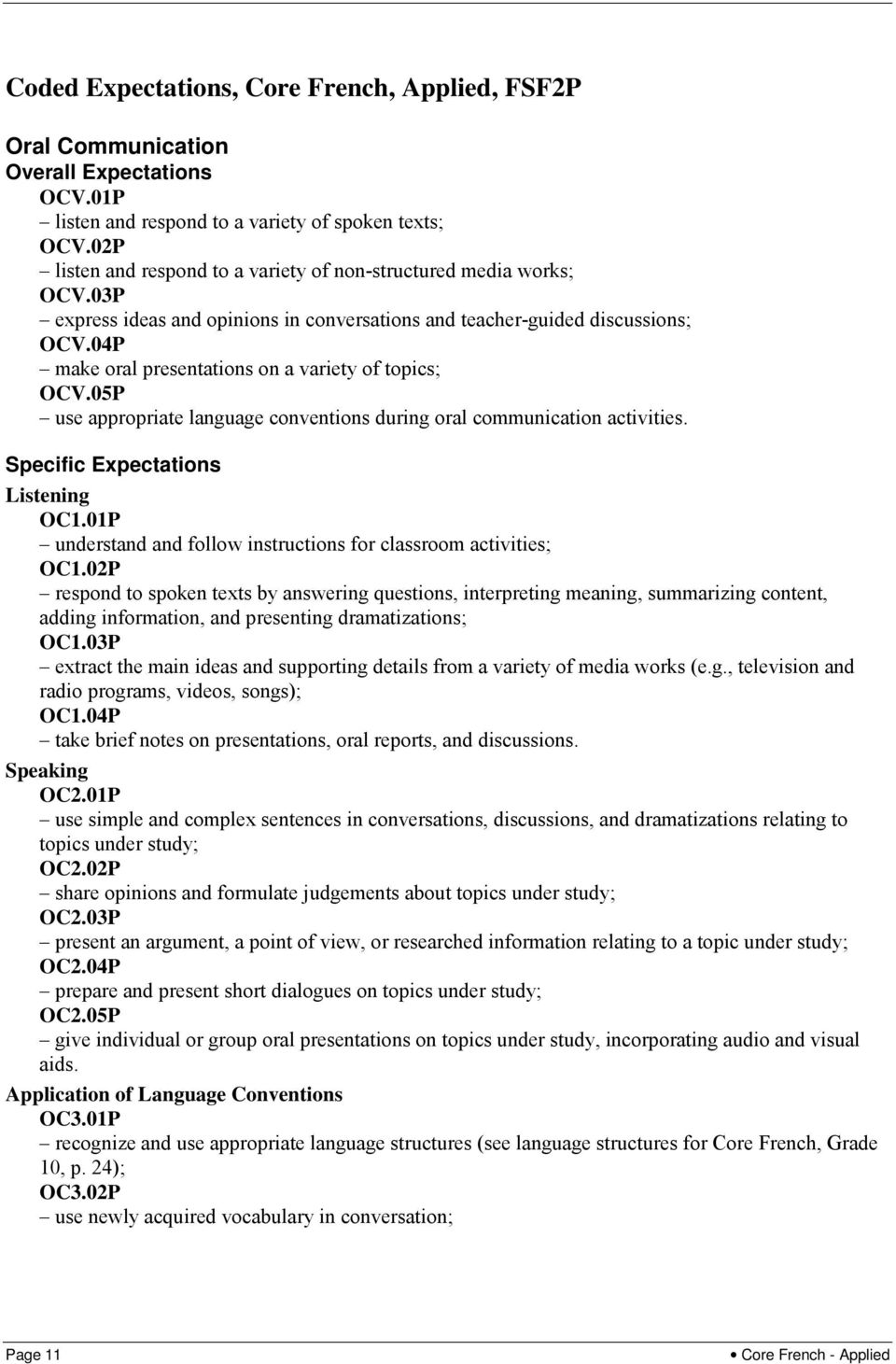
12 OC3.03P use correct pronunciation and intonation, and body language and other non-verbal cues, to clarify and enhance a message; OC3.04P interpret the meaning of unfamiliar words (e.g., by recognizing cognates, word families). Reading Overall Expectations REV.01P read and demonstrate an understanding of a variety of texts; REV.02P read a wide range of texts to gather information and to expand their knowledge of the French language; REV.03P identify and understand language conventions used in their reading materials. Specific Expectations Comprehension and Response to Text RE1.01P acquire information from a variety of materials (e.g., newspaper and magazine articles, job advertisements, publicity ads, CD-ROMs, computer software); RE1.02P read a selection of short stories, articles, and poems, and develop the main ideas and some supporting details in a different context; RE1.03P read a wide range of texts (e.g., public surveys, articles, , pen-pal communications) and respond through discussion or by giving short answers; RE1.04P skim a text to list key ideas; RE1.05P use specific research skills (e.g., identifying sources, data gathering, note taking) in preparing an assignment; RE1.06P organize their research data on a topic and report on their findings in an oral presentation that includes an introduction and a conclusion. Application of Language Conventions RE2.01P recognize and use appropriate language structures (see language structures for Core French, Grade 10, p. 24); RE2.02P identify and model language conventions used in job advertising, personal letter writing, and press releases; RE2.03P use French-English dictionaries to determine the meaning of unfamiliar vocabulary. Page 12
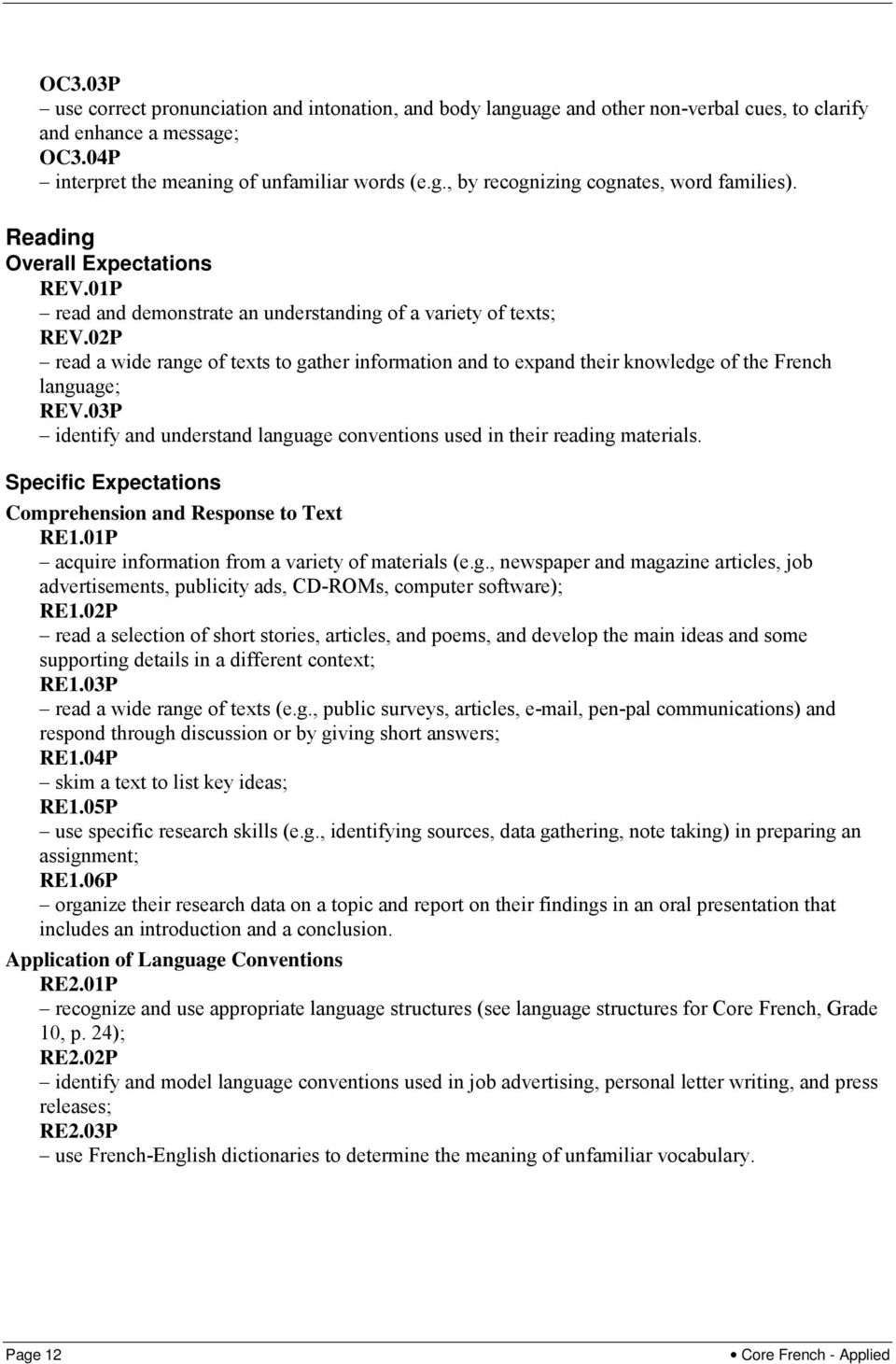
13 Writing Overall Expectations WRV.01P express ideas and opinions in short written texts; WRV.02P create short written texts in structured and open-ended situations; WRV.03P identify and use appropriate language conventions in their written work. Specific Expectations Communication of Ideas and Information WR1.01P write in a variety of forms (e.g., a paragraph expressing an opinion, a personal letter, a newspaper article, a dialogue, a job advertisement, a research report); WR1.02P write a brief description (e.g., a personal profile) using the appropriate past tenses; WR1.03P write a formal letter (e.g., requesting a job interview, expressing a point of view to the editor of a newspaper); WR1.04P write a brief report based on researched information; WR1.05P prepare and conduct a survey, and summarize and interpret the data in short paragraphs. Application of Language Conventions WR2.01P recognize and use appropriate language structures (see language structures for Core French, Grade 10, p. 24); WR2.02P revise, edit, and proofread their writing, focusing on grammar, spelling, punctuation, and conventions of style; WR2.03P apply the conventions of formal letter writing (e.g., the omission of cher in the salutation, the use of appropriate closing expressions); WR2.04P incorporate newly acquired vocabulary into their written work. Page 13

14 Ontario Catholic School Graduate Expectations The graduate is expected to be: A Discerning Believer Formed in the Catholic Faith Community who CGE1a CGE1b CGE1c CGE1d CGE1e CGE1f CGE1g CGE1h CGE1i CGE1j -illustrates a basic understanding of the saving story of our Christian faith; -participates in the sacramental life of the church and demonstrates an understanding of the centrality of the Eucharist to our Catholic story; -actively reflects on God s Word as communicated through the Hebrew and Christian scriptures; -develops attitudes and values founded on Catholic social teaching and acts to promote social responsibility, human solidarity and the common good; -speaks the language of life... recognizing that life is an unearned gift and that a person entrusted with life does not own it but that one is called to protect and cherish it. (Witnesses to Faith) -seeks intimacy with God and celebrates communion with God, others and creation through prayer and worship; -understands that one s purpose or call in life comes from God and strives to discern and live out this call throughout life s journey; -respects the faith traditions, world religions and the life-journeys of all people of good will; -integrates faith with life; -recognizes that sin, human weakness, conflict and forgiveness are part of the human journey and that the cross, the ultimate sign of forgiveness is at the heart of redemption. (Witnesses to Faith) An Effective Communicator who CGE2a CGE2b CGE2c CGE2d CGE2e -listens actively and critically to understand and learn in light of gospel values; -reads, understands and uses written materials effectively; -presents information and ideas clearly and honestly and with sensitivity to others; -writes and speaks fluently one or both of Canada s official languages; -uses and integrates the Catholic faith tradition, in the critical analysis of the arts, media, technology and information systems to enhance the quality of life. Page 14

15 A Reflective and Creative Thinker who CGE3a CGE3b CGE3c CGE3d CGE3e CGE3f -recognizes there is more grace in our world than sin and that hope is essential in facing all challenges; -creates, adapts, evaluates new ideas in light of the common good; -thinks reflectively and creatively to evaluate situations and solve problems; -makes decisions in light of gospel values with an informed moral conscience; -adopts a holistic approach to life by integrating learning from various subject areas and experience; -examines, evaluates and applies knowledge of interdependent systems (physical, political, ethical, socio-economic and ecological) for the development of a just and compassionate society. A Self-Directed, Responsible, Life Long Learner who CGE4a CGE4b CGE4c CGE4d CGE4e CGE4f CGE4g CGE4h -demonstrates a confident and positive sense of self and respect for the dignity and welfare of others; -demonstrates flexibility and adaptability; -takes initiative and demonstrates Christian leadership; -responds to, manages and constructively influences change in a discerning manner; -sets appropriate goals and priorities in school, work and personal life; -applies effective communication, decision-making, problem-solving, time and resource management skills; -examines and reflects on one s personal values, abilities and aspirations influencing life s choices and opportunities; -participates in leisure and fitness activities for a balanced and healthy lifestyle. A Collaborative Contributor who CGE5a CGE5b CGE5c CGE5d -works effectively as an interdependent team member; -thinks critically about the meaning and purpose of work; -develops one s God-given potential and makes a meaningful contribution to society; -finds meaning, dignity, fulfillment and vocation in work which contributes to the common good; Page 15

16 CGE5e CGE5f CGE5g CGE5h -respects the rights, responsibilities and contributions of self and others; -exercises Christian leadership in the achievement of individual and group goals; -achieves excellence, originality, and integrity in one s own work and supports these qualities in the work of others; -applies skills for employability, self-employment and entrepreneurship relative to Christian vocation. A Caring Family Member who CGE6a CGE6b CGE6c CGE6d CGE6e -relates to family members in a loving, compassionate and respectful manner; -recognizes human intimacy and sexuality as God given gifts, to be used as the creator intended; -values and honours the important role of the family in society; -values and nurtures opportunities for family prayer; -ministers to the family, school, parish, and wider community through service. A Responsible Citizen who CGE7a CGE7b CGE7c CGE7d CGE7e CGE7f CGE7g CGE7h CGE7i CGE7j -acts morally and legally as a person formed in Catholic traditions; -accepts accountability for one s own actions; -seeks and grants forgiveness; -promotes the sacredness of life; -witnesses Catholic social teaching by promoting equality, democracy, and solidarity for a just, peaceful and compassionate society; -respects and affirms the diversity and interdependence of the world s peoples and cultures; -respects and understands the history, cultural heritage and pluralism of today s contemporary society; -exercises the rights and responsibilities of Canadian citizenship; -respects the environment and uses resources wisely; -contributes to the common good Page 16

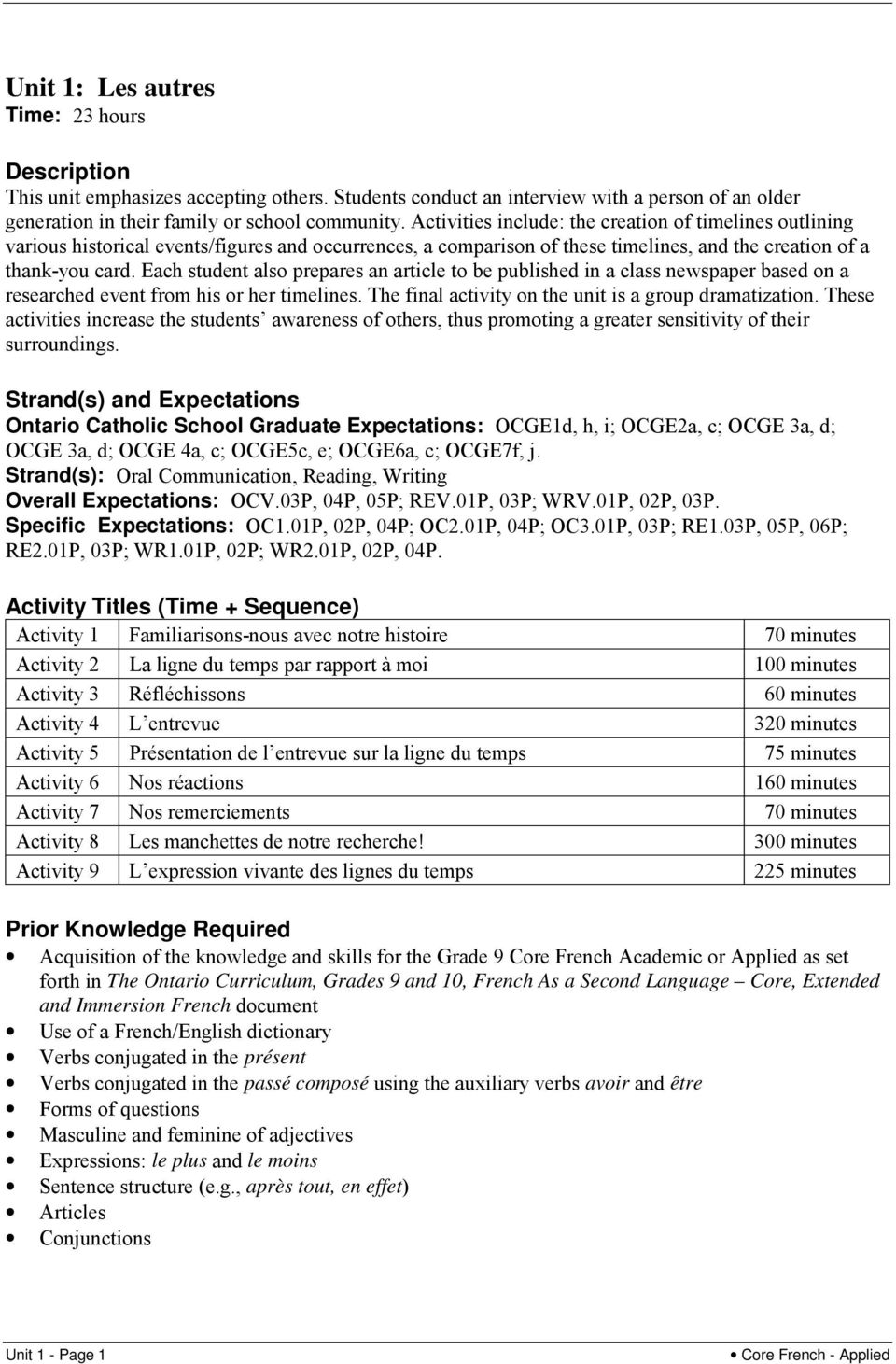
17 Unit 1: Les autres Time: 23 hours Description This unit emphasizes accepting others. Students conduct an interview with a person of an older generation in their family or school community. Activities include: the creation of timelines outlining various historical events/figures and occurrences, a comparison of these timelines, and the creation of a thank-you card. Each student also prepares an article to be published in a class newspaper based on a researched event from his or her timelines. The final activity on the unit is a group dramatization. These activities increase the students awareness of others, thus promoting a greater sensitivity of their surroundings. Strand(s) and Expectations Ontario Catholic School Graduate Expectations: OCGE1d, h, i; OCGE2a, c; OCGE 3a, d; OCGE 3a, d; OCGE 4a, c; OCGE5c, e; OCGE6a, c; OCGE7f, j. Strand(s): Oral Communication, Reading, Writing Overall Expectations: OCV.03P, 04P, 05P; REV.01P, 03P; WRV.01P, 02P, 03P. Specific Expectations: OC1.01P, 02P, 04P; OC2.01P, 04P; OC3.01P, 03P; RE1.03P, 05P, 06P; RE2.01P, 03P; WR1.01P, 02P; WR2.01P, 02P, 04P. Activity Titles (Time + Sequence) Activity 1 Familiarisons-nous avec notre histoire 70 minutes Activity 2 La ligne du temps par rapport à moi 100 minutes Activity 3 Réfléchissons 60 minutes Activity 4 L entrevue 320 minutes Activity 5 Présentation de l entrevue sur la ligne du temps 75 minutes Activity 6 Nos réactions 160 minutes Activity 7 Nos remerciements 70 minutes Activity 8 Les manchettes de notre recherche! 300 minutes Activity 9 L expression vivante des lignes du temps 225 minutes Prior Knowledge Required Acquisition of the knowledge and skills for the Grade 9 Core French Academic or Applied as set forth in The Ontario Curriculum, Grades 9 and 10, French As a Second Language Core, Extended and Immersion French document Use of a French/English dictionary Verbs conjugated in the présent Verbs conjugated in the passé composé using the auxiliary verbs avoir and être Forms of questions Masculine and feminine of adjectives Expressions: le plus and le moins Sentence structure (e.g., après tout, en effet) Articles Conjunctions Unit 1 - Page 1
18 Unit Planning Notes Photocopy or transcribe the handouts from the Appendix section. Certain activities in this unit require teacher observation (partner work, dialogues, oral presentations). Prepare checklists for ongoing assessment. Students need the school Library/Resource Centre for research in Activities 4 and 6. The teacher may wish to gather historical resources for each decade, e.g., CD-ROMs (Encarta Encyclopedia), computer software, Internet sites, books, magazines, and list key words for students research. Collect a class set of French newspapers (e.g., L Express, Le Droit) (for Activity 7). The teacher may choose to reinforce grammar structures by using various activities from a resource such as Destinations 4. It is recommended that students keep their work in a portfolio in preparation for the final evaluation. The weighting of the marks on the suggested checklists reflects the opinion of the writers. Individual boards and/or teachers may adjust the weighting accordingly. Teaching/Learning Strategies Students discuss brainstorm participate in group/partner work participate in conversations with their peers participate in discussions present prepared material to the class complete structured sentences write in structured situations conduct a research project conduct an interview conference with teacher edit the work of their peers contribute to a personal portfolio Teacher lead discussions model language directly instruct mentor monitor tutor facilitate Assessment and Evaluation Diagnostic and Formative pencil and paper tests checklists teacher/self/peer rubrics student/teacher conferencing written assignments role playing Unit 1 - Page 2

19 observation Summative Evaluation written assignment dramatization project presentation teacher/student interviews oral presentations/dialogues pencil and paper tests Resources Print Gollert, Heidi, Elver Peruzzo, and Claire Piché. Destinations 3. Mississauga, Canada: Copp Clark Pitman Limited, Gollert, Heidi, Elver Peruzzo, and Claire Piché. Destinations 4. Mississauga, Canada: Copp Clark Pitman Limited, Warren, Bernie. Drama Games. North York, Canada: Captus Press, Bilingual/Unilingual dictionaries Local French newspaper Various newspapers, magazines, encyclopedias, etc., outlining historical events Altitude from the Tous Ensemble series, D.C. Heath. Technological CD-ROM: Encarta Encyclopedia Various Internet sites Activity 1: Familiarisons-nous avec notre histoire Time: 70 minutes Description In this activity, students explore important events, figures and occurrences during their lifetime. Strategies include teacher-directed discussions and small-group brainstorming. Students create a timeline of the events discussed. An awareness of the Catholic perspective in the students lives is highlighted through examples such as Jubilee 2000 and the death of Mother Teresa. Strand(s) and Expectations Ontario Catholic School Graduate Expectations OCGE1i - integrates faith with life; OCGE2c - presents information and ideas clearly and honestly and with sensitivity to others. Strand(s): Oral Communication, Reading, Writing Overall Expectations OCV.05P - use appropriate language conventions during oral communication activities; REV.01P - read and demonstrate an understanding of a variety of texts; REV.03P - identify and understand language conventions used in their reading materials; WRV.02P - create short written texts in structured and open-ended situations; WRV.03P - identify and use appropriate language conventions in their written work. Unit 1 - Page 3

20 Specific Expectations OC1.01P - understand and follow instructions for classroom activities; OC2.01P - use simple and complex sentences in conversations, discussions and dramatizations relating to topics under study; RE2.01P - recognize and use appropriate language structures; RE2.03P - use French-English dictionaries to determine the meaning of unfamiliar vocabulary; WR1.01P - write in a variety of forms (e.g., a paragraph expressing an opinion, a personal letter, a newspaper article, a dialogue, a job advertisement, a research report); WR2.01P - recognize and use appropriate language structures. Planning Notes Prepare an overhead transparency of Annexe 1-1a Une ligne du temps for class presentation. Photocopy Annexe 1-1b Une ligne du temps à compléter for student use. As history unfolds, adjust timeline. Photocopy Annexe 1-1c Grille d évaluation pour le remue-méninges de la ligne du temps. Prior Knowledge Required Verbs conjugated in the présent Verbs conjugated in the passé composé using auxiliary verbs avoir and être Teaching/Learning Strategies The teacher will: pose the question: Quels événements marquants sont arrivés dans les trois dernières années? lead a discussion on a past event lead a discussion based on students findings summarize the common ideas on the board review the passé composé when questioning students present a sample timeline (Annexe 1-1a Une ligne du temps) on overhead transparency introduce new vocabulary on theme : - une ligne du temps - les événements historiques - les événements marquants - les personnes marquantes - la politique - les arts - la musique - les sports - les vêtements - les désastres - les catastrophes - l ordre chronologique The students will: participate in the discussion on past events participate in the review of the passé composé. actively listen to the presentation of sample timeline copy new vocabulary in notebooks Unit 1 - Page 4

21 place students in small groups ask students to collect information on the important events, figures and occurrences that have taken place in their recent past (2-3 years) using their dictionary as needed for vocabulary. Possible topics for discussion include: - important figures - world of arts and entertainment - clothes - sporting events - disasters and catastrophes complete Annexe 1-1c for each student to formatively assess their contributions during the brainstorming activity (see Grille d évaluation pour le remue-méninges de la ligne du temps) ask students to individually create a timeline based on findings from the group discussion (Annexe 1-1b Une ligne du temps à compléter). A minimum of four events, figures and/or occurrences are required. Descriptions should be written in the passé composé in groups, collect information on the important events, figures and occurrences that have taken place in their recent past (2-3 years) using their dictionary as needed for vocabulary. Possible topics for discussion include: - important figures - the world of arts and entertainment - clothes - sporting events - disasters and catastrophes individually, create a timeline based on findings from the group discussion (Annexe 1-1b Une ligne du temps à compléter) Assessment/Evaluation Techniques It is suggested that teachers link the following methods and strategies together to cover the recommended achievement categories. F = Formative S = Summative Type Category Methods and Strategies Tools User F Teacher-led discussion Annexe 1-1c Teacher Accommodations Provide for assistance from a peer or a peer tutor. Reduce the number of requirements for the timeline from four to two occurrences. Allow more time for students to complete the task. Pair students strategically. Resources Various Internet sites, newspapers, magazines, encyclopedias, etc. may be used to assist in finding information concerning specific historical events. French/English dictionaries Appendices Annexe 1-1a Une ligne du temps Annexe 1-1b Une ligne du temps à compléter Annexe 1-1c Grille d évaluation pour le remue-méninges de la ligne du temps Unit 1 - Page 5
22 Annexe 1-1a Une ligne du temps La mère Térèse est décédée. Adrienne Clarkson est devenue la première femme au poste de gouverneur général au Canada. James Cameron a réalisé le film Titanic. Wayne Gretzky, le joueur qui a compté le plus de buts dans l histoire de la Ligue nationale de hockey, a pris sa retraite. L année du jubilé est célébrée à travers le monde. Unit 1 - Page 6
23 Annexe 1-1b Une ligne du temps à compléter Années Personnes marquantes et/ou événements marquants et/ou événements historiques Unit 1 - Page 7
24 Annexe 1-1c Grille d évaluation pour le remue-méninges de la ligne du temps Nom : Niveau 1 (5.9 points) limitée Niveau 2 (6-6.9 points) partielle Niveau 3 (7-7.9 points) la plupart Niveau 4 (8-10 points) approfondie Connaissances -le nombre d événements discutés Communication -contribution d idées au groupe Application -utilisation du vocabulaire de l activité -utilisation du passé composé Total /30 Veuillez vous référer à la grille d évaluation dans la section Course Overview pour mieux définir les niveaux. Note: A student whose achievement is below level 1 (50%) has not met the expectations for this assignment or activity. Unit 1 - Page 8
25 Activity 2: La ligne du temps par rapport à moi Time: 100 minutes Description Referring to the timeline created in Activity 1, students use the expression, J étais quand to describe their whereabouts during each occurrence. Students state an opinion regarding the events listed using the second expression, Je pense que c est important parce que. Students use these expressions verbally and write them as an attachment to their timelines. This activity reinforces students ability to become effective communicators who present information and ideas clearly and honestly with sensitivity to others. Strand(s) and Expectations Ontario Catholic School Graduate Expectations OCGE1h - respects the faith traditions, world religions and the life-journeys of all people of good will; OCGE2a - listens actively and critically to understand and learn in light of gospel values; OCGE4a - demonstrates a confident and positive sense of self and respect for the dignity and welfare of Others; OCGE1f - respects and affirms the diversity and interdependence of the world s peoples and cultures. Strand(s): Oral Communication, Reading, Writing Overall Expectations OCV.03P - express ideas and opinions in conversations and teacher-guided discussions; OCV.05P - use appropriate language conventions during oral communication activities; REV.03P - identify and understand language conventions used in their reading materials; WRV.01P - express ideas and opinions in short written texts; WRV.03P - identify and use appropriate language conventions in their work. Specific Expectations OC2.01P - use simple and complex sentences in conversations, discussions, and dramatizations relating to topics under study; OC3.01P - recognize and use appropriate language structures; RE2.01P - recognize and use appropriate language structures; RE2.03P - use French-English dictionaries to determine the meaning of unfamiliar vocabulary; WR1.01P - write in a variety of forms (e.g., a paragraph expressing an opinion, a personal letter, a newspaper article, a dialogue, a job advertisement, a research report); WR1.01P - recognize and use appropriate language structures. Planning Notes Prepare sample statements for the two expressions used in this activity (J étais quand, Je pense que c est important parce que ). Prepare a checklist for assessment during dialogue presentations. Prepare practice exercises for the imparfait. Photocopy Annexe 1-2 Liste de vérification for peer evaluation. Prior Knowledge Required Verbs conjugated in the passé composé Unit 1 - Page 9
26 Teaching/Learning Strategies The teacher will: review vocabulary introduced in Activity 1 lead a discussion regarding the content of students timelines created in, Activity 1 teach and provide opportunities to practice the imparfait model the expression J étais quand to describe where he/she was during one of the occurrences of the timeline (e.g., J étais en vacances quand j ai vu le film Titanic.) model the second expression Je pense que c est important parce que to describe their reaction to one of the occurences of the timeline (e.g., Je pense que c est important parce qu un Canadien a créé un film reconnu et apprécié à travers le monde.) ask students to complete and practice each expression orally in a conversation with a partner to discuss the occurrences of their timeline ask students to write a statement of their whereabouts for each occurrence using the expression J'étais quand. write an opinion for each occurrence from their timeline using the expression Je pense que c'est important parce que. evaluate students during oral presentations (e.g., structure of sentences, vocabulary) ask students to evaluate their peers during oral presentations (see Annexe 1-2 Liste de vérification) The students will: participate in the vocabulary review refer to their timelines to contribute to the discussion practise the imparfait actively listen to the new expressions presented by the teacher complete and practise each expression orally in a conversation with a partner to discuss the occurrences of their timeline write a statement of their whereabouts for each occurrence using the expression J'étais quand write an opinion for each occurrence from their timeline using the expression Je pense que c est important parce que present four sentences orally to the class (two sentences for each expression) evaluate their peers during oral presentations (see Annexe 1-2 Liste de vérification) Assessment/Evaluation Techniques It is suggested that teachers link the following methods and strategies together to cover the recommended achievement categories. F = Formative S = Summative Type Category Methods and Strategies Tools User F F Knowledge/Understanding Communication Knowledge/Understanding Communication Oral presentation of sentences Oral presentation of sentences Accommodations Provide assistance from a peer or peer tutor. Adapt activity requirements from four sentences to two sentences. Marking scheme Rating scale Annexe 1-2 Teacher Peer Unit 1 - Page 10
27 Resources French-English dictionaries Appendices Annexe 1-2 Liste de vérification La ligne du temps par rapport à moi Unit 1 - Page 11
28 Annexe 1-2 Liste de vérification La ligne du temps par rapport à moi Nom : Date : Nom de l élève : Réponds aux questions suivantes. 1. Quel est le total des phrases de l élève? Combien de phrases incluent l expression : «J étais quand»? Combien de phrases incluent l expression : «Je pense que c est important parce que»? Unit 1 - Page 12
29 Activity 3: Réfléchissons Time: 60 minutes Description This activity examines various members in the students community and their roles. Emphasis is placed on the responsibilities and the contributions of self and others within a community. Students reflect on the quality of their own roles and responsibilities through journal writing and discussion with peers. Vocabulary relating to these roles and responsibilities is studied. Students choose a member of an older generation within their community in preparation for a future interview. Strand(s) and Expectations Ontario Catholic Graduate Expectations OCGE1d - develop attitudes and values founded on Catholic social teaching and acts to promote social responsibility, human solidarity and the common good; OCGE5e - respects the rights, responsibilities and contributions of self and others; OCGE7f - respects and affirms the diversity and interdependence of the world s people s and cultures; OCGE7I - respects the environment and uses resources wisely. Strand(s): Oral Communication, Reading, Writing Overall Expectations OCV.03P - express ideas and opinions in conversations and teacher-guided discussions; OVC.05P - use appropriate language conventions during oral communication activities; REV.03P - identify and understand language conventions used in their reading materials; WRV.03P - identify and use appropriate language conventions in their written work. Specific Expectations OC1.01P - understand and follow instructions for classroom activities; OC3.01P - recognize and use appropriate language structures; RE1.03P - read a wide range of texts (e.g., public surveys, articles, , pen-pal communications) and respond through discussion or by giving short answers; RE2.01P - recognize and use appropriate language structures; RE2.03P - use French-English dictionaries to determine the meaning of unfamiliar vocabulary; WR1.01P - write in a variety of forms (e.g., a paragraph expressing an opinion, a personal letter, a newspaper article, a dialogue, a job advertisement, a research report); WR2.01P - recognize and use appropriate language. Planning Notes Prepare presentation format of sample questions for journal writing, e.g., overhead transparency, handout, PowerPoint presentation. The amount of time needed for student interviews may vary. Teachers may wish to limit the options of community members to the students immediate family to save time. Anecdotal comments lend themselves well to this activity. The teacher should note any selfrealizations that students make during this activity. Prior Knowledge Required Forms of questions Verbs conjugated in the présent Verbs conjugated in the passé composé using auxiliary verbs avoir and être Unit 1 - Page 13
30 Teaching/Learning Strategies The teacher will: lead a discussion on students role and the role of others in their immediate communities, e.g., family, school ask students to use a dictionary to list the roles, responsibilities and impacts of various members of their communities and name these members ask questions such as: - Est-ce que tu fais le ménage? - Est-ce que tu fais tes devoirs chaque soir? - Est-ce que tu aides les autres? (famille, amis) Comment? - Est-ce que tu es un citoyen responsable? Comment? - Est-ce que tu respectes ton environnment? Comment? ask students to reflect on the quality of their actions within their roles and responsibilities by answering these questions in a journal writing assignment ask students to share their journal reflections in a dialogue with a partner ask students to choose a member of their immediate community from an older generation: - family: grandparent, aunt, uncle, parent, etc. - school: chaplain, priest, secretary, principal, teacher, caretaker, etc. ask students to arrange an interview with the chosen member of their immediate community ask students to discuss their choice of interviewee with and the details of their interview in a teacher-student conference The students will: participate in the discussion on students role and the role of others in their immediate communities, e.g., family, school use a dictionary to list the roles, responsibilities and impacts of various members of their communities and name these members reflect on the quality of their actions within their roles and responsibilities through a journal writing assignment share their journal reflections in a dialogue with a partner choose a member of their immediate community from an older generation: - family: grandparent, aunt, uncle, parent, etc. - school: chaplain, priest, secretary, principal, teacher, caretaker, etc. ask permission from the immediate member of their community to participate in an interview. arrange the details of the interview (time, place) discuss their choice of interviewee and the details of their interview in a teacher-student conference Assessment/Evaluation Techniques It is suggested that teachers link the following methods and strategies together to cover the recommended achievement categories. F = Formative S = Summative Type Category Methods and Strategies Tools User F Thinking/Inquiry Completion of journal Observation Teacher F Communication Dialogue Anecdotal Teacher Unit 1 - Page 14
31 Accommodations Reduce the number of questions required in the interview. Review journal questions in a small group to improve understanding. Simplify level of language required in journal writing assignment (point form instead of full language structure). Resources French-English dictionaries Activity 4: L entrevue Time: 320 minutes Description Students prepare for and conduct an interview based on information researched and teacher-guided questions. In this activity, students become aware of the diversity and interdependence of the world s peoples and cultures. To prepare for the interview, students research historical information regarding the decade of their interviewee s teenage years. They are given categories to research and create a timeline for that specific decade. Teacher-student conferencing is used to assess the students progress in this activity. Strand(s) and Expectations Ontario Catholic School Graduate Expectations OCGE2c - presents information and ideas clearly and honestly and with sensitivity to others; OCGE6a - relates to family members in a loving, compassionate and respectful manner; OCGE7f - respects and affirms the diversity and interdependence of the world s peoples and cultures. Strand(s): Oral Communication, Reading, Writing Overall Expectations OCV.03P - express ideas and opinions in conversations and teacher-guided discussions; REV.01P - read and demonstrate an understanding of a variety of texts; REV.03P - identify and understand language conventions used in their reading materials; WRV.03P - identify and use appropriate language conventions in their written work. Specific Expectations OC1.01P - understand and follow instructions for classroom activities; OC2.01P - use simple and complex sentences in conversations, discussions and dramatizations relating to topics under study; RE1.01P - acquire information from a variety of materials (e.g., newspaper and magazine articles, job advertisements, publicity ads, CD-ROMs, computer software); RE1.05P - use specific research skills (e.g., identifying, sources, data gathering, note taking) in preparing an assignment; WR1.01P - write in a variety of forms (e.g., a paragraph expressing an opinion, a personal letter, a newspaper article, a dialogue, a job advertisement, a research report); WR2.01P - recognize and use appropriate language structures; WR2.04P - incorporate newly acquired vocabulary into their written work. Unit 1 - Page 15
32 Planning Notes Reserve the school Library/Resource Centre for students to conduct their research. Gather historical resources for each decade (e.g., CD-ROMs, computer software, Internet sites, books, magazines) and list key words for students research. Photocopy a self-evaluation form (Annexe 1-4a Ma liste de contrôle) and a teacher-student conference form (Annexe 1-4b Teacher-Student Conference) for each student. Review students interview questions to relate to interviewee s background. Review the imparfait and the passé composé. As a follow-up to the interview, students could assist their interviewee in some capacity. This assistance could contribute to the 40 hours of community service required for their diploma. Prior Knowledge Required Verbs conjugated in the présent Verbs conjugated in the passé composé Verbs conjugated in the imparfait (as seen in previous activity) Forms of questions Teaching/Learning Strategies The teacher will: ask students to determine the decade in which their interviewee (from Activity 3) was a teenager (e.g., the 40s, 50s, 60s, and 70s) for a historical research introduce the structure for the historical research: - identify sources (indicate bibliographical information) - gather data (pertinent information only) - take notes in an organized manner (use titles and subtitles, write in point form, number pages) direct student research based on the decade chosen for their interviewee by outlining the following criteria: Describe ten to fifteen significant events, people or occurrences in any of the following areas: -les arts et la musique -les sports -les événements et/ou personnes marquant(e)s -la politique -les désastres et/ou les catastrophes ask students to use a wide range of materials (e.g., CD- ROMs, computer software, Internet, books, magazines) to gather information ask students to create a written timeline for the decade researched, including the ten to fifteen sentences formulated during the research conference with students individually or in small groups to evaluate their progress (see Annexe 1-4b Teacher-Student Conference) ask students to complete a self-evaluation form The students will: determine the decade in which their interviewee was a teenager (e.g., the 40s, 50s, 60s, and 70s) take notes on the research structure use a wide range of materials (e.g., CD-ROMs, computer software, Internet, books, magazines) to gather information on ten to fifteen significant events, people or occurrences of their chosen decade create a written timeline for the decade researched, including the ten to fifteen sentences formulated during the research conference with teacher (see Annexe 1-4b Teacher-Student Conference) complete a self-evaluation form Unit 1 - Page 16
33 (Annexe 1-4a Ma liste de contrôle) review the expressions from Activity 2: J étais quand and Je pense que c est important parce que ask students to use expressions in the second person (singular and plural) and assess their understanding formulate five interview questions using the expressions from Activity 2 and the information researched evaluate students interview questions (Annexe 1-4a Ma liste de contrôle) formulate five interview questions using the expressions from Activity 2 and the information researched. Examples : - Vous étiez où quand le pape Jean- Paul II a visité le Canada? - Pourquoi est-ce que vous pensez que sa visite a été importante? ask students to conduct their interview conduct interview and record responses (written or taped) Assessment/Evaluation Techniques It is suggested that teachers link the following methods and strategies together to cover the recommended achievement categories. F = Formative S = Summative Type Category Methods and Tools User Strategies F Knowledge/Understanding Communication Teacher-student conferencing S Communication/Application Teacher-student conferencing Checklist Annexe 1-4a Marking scheme Annexe 1-4b Self Teacher F Application Interview questions Checklist Teacher Accommodations Reduce the number of questions required for the interview. Reduce the number of events and/or categories to be researched. Pair students in a strategic fashion. Resources Historical resources e.g., CD-ROMs (Encarta Encyclopedia), computer software, Internet sites, books, and magazines French-English dictionaries Appendices Annexe 1-4a Ma liste de contrôle Annexe 1-4b Teacher-Student Conference Unit 1 - Page 17
34 Annexe 1-4a Ma liste de contrôle Nom : Date : Réponds aux questions suivantes. 1. La personne que j ai choisie pour mon entrevue s appelle. 2. La date de mon entrevue est. 3. L heure de mon entrevue est. 4. J ai écrit phrases pour ma ligne du temps. 5. J ai terminé ma recherche. OUI PRESQUE NON Unit 1 - Page 18
35 Annexe 1-4b Teacher-Student Conference Student Name: Date: Understand and follow instructions for classroom activities. 1. The student has chosen a person for his/her interview. NO YES If not, who could he or she be placed with? 2. The student has arranged a time and a place for his/her interview. NO YES Acquire information from a variety of materials (e.g., newspaper and magazine articles, job advertisements, publicity ads, CD-ROMs, computer software). 3. The student has used/intends to use a variety of sources in his/her research. NO YES Use specific research skills (e.g., identifying sources, data gathering, note taking) in preparing an assignment. 4. The student has used specific skills to conduct his/her research. NO YES Use simple and complex sentences in conversations, discussions and dramatizations relating to topics under study. 5. The student spoke French using simple and complex sentences during the conference. NO YES Unit 1 - Page 19
36 Activity 5: Présentation de l entrevue sur la ligne du temps Time: 75 minutes Description In this activity, students prepare the final copy of their researched timeline which incorporates four to five responses from their interview. Students revise, edit, and proofread their written work, submitting their timeline when complete. They continue to improve their skills as effective communicators, presenting their information and ideas with clarity and honesty. Strand(s) and Expectations Ontario Catholic School Graduate Expectations OCGE1d - develops attitudes and values founded on Catholic social teaching and acts to promote social responsibility, human solidarity and the common good; OCGE2c - presents information and ideas clearly and honestly and with sensitivity to others; OCGE6a - relates to family members in a loving, compassionate and respectful manner; OCGE7f - respects and affirms the diversity and interdependence of the world s peoples and cultures. Strand(s): Oral Communication, Writing Overall Expectations OCV.03P - express ideas and opinions in conversations and teacher-guided discussions; WRV.02P - create short written texts in structured and open-ended situations; WRV.03P - identify and use appropriate language conventions in their written work. Specific Expectations OC2.01P - use simple and complex sentences in conversations, discussions, and dramatizations relating to topics under study; OC3.01P - recognize and use appropriate language structures; WR1.02P - write a brief description (e.g., a personal profile) using the appropriate past tenses; WR2.01P - recognize and use appropriate language structures; WR2.02P - revise, edit, and proofread their writing, focusing on grammar, spelling, punctuation, and conventions of style. Planning Notes Photocopy an evaluation sheet for each student s timeline (Annexe 1-5 Grille d évaluation pour la ligne du temps). Prior Knowledge Required Verbs conjugated in the présent Verbs conjugated in the passé composé Verbs conjugated in the imparfait Unit 1 - Page 20
37 Teaching/Learning Strategies The teacher will: lead a follow-up discussion regarding student interviews review the expressions from Activity 2: J etais quand and Je pense que c est important parce que. ask students to choose four to five responses received during their interviews and place them below the corresponding event on the researched timeline created in Activity 4 (if interview was conducted in English, students write responses in French) ask students to use expressions in the third person and assess their understanding evaluate written timelines (see Annexe 1-5 Grille d évaluation pour la ligne du temps) The students will: share their experiences of the interview in the discussion participate in the review of the expressions from Activity 2 choose four to five responses received during the interviews and place them below the corresponding event on the researched timeline created in Activity 4 begin sentences with the expressions: Il/Elle était quand and Il/Elle pense que. submit their timeline for teacher evaluation Assessment/Evaluation Techniques It is suggested that teachers link the following methods and strategies together to cover the recommended achievement categories. F = Formative S = Summative Type Category Methods and Strategies Tools User S Application Written timeline Annexe 1-5 Teacher Accommodations Provide alternatives for completion of task, e.g., oral report. Allow more time for completion of task. Provide for peer assistance. Resources CD-ROM: Encarta Encyclopedia French-English dictionaries Written transcript of interview Appendices Annexe 1-5 Grille d évaluation pour la ligne du temps Unit 1 - Page 21
38 Annexe 1-5 Grille d évaluation pour la ligne du temps Nom : Niveau 1 ( points) limitée Niveau 2 ( points) partielle Niveau 3 ( points) la plupart Niveau 4 (8-10 points) approfondie Connaissances - la ligne du temps comporte phrases (événements et/ou personnes) Communication - utilisation correcte du passé composé et de l imparfait - qualité du français Application - l élève a inclus 4-5 phrases de l entrevue - utilisation correcte des expressions : Il/Elle était quand et Il/Elle pense que c est important parce que Total /30 Veuillez vous référer à la grille d évaluation dans la section Course Overview pour mieux définir les niveaux. Note: A student whose achievement is below level 1 (50%) has not met the expectations for this assignment or activity. Unit 1 - Page 22
39 Activity 6: Nos réactions Time: 160 minutes Description Students use the expressions ce que and ce qui me in a comparison of the timelines created in previous activities. Similarities and differences between reactions by students and older generations create a greater awareness of others. Students research one occurrence on the timeline in depth. Strand(s) and Expectations Ontario Catholic School Graduate Expectations OCGE2c - presents information and ideas clearly and honestly and with sensitivity to others; OCGE6a - relates to family members in a loving, compassionate and respectful manner; OCGE7f - respects and affirms the diversity and interdependence of the world s peoples and cultures; OCGE7g - respects and understands the history, cultural heritage and pluralism of today s contemporary society. Strand(s): Oral Communication, Reading, Writing Overall Expectations OCV.03P - express ideas and opinions in conversations and teacher-guided discussions; REV.03P - identify and understand language conventions used in their reading materials; WRV.01P - express ideas and opinions in short written texts; WRV.03P - identify and use appropriate language conventions in their written work. Specific Expectations OC1.01P - understand and follow instructions for classroom activities; OC3.01P - recognize and use appropriate language structures; RE1.05P - use specific research skills (e.g., identifying sources, data gathering, note taking) in preparing an assignment; RE2.01P - recognize and use appropriate language structures; WR1.02P - write a brief description using the appropriate past tenses; WR2.01P - recognize and use appropriate language structures; WR2.04P - incorporate newly acquired vocabulary into their written work. Planning Notes Materials required for this activity include the two timelines submitted by students (contains research from their decade and interviewee s decade). Prepare grammar exercises to complement the introduction of the ce qui and ce que structures. Prior Knowledge Required Masculine and feminine of adjectives Verbs conjugated in the passé composé Verbs conjugated in the présent Expressions le plus and le moins Unit 1 - Page 23
40 Teaching/Learning Strategies The teacher will: lead a discussion on the similarities and differences between the timelines previously prepared by students (contains research from their decade and the decade researched for their interview) highlight the adjectives that reflect reactions to the events. create a list of adjectives based on students responses (e.g., surpris, fier, étonné, touché) review the masculine and feminine of adjectives as needed model the structures ce que and ce qui me by incorporating these structures in sentences with adjectives developed from students timelines. Examples: - Ce que je trouve le plus intéressant, c est, - Ce qui m a surpris le plus, c est (see Annexe 1-6 Phrases à compléter) introduce the personal responses from Annexe 1-6 (on overhead, on board, handout) model pronunciation of responses ask students to complete sentences on Annexe 1-6 Phrases à compléter ask students to orally compare their responses to the sentences in Annexe 1-6 Phrases à compléter in pairs ask students to complete the phrase: Ce que je veux explorer davantage est review the structure for a research assignment: - identify sources (indicate bibliographical information); - gather data (pertinent information only); - take notes in an organized manner (use titles and subtitles, write in point form, number pages) reserve the Library/Resource Centre for research or assign research for homework. Research should describe outline details from one of the events from their timelines. This information will be used to write a newspaper article in Activity 8 The students will: participate in the group discussion by citing examples of events and reactions from their timelines actively contribute to the discussion by offering examples of adjectives to reflect their reactions be introduced to the new structures repeat sentences after teacher complete sentences on Annexe 1-6 Phrases à compléter in pairs, orally compare their responses to the phrases in Annexe 1-6 Phrases à compléter complete the sentence with an event from their timeline they wish to research further participate in the review of the structure for a research assignment research the details of an event from their timelines Unit 1 - Page 24
41 Assessment/Evaluation Techniques It is suggested that teachers link the following methods and strategies together to cover the recommended achievement categories. F = Formative S = Summative Type Category Methods and Strategies Tools User F Knowledge/Understanding Completion of sentences Annexe 1-6 Accommodations Reduce the number of sentences in the ce que activity. Provide for peer assistance. Marking Scheme Teacher Resources Historical resources e.g., CD-ROMs (Encarta Encyclopedia), computer software, Internet sites, books, and magazines French-English dictionaries Appendices Annexe 1-6 Phrases à compléter Réflexion Unit 1 - Page 25
42 Annexe 1-6 Phrases à compléter Réflexion Nom : Date : Réponds aux questions suivantes. 1. Ce que je trouve le plus intéressant, c est 2. Ce que je trouve le moins important, c est 3. Ce que j ai appris de (personne) c est 4. Ce que j ai trouvé de semblable, c est 5. Ce que j ai trouvé de différent, c est 6. Ce qui m a surpris(e)/intéressé(e)/intrigué(e) le plus, c est Unit 1 - Page 26
43 Activity 7: Nos remerciements Time: 70 minutes Description This activity requires students to reflect on ways to thank someone. Students take initiative in their growth as a caring member of a family or community. In this case, they express their appreciation to the person interviewed in a previous activity. By following a structure offered by the teacher, students create their own thank-you card. Partner work and peer editing take place during the writing process in this activity. Strand(s) and Expectations Ontario Catholic School Graduate Expectations OCGE1d - develops attitudes and values founded on Catholic social teaching and acts to promote social responsibility, human solidarity and the common good; OCGE6a - relates to family members in a loving compassionate and respectful manner. Strand(s): Oral Communication, Reading, Writing Overall Expectations OCV.05P - use appropriate language conventions during oral communication activities; REV.03P - identify and understand language conventions used in reading materials; WRV.01P - express ideas and opinions in short written texts; WRV.03P - identify and use appropriate language conventions in their written work. Specific Expectations OC3. 01P - recognize and use appropriate language structures; RE2.01P - recognize and use appropriate language structures; WR1.01P - write in a variety of forms (e.g., a paragraph expressing an opinion, a personal letter, a newspaper article, a dialogue, a job advertisement, a research report); WR2.01P - recognize and use appropriate language structures; WR2.02P - revise, edit and proofread their riting, focusing on grammar, spelling, punctuation, and conventions of style. Planning Notes Prepare a sample thank-you card. Prior Knowledge Required Verbs conjugated in the passé composé Sentence structure Unit 1 - Page 27
44 Teaching/Learning Strategies The teacher will: initiate a discussion on the importance of thanking the interviewees for their assistance in the previous activity ask students various ways which a thank you can be offered present a model thank-you card and review the possible format: e.g., - date - Cher/Chère - Merci pour - Salutations ask students to create the first draft of their personal thank-you card to be given to their interviewee ask students to exchange their first draft for peer editing observe and guide the peer editing process The students will: participate in the discussion about giving thanks contribute possible thank-you card formats read various models of thank-you cards prepare a first draft of their thankyou card exchange the first draft for peer editing edit the work of their peers evaluate thank-you cards prepare the final copy of their thank-you cards (to be submitted to the teacher for final evaluation) ask students to send or deliver the final edited version of their thank-you card send or deliver the final edited version of their thank-you card Assessment/Evaluation Techniques It is suggested that teachers link the following methods and strategies together to cover the recommended achievement categories. F = Formative S = Summative Type Category Methods and Strategies Tools User F Knowledge/Understanding Written product Peer editing Teacher-created evaluation S Knowledge/Understanding Written product Teacher-created evaluation Peer Teacher Accommodations Provide assistance from a peer or a peer tutor. Allow more time for students to complete the activity. Resources Sample thank-you cards French-English dictionaries Unit 1 - Page 28
45 Activity 8: Les manchettes de notre recherche! Time: 300 minutes Description In this activity, students create a class newspaper. They study vocabulary relating to newspapers and conduct a search through a French language paper. They write an article documenting the event researched in Activity 6, as it would have appeared in a newspaper at the time. Finally they present information and ideas clearly, honestly, and with sensitivity to others. Strand(s) and Expectations Ontario Catholic School Graduate Expectations OCGE1d - develops attitudes and values founded on Catholic social teaching and acts to promote social responsibility, human solidarity and the common good; OCGE1h - respects the faith traditions, world religions and life-journeys of all people of good will; OCGE2c - presents information and ideas clearly and honestly and with sensitivity to others. Strand(s) Reading, Writing Overall Expectations REV.01P - read and demonstrate an understanding of a variety of texts; REV.03P - identify and understand language conventions used in their reading materials; WRV.02P - create short written texts in structured and open-ended situations; WRV.03P - identify and use appropriate language conventions in their written work. Specific Expectations RE1.01P - acquire information from a variety of materials (e.g., newspaper and magazine articles, job advertisements, publicity ads, CD-ROMs, computer software); RE2.01P - recognize and use appropriate language structures; WR1.01P - write in a variety of forms (e.g., a paragraph expressing an opinion, a personal letter, a newspaper article, a dialogue, a job advertisement, a research report); WR2.04P - incorporate newly acquired vocabulary into their written work. Planning Notes Provide French language newspapers for students to conduct their search. Photocopy Annexe 1.8a Mots cachés, Annexe 1-8b Phrases à compléter, and Annexe 1-8c Cherchons dans le journal! Create a rubric for the evaluation of the newspaper article. Prior Knowledge Required Verbs conjugated in the passé composé Verbs conjugated in the présent Articles Conjunctions Unit 1 - Page 29
46 Teaching/Learning Strategies The teacher will: introduce vocabulary relating to writing a newspaper article use a newspaper to give support to new and previously acquired vocabulary (repetition, etc.) Examples: - le journal - le papier - la une - le reporteur/la reporteure - le ou la journaliste - le ou la photographe - le rédacteur/la rédactrice - le rédacteur-en-chef/la rédactrice-en-chef - la météo - l éditorial - le courrier du cœur - les sports - les manchettes - les nouvelles - les arts et la culture - les annonces classées - les bandes dessinées - les colonnes - les photos - la livraison - le journal à sensation - le journal politique review articles and conjunctions review the passé composé ask students to complete Annexe 1-8b Phrases à compléter ask students to write a newspaper article documenting the event researched in the previous activity as it would have appeared at the time. Their article should include: - the date - the title - a minimum of 7-10 sentences (describing who, what, when, where, why, how of the event and how the event has affected history) - an illustration or photograph The students will: practise vocabulary orally with the teacher become familiar with vocabulary by completing a word search (see Annexe 1-8a Mots cachés) participate in the review of the articles, conjunctions and passé composé explore vocabulary use and review the passé composé by completing activity handout (Annexe 1-8b Phrases à compléter) write a newspaper article documenting the event researched in the previous activity as it would have appeared at the time Unit 1 - Page 30
47 guide the peer editing process evaluate the final draft of the article exchange articles for peer review correct a peer s article submit the final draft of article to teacher for evaluation assist in the organization of a class newspaper create a class newspaper (organize articles by decade or events, etc.) make their newspaper available to the school and parent community by publishing it on the school web site or by distributing photocopies Assessment/Evaluation Techniques It is suggested that teachers link the following methods and strategies together to cover the recommended achievement categories. F = Formative S = Summative Type Category Methods and Strategies Tools User F Knowledge/Understanding Vocabulary Activity Marking scheme Self Annexe 1-8b S Knowledge/Understanding Newspaper Search Annexe 1-8c Marking scheme Teacher S Thinking/Inquiry Application Writing of Newspaper Article Teacher-created rubric Accommodations Reduce the requirements of the activity, e.g., article may be written in three to four sentences. Allow more time for students. Pair students in a strategic fashion. Teacher Resources French language newspaper, e.g., L Express, Le Droit Historical resources e.g., CD-ROMs (Encarta Encyclopedia), computer software, Internet sites, books, and magazines Appendices Annexe 1-8a Mots cachés Annexe 1-8b Phrases à compléter Le journal Annexe 1-8c Cherchons dans le journal! Unit 1 - Page 31
48 Annexe 1-8a Le Journal Annonces classées Intéressant Météo Rédacteur-en-chef Arts Journal Papiers Télévision Bandes dessinées Journal politique Photographe Éditorial Colonnes Journal à sensation Photos Courier du cœur Journaliste Reporteur Culture Livraison Rédacteur Answer Key Unit 1 - Page 32
49 Annexe 1-8b Phrases à compléter Le journal Nom : Date : A) Utilise le passé composé des verbes réguliers pour compléter les phrases suivantes. 1. Tu/aimer/dessins/bandes dessinées 2. Nous/trouver/la météo/journal 3. Ils/jouer/bonne équipe/année 4. Vous/acheter/journal politique 5. Elle/chercher/emploi/les annonces classées B) Utilise le passé composé des verbes irréguliers pour compléter les phrases suivantes. 1. Le reporteur/écrire/article/aujourd hui 2. Je/lire/journal/à sensation/hier 3. Elle/faire/la livraison/matin 4. Les photographes/prendre/les photos/semaine dernière 5. Le rédacteur/lire/les articles/la journée Unit 1 - Page 33
50 Annexe 1-8c Cherchons dans le journal! Nom : Date : Trouve les réponses aux questions suivantes. a) Quelle est la date de ton journal? b) Trouve la météo. Quel temps fait-il? c) Trouve dix adjectifs dans ton journal d) Trouve cinq phrases conjuguées au passé composé. e) Trouve cinq phrases conjuguées à l imparfait. f) Nomme trois films annoncés dans le journal. Unit 1 - Page 34
51 Activity 9: L expression vivante des lignes du temps Time: 225 minutes Description In this activity, students create a dramatization portraying reactions to an event/occurrence studied in this unit. Students develop roles individually and write the script of their scene in groups. Focus is placed on the group process work, including the contribution of ideas, the sharing of tasks, time spent on task, and the final product. This activity enables students to respect the rights, responsibilities, and contributions of their peers. Strand(s) and Expectations Ontario Catholic School Graduate Expectations OCGE2c - presents information and ideas clearly and honestly and with sensitivity to others; OCGE3b - creates, adapts, evaluates new ideas in light of the common good; OCGE4a - demonstrates a confident and positive sense of self and respect for the dignity and welfare of others; OCGE5e - respects the rights, responsibilities and contributions of self and others. Strand(s): Oral Communication, Reading, Writing Overall Expectations OCV.04P - make oral presentations on a variety of topics; OCV.05P - use appropriate language conventions during oral communication activities; REV.03P - identify and understand language conventions used in their reading materials; WRV.02P - create short written texts in structured and open-ended situations; WRV.03P - identify and use appropriate language conventions in their written work. Specific Expectations OC2.01P - use simple and complex sentences in conversations, discussions, and dramatizations relating to topics under study; OC3.03P - use correct pronunciation and intonation, and body language and other non-verbal clues to clarify and enhance a message; RE2.03P - recognize and use appropriate language structures; WR1.01P - write in a variety of forms (e.g., a paragraph expressing an opinion, a personal letter, a newspaper article, a dialogue, a job advertisement, a research report); WR2.02P - revise, edit, and proofread their writing, focusing on grammar, spelling, punctuation, and conventions of style. Planning Notes Photocopy Annexe 1-9 Le développement d un personnage. Supply certain resources such as props or elements of setting to stimulate ideas during the creative process. Provide a sound system for students use. Play a few drama games prior to this activity to increase the level of trust within the group. This will make students feel more comfortable during the presentations (see Resources). Prepare rubrics for observation of group work, final product, and written script. Unit 1 - Page 35
52 Prior Knowledge Required Structures studied in this unit such as: Je pense que c est important parce que and Ce qui Content of this unit, including events studied Verbs conjugated in the présent Verbs conjugated in the passé composé Verbs conjugated in the imparfait Teaching/Learning Strategies The teacher will: place students in groups of three to four (groups are formed based on a common aspect of students research during the timeline activities and the interview, e.g., the decade, a common event/figure/tragedy) ask students to determine with their group the aspect of their research they wish to explore in a dramatization (e.g., the world record set by ) distribute the handout to students (Annexe 1-9 Le développement d un personnage) explain the handout on role development and introduce new vocabulary ask students to complete the handout give students the following situation: You are a group of people sitting in a coffee shop, and the news has just been announced (radio, television, Internet, passerby) of the event researched ask students to react in role, describing their feelings, the importance of the event, and a comparison to something that has previously happened in their lives ask students to provide the script of their dramatization ask groups to present their final product to the group evaluate the dramatizations and the scripts form groups The students will: in groups, determine the aspect of their research they wish to explore in a dramatization individually, create a role by completing the role development handout (see Annexe 1-9 Le développement d un personnage) explore various reactions, and possible interactions with the other characters in the role play make decisions concerning their final reactions prepare final presentation, making decisions concerning costume, props, etc. write the script of their dramatization, revising, editing, and proofreading their work portray their dramatizations to the class (and other classes if the opportunity arises) evaluate their peers Unit 1 - Page 36
53 Assessment/Evaluation Techniques It is suggested that teachers link the following methods and strategies together to cover the recommended achievement categories. F = Formative S = Summative Type Category Methods and Strategies Tools User S S S Communication Thinking/Inquiry Communication Knowledge/Understanding Thinking/Inquiry Application Knowledge/Understanding Communication Application Observation of group process work Written script Observation of group process work and final product Marking scheme Teacher-created evaluation Teacher-created evaluation Peer Teacher Teacher Accommodations Reduction of requirements, e.g., students only write one section of their spoken text in their script. Allow more time for preparation of dramatization. Allow students to present to teacher individually. Resources French-English dictionaries Warren, Bernie. Drama Games. North York, Canada: Captus Press, Written timelines Appendices Annexe 1-9 Développement d un personnage Unit 1 - Page 37
54 Annexe 1-9 Développement d un personnage Nom : Date : Crée un personnage en répondant aux questions suivantes. 1. Quel est le nom de ton personnage? 2. Quel est l âge de ton personnage? 3. Quelle est la ville originaire de ton personnage? 4. Quelle est la plus grande qualité de ton personnage? 5. Quel est le pire défaut de ton personnage? 6. Quel est le moyen de transport que ton personnage a pris pour se rendre à l entrevue? 7. Quel est l événement le plus marquant de la vie de ton personnage? 8. Quelle est l attitude principale de ton personnage? Unit 1 - Page 38
55 Unit 2: La communication et ses divers moyens Time: 20 hours Unit Description In this unit, students explore the importance of meaningful communication in their relationships with others. Students learn the roles of the listener and the speaker in effective and respectful communication in light of gospel values. The concepts of one-way and two-way communication are introduced and the distinction is made between communication and its various means. Students study the use and importance of certain technological means of communication including the computer (electronic mail) and the telephone (a simulated conference call). This theme is developed through pertinent vocabulary acquisition and conversation activities. Strand(s) and Expectations Ontario Catholic School Graduate Expectations: OCGE1d; OCGE2a, e; OCGE3e; OCGE4b; OCGE5a, e; OCGE7j. Strand(s): Oral Communication, Reading, Writing Overall Expectations: OCV.01P, 03P, 04P, 05P; REV.01P, 03P; WRV.02P, 03P. Specific Expectations: OC1.01P, 02P, 03P, OC2.01P, 02P, 05P, OC3.01P, 03P; RE1.01P, 03P, RE2.01P, 03P; WRI.01P, 02P, WR2.01P, 02P, 03P. Activity Titles (Time + Sequence) Activity 1 Les rôles de la communication 180 minutes Activity 2 Découvrons l ordinateur 140 minutes Activity 3 Parlons de l ordinateur! 240 minutes Activity 4 Un appel conférence 180 minutes Activity 5 L expression d un message 90 minutes Activity 6 Écouter l autre personne 110 minutes Activity 7 Les obstacles à la communication 240 minutes Prior Knowledge Required Acquisition of the knowledge and skills for the Grade 9 Core French Academic or Applied as set out in The Ontario Curriculum, Grades 9 and 10, French As a Second Language Core, Extended and Immersion French document. Use of a French/English dictionary Verbs conjugated in the présent Regular and irregular verbs conjugated in the passé composé using the auxiliary verbs avoir and être Singular and plural, feminine and masculine, of irregular adjectives Interrogative constructions question words and subject-verb inversion Negation (use of ne pas with compound verbs) Unit 2 - Page 1
56 Unit Planning Notes The teacher may photocopy or transcribe the handouts offered in the Appendices. Certain activities in this unit require teacher observation (partner work, dialogues, oral presentations). Prepare checklists for ongoing assessment. Reserve the computer lab for certain activities in this unit. Reinforce grammar structures by using various activities and exercises from resources such as Destinations 4. Teaching/Learning Strategies Students discuss brainstorm participate in group/partner work participate in conversations with their peers participate in daily discussion participate in a class survey present prepared material to the class role play mime contribute to a personal portfolio Teacher lead discussions model language directly instruct mentor monitor tutor facilitate Assessment and Evaluation Diagnostic and Formative checklists teacher/self/peer rubrics written assignments role playing miming observation Summative Evaluation written assignments dramatizations oral presentations/dialogues pencil and paper tests Unit 2 - Page 2
57 Resources Print Bilingual/Unilingual dictionaries Gollert, Heidi, Elver Peruzzo, and Claire Piché. Destinations 3. Mississauga, Canada: Copp Clark Pitman Limited, Gollert, Heidi, Elver Peruzzo, and Claire Piché. Destinations 4. Mississauga, Canada: Copp Clark Pitman Limited, Oliver, Simone. Renseignez-vous sur le vocabulaire Internet. Communication, March 1998 : 20. Spolin, V., Theater Games for Rehearsal. Illinois: Northwestern University Press, Salomé, Jacques and S. Galland. Si je m écoutais je m entendrais. Québec, Canada : Les Éditions de l Homme, Trafford, Larry. Educating the Soul. Toronto, Canada: Institute for Catholic Education, Warren, Bernie. Drama Games. North York, Canada: Captus Press, Technological English-French Dictionary of Common Computing Terms French/English Terminology in Office Compatible Basic Style Guide LE/FRGLOSS.HTM CD-ROM: The 1997 Grolier Multimedia Encyclopedia, Version 9.01M. Activity 1: Les rôles de la communication Time: 180 minutes Description This activity begins with a review of the past tense. This review supports the paragraph students write, outlining the events of their weekend. This piece of writing is edited until a final draft is completed, and then students memorize it. Once the piece of writing is memorized, students are placed in pairs and participate in an activity on communication. In this activity, students recite their memorized text three times, with different reactions from their partner: no visual contact or verbal or non-verbal response, visual contact but no verbal or non-verbal response, visual contact and verbal and non-verbal response. After the activity, students reflect on the experience and various aspects of communication are studied. Strand(s) and Expectations Ontario Catholic School Graduate Expectations OCGE2a - listens actively and critically to understand and learn in light of gospel values; OCGE4b - demonstrates flexibility and adaptability. Strand(s): Oral Communication, Reading, Writing Overall Expectations OCV.01P - listen and respond to a variety of spoken texts; OCV.03P - express ideas and opinions in conversations and teacher-guided discussions; OCV.05P - use appropriate language conventions during oral communication activities; REV.03P - identify and understand language conventions used in their reading materials; WRV.01P - express ideas and opinions in short written texts; Unit 2 - Page 3
58 WRV.02P - create short written texts in structured and open-ended situations; WRV.03P - identify and use appropriate language conventions in their written work. Specific Expectations OC1.01P - understand and follow instructions for classroom activities; OC1.02P - respond to spoken texts by answering questions, interpreting meaning, summarizing content, adding information, and presenting dramatizations; OC2.01P - use simple and complex sentences in conversations, discussions, and dramatizations relating to topics under study; OC2.02P - share opinions and formulate judgements about topics under study; OC3.01P - recognize and use appropriate language structures; RE3.03P - read a wide range of texts and respond through discussion or by giving short answers; RE2.01P - recognize and use appropriate language conventions; RE2.03P - use French-English dictionaries to determine the meaning of unfamiliar vocabulary; WR1.02P - write a brief description using the appropriate past tenses; WR2.01P - recognize and use appropriate language structures; WR2.02P - revise, edit and proofread their writing, focusing on grammar, spelling, punctuation, and conventions of style. Planning Notes Prepare a review of the passé composé with exercises for the students. Select a model paragraph for students for the paragraph writing activity. Photocopy Annexe 2-1a Retour sur l activité for each student. Photocopy Annexe 2-1b Les notions for each student. Prior Knowledge Required The passé composé The structure of a paragraph (introduction, body, conclusion) Teaching/Learning Strategies The teacher will: The students will: do a review of the passé composé participate in the review of the passé composé review the structure of a paragraph (introduction, body, conclusion) and give students a model paragraph for their writing (5-7 sentences) give students a theme or a choice of themes to write about in their paragraph (e.g., décris tes activités de la fin de semaine, décris ton film préféré) guide the editing process guide the peer editing process evaluate students work ask students to memorize their description and be able to recite it as if telling a story participate in the review of the structure of the paragraph write a paragraph relating to a certain theme edit their work edit a peer s work and have a peer edit their work submit a final draft memorize their description and be able to recite it as if telling a story Unit 2 - Page 4
59 place students in pairs (preferably not with their peer editor) ask them to determine who are A students and who are B students explain that A students will tell their story to B students for one minute explain that B students will listen to the story told by A students, but will not give any verbal responses, including words and simple receptions such as mm hmm explain that B students will also not give their partners any non-verbal responses, such as nodding their heads explain that B students will also not make any visual contact with their partners ask two students to perform a demonstration start the activity by counting to three stop the speakers after one minute ask B students to tell their story to A students ask A students to respond as B students did, showing no sign of response, including visual contact start the activity by counting to three ask students to try the exercise again, with A students as the first speakers explain that B students will listen to the story told by A students, but will not give any verbal responses, including words and simple receptions such as mm hmm explain that B students will also not give their partners any non-verbal responses, such as nodding their heads explain that students should make visual contact start the activity by counting to three stop the speakers after one minute ask B students to tell their story to A students ask A students to respond as B students did, showing no sign of verbal or non-verbal response start the activity by counting to three ask students to try the exercise a third and final time, with A students as the first speaker explain that B students will listen to the story told by A students, and give verbal responses including words and simple receptions such as mm hmm explain also that B students will give their partners non-verbal responses, such as nodding their heads explain that students should make visual contact work in pairs determine their role: A or B play the A role and tell their story to B students for one minute play the B role without showing signs of response, including visual contact reverse roles play the role of A and tell their story to B students for one minute play the B role without showing any sign of verbal or non-verbal response reverse roles play the role of A and tell their story to B students for one minute play the role of B without showing any sign of verbal and non-verbal responses Unit 2 - Page 5
60 ask students to briefly discuss their reactions to the experience with their partners distribute a copy of Annexe 2-1a Retour sur l activité to students, a follow-up on the previous activity explain the activities on the worksheet and introduce and review the vocabulary ask students to complete the worksheet provide assistance and question students to verify understanding (use a checklist) distribute a copy of Annexe 2-1b Les notions to students, a questionnaire on notions in communication explain the activities on the worksheet and introduce and review vocabulary explain to students that to complete the activity, they are to apply the knowledge they have gained from their experience in the previous activity direct students responses as needed using the answer key (Annexe 2-1c Clé de réponses Sujets de discussion) evaluate student responses using a marking scheme with the large group, ask students to share their responses explain notions in communication using the answer key (Annexe 2-1c Clé de réponses Sujets de discussion) lead a discussion on communication discuss their reactions to the experience with their partners actively listen to the explanation of Annexe 2-1a Retour sur l activité complete the worksheet actively listen to the explanation of Annexe 2-1b Les notions complete the worksheet share responses to Annexe 2-1b Les notions as needed take notes on notions in communication as needed participate in discussion on communication Assessment/Evaluation Techniques It is suggested that teachers link the following methods and strategies together to cover the recommended achievement categories. F = Formative S = Summative Type Category Methods and Strategies Tools User S Knowledge/Understanding Communication Thinking/Inquiry Application Paragraph writing Marking scheme Teacher F F Knowledge/Understanding Communication Thinking/Inquiry Application Annexe 2-1a Questionnaire on reactions to activity Annexe 2-1b Worksheet on communication Checklist Marking scheme Teacher Teacher Unit 2 - Page 6
61 Accommodations Pair students strategically for peer editing. Pair students strategically for the communication activity. Permit students to use a written copy of their paragraph or cue cards with key words during the communication activity. Remove the box with possible responses (Annexe 2-1a Retour sur l activité) or offer fewer choices to students. Complete a limited amount of responses (Annexe 2-1b Les notions). Complete Annexe 2-1b Les notions as a large group. Pair students strategically for written activities. Resources Salomé, J. and S. Galland. Si je m écoutais je m entendrais. Québec: Les Éditions de l Homme, French-English dictionaries Appendices Annexe 2-1a La communication Retour sur l activité Annexe 2-1b La communication Les notions Annexe 2-1c La communication Clé de réponses Sujets de discussion Unit 2 - Page 7
62 Annexe 2-1a La Communication Retour sur l activité Réponds aux questions suivantes en utilisant des phrases complétes. Quand j ai parlé Première expérience : sans contact visuel, sans réponses verbales ou non-verbales Comment est-ce que tu as trouvé l expérience? Deuxième expérience : avec contact visuel, sans réponses verbales ou non-verbales Comment est-ce que tu as trouvé l expérience? Troisième expérience : avec contact visuel, avec réponses verbales et/ou non-verbales Comment est-ce que tu as trouvé l expérience? Quand j ai écouté Première expérience : sans contact visuel, sans réponses verbales ou non-verbales Comment est-ce que tu as trouvé l expérience? Deuxième expérience : avec contact visuel, sans réponses verbales ou non-verbales Comment est-ce que tu as trouvé l expérience? Troisième expérience : avec contact visuel, avec réponses verbales et/ou non-verbales Comment est-ce que tu as trouvé l expérience? Je n ai pas pu parler pendant une minute. J ai trouvé l expérience frustrante. J ai voulu parler. J ai parlé. J ai pu parler pendant une minute. J ai trouvé l expérience difficile. J ai trouvé l expérience acceptable. J ai pu écouter l histoire de ma/mon partenaire. J ai trouvé l expérience facile. Je n ai pas pu écouter mon/ma partenaire. J ai trouvé l expérience intéressante parce que Unit 2 - Page 8
63 Annexe 2-1b La Communication Les notions Réponds aux questions suivantes en utilisant des phrases complètes. 1. Donne la définition de l expression suivante : la communication à un sens. 2. Dresse une liste de moyens de communication à un sens. 1. la télévision Donne la définition de l expression suivante : la communication à deux sens. 4. Dresse une liste de moyens de communication à deux sens. 1. le télécopieur Quels rôles et éléments sont nécéssaires pour établir la communication à deux sens? Unit 2 - Page 9
64 Annexe 2-1c La Communication Clé de réponses Sujets de discussion Réponds aux questions suivantes en utilisant des phrases complètes. 1. Donne la définition de l expression suivante : la communication à un sens. La communication à un sens est un aller simple dans la transmission d un message. 2. Dresse une liste de moyens de communication à un sens. 1. la télévision 2. le journal 3. Internet Sujet de discussion : L Internet est aussi un moyen de communication à deux sens. Est-ce que c est le seul? 3. Donne la définition de l expression suivant : la communication à deux sens. La communication à deux sens est un aller-retour entre deux ou plusieurs personnes où il y a l envoi d un message et la confirmation du message reçu. D après Thomas Gordon, la communication c est mettre en commun. 4. Dresse une liste de moyens de communication à deux sens. 1. le télécopieur 2. le téléphone 3. la lettre traditionnelle 4. la messagerie électronique Il y a également la boîte vocale, le télégramme, Sujet de discussion : S il y a un délai entre l envoi du message et la réponse, est-ce que c est encore la communication à deux sens? 5. Quels rôles et éléments sont nécessaires pour établir la communication à deux sens? envoi du message! " locuteur récepteur # $ confirmation du message reçu Remarque que le locuteur et le récepteur changent de rôles constamment. Unit 2 - Page 10
65 Activity 2: Découvrons l ordinateur Time: 140 minutes Description This activity begins by introducing students to various roles and responsibilities within a group when completing a task. Students work as interdependent team members to create a list of French vocabulary terms relating to the computer, a means of communication studied in the previous activity. Following this, students manipulate computer-related vocabulary in an acrostic activity. Strand(s) and Expectations Ontario Catholic School Graduate Expectations OCGE2a - listens actively and critically to understand and learn in light of gospel values; OCGE2e - uses and integrates the Catholic faith tradition, in the critical analysis of the arts, media, technology and information systems to enhance the quality of life; OCGE4b - demonstrates flexibility and adaptability; OCGE5a - works effectively as an interpendent team member. Strand(s): Oral Communication, Reading, Writing Overall Expectations OCV.05P - use appropriate language conventions during oral communication activities; REV.03P - identify and understand language conventions used in their reading materials; WRV.03P - identify and use appropriate language conventions in their written work. Specific Expectations OC1.01P - understand and follow instructions for classroom activities; OC3.01P - recognize and use appropriate language structures; RE2.02P - recognize and use appropriate language structures; RE2.03P - use French-English dictionaries to determine the meaning of unfamiliar vocabulary; WR2.01P - recognize and use appropriate language structures; WR2.04P - incorporate newly acquired vocabulary into their written work. Planning Notes Decide which medium to use for recording students findings in the group activity (overhead, chart paper, or board). Select specific vocabulary relating to computer terminology from list supplied in the Teaching/Learning Strategies section according to students interests and skills. Prepare an overhead of Annexe 2-2a L ordinateur and Annexe 2-2b L imprimante for vocabulary introduction. Photocopy the acrostic activity from Annexe 2-2c Vocabulaire de l ordinateur for each student. Prepare checklist for observation of students during brainstorming activity. Prior Knowledge Required Limited knowledge of computers and their functions Use of a French-English dictionary Unit 2 - Page 11
66 Teaching/Learning Strategies The teacher will: introduce the following roles for group work: - le/la secrétaire - le gardien/la gardienne du temps - le gardien/la gardienne de la tâche - le gardien/la gardienne de la parole elaborate with students a list of responsibilities for each role in the group, to be applied further in this activity in a class discussion, ask students to list various means of communication (as studied in the previous activity) to introduce the theme of computers conduct a brief class survey by asking questions such as: - Qui a un ordinateur à la maison? - Qui a son propre ordinateur? - Qui partage l ordinateur avec sa famille? Place students in groups of four. ask each student in the group to choose a role ask each group to generate a list of words relating to the computer (using a dictionary) evaluate students through observation ask a representative from each group (e.g., le gardien de la parole) to share the group s findings with the larger group record pertinent vocabulary (on board, overhead or chart paper) during group presentations discuss the vocabulary generated by the groups and introduce other computer terminology, beginning with terms found in Annexe 2-2a L ordinateur and Annexe 2-2b L imprimante (as overhead or handout) continue to introduce new vocabulary from the following list computer-related terms: - l ordinateur (l ordinateur personnel) the personal computer - le clavier the keyboard - la disquette the floppy disk - la disque the hard disk - la disquette de sauvegarde the back-up disk - le lecteur de disquettes the disc drive - le moniteur (le moniteur couleur) the colour monitor - l écran the screen - la souris the mouse - l imprimante matricielle the dot matrix printer - l imprimante à jet d encre the inkjet printer - l imprimante à laser the laser printer The students will: participate in the creation of a list of responsibilities for the roles in a group participate in class discussion and subsequent class survey choose a role within their group work in groups to create a list of words relating to the computer (using a dictionary) work cooperatively to complete their task share findings/listen to other students findings practise vocabulary orally with the teacher (repetition and visual aids using Annexe 2-2a L ordinateur and Annexe 2-2b L imprimante) Unit 2 - Page 12
67 - le virus a virus - le fond the background - la sauvegarde the back up - le butineur the browser (for Internet) - l erreur (un bug) a bug - l octet a byte -le câble the cable - le tableau de commande control panel - les données the data - le courriel/le courrier électronique electronic mail - la fenêtre principale the main window - le fichier the file - le graphique the graphic - le bourrage a jam in the paper feed - la marge the margin - la mémoire the memory - le menu the menu - le réseau the network - le mot de passe the password - la puissance the power - la panne de courant the power failure - arrêt power off - marche power on - le logiciel the software - la touche the key - naviguer/surfer l Internet to surf the Internet - adresse Internet/nom d hôte/nom - Internet-domain name address/host name/internet name - outil de recherche web search engine - site Internet Internet site ask students to complete anacrostic activity (Annexe 2-2c Vocabulaire de l ordinateur) correct the acrostic activity using Annexe 2-2d Vocabulaire de l ordinateur-clé de réponses or ask students to exchange copies for peer evaluation become familiar with vocabulary by completing the acrostic activity handout (Annexe 2-2c Vocabulaire de l ordinateur) hand in the completed assignment Assessment/Evaluation Techniques It is suggested that teachers link the following methods and strategies together to cover the recommended achievement categories. F = Formative S = Summative Type Category Methods and Strategies Tools User F Knowledge/Understanding Communication Observation Brainstorming activity F Knowledge/Understanding Annexe 2-2c Acrostic activity Checklist Annnex 2-2d Marking scheme Teacher Teacher/ Peer Unit 2 - Page 13
68 Accommodations Allow more time for students to complete the task. Pair students strategically during group work. Increase or decrease the amount of vocabulary terms presented according to the particular needs and interests of students. Encourage use of visual aids for vocabulary acquisition. Resources Bilingual/Unilingual dictionaries Gollert, Heidi, Elver Peruzzo, and Claire Piché. Destinations 3. Mississauga, Canada: Copp Clark Pitman Limited, Gollert, Heidi, Elver Peruzzo, and Claire Piché. Destinations 4. Mississauga, Canada: Copp Clark Pitman Limited, Oliver, Simone. Renseignez-vous sur le vocabulaire Internet. Communication, March 1998 : 20. English-French Dictionary of Common Computing Terms French/English Terminology in Office Compatible Basic Style Guide LE/FRGLOSS.HTM CD-ROM: The 1997 Grolier Multimedia Encyclopedia, Version 9.01 M. Appendices Annexe 2-2a L ordinateur Annexe 2-2b L imprimante Annexe 2-2c Vocabulaire de l ordinateur Annexe 2-2d Vocabulaire de l ordinateur Clé de réponses Unit 2 - Page 14
69 Annexe 2-2a L ordinateur Unit 2 - Page 15
70 Annexe 2-2b L imprimante L imprimante matricielle L imprimante à jet d encre L imprimante à laser Unit 2 - Page 16
71 Annexe 2-2c Vocabulaire de l ordinateur Nom : Partie A Trouve les mots suivants à l aide du code donné. Voici ton code : L O R D I N A T E U R Mots possibles : la souris l écran le logiciel le fond la disquette le moniteur le clavier la sauvegarde l imprimante le disque le câble le fichier Partie B Trouve les mots suivants, ensuite réponds à la question ? Réponse : Unit 2 - Page 17
72 Annexe 2-2d Vocabulaire de l ordinateur Clé de réponses Partie A Trouve les mots suivants à l aide du code donné. Voici ton code : L O R D I N A T E U R L E L O G I C I E L L E C L A V I E R L A S O U R I S L E D I S Q U E L É C R A N L I M P R I M A N T E L E M O N I T E U R L E F O N D L A S A U V E G A R D E L A D I S Q U E T T E Partie B Trouve les mots suivants, ensuite réponds à la question. S A I S T U Q U A N D L E P R E M I E R O R D I N A T E U R P E R S O N N E L A E T E I N V E N T É Réponse : Le premier ordinateur personnel a été inventé dans les années Unit 2 - Page 18
73 Activity 3: Parlons de l ordinateur! Time: 240 minutes Description In this activity, students continue to analyse technology and information systems in the review of computer vocabulary from the previous activity. They are introduced to computer-related verbs which are used to reinforce the imperative of -er, -ir, and -re verbs. As students work in partners and groups of three, their adaptability and flexibility as effective, interdependent team members are once again highlighted. Group tasks are miming and writing a conversation using the imperative of computer-related verbs. Strand(s) and Expectations Ontario Catholic School Graduate Expectations OCGE2a - listens actively and critically to understand and learn in light of gospel values; OCGE2e - uses and integrates the Catholic faith tradition, in the critical analysis of the arts, media, technology and information systems to enhance the quality of life; OCGE4b - demonstrates flexibility and adaptability; OCGE5a - works effectively as an interpendent team member. Strand(s): Oral Communication, Reading, Writing Overall Expectations OCV.02P - listen and respond to a variety of non-structured media works; OCV.05P - use appropriate language conventions during oral communication activities; REV.01P - read and demonstrate a variety of texts; REV.03P - identify and understand language conventions used in their reading materials; WRV.01P - express ideas and opinions in short written texts; WRV.03P - identify and use appropriate language conventions in their written work. Specific Expectations OC1.01P - understand and follow instructions for classroom activities; OC2.02P - share opinions and formulate judgements about topics under study; OC3.01P - recognize and use appropriate language structures; RE2.01P - recognize and use appropriate language structures; RE2.03P - use French-English dictionaries to determine meaning of unfamiliar vocabulary; WR2.01P - recognize and use appropriate language structures; WR2.04P - incorporate newly acquired vocabulary into their written work. Planning Notes Choose partners for verb practice activity or allow students to choose their own partners. Prepare flashcards of selected vocabulary from Activity 2 for oral reinforcement. Photocopy or prepare an overhead of Annexe 2-3a Travail en groupe L ordinateur. Incorporate a written assignment to reinforce the imperative of -er, -ir, and -re verbs. Use this activity with the imperative as an introduction to the language structure: position of object pronouns with imperatives. The computer terms could be reinforced in any future research projects on the computer. Prepare rating scale for evaluation of oral presentations. Prior Knowledge Required The imperative of -er, -ir, and -re verbs Unit 2 - Page 19
74 Teaching/Learning Strategies The teacher will: review selected computer related vocabulary from Activity 2 (repetition, flash cards, overhead, etc.) introduce verbs that are directly related to computer terminology, such as: - appuyer sur to press on - taper to type - imprimer to print - effacer to erase - fermer (un fichier) to close (a file) - ouvrir (un fichier) to open (a file) - quitter to exit (file menu) - installer to install - améliorer to upgrade place the students in groups of two and ask them to take turns in miming a verb from the above list to their partner observe partners and then choose volunteers to present to the class review orally the imperative of -er, -ir, and -re verbs using the computer terminology verbs listed above (with flashcards, on board or on overhead) place the students in groups of three distribute the handout or display an overhead of Annexe 2-3a Travail en groupe L ordinateur to reinforce the imperative of -er, -ir, and -re verbs ask students to complete the activity on Annexe 2-3a Travail en groupe L ordinateur in groups of three by writing at least six commands/instructions about the computer with two peers in a conversation (two commands per person), using the three forms of the imperative : tu/nous/vous. Have students orally practise these commands/instructions with their group ask students to present their commands to the larger group evaluate student presentations The student will: practise selected computer-related vocabulary orally with the teacher practise the computer verb vocabulary orally in partners, by following these directions: - one student chooses a verb and mimes it to his/her partner; - when the partner guesses the verb, he/she has a turn; - volunteers may present to the class orally review verbs in the imperative form with the teacher complete the activity on Annexe 2-3a Travail en groupe - L ordinateur in groups of three present the finished product to the class complete group evaluation form (Annexe 2-3b Évaluation du groupe) Unit 2 - Page 20
75 Assessment/Evaluation Techniques It is suggested that teachers link the following methods and strategies together to cover the recommended achievement categories. F = Formative S = Summative Type Category Methods and Strategies Tools User F S Knowledge/Understanding Communication Knowledge/Understanding Communication Accommodations Provide for assistance from a peer tutor. Group or pair student strategically. Expand or decrease the number of sentences. Written Activity Annexe 2-3a Oral presentation of conversation using the imperative of -er, -ir, and -re verbs Checklist Annexe 2-3b Rating scale Student (group) Teacher Resources French-English dictionaries Gollert, Heidi, Elver Peruzzo, and Claire Piché. Destinations 3. Mississauga, Canada: Copp Clark Pitman Limited, Gollert, Heidi, Elver Peruzzo, and Claire Piché. Destinations 4. Mississauga, Canada: Copp Clark Pitman Limited, Oliver, Simone. Renseignez-vous sur le vocabulaire Internet. Communication, March (1998): 20. English-French Dictionary of Common Computing Terms French/English Terminology in Office Compatible Basic Style Guide OFFICE/COMPATIBLE/FRGLOSS.HTM Appendices Annexe 2-3a Travail en groupe L ordinateur Annexe 2-3b Évaluation du groupe Unit 2 - Page 21
76 Annexe 2-3a Travail en groupe L ordinateur Les membres du groupe sont : Prépare une conversation avec tes partenaires au sujet de l ordinateur. Écris au moins six directives avec tes partenaires (deux directives par personne) en utilisant la forme impérative des verbes (tu/nous/vous). Après avoir lu les phrases avec ton groupe, présente-les à la classe. Voici quelques verbes possibles : appuyer sur, fermer, ouvrir, taper, effacer, quitter, trouver. Conversation : Unit 2 - Page 22
77 Annexe 2-3b Évaluation du groupe Les membres du groupe sont : Date: 1. Nous avons écrit au moins six phrases à la forme impérative dans notre conversation. OUI NON 2. Nous avons varié les personnes (tu/nous/vous) dans notre conversation. OUI NON 3. Nous avons utilisé autant de verbes suggérés que possible. OUI NON 4. Nous avons essayé d utiliser le vocabulaire appris de l ordinateur. OUI NON 5. Nous avons répété notre produit final et nous sommes prêts à présenter. OUI NON Unit 2 - Page 23
78 Activity 4: Un appel conférence Time: 180 minutes Description In this activity, students learn about another form of communication in our technological society, the conference call. Students examine a dialogue of a conference call in which they can participate, students work in groups to create their own call. They incorporate the computer vocabulary acquired in the previous activities and practise their greeting expressions on the phone. In these tasks, students listen actively and critically while working as an interdependent team member. Strand(s) and Expectations Ontario Catholic School Graduate Expectations OCGE2a - listens actively and critically to understand and learn in light of gospel values; OCGE2e - uses and integrates the Catholic faith tradition, in the critical analysis of the arts, media, technology and information systems to enhance the quality of life; OCGE5a - works effectively as an interdependent team member. Strand(s): Oral Communication, Reading, Writing Overall Expectations OCV.02P - listen and respond to a variety of non-structured media works; OCV.05P - use appropriate language conventions during oral communication activities; REV.01P - read and demonstrate a variety of texts; REV.03P - identify and understand language conventions used in their reading materials; WRV.01P - express ideas and opinions in short written texts; WRV.03P - identify and use appropriate language conventions in their written work. Specific Expectations OC1.01P - understand and follow instructions for classroom activities; OC2.02P - share opinions and formulate judgements about topics under study; OC3.01P - recognize and use appropriate language structures; RE2.01P - recognize and use appropriate language structures; RE2.03P - use French-English dictionaries to determine meaning of unfamiliar vocabulary; WR2.01P - recognize and use appropriate language structures; WR2.04P - incorporate newly acquired vocabulary into their written work. Planning Notes Prepare an overhead or a photocopy of the sample dialogue (Annexe 2-4a Un appel conférence). Choose groups of three prior to the activity in order to provide for peer assistance. Prepare evaluation tools for the dialogue creation and presentation. Prior Knowledge Required Salutation expressions used on the telephone Verbs conjugated in the conditionnel Unit 2 - Page 24
79 Teaching /Learning Strategies The teacher will: introduce the conference call through a dialogue presentation to the class (handout or on overhead). (Annexe 2-4a Une conférence téléphonique) place the students in groups of three and ask them to choose a role and read the dialogue ask each group to make a list of words related to a conference call (either from the dialogue or words they have brainstormed) Examples of possible vocabulary words: - un appel conférence - un interlocuteur (le premier, le deuxième, et le troisième) - les mots/phrases de salutations (e.g., Comment allez-vous, Au revoir ) instruct the groups to compose their own conference calls/dialogues circulate and observe the students during their dialogue creation The student will: participate in the conference call dialogue by listening and volunteering for the roles for class reading choose the roles in the dialogue and practice it within their groups of three generate a list of words related to conference calling create their own conference call dialogue base the call on an office/work/school situation preferably discussing computers be responsible for a minimum of three lines within the dialogue (minimum total of 9 lines in dialogue) assess the dialogue presentations present the dialogue in groups to the class Assessment/Evaluation Techniques It is suggested that teachers link the following methods and strategies together to cover the recommended achievement categories. F = Formative S = Summative Type Category Methods and Strategies Tools User F S Knowledge/Understanding Communication Knowledge/Understanding Communication Dialogue preparation Annexe 2-4a Oral presentation of conference call dialogue Accommodations Provide for assistance from a peer tutor. Provide strategic grouping of students. Expand or decrease the number of sentences required. Observation Rating scale Teacher Teacher Unit 2 - Page 25
80 Resources French-English dictionaries Gollert, Heidi, Elver Peruzzo, and Claire Piché. Destinations 3. Mississauga, Canada: Copp Clark Pitman Limited, Gollert, Heidi, Elver Peruzzo, and Claire Piché. Destinations 4. Mississauga, Canada: Copp Clark Pitman Limited, Oliver, Simone. «Renseignez-vous sur le vocabulaire Internet.» Communication, March (1998): 20. English-French Dictionary of Common Computing Terms French/English Terminology in Office Compatible Basic Style Guide LE/FRGLOSS.HTM Appendices Annexe 2-4a Un appel conférence Unit 2 - Page 26
81 Annexe 2-4a Uné conférnce téléponique M. Garnier, Mme Bleu, et Mlle Lajoie parlent au téléphone. M. Garnier : Bonjour madme Bleu et mademoiselle Lajoie. Comment allez-vous? Mlle Lajoie : Mme Bleu : Très bien merci. Moi aussi, je vais très bien. Parlons de vos nouveaux ordinateurs. M. Garnier : Bonne idée. J aimerais vous remercier de tout le travail que vous avez fait. Mlle Lajoie : Mme Bleu : Mlle Lajoie : Il n y a pas de quoi M. Garnier. Nous avons installé les fichiers sans problèmes. De plus, nous avons ajouté la vérification d orthographe comme vous l avez demandé et nous avons vérifié la fenêtre principale. Comment fonctionne votre système courriel? M. Garnier : Sans problèmes. Oh, je viens de recevoir un message urgent, alors, à la prochaine. Merci encore une fois pour votre aide. Mme Bleu et Mlle Lajoie : Au revoir, M. Garnier. Unit 2 - Page 27
82 Activity 5: L expression d un message Time: 90 minutes Description Students interact with a large group of their peers in this conversation activity. Using only sounds, students portray various situations, for example a breakup or a lottery win. After completing a selfevaluation form, students reflect on the importance of non-verbal language and intonation in oral communication. Strand(s) and Expectations Ontario Catholic School Graduate Expectations OCGE2a - listens actively and critically to understand and learn in light of gospel values; OCGE3e - adopts a holistic approach to life by integrating learning from various subject areas and experience; OCGE4b - demonstrates flexibility and adaptability; OCGE5a - works effectively as an interdependent team member. Strand(s): Oral Communication, Reading, Writing Overall Expectations OCV.03P - express ideas and opinions in conversations and teacher-guided discussions; OCV.04P - make oral presentations on a variety of topics; OCV.05P - use appropriate language conventions during oral communication activities; REV.03P - identify and understand language conventions used in their reading materials; WRV.01P - express ideas and opinions in short written texts; WRV.02P - create short written texts in structured and open-ended situations; WRV.03P - identify and use appropriate language structures in their written work. Specific Expectations OC1.01P - understand and follow instructions of classroom activities; OC1.02P - respond to spoken texts by answering questions, interpreting meaning, summarizing content, adding information, and presenting dramatizations; OC2.02P - share opinions and formulate judgements about topics under study; OC2.04P - prepare and present short dialogues on topics under study; OC3.03P - use correct pronunciation and intonation, and body language and other verbal cues to clarify and enhance a message; RE3.03P - read a wide range of texts and respond through discussion or by giving short answers; RE2.01P - recognize and use appropriate language conventions; RE2.03P - use French-English dictionaries to determine the meaning of unfamiliar vocabulary; WR1.02P - write a brief description using the appropriate past tenses; WR2.01P - recognize and use appropriate language structures. Planning Notes Portions of this activity require an open space where only chairs are needed. Photocopy Annexe 2-5 Auto-évaluation for students. Students may feel uncomfortable doing this activity. To develop trust within the group, teachers may wish to ask a few leaders to demonstrate the activity. A warm-up exercise such as a drama game is recommended (see Resources). Unit 2 - Page 28
83 Prior Knowledge Required Conjugation of verbs in the passé composé Teaching/Learning Strategies The teacher will: write the situations listed below on the board introduce and/or review vocabulary from the list Situations - tu as gagné un concours de beauté - le chien a mangé tes devoirs - tu es amoureux - tu es perdu - tu as de la peine parce que ton meilleur ami a déménagé - tu as gagné la lotterie - tu as une peine d amour - tu as un problème d ordinateur divide the group in half seat one group of students in a circle facing out seat the second group of students around the first circle, facing in, ensuring that all students have a partner (there may be a group of three) ask students seated in the outer circle to choose one of the situations listed on the board ask students to convey the message of their chosen situation by using only the sound wa, wa, wa, wa (or any other combination of sounds). Indicate that students may use actions to enhance their message direct students seated in the inner circle to react to the stories told by their partners by using the sound si, si, si, si begin the activity by asking everyone to speak at the same time on the count of three after seconds, ask students to stop their dialogues ask students from the inner circle to tell their partner which situation he/she thought was being described ask students seated in the outer circle to stand and step one seat or two seats to the right repeat the process after four or five situations, reverse the roles by having students in the inner circle tell the story, or, alternate roles after each situation give each group of students the chance to create their own situation(s) during this process The students will: participate in vocabulary introduction/review be seated in an inner or an outer circle listen to the teacher s instructions speak using only the sound wa, wa, wa, wa if trying to describe a situation speak using only the sound si, si, si, si if responding to a description Variation: If students speak a language other than English or French, the teacher may request that they use it during this activity Unit 2 - Page 29
84 The teacher will: distribute self-evaluation handout (Annexe 2-5 Autoévaluation) to students introduce and/or review vocabulary ask students to complete self-evaluation/follow-up reflection handout collect students work and evaluate it using a marking scheme conclude the activity by discussing with the large group the importance of non-verbal language and intonation in the communication of a message The students will: participate in the vocabulary introduction/review complete the selfevaluation/follow-up reflection handout individually hand in the self-evaluation to teacher participate in the discussion on non-verbal language and intonation in the communication of a message Assessment/Evaluation Techniques It is suggested that teachers link the following methods and strategies together to cover the recommended achievement categories. F = Formative S = Summative Type Category Methods and Strategies Tools User F Communication Application Self-evaluation Annexe 2-5a Student Accommodations For the inner/outer circle portion of the activity, students with physical disabilities should be placed in the circle which remains stationary (inner circle). Students may participate through observation. Pair students strategically for the self-evaluation. Allow for more time to complete the self-evaluation. Do the self-evaluation orally. Resources Spolin, V. Theater Games for Rehearsal. Illinois: Northwestern University Press, Appendices Annexe 2-5a Auto-évaluation Unit 2 - Page 30
85 Annexe 2-5a Auto-évaluation Nom : Date: Communication 1. Est-ce que tu as pu communiquer ton message? (2 points) Rarement Parfois Souvent Toujours Qu est-ce que tu as fait qui a aidé la communication de ton message? (2 points) 3. Est-ce que tu as bien reçu les messages de tes partenaires? (2 points) Rarement Parfois Souvent Toujours Quand est-ce que tu as trouvé la compréhension du message difficile? (2 points) 5. Qu est-ce que tu en déduis pour ton expression orale en français? (2 points) Mots clés : TOTAL 10 gestes intonation expressions faciales signes Unit 2 - Page 31
86 Activity 6: Écouter l autre personne Time: 110 minutes Description In this activity, students explore effective listening through various exercises. The first is a brainstorm on behaviours displayed by effective listeners in various situations, such as: in person, on the telephone, and through electronic mail. Students are then offered an and asked to respond as an effective listener. Once complete, students write an to a classmate and respond to an that they receive. Strand(s) and Expectations Ontario Catholic School Graduate Expectations OCGE1d - develops attitudes and values founded on Catholic social teaching and acts to promote social responsibility, human solidarity and the common good; OCGE2a - listens actively and critically to understand and learn in light of gospel values. Strand(s): Oral Communication, Reading, Writing Overall Expectations OCV.03P - express ideas and opinions in conversations and teacher-guided discussions; OCV.05P - use appropriate language conventions during oral communication activities; REV.01P - read and demonstrate an understanding of a variety of texts; REV.03P - identify and understand language conventions used in their reading materials; WRV.02P - create short written texts in structured and open-ended situations; WRV.03P - identify and use appropriate language structures. Specific Expectations OC1.01P - understand and follow instructions for classroom activities; OC2.01P - share opinions and formulate judgements about topics under study; OC3.01P - recognize and use appropriate language structures; RE1.03P - read a wide range of texts and respond through discussion or by giving short answers; WR1.01P - write in a variety of forms; WR2.01P - recognize and use appropriate language structures; WR2.02P - revise, edit and proofread their writing, focusing on grammar, spelling, punctuation and conventions of style; WR2.03P - apply the conventions of formal letter writing. Planning Notes Decide which medium to use to record students findings during the period where they share examples of behaviours displayed by effective listeners (overhead, chart paper, or board). Reserve the computer lab, ensuring that the printer has paper. If possible, make arrangements to do the correspondence activity with students from another school. Ensure that students know how to access French accents and punctuation on the keyboard. Prior Knowledge Required Use of a computer Method for sending electronic mail messages Use of a French-English dictionary Unit 2 - Page 32
87 Teaching/Learning Strategies The teacher will: introduce to the large group the notion that the elements of communication may be present (locuteur, récepteur, message, confirmation du message reçu), but significant communication may not necessarily occur. In order to achieve significant communication, students must learn to be effective listeners ask students to work in pairs to generate a list of behaviours displayed by an effective listener in different situations: - in person (e.g., making eye contact, being still, facial expressions to show reaction) - over the telephone (e.g., simple acknowledgements, asking questions) - in a letter (e.g., responding to questions asked by sender, commenting on subject of sender s letter) ask students to share their findings with the large group record findings (on board, overhead or chart paper) during presentations summarize student s findings emphasize to students that listening is not only when the speaker is sending his or her message, but in the response given to the speaker. Remind students that communication is a two-way process. Redefine this notion in these terms, also focussing on vocabulary acquisition: - J écoute l expression de l autre personne. - Je confirme que je l ai entendue. Par exemple : «Je ne peux pas croire ce qu il m a dit.» «Je vois que tu es en choc.» introduce students to an example of an electronic mail message (Annexe 2-6 Exemple d un courriel) explain to students that their task is to respond to this text as an effective listener by responding to all the messages the sender was transmitting (if possible, have students send their written response to you through electronic mail) discuss letter writing in the form of electronic mail and ask students to write an that would be sent about a situation in the workplace. This letter should include: - la date - les salutations - 3 à 5 phrases pair up students for the exchange indicate to students that they should respond to their using their effective listening skills ask students to print a copy of the for your evaluation The students will: actively listen to the teacher s introduction work in pairs to generate a list of behaviours displayed by an effective listener share their findings with the large group actively listen to the teacher s explanation respond to the electronic mail message (Annexe 2-6 Exemple d un courriel) in writing write an to send to one of their classmates respond to the sent by a classmate print a copy of the exchange for teacher evaluation Unit 2 - Page 33
88 Assessment/Evaluation Techniques It is suggested that teachers link the following methods and strategies together to cover the recommended achievement categories. F = Formative S = Summative Type Category Methods and Strategies Tools User F S Knowledge/Understanding Thinking/Inquiry Communication Application Communication Thinking/Inquiry Writing process Letter writing (three s) Marking scheme (Teacher-created) Marking scheme Teacher Teacher Accommodations Encourage student to create a list of behaviours displayed by effective listeners orally. Reduce the length of the written assignment from three to five sentences to one to two sentences. Pair students strategically for the activity. Resources Salomé, J. and S. Galland. Si je m écoutais je m entendrais. Québec: Les Éditions de l Homme, Appendices Annexe 2-6a Exemple d un courriel Unit 2 - Page 34
89 Annexe 2-6a Exemple d un courriel le 1 er janvier 2000 Paul, Je viens de recevoir ton courriel du 31 décembre. J ai le plaisir de te dire que nous n avons pas eu de problèmes avec nos fichiers. Nos ordinateurs fonctionnent bien. As-tu eu des problèmes chez toi? Envoie-moi ta réponse avant le 8 janvier À la prochaine, Marie-Claire Unit 2 - Page 35
90 Activity 7: Obstacles à la communication Time: 240 minutes Description Students explore various communication obstacles (commanding, judging, interrupting, avoiding) within small groups. They orally present a simulated dialogue representing one type of obstacle to the class. These same dialogues are used to create meaningful communication, as students apply the formula of an I-message to express the same messages. These messages are also presented to the larger group. Strand(s) and Expectations Ontario Catholic School Graduate Expectations OCGE1d - develops attitudes and values founded on Catholic social teaching and acts to promote social responsibility, human solidarity and the common good; OCGE2a - listens actively and critically to understand and learn in light of gospel values; OCGE4b - demonstrates flexibility and adaptability; OCGE5a - works effectively as an interdependent team member. Strand(s): Oral Communication, Reading, Writing Overall Expectations OCV.01P - listen and respond to a variety of spoken texts; OCV.03P - express ideas and opinions in conversations and teacher-guided discussions; OCV.04P - make oral presentations on a variety of topics; OCV.05P - use appropriate language conventions during oral communication activities; REV.01P - read and demonstrate an understanding of a variety of texts; REV.03P - identify and understand language conventions used in their reading materials; WRV.02P - create short written texts in structured and open-ended situations; WRV.03P - identify and use appropriate language structures. Specific Expectations OC1.01P - understand and follow instructions for classroom activities; OC2.01P - share opinions and formulate judgements about topics under study; OC2.05P - prepare and present short dialogues on topics under study; OC3.01P - recognize and use appropriate language structures; OC3.03P - use correct pronunciation and intonation, and body language and other non-verbal cues, to clarify and enhance a message; RE1.03P - read a wide range of texts and respond through discussion or by giving short answers; RE2.01P - recognize and use appropriate language structures; RE2.03P - use French-English dictionaries to determine the meaning of unfamiliar vocabulary; WR1.01P - write in a variety of forms; WR2.01P - recognize and use appropriate language structures. Planning Notes Photocopy Annexe 2-7a Les obstacles à la communication and cut out the various obstacles to communication to distribute to the groups. Prepare evalutation tools (checklist, marking scheme, rubric) for activity. Unit 2 - Page 36
91 Prior Knowledge Required Types of questions Verbs conjugated in the présent Verbs conjugated in the passé composé Verbs conjugated in the imparfait Teaching/Learning Strategies The teacher will: review the communication notion that the response given by the listener is influenced by the message sent by the speaker introduce the idea that the message sent by the speaker is also influenced by the anticipated response of the listener ask students to cite examples where they have found this to be true ask students to give examples of how the response could be anticipated explain that messages can be blocked by communication obstacles. These obstacles are not only words included in the message or the response, but attitudes and behaviours displayed by the speaker and the listener review the roles in a group divide the class in groups of four, and ask students to determine their role within the group (as seen in Activity 2) explain that there are four major types of communication obstacles (see Annexe 2-7a Les obstacles à la communication) distribute one type of obstacle to each group (cut strips from Annexe 2-7a Les obstacles à la communication) ask students to produce a series of messages and responses (a dialogue) that portray each verb listed (four verbs per obstacle) circulate and evaluate students using a checklist ask students to choose two dialogues from their lists to present to the class explain the peer evaluation process ask students to present their dialogues The students will: participate in the discussion participate in the review choose an appropriate role within the group, and make compromises where necessary work in groups produce a series of messages and responses that portray their group s obstacle (a dialogue) choose two dialogues from their lists to present to the class present their dialogues to the larger group evaluate their peers Unit 2 - Page 37
92 The teacher will: introduce the formula for an I-message (message-je): - Je me sens (identifier émotion) - quand tu (comportement de l autre) - parce que (l effet de ce geste sur toi) explain that to communicate effectively, it is essential not to blame others as the cause of your feelings (e.g., You make me so angry!), (because in fact, the other person did not intentionally make you feel that way, you are reacting to a behaviour on the other person s part) review vocabulary relating to emotions introduce/review vocabulary relating to emotions: - frustré(e) - triste-ennuyé(e) - confus(e) - (ne pas) apprécié(e) - (ne pas) aimé(e) - (ne pas) certain(e) ask students to apply the I-message model to situations created in the group work activity, creating eight I-message statements as a group -Example: Interrompre Original Message: M : «Tu crois que c est moi le responsable.» R : «Non, je ne t ai pas accusé» M : «Oui, oui, je t ai entendu parler avec Jean» R : «Tu as mal compris» M : «Ne me dis pas ce que j ai entendu!» I-Message Statement M : «Je me sens frustrée quand tu parles aux autres d un problème avec moi avant de m en parler parce que tu ne connais pas ma version de l histoire. Je ne suis pas la responsable.» R : «Tu as mal compris, je ne parlais pas de toi.» M : «Je ne comprends pas. Tu as mentionnée mon nom.» R : «Tu n es pas la seule qui s appelle Julie.» ask students to prepare two I-messages for oral presentation (preferably the two that were chosen for the previous presentation) ask students to present their I-messages to the larger group evaluate oral presentations The students will: actively listen to the explanation participate in vocabulary introduction/review apply the I-message model to eight situations created in the group work activity prepare two I-messages for oral presentation present the I-messages to the larger group Unit 2 - Page 38
93 Assessment/Evaluation Techniques It is suggested that teachers link the following methods and strategies together to cover the recommended achievement categories. F = Formative S = Summative Type Category Methods and Strategies Tools User F S S Communication Thinking/Inquiry Application Communication Thinking/Inquiry Application Communication Thinking/Inquiry Application Observation during group work Checklist Teacher Oral presentation Marking scheme Peer Oral presentation Accommodations Reduce the number of communication obstacles required. Reduce the number of I-messages required. Pairing student strategically during group work. Students do oral presentations to teacher only. Rubric (teacherprepared) Teacher Resources Salomé, J. and S. Galland. Si je m écoutais je m entendrais. Québec: Les Éditions de l Homme, French-English dictionaries Appendices Annexe 2-7a Unit 2 - Page 39
94 Annexe 2-7a Les obstacles à la communication 1. Ordonner, menacer, conseiller, moraliser Exemple pour ordonner Messages et/ou réponses : M : «Donne-moi mes pantalons noirs.» R : «Non.» M : «Tu as mes pantalons depuis trois mois, donne-les moi!» R : «Je ne veux pas.» 2. Juger, critiquer, humilier, blâmer Exemple pour juger Messages et/ou réponses : M : «Tu es retourné à la maison avec une autre fille, tu dois l aimer.» R : «Mais non, c est toi que j aime, c est seulement une amie.» M : «Je ne te crois pas.» R : «C est la vérité!» 3. Interrompre, questionner, argumenter, enquêter Exemple pour interrompre Messages et/ou réponses : M : «Tu crois que c est moi le responsable.» R : «Non, je ne t ai pas accusé» M : «Oui, oui, je t ai entendu parler avec Jean» R : «Tu as mal compris» M : «Ne me dis pas ce que j ai entendu!» 4. Dévier, éviter, blaguer, interférer Exemple pour dévier Messages et/ou réponses : M : «Pourquoi est-ce que tu es rentré tard hier soir?» R : (silence) «Uhh Où sont mes livres?» M : «Je te parle. Où étais-tu hier?» R : (long silence) «Je ne sais pas.» Unit 2 - Page 40
95 Unit 3: Les divertissements Time: 23 hours Unit Description This unit provides the student with the opportunity to learn and use the vocabulary relating to the world of entertainment of the adolescent. Focus is placed on the interests of the students, such as: movies, restaurants, sports, television and music. Students are encouraged to reflect on the impact of the various forms of entertainment on their lives. They define a balanced and healthy lifestyle as they explore faith values and priorities. Activities include: dialogues simulating real life situations (e.g., au magasin, l entrevue d une vedette) and discussions about social issues. Strand(s) and Expectations Ontario Catholic School Graduate Expectations: OCGE1d; OCGE2 b, c; e; OCGE 3c, OCGE4e, g; OCGE5a, e, g; OCGE7b. Strand(s): Oral Communication, Reading, Writing Overall Expectations: OCV.01P, 02P, 03P, 04P, 05P; REV.02P, 03P; WRV.01P, 02P, 03P. Specific Expectations: OC1.01P, 02P, 03P; OC2. 01P, 02P, 04P, 05P; OC3.01P, 03P, 04P; RE1.01P, 02P; RE.01P, 03P; RE2.03P; WR1.01P, 05P; WR2.01P, 02P, 04P. Activity Titles (Time + Sequence) Activity 1 Un sondage sur les divertissements 150 minutes Activity 2 Je prépare un télé-guide pour un enfant 240 minutes Activity 3 Une entrevue avec une vedette 240 minutes Activity 4 Je mets en scène une situation dans un magasin 240 minutes Activity 5 Venez visiter mon école! 220 minutes Activity 6 Les recettes 110 minutes Activity 7 Le menu d un café français 180 minutes Prior Knowledge Required Acquisition of the knowledge and skills for the Grade 9 Core French Applied or Academic course as set forth in The Ontario Curriculum, Grades 9 and 10, French As a Second Language Core, Extended and Immersion French document. Use of a French/English dictionary Verbs conjugated in the présent Verbs conjugated in the passé composé using the auxiliary verbs avoir and être Interrogative constructions/question words with subject-verb inversion Forms of questions Masculine and feminine of adjectives Vocabulary (words associated with films, television, foods, music, and sports) Familiarity with the writing process Experience in oral presentations Ability to express ideas and opinions in discussions, in conversations, and in written form Unit 3 - Page 1
96 Unit Planning Notes Photocopy or transcribe the handouts offered in the Appendix section. Certain activities in this unit require teacher observation (partner work, dialogues, oral presentations). Prepare checklists for ongoing assessment. The teacher may choose to reinforce grammar structures by using various activities from a resource such as Destinations 4. It is recommended that students keep their work in a portfolio in preparation for the final evaluation. The weighting of the marks on the suggested checklists reflects the opinion of the writers. Individual boards and/or teachers may adjust the weighting accordingly. Pre-teach/review the functional language (structure, theme vocabulary) required for the successful completion of the tasks prescribed throughout this unit. Teaching and Learning Strategies Student discuss brainstorm participate in group/partner work participate in conversations with their peers participate in discussions present prepared material to the class complete structured sentences write in structured situations prepare a travel brochure conduct an interview conference with the teacher edit the work of their peers contribute to a personal portfolio role play conduct a survey conduct research on the internet engage in problem-solving Teacher lead discussions model language direct mentor monitor tutor facilitate assess evaluate Unit 3 - Page 2
97 Assessment and Evaluation Diagnostic and Formative checklists teacher/self/peer rubrics written assignments role playing observation Summative written assignments dramatizations oral presentations/dialogues paper and pencil tests Resources Print Dyer, Raymond, Sylvia Goodman, Linda Leclipteux, and Rebecca Ullman. Tous Ensemble : Altitude. Canada: D.C. Heath Limited, Dyer, Raymond, Sylvia Goodman, Linda Leclipteux, and Rebecca Ullman. Tous Ensemble : Décollage. Canada: D.C. Heath Limited, Gollert, Heidi, Elver Peruzzo, and Claire Piché. Destinations 3. Mississauga, Canada: Copp Clark Pitman Limited, Gollert, Heidi, Elver Peruzzo, and Claire Piché. Destinations 4. Mississauga, Canada: Copp Clark Pitman Limited, Horsfall, Philip. Advanced French Vocabulary. M. Glasgow Publications, Horsfall, Philip. French Vocabulary Handbook for Canadian School. M. Glasgow Publications Ltd Bilingual Dictionaries Bilingual/Unilingual dictionaries Technological CD - ROM: Encarta Encyclopedia Various Internet sites Activity 1: Un sondage sur les divertissements Time: 150 minutes Description In this activity, students become familiar with the vocabulary relating to the world of entertainment. Students use this vocabulary to create a survey and draw conclusions from the survey in their journals. In doing this survey, they respect the rights, responsibilities, and contributions of self and others. Strand(s) and Expectations Ontario Catholic School Graduate Expectations OCG2b - reads, understands and uses written materials effectively; OCG5e - respects the rights, responsibilities and contributions of self and others. Unit 3 - Page 3
98 Strand(s): Oral Communication, Reading, Writing Overall Expectations OCV.03P - express ideas and opinions in conversations and teacher-guided discussions; REV.01P - read and demonstrate an understanding of a variety of texts; WRV.01P - express ideas and opinions in short written texts; WRV.03P - identify and use appropriate language conventions in their written work. Specific Expectations OC2.02P - share opinions and formulate judgements about topics under study; OC3.02P - use newly acquired vocabulary in conversation; RE1.02P - read a selection of short stories, articles, and poems, and develop the main ideas and some supporting details in a different context; WR1.01P - write in a variety of forms (e.g., a paragraph expressing an opinion, a personal letter, a newspaper article, a dialogue, a job advertisement, a research report). Planning Notes Photocopy Annexe 3-1a Bonjour! Je m appelle for class presentation. Refer to Annexe 3-1b Vocabulaire utile Les divertissements. Prepare a template to be used by the students for the survey. Teachers should discuss the protocol involved in surveying students outside of the class. Teacher should review the material in Annexe 3-1a Bonjour! Je m'appelle periodically since the television programs and movie titles may become outdated. Prior Knowledge Required basic vocabulary related to movies, television, sports, and music interrogative question words Teaching/Learning Strategies The teacher will: distribute a copy of Annexe 3-1a Bonjour! Je m appelle... read the passage with the students ask the students to answer the comprehension questions included orally introduce the main theme of the unit by eliciting the student s preferences in entertainment, e.g., Quel est votre film/disque compact/sport/programme de télé préfèré? introduce the expressions relevant to the different categories in these three areas. Provide an example of each type of music, movie, and television program complete this list with relevant expressions from each category (refer to Annexe 3-1b Vocabulaire utile Les divertissements) spend time discussing the protocol of conducting a survey ask students to survey 20 students from outside their class to determine their preference (one choice) from each category, e.g., Quel est votre genre de film préféré?, Quel est votre sport préféré? (Annexe 3-1b The students will: read the passage with peers, out loud participate in the discussion by providing examples of their preferences participate by contributing their knowledge of the categories in these areas copy the new vocabulary conduct the survey Unit 3 - Page 4
99 can be used for the survey.) ask the students to interpret the results by generating three conclusion statements lead a discussion of the results of the survey have students write their conclusions in their journal. (Students can write their conclusions from the survey. They could also list two preferences from each category along with a justification, e.g., La majorité des élèves dans mon sondage préfèrent les films d horreur. Je préfère les films d horreur parce que j aime avoir peur. generate three conclusions from the survey participate in a discussion on the results of the survey complete their journal assignment Assessment/Evaluation Techniques It is suggested that teachers link the following methods and strategies together to cover the recommended achievement categories. F = Formative S = Summative Type Category Methods and Tools User Strategies F Knowledge/Understanding Teacher-led discussion Observation Annexe 3-1a Bonjour! Je m appelle F Application Survey questions Checklist Annexe 3-1b Vocabulaire utile Les divertissements F/S Thinking/Inquiry Knowledge/Understanding Communication/Application Completion of journal entry Accommodations Pair students strategically. Allow more time for students to complete the task. Resources French-English dictionaries Appendices Annexe 3-1a Bonjour! Je m appelle Annexe 3-1b Vocabulaire utile Les divertissements Rating Scale Teacher Student Teacher Unit 3 - Page 5
100 Annexe 3-1a Bonjour! Je m appelle... Bonjour! Je m appelle Ernst Lapofine et je suis élève à l école secondaire Jean Chrétien à Shawinigan au Québec. J ai quinze ans et je suis en secondaire 4 (dixième année). J aime mon école parce qu on offre plusieurs activités pour les élèves actifs. Je participe à beaucoup d activités parascolaires. Présentement, je fais partie de l équipe de basketball. Nous avons eu une saison remarquable avec 12 victoires et seulement 1 défaite. Les séries éliminatoires commencent la semaine prochaine. Je suis si excité que j ai de la difficulté à dormir. Je suis aussi membre de l orchestre de l école. J ai commencé à jouer du saxophone il y a trois ans. Notre professeur de musique est enthousiaste et énergique. On a eu la chance de participer á une compétition á la Nouvelle-Orléans au mois de mars. C était un voyage formidable! Il y avait des groupes du Canada et des États-Unis. On n a pas gagné. Par contre, on a eu la chance de sortir en bande le soir. Nous avons entendu beaucoup de jazz dans le Vieux Quartier de la ville. J adore la musique jazz, surtout en spectacle! On s est amusé comme des fous à la Nouvelle-Orléans! Mais la ville de Shawinigan offre aussi une variété de divertissements aux adolescents. Pendant un weekend typique, j aime aller au cinema avec mes amis. J adore les films d horreur! Le film Scream m a beaucoup impressionné. Après le cinéma, on va souvent à un restaurant pour jaser et bien sûr, pour manger. J adore les hamburgers et les frites! Mais mon plat préféré, c est la poutine! Dimanche, j aime écouter mes disques compacts. J adore la musique rock. Mon groupe préféré c est les Rolling Stones. Je pense que Mick Jagger est un artiste remarquable! Ses vidéoclips à la télé sont super! Dimanche soir, j aime regarder la télé. Mes émissions préférées sont The Simpsons et Ally McBeal. Je m identifie surtout avec Bart Simpson parce que je suis souvent fatiguant à l école et à la maison. A. En groupes de deux, trouve la définition des expressions suivantes à l aide d un dictionnaire. Vocabulaire activités parascolaires séries éliminatoires il y a trois ans sortir en bande en spectacle vidéoclips B. Réponds aux questions suivantes. 1. Comment s appelle l école secondaire de Ernst? 2. Quel âge a-t-il? 3. Pourquoi aime-t-il son école? 4. À quel sport Ernst participe-t-il? 5. Comment son équipe a-t-elle réussi pendant la saison régulière? Justifie ta réponse. 6. À quel instrument de musique Ernst joue-t-il? Depuis combien d'années? 7. Où a-t-il voyagé avec les membres de orchestre de l école? Décris son expérience. 8. Comment Ernst préfére-t-il écouter la musique jazz? 9. Qu est-ce qu il aime faire pendant le weekend? (deux activités) 10. Pourquoi aime-t-il les Rolling Stones? 11. Quels programmes aime-t-il regarder à la télé? 12. Pourquoi aime-t-il Bart Simpson? Unit 3 - Page 6
101 Annexe 3-1b Vocabulaire utile les divertissements (Resource pour l'enseignant ou l enseignante) Les films un film romantique un film western un film d horreur un film d aventure un film de science-fiction un film policier une comédie un dessin animé un film de guerre une comédie musicale un film d espionnage un documentaire Les sports le badminton le ski alpin le ski de fond le football le football américain le patinage artistique la natation le ballon-volant le volleyball le ballon-panier le basketball la planche à neige le tennis le curling le hockey le cyclisme le baseball le parapente le ski nautique La musique la musique rock le reggae le rap les blues la musique pop la musique country et western la musique soul la musique folkorique la musique classique le jazz Les émission à la télé une comédie un dessin animé un bulletin de nouvelles un documentaire un téléroman une comédie de situations un match de sport un jeu télévisé/jeu questionnaire un vidéoclip une émission entrevue-variétés la télévision éducative les événements spéciaux les feuilletons une télésérie un drame policier Unit 3 - Page 7
102 Activity 2: Je prépare un télé-guide pour un enfant Time: 240 minutes Description In this activity, students identify the different categories of television programs. They also establish appropriate criteria for creating a television guide for a six-year-old child. During this activity, students use and integrate the Catholic faith tradition, in the critical analysis of the arts, media, technology, and information systems. Strand(s) and Expectations Ontario Catholic School Graduate Expectations OCG1d - develops attitudes and values founded on Catholic social teaching and acts to promote social responsibility, human solidarity, and the common good; OCG1i - integrates faith with life; OCG2e - uses and integrates the Catholic faith tradition, in the critical analysis of the arts, media, technology and information systems to enhance the quality of life; OCG3c - thinks reflectively and creatively to evaluate situations and solve problems; OCG5g - achieves excellence, originality, and integrity in one s own work and supports these qualities in the work of others; OCG7j - contributes to the common good. Overall Expectations OCV.03P - express ideas and opinions in conversations and teacher-guided discussions; REV.01P - read and demonstrate an understanding of a variety of texts; WRV.02P - create short written texts in structured and open-ended situations; WRV.03P - identify and use appropriate language conventions in their written work. Specific Expectations OC1.01P - understand and follow instructions for classroom activities; OC1.04P - take brief notes on presentations, oral reports, and discussions; OC2.02P - share opinions and formulate judgements about topics under study; RE1.01P - acquire information from a variety of materials (e.g., newspaper and magazine articles, job advertisements, publicity ads, CD-ROMs, computer software); RE2.03P - use French-English dictionaries to determine the meaning of unfamiliar vocabulary; WR1.01P - write in a variety of forms (e.g., a paragraph expressing an opinion, a personal letter, a newspaper article, a dialogue, a job advertisement, a research report); WR2.01P - recognize and use appropriate language structures (see language structures for Core French, Grade 10, p. 24); WR2.02P - revise, edit, and proofread their writing, focusing on grammar, spelling, punctuation, and conventions of style; WR2.04P - incorporate newly acquired vocabulary into their written work. Planning Notes Photocopy Annexe 3-2a. Refer to the categories of television programs from Activity 1. Prior Knowledge Required Basic theme vocabulary associated with the types of television programs Verbs conjugated in the présent Unit 3 - Page 8
103 Teaching/Learning Strategies The teacher will: review the different categories of television programs ask the students to imagine they have been hired as a babysitter. The parents have asked them to carefully monitor what types of programs their child watches on television: 1. Quels sont les éléments qui rendent une émission appropriée/inappropriée? 2. Quels sont les effets négatifs d une émission inappropriée pour un enfant? 3. Discute d'une émission qui t a marqué dans ton enfance (qui t a fait peur). ask the students to identify a criteria checklist for selecting television programs for a six-year-old child, e.g., programs with violence, sex, mature themes... are not appropriate for children. The teacher should guide the students in establishing this checklist handout a copy of Annexe 3-2a Le télé-guide ask students in pairs, to apply the criteria checklist to the T.V. guide, deciding which programs are appropriate for a child or not and why ask students to share their results. The pretext for this activity is to achieve consensus on what programs, in particular, are not appropriate for young children ask students to create a T.V. guide with the following criteria: - include at least 15 programs geared specifically for a six-year-old child - ensure that at least five different categories of television programs exist (e.g., dessins animés, télévision éducative...) - choose a timetable of 10 a.m. until 2 p.m. for a Saturday - include a minimum of 3 programs per hour - include a minimum of 3 channels - provide a brief summary of each program (1-2 lines) - provide a written justification for the selection of the programs as a whole. This can be included at the end of the television guide students need to refer to the elements on the criteria checklist e.g., 11 h Géographie mondiale Documentaire sur les différentes baleines du monde. Visite du jardin zoologique à San Francisco. The students will: identify the different categories of television programs in pairs, answer questions identify the criteria checklist in selecting appropriate programs for a child in pairs, use the criteria checklist to determine why certain television programs are appropriate from the guide and certain television programs are not and why participate in a discussion on the results of the activity complete a T.V. guide for a six-yearold child based on the established criteria Unit 3 - Page 9
104 Assessment/Evaluation Techniques It is suggested that teachers link the following methods and strategies together to cover the recommended achievement categories. F = Formative S = Summative Type Category Method and Tools User Strategies F Knowledge/Understanding Peer editing Writing process Peer S Knowledge/Understanding Written product Rating scale Annexe 3-2c Teacher Accommodations Reduce or increase the number of requirements for the assignment. Allow more time for students to complete the task. Pair students strategically. Resources French/English dictionaries Saturday edition of a French newspaper (télé-guide) Apendices Annexe 3-2a Un télé-guide Annexe 3-2b Grille de vérification du télé-guide Annexe 3-2c Grille d évaluation pour le télé-guide Unit 3 - Page 10
105 Annexe 3-2a Un télé-guide samedi 18 mars 12 h 30 Chaîne Émission 5 Le hockey : Montréal vs Toronto 6 Dennis The Menace 9 Film Rambo 12 Friendly Giant 14 Sesame Street 17 Les Nouvelles du jour 24 The Addams Family 32 The Simpsons 35 Beverly Hills Biographie : Adoph Hitler 41 Musique-Plus 46 La lutte WWF 50 David Letterman Invitée : Martin Short Unit 3 - Page 11
106 Annexe 3-2b Grille de vérification du télé-guide Instructions Questions Oui Non 1. As-tu fait une page couverture avec un titre français et une illustration? 2. Est-ce que tu as bien indiqué la date (le jour, le mois)? 3. Est-ce que l heure est bien indiquée? 4. Est-ce qu il y a une courte description pour chaque émission? (15 en tout) 5. Est-ce qu il y a un minimum de trois émissions par heure? 6. Est-ce que le titre de chaque émission est en caractère gras? 7. Est-ce que le numéro de la chaîne est bien indiquée? 8. Est-ce que le télé-guide a 4 heures d émissions? 9. As-tu inclus une justification pour le choix des émissions? 10. As-tu corrigé tes fautes? Annexe 3-2c Grille d évaluation pour le télé-guide Travail écrit Un télé-guide Nom : Travail : Date : A. Connaissances/Compréhension contenu B. Communication choix de vocabulaire/expressions qualité du français C. Application mise en practique des notions apprises liens avec l expérience personnelle, commnautaire Barême assez bien 1 bien 2 très bien 3 excellent 4 Unit 3 - Page 12
107 Activity 3: Une entrevue avec une vedette Time: 240 minutes Description In this activity, students establish a criteria checklist for a good role model, and from this list, generate examples of celebrities who satisfy the requirements. Students then interview a classmate in the role of a celebrity while incorporating the imperfect and the present conditional. Students present their dialogues to the class. In preparation for this activity, students develop attitudes and values founded on Catholic social teaching and act to promote social responsibility, human solidarity and the common good. Strand(s) and Expectations Ontario Catholic School Graduate Expectations OCGE1d - develops attitudes and values founded on Catholic social teaching and acts to promote social responsibility, human solidarity, and the common good; OCGE2c - presents information and ideas clearly and honestly and with sensitivity to others; OCGE3d - makes decisions in light of gospel values with an informed moral conscience; OCGE5a - works effectively as an interdependent team member; OCGE5g - achieves excellence, originality, and integrity in one s own work and supports these qualities in the work of others. Strand(s): Oral Communication, Writing Overall Expectations OCV.03P - express ideas and opinions in conversations and teacher-guided discussions; OCV.04P - make oral presentations on a variety of topics; OCV.05P - use appropriate language conventions during oral communication activities; WRV.02P - create short written texts in structured and open-ended situations; WRV.03P - identify and use appropriate language conventions in their written work. Specific Expectations OC1.01P - understand and follow instructions for classroom activities; OC1.02P - take brief notes on presentations, oral reports, and discussions; OC2.01P - use simple and complex sentences in conversations, discussions, and dramatizations relating to topics under study; OC2.02P - share opinions and formulate judgements about topics under study; OC2.04P - prepare and present short dialogues on topics under study; OC3.01P - recognize and use appropriate language structures (see language structures for Core French, Grade 10, p. 24); OC3.03P - use correct pronunciation and intonation, and body language and other non-verbal cues, to clarify and enhance a message; WR1.01P - write in a variety of forms (e.g., a paragraph expressing an opinion, a personal letter, a newspaper article, a dialogue, a job advertisement, a research report); WR2.01P - recognize and use appropriate language structures; WR2.02.P - revise, edit, and proofread their writing, focusing on grammar, spelling, punctuation, and conventions of style; WR2.04P - incorporate newly acquired vocabulary into their written work. Unit 3 - Page 13
108 Prior Knowledge Required Interrogative Constructions use of question words and subject-verb inversion Verbs conjugated in the présent The distinction between tu and vous Use of a French/English dictionary Planning Notes Photocopy Annexe 3-1a Grille de vérification pour une entrevue. Reinforce grammar structures by using various activities and exercises from resources such as Destinations 3 and Destinations 4. Draw up your own criteria checklist for a role model. Have a backup list of celebrities whom you would consider good role models. (e.g., Wayne Gretzky, Elvis Stojko...) Handout Annexe 3-1a Grille de vérification pour une entrevue (checklist for students). Teaching/Learning Strategies The teacher will: The students will: review the imparfait participate in the review of the imparfait teach and provide opportunities to practice the conditionnel présent tense of -er, -ir, and - re verbs and irregular verbs drill the students on the language structures above brainstorm a list of criteria for being a positive role model in our society today, e.g., une personne qui fait du bénévolat. Ask students to consider how these people impact on their lives ask students to list celebrities whom they believe fulfill most of the criteria above (students should be prepared to justify their choice) ask students, in pairs, to prepare an interview for a celebrity from the list established above. Suggest the talk show format, e.g., David Letterman handout Annexe 3-3a Grille de vérification pour l entrevue d un vedette The interview should have the following elements: - one person plays the role of the talk show host - one person plays the role of the celebrity - an appropriate greeting and closing for the interview, e.g., Souhaitons la bienvenue à! practice the conditionnel présent contribute to the discussion participate in the class discussion prepare an interview Unit 3 - Page 14
109 - a minimum of 10 questions using a variety of interrogative words and the use of inversion/intonation - a minimum of three questions using the imparfait - a minimum of three questions using the conditionnel présent - the use of the formal vous when addressing the celebrity - a minimum of three questions designed to profile the celebrity s positive contribution as a role model - some of the vocabulary from the criteria checklist on what constitutes a good role model check the dialogue conference with the teacher ask students to present the interview. Encourage students to use props and/or costumes to enhance their oral presentations evaluate the dialogues present the interviews Assessment/Evaluation Techniques It is suggested that teachers link the following methods and strategies together to cover the recommended achievement categories. F = Formative S = Summative Type Category Methods and Strategies Tools User F S Knowledge/Understanding/ Communication Knowledge/Understanding/ Communication/Thinking/ Inquiry/Application Teacher-student conferencing Presentation of interview Accommodations Reduce the number of questions required for the interview. Pair students strategically. Provide a model dialogue. Checklist Annexe 3-3a Teacher-created checklist Self Teacher Resources French/English dictionaries Gollert, Heidi, Elver Peruzzo, and Claire Piché. Destinations 3, Canada: Copp Clark Pitman Limited, Gollert, Heidi, Elver Peruzzo, and Claire Piché. Destinations 4. Mississauga, Canada: Copp Clark Pitman Limited, Appendix Annexe 3-3a Grille de vérification pour l entrevue d une vedette Unit 3 - Page 15
110 Annexe 3-3a Grille de vérification pour l entrevue d une vedette Instructions Questions Oui Non 1. Est-ce qu il y a un acceuil et un remerciement dans l entrevue? 2. Est-ce qu il y a un minimum de 10 questions? 3. Est-ce qu il y a une variété de mots interrogatifs, p. ex., Pourquoi? 4. As-tu inclus l inversion et l intonation dans les questions? 5. As-tu inclus un minimum de trois questions à l imparfait? 6. As-tu inclus un minimum de trois questions au conditionnel présent? 7. As-tu inclus une question au conditionnel présent pour monter lapolitesse? (p. ex., Je voudrais un café, s.v.p.) 8. As-tu inclus une question au conditionnel présent pour considérer lapossibilité? (p. ex., Est-ce que tu pourrais répondre à cette question?) 9. As-tu inclus le vocabulaire relié à la liste de qualités d un modèle? 10. As-tu inclus la forme vous en formulant tes questions? 11. As-tu souligné l influence positive de cette vedette? 12. As-tu corrigé tes erreurs? Unit 3 - Page 16
111 Activity 4: Je mets en scène une situation dans un magasin Time: 240 minutes Description In this activity, students dramatize a scene in a music store. The skit is in two parts: first, students purchase an item and secondly, attempt to return the item. Students must incorporate object pronouns in their quest for a resolution to their problem. Students think reflectively and creatively to evaluate situations and solve problems. Strand(s) and Expectations Ontario Catholic School Graduate Expectations OCGE2b - reads, understands, and uses written materials effectively; OCGE3c - thinks reflectively and creatively to evaluate situations and solve problems; OCGE5a - works effectively as an interdependent team member; OCGE5g - achieves excellence, originality, and integrity in one s own work and supports these qualities in the work of others. Strand(s): Oral Communication, Reading, Writing Overall Expectations OCV.04P - make oral presentations on a variety of topics; OCV.05P - use appropriate language conventions during oral communication activities; REV.01P - read and demonstrate an understanding of a variety of texts; REV.03P - identify and understand language conventions used in their reading materials; WRV.02P - create short written texts in structured and open-ended situations; WRV.03P - identify and use appropriate language conventions in their written work. Specific Expectations OC1.01P - understand and follow instructions for classroom activities; OC2.01P - use simple and complex sentences in conversations, discussions, and dramatizations relating to topics under study; OC2.04P - prepare and present short dialogues on topics under study; OC2.05P - give individual or group oral presentations on topics under study, incorporating audio and visual aids; OC3.01P - recognize and use appropriate language structures (see language structures for Core French, Grade 10, p. 24); OC3.03P - se correct pronunciation and intonation, and body language and other non-verbal cues, to clarify and enhance a message; RE1.02P - read a selection of short stories, articles, and poems, and develop the main ideas and some supporting details in a different context; RE2.01P - recognize and use appropriate language structures (see language structures for Core French, Grade 10, p. 24); WR1.01P - write in a variety of forms (e.g., a paragraph expressing an opinion, a personal letter, a newspaper article, a dialogue, a job advertisement, a research report); WR2.01P - recognize and use appropriate language structures (see language structures for Core French, Grade 10, p. 24); WR2.02P - revise, edit, and proofread their writing, focusing on grammar, spelling, punctuation, and conventions of style; WR2.04P - incorporate newly acquired vocabulary into their written work. Unit 3 - Page 17
112 Planning Notes Photocopy Annexe 3-4a Au magasin de musique Prior Knowledge Required vocabulary relating to the different types of music disjunctive pronouns the pronoun en interrogative construction question words Teaching/Learning Strategies The teacher will: teach and provide opportunities to practise personal object pronouns (me, te, nous, vous) introduce the object pronoun en to replace expressions of quantity distribute a copy of Annexe 3-4a Au magasin de musique have students read highlight the use of object pronouns included throughout the dialogue ask students, in pairs, to prepare a skit based on a similar scene in a music store (students start off with Annexe 3-4a as a template for the first part of the skit) The students will: practise the object pronouns practise the object pronoun en read the passage with the class highlight the object pronouns in the skit prepare a skit continue the skit by returning to the store wanting to return the merchandise they have purchased. The challenge is for the students to successfully negotiate a resolution to the problem. check the skit conference with the teacher evaluate the skit present the skit Assessment/Evaluation Techniques It is suggested that teachers link the following methods and strategies together to cover the recommended achievement categories. F = Formative S = Summative Type Category Methods and Tools User Strategies F S Knowledge/Understanding/ Communication/Thinking/ Inquiry Knowledge/Understanding/ Communication/Thinking/ Inquiry Teacher/Student conferencing Oral presentation of skit Teacher-created checklist Teacher-created rubric Teacher Teacher Unit 3 - Page 18
113 Accommodations Allow more time for completion of task. Group students strategically Present only the first part of the skit. Focus only on the situation to resolve. Change the context and situation. Resources French-English dictionaries Horsfall, Philip. French Vocabulary Handbook for Canadian Schools. M. Glasgow Publication Ltd Gollert, Heidi, Elver Peruzzo, and Claire Piché. Destinations 3. Mississauga, Canada: Copp Clark Pitman Limited, Gollert, Heidi, Elver Peruzzo, and Claire Piché. Destinations 4. Mississauga, Canada: Copp Clark Pitman Limited, Appendix Annexe 3-4a Au magasin de musique Unit 3 - Page 19
114 Annexe 3-4a Au magasin de musique Jean et Francine sont au magasin de musique. Jean adore la musique reggae. Francine adore la musique populaire. Jean : J adore ce magasin. On offre un excellent choix de musique reggae! Francine : Tu as raison. Je veux dépenser tout mon argent. Mon père était trés généreux. J'ai reçu 40 $ pour aller magasiner. Jean : Tu parles! Maintenant je te considère mon meilleur ami! Francine : Ah, Jean! Tu aimes toujours me taquiner! J aimerais chercher des disques compacts de Céline Dion. Je la trouve remarquable! Jean : Eh bien, à chacun son goût! Je suis à la recherche de disques compacts de Bob Marley. Je le trouve sensass! Francine : Allons demander à la vendeuse si elle peut nous aider. Vendeuse : Bonjour! Puis-je vous aider? Francine : Oui... Avez-vous des disques de Céline Dion? Vendeuse : Oui, mademoiselle. Nous en avons beaucoup dans le magasin. C est dans la section «Musique populaire» à votre gauche. Francine : Merci, madame! Jean : Excusez-moi! Avez-vous des disques de Bob Marley? Vendeuse : Oui, monsieur! C est à votre droite dans la section «Musique reggae». Jean : Merci, madame! Vendeuse : Il n y a pas de quoi! Quelques minutes plus tard. Jean : Francine, j'ai un petit problème. Ce disque compact coûte 17,50 $, les taxes incluses. J'ai seulement 15,00 $. Peux-tu me prêter 2,50 $, s'il te plaît? Francine : Avec plaisir, Jean! Jean : Veux-tu me marier, Francine? Unit 3 - Page 20
115 Activity 5: Venez visiter mon école! Time: 220 minutes Description In this activity, students promote their own school by creating a travel brochure, highlighting activities that would be of interest to students coming from the elementary panel or from other secondary schools. Students show how their Catholic school demonstrates its commitment to the individual and to the greater community. Strand(s) and Expectations Ontario Catholic School Graduate Expectations CGE2b - reads, understands, and uses written materials effectively; CGE2d - writes and speaks fluently one or both of Canada s official languages; CGE5g - achieves excellence, originality, and integrity in one s own work and supports these qualities in the work of others; CGE7e - witness Catholic social teaching by promoting equality, democracy, and solidarity for a just, peaceful, and compassionate society. Strand(s): Oral Communication, Reading, Writing Overall Expectations OCV.03P - express ideas and opinions in conversations and teacher-guided discussions; OCV.04P - make oral presentations on a variety of topics; REV.02P - read a wide range of texts to gather information and to expand their knowledge of the French language; WRV.02P - create short written texts in structured and open-ended situations; WRV.03P - identify and use appropriate language conventions in their written work. Specific Expectations OC1.01P - understand and follow instructions for classroom activities; OC2.01P - use simple and complex sentences in conversations, discussions, and dramatizations relating to topics under study; RE1.01P - acquire information from a variety of materials (e.g., newspaper and magazine articles, job advertisements, publicity ads, CD-ROMs, computer software); WR2.01P - recognize and use appropriate language structures (see language strucutures for Core French, Grade 10, p. 24); WR2.02P - revise, edit, and proofread their writing, focusing on grammar, spelling, punctuation, and conventions of style; WR2.04P - incorporate newly acquired vocabulary into their written work. Planning Notes Bring in examples of travel brochures. Prior Knowledge Required Basic dictionary skills to determine the meaning of unfamiliar vocabulary Verbs conjugated in the présent Imperative of regular and irregular verbs Unit 3 - Page 21
116 Teaching/Learning Strategies The teacher will: The student will: review the impératif complete practice activities brainstorm a list of extra-curricular and cocurricular activities offered at your school students should also include activities which clearly show the school s Catholic mission, e.g., a fundraiser for cancer research, volunteer work in a Third World country distribute the travel brochure to the students. Ask students to identify what activities are highlighted in the brochure (the brochure can sever as a template for this activity) ask students to design a travel brochure for their own school (the brochure should clearly highlight what the school offers not only to the student, but also to the community as a whole) suggest the following for the travel brochure: - the brochure should be three pages (students could use a large sheet of paper or bristol board and fold it in three) - the first page is the cover page. It should include the name and emblem of the school - the second and third pages should list a minimum of four different activities that could interest a student coming to your school (one of the activities should be a communitybased activity which is unique to Catholic schools) - a summary of each activity (two to three lines) should be included - the student should use the impératif at least three times, e.g., Venez à l École secondaire catholique Holy Cross evaluate the brochure ask students to present their brochure to the class (oral presentation) evaluate the oral presentation participate in the brainstorming activity create a travel brochure use the writing process to edit work present the travel brochure orally to the class Unit 3 - Page 22
117 Assessment/Evaluation Techniques It is suggested that teachers link the following methods and strategies together to cover the recommended achievement categories. F = Formative S = Summative Type Category Methods and Strategies Tools User S S F Knowledge/Understanding/ Application/ Communication Knowledge/Understanding/ Communication Knowledge/Understanding/ Application/ Communication Written product Oral presentation of travel brochure Teacher-created rubric Teacher-created rating scale Teacher Oral participation Observation Teacher Accommodations Vary the criteria. Provide alternatives for the presentation of the task, e.g., a taped report. Pair the students strategically. Resources School brochure Teacher/Student Activity 6: Les recettes Time: 110 minutes Description In this activity, students learn the vocabulary related to the different categories of foods (as suggested in Canada s Food Guide to Healthy Eating). Students also examine the ingredients and methods of food preparation for certain French recipes. They present a method of preparation based on only the title and the ingredients of a French recipe. In this activity, students learn to work effectively as interdependent team members. Strand(s) and Expectations Ontario Catholic School Graduate Expectations OCGE2b - reads, understands, and uses written materials effectively; OCGE3c - thinks reflectively and creatively to evaluate situations and solve problems; OCGE5a - works effectively as an interdependent team member. Strand(s): Oral Communication, Reading, Writing Overall Expectations OCV.03P - express ideas and opinions in conversations and teacher-guided discussions; REV.01P - read and demonstrate an understanding of a variety of texts; WRV.01P - express ideas and opinions in short written texts; WRV.03P - identify and use appropriate language conventions in their written work. Unit 3 - Page 23
118 Specific Expectations OC1.01P - understand and follow instructions for classroom activities; OC2.01P - use simple and complex sentences in conversations, discussions, and dramatizations relating to topics under study; RE2.03P - use French-English dictionaries to determine the meaning of unfamiliar vocabulary; WR1.01P - write in a variety of forms (e.g., a paragraph expressing an opinion, a personal letter, a newspaper article, a dialogue, a job advertisement, a research report); WR2.01P - recognize and use appropriate language structures (see language structures for Core French, Grade 10, p. 24); WR2.02P - revise, edit, and proofread their writing, focusing on grammar, spelling, punctuation, and conventions of style; WR2.03P - incorporate newly acquired vocabulary into their written work. Planning Notes Photocopy Annexe 3-6a. Please refer to saladecrev.html for recipe Download a list of French recipes from the Internet. Obtain a copy of Le Guide alimentaire canadien (refer to Décollage). Prior Knowledge Required Vocabulary related to the different foods and food groups Some understanding of Canada s Food Guide to Healthy Eating Teaching /Learning Strategies The teacher will: brainstorm a list of foods which are considered nutritious (the teacher should take food allergies into consideration as well) distribute a copy of Le Guide Alimentaire Canadien introduce the different categories of the food guide ask the students to identify and list any items on the food guide which were missed during the brainstorming session distribute a copy of a French recipe: Annexe 3-6a Les biscuits ask the students to list all the ingredients. Explain any vocabulary which may be difficult for the students. ask the students to complete the method of preparation component for this recipe hand out a different French recipe to each student (or pairs of students) The student will: participate in the discussion on foods and food types list all the ingredients of the recipe in pairs, complete the method of preparation component Unit 3 - Page 24
119 choose a variety of healthy French recipes (entreés, plats principaux, desserts...) *The method of preparation should be deleted from the handout ask the students to suggest a method of preparation for the French recipe using the impératif evaluate the assignment create a method of preparation for a recipe using the impératif Assessment/Evaluation Techniques It is suggested that teachers link the following methods and strategies together to cover the recommended achievement categories. F = Formative S = Summative Type Category Methods and Strategies Tools User D/F Communication/Thinking/ Inquiry Brainstorming Observation Checklist Teacher F Knowledge/Understanding Reading the recipes Observation Teacher F Knowledge/Understanding/ Writing the method of Teacher-created Teacher Thinking/Application preparation for a recipe marking scheme Accommodations Pair students strategically. Allow more time for completion of task. Resources Internet site: Le guide alimentaire canadien Appendices Annexe 3-6a Les biscuits aux brisures de chocolat et aux amandes Unit 3 - Page 25
120 Annexe 3-6a Les biscuits aux brisures de chocolat et aux amandes 24 biscuits Ingrédients 250 ml (1 tasse) graisse végétale 375 ml (1½ tasse) cassonade 2 oeufs 15 ml (1c. à soupe) bicarbonate de soude 227 g (½ lb) brisures de chocolat blanc et noir 250 ml (1 tasse) flocons d avoine 125 ml (½ tasse) amandes moulues Compléte les phrases suivantes. Méthode de préparation Préchauffe le four à 190 C (375 F). Dans un, mélange la graisse, la, les et la vanille à l aide d un mélangeur électrique. Réserve. Dans un autre, mélange la farine, le de et les de. Ajoute les flocons d avoine et les. Mélange et transvide ce mélange dans le bol où repose la graisse végétale. Mélange bien avec le mélangeur électrique jusqu à l obtention d une consistance crémeuse mais ferme. Dépose des quantités du mélange à biscuits, bien espacées, sur une tôle graissée à l aide d une cuillère. Mets les biscuits dans pendant 8 à 10. Laisse refroidir minutes. Sers le dessert. Unit 3 - Page 26
121 Activity 7: Le menu d un café français Time: 180 minutes Description In this activity, students examine the main categories of a menu in a French restaurant. Their main task is to design a full menu for a French restaurant which they have recently acquired. Students should offer a variety of healthy foods along with price and specials. During this activity, students read, understand, and use materials effectively. They also present information and ideas clearly and honestly and with sensitivity to others. Strand(s) and Expectations Ontario Catholic School Graduate Expectations OCGE2b - reads, understands and uses materials effectively; OCGE2c - presents information and ideas clearly and honestly and with sensitivity to others. Strand(s): Oral Communication, Reading, Writing Overall Expectations OCV.03P - express ideas and opinions in conversations and teacher-guided discussions; REV.02P - read a wide range of texts to gather information and to expand their knowledge of the French language; WRV.02P - create short written texts in structured and open-ended situations; WRV.03P - identify and use appropriate language conventions in their written work. Specific Expectations OC1.04P - take brief notes on presentations, oral reports, and discussions; RE1.01P - acquire information from a variety of materials (e.g., newspaper and magazine articles, job advertisements, publicity ads, CD-ROMs, computer software); RE1.05P - use specific research skills (e.g., identifying sources, data gathering, note taking) in preparing an assignment; RE2P.03P - use French-English dictionaries to determine the meaning of unfamiliar vocabulary; WR1.01P - write in a variety of forms (e.g., a paragraph expressing an opinion, a personal letter, a newspaper article, a dialogue, a job advertisement, a job advertisement, a research report); WR2.01P - recognize and use appropriate language structures (see language structures for Core French, Grade 10, p. 24); WR2.02P - revise, edit, and proofread their writing, focusing on grammar, spelling, punctuation, and conventions of style; WR2.04P - incorporate newly acquired vocabulary into their written work. Planning Notes Bring in a copy of a French menu. Do preliminary research on the Internet (check sources). Prior Knowledge Required vocabulary relating to foods that appear on restaurant menus Unit 3 - Page 27
122 Teaching/Learning Strategies The teacher will: introduce the main categories of a menu. (entrées, plats principaux, desserts, soupes, salades, boissons ) ask students to provide examples from each category ask students to imagine that they are the owners of a new French restaurant opening up in two months in their community. The students must design a full menu for the French chef (brainstorm for vocabulary)*the Internet has a variety of sites in French for French cuisine. ask the students to complete the assignment based on the following criteria: - students should ensure that they offer a variety of healthy French dishes (meat and vegetarian) - include at least three examples of dishes from each category of the menu (e.g., three entrées ) - include the price for each dish (remind students of the punctuation for money in French (19,99 $) - include at least four Chef specials. Name these dishes in honour of the chef, e.g., Poutine à la Rozon - give a brief description of these specials, e.g., Poutine à la Rozon Frites couvertes d'une sauce piquante avec du fromage Brie - include at least three pictures of dishes offered at your restaurant - include a cover page with an appealing photo and the name of your restaurant The students will: participate in a discussion on the main categories of a menu provide examples from each category for the menu take notes and write the new vocabulary in their notebooks create a full menu for a French restaurant Assessment/Evaluation Techniques It is suggested that teachers link the following methods and strategies together to cover the recommended achievement categories. F = Formative S = Summative Type Category Methods and Tools User Strategies S Knowledge/Understanding/ Communication/Thinking/ Inquiry/Application Project: Create a menu Teacher-created rubric Teacher Unit 3 - Page 28
123 Accommodations Group students strategically. Include a Table d hôte section as enrichment Have the students simulate a café setting and use one of the menus designed by the students. Resources French/English dictionaries Internet site: Internet: check Altavista.com search in French type in-french food recipes Unit 3 - Page 29
124 Unit 4: La Publicité Time: 22 hours Unit Description Students explore advertisement in media. Vocabulary pertaining to media is presented. Newspaper, magazines, billboards, brochures, and the Internet are examined as models for students to create their own advertisement (e.g., for a retirement home, for multinational companies, for shelter, for the homeless). Students identify and analyse the role of content and visual impact in advertising. While students are exposed to the effect of advertising in their daily lives, they differentiate between necessity and luxury by listing their needs and wants. Through this, students will be able to discern, reflect and evaluate the advertisements they are exposed to in their daily lives. Strand(s) and Expectations Ontario Catholic School Graduate Expectations: OCGE2b; OCGE3b,c; OCGE4b; OCGE5e; OCGE7d,g. Strand(s): Oral Communication, Reading, Writing Overall Expectations: OCV.02P, 03P, 04P, 05P; REV.01P, 02P.03P; WRV.01P, 02P,03P. Specific Expectations: OC1.01P, 03P, 04P, OC2.01P, 02P, 03P, 04P, 05P; OC3.01P, 02P, 04P; RE1.01P, 03P, 04P; RE2.01P, 03P; WR1.01P, 05P; WR2.01P, 02P, 04P. Activity Titles (Time + Sequence) Activity 1 La commercialisation 180 minutes Activity 2 La promotion des ventes 220 minutes Activity 3 Les stratégies publicitaires 240 minutes Activity 4 La publicité d émotion 220 minutes Activity 5 Les achats : luxe ou nécessité? 220 minutes Activity 6 Emplois et carrières 240 minutes Prior Knowledge Required Acquisition of the knowledge and skills for the Grade 9 Core French Applied or Academic course as set forth in The Ontario Curriculum, Grade 9 and 10, French As a Second Language Core, Extended and Immersion French document. Use of a French/English dictionary The direct and indirect object pronouns The formation and the use of l imparfait and le conditionnel présent The use of la phrase hypothetique The formation of l impératif of -er, -ir, -re verbs The use of prepositions with countries and cities The use of en as an object pronoun and expressions of quantity Unit Planning Notes Photocopy or transcribe the handouts offered in the Appendix section. Certain activities in this unit require teacher observation (group work, dialogues, oral presentation, poster making). Prepare checklist for ongoing assessment. Unit 4 - Page 1
125 Students need to access the Library/Resource Centre to research information for Activities 2 and 3. The teacher may wish to gather resources for each of the activities suggested, e.g., CD-ROMs (Encarta Encyclopedia) reference texts, magazines, newspaper ads, etc and list key words for students research. In Activities 3 and 4, a class set of local French newspaper (e.g., La Presse, Le Droit, L Express de Toronto) could be useful. The teacher may choose to reinforce grammar structures by using various activities from a resource such as Destinations 4, Panorama etc It is recommended that students gather newspaper or magazine advertising ads in a portfolio in preparation for the culminating activities or final evaluation. The weighting of the marks on the suggested rubrics reflects the opinion of the writers. Individual boards and/or teachers may alter the weighting accordingly. Teaching/Learning Strategies Students brainstorm discuss participate in group/partner work participate in conversation with their peers present prepared material to the class complete structured exercises write in structured situations conduct a research via the Internet, newspaper, or magazine advertisement ads present point of views conference with the teacher contribute to a personal portfolio Teacher facilitate lead discussions model language monitor directly instruct mentor Assessment/Evaluation Techniques Diagnostic and Formative student/teacher conferencing teacher/self/peer rubric written assignments observation Unit 4 - Page 2
126 Summative project presentation written assignments teacher/student interviews oral presentations/dialogues paper and pencil tests Resources Print Gollert, Heidi, Elver Peruzzo, and Claire Piché. Destinations 4. Mississauga, Canada: Copp Clark Pitman Limited, Bilingual/Unilingual Dictionaries La Presse, Montréal L Express de Toronto Various newspapers, magazines, encyclopedias, etc., outlining advertisement ads Murphy, Terry, Roy McMillan, and Bob Williams, and Rob Kelley. Le Monde des Affaires. Toronto, Canada: John Wiley & Sons, Technological Various Internet Sites Microsoft Word 2000, Clip Art Activity 1: La commercialisation Time: 180 minutes Description In this activity, students explore the presence of advertisements in media. Strategies include teacherdirected discussions and brainstorming. Students create a thematic web in order to familiarise themselves with the proper terms. In addition, students evaluate and apply knowledge of the world of advertisement and gain an awareness of the Catholic perspective of a just and compassionate society. Strand(s) and Expectations Ontario Catholic School Graduate Expectations CGE2b - reads, understands and uses written materials effectively; CGE3b - creates, adapts, evaluates new ideas in light of the common good. Strand(s): Oral Communication, Reading, Writing Overall Expectations OCV.02P - listen and respond to a variety of non-structured media; OCV.03P - express ideas and opinions in conversations and teacher-guided discussions; OCV.05P - use appropriate language conventions during oral communication activities; REV.03P - identify and understand language conventions used in their reading materials; WRV.03P - identify and use appropriate language conventions in their written work. Unit 4 - Page 3
127 Specific Expectations OC1.01P - understand and follow instructions for classroom activities; OC1.03P - extract the main ideas and supporting details form a variety of media works (e.g., television and radio programs, video, songs); OC3.02P - use newly acquired vocabulary in conversation; OC3.04P - interpret the meaning of unfamiliar words (e.g., by recognizing cognates, word families); RE1.04P - skim a text to list key ideas; RE2.03P - use French-English dictionaries to determine the meaning of unfamiliar vocabulary. Planning Notes Photocopy Annexe 4-1a La commercialisation for student use Photocopy Annexe 4-1b and Annexe 4-1c for student use Prior Knowledge Required The use of relative pronouns qui and que The formation of regular and irregular past participles The formation of the passé compose Teaching/Learning Strategies The teacher will: review the use of relative pronouns qui and que review the formation of regular and irregular past participles review the formation of the passé compose invite students through brainstorming to give key words pertaining to the world of advertising summarize the common ideas on the overhead transparency introduce new vocabulary in Annexes 4-1a based on the theme and give examples such as: - les médias (la radio, le journal ) - la publicité (une annonce, un publipostage ) - la commercialisation (vente des produits) - le manufacturier (la fabrication des produits) - le/la consommateur (-trice) (personne qui achète le produit) - le publipostage (vente d un produit par la poste) - la marchandise (produit que l on vend) - la vente (du verbe vendre) - la revue (média, exemple : Paris Match) - le journal ou le quotidien (la presse) - l annonce publicitaire (média utilisé dans la The students will: complete practice activities from review complete Annexe 4-1b copy new vocabulary in their notebook and write examples for each term introduced Unit 4 - Page 4
128 vente d un produit) - radiodiffusé (annonce par la radio) - télédiffusé (annonce par la télé) - slogan (phrase publicitaire conçue pour attirer l attention) invite students to complete Annexe 4-1c by providing examples of products and their slogan through various media. Evaluate slogan for whether or not they represent a just and compassionate society review the use of the relative pronouns qui and que provide opportunities to practise the use of the relative pronouns qui and que complete Annexe 4-1c by following teacher s instructions participate in the review of the relative pronouns qui and que practice the use of the relative pronouns qui and que through various exercises Assessment/Evaluation Techniques It is suggested that teachers link the following methods and strategies together to cover the recommended achievement categories. F = Formative S = Summative Type Category Methods and Strategies Tools User F F F F Knowledge/Understanding Application Knowledge/Understanding Application Knowledge/Understanding Application Knowledge/Understanding Application Brainstorming Webbing Observation Student/Teacher Vocabulary association Marking Scheme Teacher Review qui and que Practice Teacher/Student activities Reading Recognition Observation Teacher/Student Accommodations Provide for assistance from a peer or a peer tutor. Allow more time for students to complete their task. Resources French-English dictionaries Appendices Annexe 4-1a La commercialisation Annexe 4-1b La commercialisation verb chart (student use) Annexe 4-1c La commercialisation Les médias (student use) Unit 4 - Page 5
129 Annexe 4-1a La commercialisation Le monde de la publicité affecte tout consommateur et consommatrice. Désormais, nous vivons dans un village global influencé par une multitude de messages publicitaires. Savez-vous que la majorité des consommateurs canadiens achètent leurs produits sous l influence de la publicité? Comment donc choisir la marchandise qui répond à nos besoins ou à nos désirs? La commercialisation est le processus par lequel les produits atteignent le consommateur ou la consommatrice. La compétition force les entreprises à convaincre le consommateur que leur produit est le meilleur. Par quelles techniques le font-ils? Et bien, si vous avez dit «par la publicité», vous avez raison. Les manufacturiers se servent de la publicité pour vendre leurs produits ou leurs services. Ces manufacturiers utilisent plusieurs médias pour promouvoir la vente. Voici comment se manifeste la publicité : panneaux publicitaires journaux revues radio télévision publipostage VOCABULAIRE La publicité Consommateur/consommatrice Désormais Village global La commercialisation Le processus Atteignent (v. atteindre) L entreprise Convaincre Le manufacturier Le média/les médias Un panneau publicitaire Une revue Le publipostage publicity consumer from now on global village business relations procedure to reach the firm to convince the manufacturer the media advertisement billboard magazine direct mail (e.g., flyers) Unit 4 - Page 6
130 Annexe 4-1b La commercialisation La colonne A comprend une liste de mots que tu as déjà étudiés. Associe les mots de la colonne A aux verbes de la colonne B. Remarque que tu pourrais associer certaines expressions avec plus d un verbe, p.ex., la television voir, écouter COLONNE A COLONNE B La vente 1. lire Le consommateur/la consommatrice 2. annoncer La publicité 3. consommer Le journal 4. écouter La revue 5. commercer La radio 6. regarder La television 7. vendre Une annonce 8. revoir La commercialisation 9. publier Le publipostage 10. poster Annexe 4-1c La commercialisation : les médias (emploi de l élève) Donne deux exemples d annonces publicitaires pour chaque média. Inclus le nom du produit et son slogan. Produit Slogan Juste et compatissante Journal Revue Radio Télé Publi- 1 postage 2. Unit 4 - Page 7
131 Activity 2: La promotion des ventes Time: 220 minutes Description This activity examines the various promotional methods used by companies in order to sell their products. The emphasis is placed on the language and nuances used for maximum effectiveness. Students review the direct and indirect object pronouns. In addition, students examine a variety of ads, classify them according to genre, and evaluate new concepts in light of the common good. Strand(s) and Expectations Ontario Catholic School Graduate Expectations CGE3b - creates, adapts, evaluates new ideas in light of the common good; CGE4b - takes initiative and demonstrates Christian leadership. Strand(s): Oral Communication, Reading, Writing Overall Expectations OCV.05P - use appropriate language conventions during oral communication activities; REV.03P - identify and understand language conventions used in reading materials; WRV.01P - express ideas and opinions in short written texts; OCV.02P - listen and respond to a variety of non-structured media. Specific Expectations OC3.01P - recognize and use appropriate language structures (see language structures for Core French, Grade 10, p. 24); OC3.02P - use newly acquired vocabulary in conversation; RE1.01P - acquire information from a variety of materials (e.g., newspaper and magazine articles, job advertisement, publicity ads, CD-ROMs, computer software); RE1.04P - skim a text to list key ideas; RE2.03P - use French-English dictionaries to determine the meaning of unfamiliar vocabulary; WR1.04P - prepare and conduct a survey, and summarize and interpret the data in short paragraphs. Planning Notes Photocopy Annexe 4-2a La Promotion des ventes (for teacher use) Photocopy Annexe 4-2a-i (for student use) Photocopy Annexe 4-2b Ma promotion de vente : (for student use) Prepare student evaluation grid Photocopy Annexe 4-2d and Annexe 4-2d-i Les pronoms objet directs et indirects Prepare practice exercises for the use of the direct and indirect object pronouns Prior Knowledge Required Vocabulary learned in Activity 1 Formation and use of the imperative tense Unit 4 - Page 8
132 Teaching/Learning Strategies The teacher will: The students will: review vocabulary introduced in Activity 1 participate in the review by giving key vocabulary words previously learned pose the question: Avez-vous déjà écrit avec un stylo ou un crayon qui porte un message publicitaire? to lead a discussion on promotional sales in the light of the common good lead a discussion regarding the various methods of selling a product introduce Annexes 4-2a and 4-2a-i La promotion des ventes and emphasize the various techniques used in promotional sales (e.g., un cadeau en prime, un rabais) review verbs in the imperative tense and the place of direct and indirect object pronouns using Annexes 4-2d and 4-2d-i teach and provide opportunities to integrate the new grammar structure by giving several examples of the use of the direct and indirect object pronouns in a sentence guide the students to complete the two activities based on Ma promotion de vente Annexe 4-2b evaluate flyer using Annexe 4-2c participate in discussion and offer ideas on promotional sales actively listen to the new terms presented by the teacher complete and answer questions based on their observations of Annexe 4-2a listen to the presentation on the direct and indirect object pronouns practise through various exercises, the use of the direct and indirect object pronouns complete Annexe 4-2b, creating a flyer Assessment/Evaluation Techniques It is suggested that teachers link the following methods and strategies together to cover the recommended achievement categories. F = Formative S = Summative Type Category Methods and Tools User Strategies F Knowledge/Understanding A publicity ad Complete questions in Annexe 4-2a-i Marking scheme Student F S Knowledge/Understanding Application Knowledge/Understanding Communication Application Paper and pencil test Completion of Ma promotion de vente (Annexe 4-2b) Teacher-prepared test Grille d evaluation (Annexe 4-2c) Teacher/ Student Teacher Unit 4 - Page 9
133 Accommodations Vary time for completion of work. Pair of students strategically Provide alternatives for presentation of information. Vary criteria for promotion. Resources French-English dictionaries Various magazines and newspaper ads La Presse, Montréal French radio stations French TV channels Appendices Annexe 4-2a La promotion des ventes (for teacher use) Annexe 4-2a-i La promotion des ventes (for student use) Annexe 4-2b Ma promotion de vente (for student use) Annexe 4-2c Grille d évaluation (for teacher use) Annexe 4-2d Les pronoms objet directs et indirects (for teacher use) Annexe 4-2d-i Les pronoms objet directs et indirects (for teacher use) suite Unit 4 - Page 10
134 Annexe 4-2a La promotion des ventes Plusieurs entreprises offrent aux consommateurs divers articles de promotion portant leur nom. Par exemple, des allumettes, des stylos, un T-shirt, des calendriers, etc. Ce sont des techniques de promotion de vente. Certaines entreprises offrent des primes pour attirer des clients. Ces primes peuvent prendre plusieurs formes : -un cadeau offert en prime -un rabais de 10 % à 30 % ou même à 50 % -un lavage d auto gratuit avec un plein d essence Voici un exemple de promotion de vente : Dites «oui» à Revue pour jeunes et et É C O N O M I S E Z! Recevez comme cadeau CARTE D ABONNEMENT Oui, Je désire m abonner à REVUE POUR JEUNES Prix au kiosque 39,00 $ Votre prix 28,00 $ Cette offre se termine le 31 décembre 2000 Pour vous remercier d avoir commander Revue pour jeunes, nous vous envoyons comme cadeau cette calculatrice. Pour recevoir ce cadeau, l abonné devra remplir et retourner la carte d abonnement ci-dessous. Nom : Prénom : Adresse : Ville : Province : Code postal : Unit 4 - Page 11
135 Annexe 4-2a-i Observe la promotion de vente de la Revue pour jeunes, puis réponds aux questions qui suivent : 1. De quel produit ou service s agit-il? 2. Qu offre-t-on comme cadeau? 3. Que faut-il faire pour obtenir ce cadeau? 4. Quel mot attire ton attention? Pourquoi ce mot écrit-on en grosses lettres? 5. Pourquoi la Revue pour jeunes fait-elle cette promotion? 6. Les verbes dire et économiser sont conjugués à l impératif. Quel est un des emplois de l impératifutilisé dans cette offre? 7. Observe attentivement la carte d abonnement. Quelle information personnelle faut-il donner à la compagnie pour s abonner? 8. Combien coûte la Revue pour jeunes au kiosque? 9. Quel serait le coût d un abonnement? 10. Combien d argent économises-tu dans un an? 11. Quand se termine cette promotion? Donne la date précise. Unit 4 - Page 12
136 Annexe 4-2b Ma promotion de vente 1. Dans l espace prévu, crée une annonce publipostage pour promouvoir la vente d un produit de ton choix. Tu dois inclure les détails suivants : un slogan (verbes à l impératif) un prix ou un cadeau le prix un rabais en % les conditions de cette promotion (s il y en a) une carte d abonnement s il s agit d une revue, d un journal ou d une collection 2. Les primes sont des articles offerts pour encourager les consommateurs à acheter. Dans la première colonne, cite 5 produits en prime. Dans la deuxième colonne, décris la prime que l on offre pour chaque produit. Produits en prime Description des primes Unit 4 - Page 13
137 Annexe 4-2c Grille d évaluation Grille d évaluation pour l Annexe 2-c «Ma promotion de vente» parties 1 et 2 Nom : Niveau 1 50 à 59 % Rarement Niveau 2 60 à 69 % Parfois Niveau 3 70 à 79 % Souvent Connaissance et Compréhension - les éléments pour créer une bonne publicité sont inclus Communication - utilisation correcte de l impératif - orthographe Application - le message de l annonce publicitaire est évident les éléments suivants sont présents : un slogan (à l mpératif) le prix une prime un rabais les conditions de vente une carte d abonnement - utilisation de la langue dans un contexte publicitaire Raisonnement - presence des techniques de promotion de vente Total /40 Note: A student whose achievement is below level 1 (50%) has not met the expectations for this assignment or activity. Niveau 4 80 à 100 % Toujours Unit 4 - Page 14
138 Annexe 4-2d Les pronoms objets directs et indirects 1. Les pronoms objets directs (le, la, les, l ) a. Quand il s agit d un verbe simple, les pronoms le, la, les, l se placent DEVANT le verbe Exemples : 1. Jean voit l annonce publicitaire. Jean la voit. 2. Je ne vois pas l annonce publicitaire. Je ne la vois pas. À L AFFIRMATIF AU NÉGATIF b. Quand it s agit d un verbe composé, les pronoms le, la, les, l se placent DEVANT l auxiliaire et le participe passé s accorde en genre et nombre avec le nouveau objet direct. Exemples: 1. J ai vu l annonce publicitaire. Je l ai vue. 2. Je n ai pas vu l annonce publicitaire. Je ne l ai pas vue. À L AFFIRMATIF AU NÉGATIF 2. Les pronoms objets indirects (lui, leur) Les pronoms objets indirects lui et leur remplacent la préposition «à» suivie d une personne. Ainsi : à, au, à la, à l + une personne = lui à, au, à la, à l + plusieurs personnes = leur a. Quand il s agit d un verbe simple, les pronoms lui et leur se placent DEVANT le verbe. Exemples: 1. Nous vendons ce produit au consommateur. Nous lui vendons ce produit. 2. Nadine téléphone à ses parents. Nadine leur téléphone. À L AFFIRMATIF 3. Nous ne vendons pas ce produit au consommateur. Nous ne lui vendons pas ce produit. AU NÉGATIF 4. Nadine ne téléphone pas à ses parents. Nadine ne leur téléphone pas. Unit 4 - Page 15
139 Annexe 4-2d-i b. Quand il s agit d un verbe composé, les pronoms lui et leur se placent DEVANT l auxiliaire et le participe passe ne s accorde pas avec le pronom indirect. Exemples : 1. Nous avons vendu ce produit au consommateur. Nous lui avons vendu ce produit. 2. Nadine a téléphoné à ses parents. Nadine leur a téléphoné. c. Dans une phrase ayant un verbe à l infinitif, le, la, les, l se placent DEVANT l infinitif. Exemples: 1. Je désire voir l annonce publicitaire. Je désire la voir. À L AFFIRMATIF 2. Je ne désire pas voir l annonce publicitaire. Je ne désire pas la voir. AU NÉGATIF d. Dans une phrase ayant un verbe à l infinitif, les pronoms lui et leur se placent DEVANT l infinitif. Exemples: 1. Nadine veut téléphoner à ses parents. Nadine veut leur téléphoner. À L AFFIRMATIF 2. Nadine ne veut pas téléphoner à ses parents. Nadine ne veut pas leur téléphoner. Les pronoms objets directs et indirects dans une même phrase Ordre des pronoms : le (ne / n ) la + lui + verbe (pas) les leur l Exemples : 1. Nous vendons la voiture au client. Nous la lui vendons. 2. Nous ne vendons pas la voiture au client. Nous ne la lui vendons pas. À L AFFIRMATIF AU NÉGATIF Unit 4 - Page 16
140 Activity 3: La promotion des ventes Time: 240 minutes Description In this activity, students explore the different strategies used by advertising agencies to promote new products. Strategies include teacher-directed discussions and brainstorming. Students are invited to provide key words and phrases on the effectiveness of advertising based on several factors: la publicité informative, la publicité comparative et la publicité innovatrice. Through this experience, students use and integrate the Catholic faith tradition in the critical analysis of the arts, media, technology, and information systems to enhance the quality of life. Strand(s) and Expectations Ontario Catholic School Graduate Expectations CGE2b - reads, understands, and uses written materials effectively; CGE3b - creates, adapts, evaluates new ideas in light of the common good; CGE5e - respects the rights, responsibilities, and contributions of self and others. Strand(s): Oral Communication, Reading, Writing Overall Expectations OCV.02.P - listen and respond to a variety of non-structured media; OCV.03P - express ideas and opinions in conversation and teacher-guided discussions; OCV.05P - uses appropriate language conventions during oral communication activities; REV.01.P - read and demonstrate an understanding of a variety of texts; WRV.02P - create short written texts in structured and open-ended situations. Specific Expectations OC1.03P - extract the main ideas and supporting details from a variety of media works (e.g., television and radio programs, videos, songs); OC1.04P - take brief notes on presentations, oral reports and discussions; OC2.02P - use simple and complex sentences in conversation, discussions and dramatization relating to topics under study; RE1.01P - acquire information from a variety of materials (e.g., newspaper and magazine articles, job advertisements, publicity ads, CD-ROMs, computer software); RE2.01P - recognize and use appropriate language structures (see language structures for Core French, Grade 10, p. 24); RE2.03P - use French-English dictionaries to determine the meaning of unfamiliar vocabulary; WR1.01P - write in a variety of forms (e.g., a paragraph expressing an opinion, a personal letter, a newspaper article). Planning Notes Prepare an overhead transparency of Annexe 4-3a (brainstorming for teacher use) Photocopy Annexe 4-3b La Publicité de témoignage (for teacher and student use) Photocopy Annexe 4-3c La Publicité informative (for student use) Prepare students for group work. Divide class into groups of two students. Instruct students to bring a tape recorder or a video camera for the next class or reserve necessary electronic devices from the AV department. Photocopy Annexe 4-3d Une annonce publicitaire Photocopy Annexe 4-3e Grille d évaluation (for teacher use) Unit 4 - Page 17
141 Photocopy Annexe 4-3f and prepare a lesson on the formation of l imparfait et le conditionnel présent dans une phrase hypothétique. Prepare additional activities reinforcing the use of l imparfait et le conditionnel présent dans une phrase hypothétique. Teacher/Learning Strategies The teacher will: The students will: review vocabulary learned in Activity 2 participate in the review by providing key vocabulary words previously learned in Activity 2 invite students to provide information and key words on the effectiveness of advertising introduce new vocabulary by writing the following on the board and by asking students what word they recognize in these new terms: - informative (information) - informative - comparative (comparaison) - comparative - innovatrice (innover) - innovatrice - concurrentielle (concurrence) - concurrentielle - stimulatrice (stimuler) - stimulatrice show on the overhead projector the transparency of Annexe 4-3a Stratégies publicitaires. Cover the right side of the transparency and slowly unveil one term at a time after listening to the students responses write on the blackboard the following new terms: - la publicité de témoignage - la publicité informative invite students to suggest an ad where celebrities are used to sell products (e.g., movie stars, athletes, top fashion models ) ask students to complete Annexe 4-3b La publicité de témoignage provide students with a class set of L Express de Toronto, or La Presse de Montréal or a local francophone newspaper of magazine, and conduct a research assignment by finding examples of la publicité de témoignage ask students to suggest an ad where specific details are given to the consumer about the product (e.g., price, measurements, colour, capabilities, speed and other statistics) participate by giving key words and ideas which makes an ad attractive and effective actively listen to the pronunciation and copy the new vocabulary list in their notebook find in a French-English dictionary words related to: copy and find the definition in a French- English dictionary of these new terms participate in group discussions by citing examples of celebrities in advertisements complete and answer questions based on their observations of Annexe 4-3b complete newspaper or magazine search activity in Annexe 4-3b participate in group discussions by citing examples of advertisements which give specific details (e.g., computer desktops or laptops, software, automobiles, electronic devices ) Unit 4 - Page 18
142 instruct students to complete Annexe 4-3c La publicité informative provide students with the opportunity to listen to a French radio station or a French TV channel and notice the various advertisements which have a song, a repeated message or a specific rhythm instruct students to bring a tape recorder or a video camera or reserve them through the AV department divide the class into groups of two students and develop a radio or a TV advertisement. Distribute Annexe 4-3d Une annonce publicitaire prepare evaluation grid in Annexe 4-3e introduce the lesson on la formation de l imparfait et du conditionnel présent des verbes réguliers et irréguliers introduce l emploi de la phrase hypothétique avec l imparfait et le conditionnel présent( si + imparfait + conditionnel présent) distribute Annexe 4-3f provide students with additional exercises reinforcing the formation of l imparfait et le conditionnel présent des verbes réguliers et irréguliers et l emploi de la phrase hypothétique complete activities based on their observations of Annexe 4-3c by giving specific details about the two products illustrated participate actively by listening to the various radio and TV ads conference with teacher for tape recorders or video cameras availability participate in group work to complete activity suggested in Annexe 4-3d listen attentively to the teacher presentation on the formation of l imparfait et le conditionnel présent des verbes réguliers et irréguliers listen attentively to the teacher presentation on l emploi et la formation de la phrase hypothétique complete all additional activities reinforcing the formation of l imparfait et le conditionnel présent des verbes réguliers et irréguliers et l emploi de la phrase hypothétique Assessment/Evaluation Techniques It is suggested that teachers link the following methods and strategies together to cover the recommended achievement categories. F = Formative S = Summative Type Category Methods and Tools User Strategies F S S Knowledge/Understanding Communication Application Knowledge/Understanding Communication Application Thinking/Inquiry Knowledge/Understanding Application Completion of Annexe 4-3b, c Audio or video-tape performance task of advertisement Paper and pencil test Marking scheme Annexe 4-3e Teacher-prepared test Teacher/ Student Teacher Teacher Unit 4 - Page 19
143 Accommodations Pair students strategically. Vary time for students to complete assignments. Vary activity criteria. Provide vocabulary lists. Provide for the use of scribe, tape recorder, and word processors. Resources French dictionaries French-English dictionaries Local French newspapers or magazines La Presse de Montréal L Express de Toronto French radio stations and TV channels Internet Web sites Microsoft Word 2000 and Clip Art Appendices Annexe 4-3a Stratégies publicitaires (overhead transparency) Annexe 4-3b La publicité de témoignage Annexe 4-3c La publicité informative Annexe 4-3d Une annonce publicitaire Annexe 4-3e Grille d évaluation Annexe 4-3f L imparfait et le conditionnel présent et la phrase hypothétique Unit 4 - Page 20
144 Annexe 4-3a Stratégies publicitaires Brainstorming: Invite students to provide information on the effectiveness of advertising based on the following factors: La publicité est : La publicité : informative - nous informe sur la marque, le prix et la vente du produit comparative - nous donne le choix de comparer le prix et la qualité de plusieurs produits innovatrice - nous informe sur un nouveau produit dans le marché concurrentielle - oblige le manufacturier à nous offrir un prix plus competitif stimulatrice - nous stimule à acheter le produit Unit 4 - Page 21
145 Annexe 4-3b La publicité de témoignage Les agences publicitaires utilisent une variété de techniques qui sont destinées à vendre un produit. Une technique souvent employée consiste à faire appel aux vedettes de cinéma, aux athlètes, aux mannequins ou même aux gens ordinaires. Ceci s appelle la publicité de témoignage, c est-à-dire, que ces personnages fameux témoignent sur la réputation et la qualité du produit ou du service. Voici un exemple de publicité de témoignage : A. Observez cette annonce publicitaire, puis répondez aux questions qui suivent: Internet par Cable aussi rapide que Bruny Surin. 1. Qui est cet athlète? 2. Quel produit ou service est-ce qu on vend? 3. Quel est le slogan? 4. Que vous suggère cette annonce? 5. Quelle relation pouvez-vous faire entre l athlète et la compagnie d Internet? 6. Quel est le nom de la compagnie de cable pour télévision? 7. Quel genre d annonce est-ce? 8. Est-ce que la publicité de témoignage est une façon honnête de vendre des produits? Expliquez! À ton tour maintenant! Cherche dans un journal local ou une revue deux annonces publicitaires de témoignage. Identifie la vedette et le produit ou le service qu il ou elle représente. Unit 4 - Page 22
146 Annexe 4-3c La publicité informative Une autre technique publicitaire est celle que l on nomme INFORMATIVE. Elle est utilisée par les magasins. Ces annonces donnent au consommateur beaucoup de détails sur le produit : le prix, la dimension, la couleur, le poids, la vitesse etc On trouve souvent ces annonces dans les journaux ou les revues. Prenons par exemple les deux annonces d un magasin qui vend des ordinateurs. Regarde ces deux annonces et complète le tableau ci-dessous. Orinateur n o $ Orinateur n o $ 433 MHz 32 Mo Mémoire Disque rigides : 4,8 Go CD-ROM : 24x Écrant : 13" HPA Modem : 56 K 500 MHz 96 Mo. Mémoire Disque rigide : 8,0 go CD-ROM 36X Écrant : 17" Audio soundblaster Modem : 56 K 1. Complète ce tableau en écrivant tous les détails de ces deux annonces. MARQUE MÉMOIRE MONITEUR EN POUCE Orinateur n o 1. Orinateur n o 2. DISQUE RIGIDE MODEM CARTE GRAPHIQUE LECTEUR CD PRIX 2. Quelle information est écrite en grosses lettres? Unit 4 - Page 23
147 Annexe 4-3d Une annonce publicitaire En groupes de deux, préparez une annonce publicitaire radiodiffusée ou télédiffusée d un produit de votre choix. N oubliez pas d y inclure les détails suivants : le nom de la compagnie, le nom ou la marque du produit ou du service, un slogan illustrant des valeurs chrétiennes, le prix, une promotion de vente (cadeau, prime, rabais ), quel magasin vend votre produit? Une date indiquant la fin de votre promotion, utilisez de la musique (de fond = background music), etc Unit 4 - Page 24
148 Annexe 4-3e Grille d évaluation Thème : Une annonce publicitaire radio ou télédiffusée Titre de l annonce publicitaire : Nom : POINTS CONNAISSANCE ET COMPRÉHENSION 20 % Identifie et comprend le processus de composition d une annonce publicitaire radio ou télédiffusée en incluant : - le nom du produit.../4 - le nom de la compagnie.../4 - un slogan /4 - le prix./4 - une promotion /4 ORGANISATION/RAISONNEMENT 10 % Compilation, organisation et formulation de l information recherchée et ses sources COMMUNICATION ET LANGUE 40 % Expression orale/intonation./4 Syntaxe, orthographe, grammaire, temps de verbes, /4 Aspects visuels, son, images, effets spéciaux../4 APPLICATION 30 % Emploi du vocabulaire approprié Clarté du message publicitaire Efficacité de l annonce publicitaire TOTAL 100 % Note: A student whose achievement is below level 1 (50%) has not met the expectations for this assignment or activity. Unit 4 - Page 25
149 Annexe 4-3f L imparfait et le conditionnel et la phrase hypothétique 1. La formation de l imparfait et du conditionnel des verbes réguliers et irréguliers. a. L imparfait est régulier pour tous les verbes sauf pour l auxiliaire être. On forme l imparfait en utilisant la première personne du pluriel (nous) de l indicatif présent ; on enlève la terminaison ons et on ajoute les terminaisons de l imparfait : ais, ais, ait, ions, iez, aient. Modèle : (parler) Nous parl ons % nous parl ions b. Le conditionnel présent se forme comme le futur simple. On prend l infinitif du verbe et on ajoute les terminaisons de l imparfait : ais, ais, ait, ions, iez, aient. Attention! Pour les verbes qui se terminent en re, on laisse tomber le r final et puis on ajoute les terminaisons de l imparfait. Modèle : (prendre) % prendr % + les terminaisons de l imparfait c. Les verbes irréguliers, ne suivent aucune règle. Voici une liste de verbes réguliers et irréguliers. Complète le tableau. Chaque verbe est conjugué à la première personne du singulier je. Infinitif Racine Imparfait Racine Conditionnel présent Aller all j allais ir j irais être avoir vendre finir voir prendre courir envoyer faire mourir pouvoir recevoir savoir venir voir 2. La phrase hypothétique se forme comme suit : si + imparfait + conditionnel présent Unit 4 - Page 26
150 Activity 4: La publicité d émotion Time: 220 minutes Description This activity is an extension of Activity 3 where students further explore strategies used by advertising agencies in the promotion of new products. Students examine ads where emotions and feelings are conveyed. Strategies include teacher-directed discussions and brainstorming. Students are invited to provide expressions of emotion that emphasize the effectiveness of an ad. Through this experience, students use and integrate the Catholic faith tradition in the critical analysis of the arts, media, technology, and information systems to enhance their quality of life. Strand(s) and Expectations Ontario Catholic School Graduate Expectations CGE2b - reads, understands and uses written materials effectively; CGE3b - creates, adapts evaluates new ideas in light of the common good; CGE4b - takes initiative and demonstrates Christian leadership; CGE5e - respects the rights, responsibilities and contributions of self and others. Strand(s): Oral Communication, Reading, Writing Overall Expectations OCV.02P - listen and respond to a variety of non-structured media; OCV.03P - express ideas and opinions in conversation and teacher-guided discussions; OCV.05P - use appropriate language conventions during oral communication; REV.01P - read and demonstrate an understanding of a variety of texts; WRV.02P - create short written text in structured and open-ended situations. Prior Knowledge Required Vocabulary used in Activity 3 The use of l imparfait et le conditionnel présent dans une phrase hypothétique Teaching/Learning Strategies The teacher will: The students will: review vocabulary learned in Activity 3 participate in the review by providing key vocabulary words learned in Activity 3 invite students to suggest an ad where advertising agencies use pictures or words to convey emotions or feelings prepare an overhead transparency of Annexe 4-4a and introduce expressions of emotions and feelings: participate in group discussions by citing examples of advertisements that convey feelings or emotions actively listen to the expressions of emotions and feelings and pay close attention to the pronunciation - l amour practice each expression orally - la colère prepare a list of verbs expressing emotions and feelings, for example: - le mécontentement - aimer - la deception - adorer - le dégoût - detester - la haine - haïr Unit 4 - Page 27
151 - la peur - la joie - le plaisir - la surprise introduce Annexe 4-4b Expressions de sentiments et d émotions and guide students through activities 1 and 2 by providing a model: Model: l amour : - J aime mes parents - J adore la musique etc invite students to search in a local newspaper or magazine for three advertisements which convey: - fear (la peur) - happiness (la joie) - rage (la colère) complete Annexe 4-4b part 1 by writing a simple sentence expressing an emotion or a feeling complete Annexe 4-4b part 2 by finding 3 ads which convey: fear, happiness and rage Tout ensemble summarizing the different complete 4-4c techniques of advertising: - la publicité de témoignage answer all pertinent questions - la publicité informative - la publicité d émotion review and provide additional exercises reinforcing the use of l imparfait et le conditionnel présent dans la phrase hypothétique participate and complete all additional activities reinforcing the use of l imparfait et le conditionnel présent dans la phrase hypothétique Assessment/Evaluation Techniques It is suggested that teachers link the following methods and strategies together to cover the recommended achievement categories. F = Formative S = Summative Type Category Methods and Strategies Tools User S F Knowledge/Understanding communication Application Thinking/Inquiry Knowledge/Understanding Application Thinking/Inquiry Communication Completion of Annexe 4-4c Creation of an ad Oral participation Simple sentence construction Labelling/Categorizing Rubric Observation Teacher Teacher/ Student Unit 4 - Page 28
152 Accommodations Pair students strategically. Vary time for students to complete assignments. Vary activity criteria. Provide vocabulary lists. Resources French-English dictionaries Local or French newspaper or magazine Appendices Annexe 4-4a Expressions d émotions ou de sentiments (for teacher and student use) Annexe 4-4b Expressions d émotions ou de sentiments (for student use) Annexe 4-4c La publicité d émotion - suite (for student use) Unit 4 - Page 29
153 Annexe 4-4a Expressions d émotion ou de sentiment Plusieurs annonces publicitaires suscitent une émotion. Ces annonces ont pour but de faire éprouver chez le consommateur une réaction parfois positive, parfois négative, parfois de surprise. Voici quelques verbes et expressions d émotion ou de sentiment : L amour : - aimer, adorer, être amoureux(se) de être fou/folle de La colère/le mécontentement : - être fâché(e), être en colère, être furieux(se), être agacé (e), être ennuyé (e) La déception : - c est dommage!, être déçu(e), être désolé (e), malheureusement Le dégoût : - c est dégueulasse (expression familière), c est dégoûtant, c est répugnant, c est écœurant La haine : - détester, ne pas aimer, ne pas plaire La peur : - avoir peur de, craindre, avoir la frousse (expression familière), redouter, apprehendir La joie/le plaisir : être content(e) de, être heureux(se) de,être ravi(e) de, c est chouette! (expression familière), super!, sensas, génial, c est formidable! La surprise : - c est étonnant!, c est incroyable!, c est surprenant!, être surpris(e), être étonné(e), est-ce possible?, ce n est pas vrai! Annexe 4-4b Expressions d émotion ou de sentiment À ton tour 1. Écris une phrase courte exprimant une émotion. Mets le verbe au présent! L amour : La colère : La déception : Le dégoût : La haine : La peur : La joie : La surprise : 2. Dans un journal ou une revue locale trouve trois annonces publicitaires suscitant : la peur la joie la colère Donne une explication simple justifiant l émotion que ces trois annonces suscitent. Unit 4 - Page 30
154 Annexe 4-4c La publicité d émotion (suite) Dans l espace prévu, crée une annonce publicitaire faisant appel à une émotion. - Crée un slogan. - Donne une expression courte ou un message facile à retenir. - Utilise des couleurs captivantes qui attirent la curiosité et l attention du consommateur. Voici quelques suggestions : Les effets du tabac L alcoolisme La pollution La pauvreté La violence contre les femmes La déforestation Les enfants abandonnés L abus de la drogue Unit 4 - Page 31
155 Activity 5: Les achats : luxe ou nécessité? Time: 220 minutes Description In this activity, students distinguish between a necessity and a luxury. Students discriminate between a need and a pleasure. Strategies include teacher-directed discussions and written assignments. Students examine a variety of advertisements and classify them accordingly. In addition, students are introduced to new language structures which include the use of the object pronoun en and expressions of quantity. Strand(s) and Expectations Ontario Catholic School Graduate Expectations CGE2b - reads, understands, and uses written materials effectively; CGE3b - creates, adapts, evaluates new ideas in light of the common good; CGE3c - thinks effectively and creatively to evaluate situations and solve problems. Strand(s): Oral Communication, Reading, Writing Overall Expectations OCV.02P - listen and report to a variety of non-structured media; OCV.03P - express ideas and opinions in conversations and teacher-guided discussions; REV.03P - identify and understand language conventions used in their reading materials. Specific Expectations OC1.01P - understand and follow instructions for classroom activities; OC2.02P - share opinions and formulate judgements about topics under study; OC3.04P - recognize and use appropriate language structures (see language structures for Core French, Grade 10, p. 24); RE1.01P - acquire information from a variety of materials (e.g., newspaper and magazine articles, job advertisements, publicity ads, CD-ROMs, computer software); WR1.01P - write in a variety of forms (e.g., a paragraph expressing an opinion, a personal letter, a newspaper article, a dialogue, a job advertisement, a research report). Planning Notes Provide a class set of La Presse de Montréal, or L Express de Toronto or a local newspaper for students in order to find ads which represent a necessity or a luxury Photocopy Annexes 4-5a (for teacher use) Prepare grammar lesson on the pronoun en and expressions of quantity Provide additional exercises to complement the lesson on the pronoun en and expressions of quantity Prepare overhead transparency of Annexe 4-5b Classification de trois annonces publicitaires (for student use) Photocopy Annexe 4-5c Le pronom en et les expressions de quantité Photocopy Annexe 4-5d Grille d auto-évaluation (for student use) Prior Knowledge Required Vocabulary used in Activity 2 The position of direct and indirect object pronouns in simple and compound sentences The use of l imparfait et le conditionnel présent dans une phrase hypothétique Unit 4 - Page 32
156 Teaching/Learning Strategies The teacher will: The student will: review vocabulary learned in Activity 4 participate in the review by providing key vocabulary words learned in Activity 4 invite students to provide examples of advertisements representing a need or a luxury introduce new vocabulary found in Annexe 4-5a La consommation by writing the following words on the board: - l apparence - la marque - le logement - la survie - les soldes - l emballage - l étiquette - en rabais - la frugalité divide the class into two groups ask each member of the group to generate a list of products that are considered essential to survival and a list of products that are considered luxury items provide a class set of La Presse de Montréal, or L Express de Toronto, or a local newspaper or magazine and ask students to find examples of luxury and essential products invite students to create an ad representing a product of their choice at a rebate price invite students to complete Annexe 4-5c by distinguishing what is a necessity or a luxury briefly review on the blackboard or on a transparency the use and the order of direct and indirect object pronouns (see Activity 2, Annexe 4-2e) participate by giving examples of what constitutes a need or a luxury item copy the new vocabulary in their notebook and find the meaning in a French-English dictionary participate by providing a list of products that are considered essentials or luxury items search for examples of luxuries in a local or La Presse de Montréal newspaper students create an ad complete Annexe 4-5b participate in the review of direct and indirect object pronouns Unit 4 - Page 33
157 introduce the new object pronoun en and expressions of quantity and distribute Annexe 4-5c en and expressions of quantity: - peu - beaucoup - assez - trop - un, deux, trois.. provide students with examples when en is used as an object pronoun provide students with additional activities reinforcing the use of en as an object pronoun distribute Annexe 4-5d Grille d autoévaluation so that students assess their own learning and plan strategies for improvements listen attentively to the teacher s presentation on the use of en as an object pronoun and after expressions of quantity complete all additional activities provided by the teacher complete the Student Self-evaluation in Annexe 4-5d Assessment/Evaluation Techniques It is suggested that teachers link the following methods and strategies together to cover the recommended achievement categories. F = Formative S = Summative Type Category Methods and Strategies Tools User F S Knowledge Application Thinking/Inquiry Knowledge Application Thinking/Inquiry Classification Advertisement Accommodations Vary time for completion of task. Pair students strategically. Allow time for teacher-student conferencing to complete Annexe 4-5b. Resources French-English dictionaries La Presse de Montréal or a local newspaper or magazine L Express de Toronto Appendices Annexe 4-5a La consommation Annexe 4-5b Classification de trois annonces publicitaires Annexe 4-5c Le pronom en et les expressions de quantité Annexe 4-5d Grille d auto-évaluation Observation Annexe 4-5c Teacherprepared test Teacher Teacher Unit 4 - Page 34
158 Annexe 4-5a La consommation Nous sommes tous des consommateurs, car à un moment ou à un autre, nous achetons et nous consommons des produits soit par nécessité soit par plaisir. Ainsi, le consommateur fera une décision : est-ce une nécessité ou un luxe? Plusieurs facteurs entrent en jeu lorsque nous achetons un produit : - le prix - la qualité - l apparence - la marque Les produits qui sont considérés «nécessité» sont : la nourriture, le logement, les vêtements Ceux qui sont considérés «luxe», sont les produits dont nous ne dépendons pas pour la survie : un nouvel ordinateur, un nouveau CD, un jeu électronique Ainsi, il est parfois difficile de faire une décision d achat. Quels sont nos motifs d achat? Qu est-ce qui nous influence à faire une décision? Voilà ce que nous tenterons de déterminer dans cette unité. Beaucoup d entrenous achetons des produits de marque renommée car, pelon leur la publicité, ils semblent offrir au consommateur une certaine réputation et fiabilité. D autres achètent un produit plutôt qu un autre pour des raisons économiques, c est-à-dire le prix. Les soldes sur certaines marchandises poussent le consommateur à faire une décision d achat. L emballage et l étiquette servent aussi à nous influencer. Un emballage attrayant éveille l intérêt du consommateur. Une étiquette portant le nom de la compagnie dispose d un message à propos de la marchandise et facilite le choix que doit faire le consommateur. Unit 4 - Page 35
159 Annexe 4-5b Classification de trois annonces publicitaires Voici trois annonces publicitaires. Dis si elles représentent une nécessité ou un luxe. Annonce n o 1 Annonce n o 2 1. Nécessité ou luxe? 1. Nécessité ou luxe? 2. De quel produit ou service s agit-il? 2. De quel produit s agit-il? Annonce n o 3 1. Nécessité ou luxe? 2. De quel produit s agit-il? # 1 EN SOLDE 2 PAINS POUR LE PRIX D UN SEUL Quantité limitée. Boulangeries Lepain # 2 EN SOLDE Un diamant de 2 carats pour un prix incroyable de $! Faites sourire votre femme ou fiancée. Un diamant, c est pour la vie. Magasins Lesbagues # 3 EN VENTE Jolie maison de 3 chambres à coucher. Un sous-sol et 2 salles de bain, pour le prix de $. Ne manques pas cette occasion! Composez le (509) Unit 4 - Page 36
160 Annexe 4-5c Le pronom en et les expressions de quantité Le pronom en remplace de + une chose, de + un lieu, de dans une expression de quantité ou un nom après un chiffre. Exemples : Tu apportes des fleurs? Tu en apportes? Apporte des fleurs! Apportes-en! Remarque : À l impératif affirmatif, les verbes en er prennent un s devant les pronoms en et y. Quand on emploie le pronom en, on répète les expressions de quantité dans les phrases affirmatives. Mais, si les phrases sont négatives, on ne les répète pas, sauf pour éviter une confusion. Exemple : L élève apporte deux livres avec lui. L élève en apporte deux avec lui. Ainsi: - un, une - du - de la - des - de l - deux, trois, quatre sont remplacés par en et sont répétés dans les phrases affirmatives - beaucoup - assez - trop - peux. Unit 4 - Page 37
161 Annexe 4-5d Grille d auto Évaluation Nom: Date : Professeur(e) : E = Excellent G = Good S = Satisfactory N = Needs improvement Travail par équipe Coopération : - Est-ce que je partage mes idées et le matériel avec les autres? Responsabilités : - Est-ce que j ai pris la responsabilité pour accomplir mon travail? Rôle : - Est-ce que j utilise mon habileté affin de développer de nouvelles connaissances? Organisation Planification : - Ai-je un plan qui m aide a accomplir mon travail? Emploi du temps: - Est-ce que j utilise bien mon temps pour accomplir mon travail? Mon accomplissement (1, 2, 3) Comment améliorer Habitudes/ devoirs Responsabilités : - Est-ce que je remets mon travail à temps? Travail en classe: - Est-ce que je viens en classe prêt à travailler? Devoirs : - Est-ce que je complète régulièrement mes devoirs? Travail independant Direction : - Est-ce que je profite de mes connaissances pour améliorer mon travail? Initiative Mon approche pour apprendre : - Est-ce que je profite de plusieurs occasions pour améliorer mon travail? Se débrouiller : - Est-ce que j utilise diverses sources qui m aident à mieux apprendre? Cette grille d auto-évaluation peut faire partie des «strategies d apprentissage». Mon accomplissement (1, 2, 3) Comment améliorer Unit 4 - Page 38
162 Activity 6: Emplois et Carrières Time: 240 minutes Description This activity begins by introducing students to the world of employment opportunities found in the media. Students explore various employment ads in their local newspaper or the Internet and solicit a job interview by writing a cover letter and a curriculum vitae. In addition, students respond to a job advertisement and conduct a job interview in pairs. Vocabulary relating to careers is emphasized and applied during various exercises. Strand(s) and Expectations Ontario Catholic School Graduate Expectations CGE2b - reads, understands and uses written materials effectively; CGE4c - takes initiative and demonstrates Christian leadership; CGE5d - lends meaning, dignity, fulfillment and vocation in work which contributes to the common good. Strand(s): Oral Communication, Reading, Writing Overall Expectations OCV.05P - use appropriate language conventions during oral communication activities; REV.02P - read a wide range of texts to gather information and to expand their knowledge of the French language; WRV.03.P - identify and use appropriate language conventions in their written work. Specific Expectations OC1.01P - understand and follow instructions for classroom activities; OC2.01P - use simple and complex sentences in conversations, discussions, and dramatization relating to topics under study; OC2.04P - prepare and present short dialogues on topics under study; RE1.01P - acquire information from a variety of materials (e.g., newspaper and magazine articles, job advertisements, publicity ads, CD-ROMs, computer software); RE2.03P - use French-English dictionaries to determine the meaning of unfamiliar vocabulary; WR1.01P - write in a variety of forms (e.g., a paragraph expressing an opinion, a personal letter, a newspaper article, a dialogue, a job advertisement, a research report). Planning Notes Photocopy Annexe 4-6a Métiers et professions (for student use). Provide students with a class set of La Presse de Montréal or L Express de Toronto or a local newspaper. Photocopy Annexe 4-6b Qui suis-je? (for student use). Prepare an overhead transparency and photocopy Annexe 4-6c Carrières et offres d emplois (for teacher and student use). Photocopy Annexe 4-6c-i Une offre d emploi (for student use). Divide class into groups of 2 and prepare students to role play the role of the employer and the role of the job applicant. Prepare evaluation chart for Annexe 4-6e parts 1 and 2. Photocopy Annexe 4-6e Une offre d emploi (for student use). Prepare oral evaluation grid Annexe 4-6i. Unit 4 - Page 39
163 Prepare transparency and photocopy Annexe 4-6f Comment écrire un curriculum vitae (for teacher and student use). Prepare evaluation chart of Annexe 4-6f. Photocopy sample of lettre de demande d emploi Annexe 4-6g (for student use). Prepare lesson on the prepositions with geographical names, Annexe 4-6h (for student and teacher use). Provide additional activities to reinforce grammar structure on the prepositions with geographical names. Prior Knowledge Required Prépositions articulées à + le = au, à + les = aux, de + le = du, de + les = des and so on. Verbs venir and aller in the present tense Types of questions Teaching/Learning Strategies The teacher will: The students will: review vocabulary covered in Activity 5 participate in the review by providing key vocabulary previously learned in Activity 5 invite students through brainstorming to give ideas and steps on how to find a job; for example: look in classified ads introduce new vocabulary based on careers and trades. Emphasize that some careers do not have a feminine form actively participate in giving key ideas on how to find a job listen attentively to the proper phonetics and repeat after the teacher distribute Annexe 4-6a find in a French-English dictionary the equivalent provide students with the opportunity to acknowledge the description of each career and trade by completing Annexe 4-6b Qui suis-je? distribute French or local newspaper to students and find the classified ads where jobs are advertised distribute Annexe 4-6c and show a sample of Classified ads from La Presse de Montréal Review vocabulary relating to newspapers in Unit 1 Activity 8 Les manchettes de notre recherché ask each student to examine closely Annexe 4-6c and find the ad: SOS, infirmier(ère) assist students in finding pertinent information about: salary, address, telephone #, fax number and conditions ask students to re-examine Annexe 4-6c and find a job where being bilingual is an essential qualification become familiar with the new vocabulary by completing Annexe 4-6b actively listen to instructions and find the classified ads participate in the review of Unit 1, Activity 8 complete Annexe 4-6d by filling out the chart which gives specifics about the job ad re-examine Annexe 4-6c and complete part 1 of Annexe 4-6d Unit 4 - Page 40
164 divide the class into groups of 2 ask students to read job ads in Annexe 4-6c to their partner and vice versa. Choose one ad and role-play an interview by formulating five pertinent questions for the employer and five answers for the interviewee and vice versa role-play an interview distribute oral evaluation grid in Annexe 4-6-i listen attentively to the teacher s presentation on the format writing a curriculum vitae introduce the format of a formal curriculum vitae for students at the secondary level and emphasize its six headings: - renseignements personnels - scolarité - activite(s) parascolaire(s) - intérêt(s) et passe-temps - expérience - references distribute copies of Annexe 4-6f to each student and guide them step by step by highlighting new vocabulary words and terms introduce the format of a formal cover letter for students at the secondary level and emphasize new vocabulary emphasis is placed on expressions of salutations: -Veuillez agréer, Monsieur/Madame l assurance de mes meilleurs sentiments -Je vous prie d agréer, Monsieur/Madame, l expression de mes sentiments respectueux. -Recevez, Monsieur/Madame, l expression de mes meilleurs sentiments ask students to write a cover letter by replying to a job ad in Annexe 4-6c assist students in the writing of a cover letter introduce the new grammar lesson on the use of prepositions with geographical names: à, en, dans, de, au, aux + geographical names Annexe 4-6h emphasis is placed on gender of countries (masculine/feminine) which take en, au, aux as preposition record in the notebook the meaning of new vocabulary and find its equivalent in a French-English dictionary complete with teacher s guidance Annexe 4-6f Comment écrire un curriculum vitae listen attentively to the teacher s presentation on how to write a cover letter record in their notebook new vocabulary words and find their equivalent in a French- English dictionary listen attentively to the teacher s presentation on various uses of salutations write a cover letter by replying to a job ad in Annexe 4-6c and use as a model Annexe 4-6g listen attentively to the teacher s presentation Unit 4 - Page 41
165 provide students with additional activities on the use of prepositions with geographical names prepare an exercise drill on the use of prepositions with geographical names. For example: - Je vais à Paris - Elle va.rome - Tu vas Suisse - Nous allons.états-unis etc prepare a formal evaluation based on the new structure by inserting the proper preposition before the country or the city (e.g., à Paris, à Rome, en France ) complete all exercises based on the use of prepositions with geographical names participate in the drill exercise by repeating the sentence with the use of the proper preposition Assessment/Evaluation Techniques It is suggested that teachers link the following methods and strategies together to cover the recommended achievement categories. F = Formative S = Summative Type Category Methods and Tools User Strategies F Knowledge Oral participation Observation Teacher Matching S Knowledge/Understanding Letter Rubric Teacher Application Communication S Knowledge/Understanding Application Communication Curriculum vitae Rating Scale Teacher S F F/S Knowledge/Understanding Application Communication Application Knowledge/Understanding Knowledge/Understanding Application Accommodations Pair students strategically. Vary time for students to complete assignments. Vary activity criteria. Provide vocabulary lists. Role-play Rubric 4-6i Teacher/ Student Retrieving information Paper and pencil test Marking scheme Marking scheme Resources La Presse de Montréal Local newspapers French-English dictionaries Internet Web site: Teacher/ Student Teacher/ Student Unit 4 - Page 42
166 Appendices Annexe 4-6a Métiers et professions Annexe 4-6b Qui suis-je? Annexe 4-6c Carrières et professions Annexe 4-6d Une offre d emploi Annexe 4-6e Une offre d emploi (suite) Annexe 4-6f Comment écrire un curriculum vitae Annexe 4-6g Lettre de demande d emploi Annexe 4-6h Les prépositions et les noms géographiques Annexe 4-6i Grille d évaluation pour : saynette/skit/dramatisation Unit 4 - Page 43
167 Annexe 4-6a Métiers et professions (student and student use) un une un une agriculteur agricultrice infirmier infirmière animateur animatrice ingénieur ingénieure avocat avocate annonceur annonceure interprète interprète architecte architecte journaliste journaliste banquier banquier juge juge bibliothécaire bibliothécaire mannequin mannequin boucher bouchère marchand marchande chauffeur chauffeuse mécanicien mécanicienne coiffeur coiffeuse menuisier menuisière commis-vendeur commis-vendeuse moniteur monitrice couturier couturière notaire notaire dentiste dentiste orfèvre orfèvre directeur directrice ouvrier ouvrière docteur docteur peintre peintre électricien électricienne pharmacien pharmacienne enseignant enseignante pilote pilote entraîneur entraîneuse plombier plombier écrivain écrivaine pompier pompier facteur factrice policier policière gardien gardienne professeur professeure guide guide programmeur programmeuse géomètre géomètre psychologue psychologue gérant gérante rédacteur rédactrice hygiéniste hygiéniste scientifique scientifique dentaire dentaire secrétaire secrétaire huissier huissière staticien staticienne tailleur tailleuse technicien technicienne travailleur travailleuse vétérinaire vétérinaire Unit 4 - Page 44
168 Annexe 4-6b QUI SUIS-JE? D après le metier ou la profession, quel est la nature du travail? Associe le mot de la colonne A à la description de la colonne B. COLONNE A n o COLONNE B Animateur 8 1. Personne placée à la tête d un établissement commercial ou d une entreprise Avocat / avocate 2. Gardien qui se tient à la porte d un haut personnage pour annoncer et présenter les visiteurs Chauffeur / chauffeuse 3. Commerçant qui vend de la viande Boucher / bouchère 4. Personne qui conduit une voiture Chirurgien / chirurgienne Facteur / factrice Gérant / gérante Huissier / huissière Mannequin Menuisier / menuisière Notaire Rédacteur / rédactrice Plombier Vétérinaire Tailleur / tailleurse 5. Personne sur laquelle le couturier ou la couturière essaie ses modèles et qui présente sur elle-même les nouveaux modèles de collection au public 6. Artisan qui confectionne des vêtements sur mesure 7. Personne qui rédige un texte et qui participe à la rédaction d un journal, d une revue ou d un livre 8. Personne chargée d organiser et d encadrer des activités dans une collectivité 9. Ouvrier ou ouvrière qui installe, entretiet et répare les appareils de distribution de gaz ou d eau 10. Personne qui fait profession de représenter les parties et de plaider en justice 11. Docteur qui exerce la médecine des animaux 12. Artisan qui produit des meubles ou des ouvrages en bois 13. Officier public qui reçoit et rédige les actes et les contrats pour leur donner un caractère authentique 14. Médecin qui se spécialise en chirurgie et effectue des opérations chirurgicales 15. Employé des postes qui distribue le courrier Unit 4 - Page 45
169 Annexe 4-6c Carrières et professions SOS Services et organisation de soins Infirmier/Infirmière Opportunités à offrir : Poste permanent Bon Salaire Prime additionnelle de 200 $ par semaine pour tout remplacement effectué pour la période du 15 décembre au 15 janvier. Faire parvenir votre Curriculum vitiae (CV) par Télécopieur au (452) Receptionniste Temporaire $/heure Bilingue Habilités en informatique Faire Parvenir (CV) par Télécopieur au (541) Carrière dans les vents Nous sommes à larecherche de personnel dynamique : Possibilité de revenu sous forme de commission Promotion rapide Avantages sociaux. Faire parvenir CV à : Jean-Paul Morin : Tél. (451) Gardien/Gardienne Experience non-nécessaire Salaire 6 $ /heure Téléphoner à : M ss Dupont (478) Percepteurs Bilingues Junior avec expérience de 6 mois à 1 an Salaire de 14, 50 $/heure Deux horaires possibles : de lundi à vendredi / de mardi à samedi Unit 4 - Page 46
170 Annexe 4-6d Une offre d emploi Hypothèse Tu es à la recherche d un emploi comme infirmier ou infirmière. Tu t achètes La Presse de Montréal, et dans la section Carrières et professions, (voir Annexe 4-6c), tu trouves ce que tu cherches. Tu encercles l annonce et tu décides d y poser ta candidature. Quelles sont les exigences? Quel est le salaire? Qui dois-tu contacter? Pour pouvoir répondre à ces questions, complète le tableau ci-dessous. OFFRE D EMPLOI Poste (permanent ou temporaire?) «SOS» Infirmier/Infirmière Qu est-ce qu un établissement dispensaire? Quel est le salaire? Quelle prime offre-t-on? Combien vaut-elle? Quelles sont les conditions de la prime? Par quel moyen de communication dois-tu envoyer ton CV (curriculum vitae)? Quel est le numéro de téléphone? Annexe 4-6e Une offre d emploi 1. Regarde l Annexe 4-6c et trouve un emploi bilingue qui t intéresse, puis fais un tableau semblable à celui de l Annexe 4-6d. OFFRE D EMPLOI : Exigences Salaire Contact n o de telephone n o de télécopieur Expérience requise? 2. Entrevue Avec un(e) partenaire, lisez les offres d emplois de l Annexe 4-6c. Choisissez-en une et préparez une entrevue. Écrivez cinq questions pour l employeur et cinq réponses pour le/la candidat(e). Changez de rôle à la fin de la première entrevue. Unit 4 - Page 47
171 Annexe 4-6f Comment écrire un curriculum vitae Un curriculum vitae ou feuille de renseignement, est un document utilisé lorsqu on cherche un emploi. Il doit être court et renfermer tous les renseignements trouvés dans un formulaire de demande d emploi. Voici un exemple d un curriculum vitae pour un élève du secondaire à la recherche d un emploi à temps partiel ou un emploi d été. CURRICULUM VITAE RENSEIGNEMENTS PERSONNELS Nom : Prénom : Adresse : Numéro de téléphone : Courriel : Date de naissance : Lieu de naissance : Nationalité : Langue maternelle : Autre(s) langue(s) : SCOLARITEÉ Année scolaire : École : Matières favorites : ACTIVITÉ (S) PARASCOLAIRE(S) INTÉRÊT(S) ET PASSE-TEMPS EXPÉRIENCE RÉFÉRENCES Unit 4 - Page 48
172 Annexe 4-6g Lettre de demande d emploi Voici un exemple d une lettre de demande d emploi pour un ou une élève du secondaire qui cherche un emploi à temps partiel ou à temps plein pendant été. Pascal Deschenes Directeur du personnel 2, rue Shamrock Toronto (Ont.) L4H 1A7 (416) Ottawa, le 20 avril 2000 Monsieur, En réponse à l offre d emploi publiée dans Le Globle and Mail du 10 avril, 2000, j aimerais faire demande pour le poste de mécanicien L emploi que vous offrez convient à mes qualifications et à mon expérience. Vous trouverez ci-joint mon curriculum vitae. J espère que vous m accorderez une entrevue car je crois que mes expériences répondront à vos besoins. Je vous prie d agréer, Monsieur, l expression de mes sentiments les plus respectueux. Jean Bilodeau Unit 4 - Page 49
173 Annexe 4-6h Les prépositions et les noms géographiques L emploi de à, en, dans, de, au, aux avec des noms géographiques : a) Noms de villes. On emploie à devant tous les noms de ville Modèle : à Paris, à Montréal, à Toronto, à Rome On emploie au devant un nom de ville ayant un article Modèle : Le Caire au Caire Le Havre au Havre b) Noms de pays. On emploie en avec les noms de pays féminins sans article Modèle : en France, en Italie, en Belgique, en Espagne Remarque : Tous les pays se terminant en e sont féminins, sauf pour le Mexique On emploie en avec les noms de pays masculins à voyelle initiale Modèle : en Iran, en Italie, en Irlande On emploie au avec les noms de pays masculins à consonne initiale Modèle : au Canada, au Brésil, au Japon On emploie aux avec les noms de pays pluriels Modèle : aux États-Unis, aux Pays-Bas On emploie en devant le nom d un état américain ou d une province canadienne qui est féminin Modèle : la Nouvelle-Écosse % en Nouvelle-Écosse la Virginie % en Virginie la Colombie-Britannique % en Colombie-Britannique On emploie en devant un état américain ou une province canadienne masculines qui commence avec une voyelle Modèle : l Alberta % en Alberta l Arizona % en Arizona On emploie au devant les noms d états américains ou provinces canadiennes qui commencent ave une consonne Modèle : Exercice de renforcement le Nouveau-Brunswick % au Nouveau Brunswick le Québec % au Québec Mets la préposition qui convient le mieux devant le nom de la ville ou du pays. (à, en, dans, au, aux, de) Je vais en Espagne- Je vais Italie/ Je vais Texas/ Je vais Québec/ Je vais Toronto etc Unit 4 - Page 50
174 Annexe 4-6i Grille d évaluation Saynette Nom : Date : Professeur : Thème : Critères Niveau 1 ( points) Connaissance/ Comprehension Communication Orale Communication Visuelle (costumes, objets ) Application/ Raisonnement - le rôle joué par l élève montre une connaissance limitée des faits - la langue et l information communiquée oralement sont limitées - l emploi du matériel visuel est limité - le rôle est inadéquatement représenté Niveau 2 ( points) - le rôle joué par l élève montre une connaissance adéquate des faits - la langue et l information communiquée oralement sont adéquates - l emploi du matériel visuel est bien utilisé - le rôle est adéquatement représenté Niveau 3 ( points) - le rôle joué par élève montre une connaissance satisfaisante des faits - la langue et l information communiquée oralement sont satisfaisantes - l emploi du matériel visuel est utilisé de façon satisfaisante - le rôle est représenté de façon satisfaisante Niveau 4 ( points) - le rôle joué par élève montre une maîtrise de la connaissance des faits - la langue et l information communiquée oralement sont maîtrisées - l emploi du matériel visuel est très bien mis en valeur - le rôle est très bien mis en valeur Note Globale 30 Note: A student whose achievement is below level 1 (50%) has not met the expectations for this assignment or activity. Note Unit 4 - Page 51
175 Unit 5: Les droits et les responsabilités Time: 19 hours Unit Description Students become aware of their responsibilities as a meaningful contributor to society as they research a charitable organization and reflect on their responsibilities towards self and others: family, friends, and beyond. Activities include writing a formal letter, examining their responsibilities including ongoing community service, creating a dramatization as part of a video production and planning a family reunion. Personal development is examined as students reflect on their life choices, and priorities allowing them to become responsible members of the Catholic faith community. Strand(s) and Expectations Ontario Catholic School Graduate Expectations: OCGE1d, h: OCGE2c; OCGE3a, c, f; OCGE4a, e, g; OCGE5b, c, d, e; OCGE7e, f, h, j. Strand(s): Oral Communication, Reading, Writing Overall Expectations: OCV.01P, 03P, 04P, 05P; REV.01P, 03P; WRV.01P, 02P.03P. Specific Expectations: OC1.01P, 02P, 03P, 04P; OC2.01P, 02P, 03P, 04P; OC3.01P, 02P, 03P; RE1.01P, 03P, 04P, 05P, 06P; RE2.01P, 02P, 03P; WR1.03P, 04P; WR2.01P, 02P, 03P, 04P. Activity Titles (Time + Sequence) Activity 1 Organisons une réunion familiale 215 minutes Activity 2 Mes responsabilités envers moi-même, ma famille et mes amis 210 minutes Activity 3 Les organisations charitables 150 minutes Activity 4 Filmons nos responsabilités 285 minutes Activity 5 Une lettre formelle 150 minutes Activity 6 Réfléchissons à nos prioritéset à nos expériences 130 minutes Prior Knowledge Required Acquisition of the knowledge and skills for the Grade 9 Core French Applied or Academic course as set forth in The Ontario Curriculum, Grades 9 and 10, French As a Second Language Core, Extended and Immersion French document. Use of a French/English dictionary Verbs conjugated in the présent Verbs conjugated in the passé composé using the auxiliary verbs avoir and être Verbs in the infinitif Questions using est-ce que Reflexive verbs in the présent from the Grade 9 Core program Verbs conjugated in the impératif Planning Notes Photocopy or transcribe the exercises/worksheets/evaluation schemes, etc. offered in the Appendix section. Reserve the Library/Resource Centre and computer lab for activities requiring their use. Reinforce grammar structures by using various activities and consolidation exercises from resources such as Destinations3 and Destinations 4. Unit 5 - Page 1
176 Prepare checklists for ongoing assessment. Individual boards and/or teachers may adjust the weighting of the marks on the suggested rubrics as these reflect the opinion of the writers. Teaching/Learning Strategies Students brainstorm discuss participate in discussions participate in conversations with peers and teacher practise pronunciation, intonation present prepared material in class write in structured situations take part in a research project conduct a questionnaire present dialogues take part in an interview with teacher peer edit written work work independently participate in group/partner work make notes Teacher present new materials conduct reviews prepare review/consolidation exercises lead discussions model language mentor monitor assist tutor facilitate assess/evaluate Assessment/Evaluation Techniques Diagnostic and Formative paper and pencil test written assignments oral presentations dramatizations observation checklists anecdotal improvisation interview Unit 5 - Page 2
177 classroom presentations self-evaluation conferencing Summative video production written assignment e.g., script, paragraphs rubrics oral presentations rating scale checklist class yearbook/album Resources Print French/English dictionaries Gollert, Heidi, Elver Peruzzo, and Claire Piché. Destinations 3. Mississauga, Canada: Copp Clark Pitman Limited, Gollert, Heidi, Elver Peruzzo, and Claire Piché. Destinations 4. Mississauga, Canada: Copp Clark Pitman Limited, Canadian Charter of Rights and Freedoms, Charte Canadienne des Droits et Libertés, Steele, Ross and Patricia Maréchal-Ross. Amicalement. Illinois: National Textbook Company, ISBN Corbeil, Jean-Claude and Arine Archambault. Dictionnaire thématique visuel Français/Anglais, French/English Visual Dictionary. Québec : Éditions Québec/Amérique Inc., ISBN Eaton, Newman. Regard sur le Canada: De la Confédération à aujourd hui. Montréal : Les Éditions de la Chenelière Inc., Grotkowski, S. Working Together. Youth Ambassador Magazine des jeunes ambassadeurs, (December, 1998): 6. Grotkowski, S. On se donne la main. Youth Ambassador Magazine des jeunes ambassadeurs, (December, 1998): 6. McMorran, M. The 30-Hour Famine Experience. Youth Ambassador Magazine des jeunes ambassadeurs, (May, 1999): 24. McMorran, M. L expérience de la Famine de 30 heures. Youth Ambassador Magazine des jeunes ambassadeurs, (May, 1999): 25. Technological CIC Canada - A Look at Canada Citizenship Rights and Responsibilities Canadian Red Cross The Ontario Association of Food Banks Volunteering Toronto, Canada Net Links Youth Ambassador Magazine des jeunes ambassadeurs Le bénévolat: Une valeur traditionnelle au Canada Unit 5 - Page 3
178 Other related Internet sites Activity 1: Organisons une réunion familiale Time: 215 minutes Description In this activity students examine the steps involved in planning and hosting a party, such as a family reunion. Students are challenged to focus on the notion of self-respect and the respect for the dignity and welfare of others. The conditionnel présent is presented and reinforced while planning for the family reunion. Strand(s) and Expectations Ontario Catholic School Graduate Expectations OCGE1d - develops attitudes and values founded on Catholic social teaching and acts to promote social responsibility, human solidarity and the common good; OCGE2c - presents information and ideas clearly and honestly and with sensitivity to others; OCGE4a - demonstrates a confident and positive sense of self and respect for the dignity and welfare of others; OCGE4g - examines and reflects on one s personal values, abilities, and aspirations influencing life s choices and opportunities; OCGE7e - witnesses Catholic social teaching by promoting equality, democracy, and solidarity for a just, peaceful and compassionate society; OCGE7j - contributes to the common good. Strand(s): Oral Communication, Reading, Writing Overall Expectations OCV.01P - listen and respond to a variety of spoken texts; OCV.03P - express ideas and opinions in conversations and teacher-guided discussions; OCV.04P - make oral presentations on a variety of topics; OCV.05P - use appropriate language conventions during oral communication activities; REV.03P - identify and understand language conventions used in their reading materials; WRV.01P - express ideas and opinions in short written texts; WRV.02P - create short written texts in structured and open-ended situations; WRV.03P - identify and use appropriate language conventions in their written work. Specific Expectations OC1.01P - understand and follow instructions for classroom activities; OC1.04P - take brief notes on presentations, oral reports, and discussions; OC2.02P - share opinions and formulate judgements about topics under study; OC3.01P - recognize and use appropriate language structures; OC3.03P - use correct pronunciation and intonation, and body language and other non-verbal cues to clarity and enhance a message; RE1.04P - skim a text to list key ideas; RE2.01P - recognize and use appropriate language structures (see language structures for Core French, Grade 10, p. 24); Unit 5 - Page 4
179 RE2.03P - use French-English dictionaries to determine the meaning of unfamiliar vocabulary; WR2.01P - recognize and use appropriate language structures; WR2.04P - incorporate newly acquired vocabulary into their written work. Planning Notes Prepare a brief review of l imparfait, such as a worksheet and/or a visual presentation on the board or overhead projector and a short quiz. Prepare an introduction to the conditionnel présent, for both the concept and the formation. Photocopy Annexe 5-1a Les plans pour une réunion familiale. Photocopy Annexe 5-1b Les plans pour une réunion familiale Corrigé according to student need. Prior Knowledge Required Verbs in the imparfait Verbs in the infinitif Teaching/Learning Strategies The teacher will: present le conditionnel présent in context present written forms where students deduce formation and use (the imperfect tense could be used as a springboard to allow students to note that the same endings are used for the present conditional) introduce the formation of some common action words, e.g., aller, venir, acheter, avoir, être, etc. and illustrate how even though their endings are regular, their radical is in fact not regular follow up with oral and written reinforcement exercises conduct a discussion on the possibility of having a family reunion and the preparations involved list main ideas on board (Note to teacher: Select questions so as to elicit only points that reflect responsible practices and behaviours.) record these ideas in the infinitive form of the verb assign an infinitive with a subject to each of two students (Note: try to limit these to verbs with a regular formation) instruct students to create one sentence using le conditionnel présent with a pre-determined subject (je, tu, il/elle/on, ma mère, mon ami, nous, moi et mes soeurs, vous, Madame, le prof, ils/elles, mes amies, Gilles et Solange, etc.) The students will: participate in an oral presentation by answering questions in context contribute answers attempting to deduce the use and formation of verb forms complete oral and written exercises share their ideas for the preparations involved in planning a party take notes from board work in partners to create an original sentence containing the conditional tense with subject Unit 5 - Page 5
180 assess students performance in pairs by observation encourage students to share their sentences with the rest of the class distribute prepared worksheet (Annexe 5-1a Les plans pour une réunion familiale) and explain procedure introduce and/or review related vocabulary circulate, assisting students with the completion of the exercise collect worksheet for evaluation assign oral presentation: - from completed sentences, students compile their own sequence of events in a cohesive, coherent manner (five to six sentences) - these sentences reflect what they would do, what would happen, etc. - two of their sentences must be from the original ones created on the worksheet evaluate the presentation of party plans and activities lead a discussion on appreciating the planning involved in creating a reunion present their sentences in front of the class striving for correct pronunciation and intonation complete worksheet individually submit worksheet for marking determine their selection of sentences based on their idea of appropriate sequence present their short paragraph orally to the class and teacher reflect upon various contributions in the planning of a reunion participate in discussion Assessment/Evaluation Techniques It is suggested that teachers link the following methods and strategies together to cover the recommended achievement categories. D = Diagnostic F = Formative S = Summative Type Category Methods and Strategies Tools User D Knowledge/Understanding Quiz on l imparfait Marking scheme Teacher F S Knowledge/Understanding Application Thinking/Inquiry Communication Application Accommodations Provide models of sentences. Vary the number of sentences to be presented. Worksheet (Annexe 5-1a Les plans pour une réunion familiale) Oral presentation of plans for the party Marking scheme Annexe 5-1b Rating scale Teacher Peer Teacher Unit 5 - Page 6
181 Resources French/English dictionaries Gollert, Heidi, Elver Peruzzo, and Claire Piché. Destinations 3. Mississauga, Canada: Copp Clark Pitman Limited, Gollert, Heidi, Elver Peruzzo, and Claire Piché. Destinations 4. Mississauga, Canada: Copp Clark Pitman Limited, Appendices Annexe 5-1a Les plans pour une réunion familiale Annexe 5-1b Les plans pour une réunion familiale Corrigé Unit 5 - Page 7
182 Annexe 5-1a Les plans pour une réunion familiale A. Complète ces phrases par la bonne forme du conditionnel présent d un des verbes de la liste. 1. Nous tous nos cousins, oncles, et tantes. 2. Est-ce que vous m à tout ranger après la partie? 3. Nous le désir de tous les membres du comité chargé de l organisation de la partie. 4. La partie à une heure raisonnable. 5. J des invitations. 6. Je toute la maison. 7. Nous beaucoup. 8. Nous tous les casse-croûte. 9. Mes cousins et moi des décorations. 10. Mon père des mets pour la partie. 11. Mon père et ma mère de la pizza aussi. 12. Mes soeurs et moi beaucoup de préparatifs. 13. Je à mes voisins pour les aviser que nous une fête. 14. Je très excité(e). 15. J déjà préparé toute la musique populaire. 16. Tous les invités puisque nous avons un grand sous-sol et beaucoup d espace. 17. On la musique qui plaît à tout le monde. B. Maintenant écris d autres phrases qui reflètent tes propres idées pour la partie. N oublie pas d écrire les actions au CONDITIONNEL! respecter finir aider inviter décorer faire commander acheter choisir être avoir se divertir avoir écrire préparer téléphoner venir Unit 5 - Page 8
183 Annexe 5-1b Les plans pour une réunion familiale Corrigé Complète ces phrases par la bonne forme du conditionnel présent d un des verbes de la liste. 1. Nous INVITERIONS tous nos cousins, oncles, et tantes. 2. Est-ce que vous m AIDERIEZ à tout ranger après la partie? 3. Nous RESPECTERIONS le désir de tous les membres du comité chargé de l organisation de la partie. 4. La partie FINIRAIT à une heure raisonnable. 5. J ÉCRIRAIS des invitations. 6. Je DÉCORERAIS toute la maison. 7. Nous NOUS DIVERTIRIONS beaucoup. 8. Nous ACHÈTERIONS tous les casse-croûte. 9. Mes cousins et moi ACHÈTERIONS/PRÉPARERIONS des décorations. 10. Mon père PRÉPARERAIT des mets pour la partie. 11. Mon père et ma mère COMMANDERAIENT de la pizza aussi. 12. Mes soeurs et moi FERIONS beaucoup de préparatifs. 13. Je TÉLÉPHONERAIS à mes voisins pour les aviser que nous AURIONS une fête. 14. Je SERAIS très excité(e). 15. J AURAIS déjà préparé toute la musique populaire. 16. Tous les invités VIENDRAIENT puisque nous avons un grand sous-sol et beaucoup d espace. 17. On CHOISIRAIT la musique qui plaît à tout le monde. Unit 5 - Page 9
184 Activity 2: Mes responsabilités envers moi-même, ma famille et mes amis Time: 210 minutes Description Students begin this activity by reflecting on their responsibilities towards themselves, their families, and their friends. Students further develop attitudes and values founded on Catholic social teaching and act to promote social responsibility and human solidarity. They qualify their responsibilities with the use of several impersonal expressions followed by affirmative and negative infinitives. Students will then share their views on responsibilities with the class via an oral questionnaire. Strand(s) and Expectations Ontario Catholic School Graduate Expectations OCGE1d - develops attitudes and values founded on Catholic social teaching and acts to promote social responsibility, human solidarity, and the common good; OCGE1h - respects the faith traditions, world religions, and the life-journeys of all people of good will; OCGE2c - presents information and ideas clearly and honestly and with sensitivity to others; OCGE3c - thinks reflectively and creatively to evaluate situations and solve problems; OCGE3f - examines, evaluates, and applies knowledge of interdependent systems (physical, political, ethical, socio-economic and ecological) for the development of a just and compassionate society; OCGE4a - demonstrates a confident and positive sense of self and respect for the dignity and welfare of others; OCGE4e - sets appropriate goals and priorities in school, work, and personal life; OCGE4g - examines and reflects on one s personal values, abilities, and aspirations influencing life s choices and opportunities; OCGE5e - respects the rights, responsibilities, and contributions of self and others; OCGE7e - witnesses Catholic social teaching by promoting equality, democracy, and solidarity for a just, peaceful and compassionate society; OCGE7f - respects and affirms the diversity and interdependence of the world s peoples and cultures. Strand(s): Oral Communication, Reading, Writing Overall Expectations OCV.01P - listen and respond to a variety of spoken texts; OCV.03P - express ideas and opinions in conversations and teacher-guided discussions; OCV.04P - make oral presentations on a variety of topics; OCV.05P - use appropriate language conventions during oral communication activities; REV.01P - read and demonstrate an understanding of a variety of texts; WRV.01P - express ideas and opinions in short written texts; WRV.02P - create short written texts in structured and open-ended situations. Specific Expectations OC1.01P - understand and follow instructions for classroom activities; OC1.04P - take brief notes on presentations, oral reports, and discussions; OC2.01P - use simple and complex sentences in conversations, discussions, and dramatizations relating to topics under study; OC2.02P - share opinions and formulate judgements about topics under study; OC2.04P - prepare and present short dialogues on topics under study; OC3.01P - recognize and use appropriate language structures (see language structures for Core French, Grade 10, p. 24); OC3.02P - use newly acquired vocabulary in conversation; Unit 5 - Page 10
185 OC3.03P - use correct pronunciation and intonation, and body language and other non-verbal cues, to clarity and enhance a message; RE2.01P - recognize and use appropriate language structures (see language structures for Core French, Grade 10, p. 24); RE2.03P - use French-English dictionaries to determine the meaning of unfamiliar vocabulary; WR2.01P - recognize and use appropriate language structures (see language structures for Core French, Grade 10, p. 24); WR2.02P - revise, edit, and proofread their writing, focusing on grammar, spelling, punctuation, and conventions of style; WR2.04P - incorporate newly acquired vocabulary into their written work. Planning Notes Prepare a lesson on impersonal expressions followed by affirmative and negative infinitives. Photocopy exercise on responsibilities (Annexe 5-2 Mes responsabilités). Prepare a test including the more common impersonal expressions and infinitives. Prior Knowledge Required Verbs in infinitif Verbs conjugated in the présent Questions using est-ce que Reflexive verbs in the présent from the Grade 9 program Teaching/Learning Strategies The teacher will: begin the activity with: Comme élève d une école catholique et membre d une communauté catholique, quels sont nos responsabilités et envers qui avons-nous des responsabilités? ask students to get into groups of two or three and to come up with various people in their lives towards whom they have responsibilities ask students to share their findings from their group worklist common responses on boarde.g., moi-même, ma famille, mes amis, les personnes que nous rencontrons chaque jour, mes professeurs, etc. in column format, using ma famille, moimême, mes amis as headings, list some common responses for responsibilities students have brainstormed (list these in the infinitive form of the verb) list common actions e.g., respecter, ne pas discriminer, aimer, communiquer, écouter, parler avec, donner des conseils, faire les devoirs, aider avec le ménage, être patient, s occuper de quelqu un, se nourrir, etc. The students will: work in their groups brainstorming different people towards whom they have responsibilities share with the class different people in their lives towards whom they have responsibilities contribute to a class discussion on responsibilities towards self, family, and friends take notes from the brainstorming session Unit 5 - Page 11
186 Note: At this point, it will be necessary to review some reflexive verbs studied in Grade 9 e.g., se laver, se nourrir, se peigner, s habiller, etc. present a lesson on impersonal expressions followed by affirmative and negative infinitives (suggested impersonal expressions are: -Il est important de -Il est préférable de -Il est bon de -Il est nécessaire de -Il est facile de -Il est fantastique de -Il est difficile de -Il est agréable de -Il est amusant de -Il est passionnant de -Il est utile de -Il est super de -Il est remarquable de -Il est prudent de -Il est difficile de -Il est génial de -Il est formidable de etc. introduce the negative form of these expressions include a brief lesson on the position of adverbs with an infinitive follow up with appropriate oral and written reinforcement exercises for practice and consolidation distribute Annexe 5-2 Mes responsabilités and instruct students to fill in blanks with the appropriate infinitive of action verbs and necessary sentence completions, reflecting their responsibilities towards self, family, and friends ask students to also qualify their responsibilities according to the scale given (toujours, souvent, parfois, jamais) instruct students to ask their designated partner if they feel the same way about a particular responsibility, e.g., Est-ce qu il est important de toujours respecter ses frères/soeurs? (the questions will be written out so as to form a questionnaire) monitor students interaction in pairs participate in the presentation of impersonal expressions take notes on lesson from the board complete reinforcement exercises complete the exercise sheet individually and conduct a peer review work collaboratively in pairs asking each other questions based on statements completed on the worksheet write out these questions in the form of a questionnaire record partner s answers in full sentences hand in exercise sheet for evaluation Unit 5 - Page 12
187 assist with completion of sentences where necessary collect exercise for marking assign questions/answers as a questionnaire that will be incorporated into a dialogue to be presented to the rest of the class allow ample time for students to practice questions/answers and to practice pronunciation and intonation assess students questions/answers in dialogue form using marking scheme administer paper and pencil test testing knowledge of construction: impersonal expressions + infinitive (affirmative and negative) with/without adverb practice dialogue in pairs according to instructions given by teacher present dialogue to the rest of the class write test as per instructions Assessment/Evaluation Techniques It is suggested that teachers link the following methods and strategies together to cover the recommended achievement categories. F = Formative S = Summative Type Category Methods and Strategies Tools User F S Knowledge/Understanding Application Knowledge/Understanding Thinking/Inquiry Application Paper and pencil test on impersonal expressions followed by infinitives Sentence completion (Annexe 5-2 Mes responsabilités) Marking scheme Teacher-created marking scheme Teacher Teacher S Communication Application Presentation of dialogue Rating scale Teacher Accommodations Supply list of infinitives to be used for completion of sentences. Vary the number of questions and answers to be presented. Pair students strategically. Resources French/English dictionaries Gollert, Heidi, Elver Peruzzo, and Claire Piché. Destinations 3. Mississauga, Canada: Copp Clark Pitman Limited, Gollert, Heidi, Elver Peruzzo, and Claire Piché. Destinations 4. Misssissauga, Canada: Copp Clark Pitman Limited, Canadian Charter of Rights and Freedoms, Charte Canadienne des Droits et Libertés, Appendices Annexe 5-2 Mes responsabilités Unit 5 - Page 13
188 Annexe 5-2 Mes responsabilités A. Complète les phrases suivantes pour indiquer tes responsabilités. Commence le reste de la phrase par un INFINITIF! Ensuite, encercle l adverbe convenable. Exemple : Il est important d être optimiste chaque jour. Toujours souvent parfois jamais Envers moi-même 1. Il est important de (d ). Toujours souvent parfois jamais 2. Il est bon de (d ). Toujours souvent parfois jamais 3. Il est important de (d ). Toujours souvent parfois jamais Envers ma famille 1. Il est préférable de (d ). Toujours souvent parfois jamais 2. Il est facile de (d ). Toujours souvent parfois jamais 3. Il est nécessaire de (d ). Toujours souvent parfois jamais Envers mes amis 1. Il est passionnant de (d ). Toujours souvent parfois jamais 2. Il est super de (d ). Toujours souvent parfois jamais 3. Il est difficile de (d ). Toujours souvent parfois jamais B. Maintenant, pose des questions à un ou une camarade de classe pour détérminer ses opinions. Il ou elle va répondre en choisissant un adverbe pour qualifier son choix de responsabilité. Modèle : (nom), est-ce qu il est important d être optimiste? Oui, il est important de toujours être optimiste. Unit 5 - Page 14
189 Activity 3: Les organisations charitables Time: 150 minutes Description In this activity, students research a charitable organization with a local chapter in their community or a smaller organization either inside or out of the immediate area. They first consider the raison-d être and the role of charitable organizations. Students refine the research skills they employed in Unit 1 while they become more aware of the life-journeys of all people of good will. Strand(s) and Expectations Ontario Catholic School Graduate Expectations OCGE1d - acts to develop attitudes and values founded on Catholic social teaching and promote social responsibility, human solidarity and the common good; OCGE1h - respects the faith traditions, world religions, and life-journeys of all people of good will; OCGE2c - presents information and ideas clearly and honestly and with sensitivity to others; OCGE3f - examines, evaluates, and applies knowledge of interdependent systems (physical, political, ethical, socio-economic, and ecological) for the development of a just and compassionate society; OCGE4a - demonstrates a confident and positive sense of self and respect for the dignity and welfare of others; OCGE4g - examines and reflects on one s personal values, abilities, and aspirations influencing life s choices and opportunities; OCGE5b - thinks critically about the meaning and purpose of work; OCGE5d - finds meaning, dignity, fulfillment, and vocation in work which contributes to the common Good; OCGE5e - respects the rights, responsibilities and contributions of self and others; OCGE7f - respects and affirms the diversity and interdependence of the world s peoples and cultures. Strand(s): Oral Communication, Reading, Writing Overall Expectations OCV.04P - make oral presentations on a variety of topics; OCV.05P - use appropriate language conventions during oral communication activities; REV.01P - read and demonstrate an understanding of a variety of texts; REV.03P - identify and understand language conventions used in their reading materials; WRV.01P - express ideas and opinions in short written texts; WRV.02P - create short written texts in structured and open-ended situations; WRV.03P - identify and use appropriates language conventions in their written work. Specific Expectations OC1.01P - understand and follow instructions for classroom activities; OC1.03P - extract the main ideas and supporting details from a variety of media works (television and radio programs, videos, songs); OC2.03P - present an argument, a point of view, or researched information relating to a topic under study; OC2.05P - give individual or group oral presentations on topics under study, incorporating audio and visual aids; OC3.01P - recognize and use appropriate language structures (see language structures for Core French, Grade 10, p. 24); RE1.01P - acquire information from a variety of materials (e.g., newspaper and magazine articles, job advertisements, publicity ads, CD-ROMs, computer software); Unit 5 - Page 15
190 RE1.03P - read a wide range of texts (e.g., public surveys, articles, , pen-pal communications) and respond through discussion or by giving short answers; RE1.04P - skim a text to list key ideas; RE1.05P - use specific research skills (e.g., identifying sources, data gathering, note taking) in preparing an assignment; RE1.06P - organize their research data on a topic and report on their findings in an oral presentation that includes an introduction and a conclusion; RE2.01P - recognize and use appropriate language structures; RE2.03P - use French-English dictionaries to determine the meaning of unfamiliar vocabulary; WR1.04P - write a brief report based on researched information; WR2.01P - recognize and use appropriate language structures; WR2.02P - revise, edit, and proofread their writing, focusing on grammar, spelling, punctuation, and conventions of style; WR2.04P - incorporate newly acquired vocabulary into their written work. Planning Notes Book the Library/Resource Centre and computer lab to allow for student research. Photocopy Annexe 5-3a Les renseignements pour mon rapport to be distributed once students begin their research. Photocopy Annexe 5-3b Grille d évaluation : Présentation des recherches for the presentation of students reports. Prior Knowledge Required Verbs conjugated in the présent and passé composé Research procedures Limited use of a video cassette recorder, television, and video camera Teaching/Learning Strategies The teacher will: lead a discussion on the role and raisond être of some of the organizations: - where students provided community service - where students may have volunteered concentrate on eliciting the notion that: - the needs of communities often determine the need for charitable organizations such as: - shelters where there are many homeless people - food banks where there is a some degree of poverty assign research of a charitable organization of their choice a large organization with a local chapter nearby or a smaller one that serves a smaller community inform students they will be required to call the organization requesting information to be transmitted to them via (in French, if possible) The students will: participate in discussion by giving their ideas on why charitable organizations exist further contribute by giving specific pertinent information about the organization they worked in take part in review of research procedure ask pertinent questions related to the assignment Unit 5 - Page 16
191 review research procedure: - determining topic - researching and gathering data using various means e.g., Internet, newspaper and magazines, CD-ROMs, teachers of religion - citing these sourcestaking notes in point form - organizing important points establish other requirements for the project: - the written report must include a bibliography - the written and oral presentation must include an INTRODUCTION as well as a CONCLUSION - the presentation in class should include audio and visual materials to support presentation - their from the chosen organization will also be presented along with their own comments distribute the worksheet that will help students to decipher pertinent information and organize their written and oral report: (Annexe 5-3a Les renseignements de mes recherches) begin guiding the students research with a continuing lesson in the computer lab where students can access the Internet cite some Internet sites they may access (see Resources section) allow class time for the completion of the worksheet and for compiling a brief report based on their researched information allow time also to practise their oral presentation of the report on their findings during their research evaluate the presentations using a rubric that includes assessment of appropriate use of audio and visual aids (Annexe 5-3b Grille d évaluation : Présentation des recherches) distribute or make available to students a copy of the rubric when the presentation is assigned take notes on the research procedure and project requirements work in the computer lab accessing Internet sites to determine possible topics of study or to begin research of specific data work co-operatively on the worksheet related to research findings write a brief report based on the data compiled in an organized and coherent manner practise the presentation of the report on the charitable organization studied present the oral presentation to the class using a variety of audio and visual aids Unit 5 - Page 17
192 Assessment/Evaluation Techniques It is suggested that teachers link the following methods and strategies together to cover the recommended achievement categories. F = Formative S = Summative Type Category Methods and Tools User Strategies F Thinking/Inquiry Application Observation Research work S Knowledge/Understanding Thinking/Inquiry Communication Application Oral presentation of research report Accommodations Vary time for research. Vary the number of sentences required from worksheet. Pair the students strategically. Create word lists. Checklist Rating Scale (Annexe 5-3b) Anecdotal comments Teacher Peer Teacher Resources French/English Dictionaries Canadian Red Cross The Ontario Association of Food Banks Volunteering Toronto, Canada Net Links Other related Internet sites Grotkowski, S. Working Together. Youth Ambassador Magazine des jeunes ambassadeurs (December, 1998): 6. Grotkowski, S. On se donne la main. Youth Ambassador Magazine des jeunes ambassadeurs (December, 1998): 6. McMorran, M. The 30-Hour Famine Experience. Youth Ambassador Magazine des jeunes ambassadeurs (May, 1999): 24. McMorran, M. L expérience de la Famine de 30 heures. Youth Ambassador Magazine des jeunes ambassadeurs (May, 1999): 25. Youth Ambassador Magazine des jeunes ambassadeurs Le bénévolat: Une valeur traditionnelle au Canada Appendices Annexe 5-3a Les renseignements pour mon rapport Annexe 5-3b Grille d évaluation Présentation des recherches Unit 5 - Page 18
193 Annexe 5-3a Les renseignements pour mon rapport A. Complète les phrases et réponds aux questions en utilisant les renseignements que tu as trouvés pendant tes recherches. 1. L organisation charitable que j ai recherchée est 2. La raison pour laquelle je l ai choisie c est que 3. Cette organisation a été fondée en (l année) 4. Elle se trouve à (la ville) 5. L adresse c est 6. Le directeur/la directrice s appelle 7. Cette organisation aide (les personnes qu elle aide) 8. Elle est plus grande/petite que quand elle a été fondée. 9. Comment est-ce qu elle a changé pendant les années? 10. Combien de personnes travaillent à cette organisation? 11. Est-ce que ces personnes représentent toutes les races? 12. Quelles sont les différentes tâches des gens qui y travaillent? 13. D autres renseignements intéressants : B. Maintenant que tu as les renseignements importants pour ton rapport, tu dois penser à ton INTRODUCTION et à ta CONCLUSION! La phrase d introduction : La phrase de conclusion : Unit 5 - Page 19
194 Annexe 5-3b Grille d évaluation Présentation des recherches Nom Niveau 1 (5-5.9 points) Rarement Niveau 2 (6-6.9 points) Parfois Niveau 3 (7-7.9 points) Souvent Connaissances - le rapport présenté contient 9-12 phrases (basées sur les détails de l Annexe 5-3a) Habiletés de pensée et de recherché - l élève a bien planifié le rapport - l élève a utilisé des ressources - l élève a utilisé du matériel d appui Communication - qualité du francais : prononciation, verbes Application - l élève a inclus une introduction et une conclusion - l élève a formulé des phrases selon les modèles (Annexe 5-3a) Total: /40 Note: A student whose achievement is below level 1 (50%) has not met the expectations for this assignment or activity. Commentaires : Niveau 4 (8-10 points) Toujours Veuillez vous référer à la grille d évaluation dans la section Course Overview pour mieux définir les niveaux. Unit 5 - Page 20
195 Activity 4: Filmons nos responsabilités Time: 285 minutes Description Students reflect further on their responsibilities as a meaningful contributor to a Catholic community as they focus specifically on their responsibilities towards other people, in addition to their family and their friends. They review the use of le conditionnel présent and discover how it can be used to express politeness. This affords them the opportunity to incorporate it into a video production illustrating their responsibilities towards others in the setting of a charitable organization and/or the place of their community service work. Strand(s) and Expectations Ontario Catholic School Graduate Expectations OCGE1d - acts to develop attitudes and values founded on Catholic social teaching and promote social responsibility, human solidarity and the common good; OCGE2c - presents information and ideas clearly and honestly and with sensitivity to others; OCGE3a - recognizes there is more grace in our world than sin and that hope is essential in facing all challenges; OCGE3c - thinks reflectively and creatively to evaluate situations and solve problems; OCGE3f - examines, evaluates, and applies knowledge of interdependent systems (physical, political, ethical, socio-economic, and ecological) for the development of a just and compassionate society; OCGE4a - demonstrates a confident and positive sense of self and respect for the dignity and welfare of others; OCGE5c - develops one s God-given potential and makes a meaningful contribution to society; OCGE5d - finds meaning, dignity, fulfillment, and vocation in work which contributes to the common good; OCGE5e - respects the rights, responsibilities and contributions of self and others; OCGE7e - witnesses Catholic social teaching by promoting equality, democracy, and solidarity for a just, peaceful and compassionate society; OCGE7f - respects and affirms the diversity and interdependence of the world s peoples and cultures; OCGE7h - exercises the rights and responsibilities of Canadian citizenship; OCGE7j - contributes to the common good. Strand(s): Oral Communication, Reading, Writing Overall Expectations OCV.01P - listen and respond to a variety of spoken texts; OCV.03P - express ideas and opinions in conversations and teacher-guided discussions; OCV.04P - make oral presentations on a variety of topics; OCV.05P - use appropriate language conventions during oral communication activities; REV.01P - read and demonstrate an understanding of a variety of texts; WRV.02P - create short written texts in structured and open-ended situations; WRV.03P - identify and use appropriate language conventions in their written work. Specific Expectations OC1.01P - understand and follow instructions for classroom activities; OC1.02P - respond to spoken texts by answering questions, interpreting meaning, summarizing content, adding information and presenting dramatizations; OC2.01P - use simple and complex sentences in conversations, discussions and dramatizations relating to topics under study; Unit 5 - Page 21
196 OC2.02P - share opinions and formulate judgements about topics under study; OC2.05P - give individual or group oral presentations on topics under study, incorporating audio and visual aids; OC3.01P - recognize and use appropriate language structures (see language structures for Core French, Grade 10, p. 24); OC3.02P - use newly acquired vocabulary in conversation; OC3.03P - use correct pronunciation and intonation, and body language and other non-verbal cues, to clarify and enhance a message; RE1.03P - read a wide range of texts (e.g., public surveys, articles, , pen-pal; communications and respond through discussion or by giving short answers; RE1.04P - skim a text to list key ideas; RE2.01P - recognize and use appropriate language structures (see language structures for Core French, Grade 10, p. 24); RE2.03P - use French-English dictionaries to determine the meaning of unfamiliar vocabulary; WR2.01P - recognize and use appropriate language structures (see language structures for Core French, Grade 10, p. 24); WR2.02P - revise, edit, and proofread their writing, focusing on grammar, spelling, punctuation, and conventions of style; WR2.04P - incorporate newly acquired vocabulary into their written work. Planning Notes Book one or more video cameras from the resource centre for students who do not have access to one at home. Access a VCR, television, and video camera to demonstrate various parts during the lesson and for students video presentation. Prepare brief sample dialogues/situations where le conditionnel present is used to express politeness. Photocopy these on paper or on transparency. Arrange for use of the school stage and/or drama room(s). Photocopy Annexe 5-4 Vocabulaire utile for students, according to need. Make a transparency of Annexe 5-4 Vocabulaire utile. Photocopy the Charte canadienne des droits et libertés and the Canadian Charter of Rights and Freedoms. Prepare marking scheme for video. Prior Knowledge Required Verbs conjugated in le conditionnel présent Differences between use of tu and vous Impersonal expressions followed by affirmative and negative infinitives Teaching/Learning Strategies The teacher will: ask students to share their community service and/or other volunteer experiences have students specify some of their responsibilities (e.g., serving food at a food bank, helping children at a daycare facility, assisting the elderly at a nursing home, etc.) The students will: contribute to class discussion by sharing their responsibilities during their community service or other volunteer work Unit 5 - Page 22
197 ask students to reflect on their responsibilities on a more general level, that is, towards people who are not relatives or friends list common ideas on board/chart paper/ overhead transparency (e.g., respecter, être poli(e), ne pas discriminer, traiter tout le monde également, parler clairement, saluer, écouter attentivement, aider, etc.) have students note: - how some of these responsibilities are the same as those towards people we do not know well - that some reflect peoples rights (based on The Canadian Charter of Rights and Freedoms) e.g., liberté de religion, de pensée, de croyance, d opinion et d expression, droits à l égalité distribute la Charte canadienne des droits et libertés and the Canadian Charter of Rights and Freedoms and have students determine where these are found elaborate as needed on these notions briefly review the conditionnel présent forms and its use la possibilité (as seen in Activity 1) present some dialogues/situations where the conditional is used to express politeness, examples: - making reservations - asking for information - asking someone if they require assistance - etc. have copies ready for students or have transparency illustrating these situations/dialogues ask a few students to read parts of dialogue using the conditional assign the production of a video which will be a dramatization of a situation where they are exhibiting their responsibilities towards self, friends, family, or others taking into consideration people s rights, in the setting of their place of community service or a place they would like to volunteer at in the future They must exhibit: - impersonal expressions (as learned in Activity 2 on Mes responsabilités) - le conditionnel de politesse brainstorm responsibilities towards others (not including their family, self or friends) draw on some ideas discussed in Activity 2 on Mes responsabilites envers moi-même, ma famille, et mes amis skim text of Charte canadienne des droits et libertés with the help of the English version participate in discussion on rights participate in a review of the conditional read parts of the dialogue as requested by teacher practise pronunciation and intonation, especially when expressing politeness listen carefully to instructions and requirements for video production Unit 5 - Page 23
198 - correct form of address (tu vs. vous) assign groups of three or four or allow students to arrange their own group present useful vocabulary for this assignment with the aid of a video camera and a video cassette recorder to illustrate parts and functions (see Annexe 5-4 Vocabulaire utile) distribute copies of Annexe 5-4 as required model pronunciation of key terms only allow students time to begin working on their scripts allow time for: - practice of skits - videotaping of skits (where applicable) in class, on a school stage, etc. observe and assess students during the practice of skits and videotaping using a checklist collect scripts to assess the use of and inclusion of required elements return scripts and allow students to make modifications allow students to present their productions evaluate their finished product based on a teacher-prepared marking scheme listen for predetermined groups/decide on group members contribute to the presentation of parts of the video camera and VCR practice the pronunciation of key words begin writing the script, keeping in mind directives given work collaboratively on the development of the script peer edit the script practice collaboratively with group use care when using a video camera incorporate new vocabulary where necessary submit their script for assessment make modifications on the script once the teacher has returned it present the video production to the rest of the class use new vocabulary when presenting a production on VCR/TV Assessment/Evaluation Techniques It is suggested that teachers link the following methods and strategies together to cover the recommended achievement categories. F = Formative S = Summative Type Category Methods and Strategies Tools User F Thinking/Inquiry Communication Observation of group work Checklist Teacher S F Thinking/Inquiry Knowledge/Understanding Communication Application Knowledge/Understanding Application Dramatization and Video production Rating scale Anecdotal comments Teacher Script of dramatization Marking scheme Teacher Unit 5 - Page 24
199 Accommodations Vary time for the students to complete dramatization and taping. Group students strategically. Vary length of skit. Supply key phrases for script. Resources Corbeil, Jean-Claude and Arine Archambault. Dictionnaire thématique Visuel Français/Anglais, French/English Visual Dictionary. Québec : Éditions Québec/Amérique Inc., ISBN French/English dictionaries Canadian Charter of Rights and Freedoms Charte canadienne des droits et libertés Eaton, Newman. Regard sur le Canada: De la Confédération à aujourd hui. Montréal : Les Éditions de la Chenelière Inc., CIC Canada - A Look at Canada Citizenship Rights and Responsibilities Appendices Annexe 5-4 Vocabulaire utile Unit 5 - Page 25
200 Annexe 5-4 Vocabulaire utile La caméra vidéo video camera Viseur électronique Oeilleton Interrupteur de fondu Commande de lecture Microphone incorporé Réglage des couleurs Bague de mise au point Commande motorisé du zoom Interrupteur Dragonne Poignée handgrip Commutateur de vitesses du zoom Commutateur lumière artificielle/naturelle Commutateur de mise au point automatique Objectif zoom Magnétoscope video tape recorder Pause Rebobinage Logement de cassette Éjection Avance rapide Lecture Arrêt Touche mémoire Touche de remise à zéro Enregistrement Interrupteur d alimentation Interrupteur d alimentation du magnétoscope interrupteur d alimentation du programmeur sélecteur vidéo/tv sélecteur de vitesses de défilement réglage d asservissement compteur programmateur horloge numérique télécommande rebobiner avancer enregistrer vidéocassette filmer enregistrement magnétoscoper/faire une vidéo(cassette) de electronic viewfinder eye cup automatic fade control VCR pause switch built-in microphone colour temperature switch focus setting ring power zoom control filming trigger wrist strap zoom-speed selector indoor/outdoor position auto-manual focusing switch zoom lens pause rewind cassette loading slot eject fast forward play stop counter memory button reset button record power switch timer on switch power/timer off switch video/tv selector tape speed selector tracking control tape counter programmable timer digital clock remote control to rewind to fast forward to tape video cassette to film the taping to videotape Unit 5 - Page 26
201 Activity 5: Une lettre formelle Time: 150 minutes Description In this activity, students reflect on one of their responsibilities as collaborative contributors and responsible citizens of a Catholic community: the importance of, and reasons for, thanking people, especially those who have had an effect on them. Students focus on their experiences during their community service or any volunteer work done in the past. Prior to this, students review and practise proper forms of address in various situations e.g., tu vs vous. Strand(s) and Expectations Ontario Catholic School Graduate Expectations OCGE1d - develops attitudes and values founded on Catholic social teaching and acts to promote social teaching and acts to promote social responsibility, human solidarity, and the common good; OCGE2c - presents information and ideas clearly and honestly and with sensitivity to others; OCGE3c - thinks reflectively and creatively to evaluate situations and solve problems; OCGE4g - examines and reflects on one s personal values, abilities, and aspirations influencing life s choices and opportunities; OCGE5b - thinks critically about the meaning and purpose of work; OCGE5d - finds meaning dignity, fulfillment, and vocation in work which contributes to the common good; OCGE5e - respects the rights, responsibilities and contributions of self and others; OCGE7h - exercises the rights and responsibilities of Canadian citizenship; OCGE7j - contributes to the common good. Strand(s): Oral Communication, Writing Overall Expectations OCV.01P - listen and respond to a variety of spoken texts; OCV.03P - express ideas and opinions in conversations and teacher-guided discussions; OCV.05P - use appropriate language conventions during oral communication activities; WRV.02P - create short written texts in structured and open-ended situations; WRV.03P - identify and use appropriate language conventions n their written work. Specific Expectations OC1.01P - understand and follow instructions for classroom activities; OC1.04P - take brief notes on presentations, oral reports, and discussions; OC2.01P - use simple and complex sentences in conversations, discussions, and dramatizations relating to topics under study; OC2.04P - prepare and present short dialogues on topics under study; OC3.01P - recognize and use appropriate language structures (see language structures for Core French, Grade 10, p. 24); OC3.03P - use correct pronunciation and intonation, and body language and other non-verbal cues, to clarify and enhance a message; WR1.03P - write a formal letter (e.g., requesting a job interview, expressing a point of view to the editor of a newspaper); WR2.01P - recognize and use appropriate language structures (see language structures for Core French, Grade 10, p. 24); WR2.02P - revise, edit, and proofread their writing, focusing on grammar, spelling, punctuation, and conventions of style; Unit 5 - Page 27
202 WR2.03P - apply the conventions of formal letter writing (e.g., the omission of cher in the salutation, the use of appropriate closing expressions); WR2.04P - incorporate newly acquired vocabulary into their written work. Planning Notes Compile a list of situations (formal and informal) between students and people in the community. Photocopy Annexe 5-5 Format d une lettre formelle. Prior Knowledge Required Verbs conjugated in the présent Verbs conjugated in the passé composé Verbs conjugated in the impératif Teaching/Learning Strategies The teacher will: begin some social interaction with students with questions such as: (addressing one student) «Comment vas-tu aujourdhui? Qu as-tu fait d intéressant hier soir?» (addressing more than one student) «Comment allez-vous aujourd hui? De quelle classe venez-vous?» etc. ask students as a whole to deduce the use of tu and vous review some present tense and passé composé forms on the board provide students with various situations that they are to improvise using appropriate forms of address, tu or vous: e.g., Speaking to a friend, mother, aunt/uncle, teacher, neighbour, employer, teller, sales clerk, etc. assess students use of tu or vous return to the whole class and ask students for reasons we thank people record common reasons on the board or chart paper have students focus on their community service so far in their high school years and discuss some of their experiences (Note: formulate questions so as to elicit only positive experiences.) The students will: listen attentively while teacher interacts with different students participate as required by the teacher respond to teacher-directed questions provide the required verb forms for tu and vous in pairs, determine which form of address should be used, tu or vous write out a brief dialogue of three or four lines where the specified person is being addressed present the dialogue to the rest of the class participate in the class discussion share their experiences in community service determine: - to whom they would like to write the letter - which adjectives to use in describing the experience practise pronouncing and recognizing new phrases in a formal letter Unit 5 - Page 28
203 list French phrases describing experiences e.g., Une experience : - qui en vaut la peine - enrichissante (enrichissant) - touchante (touchant) - réconfortante (réconfortant) - encourageante (encourageant) - qui m a enseigné - intéressante (intéressant) - utile etc. distribute copies of the format of a formal letter (Annexe 5-5: Format d une lettre formelle) and elicit differences between a formal letter and a personal letter/note, e.g., - use of titles - omission of cher (chère) - different salutations model salutations and key phrases instruct students to write a letter thanking the person in charge at the place they provided community service inform students that the letter must include: - a statement of thanks - the kind of experience (using adjectives learned) - how the experience has helped them - appropriate salutations - a properly addressed envelope take notes on phrases write the letter and prepare the envelope according to criteria collect the letter and envelope for marking hand in the letter and envelope for evaluation Assessment/Evaluation Techniques It is suggested that teachers link the following methods and strategies together to cover the recommended achievement categories. F = Formative S = Summative Type Category Methods and Strategies Tools User F S Knowledge/Understanding Thinking/Inquiry Communication Application Knowledge/Understanding Thinking/Inquiry Communication Application Oral presentation of mini skits (tu/vous) Completion of the letter and envelope Rating scale Rubric Peer Teacher Teacher Unit 5 - Page 29
204 Accommodations Vary time for the students to complete task. Pair students strategically. Vary length of formal letter. Resources French/English dictionaries Steele, Ross and Patricia Maréchal-Ross. Amicalement. Illinois: National Textbook Company, ISBN Appendices Annexe 5-5 Format d une lettre formelle Unit 5 - Page 30
205 Annexe 5-5 Format d une lettre formelle Ton nom Ton adresse La date Le nom de la personne à qui tu écris (le destinataire) L adresse de la personne à qui tu écris La salutation de début P.ex. Monsieur, Madame, Mademoiselle, Monsieur le directeur, Madame la directrice (if the person has a professional title) N utilise pas Chèr,Chère! Le texte de la lettre Des expressions possibles pour REMERCIER : P.ex. J ai l honneur de vous écrire au sujet de mon service communautaire chez votre organisation. J aimerais/voudrais vous remercier J aimerais/voudrais vous donner mes remerciements pour Des expressions possibles pour exprimer POURQUOI tu remercies : (tu exprimes quel type d expérience c était) Cette expérience m a beaucoup aidé(e) à C était une expérience positive parce que C était une expérience Il est important de faire du bénévolat parce que Une expression pour terminer le texte de la lettre P. ex. J aimerais retourner chez vous cet été et continuer à contribuer à votre organization. Je voudrais avoir l occasion de vous assister une autre fois si possible. La salutation finale P. ex. Veuillez agréer, Monsieur (Madame/Mademoiselle), l expression de mes sentiments distingués. Veuillez agréer, Monsieur le directeur (Madame la directrice), l expression de mes sentiments respectueux. (You need to include the same title that you used in the opening greeting.) Ta signature Ton nom Unit 5 - Page 31
206 Activity 6: Reflechissons à nos priorités et à nos expériences Time: 130 minutes Description In this activity, students reflect upon their year/semester and in particular on the activities conducted in Unit 5: Les droits et les responsabilités on the basis of their experiences and personal growth within the Catholic faith tradition. In so doing, students will be afforded the opportunity to review and practise the conditionnel présent, imparfait and passé composé in an interactive activity. This activity culminates with the compiling of a class yearbook/album where students record their reflections on the unit/year and their priorities influencing life s choices and opportunities allowing them to become responsible members of the Catholic community: family, friends, self, and others. Strand(s) and Expectations Ontario Catholic School Graduate Expectations OCGE1d - acts to develops attitudes and values founded on Catholic social teaching and promote social responsibility, human solidarity, and the common good; OCGE2c - presents information and ideas clearly and honestly and with sensitivity to others; OCGE3a - recognizes there is more grace in our world than sin and that hope is essential in facing all challenges; OCGE3c - thinks reflectively and creatively to evaluate situations and solve problems; OCGE4a - demonstrates a confident and positive sense of self and respect for the dignity and welfare of others; OCGE4e - sets appropriate goals and priorities in school, work, and personal life; OCGE4g - examines and reflects on one s personal values, abilities, and aspirations influencing life s choices and opportunities; OCGE5c - develops one s God-given potential and makes a meaningful contribution to society; OCGE5e - respects the rights, responsibilities, and contributions of self and others; OCGE7e - witnesses Catholic social teaching by promoting equality, democracy, and solidarity for a justpeaceful and compassionate society; OCGE7h - exercises the rights and responsibilities of Canadian citizenship; OCGE7j - contributes to the common good. Strand(s): Oral Communication, Writing Overall Expectations OCV.01P - listen and respond to a variety of spoken texts; OCV.03P - express ideas and opinions in conversations and teacher-guided discussions; OCV.04P - make oral presentations on a variety of topics; OCV.05P - use appropriate language conventions during oral communication activities; WRV.01P - express ideas and opinions in short written texts; WRV.02P - create short written texts in structured and open-ended situations; WRV.03P - identify and use appropriate language conventions in their written work. Specific Expectations OC1.01P - understand and follow instructions for classroom activities; OC1.02P - respond to spoken texts by answering questions, interpreting meaning, summarizing content, adding information and presenting dramatizations; OC2.01P - use simple and complex sentences in conversations, discussions, and dramatizations relating to topics under study; OC2.02P - share opinions and formulate judgements about topics under study; Unit 5 - Page 32
207 OC3.01P - recognize and use appropriate language structures (see language structures for Core French, Grade 10, p. 24); OC3.03P - use correct pronunciation and intonation, and body language and other non-verbal cues, to clarify and enhance a message; WR2.01P - recognize and use appropriate language structures (see language structures for Core French, Grade 10, p. 24); WR2.02P - revise, edit, and proofread their writing, focusing on grammar, spelling, punctuation, and conventions of style; WR2.04P - incorporate newly acquired vocabulary into their written work. Planning Notes Prepare cards each with one sentence and responses (oui, peut-être, non). Duplicate sentences depending on number of students in the class. These sentences may vary according to the composition of class. Photocopy Annexe 5-6 Mes priorités. Obtain a camera for use in classroom for photos of students (where applicable). Prior Knowledge Required Verbs conjugated in the passé composé and imparfait Use of le passé composé vs l imparfait to express past actions Verbs conjugated in the conditionnel présent Teaching/Learning Strategies The teacher will: begin activity by asking students to reflect on the past year/semester in school and in particular on this unit highlight certain key activities with students, e.g., - writing a formal letter - organizing a family reunion - producing a video - researching a charitable organization - reflecting on one s responsibilities and rights ask questions, such as: - Quelles situations avez-vous trouvées intéressantes/ennuyeuses/intrigantes/ fascinantes, cette année? - Avez-vous fait des amitiés spéciales (dans cette classe)? - De nos expériences, y a-t-il, des choses importantes que vous avez apprises de vousmêmes? - etc. The student will: participate in class discussion work alone considering ideas based on the past year/semester use a dictionary where necessary to look up unfamiliar vocabulary Unit 5 - Page 33
208 (These questions could also be previously prepared on chart paper or blackboard.) supply students with useful phrases and names of activities conducted in this unit, e.g., - J ai trouvé intéressante la recherche d une organisation charitable. - J ai trouvé super notre production de vidéo. - J ai appris que - etc. record key phrases on chart paper have students quietly reflect on their own situations and write down one or two ideas they may not have shared with the class encourage students to use a dictionary to look up any unfamiliar words briefly review le passé composé and l imparfait as they will be needed to talk about the past year/semester/unit elicit comments such as: - C était une bonne expérience de réfléchir à/penser à nos responsabilités; - J ai aimé/je n ai pas aimé faire une vidéocassette; - J ai aimé/je n ai pas aimé l activité où nous avons organisé une réunion familiale; - C était très utile d apprendre à écrire une lettre formelle; - J ai recherché une organisation très importante. - etc. record key phrasing or have key phrasing already prepared and illustrate them once they are elicited ask students to concentrate on their own personal development and identify what they could do or would/should do to enhance/improve it place students in pairs and ask each of them to try to determine two ideas circulate to assist students in focussing their ideas hand out cards containing sentences indicating certain priorities (drawn from Annexe 5-6 Mes priorités) allow students a few minutes to read and understand the sentence and to determine how much of a priority it is (oui, peut-être, non) participate in the review express ideas about activities done this semester/year copy key phrases into their notebook work in pairs identifying two ways/things they could/would/should do to enhance/improve aspects of their own personal development read over and determine the type of priority based on possible answers given prepare reasons in point form as to why they have chosen a particular answer share their sentence with the chosen answer as well as their reason Unit 5 - Page 34
209 have students practise reading the sentence out loud have students share their statement along with their reason why allow students to express their reasons in point form instruct students to pass their card to another student and continue as per the procedure outlined above continue this exercise as many times as desired according to the needs and interests of the class distribute Annexe 5-6 Mes priorités and have students complete it according to their own priorities interview each student asking about two or three priorities and have students give the reason for their selection assess their own sentences (at the bottom of worksheet) and inquire about at least one of these statements assess the use of le conditionnel in the sentences they have composed inform students of the next part of the activity which involves their developing a class album or yearbook that will include some of the work they just completed give the following directive: The class yearbook/album will include: - a class photo - each student s photo - two short paragraphs beside each photo with the following sub-headings: a) Mes expériences cette année/ce semester b) Mes priorités (these were generated throughout this activity) Each paragraph should consist of 3-5 sentences allow time in class for assignment provide a camera for photos where necessary monitor students work evaluate the final product as per checklist instruct and assist students in compiling and formatting the yearbook/album display the yearbook/album in a prominent place in the school/department for all to appreciate pass their card to another student continue following same directions as above continue to work co-operatively and attentively complete the worksheet on priorities keeping in mind issues examined in this unit and their own personal development take part in the interview: - answer questions the teacher poses - supply reasons for choices - share their own statements (at the bottom of worksheet) listen and record directions for the yearbook/album begin working on compiling written portion of the yearbook/album decide which phrases written in the early part of Activity 6 will be used for the yearbook/album paragraphs peer edit the paragraphs supply a photo of themselves take a photo of their peers (when instructed and where applicable) hand in the assignment for marking participate in the compiling and formatting of the yearbook/album Unit 5 - Page 35
210 Assessment/Evaluation Techniques It is suggested that teachers link the following methods and strategies together to cover the recommended achievement categories. F = Formative S = Summative Type Category Methods andstrategies Tools User F Knowledge/Understanding Thinking/Inquiry Communication Application` Self-evaluation F Knowledge/Understanding Communication S Knowledge/Understanding Thinking/Inquiry Communication Application F Communication Application Oral participation Conferencing Accommodations Vary the length of the written exercise. Allow more time to complete the exercises. Shorten the interview. Resources French/English dictionaries Appendices Annexe 5-6 Mes priorités Rating scale (Annexe 5-6) Student Work in pairs Observation Teacher Class yearbook/album Checklist Teacher Observation Teacher Unit 5 - Page 36
211 Annexe 5-6 Mes priorités 1. Je devrais être plus patient(e) envers les autres. OUI PEUT-ÊTRE NON 2. Je pourrais être plus gentil(le) envers mes parents. OUI PEUT-ÊTRE NON 3. J aimerais être ponctuel(le) à l école/au travail. OUI PEUT-ÊTRE NON 4. Je voudrais aider mes amis quand qu ils ont besoin d aide. OUI PEUT-ÊTRE NON 5. Je devrais respecter chaque individu même si je ne les connais pas. OUI PEUT-ÊTRE NON 6. Je devrais reconnaître que chaque personne a des droits. OUI PEUT-ÊTRE NON 7. J aimerais continuer à faire du bénévolat/être charitable. OUI PEUT-ÊTRE NON 8. Je voudrais aider ma famille le plus possible. OUI PEUT-ÊTRE NON 9. Je pourrais toujours chercher à faire de mon mieux à l école, à la maison et au travail. OUI PEUT-ÊTRE NON 10. Je voudrais être la meilleure personne possible! OUI PEUT-ÊTRE NON Quelles sont deux autres priorités? (N oublie pas ta famille, tes amis, les autres et toi-même!) Unit 5 - Page 37
Deadline(s): Assignment: in week 8 of block C Exam: in week 7 (oral exam) and in the exam week (written exam) of block D
 ICM STUDENT MANUAL French 2 JIC-FRE2.2V-12 Module Change Management and Media Research Study Year 2 1. Course overview Books: Français.com, niveau intermédiaire, livre d élève+ dvd- rom, 2ième édition,
Application Form/ Formulaire de demande
 Application Form/ Formulaire de demande Ecosystem Approaches to Health: Summer Workshop and Field school Approches écosystémiques de la santé: Atelier intensif et stage d été Please submit your application
OVERALL EXPECTATIONS. read short, simple written materials and demonstrate understanding through oral and very brief written responses;
 En avant Séries 1-4 correlated to Grade 1 Ontario Ministry of Education learning outcomes in French Immersion: Oral Communication, Reading, and Writing OVERALL EXPECTATIONS listen and respond to short,
Institut d Acclimatation et de Management interculturels Institute of Intercultural Management and Acclimatisation
 Institut d Acclimatation et de Management interculturels Institute of Intercultural Management and Acclimatisation www.terresneuves.com Institut d Acclimatation et de Management interculturels Dans un
Course Profile Core French Grade 10 Academic
 Course Profiles Catholic District School Board Writing Partnership Course Profile Core French Grade 10 Academic for teachers by teachers This sample course of study was prepared for teachers to use in
Lesson Plan Physical Descriptions. belle vieille grande petite grosse laide mignonne jolie. beau vieux grand petit gros laid mignon
 Lesson Plan Physical Descriptions Objective: Students will comprehend and describe the physical appearance of others. Vocabulary: Elle est Il est Elle/Il est Elle/Il a les cheveux belle vieille grande
affichage en français Nom de l'employeur *: Lions Village of Greater Edmonton Society
 LIONS VILLAGE of Greater Edmonton Society affichage en français Informations sur l'employeur Nom de l'employeur *: Lions Village of Greater Edmonton Society Secteur d'activité de l'employeur *: Développement
INSTRUCTIONS. Comment compléter le formulaire. How to complete this form. Instructions
 Instructions INSTRUCTIONS Objet du formulaire Ce formulaire vise à documenter l équivalence de stage d un candidat au permis de géologue par l obtention de diplômes de cycle supérieur. Une déclaration
For the attention of all Delegations/ A l attention de toutes les Délégations
 Postal address Adresse postale F-67075 Strasbourg Cedex France With the compliments of the Human Resources Directorate 17 September 2013 Avec les compliments de la Direction des Ressources Humaines DRH(2013)529
MODERN LANGUAGES DEPARTMENT
 MODERN LANGUAGES DEPARTMENT Common Assessment Task 3 YEAR 9 Je m appelle Ma classe Mark 20 10 19 22 16 13 Total Effort Instructions For this extended piece of homework, you are going to learn and write
Forthcoming Database
 DISS.ETH NO. 15802 Forthcoming Database A Framework Approach for Data Visualization Applications A dissertation submitted to the SWISS FEDERAL INSTITUTE OF TECHNOLOGY ZURICH for the degree of Doctor of
Loi sur la Semaine nationale du don de sang. National Blood Donor Week Act CODIFICATION CONSOLIDATION. S.C. 2008, c. 4 L.C. 2008, ch.
 CANADA CONSOLIDATION CODIFICATION National Blood Donor Week Act Loi sur la Semaine nationale du don de sang S.C. 2008, c. 4 L.C. 2008, ch. 4 Current to June 9, 2015 À jour au 9 juin 2015 Published by the
Quatre axes au service de la performance et des mutations Four lines serve the performance and changes
 Le Centre d Innovation des Technologies sans Contact-EuraRFID (CITC EuraRFID) est un acteur clé en matière de l Internet des Objets et de l Intelligence Ambiante. C est un centre de ressources, d expérimentations
AUDIT COMMITTEE: TERMS OF REFERENCE
 AUDIT COMMITTEE: TERMS OF REFERENCE PURPOSE The Audit Committee (the Committee), assists the Board of Trustees to fulfill its oversight responsibilities to the Crown, as shareholder, for the following
SCHOLARSHIP ANSTO FRENCH EMBASSY (SAFE) PROGRAM 2015-2 APPLICATION FORM
 SCHOLARSHIP ANSTO FRENCH EMBASSY (SAFE) PROGRAM 2015-2 APPLICATION FORM APPLICATION FORM / FORMULAIRE DE CANDIDATURE Note: If there is insufficient space to answer a question, please attach additional
Préconisations pour une gouvernance efficace de la Manche. Pathways for effective governance of the English Channel
 Préconisations pour une gouvernance efficace de la Manche Pathways for effective governance of the English Channel Prochaines étapes vers une gouvernance efficace de la Manche Next steps for effective
that the child(ren) was/were in need of protection under Part III of the Child and Family Services Act, and the court made an order on
 ONTARIO Court File Number at (Name of court) Court office address Applicant(s) (In most cases, the applicant will be a children s aid society.) Full legal name & address for service street & number, municipality,
First Nations Assessment Inspection Regulations. Règlement sur l inspection aux fins d évaluation foncière des premières nations CONSOLIDATION
 CANADA CONSOLIDATION CODIFICATION First Nations Assessment Inspection Regulations Règlement sur l inspection aux fins d évaluation foncière des premières nations SOR/2007-242 DORS/2007-242 Current to September
Cité du design - Concours d entrée Sadrine Binoux
 Partageant le constat du besoin de préparation des étudiants internationaux aux concours d entrée des écoles d art et design en France, l Université de Saint-Etienne et l Ecole Supérieure d art et design
CEPF FINAL PROJECT COMPLETION REPORT
 CEPF FINAL PROJECT COMPLETION REPORT I. BASIC DATA Organization Legal Name: Conservation International Madagascar Project Title (as stated in the grant agreement): Knowledge Management: Information & Monitoring.
iqtool - Outil e-learning innovateur pour enseigner la Gestion de Qualité au niveau BAC+2
 iqtool - Outil e-learning innovateur pour enseigner la Gestion de Qualité au niveau BAC+2 134712-LLP-2007-HU-LEONARDO-LMP 1 Information sur le projet iqtool - Outil e-learning innovateur pour enseigner
Module Title: French 4
 CORK INSTITUTE OF TECHNOLOGY INSTITIÚID TEICNEOLAÍOCHTA CHORCAÍ Semester 2 Examinations 2010 Module Title: French 4 Module Code: LANG 6020 School: Business Programme Title: Bachelor of Business Stage 2
CONVENTION DE STAGE TYPE STANDART TRAINING CONTRACT
 CONVENTION DE STAGE TYPE STANDART TRAINING CONTRACT La présente convention a pour objet de définir les conditions dans lesquelles le stagiaire ci-après nommé sera accueilli dans l entreprise. This contract
Syllabus Dossiers d études
 Syllabus Dossiers d études General Course Details: Course No.: IBU 4090 Title: Dossiers d études Language: French Credits: ECTS 5 (1,5 weekly contact hours) Level: Advanced (Bachelor 6 th semester) Sessions:
Provide supervision and mentorship, on an ongoing basis, to staff and student interns.
 Manager, McGill Office of Sustainability, MR7256 Position Summary: McGill University seeks a Sustainability Manager to lead the McGill Office of Sustainability (MOOS). The Sustainability Manager will play
The UNITECH Advantage. Copyright UNITECH International Society 2011. All rights reserved. Page 1
 The UNITECH Advantage Copyright UNITECH International Society 2011. All rights reserved. Page 1 Two key aspects of UNITECH Distinctive by being selective Standing out while fitting in The Wide and Varied
école supérieure d art et de design d amiens post-diplôme typographie et langage cycle supérieur de recherche 2010 / 2011 programme pédagogique
 école supérieure d art et de design d amiens post-diplôme typographie et langage cycle supérieur de recherche 2010 / 2011 L Ésad d Amiens ouvre une nouvelle session du post-diplôme en octobre 2010. Chaque
Cette Leçon va remplir ces attentes spécifiques du curriculum :
 Dev4Plan1 Le Plan De Leçon 1. Information : Course : Français Cadre Niveau : Septième Année Unité : Mes Relations Interpersonnelles Thème du Leçon : Les Adjectifs Descriptifs Date : Temps : 55 minutes
POSITION DESCRIPTION DESCRIPTION DE TRAVAIL
 Supervisor Titre du poste de la superviseure ou du superviseur : Coordinator, Communications & Political Action & Campaigns Coordonnatrice ou coordonnateur de la Section des communications et de l action
Programming Server-Side Web Applications with Object-Oriented PHP. 420-060-NC Group 1638. Syllabus. Duration: 75 hours 1-2-2
 Programming Server-Side Web Applications with Object-Oriented PHP 420-060-NC Group 1638 Syllabus Duration: 75 hours 1-2-2 Lecturer: Mathieu Viau [email protected] COLLÈGE DE MAISONNEUVE 3800, rue
EU- Luxemburg- WHO Universal Health Coverage Partnership:
 EU- Luxemburg- WHO Universal Health Coverage Partnership: Supporting policy dialogue on national health policies, strategies and plans and universal coverage Year 2 Report Jan. 2013 - - Dec. 2013 [Version
Integrated Music Education: Challenges for Teaching and Teacher Training Presentation of a Book Project
 Integrated Music Education: Challenges for Teaching and Teacher Training Presentation of a Book Project L enseignement intégré de la musique: Un défi pour l enseignement et la formation des enseignants
RULE 5 - SERVICE OF DOCUMENTS RÈGLE 5 SIGNIFICATION DE DOCUMENTS. Rule 5 / Règle 5
 RULE 5 - SERVICE OF DOCUMENTS General Rules for Manner of Service Notices of Application and Other Documents 5.01 (1) A notice of application or other document may be served personally, or by an alternative
APPENDIX 6 BONUS RING FORMAT
 #4 EN FRANÇAIS CI-DESSOUS Preamble and Justification This motion is being presented to the membership as an alternative format for clubs to use to encourage increased entries, both in areas where the exhibitor
1.The pronouns me, te, nous, and vous are object pronouns.
 1.The pronouns me, te, nous, and vous are object pronouns.! Marie t invite au théâtre?!! Oui, elle m invite au théâtre.! Elle te parle au téléphone?!! Oui, elle me parle au téléphone.! Le prof vous regarde?!!!
Language requirement: Bilingual non-mandatory - Level 222/222. Chosen candidate will be required to undertake second language training.
 This Category II position is open to all interested parties. Toutes les personnes intéressées peuvent postuler ce poste de catégorie II. Senior Manager, Network and Systems Services Non-Public Funds Information
Comprendre l impact de l utilisation des réseaux sociaux en entreprise SYNTHESE DES RESULTATS : EUROPE ET FRANCE
 Comprendre l impact de l utilisation des réseaux sociaux en entreprise SYNTHESE DES RESULTATS : EUROPE ET FRANCE 1 Objectifs de l étude Comprendre l impact des réseaux sociaux externes ( Facebook, LinkedIn,
SOS! Parent Teens Acculturation Conflict in Immigrant Families
 Inclusive Leadership & Intercultural Management Training & Coaching SOS! Parent Teens Acculturation Conflict in Immigrant Families Best Practices that Foster Positive Family-School Learning Conditions,
EMPLOYMENT OPPORTUNITY
 File Number: 6004-8 (28) 15-060 EMPLOYMENT OPPORTUNITY Competition: # OTT-15-060 Open to: This Category I position is open to all interested parties * * * * * * Corporate Services Administrator Personal
Règlement relatif à l examen fait conformément à la Déclaration canadienne des droits. Canadian Bill of Rights Examination Regulations CODIFICATION
 CANADA CONSOLIDATION CODIFICATION Canadian Bill of Rights Examination Regulations Règlement relatif à l examen fait conformément à la Déclaration canadienne des droits C.R.C., c. 394 C.R.C., ch. 394 Current
Le passé composé. C'est le passé! Tout ça c'est du passé! That's the past! All that's in the past!
 > Le passé composé le passé composé C'est le passé! Tout ça c'est du passé! That's the past! All that's in the past! «Je suis vieux maintenant, et ma femme est vieille aussi. Nous n'avons pas eu d'enfants.
ETABLISSEMENT D ENSEIGNEMENT OU ORGANISME DE FORMATION / UNIVERSITY OR COLLEGE:
 8. Tripartite internship agreement La présente convention a pour objet de définir les conditions dans lesquelles le stagiaire ci-après nommé sera accueilli dans l entreprise. This contract defines the
English Q&A #1 Braille Services Requirement PPTC 144918. Q1. Would you like our proposal to be shipped or do you prefer an electronic submission?
 English Q&A #1 Braille Services Requirement PPTC 144918 Q1. Would you like our proposal to be shipped or do you prefer an electronic submission? A1. Passport Canada requests that bidders provide their
Instructions Mozilla Thunderbird Page 1
 Instructions Mozilla Thunderbird Page 1 Instructions Mozilla Thunderbird Ce manuel est écrit pour les utilisateurs qui font déjà configurer un compte de courrier électronique dans Mozilla Thunderbird et
Règlement sur le télémarketing et les centres d'appel. Call Centres Telemarketing Sales Regulation
 THE CONSUMER PROTECTION ACT (C.C.S.M. c. C200) Call Centres Telemarketing Sales Regulation LOI SUR LA PROTECTION DU CONSOMMATEUR (c. C200 de la C.P.L.M.) Règlement sur le télémarketing et les centres d'appel
BNP Paribas Personal Finance
 BNP Paribas Personal Finance Financially fragile loan holder prevention program CUSTOMERS IN DIFFICULTY: QUICKER IDENTIFICATION MEANS BETTER SUPPORT Brussels, December 12th 2014 Why BNPP PF has developed
I. COORDONNÉES PERSONNELLES / PERSONAL DATA
 DOSSIER DE CANDIDATUREAPPLICATION FORM 2012 Please tick the admission session of your choice FévrierFebruary SeptembreSeptember MASTER OF ART (Mention the subject) MASTER OF SCIENCE (Mention the subject)
«Rénovation des curricula de l enseignement supérieur - Kazakhstan»
 ESHA «Création de 4 Ecoles Supérieures Hôtelières d'application» R323_esha_FT_FF_sup_kaza_fr R323 : Fiche technique «formation des enseignants du supérieur» «Rénovation des curricula de l enseignement
If you understand the roles nouns (and their accompanying baggage) play in a sentence...
 If you understand the roles nouns (and their accompanying baggage) play in a sentence...... you can use pronouns with ease (words like lui, leur, le/la/les, eux and elles)...... understand complicated
COUNCIL OF THE EUROPEAN UNION. Brussels, 18 September 2008 (19.09) (OR. fr) 13156/08 LIMITE PI 53
 COUNCIL OF THE EUROPEAN UNION Brussels, 18 September 2008 (19.09) (OR. fr) 13156/08 LIMITE PI 53 WORKING DOCUMENT from : Presidency to : delegations No prev. doc.: 12621/08 PI 44 Subject : Revised draft
Syllabus (English Version see page 4) PROFESSOR. Interdisicplinary Programme (MDEV and MIA)
 Interdisicplinary Programme (MDEV and MIA) Academic year 2014-2015 Strategic Project Management: Monitoring and Evaluation/Gestion stratégique de projets de développement: Suivi et évaluation MINT011 -
PROFESSOR. Masters in Development (MDEV)
 Masters in Development (MDEV) Academic year 2014-2015 Strategic Project Management: Preparation, Actor Analysis and Implementation for development projects/gestion stratégique de projets de développement:
Summer School * Campus d été *
 Agri-Cultures 2013 Summer School * Campus d été * French intensive courses and discovery of French culture and agriculture Français Langue Étrangère découverte de la culture et du monde agricole français
Cheque Holding Policy Disclosure (Banks) Regulations. Règlement sur la communication de la politique de retenue de chèques (banques) CONSOLIDATION
 CANADA CONSOLIDATION CODIFICATION Cheque Holding Policy Disclosure (Banks) Regulations Règlement sur la communication de la politique de retenue de chèques (banques) SOR/2002-39 DORS/2002-39 Current to
Loi sur l aide financière à la Banque Commerciale du Canada. Canadian Commercial Bank Financial Assistance Act CODIFICATION CONSOLIDATION
 CANADA CONSOLIDATION CODIFICATION Canadian Commercial Bank Financial Assistance Act Loi sur l aide financière à la Banque Commerciale du Canada S.C. 1985, c. 9 S.C. 1985, ch. 9 Current to September 10,
Le projet WIKIWATER The WIKIWATER project
 Le projet WIKIWATER The WIKIWATER project Eau et assainissement pour tous Water and sanitation for all Faire connaitre facilement les moyens techniques, financiers, éducatifs ou de gouvernance pour faciliter
French Continuers. Centre Number. Student Number. Total marks 80. Section I Pages 2 7
 Centre Number Student Number 2013 H I G H E R S C H O O L C E R T I F I C A T E E X A M I N A T I O N French Continuers Total marks 80 Section I Pages 2 7 General Instructions Reading time 10 minutes Working
How to Login to Career Page
 How to Login to Career Page BASF Canada July 2013 To view this instruction manual in French, please scroll down to page 16 1 Job Postings How to Login/Create your Profile/Sign Up for Job Posting Notifications
NORME INTERNATIONALE INTERNATIONAL STANDARD. Dispositifs à semiconducteurs Dispositifs discrets. Semiconductor devices Discrete devices
 NORME INTERNATIONALE INTERNATIONAL STANDARD CEI IEC 747-6-3 QC 750113 Première édition First edition 1993-11 Dispositifs à semiconducteurs Dispositifs discrets Partie 6: Thyristors Section trois Spécification
AMENDMENT TO BILL 32 AMENDEMENT AU PROJET DE LOI 32
 THAT the proposed clause 6(1), as set out in Clause 6(1) of the Bill, be replaced with the following: Trustee to respond promptly 6(1) A trustee shall respond to a request as promptly as required in the
CLIM/GTP/27/8 ANNEX III/ANNEXE III. Category 1 New indications/ 1 re catégorie Nouvelles indications
 ANNEX III/ANNEXE III PROPOSALS FOR CHANGES TO THE NINTH EDITION OF THE NICE CLASSIFICATION CONCERNING AMUSEMENT APPARATUS OR APPARATUS FOR GAMES/ PROPOSITIONS DE CHANGEMENTS À APPORTER À LA NEUVIÈME ÉDITION
EN UNE PAGE PLAN STRATÉGIQUE
 EN UNE PAGE PLAN STRATÉGIQUE PLAN STRATÉGIQUE EN UNE PAGE Nom de l entreprise Votre nom Date VALEUR PRINCIPALES/CROYANCES (Devrait/Devrait pas) RAISON (Pourquoi) OBJECTIFS (- AN) (Où) BUT ( AN) (Quoi)
Support Orders and Support Provisions (Banks and Authorized Foreign Banks) Regulations
 CANADA CONSOLIDATION CODIFICATION Support Orders and Support Provisions (Banks and Authorized Foreign Banks) Regulations Règlement sur les ordonnances alimentaires et les dispositions alimentaires (banques
Emergency Management Act. Loi sur la gestion des urgences CODIFICATION CONSOLIDATION. S.C. 2007, c. 15 L.C. 2007, ch. 15. À jour au 4 août 2015
 CANADA CONSOLIDATION CODIFICATION Emergency Management Act Loi sur la gestion des urgences S.C. 2007, c. 15 L.C. 2007, ch. 15 Current to August 4, 2015 À jour au 4 août 2015 Last amended on August 3, 2007
IDENTITÉ DE L ÉTUDIANT / APPLICANT INFORMATION
 vice Direction des Partenariats Internationaux Pôle Mobilités Prrogrramme de bourrses Intterrnattiionalles en Mastterr (MIEM) Intterrnattiionall Mastterr Schollarrshiip Prrogrramme Sorrbonne Parriis Ciitté
PLAN DIRECTEUR DES PARCS, MILIEUX NATURELS ET ESPACES VERTS PARKS, NATURAL HABITATS AND GREEN SPACES MASTER PLAN
 PLAN DIRECTEUR DES PARCS, MILIEUX NATURELS ET ESPACES VERTS PARKS, NATURAL HABITATS AND GREEN SPACES MASTER PLAN Présentation publique du jeudi 10 septembre, 2009 Public presentation of Thursday, September
8. Cours virtuel Enjeux nordiques / Online Class Northern Issues Formulaire de demande de bourse / Fellowship Application Form
 F-8a-v1 1 / 7 8. Cours virtuel Enjeux nordiques / Online Class Northern Issues Formulaire de demande de bourse / Fellowship Application Form Nom de famille du candidat Langue de correspondance Français
MELTING POTES, LA SECTION INTERNATIONALE DU BELLASSO (Association étudiante de lʼensaparis-belleville) PRESENTE :
 MELTING POTES, LA SECTION INTERNATIONALE DU BELLASSO (Association étudiante de lʼensaparis-belleville) PRESENTE : Housing system est un service gratuit, qui vous propose de vous mettre en relation avec
UML : Unified Modeling Language
 UML : Unified Modeling Language Recommended: UML distilled A brief guide to the standard Object Modeling Language Addison Wesley based on Frank Maurer lecture, Univ. of Calgary in french : uml.free.fr/index.html
APPENDIX 2. Provisions to be included in the contract between the Provider and the. Holder
 Page 1 APPENDIX 2 Provisions to be included in the contract between the Provider and the Obligations and rights of the Applicant / Holder Holder 1. The Applicant or Licensee acknowledges that it has read
THÈSE. présentée à TÉLÉCOM PARISTECH. pour obtenir le grade de. DOCTEUR de TÉLÉCOM PARISTECH. Mention Informatique et Réseaux. par.
 École Doctorale d Informatique, Télécommunications et Électronique de Paris THÈSE présentée à TÉLÉCOM PARISTECH pour obtenir le grade de DOCTEUR de TÉLÉCOM PARISTECH Mention Informatique et Réseaux par
Discours du Ministre Tassarajen Pillay Chedumbrum. Ministre des Technologies de l'information et de la Communication (TIC) Worshop on Dot.
 Discours du Ministre Tassarajen Pillay Chedumbrum Ministre des Technologies de l'information et de la Communication (TIC) Worshop on Dot.Mu Date: Jeudi 12 Avril 2012 L heure: 9h15 Venue: Conference Room,
EnerSys Canada Inc. Policy on. Accessibility Standard For Customer Service
 EnerSys Canada Inc. Policy on Accessibility Standard For Customer Service The customer service standard applies to every organization that provides goods and services to the public or third parties and
NOM ENTREPRISE. Document : Plan Qualité Spécifique du Projet / Project Specific Quality Plan
 Document : Plan Qualité Spécifique du Projet Project Specific Quality Plan Référence Reference : QP-3130-Rev 01 Date Date : 12022008 Nombre de Pages Number of Pages : 6 Projet Project : JR 100 Rédacteur
Règlement sur les baux visés à la Loi no 1 de 1977 portant affectation de crédits. Appropriation Act No. 1, 1977, Leasing Regulations CODIFICATION
 CANADA CONSOLIDATION CODIFICATION Appropriation Act No. 1, 1977, Leasing Regulations Règlement sur les baux visés à la Loi no 1 de 1977 portant affectation de crédits C.R.C., c. 320 C.R.C., ch. 320 Current
Resident Canadian (Insurance Companies) Regulations. Règlement sur les résidents canadiens (sociétés d assurances) CONSOLIDATION CODIFICATION
 CANADA CONSOLIDATION CODIFICATION Resident Canadian (Insurance Companies) Regulations Règlement sur les résidents canadiens (sociétés d assurances) SOR/92-284 DORS/92-284 Current to August 4, 2015 À jour
http://www.international.umontreal.ca/echange/cap-udem/guide.html#finaliser
 Requisitos de conocimiento de idioma* CANADÁ Université de Montréal http://www.international.umontreal.ca/echange/cap-udem/guide.html#finaliser Une attestation de votre connaissance du français, si ce
SMALL CITY COMMERCE (EL PEQUEÑO COMERCIO DE LAS PEQUEÑAS CIUDADES)
 CIUDADES) ES/08/LLP-LdV/TOI/149019 1 Project Information Title: Project Number: SMALL CITY COMMERCE (EL PEQUEÑO COMERCIO DE LAS PEQUEÑAS CIUDADES) ES/08/LLP-LdV/TOI/149019 Year: 2008 Project Type: Status:
donor which means an individual person who makes a charitable contribution to The Playhouse or one of its Clients;
 THE FREDERICTON PLAYHOUSE INC. PRIVACY POLICY Commitment to Respecting Privacy of Information The Fredericton Playhouse Inc. ( The Playhouse ) is committed to protecting the privacy of information about
Archived Content. Contenu archivé
 ARCHIVED - Archiving Content ARCHIVÉE - Contenu archivé Archived Content Contenu archivé Information identified as archived is provided for reference, research or recordkeeping purposes. It is not subject
Name of document. Audit Report on the CORTE Quality System: confirmation of the certification (October 2011) Prepared by.
 AUDIT REPORT ON THE CORTE QUALITY SYSTEM: CONFIRMATION OF THE CERTIFICATION (OCTOBER 2011) Name of document Prepared by Audit Report on the CORTE Quality System: confirmation of the certification (October
Quel temps fait-il chez toi?
 Quel temps fait-il chez toi? -------------------------------------------------------------------------------------------------------------------------------------- Teacher s note: We have prepared a teaching
Mon Service Public - Case study and Mapping to SAML/Liberty specifications. Gaël Gourmelen - France Telecom 23/04/2007
 Mon Service Public - Case study and Mapping to SAML/Liberty specifications Gaël Gourmelen - France Telecom 23/04/2007 Agenda Brief presentation of the "Mon Service Public" project (main features) Detailed
MASSEY COLLEGE & UNIVERSITY OF TORONTO
 MASSEY COLLEGE & UNIVERSITY OF TORONTO The William Southam Journalism Fellowships Les Bourses d études de Journalisme William Southam Application Form Formule de demande Application deadline March 2 limite
Nouveautés printemps 2013
 » English Se désinscrire de la liste Nouveautés printemps 2013 19 mars 2013 Dans ce Flash Info, vous trouverez une description des nouveautés et mises à jour des produits La Capitale pour le printemps
Class contents and exam requirements. French Language
 Class contents and exam requirements French Language Codes 20366-20372 and 20416 Learning Path B1 business Head Teacher: Prof. Bianca Maria SAN PIETRO Introduction pag. 2 Program pag. 2 Set and recommended
RÉSUMÉ DE THÈSE. L implantation des systèmes d'information (SI) organisationnels demeure une tâche difficile
 RÉSUMÉ DE THÈSE L implantation des systèmes d'information (SI) organisationnels demeure une tâche difficile avec des estimations de deux projets sur trois peinent à donner un résultat satisfaisant (Nelson,
ETUI Formation Cours de langues et de communication. Devenir un communicateur efficace dans le monde syndical
 ETUI Formation Cours de langues et de communication Devenir un communicateur efficace dans le monde syndical Cours de langues et de communication en anglais et en français pour les syndicalistes européens
Natixis Asset Management Response to the European Commission Green Paper on shadow banking
 European Commission DG MARKT Unit 02 Rue de Spa, 2 1049 Brussels Belgium [email protected] 14 th June 2012 Natixis Asset Management Response to the European Commission Green
Academic Project. B2- Web Development. Resit Project. Version 1.0 Last update: 24/05/2013 Use: Students Author: Samuel CUELLA
 SUPINFO Academic Dept. Resit Project Academic Project B2- Web Development 2012-2013 Version 1.0 Last update: 24/05/2013 Use: Students Author: Samuel CUELLA Conditions d utilisations : SUPINFO International
Women s State of the Media Democracy 2012 L observatoire international des usages et interactions des médias
 Women s State of the Media Democracy 2012 L observatoire international des usages et interactions des médias Women s Forum - Deauville - Octobre 2012 Présentation de l étude Women s State of the Media
UN PEU DE VOTRE CŒUR EST TOUJOURS À LYON... A PIECE OF YOUR HEART IS FOREVER IN LYON...
 UN PEU DE VOTRE CŒUR EST TOUJOURS À LYON... A PIECE OF YOUR HEART IS FOREVER IN LYON... Diplômé(e)s et futur(e)s diplômé(e)s, les moments passés sur le campus d EMLYON ne s oublient pas... Etre membre
Gestion des prestations Volontaire
 Gestion des prestations Volontaire Qu estce que l Income Management (Gestion des prestations)? La gestion des prestations est un moyen de vous aider à gérer votre argent pour couvrir vos nécessités et
Cross-curricular competencies
 1 Broad areas of learning Health and Well-Being Environmental Awareness and Consumer Rights Personal and Career Planning and Responsibilities Media Literacy Citizenship and Community Life Focus of development
Canada Army Run Program Manager Non-Public Funds Associate DG Division Headquarters - Ottawa Permanent Full Time Position
 This Category II position is open to all interested parties. Toutes les personnes intéressées peuvent postuler ce poste de catégorie II. Canada Army Run Program Manager Non-Public Funds Associate DG Division
Frequently Asked Questions
 GS1 Canada-1WorldSync Partnership Frequently Asked Questions 1. What is the nature of the GS1 Canada-1WorldSync partnership? GS1 Canada has entered into a partnership agreement with 1WorldSync for the
TABLE DES MATIERES A OBJET PROCEDURE DE CONNEXION
 1 12 rue Denis Papin 37300 JOUE LES TOURS Tel: 02.47.68.34.00 Fax: 02.47.68.35.48 www.herve consultants.net contacts@herve consultants.net TABLE DES MATIERES A Objet...1 B Les équipements et pré-requis...2
Exemple PLS avec SAS
 Exemple PLS avec SAS This example, from Umetrics (1995), demonstrates different ways to examine a PLS model. The data come from the field of drug discovery. New drugs are developed from chemicals that