
SECTION D'INFORMATIQUE DE L'ECOLE POLYTECHNIQUE FEDERALE DE LAUSANNE
|
|
|
- Émile Cantin
- il y a 9 ans
- Total affichages :
Transcription
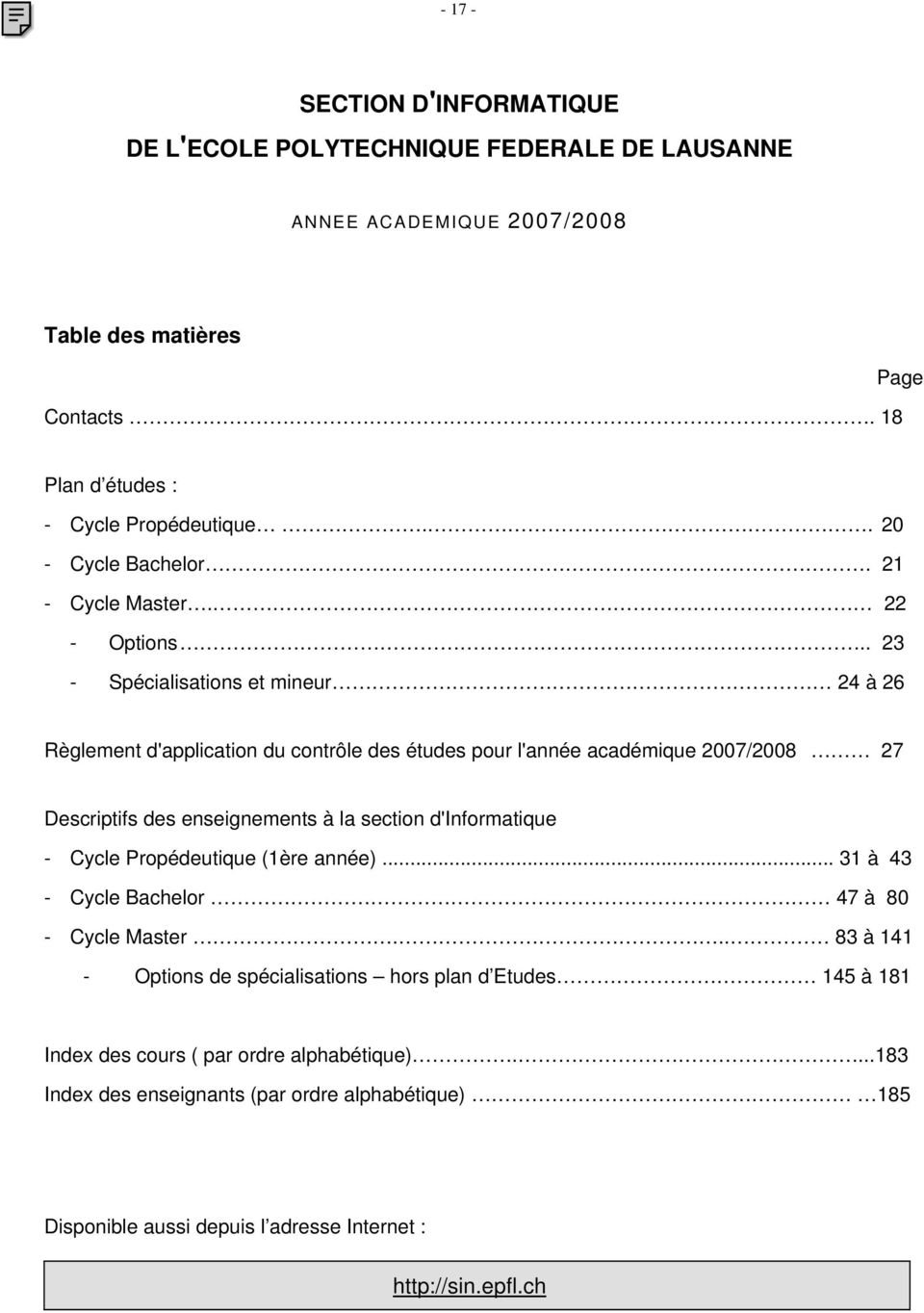
1 SECTION D'INFORMATIQUE DE L'ECOLE POLYTECHNIQUE FEDERALE DE LAUSANNE ANNEE ACADEMIQUE 2007/2008 Table des matières Contacts. 18 Page Plan d études : - Cycle Propédeutique Cycle Bachelor Cycle Master Options Spécialisations et mineur 24 à 26 Règlement d'application du contrôle des études pour l'année académique 2007/ Descriptifs des enseignements à la section d'informatique - Cycle Propédeutique (1ère année) à 43 - Cycle Bachelor 47 à 80 - Cycle Master à Options de spécialisations hors plan d Etudes 145 à 181 Index des cours ( par ordre alphabétique) Index des enseignants (par ordre alphabétique) 185 Disponible aussi depuis l adresse Internet :
2 CONTACTS Pour plus de renseignements, vous pouvez vous adresser à : Secrétariat du Bachelor Secrétariat du Master Administratrice Stages Directeur de la section Directeur adjoint Conseiller d'études de l Année propédeutique Conseiller d'études de la 1 ère année cycle bachelor Conseiller d'études de la 2 ème année cycle bachelor Conseiller d'études Cycle master Conseiller d'études Projet de master Mme Cecilia BIGLER Bureau INN Tél [email protected] Mme Antonella MARTIN-VELTRO Bureau INN 111 Tél [email protected] Mme Sylviane DAL MAS Bureau INN Tél [email protected] Mme Marisa MARCIANO WYNN Bureau INN Tél Prof. André SCHIPER Bureau INF Tél Prof. Paolo IENNE Bureau INF Tél Prof. Boi Faltings IC/IIF/LIA - Bureau INR 211 Tél Prof. Rachid GUERRAOUI IC/IIF/LPD - Bureau INR 310 Tél Prof. Pascal FUA IC/ISIM/CVLAB - Bureau BC 310 Tél Prof. Claude PETITPIERRE IC/ISIM/LTI - Bureau INN 314 Tél Prof. Paolo IENNE IC/ISIM/LAP - Bureau INF 137 Tél Délégué à la mobilité s de la section Adresse de la section Dr. Monika LUNDELL IC/IIF/LAMS - Bureau BC 147 Tél [email protected] [email protected] EPFL - Faculté Informatique et Communications Section d Informatique Bâtiment INN Station 14 CH-1015 Lausanne Fax de la section

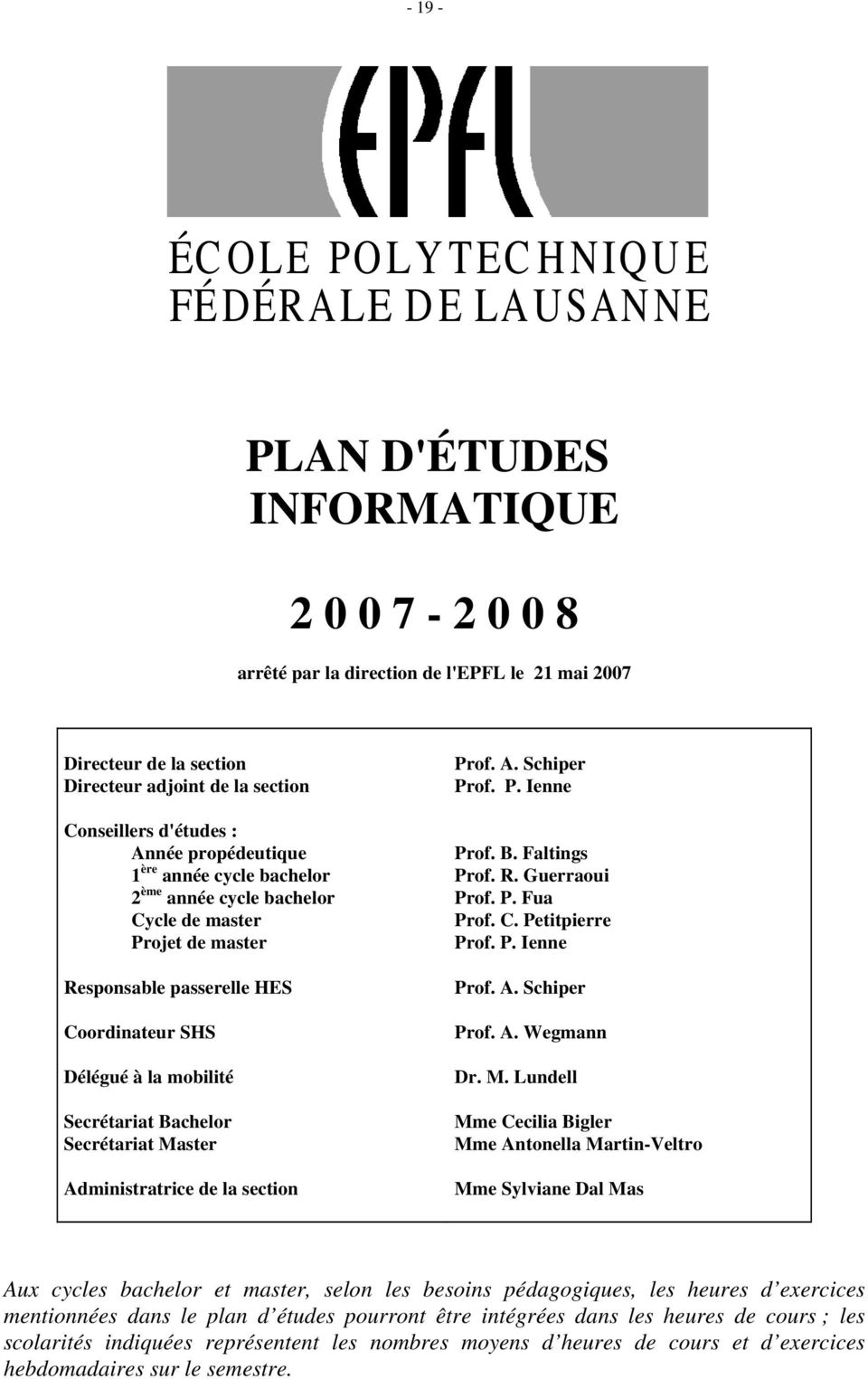
3 ÉCOLE POLYTECHNIQUE FÉDÉRALE DE LAUSANNE PLAN D'ÉTUDES INFORMATIQUE arrêté par la direction de l'epfl le 21 mai 2007 Directeur de la section Directeur adjoint de la section Prof. A. Schiper Prof. P. Ienne Conseillers d'études : Année propédeutique Prof. B. Faltings 1 ère année cycle bachelor Prof. R. Guerraoui 2 ème année cycle bachelor Prof. P. Fua Cycle de master Prof. C. Petitpierre Projet de master Prof. P. Ienne Responsable passerelle HES Coordinateur SHS Délégué à la mobilité Secrétariat Bachelor Secrétariat Master Administratrice de la section Prof. A. Schiper Prof. A. Wegmann Dr. M. Lundell Mme Cecilia Bigler Mme Antonella Martin-Veltro Mme Sylviane Dal Mas Aux cycles bachelor et master, selon les besoins pédagogiques, les heures d exercices mentionnées dans le plan d études pourront être intégrées dans les heures de cours ; les scolarités indiquées représentent les nombres moyens d heures de cours et d exercices hebdomadaires sur le semestre.
4 INFORMATIQUE Cursus commun IN- SC Cycle propédeutique Les enseignants sont Semestres Coeff. Période indiqués sous réserve des exam. de modification 1 2 épreuves Matières Enseignants Sections c e p c e p Bloc "Branches d'examen" : 12 Algèbre linéaire Maddocks MA H écrit Analyse I, II (en français) ou Bachmann MA E écrit 4 Analyse I, II (en allemand) Semmler MA E écrit Sciences de l'information Vetterli/Thiran P./Fragouli SC/IN H écrit Discrete structures Lenstra SC E écrit Bloc "Branches de semestre" : 10 Introduction à la programmation objet Guerraoui/Sam SC/IN sem A Introduction aux systèmes informatiques Sanchez IN sem A Projet de technologie de l'information Lundell/Dillenbourg/Petitpierre/Diggavi SC/IN 6 2 sem P Systèmes logiques I,II Sanchez IN sem A+P Théorie et pratique de la programmation Lundell/Fua SC/IN sem P SHS : Cours d'initiation 1 Divers enseignants SHS 1 0,25 sem A SHS : Cours d'initiation 2 Divers enseignants SHS 1 0,25 sem A SHS : Cours d'initiation 3 Divers enseignants SHS 1 0,25 sem P SHS : Cours d'initiation 4 Divers enseignants SHS 1 0,25 sem P Totaux : Totaux : Par semaine Légende : c : cours e : exercices p : branches pratiques en italique : cours à option colonnes c/e/p : nb d'heures par semaine ( ) : facultatif 1 semestre comprend 14 semaines. / : enseignement partagé type examination : voir règlement d'application + : enseignement séparé à l'horaire

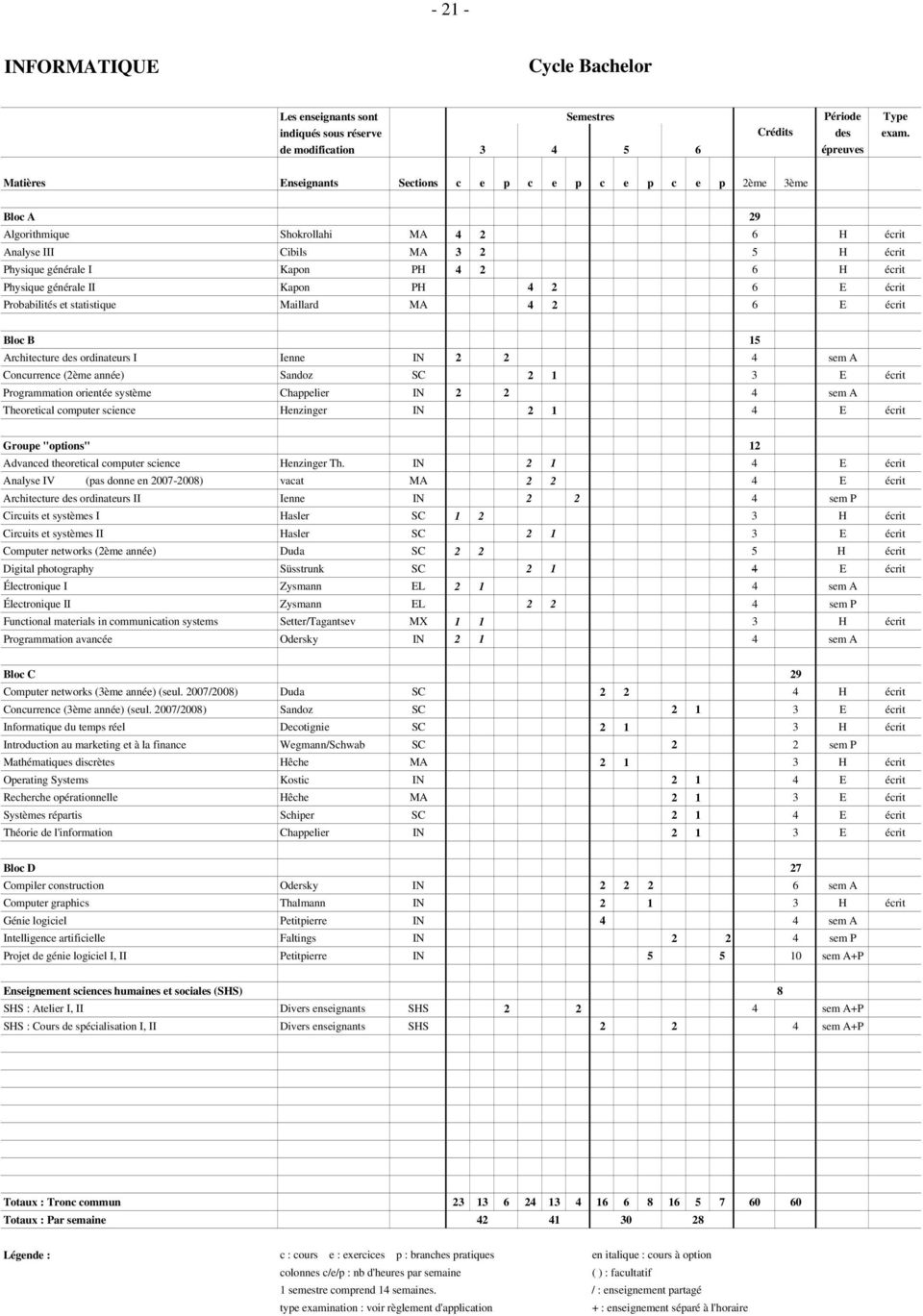
5 INFORMATIQUE Cycle Bachelor Les enseignants sont Semestres Période indiqués sous réserve Crédits des exam. de modification épreuves Matières Enseignants Sections c e p c e p c e p c e p 2ème 3ème Bloc A 29 Algorithmique Shokrollahi MA H écrit Analyse III Cibils MA H écrit Physique générale I Kapon PH H écrit Physique générale II Kapon PH E écrit Probabilités et statistique Maillard MA E écrit Bloc B 15 Architecture des ordinateurs I Ienne IN sem A Concurrence (2ème année) Sandoz SC E écrit Programmation orientée système Chappelier IN sem A Theoretical computer science Henzinger IN E écrit Groupe "options" 12 Advanced theoretical computer science Henzinger Th. IN E écrit Analyse IV (pas donne en ) vacat MA E écrit Architecture des ordinateurs II Ienne IN sem P Circuits et systèmes I Hasler SC H écrit Circuits et systèmes II Hasler SC E écrit Computer networks (2ème année) Duda SC H écrit Digital photography Süsstrunk SC E écrit Électronique I Zysmann EL sem A Électronique II Zysmann EL sem P Functional materials in communication systems Setter/Tagantsev MX H écrit Programmation avancée Odersky IN sem A Bloc C 29 Computer networks (3ème année) (seul. 2007/2008) Duda SC H écrit Concurrence (3ème année) (seul. 2007/2008) Sandoz SC E écrit Informatique du temps réel Decotignie SC H écrit Introduction au marketing et à la finance Wegmann/Schwab SC 2 2 sem P Mathématiques discrètes Hêche MA H écrit Operating Systems Kostic IN E écrit Recherche opérationnelle Hêche MA E écrit Systèmes répartis Schiper SC E écrit Théorie de l'information Chappelier IN E écrit Bloc D 27 Compiler construction Odersky IN sem A Computer graphics Thalmann IN H écrit Génie logiciel Petitpierre IN 4 4 sem A Intelligence artificielle Faltings IN sem P Projet de génie logiciel I, II Petitpierre IN sem A+P Enseignement sciences humaines et sociales (SHS) 8 SHS : Atelier I, II Divers enseignants SHS sem A+P SHS : Cours de spécialisation I, II Divers enseignants SHS sem A+P Totaux : Tronc commun Totaux : Par semaine Légende : c : cours e : exercices p : branches pratiques en italique : cours à option colonnes c/e/p : nb d'heures par semaine ( ) : facultatif 1 semestre comprend 14 semaines. / : enseignement partagé type examination : voir règlement d'application + : enseignement séparé à l'horaire
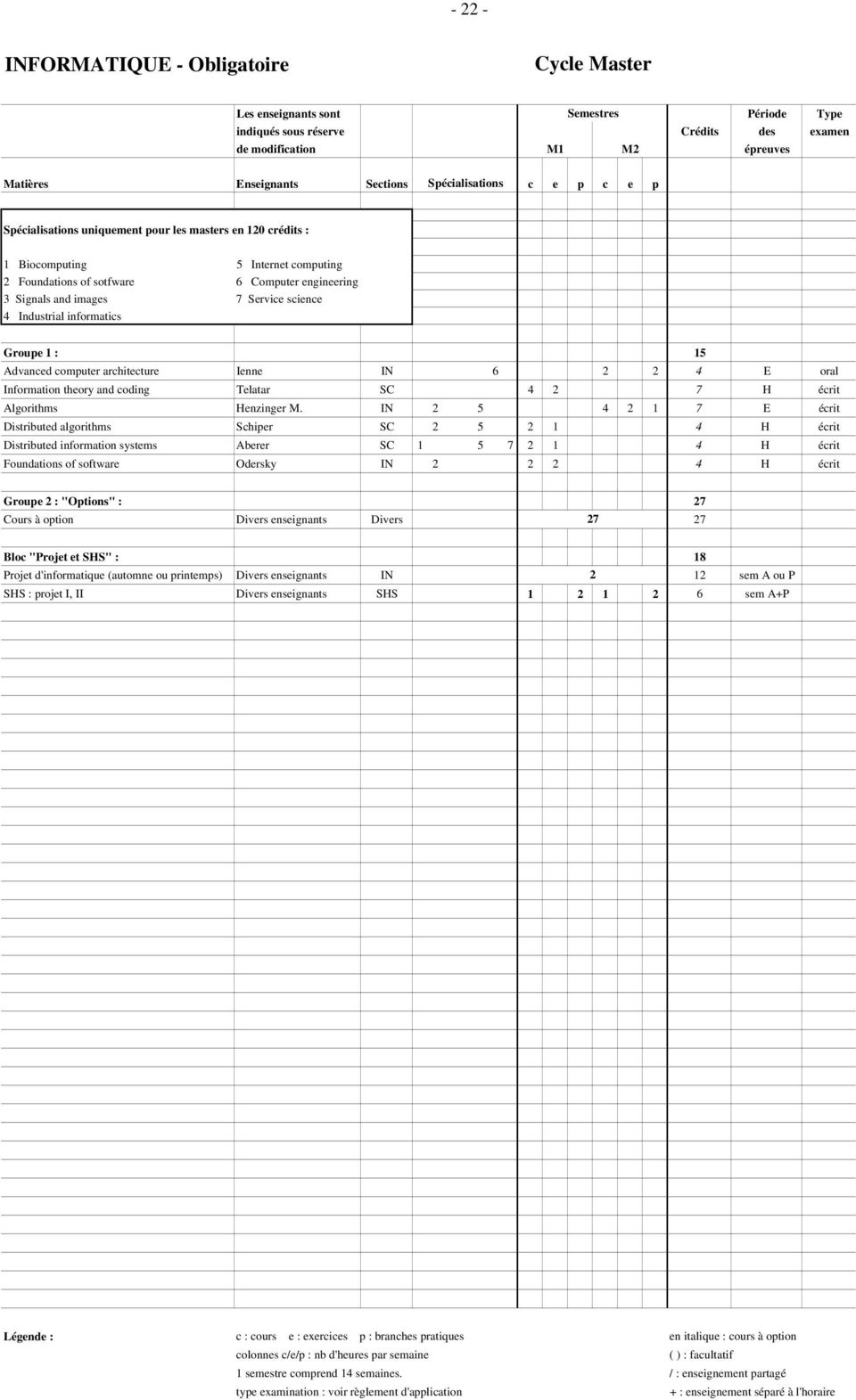
6 INFORMATIQUE - Obligatoire Cycle Master Les enseignants sont Semestres Période indiqués sous réserve Crédits des examen de modification M1 M2 épreuves Matières Enseignants Sections Spécialisations c e p c e p Spécialisations uniquement pour les masters en 120 crédits : 1 Biocomputing 5 Internet computing 2 Foundations of sotfware 6 Computer engineering 3 Signals and images 7 Service science 4 Industrial informatics Groupe 1 : 15 Advanced computer architecture Ienne IN E oral Information theory and coding Telatar SC H écrit Algorithms Henzinger M. IN E écrit Distributed algorithms Schiper SC H écrit Distributed information systems Aberer SC H écrit Foundations of software Odersky IN H écrit Groupe 2 : "Options" : 27 Cours à option Divers enseignants Divers Bloc "Projet et SHS" : 18 Projet d'informatique (automne ou printemps) Divers enseignants IN 2 12 sem A ou P SHS : projet I, II Divers enseignants SHS sem A+P Légende : c : cours e : exercices p : branches pratiques en italique : cours à option colonnes c/e/p : nb d'heures par semaine ( ) : facultatif 1 semestre comprend 14 semaines. / : enseignement partagé type examination : voir règlement d'application + : enseignement séparé à l'horaire
7 INFORMATIQUE - Options Les enseignants sont Semestres Période cours indiqués sous réserve M1 M2 des examen biennaux / de modification épreuves donnés en Crédits Matières Enseignants Sections Spécialisations c e p c e p Options Advanced compiler construction Schinz IN sem P Advanced computer graphics Thalmann IN E écrit Advanced computer networks and distributed systems Kostic IN sem A Advanced databases Spaccapietra IN sem A Advanced digital design (pas donné en 07-08) vacat IN sem P Analyse de données génétiques Morgenthaler MA H oral Applications for convex optimization and linear programming (pas en 07-08) Fragouli IN 2 3 H écrit Business plan Wegmann SC E oral Color imaging (pas donné en 07-08) Süsstrunk SC H oral Color reproduction Hersch IN E oral Combinatorique Prodon MA E oral Computational genomics (pas donné en ) Galisson IN H écrit Computational linguistics Rajman/Chappelier IN E écrit Computational molecular biology Moret B. IN sem P Computer vision Fua IN E écrit Computer-Supported Cooperative Work (CSCW) Dillenbourg IN H oral Current topics in computer science Vacat IN H écrit Cryptography and security Vaudenay/Oechslin SC H écrit Design technologies for intergrated systems De Micheli IN sem A Dynamical system theory for engineers Hasler SC H écrit Embedded systems Beuchat IN H oral Enterprise and service-oriented architecture Wegmann SC E oral Foundations of image science Fua IN H écrit Genetic and developmental computing architectures (pas en 07-08) Ijspeert IN sem A Graphes et réseaux I, II de Werra MA E oral Human computer interaction Pu IN E écrit Image processing I Unser/Thiran J.-Ph. MT/EL H écrit Image processing II Unser/Thiran J.-Ph. MT/EL sem P Industrial automation Kirrmann SC E oral Intelligent agents Faltings IN H écrit Microelectronics for systems on chips Beuchat/Piguet IN H oral Middleware Garbinato HEC E écrit Mobile networks Hubaux SC E écrit Model checking Henzinger Th. IN sem A Modelling the immune system Debard/Kraehenbuhl/Martinoli SC E oral Models and methods for random networks (pas donné en ) vacat/thiran P. SC H écrit Models of biological sensory-motor systems Ijspeert IN H oral Multimedia documents Vanoirbeek IN E écrit Parallélisation de programmes sur grappes de PC Hersch IN sem A Pattern classification and machine learning Gerstner/Hasler IN/SC E écrit Performance evaluation (pas donné en ) Le Boudec SC E oral Périphériques Gerlach IN E oral Personal interaction studio Huang IN sem P Principles of dependable systems Candea IN sem A Optional specialisation project Divers enseignants IN sem A ou P Real-time embedded systems Beuchat IN sem P Real-time networks Decotignie SC E oral Selected topics in distributed computing Guerraoui SC H écrit Signal processing for audio and acoustics Faller SC H écrit Software analysis and verification Kuncak IN sem P Solid-state imaging : architectures and techniques Charbon IN sem A Statistical signal processing and applications Sbaiz / Ridolfi SC E écrit Statistics for genomic data analysis Goldstein MA H écrit Student seminar : AI methods for biology Faltings IN sem A Student seminar : Information systems in biology Aberer/Palaghi SC sem P Swarm intelligence Martinoli SC H oral TCP/IP Networking Le Boudec SC H écrit Traitement automatique de la parole Bourlard EL H écrit Unsupervised and reinforcement learning in neural networks Gerstner IN H oral Virtual reality Thalmann IN E écrit Légende : c : cours e : exercices p : branches pratiques en italique : cours à option colonnes c/e/p : nb d'heures par semaine ( ) : facultatif type examination : voir règlement d'application 1 semestre comprend 14 semaines. / : enseignement partagé + : enseignement séparé à l'horaire

8 INFORMATIQUE Les enseignants, les crédits et la période des cours sont indiqués sous réserve de modification. Matières Enseignants Sections Crédits Période des cours Groupe des branches de la spécialisation "1 - BIOCOMPUTING" 100 * * * * * * Analyse de données génétiques Morgenthaler MA 4 A Biologie moléculaire I Mermod UNIL 3 A Cellular biology and biochemics for engineer Hirling SV 4 A Computational genomics (pas donné en ) Galisson IN 6 A Computational molecular biology Moret IN 7 P Distributed information systems Aberer SC 4 A Dynamical system theory for engineers Hasler SC 7 A Image processing I Unser/Thiran J.-Ph. MT 3 A Image processing II Unser/Thiran J.-Ph. MT 3 P Introduction to electronic structure methods I, II (annual course) Röthlisberger/Tavernelli CGC 7 A P Mathematical modelling of DNA Maddocks MA 4 A Modelling the immune system Debard/Kraehenbuhl/Martinoli SC 4 P Models of biological sensory-motor systems Ijspeert IN 4 A Neural networks and biological modeling Gerstner IN 4 P Optional specialisation project Divers enseignants 12 A P Pattern classification and machine learning Gerstner/Hasler IN/SC 6 P Statistics for genomic data analysis (pas donné en ) Goldstein MA 4 A Student seminar : AI methods for biology (pas donné en ) Faltings IN 2 A Student seminar : Information systems in biology (pas donné en ) Aberer/Palaghi SC 2 P Swarm intelligence Martinoli SC 6 A Topics in bioinformatics I Moret/Naef/Bucher IN/SV 4 A Unsupervised and reinforcement learning in neural networking Gerstner IN 4 A Groupe des branches de la spécialisation "2 - FOUNDATIONS OF SOFTWARE" 68 Advanced compiler construction Schinz IN 4 P Advanced computer networks and distributed systems Kostic IN 4 A Algorithms Henzinger M. IN 7 P Distributed algorithms Schiper SC 4 A Foundation of software Odersky IN 4 A Middleware Garbinato HEC 6 P Model checking Henzinger Th. IN 6 A Optional specialisation project Divers enseignants 12 A P Performance evaluation (pas donné en ) Le Boudec SC 7 P Principles of dependable systems Candea IN 4 A Selected topics in distributed computing Guerraoui SC 4 A Software analysis and verification Kuncak IN 6 P Groupe des branches de la spécialisation "3 - SIGNALS AND IMAGES" 91 * * * * * * Advanced computer graphics Thalmann IN 4 P Advanced signal processing, wawelets end applications Vetterli SC 4 P Capteur en instrumentation médicale Aminian EL 2 P Color imaging (pas donné en ) Süsstrunk SC 4 A Color reproduction Hersch IN 4 P Computer vision Fua SC 4 P Foundations of image science Fua IN 4 A Image and video processing Ebrahimi EL 6 A Image processing I Unser/Thiran J.-Ph. MT 3 A Image processing II Unser/Thiran J.-Ph. MT 3 P Optional specialisation project Divers enseignants 12 A P Pattern classification and machine learning Gerstner/Hasler IN/SC 6 P Signal processing for audio and acoustics Faller SC 5 A Signal processing for communications Diggavi SC 6 A Software-defined radio : A hands-on course Rimoldi SC 5 A Solide-state imaging: architectures and techniques Charbon IN 4 A Statistical signal processing and applications Sbaiz / Ridolfi SC 5 P Traitement des signaux biomédicaux Vesin EL 6 A Virtual reality Thalmann IN 4 P Légende : * = cours hors plan d'études A = automne, P = printemps 1 semestre comprend 14 semaines

9 INFORMATIQUE Les enseignants, les crédits et la période des cours sont indiqués sous réserve de modification. Matières Enseignants Sections Crédits Période des cours Groupe des branches de la spécialisation "4 - INDUSTRIAL INFORMATICS" 80 * * * * * * * * * * * * Automatique I Longchamp GM 3 A Automatique II + TP Gillet / Longchamp GM 3 P Embedded systems Beuchat IN 4 A Enterprise and service-oriented architecture Wegmann SC 6 P Gestion de production I,II (annual course) Glardon GM 4 A P Identification et commande I Karimi GM 2 A Identification et commande II Karimi / Longchamp GM 2 P Industrial automation Kirrmann SC 3 P Intelligent agents Faltings IN 6 A Mécatronique Colombi EL 2 P Modèles stochastiques pour les communications Thiran SC 6 A Optimisation pour ingénieurs I Bierlaire GC 3 A Optimisation pour ingénieurs II Prodon MA 3 P Optional specialisation project Divers enseignants 12 A P Performance evaluation (pas donné en ) Le Boudec SC 7 P Real-time embedded systems Beuchat IN 4 P Real-time networks Decotignie SC 3 P Recherche opérationnelle Pournin MA 3 A Systèmes multivariables I Gillet GM 2 A Systèmes multivariables II Muellhaupt GM 2 P Groupe des branches de la spécialisation "5 - INTERNET COMPUTING" 102 * Advanced databases Spaccapietra IN 6 A Algorithms Henzinger M. IN 7 P Computational linguistics Rajman/Chappelier IN 6 P Cryptography and security Vaudenay/Oechslin SC 7 A Distributed algorithms Schiper SC 4 A Distributed information systems Aberer SC 4 A E-Business Pigneur HEC 6 A Enterprise and service-oriented architecture Wegmann SC 6 P Human computer interaction Pu IN 4 P Intelligent agents Faltings IN 6 A Middleware Garbinato HEC 6 P Mobile networks Hubaux SC 4 P Models and methods for random networks (pas donné en ) vacat/thiran P. SC 4 A Multimedia documents Vanoirbeek IN 6 P Optional specialisation project Divers enseignants 12 A P Performance evaluation (pas donné en ) Le Boudec SC 7 P Principles of dependable systems Candea IN 7 A Groupe des branches de la spécialisation "6 - COMPUTER ENGINEERING" 70 * * * * Advanced computer architecture Ienne IN 4 P Advanced digital design (pas donné en ) vacat IN 6 P Design technologies for intergrated systems De Micheli IN 6 A Embedded systems Beuchat IN 4 A Hardware systems modeling I Vachoux EL 2 A Hardware systems modeling II Vachoux EL 2 P Microelectronics for systems on chips Beuchat/Piguet IN 4 A Model checking Henzinger Th. IN 6 A Optional specialisation project Divers enseignants 12 A P Real-time embedded systems Beuchat IN 4 P Software analysis and verification Kuncak IN 6 P Solid-state imaging : architectures and techniques Charbon IN 4 A Swarm intelligence Martinoli SC 6 A VLSI design I Leblebici EL 2 A VLSI design II Leblebici EL 2 P Légende : * = cours hors plan d'études A = automne, P = printemps 1 semestre comprend 14 semaines

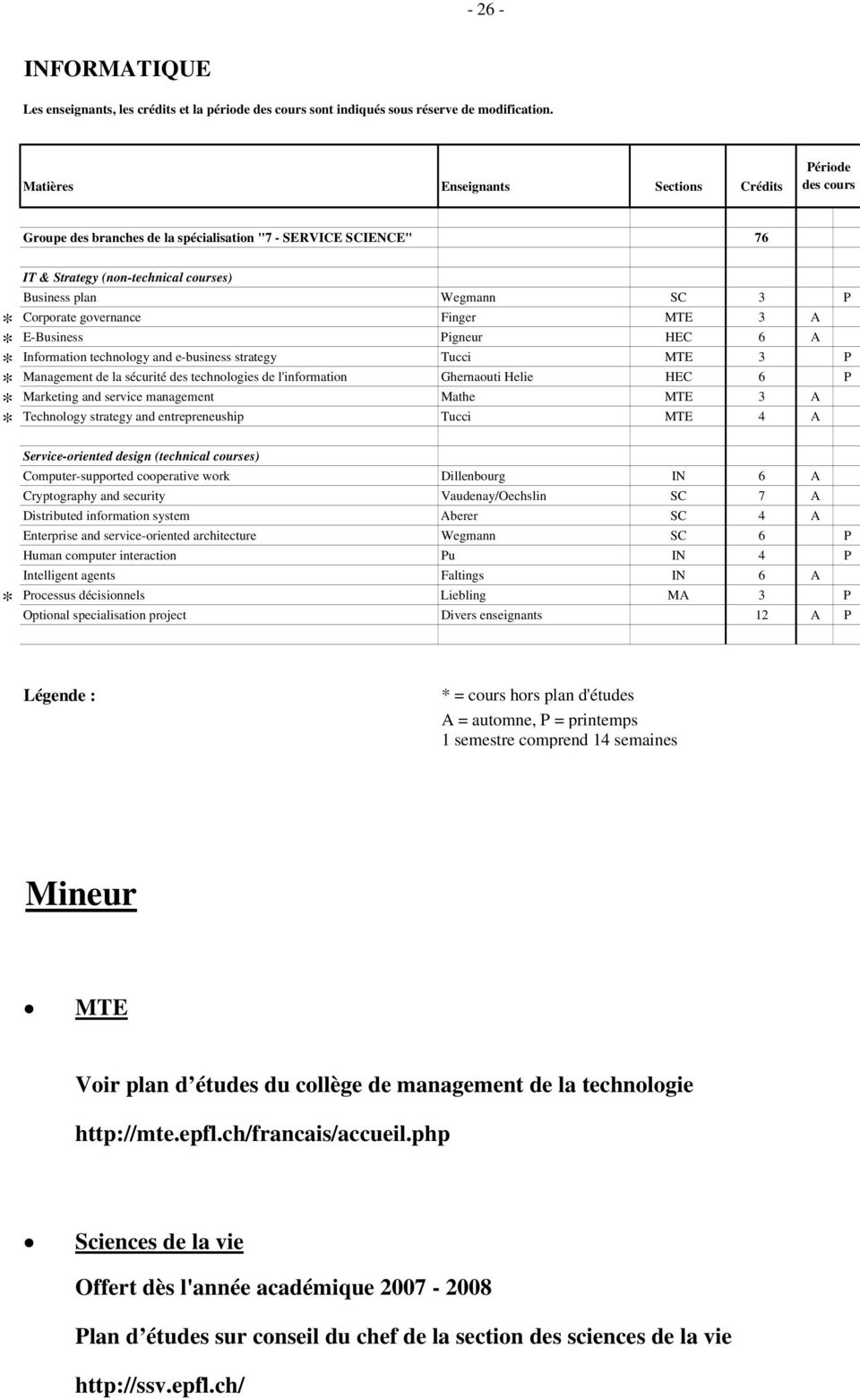
10 INFORMATIQUE Les enseignants, les crédits et la période des cours sont indiqués sous réserve de modification. Matières Enseignants Sections Crédits Période des cours Groupe des branches de la spécialisation "7 - SERVICE SCIENCE" 76 * * * * * * * IT & Strategy (non-technical courses) Business plan Wegmann SC 3 P Corporate governance Finger MTE 3 A E-Business Pigneur HEC 6 A Information technology and e-business strategy Tucci MTE 3 P Management de la sécurité des technologies de l'information Ghernaouti Helie HEC 6 P Marketing and service management Mathe MTE 3 A Technology strategy and entrepreneuship Tucci MTE 4 A Service-oriented design (technical courses) Computer-supported cooperative work Dillenbourg IN 6 A Cryptography and security Vaudenay/Oechslin SC 7 A Distributed information system Aberer SC 4 A Enterprise and service-oriented architecture Wegmann SC 6 P Human computer interaction Pu IN 4 P Intelligent agents Faltings IN 6 A Processus décisionnels Liebling MA 3 P Optional specialisation project Divers enseignants 12 A P Légende : * = cours hors plan d'études A = automne, P = printemps 1 semestre comprend 14 semaines Mineur MTE Voir plan d études du collège de management de la technologie Sciences de la vie Offert dès l'année académique Plan d études sur conseil du chef de la section des sciences de la vie
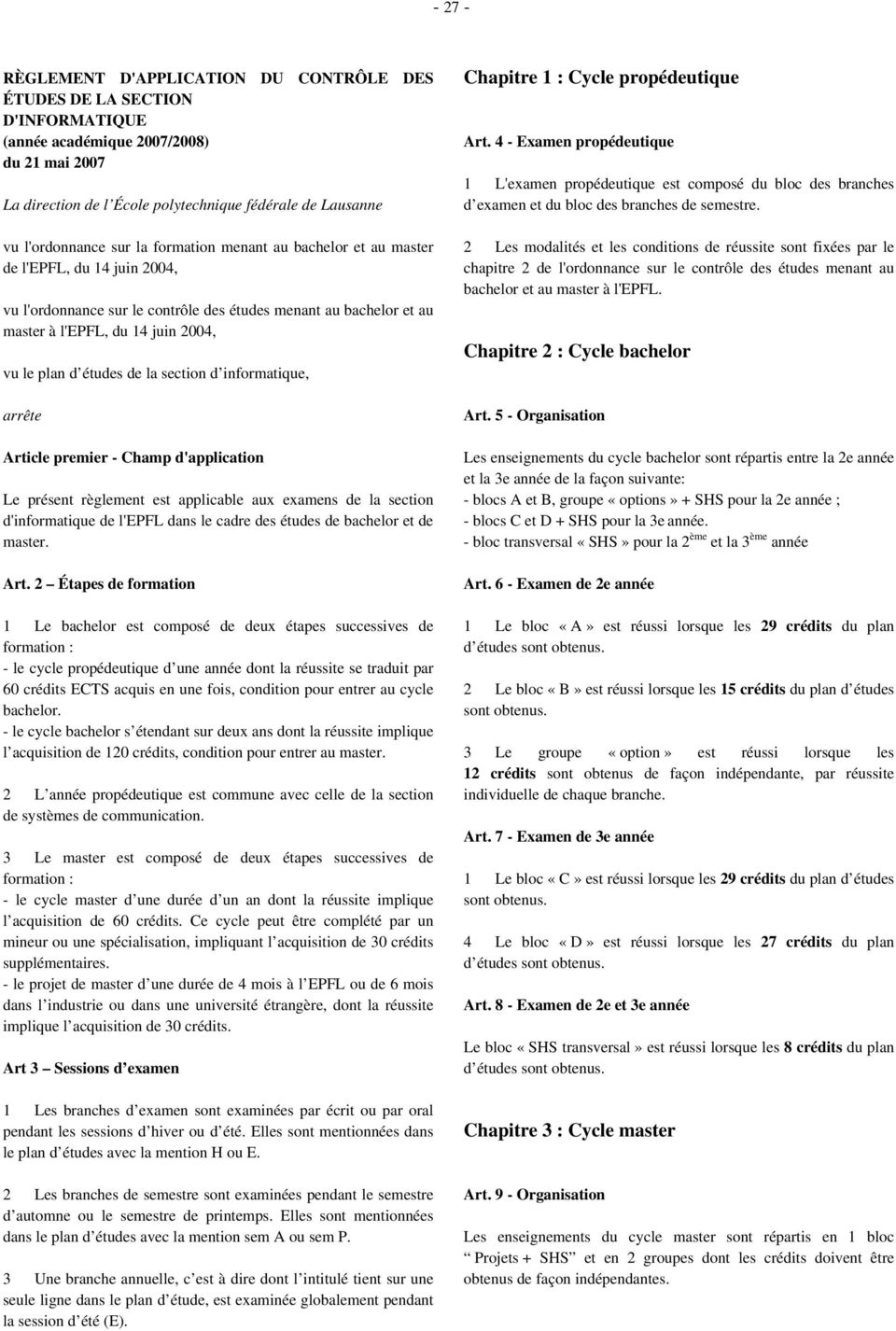
11 RÈGLEMENT D'APPLICATION DU CONTRÔLE DES ÉTUDES DE LA SECTION D'INFORMATIQUE (année académique 2007/2008) du 21 mai 2007 La direction de l École polytechnique fédérale de Lausanne vu l'ordonnance sur la formation menant au bachelor et au master de l'epfl, du 14 juin 2004, vu l'ordonnance sur le contrôle des études menant au bachelor et au master à l'epfl, du 14 juin 2004, vu le plan d études de la section d informatique, arrête Article premier - Champ d'application Le présent règlement est applicable aux examens de la section d'informatique de l'epfl dans le cadre des études de bachelor et de master. Art. 2 Étapes de formation 1 Le bachelor est composé de deux étapes successives de formation : - le cycle propédeutique d une année dont la réussite se traduit par 60 crédits ECTS acquis en une fois, condition pour entrer au cycle bachelor. - le cycle bachelor s étendant sur deux ans dont la réussite implique l acquisition de 120 crédits, condition pour entrer au master. 2 L année propédeutique est commune avec celle de la section de systèmes de communication. 3 Le master est composé de deux étapes successives de formation : - le cycle master d une durée d un an dont la réussite implique l acquisition de 60 crédits. Ce cycle peut être complété par un mineur ou une spécialisation, impliquant l acquisition de 30 crédits supplémentaires. - le projet de master d une durée de 4 mois à l EPFL ou de 6 mois dans l industrie ou dans une université étrangère, dont la réussite implique l acquisition de 30 crédits. Art 3 Sessions d examen 1 Les branches d examen sont examinées par écrit ou par oral pendant les sessions d hiver ou d été. Elles sont mentionnées dans le plan d études avec la mention H ou E. 2 Les branches de semestre sont examinées pendant le semestre d automne ou le semestre de printemps. Elles sont mentionnées dans le plan d études avec la mention sem A ou sem P. 3 Une branche annuelle, c est à dire dont l intitulé tient sur une seule ligne dans le plan d étude, est examinée globalement pendant la session d été (E). Chapitre 1 : Cycle propédeutique Art. 4 - Examen propédeutique 1 L'examen propédeutique est composé du bloc des branches d examen et du bloc des branches de semestre. 2 Les modalités et les conditions de réussite sont fixées par le chapitre 2 de l'ordonnance sur le contrôle des études menant au bachelor et au master à l'epfl. Chapitre 2 : Cycle bachelor Art. 5 - Organisation Les enseignements du cycle bachelor sont répartis entre la 2e année et la 3e année de la façon suivante: - blocs A et B, groupe «options» + SHS pour la 2e année ; - blocs C et D + SHS pour la 3e année. - bloc transversal «SHS» pour la 2 ème et la 3 ème année Art. 6 - Examen de 2e année 1 Le bloc «A» est réussi lorsque les 29 crédits du plan d études sont obtenus. 2 Le bloc «B» est réussi lorsque les 15 crédits du plan d études sont obtenus. 3 Le groupe «option» est réussi lorsque les 12 crédits sont obtenus de façon indépendante, par réussite individuelle de chaque branche. Art. 7 - Examen de 3e année 1 Le bloc «C» est réussi lorsque les 29 crédits du plan d études sont obtenus. 4 Le bloc «D» est réussi lorsque les 27 crédits du plan d études sont obtenus. Art. 8 - Examen de 2e et 3e année Le bloc «SHS transversal» est réussi lorsque les 8 crédits du plan d études sont obtenus. Chapitre 3 : Cycle master Art. 9 - Organisation Les enseignements du cycle master sont répartis en 1 bloc Projets + SHS et en 2 groupes dont les crédits doivent être obtenus de façon indépendantes.
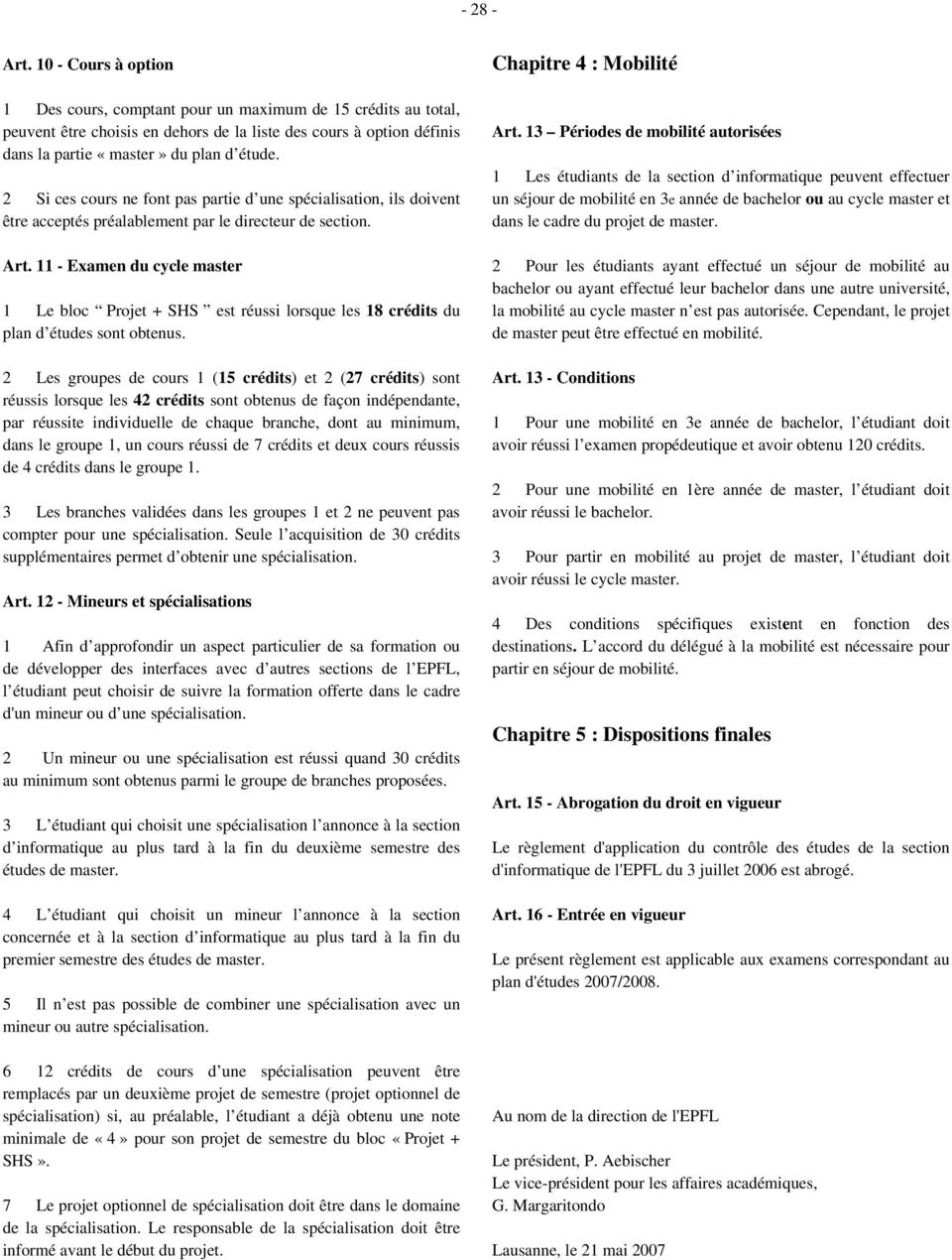
12 Art Cours à option 1 Des cours, comptant pour un maximum de 15 crédits au total, peuvent être choisis en dehors de la liste des cours à option définis dans la partie «master» du plan d étude. 2 Si ces cours ne font pas partie d une spécialisation, ils doivent être acceptés préalablement par le directeur de section. Art Examen du cycle master 1 Le bloc Projet + SHS est réussi lorsque les 18 crédits du plan d études sont obtenus. 2 Les groupes de cours 1 (15 crédits) et 2 (27 crédits) sont réussis lorsque les 42 crédits sont obtenus de façon indépendante, par réussite individuelle de chaque branche, dont au minimum, dans le groupe 1, un cours réussi de 7 crédits et deux cours réussis de 4 crédits dans le groupe 1. 3 Les branches validées dans les groupes 1 et 2 ne peuvent pas compter pour une spécialisation. Seule l acquisition de 30 crédits supplémentaires permet d obtenir une spécialisation. Art Mineurs et spécialisations 1 Afin d approfondir un aspect particulier de sa formation ou de développer des interfaces avec d autres sections de l EPFL, l étudiant peut choisir de suivre la formation offerte dans le cadre d'un mineur ou d une spécialisation. 2 Un mineur ou une spécialisation est réussi quand 30 crédits au minimum sont obtenus parmi le groupe de branches proposées. 3 L étudiant qui choisit une spécialisation l annonce à la section d informatique au plus tard à la fin du deuxième semestre des études de master. 4 L étudiant qui choisit un mineur l annonce à la section concernée et à la section d informatique au plus tard à la fin du premier semestre des études de master. 5 Il n est pas possible de combiner une spécialisation avec un mineur ou autre spécialisation crédits de cours d une spécialisation peuvent être remplacés par un deuxième projet de semestre (projet optionnel de spécialisation) si, au préalable, l étudiant a déjà obtenu une note minimale de «4» pour son projet de semestre du bloc «Projet + SHS». 7 Le projet optionnel de spécialisation doit être dans le domaine de la spécialisation. Le responsable de la spécialisation doit être informé avant le début du projet. Chapitre 4 : Mobilité Art. 13 Périodes de mobilité autorisées 1 Les étudiants de la section d informatique peuvent effectuer un séjour de mobilité en 3e année de bachelor ou au cycle master et dans le cadre du projet de master. 2 Pour les étudiants ayant effectué un séjour de mobilité au bachelor ou ayant effectué leur bachelor dans une autre université, la mobilité au cycle master n est pas autorisée. Cependant, le projet de master peut être effectué en mobilité. Art Conditions 1 Pour une mobilité en 3e année de bachelor, l étudiant doit avoir réussi l examen propédeutique et avoir obtenu 120 crédits. 2 Pour une mobilité en 1ère année de master, l étudiant doit avoir réussi le bachelor. 3 Pour partir en mobilité au projet de master, l étudiant doit avoir réussi le cycle master. 4 Des conditions spécifiques existent en fonction des destinations. L accord du délégué à la mobilité est nécessaire pour partir en séjour de mobilité. Chapitre 5 : Dispositions finales Art Abrogation du droit en vigueur Le règlement d'application du contrôle des études de la section d'informatique de l'epfl du 3 juillet 2006 est abrogé. Art Entrée en vigueur Le présent règlement est applicable aux examens correspondant au plan d'études 2007/2008. Au nom de la direction de l'epfl Le président, P. Aebischer Le vice-président pour les affaires académiques, G. Margaritondo Lausanne, le 21 mai 2007
13 ÉCOLE POLYTECHNIQUE FÉDÉRALE DE LAUSANNE SECTION D INFORMATIQUE Cycle Propédeutique (1ère année) 2007 / 2008

14 - 30 -
15 Algèbre linéaire Linear Algebra Enseignant(s) / Instructor(s) Maddocks John: MA Langue / Language FR Informatique ( , Bachelor semestre 1) C: 4 H hebdo, Ex: 2 H hebdo obl Systèmes de communication ( , Bachelor semestre 1) C: 4 H hebdo, Ex: 2 H hebdo obl Apprendre les techniques du calcul matriciel, être apte à exécuter les manipulations mathématiques s'y rapportant et être capable d'appliquer ces techniques dans les problèmes issus de son domaine de spécialisation. L'étudiant devra maîtriser les outils nécessaires à la résolution des problèmes liés à la linéarité, à l'orthogonalité et à la diagonalisation des matrices. Système d'équations linéaires. Calcul matriciel. Déterminants. Espaces vectoriels. Valeurs et vecteurs propres. Orthogonalité et moindres carrés. Matrices symétriques et formes quadratiques. Préparation pour: Analyse II et III Cours ex cathedra, exercices en salle d'ordinateurs Contrôle continu : exercices chaque semaine et travaux écrits Learn the techniques of matrix algebra, be able to execute the corresponding mathematical manipulations and to apply these techniques in problems connected to one's specialization area. The student will have to master the tools necessary to the resolution of problems connected to linearity, orthogonality and matrix diagonalization. Systems of linear equations. Matrix Algebra. Determinants. Vector Spaces. Eigenvalues and eigenvectors. Orthogonality and leastsquares. Symmetric matrices and quadratic forms. Prerequisite for: Analysis II and III of teaching: Ex cathedra lecture, exercises in the classroom with computer Form of examination: Continuous control: exercises each week and written tests Linear Algebra and its Applications, D.C. Lay, 3rd edition (or updated 2nd edition) Addison-Wesley. Algèbre Linéaire, Théorie exercices et applications, De Boeck et Larcier. "Savoir-faire en mathématiques pour bien commencer l'epfl", brochure de la Section de mathématiques. Algèbre linéaire HIV 2 Ecrit
16 Analyse I Analysis I Enseignant(s) / Instructor(s) Bachmann Otto: MA Langue / Language FR Informatique ( , Bachelor semestre 1) C: 3 H hebdo, Ex: 3 H hebdo obl Systèmes de communication ( , Bachelor semestre 1) C: 3 H hebdo, Ex: 3 H hebdo obl Étude des méthodes principales du calcul différentiel et intégral des fonctions d'une variable en vue de leur utilisation par les ingénieurs. Calcul différentiel et intégral des fonctions d'une variable. - Notions fondamentales (nombres réels et complexes, suites, séries, limites). - Fonctions d'une variable (limite, continuité et dérivée). - Développements limités. - Comportement local d'une fonction, extremums. - Fonctions particulières (puissance, logarithme, exponentielle, trigonométrique, hyperbolique). - Intégrales. Cours ex cathedra, exercices en salle Travail écrit Study of the principal methods of calculus of one variable in view of its applications by engineers. Differential and integral calculus of one variable. - Fundamental notions (real and complex numbers, sequences, series, limits). - Functions of one variable (limit, continuity and derivability). - Local behavior of a function, maxima and minima. - Special functions (power, logarithm, exponential, trigonometric, hyperbolic). - Integrals. of teaching: Ex cathedra lecture and exercises in the classroom Form of examination: Written test "Savoir-faire en mathématiques", brochure de la Section de Mathématiques. Ouvrages conseillés indiqués en début de semestre. 1) Analyse I, II ETE 4 Ecrit
17 Analyse II Analysis II Enseignant(s) / Instructor(s) Bachmann Otto: MA Langue / Language FR Informatique ( , Bachelor semestre 2) C: 3 H hebdo, Ex: 3 H hebdo obl Systèmes de communication ( , Bachelor semestre 2) C: 3 H hebdo, Ex: 3 H hebdo obl Étude des méthodes principales du calcul différentiel et intégral des fonctions de plusieurs variables en vue de leur utilisation par les ingénieurs. Éléments d'équations différentielles ordinaires. - Équations différentielles du premier ordre. - Équations différentielles du deuxième ordre à coefficients constants. Calcul différentiel et intégral des fonctions de plusieurs variables. - Fonctions de plusieurs variables. - Dérivées partielles. - Différentielle. - Extremums. - Intégrales mulitples. - Intégrales curvilignes. Analyse I, Algèbre linéaire I Cours ex cathedra et exercices en salle Travail écrit Study of the principal methods of calculus of several variables in view of its applications by engineers. Introduction to the theory of ordinary differential equations. - First order differential equations. - Second order differential equations with constant. coefficients. Differential and integral calculus of several variables. - Multivariable functions. - Partial derivatives. - Differentials. - Maxima and minima. - Multiple integrals. - Line integrals. Required prior knowledge: Analysis I, Linear Algebra I of teaching: Ex cathedra lecture and exercises in the classroom Form of examination: Written test Ouvrages conseillés indiqués en début de semestre. «Savoir faire en mathématiques», brochure de la Section de mathématiques. 1) Analyse I, II ETE 4 Ecrit
18 Analyse (allemand) I Analysis (German) I Enseignant(s) / Instructor(s) Semmler Klaus-Dieter: MA Langue / Language DE Mathématiques ( , Bachelor semestre 1) C: 4 H hebdo, Ex: 4 H hebdo obl Génie civil ( , Bachelor semestre 1) C: 4 H hebdo, Ex: 2 H hebdo obl Génie électrique et électronique ( , Bachelor semestre 1) C: 4 H hebdo, Ex: 4 H hebdo obl Génie mécanique ( , Bachelor semestre 1) C: 4 H hebdo, Ex: 4 H hebdo obl Informatique ( , Bachelor semestre 1) C: 4 H hebdo, Ex: 4 H hebdo obl Microtechnique ( , Bachelor semestre 1) C: 4 H hebdo, Ex: 4 H hebdo obl Physique ( , Bachelor semestre 1) C: 4 H hebdo, Ex: 4 H hebdo obl Sciences et ingénierie de l'environnement ( , Bachelor semestre 1) C: 4 H hebdo, Ex: 2 H hebdo obl Sciences et technologies du vivant ( , Bachelor semestre 1) C: 4 H hebdo, Ex: 4 H hebdo obl Science et génie des matériaux ( , Bachelor semestre 1) C: 4 H hebdo, Ex: 4 H hebdo obl Systèmes de communication ( , Bachelor semestre 1) C: 4 H hebdo, Ex: 4 H hebdo obl Anwendungsorientierte Basisvorlesung in deutscher Sprache, ausgerichtet auf die Bedürfnisse des Ingenieurs. - Reelle Zahlen, Folgen und Reihen. - Funktionen, Grenzwerte und Stetigkeit. - Komplexe Zahlen. - Differentialrechnung von IR nach IR. - Integration, Stammfunktionen, Verallgemeinerte Integrale. - Differentialgleichungen erster und zweiter Ordnung. Basisvorlesung Préparation pour: Analysis II Vorlesung mit Übungen in Gruppen. Das mathematische Vokabular wird zweisprachig erarbeitet (d/f) Abzugebende Übungen. Schriftliches Examen Cours de base en allemand, orienté vers les applications et les besoins de l'ingénieur. - Nombres réels, suites et séries. - Fonctions, limites et continuité. - Nombres complexes. - Calculs différentiels des fonctions de IR en IR. - Intégration, primitives, intégrales généralisées. - Equations différentielles de premier et deuxième ordre. Required prior knowledge: Cours de base Prerequisite for: Analyse II of teaching: Cours, exercices en groupes. Le vocabulaire mathématique sera travaillé de façon bilingue (a/f) Form of examination: Exercices à rendre. Examen écrit Wird in der Vorlesung bekanntgegeben. 1) Analyse (allemand) I, II ETE 4 Ecrit
19 Analyse (allemand) II Analysis (German) II Enseignant(s) / Instructor(s) Semmler Klaus-Dieter: MA Langue / Language DE Mathématiques ( , Bachelor semestre 2) C: 4 H hebdo, Ex: 2 H hebdo obl Génie civil ( , Bachelor semestre 2) C: 4 H hebdo, Ex: 2 H hebdo obl Génie électrique et électronique ( , Bachelor semestre 2) C: 4 H hebdo, Ex: 2 H hebdo obl Génie mécanique ( , Bachelor semestre 2) C: 4 H hebdo, Ex: 2 H hebdo obl Informatique ( , Bachelor semestre 2) C: 4 H hebdo, Ex: 2 H hebdo obl Microtechnique ( , Bachelor semestre 2) C: 4 H hebdo, Ex: 2 H hebdo obl Physique ( , Bachelor semestre 2) C: 4 H hebdo, Ex: 2 H hebdo obl Sciences et ingénierie de l'environnement ( , Bachelor semestre 2) C: 4 H hebdo, Ex: 2 H hebdo obl Sciences et technologies du vivant ( , Bachelor semestre 2) C: 4 H hebdo, Ex: 2 H hebdo obl Science et génie des matériaux ( , Bachelor semestre 2) C: 4 H hebdo, Ex: 2 H hebdo obl Systèmes de communication ( , Bachelor semestre 2) C: 4 H hebdo, Ex: 2 H hebdo obl Anwendungsorientierte Basisvorlesung in deutscher Sprache, ausgerichtet auf die Bedürfnisse des Ingenieurs. - Differentialrechnung von Funktionen von IRn nach IRm. - Grenzwerte und Stetigkeit, Extrema. - Gradient, Richtungsableitung, Kritische Punkte. - Differentialformen, Integrierende Faktoren, Kurvenintegrale. - Integration über Gebiete im IRn. - Die Green-Stokes Formel. Analysis I Préparation pour: Analysis III Vorlesung mit Übungen in Gruppen. Das mathematische Vokabular wird zweisprachig erarbeitet (d/f) Schriftliches Examen Cours de base en allemand, orienté vers les applications et les besoins de l'ingénieur. - Calculs différentiels des fonctions de IRn en IRm. - Limites, continuité, extrêma. - Gradient, dérivée directionelle, points critiques. - Formes différentielles, facteurs intégrantes, intégrales curvilignes. - Intégration sur des domaines en IRn. - Formule de Green-Stokes. Required prior knowledge: Analyse I Prerequisite for: Analyse III of teaching: Cours, exercices en groupes. Le vocabulaire mathématique sera travaillé de façon bilingue (a/f) Form of examination: Contrôle écrit Wird in der Vorlesung bekanntgegeben (Skript). 1) Analyse (allemand) I, II ETE 4 Ecrit
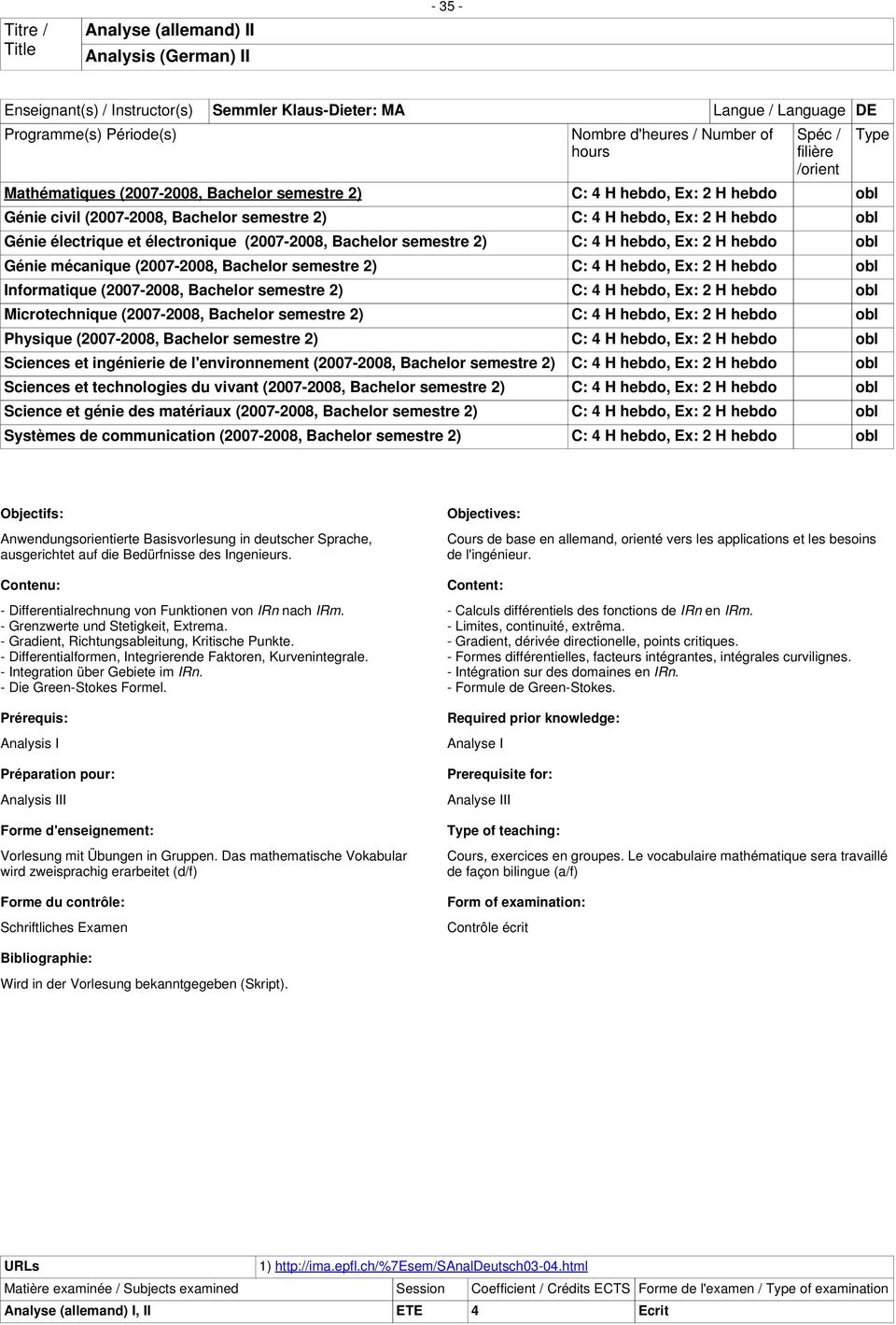
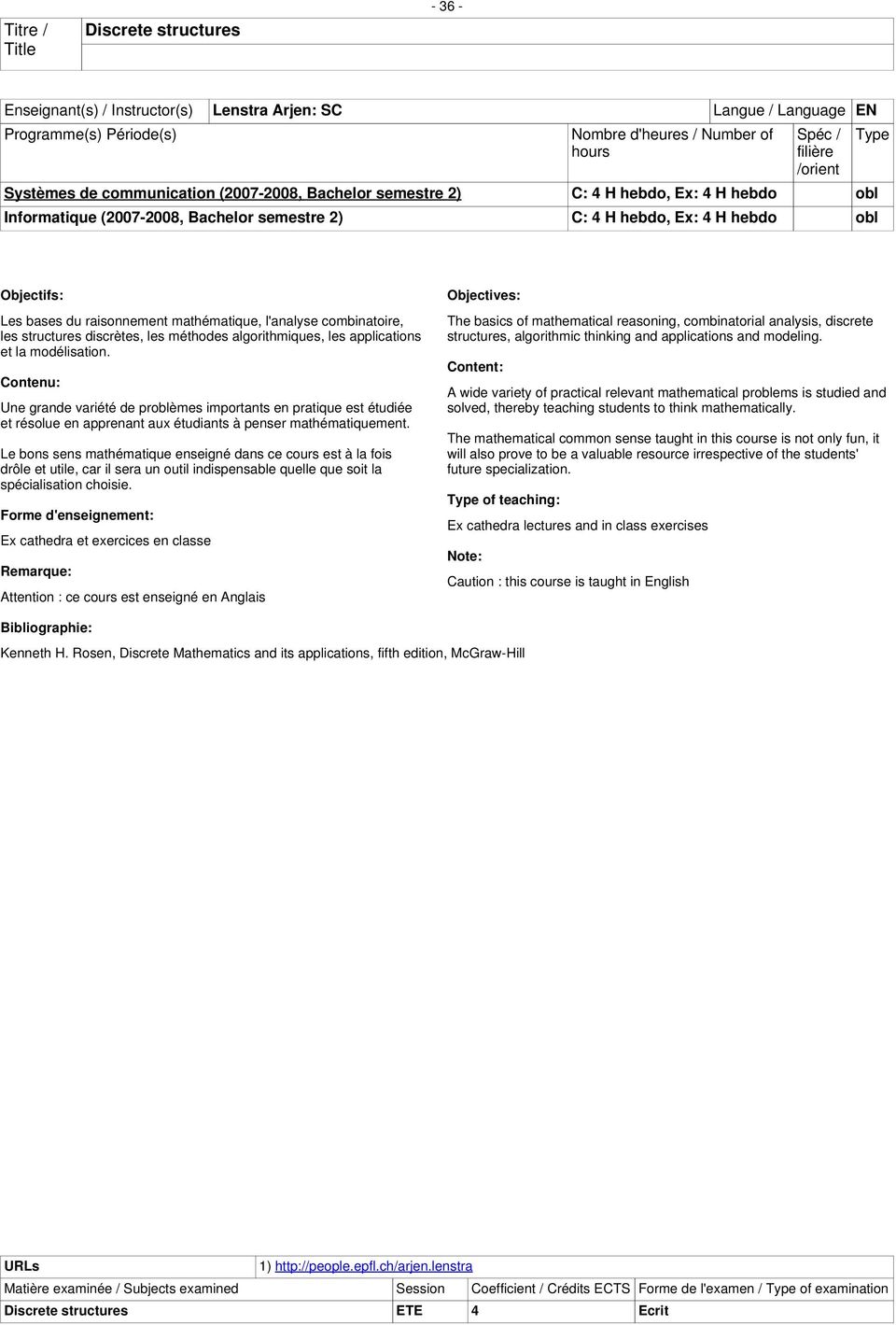
20 Discrete structures Enseignant(s) / Instructor(s) Lenstra Arjen: SC Langue / Language EN Systèmes de communication ( , Bachelor semestre 2) C: 4 H hebdo, Ex: 4 H hebdo obl Informatique ( , Bachelor semestre 2) C: 4 H hebdo, Ex: 4 H hebdo obl Les bases du raisonnement mathématique, l'analyse combinatoire, les structures discrètes, les méthodes algorithmiques, les applications et la modélisation. Une grande variété de problèmes importants en pratique est étudiée et résolue en apprenant aux étudiants à penser mathématiquement. Le bons sens mathématique enseigné dans ce cours est à la fois drôle et utile, car il sera un outil indispensable quelle que soit la spécialisation choisie. Ex cathedra et exercices en classe Remarque: Attention : ce cours est enseigné en Anglais The basics of mathematical reasoning, combinatorial analysis, discrete structures, algorithmic thinking and applications and modeling. A wide variety of practical relevant mathematical problems is studied and solved, thereby teaching students to think mathematically. The mathematical common sense taught in this course is not only fun, it will also prove to be a valuable resource irrespective of the students' future specialization. of teaching: Ex cathedra lectures and in class exercises Note: Caution : this course is taught in English Kenneth H. Rosen, Discrete Mathematics and its applications, fifth edition, McGraw-Hill 1) Discrete structures ETE 4 Ecrit
21 Introduction à la programmation objet Introduction to objects oriented programming Enseignant(s) / Instructor(s) Guerraoui Rachid: SC, Sam Jamila: IN Langue / Language FR Systèmes de communication ( , Bachelor semestre 1) Informatique ( , Bachelor semestre 1) C: 2 H hebdo, Ex: 2 H hebdo, Proj: 2 H hebdo C: 2 H hebdo, Ex: 2 H hebdo, Proj: 2 H hebdo obl obl L'objectif de ce cours est de permettre à l'étudiant : d'aborder les notions de base de l'informatique logicielle et de l'algorithmique; de se familiariser avec un environnement informatique (station de travail sous UNIX); de développer une compétence en programmation et se familiariser avec des concepts de base de la programmation orientée objet (langage JAVA). Introduction à l'environnement UNIX (connection, multi-fenêtrage, édition de textes, ,...), éléments de base du fonctionnement d'un système informatique et prise en main d'un environnement de programmation (éditeur, compilateur,...). Initiation à la programmation (langage JAVA) : variables, expressions, structures de contrôle, modularisation, entrées-sorties,... Introduction à la programmation objet (langage JAVA) : objets, classes, méthodes, encapsulation, héritage, polymorphisme, etc... Présentation informelle de l'algorithmique (exemples, présentation/implémentation d'algorithmes connus). Mise en pratique sur des exemples concrets : les concepts théoriques introduits lors des cours magistraux seront mis en pratique dans le cadre d'exercices sur machines. The goal of this course is to make it possible for students to : acquire some knowledge of fundamental aspects of software development and algorithmic designs; use a computing environment (Unix workstation); be able to write object-oriented programs (in Java). Introduction to the Unix development environment. Basics of programming (using Java) : variables, expressions, control structures, modularisation, etc... Basics of object-oriented programming (using Java) : objects, classes, methods, encapsulation, abstraction, inheritance, polymorphism... Introduction to some algorithmic key concepts through the presentation of examples and the implementation of known algorithms. The course topics will heavily rely on practical exercises. Prerequisite for: Théorie et pratique de la programmation Projet de technologie de l'information of teaching: Ex cathedra Préparation pour: Théorie et pratique de la programmation Projet de technologie de l'information Ex cathedra Série notée intermédiaire Absolute Java,2nd edition, Walter Savitch, 2006, Pearson Education, ISBN ) Introduction à la programmation objet HIV 2 Ctrl continu
22 Introduction aux systèmes informatiques Introduction to computing systems Enseignant(s) / Instructor(s) Sanchez Eduardo: IN Langue / Language FR Informatique ( , Bachelor semestre 1) C: 2 H hebdo, Proj: 1 H hebdo obl Systèmes de communication ( , Bachelor semestre 1) C: 2 H hebdo, Proj: 1 H hebdo obl Le but est d'établir les fondations de l'informatique, afin de mieux préparer les étudiants aux cours d'approfondissements ultérieurs. Les systèmes informatiques seront présentés comme une hiérarchie des machines virtuelles, dont les différents rôles seront décrits. La structure de base des ordinateurs sera expliquée, en montrant comment une instruction est exécutée et comment les différents types de données sont représentés. Une introduction sera donnée également aux systèmes d'exploitation ainsi qu'aux différents outils et applications de développement du logiciel (compilateur, linker, loader, etc). 1. Introduction. 2. Histoire de l'informatique. 3. Niveaux d'abstraction. 4. Langages de haut niveau. 5. Représentation de l'information : systèmes de numération. 6. Représentation de l'information : nombres entiers et réels. 7. Représentation de l'information non numérique. 8. Organisation de base d'une machine de von Neumann. 9. Langages machine. 10. Traduction des langages. 11. Systèmes d'exploitation. 12. Systèmes logiques : algèbre booléenne. 13. Systèmes logiques : technologie. 14. Test. The goal is to establish the foundations of informatics, in order to better prepare the students for the more in-depth futur courses. Computing systems will be presented as a hierarchy of virtual machines, all of which will be described. The basic structure of computers will be explained, by showing how an instruction is performed and how different data types are represented. An introduction will be also given to operating systems, and to various tools and applications for software development (compiler, linker, loader, etc). 1. Introduction. 2. History of the computer. 3. Levels of abstraction. 4. High-order languages. 5. Information representation : numerical systems. 6. Information representation : integer and floating-point numbers. 7. Representation of nonnumeric data. 8. Basic organization of a von Neumann machine. 9. Assembly language. 10. Language translation principles. 11. Operating systems. 12. Digital systems : Boolean algebra. 13. Digital systems : technological aspects. 14. Test. of teaching: Ex cathedra and exercises Préparation pour: Systèmes logiques, Architecture des ordinateurs, Programmation, Compiler construction, Systèmes d'exploitation Ex cathedra et exercices Cours polycopié J. S. Warford, Computer Systems, Jones and Bartlett Publishers, ) Introduction aux systèmes informatiques HIV 1 Ctrl continu
23 Projet de technologie de l'information Information technology project Enseignant(s) / Instructor(s) Diggavi Suhas: SC, Dillenbourg Pierre: IN, Lundell Monika: SC, Petitpierre Claude: IN Langue / Language FR Systèmes de communication ( , Bachelor semestre 2) Proj: 6 H hebdo obl Informatique ( , Bachelor semestre 2) Proj: 6 H hebdo obl Le but de ce projet est de permettre à l'étudiant d'appliquer les connaissances théoriques étudiées dans le cadre des trois cours suivants : Sciences de l'information, Introduction à la programmation objet and Théorie et pratique de la programmation. Ces cours sont suivis antérieurement ou parallèlement au projet. Les étudiants apprennent à modéliser, développer et debugger un programme relativement large. Ils revoient et consolident la matière théorique enseignée dans le cadre des trois cours ci-dessus. Ils apprennent à étroitement collaborer avec un partenaire et acquièrent de l'expérience pour présenter leur travail. Le projet est divisé en plusieurs étapes de développement qui représentent les différentes parties du système à construire. Les étudiants implémentent une étape après l'autre et arrivent au fur et à mesure à un système complet. Au début du projet, les étudiants réalisent typiquement l'implémentation d'un problème théorique relié au cours Sciences de l'information en appliquant les techniques enseignées dans le cours Introduction à la programmation objet. Par exemple, comment transférer un document multimédia à travers un canal qui perd une partie de l'information. Plus tard dans le projet, l'implémentation est typiquement étendue à un plus grand système, en utilisant ce qui a été enseigné dans la première partie du cours Théorie et pratique de la programmation. Par exemple, en ajoutant une interface graphique, en utilisant des exceptions pour gérer les erreurs commises par l'utilisateur, etc. Les étudiants travaillent en binôme. Régulièrement pendant le projet ils rencontrent un professeur afin de lui présenter l'avancement du projet. A la fin du projet, il y a un test écrit individuel couvrant tous les aspects du projet. Sciences de l'information; Introduction à la programmation objet; Théorie et pratique de la programmation (à suivre en parallel avec le projet) Ex cathedra, projet et présentations des étudiants In this project, students apply theoretical knowledge from the following three related courses to a practical problem: Sciences de l'information, Introduction à la programmation objet and Théorie et pratique de la programmation. These courses are taken in parallel with or prior to the project. Students experience independent development of a fairly large program. They get hands-on practice with modelling, programming and debugging. They review and consolidate the theoretical material of the related courses. They experience close collaboration with another person and acquire presentation and documentation skills. The project is divided into a number of development steps that reflect different parts of the system to be constructed. The student implements one step after the other and gradually constructs a completely working system. In the beginning of the project, techniques learnt in Introduction à la programmation objet are typically used to provide a practical implementation of a problem related to material learnt in Sciences de l'information, for example how to transfer a multimedia document over a channel that loses some information Later in the project, the implementation is typically extended to a larger system using techniques learnt in the first part of Théorie et pratique de la programmation, for example by introducing a graphical interface, handling user mistakes through exceptions, etc. Students work in pairs. At regular intervals during the project, they have a milestone meeting with a teacher and present the current state of their project. At the end of the project, there is an individual written test covering all aspects of the project. Required prior knowledge: Sciences de l'information; Introduction à la programmation objet; Théorie et pratique de la programmation (to be attented at the same time as the project) of teaching: Ex cathedra, project and presentation of the students Absolute Java, 2nd edition, Walter Savitch, 2006, Pearson Education, ISBN Notes de cours des trois cours suivants: Sciences de l'information, Introduction à la programmation objet et Théorie et pratique de la programmation 1) Projet de technologie de l'information ETE 2 Ctrl continu
24 Sciences de l'information Information sciences Enseignant(s) / Instructor(s) Fragouli Christina: IN, Thiran Patrick: SC, Vetterli Martin: SC Langue / Language FR Systèmes de communication ( , Bachelor semestre 1) C: 2 H hebdo, Ex: 2 H hebdo obl Informatique ( , Bachelor semestre 1) C: 2 H hebdo, Ex: 2 H hebdo obl Malgré une grande diversité et variété, les systèmes de communications ont néanmoins en commun nombre de blocs constitutifs fondamentaux. Dans ce cours, nous étudierons l'exemple familier du CD. Comme représenter la musique sous forme numérique? En quoi consiste l'écoute de façon répétée et fidèle de la musique enregistrée sur un CD? Nous parlerons des 4 ingrédients essentiels d'un tel système : 1. Représenter les ondes sonores continues par des échantillons (échantillonage) 2. Quantifier les échantillons et les compresser (codage source) 3. Protéger l'information numérique contre les erreurs de lecture (corrections d'erreurs) 4. Protéger l'information contre un accès non-autorisé (cryptographie) Ex cathedra + exercices Avec contrôle continu Although communication systems come in many varieties and flavors they nevertheless share many common fundamental building blocks. In this course we will look at the familiar example of a CD. What does it take to represent music in digital form and to be able to repeatedly and reliably listen to music stored on a CD. We will talk about the following four essential ingredients of such a system : 1. Represent the continuous audiowaves by samples (sampling) 2. Quantize the samples and compress them (source coding) 3. Protect the digital information against errors in the read process (error correction) 4. Protect the information against unauthorized acces (cryptography) of teaching: Ex cathedra + exercises Form of examination: With continuous control Polycopiés 1) Sciences de l'information HIV 2 Ecrit
25 Systèmes logiques I Logic systems I Enseignant(s) / Instructor(s) Sanchez Eduardo: IN Langue / Language FR Informatique ( , Bachelor semestre 1) C: 2 H hebdo, Lab: 1 H hebdo obl Systèmes de communication ( , Bachelor semestre 1) C: 2 H hebdo, Lab: 1 H hebdo obl Le but est de familiariser l'étudiant avec les composants matériels logiques et numériques des systèmes de traitement de l'information: portes, verrous, bascules, registres, compteurs, circuits arithmétiques, circuits programmables (CPLD, FPGA). De lui enseigner l'usage des modes de représentation des systèmes combinatoires et séquentiels: algèbre de Boole, tables de vérité, diagrammes de décision binaire, tables d'états, graphes des états. De lui apprendre des méthodes de synthèse et de simplification des systèmes combinatoires et séquentiels. De connaître la structure de base d'un processeur et d'étudier les méthodes modernes de synthèse, à l'aide notamment des langages tels que VHDL. D'étudier enfin la représentation binaire des nombres et les opérations arithmétiques binaires. 1. Algèbre booléene. 2. Implémentation des fonctions logiques: introduction à l'électronique numérique. 3. Systèmes combinatoires: analyse et synthèse. 4. Systèmes combinatoires complexes. 5. Systèmes combinatoires programmables (CPLD). 6. Systèmes séquentiels: analyse et synthèse. The goal is to familiarize the student with logic and digital hardware components of computing systems: gates, flip-flops, registers, counters, arithmetic circuits, programmable circuits (CPLD, FPGA). To teach the student how to represent combinational and sequential systems: Boolean algebra, truth tables, state graphs. To teach the methods of synthesis and simplification of combinational and sequential systems. To know the basic structure of a processor and to study the modern methods of synthesis, with the assistance of high-level languages such as VHDL. Finally, to study the binary number notation and the binary arithmetic operations. 1. Boolean algebra. 2. Implementation of logic functions: an introduction to digital electronics. 3. Combinational systems: analysis and synthesis. 4. Complex combinational systems. 5. Programmable combinational systems (CPLD). 6. Sequential systems: analysis and synthesis. Préparation pour: Architecture des ordinateurs Ex cathedra Prerequisite for: Architecture des ordinateurs of teaching: Ex cathedra Cours polycopié J. Wakerly, Digital design, Prentice Hall, 2005 Cours polycopié J. Wakerly, Digital design, Prentice Hall, ) Systèmes logiques I, II ETE 2 Ctrl continu
26 Systèmes logiques II Logic systems II Enseignant(s) / Instructor(s) Sanchez Eduardo: IN Langue / Language FR Informatique ( , Bachelor semestre 2) C: 2 H hebdo, Lab: 1 H hebdo obl Systèmes de communication ( , Bachelor semestre 2) C: 2 H hebdo, Lab: 1 H hebdo obl Le but est de familiariser l'étudiant avec les composants matériels logiques et numériques des systèmes de traitement de l'information: portes, verrous, bascules, registres, compteurs, circuits arithmétiques, circuits programmables (CPLD, FPGA). De lui enseigner l'usage des modes de représentation des systèmes combinatoires et séquentiels: algèbre de Boole, tables de vérité, diagrammes de décision binaire, tables d'états, graphes des états. De lui apprendre des méthodes de synthèse et de simplification des systèmes combinatoires et séquentiels. De connaître la structure de base d'un processeur et d'étudier les méthodes modernes de synthèse, à l'aide notamment des langages tels que VHDL. D'étudier enfin la représentation binaire des nombres et les opérations arithmétiques binaires. 7. Compteurs synchrones et asynchrones. 8. Les mémoires. 9. Circuits programmables complexes (FPGA). 10. Structure d'un processeur : unité de contrôle et unité de traitement. 11. Le langage VHDL The goal is to familiarize the student with logic and digital hardware components of computing systems: gates, flip-flops, registers, counters, arithmetic circuits, programmable circuits (CPLD, FPGA). To teach the student how to represent combinational and sequential systems: Boolean algebra, truth tables, state graphs. To teach the methods of synthesis and simplification of combinational and sequential systems. To know the basic structure of a processor and to study the modern methods of synthesis, with the assistance of high-level languages such as VHDL. Finally, to study the binary number notation and the binary arithmetic operations. 7. Synchronous and asynchronous counters. 8. Memories. 9. Complex programmable devices (FPGA) 10. Processor structure: control unit and datapath unit. 11. The VHDL language. Préparation pour: Architecture des ordinateurs Ex cathedra Prerequisite for: Architecture des ordinateurs of teaching: Ex cathedra Cours polycopié J. Wakerly, Digital design, Prentice Hall, ) Systèmes logiques I, II ETE 2 Ctrl continu
27 Théorie et pratique de la programmation Programming theory and practice Enseignant(s) / Instructor(s) Fua Pascal: IN, Lundell Monika: SC Langue / Language FR Systèmes de communication ( , Bachelor semestre 2) Informatique ( , Bachelor semestre 2) C: 3 H hebdo, Ex: 1 H hebdo, Proj: 1 H hebdo C: 3 H hebdo, Ex: 1 H hebdo, Proj: 1 H hebdo obl obl Approfondir les connaissances théoriques et pratiques en programmation orientée objets Java. Connaître les paquetages centraux de l'api Java et savoir utiliser leurs classes principales. Connaître les structures de données les plus importantes, leur mise en oeuvre et utilisation. Se familiariser avec les modèles de conception (design patterns) et examiner les plus communs. Le contenu de l'api Java Construction et utilisation de paquetages Traitement d'exceptions Collections Flux, fichiers texte, fichiers binaires Construction d'une interface utilisateur graphique Composants graphiques de base Modèle d'événements Structures de données génériques: arbres binaires de recherche, tables de hachage, listes. Opérations sur les tableaux 1D et 2D. Modèles de conception (design patterns) Applets Introduction à la programmation objet Préparation pour: Projet de technologie de l'information Ex cathedra Improve theoretical and practical programming skills in Java. Acquire experience with the major packages and classes of the Java API. Know the most important data structures, how to use and implement them. Learn the concept of design patterns and examine the most frequently used ones. Contents of the Java API Construction and use of packages Exception handling Collections framework Streams, text files, binary files Construction of a graphical user interface Basic graphical components Event model Generic data structures: Binary search trees, hash tables, lists. Manipulation of 1D and 2D arrays. Design patterns Applets Required prior knowledge: Introduction à la programmation objet Prerequisite for: Projet de technologie de l'information of teaching: Ex cathedra Absolute Java 2nd edition, Walter Savitch, 2006, Pearson Education, ISBN ) Théorie et pratique de la programmation ETE 2 Ctrl continu
28 - 44 -
29 ÉCOLE POLYTECHNIQUE FÉDÉRALE DE LAUSANNE SECTION D INFORMATIQUE Cycle Bachelor (2 ème année et 3 ème année) 2007 / 2008
30 - 46 -
31 Advanced theoretical computer science Enseignant(s) / Instructor(s) Henzinger Thomas: IN Langue / Language EN Informatique ( , Bachelor semestre 4) C: 2 H hebdo, Ex: 1 H hebdo opt Passerelle HES - IN ( , Bachelor semestre 4) C: 2 H hebdo, Ex: 1 H hebdo opt Systèmes de communication ( , Bachelor semestre 4) C: 2 H hebdo, Ex: 1 H hebdo opt Ce cours doit être pris durant le même semestre que le cours Theoretical Computer Science (TCS). Il couvrira la même matière que TCS, mais inclut plus de matériel avancé. Matières avancées en automates et aux langages formels Matières avancées à la calculabilité et à la complexité Introduction à la sémantique et à la concurrence: lambda-calcul, algèbres de processus. Theoretical computer science (même semestre) Ex cathedra avec exercices avec contrôle continu This cours should be taken in the same semester as Theroretical Computer Science (TCS). It will cover the same topics as TCS, but include more advanced material. Advanced topics in automata and formal languages Advanced topics in computability and complexity Introduction to semantics and concurrency: lambda calculus, process algebra. Required prior knowledge: Theoretical computer science (same semester) of teaching: Ex cathedra with exercises Form of examination: with continuous control 1) Advanced theoretical computer science ETE 4 Ecrit
32 Algorithmique Algorithmics Enseignant(s) / Instructor(s) Shokrollahi Mohammad Amin: MA Langue / Language FR Mathématiques ( , Bachelor semestre 5) C: 4 H hebdo, Ex: 2 H hebdo 3 opt Informatique ( , Bachelor semestre 3) C: 4 H hebdo, Ex: 2 H hebdo obl Passerelle HES - IN ( , Bachelor semestre 3) C: 4 H hebdo, Ex: 2 H hebdo opt Passerelle HES - SC ( , Bachelor semestre 3) C: 4 H hebdo, Ex: 2 H hebdo opt Systèmes de communication ( , Bachelor semestre 3) C: 4 H hebdo, Ex: 2 H hebdo obl Connaître et savoir utiliser les notions de base des mathématiques théoriques et pratiques. Ce cours permettra au étudiants de résoudre des problèmes aux sciences de l'ingénieur et notamment en informatique. Cours en anglais. Support de cours et exercices en français. Récurrence Mathématique Bases mathématiques, compter des régions, problème de coloration, formule d'euler, codes de Gray, chemins d'arrêtes disjoints. Analyse d'algorithmes Notation O, complexité en temps et espace, relations de récurrence. Structures de données Tableaux, listes chaînées, arborescences, monceaux, arbres AVL, tables de hachage, graphes. Planifier des algorithmes par induction Evaluer des polynômes, le problème de la vedette, algorithmes du type «diviser pour régner», programmation dynamique. Algorithmes gloutons Tri et recherche Tri par fusion, tri panier, Quicksort, Heapsort, recherche dichotomique, recherché par interpolation, statistiques d'ordre. Algorithmes de graphes et structures de données Traverser des graphes, plus court chemin, arbres couvrants, fermeture transitive, décompositions, couplages, flux dans un réseau. Complexité Réductions polynomiales, NP-complétude. Cours ex cathedra, exercices en salle Ecrit The main objective of this course is to provide the students with theory and practice of the basic concepts and techniques in algorithmics. The course is designed to enable students to solve problems in engineering and computer science. Lectures in English. Support materials and exercises in French. Mathematical Induction Mathematical background, counting regions, coloring problem, Euler's formula, Gray codes, edge-disjoint paths. Analysis of Algorithms O-notation, time and space complexity, recurrence relations. Data structures Arrays, linked lists, trees, heaps, AVL trees, hashing, graphs. Design of algorithms by induction Evaluating polynomials, the celebrity problem, divide-and-conquer algorithms, dynamic programming. Greedy Algorithms Sorting and searching Merge sort, Bucket sort, Quicksort, Heapsort, binary search, interpolation search, order statistics. Graphs algorithms and data structures Graphs traversals, shortest paths, spanning trees, transitive closure, decompostitions, matching, network flows. Complexity Polynomial reductions, NP-completeness. of teaching: Ex cathedra lecture, exercises in classroom Form of examination: Written Udi Manber, Addison Wesley publisher : Introduction to Algorithms : A creative approach, Cormen, Leiserson, Rivest, Stein : Introduction to Algorithms, MIT Press, ) Algorithmique HIV 6 Ecrit
33 Analyse III Analysis III Enseignant(s) / Instructor(s) Cibils Michel: MA Langue / Language FR Informatique ( , Bachelor semestre 3) C: 3 H hebdo, Ex: 2 H hebdo obl Passerelle HES - IN ( , Bachelor semestre 3) C: 3 H hebdo, Ex: 2 H hebdo obl Présenter l'étude des principaux outils de l'analyse vectorielle et de l'analyse de Fourier en vue des applications à des problèmes pluridisciplinaires des sciences de l'ingénieur. Analyse vectorielle : Etude des opérateurs gradient, rotationnel, divergence et laplacien. Intégrales curvilignes et intégrales de surface. Champs vectoriels et potentiels. Théorèmes de Green, de la divergence et de Stokes. Applications à quelques problèmes. Analyse de Fourier : Séries de Fourier. Transformée de Fourier. Transformée de Laplace. Application aux équations différentielles ordinaires et aux dérivées partielles. Analyse I et II Cours ex cathedra, exercices en salle To present the main tools of vectorial analysis and Fourier analysis with their applications. Vectorial analysis: The differentials operators gradient, curl, divergence an laplacian. Line integrals and surface integrals. Vectors fields and potentials. Green, divergence and Stokes theorems. Applications to some problems. Analyse de Fourier : Fourier series. Fourier transform. Laplace transform. Applications to ordinary and partial differential equations. Required prior knowledge: Analysis I and II of teaching: Ex cathedra lecture, exercises in the classroom Examen écrit B. Dacorogna et C. Tanteri, Analyse avancée pour ingénieurs, 2e édition 2006, PPUR. Analyse III HIV 5 Ecrit
34 Architecture des ordinateurs I Computer architecture I Enseignant(s) / Instructor(s) Ienne Paolo: IN Langue / Language FR Informatique ( , Bachelor semestre 3) C: 2 H hebdo, TP: 2 H hebdo obl Passerelle HES - IN ( , Bachelor semestre 3) C: 2 H hebdo, TP: 2 H hebdo opt Systèmes de communication ( , Bachelor semestre 3) C: 2 H hebdo, TP: 2 H hebdo opt Première partie : Initier l'étudiant à la conception d'un système digital complexe, et plus particulièrement à celle d'un processeur, en introduisant à cet effet les composants et les méthodes de synthèse adéquats. Il s'agit d'étudier la méthodologie de synthèse des machines algorithmiques: décomposition en unité de contrôle et unité de traitement, et synthèse de chacune d'elles. Le langage VHDL et des outils de simulation et de synthèse automatiques sont utilisés. Deuxième partie : Initier l'étudiant à la structure des processeurs modernes et à l'arithmétique des ordinateurs. Mastering the design of complex digital system in VHDL using logic synthesis tools and simulators. Understanding modern computer organization fundamentals and in particular the basics of processor architecture and of assembly level programming. First rudiments of computer arithmetic. Introduction to input/output methods and to interrupts. Design of a simple processor and implementation on an FPGA board. Systèmes logiques complexes en VHDL Composants de base d'un ordinateur Architecture au niveau du répertoire d'instructions Programmation en assembleur Implémentation multi-cycle des processeurs Eléments d'arithmétique des ordinateurs Entrées/sorties et interruptions Exceptions Complex digital systems in VHDL Basic components of a computer Instruction Set Architectures Assembly-level programming Multi-cycle implementation of processors Elements of computer arithmetic Input/output and interrupts Exceptions Systèmes logiques Préparation pour: Architecture des ordinateurs II, Advanced computer architecture Cours et laboratoires Required prior knowledge: Systèmes logiques Prerequisite for: Architecture des ordinateurs II, Advanced computer architecture of teaching: Course and laboratory work Wakerly, Digital Design, 4th Ed., Prentice Hall, 2005 Patterson and Hennessy, Computer Organization & Design, 3rd Ed., Morgan Kaufmann, ) Architecture des ordinateurs I HIV 4 Ctrl continu
35 Architecture des ordinateurs II Computer architecture II Enseignant(s) / Instructor(s) Ienne Paolo: IN Langue / Language FR Informatique ( , Bachelor semestre 4) C: 2 H hebdo, TP: 2 H hebdo opt Passerelle HES - IN ( , Bachelor semestre 4) C: 2 H hebdo, TP: 2 H hebdo opt Systèmes de communication ( , Bachelor semestre 6) C: 2 H hebdo, TP: 2 H hebdo opt Systèmes de communication ( , Bachelor semestre 4) C: 2 H hebdo, TP: 2 H hebdo opt Comprendre la structure des processeurs modernes et en étudier l'architecture, en particulier du point de vue de l'implémentation des unités de traitement et de contrôle, de la maximisation de la performance (pipelining, ordonnancement dynamique, processeurs superscalaires et VLIW), ainsi que des techniques d'organisation du système ayant une influence sur les performances de la machine (mémoire cache, mémoire virtuelle, périphériques, etc.). Ces notions seront illustrées par l'étude des processeurs réels. Un processeur MIPS sera réalisé lors des travaux de laboratoire. Performance des ordinateurs Pipelines Caches Mémoire virtuelle Accès directe à la mémoire Augmenter la performance : processeurs à ordonnancement dynamique, superscalaires et VLIW Etudes des cas Systèmes logiques, Architecture des ordinateurs I Préparation pour: Advanced computer architecture Cours et laboratoires Understand the structure of modern processors and study of the architecture especially for performance enhancement (pipelining, dynamic scheduling, superscalars, VLIWs) and of the system organization choices which significantly impact performance (caches, virtual memory, etc.). The general notions will be illustrated with real processor examples and through the design of various elements of a simple system and their implementation on an FPGA board. Computer performance Pipelining Caches Virtual memory Direct Memory Access Increasing performance: dynamically scheduled out-of-order, superscalar, and VLIW processors Case studies Required prior knowledge: Systèmes logiques, Architecture des ordinateurs I Prerequisite for: Advanced computer architecture of teaching: Course and laboratory work Patterson and Hennessy, Computer Organization & Design, 3rd Ed., Morgan Kaufmann, ) Architecture des ordinateurs II ETE 4 Ctrl continu
36 Circuits et systèmes I Circuits and systems I Enseignant(s) / Instructor(s) Hasler Martin: SC Langue / Language FR Systèmes de communication ( , Bachelor semestre 3) C: 1 H hebdo, Ex: 2 H hebdo obl Génie électrique et électronique ( , Bachelor semestre 3) C: 1 H hebdo, Ex: 2 H hebdo obl Informatique ( , Bachelor semestre 3) C: 1 H hebdo, Ex: 2 H hebdo opt Passerelle HES - EL ( , Bachelor semestre 3) C: 1 H hebdo, Ex: 2 H hebdo opt Passerelle HES - SC ( , Bachelor semestre 3) C: 1 H hebdo, Ex: 2 H hebdo opt L'étudiant maîtrisera les notions de circuits et de systèmes comme notions abstraites et comme modèles d'une réalité physique. Il saura décrire les circuits et les systèmes linéaires et non linéaires par des équations; les systèmes aussi bien à temps continu qu'à temps discret. Notion d'un système - généralités - classification de systèmes - propriétés générales des systèmes - connexion de systèmes Circuits : description d'un circuit - équations entrée-sortie - équations d'état Analyse temporelle d'un système discret - solution libre et solution forcée - stabilité BIBO - produit de convolution Notion de circuit - généralités - éléments de base - connexions Description d'un circuit - notion de la théorie des graphes - matrices liées à un graphe - équations de Kirchhoff - mise en équation d'un circuit Analyse I et II, Algèbre linéaire Préparation pour: Circuits et systèmes II, Filtres électriques, Dynamical system theory for Engineers Ex cathedra. Exercices sur papier et à l'ordinateur The student will know the basic notions of circuits and systems as abstract objects and as models of a physical reality. he will be able to establish the equations for linear and non linear circuits and systems including discrete time systems Notion of a system - generalities - system classification - general properties of systems - system connection Description of a system - Input-output equations - state equations Analysis of a discrete-time system in the time domain - Free and forced solution - BIBO stability - convolution Notion of a circuit - generalities - basic elements - connections Description of a circuit - notions from graph theory - matrices related to graphs - Kirchhoff's equations - derivation of circuit equations Required prior knowledge: Analyse I and II, Algèbre linéaire Prerequisite for: Circuits et systèmes II, Filtres électriques, Dynamical system theory for Engineers of teaching: Ex cathedra. Exercises on paper and on the computer Polycopié + CD-Rom, vol IV du Traité d'electricité 1) Circuits et systèmes I HIV 3 Ecrit
37 Circuits et systèmes II Circuits and systems II Enseignant(s) / Instructor(s) Hasler Martin: SC Langue / Language FR Systèmes de communication ( , Bachelor semestre 4) C: 2 H hebdo, Ex: 1 H hebdo obl Génie électrique et électronique ( , Bachelor semestre 4) C: 2 H hebdo, Ex: 1 H hebdo obl Informatique ( , Bachelor semestre 4) C: 2 H hebdo, Ex: 1 H hebdo opt Passerelle HES - EL ( , Bachelor semestre 4) C: 2 H hebdo, Ex: 1 H hebdo opt Passerelle HES - SC ( , Bachelor semestre 4) C: 2 H hebdo, Ex: 1 H hebdo opt L'étudiant sera capable de décrire qualitativement l'évolution temporelle de circuits linéaires et de systèmes linéaires analogiques et discrets et de la calculer dans le cas de circuits et systèmes simples. Il saura appliquer les propriétés générales et il saura se servir des concepts propres aux circuits et aux systèmes linéaires. Résolution des équations d'un système linéaire discret - résolution dans le domaine temporel - analyse de la réponse forcée dans le domaine temporel Résolution d'un système analogique et résolution d'un circuit linéaire - résolution dans le domaine fréquentiel - distributions - résolution dans le domaine temporel Propriétés de circuits - énergétique - description d'un bipôle - description d'un biporte Analyse I, II et III, Algèbre linéaire I et II Préparation pour: Filtres électriques, Dynamical system theory for engineers Ex cathedra. Exercices sur papier et à l'ordinateur The student will be capable of describing qualitatively the time evolution of linear circuits and linear analog and discrete systems. He will be able to calculate the solution for simple circuits and systems. He will be capable of applying the general properties and he will be able to use the notions that are specific for circuits and systems. Solution of the equations linear discrete systems - solution in the time domain - analysis of the forced response in the time domain Solution of the equations or.. linear analog systems and linear circuits : - solution in the frequency domain - distributions - solution in the time domain Properties of circuits : - energy and power - description of 1-parts - description of 2-parts Required prior knowledge: Analyse I, II and III; Algèbre linéaire I and II Prerequisite for: Filtres électriques, Dynamical system theory for engineers of teaching: Ex cathedra. Exercises on paper and on the computer Polycopié et CD-Rom, vol IV du Traité d'electricité 1) Circuits et systèmes II ETE 3 Ecrit
38 Compiler construction Enseignant(s) / Instructor(s) Odersky Martin: IN Langue / Language EN Informatique ( , Bachelor semestre 5) Systèmes de communication ( , Bachelor semestre 5) C: 2 H hebdo, Ex: 2 H hebdo, TP: 2 H hebdo C: 2 H hebdo, Ex: 2 H hebdo, TP: 2 H hebdo obl opt Le cours a pour but d'apprendre les aspects fondamentaux de l'analyse des langages informatiques et les rendre applicables. A la fin du cours, l'étudiant devrait : - Etre capable de définir la syntaxe formelle des langages informatiques - Etre capable de définir le sens des langages informatiques à travers des interprètes - Connaître la structure interne et l'implémentation de simples compilateurs - Etre capable d'écrire un compilateur qui transforme un simple langage de programmation dans le code d'une machine virtuelle - Connaître les structures communes et dessins utilisés dans la construction d'un compilateur - Connaître les représentations d'exécution d'importantes constructions de programmation Buts moins tangibles mais néanmoins importants : - Améliorer la compréhension des langages de programmation - Comprendre les compromis entre expressivité, simplicité et performance des langages de programmation - Expérimenter le dessin et l'implémentation d'un projet de logiciel de certaine taille où la théorie est essentielle pour le succès. The course aims to teach the fundamental aspects of analysing computerlanguages and mapping them into executable form. At the end of thecourse, the student should : - be able to define the formal syntax of computer languages - be able to define the meaning of computer languages through interpreters - know the internal structure and implementation of simple compilers - be able to write a compiler that maps a simple programming language into the code of a virtual machine - know common frameworks and design patterns used in compiler construction - know run-time representations of important programming constructs Some less tangible, but nevertheless important goals are : - Improving the understanding of programming languages - Understanding trade-offs between expressiveness, simplicity, and performance of programming languages, - Experience the design and implementation of a sizable softwareproject where theory is essential for success. 1. Overview, source langages, run-time modèles 2. Généralités sur les langages formels 3. Analyse lexicale 4. Analyse syntaxique 5. Résumé syntaxique 6. Analyse sémantique 7. Run-time organisation 8. Génération de code 9. Garbage collection 1. Overview, source languages and run-time models 2. Review of formal languages 3. Lexical analysis 4. Syntactic analysis 5. Abstract syntax 6. Semantic analysis 7. Run-time organisation 8. Code generation 9. Garbage collection Préparation pour: Advanced compiler construction Ex cathedra, exercices et projets en classe Prerequisite for: Advanced compiler construction of teaching: Ex cathedra, exercises and project in class Andrew W. Appel, Modern compiler implementation in Java, Addison-Wesley ) Compiler construction HIV 6 Ctrl continu
39 Computer graphics Enseignant(s) / Instructor(s) Thalmann Daniel: IN Langue / Language EN Informatique ( , Bachelor semestre 5) C: 2 H hebdo, TP: 1 H hebdo obl Génie électrique et électronique ( , Master semestre 3) C: 2 H hebdo, TP: 1 H hebdo 2 opt Génie électrique et électronique ( , Master semestre 1) C: 2 H hebdo, TP: 1 H hebdo 2 opt Systèmes de communication ( , Bachelor semestre 5) C: 2 H hebdo, TP: 1 H hebdo opt Ce cours s'adresse à tous les futurs ingénieurs qui devront un jour visualiser graphiquement des objets, des mécanismes, des circuits, des constructions, des matériaux, des phénomènes physiques, chimiques, biomédicaux, électriques, météorologiques etc... Le cours va expliquer les concepts et les méthodes de base pour modéliser des objets graphiques, les transformer et leur donner des aspects réalistes. Il montre aussi comment on peut tenir compte de l'évolution des formes au cours du temps et explique les principes de la Réalité Virtuelle. A la fin du cours, les étudiants seront capables de réaliser des logiciels graphiques et d'animation sur une station graphique. 1. INTRODUCTION. Historique, matériel graphique, modèles graphiques, transformations visuelles, transformations d'images 2. MODELISATION GEOMETRIQUE. Courbes et surfaces paramétriques, balayages, surfaces implicites 3. RENDU REALISTE. Couleur, visibilité des surfaces, lumière synthétique, transparence simple, lancer de rayons, texture 4. ANIMATION PAR ORDINATEUR. Principes de base, animation par dessins -clés, métamorphoses, animation procédurale, animation de corps articulés, cinématique inverse 5. REALITE VIRTUELLE. Equipements de réalité virtuelle, systèmes de réalité virtuelle Préparation pour: Advanced Computer Graphics, Virtual Reality Ex Cathedra, films, demos avec contrôle continu This course is dedicated to future engineers who will have someday to visualize graphically objects, mechanisms, circuits, buildings, materials, physical, chemical, biomedical, electric, or meteorological phenomena etc. The course will explain the basic concepts and methods to model graphical objects, transform them and give them realistic aspects. It will also show how take into account the evolution of shapes over time and explain the principles of Virtual Reality. At the end of the course, students will be able to develop graphical and animation software on a graphics workstation. 1. INTRODUCTION. Historical background, graphics hardware, graphical models, visual transformations, image transformations 2. GEOMETRIC MODELLING. Parametric curves and surfaces, swept surfaces, implicit surfaces 3. REALISM. Color, surface visibility, synthetic light, simple transparency, ray-tracing, texture 4. COMPUTER ANIMATION. Basic principles, key-frame animation, morphing, procedural animation, animation of articulated bodies, inverse kinematics 5.VIRTUAL REALITY. Virtual reality devices, Virtual Reality systems Prerequisite for: Advanced Computer Graphics, Virtual Reality of teaching: Ex cathedra, films, demonstration Form of examination: with continuous control Notes de cours 1) Computer graphics HIV 3 Ecrit
40 Computer networks (2ème année) Computer networks Enseignant(s) / Instructor(s) Duda Andrzej: SC Langue / Language EN Informatique ( , Bachelor semestre 3) C: 2 H hebdo, Ex: 2 H hebdo opt Connaître les principes des réseaux TCP/IP. Savoir écrire un programme client ou serveur TCP ou UDP. Principes des réseaux informatiques. Structuration en couches. Communication orientée connexion vs. sans connexion. Services, protocoles, architectures. Nommage dans l'internet. Applications communicantes. Couche de transport de l'internet : TCP, UDP. Couche de réseau de l'internet : IP v4 et IP v6. ICMP, ARP, acheminement de paquets vs. protocoles de routage. Couche de liaison : Ethernet et Wi-Fi. Notions de base de la sécurité. Commandes UNIX pour la communication. Programmation des sockets. Programmation d'applications communicantes en Java. Initiation au langage de programmation C Préparation pour: Réseaux TCP/IP Ex cathedra. Travaux pratiques sur ordinateur Avec contrôle continu (rapports des TPs, projet de programmation) Know the principles of TCP/IP networks. Be able to write a UDP or TCP server or client program. The principles of computer networking. Layers, connection oriented versus connectionless operations. Services, protocols, architectures. The domain name system of the Internet. Communication applications. The transport layer of the Internet: TCP and UDP. The connectionless network layer of the Internet: IP v4 and IP v6. ICMP, ARP, packet forwarding versus routing. Link layer: Ethernet and Wi-Fi. Basic notions of security. UNIX networking commands. Socket programming. Programming network applications in Java. Required prior knowledge: Initiation to the C programming language Prerequisite for: TCP/IP Networking of teaching: Ex cathedra. Practical work on the computer Form of examination: With continuous control (lab reports, programming project) Kurose, Ross «Computer Networking: A Top-Down Approach Featuring the Internet», 4th edition, Pearson Addison Wesley ) Computer networks (2ème année) HIV 5 Ecrit
41 Computer networks (3ème année) Computer networks Enseignant(s) / Instructor(s) Duda Andrzej: SC Langue / Language EN Informatique ( , Bachelor semestre 5) C: 2 H hebdo, Ex: 2 H hebdo obl Connaître les principes des réseaux TCP/IP. Savoir écrire un programme client ou serveur TCP ou UDP. Principes des réseaux informatiques. Structuration en couches. Communication orientée connexion vs. sans connexion. Services, protocoles, architectures. Nommage dans l'internet. Applications communicantes. Couche de transport de l'internet : TCP, UDP. Couche de réseau de l'internet : IP v4 et IP v6. ICMP, ARP, acheminement de paquets vs. protocoles de routage. Couche de liaison : Ethernet et Wi-Fi. Notions de base de la sécurité. Commandes UNIX pour la communication. Programmation des sockets. Programmation d'applications communicantes en Java. Initiation au langage de programmation C Préparation pour: Réseaux TCP/IP Ex cathedra. Travaux pratiques sur ordinateur Avec contrôle continu (rapports des TPs, projet de programmation) Know the principles of TCP/IP networks. Be able to write a UDP or TCP server or client program. The principles of computer networking. Layers, connection oriented versus connectionless operations. Services, protocols, architectures. The domain name system of the Internet. Communication applications. The transport layer of the Internet: TCP and UDP. The connectionless network layer of the Internet: IP v4 and IP v6. ICMP, ARP, packet forwarding versus routing. Link layer: Ethernet and Wi-Fi. Basic notions of security. UNIX networking commands. Socket programming. Programming network applications in Java. Required prior knowledge: Initiation to the C programming language Prerequisite for: TCP/IP Networking of teaching: Ex cathedra. Practical work on the computer Form of examination: With continuous control (lab reports, programming project) Kurose, Ross «Computer Networking: A Top-Down Approach Featuring the Internet», 4th edition, Pearson Addison Wesley ) Computer networks (3ème année) HIV 4 Ecrit
42 Concurrence (2ème année) Concurrence Enseignant(s) / Instructor(s) Sandoz Alain: SC Langue / Language FR Systèmes de communication ( , Bachelor semestre 4) C: 2 H hebdo, Ex: 1 H hebdo opt Informatique ( , Bachelor semestre 4) C: 2 H hebdo, Ex: 1 H hebdo obl L'étudiant apprendra à concevoir un programme concurrent. Il comprendra également le rôle et le fonctionnement d'un noyau de système concurrent. Il pratiquera ces notions sur un environnement de programmation courant. Programmation concurrente Notion de processus Noyau d'un système concurrent Exclusion mutuelle et synchronisation Evénements, sémaphores Moniteurs, concurrence en Java Rendez-vous Implémentation d'un noyau Mémoire transactionnelle logicielle Threads POSIX Introduction à la programmation objet; Théorie et pratique de la programmation The student will learn to design a concurrent program. He/she will also understand the role of the kernel of concurrent system. He / she will practice these notions using a standard programming environment. Concurrent programming Notion of a process Kernel of a concurrent system Mutual exclusion and synchronization Events and semaphores Monitors, concurrency in Java Rendez-vous Implementation of a kernel Software Transactional Memory POSIX Threads Required prior knowledge: Programmation I et II Programmation concurrente (PPR) + support de cours au format pdf 1) Concurrence (2ème année) ETE 3 Ecrit
43 Concurrence (3ème année) Concurrence Enseignant(s) / Instructor(s) Sandoz Alain: SC Langue / Language FR Informatique ( , Bachelor semestre 6) C: 2 H hebdo, Ex: 1 H hebdo obl L'étudiant apprendra à concevoir un programme concurrent. Il comprendra également le rôle et le fonctionnement d'un noyau de système concurrent. Il pratiquera ces notions sur un environnement de programmation courante. Programmation concurrente Notion de processus Noyau d'un système concurrent Exclusion mutuelle et synchronisation Evénements, sémaphores Moniteurs, concurrence en Java Rendez-vous Implémentation d'un noyau Mémoire transactionnelle logicielle Threads POSIX Programmation I et II The student will learn to design a concurrent program. He/she will also understand the role of the kernel of concurrent system. He/she will practice these notions using a standard programming environment. Concurrent programming Notion of a process Kernel of a concurrent system Mutual exclusion and synchronization Events and semaphores Monitors, concurrency in Java Rendez-vous Implementation of a kernel Software Transactional Memory POSIX Threads of teaching: Ex cathedra. Exercises in class and on the computer Ex cathedra. Exercices en salle et sur ordinateur Programmation concurrente (PPR) + support de cours au format pdf 1) Concurrence (3ème année) ETE 3 Ecrit
44 Digital photography Enseignant(s) / Instructor(s) Süsstrunk Sabine: SC Langue / Language EN Systèmes de communication ( , Bachelor semestre 4) C: 2 H hebdo, Ex: 1 H hebdo opt Informatique ( , Bachelor semestre 4) C: 2 H hebdo, Ex: 1 H hebdo opt Comprendre les composantes et les processus des systèmes de photographie digitale. Acquérir la maîtrise des techniques de traitement de l'image et de la couleur appliquées à des images naturelles. Introduction à la mesure de la qualité de l'image et aux évaluations psychométriques. 1. Le système visuel humain appliqué à l'image. 2. La photométrie, l'optique, la théorie de l'illumination et de la couleur. 3. Principes et mesures photographiques. 4. Les systèmes de photographie digitale. 5. Les caractéristiques des capteurs photosensibles. 6. Le traitement d'image spatial. 7. Le traitement dans une camera numérique 8. La propagation d'erreur dans les systèmes d'images. 9. Les méthodes picturales pour la reproduction d'images. 10. Internet imaging. 11. Les technologies d'affichage. 12. Les évaluations de qualité de l'image. Préparation pour: Color Imaging Ex cathedra et exercices Avec contrôle continu To understand the components and processes of digital photography systems. To acquire a working knowledge of color and image processing techniques as they apply to natural images. Introduction of image quality metrics and psychometric evaluations. 1. Review of the human visual system as it applies to imaging. 2. Review of photometry, optics, illumination and color theory. 3. Photographic principles and metrics. 4. Digital photography systems. 5. Image sensor characteristics. 6. Spatial image processing. 7. Digital camera processing. 8. Error propagation in pictorial imaging systems. 9. Pictorial image reproduction processing. 10. Internet imaging. 11. Display technologies. 12. Image evaluations. Prerequisite for: Color Imaging of teaching: Ex cathedra and exercises Form of examination: With continuous control Notes de cours polycopiées 1) Digital photography ETE 4 Ecrit
45 Electronique I Electronics I Enseignant(s) / Instructor(s) Zysman Eytan: EL Langue / Language FR Informatique ( , Bachelor semestre 3) C: 2 H hebdo, Ex: 1 H hebdo opt Systèmes de communication ( , Bachelor semestre 3) C: 2 H hebdo, Ex: 1 H hebdo opt À la fin du cours, l'étudiant sera capable de comprendre et de concevoir correctement les circuits électroniques de base. Cet objectif s'appuie sur une connaissance fondamentale des composants électroniques modernes et la maîtrise de leur mise en oeuvre dans les circuits. L'étudiant aura une approche théorique et également "physique" des phénomènes et des techniques de circuits et saura interpréter des résultats de calcul ou de mesures. Il aura le sens des approximations et leurs limites de validité. Cours 1. Circuits passifs linéaires 2. Circuits passifs non-linéaires 3. Amplificateur opérationnel en contre-réaction 4. Amplificateur opérationnel en réaction positive 5. Imperfections des amplificateurs opérationnels 6. Applications de l'amplificateur opérationnel 7. Oscillateurs 8. Bascules Exercices et travaux pratiques Avec les exercices et travaux pratiques, l'étudiant confrontera systématiquement la théorie aux résultats expérimentaux. Il mettra en oeuvre différents types de circuits intégrés et de composants discrets dans diverses expériences. Électrotechnique I et II Préparation pour: Électronique II Cours ex cathedra et exercices dirigés en salle. Travaux pratiques en laboratoire At the end of the course, the student will be able to understand and design basic electronics. This objective takes advantage of an in-depth knowledge of modern electronic components and their applications. The student will acquire both theoretical and physical approaches of phenomena as well as practical aspects of design limitations and measurements of circuits. Courses 1. Linear passive circuits 2. Non-linear passive circuits 3. Op.-Amp. with negative feed-back 4. Op.-Amp. with positive feed-back 5. Non-ideal effects in Op.-Amp. 6. Op.-Amp. applications 7. Oscillators 8. Triggers and timers Exercises and laboratories Exercises and laboratory experiments will allow the student to compare theory and practice. Different types of integrated circuits as well as discrete components will be used in various experiments. Required prior knowledge: Introduction to electrical engineering I and II Prerequisite for: Electronics II of teaching: Ex cathedra and exercises in class. Labs Form of examination: Written exam Écrit Notes de cours polycopiées. Notice de laboratoire. 1) Electronique I HIV 4 Ctrl continu
46 Electronique II Electronics II Enseignant(s) / Instructor(s) Zysman Eytan: EL Langue / Language FR Informatique ( , Bachelor semestre 4) C: 2 H hebdo, Ex: 2 H hebdo opt Systèmes de communication ( , Bachelor semestre 4) C: 2 H hebdo, Ex: 2 H hebdo opt À la fin du cours, l'étudiant sera capable de comprendre et de concevoir correctement les circuits électroniques de base. Cet objectif s'appuie sur une connaissance fondamentale des composants électroniques modernes et la maîtrise de leur mise en oeuvre dans les circuits. L'étudiant aura une approche théorique et également "physique" des phénomènes et des techniques de circuits et saura interpréter des résultats de calcul ou de mesures. Il aura le sens des approximations et leurs limites de validité. Cours 9. Semiconducteurs et jonction pn 10. Diode 11. Transistor bipolaire 12. Ttransistor MOS 13. Configurations petits signaux du transistor 14. Polarisation et sources de courant 15. Amplificateurs élémentaires à transistors 16. Réponse en fréquence des amplificateurs Exercices et travaux pratiques Avec les exercices et travaux pratiques, l'étudiant confrontera systématiquement la théorie aux résultats expérimentaux. Il mettra en oeuvre différents types de circuits intégrés et de composants discrets dans diverses expériences. Électronique I Préparation pour: Circuits et Systèmes Electroniques Cours ex cathedra et exercices dirigés en salle. Travaux pratiques en laboratoire At the end of the course, the student will be able to understand and design basic electronics. This objective takes advantage of an in-depth knowledge of modern electronic components and their applications. The student will acquire both theoretical and physical approaches of phenomena as well as practical aspects of design limitations and measurements of circuits. Courses 9. Semiconductors and pn junction 10. Diode 11. Bipolar transistor 12. MOS transistor 13. Small signal configurations 14. Bias and current sources 15. Basic amplifiers 16. Frequency response of amplifiers Exercises and laboratories Exercises and laboratory experiments will allow the student to compare theory and practice. Different types of integrated circuits as well as discrete components will be used in various experiments. Required prior knowledge: Electronics I Prerequisite for: Electronic circuits and systems of teaching: Ex cathedra and exercises in class. Labs Form of examination: Written exam Écrit Notes de cours polycopiées. Notice de laboratoire. 1) Electronique II ETE 4 Ctrl continu
47 Functional materials in communication systems Enseignant(s) / Instructor(s) Setter Nava: MX, Tagantsev Alexandre: MX Langue / Language EN Informatique ( , Bachelor semestre 3) C: 1 H hebdo, Ex: 1 H hebdo opt Systèmes de communication ( , Bachelor semestre 5) C: 1 H hebdo, Ex: 1 H hebdo opt Systèmes de communication ( , Bachelor semestre 3) C: 1 H hebdo, Ex: 1 H hebdo opt L'étudiant(e) se familiarisera avec les principaux matériaux couramment utilisés ou en développement pour les systèmes informatiques et de communication, et les phénomènes physiques qui sont à l'origine de leur fonctionnement. Il (elle) acquérra les notions sur les possibilités et les limites de ces matériaux. Introduction aux matériaux fonctionnels Logique et processeurs (matériaux semi-conducteurs, téchnologie des CI) RAM (matériaux pour le stockage des charges) Technologie de transmission de données (fibres optiques, lasers, etc.) Technologie d'affichage (par. Ex. cristaux liquides, matériaux pour l'émission a champ) Matériaux sensoriels (nez artificiel, technologie de champs proches, matériaux pour l'imagérie, téchnologies des microsystèmes, etc.). Le cours est centré autour des phénomènes physiques et des concepts qui sont à l'origine du fonctionnement des matériaux électroniques des systèmes informatiques et de communication. Des exemples de matériaux courants et de nouveaux matériaux illustrent les applications. Des visites sont inclues dans le programme. Physique générale, (électromagnétisme) The student will become familiar with important current and emerging materials for information and communication systems, and with the physical phenomena that govern the functioning of these materials. The student will understand the capacities and the limits of these materials in devices. Introduction to functional materials Logic devices and processors (semiconductor materials, IC technology) Random access memories (charge storage materials) Data transmission technology (optical fibers, lasers, etc.) Display technology (such as liquid crystals, materials for field emission display) Data acquisition technology : Technologies and materials for microsystems (AFM-based devices, artificial nose, imaging technologies, etc.) The course emphasizes the physical phenomena and the concepts that make the materials work and complements this with examples of presently used and emerging materials. Demonstrations and laboratory. Visits are included in the program. of teaching: With continuous control Avec contrôle continu Polycopié S. O. Kasap, Principles of electronic materials and devices, 2nd Ed. McGraw Hill, ISBN , ) Functional materials in communication systems HIV 3 Ecrit
48 Génie logiciel Software engineering Enseignant(s) / Instructor(s) Petitpierre Claude: IN Langue / Language FR Informatique ( , Bachelor semestre 5) C: 4 H hebdo obl Etre en mesure de concevoir le plan d'une application d'informatique et de la réaliser selon ce plan. Méthodes de développement Waterfall, en spirale, programmation XP Diagrammes UML Standard de description d'applications informatiques (Collaboration, State, Sequence...) Exemples d'applications Applications distantes ou sur browser Gestion de flux de données sur JBoss Design patterns Assemblages reconnus de composants permettant de réaliser des fonctions souvent retrouvées dans la pratique (Façade, Decorator, Composite, Visitor, State, Observer...) JUnit, CVS Outils de développement (test et partage de fichiers) Multi-processus Calculus of Communicating Systems Objets synchrones (Java, Javascript) Analyse de systèmes multi-thread écrits en Java Gestion de GUI Utilisation de listeners, de machine d'états et de threads Inversion de programmes To be able to devise the plan of a software application and to realize it according to this plan Development methodologies Waterfall, spiral process, XProgramming UML Diagrammes Standard for the description of computer applications (Collaboration, State, Sequence...) Application Examples Thin or rich clients Handling of dataflows on JBoss Design Patterns Well-known software structures allowing the realization of functionality often encountered in practice (Façade, Decorator, Composite, Visitor, State, Observer...) JUnit, CVS Development tools (test and file sharing) Multi-threading Calculus of Communicating Systems Synchronous objects (Java, Javascript) Analysis of multi-threaded systems written in Java Management of GUI Use of listeners, state machines and threads Program inversion Préparation pour: Projet génie logiciel Ex cathedra, exercices sur papier Prerequisite for: Projet génie logiciel of teaching: Ex cathedra, exercises on paper Software Engineering, the implementation phase, C. Petitpierre, EPFL Press 1) Génie logiciel HIV 4 Ctrl continu
49 Informatique du temps réel Real-time systems Enseignant(s) / Instructor(s) Decotignie Jean-Dominique: SC Langue / Language FR Informatique ( , Bachelor semestre 5) C: 2 H hebdo, Ex: 1 H hebdo obl A l'issue du cours, l'étudiant aura acquis les connaissances principales liées à la conception et la réalisation des systèmes temps réel. Les différentes notions seront illustrées par des exercices et des laboratoires. 1. Introduction sur l'informatique du temps-réel et ses particularités 2. Modélisation des systèmes temps-réel - contexte, types 3. Modélisation asynchrone du comportement logique - Réseaux de Petri 4. Modélisation des systèmes temps-réels - types de programmation (polling, par interruption, par états, exécutifs cycliques, coroutines, tâches) 6. Noyaux et systèmes d'exploitation temps-réel - problèmes, principes, mécanismes (tâches synchrones et asynchrones, synchronisation des tâches, gestion du temps et des événements) 7. Ordonnancement - problèmes, contraintes, nomenclature 8. Ordonnancement à priorités statiques (Rate Monotonic) et selon les échéances (EDF) 9. Ordonnancement en tenant compte des resssources, des relations de précédence et des surcharges 10. Ordonnancement de tâches multimédia 11. Evaluation des temps d'exécution Ex cathedra + laboratoires At the completion of the course, the student will have mastered the main topics concerning the design and programming of real-time systems. The course topics will be illustrated through exercises and a practical case study. 1. Introduction - Real-time systems and their characteristics 2. Model ling real-time systems - context and types 3. Asynchronous models of logical behavior - Petri nets 4. Synchronous models - GRAFCET (link with synchronous languages) 5. Programming real-time systems (polling, cyclic executives, co-routines, state based programming) 6. Real-time kernels and operating systems - problems, principles, mechanisms (synchronous and sporadic tasks, synchronization, event and time management) 7. Scheduling - problem, constraints, taxonomy 8. Fixed priority and deadline oriented scheduling 9. Scheduling in presence of shared resources, precedence constraints and overloads 10.Scheduling of continuous media tasks 11.Evaluation of worst case execution times of teaching: Ex cathedra + laboratory work Polycopiés 1) Informatique du temps réel HIV 3 Ecrit
50 Intelligence artificielle Artificial intelligence Enseignant(s) / Instructor(s) Faltings Boi: IN Langue / Language FR Informatique ( , Bachelor semestre 6) C: 2 H hebdo, Proj: 2 H hebdo obl Systèmes de communication ( , Bachelor semestre 6) C: 2 H hebdo, Proj: 2 H hebdo opt Connaitre les principales techniques pour la réalisation de systèmes à base de connaissances et des agents intelligents. 1. Notions de base: logique des prédicats, inférence et démonstration automatique des théorèmes 2. Programmation symbolique, en particulier en LISP 3. Algorithmes de recherche, moteurs d'inférence, systèmes experts 4. Diagnostic: par raisonnement incertain, par système expert, et par modèles 5. Raisonnement avec des données incertaines: logique floue, inférence Bayesienne 6. Satisfaction de contraintes: définition, consistance et principaux théorèmes, heuristiques de recherche, propagation locale, raisonnement temporel et spatial 7. Planification automatique: modélisation, planification linéaire et non-linéaire 8. Apprentissage automatique: induction d'arbres de décision et de règles, algorithmes génétiques, explanation-based Programmation IV Préparation pour: Intelligent Agents Ex cathedra, travaux pratiques sur ordinateur Basic principles for implementing knowledge systems and intelligent agents 1. Basics: predicate logic, inference and theorem proving 2. Symbolic programming, in particular LISP 3. Search algorithms, inference engines, expert systems 4. Diagnosis: using uncertainty, rule systems, and model- based reasoning 5. Reasoning with uncertain information: fuzzy logic, Bayesian networks 6. Constraint satisfaction: definitions, consistency, search heuristics, local propagation, theoretical limits and complexity 7. Planning: modeling, linear and non-linear planning 8. Machine learning: learning from examples, learning decision trees and rules, genetic algorithms, explanation-based learning, case-based reasoning Required prior knowledge: Programmation IV Prerequisite for: Intelligent Agents of teaching: Ex cathedra, practical work on computer Polycopié: Intelligence Artificielle Winston & Horn: LISP, Addison Wesley Russel & Norvig: Artificial Intelligence: A Modern approach, Prentice Hall 1) Intelligence artificielle ETE 4 Ctrl continu
51 Introduction au marketing et à la finance Introduction to marketing and finance Enseignant(s) / Instructor(s) Schwab Jean-Marc: SC, Wegmann Alain: SC Langue / Language FR Systèmes de communication ( , Bachelor semestre 6) C: 2 H hebdo opt Informatique ( , Bachelor semestre 6) C: 2 H hebdo obl Ce cours présente le processus conduisant de la définition du marché d'une entreprise, au développement de ses stratégies marketing et technologique et à l'implémentation de celles-ci. Le cours introduit ensuite comment, à partir des plans commerciaux définis dans la première partie, une entreprise peut être créée ainsi que les différents mécanismes de financement possible Le but de ce cours est multiple : sensibiliser les ingénieurs à leur rôle dans la compétitivité de l'entreprise ; montrer comment une entreprise peut être crée et le financement obtenu. Marketing et concept de marketing intégré «Business System» & «Business Definition» Plan stratégique Création d'entreprise Financement Comptabilité (J.-M Schwab) ou équivalent This course introduces the process leading from business definition, to strategy development and implementation. The course introduces how, from the business plans developed in the first part, a company can be started and how financing can be found. This course has multiple goals: to rise the awareness of the engineer regarding his/her role for the enterprise competitiveness; to explain how a startup can be created and financing found. Marketing and integrated marketing concept Business system & Business definition Strategic business plan Business creation Financing Required prior knowledge: Accounting (J.-M. Schwab) or equivalence of teaching: Ex cathedra Ex cathedra Transparents 1) Introduction au marketing et à la finance ETE 2 Ctrl continu
52 Mathématiques discrètes Discrete mathematics Enseignant(s) / Instructor(s) Hêche Jean-François: MA Langue / Language FR Informatique ( , Bachelor semestre 5) C: 2 H hebdo, Ex: 1 H hebdo obl Les étudiants seront familiarisés avec les principaux modèles de la recherche opérationnelle. Ils sauront utiliser les algorithmes de résolution associés et en auront compris les fondements. Par des exemples et des exercices, ils seront entraînés à la modélisation de problèmes de décision rencontrés par l'ingénieur. Programmation linéaire Modélisation à l'aide de la programmation linéaire. Géométrie de la programmation linéaire. Algorithme du simplexe. Dualité, algorithme dual. Analyse de sensibilité. Systèmes d'inégalités linéaires, polyèdres, lemme de Farkas. Introduction aux méthodes de points intérieurs. Programmation convexe Ensembles et fonctions convexes. Polyèdres, points extrêmes, sommets. Notions de la théorie des graphes Connexité, arbres, chaînes, chemins, cycles, circuits. Matrices d'adjacence et d'incidence. Problèmes d'optimisation classiques. Le problème du transbordement. Applications à la modélisation Problèmes d'allocation de ressources, de planification, d'ordonnancement, de transport et de distribution. Algébre linéaire, Algorithmique Préparation pour: Graphes et réseaux, Combinatorique, Optimisation Cours ex cathedra et exercices en salle et sur ordinateurs Ecrit To acquaint students with basic operations research models. To enable them to use some of the main algorithms and understand the underlying theory. To train them to model engineering and management decision problems with appropriate exercises and examples. Linear programming Formulating LP models. Geometry of linear programming. Simplex algorithm. Duality, dual simplex method. Sensitivity analysis. Linear inequality systems, polyhedra, Frakas lemma. Introduction to interior points methods. Convex programming Convex sets and functions. Polyhedra, extreme points, vertices. Elements of graph theory Connexity, trees, chains, paths, cycles, circuits. Adjacency and incidence matrices. Classic optimisation problems. Transhipment problem. Modelling applications Resource allocation, planning and scheduling, transportation and distribution problems. Required prior knowledge: Linear Algebra, Algorithmic Prerequisite for: Graphs and networks, Combinatoric, Optimisation of teaching: Ex cathedra lecture and exercises in the classroom (also on the computer) Form of examination: Written exam D. de Werra, J.-F. Hêche, Th. M. Liebling, Recherche opérationnelle pour l'ingénieur, vol 1, PPUR, ) Mathématiques discrètes HIV 3 Ecrit
53 Operating systems Enseignant(s) / Instructor(s) Kostic Dejan: IN Langue / Language EN Systèmes de communication ( , Bachelor semestre 6) C: 2 H hebdo, Ex: 1 H hebdo opt Informatique ( , Bachelor semestre 6) C: 2 H hebdo, Ex: 1 H hebdo obl L'étudiant apprendra le rôle, les principes de base et le fonctionnement d'un système d'exploitation. Introduction aux systèmes d'exploitation Fonctions d'un système d'exploitation. Evolution historique des systèmes d'exploitation et terminologie: spooling, multiprogrammation, systèmes batch, temps partagé, temps réel. Concept de micro-noyau. Gestion des ressources Gestion du processeur. Gestion de la mémoire principale: gestion par zones, gestion par pages (mémoire virtuelle). Gestion des ressources non préemptibles: le problème de l'interblocage. Concept de machine virtuelle. Gestion de l'information Le système de fichiers, structure logique et organisation physique d'un fichier, contrôle des accès concurrents. Partage et protection de l'information: matrice des droits, limitation de l'adressage à 1 dimension, adressage segmenté, adressage par capacités. Introduction à la programmation objet et théorie et pratique de la programmation Ex cathedra. Exercices sur ordinateur Avec contrôle continu The student will learn the role and the basic principles of an operating system, and the way it works Introduction to operating systems Functions of an operating system. Historical evolution and terminology: spooling, multiprogramming, batch, time-sharing, real-time. Micro-kernels. Resource management Processor management. Main memory management: contiguous storage allocation, paging (virtual memory). Management of non-preemptive resources: the deadlock problem. Virtual machine. Information management File systems, logical and physical organization, concurrency control. Information sharing and protection: access matrix, limitation of 1 dimensional addressing mechanisms, segmentation, capability. Required prior knowledge: Introduction à la programmation objet and théorie et pratique de la programmation of teaching: Ex cathedra. Exercises on the computer Form of examination: With continuous control 1) Operating systems ETE 4 Ecrit
54 Physique générale I General physics I Enseignant(s) / Instructor(s) Kapon Elyahou: PH Langue / Language FR Informatique ( , Bachelor semestre 3) C: 4 H hebdo, Ex: 2 H hebdo obl Passerelle HES - SC ( , Bachelor semestre 3) C: 4 H hebdo, Ex: 2 H hebdo obl Systèmes de communication ( , Bachelor semestre 3) C: 4 H hebdo, Ex: 2 H hebdo obl Formuler les principes de la physique classique et connaître les phénomènes physiques gouvernant les fonctionnements des systèmes mécaniques, thermodynamiques et électromagnétiques. Montrer les expériences par lesquelles les phénomènes physiques pertinents sont mis en évidence et illustrer les applications des théories de la physique classique. MECANIQUE Cinématique : référentielles; trajectoires; vitesse; accélération; mouvement rectiligne et curviligne. Dynamique Newotonienne : masse; quantité de mouvement; forces; lois de Newton; mouvement oscillatoire; moment cinétique; mouvement central; changements de référentiels. Travail et énergie : énergie cinétique, potentielle et mécanique; lois de conservation; mouvements gravitationnels. Sytèmes de particules : centre de masse; collisions; moment cinétique; énergie cinétique de rotation; solide rigide; moment d'inertie; toupies et gyroscopes. Mouvements vibratoires : oscillations harmoniques, amorties, et forcées, résonance. THERMODYNAMIQUE Théorie cinétique des gaz parfaits : pression; température; énergie interne; loi des gaz parfaits; distribution des vitesses de Maxwell. Loi de Boltzmann : l'atmosphère exponentielle, principe d'équipartition; degrés de liberté. Premier principe : travail et chaleur; transformations thermodynamiques; chaleur spécifique. Deuxième principe : entropie, phénomènes irréversibles ; énoncés équivalents du deuxième principe; machines thermiques. ELECTRICITE ET MAGNETISME Champs électriques : charge et champ électriques; loi de Coulomb; loi de Gauss. Potentiel et énergie électriques : potentiel; énergie; capacité et condensateurs; diélectriques. Conduction électrique : courants; résistance et résisteurs; loi d'ohm; puissance électrique. Magnétisme : force et champ magnétique; loi d'ampère; loi de Biot-Savart; potentiel vecteur. Electromagnétisme : force électromotrice; loi de Faraday; inductance; équations de Maxwell. Préparation pour: Physique générale II Formulation of the principles of classical physics and establishment of the physical phenomena underlying the functioning of mechanical, thermodynamic and electromagnetic systems. Demonstration of experiments evidencing the relevant physical phenomena and illustrating various applications of the theories of classical physics. MECHANICS Kinematics: frames of reference; trajectories; velocity; acceleration; rectilinear and curvilinear motion. Newtonian dynamics: mass; momentum; forces; Newton's laws; oscillatory motion; angular momentum; motion in central force field; change of referential frames. Work, power and energy: kinetic, potential and mechanical energy; conservation laws; motion in gravitational field. Dynamics of systems of particles: center of mass; collisions; angular momentum; kinetic energy of rotation; rigid solids; moment of inertia; tops and gyroscopes. Oscillations: harmonic, damped and forced oscillations, resonance. THERMODYNAMICS Kinetic theory of perfect gases: pressure; temperature; internal energy; law of perfect gases; Maxwell's velocity distribution. Boltzmann's law: the exponential atmosphere; principle of equipartition; degrees of freedom. First law: work and heat; thermodynamic transformations; specific heat. Second law: entropy; irreversible processes; equivalent formulations of the second law, thermal machines. ELECTRICITY AND MAGNETISM Electric fields: electric charges and fields; Coulomb's law; Gauss's law Electric potential and energy: potential; energy; capacitance and capacitors; dielectric materials Magnetism: magnetic forces and fields; Ampere's law; Biot-Savart law; vector potential Electromagnetism: electromotive force; Farady's law; inductance and inductors; Maxwell's equations Prerequisite for: General Physics II of teaching: Ex cathedra with demonstrations, exercises in class Ex cathedra avec démonstration, exercices en salle Polycopiés / Course notes 1) Physique générale I HIV 6 Ecrit
55 Physique générale II General physics II Enseignant(s) / Instructor(s) Kapon Elyahou: PH Langue / Language FR Informatique ( , Bachelor semestre 4) C: 4 H hebdo, Ex: 2 H hebdo obl Passerelle HES - IN ( , Bachelor semestre 4) C: 4 H hebdo, Ex: 2 H hebdo obl Passerelle HES - SC ( , Bachelor semestre 4) C: 4 H hebdo, Ex: 2 H hebdo obl Systèmes de communication ( , Bachelor semestre 4) C: 4 H hebdo, Ex: 2 H hebdo obl Formuler les principes de la physique classique et moderne, et connaître les phénomènes physiques gouvernant les fonctionnements des systèmes ondulatoires, quantiques et relativistes. Montrer les expériences par lesquelles les phénomènes physiques pertinents sont mis en évidence et illustrer les applications des théories de la physique classique et moderne. ONDES Mouvement ondulatoire : équations d'ondes; vitesse de phase; polarisation; transmission; réflexion; réfraction; classification d'ondes (mécaniques; de pression; électromagnétiques). Principe de superposition : ondes stationnaires; modes; battements; paquets d'ondes. Interférence et diffraction : principe d'huygens; interférence de doubles fentes; diffraction de fente unique ; réseaux de diffraction; interféromètres. MECANIQUE QUANTIQUE Dualité particule-onde : longueur d'onde de De Broglie; quantification de l'énergie; loi de radiation de Planck; photons. Mécanique ondulatoire : opérateurs et observables; équation de Schrödinger; principe d'incertitude; modèle d'atome de Bohr. Etats liés : puits de potentiel; oscillateur harmonique quantique; quantification de l'énergie; effet tunnel. Atomes et molécules : moment cinétique et spin; expérience de Stern-Gerlach; principe d'exclusion de Pauli; règles de sélection, tableau périodique de Mendeleev. Solides : gaz quantiques; statistique quantique; bandes d'énergie; conducteurs; isolants; semiconducteurs. RELATIVITE RESTREINTE Expérience de Michelson et Morley; principe de relativité d'einstein; simultanéité revisitée ; dilatation de temps; contraction de longueur; transformations de Lorentz ; barrière de la vitesse de la lumière; dynamique relativiste ; équivalence masse- énergie. Physique générale I Préparation pour: Physique générale III Ex cathedra avec démonstration, exercices en salle Formulation of the principles of mechanics and thermodynamics and establishment of the physical phenomena underlying the functioning of mechanical and thermodynamic systems. Demonstration of experiments evidencing the relevant physical phenomena and illustrating various applications of the theory of mechanics and thermodynamics. WAVES Wave motion: wave equations; phase velocity; polarization; transmission; reflection; refraction; types of waves (mechanical, pressure, electromagnetic). Principle of superposition: stationary waves; modes; beats; wave packets. Interference and diffraction: Huygens's principle; double slit interference; single slit diffraction; diffraction gratings; interferometers. QUANTUM MECHAICS Particle-wave duality: De Broglie wavelength; quantization of energy; Planck's radiation law; photons. Wave mechanics: operators and observables; Schrödinger's equation; uncertainty principle; Bohr's model of the atom. Bound states: potential wells; quantum harmonic oscillator; energy quantization; tunneling. Atoms and molecules: angular momentum and spin; Stern-Gerlach experiment; Pauli's exclusion principle; selection rules, Mendeleev's periodic table. Solids: quantum gases; quantum statistics; energy bands; conductors; isolators; semiconductors. SPECIAL RELATIVITY Experiment of Michelson and Morley; Einstein's principle of relativity; simultaneity revisited; dilatation of time; contraction of length; transformations of Lorentz; light speed barrier; relativistic dynamics; energy and mass equivalence. Required prior knowledge: General Physics I Prerequisite for: General Physics III of teaching: Ex cathedra with demonstrations, exercises in class Polycopiés / Course notes 1) Physique générale II ETE 6 Ecrit
56 Probabilités et statistique Probabilities and statistics Enseignant(s) / Instructor(s) Maillard Grégory: Langue / Language FR Informatique ( , Bachelor semestre 4) C: 4 H hebdo, Ex: 2 H hebdo obl Passerelle HES - SC ( , Bachelor semestre 4) C: 4 H hebdo, Ex: 2 H hebdo opt Systèmes de communication ( , Bachelor semestre 4) C: 4 H hebdo, Ex: 2 H hebdo obl Présenter les notions et méthodes fondamentales des probabilités et des statistiques. Présenter quelques méthodes statistiques et les premiers éléments de la théorie des processus stochastiques. 1. Combinatoire élémentaire : rappel des notions de la théorie des ensembles et des notions de combinatoire. 2. Notions de probabilités : le modèle probabiliste, propriétés élémentaires d'une distribution de probabilités, indépendance, probabilités conditionnelles. 3. Suites d'expériences aléatoires : le schéma de Bernoulli, lois binomiales, géométriques, binomiales négatives et hypergéométriques, théorèmes limites, marche aléatoire et problème de la ruine du joueur. 4. Variables aléatoires : variables aléatoires discrètes, variables aléatoires continues, espérance, variance et covariance, transformée de Laplace, changement des variables, couples de variables aléatoires, variables aléatoires indépendantes. 5. Variables aléatoires indépendantes et théorèmes limites : somme de variables aléatoires indépendantes, lois du minimum et du maximum et statistiques d'ordre, lois des grands nombres, théorème central limite et sa pratique. 6. Inférence bayesienne et la vraisemblance. maximum de vraisemblance, échantillons gaussiens et autres cas élémentaires, intervalles de confiance, tests. 7. Autres sujets choisis parmi simulation, introduction aux chaînes de Markov, processus de Poisson, inférence statistique. Analyse I Préparation pour: Probabilités et statistique II, Electrométrie, Théorie du signal, Télécommunications, Information et codage, fiabilités Cours ex cathedra, exercices en classe Ecrit To present the fundamental concepts and methods of probability theory and statistics. To present a few methods of statistic reference and basic notions of the theory of stochastic processes. 1. Elementary Combinatorial Analysis: review of elements of set theory and counting problems. 2. Elementary probability: axioms of probability, elementary properties of probability distributions, independent events, conditional probability. 3. Repeating random experiments: Bernoulli trials, binomial, geometric, negative binomial and hypergeometric probability distributions, limit theorems, random walk and gambler's ruin problem. 4. Random variables: discrete random variables, continuous random variables, expectation, variance and covariance, moment generating function, change of variables technique, joint random variables, independent random variables. 5. Independent random variables and limit theorems: Sums of independent random variables, distribution of the minimum and maximum and order statistics, laws of large numbers, central limit theorem and its applications. 6. Bayesian inference and likelihood. Maximum likelihood estimation, Gaussian and other elementary examples, confidence intervals, hypothesis testing. 7. Other topics as time permits, chosen from simulation, Introduction to Markov Chains, Poisson processes, inference. Required prior knowledge: Analysis I Prerequisite for: Probability and statistics II, Electrometry, Signal theory, Telecommunication, Information and coding, Reliability of teaching: Ex cathedra lecture and exercises Form of examination: Written Matériel pédagogique et exercices interactifs sur le web. Probabilités et statistique ETE 6 Ecrit
57 Programmation avancée Advanced topics in programming Enseignant(s) / Instructor(s) Odersky Martin: IN Langue / Language FR Informatique ( , Bachelor semestre 3) C: 2 H hebdo, Ex: 1 H hebdo opt Passerelle HES - IN ( , Bachelor semestre 3) C: 2 H hebdo, Ex: 1 H hebdo opt Systèmes de communication ( , Bachelor semestre 3) C: 2 H hebdo, Ex: 1 H hebdo opt Comprendre les principes et appplications de la programmation déclarative Comprendre des modèles fondamentaux de l'exécution des logiciels Comprendre et utiliser des méthodes fondamentales de la composition des logiciels Comprendre la méta-programmation par la construction interprètes Apprentissage des techniques de programmation avancées. Introduction au langage Scala Expressions et fonctions Classes et objets Evaluation par réécriture Filtrage de motifs Polymorphisme Stratégies de l'évaluation Langages spécifiques de domaine Programmatuon par contraines Interprètes des langages Un interprète pour Lisp Un interprète pour Prolog Introduction a la programmation objet Théorie et pratique de la programmation Préparation pour: Compilation Foundations of Software Ex cathedra. Exercices et projets sur ordinateur Continue et par écrit a la fin du cours Understanding of the principles and applications of declaratative programming. Understanding of the fundamental models of program execution. Understanding and application of fundamental methods of program composition. Understanding meta-programming through the construction of interpreters. Learning advanced programming techniques. Introduction to programming in Scala Expressions and functions Classes and objects Evaluation by rewriting Pattern matching Polymorphism Evaluation strategies Domain-specific languages Constraint programming Language interpretation An interpreter for Lisp An interpreter for Prolog Required prior knowledge: Introduction a la programmation objet Théorie et pratique de la programmation Prerequisite for: Compiler Construction Foundations of Software of teaching: Ex cathedra. Computer exercises and projects Form of examination: Continuous and written test at the end of the course Abelson/Sussman : Structure and Interpretation of Computer Programs, MIT Press 1) Lampwww.epfl.ch/teaching Programmation avancée HIV 4 Ctrl continu
58 Programmation orientée système System oriented programming Enseignant(s) / Instructor(s) Chappelier Jean-Cédric: IN Langue / Language FR Informatique ( , Bachelor semestre 3) C: 2 H hebdo, Proj: 2 H hebdo obl Passerelle HES - IN ( , Bachelor semestre 3) C: 2 H hebdo, Proj: 2 H hebdo opt Systèmes de communication ( , Bachelor semestre 3) C: 2 H hebdo, Proj: 2 H hebdo opt L'objectif de ce cours est de développer une compétence de base en programmation orientée système (langages UNIX Shell, C et Perl) et de familiariser les étudiants avec l'utilisation d'une station de travail sous UNIX. À l'issue de ce cours, les étudiants devraient être à même : d'écrire des programmes avancés en C qui utilisent les arguments de ligne de commande, des pointeurs et des structures, manipulent la mémoire et les fichiers,... ; d'écrire des scripts systèmes simples en Shell (tcsh) et en Perl ; d'utiliser les outils systèmes UNIX élémentaires, aussi bien au niveau utilisateur que programmeur. Rappel des éléments de base du fonctionnement d'un système informatique et de l'environnement UNIX. Initiation à la programmation en C, puis en Shell puis en Perl : variables, expressions, structures de contrôle, fonctions, entrées-sorties, expressions régulières,... Approfondissement des spécificités de la programmation système rudimentaire : utilisation de la mémoire (pointeurs), gestion des fichiers et autres entrées/sorties. Les concepts théoriques introduits lors des cours magistraux seront mis en pratique dans le cadre d'exercices sur machine. This course focuses on the basis of system-oriented programming, using C, UNIX Shell and Perl languages. It aims at introducing the basics of using and programming on a UNIX workstation. At the end of this course, students should be able to: write advanced C programs, with command-line arguments, pointers and structures, memory and file handling; write Perl and shell scripts (tcsh); use the basic tools of a UNIX system, both at the user and programmer level. Basics of UNIX environment [reminder] Introduction to C, then shell and then Perl languages: variables, expressions, structures, control, functions, basic IO, regular expressions,... Basics of system-oriented programming: memory (pointers), file handling, misc. IO. Theoretical concepts presented during plenary lectures will be studied further on UNIX workstations during practical sessions. Introduction à la programmation objet + théorie et pratique de la programmation Ex cathedra, travaux pratiques sur ordinateur Required prior knowledge: Introduction à la programmation objet + théorie et pratique de la programmation of teaching: Ex cathedra, practical work on computer Notes de cours ; livre(s) de référence indiqué(s) en début de semestre 1) Programmation orientée système HIV 4 Ctrl continu
59 Projet de génie logiciel I Software engineering project I Enseignant(s) / Instructor(s) Petitpierre Claude: IN Langue / Language FR Informatique ( , Bachelor semestre 5) TP: 5 H hebdo obl Maîtriser le développement d'une application logicielle de complexité moyenne. Savoir appliquer une méthode de développement par objets. Vivre l'expérience d'un travail d'équipe. Réalisation d'un projet logiciel par des groupes d'étudiants (en général au nombre de cinq). Le développement sera basé sur UML. Il consistera à mettre en oeuvre une application qui demande la coordination de plusieurs aspects système : répartition, bases de données, serveurs Web, GUI, multi-tâche, etc. To master the development of a medium-size software application. To be able to apply an object-oriented software development method. To experience working in a team. Development of a software application by teams of students (usually five of them). The development will be based on UML. It will consist of developing an application that requires the coordination of several system aspects: distribution, databases, Web servers, GUI, multi-tasking, and so on. NOTE 1 Cet enseignement est annuel. Il ne peut être fractionné. NOTE 1 This class lasts for the whole academic year. It cannot be divided Génie logiciel Projet en équipe Required prior knowledge: Software engineering of teaching: Group project Software Engineering, the implementation phase, C. Petitpierre, EPFL Press 1) Projet de génie logiciel I,II ETE 10 Ctrl continu
60 Projet de génie logiciel II Software engineering project II Enseignant(s) / Instructor(s) Petitpierre Claude: IN Langue / Language FR Informatique ( , Bachelor semestre 6) TP: 5 H hebdo obl Maîtriser le développement d'une application logicielle de complexité moyenne. Savoir appliquer une méthode de développement par objets. Vivre l'expérience d'un travail d'équipe. Réalisation d'un projet logiciel par des groupes d'étudiants (en général au nombre de cinq). Le développement sera basé sur UML. Il consistera à mettre en oeuvre une application qui demande la coordination de plusieurs aspects système : répartition, bases de données, serveurs Web, GUI, multi-tâche, etc. To master the development of a medium-size software application. To be able to apply an object-oriented software development method. To experience working in a team. Development of a software application by teams of students (usually five of them). The development will be based on UML. It will consist of developing an application that requires the coordination of several system aspects: distribution, databases, Web servers, GUI, multi-tasking, and so on. NOTE 1 Cet enseignement est annuel. Il ne peut être fractionné. NOTE 1 This class lasts for the whole academic year. It cannot be divided Génie logiciel Projet en équipe Required prior knowledge: Software engineering of teaching: Group project Software Engineering, the implementation phase, C. Petitpierre, EPFL Press 1) Projet de génie logiciel I,II ETE 10 Ctrl continu
61 Recherche opérationnelle Operations research Enseignant(s) / Instructor(s) Hêche Jean-François: MA Langue / Language FR Informatique ( , Bachelor semestre 6) C: 2 H hebdo, Ex: 1 H hebdo obl Les étudiants seront familiarisés avec les principaux modèles de la recherche opérationnelle. Ils sauront utiliser les algorithmes de résolution associés et en auront compris les fondements. Ils auront acquis des notions de modélisation mathématique de problèmes de décision, en particulier en présence d'éléments stochastiques. Optimisation séquentielle Programmation dynamique déterministe. Applications : problème du sac à dos, problèmes de plus courts chemins, problème de renouvellement d'équipement. Introduction aux processus stochastiques de décision Programmation dynamique stochastique. Application à la gestion des stocks. Chaînes de Markov finies à temps discret et continu. Propriétés et applications. Classification des états d'une chaîne de Markov Discussion du régime transitoire et stationnaire. Chaînes de Markov absorbantes : temps et probabilités d'absorption Files d'attente Processus de Poisson, marches aléatoires. Processus de naissance et de mort. Classification des files d'attente simples, notation de Kendall. Formule de Little. Files d'attente markoviennes : M/M/1, M/M/s, M/M/infini, M/M/s/K. File M/G/1, formule de Pollaczek-Khinchin Réseaux de Jackson, réseaux à forme produit. Mathématiques discrètes, probabilités Préparation pour: Ordonnancement et conduite de systèmes, Modèles stochastiques pour les communications, Optimisation Cours ex cathedra et exercices en salle et sur ordinateurs Ecrit To acquaint students with basic operations research models. To enable them to use some of the main algorithms and understand the underlying theory. To train them to model engineering and management decision problems in a stochastic environment. Sequential optimisation Deterministic dynamic programming. Applications: knapsack problem, shortest paths problems, machine replacement problem. Introduction to stochastic decision processes Stochastic dynamic programming. Applications in inventory control. Discrete and continuous time finite Markov chains. Properties and applications. Markov chain state classification. Discussion of transient and stationary modes. Absorbing Markov chains, hitting times and absorption probabilities Queuing theory Poisson processes, random walks. Birth and death processes. Classification of simple queuing systems, Kendall's notation Little's formula. Markovian queues: M/M/1, M/M/s, M/M/infinite;, M/M/s/K. M/G/1 queue, Pollaczek-Khinchin's formula Jackson queuing networks, product form networks. Required prior knowledge: Discrete mathematics, probabilities Prerequisite for: Scheduling and System management, Stochastic models for communications, Optimisation of teaching: Ex cathedra lecture and exercises in the classroom and on computers Form of examination: Written J.-F. Hêche, Th. M. Liebling, D. de Werra, Recherche opérationnelle pour l'ingénieur, vol 2, PPUR, ) Recherche opérationnelle ETE 3 Ecrit
62 Systèmes répartis Distributed systems Enseignant(s) / Instructor(s) Schiper André: SC Langue / Language FR Informatique ( , Bachelor semestre 6) C: 2 H hebdo, Ex: 1 H hebdo obl Les applications informatiques sont de plus en plus fréquemment réparties. On peut citer par exemple les systèmes de réservation, les applications financières, le contrôle du trafic aérien, la gestion des systèmes de communication. L'objectif de ce cours est de présenter aux étudiants les fondements des applications informatiques réparties et de leur apprendre à aborder de manière rigoureuse les problèmes de répartition. 1. Transactions réparties Rappel des propriétés ACID, contrôle de concurrence, atomicité vs durabilité, protocoles de recouvrement local, protocoles de validation atomique 2PC et 3PC, réplication de bases de données. 2. Tolérance aux défaillances Checkpointing, systèmes de quorum, réplication active, réplication passive, communication de groupe, modèle de système synchrone et asynchrone, problème du consensus, détecteurs de fautes, diffusion totalement ordonnée. 3. Concepts de base Etat global, coupe cohérente, horloges logiques, synchronisation d'horloge, calcul d'état global, propriétés stables, détection de propriétés stables, ordre causal. Concurrence Ex cathedra et mini-projet Avec contrôle continu Computer applications are more and more distributed. Examples are reservation systems, financial applications, air traffic control, network management systems. The aim of this course is to expose the students to the fundamental of distributed applications, and teach them how to approach and reason in a rigorous manner about problems related to distribution. 1. Distributed transactions The ACID properties, concurrency control, atomicity vs durability, local recovery protocols, 2PC and 3PC atomic commitment protocols, database replication. 2. Fault-tolerance Checkpointing, quorum systems, actives replication, passive replication, group communication, synchronous and asynchronous system model, consensus problem, failure detectors, total order broadcast. 3. Other distributed systems concepts Global state, consistent cut, logical clocks, clock synchronization, snapshot algorithm, stable properties, detection of stable properties, causal ordering. Required prior knowledge: Concurrency of teaching: Ex cathedra and mini-project Form of examination: With continuous control Notes de cours 1) Systèmes répartis ETE 4 Ecrit
63 Theoretical computer science Enseignant(s) / Instructor(s) Henzinger Thomas: IN Langue / Language EN Informatique ( , Bachelor semestre 4) C: 2 H hebdo, Ex: 1 H hebdo obl Passerelle HES - IN ( , Bachelor semestre 4) C: 2 H hebdo, Ex: 1 H hebdo opt Systèmes de communication ( , Bachelor semestre 4) C: 2 H hebdo, Ex: 1 H hebdo opt Ce cours est une introduction à la «théorie du calcul». En bref, le but de ce cours est de fournir une compréhension mathématiquement précise des possibilités et limites fondamentales des ordinateurs et des logiciels. Nous considérons également les implications pratiques de ces limites. This course is an introduction to the "theory of computation". The goal of this course is to provide a solid and mathematically precise understanding of the fundamental capabilities and limitations of computers and software, as well as their relevance to computer and software engineering practice. Introduction aux automates et aux langages formels: automates finis, automates à pile, machines de Turing. Introduction à la calculabilité et à la complexité: fonctions récursives, NP-complétude. Introduction to automata and formal languages: finite automata, push-down automata, Turing machines Introduction to computability and complexity: recursive functions, NP-completeness Structures discrètes, algorithmique Ex cathedra avec exercices avec contrôle continu Required prior knowledge: Discrete structures, algorithmics of teaching: Ex cathedra with exercises Form of examination: with continuous control Textbook: Michael Sipser, Introduction to the Theory of Computation, PWS Publishing 1) Theoretical computer science ETE 4 Ecrit
64 Théorie de l'information Information theory Enseignant(s) / Instructor(s) Chappelier Jean-Cédric: IN Langue / Language FR Informatique ( , Bachelor semestre 6) C: 2 H hebdo, Ex: 1 H hebdo obl Mathématiques ( , Master semestre 2) C: 2 H hebdo, Ex: 1 H hebdo 3 opt Présenter les notions de base de la théorie de l'information et leurs applications dans le codage et la cryptographie. 1. Notions de base: mesures quantitatives de l'incertitude et de l'information propriétés fondamentales de ces mesures 2. Principe de codage d'information compression de données codes de Huffman 3. Information en présence d'erreurs capacité d'un canal codes correcteurs d'erreurs codes linéaires par blocs codes convolutifs 4. Cryptographie théorèmes fondamentaux cryptographie à clés secrètes fonctions à sens unique cryptographie à clé publique authentification et signatures numériques Cours on-line avec quelques séances ex cathedra Introduce basic notions of information theory and their applications in coding and cryptography 1. Basic notions : quantitative measures of uncertainty and information basic properties of these measures 2. Principles of coding data compression Huffman codes 3. Information in the presence of errors capacity of a medium error-correcting codes linear block codes convolutional codes 4. Cryptography fundamental theorems cryptosystems with a secret key one-way functions cryptosystems with a public key authentification and digital signatures of teaching: On-line course with several ex cathedra sessions Polycopié du cours Dominic Welsh: Codes and Cryptography, Oxford Science Publications Cover & Thomas: Information Theory, Wiley 1) Théorie de l'information ETE 3 Ecrit
65 ÉCOLE POLYTECHNIQUE FÉDÉRALE DE LAUSANNE SECTION D INFORMATIQUE Cycle Master (Options et spécialisations) 2007 / 2008
66 - 82 -
67 Advanced compiler construction Enseignant(s) / Instructor(s) Schinz Michel: IN Langue / Language EN Informatique ( , Master semestre 2) C: 2 H hebdo, Proj: 2 H hebdo 2 opt L'étudiant apprendra les techniques utilisées pour l'implémentation de langages de haut niveau et les techniques de compilation utilisées pour obtenir de hautes performances sur les architectures des ordinateurs modernes. Il aura également l'opportunité d'étudier l'une de ces techniques en profondeur et gagnera de l'expérience dans les problèmes d'implémentation au travers d'un projet dans le contexte d'un compilateur actuel. Implémentation de langages de haut niveau - Implémentation de fonctions d'ordre supérieur et de continuations. - Techniques de récupération de la mémoire pour architectures uniprocesseur - Machines virtuelles et l'implémentation performante de leur interpréteur. Techniques d'optimisation : - Analyse du flot des données, optimisation de programme, génération de code au travers des blocs de base, des procédures et des programmes complets. - Analyse interprocédurale et intraprocédurale, représentations intermédiaires, allocation de registre et séquencement des instructions. - Analyse de dépendance et transformations de boucles Un nombre de projets, chacun relié à l'un des sujets ci-dessus sera disponible. Chaque étudiant devra choisir un projet à implémenter, puis écrire un rapport qu'il présentera aux autres étudiants. The student will learn about techniques used to implement high level languages, and compilation techniques used to obtain high performance on modern computer architectures. He will also get the opportunity to study one of these techniques in depth and gain experience with implementation issues through a project in the context of an actual compiler Implementation of high level languages - Implementation of higher order functions and continuations. - Uniprocessor garbage collector techniques. - Virtual machines and the efficient implementation of their interpreters. Optimization techniques : - Data-flow analysis, program optimization, and code generation across basic blocks, procedures, and complete programs. - Interprocedural and intraprocedural analysis, intermediate representations, register allocation, and instruction scheduling. - Dependence analysis and loop transformations. A number of projects, each related to one of the above topics, will be available. Each student should choose one project to implement, write a report on, and present to his fellow students. Compiler construction Ex Cathedra. Exercices et Projets en salle et sur l'ordinateur Required prior knowledge: Compiler construction of teaching: Ex Cathedra. Exercises and projects in class and on computer Notes polycopiées ou Web 1) Advanced compiler construction ETE 4 Ctrl continu
68 Advanced computer architecture Enseignant(s) / Instructor(s) Ienne Paolo: IN Langue / Language EN Informatique ( , Master semestre 2) C: 2 H hebdo, Proj: 2 H hebdo 6 obl Génie électrique et électronique ( , Master semestre 2) C: 2 H hebdo, Proj: 2 H hebdo 1 opt Systèmes de communication - master EPFL ( , Master semestre 2) C: 2 H hebdo, Proj: 2 H hebdo 6 opt Ce cours complète les sujets traités dans les cours «Architecture des ordinateurs I et II». Les techniques les plus modernes pour l'utilisation du parallélisme au niveau des instructions seront abordées et on discutera de leur relations avec les phases critiques de compilation. Une catégorie de processeurs d'importance croissante - les processeurs pour la conception de systèmes complexes sur un seul circuit intégré - sera aussi analysée ; on discutera à la fois les processeurs commerciaux récents et les dernières directions de recherche Augmenter au maximum la performance : o Principes de parallelisme au niveau des instructions o «Register renaming» o Prediction et speculation o Techniques de compilation pour ILP o «Simultaneous multithreading» o «Dynamic binary translation» o Etudes de cas Processeurs embarqués VLSI o Particularités par rapport aux processeurs non embarqués o Survol des DSP et des microcontrôleurs pour les Systems-on-Chip o Processeurs configurables et customisation o Problèmes d'implantation VLSI Architecture des ordinateurs I et II The course extends and completes the topics of the courses «Computer Architecture I and II». The most innovative techniques to exploit Instruction-Level Parallelism are surveyed and the relation with the critical phases of compilation discussed. Emerging classes of processors for complex single-chip systems are also analysed by reviewing both recent commercial devices and research directions. Pushing processor performance to its limits: o Principles of Instruction Level Parallelism (ILP) o Register renaming techniques o Prediction and speculation o Compiler techniques for ILP o Simultaneous multithreading o Dynamic binary translation o Case studies VLSI embedded processors: o Specificities over stand-alone processors o Overview of DSPs and micro controllers for Systems-on-Chip o Configurable and customisable processors o VLSI design challenges Required prior knowledge: Architecture des ordinateurs I et II of teaching: Ex cathedra Ex cathedra J.L. Hennessy et D.A. Patterson, Computer Architecture: A Quantitative Approach, 4th Edition, ) Advanced computer architecture ETE 4 Oral
69 Advanced computer graphics Enseignant(s) / Instructor(s) Thalmann Daniel: IN Langue / Language EN Informatique ( , Master semestre 2) C: 2 H hebdo, Ex: 1 H hebdo 3 opt Systèmes de communication - master EPFL ( , Master semestre 2) C: 2 H hebdo, Ex: 1 H hebdo 2 opt Ce cours va expliquer des concepts avancés pour modéliser des objets graphiques complexes, les transformer et leur donner des aspects réalistes. On traitera, en particulier les phenomènes naturels à l'aide de méthodes comme les fractales, les L-systèmes et les systèmes de particules. Dans le domaine du réalisme, on étudiera les problèmes complexes d'ombrage et d'illumination. Enfin, la plus grande partie du cours sera consacrée à l'animation par ordinateur et plus particulièrement aux problèmes complexes de l'animation faciale, de l'animation de foules, de l'animation comportementale, de l'animation de corps déformables incluant les vêtements. 1. MODELISATION GEOMETRIQUE. fractales, L-systèmes, solides 2. RENDU REALISTE. Ombre, réfraction, optimisation du lancer de rayons, radiosité, phénomènes naturels 3. ANIMATION PAR ORDINATEUR. Animation faciale, animation basée sur la physique, animation comportementale, animation de foules, animation de corps déformables, animation de vêtements Computer graphics Ex cathedra, films, démos avec contrôle continu This course will explain advanced concepts for modelling of graphical objects, transform them and give them realistic aspects. In particular, we will study natural phenomena using methods like fractals, L-systems, and particle systems. For the rendering, we will emphasize on complex problems of shadowing and lighting. Finally, a large part of the course will de dedicated to computer animation, particularly to problems of facial animation, crowd animation, behavioural animation, animation of deformable bodies, and cloth animation. 1. GEOMETRIC MODELLING. Fractals, L-systems, solids 2. REALISM. Shadows, refraction, optimization of ray tracing, radiosity, natural phenomena 3. COMPUTER ANIMATION. Facial animation, physics-based animation, behavioral animation, crowd animation, animation of deformable bodies, cloth animation Required prior knowledge: Computer graphics of teaching: Ex cathedra, films, demonstrations Form of examination: with continuous control Notes de cours 1) Advanced computer graphics ETE 4 Ecrit
70 Advanced computer networks and distributed systems Enseignant(s) / Instructor(s) Kostic Dejan: IN Langue / Language EN Informatique ( , Master semestre 3) C: 2 H hebdo, Ex: 3 H hebdo 2 opt Informatique ( , Master semestre 1) C: 2 H hebdo, Ex: 3 H hebdo 2 opt Systèmes de communication - master EPFL ( , Master semestre 3) C: 2 H hebdo, Ex: 3 H hebdo 3 opt Systèmes de communication - master EPFL ( , Master semestre 1) C: 2 H hebdo, Ex: 3 H hebdo 3 opt Internet a changé la façon dont les gens perçoivent les ordinateurs et travaillent. Un des composants clés de beaucoup de services Internet à succès est un système distribué à haute disponibilité et hautes performances, capables de résister à de grosses variations de charge. De plus, alors que la planétarisation des services devient de plus en plus prévalente et croit en importance, il devient nécessaire de comprendre les fondements des systèmes distribués qui permettront de créer les applications du future. Ce cours de systèmes distribués adopte une approche expérimentale : le cours parlera d'architecture et de performances de systèmes réels. Le titre du cours reflète le flou qui existe autour de la frontière entre réseaux d'ordinateurs et systèmes distribués, puisque souvent on utilise des systèmes distribués pour implémenter des services à large échelle qui ne pouvaient pas simplement êtres implémentés et déployés au niveau du réseau. Le plan de ce cours est établi à partir de papiers de recherche publiés et récents. Après avoir terminé ce cours, l'étudiant devrait être capable de s'engager dans des études doctorales sur ce sujet. L'évaluation de papiers demandant un esprit critique fera partie de la note. Il y aura un examen de milieu de semestre ainsi qu'un projet de groupe, avec comme but de publier les meilleurs projets dans une des meilleures conférences du domaine (moyennant un peu de travail additionnel). Vue d'ensemble rapide des aspects réseaux qui ont un impacte sur les systèmes déployés à échelle mondiale. Techniques d'implémentation de services réseau à large échelle au niveau des systèmes distribués. Amélioration du routage et de la disponibilité de services internet en utilisant des réseaux superposés (overlay networks). Diffusion et distribution de contenu multimédia: Réseau de distribution de contenus (CDNs), Stockage pair à pair et systèmes de fichiers réseau. Création et programmation de réseaux superposés: machines d'état, basés sur des requêtes. Performance de systèmes de fichiers distribués et déboguage. Systèmes distribués émergents. The Internet has changed the way people perceive computers, communicate and do business. A key component of many successful Internet applications is a scalable, high-performance, and highly-available distributed system. Moreover, as the planetary-scale services become prevalent and grow in importance, it becomes necessary to understand the distributed systems underpinnings that will enable the future applications. This is a distributed systems course with an experimental systems viewpoint: the course will discuss the architecture and teach the understanding of the performance of real systems. The title of the course reflects the blurring of boundaries between computer networks and distributed systems, as often distributed systems are used to implement large-scale services that could not be implemented and deployed solely at the network level. The syllabus for this research-oriented course is driven by published, current papers. After completing the course, the students should be able to engage in doctoral-level research in this field. Paper evaluations that demand critical reasoning will be a part of the grade. There will be a midterm and a final group project report, with a goal of publishing the best projects in top conferences (with additional work). Brief overview of networking aspects that impact planetary-scale systems: Techniques for implementing scalable, large-scale network services at the distributed systems level (overlay networks) Improving routing and availability of internet services using overlay networks. Multimedia Streaming and Content Distribution: Content Distribution Networks (CDNs), overlay trees, overlay meshes. Peer-to-Peer storage and wide-area file systems. Overlay network creation and programming: state-machine and query-based. Distributed systems performance debugging Emerging distributed systems Bonnes connaissance des concepts et protocoles réseaux, des systèmes d'exploitation, et de la programmation. Ex cathedra et mini-projet Avec examen écrit final Required prior knowledge: Good knowledge of networking concepts and protocols, operating systems (UNIX environment), and programming of teaching: Ex cathedra and mini-project Form of examination: With final written exam. 1) Advanced computer networks and distributed systems HIV 6 Ctrl continu
71 Advanced databases Enseignant(s) / Instructor(s) Spaccapietra Stefano: IN Langue / Language EN Informatique ( , Master semestre 3) Informatique ( , Master semestre 1) Systèmes de communication - master EPFL ( , Master semestre 3) Systèmes de communication - master EPFL ( , Master semestre 1) C: 2 H hebdo, Ex: 2 H hebdo, TP: 2 H hebdo C: 2 H hebdo, Ex: 2 H hebdo, TP: 2 H hebdo C: 2 H hebdo, Ex: 2 H hebdo, TP: 2 H hebdo C: 2 H hebdo, Ex: 2 H hebdo, TP: 2 H hebdo 5 opt 5 opt 5 opt 5 opt Ce cours s'adresse aux étudiants qui souhaitent pouvoir s'engager dans des applications avancées utilisant les techniques innovantes des bases de données. Il forme les étudiants aux concepts et techniques les plus récents des bases de données. Etude et analyse critique des systèmes de gestion de bases de données (SGBD) orientés-objets et relationnels-objet, et de leurs langages. Application pratique sur le système Oracle. Optimisation de bases de données. Bases de données dans un environnement distribué: BD réparties, BD fédérées, multi-bases. Application pratique. Conception du système d'information dans les systèmes coopératifs: intégration de bases de données. Bases de données sur WEB Bases de données et XML Bases de données et ontologies Systèmes d'information à références spatiales et temporelles. Mobilité et Services Géo-référencés Entrepôts de données. Fouille de données. Bases de données Ex cathedra; exercices en classe; projets. Remarque: URL du cours : Updates to the programme and all course material are posted on this web page. This course is intended for those students who aim at being capable of working on new database applications using advanced up to date technology. It covers a wide spectrum of new technologies related to data management. Object-oriented & Object-relational database management systems (DBMSs). Case study: Oracle. Database optimization. Databases in a distributed environment: distributed databases, federated databases, multidatabases. Case study. Database design in cooperative systems: database integration. DB and the web DB & XML DB & Ontologies Spatio-temporal information systems Mobility and Location-Based Services Data Warehousing, Data Mining (time permitting). Required prior knowledge: Bases de données of teaching: Ex cathedra; exercises in class; projects Note: URL du cours : Updates to the programme and all course material are posted on this web page. Database Systems - The Complete Book, H.Garcia-Molina, J.D.Ullman, J,Widom, Prentice Hall, 2002 The Object Data Standard: ODMG 3.0 (The Morgan Kaufmann Series in Data Management Systems),by Rick Catell (Editor), 2000 Principles of Distributed Database Systems, M.T.Özsu, P.Valduriez, 2nd Edition, Prentice-Hall, 1999 Handbook On Ontologies, S.Staab, R.Studer (Editors), Springer, 2004 Conceptual Modeling for Traditional and Spatio-Temporal Applications - The MADS Approach, C.Parent, S. Spaccapietra, E. Zimányi, Springer, 2006 J.Ullman,J.Widom: "A First Course in Database Systems", Prentice Hall Int., 1997 R. Elmasri & S. Navathe: " Fundamentals of Database Systems ", Benjamin-Cummings, 3rd edition, C. Date: " An introduction to database systems " Addison Wesley, vol. 1-2, 7th edition, ) Advanced databases HIV 6 Ctrl continu
72 Algorithms Enseignant(s) / Instructor(s) Henzinger Monika: IN Langue / Language EN Informatique ( , Master semestre 2) Systèmes de communication - master EPFL ( , Master semestre 2) C: 4 H hebdo, Ex: 2 H hebdo, Proj: 1 H hebdo C: 4 H hebdo, Ex: 2 H hebdo, Proj: 1 H hebdo 2 5 obl opt Augmenter les connaissances de base de divers aspects d'algorithmes avancés. Aspects de la théorie de calculs Machines de Turing, NP-complétude Algorithmes d'approximation Algorithmes d'approximation pour les problèmes NP-durs Algorithmes en ligne Analyse compétitive Algorithmes aléatoires Analyse du temps supposé Structures des données Quantités, listes aléatoires Autres modèles de calculs Modèles de calculs parallèles, algorithmes à mémoire externe, flux de données To gain basic familiarity with various aspects of advanced algorithms. Aspects of the Theory of Computations Turing machines, NP-completeness Approximation Algorithms Approximation Algorithms for NP-hard problems Online Algorithms Competitive Analysis Randomized Algorithms Expected Time Analysis Data Structures Heaps, Skip Lists Other Computational Models Models of parallel computation, external memory algorithms, data streams Algorithmique Cours ex cathedra, lectures Required prior knowledge: Algorithmic of teaching: Ex cathedra lecture, reading (1) C. H. Papdimitriou: Computational Complexity, Addison-Wesley. (2) V. Vazirani: Approximation Algorithms, Springer Verlag (3) R. Motwani and P. Raghavan: Randomized Algorithms, Cambridge University Press (4) J. Kleinberg and E. Tardos: Algorithm Design, Addison Wesley. 1) Algorithms ETE 7 Ecrit
73 Analyse de données génétiques Statistical analysis of genetic data Enseignant(s) / Instructor(s) Morgenthaler Stephan: MA Langue / Language FR Mathématiques ( , Master semestre 3) C: 2 H hebdo, Ex: 2 H hebdo 2 opt Mathématiques ( , Master semestre 1) C: 2 H hebdo, Ex: 2 H hebdo 2 opt Informatique ( , Master semestre 3) C: 2 H hebdo, Ex: 2 H hebdo 1 opt Informatique ( , Master semestre 1) C: 2 H hebdo, Ex: 2 H hebdo 1 opt Systèmes de communication - master EPFL ( , Master semestre 3) C: 2 H hebdo, Ex: 2 H hebdo 4 opt Systèmes de communication - master EPFL ( , Master semestre 1) C: 2 H hebdo, Ex: 2 H hebdo 4 opt Présenter les idées de base de la modélisation statistique des processus de procréation, de mutation, de sélection et d'évolution. Etudier les modèles biomathématiques de carcinogénèse et présenter quelques idées concernant la génétique moléculaire. - Carcinogénèse, modèles à multiple frappes, modèles à deux étapes. - Gènes et génotypes, ségrégation mendelienne, fréquences d'allèles et équilibre de Hardy-Weinberg. - Risque génétique pour des maladies, cosanguinité. - Phénotypes, estimation de fréquences d'allèles, algorithme EM. - Chromosomes, liaison génétique, déséquilibre. - Mutations, polymorphismes, marqueurs génétiques, l'effet d'une taille restreinte d'une population. - Sélection. - Propagation d'un caractère : composantes de variation, héritabilité. - Modèles expliquant la variation génétiques: Wright-Fisher avec et sans mutations, nombre infini d'allèles, formule d'ewens. - Modèles pour l'évolution des espèces. - Reconstruction de phylogénies: méthodes basées sur des matrices de distances, méthodes de vraisemblance. Notions élémentaires de probabilités et statistique Cours ex cathedra et exercices en classe Contrôle des exercices This course offers the students an introduction to the field of statistical genomics in the form of models for procreation, for genetic variability and mutations, for natural selection and for evolution. Biomathematical models for carcinogenesis will be discussed and some basic ideas in the area of computational molecular biology will be given. - Carcinogenesis, multi-hit models, two-stage models. - Genes and genotypes, Mendelian segregation, allele frequencies and Hardy-Weinberg equilibrium. - Genetic risk in diseases, inbreeding. - Phenotypes, estimation of allele frequencies, EM algorithm. - Chromosomes, genetic linkage, disequilibrium. - Mutations, polymorphisms, genetic markers, effects of finite population size. - Selection. - Inheritance of quantitative traits: components of variance, heritability. - Models that explain the genetic variation: Wright-Fisher with and without mutations, infinite alleles model, Ewens'sampling formula. - Models for the evolution of species. - Phylogeny construction: distance matrix methods, likelihood methods. Required prior knowledge: Basic notions in probability and statsitics of teaching: Ex cathedra lecture and classroom exercises Form of examination: Exercises checking Liste de livres distribuée pendant le cours. 1) Analyse de données génétiques HIV 4 Oral
74 Business plan Enseignant(s) / Instructor(s) Wegmann Alain: SC Langue / Language EN Informatique ( , Master semestre 2) C: 2 H hebdo, Ex: 1 H hebdo 7 opt Management de la technologie et entrepreneuriat ( , Master semestre 2) C: 2 H hebdo, Ex: 1 H hebdo opt Management de la technologie et entrepreneuriat ( , Semestre été) C: 2 H hebdo, Ex: 1 H hebdo opt Systèmes de communication - master EPFL ( , Master semestre 2) C: 2 H hebdo, Ex: 1 H hebdo 8 opt Les ingénieurs sont souvent amenés à rechercher un financement pour leurs projets. Le but du cours est d'apprendre à analyser, présenter et critiquer la valeur commerciale d'une idée technique ou commerciale. Dans ce cours très participatif, les étudiants doivent : 1 analyser le marché correspondant à leur idée, 2 déterminer le profile de l'entreprise à créer pour exploiter leur idée, 3 définir le but à atteindre pour cette entreprise (incluant la définition de leur produit/service et des projets à mettre en place pour réaliser leur idée), 4 de valider la viabilité financière de leur entreprise au moyen d'un modèle financier simple. Les étudiants travaillent par groupes sur leurs propres idées de produits. Ils développement leur business plan en utilisant des modèles graphiques qui sont ensuite discutés entre groupes. Ils apprennent ainsi à présenter leur plan et à critiquer le plan des autres. Les sujets abordés sont : segmentation, processus de création de valeur, analyse compétitive, analyse SWOT, cartographie des produits, plateforme technologique, analyse du retour sur l'investissement, Les étudiants sont encouragés à étudier des produits ou services en liaison avec le domaine de la télécommunication ou de l'informatique. Rapport + présentation Frequently, engineers have to fight for the funding for their projects. In this course, the students learn to analyze, to present and to critic the marketability of a technical or a business idea. In this very participative course, the students have to: 1 understand the market for their idea, 2 determine the business definition of the company that can develop their idea, 3 set the goals for this enterprise (including defining their product/service and the programs necessary to implement the idea), 4 check the financial viability of their enterprise with a simple financial model. The students work as groups on their own product ideas. They develop their business plan by using graphical models that are discussed with the other groups. They learn to present their plan and to critic the plans of the others. The topics addressed in the course are: segmentation, value creation, competitive analysis, SWOT analysis, roadmap, product platform, ROI analysis, The students are invited to study product or services in relation with the telecommunication of the computer science domains. Form of examination: Report + presentation Transparents, publications 1) Business plan ETE 3 Oral
75 Color reproduction Enseignant(s) / Instructor(s) Hersch Roger: IN Langue / Language EN Informatique ( , Master semestre 2) C: 2 H hebdo, Proj: 2 H hebdo 3 opt Systèmes de communication - master EPFL ( , Master semestre 2) C: 2 H hebdo, Proj: 2 H hebdo 2 opt Ce cours donne une introduction à la colorimétrie et présente les éléments permettant de modéliser numériseurs, dispositifs d'affichage et imprimantes couleur. La reproduction d'image en demi-tons ainsi que les procédés de modélisation et de calibration d'imprimantes sont traités de manière approfondie. Les notions acquises sont utiles pour comprendre certaines techniques de protection contre la contrefaçon. Fondements de la colorimétrie Sensibilité spectrale des récepteurs rétinaux, égalisation colorimétrique, les systèmes CIE-XYZ, xyy, CIELAB, RGB, YIQ, CMYK, systèmes additifs et soustractifs, mesures spectrales. Interaction entre lumière et papier imprimé Loi de Beer, correction de Saunderson (réflexions multiples) et modèle Clapper-Yule. Périphériques couleur Modélisation des numériseurs, écrans, et imprimantes, impression noir/blanc et couleur, séparation couleur, calibration d'une chaîne de reproduction couleur, mise en correspondance de volumes couleur, modèles prédictifs de Neugebauer et Yule-Nielson. Génération d'images en demi-tons (halftoning) Procédés de génération d'images tramées: points groupés, super-trames, points dispersés, diffusion d'erreurs, phénomènes de moirés, trames couleur, trames à microstructures. Les laboratoires s'effectueront en MatLab et permettront d'exercer les notions présentées au cours. Un mini-projet permettra d'approfondir les notions acquises. The course introduces the fundaments of colorimetry, as well as models for scanners, displays and printers. The main focus is on halftoning and color reproduction (color separation, gamut mapping, color prediction for printing devices). The introduced concepts are useful for the understanding of anti-counterfeiting methods (protective features for banknotes, checks, etc). Color theory: Spectral sensibility of the eye, colorimetric equalization, the CIE-XYZ, xyy, CIELAB, RGB, YIQ, CMYK systems, additive and substractive systems, spectral measurements. Interaction between light and printed paper Beer's law, the Saunderson correction (multiple reflections) and the Clapper-Yule model. Models of color devices: Modellization of scanners, displays and printers, black-white and color printing, density measurements, dot-gain, color separation, device characterization (scanner, display, printer), gamut mapping, color prediction models (Neugebauer, Yule-Nielson). Halftoning algorithms Clustered-dot dithering, dispersed-dot dithering, super-cells, error diffusion, moiré phenomena between color layers, color halftoning, microstructure imaging, The course is coupled with laboratories in MatLab which enable exercising the concepts presented during the lectures. A small project enables each student to gain concrete experience with some of the course's topics. Ex-cathedra, labo sur ordinateur et mini-projet Laboratoires, Mini-projet & examen oral of teaching: Lecture, laboratories and mini-project Form of examination: Laboratories, mini-project and oral exam Course & laboratory notes, Digital Color Imaging Handbook (ed. G. Sharma), CRC Press, ) Color reproduction ETE 4 Oral
76 Combinatorique Combinatorics Enseignant(s) / Instructor(s) Prodon Alain: MA Langue / Language FR Mathématiques ( , Master semestre 2) C: 2 H hebdo, Ex: 2 H hebdo 2 opt Informatique ( , Master semestre 2) C: 2 H hebdo, Ex: 2 H hebdo opt Familiarisation avec l'optimisation combinatoire: étude de ses fondements théoriques et des algorithmes essentiels. Mise en oeuvre de ses méthodes dans la modélisation et la résolution de problèmes de décision provenant des sciences de l'ingénieur et de la gestion. 1. Fondements Formulation de problèmes, modélisation, introduction à la théorie de la complexité. 2. Problèmes polynomiaux Matrices totalement unimodulaires, équilibrées, systèmes t.d.i., problèmes faciles dans des classes de graphes particulières. 3. Polyèdres Introduction à la théorie des polyèdres appliquée à l'optimisation combinatoire. 4. Matroïdes Structures de matroïdes, fonctions sous-modulaires, algorithmes gloutons et extensions. 5. Couplages Algorithmes et applications. Cours ex cathedra avec exercices et travaux pratiques sur ordinateur Contrôle continu et examen oral To bring across combinatorial optimization, its theoretical foundations and its essential algorithms, in particuliar the use of its methods in modeling and solving decision problems in engineering and management sciences. 1. Foundations Problem formulations, modeling, introduction to complexity theory. 2. Polynomial problems Totally unimodular matrices, balanced matrices, t.d.i. systems, easy problems on special graph classes. 3. Polyhedra Introduction to polyhedral theory applied to combinatorial optimization. 4. Matroids Matroid structures, submodular functions, greedy algorithms and extensions. 5. Matchings Algorithms and applications. of teaching: Ex cathedra lecture with exercises and practical work with the computer Form of examination: Continuous assessment and oral exam Notes du cours Combinatorique ETE 4 Oral
77 Computational linguistics Enseignant(s) / Instructor(s) Chappelier Jean-Cédric: IN, Rajman Martin: IN Langue / Language EN Informatique ( , Master semestre 2) C: 4 H hebdo, Ex: 2 H hebdo 5 opt Systèmes de communication - master EPFL ( , Master semestre 2) C: 4 H hebdo, Ex: 2 H hebdo 5 opt Manipuler de façon efficace les données textuelles est devenu une nécessité pour les systèmes d'information modernes. Dans des applications comme les moteurs de recherche sur le Web, les systèmes d'extraction d'information (Text Mining) ou plus simplement les systèmes avancés de traitement de documents (correction, résumé, traduction,...), l'utilisation de techniques sensibles au contenu linguistique constitue aujourd'hui un avantage concurrentiel certain. L'objectif de ce cours est de présenter les principaux modèles, formalismes et algorithmes permettant l'intégration de techniques d'informatique linguistique dans les applications d'informatique documentaire. Les concepts introduits en cours seront mis en pratique lors de TP. Divers modèles et algorithmes génériques pour le traitement de données textuelles seront présentés : (1) niveau morpho-lexical : lexiques informatiques, correction orthographique,...; (2) niveau syntaxique : grammaires régulières, non-contextuelles, stochastiques ; algorithmes d'analyse syntaxique ;...; (3) niveau sémantique : modèles et formalismes pour la représentation du sens), (4) niveau pragmatique : modèles et formalismes pour la gestion de dialogues, interprétation contextuelle, actes de langage. Plusieurs domaines pratiques seront abordés : Ingénierie linguistique, Recherche Documentaire, Text-Mining (extraction automatique de connaissances), Analyse des données textuelles (classification automatique de documents, visualisation de bases de données textuelles). Efficient handling of textual data is an important requirement for modern information systems. In applications such as search engines on the Web, Text Mining systems (information extraction) or even advanced document processing systems (correction, summary, translation...), the use of techniques sensitive to the linguistic content represents nowadays a clear competitive advantage. The objective of this course is to present the main models, formalisms and algorithms necessary for the development of applications in the field of documentary information processing. The concepts introduced during the lectures will be applied during practical sessions. Several models and algorithms for automated textual data processing will be described: (1) morpho-lexical level: electronic lexica, spelling checkers,...; (2) syntactic level: regular, context-free, stochastic grammars, parsing algorithms,...; (3) semantic level: models and formalisms for the representation of meaning,... ; (4) pragmatic level: models and formalisms for dialogue management, contextual interpretation, speech acts. Several application domains will be presented: Linguistic engineering, Information Retrieval, Text mining (automated knowledge extraction), Textual Data Analysis (automated document classification, visualization of textual data). Certains des cours magistraux pourront être donnés en anglais en fonction de l'auditoire. Ex cathedra; travaux pratiques sur ordinateur Remarque: Pour plus d'information sur le cours, voir site web of teaching: Ex cathedra; practical work on computer Note: For further details, see Web site Notes de cours 1) Computational linguistics ETE 6 Ecrit
78 Computational molecular biology Enseignant(s) / Instructor(s) Moret Bernard: IN Langue / Language EN Informatique ( , Master semestre 2) C: 4 H hebdo, Ex: 2 H hebdo 1 opt Sciences et technologie du vivant - master ( , Master semestre 2) C: 4 H hebdo, Ex: 2 H hebdo 1 opt Systèmes de communication - master EPFL ( , Master semestre 2) C: 4 H hebdo, Ex: 2 H hebdo 4 opt Parvenir a comprendre les méthodes principales dans l'algorithmique utilisée pour résoudre les problèmes de calcul posés par l'analyse des données biomoléculaires (telles que les séquences ADN/ARN/acides aminés, les spectres de masse de protéines, les génomes entiers, ou lesniveaux d'expression des gênes). Nous discuterons les problèmes de séquençage, d'assemblage de séquences, d'alignements multiples de séquences, d'estimation de phylogénies, de comparaisons de génomes entiers, de d'évolution de génomes entiers. Les trois premiers quarts du cours prendront la forme de leçons et sessions d'exercice, alors que le dernier quart du cours sera consacré aux présentations données (en groupe) par les étudiants au sujet d'articles de recherche et à leur discussion par toute la classe. Nous accentuerons toujours le design et l'analyse des algorithmes, y compris les preuves formelles, et exercerons le design de variantes de ces algorithmes en se servant de méthodes combinatorielles et statistiques. (i) S'intéresser à la fois aux méthodes informatiques et à la biologie moléculaire et l'évolution; et (ii) une très bonne formation dans l'algorithmique ou dans la biologie moléculaire (dans une perspective d'évolution, pas de chimie), avec des connaissances passable dans l'autre domaine. L'enseignement et les sessions d'exercice sont uniquement en anglais. Remarque: La note sera déterminée sur la base des notes obtenues sur les devoirs (d'aucuns individuels, d'autres en groupe), des présentations (en groupe) d'articles de recherche, et de la participation individuelle dans les discussions. Il n'y aura pas d'examen final. To develop an understanding of the main algorithmic approaches used in solving computational problems that arise in the analysis of biomolecular data (such as DNA/RNA/aminoacid sequences, mass spectra of proteins, whole genomes, or gene expression levels). Specific problems to be covered include sequencing and assembly, multiple sequence alignment, phylogenetic reconstruction, and whole-genome comparisons and evolution. Three quarters of the course is lectures, with graded homework assignments, while the last quarter is devoted to presentations and discussions of current research papers by student teams. The emphasis throughout is on algorithmic design and analysis, including proofs of correctness and new designs, using both combinatorial and statistical approaches. Required prior knowledge: (i) an interest in both computational methods and molecular biology and evolution; and (ii) a strong background in one of algorithms or (evolutionary) molecular biology and some reasonable acquaintance with the other. of teaching: Taught entirely in English Note: Grading: grading will be based on the graded homework assignments (some individual, some in teams), the team presentations, and individual participation in discussions. There will be no final examination. 1) Computational molecular biology ETE 7 Ctrl continu
79 Computer-supported cooperative work Enseignant(s) / Instructor(s) Dillenbourg Pierre: IN Langue / Language EN Informatique ( , Master semestre 3) C: 2 H hebdo, Ex: 2 H hebdo 7 opt Informatique ( , Master semestre 1) C: 2 H hebdo, Ex: 2 H hebdo 7 opt Management de la technologie et entrepreneuriat ( , Master semestre 1) Management de la technologie et entrepreneuriat ( , Semestre automne) C: 2 H hebdo, Ex: 2 H hebdo opt C: 2 H hebdo, Ex: 2 H hebdo opt Systèmes de communication - master EPFL ( , Master semestre 3) C: 2 H hebdo, Ex: 2 H hebdo 8 opt Systèmes de communication - master EPFL ( , Master semestre 1) C: 2 H hebdo, Ex: 2 H hebdo 8 opt Les objectifs de ce cours sont d'être capable de Analyser en quoi les processus de collaboration sont influencés par les caractéristiques du groupware utilisé Concevoir et réaliser des expériences avec des utilisateurs afin de mesurer les effets d'un collecticiel en termes de performance et de pattern d'interactions Analyser les données récoltées pendant son expérience et en extraire des propositions en matière de design d'un collecticiel. Ce cours porte sur l'aspect "utilisateur" des collecticiels Processus formel de coordination (workflow) Gestion des connaissances versus portails communautaires Espaces de collaboration synchrone: WYSIWIS, mutualisation et persistance Qualité de la communication et la collaboration selon la nature des medias (audio/video, richesse du medium, biais d'imitation,...) Résolution collaborative de problèmes (mémoire de groupe, charge cognitive,...) et théories de la cognition distribuée Roomware & ubiquitous computing Méthodes d'expérimentation et d'analyse de données The goal of this course is that students become able: To analyze how specific collaborative processes are influenced by groupware features To design and run an empirical study that measures the effects of groupware on group performance and interaction patterns. To analyse collect data and infer recommendation for groupware design This course is about the user side of groupware Formal coordination process (workflows, Knowledge management versus communities of practice/knowledge Synchronous workspaces: WYSIWIS, awareness and persistence Quality of communication and collaboration with different media (audio/video conferencing, medium richness, imitation bias, ) Joint problem solving, group memory, cognitive load and distributed cognition theories Roomware & ubiquitous computing Methods for empirical studies with use and statistical analysis Human-Computer Interaction (Pu) - recommandé Research project + lectures Avec contrôle continu Required prior knowledge: Human-Computer Interaction (Pu) - recommended of teaching: Research project + lectures Form of examination: With continuous control Dix, A., Finlay, J., Abowd, G., and Beale, R. (1998) Chapter 13: Groupware. In Human Computer Interaction, 2nd Edition , Prentice Hall. 1) Computer-supported cooperative work HIV 6 Oral
80 Computer vision Enseignant(s) / Instructor(s) Fua Pascal: IN Langue / Language EN Informatique ( , Master semestre 2) C: 2 H hebdo, Ex: 1 H hebdo 3 opt Systèmes de communication - master EPFL ( , Master semestre 2) C: 2 H hebdo, Ex: 1 H hebdo 2 opt L'étudiant pourra identifier le type de problèmes posés par la vision par ordinateur et saura mettre en oeuvre des méthodes adéquates de traitement d'image. La vision par ordinateur est la branche de l'informatique qui tente de modéliser le monde réel ou de reconnaitre des objets à partir d'images digitales. Ces images peuvent être acquises par des caméras vidéos, infrarouges, des radars ou des senseurs specialisés tels ceux utilisés par les médecins. Nous nous concentrerons sur le traitement d'images noir et blanc ou couleur obtenues par des caméras vidéo classiques et nous introduirons les techniques de base. Introduction Historique de la vision par ordinateur. Vision humaine et Vision par Ordinateur Formation des images Analyse d'images en deux dimensions Espace des échelles Détection de contours Suivi d'objets Segmentation niveaux de gris, couleur et texture La troisième dimension Ombrage Stéréographie Silhouettes Mouvement Ex cathedra, films et exercices sur ordinateur Avec contrôle continu The student will be introduced to the basic techniques of the field of Computer Vision. He will learn to apply Image Processing techniques where appropriate. Computer Vision is the branch of Computer Science whose goal is to model the real world or to recognize objects from digital images. These images can be acquired using video or infrared cameras, radars or specialized sensors such as those used by doctors. We will concentrate on the black and white and color images acquired using standard video cameras. We will introduce the basic processing techniques. Introduction History of Computer Vision Human vs Machine Vision Image formation 2-D Image Analysis Scale-space Delineation Tracking Gray-level, color and texture segmentation 3-D Image Processing Shading Stereo Silhouettes Motion of teaching: Ex cathedra, films and exercises on computer Form of examination: With continuous control V. S. Nalwa, A Guided Tour of Computer Vision, Addison-Wesley, D. A. Forsyth, J. Ponce, Computer Vision: A Modern Approach, Prentice Hall, ) Computer vision ETE 4 Ecrit
81 Cryptography and security Enseignant(s) / Instructor(s) Oechslin Philippe: SC, Vaudenay Serge: SC Langue / Language EN Informatique ( , Master semestre 3) C: 4 H hebdo, Proj: 2 H hebdo 5 7 opt Informatique ( , Master semestre 1) C: 4 H hebdo, Proj: 2 H hebdo 5 7 opt Systèmes de communication - master EPFL ( , Master semestre 3) C: 4 H hebdo, Proj: 2 H hebdo Systèmes de communication - master EPFL ( , Master semestre 1) C: 4 H hebdo, Proj: 2 H hebdo obl obl Comprendre les menaces contre les réseaux informatiques, savoir comment les protéger par des mesures techniques ou organisationnelles. Introduire les bases de la cryptographie : comment l'implémenter, comment l'utiliser. 1. Cryptographie conventionnelle : - chiffrement par blocs, modes opératoires, chiffrement par flots, fonctions de hachage, codes d'authentification de message - attaques par force brute, paradoxe des anniversaires - application au contrôle d'accès 2. Cryptographie à clef publique : - RSA: cryptosystème à clef publique, exemple de problèmes de sécurité, signature numérique - protocole de Diffie-Hellman, chiffrement et signature de ElGamal 3. Aspects techniques : - attaque communes : virus, chevaux de Troye, déni de service, crackage - mesures de protection : filtres, pare-feus, proxys, anti-virus, détection d'intrusion - protocoles : IPSec, HTTPS, SSL/TLS, PGP, S/MIME, SSH, PPTP 4. Aspects organisationnels : - analyse de risque et politiques de sécurité - audit de sécurité 5. Aspects humains et de régulation : - aspects légaux sur la sphère privée et la protection de la propriété intellectuelle - éthique, sensibilisation, dissuasion To understand the threats to which computer networks are expose, to know how to protect a network using appropriate technical and organisational measures. To introduce basic cryptography: how to implement it, how to use it. 1. Conventional cryptography: - block ciphers, modes of operation, stream ciphers, hash functions, message authentication codes - brute force attacks, birthday paradox - applications to access control 2. Public key cryptography: - RSA: public key cryptosystem, example of security faults, digital signature - Diffie-Hellman protocol, ElGamal encryption and signature 3. Technical aspects: - common attacks: virus, Trojan horse, denial of service, cracking - protective measures: filters, firewalls, proxys, anti-virus, intrusion detection - protocols: IPSec, HTTPS, SSL/TLS, PGP, S/MIME, SSH, PPTP 4. Organisational aspects: - risk analysis and security polices - security inspection and audit 5. Regulation and human aspects: - legal aspects related to privacy, intellectual property protection - ethics, awareness, dissuasion Ex cathedra Avec contrôle continu of teaching: Ex cathedra Form of examination: With continuous control - A classical Introduction to cryptography : Applications for communications Security, Serge Vaudenay, Springer 2005; - A classical Introduction to cryptography : Exercises book, Thomas Baignères, Pascal Junod, Lu Yi, Jean Monnerat and Serge Vaudenay, Springer ) Cryptography and security HIV 7 Ecrit
82 Design technologies for integrated systems Enseignant(s) / Instructor(s) De Micheli Giovanni: IN Langue / Language EN Informatique ( , Master semestre 3) C: 3 H hebdo, Proj: 2 H hebdo 6 opt Informatique ( , Master semestre 1) C: 3 H hebdo, Proj: 2 H hebdo 6 opt Génie électrique et électronique ( , Master semestre 3) C: 3 H hebdo, Proj: 2 H hebdo 1 opt Génie électrique et électronique ( , Master semestre 1) C: 3 H hebdo, Proj: 2 H hebdo 1 opt Systèmes de communication - master EPFL ( , Master semestre 3) C: 3 H hebdo, Proj: 2 H hebdo 6 opt Systèmes de communication - master EPFL ( , Master semestre 1) C: 3 H hebdo, Proj: 2 H hebdo 6 opt Les étudiants étudieront les techniques utilisées pour la conception des circuits et systèmes intégrés en partant d'une description formelle à l'aide de langages de conception hardware et l'optimisation des circuits digitaux en terme de porte logique. La synthèse hardware est effectuée grâce à la transformation d'un langage spécialisé de description hardware en une description de circuits, qui est affinée et optimisée par itérations successives. Ce cours présentera les principales spécificités de la synthèse hardware et les différentes techniques d'optimisation des représentations logiques. Ce cours donne une vision nouvelle et actuelle de la conception de circuits digitaux. Les travaux pratiques montreront aux étudiants l'utilisation des outils de conception principaux. Programme 1) Langages de modélisation et de spécification 2) Synthèse haut niveau et méthodes d'optimisation (planification, liaison, chemin de données et contrôle) 3) Représentation et optimisation de fonctions logique combinatoires (problème d'encodage, diagrammes de décision binaire) 4) Représentation et optimisation de réseau à couche multiple (méthodes algébriques et booléennes, calcul des ensembles «don't care», vérification et optimisation des temps de propagation) 5) Modélisation et optimisation de fonctions séquentielles et de réseaux (retiming) 6) Librairies partiellement personnalisées et liaison de librairies. Ex cathedra Students will learn the techniques used for designing integrated circuits and systems starting from design languages and formalism to the synthesis and optimization of digital circuits in terms of logic gates. Hardware compilation is the process of transforming specialized hardware description languages into circuit descriptions, which are iteratively refined, detailed and optimized. The course will present the most outstanding features of hardware compilation, as well as the techniques for optimizing logic representations and networks. The course gives a novel, uptodate view of digital circuit design. Practical sessions will teach students the use of current design tools. Syllabus 1) Modeling languages and specification formalisms; 2) High-level synthesis and optimization methods (scheduling, binding, data-path and control synthesis); 3) Representation and optimization of combinational logic functions (encoding problems, binary decision diagrams); 4) Representation and optimization of multiple-level networks (algebraic and Boolean methods, "don't care" set computation, timing verification and optimization); 5) Modeling and optimization of sequential functions and networks (retiming); 6) Semicustom libraries and library binding. of teaching: Ex cathedra Synthesis and Optimization of Digital Circuits by Pr. G. De Micheli 1) Design technologies for integrated systems HIV 6 Ctrl continu
83 Distributed algorithms Enseignant(s) / Instructor(s) Schiper André: SC Langue / Language EN Informatique ( , Master semestre 3) C: 2 H hebdo, Ex: 1 H hebdo 2 5 obl Informatique ( , Master semestre 1) C: 2 H hebdo, Ex: 1 H hebdo 2 5 obl Systèmes de communication - master EPFL ( , Master semestre 3) C: 2 H hebdo, Ex: 1 H hebdo 5 obl Systèmes de communication - master EPFL ( , Master semestre 1) C: 2 H hebdo, Ex: 1 H hebdo 5 obl Les algorithmes répartis constituent l'algorithmique fondamentale de nombreuses applications et systèmes de communication. On peut citer par exemple les applications de réservation, la finance, le contrôle de trafic aérien, ainsi que la gestion des systèmes de communication. L'objectif de ce cours est de présenter aux étudiants les fondements des algorithmes répartis et de leur apprendre à aborder de manière rigoureuse les problèmes de distribution et leurs solutions. 1. Introduction Mémoire partagée vs échange de messages, réplication active/passive, communications de groupe. 2. Consensus et problèmes d'agrément Résultats d'impossibilité, algorithmes aléatoires, système synchrone, système partiellement synchrone, détecteur de défaillance, modèle "Heard-Of", fautes byzantines, élection de leader. 3. Groupes dynamiques Résultats d'impossibilité, modèle de partition primaire, modèle partitionné, communications dans un groupe dynamique. 4. Mémoire partagée Registres, algorithmes non-bloquants, algorithmes "wait-free". 5. Algorithmes auto-stabilisants Principe de l'auto-stabilisation, exemple d'algorithmes auto-stabilisants. Concurrence Ex cathedra Distributed algorithms are at the heart of most modern applications. These include banking, reservation (air-)traffic control, as well as network management systems. The aim of this course is to expose the students to the fundamentals of distributed algorithms and teach them how to build distributed algorithms in a rigorous and modular manner. 1. Introduction Shared memory vs. massage exchange, active/passive replication, group communication. 2. Consensus and agreement problems Impossibility results, randomized algorithms, synchronous system, partially synchronous system, failure detectors, heard-of-model, Byzantine faults, leader election. 3. Dynamic groups Impossibility results, primary partition model, partionable model, dynamic group communication. 4. Shared memory Registers, non-blocking algorithms, wait-free algorithms. 5. Self-stabilizing algorithms Principle of self-stabilization, examples of self-stabilizing algorithms. Required prior knowledge: Concurrency of teaching: Ex cathedra Form of examination: With continuous control Avec contrôle continu Notes de cours / Lecture notes 1) Distributed algorithms HIV 4 Ecrit
84 Distributed information systems Enseignant(s) / Instructor(s) Aberer Karl: SC Langue / Language EN Informatique ( , Master semestre 3) C: 2 H hebdo, Ex: 1 H hebdo obl Informatique ( , Master semestre 1) C: 2 H hebdo, Ex: 1 H hebdo obl Systèmes de communication - master EPFL ( , Master semestre 3) C: 2 H hebdo, Ex: 1 H hebdo Systèmes de communication - master EPFL ( , Master semestre 1) C: 2 H hebdo, Ex: 1 H hebdo obl obl La conférence donne une vue d'ensemble des problèmes principaux dans la gestion Enchaînement-basée et mobile de l'information. Elle présente en détail un choix des approches caractéristiques, de la pratique et de la recherche, et crée ainsi la prise de conscience pour les défis spécifiques dans la gestion distribuée de l'information et les solutions typiques. Les étudiants pourront identifier les différentes classes de problème dans la gestion distribuée de l'information (par exemple gestion des données mobile) et les techniques correspondantes pour les résoudre (par exemple des structures d'indexation), pour comprendre de diverses méthodes standard dans la gestion distribuée de l'information (par exemple recherche documentaire de l'espace de vecteur) et pour s'appliquer ces méthodes aux problèmes pratiques (simples). Nous procédons aux niveaux croissants de l'abstraction. Nous commençons à partir des aspects physiques des données distribuées et mobiles de gestion (distribution, classant). Alors nous présentons dans des méthodes pour contrôler la structure logique des documents d'enchaînement (semistructure des données). En conclusion, nous présentons des méthodes de base pour traiter la sémantique des documents et des données, pour la recherche (recherche documentaire) et pour l'extraction de nouvelle information (exploitation de données). Distributed data management: Fragmentation de base de données, gestion des données mobile, gestion des données de Peer-2-peer; Semistructured Data Management: semistructuré Modèles de données, extraction de schéma et indexation, enchaînement sémantique; Information Retrieval: Indexation des textes, recherche documentaire standard, moteurs de recherche du Web: Data Mining : Exploitation de Règle d'association, Classification, Groupement Bases de données relationnelles ou Introduction to information systems The lecture gives an overview of key problems in Web-based and mobile information management. It introduces in detail a selection of characteristic approaches, both from practice and research, and thus creates awareness for the specific challenges in distributed information management and typical solutions. The students will be able to identify the different problem classes in distributed information management (e.g. mobile data management) and corresponding techniques for solving them (e.g. indexing structures), to understand various standard methods in distributed information management (e.g. vector space information retrieval) and to apply these methods to (simple) practical problems. We proceed at increasing levels of abstraction. We start from the physical aspects of managing distributed and mobile data (distribution, indexing). Then we introduce into methods for managing the logical structure of Web documents (semistructured data). Finally, we introduce basic methods for dealing with the semantics of documents and data, both for search (information retrieval) and for the extraction of new information (data mining). Distributed data management: Database fragmentation, Mobile data management, Peer-2-peer data management; èi]semistructured Data Management: Semistructured data models, Schema extraction and indexing, Semantic Web; Information Retrieval: Text indexing, Standard information retrieval, Web search engines Data Mining: Association Rule Mining, Classification, Clustering Required prior knowledge: Bases de données relationnelles or Introduction to information systems of teaching: Ex cathedra + exercises Ex cathedra + exercices Notes de cours polycopiés 1) Distributed information systems HIV 4 Ecrit
85 Dynamical system theory for engineers Enseignant(s) / Instructor(s) Hasler Martin: SC Langue / Language EN Informatique ( , Master semestre 3) C: 4 H hebdo, Ex: 2 H hebdo 1 opt Informatique ( , Master semestre 1) C: 4 H hebdo, Ex: 2 H hebdo 1 opt Sciences et technologie du vivant - master ( , Master semestre 3) C: 4 H hebdo, Ex: 2 H hebdo 1 opt Sciences et technologie du vivant - master ( , Master semestre 1) C: 4 H hebdo, Ex: 2 H hebdo 1 opt Systèmes de communication - master EPFL ( , Master semestre 3) C: 4 H hebdo, Ex: 2 H hebdo 4 opt Systèmes de communication - master EPFL ( , Master semestre 1) C: 4 H hebdo, Ex: 2 H hebdo 4 opt L'étudiant sera capable de choisir les hypothèses et techniques de modélisation permettant d'établir un model mathématique (équations d'état) d'un phénomène décrit qualitativement. Pour les systèmes linéaires, il saura: prévoir les propriétés et résoudre des problèmes simples; de lien entre systèmes linéaires positifs et les problèmes statistiques. Dans le cas des systèmes non linéaires, il saura: distinguer, identifier, et analyser les différents comportements asymptotiques, y compris le comportement chaotique; esquisser et prédire le comportement qualitatif et déterminer leur stabilité locale et structurelle et de possibles applications pratiques. Introduction: Systèmes dynamiques; Algèbre des schémas à blocs. Systèmes Linéaires: Définitions; Solution; Stabilité; Analyse géométrique; Variétés stables, instables et centraux; Contrôlabilité et observabilité; Identification ARMA LSQ; Systèmes positifs et probabilités; Matlab et l'analyse des systèmes linéaires. Systèmes Fortement Non Linéaires: Exemples; Invariantes génériques; Géométrie fractale; Non linéaires vs. linéaires; Comportement asymptotique; Basins d'attraction; Stabilité; Méthodes graphiques pour l'analyse et pour systèmes à faible dimension; Théorie ergodique; Stabilité structurelle et bifurcations (locales et globales); Perturbations singulières; Logiciels spécifiques. Pas de prérequis formel, mais une connaissance de base des systèmes linéaires serait très utile. Ex cathedra et séances d'exercices, démos sur ordinateurs The student will be able of choosing the appropriate modeling techniques and hypothesis to establish a mathematical (state equations) model of a qualitatively described phenomenon. For the linear systems, he/she will know: how to anticipate their properties and to solve simple problems; about the link between positive linear systems and statistical problems. For nonlinear dynamical systems, he/she will know: how to distinguish, identify, and analyze the fundamentals different nonlinear behaviors, including chaotic behavior, sketch and predict their qualitative behavior and determine the local and structural stability and the practical applications concerning strongly nonlinear phenomena. Introduction: Dynamical systems descriptions; Block schemes algebra. Linear Systems: Definitions; Solution; Stability; Geometrical analysis; Stable, unstable, and center manifolds; Reachability and observability; ARMA LSQ identification; Positive systems and probabilities; Matlab and the analysis of linear systems. Strongly Nonlinear Systems: Examples; Generic invariant sets; Fractal geometry; Linear vs. nonlinear systems; Asymptotic behavior and invariant sets stability; Basins of attraction; Stability; Graphical methods for the analysis; Low order methods; Ergodic theory; Structural stability and bifurcations; Local and Global bifurcations; Singular perturbations; Specific software. Required prior knowledge: No formal requirement, but basic knowledge of linear systems would be very useful. of teaching: Ex cathedra and exercise sessions, demonstrations on computers O. De Feo & I. Belykh, Handsout, EPFL, Lausanne, Switzerland, 2004; S. Strogatz, Nonlinear Dynamics and Chaos, Perseus, ) Dynamical system theory for engineers HIV 7 Ecrit
86 Embedded systems Enseignant(s) / Instructor(s) Beuchat René: IN Langue / Language EN Informatique ( , Master semestre 3) C: 2 H hebdo, Proj: 2 H hebdo 4 6 opt Informatique ( , Master semestre 1) C: 2 H hebdo, Proj: 2 H hebdo 4 6 opt Génie électrique et électronique ( , Master semestre 3) C: 2 H hebdo, Proj: 2 H hebdo 1 opt Génie électrique et électronique ( , Master semestre 1) C: 2 H hebdo, Proj: 2 H hebdo 1 opt Systèmes de communication - master EPFL ( , Master semestre 3) C: 2 H hebdo, Proj: 2 H hebdo 6 opt Systèmes de communication - master EPFL ( , Master semestre 1) C: 2 H hebdo, Proj: 2 H hebdo 6 opt Ce cours, orienté matériel et interfaçage matériel, présente de façon détaillée les divers constituants d'un système embarqué tels que les bus généraux parallèles et séries, les bus de processeurs asynchrones et synchrones, leurs caractéristiques communes et divergentes. Les mémoires complexes et leur interfaçage (DRAM, RAMBUS, DDR, etc...) et les interfaces programmables. Les principes de processeurs embarqués sur FPGA hardcore et softcore sont étudiés et mis en oeuvre lors de laboratoires. La méthodologie de conception de tels systèmes est mise en application lors des travaux pratiques, notamment lors de conception d'interfaces programmables en VHDL pour FPGA. L'étude de microcontrôleurs et leur mise en oeuvre complètent ce cours. Des laboratoires sont associés pour les domaines principaux. Au terme du semestre, l'étudiant doit être capable de concevoir un système embarqué spécialisé basé sur des microcontrôleurs et des systèmes basés sur des FPGA. Microcontrôleur et interfaces programmables associés Processeurs hardcore/softcore sur FPGA Organisation mémoire little/big endian Bus synchrones et asynchrones, taille de bus dynamique Bus processeur, bus "backplanes" Bus série (USB, 1394, Ethernet) Ecrans LCD, graphiques, caméras CMOS Méthodologie et conception de systèmes embarqués Systèmes embarqués à FPGA, processeurs intégrés Laboratoires amenant à la réalisation d'un système embarqué basé sur le module FPGA4u ( Introduction aux systèmes informatiques, Electronique, Systèmes logiques, Architecture des ordinateurs, Programmation (C/C++), VHDL. Préparation pour: Real-time embedded systems Ex cathedra et exercices Avec contrôle continu This course is oriented hardware and interfaces. It presents in details the different part of an embedded system. The first part explain the different part of this kind of system, with standards parallel and serial bus, processor bus (asynchronous, synchronous) common and divergent characteristics and special memories as DRAM, RAMBUS, DDR, etc. FPGA hardcore and softcore embedded processors are described and used in laboratories. Conception methodology of some architecture is put in application with practical works in VHDL on FPGA. Microcontrollers are studied and their used emphasized in the course with the help of laboratories. Laboratories are associated with main topics. At the end of semester, students have to be able to design an embedded system based on microcontroller and FPGA. Microcontroller and associated programmable interfaces Hardcore/softcore processors Memory organization, little/big endian Synchronous/asynchronous bus, dynamic bus sizing Processor bus, backplane bus Serial bus (USB, 1394, Ethernet) Basic on graphical screen and CMOS camera Embedded systems conception FPGA embedded processor Laboratories provide knowledge to develop an embedded system based on FPGA4u module ( Required prior knowledge: Introduction aux systèmes informatiques, Electronic, logic systems, computer architecture, Programming (C/C++), VHDL. Prerequisite for: Real-time embedded systems of teaching: Ex cathedra and exercises Form of examination: With continuous control Teaching notes and suggested reading material Specialized datasheet and norms 1) 2) Embedded systems HIV 4 Oral
87 Enterprise and service-oriented architecture Enseignant(s) / Instructor(s) Wegmann Alain: SC Langue / Language EN Informatique ( , Master semestre 2) C: 4 H hebdo, Ex: 2 H hebdo opt Management de la technologie et entrepreneuriat ( , Master semestre 2) C: 4 H hebdo, Ex: 2 H hebdo opt Management de la technologie et entrepreneuriat ( , Semestre été) C: 4 H hebdo, Ex: 2 H hebdo opt Systèmes de communication - master EPFL ( , Master semestre 2) C: 4 H hebdo, Ex: 2 H hebdo 5 8 opt Une majorité des projets informatiques échouent ou sont retardés. Le taux de réussite des projets peut être amélioré si les systèmes informatiques sont mieux intégrés aux buts commerciaux des entreprises De plus, une grande partie des budgets informatiques sont absorbés par la maintenance des systèmes existants. En développant les systèmes informatiques de manière plus efficace, ces coûts peuvent être réduits. Les ressources nécessaires pour développer de nouveaux services peuvent ainsi être libérées. Dans ce cours très participatif, les étudiants découvrent par eux-mêmes trois méthodes adressant ces problèmes : l'architecture d'entreprise, la gestion des exigences (des systèmes d'info) et les architectures orientées services. 1 Introduction, au moyen d'un jeu genre Monopoly, du fonctionnement des entreprises. 2 Apprentissage, par un jeu de rôle, d'une méthode d'analyse des exigences : définition du cadre du projet, recherche du vrai problème, modélisation des buts et processus commerciaux A majority of IT projects fail or are delayed. Their success rate can be increased if the business goals and the IT systems are better aligned. In addition, most of the companies' IT budgets are spent in the maintenance of the existing IT infrastructure instead of developing new services. By developing IT systems more efficiently, resources can be freed to develop new services. In this very interactive course, the students discover - by themselves - three methods that address these issues: enterprise architecture, requirement engineering and service-oriented architectures. 1 Introduction, with a Monopoly-like game, of the key business processes of an enterprise. 2 Teaching, through role playing, of a requirement analysis method: project scoping, root cause analysis, goal modeling and business process modeling 3 IT system implementation through service-oriented architecture: definition of services that encapsulate existing IT systems, combination of these services into new services using workflow engines. 3 Implémentation du système d'information au moyen d'une architecture orientée service : encapsulation des systèmes existants sous forme de services, création de nouveaux services en combinant les services existants au moyen de "workflow engine". Transparents, publications 1) Enterprise and service-oriented architecture ETE 6 Oral
88 Foundations of image science Enseignant(s) / Instructor(s) Fua Pascal: IN Langue / Language EN Informatique ( , Master semestre 3) C: 2 H hebdo, Ex: 1 H hebdo 3 opt Informatique ( , Master semestre 1) C: 2 H hebdo, Ex: 1 H hebdo 3 opt Systèmes de communication - master EPFL ( , Master semestre 3) C: 2 H hebdo, Ex: 1 H hebdo 2 opt Systèmes de communication - master EPFL ( , Master semestre 1) C: 2 H hebdo, Ex: 1 H hebdo 2 opt Les cours avancés dans les domaines de la photographie digitale, de la vision par ordinateur et du graphique requièrent la maîtrise d'un certain nombre de techniques mathématiques et de leur implémentation. Le but de ce cours est de donner aux étudiants cette maîtrise en combinant des cours ex-cathedra avec des travaux pratiques de développement et de prototypage sous JAVA. Géométrie et radiométrie des images Caméras et géométrie projective Géométrie d'une ou plusieurs images Sources lumineuses, ombres et ombrage. Mesure et échantillonnage de l'intensité lumineuse. Couleur et texture Filtrage et ses applications Filtres linéaires Convolution et séparabilité Transformée de Fourier Contours et texture Optimisation discrète Programmation dynamique et chaînage de contours. Optimisation dans les graphes et segmentation. Préparation pour: Introduction to Computer Vision, Computer Graphics, Color Reproduction Ex cathedra, films, et exercices sur ordinateur Avec contrôle continu Advanced classes in the fields of Digital Photography, Computer Vision, and Computer Graphics require the mastery of a certain number of mathematical techniques and of their actual implementations. This course aims at supplying this knowledge by combining formal lectures and software development and prototyping exercises under JAVA. Image Geometry and Radiometry Cameras and projective geometry Geometry of single and multiple images Light sources, shadows and shading Measuring and sampling light Color and Texture Image Filtering and its Applications Linear Filters Convolution and separability Fourier Transform Edge and Texture Detection Discrete Optimization Dynamic programming and edge linking Graph cuts and segmentation Prerequisite for: Introduction to Computer Vision, Computer Graphics, Color Reproduction of teaching: Ex cathedra, movies, and computer exercises Form of examination: With continuous control D. A. Forsyth, J. Ponce, Computer Vision: A Modern Approach, Prentice Hall, R. Hartley and A. Zisserman, Multiple View Geometry in Computer Vision, Cambridge University Press, ) Foundations of image science HIV 4 Ecrit
89 Foundations of software Enseignant(s) / Instructor(s) Odersky Martin: IN Langue / Language EN Informatique ( , Master semestre 3) C: 2 H hebdo, Ex: 2 H hebdo 2 obl Informatique ( , Master semestre 1) C: 2 H hebdo, Ex: 2 H hebdo 2 obl L'étude théorique des systèmes de types et des langages de programmation a d'importantes applications dans les domaines de l'ingénierie du logiciel, de la conception de langages, des compilateurs haute-performance et de la sécurité. Dans ce cours, les étudiants apprendront les principes de base des systèmes de types tels qu'ils apparaissent dans les langages de programmation modernes. La connaissance acquise sera suffisante pour concevoir de petits systèmes de types, mais surtout elle donnera une nouvelle vision, basée sur les types, de la programmation. Ce point de vue est indis-pensable dès qu'il s'agit de programmer dans un langage fortement typé. The study of type systems and of programming languages, from a type-theoric perspective, has important applications in software engineering, language design, high-performance compilers and security. In this course, the student will learn the basic principles of type systems as they appear in modern programming languages. The acquired knowledge will be sufficient to design small type systems, but it will also sharpen the student's awareness of typeful programming as such. The latter is an indispensable task when programming in strongly typed languages. - types simples, lambda-calcul - normalisation, références, exceptions - sous-typage - types récursifs - polymorphisme - caractéristiques avancées du système de typage de Scala - simple types, lambda-calculus - normalization, references, exceptions - subtyping - recursive types - polymorphism - advances features of the Scala type system Programmation IV (programmation avancée), Compiler construction Ex cathedra, exercices pratiques Avec contrôle continu Required prior knowledge: Programmation IV (programmation avancée), Compiler construction of teaching: Ex cathedra, practical exercises Form of examination: With continuous control s and Programming Languages, B. Pierce MIT Press 2002 ISBN ) Foundations of software HIV 4 Ecrit
90 Graphes et réseaux I Graphs and networks I Enseignant(s) / Instructor(s) de Werra Dominique: MA Langue / Language FR Mathématiques ( , Master semestre 3) C: 2 H hebdo, Ex: 2 H hebdo 2 opt Mathématiques ( , Master semestre 1) C: 2 H hebdo, Ex: 2 H hebdo 2 opt Informatique ( , Master semestre 3) C: 2 H hebdo, Ex: 2 H hebdo opt Informatique ( , Master semestre 1) C: 2 H hebdo, Ex: 2 H hebdo opt Sciences et technologie du vivant - master ( , Master semestre 3) C: 2 H hebdo, Ex: 2 H hebdo 1 opt Sciences et technologie du vivant - master ( , Master semestre 1) C: 2 H hebdo, Ex: 2 H hebdo 1 opt Familiariser l'étudiant avec l'utilisation des graphes comme instrument de modélisation dans les sciences de l'ingénieur, en informatique et en gestion. Concepts de base de la théorie des graphes: Chaînes et chemins, cycles et circuits, co-cycles et co-circuits, arbres et co-arbres. Problèmes de connexité et de cheminement: Arbres et arborescences optimaux, cycles et circuits eulériens ou hamiltoniens. Flots dans les réseaux: Algorithmes de flot maximum, de flot compatible, de flot à coût minimum. Construction de réseaux à performances optimales. Diverses applications : problèmes d'ordonnancement, carrés latins, etc. Graphes planaires: Algorithmes de reconnaissance, coloration des sommets/arêtes, graphe dual d'un graphe planaire. Graphes parfaits: Définitions et propriétés des graphes parfaits. Graphes triangulés, de permutation, d'intervalles, de comparabilité, parfaitement ordonnables, etc. Algorithmes de reconnaissance et d'optimisation combinatoire dans les graphes parfaits (coloration, stable maximum, etc.). Algorithmes dans les graphes: Détermination du nombre chromatique et du nombre de stabilité d'un graphe quelconque. Variations et extensions. Bornes supérieures sur le nombre chromatique, bornes inférieures sur le nombre de stabilité et méthodes heuristiques. Algèbre linéaire, recherche opérationnelle Préparation pour: Modélisation de systèmes dans les sciences de l'ingénieur Cours ex cathedra, exercices en salle Ecrit Remarque: Cours bisannuel donné en 2007/2008 To show how graphs and their algorithms can be used for modelling and solving practical problems (e.g. in management and in computer science). Basic concepts of graph theory: Chains and paths, cycles and circuits, co-cycles and co-circuits, trees and co-trees. Connectivity and routing problems: Optimal trees and rooted trees, Eulerian or Hamiltonian cycles. Network flows: Algorithms for the maximum flow problem, the compatible flow problem, the minimum cost flow problem. Design of optimal networks. Applications to open shop scheduling, Latin squares, etc. Planar graphs: Recognition algorithms, edge/vertex, coloring dual of planar graphs. Perfect graphs: Definitions and properties of perfect graphs. Chordal graphs, interval graphs, permutation graphs, comparability graphs, perfectly orderable graphs, etc. Recognition algorithms, and algorithms for the solution of difficult combinatorial problems in perfect graphs (vertex coloring, maximum stable set, etc.). Algorithms in graphs: Computation of the chromatic number and the stability number of a graph. Bounds on the chromatic number, and on the stability number. Required prior knowledge: Linear Algebra, Operations Research Prerequisite for: Systems modelling in the engineering sciences of teaching: Ex cathedra lecture, exercises in the classroom Form of examination: Written Note: Biennial course given in 2007/2008 R.K.Ahuja, T.L. Magnanti & J.B. Orlin : Network flows, Prentice-Hall, D.B. West: Introduction to Graph Theory, Prentice-Hall, D.de W., J.F. Hêche & T. Liebling: Recherche Opérationnelle pour ingénieurs I, PPUR ) Graphes et réseaux I, II ETE 8 Oral
91 Graphes et réseaux II Graphs and networks II Enseignant(s) / Instructor(s) de Werra Dominique: MA Langue / Language FR Mathématiques ( , Master semestre 2) C: 2 H hebdo, Ex: 2 H hebdo 2 opt Informatique ( , Master semestre 2) C: 2 H hebdo, Ex: 2 H hebdo opt Sciences et technologie du vivant - master ( , Master semestre 2) C: 2 H hebdo, Ex: 2 H hebdo 1 opt Familiariser l'étudiant avec l'utilisation des graphes comme instrument de modélisation dans les sciences de l'ingénieur, en informatique et en gestion. Concepts de base de la théorie des graphes: Chaînes et chemins, cycles et circuits, co-cycles et co-circuits, arbres et co-arbres. Problèmes de connexité et de cheminement: Arbres et arborescences optimaux, cycles et circuits eulériens ou hamiltoniens. Flots dans les réseaux: Algorithmes de flot maximum, de flot compatible, de flot à coût minimum. Construction de réseaux à performances optimales. Diverses applications : problèmes d'ordonnancement, carrés latins, etc. Graphes planaires: Algorithmes de reconnaissance, coloration des sommets/arêtes, graphe dual d'un graphe planaire. Graphes parfaits: Définitions et propriétés des graphes parfaits. Graphes triangulés, de permutation, d'intervalles, de comparabilité, parfaitement ordonnables, etc. Algorithmes de reconnaissance et d'optimisation combinatoire dans les graphes parfaits (coloration, stable maximum, etc.). Algorithmes dans les graphes: Détermination du nombre chromatique et du nombre de stabilité d'un graphe quelconque. Variations et extensions. Bornes supérieures sur le nombre chromatique, bornes inférieures sur le nombre de stabilité et méthodes heuristiques. Algèbre linéaire, recherche opérationnelle Préparation pour: Modélisation de systèmes dans les sciences de l'ingénieur Cours ex cathedra, exercices en salle Ecrit To show how graphs and their algorithms can be used for modelling and solving practical problems (e.g. in management and in computer science). Basic concepts of graph theory: Chains and paths, cycles and circuits, co-cycles and co-circuits, trees and co-trees. Connectivity and routing problems: Optimal trees and rooted trees, Eulerian or Hamiltonian cycles. Network flows: Algorithms for the maximum flow problem, the compatible flow problem, the minimum cost flow problem. Design of optimal networks. Applications to open shop scheduling, Latin squares, etc. Planar graphs: Recognition algorithms, edge/vertex, coloring dual of planar graphs. Perfect graphs: Definitions and properties of perfect graphs. Chordal graphs, interval graphs, permutation graphs, comparability graphs, perfectly orderable graphs, etc. Recognition algorithms, and algorithms for the solution of difficult combinatorial problems in perfect graphs (vertex coloring, maximum stable set, etc.). Algorithms in graphs: Computation of the chromatic number and the stability number of a graph. Bounds on the chromatic number, and on the stability number. Required prior knowledge: Linear Algebra, Operations Research Prerequisite for: Systems modelling in the engineering sciences of teaching: Ex cathedra lecture, exercises in the classroom Form of examination: Written Note: Biennial course given in 2007/2008 Remarque: Cours bisannuel donné en 2007/2008 R.K.Ahuja, T.L. Magnanti & J.B. Orlin : Network flows, Prentice-Hall, D.B. West: Introduction to Graph Theory, Prentice-Hall, D.de W., J.F. Hêche & T. Liebling: Recherche Opérationnelle pour ingénieurs I, PPUR ) Graphes et réseaux I, II ETE 8 Oral
92 Human computer interaction Enseignant(s) / Instructor(s) Pu Faltings Pearl: IN Langue / Language EN Informatique ( , Master semestre 2) C: 2 H hebdo, Ex: 1 H hebdo E G opt Systèmes de communication - master EPFL ( , Master semestre 4) C: 2 H hebdo, Ex: 1 H hebdo E H opt Systèmes de communication - master EPFL ( , Master semestre 2) C: 2 H hebdo, Ex: 1 H hebdo E H opt Ce cours enseigne les principes de conception de logiciel dans une optique centrée sur l'utilisateur, ainsi que la conception d interfaces logicielles. Après avoir parcouru quelques principes de bases de l'interaction homme-machine, le cours se focalisera sur les cycles de design orientés sur l'utilisateur : analyse des tâches d'utilisateur, modèles des tâches, conception d'interfaces graphiques, prototypes papier et évaluation. De plus, ce cours introduit plusieurs méthodes d'évaluation qui aident les concepteurs logiciels à découvrir des problèmes d'utilisation dans les logiciels et solutions Internet. Concepts de base de l'interaction homme-machine Modèles mentaux, résolution de problèmes, apprentissage, mémoire, attention, traitement de l'information, perception et systèmes moteur, dialogues homme-machine et conception de messages d'erreur. Cycles de conception focalisés sur l'utilisateur Analyse des tâches, modèles des tâches, conception d'interfaces graphiques, prototypes papier, évaluation avec des utilisateurs réels Testes d'utilisation Méthodes d'évaluation qualitative Méthodes d'inspection Méthodes comparatives This course is a complimentary course to the software engineering course. It teaches students the user-centered approach to software design. After discussing some basic principles on how humans interact with computers, the course focuses on the user-centered design cycle: user task analysis, task models, graphical interface design, paper prototyping, and evaluation. In addition, this course introduces several evaluation methods which help software designers discover usability problems in software systems and web applications. Basic concepts of human-computer interaction Mental models, problem solving, learning, memory, attention, information processing, perception and motor systems; human computer dialogs and error message design. User-centered design cycle Task analysis, task models, graphical user interface design, paper prototyping, evaluation with real users Usability testing Heuristic method Inspection method Comparative method Students must have taken Software engineering to qualify for the registration of this course Lectures, case studies, group projects Avec contrôle continu Remarque: Liaison avec d'autres cours : Software engineering; conceptual design of databases Required prior knowledge: Students must have taken Software engineering to qualify for the registration of this course of teaching: Lectures, case studies, group projects Form of examination: With continuous control Note: Connection with other course : Software engineering; conceptual design of databases Teaching notes and suggested reading material 1) Human computer interaction ETE 4 Pendant le semestre
93 Image processing I Enseignant(s) / Instructor(s) Thiran Jean-Philippe: EL, Unser Michaël: MT Langue / Language EN Microtechnique ( , Master semestre 3) C: 3 H hebdo Microtechnique ( , Master semestre 1) C: 3 H hebdo Bioingénierie et Biotechnologie - master ( , Master semestre 3) C: 3 H hebdo obl Bioingénierie et Biotechnologie - master ( , Master semestre 1) C: 3 H hebdo obl Informatique ( , Master semestre 3) C: 3 H hebdo 1 3 opt Informatique ( , Master semestre 1) C: 3 H hebdo 1 3 opt Sciences et technologie du vivant - master ( , Master semestre 3) C: 3 H hebdo obl Sciences et technologie du vivant - master ( , Master semestre 1) C: 3 H hebdo obl Systèmes de communication - master EPFL ( , Master semestre 3) C: 3 H hebdo 2 4 opt Systèmes de communication - master EPFL ( , Master semestre 1) C: 3 H hebdo 2 4 opt opt opt Introduction aux techniques de base du traitement d'images. Initiation au développement en JAVA et à la mise en oeuvre d'algorithmes de traitement d'images; application à des exemples concrets en vision industrielle et en imagerie biomédicale. Introduction. Traitement et analyse d'images. Applications. Éléments d'un système de traitement. Caractérisation des images de type continu. Classe d'images. Transformée de Fourier 2D. Systèmes invariants par translation. Acquisition d'images. Théorie d'échantillonnage. Systèmes d'acquisition. Histogramme et statistiques simples. Quantification linéraire et Max-Lloyd. Caractérisation des images discrètes et filtrage linéaire. Transformée en z. Convolution. Séparabilité. Filtrage RIF et RII. Opérations de traitement d'images. Opérateurs ponctuels (seuillage, modification d'histogramme). Opérateurs spatiaux (lissage, rehaussement, filtrage non-linéaire). Opérateurs morphologiques simples. Introduction à l'analyse d'image et à la vision par ordinateur. Segmentation, détection de contours, détection d'objets, comparaison d'images Introduction to the basic techniques of image processing. Introduction to image processing software development and prototyping in JAVA; application to real-world examples in industrial vision and biomedical imaging. Introduction. Image processing versus image analysis. Applications. System components. Characterization of continuous images. Image classes. 2D Fourier transform. Shift-invariant systems. Image acquisition. Sampling theory. Acquisition systems. Histogram and simple statistics. Linear and Max-Lloyd Quantization. Characterization of discrete images and linear filtering. z-transform. Convolution. Separability. FIR and IIR filters. Image processing operations. Point operators (thresholding, histogram modification). Spatial operators (smoothing, enhancement, non-linear filtering). Morphological operators. Introduction to image analysis and computer vision. Segmentation, edge detection, objet detection, image comparison. Signaux et systèmes I, II Préparation pour: Traitement d'images II + projets Cours ex cathedra, exercices et travaux pratiques sur ordinateur Contrôle continu (exercces + laboratoires), examen écrit Notes polycopiées 1) Image processing I HIV 3 Ecrit
94 Image processing II Enseignant(s) / Instructor(s) Thiran Jean-Philippe: EL, Unser Michaël: MT Langue / Language EN Microtechnique ( , Master semestre 2) C: 3 H hebdo Bioingénierie et Biotechnologie - master ( , Master semestre 2) C: 3 H hebdo obl Informatique ( , Master semestre 2) C: 3 H hebdo 1 3 opt Sciences et technologie du vivant - master ( , Master semestre 2) C: 3 H hebdo obl Systèmes de communication - master EPFL ( , Master semestre 2) C: 3 H hebdo 2 4 opt opt Compréhension et maîtrise des techniques avancées du traitement d'images; imagerie mathématique. Développement en JAVA et mise en oeuvre d'algorithmes de traitement d'images; application à des exemples concrets en vision industrielle et en imagerie biomédicale. Revue des notions fondamentales. Transformée de Fourier multi-dimensionnelle. Convolution. Transformée en z. Filtres numériques. Représentation continue de données discrètes. Splines. Interpolation. Transformations géométriques. Décompositions multi-échelles. Transformations d'images. Transformation de Karhunen-Loève (KLT) et en cosinus (DCT). Codage JPEG. Pyramides. Décomposition en ondelettes. Reconstructions à partir de projections. Scanners aux rayons X. Transformée de Radon. Rétro-projection filtrée. Méthodes itératives. Déconvolution. Filtrage inverse et de Wiener. Formulations matricielles. Méthodes itératives. Méthodes statistiques de classification. Critères de décision. Classification Bayesienne. Estimation. Apprentissage supervisé. Coalescence. Analyse d'images. Classification de pixels. Study of advanced image processing; mathematical imaging. Image processing software development and prototyping in JAVA; application to real-world examples in industrial vision and biomedical imaging. Review of fundamental notions. Multi-dimensional Fourier transform. Convolution. z-transform. Digital filters. Continuous representation of discrete data. Splines. Interpolation. Geometric transformations. Multi-scale decomposition (pyramids and wavelets). Image transforms. Karhunen-Loève transform (KLT). Discrete cosine transform (DCT). JPEG coding. Image pyramids. Wavelet decomposition. Reconstruction from projections. X-ray scanners. Radon transform. Central slice theorem. Filtered backprojection. Iterative methods. Deconvolution. Inverse and Wiener filtering. Matrix formulations. Iterative techniques (ART). Statistical pattern classification. Decision making. Bayesian classification. Parameter estimation. Supervised learning. Clustering. Image analysis. Pixel classification. Contour extraction and representation. Shape. Texture. Snakes and active contours. Signaux et Systèmes I et II, Traitement d'images I (ou équivalent) Préparation pour: Projets de semestre et travail pratique de diplôme Cours ex cathedra, exercices et travaux pratiques sur ordinateur Contrôle continu Notes polycopiées 1) Image processing II ETE 3 Ctrl continu
95 Industrial automation Enseignant(s) / Instructor(s) Kirrmann Hubert: SC Langue / Language EN Systèmes de communication ( , Bachelor semestre 6) C: 2 H hebdo, Proj: 1 H hebdo opt Génie électrique et électronique ( , Master semestre 2) C: 2 H hebdo, Proj: 1 H hebdo opt Informatique ( , Master semestre 2) C: 2 H hebdo, Proj: 1 H hebdo 4 opt Ce cours s'adresse aux informaticiens, électroniciens ou ingénieurs de communication concevant ou appliquant des systèmes d'automation, depuis les petits laboratoires jusqu'aux grandes usines. L'Automation Industrielle concerne les moyens de calcul et de communication conduisant usines, centrales et réseaux électriques, véhicules et autres systèmes embarqués. Elle englobe toute la hiérarchie de contrôle-commande depuis les capteurs de mesure, en passant par les automates, les bus de communication, la visualisation, l'archivage jusqu'à la gestion de production et des ressources de l'entreprise. Ce cours pratique n'exige pas comme préalable la théorie du contrôle automatique. Il complémente les cours de téléinformatique avec l'accent sur l'usage industriel. Il comporte des laboratoires sur des systèmes réels et des visites d'usine. This course is directed to the informatics, electronics or com-munication engineers who design or apply industrial automa-tion systems, from small laboratories to large enterprises. Industrial Automation considers the computer and communica-tion systems that control factories, energy production and dis-tribution, vehicles and other embedded systems. Industrial Automation encompasses the whole control hierar-chy from sensors, motors, controllers, communication busses, operator visualisation, archiving and up to manufacturing exe-cution systems and enterprise resource management. This course is application-oriented and does not require previ-ous knowledge in control theory. It complements communica-tion systems courses with a focus on industrial application. It includes workshops giving hands-on experience and factory visits. 1. Processus et usines, architecture de contrôle-commande 2. Instrumentation, Contrôle et Automates (AP) 3. Réseaux de communication industriels, bus de terrain 4. Protocoles pour dispositifs (HART, MMS) et OPC 5. Interface homme-machine, fonctions SCADA 6. Gestion de production, production par lots (ISA88, 95) 7. Configuration, test et mise en service 8. Temps réel et évaluation des besoins en performances 9. Tolérance aux fautes et sûreté, analyse et calcul 1. Processes and plants, control system architecture 2. Instrumentation, Control and Controllers (PLC) 3. Industrial communication networks, field busses 4. Device access protocols (HART, MMS and OPC 5. Human-Machine Interface, SCADA functions 6. Manufacturing Execution Systems, Batch (ISA 88, 95) 7. Engineering, Commissioning and Test 8. Real-time response and performance requirement analysis 9. Fault-tolerance and safety, analysis and computation Réseaux de communication of teaching: Oral, exercises, practical work Orale, exercices, travaux pratiques Nussbaumer, Informatique Industrielle 1) Industrial automation ETE 3 Oral
96 Information theory and coding Enseignant(s) / Instructor(s) Telatar Emre: SC Langue / Language EN Génie électrique et électronique ( , Master semestre 3) C: 4 H hebdo, Ex: 2 H hebdo 2 opt Génie électrique et électronique ( , Master semestre 1) C: 4 H hebdo, Ex: 2 H hebdo 2 opt Informatique ( , Master semestre 3) C: 4 H hebdo, Ex: 2 H hebdo obl Informatique ( , Master semestre 1) C: 4 H hebdo, Ex: 2 H hebdo obl Systèmes de communication - master EPFL ( , Master semestre 3) C: 4 H hebdo, Ex: 2 H hebdo 1 obl Systèmes de communication - master EPFL ( , Master semestre 1) C: 4 H hebdo, Ex: 2 H hebdo 1 obl Introduction à l'étude quantitative de la transmission de l'information avec mise en relief des concepts fondamentaux pour l'ingénierie de systèmes de communication fiables et efficaces. 1. Définition mathématique de l'information et étude de ses propriétés. 2. Codage de source : représentation efficace des sources de messages. 3. Canaux de communication et leur capacité. 4. Codage pour une communication fiable dans un canal bruité. 5. Communication à plusieurs utilisateurs : accès multiple et canaux "broadcast". Probabilités et Statistiques I et II ou Processus stochastiques pour les communications Ex cathedra + exercices Introduction to the quantitative study of the transmission of information with emphasis on concepts fundamental to the engineering of reliable and efficient communication systems. 1. Mathematical definition of information and the study of its properties. 2. Source coding: efficient representation of message sources. 3. Communication channels and their capacity. 4. Coding for reliable communication over noisy channels. 5. Multi-user communications: multi access and broadcast channels. Required prior knowledge: Probabilités et Statistiques I et II ou Processus stochastiques pour les communications of teaching: Ex cathedra + exercises Form of examination: With continuous control Avec contrôle continu T. M. Cover et J. A. Thomas, Elements of Information Theory, New York: J. Wiley and Sons, ) Information theory and coding HIV 7 Ecrit
97 Intelligent Agents Enseignant(s) / Instructor(s) Faltings Boi: IN Langue / Language EN Informatique ( , Master semestre 3) C: 3 H hebdo, Ex: 3 H hebdo opt Informatique ( , Master semestre 1) C: 3 H hebdo, Ex: 3 H hebdo opt Systèmes de communication - master EPFL ( , Master semestre 3) C: 3 H hebdo, Ex: 3 H hebdo 5 8 opt Systèmes de communication - master EPFL ( , Master semestre 1) C: 3 H hebdo, Ex: 3 H hebdo 5 8 opt Les agents intelligents sont une nouvelle technologie pour l'implémentation efficace de grands systèmes logiciels, centralisés ou distribués. Ils trouvent de plus en plus d'applications dans divers domaines comme les systèmes d'information et le commerce électronique. L'objectif de ce cours est d'apprendre les technologies pour l'implémentation d'agents intelligents et de systèmes multi-agents ainsi que les théories sous-jacentes. Le cours traite 4 thèmes principaux: 1) Agents simples: Algorithmes pour des programmes de jeux, agents réactifs, reinforcement learning, modèles logiques d'agents 2) Agents rationels: Planification automatique, algorithmes distribués pour la satisfaction de contraintes, coordination d'agents 3) Sémantic Web: Plateformes d'agents, utilisation d'ontologies, standards pour les web services 4) Agents économiques: Théorie des jeux, principes de la négotiation et d'économies électroniques. Intelligence artificielle avec contrôle continu Intelligent agents are a new technology for efficiently implementing large software systems which may also be distributed. They are increasingly applied to problems ranging from information systems to electronic commerce. This course teaches students the main technologies for implementing intelligent agents and multi-agent systems are well as their underlying theories. The course contains 4 main subject areas: 1) Basic models and algorithms for agents: game-playing algorithms, reactive agents and reinforcement learning, logical (BDI) agent models. 2) Rational agents: Models and algorithms for rational, goal-oriented behavior in agents: planning, distributed algorithms for constraint satisfaction, coordination techniques for multi- agent systems. 3) Semantic Web: Agent platforms, ontologies and markup languages, web services and standards for their definition and indexing. 4) Self-interested agents: Models and algorithms for implementing self-interested agents motivated by economic principles: relevant elements of game theory, models and algorithms for automated negotiation, electronic auctions and marketplaces. Required prior knowledge: Intelligence artificielle Form of examination: with continuous control Divers papiers techniques en langue anglaise 1) Intelligent Agents HIV 6 Ecrit
98 Microelectronics for systems on chips Enseignant(s) / Instructor(s) Beuchat René: IN, Piguet Christian: IN Langue / Language EN Informatique ( , Master semestre 3) C: 2 H hebdo, Proj: 2 H hebdo 6 opt Informatique ( , Master semestre 1) C: 2 H hebdo, Proj: 2 H hebdo 6 opt Génie électrique et électronique ( , Master semestre 3) C: 2 H hebdo, Proj: 2 H hebdo 1 opt Génie électrique et électronique ( , Master semestre 1) C: 2 H hebdo, Proj: 2 H hebdo 1 opt Systèmes de communication - master EPFL ( , Master semestre 3) C: 2 H hebdo, Proj: 2 H hebdo 6 opt Systèmes de communication - master EPFL ( , Master semestre 1) C: 2 H hebdo, Proj: 2 H hebdo 6 opt La technologie VLSI a permis le développement des processeurs et mémoires, et doit encore s'améliorer d'un facteur 1000 dans les 15 prochaines années. Le but du cours est de comprendre l'influence de la technologie et surtout des contraintes de consommation sur l'architecture des systèmes sur chip comportant des microcontrôleurs, microprocesseurs, mémoires, mémoires cache, DSP et machines parallèles. Dans tout système sur chip, les mémoires et les bus sont de toute première importance pour les performances tant en vitesse qu'en consommation. Le cours suppose une bonne connaissance des architectures de processeurs et périphériques. Il prépare pour des projets de systèmes sur chip et systèmes sur cartes avec développement de circuits intégrés spécifiques. - Evolution des technologies VLSI - Prédictions de la Roadmap SIA Futures technologies et nouvelles techniques de circuits - Circuits asynchrone et adiabatique - Microcontrôleurs basse consommation - Microprocesseurs basse consommation - Mémoires et caches basse consommation - DSP et machines parallèles basse consommation - Mémoires dynamiques DRAM de haute complexité - Circuits interfaces pour bus parallèle et série - Interfaces processeur-mémoire, asynchrone et synchrone VLSI technology allows the development of processors and memories. Significant improvements, by a factor 1000 or more, are still expected over the next 15 years. The objective of the course is to understand the influence of technology and mainly power consumption constraints on the architecture of microcontrollers, microprocessors, memories, cache memories, DSP and parallel machines. In any system on chip, memories and buses are very important for achieving speed and power consumption performances. The course supposes a good knowledge of processor and I/O architectures. Students will be prepared to develop systems on chip and on boards with development of specific integrated circuits. - Evolution of VLSI technologies - SIA Roadmap predictions ( ) - Future technologies and new circuit techniques - Asynchronous and adiabatic circuits - Low-power microcontrollers - Low-power microprocessors - Low-power memories and cache memories - Low-power DSP and parallel machines - Complex dynamic SRAM memories - Circuit interfaces or parallel and serial buses - Asynchronous - synchronous processor-memory interfaces Systèmes Microprocesseurs, Conception de Systèmes numériques Ex cathedra Required prior knowledge: Microprocessor Systems, Digital Logic Design of teaching: Ex cathedra 1) Microelectronics for systems on chips HIV 4 Oral
99 Middleware Enseignant(s) / Instructor(s) Garbinato Benoît: SC Langue / Language EN Informatique ( , Master semestre 2) C: 2 H hebdo, Ex: 3 H hebdo 2 5 opt Systèmes de communication - master EPFL ( , Master semestre 2) C: 2 H hebdo, Ex: 3 H hebdo 5 opt Les intergiciels jouent un rôle clé en matière d'intégration d'applications dans les entreprises. Conceptuellement, on peut définir l'intergiciel comme une couche logicielle s'intercalant entre les applications et le système d'exploitation sur chaque noeud d'un système réparti. Pratiquement, cette couche consiste la plupart du temps en des agents logiciels fonctionnant comme intermédiaires entre les composants répartis d'une application. Dans la première partie du cours, les étudiants prendront connaissance des services fournis par la plupart des produits intergiciels aujourd'hui, e.g., partage de fichiers répartis, transactions, duplication, etc. Cette partie comprendra une exploration en profondeur des mécanismes sous-jacents à ces services. Dans un second temps, les étudiants exploreront les architectures réparties émergentes fortement susceptibles d'influencer les produits intergiciels à venir. On explorera notamment les architectures supportant la communication poste-à-poste, les applications mobiles et diffuses, la séparation des problèmes, etc. Ce cours se basera sur des présentations conceptuelles, ainsi que sur des exercices pratiques et des mini-projets. Les étudiants seront amenés à lire et à discuter divers articles de recherche, en complément du manuel de cours. Cette approche permettra aux étudiants d'acquérir à la fois des connaissances théoriques et une expérience pratique liés aux problèmes et aux solutions en relation avec les intergiciels. Partie I - Services standards des intergiciels Bref survol du support réseau et système Sécurité, SSL, clés symétriques vs. clés asymétriques Systèmes de fichiers répartis, problème de désignation Transactions, duplication, répartition de charge, clusters Partie II - Architectures réparties émergentes Architectures réparties et web dans l'entreprise Séparation des problèmes, modèle de composants répartis Services web et serveurs applicatifs Architectures poste-à-poste, informatique mobile et diffuse Introduction to distributed systems ex cathedra + computer-based exercises and mini-projects Avec contrôle continu Middleware is a key enabler when it comes to enterprise application integration. Conceptually, middleware can be defined as a software layer that lies between applications and operating systems on each node of a distributed system. Practically, it often consists of software agents acting as intermediaries between distributed application components. In the first part of this course, students will learn about the standard services provided by mainstream middleware products today, e.g., distributed file sharing, transactions, replication, etc. This will include an in-depth exploration of the underlying mechanisms supporting those services. In the second part, students will learn about emerging distributed architectures that are likely to shape middleware in the future. For example, this will include architectures supporting peer-to-peer communication, mobile and ubiquitous applications, separation of concerns, etc. The course will be based on conceptual presentations, as well as on practical exercises and mini-projects. Students will read and discuss several research papers to complement the textbook. This will allow students to acquire both theoretical knowledge and practical experience about middleware-related problems and solutions. Part I - Standard middleware services Brief overview of networking and OS support Security, SSL, shared vs. PKI Distributed file systems, naming Transactions, replication, load balancing, clusters Part II - Emerging distributed architectures Distributed and web-based enterprise architectures Separation of concerns and distributed component models Web services and application servers Peer-to-peer architectures, mobile and ubiquitous computing Required prior knowledge: Introduction to distributed systems of teaching: ex cathedra + computer-based exercises and mini-projects Form of examination: With continuous control Distributed Systems - Concept and Design, 4th Edition. G. Coulouris, J. Dollimore, T. Kindberg Addison Wesley. 1) Middleware ETE 6 Ecrit
100 Mobile networks Enseignant(s) / Instructor(s) Hubaux Jean-Pierre: SC Langue / Language EN Informatique ( , Master semestre 2) C: 2 H hebdo, Ex: 1 H hebdo 5 opt Systèmes de communication - master EPFL ( , Master semestre 2) C: 2 H hebdo, Ex: 1 H hebdo obl Un premier objectif de ce cours est de fournir une compréhension détaillée des techniques permettant de supporter la mobilité dans les réseaux sans fil (au-dessus de la couche physique): accès multiple, gestion de la mobilité, hand-over, roaming, sécurité, et planification de réseau (y compris l'estimation de la capacité). Un deuxième objectif est d'illustrer ces techniques en montrant leur usage dans les réseaux mobiles les plus courants, à savoir les réseaux cellulaires et les réseaux locaux sans fil. Un troisième objectif consiste à fournir une introduction aux réseaux de capteurs. Introduction: réseaux sans fil et mobilité Techniques d'accès multiple sur un canal radio Rappels sur la sécurité Principes de fonctionnement des réseaux locaux sans fil; un exemple important: IEEE Exercices pratiques sur IEEE ; illustration des vulnérabilités et des contre-mesures Hotspots WiFi: défis techniques et solutions possibles Mobilité dans les réseaux IP; Mobile IPv4 et v6 Réseaux cellulaires: capacité, gestion de la mobilité; hand-over; roaming; sécurité; facturation Exemples de réseaux cellulaires: GSM, GPRS, et UMTS Introduction aux réseaux de capteurs. Introduction aux réseaux de communications ou équivalent Ex cathedra et exercices en salle A first objective of this course is to provide a deep understanding of the techniques used to support mobility in wireless networks (above the physical layer): multiple access, mobility management, hand-over, roaming, security, and network planning (including capacity estimation). A second objective is to illustrate these techniques by showing their usage in the most relevant mobile networks, namely cellular networks and wireless Local Area Networks. A third objective is to provide an introduction to sensor networks. Introduction: wireless and mobility Multiple access techniques over a radio channel Reminders on security Operating principles of wireless LANs; a prominent example: IEEE Hands-on exercises on IEEE ; illustration of vulnerabilities and counter-measures Wi-Fi hotspots: technical challenges and possible solutions Mobility in IP networks; Mobile IPv4 and v6 Cellular networks: capacity; mobility management; hand-over; roaming; security; billing Examples of cellular networks: GSM, GPRS and UMTS Introduction to sensor networks Required prior knowledge: "Introduction aux réseaux de communications" or an equivalent Bachelor-level course on the introduction to communication networks of teaching: Ex cathedra and exercises in class Handouts 1) Mobile networks ETE 4 Ecrit
101 Model checking Enseignant(s) / Instructor(s) Henzinger Thomas: IN Langue / Language EN Informatique ( , Master semestre 3) C: 4 H hebdo, Proj: 2 H hebdo 2 6 opt Informatique ( , Master semestre 1) C: 4 H hebdo, Proj: 2 H hebdo 2 6 opt Systèmes de communication - master EPFL ( , Master semestre 3) C: 4 H hebdo, Proj: 2 H hebdo 6 opt Systèmes de communication - master EPFL ( , Master semestre 1) C: 4 H hebdo, Proj: 2 H hebdo 6 opt Acquérir les bases théoriques et pratiques de la vérification formelle software et hardware, ceci en particulier à travers l'étude d'une technique dite de «vérification de modèle». La vérification de modèle concerne l'utilisation d'algorithmes assurant la sureté et la performance des systèmes software et hardware. Les systèmes numériques occupants une place de plus en plus prépondérante dans notre quotidien, la fiabilité de tels systèmes est devenu une question d'importance majeure. Lorsque la complexité de ces systèmes grandit, leur fiabilité ne peut malheureusement plus être assurée par les approches traditionnelles de test et de simulation. Le cours abordera les sujets suivants : 1. Modélisation de systèmes : concurrence, temps réel, sécurité / vivacité. 2. Algorithmes de vérification : logique temporelle, automates, jeux. 3. Problèmes de dimensionnement : méthodes symboliques, modularité, abstraction. 4. Sujets avancés : systèmes hybrides, systèmes stochastiques. The participants will become familiar with both the theory and practice of formal software and hardware verification, in particular with the technique called model checking. Model checking concerns the use of algorithms for the safety and performance assurance of software and hardware systems. As our daily lives depend increasingly on digital systems, the reliability of these systems becomes a concern of overwhelming importance, and as the complexity of the systems grows, their reliability can no longer be sufficiently controlled by the traditional approaches of testing and simulation. The course will cover the following topics. 1. System modeling: concurrency, real time, safety vs. liveness. 2. Verification algorithms: temporal logic, automata, games. 3. Scalability issues: symbolic methods, modularity, abstraction. 4. Advanced topics: hybrid systems, stochastic systems. Familiarity with propositional logic, finite automata, basic computational complexity classes, and basic graph algorithms is assumed. Required prior knowledge: Familiarity with propositional logic, finite automata, basic computational complexity classes, and basic graph algorithms is assumed. Weekly lectures and exercises. of teaching: Weekly lectures and exercises. Grades will be awarded on the basis of weekly homeworks, in-class quizzes, and a course project. There will be no final exam. Form of examination: Grades will be awarded on the basis of weekly homeworks, in-class quizzes, and a course project. There will be no final exam. 1) Model checking HIV 6 Ctrl continu
102 Modelling the immune system Enseignant(s) / Instructor(s) Debard Nathalie: SV, Kraehenbuehl Jean-Pierre: SC, Martinoli Alcherio: SC Langue / Language EN Informatique ( , Master semestre 2) C: 2 H hebdo, Ex: 1 H hebdo 1 opt Systèmes de communication - master EPFL ( , Master semestre 2) C: 2 H hebdo, Ex: 1 H hebdo 4 opt Comprendre le système immunitaire pour le modéliser. Connaître les outils de modélisation correspondant. Le cours est donné en anglais. Les termes techniques sont donnés en anglais seulement pour éviter des confusions. Dans une première partie, on décrit qualitativement le fonctionnement global du système immunitaire humain en utilisant un logiciel d'enseignement par ordinateur. Dans une seconde partie, on étudie les méthodes de modélisations quantitatives susceptibles d'être utiles en biologie. Dans une troisième partie, on effectue des études de cas. Le cours comporte une partie sous la forme de séminaires, basés sur des papiers de recherche récents, ainsi que des études de cas par simulation. Cours de base en biologie et en probabilité; savoir programmer Préparation pour: Recherche en biologie mathématique et bio-informatique Ex cathedra et exercices assistés Avec contrôle continu To understand the Immune System (IS) in order to model it. To acquire knowledge about the tools required to model the immune system I. Introduction to the Immune System: Note : this part involves individual work on the web site (e-learning) and seminars with specific questions related to the immune system 1. Overview 2. The innate IS - Cells : Monocytes, Macrophages, Dendritic cells, Neutrophils, Eosinophils, Basophils, Mast cells, Natural killer cells; Molecules: Acute-phase proteins, Complement, Cytokines, Chemokines; Innate response: Recognition, Effector mechanisms, Inflammatory response, Phagocytosis, Cytolysis 3. The adaptive IS - Cells: T-lymphocytes, B-lymphocytes; Molecules: Antibodies, Cytokines, Chemokines, Interleukins, Interferons; Organs: primary lymphoid organs (bone marrow and thymus), secondary lymphoid organs (spleen, lymph nodes, MALT), tertiary lymphoid organs; Adaptive response: recognition, MHC molecules, antigen presentation, clonal expansion, immune response versus tolerance, effector mechanisms. Immune protection against viral, bacterial and parasitic infections 4. Design of an experimental design following an annotated based learning approach. 5. Problem base learning : an acquired immunodeficiency (AIDS) II. Modelling Techniques Microscopic models (stochastic cellular automata, multi-agent models); macroscopic models (Ordinary Differential Equations; stochastic models); simulators of the Immune System; model analysis; model calibration and validation III. Case Studies Selected papers are distributed in the last part of the course; the course projects consist in a critical analysis of such papers based on the reproduction of their modeling results Required prior knowledge: Basic biology knowledge; fundamentals in probability theory and programming Prerequisite for: Research in Bio-Computing and Bio-Informatics of teaching: Lecture and assisted exercises Form of examination: With continuous control Selected papers, e-learning support via Immunology : 1) Modelling the immune system ETE 4 Oral
103 Models of biological sensory-motor systems Enseignant(s) / Instructor(s) Ijspeert Auke: IN Langue / Language EN Informatique ( , Master semestre 3) C: 2 H hebdo, TP: 2 H hebdo 1 opt Informatique ( , Master semestre 1) C: 2 H hebdo, TP: 2 H hebdo 1 opt Sciences et technologie du vivant - master ( , Master semestre 3) C: 2 H hebdo, TP: 2 H hebdo 1 opt Sciences et technologie du vivant - master ( , Master semestre 1) C: 2 H hebdo, TP: 2 H hebdo 1 opt Systèmes de communication - master EPFL ( , Master semestre 3) C: 2 H hebdo, TP: 2 H hebdo 4 opt Systèmes de communication - master EPFL ( , Master semestre 1) C: 2 H hebdo, TP: 2 H hebdo 4 opt (1) Revue de différents types de modèles numériques du contrôle de la locomotion et du mouvement, de la coordination sensori-motrice, de la perception, et de l'apprentissage chez l'animal (2) Présentation des différents types de techniques utilisées dans le cadre de ces modèles (3) Analyse de comment ces modèles et ces techniques peuvent être utilisés en informatique, dans des domaines tels que la robotique, la vision par ordinateur, et l'interaction homme-ordinateur. (1) To provide a comprehensive overview of numerical models developed for studying locomotion and movement control, sensory-motor coordination, perception, and learning in animals (2) To present different types of techniques used in such types of modeling (3) To analyze how these models and techniques can be used in computer science, in fields such as robotics, machine vision, and human-computer interaction. Concepts généraux : Importance de modèles numériques dans une approche scientifique, introduction aux systèmes dynamiques non-linéaires et aux réseaux de neurones. Modèles numériques de systèmes moteurs : modèles à base de réseaux de neurones du contrôle de la locomotion, génération de rythmes à l'aide de «central pattern generators», réflexes, «force fields», coordination sensori-motrice, apprentissage moteur, application aux robots à pattes et robots humanoïdes, comparaison avec les techniques de contrôle traditionnelles en robotique Modèles numériques de systèmes sensoriels : traitement visuel dans la rétine, vaguelettes pour traitement d'images, systèmes visuels de la salamandre et du primate, voies du «où» et du «quoi», saccades, mécanismes d'attention, application à la vision par ordinateur, la robotique et l'interaction homme-ordinateur, comparaison avec des algorithmes traditionnels de traitements d'images et d'autres modalités sensorielles. Apprentissage par renforcement : concepts généraux et algorithmes de base, modélisation de l'apprentissage animal Projet : Le cours impliquera également un projet dans lequel les étudiants développeront leurs propres simulations de systèmes sensori-moteurs. Ex cathedra General concepts: Importance of numerical models in a scientific approach, introduction to nonlinear dynamical systems and neural network models. Numerical models of motor systems : neural network models of control of locomotion, rhythm generation in central pattern generators, reflexes, force fields, sensory-motor coordination, motor learning, applications to legged and humanoid robots, comparison with traditional control techniques in robotics Numerical models of sensory systems : visual processing in the retina, wavelets for visual processing, salamander and primate visual systems, the «where» and «what» pathways, saccades, attentional mechanisms, applications to machine vision, robotics, and human-computer interaction, comparison with traditional sensory processing algorithms Reinforcement learning: general concepts and algorithms, modeling of biological learning Lab project: The course will also involve a lab project in which students will develop their own numerical simulations of sensory-motor systems. of teaching: Ex cathedra Form of examination: With continuous control Avec contrôle continu 1) Models of biological sensory-motor systems HIV 4 Oral
104 Multimedia documents Enseignant(s) / Instructor(s) Vanoirbeek Christine: IN Langue / Language EN Informatique ( , Master semestre 2) C: 4 H hebdo, Ex: 2 H hebdo 5 opt Systèmes de communication - master EPFL ( , Master semestre 2) C: 4 H hebdo, Ex: 2 H hebdo 5 opt Les systèmes d'informations actuels, en particulier pour une exploitation collaborative à travers la plateforme WWW, reposent sur l'utilisation croissante de documents multimédia. Le cours a pour objectif de décrire les modèles de représentation et les méthodes de traitement spécifiques à de tels systèmes. Il présente et discute les solutions actuelles (et émergentes) apportées par les normes pour répondre aux problèmes d'échange, d'interopérabilité et de mise en oeuvre d'applications qui reposent sur le concept de documents multimédia. Il couvre en particulier les techniques utilisées pour l'analyse et l'indexation de documents multimedia et démontre leur utilité dans le contexte de la recherche d'information Les bases théoriques seront enseignées pour décrire les modèles dont découlent les normes de représentation structurée des documents Représentation des différentes structures de documents: structuration logique (XML), physique (CSS, XSL) et hypertexte (HTML, HyTime, Xlink, etc.). Représentation des documents composites et technologie multimédia: standards et méthodes de compression (JPEG, MPEG), documents actifs (JAVA), documents en temps que composants logiciels. Techniques de traitement et de transformations de structures de documents. Analyse et indexation de documents multimedia (sons, images, vidéo). Modern information systems, especially dedicated to the WWW environment, increasingly rely on multimedia documents. The goal of this course is to describe the models of representation and the processing methods that those systems use. The solutions offered by the developing standards of multimedia components to the problems of document exchange and interoperability, and multimedia document platforms will be presented and discussed. Techniques used in the analysis of multimedia documents will be covered, and their usefulness will be shown in the development of indexation and classification methods for information retrieval. The theoretical foundations of models and standards for representing structured documents will be taught. Representation methods for structured documents: logical structure (XML), physical structures (CSS, XSL), and Hypertext (HTML, HyTime, Xlink, etc.). Representation of composite documents and multimedia technology: image and video compression techniques (JPEG, MPEG), active documents (JAVA), documents as software components. Management and transformation of structured documents. Component analysis and indexing (sound, images and video) Ex cathedra et exercices Avec contrôle continu of teaching: Ex cathedra and exercises Form of examination: With continuous control 1) Multimedia documents ETE 6 Ecrit
105 Optional specialisation project (Autumn) Enseignant(s) / Instructor(s) Profs divers *: Langue / Language EN Informatique ( , Master semestre 3) Proj: 2 H hebdo Informatique ( , Master semestre 1) Proj: 2 H hebdo opt opt 12 crédits de cours d'une spécialisation peuvent être remplacés par un deuxième projet de semestre (projet optionnel de spécialisation) si, au préalable, l'étudiant a déjà obtenu une note minimale de «4» pour son projet de semestre du bloc «Projet + SHS». Le projet optionnel de spécialisation doit être dans le domaine de la spécialisation. Le responsable de la spécialisation doit être informé avant le début du projet. Tiré du «Règlement d'application du contrôle des études de la section d'informatique». Art Mineurs et spécialisation Al. 6 et 7 Travail pratique dans un labo. Les 12 crédits correspondent à un charge de travail d'environ 320 heures de travail (ou 20 heures par semaines pendant 16 semaines). Premier projet de semestre de master Préparation pour: La spécialisation choisie Travail pratique dans un laboratoire Contrôle continu Rapport écrit à la fin 12 credits of specialisation courses can be replaced by a 2nd semester project if the student has finished his first semester project (part of the block 'SHS and Projet' with a minimal mark of 4 or better. The optional specialisation project has to be in the area of the chosen specialisation. The person in charge for the specialisation has to be informed before the begin of the project. From the «Règlement d'application du contrôle des études de la section d'informatique». Art Mineurs et spécialisation Al. 6 et 7 Practical lab work. The 12 credits correspond to about 320 of work total (or 20 per week for 16 weeks) Required prior knowledge: First semester project at the master level finished Prerequisite for: The chosen specialisation of teaching: Practical work in a lab Form of examination: Continuous controle Project report 1) Optional specialisation project (Autumn) HIV 12 Ctrl continu
106 Optional specialisation project (Spring) Enseignant(s) / Instructor(s) Profs divers *: Langue / Language EN Informatique ( , Master semestre 2) Proj: 2 H hebdo opt 12 crédits de cours d'une spécialisation peuvent être remplacés par un deuxième projet de semestre (projet optionnel de spécialisation) si, au préalable, l'étudiant a déjà obtenu une note minimale de «4» pour son projet de semestre du bloc «Projet + SHS». Le projet optionnel de spécialisation doit être dans le domaine de la spécialisation. Le responsable de la spécialisation doit être informé avant le début du projet. Tiré du «Règlement d'application du contrôle des études de la section d'informatique». Art Mineurs et spécialisation Al. 6 et 7 Travail pratique dans un labo. Les 12 crédits correspondent à un charge de travail d'environ 320 heures de travail (ou 20 heures par semaines pendant 16 semaines). Premier projet de semestre de master Préparation pour: La spécialisation choisie Travail pratique dans un laboratoire Contrôle continu Rapport écrit à la fin 12 credits of specialisation courses can be replaced by a 2nd semester project if the student has finished his first semester project (part of the block 'SHS and Projet' with a minimal mark of 4 or better. The optional specialisation project has to be in the area of the chosen specialisation. The person in charge for the specialisation has to be informed before the begin of the project. From the «Règlement d'application du contrôle des études de la section d'informatique». Art Mineurs et spécialisation Al. 6 et 7 Practical lab work. The 12 credits correspond to about 320 of work total (or 20 per week for 16 weeks) Required prior knowledge: First semester project at the master level finished Prerequisite for: The chosen specialisation of teaching: Practical work in a lab Form of examination: Continuous controle Project report 1) Optional specialisation project (Spring) ETE 12 Ctrl continu
107 Parallélisation de programmes sur grappes de PC Program parallization on PC clusters Enseignant(s) / Instructor(s) Hersch Roger: IN Langue / Language FR Informatique ( , Master semestre 3) C: 2 H hebdo, Proj: 2 H hebdo opt Informatique ( , Master semestre 1) C: 2 H hebdo, Proj: 2 H hebdo opt De nombreuses applications exigent une puissance de calcul et des débits d'entrées-sorties qui ne peuvent être offerts que par plusieurs ordinateurs travaillant simultanément. Ce cours vise à introduire les problèmes et méthodes pour la programmation parallèle sur grappes de PC. Contenu du cours: - Architectures parallèles - Méthodes de parallélisation, - Métriques de performances, - Modélisation des performances, - Développement de programmes parallèles, - Débusquage d'erreurs, - Mesure des temps d'exécution, - Contrôle de flux et équilibrage de charges Environnement de développement: - Visual C++ sous Windows ou Linux - Librairie DPS pour la création d'ordonnancements parallèles - OpenMP Mini-projet: Choix d'un problème, analyse, prédiction du gain de performances, développement du programme, test et comparaison avec les performances prédites Projets proposés: algorithmes de tri, satisfaction de clauses booléennes, tour du cheval, décryptage de message, voyageur du commerce, traitement d'image, assemblage de puzzle, Transformée de Fourier rapide, apprentissage non-supervisé, systèmes d'équations linéaires, corps célestes (N-Body), transformée de Hough, automates cellulaires. Demanding applications may require the processing power and/or I/O throughput offered by multiple PCs connected by Fast or Gigabit Ethernet. The course will introduce the problems and methods of program parallelization on PC clusters. - parallel architectures, - parallelization methods, - multi-threaded parallel programming - parallelization metrics, - theoretical performance models, - parallel program development, - debugging techniques and - measurement of program execution times - flow control & load balancing Environment: - Visual C++ under Windows or Linux - DPS C++ library for creating flowgraphs defining parallel execution schedules. - OpenMP Project: Select a problem, predict the speedup, develop the parallel program (1 to 8 PC's) and compare predicted and measured performances. Proposed projects: mergesort, bucket sort, satisfaction of boolean clauses, knight tour, descrypting of messages, travelling salesman, zooming in color image, monkey puzzle, FFT, creation of a color lookup table by unsupervised learning, linear equation systems (Jacobi iterations, Gaussian elimination), N-Body, Hough transform, LU decomposition, cellular automaton (image skeletonization). Ex-cathedra, labo sur ordinateur et mini-projet of teaching: Lecture, laboratories and mini-project Cours polycopié: Program Parallelization, vente des cours B. Wilkinson, M. Allen, Parallel Programming, Prentice Hall, 1999 T. Bräunl, Parallel Image Processing, Springer, ) 2) Parallélisation de programmes sur grappes de PC HIV 4 Ctrl continu
108 Pattern classification and machine learning Enseignant(s) / Instructor(s) Gerstner Wulfram: IN, Hasler Martin: SC Langue / Language EN Informatique ( , Master semestre 2) C: 4 H hebdo, Ex: 2 H hebdo 1 3 opt Sciences et technologie du vivant - master ( , Master semestre 2) C: 4 H hebdo, Ex: 2 H hebdo 1 opt Systèmes de communication - master EPFL ( , Master semestre 2) C: 4 H hebdo, Ex: 2 H hebdo 2 4 obl La classification de données (images, textes, sons) est une tâche qui est à la base de toute apprentissage et reconnaissance automatique. L'objectif du cours est la maîtrise des algorithmes de classification, en particulier les réseaux de neurones artificiels, les méthodes classiques basées sur la règle de Bayes, les méthodes modernes basées sur les vecteurs à support ainsi que la compréhension de la théorie statistique de l'apprentissage. I. Introduction: Classification et apprentissage supervisé - Le problème d'une classification automatique des données II.Réseaux de neurones artificiels - Perceptron simple et séparabilité linéaire - Réseaux multicouches et l'algorithme BackProp - Le problème de la généralisation - Applications III.Décisions optimales et estimation de densité - Maximum likelihood et Bayes - Mixture Models et l'algorithme EM IV.Comparaison de réseaux de neurones et méthodes classiques - Réseaux RBF et logique flou - Introduction au «Support vector machines» V.Théorie statistique de l'apprentissage - Introduction informelle - Définition du problème d'apprentissage statistique - Minimisation du risque empirique - Dimension VC (Vapnik - Chervonenkis) - Formalisation des «Support vector machines» Probabilité et statistique I, II ; Analyse I, II, III, et Programmation I Ex cathedra. Exercices en salle et sur ordinateur, miniprojet Examen écrit avec miniprojet Data classification is at the heart of all learning and recognition. In this course the student will learn to master all relevant algorithms (artificial neural networks, Bayes classification, support vector machines) and understand the fundamentals of statistical learning theory. I. Introduction: Classification and supervised learning - The problem of automatic classification II. Artificial Neural Networks - Simple perceptrons and linear separability - Multilayer Perceptrons: Backpropagation Algorithm - The problem of generalization - Applications III. Optimal decision boundary and density estimation - Maximum Likelihood and Bayes - Mixture Models and EM-algorithm IV. Comparison of classical and modern methods - Network RBF and fuzzi logic - Introduction to «Support vector machines» V. Statistical learning theory - Informal introduction - Definition of the statistical learning problem - Empirical risk minimization - VC-dimension (Vapnik - Chervonenkis) - Contrôle de capacité Required prior knowledge: Probabilité et statistique I, II ; Analyse I, II, III, et Programmation I of teaching: Ex cathedra. Exercises in class and on the computer, miniproject Form of examination: Written exam and miniproject Polycopiés : Réseau de Neurones Artificiels, Statistical theory of learning; Exercices et Initiation : Neural JAVA ; C. Bishop : Neural Networks for Pattern Recognition, Oxford, 1995 ; S. Haykin : Neural Networks, Prentice Hall, 1994 ; V. Vapnik : The Nature of Statistical Learning Theory, Springer, ) 2) Pattern classification and machine learning ETE 6 Ecrit
109 Périphériques Storage and display peripherals Enseignant(s) / Instructor(s) Gerlach Sebastian: IN Langue / Language FR Informatique ( , Master semestre 2) C: 2 H hebdo, Proj: 1 H hebdo opt Ce cours présente les méthodes et technologies utilisées pour interfacer des périphériques au niveau matériel, ainsi que pour accéder à ceux-ci au niveau logiciel. Le fonctionnement de divers types de périphériques est abordé, ainsi que les interfaces logicielles de bas et haut niveau sous Windows. Des mini-projets individuels permettent d'approfondir un sujet particulier. Suite à la diversification des périphériques disponibles pour les ordinateurs individuels contemporains, il est important d'être capable de concevoir des systèmes utilisant ceux-ci de façon efficace. Interfaçage: Survol de la connectique actuelle: USB, Firewire, Bluetooth, PCI, AGP, PCI Express, principes de haut niveau, interface logicielle, plug and play. Stockage d'information: supports magnétiques, organisation des données sur disque, modélisation des disques, interfaces (SCSI, ATA, Serial ATA), disques magnéto-optiques, CD-ROM, DVD, archivage (bandes magnétiques), tableaux de disques RAID. Affichage: écrans graphiques, gestion de l'écran sous Windows (fenêtres), affichage d'images et de texte, impression. Interaction homme-machine: interfaces d'entrée-sortie (souris, joystick, clavier), interface USB, interface logicielle DirectPlay. Multimédia: caméras, microphones, haut-parleurs, flux continus, interface logicielle DirectShow. Les laboratoires et mini-projets offrent aux étudiants la possibilité d'implémenter les concepts présentés (gestion de blocs sur disque, conception de systèmes de fichiers, affichage, protocoles HID sur USB, etc.). Cours, laboratoires (Windows avec Visual C++) This course presents methods and technologies for interfacing peripherals at the hardware level, and for accessing these at the software level. The inner workings of several types of peripherals are discussed, as well as the low and high level software interfaces in the Windows operating system. Mini-projects allow in-depth study of a particular subject. Due to the huge diversity of peripherals available for modern personal computers, it is critical to be able to develop systems that use them efficiently. Interfaces: Overview of current interfaces: USB, Firewire, Bluetooth, PCI, AGP, PCI Express, high level principles, software interfaces, plug and play Storage: magnetic media, organisation of data on disks, performance modelling of disks, interfaces (SCSI, ATA, Serial ATA), magneto-optical disks, CD-ROM, DVD, archiving (magnetic tapes), RAID disk arrays. Display: graphic displays, display management in Windows (windowing), displaying graphics, images and text, printing. Human-computer interaction: input-output interfaces (mouse, joystick, keyboard), USB interface, DirectPlay software interface. Multimedia: cameras, microphones, loudspeakers, continuous streams, DirectShow software interface The labs and mini-projects allow students to implement the concepts presented in the course (block-based disk access, file system design, display, HID protocols on USB, etc.) of teaching: Course, laboratories (Windows avec Visual C++) Cours polycopié et notes de laboratoire 1) Périphériques ETE 3 Oral
110 Personal interaction studio Enseignant(s) / Instructor(s) Huang Jeffrey: AR Langue / Language EN Informatique ( , Master semestre 2) C: 2 H hebdo, Proj: 4 H hebdo opt Ce module est une introduction à : la recherche en ubiquitous / pervasive computing la recherche orientée applications les méthodes de design qui fournira la compréhension et l'expérience pratique concernant l'architecture et la programmation de dispositifs mobiles (particulièrement smart phones) - les applications mobiles interactives - la connectivité locale/distante L'interfaçage de dispositifs, senseurs et actuateurs mobiles - la collecte et l'analyse de données sur des smart phones. - la représentation sur des écrans présents dans l'environnement de données stockées sur un téléphone mobile. Ce module sera basé sur un équilibre entre cours et apprentissage par la pratique. Cette expérience pratique consistera en un projet développé tout au long du semestre, qui sera aussi le moyen principal d'évaluation du cours. This module will introduce students to research in ubiquitous / pervasive computing application-based research design methods and it will provide understanding and hands-on experience of Mobile device (especially smart phones) architectures and programming - interactive mobile applications - local / remote connectivity Interfacing mobile devices, sensors and actuators - data collection and analysis on smart phones - display of information stored on the phone on ambient displays This module will be based on a balance of lectures and learning-through-making. Hands-on experience will be centered on a semester-long project which will also provide the main method of evaluation for the class. Le cours présentera une vue d'ensemble de la recherche en ubiquitous et pervasive computing et particulièrement les dispositifs et interactions mobiles, ambient computing, les interactions embarquées et les interfaces tangibles. Il abordera aussi les questions sociales relatives à la sphère privée, ainsi que la pertinence des données mesurées. Du point de vue technologique, le projet inclura le design, le développement et les tests d'une application interactive sur un téléphone mobile, en accord avec des consignes de départ. L'application devra récolter, analyser et présenter des informations sur un téléphone mobile et sur des dispositifs embarqués. La plateforme pour le projet sera des smart phones basés sur SymbianOS, programmé en un dialecte C++ et (en option) en J2ME. Les projets seront interfacés avec des senseurs sans-fil et des actuateurs/écrans basés sur des microcontrôleurs programmable en C. Programmation orientée-objet en C++ (préféré) ou Java. Compréhension des concepts réseau, des principes de base d'électronique et des systèmes embarqués. Studio (projet + cours + lectures spécifiques) Contrôle continu et projet. The module will provide an overview of research in ubiquitous and pervasive computing, including: mobile devices and mobile interaction; ambient computing and responsive environments; embedded interaction and tangible interfaces; social issues: privacy and disruption; evaluation: what should be measured and what cannot be. From the technology point of view the class project will include the design, development and testing of a mobile phone interactive application in response to a brief. The application will generally require sensing, analysis and display of information on the mobile phone and on embedded devices. The platform for the project will be smart phones based on Symbian OS, programmed in a C++ dialect and (optionally) in J2ME. Projects will generally involve interfacing with wireless sensors and actuator/displays based on micro controllers programmable in C. Required prior knowledge: Object oriented programming in C++ (preferred) or Java. Understanding of networking concepts, electronics principles and embedded systems. of teaching: Studio (Project + lectures + readings) Form of examination: Continuous control and project 1) Personal interaction studio ETE 6 Ctrl continu
111 Principles of dependable systems Enseignant(s) / Instructor(s) Candea George: IN Langue / Language EN Informatique ( , Master semestre 3) Informatique ( , Master semestre 1) Systèmes de communication - master EPFL ( , Master semestre 3) Systèmes de communication - master EPFL ( , Master semestre 1) C: 2 H hebdo, Ex: 2 H hebdo, Proj: 2 H hebdo C: 2 H hebdo, Ex: 2 H hebdo, Proj: 2 H hebdo C: 2 H hebdo, Ex: 2 H hebdo, Proj: 2 H hebdo C: 2 H hebdo, Ex: 2 H hebdo, Proj: 2 H hebdo 2 5 opt 2 5 opt 5 opt 5 opt Une vue holistique des principes qui sous-tendent les systèmes logiciels fiables, avec un accent particulier sur les systèmes distribués à large échelle. Les cours explorent les relations entre les logiciels fiables, la haute disponibilité, la sûreté logicielle, la sécurité et l'administrabilité. Nous présentons des techniques de tolérance aux pannes, d'observation, de diagnostique, de reprise sur panne rapide, de dégradation de service contrôlée, ainsi que des façons de gérer les erreurs d'opérateurs humains. Ce cours prend une approche quantitative des systèmes fiables en insistant à chaque étape sur les métriques pour évaluer les systèmes fiables. Le cours consiste en des cours magistraux hebdomadaires et un projet pratique de taille significative. Très bon niveau de programmation, Systèmes d'exploitation, Réseaux, Systèmes distribués, Bases de données Ex cathedra + mini-projet A holistic view of principles that underlie dependable software-centric computing systems, with an emphasis on large-scale distributed systems. Lectures explore the interconnections between software reliability, high availability, software safety, security, and manageability. We present techniques for fault tolerance, monitoring, diagnosis, fast recovery, graceful service degradation, as well as ways to cope with human operator error. The course takes a quantitative approach to system dependability by emphasizing at every step metrics for evaluating system dependability. The course consists of weekly lectures and a substantial hands-on project. Required prior knowledge: Strong programming skills, Operating Systems, Networks, Distributed Systems, Database Systems of teaching: Ex cathedra + miniproject Lecture notes Research papers (all bibliography will be distributed in electronic form via the course homepage) (toute la bibliographie sera distribuée sous forme électronique sur la page web du cours) 1) Principles of dependable systems HIV 7 Ctrl continu
112 Projet d'informatique (automne) Informatic project (Autumn) Enseignant(s) / Instructor(s) Profs divers *: Langue / Language Informatique ( , Master semestre 3) Proj: 2 H hebdo obl Informatique ( , Master semestre 1) Proj: 2 H hebdo obl Former les étudiants à la résolution de problèmes informatiques de manière autonome et présenter les résultats de leur recherche sous forme de mémoire et de défense orale. Travaux de recherche individuelle à effectuer pendant le semestre, selon directives d'un professeur. Sujet du travail à choisir parmi la liste des sujets de travail de semestre accessible en permanence sur internet depuis l'adresse : To form students to resolve on their own computerscience problems. Presentation of the results of their research in a report and oral examination. Individual research works to perform in the semester under the conduct of a C.S. professor. The subject will be chosen among the themes proposed by the Computer Science Department permanently accessible on the web from : Pour les étudiants intéressés à avoir une collaboration multidisciplinaire et intéressés aux aspects commerciaux, le projet EPFL peut être couplé avec un projet "business" fait par un étudiant HEC. Une séance d'information sera faite au début du semestre. Pour plus d'information, contactez le professeur Alain Wegmann ([email protected]) pour les étudiants EPFL et Yves Pigneur ([email protected]) pour les étudiants HEC! For the students interested in multi-disciplinary collaboration and business issues, the EPFL project can be linked to a "business" project done by an HEC student. An information session will be organized at the beginning of the semester. For more information, you can contact the professor Alain Wegmann ([email protected]) for the EPFL students and Yves Pigneur ([email protected]) for the HEC students! 1) Projet d'informatique (automne) HIV 12 Ctrl continu
113 Projet d'informatique (printemps) Informatic project (Spring) Enseignant(s) / Instructor(s) Profs divers *: Langue / Language FR Informatique ( , Master semestre 2) Proj: 2 H hebdo obl Former les étudiants à la résolution de problèmes informatiques de manière autonome et présenter les résultats de leur recherche sous forme de mémoire et de défense orale. Travaux de recherche individuelle à effectuer pendant le semestre, selon directives d'un professeur. Sujet du travail à choisir parmi la liste des sujets de travail de semestre accessible en permanence sur internet depuis l'adresse : To form students to resolve on their own computerscience problems. Presentation of the results of their research in a report and oral examination. Individual research works to perform in the semester under the conduct of a C.S. professor. The subject will be chosen among the themes proposed by the Computer Science Department permanently accessible on the web from : Pour les étudiants intéressés à avoir une collaboration multidisciplinaire et intéressés aux aspects commerciaux, le projet I ou II EPFL peut être couplé avec un projet "business" fait par un étudiant HEC. Une séance d'information sera faite au début du semestre. Pour plus d'information, contactez le professeur Alain Wegmann ([email protected]) pour les étudiants EPFL et Yves Pigneur ([email protected]) pour les étudiants HEC! For the students interested in multi-disciplinary collaboration and business issues, the EPFL project can be linked to a "business" project done by an HEC student. An information session will be organized at the beginning of the semester. For more information, you can contact the professor Alain Wegmann ([email protected]) for the EPFL students and Yves Pigneur ([email protected]) for the HEC students! 1) Projet d'informatique (printemps) ETE 12 Ctrl continu
114 Real-time embedded systems Enseignant(s) / Instructor(s) Beuchat René: IN Langue / Language EN Informatique ( , Master semestre 2) C: 2 H hebdo, Proj: 2 H hebdo 4 6 opt Génie électrique et électronique ( , Master semestre 2) C: 2 H hebdo, Proj: 2 H hebdo 1 opt Systèmes de communication - master EPFL ( , Master semestre 2) C: 2 H hebdo, Proj: 2 H hebdo 6 opt Un système temps réel doit répondre à des contraintes temporelles importantes. Un système embarqué temps réel doit être capable de répondre à des évènements avec un temps borné. Lors de ce cours, les éléments déterminants de temps de réponses à des interruptions sont étudiés et testés en laboratoires, comme par exemple l'influence d'une mémoire dynamique, d'une mémoire cache, d'option de compilation. Des mesures de temps de réponses aux interruptions, de commutations de tâches, de primitives de synchronisations sont réalisées sur un système embarqué basé sur une FPGA. Le cours comprend l'étude de modèles de gestion d'un système embarqué par scrutation, par interruptions et à l'aide d'un noyau temps réel et de ses primitives de gestion de tâches et de synchronisations. Des modules interfaces sont réalisés en VHDL pour aider à ces mesures. Un noyau temps réel est étudié et utilisé lors des laboratoires. Un système d'acquisition est réalisé et les données acquises transmises par un serveur web embarqué. Pour assurer le lien entre acquisition temps réel et lecture par le serveur web, un système multiprocesseur est développé et réalisé sur FPGA. Un accélérateur C-> VHDL permet de faciliter l'optimisation de fonctions par matériel sur FPGA. Des outils de développement croisés sont utilisés. Chaque thème est traité par un cours théorique et un laboratoire associé. L'ensemble des laboratoires est effectué sur des cartes spécialement développées pour ce cours. Un système d'exploitation temps réel est étudié et utilisé avec les laboratoires. A real time system has to accept important temporal constraints. A real time embedded system must be able to react to events with a limited time. During this course, the measures of response time to interruptions are studied and tested in laboratories, such as for example the influence of dynamic memories, of cache memories, of option of compilation. Measurements of response time to the interruptions, task s commutations, primitives of synchronizations are carried out on an embarked system based on a FPGA. The course includes the study of models of management of an embedded system by polling, interruptions and using a real time kernel and these primitives of tasks management and synchronizations. Specialized programmable interfaces are carried out in VHDL to help with these measurements. A real time kernel is studied and used at the time of the laboratories. A system of acquisition is carried out and the gathered data transmitted by an embedded Web server. To ensure the real time acquisition and reading by the Web server, a multiprocessor system is developed and carried out on FPGA. An Accelerator C to VHDL makes it possible to facilitate the optimization of functions by hardware on FPGA. Cross development tools are used. Each topic is treated by a theoretical course and an associated laboratory. The laboratories are realized on a FPGA board especially developed for teaching. A real time operating system is studied and used with the laboratories. Systèmes embarqués, programmation temps réel, VHDL Ex-cathedra, laboratoires dirigés et mini-projet Control continu, rendu de rapport et présentation orale Required prior knowledge: Embedded Systems, Real time Programming, VHDL of teaching: Ex cathedra, laboratories and a miniproject Form of examination: Continuous control with reports and oral presentation Teaching notes and suggested reading material Specialized datasheet and norms 1) 2) Real-time embedded systems ETE 4 Ctrl continu
115 Real-time networks Enseignant(s) / Instructor(s) Decotignie Jean-Dominique: SC Langue / Language EN Informatique ( , Master semestre 2) C: 2 H hebdo 4 opt Systèmes de communication - master EPFL ( , Master semestre 2) C: 2 H hebdo 3 opt A l'issue du cours, l'étudiant aura acquis les connaissances principales liées à la problématique et aux solutions apportées pour les communications temps réel dans les systèmes de transport et en contrôle de processus industriels, des systèmes temps réel. L'application de ces techniques au multimédia sera aussi abordée. 1. Introduction (Hiérarchie des communications, motivation pour les réseaux, types d'applications) 2. Besoins (délai, gigue, prévisibilité, topologie, coût, etc.) 3. Architecture des systèmes de communication et son influence sur le comportement temporel (modèle OSI, modèles d'interaction, approches architecturales - activation par événements ou temps, interconnexion) 4. Impact de la couche physique (topologie, cuivre, fibre, radio, sécurité intrinsèque, connecteurs) 5. Contrôle de l'accès au milieu et procédures de lien (trafic synchrone et asynchorne) 6. Les autres couches (réseau, transport, application, synchronisation d'horloge, gestion de réseau) 7. Détermination des garanties temporelles (ordonnancement, avec ou sans erreur) 8. Les bus de terrain. Analyse des solutions principales et de la satisfaction des besoins (Profibus, FIB, MVB, CAN, Asi, etc.) 9. Ethernet et le temps réel - problèmes et solutions 10. Les solutions sans fil (802.11, ZigBee, Bluetooth) Ex cathedra At the completion of the course, the student will have mastered the main problems and solutions related to communications under real-time constraints in transportation systems and in the control of industrial processes. Applications to multimedia will also be sketched. 1. Introduction (hierarchy in communications, motivation for networks, types of applications) 2. Requirements (delay, jitter, predictability, topology, cost, etc.) 3. Communication systems architecture and its influence on temporal behavior(osi model, communication models, real-time paradigms : Time-Triggered vs. Event-Triggered, interworking) 4. Physical layer impact (topology, fibers, copper, wireless, intrinsic safety, connectors) 5. Medium Access Control and Logical Link Control (synchronous and asynchronous traffic) 6. Other layers (network, transport, application, clock synchronization, network management) 7. Real-time performance assessment (scheduling, without error, in presence of errors) 8. Fieldbusses and analysis of the main solutions (Profibus, FIP, MVB, CAN, ASi, etc.) and how they fulfill the requirements 9. Ethernet and the many ways to offer real-time performances 10. Wireless solutions (802.11, Zigbee, Bluetooth) of teaching: Ex cathedra Transparents et polycopiés 1) Real-time networks ETE 3 Oral
116 Selected topics in distributed computing Enseignant(s) / Instructor(s) Guerraoui Rachid: SC Langue / Language EN Informatique ( , Master semestre 3) C: 2 H hebdo, Ex: 1 H hebdo 2 opt Informatique ( , Master semestre 1) C: 2 H hebdo, Ex: 1 H hebdo 2 opt Systèmes de communication - master EPFL ( , Master semestre 3) C: 2 H hebdo, Ex: 1 H hebdo 3 opt Systèmes de communication - master EPFL ( , Master semestre 1) C: 2 H hebdo, Ex: 1 H hebdo 3 opt Les systèmes répartis sont caractérisés par l'absence d'un état global et la possibilité de pannes partielles. Cela rend la conception d'algorithmes répartie plus difficile que dans le cas centralisé. L'objectif de ce cours est de couvrir certains des résultats fondamentaux de l'algorithmique repartie et de familiariser les étudiants avec la théorie de l'algorithmique distribuée. Modèle Processus et objets Sûreté et vivacité Implémentation de registres Registres surs, réguliers et atomiques Transformations générales et limitées La hiérarchie du consensus L'impossibiité de FLP Le numéro de consensus La construction universelle Algorithmes de consensus Hypothèses temporelles et détection de fautes Algorithme de consensus La question du détecteur de fautes le plus faible Distributed systems are characterized by the absence of a global state and the possibility of partial failures. This makes the design of distributed algorithms more difficult than in the centralized case. The aim of this course is to cover some of the fundamental results in distributed computing and get the students acquainted with the theory of distributed computing. Model Processes and objects Atomicity and wait-freedom Register Implementations Safe, regular and atomic registers General and bounded transformations The consensus hierarchy The FLP impossibility The consensus number The universal construction Consensus algorithms Timing assumptions and failure detectors A consensus algorithm The weakest failure detection question Le cours sera donné en anglais si au moins un des étudiants ne parle pas français. Les transparents seront disponibles à l'avance sur le site web (voir URL plus bas) Un support ainsi que les transparents du cours seront disponible à l'url indiqué ci-dessous 1) Selected topics in distributed computing HIV 4 Ecrit
117 Signal processing for audio and acoustics Enseignant(s) / Instructor(s) Faller Christof: SC Langue / Language EN Informatique ( , Master semestre 3) C: 2 H hebdo, Ex: 2 H hebdo 3 opt Informatique ( , Master semestre 1) C: 2 H hebdo, Ex: 2 H hebdo 3 opt Systèmes de communication - master EPFL ( , Master semestre 3) C: 2 H hebdo, Ex: 2 H hebdo 2 opt Systèmes de communication - master EPFL ( , Master semestre 1) C: 2 H hebdo, Ex: 2 H hebdo 2 opt L'objectif du cours est d'introduire la théorie, les méthodes et les bases psychoacoustiques nécessaires pour comprendre de nombreuses techniques utilisées dans les applications audio professionnelles ou à destination des consommateurs. Les techniques vues dans ce cours couvrent l'enregistrement à l'aide de microphones, le son "surround", le mixage et le codage audio. Le cours commence avec les notions d'acoustique et d'audio, ainsi que le traitement du signal pour les applications audio. Il est ensuite montré comment l'analyse de Fourier du champ sonore permet de représenter le champ sonore par une somme d'ondes planes. Cette représentation est ensuite utilisée pour expliquer différentes techniques d'enregistrement et de reproduction sonsore. La perception spatiale est étudiée en détails puis utilisée pour expliquer le principe de fonctionnement des enregistrements stéréo et "surround". La transformée de Fourier locale (STFT) est introduite comme un outil de base pour la manipulation de signaux audio : filtrage, retard et modification spectrale. Le cours traite aussi du système de codage "matrix sourround", du codage audio et de la formation de faisceaux à l'aide de plusieurs microphones. Transformée de Fourier, bases de traitement du signal (échantillonage, filtrage, transformée de Fourier discrète) Cours + mini-projet The objective of the course is to introduce theory, methods, and basic psychoacoustics needed to understand a wide range of techniques used in pro audio and consumer audio, including microphone techniques, surround sound, mixing, and audio coding. Acoustics and audio is covered and the manipulation and processing of audio signals. It is shown how Fourier analysis of the soundfield yields to the representation of a soundfield with plane waves. These and other acoustic insights are used to explain microphone techniques and reproduction of the soundfield. Spatial hearing is covered in detail and used to motivate stereo and surround mixing and audio playback. The short-time Fourier transform is introduced as a tool for flexible manipulation of audio signals, suchs as filtering, delaying and other spectral modification. Matrix surround, audio coding, and beamforming are also treated. Required prior knowledge: Fourier transform, signal processing basics (sampling, filtering, discrete Fourier transform). of teaching: Class + mini project Form of examination: With coninuous control Avec contrôle continu C. Faller, "Signal Processing for Audio and Acoustics" complete lecture notes in book form. J. Blauert, "Spatial Hearing : The Psychophysics of Human Sound Localization", MIT Press, F. Rumsey, "Spatial Audio", Focal Press, ) Signal processing for audio and acoustics HIV 5 Ecrit
118 Software analysis and verification Enseignant(s) / Instructor(s) Kuncak Viktor: IN Langue / Language EN Informatique ( , Master semestre 2) C: 4 H hebdo, TP: 2 H hebdo 2 6 opt Systèmes de communication - master EPFL ( , Master semestre 2) C: 4 H hebdo, TP: 2 H hebdo 6 opt Introduction à la vérification de logiciel: bases théoriques, algorithmes, outils. The class will introduce foundations, algorithms, and tools for automated analysis and verification of complex properties of software systems. Matières: Logic Sémantique de programme Génération d'état de vérification S'avérer automatisé de théorème Procédures de décision Interprétation abstraite Abstraction d'attribut Analyse d'indicateur Analyse de forme Analyse d'interprocedural Construction de graphique d'appel Analyse des programmes concourants Motivation: Tools for automated analysis and verification of software can improve reliability of software that we use every day. The underlying techniques are also used for compiler optimizations and program understanding. In recent years, new algorithms and combinations of existing techniques have made such tools more effective than in the past. This course will give an overview of basic techniques, as well as the recent advances that made this progress possible. Topics covered include: Logic and program semantics Verification condition generation Theorem proving and decision procedures Syntactic loop invariant inference Abstract interpretation and data flow analysis Predicate abstraction; shape analysis Modular verification Interprocedural analysis Analysis of object-oriented and concurrent programs Dynamic analysis; bug finding; loop unrolling Theory of Computation, Compiler Construction, and basics of Formal Logic are helpful but not required. If you are not familiar with these topics, please see the instructor. Préparation pour: Research and application of program analysis, verification, software reliability, and compilers. The course will include lectures, exercises, paper discussions, mini project presentations, and possibly an invited lectures. Grading will be based on one mini project, weekly homeworks, class participation, and taking lecture notes. Students will participate in homework grading. Required prior knowledge: Theory of Computation, Compiler Construction, and basics of Formal Logic are helpful but not required. If you are not familiar with these topics, please see the instructor. Prerequisite for: Research and application of program analysis, verification, software reliability, and compilers. of teaching: The course will include lectures, exercises, paper discussions, mini project presentations, and possibly an invited lectures. Form of examination: Grading will be based on one mini project, weekly homeworks, class participation, and taking lecture notes. Students will participate in homework grading. 1) Software analysis and verification ETE 6 Ctrl continu
119 Solid-state imaging : Architectures and techniques Enseignant(s) / Instructor(s) Charbon Edoardo: IN Langue / Language EN Informatique ( , Master semestre 3) C: 2 H hebdo, Proj: 2 H hebdo 3 6 opt Informatique ( , Master semestre 1) C: 2 H hebdo, Proj: 2 H hebdo 3 6 opt Systèmes de communication - master EPFL ( , Master semestre 3) C: 2 H hebdo, Proj: 2 H hebdo 2 6 opt Systèmes de communication - master EPFL ( , Master semestre 1) C: 2 H hebdo, Proj: 2 H hebdo 2 6 opt Les dispositifs d'imagerie électronique ont évolué rapidement dans les dernières années. Récemment, les capteurs d'image optiques sont entrés dans une phase de renaissance due aux nouvelles applications dans l'imagerie biomédicale et de l'environnement. Le cours se focalise sur les architectures et techniques à la base des dispositifs afin de comprendre l'état de l'art et de développer des capteurs performants en silicium. La physique de photodiodes et photogates est décrite dans le cours, ainsi que les techniques de détection conventionnelles et avancées. De nouveaux capteurs à haute précision et à haute vitesse seront étudiés en particulier pour les applications night vision et caméras 3D, computer vision, biométrie et détecteurs à photon unique. Biocapteurs et imagerie médicale recevront une attention particulière spécialement dans le contexte de détection avec corrélation temporale. Le cours comprend une partie théorique, des travaux pratiques et un projet final. Physique de détection (CCD et CMOS APS) Dispositifs CCD (Lecture et transfert d'image): architectures, bruit, multi-pixel, multi-exposure, haute vitesse CMOS APS (Lecture et transfert d'image) : architectures, bruit, dynamique, haute vitesse Techniques avancées : gating, TCSPC Computer Vision imagers : embedded edge detection, embedded motion detection, approches event-driven Caméras 3D :stéréoscopie et triangulation, interférométrie, temps-de-vol (modulation / pulsation) Systèmes d'imagerie biomédicale : capteurs TCSPC, FLIM/FRET, FCS, Capteurs pour bioluminescence, In situ sensors Systèmes d'imagerie de précision : photo multiplier Tubes (PMTs), multi/microchannel Plates (MCPs), diodes a photon unique (SPADs), systèmes de lecture à haute précision Physique de base et électronique de base Ex cathedra Examen intermédiaire, projet (rapport, examen orale) Electronic imaging is a dynamic and continuously evolving, multi-disciplinary field of research. Solid-state imaging is going through a renaissance propelled by new applications, especially in the life sciences and in medical and environmental monitoring. This course describes architectures and techniques necessary to use, understand, and implement state-of-the-art integrated system-on-chip (SOC) imagers. We review the device physics of photodiodes and photogates, and we discuss conventional and novel imager architectures. Important new developments in the field of high-accuracy and high-speed imaging will be studied with emphasis on night-vision and 3D cameras, computer vision, biometrics, ultra-sensitive CCDs, and CMOS single photon detector arrays. Precision imaging techniques for bio-sensing and bio-imaging will also be treated in detail with focus on readout architectures and time-correlated detection methods. The course will include theoretical analysis and practical design exercises, as well as a final project. Physics of detection in CCD and CMOS imagers CCD readout techniques : architectures, noise, multi-pixel, multi-exposure, high-speed CMOS APS readout techniques : architectures (Rolling/global shutter, CDS, etc.), noise, high dynamic range imaging, high-speed Advanced techniques : gating, TCSPC Computer Vision imagers : embedded edge detection, embedded motion detection, event-driven approaches 3D vision imagers :stereoscopy and triangulation, interferometry, modulation based time-of-flight, pulse based time-of-flight Bio-imagers : TCSPC based imagers, FLIM/FRET imagers, FCS imagers, bioluminescence imagers, miniaturized and in situ sensors Precision imaging :photomultiplier Tubes (PMTs), Multi/Microchannel Plates (MCPs), single photon avalanche diodes (SPADs), precision readout techniques Required prior knowledge: Basic physics and basic electronic of teaching: Ex cathedra Form of examination: Midterm examination, project (report, oral exam) P. R. Gray, P. J. Hurst, S.H. Lewis, R.G. Meyer, «Design of Analog Integrated Circuits (4th Edition)», Wiley, ) Solid-state imaging : Architectures and techniques HIV 4 Ctrl continu
120 Statistical signal processing and applications Enseignant(s) / Instructor(s) Ridolfi Andrea: SC, Sbaiz Luciano: SC Langue / Language EN Informatique ( , Master semestre 2) C: 2 H hebdo, Ex: 2 H hebdo 3 opt Mathématiques ( , Master semestre 2) C: 2 H hebdo, Ex: 2 H hebdo 3 opt Systèmes de communication - master EPFL ( , Master semestre 2) C: 2 H hebdo, Ex: 2 H hebdo 1 2 obl Présentation de sujets avancés du traitement du signal, ainsi que leur application en Systèmes de communication. 1. Les principes fondamentaux du traitement déterministe et statistique du signal. 2. Prédiction et estimation : modèles ARMA, filtre de Wiener, équations de Yule Walker, algorithme de Levinson. 3. Traitement adaptatif du signal : algorithmes de base (LMS et RLS). Applications : annulation adaptative du bruit et annulation d'écho. 4. Analyse spectrale non paramétrique : le periodogramme et la méthode Blackman-Turkey. Analyse spectrale paramétrique : filtre annulateur et algorithme MUSIC pour signaux harmoniques; méthodes AR pour spectres rationnels. 5. Transformes : Karhunen-Loeve (KLT), discrète cosine (DCT). Application au codage d'image. Analyse temps-fréquence : banques des filtres, ondelettes et applications. Signal processing for communications Ex cathedra avec exercices To present advanced topics in signal processing, and their applications in communication systems. 1. Basic principles of deterministic and statistical digital signal processing. 2. Prediction and estimation : ARMA models, Wiener filter, Yule Walker equations, Levinson algorithm. 3. Adaptive filtering : linear mean squares (LMS) and recursive least squares (RLS) filtering. Applications : adaptive noise cancellation, echo cancellation. 4. Non parametric spectral analysis : periodogram and the Blackman-Turkey method. Parametric spectral estimation : annihilating filter and MUSIC algorithm for harmonic signals; AR methods for rational spectra. 5. Transforms : Karhunen-Loeve (KLT), discrete cosine (DCT). Application to image coding. Time-frequency analysis : filter-banks, wavelets and applications. Required prior knowledge: Signal processing for communications of teaching: Ex cathedra with exercises Notes de cours polycopiés 1) Statistical signal processing and applications ETE 5 Ecrit
121 Swarm intelligence Enseignant(s) / Instructor(s) Martinoli Alcherio: SC Langue / Language EN Informatique ( , Master semestre 3) C: 2 H hebdo, Proj: 3 H hebdo 1 6 opt Informatique ( , Master semestre 1) C: 2 H hebdo, Proj: 3 H hebdo 1 6 opt Systèmes de communication - master EPFL ( , Master semestre 3) C: 2 H hebdo, Proj: 3 H hebdo 4 6 opt Systèmes de communication - master EPFL ( , Master semestre 1) C: 2 H hebdo, Proj: 3 H hebdo 4 6 opt L'intelligence collective (IC) exhibée par des sociétés animales telles que les colonies de fourmis ou les bancs de poissons a inspiré la création d'un nouveau paradigme de calcul et de comportement basé sur l'auto-organisation. Le but de ce cours est d'expliquer les mécanismes du comportement collectif de ces sociétés à travers des modèles et de montrer comment ces mécanismes peuvent être combinés avec des techniques développées, par exemple, des algorithmes d'optimisation combinatoire innovateurs ou des architectures de contrôle distribuées pour des robots. Le cours est un mélange équilibré de théorie, de simulation, et d'expériences avec des outils matériels réels. 1. Introduction aux concepts de base tels que l'auto-organisation et la stigmergie ainsi qu'aux outils logiciels et matériels utilisés dans le cours. 2. Comportements collectifs dans les sociétés animales et humaines ; mécanismes de récolte, suivi et création de piste, agrégation et ségrégation, auto-assemblage et transport coopératif chez les insectes sociaux. 3. Méthodes de modélisation multi-niveau : modèle microscopiques et macroscopiques. 4. Algorithmes d'optimisation combinatoire (ACO, PSO) basés sur l'ic; comparaison avec des autres techniques d'optimisation multi-agents. 5. Algorithmes de classification de données et partition de graphes basés sur l'ic. 6. Division du travail : algorithmes basés sur des mécanismes à seuil et sur des lois de marché. 7. Applications de l'ic dans les télécommunications, la recherche opérationnelle, la robotique collective et les réseaux de capteurs et d'actuateurs. Cours de base en analyse, calcul de probabilité et programmation (C/C++ et Matlab) Préparation pour: Activités R&D en informatique et ingénierie Ex cathedra et laboratoires assistés Swarm Intelligence (SI) is a new computational and behavioral paradigm for solving distributed problems based on self-organization. The goals of this course are two-fold : first, to enable students to understand the underlying principles of collective behavior in natural systems through appropriate models, and second, to investigate the combinaison of such algorithmic principles with further engineering knowledge and techniques in order to solve concrete, difficult engineering and computer science problems (for instance, original combinatorial optimization algorithms and multi-robot coordination strategies). The course is a well-balanced mixture of theory and laboratory exercises using simulation and real hardware platforms. 1. Introduction to key concepts (e.g., self-organization, stigmergy) and software and hardware tools used in the course. 2. Collective behaviors in animal and human societies; foraging, trail-laying and following, aggregation and segregation, self-assembling, and collaborative transportation in social insects. 3. Multi-level modeling methodologies: microscopic and macroscopic modeling. 4. SI-based combinatorial optimization (ACO, PSO); comparison with other multi-agent machine-learning techniques. 5. Data clustering and graph partitioning algorithms based on SI. 6. Division of labor : threshold-based and market-based algorithms. 7. Applications of SI in telecommunication, operational research, collective robotics and sensor and actuators networks. Required prior knowledge: Fundamentals in mathematical analysis, probability and statistics, and programming (C/C++ and Matlab) Prerequisite for: R&D activities in computer science and engineering of teaching: Ex cathedra lecture and assisted exercises Form of examination: With continuous control Avec contrôle continu Bonabeau, Dorigo, Theraulaz., "Swarm Intelligence: From Natural to Artificial Systems", Oxford University Press, Selected papers distributed at each lecture. 1) Swarm intelligence HIV 6 Oral
122 TCP/IP networking Enseignant(s) / Instructor(s) Le Boudec Jean-Yves: SC Langue / Language EN Génie électrique et électronique ( , Master semestre 3) C: 2 H hebdo, Ex: 2 H hebdo opt Génie électrique et électronique ( , Master semestre 1) C: 2 H hebdo, Ex: 2 H hebdo opt Informatique ( , Master semestre 3) C: 2 H hebdo, Ex: 2 H hebdo opt Informatique ( , Master semestre 1) C: 2 H hebdo, Ex: 2 H hebdo opt Systèmes de communication - master EPFL ( , Master semestre 3) C: 2 H hebdo, Ex: 2 H hebdo obl Systèmes de communication - master EPFL ( , Master semestre 1) C: 2 H hebdo, Ex: 2 H hebdo obl Dans ce cours, vous apprendez ce qui se cache derrière les mots "Internet" ou "Web". Dans la partie théorique, vous découvrirez les concepts clés de l'internet, qui expliquent son fonctionnement et son organisation. Dans les laboratoires, vous pourrez tester et clarifier votre compréhension par une série de manipulations : connecter des ordinateurs pour former un réseau local, un domaine bridgé, un réseau routé et un réseau multi-domaine; développer et implémenter une variante de TCP qui accélère la performance. Cours 1. L'architecture TCP/IP 2. Interconnexion de niveau 2 ; algorithmes du Spaninng Tree. Bellman-Ford dans différentes algèbres. 3. Le protocole IP. IPv6. Distance vector et link state, autres formes de routage. Routage intérieur : RIP, OSPF, IGRP. Optimalité du routage. 4. Routage interdomaine, l'internet auto-organisé. BGP. Autonomous routing domains 5. Principes du contrôle de congestion. Application à l'internet. L'équité de TCP. 6. Qualité de service. Services différentiés. L'intégration de services. 7. Constructions hybrides. MPLS. Transition à IPv6. VPNs. Réseaux sans fils. 8. Multicast IP. 9. Thème avancé choisi. Laboratoires 1. Algorithmes de bridging 2. Routage statique 3. Routage intérieur 4. Routage interdomaine 5. Le contrôle de congestion Travaux personnels et étude guidée 1. Sujet choisi Un langage de programmation Préparation pour: Cours avancé réseaux Cours + laboratoires Avec contrôle continu In this lecture you will learn and practice what is behind "suring the net". In the lectures you will learn and understand the main ideas that underlie the Internet, the way it is built and run. In the labs you will test and clarifiy your understanding of the networking concepts by : connecting computers to form a LAN, a bridged area, few networks interconnected by routers and few interconnected autonomous routing domains; developing and implementing a variant of TCP that boosts the performance of your TCP connections. Lectures 1. The TCP/IP architecture 2. Layer 2 networking; Bridging; the Spanning Tree Protocol and Fast Spanning Tree protocol. Bellman Ford in different algebras. 3. The Internet protocol. IPv6. Distance vector, link state and other forms of routing for best effort. Interior routing: RIP, OSPF, IGRP. Optimality of routing. 4. Interdomain routing, the self-organized Internet. BGP. Autonomous routing domains. 5. Congestion control principles. Application to the Internet. The fairness of TCP 6. Quality of service. Differentiated services. Integrated services. 7. Hybrid constructions. MPLS. Transition to IPv6. VPNs. Wireless LANs. 8. IP multicast. 9. Selected advanced topic. Lab Sessions 1. Bridging algorithms 2. Static routing 3. Interior routing 4. Interdomain routing 5. Congestion control Homeworks and guided self-study 1. Selected topic Required prior knowledge: One programming language Prerequisite for: Advanced Computer Networking of teaching: Lectures + labs Form of examination: With continuous control Documents on web site 1) TCP/IP networking HIV 5 Ecrit
123 Traitement automatique de la parole Automatic speech processing Enseignant(s) / Instructor(s) Bourlard Hervé: EL Langue / Language FR Informatique ( , Master semestre 3) C: 2 H hebdo, Ex: 1 H hebdo opt Informatique ( , Master semestre 1) C: 2 H hebdo, Ex: 1 H hebdo opt Systèmes de communication ( , Bachelor semestre 5) C: 2 H hebdo, Ex: 1 H hebdo opt L'objectif de ce cours est de présenter les principaux formalismes, modèles et algorithmes permettant la réalisation d'applications mettant en oeuvre des techniques de traitement de la parole (codage, analyse/synthèse, reconnaissance) 1. Introduction: Tâches du traitement de la parole, domaines d'applications de l'ingénierie linguistique. 2. Outils de base: Analyse et propriétés spectrales du signal de parole, reconnaissance statistique de formes (statiques), programmation dynamique. 3. Codage de la parole: Propriétés perceptuelles de l'oreille, théorie de la quantification, codage dans le domaine temporel et fréquentiel. 4. Synthèse de la parole: Analyse morpho-syntaxique, transcription phonétique, prosodie, modèles de synthèse. 5. Reconnaissance de la parole: Classification de séquences et algorithme de déformation temporelle dynamique (DTW), systèmes de reconnaissance à base de chaînes de Markov cachées (HMM). 6. Reconnaissance et vérification du locuteur : Formalisme, test d'hypothèse, HMM pour la vérification du locuteur. 7. Ingénierie linguistique: état de l'art et applications types. The goal of this course is to provide the students with the main formalisms, models and algorithms required for the implementation of advanced speech processing applications (involving, among others, speech coding, speech analysis/synthesis, and speech recognition). 1. Introduction: Speech processing tasks, language engineering applications. 2. Basic Tools: Analysis and spectral properties of the speech signal, linear prediction algorithms, statistical pattern recognition, programmation dynamique. 3. Speech Coding: Human hearing properties, quantization theory, speech coding in the temporal and frequency domains 4. Speech Synthesis: morpho-syntactic analysis, phonetic transcription, prosody, speech synthesis models. 5. Automatic speech recognition: Temporal pattern matching and Dynamic Time Warping (DTW) algorithms, speech recognition systems based on Hidden Markov Models (HMM). 6. Speaker recognition and speaker verification: Formalism, hypothesis testing, HMM based speaker verification. 7. Linguistic Engineering: state-of-the-art and typical applications Ex cathedra Traitement de la parole, PPUR 1) Traitement automatique de la parole HIV 3 Ecrit
124 Unsupervised and reinforcement learning in neural networks Enseignant(s) / Instructor(s) Gerstner Wulfram: IN Langue / Language EN Informatique ( , Master semestre 3) C: 2 H hebdo, Ex: 2 H hebdo 1 opt Informatique ( , Master semestre 1) C: 2 H hebdo, Ex: 2 H hebdo 1 opt Systèmes de communication - master EPFL ( , Master semestre 3) C: 2 H hebdo, Ex: 2 H hebdo 4 opt Systèmes de communication - master EPFL ( , Master semestre 1) C: 2 H hebdo, Ex: 2 H hebdo 4 opt Les réseaux de neurones sont une classe de modèles de traitement d'information inspirée par la biologie du cerveau. Ce cours pour informaticiens et science de vie présentera les principes d apprentissage non-supervisée ou partiellement supervisé (par renforcement), mais pas les algorithmes de la classification supervisé qui sont traités dans le cours 'Pattern classification and machine learning' I. Apprentissage non-supervisé 1. Introduction 2. Biologie de l'apprentissage non-supervisé 3. PCA par règle de Hebb 4. Analyse et application au développement du cerveau 5. Analyse en composantes indépendantes 6. Apprentissage compétitif 7. Algorithme de Kohonen II. Apprentissage par renforcement 8. Apprentissage par récompense dans la biologie et formalisation théorique 9. apprentissage par renforcement dans un espace discret 10. Trace d'éligibilité et apprentissage par renforcement dans un espace continu III.... et le cerveau? 11. STDP 12. Les neuromodulateur dans l apprentissage 13. Stabilité de longue duréee de la mémoire 14. Optimalité de l'apprentissage This course for Computer Scientists and Life Scientists focuses on the process of learning in neural systems. In contrast to the course on `Pattern classification and machine learning' which focuses on algorithmic approaches towards supervised learning, this course covers Unsupervised Learning and Reinforcement Learning, since these are the relevant paradigms for biological self-learning systems. I. unsupervised learning 1. Neurons and Synapses in the Brain. Synaptic Changes 2. Biology of unsupervised learning, Hebb rule and LTP. 3. Hebb rule in a linear neuron model and PCA 4. Analysis of Hebb rule and application to development 5. Plasticity and Independent Component Analysis (ICA) 6. Competitive Learning and Clustering 7. Kohonen networks II. Reinforcement learning 8. The paradigm of reward-based learning in biology and theoretical formalisation 9. Reinforcement learning in discrete spaces 10. Eligibity traces and reinforcement learning in continuous spaces and applications III. Can the brain implement Unsupervised and Reinforcement learning? 11. Spiking neurons and learning: STDP 12. Neuromodulators and Learning 13. Long-term stability of synaptic memory 14. Unsupervised learning from an optimality Analyse I-III, Algèbre linéaire, Probabilité et statistique Ex cathedra et exercices, en anglais Required prior knowledge: Analyse I-III, Algèbre linéaire, Probabilité et statistique of teaching: Ex cathedra and exercises, in English Dayan & Abbott : Theoretical Neuroscience, MIT Press 2001; Gerstner & Kistler : Spiking Neuron Models, Cambridge Univ. Press 1) Unsupervised and reinforcement learning in neural networks HIV 4 Oral
125 Virtual reality Enseignant(s) / Instructor(s) Thalmann Daniel: IN Langue / Language EN Informatique ( , Master semestre 2) C: 2 H hebdo, Ex: 1 H hebdo 3 opt Systèmes de communication - master EPFL ( , Master semestre 2) C: 2 H hebdo, Ex: 1 H hebdo 2 opt Ce cours présente les concepts et les méthodes pour réaliser des environnements virtuels. pouvant être distribués sur les réseaux multimédias. On introduit ainsi des concepts avancés pour l'interaction 3D, la reconnaissance de gestes, les interfaces haptiques, le son spatial, la communication faciale, la reconnaissance et la synthèse de la parole. On montre comment créer des avatars et des populations autonomes dans les mondes virtuels. On insiste sur des applications concrètes comme les téléconférences 3D, la téléchirurgie ou les systèmes de simulation en cas d'urgence interactive. 1. INTRODUCTION. Concepts de base des environnements virtuels, matériel, logiciel, applications 2. INTERACTION MULTIMODALE. Capture de mouvements, reconnaissance de gestes, reconnaissance et synthèse de la parole, son spatial, interfaces haptiques 3. ENVIRONNEMENTS VIRTUELS DANS LA COMMUNICATION MULTIMEDIA. Environnements virtuels distribués, avatars, communication faciale 4. VIE ARTIFICIELLE DANS LES ENVIRONNEMENTS VIRTUELS. Sens virtuels, perception-action, créatures autonomes 5. REALITE AUGMENTEE. Mélange réel-virtuel, «tracking», calibration de caméras 6. APPLICATIONS. Téléconférences 3D, téléchirurgie, jeux vidéo 3D, systèmes de simulation This course presents the concepts and methods to define complex virtual environments, which may be distributed on multimedia networks. We introduce advanced concepts for 3D interaction, gesture recognition, haptic interfaces, spatial sound, facial communication, speech recognition and synthesis. We show how to create avatars or 3D clones, how to create autonomous people in virtual worlds. We emphasize concrete applications like 3D teleconferences, tele-surgery or systems for emergency and training.. 1. INTRODUCTION. Basic concepts of virtual environments, hardware, software, applications 2. MULTIMODAL INTERACTION. motion capture, gesture recognition, speech recognition and synthesis, spatial sound, haptics 3. VIRTUAL ENVIRONNEMENTS IN THE MULTIMEDIA COMMUNICATION. Distributed Virtual Environments, avatars, facial communication 4. ARTIFICIAL LIFE IN VIRTUAL ENVIRONNEMENTS. Virtual sensors, perception-action, autonomous 5. AUGMENTED REALITY. Mixed reality, tracking, camera calibration 6. APPLICATIONS. 3D teleconferences, tele-surgery, 3D video-games, training systems Computer graphics Ex cathedra, vidéo, démos Avec contrôle continu Required prior knowledge: Computer graphics of teaching: Ex cathedra, video, demonstrations Form of examination: With continuous control Notes de cours 1) Virtual reality ETE 4 Ecrit
126
127 ÉCOLE POLYTECHNIQUE FÉDÉRALE DE LAUSANNE SECTION D INFORMATIQUE Options de spécialisations Hors plan d Etudes 2007 / 2008
128
129 Advanced Signal Processing : Wavelets and Applications Enseignant(s) / Instructor(s) Vetterli Martin: SC Langue / Language EN Systèmes de communication - master EPFL ( , Master semestre 2) C: 2 H hebdo, Ex: 2 H hebdo 1 2 opt Les techniques développées dans différents domaines (p.ex. ondelettes en mathématiques appliquées, codage sous-bandes en traitement numérique du signal ou méthodes multi-résolutions en vision assistée par ordinateur) se sont regroupées au sein d'une théorie unifiée. Les ondelettes fournissent une alternative intéressante aux méthodes traditionnelles basées sur la transformée de Fourier et la transformée de Fourier à fenêtre, ceci principalement dû à des propriétés d'auto-similarités et à l'existence de bonnes bases orthonormales. Au fondement des méthodes de codage sous-bandes et de l'analyse par ondelettes réside la notion d'approximation successive ou de multi-résolution : un signal peut être vu comme une version "approximative" à laquelle s'ajoute des "détails". Cette notion est intuitive et conduit à d'intéressantes applications. Ce cours présente un aperçu général des bancs de filtres et de la transformée en ondelettes, leur relation avec le codage sous-bandes ainsi que certaines généralisations. Le point de vue adopté est celui de l'expansion de signaux dans des bases orthogonales et biorthogonales ainsi qu'en utilisant des représentations sur-déterminées (frames). Les propriétés temps-fréquences de ces bases sont étudiées. Des applications possibles de ces méthodes sont également présentées. Outils. Espaces vectoriels. Bases générales. Expansions sur-déterminées. Signaux à domaine discret et continu. Théorème d'échantillonnage. Analyse de Fourier, Traitement du signal multicadence. Temps, fréquence, échelle et résolution. Représentations de Fourier et en ondelettes. Bancs de filtres orthogonaux et biorthogonaux. Séries d'ondelettes. Séries de Fourier localisées. Frames. Transformée d'ondelette continue. Approximation. Applications. Compression et débruitage d'images. Codage audio. Communications. Signal processing for communications In recent years, techniques developed in different fields (e.g. wavelets in applied mathematics, subband coding in digital signal processing or multiresolution techniques in computer vision) have converged to form a unified theory. Wavelets provide an interesting alternative to Fourier and short-time Fourier transform methods, mainly because of self-similarity properties and the fact that good orthonormal bases do exist. Underlying both wavelets and subband coding is the notion of successive approximation or multiresolution : a signal can be seen as "coarse" version plus added "details". This notion is intuitive and leads to interesting applications. This course presents an overview of filter banks and wavelets, their relation to subband coding as well as some generalizations. The point of view is expansion into orthogonal and biorthogonal bases dans overcomplete expansions (frames). The time-frequency properties of such bases are studied. Possible applications are also discussed. Tools. Vector spaces. General bases. Overcomplete expansions. Continuous and discrete domain signals. Sampling theorem. Fourier analysis. Multi-rate signal processing. Time, frequency, scale and resolution. Fourier and Wavelets Representations. Orthogonal and biorthogonal filter banks. Wavelet series. Localized Fourier series. Frames. Continuous wavelet transform. Approximation. Applications. Image compression and denoising. Audio coding. Communications. Required prior knowledge: Signal processing for communications of teaching: Ex cathedra Form of examination: With continuous control Ex cathedra Avec contrôle continu "The World of Fourier and Wavelets" M. Vetterli, J. Kovacevic et V.K. Goyal 1) Advanced Signal Processing : Wavelets and Applications ETE 4 Oral
130 Automatique I Control systems I Enseignant(s) / Instructor(s) Longchamp Roland: GM Langue / Language FR Génie mécanique ( , Bachelor semestre 5) C: 2 H hebdo, Ex: 1 H hebdo obl Génie électrique et électronique ( , Bachelor semestre 5) C: 2 H hebdo, Ex: 1 H hebdo obl Microtechnique ( , Bachelor semestre 5) C: 2 H hebdo, Ex: 1 H hebdo obl L'étudiant maîtrisera les méthodes classiques d'analyse et de synthèse des régulateurs automatiques. Il sera en outre capable de modéliser les systèmes discrets en vue de leur commande par ordinateur. L'étudiant sera en mesure d'analyser et de synthétiser des régulateurs numériques. La partie pratique porte sur l'étude expérimentale du comportement de systèmes dynamiques et de certains concepts de base introduits aux cours Automatique I et II, ainsi que la mise en oeuvre de systèmes de mesure et de commande. Introduction à l'automatique Echantillonnage et reconstruction Systèmes discrets Transformée en z Fonction de transfert discrète du système bouclé Réponse harmonique Stabilité The student will know how to analyze and design classical control systems. Moreover, he will be able to model discrete-time systems for the purpose of digital control, and will be able to analyze and design digital control systems. The practical activities are dedicated to the experimental study of dynamic systems and some basic control concepts introduced in the Control Systems course, as well as the implementation of measurement and control algorithms. Introduction to control systems Sampling and reconstruction Discrete-time systems The z-transform Closed-loop discrete-time transfer function Frequency response Stability Analyse réelle et complexe, Systèmes dynamiques Préparation pour: Automatique II Identification et commande I, II Systèmes multivariables I, II Ex cathedra. Démonstrations et exercices intégrés. Examen écrit au printemps R. Longchamp, Commande numérique de systèmes dynamiques: cours d'automatique, PPUR, 2006 Automatique I HIV 3 Ecrit
131 Automatique II + TP Control systems II + Laboratory Work Enseignant(s) / Instructor(s) Gillet Denis: GM, Longchamp Roland: GM Langue / Language FR Génie mécanique ( , Bachelor semestre 6) C: 2 H hebdo, TP: 1 H hebdo opt Génie électrique et électronique ( , Bachelor semestre 6) C: 2 H hebdo, TP: 1 H hebdo obl Microtechnique ( , Bachelor semestre 6) C: 2 H hebdo, TP: 1 H hebdo obl L'étudiant maîtrisera les méthodes classiques d'analyse et de synthèse des régulateurs automatiques. Il sera en outre capable de modéliser les systèmes discrets en vue de leur commande par ordinateur. L'étudiant sera en mesure d'analyser et de synthétiser des régulateurs numériques. La partie pratique porte sur l'étude expérimentale du comportement de systèmes dynamiques et de certains concepts de base introduits aux cours Automatique I et II, ainsi que la mise en oeuvre de systèmes de mesure et de commande. Stabilité Numérisation Synthèse directe Commande analogique The student will know how to analyze and design classical control systems. Moreover, he will be able to model discrete-time systems for the purpose of digital control, and will be able to analyze and design digital control systems. The practical activities are dedicated to the experimental study of dynamic systems and some basic control concepts introduced in the Control Systems course, as well as the implementation of measurement and control algorithms. Stability Translation of analog design Discrete-time design Continuous-time control systems Automatique I Préparation pour: Identification et commande I, II Systèmes multivariables I, II Ex cathedra. Démonstrations et exercices intégrés. Contrôle continu pour la partie pratique et examen écrit en été R. Longchamp, Commande numérique de systèmes dynamiques: cours d'automatique, PPUR, 2006 Automatique II + TP ETE 3 Ecrit
132 Biologie moléculaire I Molecular biology I Enseignant(s) / Instructor(s) Mermod Nicolas: SV Langue / Language FR Sciences et technologies du vivant ( , Bachelor semestre 3) C: 2 H hebdo, Ex: 1 H hebdo, Proj: 1 H hebdo Chimie et génie chimique ( , Bachelor semestre 5) C: 2 H hebdo, Ex: 1 H hebdo opt Systèmes de communication - master EPFL ( , Master semestre 3) C: 2 H hebdo, Ex: 1 H hebdo 4 opt Systèmes de communication - master EPFL ( , Master semestre 1) C: 2 H hebdo, Ex: 1 H hebdo 4 opt UNIL - Police scientifique ( , Semestre automne) C: 2 H hebdo, Ex: 1 H hebdo obl obl L'objectif du cours est de comprendre la structure des gènes et comment l'adn est répliqué, comment l'expression des gènes est régulée et comment ils sont transmis à la descendance et influencent les propriétés de l'organisme. Propriétés moléculaires des acides nucléiques. Mécanismes moléculaires de l'expression des gènes. Mécanismes moléculaires de la synthèse des protéines. Régulation de l'expression des gènes procaryotes et eucaryotes. Mutations et propagation génétique et épigénétique des phénotypes. This course illustrates the structure of genes and the molecular mecanisms of DNA transcription and replication. The objective of the course is the understanding of how genes are regulated and transmitted and how they influence the phenotype of organisms Molecular properties of nucleic acids. Molecular mechanisms of gene expression. Molecular mechanisms of protein synthesis. Regulation of gene expression in procaryotes and eucaryotes. Mutations and genetic/epigenetic propagation of phenotypes. Biologie cellulaire I,II Préparation pour: Genetics, Biologie du développement II,III Cours ex cathédra et travail personnel Examen écrit et contrôle continu Klug and Cummings, Genetics a Molecular Perspective, Pearson 2003 Albert et al. Molecular Biology of the Cell, 4th ed., Garland 2002 Biologie moléculaire I HIV 3 Ecrit
133 Capteurs en instrumentation médicale Sensors in medical instrumentation Enseignant(s) / Instructor(s) Aminian Kamiar: EL Langue / Language FR Génie électrique et électronique ( , Master semestre 2) C: 2 H hebdo 1 2 opt Bioingénierie et Biotechnologie - master ( , Master semestre 2) C: 2 H hebdo 1 opt Ingénierie biomédicale ( , Semestre été) C: 2 H hebdo opt Microtechnique ( , Master semestre 2) C: 2 H hebdo opt Sciences et technologie du vivant - master ( , Master semestre 2) C: 2 H hebdo 2 3 opt Systèmes de communication - master EPFL ( , Master semestre 2) C: 2 H hebdo 2 opt Connaître les techniques utilisées pour la détection et la conversion des informations physiologiques en signaux électriques. Maîtriser les outils nécessaires ainsi que les principes à respecter pour conditionner les signaux physiologiques à l'aide des exemples de réalisation existant en instrumentation médicale. Etablir une relation plus efficace avec les partenaires médicaux grâce à une meilleure compréhension des spécificité techniques relevant de l'instrumentation médicale. 1. Mesurandes physiologiques Les biopotentiels; la bioimpédance; les signaux mécaniques, acoustiques, thermiques 2. Bruit en instrumentation médicale Source et nature des bruits; réduction du bruit; amplificateurs d'instrumentation pour la mesure des biopotentiels 3. Mesure des biopotentiels Les électrodes; mesure de l'ecg, de l'emg et de l'eeg 4. Capteurs résistifs Thermistor et ses applications médicales; Jauge de contrainte pour la mesure de la pression sanguine, la force et les accélérations du corps 5. Capteurs inductifs Inductance simple et mutuelle et ses applications médicales. 6. Capteurs capacitifs Mesure du débit respiratoire par gradient de pression 7. Capteurs piézoélectriques Plate-forme de force, accéléromètre, gyromètre pour la mesure des tremblements et des mouvements, transducteurs à ultrason: mesure de pression et débit sanguin 8. Capteurs optiques Photoplethysmographie; oxymétrie pulsée 9. Exemple d'applications Systèmes de mesure ou Capteurs ou Electronique Préparation pour: Projets de semestre et de master Ex cathedra, avec exercices intégrés Knowing the techniques used to detect and convert physiological information's to electrical signals. To be able to control the fundamental principles and methods used for physiological signal conditioning with the help of examples from existing medical instrumentation design. To establish a more efficient communication with the medical and clinical partners thanks to a better understanding of the medical instrumentation. 1. Physiological Mesurands Biopotentials; bioimpedance; mechanical, acoustic and thermal signals 2. Noise in medical instrumentation Source and nature of the noise; noise reduction; instrumentation amplifier for biopotential measurement 3. Biopotential measurement Electrodes; ECG, EMG and EEG measurement 4. Resistive sensors Thermistor and its biomedical applications; strain gage for the measurement of blood pressure; force and accelerations of the body 5. Inductive sensors Simple and mutual inductance and its medical applications 6. Capacitive sensors Respiratory flow measurement by the gradient of pressure 7. Piezoelectric sensors Force platform, accelerometer, angular rate sensor for the measurement of tremors and body movements, ultrasound transducer : measurement of pressure and flow rate 8. Optical sensors Photoplethysmography; pulsed oxymetry 9. Example of applications Required prior knowledge: Measuring systems or Sensors or Electronics Prerequisite for: Semester project and Master project of teaching: Ex cathedra, with exercices Form of examination: Written Ecrit Polycopié, Medical Instrumentation : Application and design, JG Webster 1) Capteurs en instrumentation médicale ETE 2 Ecrit
134 Cellular biology and biochemistry for engineers Enseignant(s) / Instructor(s) Hirling Harald: SV Langue / Language EN Ingénierie biomédicale ( , Semestre automne) C: 2 H hebdo, Ex: 2 H hebdo opt Microtechnique ( , Master semestre 3) C: 2 H hebdo, Ex: 2 H hebdo 5 obl Microtechnique ( , Master semestre 1) C: 2 H hebdo, Ex: 2 H hebdo 5 obl Science et génie des matériaux ( , Master semestre 3) C: 2 H hebdo, Ex: 2 H hebdo 4 opt Science et génie des matériaux ( , Master semestre 1) C: 2 H hebdo, Ex: 2 H hebdo 4 opt Systèmes de communication - master EPFL ( , Master semestre 3) C: 2 H hebdo, Ex: 2 H hebdo 4 opt Systèmes de communication - master EPFL ( , Master semestre 1) C: 2 H hebdo, Ex: 2 H hebdo 4 opt Le but de ce cours est d'offrir aux ingénieurs des connaissances de base en biologie cellulaire et moléculaire. Introduction aux tissus, cellules et molécules formant les systèmes biologiques. De plus, les approches et techniques principales utilisées dans la biologie moderne seront discutées. Mots clé de la matière: caractéristiques des organes, cellules, biomolécules; enzymes; métabolisme; ADN; réplication; expression de gène; clonage; transport membraniare; cycle cellulaire, mitose; communication cellulaire; cellules souches, cellules nerveuses, tissus, organes The goal of this course is to teach engineers basic knowledge of Cell Biology and Molecular Biology. A broad overview on tissues, cells and molecules that make up biological systems will be given, including a discussion of the major techniques applied in modern biological research. Here a few keywords of the course content: Features of organs, cells, biomolecules; Enzymes; Metabolism; DNA, replication; Gene expression, cloning; Membrane transport; Cell cycle, mitosis; Cell communication; Stem cells, nerve cells, tissues, organs Cours ex cathedra Examen écrit "Essential Cell Biology" by Alberts et al., 2nd edition, Garland Science Cellular biology and biochemistry for engineers HIV 4 Ecrit
135 Corporate governance Enseignant(s) / Instructor(s) Finger Matthias: MTE Langue / Language EN Management de la technologie et entrepreneuriat ( , Master semestre 2) C: 2 H hebdo, Ex: 1 H hebdo opt Management de la technologie et entrepreneuriat ( , Semestre été) C: 2 H hebdo, Ex: 1 H hebdo opt Systèmes de communication - master EPFL ( , Master semestre 2) C: 2 H hebdo, Ex: 1 H hebdo 8 opt Offrir aux ingénieurs une vue générale de l'importance et des enjeux actuels de la gouvernance d'entreprise Introduction: vue générale de la gouvernance d'entreprise, incluant la définition du domaine et la discussion des récents échecs de la gouvernance d'entreprise (p.ex. Swissair, Enron, Arthur Andersen, etc.) Principes, politique et théorie d'une gouvernance d'entreprise efficace et moderne - Présentations et discussions mettant en évidence les principes et les théories (p.ex. théories de l'entreprise, du comportement des organisations, de la gestion des acteurs intéressés, de la gouvernance efficace), y compris la présentation des positions des cabinets de conseil et des organisations internationales (p.ex. OCDE) - Présentation et discussion des principaux outils de la gouvernance d'entreprise (par ex. checklists organisationnelles, instruments de contrôle et outils de comptabilité analytique) Présentation et discussion de cas illustrant les meilleures et les pires exemples de gouvernance d'entreprise Identification des enjeux d'avenir tels que le rôle de la culture dans la gouvernance d'entreprise, le statut de l'innovation ou encore la relation entre gouvernance d'entreprise et régulation Ex-cathedra, études de cas Travail final. Présentation orale par les étudiants. To offer engineers an overview and appreciation of the importance and particular issues of corporate governance today Introduction: overview of corporate governance, including definition of terms and discussion of the recent breakdowns of corporate governance (e.g., Swissair, Enron, Arthur Andersen, etc.) Principles, policies and theories of good corporate governance - Discussion of underlying principles and theories (e.g., theories of firm, organizational behavior, stakeholder theories, good governance), including those initiated by major consulting firms and international organizations (e.g. OECD) - Tools for the assessment and promotion of corporate governance (e.g., organizational checklists, controlling instruments, financial analytical tools) Cases of best and worst practices of corporate governance Analysis and future issues and challenges of corporate governance, such as the role of culture, innovation, or regulation of teaching: Lectures, case studies Form of examination: Final paper. Presentation by the students. Keywords: Corporate governance - stakeholders Mots clés: Gouvernance d'entreprise - acteurs intéressés. Voir syllabus sur: Corporate governance ETE 3 Ctrl continu
136 E-Business Enseignant(s) / Instructor(s) Pigneur Yves: SC Langue / Language EN Systèmes de communication - master EPFL ( , Master semestre 3) C: 4 H hebdo, Ex: 2 H hebdo 5 8 opt Systèmes de communication - master EPFL ( , Master semestre 1) C: 4 H hebdo, Ex: 2 H hebdo 5 8 opt Le phénomène Internet a certes connu quelques vicissitudes, mais le commerce électronique et le e-business ont redéfini les façons de conduire les affaires, en fournissant notamment des nouveaux modèles d'affaires. Ce cours doit fournir aux participants une compréhension en profondeur du e-business. Le cours présente les concepts nécessaires pour appréhender et modéliser les business models ou modèles d'affaire, les processus d'affaire et les services e-business. Le cours est construit à partir d'études de cas, de lectures, de présentations de groupe, et de recherches personnelles À la fin du cours, les participants - Auront une bonne compréhension du e-business, - Seront sensibilisés à l'alignement entre les affaires et les solutions informatiques - Seront familiers avec les recherches récentes en e-business et systèmes d'information Plus spécifiquement, les étudiants seront capables de - Décrire le modèle d'affaire d'une entreprise, - Analyser et résumer quelques théories en vigueur dans ce domaine, et - Appliquer ces théories à la conception de processus d'affaire et de services e-business. Interactif, études de cas, devoirs Participation, projet, test Despite the dot-com bubble burst, e-business and e-commerce have redefined the ways of conducting business, providing new business models, and competing in the global marketplace. This course provides the participants with an understanding of e-business and e-commerce from a business perspective, in a Internet-enabled economy. The course introduces concepts, frameworks, and models for defining business models, designing inter-organization business processes, describing e-commerce services, and assessing technology environments. Learning will be accomplished through lectures, case studies, group presentation, and research. Upon completion this course, the participants will - have a general understanding of the current state and trends of e-business and e-commerce, - be aware of the desirable business/it alignment, - be familiar with the state of the art of the research in e-business and e-commerce. More specifically, the participants will be able to - design the business model of a company, - analyze and summarize theories current in e-business, and - apply these theories for designing a e-business process or a e-business service. of teaching: Interactive, case studies, assignment Form of examination: Participation, project, test Liste écrite 1) E-Business HIV 6 Ecrit
137 Gestion de production I Production management I Enseignant(s) / Instructor(s) Glardon Rémy: GM Langue / Language FR Génie mécanique ( , Master semestre 3) C: 2 H hebdo 2 3 opt Génie mécanique ( , Master semestre 1) C: 2 H hebdo 2 3 opt Management de la technologie et entrepreneuriat ( , Master semestre 1) Management de la technologie et entrepreneuriat ( , Semestre automne) C: 2 H hebdo opt C: 2 H hebdo opt Microtechnique ( , Master semestre 3) C: 2 H hebdo 3 opt Microtechnique ( , Master semestre 1) C: 2 H hebdo 3 opt L'étudiant doit être capable de 1. Comprendre les aspects principaux du fonctionnement de l'entreprise de production en tant que système et reconnaître les principaux types d'organisations de la production. 2. Maîtriser les bases des éléments fondamentaux de la production et de la logistique interne (nomenclatures, gestion des besoins, gestion des stocks, méthodes de planification, de suivi et d'ordonnancement) 3. Comprendre le fonctionnement de la génération des besoins, ses enjeux et ses limtes. Choisir et appliquer les méthodes mathématiques de prévision. l'entreprise de production en tant que système ; les flux de matière, d'information et financier ; les défis technico-écomiques ; les types d'organisations de production la structure des coûts et des produits, nomenclatures et codification The student should be capable of 1. Understanding the main characteristics of the manufacturing enterprise as a system and the major types of production organizations. 2. Mastering the basic elements of the production and internal logistic (bill of material, demand and inventory management, planning, control and scheduling) 3. Understanding the working principles and the demand determination, its challenges, constraint and limitations. Choosing and applying the mathematical forecasting methods. the manufacturing enterprise as a system; material, information and financial flows; the various production organization types the product and cost structures; bill of material and codification demand management, goals, methods, constraint; types of forecasts, mathematical and subjective forecasting methods; mixed methods. la génération des besoins, objectifs, moyens, contraintes; types de prévisions, méthodes mathématiques et subjectives de prévision; méthodes mixtes. cours obligatoires du plan d'étude Préparation pour: cours Gestion de production II, projets de semestre et de Master cours ex cathedra, études de cas en groupes, présentation d'étudiants, lectures individuelles hors cours. Contrôle continu, étude de cas et examen oral notes polycopiées, modules internet et livres de référence (toute la documentation du cours en anglais). Gestion de production I,II ETE 4 Oral
138 Gestion de production II Production management II Enseignant(s) / Instructor(s) Glardon Rémy: GM Langue / Language FR Génie mécanique ( , Master semestre 2) C: 2 H hebdo 2 3 opt Management de la technologie et entrepreneuriat ( , Master semestre 2) C: 2 H hebdo opt Management de la technologie et entrepreneuriat ( , Semestre été) C: 2 H hebdo opt Microtechnique ( , Master semestre 2) C: 2 H hebdo 3 opt L'étudiant doit être capable de : 1. Maîtriser les principes de fonctionnement de la planification de production sur une base MRP. Comprendre et appliquer les méthodes de planification des ressources 2. Comprendre le fonctionnement et les critères d'optimisation de la gestion de stock. Connaître les méthodes de réapprovisionnement et dimensionner les paramètres de gestion sur une base statistique. 3. Comprendre les principes et les limites de méthodes de gestion des glux basées sur les principes du juste à temps. Dimensionner des systèmes KANBAN. 4. Identifier les avantages, inconvénients, limites et contraintes de méthodes mixtes de gestion de la production. planification et suivi de la production; niveaux de gestion, plan industriel et commercial, méthodes MRP, plan directeur de production. la gestion des stocks; méthodes de réapprovisionnement, dimensionnement statistique des niveaux de gestion, bases d'optimisation, mesure des performances. le juste à temps, objectifs, principes de base; la méthode KANBAN, dimensionnement des systèmes KANBAN, heuristiques; conditions de fonctionnement et limites des méthodes JIT. évolution de la gestion de production, les nouveaux défis; méthodes mixtes de gestion de la production; méthode OPT, DSSPL; nouveaux développements et perspectives. Gestion de production I Préparation pour: projets de semestre et de master cours ex cathedra, études de case en groupes, présentation d'étudiants, lectures individuelles hors cours. 1. Mastering the working principles of production planning on an MRP basis. Understanding and applying the capacity planning methods. 2. Understanding the working principles and the optimization criteria of inventory management. Using the replenishment methods and calculating the parameters on a statistical basis. 3. Understanding the characteristics and limitations of production planning and control methods based on the just in time principle. Designing and dimensioning KANBAN systems. 4. Identifying the advantages, disadvantages, limitations and constains of mixed production planning methods. production planning and control; levels of planning, general industrial plan, the MRP method, master production scheduling plan. inventory management; replenishment methods, statistical determination of the control levels, optimization and performance criteria. just in time; objectives, basic principles; the KANBAN method, dimensioning of KANBAN systems, heuristics; functioning conditions and limitations of JIT methods. evolution of production planning and control; the new challenges; mixed methods in production planning and control; methods OPT and DSSPL; new developments and future trends. Required prior knowledge: Gestion de production I Prerequisite for: Semester projects and master program of teaching: Lectures, case studies in groups, student presentations, individual lectures outside of class Form of examination: Continuous assessment, case study and oral exam Contrôle continu, étude de cas et examen oral notes polycopiées, modules internet et livres de références (toute la documentation du cours en anglais). Gestion de production I,II ETE 4 Oral
139 Hardware systems modeling I Enseignant(s) / Instructor(s) Vachoux Alain: EL Langue / Language EN Génie électrique et électronique ( , Master semestre 3) C: 2 H hebdo 1 obl Génie électrique et électronique ( , Master semestre 1) C: 2 H hebdo 1 obl MNIS ( , Master semestre 3) C: 2 H hebdo obl Systèmes de communication - master EPFL ( , Master semestre 3) C: 2 H hebdo 6 opt Systèmes de communication - master EPFL ( , Master semestre 1) C: 2 H hebdo 6 opt Être capable de créer des modèles VHDL de composants numériques pour la simulation et la synthèse. Être capable de créer des modèles de test et d'appliquer des techniques de vérification. Acquérir des règles de modélisation. Disposer d'une bibliothèque de modèles VHDL. Obtenir une connaissance pratique des outils de simulation et de synthèse VHDL. Introduction Notion de modèle et de langages de description de matériel. Principes de la simulation logique et de la synthèse logique et architecturale. Caractéristiques de VHDL (langage, flot de conception, règles de modélisation). VHDL pour la synthèse Sous-ensemble synthétisable standard du langage (IEEE Std et ). Synthèse d'instructions VHDL. Modélisation de composants numériques Éléments combinatoires et séquentiels. Contrôleurs (machines à états finis). Unités arithmétiques (additionneurs, multiplieurs, ALU). Mémoires (registres, RAM, ROM, FIFO, LIFO). Filtres numériques. Circuits d'interface (UART, PCI), Processeurs. Modèles de test et techniques de vérification. Outils informatiques (module VHDL); Systèmes logiques Préparation pour: Hardware systems modeling II; VLSI design II Cours avec exemples et exercices pratiques intégrés Ecrit To be able to create VHDL models of digital components for simulation and synthesis. To be able to create testbench models and to learn verification techniques. To learn modeling guidelines. To get a reference library of VHDLmodels. To get a working knowledge of VHDL simulation and synthesis tools. Introduction Models in electronic design automation. Hardware description languages. Logic simulation. Architectural and logic synthesis. VHDL characteristics (language, design flow, modeling guidelines). Synthesis with VHDL VHDL synthesis subset (IEEE Std and ). Synthesis of VHDL statements. Modeling of digital components Basic combinational and sequential elements. Controllers (finite state machines). Arithmetic units (adders, multipliers, ALU). Memories (registers, RAM, ROM, FIFO, LIFO). Digital filters. Interface circuits (UART, PCI). Processors. Testbenches and verification techniques. Required prior knowledge: Computer tools (VDHL Module); Logic systems Prerequisite for: Hardware systems modeling II; VLSI design II of teaching: Ex cathedra with integrated exercises Form of examination: Written exam Notes polycopiées, précis de syntaxe VHDL 1) Hardware systems modeling I HIV 2 Ecrit
140 Hardware systems modeling II Enseignant(s) / Instructor(s) Vachoux Alain: EL Langue / Language EN Génie électrique et électronique ( , Master semestre 2) C: 2 H hebdo 1 obl Systèmes de communication - master EPFL ( , Master semestre 2) C: 2 H hebdo 6 opt Etre capable de créer des modèles VHDL-AMS de composants analogiques et mixtes pour la simulation. Etre capable de créer des modèles de test et d'appliquer des techniques de vérification. Acquérir des règles de modélisation. Disposer d'une bibliothèque de modèles VHDL-AMS. Obtenir une connaissance pratique d'un outil de simulation VHDL-AMS. Introduction Notion de modèle et de langages de description de matériel. Techniques de la simulation analogique et mixte. Le langage VHDL-AMS Caractéristiques de VHDL-AMS (langage, flot de conception, règles de modélisation). Organisation d'un modèle VHDL-AMS. Modélisation comportementale et structurelle analogique et mixte. Modélisation de composants analogiques Primitives électriques. Amplificateur opérationnel, OTA. Filtres. PLL. Modèles de test et techniques de vérification. Modélisation de composants mixtes Interfaces A/N et N/A. Convertisseurs A/N et N/A. PLL. CDR. Modèles de test et techniques de vérification. Outils informatiques (module VHDL) Hardware systems modeling I Cours avec exemples et exercices pratiques intégrés Ecrit To be able to create VHDL-AMS models of analog and mixed-signal components for simulation. To be able to create testbench models and to use verification techniques. To learn modeling guidelines. To get a reference library of VHDL-AMS models. To get a working knowledge of a VHDL-AMS simulation tool. Introduction Models in electronic design automation. Hardware description languages. Analog and mixed-signal simulation techniques. The VHDL-AMS language VHDL-AMS characteristics (language, design flow, modeling guidelines). VHDL-AMS model organization. Behavioural and structural VHDL-AMS modeling. Modeling of analog components Electrical primitives. Operational amplifier, OTA. Filters. PLL. Testbenches and verification techniques. Modeling of mixed-signal components A/D and D/A interfaces. A/D and D/A converters. PLL. CDR. Testbenches and verification techniques. Required prior knowledge: Computer tools (VHDL Module); Hardware systems modeling I of teaching: Ex cathedra with integrated exercises Form of examination: Written exam Notes polycopiées, précis de syntaxe VHDL-AMS 1) Hardware systems modeling II ETE 2 Ecrit
141 Identification et commande I Identification and control I Enseignant(s) / Instructor(s) Karimi Alireza: GM Langue / Language FR Génie mécanique ( , Master semestre 3) C: 2 H hebdo Génie mécanique ( , Master semestre 1) C: 2 H hebdo Génie électrique et électronique ( , Master semestre 3) C: 2 H hebdo 3 opt Génie électrique et électronique ( , Master semestre 1) C: 2 H hebdo 3 opt Microtechnique ( , Master semestre 3) C: 2 H hebdo 3 4 opt Microtechnique ( , Master semestre 1) C: 2 H hebdo 3 4 opt opt opt L'étudiant apprendra à modéliser des systèmes dynamiques sur la base de mesures entrée-sortie. Il maîtrisera les possibilités offertes par certains logiciels modernes d'analyse et d'identification (Identification Toolbox de Matlab). - s de modèles dynamiques - Méthode de corrélation - Analyse spectrale - Modèles paramétriques - Identification des paramètres - Validation du modèle - Aspects pratiques de l'identification - Projet en groupe Automatique I et II Préparation pour: Identification et commande II Cours avec exemples, exercices et projet individuel This course covers the identification of dynamic systems, i.e. the modeling of these systems on the basis of input/output data. The possibilities offered by modern software packages such as the Identification Toolbox of Matlab for both system identification and control system analysis will be discussed. - Model types - Correlation method - Spectral analysis - Parametric models - Parameter identification - Model validation - Practical aspects of identification - Group project Required prior knowledge: Control systems I - II Prerequisite for: Identification and control II of teaching: Ex cathedra with examples, exercices and personal project Cours polycopié "Identification de systèmes dynamiques" Identification et commande I HIV 2 Oral
142 Identification et commande II Identification and control II Enseignant(s) / Instructor(s) Karimi Alireza: GM, Longchamp Roland: GM Langue / Language FR Génie mécanique ( , Master semestre 2) C: 2 H hebdo Génie électrique et électronique ( , Master semestre 2) C: 2 H hebdo 3 opt Microtechnique ( , Master semestre 2) C: 2 H hebdo 3 4 opt opt L'étudiant sera en mesure de synthétiser des régulateurs polynomiaux. Il pourra réaliser des régulateurs adaptatifs et maîtrisera des algorithmes d'auto-ajustement des régulateurs PID. Régulateur RST polynomial Identification Commande adaptative Auto-ajustement des régulateurs PID Automatique I,II Ex cathedra. Démonstrations et exercices intégrés. The student will be able to design polynomial controllers. Moreover, he will know how to implement adaptive controllers and how to automatically tune PID controllers. RST polynomial controller Identification Adaptive control Auto-turning of PID controllers of teaching: Ex cathedra. Demonstrations and exercices. Form of examination: Oral Oral Oral R. Longchamp, Commande numérique de systèmes dynamiques: cours d'automatique, PPUR, Identification et commande II ETE 2 Oral
143 Image and video processing Enseignant(s) / Instructor(s) Ebrahimi Touradj: EL Langue / Language EN Génie électrique et électronique ( , Master semestre 3) C: 4 H hebdo, Proj: 2 H hebdo 2 opt Génie électrique et électronique ( , Master semestre 1) C: 4 H hebdo, Proj: 2 H hebdo 2 opt Systèmes de communication - master EPFL ( , Master semestre 3) C: 4 H hebdo, Proj: 2 H hebdo 2 opt Systèmes de communication - master EPFL ( , Master semestre 1) C: 4 H hebdo, Proj: 2 H hebdo 2 opt À la fin du cours, les étudiants seront capables de maîtriser les méthodes élémentaires de traitement d'images et vidéo et de les appliquer à des cas concrets Introduction, acquisition, restitution Signaux et systèmes bidimensionnels. Signaux élémentaires. Transformation de Fourier bidimensionnelle. Propriétés. Discrétisation (artefacts spatiaux et spatio-temporels). Filtrage numérique bidimensionnel. Transformation en z bidimensionnelle. Fonction de transfert. Capteurs, moniteurs, imprimantes, binarisation, espaces couleurs. Filtres multidimensionnels Élaboration de filtres à réponse impulsionnelle à étendue finie et infinie. Réalisation et implantation des filtres multidimensionnels. Décomposition directionnelle et filtres directionnels. Filtrage en sous-bandes M-D. Ondelettes M-D. Perception visuelle Système nerveux. L' il. Rétine. Cortex visuel. Modèle du système visuel. Effets spéciaux. Phénomène de Mach et inhibition latérale. Couleur. Vision temporelle. Extraction de contours et d'attributs, segmentation Méthodes locales. Méthodes régionales. Méthodes globales. Méthode de Canny. Morphologie mathématique. Segmentation, Estimation de mouvement Codage de l'information visuelle Rappels de théorie de l'information et éléments de théorie du débit/distorsion. Méthodes classiques: prédictives, transformées, sous-bandes, quantification vectorielle. Méthodes nouvelles: multirésolution, psychovisuelles, par région (codage par segmentation, codage directionnel), fractales. Codage vidéo numérique : compensation de mouvement, télévision numérique, télévision haute définition. Normes : JPEG, MPEG, H.261, H.263 Traitement du signal pour les communications Préparation pour: Projets de semestre, de master, thèses Ex cathedra, mini-projets After following this course, students will be able to master the basic methods of image and video processing, and to apply them on concrete problems. Introduction, acquisition, restitution Two-dimensionnal signals and systems, Elementary signals, Properties of two-dimentional Fourier transform, Discretization (spatial and spatio-temporal artefacts), Two-dimensional digital filters, Two-dimensional z-transform, Transfer function. Captors, monitors, printers, half-toning, color spaces. Multi-dimensional filtres Design of Infinite Impulse Response and Finite Impulse Response filters, Implementation of multi-dimensional filters, Directional decomposition and directional filters, M-D Sub-band filters, M-D Wavelets. Visual perception Neural system, Eye, Retina, Visual cortex, Model of visual system, Special effects, Mach phenomena and lateral inhibition, Color, Temporal vision. Contour and feature extraction, segmentation Local methods, Region based methods, Global methods, Canny, Mathematical morphology. Segmentation, Motion estimation Visual information coding Overview of the information theory and basics of rate-distortion, Conventional techniques : predictive coding, transform coding, subband coding, vector quantization, Advanced methods : multiresolution coding, perception based coding, region based coding, directional coding, fractals, Video coding : motion compensation, digital TV, High definition TV. Standards: JPEG, MPEG, H.261, H.263 Required prior knowledge: Signal processing for communication Prerequisite for: Semester projects, master thesis projects, doctoral thesis of teaching: Ex cathedra, mini-projects Form of examination: Oral Oral Polycopié du cours traitement d'images et vidéo Fundamentals of Digital Image Processing, A. K. Jain 1) Image and video processing HIV 6 Oral
144 Information technology and e-business strategy Enseignant(s) / Instructor(s) Tucci Christopher: MTE Langue / Language EN Management de la technologie et entrepreneuriat ( , Master semestre 1) Management de la technologie et entrepreneuriat ( , Semestre automne) C: 2 H hebdo, Ex: 1 H hebdo opt C: 2 H hebdo, Ex: 1 H hebdo opt Systèmes de communication - master EPFL ( , Master semestre 3) C: 2 H hebdo, Ex: 1 H hebdo 8 opt Systèmes de communication - master EPFL ( , Master semestre 1) C: 2 H hebdo, Ex: 1 H hebdo 8 opt Dans ce cours, les étudiants devraient acquérir une connaissance générale du monde évolutif des technologies de l'information et de ses liens avec le fonctionnement et la stratégie d'entreprise. Introduction au commerce électronique et aux éléments de son infrastructure. Exploration des tendances actuelles et identification des futures tendances potentielles de la technologie de l'information, en incluant l'externalisation et le fonctionnement. Identification des stratégies du commerce électronique et de la manière dont ces stratégies sont connectées et soutiennent les fonctions traditionnelles de l'entreprise (c'est-à-dire le marketing, la finance, la comptabilité, la gestion, etc...) Etudes de cas Contrôle continu: examen écrit Mots clés: Technologies de l'information - e-commerce - externalisation In this course students should gain a broad-based knowledge of the ever-changing world of information technology and how it relates to corporate business operations and strategy. An introduction to electronic commerce and the elements of its infrastructure Explore current, and identify possible future, information technology trends, including outsourcing and operations Identify strategies for electronic commerce and how those strategies relate to and support traditional business functions (i.e. marketing, finance, accounting, management, etc...) of teaching: Case Method Form of examination: Continuous assessment: written exam Keywords: Information technology - e-commerce - outsourcing Afuah & Tucci, Internet Business Models and Strategies, 2nd Edition. New York: McGraw-Hill, 2002 Chorafas, Outsourcing, Insourcing, and IT for Enterprise Management. New York: Palgrave Macmillan, ) Information technology and e-business strategy HIV 3 Ctrl continu
145 Introduction to electronic structure methods I Enseignant(s) / Instructor(s) Röthlisberger Ursula: CGC, Tavernelli Ivano: CGC Langue / Language EN Chimie et génie chimique ( , Bachelor semestre 5) C: 2 H hebdo opt Systèmes de communication - master EPFL ( , Master semestre 3) C: 2 H hebdo 4 opt Systèmes de communication - master EPFL ( , Master semestre 1) C: 2 H hebdo 4 opt Introduction à la théorie et les applications pratiques des méthodes de la structure électronique et des techniques de la modélisation moléculaire. Répétition brève des concepts fondamentaux de la mécanique quantique et des algorithmes numériques utilisés pour les implémentations pratiques. Principes essentiels des méthodes de la structure électronique : HF, MPn, CI, CC, DFT. Résumé des techniques computationelles pour la modélisation des systèmes moléculaires. Acquérir les crédits de: "Mathématiques appliquées", "Chimie quantique". Introduction to the theory and practical application of quantum chemical electronic structure methods and molecular modelling techniques. Short repetition of the basic concepts of quantum mechanics and the main numerical algorithms used for practical implementions. Basic principles of electronic structure methods: Hartree-Fock, many-body perturbation theory, configuration interaction, cou-pled-cluster theory, density functional theory. Overview of com-putational molecular modelling techniques. Application of these techniques in a practical research project. Ex cathedra et projet par ordinateur Remarque: Enseignement partiel du module Cheminformatique "Quantum Chemistry", A. Szabo; "Molecular Modelling", A.R. Leach 1) Introduction to electronic structure methods I, II ETE 7 Ctrl continu
146 Introduction to electronic structure methods II Enseignant(s) / Instructor(s) Röthlisberger Ursula: CGC, Tavernelli Ivano: CGC Langue / Language EN Chimie et génie chimique ( , Bachelor semestre 6) C: 2 H hebdo, Proj: 4 H hebdo opt Systèmes de communication - master EPFL ( , Master semestre 2) C: 2 H hebdo, Proj: 4 H hebdo 4 opt Introduction à la théorie et les applications pratiques des méthodes de la structure électronique et des techniques de la modélisation moléculaire. Répétition brève des concepts fondamentaux de la mécanique quantique et des algorithmes numériques utilisés pour les implémentations pratiques. Principes essentiels des méthodes de la structure électronique : HF, MPn, CI, CC, DFT. Résumé des techniques computationelles pour la modélisation des systèmes moléculaires. Acquérir les crédits de: "Mathématiques appliquées", "Chimie quantique". Introduction to the theory and practical application of quantum chemical electronic structure methods and molecular modelling techniques. Short repetition of the basic concepts of quantum mechanics and the main numerical algorithms used for practical implementions. Basic principles of electronic structure methods: Hartree-Fock, many-body perturbation theory, configuration interaction, cou-pled-cluster theory, density functional theory. Overview of com-putational molecular modelling techniques. Application of these techniques in a practical research project. Ex cathedra et projet par ordinateur. Remarque: Enseignement partiel du module Cheminformatique "Quantum Chemistry", A. Szabo; "Molecular Modelling", A.R. Leach Introduction to electronic structure methods I, II ETE 7 Ctrl continu
147 Management de la sécurité des technologies de l'information Enseignant(s) / Instructor(s) Ghernaouti Helie Solange: SC Langue / Language FR Systèmes de communication - master EPFL ( , Master semestre 2) C: 3 H hebdo, Ex: 1 H hebdo 7 8 opt Ce cours à pour objet de présenter les méthodologies, démarches et éléments de solution permettant d'assurer la maîtrise de la sécurité des technologies de l'information. Il met l'accent sur la dimension managériale de la sécurité et sur l'approche du gestionnaire de la sécurité informatique et télécoms. Les thèmes du cours permettent l'apprentissage et l'assimilation des invariants et fondamentaux de la gestion de la sécurité informatique. Les éléments de solution d'ordre technologique sont présentés de manière fonctionnelle et générique. Listes des thèmes traités : Criminalité informatique et cyber criminalité Analyse de l'évolution de la sinistralité informatique Panorama de la sécurité des systèmes d'information et des réseaux Maîtrise des risques informatiques : enjeux et analyse des risques Méthodes et normes de sécurité Politique de sécurité et stratégie d'entreprise Dimensions organisationnelle, économique, légale, technologique et humaine de la sécurité informatique Evaluation de la sécurité d'un système d'information et démarche d'audit de sécurité Outils et mesures de sécurité Principales technologies et solutions en sécurité informatique et télécoms Les promesses du biométrique Gestion des identités, des autorisations, authentifications, et des contrôles d'accès Gestion de la sécurité des postes de travail, des serveurs, des réseaux Intégration des technologies de sécurité Complémentarité des aspects de gestion de réseaux et de sécurité Les métiers et les acteurs de la sécurité Ce que ne sont pas les objectifs du cours : apprendre à pirater des systèmes, réaliser des tests d'intrusions, réaliser des attaques de systèmes via Internet, configurer des systèmes ou des réseaux, installer et paramétrer des logiciels de sécurité. The aim of this course is to present the methodologies, the steps and the solution elements allawing to master security in information technology. It puts the emphasis on the managerial dimension of security and on the administrator's approach of computer and telecom security. The subjects of the course allow the learning and the assimilation of the invariants and the basics of managing computer security. The technological solution elements are presented in a foncitonnal and generic manner. List of studied subjects : Computer criminality and cyber criminality Analysis of the evolution of computer accidents Overview of II systems' and networks' security control of IT risks : stake and analysis of risks Security methodology and standards Security policy and business strategy Organisational, economic, legal, technological and human dimensions of IT security Evaluation of the security of an IT system and approach to a security audit Security tools and measures Main technologies and solutions in computer and telecom security Biometrical promises Managing identities, authorisations, authentifications and access controls Managing security of the work places, the server and the networks Integration of security technology Complementarity of the managing and security aspects of networks Jobs and the people in security What the objectives of this course are note : learn to pirate systems, do intrusion tests, attack systems via internet, configur systems or networks, install and defin security programs. of teaching: Ex cathedra Ex cathedra Management de la sécurité des technologies de l'information ETE 6 Ecrit
148 Marketing and service management Enseignant(s) / Instructor(s) Vacat.: Langue / Language EN Management de la technologie et entrepreneuriat ( , Master semestre 1) Management de la technologie et entrepreneuriat ( , Semestre automne) C: 2 H hebdo, Ex: 1 H hebdo obl C: 2 H hebdo, Ex: 1 H hebdo obl Systèmes de communication - master EPFL ( , Master semestre 3) C: 2 H hebdo, Ex: 1 H hebdo 8 opt Systèmes de communication - master EPFL ( , Master semestre 1) C: 2 H hebdo, Ex: 1 H hebdo 8 opt Préparation pour: Utile pour "Technology strategy and entrepreneurship" Cours, études de cas, projets en groupes Participation en classe (10%), préparation et présentation d'études de cas (30%), examen écrit (60%) Mots clés: Marketing This course explores how companies shape, implement, and change corporate and marketing strategies. It provides a set of integrated frameworks and tools to help a manager more effectively design and manage the strategies, processes, and organizational structures required for marketing products and services. The material in the course includes both conceptual frameworks that help managers understand the nature and characteristics of different types of marketing processes. It discusses also practical insights on how to design processes to ensure their effective execution. The course tackles issues at both a strategic level as well as decisions of a more tactical nature. The course equips you with frameworks to analyze processes of marketing products and services in both emerging and mature industries; it explores both the launch of products in existing businesses as well as new-to-the-world products. An emphasis is on applicative methodologies. Class discussions involve real examples of turbulent changes in various industries on a global scale to better illustrate the ideas and learning of the course. Marketing: An introduction for innovative firms Marketing and value creation - Marketing and the dynamics of innovation - New product success - Product Innovation Charter Marketing: Identifying market opportunities Segmenting / Targeting / Positioning - Market research - Immersion and empathic design - Lead user analysis - Product-driven opportunity identification - Conjoint analysis Marketing and new product launch New product launch trade-offs - A.T.A.R. methodology - Bass and Rogers Model - Effective Pricing Policy - Pricing and Customer Equity - Pricing and Customer Retention Rate - Distributing products and services - Selection of distribution channels as mechanisms to "go to market" - Managing hybrid channels - Marketing communications and branding - Brand architecture and brand equity - Brand extension strategies Marketing issues Customer satisfaction and loyalty - Key Account Management - Market Innovation Prerequisite for: Useful for "Technology strategy and entreneurship" of teaching: Lectures, case studies, group projects Form of examination: Class participation (10%), case studies preparation and presentation (30%), written exam (60%) Keywords: Marketing Marketing and service management HIV 3 Ctrl continu
149 Mathematical modelling of DNA Enseignant(s) / Instructor(s) Maddocks John: MA Langue / Language EN Mathématiques ( , Master semestre 3) C: 2 H hebdo, Ex: 2 H hebdo 2 opt Mathématiques ( , Master semestre 1) C: 2 H hebdo, Ex: 2 H hebdo 2 opt Ce cours vise à introduire, dans le contexte particulier de l'adn, les interactions entre analyse, simulation numérique et résultats expérimentaux, interactions qui constituent l'essence de la modélisation mathématique. En plus des étudiants intéressés à la modélisation de l'adn, ce cours se destinera aussi à ceux qui désirent une introduction générale au processus de modélisation mathématique, et couvrira diverses techniques mathématiques et numériques couramment rencontrées dans ce domaine. Voir : Premier cycle en math. ou physique (ou avec la permission de l'enseignant) Cours ex cathedra, avec exercices en classe Examen oral This course is designed to be an introduction, within the particular context of DNA, to the interplay between analysis, computation and experiment that makes up the process called mathematical modelling. In addition to students mainly interested in DNA modelling, the course is intended for students wishing an introduction to the modelling process in general, and will describe a number of widely encountered mathematical and computational techniques. See : Required prior knowledge: First cycle in mathematics or physics (or with the permission of the teacher) of teaching: Ex cathedra lecture with exercises in the classroom Form of examination: Oral exam Distribuée au début du cours. Mathematical modelling of DNA HIV 4 Oral
150 Mécatronique Mechatronics Enseignant(s) / Instructor(s) Colombi Silvio: EL Langue / Language FR Génie électrique et électronique ( , Master semestre 2) C: 2 H hebdo 3 opt La mécatronique est un domaine interdisciplinaire en pleine expansion se basant sur la mécanique classique, l'électronique et l'informatique. L'objectif de cet enseignement est d'illustrer, par différents exemples d'applications réels, comment améliorer une solution mécanique en utilisant des actionneurs, des capteurs, de l'électronique et des algorithmes de réglage. Ces exemples d'applications montrent différents aspects de la conception mécatronique et sont une importante source d'inspiration pour beaucoup d'autres applications. L'étudiant sera sensibilisé au fait que la conception d'un système est toujours une "question de compromis". Spécification et conception d'un système mécatronique Conception mécatronique: coût, performances, approche système, diagramme d'influence, équivalents mécaniques, étapes de conceptions, outils de conception et de simulation, prototypage rapide : de la simulation à la réalité, méthodologie de conception. Exemples d'applications choisis Servomécanismes bilatéraux maître-esclave à retour de force, actionneurs et réglages pour un servomanipulateur maître-esclave à retour de force, "durcissement" électronique de transmission mécaniques, "durcissement" et linéarisation électronique d'actionneurs ; réglage du gros transporteur Boom de JET, compensation électronique des forces/couples parasites de moteurs synchrônes à aimants permanents, compensation du frottement mécanique dans des applications "motion control", sustentation et guidage magnétique d'un véhicule, réglage d'un robot parallélogramme, suspension active d'une roue, dispositifs anti-blocage et anti-patinage, différentiel électronique, injecteur pour moteur à gaz naturel, réglage et commande d'un moteur à pistons libres. Ex cathedra "Mechatronics" is a rapidly growing field, resulting from the combination of classical electrical engineering, mechanical engineering and computer science. The goal of this teaching is to illustrate, through several real application examples, how to improve a mechanical solution using actuators, sensors, electronics and control algorithms. The examples show various features of the mechatronics design and are an important source of inspiration for many other applications. The student will be aware of the fact that a design is always a "question of compromise". Specification and design of mechatronic systems Design of mechatronic systems: cost, performances, system approach, diagram of influence, mechanical equivalents, design steps, simulation and design tools, rapid prototyping: from the simulation to the reality, design methodology. Selected application examples Bilateral Master-Slave force reflecting servomechanisms, Actuators and controls for a master-slave force reflecting servomanipulator, Electronic stiffening of mechanical transmissions, Electronic stiffening and linearisation of actuators; control of the JET Boom, Electronic compensation of the parasitic forces/torques of brushless DC motors, Friction compensation in motion control applications, Magnetic levitation and lateral guidance of a vehicle, Control of a parallelogram robot, Active suspension of a wheel, Anti-slip and anti-skid devices, Electronic differential, Injector for a natural gaz engine, Command and control of a free pistons engine. of teaching: Ex cathedra Form of examination: Oral Oral Cours et notes polycopiés Mécatronique ETE 2 Oral
151 Modèles stochastiques pour les communications Stochastic models in communication Enseignant(s) / Instructor(s) Thiran Patrick: SC Langue / Language FR Systèmes de communication ( , Bachelor semestre 5) C: 4 H hebdo, Ex: 2 H hebdo obl Maîtriser les outils des processus aléatoires utilisés par un ingénieur en systèmes de communication. 1. Rappels de probabilité: axiomes de probabilité, variable aléatoire et vecteur aléatoire. 2. Processus stochastiques à temps continu et à temps discret : analyse du second ordre (stationarité, ergodisme, densité spectrale, relations de Wiener- Khintchine, réponse d'un système linéaire invariant à des entrées aléatoires, processus gaussien, processus ARMA, filtres de Wiener). Application à des cas simples de détection optimale, de restauration et de compression d'image. 3. Processus de Poisson et bruit impulsif de Poisson. Application aux transmissions sur fibres optiques. 4. Chaînes de Markov à temps discret. Chaînes ergodiques, comportement asymptotique, chaînes absorbantes, temps d'atteinte, marches aléatoires simples, processus de branchement. 5. Chaînes de Markov à temps continu. Processus de naissance et de mort à l'état transitoire et stationnaire. Files d'attente simples: définition, loi de Little, files M/M/1... M/M/s/K, M/G/1. Exemples d'application aux réseaux de communication. Cours de base en probabilité, analyse et algèbre linéaire Préparation pour: Cours en Systèmes de Communication (Bachelor et Master) et informatique (Master) Ex cathedra avec exercices Avec contrôle continu To acquire a working knowledge of the tools of random processes used by a communication systems engineer. 1. Review of probability: axioms of probability, random variable and random vector. 2. Continuous-time and discrete-time stochastic processes: second-order analysis (stationarity, ergodism, spectral density, Wiener-Khintchine relations, response of a LTI system to random inputs, Gaussian processes, ARMA processes, Wiener filter). Application to simple optimal detection schemes, and to simple image restoration and compression. 3. Poisson process and Poisson shot noise. Application to opical fiber transmission. 4. Discrete-time Markov chains. Ergodic chains, asymptotic behavior, absorbing chains, reaching time, simple random walks, branching processes. 5. Continuous-time Markov chains. Birth and death process: transient and steady-state analysis. Simple queues: definitions, Little's law, M/M/1... M/M/s/K, M/G/1 queues. Example of application to communication networks. Required prior knowledge: Basic course in probability, analysis and linear algebra Prerequisite for: Courses in Communication Systems (Bachelor and Master) and Computer Science (Master) of teaching: Ex cathedra with exercises Form of examination: With continuous control Polycopié 1) Modèles stochastiques pour les communications HIV 6 Ecrit
152 Neural networks and biological modeling Enseignant(s) / Instructor(s) Gerstner Wulfram: IN Langue / Language EN Bioingénierie et Biotechnologie - master ( , Master semestre 2) 1 opt Génie électrique et électronique ( , Master semestre 2) C: 2 H hebdo, Ex: 2 H hebdo opt Ingénierie biomédicale ( , Semestre été) C: 2 H hebdo, Ex: 2 H hebdo opt Mathématiques ( , Master semestre 2) C: 2 H hebdo, Ex: 2 H hebdo 3 opt Physique ( , Master semestre 2) C: 2 H hebdo, Ex: 2 H hebdo opt Sciences et technologie du vivant - master ( , Master semestre 2) C: 2 H hebdo, Ex: 2 H hebdo 3 opt Systèmes de communication - master EPFL ( , Master semestre 2) C: 2 H hebdo, Ex: 2 H hebdo 4 opt Les réseaux de neurones sont une classe de modèles de traitement d'information inspirée par la biologie du cerveau. Ce domaine interdisciplinaire a attiré beaucoup d'intérêt parmi des mathématiciens, physiciens, informaticiens et biologistes. Le cours introduit les réseaux de neurones comme modèle du système nerveux. I. Modèles de neurones isolés 1. Introduction (cerveau et ordinateur, un premier modèle d'un neurone) 2. Modèles ioniques (modèle de Hodgkin et Huxley) 3. Modèles en 2 dimensions (modèle de Fitzhugh-Nagumo, analyse en espace de phase) II. Synapses et la base d'apprentissage 4. La règle de Hebb (Long-term-potentiation et formulation math.) 5. La mémoire associative (le modèle de Hopfield, relation au modèle de ferromagnétisme) 6. Apprentissage par renforcement 7. Compléments et définition du miniprojet III. Bruit et le code neuronale 8. Bruit et variabilité dans des modèles impulsionels (processus ponctuel, distribution d'intervalles) 9. Modèle SRM et codage neuronal (fiabilité de neurones et prédiction du temps de tir) 10. Distribution du potentiel membranaire (équation de Fokker-Planck) 11. Groupes de neurones et codage (activité d'une population, PSTH, reverse correlation) IV. Réseaux 12. Réseaux spatials continus 13. Modèles de décision Analyse I-III, Algèbre linéaire, Probabilité et statistique, Pour les étudiants SV: Dynamical Systems Theory for Engineers Pour les étudiants PH: Mécanique analytique Ex cathedra et exercices, en anglais Examen écrit, mini-projet Neural networks are a fascinating interdisciplinary field where physicists, biologists, and computer scientists work together in order to better understand the information processing in biology. In this course, mathematical models of biological neurons and neural networks are presented and analyzed. I. Models of single neurons 1. Introduction: brain vs computer and a first simple neuron model (integrate-and-fire) 2. Models on the level of ion current (Hodgkin-Huxley model) 3. Two-dimensional models and phase space analysis (Fitzhugh-Nagumo and Morris LeCar model) II. Syanaptic changes and learning 4. Synaptic Plasticity and Long-term potentiation (Hebb rule, mathematical formulation) 5. Network Dynamics and Associative Memory (Hopfield Model, spin analogy) 6: Introduction to Reinforcement learning 7. Complements and hand-out of miniproject III. Noise and the neural code 8. Noise and variability of spike trains (point processes, renewal process, interval distribution) 9: Spike Response Models and the neural code revisited (Reliability of neurons, predicting spike times, timing codes 10. Population dynamics and membrane potential distribution (Fokker-Planck equation) 11. population rate models and coding (PSTH, reverse correlation, population transients) IV. Networks 12. Spatially structured networks (Continuous field models) 13. Decision making in populations of neurons Required prior knowledge: Analyse I-III, Algèbre linéaire, Probabilité et statistique, For SSV students: Dynamical Systems Theory for Engineers For SPh students: Mécanique analytique of teaching: Ex cathedra and exercises, in English Form of examination: Written exam, miniproject Dayan & Abbott : Theoretical Neuroscience, MIT Press 2001; Gerstner & Kistler : Spiking Neuron Models, Cambridge Univ. Press 1) Neural networks and biological modeling ETE 4 Ecrit
153 Optimisation pour ingénieurs I Optimisation for engineers I Enseignant(s) / Instructor(s) Bierlaire Michel: GC Langue / Language FR Génie électrique et électronique ( , Master semestre 3) C: 2 H hebdo, Ex: 1 H hebdo opt Génie électrique et électronique ( , Master semestre 1) C: 2 H hebdo, Ex: 1 H hebdo opt Génie mécanique ( , Bachelor semestre 5) C: 2 H hebdo, Ex: 1 H hebdo obl Systèmes de communication ( , Bachelor semestre 5) C: 2 H hebdo, Ex: 1 H hebdo opt Le cours a pour but d'initier les étudiants à la théorie de l'optimisation afin de leur permettre d'utiliser des algorithmes et des logiciels de manière adéquate, en appréciant leurs limitations méthodologiques et en interprétant correctement les résultats. 1. Introduction à l'optimisation Modélisation, transformations du problème 2. Optimisation sans contrainte : analyse du problème Définition du problème Convexité / concavité ; Différentiabilité Conditionnement et préconditionnement 3. Optimisation sans contrainte : conditions d'optimalité 4. Résolution de systèmes d'équations non linéaires Méthode de Newton Méthodes quasi-newton 5. Optimisation sans contrainte : algorithmes Problèmes quadratiques : gradients conjugués Recherche linéaire Région de confiance Méthodes quasi-newton Problèmes de moindres carrés-filtre de Kalman 6. Optimisation avec contraintes : analyse du problème Contraintes actives Qualification des contraintes Élimination des contraintes 7. Introduction à la dualité The course is an introduction to optimization theory, aimed at helping the students to appropriately use optimization algorithms and packages. The stress will be made on methodological issues and results analysis. 1. Introduction to optimization Modeling, problem transformations 2. Unconstrained optimization: problem analysis Problem definition Convexity / concavity; differentiability Conditioning and preconditioning 3. Unconstrained optimization: optimality conditions 4. Solving systems of nonlinear equations Newton's method Quasi-Newton methods 5. Unconstrained optimization: algorithms Quadratic problems: conjugate gradients Linesearch Trust region Quasi-Newton methods Least squares problems - Kalman filter 6. Constrained optimization : problem analysis Active constraints Constraints qualification Constraints elimination 7. Introduction to duality Algèbre linéaire, Analyse Préparation pour: Pratique des sciences de l'ingénieur Cours Ex cathedra + travaux pratiques sur ordinateur Bierlaire, M. Introduction à l'optimisation différentiable, PPUR (2006) D. P. Bertsekas, Nonlinear programming, Athena Scientific, 1995 Optimisation pour ingénieurs I HIV 3 Ecrit
154 Optimisation pour ingénieurs II Optimisation for engineers II Enseignant(s) / Instructor(s) Prodon Alain: MA Langue / Language FR Génie mécanique ( , Bachelor semestre 6) C: 2 H hebdo, Ex: 1 H hebdo opt Systèmes de communication ( , Bachelor semestre 6) C: 2 H hebdo, Ex: 1 H hebdo opt Se familiariser avec les méthodes de l'optimisation discrète. Connaître les fondements de méthodes efficaces spécifiques et de méthodes générales, leurs limitations, et les appliquer à des problèmes de configuration, routage, placement, ordonnancement. 1. Introduction - Rappels de complexité. - Modélisation et exemples. 2. Optimisation combinatoire - Motivation et exemples. - Graphes, chemins, circuits et problèmes de connectivité. - Flot maximum. - Flot à coût minimum. - Multiflots. - Affectations et couplages. 3. Programmation entière et mixte - Motivation et exemples. - Choix de formulations de problèmes. - Méthodes de relaxations et Branch and Bound. - Méthodes de plans coupants et Branch and Cut. - Méthodes heuristiques, quêtes locales, recuit simulé, tabou, schémas d'approximation. Recherche opérationnelle, Algèbre linéaire Cours ex cathedra, exercices en classe et sur ordinateur Examen écrit et contrôle continu To get acquainted with discrete optimization methods. To know the foundations of specific efficient methods, general methods, their limitations. Apply these to configuration, routing, placement and scheduling problems. 1. Introduction - Review of complexity. - Modeling and examples. 2. Combinatorial optimization - Motivation and examples. - Graphs, paths, circuits and connectivity problems. - Maximum flow. - Minimum cost flow. - Multiflow. - Assignments and matchings. 3. Integer and mixed integer programming - Motivation and examples. - Choices in problem. formulations. - Relaxation methods and Branch and Bound. - Cutting plane methods and Branch and Cut. - Heuristic methods, local search, simulated annealing, tabu search, approximation schemes. Required prior knowledge: Operations research, Linear algebra of teaching: Ex cathedra lecture, exercises in the classroom and on the computer Form of examination: Written exam and continuous control G. Nemhauser, L. Wolsey : Integer and Combinatorial Optimization, Wiley Optimisation pour ingénieurs II ETE 3 Oral
155 Processus décisionnels Decision processes Enseignant(s) / Instructor(s) Liebling Thomas: MA Langue / Language FR Management de la technologie et entrepreneuriat ( , Master semestre 2) C: 2 H hebdo, Ex: 1 H hebdo opt Management de la technologie et entrepreneuriat ( , Semestre été) C: 2 H hebdo, Ex: 1 H hebdo opt Systèmes de communication - master EPFL ( , Master semestre 2) C: 2 H hebdo, Ex: 1 H hebdo 8 opt UNIL - Biologie ( , Semestre été) C: 2 H hebdo, Ex: 1 H hebdo obl Transmettre des notions de la modélisation mathématique des situations conflictuelles et de leur résolution, ainsi que sur les processus décisionnels faisant intervenir l'incertain et des acteurs multiples. Introduire les notions d'équilibre en économie et en écologie. Éléments de la théorie des jeux. Jeux non coopératifs: jeux à somme nulle et non nulle à deux et plusieurs personnes. Équilibres de Nash et leur calcul. Arbres du jeu, jeux itérés. Duopoles et oligopoles. Applications en écologie. Jeux bayesiens à information incomplète, enchères. Jeux coopératifs à n personnes: notions de solutions, imputations, noyaux, etc. Jeux coopératifs combinatoires. Applications à l'optimisation en temps réel. Programmation linéaire Cours ex cathedra et exercices en salle Miniprojet et examen oral Remarque: Liaison avec d'autres cours : Recherche opérationnelle Convey first notions of mathematical modeling of conflictual situations and their resolution, as well as of decision processes in an uncertain environment and multiple actors. Introduce notions of equilibrium in economics and ecology. Notions of game theory. Non-cooperative games: Zero sum and non-zero sum games between two or more players, Nash equilibria and their computation. Game trees, iterated games. Duopoles and oligopolies. Applications to ecology. Bayesian incomplete information games, auctions. Cooperative n person games : solution concepts, imputations, kernel, etc. Combinatorial cooperative games. Applications to online optimization. Required prior knowledge: Linear programming of teaching: Ex cathedra lecture and exercises in the classroom Form of examination: Mini-projects and oral exam Note: Connection with other courses: operational research Notes polycopiées. Livre «Recherche opérationnelle pour l'ingénieur». Processus décisionnels ETE 3 Ctrl continu
156 Recherche opérationnelle Operations research Enseignant(s) / Instructor(s) Pournin Lionel: MA Langue / Language FR Systèmes de communication ( , Bachelor semestre 5) C: 2 H hebdo, Ex: 1 H hebdo obl Les étudiants seront familiarisés avec : les principaux modèles de la recherche opérationnelle; la modélisation mathématique de processus techniques,logistiques et de gestion, en vue de l'optimisation des décisions sous-jacentes; l'utilisation de techniques d'optimisation, également en présence d'éléments stochastiques. Programmation linéaire Modélisation à l'aide de la programmation linéaire. Méthode du simplexe. Dualité, post-optimisation et méthode duale du simplexe. Programmation paramétrique. Systèmes d'inégalités linéaires, polyèdres, lemme de Farkas. Notions des ensembles et fonctions convexes Problèmes d'optimisation associés. Optimisation séquentielle Programmation dynamique déterministe. Applications : plus court chemin, problèmes de gestion des stocks, problème du sac à dos. Optimisation dans les graphes Connexité, arbres, chaînes, chemins, cycles, circuits. Le problème du transbordement Arbres couvrants de poids maximum. Applications à la modélisation Analyse, Algèbre linéaire, Informatique Préparation pour: Conception et gestion de systèmes de communication, Algorithmique Cours ex cathedra et exercices en salle, travaux pratiques Examen écrit Students will be thoroughly familiar with the various operations research models; the mathematical modeling of processes, from technology, logistics and management, in due of optimizing the underlying decisions; the use of optimization techniques also in a stochastic environment. Linear programming Formulating lp models. Simplex algorithm. Diality, post-optimization, dual simplex method. Parametric programming Linear inequality systems, polyhedra. Convex sets and functions Associated optimization problems. Sequential optimization Deterministic dynamic programming Applications: shortest path problem, inventory problems, knapsack problem. Optimization problems in Graphs Connexity, trees, chains, paths, cycle, circuits, description, matrices. Transshipment problem Maximum weight spanning trees. Applications to modeling Required prior knowledge: Analysis, Linear Algebra, Computer Science Prerequisite for: Design and management of communication systems, Algorithmic of teaching: Ex cathedra lecture and exercises in the classroom, practical exercises Form of examination: Written exam Notes Polycopiées J.-F. Hêche, Th.M. Liebling, D. de Werra, Recherche Opérationnelle pour ingénieurs, tomes I et II. 1) Recherche opérationnelle HIV 3 Ecrit
157 Signal processing for communications Enseignant(s) / Instructor(s) Diggavi Suhas: SC Langue / Language EN Systèmes de communication ( , Bachelor semestre 5) C: 4 H hebdo, Ex: 2 H hebdo obl Mathématiques ( , Master semestre 3) C: 4 H hebdo, Ex: 2 H hebdo 3 opt Mathématiques ( , Master semestre 1) C: 4 H hebdo, Ex: 2 H hebdo 3 opt Le cours introduit les principes numériques de traitement des signaux. Il étudie les signaux et systèmes en temps discrets qui sont devenus les bases des techniques du traitement des signaux numériques modernes. Il développe les principes derrière la plupart des techniques du traitement de signaux. 1 Bases de signaux et systèmes en temps discret Opération sur des signaux en temps discret : décalage temporel, convolution etc. Les systèmes LIT et leurs propriétés 2 Transformée de Fourier en temps discret (TFTD) Propriété des transformées de Fourier Application aux systèmes linéaires Conception de filtres en temps discret 3 Transformée en Z Régions de convergence Propriété de transformée en Z Application aux systèmes linaires 4 Signaux en temps discret et en temps continus Théorème d'échantillonnage Interpolation 5 Transformée discrète de Fourier (TFD) Convolution circulaire Transformation Fourier (FFT) 6 Traitement des signaux multi-cadencés Echantillonnage vers le haut et vers le bas Transformée de Fourier à court terme Principe d'incertitude Base de bancs de filtre et propriétés 7 les signaux et traitements multi-dimentionels Représentation de signaux multi-dimentionels Théorèmes d'échantillonnage Transformation et traitement multi-dimentionels 8 Signaux numériques et quantification Conversion analogique/numérique et numérique/analogique Suréchantillonnage, effets de précision finie 9 Applications pratiques Communication «multicarrier» Quantification suréchantillonnée Signaux multi-dimentionels Circuits et systèmes, cours de base en probabilité, analyse et algébre linéaire Préparation pour: Advanced digital communication Avec contrôle continu The goal of this class is to introduce the students to the principles of digital signal processing. The course studies discrete-time signals and systems which have become the basis for modern digital signal processing. It develops the principles behind most modern signal processing techniques. The tentative course contents are given below. 1 Basic discrete-time signals and systems Operations on discrete-time signals : time-shifting, convolution etc. LTI systems and properties. 2 Discrete-time Fourier transforms (DTFT) Properties of Fourier transforms. Applications to linear systems. Design of discrete-time filters. 3 Z-transforms Regions of convergence. Properties of Z-transforms. Applications to linear systems. 4 Continuous-time and discrete-time signals Sampling theorem. Interpolation. 5 Discrete Fourier transform (DFT) Circular convolution. Fourier Transform (FFT). 6 Multi-rate signal processing Upsampling and downsampling. Short-term Fourier transform. Uncertainty principle. Basics of filterbanks and properties. 7 Multi-dimensional signals and processing Multi-dimensional signal representations. Sampling theorems. Multi-dimensional transforms and properties. 8 Digital signals and quantization Analag-Digital (A/D) and Digital-Analog (D/A) conversion. Oversampling, finite precision effects. 9 Practical applications Multicarrier communications. Oversampled quantization. Multi-dimensional signals. Required prior knowledge: Circuits and systems, basic probability course, analysis and linear algebra Prerequisite for: Advanced digital communication Form of examination: With continuous control Book : Discrete-Time Signal Processing (2nd edition, February 15, 1999), Prentice Hall, by Alan V. Oppenheim, Ronald W. Schafer, John R. Buck.Course note : Signal Processing for Communications, Paolo Prandoni and Martin Vetterli, LCAV, EPFL and Shuas Diggavi, LICOS, EPFL 1) Signal processing for communications HIV 6 Ecrit
158 Software-defined radio : A hands-on course Enseignant(s) / Instructor(s) Rimoldi Bixio: SC Langue / Language EN Systèmes de communication - master EPFL ( , Master semestre 3) C: 2 H hebdo, Ex: 1 H hebdo opt Systèmes de communication - master EPFL ( , Master semestre 1) C: 2 H hebdo, Ex: 1 H hebdo opt Ce cours complète les deux cours Principes des Communications Numériques et Communications Numériques Avancées par des exercices principalement avec Matlab. A la fin du cours l'étudiant aura mis en application avec MatLab plusieurs modules de la couche physique. 1. Software radio : concepts clés et démonstration pour notre implémentation. 2. Implémentation Matlab détaillée de la chaîne de traitement du signal comme étudiée au cours Principes des Communications Numériques. Une image sera transmise sur un canal simulé. 3. Concepts liés aux communications bi-directionnelles et multi-utilisateurs sur des canaux à évanouissement y compris la synchronisation et l'estimation du canal. 4. Techniques avançées modernes : CDMA, OFDM, égalisation et méthodes itératives. 5. Décodage d'un signal GPS et positionnement. Principles of digital communications Ex cathedra et exercices (Matlab) Contrôle continu (TP et test écrit) This course complements the two classes Principles of Digital Communications and Advanced Digital Communications by means of a hands-on course, mainly based on Matlab. At the end of the course the student will be familiar with a Matlab implementation of various physical layer modules. 1. Software radio : key concepts and demonstration by means of an in-house implementation. 2. Matlab implementation of the signal processing chain to the level of detail studied in Principles of Digital Communications. An image will be transmitted over a simulated channel. 3. Issues related to two-way and multiuser communication across fading channels, including synchronization and channel estimation. 4. Modern advanced techniques such as CDMA, OFDM, equalization, and iterative methods. 5. Decoding of a GPS signal and positioning. Required prior knowledge: Principles of digital communications of teaching: Ex cathedra and exercises (Matlab) Form of examination: Continuous control (TP and written test) Notes de cours, articles 1) Software-defined radio : A hands-on course HIV 5 Ctrl continu
159 Systèmes multivariables I Multivariable systems I Enseignant(s) / Instructor(s) Gillet Denis: GM Langue / Language FR Génie mécanique ( , Master semestre 3) C: 2 H hebdo Génie mécanique ( , Master semestre 1) C: 2 H hebdo Génie électrique et électronique ( , Master semestre 3) C: 2 H hebdo 3 obl Génie électrique et électronique ( , Master semestre 1) C: 2 H hebdo 3 obl Microtechnique ( , Master semestre 3) C: 2 H hebdo 4 opt Microtechnique ( , Master semestre 1) C: 2 H hebdo 4 opt opt opt Ce cours traite de la conception de commandes numériques basée sur des méthodes d'état, ainsi que de la modélisation et de l'estimation d'état de systèmes dynamiques multivariables. Représentation par variables d'état de systèmes continus et discrets Conversion entre les représentations par fonction de transfert et par variables d'état Observabilité, gouvernabilité et stabilité Estimation d'état et observateur de Luenberger Contre-réaction d'état par placement de pôles Commande optimale Commande prédictive Systèmes dynamiques, Automatique I et II This course covers the design of digital control systems using state-space methods, including the modeling and the state estimation of multivariable dynamic systems. State-variable representation of continuous and discrete systems State-space to/from transfer function conversion Observability, controllability and stability State estimation and Luenberger observer State feedback using pole placement Optimal control Predictive control Form of examination: written Préparation pour: Systèmes multivariables II Cours ex cathedra avec exemples et exercices intégrés écrit Cours polycopié "Systèmes multivariables I", Digital Control of Dynamic Systems, G.F. Franklin and al., Addison Wesley Systèmes multivariables I HIV 2 Ecrit
160 Systèmes multivariables II Multivariable systems II Enseignant(s) / Instructor(s) Müllhaupt Philippe: GM Langue / Language FR Génie mécanique ( , Master semestre 2) C: 2 H hebdo Génie électrique et électronique ( , Master semestre 2) C: 2 H hebdo 3 obl Microtechnique ( , Master semestre 2) C: 2 H hebdo 4 opt opt Ce cours introduit les méthodes de base d'analyse et de commande des systèmes non linéaires. Notions générales sur les systèmes non linéaires Description du comportement dans l'espace de phase Méthode de l'équivalent harmonique Analyse de stabilité par la méthode de Lyapunov Aperçu des stratégies de commande non linéaire This course introduces the analysis and control methods for nonlinear systems. Nonlinear systems fundamentals Phase plane description of nonlinear dynamics Describing function analysis Lyapunov stability analysis Nonlinear control overview Automatique I et II, Systèmes multivariables I Ex cathedra avec exemples et exercices intégrés. oral Notes de cours Hassan K. Khalil, "Nonlinear Systems", Prentice Hall 3rd edition, 2002 Ph. Müllhaupt, "Introduction à l'analyse et à la Commande des Systèmes Non Linéaires",Presse Polytechniques et Universitaires Romandes, Publication début 2008 Systèmes multivariables II ETE 2 Oral
161 Technology strategy and entrepreneurship Enseignant(s) / Instructor(s) Tucci Christopher: MTE Langue / Language EN Management de la technologie et entrepreneuriat ( , Master semestre 1) Management de la technologie et entrepreneuriat ( , Semestre automne) C: 2 H hebdo, Ex: 1 H hebdo opt C: 2 H hebdo, Ex: 1 H hebdo opt Systèmes de communication - master EPFL ( , Master semestre 3) C: 2 H hebdo, Ex: 1 H hebdo 8 opt Systèmes de communication - master EPFL ( , Master semestre 1) C: 2 H hebdo, Ex: 1 H hebdo 8 opt Ce cours se veut une analyse de la recherche, du développement, et de l'apport de nouvelles technologies et de nouveaux produits du point de vue de la direction d'entreprise. Il étudie aussi bien les aspects organisationnels liés au développement des nouvelles technologies par des sociétés, que les moyens d'atteindre ce niveau de développement. Le cours est divisé en plusieurs modules. Le premier module introduit les principaux thèmes du cours et leur finalité, et discute des dommages potentiels de la technologie. Le deuxième module est centré sur la conception et la mise en valeur de contextes organisationnels qui promeuvent l'innovation et la créativité. Dans le troisième module du cours, nous discutons d'investissement dans de nouvelles sociétés et de son utilité pour l'investisseur. Le quatrième module est un survol des alliances et des "joints ventures" ainsi que des facteurs clés pour arriver à des alliances fructueuses. Le cinquième module traite des biens d'exploitation (tels que la propriété intellectuelle et les biens annexes) pour l'innovation et la croissance. Finalement, le cours se termine par un exercice de négociation où les étudiants jouent le rôle du directeur d'une petite start-up dans le milieu médical ou d'une grande industrie pharmaceutique. Cet exercice de négociation constitue une base solide pour la formation et la gestion continue des alliances destinées au développement et au transfert des technologies. Études de cas Contrôle continu: projets de groupe et présentations This course analyzes the research, development, and provision of new technology and new products from the point of view of top management. It examines the organizational aspects of both how firms develop new technologies and what makes them successful in their development. The course is divided into several modules. The first module introduces the main topics of the course, sets out the motivation, and discusses when technologies might hurt or weaken incumbents. The second module focuses on designing and encouraging organizational contexts that promote innovation and creativity. In the third module of the course, we discuss corporate investments in new ventures and their uses to the investor. The fourth module is a brief survey of alliances and joint ventures and key success factors for forming successful alliances. The fifth module is a treatment of exploiting assets (such as intellectual property and complementary assets) for innovation and growth. Finally, the course culminates in a negotiation exercise where students role-play the parts of the top management of either a small medical start-up or a large pharmaceutical company. The extended negotiation exercise provides a solid foundation for both the formation and ongoing management of alliances designed for technology development and transfer. of teaching: Case method Form of examination: Continuous assessment: group projects and presentations Keywords: Innovation management - technology strategy Mots clés: Gestion de l'innovation - stratégies technologiques Block and MacMillan, Corporate Venturing, Harvard Business School Press, ) Technology strategy and entrepreneurship HIV 4 Ctrl continu
162 Topics in bioinformatics I Enseignant(s) / Instructor(s) Bucher Philipp: SV, Moret Bernard: IN, Naef Felix: SV Langue / Language EN Bioingénierie et Biotechnologie - master ( , Master semestre 3) C: 2 H hebdo, Ex: 2 H hebdo obl Bioingénierie et Biotechnologie - master ( , Master semestre 1) C: 2 H hebdo, Ex: 2 H hebdo obl Sciences et technologie du vivant - master ( , Master semestre 3) C: 2 H hebdo, Ex: 2 H hebdo obl Sciences et technologie du vivant - master ( , Master semestre 1) C: 2 H hebdo, Ex: 2 H hebdo obl Systèmes de communication - master EPFL ( , Master semestre 3) C: 2 H hebdo, Ex: 2 H hebdo 4 opt Systèmes de communication - master EPFL ( , Master semestre 1) C: 2 H hebdo, Ex: 2 H hebdo 4 opt Aborder la bioinformatique par des publications clés. Etre capable de reproduire ou de vérifier des résultats publiés avec des logiciels publics ou le logiciel Perl. Comprendre des problèmes de base en bioinformatique. Etre capable d'exploiter des données publiques dans l'approche des nouveaux problèmes que pose la biologie. Connaître les défis majeurs et les domaines d'application de la bioinformatique en biologie contemporaine. Présentations et discussions critiques de publications clés. Reproduction et vérification de résultats publiques par la programmation et l'application du logiciel Perl et d'autres logiciels. Les domaines étudiés comprendront l'analyse d'algorithmes séquentiels, la génomique fonctionnelle et l'analyse de données, l'arn et la prévision secondaire et tertiaire de structure des protéines, les systèmes de biologie et l'analyse de polymorphismes. Les étudiants apprendront également à travailler sur la base de données biologiques publiques. Bioinformatics I, II. Programmation de base avec Perl. Cours ex cathedra, exercices To learn bioinformatics from landmark papers. To be able to reproduce or verify published results using public software and Perl programming. To understand problem statements in bioinformatics. To be able to exploit public data to approach new biological questions. To know the major challenges and application areas of bioinformatics in modern biology. Presentation and critical discussion of landmark papers. Reproduction and verification of published results by Perl programming and application of public software. The areas covered will include sequence analysis algorithms, functional genomics and expression data analysis, RNA and protein secondary and tertiary structure prediction, systems biology, phylogetics and analysis of population polymorphisms. The students will also learn how to work with public biological data. Required prior knowledge: Bioinformatics I, II. Special skills: basic Perl programming of teaching: Theoretical courses, exercises Form of examination: Written exam Examen écrit Durbin et al. (1999) Biological sequence analysis: Probabilistic models for proteins and nucleic acids, Jones & Pevzner (2004) An introduction to bioinformatics algorithms. Topics in bioinformatics I HIV 4 Ecrit
163 Traitement des signaux biomédicaux Biomedical signal processing Enseignant(s) / Instructor(s) Vesin Jean-Marc: EL Langue / Language FR Génie électrique et électronique ( , Master semestre 3) C: 4 H hebdo, TP: 2 H hebdo 2 opt Génie électrique et électronique ( , Master semestre 1) C: 4 H hebdo, TP: 2 H hebdo 2 opt Ingénierie biomédicale ( , Semestre automne) C: 4 H hebdo, TP: 2 H hebdo opt Mathématiques ( , Master semestre 3) C: 4 H hebdo, TP: 2 H hebdo 3 opt Mathématiques ( , Master semestre 1) C: 4 H hebdo, TP: 2 H hebdo 3 opt Systèmes de communication - master EPFL ( , Master semestre 3) C: 4 H hebdo, TP: 2 H hebdo 2 opt Systèmes de communication - master EPFL ( , Master semestre 1) C: 4 H hebdo, TP: 2 H hebdo 2 opt Les signaux biomédicaux constituent une application de choix des techniques avancées de traitement des signaux, tant du point de vue de leur pré-traitement (réduction de bruit...) que de leur analyse. Le but de ce cours est d'introduire ces techniques avancées et de former les étudiants à leur utilisation sur des signaux. 1. Généralités sur le traitement des signaux biomédicaux 2. Modélisation linéaire prédiction linéaire analyse spectrale paramétrique estimation de la fonction de transfert prédiction adaptative critères de sélection des modèles 3. Modélisation non linéaire modèles polynomiaux perceptron multi-couches fonctions radiales critères de sélection des modèles 4. Analyse temps-fréquence analyse par ondelettes transformation de Wigner-Ville et transformations associées 5. Classification classifieurs classiques classifieurs basés sur les réseaux de neurones 6. Divers (si le temps disponible le permet) statistiques d'ordre supérieur analyse en composantes principales séparation de sources Traitement des signaux pour les télécommunications Ex cathedra, séances Matlab Ecrit Biomedical signals constitute a very interesting application field for advanced signal processing techniques, be it for pre-processing (noise reduction...) or analysis. The goal of this course is to introduce these advanced techniques and to form students to their use on experimental biomedical signals. 1. Generalities on biomedical signal processing 2. Linear modeling linear prediction parametric spectral estimation transfer function estimation adaptive prediction model selection criteria 3. Nonlinear modeling polynomial models multi-layer perceptron radial basis functions model selection criteria 4. Time-frequency analysis wavelet analysis Wigner-Ville transform and related transforms 5. Classification classical classifiers neural network based classifiers 6. Miscellaneous (if time permits) higher order statistics principal component analysis source separation Required prior knowledge: Signal processing for telecommunications of teaching: Cours ex cathedra, séances Matlab Form of examination: Written Notes polycopiées 1) Traitement des signaux biomédicaux HIV 6 Ecrit
164 VLSI design I Enseignant(s) / Instructor(s) Leblebici Yusuf: EL Langue / Language EN Génie électrique et électronique ( , Master semestre 3) C: 2 H hebdo 1 obl Génie électrique et électronique ( , Master semestre 1) C: 2 H hebdo 1 obl MNIS ( , Master semestre 3) C: 2 H hebdo obl Systèmes de communication - master EPFL ( , Master semestre 3) C: 2 H hebdo 6 opt Systèmes de communication - master EPFL ( , Master semestre 1) C: 2 H hebdo 6 opt L'objectif de ce cours est de constituer une introduction aux principes fondamentaux du développement de circuits VLSI, d'examiner les blocs constitutifs élémentaires des circuits intégrés à grande échelle, ainsi que de proposer une expérience pratique de développement au moyen d'outils de design professionnels. 1. Introduction aux concepts de base, techniques de développement VLSI 2. Principales étapes du flot de développement VLSI - design hiérarchique 3. Technologie de fabrication CMOS, limitations, origines des règles de design, problèmes liés au développement en technologies fortement submicroniques (VDSM) 4. Développement par dessin des plans de masque 5. Parasites d'interconnection RC, leur influence sur les performances 6. Technique de développement VLSI haute performances Porte à plusieurs entrées, et portes complexes Optimisation de la profondeur logique Optimisation de la dissipation de puissance 7. Développement de sous-systèmes et architectures arithmétques Additionneurs à propagation de retenue Additionneurs "Carry Lookahead" Additionneurs "Carry Select" Multiplieurs série/parallèle Multiplieurs à matrice parallèle Registres à décalage 8. Règles de développement pour circuits dédiés Développement de circuits asychrones Techniques d'amplification d'horloge Techniques de pipelining Développement VLSI faible consommation Génération et distribution des signaux d'horloge Préparation pour: Conception VLSI II Ex cathedra The course objective is to introduce the fundamental principles of VLSI circuit design, to examine the basic building blocks of large-scale digital integrated circuits, and to provide hands-on design experience with professional design (EDA) platforms. 1. Introduction to basic concepts: VLSI design styles 2. Main steps of VLSI design flow - hierarchical design 3. CMOS fabrication technology, limitations, origins of design rules, very deep sub-micron (VDSM) issues 4. Full-custom layout design examples 5. RC interconnect parasitics, their influence on performance 6. High-performance CMOS design techniques Multi-input gates and complex gates Optimization of logic depth Optimization of power dissipation 7. Sub-system design and arithmetic architectures Ripple-carry adders Carry-lookahead adders (CLAs) Carry-select adders (CSAs) Serial-parallel multiplier Parallel array multipliers Shift registers 8. ASIC design guidelines Synchronous circuit design Clock buffering techniques Pipelining techniques Low-power VLSI design Generation and distribution of clock signals Prerequisite for: VLSI design II of teaching: Ex cathedra Form of examination: Written Ecrit Weste & Eshraghian, Principles of CMOS VLSI Design, 2nd edition, Notes polycopiées 1) VLSI design I HIV 2 Ecrit
165 VLSI design II Enseignant(s) / Instructor(s) Leblebici Yusuf: EL Langue / Language EN Génie électrique et électronique ( , Master semestre 2) C: 2 H hebdo 1 obl Systèmes de communication - master EPFL ( , Master semestre 2) C: 2 H hebdo 6 opt Le but de ce cours est de familiariser les étudiants au développement VLSI de circuits par l'usage d'outils permettant l'automatisation de phases de conception de circuits électroniques. Plusieurs blocs fonctionnels seront développés dans le cadre d'exercices pratiques ; de même, des exemples d'intégration au niveau système seront démontrés. 1. Introduction à la CAO pour la VLSI Revue des systèmes CAO. Flot de conception automatique. Approches descendante et montante. Aspects pratiques de l'utilisation d'outils CAO. 2. Conception physique automatique Partitionnement au niveau système et plan de masses. Partitionnement logique. Algorithmes de placement de modules. Algorithmes de routage global et de détail. Méthodologies de compaction. Conception de layout dirigée par les performances. 3. Projets de conception Les étudiants participeront à une série d'exercices collectifs de conception, à l'occasion desquels chaque groupe se verra assigné une tâche à terminer en 3 à 4 semaines. La difficulté des tâches assignées augmentera de façon progressive, conduisant à la réalisation de système monopuce (system-on-chip) au terme du semestre. Conception VLSI - I, Hardware systems modeling I Ex cathedra / exercices pratiques This course aims to familiarize the students with the design of very large-scale integrated (VLSI) circuits, using dedicated electronic design automation tools. Several functional blocks will be designed in practical exercises, and examples of system level integration will be shown. 1. Introduction to VLSI CAD Overview of CAD systems. Concept of automated design flow. Top-down and bottom-up design approaches. Practical aspects of using CAD systems in design. 2. Physical Design Automation System-level partitioning and floor-planning. Logic partitioning. Module placement algorithms. Global and detailed routing algorithms. Design compaction methodologies. Performance-driven physical layout design. 3. Design Projects The students will participate in a series of collaborative design exercises where each project group is assigned a task, to be completed in 3-4 weeks. The complexity of the design assignments will increase progressively, leading up to system-on-chip (SoC) realization by the end of the semester. Required prior knowledge: VLSI design - I, Hardware systems modeling I of teaching: Ex cathedra / practical exercices Form of examination: Written Ecrit Notes polycopiées 1) VLSI design II ETE 2 Ecrit
166
167 INDEX PAR COURS Cours Enseignant Semestre Page Advanced compiler construction... Schinz M.... Advanced computer architecture... Ienne P..... Advanced computer graphics... Thalmann D..... Advanced computer networks & distributed systems... Kostic D..... Advanced databases... Spaccapietra S.... Advanced signal processing wavelets & applications... Vetterli M.... Advanced theoretical computer science.... Henzinger Th..... Algèbre linéaire... Maddocks J.... Algorithmique... Shokrollahi A.... Algorithms... Henzinger M..... Analyse I, II... Bachmann O... Analyse I,II (en allemand)... Semmler K.-D..... Analyse III... Cibils M..... Analyse de données génétiques... Morgenthaler S..... Architecture des ordinateurs I... Ienne P..... Architecture des ordinateurs II... Ienne P..... Automatique I... Longchamp R.... Automatique II + TP... Longchamp R. / Gillet D.... Biologie moléculaire I... Mermod N.... Business plan... Wegmann A.... Capteurs en instrumentation médicale... Aminian K..... Cellular biology and biochemistry for engineers.... Hirling H.... Circuits et systèmes I... Hasler M..... Circuits et systèmes II... Hasler M Color reproduction... Hersch R.D..... Combinatorique.... Prodon A.... Compiler construction... Odersky M.... Computational linguistics... Rajman M. / Chappelier J.-C.... Computational molecular biology... Moret B..... Computer graphics... Thalmann D..... Computer networks (2ème année).... Duda A.... Computer networks (3ème année).... Duda A.... Computer-supported cooperative work... Dillenbourg P.... Computer vision... Fua P..... Corporate governance.... Finger M.... Concurrence (2ème annnée)... Sandoz A.... Concurrence (3ème annnée).... Sandoz A..... Cryptography and security... Oechslin P. / Vaudenay S.... Design technologies for intergrated systems... De Micheli G.... Digital photography... Süsstrunk S..... Discrete structures... Lenstra A.... Distributed algorithms... Schiper A..... Distributed information systems... Aberer K.... Dynamical system theory for engineers... Hasler M.... E-Business... Pigneur Y.... Electronique I... Zysman E.... Electronique II... Zysman E.... Embedded systems... Beuchat R.... Enterprise and service-oriented architecture.... Wegmann A.... Foundations of image science... Fua P.... Foundations of software... Odersky M..... Functional materials in communication systems.... Setter N. / Tagantsev A..... Génie logiciel.... Petitpierre Cl..... Gestion de production I, II... Glardon R.... Graphes et réseaux I, II.... De Werra D.... Hardware systems modeling I... Vachoux A..... Hardware systems modeling II... Vachoux A.... Human computer interaction... Pu P.... Identification et commande I... Karimi A.... Identification et commande II... Longchamp R. / Karimi A... Image and video processing.... Ebrahimi T..... Image processing I.... Thiran J.-P. / Unser M.... Image processing II.... Thiran J.-P. / Unser M.... Industrial automation... Kirrmann H.... Information technology and e-business strategy... Tucci Ch.... Information theory and coding... Telatar E..... Informatique du temps réel... Decotignie J.-D.... M M M M1, M M1, M M B B B M B1, B , 33 B1, B , 35 B M B B M1, M M M1, M M M M1, M B B M M B M M B B B M1, M M M1, M B B M1, M M1, M B B M1, M M1, M M1, M M1, M B B M1, M M M1, M M1, M B B M1 + M , 154 M1 + M , 107 M1, M M M M1, M M M1, M M M M M1, M M1, M B
168 INDEX PAR COURS Cours Enseignant Semestre Page Intelligence artificielle... Faltings B.... Intelligent agents... Faltings B.... Introduction à la programmation objet... Guerraoui R. / Sam J.... Introduction au marketing et à la finance... Wegmann A. / Schwab J.-M.... Introduction aux systèmes informatiques... Sanchez E.... Introduction to electronic structure methods I, II.... Röthlisberger U. / Tavernelli I..... Management de la sécurité des tech. de l information Ghernaouti Helie S..... Marketing and service management... Vacat..... Mathematical modelling of DNA... Maddocks J.... Mathématiques discrètes... Hêche J.-F.... Mécatronique... Colombi S.... Microelectronics for systems on chips.... Beuchat R. / Piguet Ch..... Middleware.... Garbinato. B.... Mobile Networks... Hubaux J.-P... Model checking... Henzinger Th..... Modelling the immune system... Debard N. / Kraehenbuehl J.-P../Martinoli A.... Modèles stochastiques pour les communications... Thiran P.... Models of biological sensory-motor systems... Ijspeert A.... Multimedia documents... Vanoirbeek Ch.... Neural network and biological modeling.... Gerstner W..... Operating systems... Kostic D..... Optimisation pour ingénieurs I... Bierlaire M... Optimisation pour ingénieurs II... Prodon A.... Optional specialisation project.... Divers enseignants.... Parallélisation de programmes sur grappes de PC... Hersch R. D.... Pattern classification and machine learning... Gerstner W. / Hasler M.... Périphériques... Gerlach S.... Personal interaction studio... Huang J..... Physique générale I... Kapon E.... Physique générale II.... Kapon E.... Principles of dependable systems.... Candea G.... Probabilités et statistique... Maillard G.... Processus décisionnels... Liebling Th..... Programmation avancée... Odersky M.... Programmation orientée système... Chappelier J.-C.... Projet de technologie de l information... Lundell / Diggavi / Petitpierre / Dillenbourg... Projet d informatique... Divers enseignants... Projet génie logiciel I, II... Petitpierre C... Real-time embedded systems... Beuchat R.... Real-time networks... Decotignie J.-D.... Recherche opérationnelle... Hêche J.-F.... Recherche opérationnelle - (spécialisation no 4)... Pournin L.... Sciences de l information... Sbaiz L. / Thiran P. /Fragouli Ch.... Selected topics in distributed computing... Guerraoui R.... Signal processing for audio and acoustics... Faller Ch.... Signal processing for communications... Diggavi S.... Software analysis and verification... Kuncak V.... Software-defined radio : A hands-on course... Rimoldi B.... Solid-state imaging : Architectures & techniques... Charbon E.... Statistical signal processing and applications... Ridolfi A. / Sbaiz L.... Swarm intelligence... Martinoli A.... Systèmes logiques I, II... Sanchez E.... Systèmes multivariables I.... Gillet D.... Systèmes multivariables II... Müllhaupt Ph.... Systèmes répartis... Schiper A.... TCP/IP Networking... Le Boudec J.-Y.... Technology strategy and entrepreneurship... Tucci Ch.... Theoretical computer science... Henzinger Th.... Théorie de l information... Chappelier J.-C.... Théorie et pratique de la programmation... Fua P. / Lundell M.... Topics in bioinformatics I.... Bucher Ph. / Moret B. / Naef F.... Traitement automatique de la parole... Bourlard H.... Traitement des signaux biomédicaux... Vesin J.-M.... Unsuperv. + reinforcem. learning in neural networks... Gerstner W..... Virtual reality... Thalmann D.... VLSI desing I... Leblebici Y.... VLSI design II... Leblebici Y.... B M1, M B B B M1 + M , 162 M M1, M M1, M B M M1, M M M M1, M M M1, M M1, M M M B M1, M M M1 ou M2 ou M3..121, 122 M1, M M M M B B M1, M B M B B B M1 ou M2 ou M3..128, 129 B5, B , 76 M M B M1, M B M1, M M1, M M1, M M M1, M M1, M M M1,M B1, B , 42 M M B M1, M M1, M B B B M1, M M1, M M1, M M1, M M M M
169 INDEX PAR ENSEIGNANTS Enseignant Cours Semestre Page Aberer K... Aminian K..... Bachmann O... Beuchat R.... Beuchat R.... Beuchat R.... Bierlaire M.... Bourlard H.... Bucher Ph..... Candea G..... Chappelier J.-C.... Chappelier J.-C... Chappelier J.-C... Charbon E.... Cibils M... Colombi S..... Debard N..... De Micheli G.... De Werra D.... Decotignie J.-D.... Decotignie J.-D.... Diggavi S..... Diggavi S..... Dillenbourg P.... Dillenbourg P.... Divers enseignants.... Divers enseignants.... Duda A.... Duda A.... Ebrahimi T..... Faller Ch..... Faltings B... Faltings B... Finger M.... Fragouli Ch.... Fua P..... Fua P.... Fua P..... Garbinato B.... Gerlach S.... Gerstner W..... Gerstner W..... Gerstner W..... Ghernaouti Helie S..... Gillet D.... Gillet D.... Glardon R.... Guerraoui R..... Guerraoui R..... Hasler M.... Hasler M.... Hasler M.... Hasler M.... Hêche J.-F.... Hêche J.-F.... Henzinger M.... Henzinger Th..... Henzinger Th..... Henzinger Th.... Hersch R.D.... Hersch R. D.... Huang J..... Hirling H..... Hubaux J.-P.... Ienne P.... Ienne P.... Ienne P..... Distributed information systems... Capteurs en instrumentation médicale... Analyse I, II... Embedded systems... Microelectronics for systems on chips.... Real-time embedded systems... Optimisation pour ingénieurs I... Traitement automatique de la parole... Topics in bioinformatics I... Principles of dependable systems... Computational linguistic... Programmation orientée système... Théorie de l information... Solid-state imaging : Architecture and techniques.... Analyse III... Mécatronique... Modelling the immune system... Design technologies for intergrated systems... Graphes et réseaux I,II... Informatique du temps réel... Real-time networks... Projet de technologie de l information.... Signal processing for communications... Computer-supported cooperative work... Projet de technologie de l information... Projet d informatique... Optional specialisation project... Computer networks (2 ème année).... Computer networks (3 ème année).... Image and video processing.... Signal processing for audio and acoustics... Intelligence artificielle... Intelligent agents... Corporate governance.... Sciences de l information... Computer vision.... Foundations of image science.... Théorie et pratique de la programmation.... Middleware... Périphériques... Neural network and biological modeling... Pattern classification an Machine Learning... Unsupervised & reinforcement learning in neural networks... Management de la sécurité des technologies de l information... Automatique II + TP.... Systèmes multivariables I... Gestion de production I, II... Introduction à la programmation objet... Selected topics in distributed computing... Circuits et systèmes I... Circuits et systèmes II... Dynamical system theory for engineers... Pattern classification an Machine Learning... Mathématiques discrètes... Recherche opérationnelle... Algorithms.... Advanced theoretical computer science.... Model checking.... Theoretical computer science... Color reproduction... Parallélisation de programmes sur grappes de PC... Personal interaction studio... Cellular biology and biochemistry for engineers... Mobile Networks... Advanced computer architecture... Architecture des ordinateurs I... Architecture des ordinateurs II... M1, M M B1, B , 33 M1, M M1, M M M1, M M1, M M1, M M1, M M B B M1, M B M M M1, M M1 + M , 107 B M B M1, M M1, M B M1 ou M2 ou M3..128, 129 M1 ou M2 ou M3..121, 122 B B M1, M M1, M B M1, M M1, M B M M1, M B M M M M M1, M M M M M1+ M , 154 B M1, M B B M1, M M B B M B M1, M B M M1, M M M1, M M M B B
170 INDEX PAR ENSEIGNANTS Enseignant Cours Semestre Page Ijspeert A... Kapon E.... Kapon E.... Karimi A.... Karimi A..... Kirrmann H.... Kostic D..... Kostic D..... Kraehenbuehl J.-P.... Kuncak V..... Le Boudec J.-Y..... Leblebici Y.... Leblebici Y..... Lenstra A..... Liebling Th..... Longchamp R.... Longchamp R.... Longchamp R.... Lundell M..... Lundell M..... Maddocks J.... Maddocks J.... Maillard G..... Martinoli A... Martinoli A... Mermod N..... Moret B..... Moret B..... Morgenthaler S..... Müllhaupt Ph.... Naef F.... Odersky M.... Odersky M..... Odersky M.... Oechslin P.... Petitpierre C.... Petitpierre C.... Petitpierre C.... Pigneur Y.... Piguet Ch.... Pournin L..... Prodon A.... Prodon A.... Pu P.... Rajman M..... Ridolfi A..... Rimoldi B..... Röthlisberger U.... Sam J.... Sanchez E.... Sanchez E.... Sandoz A.... Sandoz A.... Sbaiz L.... Sbaiz L.... Schinz M.... Schiper A.... Schiper A.... Schwab J.-M.... Semmler K.-D.... Setter N.... Shokrollahi A.... Spaccapietra S.... Süsstrunk S..... Tagantsev A.... Tavernelli I.... Telatar E..... Models of biological sensory-motor systems... Physique générale I.... Physique générale II.... Identification et commande I... Identification et commande II... Industrial automation... Advanced computer networks and distributed systems.... Operating systems.... Modelling the immune system... Software analysis and verification... TCP/IP Networking... VLSI design I... VLSI design II... Discrete structures... Processus décisionnels... Identification et commande II... Automatique I... Automatique II + TP... Projet de technologie de l information... Théorie et pratique de la programmation.... Algèbre linéaire... Mathematical modelling of DNA... Probabilités et statistique.... Modelling the immune system... Swarm intelligence.... Biologie moléculaire I... Computational molecular biology... Topics in bioinformatics I... Analyse de données génétiques.... Systèmes mutivariables II... Topics in bioinformatics I... Compiler construction... Foundations of software... Programmation avancée... Cryptography and security... Génie logiciel.... Projet de technologie de l information.... Projet génie logiciel I, II... E-Business... Microelectronics for systems on chips.... Recherche opérationnelle (spécialisation. No 4)... Combinatorique... Optimisation pour ingénieurs II... Human computer Interaction... Computational linguistic... Statistical signal processing and applications... Software-defined radio: A hands-on course... Introduction to electronic structure methods I,II... Introduction à la programmation objet... Introduction aux systèmes informatiques... Systèmes logiques I, II... Concurrence (2 ème année)... Concurrence (3 ème année)... Sciences de l information... Statistical signal processing and applications... Advanced compiler construction... Distributed algorithms.... Systèmes répartis... Introduction au marketing/finance... Analyse I, II (en allemand)... Functional materials in communication systems.... Algorithmique... Advanced databases... Digital photography.... Functional materials in communication systems... Introduction to electronic structure methods I,II... Information theory and coding... M1, M B B M1, M M M M1, M B M M M1, M M M B M M M1, M M B B B M1, M B M M1, M M1, M M M1, M M M M1, M B M1, M B M1, M B B B5, B , 76 M1, M M1, M M1, M M M M M M M1, M M1+M , 162 B B B1, B , 42 B B B M M M1, M B B B1, B , 35 B B M1, M B B M1+ M , 162 M1, M
171 INDEX PAR ENSEIGNANTS Enseignant Cours Semestre Page Thalmann D..... Thalmann D.... Thalmann D..... Thiran J.-P..... Thiran J.-P..... Thiran P..... Thiran P..... Tucci Ch.... Tucci Ch.... Unser M..... Unser M..... Vachoux A.... Vachoux A.... Vanoirbeek Ch.... Vaudenay S.... Vesin J.-M.... Vetterli M.... Wegmann A.... Wegmann A.... Wegmann A.... Zysman E.... Zysman E.... Advanced computer graphics... Computer graphics.... Virtual reality.... Image processing I... Image processing II... Modèles stochastiques pour les communications.... Sciences de l information... Information technology and e-business strategy... Technology strategy and entrepreneurship... Image processing I... Image processing II... Hardware systems modeling I... Hardware systems modeling II... Multimedia documents... Cryptography and security... Traitement des signaux biomédicaux... Advanced signal processing wavelets and applications... Business plan... Enterprise and service-oriented architecture... Introduction au marketing and finance.... Electronique I.... Electronique II... M B M M M M1, M B M1, M M1, M M M M1, M M M M1, M M1, M M M M B B B Vacat Marketing and service management... M1, M
ÉCOLE POLYTECHNIQUE FÉDÉRALE DE LAUSANNE
 - 1 - ÉCOLE POLYTECHNIQUE FÉDÉRALE DE LAUSANNE Plan d études Section des Systèmes de communication 2 0 13-2 0 1 4 arrêté par la direction de l'epfl le 13 mai 2013 Directeur de section Conseillers d'études
Bachelor Informatique et Systèmes de Communication
 INFORMATIQUE ET SYSCOM Bachelor Informatique et Systèmes de Communication Prof.E.Telatar,SylvianeDalMas, Cecilia Bigler et Martine Emery 1 SUJETS ABORDÉS Rappel conditions passage en 3 ème Branches de
Formation. Mastère Spécialisé en Sécurité des Systèmes Intégrés & Applications. Post-master s degree in Security of Integrated Systems & Applications
 Formation Mastère Spécialisé en Sécurité des Systèmes Intégrés & Applications Post-master s degree in Security of Integrated Systems & Applications Développer ses talents Ce mastère prépare à un emploi
REMOTE DATA ACQUISITION OF EMBEDDED SYSTEMS USING INTERNET TECHNOLOGIES: A ROLE-BASED GENERIC SYSTEM SPECIFICATION
 REMOTE DATA ACQUISITION OF EMBEDDED SYSTEMS USING INTERNET TECHNOLOGIES: A ROLE-BASED GENERIC SYSTEM SPECIFICATION THÈSE N O 2388 (2001) PRÉSENTÉE AU DÉPARTEMENT D'INFORMATIQUE ÉCOLE POLYTECHNIQUE FÉDÉRALE
Programming Server-Side Web Applications with Object-Oriented PHP. 420-060-NC Group 1638. Syllabus. Duration: 75 hours 1-2-2
 Programming Server-Side Web Applications with Object-Oriented PHP 420-060-NC Group 1638 Syllabus Duration: 75 hours 1-2-2 Lecturer: Mathieu Viau [email protected] COLLÈGE DE MAISONNEUVE 3800, rue
Deadline(s): Assignment: in week 8 of block C Exam: in week 7 (oral exam) and in the exam week (written exam) of block D
 ICM STUDENT MANUAL French 2 JIC-FRE2.2V-12 Module Change Management and Media Research Study Year 2 1. Course overview Books: Français.com, niveau intermédiaire, livre d élève+ dvd- rom, 2ième édition,
Forthcoming Database
 DISS.ETH NO. 15802 Forthcoming Database A Framework Approach for Data Visualization Applications A dissertation submitted to the SWISS FEDERAL INSTITUTE OF TECHNOLOGY ZURICH for the degree of Doctor of
physicien diplômé EPFZ originaire de France présentée acceptée sur proposition Thèse no. 7178
 Thèse no. 7178 PROBLEMES D'OPTIMISATION DANS LES SYSTEMES DE CHAUFFAGE A DISTANCE présentée à l'ecole POLYTECHNIQUE FEDERALE DE ZURICH pour l'obtention du titre de Docteur es sciences naturelles par Alain
Courses available for exchange students 4 th year
 Academic year 2014-20 Courses available for exchange students 4 th year Executive Engineering Programme (EEP) Semester 7 (French level required : B2 min) Semester 8 (Limited number of places per major)
Exemple PLS avec SAS
 Exemple PLS avec SAS This example, from Umetrics (1995), demonstrates different ways to examine a PLS model. The data come from the field of drug discovery. New drugs are developed from chemicals that
Bourses d excellence pour les masters orientés vers la recherche
 Masters de Mathématiques à l'université Lille 1 Mathématiques Ingénierie Mathématique Mathématiques et Finances Bourses d excellence pour les masters orientés vers la recherche Mathématiques appliquées
Informatique / Computer Science
 Informatique / Computer Science Vous trouverez ici les conditions de candidature pour les différentes voies de M2 de la mention «Informatique / Computer Science». Certaines formations ne seront cependant
UNIVERSITY OF MALTA FACULTY OF ARTS. French as Main Area in an ordinary Bachelor s Degree
 French Programme of Studies (for courses commencing October 2009 and later) YEAR ONE (2009/10) Year (These units start in and continue in.) FRE1001 Linguistique théorique 1 4 credits Non Compensatable
Présentation par François Keller Fondateur et président de l Institut suisse de brainworking et M. Enga Luye, CEO Belair Biotech
 Présentation par François Keller Fondateur et président de l Institut suisse de brainworking et M. Enga Luye, CEO Belair Biotech Le dispositif L Institut suisse de brainworking (ISB) est une association
Programme Bachelor Semestre d automne 2015
 Programme Bachelor Semestre d automne 2015 Catalogue de cours Droit International p. 2 International Marketing p. 3 Business Development Strategy p. 4 Analyse & Gestion Financière p. 5 Business Games I
Application Form/ Formulaire de demande
 Application Form/ Formulaire de demande Ecosystem Approaches to Health: Summer Workshop and Field school Approches écosystémiques de la santé: Atelier intensif et stage d été Please submit your application
Instructions Mozilla Thunderbird Page 1
 Instructions Mozilla Thunderbird Page 1 Instructions Mozilla Thunderbird Ce manuel est écrit pour les utilisateurs qui font déjà configurer un compte de courrier électronique dans Mozilla Thunderbird et
MODERN LANGUAGES DEPARTMENT
 MODERN LANGUAGES DEPARTMENT Common Assessment Task 3 YEAR 9 Je m appelle Ma classe Mark 20 10 19 22 16 13 Total Effort Instructions For this extended piece of homework, you are going to learn and write
Grenoble Institute of Technology Esisar department. Speaker : [email protected]
 Grenoble Institute of Technology Esisar department Speaker : [email protected] Grenoble INP 6 Departments organized along the European standard «Bachelor, Master, Doctorate» Ense3 Energy,
affichage en français Nom de l'employeur *: Lions Village of Greater Edmonton Society
 LIONS VILLAGE of Greater Edmonton Society affichage en français Informations sur l'employeur Nom de l'employeur *: Lions Village of Greater Edmonton Society Secteur d'activité de l'employeur *: Développement
Syllabus Dossiers d études
 Syllabus Dossiers d études General Course Details: Course No.: IBU 4090 Title: Dossiers d études Language: French Credits: ECTS 5 (1,5 weekly contact hours) Level: Advanced (Bachelor 6 th semester) Sessions:
Integrated Music Education: Challenges for Teaching and Teacher Training Presentation of a Book Project
 Integrated Music Education: Challenges for Teaching and Teacher Training Presentation of a Book Project L enseignement intégré de la musique: Un défi pour l enseignement et la formation des enseignants
RÉSUMÉ DE THÈSE. L implantation des systèmes d'information (SI) organisationnels demeure une tâche difficile
 RÉSUMÉ DE THÈSE L implantation des systèmes d'information (SI) organisationnels demeure une tâche difficile avec des estimations de deux projets sur trois peinent à donner un résultat satisfaisant (Nelson,
Completed Projects / Projets terminés
 Completed Projects / Projets terminés Nouvelles normes Nouvelles éditions Publications spéciales publiées en français CAN/CSA-ISO/CEI 10164-9-97 (C2001), 1 re édition Technologies de l information Interconnexion
Language requirement: Bilingual non-mandatory - Level 222/222. Chosen candidate will be required to undertake second language training.
 This Category II position is open to all interested parties. Toutes les personnes intéressées peuvent postuler ce poste de catégorie II. Senior Manager, Network and Systems Services Non-Public Funds Information
Ingénierie et gestion des connaissances
 Master Web Intelligence ICM Option Informatique Ingénierie et gestion des connaissances Philippe BEAUNE [email protected] 18 novembre 2008 Passer en revue quelques idées fondatrices de l ingénierie
CURRENT UNIVERSITY EDUCATION SYSTEM IN SPAIN AND EUROPE
 CURRENT UNIVERSITY EDUCATION SYSTEM IN SPAIN AND EUROPE 1 st Cycle (1 Ciclo) (I livello) DEGREE (Grado) 240 ECTS (European Credit Transfer System) credits* over four years of university study). The equivalent
Informatique / Computer Science
 Informatique / Computer Science Vous trouverez ici les conditions de candidature pour les différentes voies de M2 de la mention «Informatique / Computer Science». Certaines formations ne seront cependant
Utiliser une WebCam. Micro-ordinateurs, informations, idées, trucs et astuces
 Micro-ordinateurs, informations, idées, trucs et astuces Utiliser une WebCam Auteur : François CHAUSSON Date : 8 février 2008 Référence : utiliser une WebCam.doc Préambule Voici quelques informations utiles
Bologne à l EPFL. Réforme de Bologne Implications pour l EPFL. Prof. Dominique Bonvin, Doyen Bachelor-Master
 Bologne à l EPFL Réforme de Bologne Implications pour l EPFL Prof. Dominique Bonvin, Doyen Bachelor-Master EPFL Quelques chiffres 6 600 Etudiants, 23% femmes, 38% étrangers, 109 nationalités 1 400 Doctorants
Editing and managing Systems engineering processes at Snecma
 Editing and managing Systems engineering processes at Snecma Atego workshop 2014-04-03 Ce document et les informations qu il contient sont la propriété de Ils ne doivent pas être copiés ni communiqués
AGILE. Implémenter la pratique Scrum dans votre équipe?
 FORMATIONS AGILE AGILE Implémenter la pratique Scrum dans votre équipe? Scrum est un processus de gestion de projet qui propose de construire un logiciel de façon incrémentale, itérative et adaptative
SMALL CITY COMMERCE (EL PEQUEÑO COMERCIO DE LAS PEQUEÑAS CIUDADES)
 CIUDADES) ES/08/LLP-LdV/TOI/149019 1 Project Information Title: Project Number: SMALL CITY COMMERCE (EL PEQUEÑO COMERCIO DE LAS PEQUEÑAS CIUDADES) ES/08/LLP-LdV/TOI/149019 Year: 2008 Project Type: Status:
«Rénovation des curricula de l enseignement supérieur - Kazakhstan»
 ESHA «Création de 4 Ecoles Supérieures Hôtelières d'application» R323_esha_FT_FF_sup_kaza_fr R323 : Fiche technique «formation des enseignants du supérieur» «Rénovation des curricula de l enseignement
ETABLISSEMENT D ENSEIGNEMENT OU ORGANISME DE FORMATION / UNIVERSITY OR COLLEGE:
 8. Tripartite internship agreement La présente convention a pour objet de définir les conditions dans lesquelles le stagiaire ci-après nommé sera accueilli dans l entreprise. This contract defines the
Quick Start Guide This guide is intended to get you started with Rational ClearCase or Rational ClearCase MultiSite.
 Rational ClearCase or ClearCase MultiSite Version 7.0.1 Quick Start Guide This guide is intended to get you started with Rational ClearCase or Rational ClearCase MultiSite. Product Overview IBM Rational
Etudier l informatique
 Etudier l informatique à l Université de Genève 2015-2016 Les bonnes raisons d étudier l informatique à l UNIGE La participation à des dizaines de projets de recherche européens Dans la présente brochure,
THÈSE. présentée à TÉLÉCOM PARISTECH. pour obtenir le grade de. DOCTEUR de TÉLÉCOM PARISTECH. Mention Informatique et Réseaux. par.
 École Doctorale d Informatique, Télécommunications et Électronique de Paris THÈSE présentée à TÉLÉCOM PARISTECH pour obtenir le grade de DOCTEUR de TÉLÉCOM PARISTECH Mention Informatique et Réseaux par
0 h(s)ds et h [t = 1 [t, [ h, t IR +. Φ L 2 (IR + ) Φ sur U par
 Probabilités) Calculus on Fock space and a non-adapted quantum Itô formula Nicolas Privault Abstract - The aim of this note is to introduce a calculus on Fock space with its probabilistic interpretations,
Etudier à l EPFL Les spécialités. Maya Frühauf Service de promotion des études
 Etudier à l EPFL Les spécialités Maya Frühauf Service de promotion des études Rankings mondiaux 2014: USA Top, les EPF pas loin... (Eng. & Technology) QS (Eng. & Technology) THE (Eng. & Technology) Shanghaï
Bienvenue / Welcome 27 mars 2014
 Bienvenue / Welcome HEC Executive Mission Mettre à jour et acquérir de nouvelles connaissances Update and expand your knowledge, learn new topics Obtenir des qualifications supplémentaires Obtain new or
POSITION DESCRIPTION DESCRIPTION DE TRAVAIL
 Supervisor Titre du poste de la superviseure ou du superviseur : Coordinator, Communications & Political Action & Campaigns Coordonnatrice ou coordonnateur de la Section des communications et de l action
Once the installation is complete, you can delete the temporary Zip files..
 Sommaire Installation... 2 After the download... 2 From a CD... 2 Access codes... 2 DirectX Compatibility... 2 Using the program... 2 Structure... 4 Lier une structure à une autre... 4 Personnaliser une
414.132.3 Ordonnance sur la formation menant au bachelor et au master de l Ecole polytechnique fédérale de Lausanne
 Ordonnance sur la formation menant au bachelor et au master de l Ecole polytechnique fédérale de Lausanne (Ordonnance sur la formation à l EPFL) du 14 juin 2004 (Etat le 1 er septembre 2009) La Direction
Guide d'installation rapide TFM-560X YO.13
 Guide d'installation rapide TFM-560X YO.13 Table of Contents Français 1 1. Avant de commencer 1 2. Procéder à l'installation 2 Troubleshooting 6 Version 06.08.2011 16. Select Install the software automatically
Quatre axes au service de la performance et des mutations Four lines serve the performance and changes
 Le Centre d Innovation des Technologies sans Contact-EuraRFID (CITC EuraRFID) est un acteur clé en matière de l Internet des Objets et de l Intelligence Ambiante. C est un centre de ressources, d expérimentations
The UNITECH Advantage. Copyright UNITECH International Society 2011. All rights reserved. Page 1
 The UNITECH Advantage Copyright UNITECH International Society 2011. All rights reserved. Page 1 Two key aspects of UNITECH Distinctive by being selective Standing out while fitting in The Wide and Varied
Vers plus de responsabilités
 Présentation du MSE [email protected] Vers plus de responsabilités 21.01.10 1 Bachelors et masters HES professionnalisant + de responsabilités Master HES-SO Bachelor HES-SO Compétences techniques
Course List for Exchange Students PGE Program 2014-2015
 Course List for Exchange Students PGE Program 2014-2015 Course code Course title Semester Credit Language EM145M42 Advance Seminar of Cases in Finance 1 3 en EM1F4M52B1 Basics in Financial Analysis 1 3
RAPID 3.34 - Prenez le contrôle sur vos données
 RAPID 3.34 - Prenez le contrôle sur vos données Parmi les fonctions les plus demandées par nos utilisateurs, la navigation au clavier et la possibilité de disposer de champs supplémentaires arrivent aux
GEIDE MSS /IGSS. The electronic document management system shared by the Luxembourg
 GEIDE MSS /IGSS The electronic document management system shared by the Luxembourg Social Security Ministry and IGSS Introduction: The administrative context IGSS missions Legal and international affairs
I. COORDONNÉES PERSONNELLES / PERSONAL DATA
 DOSSIER DE CANDIDATUREAPPLICATION FORM 2012 Please tick the admission session of your choice FévrierFebruary SeptembreSeptember MASTER OF ART (Mention the subject) MASTER OF SCIENCE (Mention the subject)
Contents Windows 8.1... 2
 Workaround: Installation of IRIS Devices on Windows 8 Contents Windows 8.1... 2 English Français Windows 8... 13 English Français Windows 8.1 1. English Before installing an I.R.I.S. Device, we need to
SCHOLARSHIP ANSTO FRENCH EMBASSY (SAFE) PROGRAM 2015-2 APPLICATION FORM
 SCHOLARSHIP ANSTO FRENCH EMBASSY (SAFE) PROGRAM 2015-2 APPLICATION FORM APPLICATION FORM / FORMULAIRE DE CANDIDATURE Note: If there is insufficient space to answer a question, please attach additional
iqtool - Outil e-learning innovateur pour enseigner la Gestion de Qualité au niveau BAC+2
 iqtool - Outil e-learning innovateur pour enseigner la Gestion de Qualité au niveau BAC+2 134712-LLP-2007-HU-LEONARDO-LMP 1 Information sur le projet iqtool - Outil e-learning innovateur pour enseigner
ADHEFILM : tronçonnage. ADHEFILM : cutting off. ADHECAL : fabrication. ADHECAL : manufacturing.
 LA MAÎTRISE D UN MÉTIER Depuis plus de 20 ans, ADHETEC construit sa réputation sur la qualité de ses films adhésifs. Par la maîtrise de notre métier, nous apportons à vos applications la force d une offre
Master Développement Durable et Organisations Master s degree in Sustainable Development and Organizations Dossier de candidature Application Form
 Master Développement Durable et Organisations Master s degree in Sustainable Development and Organizations Dossier de candidature Application Form M / Mr Mme / Mrs Nom Last name... Nom de jeune fille Birth
Cité du design - Concours d entrée Sadrine Binoux
 Partageant le constat du besoin de préparation des étudiants internationaux aux concours d entrée des écoles d art et design en France, l Université de Saint-Etienne et l Ecole Supérieure d art et design
école supérieure d art et de design d amiens post-diplôme typographie et langage cycle supérieur de recherche 2010 / 2011 programme pédagogique
 école supérieure d art et de design d amiens post-diplôme typographie et langage cycle supérieur de recherche 2010 / 2011 L Ésad d Amiens ouvre une nouvelle session du post-diplôme en octobre 2010. Chaque
Provide supervision and mentorship, on an ongoing basis, to staff and student interns.
 Manager, McGill Office of Sustainability, MR7256 Position Summary: McGill University seeks a Sustainability Manager to lead the McGill Office of Sustainability (MOOS). The Sustainability Manager will play
Software and Hardware Datasheet / Fiche technique du logiciel et du matériel
 Software and Hardware Datasheet / Fiche technique du logiciel et du matériel 1 System requirements Windows Windows 98, ME, 2000, XP, Vista 32/64, Seven 1 Ghz CPU 512 MB RAM 150 MB free disk space 1 CD
Formation continue BNF // Programme des cours 2015
 Formation continue BNF // Programme des cours 2015 Du 03 septembre 2015 Août Molecular Biology // Widely used methods in research laboratories Introduction and history / Principles, methods and applications
CONVENTION DE STAGE TYPE STANDART TRAINING CONTRACT
 CONVENTION DE STAGE TYPE STANDART TRAINING CONTRACT La présente convention a pour objet de définir les conditions dans lesquelles le stagiaire ci-après nommé sera accueilli dans l entreprise. This contract
Tier 1 / Tier 2 relations: Are the roles changing?
 Tier 1 / Tier 2 relations: Are the roles changing? Alexandre Loire A.L.F.A Project Manager July, 5th 2007 1. Changes to roles in customer/supplier relations a - Distribution Channels Activities End customer
Tele-Lab - virtual IT Security Lab
 Tele-Lab - virtual IT Security Lab LLP-LdV-TOI-2009-LT-0037 http://www.adam-europe.eu/adam/project/view.htm?prj=6116 1 Information sur le projet Titre: Code Projet: Année: 2009 Type de Projet: Statut:
AUDIT COMMITTEE: TERMS OF REFERENCE
 AUDIT COMMITTEE: TERMS OF REFERENCE PURPOSE The Audit Committee (the Committee), assists the Board of Trustees to fulfill its oversight responsibilities to the Crown, as shareholder, for the following
MASTER EN SYSTEMES DE COMMUNICATION MASTER EN INFORMATIQUE
 ÉCOLE POLYTECHNIQUE FÉDÉRALE DE LAUSANNE MASTER EN SYSTEMES DE COMMUNICATION MASTER EN INFORMATIQUE Prof. Patrick Thiran 26.02.2015 1 AGENDA LE PROGRAMME MASTER Conditions de passage au programme Master
UML : Unified Modeling Language
 UML : Unified Modeling Language Recommended: UML distilled A brief guide to the standard Object Modeling Language Addison Wesley based on Frank Maurer lecture, Univ. of Calgary in french : uml.free.fr/index.html
Les lières. MSc in Electronics and Information Technology Engineering. Ingénieur civil. en informatique. MSc in Architectural Engineering
 Ingénieur civil Ingénieur civil Les lières MSc in Electronics and Information Technology Engineering MSc in Architectural Engineering MSc in Civil Engineering MSc in Electromechanical Engineering MSc
http://www.international.umontreal.ca/echange/cap-udem/guide.html#finaliser
 Requisitos de conocimiento de idioma* CANADÁ Université de Montréal http://www.international.umontreal.ca/echange/cap-udem/guide.html#finaliser Une attestation de votre connaissance du français, si ce
Métiers - informatique et Internet Jobs - IT and Internet
 Métiers - informatique et Internet Jobs - IT and Internet Le tableau ci-dessous, qui sera enrichi progressivement, donne la correspondance entre les termes français et les termes anglais utilisés pour
Master of Science in Engineering www.hes-so.ch/mse
 Présentation du MSE [email protected] Master of Science in Engineering www.hes-so.ch/mse 1 Bachelors et Masters HES professionnalisant + de responsabilités Master HES-SO Bachelor HES-SO Compétences
Conseils, inscription et accompagnement pour vos études en Australie
 Conseils, inscription et accompagnement pour vos études en Australie Représentant de plus de 100 établissements australiens, universités et centres de langues. NOS SERVICES Conseils, inscriptions et accompagnement
Optimisation et programmation mathématique. Professeur Michel de Mathelin. Cours intégré : 20 h
 Télécom Physique Strasbourg Master IRIV Optimisation et programmation mathématique Professeur Michel de Mathelin Cours intégré : 20 h Programme du cours d optimisation Introduction Chapitre I: Rappels
Data issues in species monitoring: where are the traps?
 Data issues in species monitoring: where are the traps? French breeding bird monitoring : Animations locales : - dealing with heterogenous data - working with multi-species multi-sites monitoring schemes
Lycée Français de Hong Kong French International School
 Lycée Français de Hong Kong French International School Présentation de la Filière Bilingue Collège, 11 mai 2010 Collège Bilingual Stream Presentation, May 11th 2010 Contenu de la Présentation/ Contents
A GLOBAL VISION OF INFORMATION SYSTEM
 A GLOBAL VISION OF INFORMATION SYSTEM Camille ROSENTHAL-SABROUX Professor University Paris Dauphine Tél. : 01 44 05 47 24 Fax : 01 44 05 40 91 [email protected] http://www.lamsade.dauphine.fr
Master (filière Réseau) Parcours Recherche: Systèmes Informatiques et Réseaux (RTS)
 Master (filière Réseau) Parcours Recherche: Systèmes Informatiques et Réseaux (RTS) Responsables: Tanguy Risset & Marine Minier [email protected] [email protected] http://master-info.univ-lyon1.fr/m2rts/
For the attention of all Delegations/ A l attention de toutes les Délégations
 Postal address Adresse postale F-67075 Strasbourg Cedex France With the compliments of the Human Resources Directorate 17 September 2013 Avec les compliments de la Direction des Ressources Humaines DRH(2013)529
Support Orders and Support Provisions (Banks and Authorized Foreign Banks) Regulations
 CANADA CONSOLIDATION CODIFICATION Support Orders and Support Provisions (Banks and Authorized Foreign Banks) Regulations Règlement sur les ordonnances alimentaires et les dispositions alimentaires (banques
Macroscope et l'analyse d'affaires. Dave Couture Architecte principal Solutions Macroscope
 Macroscope et l'analyse d'affaires Dave Couture Architecte principal Solutions Macroscope Avis Avis d intention Ce document a pour but de partager des éléments de vision et d intentions de Fujitsu quant
Le passé composé. C'est le passé! Tout ça c'est du passé! That's the past! All that's in the past!
 > Le passé composé le passé composé C'est le passé! Tout ça c'est du passé! That's the past! All that's in the past! «Je suis vieux maintenant, et ma femme est vieille aussi. Nous n'avons pas eu d'enfants.
CEST POUR MIEUX PLACER MES PDF
 CEST POUR MIEUX PLACER MES PDF ==> Download: CEST POUR MIEUX PLACER MES PDF CEST POUR MIEUX PLACER MES PDF - Are you searching for Cest Pour Mieux Placer Mes Books? Now, you will be happy that at this
IDENTITÉ DE L ÉTUDIANT / APPLICANT INFORMATION
 vice Direction des Partenariats Internationaux Pôle Mobilités Prrogrramme de bourrses Intterrnattiionalles en Mastterr (MIEM) Intterrnattiionall Mastterr Schollarrshiip Prrogrramme Sorrbonne Parriis Ciitté
L ESPACE À TRAVERS LE REGARD DES FEMMES. European Economic and Social Committee Comité économique et social européen
 L ESPACE À TRAVERS LE REGARD DES FEMMES 13 European Economic and Social Committee Comité économique et social européen 13 This publication is part of a series of catalogues published in the context of
1. Formation F5 - Local Traffic Manager Configuring (LTM)
 Description F5 F5 Networks, Inc. (NASDAQ: FFIV) est une entreprise informatique américaine fondée en 1996 établie à Seattle qui commercialise des équipements réseau. Dans les années 1990, la société a
Plan. Department of Informatics
 Plan 1. Application Servers 2. Servlets, JSP, JDBC 3. J2EE: Vue d ensemble 4. Distributed Programming 5. Enterprise JavaBeans 6. Enterprise JavaBeans: Special Topics 7. Prise de recul critique Enterprise
BILAN du projet PEPS 1 EOLIN (Eolien LMI INSA)
 BILAN du projet PEPS 1 EOLIN (Eolien LMI INSA) Lab. de Math de l INSA de ROUEN FR CNRS 3335 et EA 3226 PLAN 1. Introduction 2. Bilan scientifique 3. Bilan financier 4. Conclusion 1 Introduction Le projet
ICA Congress, Brisbane 2012 Thème général : Les temps qui changent. La confiance et les archives*
 ICA Congress, Brisbane 2012 Thème général : Les temps qui changent. La confiance et les archives* Titre : Un résumé de la pratique archivistique internationale adaptée au niveau local : manuel pratique
COUNCIL OF THE EUROPEAN UNION. Brussels, 18 September 2008 (19.09) (OR. fr) 13156/08 LIMITE PI 53
 COUNCIL OF THE EUROPEAN UNION Brussels, 18 September 2008 (19.09) (OR. fr) 13156/08 LIMITE PI 53 WORKING DOCUMENT from : Presidency to : delegations No prev. doc.: 12621/08 PI 44 Subject : Revised draft
D R A F T (a work in progress destined to always be incomplete, the way all dictionaries are, because people and languages constantly evolve )
 D R A F T (a work in progress destined to always be incomplete, the way all dictionaries are, because people and languages constantly evolve ) Glossary/Glossaire The enclosed list includes many of the
MANUEL MARKETING ET SURVIE PDF
 MANUEL MARKETING ET SURVIE PDF ==> Download: MANUEL MARKETING ET SURVIE PDF MANUEL MARKETING ET SURVIE PDF - Are you searching for Manuel Marketing Et Survie Books? Now, you will be happy that at this
Improving the breakdown of the Central Credit Register data by category of enterprises
 Improving the breakdown of the Central Credit Register data by category of enterprises Workshop on Integrated management of micro-databases Deepening business intelligence within central banks statistical
Lamia Oukid, Ounas Asfari, Fadila Bentayeb, Nadjia Benblidia, Omar Boussaid. 14 Juin 2013
 Cube de textes et opérateur d'agrégation basé sur un modèle vectoriel adapté Text Cube Model and aggregation operator based on an adapted vector space model Lamia Oukid, Ounas Asfari, Fadila Bentayeb,
Comprendre l impact de l utilisation des réseaux sociaux en entreprise SYNTHESE DES RESULTATS : EUROPE ET FRANCE
 Comprendre l impact de l utilisation des réseaux sociaux en entreprise SYNTHESE DES RESULTATS : EUROPE ET FRANCE 1 Objectifs de l étude Comprendre l impact des réseaux sociaux externes ( Facebook, LinkedIn,
Institut d Acclimatation et de Management interculturels Institute of Intercultural Management and Acclimatisation
 Institut d Acclimatation et de Management interculturels Institute of Intercultural Management and Acclimatisation www.terresneuves.com Institut d Acclimatation et de Management interculturels Dans un
SHAREPOINT PORTAL SERVER 2013
 Powered by TCPDF (www.tcpdf.org) SHAREPOINT PORTAL SERVER 2013 Sharepoint portal server 2013 DEVELOPING MICROSOFT SHAREPOINT SERVER 2013 CORE SOLUTIONS Réf: MS20488 Durée : 5 jours (7 heures) OBJECTIFS
Cedric Dumoulin (C) The Java EE 7 Tutorial http://docs.oracle.com/javaee/7/tutorial/doc/
 Cedric Dumoulin (C) The Java EE 7 Tutorial http://docs.oracle.com/javaee/7/tutorial/doc/ Webographie The Java EE 7 Tutorial http://docs.oracle.com/javaee/7/tutorial/doc/ Les slides de cette présentation
La solution idéale de personnalisation interactive sur internet
 FACTORY121 Product Configurator (summary) La solution idéale de personnalisation interactive sur internet FACTORY121 cité comme référence en «Mass Customization» au MIT et sur «mass-customization.de» Specifications
Sub-Saharan African G-WADI
 Sub-Saharan African G-WADI Regional chapter of the Global network on Water and Development Information for Arid Lands Prof. Cheikh B. Gaye G-WADI Workshop 20-21 April 2010 Dakar, Senegal 35 participants