
Research on infectious diseases: a global challenge
|
|
|
- Jean-Michel Lafond
- il y a 10 ans
- Total affichages :
Transcription
1 Research on infectious diseases: a global challenge La recherche sur les maladies infectieuses : un défi planétaire June 26th and 27th, 2008 / 26 et 27 juin 2008 Institut Pasteur, Paris, France ORGANISING COMMITTEE : Roberto BRUZZONE, Hong Kong University - Pasteur Research Centre Jean-Marc CAVAILLON, Infection and Epidemiology Dpt, Institut Pasteur, Paris Suzanne CHANTEAU, Institut Pasteur in New Caledonia Yves CHARPAK, International Affairs Director, Institut Pasteur, Paris Eliane COËFFIER, International Affairs Department, Institut Pasteur, Paris Antoine DANCHIN, Genomes and Genetics Dpt, Institut Pasteur, Paris Vincent DEUBEL, Institut Pasteur of Shanghai Antoine GESSAIN, Institut Pasteur, Paris Marcel HOMMEL, Institut Pasteur, Paris Marc JOUAN, International Affairs Department, Institut Pasteur, Paris Jacques LOUIS, Parasitology and Mycology Dpt, Institut Pasteur, Paris Jean-Louis SARTHOU, Institut Pasteur in Cambodia
2 TABLE OF CONTENTS Theme of the conference...1 Scientific program...2 Oral communications...6 Sessions: Session 1: Virology / Epidemiology...7 Session 2: Bacteriology...24 Session 3: Parasitology...30 Posters...38 Authors index...128
3 THEME DE LA CONFERENCE The symposium deals with field work as well as fundamental mechanisms of the diseases, but also with the new advances in disease control. The selected oral communications are those which: - the best illustrate collaborations and synergies between the institutes of the RIIP and various French or international teams - show the impact of the research activities on the development of the local public health capacities - show the articulation between basic and operational research - describe the impact of technological developments on research in the institutes of the network, as well as the original and new approaches to local problems. The symposium begins with an invited conference on the research in the field of the infectious diseases in the 21st century; it will focus on the need to match the geographical distribution of the challenges, the research priorities and the research locations. The symposium ends by an invited forward-looking presentation of the research in the RIIP, its multidisciplinary, international connections and partnerships and the interactions with major interventions in developing countries. Le colloque aborde la recherche sur le terrain, la compréhension des mécanismes des maladies, mais aussi les avancées dans le contrôle des maladies. Les communications orales sélectionnées sont en priorité celles qui : - illustrent les collaborations et synergies entre les instituts du RIIP et les équipes de l'institut Pasteur, voire d'autres équipes française ou étrangères - montrent l'impact des activités de recherche sur le développement des compétences de santé publique locales - montrent l'articulation entre la recherche fondamentale et la recherche opérationnelle, - décrivent l'impact des développements technologiques sur la recherche dans les instituts du Réseau, ainsi que des approches originales et nouvelles des problèmes locaux. Par ailleurs, le colloque s ouvre par une conférence invitée sur la recherche dans le domaine des maladies infectieuses au 21 ème siècle et la nécessaire articulation de la géographie des enjeux et des priorités de recherche avec les lieux d'exercice de la recherche. Le colloque se terminera par une conférence invitée sur la prospective de la recherche dans le RIIP, la nécessaire multidisciplinarité des recherches, les perspectives de connexions et partenariats internationaux de cette recherche dans des pays en développement. 1

4 SCIENTIFIC PROGRAM Thursday June 26th, :00 am Registration of participants 8:45 am-9:00 am Welcome address Alice DAUTRY, Directrice Générale de l Institut Pasteur Yves CHARPAK, Directeur des Affaires Internationales, Institut Pasteur, Paris 9:00 am-9:30 am Opening Lecture David HEYMANN, WHO, Geneva 9:30 am-4:00 pm Session 1 Virology / Epidemiology Chairs: Félix REY / Guillaume DIGHIERO 9:30 am-9:45 am S1-1: Sirenda VONG, Institut Pasteur du Cambodge Rabies in Cambodia: a vaccine preventable death 9:45 am-10:00 am S1-2: Hervé BOURHY, Institut Pasteur, Paris The Origin and Phylogeography of Dog Rabies Virus 10:00 am-10:15 am S1-3: Monique LAFON, Institut Pasteur, Paris Rabies virus has more than one trick up its sleeve to manipulate the host defences 10:15 am-10:30 am S1-4: Laurent DACHEUX, Institut Pasteur, Paris Du diagnostic intra-vitam de la rage humaine à l analyse du transcriptome cérébral chez les patients infectés 10:30 am-10:45 am S1-5: Philippe CAVAILLER, Institut Pasteur du Cambodge Frequency of Poultry to Human H5N1 transmission and evidence of Transmission via contaminated Environment in Cambodia 10:45 am-11:00 am S1-6: John NICHOLLS, Hong Kong University Pasteur Research Centre Determination of the haemagglutinin sialic acid receptor interaction of H5N1 and other influenza viruses at the atomic level 11:00 am-11:30 am Coffee break and posters 11:30 am-12:00 am Keynote speaker Malik PEIRIS, Hong Kong University Pasteur Research Centre 12:00 am-12:15 am S1-7: Julien POTHLICHET, Institut Pasteur, Paris Innate immune response triggered by influenza A virus is negatively regulated by suppressor of cytokine signalling (SOCS)1 and SOCS3 through a RIG-I/IFNAR1 2

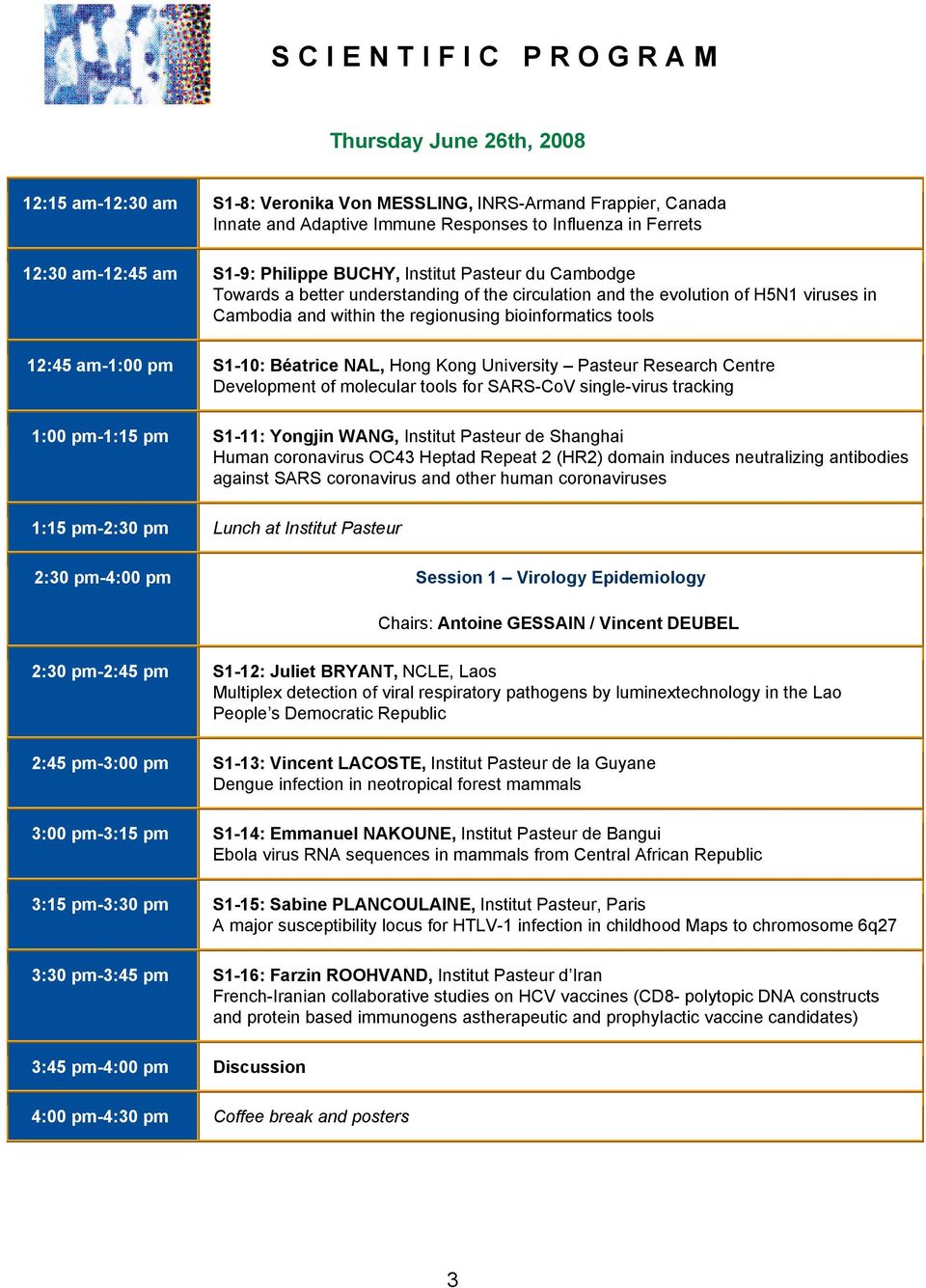
5 SCIENTIFIC PROGRAM Thursday June 26th, :15 am-12:30 am S1-8: Veronika Von MESSLING, INRS-Armand Frappier, Canada Innate and Adaptive Immune Responses to Influenza in Ferrets 12:30 am-12:45 am S1-9: Philippe BUCHY, Institut Pasteur du Cambodge Towards a better understanding of the circulation and the evolution of H5N1 viruses in Cambodia and within the regionusing bioinformatics tools 12:45 am-1:00 pm S1-10: Béatrice NAL, Hong Kong University Pasteur Research Centre Development of molecular tools for SARS-CoV single-virus tracking 1:00 pm-1:15 pm S1-11: Yongjin WANG, Institut Pasteur de Shanghai Human coronavirus OC43 Heptad Repeat 2 (HR2) domain induces neutralizing antibodies against SARS coronavirus and other human coronaviruses 1:15 pm-2:30 pm Lunch at Institut Pasteur 2:30 pm-4:00 pm Session 1 Virology Epidemiology Chairs: Antoine GESSAIN / Vincent DEUBEL 2:30 pm-2:45 pm S1-12: Juliet BRYANT, NCLE, Laos Multiplex detection of viral respiratory pathogens by luminextechnology in the Lao People s Democratic Republic 2:45 pm-3:00 pm S1-13: Vincent LACOSTE, Institut Pasteur de la Guyane Dengue infection in neotropical forest mammals 3:00 pm-3:15 pm S1-14: Emmanuel NAKOUNE, Institut Pasteur de Bangui Ebola virus RNA sequences in mammals from Central African Republic 3:15 pm-3:30 pm S1-15: Sabine PLANCOULAINE, Institut Pasteur, Paris A major susceptibility locus for HTLV-1 infection in childhood Maps to chromosome 6q27 3:30 pm-3:45 pm S1-16: Farzin ROOHVAND, Institut Pasteur d Iran French-Iranian collaborative studies on HCV vaccines (CD8- polytopic DNA constructs and protein based immunogens astherapeutic and prophylactic vaccine candidates) 3:45 pm-4:00 pm Discussion 4:00 pm-4:30 pm Coffee break and posters 3
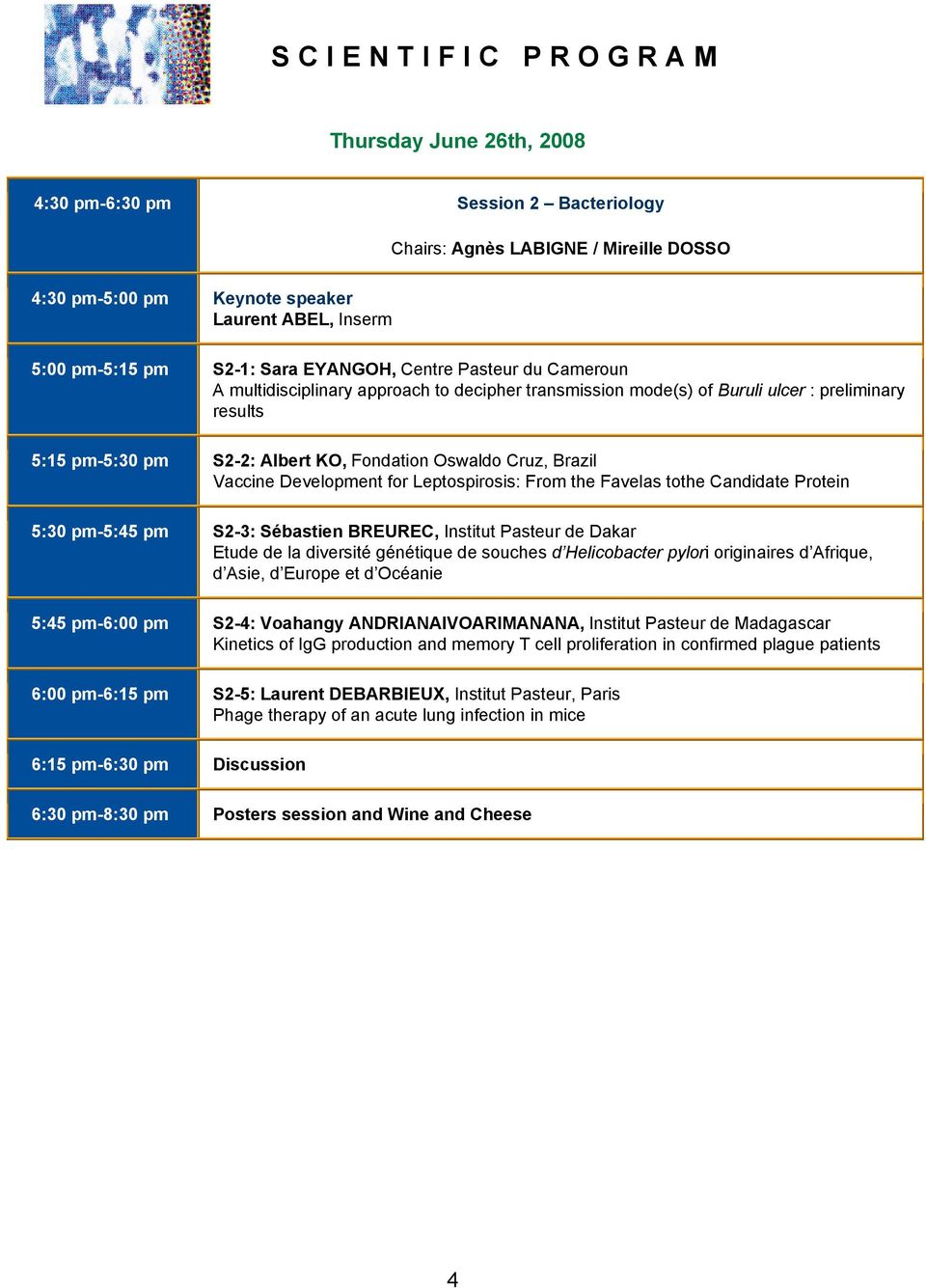
6 SCIENTIFIC PROGRAM Thursday June 26th, :30 pm-6:30 pm Session 2 Bacteriology Chairs: Agnès LABIGNE / Mireille DOSSO 4:30 pm-5:00 pm Keynote speaker Laurent ABEL, Inserm 5:00 pm-5:15 pm S2-1: Sara EYANGOH, Centre Pasteur du Cameroun A multidisciplinary approach to decipher transmission mode(s) of Buruli ulcer : preliminary results 5:15 pm-5:30 pm S2-2: Albert KO, Fondation Oswaldo Cruz, Brazil Vaccine Development for Leptospirosis: From the Favelas tothe Candidate Protein 5:30 pm-5:45 pm S2-3: Sébastien BREUREC, Institut Pasteur de Dakar Etude de la diversité génétique de souches d Helicobacter pylori originaires d Afrique, d Asie, d Europe et d Océanie 5:45 pm-6:00 pm S2-4: Voahangy ANDRIANAIVOARIMANANA, Institut Pasteur de Madagascar Kinetics of IgG production and memory T cell proliferation in confirmed plague patients 6:00 pm-6:15 pm S2-5: Laurent DEBARBIEUX, Institut Pasteur, Paris Phage therapy of an acute lung infection in mice 6:15 pm-6:30 pm Discussion 6:30 pm-8:30 pm Posters session and Wine and Cheese 4
7 SCIENTIFIC PROGRAM Friday June 27th, morning 9:00 am-12:15 am Session 3 Parasitology Chairs: Jacques LOUIS / André SPIEGEL 9:00 am-9:30 am Keynote speaker Jacques LOUIS 9:30 am-9:45 am S3-1: Alejandro BUSCHIAZZO, Institut Pasteur de Montevideo Structure/functional studies of trypanosomal neuraminidases 9:45 am-10:00 am S3-2: Maman Laminou IBRAHIM, CERMES, Niger Analyse de 34 SNPs associées à la résistance de P.falciparum aux antipaludiques par les puces à ADN au Niger 10:00 am-10:15 am S3-3: Ronan JAMBOU, Sydney University Allergic immune response and histamine pathway in malaria: new perspective to improve the treatment of cerebral malaria R 10:15 am-10:30 am S3-4: Elisabeth RAVAOARISOA, Institut Pasteur de Madagascar Recombinant Fab fragments specific for the histidine-rich protein2 and heat-shock protein 72 of Plasmodium falciparum : implications for malaria diagnosis 10:30 am-11:15 am Coffee break / Posters 11:15 am-11:30 am S3-5: Robert MENARD, Institut Pasteur, Paris In vivo imaging of Plasmodium pre-erythrocytic stages in a rodent model 11:30 am-11:45 am S3-6: Hechmi LOUZIR, Institut Pasteur de Tunis Approaches for the identification of vaccines against human leishmaniasis 11:45 am-12:00 am S3-7: Wilson SAVINO, Fondation Oswaldo Fiocruz, Brazil Abnormal T cell traffic in experimental Chagas disease 12:00 am-12:15 am Discussion 12:15 am-12:45 am Closing lecture Michèle BARZACH, Ancienne Ministre de la Santé, Présidente de l'association Les Amis du Fonds Mondial Europe, Paris 12:45 am-1:00 pm Conclusions Alice DAUTRY, Directrice Générale de l Institut Pasteur Yves CHARPAK, Directeur des Affaires Internationales, Institut Pasteur, Paris 5
8 LECTURE ABSTRACTS 6

9 SESSION 1 Virology / Epidemiology 7
10 S1-1 RABIES IN CAMBODIA: A VACCINE PREVENTABLE DEATH. S. Ly 1, P. Buchy 1, S. Ong 1, NY Heng 1, JL Sarthou 1, H. Bourhy 2, S. Vong 1 1. Institut Pasteur du Cambodge 2. Institut Pasteur de Paris Rabies, a fatal but preventable zoonosis, is a major public health problem in developing countries. However in Cambodia the disease burden is largely underestimated because patients with encephalitis following dog bites are rarely hospitalized and die at home. Since 1998 the Institut Pasteur (IPC), Phnom Penh (PP) has been the only source of free post exposure treatment (PET) and post mortem diagnosis. Methods: The data compiled by IPC was analyzed to identify all treated patients, confirmed human rabies cases and results of human and animal testing. From bites' characteristics, we defined a suspected rabies injury as a unprovoked bite from a dog that died spontaneously, or was reported sick. We applied a deterministic probability model to estimate 2007 rabies mortality in Cambodia from the clinical characteristics of biting dogs, the incidence of rabies suspected dog bites injuries, the distribution of bite wounds and the probability of PET access. Results: Over 120,000 patients received PET at IPC during (average: 12,470 and range: ,475). In 2007, 14,475 patients were treated (101/100,000 for Cambodia) including 8,606 (59.5%) residing in PP (615/100,000) and 5,305 (37%) in 5 neighboring provinces. Sixty suspected human cases of rabies were reported and tested at IPC in pre or post-mortem by PCR or IFD during , and 73% tested positive. Of the positive patients, all were bitten by dogs and all died. From 1998 to 2007, IPC tested 1,255 animal brain samples, 1,214 (97%) were from dogs and 610 (49%) were positive. Of 596 positive dogs, 88% lived in PP or neighboring provinces. Assuming IPC reports reflected true incidence of dog bites in Phnom Penh, the predictive model estimated 117 human rabies deaths would occur in 2007 (95%CI = ) despite PET; an incidence of 0.8 (95%CI = ) per 100,000. Conclusions: Rabies is endemic in all parts of Cambodia including PP. Access to PET is only available for PP since IPC is the only PET center in Cambodia. In 2007, the estimated rabies related mortality is similar to that of dengue reported in A national rabies control program is needed to improve surveillance and access to PET, and initiate a vaccination campaign in dogs. Furthermore, because data are still lacking regarding the burden of rabies in endemic countries, this type of approach could be proposed with minimal adjustment to the Réseau International des Instituts Pasteur where PET centers and diagnostic capacity exist. 8

11 S1-2 THE ORIGIN AND PHYLOGEOGRAPHY OF DOG RABIES VIRUS. Hervé Bourhy 1, Jean-Marc Reynes 2*, Eleca J. Dunham 3, Laurent Dacheux 1, Florence Larrous 1, Vu Thi Que Huong 4, Gelin Xu 5, Jiaxin Yan 5, Mary Elizabeth G. Miranda 6, Edward C Holmes 3,7 1. Institut Pasteur, UPRE Lyssavirus Dynamics and Host Adaptation, France 2. Institut Pasteur du Cambodge, Phnom Penh, Cambodge 3. Center for Infectious Disease Dynamics, The Pennsylvania State University, Mueller Laboratory, University Park. USA 4. Institut Pasteur of Ho Chi Minh City, Ho Chi Minh City, Vietnam 5. Wuhan Institute of Biological Products, Wuhan, Hubei Province, China 6. Veterinary Research Department, Research Institute for Tropical Medicine, Metro Manila, Philippines 7. Fogarty International Center, National Institutes of Health, Bethesda, USA. Rabies is a progressively fatal and incurable viral encephalitis caused by a lyssavirus infection. Almost all of the 55,000 annual rabies deaths in humans result from infection with dog rabies viruses (RABV). Despite the importance of rabies for human health, little is known about the origin and spread of RABV in dog populations, and patterns of biodiversity have only been studied in limited geographical space. To address these questions on a global scale we sequenced 62 new isolates and performed the largest comparative analysis of RABV gene sequence data undertaken to date, representing 192 isolates sampled from 55 countries. From this, we identified six clades of RABV adapted to non-flying mammals, each of which has a distinct geographic distribution, most likely reflecting major physical barriers to gene flow. Indeed, a detailed analysis of phylogeographic structure revealed only limited viral movement among geographical localities. Using Bayesian coalescent methods we further reveal that the sampled lineages of canid RABV derive from a common ancestor that originated within the last 1500 years. Additionally, we found no evidence for either positive selection or widespread population bottlenecks during the expansion of canid RABV. In sum, our study reveals that the stochastic processes of genetic drift and population subdivision are the most important factors shaping the global phylogeography of canid RABV. * present address: Institut Pasteur de Madagascar, Tannanarive, Madagascar. 9
12 S1-3 RABIES VIRUS HAS MORE THAN ONE TRICK UP ITS SLEEVE TO MANIPULATE THE HOST DEFENCES. Monique Lafon 1, Heinz Wiendl 2 and Thiravat Hemachudha 3 1. Institut Pasteur, Paris 2. University of Würzburg, Germany 3. Chulalongkorn University hospital and University Hospital Bangkok,Thailand Rabies virus is a pathogen well-adapted to the mammalian nervous system where it infects the neurons. It causes rabies- an acute myelo-encephalitis- fatal in most mammalian species, and humans in particular. Rabies virus is transmitted by saliva of an infected animal through bites or scratches, by unfortunate transplantation of organs originated from unsuspected rabid donors and more rarely by aerosols. Rabies virus enters the nervous system via a motor neuron through the neuromuscular junction, or via a sensory nerve through nerve spindles. It then travels from one neuron to the next, along the spinal cord to the brain. Then, rabies virus infection reaches the salivary glands and virus particles are excreted in the saliva.. Intriguingly, once the rabies virus has entered the CNS, its progression is interrupted neither by destruction of the infected neuron nor by the immune response, two classical strategies developed by the host to usually battle viral infection. Successful invasion of the nervous system by rabies virus seems to be the result of rabies virus capacity to escape the host mechanisms of defence.we showed that rabies virus neuroinvasiveness results of the selection of multiple factors : not only neuronotropic rabies virus avoids to induce neuron cell death, but also protective T cells that migrate into the infected nervous system are exhausted or killed by apoptosis, as a result of the overexpression by the infected neurons of at least three immunosubversive molecules: Fas-L, HLA-G and B7- H1. We also observed that fast killing virus strains limit local inflammation of the infected nervous tissues. Preservation of the integrity of neurons and neuronal network can be understood as a perquisite for the long journey of the virus through the nervous system from the site of entry up to the salivary glands. One would expect that the host s natural capacity to fight such a well adapted virus is greatly limited, explaining why in the absence of post-exposure vaccination, rabies is one of the very few human infections with a near 100 % mortality rate. Implications of these findings for new rabies treatment will be discussed. 10
13 S1-4 DU DIAGNOSTIC INTRA-VITAM DE LA RAGE HUMAINE A L'ANALYSE DU TRANSCRIPTOME CEREBRAL CHEZ LES PATIENTS INFECTES. L. Dacheux 1, J.M. Reynes 2-3, Ph. Buchy 3, B. Regnault, 4 T. S. Leng 5, B. Diop 6, D. Rousset 2, C. Rathat 7, N. Jolly 8, J.B. Dufourcq 5, C. Nareth 5, R. Rajerisson 9, G. Soubigou 4, J.Y. Coppée 4, C. Sadorge 8, H. Bourhy 1 1. Institut Pasteur, UPRE Dynamique des Lyssavirus et Adaptation à l Hôte, France 2. Institut Pasteur de Madagascar, Madagascar 3. Institut Pasteur du Cambodge, Cambodge 4. Institut Pasteur, Plate-forme Puces à ADN-Pasteur Génopole Ile de France, France 5. Hopital Calmette, Phnom Penh, Cambodge, 6Hopital Fann, Dakar, Sénégal 7. Hopital de Soavinandriana (CENHOSOA), Antananarivo, Madagascar 8. Institut Pasteur, Centre de Recherche Vaccinale et Biomédicale, France 9. Centre Hospitalier Universitaire de Befelatanana, Antananarivo, Madagascar La rage est une infection virale toujours mortelle, dont l incidence mondiale est estimée à décès par an. Cependant, ce chiffre est largement sous-estimé. L un des facteurs responsables réside dans l'absence de diagnostic biologique facilement réalisable. Seul le diagnostic post-mortem sur prélèvement cérébral permet actuellement de porter un diagnostic de certitude, difficilement réalisable dans les zones d endémie. Un nouveau protocole standardisé de diagnostic biologique intra-vitam de la rage, basé sur la détection d'arn viraux par RT-PCR, a été évalué en collaboration avec les laboratoires référents pour la rage situés dans les Instituts Pasteur du Cambodge, de Madagascar et de Dakar au Sénégal. Au final 51 patients issus des hôpitaux des pays concernés ont été inclus dans cette étude et plus de 400 prélèvements biologiques ont été collectés et analysés. Cette étude a permis de définir un protocole simple basé sur des prélèvements peu ou pas invasifs et présentant une sensibilité de plus de 98%. Pour 34 de ces patients, une biopsie cérébrale terminale a pu être obtenue. Afin d'analyser les dysfonctionnements du système nerveux central lors de l infection rabique, une étude a été initiée en utilisant la technologie des puces à ADN (Affymetrix). Après analyse des résultats obtenus, l activation ou la répression de différentes voies métaboliques a pu être mise en évidence, notamment celles impliquées dans la transmission synaptique et l homéostasie neuronale. De plus, les gènes impliqués dans les principales voies de réponses immunitaires antivirales (de type innée ou adaptative) ont été retrouvés très faiblement exprimés, voire réprimés. Ce résultat reste surprenant comparé à différents modèles animaux, comme la souris chez laquelle une très forte réponse antivirale de type interféron a été observée. 11
14 S1-5 FREQUENCY OF POULTRY TO HUMAN H5N1 TRANSMISSION AND EVIDENCE OF TRANSMISSION VIA CONTAMINATED ENVIRONMENT IN CAMBODIA. Vong S 1, Cavailler P 1, Garcia JM 2, Chu S 1, Buchy P 1 1. Institut Pasteur in Cambodia 2. HKU-Pasteur Research Centre Background: In Cambodia, H5N1 poultry outbreaks have been widespread and seven fatal human H5N1 cases were detected since January Direct contact with infected poultry is thought to be the main source of transmission. However, despite intense exposure, H5N1 viruses may not be easily transmitted from birds to humans. As H5N1 viruses continue to circulate and evolve among poultry, poultry to human transmission of H5N1 viruses could increase. We report the results of 4 studies conducted in four villages with human H5N1 cases to monitor the extent of illnesses from poultry to human transmission and to explore potential risk factors for H5N1 virus infection. Methods: In response to notification of 4 confirmed human H5N1 cases that occurred in 4 villages during May 2005 June 2007, we launched a series of investigations in the 4 cases villages including (i) retrospective poultry mortality surveys to determine the magnitude of exposure to infected birds; (ii) environmental sampling collection to identify the extent of environmental contamination; (iii) a sero-prevalence survey and a case control study few weeks following the outbreaks to determine the frequency of asymptomatic cases and potential risk factors. We interviewed villagers living near the households of H5N1 patients about potential exposures and bled them for H5N1 serological testing by microneutralization assay. Of note, we introduced a new serology testing which used H5 pseudotype-based assay for detection of neutralizing antibodies developed by Pasteur Research Centre in Hong Kong and Institut Pasteur in Cambodia. Findings: High intensity contact with poultry likely infected by H5N1 virus within 3 months prior to notification of H5N1-infected patients. The 2005 study found no seropositive cases in 351 villagers potentially exposed to infected poultry. In the studies, of 1,382 participants who were interviewed and bled, 12 (1%) tested positive for H5N1 antibodies. Of these, 7 were males and the median age was 12 years (range 4-20 years), which was significantly younger than that of the seronegative participants. The first 7 seropositive cases were more likely than the 24 controls to report bathing or swimming in household ponds (71.4% vs. 20.8%, matched odds ratio 11.3, 95 % CI , Wald test p=0.03); the analysis of the remaining 5 cases is pending. There were no differences between cases and controls regarding basic hygiene, poultry preparation practices or contact with an H5N1 patient. Viral RNA was detected in 27 of 77 specimens in mud, pond water, water plants and soil swabs. Discussion: Our research protocol following an H5N1 outbreak detected 12 sub-clinical H5N1 virus infections, but avian-to-human transmission of H5N1 virus appeared low despite extensive poultry contact. Our results also suggest the potential risks for bird-tohuman transmission via contaminated environment and underscore the needs for regular disinfection of poultry areas. 12
15 S1-6 DETERMINATION OF THE HAEMAGGLUTININ SIALIC ACID RECEPTOR INTERACTION OF H5N1 AND OTHER INFLUENZA VIRUSES AT THE ATOMIC LEVEL. Jean-Michel Garcia ±1, John M Nicholls ±1, Mark von Itzstein 2, Thomas Hazelhorst 2, Jimmy Lai 1 and JS Malik Peiris 1 1. Department of Pathology, The University of Hong Kong, Hong Kong University-Pasteur Research Centre 2. Institute for Glycomics, Griffith University, QLD, Australia Research into the pathogenesis of emerging viral infections has been hampered by the hazardous nature of many of these viruses, necessitating their study in BSL3 or 4 laboratories. This is especially the case with highly pathogenic H5N1 influenza virus. We have developed virus like pseudoparticles (VLP) using a retroviral core and surface haemagglutinin (HA) expression. Electron microscopy studies have demonstrated particle formation and NMR studies have shown that these particles bind to similar glycans than native virions in particular we have demonstrated there is a specific affinity for the SAα2-3Galß1-4GlcNAc moiety. Recent data indicates that the virus receptor recognition involves more than these terminal sugars and so we are continuing the studies using tetra and pentasaccharides and comparing these with virus affinity on glycan arrays. Our approach has some obvious advantages compare to previously reported methods. First, the NMR studies are invaluable for determining the virus host binding at the atomic level and the strengths of these interactions, as this information is not available from glycan array or lectin affinity. Second, the pseudoparticle system allows us to study the HA alone (in the absence of NA) with a infectious-potent virus-like topology. We have used this methodology to investigate the effect of naturally occurring point mutations in the haemagglutinin resulting in a switch of binding from an α2-3 to α2-6 binding for H3N2 virus and from α2-6 to α2-3 in H5N1 viruses. Using these mutated HA together with VLPs with different neuraminidases we will also analyze for the first time the synergy between the viral HA and NA. ± JMN and JMG contributed equally to the project. 13
16 S1-7 INNATE IMMUNE RESPONSE TRIGGERED BY INFLUENZA A VIRUS IS NEGATIVELY REGULATED BY SUPPRESSOR OF CYTOKINE SIGNALING (SOCS)1 AND SOCS3 THROUGH A RIG-I/IFNAR1- DEPENDENT PATHWAY. Julien Pothlichet, Michel Chignard, and Mustapha Si-Tahar Unité Défense Innée et Inflammation, Inserm U874, Institut Pasteur Influenza A virus (IAV) triggers a contagious respiratory disease that produces considerable lethality. Although this lethality is likely due to an excessive host inflammatory response, the negative feedback mechanisms aimed to regulate such response are unknown. Here, we investigated the role of the eight suppressor of cytokine signaling (SOCS) regulatory proteins in IAV-triggered cytokine expression in human respiratory epithelial cells. SOCS1 to SOCS7, but not cytokine inducible src homology 2-containing protein (CIS), are constitutively expressed in these cells and only SOCS1 and SOCS3 expression is upregulated upon IAV challenge. Using distinct approaches affecting the expression and/or the function of the IFNα/ß receptor (IFNAR)1, the viral sensors TLR3 and RIG-I as well as MAVS (a RIG-I signaling intermediate), we demonstrated that SOCS1 and SOCS3 upregulation requires a TLR3-independent, RIG-I/MAVS/IFNAR1-dependent pathway. Importantly, using vectors overexpressing SOCS1 and SOCS3, we revealed that while both molecules inhibit antiviral responses, they differentially modulate inflammatory signaling pathways. 14
17 S1-8 INNATE AND ADAPTIVE IMMUNE RESPONSES TO INFLUENZA IN FERRETS. S. Pillet 1, I. Meunier 1, É. Somo-Youmbi 1, K. Obojes 1, G. Kobinger 2, M. Gray 2, V. von Messling 1 1. INRS-Institut Armand-Frappier, University of Quebec, Laval, Canada 2. Special Pathogens Program, National Microbiology Laboratory, Public Health Agency of Canada Ferrets are considered one of the best influenza animal models because they are naturally susceptible to human strains, and the course and signs of disease caused reproduce those in humans. However, the lack of suitable immunological reagents has limited their use for the assessment of the anti-viral immune response. To characterize the host aspect of influenza pathogenesis in this model in more detail, we adapted our real-time PCR assays for the cytokine mrna quantification in nasal wash cells and developed an ELISpot assay for interferon γ to assess cytotoxic T cell responses. We observed that strains causing a mild disease were associated with a strong and rapid innate response and upregulation of IL-8, while severe infections were characterized by a lesser induction of type I and II interferons and strong IL-6 upregulation. Regardless of the strains virulence, virus-specific serum IgM and nasal IgA were detected as early as three days after infection, followed by a strong sustained IgG response beginning at day seven. Interferon γ production in peripheral blood mononuclear cells upon exposure to peptides covering parts of the HA, NA, or NP proteins was first observed after ten days and was strongest against the HA- and NP-derived peptides. Both, humoral and cellular responses started to decline four weeks after infection. However, the antibody titer stabilized at protective levels, while the cellular response in most cases declined below background after two months. Taken together our study suggests that virulent strains interfere more efficiently with the innate response, but do not prevent a strong adaptive response. This study provides new insights in the host response to influenza and will contribute to the development of novel vaccine and treatment approaches exist. 15
18 S1-9 TOWARDS A BETTER UNDERSTANDING OF THE CIRCULATION AND THE EVOLUTION OF H5N1 VIRUSES IN CAMBODIA AND WITHIN THE REGION USING BIOINFORMATICS TOOLS. Philippe Buchy 1, Mardy Sek 1, Mathieu Fourment 1, Sorn San 3, Holl Davun 3, Ly Sovann 4, Sok Touch 4, Malik Peiris 5, Sylvie van der Werf 6, Sirenda Vong 2 1. Virology unit 2. Epidemiology unit, Institut Pasteur du Cambodge, Phnom Penh, Cambodge. 3. Ministry of Agriculture, Cambodia 4. Ministry of Health, Cambodia 5. Department of microbiology, The University of Hong Kong and HKU-Pasteur Research Center, Hong Kong SAR 6. Unité de génétique moléculaire des virus respiratoires, Institut Pasteur, Paris, France. From 2004 to 2007, Cambodia experienced 24 outbreaks in poultry and 7 human cases of H5N1 infection. Phylogenetic and Bayesian analyses were performed on sequences from clade 1, 1, 2.1, 2.2, 2.3 viruses including 225 complete segment sequences from 33 representative Cambodian isolates belonging to clade 1. Our data suggest that H5N1 was introduced in Cambodia several times, by successive waves, until Cambodian viruses seemed to evolve independently. This hypothesis is supported by phylogenic analysis, differences in substitution rates and epidemiological data (9 months of lack or low transmission in Vietnam in 2006). For the clade 1 HA sequences, the mean substitution rate (number of substitutions/site/year) is 5.1 and with strict and relaxed clock, respectively. It increases to 7.5 and 7.9 when only Cambodian sequences are considered. For the latter, a positively selected site at position 138, corresponding to an antigenic site of the HA was identified. Poultry movements probably play a crucial role in the introduction of new viruses from, and eventually also to, neighbouring countries and in a sometimes complex evolution of viruses within Cambodia. The lack of introduction of clade 2.2 or clade viruses into Cambodia is compatible with the role of poultry trade (rather than wild birds) being responsible for the continued endemicity of the virus in Cambodia. 16
19 S1-10 DEVELOPMENT OF MOLECULAR TOOLS FOR SARS-COV SINGLE- VIRUS TRACKING. Kien Francois, Siu Lewis, Teoh KimTat, Millet Jean, Tse Jane, Altmeyer Ralf, Peiris Malik, Bruzzone Roberto and Nal Beatrice HKU-Pasteur Research Centre, Dexter HC Man Building, 8 Sassoon Road, Pokfulam, Hong Kong SAR, China Single-virus tracking using fluorescently labeled virus derivatives is a powerful approach which allows direct visualization of viral entry, trafficking and egress in live cells and analysis of dynamic interactions between viruses and host-cell factors. Severe acute respiratory syndrome coronavirus (SARS-CoV) is the aetiological agent of SARS which infected 8100 people worldwide, among which 774 people died in Imaging of life infected cells with a biosafety level 3 (BSL3) pathogen like SARS-CoV is undesirable due to safety concerns. The same safety concerns prompted us to generate viral genome-free SARS-CoV virus like particle (VLP) and replication-defective, SARS-CoV Spike pseudotyped lentiviral particle (SARS-CoVpp) as safe molecular tools to study SARS-CoV egress and/or entry. By co-expressing different combinations of the four SARS-CoV structural proteins in VeroE6 permissive cell line, we have developed an expression system that allows efficient secretion of SARS-CoV VLPs. Addition of fluorescent tags to viral proteins allowed us to visualize VLPs in producing cells. Pseudotyping replication defective lentiviral vectors with heterologous envelope or spike protein from enveloped viruses has been used to study viral entry and cell tropism. We and others have shown that SARS-CoV Spike can efficiently pseudotype lentiviral vector to generate SARS-CoVpp which faithfully mimic the SARS-CoV entry process. Incorporation of HIV Vpr accessory protein fused to GFP allowed us to track individual GFP-labeled SARS-CoVpp. We present here a detailed characterization of these molecular tools together with imaging studies, demonstrating their suitability for SARS-CoV single-virus tracking. Fluorescently labeled SARS-CoV VLPs and SARS-CoVpp are valuable tools used to probe dynamic interactions between viral structural proteins and cellular partners that we have previously identified by Yeast-Two-Hybrid and RNAi screens. Besides cultured cells, which are simplified model systems, virus-cell interactions will be also investigated using in vitro well-differentiated human airway epithelial cells and ex vivo cultures of human airway tissues. 17
20 S1-11 HUMAN CORONAVIRUS OC43 HEPTAD REPEAT 2 (HR2) DOMAIN INDUCES NEUTRALIZING ANTIBODIES AGAINST SARS CORONAVIRUS AND OTHER HUMAN CORONAVIRUSES. Yongjin Wang, Ying Gao and Vincent Deubel Institut Pasteur of Shanghai, Chinese Academy of Sciences, PR China Coronavirus (CoV) spike heptad repeat 2 (HR2) region is highly immunogenic and induces neutralizing antibodies. Monoclonal antibody against SARS CoV HR2 region inhibits HR1-HR2 postfusion core formation and entry of the virus into its susceptible cells. The HR2 region is relatively conserved for all CoV from the same or different serogroups. Our objective is to extend the understanding of the specificity of fusion process for all known human CoV (HcoV) by blocking their cell entry with antibodies directed against the HR2 region. In this study, we purified the HCoV OC43 HR2 protein fragment and produced the corresponding antibody in mice. Western-blot showed that this polyclonal antibody detected sspike protein of all known HCoV including HCoV OC43, 229E, NL63, HKU1 and SARS coronavirus. This antibody also recognized the native form of all five HCoV spike proteins by confocal experiment. To investigate the neutralization and cross-neutralization activities of this antibody, we performed neutralization assay against HCoV OC43, 229E and NL63 in cell culture by either plaque or TCID50 reduction test. Because the cellular receptor of HCoV HKU1 has not been identified, we constructed plasmids expressing chimeric gene of OC43 S1 and HKU S2 ligated by CoV cleavage residues and pseudotyped in lentiviral vector. SARS CoV spike protein was also pseudotyped with the same vector. Neutralization assay against SARS CoV and HCoV HKU1 HR1-HR2 postfusion core formation was performed on the pseudoviruses. The results showed that antibodies developed from HCoV OC43 HR2 region cross neutralized all known HCoV. This study brings new insights on the mechanisms and specificity of CoV neutralization and offers new tools for diagnosis of the virus infection and for immunotherapy strategies. 18
21 S1-12 MULTIPLEX DETECTION OF VIRAL RESPIRATORY PATHOGENS BY LUMINEX TECHNOLOGY IN THE LAO PEOPLE S DEMOCRATIC REPUBLIC. Khanthong Bounlu 1, Vimatha Pansayavong 1, Thongchanh Sisouk 1, Darouny Phonekeo 1, Phengta Vongprachanh 1, Sithat Insisiengmay 2, Gary T Brice 3, Juliet E Bryant 4 1. National Center for Laboratory and Epidemiology (NCLE), Lao PDR 2. Department of Hygiene and Prevention, Ministry of Health Vientiane, Lao PDR 3. Naval American Military Research Unit Indonesia 4. Institut Pasteur Background: Human respiratory viruses are a diverse group of pathogens composed of hundreds of virus strains, and this presents a major challenge for diagnostic laboratories. A fast, multitarget, sensitive, and specific assays for detection of respiratory viruses has recently been developed using multiplexed PCR chemistries coupled with high-throughput microsphere flow cytometry (Luminex). The RVP assay detects viral respiratory agents belonging to 8 distinct groups: respiratory synctial viruses, RSV; human rhinoviruses, HRV; parainfluenza virus, PIV, influenza virus, InfV; metapneumavirus, MPV; coronavirus, CoV; enterovirus, EnV; and adenovirus, AdV. We report here on the results of a pilot study comparing the RVP assay with conventional and real time RTPCR assays. Diagnostic yields, feasibility, and relative costs of testing respiratory specimens were evaluated. Methods: A total of 236 nasopharyngeal and oropharyngeal swab specimens from patients enrolled in a pilot phase influenza-like illness surveillance program were tested sequentially by conventional RTPCR for influenza, and by RVP assay. Discordant results for influenza were resolved by real-time RTPCR. Results: The pathogens detected most frequently were influenza virus (96, 40.9%), entero/rhinovirus (36, 15.3%), parainfluenza virus (9, 3.8%), metapneumovirus (5, 2.1%), respiratory synctial virus (5, 2.1%), and coronavirus (3, 1.3%). RVP increased the diagnostic yield from 46 cases (19.6% of patients) to 105 cases (44.7% of patients), compared with conventional influenza subtyping by RTPCR. Conclusions: Implementation of RVP for the etiological diagnosis of respiratory infections increased diagnostic yields considerably, and provides a useful tool for disease surveillance in a developing country setting. 19
22 S1-13 DENGUE INFECTION IN NEOTROPICAL FOREST MAMMALS. Benoît de Thoisy 1, Vincent Lacoste 1, Adeline Germain 1, Séverine Matheus 2, Philippe Dussart 2, Xavier Deparis 3 & Anne Lavergne 1 1. Laboratoire des Interactions Virus-Hôtes, Institut Pasteur de la Guyane 2. Laboratoire de Virologie, CNR des Arbovirus et Virus Influenza, Institut Pasteur de la Guyane 3. Laboratoire de Virologie, Institut de Médecine Tropicale du Service de Santé des Armées In South America, dengue is the arbovirus-transmitted disease with the highest incidence in humans. Contrary to other arboviruses, wild mammals have no confirmed role in the cycle of dengue in the neotropics, but previous serological studies suggested that this statement remained questionable. In French Guiana, where the four dengue serotypes are present, the disease is endemic with outbreaks of epidemic events. To determine if dengue virus can infect wild mammals, rodents, marsupials and bats were captured at several periods of time, from 2001 to 2007, in two sites. While the first place corresponds to a secondary forest surrounded by an urban area endemic for dengue virus, the second place is a transition forest site between primary forest and a small human settlement where the disease has not yet emerged. A total of about trap/nights have been performed allowing capturing 473 non-flying mammals and 152 bats. Infection by one of the four dengue serotypes was detected by RT-PCR amplification of viral RNA from 55 livers and 38 sera from 13 out of 32 mammal species belonging to three mammalian orders. Sequence analyses of the premembrane and capside region revealed that dengue virus mammal strains of the four serotypes identified were highly divergent from those circulating in the human population at the same periods. In addition, dengue virus serotype 2 strains related to the one responsible of an epidemic event in humans, concomitantly to the capture sessions, were evidenced suggesting that circulating human strains can also infect wild mammals in edge habitat. Our results thus demonstrate, for the very first time, that Neotropical wild mammals can be infected by dengue virus and that they are able to maintain it, suggesting their potential role in dengue virus emergence processes in South America. 20
23 S1-14 EBOLA VIRUS RNA SEQUENCES IN MAMMALS FROM CENTRAL AFRICAN REPUBLIC. Nakoune E 1, Vanthomme H 2, Fargeot C 2, Marianneau P 3, Zeller H 3, Tordo N 3 Faou A 1 and Le 1. Laboratoire des Arbovirus et virus des Fièvres Hémorragiques, Institut Pasteur de Bangui, Central African Republic 2. CIRAD, Centre de Coopération Internationale en Recherche Agronomique pour le Développement, Montpellier 3. Centre National de Référence et Centre Collaborateur OMS des Arbovirus et Fièvres Hémorragiques Virales, Lyon, France The team of the Pasteur Institute of Bangui (CAR) has searched for the presence of Ebola virus markers in the liver, spleen, lung and/or kidney of four local animal species (monkeys [Cercopithecus], forest antelope [Cephalophus] captured in the gallery forest South-West of Bangui, aulacode [Thryonomis sp.]) from the border of savannah North of Bangui and fruit bats collected downtown Bangui. Using molecular biology tools (reverse transcription nested PCR), Ebola virus genome (RNA) was detected from several organs of Cercopithecus (5/16), Cephalophus (9/59), Thryonomis (3/5) and fruit bats (9/20). Homologies to Ebola Zaire/Gabon subtype genomes were obtained by sequencing nucleoprotein or polymerase gene amplicons. The sequenced segments of the polymerase gene presented 4 codons deletion (bases 51 to 53 and 99 to 107) compared to the Ebola Zaire strain sequence (DQ20541). The nucleoprotein partial gene sequences were 99 % identical to those of the Ebola Zaire virus strains (AF086833) and Ebola Gabon strains (Y09358). Polymerase and glycoprotein partial gene sequences obtained were identical for all animals studied, suggesting a common Ebola virus strain that may circulate among the wild faunae surrounding of Bangui. Subtype Ebola Zaire antibodies were not detected in serum of PCR positive monkeys by ELISA. Similar serological assays could not be conducted on the other animal species for lack of specific antiserum. Complement of investigations including attempt of virus isolation in BSL4 facilities (Lyon, France) are in progress. The risk for the human population cannot be evaluated for the moment. It has to be noted that hunters didn t have any symptoms that could be related to Ebola virus infection despite close contact with monkeys and Cephalophus. If confirmed, the presence of Ebola virus in different animals species would indicate that this virus circulate freely within the local wild fauna which may constitute the true reservoir of Ebola virus. 21
24 S1-15 A MAJOR SUSCEPTIBILITY LOCUS FOR HTLV-1 INFECTION IN CHILDHOOD MAPS TO CHROMOSOME 6q27. S Plancoulaine 1,2, A Gessain 2, P Tortevoye 2, A Boland-Auge 3, A Vasilescu 3, F Matsuda 3, L Abel 1 1. INSERM, U550, Paris, France; Human Genetics of Infectious Diseases, Université René Descartes, Paris, France 2. Unité d Epidémiologie et Physiopathologie des Virus Oncogènes, Institut Pasteur, France 3. Centre National de Génotypage, Evry, France Human T-cell leukemia/lymphoma virus type 1 (HTLV-1) is a human oncoretrovirus causing adult T-cell leukemia/lymphoma (ATL) and chronic neuromyelopathy. We showed, by segregation analysis, that a dominant gene controls HTLV-1 infection through breast-feeding in children of African origin. To map this locus, we performed a genome-wide linkage analysis, based on the genetic model provided by segregation analysis, in five pedigrees (46 subjects with available DNA) of African origin with HTLV- 1-seropositive children. A total of 382 microsatelites markers spanning the whole genome were typed. Two attractive positional genes located within the linked regions were further studied through an association analysis in an independent sample of 59 cases (24 HTLV-1 infected children and 25 ATL) and 48 controls (27 HTLV-1 seronegative but exposed children and 21 HTLV-1 seronegative young individuals) of African origin. Significant evidence for linkage (lod-score of 3.36, p= ) was obtained for chomosomal region 6q27. Another maximum lod-score of 2.79 (p=0.0002) was obtained for chomosome 2p25. This result was entirely due to the largest pedigree of our sample, which alone gave a lod-score of 2.90 (p= ). The role of exonic variants of CCR6 on 6q27 and ID2 on 2p25 was excluded. Our results, mapping a major susceptibility locus to chromosome 6q27 and suggesting genetic heterogeneity with another locus at 2p25, pave the way to determination of the molecular basis of predisposition to HTLV-1 infection in children. 22
25 S1-16 FRENCH-IRANIAN COLLABORATIVE STUDIES ON HCV VACCINES (CD8-POLYTOPIC DNA CONSTRUCTS AND PROTEIN BASED IMMUNOGENS AS THERAPEUTIC AND PROPHYLACTIC VACCINE CANDIDATES). F. Roohvand 1,2, A. Memarnejadian 1,2, A. Arashkia 1,2, MR. Aghasadeghi 1,2, M. Sadat 1,2, A. Budkowska 3, B. Combadière 4 1. Hepatitis and AIDS Dept. 2. NRGB Laboratory of Institute Pasteur d Iran 3. Unité Hepacivirus, Institut Pasteur Paris 4. INSERM U543 Laboratoire ď Immunologie, Faculté de Médecine, Pitié Salpétrière Hypothesis: With a global infection prevalence of 3% (4 times that of HIV), Hepatitis C Virus (HCV) infection is in the alarming rates and vaccine studies are of vital importance. Early and vigorous Th1, Th2 and multi-specific cellular immune responses manifested by CD8 + CTLs seem to be critical in the elimination of HCV infection. Due to high heterogeneity of HCV, conserved genes like core protein (HCVcp) and immunoprotective CD8 epitopes represent important targets for vaccine design. In this context isolated epitope-based approaches and HCVcp based immunogens may be considered. Objectives: To evaluate immune responses to different CD8 + Poly-epitopic constructs and Montanide formulated HCVcp. Methodology: three polytopes containing 3 immunodominant HLA-A2 restricted epitopes of HCV (Core 132, E2 614 and NS3 1406) and 3 other constructs based on subdominant HCV epitopes (E1363 and Core35) to getter with an H2-Dd mouse epitope (405) in different sequential tandems with or without HBsAg/ Endoplasmic reticulum translocating signal sequence(erss)/ PADRE (A universal helper epitope) based on proteasome cleavage prediction softwares were constructed. Long peptides corresponding to above mentioned polytope tandems were also synthesized and used as immunogen. In other set of experiments HCVcp formulated in Montanide was used as Immunogen for Murine immunization in different regimes (DNA/DNA versus DNA/polypeptide-prime/boost). Results: Transfection of the polytopic DNA constructs (In pcdna 3.1) into COS-7 cells, confirmed the expression of the fusion peptides using western-blot, ELISA and immunofluorescence. In all cases the DNA/polypeptide immunization regime showed significant levels of CD4-based interferon, delayed-type Hypersensitivity (DTH) and CD8-CTLs specific for the H2-Dd mouse epitope (405) with measurable differences among some groups. Therefore, the constructed polytopes were processed to different levels of immunogenecity based on the assembled sequences. However, the immune responses were weak in comparison to HCVcp-Montanide formulation which induced strong Th1/Th2 and stable CTL responses. Conclusions: Possibility of inducing specific CTL responses to each CD8 epitope alone in the assembled multiple-epitope-based-dna or polypeptide vaccine candidates is shown but the formulation should be improved for higher responses comparable to HCVcp adjuvanted formulation. Significance of the work: Insights are gained into the rules governing the processing of the isolated CD8 epitopes in the string of CD8+ polytopes and the role of CD4+ helper epitopes and ERss sequences in processing of engineered polytopes. Moreover application of HCVcp+montanide formuation as a protein based vaccine candidate for HCV infection is shown. 23
26 SESSION 2 Bacteriology 24
27 S2-1 A MULTIDISCIPLINARY APPROACH TO DECIPHER TRANSMISSION MODE(S) OF BURULI ULCER: PRELIMINARY RESULTS. S. Eyangoh 1, C. Mbondji 1, 2, P. Brodin 3, A. Tanghe 4, J. d Alayer 5, R. Pouillot 1, M. C. Tejiokem 1, F. Ngos 6, A. Fontanet 5, J. Aubry 2, L. Marsollier 7 1. Centre Pasteur du Cameroun 2. U 892 INSERM Université de Nantes 3. Institut Pasteur Corée, 4Institut Pasteur de Bruxelles 5. Institut Pasteur Paris 6. Hôpital Akonolinga 7. Université d Angers Mycobacterium ulcerans is the etiological agent of Buruli ulcer, an extremely debilitating skin disease observed in humid tropical areas. The transmission routes of Buruli ulcer still remains unclear, consequently the preventive and therapeutic strategies for this invalidating disease are also limited, no specific vaccine being available to date. A multidisciplinary approach is currently undertaken in Cameroon to identify epidemiological, immunological and environmental factors associated with the development of the Buruli ulcer with the commitment of experts of several teams. Epidemiological aspects: lifestyles of patients suffering from Buruli ulcer have been compared to those living in the same endemic area without clinical signs in a case control study framework (168 pairs). Covering limbs during farming activities was confirmed as a protective factor. But new protective factors were outlined such as the use of mosquito bed nets and the proper care of skin lesions with antiseptic solutions. If confirmed, these results could be used to reinforce education in a basic public health measures. Immunological aspects: sera from control individuals collected during this survey showed a significantly higher level of specific IgG against proteins from salivary glands of aquatic insects than those from case individuals. Some immunogenic proteins have been identified in these salivary glands which are currently under characterisation. These results could bring development of new diagnostic tools and vaccine strategies. Environmental aspects: these included the characterization of the ecosystem and inventory of all aquatics plants and insects in endemic areas. Data collected would help to better understand the role of aquatic insects in M. ulcerans transmission. All together, the results of this collaborative study would contribute to develop new preventive approach, including ecosystem monitoring, new diagnostic tools and vaccine development. 25
28 S2-2 VACCINE DEVELOPMENT FOR LEPTOSPIROSIS: FROM THE FAVELAS TO THE CANDIDATE PROTEIN. Marco Medeiros 1, Flavia W. McBride 1, Julio Croda 1,2, Elsio Wunder 1, Paula Ristow 1,2, Akira Homma 1, David Haake 2, Mathieu Picardeau 3, Mitermayer G. Reis 1, and Albert I. Ko 1,4 1. Oswaldo Cruz Foundation, Brazil 2. Institut Pasteur, France 3. University of California Los Angeles, USA 4. Weil Medical College of Cornell University, USA Introduction: Leptospirosis, a spirochetal zoonosis, has become a global health problem as the cause of life-threatening disease among impoverished rural-based subsistence farmers and urban slum dwellers. Our community-based studies in the city of Salvador, Brazil have shown that epidemics of leptospirosis occur each year in the same slum communities during seasonal periods of heavy rainfall. Prevention is urgently needed since mortality is >10% from leptospirosis-associated acute renal failure and pulmonary haemorrhage during epidemics. We identified a novel member of the bacterial immunoglobulin superfamily of virulence determinants, Leptospira Ig-like (Lig) proteins, and found that patients have robust antibody responses against this moiety. Objectives/methods: We hypothesized that immunization with against Lig proteins induce bacteriocidal and pathogenesis-blocking immune responses. We evaluated whether immunization with recombinant Lig protein fragments in Alhydrogel adjuvant conferred protection against lethal infection with L. interrogans in the standard hamster model of leptospirosis. Results: Immunization with the N-terminal fragment of the LigB protein conferred sterilizing immunity. This phenomenon was observed with immunization doses as low as 20 µg. Whereas examination of tissues from control-immunized hamsters sacrificed 9 days post-challenge showed characteristic lesions of severe leptospirosis, these findings were not observed in LigB-immunized hamsters sacrificed at the same time point. Immunization with LigB protein induced antibodies that bind to the Leptospira surface. Passive transfer of rabbit hyperimmune sera against each of LigB fragments conferred sterilizing immunity when administered to hamsters 24 hours prior to lethal challenge. Significance: Our findings demonstrate that immunization with recombinant Lig proteins in Alhydrogel confers sterilizing immunity in hamsters and that immunoprotection is in part, antibody-dependent. On-going studies are evaluating Lig proteins as a sub-unit vaccine candidate and a potential intervention strategy for leptospirosis in neglected populations in developing countries. 26
29 S2-3 ETUDE DE LA DIVERSITE GENETIQUE DE SOUCHES D HELICOBACTER PYLORI ORIGINAIRES D AFRIQUE, D ASIE, D EUROPE ET D OCEANIE. S. Breurec 1, B. Garin 1, C. Fall 1, A. Seck 1 (IP), M. Mbengue 1 (CHU Le Dantec), F. Mouffok 2 (IP), B. Touchene 2 (Hôpital de Kouba), B. Guillard 3, S. Hem 3 (IP), D. Sgouras 4 (IP), K. Petraki 4, S. Michopoulos 4 (Alexandra Hospital), GJ. Mantzaris 4 (Evangelismos Hospital), JF. Carod 5, E. Corradi 5, C. Raharisolo 5 (IP), RM. Ramanampamonjy 5 (Hospital Général de Befelatanana), S. Le Hello 6, O. O Connor 6, Y. Rougier 6 (IP), B. Genelle 6 (CH Gaston Bourret), F. Beau 7 (Institut Louis Malardé), M. Levy 7, F. Bost Bezeaud 7 (CH de Mamao), JM. Thiberge 8, A. Labigne 8, J. Raymond 8, M. Huerre 8, V. Caro 8, S. Brisse 8 (IP) 1. Dakar ; 2. Algérie ; 3. Cambodge ; 4. Grèce ; 5. Madagascar ; 6. Nouvelle-Calédonie ; 7. Tahiti ; 8. Paris Contexte bibliographique : L analyse du polymorphisme génétique de 7 gènes de ménage de 769 souches d Helicobacter pylori (Hp) isolées de patients originaires de 51 groupes géographiques, ethniques et linguistiques différents, a permis de classer les souches en 6 groupes génétiques sur la base de l origine géographique (hpeurope, hpneafrica, hpafrica2, HpAfrica1 (subdivisé en hspsafrica, hspwafrica), hpasia2 et hpeastasia (subdivisé en hspamerind, hspeasia, hspmaori)) et de retracer les mouvements des populations humaines au cours des grandes migrations (Falush et al, 2003, Linz et al, 2007). Hypothèses : Parmi ces 769 souches, l échantillon issu d Afrique, d Asie et de Polynésie était restreint et n a pas permis d explorer leurs diversités génétiques et de préciser réellement les migrations humaines dans ces parties du monde. Objectifs : L objectif de ce projet intitulé «Programme ANR 2006 Era-Net (HELDIVNET)» est d étudier la diversité génétique de souches originaires d Afrique, d Asie, d Europe et d Océanie en lien avec la pathologie gastro-duodénale, l origine ethnique et géographique des patients. Méthodologie : Collection de souches d Hp. La période d inclusion se terminera en mars Les souches sont isolées de patients originaires d Algérie, du Cambodge, de Grèce, de Nouvelle-Calédonie, du Sénégal et de Tahiti. Sur chaque site, un réseau d étude des pathologies gastro-duodénales (GD) associant microbiologistes, anatomo-pathologistes et gastroentérologues a été mis en place. En présence d une culture de Hp à partir des biopsies gastriques, l ADN est extrait et conservé à -80 C puis envoyé à l Institut Pasteur de Paris et de Dakar. Analyse moléculaire. L amplification et le séquençage de 9 gènes de ménage (atpa, efp, muty, ppa, trpc, urei, yphc, hspa et glmm) sont réalisés à l Institut Pasteur de Paris et de Dakar. Des méthodes bayésiennes (Structure, BAPS) sont utilisées pour assigner ces souches à des populations génétiques en les comparant à la structure génétique globale d Hp. Résultats obtenus : Souches isolées. Fin 2007, 40 souches ont été isolées de patients issus d Algérie, 70 du Cambodge, 116 de Grèce, 36 de Nouvelle-Calédonie (27 souches de patients Mélanésiens et 9 souches de patients Polynésiens) et 42 du Sénégal. Sur les 500 souches escomptées à la fin des inclusions, 265 seront choisies pour analyse moléculaire sur la base de la pathologie GD, de l origine ethnique du patient et des analyses préliminaires. Diversité génétique. Les amplifications et séquençages de 8 souches de patients issues d Algérie, 28 du Cambodge, 33 du Sénégal et 26 de Nouvelle-Calédonie (17 de patients Mélanésiens et 9 de patients Polynésiens) sont en cours. D ici juin 2008, l analyse aura été réalisée et permettra de mieux préciser les populations génétiques dans lesquelles se trouvent ces souches : Cambodge (groupes hpeastasia ou hpasia2?), Nouvelle-Calédonie (groupe hpasia2, sousgroupe hspmaori ou nouveau sous-groupe?), Sénégal (sous-groupe hspwafrica?), Algérie (groupes hpafrica1, hpeurope, hpneafrica? ou un mélange de ces groupes?). Conclusion : Nous nous proposons de faire une communication sur des résultats préliminaires du projet ERA-Net PathogenoMics Helicobacter pylori portant sur la description des populations génétiques en lien avec l origine géographique, ethnique et linguistique des patients. Impact des travaux : Cette étude permettra de compléter les données disponibles en analysant des souches de Hp isolées de patients originaires d Afrique, d Asie, d Europe et d Océanie. Elle permettra d identifier de nouveaux groupes et sous-groupes génétiques et de documenter les migrations humaines en Afrique et en Polynésie. Un projet de séquençage complet de 5 génomes représentatifs des populations génétiques et associés à des lésions cancéreuses (dysplasie sévère ou adénocarcinome) a été prévu. Cette partie n est pas encore financée et sera soumise à un appel d offre courant
30 S2-4 KINETICS OF IgG PRODUCTION AND MEMORY T CELL PROLIFERATION IN CONFIRMED PLAGUE PATIENTS. Andrianaivoarimanana Voahangy 1, Rakotomalala Emma 1, Domarle Olivier 1, Ralafiarisoa Lalao Angeltine 1, Rajerison Minoarisoa 1, Demeure Christian 2 and Rahalison Lila 1 1. Institut Pasteur de Madagascar 2. Institut Pasteur, Paris, France The re-emergence of human plague and the appearance of new foci in some countries indicate that plague remains a public health problem worldwide. Hypothesis: The natural plague infection in human provides efficient long termprotection since we have never seen notification of an individual affected twice by the disease as soon as plague was introduced in Madagascar (in 1898). The aim of the present study is to follow the humoral and cellular responses against Yersinia pestis. We assessed the persistence of anti-f1 IgG production and the T cell memory proliferation induced by F1 antigen in confirmed plague patients. Blood samples were collected from 34 consent patients at different times after the onset of the disease. Specific anti-f1 IgG antibodies were detected in sera or plasma using ELISA assays. Peripheral Blood Mononuclear Cells were seeded in presence of F1 antigen.t cell proliferative response was measured by [3H]TdR uptake after 5-days culture, Following the occurrence at day 8 after the onset of the disease, the anti-f1 IgG could persist for 3 years (4/12 patients sampled after 33 months), and at least at a high level until 15 months from diagnosis (6/9 individuals tested). T cells proliferation was detectable 2 months after the onset of the disease (4/6 individuals analysed from 0 to 5 months). It became significative and remained detectable until 4 years for 11/12 cases tested after 33 months. Exception was observed in the response of a pneumonic plague case for whom anti-f1 IgG antibodies were still at a high level and the mitogenic index is positive 11 years after the disease. These data show that after a natural plague infection, the patient first develop an humoral immunity which can persist few months.the T memory response seems to appear 2 months after the onset of the disease and lasts for few years. These findings give important informations for understanding the protective response during natural plague infection and for improving of the development of a future vaccine for plague. 28
31 S2-5 PHAGE THERAPY OF AN ACUTE LUNG INFECTION IN MICE. Leduc D 1., Touqui L 1. and Debarbieux L 2 1. Unité Défense Innée et Inflammation, IP Paris 2. Unité Biologie Moléculaire du Gène chez les Extrêmophiles, IP Paris In 1919 Félix d Herelle published a paper in which it described the use of bacteriophage to cure humans having dysentery. This therapeutic approach was always constested and the discovery of antibiotics precipitated its abandonment in West countries. In contrast in Eastern countries, phage therapy was developped and is still currently used. With the rise of antibiotic resistant bacteria, westearn scientists are now re-evaluating phage therapy. Taking advantage of an acute lung infection model in mice, we demonstrated that phages are efficient to cure this kind of infection. The infectious bacterium we used was a bioluminescent version of the Pseudomonas aeruginosa PAK strain, allowing us to assess the kinetic of the phage attack in vivo in living animals. We determined the ratio phage/bacteria and the optimum time-delay between the beginning of the infection and the phage treatment. We also evaluated 3 differents phages showing that some are more efficient than others in vivo and demonstrated that phages multiply inside infected lungs. Finally, we determined that the inflammatory responses were attenuated in phage-treated animal in comparison to non-treated animals, supporting the evidence that a lower amount of bacteria is less proinflammatory. With the demonstration that phages can cure infection in vivo in animal models we plan to developp research to test phage efficiency in treating diarrheal deseases. 29
32 SESSION 3 Parasitology 30
33 S3-1 STRUCTURE / FUNCTIONAL STUDIES OF TRYPANOSOMAL NEURAMINIDASES. A. Buschiazzo 1, S Withers 2 & P.M. Alzari 3 1. Unit of Protein Crystallography, Institut Pasteur de Montevideo, Urugay 2. Dept of Chemistry, University of British Columbia, Vancouver, Canada 3. Unit of Structural Biochemistry - Dept of Structural Biology & Chemistry, Pasteur Institute, Paris, France Human diseases caused by kinetoplastid parasites have a tremendous impact, especially on people from poor countries. Taking recent estimates of the major burdens, ~4,300,000 disability-adjusted life-years are lost each year because of trypanosomiasis and leishmaniasis. The intracellular parasite Trypanosoma cruzi, etiologic agent of Chagas' disease, sheds a developmentally regulated surface trans-sialidase (TcTS), a virulence factor involved in key aspects of parasite-host cell interactions. Since no effective profilactic/therapeutic strategies are currently available, Chagas' disease still generates high rates of morbidity/mortality in affected populations in America. TcTS is barely inhibited by known sialidase inhibitors. Disclosing the mechanistic details of the TcTS sialyl-transferase reaction will contribute to the design of inhibitory molecules to be assayed as novel antichagasic compounds. We have followed a multidisciplinary and multicentre approach, involving protein crystallography, site-directed mutagenesis, synthetic chemistry and mass spectroscopy, in order to advance in the understanding of substrate recognition and catalytic mechanism at the atomic level. Several crystal structures of TcTS, as well as of related trypanosomal sialidases (with no transglycosidase activity), have been solved at high resolution. We have now 'snapshots' of the complete catalytic cycle, including the kinetically trapped reaction intermediate. We conclude that TcTS and, in general, all exo-neuraminidases, operate through a pingpong mechanism using a rather exceptional residue as the nucleophile (tyrosine 342). Key residues in the periphery of the reaction center account for the novel transglycosidase activity. These trypanosomal enzymes illustrate how a glycosidase scaffold can achieve efficient glycosyltransferase activity critical for the parasite survival and provide a framework for ongoing structure-based inhibitor design. Particularly interesting is the use of suicide 'mechanistic' inhibitors. 31
34 S3-2 ANALYSE DE 34 SNPS ASSOCIEES A LA RESISTANCE DE P. FALCIPARUM AUX ANTIPALUDIQUES PAR LES PUCES à ADN AU NIGER. Ibrahim M. L. 1, Steenkesten N 3, Nimol K. 3, Hassane H. 1, Konate L. 2, Ariey F. 3, Duchemin J. B Centre de Recherche Médicale et Sanitaire (CERMES), BP Niamey, Niger 2. Faculté des Sciences et Techniques, UCAD, BP 5005, Dakar, Sénégal 3. Unité d épidémiologie moléculaire, Institut Pasteur du Cambodge Des avancées significatives ont été réalisées ces dernières années dans la compréhension du mécanisme moléculaire de la résistance aux antipaludiques. Le monitorage moléculaire fait désormais partie des stratégies de surveillance de la chimiosensibilité du plasmodium associé aux tests in vivo. Actuellement, les bio-puces à ADN offrent la possibilité d analyser le polymorphisme de nombreuses mutations ponctuelles ou SNPs et permettent le criblage de nombreux isolats plasmodiaux, y compris ceux de terrain. En Décembre 2005, le Niger a distribué deux millions trois cents mille moustiquaires imprégnées d insecticide aux femmes enceintes et aux enfants de 1 à 5 ans et a adopté les combinaisons thérapeutiques à base d artémisinine (COARTEM ) en traitement de première intension du paludisme simple. 34 SNPs des gènes pfcrt, pfdhfr, pfdhps, pfmdr et pfatpase 6 ont été étudiés dans deux villages -Zindarou et Banizoumbou- de durée de transmission différente. L objectif principal de l étude est d évaluer l impact de la transmission vectorielle sur l émergence et l invasion des souches résistantes. Cette étude a permit pour la première fois au Niger, sur des souches de terrain de cribler 5 SNP s du gène PfATPase6 dont la mutation pfatpaseser769asn, candidate de la résistance à l artémisinine. Nous avons mis en évidence un changement important et statistiquement significatif de la fréquence de plusieurs mutations conférant la résistance de P.falciparum aux traitements sur une courte période de 4 ans. Ces données serviront de ligne de base aux futures études de chimiosensibilité de P.falciparum aux antipaludiques. L'augmentation significative au cours du temps de la résistance moléculaire de P.falciparum est discutée à la lumière du contexte de changements actuels de politique de lutte contre le paludisme au Niger (Distribution des MII et adoption des ACT). 32
35 S3-3 ALLERGIC IMMUNE RESPONSE AND HISTAMINE PATHWAY IN MALARIA: NEW PERSPECTIVE TO IMPROVE THE TREATMENT OF CEREBRAL MALARIA. R Jambou 1,4, D Aldebert 1,2, S Pelleau 1,3, L Marrama 1, R Paul 1, V Combe 4, P Beguin 5, B Diop 6, JC Moreau 7, G Grau 4, D Parzy 3 1. Institut Pasteur de Dakar 2. Université Grenoble 3. IMTSSA Le Pharo, Marseille 4. Department of Pathology, University of Sydney 5. Génopole Institut Pasteur 6. Clinique des maladies infectieuses CHU Fann, Dakar 7. Clinique de Gynécologie, Hopital Ledantec, Dakar Severe malaria claims 2 millions of death every year, mostly among children from rural area, but also now among young adults. At hospital, even with adequate treatment 30% of patients died. Immune response over-activation and endothelial barrier alterations are clearly implicated in the pathology, but mechanisms implicated in these processes must be described to propose new adjuvant treatments. In this context, type I immune response is usually associated with allergy and/or helminths. However high IgE level and histamine release are reported during malaria. Their role in pathology is not understood, but alteration of the blood brain barrier (BBB) was early associated with histamine release and can trigger much of the symptoms observed during Cerebral Malaria (CM). Histamine release can be triggered by IgE but also by Histamine Releasing Factor (HRF/TCTP) encoded by parasites. Mosquito bites, helminths, IL4/TH2 immune balance and pregnancy can also modulate this pathway. The objective of this project is to analyse the role of allergy in the malaria pathology. We first conducted studies in patients in Senegal to compare total IgE level, IgEs anti-pfalciparum prevalence and basophyls activation. Pf-IgEs were detected by ELISA using ghost of infected red cells. Basophyls activation was measured by flow cytometry (Beckton, basotest). Three studies were conducted i) for cerebral malaria (CM), two groups of paired patients were enrolled in hospitals (n=97) and at dispensary (for mild malaria n=97), which show a lower rate of total IgE and Pf-IgE for CM with a reincrease during recovery, which suggest consumption of IgE during the disease, ii) during pregnancy total IgE level was not different in the three groups, but prevalence of Pf-IgE was lower among infected pregnant women (36% versus 21%), and eosinophiles and monocytes counts were higher in placental blood and in placenta of infected women; however a TH1 cytokine profile was found in placental blood during infection, iii) for healthy villagers sampled during both dry and rainy seasons, high levels of total IgEs and Pf-IgEs were found for 15% of the children (but not for adults) and increased to 25% at the end of the dry season; during the rainy season a low percentage of villagers had basophiles response against standard allergens and mosquitoes salivary antigens. However, it increases to 35% of people after the rainy season for mosquito s antigens and to 10% for Pf antigens. In a second step, we studied the role of P falciparum in IgE-independent modulation of allergy involving Histamine Releasing Factor. Human HRF was only reported to activate cells from allergic patients. However in Senegal, 70 healthy villagers were studied and recombinant PfTCTP was able to activate exvivo their cells. Level of antibodies against PfTCTP was measured during and showed a clear correlation with malaria transmission (from 10 to 60% of positive villagers ie from low to high transmission area). These field data support a role for Pfalciparum antigens in inducing histamine release during malaria. The role of TCTP and histamine in physiopathology was then analysed in vitro on human brain endothelial cells (HBEC), used as a model of blood brain barrier. Incubation of cells with histamine induced a rapid Ca++ mobilisation and a decrease in the monolayer impedance related to an opening of the intercellular junctions. This decrease persists over the first 24 hours. In the same time ICAM1 increases on the cells and VCAM decreases (qpcr and flow cytometry analysis). Binding of IRBC increases on the monolayer, mostly related to ICAM expression. No effect was found on the production of microparticules by HBECs. Human and Pf TCTP were not able to directly stimulate HBECs. In the opposite way, first experiments on isolated platelets showed an activation of the cells by TCTP which can trigger histamine release. All these data support activation of an idiopathic allergy during malaria and a role for histamine in pathology. They support in human malaria the results obtained by Mecheri et al in mouse model. We are now using H1/H2 specific inhibitors and P.berghei infected mice t to study the interest of antihistaminic in the treatment of cerebral malaria. 33
36 RECOMBINANT Fab FRAGMENTS SPECIFIC FOR THE HISTIDINE- RICH PROTEIN 2 AND HEAT-SHOCK PROTEIN 72 OF PLASMODIUM FALCIPARUM: IMPLICATIONS FOR MALARIA DIAGNOSIS. Elisabeth Ravaorisoa 1,2, Halima Zamanka 3,2, Thierry Fusai 4, Hugues Bedouelle 5, Odile Puijalon 2, Didier Menard 1 and Thierry Fandeur 2 S Institut Pasteur de Madagascar, Unité de Recherche sur le Paludisme 2. Institut Pasteur, Unité d Immunologie Moléculaire des Parasites 3. CERMES Niger, Unité de Parasitologie 4. IMTSSA, Unité de recherche en biologie et épidémiologie parasitaire 5. Institut Pasteur, Unité de Recherche Prévention et Thérapie moléculaires des Maladies humaines Early diagnosis and appropriate treatment are key factors of malaria control programs in endemic countries. A major contribution of these recent years has been the production and deployment of rapid diagnostic tests (RDT) in settings where microscopy is impracticable. However, despite the indisputable positive impact of RDT on malaria management, in particular in remote areas, they still have several limitations. The cost of a RDT approximately equals the cost of an artemisinin-based combination therapy and remains for that reason unaffordable to most populations at risk. Importantly, RDTs have variable sensitivities and specificities from one manufacturer to another in field conditions, and sometimes poor reproducibility between lots. The use of RDT is further limited by the fact their performances are adversely affected by alternate exposures to high and low temperatures during transport and by uncontrolled long term storage in health care facilities. Loss of sensitivity prior to expiry date likely results from instability of the monoclonal antibody components, which might be either denaturated by temperature variations and humidity or removed from the solid nitrocellulose support. Because recombinant technology allows the engineering of low-cost, well-defined and stabilized antibodies with good binding affinity and specificity, such limitations could theoretically be circumvented by using recombinant antibodies. Here, we describe the characterisation and cloning of cdnas encoding the Fab regions of four monoclonal antibodies with specificities for the PfHRPII or PfHSP70 proteins. PfHRPII and PfHSP70 are soluble antigens found in the blood of malaria infected patients and culture supernatants. These antigens are abundant and have great potential for malaria diagnosis. Actually, some current commercial RDTs use monoclonal antibodies raised against PfHRPII, a P. falciparum-specific antigen. By contrast, PfHSP70 belongs to a family of heat shock proteins that are well conserved amongst the different Plasmodium species. It constitutes an attractive target for accurate pan-specific detection of malaria parasites. To our knowledge, it is the first time that this antigen is considered for malaria diagnosis. The cdnas coding for the heavy and light chain of each monoclonal antibody pair was cloned into expression vectors driving co-expression of the heavy and light chain in the E. coli periplasm. We will describe the expression of the Fab fragments and their properties of binding to the parasite-derived and recombinant antigens. As the affinity and stability of recombinant antibodies can be improved by mutagenesis, these two detection systems should provide a solid basis for developing new RDTs for malaria diagnosis. 34
37 S3-5 IN VIVO IMAGING OF PLASMODIUM PRE-ERYTHROCYTIC STAGES IN A RODENT MODEL Robert Ménard, R. Amino, P. Gueirard, S. Thiberge Institut Pasteur de Paris, Unité de Biologie et Génétique du Paludisme Infection of vertebrates by Plasmodium parasites starts with the inoculation of sporozoites into the dermis via a mosquito bite. During an asymptomatic phase that lasts from ~2 to ~10 days depending on the host-parasite combination, sporozoites invade host cells where they differentiate into thousands of merozoites, the stage adapted to red blood cell infection. The current picture is that sporozoites from Plasmodium species that infect birds invade and multiply inside macrophages in the dermis, whereas parasite species that infect mammals invade and multiply inside hepatocytes in the liver. Using the rodent-infecting P. berghei species, we have analyzed the fate of mosquitotransmitted sporozoites in the skin of mice by confocal intravital imaging. We found that up to 50% of the parasites initially deposited stay at the bite site and ~1% are still observed at 24 h in the skin, a proportion similar to that of developing parasites in hepatocytes in vitro. Strikingly, some parasites undergo complete exo-erythrocytic schizogony in the skin and produce merozoites. We identified keratinocytes and dermal fibroblasts as host cells allowing production of infectious P. berghei merozoites. Moreover, some parasites persist in the skin, displaying a blocked/retarded development. Another rodent-infecting species, P. yoelii, traditionally considered as more indicative of the behavior of human-infecting P. falciparum, also undergoes at least partial development in the skin of rodents. These findings indicate that mammalian species of Plasmodium can undergo exoerythrocytic schizogony not only in the liver but also in the dermis, which might provide a secondary means of producing red blood cell-infecting forms. More importantly, these results reveal the high proportion of parasites that stay at the injection site and differentiate, constituting a new pool of parasite antigens that will eventually be presented to immune cells in the draining lymph node. 35
38 S3-6 APPROACHES FOR THE IDENTIFICATION OF VACCINES AGAINST HUMAN LEISHMANIASIS. Hechmi Louzir, Mehdi Chenik, Thouraya Bousoffara, Ikbel Naouar, Sami Lakhal, Meriam Ouakad, Afif Ben Salah, Koussay Dellagi LIVGM, Institut Pasteur de Tunis Leishmaniasis constitutes a group of neglected diseases of public health importance in many parts of the world. Anti-leishmanial drugs are difficult to use and current experimental vaccines have not proven effective in humans. In this context, we previously reported that Leishmania-specific cytotoxic T cell response is part of acquired immune response developed against the parasite and contribute to the resistance to re infection. In parallel, we characterized a set of 33 Leishmania (L.) major genes coding for proteins that are probably released by the parasite after incubation at ph and temperature that partially reproduce the phagolysosomal vacuole conditions. These proteins may probably generate peptides for presentation to CD8 + T cells and serve as target of cytotoxic immune response. We used an immuno informatics approach for the identification, among the 34 potentials Exceted/Secreted (ES) proteins, those that generate peptides that could constitute targets of cytotoxic immune response. Using different software of peptides prediction (Syfpeithi, BIMAS, MAPPP, RANKPEP), 20 proteins among the 34 proteins potentially ES were able to generate peptides that could be loaded by HLA-A*0201 molecule. Seventy eight predicted peptides have been synthesised; their affinity to HLA-A*0201 were determined using the stabilization of HLA-A2 molecule of the T2 cell line and FACS analysis. As indicator of cytotoxic T cell responses to the peptides, we evaluated, by ELISpot and/or ELISA, the production of granzyme B by peripheral blood mononuclear cells obtained from 10 HLA-A*0201 immune individuals (leishmanin skin test-positive individuals living in endemic area of L. major transmission). The most significant positive peptides (n=21) were ranked. Interestingly, they are derived from 5 different ES proteins. These proteins constitute interesting new candidate vaccines. 36
39 S3-7 ABNORMAL T CELL TRAFFIC IN EXPERIMENTAL CHAGAS DISEASE. Wilson Savino 1, Ana Rosa Perez 2, Alexandre Morrot 1, Oscar Bottasso 2, Suse Dayse Silva-Barbosa 1 1. Laboratory on Thymus Research, Oswaldo Cruz Institute, Oswaldo Cruz Foundation, Rio de Janeiro, Brazil 2. Institute of Immunology, National University of Rosário, Rosário, Argentina Along with the evolution of Chagas disease, lymphocyte populations undergo a series of changes in their dynamics, including expansion, differentiation, death, and migration. Studying the murine model of acute Chagas disease, we showed that, in addition to the progressive and massive cell death seen in the thymus of acutely-infected animals, the ex-vivo migration patterns of remaining thymocytes were also altered, as ascertained by the higher migratory response to extracellular matrix (ECM), in association or not with chemokines. Accordingly, thymocytes from infected mice exhibited higher membrane levels of the corresponding ECM and chemokine receptors, and we found an increase in the intrathymic contents of ECM and chemokine ligands, such as fibronectin and CXCL12, respectively. Interestingly, migratory responses to these ligands were particularly enhanced in the CD4 + CD8 + thymocyte subset, and this correlated with the abnormal release of thymusderived CD4 + CD8 + cells into peripheral lymphoid organs seen in infected mice. These peripheral CD4 + CD8 + lymphocytes also show abnormally high densities of fibronectin and CXCL12 receptors. Importantly, they seem to have by-passed normal intrathymic negative selection, since they express forbidden TCR clones, thus suggesting an autoimmune potential. Moreover, at least part of them exhibits an activated phenotype, as ascertained by the high levels of perforin and interferon-γ gene expression. It is thus conceivable that these peripheral CD4 + CD8 + lymphocytes are at the origin of the autoimmune events reported in both murine and human Chagas disease. In this respect, studies are now in progress so that to define if an abnormal T cell traffic is also seen in chagasic patients. 37
40 POSTER ABSTRACTS 38
41 ANALYSE DU POLYMOROPHISME ALLELIQUE DES GENES MSP1 ET MSP2 DE P. FALCIPARUM AU NIGER. INFLUENCE DE LA SAISON ET DES ZONES DE TRANSMISSION. Adam.H. 1, Ibrahim M.L. 1, Konaté L. 2, Duchemin J. B Centre de Recherche Médicale et Sanitaire (CERMES), BP Niamey, Niger 2. Faculté des Sciences et Techniques, UCAD, BP 5005, Dakar, Sénégal La complexité des infections est couramment décrite comme un indicateur de la dynamique de population de P. falciparum et surtout d une prémunition. Différentes études ont montré que la multiplicité des infections est dépendante des facteurs comme le statut clinique, l endémicité, les hémoglobinopathies et l intensité de la transmission vectorielle. Au Niger, la transmission du paludisme est méso endémique avec une recrudescence saisonnière entre le mois de Juin et Septembre. Nous avons décrit la diversité génétique de P.falciparum en déterminant la fréquence allèlique des gènes msp1 et msp2 de 120 prélèvements de sujets asymptomatiques d un village à transmission méso endémique -Banizoumbou au cours des trois saisons de l année. L objectif principal de notre étude est d analyser l influence de la saison de transmission sur la diversité génétique du P.falciparum. Le polymorphisme génétique du P.falciparum est analysé en amplifiant le block2 de msp1 et la région variable centrale de msp2. Les amorces spécifiques des différentes familles allèliques (K1, MAD20 et RO33 pour msp1, 3D7 et FC27 pour msp2) ont permit de distinguer les allèles de msp1 et msp2. Pour étudier l impact de l intensité de la transmission sur la diversité génétique, les données de Banizoumbou sont comparées avec celles de Tahoua où la transmission est hypo endémique et de Gaya où la transmission est hyper endémique. Le nombre moyen de clones à Banizoumbou est de 2,6 clones par sujets infecté, de 2,55 à Tahoua et de 3 à Gaya, en zone de transmission plus prolongée. Néanmoins la différence n'est pas significative entre les sites. Par contre, ce nombre moyen de clones varie significativement au cours des saisons. La variation saisonnière des marqueurs msp1 montre l influence de la saison des pluies par rapport à la saison sèche sur la distribution de la familles allèlique K1 prédominante (70% vs 21.3% de K1) à Banizoumbou. Pour le gène mps2 la prévalence de la famille prédominante 3D7 à Banizoumbou est de 80% en saison des pluies contre 46.67% en saison sèche. P1 39
42 EVALUATION OF HUMORAL AND CELLULAR RESPONSES TO COMBINATION OF DIFFERENT HUMAN COMPATIBLE ADJUVANTS AND HCV CORE PROTEIN IN IMMUNIZED MICE. MR Aghasadeghi 1,2, M. Sadat 1,2, G. Bahramali 1, F. Motevali 2, A. Budkowska 3 and F. Roohvand *1,2 1. Hepatitis and AIDS Dept. 2. NRGB Laboratory of Institute Pasteur d Iran, Tehran-Iran 3. Unité Hepacivirus, Institut Pasteur Paris Hypothesis: Infection with Hepatitis C virus (HCV) is a spreading world health problem and formulation of a vaccine for HCV infection is a global priority. HCV core protein (HCVcp) is a prime candidate for inclusion in a future HCV vaccine. Immunization with recombinant proteins however, requires formulation in proper adjuvants and for any new adjuvant or protein, immunization responses should be evaluated experimentally and individually. Objectives: To evaluate adjuvant effect of M720 (Montanide ISA 720), CPG ODNs and F127 (Pluronic acid) in different formulations (alone or in cocktail combinations) on induction of HCVcp-specific humoral and cellular responses in BALB/C mice. Methodology: E.coli-Eexpressed HCVcp, Purified in native condition was used for murine immunization in seperate groups of : Free HCVcp(Ag) and Ag combination with either of adjuvants alone and cocktails of CpG and F120 and M720. Total IgGs and its subclasses, IL-4 and INF-γ cytokines and HCVcp-specific CTLs in immunized mice were measured by ELISA-based assays. Results: All Immunized mice developed anti HCV-core antibodies of IgG class (1, 2a, 2b) and that of INF-γ and IL-4 cytokines but the mean value for M720 and M720+CpG groups were significantly higher than for other groups. HCVcp-specific CLTs against relevant MHC class I (CD8 + ) peptides were also detected for two above mentioned groups but not the others. While CTLs were stable, only F127 formulated groups demonstrated detectable IgG antibodies one year post-immunization. Conclusions: HCVcp purified in native from is capable of eliciting different levels of humoral and cellular immune responses when administered in a combination of selected adjuvants and addition of CpG seems to have a synergistic effect on immune responses elicited by HCVcp+M720 formulation. Significance of the Work: HCVcp formulated in M720+CpG may be a proper new immunogen for potential HCV vaccine candidates while formulation with F127 may maintain Ag specific IgGs for long time. This study was supported in part by RIIP (ACIP-HCV 2004). P2 40
43 ETUDE DES MUTATIONS ET DES POLYMORPHISMES LIES AU PROTO-ONCOGENE RET CHEZ DES PATIENTS MAROCAINS ATTEINTS DU CANCER MEDULLAIRE DE LA THYROÏDE. Ainahi A 1,2, Barlier A 3, Kebbou M 4, Benabdeljalil N 5, Timinouni M 6, Fechtali T 7, Roche C 3, Germanetti A L, Enjalbert Alain 3 and El Antri S 2 P3 1. Laboratoire de Physiologie et Ecophysiologie «UFR Environnement et Santé» 2. Laboratoire de Biochimie, Environnement & Agroalimentaire, FST, Université Hassan II- Mohammedia 3. Laboratoire de Biochimie Biologie Moléculaire, Centre Hospitalier Universitaire La Conception, Marseille Cedex 5, France 4. Service de Médecine Nucléaire, Centre Hospitalier Universitaire Ibn Rochd, Faculté de Médecine et de Pharmacie, Université HASSAN II 5. Laboratoire d Hormonologie et Marqueurs tumoraux 6. Laboratoire de Microbiologie et Biologie Moléculaire, Institut Pasteur du Maroc Objectif. Le but de la présente étude est d identifier les mutations et les polymorphismes liés à l oncogène RET chez des patients Marocains atteints d un cancer médullaire de la thyroïde (CMT). Matériels et méthodes. Neuf cas index atteints d un CMT, correspondant à des sujets présentant une néoplasie endocrinienne multiple de type 2A (MEN2A, N = 2), un CMT familial (CMTf, N = 1) ou un CMT sporadique (CMTs, N = 6), ont fait l objet d une étude du gène RET. L analyse moléculaire a été effectuée, après extraction de l ADN génomique, grâce à une amplification suivi d un séquençage des exons 8, 10, 11, 13 à 16 du proto-oncogène RET. Résultats. Trois mutations germinales différentes au niveau de l exon 11 (codon 634) : p.cys634arg (c.1900 T>C) (cas de novo), p.cys634phe (c.1901 G>T), p.cys634trp (c.1902 C>G) ont été détectées chez les patients possédant un phénotype CMTf/MEN2A. Cette recherche était négative dans les 6 cas de CMT s. Parmi les 21 apparentés à risque, deux sujets ont été retrouvés porteurs de l une des mutations décrites ci-dessus ; dans les deux cas une thyroïdectomie prophylactique a été indiquée. Les fréquences observées de polymorphisme étaient, 33 % pour G691S (c.2071 G>A) (exon 11), 11 % pour L769L (c.2307 T>G) (exon 13), et 11 % pour S904S (c.2712 C>G) (exon 15). Conclusions. Ces résultats génétiques sont similaires à ceux rapportés dans la littérature sur d autres populations suggérant que les mutations de RET sont conservées dans la population marocaine. Mots clés : Cancer médullaire de la thyroïde, Proto-oncogène RET, Polymorphisme. 41
44 BENEFITS AND LIMITATIONS OF THE USE OF DRIED BLOOD SPOTS FOR THE BIOLOGICAL DIAGNOSIS OF MEASLES. Akoua-Koffi C 1, Fiéni BK 1, Smit S 2, Loubienga S 1. Traoré I 1, Coulibaly D 1, Kadio H 1, & Dosso M 1 1. Measles RRL, Département des Virus Epidémiques, Institut Pasteur de Côte d Ivoire 2. Measles RRL, NICD Johannesburg, South Africa Aims: Measles is the main cause of death from a disease preventable by vaccination. The use of biological testing has become particularly important since the WHO declared the eradication of measles a priority. It is often difficult to collect venous blood from children. The WHO has therefore recommended alternative methods for the collection of biological samples for diagnosis, to overcome the need for classical venous blood sampling, which may be traumatic for children. Various studies have demonstrated the feasibility and potential use of spots of blood dried on filter paper for the detection of immunoglobulins (IgM and IgG) and the measles virus genome. We experimented with the use of these spots, evaluated their use in routine practice and identified limitations to the generalisation of this method. Materials and methods: Between 2002 and 2007, 294 dried blood spots, including 244 duplicates of serum samples from the Ivory Coast and 50 from Sierra Leone, were collected and sent to the WHO regional reference laboratory for measles, for the confirmation of suspected cases of measles. Specific IgM were detected with the Enzygnost kit for measles and viral DNA was detected by nested RT-PCR specific for the N gene, followed by sequencing for genotyping. Results: Four spots were required for patient; the blood sample correctly filled the circle for all four spots (an indication of the quality of the sample) in 72 to 94% of cases, depending on the origin of the sample. Low-quality blood spots were due to poor spreading of the blood, the drying of the blood in the centre or at the edge, or overfilling. Less than 1% showed signs of contamination due to insufficient drying. Overall, the sensitivity and specificity of testing with dried blood spots using serum samples as the reference were 100% and 91.4%, respectively, with a positive predictive value of 95.1% and a negative predictive value of 100%. The prevalence of measles was 67.62% and that of rubella was 3.5%. The genotype was determined for 14 of the 15 samples tested. These dried blood spots had several advantages for the biological surveillance of measles (easier sample collection and shipment). Conclusion: Training in sample collection will be required before dried blood spots can used in daily practice, as required for surveillance of measles virus, to ensure that valid results are obtained. Key words: Measles - Biological diagnosis Dried blood spots Benefits Limitations P4 42
45 MOLECULAR DIAGNOSIS OF THE MEASLES VIRUS IN SERUM BY RT-PCR. P5 Adagba M 1, Akoua-Koffi C 1, Traoré I 1, Smit S 3, E. Ekaza E 2, Kadjo H 1, Dosso M 1 1. Département des virus épidémiques Institut Pasteur de Côte d Ivoire 2. Unité de biologie moléculaire Institut Pasteur de Côte d Ivoire 3. Measles RRL, NICD Johannesburg, South Africa Aim : Measles is a highly contagious exanthematous disease in children, associated with very high morbidity and mortality rates in developing countries despite vaccination with the MMR vaccine, which includes an anti-measles vaccine. The control and elimination of this disease involve biological diagnosis by various methods, ranging from the direct detection of virus or viral antigen to the detection of specific antibodies by standardised techniques. These diagnostic techniques, although reliable, are affected by factors related to the interval between symptom onset and sample collection and the nature of the sample (serum, throat secretion, urine). We evaluated the detection of measles virus DNA in serum samples from suspected cases of measles for diagnostic confirmation and genotype determination. Materials and methods : We carried out a cross-sectional study involving the analysis of 45 serum samples sent to the laboratory for measles surveillance. Serum samples were divided into two groups as a function of the interval between rash onset and blood collection: group 1 (1 to 3 days) and group 2 ( 4 days). RT-PCR with the Qiagen One Step RT-PCR kit was used to detect the measles virus genome, with primers specific for the conserved region of the N gene of the measles virus genome. Results : Four of 45 serum samples (8.9%) tested positive by RT-PCR, and 10 tested positive by ELISA with specific anti-measles virus IgM antibodies (22.2%). Based on these positive serum samples, B3 was identified as the circulating genotype. The RT- PCR and ELISA tests performed equally well for group 1, with 13.79% tests positive. Conclusion : The viral genome can be detected in serum during the first few days after the onset of the rash, making it possible to determine the genotype of the circulating strain. Detection of the viral genome in serum samples may be considered palliative in cases in which biological samples such as nasopharyngeal secretions and urine are unavailable for viral characterisation. Key words: measles virus, serum, viral genome, B3 genotype 43
46 GENOTYPAGE DE VP4 ET VP7 DES ROTAVIRUS DANS LES GASTROENTERITES AIGUËS INFANTILES A ABIDJAN, DE 2002 A 2004 : EMERGENCE D UNE NOUVELLE SOUCHE DE G8 P [6]. V.Akran 1, Akoua Koffi 1, I.Peenze 2, E. Ekaza 1, M.de Beer 2, H.Faye Kette 1, M.Dosso 1, A D steele 2 P6 1. Départ des Virus Epidémiques/ Institut Pasteur de Côte d Ivoire Abidjan, 01 BP MRC/Diarrhoeal pathogens Research Unit, department of virology of Medunsa/RSA Justification : Les Rotavirus sont les principaux agents étiologiques des gastroentérites aigues infantiles. L épidémiologie moléculaire basée sur la caractérisation des gènes 4 (VP4) et 7 (VP7) varient d une année à l autre et en fonction des situations géographiques. La connaissance des génotypes circulant s avère primordiale avant l introduction des vaccins anti-rotavirus dans les pays. L objectif visé par cette étude était de mettre en évidence d éventuels génotypes atypiques (VP7 et de VP4) parmi les souches de Rotavirus isolées dans les gastroentérites aiguës infantiles à Abidjan. Matériel et Méthodes : Les échantillons de selles diarrhéiques ont été collectés dans de différentes communes d Abidjan de Mars 2002 (n=120) puis de Février 2003 à Septembre 2004 (n=175) chez les enfants de 0 à 5 ans. Les antigènes de Rotavirus ont été détectés par la technique immunoenzymatique ELISA (IDEIA TM Rotavirus, Dako Diagnostics). Après une extraction au Trizol, les génotypes G et P ont été déterminés par une Nested RT-PCR multiplex, utilisant des amorces de consensus dans une première étape puis des amorces spécifiques de type dans la deuxième étape comme décrit précédemment (Gouvea et al, 1990-Gentsch et al, Das et al, 1994). Les produits ont été séparés en agarose à 2% additionné de 2µl de Bromure d Ethidium suivis d une visualisation à la lumière ultraviolette. Résultats : Un total de 57 souches a été détecté sur 295 échantillons collectés soient (19,32%) de 2002 à Une nouvelle souche a été identifiée à 8,77% pour [G8P6] pour la première fois à Abidjan, en plus des 8 distinctes souches qu ont été : G1P[8] (22,80%), G2P[6](5,26%),G1/3P[6] 7,01%, G9P[6] 1,75%, G3P[8] 1,75%,G2/3P[6.8] 1,75%,G2P[6.8], G1P[10]1,75%.14 souches n ont pas été génotypés soient [24,56%], 7 souches ont été non typables soient [12,28%]. Le génotype G4 de VP7, n a pas été déterminé dans cette étude. Conclusion : Cette première description du génotype G8 des Rotavirus comme une seconde souche de cette étude aura une implication dans l implantation d un vaccin dans le pays et en Afrique. Mots clé : Gastroentérites aiguës infantiles, Rotavirus, Emergence G8P [6] 44
47 DIVERSITE GENETIQUE DES SOUCHES DE PNEUMOCOQUES ISOLEES DE CAS DE MENINGITES AU NIGER : Amadou Hamidou A 1, Djibo S 1, Boisier P 1, Varon E 2, Dubrouss P 3, Chanteau S 1, Koeck JL CERMES, Niamey, NIGER, 2. Centre National de Référence des pneumocoques. Paris, France 3. Laboratoire de Biologie Clinique, Bordeaux, France Contexte. Le méningocoque est habituellement considéré comme étant la seule cause d épidémies de méningites purulentes en Afrique subsaharienne. Cependant, des épidémies de méningites à pneumocoque, principalement dues à des souches de S. pneumoniae (Sp) de sérotype 1 génétiquement reliées, ont été récemment décrites au Ghana, au Burkina Faso et au Togo. Objectif : Décrire et expliquer la diversité des sérotypes et des génotypes des méningites à pneumocoque survenant au Niger. Méthodes. Le CERMES, Centre National de Référence pour les méningites au Niger, a mis en place depuis 2002 une surveillance passive et permanente sur toute l étendue du territoire. Au total, cas suspects de méningite ont été notifiés durant la période Parmi ces cas, LCR ont fait l objet d un examen bactériologique. Selon la qualité du prélèvement, Sp était identifié par l un ou plusieurs des tests suivants : culture, PCR, test d agglutination au latex. Une sélection de souches de Sp était sérotypée et faisait l objet d un génotypage par MultiLocus Variable Number of Tandem Repeats Analysis (MLVA) et par MultiLocus Sequence Typing (MLST). Résultats et discussion. De 2003 à 2006, LCR examinés (44 % des LCR prélevés) ont permis un diagnostic étiologique. Sp était identifié dans 16,4 % des cas. La létalité due à Sp était de 50 %. Parmi 74 souches de Sp isolées de 2003 à 2006 et caractérisées phénotypiquement et génétiquement, le sérotype 1 était en cause dans 24 cas (32,4 %) ; 16 souches seulement (22 %) appartenaient à des sérotypes inclus dans le vaccin conjugué Prevenar.Les techniques moléculaires ont montré que les souches de sérotype 1 étaient clonales et génétiquement reliées à d autres souches de sérotype 1 provenant de cas de méningite survenus au Ghana, au Burkina Faso, au Togo et en Egypte. D autres souches de même sérotype (2, 5 ou 12 par exemple) sont rassemblées dans des complexes clonaux circulant dans différents pays africains. Conclusion. Très peu de sérotypes circulant au Niger sont inclus dans le vaccin conjugué. Les nouvelles techniques de génotypage permettent de suivre l émergence et la diffusion des nouveaux clones. P7 45
48 IDENTIFYING ECOLOGICAL AND EPIDEMIOLOGICAL KEY FACTORS FOR RABIES DYNAMICS AND CONTROL IN NORTH AFRICA AND IMPLICATIONS FOR RABIES STATUS IN SOUTH WEST EUROPE. RABMEDCONTROL Consortium ( Bahloul Chokri Institut Pasteur de Tunis Baseline epidemiological data on human and animal rabies will be collected and analyzed by GIS in 4 North African countries (Tunisia, Algeria, Morocco and Egypt). GIS tools will allow the identification of rabies hyperactive areas where transmission risk is highest, in order to implement more intensive control measures. Factors which contribute to human post-exposure therapy failures will be identified. We will address KAP surveys in order to weigh out key ethologic factors of dogs and the impact of human socio-cultural perturbations and human behaviour which may play a role in rabies dynamics and vaccination efficiency. These studies will be completed by a thorough molecular and phylogenetic analysis of rabies isolates collected from North Africa and of imported cases recorded in 3 European countries bordering the Mediterranean Sea (France, Spain and Italy). Whether lyssaviruses (rabies and rabiesrelated viruses) are circulating in bats in North Africa is unknown despite circumstantial data indicating exchange of bats between Europe and Africa which might harbour such viruses. Therefore, we propose in-depth molecular epidemiological and ecological studies of bat species in North Africa and Western European countries, which might be important for the assessment of rabies dynamics in both Mediterranean shores. All generated data and findings will lead to a coherent analysis of rabies epidemiology, an assessment of vaccination strategies and the identification of key factors that must be considered for successful rabies management in North Africa and possible implications for the epidemiology of rabies in Europe. P8 46
49 THE MOLECULAR CHARACTERIZATION OF POLIOVIRUS STRAINS BY RT-PCR-RFLP ASSAY AND ITS USE IN THE ACTIVE SURVEILLANCE FOR ACUTE FLACCID PARALYSIS CASES IN ROMANIA BETWEEN Anda Băicuş',2, M. Combiescu', A. Persu', G. Oprişan', A. Aubert-Combiescu',2 1. National Institute of Research-Development for Microbiology and Immunology Cantacuzino Bucharest, Romania 2. University of Medicine - Microbiology Department, Bucharest, Romania Poliomyelitis, an acute disease of the the central nervous system can be controlled through the use of inactivated virus vaccine (IPV) or live attenuated vaccine (OPV). The goal of the Global Polio Eradication Initiative is to stop the global transmission of poliovirus. Our study is a retrospective and prospective study that was made because in 2002 vaccine-derived poliovirus (VDPV) recombinant lineage was isolated from one acute flaccid paralysis AFP case and from eight healthy contacts belonging to the same small socio-cultural group having a low vaccine coverage living in Babadag a town in Romania. The 67 poliovirus strains isolated in Romania between from acute flaccid paralysis cases (AFP) (n =20), facial paralysis cases (FP) (n = 5) and healthy 's AFP contacts (n =42) were molecular investigated to confirm the vaccine origin of these strains and for the detection of recombinant strains. The identification of these strains was achieved through reverse transcription (RT), polymerase chain reaction (PCR) and restriction fragment length polymorphisme assays (RFLP) applied to two sequences of the viral genome, which are located in VP1-2A (2870 nt nt) and 3Dpol (6086nt nt) regions. For the strains investigated in VP1-2A region, the RFLP profiles after digestion with 3 restriction enzymes appeared to be similar to the original vaccine strain (Sabin-Like) only with one exception (the VDPV mentionned above). Following analysis in the 3D pol region most poliovirus (PV) strains were found to be similar to the original vaccine strain. However, in 9 AFP cases, 3 FP cases and 11 healthy contacts, RFLP profiles indicated the presence of vaccine derived recombinant genomes that were the product of recombination between different vaccine strains. The frequency of recombination was 38% for type 1 PV, 40% for type 2 PV and 52 % for type 3 PV. Although many vaccine recombinant strains have been detected, no VDPVs except that already described in 2002 has been identified through this exhaustive analysis. This indicates that the emergence of such potentially pathogenic strain is rare and/or that the vaccine-coverage has been maintained at high level during the analysed period. However, the fast detection of VDPVs needs to be carried on, in particular in minorities with low-immunity that could be at risk of infection. Acknowledgments: This study was supported from the Transverse Research Programs PTR- from the project: "RT-PCRRFLP utilise dans I'etude de la circulation et la derive genetique des souches vaccinales des poliovirus" and from the FSP/2005 of the Pasteur Institute Paris France for National Polio Laboratory from National Institute of Research-Development for Microbiology and Immunology - Cantacuzino, Bucharest Romania. P9 47
50 P10 STRUCTURAL BIOLOGY OF SCHISTOSOME : FROM BASIC RESEARCH TO NEW THERAPEUTIC APPROACHES. Bellelli A, Angelucci A., Boumis G., Dimastrogiovanni D., Miele A.E. and Brunori M. Dip. Scienze Biochimiche e Istituto Pasteur Fondazione Cenci Bolognetti, Sapienza Università di Roma Treatment of schistosomiasis relies mainly on a single drug, praziquantel (PZQ); the possible development of resistance makes it imperative to develop other drugs. We searched for potential new protein targets in the genome of Schistosoma mansoni and expressed the selected proteins in E.coli for structural and functional characterization. Although in its beginning, this approach is providing relevant information. The case of the enzyme Thioredoxin-Glutathione Reductase from S. mansoni (SmTGR) is telling. TGRs from parasites combine the functions of three different mammalian enzymes: Thioredoxin Reductases (TR), Glutathione Reductases (GR) and Glutaredoxins (Grx). We solved the structure of SmTGR (1), showing for the first time the peculiarities of its active site(s). SmTGR is a homodimeric FAD- and Sec-containing enzyme; electrons are transferred from the NADPH to the FAD and further shuttled to the oxidizing substrates by the carboxy-terminal loop with its characteristic Cys - Sec pair. The enzyme was demonstrated to be essential to the parasite's survival and to be the target of some classic drugs formerly employed in therapy, e.g. Oltipraz and antimonium tartrate (2); its structure may thus be useful to develop new compounds that share the same binding site of the old ones. In spite of being the target of older schistosomicidal drugs, SmTGR is not the target of PZQ and the action mechanism of this drug remains uncertain. Our approach has provided some clues in this field, demonstrating that PZQ is not an inhibitor of Glutathione Transferase, contrary to what previously hypothesized. The best known effect of the drug is to induce a massive calcium influx in the worm, thus calcium channels were suggested to be the main target of the drug. This hypothesis received only indirect support. We recently demonstrated that PZQ inhibits the uptake of radioactive adenosine in cultured worms (3), thus suggesting a possible alternative mechanism of action. References 1. Angelucci F. et al.(2008) Proteins, in press. 2. Kuntz A.N. et al. (2007) PLoS Med. 4(6):e Angelucci F. et al. (2007) Parasitology. 134:
51 P11 GENETIC POLYMORPHISM IN MANGANESE SUPEROXIDE DISMUTASE IS ASSOCIATED WITH AN INCREASED RISK OF HEPATOCELLULAR CARCINOMA IN HCV-INFECTED MOROCCAN PATIENTS. Sayeh Ezzikouri 1, Abdellah Akil 1, Abdellah Essaid El feydi 2, Rajae Afifi 2, Latifa El kihal 2, Mustapha Benazzouz 2, Mohammed Hassar 1, Pascal Pineau 3, Soumaya Benjelloun 1 1. Laboratoire des Hépatites Virales, Institut Pasteur, Casablanca, Maroc 2. Service de Médecine C, CHU Ibn-Sina, Rabat, Maroc 3. Unité d'organisation Nucléaire et Oncogénèse, INSERM U579, Institut Pasteur, Paris, France Hepatocellular carcinoma (HCC) ranks among the 10 most common cancers worldwide. The main risk factors for its development are hepatitis B and C virus infections. Hepatitis B and C viruses induced chronic inflammation and oxidative stress that could predispose a cell to mutagenesis and liver cell proliferation. Manganese superoxide dismutase (MnSOD) plays a crucial role in protecting the cells against damage caused by free radicals by catalyzing their detoxification. A valine (Val) to alanine (Ala) substitution at amino acid 9, occurring in the mitochondrion targeting sequence of the MnSOD, has been associated with an increased cancer risk. The aim of our study was to investigate possible association of Val/Ala-MnSOD polymorphism and HCC development in Moroccan patients. Genotypes were determined in 96 patients with HCC and 222 control subjects matched for age, sex, and ethnicity with PCR and RFLP. The frequency for the Ala allele of the Ala-9Val polymorphism was 54% in the cases and 40% in the controls. Homozygous Ala/Ala carriers were 31% in the cases and 18% in the controls (OR, 2.89; 95% CI, ). Stratification into subgroups based on HCV infection status showed an increased risk among homozygous Ala/Ala carriers with hepatitis C infection (38.2% versus 14.8%) (OR, 5.09; 95% CI, ). This study provides further evidence that polymorphism in MnSOD is associated with the presence of hepatocellular carcinoma in Moroccan patients with chronic hepatitis C. 49
52 P12 CO-CIRCULATION AND CO-EVOLUTION OF HUMAN ENTEROVIRUSES SPECIES C AND POLIOVIRUSES. Maël Bessaud 1, Mala Rakoto-Andrianarivelo 2, Dominique Rousset 3, Sophie Jegouic 1, Marie-Line Joffret 1, Jean Balanant 1, Ionela Gouandjika-Vasilache 4, Razafindrarsimandresy Richter 2, Jean-Marc Reynes 2, Francis Delpeyroux 1 1. Institut Pasteur de Paris, France 2. Institut Pasteur de Madagascar 3. Centre Pasteur du Cameroun 4. Institut Pasteur de Bangui, République Centrafricaine Human enteroviruses, family Picornaviridae, are among the most common viruses infecting humans. They can cause diverse clinical syndromes ranging from minor febrile illness to severe and potentially fatal diseases. Human enteroviruses comprise more than 70 serotypes (including the 3 serotypes of poliovirus, PV) classified into 5 species. Biodiversity and evolution of human enterovirus genomes are shaped by frequent recombination events leading to a wide range of mosaic genomes inside human enterovirus species, which can give rise to new viral genotypes possibly exhibiting modified pathogenic properties. Thus, it is known that recombination between PV strains from the oral poliovirus vaccine (OPV), i.e. attenuated living strains of polioviruses, and non-pv enteroviruses can lead to new viruses, called vaccine-derived PV (VDPV), that have been rendered responsible for outbreaks of acute poliomyelitis. In and 2005, the Republic of Madagascar experienced two outbreaks of acute flaccid paralysis. Characterization of the VDPV involved in these epidemics confirmed the recombinant features of their genomes, which contained sequences from PV and from enteroviruses species C (HEV-C), and their wild-type-like phenotype. Moreover, the search for enteroviruses circulating in the small area where the outbreaks have occurred revealed an unexpectedly high diversity of HEV-C that co-evolved by intertypic recombination that also concerned PV. This local ecosystem seemed to be particularly favourable for the emergence of new recombinant VDPV and new genotypes of HEV-C. In the context of near achievement of poliomyelitis eradication by the Global Eradication of Poliomyelitis Programme and worldwide health authorities, genetic exchanges and genomic sequence relationships between HEV-C and vaccine strains of PV have to be investigated to evaluate the risk of emergence of new genotypes with threatening pathogenic properties. A study implicating several teams of the International Network of the Pasteur Institutes will provide new insights into the co-circulation and co-evolution of HEV and vaccine strains of PV in different parts of the world. objectives, methodology, results, conclusions and significance of the work. 50
53 P13 AGENTS OF LYME BORRELIOSIS IN THE MAGHREB. Bouattour A 1, M. Sarih 2, I. Bitam 3, L. Gern 4 and D. Postic 5 1. Institut Pasteur de Tunis 2. Institut Pasteur de Casablanca 3. Institut Pasteur d Alger 4. Université de Neuchâtel 5. Institut Pasteur de Paris Lyme borreliosis (LB), which represents a new global public health problem, is now considered as one the most common vector-borne disease in Europe and North America. The causative agent Borrelia burgdorferi sl is a bacterial species complex comprising 12 delineated and named species. In North Africa, few studies, based on clinical and serological features, have indicated that LB could occur in North Africa. Our aim in this study was to establish the life cycle of Ixodes ricinus and to determine the prevalence and the identity of Borrelia burgdorferi for this ticks species in the Maghreb. This data would permit assessing the risk of transmission of Borrelia in this region. The results has showed that Ixodes ricinus is present in the cooler and the humid area with a peak of activity in November. Using IFA and PCR tests, the mean rate of Borrelia-infection of I. ricinus adults collected in Tunisia and Morocco ranged from 50 to 60 %, and from 30 to 40% in nymphs. In contrast, the prevalence in larvae was very low (less than 2.5 %). Several strains of B. burgdorferi were isolated from adults and nymphs of I. ricinus collected in the Maghreb. The identification of these strains and the DNAs extracted from Ixodes was done by PCR-RFLP and sequencing analysis. The results showed that B. lusitaniae (genotypes Poti B2 and Poti B3) is the predominant genospecies circulating in Ixodes in the Maghreb; the reservoir being the lizard P. algirus. B. garinii, B. burgdorferi ss and B. valaisiana were also present in this region but very rare. The results provide the evidence for the existence of LB in North Africa, and its impact in the human population seems to be negligible. Indeed, the seroprevalence (ELISA and W.B) of Borrelia in forest workers, considered as population of high risk in Tunisia, is less than 4%. Project financed by the CE and supported by the RIIP. 51
54 FIRST DETECTION OF EHRLICHIAL DNA FROM TICKS IN TUNISIA. M Ghirbi Youmna 1, Postic Daniel 2, Bouattour Ali 1 1. Service d Entomologie Médicale, Institut Pasteur de Tunis 2. Laboratoire des Spirochètes, Institut Pasteur Paris P14 Ehrlichiosis is an important emerging tick-borne disease of animals and humans; it is caused by organisms belonging to Ehrlichia and Anaplasma genera. In Tunisia where ehrlichiosis is endemic, little information on ehrlichial agents infecting ticks is available. Objectives: The study aim was to identify and characterize Anaplasmataceae species infecting ticks in Tunisia. Materials: A total of 861 ticks were collected between 2005 and Ixodes ricinus were collected by dragging vegetation, 413 Rhipicephalus sanguineus and 52 Hyalomma sp. were removed from dogs and cattle, respectively. DNA tick was extracted for PCR amplification of partial rrs gene of the Anaplasmataceae species, using the primer set Ehr521-Ehr747. In addition, amplification of the partial 16S rrna gene of E. canis and A. phagocytophilum was performed using species-specific nested PCR. In order to provide objective confirmation of the PCR identification, amplified products were then purified and sequenced. Results: PCR products of the expected size (247pb) were obtained from 21 out of 197 (10.2%) I. ricinus, 6.2% of H. detritum and 1.6% of R. sanguineus ticks. Moreover, using species-specific set primers, it was showing that among 225 R. sanguineus, 41 (18.2%) ticks were positive for E. canis and one I. ricinus was infected with A. phagocytophilum. BLAST search of the partial 16S rrna of the amplified fragments revealed high similarity to available sequences in GeneBank. In addition, sequencing reactions revealed that three partial sequences, identical to that of the agent of human granulocytic ehrlichiosis, were detected in two I. ricinus and one H. detritum, whereas partial sequences identical to that of A. platys were detected in 3 R. sanguineus. Interestingly, variants of Anaplasma and Ehrlichia were detected in 19 I. ricinus and in one H. detritum. Conclusion: The present work reports the natural infection of R. sanguineus, I. ricinus and H. detritum ticks by E. canis, A. phagocytophilum and A. platys. The results emphasized the potential of these ticks as a natural vector of ehrlichiosis in Tunisia. 52
55 P15 LES MENINGITES BACTERIENNES AU NIGER: SURVEILLANCE ET CARACTERISTIQUES EPIDEMIOLOGIQUES. Boubacar Maïnassara H 1, Tohon Z 1, Issaka B 1, Yahaya R 1, Sidikou F 1, Djibo S, Amina A, Kiari K 3, Nicolas P 4, Boisier P 1 et Chanteau S 1, 2 1. CERMES/Réseau International des Instituts Pasteurs 2. Institut Pasteur Nouvelle Calédonie 3. Direction de la Statistique, de la Surveillance et de la Riposte aux Epidémies 3. Centre Collaborateur OMS pour les méningocoques, IMTSSA Le Pharo (Marseille) Contexte bibliographique : Le Niger est situé au coeur de la ceinture africaine de la méningite soumise à des épidémies récurrentes de méningites bactériennes. Le potentiel épidémiogène du méningocoque W135 révélé au Burkina Faso en 2002, l ascendance croissante du méningocoque X, la limitation de la disponibilité des vaccins et la létalité élevée ont démontré l importance de la surveillance microbiologique renforcée des germes responsables de méningite. Objectifs:Etudier l épidémiologie des méningites bactériennes, surveiller les germes circulants pour être prêt aux ripostes en cas de flambée et évaluer l efficacité des vaccins. Méthodologie : Le CERMES collabore étroitement avec la DSSRE du Ministère de la Santé du Niger dans la surveillance des méningites. Les techniques d analyse des liquides céphalora-chidiens (LCR) sont la PCR, la bactériologie et les bandelettes. Certains LCR sont envoyés au Pharo pour la confirmation des souches et le génotypage. Résultats : Sur cas notifiés au Niger pendant les 5 dernières saisons de méningite, 8165 LCR ont été analysés (57,32 % de négatifs). En 2003, 2004, 2006, où ont été déclarés un nombre important de cas, Neisseria meningitidis (Nm) est le germe prédominant (environ 80 %). Le pneumocoque a une incidence proche de celle du méningocoque en absence d épidémie : 42,1% contre 48,1% en 2005 ; 38% contre 41,3% en Le Nm W135 dont l épidémie a été très redoutée a vu son incidence régresser au fil des années. Le Nm X, responsable de cas sporadiques auparavant, a augmenté d incidence depuis 2004 pour donner une épidémie en La létalité est de 49,7% pour le pneumocoque, 30% pour H influenzae 7,4% pour le méningocoque. Elle varie selon le serogroupe : 5,1% pour le Nm A, 12,2% pour le NmX. Conclusion : En 2007, le pré positionnement des bandelettes dans les formations sanitaires a permis de prévenir l épidémie dans l ouest du pays frontalier du Burkina Faso où il a été identifié pour la première fois le Nm A de ST L augmentation croissante de l incidence de Nm X, l apparition de nouveaux clones de Nm interpelle notre vigilance et justifie la perpétuation de la surveillance. 53
56 P16 BACTERIAL VIRULENCE FACTORS AND THEIR APPLICATION AS THERAPEUTIC AGENTS. Saeid Bouzari, Mana Oloomi, Mahyar Habibi Roudkenar, Alahe Shariati Molecular Biology Unit, Institut Pasteur of Iran In the last few years a new approach for targeted therapy of human disease has been developed. This class of molecules termed chimeric proteins comprises both the cell targeting and the cell killing moieties. As killing moieties, Bacterial and plant toxins have been attached chemically or genetically to monoclonal antibodies and polypeptide hormones to target their cytotoxicity toward euokaryotic cells. In most cases, the bacterial toxins diphtheria toxin (DT) and Pseudomonas exotoxin A have been used as the toxic elements. Another such toxin is Shigatoxin/Shiga-like toxins, belonging to the AB family produced by Shigella and E.coli. As targeting moieties different classes of antibodies or cytokines are used. Human granulocyte-macrophage colony-stimulating factor (hgm-csf) is a cytokine, required for production of granulocytes and macrophages from normal bone marrow and appears to regulate the activity of mature, differentiated granulocytes and macrophages. In this investigation, a chimeric protein was produced and specific cytotoxicity and non- specific toxicity of it was analysed in invitro and in vivo studies. For this purpose, the catalytic domain of Shiga-like toxin (A1) was fused to human granulocyte macrophage colony stimulating factor (hgm-csf) gene and the fused gene was then expressed protein thus obtained was recognized by two different ELISA system designed for detection of hgm-csf and Shiga-toxin and reconfirmed by Western-blot. The chimeric hybrid protein was further characterized in invitro assay and was found to be cytotoxic for various cell lines. Moreover the invivo studies of this chimeric protein in mice indicated that there is no non-specific toxicity. Since no death occurred among mice that received the chimeric protein, also the immune system of mice was not induced significantly. Overall the data obtained so far are promising and further characterization of the chimeric protein is under study. 54
57 P17 BIOLOGICAL ROLE OF A NOVEL PROTEIN (CORE+1/F) ENCODED BY THE ALTERNATIVE OPEN READING FRAME OF THE HEPTITIS C VIRUS GENOME. Agata Budkowska 1, Thanos Kakkanas 2, Eric Nerrinet 3, Olga Kalinina 4, Patrick Maillard 1, Srey Viseth Horn 3, Geena Dalagiorgou 2, Niki Vassilaki 2 and Penelope Mavromara 2 1. Hepacivirus Unit, Pasteur Institute Paris 2. Moleular Virology Laboratory, Hellenic Pasteur Institute, Athens 3. Virology Laboratory, Pasteur Institute, Cambodia 4. Molecular Microbiology-Virology Laborator,y Pasteur Institute of St. Petersburg A novel HCV protein (protein F, core +1) can be encoded by an alternative open reading frame in the core region of HCV genome in in vitro models. Humoral and T-cell responses suggest that this protein is produced in natural infection, however it has not yet been detected in HCV infected individuals and its biological role remains unknown. Using ELISA assays, developed in this collaborative project, we detected unusual antibody profiles in 3 out of 58 serum samples from HCV infected individuals from Cambodia (all 3 of 1a genotype). ELISA tests based on synthetic peptides from the immunodominant N-terminal region of HCV core protein aa (3-75) failed to detect anticore antibodies. The absence of antibodies directed to core aa (3-75) in these patients was further confirmed by commercial anti-hcv assays. However, all 3 sera were reactive with the full-length HCV core protein, suggesting the presence of antibodies directed to the C-terminal part of core protein in this particular sera. Nucleotide sequence analyses evidenced that the entire core region of HCV RNA was present in these samples. In addition, this region was fully functional, since cloning of the corecoding region from one of these patients into eukaryotic expression vectors, resulted in the expression of the normal core protein in mammalian cells. Using ELISA assay, based on a recombinant core+1/f protein, of 1a genotype, we detected very high levels of anti-core+1/f antibodies in all these patients. Prediction analyses of the RNA secondary structure revealed important conformational changes within the stem-loop structure/core coding region that contains the initiator AUG for core+1/f protein in these patients, not found in other HCV-1a samples of the panel. These data provide evidence for the production of HCV core+1/f protein during natural infection and suggest that it is favored in the presence of a defective/ form of the core protein. Since all three patients were viremic, our findings suggest that core+1/f protein can be functional in vivo. These observations are in agreement with previous in vitro data (Vassilaki et al. FEBS J. 2007) indicating that core negatively regulates core+1 expression and bring new insights into the biological role of core+1/f protein. 55
58 P18 CONTRIBUTION DE LA BIOLOGIE MOLECULAIRE A LA COMPREHENSION DE LA PHYSIOPATHOLOGIE, AU DIAGNOSTIC ET AU GENOTYPAGE DE LA CYSTICERCOSE HUMAINE ET ANIMALE. Carod Jean-François 1, Andriantseheno Marcellin 2, Randrianarisona Michael 3, Ramaherisoa Rondro Mamitiana 1, Razafimahefa Julien 2, Michelet Lorraine 1, Rakotondrazaka Mahenintsoa 1, Gay Frédérique 4, Bouchier Christiane 5 1. Institut Pasteur de Madagascar 2. Service de Neurologie, CHU Befelatanana, Antananarivo 3. Unité de Radiologie, C.H. Soavindrina, Antananarivo 4. APHP La pitié Salpetrière 5. PF1, Génopôle, Institut Pasteur de Paris La cysticercose est une anthropozoonose endémique à Madagascar et négligée, causée par la larve Cysticercus cellulosae de Taenia solium. La séroprévalence de la cysticercose active varie, entre 7 et 21%. Sa forme clinique la plus redoutée est la neurocysticercose à l origine de céphalées et de crises épileptiques essentiellement. Cette maladie est au carrefour de plusieurs disciplines médicales (neurologie, radiologie, biologie) et disciplines scientifiques (médecine humaine et vétérinaire). Dans le but de mieux comprendre et diagnostiquer cette maladie, un programme de recherche a été initié en 2005 en collaboration avec la Génopôle de l IPP dans le but d étudier la contribution de la biologie moléculaire au diagnostic, à la compréhension de la physiologie et au génotypage de parasites en circulation à Madagascar. L étude a été réalisée en plusieurs phases. Un modèle de PCR a été construit à partir d amorces désignées (eprimer-3) : Taenia 3 et 4 (avec la collaboration du Dr FRANGEUL Lionel Génôpole-IPP). Ce modèle a été testé sur des ADN extraits de cysticerques porcins en provenance de plusieurs localisations géographiques puis sur des échantillons humains (sang, LCR) de patients atteints de Neurocysticercose et de patients indemnes. Les amplicons ont ensuite été séquencés à la plateforme PF1 de l IPP. L étude génotypique qui a été réalisée en parallèle a consisté en l amplification sur l ADN extrait de ces mêmes échantillons de gènes codant pour la COX1 et CytB mitochondriale selon la méthode décrite par Nakao et al, La PCR mise au point possède une sensibilité et une spécificité de 100% quand testée sur les biopsies extraites de porcs ladres et de porcs non ladre ; les résultats sur les sérums des animaux montrent également une sensibilité et spécificité très bonnes. Appliquée aux échantillons humains : la corrélation est imparfaite vis à vis du scanner (considérable comme un test de référence) associé à la positivité de tests sérologiques. Cependant, la présence d ADN dans le LCR permet d envisager plusieurs hypothèses quant à la physiopathologie de la maladie : relargage d ADN libre ou lié dans l encéphale avec atteinte de l espace méningé, passage du parasite à travers la barrière hémato-encéphalique si la valeur diagnostique de ce modèle de PCR reste à évaluer sur l homme avec des effectifs supérieurs et une méthodologie plus standardisée; les résultats chez le porc sont très concluants et permettent que ce test soit appliqué chez le porc aussi bien en ante-mortem sur le sang (et donc contributif sur le plan de la prévention de la maladie) qu en post-mortem pour la confirmation des cysticerques isolés. Quant à l étude génotypique, elle a mis en évidence à Madagascar la cocirculation de deux génotypes de T. solium, un d origine asiatique et l autre d origine africo/américain ; une originalité apparemment unique par rapport aux pays déjà précédemment étudiés (Etude phylogénique en cours de réalisation avec la collaboration du Dr Catherine Dauga - Génopôle-IPP). Une étude plus puissante est en cours en association avec l équipe britannique de Pr Craig (Université de Salford) afin de mieux distinguer la variabilité génotypique au sein des différents biotopes malgaches afin de mieux comprendre et maitriser la circulation du parasite sur la grande île. 56
59 P19 VACCINATION WITH NON-PATHOGENIC PROTEIN DISULFIDE ISOMERASE-DEFICIENT MUTANT OF LEISHMANIA MAJOR IS IMMUNOGENIC BUT DRAMATICALLY EXACERBATE BALB/C INFECTION AFTER A VIRULENT CHALLENGE. M. Chenik 1, Y. Ben Achour-Chenik 1, T. Boussofara, Anès Sammari, D.F. Smith 2 and. Louzir 1 1. Laboratoire d Immunopathologie, de Vaccinologie et de Génétique Moléculaire, Institut Pasteur de Tunis, Tunisia 2. Immunology and Infection Unit, University of York, York, UK Leishmaniasis affects several millions of people. The disease, or only asymptomatic infection, may confer immunological resistance to subsequent clinical infections, indicating that vaccination is feasible. Considering the inefficacy of killed parasite to induce protection, the use of attenuated organisms represents a promising alternative in anti-leishmania vaccine development. Recently, by using wild Leishmania major isolates, we have identified a new L. major virulence gene encoding a protein disulfide isomerase. Interestingly, the generated L. major mutants lacking lmpdi gene are viable and show in vitro growth and metacyclic differentiation rates around twice less than wild type parasites. Moreover, while wild type parasites induced large lesions after 6 weeks of infection in BALB/c mice, lmpdi parasites were unable to induce any detectable lesions, although amastigotes were detected at the inoculation site. In the second part of this study, we have undertaken to determine whether the absence of lmpdi in the mutant parasites results in a modulation of the host immune response and whether such a modulation results in protective immunity. We clearly show that infection of BALB/c mice with the LmPDI-deficient mutant of L. major induces both Leishmaniaspecific antibodies and cytokine responses, including high IFN-γ induction. Surprisingly, the vaccination of BALB/c mice with different doses of L. major PDI-deficient mutant did not protect mice against a virulent challenge, but dramatically exacerbate disease progression. These findings seriously call into question the safety of Leishmania vaccination using live attenuated parasites. 57
60 P20 SEROEPIDEMIOLOGICAL STUDY OF CRIMEAN - CONGO HAEMORRHAGIC FEVER IN IRAN. S. Chinikar 1, R. Mirahmadi 1, M. Moradi 1, N. Afzali 1, M.M Gooya, M. Zeinali 2, M.R Shirzadi 2 1. Arboviruses and Viral Hemorrhagic Fever (National Reference Lab), Pasteur Institute of Iran 2. Center for Disease Control of Iran Background: Crimean-Congo Haemorrhagic Fever (CCHF) is a viral zoonotic disease with a high mortality rate up to 50%. The virus is transmitted through the bite of infected ticks or by contact with blood or tissue from infected livestock or nosocomially. CCHF is a public health problem in the region and its history in Iran begins in 1970 and continues until now. The laboratory of Arboviruses and Viral Haemorrhagic Fevers (VHFs) has been established in 2000 in the Pasteur Institute of Iran as National Reference Lab. Methods: From 2000 till 1 st January 2008, sera were collected from Iranian probable CCHF patients throughout the country and sent to the National Reference Lab where they were analyzed serologically by Elisa for detecting IgM and IgG against CCHF and molecularly by RT-PCR to identify a fragment of the virus genome. Results: Between 1041 probable human cases, 414 were confirmed cases. Between them, 362 were IgM positive and 52 cases were RT-PCR positive. Between the 362 IgM positive, 126 cases were also RT-PCR positive. The number of probable, confirmed and dead cases according to the year is respectively: 2000 (55,20,4), 2001 (167,66,11 ), 2002 (247,111,14), 2003 (145,57,12), 2004 (82,26,6), 2005 (84,18,7), 2006 (111,50,3), 2007 (150,66,4). Conclusion: Our studies show that CCHF is the most important VHF in Iran. As the viraemia period in humans is very short, fewer cases of RT-PCR positives have been observed. On the other hand in patients who had no time to generate an immune response, only virus genome can be detected. So molecular method with serological method is the best way of diagnosis of the disease. Due to the importance of presence of CCHF in Iran and the public health need of the country a National Expert Committee on VHFs has been established including the National Reference Lab, the CDC of Iran and the Veterinary Organization. All activities related to the control, diagnosis, treatment and the public information about CCHF are carried out by this committee in Iran. Due to the successful work of this committee and the collaboration between the laboratory, the CDC of Iran and the Veterinary Organization, it can be seen in the results that the mortality rate of the disease has decreased sharply from 20% in the year 2000 to 6% in the year
61 P21 COMPARATIVE STUDY OF METHODS FOR DETECTION OF JEV ANTIBODIES USING THE DOMAIN 3 OF THE JAPANESE ENCEPHALITIS VIRUS E PROTEIN. Dorian Counor 1, Sun Guya 1 2, Vu Thi Que Huong, Bedouelle 3 and Vincent Deubel 1 Elodie Brient-Litzler 3, Hugues 1. IP Shanghai 2. IP Ho Chi Minh City 3. IP Paris Bibliographic context: Up to now, commercially available tests for Flaviviruses are mainly based on ELISA, antibody capture or dipsticks methods. However, cross reactivity among flaviviruses is a major problem for those tests, making difficult to discriminate sera form patients infected by different viruses. The envelope protein (E) of Japanese encephalitis virus (JEV) is the major antigen used to elicit neutralizing antibody response and protective immunity in hosts. The domain 3 of E (Ed3) has a fold typical of an immunoglobulin constant domain. Its function is described as the putative receptor-binding domain and could mediate flavivirus attachment to host cells. Because of its relative small size and high immunogenicity, we believe Ed3 could be a good candidate to set up a new diagnostic test to detect JEV antibodies in patient s sera. Results: Domain 3 of JEV (strain Nakayama) envelope protein was synthesized in E. coli (strain BL-21) as a fusion protein containing six contiguous histidine residues. Highly expressed protein was obtained and purified by affinity chromatography and FPLC. The use of this protein coated on ELISA plate to detect anti-jev antibodies in sera showed a good sensitivity when tested with positive control sera. Moreover, when Ed3 from West-Nile virus (WNV) (also expressed and purified by the same method) was used, we did not observe any cross-reactivity with sera containing anti-jev antibodies. These results show the potential to use Ed3 for the detection of antibodies in order to discriminate sera from patients infected by either JEV or WNV. Perspectives: In order to identify early infection with JEV, we are developing MAC- ELISA using new approaches of captured-ed3 detection systems. JEV Ed3 protein is being tested against a large panel of sera from infected humans and animals to fully validate the tests. 59
62 P22 GENETIC DIVERSITY OF PLASMODIUM FALCIPARUM POPULATIONS FROM RURAL AREAS OF NIGER FOLLOWING A NATION-WIDE INSECTICIDE-TREATED NETS IMPLEMENTATION. Czeher C. 1, Adam H. 1, Brisse S. 2, Ariey F. 3 & Duchemin J.B Centre de Recherche Médicale & Sanitaire (CERMES), Niamey, Niger 2. Plate-Forme Génotypage des Pathogènes & Santé Publique PF8, Institut Pasteur de Paris, France 3. Institut Pasteur du Cambodge We studied the genetic diversity of P. falciparum populations taken from blood pricks of asymptomatic carriers and febrile patients living in four different zones of the sahelian savanna of Niger, where the transmission is classified as meso-endemic. We analysed the total number of alleles by marker, the relative proportions of isolates harbouring different number of clones, and the MOI (Multiplicity Of Infection, or average number of P. falciparum clones by isolate) by locations, sample type (symptomatic or asymptomatic), age, and time of collection (before or after ITNs implementation). Our preliminary results based on two microsatellites markers tend to show (1) Significantly higher MOI values for isolates taken from asymptomatic carriers in all zones except one, (2) comparable MOI values between zones / within infection type, and (3) no apparent variation in MOI values after the implementation of ITNs for asymptomatic infections, but a slighlty significant increase for symptomatic infections. The mean number of clones was globally quite low whereas the markers were highly polymorphic, in agreement with the idea that MOI is influenced by the transmission intensity and that the genetic diversity (number of distinct alleles) is shaped by the size of the parasite reservoir. We will discuss our results in relation to the local transmission conditions and in the context of country-wide ITNs implementation specifically targeting young children. 60
63 P23 DESIGN OF MULTIPLEXED DETECTION ASSAYS FOR THE DIAGNOSIS OF HUMAN PATHOGENIC AVIAN INFLUENZA A SUBTYPES BY SMARTCYCLER REAL-TIME REVERSE TRANSCRIPTION-PCR. Wei Wang 1, Peijun Ren 1, Lili Hou 1, Kwok Hung Chan 2, Philippe Buchy 3, Bing Sun 1, Tetsuya Toyoda 1, Paul Zhou 1, Malik Peiris 2, Vincent Deubel 1 1. Institut Pasteur of Shanghai, Chinese Academy of Sciences, Shanghai 2. Hong Kong University, Faculty of medicine, Department of Microbiology, Hong Kong 3. Institut Pasteur of Cambodia, Phnom Penh Two subtypes of influenza virus A containing HA1 or HA3 genes cause recurrent seasonal outbreaks due to high mutation rate, with high morbidity and up to 500,000 annual deaths. Human acute respiratory infection (ARI) caused by H5, H7, and H9 subtypes are the result of poultry-to-human transmission. AIV of HA5 and HA7 subtypes are Highly Pathogenic Avian Influenza Viruses (HPAIV) in domestic birds, having important economical impact, with alarming expansion and transmission rates to human. If not for H5N1, subtypes H2 or H7 are the likely candidates for the next pandemic. Therefore, tracking in aquatic and migratory birds, and in poultry and pigs, HPAIV and other virus subtypes that can infect humans is essential for epidemiological surveillance and alert. In this study, we performed an algorithmic rrt-pcr assay using the SmartCycler instrument for identification of influenza A virus M and HA sequences from six known AIV infecting birds and humans. M gene AIV-positive samples were further processed for HA5 gene identification, and negative samples were tested subsequently in either HA1 and HA3 or H2, H7 and H9 one-tube multiplex identification assays. The four-tube strategy performance considered the specificity and sensitivity of the tests. The method was set up using RNA transcripts prepared in vitro from plasmids containing the entire gene sequences from each HA. The limits of virus particle detection by sybr green M or H5 gene rrt-pcr were similar to those obtained when using WHO-recommended techniques, which were of about 100 copies of targeted RNA transcripts. Testing with RNAs extracted from supernatants of cell culture, and from more than 100 patient nasopharyngeal swabs, we found that the test could identify specifically the 6 HA genotypes including H5 from high pathogenic and low-pathogenic strains. In addition, three clades of H5N1 viruses isolated in Southeast Asia and China were detected by the H5 test. This platform set up in priority for rapid detection of causative agent in human, is being further validated not only in human samples, but also in birds and other animal samples, and developed in collaboration with the Asian-Pacific Pasteur institute networks of RESPARI and SISEA. 61
64 P24 USING MULTIPLEX RT-PCR DIAGNOSIS AS A MULTIPLE RESPIRATORY VIRUS DETECTION ASSAY. Wei Wang 1, Peijun Ren 1, Lili Hou 1, Xin Lin 1, Yongjin Wang 1, Yao Chen 2, Jie Shao 2, Jun Shen 3, Philippe Buchy 4, Arnaud Fontanet 5, Francois Freymuth 6, Vincent Deubel 1 1. Institut Pasteur of Shanghai, Chinese Academy of Sciences, Shanghai 2. Pediatric Department, Jaiotong University, Shanghai 3. Nanxiang Pediatric Hospital, Shanghai 4. Institut Pasteur of Cambodia, Phnom Penh 5. Institut Pasteur, Paris 6. Laboratry of Virology, CHR Caen Acute respiratory infections (ARI) are the leading cause of mortality by infectious diseases worldwide. However, the infectious agents incriminated remain unknown in a significant proportion of cases, probably because of their viral origin and difficulties related to their diagnosis. The objective of our research is to identify new viruses responsible of ARI, and to do so, we have first established sensitive and rapid techniques to identify and characterize viruses as a first step of discrimination. The remaining unidentified agents will then be tested by random PCR of their genome and microarray analysis. We have set up a laboratory for identification and characterization of ARI through the development and standardization of cell culture and molecular diagnostics including multiplex RT-PCR. During the last 15 months we have obtained 500 throat and nasal swabs of children for etiological diagnosis of ARI. We have diagnosed viruses in 50% of the samples, using multiplex RT-PCR, and have identified 13 different viruses and characterized their genomes. The results generated so far have shown genetic variability and specificity among viruses responsible of ARI with temporal distribution, and 9.5% of co-infections. We have identified and isolated several variants of viruses that show introduction of new genotypes not previously identified in China. This study provides an accurate follow up of virus evolution useful for new diagnostic and vaccine development, and contributes to the development of a center of viromics with well characterized biological specimens and virus isolates, connected to a data base with a full set of clinical, epidemiological, biological, and genetic information. This information is available for collaborative studies in China and in the RESPARI and SISEA research programs of the Asian-Pacific network of Pasteur Institutes. 62
65 P25 ELUCIDATING VIRULENCE MECHANISMS AND THE IMPORTANCE OF METAL TRANSPORTERS OF EXTRA-INTESTINAL PATHOGENIC ESCHERICHIA COLI (EXPEC). CM Dozois, M Caza, M Sabri, J Proulx, B Augustin, and S Léveillé INRS-Institut Armand-Frappier, Québec, Canada Diarrheagenic E. coli are an important cause of intestinal infections, whereas ExPEC cause systemic infections such as septicemia and urinary tract infections (UTIs) in humans and other animals. The pathogenic diversity of E. coli is due to extensive genomic variability. ExPEC must be able to compete with immune defenses, and resist stresses encountered within the host. We have used the RNA capture method SCOTS to identify genes expressed by ExPEC during infection. Among genes identified to be expressed in vivo, the role of conserved genes, present in all E. coli strains, and pathotype-associated systems were investigated following mutagenesis and virulence tests in animal models. The importance of transport systems involved in uptake of metals including iron, manganese, and zinc were assessed. These metals are essential co-factors for enzymes involved in protection against oxydative stress including superoxide dismutases and catalases. Pathotype-associated iron transport systems were shown to be important for virulence in avian septicemia and murine UTI models. Transporters required for manganese uptake (SitABCD and MntH) contributed to virulence in the avian septicemia and murine UTI models, and these systems were shown to collectively contribute to protection against reactive oxygen generating compounds (H 2 O 2, paraquat, and plumbagin). The zinc transport systems ZnuACB and ZupT were also shown to contribute to virulence. Overall, results indicate that metal transporters contribute to ExPEC virulence by efficiently competing for metals essential for global physiology and protection from oxydative stress. Such transporters may therefore be targets for prevention or treatment against E. coli and related pathogens. 63
66 P26 HIGH PREVALENCE OF MDR SHIGELLA AND SALMONELLA IN AFRICA AND ASIA AND REDUCED SUSCEPTIBILITY TO FLUOROQUINOLONE IN ASIA. M.C. Fonkoua, R. Pouillot, T.A.H. Le, V. Cao, J.M. Sire, R. Bercion, N. Guessennd, D. Monchy, D.T.N. Tuyet, I. Codita, R. Ben Aissa, F. Randrianirina, P. Courvalin, J. D. Perrier-Gros-Claude Institut Pasteur International Network Background Antimicrobial resistance and multidrug resistance among enteric pathogens has dramatically increased worldwide. Appropriate antimicrobial use must be monitored and laboratory data are needed, particularly in Africa. Methods Patients with community acquired acute diarrhoea were included over two years ( ) in ten of INPI in Asia (Cambodia and Vietnam (3 sites)) and in Africa (Cameroon, Central African Republic, Ivory Coast, Madagascar, Senegal and Tunisia). Antibiotic susceptibility testing was performed by disk diffusion method and agar dilution (CASFM guidelines). Results Out of stool specimens, 1164 Shigella and 864 Salmonella were isolated. Typhimurium, Enteritidis and Typhi were the major serotypes (50.6% of all isolates). Flexneri and sonnei were the two main species of Shigella (55.0% and 34.6% resp). Among Salmonella (resp. Shigella), 26.6% (resp. 0.5%) were fully susceptible to all tested antibiotics, 17.0% (resp.1.1%) were resistant to one antibiotic, 9.0% (resp. 2.8%) to two antibiotics and 47.4% (resp. 95.6%) to three or more antibiotics (MDR). ACSSuTe phenotype was predominant among Salmonella (26.2%) and Shigella (33.7%). The frequency of R phenotypes including nalidixic acid (NA) was significantly higher in Asia than in Africa for Salmonella (38.3% vs. 21.2%, p<0.01 ) and Shigella (33.0% vs.0.6%, p<0.01). Ciprofloxacin MIC was four times higher for Asiatic strains (NA-R) than for African ones. Only 3 Shigella from Hanoi exhibited an extended spectrum β-lactamase. Conclusion The surveillance of antimicrobial resistance by enteric pathogens through the INPI allows for a global monitoring of the emergence of resistant bacteria. This study highlights a high prevalence of MDR Shigella and Salmonella in Africa and in Asia. These results will allow updating national therapeutic guidelines. 64
67 P27 STAPHYLOCOCCUS AUREUS RESISTANTS A LA METICILLINE (SARM) EN AFRIQUE. B Garin 1, S. Breurec 1, A. Seck 1, J.M. Sire 1, A. Tall 1, R. Pouillot 2, M.C. Fonkoua 2, P. Boisier 3, S. Djibo 3, J.F. Carod 4, R. Randrianirina 4, J.D. Perrier-Grosclaude 5, V. Caro 6, S. Brisse 6, M. Bes 7, J. Etienne 7 1. IP Dakar 2. Centre Pasteur du Cameroun 3. CERMES, Niger 4. IP Madagascar 5. IP Maroc 6. IP Paris 7. CNR Lyon Contexte bibliographique Une étude menée dans des centres hospitaliers de 8 pays africains entre 1996 et 1997 (Kesah et al., 2003) a montré une proportion de SARM variant de 5% en Algérie à 30% au Nigéria. En portage nasal, une étude à Abidjan a montré que 45% du personnel soignant des services de chirurgie et de médecine des centres hospitaliers étaient porteurs de Staphylococcus aureus et que 39% étaient résistants à la méticilline (SARM) (Akoua Koffi et al., 2004). Les données sur la caractérisation génotypique des souches sont rares, en dehors d une étude par PFGE de 276 souches au Nigéria (Adesida et al., 2005). Hypothèses Devant l absence quasi-totale de données épidémiologiques et de données sur les caractéristiques des souches circulant en Afrique, il nous a semblé important de décrire la situation du SARM en Afrique. Ceci pour avoir une meilleure appréciation du poids épidémiologique de ce pathogène, de sa virulence et inscrire les sites participants, dans le mouvement international d étude de cette bactérie. 65
68 P28 AN INTEGRATED PROGRAM FOR DIAGNOSIS, EPIDEMIOLOGY, CLINICAL MANAGEMENT, PHYSIOPATHOLOGY AND VACCINE PREVENTION OF SEVERE INFANT DIARRHOEA IN DEVELOPING COUNTRIES. Germani Y 1, 2, Vray M 3, Nato F 4, PTR 179 Study Group 5, Richard V 6, Gendrel D 7, Cerf- Bensussan N 8, Sansonetti P 1 1. Unité Pathogénie Microbienne Moléculaire IP Paris 2. Réseau International des IP 3. Unité Epidémiologie des Maladies Emergentes IP Paris 4. PF5 IP Paris 5. IP Dakar / IP Ho Chi Minh City / IP Cantacuzène / IP Bangui / IP Madagascar / IP Paris (PF5, Biodiversité des Bactéries Pathogènes Emergentes, Pathogénie Microbienne Moléculaire, Biologie Cellulaire du Parasitisme, Epidémiologie des Maladies Emergentes) 6. Unité d Epidémiologie IP Madagascar 7. Hôpital St Vincent de Paul, 8 INSERM Hôpital Necker Diarrhoeal diseases continue to be a significant cause of morbidity and mortality among children in developing countries. An integrated approach to evaluate the disease burden of severe diarrhoeal diseases in the paediatric population of the developing world, and to implement new diagnostic tests and new vaccines is under development. To reach this aim, the program develops an integrative approach involving four workpackages (WP), and gathering forces from Institut Pasteur in Paris and the International Network (Madagascar, Central African Republic, Vietnam, Senegal) with a strong training component (an International Master in Infectious Diseases). WP1 is devoted to the development of diagnostic assays of enteric pathogens directly in the stool samples. Tools are adapted to the working conditions prevailing in developing countries. It is expected to help clinical management, public health surveillance, monitoring of vaccine trials, and control of epidemics. This concept has been validated (PloS ONE, April 2007 Issue 4 e361). WP2 will concentrate, in a pilot area at Madagascar, on a population-based disease burden study in order to provide baseline data on the short and long term impact of paediatric diarrhoeal diseases that will assist decision-makers in prioritizing the need for - and type of - programmatic interventions. WP3 will be dedicated to the development and evaluation of vaccine candidates. Data acquired in WP2 will be essential to identify candidate sites in which phase II vaccine trials and subsequently efficacy/phase III trials could be conducted. WP4 will aim to gain knowledge towards the prediction of success of vaccine candidates in developing areas, particularly live-attenuated, orally administered strains. It will involve a medical component encompassing physiopathological studies to better understand intestinal dysfunctions caused by recurrent diarrhoeal episodes, and their mucosal and systemic immunological consequences observed in children from the most poorly developed areas. 66
69 P29 PROTECTIVE EFFICACY OF VACCINATION WITH RECOMBINANT GRA2 ANTIGEN AGAINST TOXOPLASMA INFECTION IN C57BL/6 MICE. Majid Golkar 1, Jalal Babaie 1, Mehrak Zare 1, Kayhan Azadmanesh 2, Ghazale Sadeghiani 1 1. Molecular Parasitology Laboratory. Pasteur Institute of Iran 2. Hepatitis and AIDS Department. Pasteur Institute of Iran Dense granule antigen GRA2 is a secreted antigen of Toxoplasma gondii which is immunogenic both in humans and mice. In this study, C57BL/6 mice were immunized with recombinant GRA2 antigen (rgra2) formulated in monophosphoryl lipid A (MPL) adjuvant and protective efficacy against acute and chronic Toxoplasma infection was evaluated. Sera of immunized mice showed recognition of native GRA2 by Western blotting and high titers of antibody to GRA2 by ELISA. Spleen cells from immunized mice produced interferon-gamma and interleukin-2 upon stimulation with Toxoplasma gondii Antigens. Challenge of immunized mice with T. gondii cysts resulted in significant reduction of brain cysts, as compared to control groups. Conversely, no protection was observed when vaccinated mice were infected with tachyzoites of highly virulent RH strain. This study shows immunogenicity and vaccine potential of rgra2 against chronic Toxoplasma infection in C57BL/6 mice. 67
70 P30 OPV STRAINS CIRCULATION IN HIV INFECTED INFANTS AFTER NID S IN BANGUI, CENTRAL AFRICAN REPUBLIC. A. Manirakiza 1, E. Picard 2, R. Ngbale 2, D. Ménard 4, F. Delpeyroux 3 and I. Gouandjika- Vasilache 1 1. Institut Pasteur de Bangui 2. Foyer de Charité, Bangui 3. Institut Pasteur Paris 4. Institut Pasteur de Madagascar Humans are the only natural host of polioviruses, thus the prospects of global polio eradication look reasonable. However, after years of massive use of oral polio vaccine (OPV), individuals with immunodeficiencies were shown to excrete vaccine derived poliovirus (VDPV) for long periods, a prolongation of the vaccination campaign will be necessary to achieve this goal. In Africa the OPV is used in mass vaccination campaigns during National Immunization Days (NID) notwithstanding HIV status of children. Central Africa is affected by AIDS with a prevalence of bout 7%, thus it would be of interest to study the impact of HIV infection on poliovirus excretion in infants of 0 to 5 years of age (HIV infected versus HIV non infected children) receiving OPV during NID s in Bangui. Therefore we studied the duration of excretion of poliovirus after the 2001 NID s according to HIV status. Fifty three (53) children were enrolled. At the inclusion a blood sample (for confirmation of HIV status and CD4+ count) and a stool sample were collected. Sequential stool samples were collected in between NID s rounds and then every month during one year period. According to their HIV status and CD4+ count children were classified into 3 groups: no immunodepression (38), moderate immunodepression (13) and severe immunodepression (2). 13 poliovirus strains were isolated from 11 children: 5 HIV+ and 6 HIV-. None of the children excreted poliovirus for more then 4 weeks. RFLP analysis showed that all strains were of sabin origin, including a sole S3/S2 recombinant. Despite its limitations this study confirms the hypothesis that HIV+ children are not a high risk population for long term poliovirus excretion. 68
71 P31 DETECTION OF ENTEROVIRUSES IN STOOL SPECIMENS: RELEVANCE FOR SURVEILLANCE DES POLIOVIRUS & ENTROVIRUS SURVEILLANCE. Haddad-Boubaker S., Ben Vahia A., Rezig D., Fares W., Touzi H., Triki H. Laboratoire de Virologie Clinique Laboratoire Régional de Référence OMS pour la poliomyélite et la rougeole Institut Pasteur de Tunis - Tunisie. Detection of enterovirus genome by PCR in clinical samples is now extensively used for the diagnostic of enterovirus infections given its rapidity and high sensitivity. In contrast, its use in surveillance programs targeting specific enterovirus serotypes remains less frequent. The most sensitive protocols are those amplifying in the 5 untranslated region (5 UTR). However, the possibility to use sequence analysis of the 5 UTR amplicons for serotype identification is not yet well established. In this report, stool samples from polio suspected cases and their healthy contacts were tested. The results of direct detection of enterovirus genome by PCR and serotype identification based on sequence analysis of the PCR products in the 5 UTR were compared to those of standard cell-culturebased protocols. Standard protocols detected enterovirus isolates in 7.4% of cases while 9.8% of samples were positive by PCR. Serotype identification based on sequence analysis of amplicons showed concordant results with serotypes determined on virus isolates by seroneutralisation or sequencing in the VP1 gene in 39% of cases only. These results confirm that the use of PCR amplification from stool samples improves the sensitivity of enterovirus detection but do not recommend the use of sequence analysis of the 5 UTR PCR product to determine enterovirus serotype. 69
72 P32 ETUDE DE LA RECOMBINAISON GENETIQUE CHEZ LES SOUCHES DE POLIOVIRUS VACCINALES CIRCULANTES ET EXCRETEES EN COURS DE VACCINATION PAR LE VACCIN POLIOMYELITIQUE ORAL. Haddad-Boubaker S 1, Vall M O 1, Ben Yahia A 1, Delpeyroux f 2, Triki h Laboratoire de Virologie Clinique Laboratoire Régional de Référence OMS pour la poliomyélite et la rougeole Institut Pasteur de Tunis - TUNISIE. 2. Biologie des virus entériques - Institut Pasteur de Paris La recombinaison génétique est l un des mécanismes majeurs d évolution génétique des entérovirus, elle survient quand une cellule est co-infectée par au moins deux entérovirus de sérotypes différents. Elle est particulièrement fréquente chez les poliovirus, notamment entre souches vaccinales, la vaccination avec le vaccin poliomyélitique oral (VPO) induisant une infection simultanée avec les 3 souches atténuées de type 1, 2 et 3. Elle peut aussi avoir lieu entre une souche vaccinale et un entérovirus non poliomyélitique. De tels recombinants ont été récemment à l origine de cas paralytiques dans différentes régions du monde; ils auraient acquis un potentiel inhabituel de circulation dans la population humaine. En Tunisie, la vaccination antipoliomylitique se fait essentiellement par le VPO. Depuis 1994, aucun poliovirus sauvage n a été détecté et toutes les souches isolées dans le cadre du programme national de surveillance des poliovirus sont des souches vaccinales. Dans ce travail, la fréquence de la recombinaison a été étudiée chez des enfants en cours de vaccination par le VPO et parmi les souches vaccinales circulantes isolées en Tunisie durant les 15 dernières années. Méthodologie. L étude a porté sur 125 souches vaccinales (31 de type 1, 33 de type 2 et 62 de type 3), excrétées par 42 enfants en cours de vaccination par le VPO et 113 souches (51 de type 1, 29 de type 2 et 27 de type 3) isolées chez des enfants suspects de poliomyélite (n=33) et des sujets sains de leur entourage (n=80). La recherche des recombinants a été faite par une double PCR-RFLP en VP1 et 3D suivie d une analyse des profils de restriction par rapport à ceux des souches Sabin. Les produits de PCR ayant présenté des profils de restriction ne correspondant à aucune des souches vaccinales ont été séquencés. Résultats. 54 souches recombinantes ont été identifiées : 27 parmi les 125 (21%) souches excrétées en cours de vaccination et 22 parmi les 113 (19%) souches circulantes. La proportion de recombinants de type1 était très faible aussi bien parmi les souches circulantes que celles excrétées par les vaccinés. Par contre les proportions de recombinants de types 2 et 3 étaient différents dans les deux groupes. Chez les vaccinés 40% (25/62) des souches de type3 étaient recombinantes avec 6% uniquement (2/33) de recombinants dans le type2. Parmi les souches circulantes, la proportion la plus élevée de recombinants a été retrouvée dans le type2 (48%, 14/29) contre 29% (8/27) dans le type 3. Ces résultats suggèrent un rôle majeur que jouerait la recombinaison génétique pour le type 3 lui conférant la possibilité de se multiplier dans l intestin et d induire une réponse immune. Pour le type 2, la recombinaison serait rare en cours de vaccination et surviendrait plutôt au cours de la circultion des souches dans la population humaine. 70
73 P33 GENETIC FEATURES OF POLIOVIRUSES ISOLATED IN TUNISIA, Haddad-Boubaker S 1, Ben Yahia A 1, Bahri O 1, Morel V 2, J. Balanant J 2, Delpeyroux F 2, Triki H 1 1. Laboratoire de Virologie Clinique Laboratoire Régional de Référence OMS pour la poliomyélite et la rougeole Institut Pasteur de Tunis - TUNISIE. 2. Biologie des virus entériques - Institut Pasteur de Paris Genetic characterisation of polioviruses remains highly important even in countries where wild poliovirus circulation has been interrupted. Sequence data on representative wild strains from all geographical regions is required for surveillance purposes and surveillance for vaccine-related isolates with increased potential for transmissibility in humans should continue. This study reports the genetic characteristics of wild and vaccine-related polioviruses isolated in Tunisia from 1991 to Methodology: Wild isolates were sequenced in the VP1 genomic region and compared to each other. Vaccine-related isolates were assessed for genetic recombination by PCR/RFLP and sequence analysis of the 3D region. Recombinant viruses were assessed for genetic drift in the VP1 region. Results: The VP1 sequences of the last wild isolates, all from serotype3, showed % nucleotide homology. Nineteen percent of vaccinerelated isolates were vaccine/vaccine intertypic recombinants. No recombinant with non-poliovirus enteroviruses was identified. Mutational differences in the VP1 sequences of recombinant viruses ranged from 0.0% to 0.7% indicating a limited replication period. Conclusions: This study provides sequence data on wild polioviruses from Tunisia/North Africa and shows that in countries with continuous high vaccine coverage transmission of vaccine-related polioviruses is time-limited. 71
74 P34 IMMUNOTHERAPIE ANTISCORPIONIQUE : EVALUATION DE L EFFICACITE DE DIFFERENTES FORMES D ANTICORPS (1). Adi-Bessalem Sonia, Sami-Merah Sassia, Mendil Amina, Djamila Aroune, Hammouditriki Djelila et Laraba-Djebari Fatima Laboratoire de Recherche et de Développement sur les Venins, Institut Pasteur d Algérie Laboratoire de Biologie Cellulaire et Moléculaire, Faculté des Sciences Biologiques, Université des Sciences et de la Technologie «Houari Boumédienne» Bab Ezzouar, Alger, Algérie Les piqûres de scorpion représentent un problème de santé publique dans de nombreux pays tropicaux et subtropicaux. L administration d un sérum hétérologue contenant des anticorps neutralisants polyclonaux (immunothérapie passive) reste à l heure actuelle la seule thérapeutique spécifique. L efficacité de ce traitement dépend de la forme des molécules utilisées, du délai de leur administration, de la voie et des doses d immun-sérums administrées et de leur pouvoir neutralisant. L étude entreprise a consisté d une part, à préparer et à purifier des fragments d anticorps (Fab ou F(ab ) 2 ) spécifique au venin de scorpion Androctonus australis hector (Aah) et d autre part, à évaluer leur pouvoir neutralisant sur les effets physiopathologiques et inflammatoires causés par le venin. L étude de la réaction inflammatoire a été abordée par le dosage de certains médiateurs chimiques (cytokines, peroxydase éosinophile, IgG et IgE) et par l identification des populations cellulaires infiltrées au niveau tissulaire et périphérique en absence et en présence d immunothérapie. L administration de deux formes d anticorps (Fab et F(ab ) 2 ) par voie i.p à une dose de 40 mg/kg réduit significativement le processus inflammatoire engendré par les constituants du venin. Le dénombrement des populations cellulaires (lymphocytes, monocytes et granulocytes) et le taux de la peroxydase pulmonaire sont quasiment similaires à ceux des animaux témoins. Cependant, le taux de certaines cytokines pro inflammatoire (IL-2, IL-1) demeure élevé et les examens histologiques des coupes tissulaires du parenchyme pulmonaire montre une persistance de foyers hémorragiques. Les fragments F(ab ) 2 anti F Tox G50 Aah semble présenter une meilleur efficacité à neutraliser le venin d Aah. Une modulation de la posologie en fonction de l évolution des modifications physiologiques permettrait probablement de neutraliser totalement les effets délétères engendrés par les constituants du venin. 72
75 P35 IMMUNOTHERAPIE ANTISCORPIONIQUE : EVALUATION DE L EFFICACITE DE DIFFERENTES FORMES D ANTICORPS (2). Mendil amina, Hammoudi-triki Djelila et Laraba-Djebari Fatima Laboratoire Recherche et Développement sur les Venins, Institut Pasteur d Algérie Laboratoire de Biologie Cellulaire et Moléculaire, Faculté des Sciences Biologiques Université des Sciences et de la Technologie «Houari Boumédienne» Bab Ezzouar, Alger, Algérie Une étude rétrospective d une campagne d été sur trois régions du Sud algérien durant trois ans a permis d établir une étude épidémiologique qui a été corrélé avec une gradation clinique à l aide d un test ELISA. Cet immunotest a été utilisé pour la quantification du venin dans les échantillons sériques de patients envenimés. La détermination des concentrations sériques du venin de scorpion par ELISA a permis d établir une bonne corrélation entre ces concentrations et les grades cliniques. Les personnes présentant un taux élevé de venin sérique, sont les plus sévèrement envenimées. Afin d améliorer la prise en charge des personnes piquées, un nouveau protocole d un test plus rapide a été mis au point afin de le présenter au chevet du patient envenimé. Un test immunodiagnostic de type ELISA rapide serait d un grand apport pour pouvoir adapter une posologie thérapeutique adequate. Ce même test a été repris afin de le rendre rapide accessible au patient est mis au point pour et les surnageants tissulaires d animaux. D autres part, une étude immuno-histochimique a été réalisée afin de montrer les cibles tissulaires des toxines. Par ailleurs, l étude expérimentale a révélé que la répartition du venin du site d injection vers les différents compartiments vasculaire et tissulaires est rapide. Une correlation entre la concentration du venin et l intensité de l immuno-marquage est observée. En effet, l analyse des coupes tissulaires a montré une immuno-réactivité se traduisant par une détection des complexes immuns au niveau des pourtours cellulaires des organes foie, cœur et rate, 30 min après envenimation. Le venin diffuse ensuite progressivement dans tous les organes 24 heures après envenimation. L ELISA spécifique et rapide pourrait être appliqué lors d une envenimation accidentelle afin de raccourcir le temps nécessaire au diagnostic et à l utilisation plus rationnelle de la thérapeutique. 73
76 P36 FROM DISPENSARY TO DNA: BUILDING A DATABASE FOR THE AUTOMATIC DETECTION OF VALUE SNP IN DRUG RESISTANCE STUDIES - THE MALDIV PROJECT. Jambou R 1, Sarr D 1, Legrand E 2, Duchemin JB 3, Menard D 4, Randrianarivelojosia M 4, Penali L 5, Ariey F 6, Mercereau-Puijalon O 7, Moszer I 8, Rousseau S 8 1. Institut Pasteur de Dakar BP 220, Dakar Senegal 2. CNRCRP Institut de Guyane Française 3. Unité de paludologie CERMES, Niger 4. Laboratoire du paludisme Institut Pasteur de Madagascar 5. Unité de paludologie, Institut Pasteur de Côte d Ivoire 6. Unité d épidémiologie moléculaire, Institut Pasteur du Cambodge 7. CNRS URA 2581, Institut Pasteur, Paris France 8. Plateforme 4, Intégration et Analyse Génomiques, Genopole, Institut Pasteur, Paris France Drug resistance is a major life threatened event in infectious diseases, driven mainly by un-appropriate use of treatments. Point mutations, increase copy number or expression are the major mechanism involved in drug resistance. Discovery of genes involved in resistance is not simple and needs coordinated clinical trials, pharmacological studies, gene sequence analysis and gene expression studies. All these data must be cross analysed to define the most relevant event implicated in resistance. In malaria these analysis are urgent due to the increase of the number of deaths. We started a collaborative project to analyse polymorphism of twelve genes in 1000 field isolates over three continents which involves seven laboratories of the Pasteur network and three laboratories in Pasteur Institute in Paris. Discovery of relevant SNP needed a new tool to cross analyse all the data collected. MalDiv (Malaria Diversity) is a web application designed for i) the storage and cross analysis of clinical, biological, epidemiological and environment data related to the patient, his life environment and his response to treatment, and ii) the storage and analysis of sequence of targeted genes. The database was dvelopped using free tolls. The GenoScript model was written using an UML (Unified Modeling Language) modelling language and the database structure was built using SQL and the MySQL System. The Web application was implemented using WebObjects, a free Java framework from Apple. Polymorphism of DNA sequences were automatically detected using Polybayes which first aligns all sequences on a reference sequence, using an anchored algorithm. 3D7 was used as reference strain. It then filters duplicated sequences ( paralog filtering step) and computes a probability for the observed polymorphism to be true using a Bayesian algorithm based, in part, on base quality value. Polymorphisms are stored in the database after user validation for further analyses. An advanced query form allows users to perform complex queries. Results can then be explored with basic graphical functionalities or exported for in deep analysis.this database will be available as a website (maldiv.com). Basic analysis of the whole database will be open for all registered users in agreement with WHO and WARN wishes. The further development of the MaldDiv system will allow its installation on other websites and for other pathogens. 74
77 P37 SIGNALING PATHWAY INVOLVED IN THE TRANSFORMATION OF APICAL INTO BASOLATERAL MEMBRANE BY PSEUDOMONAS AERUGINOSA. Paola Lepanto 1, Pablo S. Aguilar 1, Joanne Engel 2 and Arlinet Kierbel 1 1. Institut Pasteur de Montevideo, Uruguay 2. University of California, San Francisco, U.S Pseudomonas aeruginosa (PA) is one of the most virulent opportunistic infectious agents of man. Normal individuals rarely get PA infections, despite constant exposure to this bacterium. However, in the setting of epithelial barrier damage or immunocompromise, PA is able to effectively colonize the epithelium and cause disease. Thus, a key step in the infection process is the interaction of PA with the epithelium. One important aspect of this interaction is the capacity of these baceria to get internalized into epithelial cells. We recently demonstrated that activation of phosphatidylinositol 3-kinase (PI3K) and Akt are necessary and sufficient for PA entry from the apical surface (Kierbel et al., 2005). We have also shown that during this process PA subverts a phosphatidylinositol 3,4,5-trisphosphate (PIP3)-dependent pathway that leads to the local transformation of apical into basolateral membrane. PA binds near cell cell junctions of epithelial cells monolayers where it activates and recruits PI3K to the apical surface. Membrane protrusions enriched for PIP3 and actin form at the site of bacterial binding. These protrusions lack apical membrane markers and are comprised of basolateral membrane constituents, which are trafficked there by transcytosis. The end result is that this bacterium transforms apical into basolateral membrane, creating a local microenvironment that facilitates its colonization and entry into the mucosal barrier (Kierbel et al. 2007). We hypothesize that PA binding to the apical surface of epithelial cells activates a signaling cascade of receptor and/or nonreceptor tyrosine kinase/s leading to the activation of PI3K. Using a proteomic approach, a comprehensive analysis of PA-induced changes in the phosphotyrosine proteome was carried out in order to identify the upstream components of this PAinduced signaling cascade. These studies are designed to identify host factors that the bacteria exploit to cause disease. The elucidation of PA-host cell interactions at the molecular level will open the door for the development of new drugs that target not the pathogenic bacteria itself but the key mechanisms that it uses to invade and cause disease. 75
78 P38 EPIDEMIOLOGICAL, BIOLOGICAL AND CLINICAL ASPECTS OF HEPATITIS E VIRUS IN BANGUI, CENTRAL AFRICAN REPUBLIC (CAR). Komas Narcisse Patrice, Goumba Alice, Komoyo Francis, Konamna Xavier, Le Faou A Viral Hepatitis Laboratory, Institut Pasteur de Bangui Background and Objectives: Hepatitis E virus (HEV), a small, single stranded, hepatotropic RNA virus is transmitted by fecal-oral route and causes sporadic and epidemic forms of acute hepatitis. Large waterborn HEV epidemics have been documented in developing countries. The case fatality rate is between 0.2% and 0.4% overall and 10%-20% for pregnant women in their third trimester. No clinical case has been reported in CAR until 2001 although the anti-hev antibody was detected in healthy subjects. To better understand the state and evolution of this disease in CAR, the epidemiological, biological and clinical aspects of this pathology were studied. Methods: The study included 411 patients, aged from 1 to 87 years old, from 11 health Centres in Bangui from June 2004 to September The sex ratio was almost equal (1:1) with 50.9% of men and 49.1% of women. Blood samples taken from the cases were tested in terms of anti-hev, IgM and IgG using ELISA methods and ALT were measured. RNA were extracted from serum and stool samples and submitted to RT- PCR and sequenced. Results: Of the 411 patients, 213 (51.8%) had anti-hev IgM antibody including 118 men (55.4%) and 95 women (44.6%). Of the 198 patients who did not have anti-hev IgM, 92 (46.5%) had anti-hev IgG antibody including 48 men (52.2%) and 44 women (47.8%). The lowest positive rate was 7% from the group below 18 years of age and 14% from group over 34 years old, whereas the highest rate (31%) was seen in the group between years old. Out of the 213 anti-hev IgM positives, ten serum samples were sequenced and compared with reference strains. The phylogenetic analysis displayed high homology with the Mexican prototype. The assessment related to place of residence showed that the IgM positivity rate was much higher in the 4 th and 7 th districts of Bangui with respectively 19.7% and 35.7% where hygiene conditions were precarious. Functional signs most frequently encountered were jaundice (85.9%), hepatalgia (54%), vomit (51.8%) and asthenia (20.4%). Hepatomegaly (34.5%) was the principal physical sign followed by abdominal distension (15.6%). Conclusion: These results confirm the existence of the endemic form of hepatitis E with high prevalence in Bangui. CAR is still under risk of new epidemic during raining seasons. Since not any vaccine does exist against this affection yet, better hygiene conditions will be the only way to control and/or avoid new epidemics. 76
79 P39 ETHICAL CHALLENGES IN CHEMOTHERAPY AND CHEMOPROPHYLAXIS DURING INFLUENZA OUTBREAK. Olga I. Kubar 1 & Angel S. Galabov 2 1. Saint Petersburg Pasteur Institute, Russia 2. The Stephan Angeloff Institute of Microbiology, Bulg. Acad. Sci., Sofia, Bulgaria Contemporary global resources in the area of treatment and prophylactics of a potential flu pandemics spread irregularly in the different regions of the world and do not involve all possible agents developed within these areas. This study tries to highlight the ethical approaches to find a consensus at the most use of chemotherapy and chemoprophylactics in such socially significant and dangerous diseases as the flu pandemics. Existing documents within the ethic domain, both the Declaration of Helsinki and CIOMS included, give a picture of the universal principals of the human rights protection. The latter refers the most to the stage of development of new methods and tools within the course of carrying out of biomedical investigations. It contains as well an insufficiently detailed examination of the ethical norms applicable in the medical praxis, especially within extreme situations, including the infectious diseases epidemics. A series of ethical problems needs to be discussed in order to find issues for an effective and safe tactics of the antiviral agents during the period of global flu epidemics. The problems existing could be arrange as follows: the level of total medicinal resources and the monitoring of their availability in the different parts of the world; technical ability for manufacturing and the distribution of the production in an adequate volumes; express registration of the new effective agents in the countries where these agents have not been registered yet during an ongoing flu epidemic; the potential of the local health care system to carry out the required preparation of the medical staff for an correct use of the new drugs; the monitoring of ADR; and in general, development of a wide international cooperation among the authority, pharmaceutical industry and medical societies. Continuous dialogue as well as collaboration needs to be established among the people involved in the development of antiviral agents in order to achieve the maximum of the medical care for patients and to improve also the situation in the areas with limited sources menaced by epidemic appearance. Nowadays, it is of particular importance to discuss the problem of the necessity of practical ethical guidelines for the investigators, sponsors, national health agencies and organizations responsible for epidemiological safety and the prevention of epidemics of infectious diseases. 77
80 P40 VECTEURS SECONDAIRES DU PALUDISME AU NIGER. R. Labbo 1, C. Czeher 1, B. Fouta 2, I. Ousmane 2, I. Jeanne 1, & J.B. Duchemin 1 1. CERMES / Réseau International des Instituts Pasteur 2. Programme National de Lutte contre le Paludisme (PNLP) du Niger Situé dans la marge sud du Sahara et au cœur du sahel ouest africain, le Niger, du fait d une grande amplitude latitudinale, comprend plusieurs faciès bioclimatiques qui vont influer sur la distribution des vecteurs du paludisme. L objectif de nos recherches était d actualiser les données de la distribution et de l abondance des espèces anophéliennes au Niger (hors zone désertique). Vingt-six sites (situés au niveau des 3 zones bioclimatiques du pays) ont fait l'objet d'échantillonnages standardisés de 2003 à Les moustiques adultes étaient collectés à l intérieur et à l extérieur des maisons, par les méthodes de captures à l atterrissage sur sujets humains, au pyrèthre, sur pièges lumineux et par aspirateurs. Les anophèles adultes capturés ont été identifiés sur des critères morphologiques et par PCR. Les têtes-thorax ont été testés en ELISA à la recherche des antigènes CSP de Plasmodium. Les données météorologiques et les coordonnées géographiques des lieux de capture ont été notées. Outre la présence du principal vecteur du paludisme au Niger Anopheles gambiae s.l au niveau de toutes nos stations d'étude avec un gradient d abondance décroissant du Sud vers le Nord et d Est en Ouest, plusieurs vecteurs secondaires ont été observés : An. funestus : retrouvé dans plusieurs villages en zones soudanienne et sahélienne, confirmant sa ré-implantation au Niger. An. nili : d abondance souvent faible avec un nombre restreint de localités (3) où il a été mis en évidence, en bordure du fleuve Niger (Gaya et Ayorou) et au niveau d une localité situé au nord à environ 250 km de Niamey. An. pharoensis : retrouvé au niveau de la majorité de nos sites d étude avec des abondances parfois très élevées. An. hervyi : espèce endémique au Niger, trouvé uniquement au niveau du village de Guidimouni avec des abondances très élevées en sympatrie avec An. gambiae et An. funestus. Ces études ont permis non seulement de faire l inventaire de ces anophèles, leur répartition géographique, leur relation avec l environnement (abondance en fonction de la saison, températures, hygrométrie etc ) mais surtout de préciser leur rôle épidémiologique. 78
81 P41 LOW PREVALENCE OF TRANSMITTED HIV-1 DRUG RESISTANCE MUTATIONS IN UNTREATED PATIENTS FROM SUB-SAHARAN AFRICA AND SOUTH EAST ASIA: THE FSP/RAI/ARV STUDY. The FSP/RAI/ARV study team Institut Pasteur de la Guyane - Laboratoire des Interactions Virus-Hôtes Due to the increased availability of antiretroviral (ARV) drugs in low-income countries from Africa and Asia, we created in 2003 a network for the surveillance of HIV-1 resistance to ARV within the International Network of Pasteur Institutes. Seven institutes belonging to the area of high priority, as defined by the French ministry of foreign affairs, as well as the one located in French Guiana participated to this program. The goal was to implement standardized HIV-1 genotyping resistance tools using ANRS AC11 procedures. The network was successfully implemented in all the laboratories as demonstrated by their participation to external quality controls set up yearly by the ANRS, with increasing performances (specificity and sensitivity) over the years. These tools have then been applied to study HIV-1 drug resistance mutations (DRM) in untreated pregnant women from Central Africa (Cameroon, n= 95, and Central African Republic, n= 93) and South East Asia (Cambodia, n= 122 and Vietnam, n= 52). Overall, 362 pregnant women were included. Sequence analyses first confirmed the high genetic diversity of strains circulating in Africa as compared to those circulating in South East Asia. Furthermore, 3 of the 362 samples analyzed in the protease gene (1 from Cameroon and 2 from Cambodia) and 7 in the reverse transcriptase gene (1 from Cameroon, 4 from Cambodia and 2 from Vietnam) harboured major drug resistance mutations conferring resistance to at least one drug. The overall prevalence of DRM, below 2 % in this sentinel population, is consistent with what can be expected for countries where the introduction of ARV drugs is recent. This survey has then been repeated in Cambodia (n=58) and Vietnam (n=63) between 2006 and Three samples (0.8%, 95% CI: ) (1 in Cambodia and 2 in Vietnam) harboured major drug resistance mutations. This new survey demonstrates that the trend of HIV-1 DRM in these two countries did not change within the 3-4 years period. In the context of a universal access to ARV, our perspectives are now to be able to study larger populations of HIV-1 infected people to progress in prevention and care and to document long-term outcomes of patients on HAART in Southern countries. 79
82 P42 ENVENIMATION OPHIDIENNE : EFFETS PATHOPHYSIOLOGIQUES ET IMMUNOTHERAPIE Chérifi. F, Bennacef-Chaou. N, Sebia-Amrane. F, Hamza. L, Boukhalfa-Abib. H, Bennacef-Heffar. N, Oussedik-Oumehdi. H et Laraba-Djebari. F Laboratoire de Recherche et Développement sur les Venins Institut Pasteur d Algérie. Laboratoire de Biologie Cellulaire et Moléculaire, Faculté des Sciences Biologiques Université des Sciences et de la Technologie «Houari Boumédienne» Bab Ezzouar, Alger, Algérie. Les biomolécules constituants des venins de Viperidae engendrent des effets pathophysiologiques divers. La caractérisation biochimique et biologique des venins de Cerastes cerastes et Vipera lebetina montre que ces derniers sont doués d activités hydrolytiques associées à des activités dermonécrotique et hémorragique. Cette activité dermonécrotique est traduite par de profondes altérations structurales de la peau. Sa caractérisation biochimique, montre une large implication des métalloprotéinases. L utilisation des anti-inflammatoires (dexaméthasone et indométacine) a montré que les voies de la cyclo-oxygénase et de la lipoxygénase sont impliquées dans la dermonécrose, ce qui serait dû à la complexité de la composition du venin, révélant ainsi le caractère inflammatoire de cette activité. Par ailleurs, plusieurs cytokines impliquées dans le processus inflammatoire sont induites lors des envenimations expérimentales par les venins de Cerastes cerastes et de Vipera lebetina. Les résultats obtenus montrent une augmentation rapide et précoce des cytokines pro-inflammatoires (IL-6 et IL-1β) avec des pics de concentration à 3 h et à 24 h d envenimation. Parallèlement à la production de ces cytokines, ces deux venins engendrent également la libération d importantes concentrations de cytokines anti-inflammatoires (IL-4 et IL 10). L utilisation de l immunothérapie permet de réduire considérablement tous ces effets pathophysiologiques et pariellement les activités enzymatiques testées. Les différents immun-sérums neutralisent jusqu à 10 fois la dose minimale hémorragique (DMH) des deux venins ainsi que le taux des cytokines. Mots clés : Viperidae ; venin ; physiopathologie ; inflammation ; immunothérapie 80
83 P43 IMMUNODIAGNOSTIC ET IMMUNODETECTION DES VENINS. Hammoudi-Triki Djelila, Mendil Amina, et Laraba-Djebari Fatima Laboratoire Recherche et Développement sur les Venins, Institut Pasteur d Algérie Laboratoire de Biologie Cellulaire et Moléculaire, Faculté des Sciences Biologiques Université des Sciences et de la Technologie «Houari Boumédienne» Bab Ezzouar, Alger, Algérie Une étude rétrospective d une campagne d été sur trois régions du Sud algérien durant trois ans a permis d établir une étude épidémiologique qui a été corrélé avec une gradation clinique à l aide d un test ELISA. Cet immunotest a été utilisé pour la quantification du venin dans les échantillons sériques de patients envenimés. La détermination des concentrations sériques du venin de scorpion par ELISA a permis d établir une bonne corrélation entre ces concentrations et les grades cliniques. Les personnes présentant un taux élevé de venin sérique, sont les plus sévèrement envenimées. Afin d améliorer la prise en charge des personnes piquées, un nouveau protocole d un test plus rapide a été mis au point afin de le présenter au chevet du patient envenimé. Un test immunodiagnostic de type ELISA rapide serait d un grand apport pour pouvoir adapter une posologie thérapeutique adequate. Ce même test a été repris afin de le rendre rapide accessible au patient est mis au point pour et les surnageants tissulaires d animaux. D autres part, une étude immuno-histochimique a été réalisée afin de montrer les cibles tissulaires des toxines. Par ailleurs, l étude expérimentale a révélé que la répartition du venin du site d injection vers les différents compartiments vasculaire et tissulaires est rapide. Une correlation entre la concentration du venin et l intensité de l immuno-marquage est observée. En effet, l analyse des coupes tissulaires a montré une immuno-réactivité se traduisant par une détection des complexes immuns au niveau des pourtours cellulaires des organes foie, cœur et rate, 30 min après envenimation. Le venin diffuse ensuite progressivement dans tous les organes 24 heures après envenimation.. L ELISA spécifique et rapide pourrait être appliqué lors d une envenimation accidentelle afin de raccourcir le temps nécessaire au diagnostic et à l utilisation plus rationnelle de la thérapeutique. 81
84 P44 ETUDE DE POLYMORPHISME DE L. INFANTUM MON-1 PAR ANALYSE DES MICROSATTELITES. Lemrani.M 1, E. Scoulica 2, T. Benazzou 3, M. Hassar 1, Y. Tselentis 2 1. Laboratoire des Leishmanioses, Institut pasteur du Maroc 2. Laboratoire de Bactériologie Clinique, Parasitologie, Zoonose et Médecine Géographique, Faculté de Médecine d' Héraklion, Grèce 3. Laboratoire de Zoologie et de Biologie Générale, Faculté des Sciences, Rabat, Maroc Pour l'identification des variants intraspécifiques de Leishmania infantum, le typage isoenzymatique est l'outil le plus utilisé; ce caractère intrinsèque du parasite, montre un niveau faible de polymorphisme, il donne des informations taxonomiques et phylogénétiques importantes de la population Leishmania; mais pour une analyse plus fine, des marqueurs moléculaires plus discriminatoires sont nécessaires. Pour mieux comprendre le polymorphisme de Leishmania infantum MON-1, nous avons utilisé un système de typage moléculaire basé sur l'analyse comparative des produits de PCR de 2 séquences nucléaires non codantes, contenant des microsatellites polymorphiques chez une quarantaine de souches de L. infantum, isolées aussi bien chez l'homme que chez le chien. Une des deux cibles correspond à une séquence trouvée à l'origine chez Leishmania major. Cette première séquence contient 4 microsatellites (séquence Lm2). La 2ème cible est une région ITS ( Internal Transcribed Spacer) contenant trois microsatellites. Ces deux régions, ITS et Lm2 sont amplifiées et séquencées, avant et après clonage. Six microsatellites parmi les 7 analysées n'ont montré aucun degré de polymorphisme, alors le dinucléotide TG de la région Lm2 est très variable, il est répété 21, 22, 23, 24 et 25 fois révélant 5 génotypes, dont le plus fréquent est le TG 24, suivi des génotypes TG 21, TG 25 et le TG 23 qui contiennent tous, aussi bien des souches canines que des souches humaines; vient ensuite le TG 22 représenté par une seule souche d'origine humaine. En conclusion, le polymorphisme des microsatellites est simple et rapidement détecté par PCR, c'est une technique fortement reproductible avec un fort pouvoir discriminatoire, elle permet, en effet de caractériser des souches fortement liées de L. infantum et pourrait apporter des réponses à des situations épidémiologiques non encore élucidées. 82
85 P45 EXPRESSION AND CHARACTERIZATION OF RECOMBINANT JAPANESE ENCEPHALITIS VIRUS NS1 IN DROSOPHILA S2 CELL. Yize Li 1, Erika Navarro-Sanchez 2, Marie Flamand 2, Dorian Counor 1, Tetsuya Toyoda 1, Felix Rey 2, Vincent Deubel 1 1. Institut Pasteur de Shanghai, Academie des Sciences de Chine 2. Institut Pasteur Paris Japanese encephalitis virus (JEV) is a member the genus Flavivirus, family Flaviviridae. Flavivirus NS1 glycoproteins are essential proteins which exhibit a high degree of sequence homology. The NS1 protein is secreted from cells as a soluble hexamer and can induce protective immune response in mice. Objectives: Our studies mainly focus on the secretion mechanism of JEV NS1 and immunogenicity properties. Four questions were asked: 1) What are the biological features of JEV NS1 expressed in S2 cell system? 2) Where are the intracellular locations of NS1 in S2 cell and which mechanisms trigger its secretion pathway. 3) Do JEV NS1 and its sub-fragment expressed in S2 cell induce protective immune response in mice. 4) If so what are the protection mechanisms? Results: The NS1 and NS1-M4 (C-terminus of NS1) of JEV Nakayama strain were amplified from cdna and inserted into a pmt vector. These plasmids were transfected in S2 cell. Limit dilution was carried out to subclone NS1 S2 cells to generate stable cell lines expressing NS1. NiNTA and size exclusion FPLC column were used to purify the proteins. S2 cell expression system provided a high amount of purified proteins (1L supernatant yielded 2~5 mg of protein with purity over 90%). We observed one form of ~300kD of NS1 by size exclusion column, corresponding to the hexameric form of NS1. Digestion by Endo H and PNGase F generated a 2~4kD decrease of NS1 molecular weight. Study of NS1 binding to different lectines demonstrated the highly mannose and hybrid glycosylation forms of NS1 N-glycans. Perspectives: Purified proteins were used to vaccinate C3H mice. Mice are being challenged with 50 LD50 of JEV. MAbs against NS1 will be tested for their capacity to protect different strain of mice against lethal JEV challenge. Finally, we also plan to unmask the localization of NS1 and its secretion pathway in insect cells. These studies will contribute to understand the roles of Flavivirus NS1 in viral replication and immunogenecity and to develop a new generation of JEV vaccine. 83
86 P46 DETECTION RAPIDE DE LA RESISTANCE A LA RIFAMPICINE EN CENTRAFRIQUE PAR UTILISATION DE LA TECHNIQUE ARMS-PCR. F.Lingoupou-Sokpawo ; E. Kassa-Kelembho ; N.Barilone, G.Zandanga ; J.Rauzier ; A. Lefaou ; B.Gicquel Institut Pasteur de Bangui La tuberculose (TB) demeure une préoccupation de santé publique dans le monde et plus encore en République Centrafrique où l incidence de cette maladie est estimée à 549 pour habitants avec un nombre croissant des cas de tuberculose pharmacorésistante. Au regard de cette situation alarmante, la détection rapide de la résistance à la rifampicine considérée comme marqueur de la multirésistance, permet de contrôler la transmission de la maladie. Nous avons évalué une technique de détection rapide de la résistance à la rifampicine, l ARMS-PCR (système de mutation réfractaire par amplification) en opposition au séquençage et une technique d hybridation sur bandelette, le Genotype MTBDRplus (Hain, Lifescience). Il s agit d une étude prospective sur les ADN provenant d expectorations de patients chroniques, en rechute, en échec thérapeutique, et en reprise de traitement. L ARMS-PCR a été réalisée à Bangui (Centrafrique), le séquençage et MTBDRplus (Unité de Génétique Mycobactérienne-Paris). Sur 54 ADN, le test de sensibilité phénotypique a révélé 20 cas MDR (Multidrug-resistant) et l ARMS-PCR a montré 70% (14/20) de multirésistance vs 90%(18/20) par le séquençage et le MTBDRplus ; deux échantillons étant révélées sensibles par les différentes techniques. La sensibilité de notre technique est de 80% (16/20 détections) avec une concordance de 93% avec le séquençage vs 100% (20/20 détection) et une concordance de 90% pour le MTBDRplus. Une mutation portant sur le codon 526 du gène rpob, différente des mutations déjà caractérisées sur d autres collections MDR de Centrafrique*, a été retrouvée à 42%(3/7) mais elle n a pas été détectée par les amorces utilisées dans notre série. Ainsi, l apport du séquençage est primordial pour confirmer les résultats de notre technique de diagnostic rapide et apporter en plus, des informations complémentaires qui nous permettront à termes de solliciter auprès du Comité Feu Vert (Green Light Commitre, GLC) les molécules de seconde ligne pour la prise en charge des patients MDR. Le laboratoire des mycobactéries, intégré au sein du Programme National de Lutte contre la Tuberculose (PNLT) comme Laboratoire National de Référence (LNR) par le diagnostic rapide de la TB-MDR, pourrait contribuer à la mise en œuvre d un programme de lutte contre les tuberculoses pharmacorésistantes dont la prévalence est de 37% (20/54) parmi les patients de catégorie II (échec, rechute, reprise). 1-*Multidrug-resistant Mycobacterium tuberculosis, Bangui, Central African Republic Emerging Infectious Diseases, Rapid detection of rpob Gene Mutations in Rifampin-Resistant Mycobacterium tuberculosis Isolates in Shanghai by using the Amplification refractory Mutation System Journal of Clinical Microbiology,
87 P47 BALB/C MICE INFECTED WITH L. TROPICA: A POTENTIAL EXPERIMENTAL MODEL FOR HUMAN VISCEROTROPIC LEISHMANIASIS. Mahmoudzadeh-Niknam H, Jamali M., Kiaei S.S., Iravani D. Immunology Department, Pasteur Institute of Iran Introduction: Leishmania (L.) tropica is the causative agent of cutaneous as well as a systemic infection called "viscerotropic leishmaniasis". The later disease is a comparatively mild form of visceral leishmaniasis (1). Study of immunology and pathophysiology of this disease in humans has many constraints. Establishment of experimental models can overcome some of these difficulties (2). No experimental model has been established for human viscerotropic leishmaniasis. We have tried to establish such a murine model (3). Methodology: BALB/c mice were infected by L. tropica and following factors were studied: lesion development, parasite load in different organs, induction of Delayed- Type Hypersensitivity (DTH), induction of protection against L. major, lymphocyte proliferation, and cytokine production by lymphocytes. Results: Our results show that L. tropica infection in BALB/c mice results in nonprogressive, non-healing lesions as described (4). Parasite growth in the footpad is relatively controlled while it disseminates to visceral organs (3). This infection is associated with immuno-modulation (5) which results in protective immunity against L. major (6). Conclusion: Viscerotropic growth pattern of L. tropica in BALB/c mice is similar to the growth pattern of this parasite in human viscerotropic leishmaniasis. Our findings suggest that BALB/c mice infected by L. tropica might be a potential murine model for human viscerotropic leishmaniasis. Studies are underway in our laboratory to clarify more details of this experimental model. References: 1. N Engl J Med (1993) 328: Exp Parasitol (2004) 106: Korean J Parasitol (2007) 45: Exp Parasitol (1998) 89: Korean J Parasitol (2007) 45: Scan J Lab Anim Sci (2004) 31:
88 P48 REINFORCEMENT OF THE NETWORK BETWEEN THE INSTITUTES OF THE RIIP IN THE FRENCH DEPARTMENTS OF AMERICA (FDAS) AND REGIONAL TEAMS: STANDARDIZATION AND VALIDATION OF THE DETINOVA METHOD FOR AEDES AEGYPTI PARITY S EVALUATION. L Marrama 1, R Girod 2, M Etienne 3, I Rakotoarivony 1, P Gaborit 2, C Ramdini 4, A Yebakima 3, J Gustave 4, A Spiegel 2 & R Perraut 1 1. Institut Pasteur de la Guadeloupe 2. Institut Pasteur de la Guyane 3. Centre de Démoustication, Conseil Général, Fort de France 4. Service de Lutte Antivectorielle, DSDS Bibliographic context. In the FDAs, dengue is an endemo-epidemic disease transmitted by Aedes aegypti. Transversal research projects are focused on this major public health problem, conducted by multidisciplinary teams from Pasteur Institutes (Guadeloupe & Guyane) and partner institutions, namely the Service de Lutte Antivectorielle (Guadeloupe) and the Centre de Démoustication (Martinique). The implementation of these projects requires a standardization process and validation of study methods and indicators. Hypothesis. Is the Detinova method, usually used for malaria vectors, efficient to estimate the age structure of the vectors population and evaluate dengue transmission risk in endemic areas? Objectives. A transversal study was carried out in , regarding the standardization and validation of the Detinova method for Ae. aegypti parity s evaluation. Methodology. The study started in Guadeloupe and was further implemented in French Guiana and Martinique, thought an ACIP project. Protocol included four steps: (1) two groups («parous» vs «non parous» females) were obtained in the laboratory; (2) all females were encoded and dissected; (3) parity status was determined according to Detinova criterion; (4) estimated parity, sensibility, specificity and error percentage were calculated. Results. Fourteen team members were involved in dissection activity. A total of 218, 117 and 340 Ae. aegypti were dissected, respectively in the three FDAs. True and estimated parity rates were, 54.8% & 56.1% [ ] in Guadeloupe, 53.9% & 58.1% [ ] in French Guiana and 50.3% & 50.9% [ ] in Martinique. In all FDAs, error percentage was under 15%, sensibility and specificity above 80%. Conclusion. Following short training period, substantial performances were observed. Significance of the work. As the alternative method (pteridine fluorescence technique) still remains controversial, the Detinova technique appears as the only reliable method for determination of the physiological age of vectors, a critical parameter for building mathematical models of transmission risk. Furthermore, methods standardization and indicators validation is essential to implement a multi-institutional network of collaborative teams at interdepartment level. It is also a requisite for the building of sub-regional network (Caribbean and Amazonian area), the only way to insure that comparable results are obtained at regional level, both in fundamental and operational research. 86
89 P49 PERFORMANCE AND RELIABILITY OF THE SYBR GREEN I BASED ASSAY FOR THE ROUTINE MONITORING SUSCEPTIBILITY OF PLASMODIUM FALCIPARUM CLINICAL ISOLATES. M.A. Rason, T. Randriantsoa, H. Andrianantenaina, A. Ratsimbasoa, D. Ménard Institut Pasteur de Madagascar As long as chemotherapy remains a key factor in the fight against malaria, constant monitoring of parasite susceptibility to antimalarial drugs is an issue of utmost importance for the development of therapeutic guidelines and policies. For this purpose, different approaches have been developed: the assessment of therapeutic responses (in vivo test) considered as the gold standart method, the in vitro drug sensitivity tests and the evaluation of molecular markers associated with drug resistance. Several in vitro drug sensitivity assays, based on culturing P. falciparum isolates in the presence of a range of antimalarial drug concentrations are available: the WHO microtest, the isotopic assay or the colorimetric methods (detection of parasite lactate dehydrogenase or histidine-rich protein II). Each of these has advantages as well as a number of known drawbacks. Recently, a microfluorimetric method using SYBR Green I for assessing susceptibility of parasites to anti-plasmodial compounds was reported. In order to assess the performance and the reliability of this method for the routine monitoring susceptibility of P. falciparum isolates to antimalarial drugs, we designed a study to report the results of in vitro drug sensitivity assays by using 50% and 90% inhibitory concentration values of clinical isolates collected from malaria symptomatic patients in Madagascar. A total of 138 P. falciparum clinical samples were tested for its susceptibility to CQ, monodesethylamodiaquine, quinine and dihydroartemisinin by using the traditional [ 3 H]-hypoxanthine accumulation method and the SYBR Green I based assay. The two methods were observed to have similar geometric means of IC50s and IC90s, high correlation (r = 0.93 for IC50s and r = 0.94 for IC90s) for the four drugs tested. The strength of agreement estimated by using concordance coefficient correlation was from almost perfect to substantial for IC50s. Our data demonstrate (1) the reliability of a simple, rapid, and easy to use fluorescence-based assay for the routine monitoring of susceptibility of Plasmodium falciparum clinical isolates, (2) the possible switch from the traditional in vitro drug sensitivity assay to the SYBR Green I method, because previous data acquired by the isotopic assay were comparable with those obtained by the SYBR Green I method. We conclude that this assay will provide an easier method for drug susceptibility testing of malaria parasites, especially in malaria endemics countries with the massive implementation of new artemisinin-based combination therapies. 87
90 P50 ETUDE DE SEROPREVALENCE DE LA DENGUE EN GUYANE EN Meynard J-B 1, Dussart P 1, Cardoso T 2, Quatresous I 3, Matheus S 1, Ardillon V 2, Morvan J 1, Quénel P 2, Spiegel A 1 1. Institut Pasteur de la Guyane 2. Cellule inter régionale d épidémiologie Antilles-Guyane 3. Institut de Veille Sanitaire Entre décembre 2005 et juin 2006, la Guyane française a été confrontée à une épidémie de dengue au cours de laquelle personnes ont consulté pour un tableau clinique évocateur de la maladie. Cette épidémie, liée à la circulation du sérotype DEN-2, a été caractérisée par la survenue de 204 cas confirmés hospitalisés dont 27 cas de dengue hémorragique, 100 cas de dengue sévère non hémorragique et 4 décès. C est dans ce contexte que le Ministre de la santé a demandé à l Institut de Veille Sanitaire de conduire une enquête de séroprévalence de la dengue en Guyane dont l objectif était d estimer la proportion de la population ayant été en contact avec le virus de manière récente ou ancienne. Une enquête prospective, coordonnée par l Institut Pasteur de la Guyane, a été menée pendant une période de 4 mois chez toutes les femmes enceintes accouchant dans le département et y vivant depuis au moins 6 mois. Afin d assurer une représentativité géographique et populationnelle, les centres investigateurs comprenaient les 4 maternités et les 2 centres de santé pratiquant des accouchements. L étude comportait un prélèvement sanguin à la recherche d anticorps IgM et IgG anti-flavivirus (dengue, fièvre jaune et encéphalite de Saint Louis) ainsi qu un questionnaire portant sur la vaccination fièvre jaune, les antécédents de syndrome dengue-like au cours des 9 mois précédents et le recours aux soins. Au total, 689 femmes enceintes ont été incluses entre le 15 septembre et le 31 décembre 2006 : 50% ayant accouché au centre hospitalier de Cayenne, 31% à Saint Laurent et 18% à Kourou. Parmi cet échantillon, 1,9% (IC95% [0,9%-1,9%]) des femmes ont montré la présence d IgM anti-flavivirus vraisemblablement en rapport avec une infection récente (moins 6 mois) par l un des virus de la dengue. La recherche d IgG anti-flavivirus a montré que 8% des patientes (IC95% [6%-10%]) n ont jamais été au contact d un flavivirus dans le milieu naturel et que 92% (IC95% [90%-94%]) ont été au moins une fois au contact d un des trois flavivirus dans le milieu naturel. Ces résultats dont la validité et la représentativité sont à discuter sont difficiles à interpréter puisque la population est théoriquement vaccinée contre la fièvre jaune et que des réactivités sérologiques croisées existent entre les virus testés. Vu la faible circulation des autres flavivirus en milieu naturel, nos résultats suggèrent qu environ 92% de la population adulte a été en contact avec un virus de la dengue, ce qui est un résultat inattendu. 88
91 P51 SURVEILLANCE EPIDEMIOLOGIQUE DE LA DENGUE EN GUYANE : UN RESEAU DE LABORATOIRES UTILISANT DES MOYENS INNOVANTS. Meynard J-B 1, Thauvin X 2, Dupuy B 1, Delamarre J 1, Dussart P 1, Matheus S 1, Ardillon V 3, Quénel P 3, Spiegel A 1 1. Institut Pasteur de la Guyane 2. Ecole Nationale des Sciences Géographiques 3. Cellule Inter Régionale d Epidémiologie Antilles Guyane Au cours du premier semestre 2006, la Guyane a connu une importante épidémie de dengue, avec 2500 confirmés biologiquement, dont 204 hospitalisations et 4 décès. Aux décours de cette épidémie, la stratégie et les outils du système de surveillance épidémiologique ont évolué afin d optimiser les performances du système. Parmi ces évolutions, l Institut Pasteur de la Guyane (IPG) a développé un nouveau système de surveillance des cas biologiquement confirmés de dengue grâce à un réseau de laboratoires d analyses de biologie médicale (LABM). Les objectifs de ce système sont de raccourcir la périodicité de collecte des données épidémiologiques et d améliorer la rapidité de déclenchement d une alerte. Ce système repose sur des solutions Web sécurisées avec saisie des données sur un formulaire Internet au niveau de chaque LABM. Les données collectées sont individuelles et nominatives et concernent en particulier l adresse, la date d apparition des signes cliniques et les résultats des examens biologiques. Ce formulaire peut être renseigné en temps réel, de façon journalière ou hebdomadaire, il est rempli même si aucun cas de dengue n a été diagnostiqué la semaine précédente. Les informations enregistrées sont directement recueillies sur un serveur installé au sein de l IPG et connecté en permanence. Si les données d un LABM ne sont pas adressées au moins une fois par semaine, un message de relance est automatiquement adressé. Les données sont intégrées dans un système de gestion de bases de données relationnelles MySQL, lui-même relié à PostgresSQL et à Arcgis pour l intégration en temps réel des données dans le système d information géographique (SIG) des cas confirmés de dengue en Guyane. Ce système, qui entrera dans sa phase opérationnelle au cours du premier semestre 2008 après validation par la commission nationale informatique et libertés, permet en outre de faciliter le travail de multiples utilisateurs et d automatiser une partie des tâches (figures, analyse statistique, rétro-information). Cet outil, développé en partenariat avec les autorités sanitaires locales, devrait permettre une optimisation d emploi des moyens de lutte antivectorielle et de la réponse de santé publique en général, ainsi qu une amélioration de la réactivité pour les prochaines épidémies de dengue en Guyane. 89
92 P52 CMV REPLICATION IS COMMON AND NEGATIVELY IMPACTS SURVIVAL IN HIV-INFECTED CAMBODIAN PATIENTS. Romain Micol 1,2, Philippe Buchy 3, Gilles Guerrier 1, Duong Veasna 3, Laurent Ferradini 4, Jean-Philippe Dousset 5, Philippe J. Guerin 6, Suna Balkan 7, Julie Galimand 2, Olivier Lortholary 8, Christine Rouzioux 2, Hak Chanroeun 9, Arnaud Fontanet 1, Marianne Leruez- Ville 2 1. Unité d Epidémiologie des Maladies Emergentes, Institut Pasteur, Paris, France 2. Laboratoire de Virologie, Université Renée-Descartes, Hôpital Necker-Enfants Malades, Paris, France 3. Unité de virologie, Institut Pasteur du Cambodge, Phnom Penh, Cambodia 4. Médecins Sans Frontières, Hôpital Préa Bath Norodom Sihanouk, Phnom Penh, Cambodia 5. Médecins Du Monde, Hôpital Kosamak, Phnom Penh, Cambodia; Epicentre, Paris, France 6. Epicentre, Paris, France 7. Médecins Sans Frontières, Paris, France 8. Service des Maladies Infectieuses et Tropicales, Université Renée-Descartes, Hôpital Necker-Enfants Malades, Paris, France 9. Service des Maladies Infectieuses et Tropicales, Hôpital Calmette, Phnom Penh, Cambodia Background: CMV retinitis is the main complication of CMV infection in HIV-infected patients. This opportunistic infection is neglected in developing countries. Heiden et al. (Plos Medecine 2007;4) reported a 23-32% prevalence of CMV retinitis among HIVinfected patients with CD4 count < 50/mm 3 in various South Asian countries. Objective: To evaluate the burden and prognostic value of CMV infection in HIVinfected Cambodian patients. Methods: Quantitative CMV PCR was performed on baseline stored serum samples from 377 patients enrolled in a previous study on cryptococcal infection in Patients were treated with HAART and followed-up for three years. Findings: CMV PCR was positive in 42.4% (160/377) of the study population. In multivariate analysis, anaemia (haemoglobin < 9g/dl), severely compromised immunity (CD4+ count < 100/mm 3 ) and altered status (Karnofsky < 50/mm 3 ) were independently associated with a positive CMV PCR. A positive CMV PCR with a viral load > 3.6 log 10 copies/ml was a risk factor (IRR (95% CI) = 2.4 ( )) of death independently of CD4 count, cryptococcal infection and HAART. Discussion: This is the first study evaluating CMV DNAemia prevalence in HIV-infected patients in a developing country. The high prevalence of CMV infection in Cambodian HIV-infected patients and its association with mortality emphasize the need for CMV infection and disease screening in patients with CD4 count<100/mm 3 and for the accessibility to specific antiviral treatments for patients from resource limited countries. 90
93 P53 TUBERCULOSIS IN THE FRENCH DEPARTMENTS OF THE AMERICAS: EPIDEMIOLOGY, DRUG RESISTANCE AND GEOGRAPHICAL TRACKING OF THE MAJOR GENOTYPIC LINEAGES OF MYCOBACTERIUM TUBERCULOSIS. Julie Millet, William Laurent, Thierry Zozio, Karine Brudey, Christophe Demay, Nalin Rastogi Unité de la Tuberculose et des Mycobactéries, Institut Pasteur de la Guadeloupe A previous long-term genotyping study focused on Mycobacterium tuberculosis clinical isolates from the 3 French Departments of the Americas (Guadeloupe, Martinique and French Guiana; January December 2003, n = 744 isolates), based on spoligotyping and 5 loci-vntrs (Variable Number of Tandem DNA Repeats). In the present work, we extended this study to isolates collected during January December 2005 (n= 176) using spoligotyping with a newer 12-loci MIRUs (Mycobacterial Interspersed Repetitive Units) format. The genotypes obtained were compared to an updated spoligotype-miru-vntrs international database developed at the Pasteur Institute of Guadeloupe with information on isolates from about 160 countries of origin. The epidemiological and drug-resistance data were studied both for clustered versus unclustered isolates, and underlined the continued impact of imported cases of TB. We further compared clustering rates and genetic diversity to underline the benefits of 12-loci format. Not surprisingly, the clustering rate with spoligotyping alone in the present investigation (73.9% - 95% IC ± 6.5) was similar to the previous study (77.3%; 95% IC ± 3.4). The combination with 12-loci significantly decreased clustering rate to 37.4 % (95% IC ± 7.6; p<0.001), with a significantly higher genetic diversity (number of different patterns observed) than spoligotyping alone (116 patterns among 154 strains studied so far, versus 76 patterns among 176 strains; p<0.001). Among the major genotypic lineages observed Latin American and Mediterranean (LAM), Haarlem, and ill-defined T clades predominated, with a smaller proportion of East- African Indian (EAI), X, and Beijing clades. We also developed a specialized software to detect the most pertinent MIRU loci combinations while simultaneously reducing the number of loci to be used for typing. For LAM and Haarlem lineages which cause most of the TB in our setting, the Hunter and Gaston Discriminative Index (HGDI) scores of the full typing scheme (12 MIRU loci) were and respectively. Reducing the MIRU typing scheme to only 2 loci (loci 26 and 40) for LAM and 4 loci (loci 10, 20, 23 and 40) for Haarlem lineages allowed to retain 93.6% (HGDI = 0.857) and 91.3% (HGDI = 0.768) of the discriminatory power of the full typing scheme. 91
94 P54 ATTENUATION AND PRESERVED IMMUNOGENIC POTENTIAL OF YERSINIA PSEUDOTUBERCULOSIS MUTANT STRAINS EVIDENCED IN ORAL PIG MODEL. H. Najdenski 1, E. Golkocheva 1, V. Kussovski 1, A. Vesselinova 1, S. Garbom 2, H. Wolf- Watz 2 1. The Stephan Angeloff Institute of Microbiology, Bulgarian Academy of Sciences, Sofia, Bulgaria 2. University of Umea, Umea, Sweden Experimental oral infection of pigs with a wild type Yersinia pseudotuberculosis strain pib102, serotype O:3 and two mutant isogenic strains pib155, yopk and pib44, ypka is carried out. Clinical findings, microbiological and immunological parameters are examined in dynamics from day 7 to day 60 post infection (p.i.). All types of infections run asymptomatically, without hyperthermia, loss of appetite, etc. Experiments on the blood parameters demonstrate a transient leukocytosis with lymphocytosis and monocytosis better expressed after yopk infection. Even though pig is usually known as a reservoir of yersiniae, bacterial colonization is found in tonsils and mesenterial lymph nodes on days 7 and 14 p.i. with wild type strain, and only in tonsils on day 14 p.i. with both mutant strains. The augmented sensitivity of mutants to the bactericidal effect of leukocytes and blood sera is the characteristic feature of attenuation in their pathogenicity, compared to the wild type strain. Comparative in vitro experiments on the immune response and immunostimulating capacity of Y. pseudotuberculosis mutant strains verify their preserved immunogenic potential, predominantly in case of yopk. Immunomorphological rearrangements like a hyperplasia and strong activation of the lymphoid tissue of Peyer s patches, mesenterial lymph nodes, tonsils, and spleen of pigs challenged with both mutant strains are proved. The results obtained give the reason to claim that the genetically constructed yopk mutant strain is significantly attenuated but still immunogenic and has the potential for a live vaccine carrier strain. Intravenous pig model of experimental melioidosis, as well as oral infection with Yersinia enterocolitica are well established and characterised too (J. Vet. Med. B, 2004, 51, ; J. Vet. Med.,B 1998, 45, 59-64). 92
95 P55 VIRAL ETIOLOGY OF RESPIRATORY INFECTIONS IN CHILDREN LIVING IN TROPICAL RURAL AREA, SENEGAL: THE EVIRA PROJECT. Mbayame Ndiaye-Niang 1, Ousmane M Diop 1, Fatoumata Diene-Sarr 3, Khader Ndiaye 1, Deborah Goudiaby 1, Abdoulaye Badiane 3, Hubert Malou Sompy 3, Astrid Vabret 2, Laurence Baril Institut Pasteur de Dakar, Unité de Virologie Médicale, Dakar, Sénégal 2. CHU de Caen, Laboratoire de Virologie Humaine et Moléculaire, Caen, France 3. Institut Pasteur de Dakar, Unité d Epidémiologie des Maladies Infectieuses, Dakar, Sénégal Background: Acute respiratory infections (ARI) are one of the leading causes of child mortality throughout the world, especially in the developing countries. Viruses are recognized as the predominant etiologic agents in ARI. In Senegal, few data are available, mainly about classic flu. Methods: We implemented the first step of the study using the research station on malaria of the villages of Dielmo and Ndiop (Region of Fatick, Sine Saloum). Clinical and virological surveillance of IRA in a rural community were performed in children below 6 years of age. Standardized questionnaire, blood and nasopharyngeal samples were collected Theses samples were tested for the detection of 20 different respiratory viruses by multiplex RT-PCR and for malaria. Principal findings: A total of 82 ARI episodes cases were included, 48 (58.5%)were positive for a total of 55 viral detections. Six specimens were positive for two (n=5) or 3 (n=1) viruses. Nine different viruses are identified: Influenza viruses A, B, and C (n=25), Respiratory Syncytial Virus type A (n=13), Rhinoviruses (n=8), Human Coronaviruses type 229E and NL63 (n=6), Parainfluenza Viruses 3 and 4 (n=2), and Bocavirus (n=1). Ten (12.2%) episodes (3 in Dielmo and 3 in Ndiop) were associated with positive thick blood film of which 6 were considered as malaria attacks concomitant to the respiratory episodes and treated with artemisinine combined therapy (ACT). Conclusions: These results provide evidence of the importance and the diversity of viruses as etiological agents of ARI in children living in rural community in Senegal. We will also present the second phase of the EVIRA project: the development of a surveillance system on flu and other respiratory viruses set up in collaboration with the Ministry of Health of Senegal. 93
96 P56 THE TEMAA ANRS PHASE II TRIAL, STEP 1: TOLERANCE AND VIRAL RESISTANCE AFTER SINGLE-DOSE NEVIRAPINE (NVP) AND SHORT-COURSE OF TENOFOVIR DISOPROXIL FUMARATE AND EMTRICITABINE (TDF/FTC) TO PREVENT MOTHER-TO-CHILD TRANSMISSION (PMTCT) OF HIV-1. Eric Nerrienet *, Elise Arrivé 1, Marie-Laure Chaix 2,, Stéphane Blanche 3, Christine Rouzioux 2, James McIntyre 4, Patrick Coffie 5, Kruy Leang Sim 6, Didier K. Ekouévi 5, François Dabis 1 *. Laboratoire HIV/Hépatites, Institut Pasteur du Cambodge, Phnom Penh, Cambodia 1. INSERM U593, ISPED, Université Victor Segalen, Bordeaux, France 2. Laboratoire de virologie, Hôpital Necker Enfants Malades, Univ Paris-Descartes, Paris, France 3. Service d Immunologie et Hématologie Pédiatrique, Hôpital Necker Enfants Malades, Univ Paris-Descartes, Paris, France 4. Perinatal HIV Research Unit (PHRU), University of the Witwatersrand, Soweto, South Africa 5. Programme PACCI, ANRS Abidjan, Côte d Ivoire 6. Service Gynécologie-Obstétrique de l Hôpital Calmette, Phnom Penh, Cambodia Background. Viral resistance occurs with high frequency after single-dose nevirapine (sdnvp) for PMTCT and alternative regimens are urgently needed. The objective of this study was to evaluate the safety and resistance profile of a combination of TDF (300 mg) and FTC (200 mg) in HIV-1 infected pregnant women and their newborns. Methods. The TEmAA ANRS trial is an open label phase II trial conducted in Ivory Coast, Cambodia and South Africa. All HIV-1-infected pregnant women received zidovudine (ZDV, 300 mg BID) from the day of enrollment, between the 28 th and 38 th week of gestation, until the beginning of labor, when sdnvp (200 mg) and 2 tablets of TDF/FTC were given. One daily tablet of TDF/FTC was administrated during 7 days postpartum (PP). All infants received sdnvp syrup on Day 1 (2 mg/kg) and ZDV syrup (4mg/kg BID) for 7 days. Mothers and infants were followed until 2 months. Serious adverse events (SAEs), kinetic of maternal plasma HIV-1 RNA and HIV-1 infection status of the infants at 3 days and 4 weeks of life were assessed using HIV-1 RNA. Genotypic resistance testing and phylogenetic analysis of the reverse transcriptase sequences were performed at week 4 PP. Results. Thirty-eight HIV-1 infected pregnant women were enrolled (19 in Abidjan, 12 in Phnom Penh and 7 in Soweto): median age 27 years, median CD4 count 450 cells/mm3 and median HIV-1 RNA 4.08 log 10 copies/ml. All women received TDF/FTC at a median of 4.9 hours before delivery. Grade 3/4 biological events (anemia, leucopenia) occurred in 9 (24%) women in postpartum. Among 39 livebirths (1 twin), 9 infants had clinical SAEs (23%) Among 39 livebirths (1 twin), 9 infants had clinical SAEs (23%), including 4 who died (meningitis, gastroenteritis, intestinal obstruction and severe encephalopathy of unknown aetiology) and 2 had transient grade 3 anaemia (5%). Maternal HIV-1 RNA decreased by a median of 0.90 log 10 copies/ml at 2 days PP, and returned to baseline value at 4 weeks PP. Plasma HIV-1 RNA was detected in 2 out of 39 (5.1%) infants at 3 days and confirmed at 4 weeks of life. No genotypic viral resistance mutations to ZDV, NVP, FTC or TDF was detected, neither in mothers (15 CRF02-AG, 3 A, 1 CRF06, 11 CRF01-AE, 7 C strains) nor in infected infants (CRF02- AG and C strains). Conclusion. A TDF/FTC combination for PMTCT appears to be well tolerated in women and exposed newborns. Seven days of PP TDF/FTC exposure seem to extend the suppression of viral replication preventing resistance to ART, including to NVP. 94
97 P57 APPLICATION OF THREE PCR SYSTEMS, DEVELOPED WITHIN THE FRAMEWORK OF THE PROJECT ENTEROVIRUS (RIIP), FOR THE IDENTIFICATION AND THE MOLECULAR ANALYSIS OF THE UNTYPABLE ENTEROVIRUSES AND OF EPIDEMIC ECHOVIRUSES ISOLATED IN ROMANIA. Ana Persu 1, Camelia Szmal 1, Anda Baicus 1, Luminita Popa 1, Mariana Combiescu 1, Andrei Aubert-Combiescu 1, Sorin Dinu 1, Radu Crainic 2, Valerie Caro 2, Sophie Guillot 2, Hinda Triki 3 and Gabriela Oprisan 1 1. National Institute of Recherche an Development for Microbiology et Immunology «Cantacuzino», Bucharest Romania 2. Pasteur Institute from Paris, France 3. Pasteur Institute from Tunis, Tunisia Objectives: typing of enteroviruses that could not be classified by antigenic methods and molecular analysis of epidemic echoviruses in 3 different genomic regions by RT - PCR and sequencing Methods: Sixteen untypable enteroviruses, isolated in Romania between , and ten echovirus strains associated with an outbreak of aseptic meningitis in Romania, in 2004, were analyzed in the VP1 protein, the 3D polymerase and 5'non-coding region by RT-PCR, sequencing and phylogenetic analysis (BLAST, Clustal W, BioEdit, MEGA4). The nucleotidic sequences obtained were compared with the sequences of enterovirus prototype strains and those of clinical isolates present in the data banks. Results: The analysis of the nucleotidic sequences of untypables enteroviruses revealed high homologies (from 94% to 98% for VP1 region) with echovirus 33 strains, including the prototype Echovirus 33 Toluca. The phylogenetic analysis in the VP1 region indicates that they belong to two different genotypes: genotype 1, represented by enteroviruses isolated in 2003, related to the prototype Toluca strain and genotype 2 enteroviruses isolated in 2001 and 2002 presenting high homologies with epidemic echovirus 33, isolated in New Zealand, Australia, Oman, Madagascar. Phylogenetic analysis in the 5'non-coding region and the 3D polymerase region gave the same results. Molecular analysis by the three PCR systems of the Echovirus 30 strains indicated the relationship with other echovirus strains recently isolated in Russia and Greece (94-97%). These viruses were not derived from recombinant intertypic Echovirus 30 strains, isolated in a large meningitis outbreak, in 1999 in Romania. Conclusions. The three PCR systems, developed within the framework of the RIIPIA, allowed the typing of the untypable enterovirus strains by antigenic methods. These PCR methods were implemented in Romania for the analysis and the molecular epidemiology of the enteroviruses. 95
98 P58 EVALUATION OF MOLECULAR TOOLS, DEVELOPED IN THE FRAME OF THE PTR 126, FOR GENOTYPING AND MOLECULAR EPIDEMIOLOGY OF HCV STRAINS IN ROMANIA. G. Oprisan 1, V. Thiers 2, C. Szmal 1, S. Dinu 1, AM. Oprisoreanu 1, D. Otelea 3, P. Maillard 2, A. Budkowska 2 and P. Mavromara 4 1. NIRDMI Cantacuzino, Bucharest, Romania 2. Pasteur Institute, Paris, France 3. Infectious Diseases Hospital Matei Bals, Bucharest, Romania 4. Hellenic Pasteur Institute, Athens, Greece Introduction. Hepatitis C virus represents one of the major health problems worldwide as a cause of chronic liver disease. Dosages and treatment duration or the disease evolution could vary according to viral genotype. Although about one million persons are infected with HCV in Romania very little information is known about the genotypes distribution and correlation with the treatment response and disease evolution. The aims of this study were to determine the HCV genotypes circulating in Romania by different methods and to evaluate tools for epidemiological studies. Methods. Three in-house PCR systems, designed in the frame of a PTR, were evaluated for genotyping and molecular epidemiology of HCV strains, circulating in Romania. One nested PCR system is designed to amplify 421 bp in the core region and the other two nested PCR systems are partially overlapping in the NS5B region (368 bp and 577 bp). Using restriction fragment length polymorphism (RFLP) in 5 Untranslated Region (5 UTR) as a screening method of 250 HCV positives sera and sequence analysis in the core and NS5B regions, we investigated the substitution patterns correlated with strains relationship or treatment resistance. Results. The molecular analysis in the 5 UTR by RFLP gave very good information about the discrimination between 1b (the predominant subtype) and the other genotypes and subtypes. Genotype distribution was: 1b - 95%, 1a - 3%, 4a - 1,5% and 3a - 0.5%. Discordant results between genotyping by RFLP and sequencing methods were obtained for only 4 viruses, probably due to the poor discrimination power of the 5 UTR region. Genetic distances between three 1a strains isolated from injecting drug users revealed a single source of infection. Subtype 1a is becoming more frequent in Romania due to intravenous drug abuse. The presence of genotype 4a might indicate a possible root of circulation from Egypt were this subtype is endemic. Among sequenced strains we identified amino acid substitutions previously assigned for treatment resistance in the core and NS5B regions. Conclusions: RFLP screening in the 5 UTR allows genotyping but has a poor resolving power for subtyping and evaluating transmission routes. Sequencing in core and NS5B regions is more adapted for epidemiological investigation or evaluation of substitutions as predictive factors of sustained responses to therapy. 96
99 P59 STUDY OF DENGUE CASES AND THEIR HOUSEHOLD MEMBERS: A FAMILIAL CLUSTER ANALYSIS (THE DENFRAME PROJECT). Laurence Baril 1, Philippe Dussart 2, Laure Petit 3, Philippe Buchy 4, Vu Ti Que Huong 5, Pedro Vasconcelos 6, Anavaj Sakhuntabhai 7, Lydie Béniguel 3, Yoann Madec 3, Loic Chartier 3, Jean-Baptiste Meynard 2, Sirenda Vong 4, Luong Chan Quang 5, Raimunda Azevedo and the DENFRAME partners 1. Institut Pasteur de Dakar, Unité d Épidémiologie des Maladies Infectieuses, Dakar, Sénégal 2. Institut Pasteur de la Guyane, Unité de Virologie (CNR des Arboviruses), Cayenne, Guyane Française 3. Institut Pasteur, Unité d Épidémiologie des Maladies Émergentes, Paris 4. Institut Pasteur du Cambodge, Laboratoire de Virologie, Phnom Penh, Cambodge 5. Institut Pasteur d Ho Chi Minh Ville, Laboratoire des Arboviruses, Ho Chi Minh Ville, Viet Nam 6. Instituto Evandro Chagas, Laboratory of Arboviruses, Belen, Brésil 7. Institut Pasteur, Laboratoire de Génétique de la Réponse aux infections chez l Homme, Paris, France Background: The main aim of the DENFRAME project is to improve the management of dengue disease in the human populations of Latin America and Asia. Dengue has emerged as the most important vector-borne viral disease in tropical areas and continues to expand geographically. The four serotypes of dengue virus (DV) each cause human disease and are transmitted by Aedes mosquitoes. Methods: The objective of the clinical study was to estimate the proportion of non or pauci-symptomatic dengue infections among household members of a laboratoryconfirmed symptomatic case. Dengue diagnosis at the acute phase was performed using virus isolation and/or genome detection by RT-PCR. Serological methods were standardized among the 4 reference laboratories that participated in the study. Principal findings: 188 confirmed dengue cases (77 in Brazil, 9 in French Guiana, 50 in Cambodia and 52 in Viet Nam) have had a familial investigation from September 2006 to May The 4 DV serotypes circulated in Asia and the serotypes 1 to 3 in Latin America. Among the 521 participants from household, 79 have had an dengue infection, 60% of them were pauci- or a-symptomatic. The attack rate (267/709) in the household was 37.7% (95% CI: ). Multinomial logistic regression with familial cluster effect identified being young, having low platelets and low monocytes, increased ALAT as factors associated with clinical dengue symptoms compared to pauci- or asymptomatic participants. DV serotypes and primary versus secondary DV infections were not factors associated with symptomatic DV infections in this study. Conclusions: DV infections could occur in humans without associated clinical symptoms, some early biological markers are associated to the occurrence of symptomatic dengue infection. We have now obtained a well-characterized collection of clinical data and biological samples covering the whole spectrum of the DV infections occurring in humans. This collection will be used for genetic sub-study and development of new diagnostic tools. 97
100 P60 REVIEW OF FEW YEARS OF ROUTINE USE OF A RAPID TEST FOR PLAGUE DIAGNOSIS: WHAT IMPACT ON THE PLAGUE CONCERN IN MADAGASCAR? Ratsitorahina Maherisoa 1, Rajerison Mino 1, Ralafiarisoa Lalao 1, Randriambelosoa Jean 2, Ramiakajato Huguette 2, Chanteau Suzanne 3 and Rahalison Lila 1 1. Institut Pasteur of Madagascar 2. Service des Maladies Endemiques - Ministry of Health Antananarivo 101 Madagascar 3. RIIP Plague continues to affect Madagascar and remains a serious public health concern. Implementation of the rapid immunochromatographic assay developed by the Institut Pasteur in peripheral health centres for a routine use has been a major advance for plague diagnosis. Since 2003, it was estimated that the coverage rate for these tests in about 250 health centres in the endemic foci was over 85%. After few years of routinely use, we intend to assess and evaluate the benefit from the test use for public health issue. What are the impacts on the plague concern in Madagascar?: What inputs on the diagnosis? Is there an impact on the incidence, on the lethality due to plague? For this purpose, we analysed the plague epidemiological data over the period of The evolution of indicators for the plague program performance such the number of reported cases, the rate of biological confirmation, the lethality due to the plague, and the rate of pneumonic plague will be presented. Except an acme in 1997, a steady decrease of the incidence of suspected cases has been observed. The decline was more frank in The biological confirmation with Y. Pestis isolation has improved gradually (~ 23% in 1994, it reached 40% in 2007). This confirmation using the rapid test followed this trend and reached 72.1% in The plague lethality remained stable for several decades until The same trend was observed for pneumonic plague rate. Plague is a multifactorial disease; the reduction of the incidence can not be attributed solely and directly to the introduction of the rapid test. Lethality and pneumonic plague rates especially depend on a lot of factors such community-based education However, the biological confirmation has been significantly improved since the introduction of the rapid test. This improvement may reflect a better clinical diagnosis of patients. This more focused plague diagnosis allows some considerable saving for the government in terms of treatment, chemoprophylaxis, and insecticide treatment as soon as these are systematically carried out and free of charge for community when a plague case is suspected in Madagascar. 98
101 P61 STUDY OF THE DISPERSION OF RATS AT THE SCALE OF THE HABITATS IN THE PLAGUE FOCI IN MADAGASCAR: APPLICATION OF THE RHODAMINE B BIOMARKER. Soanandrasana Rahelinirina 1, Yves Papillon 3, Jean Marc Duplantier 2 Rahalison 1 and Lila 1. Institut Pasteur de Madagascar, BP 1274 Antananarivo Madagascar 2. IRD, UMR 22 CBGP (UMR IRD / INRA / CIRAD / MontpellierSupAgro), Montpellier, France 3. IRD, UMR 22 CBGP (UMR IRD / INRA / CIRAD / MontpellierSupAgro), Dakar, Sénégal Rattus rattus is the main reservoir host for rural plague in Madagascar. About forty districts are affected by the disease according an inconsistent spatio-temporal distribution. In order to establish the risk of plague diffusion, it is essential to understand the relationships between landscape structure and reservoir hosts dispersion. The study can be assessed first at the scale of the habitats where human can be in contact with rats and their fleas i.e. the houses, the hedges of sisal and the rice fields. The aim of this work is to evaluate R. rattus dispersion at the scale of various habitats during the plague season in endemic foci of the highlands in Madagascar. The movements of rats at the scale of the village were followed by using a non-toxic biomarker, the Rhodamine B (RB) incorporated in the baits given in the hedges of sisal. The study was carried out from august 2006 to January Further baiting, animals were trapped in the three habitats for three months. Indicators for plague risk such as abundance of rats, flea index, Y. pestis carriage and seroprevalence for anti-f1 antibody were assessed. R. rattus represented more than 86 % of captures. The highest abundance of rats was observed in the hedges of sisal. The highest Flea Index was observed in the houses and the hedges of sisal. Some Xenopsylla cheopis and Synopsyllus fonquerniei collected in the houses and the hedges of sisal were positive for Y. pestis (culture). These fleas were collected on R. rattus, Mus musculus and Suncus murinus. Seropositive animals were found in the three habitats. No significant difference was found in the abundance and the flea index between the localities tests with RB and control without RB. About 15% and 1.5% of rats baited in the hedges of sisal moved respectively to the houses and to the rice fields. We found that RB is a practical alternative for studying rodent movement in Madagascar. The hedge of sisal and the house are important habitat for plague transmission. These results may help in designing management strategies to reduce the risk of plague transmission. 99
102 P62 CONTRIBUTION DES TRANSFERTS HORIZONTAUX D ILOTS GENOMIQUES A LA DIVERSITE GENETIQUE ET A LA VIRULENCE DES SOUCHES CLINIQUES DE MYCOBACTERIUM TUBERCULOSIS (PTR 253). Niaina Rakotosamimanana 1,2, Olivier Neyrolles 3, Priscille Brodin 4, Isabelle Peguillet 4, Eun Hye Kim 4, Brigitte Gicquel 2, Voahangy Rasolofo 1 1. Unité des mycobactéries, Institut Pasteur de Madagascar, Antananarivo 2. Unité de Génétique Mycobactérienne, Institut Pasteur, Paris 3. Dpt Mécanismes Moléculaires des Infections Mycobactériennes, IPBS / CNRS UMR 5089,Toulouse 4. Equipe Avenir INSERM, Institut Pasteur Korea. Séoul La tuberculose est toujours un problème mondial de santé publique. La détermination des facteurs de virulence du bacille tuberculeux devrait permettre d identifier des cibles pour le développement de nouveaux médicaments ou vaccins. Des études ont montré que les transferts horizontaux d îlots génomiques ont vraisemblablement contribué à l évolution des espèces du complexe Mycobacterium tuberculosis. Certains îlots génomiques codent pour des facteurs bactériens de virulence ou des éléments de régulation, suggérant une association possible entre les caractères génétiques et la pathogénicité du bacille tuberculeux. Les transferts d îlots génomiques et leurs répercussions sur les souches cliniques actuelles n ont jamais été mis en évidence. Nous nous sommes alors proposés d étudier le polymorphisme possible des îlots génomiques de pathogénicité chez des isolats cliniques du complexe M. tuberculosis, ainsi que leur rôle possible dans la virulence du bacille. Ainsi, 200 souches cliniques provenant de Madagascar ont été typées par spoligotyping. Les îlots génomiques ont été étudiés par PCR et les polymorphismes ont été mis en évidence par comparaison avec la souche de laboratoire H37Rv. Les premiers résultats obtenus montrent l existence de polymorphismes pour certains îlots génomiques dans les souches cliniques de M. tuberculosis, se caractérisant par des délétions et/ou des insertions d îlots dans le génome. Par ailleurs, il semble que les transferts horizontaux soient associés au spoligotype des souches étudiées. Ces transferts horizontaux de gènes dans les souches cliniques actuelles du complexe M. tuberculosis démontrent non seulement que ces bactéries évoluent toujours mais pourraient aussi expliquer l acquisition et la sélection de gènes ayant favorisé la pathogénicité et l adaptation de ces bactéries vis-à-vis de leur hôte. La caractérisation des îlots polymorphes et des îlots non polymorphes est en cours. De plus, des études fonctionnelles avec des souches cliniques de différents génotypes permettront de déterminer le rôle possible de ces îlots génomiques dans la virulence du bacille tuberculeux et au niveau de son interaction avec le macrophage hôte. 100
103 P63 IFNγ RESPONSE IN TB PATIENTS AND THEIR HOUSEHOLD CONTACTS IN ANTANANARIVO AND GENOTYPE OF INFECTING MYCOBACTERIUM TUBERCULOSIS STRAINS. Voahangy Rasolofo Razanamparany 1, Niaina Rakotosamimanana 1, 3, Soa Fy Andriamandimby 2, Vaomalala Raharimanga 2, Jean-Louis Soares 2, Vincent Richard 2, Brigitte Gicquel 3 and the VACSIS group 4 1. Unité des mycobactéries, Institut Pasteur Madagascar 2. Unité d épidemiologie, Institut Pasteur Madagascar 3. Unité de génétique mycobactérienne, Institut Pasteur Paris 4. VASCIS group: Ali Zumla et coll. (University College London), Mark Doherty (Statens Serum Institute, Denmark), Abebech Demissie et coll (AHRI, Addis Ababa), Roger Brookes et coll (MRC The Gambia). The majority of healthy individuals exposed to Mycobacterium tuberculosis will not develop tuberculosis (TB). To better understand the susceptibility of individual to develop an active disease, the knowledge of host immune response to M. Tuberculosis is of importance in order to early detect and prevent late disease. IFNγ response has been widely used to study infection and to examine human immune response to specific M. tuberculosis antigens. Experimental models of infection have suggested that genetic diversity of M. tuberculosis induce different immune responses. But how these differences influence these responses and the clinical outcome during tuberculosis is still poorly understood. Our objective was to study the IFNγ response in recently infected patient and exposed individuals to M. tuberculosis and to examine the influence of M. tuberculosis strains genotype on this response. IFNγ ELISPOT response of specific antigens stimulated-pbmc was evaluated in three cohorts of subjects recruited in Antananarivo in : TB index cases with sputum smearpositive, their household contacts and a group of healthy community control subjects. Clinical strains isolated from the TB patients were typed using spoligotyping. The IFNγ response was higher in patients compared to their household contacts and to control individuals. Nevertheless, the response was not specific of M. tuberculosis infection. This could be explained by previous BCG vaccination or previous infection with endemic strains. Analysis of IFNγ response according to the spoligotype of the infectious clinical strains showed that recent M. tuberculosis strains like Beijing and Central Asian (CAS) were more prone to give lower IFNγ response than ancient strains like the East African/Indian (EAI) in TB patients and in household contacts. These results suggested that new strains have evolved to induce a different host response compared to ancient strains, that need to be taken into account for the development of therapeutically strategies. 101
104 P64 TUBERCULOSIS - A GLOBAL EMERGENCY: AN OVERVIEW OF METHODS AND TOOLS TO CONTROL, UNDERSTAND AND TRACK THE TB EPIDEMIC WORLDWIDE. Christophe Demay, Véronique Hill, Thierry Zozio, Julie Millet, and Nalin Rastogi Unité de la Tuberculose et des Mycobactéries, Institut Pasteur de la Guadeloupe Although tuberculosis (TB) is a preventable and treatable disease, it remains one of the leading infectious diseases worldwide. As a result of inadequate treatment, the proportion of patients with multiple-drug resistant TB (MDR-TB) is constantly increasing, and the extensively drug-resistant TB (XDR-TB) has become a new global threat, particularly for TB/HIV co-infected patients. In the above context, recent advances in the field of molecular typing are a new tool at the disposal of TB bacteriologists. We will focus on the determinants of cluster distribution and major advances in TB molecular typing. Spoligotyping is today widely used in clinical laboratories for molecular epidemiology, evolutionary and population genetics of tubercle bacilli. Recently, it was used to define major circulating clades of tubercle bacilli in an international database ( which constitutes a new tool to draw worldwide genetic prevalence maps of M. tuberculosis lineages. Although spoligotyping reflects the spread of the disease due to human migratory movements and may correctly identify outbreak episodes, it is not suitable when used alone for purely epidemiological investigations (it may over-estimate clustering of isolates), hence the need for 2nd line typing methods to know the exact rate of ongoing transmission. Spoligotyping in association with MIRU-VNTRs (Mycobacterial Interspersed Repetitive Units variable number of tandem DNA repeats), has been adopted as the basis for large-scale, high-throughput genotyping of M. tuberculosis by CDC Atlanta, and researchers alike. Consequently, the building and mining of polymorphic genetic databases provides with a new conceptual framework to study global TB epidemiology, and human demographical and TB co-evolutionary history. An updated in-house version under development at Institut Pasteur de Guadeloupe today contains spoligotyping patterns from clinical isolates and MIRUs on isolates (160 countries of origin). New tools in development relate to: semi-supervised learning through computerfriendly rules for automatic labelling of TB lineages, SpoligoLogo graphic representation, automated MIRU pattern classification, as well as the development of tools for Real- Time Tracking of TB epidemics worldwide. Some selected examples of newlyemerging TB clones, as well as tracking of a recent intercontinental XDR-TB exposure case, will be shown. 102
105 P65 CANDIDA ALBICANS DNA TRIGGERS TNF-α AND IL-6 PRODUCTION. Remichkova M. 1, M. Adib-Conquy 2, P. Dimitrova 1, S. Danova 1, J-M. Cavaillon 2, N. Ivanovska 1 1. Department of Immunology, The Stephan Angeloff Institute of Microbiology, Bulgarian Academy of Sciences, Sofia, Bulgaria 2. Unit Cytokines & Inflammation, Institut Pasteur, Paris, France Human infection diseases caused by the yeast Candida albicans register high incidence rate and various clinical manifestations. Many of them are chronic and occur often in immunocompromised individuals. Previously, we demonstrated that double stranded DNA isolated from C. albicans could increase the host resistance of mice to Salmonella thyphimurium and C. albicans infections. The aim of the present study was to investigate the influence of Candida DNA on cytokine production by murine peritoneal macrophages and bone marrow-derived dendritic cells. Native DNA induced TNF-α and IL-6 release, which was abrogated after digestion with different endonucleases. This effect was dose-dependent and more pronounced on thioglycollate elicited macrophages. The activation of NF-kappaB pathway by C. albicans DNA was shown using HEK293T cells transfected with murine TLR9 and an NF-kappaB luciferase reporter gene. The induction of NF-kappaB activation and pro-inflammatory cytokines, such as TNF-α and IL-6, might contribute to the protective properties of yeast DNA against infections pathogens. 103
106 P66 VIRULENCE FACTORS IN TRYPANOSOMA CRUZI. Carlos Robello, Dolores Piñeyro, Adriana Parodi-Talice Institut Pasteur de Montevideo Trypanosoma cruzi causes Chagas disease, a widespread disease in Latin America, where 18 million people are infected. No vaccines are available, and most drugs currently used show variable efficacy and side effects. Identification of virulence factors will help in the detection of targets for therapeutic and vaccine approaches. In these parasites gene expression is regulated firstly at posttranscriptional level, making proteomic methods an excellent toll for studying adaptative changes in these parasites and host-parasite interactions. Our first approach was the study of an important event in these parasites: metacyclogenesis. This process implies the passage from a non-infective form (epimastigote) to an infective form, meaning that parasites acquire the ability to invade cells. This process is triggered by changes in the environment that produce nutritional stress. By inducing in vitro metacyclogenesis we analyzed the expression pattern by proteomic approach and, interestingly we found that most of the proteins were present along the process. However, the major differences between maps were at the pi level, indicating a relevant role of post-translational modifications. By this method several different proteins were detected, which were not found by LC/MS approaches, indicating that both methods give different information and are complementary. A second approach was the study of oxidative stress responses, taking into account that parasites are challenged with oxidative species during invasion. The treatment of parasites with biological oxidants allowed us to detect proteins involved in an antioxidant function, as the trypanothione dependent system. Particularly, an induction of the tryparedoxin peroxidase (TcPRX) was detected. This protein belongs to the peroxiredoxin family. We expressed and purified the protein, demonstrating its peroxidase and peroxynitrite activity. The resolution of its structure was done, giving us clues about drug design. Finally, parasites transfected with TcPRX showed more resistance to macrophages when compared with the wild type parasite. This work allowed the detection of virulence factors, and one of them (TcPRX) was showed to constitute a good candidate for drug design. Part of this work was done in collaboration with the Unité d Immunologie Structurale, Institut Pasteur, Paris. 104
107 P67 CIRCULATION DES POLIOVIRUS ET ENTEROVIRUS DANS L ENVIRONNEMENT. N. Romanenkova 1, A. Persu 1, M. Bichurina 1, A. Baicus 2, N. Rozaeva 2, G. Oprisan 2, F. Delpeyroux 3 1. Institut Pasteur, S. Pétersbourg, Russie 2. Institut Cantacuzene, Roumanie 3. Institut Pasteur, Paris, France La surveillance de la circulation des entérovirus dans l environnement y compris des poliovirus est encouragé par l OMS car la surveillance des eaux de surfaces et notamment des eaux usées sera l un des éléments clés de la phase de post-éradication de la poliomyélite. Cette surveillance permet par ailleurs de comparer les virus en circulation avec ceux qui sont à l origine de pathologies. La méthode de séparation biphasique recommandée par l OMS a été appliquée dans ces buts en Russie et en Roumanie en De 1536 échantillons des eaux d égouts provenant des 9 régions de Russie 67 souches de poliovirus vaccinales ainsi que 112 souches des entérovirus non polio ont été isolées. Parmi ces entérovirus 34% ont été identifiées comme des Coxsackievirus B1-6, 12,5% comme des Echo 7, 12,5% comme des Echo 30. Des souches d Echo 11,13,2,5,25 et Cox A ont été par ailleurs ponctuellement isolées. La révélation des entérovirus dans 16,4% des cas sporadiques et dans 45,1% des cas épidémiques de méningite aseptique a permis de déterminer les sérotypes circulant le plus fréquemment. En Roumanie 28 souches d entérovirus non polio ont été isolées des eaux d égouts: Echo 4 (8 souches), Echo 13 (7 souches), Echo 30 (4 souches), Cox A9 (4 souches). Dans la même période 764 échantillons de selles prélevés chez des gens sains ont permis d isoler 137 souches d entérovirus représentant 14 sérotypes, dont 35% d Echo 13. Pendant l épidémie de méningite aseptique en mai 2007 des entérovirus Echo 4 ont été trouvés dans LCR de 80% des patients. Les 4 souches non typables isolées des patients ont été identifiées par le séquençage comme des entérovirus Echo 4 proches des souches impliquées dans l épidémie de
108 P68 POTENTIAL OF MYCOBACTERIUM TUBERCULOSIS RESUSCITATION PROMOTING FACTORS AS ANTIGENS IN NOVEL TB SUB-UNIT VACCINES. M. Romano 1, E. Aryan 1, H. Korf 1, C.L.M. C. Franken 2, T.H.M. Ottenhoff 2 and K. Huygen 1 1. ISP, Brussels, Belgium 2. LUMC, ZA 2333 Leiden, The Netherlands Novel vaccines are needed to control tuberculosis (TB), the bacterial infectious disease that together with malaria and HIV is responsible for high levels of morbidity and mortality worldwide. In many cases, TB results from the reactivation of an initially controlled latent infection by Mycobacterium tuberculosis (Mtb). Mtb proteins possibly involved in this reactivation process are the five homologues of the resuscitation promoting factor of Micrococcus luteus, namely Mtb Rv0867c (rpfa), Rv1009 (rpfb), Rv1884c (rpfc), Rv2389c (rpfd) and Rv2450c (rpfe). In this study we have analyzed the protective potential of these Mtb rpf-like proteins. For that purpose, cellular immune responses to the five Mtb rpf-like proteins were evaluated in BALB/c and C57BL/6 mice infected with Mtb, vaccinated with M. bovis BCG or immunized with plasmid DNA vaccines encoding the individual rpf homologues. In Mtb infected or BCG vaccinated mice, significant rpfb- and rpfd-specific IFN-γ responses were observed. Vaccination with pdna encoding the five single rpf genes induced specific IFN-γ responses to the corresponding rpf-like protein as well as cross-reactive responses to some of the other rpf-like proteins. The highest responses were observed in pdna-rpfb immunized animals. Using synthetic 20-mer overlapping peptides to analyze specific immune responses, we are currently mapping the MHC class I and class II restricted epitopes present on rpfa to rpfe. Finally, vaccination of C57BL/6 mice with pdna-rpfb and pdna-rpfd conferred protective immunity against intratracheally delivered virulent Mtb H37Rv, as evidenced by reduced bacterial load in the lungs. These findings indicate that rpfb and rpfd are two members of the five rpf-like proteins that could be included in novel TB sub-unit vaccines. 106
109 P69 CTX-M ß-LACTAMASES IN ESCHERICHIA COLI FROM COMMUNITY- ACQUIRED URINARY TRACT INFECTIONS IN CAMBODIA : A DRAMATIC PREVALENCE. Ruppe, Etienne 1 ; Hem, Sopheak 1 ; Lath, Sovannarith 1 ; Gautier, Valerie 2 ; Ariey, Frederic 3 ; Sarthou, Jean-Louis 1, 3 ; Guillard Bertrand 1 ; Monchy, Didier 1 ; Arlet, Guillaume 2,4 1. Institut Pasteur du Cambodge, Microbiology 2. Université Pierre et Marie Curie, Faculté de Médecine, Bacteriology 3. Institut Pasteur du Cambodge, Molecular epidemiology 4. Hopital Tenon, Bacteriology Background: A worldwide spread of CTX-M β-lactamases in Escherichia coli isolates, especially from community-acquired urinary tract infections (CA-UTIs) has been observed these past few years. Despite this phenomenon has been extensively studied in industrialized countries, few data are available in developing countries. Objectives. To determine the prevalence of extended-spectrum β-lactamases (ESBL) in E. coli responsible for CA-UTIs in Phnom-Penh. Material and Methods. A two-year prospective study was conducted in the Pasteur Institute in Phnom Penh. Patients with a CA-UTI caused by E. coli were included. Antibiotic susceptibility testing was performed according to the French Society for Microbiology (SFM) guidelines. Strains resistant to third generation cephalosporins (3GC) were tested for CTX-M, SHV, TEM, VEB and OXA β-lactamases encoding genes, and further submitted to repetitive extragenic palindromic (REP)-PCR. Results. Ninety-three E. coli strains were included. We observed a very high prevalence of resistance to amoxicillin (88.2% of strains), cotrimoxazole (75.3%), ciprofloxacin (67.7%), gentamicin (42.5%), and 3GC (37.7%). Indeed, 34 strains were found to carry ESBL, all of which were CTX-M-type (bla CTX-M-14, n = 16; bla CTX-M-27, n = 12; and bla CTX-M-15, n = 5). CTX-M carriage was significantly associated with resistance to fluoroquinolone and aminoglycoside antibiotics. We identified four clusters using REP-PCR, containing nine, eight, three and two strains. Conclusion. The prevalence of CTX-M β-lactamases has reached a critical level in Cambodia, highlighting the importance of the study of their spread in developing countries. Significance of the work. We document here the first study focusing on antibiotic resistance in Cambodia, and the first prospective study on CTX-M spread among CA- UTIs in developing countries. 107
110 P70 PRODUCTION OF NATIVE RECOMBINANT HCV CORE PROTEIN FOR DIAGNOSTIC AND THERAPEUTIC (VACCINE) APPLICATIONS. M. Sadat 1,2, MR Aghasadeghi 1,2, G. Bahramali 1, F. Motevali 2, A. Budkowska 3 and F. Roohvand 1,2 1. Hepatitis and AIDS Dept. 2. NRGB Laboratory of Institute Pasteur d Iran 3. Unité Hepacivirus, Institut Pasteur Paris Hypothesis : Production of improved diagnostics and therapeutics for Hepatitis C virus (HCV) infection remains a major priority. HCV core protein (HCVcp) is highly important for diagnosis, vaccine formulation and HCVcp-mediated pathogenesis studies. High amounts of pure HCVcp might be prepared by heterologous expression and purified by Use of His-tag. Location of His-tag (N- versus C-terminal) and purification method may have some adverse effects on conformation and antigenic properties of the protein. Objectives : Evaluation of an arabinose inducible, T7-based E.coli system for production of HCVcp as N- or C- terminally His-tagged protein (N- or C-HCVcp) and characterization of the purified proteins in both native and denatured conditions for diagnostic and immunological applications. Methodology : The domain one (hydrophilic section) of HCVcp gene (aa 2-122) was inserted into pivex 2.3 and 2.4a vectors. Chimeric vectors were transformed into E.coli BL21-AI cells and induced for protein expression. Purified HCVcp characterized by SDS-PAGE, Immunoblotting and SELDI- TOF. Antigenic and immunogenic properties of HCVcp were evaluated by interaction with HCV-infected human and immunized mice sera (ELISA) respectively. Utility of HCVcp for mab production and particulate formation (VLPs) were examined (EM). Results : The purification yields for denatured were higher than native purification method and still higher for N- versus C-HCVcp. N-terminal fragmented products of 9 and 11 Kd, which were not due to proteolytic activity but apparently result of ribosomal release were identified. Both proteins (N- and C-HCVcps) were able to elicit immune responses in immunized mice (when adjuvanted). Diagnostic properties of natively purified proteins were predominant and still better for C-HCVcp, However N-HCVcp reacted with C-HCVcp-Immunized mice sera in lower titers. Only natively purified proteins were capable of particulate formation and assembling to generate VLPs. Conclusions : Native purification of HCVcp should be undertaken for any kind of applications. C-HCVcp purification is predominant for diagnostic and pathogenic studies while N-HCVcp may be used for generation of antibodies. Significance of the Work : providing a new and stabilized system for high HCVcp expression of natural conformation for different diagnostic and therapeutic (vaccine) applications. 108
111 P71 CLONAL DIVERSITY OF HLGR ENTEROCOCCUS FAECIUM ISOLATES IN IRAN. Saifi M, Pourshafie M.R., Soltan Dallal M.M., Aghaei S. Bacteriology Departement - Pasteur Institute of Iran Hypothesis :The emergence of enteococcal strains resistant to commonly used antimicrobial agents such as ampicillin, gentamicin and vancomycin has resulted serious complications in patients who are at high risk of enterococcal infections. A number of typing techniques have been applied for the epidemiological investigation of enterococci. The PhenPlate system (PhP) has been suggested as a primarily typing method which is based on the biochemical fingerprinting and it has been shown to be as useful as DNA typing. The "glod standard" pulsed -field gel electrophoresis (PFGE) and ribotyping have been successfully applied to enterococci. Objectives : The aim of this study was to analyze and compare the clonal diversity of HLGR E. faecium, using phenotypic and genotypic methods, isolates taken from the clinical and sewage treatment plants (STPs) in Iran where there are only limited information available. Methodology : From September 2005 to 2006 a total of 106 high level gentamicin resistant (HLGR) E. faecium isolates were collected from clinical (n=48) and sewage treatment plant (n=58)(stp). Confirmation of species level and sansitivity test was done by standard methods and Ph Plate, Ribotyping and PFGE techniques were applied for typing of HLGR isolates. Results : Increased antimicrobial resistance of E. faecium isolates was more evident in the clinical than STP isolates. The biochemical fingerprinting using Ph Plate system showed diversity indices (Di) of 0.97 and 0.91 for the isolates obtained from the clinical and STPs, respectively, suggesting highly diverse enterococcal populations. Out of the total of 16 ribotyping patterns observed for the HLGR E. faecium, 5 were shared between the isolates obtained from clinical and STPs. PFGE recognized 24 clonal types among the isolates with 3 pulsotypes shared between the clinical and STPs. Conclusions : Overall, the results show that wastewater could be a possible reservoir for highly diverse HLGR E. faecium in Tehran. Furthermore, the data suggest that combinational use of PhP and PFGE could be extremely discriminatory when examining HLGR E. faecium isolates 109
112 P72 CARACTERISATION MOLECULAIRE DE LA BORRELIOSE A TIQUES DANS LA REGION DE KENITRA AU NORD OUEST DU MAROC. Sarih M. 1, Boudebouch N. 1, Garnier M. 3, Achicha, A. 2, Aklane, H. 2, Rihani A. 2, Amarouch H. 4, Hassar M. 1, Postic D Laboratoire des maladies vectorielles. Institut Pasteur du Maroc. Casablanca. Maroc 2. Hôpital Idrissi. Kenitra. Maroc 3. Laboratoire des spirochètes. Institut Pasteur de Paris. France 4. Faculté des sciences Ain chock. Casablanca Les fièvres récurrentes (FR), dû à Borrelia, sont des maladies endémiques dans certains pays d Afrique. Les tiques molles (les Ornithodoros) sont connues étant les vecteurs de cette bactérie. Objectif: Notre objectif est d'estimer l'incidence des FR dans la région de Kenitra (Nord ouest du Maroc) et de caractériser les espèces de Borrelia responsables de la maladie. Méthodes : 129 patients fébriles suspectés d'une borreliose à tique (FR) ont été inclus dans l'étude. L'ADN du sang des patients a été extrait en utilisant le kit de Qiagen. Trois cibles ont été employées pour amplifier l'adn de Borrelia du sang des patients : ARNr 16S, le gène de la flagelline (fla) et l espace intergenique (IGS) entre les gènes rrs-rrl des espèces de Borrelia. Les produits de PCR ont été séquencés. Une étude phylogénétique nous a permis d'évaluer la diversité génétique des Borrelia responsables des FR au Maroc. Résultats: Durant la période de 2005 à 2006, 129 patients suspectés ont été analysés. Les séquences spécifiques aux Borrelia des fièvres récurrentes ont été détectées chez 30 patients (23%). Tous les positifs sont d'origine rurale. Tous les cas ont été diagnostiqués au printemps et début automne avec plus de la moitié des cas en juin 21/30 (70%). Les signes cliniques: 100% fièvre; syndrome algique 62%; troubles gastro-intestinaux (54%); Le ratio homme/femme (M/F) 0.76% (13/17). La détermination des séquences des Borrelia isolées à partir des patients positifs a permis d'identifier B. Hispanica. La séquence IGS montre une large diversité. Conclusion: Cette étude caractérise pour la première fois au Maroc Borrelia, agent étiologique des F.R. Nous mettons à la disposition des cliniciens un test moléculaire de diagnostic de F.R au Maroc. En plus, nos résultats montrent que les fièvres récurrentes sont endémiques au Maroc et sont essentiellement causées par Borrelia hispanica. 110
113 P73 FIEVRES BOUTONNEUSES MEDITERRANEENS AU MAROC. Sarih M., Boudebouch N. 1, Socolovschi C. 1, Fatihi T. 2, Chakib A. 3, Rolain JM. 3, Hassar M. 2, Parola P. 1, Raoult D Laboratoire des Maladies Vectorielles. Institut Pasteur du Maroc. Casablanca. Maroc 2. WHO Collaborative Center for Rickettsial Reference and Research, Marseille. France. 3. Service des maladies infectieuses. CHU Ibno Rochd. Casablanca. Maroc Récemment, nous avons détecté plusieurs nouvelles rickettsies pathogènes à l'homme dans les tiques récoltées au Maroc. Toutefois, il y a eu peu de rapports sur l'épidémiologie et les aspects cliniques des rickettsioses dans cette région. Nous rapportons une étude prospective des caractéristiques cliniques et de l'identification des souches de rickettsies chez des patients diagnostiqués cliniquement dans le CHU Ibn Rochd, Casablanca, Maroc, entre mai et décembre Sérums et 27 biopsies de la peau ont été testés à Marseille par des méthodes de référence : PCR-séquençage; Western blot combiné avec des réactions d'adsorption et immunofluorescence en utilisant un panel d'antigènes de neuf espèces de rickettsies : R. conorii conorii, R. conorii israelensis, R. Africae, R.mongolitimonae, R. sibirica, R. aeschlimannii, R. massiliae, R. felis et un groupe typhus antigène, R. typhi. Les signes cliniques sont comme suit : fièvre (100%); éruption (94%), escarre unique (60%) et escarre multiple (25%). Au total, 14 biopsies cutanées ont été révélées positives par PCR, le séquençage de 9 souches a montré qu'il s'agit de R. conorii. 40 sérums ont été testés en IF. 25 sérums (62%) se sont révélés positifs. Le test d'immunotransfert associé avec des réactions d'absorption sont en cours pour déterminer le ou les espèces impliquées. Ce travail décrit pour la première fois l'isolement de R. conorii à partir des biopsies des patients marocains. 111
114 P74 THE P53 Arg72PrO AND MDM2 SNP309 POLYMORPHISMS AND RISK OF LIVER CANCER IN THE MOROCCAN PATIENTS. Sayeh Ezzikouri 1, Abdellah Essaid El feydi 2, Abdellah Akil 1, Rajae Afifi 2, Latifa El kihal 2, Mustapha Benazzouz 2, Mohammed Hassar 1, Pascal Pineau 3, Soumaya Benjelloun 1 1. Laboratoire de Virologie, Institut Pasteur du Maroc, Casablanca, Maroc 2. Service de Médecine C, CHU Ibn-Sina, Rabat, Maroc 3. Unité d'organisation Nucléaire et Oncogénèse, INSERM U579, Institut Pasteur, Paris, France Candidate gene association studies to detect liver cancer susceptibility loci have yielded few positive associations. Therefore, it is more likely that variants in many genes along related biological pathways combine to influence liver cancer risk. A strong candidate pathway is that of p53-mediated cell-cycle control, DNA repair, and apoptosis. The two major proteins along this pathway are p53 and its negative regulator MDM2. Functional polymorphisms in both genes have been identified. SNP309 is associated with increased MDM2 transcription and enhanced p53 degradation. The Arg72Pro polymorphism of p53 alters the transcription of p53 target genes and modifies the apoptotic potential of cells. Roles of both polymorphisms in liver cancer are still unclear. The aim of this study was to investigate whether this functional SNPs were associated with an enhanced risk of liver tumourigenesis in Moroccan patients. We have genotyped both polymorphisms in 96 hepatocellular carcinomas (HCC) cases and 222 controls without HCC matched for age, gender and ethnicity by PCR-RFLP confirmed by sequencing. Our results indicate that the GG genotype of MDM2 SNP309 is significantly associated with an increased risk of HCC (odds ratio, OR=2.60, 95% CI, ). Interestingly, a more pronounced effect of the GG genotype was seen among males and patients with hepatitis C, with corresponding odds ratios of 3.3 (95% CI, ) and 3.7 (95% CI, ). On the opposite, we found a significant association between the p53 Pro/Pro genotype at codon72 and female gender in HCC. Men with Pro/Pro genotype had a fold increased risk for HCC, whereas corresponding genotype in women had a 4.4-fold increased risk of HCC (OR= 4.4, 95% CI, ). Furthermore, HCV-negative subjects with Pro/Pro genotype had a 3.3-fold increased risk for HCC. Our findings suggest that the MDM2 309T>G and p53 Arg72Pro polymorphisms are important modulators of hepatocellular carcinoma strongly influenced by sex and viral status. These results deserve now further confirmation in other populations. 112
115 P75 COXSACKIEVIRUS A24 ISOLATES CAUSING AN OUTBREAK OF ACUTE HEMORRHAGIC CONJUNCTIVITIS IN ALGERIA. Seghier Mohamed 1, Boudjadja Soumia 1, Bessaud Mael 2 et Chouchane Abdelkader 1, 2 1. Laboratoire des Entérovirus. Institut Pasteur d'algérie 2. Unité de Biologie des Virus Entériques. Institut Pasteur de Paris A large outbreak of acute hemorrhagic conjunctivitis occurred from end August to late September 2003 in Algeria. Of the 130 conjunctival swab specimens tested, 27 (20.7%) were culture positive in both cells lines KB and RD with CPE characteristic of enterovirus. All isolates were confirmed to belong to enterovirus group with PCR panenterovirus primers that anneal at conserved sites in the 5 nontranslated region (5 NTR). Coxsakievirus A24 (CV-A24) was identified as the etiologic agent by partly sequencing the VP1 gene whose sequence is known to correlate with neutralization type. Phylogenetic analyses of the spanned VP1 region of these isolates showed that their sequences were closely related to each other (0 to 1.7% differences). Dendrogram provided evidences of the close relationships of these strains and CV-A24 isolated in Korea (2002), Guadeloupe-French Guiana (2003) and Tunisia (2003) and also responsible for acute haemorrhagic conjunctivitis outbreaks in these countries 113
116 P76 ANALYSE DU POLYMORPHISME CHROMOSOMIQUE EXPRIME CHEZ DES PARASITES LEISHMANIA INFANTUM ISOLE DES FORMES DE RESISTANCE AUX TRAITEMENTS ANTI-LEISHMANIEN, OBSERVES EN ALGERIE. Seridi N 1, Dujardin JC 2, Belkaid M Service de Parasitologie Laboratoire de Biologie Moléculaire - Institut Pasteur d Algérie- 2. Laboratoire de Parasitologie Moléculaire Institut de Médecine Tropical Anvers - Belgique En Algérie, le parasite Leishmania infantum est l agent causal de la leishmaniose viscérale, de certaines formes de leishmanioses cutanées et d un bon nombre d atteintes qui demeurent asymptomatiques. Des cas de résistance aux traitements anti-leishmanien sont également recensés. L expression phénotypique analysée dans cette partie est une forme chronique de leishmaniose viscérale. Nous nous sommes intéressés à l analyse d isolats dont certains provenaient d un même patient présentant une leishmaniose viscérale chronique. Notre but est de tenter de rechercher un lien causal entre polymorphisme chromosomique et déterminisme phénotypique qui est la résistance aux traitements. A cet effet, 12 parasites L. infantum ont fait l objet de caryotypes suivis d hybridations moléculaires au moyen de sondes spécifiques de chromosomes. Ces sondes ciblent les gènes Psa2 et ADNr, localisées respectivement sur les chromosomes 12 et 27. Les résultats obtenus indiquent que ce phénotype est d expression variable. Celle-ci est illustrée, d une part, par des profils caryotypiques variables et d autre part, par des profils d hybridation polymorphes des 2 chromosomes : la taille du chromosome 12 varie entre 1177 Kb et 1460 Kb et celle du chromosome 27 entre 547 Kb et Kb. Cette analyse caryotypique établie pour un nombre de 12 parasites nous a donc permis d observer un polymorphisme de taille des chromosomes qui en association avec le phénotype de résistance exprimé par nos parasites, pourrait avoir une signification adaptative aux conditions du milieu (présence de molécules médicamenteuses) et dans ses interactions avec l hôte qui l héberge 114
117 P77 ALTERNATIVE STRATEGIES FOR THE TREATMENT OF INFLUENZA VIRUS INFECTION: A LA GUERRE COMME A LA GUERRE. Julia Serkedjieva Institute of Microbiology, Bulgarian Academy of Sciences, Sofia, Bulgaria Rational: Influenza virus, like other viruses, depends on its host cell and thus cellular functions and mechanisms, essential for viral replication might be suitable targets for antiviral therapy. As a result viral growth could be affected independent of the type, strain and antigenic properties of the invading virus. Some characteristics of influenza virus infection (IVI) offer attractive possibilities for alternative approaches for its control. IVI is an example of a viral infection, associated with immunosuppression. Besides the post-translational proteolytic cleavage of the viral haemagglutinin by host cell proteases is a prerequisite for viral virulence. In addition IVI induces an imbalance of the intracellular redox state towards pro-oxidant conditions, which can ultimately cause aggravation of its pathogenesis. Methodology: The results from our investigations on the protective effect of a plant polyphenol-rich extract (PRE) in the experimental IVI can serve as an illustration for the advantages of the alternative strategies for the treatment of the infection. IVI was induced in white mice by intranasal inoculation of the virus A/Aichi/2/68 (H3N2). PRE was applied in the dose 10 mg/kg 3 h before viral load by the intranasal route. Multiple virological, physiological and biochemical parameters were followed in parallel for 14 days after infection. Results: The obtained results demonstrated that in addition to its selective virusinhibitory activity PRE interfered with influenza virus infection alternatively through potentiation and restoration of the host immune response (Ivanova et al., 2005), regulation of the host lung protease activities (Serkedjieva et al., 2007), exhibition of antioxidant and radical scavenging properties (Sokmen et al., 2005). Alongside a distinct prolongation of mean survival time (+5.2 days) and reduction of mortality rate (protection index=77.8%) were observed. Lung lesions were visibly ameliorated as shown by macroscopic and microscopic examination. Lung weights, scores and indices were all reduced. Lung virus titres were also decreased ( log 10 TCID 50 /ml= ). Conclusion: Taken together, our findings evidence that the therapeutic effect of the plant preparation could be attributed to the inhibition of the viral replication as well as to the normalization of the functional-metabolic disorders in the infected cells. 115
118 P78 SEVERE ACUTE RESPIRATORY SYNDROME-ASSOCIATED CORONAVIRUS 3A PROTEIN FORMS AN ION CHANNEL AND MODULATES VIRUS RELEASE. Bing Sun Institute Pasteur of Shanghai Fourteen ORFs have been identified in the severe acute respiratory syndromeassociated coronavirus (SARS-CoV) genome. ORF 3a of SARS-CoV codes for a recently identified transmembrane protein, but its function remains unknown. In this study we confirmed the 3a protein expression and investigated its localization at the surface of SARS-CoV-infected or 3a-cDNA-transfected cells. Our experiments showed that recombinant 3a protein can form a homotetramer complex through interprotein disulfide bridges in 3a-cDNA-transfected cells, providing a clue to ion channel function. The putative ion channel activity of this protein was assessed in 3a-complement RNAinjected Xenopus oocytes by two-electrode voltage clamp. The results suggest that 3a protein forms a potassium sensitive channel, which can be efficiently inhibited by barium. After FRhK-4 cells were transfected with an sirna, which is known to suppress 3a expression, followed by infection with SARS-CoV, the released virus was significantly decreased, whereas the replication of the virus in the infected cells was not changed. Our observation suggests that SARS-CoV ORF 3a functions as an ion channel that may promote virus release. This finding will help to explain the highly pathogenic nature of SARS-CoV. In the mean while, 3a is a potential drug target to develop new strategies for treatment of SARS infection. 116
119 P79 HIV-INFECTED CHILDREN LIVING IN CENTRAL AFRICA HAVE LOW PERSISTENCE OF ANTIBODIES TO VACCINES USED IN THE EXPANDED PROGRAM ON IMMUNIZATION. Mathurin C. Tejiokem 1a, Ionela Gouandjika 2a, Lydie Béniguel 2b, Marie-Claire Endegue Zanga 1b, Gilbert Tene 3, Jean C. Gody 4, Elisabeth Njamkepo 5, Anfumbom Kfutwah 1b, Ida Penda 6, Catherine Bilong 1c, Dominique Rousset 1b, Régis Pouillot 1a, Frédéric Tangy 5b, Laurence Baril 7 1 a. Centre Pasteur du Cameroun, Laboratoire d Epidémiologie et de Santé Publique, Yaoundé, Cameroun; 1 b Centre Pasteur du Cameroun, Laboratoire de Virologie, Yaoundé, Cameroun; 1 c Centre Pasteur du Cameroun, Laboratoire d Analyses Médicales, Yaoundé, Cameroun 2 a. Institut Pasteur de Bangui, Laboratoire des Entérovirus, Bangui, Central African Republic; 2 b Institut Pasteur de Bangui, Laboratoire des Rétrovirus, Bangui, Central African Republic 3. Centre Mère et Enfant de la Fondation Chantal Biya, Yaoundé, Cameroun 4. Complexe Pédiatrique de Bangui, Central African Republic 5 a. Institut Pasteur, Centre National de Référence des Bordetella, Paris, France ; 5 b Institut Pasteur, Laboratoire de Génomique Virale et Vaccination, Paris, France 6. Hôpital Laquintinie, Service de Pédiatrie, Douala, Cameroun 7. Institut Pasteur de Dakar, Unité d Epidémiologie des Maladies Infectieuses, Dakar, Sénégal Background: The Expanded Program on Immunization (EPI) is the most cost-effective measures to control vaccine-preventable diseases. Currently, the EPI schedule is similar for HIV-infected children and the introduction of antiretroviral therapy (ART) should considerably prolong their life expectancy. Methods: To evaluate the persistence of antibodies to the EPI vaccines in HIV-infected and HIV-exposed uninfected children who previously received these vaccines in routine clinical practice, we conducted a cross-sectional study of children, aged 18 to 36 months, born to HIV-infected mothers and living in Central Africa. We tested blood samples for antibodies to the combined diphtheria, tetanus, and whole-cell pertussis (DTwP), the measles and the total oral polio (TOPV) vaccines. Principal findings: We enrolled 51 HIV-infected children of whom 33 were receiving ART, and 78 HIV-uninfected children born to HIV-infected women. A lower proportion of HIV-infected children than uninfected children had antibodies to the tested antigens with the exception of the OPV types 1 and 2. This difference was substantial for the measles vaccine (20% of the HIV-infected children and 56% of the HIV-exposed uninfected children, p<0.0001). We observed a high risk of low antibody levels for all EPI vaccines, except OPV types 1 and 2, in HIV-infected children with severe immunodeficiency (CD4 + T cells < 25%). Conclusions: Children were examined at a time when their antibody concentrations to EPI vaccines would have still not undergone significant decay. However, we showed that the antibody concentrations were lowered in HIV-infected children. Moreover, antibody concentration after a single dose of the measles vaccine was substantially lower than expected, particularly low in HIV-infected children with low CD4 + T cell counts. We will also present the on-going study (PEDIACAM Project, ANRS n 12140) that aims to examine the use a second dose of the measles vaccine and of a booster dose of the DTwP and TOPV in HIV-infected and uninfected children. 117
120 P80 PASTEUR MOLECULAR BACTERIOLOGY NETWORK: A STEP TO BRIDGE THE GAP OF ANTIMICROBIAL RESISTANCE IN DEVELOPING COUNTRIES. M. Timinouni 1, N El Mdaghri 2, K. Zerouali 2, K. Rahal 1, B. Guillard 1, A. Ngandjo 1, N. Guessend 1, T Le 1, V. Cao 1, F. Randrianirina 1, B. Garin 1, MC Ploy 3, JD Perrier-Gros- Claude 1, P. Courvalin 4 1. Pasteur Network Antibio-Resistance Study Group 2. CHU Ibn Rochd, Morocco 3. Limoges, France 4. Pasteur Institute, France. Recently, plasmid-mediated quinolone resistance (PMQR) determinants (qnr and aac(6 )-Ib-cr) have been described. This could result in efficient horizontal dissemination of quinolone resistance in Gram-negative bacteria. Moreover, these genes are generally associated with other resistance determinants. Worldwide distribution of PMQR has been reported, but to date no African or South East Asian data on PMQR penetration are available. The aim of the study was to set up a medical bacteriology and molecular biology network able to address the prevalence of PMQR gene among third generation cephalosporin resistant (C3G) Enterobacteriaceae and to identify the corresponding resistance determinants. Nine Pasteur Institutes (Africa: 6, Asia: 3) were involved. The network was coordinated by the Pasteur Institute of Morocco (IPM) and funding euros was provided by Pasteur Institute, Paris. In order to detect the known qnr, aac(6')- Ib-cr genes and those responsible for C3G resistance, standardized PCR protocols were elaborated and, after validation by IPM, were used. Reference strains for Internal Quality Control and blind strains for External Quality Control (ECQ) were sent to all members. ECQ results showed that all centers correctly identified qnr and aac(6 )-Ib. For clinical strains, preliminary results are available for 3 centers (Ivory Coast, Morocco and Senegal). qnr and aac(6 )-Ib-cr penetration rates were, respectively, between 20-38% and 70-80%. Characterizations of C3G resistance mechanisms (performed in Morocco and Ivory Coast) demonstrated the linkage of PQMR genes with those for Extended Spectrum Beta-Lactamases (CTX-M, SHV), and plasmid mediated cephalosporinases (ACC, DHA-1). This study supports the notions of 1) African and Asian diffusion of PMQR determinants.2) the feasibility of implementary a molecular bacteriology network in developing countries, provided that it is supported by reference centers. However, the public health impact of this study is questionable. At the best, results are representative of the epidemiology at the city level but not at the national level. Pasteur Institutes do not have the means to build national networks. There is a real need to reinforce the involvement of developed countries in cooperation and technology transfer with developing countries. 118
121 P81 THE BURDEN OF PARASITIC INFECTIONS IN THE ANAEMIA OF SCHOOLCHILDREN IN NIGER. Tohon Z 1, Boubacar Mainassara H 1, Garba A 2, Elhaj Mahamane A 1, Bosqué-Oliva E 3, Ibrahim ML 1, Duchemin JB 1, Chanteau S 1, Boisier P 1 1. CERMES/Réseau International des Instituts Pasteur, Niamey (Niger) 2. Programme National de Lutte contre la Bilharziose et les Géohelminthes, Niamey 3. Schistosomiasis Control Initiative, Imperial College, London (United Kingdom) Bibliographic context Anaemia is a public health problem in Niger particularly in children. The role of schistosomiasis and helminths in the prevalence of anaemia has been studied but the results are sometimes controversial, in a context of multiple infections and deficiencies. Hypothesis: Treating schistosomiasis and soil transmitted helminth (STHs) can improve anaemia in schoolchildren. Objective: To assess the evolution of Schistosoma haematobium infection and anaemia in schoolchildren in 8 sentinel sites after a single administration of praziquantel in the framework of the monitoring of the national schistosomiasis and soil-transmitted control programme. Methods: Pre-treatment examination and follow-up at one year post-treatment of schoolchildren aged 7, 8 and 11 years, including interview, urine examination, ultrasound of the urinary tract, thick smear for malarial infection and measurement of haemoglobin. Results: At baseline, S. haematobium infection was present in 75.3% of the 1642 enrolled children while 61.6% were anaemic. Anaemia was significantly more frequent in S. haematobium infected children. Other STHs were present in 3 schools only, with low prevalence. In multivariate analysis (in a sub-sample of 636 children tested for malaria), significant predictors of anaemia were Plasmodium falciparum infection, kidney distension and the village. One year after treatment, anaemia and S. haematobium infection prevalence decreased significantly to 50.4% and 38% respectively. Conclusions/significance: Although the high prevalence of anaemia in Nigerien schoolchildren is clearly the result of a combination of causes, praziquantel treatment improved it significantly. This work showed how beneficial for health can be control programme which must be perpetuated. Keywords: Schistosoma haematobium, Plasmodium falciparum, anaemia, schoolchildren, Niger NB: Ce travail a fait l objet d un article qui est actuellement en révision à Plos NTDs. 119
122 STRUCTURAL AND BIOCHEMICAL ANALYSIS OF INFLUENZA AND SARS CORONA VIRUS RNA POLYMERASES. Liqing Geng 1, Chunfu Yang 1, Shijian Zhang 1, Jianping Ding 2, Tetsuya Toyoda 1 1. Institut Pasteur of Shanghai, Chinese Academy of Sciences, China 2. Shanghai Institute of Biological Sciences, Chinese Academy of Sciences, China P82 Among the respiratory infections, influenza (Flu) pandemic and severe acute respiratory syndrome (SARS) epidemic are the most serious terror to human beings in the near future. Replication activity of virus has close relationship with viral pathogenesis. For example, H5N1 and H7N7 influenza viruses expressed strong pathogenesity in mice when they obtained strong polymerase activity in mammalian cells (Hatta et al., Science 293:1840, 2001; Gabriel et al., PNAS102:18590, 2005). Viral RNA polymerases (RdRp) are unique enzymes encoded only by RNA viruses and play key roles on transcription and replication of viral RNA genomes. In order to analyze flu and SARS RdRp precisely, we established in vitro transcription system of Flu and SARS RdRp purified from the expressed insect cells. Flu RdRp heterotrimer complex of PR8 strain, PB2, PB1 and PA, were expressed in TN5 cells and extracted from the nuclei The heterotrimer was partially purified by Probond Ni-affinity column (Invitrogen), followed by gel filtration on Superdex200 (GE). SARS RdRp of BJ01 isolate was expressed as a single open reading frame of 932 nucleotides after the frame shift was introduced. N-or C-terminal His-tagged SARS RdRp and their knock out mutants, D760A, were expressed in TN5 cells and extracted from the cytoplasm. SARS RdRp was purified through MonoQ (GE) or Superdex200 after Ni-NTA column chromatography (Qiagen). Using 84mer short model RNA template designed from NS segment and dinucleotide primer ApG, we confirmed transcription activity of the purified flu RdRp. Trancription activity of SARS RdRp was confirmed using polya template and oligou primer. We are characterizing the biochemical feature of Flu and SARS RdRp and mapping their functional domains. 120
123 P83 STRUCTURAL AND BIOCHEMICAL COMPARISON OF HEPATITIS C VIRUS RNA POLYMERASE OF JFH1 AND 1b STRAINS. Leiyun Weng 1, Takaji Wakita 2, Tetsuya Toyoda 1 1. Institut Pasteur of Shanghai, Chinese Academy of Sciences, China 2. National Institute of Health, Japan Hepatitis C virus (HCV) has a positive-stranded RNA genome and belongs to the family Flaviviridae. The HCV RNA genome is about 9.6 kb and has a long open reading frame encoding a polyprotein of approximately 3,010 amino acids, which is processed into at least 10 polypeptides (NH 2 -C-E1-E2-p7-NS2-NS3 (protease, helicase)-ns4a-ns4b- NS5A-NS5B (RNA polymerase)-cooh) by host and viral proteases. After long term struggle since the discovery of HCV, cell culture system of HCV was established by JFH1 strain, which is the only strain replicating in cultured cells (Wakita et al, Nat. Med. 11:791, 2005). NS5B with 3 noncoding region (NCR) and NS3 helicase regions of JFH1 conferred replication activity in Huh7 series to another 2a genome (Murayama et al, J. Virol. 81:8030, 2007), which indicated the importance of RNA polymerase activity in viral replication in cells. We compared the activity and structure of JFH1 and 1b RNA polymerases and found the JFH1 RNA polymerase had 10 times high activity for bulk RNA synthesis than 1b RNA polymerase. JFH1 and 1b RNA polymerases were expressed in bacteria and purified to more than 98% purity. JFH1 polymerase expressed the high activity in alkalic ph, high salt and wide range concentration of MnCl 2. The purification profile indicated the flexibility of JFH1 thumb domain. As a result, JFH1 polymerase expressed ten times higher over all RNA synthesis than 1b. There are 35 amino acids differences between JFH1 and 1b polymerases. We are identifying the biochemical and structural features of JFH1 polymerase for its high activity and replication competence in cells. 121
124 P84 CONSTRUCTION OF GFP-TAGGED INFLUENZA VIRUS, SHANGHAI GREEN FLU. Haitao Mao, Hongbing Jiang, Tetsuya Toyoda Institut Pasteur of Shanghai, Chinese Academy of Sciences, China Influenza viruses infect cells through complicated pathway. Viruses enter cells by receptor-mediated endocytosis, then move from endocytic vesicles to early endosomes and finally to late endosomes where the viruses fuse with the endosomal membrane to release RNP containing viral genes (uncoating). After uncoating RNP is transported to the infected cell nuclei and starts viral gene replication. Using fluorescent dye labeling of viral membrane, viruses were traced till endosomal membrane fusion (Lakadamyali et al. PNAS 100:9280, 2003). Because of the technical limitation, the movement of RNP was not able to be traced. In order to trace the movement of viruses in infected cells, we reconstituted influenza virus containing GFP-tagged PA and M1, respectively. First, GFP-tagged PB2, PA and NP of PR8 strain and M1 of WSN strain were constructed. After GFP-tagged PB2, PA and NP were examined for replicon activity, influenza viruses carrying GFP-tagged PA (Shanghai Green FluPA) and M1 (Shanghai Green FluM1) were reconstituted by Kawaoka s 12 plasmids method. We confirmed the GFP-signal of Shanghai Green Flues by deconvolution fluorescent microscope (Applied Biosystems). Shanghai Green Flues can be used for real-time tracing of virus transport in cells. We are examining the virological character of Shanghai Green Flues. 122
125 P85 VarO VARIANT OF THE PALO ALTO: A IN VIVO / IN VITRO MODEL OF ROSETTING EXPRESS A UpsA var GENE AND A SEROTYPE FREQUENTLY RECOGNIZED BY INDIVIDUALS LIVING IN ENDEMIC AREA. Inès Vigan-Womas 1, Micheline Guillotte 1, Cécile Le Scanf 2, Stéphane Petres 1, Sébastien Igonet 1, Alexandre Juillerat 1, Stéphane Gangnard 1, Laurence Baril 3, Adama Tall 3, Graham Bentley 1, Odile Mercereau-Puijalon 1 1. Institut Pasteur de Paris 2. Institut Pasteur de la Guyane 3. Institut Pasteur de Dakar. The capacity of Plasmodium falciparum-infected red blood cells to rosette with uninfected red blood cells or form auto-agglutinates, together with the absence of disrupting antibodies are associated with severe malaria in African children. To better understand the role of rosetting and auto-agglutination in severe malaria and provide a molecular and immunological basis for the rational development of vaccine and therapeutic strategies, we have developed a in vivo / in vitro model of rosetting/autoagglutination using the VarO antigenic variant of the Palo Alto line. The VarO variant of the Palo Alto 89F5 clone forms rosettes and autoagglutinates. In the Saimiri sciureus model, our work outlines a direct correlation of rosetting with increased growth rate in vivo. The multiplication rate of VarO parasites was 1.5-fold higher than that of the isogenic VarR variant, indicating that rosetting may contribute to the high parasite densities observed in severe malaria. VarO parasites cultured in human erythrocytes maintain both cytoadherence phenotypes and the same varo serotype. The varo gene encoding the PfEMP1 adhesin expressed by varo parasites belongs to the UpsA var gene subset frequently associated with severe malaria. Soluble proteins have been produced in the baculovirus/insect cell system for the first three (NTS-DBL1α, CIDR1γ, DBL2βC2) domains. Seroprevalence studies, using surface immunofluorescence assays on VarO parasites and ELISA on recombinant domains, were done using sera collected during two longitudinal cohort surveys in Senegal (Dielmo and Ndiop villages). The results indicate that more than 90% of individuals living in these two Senegalese settings have reactive antibodies against VarO parasites. Moreover a high proportion of the population in Dielmo has antibodies reacting with a least one varo recombinant protein (83.9% for NTS-DBL1α, 64% CIDR1γ, and 71.4% for DBL2βC2). Altogether, these results show that VarO represents a relevant in vivo/in vitro model to dissect acquisition of immunity against rosetting variants in endemic areas. 123
126 P86 IMPACT OF THE ENVIRONMENT FACTORS ON THE TRANSMISSION OF TUBERCULOSIS IN THE COMMUNITY. Djamel YALA, Fadela BOULAHBAL Service de la tuberculose, Institut Pasteur d Algérie In many developing countries, tuberculosis is still a serious public health treat. Patients who have microscopy positive pulmonary TB are the main responsible of the TB transmission within the population. The development of the tuberculosis is in relation with several factors, those that are related to the environment and those related to the individual immune system. The objective of our work is to evaluate the factors of risks and to seek the relative contribution of the factors of the environment in the development of tuberculosis disease. A retrospective and prospective study was undertaken in Algiers from January 1996 to June Two groups of population were included. In the first group, there were 74 household where multiple TB cases have been identified gathering 225 pulmonary tuberculosis with 215 strains studied. While in the second group is composed of 106 household among which only one case was diagnosed (106 strains studied). This last group constituted our reference group. Socio-economic information, clinical, radiological and bacteriological information were collected for household cases as well as for the reference group. All this information are introduced into data base and is processed by software Epi Info 6.04d. The clinical, biological and socio economic characteristics were compared to evaluate the role of the environmental factors Analysis of the socio-economic factors (type of habitat, occupancy rate of rooms etc.) showed a significant difference between the two groups. Drug sensitivity testing of all TB strains and genomic analysis by spoligotyping and RFLP allowed following transmission of the tuberculosis bacilli in this two communities The comparison of the results of the two groups will be presented. 124
127 CREATION DU LABORATOIRE DE RECHERCHE ET DE DIAGNOSTIC DES MALADIES IMMUNITAIRES (LDR-MI) DE L INSTITUT PASTEUR DE COTE D IVOIRE : IMPACT SUR LA PRISE EN CHARGE BIOLOGIQUE DES PATIENTS DE 2004 A Yapo-Crezoit Chiayé Claire Antoinette 1, Dosso Mireille 2, Boyvin Lydie 3 P87 1. Médecin -Immunologiste, Responsable du Laboratoire de Recherche et de Diagnostic des Maladies Immunitaires(LDR-MI). Institut Pasteur de Cote d Ivoire 2. Professeur-Directeur de l Institut Pasteur de Côte d Ivoire. 3. Médecin - Biologiste, Laboratoire de Recherche et de Diagnostic des Maladies Immunitaires(LDR-MI). Institut Pasteur de Cote d Ivoire Introduction : Depuis Avril 2004 s est ouvert à l Institut Pasteur de Côte d Ivoire le Laboratoire de Recherche et de Diagnostic des Maladies Immunitaires sous le sigle de LDR-MI. Objectifs : La création de ce laboratoire doit répondre à l une des missions statutaires de l Institut Pasteur de Côte d Ivoire selon le décret N en date du 9 octobre 1991 qui est celle d étudier les maladies transmissibles et Immunitaires de l Homme. Méthodologie : La première année a consisté à la mise en place physique des locaux et la formation continue sur les équipements futurs à acquérir. Les trois années suivantes ont été axées sur l acquisition d équipements de pointe telle que le cytomètre de flux avec comme principale activité l opérationnalisation et la coordination des activités de décentralisation de la prise en charge biologique des Personnes Vivant avec le VIH (PVVIH) dans plusieurs régions de la Côte d Ivoire de 2004 à Des prélèvements mobiles ont été effectués sur plusieurs sites. En 2007, un plan d action portant sur les affections allergiques et auto-immunes est envisagé. Résultats : D Octobre 2004 à Décembre 2007, la décentralisation de la de prise en charge biologique des PVVIH dans 7 régions de Côte d Ivoire a permis de réaliser plus de 3000 Tests CD4. La modélisation des prélèvements mobiles à d autres pathologies est maintenant reconnue. Dès 2006 sous l impulsion du LDR-MI le processus d autonomisation progressive des différents laboratoires régionaux de prise en charge biologique des PVVIH est effective et validée par une étude d évaluation menée par le LDR-MI. Plusieurs modules de formation dans divers domaines d application ont été dispensées ou reçues in situ et à l étranger.par ailleurs une société savante celle de la Société d Immunologie Clinique et Biologique de Côte d Ivoire a vu le jour en Septembre Une nouvelle approche de vulgarisation des outils de diagnostic biologique des maladies allergiques et auto-immunes prenant en compte les spécificités locales a été élaborée et est progressivement en cours d application. Les outils managériaux de la qualité ont été un leitmotiv tout au long de ses années.par ailleurs de nombreux partenariats ont été tissés et les travaux réalisés au sein du laboratoire de Recherche et de Diagnostic des Maladies Immunitaires ont été mis à la disposition du monde scientifique tant au plan local que régional et international. Conclusion : Le laboratoire de Recherche et de Diagnostic des Maladies Immunitaires mis en place à Abidjan répond à la prise en charge des Patients selon la vision stratégique à l horizon 2008 telle prônée par la Direction de l Institut Pasteur de Côte d Ivoire. 125
128 P88 NEUTRALIZATION ACTIVITY OF CONVALESCENT PLASMAS FROM H5N1 INFECTED INDIVIDUAL IN CHINA. Cheguo Tsai, 1 Guoliang Zhang, 2 Hongxing Hu, 1 Fan Zhou, 1 Vincent Deubel, 1 Tetsuya Toyada, 1 Philipp Buchy, 3 Shan Lu, 4 Boping Zhou, 2 and Paul Zhou 1 1. Institut Pasteur of Shanghai, Chinese Academy of Science, Shanghai, China 2. Donghu Hospital, Shanzhen, China; 3. Institut Pasteur du Cambodge, Phnom Penh, Cambodia; 4. Department of Medicine, University of Massachusetts Medical School, Worcester, USA Previously one of us reported that the transfusion of convalescent plasma of an H5N1 infected human individual into another H5N1 infected human individual resulted in complete elimination of viruses and clinical recovery (N. Engl. J. Med. 357:1450, 2007). This clinical treatment not only demonstrated that passive immunotherapy can be a viable option for the treatment of influenza A (H5N1) infection, but also provided a window opportunity for us to learn what neutralization titers are needed to have a therapeutic effect and to cross-protect H5N1 infection among H5 clades and subclades in human. Toward this goal, we constructed a panel of influenza HA/NA pseudotyped lentiviral vectors including nine wild type H5HA derived from nine human infected H5N1 isolates and ten mutants. Among them four H5HAs (A/Cambodia/1/05, A/Cambodia/1/06, A/Shenzhen/1/06 and A/Shanghai/1/06) were isolated by us. The A/Shenzhen/1/06 was actually isolated from the H5N1 infected individual whose life was saved by aforementioned passive immunotherapy. The other five H5HA [A/Hong Kong/156/97, A/Vietnam/1203/03, A/Thailand/1(KAN-1)/04, A/Indonesia/5/05 and A/Anhui/1/05] were synthesized according to the published sequence data. Ten mutants were constructed by engrafting putative antigenic epitope(s) from H5HA of A/Thailand/1(KAN-1)/04 to H5HA of A/Shenzhen/1/06 or vice versa. The convalescent plasma used in this study was the same plasma that had been used for the passive immunotherapy. Thus, the unique convalescent plasma and a H5HA/N1NA pseudotype panel allowed us to test neutralization activity and potential cross-protection in a clinically relevant setting. Specifically, using the neutralization titer determined by the HA/NA pseudotype-based neutralization assay as a surrogate marker, we are addressing three scientific questions. 1) What neutralization titers in the plasmas are needed to have therapeutic effect? 2) How broadly therapeutic effect is the plasma among different H5 clades and subclades? And 3) is it possible for the immune sera to reach such therapeutic effect among different H5 clades and subclades? The findings of these researches will be discussed. 126
129 P89 A STUDY ON THE POPULATION STRUCTURE AND DRUG- RESISTANCE PATTERNS OF MYCOBACTERIUM TUBERCULOSIS ISOLATES FROM DOMINICAN REPUBLIC: EVIDENCE FOR AN EXCEPTIONALLY HIGH RATE OF MULTIDRUG-RESISTANT ISOLATES AMONG RECURRENT TUBERCULOSIS PATIENTS AND EMERGENCE OF A CIRCULATING CLONE (H3-HISPANIOLA) WHICH HAS SPREAD TO THE AMERICAN CONTINENT. Thierry Zozio 1, Vicente Garcia Siragusa. 2, Iris Padilla. 2, Khye Seng Goh 1, N. Rastogi 1 1. Unité de la Tuberculose et des Mycobactéries, Institut Pasteur de la Guadeloupe, Abymes, Guadeloupe 2. Laboratorio Veterinario Central, Santo Domingo, Republica Dominicana We studied Mycobacterium tuberculosis clinical isolates from recurrent tuberculosis (TB) patients in the Dominican Republic (timeframe 2003 to 2006, n=89). The study sample was characterized by pulmonary TB (98.9%), male gender (male to female sexratio of 2), younger age (67.4% cases among the age group yrs), and a very high proportion of MDR-TB (41.6%). Genotyping was performed using spoligotyping and MIRUs (Mycobacterial Interspersed Repetitive Units), and the data were compared to the international genotyping database of Pasteur Institute of Guadeloupe. The epidemiological and drug-resistance data were studied both for clustered versus unclustered isolates. Among the major genotypic lineages observed Latin American and Mediterranean (LAM), and Haarlem predominated, with a smaller proportion of the ill-defined T superfamily, X and S clades. Interestingly, all these belong to evolutionaryrecent TB lineages, as opposed to evolutionary older Central-Asian (CAS), Beijing and the ancestral East-African Indian (EAI) clades; all the three being completely absent in our study sample. MIRU typing and database comparison revealed the emergence of a new clone (SIT457-MIT 222) of tubercle bacilli. Worldwide, the countries of origin are known for 88% of the patients and in 7/10 cases, it corresponded to a patient originating from Dominican Republic. We show that this clone belongs to the Haarlem linage, and hereby designate it as a new sub-lineage named H3-Hispaniola due to its specific signature (absence of spacer 28 in addition to the Haarlem-3 signature). We present data underlining its evolution from possible variants, including a precursor clone that was tracked to a TB patient from Dominican-Republic, diagnosed with TB in 1998 in Rhodes Island, USA. We show that the H3-Hispaniola clone has spread to the American continent; indeed 71% of SIT457 strains worldwide are today found in USA, and 64% all such patients in USA originated from Dominican Republic. Lack of compliance during prior treatment appears as the single largest selection factor among our patient population, favoring the emergence of MDR-TB in Dominican Republic. 127
130 AUTHORS INDEX (presenting authors) 128
131 ADAM H.... P1 AGHASADEGHI Mohamad Reza... P2 AINAHI Abdelhakim... P3 AKOUA-KOFFI Chantal... P4 AKOUA-KOFFI Chantal... P5 AKRAN Véronique... P6 AMADOU-HAMIDOU Amina... P7 ANDRIANAIVOARIMANANA Voahangy... S2-4 BAHLOUL Chokri... P8 BAICUS Anda... P9 BELLELLI Andrea... P10 BENJELLOUN Soumaya... P11 BESSAUD Maël... P12 BOUATTOUR Ali... P13 BOUATTOUR Ali... P14 BOUBACAR Halima... P15 BOURHY Hervé... S1-2 BOUZARI Saeid... P16 BREUREC Sébastien... S2-3 BRYANT Juliet... S1-12 BUCHY Philippe... S1-9 BUDKOWSKA Agata... P17 BUSCHIAZZO Alejandro... S3-1 CAROD Jean-François... P18 CAVAILLER Philippe... S1-5 CHENIK Mehdi... P19 CHINIKAR Sadegh... P20 COUNOR Dorian... P21 CZEHER Cyrille... P22 DACHEUX Laurent... S1-4 DEBARBIEUX Laurent... S2-5 DEUBEL Vincent... P23 DEUBEL Vincent... P24 DOZOIS Charles... P25 EYANGOH Sara... S2-1 FONKOUA Marie-Christine... P26 GARIN Benoit... P27 GERMANI Yves... P28 GOLKAR Majid... P29 GOUANDJIKA-VASILACHE Ionéla... P30 HADDAD-BOUBAKER S... P31 HADDAD-BOUBAKER S... P32 HADDAD-BOUBAKER S... P33 HAMMOUDI-TRIKI Djelila... P34 HAMMOUDI-TRIKI Djelila... P35 IBRAHIM Maman Laminou... S3-2 JAMBOU Ronan... P36 JAMBOU Ronan... S3-3 KIERBEL Arlinet... P37 KO Albert... S
132 KOMAS Narcisse... P38 KUBAR Olga... P39 LABBO Rabiou... P40 LACOSTE Vincent... S1-13 LACOSTE Vincent... P41 LAFON Monique... S1-3 LARABA-DJEBARI Fatima... P42 LARABA-DJEBARI Fatima... P43 LEMRANI Meryem... P44 LI Yize... P45 LINGOUPOPU-SOKPAWO Fanny... P46 LOUZIR Hechmi... S3-6 MAHMOUDZADEH-NIKNAM Hamid... P47 MARRAMA Laurence... P48 MENARD Didier... P49 MENARD Robert... S3-5 MEYNARD Jean-Baptiste... P50 MEYNARD Jean-Baptiste... P51 MICOL Romain... P52 MILLET Julie... P53 NAJDENSKI Hristo... P54 NAKOUNE Emmanuel... S1-14 NAL Béatrice... S1-10 NDIAYE-NIANG Mbayame... P55 NERRIENET Eric... P56 NICHOLLS John... S1-6 OPRISAN Gabriela... P57 OPRISAN Gabriela... P58 PETIT Laure... P59 PLANCOULAINE Sabine... S1-15 POTHLICHET Julien... S1-7 RAHALISON Lila... P60 RAHELINIRINA Soanandrasana... P61 RAKOTOSAMIMANANA Niaina... P62 RASOLOFO RAZANAMPARANY Voahangy... P63 RASTOGI Nalin... P64 RAVAOARISOA Elisabeth... S3-4 REMICHKOVA Mimi... P65 ROBELLO Carlos... P66 ROMANENKOVA Natalia... P67 ROMANO Martha... P68 ROOHVAND Farzin... S1-16 RUPPE Etienne... P69 SADAT Medhi... P70 SAIFI Mahnaz... P71 SARIH M'Hammed... P72 SARIH M'Hammed... P73 SAVINO Wilson... S3-7 SAYEH Ezzikouri... P74 SEGHIER Mohamed... P75 SERIDI Nabila... P76 130
133 SERKEDJIEVA Julia... P77 SUN Bing... P78 TEJIOKEM Mathurin... P79 TIMINOUNI M... P80 TOHON Zilahatou... P81 TOYODA Tetsuya... P82 TOYODA Tetsuya... P83 TOYODA Tetsuya... P84 VIGAN-WOMAS Inès... P85 Von MESSLING Veronika... S1-8 VONG Sirenda... S1-1 WANG Yongjin... S1-11 YALA Djamel... P86 YAPO-CREZOIT Antoinette... P87 ZHOU Paul... P88 ZOZIO Thierry... P89 131
Natixis Asset Management Response to the European Commission Green Paper on shadow banking
 European Commission DG MARKT Unit 02 Rue de Spa, 2 1049 Brussels Belgium [email protected] 14 th June 2012 Natixis Asset Management Response to the European Commission Green
APPENDIX 6 BONUS RING FORMAT
 #4 EN FRANÇAIS CI-DESSOUS Preamble and Justification This motion is being presented to the membership as an alternative format for clubs to use to encourage increased entries, both in areas where the exhibitor
Présentation par François Keller Fondateur et président de l Institut suisse de brainworking et M. Enga Luye, CEO Belair Biotech
 Présentation par François Keller Fondateur et président de l Institut suisse de brainworking et M. Enga Luye, CEO Belair Biotech Le dispositif L Institut suisse de brainworking (ISB) est une association
Marie Curie Individual Fellowships. Jean Provost Marie Curie Postdoctoral Fellow, Institut Langevin, ESCPI, INSERM, France
 Marie Curie Individual Fellowships Jean Provost Marie Curie Postdoctoral Fellow, Institut Langevin, ESCPI, INSERM, France Deux Soumissions de Projet Marie Curie International Incoming Fellowship Finance
Sub-Saharan African G-WADI
 Sub-Saharan African G-WADI Regional chapter of the Global network on Water and Development Information for Arid Lands Prof. Cheikh B. Gaye G-WADI Workshop 20-21 April 2010 Dakar, Senegal 35 participants
Quatre axes au service de la performance et des mutations Four lines serve the performance and changes
 Le Centre d Innovation des Technologies sans Contact-EuraRFID (CITC EuraRFID) est un acteur clé en matière de l Internet des Objets et de l Intelligence Ambiante. C est un centre de ressources, d expérimentations
Application Form/ Formulaire de demande
 Application Form/ Formulaire de demande Ecosystem Approaches to Health: Summer Workshop and Field school Approches écosystémiques de la santé: Atelier intensif et stage d été Please submit your application
CEPF FINAL PROJECT COMPLETION REPORT
 CEPF FINAL PROJECT COMPLETION REPORT I. BASIC DATA Organization Legal Name: Conservation International Madagascar Project Title (as stated in the grant agreement): Knowledge Management: Information & Monitoring.
Forthcoming Database
 DISS.ETH NO. 15802 Forthcoming Database A Framework Approach for Data Visualization Applications A dissertation submitted to the SWISS FEDERAL INSTITUTE OF TECHNOLOGY ZURICH for the degree of Doctor of
ANRS-FUNDED RESEARCH IN THE DEVELOPING WORLD
 ANRS-FUNDED RESEARCH IN THE DEVELOPING WORLD Brazil Burkina Faso (Bobo Dioulasso) Cambodia (Phnom Penh) Cameroon (Yaounde) Côte d Ivoire (Abidjan) Senegal (Dakar) Vietnam (Ho Chi Minh City) South Africa,
EU- Luxemburg- WHO Universal Health Coverage Partnership:
 EU- Luxemburg- WHO Universal Health Coverage Partnership: Supporting policy dialogue on national health policies, strategies and plans and universal coverage Year 2 Report Jan. 2013 - - Dec. 2013 [Version
INSTITUT MARITIME DE PREVENTION. For improvement in health and security at work. Created in 1992 Under the aegis of State and the ENIM
 INSTITUT MARITIME DE PREVENTION For improvement in health and security at work Created in 1992 Under the aegis of State and the ENIM Maritime fishing Shellfish-farming Sea transport 2005 Le pilier social
Institut français des sciences et technologies des transports, de l aménagement
 Institut français des sciences et technologies des transports, de l aménagement et des réseaux Session 3 Big Data and IT in Transport: Applications, Implications, Limitations Jacques Ehrlich/IFSTTAR h/ifsttar
Photoactivatable Probes for Protein Labeling
 Photoactivatable Probes for Protein Labeling THÈSE N O 4660 (2010) PRÉSENTÉE LE 26 MARS 2010 À LA FACULTÉ SCIENCES DE BASE LABORATOIRE D'INGÉNIERIE DES PROTÉINES PROGRAMME DOCTORAL EN CHIMIE ET GÉNIE CHIMIQUE
«Rénovation des curricula de l enseignement supérieur - Kazakhstan»
 ESHA «Création de 4 Ecoles Supérieures Hôtelières d'application» R323_esha_FT_FF_sup_kaza_fr R323 : Fiche technique «formation des enseignants du supérieur» «Rénovation des curricula de l enseignement
Editing and managing Systems engineering processes at Snecma
 Editing and managing Systems engineering processes at Snecma Atego workshop 2014-04-03 Ce document et les informations qu il contient sont la propriété de Ils ne doivent pas être copiés ni communiqués
Nouveautés printemps 2013
 » English Se désinscrire de la liste Nouveautés printemps 2013 19 mars 2013 Dans ce Flash Info, vous trouverez une description des nouveautés et mises à jour des produits La Capitale pour le printemps
Le passé composé. C'est le passé! Tout ça c'est du passé! That's the past! All that's in the past!
 > Le passé composé le passé composé C'est le passé! Tout ça c'est du passé! That's the past! All that's in the past! «Je suis vieux maintenant, et ma femme est vieille aussi. Nous n'avons pas eu d'enfants.
BNP Paribas Personal Finance
 BNP Paribas Personal Finance Financially fragile loan holder prevention program CUSTOMERS IN DIFFICULTY: QUICKER IDENTIFICATION MEANS BETTER SUPPORT Brussels, December 12th 2014 Why BNPP PF has developed
Instructions Mozilla Thunderbird Page 1
 Instructions Mozilla Thunderbird Page 1 Instructions Mozilla Thunderbird Ce manuel est écrit pour les utilisateurs qui font déjà configurer un compte de courrier électronique dans Mozilla Thunderbird et
Mise en place d un système de cabotage maritime au sud ouest de l Ocean Indien. 10 Septembre 2012
 Mise en place d un système de cabotage maritime au sud ouest de l Ocean Indien 10 Septembre 2012 Les défis de la chaine de la logistique du transport maritime Danielle T.Y WONG Director Logistics Performance
Lean approach on production lines Oct 9, 2014
 Oct 9, 2014 Dassault Mérignac 1 Emmanuel Théret Since sept. 2013 : Falcon 5X FAL production engineer 2011-2013 : chief project of 1st lean integration in Merignac plant 2010 : Falcon 7X FAL production
CLIQUEZ ET MODIFIEZ LE TITRE
 IUFRO International Congress, Nice 2015 Global challenges of air pollution and climate change to the public forest management in France Cliquez pour modifier le style des sous-titres du masque Manuel Nicolas
Frequently Asked Questions
 GS1 Canada-1WorldSync Partnership Frequently Asked Questions 1. What is the nature of the GS1 Canada-1WorldSync partnership? GS1 Canada has entered into a partnership agreement with 1WorldSync for the
Comprendre l impact de l utilisation des réseaux sociaux en entreprise SYNTHESE DES RESULTATS : EUROPE ET FRANCE
 Comprendre l impact de l utilisation des réseaux sociaux en entreprise SYNTHESE DES RESULTATS : EUROPE ET FRANCE 1 Objectifs de l étude Comprendre l impact des réseaux sociaux externes ( Facebook, LinkedIn,
RETHINKING JACQUES ELLUL AND THE TECHNOLOGICAL SOCIETY IN THE 21ST CENTURY REPENSER JACQUES ELLUL ET LA SOCIETE TECHNICIENNE AU 21EME SIECLE
 CALL FOR PAPERS / APPEL A COMMUNICATIONS RETHINKING JACQUES ELLUL AND THE TECHNOLOGICAL SOCIETY IN THE 21ST CENTURY REPENSER JACQUES ELLUL ET LA SOCIETE TECHNICIENNE AU 21EME SIECLE The Conference Rethinking
ETABLISSEMENT D ENSEIGNEMENT OU ORGANISME DE FORMATION / UNIVERSITY OR COLLEGE:
 8. Tripartite internship agreement La présente convention a pour objet de définir les conditions dans lesquelles le stagiaire ci-après nommé sera accueilli dans l entreprise. This contract defines the
The Exploration of HIV Fitness Landscapes
 Diss. ETH No. 20486 The Exploration of HIV Fitness Landscapes A dissertation submitted to ETH Zurich for the degree of Doctor of Sciences presented by João Zambujo Ramos Martins Dipl.-Ing. INSA Lyon, France
Consultation Report / Rapport de consultation REGDOC-2.3.3, Periodic Safety Reviews / Bilans périodiques de la sûreté
 Consultation Report / Rapport de consultation REGDOC-2.3.3, Periodic Safety Reviews / Bilans périodiques de la sûreté Introduction Regulatory document REGDOC-2.3.3, Periodic Safety Reviews, sets out the
Working Group on Implementation of UNGCP Meeting
 United Nations Guidelines on Consumer Protection Working Group on Implementation of UNGCP Meeting 24 March 2014 10 a.m. and 3.00 p.m. (Geneva time) SUMMARY OF THE MEETING Participants: - Chair: Permanent
PLAN DIRECTEUR DES PARCS, MILIEUX NATURELS ET ESPACES VERTS PARKS, NATURAL HABITATS AND GREEN SPACES MASTER PLAN
 PLAN DIRECTEUR DES PARCS, MILIEUX NATURELS ET ESPACES VERTS PARKS, NATURAL HABITATS AND GREEN SPACES MASTER PLAN Présentation publique du jeudi 10 septembre, 2009 Public presentation of Thursday, September
RISK-BASED TRANSPORTATION PLANNING PRACTICE: OVERALL METIIODOLOGY AND A CASE EXAMPLE"' RESUME
 RISK-BASED TRANSPORTATION PLANNING PRACTICE: OVERALL METIIODOLOGY AND A CASE EXAMPLE"' ERTUGRULALP BOVAR-CONCORD Etwiromnental, 2 Tippet Rd. Downsviel+) ON M3H 2V2 ABSTRACT We are faced with various types
Exemple PLS avec SAS
 Exemple PLS avec SAS This example, from Umetrics (1995), demonstrates different ways to examine a PLS model. The data come from the field of drug discovery. New drugs are developed from chemicals that
iqtool - Outil e-learning innovateur pour enseigner la Gestion de Qualité au niveau BAC+2
 iqtool - Outil e-learning innovateur pour enseigner la Gestion de Qualité au niveau BAC+2 134712-LLP-2007-HU-LEONARDO-LMP 1 Information sur le projet iqtool - Outil e-learning innovateur pour enseigner
RÉSUMÉ DE THÈSE. L implantation des systèmes d'information (SI) organisationnels demeure une tâche difficile
 RÉSUMÉ DE THÈSE L implantation des systèmes d'information (SI) organisationnels demeure une tâche difficile avec des estimations de deux projets sur trois peinent à donner un résultat satisfaisant (Nelson,
QUEL AVENIR POUR LA PHARMACIE HOSPITALIERE EN SUISSE?
 QUEL AVENIR POUR LA PHARMACIE HOSPITALIERE EN SUISSE? Regard critique sur nos filières de formation Symposium GSASA, Berne, 12 mai 2009 André Pannatier 1 PLAN 1. Les filières de formation de base et postdiplôme
We Generate. You Lead.
 www.contact-2-lead.com We Generate. You Lead. PROMOTE CONTACT 2 LEAD 1, Place de la Libération, 73000 Chambéry, France. 17/F i3 Building Asiatown, IT Park, Apas, Cebu City 6000, Philippines. HOW WE CAN
Archived Content. Contenu archivé
 ARCHIVED - Archiving Content ARCHIVÉE - Contenu archivé Archived Content Contenu archivé Information identified as archived is provided for reference, research or recordkeeping purposes. It is not subject
AMENDMENT TO BILL 32 AMENDEMENT AU PROJET DE LOI 32
 THAT the proposed clause 6(1), as set out in Clause 6(1) of the Bill, be replaced with the following: Trustee to respond promptly 6(1) A trustee shall respond to a request as promptly as required in the
FÉDÉRATION INTERNATIONALE DE NATATION Diving
 QUALIFICATION SYSTEM - 2 ND SUMMER YOUTH OLYMPIC GAMES - NANJING 2014 FÉDÉRATION INTERNATIONALE DE NATATION Diving A. Events (5) MEN S EVENTS (2) WOMEN S EVENTS (2) MIXED EVENTS (2) 3m individual springboard
The new consumables catalogue from Medisoft is now updated. Please discover this full overview of all our consumables available to you.
 General information 120426_CCD_EN_FR Dear Partner, The new consumables catalogue from Medisoft is now updated. Please discover this full overview of all our consumables available to you. To assist navigation
Discours du Ministre Tassarajen Pillay Chedumbrum. Ministre des Technologies de l'information et de la Communication (TIC) Worshop on Dot.
 Discours du Ministre Tassarajen Pillay Chedumbrum Ministre des Technologies de l'information et de la Communication (TIC) Worshop on Dot.Mu Date: Jeudi 12 Avril 2012 L heure: 9h15 Venue: Conference Room,
Bourses d excellence pour les masters orientés vers la recherche
 Masters de Mathématiques à l'université Lille 1 Mathématiques Ingénierie Mathématique Mathématiques et Finances Bourses d excellence pour les masters orientés vers la recherche Mathématiques appliquées
affichage en français Nom de l'employeur *: Lions Village of Greater Edmonton Society
 LIONS VILLAGE of Greater Edmonton Society affichage en français Informations sur l'employeur Nom de l'employeur *: Lions Village of Greater Edmonton Society Secteur d'activité de l'employeur *: Développement
CONVENTION DE STAGE TYPE STANDART TRAINING CONTRACT
 CONVENTION DE STAGE TYPE STANDART TRAINING CONTRACT La présente convention a pour objet de définir les conditions dans lesquelles le stagiaire ci-après nommé sera accueilli dans l entreprise. This contract
Support Orders and Support Provisions (Banks and Authorized Foreign Banks) Regulations
 CANADA CONSOLIDATION CODIFICATION Support Orders and Support Provisions (Banks and Authorized Foreign Banks) Regulations Règlement sur les ordonnances alimentaires et les dispositions alimentaires (banques
AUDIT COMMITTEE: TERMS OF REFERENCE
 AUDIT COMMITTEE: TERMS OF REFERENCE PURPOSE The Audit Committee (the Committee), assists the Board of Trustees to fulfill its oversight responsibilities to the Crown, as shareholder, for the following
MELTING POTES, LA SECTION INTERNATIONALE DU BELLASSO (Association étudiante de lʼensaparis-belleville) PRESENTE :
 MELTING POTES, LA SECTION INTERNATIONALE DU BELLASSO (Association étudiante de lʼensaparis-belleville) PRESENTE : Housing system est un service gratuit, qui vous propose de vous mettre en relation avec
IDENTITÉ DE L ÉTUDIANT / APPLICANT INFORMATION
 vice Direction des Partenariats Internationaux Pôle Mobilités Prrogrramme de bourrses Intterrnattiionalles en Mastterr (MIEM) Intterrnattiionall Mastterr Schollarrshiip Prrogrramme Sorrbonne Parriis Ciitté
Small Businesses support Senator Ringuette s bill to limit credit card acceptance fees
 For Immediate Release October 10, 2014 Small Businesses support Senator Ringuette s bill to limit credit card acceptance fees The Senate Standing Committee on Banking, Trade, and Commerce resumed hearings
SMALL CITY COMMERCE (EL PEQUEÑO COMERCIO DE LAS PEQUEÑAS CIUDADES)
 CIUDADES) ES/08/LLP-LdV/TOI/149019 1 Project Information Title: Project Number: SMALL CITY COMMERCE (EL PEQUEÑO COMERCIO DE LAS PEQUEÑAS CIUDADES) ES/08/LLP-LdV/TOI/149019 Year: 2008 Project Type: Status:
Data issues in species monitoring: where are the traps?
 Data issues in species monitoring: where are the traps? French breeding bird monitoring : Animations locales : - dealing with heterogenous data - working with multi-species multi-sites monitoring schemes
Institut d Acclimatation et de Management interculturels Institute of Intercultural Management and Acclimatisation
 Institut d Acclimatation et de Management interculturels Institute of Intercultural Management and Acclimatisation www.terresneuves.com Institut d Acclimatation et de Management interculturels Dans un
First Nations Assessment Inspection Regulations. Règlement sur l inspection aux fins d évaluation foncière des premières nations CONSOLIDATION
 CANADA CONSOLIDATION CODIFICATION First Nations Assessment Inspection Regulations Règlement sur l inspection aux fins d évaluation foncière des premières nations SOR/2007-242 DORS/2007-242 Current to September
MANAGEMENT SOFTWARE FOR STEEL CONSTRUCTION
 Ficep Group Company MANAGEMENT SOFTWARE FOR STEEL CONSTRUCTION KEEP ADVANCING " Reach your expectations " ABOUT US For 25 years, Steel Projects has developed software for the steel fabrication industry.
that the child(ren) was/were in need of protection under Part III of the Child and Family Services Act, and the court made an order on
 ONTARIO Court File Number at (Name of court) Court office address Applicant(s) (In most cases, the applicant will be a children s aid society.) Full legal name & address for service street & number, municipality,
Eléments de statistique
 Eléments de statistique L. Wehenkel Cours du 9/12/2014 Méthodes multivariées; applications & recherche Quelques méthodes d analyse multivariée NB: illustration sur base de la BD résultats de probas en
THE EVOLUTION OF CONTENT CONSUMPTION ON MOBILE AND TABLETS
 THE EVOLUTION OF CONTENT CONSUMPTION ON MOBILE AND TABLETS OPPA investigated in March 2013 its members, in order to design a clear picture of the traffic on all devices, browsers and apps. One year later
PIB : Définition : mesure de l activité économique réalisée à l échelle d une nation sur une période donnée.
 PIB : Définition : mesure de l activité économique réalisée à l échelle d une nation sur une période donnée. Il y a trois approches possibles du produit intérieur brut : Optique de la production Optique
Sustainability Monitoring and Reporting: Tracking Your Community s Sustainability Performance
 Sustainability Monitoring and Reporting: Tracking Your Community s Sustainability Performance Thursday, February 11 th, 2011 FCM Sustainable Communities Conference, Victoria, BC The Agenda 1. Welcome and
Francoise Lee. www.photoniquequebec.ca
 Francoise Lee De: Francoise Lee [[email protected]] Envoyé: 2008 年 11 月 17 日 星 期 一 14:39 À: 'Liste_RPQ' Objet: Bulletin #46 du RPQ /QPN Newsletter #46 No. 46 novembre 2008 No. 46 November
Les contraintes de financement des PME en Afrique : le rôle des registres de crédit
 Les contraintes de financement des PME en Afrique : le rôle des registres de crédit Ondel ansek Kay Sommaire Il ressort du débat sur le développement économique de l Afrique subsaharienne (ASS) que les
Provide supervision and mentorship, on an ongoing basis, to staff and student interns.
 Manager, McGill Office of Sustainability, MR7256 Position Summary: McGill University seeks a Sustainability Manager to lead the McGill Office of Sustainability (MOOS). The Sustainability Manager will play
RAPID 3.34 - Prenez le contrôle sur vos données
 RAPID 3.34 - Prenez le contrôle sur vos données Parmi les fonctions les plus demandées par nos utilisateurs, la navigation au clavier et la possibilité de disposer de champs supplémentaires arrivent aux
Stratégie DataCenters Société Générale Enjeux, objectifs et rôle d un partenaire comme Data4
 Stratégie DataCenters Société Générale Enjeux, objectifs et rôle d un partenaire comme Data4 Stéphane MARCHINI Responsable Global des services DataCenters Espace Grande Arche Paris La Défense SG figures
MONTRÉAL LA CONFORTABLE MC
 Sabin Boily Président du conseil d administration Éric Baudry Représentant Smart Electric Lyon Carrefour de l innovation Mercredi, 18 mars 12h30 à 13h00 Sabin Boily Président du conseil d administration
COUNCIL OF THE EUROPEAN UNION. Brussels, 18 September 2008 (19.09) (OR. fr) 13156/08 LIMITE PI 53
 COUNCIL OF THE EUROPEAN UNION Brussels, 18 September 2008 (19.09) (OR. fr) 13156/08 LIMITE PI 53 WORKING DOCUMENT from : Presidency to : delegations No prev. doc.: 12621/08 PI 44 Subject : Revised draft
BILL 203 PROJET DE LOI 203
 Bill 203 Private Member's Bill Projet de loi 203 Projet de loi d'un député 4 th Session, 40 th Legislature, Manitoba, 63 Elizabeth II, 2014 4 e session, 40 e législature, Manitoba, 63 Elizabeth II, 2014
Annex 1: OD Initiative Update
 Fondements du D Cadre de travail stratégique Stratégie de Stratégie de programmes rédigée et Projet de stratégie de programmes partagée avec la Commission programmes Consultative Statut Commentaires/problèmes/
Mon Service Public - Case study and Mapping to SAML/Liberty specifications. Gaël Gourmelen - France Telecom 23/04/2007
 Mon Service Public - Case study and Mapping to SAML/Liberty specifications Gaël Gourmelen - France Telecom 23/04/2007 Agenda Brief presentation of the "Mon Service Public" project (main features) Detailed
THÈSE. présentée à TÉLÉCOM PARISTECH. pour obtenir le grade de. DOCTEUR de TÉLÉCOM PARISTECH. Mention Informatique et Réseaux. par.
 École Doctorale d Informatique, Télécommunications et Électronique de Paris THÈSE présentée à TÉLÉCOM PARISTECH pour obtenir le grade de DOCTEUR de TÉLÉCOM PARISTECH Mention Informatique et Réseaux par
NORME INTERNATIONALE INTERNATIONAL STANDARD. Dispositifs à semiconducteurs Dispositifs discrets. Semiconductor devices Discrete devices
 NORME INTERNATIONALE INTERNATIONAL STANDARD CEI IEC 747-6-3 QC 750113 Première édition First edition 1993-11 Dispositifs à semiconducteurs Dispositifs discrets Partie 6: Thyristors Section trois Spécification
Consultants en coûts - Cost Consultants
 Respecter l échéancier et le budget est-ce possible? On time, on budget is it possible? May, 2010 Consultants en coûts - Cost Consultants Boulletin/Newsletter Volume 8 Mai ( May),2010 1 866 694 6494 [email protected]
L OBSERVATOIRE DE LA BIOLOGIE DE SYNTHESE SYNTHETIC BIOLOGY OBSERVATORY
 L OBSERVATOIRE DE LA BIOLOGIE DE SYNTHESE Un outil au service du dialogue entre sciences et société SYNTHETIC BIOLOGY OBSERVATORY A resource to foster dialogue between sciences and society Solène Margerit,
Loi sur la Semaine nationale du don de sang. National Blood Donor Week Act CODIFICATION CONSOLIDATION. S.C. 2008, c. 4 L.C. 2008, ch.
 CANADA CONSOLIDATION CODIFICATION National Blood Donor Week Act Loi sur la Semaine nationale du don de sang S.C. 2008, c. 4 L.C. 2008, ch. 4 Current to June 9, 2015 À jour au 9 juin 2015 Published by the
http://www.international.umontreal.ca/echange/cap-udem/guide.html#finaliser
 Requisitos de conocimiento de idioma* CANADÁ Université de Montréal http://www.international.umontreal.ca/echange/cap-udem/guide.html#finaliser Une attestation de votre connaissance du français, si ce
Dans une agence de location immobilière...
 > Dans une agence de location immobilière... In a property rental agency... dans, pour et depuis vocabulaire: «une location» et «une situation» Si vous voulez séjourner à Lyon, vous pouvez louer un appartement.
Discours de Eric Lemieux Sommet Aéro Financement Palais des congrès, 4 décembre 2013
 Discours de Eric Lemieux Sommet Aéro Financement Palais des congrès, 4 décembre 2013 Bonjour Mesdames et Messieurs, Je suis très heureux d être avec vous aujourd hui pour ce Sommet AéroFinancement organisé
Université de XY University of XY. Faculté XY Faculty of XY
 Université de XY University of XY Faculté XY Faculty of XY Le présent supplément au diplôme suit le modèle élaboré par la Commission européenne, le Conseil d'europe et l'unesco/cepes. Le supplément vise
Garage Door Monitor Model 829LM
 Garage Door Monitor Model 829LM To prevent possible SERIOUS INJURY or DEATH from a closing garage door: NEVER permit children to operate or play with door control push buttons or remote control transmitters.
SCHOLARSHIP ANSTO FRENCH EMBASSY (SAFE) PROGRAM 2015-2 APPLICATION FORM
 SCHOLARSHIP ANSTO FRENCH EMBASSY (SAFE) PROGRAM 2015-2 APPLICATION FORM APPLICATION FORM / FORMULAIRE DE CANDIDATURE Note: If there is insufficient space to answer a question, please attach additional
SURVEILLANCE DES EAUX SOUTERRAINES
 ETUDE N 06-1015/1A SYNTHESE / EXTENDED ABSTRACT FRANÇAIS / ENGLISH SURVEILLANCE DES EAUX SOUTERRAINES DANS LE CONTEXTE DES SITES POLLUÉS MONITORING OF GROUNDWATER AT CONTAMINATED SITES août 2008 C. ROLLIN,
Summer School * Campus d été *
 Agri-Cultures 2013 Summer School * Campus d été * French intensive courses and discovery of French culture and agriculture Français Langue Étrangère découverte de la culture et du monde agricole français
POSITION DESCRIPTION DESCRIPTION DE TRAVAIL
 Supervisor Titre du poste de la superviseure ou du superviseur : Coordinator, Communications & Political Action & Campaigns Coordonnatrice ou coordonnateur de la Section des communications et de l action
REVITALIZING THE RAILWAYS IN AFRICA
 REVITALIZING THE RAILWAYS IN AFRICA Contents 1 2 3 4 GENERAL FRAMEWORK THE AFRICAN CONTINENT: SOME LANDMARKS AFRICAN NETWORKS: STATE OF PLAY STRATEGY: DESTINATION 2040 Contents 1 2 3 4 GENERAL FRAMEWORK
I. COORDONNÉES PERSONNELLES / PERSONAL DATA
 DOSSIER DE CANDIDATUREAPPLICATION FORM 2012 Please tick the admission session of your choice FévrierFebruary SeptembreSeptember MASTER OF ART (Mention the subject) MASTER OF SCIENCE (Mention the subject)
Interest Rate for Customs Purposes Regulations. Règlement sur le taux d intérêt aux fins des douanes CONSOLIDATION CODIFICATION
 CANADA CONSOLIDATION CODIFICATION Interest Rate for Customs Purposes Regulations Règlement sur le taux d intérêt aux fins des douanes SOR/86-1121 DORS/86-1121 Current to August 4, 2015 À jour au 4 août
Programme international de formation
 Programme international de formation La science n a pas de patrie, car la connaissance appartient à l humanité, c est un flambeau qui illumine le monde. Louis Pasteur Le Réseau International des Instituts
BASE DE DONNÉES DES ASPECTS SOCIOÉCONOMIQUES EN MÉDITERRANÉE OCCIDENTALE
 BASE DE DONNÉES DES ASPECTS SOCIOÉCONOMIQUES EN MÉDITERRANÉE OCCIDENTALE CETMO-ASE Version 08.01 Année de référence 2008 Février 2013 BASE DE DONNÉES DES ASPECTS SOCIOÉCONOMIQUES EN MÉDITERRANÉE OCCIDENTALE
Agile&:&de&quoi&s agit0il&?&
 Association Nationale des Directeurs des Systèmes d Information &:&de&quoi&s agit0il&?& Pierre Delort, Président, Association Nationale des DSI http://www.andsi.fr/tag/delort/ Document confidentiel Ne
Contents Windows 8.1... 2
 Workaround: Installation of IRIS Devices on Windows 8 Contents Windows 8.1... 2 English Français Windows 8... 13 English Français Windows 8.1 1. English Before installing an I.R.I.S. Device, we need to
HENDRICH FALL RISK MODEL (HFRM)
 HENDRICH FALL RISK MODEL (HFRM) Hendrich, A. L., Bender, P. S., & Nyhuis, A. (2003). Validation of the Hendrich II Fall Risk Model: a large concurrent case/control study of hospitalized patients. Appl.Nurs
UN PEU DE VOTRE CŒUR EST TOUJOURS À LYON... A PIECE OF YOUR HEART IS FOREVER IN LYON...
 UN PEU DE VOTRE CŒUR EST TOUJOURS À LYON... A PIECE OF YOUR HEART IS FOREVER IN LYON... Diplômé(e)s et futur(e)s diplômé(e)s, les moments passés sur le campus d EMLYON ne s oublient pas... Etre membre
ABL and Evivar Medical for Strategic Partnership and Alliance in HIV and Hepatitis
 ABL and Evivar Medical for Strategic Partnership and Alliance in HIV and Hepatitis Conférence de Presse ABL SA - Chambre de Commerce de Luxembourg - Mardi 29 Septembre 2009, 18h Annonce de Presse ABL and
UNIVERSITE DE YAOUNDE II
 UNIVERSITE DE YAOUNDE II The UNIVERSITY OF YAOUNDE II INSTITUT DES RELATIONS INTERNATIONALES DU CAMEROUN INTERNATIONAL RELATIONS INSTITUTE OF CAMEROON B.P. 1637 YAOUNDE -CAMEROUN Tél. 22 31 03 05 Fax (237)
Projet de réorganisation des activités de T-Systems France
 Informations aux medias Saint-Denis, France, 13 Février 2013 Projet de réorganisation des activités de T-Systems France T-Systems France a présenté à ses instances représentatives du personnel un projet
RULE 5 - SERVICE OF DOCUMENTS RÈGLE 5 SIGNIFICATION DE DOCUMENTS. Rule 5 / Règle 5
 RULE 5 - SERVICE OF DOCUMENTS General Rules for Manner of Service Notices of Application and Other Documents 5.01 (1) A notice of application or other document may be served personally, or by an alternative
Tex: The book of which I'm the author is an historical novel.
 page: pror3 1. dont, où, lequel 2. ce dont, ce + preposition + quoi A relative pronoun introduces a clause that explains or describes a previously mentioned noun. In instances where the relative pronoun
For the attention of all Delegations/ A l attention de toutes les Délégations
 Postal address Adresse postale F-67075 Strasbourg Cedex France With the compliments of the Human Resources Directorate 17 September 2013 Avec les compliments de la Direction des Ressources Humaines DRH(2013)529
CLIM/GTP/27/8 ANNEX III/ANNEXE III. Category 1 New indications/ 1 re catégorie Nouvelles indications
 ANNEX III/ANNEXE III PROPOSALS FOR CHANGES TO THE NINTH EDITION OF THE NICE CLASSIFICATION CONCERNING AMUSEMENT APPARATUS OR APPARATUS FOR GAMES/ PROPOSITIONS DE CHANGEMENTS À APPORTER À LA NEUVIÈME ÉDITION