
4 En famille. Bilan. Rappel
|
|
|
- Anne Dubé
- il y a 10 ans
- Total affichages :
Transcription
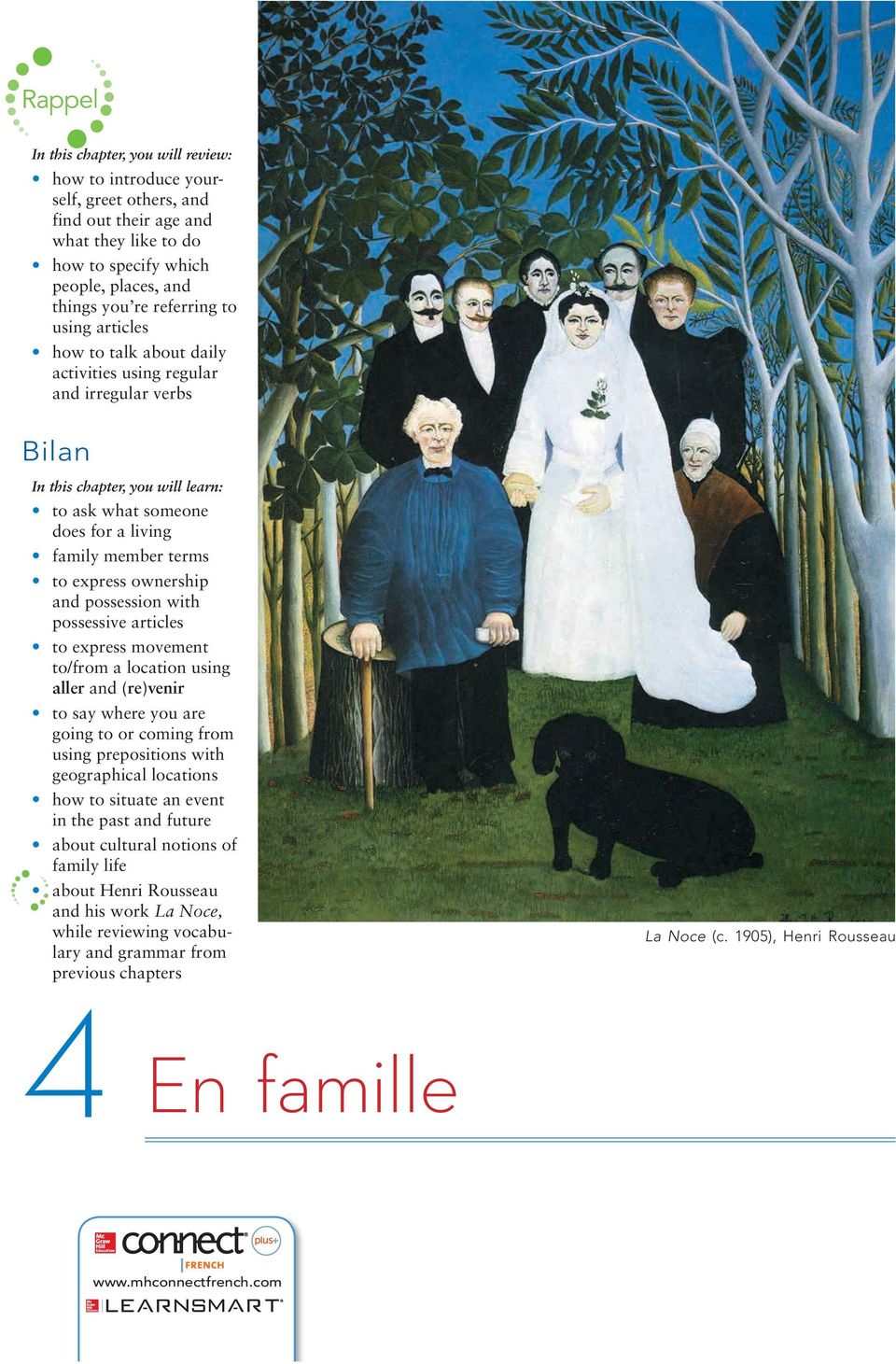
1 Rappel In this chapter, you will review: how to introduce yourself, greet others, and find out their age and what they like to do how to specify which people, places, and things you re referring to using articles how to talk about daily activities using regular and irregular verbs Bilan In this chapter, you will learn: to ask what someone does for a living family member terms to express ownership and possession with possessive articles to express movement to/from a location using aller and (re)venir to say where you are going to or coming from using prepositions with geographical locations how to situate an event in the past and future about cultural notions of family life about Henri Rousseau and his work La Noce, while reviewing vocabulary and grammar from previous chapters La Noce (c. 1905), Henri Rousseau 4 En famille
2 Communication en direct Qui est-ce? Qu est-ce que tu fais / vous faites dans la vie? Meeting people and finding out what they do for a living In previous chapters, you learned how to greet people, say good-bye, and ask and answer the following questions: Tu t appelles comment? / Comment vous appelez-vous?; Comment ça va? / Comment vas-tu? / Comment allez-vous?; Tu as quel âge? / Quel âge avez-vous?; Tu es d où? / D où êtes-vous?; Quelle est ta/votre nationalité? Another question that you might want to ask someone is what he/she does for a living: Qu est-ce que tu fais / vous faites dans la vie ( for a living )? Je suis infirmière ( nurse ). Sometimes people just say what field they are in: Qu est-ce que tu fais / vous faites dans la vie? Je travaille dans l informatique ( computers ) / dans le marketing. Warm-up: Verify that sts. know how to answer the questions from Chapitres 1 3 by asking a few sts. each of the questions before you present the new question. En français Names of professions (métiers) are considered to be nouns, but they can also be thought of as adjectives that describe people. For this reason, there are two ways in French to say what someone s job/profession is: Il est journaliste. / Elle est journaliste. He/She is a journalist. ( profession functioning like an adjective ) C est un(e) journaliste. ( profession as noun ) He/She is a journalist. A. À l écran. Watch and listen as the people in the video introduce themselves, then complete the chart on the next page with the missing information. Previewing (Act. A): In the interviews, sts. will hear the people present Vidéo themselves and provide a lot of information without responding to individual questions. Before you begin, elicit the actual questions one would ask to get the information in the various categories in the chart on the next page. Communication en direct 97
3 Answers (Act. A): 1. Élisabeth, 21 ans, étudiante ans, Montréal, enseignant 3. Taïwan, violoniste 4. Antoine, 32 ans, psychologue 5. étudiant 6. Jean-Jacques Lebon, 29 ans, France, directeur (de) marketing g( (dans une banque) Attention! In the names column, you need to write only their first name. In addition to the information you have heard before, each person will also say what he/she does for a living. Fill in the appropriate profession for each one of them: directeur de marketing, enseignant ( instructor ), étudiant, étudiante, psychologue, violoniste. Nom Âge Ville / Pays d origine 1. dans le sud-ouest de la France, pas très loin de Bordeaux / France Métier 2. Marc-Antoine Tanguy 3. Ching-yung Tu 32 ans 4. Le Mans 5. Nicolas Chane Pao Kan 22 ans île de la Réunion 6. Script (Act. A): 1..Jem ap m appelle pelle Élisabeth..J J ai 21 ans et tjes suis étudiante. t Je viens àl ori l origine i du sud-ouest de la France, pas très loin nd de ebordeaux. 2. Je m appelle Marc-Antoine Tanguy. Puis, j habite à Montréal. J ai 33 ans. Je suis enseignant. J enseigne le français. 3. Bonjour. Je m appelle Ching-yung Tu. J ai 32 ans. Je suis violoniste et je viens de Taïwan. 4. Bonjour. Je m appelle Antoine. J ai 32 ans et je suis psychologue. Je suis français. J habite Le Mans. 5. Je m appelle Nicolas Chane Pao Kan. J ai 22 ans. Je viens de l île de La Réunion. Je suis étudiant à l Université de Montréal. 6. Je m appelle Jean-Jacques Lebon. J ai 29 ans. Je suis directeur (de) marketing dans une banque. Et je suis de nationalité française. 98 Chapitre 4 En famille

4 Chez les francophones: Au Québec La langue en mouvement Language evolves constantly, often because of societal changes. For example, many women now hold jobs that only men held in the past. As a result, new feminine forms for names of professions have appeared in the French language. In Quebec, they did so earlier and with greater frequency than in France, thanks in part to a more progressive attitude toward language use and language change than one typically finds in France. These changes were also due to the efforts of Québec s Office de la langue française in publicizing them. In France, a number of professions still retain only the masculine form in the dictionary, but feminine forms, such as une écrivaine ( a writer ), the feminized form of un écrivain, can be found in newspapers and magazines. Also in France, some masculine nouns may be prefaced by une femme when they are used to refer to a woman. Here are some examples: Métiers En France Au Québec (plus rare en France) engineer une femme ingénieur une ingénieur e orchestra conductor une femme chef d orchestre un e chef d orchestre painter une femme peintre un e peintre surgeon une femme chirurgien un e chirurgien ne Et chez vous? Est-ce que les noms de métier posent aussi un problème en anglais? Pourquoi ou pourquoi pas? Quels noms de métier «traditionnels» en anglais se terminent en ( end in ) -man? Utilisez-vous une autre forme de ces noms quand vous parlez d une femme? Vocab supp Here is a list of names of additional professions (most of which, with the exception of the first set of examples, have separate masculine and feminine forms): Mon père / Ma mère est artiste / comptable / dentiste / journaliste. Il est Elle est avocat ( lawyer ) avocate coiffeur directeur de marketing écrivain coiffeuse facteur ( postal worker ) factrice directrice de marketing femme écrivain homme d affaires ( businessman ) femme d affaires infirmier informaticien ingénieur médecin musicien infirmière informaticienne femme ingénieur femme médecin musicienne ouvrier ( factory worker ) ouvrière père au foyer ( stay-at-home dad ) mère au foyer ( stay-at-home mom ) policier serveur policière serveuse Communication en direct 99

5 Previewing (Act. B): Before watching the video, have sts. read the Chez les francophones feature and answer the Et chez Vidéo vous? questions. Suggestion: Have sts. watch the entire segment and listen for the correct answers. You may wish to have them guess the profession of each person by pausing the video at the beginning of each clip, before the person speaks. Script (Act. B): 1. Je suis mannequin et en même temps, je vais à l école, étudiante. 2. Je suis journaliste. 3. Je suis pharmacien. 4. Je suis médecin à Grenoble, à l hôpital de Grenoble. 5. Je travaille dans l informatique. 6. Je travaille dans une banque américaine à Paris. 7. Je suis infirmier. 8. Dans la vie, je suis comptable. 9. Je suis coordinatrice de projets. Answers (Act. B): 1. i, e 2. h 3. g 4. f 5. c 6. d 7. b 8. a 9. j B. À l écran. Now, watch and listen as the following people answer the question: Qu est-ce que tu fais / vous faites dans la vie? Match each person to his/her profession, field, or place of business. Attention! One person has two professions. 1. Keysha 2. Xavier 3. Anne-Claire 4. Raphaël 5. Nicolas 6. Sélim Usage Note: Anne-Claire uses the masculine form: je suis pharmacien when she gives her profession. Sur la vidéo: The new interviewees in this segment were filmed in the following locations: 1. Keysha Les Halles, Paris; 6. Sélim La Défense, Paris. Suggestion (Act. C): Refer sts. back to the Vocab supp feature on page 99 for a list of additional professions. Supply them with any additional words they need (such as charpentier, électricien, plombier, pompier, secrétaire ). As a quick review, ask sts. questions about their answers and those of their classmates. 7. Lahcen 8. Mounira 9. Cécile a. comptable ( accountant ) b. infirmier c. dans l informatique d. dans une banque américaine à Paris e. étudiante f. médecin ( doctor ) g. pharmacienne h. journaliste i. mannequin ( model ) j. coordinatrice de projets C. Et vous? Work in groups of three. Fill in the following chart with your personal information, then ask your classmates questions and fill in their information. Also find out what one member of each classmate s family does for a living. Follow the model. EXEMPLE: É1: Qu est-ce que ta mère (ton père) fait dans la vie? É2: Elle/Il estomptable. 1. moi Nom Âge Ville/Pays d origine Métier Métier d un membre de la famille Chapitre 4 En famille

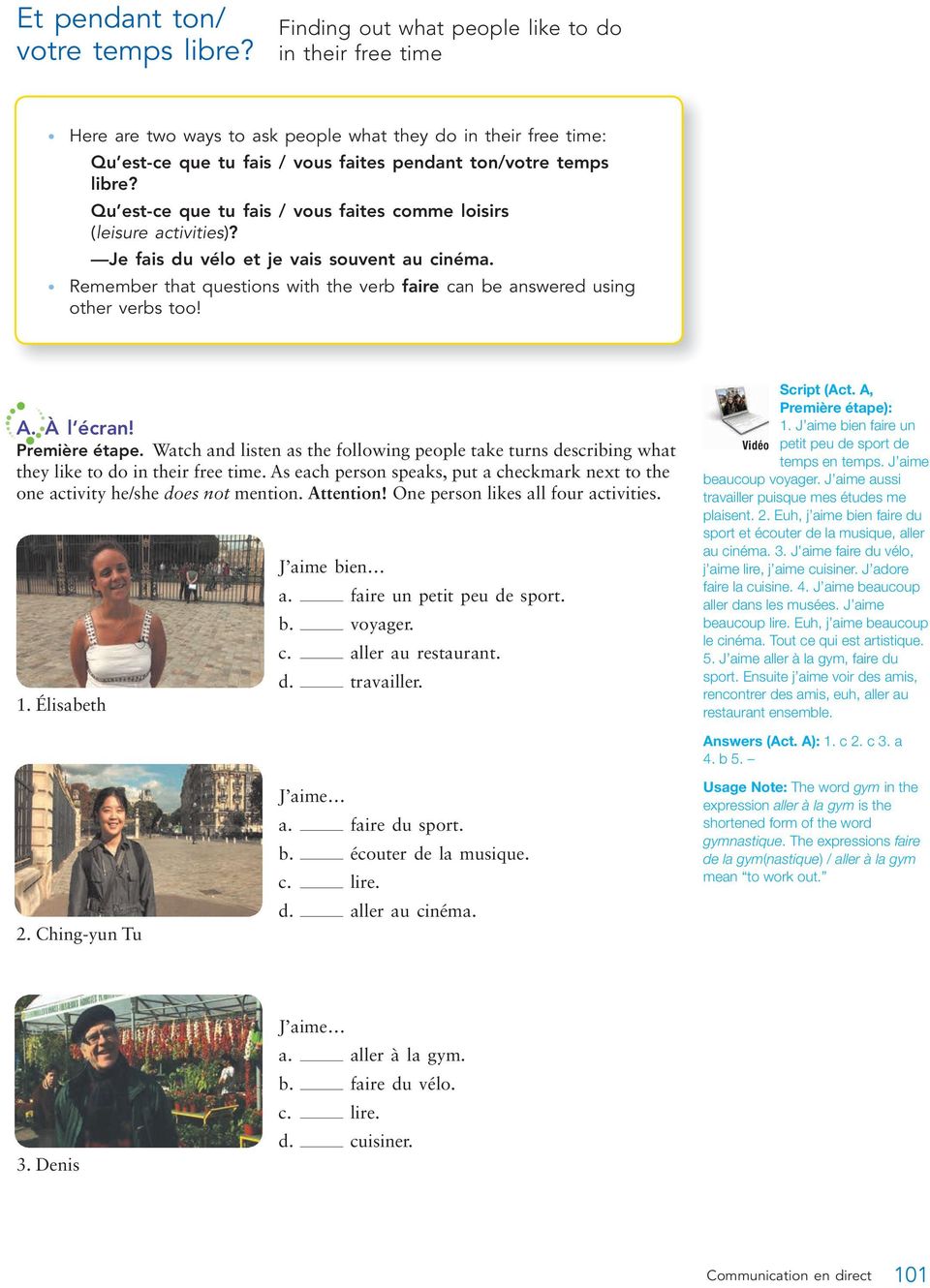
6 Et pendant ton/ votre temps libre? Finding out what people like to do in their free time Here are two ways to ask people what they do in their free time: Qu est-ce que tu fais / vous faites pendant ton/votre temps libre? Qu est-ce que tu fais / vous faites comme loisirs ( leisure activities )? Je fais du vélo et je vais souvent au cinéma. Remember that questions with the verb faire can be answered using other verbs too! A. À l écran! Première étape. Watch and listen as the following people take turns describing what they like to do in their free time. As each person speaks, put a checkmark next to the one activity he/she does not mention. Attention! One person likes all four activities. 1. Élisabeth J aime bien a. faire un petit peu de sport. b. voyager. c. aller au restaurant. d. travailler. Script (Act. A, Première étape ): 1. J aime bien faire un Vidéo petit peu de sport de temps en temps. J aime beaucoup voyager. J aime aussi travailler puisque mes études me plaisent. 2. Euh, j aime bien faire du sport et écouter de la musique, aller au cinéma. 3. J aime faire du vélo, j aime lire, j aime cuisiner. J adore faire la cuisine. 4. J aime beaucoup aller dans les musées. J aime beaucoup lire. Euh, j aime beaucoup le cinéma. Tout ce qui est artistique. 5. J aime aller à la gym, faire du sport. Ensuite j aime voir des amis, rencontrer des amis, euh, aller au restaurant ensemble. 2. Ching-yun Tu J aime a. faire du sport. b. écouter de la musique. c. lire. d. aller au cinéma. Answers (Act. A): 1. c 2. c 3. a 4. b 5. Usage Note: The word gym in the expression aller à la gym is the shortened form of the word gymnastique. The expressions faire de la gym ( nastique ) / aller à la gym mean to work out. 3. Denis J aime a. aller à la gym. b. faire du vélo. c. lire. d. cuisiner. Communication en direct 101
7 4. Dominique J aime a. aller dans les musées. b. voyager. c. lire. d. aller au cinéma. Preparation (Act. B, Deuxième étape ): Go over the content of the En français feature before beginning the Deuxième étape of Act. B. After the first pair of students has reported back using On aime (n aime pas), encourage subsequent pairs to use Nous, on aime (n aime pas) to emphasize the contrast. (Several activities in the remainder of this chapter provide additional practice for using on in place of nous.) En français In Chapitre 2, you learned that the pronoun on is equivalent in meaning to les gens ( people [in general] ) and, in Chapitre 3,that it can also be equivalent in meaning to une personne or quelqu un ( someone ). In informal spoken French, on is also used very frequently in place of nous, when talking about oneself as a part of a group of people. On aime (= nous aimons) faire du vélo. We like to go bike riding. You will even hear French speakers using nous followed by on when contrasting themselves (as a part of a group) with others. Nous, on aime faire du vélo. We (as for us), we like to go bike riding. 5. Mounira J aime a. aller à la gym. b. faire du sport. c. voir des amis. d. aller au restaurant. Deuxième étape. Based on their interests, how would you describe Ching-yun Tu, Denis, Dominique, Élisabeth, and Mounira: cultivé(e)? intellectuel(le)? sportif/ sportive? dynamique? etc. Who are you most like? EXEMPLE: Moi, je suis sportif/sportive comme Mounira. J aime faire du vélo et aller à la gym. B. Qu est-ce que tu fais pendant ton temps libre? Première étape. Work with someone in class whom you don t know well. Write down three activities listed in Activity A that you think your classmate enjoys doing in his/her leisure time. Then find out which ones your classmate really likes to do by taking turns asking Qu est-ce que tu fais pendant tes loisirs? How many of the three did you guess correctly? Deuxième étape. Now, using the pronoun on, report to the class those activities you both like to do and those that neither of you likes to do in your leisure time. EXEMPLE: Nous, on aime bien (beaucoup) Nous, on n aime pas (pas trop) Une jeune femme fait du vélo en Provence. 102 Chapitre 4 En famille

8 Vocabulaire interactif En famille Family members and pets Read each of these statements about Léa s family tree, then answer the questions that follow. Le père de Léa s appelle Bachir; Marie est la mère de Léa. Léa est fille unique: elle n a pas de sœur ; elle n a pas de frère. La tante de Léa s appelle Aurélie; elle est célibataire (elle n a pas de mari ). Grégoire est l oncle de Léa; la femme de Grégoire s appelle Miriam. Grégoire et Miriam ont deux enfants: un fils, Édouard, et une fille, Lucie. La grand-mère de Léa s appelle Françoise; Richard est le grand-père de Léa. Léa a un poisson rouge, Sam, et un chat, Roxy. Édouard ( le cousin de Léa) et Lucie ( la cousine de Léa) ont un chien, Prince, et un hamster, Dutch. L arbre généalogique Note: The presentation and activities in this section use definite and indefinite articles with family member terms. The first-person possessives mon, ma, and mes are introduced here, but with limited use in the activities. Forms of the possessive article are presented in Grammaire interactive 4.1. Presentation Tip: Read aloud the statements about Léa s family tree while sts. study the illustration. Then, call on a st. to read aloud one of the questions below for the rest of the class to answer. Explain, using paraphrases, what the boldface terms in the questions mean if sts. don t comprehend (e.g., un neveu c est le fils d un frère ou d une sœur ). Françoise (72 ans) Richard (78 ans) Bachir (52 ans) Marie (50 ans) Aurélie (44 ans) Grégoire (42 ans) Miriam (40 ans) Sam Léa (16 ans) Roxy Prince Édouard (13 ans) Lucie (10 ans) Dutch Answer the following questions. 1. Qui sont les parents de Léa? 2. Quel âge a la mère de Léa? et le père de Léa? 3. Comment s appellent les enfants de Grégoire et Miriam? 4. Qui sont les deux nièces d Aurélie? 5. Quel âge a le neveu d Aurélie? 6. Qui sont les grands-parents de Léa? 7. Il y a combien de petits-enfants dans la famille? 8. Qui est le petit-fils de Françoise et Richard? 9. Comment s appellent les deux petites-filles de Françoise et Richard? 10. Combien d animaux domestiques y a-t-il dans la famille? Additional Practice: Continue this inductive presentation by asking questions based on the illustration (e.g., Miriam est la mère de qui? Bachir est le mari de qui? Aurélie est la sœur de qui? Grégoire est l oncle de qui? Lucie est la petite-fille de qui? ). Answers to this activity are in Appendice 2 at the back of the book. Vocabulaire interactif 103

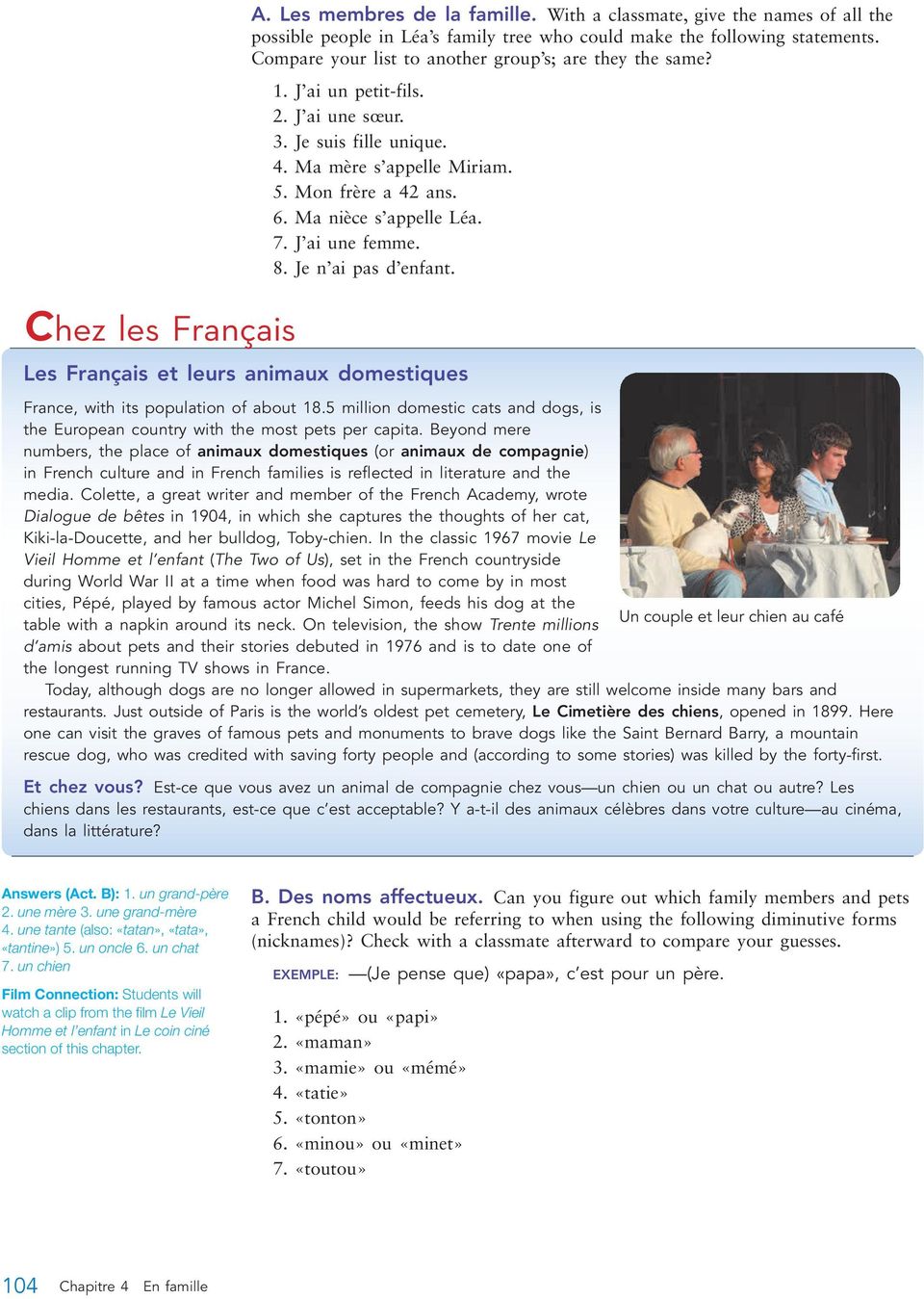
9 Chez les Français A. Les membres de la famille. With a classmate, give the names of all the possible people in Léa s family tree who could make the following statements. Compare your list to another group s; are they the same? 1. J ai un petit-fils. 2. J ai une sœur. 3. Je suis fille unique. 4. Ma mère s appelle Miriam. 5. Mon frère a 42 ans. 6. Ma nièce s appelle Léa. 7. J ai une femme. 8. Je n ai pas d enfant. Les Français et leurs animaux domestiques France, with its population of about 18.5 million domestic cats and dogs, is the European country with the most pets per capita. Beyond mere numbers, the place of animaux domestiques (or animaux de compagnie ) in French culture and in French families is reflected in literature and the media. Colette, a great writer and member of the French Academy, wrote Dialogue de bêtes in 1904, in which she captures the thoughts of her cat, Kiki-la-Doucette, and her bulldog, Toby-chien. In the classic 1967 movie Le Vieil Homme et l enfant ( The Two of Us ), set in the French countryside during World War II at a time when food was hard to come by in most cities, Pépé, played by famous actor Michel Simon, feeds his dog at the table with a napkin around its neck. On television, the show Trente millions Un couple et leur chien au café d amis about pets and their stories debuted in 1976 and is to date one of the longest running TV shows in France. Today, although dogs are no longer allowed in supermarkets, they are still welcome inside many bars and restaurants. Just outside of Paris is the world s oldest pet cemetery, Le Cimetière des chiens, opened in Here one can visit the graves of famous pets and monuments to brave dogs like the Saint Bernard Barry, a mountain rescue dog, who was credited with saving forty people and (according to some stories) was killed by the forty-first. Et chez vous? Est-ce que vous avez un animal de compagnie chez vous un chien ou un chat ou autre? Les chiens dans les restaurants, est-ce que c est acceptable? Y a-t-il des animaux célèbres dans votre culture au cinéma, dans la littérature? Answers (Act. B): 1. un grand-père 2. une mère 3. une grand-mère 4. une tante (also: «tatan», «tata», «tantine») 5. un oncle 6. un chat 7. un chien Film Connection: Students will watch a clip from the film Le Vieil Homme et l enfant in Le coin ciné section of this chapter. B. Des noms affectueux. Can you figure out which family members and pets a French child would be referring to when using the following diminutive forms (nicknames)? Check with a classmate afterward to compare your guesses. EXEMPLE: (Je pense que) «papa», c est pour un père. 1. «pépé» ou «papi» 2. «maman» 3. «mamie» ou «mémé» 4. «tatie» 5. «tonton» 6. «minou» ou «minet» 7. «toutou» 104 Chapitre 4 En famille
10 C. Qui est qui? Working in pairs, come up with two ways to identify each person in Léa s family tree. EXEMPLE: Bachir É1: Bachir est le père de Léa. É1: C est aussi le mari de Marie. 1. Édouard 2. Françoise 3. Miriam 4. Lucie 5. Richard 6. Marie 7. Aurélie 8. Grégoire D. L identité secrète. Secretly assume the identity of one of the people in Lea s family tree. Your classmate will ask questions about your family to figure out who you are. EXEMPLE: É1: Qui est Françoise? É2: C est ma grand-mère. É1: Qui est Édouard? É2: C est mon frère. É1: Tu es Lucie? É2: Oui! Vocab supp To tell the age of family members 70 years and older, you ll need to know how the numbers 70 and above are formed in French. Here are a few examples: 70 soixante-dix 81 quatre-vingt-un 100 cent 71 soixante et onze 82 quatre-vingt-deux 200 deux cents 72 soixante-douze 90 quatre-vingt-dix 201 deux cent un 80 quatre-vingts 91 quatre-vingt-onze mille E. Qui est-ce? Take turns with a classmate reading aloud the following statements. Refer to Léa s family tree and identify who the person is, his/her relationship to Léa, and the year that each person was born using Il/Elle est né(e) en. EXEMPLE: Il a 52 ans. 1. Il a 78 ans. 2. Elle a 72 ans. 92 quatre-vingt-douze deux mille To tell the year in which someone was born, say Il/Elle est né(e) en + the year. Here are some examples of how to say the year: 1970 mille neuf cent soixante-dix or dix-neuf cent soixante-dix 2002 deux mille deux C est Bachir, le père de Léa. Il est né en 3. Il a 42 ans. 4. Elle a 40 ans. 5. Il a 13 ans. 6. Elle a 10 ans. Expansion: Give sts. a copy of your family tree with only a few names filled in, and ask them to complete the tree as you describe your family. If you want to make the act. more challenging, ask sts. to listen for additional information, such as ages and years of birth, personality traits (to recycle vocabulary from Chapitre 2 ), and/or preferred activities (to recycle vocabulary from Chapitre 3 ). Preparation: Present the content of the En français feature before continuing with the remainder of the activities. Presentation Tips: (1) Show on the board how the numbers 70 through 99 are derived: = 70, = 71, etc.; 4 20 = 80, = 81, etc.; = 90, = 91, etc. Then have sts. say the following numbers aloud: 73, 74, 85, 86, 97, 98, 99; (2) Point out that, in French, a period (or a space) is used in place of a comma in numbers above (3) Point out the plural form cents with hundreds when no other number follows ( deux cents ) but the singular form otherwise ( deux cent un ) and contrast this with mille, which is always singular ( mille, deux mille ); (4) Present the two ways of indicating years before 2000 versus the sole way for the year 2000 and beyond. (5) Point out that sts. have already seen a different conjugation of il/elle est né ( e ) in Chapitre 2, Communication en direct : je suis né ( e ). Follow-up (Act. E): Have sts. say how old different members of their family are and what year they were born. Vocabulaire interactif 105

11 Preparation (Acts. F G): Go over the content of the Vocab supp feature before beginning Acts. F G. Use Léa s family tree on page 103 to demonstrate in-law terms, asking: Qui est le beau-père de Bachir? Qui est la belle-fille de Françoise et Richard? Qui est la belle-sœur de Marie? Quel adulte dans la famille est célibataire? Qui a une sœur cadette? Qui a un frère aîné? Chez les Français Les noms de famille Here are the ten most common last names (noms de famille) in France (half of them are also used as first names for males!): 1. Martin 6. Richard 2. Bernard 7. Petit 3. Dubois 8. Durand 4. Thomas 9. Leroy 5. Robert 10. Moreau When referring to a family by its last name, les is used before the name but an s is not added to the name itself; for example, les Martin ( the Martins ). Et chez vous? What are the most common last names in your country? What is the origin of these names? Prononcez bien! To learn about the spelling and pronunciation of the mid-vowels [o] as in vélo and [ ] as in sport, see the Prononcez bien! section of the Workbook / Laboratory Manual. c Culture Connection: Explain the origin of the word pacsé ( e ). For more information on the PACS, refer sts. to page 123. Vocab supp Here are some additional family terms that may be useful to you in completing Activities F and G: un demi-frère / une demi-sœur * un beau-frère / une belle-sœur un beau-père / une belle-mère un beau-fils / une belle-fille un frère / une sœur aîné(e) un frère / une sœur cadet(te) être célibataire décédé(e) divorcé(e) fiancé(e) marié(e) pacsé(e) *These terms are also used to refer to siblings in a blended family who are not blood-related. F. Un arbre généalogique. Première étape. Draw a family tree of your immediate family that is similar in style to Léa s family tree on page 103. Label each person in the tree with a familymember term ( mère, for example), first name, age, and profession, where applicable. Deuxième étape. Give your family tree to a classmate; he/she will examine the tree, ask questions about it if anything is unclear, and prepare to tell the rest of the class one or two interesting facts about your family. EXEMPLES: Le père de Susan s appelle Greg. Il a seulement 38 ans! La mère de Bill a cinq sœurs. Bill a cinq tantes et trois oncles! Les parents de John sont professeurs à la fac. G. Une famille française. Work with two other classmates. Together, write a description of a French family to present to the rest of the class. The family should consist of four members and perhaps a pet. Give your family a traditional name from among those in the En français feature; the family itself can be as (non-)traditional as you wish. Include the same sorts of details as in the model. EXEMPLE: Les Martin a half-brother / half-sister a brother-in-law / a sister-in-law a stepfather / stepmother ( also: father-in-law, mother-in-law ) a stepson / stepdaughter ( also: sonin-law / daughter-in-law ) an elder ( older ) brother/sister a younger brother/sister to be unmarried, single deceased divorced engaged married in a civil union Il y a un père, Vincent, et une mère, Marie. Ils ont une fille, Stéphanie (née en 1998), et un fils, Stéphane (né en 2003). Vincent ne travaille pas: il est père au foyer. Mais Marie est avocate. La famille Martin a un animal domestique un chien qui s appelle Zouzou. Pendant leur ( their ) temps libre, les parents aiment faire du jardinage et les enfants aiment jouer aux jeux vidéo. Follow-up (Act. G): (1) Call on groups to present their description, commenting on the extent to which each description corresponds to a traditional versus non-traditional family. (2) Recycle personality adjectives from Chapitre 2 by asking sts. which member of their imaginary family best demonstrates a particular trait (e.g., Qui dans la famille est sportif / très amusant / heureux / pas très intellectuel? ). 106 Chapitre 4 En famille

12 Grammaire interactive Rappel Dans la salle de classe: Personne (nationalité): Profession: Membre de la famille: 4.1 C est ma famille Possessive articles 1 Possessive articles (also called possessive adjectives ) are used to indicate to whom something belongs. Like the indefinite articles you just used in the Rappel section, they agree in gender and number with the noun that follows them. This means that they agree with the thing that is owned/possessed not with the person who owns/possesses them. C est mon livre / ma voiture. That s my book / my car. C est son livre. C est sa voiture. J aime bien mes cours. Il/Elle aime bien ses cours. Noun gender and number Le Petit Bac ( Scattergories ). For each of the following categories, come up with a noun that starts with the letter indicated at the top of each column. Be sure to use the appropriate indefinite article (un, une, des), depending on the gender and number of the noun. M F C un mur un(e) Mexicain(e) un médecin une mère That s his or her book. That s his or her car. I like my classes. He/She likes his or her classes. You should now be able to fill in the missing possessive articles in the following chart, using those already provided as clues. To review the singular indefinite articles un/une and noun gender, see Chapitre 1, Grammaire interactive 1.1. To review the plural indefinite article des and noun number, see Chapitre 1, Grammaire interactive 1.2. Answers to this activity are in Appendice 2 at the back of the book. Suggestion: Have sts. complete the Rappel act., based on the popular game Scattergories (known as le Petit Bac in France), in groups of three or four. Give them a time limit of 3 minutes to complete the remaining two columns. The letters P and B can be added to make the game more challenging. Afterward, have one group join up with another to compare and cross out duplicate answers. The group with the greatest number of unique answers wins! Follow-up: Use st. responses to review noun gender and the forms un and une (as used with inanimate objects and with people). Ask what the plural form would be of various responses. Transition Tip: As a transition to presenting possessive articles in Grammaire interactive 4.1, ask why mon is used with père, ma with mère, and mes with parents. Note: We have chosen to use the term possessive articles (rather than the traditional term possessive adjectives) because it is helpful for students to recognize that their form, position, and use are more similar to articles than to adjectives. MASCULIN FÉMININ PLURIEL mon père mère parents grand-père ta grand-mère grands-parents son cousin cousine ses cousin(e)s notre ( our ) oncle/tante nos oncles/tantes votre ( your ) frère/sœur frères/sœurs leur ( their ) ami(e) leurs ami(e)s Answers to this activity are in Appendice 2 at the back of the book. Grammaire interactive 107

13 2 Liaison occurs as a [n] sound between the singular possessive articles mon, ton, and son and a noun beginning with a vowel or h. It also occurs as a [z] sound between all the plural possessive articles and a noun beginning with a vowel or h. mon ordinateur nos oncles ( ton appartement leurs ami(e)s ( [n] [n] ( [z] ( [z] Follow-up: After sts. fill in the blanks, reinforce the use of the special form ton with liaison in item 4 and the distinction between ton impression and ta première année even though both nouns are feminine and start with a vowel. Allow sts. to ask a classmate the questions they ve created. 3 Whenever a feminine singular noun begins with a vowel or h (for example, affiche ), the possessive articles mon, ton, and son are used in place of the usual feminine forms ma, ta, and sa. This is for ease of pronunciation. Liaison occurs. Compare: ma carte ( f. ) but: mon affiche ( f. ) ta maison ( f. ) but: ton école ( f. ) sa directrice ( f. ) but: son assistante ( f. ) The use of the masculine form will also occur before an adjective that begins with a vowel, even if the noun that it describes is feminine. ma directrice ma p remière directrice but: mon au tre directrice Mise en pratique 1. Complete each question in the chart with the appropriate form of the possessive article ton / ta / tes. In which question would the form ton (with liaison ) be used? 1. C est première année ici? 2. Tu aimes tous (all) cours ce semestre/trimestre? ( ( 3. Le français est cours préféré? 4. Quelle est impression du campus? 5. Tu habites avec amis? 6. Tu téléphones souvent à parents? [n] [n] [n] ( ( [n] 4 Be careful to distinguish between the use of son/sa/ses when things belong to a single person (equivalent to English his, her, or its ) and leur/leurs when things belong to two or more people (equivalent to English their ). Mise en pratique 2. Complete each sentence with the appropriate form of son/sa/ses or leur/leurs, then the name(s) of the family members being referred to from the family tree on page 103. Answers to the activities on this page are in Appendice 2 at the back of the book. 1. le père de Grégoire : Son père s appelle Richard. 2. la belle-sœur d Aurélie : belle-sœur s appelle. 3. les cousins de Léa : cousins s appellent et. 4. l oncle d Édouard et de Lucie : oncle s appelle. 5. la fille de Bachir et de Marie : fille s appelle. 6. les petites-filles de Françoise et de Richard: petites-filles s appellent et. 108 Chapitre 4 En famille
![mon ordinateur nos oncles ( ton appartement leurs ami(e)s ( [n] [n] ( [z] ( [z] Follow-up: After sts.](/docs-images/43/2323016/images/page_13.jpg "fill in the blanks, reinforce the use of the special form ton with liaison in item 4 and the distinction between ton impression and ta première année even though both nouns are feminine and start")
14 A. Écoutez bien! Your instructor will make statements about Édouard and Lucie s family members. Check off which person your instructor is most likely talking about. 1. son frère sa mère ses parents 2. son grand-père sa sœur ses oncles 3. son père sa grand-mère ses tantes 4. son oncle sa cousine ses grands-parents 5. leur poisson leur chat leur chien 6. leur grand-mère leur grand-père leurs grands-parents 7. leur mère leur père leurs parents Act. A (Script): 1. Lucie aime beaucoup cette personne; elle a 40 ans; elle est gentille et belle. 2. Édouard adore cette personne; il a 78 ans et il a les cheveux gris; c est quelqu un de très généreux. 3. Lucie parle souvent à ces deux personnes quand elles viennent à la maison; elles sont toujours très amusantes. 4. Édouard joue souvent à des jeux vidéo avec cette personne. Elle est Chez les francophones: En Afrique de l Ouest La famille élargie extended In French-speaking West African countries such as Senegal, Cameroon, and Benin, ma famille may refer to many more members than the nuclear family one typically finds in France and the U.S. In Senegal, for example, the traditional model is the extended family ( famille élargie ), comprising on average eight family members (parents, children, grandparents, aunts and uncles, cousins, etc.) who live in the same village and sometimes in the same family compound of buildings set around a common courtyard. Yet things are changing there, too: Modernization and urbanization are playing significant roles in the transformation of the traditional family. Young West Une famille élargie au Sénégal Africans seeking a modern education and wages often have to relocate on their own to a major urban center within their country or even study and work abroad. They most often send back home whatever extra money they have, as individualism is not a traditional value; a person is first and foremost a member of the family. Et chez vous? Quelle est la taille moyenne ( average size ) d une famille dans votre culture? Parlez-vous souvent à vos tantes, vos oncles et vos cousins? Est-ce qu on organise des «réunions» pour rassembler ( gather together ) les membres de votre famille élargie? B. Le plus loin. ( The farthest away ). Tell a classmate in which cities various members of your extended family live (for example, Mes grands-parents habitent à / près de Detroit ). Your classmate will figure out which of your family members lives the farthest away and then tell the class (e.g., Son oncle Jim habite le plus loin, à Miami ). C. Comment sont-ils? Working in pairs, take turns describing yourself and others based on the topics provided below. Use the appropriate form of the possessive article and an adjective of your choice. amis cours ce semestre famille vacances ( f. pl. ) appartement devoirs journée à la fac vie ( f. ) ( life ) chien/chat enfant(s) travail voiture jeune, comme lui. 5. Il joue dehors avec Lucie et Édouard. Il est gros, mais très sympa. 6. Lucie et Édouard passent le week-end chez ces deux personnes. Ils font toujours un grand repas le dimanche après-midi. 7. Lucie et Édouard adorent cette personne. Il a 42 ans; il travaille beaucoup, mais il a toujours du temps pour jouer. Act. A (Answers): 1. sa mère 2. son grand-père 3. ses tantes 4. sa cousine 5. leur chien 6. leurs grand-parents 7. leur père EXEMPLES: moi / chat Mon chat est petit et très mignon. mon meilleur ami / voiture Sa voiture est vieille, mais belle. 1. moi 2. nous, les étudiants 3. mon meilleur ami / ma meilleure amie 4. mes parents ( ou mes frères et sœurs ou mes colocataires) Grammaire interactive 109

15 D. Qui est-ce? Grammaire interactive For more on possessive articles, watch the corresponding Grammar Tutorial and take a brief practice quiz at Connect French ( french.com ). Follow-up (Act. D): Call on a few sts. to report back to the class on what they told their classmate. Introduce the expression le portrait craché de as the French equivalent of the spitting image of... and ask various sts. whether they are the spitting image of the person they described. Have them explain why or why not. Additional Act.: See the IM for an activity in which sts. play the role of a biographer, interviewing and then writing a short biography of a classmate or a French speaker they know. Suggestion ( Rappel ): Have sts. complete the Rappel act., then call on volunteers to read their responses aloud; confirm the correct spelling of forms by writing them on the board as volunteers read aloud. Première étape. Working in pairs, describe two family members without stating their relationship to you. Include any or all of the following in your descriptions: name, age, eye/hair color, personality, occupation, studies, and what they do or do not do as daily activities. Your classmate will then try to identify the person you re talking about, asking C est ton/ta/tes? Deuxième étape. Choose one of the people you described in the Première étape and tell your classmate why you love, admire, or like to spend time with this person. EXEMPLE: J aime (J admire, J aime passer du temps avec) mon père parce qu il... E. Forum: La personne que je préfère dans ma famille. For this post in the Forum des étudiants, choose a favorite or notable family member and explain which of his/her characteristics ( sa profession, son pays d origine, où il/elle habite, ce qu il/elle fait comme loisirs, etc.) makes him/her stand out. Follow the model below. Forum >> Divers >> Membres de la famille MESSAGE DE: Cyril23 (Saint-Étienne) posté le Sujet: Mon grand-père J adore toute ma famille, mais mon grand-père est vraiment remarquable. Il est d'origine italienne, mais il parle aussi le français et l allemand. Il n est plus 1 jeune, mais il fait encore du vélo presque tous les après-midis et, grâce à lui, 2 c est aussi mon sport préféré. Le soir, il adore faire des mots croisés 3 avec ma grand-mère. 1 no longer 2 grâce thanks to him 3 mots crossword puzzles Follow-up: Ask sts. questions about their own family using tu/vous and possessive articles ( ton/votre, etc.). Transition Tip: As a transition to presenting aller in Grammaire interactive 4.2, ask which form of être, avoir, and faire sounds similar ( ils/elles sont, ont, font ), and tell sts. they will soon learn a new irregular verb, aller, that has a similar form ( ils/elles vont ). Rappel The verbs être, avoir, and faire La famille de Laura. Complete Laura s description of herself and her family using the appropriate forms of the verbs être, avoir, and faire. To review the verb être and subject pronouns, see Chapitre 1, Grammaire interactive 1.3. To review the verb avoir, see Chapitre 2, Grammaire interactive 2.1. To review the verb faire, see Chapitre 3, Grammaire interactive 3.2. Answers to this activity are in Appendice 2 at the back of the book. Dans ma famille, nous sommes quatre: Moi, je 1 étudiante. En semaine, j 2 besoin d étudier, mais le week-end, je 3 du vélo. Mon frère 4 10 ans et il 5 très mignon. Il 6 souvent du sport avec ses amis (mais pas souvent ses devoirs!). Mes parents 7 avocats. Ils n 8 pas beaucoup de temps libre en semaine, mais ils 9 du yoga ensemble de temps en temps. 110 Chapitre 4 En famille

16 4.2 Il va au cinéma; elle revient du parc. The verbs aller and (re)venir 1 Like the verbs you used in the Rappel section, the verb aller ( to go ) is both frequently used and irregular in its conjugation. je vais tu vas aller ( to go ) nous allons vous allez Note: Forms of aller and ( re ) venir are further practiced in Grammaire interactive Suggestion (Point 1): Remind sts. that they are already familiar with many of these forms, as found in the expressions Comment ça va? and Tu vas / Vous allez bien? il/elle/on va ils/elles vont 2 The verb aller is often used with the preposition à to indicate movement to/toward a location. Ils vont à des concerts en été. They go to concerts in the summer. Tu vas à une fête ce soir? Are you going to a party tonight? When using the preposition à with the definite article (le, la, l, les), contraction occurs with masculine le and plural les, as you saw in Chapitre 3. Tu vas souvent au (à + le) cinéma? à la banque? à l hôpital? aux ( à + les ) fêtes organisées par l université? Note: Sts. are already acquainted with the contracted forms of à and de as used with the verb jouer from Chapitre 3, Vocabulaire interactif. Practice (Point 2): To distinguish between forms of à + definite article, write Tu vas souvent? on the board then provide the following oral prompts: les matchs de foot ( de ton frère ), le cinéma, la banque, le café, le gymnase, les concerts ( de Pharrell Williams ), l opéra, la poste. Usage Note: Point out the use of the preposition en rather than à in aller en cours and aller en vacances. 3 The opposite of the verb aller is the verb venir ( to come ), which is also irregular in its conjugation. You have already seen this verb, which people use to say what city or country they come from, in the phrase je viens de Paris. venir ( to come ) je viens nous venons tu viens vous venez il/elle/on vient ils/elles viennent Pronunciation Tip: Emphasize that the singular and ils/elles forms of venir are all pronounced as a single syllable and that the pronunciation of the letter e in the nous and vous forms resembles that of the vowel sound in deux. 4 The preposition de (d ) can be used with venir, revenir ( to come back ), and rentrer to express movement from a location. Il vient de Paris pour notre fête. Ils reviennent d un concert. Vous rentrez de votre travail? He s coming from Paris for our party. They re coming back from a concert. Are you coming home from work? Note that the verb rentrer ( de ) means to go home / to come home ( from ). Practice (Point 4): To distinguish between forms of de + definite article, write À quelle heure est-ce que tu reviens? on the board, then provide the following oral prompts: le café, les cours, le match, l hôtel, l aéroport, la cérémonie, les présentations. Usage Note: You may wish to point out that it is also possible to use the preposition à with each of these verbs: venir à (to come to), revenir à (to come back to), and with rentrer in the expression rentrer à la maison (to come back home). Grammaire interactive 111

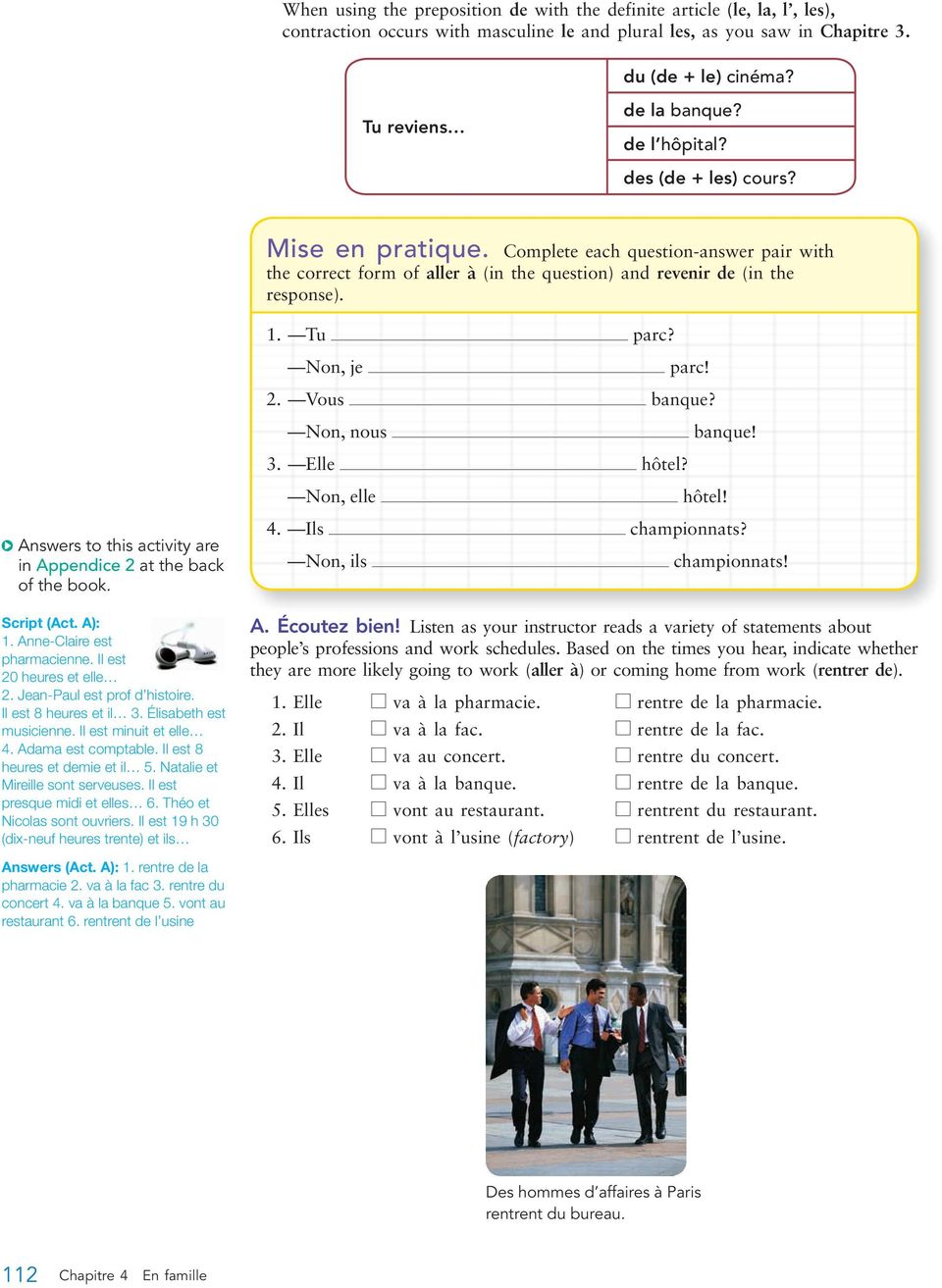
17 When using the preposition de with the definite article (le, la, l, les), contraction occurs with masculine le and plural les, as you saw in Chapitre 3. du (de + le) cinéma? Tu reviens de la banque? de l hôpital? des (de + les) cours? Mise en pratique. Complete each question-answer pair with the correct form of aller à (in the question) and revenir de (in the response). 1. Tu parc? Non, je parc! 2. Vous banque? Non, nous banque! 3. Elle hôtel? Non, elle hôtel! Answers to this activity are in Appendice 2 at the back of the book. Script (Act. A): 1. Anne-Claire est pharmacienne. Il est 20 heures et elle 2. Jean-Paul est prof d histoire. Il est 8 heures et il 3. Élisabeth est musicienne. Il est minuit et elle 4. Adama est comptable. Il est 8 heures et demie et il 5. Natalie et Mireille sont serveuses. Il est presque midi et elles 6. Théo et Nicolas sont ouvriers. Il est 19 h 30 (dix-neuf heures trente) et ils 4. Ils championnats? Non, ils championnats! A. Écoutez bien! Listen as your instructor reads a variety of statements about people s professions and work schedules. Based on the times you hear, indicate whether they are more likely going to work ( aller à ) or coming home from work ( rentrer de ). 1. Elle va à la pharmacie. rentre de la pharmacie. 2. Il va à la fac. rentre de la fac. 3. Elle va au concert. rentre du concert. 4. Il va à la banque. rentre de la banque. 5. Elles vont au restaurant. rentrent du restaurant. 6. Ils vont à l usine ( factory ) rentrent de l usine. Answers (Act. A): 1. rentre de la pharmacie 2. va à la fac 3. rentre du concert 4. va à la banque 5. vont au restaurant 6. rentrent de l usine Des hommes d affaires à Paris rentrent du bureau. 112 Chapitre 4 En famille
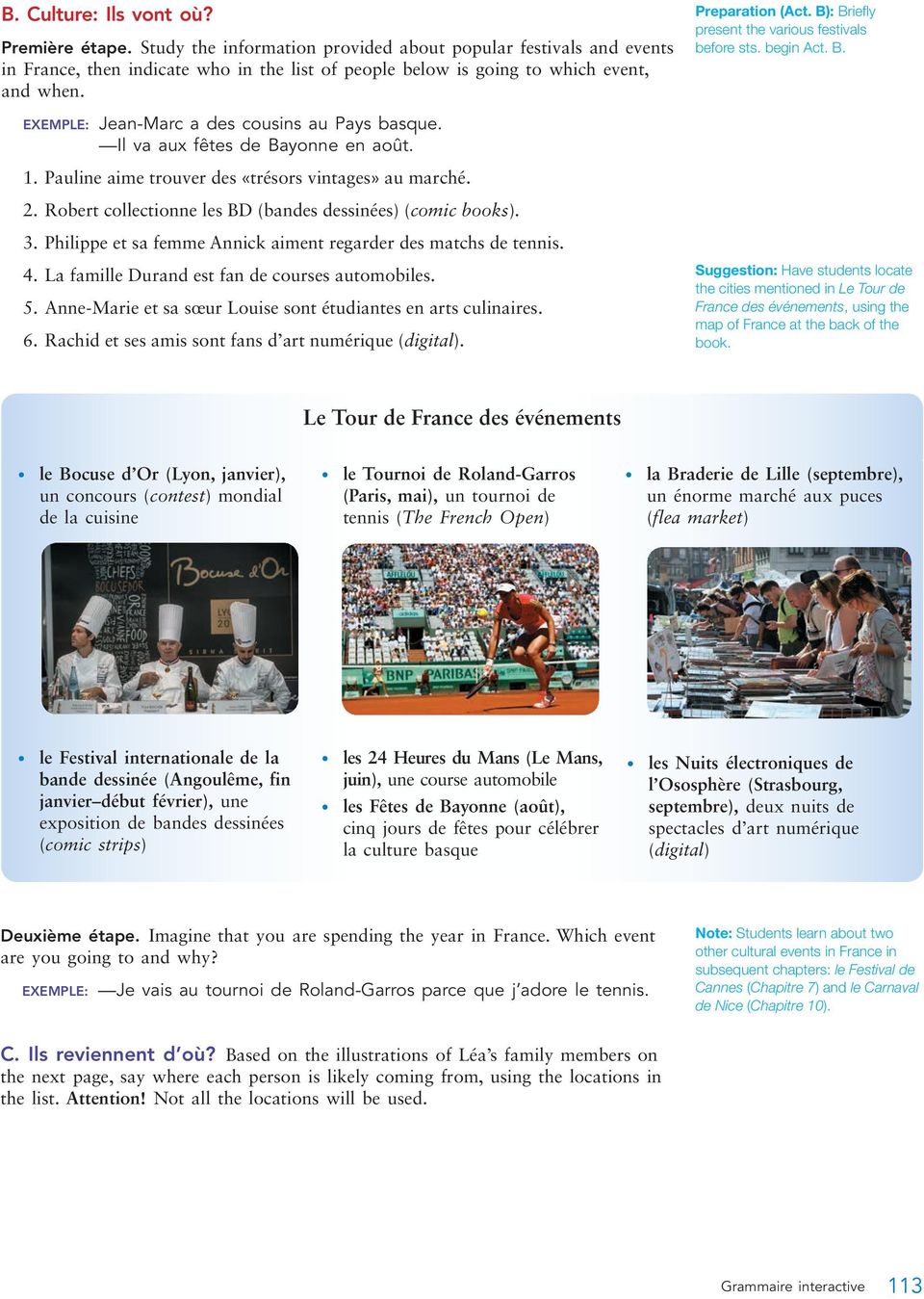
18 B. Culture: Ils vont où? Première étape. Study the information provided about popular festivals and events in France, then indicate who in the list of people below is going to which event, and when. Preparation (Act. B): Briefly present the various festivals before sts. begin Act. B. EXEMPLE: Jean-Marc a des cousins au Pays basque. Il va aux fêtes de Bayonne en août. 1. Pauline aime trouver des «trésors vintages» au marché. 2. Robert collectionne les BD (bandes dessinées) ( comic books ). 3. Philippe et sa femme Annick aiment regarder des matchs de tennis. 4. La famille Durand est fan de courses automobiles. 5. Anne-Marie et sa sœur Louise sont étudiantes en arts culinaires. 6. Rachid et ses amis sont fans d art numérique ( digital ). Suggestion: Have students locate the cities mentioned in Le Tour de France des événements, using the map of France at the back of the book. Le Tour de France des événements le Bocuse d Or (Lyon, janvier), un concours ( contest ) mondial de la cuisine le Tournoi de Roland-Garros (Paris, mai), un tournoi de tennis ( The French Open ) la Braderie de Lille (septembre), un énorme marché aux puces ( flea market ) le Festival internationale de la bande dessinée (Angoulême, fin janvier début février), une exposition de bandes dessinées ( comic strips ) les 24 Heures du Mans (Le Mans, juin), une course automobile les Fêtes de Bayonne (août), cinq jours de fêtes pour célébrer la culture basque les Nuits électroniques de l Ososphère (Strasbourg, septembre), deux nuits de spectacles d art numérique ( digital ) Deuxième étape. Imagine that you are spending the year in France. Which event are you going to and why? EXEMPLE: Je vais au tournoi de Roland-Garros parce que j adore le tennis. Note: Students learn about two other cultural events in France in subsequent chapters: le Festival de Cannes ( Chapitre 7 ) and le Carnaval de Nice ( Chapitre 10 ). C. Ils reviennent d où? Based on the illustrations of Léa s family members on the next page, say where each person is likely coming from, using the locations in the list. Attention! Not all the locations will be used. Grammaire interactive 113
19 l aéroport la boulangerie l hôpital la poste la banque le cinéma le parc le restaurant la bibliothèque la gym la plage (beach) EXEMPLE: Bachir Son père revient de la banque. 1. Marie 2. Édouard et Lucie 3. Richard 4. Françoise 5. Françoise et Marie 6. Miriam 7. Édouard, Lucie et Léa D. Sorties en famille ( Family outings ). Describe how often you and your family go out together, where you go, and why, using the pronoun on. Your classmate should provide a comparison with his/her own family, using nous, on EXEMPLE: É1: Dans ma famille, on va souvent au cinéma ensemble; on aime beaucoup les films! Quelquefois, on va au restaurant après. É2: Nous, on ne va jamais au cinéma ensemble. On préfère faire du sport; on aime beaucoup faire du ski. Suggestion (Act. E): Have sts. find a new classmate to work with to complete Act. E. Additional Activity: See the IM for an activity using rentrer, which recycles telling time and family member terms. E. Êtes-vous occupé(e) le lundi? Describe for a classmate what a typical Monday is like for you: where you go, at what time, what courses you have, what you do in between, what time you return home, etc. Use the ideas in the list below to build your description. Who is the busiest on Mondays (le/la plus occupé[e])? EXEMPLE: D habitude, le lundi, j arrive à la fac à 8 h 45 (neuf heures moins le quart) parce que j ai cours à 9 heures. 1. arriver à la fac le matin 4. faire les devoirs 7. aller chez un(e) ami(e) 2. avoir un cours de 5. revenir de la fac 8. rentrer le soir 3. faire de la gym 6. travailler en ville 114 Chapitre 4 En famille

20 Rappel The form and use of definite articles Le tour du monde. Fill in the blanks with the appropriate form of the definite article le, la, l, or les for the countries/provinces listed in the first column, what the citizens of the country are called (using les ), and at least one language you might study before visiting (using le or l ). Pays Peuple Langue l Allemagne les Allemands l allemand To review the forms and use of definite articles, see Grammaire interactive 1.4. Suggestion: Complete the first column as a class, because sts. may not all know the gender of particular locations. Follow-up: Call on six volunteers to write their responses on the board; review the use of capital letters for nationality groups and the fact that languages are all masculine and begin with a lowercase letter. Québec États-Unis Japon Chine Égypte Brésil 4.3 Vous allez en France? Articles and prepositions with geographical locations 1 With the exception of cities, most geographical locations such as the ones you saw in the Rappel section are accompanied by a definite article, and each has a gender and number. La France est un beau pays. Le Québec est une province canadienne. Les États-Unis sont en Amérique du Nord. France is a beautiful country. Quebec is a Canadian province. The United States is in North America. Answers to this activity are in Appendice 2 at the back of the book. Transition Tip: As a transition to presenting prepositions with geographical locations, ask who in the class wants to go to these countries ( Qui a envie d aller? ) while writing the preposition and country name on the board ( en Allemagne, au Québec, aux États- Unis, au Japon, en Chine, en Égypte, au Brésil ). Ask sts. what they think determines the use of en versus au ( x ). 2 After verbs like aller and venir, a preposition is required before geographical locations. The choice of preposition depends on whether you are talking about a city, country, or continent and whether that location is masculine or feminine, singular or plural. The simplest case is cities, which simply use the prepositions à (to express in/to ) and de (d ) (to express from ). VILLES On va On vient à Paris, à Montréal de Paris, de Montréal 3 Masculine countries use au and du (or aux and des for les États-Unis and les Pays-Bas [the Netherlands], because they are plural), whereas feminine countries and the seven continents use en and de (d ). Note: You may wish to point out that all continents, as well as most countries ending in -e, are feminine; le Mexique is a high-frequency exception. Grammaire interactive 115

21 Additional Practice: (1) Show sts. the following list of feminine countries and continents: l Afrique du Sud, l Australie, la Chine, la Grèce, la Pologne, la Suisse. In pairs, have sts. take turns asking whether the other wants to go to each place using Tu as envie d aller? ; (2) Show sts. the following list of masculine countries: le Brésil, le Japon, le Mexique, les Pays-Bas, le Portugal, le Sénégal. Have them guess where your family comes from using Ta/Votre famille vient? On va On (re)vient PAYS MASCULINS au Mexique, au Brésil, au Japon, aux États- Unis ( m. pl. ), aux Pays-Bas ( m. pl. ) du Mexique, du Brésil, du Japon, des États- Unis, des Pays-Bas PAYS OU CONTINENTS FÉMININS en Allemagne, en Chine, en Égypte, en France, en Italie en Afrique, en Asie d Allemagne, de Chine, d Égypte, de France, d Italie d Afrique, d Asie Mise en pratique. Complete each question with the appropriate prepositions. To learn more about prepositions with geographical locations, see Par la suite at the back of your book. Answers to this activity are in Appendice 2 at the back of your book. 1. Qui va Berlin / Allemagne / Europe? 2. Tu vas Tokyo / Japon / Asie? 3. Vous allez Los Angeles / États-Unis / Amérique du Nord? 4. Qui vient Dakar / Sénégal / Afrique? 5. Tu viens Sydney / Australie? 6. Vous venez Bogata / Colombie / Amérique du Sud? Script (Act. A): 1. Véronique est française; ici, elle étudie l anglais et la linguistique. 2. Mike est américain; il aime étudier l histoire et le russe. 3. Sandra est aussi américaine; elle aime étudier l italien et l art. 4. Ahmad est égyptien; ici, il étudie les sciences politiques. 5. Mariko est japonaise; ici, elle étudie les maths et la statistique. 6. Max est américain; il aime étudier l espagnol et les relations internationales. Answers (Act. A): 1. Elle vient de Toulouse. 2. Il va à Moscou. 3. Elle va en Italie. 4. Il vient d Égypte. 5. Elle vient du Japon. 6. Il va au Mexique. Follow-up (Act. A): While sts. examine the geographical locations listed, ask Quelles sont les villes dans cette liste? Quels sont les pays féminins? Quels sont les pays masculins? Be sure that sts. provide a definite article with country names in the latter two categories. A. Écoutez bien! Your instructor will describe students of various nationalities and what they study. Decide whether each student is going abroad to study or has come from abroad to study at your school. 1. Elle va à Toulouse. Elle vient de Toulouse. 2. Il va à Moscou. Il vient de Moscou. 3. Elle va en Italie. Elle vient d Italie. 4. Il va en Égypte. Il vient d Égypte. 5. Elle va au Japon Elle vient du Japon. 6. Il va au Mexique. Il vient du Mexique. B. Où vont-ils? Jean-Michel and Sara are a young French couple who love traveling the world. Working in pairs, take turns saying which city they are going to and in what country it is located. Can you get all nine correct? EXEMPLE: Frankfort Ils vont à Frankfort, en Allemagne. l Allemagne la Belgique l Espagne les Pays-Bas la Russie l Angleterre la Chine les États-Unis le Portugal la Suisse 1. Amsterdam 4. Genève 7. Londres 2. Barcelone 5. Lisbonne 8. Moscou 3. Bruxelles 6. La Nouvelle-Orléans 9. Pékin Preparation (Act. B): Many of the cities listed in Act. B are ones for which sts. often incorrectly use English-language place names. Before beginning the activity, you may wish to go over the pronunciation of each French-language place name as well as note the exceptional use of a capitalized definite article with La Nouvelle-Orléans (also Le Caire [Cairo] and La Haye [The Hague]). Have sts. report back afterward to determine how many city/country pairs they identified correctly. 116 Chapitre 4 En famille
22 En français To avoid having to repeat a preposition + geographical location, the pronouns y and en can be used in their place. The pronoun y (which you ve already seen in the expression il y a ) can be used with aller, and the pronoun en can be used with (re)venir. Both pronouns appear directly before the conjugated verb. Ils vont à Londres? Oui, ils y vont en été. Ils reviennent de Genève? Are they going to London? Yes, they re going ( there ) in the summer. Are they coming back from Geneva? Oui, ils en reviennent demain. Yes, they re coming back ( from there ) tomorrow. Note: The adverbial pronouns y and en are introduced in this chapter. Other pronouns are progressively introduced and practiced in Chapitres 5 11 so that sts. become naturally accustomed to their use and position while completing tasks that contextualize their use (such as Act. C). There is a complete review of pronouns and their uses in Chapitre 12. C. En voyage. Jean-Michel and Sara s travel itinerary is found in the chart that follows. For each trip, take turns with a classmate asking and telling when they are going to and coming back from each country. Use the pronouns y and en to avoid having to repeat prepositions + geographical locations. EXEMPLE: Algérie É1: Quand est-ce qu ils vont en Algérie? É2: Ils y vont le 30 avril. É1: Quand est-ce qu ils en reviennent? É2: Le 5 mai. Preparation (Act. C): Go over the content of the En français feature before beginning Act. C. Recycling (Act. C): This activity recycles month/date vocabulary from Chapitre 1, Vocabulaire interactif. Pays Arrivée Départ Algérie 30 avril 5 mai Tunisie 12 juillet 21 juillet Espagne 3 septembre 10 septembre Brésil 20 décembre 8 janvier Maroc 11 février 21 février États-Unis 13 mars 26 mars D. Leurs origines. In groups of three, take turns stating someone s origin in the three ways you ve learned. EXEMPLE: Le père d Imée et Aïda le Sénégal É1: Il est né au Sénégal. É2: Il est d origine sénégalaise. É3: Il vient du Sénégal. Recycling (Act. D): This activity recycles expressions from Chapitre 2, Communication en direct. 1. Sharon l Irlande 4. Les parents de Lahcen le Maroc 2. Frank la Suisse 5. Pedro le Mexique 3. La mère de Gina l Italie 6. Les grands-parents de Midori le Japon Grammaire interactive 117
23 Chez les Français «Nos ancêtres les Gaulois» This famous expression, popularized in 19th-century literature and history textbooks, taught French children that the ancestors of the French were les Gaulois, from la Gaule, a territory that covered much of present-day France and was conquered and colonized by the Romans starting in 52 B.C. Other tribes could dispute this title, such as les Francs, who invaded the north of la Gaule in the 5th century A.D. and gave their name to the modern country. The diversity of today s French population is actually the result of three major waves of immigrés who came to France in the 19th and 20th centuries in search of work and a higher standard of living first from neighboring countries such as Italy, Spain, and Belgium during the Industrial Revolution; then from Poland and Italy after World War I; and finally, after World War II, from Portugal and from many of France s former colonies and protectorates in le Maghreb Le coq (rooster) gaulois (Algeria, Morocco, Tunisia), sub- Saharan Africa, and Vietnam. «Nos ancêtres les Gaulois» is therefore more of a cherished historical legend than an accurate description of the ancestry of modern-day France s 65.8 million citizens. Astérix et Obélix Et chez vous? Qui sont les ancêtres des gens de votre pays? Est-ce que cette notion correspond (bien, mal) à la population de votre pays aujourd hui? Pourquoi ou pourquoi pas? Note: The distinction between visiter and rendre visite à is treated in Grammaire interactive, 5.3. For the present activity, the expression aller/venir en visite is used instead. Follow-up (Act. F): As sts. report back to the class on their travel plans, ask questions using the pronoun y such as Pourquoi est-ce que vous y allez? En quelle saison est-ce que vous y allez? Combien de jours est-ce que vous y passez? Encourage the use of on and nous, on as sts. report back and answer follow-up questions. E. Des liens de famille. ( Family ties ). With a partner, take turns answering the following questions, then determine who is the more international of the two of you. 1. Dans quels pays as-tu des liens de famille? 2. Qui sont-ils? Qu est-ce qu ils font dans la vie? 3. Est-ce que tu y vas souvent en visite? Si oui, qu est-ce que tu aimes faire avec eux ( them )? Sinon, pourquoi? 4. Est-ce qu ils viennent ici en visite de temps en temps? Si oui, qu est-ce qu ils aiment faire ici avec toi? Sinon, pourquoi? F. On y va! You and three other classmates have just won a group trip to a city of your choosing outside of North America. In groups of four, each person should say which city he/she prefers to go to (Je préfère aller ) and tell the country where it is located. Each member should explain his/her selection, and the group should come to a consensus about where they will go. Report back to the class on your travel plans, and explain your choice. EXEMPLE: É1: Je préfère aller à Kyoto, au Japon, parce que c est beau et mes grands-parents viennent de Kyoto! É2: Moi, je préfère aller à Sydney, en Australie. C est l hiver et il fait très beau! É3: Oui, moi aussi, j ai envie d aller à Sydney. On y parle anglais et la ville est belle! 118 Chapitre 4 En famille
24 Rappel 1. regarder la télé? 2. écouter de la musique? 3. parler au téléphone? 4. voyager? 5. rester à la maison? 4.4 Qu est-ce que tu vas faire? 1 As you saw in the Rappel section, the present-tense form of a verb in French is used to say what you do in general. It is also used to say what you re doing at the moment of speaking. To say, instead, that an action has just taken place in the recent past, the present-tense forms of the verb venir can be used in the expression venir de (d ) + infinitive. Je viens de faire la vaisselle. Michel vient d arriver. The use of present-tense forms of -er verbs La vie en famille. Who in your family, including yourself, does each activity the most often ( le plus souvent )? Write your response in the blank next to each activity. EXEMPLE: regarder la télé I just did ( have just done ) the dishes. Michael ( has ) just arrived. 2 Still using present-tense verb forms, there are also two ways to say that an action will take place in the near future. The first way is simply to add a time expression to a sentence with a present-tense verb form. Nous arrivons ce soir à 22 h. We re arriving tonight at 10 P.M. J étudie à la bibliothèque demain. I m studying at the library tomorrow. The second way is to use a present-tense form of the verb aller + infinitive, which is called le futur proche ( the near future ). Marie va faire les courses (ce soir). Ils vont passer un examen (demain). Vous n allez pas dîner avec nous? Je ne vais pas aller en cours lundi. Mon frère et moi, nous regardons le plus souvent la télé. Situating events in the recent past and near future Mary is going to do the grocery shopping ( tonight ). They re going to take an exam ( tomorrow ). You aren t going to eat with us? I m not going to go to class on Monday. Notice that the negation ne pas surrounds only the verb aller, followed by the infinitive. To review the forms and use of regular -er verbs, see Chapitre 3, Grammaire interactive 3.1. Suggestion: Call on volunteers to write one of their responses on the board. Afterward, ask sts. to identify the grammatical subject of each sentence, underlining it as they do, and the conjugated verb in each sentence, circling it as they do. Use the sentences to review subject verb agreement. Follow-up: If you had sts. write their sentences on the board, ask others if they responded the same way (using the same family member[s]) and, if not, to explain who they mentioned instead. Transition Tip: As a transition to presenting the recent past and near future in Grammaire interactive 4.4, ask a volunteer who has a family member who watches a lot of TV whether that person is probably watching TV right now (e.g., Il/Elle regarde la télé maintenant, peutêtre? ). Draw a timeline arrow on the board with three points, connect Il/ Elle regarde to the center point and tell sts. they will soon be learning expressions for situating events both before and after this. Practice (Point 1): Mime the following activities, but for only 5 seconds. Have sts. say what you just did using Tu viens / Vous venez de/d : acheter un livre, arriver en classe, envoyer un texto, faire une promenade, faire du ski, fermer la fenêtre, jouer au tennis, jouer de la flûte. Suggestion (Point 2): Point out that aller can be both the conjugated verb form and the infinitive (e.g., je ne vais pas aller en cours ). To learn additional expressions that situate events in time, see Par la suite at the back of your book. Grammaire interactive 119
25 Suggestion ( Mise en pratique ): Call on a volunteer to say one thing he/she is going to do this weekend (items 1 2), and poll the class to determine if anyone is not doing that activity this weekend (items 3 4). After modeling this exchange a few times, encourage sts. to volunteer and respond on their own. Mise en pratique. Using the futur proche, write two short sentences about two activities from the list that you re likely going to do this weekend and two sentences about activities that you are not likely to do. aller au cinéma faire mes devoirs jouer au basket déjeuner au restaurant faire le ménage regarder la télé Probable: Improbable: Script (Act. A): 1. Jean-Pierre prépare un examen. 2. Il va passer l examen vendredi. 3. Il vient de parler à ses camarades de classe. 4. Il vient de chercher des livres à la bibliothèque. 5. Il révise ses notes. 6. Il va faire une pause vers 4 h pour téléphoner à sa copine. 7. Ils vont aller au café ce soir. Answers (Act. A): 1. maintenant 2. bientôt 3. récemment 4. récemment 5. maintenant 6. bientôt 7. bientôt A. Écoutez bien! For each statement your instructor makes about Jean-Pierre s actions, say whether he recently did something (récemment), is currently doing something (maintenant), or is going to do something soon (bientôt) récemment maintenant bientôt B. Et maintenant? ( And now? ) Given what the speakers below have just done, what do you imagine they are going to do next? Ask a question using the appropriate form of aller ( tu vas / vous allez ) + infinitive to find out. EXEMPLE: «Je viens de rentrer du travail.» Et maintenant? Tu vas préparer ton dîner? 1. «On vient de louer un DVD.» 2. «On vient d acheter des plantes et des fleurs.» 3. «On vient d acheter deux nouvelles raquettes.» 4. «Je viens de compléter mes études de français.» 5. «Je viens de trouver un billet de 20!» 6. «Je viens d inviter des amis chez moi.» Recycling (Act. C): This activity recycles how to indicate the time from Chapitre 3, Communication en direct. C. L agenda de Philippe. Work with a classmate. Together, study Philippe s schedule for the day. Take turns reading aloud the times in the chart on page 121 and indicating either what he s doing now or what he has just done. EXEMPLES: Il est 8 h 30. Il révise ses notes. Il est 9 h 00. Il vient de réviser ses notes. 120 Chapitre 4 En famille
26 8 h 9 h au café (révision des notes) 9 h 10 h en classe (examen!) 10 h 11 h méls, Internet 11 h 12 h rendez-vous avec le Professeur Aubain 12 h 14 h au restaurant La Panse (déjeuner avec Camille) 14 h 15 h à la piscine (cours de natation) 15 h 18 h au travail (pharmacie) 18 h 19 h acheter des fleurs, une carte d anniversaire 19 h? dîner/fête (l anniversaire de maman) 1. Il est 9 h Il est 12 h Il est 18 h Il est 10 h Il est 14 h Il est 19 h Il est 10 h Il est 15 h Il est 20 h 00. D. Des projets ( plans ). Première étape. Using Philippe s schedule from Activity C, take turns with a classmate indicating what he s going to do today after studying for his exam. EXEMPLE: Il va passer un examen, et puis ( and then ) Deuxième étape. Now tell your classmate what you re going to do after French class today. How similar are your schedules? Which one of you has the busiest day? EXEMPLE: Après notre cours, je vais aller à la bibliothèque, et puis à midi, E. Destinations. Première étape. Have you, a friend, or a family member recently returned from a trip abroad or are soon going to visit a foreign country? Share this information with the class. EXEMPLES: Mon frère Jim vient de rentrer du Japon. Mes parents vont aller en Grèce en juillet. Deuxième étape. Together with your instructor, imagine what you re going to do on an end-of-semester trip to France. Use the verb aller + infinitive. Note (Act. E, Première étape ): Be careful not to elicit what someone did during a trip, because this requires the use of passé composé forms, which are presented in Chapitre 7. Suggestion (Act. E, Deuxième étape ): You may wish to provide the following infinitives on the board (in the order listed): aller, passer, louer, visiter, acheter, manger, regarder, faire, rentrer. Start with the verb aller to provide a model sentence (e.g., On va tous aller en France à la fin du semestre! ) then call on sts. to use the remaining verbs to create an itinerary and plan. Use question words such as Quand? and Combien? to elicit elaborations. Le village des Saintes-Maries-de la-mer en Camargue, sur la mer Méditerranée Grammaire interactive For more on aller and the futur proche, watch the corresponding Grammar Tutorial and take a brief practice quiz at Connect French ( www. mhconnectfrench.com ). Grammaire interactive 121
27 Culture en direct Le coin vidéo C hez moi, c est bizarre, on s est toujours marié en famille. Mon père a épou sé ma mère, mon grand-père, ma grandmère; mon oncle, ma tante, et ainsi de suite. * MICHEL COLUCCI (COLUCHE) * With me, it s odd, we ve always married within the family. My father married my mother, my grandfather, my grandmother; my uncle, my aunt, and so on. Note: Michel Colucci ( ), whose stage name was Coluche, was a famous French comedian, César award winning actor ( Tchao Pantin, 1983), and humanitarian (he started the famous restos du cœur charity). He died young in a motorcycle accident. Note: The script and suggestions for working with this section are provided in the IM. Answers (Act. B): vrai 1, 2, 6, 7; faux 3, 4, 5 La famille française d aujourd hui A. Avant de regarder. In France, family life is central to many aspects of French culture. As is the case in North America, the French understanding of what constitutes a family and the life events surrounding it has changed over the course of the last century. What has not changed is that families and family-related events constitute important elements of everyday life in France. Compare and discuss your answers to the following questions with a classmate. Quel est l âge idéal pour recevoir ( get ) un diplôme universitaire? pour se marier? pour avoir des enfants? Et pour vos parents, quel était ( was ) l âge idéal pour faire ces choses ( these things )? B. Regardez et écoutez. Watch and listen as the instructor describes some characteristics of today s French family. While you listen, note what the instructor says as well as any other elements (facial expression, intonation, illustrations, etc.) that might help you understand what s being said. Now say whether the following sentences are vrai or faux. 1. Aujourd hui, beaucoup de jeunes ont tendance de quitter (leave) la maison de leurs parents à la fin de leurs études. 2. L union libre est une option populaire parmi les couples. 3. Les couples pacsés se séparent plus fréquemment que les couples mariés. 4. Les familles monoparentales sont moins nombreuses qu avant. vrai faux 5. La tendance maintenant est d avoir beaucoup d enfants. 6. La probabilité de devenir ( becoming ) grand-parent, puis arrière-grand-parent, augmente. 7. Il y a maintenant plus de femmes qui travaillent (et plus de pères au foyer). C. À vous! Answer the following questions. Il y a beaucoup de variété dans les familles modernes, en France et en Amérique du Nord. Est-ce que vous connaissez ( know ) des familles «nontraditionnelles»? Décrivez ces familles. Pourquoi est-ce que vous trouvez que ces familles sont nontraditionnelles? Cette famille aime bien jouer aux cartes. 122 Chapitre 4 En famille
28 Chez les Français Le PACS et le «mariage pour tous» In 1999, the French Parliament approved the Pacte civil de solidarité (PACS), a form of civil union between two consenting adults of the same or opposite sex wanting to organize their life together. A couple who is pacsé enjoys many of the same advantages of being married but not others (for example, they do not have adoption or automatic inheritance rights). Since 1999, many couples have chosen this option because they do not adhere to religious conceptions of marriage, or because until recently marriage was only legal for opposite-sex couples. Same-sex marriage in France, after long debates and massive street demonstrations on both sides of the «mariage pour tous» issue, was legalized in May 2013, making France the ninth European country to legally recognize such unions. Et chez vous? Quelles formes d union sont légales dans votre pays (ou dans votre état)? À votre avis, est-ce que le mariage est un «sacrement» religieux, un «partenariat» civil, ou les deux? Le coin lecture Rousseau et la nouvelle famille A. Avant de lire. What words or images come to mind when you think of your childhood? Take the following quick survey, responding spontaneously. 1. la liberté des contraintes ( restrictions ) les deux 2. les jeux l école les deux 3. les amis la famille les deux B. Lisez. Read the following text on the origins of modern-day beliefs about raising children. L auteur Jean-Jacques Rousseau ( ), comme Voltaire et Denis Diderot, est un philosophe des Lumières, 1 un mouvement intellectuel qui rejette la tradition en faveur de l individu et la raison. À son époque, il écrit beaucoup de lettres, de traités et d essais sur des thèmes divers: l origine des langues, l origine des inégalités sociales, la politique et la culture. Surtout, ses idées sur l enfance dans son livre, Émile, ou De l éducation (1762) l éducation des enfants, la participation de leurs parents révolutionnent les coutumes familiales. Avant Rousseau, l enfant est exclu de la société des adultes. Après Rousseau, l enfant devient 2 le cœur 3 de la famille. 1 Enlightement 2 becomes 3 heart Jean-Jacques Rousseau «Respectez l enfance, et ne vous pressez point de la juger soit en bien soit en mal.» * JEAN-JACQUES ROUSSEAU * Respect childhood and do not be so hasty to judge it as either good or bad. ( Émile ) (suite) Culture en direct 123
29 Culture en direct L éducation des enfants Les coins lecture et écriture: Additional reading and writing activities are available in the Workbook / Laboratory Manual and at Connect French (www. mhconnectfrench.com). Rousseau écrit dans Émile : «On ne connaît point l enfance; sur les fausses idées qu on en a, plus on va, plus on s égare [ ]». Dans ce texte, il parle de l éducation avec des maîtres 4 car 5 il n y a pas d école publique en Suisse au 18 e (dix-huitième) siècle. Pour le philosophe, dans la nature, l intelligence vient par 6 les sens, petit à petit; et substituer les livres pour la nature est mauvais. Selon Rousseau, un enfant a besoin de se développer naturellement, à son rythme, de l observation de son environnement au développement de sa pensée critique. Il ne faut pas simplement le «gaver» 7 de leçons abstraites et ennuyeuses. L objectif: un enfant curieux, amoureux de la nature, honnête, sociable, et intelligent. Les relations parents-enfants Il est aussi très important que les parents participent et motivent leurs enfants poser des questions, donner des compliments. «Émile marque l avènement 8 de la nouvelle famille», écrit le philosophe contemporain Marc-Vincent Howlett, «[ ] des groupes de mères se constituent pour élever leurs enfants à la Jean-Jacques». En effet, à cette époque, des nourrices 9 habillent et nourrissent les enfants, pas les mères. Pour Rousseau, cela est «d un usage dénaturé» c est-à-dire non naturel. De plus, les enfants portent des vêtements très serrés 10 et ils ne peuvent pas bouger 11 et jouer librement. Après Rousseau, même la mode 12 pour les bébés et les enfants change: vêtements fluides, matières douces 13 pour des mouvements plus libres. Rousseau est mort avant la Prise de la Bastille en 1789, mais pour les enfants, c est un vrai révolutionnaire! 4 tutors 5 because 6 through 7 le force-feed him 8 beginning 9 wet nurses, nannies 10 vêtements very tight clothing 11 move 12 même even fashion 13 soft We know nothing about childhood; based on the false ideas we have about it, the more we think, the more we are mistaken. ( Émile ) Answers (Act. C): 1. faux; un philosophe (des Lumières) 2. vrai 3. vrai 4. faux; l observation (de son environnnement) 5. faux; les nourrices 6. vrai C. Répondez. Decide if each of the following statements is vrai or faux. If a statement is false, change the underlined word(s) to make it true. vrai faux 1. Jean-Jacques Rousseau est un professeur pour les enfants. 2. Les Lumières favorisent la raison, pas nécessairement la tradition. 3. Pour Rousseau, l éducation est progressive. 4. L éducation d un enfant, selon Rousseau, commence par des leçons formelles. 5. Avant Rousseau, les mères habillent et nourrissent les bébés. Suggestion (Act D): If students have difficulty answering the first discussion question, you can brainstorm with them and write answers on the board. Suggestions: Difficultés: Les mamans travaillent; Les enfants étudient longtemps; Les grands-parents ne sont pas là. Avantages: L école pour les enfants existe partout; Il y a beaucoup de jouets. 6. Après Rousseau, les enfants portent des vêtements plus confortables. D. À vous! With your classmates, discuss the following topics. 1. À votre avis, pour les parents aujourd hui (en comparaison à l époque de Rousseau), quelles sont les difficultés? Quels sont les avantages? 2. À votre avis, qu est-ce que Rousseau penserait ( would think ) du rôle de la technologie (DVDs, sites web, jeux vidéo et téléphones portables) dans l enfance et l éducation des enfants? 124 Chapitre 4 En famille
30 Culture en direct Le coin ciné Claude «Longuet» et Pépé Avant-première. With a classmate, answer the following questions: 1. Quel rôle jouent vos grands-parents dans votre vie? Qu est-ce que vous faites avec eux ( them )? Quand? (pendant les vacances, par exemple?) 2. Qu est-ce que tous les membres de votre famille ont en commun: leur origine nationale? leur langue maternelle? leur religion? leur orientation politique? Et quoi d autre ( And what else )? On tourne! Complete the summary of each scene by choosing the appropriate word. Scène 1: À la gare ( train station ), les cousins / l oncle et la tante / les parents du petit Claude révèlent sa nouvelle identité: il va s appeler Claude Longé / Longuet / Longet et il va être bouddhiste / catholique / juif. Le petit Claude monte à bord du train et toute la famille est contente / surprise / triste. Claude va garder, en souvenir, la montre de poche ( pocket watch ) de sa mère / son père / son ami. Scène 2: À table, Claude rencontre ( meets ) pour la première fois le vieil homme, Pépé. (Pépé, en français, est un nom affectueux pour frère / grand-père / père ). Pépé adore son animal domestique, un chien / chat / lapin qui s appelle Kinou. Kinou est très vieux: il a cinq / dix / quinze ans, l équivalent d une personne de cinquante / quatre-vingt / cent cinq ans! Pour célébrer l arrivée du petit Claude, la femme / la sœur / la petite-fille de Pépé prépare un dîner: ils vont manger du bœuf / lapin / porc, un plat spécial dans ce temps de guerre ( wartime ). On boucle! Answer the following question and compare your answer to that of a classmate. Quand on est enfant, il est difficile d être séparé(e) de ses parents. Maintenant que vous êtes plus âgé(e), à l université, est-il toujours difficile d être séparé(e) de vos parents? Pourquoi ou pourquoi pas? Film: Le Vieil Homme et l enfant Comédie-Drame; (1967; France; Réalisateur: Claude Berri; 86 min.) SYNOPSIS: This film tells the story of Claude Langmann, a young Jewish boy in Nazioccupied France during World War II, whose parents, fearing the family s arrest and deportation, send him to live in the countryside with their neighbor s parents, an elderly Catholic couple. An anti- Semite and supporter of the Vichy regime, the old man develops an affectionate relationship with little Claude, unaware that he is Jewish. SCÈNES: (DVD, Chapter 3 L-O-N-G-U-E-T and the first half of Chapter 4 First meal, 00:14:25 00:19:50). In the first scene, Claude s parents say good-bye to him at the train station; in the second scene, he meets his new host family and their dog at the dinner table. Suggestion: Have students read the Rétrospective section for historical backbround on Nazioccupied France before they watch the film. Song Connection: Le coin chanson appears in the textbook in oddnumbered chapters. In evennumbered chapters the song and related activities are posted in the instructor s resources in Connect French. This chapter s song is «Papaoutai» by Stromae. Culture en direct 125
31 Culture en direct Rétrospective France occupée, familles recomposées Bres est La Fr a n c e o c c u p é e Bordeaux Montoire Les deux Frances CATION EMARC LINE DE Lille Paris Vichy Lyon La France libre Marseille Grenoble Strasbourg rg Toulon Nice In 1939, France entered World War II by declaring war against Nazi Germany, only to be invaded, defeated, and occupied within a year. Until 1943, there were actually two Frances. The northern regions of the country, the Atlantic coastline, and Paris were part of Occupied France ( La France occupée ), under the direct control of the Nazi régime. The rest of the country was part of Free France ( La France libre ), under the control of a puppet government known as le régime de Vichy that collaborated with the Nazis; this regime was headed by the ultra-conservative Maréchal Pétain. Its seat was located in the city of Vichy. L Occupation was an extremely difficult period for the French. Families were separated for various reasons. Some joined the French Resistance. Many others were taken prisoner and forced to work in camps to support the Nazi war effort, and their wives often did not have the means to buy food for their children; a sad irony given the Vichy regime s praise of family values. If it was difficult to find food in cities, it was just as difficult to find manufactured products like clothing, dishes, and books in the countryside. Individuals therefore reconnected with members of their extended family a great uncle, the cousin of a cousin to exchange such necessities. Children were also sent to the countryside to live with the extended family, or a host family, so as to protect them from the repeated bombings of large cities and, in the case of French Jews, from persecution and possible deportation. In France, this period is called les Années Noires, due not only to widespread repression and lack of food and comfort, but also to the fact that numerous families were never reunited. Avez-vous compris? Quel régime gouverne Paris et le nord ( north ) de la France dans les années 1940? Quel régime gouverne le sud ( south )? Qu est-ce qui est difficile pendant l Occupation pour les Français? Quelle image avez-vous de la famille nord-américaine pendant ( during ) cette période? Le coin beaux-arts Rappel: La Noce (c. 1905), Henri Rousseau Henri Rousseau ( ) was nicknamed Le Douanier because of his job as a tax collector in Paris. He never formally studied art and painted mostly on his days off. His paintings depict exotic animals and forests (even though Rousseau never left Paris!) or portraits of people who seem frozen in time. Rousseau s style his use of primary colors and clearly delimited lines, with odd proportions and little or no perspective is therefore referred to as art naïf ( naïve or primitive art ). La Noce, an oil painting done in 1904 or 1905, was likely based on a photograph, which would explain the stiffness of the characters. It is one of his most famous works and is currently exhibited at the Musée de l Orangerie in Paris. 126 Chapitre 4 En famille
32 A. Qui est-ce? Assuming that the family members depicted in the painting are all those of the bride ( la mariée ), identify their relationship to her by answering the following questions. 1. Qui sont le vieil homme à gauche ( on the left ) et la vieille femme à droite ( on the right )? Ce sont 2. Qui est la jeune femme derrière elle, à gauche? C est 3. Qui est le jeune homme aux cheveux noirs derrière elle, à gauche? C est 4. Qui sont l homme et la femme derrière elle, à droite? Ce sont Qui est l homme aux cheveux blonds à côté d elle ( next to her )? C est 6. À qui appartient ( belongs ) le gros chien noir? Il appartient à B. Quelques ( A few ) détails. Start each question with the logical interrogative word or expression then select the most appropriate answer. 1. personnes est-ce qu il y a dans le tableau: six, sept ou huit? 2. sont-ils: dans une église ( church ), dans un jardin ou à la plage? 3. À votre avis, est-il environ ( about ): 8 h, 15 h ou 21 h? 4. ont les mariés: 12 ans, 22 ans ou 42 ans? 5. sont les personnes dans le tableau: tristes, très heureux ou un peu sérieux? 6. À votre avis, est-ce qu ils se marient ( are they getting married ): en février, en juin ou en octobre? C. Un mariage traditionnel français. Complete the following description of a traditional wedding in France by conjugating the verbs in parentheses. Notice that the description contains both regular -er and irregular verbs. Un mariage en France, c 1 (être) traditionnellement une grande occasion pour faire la fête! Après la cérémonie, s il 2 (faire) beau, les mariés 3 (aller) à l extérieur pour faire des photos avec leurs familles. Ensuite, ils 4 (dîner) avec elles et les autres invités, puis on 5 (danser) sur des musiques variées. Comme au Canada et aux États-Unis, les invités 6 (venir) à la réception avec des cadeaux ( gifts ), ou ils les 7 (envoyer) à la maison. En France les mariés 8 (quitter) discrètement la fête bien avant ( well before ) leurs invités. Eux, ils 9 (rester) pour danser toute la nuit! D. Appréciation. Discuss the following questions with your classmates. 1. Qu est-ce qui est normal et qu est-ce qui est bizarre dans la représentation des gens et de la nature dans ce tableau? 2. Est-ce que vous aimez le tableau? Pourquoi ou pourquoi pas? Answers (Act. A): 1. ses grandsparents 2. sa sœur 3. son frère 4. ses parents 5. son mari 6. Answers may vary. Answers (Act. B): 1. Combien de; huit 2. Où; dans un jardin 3. Quelle heure; 15 h 4. Quel âge; 22 ans 5. Comment; un peu sérieux 6. Quand; en juin Answers (Act. C): 1. est 2. fait 3. vont 4. dînent 5. danse 6. viennent 7. envoient 8. quittent 9. restent Sample Answers (Act. D): 1. La nature est normale dans ce tableau (le bleu et le vert). / Les mariés sont un peu bizarres parce qu ils ne sont pas heureux. / Les proportions sont bizarres. 2. J aime ce tableau parce qu il y a de belles couleurs. / Je n aime pas ce tableau parce que les personnes sont bizarres. / Le tableau est joli; j aime les arbres. / J aime ce tableau parce qu il y a une histoire. / J étudie l art; j aime Rousseau. Review and Recycling: See the IM for suggestions on additional review. Culture en direct 127
33 Vocabulaire Questions et expressions Qu est-ce tu fais / vous faites dans la vie? Qu est-ce que tu fais pendant ton temps libre? / Qu est-ce que vous faites pendant votre temps libre? Qu est-ce que tu fais pendant tes loisirs? / Qu est-ce que vous faites pendant vos loisirs? What do you do for a living? What do you do in your free time? What do you do in your leisure time? Verbes et expressions verbales aller aller (manger) venir venir de (manger) revenir La famille to go to be going to (eat) to come to have just (eaten) to come back Family un animal domestique a (house) pet un beau-fils a son-in-law / stepson un beau-frère a brother-in-law un beau-père a father-in-law / stepfather une belle-fille a daughter-in-law / step-daughter une belle-mère a mother-in-law / stepmother une belle-sœur a sister-in-law un chat a cat un chien a dog un(e) cousin(e) a cousin un demi-frère a half-brother; step-brother une demi-sœur a half-sister; step-sister un(e) enfant (unique) a(n) (only) child une femme a wife; a woman une fille a daughter; a girl un fils a son un frère a brother une (arrière-)grand-mère a (great-)grandmother un (arrière-)grand-père a (great-)grandfather des grands-parents ( m. ) grandparents un hamster a hamster un mari a husband une mère a mother un neveu a nephew une nièce a niece un oncle an uncle des parents ( m. ) un père un petit-fils une petite-fille des petits-enfants ( m. ) un poisson (rouge) une sœur une tante Les métiers Professions un(e) architecte un(e) artiste un(e) assistant(e) un(e) avocat(e) un(e) coiffeur / coiffeuse un(e) comptable un(e) dentiste un(e) directeur / directrice un écrivain / une femme écrivain un(e) facteur / factrice un homme d affaires / une femme d affaires un(e) infirmier / infirmière un(e) informaticien(ne) un ingénieur / une femme ingénieur un(e) journaliste un médecin / une femme médecin une mère au foyer un(e) musicien(ne) un(e) ouvrier / ouvrière un père au foyer un(e) pharmacien(ne) un policier / une policière un(e) serveur / serveuse Adjectifs parents; relatives a father a grandson a granddaughter grandchildren a fish (goldfish) a sister an aunt an architect an artist an assistant a lawyer a hairdresser an accountant a dentist a manager a writer a postal worker a businessman, businesswoman a nurse a computer programmer an engineer a journalist a doctor a stay-at-home mom a musician a worker, laborer a stay-at-home dad a pharmacist a policeman / policewoman a waiter/waitress aîné(e) older ( sibling ) cadet(te) younger ( sibling ) célibataire unmarried, single décédé(e) deceased divorcé(e) divorced fiancé(e) engaged marié(e) married pacsé(e) in a civil union 128 Chapitre 4 En famille
34 Vocabulaire Adverbes Nombres de 70 à bientôt soon soixante-dix seventy maintenant now soixante et onze seventy-one récemment recently soixante-douze seventy-deux Articles possessifs Possessive articles mon/ma/mes ton/ta/tes son/sa/ses votre/vos notre/nos leur(s) my your his/her your our their quatre-vingts quatre-vingt-un quatre-vingt-deux quatre-vingt-dix quatre-vingt-onze quatre-vingt-douze cent deux cents deux cent un mille eighty eighty-one eighty-two ninety ninety-one ninety-two one hundred two hundred two hundred one one thousand deux mille two thousand Vocabulaire 129
1.The pronouns me, te, nous, and vous are object pronouns.
 1.The pronouns me, te, nous, and vous are object pronouns.! Marie t invite au théâtre?!! Oui, elle m invite au théâtre.! Elle te parle au téléphone?!! Oui, elle me parle au téléphone.! Le prof vous regarde?!!!
Lesson Plan Physical Descriptions. belle vieille grande petite grosse laide mignonne jolie. beau vieux grand petit gros laid mignon
 Lesson Plan Physical Descriptions Objective: Students will comprehend and describe the physical appearance of others. Vocabulary: Elle est Il est Elle/Il est Elle/Il a les cheveux belle vieille grande
Le passé composé. C'est le passé! Tout ça c'est du passé! That's the past! All that's in the past!
 > Le passé composé le passé composé C'est le passé! Tout ça c'est du passé! That's the past! All that's in the past! «Je suis vieux maintenant, et ma femme est vieille aussi. Nous n'avons pas eu d'enfants.
MODERN LANGUAGES DEPARTMENT
 MODERN LANGUAGES DEPARTMENT Common Assessment Task 3 YEAR 9 Je m appelle Ma classe Mark 20 10 19 22 16 13 Total Effort Instructions For this extended piece of homework, you are going to learn and write
If you understand the roles nouns (and their accompanying baggage) play in a sentence...
 If you understand the roles nouns (and their accompanying baggage) play in a sentence...... you can use pronouns with ease (words like lui, leur, le/la/les, eux and elles)...... understand complicated
Module Title: French 4
 CORK INSTITUTE OF TECHNOLOGY INSTITIÚID TEICNEOLAÍOCHTA CHORCAÍ Semester 2 Examinations 2010 Module Title: French 4 Module Code: LANG 6020 School: Business Programme Title: Bachelor of Business Stage 2
Tammy: Something exceptional happened today. I met somebody legendary. Tex: Qui as-tu rencontré? Tex: Who did you meet?
 page: pro10 1. quelqu'un, quelque chose 2. chacun vs. aucun 3. more indefinite pronouns A pronoun replaces a noun which has been mentioned or is obvious from context. An indefinite pronoun refers to people
La Routine Quotidienne. Le docteur se lave les mains
 La Routine Quotidienne Le docteur se lave les mains 1 Doing daily activities la routine prendre un bain prendre une douche se réveiller se lever se laver se brosser se raser se maquiller se peigner s'habiller
Application Form/ Formulaire de demande
 Application Form/ Formulaire de demande Ecosystem Approaches to Health: Summer Workshop and Field school Approches écosystémiques de la santé: Atelier intensif et stage d été Please submit your application
Tex: The book of which I'm the author is an historical novel.
 page: pror3 1. dont, où, lequel 2. ce dont, ce + preposition + quoi A relative pronoun introduces a clause that explains or describes a previously mentioned noun. In instances where the relative pronoun
Cette Leçon va remplir ces attentes spécifiques du curriculum :
 Dev4Plan1 Le Plan De Leçon 1. Information : Course : Français Cadre Niveau : Septième Année Unité : Mes Relations Interpersonnelles Thème du Leçon : Les Adjectifs Descriptifs Date : Temps : 55 minutes
Instructions Mozilla Thunderbird Page 1
 Instructions Mozilla Thunderbird Page 1 Instructions Mozilla Thunderbird Ce manuel est écrit pour les utilisateurs qui font déjà configurer un compte de courrier électronique dans Mozilla Thunderbird et
THE SUBJUNCTIVE MOOD. Twenty-nineth lesson Vingt-neuvième leçon
 THE SUBJUNCTIVE MOOD Twenty-nineth lesson Vingt-neuvième leçon SOMMAIRE 1) Definition 2) Uses 2.1) Common expressions of doubt 2.2) Common expressions of necessity 2.3) Common expressions of desirability
OBJECT PRONOUNS. French III
 OBJECT PRONOUNS French III Les pronoms objets roulent!!! Complément d'objet direct (COD) SubjectS do the action, objects receive the action Direct objects are the people or things in a sentence which receive
that the child(ren) was/were in need of protection under Part III of the Child and Family Services Act, and the court made an order on
 ONTARIO Court File Number at (Name of court) Court office address Applicant(s) (In most cases, the applicant will be a children s aid society.) Full legal name & address for service street & number, municipality,
Quel temps fait-il chez toi?
 Quel temps fait-il chez toi? -------------------------------------------------------------------------------------------------------------------------------------- Teacher s note: We have prepared a teaching
Dis où ces gens vont d après les images / Tell where these people are going based on the pictures.
 CHAPITRE 9 ALLONS EN VILLE! Prépare toi pour l examen Dis où ces gens vont d après les images / Tell where these people are going based on the pictures. 1. Phillipe et moi allons à la poste. 2. Tu vas
Dans une agence de location immobilière...
 > Dans une agence de location immobilière... In a property rental agency... dans, pour et depuis vocabulaire: «une location» et «une situation» Si vous voulez séjourner à Lyon, vous pouvez louer un appartement.
APPENDIX 6 BONUS RING FORMAT
 #4 EN FRANÇAIS CI-DESSOUS Preamble and Justification This motion is being presented to the membership as an alternative format for clubs to use to encourage increased entries, both in areas where the exhibitor
French Continuers. Centre Number. Student Number. Total marks 80. Section I Pages 2 7
 Centre Number Student Number 2013 H I G H E R S C H O O L C E R T I F I C A T E E X A M I N A T I O N French Continuers Total marks 80 Section I Pages 2 7 General Instructions Reading time 10 minutes Working
Present Tense (1) masc = masculine fem = feminine sing = singular pl = plural
 Present Tense (1) Each of the questions asks you to make a sentence in the present tense. In each case, you need to pick an appropriate subject ("je", tu" etc), pick the correct verb from the list to the
Gestion des prestations Volontaire
 Gestion des prestations Volontaire Qu estce que l Income Management (Gestion des prestations)? La gestion des prestations est un moyen de vous aider à gérer votre argent pour couvrir vos nécessités et
OVERALL EXPECTATIONS. read short, simple written materials and demonstrate understanding through oral and very brief written responses;
 En avant Séries 1-4 correlated to Grade 1 Ontario Ministry of Education learning outcomes in French Immersion: Oral Communication, Reading, and Writing OVERALL EXPECTATIONS listen and respond to short,
Le Présent: The Present Tense (Associated with Chapitre 1)
 Le Présent: The Present Tense (Associated with Chapitre 1) The present tense describes: current actions and situations, e.g. J écoute le prof: I listen/i am listening to the teacher. habitual actions,
The assessment of professional/vocational skills Le bilan de compétences professionnelles
 The assessment of professional/vocational skills Le bilan de compétences professionnelles 03/06/13 WHAT? QUOI? Subject Sujet The assessment of professional/vocational skills (3 hours) Bilan de compétences
Utiliser une WebCam. Micro-ordinateurs, informations, idées, trucs et astuces
 Micro-ordinateurs, informations, idées, trucs et astuces Utiliser une WebCam Auteur : François CHAUSSON Date : 8 février 2008 Référence : utiliser une WebCam.doc Préambule Voici quelques informations utiles
Women s State of the Media Democracy 2012 L observatoire international des usages et interactions des médias
 Women s State of the Media Democracy 2012 L observatoire international des usages et interactions des médias Women s Forum - Deauville - Octobre 2012 Présentation de l étude Women s State of the Media
ONTARIO Court File Number. Form 17E: Trial Management Conference Brief. Date of trial management conference. Name of party filing this brief
 ONTARIO Court File Number at (Name of court) Court office address Form 17E: Trial Management Conference Brief Name of party filing this brief Date of trial management conference Applicant(s) Full legal
Deadline(s): Assignment: in week 8 of block C Exam: in week 7 (oral exam) and in the exam week (written exam) of block D
 ICM STUDENT MANUAL French 2 JIC-FRE2.2V-12 Module Change Management and Media Research Study Year 2 1. Course overview Books: Français.com, niveau intermédiaire, livre d élève+ dvd- rom, 2ième édition,
CHAPITRE 12 Nom: Date: 1
 CHAPITRE 12 Nom: Date: 1 La routine quotidienne Vocabulaire Mots 1 1 Tous les jours Write a sentence telling what the person in each illustration is doing. 1 Marie se lave les cheveux. 2 Carole se brosse
THE FRENCH EXPERIENCE 1
 Euro Worksheet 1 Euro quiz Here s a quiz to help you get used to euro prices in France. Choose a or b to complete each item. 1 Le prix d une baguette de pain est de: a 0,66 euros. b 6,60 euros. 2 Une chambre
How to Login to Career Page
 How to Login to Career Page BASF Canada July 2013 To view this instruction manual in French, please scroll down to page 16 1 Job Postings How to Login/Create your Profile/Sign Up for Job Posting Notifications
Revision time. 1. I m cooking. 4. You re babysitting. 2. She s swimming. 5. They re working. 3. We re practising.
 1Lesson Souligne les noms au singulier en bleu, et les noms au pluriel en vert. Surligne be : en bleu au singulier et en vert au pluriel. Est-ce que tu l as correctement accordé avec le nom? Revision time
MELTING POTES, LA SECTION INTERNATIONALE DU BELLASSO (Association étudiante de lʼensaparis-belleville) PRESENTE :
 MELTING POTES, LA SECTION INTERNATIONALE DU BELLASSO (Association étudiante de lʼensaparis-belleville) PRESENTE : Housing system est un service gratuit, qui vous propose de vous mettre en relation avec
Comprendre l impact de l utilisation des réseaux sociaux en entreprise SYNTHESE DES RESULTATS : EUROPE ET FRANCE
 Comprendre l impact de l utilisation des réseaux sociaux en entreprise SYNTHESE DES RESULTATS : EUROPE ET FRANCE 1 Objectifs de l étude Comprendre l impact des réseaux sociaux externes ( Facebook, LinkedIn,
Compléter le formulaire «Demande de participation» et l envoyer aux bureaux de SGC* à l adresse suivante :
 FOIRE AUX QUESTIONS COMMENT ADHÉRER? Compléter le formulaire «Demande de participation» et l envoyer aux bureaux de SGC* à l adresse suivante : 275, boul des Braves Bureau 310 Terrebonne (Qc) J6W 3H6 La
SCHOLARSHIP ANSTO FRENCH EMBASSY (SAFE) PROGRAM 2015-2 APPLICATION FORM
 SCHOLARSHIP ANSTO FRENCH EMBASSY (SAFE) PROGRAM 2015-2 APPLICATION FORM APPLICATION FORM / FORMULAIRE DE CANDIDATURE Note: If there is insufficient space to answer a question, please attach additional
affichage en français Nom de l'employeur *: Lions Village of Greater Edmonton Society
 LIONS VILLAGE of Greater Edmonton Society affichage en français Informations sur l'employeur Nom de l'employeur *: Lions Village of Greater Edmonton Society Secteur d'activité de l'employeur *: Développement
PRESENT SIMPLE PRESENT PROGRESSIF
 PRESENT SIMPLE PRESENT PROGRESSIF 1 Exercice 1 : Conjuguez les verbes suivants au présent simple et au Verbe Pronom Présent simple Présent Progressif Exemple : To fall They fall They are falling To think
I. COORDONNÉES PERSONNELLES / PERSONAL DATA
 DOSSIER DE CANDIDATUREAPPLICATION FORM 2012 Please tick the admission session of your choice FévrierFebruary SeptembreSeptember MASTER OF ART (Mention the subject) MASTER OF SCIENCE (Mention the subject)
Direct objects CHAPITRE 2
 Direct objects CHAPITRE 2 In English A direct object is the person or thing in a sentence that directly receives the action of the verb. It answers the question whom? or what? I gave him the book. (the
GAME CONTENTS CONTENU DU JEU OBJECT OF THE GAME BUT DU JEU
 GAME CONTENTS 3 wooden animals: an elephant, a Polar bear and an African lion 1 Playing Board with two tree stumps, one red and one blue 1 Command Board double sided for two game levels (Green for normal
IDENTITÉ DE L ÉTUDIANT / APPLICANT INFORMATION
 vice Direction des Partenariats Internationaux Pôle Mobilités Prrogrramme de bourrses Intterrnattiionalles en Mastterr (MIEM) Intterrnattiionall Mastterr Schollarrshiip Prrogrramme Sorrbonne Parriis Ciitté
Formulaire de candidature pour les bourses de mobilité internationale niveau Master/ Application Form for International Master Scholarship Programme
 Formulaire de candidature pour les bourses de mobilité internationale niveau Master/ Application Form for International Master Scholarship Programme Année universitaire / Academic Year: 2013 2014 A REMPLIR
UNIVERSITE DE YAOUNDE II
 UNIVERSITE DE YAOUNDE II The UNIVERSITY OF YAOUNDE II INSTITUT DES RELATIONS INTERNATIONALES DU CAMEROUN INTERNATIONAL RELATIONS INSTITUTE OF CAMEROON B.P. 1637 YAOUNDE -CAMEROUN Tél. 22 31 03 05 Fax (237)
part de mon expérience.
 Viviane JEAN, professeur d anglais TZR (2009) Niveau: A2/A2+ Programme: 4 ème Activité langagière: Production Orale en Interaction Scénario: Je discute avec un camarade de ses projets de vacances et lui
Propos liés à la consommation
 3 Propos liés à la consommation FRE-1103-3 Evaluation Activities Booklet Student Identification Name: Address: Telephone: Sent date: E-mail: Permanent code: Tutor s signature: Date of correction: Mark:
Exemple PLS avec SAS
 Exemple PLS avec SAS This example, from Umetrics (1995), demonstrates different ways to examine a PLS model. The data come from the field of drug discovery. New drugs are developed from chemicals that
COUNCIL OF THE EUROPEAN UNION. Brussels, 18 September 2008 (19.09) (OR. fr) 13156/08 LIMITE PI 53
 COUNCIL OF THE EUROPEAN UNION Brussels, 18 September 2008 (19.09) (OR. fr) 13156/08 LIMITE PI 53 WORKING DOCUMENT from : Presidency to : delegations No prev. doc.: 12621/08 PI 44 Subject : Revised draft
Module 2 Topic 1: Où habites-tu? L/O: Pupils will be able to say where they live and what nationality they are.
 Module 2 Topic 1: Où habites-tu? L/O: Pupils will be able to say where they live and what nationality they are. Countries J habite La Grande Bretagne Le Royaume Uni L Irlande L Ecosse Le pays de Galles
Le verbe avoir (to have) infinitif = avoir. j ai nous avons tu as vous avez. Exemples: J ai une copine à Montréal.
 Leçon 7 - La Vie est belle La vie de Nafi, une jeune Française d origine sénégalaise parle de sa vie. Elle est étudiante en sociologie à l Université de Toulouse. Aujourd hui, elle parle de sa vie. -Est-ce
PHOTO ROYAUME DE BELGIQUE /KINDOM OF BELGIUM /KONINKRIJK BELGIE. Données personnelles / personal data
 1 ROYAUME DE BELGIQUE /KINDOM OF BELGIUM /KONINKRIJK BELGIE Service Public Fédéral Affaires Etrangères, Commerce et Coopération au développement Federal Public Service Foreign Affairs, External Trade and
UML : Unified Modeling Language
 UML : Unified Modeling Language Recommended: UML distilled A brief guide to the standard Object Modeling Language Addison Wesley based on Frank Maurer lecture, Univ. of Calgary in french : uml.free.fr/index.html
Accueil. Voir aussi sur ce thème la revue Textes et Documents pour la Classe n 1052, «Les États-Unis dans la mondialisation».
 1 Accueil Les États-Unis dans la mondialisation Depuis la fin de la guerre froide, les États-Unis sont l unique «hyperpuissance», capable de projeter ses forces armées n importe où dans le monde. Puissance
FÉDÉRATION INTERNATIONALE DE NATATION Diving
 QUALIFICATION SYSTEM - 2 ND SUMMER YOUTH OLYMPIC GAMES - NANJING 2014 FÉDÉRATION INTERNATIONALE DE NATATION Diving A. Events (5) MEN S EVENTS (2) WOMEN S EVENTS (2) MIXED EVENTS (2) 3m individual springboard
HELLO KIDS. Learn English with Charlie, Lily, Max & Fiona GUIDE PÉDAGOGIQUE
 HELLO KIDS Learn English with Charlie, Lily, Max & Fiona GUIDE PÉDAGOGIQUE Stacey Wilson-McMahon Enseignante à l'école Américaine de Paris Brigitte Cojean-Pointeau Maître formateur et conseillère pédagogique
AIDE FINANCIÈRE POUR ATHLÈTES FINANCIAL ASSISTANCE FOR ATHLETES
 AIDE FINANCIÈRE POUR ATHLÈTES FINANCIAL ASSISTANCE FOR ATHLETES FORMULAIRE DE DEMANDE D AIDE / APPLICATION FORM Espace réservé pour l utilisation de la fondation This space reserved for foundation use
DOCUMENTATION - FRANCAIS... 2
 DOCUMENTATION MODULE SHOPDECORATION MODULE PRESTASHOP CREE PAR PRESTACREA INDEX : DOCUMENTATION - FRANCAIS... 2 INSTALLATION... 2 Installation automatique... 2 Installation manuelle... 2 Résolution des
Le Nouvel Houdini. Present Tense Version. Cover and Chapter Art by Robert Matsudaira. Written by Carol Gaab. French Adaptation by Lynnette Lang
 Le Nouvel Houdini Present Tense Version Cover and Chapter Art by Robert Matsudaira Written by Carol Gaab French Adaptation by Lynnette Lang Edited by Claire Séveignier & Carol Gaab Copyright 2010 by TPRS
Cheque Holding Policy Disclosure (Banks) Regulations. Règlement sur la communication de la politique de retenue de chèques (banques) CONSOLIDATION
 CANADA CONSOLIDATION CODIFICATION Cheque Holding Policy Disclosure (Banks) Regulations Règlement sur la communication de la politique de retenue de chèques (banques) SOR/2002-39 DORS/2002-39 Current to
1. La famille d accueil de Nadja est composée de combien de personnes? 2. Un membre de la famille de Mme Millet n est pas Français. Qui est-ce?
 1 LA FAMILLE 1.1 Lecture premier texte Nadja va passer quatre mois de la prochaine année scolaire en France. Aujourd hui, elle a reçu cette lettre de sa famille d accueil. Chère Nadja, Je m appelle Martine
Bien manger, c est bien grandir!
 Bien manger, c est bien grandir! Comme tous les enfants, tu as besoin de manger quatre repas par jour. Tu vas alors bien grandir, être en bonne santé et ne pas grignoter toute la journée! Le petit déjeuner
Master Développement Durable et Organisations Master s degree in Sustainable Development and Organizations Dossier de candidature Application Form
 Master Développement Durable et Organisations Master s degree in Sustainable Development and Organizations Dossier de candidature Application Form M / Mr Mme / Mrs Nom Last name... Nom de jeune fille Birth
ETABLISSEMENT D ENSEIGNEMENT OU ORGANISME DE FORMATION / UNIVERSITY OR COLLEGE:
 8. Tripartite internship agreement La présente convention a pour objet de définir les conditions dans lesquelles le stagiaire ci-après nommé sera accueilli dans l entreprise. This contract defines the
ROYAUME DE BELGIQUE / KINGDOM OF BELGIUM / KONINKRIJK BELGIE
 1 ROYAUME DE BELGIQUE / KINGDOM OF BELGIUM / KONINKRIJK BELGIE Service Public Fédéral Affaires Etrangères, Commerce extérieur et Coopération au Développement Federal Public Service Foreign Affairs, External
Francoise Lee. www.photoniquequebec.ca
 Francoise Lee De: Francoise Lee [[email protected]] Envoyé: 2008 年 11 月 17 日 星 期 一 14:39 À: 'Liste_RPQ' Objet: Bulletin #46 du RPQ /QPN Newsletter #46 No. 46 novembre 2008 No. 46 November
AMENDMENT TO BILL 32 AMENDEMENT AU PROJET DE LOI 32
 THAT the proposed clause 6(1), as set out in Clause 6(1) of the Bill, be replaced with the following: Trustee to respond promptly 6(1) A trustee shall respond to a request as promptly as required in the
Institut français des sciences et technologies des transports, de l aménagement
 Institut français des sciences et technologies des transports, de l aménagement et des réseaux Session 3 Big Data and IT in Transport: Applications, Implications, Limitations Jacques Ehrlich/IFSTTAR h/ifsttar
CONVENTION DE STAGE TYPE STANDART TRAINING CONTRACT
 CONVENTION DE STAGE TYPE STANDART TRAINING CONTRACT La présente convention a pour objet de définir les conditions dans lesquelles le stagiaire ci-après nommé sera accueilli dans l entreprise. This contract
Summer School * Campus d été *
 Agri-Cultures 2013 Summer School * Campus d été * French intensive courses and discovery of French culture and agriculture Français Langue Étrangère découverte de la culture et du monde agricole français
PARIS ROISSY CHARLES DE GAULLE
 GPS 2 34 1 E 49 0 46 N GPS* 2 56 56 E 49 0 12 N Votre contact / Your contact: et / and: Accueil : Cabines téléphoniques publiques Reception: Public telephone kiosks Navette Shuttle AÉROPORT DE TT CAR TRANSIT
Master professionnel en Géomatique Master Degree in Geomatic
 DOSSIER DE CANDIDATURE - RENTREE 2008 / APPLICATION FORM ACADEMIC YEAR 2008/2009 Master professionnel en Géomatique Master Degree in Geomatic I. COORDONNEES PERSONNELLES / PERSONAL DATA Photographie /
CETTE FOIS CEST DIFFERENT PDF
 CETTE FOIS CEST DIFFERENT PDF ==> Download: CETTE FOIS CEST DIFFERENT PDF CETTE FOIS CEST DIFFERENT PDF - Are you searching for Cette Fois Cest Different Books? Now, you will be happy that at this time
Provincial Mathematics Assessment at Grade 3 French Immersion. Sample Assessment
 Provincial Mathematics Assessment at Grade 3 French Immersion Sample Assessment 2011 PROVINCIAL ASSESSMENT PROGRAM Provincial Mathematics Assessment Program: Information Bulletin February, 2011 Department
APPENDIX 2. Provisions to be included in the contract between the Provider and the. Holder
 Page 1 APPENDIX 2 Provisions to be included in the contract between the Provider and the Obligations and rights of the Applicant / Holder Holder 1. The Applicant or Licensee acknowledges that it has read
1Bonjour! Vocabulaire. Phonétique. Grammaire. Vidéos Vocabulaire en contexte. Interviews. Culture
 Vocabulaire salutations présentations la salle de classe en classe les nombres cardinaux 1-69 la date Phonétique les accents Grammaire 1.1 subject pronouns 1.2 être to be 1.3 introduction to nouns 1.4
Dialogue. French Lesson 20. French Lesson 20 Page 1
 1 French Lesson 20 French Lesson 20 Dialogue Introduction Dans la rue (street) il y a une voiture rouge. C est une petite voiture. C est une voiture de sport. Dans la rue, il y a aussi un café. Au café,
Support Orders and Support Provisions (Banks and Authorized Foreign Banks) Regulations
 CANADA CONSOLIDATION CODIFICATION Support Orders and Support Provisions (Banks and Authorized Foreign Banks) Regulations Règlement sur les ordonnances alimentaires et les dispositions alimentaires (banques
Règlement sur le télémarketing et les centres d'appel. Call Centres Telemarketing Sales Regulation
 THE CONSUMER PROTECTION ACT (C.C.S.M. c. C200) Call Centres Telemarketing Sales Regulation LOI SUR LA PROTECTION DU CONSOMMATEUR (c. C200 de la C.P.L.M.) Règlement sur le télémarketing et les centres d'appel
First Nations Assessment Inspection Regulations. Règlement sur l inspection aux fins d évaluation foncière des premières nations CONSOLIDATION
 CANADA CONSOLIDATION CODIFICATION First Nations Assessment Inspection Regulations Règlement sur l inspection aux fins d évaluation foncière des premières nations SOR/2007-242 DORS/2007-242 Current to September
MEMORANDUM POUR UNE DEMANDE DE BOURSE DE RECHERCHE DOCTORALE DE LA FONDATION MARTINE AUBLET
 MEMORANDUM POUR UNE DEMANDE DE BOURSE DE RECHERCHE DOCTORALE DE LA FONDATION MARTINE AUBLET ATTENTION : Tout formulaire de candidature qui présentera des erreurs ou anomalies dans le remplissage des champs
MEMORANDUM POUR UNE DEMANDE DE BOURSE DE RECHERCHE DOCTORALE DE LA FONDATION MARTINE AUBLET
 MEMORANDUM POUR UNE DEMANDE DE BOURSE DE RECHERCHE DOCTORALE DE LA FONDATION MARTINE AUBLET ATTENTION : Tout formulaire de candidature qui présentera des erreurs ou anomalies dans le remplissage des champs
RULE 5 - SERVICE OF DOCUMENTS RÈGLE 5 SIGNIFICATION DE DOCUMENTS. Rule 5 / Règle 5
 RULE 5 - SERVICE OF DOCUMENTS General Rules for Manner of Service Notices of Application and Other Documents 5.01 (1) A notice of application or other document may be served personally, or by an alternative
Academic Project. B2- Web Development. Resit Project. Version 1.0 Last update: 24/05/2013 Use: Students Author: Samuel CUELLA
 SUPINFO Academic Dept. Resit Project Academic Project B2- Web Development 2012-2013 Version 1.0 Last update: 24/05/2013 Use: Students Author: Samuel CUELLA Conditions d utilisations : SUPINFO International
PROJET DE LOI. An Act to Amend the Employment Standards Act. Loi modifiant la Loi sur les normes d emploi
 2nd Session, 57th Legislature New Brunswick 60-61 Elizabeth II, 2011-2012 2 e session, 57 e législature Nouveau-Brunswick 60-61 Elizabeth II, 2011-2012 BILL PROJET DE LOI 7 7 An Act to Amend the Employment
PLAN DIRECTEUR DES PARCS, MILIEUX NATURELS ET ESPACES VERTS PARKS, NATURAL HABITATS AND GREEN SPACES MASTER PLAN
 PLAN DIRECTEUR DES PARCS, MILIEUX NATURELS ET ESPACES VERTS PARKS, NATURAL HABITATS AND GREEN SPACES MASTER PLAN Présentation publique du jeudi 10 septembre, 2009 Public presentation of Thursday, September
Formulaire de candidature pour les bourses de mobilité internationale niveau Master/ Application Form for International Master Scholarship Program
 Formulaire de candidature pour les bourses de mobilité internationale niveau Master/ Application Form for International Master Scholarship Program Année universitaire / Academic Year: 2013 2014 INTITULE
8. Cours virtuel Enjeux nordiques / Online Class Northern Issues Formulaire de demande de bourse / Fellowship Application Form
 F-8a-v1 1 / 7 8. Cours virtuel Enjeux nordiques / Online Class Northern Issues Formulaire de demande de bourse / Fellowship Application Form Nom de famille du candidat Langue de correspondance Français
Contents Windows 8.1... 2
 Workaround: Installation of IRIS Devices on Windows 8 Contents Windows 8.1... 2 English Français Windows 8... 13 English Français Windows 8.1 1. English Before installing an I.R.I.S. Device, we need to
calls.paris-neuroscience.fr Tutoriel pour Candidatures en ligne *** Online Applications Tutorial
 calls.paris-neuroscience.fr Tutoriel pour Candidatures en ligne Online Applications Tutorial 1/4 Pour postuler aux Appels d Offres de l ENP, vous devez aller sur la plateforme : calls.parisneuroscience.fr.
MASSEY COLLEGE & UNIVERSITY OF TORONTO
 MASSEY COLLEGE & UNIVERSITY OF TORONTO The William Southam Journalism Fellowships Les Bourses d études de Journalisme William Southam Application Form Formule de demande Application deadline March 2 limite
Miroir de presse. International Recruitment Forum 9-10 mars 2015
 Miroir de presse International Recruitment Forum 9-10 mars 2015 Contenu 1. L Agefi, 9'510 ex., 02.03.2015 2. Market, online, 12.3.2015 3. Studyrama, online, 13.3.2015 4. Venture Magazine, online, 15.3.2015
DIPLOME NATIONAL DU BREVET TOUTES SERIES
 DIPLOME NATIONAL DU BREVET SESSION : 2014 Feuille 1/7 SUJET DIPLOME NATIONAL DU BREVET TOUTES SERIES Epreuve de Langue Vivante Etrangère : ANGLAIS SESSION 2014 Durée : 1 h 30 Coefficient : 1 Ce sujet comporte
INDIVIDUALS AND LEGAL ENTITIES: If the dividends have not been paid yet, you may be eligible for the simplified procedure.
 Recipient s name 5001-EN For use by the foreign tax authority CALCULATION OF WITHHOLDING TAX ON DIVIDENDS Attachment to Form 5000 12816*01 INDIVIDUALS AND LEGAL ENTITIES: If the dividends have not been
French Beginners. Centre Number. Student Number. Total marks 80. Section I Pages 2 6
 Centre Number Student Number 2013 H I G H E R S C H O O L C E R T I F I C A T E E X A M I N A T I O N French Beginners Total marks 80 Section I Pages 2 6 General Instructions Reading time 10 minutes Working
Contrôle d'accès Access control. Notice technique / Technical Manual
 p.1/18 Contrôle d'accès Access control INFX V2-AI Notice technique / Technical Manual p.2/18 Sommaire / Contents Remerciements... 3 Informations et recommandations... 4 Caractéristiques techniques... 5
Small Businesses support Senator Ringuette s bill to limit credit card acceptance fees
 For Immediate Release October 10, 2014 Small Businesses support Senator Ringuette s bill to limit credit card acceptance fees The Senate Standing Committee on Banking, Trade, and Commerce resumed hearings
Innovation in Home Insurance: What Services are to be Developed and for what Trade Network?
 Brochure More information from http://www.researchandmarkets.com/reports/40137/ Innovation in Home Insurance: What Services are to be Developed and for what Trade Network? Description: Consumer needs in
Please kindly find below a synoptic table showing the various ways of transport from Mahe to La Digue, with a stop over on Praslin:
 Travel information: Island? Please kindly find below a synoptic table showing the various ways of transport from Mahe to La Digue, with a stop over on Praslin: From Mahé to Praslin From Praslin to La Digue
DOCUMENTATION - FRANCAIS... 2
 DOCUMENTATION MODULE CATEGORIESTOPMENU MODULE CREE PAR PRESTACREA INDEX : DOCUMENTATION - FRANCAIS... 2 INSTALLATION... 2 CONFIGURATION... 2 LICENCE ET COPYRIGHT... 3 SUPPORT TECHNIQUE ET MISES A JOUR...