
PERSON TO PERSON. Introduction
|
|
|
- Huguette Gauvin
- il y a 10 ans
- Total affichages :
Transcription
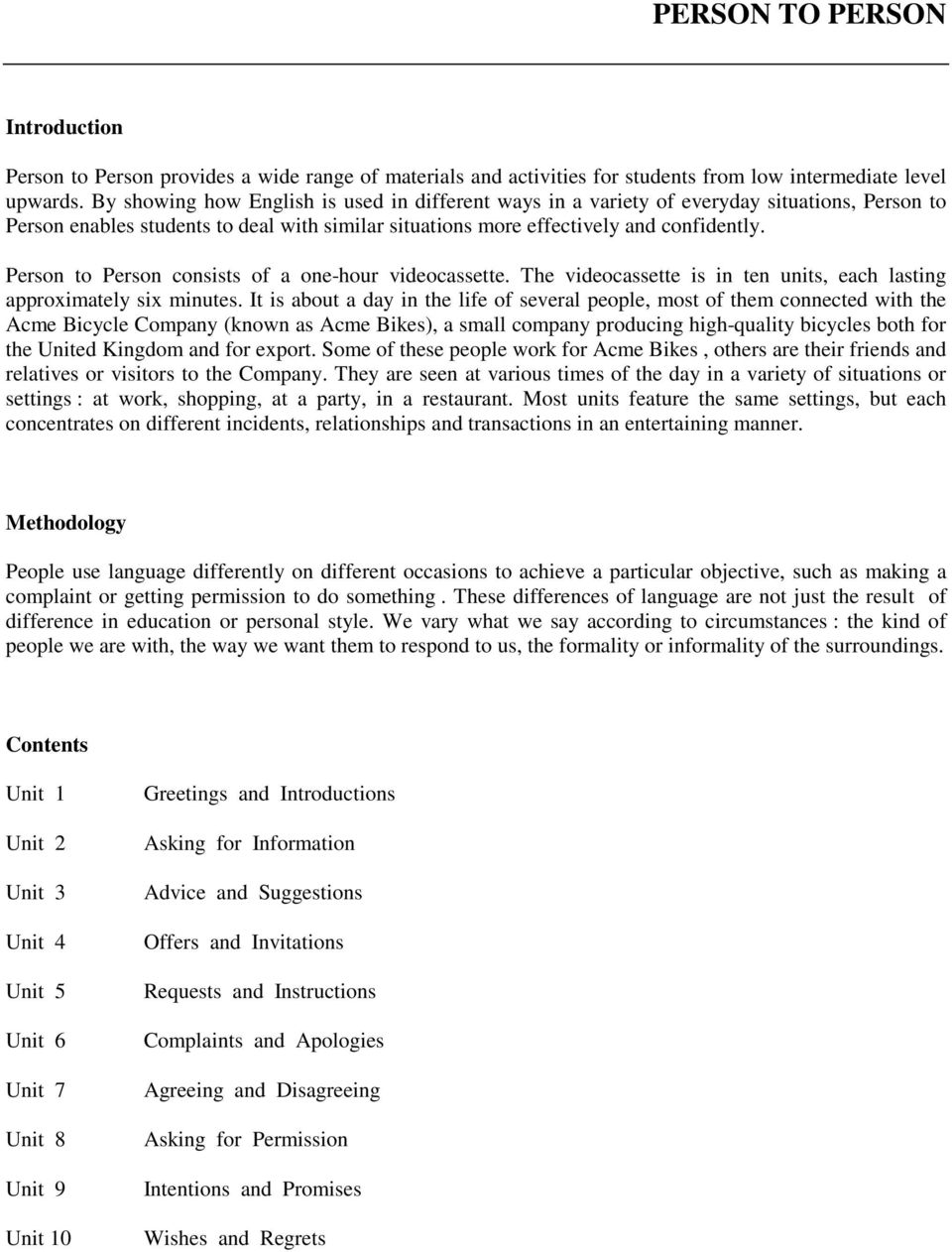
1 PERSON TO PERSON Introduction Person to Person provides a wide range of materials and activities for students from low intermediate level upwards. By showing how English is used in different ways in a variety of everyday situations, Person to Person enables students to deal with similar situations more effectively and confidently. Person to Person consists of a one-hour videocassette. The videocassette is in ten units, each lasting approximately six minutes. It is about a day in the life of several people, most of them connected with the Acme Bicycle Company (known as Acme Bikes), a small company producing high-quality bicycles both for the United Kingdom and for export. Some of these people work for Acme Bikes, others are their friends and relatives or visitors to the Company. They are seen at various times of the day in a variety of situations or settings : at work, shopping, at a party, in a restaurant. Most units feature the same settings, but each concentrates on different incidents, relationships and transactions in an entertaining manner. Methodology People use language differently on different occasions to achieve a particular objective, such as making a complaint or getting permission to do something. These differences of language are not just the result of difference in education or personal style. We vary what we say according to circumstances : the kind of people we are with, the way we want them to respond to us, the formality or informality of the surroundings. Contents Unit 1 Unit 2 Unit 3 Unit 4 Unit 5 Unit 6 Unit 7 Unit 8 Unit 9 Unit 10 Greetings and Introductions Asking for Information Advice and Suggestions Offers and Invitations Requests and Instructions Complaints and Apologies Agreeing and Disagreeing Asking for Permission Intentions and Promises Wishes and Regrets
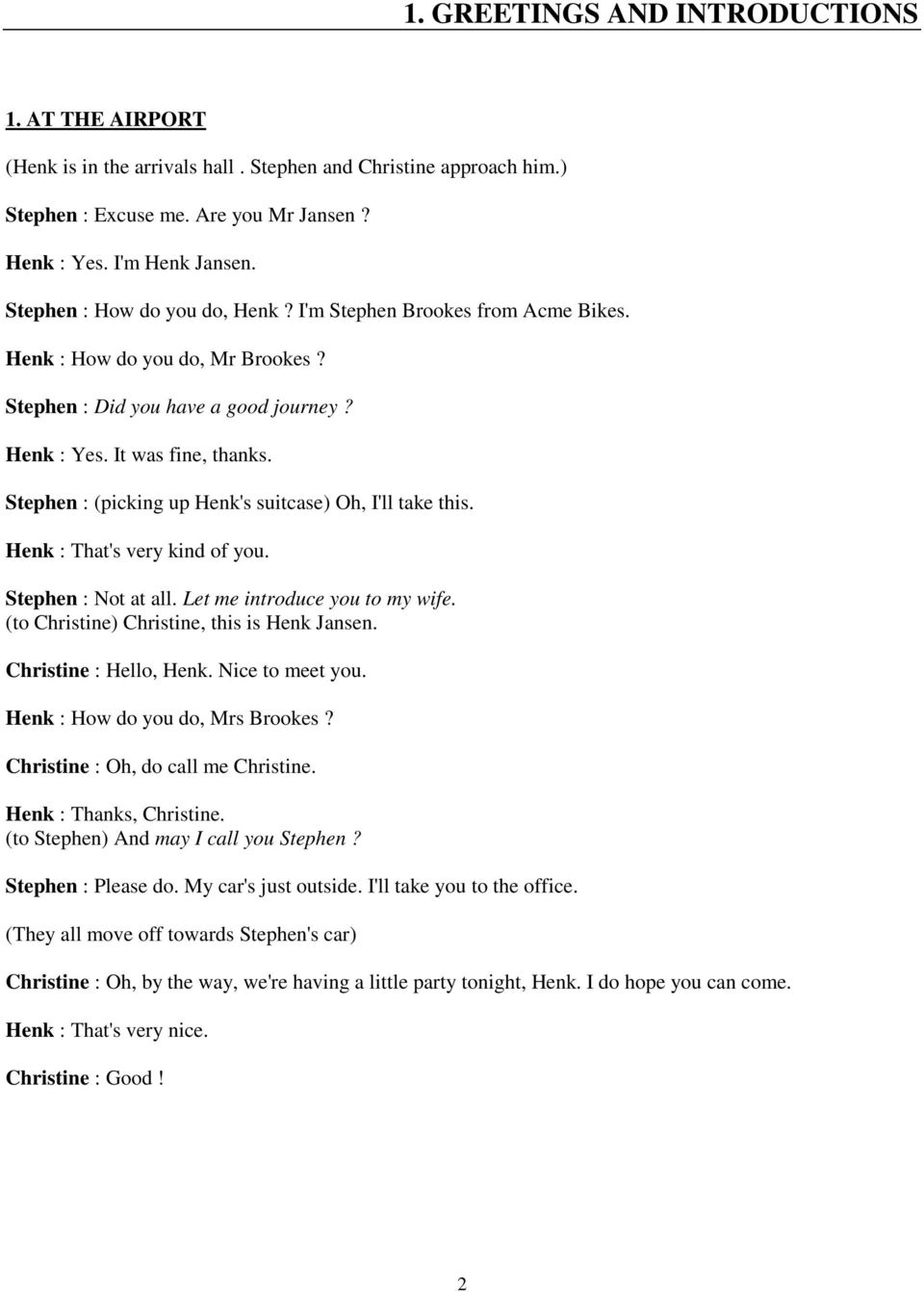
2 1. GREETINGS AND INTRODUCTIONS 1. AT THE AIRPORT (Henk is in the arrivals hall. Stephen and Christine approach him.) Stephen : Excuse me. Are you Mr Jansen? Henk : Yes. I'm Henk Jansen. Stephen : How do you do, Henk? I'm Stephen Brookes from Acme Bikes. Henk : How do you do, Mr Brookes? Stephen : Did you have a good journey? Henk : Yes. It was fine, thanks. Stephen : (picking up Henk's suitcase) Oh, I'll take this. Henk : That's very kind of you. Stephen : Not at all. Let me introduce you to my wife. (to Christine) Christine, this is Henk Jansen. Christine : Hello, Henk. Nice to meet you. Henk : How do you do, Mrs Brookes? Christine : Oh, do call me Christine. Henk : Thanks, Christine. (to Stephen) And may I call you Stephen? Stephen : Please do. My car's just outside. I'll take you to the office. (They all move off towards Stephen's car) Christine : Oh, by the way, we're having a little party tonight, Henk. I do hope you can come. Henk : That's very nice. Christine : Good! 2
3 2. ON THE PHONE (Mary is at her desk. Jim is telephoning her from a call box.) Mary : (answering the phone) Extension seven five three. Hello. Jim : Hello. Is that Mary? Mary : Yes. This is Mary Saunders. Jim : Hello, Mary. It's Jim here. Mary : Oh, Jim! Hello. Jim : I'm calling from a call box. Mary : Listen, I'm a bit busy at the moment. Could you call back later? Say, in half an hour? Jim : Of course. Bye, Mary. Mary : Thanks for calling, Jim. Bye. 3. OUTSIDE ACME BIKES (Stephen drives into the car park. He and Henk get out of the car.) Stephen : Well, here we are, then. Henk : Thank you. Stephen : (opening the door for Christine) Darling. Christine : Thank you (getting out of the car). Well, I'm off to do some shopping. But I'll see you again tonight, Henk. Henk : Yes. I'm looking forward to the party. Goodbye. Christine : Bye! (to Stephen) See you after work, Darling. Stephen : Yes. Bye, darling. (to Henk) This way. 3

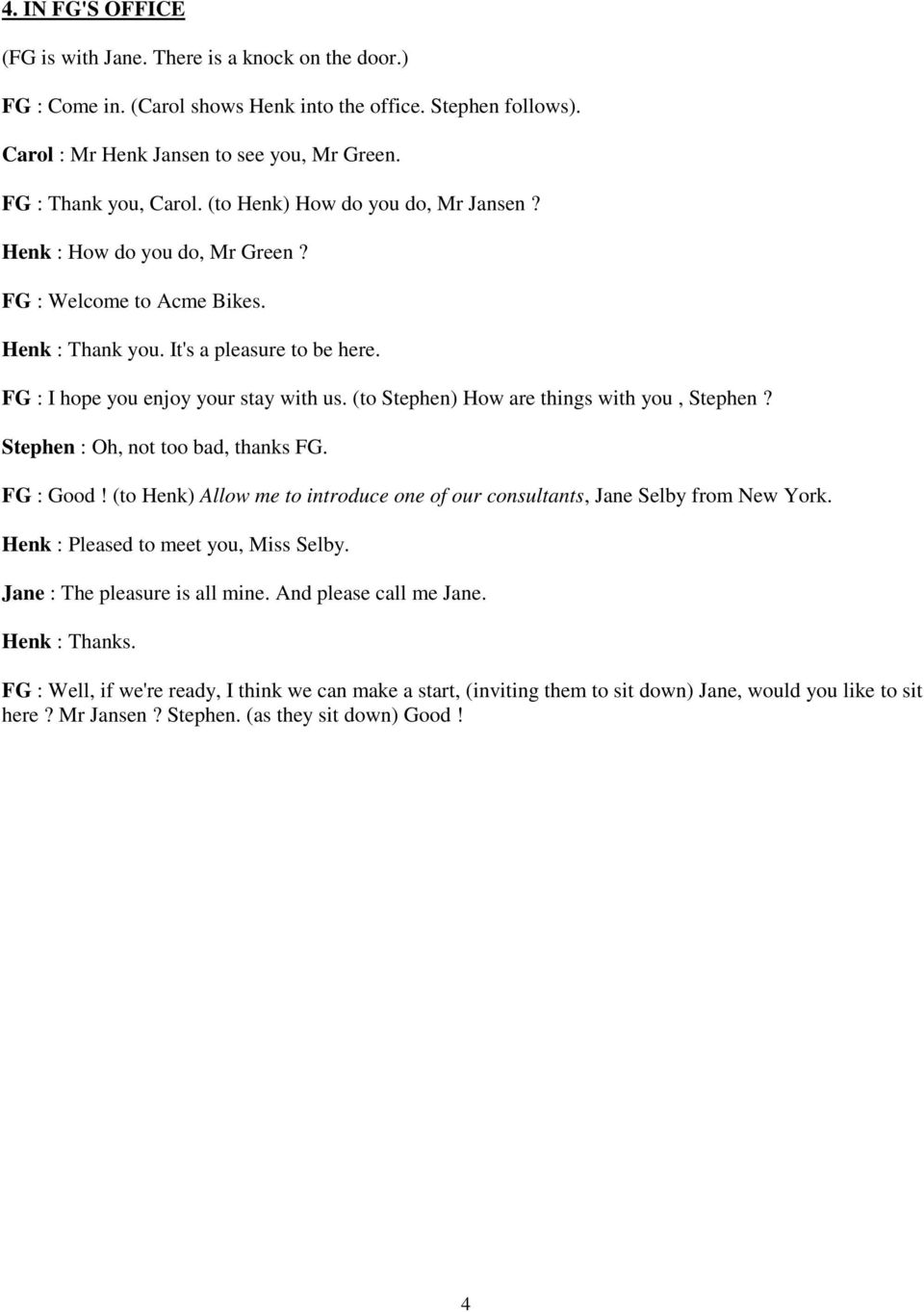
4 4. IN FG'S OFFICE (FG is with Jane. There is a knock on the door.) FG : Come in. (Carol shows Henk into the office. Stephen follows). Carol : Mr Henk Jansen to see you, Mr Green. FG : Thank you, Carol. (to Henk) How do you do, Mr Jansen? Henk : How do you do, Mr Green? FG : Welcome to Acme Bikes. Henk : Thank you. It's a pleasure to be here. FG : I hope you enjoy your stay with us. (to Stephen) How are things with you, Stephen? Stephen : Oh, not too bad, thanks FG. FG : Good! (to Henk) Allow me to introduce one of our consultants, Jane Selby from New York. Henk : Pleased to meet you, Miss Selby. Jane : The pleasure is all mine. And please call me Jane. Henk : Thanks. FG : Well, if we're ready, I think we can make a start, (inviting them to sit down) Jane, would you like to sit here? Mr Jansen? Stephen. (as they sit down) Good! 4
5 5. IN THE RECEPTION AREA (Betty is at her desk, talking on the phone.) Betty : (on the phone) Thank you very much. Goodbye. (answering another call) Acme Bikes. Good afternoon... Extension two five seven? Just a moment. I'm putting you through now. (Frank comes into the reception area, carrying a large picture wrapped in paper). Frank : Afternoon. Betty : Good afternoon. Frank : I've brought this picture. It's for Acma Bikes Limited. Betty : I'll ask someone about it. Frank : Oh, thanks very much. Very kind of you. (A girl carrying files passes through the reception area. Frank is in her way) Frank : Oh. Sorry! Betty : Oh, excuse me. I don't know your name. Frank : Frank. Frank Murphy. Betty : Just a moment, please, Frank - er - Mr Murphy. Carol : Hi, Betty. Betty : Hello, Carol. Carol : (as she moves past Frank) Oh, sorry. (to Betty) Are you going to the Brookes' party tonight? Betty : Yes. Are you? Carol : Mm. See you there then. 5

6 6. AT THE PARTY (Christine is welcoming Peter to the party.) Christine : Now, let me introduce you to some of our guests. Let's see. (as Carol approaches) I'd like you to meet Carol Simpson, this is Peter Carter. I don't think you've met each other. Carol : Hello. Peter : Hello, Carol. Christine : Let me take your coat, Peter. Peter : That's very kind of you. Christine : (taking his coat) If you'll excuse me, I'll leave you two together (to Carol) See you in a moment, dear. Carol : Right. (to Peter) I'm sorry. I didn't catch your name. Peter : Peter. Peter Carter. (Jane approaches Christine.) Jane : Christine, thanks very much for a wonderful party. Christine : Oh, Jane! Do you have to go now? The party's just beginning. Jane : Oh, I'm sorry. I've got to meet someone at the airport. (Stephen joins them) Stephen : Are you leaving, Jane? Jane : I'm afraid so. Stephen : See you in the office tomorrow then. Jane : Bye, Stephen. Christine : Good night, Jane. Jane : See you, Christine. Take care. 6

7 TRANSLATE 1. Avez-vous fait bon voyage? 2. C'est très gentil de votre part. 3. Permettez-moi de vous présenter mon mari. 4. Nous organisons une petite fête ce soir. J'espère que vous pourrez venir. 5. Je suis occupé pour le moment. Pourriez-vous rappeler plus tard? 6. Merci d'avoir appelé. 7. J'attends la fête avec impatience. 8. On frappe à la porte. 9. C'est un plaisir d'être ici. 10. J'espère que vous apprécierez votre séjour chez nous. 7

8 11. Permettez-moi de vous présenter un de nos consultants. 12. Tout le plaisir est pour moi. 13. Si vous êtes prêts, je pense que nous pouvons commencer. 14. Un instant, je vous le passe. 15. J'aimerais vous présenter Carol Simpson. 16. Je ne pense pas que nous nous soyons rencontrés. 17. Je suis désolé, je n'ai pas compris votre nom. 18. Je dois partir maintenant. 19. Elle doit rencontrer quelqu'un à l'aéroport. 20. On se voit demain au bureau. 8

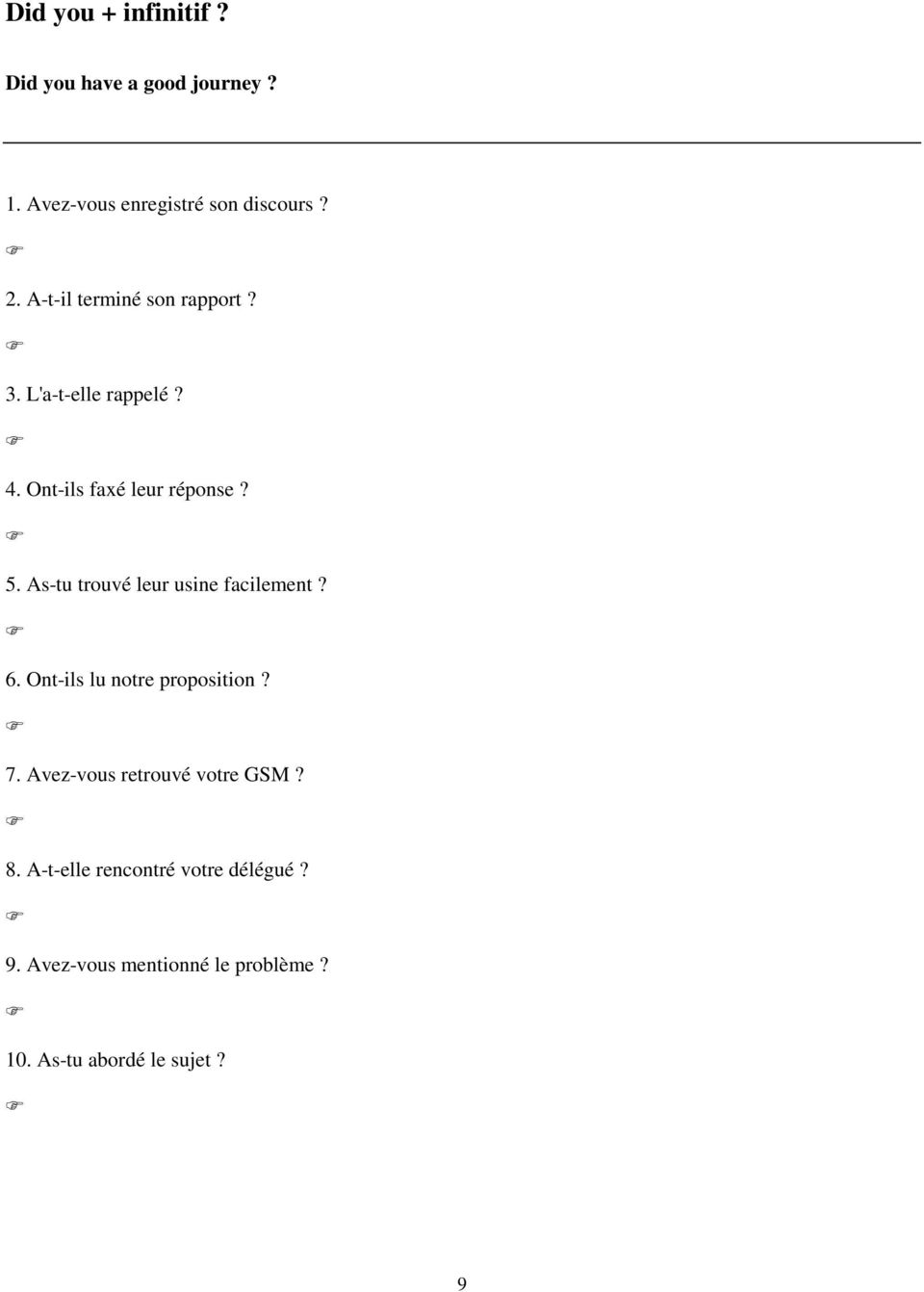
9 Did you + infinitif? Did you have a good journey? 1. Avez-vous enregistré son discours? 2. A-t-il terminé son rapport? 3. L'a-t-elle rappelé? 4. Ont-ils faxé leur réponse? 5. As-tu trouvé leur usine facilement? 6. Ont-ils lu notre proposition? 7. Avez-vous retrouvé votre GSM? 8. A-t-elle rencontré votre délégué? 9. Avez-vous mentionné le problème? 10. As-tu abordé le sujet? 9
10 Let me + infinitif Let me introduce you to my wife. 1. Laissez-moi vous aider. 2. Laissez-moi lui parler. 3. Laisse-le partir. 4. Laissez-la réaliser son rêve. 5. Laissez-nous parler. 6. Laissez-les organiser la réunion. 7. Laissez-nous suivre notre idée. 8. Laissez-moi défendre ce projet. 9. Laissez-le vous conduire. 10. Laissez-moi vous accompagner jusqu'à la gare. 10

11 May I + infinitif? May I call you Stephen? 1. Puis-je enregistrer votre discours? 2. Peut-elle lui parler tout de suite? 3. Puis-je aller à Londres demain? 4. Pouvons-nous lire votre rapport. 5. Puis-je les appeler demain? 6. Peuvent-ils nous envoyer une copie du dossier? 7. Puis-je vous rencontrer la semaine prochaine? 8. Peux-tu vraiment me donner son numéro de téléphone? 9. Puis-je avoir votre rapport aussi vite que possible? 10. Peux-tu quitter l'école à midi? 11

12 Allow me to + infinitif. Allow me to introduce one of our consultants. 1. Permettez-moi de vous parler franchement. 2. Permettez-moi de lui parler tout de suite. 3. Permettez-moi de l'accompagner à Paris. 4. Permettez-moi de lire leur rapport. 5. Permettez-moi de les appeler. 6. Permettez-moi de vous rendre visite après-demain. 7. Permettez-moi de venir immédiatement. 8. Permettez-moi de le convaincre avant la prochaine réunion. 9. Permettez-moi de vous expliquer notre point de vue. 10. Permettez-moi de la voir immédiatement. 12

13 I don't + infinitif. I don't know your name. 1. Je ne sais pas où ils habitent. 2. Tu ne sais pas ce qu'il fait. 3. Il ne sait pas comment réagir. 4. Elle ne sait pas où a lieu la réunion. 5. Nous ne savons pas s'il acceptera. 6. Vous ne savez même pas quand la réunion commence. 7. Ils ne savent pas comment le convaincre. 8. Je ne connais pas les dernières nouvelles. 9. Tu ne sais pas comment il t'accueillera. 10. Il ne sait pas où trouver l'information. 13

14 I've got to + infinitif. I've got to meet someone at the airport. 1. Je dois lui parler le plus vite possible. 2. Tu dois le rappeler ce matin. 3. Il doit être prêt pour la rencontre de jeudi. 4. Elle doit introduire sa candidature avant la fin du mois prochain. 5. Nous devons être présents. 6. Vous devez voir ce film. 7. Ils doivent lire ce roman. 8. Tu dois le convaincre avant qu'il ne parte. 9. Nous devons avoir de leurs nouvelles aussi vite que possible. 10. Je dois le voir avant son départ pour Londres. 14
15 2. ASKING FOR INFORMATION 1. IN THE DEPARTMENT STORE (Dress Department) (Christine is in a large department store. As she walks through the dress department, she sees an assistant.) Christine : Excuse me. Where's the florist's? Assistant : What was that? (turning round) Oh! Sorry, madam. Can I help you? Christine : I was looking for the florist's. Assistant : Let me think. You want the flower department. Christine : Yes. Can you tell me how to find it? Assistant : Sorry, madam. I'm new here. Um. (pointing) In the basement, on the right. Christine : Thank you. 2. ON THE PHONE (Jim is calling Mary again.) Mary : Extension seven five three. Mary Saunders. Jim : Hello, Mary. Jim here. Mary : Oh, Jim. Look, I am rather busy at the moment. Jim : I wanted to ask what you were doing this evening. Mary : I don't know. Washing my hair, watching television. Jim : I could come round and watch with you. Mary : Look, I told you. I'm busy. Jim : Sorry. I was only asking. (Mary puts the phone down.) Jim : Mary? Mary? 15

16 3. IN THE RECEPTION AREA (Betty is talking on the phone.) Betty : (on the phone) If you give me your number, I'll get someone to call you back... five six eight one. Thank you. Goodbye. (She turns to Carol, who is looking for something.) Betty : What are you looking for, Carol? Carol : The railway timetable. FG's going to Manchester tomorrow. Now, where is that timetable? Betty : Why doesn't he fly? (She finds the timetable and hands it to Carol.) Carol : Thanks. (looking at the timetable) Now, which station do trains to Manchester go from? (Frank coughs to attract attention.) Betty : Yes? Frank : Excuse me, but where's this picture supposed to go? Betty : Sorry. I don't know. (to Carol) Carol, do you know where that picture is supposed to go? Carol : No, I don't. I'll ask FG or Stephen Brookes. (looking at the railway timetable) Manchester. 16

17 4. IN FG'S OFFICE (FG is at his desk, talking on the phone.) FG : (on the phone) Well, I would like to know about the price of the components.... I'd be very grateful if you could possibly let me have some more details. (Stephen, Jane and Henk are at a table in another part of the office.) Stephen : We'll just have to wait for FG to finish. Jane : Where are you staying Henk? Henk : At the Park Hotel. Do you know what it's like? Jane : I'm afraid I don't. I'm a stranger here myself. Stephen, what's the Park Hotel like? Stephen : It's fairly expensive, but it's good. We usually put our visitors up there. Henk : Mm. How do I get there from Acme Bikes? Stephen : Well, normally the best way is by bus. Henk : I see. How long does it take? Stephen : About fifteen minutes - maybe more in the rush hour. Jane : Well, you could rent a car. Henk : How much does it cost to hire - er - rent one? Jane : That depends on the car. Stephen : Don't worry, Henk. The company's hiring one for you. I've got the forms here for you to sign. Henk : Ah! (looking at the forms) Fine. Oh, by the way, do you know any good restaurants near the hotel? Stephen : Mm! There's the one FG always goes to. What's it called? The -er - (FG gets up to join them.) FG : "The Peacock". An excellent restaurant. It's almost next to your hotel. Henk : Thank you. (Carol comes into the office.) FG : Oh, Carol! What time does my train leave for Manchester? Carol : Seven forty-five. 17
18 5. AT THE PARTY (Betty approaches Henk.) Betty : You must be Henk. Henk : That's right. Henk Jansen. Betty : I'm Betty. Henk : Oh, yes. You're the receptionist, aren't you? Betty : Yes. You're Dutch, aren't you? Henk : Yes. Betty : What part of Holland do you come from? Or is it the Netherlands? Henk : It doesn't matter. I usually say Holland. I'm from Amsterdam. Just outside, actually. Betty : Oh, really! How long are you staying here in England? Henk : Well, I expect to be working with Acme Bikes for several months. Tell me, is it all right to come to a party like this with a tie on? Betty : Yes. But - well, you could take it off, I suppose. Henk : Oh, well - (Carol is talking to Peter.) Carol : What's in this drink? Peter : I'm not sure. It's certainly got a lot of fruit in it. Carol : I'll ask Christine. (calling to her) Christine! Christine : (joining them) Mm? Carol : This drink's lovely. What's in it? Christine : Oh, I really don't know. Stephen made it. And I expect he's forgotten what he put in. I wonder where he is. 18

19 TRANSLATE 1. Je cherche le rayon habillement. 2. Laissez-moi réfléchir. 3. Si vous me donnez votre numéro, je demanderais à ce qu'on vous rappelle. 4. Je cherche l'horaire des chemins de fer. 5. J'aimerais connaître le prix du tableau. 6. A quelle heure part mon train pour Bruxelles? 7. Cela n'a pas d'importance. 8. A quoi ressemble l'hôtel du Parc? 9. Tant que j'y pense, connaissez-vous un bon restaurant près de l'hôtel? 10. Le fleuriste se trouve au rez-de-chaussée. 19
20 Can I + infinitif? Can I help you? 1. Peux-tu enregistrer ce discours? 2. Peut-il te remplacer demain? 3. Peut-elle venir après demain? 4. Pouvez-vous rédiger le P.V. de la réunion? 5. Pouvons-nous aborder le sujet demain? 6. Peuvent-ils partir immédiatement? 7. Peux-tu l'appeler demain après les heures de bureau? 8. Pouvez-vous me prêter votre dictionnaire? 9. Peuvent-ils payer cette somme avant la fin du mois? 10. Peux-tu me conduire au centre ville? 20

21 Why doesn't he + infinitif? Why doesn't he fly? 1. Pourquoi ne m'appelle-t-elle pas? 2. Pourquoi ne réponds-tu pas? 3. Pourquoi ne vient-il pas? 4. Pourquoi ne voulez-vous pas sortir? 5. Pourquoi ne partons-nous pas demain? 6. Pourquoi ne prend-il pas l'avion? 7. Pourquoi ne vend-elle pas son appartement? 8. Pourquoi n'achètes-tu pas une nouvelle imprimante? 9. Pourquoi ne veut-il pas travailler à l'étranger? 10. Pourquoi ne parle-t-il pas anglais? 21
22 I would like to + infinitif I would like to know about the price of the components. 1. J'aimerais vous rencontrer avant mon départ. 2. Il aimerait lire votre rapport avant la prochaine réunion. 3. Elle aimerait être présente lors de votre arrivée. 4. Nous aimerions vous convaincre de l'importance de ce projet. 5. Ils aimeraient discuter de l'ordre du jour avec vous. 6. J'aimerais rencontrer les syndicats dès que possible. 7. Elle aimerait vous inviter dimanche prochain. 8. Nous aimerions souligner la croissance importante de notre chiffre d'affaire. 9. Elles aimeraient organiser le concert de l'année prochaine à la fin juin. 10. Il aimerait vous accompagner à l'étranger. 22
23 3. ADVICE AND SUGGESTIONS 1. OUTSIDE ACME BIKES (Jane and Carol meet outside the Acme Bikes offices.) Jane : Going downtown for lunch? Carol : Yes, I am. I'm just waiting for Betty. Jane : Why don't we all go together? Carol : Yes, that's a good idea. Jane : Then you can give me some advice. I need to buy some gifts for friends back home in the States. What do you think I should get? Carol : Why not buy some tea? Jane : Yes, that's an idea. Carol : Or maybe some English marmalade. Jane : Of course. Why didn't I think of that? 2. IN THE DEPARTMENT STORE (Flower Department) (Christine approaches an assistant.) Christine : I'm having a party tonight and I need some flowers. What do you recommend? Assistant : I'd recommend some carnations, and perhaps some lilies. Christine : Oh, lilies! How super! I hadn't thought of those. 23
24 3. ON THE PHONE (Jim is calling Mary again.) Mary : Extension seven five three. Jim : Hi, Mary! It's Jim here. Mary : Oh, it's you again. Jim : Yes. What shall we do this evening? Mary : What do you suggest? Jim : I don't know. You decide. Mary : What about a game of tennis? Jim : No. Not today. How about going to the cinema instead? Mary : Oh, good idea! We could meet at the box office. At quarter past seven? Jim : OK. Let's do that. 4. IN THE RECEPTION AREA (Frank is sitting with the picture. He attracts Betty's attention.) Frank : Excuse me. Betty : Yes? Frank : What would you like me to do with this picture? Shall I just leave it here? Betty : No. You can't leave it there. Frank : Well, where shall I put it, then? Betty : I'm not sure. I really don't know what to suggest. Frank : (standing up) Well, why don't we put it on that wall there, above your desk? It'd look nice up there. Betty : It's worth trying, perhaps. But - Frank : All right. Don't worry. I've got another idea. Why don't we put it on that wall there? Betty : I think we should wait and ask Mr Brookes. He'll know what to do with it. Frank : All right, then. (sitting down again) Let's wait. 24
25 5. IN FG'S OFFICE. (FG is at his desk, talking on the phone.) FG : (on the phone) I advise you to consider our offer very carefully, Mr Thomas. If I were you I'd... (Stephen, Jane and Henk are waiting for FG to finish his call.) Stephen : We could always change the design. Jane : Well, you can't just change the whole design. It wouldn't work. Henk : Have you thought of modifying the seat? Jane : No. I never thought of that. It's worth trying. Thanks. (FG joins them.) FG : Now, let's get down to business, shall we? Stephen : Of course, FG. But why don't we postpone our meeting for an hour? FG : Oh? Stephen : Then you could discuss the schedule for the new bike with Jane, while Henk and I - FG : Right! Might I suggest we meet again in an hour's time? Shall we say, four o'clock? Stephen : Good idea, FG. That'll give me a chance to sort out a few things with Henk. FG : Four o'clock, then. (as they leave the office) Now, Jane. I need your advice. Now, what is the best way to modify this in the shortest possible time? 25
26 6. IN THE RECEPTION AREA (Frank is taking the paper wrapping off the picture. Stephen and Henk come in from FG's office.) Stephen : You'd better get that - er - picture out of the way. You might hurt someone. Frank : Oh! Very sorry, sir. Betty : We want your advice, Mr Brookes.Where should we put it Stephen : Try putting it in FG's - Mr Green's office. No, on second thoughts, I think you should hang it on the wall next to the entrance. Let's get out of here, Henk. It's dangerous. Henk : Yes. I think we'd better. (They leave. Carol comes in.) Carol : What time are you going to the party tonight, Betty? Betty : Oh, about eight. Shall we go together? Carol : Mm. Let's. 7. AT THE PARTY Henk : Warm, isn't it? Christine : Yes. Let's have a rest, shall we? Henk :Good idea! Christine : You should take it easy after your journey. Henk : Mm. you're right. I'll be going back to my hotel soon. What's the best way of getting there? Christine : At this time of the night? I'd get a taxi if I were you. (Peter and Carol are talking in another part of the room.) Peter : Are you enjoying yourself? Carol : Of course. I'm getting quite hungry, though. Peter : Let's go and eat, then. But we'd better go soon. It's getting quite late. Carol : Where shall we go? Peter : I don't know. I'd like somewhere quiet. Do you know any decent restaurants round here? Carol : I've heard the Peacock's quite good, and it isn't too noisy. Shall we try it? 26
27 8. IN THE RESTAURANT. (Peter and Carol are looking at the menu, while the waiter attends to customers at another table.) Waiter : (to customers) Are you ready to order now, sir? Peter : (to Carol) What shall we have, then? Carol :I'm not sure, Peter. I haven't been here before. What do you suggest? Peter : Well, there's a lot of fish on the menu. How about mullet? you could always have sole. That's one of the specials for today? Or Carol : Perhaps we should ask the waiter to recommend something. Peter : Okay. Carol : Do you think we should have a starter? Peter : Why not? (looking at the menu) What about avocado vinaigrette? Oh, wait a minute! Have you ever tried taramasalata? Carol : No. Peter : It's Greek. Carol : It sounds interesting. I'll give it a try. (FG comes in with his wife. He notices Carol and Peter.) FG : (to Carol) Take my advice. Try the potted shrimps. Carol : (surprised) Oh, Mr Green! FG : Nice to see you here, Carol. Oh, by the way, if I were you, I would avoid the taramasalata. 27
28 TRANSLATE 1. Je vais manger en ville. 2. J'ai besoin d'acheter des cadeaux. 3. Que recommandez-vous? 4. Que dirais-tu d'une partie de tennis? 5. Où voudriez-vous que j'accroche ce tableau? 6. Je ne sais pas quoi suggérer. 7. Ca vaut la peine d'essayer. 8. Ne vous en faites pas, j'ai une autre idée. 9. Si tu changes le dessin, ça ne marchera pas. 10. J'ai besoin de vos conseils. 28
29 11. Etes-vous prêt à commander? 12. Je ne suis jamais venu ici auparavant. 13. Quel est le plat du jour? 14. Souhaitez-vous prendre une entrée? 15. Que diriez-vous d une terrine de crevettes? 16. Avez-vous déjà goûté ce plat? 17. Suivez mon conseil, prenez du tarama. 18. Cela m a l air intéressant. 19. Je vais tenter ma chance. 20. Si j étais vous, j éviterais le pudding. 29
30 I need to + infinitif I need to buy some gifts for friends back home in the States. 1. J'ai besoin d'acheter des cadeaux. 2. Elle a besoin de lui parler tout de suite. 3. Il a besoin d'aller à Londres demain. 4. Nous avons besoin de lire ce rapport. 5. As-tu vraiment besoin de les appeler? 6. Ont-ils besoin de nous rencontrer ce matin? 7. J'ai besoin de venir demain. 8. Il a besoin de le convaincre avant la prochaine réunion. 9. Nous avons besoin d'avoir de leurs nouvelles aussi vite que possible. 10. J'ai besoin de le voir immédiatement. 30
31 Why not + infinitif? Why not buy some English marmalade? 1.Pourquoi ne pas acheter du thé? 2. Pourquoi ne pas les appeler immédiatement? 3. Pourquoi ne pas envoyer ton rapport à Paris? 4. Pourquoi ne pas acheter les bâtiments? 5. Pourquoi ne pas conclure tout de suite? 6. Pourquoi ne pas accepter leur offre? 7. Pourquoi ne pas signer ce contrat? 8. Pourquoi ne pas vendre ta voiture? 9. Pourquoi ne pas partir la semaine prochaine? 10. Pourquoi ne pas attendre un moment? 31
32 How about + ing? How about going to the cinema? 1. Que dirais-tu d'aller au théâtre? 2. Que diriez-vous d'aller à Bruxelles? 3. Que dirais-tu de lire ce livre? 4. Que diriez-vous d'engager de nouveaux collaborateurs? 5. Que dirais-tu de jouer au tennis? 6. Que diriez-vous d'investir dans ce projet? 7. Que dirais-tu de te reposer un peu? 8. Que diriez-vous d'améliorer l'image de la société? 9. Que dirais-tu de prendre un verre? 10. Que diriez-vous de le rencontrer immédiatement? 32
33 What about + nom? What about a game of tennis? 1. Que dirais-tu d'une partie de poker? 2. Que diriez-vous de mardi? 3. Que dirais-tu d'un livre? 4. Que diriez-vous d'un séjour à l'étranger? 5. Que dirais-tu de jouer au tennis? 6. Que diriez-vous d'un nouveau concept? 7. Que dirais-tu d'une nouvelle voiture? 8. Que diriez-vous d'un nouveau logo? 9. Que dirais-tu d'un verre de porto? 10. Que diriez-vous d'un petit déjeuner anglais? 33
34 Mot interrogatif + would you like + pronom objet + to + infinitif? What would you like me to do with this picture? 1. Que voudriez-vous que je fasse avec ce cadeau? 2. Que voudriez-vous qu'il réponde? 3. Que voudriez-vous que nous achetions pour son anniversaire? 4. Que voudriez-vous qu'ils lui racontent? 5. Où voudriez-vous que j'organise cette réunion? 6. Où voudrais-tu que nous passions nos vacances? 7. Comment voudrais-tu que je m'habille? 8. Pourquoi voudriez-vous que je vous accompagne? 9. Quand voudrais-tu que j'arrive? 10. Pourquoi voudrais-tu que je rédige ce rapport? 34
35 It's worth + ing It's worth trying. 1. Cela vaut la peine d'être enregistré. 2. Cela vaut la peine d'être lu. 3. Cela vaut la peine d'écouter. 4. Cela vaut la peine de répondre. 5. Cela vaut la peine d'y réfléchir 6. Cela vaut la peine d'y investir. 7. Cela vaut la peine d'acheter. 8. Cela vaut la peine d'y aller. 9. Cela vaut la peine de vendre. 10. Cela vaut la peine de payer. 35
36 Have you thought of + ing? Have you thought of modifying the seat? 1. Avez-vous pensé à l'inviter? 2. Avez-vous pensé à modifier le contenu de votre rapport? 3. Avez-vous pensé à acheter des fleurs? 4. Avez-vous pensé à l'appeler? 5. As-tu pensé à enregistrer les nouvelles? 6. Avez-vous pensé à éteindre l'ordinateur? 7. As-tu pensé à réserver une table pour ce soir? 8. Avez-vous pensé à reporter votre rendez-vous? 9. As-tu pensé à lui écrire? 10. Avez-vous pensé à retirer de l'argent? 36
37 You'd better + infinitif You'd better get that picture out of the way. 1.Vous feriez mieux de dégager ce tableau. 2. Nous ferions mieux de partir tout de suite. 3. Je ferais mieux de lire son rapport. 4. Tu ferais mieux de l'appeler immédiatement. 5. Il ferait mieux de travailler un peu plus. 6. Elle ferait mieux de l'acheter demain. 7. Nous ferions mieux de nous en tenir à notre accord. 8. Vous feriez mieux de m'écouter. 9. Ils feraient mieux de vivre à l'étranger. 10. Vous feriez mieux de boucler ce dossier aujourd'hui. 37
38 If I were you, I would + infinitif If I were you, I would avoid the potted shrimps. 1. Si j'étais toi, j'éviterais l'espagne. 2. Si j'étais vous, je lui parlerais. 3. Si j'étais toi, je l'appellerais demain. 4. Si j'étais vous, j'y investirais sans hésitation. 5. Si j'étais toi, je partirais tout de suite. 6. Si j'étais vous, je changerais le logo de la société. 7. Si j'étais toi, je lui achèterais des fleurs. 8. Si j'étais lui, je vous tiendrais au courant. 9. Si j'étais elle, je vendrais l'appartement. 10. Si j'étais vous, je modifierais l'ordre du jour. 38
39 4. OFFERS AND INVITATIONS 1. OUTSIDE ACME BIKES (Jane and Carol are in the car park.) Jane : Here's my car. Let me give you a ride. Carol : Thanks. That's very kind of you. Betty and I were thinking of going by bus. Jane : No, please. You must let me give you a ride. Carol : I'll go and find Betty then, shall I? Jane : Right. 2. IN THE DEPARTMENT STORE (Flower Department, Christine is buying flowers.) Assistant : Would you like anything else? Christine : No, thanks. That'll be all. Assistant : Would you like us to deliver this afternoon? Christine : Oh yes, please. That would be lovely. Assistant : Well, could I just have your name and address? Christine : Right. It's Brookes. 24 South Lea Road. 3. ON THE PHONE Mary : Hello. Mary Saunders. Jim : Mary! How would you like to meet before we go to the cinema this evening? Mary : That'd be lovely, Jim. Jim : Shall I pick you up at the office after work? Mary : Thanks. But I'll have to go home and wash my hair first. Jim : Would you like me to come round to your place? Mary : No. Don't put yourself out. I'll come round to you at about seven. Jim : Fine. I'll see you at seven, then. 'Bye. 39
40 4. IN FG'S OFFICE (FG is signing some letters. Carol is with him. There is a knock at the door.) FG : Come in. (as Jane comes in) Oh, Jane! Do sit down. I'll be with you in a moment. (to Carol) Fine, that's the lot, Carol, thank you. (to Jane) Would you like some tea or coffee? Jane : Tea, please. FG : Some tea for Miss Selby, please, Carol. Carol : And what will you have, Mr Green? FG : The usual. Black coffee, please. Carol : Yes, Mr Green. Will there be anything else? FG : No, thank you, Carol. (to Jane as Carol leaves) Now, Jane, before we get back to the schedule for our new bike, I want to have a word with you about something else. Jane : Yes? FG : We've been very happy with your work for us as a consultant, Jane. Would you be interested in a permanent job with Acme Bikes? Jane : Oh, well, that depends. What sort of job did you have in mind? FG : I'd like to offer you the new post of Development Manager. Jane : That's very tempting, FG. But I'd like some more details. FG : Of course. Of course, we'll have to go into everything in detail. Naturally, I'll be making you a formal offer in writing. But quite apart from that, I do think we should get to know each other a bit better. Would you like to have lunch on Saturday? Jane : Oh, I'd love to. But I'm sorry, I can't. I've got another arrangement for Saturday. I might be able to cancel it. Could I let you know later? FG : Certainly. 40
41 5. IN THE RECEPTION AREA (Betty answers the telephone.) Betty : Good afternoon. Acme Bikes. Can I help you?... I'll put you through straight away. (Carol comes in.) Carol : Would you like tea or coffee, Betty? Betty : Oh, I'll have tea, please. Carol : What about you, Mr - er -? Frank : Murphy. Frank Murphy. Carol : Ah yes. Can I get you some tea, Frank? Frank : Oh, that's very kind of you. Thank you very much. No sugar. Carol : Milk? Frank : Er, yes, please. (Frank is trying to hang the picture on the wall.) Carol : (to Frank) Do you want any help.that picture looks very heavy. I'll get someone to help you with it. Frank : That's very kind of you to offer. But no, I'll be perfectly all right, thank you. Carol : Let me get you a ladder. Frank : No, really. I'll manage, thanks. Carol : All right, if you say so. (leaving) I'll go and get tea and coffee for everyone. 41
42 6. IN STEPHEN BROOKES' OFFICE (Stephen is pouring coffee for Henk.) Stephen : Are you doing anything this weekend? Henk : Well, I don't have any plans at the moment. Stephen : Oh, good! Do you play tennis, or golf? Henk : Tennis? Yes. Stephen : How would you like a game on Saturday? Henk : That sounds great, Stephen. Stephen : And you must come to lunch afterwards. Henk : That's very kind of you. I'd be delighted. Stephen : That's settled, then. Shall I call round to the hotel at - er - nine thirty? Henk : All right. That'll be fine. (The intercom rings.) Stephen : Yes? (Stephen and Henk listen to FG's voice.) FG : (on intercom) FG here, Stephen. Might I have a word with our Dutch visitor? Stephen : (talking to intercom) Certainly, FG. (to Henk) FG! FG : (on intercom) Mr Jansen? Henk : (on intercom) Yes, Mr Green? FG : (on intercom) My wife and I would like to invite you to lunch on Saturday. You must come, too, Stephen. And do bring Christine. I've already asked Jane Selby. She's not sure whether she can come, but there'll be several other people there. I hope you'll join us. Henk : (to intercom) I'd really like to, Mr Green, but I'm afraid I've just accepted an invitation to lunch with Stephen. FG : (on intercom) Oh, what a pity! We must arrange something else, then. Tell me, do you play golf? 42
43 7. AT THE PARTY (Christine is talking to Henk.) Christine : You look tired. Would you like to sit down? Henk : No, I'm all right, thanks. Christine : Stephen says you're coming to lunch on Saturday. Henk : Yes, I'm looking forward to it. You know, you must come and visit me in Holland some time. Christine : I'd love to. When I can get away from being a housewife. You must talk to Stephen about it. Stephen : Hello there, Henk! You look as if you need a drink. What'll you have? Some more wine? Henk : No thanks. It's very good, but I've had enough. Stephen : Well, if you'll excuse me, I must look after the other guests. Christine : Let me help you, darling. (as she goes) Excuse me, Henk. Henk : Sure. 8. IN THE RESTAURANT. (The waiter is attending to Peter and Carol.) Waiter : Here is the wine list, sir. And would you like to order a drink from the bar first? Peter : (to Carol) Carol? Carol : A sherry would be nice. Dry, please. Peter : (to the waiter) One dry sherry and a gin and tonic, please. Waiter : Certainly, sir. Are you ready to order yet? Peter : Could you come back in a moment? We haven't made up our minds yet? FG : (calling to the waiter from his table nearby) John! Waiter : Your usual, Mr Green? FG : Yes, please. A large gin and tonic. Waiter : (to Mrs Green) And for you, madam? Mrs Green : A mineral water, please. With ice. FG : (calling out to Peter and Carol.) If you need any help with that menu, just let me know. 43
44 TRANSLATE 1. Laissez-moi vous prendre en voiture. 2. Je vais aller chercher Betty. 3. Voudriez-vous autre chose? 4. Puis-je avoir votre nom et votre adresse? 5. Est-ce que je passe te prendre au bureau? 6. Si vous avez besoin d aide, faites-le moi savoir. 7. Ne te dérange pas. Je passerai chez toi vers 5 heures. 8. On frappe à la porte. 9. Asseyez-vous, je serai à vous dans un instant. 10. C est terminé. 44
45 11. Nous n avons pas encore pris de décision. 12. Que prendrez-vous? Voudriez-vous du thé? 13. Comme d habitude. 14. J aimerais vous entretenir d autre chose. 15. J aimerais vous offrir le nouveau poste de directeur. 16. Qu avez-vous en tête? J aimerais davantage de détails. 17. J aimerais commander immédiatement. 18. Je vous ferai une offre officielle par écrit. 19. Je pourrais annuler mon rendez-vous. 20. Je vous le passe immédiatement. 45
46 21. Je m en sortirai, merci. 22. Je n ai pas de projets pour le moment. 23. Que diriez-vous d une partie de tennis samedi? 24. Mon époux et moi voudrions vous inviter dimanche. 25. Je dois m occuper des autres invités. 46
47 Would you like + pronom objet + to + infinitif Would you like us to deliver this afternoon? 1. Voudriez-vous que je m'en occupe? 2. Veux-tu qu'il te remplace? 3. Voudriez-vous qu'elle vienne demain? 4. Veux-tu que je rédige le P.V. de la réunion? 5. Voudriez-vous que nous abordions le sujet demain? 6. Veux-tu qu'il parte immédiatement? 7. Voudriez-vous que je l'appelle? 8. Veux-tu que je te prête mon dictionnaire? 9. Voudriez-vous que nous vous payions cette somme avant la fin du mois? 10. Veux-tu que je te conduise au centre ville? 47
48 I want + (pronom) + to + infinitif I want to have a word with you about something else. 1. Je veux vous voir immédiatement. 2. Il veut que tu le rejoignes dans la salle de réunion. 3. Nous voulons aborder ce sujet aussi vite que possible. 4. Elle veut nous accompagner à Bruxelles. 5. Ils veulent réparer l'imprimante tout de suite. 6. Je veux que tu lises ce rapport avant la fin de la semaine. 7. Il veut que nous partions pour l'italie. 8. Nous voulons qu'ils soient prêts pour le début du mois prochain. 9. Je veux vous offrir le poste de responsable des achats. 10. Je ne veux pas qu'il en parle. 48
49 I might be able + to + infinitif I might be able to cancel it. 1. Il se pourrait que je le convainque. 2. Il se pourrait qu'il termine son rapport avant notre prochaine réunion. 3. Il se pourrait qu'elle achète ce meuble à bon prix. 4. Il se pourrait que nous venions demain. 5. Il se pourrait que je trouve une solution au problème. 6. Il se pourrait qu'il vous surprenne. 7. Il se pourrait qu'elle lui en parle. 8. Il se pourrait que nous nous revoyions sous peu. 9. Il se pourrait qu'ils réorganisent leur département avant le prochain conseil d'administration. 10. Il se pourrait que je t'appelle dans la soirée. 49
50 We should + infinitif We should get to know each other a bit better. 1. Nous devrions reporter la réunion à lundi prochain. 2. Tu devrais appeler l'italie immédiatement. 3. Je devrais le rencontrer avant la réunion de jeudi. 4. Il devrait travailler un peu plus. 5. Elle devrait améliorer son néerlandais. 6. Nous devrions lancer ce nouveau produit en août. 7. Vous devriez faire face à ce problème aussi vite que possible. 8. Ils devraient vendre tant que c'est possible. 9. Il devrait être plus conscient des conséquences de son attitude. 10. Vous devriez acheter ces bâtiments avant qu'il ne soit trop tard. 50
51 I would like to + infinitif I would like to invite you on Saturday. 1. J'aimerais vous rencontrer avant mon départ. 2. Il aimerait lire votre rapport avant la prochaine réunion. 3. Elle aimerait être présente lors de votre arrivée. 4. Nous aimerions vous convaincre de l'importance de ce projet. 5. Ils aimeraient discuter de l'ordre du jour avec vous. 6. J'aimerais rencontrer les syndicats dès que possible. 7. Elle aimerait vous inviter dimanche prochain. 8. Nous aimerions souligner la croissance importante de notre chiffre d'affaire. 9. Elles aimeraient organiser le concert de l'année prochaine à la fin juin. 10. Il aimerait vous accompagner à l'étranger. 51
52 I'm looking forward to + (pro)nom I'm looking forward to + verbe +ing I'm looking forward to it. I'm looking forward to hearing from you. 1. Je me réjouis d'avance à l'idée de vous rencontrer. 2. J'attends la fête avec impatience. 3. Il aspire à vous parler. 4. Nous nous réjouissons à l'idée de travailler avec votre société. 5. Il attend son cadeau avec impatience. 6. Elle se réjouit à l'idée de visiter l'appartement. 7. Nous attendons ce concert avec impatience. 8. Je me réjouis à la perspective d'entrer dans le conseil d'administration de votre groupe. 9. Nous nous en réjouissons. 10. Notre société se réjouit à l'idée d'accueillir les représentants des différentes filiales du groupe 52
53 5. REQUESTS AND INSTRUCTIONS 1. IN THE DEPARTMENT STORE (Dress Department, Betty is showing a suit to the assistant.) Betty : I bought this from you yesterday and it's the wrong size. I was wondering if you could change it. Assistant : That might be a problem. I'm not sure if we've got this suit in another size. 2. IN THE DEPARTMENT STORE (Food Hall, Jane has been buying food. The assistant puts her purchases on the counter.) Assistant : There you are, madam. Jane : Would you put them in a bag, please? Assistant : Certainly, madam. Jane : (seeing the bag) Oh, that one's a little small. Could I have a larger one, please? Assistant : Yes, of course. Jane : Thank you. 3. ON THE PHONE (Jim and Mary are in the middle of a conversation.) Mary : Will you do me a favour, Jim? Jim : Well, if I can. What is it you want? Mary : Could you buy something for supper? Jim : Not again! Mary : Oh, come on, Jim! You won't be busy after work. It'll only take you a moment. Jim : You get something, Mary. After all, you're the one who's going to cook. Mary : Well, what about you doing the cooking? Jim : All right. But then you buy the food. 53
54 4. IN FG'S OFFICE (FG is talking to Jane.) FG : Jane! I'd appreciate it if you could write a short report on the prospects for the new bicycle. Jane : Sure! I'd be delighted to. But first, FG, I need information on recent sales. Would it be possible to get it today? FG : It should be no trouble at all. (pressing intercom button) Carol! Carol : (on intercom) Yes, Mr Green? FG : (to intercom) Would you mind asking Mr Brookes to let me have the latest sales figures? Would you get them for me straight away.? Carol : (on intercom) I'll fetch them immediately. (FG hears the sound of drilling from the direction of the reception area.) FG : (to intercom) Carol, would you kindly tell them to stop making that noise outside? Carol : (on intercom) Certainly, Mr Green. FG : Thank you! 5. IN THE RECEPTION AREA (Frank is drilling a hole in the wall. Carol comes in from FG's office.) Carol :(to Frank) Excuse me! Could you please make less noise? Frank : Oh yes! I'm sorry. It's a bit difficult for me while I'm doing this. (The picture is in Carol's way.) Carol : Look. Do you think you could move this out of the way, just for a moment? Frank : Oh well, I'll do my best. (moving the picture) I can't take it any further than that. Carol : Don't worry. I'll manage. Frank : Thanks. (Carol leaves. Frank goes on working and drops his hammer) Frank : (to Betty) Could you come and help me, please? Betty : Yes. Of course. What do you want? Frank : Would you be kind enough to pass me the hammer? I've dropped it on the floor. 54
55 Betty : Wait a moment! I'll get it for you. Frank : Thanks. (Betty picks up the hammer.) Betty : Here you are. Frank : Could you put it in my pocket? Betty : (putting it in his pocket) Of course. Frank : Thanks. I- I suppose you couldn't take the drill, could you? (He hands her the drill). Betty; : Yes. Frank : Thanks. Just put it on the floor, would you? (as she puts it down) Thanks. 6. IN STEPHEN BROOKES' OFFICE (Stephen is working with Henk. Carol comes into the office.) Carol : I'm sorry to disturb you, but could I possibly have the latest sales figures? Stephen : We're very busy at the moment, Carol. Would you come back in half an hour? Carol : Mr Green needs them right away. Stephen : Oh! That's different. That'll be no trouble at all. Henk, do you think you could pass me that folder, please? The pink one. Henk : (handing it to Stephen) Here you are! Stephen : Thanks. (looking inside it) Oh! They're not here. (to Carol) Look inside that blue folder, will you, Carol? (Carol fetches the folder.) Stephen : Ah, good! (looking inside it) Oh dear! They've not been typed. I'll take them to FG myself. Carol, can you get Mr Jansen some more coffee, please? Carol : Certainly. (Carol leaves the office.) Stephen : Henk, would you mind looking after things while I'm out of the office? Henk : Sure. Stephen : If anyone calls, could you tell them I'll be back in ten minutes.? Henk : OK 55
56 7. AT THE PARTY (Stephen is showing Betty how to use a video camera. Christine calls to him.) Christine : Stephen! Come over here, please. I need some more glasses. Stephen : I'm too busy right now, darling. Christine : Would you leave that wretched video machine alone, and come and look after your guests? Stephen : I won't be a moment, darling. Betty's helping me to record the party on video. Christine : Well, please hurry up. Stephen : OK, darling. (to Betty) Make sure you hold it straight, Betty. Betty : I'll try to. Stephen : Not upside down! The other way! (giving her instructions) That's fine. Now, first you look through there. That's it! Then you press this button. All right? Betty : Yes. I see. Christine : Stephen! Stephen : (to Christine) Coming! (to Betty) No! Not that button, Betty. Press the other one. Just hold it there for a moment. 56
57 8. AT THE RESTAURANT (Mrs Green is talking to FG.) Mrs Green : Francis, I want my mineral water. Can you ask the waiter to fetch it? FG : Yes, of course, dear. (to the waiter) John! Waiter : Yes, sir? FG : Would you bring the mineral water for my wife, please? Waiter : Certainly, sir. Mrs Green : I ordered it ages ago. Waiter : I'll fetch it right away, madam. Mrs Green : And don't forget to put some ice in it. Waiter : Of course not, madam. FG : (giving his empty glass to the waiter) And you can take that away. Could I have another one, please? Waiter : (taking the glass) Another large gin and tonic, sir? Certainly. (calling to the barman) Trevor! A large gin and tonic for number one. (Mrs Green has been looking at Peter and Carol at their table nearby.) Mrs Green : Francis! FG : Mm? Mrs Green : Can you ask that young man to stop smoking? FG : But he isn't smoking. Mrs Green : He's not smoking yet. But he is just about to start. Look! FG : Yes, all right. (to Peter) Excuse me. Could I possibly ask you not to smoke? Peter : Why, yes. Of course. FG : Only it disturbs my wife. I do hope you don't mind. Peter : Not at all. It's better for me not to smoke, anyway. Mrs Green : Thanks you so much. 57
58 TRANSLATE 1. Il se pourrait que ce soit un problème. 2. Pourrais-je avoir un sac plus grand? 3. Pourriez-vous me faire une faveur? 4. Cela ne te prendra pas beaucoup de temps. 5. J'aimerais que vous rédigiez un rapport à propos du potentiel de ce produit. 6. Cela ne devrait poser aucun problème. 7. Pourriez-vous lui demander de me transmettre les derniers chiffres de vente? 8. Je vais les chercher immédiatement. 9. Pourriez-vous leur demander d arrêter de faire ce bruit? 10. Je vais faire de mon mieux. 58
59 11. Ne vous en faites pas, je vais m en sortir. 12. Pourriez-vous venir m aider? 13. Désolé(e) de vous déranger, pourrais-je avoir les derniers chiffres de vente? 14. Nous sommes très occupés pour le moment. 15. Pourriez-vous revenir dans une demi-heure? 16. J en ai besoin tout de suite. 17. Si quelqu un appelle, dites-lui que je serai de retour dans une dizaine de minutes. 18. J ai besoin de quelques verres supplémentaires. 19. Il ne fume pas encore, mais il est sur le point de commencer. 20. J espère que cela ne vous dérange pas. 59
60 I was wondering whether I was wondering whether if you could change it. 1. Je me demandais si vous pourriez m'acheter ce journal. 2. Elle se demandait si vous pourriez lui parler tout de suite. 3. Il se demandait si vous pourriez aller à Londres demain. 4. Nous nous demandions si vous pourriez lire ce rapport. 5. Ils se demandaient si nous pourrions les rappeler. 6. Je me demandais s'il pourrait les rencontrer ce matin. 7. Elle se demandait s'il pourrait venir demain. 8. Nous nous demandions si elle pourrait le convaincre avant la prochaine réunion. 9. Ils se demandaient si nous pourrions récupérer le dossier aussi vite que possible. 10. Elles se demandaient si je pourrais traduire le communiqué de presse immédiatement. 60
61 Would you + infinitif? Would you put them in a bag, please. 1.Voudrais-tu acheter du thé? 2. Voudriez-vous les appeler immédiatement? 3. Voudrais-tu envoyer ton rapport à Paris? 4. Voudriez-vous acheter ces bâtiments? 5. Voudrais-tu ne pas conclure tout de suite? 6. Voudriez-vous accepter leur offre? 7. Voudrais-tu ne pas signer ce contrat? 8. Voudriez-vous ne pas vendre votre voiture? 9. Voudrais-tu partir la semaine prochaine? 10. Voudriez-vous attendre un moment? 61
62 Could you + infinitif Could you buy something for supper? 1. Pourrais-tu enregistrer ce discours? 2. Pourrait-il te remplacer demain? 3. Pourrait-elle venir après demain? 4. Pourriez-vous rédiger le P.V. de la réunion? 5. Pourrions-nous aborder le sujet demain? 6. Pourraient-ils partir immédiatement? 7. Pourrais-tu l'appeler demain après les heures de bureau? 8. Pourriez-vous me prêter votre dictionnaire? 9. Pourraient-ils payer cette somme avant la fin du mois? 10. Pourrais-tu me conduire au centre ville? 62
63 Would it be possible to + infinitif Would it be possible to get it today? 1. Serait-il possible de commencer immédiatement? 2. Serait-il possible de terminer un peu plus tôt? 3. Serait-il possible de parler anglais plutôt que néerlandais? 4. Serait-il possible de fusionner nos deux sociétés? 5. Serait-il possible de régler ce problème avant notre prochaine réunion? 6. Serait-il possible d'acheter un nouvel ordinateur? 7. Serait-il possible de réduire les coûts de production? 8. Serait-il possible de s'abonner à cette revue? 9. Serait-il possible d'engager du nouveau personnel? 10. Serait-il possible d'augmenter la vitesse de téléchargement? 63
64 Would you mind + ing? Would you mind asking Mr. Brookes? 1. Cela vous gênerait-il de différer la réunion? 2. Cela vous gênerait-il de prendre contact avec elle? 3. Cela vous gênerait-il de s'assurer de sa présence? 4. Cela vous gênerait-il de jeter un coup d'œil à son rapport? 5. Cela vous gênerait-il d'expliquer à nouveau les conséquences de notre décision? 6. Cela vous gênerait-il de rencontrer notre délégué demain matin? 7. Cela vous gênerait-il de verser le montant de la prime sur mon compte société? 8. Cela vous gênerait-il de compléter ce document dès que possible? 9. Cela vous gênerait-il de rédiger le P.V. du Comité de Direction? 10. Cela vous gênerait-il d'aller en Italie la première semaine de décembre? 64
65 Would you be kind enough to + infinitif? Would you be kind enough to pass me the hammer? 1. Auriez-vous l'amabilité de différer la réunion? 2. Auriez-vous l'amabilité de prendre contact avec elle? 3. Auriez-vous l'amabilité de s'assurer de sa présence? 4. Auriez-vous l'amabilité de jeter un coup d'œil à son rapport? 5. Auriez-vous l'amabilité d'expliquer à nouveau les conséquences de notre décision? 6. Auriez-vous l'amabilité de rencontrer notre délégué demain matin? 7. Auriez-vous l'amabilité de verser le montant de la prime sur mon compte société? 8. Auriez-vous l'amabilité de compléter ce document dès que possible? 9. Auriez-vous l'amabilité de rédiger le P.V. du Comité de Direction? 10. Cela vous gênerait-il d'aller en Italie la première semaine de décembre? 65
66 Don't forget to + infinitif Don't forget to put some ice in it. 1. N'oubliez pas de rappeler l'italie. 2. N'oubliez pas de verser ce montant sur son compte personnel. 3. N'oubliez pas d'imprimer le rapport en dix exemplaires. 4. N'oubliez pas de l'inviter pour le dîner. 5. N'oubliez pas de réfléchir aux conséquences de votre décision. 6. N'oubliez pas d'annuler votre abonnement avant la fin du mois prochain. 7. N'oubliez pas de rembourser votre dette. 8. N'oubliez pas de couper la vidéo avant de partir. 9. N'oubliez pas d'acheter de nouvelles cassettes. 10. N'oubliez pas de lui transmettre une copie du dossier par . 66
67 6. COMPLAINTS AND APOLOGIES 1. IN THE DEPARTMENT STORE (Dress Department, Betty has been trying on a new suit.) Betty: I'm afraid this one doesn't fit, either. Assistant: Oh, dear. My mistake. I'm so sorry. Betty: That's all right. Assistant: I didn't realise it was so small. I'll get you a bigger size. 2. IN THE DEPARTMENT STORE (Accounts Department, Christine approaches the counter.) Assistant: Oh, can I help you, madam? Christine: Yes. There's been a mistake. I settled my account last week and you've just sent me another. Assistant: Oh, I'll just have a look. Christine: It's not good enough. It's the third time this has happened. I want to speak to the manager. 3. ON THE PHONE (Jim is calling Mary again.) Jim: Hello, Mary, it's me again. Sorry to trouble you at work. I've got the food for this evening. Mary: I'm awfully sorry, but I don't think I can come. Jim: Oh, no! Not again! Mary: My boss has asked me to work late. Jim: Don't make excuses, Mary. You're always doing this. You're always putting me off, making excuses. Mary: Maybe we could meet tomorrow. Jim: Well, that's not good enough. Mary: I'm really very sorry, Jim. Really! Jim: So you should be. 67
68 4. IN THE RECEPTION AREA (Frank is putting the picture on the wall. A visitor comes in, carrying a bicycle.) Visitor: I'm sorry to disturb you. This is Acme Bikes, isn't it? Betty: Yes. Can I help you? Visitor: I hope so. Betty: (to Frank) Frank! Sorry to interrupt you, but would you mind not banging for a few minutes? Frank: Yes. (as he stops work) All right. (The visitor moves towards the reception desk, hitting a bicycle as he goes.) Visitor: I do apologise. I'm having a little trouble. I hope it won't matter. (as he reaches the desk) I'm afraid I have a complaint to make. I bought one of your bicycles six weeks ago and it keeps coming apart. Betty: Oh, I'm sorry about that. Visitor: I've had Acme Bikes before and they've been pretty good. But there must be something wrong with this one. Betty: Have you taken it back to the shop? Visitor: Yes. They said it was nothing to do with them. They told me to complain to the manufacturer. That's you. Betty: I see. Well, you should really put your complaint in writing and send it back to us with the guarantee. Visitor: I'm afraid that's not good enough. This bike's dangerous. I can't ride it. Betty: I'm sorry, but you'll have to wait until I find someone to deal with you. (picking up the phone) Excuse me. Visitor: This is a very serious matter, young lady. 68
69 5. IN FG'S OFFICE (FG is talking to Jane. There is a knock on the door.) FG: Yes? (Stephen comes in.) Stephen: Er - the latest sales figures FG. (Stephen hands FG the figures.) FG: (looking at the figures) But they're not typed out. Stephen: I know. I really must apologise, FG. FG: Well, this kind of thing shouldn't happen. I'm sorry to say this, but I think we're sometimes very careless about details. Stephen: I'm sorry, FG. It won't happen again. FG: I should hope not. I've got enough problems to worry about. (pressing the intercom button) Carol! Carol! (to Stephen and Jane) That girl is never there when I need her. (pressing various buttons) Carol! Carol! 6. IN STEPHEN BROOKES' OFFICE (The intercom rings.) Henk: Stephen Brookes' office. This is Henk Jansen. FG: (on intercom) Oh! I'm sorry to disturb you. Henk: That's okay, Mr Green. FG: (on intercom) My mistake. I'm trying to find Carol. Henk: I think she's on her way to see you now. 69
70 7. IN FG'S OFFICE (FG gets up from his desk as Carol comes into the office.) FG: Oh, there you are! Carol: I'm sorry, Mr Green. I was just getting coffee. FG: Coffee? Huh! There are far more important things to attend to. (showing her a letter) Look at this letter. There are five spelling mistakes. It won't do, I'm afraid. Carol: I'm very sorry, Mr Green. But you did ask me to type it quickly, and you said it would be a draft. FG: Well, it's not good enough. It's not up to your usual standard, Carol. Even for a draft. Carol: I'll do it again right away. 8. AT THE PARTY (A guest bumps into Henk.) Sarah: Oh! I'm sorry! Henk: Excuse me. My fault. Sarah: Not at all! (Christine goes past and the guest accidentally spills her drink.) Sarah: Oh, how clumsy of me! I'm so sorry! Christine: That's quite all right. It doesn't matter. Sarah: I really do apologise. Let me clear it up. Christine: No, don't worry. No one will notice it. (turning to leave) Excuse me. I must find Stephen. (She moves away and finds Stephen with Betty, trying to repair the video camera.) Christine: Stephen! Can't you leave that video alone? Stephen: But it's not working, darling. Someone's got to mend it. Christine: Yes, but not now! We're in the middle of a party.! Betty: I'm terribly sorry, Mrs Brookes. I'm afraid it's my fault. Christine: Don't worry, Betty. These things happen. Come and have a drink. 70
71 9. IN THE RESTAURANT (Mrs Green is complaining to FG.) Mrs Green: My mineral water, Francis. I still haven't got it. FG: Oh! (noticing the waiter) Oh, it's all right, dear. Here it is. (as the waiter arrives with the mineral water) John, really! Waiter: I'm sorry, sir. I'm afraid there was a mistake. Mrs Green: I'm afraid there's been another mistake. Ice! There's no ice in my mineral water. look! Waiter: Please accept my apologies. I'll see to it immediately. (He takes the mineral water away.) FG: It's my fault. I should have called the waiter earlier. Mrs Green: This really isn't good enough, Francis. FG: Oh, come now, dear! It's not that serious. Mrs Green: I don't know why we came to this restaurant. FG: Because the food is good and the service is friendly. Mrs Green: Well, we haven't even got our food yet. And I'm certainly not satisfied with the service. (The waiter brings a fresh glass of mineral water with ice.) Waiter: There we are, madam. I assure you it won't happen again. (Peter calls to the waiter). Peter: Excuse me! Waiter! Waiter: (approaching) Is everything all right? Peter: Not exactly. My friend's steak is overdone. Carol: Yes. I asked for it rare. And I'm sorry to say this, but it's rather cold. Waiter: I do apologise, madam. I'll take it back. (The waiter takes Carol's plate.) Peter: (to waiter) Don't worry. This sort of mistake happens to all of us. Carol: (remembering her day at the office) It certainly does! 71
72 TRANSLATE 1. J ai peur que ce tailleur ne convienne pas non plus. 2. Votre réponse ne me satisfait pas; c est la troisième fois que cela arrive. 3. Désolé de vous déranger au travail mais j avais besoin de vous parler. 4. Je suis particulièrement désolé mais je ne pense pas pouvoir venir. 5. Peut-être pourrions-nous nous rencontrer demain? 6. Je suis désolé de vous déranger mais je voudrais parler au directeur. 7. Cela vous dérangerait-il de ne pas venir demain? 8. Il doit y avoir un problème avec l imprimante. 9. Ils m ont dit de me plaindre auprès du fabricant. 10. Vous devriez mettre votre plainte par écrit et nous la renvoyer avec la garantie. 72
73 11. On frappe à la porte. 12. Ce genre de chose ne devrait pas arriver. 13. Je puis vous assurer que ceci n arrivera plus. 14. Il y a 5 fautes d orthographe dans ce brouillon. Cela ne vous ressemble pas. 15. Comme je suis maladroit! 16. Venez prendre un verre. 17. Je vous prie d accepter mes excuses. Je m en occupe immédiatement. 18. J aurais dû appeler le garçon plus tôt. 19. Cela n est pas si grave que ça. 20. Mon steak est trop cuit et je l avais demandé saignant. 73
74 I've got I've got the food for this evening. 1. J'ai le dossier que tu m'as demandé. 2. Il a le texte de votre intervention. 3. Elle a des nouvelles à propos de leur société. 4. Nous avons les documents que vous devez signer. 5. Avez-vous ma carte d'embarquement? 6. Ont-ils mon offre de prix? 7. J'ai de quoi manger. 8. Te reste-t-il de l'argent? 9. A-t-il leur adresse à Paris? 10. J'ai le P.V de la dernière réunion. 74
75 Maybe we could + infinitif Maybe we could meet tomorrow. 1. Peut-être pourrions-nous commencer immédiatement? 2. Peut-être pourriez-vous terminer un peu plus tôt? 3. Peut-être pourrais-tu parler anglais plutôt que néerlandais? 4. Peut-être pourraient-ils fusionner les deux sociétés? 5. Peut-être pourrait-elle régler ce problème avant notre prochaine réunion? 6. Peut-être pourrions-nous acheter un nouvel ordinateur? 7. Peut-être pourriez-vous réduire les coûts de production? 8. Peut-être pourrais-je m'abonner à cette revue? 9. Peut-être pourrais-tu engager du nouveau personnel? 10. Peut-être pourrait-on augmenter la vitesse de téléchargement? 75
76 I'm sorry to + infinitif I'm sorry to disturb you. 1. Je suis désolé de différer la réunion. 2. Il est désolé de vous quitter. 3. Elle est désolée d'annuler son rendez-vous. 4. Nous sommes désolés de refuser votre offre. 5. Je suis désolé de devoir à nouveau expliquer les conséquences de votre décision. 6. Il est désolé de ne pas pouvoir rencontrer leur délégué demain matin. 7. Elle désolée de ne pouvoir vous payer aujourd'hui. 8. Nous sommes désolés de vous demander de compléter ce document dès que possible. 9. Ils sont désolés de ne pouvoir venir. 10. Je suis désolé d'interrompre votre réunion. 76
77 It shouldn't + infinitif This kind of things shouldn't happen! 1. Nous ne devrions pas reporter la réunion à lundi prochain. 2. Tu ne devrais pas appeler l'italie immédiatement. 3. Je ne devrais pas le rencontrer avant la réunion de jeudi. 4. Il ne devrait pas travailler plus. 5. Elle ne devrait pas annuler son cours. 6. Nous ne devrions pas lancer ce nouveau produit en août. 7. Vous ne devriez pas abandonner trop vite. 8. Ils ne devraient pas vendre trop tôt. 9. Il ne devrait pas oublier les conséquences de son attitude. 10. Vous ne devriez pas acheter ces bâtiments. 77
78 You said it would be + infinitif You said it would be a draft. 1. Tu avais dit que ce serait pour demain matin. 2. Il avait dit qu'il viendrait à la réunion. 3. Elle avait dit qu'elle enverrait son rapport par courrier électronique. 4. Nous avions promis que nous leur téléphonerions ce soir. 5. Vous aviez écrit qu'il arriverait à l'aéroport. 6. Ils nous avaient prévenus qu'ils n'assisteraient pas à la conférence de presse. 7. J'avait dit que ce serait quasiment impossible. 8. Tu avais promis que tu les informerais dès que possible. 9. Il nous avait averti qu'il serait en retard. 10. J'avais cru que ce serait plus aisé. 78
79 Can't you + infinitif? Can't you leave that video alone? 1. Ne peux-tu pas enregistrer ce discours? 2. Ne peut-il pas te remplacer demain? 3. Ne peut-elle pas venir après demain? 4. Ne pouvez-vous pas rédiger le P.V. de la dernière réunion? 5. Ne pouvons-nous pas aborder le sujet demain? 6. Ne peuvent-ils pas partir immédiatement? 7. Ne peux-tu pas l'appeler demain après les heures de bureau? 8. Ne pouvez-vous pas me prêter votre dictionnaire? 9. Ne peuvent-ils pas payer cette somme avant la fin du mois? 10. Ne peux-tu pas me conduire au centre ville? 79
80 I shouldn't have + participe passé I shouldn't have called the waiter. 1. Nous n'aurions pas dû reporter la réunion à lundi prochain. 2. Tu n'aurais pas dû appeler l'italie immédiatement. 3. Je n'aurais pas dû le rencontrer avant la réunion de jeudi. 4. Il n'aurait pas dû travailler plus. 5. Elle n'aurait pas dû annuler son cours. 6. Nous n'aurions pas dû lancer ce nouveau produit en août. 7. Vous n'auriez pas dû abandonner trop vite. 8. Ils n'auraient pas dû vendre trop tôt. 9. Il n'aurait pas dû oublier les conséquences de son attitude. 10. Vous n'auriez pas dû acheter ces bâtiments. 80
81 7. AGREEING AND DISAGREEING 1. IN THE DEPARTMENT STORE (Dress Department, Betty is trying on a dress. Carol comes in.) Betty: What do you think of it, Carol? Isn't it lovely? Carol: Well, no. Not really. The dress looks fine. But surely it's too big for you? (to the assistant) Don't you agree? Assistant: Yes, madam. I think you're right. Something smaller would be more suitable. Betty: Do you really think so? (after a pause) All right, I'll try something else. 2. ON THE PHONE (Jim is looking in the newspaper to see what films are on.) Jim: Here we are. What do you think about "Love in the Sahara"? Mary: I don't know. It's supposed to be fairly good, isn't it? Jim: Well, it's got good reviews here. And it's directed by Filippini. Mary: Well, it should be all right. Who's in it? Jim: Oh! Jack Humphreys. Mary: Oh, great! I think he's wonderful. Jim: I know you do. Mary: Oh, come on, Jim! He's a good actor. Jim: Nonsense! He's not an actor. He can't act. He's just good-looking. Mary: All right. Who else is in it? Jim: Well, there's Penny Bright. Mary: Aha! And you think she's fantastic, don't you? Jim: Well, I wouldn't go as far as to say that, but - Mary: But you'd agree she's worth going to see. Jim: Definitely. 81
82 3. IN THE RECEPTION AREA (Frank has finished putting the picture in place, and moves back to look at it. Betty, Carol and the visitor are watching him.) Frank: Well! There it is! (to the others) What do you think? Betty: It's not straight, is it? Frank: Think so. It's a bit difficult to see from here, but it looks all right to me Carol: It looks straight to me. Betty: Are you sure? Don't you think it's down too far on the right? (to the visitor) What's your opinion? Visitor: If you ask me, it doesn't matter. Pretty silly painting. Betty: I wouldn't say that. I think it's rather nice. Anyway, I can't help thinking it should go that way (showing them) a bit. Carol: Mm! You're quite right. (Frank starts to move the picture.) Betty: That's better, Frank. (as Frank moves it) Much better. That's about right. Visitor: You sure? If it is going there, I think it should go (indicating the other direction) that way. (as Frank moves it) No! No, the other way. (to everyone) Don't you agree? Betty: No, I don't. I don't agree at all. I liked it better the way it was before. Carol: So did I. What about you, Frank? Frank: Oh, I don't... It doesn't seem to make much difference to me. Betty: I think we should ask Mr Green for his opinion. Don't you, Carol? Carol: Not really. 82
83 4. IN FG'S OFFICE (There is a meeting in progress to discuss Acme Bike's latest design.) FG: Well, we've all had a look at the design and at Stephen's figures. I'd like to hear your views on the prospects for the new bicycle. Stephen? Stephen: As you know, I think we have an excellent product. What's more, I'm sure all of you will agree our customers are looking for something different. Jane: I agree, up to a point. The customers are looking for something different. On the other hand, I'm not happy about the design itself. Are you sure it's strong enough, Stephen? Stephen: Oh, yes. I'm convinced it is. It's been tested, hasn't it? Jane: If you want my opinion, those tests prove very little. Henk, this bike wouldn't meet the safety regulations in your country, would it? Henk: To be quite frank, I don't think so. And in my personal opinion, it may not be a safe machine. FG: It seems to me that we need further tests, at any rate. Stephen: That's what I've been saying all along, FG. I entirely agree. We've got to have more tests. FG: Good. Stephen: But don't you think we should back the project now and give development? the necessary money for FG: I'm not convinced, Stephen. Not at all. Henk's views are very important. He represents one of our largest export markets. Henk: Of course, it's difficult to say what the market will be like in a few years' time. But it does seem to me that your new design wouldn't sell in Holland. Stephen: Oh? What makes you think that? Henk: To begin with there's the position of the seat... 83
84 5. AT THE PARTY (Two guests are discussing the party.) 1st guest: Good party! 2nd guest: It's all right. 1st guest: Nice place! 2nd guest: Yes. I don't like the curtains much, though. 1st guest: I think Christine's very nice, don't you? 2nd guest: Mm! What about her husband? He looks nice. 1st guest: Well, I think he's all right. But some of the girls in his office don't think much of him. 2nd guest: Hey! Who's that with Christine? 1st guest: Oh, that's Henk. 2nd guest: Henk? Funny name. 1st guest: No, it isn't. He's Dutch. 2nd guest: Oh, that explains it. 1st guest: Anyway, let's talk about something else. How was your holiday? 2nd guest: It was all right. 84
85 6. IN THE RESTAURANT (Peter and Carol are eating their meal.) Peter: How's your meal? Carol: Fine. What do you think of the wine? Peter: It's good, isn't it? Carol: I think so. I don't know much about wine, but it seems very nice. (FG has overheard their conversation.) FG: (to Peter and Carol) It looks like mud to me. Carol (surprised): Oh! Mr Green! FG: If you ask me, that wine isn't worth drinking. Peter: I wouldn't say that; it's not at all bad. FG: Oh! Do you really mean that, or are you just being polite? Peter: Well, I'm certainly not an expert, but -er- have you tried it yourself? FG: No. But I've been drinking wine for years, and well, if you want my opinion - Mrs Green: I don't think that he does want your opinion, dear. (to Peter and Carol) Are you sure you need to drink wine? Peter: I think wine adds something to a meal, don't you? Mrs Green: I disagree. Mineral water's much better. Carol (to Peter): With ice. 85
86 TRANSLATE 1. Qu en penses-tu? 2. Quelque chose de plus grand ferait mieux l affaire. 3. Ce film a de bonnes critiques. 4. Ce tableau ne me semble pas droit. 5. J aimerais entendre votre avis à propos de notre nouveau produit. 6. Nos clients recherchent quelque chose de différent. 7. Je suis d accord jusqu à un certain point. 8. Ces tests prouvent peu de choses. 9. Ce produit ne satisfait pas aux normes de sécurité. 10. Il me semble que nous ayons besoin de tests supplémentaires. 86
87 11. C est ce que j ai toujours dit. 12. Nous devrions supporter ce projet et lui donner le budget nécessaire à son développement. 13. L Allemagne représente un de nos plus importants marchés à l exportation. 14. Il est difficile de dire à quoi ressemblera le marché des cosmétiques dans quelques années. 15. Cette nouvelle famille de produits ne se vendra pas en Flandres. 16. Parlons d autre chose. 17. Je ne m y connais pas en vin. 18. Je lis ce journal depuis des années. 19. Ce vin ne vaut pas la peine d être bu. 20. Je ne suis pas d accord, son approche est de loin la meilleure. 87
88 I'll + infinitif I'll try something else. 1. Je l'appellerai à mon arrivée à Londres. 2. Il sera là quand vous aurez besoin de lui. 3. Elle rédigera le rapport dès que vous lui demanderez. 4. Nous déciderons une fois que nous serons en possession de tous les éléments. 5. Ils vous appelleront avant de quitter l'aéroport. 6. Je te faxerai les données dès qu'elles seront publiées. 7. Il abandonnera le dossier quand il saura que tu soutiens ce projet. 8. Elle tentera autre chose pour vous convaincre. 9. Nous vous enverrons un message dès que nous connaîtrons leur décision. 10. Ils ne partiront que lorsqu'ils auront reçu un recommandé. 88
89 He can't + infinitif He can't act! 1. Je ne peux pas enregistrer ce discours. 2. Il ne peut pas te remplacer demain. 3. Elle ne peut pas venir après demain. 4. Il nous est impossible de rédiger le P.V. de la dernière réunion. 5. Je ne peux pas aborder le sujet demain. 6. Ils sont dans l'impossibilité de partir immédiatement. 7. On ne peut pas l'appeler demain après les heures de bureau. 8. Elle ne peut pas me prêter son dictionnaire. 9. Ils sont incapables de payer cette somme avant la fin du mois. 10. Je ne peux pas la conduire au centre ville. 89
90 I can't help + ing. I can't help thinking it should go that way 1. Je ne peux pas m'empêcher d'y penser. 2. Il ne peut pas s'empêcher d'aborder le sujet en permanence. 3. Elle ne peut pas s'empêcher d'en parler. 4. Nous ne pouvons pas nous empêcher de vous mettre en garde à ce propos. 5. Je ne peux pas m'empêcher de vous déconseiller cette solution. 6. Ils ne peuvent pas s'empêcher de créer des problèmes. 7. Il ne peut pas s'empêcher de dénigrer ses collaborateurs. 8. Elle ne peut pas s'empêcher de l'appeler chez lui. 9. Ils ne peuvent pas s'empêcher de faire la promotion de leur produit. 10. Je ne peux pas m'empêcher de réfléchir à ce projet. 90
91 It may not + infinitif It may not be a safe machine. 1. Il se peut que ce ne soit pas la meilleure solution. 2. Il se peut que ce ne soit pas une affaire intéressante. 3. Il se peut qu'il n'en tienne pas compte. 4. Il se peut que tu ne le rencontres pas demain. 5. Il se peut que je ne change pas d'avis. 6. Il se peut qu'elle n'aborde pas le sujet. 7. Il se peut qu'ils n'abandonnent pas aussi facilement. 8. Il se peut que vous n'arriviez pas à les convaincre. 9. Il se peut qu'ils ne modifient pas le contenu de leur rapport. 10. Il se peut que ce ne soit pas une décision facile. 91
92 Let's + infinitif Let's talk about something else. 1. Parlons de leur nouveau projet. 2. Abordons maintenant le point suivant à l'ordre du jour. 3. Evitons ce sujet lors de notre prochaine réunion. 4. Rappelons-leur les problèmes que nous avons rencontrés l'année dernière. 5. Suggérons-lui de renoncer à sa plainte. 6. Proposons-leur d'imaginer une autre solution. 7. Essayons de l'appeler avant qu'il ne parte. 8. Ecoutons ce qu'il a à nous dire. 9. Supposons qu'il ne vienne pas. 10. Publions l'information avant qu'ils ne puissent réagir. 92
93 I have been + ing I've been drinking wine for years. 1. Je joue au golf depuis des années. 2. Elle habite Bruxelles depuis plus de 10 ans. 3. Il parle anglais depuis toujours. 4. Nous descendons dans cet hôtel depuis 15 ans. 5. Nous travaillons avec vous depuis des décennies. 6. Elle s'entraîne depuis des mois. 7. Il lit depuis près de 2 heures. 8. Tu dors depuis des heures. 9. Elle joue du piano depuis 10 heures. 10. Je travaille sur ce projet depuis début juillet. 93
94 8. ASKING FOR PERMISSION 1. IN THE DEPARTMENT STORE (Accounts Department) (Jane is paying for her purchases.) Jane: Is it all right to pay by traveller's cheque? Assistant: I'm not sure about that. I'll have to ask. Jane: Don't worry. I've got a credit card.(showing it) Would that be all right? Assistant: Oh, yes madam. We can accept that. That's fine. 2. ON THE PHONE (Jim and Mary are still talking on the phone.) Mary: OK if I bring my cat? Jim: That miserable animal! Mary: Don't say that. She's beautiful. Anyway, is it all right to bring her with me? Jim: Don't be ridiculous, Mary. Of course you can't. Cats aren't allowed in the cinema. Mary: I know that. But is it OK to leave her at your place? Jim: I'd rather you didn't. I'd have to get one of the neighbours to look after her. Mary: No, you wouldn't. She doesn't need looking after. Jim: I'm sorry, Mary, but it's quite out of the question. Mary: Oh, please, Jim. Jim: No, Mary. You'll have to leave the cat at home. And that's final. 94
95 3. IN STEPHEN BROOKES'OFFICE (Henk and Jane are working together on some plans and documents.) Henk: These figures don't look quite right to me, Jane. Would you mind if I checked them? Jane: Not at all. Go ahead. Henk: I'll need a calculator. Can I use yours? Jane: Oh, sorry. I haven't got one with me. I'll have to borrow one. (pressing the intercom button) Carol? Carol: (on intercom) Yes, Miss Selby? Jane: (to intercom) Could I possibly borrow a calculator? Carol: (on intercom) Of course. I'll find one for you right way. Jane: (to intercom) Thanks. 4. IN THE RECEPTION AREA (Frank is ready to leave.) Frank: Well, I've finished. Can I go now? Betty: I'm sorry, but I think you ought to wait until Mr Brookes or Mr Green has looked at it. Frank: Oh! (pointing to some seats by the wall) All right if I sit there? Betty: Certainly. (Frank goes to sit next to the visitor, who has been inspecting the guarantee document for his bicycle. The visitor looks up to attract attention.) Visitor: (to Betty) Excuse me! Betty: I'm afraid the person you need to see is busy at the moment. You can wait if you like. Otherwise you'll have to come back tomorrow. Visitor: If it's all right with you, I'll wait here. Betty: Please do. (Frank sees a newspaper on a table near the visitor.) Frank: (to visitor) Is that your newspaper? Visitor: No. 95
96 Frank: Mind if I read it, then? Visitor: Go ahead. (Frank starts to read the newspaper, but he is interrupted by the visitor drawing attention to his guarantee document.) Visitor: Look! It says here that if your bicycle is no good, you can ask for a new one. Frank: Very generous, isn't it? Visitor: Not really. You must do it within six weeks. It's part of the guarantee (reading) "At any time within six weeks of the date of the purchase, the purchaser may claim - etcetera,etcetera." What language! You have to translate it into English. Frank: Perhaps you should get somebody to help you. (The visitor draws attention to another passage in the guarantee.) Visitor: Look! Look here! (reading) "The retailer may, if he sees fit, return the article to the wholesaler or manufacturer." Huh! (Carol comes into the reception area.) Carol: Betty! I'm sorry to be a nuisance. Is it OK to borrow your calculator? Betty: Yes, sure. Actually, it belongs to Roger in the accounts department, but I'm sure he won't mind. (She hands the calculator to Carol.) Betty : Oh, Carol Could I ask you a favour now? Carol: It depends what it is. Betty: Tell me. Are we allowed to take the day off for something really important? Carol : That might be difficult. Betty: You see, it's my sister's wedding on Friday, and I really ought to be there. Carol: I think that should be all right. But you'll have to ask permission. (Stephen comes into the reception area) Betty: Oh, Mr Brookes! Stephen: Yes, Betty? Everything OK? Betty: Yes, Mr Brookes. But - er - could I have permission to take Friday off? Stephen: Do you really have to? It's a bit difficult, with so many people away on holiday, you know. 96
97 Betty: It's my sister's wedding. I just wondered if I could possibly take one extra day off. Stephen: Well, you 'll have to talk to the personnel officer and ask her permission. It's all right as far as I'm concerned. But the regulations say you should give a week's notice. Betty: May I tell the personnel officer that you don't mind if I'm away? Stephen: Yes, that's fine. And let me know how you get on. Betty: Thank you. 5. AT THE PARTY (Betty approaches Christine.) Betty: Oh, Mrs Brookes - Christine, could I use your telephone? Christine : Certainly. It's over there, on the little table. Betty: Thank you. I've got to call my sister. It's her wedding on Friday. Christine: Oh, yes. Stephen told me. Did they let you take the day off? Betty: Yes, I must thank Stephen - Mr Brookes - for his help. 6. IN THE RESTAURANT (Peter and Carol have almost finished. The waiter approaches.) Waiter: (to Peter) May I take this away now, sir? Peter: Yes, please do. (The waiter takes his plate and turns to Carol) Waiter: Thank you. And you, madam? May I take yours? Carol: No, not yet. I haven't quite finished. (The waiter goes away.) Peter: Do you mind if I smoke? Carol: I'd rather you didn't. And I'm sure (with a glance in Mrs Green's direction) she'll object. Peter: You're right. Sorry! 97
98 (FG leans across towards them.) FG: Young man! Peter: Carter's the name. Peter Carter. FG: Ah! May I call you Peter? Peter: Yes. Of course. FG: Well, Peter, I hope you don't mind if I give you some advice about the wine. Mrs Green: I'd like to offer some advice first, if you don't mind. FG: If you must, dear. Mrs Green: Don't drink the stuff 98
99 TRANSLATE 1. Je préférerais que vous n en fassiez rien. 2. Elle n a pas besoin qu on s occupe d elle. 3. Pourrais-je emprunter une calculatrice? 4. Vous pouvez attendre si vous le souhaitez. Autrement, vous pouvez revenir demain. 5. C est d accord en ce qui me concerne. 6. Vous devez donner une semaine de préavis. 7. Je dois appeler ma soeur. 8. Anne m a dit que vous aviez demandé un jour de congé. 9. Faites moi savoir comment vous vous en sortez. 10. Le grossiste a attiré mon attention sur les nouvelles règles. 99
100 Can I + infinitif? Can I help you? 1. Peux-tu enregistrer ce discours? 2. Peut-il te remplacer demain? 3. Peut-elle venir après demain? 4. Pouvez-vous rédiger le P.V. de la réunion? 5. Pouvons-nous aborder le sujet demain? 6. Peuvent-ils partir immédiatement? 7. Peux-tu l'appeler demain après les heures de bureau? 8. Pouvez-vous me prêter votre dictionnaire? 9. Peuvent-ils payer cette somme avant la fin du mois? 10. Peux-tu me conduire au centre ville? 100
101 THE CHARACTERS Francis Green Chairman and Managing Director of Acme Bikes Known to his staff as FG. He is in his fifties and is very much the Boss, except when he is with his wife. He is rather formal on all occasions, and is sometimes quite pompous. We see him in his office and at a restaurant. Mrs Green FG's wife She is in her fifties. She is rather formal and likes giving orders. We see her at the restaurant with her husband. Stephen Brookes Sales Manager of Acme Bikes He is in his mid thirties. He is naturally informal with his colleagues, but he is more formal with visitors and with FG. Stephen is very conscious of his position in the Company, so he usually tries to impress strangers or subordinates and does his best not to offend or disagree with FG. We see him at the airport, at the office and at a party which he and his wife give at their home. Christine Brookes Stephen's wife She is in her mid thirties. She is naturally informal and friendly. We see her at the airport, in a department store and at the party. Carol Simpson FG's secretary She is in her twenties. Carol's usual way of expressing herself is standard, neither formal nor informal. We see her in the department store, at the office, at the Brookes' party and at the restaurant. Betty A receptionist at Acme Bikes She is in her early twenties. Her natural style is informal, but she is more formal with Stephen Brookes and with visitors to the office. At times she is rather shy and uncertain of herself. We see her in the department store, in the reception area at Acme Bikes and at the Brookes' party. Jane Selby An American technical consultant She is in her late twenties or early thirties. Jane is American and uses fairly informal American English. We see her in the department store, at the office and at the Brookes' party. She has been brought into the company as a consultant for the development of a new product. Henk Jansen A Dutch businessman He is in his early thirties. Henk is Dutch and is on a visit to Acme Bikes. He is sometimes quite formal, particularly when he is uncertain about the way he should behave or express himself in English. Henk actually speaks excellent English with hardly any accent to indicate that he is a foreigner. We see him at the airport, at the office and at the Brookes' party. 101
102 Mary Saunders A clerk at Acme Bikes She is in her early twenties. We see her talking on the telephone to her boyfriend, Jim. She answers the phone quite formally because she is at work, but talks very informally to Jim. Jim Mary Saunders' boyfriend He is in his early twenties. We see him talking on the telephone to Mary. He is very informal. Peter Carter A friend of Stephen's He is in his twenties. He meets Carol and takes her out to dinner. He is usually quite informal. We see him at the party and in the restaurant. Frank Murphy A delivery man He is in his late fifties or early sixties. He delivers a picture to Acme Bikes and hangs it up in the reception area. Frank is friendly and engaging but is often rather formal. Bill Watkins A dissatisfied customer He is in his forties. He visits Acme Bikes to complain about his broken bicycle. He deliberately uses quite formal language to make his complaint. 102
Dans une agence de location immobilière...
 > Dans une agence de location immobilière... In a property rental agency... dans, pour et depuis vocabulaire: «une location» et «une situation» Si vous voulez séjourner à Lyon, vous pouvez louer un appartement.
Le passé composé. C'est le passé! Tout ça c'est du passé! That's the past! All that's in the past!
 > Le passé composé le passé composé C'est le passé! Tout ça c'est du passé! That's the past! All that's in the past! «Je suis vieux maintenant, et ma femme est vieille aussi. Nous n'avons pas eu d'enfants.
PRESENT SIMPLE PRESENT PROGRESSIF
 PRESENT SIMPLE PRESENT PROGRESSIF 1 Exercice 1 : Conjuguez les verbes suivants au présent simple et au Verbe Pronom Présent simple Présent Progressif Exemple : To fall They fall They are falling To think
Tammy: Something exceptional happened today. I met somebody legendary. Tex: Qui as-tu rencontré? Tex: Who did you meet?
 page: pro10 1. quelqu'un, quelque chose 2. chacun vs. aucun 3. more indefinite pronouns A pronoun replaces a noun which has been mentioned or is obvious from context. An indefinite pronoun refers to people
1.The pronouns me, te, nous, and vous are object pronouns.
 1.The pronouns me, te, nous, and vous are object pronouns.! Marie t invite au théâtre?!! Oui, elle m invite au théâtre.! Elle te parle au téléphone?!! Oui, elle me parle au téléphone.! Le prof vous regarde?!!!
Parce que, dans sa construction, le sujet est directement rattaché au verbe sans recours à un auxiliaire quelconque.
 LE PRESENT SIMPLE 1. Valeur Pourquoi appeler ce temps présent simple? Parce que, dans sa construction, le sujet est directement rattaché au verbe sans recours à un auxiliaire quelconque. I speak English.
If you understand the roles nouns (and their accompanying baggage) play in a sentence...
 If you understand the roles nouns (and their accompanying baggage) play in a sentence...... you can use pronouns with ease (words like lui, leur, le/la/les, eux and elles)...... understand complicated
Les temps du présent : simple - présent en ING - present perfect
 L1 S2 GRAMMAIRE V. Requeno Les temps du présent : simple - présent en ING - present perfect I- Présent simple 1) Valeur générique - Situation indéterminée ou vérité permanente Ex. The English drink tea
OBJECT PRONOUNS. French III
 OBJECT PRONOUNS French III Les pronoms objets roulent!!! Complément d'objet direct (COD) SubjectS do the action, objects receive the action Direct objects are the people or things in a sentence which receive
Application Form/ Formulaire de demande
 Application Form/ Formulaire de demande Ecosystem Approaches to Health: Summer Workshop and Field school Approches écosystémiques de la santé: Atelier intensif et stage d été Please submit your application
Dis où ces gens vont d après les images / Tell where these people are going based on the pictures.
 CHAPITRE 9 ALLONS EN VILLE! Prépare toi pour l examen Dis où ces gens vont d après les images / Tell where these people are going based on the pictures. 1. Phillipe et moi allons à la poste. 2. Tu vas
Gestion des prestations Volontaire
 Gestion des prestations Volontaire Qu estce que l Income Management (Gestion des prestations)? La gestion des prestations est un moyen de vous aider à gérer votre argent pour couvrir vos nécessités et
Utiliser une WebCam. Micro-ordinateurs, informations, idées, trucs et astuces
 Micro-ordinateurs, informations, idées, trucs et astuces Utiliser une WebCam Auteur : François CHAUSSON Date : 8 février 2008 Référence : utiliser une WebCam.doc Préambule Voici quelques informations utiles
Instructions Mozilla Thunderbird Page 1
 Instructions Mozilla Thunderbird Page 1 Instructions Mozilla Thunderbird Ce manuel est écrit pour les utilisateurs qui font déjà configurer un compte de courrier électronique dans Mozilla Thunderbird et
MODERN LANGUAGES DEPARTMENT
 MODERN LANGUAGES DEPARTMENT Common Assessment Task 3 YEAR 9 Je m appelle Ma classe Mark 20 10 19 22 16 13 Total Effort Instructions For this extended piece of homework, you are going to learn and write
DIPLOME NATIONAL DU BREVET TOUTES SERIES
 DIPLOME NATIONAL DU BREVET SESSION : 2014 Feuille 1/7 SUJET DIPLOME NATIONAL DU BREVET TOUTES SERIES Epreuve de Langue Vivante Etrangère : ANGLAIS SESSION 2014 Durée : 1 h 30 Coefficient : 1 Ce sujet comporte
Revision time. 1. I m cooking. 4. You re babysitting. 2. She s swimming. 5. They re working. 3. We re practising.
 1Lesson Souligne les noms au singulier en bleu, et les noms au pluriel en vert. Surligne be : en bleu au singulier et en vert au pluriel. Est-ce que tu l as correctement accordé avec le nom? Revision time
PARIS ROISSY CHARLES DE GAULLE
 GPS 2 34 1 E 49 0 46 N GPS* 2 56 56 E 49 0 12 N Votre contact / Your contact: et / and: Accueil : Cabines téléphoniques publiques Reception: Public telephone kiosks Navette Shuttle AÉROPORT DE TT CAR TRANSIT
Present Tense (1) masc = masculine fem = feminine sing = singular pl = plural
 Present Tense (1) Each of the questions asks you to make a sentence in the present tense. In each case, you need to pick an appropriate subject ("je", tu" etc), pick the correct verb from the list to the
Module Title: French 4
 CORK INSTITUTE OF TECHNOLOGY INSTITIÚID TEICNEOLAÍOCHTA CHORCAÍ Semester 2 Examinations 2010 Module Title: French 4 Module Code: LANG 6020 School: Business Programme Title: Bachelor of Business Stage 2
Bien manger, c est bien grandir!
 Bien manger, c est bien grandir! Comme tous les enfants, tu as besoin de manger quatre repas par jour. Tu vas alors bien grandir, être en bonne santé et ne pas grignoter toute la journée! Le petit déjeuner
THE FRENCH EXPERIENCE 1
 Euro Worksheet 1 Euro quiz Here s a quiz to help you get used to euro prices in France. Choose a or b to complete each item. 1 Le prix d une baguette de pain est de: a 0,66 euros. b 6,60 euros. 2 Une chambre
MELTING POTES, LA SECTION INTERNATIONALE DU BELLASSO (Association étudiante de lʼensaparis-belleville) PRESENTE :
 MELTING POTES, LA SECTION INTERNATIONALE DU BELLASSO (Association étudiante de lʼensaparis-belleville) PRESENTE : Housing system est un service gratuit, qui vous propose de vous mettre en relation avec
Le Présent: The Present Tense (Associated with Chapitre 1)
 Le Présent: The Present Tense (Associated with Chapitre 1) The present tense describes: current actions and situations, e.g. J écoute le prof: I listen/i am listening to the teacher. habitual actions,
Quel temps fait-il chez toi?
 Quel temps fait-il chez toi? -------------------------------------------------------------------------------------------------------------------------------------- Teacher s note: We have prepared a teaching
Lesson Plan Physical Descriptions. belle vieille grande petite grosse laide mignonne jolie. beau vieux grand petit gros laid mignon
 Lesson Plan Physical Descriptions Objective: Students will comprehend and describe the physical appearance of others. Vocabulary: Elle est Il est Elle/Il est Elle/Il a les cheveux belle vieille grande
Guide d'installation rapide TFM-560X YO.13
 Guide d'installation rapide TFM-560X YO.13 Table of Contents Français 1 1. Avant de commencer 1 2. Procéder à l'installation 2 Troubleshooting 6 Version 06.08.2011 16. Select Install the software automatically
Nancy Neamtam et Carole Lévesque (Québec/Canada)
 Nancy Neamtam et Carole Lévesque (Québec/Canada) Email: [email protected] Organization: Le chantier de l'economie Solidaire Plataforme : http://www.chantier.qc.ca http://economiesocialquebec.ca
CHAPITRE 12 Nom: Date: 1
 CHAPITRE 12 Nom: Date: 1 La routine quotidienne Vocabulaire Mots 1 1 Tous les jours Write a sentence telling what the person in each illustration is doing. 1 Marie se lave les cheveux. 2 Carole se brosse
THE SUBJUNCTIVE MOOD. Twenty-nineth lesson Vingt-neuvième leçon
 THE SUBJUNCTIVE MOOD Twenty-nineth lesson Vingt-neuvième leçon SOMMAIRE 1) Definition 2) Uses 2.1) Common expressions of doubt 2.2) Common expressions of necessity 2.3) Common expressions of desirability
Please kindly find below a synoptic table showing the various ways of transport from Mahe to La Digue, with a stop over on Praslin:
 Travel information: Island? Please kindly find below a synoptic table showing the various ways of transport from Mahe to La Digue, with a stop over on Praslin: From Mahé to Praslin From Praslin to La Digue
Si clauses: si + present, future
 Si clauses Type 1: si + present, future Type 2: si + imperfect, conditional Type 3: si + pluperfect, past conditional Practice of all three Help: formation of the future tense formation of the imperfect
that the child(ren) was/were in need of protection under Part III of the Child and Family Services Act, and the court made an order on
 ONTARIO Court File Number at (Name of court) Court office address Applicant(s) (In most cases, the applicant will be a children s aid society.) Full legal name & address for service street & number, municipality,
FRENCH FOR TRAVELERS TRANSCRIPT 8
 FRENCH FOR TRAVELERS TRANSCRIPT 8 by Marielle Bruant-Carlson with dialogues by Soraya Garré Transcript Webisode 8 www.ohlalaispeakfrench.com EIGHTH WEBISODE: OH LA LA, I M LOST! TRANSCRIPT OF FRENCH WORDS
INTERNSHIP Application Form Fiche d Inscription Stage en Entreprise
 INTERNSHIP Application Form Fiche d Inscription Stage en Entreprise Please complete all sections of this form in ENGLISH & BLOCK CAPITAL LETTERS. Should you require any help completing this form, please
part de mon expérience.
 Viviane JEAN, professeur d anglais TZR (2009) Niveau: A2/A2+ Programme: 4 ème Activité langagière: Production Orale en Interaction Scénario: Je discute avec un camarade de ses projets de vacances et lui
Pratiques induites par les réunions à distance : discours, identités et organisation des actions
 Pratiques induites par les réunions à distance : discours, identités et organisation des actions Clair-Antoine VEYRIER ATER Paris 3 Sorbonne Nouvelle Laboratoire Praxiling UMR 5267 (Université Montpellier
RULE 5 - SERVICE OF DOCUMENTS RÈGLE 5 SIGNIFICATION DE DOCUMENTS. Rule 5 / Règle 5
 RULE 5 - SERVICE OF DOCUMENTS General Rules for Manner of Service Notices of Application and Other Documents 5.01 (1) A notice of application or other document may be served personally, or by an alternative
La Routine Quotidienne. Le docteur se lave les mains
 La Routine Quotidienne Le docteur se lave les mains 1 Doing daily activities la routine prendre un bain prendre une douche se réveiller se lever se laver se brosser se raser se maquiller se peigner s'habiller
Comprendre l impact de l utilisation des réseaux sociaux en entreprise SYNTHESE DES RESULTATS : EUROPE ET FRANCE
 Comprendre l impact de l utilisation des réseaux sociaux en entreprise SYNTHESE DES RESULTATS : EUROPE ET FRANCE 1 Objectifs de l étude Comprendre l impact des réseaux sociaux externes ( Facebook, LinkedIn,
Créé par Goldfing & Pblabla Créé le 02/05/2006 09:49:00. Guide pour la déclaration d impôt
 Créé par Goldfing & Pblabla Créé le 02/05/2006 09:49:00 Guide pour la déclaration d impôt Disclaimer Le présent document ne se substitue, en aucun cas, aux notices que l'on trouve sur le site des impôts
Contents Windows 8.1... 2
 Workaround: Installation of IRIS Devices on Windows 8 Contents Windows 8.1... 2 English Français Windows 8... 13 English Français Windows 8.1 1. English Before installing an I.R.I.S. Device, we need to
accidents and repairs:
 accidents and repairs: putting the pieces together accidents et réparations : réunir le tout nobody can repair your Toyota like Toyota Unfortunately, accidents do happen. And the best way to restore your
Nouveautés printemps 2013
 » English Se désinscrire de la liste Nouveautés printemps 2013 19 mars 2013 Dans ce Flash Info, vous trouverez une description des nouveautés et mises à jour des produits La Capitale pour le printemps
APPENDIX 6 BONUS RING FORMAT
 #4 EN FRANÇAIS CI-DESSOUS Preamble and Justification This motion is being presented to the membership as an alternative format for clubs to use to encourage increased entries, both in areas where the exhibitor
Tex: The book of which I'm the author is an historical novel.
 page: pror3 1. dont, où, lequel 2. ce dont, ce + preposition + quoi A relative pronoun introduces a clause that explains or describes a previously mentioned noun. In instances where the relative pronoun
Compléter le formulaire «Demande de participation» et l envoyer aux bureaux de SGC* à l adresse suivante :
 FOIRE AUX QUESTIONS COMMENT ADHÉRER? Compléter le formulaire «Demande de participation» et l envoyer aux bureaux de SGC* à l adresse suivante : 275, boul des Braves Bureau 310 Terrebonne (Qc) J6W 3H6 La
Our recommendation engine has come up with some personalized suggestions for you.
 Purchase flow 1. 1. Product preview I want this! You'll get 10 files. Attribute Value 2. 2. Payment form Optimize for conversion (?) Require shipping information More information: Required Enter placeholder
COUNCIL OF THE EUROPEAN UNION. Brussels, 18 September 2008 (19.09) (OR. fr) 13156/08 LIMITE PI 53
 COUNCIL OF THE EUROPEAN UNION Brussels, 18 September 2008 (19.09) (OR. fr) 13156/08 LIMITE PI 53 WORKING DOCUMENT from : Presidency to : delegations No prev. doc.: 12621/08 PI 44 Subject : Revised draft
calls.paris-neuroscience.fr Tutoriel pour Candidatures en ligne *** Online Applications Tutorial
 calls.paris-neuroscience.fr Tutoriel pour Candidatures en ligne Online Applications Tutorial 1/4 Pour postuler aux Appels d Offres de l ENP, vous devez aller sur la plateforme : calls.parisneuroscience.fr.
ONTARIO Court File Number. Form 17E: Trial Management Conference Brief. Date of trial management conference. Name of party filing this brief
 ONTARIO Court File Number at (Name of court) Court office address Form 17E: Trial Management Conference Brief Name of party filing this brief Date of trial management conference Applicant(s) Full legal
AMENDMENT TO BILL 32 AMENDEMENT AU PROJET DE LOI 32
 THAT the proposed clause 6(1), as set out in Clause 6(1) of the Bill, be replaced with the following: Trustee to respond promptly 6(1) A trustee shall respond to a request as promptly as required in the
Règlement sur le télémarketing et les centres d'appel. Call Centres Telemarketing Sales Regulation
 THE CONSUMER PROTECTION ACT (C.C.S.M. c. C200) Call Centres Telemarketing Sales Regulation LOI SUR LA PROTECTION DU CONSOMMATEUR (c. C200 de la C.P.L.M.) Règlement sur le télémarketing et les centres d'appel
A variety of different phrases used everyday between pupils, teachers and parents.
 A variety of different phrases used everyday between pupils, teachers and parents. EMAS English as an Additional Language 1st Floor Leigh Town Hall Market Street Leigh WN7 1DY Translated by Wigan EMAS
EN UNE PAGE PLAN STRATÉGIQUE
 EN UNE PAGE PLAN STRATÉGIQUE PLAN STRATÉGIQUE EN UNE PAGE Nom de l entreprise Votre nom Date VALEUR PRINCIPALES/CROYANCES (Devrait/Devrait pas) RAISON (Pourquoi) OBJECTIFS (- AN) (Où) BUT ( AN) (Quoi)
DOCUMENTATION - FRANCAIS... 2
 DOCUMENTATION MODULE CATEGORIESTOPMENU MODULE CREE PAR PRESTACREA INDEX : DOCUMENTATION - FRANCAIS... 2 INSTALLATION... 2 CONFIGURATION... 2 LICENCE ET COPYRIGHT... 3 SUPPORT TECHNIQUE ET MISES A JOUR...
UML : Unified Modeling Language
 UML : Unified Modeling Language Recommended: UML distilled A brief guide to the standard Object Modeling Language Addison Wesley based on Frank Maurer lecture, Univ. of Calgary in french : uml.free.fr/index.html
Provincial Mathematics Assessment at Grade 3 French Immersion. Sample Assessment
 Provincial Mathematics Assessment at Grade 3 French Immersion Sample Assessment 2011 PROVINCIAL ASSESSMENT PROGRAM Provincial Mathematics Assessment Program: Information Bulletin February, 2011 Department
DEMANDE DE TRANSFERT DE COTISATIONS (ENTENTES DE RÉCIPROCITÉ) 20
 DEMANDE DE TRANSFERT DE COTISATIONS (ENTENTES DE RÉCIPROCITÉ) 20 Voir information au verso avant de compléter le formulaire (See yellow copy for English version) 1 NOM DE FAMILLE IDENTIFICATION DU SALARIÉ
Institut français des sciences et technologies des transports, de l aménagement
 Institut français des sciences et technologies des transports, de l aménagement et des réseaux Session 3 Big Data and IT in Transport: Applications, Implications, Limitations Jacques Ehrlich/IFSTTAR h/ifsttar
Using a Walker. 2. Move your injured or weak leg toward the walker first. If you have had surgery on both legs, use either leg to begin walking.
 Using a Walker Walking with a Walker 1. Lift the walker and place it at a comfortable distance in front of you with all four of its legs on the floor. This distance is often equal to an arm s length. 2.
POLICY: FREE MILK PROGRAM CODE: CS-4
 POLICY: FREE MILK PROGRAM CODE: CS-4 Origin: Authority: Reference(s): Community Services Department Cafeteria Services and Nutrition Education Division Resolution #86-02-26-15B.1 POLICY STATEMENT All elementary
Accueil et secrétariat en anglais. Extrait de 6 pages Livre disponible au format epub ou PDF
 Accueil et secrétariat en anglais Extrait de 6 pages Livre disponible au format epub ou PDF Copyright Laetitia Perraut avril 2006 - avril 2013 ISBN : 978-2-916298-20-7 Editions Café Anglais, Asnières-sur-Seine,
La Page du CyberProf. Fiche d exploitation pour le podcast :
 Fiche d exploitation pour le podcast : Elaboré et mis en ligne par Gilles Gallois mailto:[email protected] Télécharger les fichiers audio et les scripts : http://www.englishthroughstories.com/scripts/scripts.html
GAME CONTENTS CONTENU DU JEU OBJECT OF THE GAME BUT DU JEU
 GAME CONTENTS 3 wooden animals: an elephant, a Polar bear and an African lion 1 Playing Board with two tree stumps, one red and one blue 1 Command Board double sided for two game levels (Green for normal
How to Login to Career Page
 How to Login to Career Page BASF Canada July 2013 To view this instruction manual in French, please scroll down to page 16 1 Job Postings How to Login/Create your Profile/Sign Up for Job Posting Notifications
Package Contents. System Requirements. Before You Begin
 Package Contents DWA-125 Wireless 150 USB Adapter CD-ROM (contains software, drivers, and manual) Cradle If any of the above items are missing, please contact your reseller. System Requirements A computer
Consultants en coûts - Cost Consultants
 Respecter l échéancier et le budget est-ce possible? On time, on budget is it possible? May, 2010 Consultants en coûts - Cost Consultants Boulletin/Newsletter Volume 8 Mai ( May),2010 1 866 694 6494 [email protected]
THE EVOLUTION OF CONTENT CONSUMPTION ON MOBILE AND TABLETS
 THE EVOLUTION OF CONTENT CONSUMPTION ON MOBILE AND TABLETS OPPA investigated in March 2013 its members, in order to design a clear picture of the traffic on all devices, browsers and apps. One year later
GIGABIT PCI DESKTOP ADAPTER DGE-530T. Quick Installation Guide+ Guide d installation+
 GIGABIT PCI DESKTOP ADAPTER Quick Installation Guide+ Guide d installation+ Check Your Package Contents Quick Installation Guide Gigabit Ethernet PCI Adapter CD with Manual and Drivers DO NOT insert the
UNIVERSITE DE YAOUNDE II
 UNIVERSITE DE YAOUNDE II The UNIVERSITY OF YAOUNDE II INSTITUT DES RELATIONS INTERNATIONALES DU CAMEROUN INTERNATIONAL RELATIONS INSTITUTE OF CAMEROON B.P. 1637 YAOUNDE -CAMEROUN Tél. 22 31 03 05 Fax (237)
SCHOLARSHIP ANSTO FRENCH EMBASSY (SAFE) PROGRAM 2015-2 APPLICATION FORM
 SCHOLARSHIP ANSTO FRENCH EMBASSY (SAFE) PROGRAM 2015-2 APPLICATION FORM APPLICATION FORM / FORMULAIRE DE CANDIDATURE Note: If there is insufficient space to answer a question, please attach additional
French Continuers. Centre Number. Student Number. Total marks 80. Section I Pages 2 7
 Centre Number Student Number 2013 H I G H E R S C H O O L C E R T I F I C A T E E X A M I N A T I O N French Continuers Total marks 80 Section I Pages 2 7 General Instructions Reading time 10 minutes Working
The new consumables catalogue from Medisoft is now updated. Please discover this full overview of all our consumables available to you.
 General information 120426_CCD_EN_FR Dear Partner, The new consumables catalogue from Medisoft is now updated. Please discover this full overview of all our consumables available to you. To assist navigation
of Europe Report compiled by Propos recueillis par Didier Destabeaux
 ES creates consensus within the Council of Europe Report compiled by Propos recueillis par Didier Destabeaux 36 ES crée le consensus au Conseil de l Europe 37 Since 2011, the ES server has united all of
Deadline(s): Assignment: in week 8 of block C Exam: in week 7 (oral exam) and in the exam week (written exam) of block D
 ICM STUDENT MANUAL French 2 JIC-FRE2.2V-12 Module Change Management and Media Research Study Year 2 1. Course overview Books: Français.com, niveau intermédiaire, livre d élève+ dvd- rom, 2ième édition,
The assessment of professional/vocational skills Le bilan de compétences professionnelles
 The assessment of professional/vocational skills Le bilan de compétences professionnelles 03/06/13 WHAT? QUOI? Subject Sujet The assessment of professional/vocational skills (3 hours) Bilan de compétences
Paper 3F: Reading and understanding in French
 Write your name here Surname Other names Edexcel GCSE Centre Number Candidate Number French Paper 3F: Reading and understanding in French Thursday 10 June 2010 Morning Time: 35 minutes You do not need
Cloud computing 2014-15
 Cloud computing 2014-15 [email protected] 1/79 Cloud computing 2013-14 2/79 Objectifs du cours Évaluer la pertinence du Cloud computing pour les organisations 3/79 Déroulement du cours Questions sur le
CETTE FOIS CEST DIFFERENT PDF
 CETTE FOIS CEST DIFFERENT PDF ==> Download: CETTE FOIS CEST DIFFERENT PDF CETTE FOIS CEST DIFFERENT PDF - Are you searching for Cette Fois Cest Different Books? Now, you will be happy that at this time
DOCUMENTATION - FRANCAIS... 2
 DOCUMENTATION MODULE SHOPDECORATION MODULE PRESTASHOP CREE PAR PRESTACREA INDEX : DOCUMENTATION - FRANCAIS... 2 INSTALLATION... 2 Installation automatique... 2 Installation manuelle... 2 Résolution des
Confirmation du titulaire de la carte en cas de contestation de transaction(s) Cardholder s Certification of Disputed Transactions
 Confirmation du titulaire de la carte en cas de contestation de transaction(s) Cardholder s Certification of Disputed Transactions Informations personnelles Nom/Prénom Name / Firstname Numéro de la carte
Fiche L. Les temps et aspects du présent. - une vérité générale. Ex : Water boils at 100'C. - une caractéristique. Ex : Jenny is tall and blonde.
 Fiche L Les temps et aspects du présent I. Le présent Le temps présent s'exprime par I'emploi du présent simple et du présent progressif (présent à la forme en ING). 1. Le présent simple Le présent simple
Francoise Lee. www.photoniquequebec.ca
 Francoise Lee De: Francoise Lee [[email protected]] Envoyé: 2008 年 11 月 17 日 星 期 一 14:39 À: 'Liste_RPQ' Objet: Bulletin #46 du RPQ /QPN Newsletter #46 No. 46 novembre 2008 No. 46 November
SNCF Société Nationale des Chemins de Fer Français, SNCF gare du Nord, gare de l Est, gare Saint-Lazare, gare de Lyon, gare d Austerlitz
 SNCF The French railway system, la Société Nationale des Chemins de Fer Français, is normally referred to as the SNCF. Many of the lines go through Paris and it is common to have to travel via Paris in
Logitech Tablet Keyboard for Windows 8, Windows RT and Android 3.0+ Setup Guide Guide d installation
 Logitech Tablet Keyboard for Windows 8, Windows RT and Android 3.0+ Setup Guide Guide d installation English.......................................... 3 Français.........................................
WEB page builder and server for SCADA applications usable from a WEB navigator
 Générateur de pages WEB et serveur pour supervision accessible à partir d un navigateur WEB WEB page builder and server for SCADA applications usable from a WEB navigator opyright 2007 IRAI Manual Manuel
CEST POUR MIEUX PLACER MES PDF
 CEST POUR MIEUX PLACER MES PDF ==> Download: CEST POUR MIEUX PLACER MES PDF CEST POUR MIEUX PLACER MES PDF - Are you searching for Cest Pour Mieux Placer Mes Books? Now, you will be happy that at this
TABLE DES MATIERES A OBJET PROCEDURE DE CONNEXION
 1 12 rue Denis Papin 37300 JOUE LES TOURS Tel: 02.47.68.34.00 Fax: 02.47.68.35.48 www.herve consultants.net contacts@herve consultants.net TABLE DES MATIERES A Objet...1 B Les équipements et pré-requis...2
Frequently Asked Questions
 GS1 Canada-1WorldSync Partnership Frequently Asked Questions 1. What is the nature of the GS1 Canada-1WorldSync partnership? GS1 Canada has entered into a partnership agreement with 1WorldSync for the
Direct objects CHAPITRE 2
 Direct objects CHAPITRE 2 In English A direct object is the person or thing in a sentence that directly receives the action of the verb. It answers the question whom? or what? I gave him the book. (the
HELLO KIDS. Learn English with Charlie, Lily, Max & Fiona GUIDE PÉDAGOGIQUE
 HELLO KIDS Learn English with Charlie, Lily, Max & Fiona GUIDE PÉDAGOGIQUE Stacey Wilson-McMahon Enseignante à l'école Américaine de Paris Brigitte Cojean-Pointeau Maître formateur et conseillère pédagogique
We Generate. You Lead.
 www.contact-2-lead.com We Generate. You Lead. PROMOTE CONTACT 2 LEAD 1, Place de la Libération, 73000 Chambéry, France. 17/F i3 Building Asiatown, IT Park, Apas, Cebu City 6000, Philippines. HOW WE CAN
I. COORDONNÉES PERSONNELLES / PERSONAL DATA
 DOSSIER DE CANDIDATUREAPPLICATION FORM 2012 Please tick the admission session of your choice FévrierFebruary SeptembreSeptember MASTER OF ART (Mention the subject) MASTER OF SCIENCE (Mention the subject)
Propos liés à la consommation
 3 Propos liés à la consommation FRE-1103-3 Evaluation Activities Booklet Student Identification Name: Address: Telephone: Sent date: E-mail: Permanent code: Tutor s signature: Date of correction: Mark:
Cette Leçon va remplir ces attentes spécifiques du curriculum :
 Dev4Plan1 Le Plan De Leçon 1. Information : Course : Français Cadre Niveau : Septième Année Unité : Mes Relations Interpersonnelles Thème du Leçon : Les Adjectifs Descriptifs Date : Temps : 55 minutes
Vivre, étudier, travailler dans un pays étranger est l opportunité d une expérience inoubliable qui ne fera qu enrichir votre CV.
 KAP AU PAIR JOB BP 93 17 700 Surgères France Tel : 05 46 27 06 45 [email protected] Mademoiselle, Monsieur, Apprendre une langue étrangère, c est avant tout la vivre! Notre agence met à votre disposition
CINEMA FRANCAIS SUR LPB
 DEUX HOMMES DANS LA VILLE Fiche n 3 CINEMA FRANCAIS SUR LPB Réalisateur: Jose Giovanni Producteur : Jose Giovanni, Daniel Boulanger Avec : Jean Gabin (Germain Cazeneuve), Alain Delon (Gino Strabliggi),
WiFi Security Camera Quick Start Guide. Guide de départ rapide Caméra de surveillance Wi-Fi (P5)
 #45 #46 WiFi Security Camera Quick Start Guide Guide de départ rapide Caméra de surveillance Wi-Fi (P5) #47 Start Here 1 Is this you? TECH SUPPORT CTRL ALT DEL 2 If yes, turn to page three 1 3 If not,
Demande d inscription
 Demande d inscription Section Viti-Vini "Films Techniques & d'entreprise" du Festival international de films sur la vigne et le vin Oenovidéo Madame, Monsieur, Vous envisagez de participer à la Section