
Community Health Project: USAID Health Program
|
|
|
- Patrice Julien François
- il y a 10 ans
- Total affichages :
Transcription

1 Ministère de la Santé et de la Prévention Community Health Project: USAID Health Program ANNUAL ACTIVITIES REPORT Year III: October 2008 to September 2009 Prepared by Mamadou Diagne For USAID Senegal October 2009 Cooperative Agreement n 685-A

2 Introduction: The Community Health/PMI (PSC/PMI) project is a component of the USAID health program led by ChildFund Senegal (Ex CCF). Its implementation period is October September The project includes two components: an integrated package of community-based maternal and child health (SMNI/PF) services (19 basic services, 6 specific services, 6 pilot services) and the President s Malaria Initiative community component (PMI: 10 services). The integrated services component is implemented by ChildFund Senegal, Africare, Plan and World Vision in 7 regions of Senegal and 30 health districts: Kaffrine (3 districts), Kaolack (4 districts), Kolda (2 districts), Louga (5 districts), Sédhiou (2 districts), Thiès (9 districts) and Ziguinchor (5 districts). The total population covered is estimated at 1,961, 243 inhabitants: children 0 5 years (380, 481), women in reproductive age (451, 086), pregnant women (16, 239). Source: PSC/PMI, estimated coverage June The PMI community component is implemented by an expanded consortium including ChildFund Senegal, Africare, Plan, World Vision, Counterpart and Catholic Relief Services. It covers the 14 regions of Senegal and 65 health districts. The population covered is estimated at 4,014,829 inhabitants. Among tham are children 0 5 years (778,877) and pregnant women (33,243). The planned annual activities (Oct. 08 Sept. 09) are: selection of health huts to extend Project coverage; continuation of pilot study documentation; consolidation of service delivery in the community health huts and sites covered; monitoring, supervision and mentoring of community actors; project overall management and coordination. The key activities planned for the 4 th quarter (July, August and Sept. 2009) included the following : TBA post-training monitoring and mentoring within the framework of the initial offer of the pill and FP promotion at the community level (IOP/FP); monitoring of specific-package activity implementation in health huts; community actor monitoring/mentoring in basic package service implementation; planning of the community IOP/FP activity evaluation; to continue implementing community mobilization for Post Abortion Care activities (Community-PAC) in the sites of Kolda, Ziguinchor and Louga; TBA training and mentoring on misoprostol use at the community level; assisted delivery promotion in health facilities; implementation of the indoor residual spraying (IRS) IEC component; overall project management and coordination activities. Activities already achieved and documented during the 1 st, 2 nd and 3 rd quarters included: health hut enrolment process within the framework of Project coverage expansion; community-actor training and retraining in huts and sites ; continuation of pilot study implementation; service delivery in the health huts and sites supervised by the project; technical and methodological support to areas; specific activities: (organization of the Local Supplementation Days coupled with the National free LLIN distribution campaign, celebration of special events ); continuous activity supervision at the community level; Project coordination activities (technical meetings and workshops held by project or partners); overall project activity coordination. The report further details activities achieved during the 4 th quarter (Jul. Sept. 2009) and consolidates all the results achieved during its 3 rd year of project implementation (Oct. 08 Sept. 09). It includes three parts: activities of the report period (4 th quarter and year 3), administration and Finance, planned activities for the 1 st quarter of the 4 th year (Oct., Nov. and Dec. 09). Version finale 1(oct. 09) Page 1

3 I- Activities of the period under review (4 th quarter and 3 rd year): The documented activities have to do with community actor training, mapping of interventions, pilot study implementation status, health hut/site performance and activity supervision 1.1- Training: Training activities achieved during the 4 th quarter had to do with training or retraining 179 CHWs, TBAs, and relays, on the basic package services (M: 75, F: 104) including 174 relays trained on new standards for malnutrition management (M: 75, F: 109) in partnership with the PRN; 605 CHWs, TBAs and relays were also trained or retrained on malaria topics during the quarter (M: 196, F: 409) 251 of them were trained on ACT management of malaria (M: 126, F : 125). Details on training sessions are as follows: - Kaffrine and Nioro area: 42 CHWs/TBAs and relays (basic package and new standards for malnutrition management). - Mbour area: 72 CHWs, TBAs and relays (PMI package). - Ziguinchor and Sédhiou area: 142 CHWS, TBAs and relays, (basic package, new standards for malnutrition management and PMI package). - Richard Toll area: 359 TBAs trained on malaria prevention (IRS/IEC). The total number of CHWs, TBAs and relays trained during the 3 rd year of implementation is 1,552 (M: 301; F: 1,251) distributed as follows: - PMI/Malaria 1,552 (M : 301, F : 2,251) 279 of them were trained on ACT management of malaria (M : 142; F : 137); - New standards for malnutrition management, 891 (M : 180, F : 711); - Basic package, 195 (M: 85; F: 110) The interventions: The planned activities regarding this component for the 3 rd year are: offer of a malaria package services (PMI) in all the functional health huts of Senegal (except in the region of Dakar), availability of an extended package of services integrating maternal and child health in 7 regions (Kaolack, Kaffrine, Kolda, Sédhiou, Louga, Thiès and Ziguinchor) and the implementation of a specific package of services in all the huts covered by the health facilities, and which fulfill the basic conditions required to provide all these services (7 regions). PMI Package: it includes 10 essential community malaria services: 1. ACT treatment of simple malaria cases, 2. promotion of intermittent preventive treatment for pregnant women, 3. Promotion of LLIN use 4. Support for the organization of LLIN distribution (free voucher targeted LLIN distribution), 5.Population awreness-raising on malaria prevention, 6.Population awarenessraising on early care seeking, 7.Population awareness-raising on early referral of severe cases, 8.Population organization and awareness-raising to prepare indoor residual spraying, 9.Community mobilization, 10.community advocacy sessions. 1,297 huts and 528 Sites were planned to be enrolled in the 3 rd year action plan. At the 4 th quarter, all the huts (1 297) and sites (528) identified were functional and delivering services on a regular basis. Version finale 1(oct. 09) Page 2

4 Basic Package: it comprises 20 mother, child and newborn-oriented services: 1. ACT management of malaria, 2. Diarrhea management with ORS, 3. treatment of common wounds and first aid care, 4. systematic de-worming with Mebendazole of 1-5 years old children, 5. growth promotion monitoring (SPC) of 0 to 3 year old children, 6.Promotion of iodized salt and local Iodine-rich food consumption, 7. Recognition of danger signs among children and pregnant women, 8. Early care seeking, 9. Promotion of skilled services in advanced skill strategies (Intermittent Preventive Treatment, prenatal and post natal consultation, family planning, immunization of pregnant women and children, ), 10. Pregnant and post-partum women supplementation with iron and Vitamin A, 11. Promotion of assisted delivery in health facilities, 12. Promotion of modern family planning method use and contraceptive re-supply by health huts, 13.HIV/AIDS/STI prevention, and 14.promotion of healthy nutrition habits for children and pregnant women, 15. Social marketing of LLIN (promotion, support for distribution, and use monitoring), 16.management of moderate malnutrition and referral of serious malnutrition cases, 17. Mother education on acute respiratory infections, malaria and Diarrhea prevention, 18.Vitamin A supplementation of children 6 months to 5 years old, 19. Population information on services available, 20. promotion of an assisted delivery plan, and emergency delivery by the skilled TBAs («5 clean»). During the 4 th quarter, the basic package was offered in 958 huts (forecast: 988 huts) and 512 sites (forecast: 524 sites) representing 97.2% of achievement compared to the number of huts forecasted in the 3 rd year action plan. Specific package: it comprises 5 services, the implementation of which requires the joint intervention of different USAID implementing agencies and the Ministry Of Health (prior equipment of health facilities and training of the personnel). Regarding the specific package, 306 huts were planned to offer community management of ARIs with Cotrimoxazole, 239 huts offer peri natal and Neonatal Health (SPNN) care, 429 huts offer community management of TB (Com. TB), 61 huts offer Diarrhea management with ORS/Zinc and 239 offer the Standard Days Method/cyclebeads (MJF). Evaluation of the specific package implementation in eligible health huts during the 4 th quarter is as follows: - Community management of ARI with Cotrimoxazole: 533 huts against 306 planned (174.2%), - Perinatal and Neonatal care: 461 huts against 239 planned (192.9%), - Community monitoring of TB: 623 huts against 429 planned (145.2%), - ORS/Zinc: 151 huts against 61 planned (247.5%), - Standard Days method/cycle beads (MJF) by TBAs in huts: 196 huts against 239 planned (82%). The set objectives were surpassed due to improvements in the technical capacity and equipment established in the health facilities, and community actor capacity building at health hut level, which prepared them for service delivery evolution in health districts and health posts. The offer of the Standard Days Method is particular to the IOP test huts and the delay in the practical training of TBAs justifies the gap noted. Diarrhea management with ORS-Zinc: since it is new in Senegal, this activity is monitored separately. It started in 61 huts and was expanded to 151 huts with the redistribution of surplus Zinc stocks in 2 pilot districts (Joal and Kolda) to 5 other districts (Popenguine, Thiès, Ziguinchor, Sédhiou and Nioro). This brought the Version finale 1(oct. 09) Page 3

5 number of districts covered to 8 instead of 3 planned (Fatick, Kolda and Joal). The Zinc stocks were provided to the DANSE by UNICEF. The project ensured product distributon, community actor training and monitoring. The service delivery implementation and scale up are linked to the product availability at the national level: The National Drugstore (PNA) is planning to make Zinc available in the Regional Drugstores in March If this condition is met, ORS/Zinc management of diarrhea could be done in health huts from the 3 rd quarter of the 4 th year of Project implementation Pilot Studies: 6 pilot studies are planned for the 3 rd year: 1. initial offer of contraceptive pills by trained TBAs in health huts (IOP/FP), 2.Adaptation of the community action model to prevent hemorrhage during the third term of pregnancy (com. PAC), 3.community-based postpartum hemorrhage management by trained TBAs with misoprostol, 4.Development of a strategy to control female genital cutting (FGC), 5.Local flour fortification with iron, 6.Cell phone use for IEC and referral management. The project also supports the other USAID execution agencies in the implementation of specific projects: radio series on maternal and child health (PMC/Ademas), mass communication and information on malaria (Malaria No more/ Youssou Ndour Foundation), «Badienou gokh» strategy (Reproductive Health Department). All the pilot studies were started within the Project s 1 st and 2 nd years of implementation, except for the misoprostol use and cell phone pilot studies which started during the 3 rd year. Details of pilot study progress is as follows for the Project 3 rd year: (Oct. 08 Sept 09): The initial offer of contraceptive pills by trained TBAs in health huts (IOP/FP): the data reported were collected during the 3 rd quarter July-September 09 in all the areas except in Louga, Darou Mousty and Dahra (information not yet available). The number of huts involved is 158 out of of them were functional during the report quarter. 19 huts did not implement activities because the TBA was temporarily unavailable (illness -Matam takes into account the priorities of the UNFPA related to the increase of adolescents and young adults need of Reproductive Health (RH) information and services (15-35 years), the subjects addressed are: - Birth-spacing and its relation with maternal death; -the reasons for using family planning; - Management of rumors about family planning; - The involvement of men as partners in family planning;, widowhood ). 140 posttraining visits were conducted during the quarter. Only 16 huts out of 158 (10. 12%) were not supervised during the quarter; only 41 huts out of 191 were visited only once since the beginning of the activity. 480 supervision visits were conducted in the IOP huts. 52 huts benefited from a joint supervision visit with district teams. During the quarter, 900 new potential adherents were reported, of which 297 were for condoms and 600 were new female clients. The new clients are divided as follows: pills 416, MAMA 53, cycle beads/sdm 31, clients referred for other methods 55 (injectable 54, Norplan 1, IUD 1) clients were re-supplied during the quarter: pills 1376, cyclebeads 23, and condoms 178. Nine (9) clients using MAMA changed it for another method. The number of abandonment cases reported Version finale 1(oct. 09) Page 4

6 is 15: 14 were using pills and 1 was under SDM. 6 clients reported side effects: 2 reported bleeding and 4 reported amenorrhea. The FP promotion activities carried out were: 263 advocacy sessions, 537 FP talks, and 3,603 home visits. The innovative FP strategies developed and implemented are: grand mother strategy (62) and pregnant women solidarity circle (52). The other strategies were not often used during the quarter or not stated in the activity reports (peers education, model couples ) clients received FP-related information. The availability of inputs and outputs is overall acceptable. Two areas reported contraceptive stock shortage at the district level (Ziguinchor and Khombole). The constraints noted during the quarter are linked to the poor involvement of men in the IEC activities, the irregular participation of women in IEC activities (because they are busy with income generating activities) and the scarcity of IEC activities organized by relays. Corrective strategies are being implemented, namely intensification of some initiatives like the Penth meetings with men, the negotiation with women to set appropriate time slots for discussion, the systematic integration of FP themes in routine sensitizing activities (talks, home visits, individual interviews ). Documentation Preparation: the project staff met on September 9 th and 22 nd to prepare the documentation of the initial offer of the pill by trained TBAs in health huts. The documentation will be conducted in collaboration with Progress/FHI. Preliminary meetings will be held at USAID and at the project office in Thies on the presentation of the two partners programs (Progress and Community health Project), the definition of synergy areas within the framework of the FP project, brainstorming on the main elements of a joint action plan for the documentation of the IOP project and the exploration of the benefits of using long duration methods (injectable) at the community level. The meeting with USAID solidified the collaboration between FHI-Progress/ChildFund and started discussions regarding the nature and the method of the support to provide for the documentation. The meetings will continue to ensure effective partnership in implementing the documentation process. National review of community-based Reproductive Health: this review aims at presenting to the leaders of the Ministry of Health the IOP experience and the results achieved. Various other themes will also be presented (results of the community misoprostol scale-up, FGC strategy, community-pac model, international experiences on injectable use at community level). The expected outcome of the review is that the decision will be made and approved to scale-up IOP in additional huts that fill the eligibility requirements. The national review will be followed by dissemination workshops held at the regional level with medical regions and health districts. The planning activities are underway in collaboration with the Reproductive Health Division, FHI/Progress and IntraHealth. Planned activities for the quarter Oct. Dec. 09 are: development of the IOP documentation methodology, data collection, result analysis, results presentation to the Reproductive Health Division and the steering committee (January 2010), organization of the national review of the community-based Reproductive Health interventions by the Ministry Of health (February 2, 2010) Community Mobilization for Post Abortion Care (Comm-PAC): the activties achieved during the 4 th quarter have to do with the continuation of the 1 st cycle Version finale 1(oct. 09) Page 5

7 activities in the expansion sites of Kaffrine, Ziguinchor and Nioro and the 2 nd cycle activities in the sites of Mbour and Joal. A.Community Organization: the standards of the partnership agreement with the President of the Rural Communities (PCR), the head nurses (ICP) and the health hut/site committees were signed by the different stakeholders during June and July groups each received financial support to facilitate training and action plan implementation (75, 000 to 100, 000 FCFA for each group). b. Facilitaton-preparation for group self-evaluation: 07 representative-training evaluation, and group self-evaluation facilitation sessions were organized from July to August 09. These sessions allowed tools to be reviewed and their content clarified, and simulation sessions to be organized (microteaching). Dates were set for group sessions and other practical/logistical details for sessions were discussed. District staff supervised the activity with project agents and their participation did not have any negative effects on the methodology (the representatives were at ease to express theirs needs). c. Group self-evaluation sessions: 16 self-evaluation sessions were held in 4 extension sites of Kaffrine and Nioro (July-August 09). One group session comprises 5 daily five-hour sessions held either in the morning or in the evening, or during a whole day depending on group members availability. 320 members of 16 groups were trained in 04 sites by group leaders with relays and project agents support. d. Drafting of action plans: 16 groups (Kaffrine and Nioro) drafted their action plans (August Septmber 09); 02 groups (Kaffrine) completed their area action plan. These action plans were validated with groups partners in the presence of the administrative leader, the RCP and the ICP. E.Facilitator-training: 09 facilitators were trained in Ziguinchor during a threeday session, with the support of the medical region RH coordinator. f. Training of project agents facilitators on gender based violence (GBV): After the group-representative training assessment, the facilitators in Mbour and Joal expressed their limits regarding the new gender based violence issues addressed in the 2 nd cycle. 13 project agents were trained during 5 days on the subject to facilitate group supervision. The constraints noted during the implementation had to do with a lack of available adolescent group members to conduct surveys at health facility level. Planned activities for next quarter are: officialization of the partnership agreement for 09 urban sites in Ziguibnchor, financial support to 21 groups in Kaffrine, Nioro and Ziguinchor; the organization of self-evaluation sessions and the development of action plans for Ziguinchor and Kaffrine; the development and validation of area action plans for the Kaffrine groups (Jamal Health Post), Nioro (Médina Sabakh), Ziguinchor (Lyndiane) and Joal/Mbour (Darou Salam and Nguéniène); organization of a workshop to develop advocacy tools Misoprostol use at the community level: the hut-selection process started during the previous quarter which allowed 20 health huts to be enrolled according to the criteria validated during the study (region of Thiès: 11, region of Kaolack: 9). Trainings were also done. 40 providers (26 midwives and 28 nurses) were trained (Thiès: 14 midwives, 7 nurses; Kaolack: 12 midwives and 7 nurses). All the coordinators, program managers and CHWs in the targeted areas were oriented. The theoretical training of TBAs was done by the district providers. TBA practical internships were done in the health centers under the supervision of midwives. Version finale 1(oct. 09) Page 6

8 During the report quarter, a team including the RHD, the Projet and CEFOREP carried out 2 supervision visits in the area covered by the security phase. The first supervision visit occurred at the beginning of TBAs internship and aimed at harmonizing the data collection methodology, identifying the problems and implementing the appropriate solutions. The 2 nd supervision visit started data collection. In September 09, 173 forms were collected and processed. Difficulties were reported in the district of Popenguine where the training of 03 TBA is not yet complete due to a lack of sufficient obstetrical work in the health post maternity for the practical aspect of the training. This had a negative effect on the study implementation plan. The TBAs in Popenguine were finally trained in the Thiadiaye or Thiès maternities where there are a higher number of deliveries. The 2 nd phase of the security study has started and 60% of the forms have been collected. The planned activities for the coming quarter are: regular supervision of TBAs, conducting the steering committee meeting, presentation of the security-phase provisional results, planning of the scaling-up phase (30 huts) Development of a community-based strategy to control female genital cutting (FGC): the pilot study to control female genital cutting, integrated into a Girls Holistic Development program (DHF/MGF) is continuing in the health district of Velingara. The activities carried out during the year are: presentation of the intervention methodology to the partners of the Ministry of Health, the local governments, the local administrative services and the NGOs; training of project agents on the facilitation techniques at the community level, organization of intergenerational forums in the 12 villages selected for th 1 st phase; organization of particpative education sessions with grandmothers and women of reproductive age using the open-ended stories and songs; dissemination and monitoring of forums in villages with the different age groups represented in the forums; organization of cultural days to show the different aspects of the local culture; census and monitoring of grandmothers traditional activities; telling of tales, and dancing with grandmothers and children; organization of traditional games with grandmothers, women of reproductive age, pregnant women and children, teacherorientation sessions on how to use the grandmother booklet, and on grand-mothers role in the African society; implementation of the strategy in schools; moral lessons using the Grandmother booklet to promote local cultures and improve communication between the dfferent generations; production of 447 moral booklets dealing with grandmother culture and tradition; production of 36 moral lessons in 11 schools, based on the booklets; organization of teacher-orientation session on the use of the grandmother booklet and grandmothers role in the African society; training of 12 steering committee members on positive cultural values related to girls education. Specific activities were implemented within the framework of ongoing documentation; 1 baseline qualitative study which sets the actual prevalency of excision; 10 open-ended stories ; 15 specification sheets; testimonials; supervision mission reports; meeting reports and minutes. A mid-term evaluation was conducted in September 09 to review the project principles, strategies and activities; to document the achievements, to identify the strengths and weaknesses; to draw lessons for the continuation of program implementation; to define opportunities for expansion, and challenges; to identify the project strategic elements that could help to sustain activities. The lessons Version finale 1(oct. 09) Page 7

9 learned by the mid-term of the project are: population awareness on all types of ill-treatment; teachers involvement in bringing values and traditions to school; community practices participative approaches for behavior change. The mid-term assessment was not planned in the project but proved to be a critical step in project implementation. Some other planned activities were not achieved: strategy promoting dialogue between project agents and communities to discourage harmful practices and excision; implementation of alternative rites of passage/arp (ARP could be done during school holidays because schools are planned to be used as housing). The constraints and challenges faced are : lack of or inapropriate logistics for the mobility of field agents who have to ensure close and continuous monitoring at the village level ; delays in the establishment of the alliance committee at the local government level; delays in the development of didactic tools for schools; delays in the training of health agents and the organization of ARP; inaccessibility of some communities during the rainy seasions; some project staff members are not skilled for project activity management and could not master the animation techniques used. The planned activities for the coming quarter are: identification and negotiation of the enrolment of 13 new villages in the area ; implementation of the strategy involving health agents at community level, establishment of an alliance committee and training of the committee members ; meeting to assess the use of the grandmother booklet and its role in schools and in the community ; signing of a partnership agreement with the district ; monitoring/ mentoring of animators; continuous documentation of the process Iron fortification of Local flour: the pilot study on local food and local flour fortification with iron/folic acid and zinc is implemented in 32 villages of the district of Velingara, in collaboration with the Food Technology Institute (ITA) of Dakar. The objective is to decrease micronutrient deficiency in the population. The methods used consist in adding a fortifier to the food (mixtures, mafé, rice, doughnuts, bread ) to increase iron consumption. During the quarter, the partners of the ITA carried out site visits for an exhaustive monitoring of the technical and social environment. The recommandations made were related to the training of the monitoring committee members to improve security and hygiene practices in food-making. Food quality assessments were also recommended at test units, mills and the households level. Meetings were organized during the 4 th quarter with chiefs of villages, community leaders, women and millers on the flour and fortification mixture. The other activities achieved during the 3 rd quarter (Oct.08 September 09) have to do with: - capacity building: project agent training (5) on how to prevent food infection and food technology (microbiological risk, chemical contaminants, practical aspects for the dilution and mixing of fortifier with food ); training of millers (4) in fortification units on maintenance and grinding techniques. - Supply of inputs: building of 2 test units (villages of Kandiaye and Daharatou) ; supply of packing equipment, scales, generators (2), mixers (2), contaminant prevention tools (dresses, gloves ) and pots for each family, for a safe handling of the pre-mix (12, 000). Version finale 1(oct. 09) Page 8

10 - IEC/social marketing: mass animations at community level for awareness rising (28); - Fortification tests: fortification-making diagram; test of the process in a real environment; supplying of the concentrate fotrifier. - Adolescent girls suypplementations (school and women support groups): training of 1227 adolescent girls on basic nutrition notions; supplementation of 944 adolescents (out of 1227 recorded) in iron/ folic acid; - Food diversification: distribution of fruit trees (families and children under 5 years). Planned activities for the next quarter are: trainng of unit-monitoring committee members on iron/folic acid/zinc concentrate dilution; training of the monitoring committee members on local flour and pre-mix mixing; provision of pre-mix to the fortification units; mills and target families; training of operators on how to run the mixers; organization of a launch day with pre-mix tasting; social marketing; provision of the premix to schools cantines; adolescent girls supplementation at school Cell phone use for IEC and referral management: the activity was delayed due to difficulties in finding, with the resources available, a consultant experienced in the area. In the beginning of the third quarter «Integral Technologies» was selected to support the development of and test the methodology. The areas involved are the rural communities of Mbédiéne (health district of Louga) and Mboss (health district of Khombole). The objective was to see how a well organized use of cell phone can contribute to the improvement of IEC/BCC level of performance at the community level. During the quarter, two site visits were held with Integral Technologies and districts involved: villages of Mboss/Khombole (July 09) and Yabtil Diop/Louga (August 09). These field visits provided the opportunity to discuss the methodology used in the study with districts and populations; gaining partner buy-in at the community level and agreement on the nature and the content of the messages. 2 types of messages were selected: «messages of general nature» that eveybody would receive on his or her cell phone and «specific messages» intended for specific persons («Fatou mbaye, don t forget your son Abdou s appointement for vaccination next Wednesday»). Regarding the specific messages, people requested that not only the person involved receive the message but also the CHW of reference so that s/he can remind the person and provide follow-up. The planned activities for the next quarter (Oct. 09 to March 2010) are: integration of district and community observations into the implementation platform; istallation of the hardware and software architecture of the application, user management and statistical monitoring of the implementation Radio Series on maternal and child health: the project supports ADEMAS and Population Media Center in the implementation of the reproductive health radio series in all the regions of Senegal. Three pilot regions were selected for the documentation of the listening sessions: Kaffrine, Kaolack and Matam. The series includes a Wolof version broadcasted from RTS-Dakar that takes into account the strategic USAID priorities, namely the improvement of family health. The Pular version aired from RTS -the role of the other family members (the mother in-law) in decision making; - Pre-natal consultation and new-born survival; Version finale 1(oct. 09) Page 9

11 - Stigmatization management among PLWHA; - Monitoring of TB treatment to ensure that patients complete it. - Behaviors related to careseeking for: STIs, fever and diarrhea for children especially, the prevention of HIV/AIDS/STI transmission, and for free voluntary counseling and testing; - The gender aspects that influence behaviors regarding family planning, maternal and child health and HIV/AIDS prevention; - Adolescents and young adults need for RH information and services; - Female genital cutting; -Early marriage 22 listening groups were formed by the project in the regions of Matam (12), Kaolack (6) and Kaffrine (4). The groups listen and discuss the series every week. Every month, a questionnaire («listener s diary») is provided to group listeners. A focus group is organized at the end of every quarter in the sites selected for this purpose. The planned activities were regularly carried out during the first three quarters of the year despite the bad reception or «no reception» noticed on the RTS National channel. The activities are supervised by project agents in the areas. Listener follow-up groups were also formed in all the pilot sites with USAID, ADEMAS, PMC, the Projet and the health districts. These visits showed the efficiency of the strategy and the population interest in the series despite the constraints related to the quality of the reception and the inappropriate broadcasting schedule. Activities stopped in the area during the 4 th quarter because there was no reception during the rainy season. To improve the reception, and keep groups motivated, populations suggested that series be broadcast from the regional RTS stations and the local radio stations, to provide huts with radio/cassette players and change the broadcasting schedule so that it would coincide better with times when women are available. The next steps (Oct. Dec. 09) have to do with informing the population that radio series has resumed, mentoring group listeners, developing listening reports and using the series to start IEC activities in health huts and sites Use of the Xeex Sibiru radio cassette: within the framework of the partnership with Malaria No More and the Youssou Ndour Foundation, special activities were carried out to increase social mobilization for malaria prevention. To this purpose, the cassette Xeex Sibiru was produced by a group of famous artists. The cassette was distributed in community health huts and sites. The local radio stations received CDs that aired during health programs. The cassette is currently used at the hut and site level to start and close advocacy sessions on malaria. Populations appreciate the content of the song and its entertaining and recreational nature (educative, sweet and easy to dance to). Meetings were held during the quarter to identify further opportunities for collaboration between the project and Malaria No More: promotion of local songs dealing with health, organization of artistic competitions dealing with malaria prevention at the community level. The next steps have to do with the development and implementation of a joint action plan for a mass media campaign on malaria prevention through the organization of artistic song competitions maternal and child and new born health promotion «Badiene Gokh» initiative: during the report year, the project supported the RHD in running Version finale 1(oct. 09) Page 10

12 the program, and developing implementation tools: strategic document, training manuals, indicator-chart monitoring and evaluation plan, IEC tools The project participated in the program presentation workshop at Thiès. It contributed to the design and development of social mobilization tools for the national joint «Coatless Doctors» day and the «Badiene Gokh» initiative. At the regional level, the area offices supported districts and medical regions in the implementation of activities related to the iniative. The areas of Ziguinchor and Kolda were highly involved in the activities organized by the medical region (11 meeting in Ziguinchor). In Kaolack, the project participated in the orientation workshop on the «Badiene Gokh» initiative (BDI) and took part in the different activities carried out by the district. The next steps have to do with providing support to the RHD to finalize the BDI implementation and increase areas in activty implementation at the operationnal level. 2. Specific malaria activities: The main malaria related activities carried out during the year are : community organization for the distribution of free LLIN (June 2009), PNLP mentoring for the introduction of referral terms in the health huts, monitoring of health hut ACT/New formula supply, cases management at home (PECADOM) and implementation of the IRS/IEC component in the pilot districts. The other PMI activities are presented in the component of the report dealing with service delivery in health huts (page 13) Community Organisation for free Long Lasting Lasting Insecticide Treated Bed Nets distribution (LLIN): From June 20 to , the project supported all the regions of the country in the free LLIN Distribution campaign coupled with Local Supplementation Days (JLS) and with de-worming. The project provided different types of support: - Support for activity planning: regular participation in steering commitee meetings, - Support for national supervision: participation in national supervision in 13 regions, - Support to medical regions, districts and health posts: participation in orientation workshops at the district and regional level, training of community actors, supervision at site level support for district and medical region planning and supervision amounting to 156,764,975 F.Cfa (Project Budget: 66,253,172 F.Cfa, USAID/Deliver-JSI Funds: 27,544,683 F.Cfa, World Vision Funds: 63,548,512 F.Cfa). A contract was signed between the project and USAID/DELIVER-JSI aimed at increasing USAID support to 6 regions and 28 healths: Dakar (2 districts), Fatick (4 districts), Kaolack (4 districts), Louga (4 districts), Saint Louis (5 districts), Thiès (9 districts). The objectives of the National free LLIN distrubution coupled with the JLS and deworming were the followings: 1. To supplement at least 85% of 6-59 months children with Vitamin A; 2. To de-worm at least 85% of months children; 3. To distribute LLIN to 85% of 6-59 months children; 4. Raise population awareness on the benefits of preventing Vitamin A deficiency, parasit infection and malaria. The main strategies used were door to door visits, mosquito net distribution in fixed points, communication and social mobilization. Version finale 1(oct. 09) Page 11

13 3726 «door to door» voluonteers, 10,381 volunteers in fixed distribution points and 1310 supervisors were mobilized by the districts with project support. The national evaluation of JLS/LLIN was done in August 2009 with the PNLP, DANSE and the representatives of the different partners who supported and supervised the campaign. The results recorded are, overall, satisfying: 1, 838,400 LLIN distributed out of 1, 916,200 received by the districts (distribution rate: 96%); 1,838,400 vouchers exchanged against 1,868,104 vouchers distributed (exchange rate: 98%); LLIN coverage rate 102.4%, vitamin A 103.8% and Mebendazole 102.7%. The free LLIN distribution highly increased population particiption in the JLS. The effective coordination of the activity by PNLP and DANSE, partner involvement and the mobilization of all the stakeholders at all levels of the health system were the stong points of the the campaign. The problems faced in some areas were generally linked to the under estimation of the targets, the inefficient orientation of community supervisors, and the poor supervision and training of relays. LLIN use monitoring at the household level started as soon as the campaign was over and will continue throughout the next quarter. It is done through home visits, signing of contract with CBOs, and the «Did you hang your LLIN?» campaign. The next steps will focus on LLIN-use community-based monitoring intensifcation and documentation with specific levels of performance (number of follow up visits) Introduction of the rapid diagnostic test (TDR) at the health hut level: 1264 CHWs were trained on the use of the TDR (PNLP) and ACT/new formula in the health huts of the areas covered by the Community health/pmi project. The TDRs were provided to 677 enrolled huts. Service delivery started in 583 health huts during the reported quarter. A temporary TDR stock shortage was reported in 94 huts. The PNLP and the districts are correcting the gaps Availability of new formula /ACT: The new formula/act is available in 383 health huts in 12 health districts out of 57. (Kaolack, Fatick, Dagana, Pété, Matam, Diourbel, Goudomp, Kolda, Mbour, Joal, Popenguine, Thiadiaye). The lack of new formula/act at the health hut level is related to slow replacement of expired ACT, because there is an ACT stock shortage at the national level. The PNLP is informed and is currently making arrangement for resupplying Home management of malaria (PECADOM): In certain areas (Kaolack, Guinguinéo, Ndoffane), the project is currently taking part in the implementation of the PECADOM straegy. In most of the other areas, project participation is in the early stages or does not exist at all. All the project offices received specific instructions to actively support PECADOM implementation in the test and the expansion districts. The area office of Kaolack actively participated in the PECADOM implementation process in the districts of Ndoffane, Guinguinéo and Kaolack (support to districts and ICP for the selection of villages to enroll and the choice of home-service providers (DSDOM)). The Kaolack area office s team also supported the theoretical and practical training of 34 DSDOM (Ndoffane: 26, Kaolack: 8) and participated in the launch days in Keur Baka and Ndiendieng (district of Ndoffane). Support to the PECADOM strategy will be Version finale 1(oct. 09) Page 12

14 intensified in all the project areas, based on PNLP s needs. A planning and information workshop is planned with the PNLP and the project teams to establish the next steps related to this component (November 11 and 12, 09) Implemention of the indoor residual spraying (IRS) /IEC component: the district of Richard-Toll organized two IRS rounds during the year (March-April 09 and July-August 09). The districts of Velingara and Nioro organized one IRS round each between June and July The communication plans designed in partnership with the districts, the local governments, the health committees and the community-based organizations were implemented in all the areas. The main activity achievements in the test districts have to do with microfinance, planning with partners ; selection/training of community relays and volunteers ; advocacy with administrative and community leaders ; signing of contracts with local radio stations and making of radio spots and programs; meetings with community leaders and social mobilization; the use of town criers ; stickers, and distribution of teeshirts. The management of IEC activities was ensured by district health agents and project agents through supervision visits and community actor mentoring. Close activity monitoring and improvement of coordination with RTI and the districts helped to correct inadequacies noticed during the previous rounds. More than 95% of the populations were made aware through the IEC activities of the benefits of IRS and the practical arrangements to be made before, during, and after the spraying. During the 4 th round, the district of Richard Toll recorded difficulties related to population prejudice against IRS and a lack of communication with CBO subcontractors regarding arrangements for and constraints to the organization of the activity (moving of stuff ). These problems were handled and the 5 th round (July- August) was successfully implemented. Next steps have to do with the review of IRS/ IEC materials and training tools, and planning of the next rounds in the expansion districts (Koumpentoum, Guinguineo, and Malem Hoddar). 3. Service delivery at the health hut level: During the 4 th quarter, the health huts continued implementing service package activities: malaria prevention, management of childhood illnesses (malaria, pneumonia, diarrhea), community monitoring of TB, assistance during delivery and postpartum monitoring, referral and referral follow-up, growth promotion monitoring for children under 3 years old, supplementation with Vitamin A and deworming, IEC/BCC Malaria control The documented activities for this component are case management, IPT-oriented advanced strategies for pregnant women and IEC/BCC Malaria treatment/fever: Case Number % Quart1 Quart2 Quart3 Quart4 Total Number of Case of 17,509 8, 317 5,510 6, ,508 Version finale 1(oct. 09) Page 13

15 fever/malaria seen Nber of cases of Fever/malaria treated Nber of cases of fever/ severe malaria Nber of cases of fever/referred malaria cases Number of counter referred cases 17, 103 8, 222 5,423 5,925 36,673 97, , , ,9 Death due to fever/paludisme Malaria data synthesis chart The number of cases of fever /malaria managed with ACT regularly decreased along the quarters due undoubtedly to the efficiency of the preventive measures taken all over the country (availability and use of LLIN, vector control, continuous IEC ). 36, 673 fever/malaria cases out of 37, 508 (97.8%) were treated with ACT during the 3 rd year of project implementation. 558 cases were considered as serious (1.5%) and referred. The other referred cases (267) comprised patient who did not show improvement after three days of treatment, babies under 2 months, pregnant women and those who could not be treated due to ACT stock shortages at the health hut level (delays in the supply of new formula/act). Among the cases referred, 16 (1.9%) were counter referred. No cases of death due to malaria were reported during the year IPT-oriented advanced strategies: the number of advanced skills strategies visits to the health huts increased significantly in the third year of implementation. 3, 830 advanced strategy visits were carried out at health huts of them were done with PNC/IPT and 340 with LLIN vouchers. 12, 020 pregnant women benefitted from the service: 6,848 of them with IPT1 and 5,172 with IPT 2. Advanced strategy implementation has not started yet in the districts of Louga, Darou Mousty and Saint-Louis. It is still in the early stages in the districts of Matam, Ranérou and Kanel Malaria IEC/BCC activities: during the 3 rd year, 280,564 malaria IEC/BCC activities were organized. 785,214 people were reached by awareness-raising messages and activities. The techniques used are: talks, home visits, individual interviews; grand mother strategies; pregnant women solidarity circles; advocacy sessions; social mobilizations; environment sanitation and cleanliness activities. Information, Education and Communication activities focused on case treatment (32, 028), promotion of LLIN use (117,752), malaria prevention (63,889), education for early careseeking and recognition of danger signs (31,918), IRS awarenessraising (1,.784). People targeted by these activities are pregnant women, breastfeeding women, mothers of children under 5 years old, men, community leaders, women-support groups (GFP) and community-based organizations (CBO). Version finale 1(oct. 09) Page 14

16 3.2- Management of child illnesses: Pneumonia treatment: Cases Number % Quart1 Quart2 Quart3 Quart4 Total Cases of pneumonia seen Cases of pneumonia treated Serious cases of pneumonia Cases of pneumonia referred Cases counter referred Death cases due to pneumonia Acute Respiratory Infections data synthesis chart 15,184 pneumonia cases were seen in health huts offering the service during the year. 15,115 of them were treated with Cotrimoxazole. 70 cases were referred (0.5%), 49 (3.2%) of which were considered serious. Ten counter referred cases were reported. No death cases due to pneumonia were reported during the year Diarrhea treatment: Cases Number Quatr1 Quart2 Quart3 Quart4 Total % Diarrhea cases seen Diarrhea cases treated Diarrhea cases considered serious Referred cases Counter referred cases Death cases due to diarrhea 0 Diarrhea management data synthesis chart ,270 diarrhea cases (98.3%) out of 12,472 seen were treated with ORS in health huts. 122 cases were referred (0.8%). 1,898 cases (15.46%) were treated with ORS/zinc. 102 cases were considered serious. 20 babies, and patients who did not show any improvement after treatment were referred. 14 cases (11.5%) counter referred by providers were followed at home by community actors Quality of childhood illness management: The illnesses managed are malaria, pneumonia and diarrhea. At all area levels, the quality of illness management services assessed on the basis of the the standards and protocols set by the Ministry Of Health exceeds 99%. More than 99% of patients treated recovered according to the data reported. Regarding malaria, 97.8% of Version finale 1(oct. 09) Page 15

17 cases were managed with ACT following the doses, the therpeutical forms and the duration of the treatment defined in the standards and protocols; 99.5% of pneumonia cases wee managed with Cotrimoxazole following the standards and protocols set by the Ministry of Health; 98.3% of diarrhea cases were managed with ORS or ORS/zinc Childhood illness case referral and referred follow up: Cases referred included serious malaria, pneumonia and diarrhea cases. For this 3 rd report year, 1017 (1.56%) cases out of 65,164 (all illnesses included) were referred. However, only 40 (4%) malaria, diarrhea or ARI cases were reported. The counter reference has been the weak link of the system since the beginning of the Project implementation. The issue was addressed during advocacy sessions held in the districts and medical regions supported by Intrahealth and the USAID/Health Program s regional offices. It was also addressed during presentations at the USAID/Health Progam steering committee and during awareness-raising discussions with districts and ICP, but without leading to much improvement Tuberculosis follow up: Cases Number Quart1 Quart2 Quart3 Quart4 Total Suspected cases referred New cases detected Patients monitored Irregular patients found and referred again Community TB monitoring data synthesis chart During the 4 th quarter, 76 suspected cases were referred by health community actors. 65 cases (86%) were confirmed positive after the appropriate tests. Accuracy of the tests was highly improved during the 4 th quarter compared to the annual average that reports 2 positive patients referred by the community actors. In fact, 309 suspected cases were referred during the year by community actors to health facilities for confirmation; 172 (55.6%) of them were confirmed positive. All the patients confirmed positive benefitted from counseling. 1, 125 new cases were monitored during the third year. 805 people (347 women and 458 men) were trained on treatment supervision (DOT). 33 TB patient-support groups and 4 TB prevention associations regularly carried out activities throughout the year. Mentoring of the TB-support groups improved significantly during the 4 th quarter in the district of Vélingara where 19 groups have formed Delivery and postpartum monitoring: Cases Number % Quart1 Quart Quart Quart Total Total deliveries recorded Assisted by a skilled TBA ,6 Version finale 1(oct. 09) Page 16

18 Referred to a health facility ,07 Delivery data annual synthesys chart 14,148 deliveries were reported during the third year of project implementation (Sept. 08 Oct. 09). This number is especially high when considering that the protocols only support assistance by TBAs for emergency cases. Vigourous measures were put in place starting in the 3 rd quarter to intensify the educational activities promoting assisted delivery at the health facility level. A decrease in the number of deliveries managed by TBAs was noticed during the 3 rd quarter but is still insufficient. Women justify their behavior with similar arguments: the quality of services provided at the health facility level are often not different than what is offered at the health huts ( deliveries are done by TBAs in both), they find the service cost expensive (5 000F or more in some health facilities), the distance, the unfriendly reception at the health facilities and the comforting psychological environment of the health hut ( I know the people working in the health huts and they know me ). 13,398 newborns received basic newborn care services at birth. 19,890 newborns received postnatal care within the three days after birth year old children growth promotion monitoring: Cases Number % Quart1 Quart2 Quart3 Quart4 Total Children monitored Newly registered ,71 children weighed Adequate weight gain ,1 Global malnutrition ,3 Moderate Malnutrition ,7 Serious malnutrition , 2 Recoverd malnutrition cases ,7 Nutrition-GPM data annual synthesis chart Growth promotion monitoring activities are carried out in the Project areas in close and successful collaboration with the Nutrition Reinforcement Program (PRN). 173,186 children under 36 months old were regularly monitored during the third year in 988 health huts and 524 sites. 144,981 newly enrolled children (83.71%) were weighed. 118, 076 representing 68.1% of the children weighed recorded an adequate weigh gain. The global malnutrition rate (moderate and serious) is 3.3% (5, 696 children). 5, 392 malnutrition cases (94.7%) were managed at the community level according to the standards and protocols defined by the Ministry of Health (new standards for the management of MAS/MAM). 304 severe malnutrition cases (5.3%) were referred to health facilities. 4,367 malnutrition cases managed at the health hut level recovered (76.7%). Activities for nutritional recovery were improved in many places by the availability of supplementation food provided by PRN and made with legumes, oil and iodized salt, and also with the availability of mebendazole for the de-worming of children. The partnership with the PRN also provided for the retraining of community actors Version finale 1(oct. 09) Page 17
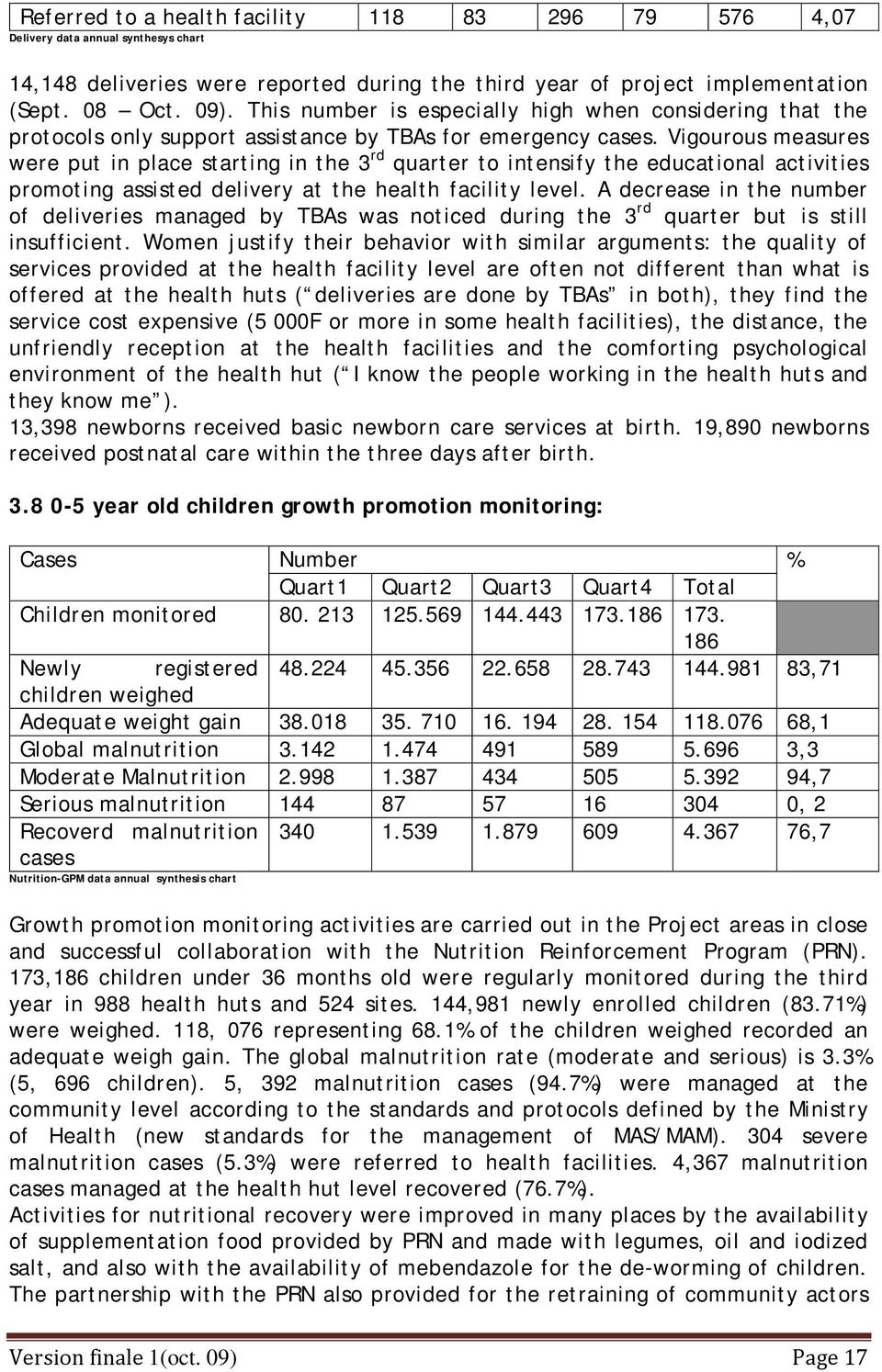
19 on malnutrition case detection according to the Growth srandards and protocols set by the WHO and the establishement of learning, nutritional recovery, and child stimulation centers (FARNE). Those activities helped to highly improve malnutrition detection and management at the community level. Finally, the results from the quick assessments initiated by the Ministry of Health (DANSE) and the LQAS surveys planned by the PRN to monitor community nutrition management activities helped to better understand the current nutritional status and the impact of the interventions. They also helped to improve and contextualize the nutrition strategies among children under 5 years old Supplementation with Vitamin A and de-worming: Cases Number Quart1 Quart2 Quart3 Quart4 Total Supplementation with 226, ,960 1,023, ,049 1,647,778 vitamin A De-worming 202, , , ,487 1,499, 112 Tableau de synthèse annuelle des données de Supplémentation et déparasitage 1,647,778 children from 6-59 months old were supplemented with Vitamin A, with project support, during the 2 JLS phases held during the 3 rd year of project implementation. 1,499,112 mebendazole tablets were given to 1 to 5 year old children during those same JLS IEC activities: Activities Number Quart1 Quart Quart Quart4 Total 2 3 Educational talks 3,573 9,450 8,021 8,352 29,396 Advocacy sessions ,824 Community meetings ,721 Social mobilization Home visits 4,547 32,59 27,61 33, , Grandmother strategies ,046 Individual interviews 8, ,81 46,11 31, , Pregnant women solidarity circles Activity with schools IEC/BCC data annual synthesys chart The IEC activities carried out in the third year dealt with the following issues: Tuberculosis and HIV/AIDS prevention; promotion of assisted delivery at the health facility level; pregnant woman and child nutrition; ARI and diarrhea prevention; promotion of Family Planning; Hygiene and sanitation; month old de- Version finale 1(oct. 09) Page 18

20 worming the activities targeted mothers, community leaders, adolescents and men. A total of 1,824 advocacy sessions, 1,721 community meetings, 344 social mobilization activities, 29,750 educational talks, 98,016 home visits, 1,046 grandmother strategies, 786 pregnant women solidarity circles, 146, 847 individual interviews and 230 school-targeting activities were held. The other activities carried out had to do with father-to-be solidarity circles (Mbour area: 10), animations with local radio stations (4), cooking demonstration sessions (277), partnership with Coranic schools in the District of Tivaouane(10), community information days (JIC) in the region of Ziguinchor (3), care group sessions in Ziguinchor and Tambacounda (343). During the report year, the care groups held 343 activities that reached 1654 people with different types of messages. (Family Planning, use of bed nets, breastfeeding ). During the 4 th quarter, 112 pregnant women were sponsored by women older and more experimented than they. The total number of people who assisted the IEC/BCC activities is reported per area in the attached Indicator monitoring chart. 4. USAID indicators analysis: 23 Indicators out of 28 (85.7%) were met or exceeded. 4 indicators out of 24 (16.6%) recorded an achievement rate between 90 and 110%. 5 indicators out of 28 (17.85%) did not reach the target set: number of cycles of pills distributed (8613/14325=60.1%) ; number of cyclebeads/sdm distributed (779/1146=68.0%); number of FP counseling sessions (116189/146160=79.5%). 13 indicators exceeded the target by more than 10%. Indicators that exceeded the set targets are: TB (2 indicators), maternal and child health (10 indicateurs), reproductive health/family planing (6 indicators) and malaria (4 indicators). Justification for exceeded targets (over 10%): the reason why certain set targets were exceeded is linked to the number of huts which provided services during the year which is more than the number which was used in originally setting the targets. The planning for this year was done on the basis of 1297 health huts and sites offering PMI services and 831 huts/sites offering the basic package services. 74 new huts were to be enrolled in the course of the year but were expected to be functional only at the end of the year because of the lengthy establishment procedures (agreement on the coverage plan with districts and local governments, community advocacy sessions, community actor selection and training, establishment of additional equipment ). It was possible to shorten this procedure in some areas and so since the 1 st quarter, 48 new health huts were functional and offering integrated services. It was also forecasted that 10% of huts and sites would have difficulties which would prevent them from offering services during the year (the non-availability of community actors in health facilities, indifference of the community). This ratio was lower during the 3 rd year of program implementation (2% on average). During the report year, about 1809 huts and sites offered PMI services on a regular basis, against 1297 planned (139%); about 1444 huts and sites offered integrated services against 831 planned (174%). The same trend was noticed for the specific package (ARI management with Cotrimoxazole, community management of TB and perinatal and neonatal health). The estimation of the Version finale 1(oct. 09) Page 19

21 number of huts offering these services was based upon the previous year data (year 2: Oct. 07 Sept. 08) because expansion activities had to do with health facility capacity building by other agencies (Intrahealth and aspecially FHI). New huts offering the specific package services were enrolled in the course of the year in order to be in line with the progress plan in the health facilities : ARI huts(306 huts planned; 533 huts enrolled), comm.-tb (429 huts planned; 623 huts enrolled), SPNN (239 huts planned; 461 huts enrolled). Analysis of the gaps: Tuberculsois: regarding the indicator related to hut rehabilitation, it was not planned in the budget to undertake renovation work at the health hut level during the 3 rd year. The fact that the target was surpassed is justified by initiatives taken at the local level (community, local governments) which allowed basic repairs/maintenance, repairs from some damage caused by the rains, or work to make the health huts more attractive (Kolda: 2 huts; Kaffrine:69 huts). Maternal and child health: - Newborn visit by the third day after birth: the target was estimated on the basis of 1,119 functional huts/sites during the year x 13 newborns to visit per hut/site= 14,547. The actual number of huts/sites that offered services during the year is about 1,444. The readjusted target on the basis of the average number of functional huts/sites is 13 x 1,444 huts/sites= 18, 772 (94%). - Delivery assisted by a skilled TBA: the target was calculated on the basis of 40% of deliveries managed at the health facility level. This target was not reached because women kept seeking services at the health hut level for different reasons: the cost of services at health facility level, the quality of services (deliveries assisted by TBAs at both the health facility level and the health hut level), geographical accessibility efforts were made by the Project to promote delivery at the health facility level but work still needs to be done because of the factors cited above. - Training or retraining on maternal and neonatal health: the CHWs, TBAs and relays were trained or retrained (new health huts and community actors with low performance) whereas the activity was to be implemented during the 4 th year. - Training or retraining on Health / nutrition or child survival: the change of the standards for malnutrition management at the community level required the retraining of community actors on the new protocols. - Basic health care: the fact that the target related to the number of deliveries assisted by a skilled TBA (indicator 7) was exceeded justifies why the the target related to basic health care was exceeded (for each mother delivered by a TBA, the baby received basic health care at birth) new born registered and weighed: the target was set on the basis of 1,354 huts/sites where as 1,444 huts/sites on average offered the service during the year. The target, corrected on the basis of the average number of huts/sites that offered services during the year is: 116x1,444 huts/sites= 167,504 (95%). - pneumonia management: 277 functional ARI huts served as the basis to set the target related to Cotrioxazole management of pneumonia in 0-5 year old children, at the health hut level, with 36 ARI cases expected per year and per hut = 9,972; about 474 ARI huts delivered services during the year (1 st quart.: 306; 2 nd quart.: 526; 3 rd and 4 th quart.: 533). The target corrected on the basis of the average Version finale 1(oct. 09) Page 20
22 number of ARI huts that delivered services during the year (36x474) resulted in an target of 17,084 (113%). Another factor explaining why the target was surpassed is the intensification of awareness-raising activities on the use of health huts within the framework of ARI treatment (the targets were not reached in the previous year). - Diarrhea management: the increase in the number of huts enrolled explains why the target set related to diarrhea management among 0 to 5 years children with ORS/Zinc was surpassed. Regarding the indicator related to the use of ORS/Zinc, the redeployment of the excess of Zinc stocks in the pilot areas of Joal and Kolda to other districts (Popenguine, Thiès, Ziguinchor, Sédhiou and Nioro) increased the number of ORS/Zinc huts (61 to 151). Family planning and reproductive health: - Number of cycles of pills distributed: this activity was planned to begin in Oct. 08. Because of some constraints (practical internship not completed), the service delivery was postponed in many test huts. Regarding the cycle beads (standard days method), the same problems as with the pills were faced. There are also constraints related to lack of interest in the pills because of the risk of forgetting to take them and the necessity of the partner s collaboration for its use. - Condoms distributed: the annual target was set on the basis of 665 functional health huts (120 condoms x 665 huts = 79,800). During the report year an average of 933 huts offered services representing a corrected target of 120x933=111,960 (102%). - training/retraining on FP: Surpassing the target is due to the training of 144 CHWs, relays and TBAs for the 48 new huts established in the course of the year and the early retraining in other health huts (retraining sessions were planned for the 4 th year). - FP counseling: the poor performance is not easy to explain but is linked to a misunderstanding of the indicator: the community actors were previously not taking account of the home interviews in this rubric but only interviews done at health hut level. - FP Awareness-raising: the annual target was set on the basis of 1,083 huts/sites with 160 people reached per hut/site (173,200). An average of 1,444 huts/sites offered services during the year, representing an adjusted target of 160x1, 444= (93%). - Huts providing FP counseling: the average number of huts that offered services during the year (988) is higher than the planned number (831). - Contraceptive product stock shortage at health hut level (pills, cycle beads or condoms): There was an error in the planned target because it was based on the number of health huts that did not report any days of stock shortage during the year (contrary to the actual indicator description: huts reporting any days of stock shortage during the year). It was forecasted that 25% of huts would report a stock shortage (25% of the 211 test huts=53). Only 12 huts out of 196 functional huts reported stock shotage (6.12%). The target should, therefore, be considered met because only 6.12% of functional huts reported stock shortage whereas the tolerance is 25%. - condom stock shortage: as for the indicator related to pills, there was an error in the planned target because it was defined on the basis of the number of huts who did not report any days of stock shortage (contrary to the actual indicator description: huts reporting any days of stock shortages). It was forecasted that 25% Version finale 1(oct. 09) Page 21
23 of huts would report stock shortage (25% of the 892 huts =223). Only 12 huts out of 223 functional huts reported stock shortage (5.38%). As for the other contraceptive products, the indicator target can be considered reached. Malaria: - Training on malaria prevention and/or treatment: The target was surpassed given community actor training for the new huts and their retraining within the framework of IRS in Richard Toll, Vellingara and Nioro (not taken into account when the the indicator target was set). - Malaria management: the gap is again due to the community actor training in the new huts and the replacement of those who resigned. - Malaria awareness-raising: the target was set on the basis of 1,297 functional huts/sites with 285 people to be reached per hut/site (285x1,297=369,645). During the year, an average of 1,809 huts/sites delivered services on a regular basis. The revised target is 285x1,809=515,565 (152%). The resuidual gap is attributable to the awareness-raising activities carried out in urban and peri-urban areas during the National LLIN distribution campaign coupled with the JLS and which covered all the regions of Senegal. - ACT stock shortage in health huts: with the change of the drug formula, all the huts recorded stock shortages due to delays in providing the new drugs and the expiration of the old stocks (all the ACT stocks expired by July 09). Synthesis on the USAID indicators: the set targets for the year were largely reached and even surpassed, except for the indicators related to the availability of contraceptive products (standard Days Method and pills), FP/counseling and ACT stock management. Those objectives are not reached because of: the delays in starting service delivery in certain huts, the home FP/interviews not taken into account and the ACT stock shortage at the national level. 5. Supervision: Supervision activities were conducted on a regular basis throughout the 3 rd year. In the 4 th quarter, the community staff (relays, CHWs and TBAs) benefitted from closer supervision from the Project area teams. Other supervision also operated on a regular basis. The project agents were supervised by the Program area office coordinators and managers. The coordination unit supervised all the area offices during the year, using an integrated chart. The supervision was formative and targeted capacity building, assessment of activities related to services delivery, hut/site equipment, activity coordination and service and data quality assessment. Hut activity supervision by districts (ICP) and joint supervision Project/district remained in the early stages throughout the year despite the advocacy sessions carried out at different levels (national steering committee, medical regions, districts, health posts). In Casamance, the insecurity and upsurge of violence in the regions of Ziguinchor and Sedhiou made some areas inaccessible and that decreased the number supervision visits. II- Administration and Finance: 2.1- Organization: Version finale 1(oct. 09) Page 22
24 The planned activities within the framework for this 3 rd year of Program implementation had mainly to do with the restructuring of the ChildFund area office of Mbour in 2 areas (Mbour and Kaolack) and the reinforcement of the coordination unit through the recruitment of a Grants-M&E Manager based in Dakar who is to support the project regarding the relationships with partners and Monitoring & Evaluation. During the 3 rd year of implementation, the Project was restructured into the following system: a) - Project coordination unit (PCU) based in Thies and led by a Chief Of Project (COP) assisted by 6 advisors and assistants, a Grant-M&E manager based in Dakar and an administrative department (3 persons): they are in charge of the Project overall coordination, quality control, and methodological and technical support to the area offices. b)-15 area offices in charge of Project activity implementation at the operational level: the total number of workers is 361 agents divided as follows: area Coordinators (10); program managers (18), area managers/supervisors (40); community development agents including community motivators, community health educators (ECS), facilitators (274); support teams (finance, logistics: 19). The different areas are: - ChildFund Mbour area: districts of Mbour, Joal, Popenguine and Thiadiaye (46 agents), - ChildFund Kaolack/Fatick area: districts of Kaolack, Ndoffane, Gossas, Guinguinéo, Foundiougne, Passy and Sokone (27 agents), - ChildFund and Plan area, Thiès: districts of Thiès, Khombole, Pout, Tivaouane, Mékhé, Mbacké and Touba (56 agents), - ChildFund and World Vision area, Kolda/Vélingara: districts of Kolda and Vélingara (55 agents), - Plan area of Nioro: district of Nioro (33 agents), - Plan area of Louga: districts of Louga and Darou Mousty (20 agents), - Plan area of Linguère: districts of Dahra and Linguère (12 agents), - Plan area of Saint Louis: districts of Saint Louis and Richard Toll (23 agents), - Africare area of Ziguinchor: districts of Bignona, Diouloulou, Oussouye, Thionck Essyl, Ziguinchor, Goudomp and Sédhiou (30 agents), - Africare area of Tambacounda: districts of Tambacounda, Koumpentoum, Makakolibantan and Kédougou (6 agents), - World Vision area of Fatick: districts of Fatick, Dioffior and Bambéye (16 agents), - World Vision area of Kaffrine/Koungheul and Kébémer: districts of Kaffrine, Koungheul, Malème Hodar and Kébémer (18 agents), - CRS area of Diourbel: district of Diourbel (1 agent), - CRS area of Bakel: districts of Kidira, Goudiry, Bakel, Diankémakhan, Saraya (5 agents), - Counterpart area of Ndioum/Matam: districts of Podor, Dagana, Pété, Matam, Ranérou and Kanel (13 agents) Administration: Version finale 1(oct. 09) Page 23
25 Project coordination was ensured through: the PCU quarterly meetings with the area coordinators, the internal monthly meetings in the area offices, the monthly meetings between area supervisors, community development agents (ADC), and the planning and self-evaluation meetings at health hut and site level. All the coordination levels operated during the 3 rd year Internal meetings: all the coordination meetings planned by the coordination unit and the area coordinators and program managers were held on a regular basis. At the area level, the different planned internal meetings were held. The area offices participated in the coordination meetings held by the districts during the 3 rd year of project implementation Meetings with partners: the project participated in all the meetings planned with partners (USAID implementing agencies, Ministry of Health and Medical Prevention, PRN, PNLP, PNT, UNICEF, WHO ). At the local level, the Project representatives participated in all the coordination meetings of the USAID health Program s regional offices (Kolda and Thies). Pogram coordinators and managers participated in the coordination meetings held by medical regions and districts of their intervention areas, and in the meetings held by administrative leaders, local governments (CCD, LDC, steering committees ) and other partners. The Peace Corps volunteers actively participated in relay/chw/tba mentoring in health huts and sites and in close collaboration with Project agents. They helped hut management committees to improve their performance and finance their own activities thanks to the monitoring meetings they initiated. They closely collaborated with the Project agents during the LLIN distribution campaign Working groups: the Project regularly participated in the meetings of the working committees: steering committees for the introduction of the new formula ORS and Zinc in diarrhea management among 0-5 year old children, monitoring meetings with the Peace Corps volunteers, meetings with PRN, steering committee for the initial offer of the pill, steering committee for misoprostol use at the community level Program s Financial Status: III- the planned activities for the 1 st quarter of the 4 th year (October, November and December 2009): 1. Organize data collection, draft the IOP documentation report and disseminate the results with DSR and partners. 2. Plan activities for the international review of community-based Reproductive Health interventions. 3. Participate in the preparation and planning for community malaria activities with PNLP. 4. Organize hut enrolment and community actor selection to scale up Project coverage. 5. Organize advocacy sessions at community and institutional levels for newly enrolled huts and integration of package activities. Version finale 1(oct. 09) Page 24
26 6. Plan and organize Project activity self-evaluation and planning at all hut and site level. 7. Control Project activity implementation at health hut and site level. 8. Continue implementing pilot study on initial offer of the pill/family Planning. 9. Continue implementing the 2 nd cycle in Mbour and Joal of community mobilization on post abortion care (PAC) and scale-up activities in the regions of Kaffrine, Ziguinchor and Kaolack. 10. Continue implementing the community mentoring activities related to the pilot study on misoprostol use. 11. Participate in the meetings held by the steering committee on misoprostol use. 12. Continue implementing the study on cell phone use (update the application s execution and install the hardware and software architechture). 13. Continue carrying out activities within the framework of female genital cutting (FGC) in the test villages of Velingara (partnership identification and negotiation in the expansion villages, implementation of district-involvement strategies and establishment of alliance committees). 14. Continue implementing iron-fortified flour activities in the sites of the Velingara area (training of the monitoring committee members and management commity members, supply of the premix and premix pots, IEC/BCC). 15. Organize the continuous supply of ACTs and TDRs in health huts, and stock management. 16. Organize IEC strategy implementation for population information on services available in health huts and health facilities. 17. Ensure community actor supervision and mentoring in IEC activity implementation. 18. Ensure community actor mentoring in population organization/mobilization for advanced strategy services. 19. Ensure community actor supervision in childhood illness management at the health hut level. 20. Continue LLIN use monitoring and documentation in all the areas. 21. Organize community information sessions on new protocols for fever management at the health hut level (introduction of TDR and new formula ACT). 22. Organize IRS/IEC activity implementation at the district level. 23. Organize internal data quality control in the project areas. 24. Organize monthly coordination meetings in each area. 25. Organize quarterly Project activity coordination meetings with the area coordonnators, NGO national coordinators and the Project Coordination Unit. 26. Participate in the district and medical region coordination meetings. 27. Participate in the USAID monthly coordination meetings. 28. Participate in the sector technical meetings with the other implementing agencies, the Ministry of Health and the Project partners. 29. Assess area quarterly action plans. 30. Share the evaluation-based results with districts and partners. 31. Draft Project quarterly report. Version finale 1(oct. 09) Page 25
27 ATTACHMENTS A. Project financial status. B. USAID indicator monitoring chart ( ). C. Justification of the gaps in USAID indicators. D. Specification sheet: Solidarity circle for pregnant women s husbands («fathersto-be»). E. List of huts renovated in the course of the Project 3 rd year (Oct. 08 Sept. 09). F. Succes stories. Version finale 1(oct. 09) Page 26
28 FY 08 OPERATIONNAL PLAN Annual results Octobre 2008 Septembre 2009 Area of: CONSORTIUM PROJET SANTE COMMUNAUTAIRE - PMI TUBERCULOSIS Indicators 4. Nber of CHWs, relays, TBAs, members of the health committee, TB patients parents /friends trained on (DOT) supervision Objective Results achieved Gaps Annual Quarterly Quarter % Cumul period % Quarterly % Annual % Nber of women? Nber of men? Nber of huts /sites renovated or rehabilitated with the project support (fencing, painting, masonry, carpentry, roofing, various repairing) NB: huts offering TB community-based monitoring MOTHER AND CHILD HEALTH Indicators Objective Results achieved Gaps Annual Quarterly Quarter % Cumul period % Quarterly % Annual % Version finale 1(oct. 09) Page 27
29 6. Nber of new born visited by a TBA, relay or CHW within the 3 days after birth (each new born is counted only once even if he is visited many times) NB: each new born is counted only once the year Nber of deliveries performed by a skilled TBA (at home or at the health hut) Nber of CHW, relays and TBA trained or retrained on maternal and neonatal health (mother and child health training module) Nber of female CHW, TBA, and relays? Nber of male CHWs and relays Nber of CHWs relays and TBAs trained or retrained on Health/Nutrition or child survival? Nber of female CHWs, relays And TBA? Nber of male CHW and relays? Number of mothers delivered by a skilled TBA and whose baby received the following care : -Temperature kept (new born properly dried and covered, bath postponed to at least 6 hours later, direct contact with mother - Early breastfeeding within the hour after birth - care for the umbilical cord (cord bare and dry) MOTHER AND CHILD HEALTH Indicateurs Objective Results avhieved Gaps Annual quarterly Quarter % Cumul period % quarterly % Annuel % Version finale 1(oct. 09) Page 28
30 11. Nber of newly-registered 0-3-year children weighed at least once a quarter Nber of 0-5 year old siblings for every newly-registered child brought by his mother Nber of 0-5 year children treated for pneumonia with Cotrimoxazole at health hut level. 13. Nber of 0-5 children treated for diarrhea at hut level a) with ORS (old and new formula) 13. b) with zinc only or ORS/zinc 14. Nber of huts/sites rehabilitated or renovated with the project support (fencing, painting, carpentry, masonry, roofing, and various repairing) NB : huts offering MNCC services REPRODUCTIVE HEALTH/FAMILY PLANNING Indicators Objective Results achieved Gaps Version finale 1(oct. 09) Page 29
31 Annual Quarterly Quarterly % Cumul period % Quarterly % Annual % 15.1 Nber of cycles of pills (21 or 28-pill pack) distributed during the quarter by TBAs in each hut of the area implementing the initial offer of pill Nber of SDM cycle beads distributed in the huts implementing the initial offer of pills (test huts) Nber of condoms distributed in each hut and site during the quarter. Nber of condoms for men? Nber of condoms for women? Nber of CHWs, TBA and relays trained or retrained on FP. Nber of female CHWs, relays and TBAs? Nber of male CHWS, relays and TBAs Nber of individual (or couple) interviews on FP (Counselling) Nber of women? Nmber of men? Nber of people (women, men, ado, youth and old people ) who have been in contact with a FP message spread by the project or with its support REPRODUCTIVE HEALTH/FAMILY PLANNING Indicators Objective Results achieved Gaps Version finale 1(oct. 09) Page 30
32 Annual Quarterly Quarter % Cumul period % Quarterly % Annual % 19. Nber of new FP strategies (approaches, techniques, means, community-based interventions tools, IEC/BCC. Capacity building ) successfully produced in the project by the project. 20. Nber of huts providing FP, RH or HIV prevention counselling Nber of test FP huts reporting one day of pill (lovrette or lofemenal), cycle beads or condoms stock shortage during the 3 rd year from Oct. 1 st 08 to Sept. 31 st (53)* (12)* Nber of test de cases non PF reporing any days of stock shortage during the year (du 1 er oct au 31 sept (223)* (12)* Number of community-based interventiosn aming at decreasing or responding to gender-based violence including excision (attach specification sheed describing the intervention) 23. Number of huts/sites renovated with Project support (fencing, painting, masonry, roofing, various repairings) MALARIA Version finale 1(oct. 09) Page 31
33 Indicators Objective Results achieved Gaps Annual Quarterly Quarter % Cumul period % Quarterly % Annual % 24. Nber of CHWs, TBAs, relays trained on malaria prevention/and or treatment Nber of men? Nber of women Nber of CHWs, TBAs and relays trained on ACT management of malaria Nber of men? Nber of women Nber of 0-5 year-old malaria cases treated with ACT according to standards and protocols set ) Nber of people (men, women, children, adolescents, old people ) reached by malaria educational and/or treatment activity. NB : each person is counted once the year (systematize IEC groups and form men, adolescent, GM groups MALARIA Version finale 1(oct. 09) Page 32
34 Indicateurs Objective Results achieved Gaps Annual Quarterly Quarter % Cumul period % Quarterly % Annual % 27. 2) Nber of advanced strategy visits to health huts. a) with PNC/ITP b) with MILDA voucher Nber of pregnant women recievin g the ITP. During the adnvanced strategies a) ITP b) ITP2 and more Nber of malaria IEC/BCC activities (individual interviews, talks, social mobilization, home visit ) Nber of IEC activities carried out for each theme: re d activités IEC/CCC menées pour chaque thème : - cases treatment IPT/PNC Promotion MILDA Promotion Malaria Prevention Early seeking of care, recognition of danger signs Indoor Residual Spraying Other activities with quantitative dats (Supplementation, de worming, MILDA distribution, reimprégnation ) Vitamine A supplementation Children de worming Free MILDA Dist. With USG funds Nber of huts who did not report any days of stock shortage during the quarter Version finale 1(oct. 09) Page 33
35 C. Justification des gaps des indicateurs de l USAID. Analyse 23 indicateurs sur 28 (85,7%) ont été atteints ou dépassés. 4 indicateurs sur 24 (16,6%) enregistrent des scores compris entre 90 et 110%.Les objectifs ne sont pas atteints pour 5 Indicateurs sur 28 (17,85%): nombre de cycles de pilules distribués (8613/14325=60,1%) ; nombre de colliers/mjf distribués (779/1146=68,0%) ; nombre de counseling PF (116189/146160=79,5%).Les objectifs sont dépassés de plus de 10% pour 13 Indicateurs. Les indicateurs qui enregistrent des dépassements sont : - nombre d ASC, relais, matrones, membres de comités de santé, parents/amis des malades formés dans la supervision au traitement (TDO) des malades tuberculeux. - nombre de cases/sites qui ont eu des travaux de réfection ou rénovation ou réhabilitation avec l aide du projet (clôture, peinture, menuiserie, maçonnerie, toiture, réparations diverses) - nombre de nouveau-nés visités par une matrone, relais ou ASC dans les 3 premiers jours de la naissance. - nombre d ASC, relais et matrones formés ou recyclés en santé maternelle et néonatale (module de formation santé mère et santé enfant). - Nombre d ASC, relais, matrones formés ou recyclés en santé/nutrition ou survie de l enfant - nombre d accouchements effectués par une matrone formée (à domicile ou dans la case) - nombre de mères accouchées par une matrone formée et dont l enfant a eu les soins suivants : - nombre d enfants 0-3 ans nouveaux inscrits pesés au moins 1 fois dans le trimestre. - nombre de cas de pneumonie traités dans les cases de santé avec du Cotrimoxazole chez les enfants 0-5 ans. - nombre d enfants 0-5 ans traités pour diarrhée dans les cases de santé avec SRO (ancienne ou nouvelle formule). - nombre d enfants 0-5 ans traités pour diarrhée dans les cases de santé avec du zinc seul ou du SRO/Zinc. - nombre de condoms distribués dans chaque case et site pendant le trimestre. - nombre d ASC, matrones, relais formés ou recyclés dans le domaine de la PF. - nombre de personnes dans la population (femmes, hommes, ado, jeunes, personnes âgées ) qui ont été en contact avec un message sur la PF véhiculé par le projet ou avec son appui. - nombre de cases qui donnent des conseils sur la PF ou la SR ou la prévention du VIH. - nombre de cases tests PF qui n ont déclaré aucun jour de rupture de stock de pilules (lovrette ou lofemenal), de colliers ou de condoms du 1er oct 08 au 31 sept 09 pour l an 3. - nombre d ASC, matrones, relais formés dans la prévention et/ou le traitement du paludisme. - nombre d ASC et de matrones formés dans la prise en charge du paludisme avec les ACT. Version finale 1(oct. 09) Page 34
36 - nombre de personnes dans la population (hommes, femmes, enfants, ado, personnes âgées ) touchées par une activité d éducation et/ou de prévention du paludisme. - nombre total d activités IEC/CCC menées sur le paludisme (entretiens individuels, causeries, mobilisations sociales, visites à domicile ) Justification des dépassements : Les dépassements sont pour la plupart liés au nombre de cases de santé qui ont fonctionné pendant l année et qui sont supérieures au nombre planifié. Les prévisions de l année étaient basées sur 1297 cases et sites offrant les services du PMI et 831 cases/sites offrant le paquet de base. 74 nouvelles cases devaient être enrôlées au cours de l année mais ne devaient être réellement fonctionnelles et offrir des services qu à la fin de l année en raison des procédures d implantation (négociations des plans de couverture avec les districts et les collectivités locales, plaidoyers communautaires, sélection et formation des acteurs, mise en place des équipements complémentaires ). Ces procédures ont pu être raccourcies dans certaines zones et dès le 1 er trimestre 48 nouvelles cases étaient fonctionnelles et offraient des services intégrés. Il était également prévu que 10% des cases et sites connaitront des problèmes de fonctionnalité pendant l année qui les empêcheront d offrir des services (indisponibilité des acteurs ou de la structure, indifférence communautaire ). Ce ratio s est révélé plus faible pendant la 3 ème année de mise en œuvre du programme (2%). Au cours de l année, en moyenne 1809 cases et sites ont offert sur une base continue des services PMI contre 1297 prévus (139%); 1444 cases et sites ont offert des services intégrés contre 831 prévus (174%). Le même phénomène a été constaté pour les services du paquet spécifique (prise en charge des IRA avec le Cotrimoxazole, suivi communautaire de la Tuberculose et santé péri néonatale). Les estimations pour le nombre de cases offrant ces services étaient basés sur les données de l année précédente (an 2) parce que les extensions étaient liées à un renforcement de la capacité des structures de santé par d autres agences (Intrahealth et FHI principalement). De nouvelles cases de santé offrant les services du paquet spécifiques ont été enrôlés au cours de l année pour s ajuster au plan de progression dans les structures de santé : cases IRA (prévues: cases; réalisées: cases), TB com (prévues: cases; réalisées: cases), SPNN (prévues: cases; réalisées: cases). Le tableau ci-dessous présente le nombre de cases/sites fonctionnels prévus (et ayant servi de base à la définition des objectifs) et le nombre de cases/sites effectivement fonctionnels dans l année (et justifiant certains dépassements observés). Version finale 1(oct. 09) Page 35
37 INDICATEURS USAID : JUSTIFICATION DES GAPS POUR FY 09 TUBERCULOSE Indicateurs 4. Nbre d ASC, relais, matrones, membres de comités de santé, parents/amis des malades formés dans la supervision au traitement (TDO) des malades tuberculeux. FY 09 Justification des gaps Prévu Réalisé % ,60% - 5. Nbre de cases/sites qui ont eu des travaux de réfection ou rénovation ou réhabilitation avec l aide du projet (clôture, peinture, menuiserie, maçonnerie, toiture, réparations diverses) NB: cases qui font le suivi communautaire de la TB Travaux de base pour corriger des dégâts mineurs occasionnes par les pluies hivernales ou réalisés par les populations/collectivités locales pour des soucis d'ordre esthétique (rendre les cases plus attrayantes): Kolda (2 cases); Kaffrine (69 cases) Version finale 1(oct. 09) Page 36
38 SANTE MATERNELLE ET INFANTILE Indicateurs 6. Nbre de nouveau-nés visités par une matrone, relais ou ASC dans les 3 premiers jours de la naissance (chaque nouveau-né est décompté une seule fois même s il a bénéficié de plusieurs visites) NB: chaque nouveau-né est décompté 1 fois dans l'année 7. Nbre d accouchements assistés par une matrone formée (à domicile ou dans la case) FY 09 Prévu Réalisé % ,70% ,50% 8. Nbre d ASC, relais et matrones formés ou recyclés en santé maternelle et néonatale (module de formation santé mère et santé enfant) Nombre d ASC, relais, matrones formés ou recyclés en santé/nutrition ou survie de l enfant Nbre de mères accouchées par une matrone formée et dont l enfant a eu les soins suivants : - maintien de la température (nouveau-né bien séché, bien recouvert/enveloppé, bain différé d'au moins 6 h, contact peau à peau) - mise au sein précoce dans l'heure qui suit la naissance - soins du cordon (cordon libre et sec) ,10% Justification des gaps l'objectif avait été estimé sur la base de cases/sites fonctionnels pendant l'année x 13 nouveau-nés à visiter par case/site= le nombre réel de cases/sites qui ont fonctionne pendant l'année est en moyenne de L'objectif réajusté sur la base du nombre réel de cases/sites fonctionnels donne: 13 x cases/sites= (94%) L'objectif avait été calculé sur la base de 40% des accouchements pris en charge dans les structures de santé. Ce nombre n'a pas été atteint car les femmes continuent à recourir aux services des cases de santé pour différentes raisons: le coût des prestations dans les structures, la qualité des services (accouchements faits par les matrones dans les structures), l'accessibilité géographique... Des efforts ont été fait par le Projet pour promouvoir l'accouchement dans les structures de santé mais restent encore inopérants eu égard aux facteurs cités plus haut. Les ASC, matrones et relais ont été formés ou recyclés alors que l'activité devait se faire dans la 4ème année (nouvelles cases et acteurs communautaires présentant des déficiences de compétences importantes) Le changement des normes de prise en charge de la malnutrition au niveau communautaire a nécessité le recyclage des acteurs dans les nouveaux protocoles. les raisons qui expliquent le dépassement du nombre d'accouchements assistés par une matrone (indicateur 7) expliquent également le dépassement de cet objectif. Version finale 1(oct. 09) Page 37
39 SANTE MATERNELLE ET INFANTILE Indicateurs 11. Nbre d enfants 0-3 ans nouveaux inscrits pesés au moins 1 fois dans le trimestre 12. Nbre de cas de pneumonie traités dans les cases de santé avec du cotrimoxazole chez les enfants 0-5 ans. FY 09 Prévu Réalisé % ,70% ,60% Justification des gaps L'objectif avait été estimé sur la base de cases/sites alors que cases/sites ont offert le service pendant l'année. L'objectif corrigé sur la base du nombre réel de cases/sites en fonction durant l'année donne: 116x1.444 cases/sites= (95%). 277 cases IRA fonctionnelles avaient servi de base de calcul pour la fixation de l'objectif avec 36 cas d'ira attendus par an par case=9.972; 44 cases IRA en moyenne ont fonctionné pendant l'année (1er Trim.: 306; 2ème Trim: 526; 3ème et 4ème Trim: 533). L'objectif corrigé sur la base du nombre réel de cases IRA fonctionnelles pendant l'année (36x474) donne un objectif de (113%). Un autre facteur qui explique le dépassement est l'intensification de la sensibilisation sur l'utilisation des cases dans le cadre du traitement des IRA (les objectifs n'étaient pas atteints l'année dernière). 13. Nbre d enfants 0-5 ans traités pour diarrhée dans les cases de santé a) avec SRO (ancienne ou nouvelle formule) ,10% Augmentation du nombre de cases enrôlées. 13. b) avec du zinc seul ou du SRO/Zinc 14. Nbre de cases/sites qui ont eu des travaux de réfection ou rénovation ou réhabilitation avec l aide du projet (clôture, peinture, menuiserie, maçonnerie, toiture, réparations diverses) NB : cases qui offrent les SMNI ,00% Redéploiement des stocks du Zinc excédentaires des zones pilotes de Joal et Kolda vers des cases d'autres districts (Popenguine, Thiès, Ziguinchor, Sedhiou et Nioro) portant ainsi le nombre de cases SRO/Zinc de 61 à 151 (3ème Trimestre). Travaux de base pour corriger des dégâts mineurs occasionnés par les pluies hivernales ou réalisés par les populations/collectivités locales pour des soucis d'ordre esthétique (rendre les cases plus attrayantes): Kolda (2 cases); Kaffrine (69 cases) Version finale 1(oct. 09) Page 38
40 SANTE DE LA REPRODUCTION / PLANIFICATION FAMILIALE FY 09 Indicateurs 15.1 Nbre de cycle de pilules (plaquette de 21 ou 28 pilules) distribuées dans le trimestre par les matrones dans chaque case de la zone qui pratique l offre initiale de pilules 15.2 Nbre de colliers MJF distribués dans les cases qui pratiquent l offre initiale de pilules (casetest) Prévu Réalisé % /15 = Nbre de condoms distribués dans chaque case et site pendant le trimestre /120 = Nbre d ASC, matrones, relais formés ou recyclés dans le domaine de la PF. 17. Nbre d entretiens individuels (ou avec des couples) sur la PF (counseling) 18. Nbre de personnes dans la population (femmes, hommes, ado, jeunes, personnes âgées ) qui ont été en contact avec un message sur la PF véhiculé par le projet ou avec son appui 8531/15 = , 1% ,0% /120= ,70% ,50% ,70% Justification des gaps Le début de l'offre de service dans toutes les cases tests avaient été planifié pour octobre 08. En raison de certaines contraintes (stages pratiques non complétés), l'offre de service a été différé dans plusieurs cases tests. Les mêmes problèmes que pour la pilule ont été rencontrés. Il existe également des contraintes en rapport avec un moindre attrait pour la MJF à cause des risques d'oubli et parce que son utilisation requiert la collaboration du partenaire. L'objectif annuel avait été estimé sur la base de 665 cases fonctionnelles (120 condomsx665 cases=79.800). Pendant l'année, en moyenne 933 cases ont fonctionne soit un objectif corrigé de 120x933= (102%) Il s'agit de la formation de 144 ASC, relais et matrones pour les nouvelles cases (48) mises en fonction au cours de l'année et de recyclages anticipés (les recyclages étaient prévus pour la 4ème année). Cette faible performance s'explique mal et pourrait être due à une mauvaise compréhension de l'indicateur: les acteurs communautaires ne comptabilisent pas dans cette rubrique les entretiens fait à domicile mais seulement les entrevues faites dans la case. L'objectif annuel a été calculé sur cases/sites à raison de 160 personnes touchées par case/site (soit ). En moyenne, cases/sites ont fonctionne durant l'année soit un objectif ajusté de 160x1.444= (93%). Version finale 1(oct. 09) Page 39
41 SANTE DE LA REPRODUCTION / PLANIFICATION FAMILIALE FY 09 Indicateurs 19. Nbre de nouvelles stratégies de PF (approches, techniques, moyens, outils d interventions communautaires, IEC/CCC. Renforcement des capacités ) produites avec succès dans la zone par le projet Prévu Réalisé % justification des gaps 1 25% 100% «Offre initiale de pilules par les matrones de case». 20. Nbre de cases qui donnent des conseils sur la PF ou la SR ou la prévention du VIH ,89% Nbre de cases tests PF qui déclarent un jour de rupture de stock de pilules (lovrette ou lofemenal), de colliers ou de condoms du 1er oct. 08 au 31 septembre (53)* 21.2 Nbre de cases non PF ou de sites qui déclarent un jour de rupture de stock de condoms du 1er oct. au 31 septembre Nbre d interventions à base communautaire visant à réduire ou à répondre à la violence faite aux femmes y compris l excision (joindre fiche technique) 892 (223)* 152 (12)* 593 (12)* 106,30% 66,50% Le nombre de cases qui ont fonctionné en moyenne pendant l'année (988) est supérieur au nombre prévu (831). Le niveau d'indicateur prévu est erroné parce qu'il est basé sur le nombre de cases qui n'ont déclaré aucun jour de rupture de stock pendant l'année (inverse du libelle de l'indicateur: cases qui déclarent une rupture de stock). Il était prévu que 25% des cases déclarent une rupture de stock (25% des 211 cases tests=53)*. Seules 12 cases/196 cases* en fonction ont déclaré une rupture de stock (6,12%). Le niveau d'indicateur prévu est erroné parce qu'il est basé sur le nombre de cases qui n'ont déclaré aucun jour de rupture de stock pendant l'année (inverse du libelle de l'indicateur: cases qui déclarent une rupture de stock). Il était prévu que 25% des cases déclarent une rupture de stock (25% des 892 cases =223)*. Seules 12 cases/223 cases* en fonction ont déclaré une rupture de stock (5,38%) % «Cercle de solidarité des futurs pères». 23. nombre de cases/sites qui ont eu des travaux de réfection ou rénovation ou réhabilitation avec l aide du projet (clôture, peinture, menuiserie, maçonnerie, toiture, réparations diverses Travaux de base pour corriger des dégâts mineurs occasionnés par les pluies hivernales ou réalisés par les populations/collectivités locales pour des soucis d'ordre esthétique (rendre les cases plus attrayantes): Kolda (2 cases); Kaffrine (69 cases) Version finale 1(oct. 09) Page 40
42 PALUDISME Indicateurs FY 09 Prévu Réalisé % Justication des gaps 24. Nbre d ASC, matrones, relais formés dans la Il s'agit de la formation des acteurs communautaires des prévention et/ou le traitement du paludisme. nouvelles cases et les recyclages des acteurs communautaires dans le cadre des AID à Richard Toll, Vélingara et Nioro. 25. Nbre d ASC et de matrones formés dans la Il s'agit de la formation des acteurs communautaires des prise en charge du paludisme avec les ACT nouvelles cases et le remplacement des acteurs démissionnaires. 26. Nbre de cas de palu chez les enfants 0-5 ans traités avec les ACT par les cases selon les normes et protocoles ,40% )Nbre de personnes dans la population (hommes, femmes, enfants, ado, personnes âgées ) touchées par une activité d éducation et/ou de prévention du paludisme. NB : chaque personne est décomptée 1 fois dans l année (systématise groupe IEC et constituer des groupes d hommes, ado, GM ,40% L'objectif avait été estimé sur la base de cases/sites fonctionnelles à raison de 285 personnes à toucher par case/site (285x1.297= ). Pendant l'année, en moyenne cases/sites ont fonctionné régulièrement. L'objectif corrigé sur cette base donne 285X1.809= (152%).Le gap résiduel est attribuable aux activités de sensibilisation dans les zones urbaines à l'occasion de la distribution nationale gratuite de MILDA couplée aux JLS qui a concerné toutes les régions du Sénégal. Version finale 1(oct. 09) Page 41
43 PALUDISME Indicateurs FY 09 Prévu Réalisé % Nbre total d activités IEC/CCC menées sur le paludisme (entretiens individuels, causeries, mobilisations sociales, visites à domicile ) ,10% Nbre d activités IEC/CCC menées pour chaque thème : Justication des gaps La distribution des MILDA dans toutes les régions, la Journée Mondiale Paludisme et les IEC/AID expliquent cette performance. - Traitement des cas ,70% - - Promotion TPI/CPN Performances en rapport avec la préparation des stratégies ,70% avancées. - Promotion MILDA Beaucoup d'activités ont été menées au cours de la ,70% campagne de distribution des MILDA qui a concerné toutes les régions (zones rurales et urbaines). - Prévention paludisme ,80% - - Recherche précoce de soins/reconnaissance des signes de danger ,90% - - Aspersion Intra domiciliaire 29. Autres activités avec des données quantitatives (Supplémentation, déparasitage, distribution MILDA, ré imprégnation ) 30. Nombre de cases qui n'ont connu aucun jour de rupture de stock d'act durant le trimestre ,30% % Avec le changement de molécule, toutes les cases ont connu des ruptures de stock dues au retard dans la mise en place des nouvelles présentations et la péremption des stocks (Tous les stocks d'act étaient périmés en juillet 09). Version finale 1(oct. 09) Page 42
44 Version finale 1(oct. 09) Page 43
45 D. Fiche technique: le cercle de solidarité des maris de femmes enceintes («futurs pères»). «Cercle de solidarité des futurs pères» (Maris des femmes enceintes) Justification et Principes méthodologiques : La bonne croissance d un enfant passe par une bonne prise en charge de la grossesse, sur les plans sanitaire, nutritionnel et affectif. La qualité de la prise en charge intègre également l implication et le soutien des membres de la famille et particulièrement du conjoint/mari. Les programmes de santé ont surtout insisté sur le renforcement des capacités cognitives et affectives des femmes enceintes dans la perspective d une modification des comportements. Les maris ou conjoints de ces femmes enceintes ne bénéficient d aucune intervention structurée ou même informelle de nature à les préparer à soutenir efficacement leur conjointe ou épouse dans sa grossesse et, plus tard, à être un père éclairé. Pourtant, leur rôle est crucial dans les différents stades de la grossesse, du travail, de l accouchement, des suites de couches et de l élevage de l enfant. C est dans ce sens qu une stratégie d éducation et de sensibilisation ciblant les futurs pères ou les maris des femmes enceintes a été conçue et mise en expérimentation. Une première stratégie avait été développée à l intension des femmes enceintes basée sur le modèle de l éducation par les pairs et le partage d expérience (Cercle de solidarité des femmes enceintes). La même méthodologie a été réaménagée pour être appliquée aux les maris/conjoints des femmes enceintes. (Cercle de solidarité des futurs pères). Le but de l approche combinée (Cercle de solidarité des femmes enceintes et Cercle de solidarité des futurs pères) est d accompagner la femme enceinte mais également son mari durant toute la grossesse afin que la femme bénéficie le plus possible du soutien de son mari et, par ricochet, des autres membres de sa famille et de la communauté (belles mères, sœurs, frères...) Le Cercle de solidarité des futurs pères repose sur les mêmes principes que ceux de la stratégie du cercle de solidarité des femmes enceintes. La mise en œuvre de la stratégie a montré que les personnes qui ont les mêmes préoccupations sont plus réceptives aux conseils de leurs pairs, partagent plus facilement leurs expériences et peuvent se soutenir mutuellement. L organisation des maris/conjoints des femmes enceintes dans un cercle de solidarité peuvent leur permettre de parler ouvertement des difficultés liées à la grossesse de leur conjointe, discuter des solutions possibles et définir des stratégies pour un soutien plus efficace à leur femme durant la grossesse. Ceci permettra d instaurer une meilleure communication dans le couple sur la grossesse en cours, l accouchement à venir et les autres aspects liés à la vie du couple (planification familiale, survie de l enfant...) Les différentes étapes de la méthodologie : Version finale 1(oct. 09) Page 44
46 Les étapes prévues pour la mise en œuvre de l approche sont : la négociation communautaire, le ciblage des maris/conjoints, la négociation avec les maris et la Mise en œuvre de la stratégie ETAPE 1 : NEGOCIATION COMMUNAUTAIRE Pour l implantation de cette approche, la première étape consiste à négocier avec la communauté et les partenaires leur adhésion. Des réunions communautaires sous forme de plaidoyer ont été organisées par les agents du projet avec les agents de santé et les relais auprès des leaders communautaires (délégués de quartier, membres des comités de pilotage), des hommes et des femmes des communautés. Lors de ces réunions, les objectifs, les principes et les modalités d organisation des activités dans la communauté ont été présentés, discutés et réajustés sur la base des suggestions et contributions des groupes communautaires. ETAPE 2 : CIBLAGE ET NEGOCIATION AVEC LES MARIS : Les maris concernés ont été identifiés, lors des réunions communautaires par les relais et dans le cadre des cercles de solidarité des femmes enceintes. Les maris identifiés ont été sensibilisés et invités à participer au cercle de solidarité. Pour les enrôler dans l approche, des visites à domicile (VAD) ont été organisées par les relais, appuyées par le délégué de quartier et l agent du projet. A la suite de ces VAD, une date de réunion a été fixée par le délégué de quartier et la réunion tenue. La réunion a permis d approfondir les discussions sur la pertinence de l activité qui doit être le prolongement du cercle de solidarité des femmes enceintes. Le mari, chef de famille, père du futur bébé détient l essentiel des ressources et souvent le pouvoir de décision ; il doit être le premier soutien moral et affectif de son épouse. Une fois la justification de l activité comprise et acceptée par tous, la méthodologie des rencontres a été dégagée. Différents éléments d appui matériel, financier et psycho affectif venant du mari ont été discutés : achat de tickets et d ordonnances pour les CPN, allégement des travaux domestiques de l épouse (lui permettre de faire venir une parente comme aide ou d embaucher une domestique) augmentation et amélioration de sa ration alimentaire, réalisation du plan de son accouchement, appui dans la prise effective des médicaments prescrits, gestion des problèmes d humeur. Les éléments d information relatifs à une meilleure compréhension de la vie reproductive ont été également discutés comme thèmes à développer dans le cercle de solidarité des maris des femmes enceintes (FE). Cette étape a permis de créer un groupe de 08 hommes disponibles pour les premières séances. ETAPE 3 : LA MISE EN ŒUVRE Elaboration d un plan d action : Un calendrier d activites avec «les maris des femmes enceintes» a été élaboré : une rencontre tous les 15 jours chez le délégué de quartier. Les rencontres ont lieu les dimanches après-midi (16 h) sur la décision des participants dont la majorité ne sont libres que les week end. Difficultés rencontrées : La difficulté majeure rencontrée est la non disponibilité des maris concernés pour des raisons professionnels. Les VAD menées ont été faites à l heure du crépuscule ou pendant la nuit avec l accompagnement du délégué de quartier et les relais. Les réunions enregistrent beaucoup de cas d absence ; le seul groupe actuellement opérationnel est constitué de 8 hommes. Version finale 1(oct. 09) Page 45
47 Description d une activité avec «les maris aux femmes enceintes» : Accueil des maris Brise glace Animation les causes/les conséquences/ les solutions : Les thèmes sont développés sur la base des problèmes vécus par les femmes enceintes et ressentis par les maris/les problèmes vécus par le mari/les cause de ces problèmes /les conséquences de ces problèmes et les solutions possibles de ces problèmes Synthèse Le relais demande aux maris les problèmes auxquels ils sont confrontés dans la grossesse de leur conjointe. Ils décrivent leur problème, puis les autres hommes qui ont eu le même problème sont aussi interpellés. Le relais demande aux maris qui ont ce problème qu elles en sont les causes, ensuite il demande aux autres maris s ils partagent ces avis. Le relais demande aux maris qui vivent le problème de décrire les conséquences si le problème n est pas réglé à temps ensuite il demande l avis des autres membres du cercle sur les conséquences du problème. Le relais demande aussi aux maris qui vivent le problème de dire ce qu ils ont fait pour résoudre le problème et aux autres, qui ont eu a vivre le problème dans le passé, ce qu ils ont fait pour lui trouver des solutions. Il demande aussi aux maris qui n ont jamais vécu ce problème leur stratégie pour l éviter et ceux qui vivent actuellement le problème s il est possible d appliquer les solutions pratiquées par les autres. Enfin le relais pose une question aux maris plus expérimentés ce qu ils peuvent faire pour aider ceux qui ont des difficultés à appliquer les solutions préconisées et à donner le message aux maris concernes mais absents à la séance. A la fin de la séance, l animatrice synthétise les conseils, les complètent au besoin. Version finale 1(oct. 09) Page 46
48 E. Liste récapitulative des cases réhabilitées en l an 3 (oct. 08 sept. 09). Liste récapitulative des cases réhabilitées depuis Octobre 2008 (octobre 08 septembre 09) District Sanitaire de Kébémer (World Vision): Nom du Poste de Santé Nom de la Case de Santé Type de travaux Diokoul Thiolom Fall Maka Ndiaye Maka Fall Nguer Nguer Kanéne Kane Badar Diop Lompoul Village Diokoul Ndiaye Gad Mbrama Thienaba Seck Ndiawagne Fall Ndialouye Marone réfection de plancher, réfection de portes et fenêtres, peinture murale réfection de plancher, réfection de portes et fenêtres, peinture murale réfection de plancher, réfection de portes et fenêtres, peinture murale réfection de plancher, réfection de portes et fenêtres, peinture murale réfection de plancher, réfection de portes et fenêtres, peinture murale réfection de plancher, réfection de portes et fenêtres, peinture murale tôle d étanchéité, réfection de plancher, réfection de portes et fenêtres, peinture murale. Participation des villageois pour la toiture de la case. réfection de plancher, réfection de portes et fenêtres, peinture murale réfection de plancher, réfection de portes et fenêtres, peinture murale réfection de plancher, réfection de portes et fenêtres, peinture murale tôle d étanchéité, réfection de plancher, réfection de portes et fenêtres. Version finale 1(oct. 09) Page 47
49 Kab Gaye Thieulbaty Massar Diop Kouré Mbel Gor Ngaye Ngaye Ndiakhoumpa Kandala Mbengue Toubé Fall Keur Mory leye Lompoul sur Mer Mabouille Niaye Ngeubeul Tawa Peul Teumb Mbaye Lambane Willane Merina Soump Merina Ndiaye tôle d étanchéité, réfection de plancher, réfection de portes et fenêtres. réfection de plancher, réfection de portes et fenêtres, peinture murale réfection de plancher, réfection de portes et fenêtres. Participation des villageois pour la toiture de la case réfection de plancher, réfection de portes et fenêtres, peinture murale réfection de plancher, réfection de portes et fenêtres, peinture murale Changement de serrure, peinture porte Changement de serrure, peinture porte Changement de serrure, peinture porte réfection de plancher, réfection de portes et fenêtres, peinture murale réfection de plancher, réfection de portes et fenêtres. peinture murale réfection de plancher, réfection de portes et fenêtres. tôle d étanchéité réfection de plancher, réfection de portes et fenêtres. peinture murale réfection de plancher, réfection de portes et fenêtres. tôle d étanchéité peintures mural tôle d étanchéité, réfection de plancher, réfection de portes et fenêtres. Changement de serrure, peinture porte Changement de serrure, peinture porte Version finale 1(oct. 09) Page 48
50 Bercome tôle d étanchéité, réfection de plancher, réfection de portes et fenêtres. District Sanitaire de Koungheul (World Vision): Nom du Poste de Santé Nom de la Case de Santé Type de travaux Ndoune réfection de plancher, Ida Mouride réfection de portes et Fass Thiekene fenêtres, peinture murale Sam Diebel changement de toit et des planchers, changement Urbain Keur Ablaye Fanta serrures portes, peindre la case, mettre la dalle. Koumbidia réfection de plancher, Keur Ali Lobe réfection de portes et fenêtres, peinture murale Saly Escale Keur Malick Marame changement de toit et des planchers, changement Fass Katy serrures portes, peindre la case, mettre la dalle. Keur Mandoumbe réfection de plancher, Hyliassa réfection de portes et fenêtres, peinture murale District Sanitaire de Kaffrine (World Vision): Nom du Poste de Santé Mabo Nom de la Case de Santé Ndiagnène Punkou Kassas Ndioral B Diop Ndimbéré Type de travaux changement de toit et des planchers, changement serrures portes, peindre la case, mettre la dalle. changement de toit et de planchers, changement serrures des portes, peindre la case, mettre la dalle. changement du toit de chôme en zinc, changement serrures portes, peindre la case murale, mettre la dalle changement toit et de planchers, changement serrures portes, daller le sol, rafistoler le mur et peindre la case. Version finale 1(oct. 09) Page 49
51 Ndiognick Kathiotte Diokoul Fass Gad Loumène Godji Santhie Mbelbouck Témeigne Mara changement toit et de planchers, peindre la case mettre la dalle. réfection toit, changement de serrures, rafistoler le mur, peindre la case. réfection toit, changement de planchers de serrures, rafistoler le mur, peindre la case réfection toit, réfection de portes et fenêtres, peinture murale changement de serrures Changement de portes en bois par des portes en fer, changement de serrures, toitures et planchers Changement de portes en bois par des portes en fer, changement de serrures, toitures et planchers District Sanitaire de Malem Hodar (World Vision) : Nom du Poste de Santé Malem Hodar Birkelane Nom de la Case de Santé Lague Maka Bélal Diam-Diam Mbarocounda Nawel Type de travaux réfection toit, réfection de portes et fenêtres, peinture murale changement de serrures mettre la dalle réfection toit, réfection de portes et fenêtres, peinture murale changement de serrures, mettre la dalle réfection toit, réfection de portes et fenêtres, peinture murale changement de serrures, mettre la dalle réfection toit, réfection de portes et fenêtres, peinture murale changement de serrures, mettre la dalle réfectionner le toit, rafistoler le mur, changement de porte et fenêtre, réfectionner les toilettes, peindre la case Version finale 1(oct. 09) Page 50
52 Weydé Keur Mboucki réfectionner le toit, rafistoler le mur, changement des portes et fenêtres, peindre la case réfectionner le toit, rafistoler le mur, changement des portes et fenêtres, peindre la case District Sanitaire de Kolda (ChildFund Sénégal) : Nom du Poste de Santé Medina El hadji Nom de la Case de Santé Sansankoto Bantancountou Maoundé Type de travaux Clôture en palissade de la case Pour la discrétion Clôture en palissade de la case Pour la discrétion F. Histoires à succès. Version finale 1(oct. 09) Page 51
53 PROGRAMME SANTE SANTE COMMUNAUTAIRE / PMI Mis en œuvre par ChildFund Sénégal, Africare, Plan, World Vision, Counterpart, Catholic Relief Services F. Success stories The grandmother strategy saves a 15-year-old mother and her baby. «Thanks to my grandmother s advice, my son Mbaye Ndoye and I are still alive». Mayacine Sarr, a 15 year old young mother, expresses her gratefulness and relief because I was living a nightmare from which I thought I would never wake. Mayacine is living in Thieudèm; a village with a health hut of the same name and located in the rural community of Diender, Thiès (health post of Thior). Mayacine s story: My name is Mayacine Sarr, I am 15 years old and I have two (2) children. My first child s name is Baye Lahat Ndoye; I had him when I was 13 and half years old. He was barely 5 months old when I became pregnant again. A few months later I couldn t breastfeed him anymore; he was barely 10 months old when I had to wean him. He then started to look sickly; I became teary-eyed every time I looked at him. In March 2008, one month after I gave birth to Mbaye Ndoye, my second child, Baye Lahat died from malnutrition at the young age of 15 months. I was very afraid because I knew that the same thing would happen again unless I found a solution to my situation. My father was dead and my mother was seldom at home (she is a shopkeeper), I had nobody to confide in; and I was not used to going to the health hut, now I know I was wrong not to! Informed of my situation, my grandmother came to see me 9 months ago. She told me that, with the other grandmothers of her village, they talked about family planning during a meeting with the USAID-Community Health Project, and that it would solve my problems. The day after, she brought me to the health hut to meet the TBA. I talked a lot with the TBA who asked me a lot of questions and told me the kinds of contraceptive methods I could use if I wanted to and which ones I couldn t. Since that day, and after 3 appointments, I can only say positive things about the contraceptive method I have chosen (pills). Today, I am living very happily with my son without being afraid of an unexpected pregnancy, and for the first time, I am getting to experience the happiness of seeing my healthy child grow. This is how a mother and her child were saved thanks to the grandmother strategy sessions and the advice the grandmother provided them. In Thieudèm, the USAID-ChildFund Community Health Project is developing the grandmother strategy, within the implementation of the reproductive health component, the objective of which is to develop and reinforce the knowledge of grandmothers, because they play an important advice-giving role within the households, regarding maternal health and family planning. I really thank the Project who gave my grandmother the knowledge without which I would never have found a positive solution to my problems. And I know that if I had had my grandmother s advice two years ago, or if I was used to going to the health hut, Baye Lahat would be still with me says Mayacine bitterly. Rue 7 Quartier Carrière en face Inspection d Académie Thiès BP 1080 Thiès Tel : / fax :
54 PROGRAMME SANTE SANTE COMMUNAUTAIRE / PMI Mis en œuvre par ChildFund Sénégal, Africare, Plan, World Vision, Counterpart, Catholic Relief Services In Thiès, Relays, CHWs and TBAs are working together in order to sustain the USAID-Community Health Project s achievements. We increased from 2 to 3 FP clients a day coming to our health huts for FP services to fifteen (15) clients per day. This is Arame talking. She is a trained TBA at Baïty Bacar, a village located in the rural community of Pambal, 20km from Thiès. She is with Amy Faye, Community Health Worker (CHW) at Daga, and another village in the rural community of Darou Alpha. With 7 of their colleagues, they created in February 2009 an association named TBA Association to Promote Family Planning for Maternal and Child Health. The association includes CHWs and relays from the 8 villages of the area (Daga, Baïty, Baïty Bacar, Fouloum, Khaq, Ndiaye Bopp, Ndiakhaté Ndiassane, and Keur Baba Alima). Alima says: this association was created to help sustain the USAID-Community Health Project s achievements and at the same time helps us support one another in building our FP capacity. Arame expands upon Alima s explanation: «after the training, we noticed that some of our colleagues had a hard time effectively implementing some of the activities like family planning counselling. So some health huts did not receive many FP clients. Also, when there was a drug shortage in some huts others still had drugs left. And her friend Amy Faye adds Today we are on the right track to tackle these challenges to be able to better manage maternal and child health in our villages. For that we are thankful to the USAID-ChildFund Community Health Project. Within the framework of its Reproductive Health component, the USAID-ChildFund Community Health Project is implementing interventions focused on community and health hut autonomy. The villages covered by the Project benefit from a full package of FP and maternal and child health services. The communities complemented the project interventions by creating the TBA Association to Promote Family Planning for Maternal and Child Health of which Arame is the president. Community meetings are alternately held in every health huts that is part of the association. During those meetings, FP capacity building activities are carried out by relays and TBAs themselves who then also discuss the role of TBAs and relays in the community. As Arame the president says: we share our FP and family health experiences amongst ourselves, which improves the quality of services we in turn provide to the community. Rue 7 Quartier Carrière en face Inspection d Académie Thiès BP 1080 Thiès Tel : / fax :
Annex 1: OD Initiative Update
 Fondements du D Cadre de travail stratégique Stratégie de Stratégie de programmes rédigée et Projet de stratégie de programmes partagée avec la Commission programmes Consultative Statut Commentaires/problèmes/
CEPF FINAL PROJECT COMPLETION REPORT
 CEPF FINAL PROJECT COMPLETION REPORT I. BASIC DATA Organization Legal Name: Conservation International Madagascar Project Title (as stated in the grant agreement): Knowledge Management: Information & Monitoring.
EU- Luxemburg- WHO Universal Health Coverage Partnership:
 EU- Luxemburg- WHO Universal Health Coverage Partnership: Supporting policy dialogue on national health policies, strategies and plans and universal coverage Year 2 Report Jan. 2013 - - Dec. 2013 [Version
Sub-Saharan African G-WADI
 Sub-Saharan African G-WADI Regional chapter of the Global network on Water and Development Information for Arid Lands Prof. Cheikh B. Gaye G-WADI Workshop 20-21 April 2010 Dakar, Senegal 35 participants
Quatre axes au service de la performance et des mutations Four lines serve the performance and changes
 Le Centre d Innovation des Technologies sans Contact-EuraRFID (CITC EuraRFID) est un acteur clé en matière de l Internet des Objets et de l Intelligence Ambiante. C est un centre de ressources, d expérimentations
iqtool - Outil e-learning innovateur pour enseigner la Gestion de Qualité au niveau BAC+2
 iqtool - Outil e-learning innovateur pour enseigner la Gestion de Qualité au niveau BAC+2 134712-LLP-2007-HU-LEONARDO-LMP 1 Information sur le projet iqtool - Outil e-learning innovateur pour enseigner
that the child(ren) was/were in need of protection under Part III of the Child and Family Services Act, and the court made an order on
 ONTARIO Court File Number at (Name of court) Court office address Applicant(s) (In most cases, the applicant will be a children s aid society.) Full legal name & address for service street & number, municipality,
Tier 1 / Tier 2 relations: Are the roles changing?
 Tier 1 / Tier 2 relations: Are the roles changing? Alexandre Loire A.L.F.A Project Manager July, 5th 2007 1. Changes to roles in customer/supplier relations a - Distribution Channels Activities End customer
AUDIT COMMITTEE: TERMS OF REFERENCE
 AUDIT COMMITTEE: TERMS OF REFERENCE PURPOSE The Audit Committee (the Committee), assists the Board of Trustees to fulfill its oversight responsibilities to the Crown, as shareholder, for the following
Natixis Asset Management Response to the European Commission Green Paper on shadow banking
 European Commission DG MARKT Unit 02 Rue de Spa, 2 1049 Brussels Belgium [email protected] 14 th June 2012 Natixis Asset Management Response to the European Commission Green
Application Form/ Formulaire de demande
 Application Form/ Formulaire de demande Ecosystem Approaches to Health: Summer Workshop and Field school Approches écosystémiques de la santé: Atelier intensif et stage d été Please submit your application
Archived Content. Contenu archivé
 ARCHIVED - Archiving Content ARCHIVÉE - Contenu archivé Archived Content Contenu archivé Information identified as archived is provided for reference, research or recordkeeping purposes. It is not subject
NOM ENTREPRISE. Document : Plan Qualité Spécifique du Projet / Project Specific Quality Plan
 Document : Plan Qualité Spécifique du Projet Project Specific Quality Plan Référence Reference : QP-3130-Rev 01 Date Date : 12022008 Nombre de Pages Number of Pages : 6 Projet Project : JR 100 Rédacteur
Name of document. Audit Report on the CORTE Quality System: confirmation of the certification (October 2011) Prepared by.
 AUDIT REPORT ON THE CORTE QUALITY SYSTEM: CONFIRMATION OF THE CERTIFICATION (OCTOBER 2011) Name of document Prepared by Audit Report on the CORTE Quality System: confirmation of the certification (October
SMALL CITY COMMERCE (EL PEQUEÑO COMERCIO DE LAS PEQUEÑAS CIUDADES)
 CIUDADES) ES/08/LLP-LdV/TOI/149019 1 Project Information Title: Project Number: SMALL CITY COMMERCE (EL PEQUEÑO COMERCIO DE LAS PEQUEÑAS CIUDADES) ES/08/LLP-LdV/TOI/149019 Year: 2008 Project Type: Status:
First Nations Assessment Inspection Regulations. Règlement sur l inspection aux fins d évaluation foncière des premières nations CONSOLIDATION
 CANADA CONSOLIDATION CODIFICATION First Nations Assessment Inspection Regulations Règlement sur l inspection aux fins d évaluation foncière des premières nations SOR/2007-242 DORS/2007-242 Current to September
Nouveautés printemps 2013
 » English Se désinscrire de la liste Nouveautés printemps 2013 19 mars 2013 Dans ce Flash Info, vous trouverez une description des nouveautés et mises à jour des produits La Capitale pour le printemps
ETABLISSEMENT D ENSEIGNEMENT OU ORGANISME DE FORMATION / UNIVERSITY OR COLLEGE:
 8. Tripartite internship agreement La présente convention a pour objet de définir les conditions dans lesquelles le stagiaire ci-après nommé sera accueilli dans l entreprise. This contract defines the
Lean approach on production lines Oct 9, 2014
 Oct 9, 2014 Dassault Mérignac 1 Emmanuel Théret Since sept. 2013 : Falcon 5X FAL production engineer 2011-2013 : chief project of 1st lean integration in Merignac plant 2010 : Falcon 7X FAL production
POLICY: FREE MILK PROGRAM CODE: CS-4
 POLICY: FREE MILK PROGRAM CODE: CS-4 Origin: Authority: Reference(s): Community Services Department Cafeteria Services and Nutrition Education Division Resolution #86-02-26-15B.1 POLICY STATEMENT All elementary
CONVENTION DE STAGE TYPE STANDART TRAINING CONTRACT
 CONVENTION DE STAGE TYPE STANDART TRAINING CONTRACT La présente convention a pour objet de définir les conditions dans lesquelles le stagiaire ci-après nommé sera accueilli dans l entreprise. This contract
FÉDÉRATION INTERNATIONALE DE NATATION Diving
 QUALIFICATION SYSTEM - 2 ND SUMMER YOUTH OLYMPIC GAMES - NANJING 2014 FÉDÉRATION INTERNATIONALE DE NATATION Diving A. Events (5) MEN S EVENTS (2) WOMEN S EVENTS (2) MIXED EVENTS (2) 3m individual springboard
Le projet WIKIWATER The WIKIWATER project
 Le projet WIKIWATER The WIKIWATER project Eau et assainissement pour tous Water and sanitation for all Faire connaitre facilement les moyens techniques, financiers, éducatifs ou de gouvernance pour faciliter
Yes, you Can. Travailler, oui c est possible! Work!
 Yes, you Can Travailler, oui c est possible! Work! Qu est-ce que le programme IPS? IPS (Individual Placement and Support) est un programme qui offre un suivi intensif individualisé à la recherche d emploi,
Comprendre l impact de l utilisation des réseaux sociaux en entreprise SYNTHESE DES RESULTATS : EUROPE ET FRANCE
 Comprendre l impact de l utilisation des réseaux sociaux en entreprise SYNTHESE DES RESULTATS : EUROPE ET FRANCE 1 Objectifs de l étude Comprendre l impact des réseaux sociaux externes ( Facebook, LinkedIn,
Rountable conference on the revision of meat inspection Presentation of the outcome of the Lyon conference
 Rountable conference on the revision of meat inspection Presentation of the outcome of the Lyon conference Brussels 18 May 2010- Dr Pascale GILLI-DUNOYER General Directorate for Food Ministry of Food,
Institut d Acclimatation et de Management interculturels Institute of Intercultural Management and Acclimatisation
 Institut d Acclimatation et de Management interculturels Institute of Intercultural Management and Acclimatisation www.terresneuves.com Institut d Acclimatation et de Management interculturels Dans un
Paxton. ins-20605. Net2 desktop reader USB
 Paxton ins-20605 Net2 desktop reader USB 1 3 2 4 1 2 Desktop Reader The desktop reader is designed to sit next to the PC. It is used for adding tokens to a Net2 system and also for identifying lost cards.
PROJET DE LOI. An Act to Amend the Employment Standards Act. Loi modifiant la Loi sur les normes d emploi
 2nd Session, 57th Legislature New Brunswick 60-61 Elizabeth II, 2011-2012 2 e session, 57 e législature Nouveau-Brunswick 60-61 Elizabeth II, 2011-2012 BILL PROJET DE LOI 7 7 An Act to Amend the Employment
WEST AFRICA INTERNET GOVERNACE FIFTH GLOBAL INTERNET GOVERNACE FORUM. 14th to 17th Septembre 2010 VILNIUS, LITHUANIA. Participants REPORT
 WEST AFRICA INTERNET GOVERNACE FIFTH GLOBAL INTERNET GOVERNACE FORUM 14th to 17th Septembre 2010 VILNIUS, LITHUANIA Participants REPORT Introduction : The fifth Global forum on internet governance was
POSITION DESCRIPTION DESCRIPTION DE TRAVAIL
 Supervisor Titre du poste de la superviseure ou du superviseur : Coordinator, Communications & Political Action & Campaigns Coordonnatrice ou coordonnateur de la Section des communications et de l action
PLAN DIRECTEUR DES PARCS, MILIEUX NATURELS ET ESPACES VERTS PARKS, NATURAL HABITATS AND GREEN SPACES MASTER PLAN
 PLAN DIRECTEUR DES PARCS, MILIEUX NATURELS ET ESPACES VERTS PARKS, NATURAL HABITATS AND GREEN SPACES MASTER PLAN Présentation publique du jeudi 10 septembre, 2009 Public presentation of Thursday, September
APPENDIX 6 BONUS RING FORMAT
 #4 EN FRANÇAIS CI-DESSOUS Preamble and Justification This motion is being presented to the membership as an alternative format for clubs to use to encourage increased entries, both in areas where the exhibitor
Forthcoming Database
 DISS.ETH NO. 15802 Forthcoming Database A Framework Approach for Data Visualization Applications A dissertation submitted to the SWISS FEDERAL INSTITUTE OF TECHNOLOGY ZURICH for the degree of Doctor of
Township of Russell: Recreation Master Plan Canton de Russell: Plan directeur de loisirs
 Township of Russell: Recreation Master Plan Canton de Russell: Plan directeur de loisirs Project Introduction and Stakeholder Consultation Introduction du projet et consultations publiques Agenda/Aperçu
Instructions Mozilla Thunderbird Page 1
 Instructions Mozilla Thunderbird Page 1 Instructions Mozilla Thunderbird Ce manuel est écrit pour les utilisateurs qui font déjà configurer un compte de courrier électronique dans Mozilla Thunderbird et
Deadline(s): Assignment: in week 8 of block C Exam: in week 7 (oral exam) and in the exam week (written exam) of block D
 ICM STUDENT MANUAL French 2 JIC-FRE2.2V-12 Module Change Management and Media Research Study Year 2 1. Course overview Books: Français.com, niveau intermédiaire, livre d élève+ dvd- rom, 2ième édition,
Présentation par François Keller Fondateur et président de l Institut suisse de brainworking et M. Enga Luye, CEO Belair Biotech
 Présentation par François Keller Fondateur et président de l Institut suisse de brainworking et M. Enga Luye, CEO Belair Biotech Le dispositif L Institut suisse de brainworking (ISB) est une association
The assessment of professional/vocational skills Le bilan de compétences professionnelles
 The assessment of professional/vocational skills Le bilan de compétences professionnelles 03/06/13 WHAT? QUOI? Subject Sujet The assessment of professional/vocational skills (3 hours) Bilan de compétences
EN UNE PAGE PLAN STRATÉGIQUE
 EN UNE PAGE PLAN STRATÉGIQUE PLAN STRATÉGIQUE EN UNE PAGE Nom de l entreprise Votre nom Date VALEUR PRINCIPALES/CROYANCES (Devrait/Devrait pas) RAISON (Pourquoi) OBJECTIFS (- AN) (Où) BUT ( AN) (Quoi)
Gestion des prestations Volontaire
 Gestion des prestations Volontaire Qu estce que l Income Management (Gestion des prestations)? La gestion des prestations est un moyen de vous aider à gérer votre argent pour couvrir vos nécessités et
COUNCIL OF THE EUROPEAN UNION. Brussels, 18 September 2008 (19.09) (OR. fr) 13156/08 LIMITE PI 53
 COUNCIL OF THE EUROPEAN UNION Brussels, 18 September 2008 (19.09) (OR. fr) 13156/08 LIMITE PI 53 WORKING DOCUMENT from : Presidency to : delegations No prev. doc.: 12621/08 PI 44 Subject : Revised draft
Editing and managing Systems engineering processes at Snecma
 Editing and managing Systems engineering processes at Snecma Atego workshop 2014-04-03 Ce document et les informations qu il contient sont la propriété de Ils ne doivent pas être copiés ni communiqués
Frequently Asked Questions
 GS1 Canada-1WorldSync Partnership Frequently Asked Questions 1. What is the nature of the GS1 Canada-1WorldSync partnership? GS1 Canada has entered into a partnership agreement with 1WorldSync for the
AMENDMENT TO BILL 32 AMENDEMENT AU PROJET DE LOI 32
 THAT the proposed clause 6(1), as set out in Clause 6(1) of the Bill, be replaced with the following: Trustee to respond promptly 6(1) A trustee shall respond to a request as promptly as required in the
affichage en français Nom de l'employeur *: Lions Village of Greater Edmonton Society
 LIONS VILLAGE of Greater Edmonton Society affichage en français Informations sur l'employeur Nom de l'employeur *: Lions Village of Greater Edmonton Society Secteur d'activité de l'employeur *: Développement
MANAGEMENT SOFTWARE FOR STEEL CONSTRUCTION
 Ficep Group Company MANAGEMENT SOFTWARE FOR STEEL CONSTRUCTION KEEP ADVANCING " Reach your expectations " ABOUT US For 25 years, Steel Projects has developed software for the steel fabrication industry.
REVITALIZING THE RAILWAYS IN AFRICA
 REVITALIZING THE RAILWAYS IN AFRICA Contents 1 2 3 4 GENERAL FRAMEWORK THE AFRICAN CONTINENT: SOME LANDMARKS AFRICAN NETWORKS: STATE OF PLAY STRATEGY: DESTINATION 2040 Contents 1 2 3 4 GENERAL FRAMEWORK
RÉSUMÉ DE THÈSE. L implantation des systèmes d'information (SI) organisationnels demeure une tâche difficile
 RÉSUMÉ DE THÈSE L implantation des systèmes d'information (SI) organisationnels demeure une tâche difficile avec des estimations de deux projets sur trois peinent à donner un résultat satisfaisant (Nelson,
ONTARIO Court File Number. Form 17E: Trial Management Conference Brief. Date of trial management conference. Name of party filing this brief
 ONTARIO Court File Number at (Name of court) Court office address Form 17E: Trial Management Conference Brief Name of party filing this brief Date of trial management conference Applicant(s) Full legal
Mise en place d un système de cabotage maritime au sud ouest de l Ocean Indien. 10 Septembre 2012
 Mise en place d un système de cabotage maritime au sud ouest de l Ocean Indien 10 Septembre 2012 Les défis de la chaine de la logistique du transport maritime Danielle T.Y WONG Director Logistics Performance
Consultation Report / Rapport de consultation REGDOC-2.3.3, Periodic Safety Reviews / Bilans périodiques de la sûreté
 Consultation Report / Rapport de consultation REGDOC-2.3.3, Periodic Safety Reviews / Bilans périodiques de la sûreté Introduction Regulatory document REGDOC-2.3.3, Periodic Safety Reviews, sets out the
IDENTITÉ DE L ÉTUDIANT / APPLICANT INFORMATION
 vice Direction des Partenariats Internationaux Pôle Mobilités Prrogrramme de bourrses Intterrnattiionalles en Mastterr (MIEM) Intterrnattiionall Mastterr Schollarrshiip Prrogrramme Sorrbonne Parriis Ciitté
Sustainability Monitoring and Reporting: Tracking Your Community s Sustainability Performance
 Sustainability Monitoring and Reporting: Tracking Your Community s Sustainability Performance Thursday, February 11 th, 2011 FCM Sustainable Communities Conference, Victoria, BC The Agenda 1. Welcome and
Action concrète 14 Répertoire des compétences Féminines Africaines en Diaspora : Coopérer pour transcender en réalité
 NGO official partner of UNESCO (consultative status) and in Special consultative status with the United Nations ECOSOC since 2012 Millennia2015, "An action plan for women's empowerment", Foresight research
BILL 203 PROJET DE LOI 203
 Bill 203 Private Member's Bill Projet de loi 203 Projet de loi d'un député 4 th Session, 40 th Legislature, Manitoba, 63 Elizabeth II, 2014 4 e session, 40 e législature, Manitoba, 63 Elizabeth II, 2014
INSTITUT MARITIME DE PREVENTION. For improvement in health and security at work. Created in 1992 Under the aegis of State and the ENIM
 INSTITUT MARITIME DE PREVENTION For improvement in health and security at work Created in 1992 Under the aegis of State and the ENIM Maritime fishing Shellfish-farming Sea transport 2005 Le pilier social
Projet de réorganisation des activités de T-Systems France
 Informations aux medias Saint-Denis, France, 13 Février 2013 Projet de réorganisation des activités de T-Systems France T-Systems France a présenté à ses instances représentatives du personnel un projet
Préconisations pour une gouvernance efficace de la Manche. Pathways for effective governance of the English Channel
 Préconisations pour une gouvernance efficace de la Manche Pathways for effective governance of the English Channel Prochaines étapes vers une gouvernance efficace de la Manche Next steps for effective
BNP Paribas Personal Finance
 BNP Paribas Personal Finance Financially fragile loan holder prevention program CUSTOMERS IN DIFFICULTY: QUICKER IDENTIFICATION MEANS BETTER SUPPORT Brussels, December 12th 2014 Why BNPP PF has developed
The new consumables catalogue from Medisoft is now updated. Please discover this full overview of all our consumables available to you.
 General information 120426_CCD_EN_FR Dear Partner, The new consumables catalogue from Medisoft is now updated. Please discover this full overview of all our consumables available to you. To assist navigation
MELTING POTES, LA SECTION INTERNATIONALE DU BELLASSO (Association étudiante de lʼensaparis-belleville) PRESENTE :
 MELTING POTES, LA SECTION INTERNATIONALE DU BELLASSO (Association étudiante de lʼensaparis-belleville) PRESENTE : Housing system est un service gratuit, qui vous propose de vous mettre en relation avec
Integrated Music Education: Challenges for Teaching and Teacher Training Presentation of a Book Project
 Integrated Music Education: Challenges for Teaching and Teacher Training Presentation of a Book Project L enseignement intégré de la musique: Un défi pour l enseignement et la formation des enseignants
«Rénovation des curricula de l enseignement supérieur - Kazakhstan»
 ESHA «Création de 4 Ecoles Supérieures Hôtelières d'application» R323_esha_FT_FF_sup_kaza_fr R323 : Fiche technique «formation des enseignants du supérieur» «Rénovation des curricula de l enseignement
Interest Rate for Customs Purposes Regulations. Règlement sur le taux d intérêt aux fins des douanes CONSOLIDATION CODIFICATION
 CANADA CONSOLIDATION CODIFICATION Interest Rate for Customs Purposes Regulations Règlement sur le taux d intérêt aux fins des douanes SOR/86-1121 DORS/86-1121 Current to August 4, 2015 À jour au 4 août
GEIDE MSS /IGSS. The electronic document management system shared by the Luxembourg
 GEIDE MSS /IGSS The electronic document management system shared by the Luxembourg Social Security Ministry and IGSS Introduction: The administrative context IGSS missions Legal and international affairs
Credit Note and Debit Note Information (GST/ HST) Regulations
 CANADA CONSOLIDATION CODIFICATION Credit Note and Debit Note Information (GST/ HST) Regulations Règlement sur les renseignements à inclure dans les notes de crédit et les notes de débit (TPS/ TVH) SOR/91-44
Agile&:&de&quoi&s agit0il&?&
 Association Nationale des Directeurs des Systèmes d Information &:&de&quoi&s agit0il&?& Pierre Delort, Président, Association Nationale des DSI http://www.andsi.fr/tag/delort/ Document confidentiel Ne
We Generate. You Lead.
 www.contact-2-lead.com We Generate. You Lead. PROMOTE CONTACT 2 LEAD 1, Place de la Libération, 73000 Chambéry, France. 17/F i3 Building Asiatown, IT Park, Apas, Cebu City 6000, Philippines. HOW WE CAN
Exemple PLS avec SAS
 Exemple PLS avec SAS This example, from Umetrics (1995), demonstrates different ways to examine a PLS model. The data come from the field of drug discovery. New drugs are developed from chemicals that
Nouvelle approche de validation Novo Nordisk
 44 ème Congrès International SFSTP 6 et 7 juin 2012 LA CONNAISSANCE SCIENTIFIQUE AU SERVICE DE LA QUALITE PRODUIT Apports du «Quality by Design» et retours d expd expériences Nouvelle approche de validation
&KQBOFJ"UB@RQFSBP0. Notre métier: «offrir aux entreprises la possibilité. d accéder de façon temporaire à des. cadres supérieurs, rapidement, sans
 &KQBOFJ"UB@RQFSBP0 Our Business: the temporary provision of additional senior management resources, when and where they are needed, without long- term obligations, at an optimal cost Notre métier: «offrir
Macroscope et l'analyse d'affaires. Dave Couture Architecte principal Solutions Macroscope
 Macroscope et l'analyse d'affaires Dave Couture Architecte principal Solutions Macroscope Avis Avis d intention Ce document a pour but de partager des éléments de vision et d intentions de Fujitsu quant
Miroir de presse. International Recruitment Forum 9-10 mars 2015
 Miroir de presse International Recruitment Forum 9-10 mars 2015 Contenu 1. L Agefi, 9'510 ex., 02.03.2015 2. Market, online, 12.3.2015 3. Studyrama, online, 13.3.2015 4. Venture Magazine, online, 15.3.2015
Consultants en coûts - Cost Consultants
 Respecter l échéancier et le budget est-ce possible? On time, on budget is it possible? May, 2010 Consultants en coûts - Cost Consultants Boulletin/Newsletter Volume 8 Mai ( May),2010 1 866 694 6494 [email protected]
UPFI URBAN PROJECTS FINANCE INITIATIVE
 UPFI URBAN PROJECTS FINANCE INITIATIVE Union pour la Méditerranée Union for the Mediterranean Lors de la conférence ministérielle des 9 et 10 novembre 2011 à Strasbourg sur le développement urbain durable,
Support Orders and Support Provisions (Banks and Authorized Foreign Banks) Regulations
 CANADA CONSOLIDATION CODIFICATION Support Orders and Support Provisions (Banks and Authorized Foreign Banks) Regulations Règlement sur les ordonnances alimentaires et les dispositions alimentaires (banques
Stratégie DataCenters Société Générale Enjeux, objectifs et rôle d un partenaire comme Data4
 Stratégie DataCenters Société Générale Enjeux, objectifs et rôle d un partenaire comme Data4 Stéphane MARCHINI Responsable Global des services DataCenters Espace Grande Arche Paris La Défense SG figures
Don't put socks on the Hippopotamus. Bill BELT Emmanuel DE RYCKEL
 Don't put socks on the Hippopotamus Bill BELT Emmanuel DE RYCKEL BEECHFIELD ASSOCIATES 2009 or you will screw up your Supply Chain. BEECHFIELD ASSOCIATES 2009 HIPPO ATTITUDE - inappropriate behavior -
LOI SUR LE RÉGIME D ASSURANCE COLLECTIVE DE LA FONCTION PUBLIQUE PUBLIC SERVICE GROUP INSURANCE BENEFIT PLAN ACT
 PUBLIC SERVICE GROUP INSURANCE BENEFIT PLAN ACT LOI SUR LE RÉGIME D ASSURANCE COLLECTIVE DE LA FONCTION PUBLIQUE Application of this Act 1(1) This Act applies to the following (a) persons employed by the
The UNITECH Advantage. Copyright UNITECH International Society 2011. All rights reserved. Page 1
 The UNITECH Advantage Copyright UNITECH International Society 2011. All rights reserved. Page 1 Two key aspects of UNITECH Distinctive by being selective Standing out while fitting in The Wide and Varied
BELAC 1-04 Rev 1-2015
 BELAC 1-04 Rev 1-2015 PROCEDURE ET MODALITES D APPLICATION POUR L ACCREDITATION DES ORGANISMES D EVALUATION DE LA CONFORMITE OPERANT AU DEPART DE PLUSIEURS SITES (ORGANISMES MULTI-SITES) Les versions des
EnerSys Canada Inc. Policy on. Accessibility Standard For Customer Service
 EnerSys Canada Inc. Policy on Accessibility Standard For Customer Service The customer service standard applies to every organization that provides goods and services to the public or third parties and
Faits saillants et survol des résultats du sondage
 NORMES PROFESSIONNELLES NATIONALES pour les gestionnaires de ressources bénévoles Préparer les prochaines étapes Résultats du sondage d'octobre 2012 Merci aux membres qui ont pris le temps de répondre
Compléter le formulaire «Demande de participation» et l envoyer aux bureaux de SGC* à l adresse suivante :
 FOIRE AUX QUESTIONS COMMENT ADHÉRER? Compléter le formulaire «Demande de participation» et l envoyer aux bureaux de SGC* à l adresse suivante : 275, boul des Braves Bureau 310 Terrebonne (Qc) J6W 3H6 La
1 400 HKD / year (Season : 21/09/2015 01/06/2016)
 * Please refer to the Grade reference table at the end of this document Inscription en ligne uniquement via votre espace parent, à partir du samedi 12 septembre 2015 à 10h00 Enrolment process will only
Technical Assistance for Sustainable National Greenhouse Gas Inventory Management Systems in West Africa (West Africa GHG Project)
 Technical Assistance for Sustainable National Greenhouse Gas Inventory Management Systems in West Africa (West Africa GHG Project) Dr. Sabin Guendehou, Regional Project Coordinator Cluster Francophone
LE FORMAT DES RAPPORTS DU PERSONNEL DES COMMISSIONS DE DISTRICT D AMENAGEMENT FORMAT OF DISTRICT PLANNING COMMISSION STAFF REPORTS
 FORMAT OF DISTRICT PLANNING COMMISSION STAFF REPORTS LE FORMAT DES RAPPORTS DU PERSONNEL DES COMMISSIONS DE DISTRICT D AMENAGEMENT A Guideline on the Format of District Planning Commission Staff Reports
Lesson Plan Physical Descriptions. belle vieille grande petite grosse laide mignonne jolie. beau vieux grand petit gros laid mignon
 Lesson Plan Physical Descriptions Objective: Students will comprehend and describe the physical appearance of others. Vocabulary: Elle est Il est Elle/Il est Elle/Il a les cheveux belle vieille grande
Cheque Holding Policy Disclosure (Banks) Regulations. Règlement sur la communication de la politique de retenue de chèques (banques) CONSOLIDATION
 CANADA CONSOLIDATION CODIFICATION Cheque Holding Policy Disclosure (Banks) Regulations Règlement sur la communication de la politique de retenue de chèques (banques) SOR/2002-39 DORS/2002-39 Current to
Possible ECHO Shelter & Settlement Indicators (version 15/05/13) revised by EDB/MP & DH 13/06
 Possible ECHO Shelter & Settlement Indicators (version 15/05/13) revised by EDB/MP & DH 13/06 (at Results level) Abris/Habitat et Etablissement Humains Sub-Sector/Key Results Indicator A) Planification
Francoise Lee. www.photoniquequebec.ca
 Francoise Lee De: Francoise Lee [[email protected]] Envoyé: 2008 年 11 月 17 日 星 期 一 14:39 À: 'Liste_RPQ' Objet: Bulletin #46 du RPQ /QPN Newsletter #46 No. 46 novembre 2008 No. 46 November
Calculation of Interest Regulations. Règlement sur le calcul des intérêts CONSOLIDATION CODIFICATION. Current to August 4, 2015 À jour au 4 août 2015
 CANADA CONSOLIDATION CODIFICATION Calculation of Interest Regulations Règlement sur le calcul des intérêts SOR/87-631 DORS/87-631 Current to August 4, 2015 À jour au 4 août 2015 Published by the Minister
PEINTAMELEC Ingénierie
 PEINTAMELEC Ingénierie Moteurs de productivité Drivers of productivity Automatisation de systèmes de production Informatique industrielle Manutention Contrôle Assemblage Automating production systems Industrial
INSTRUCTIONS. Comment compléter le formulaire. How to complete this form. Instructions
 Instructions INSTRUCTIONS Objet du formulaire Ce formulaire vise à documenter l équivalence de stage d un candidat au permis de géologue par l obtention de diplômes de cycle supérieur. Une déclaration
THE OUAGADOUGOU RECOMMENDATIONS INTERNET INFRASTRUCTURE FOR AN AFRICAN DIGITAL ECONOMY 5-7 MARCH 2012
 THE OUAGADOUGOU RECOMMENDATIONS INTERNET INFRASTRUCTURE FOR AN AFRICAN DIGITAL ECONOMY 5-7 MARCH 2012 We, the participants, assembled in Ouagadougou, Burkina Faso, from 5-7 March 2012, for the meeting
INVESTMENT REGULATIONS R-090-2001 In force October 1, 2001. RÈGLEMENT SUR LES INVESTISSEMENTS R-090-2001 En vigueur le 1 er octobre 2001
 FINANCIAL ADMINISTRATION ACT INVESTMENT REGULATIONS R-090-2001 In force October 1, 2001 LOI SUR LA GESTION DES FINANCES PUBLIQUES RÈGLEMENT SUR LES INVESTISSEMENTS R-090-2001 En vigueur le 1 er octobre
WEB page builder and server for SCADA applications usable from a WEB navigator
 Générateur de pages WEB et serveur pour supervision accessible à partir d un navigateur WEB WEB page builder and server for SCADA applications usable from a WEB navigator opyright 2007 IRAI Manual Manuel
Empowering small farmers and their organizations through economic intelligence
 Empowering small farmers and their organizations through economic intelligence Soutenir les petits agriculteurs et leurs organisations grâce à l intelligence économique XOF / kg RONGEAD has been supporting
Loi sur la Semaine nationale du don de sang. National Blood Donor Week Act CODIFICATION CONSOLIDATION. S.C. 2008, c. 4 L.C. 2008, ch.
 CANADA CONSOLIDATION CODIFICATION National Blood Donor Week Act Loi sur la Semaine nationale du don de sang S.C. 2008, c. 4 L.C. 2008, ch. 4 Current to June 9, 2015 À jour au 9 juin 2015 Published by the