
( Mauritius ) ( France )
|
|
|
- Jeannine Roussel
- il y a 10 ans
- Total affichages :
Transcription
1 UNIVERSITE DES UNIVERSITE DE MASCAREIGNES LIMOGES ( Mauritius ) ( France ) Faculty of Information and Communication Technology Faculté de Technologie de l Information et de la Communication Department of Software Engineering Département Génie Logiciel BSC in Software Ingineering DULT : Génie Logiciel

2 1.0 DESCRIPTION DU PROGRAMME L objectif de ce programme est de procurer aux étudiants une connaissance étendue de l informatique. Il donnera aux étudiants de solides éléments de base dans les secteurs fondamentaux de l informatique, les préparant ainsi à des carrières dans les secteurs traditionnels de l industrie, du commerce, de l éducation et de la finance aussi bien que dans les secteurs nouveaux de l industrie spatiale, de l édition électronique, de la santé et de tous les aspects de L industrie de la communication par internet en expansion rapide. Les étudiants pourront aussi acquérir les éléments de base nécessaires pour entreprendre des études supplémentaires de niveau Master et par la suite effectuer de la Recherche. Ce diplôme a pour objectif de se focaliser sur le développement des logiciels et des matériels sur des domaines d application variés, tout en préparant le diplômé aux inévitables changements dans le domaine de l informatique. L introduction d un stage industriel prépare les candidats aux carrières de l informatique et situe leurs études dans le contexte des applications variées de l informatique. Le programme a les objectifs suivants : présenter l étude systématique de la théorie et des principes de programmation, du génie logiciel, du matériel informatique et des logiciels, ainsi que le rôle du système d information dans les entreprises, développer la capacité d analyser les problèmes informatiques et formuler des solutions pratiques pour les résoudre, associée à la capacité à formuler une évaluation critique de l approche et des techniques utilisées, développer des compétences clés et des compétences entreprenariales pour soutenir la progression de l étudiant au cours de sa carrière dans l industrie du logiciel ou dans la poursuite de ses études futures, développer des compétences personnelles et de communication et développer la prise de conscience du monde des affaires. To adopt a more student-centred approach, a flexible form of teaching will be conducted in both English and French where appropriate. Le programme se déroulera à la fois en formation initiale (FI) et en formation continue(fc) selon la demande. Page 2 of 58

3 2.0 ORGANISATION DU PROGRAMME Le DULT/BSC Génie Logiciel est un diplôme en 3 ans divisés en 6 semestres. Chaque semestre équivaut à 30 crédits (ce qui fait un total de 180 crédits pour tout le programme). Les 3 premiers semestres sont communs avec le DUST/Diploma Génie Logiciel. Au semestre 6, les étudiants entreprendront un important projet sous la direction d un enseignant responsable. The project report (rapport de stage) can be written in either French or English. Upon completion of the course project, the student is required to perform a formal presentation in either English or French language in front of a panel composed of academic staff of the department and/or industrialists. Le semestre 6 comprend aussi un stage industriel obligatoire de 10 semaines. Ce stage permettra à l étudiant de découvrir comment les technologies et les compétences apprises sont utilisées dans les entreprises. Cela aidera aussi l étudiant à appréhender des compétences techniques et des connaissances professionnelles et à découvrir les différentes carrières possibles. A chaque étudiant sera attribué un enseignant référent qui l aidera à fixer ses objectifs et contrôlera ses progrès - et lui fournira une aide supplémentaire si nécessaire. Les industriels locaux pourront être contactés pour se joindre au jury d enseignants du département pour évaluer le travail de l étudiant. The presentation of the work can be conducted in either English or French. 3.0 CONDITIONS D ADMISSION Les candidats doivent satisfaire aux conditions d entrée décrites pour le DUST/Diploma en Génie Logiciel dont ils suivront les 3 premiers semestres. 4.0 PERSPECTIVES DE CARRIERES Les diplômés ont un large choix de métiers possibles. Ils pourront trouver un emploi comme concepteur de logiciels, spécialiste des réseaux, développeur web, analyste/programmeur, administrateur et concepteur de base de données. Des parcours de poursuites d études sont aussi possibles pour ceux qui veulent entrer en Master et aussi pour ceux qui veulent faire de la recherche dans les domaines spécifiques de l informatique. 5.0 METHODES D ENSEIGNEMENT Dans le département Génie Logiciel, les méthodes d enseignement reposent sur des Cours, des TD, des TP, du travail en Laboratoire, des séminaires, du travail en groupe ou individuel, des projets en groupe et un stage en entreprise. Les étudiants ont besoin de passer une grande partie de leur temps sur des Page 3 of 58
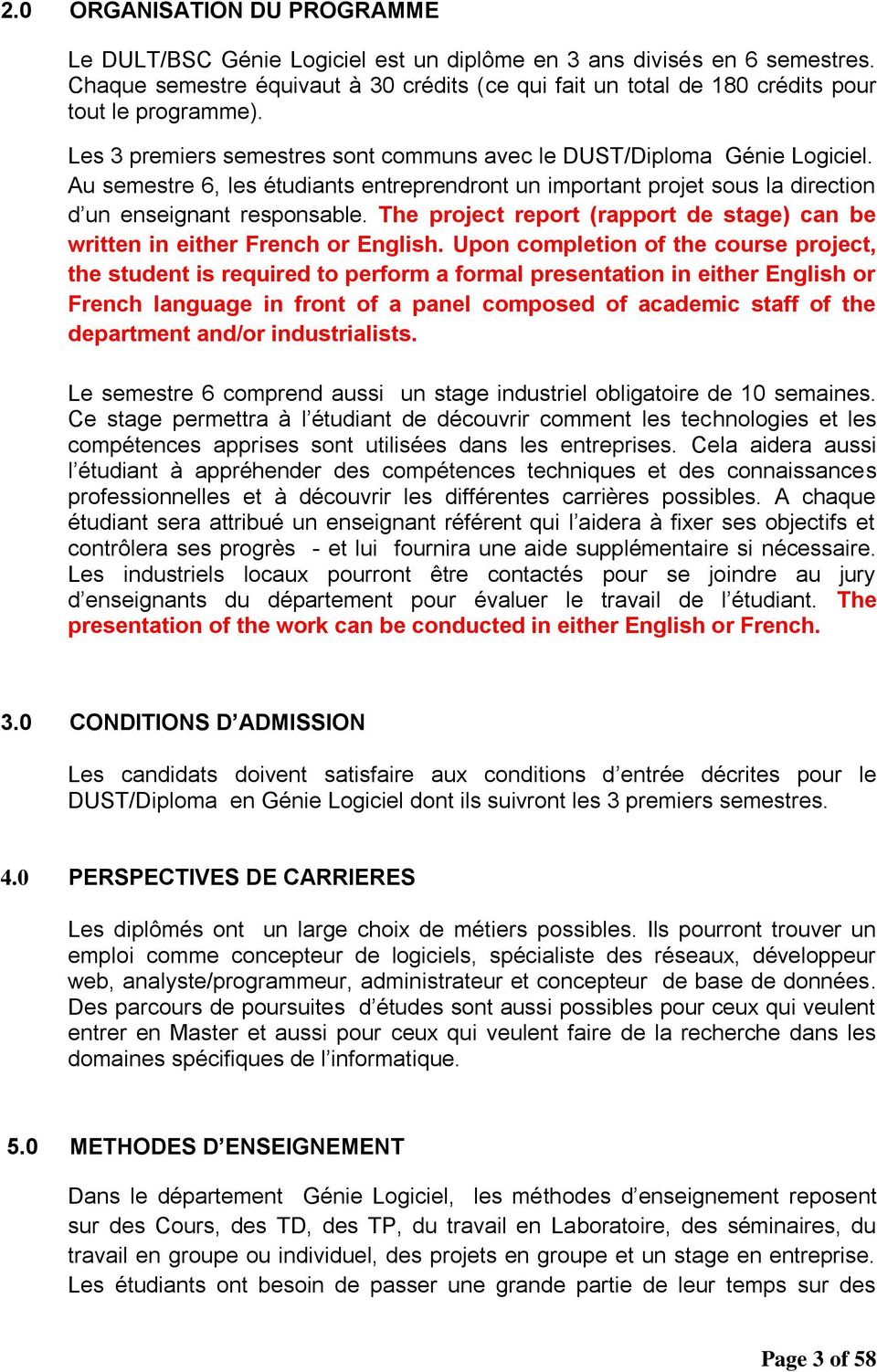
4 travaux personnels de façon à retirer des bénéfices maximum de l enseignement. 6.0 EVALUATION Les critères d évaluation sont propres à chaque module. Les méthodes d évaluation utilisées décrites dans le Règlement Intérieur peuvent inclure du contrôle continu, des travaux en cours, des examens, des projets en groupe, des projets individuels. Le nombre de crédits attribués à chaque module dépend de son importance et du temps passé par l étudiant à la fois en Cours, TD, TP et en travail personnel. 7.0 VOLUME HORAIRE GLOBAL Semestre L C T TD P TP Total Heures Crédits Sem Sem * 30 Année Sem ** 30 Sem Année Sem Sem *** 30 Année TOTAL * Avec un PPP de 15h ** Avec un PPP de 30h *** Hors stage de 12 semaines, mais avec un PPP de 30h et un Projet de 150h Page 4 of 58
5 8.0 STRUCTURE DU PROGRAMME Year 1 Semester 1 [S1] Modules Total Hours Credits UE 11 : ENSEIGNEMENT TECHNOLOGIQUE Programming Concepts Introduction to Multimedia Introduction to Information Systems Web Technologies Total UE 12 : ENSEIGNEMENT GENERAL Discrete Mathematics Business English Renforcement de la Langue Française Introduction to Accounting Total TOTAL SEMESTER Page 5 of 58

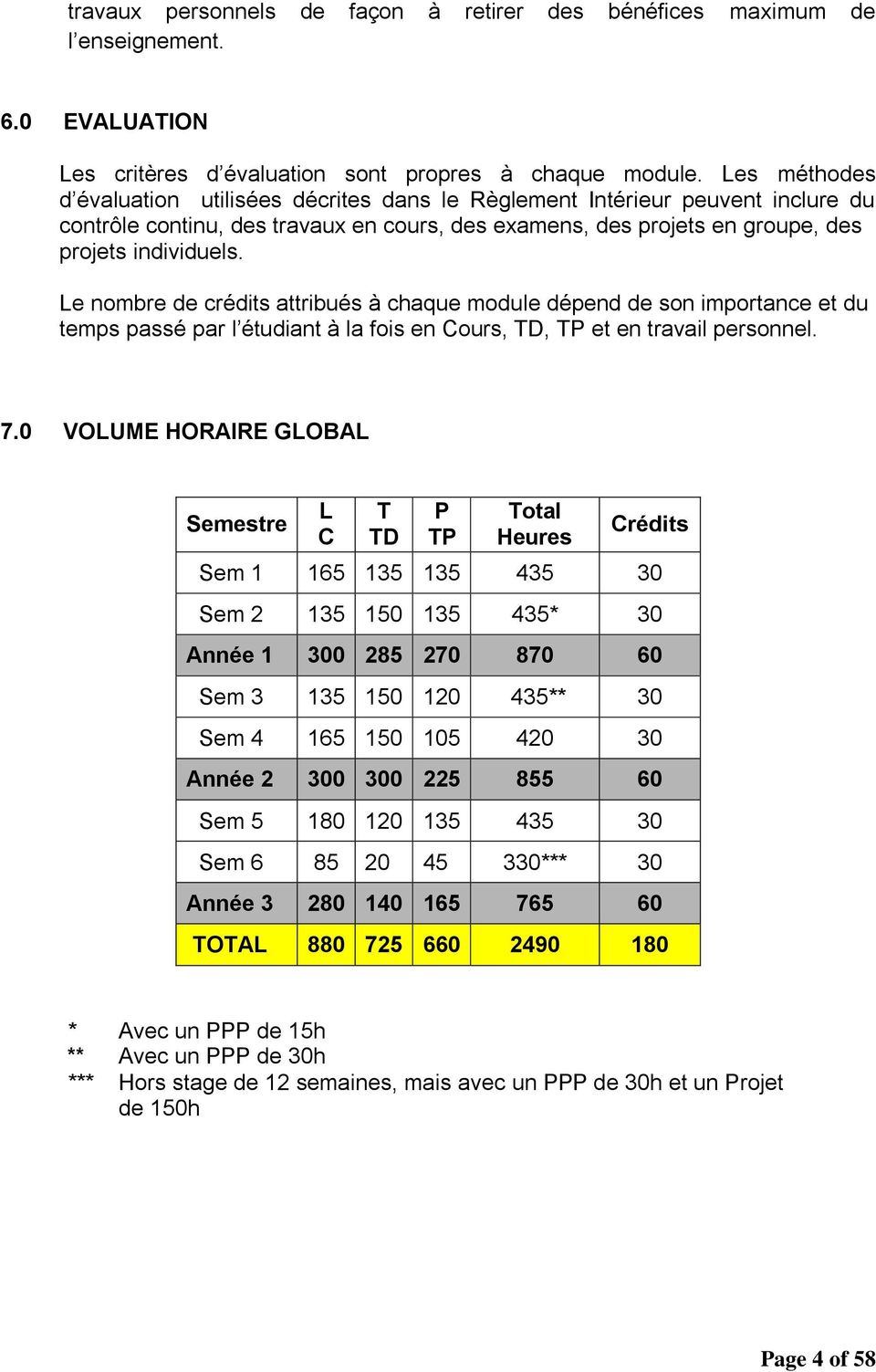
6 Year 1 Semester 2 [S2] Modules Total Hours Credits UE 21 : ENSEIGNEMENT TECHNOLOGIQUE Object Oriented Programming Digital Logic Web Programming Database Design Total UE 22 : ENSEIGNEMENT GENERAL Linear Algebra Effective Presentation Skills Techniques d'expression Orales Cyber Law Projet Personnel Professionnel- PPP Total TOTAL SEMESTER PPP 1 : connaissance du monde du travail, les métiers de l informatique Page 6 of 58
7 Year 2 Semester 1 [S3] Modules Total Hours Credits UE 31 : ENSEIGNEMENT TECHNOLOGIQUE Data Structures and Algorithms Human Computer Interaction Database Manipulation Software Engineering Total UE 32 : ENSEIGNEMENT GENERAL Probability and Statistics Report Writing Aspects de la Communication Projet Personnel Professionnel - PPP Total TOTAL SEMESTER PPP 2 : orientation selon le métier choisi, les capacités académiques et le savoir être de l étudiant Page 7 of 58

8 Year 2 Semester 2 [S4] Modules Total Hours Credits UE 41 : ENSEIGNEMENT TECHNOLOGIQUE Visual Programming Data Communication and Networking Operating Systems Computer Organisation and Assembly Language Total UE 42 : ENSEIGNEMENT GENERAL Real Analysis E-Commerce Communication Skills at Work Techniques d'expression Professionnelle Total TOTAL SEMESTER Page 8 of 58

9 Year 3 Semester 1 [S5] Modules Total Hours Credits UE 51 : ENSEIGNEMENT TECHNOLOGIQUE Distributed Systems Software Quality Assurance Database Administration Mobile Technologies Total UE 52 : ENSEIGNEMENT GENERAL Auditing IT Systems Software Project Management Effective Interpersonal Communication Français des Affaires Total TOTAL SEMESTER Page 9 of 58

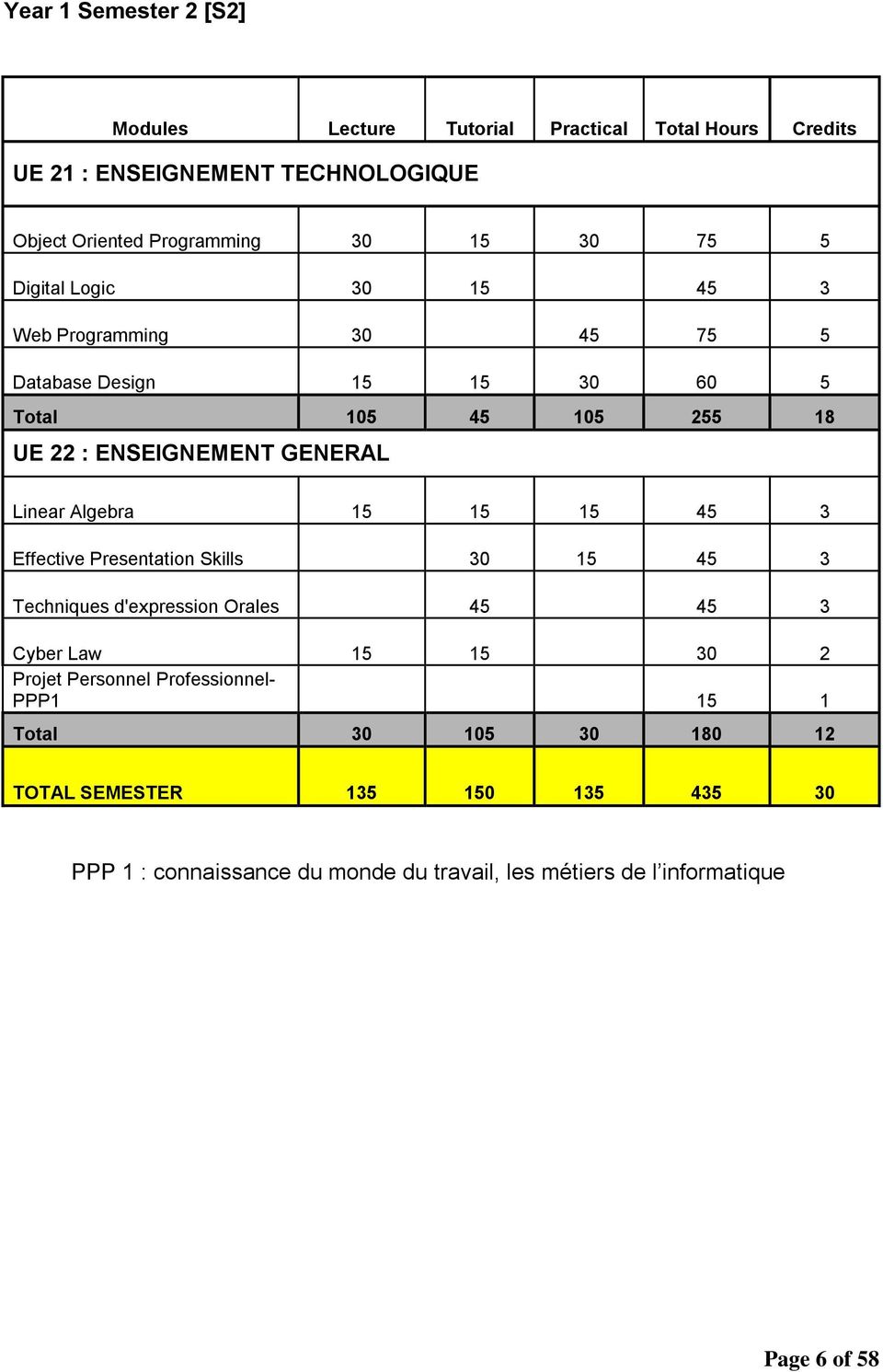
10 Year 3 Semester 2 [S6] Modules Total Hours Credits UE 61 : ENSEIGNEMENT TECHNOLOGIQUE Enterprise Resource Planning Cryptography and Security Total UE 62 : ENSEIGNEMENT GENERAL Numerical Methods Management Information Systems Projet Personnel Professionnel - PPP Total UE 63 : ENVIRONNEMENT PROFESSIONNEL Stage (12 weeks) 10 Course Project Total TOTAL SEMESTER PPP 3: orientation, poursuite d études en master Page 10 of 58
11 Programming Concepts Semester 1 UE 11 Contact Hours: Contents: Total 75 h Credits: 5 Introduces the concepts and principles of problem solving and the construction of appropriate algorithms for the solution of problems, demonstrates the principles behind high level programming languages, and gives students experience and confidence in the use of high level programming language to implement algorithms. None Developing algorithms/pseudocode Variables and data types Operators and expressions Sequence, selection and iteration Arrays Modular programming Parameter passing mechanisms Page 11 of 58

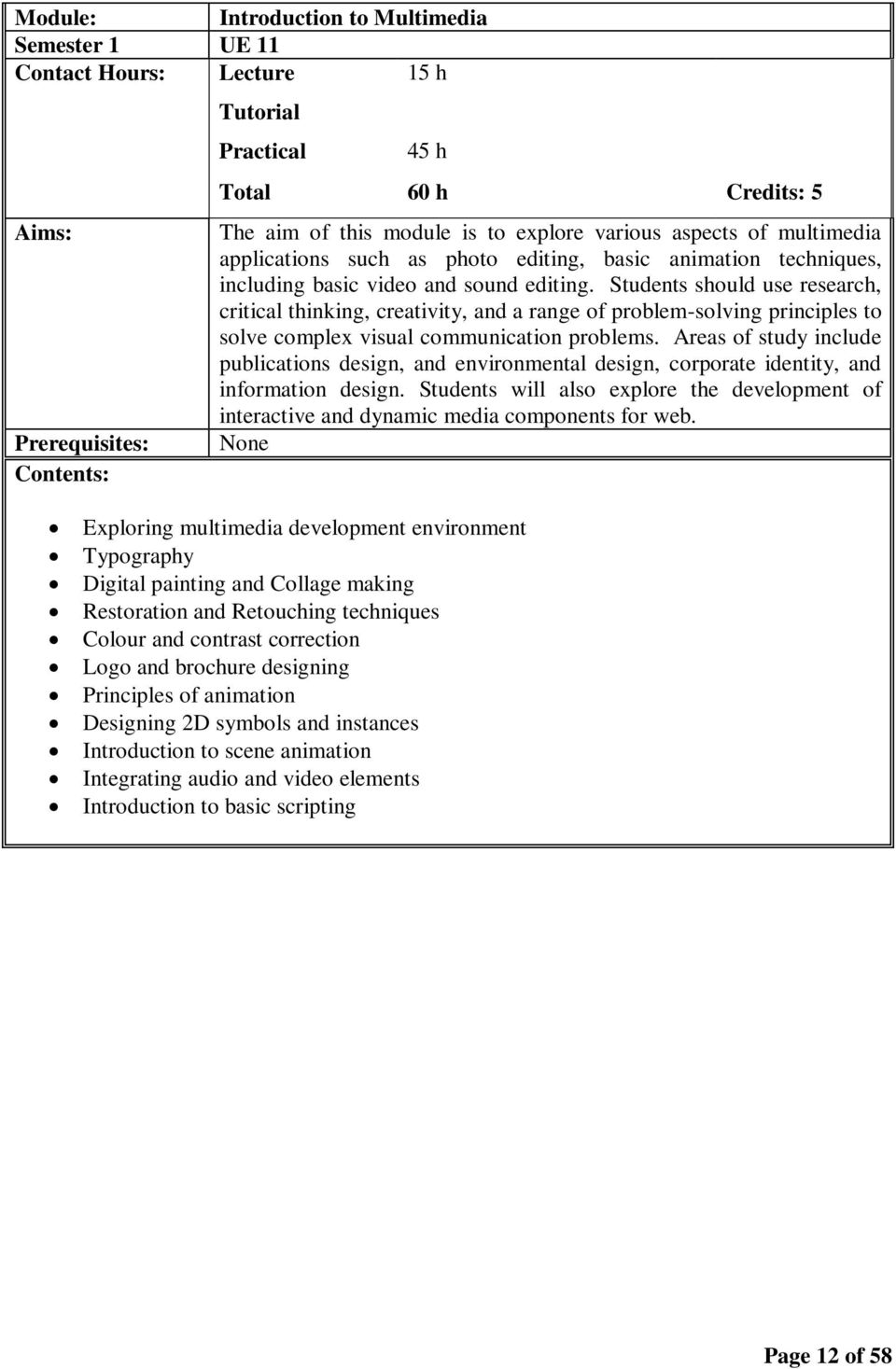
12 Introduction to Multimedia Semester 1 UE 11 Contact Hours: Contents: 45 h Total 60 h Credits: 5 The aim of this module is to explore various aspects of multimedia applications such as photo editing, basic animation techniques, including basic video and sound editing. Students should use research, critical thinking, creativity, and a range of problem-solving principles to solve complex visual communication problems. Areas of study include publications design, and environmental design, corporate identity, and information design. Students will also explore the development of interactive and dynamic media components for web. None Exploring multimedia development environment Typography Digital painting and Collage making Restoration and Retouching techniques Colour and contrast correction Logo and brochure designing Principles of animation Designing 2D symbols and instances Introduction to scene animation Integrating audio and video elements Introduction to basic scripting Page 12 of 58
13 Semester 1 UE 11 Contact Hours: Contents: Introduction to Information Systems Total 45 h Credits: 3 None This module aims at developing a basic awareness of Information Systems and its impact in organisations. Students will learn key concepts such as hardware and software components in Information Systems, telecommunications and networks, specialised types of Information Systems, basics of systems development and impact of Information Systems on society. Overview of Information Systems Hardware and Software Database Systems and Business Intelligence Telecommunications, Internet, Intranets and Extranets Business Information Systems Systems Development Information Systems in Business and Society Page 13 of 58

14 Semester 1 UE 11 Contact Hours: Content: Web Technologies 45 h Total 75 h Credits: 5 None The aim of the module is to give students a basic knowledge of HTML tags and client side scripting language. Students will implement these concepts in designing simple web pages and eventually web sites. Introduction to The Internet HTML and XHTML Introduction to Cascading Style Sheets Introduction to Javascript Introduction to Jquery Basics of Content Management Systems (CMS) Page 14 of 58

15 Semester 1 UE 12 Contact Hours: Content: Discrete Mathematics Total 45 h Credits: 3 None This module provides an introduction to some of the concepts and computational techniques of discrete mathematics. The main aim is to provide a strong background in a number of areas which are of particular relevance to computing. The module also aims to develop logical reasoning ability of students. Set Theory Definition and Notation; Venn Diagrams; Set Operations; Algebraic Laws; Inclusion-Exclusion Principle; Generalised Union and Intersection. Relations Cartesian Product; Ordered n-tuples; Binary Relations; Properties of Relations; Composite Relations; Closures; Order Relations; Posets; Hasse Diagrams; Lattices. Functions Definition and Graphical Representation; Function Terminology; Injective, Surjective and Bijective Functions. Composition of Functions; Cardinality; Recursive Functions. Number Theory Division Algorithm; Greatest Common Divisor; Euclid s Algorithm; Bezout s identity; Prime Numbers; Fundamental Theorem of Arithmetic; Congruences. Sequences and Series Arithmetic and Geometric Sequences and Series; The Sigma Notation and its Properties; Mathematical Induction; Binomial Theorem; Recurrence Relations. Graphs and Trees Basic Terminology; Types of Graphs; Isomorphism; Paths, Cycles and Connectivity; Eulerian and Hamiltonian graphs; Shortest Path Algorithms. Graph Colouring. Minimal Spanning Trees. Prim s and Kruskal s Algorithm. Page 15 of 58

16 Business English Semester 1 UE 12 Contact Hours: Total 45 h Credits: 3 Sound knowledge of the English language. Content: English and command of words in the following specialized fields of Accounting, Finance, Human Resource and Marketing through specialized texts. Presentation on business articles to demonstrate their command of the English language. Advanced Language Lab tutorials Summary of business texts. Skills Listening, reading, speaking skills Page 16 of 58

17 Semester 1 UE 12 Contact Hours: Pre-requis: Objectifs: Contenu: Renforcement de la langue française 45 h Total 45 h Credits: 3 Français du niveau secondaire Ce module a pour objectif la consolidation de la langue française. L accent sera mis sur l orthographe, la grammaire et la prononciation. Prononciation Grammaire et expression Orthographe Evaluation Les étudiant(e)s seront noté(e)s sur les travaux écrits et / ou oraux. Pour le bon déroulement des cours de français, qui demandent une participation active des étudiant(e)s (discussions, travaux dirigés, présentations, jeux de rôle entre autres), la présence est obligatoire. Page 17 of 58

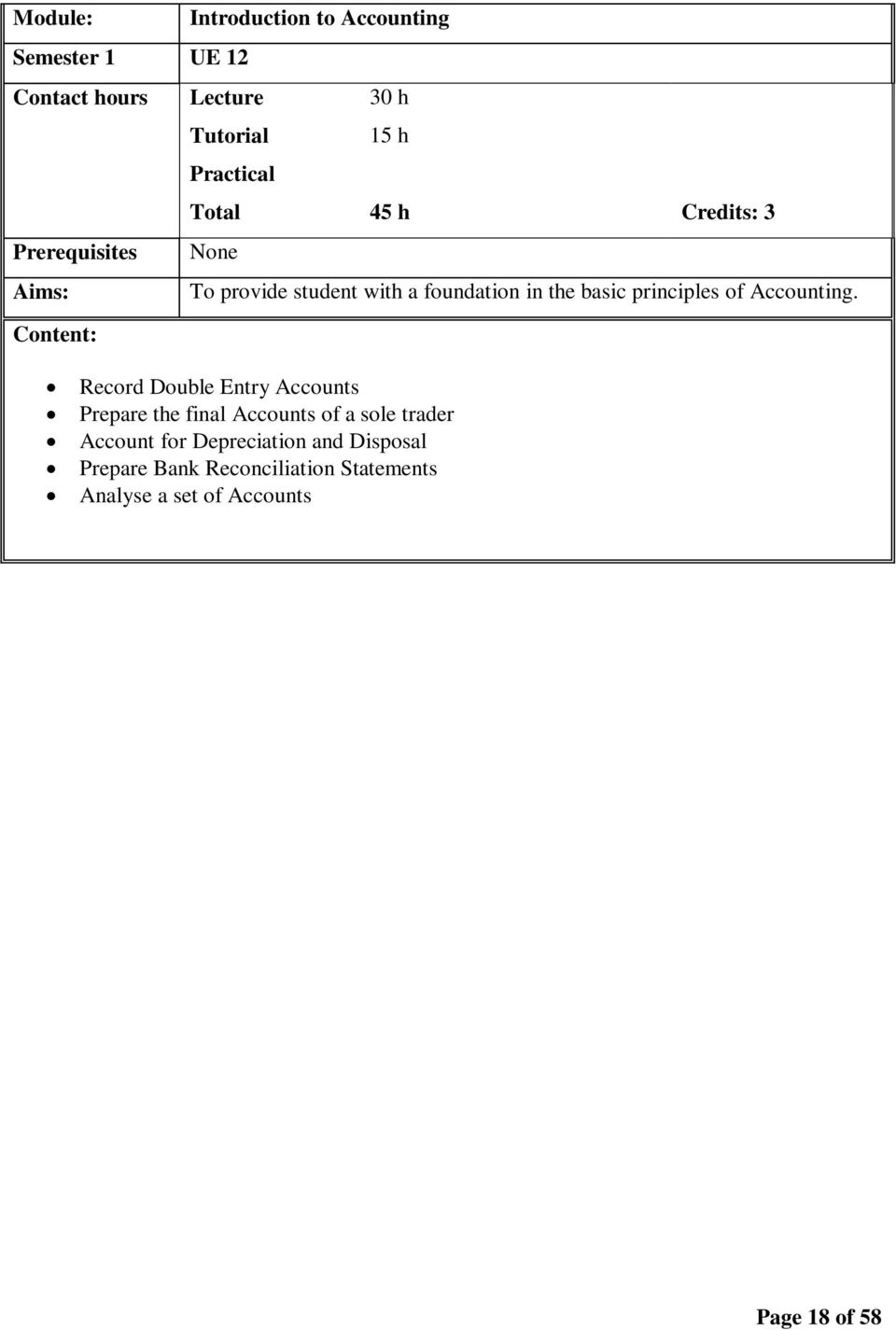
18 Introduction to Accounting Semester 1 UE 12 Contact hours Total 45 h Credits: 3 Prerequisites None To provide student with a foundation in the basic principles of Accounting. Content: Record Double Entry Accounts Prepare the final Accounts of a sole trader Account for Depreciation and Disposal Prepare Bank Reconciliation Statements Analyse a set of Accounts Page 18 of 58
19 Object Oriented Programming Semester 2 UE 21 Contact Hours: Contents: Total 75 h Credits: 5 This module will both deepen and broaden the students' existing programming and software development skills. The main aim is to make students understand the fundamental concepts upon which objectorientation is based and to be able to implement those concepts in any OO programming language. Programming Concepts Introduction OOP concepts. Classes and Objects. Inheritance. Polymorphism. Abstract Classes. Interfaces. Exception Handling. Graphical User Interfaces. Page 19 of 58

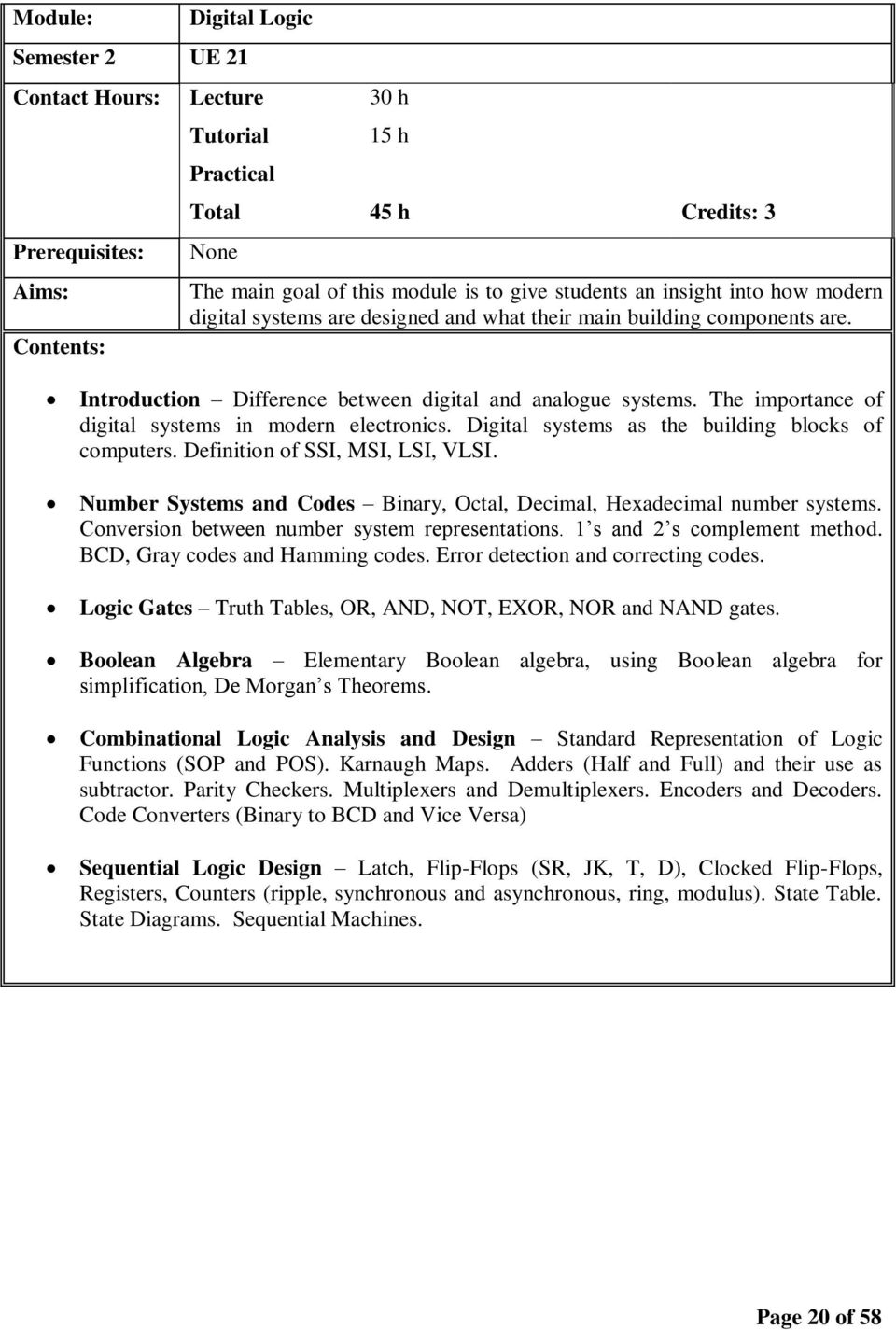
20 Semester 2 UE 21 Contact Hours: Contents: Digital Logic Total 45 h Credits: 3 None The main goal of this module is to give students an insight into how modern digital systems are designed and what their main building components are. Introduction Difference between digital and analogue systems. The importance of digital systems in modern electronics. Digital systems as the building blocks of computers. Definition of SSI, MSI, LSI, VLSI. Number Systems and Codes Binary, Octal, Decimal, Hexadecimal number systems. Conversion between number system representations. 1 s and 2 s complement method. BCD, Gray codes and Hamming codes. Error detection and correcting codes. Logic Gates Truth Tables, OR, AND, NOT, EXOR, NOR and NAND gates. Boolean Algebra Elementary Boolean algebra, using Boolean algebra for simplification, De Morgan s Theorems. Combinational Logic Analysis and Design Standard Representation of Logic Functions (SOP and POS). Karnaugh Maps. Adders (Half and Full) and their use as subtractor. Parity Checkers. Multiplexers and Demultiplexers. Encoders and Decoders. Code Converters (Binary to BCD and Vice Versa) Sequential Logic Design Latch, Flip-Flops (SR, JK, T, D), Clocked Flip-Flops, Registers, Counters (ripple, synchronous and asynchronous, ring, modulus). State Table. State Diagrams. Sequential Machines. Page 20 of 58
21 Semester 2 UE 21 Contact Hours: Content: Web Programming 45 h Total 75 h Credits: 5 Web Technologies The aim of the module is to introduce PHP language and dynamic web pages with database connection. Students should be able to create dynamic web sites. PHP programming: classical and OOP Basic syntax of PHP. DBMS with MySQL: Creating databases, creating tables and queries Creating Dynamic web pages with database connection. Page 21 of 58
22 Semester 2 UE 21 Contact Hours: Content: Database Design Total 60 h Credits: 5 None To explore a relational database management system in a client-server model, design and implement relational databases, create and manage tables, design and implement data integrity. Introduction to database concepts Explanation of Client /Server Model Rules for data integrity Create and manage E-R diagrams Understand Relational Databases Normalisation of tables Create relational tables/database Storing data in relational database Application of data integrity to the relational tables Security in database management systems Concurrency in relational databases Application of security measures in relational databases Page 22 of 58
23 Semester 2 UE 22 Contact Hours: Content: Linear Algebra Total 45 h Credits: 3 None The aim of this module is to define the axiomatic structures of linear algebra in R n and apply them in simple proofs. At the end of the module students should be able to calculate the determinants, and invert matrices, find eigenvalues and eigenvectors of square matrices, solve systems of linear equations, carry out matrix diagonalisation, know and understand the terminology associated with vector spaces and subspaces, understand and be able to apply the relationship between linear maps and matrices. Matrix Algebra Matrices; Operation on Matrices; Types of Matrices. Determinants Minors and Cofactors; Evaluating Determinant of a Matrix; Properties of Determinants; Matrix Inverse; Singular and Non-singular Matrices; Orthogonal Matrix. Linear Systems Null Space and Range of a Matrix; Solutions to Linear Systems of Equations: Gaussian Elimination, Gauss-Jordan Elimination, Cramer s Rule, Method of Inverses. Vectors Vectors in R n ; Position Vectors; Dot Product; Norm; Unit Vectors; Triangle Inequality; Cauchy-Schwarz Inequality; Orthogonal Projections; Lines; Planes. Vector Spaces Real Vector Spaces in R n ; Subspaces; Linear Combinations; Spanning Sets; Row Space and Column Space of a Matrix; Linear Dependence and Independence; Basis and Dimension; Rank and Nullity. Linear Transformations Definition; Matrix Representation of Linear Transformations; Null Space and Range; Rank and Nullity; Coordinate Change; Change of Basis and Similarity; Injectivity and Surjectivity; Composition of Linear Transformations. Eigenvalues and Eigenvectors Definitions; Finding Eigenvalues and Eigenvectors; Geometric Interpretation of Eigenvectors and Eigenvalues; Hamilton-Cayley Theorem; EigenSpaces; Diagonalization. Page 23 of 58
24 Semester 2 UE 22 Contact Hours: Content: Effective Presentation Skills Total 45 h Credits: 3 Command of the English language This module aims at helping students acquire some oral skills needed for their studies at the University and for effective functioning in business situations. Students will be taught group discussions and oral presentations. They will also learn how to conduct surveys and interviews. Interview techniques: o Use different approaches for conducting surveys. o face-to-face interviews, telephone interviews, and survey interviews o listening skills Oral presentation and demonstrations o Understand the basic principles involved in giving effective oral presentations o Identify the differences between speech and writing o Recognise the qualities of an effective oral presentation which resolves around presentation, content, structure, and delivery o Make an effective oral presentation Group discussion techniques o Participate effectively in group discussions o Recognise the positive and negative roles played by various participants in a group discussion Page 24 of 58
25 Semester 2 UE 22 Contact Hours: Content: Techniques d expression Orales 45 h Total 45 h Credits: 3 Réussite dans le module de français du semestre précédent Les étudiant(e)s vont acquérir des habiletés de compréhension et d'expression orales applicables à la communication de tous les jours. L objectif est de permettre à l étudiant(e) de développer et de maîtriser les techniques de communication verbale et non-verbale pour une meilleure interaction professionnelle à l intérieur comme à l extérieur de son établissement de travail. Techniques de communication non-verbales: la voix, la respiration, le regard, l écoute, le langage corporel entre autres Origine et maîtrise du trac ; gestion du stress ; le développement personnel Parler en public : Comment raconter et intéresser?; Comment relancer l attention? entre autres Préparer et Réussir un exposé Utilisation des aides visuelles Assessment Les étudiant(e)s seront noté(e)s sur les travaux écrits et / ou oraux. Pour le bon déroulement des cours de français, qui demandent une participation active des étudiant(e)s (discussions, travaux dirigés, présentations, jeux de rôle entre autres), la présence est obligatoire. Page 25 of 58
26 Cyber Law Semester 2 UE 22 Contact Hours: Contents: Total Credits: 2 The aim of this module is to introduce students to the legal challenges that arise from the population of cyberspace. Upon completion of the course it is expected that students should be able to understand the essential the issues concerning the relationship between information technology applications and key legal principles. Students should also be able to evaluate national and international policies and initiatives concerning the regulation of the information society and understand the necessity for law to adopt new strategies and perspectives in order to approach the legal implications of developments in cyber space. None Introduction to the possibilities and challenges of the Information Society Governing the Internet - Who should govern the Internet Data Protection and State Surveillance Privacy and Freedom of Expression Legal issues in E-Commerce Domain Names and Cybersquatting E-Government Defamation: Liability of ISP Issues in Developing Countries: How do we ensure equitable access to the Internet and technology? Page 26 of 58
27 Projet Personnel et Professionnel (PPP1): connaissance du monde du travail, les métiers de l informatique Semester 2 UE 22 Contact Hours: Total Credits: 1 Permettre à l étudiant de se faire une idée précise des métiers du secteur d activité et de leurs aptitudes personnelles. Amener l'étudiant à mettre en adéquation ses souhaits professionnels et ses aspirations personnelles afin de concevoir un parcours de formation cohérent. None Contents: Connaître le marché du travail et les formations (professionnelles et universitaires) Déterminer ses motivations, qualités personnelles et ses compétences Se servir d outils pour l insertion professionnelle Choisir un parcours de formation (apprentissage, poursuite d études, étranger, etc.) Mieux déterminer un projet professionnel à moyen terme Evaluation Ecrite ou orale (dossier, exposé, carnet de bord papier ou e-port-folio) synthétisant les informations recueillies et leur intégration dans la réflexion d ensemble sur le ou les projets des étudiants. Indications de mise en œuvre Relations avec des anciens diplômés, interventions extérieures, projets tutorés Cahier de bord, compte-rendu, visites d entreprise, enquêtes, forums, prises de parole, entretiens personnalisés par un enseignant (tutorat individuel), etc. Page 27 of 58
28 Module Data Structures and Algorithms Semester 3 UE 31 Contact Hours Aim Contents: Total 75 h Credits: 5 To introduce the notation, terminology, and techniques underpinning the study of algorithms. To introduce the standard algorithmic design paradigms employed in the development of efficient algorithmic solutions. To introduce the mathematical tools needed for the analysis of algorithms in terms of the use of formal models of Time and Space. This module covers the design and implementation of data structures including strings, arrays, stacks, queues, linked lists, binary trees, heaps, balanced trees (e.g. AVL-trees), graphs and files. Algorithm topics include sorting, searching, hashing, memory allocation, garbage collection, complexity and algorithm analysis. Programming Concepts, Object Oriented Programming Linear Data Structures, Strings and Arrays Algorithm Complexity and analysis Recursion, Sorting, Searching Algorithms N-dimensional vectors and spaces. Stacks, Queues, Deques, Priority Queues Simple Linked Lists, Doubly-linked Lists Binary trees Text and binary files Page 28 of 58
29 Human Computer Interaction Semester 3 UE 31 Contact Hours: Total 60 h Credits: 5 The purpose of this module is to create an awareness and explain the importance of user interface design in information Students will have a knowledge and understanding of the differences between users and designers, the perceptual, cognitive and physical limitations of users, the consequences of poorly designed systems interfaces, the limitations of input and output devices, the use of text, forms, menus, and graphics in interactive systems and the role of interface design in the systems engineering. Software Engineering Contents: Introduction, Interaction, Conceptual models, metaphors, paradigms, Stages of action Characteristics of user interfaces, Graphical and web, Web usability Interaction design, Interfaces and their effect on users Humans, Users, Memory, Collaboration, communication mechanisms Business Function analysis, Data gathering techniques Principles of good screen design, web interfaces Menu design and navigation schemes, Windows IO devices, screen controls, Dialog design Icons, Graphics, Feedback, guidance and assistance Colours, Interface Evaluation, Ergonomics, RSI Page 29 of 58
30 Semester 3 UE 31 Contact Hours: Content: Database Manipulation 45 h Total 75 h Credits: 5 Database Design This module will provide students with knowledge in principles and techniques of relational database management software. The student will also learn to use Structured Query Language (SQL) to create, access, retrieve data and maintain a database. SQL Basics: DDL, DML statements, data types Create and maintain databases Implement data integrity constraints Plan and create indexes Querying tables: Simple queries and multi-table queries : inner and outer joins. Summary Queries, aggregate functions Use advanced query techniques Implement Views SQL security Transaction Processing Use Stored Procedures and functions; Implement Triggers Page 30 of 58
31 Software Engineering Semester 3 UE 31 Contact Hours: Contents: Total 45 h Credits: 3 To introduce the methodologies involved in the development and maintenance of software (i.e.) over its entire life cycle using UML as the modelling technique. None Software, Software Engineering, Introduction, Problems, future Classical Software development Life Cycle Systems analysis, Data Gathering Methods, Prototyping, Specification of Requirements Requirements analysis, feasibility study, Use Case Modelling Systems design concepts and principles, Functional modelling, Functional specification, Class Modelling, Dynamic Modelling Architectural, and interface design Implementation, Coding, Installation, Exploitation Software Testing, Conversion, Training Software Maintenance CASE Tools, Project Management, Other life cycles Page 31 of 58
32 Semester 3 UE 32 Contact Hours: Content: Probability and Statistics Total 60 h Credits: 4 None After completing this module students should be able to understand and recall the basic definitions of probability and statistics, manipulate probabilities in practical situations, derive the mean and variance of a variety of random variables, carry out a significance test and construct a confidence interval and understand the Central Limit Theorem and apply it to problems. Students are also expected to become proficient in the use of statistical software. Basic Probability Discrete Distributions Continuous Distributions Statistics Estimation Theory Hypothesis Testing Simple Linear Correlation and Regression Introduction to statistical software. Page 32 of 58
33 Semester 3 UE 32 Contact Hours: Content: Report Writing Total 45 h Credits: 3 Basic Writing Skills This module provides students with the basic principles for writing project and schematic reports. Using the techniques of questionnaire design learnt in the Oral Communication Module, students will design the questionnaire to obtain information for writing the assigned Project Report. They will analyse and organise data, and prepare appropriate the effective visual aids. Basic Principles Of Report Writing o Describe the functions of different types of reports encountered in the business world o Identify the readership o Identify the purpose of the report Write the various sections of a report: o Prefatory part o Report Body o Supplemental Parts Conduct survey o Questionnaire design o Tally Sheet Survey Page 33 of 58
34 Semester 3 UE 32 Contact Hours: Content: Aspects de la Communication 45 h Total 45 h Credits: 3 Réussite dans le module de français du semestre précédent Permettre aux étudiant(e)s d appréhender les différents modes d expression et de communication : particulièrement dans les domaines des arts et des médias. Etude des notions suivantes entre autres : L histoire et les différents types d écriture Analyse de l image et de la peinture Analyse d un journal (radiophonique, télévisé, presse écrite) Synthèse des documents Assessment Les étudiant(e)s seront noté(e)s sur les travaux écrits et / ou oraux. Pour le bon déroulement des cours de français, qui demandent une participation active des étudiant(e)s (discussions, travaux dirigés, présentations, jeux de rôle entre autres), la présence est obligatoire. Page 34 of 58
35 Projet Personnel et Professionnel (PPP2): orientation selon le métier choisi, les capacités académiques et le savoir être de l étudiant Semester 3 UE 32 Contact Hours: Total Credits: 2 Permettre à l étudiant de mieux se connaitre pour bien s orienter dans ses études et dans sa vie professionnelle. Permettre à l étudiant de faire ses choix quant a son parcours futur. Accompagner l étudiant dans la détermination du secteur d activité ou de l environnement professionnel dans lesquels il souhaite effectuer son stage, l aider à élaborer des outils pertinents et efficients concernant sa recherche de stage, lui inculquer une méthodologie de techniques de recherche de stage et d emploi. PPP1 Contents: Intérêts professionnels, valeurs, motivations, traits de personnalité, ses expériences acquises Démarches et outils des techniques de recherche d emploi (CV, lettre de motivation, usage du téléphone et du courriel a des fins professionnelles) Simulations filmées des entretiens, débriefing des enregistrements Analyses d offres d emploi Evaluation Carnet de bord récapitulant l argumentaire et les démarches menées, l impact sur le ou les projets des étudiants Indications de mise en œuvre Travailler en lien avec le module PPP: connaissance du monde du travail, les métiers de l informatique et partir de ce que l étudiant appris dans ce cadre pour aller vers l énonciation de ses souhaits. Page 35 of 58
36 Semester 4 UE 41 Contact Hours: Content: Visual Programming 45 h Total 75 h Credits: 5 Programming Concepts, Object Oriented Programming This module will enable students to develop desktop applications using Microsoft Programming Technology. Visual Basic.NET IDE Programming Basics OOP with VB.net VB.Net Data Types Forms and Common Controls Advanced Controls Control Structures Modules, Functions and Procedures Program applications using controls User Input Validation Strings manipulation Page 36 of 58
37 Data Communication and Networking Semester 4 UE 41 Contact Hours: Contents: Total 45 h Credits: 3 This module provides an overview of the core technologies used in today's data communication and networks, with emphasis on principles of operation, design issues, and current implementations. After completion of this module students should be able to understand the core technologies used in today's data communication and networks and its principles of operation. None Overview of Computer Networks ISO-0SI Reference Model and layered network architecture Introduction to Network physical layer Data Encoding Concepts and Techniques Data Link Layer & Protocols LAN Architecture, Topology & Devices LAN Medium Access control Protocols and standards LAN Standards: Ethernet and IEEE standards for LANs WAN Standards and Techniques: ( packet switching, virtual circuit switching, sample of modern WANs,.) Page 37 of 58
38 Semester 4 UE 41 Contact Hours: Content: Operating Systems Total 60 h Credits: 5 Computer Fundamentals To provide students with knowledge of the structure and functions of the basic components of operating systems. Also, to introduce students to a multiprogramming operating system Describe the structure and functions of an operating system. Describe the process scheduling algorithms. Describe memory management schemes. Describe Concurrent Processes Describe the file management sub system. Describe Input/Output organisation File Systems Protection & security Linux Operating System Shell Programming Page 38 of 58
39 Semester 4 UE 41 Contact Hours: Contents: Computer Organisation and Assembly Language Total 60 h Credits: 5 None This module aims to give a broad understanding of the operation of modern computers. This will acquaint students with the general architecture of computers and introduce them to low-level programming using assembly language. Basic Organisation Von Neumann Machine (IAS Computer), Fetch-Execute Cycle, Organization of Central Processing Unit, Hardwired & micro programmed control unit, Single Organization, General Register Organization, Stack Organization. Memory Organisation Memory Hierarchy, Main memory (RAM/ROM chips), Auxiliary memory, Associative memory, Cache memory, Virtual Memory, Memory Management Hardware, hit/miss ratio, magnetic disk and its performance, magnetic tape etc. I/O Organisation Peripheral devices, I/O interface, Modes of Transfer, Priority Interrupt, Direct Memory Access, Input-Output Processor, and Serial Communication. I/O Controllers, Asynchronous data transfer, Strobe Control, Handshaking. The assembly process assembling, linking, and loading, source and object codes. Assembly Language Instruction Sets, Instruction Formats, Op Code Mnemonics, Instructions: Data Transfer, Arithmetic, Branch, Loop, Logical, Shift and Rotate Instructions. Addressing Modes. Page 39 of 58
40 Semester 4 UE 42 Contact Hours: Content: Real Analysis Total 45 h Credits: 3 Discrete Mathematics, Linear Algebra The objective of this module is to provide an introduction to analysis, which is the branch of mathematics that rigorously studies functions, continuity and limit processes, such as differentiation and integration. At the end of the module a student should be able to: demonstrate understanding of the real numbers, their axioms and the role of completeness in the existence of limits and solutions to equations; calculate limits of sequences and (power) series, and prove/disprove converge using the definitions; quote and apply basic theorems in analysis and convergence tests. Real Numbers Algebraic Properties of Real Numbers; Maximum, Minimum, Supremum and Infimum of Sets; The Triangle Inequality. Countable and Uncountable Sets. Sequences and Limits Definition; Basic Properties of Limits; Monotone Sequences; Subsequences; Bolzano-Weierstrass Theorem; Cauchy Sequences. Series Convergent Series, Geometric Series, Harmonic Series; Convergence Tests. Absolute and Conditional Convergence; Rearrangement; Power Series. Functions Limits and Continuity; Properties of Continuous Functions; Intermediate Value Theorem. Differentiation Local Maximum and Minimum; Rolle's Theorem; Mean Value Theorem; Differentiation of Power Series; Taylor's series. Integration Dissection of an Interval; Upper and Lower Sums; Refinement; Upper and Lower Integrals; Integrable Functions; Fundamental Theorem of Calculus; Riemann Integration. Page 40 of 58
41 Semester 4 UE 42 Contact Hours: Content: E-Commerce Total 45 h Credits: 3 None This module provides an overview of business and technology topics, business models, virtual value chain, and marketing strategies in E- Commerce. Students will be exposed to some of the major issues associated with E-Commerce namely security, privacy, intellectual property rights, e- payment systems and legal liabilities. Basic concepts of E-Commerce. E-Commerce infrastructure. Business models and E-Commerce. Planning an E-Commerce strategy. Supply Chain Management and E-Commerce. Marketing strategies in E-Commerce. Security issues in E-Commerce. Electronic Payment Systems. Mobile E-Commerce. Legal and ethical issues in E-Commerce. Global, social and other issues in E-Commerce. Page 41 of 58
42 Semester 4 UE 42 Contact Hours: Content: Communication Skills At Work Total 45 h Credits: 3 Sound knowledge of the English language and ability to work in groups. This module aims at teaching students written and oral communication skills necessary for effective functioning at work. Specifically, it focuses on the writing of business letters, memos and short (memo and letter) reports. Students will learn the mechanism of teamwork to be effective in meetings, communicating on the telephone and looking for a job. Related written skills (e.g. preparing agenda and minutes of meetings) and role plays will be covered. Effective Principles of Business Writing Business Letters, Memos, and Short Reports o Identify the structure language, tone, style of business letter in relation to the writer, reader, purpose, context and audience o Use appropriate format o Organise information in a logical sequence, e.g. opening, middle, and closing paragraphs Conduct meetings o Write precise notices of meetings and informative agendas o Participate effectively as chairman/ secretary / committee members in meetings Job application letters Prepare resumes Job interview techniques Page 42 of 58
43 Semester 4 UE 42 Contact Hours: Techniques d Expression Professionnelle Total 45 h Credits: 3 Réussite obligatoire dans le module de français du semestre précédent. Faciliter la compréhension et la maîtrise des mécanismes qui régissent la production des différents types de texte dans le cadre professionnel. Initier l étudiant(e) au monde du travail, lui permettant d acquérir les aptitudes et les techniques nécessaires pour sa quête d emploi. Lui donner des notions pour faciliter sa participation active en réunions, et à bien s exprimer en public. Content: Rédiger des lettres, enveloppes, circulaires, notes de service, télécopies, courriels, rapports de travail ou de recherche entre autres Définir son projet professionnel et ses compétences Rédiger un Curriculum Vitae et une lettre de motivation Préparer son entretien d embauche Animer des réunions et y participer Assessment Les étudiant(e)s seront noté(e)s sur les travaux écrits et / ou oraux. Pour le bon déroulement des cours de français, qui demandent une participation active des étudiant(e)s (discussions, travaux dirigés, présentations, jeux de rôle entre autres), la présence est obligatoire. Page 43 of 58
44 Semester 5 UE 51 Contact Hours: Contents: Distributed Systems Total 75 h Credits: 5 None With the huge advances in the price/performance ratio of computer hardware and with the proliferation of high speed networks, several attempts have been made at creating a truly distributed operating system to enable a new generation of computing applications that take full advantage of the new technologies. Such system would federate multiple distributed resources into a single image and allow users and applications access to these resources in a location-transparent manner. The topics covered in this course include: fundamentals of distributed systems, communication model, naming, faulttolerance, caching and replication. Characterisation of Distributed System Architectural Models Remote Procedure Call Remote Method Invocation Distributed Operating Systems Concurrency Control Distributed Transaction Control Recovery and Fault Tolerance Page 44 of 58
45 Semester 5 UE 51 Contact Hours: Software Quality Assurance Total 45 h Credits: 3 None The goal of this module is to provide a broad systematic study of software quality aspects of the software development process with an emphasis software quality assurance, software quality management, software testing, and software quality certification and standards. Contents: Fundamentals of software quality assurance Managing software quality Software quality assurance metrics Software quality program concepts Total Quality Management(TQM) Software quality metrics analysis Software quality assurance standardisation, Software standards Page 45 of 58
46 Semester 5 UE 51 Contact Hours: Database Administration 45 h Total 60 h Credits: 5 None The aim of this module is to build on the previous background of database systems by Deepening the understanding of the theoretical and practical aspects of the enterprise database technologies, Showing the need for designing, administering and maintaining database technology to tackle business needs, Introducing the concepts and techniques of database administration including principles, architectures, design, implementation and major domain of application, Exposing students to active research topics of the database administration field, and Contents: Finally, the module addresses advanced issues faced in database administration; it aims to familiarise students with the current technological developments and trends, and to make them experiment with these technologies. Installing an Enterprise DBMS Database Interfaces Controlling Database Storage Structures Administering Users Managing Schema and Data Maintenance Security Recovery Tasks Automation Page 46 of 58
47 Semester 5 UE 51 Contact Hours: Contents: Mobile Technologies Total 75 h Credits: 5 Basic knowledge of programming preferably Java and any object oriented language. Students will be able to embark on mobile application development project after completion of this module. The emergence of a new generation of highly-capable mobile devices and platforms has opened up new opportunities for application developers. The aim of this module is to give students the basics for them to be able to develop mobile devices applications. At the end of the module students should be able to develop software for at least one mobile platform and evaluate aspects of mobile platforms that they encounter. Mobile Application development overview Hardware and Software characteristics of mobile devices Mobile Development Platforms for native programming Web-based application development Server-side support for mobile systems Mobile user interfaces Dealing with Location Information Social aspects of mobile devices Security and Privacy Page 47 of 58
48 Semester 5 UE 52 Contact Hours: Content: Auditing IT Systems Total 45 h Credits: 3 None It is a trend worldwide for organizations to have to implement and prove the existence of strong internal controls. The aim of this module is to give students an overview of the main activities of computer audit and the role of the computer auditor. Students will gain a basic understanding of Auditing concepts and tools used for auditing IT systems. Computer Auditing Concepts Auditing Computerized Systems Auditing Computer System Developments Introduction to Computer Assisted Audit Techniques (CAATs) Auditing Computer Security Page 48 of 58
49 Semester 5 UE 52 Contact Hours: Content: Software Project Management Total 45 h Credits: 3 None This module will introduce and develop concepts that are essential to the effective management of software projects. Students will be expected to develop an appreciation of key, generic project management as well as those techniques and approaches that are specific to the management of software projects. At the end of the course, students should be able to apply techniques learnt to different software project management scenarios. Software Project Management concepts Role of system development lifecycle models Role of project team and the project manager Understanding and decomposing the task Estimation and risk management Scheduling and resourcing Monitoring and controlling progress of project Alternative approaches and emerging issues Page 49 of 58
50 Semester 5 UE 52 Contact Hours: Content: Effective Interpersonal Communication Total 45 h Credits: 3 None The aim of the module is to help increase the awareness of aspects of language and behaviour that are relevant in interacting with people and to provide skills for more effective interpersonal communication. Knowing Yourself Understanding Interpersonal Relationships Developing Basic Interpersonal Communication Skills I: Listening Skills Developing Basic Interpersonal Communication Skills II: Non-verbal Skills Developing Basic Interpersonal Communication Skills III: Verbal Skills Building Positive Relationships Managing Conflicts in Relationships Page 50 of 58
51 Semester 5 UE 52 Contact Hours: Content: Français des Affaires Total 45 h Credits: 3 Réussite dans le module de français du semestre précédent Permettre à l étudiant(e) de s habituer au jargon/langage utilisé dans son domaine spécifique. L enseignement fournit un apport à la fois théorique et pratique, méthodologique et personnalisé (rédaction, correction, évaluation, exercices de simulation, travaux pratiques, discussion en groupe). Il est assuré sous forme de cours et d intervention interactive. Etude des textes et du vocabulaire/lexique spécifique aux différents cursus (gestion et marketing, informatique, finance et comptabilité) Fonctionnement des entreprises et analyse de différents secteurs d activité Assessment Les étudiant(e)s seront noté(e)s sur les travaux écrits et / ou oraux. Pour le bon déroulement des cours de français, qui demandent une participation active des étudiant(e)s (discussions, travaux dirigés, présentations, jeux de rôle entre autres), la présence est obligatoire. Page 51 of 58
52 Semester 6 UE 61 Contact Hours: Contents: Enterprise Resource Planning Total 45 h Credits: 3 None This module aims to provide students with an understanding of Enterprise Resource Planning (ERP) systems which enable key business processes in organisations. ERP systems are powerful software packages that enable businesses to integrate a variety of disparate functions. Supply chain management, procurement, order tracking and inventory management are major topics in this module. ERP systems overview Business processes Life cycle of an ERP system Choice of an ERP system Implementation of ERP systems Workflow definition Data management System implementation technique ERP risk: success and failure factors ERP and electronic commerce Page 52 of 58
53 Cryptography and Security Semester 6 UE 61 Contact Hours: Total 45 h Credits: 3 Identify, analyse and assess threats pertinent to information systems and introduce the need for data and network security, To illustrate how cryptography has evolved through the years. To describe the different techniques that can be used to enforce security in information systems. Contents: Programming Concepts, Network Technologies, Discrete Mathematics Overview: Security Needs, Security Services, Mechanisms and Protocols, Symmetric Ciphers Classical cryptography: Monoalphabetic, polyalphabetic, transposition ciphers, product ciphers and rotor machines. Modern cryptography: Block vs. Stream ciphers, Feistel Cipher, DES: ECB, CBC, CFB, OFB, 3-DES Modern cryptography: Rjindael, AES: operation and implementation. Finite fields, Number Theory, Euler Totient Function, Chinese Remainder Theorem, Primality Testing: Miller- Rabin. Public Key Encryption: RSA algorithm, implementation and security Authentication: MAC and Hash functions: SHA-1 implementation and security, Difffie-Hellman Key Algorithm and Exchange, Digital Signatures. Kerberos and X.509 Certificates Wireless Security: WEP, WPA and WPA2. Elliptic Curve Cryptography Java TM Cryptography Extension Page 53 of 58
54 Semester 6 UE 62 Contact Hours: Contents: Numerical Methods 20 h 10 h Total Credits: 2 Linear Algebra The aim of this module is to study numerical methods applied in linear algebra and to the solution of differential equations. Iterative Methods for non-linear equations Bisection method. Newton's method. Secant method. Fixed-point iteration and acceleration techniques. Iterative Methods for linear equations Jacobi, Gauss-Siedel, and SOR. Matrix Norms. Convergence Criteria. Numerical Differentiation Calculus of finite differences. Local truncation error, rounding error and optimal step-sizes. Method of undetermined coefficients, Richardson extrapolation. Numerical Integration Newton-Cotes formulae: Trapezoidal Rule, Simpson's Rule; Composite integration; Estimating errors; Romberg integration; Gaussian quadrature. Interpolation Polynomial forms, Polynomial Interpolation, Lagrange Interpolation First Order Ordinary Differential Equations Euler and Runge-Kutta Methods Page 54 of 58
55 Projet Personnel et Professionnel (PPP3): orientation, poursuite d études en master Semester 6 UE 62 Contact Hours: Total Credits: 2 Permettre à l étudiant de construire son parcours future, en analysant les différentes pistes qui s offrent a lui afin qu il choisisse et mettre en œuvre la plus pertinente pour lui. Savoir déchiffrer une offre de formation, une offre d emploi pour mieux appréhender le marche de l emploi. PPP1 et PPP2 Contents: Ateliers d échanges de réflexion sur les diverses possibilités de poursuite d études Analyse des offres d emploi de niveau M Rencontre avec des anciens diplômes, des professionnels Analyse des compétences acquises Evaluation Ecrite ou orale (dossier, exposé, carnet de bord papier ou e-port-folio) synthétisant les informations recueillies et leur intégration dans la réflexion d ensemble sur le ou les projets des étudiants. Indications de mise en œuvre Ateliers d analyse des offres de formation, d emploi Analyse des résultats des enquêtes sur le devenir des anciens diplômés de Masters Page 55 of 58
56 Semester 6 UE 62 Contact Hours: Content: Management Information Systems 20 h 10 h Total Credits: 2 None This module explores various ways in which information technology relates to organisational objectives and goals in an organisational context. Its main objective is to emphasise on the strategic adoption, implementation, use and evaluation of information systems in organisations. It also discusses the significant managerial aspects of treating information as an organisational resource and its increasing impact on today s organisation. Importance of information systems in global business. Information systems, organisations and strategy. Systems, information and decision trees. Management activities, roles and levels in organizations. Description of MIS applications TPS, DSS, ESS, ERP, CRM. Ethical and social issues in information systems. Development and maintenance of information systems. Management of MIS projects. Future trends in hardware, software, Internet and communications capabilities and their implication for MIS. Page 56 of 58
57 Semester 6 UE 63 Contact Hours: Contents: Industrial Placement (Stage en Entreprise) Total 12 weeks Credits: 10 Students are expected to have completed all modules of semesters I, II, and III, IV and V. The Industrial Placement Programme (IPP) exposes students to real-life working situations in the local IT industry. They will work in local companies in real life projects with IT professionals and will be immersed in the daily operations of the company. The student is required to report to the company which he/she is attached throughout the attachment period. The student might be given an allowance (determined by the company). The student will abide with the company's operating hours, dress code and any other human resource requirements. The student reports to the Officer-in-Charge who is a staff of the company. The Officer-in- Charge supervises the student directly, provides technical guidance and assesses the student's performance. A Liaison Officer who is a staff of the School will be appointed to oversee the smooth running of our student's attachment. The Liaison Officer will liaise and visit the Officer-in-Charge and the student during the attachment. The Officer-in-Charge can communicate to the Liaison Officer for any matters regarding the student attached and the attachment during the whole duration of the attachment Assessment At the end of the Industrial Placement Programme, the student will be required to produce a report to the Liaison Office of the faculty and to the officer-in-charge of the staff of the company. The report (Rapport de Stage) can be written in either English or French. Local IT industrials can be called upon to assess the student in a panel (which will include members of the academic staff of the department) where the presentation of the work done in the company will be assessed (Soutenance de Stage). Page 57 of 58
58 Semester 6 UE 63 Contact Hours: Course Project Total 150 h Credits: 8 The project will be undertaken over semesters V and VI. The aims of this project are: to provide students with the opportunity of exploring a particular topic in computer science in some considerable depth; to provide the opportunity of specifying, designing and implementing a complete system and experiencing the major phases of the lifecycle of a computing project; to enhance students competence in system design, algorithm analysis and mathematical reasoning, and their fluency in using programming languages and tools; to give students an intellectual challenge to their abilities to learn new subjects without instruction, and to further develop their abilities in literature searching, report writing, verbal presentation, project planning and time management. Description: The course project is intended to give students the opportunity to consolidate the knowledge that they have acquired throughout the course to computerise a real-life or research-based software. The project will include analysis, design, implementation and testing of software and a written report that describes the work. The Department produces an annual list of proposed projects, and students should approach members of staff for detailed information on those projects that interest them or suggestions for alternatives. Each student will be supervised by a member of staff. The course project will require strong project management skills, problem-solving abilities, and self directed study. Assessment The course project involves a number of milestones including the production of three documents (an initial project document, an interim document and a final project report) written in either English or French and a demo/viva meeting conducted in English or French. Page 58 of 58
POSITION DESCRIPTION DESCRIPTION DE TRAVAIL
 Supervisor Titre du poste de la superviseure ou du superviseur : Coordinator, Communications & Political Action & Campaigns Coordonnatrice ou coordonnateur de la Section des communications et de l action
Les marchés Security La méthode The markets The approach
 Security Le Pôle italien de la sécurité Elsag Datamat, une société du Groupe Finmeccanica, représente le centre d excellence national pour la sécurité physique, logique et des réseaux de télécommunication.
SHAREPOINT PORTAL SERVER 2013
 Powered by TCPDF (www.tcpdf.org) SHAREPOINT PORTAL SERVER 2013 Sharepoint portal server 2013 DEVELOPING MICROSOFT SHAREPOINT SERVER 2013 CORE SOLUTIONS Réf: MS20488 Durée : 5 jours (7 heures) OBJECTIFS
Programming Server-Side Web Applications with Object-Oriented PHP. 420-060-NC Group 1638. Syllabus. Duration: 75 hours 1-2-2
 Programming Server-Side Web Applications with Object-Oriented PHP 420-060-NC Group 1638 Syllabus Duration: 75 hours 1-2-2 Lecturer: Mathieu Viau [email protected] COLLÈGE DE MAISONNEUVE 3800, rue
Deadline(s): Assignment: in week 8 of block C Exam: in week 7 (oral exam) and in the exam week (written exam) of block D
 ICM STUDENT MANUAL French 2 JIC-FRE2.2V-12 Module Change Management and Media Research Study Year 2 1. Course overview Books: Français.com, niveau intermédiaire, livre d élève+ dvd- rom, 2ième édition,
Quatre axes au service de la performance et des mutations Four lines serve the performance and changes
 Le Centre d Innovation des Technologies sans Contact-EuraRFID (CITC EuraRFID) est un acteur clé en matière de l Internet des Objets et de l Intelligence Ambiante. C est un centre de ressources, d expérimentations
Application Form/ Formulaire de demande
 Application Form/ Formulaire de demande Ecosystem Approaches to Health: Summer Workshop and Field school Approches écosystémiques de la santé: Atelier intensif et stage d été Please submit your application
Forthcoming Database
 DISS.ETH NO. 15802 Forthcoming Database A Framework Approach for Data Visualization Applications A dissertation submitted to the SWISS FEDERAL INSTITUTE OF TECHNOLOGY ZURICH for the degree of Doctor of
REMOTE DATA ACQUISITION OF EMBEDDED SYSTEMS USING INTERNET TECHNOLOGIES: A ROLE-BASED GENERIC SYSTEM SPECIFICATION
 REMOTE DATA ACQUISITION OF EMBEDDED SYSTEMS USING INTERNET TECHNOLOGIES: A ROLE-BASED GENERIC SYSTEM SPECIFICATION THÈSE N O 2388 (2001) PRÉSENTÉE AU DÉPARTEMENT D'INFORMATIQUE ÉCOLE POLYTECHNIQUE FÉDÉRALE
For the attention of all Delegations/ A l attention de toutes les Délégations
 Postal address Adresse postale F-67075 Strasbourg Cedex France With the compliments of the Human Resources Directorate 17 September 2013 Avec les compliments de la Direction des Ressources Humaines DRH(2013)529
Bourses d excellence pour les masters orientés vers la recherche
 Masters de Mathématiques à l'université Lille 1 Mathématiques Ingénierie Mathématique Mathématiques et Finances Bourses d excellence pour les masters orientés vers la recherche Mathématiques appliquées
Language requirement: Bilingual non-mandatory - Level 222/222. Chosen candidate will be required to undertake second language training.
 This Category II position is open to all interested parties. Toutes les personnes intéressées peuvent postuler ce poste de catégorie II. Senior Manager, Network and Systems Services Non-Public Funds Information
Formation. Mastère Spécialisé en Sécurité des Systèmes Intégrés & Applications. Post-master s degree in Security of Integrated Systems & Applications
 Formation Mastère Spécialisé en Sécurité des Systèmes Intégrés & Applications Post-master s degree in Security of Integrated Systems & Applications Développer ses talents Ce mastère prépare à un emploi
UNIVERSITE DE YAOUNDE II
 UNIVERSITE DE YAOUNDE II The UNIVERSITY OF YAOUNDE II INSTITUT DES RELATIONS INTERNATIONALES DU CAMEROUN INTERNATIONAL RELATIONS INSTITUTE OF CAMEROON B.P. 1637 YAOUNDE -CAMEROUN Tél. 22 31 03 05 Fax (237)
Provide supervision and mentorship, on an ongoing basis, to staff and student interns.
 Manager, McGill Office of Sustainability, MR7256 Position Summary: McGill University seeks a Sustainability Manager to lead the McGill Office of Sustainability (MOOS). The Sustainability Manager will play
AUDIT COMMITTEE: TERMS OF REFERENCE
 AUDIT COMMITTEE: TERMS OF REFERENCE PURPOSE The Audit Committee (the Committee), assists the Board of Trustees to fulfill its oversight responsibilities to the Crown, as shareholder, for the following
affichage en français Nom de l'employeur *: Lions Village of Greater Edmonton Society
 LIONS VILLAGE of Greater Edmonton Society affichage en français Informations sur l'employeur Nom de l'employeur *: Lions Village of Greater Edmonton Society Secteur d'activité de l'employeur *: Développement
iqtool - Outil e-learning innovateur pour enseigner la Gestion de Qualité au niveau BAC+2
 iqtool - Outil e-learning innovateur pour enseigner la Gestion de Qualité au niveau BAC+2 134712-LLP-2007-HU-LEONARDO-LMP 1 Information sur le projet iqtool - Outil e-learning innovateur pour enseigner
Editing and managing Systems engineering processes at Snecma
 Editing and managing Systems engineering processes at Snecma Atego workshop 2014-04-03 Ce document et les informations qu il contient sont la propriété de Ils ne doivent pas être copiés ni communiqués
Programme Bachelor Semestre d automne 2015
 Programme Bachelor Semestre d automne 2015 Catalogue de cours Droit International p. 2 International Marketing p. 3 Business Development Strategy p. 4 Analyse & Gestion Financière p. 5 Business Games I
Tier 1 / Tier 2 relations: Are the roles changing?
 Tier 1 / Tier 2 relations: Are the roles changing? Alexandre Loire A.L.F.A Project Manager July, 5th 2007 1. Changes to roles in customer/supplier relations a - Distribution Channels Activities End customer
Présentation par François Keller Fondateur et président de l Institut suisse de brainworking et M. Enga Luye, CEO Belair Biotech
 Présentation par François Keller Fondateur et président de l Institut suisse de brainworking et M. Enga Luye, CEO Belair Biotech Le dispositif L Institut suisse de brainworking (ISB) est une association
ADHEFILM : tronçonnage. ADHEFILM : cutting off. ADHECAL : fabrication. ADHECAL : manufacturing.
 LA MAÎTRISE D UN MÉTIER Depuis plus de 20 ans, ADHETEC construit sa réputation sur la qualité de ses films adhésifs. Par la maîtrise de notre métier, nous apportons à vos applications la force d une offre
«Rénovation des curricula de l enseignement supérieur - Kazakhstan»
 ESHA «Création de 4 Ecoles Supérieures Hôtelières d'application» R323_esha_FT_FF_sup_kaza_fr R323 : Fiche technique «formation des enseignants du supérieur» «Rénovation des curricula de l enseignement
The UNITECH Advantage. Copyright UNITECH International Society 2011. All rights reserved. Page 1
 The UNITECH Advantage Copyright UNITECH International Society 2011. All rights reserved. Page 1 Two key aspects of UNITECH Distinctive by being selective Standing out while fitting in The Wide and Varied
THÈSE. présentée à TÉLÉCOM PARISTECH. pour obtenir le grade de. DOCTEUR de TÉLÉCOM PARISTECH. Mention Informatique et Réseaux. par.
 École Doctorale d Informatique, Télécommunications et Électronique de Paris THÈSE présentée à TÉLÉCOM PARISTECH pour obtenir le grade de DOCTEUR de TÉLÉCOM PARISTECH Mention Informatique et Réseaux par
Exemple PLS avec SAS
 Exemple PLS avec SAS This example, from Umetrics (1995), demonstrates different ways to examine a PLS model. The data come from the field of drug discovery. New drugs are developed from chemicals that
IDENTITÉ DE L ÉTUDIANT / APPLICANT INFORMATION
 vice Direction des Partenariats Internationaux Pôle Mobilités Prrogrramme de bourrses Intterrnattiionalles en Mastterr (MIEM) Intterrnattiionall Mastterr Schollarrshiip Prrogrramme Sorrbonne Parriis Ciitté
Syllabus Dossiers d études
 Syllabus Dossiers d études General Course Details: Course No.: IBU 4090 Title: Dossiers d études Language: French Credits: ECTS 5 (1,5 weekly contact hours) Level: Advanced (Bachelor 6 th semester) Sessions:
Institut d Acclimatation et de Management interculturels Institute of Intercultural Management and Acclimatisation
 Institut d Acclimatation et de Management interculturels Institute of Intercultural Management and Acclimatisation www.terresneuves.com Institut d Acclimatation et de Management interculturels Dans un
Plan. Department of Informatics
 Plan 1. Application Servers 2. Servlets, JSP, JDBC 3. J2EE: Vue d ensemble 4. Distributed Programming 5. Enterprise JavaBeans 6. Enterprise JavaBeans: Special Topics 7. Prise de recul critique Enterprise
Quick Start Guide This guide is intended to get you started with Rational ClearCase or Rational ClearCase MultiSite.
 Rational ClearCase or ClearCase MultiSite Version 7.0.1 Quick Start Guide This guide is intended to get you started with Rational ClearCase or Rational ClearCase MultiSite. Product Overview IBM Rational
Mise en place d un système de cabotage maritime au sud ouest de l Ocean Indien. 10 Septembre 2012
 Mise en place d un système de cabotage maritime au sud ouest de l Ocean Indien 10 Septembre 2012 Les défis de la chaine de la logistique du transport maritime Danielle T.Y WONG Director Logistics Performance
CONVENTION DE STAGE TYPE STANDART TRAINING CONTRACT
 CONVENTION DE STAGE TYPE STANDART TRAINING CONTRACT La présente convention a pour objet de définir les conditions dans lesquelles le stagiaire ci-après nommé sera accueilli dans l entreprise. This contract
A GLOBAL VISION OF INFORMATION SYSTEM
 A GLOBAL VISION OF INFORMATION SYSTEM Camille ROSENTHAL-SABROUX Professor University Paris Dauphine Tél. : 01 44 05 47 24 Fax : 01 44 05 40 91 [email protected] http://www.lamsade.dauphine.fr
Cedric Dumoulin (C) The Java EE 7 Tutorial http://docs.oracle.com/javaee/7/tutorial/doc/
 Cedric Dumoulin (C) The Java EE 7 Tutorial http://docs.oracle.com/javaee/7/tutorial/doc/ Webographie The Java EE 7 Tutorial http://docs.oracle.com/javaee/7/tutorial/doc/ Les slides de cette présentation
MSO MASTER SCIENCES DES ORGANISATIONS GRADUATE SCHOOL OF PARIS- DAUPHINE. Département Master Sciences des Organisations de l'université Paris-Dauphine
 MSO MASTER SCIENCES DES ORGANISATIONS GRADUATE SCHOOL OF PARIS- DAUPHINE Département Master Sciences des Organisations de l'université Paris-Dauphine Mot du directeur Le département «Master Sciences des
Information Security Management Lifecycle of the supplier s relation
 1 Information Security Management Lifecycle of the supplier s relation VS Gery Mollers Conseiller en Sécurité du Système d Information 2 SUPPLIER GOVERNANCE Why? Undiable Partner for Infor. System Maintenance
Manager, Construction and Engineering Procurement. Please apply through AECL website:
 Position: Location: How to Apply: Manager, Construction and Engineering Procurement Chalk River, Ontario Please apply through AECL website: http://www.recruitingsite.com/csbsites/aecl/en/jobdescription.asp?jobnumber=709148
Université de XY University of XY. Faculté XY Faculty of XY
 Université de XY University of XY Faculté XY Faculty of XY Le présent supplément au diplôme suit le modèle élaboré par la Commission européenne, le Conseil d'europe et l'unesco/cepes. Le supplément vise
1. Formation F5 - Local Traffic Manager Configuring (LTM)
 Description F5 F5 Networks, Inc. (NASDAQ: FFIV) est une entreprise informatique américaine fondée en 1996 établie à Seattle qui commercialise des équipements réseau. Dans les années 1990, la société a
THE OUAGADOUGOU RECOMMENDATIONS INTERNET INFRASTRUCTURE FOR AN AFRICAN DIGITAL ECONOMY 5-7 MARCH 2012
 THE OUAGADOUGOU RECOMMENDATIONS INTERNET INFRASTRUCTURE FOR AN AFRICAN DIGITAL ECONOMY 5-7 MARCH 2012 We, the participants, assembled in Ouagadougou, Burkina Faso, from 5-7 March 2012, for the meeting
SCHOLARSHIP ANSTO FRENCH EMBASSY (SAFE) PROGRAM 2015-2 APPLICATION FORM
 SCHOLARSHIP ANSTO FRENCH EMBASSY (SAFE) PROGRAM 2015-2 APPLICATION FORM APPLICATION FORM / FORMULAIRE DE CANDIDATURE Note: If there is insufficient space to answer a question, please attach additional
COUNCIL OF THE EUROPEAN UNION. Brussels, 18 September 2008 (19.09) (OR. fr) 13156/08 LIMITE PI 53
 COUNCIL OF THE EUROPEAN UNION Brussels, 18 September 2008 (19.09) (OR. fr) 13156/08 LIMITE PI 53 WORKING DOCUMENT from : Presidency to : delegations No prev. doc.: 12621/08 PI 44 Subject : Revised draft
Module Title: French 4
 CORK INSTITUTE OF TECHNOLOGY INSTITIÚID TEICNEOLAÍOCHTA CHORCAÍ Semester 2 Examinations 2010 Module Title: French 4 Module Code: LANG 6020 School: Business Programme Title: Bachelor of Business Stage 2
ISO/IEC 27002. Comparatif entre la version 2013 et la version 2005
 ISO/IEC 27002 Comparatif entre la version 2013 et la version 2005 Évolutions du document Version Date Nature des modifications Auteur 1.0 22/07/2014 Version initiale ANSI Critère de diffusion Public Interne
Completed Projects / Projets terminés
 Completed Projects / Projets terminés Nouvelles normes Nouvelles éditions Publications spéciales publiées en français CAN/CSA-ISO/CEI 7498-1-95 (C2004), 1 re édition Technologies de l'information Interconnexion
Lamia Oukid, Ounas Asfari, Fadila Bentayeb, Nadjia Benblidia, Omar Boussaid. 14 Juin 2013
 Cube de textes et opérateur d'agrégation basé sur un modèle vectoriel adapté Text Cube Model and aggregation operator based on an adapted vector space model Lamia Oukid, Ounas Asfari, Fadila Bentayeb,
en SCÈNE RATIONAL Rational Démonstration SDP : automatisation de la chaîne de développement Samira BATAOUCHE [email protected]
 Rational Démonstration SDP : automatisation de la chaîne de développement Samira BATAOUCHE [email protected] Fabrice GRELIER [email protected] RATIONAL en SCÈNE 2007 IBM Corporation Objectif
EN UNE PAGE PLAN STRATÉGIQUE
 EN UNE PAGE PLAN STRATÉGIQUE PLAN STRATÉGIQUE EN UNE PAGE Nom de l entreprise Votre nom Date VALEUR PRINCIPALES/CROYANCES (Devrait/Devrait pas) RAISON (Pourquoi) OBJECTIFS (- AN) (Où) BUT ( AN) (Quoi)
MANAGEMENT SOFTWARE FOR STEEL CONSTRUCTION
 Ficep Group Company MANAGEMENT SOFTWARE FOR STEEL CONSTRUCTION KEEP ADVANCING " Reach your expectations " ABOUT US For 25 years, Steel Projects has developed software for the steel fabrication industry.
First Nations Assessment Inspection Regulations. Règlement sur l inspection aux fins d évaluation foncière des premières nations CONSOLIDATION
 CANADA CONSOLIDATION CODIFICATION First Nations Assessment Inspection Regulations Règlement sur l inspection aux fins d évaluation foncière des premières nations SOR/2007-242 DORS/2007-242 Current to September
Instructions Mozilla Thunderbird Page 1
 Instructions Mozilla Thunderbird Page 1 Instructions Mozilla Thunderbird Ce manuel est écrit pour les utilisateurs qui font déjà configurer un compte de courrier électronique dans Mozilla Thunderbird et
CEPF FINAL PROJECT COMPLETION REPORT
 CEPF FINAL PROJECT COMPLETION REPORT I. BASIC DATA Organization Legal Name: Conservation International Madagascar Project Title (as stated in the grant agreement): Knowledge Management: Information & Monitoring.
6085, rue Corbeil MULTIHEXA TROIS-RIVIÈRES 819-697-2828
 6085, rue Corbeil MULTIHEXA TROIS-RIVIÈRES 819-697-2828 Qui sommes-nous? MultiHexa est l'une des premières sociétés privées au Canada à avoir fait de la formation informatique sa mission principale. Pionnière
Formation continue BNF // Programme des cours 2015
 Formation continue BNF // Programme des cours 2015 Du 03 septembre 2015 Août Molecular Biology // Widely used methods in research laboratories Introduction and history / Principles, methods and applications
NIMBUS TRAINING. Administration de Citrix NetScaler 10. Déscription : Objectifs. Publics. Durée. Pré-requis. Programme de cette formation
 Administration de Citrix NetScaler 10 Déscription : Cette formation aux concepts de base et avancés sur NetScaler 10 permet la mise en oeuvre, la configuration, la sécurisation, le contrôle, l optimisation
GEIDE MSS /IGSS. The electronic document management system shared by the Luxembourg
 GEIDE MSS /IGSS The electronic document management system shared by the Luxembourg Social Security Ministry and IGSS Introduction: The administrative context IGSS missions Legal and international affairs
Formulaire de candidature pour les bourses de mobilité internationale niveau Master/ Application Form for International Master Scholarship Programme
 Formulaire de candidature pour les bourses de mobilité internationale niveau Master/ Application Form for International Master Scholarship Programme Année universitaire / Academic Year: 2013 2014 A REMPLIR
INSTRUCTIONS. Comment compléter le formulaire. How to complete this form. Instructions
 Instructions INSTRUCTIONS Objet du formulaire Ce formulaire vise à documenter l équivalence de stage d un candidat au permis de géologue par l obtention de diplômes de cycle supérieur. Une déclaration
8. Cours virtuel Enjeux nordiques / Online Class Northern Issues Formulaire de demande de bourse / Fellowship Application Form
 F-8a-v1 1 / 7 8. Cours virtuel Enjeux nordiques / Online Class Northern Issues Formulaire de demande de bourse / Fellowship Application Form Nom de famille du candidat Langue de correspondance Français
WEB page builder and server for SCADA applications usable from a WEB navigator
 Générateur de pages WEB et serveur pour supervision accessible à partir d un navigateur WEB WEB page builder and server for SCADA applications usable from a WEB navigator opyright 2007 IRAI Manual Manuel
RÉSUMÉ DE THÈSE. L implantation des systèmes d'information (SI) organisationnels demeure une tâche difficile
 RÉSUMÉ DE THÈSE L implantation des systèmes d'information (SI) organisationnels demeure une tâche difficile avec des estimations de deux projets sur trois peinent à donner un résultat satisfaisant (Nelson,
BOOK STAGE 2013 / 2014 OFFRES DE
 BOOK OFFRES DE STAGE 2013 / 2014 Ingénieur mécanique des fluides R&D : Hydrofoils directionnels Référence AKKA/AKR NAUT_01/78 Au sein d AKKA Technologies Akka Research est le centre de R&D du groupe Akka
Networking Solutions. Worldwide VSAT Maintenance VSAT dans le Monde Entretien. Satellite Communications Les Communications par Satellite
 www.dcs-eg.com DCS TELECOM SAE is an Egyptian based Information Technology System Integrator company specializes in tailored solutions and integrated advanced systems, while also excelling at consulting
Relions les hommes à l entreprise Linking people to companies
 Relions les hommes à l entreprise Linking people to companies Concevoir et commercialiser des logiciels d infrastructure Designing and selling infrastructure software CORPORATE «La capacité de MediaContact
POSITION DESCRIPTION DESCRIPTION DE TRAVAIL
 Supervisor Titre du poste de la superviseure ou du superviseur : Supervisor Numéro du poste de la superviseure ou du superviseur : Supervisor, Projects IT and Network Support/ Superviseur ou superviseure,
NORME INTERNATIONALE INTERNATIONAL STANDARD. Dispositifs à semiconducteurs Dispositifs discrets. Semiconductor devices Discrete devices
 NORME INTERNATIONALE INTERNATIONAL STANDARD CEI IEC 747-6-3 QC 750113 Première édition First edition 1993-11 Dispositifs à semiconducteurs Dispositifs discrets Partie 6: Thyristors Section trois Spécification
Public and European Business Law - Droit public et européen des affaires. Master I Law Level
 Public and European Business Law - Droit public et européen des affaires Stéphane de La Rosa Master I Law Level Delivered Lectures Jean Monnet Chair «Droit de l Union Européenne et Mutations de l intégration
Package Contents. System Requirements. Before You Begin
 Package Contents DWA-125 Wireless 150 USB Adapter CD-ROM (contains software, drivers, and manual) Cradle If any of the above items are missing, please contact your reseller. System Requirements A computer
PACKZ System Requirements. Version: 2015-05-27. Version: 2015-05-27 Copyright 2015, PACKZ Software GmbH. 1
 PACKZ System Requirements Version: 2015-05-27 Copyright 2015, PACKZ Software GmbH. All rights reserved.this manual may not be copied, photocopied, reproduced, translated, or converted to any electronic
Lean approach on production lines Oct 9, 2014
 Oct 9, 2014 Dassault Mérignac 1 Emmanuel Théret Since sept. 2013 : Falcon 5X FAL production engineer 2011-2013 : chief project of 1st lean integration in Merignac plant 2010 : Falcon 7X FAL production
How to Login to Career Page
 How to Login to Career Page BASF Canada July 2013 To view this instruction manual in French, please scroll down to page 16 1 Job Postings How to Login/Create your Profile/Sign Up for Job Posting Notifications
BELAC 1-04 Rev 1-2015
 BELAC 1-04 Rev 1-2015 PROCEDURE ET MODALITES D APPLICATION POUR L ACCREDITATION DES ORGANISMES D EVALUATION DE LA CONFORMITE OPERANT AU DEPART DE PLUSIEURS SITES (ORGANISMES MULTI-SITES) Les versions des
INSTRUMENTS DE MESURE SOFTWARE. Management software for remote and/or local monitoring networks
 INSTRUMENTS DE MESURE SOFTWARE SOFTWARE Logiciel de supervision des réseaux locaux et/ou distants Management software for remote and/or local monitoring networks MIDAs EVO 4 niveaux de fonctionnalités
Préconisations pour une gouvernance efficace de la Manche. Pathways for effective governance of the English Channel
 Préconisations pour une gouvernance efficace de la Manche Pathways for effective governance of the English Channel Prochaines étapes vers une gouvernance efficace de la Manche Next steps for effective
EMPLOYMENT OPPORTUNITY
 File Number: 6004-8 (28) 15-060 EMPLOYMENT OPPORTUNITY Competition: # OTT-15-060 Open to: This Category I position is open to all interested parties * * * * * * Corporate Services Administrator Personal
école supérieure d art et de design d amiens post-diplôme typographie et langage cycle supérieur de recherche 2010 / 2011 programme pédagogique
 école supérieure d art et de design d amiens post-diplôme typographie et langage cycle supérieur de recherche 2010 / 2011 L Ésad d Amiens ouvre une nouvelle session du post-diplôme en octobre 2010. Chaque
ENOVIA 3DLive. IBM PLM Solutions 1 er Octobre 2007. Philippe Georgelin Sébastien Veret
 ENOVIA 3DLive IBM PLM Solutions 1 er Octobre 2007 Philippe Georgelin Sébastien Veret La définition : Le Product Lifecycle Management est un ensemble de solutions qui permettent à une entreprise manufacturière
PEINTAMELEC Ingénierie
 PEINTAMELEC Ingénierie Moteurs de productivité Drivers of productivity Automatisation de systèmes de production Informatique industrielle Manutention Contrôle Assemblage Automating production systems Industrial
Lycée Français de Hong Kong French International School
 Lycée Français de Hong Kong French International School Présentation de la Filière Bilingue Collège, 11 mai 2010 Collège Bilingual Stream Presentation, May 11th 2010 Contenu de la Présentation/ Contents
http://www.international.umontreal.ca/echange/cap-udem/guide.html#finaliser
 Requisitos de conocimiento de idioma* CANADÁ Université de Montréal http://www.international.umontreal.ca/echange/cap-udem/guide.html#finaliser Une attestation de votre connaissance du français, si ce
INFORMATION TECHNOLOGY SUPPORT SPECIALIST SPÉCIALISTE EN SOUTIEN DES TECHNOLOGIES DE L INFORMATION
 INFORMATION TECHNOLOGY SUPPORT SPECIALIST SPÉCIALISTE EN SOUTIEN DES TECHNOLOGIES DE L INFORMATION AEC - LEA.1Q (450) 672-7364 www.champlainonline.com [email protected] 900 Riverside
ETABLISSEMENT D ENSEIGNEMENT OU ORGANISME DE FORMATION / UNIVERSITY OR COLLEGE:
 8. Tripartite internship agreement La présente convention a pour objet de définir les conditions dans lesquelles le stagiaire ci-après nommé sera accueilli dans l entreprise. This contract defines the
G R O U P E E S C T O U L O U S E CATALOGUE DE COURS COURSE CATALOGUE
 G R O U P E E S C T O U L O U S E CATALOGUE DE COURS COURSE CATALOGUE FORMATION APPROFONDIE Semestres 3 et 4 FORMATION PROFESSIONNALISANTE Semestres 5 et 6 2011 / 2012 FORMATION APPROFONDIE SEMESTRE 3
PLM 2.0 : Mise à niveau et introduction à l'offre version 6 de Dassault systèmes
 IBM Software Group 2008 IBM Corporation and Dassault Systèmes PLM 2.0 : Mise à niveau et introduction à l'offre version 6 de Dassault systèmes 2009 2007 IBM Corporation 2 PLM : de l historique 2D-3D à
Discours de Eric Lemieux Sommet Aéro Financement Palais des congrès, 4 décembre 2013
 Discours de Eric Lemieux Sommet Aéro Financement Palais des congrès, 4 décembre 2013 Bonjour Mesdames et Messieurs, Je suis très heureux d être avec vous aujourd hui pour ce Sommet AéroFinancement organisé
Discours du Ministre Tassarajen Pillay Chedumbrum. Ministre des Technologies de l'information et de la Communication (TIC) Worshop on Dot.
 Discours du Ministre Tassarajen Pillay Chedumbrum Ministre des Technologies de l'information et de la Communication (TIC) Worshop on Dot.Mu Date: Jeudi 12 Avril 2012 L heure: 9h15 Venue: Conference Room,
Completed Projects / Projets terminés
 Completed Projects / Projets terminés Nouvelles normes Nouvelles éditions Publications spéciales publiées en français CAN/CSA-ISO/CEI 10164-9-97 (C2001), 1 re édition Technologies de l information Interconnexion
UML : Unified Modeling Language
 UML : Unified Modeling Language Recommended: UML distilled A brief guide to the standard Object Modeling Language Addison Wesley based on Frank Maurer lecture, Univ. of Calgary in french : uml.free.fr/index.html
Courses available for exchange students 4 th year
 Academic year 2014-20 Courses available for exchange students 4 th year Executive Engineering Programme (EEP) Semester 7 (French level required : B2 min) Semester 8 (Limited number of places per major)
La solution idéale de personnalisation interactive sur internet
 FACTORY121 Product Configurator (summary) La solution idéale de personnalisation interactive sur internet FACTORY121 cité comme référence en «Mass Customization» au MIT et sur «mass-customization.de» Specifications
Township of Russell: Recreation Master Plan Canton de Russell: Plan directeur de loisirs
 Township of Russell: Recreation Master Plan Canton de Russell: Plan directeur de loisirs Project Introduction and Stakeholder Consultation Introduction du projet et consultations publiques Agenda/Aperçu
An Ontology-Based Approach for Closed-Loop Product Lifecycle Management
 An Ontology-Based Approach for Closed-Loop Product Lifecycle Management THÈSE N O 4823 (2010) PRÉSENTÉE LE 15 OCTOBRE 2010 À LA FACULTÉ SCIENCES ET TECHNIQUES DE L'INGÉNIEUR LABORATOIRE DES OUTILS INFORMATIQUES
Master Développement Durable et Organisations Master s degree in Sustainable Development and Organizations Dossier de candidature Application Form
 Master Développement Durable et Organisations Master s degree in Sustainable Development and Organizations Dossier de candidature Application Form M / Mr Mme / Mrs Nom Last name... Nom de jeune fille Birth