
SUPPLY CHAIN AND INFORMATION SYSTEMS
|
|
|
- Lucille Morency
- il y a 10 ans
- Total affichages :
Transcription
1 SUPPLY CHAIN AND INFORMATION SYSTEMS
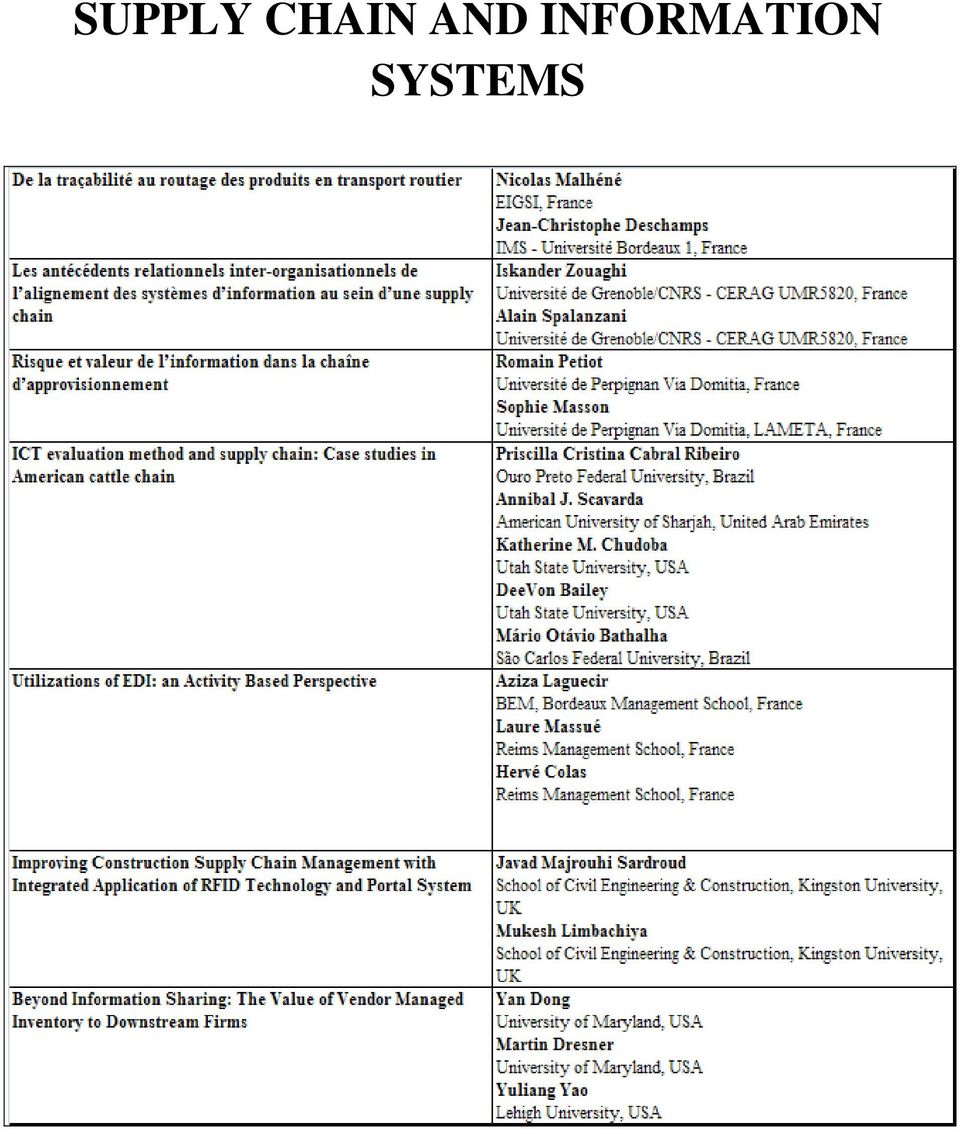
2 RIRL 2010 The 8th International Conference on Logistics and SCM Research BEM Bordeaux Management School September 29, 30 and October 1st 2010 De la traçabilité au routage des produits en transport routier Nicolas Malhéné EIGSI (Ecole d Ingénieurs en Génie des Systèmes Industriels), France ([email protected]) Jean-Christophe Deschamps IMS - Université Bordeaux 1, France ([email protected]) Résumé Dans le contexte concurrentiel de la nouvelle économie, les entreprises doivent maitriser au mieux leur réseau logistique pour l adapter aux nouvelles réalités des marchés. Le transport est devenue une fonction intégrative de performance au sein de la chaîne d approvisionnement, dont l efficacité risque de «peser lourd» dans la maîtrise des coûts industriels à l aube des nouveaux défis liés au développement durable. L objet de ce papier, résolument prospectif, est de définir le bien fondé de l application des NTIC, et plus particulièrement la technologie du RFID, à la rationalisation du transport routier et à la synchronisation de la chaîne d approvisionnement. Il décrit ainsi les fondements du projet PRODIGE qui tend, dans ses développements, à instrumenter la traçabilité au travers d une application combinée de plusieurs technologies et à modifier les usages en transport en posant le problème de l optimisation du routage à l échelle du produit. Mots clés: transport routier, RFID, géolocalisation, routage, produit intelligent 1
3 1. INTRODUCTION Depuis plusieurs années, le mouvement de recentrage des industriels sur leur cœur de métier et les pratiques modernes de management favorisent l externalisation de pans entiers de certaines activités soutenant ainsi une évolution rapide de la logistique dans de nouvelles formes d organisations. La fonction devient alors la véritable articulation de la collaboration inter-entreprise garante d une réponse adaptée des industriels face à l évolution des caractéristiques du marché et de leur environnement. Même concurrentes, les entreprises industrielles n hésitent plus à collaborer comme l illustre la conception, la construction et la location des plates formes voisines par Prologis, permettant à Continental et Bridgestone de mutualiser leur préparation de commande avec un même prestataire logistique. (Houe, 2006) souligne que le passage à une attitude plus coopérative au sein de la chaine logistique étendue témoigne de la dilution des frontières des entreprises et de l émergence de nouvelles organisations aux multiples caractéristiques, appelées réseaux logistiques. On entend par " Réseau Logistique " toutes les activités qui se rapportent à l'adaptation des ressources aux besoins des clients internes, à la recherche et la proposition de solutions logistiques innovantes, correspondant, soit à l'évolution des cahiers des charges, soit au maintien du taux de service en optimisant les coûts. De tels réseaux peuvent fonctionner grâce à des mécanismes de coopération entre les partenaires. Il faut donc en premier lieu que les acteurs des réseaux logistiques cherchent à définir ensemble la nature des informations qu'ils doivent échanger et les procédures d'échange pour mettre en œuvre ces mécanismes et qui leur permettraient de progresser dans le cadre d'une relation gagnant-gagnant. Le transport est un élément prépondérant de ces réseaux logistiques. Véritable maillon de la chaine d approvisionnement, il est devenu un acteur incontournable de la logistique dont la performance impacte fortement celles des chargeurs et clients. La maîtrise des transports routiers, objet d étude de ce papier, est une préoccupation très actuelle, dans un contexte où le développement durable devient un enjeu économique majeur, s agissant de sensibiliser l ensemble des acteurs économiques et politiques aux problèmes de maîtrise de l énergie, de respect de l environnement sans pour autant renoncer à l optimisation des profits. Ainsi, de nouvelles initiatives se développent dans le domaine, autour de l utilisation des NTIC (Nouvelles Technologies de l information et la Communication) afin notamment de favoriser la traçabilité des produits et d optimiser l usage d une flotte de transport. L utilisation de la technologie RFID (Radio Frequency Identification) permet particulièrement de faciliter 2

4 l accès à l information, et de renforcer l interopérabilité (aptitude de deux partenaires à interagir efficacement et sans effort, que ce soit au plan organisationnel ou technique) au sein de la chaîne d approvisionnement. Cette propriété, à l ère où le transport multimodal peut devenir une stratégie gagnante dans la recherche de maîtrise des coûts, tend à favoriser un échange aisé d information, pouvant être exploitée à des fins de transfert de responsabilités (lors de ruptures de charges entre deux prestataires transport), une facturation à l acte, ou encore le calcul de la trace carbone associée à l acheminement du produit. Ce travail n est pas en soi le résultat d une recherche aboutie, mais se veut prospectif. Au travers d une discussion argumentée, nous cherchons à poser les fondements du projet PRODIGE, financé par l'agence Nationale de la Recherche, qui pose le problème de l usage des NTIC durant le transport routier de marchandises, et de la valeur d une telle technologie à des fins d optimisation de l activité. Ainsi, dans une première partie, nous définissons les enjeux liés à la traçabilité dans le transport. Nous tentons alors en partie 3 de nous appuyer sur un standard privatif existant pour comprendre comment maîtriser le flux d information vis-à-vis du flux physique afin d assurer la traçabilité des matières tout au long de leur cycle de vie ; l analyse reste cependant circonscrit au transport, depuis la prise en charge de la marchandise chez le chargeur jusqu à sa délivrance au client. Nous introduisons en partie 4 les bases, avantages et limitations de la technologie RFID avant de montrer comment cette technologie peut modifier les usages en transport routier (partie 5). Le projet PRODIGE est alors décrit à travers ses attendus techniques et scientifiques. Les premières bases de réflexions sur les développements à réaliser sont présentées avant de conclure sur l avenir de ce travail. 2. TRAÇABILITE ET TRANSPORT La traçabilité caractérise dans sa définition la plus générique la mise en œuvre d une chaîne d information donnant la faculté d une organisation à retrouver l historique, l utilisation ou la localisation d une entité au moyen d identifications enregistrées (Norme NF EN ISO 8402). La norme réfère entre autre à la caractérisation de l origine de matières participant à la fabrication de produits plus complexes, à la connaissance des processus appliqués au produit, à la distribution et l emplacement du produit après livraison. Les nouvelles organisations émergentes, telles que les chaînes d approvisionnement et réseaux logistiques, tendent à ce que la maîtrise de la conception et fabrication d un produit ne s inscrit plus au sein d une seule et même entreprise mais fasse appel à un réseau de partenaires. 3
5 La traçabilité devient ainsi un outil incontournable dans la gestion de crise, où la situation la plus fréquemment rencontrée consiste à remonter la chaîne d information caractérisant l historique des transformations suite à la détection de défauts graves sur un produit, et ceci afin de rappeler tous ceux issus d un même lot de fabrication. La dimension liée à la localisation des produits est par contre mal considérée et souvent sous exploitée. Une connaissance plus ou moins précise de la localisation du produit tout au long de son cycle de vie, tout au moins jusqu à sa distribution au consommateur (utilisateur du produit), représente pourtant aujourd hui une source de gains appréciable dans la possibilité qu elle offre de mieux coordonner les actions distribuées tout au long d un réseau logistique de plus en plus collaboratif. L activité pouvant le plus tirer profit d une traçabilité intégrant tout particulièrement la localisation des produits est sans aucun doute le transport de marchandises. Si la chaîne d information assurant l historique des transformations existe dans le domaine, il n en demeure pas moins qu elle reste perfectible dans le domaine du captage de données en rapport avec le respect de l intégrité des produits (chocs) ou de ses contraintes de conditionnement (chaîne de froid). La localisation du produit n est quant à elle disponible la plupart du temps qu en cas de rupture de charge, c'est-à-dire lorsqu un produit est transféré en terme de responsabilité d un partenaire logistique à un autre, ou lorsqu il subit une activité de fractionnement / regroupement avec d autres en rapport avec son acheminement. Fort de ce constat, le présent travail tente de poser les fondements de nouveaux usages dans le domaine du transport, associés à la mise en œuvre renforcée d une traçabilité intégrant la connaissance quasi temps réel de la position de l ensemble des produits en transport. Les propositions faites dans ce papier sont donc par nature prospectives, et font l objet de développements actuels. 3. PRATIQUES LIEES A LA TRACABILITE La définition de nouveaux usages impliquent la connaissance des pratiques telles qu elles sont mises en œuvre dans le domaine étudié. Peu de documents font état de ces pratiques, tant elles sont propres à chaque prestataire offrant un service transport. Certains standards tentent cependant de s imposer dans la manière d organiser l activité transport et d assurer la traçabilité. Nous tentons ici de nous appuyer sur un standard privatif, proposé par GS1 (GS1 France, 2006), pour comprendre et analyser succinctement les activités allant de la prise en charge chez l expéditeur jusqu à la livraison au client. Nous tentons notamment de renforcer, 4

6 au travers de cette présentation, l idée d une «nécessaire» synchronisation des activités liées à la transformation du flux physique avec celles associées à la gestion et transformation du flux d information Quelques définitions clés L objet de ce paragraphe est le rappel de la définition des unités de conditionnement qui définissent à différents niveaux d abstraction les emballages nécessaires à la préparation du produit à son transport. Ainsi, les unités consommateurs (notées UC) caractérisent un objet, ou une entité, souvent assimilé à un produit consommable identifié de manière unique et destiné à un client. C est l unité la plus élémentaire accessible à ce dernier. Les unités logistiques (notées UL) sont le regroupement d unités consommateurs. Une unité logistique peut être standard lorsqu elle se compose d unités consommateurs identiques (en nature et en nombre) ou bien non standards si elle regroupe des articles de natures diverses dans des quantités non homogènes. Les unités d expédition (notées UE) correspondent aux unités préparées à des fins de transport, c'est-à-dire pour l acheminement d un ensemble de produits plus ou moins homogènes à un client. L exemple le plus représentatif est la palette contenant un ensemble d unités logistiques Le système d information associé La traçabilité des activités reposant sur la caractérisation d informations permettant de connaître l historique des produits, chaque unité de conditionnement telle que définie plus haut, se voit affecter un code de référencement. Ce dernier est l un des facteurs de rapprochement / d intégration du flux physique et du flux d information correspondant dans la manière dont il permet de hiérarchiser l information, et d assurer les liens entre «contenant» et «contenu». Cette codification repose sur les définitions des informations suivantes : GTIN ou Global Trade Item Number : Ce code repose sur une information à 14 chiffres faisant appel à des standards de codage tels que l EAN/UCC-8 ou encore l EAN/UCC-13. Par une hiérarchisation et une structure spécifique, il est associé à chaque unité consommateur, ou unité logistique lorsqu elle est standard, et répond aux normes internationales garantissant l unicité de l information. SSCC ou Serial Shipping Container Code : ce code structure en 18 chiffres est constituée pour chaque unité d expédition, pour le besoin du transport. Il référence de manière unique l UE à laquelle il est attaché, sans faire référence à son contenu. 5
7 Pour plus d information, le lecteur peut consulter les différents rapports rendus publiques par GS1 dont notamment le rapport sur les standards de transport (GS1 France, 2006). 6

8 3.3. Modélisation succincte des processus La traçabilité impose une mise à jour des informations contenues dans le système d information de chaque partenaire. Cette mise à jour doit se faire de manière synchrone avec la réalisation des activités sur le flux physique. Au sein d une entreprise, elle s applique depuis l utilisation d une matière dans une fabrication (auquel cas les numéros de lots pour chaque matière sont à lier au n de lot du produit fabriqué), jusqu à la constitution des unités logistiques (figure 1). Lorsque les unités logistiques sont non standards (ULNS), le caractère hétérogène de leur contenu impose une codification par un SSCC et une mémorisation des liens associant UL et produits conditionnés (Quantité de produits / GTIN, référence lots si nécessaire). Flux physique PRODUCTION CONDITIONNEMENT LECTURE N N LOTS EDITION GTIN, N N lot lot EDITION SSCC si si ULNS Flux information N lots MP1 N lots MP2 N lots emballages GTIN, n Lots, Qtés SSCC1 GTIN, n Lots, Qtés GTIN, n Lots, Qtés GTIN, n Lots, Qtés Figure 1. Production / conditionnement chez le chargeur Lors de la réception d une commande chez le fabriquant, la réservation d une prestation de transport est demandée auprès du prestataire choisi. Dès lors, les unités d expéditions sont préparées pour la date d enlèvement demandée et un avis d expédition est envoyé au destinataire de la marchandise. L ordre de transport une fois confirmé, les codes SSCC sont générées et apposées sur les palettes par le biais d étiquettes. Ces codes dits «pères» en référence à la hiérarchisation de l information sont liés dans la base de données aux codes GTIN ou SSCC «fils» caractérisant les ULNS. Une fois le transporteur arrivé chez le chargeur (fabriquant), il prend en charge les unités d expédition en commençant par lire les codes SSCC les référençant. Il peut ainsi vérifier la conformité du code des UE à charger avec ceux mentionnés sur l ordre de transport reçu. 7
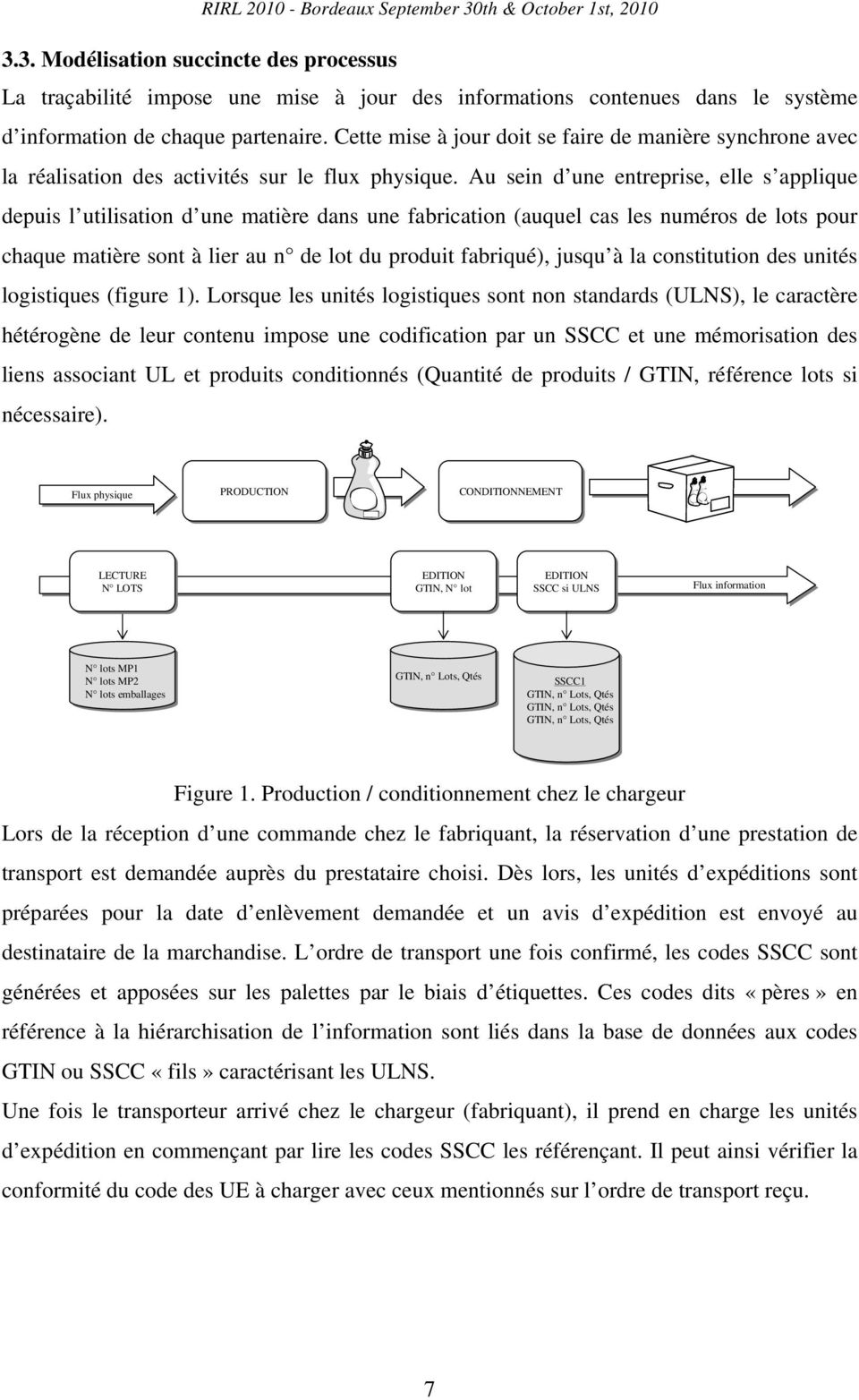
9 PREPARATION COMMANDES CONSTITUTION DES UE ETIQUETAGE DES UE EXPEDITION RECEPTION COMMANDES RESERVATION TRANSPORT ENV0I AVIS EXPEDITION DEMANDE TRANSPORT EDITION SSCC UE Flux information Commandes Ordre de réservation Avis d expédition Ordre de transport SSCCx SSCCy, GTIN n Lots, Qtés CLIENT FINAL TRANSPORTEUR CLIENT FINAL TRANSPORTEUR Figure 2. Expédition chez le chargeur Si les codes s avèrent exacts, il est mémorisé dans sa base de données avec les informations utiles à l acheminement de l UE (notamment le code postal ou le code route utile au tri des UE afin d embarquer de manière rationnelle le chargement (figure 3). Une fois la prise en charge terminée, l activité de transport débute. Elle peut conduite à l utilisation de plateformes logistiques nécessitant un passage à quai, notamment si l acheminement des produits demande un éclatement / regroupement de marchandises. Flux physique TRI DES UE CHARGEMENT TRANSPORT PASSAGE A QUAI PLATEFORME (si (si besoin) TRANSPORT SSCC ETIQUETTE LOG. Code route Code postal LECTURE SSCC UE CONTRÔLE ENREGISTREMENT SSCC UE SUIVI SUIVI SUIVI Flux information Ordre de transport Contient les liens entre SSCC UE SSCCx SSCCy Statut Mouvements Statut Mouvements Statut Mouvements FOURNISSEUR Figure 3. Prise en charge de l expédition par le prestataire transport Dans un tel cas, les activités sur le flux physique et d information s apparente à ce que l on peut observer chez l expéditeur (dans la partie préparation de l expédition) et chez le destinataire (pour la partie réception des expéditions). C est au travers de ces ruptures de charges que ce fait les informations de traçage de l activité transport, par un envoi d information indiquant le statut des mouvements en cours. 8
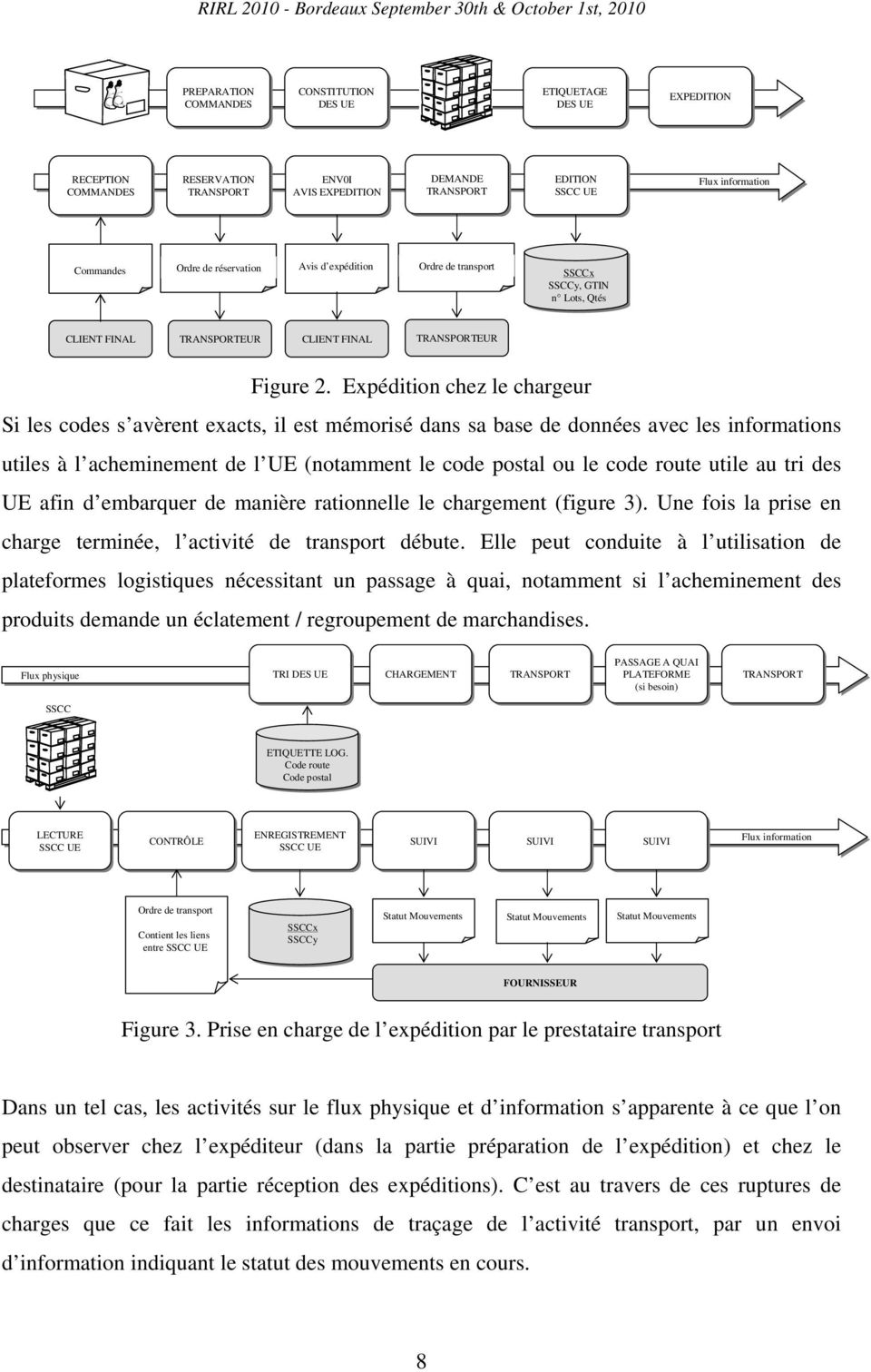
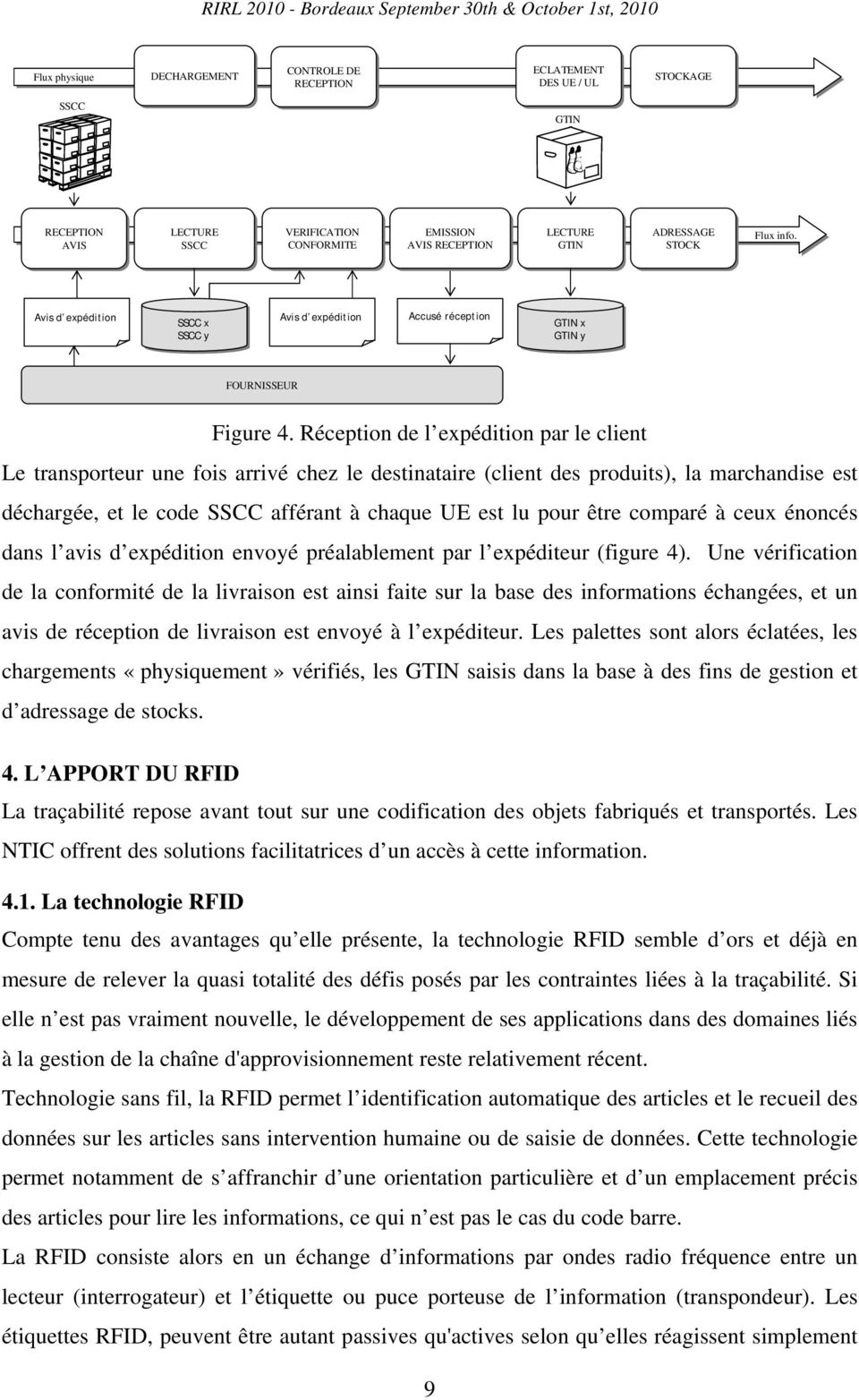
10 Flux physique DECHARGEMENT CONTROLE DE RECEPTION ECLATEMENT DES UE // UL STOCKAGE SSCC GTIN RECEPTION AVIS LECTURE SSCC VERIFICATION CONFORMITE EMISSION AVIS RECEPTION LECTURE GTIN ADRESSAGE STOCK Flux info. Avis d expédition SSCC x SSCC y Avis d expédition Accusé réception GTIN x GTIN y FOURNISSEUR Figure 4. Réception de l expédition par le client Le transporteur une fois arrivé chez le destinataire (client des produits), la marchandise est déchargée, et le code SSCC afférant à chaque UE est lu pour être comparé à ceux énoncés dans l avis d expédition envoyé préalablement par l expéditeur (figure 4). Une vérification de la conformité de la livraison est ainsi faite sur la base des informations échangées, et un avis de réception de livraison est envoyé à l expéditeur. Les palettes sont alors éclatées, les chargements «physiquement» vérifiés, les GTIN saisis dans la base à des fins de gestion et d adressage de stocks. 4. L APPORT DU RFID La traçabilité repose avant tout sur une codification des objets fabriqués et transportés. Les NTIC offrent des solutions facilitatrices d un accès à cette information La technologie RFID Compte tenu des avantages qu elle présente, la technologie RFID semble d ors et déjà en mesure de relever la quasi totalité des défis posés par les contraintes liées à la traçabilité. Si elle n est pas vraiment nouvelle, le développement de ses applications dans des domaines liés à la gestion de la chaîne d'approvisionnement reste relativement récent. Technologie sans fil, la RFID permet l identification automatique des articles et le recueil des données sur les articles sans intervention humaine ou de saisie de données. Cette technologie permet notamment de s affranchir d une orientation particulière et d un emplacement précis des articles pour lire les informations, ce qui n est pas le cas du code barre. La RFID consiste alors en un échange d informations par ondes radio fréquence entre un lecteur (interrogateur) et l étiquette ou puce porteuse de l information (transpondeur). Les étiquettes RFID, peuvent être autant passives qu'actives selon qu elles réagissent simplement 9
11 au signal émis par un lecteur ou qu elles possèdent leur propre source d'énergie et génèrent un signal plus puissant contenant plus d'informations. Lorsqu elles sont réinscriptibles, elles peuvent enregistrer de nouveaux renseignements émis par les lecteurs RFID et permettent une utilisation plus poussée de cette technologie en permettant par exemple de chiffrer de l'information sur un colis pour connaître son trajet exact et l'horaire de sa livraison. Dans son principe le plus élémentaire, la technologie RFID traite le flux d'informations : quels éléments sont arrivés, quels éléments sont sortis, à quels moments et à quels endroits ils sont allés. Support à différentes informations comme l EPC (Electronic Product Code ou Code produit électronique - les codes GTIN et SSCC font partis des données préconisées dans ce cadre par le standard GS1) associée au «réseau de la traçabilité des objets», et identifiée de manière unitaire (étiquettes à codification séquentielle), les puces RFID peuvent être facilement ajoutées à des marchandises ou à des emballages afin d'en faciliter le pistage ou l'identification. Elles pourraient supplanter avantageusement les omniprésents codes à barres, dans la manière d aider au traçage des UC, UL et autre UE. Pour ce faire, la technologie devra surmonter l une des principales difficultés auxquelles elle doit faire face à savoir le coût de l étiquette dont on peut estimer, pour les puces les moins chères, qu il se situe autour de 0,10 l unité. Cette barrière pourrait bien être levée dans les toutes prochaines années avec l explosion de la technologie et son exploitation répandue. Dans un récent numéro du magazine Fortune, Rob Carter (PDG de Federal Express) s'exprimant au sujet de la RFID citait la définition de Bill Gates sur les «technologies deux ans dix ans». Le phénomène de mode a ainsi dominé lors des deux premières années, avant de laisser place à la déception jusqu'au jour où, 10 ans plus tard, les gens ont pris conscience que la technologie s'était installée dans leur vie quotidienne. Toutefois, après avoir constaté les problèmes rencontrés par FedEx avec ses étiquettes, M. Carter reconnaissait que l'identification par radiofréquence est probablement une technologie «trois ans quinze ans». Selon une étude menée par VDC (Venture DAta Corp.), le marché des middlewares RFID a augmenté de plus de 31 % sur l'exercice , tendance qui semble se confirmer sur 2009, ce segment devant connaître une croissance de 55 %. La valeur du marché mondial est estimée à 69,4 millions $ et devrait suivre une croissance annuelle moyenne de 60,5 % jusqu'en Toutefois cela fait plusieurs années que l'on attend une telle explosion de la croissance des technologies RFID sans qu'elle ait vraiment eu lieu. Malgré les nombreux effets d annonce et autres expérimentations plus ou moins bien réussies (chaînes logistiques de Wal-Mart, Marks 10

12 & Spencer et Metro AG, passeports chinois équipés de puces, gestion de la chaine logistique d AIRBUS, lancement d un téléphone porte monnaie par NOKIA, etc.), beaucoup hésitent à se lancer. Comme toutes les technologies, il est nécessaire de discerner le potentiel du RFID pour les enjeux de l application, de même qu'il faut en connaître ses limites Limitations liées à la technologie Les obstacles majeurs à l adoption généralisée de la technologie RFID relèvent de quatre catégories : Un manque de visibilité sur le Retour Sur Investissement. Les entreprises ont souvent opté pour une mise en œuvre basique : collage de l étiquette sur la palette ou le colis avant son expédition chez le client, appelée solution «slap-and-ship» (Murphy-Hoye et al., 2005). En considérant les coûts associés à la technologie RFID (investissements, étiquettes, etc.) très supérieurs aux coûts associés à une technologie code à barre pour une utilisation quasi identique sous exploitant le potentiel du RFID, il n'est pas surprenant que plus de la moitié de ces entreprises n ait pas rencontré le RSI attendu. Les risques techniques. Depuis 2004, GS1 France (GS1 France, 2006) évalue avec ses clients des solutions RFID spécifiques. Les taux d erreurs de lecture pouvant atteindre 30% sont encore incompatibles avec les besoins industriels. Ce taux augmente avec la densité d étiquettes à lire qui ajoute les problèmes de collision de lecteur (la collision de signaux de lecteurs multiples), la collision d'étiquette (la possibilité d'étiquettes multiples embrouillant un lecteur). La concurrence du code barre. En l espace de 30 ans, le code à barres est devenu le symbole de la distribution moderne. Entre 5 et 10 trillions de codes à barres sont imprimés chaque année, et environ 5 milliards de code à barres sont scannés chaque jour. Si la popularité du code à barres n est pas considérée comme un effet dissuasif en soi, il est clair qu elle n'a pas contribué à la propagation à plus grande échelle de déploiement RFID (Smith, 2005). La confidentialité. La technologie sans fil permet de lire tout ou à peu près tout à l insu des personnes. En violant notre vie privée, les puces risquent d alimenter des études de marché de plus en plus ciblées et précises en renseignant de gigantesques bases d informations avec nos informations personnelles. Tels sont les arguments avancés par des associations comme Consumers Against Supermarket Privacy Invasion and Numbering (CASPIAN) (Jones et al., 2004). 11

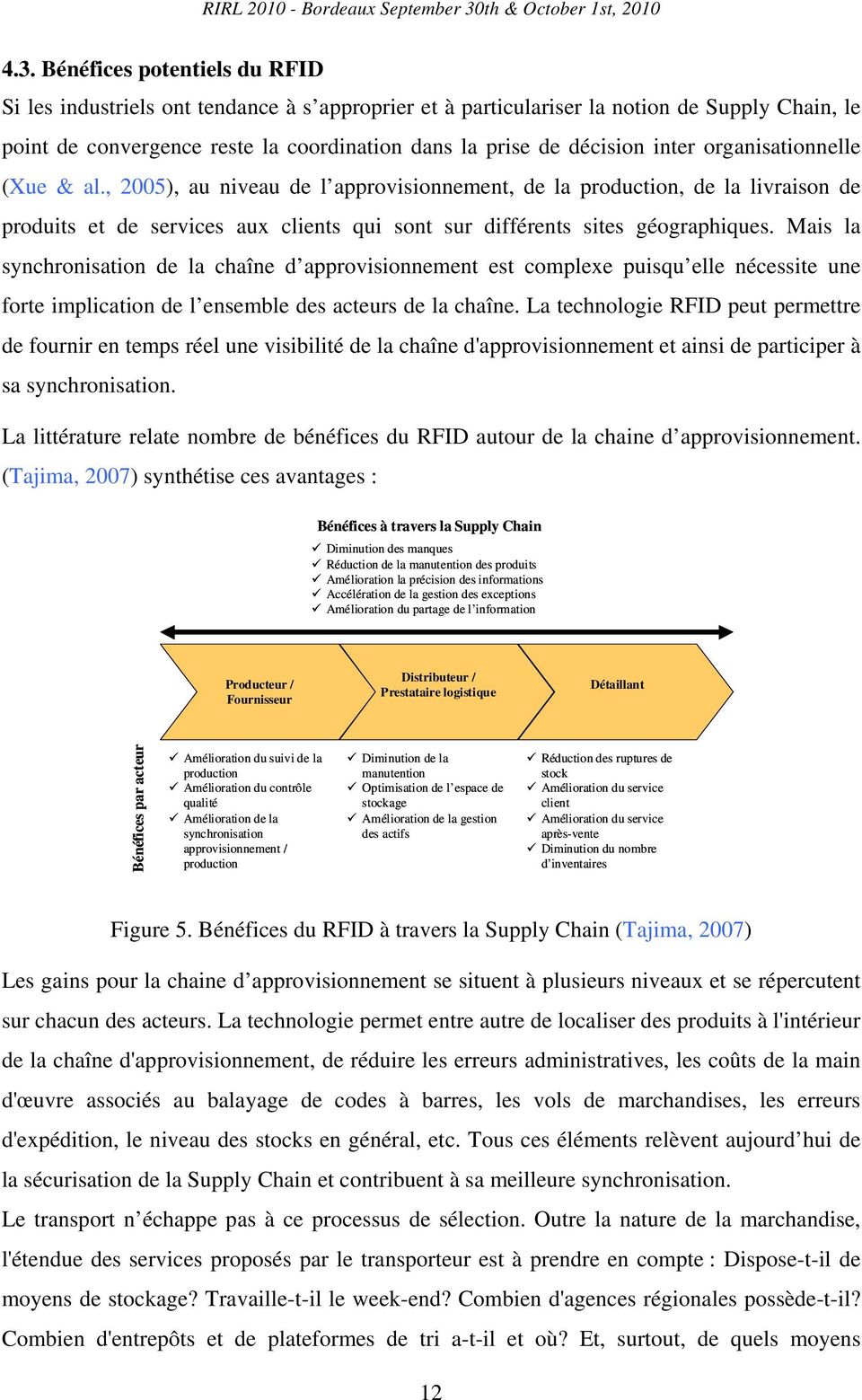
13 4.3. Bénéfices potentiels du RFID Si les industriels ont tendance à s approprier et à particulariser la notion de Supply Chain, le point de convergence reste la coordination dans la prise de décision inter organisationnelle (Xue & al., 2005), au niveau de l approvisionnement, de la production, de la livraison de produits et de services aux clients qui sont sur différents sites géographiques. Mais la synchronisation de la chaîne d approvisionnement est complexe puisqu elle nécessite une forte implication de l ensemble des acteurs de la chaîne. La technologie RFID peut permettre de fournir en temps réel une visibilité de la chaîne d'approvisionnement et ainsi de participer à sa synchronisation. La littérature relate nombre de bénéfices du RFID autour de la chaine d approvisionnement. (Tajima, 2007) synthétise ces avantages : Bénéfices à travers la Supply Chain Diminution des manques Réduction de la manutention des produits Amélioration la précision des informations Accélération de la gestion des exceptions Amélioration du partage de l information Producteur / Fournisseur Distributeur / Prestataire logistique Détaillant Bénéfices par acteur Amélioration du suivi de la production Amélioration du contrôle qualité Amélioration de la synchronisation approvisionnement / production Diminution de la manutention Optimisation de l espace de stockage Amélioration de la gestion des actifs Réduction des ruptures de stock Amélioration du service client Amélioration du service après-vente Diminution du nombre d inventaires Figure 5. Bénéfices du RFID à travers la Supply Chain (Tajima, 2007) Les gains pour la chaine d approvisionnement se situent à plusieurs niveaux et se répercutent sur chacun des acteurs. La technologie permet entre autre de localiser des produits à l'intérieur de la chaîne d'approvisionnement, de réduire les erreurs administratives, les coûts de la main d'œuvre associés au balayage de codes à barres, les vols de marchandises, les erreurs d'expédition, le niveau des stocks en général, etc. Tous ces éléments relèvent aujourd hui de la sécurisation de la Supply Chain et contribuent à sa meilleure synchronisation. Le transport n échappe pas à ce processus de sélection. Outre la nature de la marchandise, l'étendue des services proposés par le transporteur est à prendre en compte : Dispose-t-il de moyens de stockage? Travaille-t-il le week-end? Combien d'agences régionales possède-t-il? Combien d'entrepôts et de plateformes de tri a-t-il et où? Et, surtout, de quels moyens 12
14 technologiques dispose-t-il? Pionniers dans le domaine, le groupe Alloin a équipé ses véhicules de la RFID. A travers un portail Internet, les clients peuvent suivre leurs expéditions, vérifier les preuves de livraison et repérer ainsi les éventuels dysfonctionnements. Le déploiement de la technologie doit aller plus loin dans les transports. (Kim et al. 2008) démontrent l apport de l utilisation du RFID associée à la localisation temps réel des camions dans l amélioration de la satisfaction client et une diminution du coût du travail, conduisant ainsi à augmenter le profit global de la Supply Chain. 5. LE ROLE DU RFID DANS LA MODIFICATION DES USAGES EN TRANSPORT 5.1. Les enjeux actuels au sein des projets R&D Le développement des applications de la technologie RFID dans la gestion de la chaîne logistique est donc en plein essor. Si les projets de type «slap-and-ship» se limitent dans l utilisation de la RFID, les projets de recherche en cours, en la combinant avec d autres technologies comme la géolocalisation, tentent d aller beaucoup plus loin dans l exploitation de son potentiel. Le 12 novembre 2009, le PREDIT (Programme de recherche et d innovation dans les transports terrestre) organisait les Rencontres sur les outils de traçabilité du transport de marchandises et leurs enjeux pour la logistique. Deux projets présentés respectivement par TOSHIBA et la SANOFI et soutenus par le pôle de compétitivité Nov@log illustrent cette orientation. GEOCOLIS ( est un projet visant à assurer une traçabilité complète en temps réel et en continu de produits transportés en associant géolocalisation et identification individualisée par radiofréquences. Les travaux de recherche consistent à choisir, développer et valider les technologies adaptées et à modéliser les processus et interfaces d'échanges de données en répondant aux problématiques propres aux radiofréquences pour aboutir à un prototype industriel opérationnel. La circulation de l information suit le schéma suivant : les étiquettes RFID passives Antenne embarquée Emission / Réception d inventaire Localisateur GPS Emission GPRS au serveur Portail Web. Initié en 2008, le projet se déroule en deux étapes de 18 mois chacune : - La première phase a consisté à approcher la problématique d un point de vue macro en proposant un prototype pour un suivi à la palette. Elle a permis d étudier les flux physique et les outils existants, de lever les verrous techniques et technologiques par la R&D et réaliser un prototype simplifié, de le tester techniquement. Elle a consisté également à évaluer le prototype d un point de vue économique en mesurant un 13
15 premier retour sur investissement en vue d une solution de première génération commercialisable. - La seconde phase vise à généraliser les concepts et les outils pour un suivi de colis individuel (format US). Si l approche est semblable, la complexité croit de manière exponentielle avec la massification de l information multipliant les problèmes technologiques évoqués dans le 4.2 (interférences, anticollisions, normalisation). FTRACE ( cherche à développer un module hybride GPRS/Satellitaire/RFID Active pour la géolocalisation et le suivi de la température. L expérimentation du prototype se fait dans la filière pharmaceutique. Tout comme dans le cadre de GEOCOLIS, le module permettra de localiser continûment et en temps réel l ensemble des marchandises transportées. Mais avec l introduction d une puce active, les possibilités augmentent considérablement. Il sera ainsi possible de connaître l historique des trajets pour un véhicule ainsi que la marchandise transportée, mesurer et transmettre en continu la température des produits transportés, contrôler le respect de l intervalle de tolérance des températures pour chaque produit et ainsi garantir le respect de la chaîne du froid par la localisation temps réel (positionnement satellitaire). A travers la consolidation de cette chaine d information, le client final peut se voir remettre un certificat de conformité (avec courbe d évolution de la température), garant de la qualité et de la conformité du produit livré. Bien entendu l utilisation de ce type de technologie ne peut être envisagée que sur des marchandises à forte valeur ajoutée compte tenu du coût des puces RFID active. Néanmoins, FTRACE montre à travers la combinaison de plusieurs technologies le véritable potentiel du RFID Apport de la communauté scientifique La littérature scientifique fait état de travaux de recherche appliquant la technologie RFID dans le domaine de la logistique. Si l on fait abstraction des possibles erreurs de lecture, certaines caractéristiques émanant du RFID appliqué au pilotage de flux matières sont particulièrement intéressantes, telles que la facilité d accès à l information permettant d identifier chaque objet piloté et l exactitude du système d information représentatif de la situation de pilotage, rendue possible par une lecture aussi fréquente que nécessaire des informations associées aux objets pilotés. Notons que ces informations ne sont pas obligatoirement statiques, la technologie permettant aujourd hui de disposer de puces autorisant un certain nombre d opérations de réécriture (voir 4.1). 14

16 En prenant ces caractéristiques comme postulats, un ensemble de travaux ont vu le jour autour de la définition de la notion de «produit intelligent». Ainsi, (Zaharudin et al., 2002) définit le produit intelligent comme un objet identifié de manière unique, ayant une capacité de stockage d information le concernant, et ayant l aptitude de pouvoir communiquer ces informations à un tiers pour faciliter une prise de décision concernant son devenir. Ils explicitent notamment la manière d instrumenter cette notion d intelligence en plaçant des portails de lecture en début et fin de chaîne de fabrication, en baie de déchargement d un camion, au niveau des stocks de produits dans les entrepôts, ainsi qu en se servant des informations portées par le produit (pouvant représenter l état du produit, et l historique de ses transformations) pour une prise de décision permettant d optimiser les performances de la chaîne logistique. Néanmoins, le cadre d application reste purement théorique, les concepts et fonctions présentés n étant pas annoncés comme déployés en situation réelle. Cette notion de produit intelligent est partiellement partagée par d autres auteurs comme (Karkkainen et al., 2003), et donne lieu à la notion de systèmes pilotés par les produits (Thomas, 2008). Ainsi s est créée depuis plusieurs années une communauté de chercheurs travaillant sur le produit intelligent. (Meyer et al. 2009) témoignent, au travers de leur état de l art, de la richesse de travaux dans le domaine et des nombreuses perspectives d applications. A notre connaissance, les applications de la technologie restent cependant majoritaires à l échelle de l atelier (Pannequin, 2009) ou au périmètre d un entrepôt (Poon et al., 2009). Réduit au périmètre du transport, les travaux réalisés autour de l application du RFID s affranchissent de la notion de produit intelligent pour se focaliser sur le problème de suivi de ressources faisant appel à de la localisation, qu il s agisse de containers réutilisables, ou de moyens de transport dont on veut optimiser le fonctionnement. Ainsi, (Cheung et al., 2008) partent de l hypothèse d un couplage de GPS/GIS et RFID permettant de caractériser de manière temps réel la situation de transport (localisation des ressources, connaissance de la distribution spatiale des routes et des lieux de tournées, identification des conditions de route) pour poser les bases d un modèle dynamique de routage d une flotte de véhicules de transport. Le travail présenté ne comporte cependant pas de mise en œuvre et validation en situation réelle. (Wen, 2010) décrit les fondements du développement d une application informatique récupérant des informations à partir de la technologie RFID facilitant le «tracking» des voitures volées ou le contrôle des véhicules dans le respect de la législation routière. 15

17 6. LE PROJET PRODIGE L analyse rapide des initiatives et travaux cités plus tôt met alors en évidence deux situations ; les projets industriels R&D sont d une part essentiellement focalisés sur des logiques de traçage de marchandises dangereuses ou sensibles et de ressources reconditionnées, mais n exploitent pas systématiquement les informations à des fins d optimisation. La géolocalisation apporte dans certains cas des informations utiles aux positionnements des ressources. Les travaux scientifiques exploitent d autre part toute la richesse des applications possibles, sans pour autant valider systématiquement les contributions par une mise en application pratique en situation réelle. 6.1 Présentation du projet Le projet PRODIGE pose dans ce contexte un cadre d application dans le domaine du transport routier associant une réflexion sur les notions théoriques de produit intelligent, et de système piloté par le produit à la mise en application des technologies RFID, GPS et GPRS permettant de tracer et localiser le produit tout au long de son déplacement. La notion de produit intelligent tel que perçue dans le projet se limite à l aptitude du produit à stocker et communiquer de l information le concernant susceptible d aider à son acheminement au client. Cette information peut dans certains cas être en rapport avec son intégrité, comme la mesure d une température pour les produits frais et surgelés. GPS RFID Boitier communicant RF (interfaçage) GSM (interfaçage) (interfaçage) Solution logicielle embarquée Solution logicielle serveur Figure 6. La chaîne d information L objet du projet est d une part de concevoir une chaîne d information allant de l accès à l information portée par le produit jusqu à communiquer au client les données en relation avec l acheminement de ce produit, dans une logique d offrir une traçabilité et une 16

18 localisation «parfaite» et «continue» du produit transporté. D autre part, l accès quasi temps réel à l information laisse supposer le développement de nouveaux modes de raisonnement dans la manière d optimiser les activités au niveau de la chaîne logistique, en centrant les problèmes de routage non pas sur les véhicules transportant les matières, mais sur les matières elles mêmes. 6.2 Un routage orienté produits Le routage, bien connue de la communauté scientifique lorsqu il s agit d organiser entre autres les tournées de véhicules (Chao et al., 1995) (Fabri et al., 2006), n est pas ou encore peu étudié à l échelle du produit. S il n y pas de rupture fondamentale de raisonnement par rapport aux approches classiques dès lors que l on s intéresse au produit et que l on banalise la ressource de transport, le problème est néanmoins plus complexe. L idée d un routage orienté produits s appuie sur le principe d un transport qui, au-delà de la maîtrise de ses coûts opérationnels, tend de plus en plus à proposer des solutions agiles intégrant de nouveaux facteurs de performance tels que le respect de la législation interdisant ou limitant l accès de certaines zones urbaines aux moyens de transport encombrants, le calcul de la trace carbone associée au transport du produit, Elle pose également des principes de gestion pas toujours facilement conciliables. Ainsi, l agilité dans le transport rendue possible par le routage des produits s appuie sur un fractionnement possible d un chargement, sans effort considérable dans le transfert d information d un acteur de transport à l autre mettant ainsi en évidence l importance d une interopérabilité aussi bien au plan organisationnel qu au plan technique. Les prémices d une réflexion sur le problème d interopérabilité appliqué au périmètre du projet PRODIGE sont présentés dans (Zacharewicz et al., 2010). A l opposé, l amélioration des performances du transport routier passe par une mutualisation des moyens, le regroupement et l optimisation du remplissage des camions, entraînant ainsi un impact plus faible sur l environnement. Les fondements du problème de routage orienté produits reposent alors sur la définition de la notion de «service orientée transport», pouvant s assimiler aux ressources disponibles à chaque instant pour assurer la reconfiguration du trajet d acheminement d un produit à son destinataire. Ces ressources correspondent aussi bien aux véhicules de transport qu aux plateformes logistiques utiles au transbordement quai à quai de marchandises, et sont caractérisées par une localisation et une capacité disponible. Néanmoins, le problème ne se résume pas à une simple affectation de charges à des ressources, du fait que la tension des 17
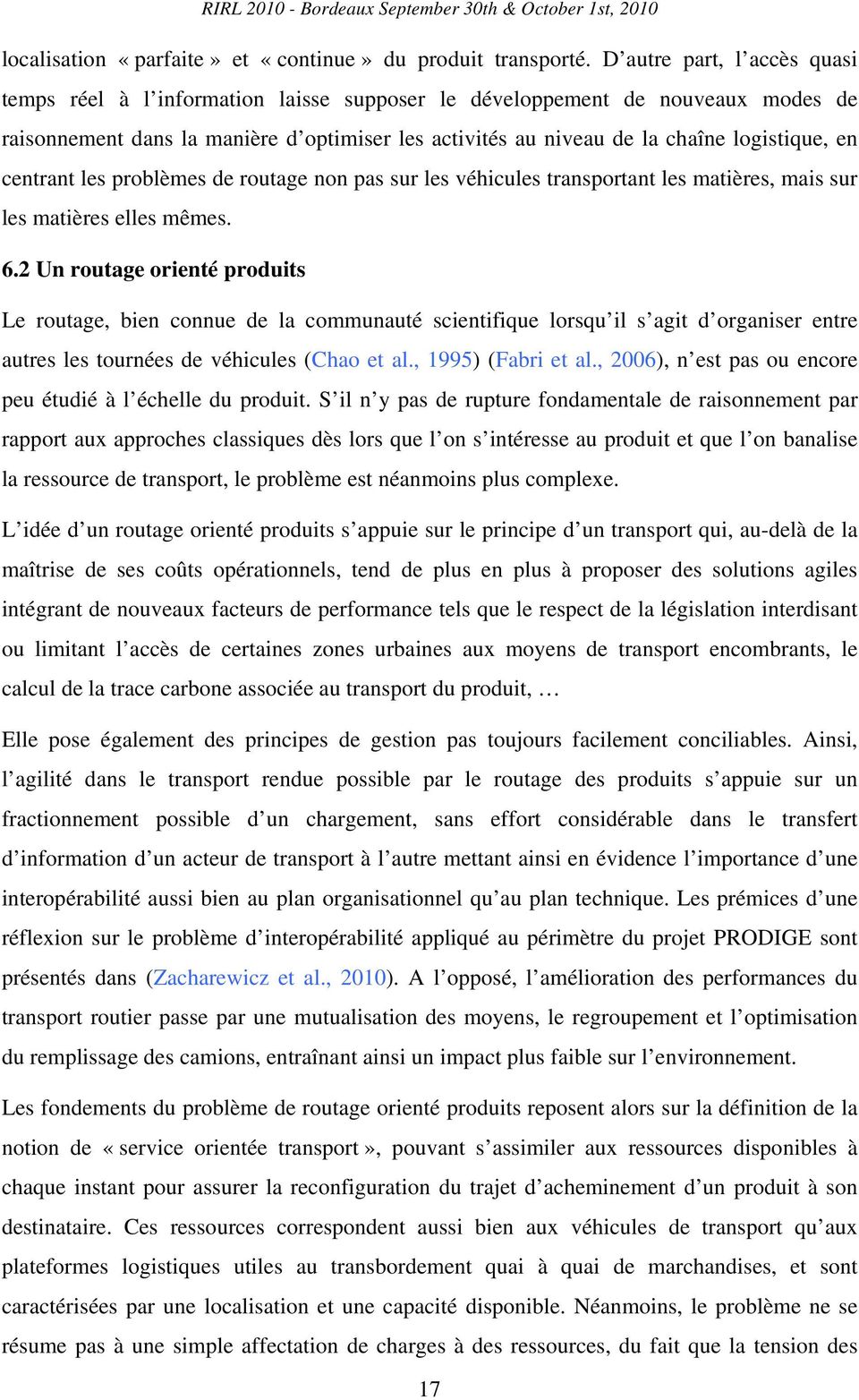
19 flux oblige le rendez-vous entre véhicules et plateforme sur un intervalle de temps donné. Il s apparente plus à un problème d optimisation dynamique des tournées (noté DVRPTW Dynamic Vehicle Routing Problem with Time Windows). La complexité du problème à résoudre est augmentée par le fait que les prestataires transport sont multiples et les ressources «véhicules» ont par nature une localisation variable dans le temps. De plus, le nombre d activités est augmenté par le centrage du problème de routage sur le produit et le problème est plus contraint par le couplage des tournées lié la nécessité de garantir l arrivée synchronisée de véhicules au même endroit (figure 6). Tournée véhicule i Tournée véhicule j 0 Entrepôt pour transbordement Dépôt véhicule i Dépôt véhicule j Tournée initiale véhicule i Tournée initiale véhicule j Nouveau trajet véhicule i Nouveau trajet véhicule j Trajet abandonné Figure 7. Exemple de scénario de reconfiguration de trajets Le routage orienté produits se singularise ainsi par l étude d un problème d optimisation de trajets fortement dynamique et contraint dans le temps où doivent cohabiter des stratégies de résolution propres au produit et au contexte de son transport sans négliger la performance opérationnelle propre aux ressources utilisées pour l acheminement. 6.3 Enjeux et performances L accès temps réel aux informations caractérisant un produit et porté par ce dernier, via le RFID, la localisation de la position de chaque produit au travers de l utilisation d un GPS, la communication des données par GPRS, représentent un réel axe d amélioration de la performance dans les chaînes logistiques et dans le transport. Ainsi, la mise à disposition de l information à un tiers dont l activité est impactée par le transport permet d entrevoir : - Une reconfiguration des systèmes logistiques au travers du suivi des opérations de routage, autorisant une adaptation des moyens de transport et ajustement des plannings de livraisons aux aléas auquel se confronte l activité transport. - L amélioration des performances chez les clients ou logisticiens (plateformes) par un suivi à distance précis leur facilitant l organisation à quai des activités de manutention des produits, et de stockage. 18

20 - La sécurisation de la marchandise pour peu que tout mouvement non autorisé dans le volume où les produits sont interrogés périodiquement via la technologie RFID soit détecté. - L amélioration des systèmes d information utilisés par les acteurs de la chaîne logistique au travers du développement d outils interopérables. La recherche de performance représente cependant un point délicat dans l approche préconisée et doit faire l objet d une analyse toute particulière. Elle pose le problème de recherche de performances parfois antagonistes. En effet, si l optimisation des flottes de transport repose sur une réduction des coûts de transport, un routage orienté produit s appuie à contrario sur une reconfiguration dynamique des trajets pouvant avoir pour conséquence directe une augmentation des temps d arrêts et des temps de manutention. Cette situation peut être vécue par le transporteur comme une perte de productivité, mais vue par le client comme un gage de qualité de service. Il s agit alors de concilier la recherche de profit maximal local pour chaque partie prenante et la garantie d une performance globale (à l échelle de l ensemble des partenaires impliqués). 6.4 L approche développée Forts des observations et remarques précédentes, les grandes orientations retenues pour le développement de la solution technique et organisationnelle réalisée au sein du projet PRODIGE sont : L objet tracé et routé est fonction de la valeur du produit transporté. Produits Type de routage Avantages Inconvénients Faible valeur PALETTE Combinatoire maîtrisée Coût de la solution technique Valeur ajoutée du service à bien définir Forte valeur CARTON Protection vol Lecture de masse peu aisée Coût plus élevé Une architecture matérielle intégrant tags et lecteur RFID, téléphone mobile et serveur informatique chez le prestataire transport. Le lecteur fera l objet d un développement spécifique pour s intégrer au contexte du transport (environnement «agressif» pour de la technologie radio fréquence). Le téléphone aura pour fonction de récupérer les informations liées à la géolocalisation, d interagir le lecteur RFID avec le chauffeur (interface tactile) et le serveur chez le prestataire (transmission de données). Les données stockées sur les puces RFID sont par nature non significatives, lorsqu elles sont sorties de leur contexte d exploitation. Ainsi, à titre d exemple, 19
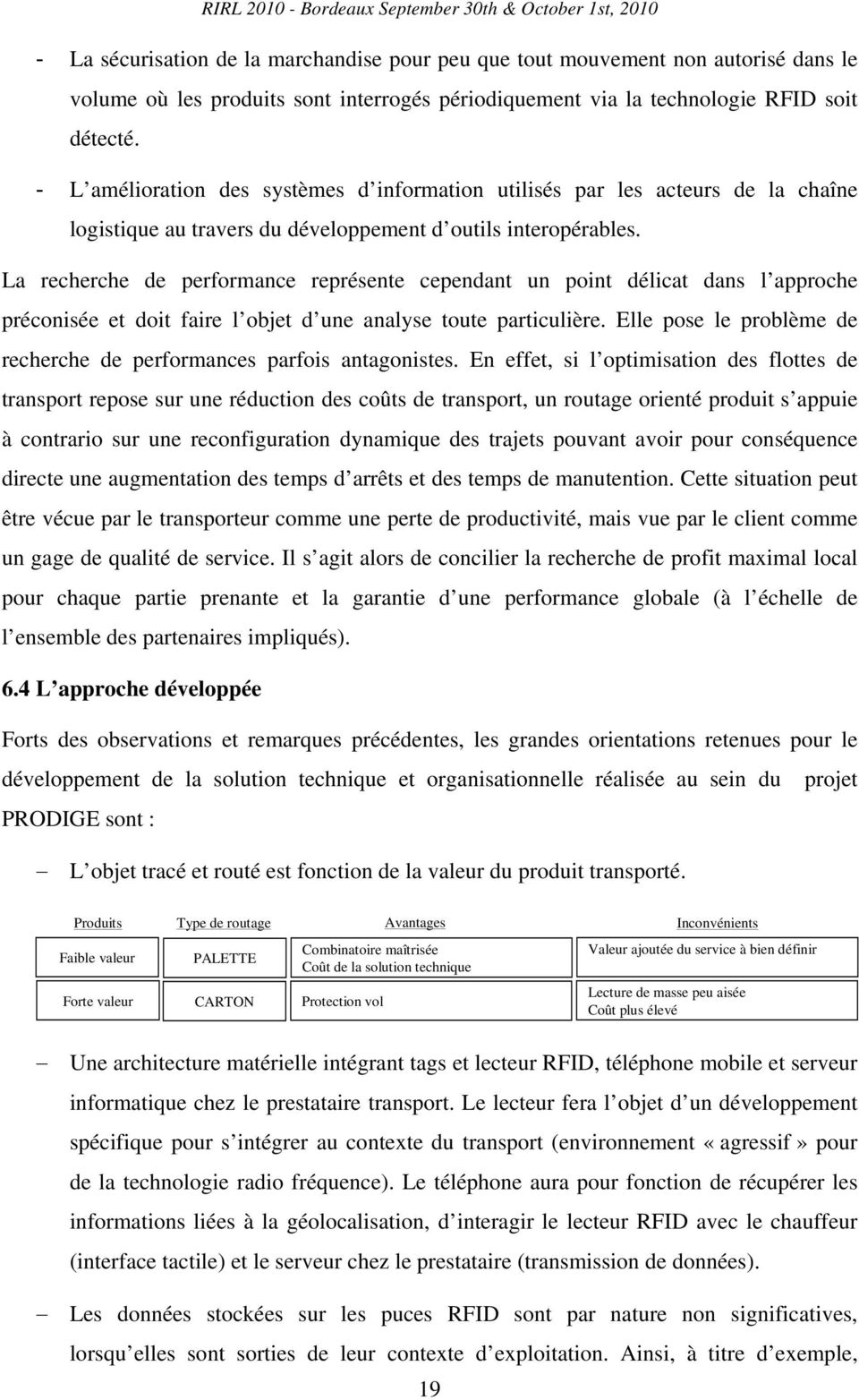
21 l utilisation des codes type SSCC permet de référencer les unités d expédition transportées sans livrer des informations sensibles comme la nature du produit, ou la destination du colis ou de la palette. Elle évite notamment le recours à un cryptage de l information et simplifie les envois d information. Un périmètre fonctionnel propre à chaque élément de la chaîne d information (voir figure 7). Informations chez prestataire ROUTAGE PRODUITS Synchronisation des véhicules, reconfiguration des tournées Traçabilité produits, planification des activités, routage Calcul indicateurs performances Gestion des Services orientés transport OPTIMISATION USAGE VEHICULE Optimisation des trajets Synchronisation avec entrepôts Services orientés transport ACCES ET GESTION DE DONNEE Stockage et traitement de données, GPRS Véhicule N Liaison filaire Lecteur RFID Numéro et date de commande, Numéro d avis d expédition, Numéro de bon de livraison, Date d expédition, GLN GTIN (Quantités, Numéros de lots, DLC / DLUO, poids nets) Recherche caractéristiques produits BD SSCC SSCC (ULNS ou UE) + position GPS SSCC (ULNS ou UE) à distance de lecture Information non significative Tag SSCC (ULNS ou UE) Figure 8. La chaîne d information et le périmètre fonctionnel associé à chaque élément La notion de produit intelligent reste cependant un postulat central dans le développement de la solution. Ainsi, la chaîne d information n est utile que dans sa capacité à remonter un code servant de référence dans le fait de retrouver dans une base de données sécurisée les données sensibles se rapportant à l unité d expédition considérée. L intelligence du produit est dite «déportée» au niveau du serveur qui prendra toute décision de routage à l échelle du produit et enverra aux véhicules le résultat d optimisation. 6. CONCLUSION Développée dans les années 40, le déploiement de la technologie RFID s est accéléré ces dernières années. Industriels, politiques et académiques travaillent pour normaliser et standardiser son utilisation. Sa mise en œuvre a déjà démontré qu elle permettait aux acteurs économiques de faire des économies substantielles. Cependant, alors qu on prévoyait 44% d utilisateurs dans ce le secteur du transport en 2009, seuls 28% d utilisateurs étaient référencés par différentes études. La crise économique actuelle n est sans doute pas étrangère à cette frilosité. 20
22 Si l on passe outre ce contexte économique, cette technologie reste le gage d une meilleure synchronisation des flux d information et physiques améliorant en cela les performances de la chaîne d'approvisionnement et de ses acteurs. Elle permet de franchir le cap de raisonnements appliqués à l échelle d une flotte de véhicules pour s intéresser au suivi temps réel du contenu du camion, tout en développant de nouveaux modes de logistique collaborative reposant sur un routage efficace des produits. Le projet PRODIGE prend part à ses développements. A l image des projets actuels, il doit notamment contribuer à répondre aux défis du transport de demain, qu ils soient techniques (type d étiquette, de lecteur, gestion des collisions, etc.) ou organisationnels (gestion d une très grande quantité de données, processus de groupage/dégroupage, etc.). REMERCIEMENTS Le projet PRODIGE a bénéficié d'une aide de l'agence Nationale de la Recherche portant la référence ANR-09-VTT et a été labellisé par des pôles de compétitivités Nov@log (Seine Normandie) et MTA (Charente - Poitou). REFERENCES Cheung, B. K. S., Choy K. L., Li, C. L., Shi, W., Tang, J. (2008), Dynamic routing model and solution methods for fleet management with mobile technologies, Int. J. of Production Economics, 113, Chao I. M., Golden B., Wasil E. (1995), An improved heuristic for the period vehicle routing problem, Networks, 26, pp Fabri, A., Recht, P., (2006). On dynamic pickup and delivery vehicle routing with several time windows and waiting times, Transportation Research Part B 40, Jones, P., Clarke-Hill, C., Hillier, D., Shears, P., Comfort, D., (2004), Radio frequency identification in the UK: opportunities and challenges, International Journal of Retail and Distribution Management, 32 (3), GS1 France (2006), Les standards pour le transport : étiquettes et messages Rapport, Houe T. (2006), Pluralité de réseaux logistiques de proximité et ancrage territorial des activités, 6ème Rencontre Internationale de Recherche en Logistique (RIRL), Pontremoli (Italie) Karkkainen M., Holmstrom, J., Framling K., Artto K. (2003), Intelligent products - a step towards a more effective project delivery chain, Computers in Industry, 50, Kim, J., Tang, K., Kumara, S., Yee, S.-T., Tew, J. (2008), Value analysis of locationenabled radio-frequency identification information on delivery chain performance, Int. J. Production Economics, 112,
23 Meyer, G. G., Framling K., Holmstrom J. (2009), Intelligent Products: A survey. Computers in Industry, 60, Murphy-Hoye, M., Lee, H.L., Rice, J.B., (2005), A real-world look at RFID. Supply Chain Management Review, July/August Pannequin R., Thomas A., Morel G. (2009), Proposition d un environnement d évaluation pour la mise en œuvre d un pilotage par le produit, Journal Européen des Systèmes Automatisés, 43 (4-5), Poon T.C., Choy, K.L., Chow, H.K.H., Lau, H.C.W., Chan, F.T.S., Ho, K.C. (2009), A RFID case-based logistics resource management system for managing order-picking operations in warehouses, Expert Systems with Applications, 36, Smith, A.D., (2005). Exploring the inherent benefits of RFID and automated self-serve checkouts in a B2C environment. International Journal of Business Information Systems 1 (1/2), Tajima, M. (2007), Strategic value of RFID in supply chain management, Journal of Purchasing and Supply Management, 13, Thomas A. (2008), La simulation pour les systèmes pilotés par le produit, in Thierry C., Thomas A., Bel G. (Eds), La simulation pour la gestion des chaînes logistiques, Hermès, pp Wen W. (2010), An intelligent traffic management expert system with RFID technology, Expert Systems with Applications, 37, Xue, X., Li X., Shen, Q., Wang, Y. (2005), An agent-based framework for supply chain coordination in construction, Automation in Construction, vol. 14, n 3, pp Zacharewicz, G., Deschamps, J.C., Francois, J. (2010), Distributed simulation plateform for validating advanced freight transportation systems, 8th ENIM IFAC International Conference on Modelling and Simulation (MOSIM), Hammamet (Tunisia), may. 22
24 RIRL 2010 The 8th International Conference on Logistics and SCM Research BEM Bordeaux Management School September 29, 30 and October 1st 2010 Les antécédents relationnels inter-organisationnels de l alignement des systèmes d information au sein d une supply chain Iskander Zouaghi Université de Grenoble/CNRS - CERAG UMR5820, France [email protected] Alain Spalanzani Université de Grenoble/CNRS - CERAG UMR5820, France [email protected] Résumé L alignement des systèmes d information (SI) avec la stratégie d affaire ou la structure, que ce soit de l entreprise ou d un réseau donné, présente une préoccupation majeure des entreprises soucieuses de leur devenir. Au sein d une supply chain considérée comme un type de réseau et caractérisée par des comportements de création de valeur (coopération) et de capture de valeur (compétition), une dynamique relationnelle inter-organisationnelle subsiste entre ses différents acteurs. Cette dynamique est à l origine d un certain nombre d orientations et de décisions adoptées par les entreprises qui constituent la supply chain, dont l alignement des SI. Le présent article nourrit une réflexion autour des antécédents relationnels inter-organisationnels de l alignement des SI, qu ils soient organisationnels ou inter-organisationnels, au sein d une supply chain. Mots clés: dynamique relationnelle inter-organisationnelle, alignement des SI, supply chain. 1
25 INTRODUCTION La complexité de l environnement, caractérisée par l ouverture des marchés, la globalisation de l offre, l augmentation de la demande, mais aussi par des consommateurs qui deviennent de plus en plus exigeants en termes de qualité de produit et de service, a poussé les entreprises à se focaliser sur le cœur de leur métier en externalisant les activités non génératrices de valeur. Optant pour des stratégies de spécialisation et de différentiation pour la plupart d entre elles, ces entreprises ont très vite vu leur nombre se multiplier et les flux se densifier provoquant une amplification de la complexité et une augmentation de l incertitude relative à l environnement dans lequel elles évoluent. De ce fait, la demande est devenue trop fluctuante et sa prévision assez difficile à appréhender (Forrester, 1958), mais aussi et surtout la rationalisation de l ensemble des flux et des processus au travers du système de création de valeur assez problématique. Pour faire face à de telles contraintes, les entreprises ont adopté de nouvelles configurations organisationnelles autour de la notion de réseaux. Celles-ci se sont concrétisées par l avènement des «supply chains» en tant qu organisations qui s axiomatisent de plus en plus. Aborder ce phénomène avec une vision qui est à la fois organisationnelle et technologique nous amène à deux niveaux de problématique. D une part, afin de prétendre à une adéquation relative entre l offre et la demande, il est nécessaire d adopter une réflexion orientée vers l intégration des processus pertinents et des activités génératrices de valeur entre l ensemble des acteurs de la supply chain (Lambert et Cooper, 2000), tout en assurant une agilité, une adaptabilité et un alignement entre leurs différents intérêts (Lee, 2004). Ces objectifs ne peuvent être atteints sans le recours aux systèmes d information (SI) (Gunasekaran et Ngai, 2004), vu que l information présente un facteur clé permettant de relier l ensemble des autres facteurs dans le but de créer une supply chain intégrée et coordonnée (Chopra et Meindl, 2006). D autre part, les SI présentent l une des préoccupations les plus importantes des entreprises d aujourd hui, intégrant des bénéfices reconnus, mais qui sont difficilement perceptibles (Joshi et Pant, 2008). D autant plus qu ils représentent une grande partie de leurs investissements. De ce fait, les SI doivent être planifiés et alignés avec la stratégie et la structure organisationnelle (Henderson et Venkatraman, 1993). Au sein d une supply chain, une dynamique relationnelle subsiste entre ses différents acteurs, faisant ressortir un certain nombre de facteurs tels que le pouvoir, la confiance, l engagement ou autres. Ces facteurs ont un impact sur un certain nombre de phénomènes, dont 2
26 l alignement des SI, vu que celui-ci peut être sujet à un jeu d action entre les différents acteurs de la chaîne. De ce fait, pour répondre à la question : quels sont les antécédents relationnels interorganisationnel de l alignement des SI au sein d une supply chain? Le présent travail de recherche tente tout d abord d identifier l ensemble des facteurs relationnels interorganisationnels, après avoir cerné le paradigme de la supply chain, en faisant ressortir les facteurs relatifs aux variables structurelles et comportementales. Dans un deuxième point, une revue de littérature relative à la problématique de l alignement des SI au sein des organisations sera présentée, afin d arriver à l adopter au contexte d une supply chain. Par la suite on déterminera le cadre conceptuel dans lequel s insert notre problématique, en abordant les antécédents relationnels inter-organisationnels de l alignement des SI dans le contexte de la supply chain. À la fin, on discutera le cadre d analyse proposé et on déterminera les limites et les perspectives relatives à cette recherche. 1. LA DYNAMIQUE RELATIONNELLES AU SEIN D UNE SUPPLY CHAIN 1.1. La supply chain : un paradigme organisationnel Durant ces trente dernières années, l environnement dans lequel évoluent les entreprises a connu des agitations et des turbulences très importantes, les contraignants ainsi à basculer des approches d optimisation et de rationalisation vers des approches de connexion et de collaboration. À partir de cela, plusieurs configurations organisationnelles, tels que les alliances, les réseaux et les supply chains, se sont vues adoptées par un grand nombre d entreprises. Aujourd hui, les supply chains présentent des unités organisationnelles centrales dans les industries (Miles et Snow, 2007). Dans la littérature, les supply chains ont été appréhendées à partir de plusieurs perspectives. Brindley (2004), en a fait ressortir quatre principales : une perspective structurelle, une perspective systémique, une perspective stratégique et une perspective relationnelle. Cependant, à partir d une analyse approfondie des définitions données dans la littérature, on peut les classer en six perspectives principales (Tableau 1). À partir de l étude de ces différentes perspectives, on peut définir la supply chain comme étant un réseau hiérarchique, dynamique et processuel, composé par un ensemble d entreprises allant du premier fournisseur jusqu au client final, reliées par des flux amonts et avals (physiques, informationnels, financiers et de connaissances) et des relations de 3
27 différents niveaux, et constitué dans le but de satisfaire le client par une meilleure coordination et intégration, mais aussi par une plus grande flexibilité et réactivité. Perspectives Unité d analyse Auteurs Processuelle Processus Cox et al. (1998), Beamon (1999), Ayers (2006). Fonctionnelle Fonctions et activités Quinn (1997), Cox et al. (1998), Seuring (2005). Réseau Systémique Stratégique Relationnelle Réseau : disposition des acteurs et liens entre eux. Système : Acteurs et interactions (un tout dynamique, supérieur à l ensemble des parties). Système de valeur et avantages concurrentiels. Relations et comportements entre acteurs Christopher (1992, 2005), Xu et al. (2003), Santoso et al. (2005), Eriksson et al. (2006). Stevens (1989), Ketchen et al. (2008), Leukel et Kirn (2008). Porter (1985), Monczka et al. (1998), Tyndall et al. (1998) Cooper et Gardner, 1993 ; Lambert et al., 1996 Tableau 1 : Principales perspectives d appréhension de la supply chain Les supply chains peuvent être présentées comme étant des phénomènes inévitables qui naissent à partir d un besoin de coordination et de flexibilité entre un certain nombre d entreprises. Dans ce sens, les supply chains existent, qu elles soient managées ou pas (Mentzer et al., 2001). Par ailleurs, le supply chain management (SCM) présente la gestion des flux de matières, d informations et financiers depuis le premier fournisseur jusqu au client final. Cooper et al. (1997) le définissent comme étant une philosophie intégrative permettant de gérer le flux total du canal de distribution depuis le fournisseur jusqu à l utilisateur ultime. Actuellement, le paradigme de coopération domine les approches de SCM. Au sein de ce paradigme, le SCM est fondé sur une approche systémique. Il identifie la supply chain dans son ensemble, qui représente plus que la somme de ses parties, et non comme un ensemble fragmenté d entités, par rapport auquel chacun agit pour son propre intérêt (Ellram et Cooper, 1990). Cette approche se caractérise par un certain nombre de concepts tels que l intégration, la coordination, la collaboration, le partage d informations, des intérêts communs et d un avantage concurrentiel collectif. Toutefois, lorsque nous parlons d intégration dans la supply chain, nous n entendons pas forcement l intégration verticale au sens stratégique du terme. En 4
28 ce sens, les entités dans la supply chain sont autonomes et la supply chain elle-même présente un réseau dynamique d acteurs qui apparaissent et disparaissent avec le temps. Un autre paradigme axé sur la nécessité de développement de la concurrence entre les acteurs de la chaîne. Dans ce sens, Lado et al. (1997) affirment que la concurrence engendre des gains d efficience économique en permettant aux entreprises d allouer de façon optimale des ressources rares, permettant ainsi d innover et de réduire les coûts de transaction entre elles. En outre, les entreprises qui constituent la supply chain sont partiellement entrainées par la rationalité et leurs intérêts propres. Tout cela permet à la supply chain d être agile et flexible, en sachant que ces conditions sont nécessaires pour faire face à un environnement instable, et permettent le changement et l innovation. Aujourd hui, ces deux paradigmes deviennent à la fois nécessaires et complémentaires, faisant de la supply chain un système ago-antaginiste (Zouaghi et Spalanzani, 2009). Ils sont articulés en vertu d une troisième perspective, qui est positionnée autour du concept de «coopétition», joignant deux comportements stratégiques opposés, à savoir la coopération et la compétition. Dans ce sens, les entreprises créent de la valeur par des processus de coopération, et en même temps capturent de la valeur par la compétition (Brandenburger et Nalebuff, 1996), faisant émerger à la fois des comportements holistes (intérêt commun, collaboration, intégration) et des comportements individualistes (intérêt propre, action individuelle, flexibilité). Tout en sachant qu en fonction du type d interdépendance et de l intensité de la coopération par rapport à la compétition, ou vice versa, ces comportements peuvent faire émerger différentes stratégies bipolaires, à savoir de co-opétition ou de compération (Zouaghi et al., 2010) Facteurs caractéristiques de la dynamique relationnelle inter-organisationnelle au sein d une supply chain Pour faire ressortir les éléments caractéristiques qui influencent les comportements au sein d une supply chain, on se base sur les travaux de Zouaghi et Spalanzani (2010). Par ailleurs, on fait appel tout d abord à la théorie des réseaux, au sens de Borgatti et Foster (2003), pour souligner le fait que la supply chain est structurée autour d un ensemble d acteurs connectés par divers types de liens. Dans une conception du réseau en tant qu entité homogène (Miles et Snow, 1992), la supply chain est orchestrée et pilotée par une entreprise dite focale autour de laquelle évolue une constellation de fournisseurs et de clients. Par ailleurs, à partir du moment où elle se présente comme un réseau dynamique, la supply chain se caractérise par des 5
29 variations et des instabilités donnant lieu à des conflits, ou des comportements opportunistes, dus au fait de l incertitude et de l ambiguïté de certaines situations. Une telle dynamique évolue par rapport à un certain nombre de facteurs, qui sont réduit à des facteurs transactionnels par la Théorie des Coûts de Transaction, mais qui sont étendus et complétés par des facteurs relationnels à l initiative de la Théorie Sociale des Echanges au sens de Blau (1964). En survolant l ensemble des facteurs les plus pertinents dans un premier temps, on peut affirmer que le premier facteur relationnel intègre la position hiérarchique des différents acteurs et leur poids respectif, c est-à-dire le pouvoir dont ils disposent (Cox, 1999 ; Maloni et Benton, 2000). L exercice de celui-ci suscite instinctivement une réaction de celui qui le subit, se traduisant concrètement par son niveau de satisfaction (Benton et Maloni, 2005). Ce niveau de satisfaction présente, donc, un deuxième facteur majeur, et a un impact direct sur la nature de la relation (conflit, coopération, coordination, collaboration) entre les différents acteurs, qui dépend également de la confiance, de l engagement des acteurs et de l interdépendance entre leurs différents processus (Mohr et Spekman, 1994 ; Mentzer et al., 2001). Enfin, ces antécédents relationnels déterminent le degré de partage des informations (Patnayakuni et al., 2006) qui présente un autre facteur de cette dynamique. Dans ce qui suis, ces facteurs seront détaillés et analysés afin de faire ressortir les éléments relatifs à la dynamique relationnelle qui régit la supply chain Le pouvoir Pour Dahl (1957, p.290), «A a le pouvoir sur B dans la mesure où il peut faire faire à B ce, sans quoi, il n aurait pas fait». Aussi, repris par Friedberg (2009), Crozier (1970) définit «le pouvoir d un acteur A comme sa capacité à imposer à un acteur B des termes de l échange qui lui soient favorables». Donc le pouvoir présente une force relative, justifiée ou pas, qu un acteur peux exercer sur un autre dans le cadre d une relation donnée. Au sein de la supply chain, le pouvoir joue un rôle décisif (Maloni et Benton, 2000). Al- Ansary et Stern (1972, p.47) le définissent comme étant «la capacité à contrôler les variables de décision de la stratégie marketing d un autre membre dans un canal donné à différents niveaux de distribution». Il permet la détermination des influences relationnelles entre les différents acteurs ; d autant plus que l identification de ses sources montre qu il peut avoir un effet contrasté sur les relations inter-organisationnelles mais aussi sur les comportements de chacun des acteurs. 6
30 Par ailleurs, le pouvoir permet la hiérarchisation des dominances structurelles définies par Cox (1999) comme étant des situations dans lesquelles il existe un ou plusieurs acteurs dominants, qui sont capables de s approprier ou de contrôler les ressources clés qui génèrent de la valeur. Dans la même lignée, Munson et al. (1999) stipulent qu un acteur a le pouvoir dans une supply chain s il est en possession d une forte position de marché, d un accès à une majeure partie des ressources financières, d un accès à des informations importantes ou critiques, ou d une position irremplaçable. Ils ajoutent que l exercice du pouvoir au sein de la supply chain tourne autour du contrôle des prix, des stocks, des opérations, de la structure du canal et de l information. La typologie de French et Raven (1959) identifie cinq sources de pouvoir, à savoir la récompense, la coercition, la légitimité, la référence et l expertise. L information étant une sixième source qui a été rajoutée par Raven (1964). Néanmoins, Hunt et Nevin (1974) classifient le pouvoir en pourvoir coercitif et pouvoir non-coercitif (récompense, légitimité, référence, expertise et information). Molm (1997) stipule que cette classification est plus pertinente parce que les quatre autres sources de pouvoir de French et Raven (1959), qui sont considérés comme non-coercitifs (récompense, légitimité, référence et expertise), intègrent des bénéfices dans la promotion des comportements désirés, alors que le pouvoir de source coercitif est principalement basé sur l exercice de la force. Ceci a été étudié auparavant par Beier et Stern (1969) qui ont trouvé que les sources non-coercitives du pouvoir présentent des alternatives qui permettent l augmentation de la satisfaction des membres les plus faibles. Par conséquence, cette dernière typologie sera prise en considération dans notre travail de recherche, puisqu elle est suffisante pour distinguer les comportements au niveau de la supply chain. Toutefois, la typologie de French et Raven (1959) actualisée par Raven (1964) peut apporter des éléments explicatifs, puisqu elle permet d avoir plus de recul quant aux sources du pouvoir Le niveau de satisfaction L exercice du pouvoir par un acteur sur un ou plusieurs autres acteurs, quelle que soit sa source, n est pas sans conséquences. En d autres termes, l exercice d un pouvoir dans une logique coercitive ou pas n a pas le même écho. De ce fait, la satisfaction des acteurs concernés présente un facteur essentiel dans la constitution de la relation et de la décision au sein de la supply chain. 7
31 Anderson et Narus (1984) ont défini la satisfaction comme étant «un état affectif positif résultant de l évaluation de tous les aspects de la relation de travail entre une entreprise et une autre». Dans le cadre de notre travail de recherche, on adopte la définition de Benton et Maloni (2005), qui stipulent que la satisfaction des partenaires est un sentiment d équité dans la relation, et ce quel que soit le déséquilibre de pouvoir existant. Dans notre travail on déterminera la satisfaction par rapport aux sources de pouvoir. Dans cette lignée, les travaux de Benton et Maloni (2005) montre que le pouvoir de nature coercitive a un impact négatif sur la satisfaction des acteurs qui le subissent. Par contre, le pouvoir de nature non-coercitive a un impact positif sur le niveau de satisfaction des acteurs qui le subisse. Hunt et Nevin (1974) ont souligné six principaux avantages qui découlent de la satisfaction du partenaire qui subit le pouvoir. Celui-ci a un haut niveau de moral, coopère mieux, évite de rompre volontairement les contrats, est moins susceptible de poursuivre juridiquement celui qui a le pouvoir ou d engager un recours collectif contre lui avec d autres partenaires, et enfin, cherche moins des législations qui le protège contre celui qui a le pouvoir. Ceci dit, la satisfaction de l entreprise qui subit le pouvoir améliore considérablement la relation qui existe entre ces deux acteurs partenaires. Donc on peut dire que le niveau de satisfaction a un impact plus ou moins important sur la nature de la relation qui lie les différents acteurs. Dans cette lignée, cité par Benton et Maloni (2005), Ganesan (1994) a montré que le niveau de satisfaction présente un facteur important dans l accomplissement de relation à long-terme. De même, Skinner et al. (1992), ont démontré que le niveau de la satisfaction a une relation positive avec la coopération, et une relation négative avec le conflit La nature de la relation inter-organisationnelle Au sein d une supply chain, la nature et l intensité de la relation qui relie les différents acteurs peuvent être appréhendées avec une logique dichotomique. En effet, Soit les facteurs qui influencent cette relation sont plus ou moins favorables, et là on est dans une situation d entente, qui peut se traduire par des comportements d intégration, telles que la coopération, la coordination ou la collaboration. Soit ceux-ci sont relativement défavorables, et là on est face à une situation de conflit et d opposition. Au sein des supply chains, les conflits peuvent surgir entre les différents partenaires à la suite de divergences par rapports à certains éléments. Hocker et Wilmot (1985) ont définis le conflit comme étant une divergence exprimée entre au moins deux parties interdépendantes qui perçoivent des objectifs incompatibles, des récompenses insuffisantes et de l ingérence de 8
32 l autre partie dans la réalisation de leurs objectifs (mutuels). Ces conflits peuvent provenir d une divergence de pouvoir, d une compétition pour des ressources rares, d une tendance à se différencier, d une interdépendance négative entre les différentes entités, d une ambiguïté sur la responsabilité ou la compétence juridique, d une détérioration de l image de l un d entre eux ou de sa valeur (Deutsch, 1969). Etant en conflit, les membres d une supply chain tendent naturellement à une optimisation locale au détriment de la performance globale de la chaîne. Pour faire face à cela, les membres d une supply chain coopèrent, se coordonnent ou collaborent dans le sens d un intérêt commun. Par ailleurs, l intégration de la supply chain dépend, entre autres, de certains facteurs organisationnels tels que la confiance, l engagement, l interdépendance, la compatibilité organisationnelle, la vision, les processus clés, le leadership et le soutien du top management (Mentzer et al., 2001). De ce fait, on peut dire qu en plus du niveau de satisfaction précédemment invoqué, la confiance, l engagement et l interdépendance sont des facteurs déterminants de la nature des relations entre les différents partenaires (Mohr et Spekman, 1994). La confiance envers une entreprise peut être décrite comme étant une croyance que celle-ci n accomplirait que des actions qui procureront des résultats bénéfiques (Anderson et Narus, 1990). Cette confiance émerge lorsqu une partie croit en la fiabilité et l intégrité de son partenaire d échange (Morgan et Hunt 1994). Pour Högberg (2002), elle se développe progressivement avec l affermissement graduel de la relation à travers un processus d adaptation mutuelle, pas nécessairement symétrique, aux besoins de l autre partie. La confiance a une influence majeure sur l engagement des acteurs dans la relation (Achrol, 1991 ; Ruyter et al., 2001). L engagement est lui définit comme étant un gage implicite ou explicite relatif à la continuité d échange entre partenaires (Dwyer et al., 1987). En reliant ces deux concepts, Morgan et Hunt (1994) stipulent que la coopération augment par l augmentation de la confiance et l engagement. Dans la même lignée de Kambil et Short (1994), Kumar et van Dissel (1996) stipulent que l interdépendance, au sens de Thompson (1967), détermine le niveau relationnel entre les différents acteurs. Ainsi, les niveaux d interdépendance, à savoir l interdépendance groupée, l interdépendance séquentielle et l interdépendance 9
33 réciproque ont un impact plus ou moins important sur le niveau des relations entre les différents acteurs Degré de partage des informations Au niveau de la supply chain, l information présente un élément critique permettant la coordination et l optimisation des flux. Une rétention ou une communication insuffisante de l information peut entrainer une distorsion et une diminution de la visibilité, et donc l amplification de l effet «bullwhip» 1 (Lee et al., 1997) et une diminution de la performance de la supply chain. Par ailleurs, il convient de signaler que le partage de l information entre les entreprises a un impact sur la performance de la supply chain (Lee et al., 2000), et que cela est conditionné par une meilleure prise en compte des antécédents de ce partage (Samaddar et al., 2006). Ceci dit, Patnayakuni et al. (2006), montre que le partage des informations est influencé par des antécédents relationnels, donc de la nature des relations qui lient les différents acteurs de la supply chain. Dans le cadre inter-organisationnel, trois situations de partage peuvent se présentées, à savoir une situation où aucune information n est partagée, une situation où certaines informations sont partagées, et une dernière où presque toute l information est partagée (Gavirneni et al., 1999). Par ailleurs, le degré de partage des informations dépendent également de deux éléments clés, à savoir la qualité de l information et le coût qui permet l accès à celle-ci. Zhou et Benton (2007) stipulent que la qualité de l information présente le degré auquel l information échangée entre les entreprises coïncide avec leurs besoins. La qualité d une information est déterminée par son exhaustivité, son exactitude (l absence de bruit), sa fiabilité, sa finesse et sa précision, son actualité, sa ponctualité, sa forme et sa richesse, et enfin de son accessibilité (Reix, 2004). Cette qualité n est recherchée qu en fonction du coût qui permet sa mise à disposition. Si le coût de l information est trop élevé, certains critères de qualité peuvent être mis à part. De ce fait, avant de partager des informations, les entreprises membres d une supply chain procèdent à l évaluation du rapport qualité/coût d une manière précise ou approximative. Par conséquence, ce rapport a un impact direct sur le degré de partage des informations entre les différentes entreprises d une supply chain. 1 L effet bullwhip est caractéristique du phénomène d amplification de la variabilité de la demande chaque fois qu on passe d un niveau de la supply chain vers un niveau plus en amont. 10
34 2. L ALIGNEMENT DES SI : REVUE DE LA LITTERATURE Un SI présente un ensemble d éléments technologiques, humains, organisationnels et informationnels en interrelation et en interaction les uns avec les autres, qui permettent d assurer d une manière synergique des fonctions transactionnelles, décisionnelles, de contrôle et d apprentissage. On peut dire que le SI présente un objet de recherche multidimensionnel intégrant une dimension technologique, une dimension organisationnelle (managériale et stratégique), une dimension informationnelle, mais aussi une dimension sociale (Figure 1). L interaction entre l ensemble de ses dimensions engendre un besoin de mise en cohérence et d alignement entre les SI et les différentes dimensions de l entité dans laquelle ils évoluent. L alignement entre plusieurs dimensions des entreprises est un phénomène qui a été largement étudié par un grand nombre de chercheurs (Schoonhoven, 1981 ; Van de Ven et Drazin, 1985). De même, dans le domaine des SI, sous l impulsion des praticiens d IBM qui, en 1981, ont essayé d intégrer au sein d une même approche la planification stratégique et celle des technologies de l information (Chan et Reich, 2007), cette problématique a vu le jour et a commencée à faire l objet d un intérêt particulier dans le but d améliorer la perception de la valeur des SI. Figure 1 : Les quatre dimensions d un système d information Initiée par des travaux sur l alignement stratégique, tels que ceux de, Venkatraman et Camillus (1984), Miles et Snow (1984), ou de Scholz (1987) et de Waterman (1992) et ceux sur la planification et l efficacité des SI, tels que ceux de Hamilton et Chervany (1981), Henderson et Sifonis (1988), ou encore ceux de Lederer et Sethi (1988) et Venkatraman (1989) qui ont convergé vers la nécessité d adaptation, ou plutôt de congruence entre la stratégie de l entreprise et le déploiement des technologies de l information, afin de débouché 11
35 sur l efficacité, l efficience et la performance, la problématique liée à l alignement des SI est née dans le milieu académique. Par ailleurs, plusieurs modèles intégratifs ont vu le jour au début des années Deux principaux modèles sont à mettre en exergue : le modèle du MIT (Morton, 1991) qui intègre plusieurs dimensions, à savoir une dimension technologique, une dimension stratégique, une dimension organisationnelle, une dimension processuelle, une dimension individuelle, et une dimension environnementale (dont une socioéconomique), suivi en 1993 par le modèle de Henderson et Venkatraman (1993) qui est basé sur la congruence stratégique et l intégration fonctionnelle entre quatre dimensions principales, à savoir la stratégie d affaire, la stratégie SI, la structure et les processus organisationnels et la structure et les processus des SI 1. À partir de ce dernier modèle, plusieurs autres ont été développés, tels que celui de Luftman et al. (1993) qui ont redéfini le modèle par l intégration de problématiques managériales critiques au sein des différents domaines établies dans le modèle original de Henderson et Venkatraman (1993) ; ou encore celui de Maes et al. (2000) qui ont intégré trois niveaux de réflexion, à savoir le niveau stratégique, structurel et le niveau opérationnel, et ont séparé les activités proprement dites de la technologie, en intégrant la dimension informationnelle et communicationnelle. Ensuite, ils l ont analysé à travers le modèle IAF (Integrated Architecture Framework) en intégrant la dimension de conception La nature et la pertinence de l alignement des SI Henderson et Venkatraman (1993) ont défini l alignement des SI comme étant le degré d ajustement et d intégration entre la stratégie de l entreprise, sa stratégie SI, sa structure et son infrastructure informatique. Dans cette même lignée, Reich et Benbasat (1996) décrivent l alignement des SI comme étant le niveau par rapport auquel la mission, les objectifs et les plans contenus dans la stratégie d entreprise sont partagés et soutenus par la stratégie SI. Son impact sur la performance a été étudié, testé et validé par un grand nombre de chercheurs (Miller, 1992 ; Delery et Doty, 1996 ; Chan et al., 1997). Par ailleurs, il compte parmi les objectifs prioritaires des entreprises d aujourd hui (Luftman et al., 2008). Ceci dit, plusieurs perspectives d appréhension du phénomène d alignement des SI se sont dessinées. Silva et al. (2007) les ont classées en trois principaux groupes. Le premier groupe est orienté vers une perspective managériale. Basé sur les travaux de Henderson et 1 Ces deux modèles, et surtout le modèle SAM (Strategic Alignment Model) de Henderson et Venkatraman (1993), sont ceux qui prédominaient à l époque, et qui prédominent toujours dans certains travaux et approches relatives à l alignement des SI (cf. Avison et al., 2004 ; Cragg et Tagliavini, 2006 ; Abou-Zeid, 2007) 12
36 Venkatraman (1993) et leur modèle SAM, ce groupe présente l alignement comme un moyen permettant à l entreprise d augmenter sa performance et sa rentabilité. Ceci dit, cette perspective est plutôt axée sur la stratégie des SI, leur architecture, les processus qui leurs sont relatifs et les compétences à mobiliser. Le second groupe basé sur une perspective dite d émergence, caractérisée principalement par les travaux de Ciborra (1997, 2000, 2002) et de Hanseth et Braa (2000), aborde l alignement comme un phénomène émergent, ne pouvant être déterminé comme une réponse automatique. De ce fait, ce courant se concentre plus sur les facteurs qui peuvent entraver l alignement des SI, puisque celui-ci présente en quelque sorte un phénomène qui se produit d une manière relativement naturelle. Le troisième groupe est basé sur une perspective dite critique, qui s appuie sur des travaux comme ceux de Knights et Morgan (1991) qui stipulent que le discours de stratégie sert l intérêt du capitalisme et est, de ce fait, contreproductif. Ce courant se concentre plus sur l influence de l idéologie. Dans cette même lignée, Levy (2000), à partir d une approche basée sur les ressources et les compétences, remet en question le caractère stratégique des SI, en précisant qu ils ne peuvent être stratégiques que s ils soient rares, qu ils aient de la valeur et qu ils ne soient pas imitables par les concurrents. De plus, la technologie, elle-même, est caractérisée par diverses improvisations (Orlikowski, 1996). Malgré le fait que certaines approches critiques remettent en question la notion d alignement des SI, les chercheurs dans ce domaine tentent d établir un cadre d analyse en l améliorant en permanence afin de permettre d appréhender la problématique des SI dans un contexte managérial et stratégique, et ce d une manière intégrative. 3. ALIGNEMENT DES SI AU SEIN DE LA SUPPLY CHAIN 3.1. La problématique de l alignement des SI : quelle étendue? La plupart des travaux qui se sont focalisés sur l alignement des SI, surtout ceux qui appartiennent à la perspective managériale, présentent une vision relativement limitée au périmètre de l entreprise, mettant implicitement ou explicitement en jeu deux groupes d acteurs, à savoir la direction générale et celle des SI, en essayant d aboutir à une meilleures façon de faire (one best way). Toutefois, les tenants d une approche dite contingente stipulent que ces dernières années, le développement des SI a fait face à une baisse du taux de succès (Lindstrom et Jeffries, 2004), et que cela est dû principalement aux méthodologies rigides adoptées par les chercheurs et les praticiens dans ce domaine, devant, de ce fait, être remplacées par d autres qui soient plus agiles et flexibles afin de coller à la réalité 13
37 managériale (Vinekar et al., 2006). Autant, Chan et al. (2006) stipulent qu il y a peu de travaux qui s intéressent aux antécédents de l alignement des SI, alors que la littérature relative à ses conséquences abonde. D ailleurs, ces auteurs ont trouvé que les antécédents de l alignement des SI étaient des facteurs contingents. Ceci est appuyé par les travaux de Palmer et Markus (2000) qui ont trouvé que l alignement des SI n a pas d impact direct sur la performance. Ils l ont attribué principalement à un manque d institutionnalisation dans certaines industries. Plus encore, la problématique de l alignement des SI est moins abordée dans une vision relative à des configurations organisationnelles réticulaires. Certains travaux ont étudié l impact des SI sur la performance des réseaux, et plus précisément des supply chains (Gunasekaran et Ngai, 2004 ; Wu et al., 2006), d autres se sont focalisés sur l impact de l alignement des SI de la supply chain sur la performance des entreprises (Seggie et al., 2006). Par rapport à cette dernière, Subramani (2004) stipule que, du moment où les réseaux sont généralement contrôlés par une entreprise dite focale, un grand nombre de recherche se sont focalisées sur la performance de l entreprise focale en minimisant l intérêt pour les autres membres du réseau. De ce fait, il a étudié les bénéfices qui peuvent être engendrés pour les fournisseurs de ces entreprises focales. Dans notre revue de littérature, on a constaté que très peu de travaux ont essayé d inverser le problème en étudiant l impact de ces configurations organisationnelles réticulaires sur l alignement des SI. En effet, aujourd hui, les entreprises appartiennent presque toutes à une quelconque forme de réseau. Cette appartenance engendre une influence plus ou moins importante sur leur comportement et leurs décisions respectives. Ce fait est d autant plus important dans les supply chains, où l on est face à une dynamique caractérisée, comme on l avait vu plus haut, par des phénomènes inter-organisationnels de pouvoir, de confiance, de collaboration, de conflit et autres. Dans ce sens, certain auteurs ont essayé d approcher le phénomène d alignement des SI dans les relations interentreprises au sein d une supply chain (Sanders, 2005). D autres ont étudié les antécédents relationnels quant à la problématique informationnelle inter-organisationnelle (Patnayakuni et al., 2006) L impact de la dynamique relationnelle inter-organisationnelle sur l alignement des SI au sein de la supply chain L alignement des SI entre producteur et fournisseur ou entre d autres acteurs de la supply chain a été étudié par un certain nombre d auteurs (Sanders, 2005). Contrairement à ceux qui 14
38 abordent l impact direct des SI sur la performance de l entreprise, Hammer et Mangurian (1987) se sont focalisés sur leurs bénéfices, pouvant être traduits par le développement de relations interentreprises. De même, plusieurs travaux ont étudié la relation entre l impact des SI sur la performance, les relations interentreprises et les supply chains (Tallon et al., 1997 ; Vickery et al., 2003). Dans cette lignée, Wen et al. (1998) stipulent que les SI peuvent avoir un impact sur la performance de façon à en tirer des bénéfices relationnels. Alors que d autres stipulent que c est les relations interentreprises et le niveau d intégration de la supply chain qui déterminent la stratégie des SI (Kim, 2007). À partir du développement relatif à la dynamique relationnelle inter-organisationnelle, on peut dire que les éléments déterminés précédemment, à savoir, le pouvoir, le niveau de satisfaction, la nature de la relation, dont la confiance, l engagement et l interdépendance, ainsi que le partage des informations ont un impact plus ou moins contrasté sur l alignement des SI. En effet, il a été démontré par un certain nombre d auteurs que le pouvoir de nature coercitive a un impact positif sur l adoption de SI dans le cadre de systèmes inter-organisationnels (Teo et al., 2003 ; Khalifa et Davison, 2006), dans le sens où l entreprise qui détient le pouvoir oblige directement ou indirectement son partenaire à implanter un SI interne ou interorganisationnel pour servir ses intérêts. De même, le pouvoir de nature non-coercitive facilite les échanges inter-organisationnels et favorise la recherche d un consensus (Son et Benbasat, 2007), et a, de ce fait, un impact direct sur l alignement des SI. Le fait que le pouvoir a un impact sur l alignement des SI, la satisfaction de celui qui le subit n a pas d impact direct sur l alignement des SI. Effectivement, si le pouvoir est de nature coercitive, que l entreprise qui le subie soit satisfaite ou pas importe peu, puisqu elle est dans «l obligation» de satisfaire son partenaire qui a un pouvoir sur elle. Si le pouvoir est de nature non-coercitive, l entreprise qui le subie est satisfaite, et de ce fait, elle coopère avec son partenaire. Cela se traduit par le fait que c est la nature du pouvoir qui a un impact direct sur l alignement des SI inter-organisationnels. Par contre, les SI évoluent avec l évolution de la nature relationnelle, du moment où le besoin en échange d information augmente avec l intensification de la relation. De ce fait, la coopération, la coordination et la collaboration ont un impact positif et d intensité graduelle sur l alignement des SI, alors que le conflit présente un effet négatif quant à celui-ci. Par ailleurs, d un point de vue comportemental, la confiance (cognitive ou affective) qui règne 15
39 entre les différentes entreprises qui constituent la supply chain conditionne fortement le niveau de partage des informations entre elles. Cela se traduit par un engagement de ces entreprises afin de perdurer, ou au contraire de limiter (ou arrêter) la relation entre elles. Cela conditionne les actions engagées des partenaires afin d adapter la stratégie SI et leur architecture en conséquence. Cela montre bien que la confiance ainsi que l engagement ont un impact sur l alignement des SI au niveau des entreprises d une supply chain. Également, l aspect structurel, c est-à-dire le type d interdépendance entre elles présente un élément très important. Effectivement, que les entreprises au sein de la chaîne aient une interdépendance groupée, une interdépendance séquentielle ou une interdépendance réciproque ne présente pas le même intérêt informationnel qui régit la relation. Aubert et Dussart (2002) stipulent que les potentialités de conflits relatives au type d interdépendance groupée sont faibles. Les entreprises dans ce cas ont généralement en commun un extranet ou une place de marché électronique. Aussi, dans le cadre d une interdépendance séquentielle, les potentialités de conflits sont moyennes et les entreprises ont souvent des systèmes transactionnels (EDI ou XML) en commun. Dans le cas d une interdépendance réciproque, les potentialités de conflits sont fortes et les entreprises ont recours principalement aux groupwares. On peut faire ressortir à partir de cela que les stratégies et les structures des SI diffèrent d un type d interdépendance à un autre, nous permettant de dire qu inévitablement, le type d interdépendance a un impact sur l alignement des SI. Enfin, comme on l avait vu plus haut, à un niveau inter-organisationnel, les entreprises partenaires peuvent être dans une situation où aucune information n est partagée, et là elles n ont pas besoin d un système d information inter-organisationnel. Dans le cas où certaines informations sont partagées entre elles, comme par exemple des informations opérationnelles, et là elles ont besoin d aligner leur SI en conséquence. Dans le cas où celles-ci partage une grande partie de l information, dont par exemple l information stratégique, elles ont besoin d aligner leur SI en optant pour un SI qui couvre une grande partie des informations. De ce fait, le degré du partage des informations entre les différents acteurs a un impact sur l alignement des SI. D autant plus que, comme on l avait vu plus haut, le rapport entre la qualité et le prix des informations a un impact direct sur le niveau des informations partagées, et donc a un impact indirect sur l alignement des SI au niveau de la supply chain. 16
40 CONCLUSION Ce travail de recherche nous a permit en premier lieu de cerner la dynamique relationnelle inter-organisationnelle au niveau des supply chains. Ceci, en mettant en lumière les différents facteurs qui interviennent dans une telle dynamique. Par la suite, la notion d alignement des SI a été revue afin d arriver au constat qui montre que l alignement des SI est enclin à un certain nombre de facteurs, dont les facteurs relationnels inter-organisationnels dans un contexte de supply chain. Le cadre d analyse présenté dans ce papier permet d expliquer l impact des facteurs relationnels inter-organisationnels sur l alignement des SI au niveau de la supply chain. Ce cadre d analyse, appuyé principalement sur la théorie sociale des échanges nous montre qu en plus des considérations purement économiques et techniques, l alignement des systèmes d information est également sujet à la dynamique relationnelle inter-organisationnelle qui régit l ensemble de la supply chain. D une manière plus précise, ce cadre d analyse nous permet de percevoir l importance des notions de pouvoir, de satisfaction des partenaires, de la nature de la relation inter-organisationnelle, de la confiance, de l engagement, de l interdépendance, mais aussi du degré de partage de l information dans l émergence du phénomène de l alignement des SI dans un contexte de supply chain. Dans le présent article, en s appuyant sur les travaux de Ciborra (1997, 2000, 2002), on a évidemment considéré l alignement des SI comme étant un phénomène naturelle dont on cherche à faciliter le déroulement. Par ailleurs, dans leur conception des problématiques relatives à l alignement des SI, les managers devront intégrer dans leur réflexion la dynamique relationnelle interorganisationnelle de la supply chain dans laquelle évolue leur entreprise, et ce afin de pouvoir au moins justifier un certain nombre de comportements et de décisions. Bien sûr, le mieux serait de jouer sur ces facteurs relationnels afin d en tirer de la valeur, puisque parfois certaines entreprises sont dans la quasi-impossibilité d y faire face. Enfin, la dynamique relationnelle inter-organisationnelle au sein d une supply chain a de plus en plus d impact sur le comportement des entreprises qui la constituent, méritant au moins qu elle soit intégrée dans la carte cognitive des dicideurs dans un large éventail de problématiques. Comme tout travail de recherche, le présent travail présente un certain nombre de limites. On peut en citer trois principales. La première est relative à la conceptualisation de la dynamique relationnelle inter-organisationnelle. Celle-ci reste relativement spécifique à des situations particulières puisque dans certains secteurs et pour certaines entreprises, cette dynamique 17
41 reste secondaire compte tenu de l orientation technique et économique qui régit les relations inter-organisationnelles. La seconde limite est relative au concept d alignement des SI. Celuici est pris dans sa conception large. Une spécification du processus d alignement pourrait permettre d apporter d autre élément de réponse au cadre d analyse proposé. La dernière limite est relative à l absence d étude empirique permettant la validation du cadre d analyse proposé. Celle-ci peut faire l objet d une recherche ultérieure. Enfin, l intégration de facteurs transactionnels ainsi que ceux relationnels au sein d une même recherche présente une piste de recherche très féconde. BIBLIOGRAPHIE Achrol R. S. (1991), Evolution of the marketing organization: new forms for turbulent environments, The Journal of Marketing, pp Anderson J. C., Narus J. A. (1984), A model of the distributor's perspective of distributormanufacturer working relationships, The Journal of Marketing, pp Anderson J. C., Narus J. A., (1990), A model of distributor firm and manufacturer firm working partnerships, The Journal of Marketing, pp Ayers J. B. (2006), Handbook of supply chain management, CRC Press. Beamon B. M. (1999), Measuring supply chain performance, International Journal of Operations and Production Management, Vol. 19, pp Beier F.J. et Stern L.W. (1969), Power in the distribution channel, in Stern, L.W. (Eds), Distribution Channels: Behavioural Dimensions, Houghton Mifflin, Boston, MA. Benton W. C., Maloni M. (2005), The influence of power driven buyer/seller relationships on supply chain satisfaction, Journal of Operations Management, Vol.23, N 1, pp Borgatti S. P., Foster P. C., (2003), The network paradigm in organizational research: A review and typology, Journal of management, Vol.29, N 6, pp.991. Brandenburger A. M., Nalebuff B. J. (1996), Co-Opetition: A revolution mindset that combines competition and cooperation: the game theory strategy that's changing the game of business, Bantam Dell. Brindley C. (2004), Supply chain risk, Ashgate Publishing, Ltd. Brown J. R., Lusch R. F., Nicholson C. Y. (1995), Power and relationship commitment: their impact on marketing channel member performance, Journal of Retailing, Vol.71, N 4, pp Chan Y. E., Huff S. L., Barclay D. W., Copeland D. G. (1997), Business strategic orientation, information systems strategic orientation, and strategic alignment, Information Systems Research, Vol.8, N 2, pp
42 Chan Y. E., Reich B. H. (2007), IT alignment: an annotated bibliography, Journal of Information Technology, Vol.22, N 4, pp.316. Chan Y. E., Sabherwal R., Thatcher J. B. (2006), Antecedents and outcomes of strategic IS alignment: An empirical investigation, IEEE Transactions on engineering management, Vol.53, N 1, pp Chopra S., Meindl P. (2006), Supply Chain Management: Strategy, Planning, and Operation, Prentice Hall (3 rd edition). Christopher M. (1999), Logistics and Supply Chain Management: Strategies for Reducing Cost and Improving Service, International Journal of Logistics Research and Applications, Vol.2, N 1, pp Christopher M. (2005), Logistics and supply chain management: creating value-adding networks, Financial Times/Prentice Hall. Ciborra C. U. (1997), De profundis? Deconstructing the concept of strategic alignment, Scandinavian Journal of Information Systems, Vol.9, N 1, pp Ciborra C. U. (2000), From control to drift: The dynamics of corporate information infrastructures, Oxford University Press. Ciborra C. U. (2002), The labyrinths of information: challenging the wisdom of systems, Oxford University Press. Cooper M. C., Gardner J. T. (1993), Building good business relationships: more than just partnering or strategic alliances?, International journal of physical distribution and logistics management, Vol.23, pp Cooper M. C., Lambert D. M., Pagh J. D. (1997), Supply chain management: more than a new name for logistics, International journal of logistics management, Vol.8, pp Cox A. (1999), Power, value and supply chain management, Supply Chain Management: An International Journal, Vol.4, N 4, pp Cox J. F., Draman R. H., Boyd L. H., Spencer M. S. (1998), A Cause and Effect Approach to Analyzing Performance Measures: Part 2-Internal Plant Operations, Production and Inventory Management Journal, Vol.39, pp Crozier M. (1970), La société bloquée, Seuil, Paris. Cummings L. L., Bromiley P. (1996), The organizational trust inventory (OTI): Development and validation, Trust in organizations: Frontiers of theory and research, pp.302: 330. Dahl R. (1957), The concept of power, Behavioral Science, pp De Ruyter K., Moorman L., Lemmink J. (2001), Antecedents of commitment and trust in customer supplier relationships in high technology markets, Industrial Marketing Management, Vol.30, N 3, pp
43 Deutsch M. (1969), Conflicts: Productive and destructive, Journal of Social Issues, Vol.25, pp Drazin R., Van de Ven A. H. (1985), Alternative Forms of Fit in Contingency Theory, Administrative Science Quarterly, Vol.30, N 4, pp Dwyer F. R., Schurr P. H., Oh S. (1987), Developing buyer-seller relationships, The Journal of Marketing, Vol.51, pp El Ansary A. et L. W. Stern (1972), Power measurement in the distribution channel, Journal of Retailing, vol. 9, February, p Ellram L. M., Cooper M.C. (1990), Supply chain management, partnerships, and the shipperthird party relationship, International Journal of Logistics Management, Vol.1, N 2, pp Eriksson J., Finne N., Janson S. (2006), Evolution of a supply chain management game for the trading agent competition, AI Communications, Vol.19, N 1, pp Forrester J. W. (1958), Industrial dynamics: a major breakthrough for decision makers, Harvard business review, Vol.36, N 4, pp French J. R. P., Raven B. (1959), The bases of social power, Studies in social power, pp Friedberg E. (2009), Pouvoir et négociation, Négociations, Vol.12, N 2, pp Ganesan S. (1994), Determinants of long-term orientation in buyer-seller relationships, Journal of marketing, Vol.58, N 2, pp.1. Gavirneni S., Kapuscinski R., Tayur S. (1999), Value of Information in Capacitated Supply Chains, Management Science, Vol.45, N 1, pp.16. Gunasekaran A., Ngai E. W. T. (2004), Information systems in supply chain integration and management, European Journal of Operational Research, Vol.159, N 2, pp Hammer M., Mangurian G. E. (1987), The Changing Value of Communications previous termtechnology, Sloan Management Review, Vol.28, pp Hanseth O., Braa K. (2000), Globalization and Risk Society, Oxford University Press. Henderson J. C., Sifonis J. G. (1988), The value of strategic IS planning: understanding consistency, validity, and IS markets, MIS Quarterly, Vol.12, N 2, pp Henderson J. C., Venkatraman N. (1993), Strategic alignment: Leveraging information technology for transforming organizations, IBM systems journal, Vol.32, N 1, pp Hocker J.L. et Wilmot W.W. (1985), Interpersonal conflict, 2nd ed., Dubuque, Iowa: Brown Publishers. Högberg B. (2002), Trust and opportunism in supply chain relationships, 20
44 Hunt S. et Nevin J. (1974), Power in channels of distribution: sources and consequences, Journal of Marketing Research, Vol.6, pp Joshi K., Pant S. (2008), Development of a framework to assess and guide IT investments: An analysis based on a discretionary mandatory classification, International Journal of Information Management, Vol.28, N 3, pp Kambil A., Short J. E. (1994), Electronic integration and business network redesign: a roleslinkage perspective, Journal of Management Information Systems, Vol.10, N 4, pp Khalifa M., Davison M. (2006), SME adoption of IT: the case of electronic trading systems, IEEE Transactions on Engineering Management, Vol.53, N 2, pp Kim S.W. (2007), The Characteristics of Information Systems Utilized in Supply Chain Management, Seoul Journal of Business, Vol.13, N 2, pp Knights D., Morgan G. (1991), Corporate strategy, organizations, and subjectivity: A critique, Organization Studies, Vol.12, N 2, pp.251. Kumar K., van Dissel H. G. (1996), Sustainable collaboration: managing conflict and cooperation in interorganizational systems, MIS Quarterly, Vol.20, N 3, pp Lado A. A., Boyd N. G., Hanlon S. C. (1997), Competition, cooperation, and the search for economic rents: a syncretic model, Academy of Management Review, pp Lambert D. M., Cooper M. C. (2000), Issues in supply chain management, Industrial Marketing Management, Vol.29, N 1, pp Lambert D. M., Emmelhainz M. A., Gardner J. T. (1996), Developing and implementing supply chain partnerships, International journal of logistics management, Vol.7, N 2, pp Lederer A. L., Sethi V. (1988), The implementation of strategic information systems planning methodologies, MIS Quarterly, Vol.12, N 3, pp Lee H. L. (2004), The triple-a supply chain, Harvard Business Review, Vol.82, N 10, pp Lee H. L., Padmanabhan V., Whang S. (1997), Information distortion in a supply chain: the bullwhip effect, Management Science, Vol.43, N 4, pp Lee H. L., So K. C., Tang C. S. (2000), The Value of Information Sharing in a Two-Level Supply Chain, Management Science, Vol.46, N 5, pp Leukel J., Kirn S. (2008), A Supply Chain Management Approach to Logistics Ontologies in Information Systems, in Business Information Systems: 11th International Conference, Bis 2008, Innsbruck, Austria, May 5-7, 2008, Proceedings, 95, Springer. Levy D. L. (1999), Applications and limitations of complexity theory in organization theory and strategy, Handbook of strategic management. 21
45 Lindstrom L., Jeffries R. (2004), Extreme programming and agile software development methodologies, Information Systems Management, Vol.21, N 3, pp Luftman J., Kempaiah R. (2008), Key issues for IT executives 2007, MIS Quarterly Executive, Vol.7, N 2, pp Maes R., Rijsenbrij D., Truijens O., Goedvolk H. (2000), Redefining Business: IT Alignment through a Unified Framework, Universiteit van Amsterdam, Department of Accountancy & Information Management. Mentzer J. T., DeWitt W., Keebler J. S., Min S., Nix N. W., Smith C. D., Zacharia Z. G. (2001), Defining supply chain management, Journal of Business logistics, Vol.22, N 2,pp Miles R. E., Snow C. C. (1984), Designing strategic human resource systems, Organizational Dynamics, Vol.13, N 1, pp Miles R. E., Snow C. C. (1992), The New York Firm: A Spherical Structure Built on a Human Investment Philosophy, Organization Dynamics, Vol.23, pp Miles R. E., Snow C. C. (2007), Organization theory and supply chain management: An evolving research perspective, Journal of Operations Management, Vol.25, N 2, pp Mohr J., Spekman R. (1994), Characteristics of partnership success: partnership attributes, communication behavior, and conflict resolution techniques, Strategic Management Journal, Vol.15, N 2, pp Molm L. D. (1997), Coercive power in social exchange, Cambridge University Press. Monczka R. M., Petersen K. J., Handfield R. B., Ragatz G. L. 1998, Success Factors in Strategic Supplier Alliances: The Buying Company Perspective, Decision Sciences, Vol.29, N 3, pp Morton M. S. S. (1991), The Corporation of the 1990s: Information technology and organizational transformation, Oxford University Press, USA. Munson C. L., Rosenblatt M. J., Rosenblatt Z. (1999), The use and abuse of power in supply chains, Business Horizons, Vol.42, N 1, pp Orlikowski W. J. (1996), Improvising organizational transformation over time: A situated change perspective, information, Systems Research, Vol.7, pp Paché G., Spalanzani A. (2007), La gestion des chaînes logistiques multi-acteurs: perspectives stratégiques, Presses universitaires de Grenoble. Palmer J. W., Markus M. L. (2000), The performance impacts of quick response and strategic alignment in specialty retailing, Information Systems Research, Vol.11, N 3, pp Patnayakuni R., Rai A., Seth N. (2006), Relational antecedents of information flow integration for supply chain coordination, Journal of Management Information Systems, Vol.23, N 1, pp
46 Porter M. E. (1985), Competitive advantage, Free Press New York. Quinn J. P. (1997), Sun moves to make the virtual supply chain a reality, Supply Chain Management Review, Vol.1, N 3, pp Raven B. H. (1964), Social influence and power, University of California, Department of Psychology. Reich B.H. et Benbasat I. (2000), Factors that Influence the Social Dimension Of Alignment between Business and Information Technology Objectives, Management Information Systems Quarterly, pp Reix R. (2004), Systèmes d'information et management des organisations, Vuibert (5 ème édition). Rempel J. K., Holmes J. G., Zanna M. P. (1985), Trust in close relationships, Journal of personality and social psychology, Vol.49, N 1, pp Ryssel R., Ritter T., Gemünden H. G. (2004), The impact of information technology deployment on trust, commitment and value creation in business relationships, Journal of Business and Industrial Marketing, Vol.19, N 3, pp Samaddar S., Kadiyala S. S. (2006), An analysis of interorganizational resource sharing decisions in collaborative knowledge creation, European Journal of Operational Research, Vol.170, N 1, pp Sanders N. R. (2005), IT alignment in supply chain relationships: a study of supplier benefits, The Journal of Supply Chain Management, Vol.41, N 2, pp Santoso T., Ahmed S., Goetschalckx M., Shapiro A. 2005, A stochastic programming approach for supply chain network design under uncertainty, European Journal of Operational Research, Vol.167, N 1, pp Scholz C. (1987), Corporate culture and strategy the problem of strategic fit, Long Range Planning, Vol.20, N 4, pp Schoonhoven C. B. (1981), Problems with Contingency Theory: Testing Assumptions Hidden within the Language of Contingency Theory, Administrative Science Quarterly, Vol.26, N 3, pp Seggie S. H., Kim D., Cavusgil S. T. (2006), Do supply chain IT alignment and supply chain interfirm system integration impact upon brand equity and firm performance?, Journal of Business Research, Vol.59, N 8, pp Seuring S. (2005), Case study research in supply chains An outline and three examples, Research Methodologies in Supply Chain Management, pp Silva L., Figueroa E., González-Reinhart J. (2007), Interpreting IS alignment: A multiple case study in professional organizations, Information and Organization, Vol.17, N 4, pp Skinner S. J., Gassenheimer J. B., Kelley S. W. (1992), Cooperation in supplier-dealer relations, Journal of Retailing, Vol.68, N 2, pp
47 Son J. Y., Benbasat I. (2007), Organizational Buyers' Adoption and Use of B2B Electronic Marketplaces: Efficiency-and Legitimacy-Oriented Perspectives, Journal of Management Information Systems, Vol.24, N 1, pp Stevens G. C. (1989), Integrating the supply chain, International Journal of Physical Distribution & Logistics Management, Vol.19, N 8, pp.3-8. Subramani M. (2004), How do suppliers benefit from information technology use in supply chain relationships, MIS Quarterly, Vol.28, N 1, pp Tallon P. P., Kraemer K. L., Gurbaxani V., Mooney J. G. (1997), A multidimensional assessment of the contribution of information technology to firm performance, in 5th European Conference on Information Systems, Cork, Teo H. H., Chan H. C., Wei K. K., Zhang Z. (2003), Evaluating information accessibility and community adaptivity features for sustaining virtual learning communities, International Journal of Human-Computer Studies, Vol.59, N 5, pp Thompson J. D. (1967), Organizations in action: Social science bases of administration, NY: McGraw-Hill. Tyndall G. R., Gopal C., Partsch W., Kamauff J. (1998), Supercharging supply chains: new ways to increase value through global operational excellence, Wiley. Venkatraman N. (1989), The Concept of Fit in Strategy Research: Toward Verbal and Statistical Correspondence, The Academy of Management Review, Vol.14, N 3, pp Venkatraman N., Camillus J. C. (1984), Exploring the concept of" fit" in strategic management, Academy of Management Review, Vol.9, N 3, pp Vickery S. K., Jayaram J., Droge C., Calantone R. (2003), The effects of an integrative supply chain strategy on customer service and financial performance: an analysis of direct versus indirect relationships, Journal of Operations Management, Vol.21, N 5, pp Vinekar V., Slinkman C. W., Nerur S. (2006), Can agile and traditional systems development approaches coexist? An ambidextrous view, Information systems management, Vol.23, N 3, pp Waterman R. H. (1982), The seven elements of strategic fit, Journal of Business Strategy, Vol.2, N 3, pp Wen H. J., Yen D.C., Lin B. (1998), Methods for measuring information technology investment payoff, Human Systems Management, Vol.17, N 2, pp Wu F., Yeniyurt S., Kim D., Cavusgil S. T. (2006), The impact of information technology on supply chain capabilities and firm performance: a resource-based view, Industrial Marketing Management, Vol.35, N 4, pp Xu M., Qi X., Yu G., Zhang H. Gao C. (2003), The demand disruption management problem for a supply chain system with non linear demand functions, Journal of Systems Science and Systems Engineering, Vol.12, pp
48 Zhou H., Benton W. C. (2007), Supply chain practice and information sharing, Journal of Operations Management, Vol.25, N 6, pp Zouaghi I. et Spalanzani A. (2009), Supply chains: Ago-antagonistic systems through coopetition game theory lens, in Creating difference in Information era via value chains, 7 th International Logistics and Supply Chain Congress, Yildiz Technical University and Logistics Association Publication, 6-7 November, Istanbul, Turkey. Zouaghi I. et Spalanzani A. (2010), Inter-Organizational Relational Dynamics: Toward an Explanatory Framework, 5 th International Logistics and Supply Chain Conference Proceedings, 3-5 August, Coimbatore, India. Zouaghi I., Saikouk T. et Spalanzani A. (2010), Interdependencies and supply chain bipolar strategies: between co-opetition and com-peration, Hamburg International Conference of Logistics HICL 2010 Proceedings, 2-3 September, Hamburg, Germany. 25
49 RIRL 2010 The 8th International Conference on Logistics and SCM Research BEM Bordeaux Management School September 29, 30 and October 1st 2010 Risque et valeur de l information dans la chaîne d approvisionnement Romain Petiot Université de Perpignan Via Domitia [email protected] Sophie Masson Université de Perpignan Via Domitia ; LAMETA [email protected] Résumé Les chaines logistiques, en se complexifiant, multiplient les sources de risque. Le développement du pilotage par les systèmes d information montre que la maîtrise de l information contribue à l optimisation des processus. Le concept de valeur d information permet d évaluer le montant qu une firme est prête à investir dans la réduction du risque. On montre dans cet article, dont l ambition est purement théorique, dans quelle mesure la valeur de l information constitue un outil de management du risque dans la chaîne d approvisionnement. Elle repose sur une identification des sources du risque et sur une typologie de l information suivant son caractère stratégique. En permettant par ailleurs au manager de choisir entre flexibilité ou irréversibilité des choix logistiques face au risque, la valeur d information devient une pièce maîtresse du Supply Chain Management. Mots clés: SCM, Risque, Risk Management, Information, Valeur d information Les chaînes logistiques ne cessent de s intensifier et de se complexifier. Elles traversent continents, océans, cultures et environnements socio-économiques. Le pilotage de cette 1
50 RIRL Bordeaux 30 septembre, 1er octobre 2010 complexité est coûteux, notamment du fait de l augmentation des stocks de sécurité que nécessite la prise en compte de l incertitude sur la régularité globale des approvisionnements. Par ailleurs, le recours systématique au SCM n est pas sans impact en termes de risque. En effet, si dans un premier temps la délocalisation des activités de production permet de profiter de la baisse des coûts de production, elle induit cependant de nouveaux risques, plus stratégiques, liés à la qualité des prestations externalisées, à la régularité et à la sécurité des transports, à l instabilité des régimes politiques, etc. (Sheffi, 2005 ; Tapiero, 2008). Il apparaît du reste que la gestion de la chaîne d approvisionnement repose sur une stratégie systémique d intégration et de collaboration entre firmes et activités (Forrester, 1958 ; Mentzer et al., 2001) qui néglige de manière assez générale l analyse approfondie des risques, et plus spécifiquement, les situations d asymétries informationnelles entre acteurs engagés dans le processus. L existence même de ces situations remet pourtant potentiellement en cause la continuité et la profitabilité du processus d approvisionnement (Tang, 2006). La maîtrise de l information en temps réel est largement admise comme l outil principal de l encadrement du risque. Les systèmes d information permettent en effet de manager la chaîne d approvisionnement en intégrant des processus qui contribuent à la maximisation de la satisfaction de la demande (Cooper et al, 1997). Dans ce cadre, l investissement dans des centres opérationnels assurant en continu la planification et la maîtrise des activités d acheminement dans la chaîne logistique permet de contrôler un événement imprévu au sein de la chaîne (Véronneau et al., 2008). Toutefois, il convient de s interroger sur le niveau d investissement pertinent. Est-il toujours en rapport réel avec le niveau des pertes potentielles que peut entrainer l apparition d un événement non prévu? Permet-il de produire un avantage concurrentiel décisif? La mesure du risque étant un exercice complexe, peut-on envisager, dans le cadre du Supply Chain Management, d évaluer les pertes espérées liées à un événement aléatoire qui permettrait de justifier le montant des investissements? La théorie économique de l information (Laffont, 1991) met à disposition des outils de résolution de ces questions en utilisant notamment le concept de valeur (statistique) de l information qui correspond au montant qu un décideur est prêt à investir pour posséder une information sur la réalisation d un événement aléatoire et ses conséquences. L application de ce concept peut s inscrire dans une réflexion de niveau managérial sur la conception d une chaîne d approvisionnement. D un point de vue méthodologique, le propos de l article est purement théorique. Il s inscrit dans une démarche d analyse du risque dans la chaîne d approvisionnement dans un 2
51 RIRL Bordeaux 30 septembre, 1er octobre 2010 objectif de formalisation (Khan et Burnes, 2007). Il s associe à l analyse du rôle de la valeur de l information dans la gestion du risque dans la Supply Chain et doit permettre d aboutir in fine à une représentation formalisée des phénomènes. L objectif à plus long terme (qui ne sera qu évoqué dans cet article) est de contribuer au développement d un outil d aide à la décision managériale. Sur la base de la littérature récente (Rao, Goldsby, 2009 ; Tapiero, 2008), le papier propose, dans un premier temps, une synthèse de typologies des risques qui pesent sur la chaîne logistique (I). Elle constitue le support de l analyse de l information. Cette première étape conduit à étudier les usages stratégiques de l information dans la Supply Chain et d en dresser une classification (II). On discute alors du rôle de la valeur de l information au sein d une chaîne logistique (III). Cette discussion doit permettre de poser les bases méthodologiques d une analyse plus générale conduisant à évaluer dans quelle mesure la maîtrise de l information dans la chaîne d approvisionnement peut s avérer rentable. L investissement dans un système d information pouvant être assimilé à une assurance contre le risque, l analyse doit pouvoir donner les pistes pour évaluer combien la firme est prête à débourser pour investir dans un outil lui procurant une connaissance plus ou moins fine des risques versus la souscription d un contrat d assurance (qui peut réparer une partie plus ou moins large des dommages, mais qui ne supprime pas les risques). L information produite au sein de la chaîne doit-elle être publique et mise gratuitement à disposition des acteurs de la chaîne ou doit-elle rester privée et faire éventuellement l objet d une négociation entre acteurs de la chaîne? Le coût de production peut-il être partagé? Entre-t-il dans le cadre de la gestion collaborative? Les réflexions théoriques exposées dans l article permettent d ajouter le concept de valeur de l information aux outils traditionnels de la gestion du risque dans la Supply Chain. Elles conduisent au final à discuter de la qualité de l information (notamment s agissant de la question du pilotage d une chaîne logistique en information croissante) soit, à s interroger sur une vision stratégique des choix informationnels au sein de la chaîne d approvisionnement, entre flexibilité et irréversibilité des choix logistiques. 1. LES FORMES DU RISQUE DANS LA SUPPLY CHAIN L analyse du risque dans la gestion de la chaîne d approvisionnement reste à ce jour un domaine de recherche relativement peu exploré. Pourtant, d un point de vue opérationnel, un événement imprévu qui perturbe les conditions d acheminement des marchandises, à quelque lieu que ce soit de la chaîne, peut avoir des conséquences coûteuses en termes financiers et en 3
52 RIRL Bordeaux 30 septembre, 1er octobre 2010 termes de satisfaction client. La prise en compte de l analyse du risque dans le management de la Supply Chain permet d en intégrer les conséquences, autant financières qu organisationnelles. Elle relève formellement du Supply Chain Risk Management (SCRM) qui s appuie sur la connaissance des risques encourus par la chaîne d approvisionnement soit, en définitive, sur la maîtrise des risques. Cette maîtrise dépendra de la définition même des risques et des moyens de gestion du risque, en particulier de l usage de l information Risque et Supply Chain : de quoi parle-t-on? D un point de vue opérationnel, toutes les situations aléatoires ne sont pas équivalentes et ne produisent pas les mêmes conséquences. L analyse de l information sur les aléas n a donc pas le même statut qu il s agisse d un risque d origine "naturelle" comme un tremblement de terre ou qu il s agisse d une crise financière, de la défaillance d un fournisseur ou d un prestataire de services. Dès lors, avant d envisager une analyse approfondie du rôle de l information dans la chaîne d approvisionnement et de s interroger sur le positionnement de la valeur d information comme outil de gestion du risque dans Supply Chain Management, il paraît essentiel d avoir une vue d ensemble des risque qui pèsent sur la chaîne d approvisionnement et surtout, des risques pour lesquels la valeur de l information peut avoir un réel intérêt d un point de vue opérationnel. Il convient donc de faire un point sur la définition même du risque. Les premiers travaux appliqués en science de gestion portent sur la question du choix économique de portefeuille d actifs financiers (Markowitz, 1952). Formellement, le portefeuille d actifs efficace est celui dont on ne peut réduire le risque total sans réduire le gain espéré (l espérance mathématique des gains et des pertes possibles). Un champ large de la littérature limite aujourd hui l usage du terme "risque" à un résultat négatif relativement à des indices de performance. Ce point de vue suppose implicitement que seules les conséquences négatives d un événement aléatoire préoccupent les acteurs au moment de leur choix (Wagner et Bode, 2008). Si ce choix méthodologique paraît défendable d un point de vue managérial, il tronque cependant une partie des problèmes théoriques qui remettent en question la pertinence de l ensemble des positions qui pourraient être adoptées de manière empirique face au risque 1. On préfère ici s inscrire dans le cadre plus large proposé par Holton (2004) pour lequel une situation est dite risquée lorsqu elle comporte nécessairement deux éléments essentiels : un événement et des conséquences probables (positives ou négatives). Formellement, la décision face au risque 1 Il s agit là de distinguer le "risque pur" qui ne considère que les événements défavorables du "risque spéculatif" qui tient compte de toutes les conséquences possibles d un aléa (Jokung Nguéna, 2008). 4
53 RIRL Bordeaux 30 septembre, 1er octobre 2010 consiste donc à choisir une action ayant plusieurs issues, chacune ayant une probabilité différente de survenance (Kahneman et Tversky, 1979). La notion de probabilité conduit à rappeler la distinction qu il convient de faire d un point de vue analytique entre les situations de choix face au risque et les situations de choix dans l incertain. Lorsque les probabilités sont connues par le décideur au moment de faire un choix, son environnement est dit risqué ou avenir aléatoire. L acteur est alors réputé être dans un environnement où l aléa est mesurable (probabilisable). On parle dans ce cas de situation dans laquelle les probabilités sont objectives ce qui signifie que la distribution de probabilités est inhérente à la description du problème de décision. En clair, il s agit de situations difficilement envisageables d un point de vue managérial dans la mesure où aucune loi statistique ne permet de savoir avec certitude qu un fournisseur sera défaillant de la même manière que l on sait qu une pièce de monnaie à une chance sur deux de tomber du côté pile. En revanche, lorsque les probabilités ne sont pas connues au moment où le décideur fait son choix, alors le problème de la décision est dit incertain (avenir non mesurable). L analyse devient complexe tant est redoutable le nombre d hypothèses qui peuvent être faites sur la perception qu ont les décideurs des probabilités d apparition des événements. Pour sortir de cette impasse technique, la théorie des probabilités subjectives récuse la distinction entre risque et incertitude. Elle propose une axiomatique sur les préférences des décideurs qui permet d aborder tout problème de décision dans une perspective mesurable (Anscombe, Aumann, 1963 ; Savage, 1954). Cette théorie, très pratique pour la suite du traitement managérial, offre la possibilité d analyser formellement des problèmes réels pour lesquels les probabilités sont rarement données. Elle propose de réduire toute incertitude en un risque mesurable en utilisant les croyances des décideurs sur les événements à venir. Ces croyances conduisent à affecter des probabilités subjectives aux événements qui représentent ainsi les préférences révélées des décideurs sur les événements. D un point de vue opérationnel, cela implique que le manager d une Supply Chain affecte effectivement, en opérant ses choix organisationnels et stratégiques, une probabilité à tout type d événement pouvant perturber la chaîne d approvisionnement, que ce soit une tornade, une crise financière ou le retard d un cargo. Techniquement, même si les probabilités d apparition des événements ne sont pas données objectivement, il suffit de faire des restrictions pertinentes sur les préférences des décideurs pour définir une distribution de probabilités subjectives inhérente aux états de la nature, ce qui s avère essentiel pour l analyse formelle de l information et la valeur de l information. 5
54 RIRL Bordeaux 30 septembre, 1er octobre Une classification du risque pour traiter l information Si l analyse du risque dans le cadre du Supply Chain Management est encore insuffisamment envisagée dans la littérature, quelques articles proposent toutefois une grille d analyse. Le travail de Rao et Goldsby (2009) en offre sans doute la meilleure synthèse. Toutes les analyses recensées s intéressent au risque pesant sur la chaîne logistique envisagée dans sa globalité et cherchent à assurer un optimum global et non local. Le risque, quel qu il soit et où qu il intervienne, présente donc un enjeu pour le management de la chaîne globale d approvisionnement. Par ailleurs, la grande richesse du travail de Rao et Goldsby (2009) est de proposer une typologie des risques pesant sur la Supply Chain qui fait une synthèse de multiples champs d analyse du risque (Ritchie et Marshall, 1993 ; Miller, 1991 ; Oxelheim et Wihlborg, 1987 ; Wu et al. ; 2006 ; Zsidsin et al., 2004 ; Manuj et Mentzer, 2008 ; Harland et al., 2003). Formellement, on peut distinguer 5 origines du risque pesant sur la Supply Chain : 1) les facteurs environnementaux ou facteurs impactant le contexte industriel global qui affectent tous les acteurs de la chaîne : l instabilité dans la politique économique d un pays, le risque macroéconomique global, le risque social (y.c. le risque terroriste), le risque naturel (tremblements de terre, inondations, etc.) ; 2) les facteurs industriels qui affectent des segments industriels spécifiques de la chaîne : le risque de marché (marché des inputs : disponibilité, prix, fiabilité, délais de livraison, etc. ; marché des outputs : niveau de demande, prix, etc.), le risque concurrentiel relevant des stratégies industrielles (innovation, coordination, concurrence, etc.) ; 3) les facteurs organisationnels qui proviennent de la firme elle-même : les risques opérationnels (dysfonctionnement de l outil de production, baisse de productivité, pénurie de maintenance), les risques liés au niveau de responsabilité sociale et environnementale relative à la production ou la consommation du produit, le risque crédit et le risque partenarial pesant sur la performance de la firme (les récents événements ayant touché le Groupe Toyota donnent une bonne illustration de ce genre de risque relevant du comportement de choix de fournisseurs de pièces détachées par le prestataire organisateur de la chaîne logistique du groupe) ; 4) les facteurs spécifiques soient les risques endogènes à l organisation tels que le recours à l externalisation qui conduit à accroître la vulnérabilité de l organisation qui perd en contrôle du pilotage de la chaîne ; 5) les facteurs décisionnels qui relèvent de la prise de décision liée aux connaissances, compétences, expériences ou croyances du décideur, également liée au comportement 6
55 RIRL Bordeaux 30 septembre, 1er octobre 2010 d acquisition d information de la part du décideur 2, aux procédures et règles institutionnelles de décision et à la rationalité des décideurs. On propose un raffinement de cette typologie en se référant à l analyse du risque que dresse Tapiero (2008). Elle consiste à classer les situations aléatoires du risque exogène à l organisation (on retrouve là les risques environnementaux et industriels ou risques de marché) au risque intra-entreprise au sein duquel on distingue le risque opérationnel du risque stratégique ou partenarial. Les situations de risque sont ainsi envisagées depuis les événements pour lesquels il n existe pas de moyen pour la firme de peser sur l existence même du risque (rien ne permet par exemple d éviter une tornade d interrompre une chaîne de production) aux situations qui relèvent d interactions décisionnelles entre partenaires engagés dans le processus global. Le décideur peut avoir une influence sur ces dernières situations, en maîtrisant la nature et l intensité des conséquences au moyen de ces propres choix stratégiques. Entre autres, il peut acquérir une information sur le risque (par exemple, une information sur l effort réel de coopération d un fournisseur ce qui permettra d augmenter le niveau de sécurité sur la régularité des flux de matières en usant d incitations ou de menaces d exclusion du réseau). Cette typologie conduit à mobiliser des outils différents d analyse du risque, de la théorie de la décision pour les situations dans lesquelles le décideur est seul face aux états de la "nature" qu il ne peut maîtriser, à la théorie des jeux, pour laquelle le décideur peut, en agissant en fonction de ses anticipations sur les décisions des autres acteurs, influer sur les choix de ces mêmes acteurs qui, eux-mêmes, agissent relativement à ses anticipations. On parle plus communément d interactions stratégiques en se référant à la théorie formalisée par Von Neumann et Morgenstern (1944). On note que de nombreux travaux utilisent déjà cet outil pour analyser les relations entre acteurs de la chaîne d approvisionnement (entre autres, Chen et al., 2006 ; Esmaeili et al., 2009 ; Kogan et Tapiero, 2007 ; Taratynava, 2009). Le rôle de l information dans chacune des situations est fondamentalement différent, ce qui conduit à proposer une grille d analyse des usages stratégiques de l information dans la Supply Chain. 2. DES USAGES DE L INFORMATION DANS LE SUPPLY CHAIN MANAGEMENT La maîtrise de l information en temps réel est le principal outil permettant de contenir les risques dans la chaîne d approvisionnement (Simchi-Levi et al., 2003 ; Kempainen et Ari, 2 Bien que la question de l usage de l information relève des risques issus de facteurs décisionnels, le concept de valeur d information est lui transversal dans la mesure où il contribue au management du risque en général. 7
56 RIRL Bordeaux 30 septembre, 1er octobre ; Lee, 2005). Elle repose principalement sur le développement des systèmes d information que le SCRM intègre très naturellement, en particulier lorsqu il s agit d intégrer des flux d information d une chaîne logistique mobilisant un nombre important de fournisseurs et multipliant par conséquent les sources de risque. Véronneau et al. (2008) proposent aux firmes de se doter d un "centre de contrôle" assurant la fluidité continue des informations dans la chaîne globale. Il permet d avoir accès en temps réel aux données clés d une chaîne logistique (stocks, taux d utilisation des centres de production, coefficient de remplissage des transports, commandes, etc.) intégrés aux dimensions stratégiques de cette chaîne (plan d affaires, politique commerciale, etc.). Outre ces données endogènes au processus, le centre de contrôle doit également permettre d intégrer des événements "ponctuels" ou exogènes à la chaîne (grèves, tempêtes, contextes politiques, etc.). Il donne concrètement les moyens au manager d accroître la réactivité opérationnelle face aux risques. Si cette illustration conduit à montrer que la maîtrise de l information s inscrit parfaitement dans la gestion du risque, elle repose toutefois sur l hypothèse que le coût d opportunité de l acquisition de cette information est plus que compensé par les avantages que procure la maîtrise de cette information. Seule l analyse de la valeur que fournit l information peut permettre de conclure positivement sur cette question. La maîtrise de l information ne présente cependant pas le même enjeu suivant la nature du risque considéré. Cet enjeu ressort de la valeur de l information, c est-à-dire du montant que la firme est prête à investir dans un système qui lui permette de dominer le risque. Or, nous l avons évoqué en amont, le rôle de l information est fondamentalement différent suivant que le risque relève d une situation non stratégique (elle n en est pas moins essentielle) ou qu il ressort d une relation stratégique. Lorsque la firme fait face au risque d ouragan qui pourrait ponctuellement rompre la chaîne d approvisionnement, elle ne peut envisager d avoir une influence sur la réalisation du risque. Certes, la possession d une information lui permet d anticiper (interrompre ou déplacer la chaîne de production, modifier l itinéraire d un cargo, accroître les stocks, etc.) mais elle ne permet pas, en prenant de bonnes (ou de mauvaises) décisions, de modifier le cours des choses. Les conclusions sont différentes lorsqu on envisage un risque stratégique provenant de l interdépendance des acteurs engagés dans la gestion de la chaîne logistique. Lorsque par exemple, le réapprovisionnement est piloté par un fournisseur qui "surfournit" les distributeurs dans l objectif de leur transférer une partie des coûts de stockage et de pousser les ventes (comportement régulier dans le secteur automobile), la réaction des distributeurs est d adapter leurs commandes ce qui génère une situation risquée (rupture de stock chez le 8
57 RIRL Bordeaux 30 septembre, 1er octobre 2010 distributeur) directement liée à un aléa sur le comportement du fournisseur. La situation illustre là un risque partenarial issu d une asymétrie informationnelle qui génère un conflit et une sous-optimisation de la chaîne logistique (Tapiero, 2008). Dans ce cas, la maîtrise de l information est stratégiquement essentielle. La dotation initiale en information étant imparfaitement répartie au sein de la chaîne, un acteur peut alors profiter individuellement d une rente informationnelle ce qui conduit à créer des situations critiques pour la chaîne logistique globale (du type aléa moral ou sélection adverse) lorsque les entreprises ont individuellement des intérêts divergents (Corbett et al., 2005 ; Corbett et de Groote, 2000 ; Corbett et Tang, 1999 ; Tapiero, 2008). Intuitivement (même s il conviendra de le démonter théoriquement et empiriquement), l information est d autant plus importante qu elle ressort d une situation relevant d une asymétrie informationnelle, sa maîtrise conférant une position stratégique au sein de la chaîne. Il peut donc apparaître primordial que cette information demeure privée pour qui la possède, ce qui lui confère une valeur certaine, mais difficile à cerner, pour l ensemble de la chaîne. En revanche, l information sur les risques non stratégiques peut facilement être produite et rendue publique (hors la firme). Bien que sa maîtrise soit également incontournable pour le manager de la Supply Chain, sa valeur devrait être plus évidente à déterminer. La question essentielle concerne toutefois son mode de production (qui la produit? qui finance sa production? comment est-elle produite et diffusée?). Le tableau n 1 permet de caractériser l information dans une typologie large du risque pesant sur la Supply Chain. ORIGINES DU RISQUE TYPES D'INFORMATION Tableau n 1 Typologie du risque et de l information dans la Supply Chain FACTEURS FACTEURS INDUTRIELS ENVIRONNEMENTAUX Risques de marché Risque concurrentiel EXOGENE EXOGENE ENDOGNE INFORMATION NON INFORMATION NON INFORMATION STRATEGIQUE STRATEGIQUE STRATEGIQUE FACTEURS ORGANISATIONNELS FACTEURS SPECIFIQUES ENDOGENE INFORMATION STRATEGIQUE FACTEURS DECISIONNELS La question de la valeur de l information renvoie donc à celle de savoir si le risque est intégré dans la prise de décision stratégique au sein du SCM. Il est évident en tout cas que la valeur de l information permet d avoir une idée précise du coût d opportunité pour le réseau partenarial de maîtriser ou non l information et d y allouer le montant des investissements adéquat. Un avantage d évaluer l information est de pouvoir apporter un élément de réponse à Tapiero (2008) lorsqu il s interroge sur les moyens de transfert du risque. L évaluation de l information en permet la vente et contribue à l évaluation du prix réel de l assurance contre le risque. La valeur d information peut aider à la décision de transférer tout ou partie du risque 9
58 RIRL Bordeaux 30 septembre, 1er octobre 2010 de sorte à diminuer ou éliminer le risque. Il reste donc à définir formellement le concept de valeur de l information. 3. UNE APPROCHE DE LA VALEUR D INFORMATION DANS LA SUPPLY CHAIN L intérêt de la maîtrise de l information sur les risques pesant sur la Supply Chain ayant été démontré, il a permis de proposer une typologie de l information selon l origine du risque. Il convient alors de présenter les outils permettant d évaluer le niveau de rentabilité de la maîtrise de l information dans la chaîne d approvisionnement. L investissement dans un système d information pouvant être assimilé à une assurance contre le risque, l analyse doit pouvoir donner les pistes pour évaluer combien la firme est prête à débourser pour investir dans un outil lui procurant une connaissance plus ou moins fine des risques. La question est d importance puisque la réponse permet d envisager une quantification des avantages de la réduction du risque pesant sur la Supply Chain. La démarche a pourtant rarement été envisagée comme le regrettent Rao et Goldsby (2009) qui observent par exemple que le bénéfice pour les chaînes logistiques fourni par l investissement dans la puce RFID n a jamais été précisément évalué. Le concept de valeur d information n a quasiment jamais été abordé en logistique, si ce n est par Vallin (2008) qui l envisage pour le management du risque lié aux délais de transport dans la chaîne d approvisionnement Définition et modèle de base La question de la valeur d information revient à déterminer combien un décideur est-il prêt à payer pour posséder une information additionnelle avant de prendre sa décision. La valeur de l information (VI) est donc le montant maximum qu un décideur est prêt à payer pour posséder une information. Formellement, l analyse de la VI s appuie sur les modèles de choix dynamiques en information croissante qui utilisent les processus d apprentissage bayésiens où la VI correspond au différentiel de satisfaction pour un décideur résultant d une augmentation de l information sur les états de la nature auxquels il fait face (voir le travail séminal de Marschak et Radner, 1972 et les développements de Laffont, 1991). Le modèle de base définit 2 périodes de choix (t = 1, 2) en situation de risque. On pose D l ensemble de choix possibles au début d une première période ( d i D ; i =1,..., I pour t = 1), S l ensemble des états de la nature ( s j l état j, j = 1 à J) et Y un ensemble d observations 3 On y retrouve la méthode d analyse proche de celle appliquée sur la question des risques sur les temps de transport dans un contexte économique de choix d itinéraire par Denant-Boèmont et Petiot (2003) 10
59 RIRL Bordeaux 30 septembre, 1er octobre 2010 d éléments y ( y k fournit donc l information k). Un ensemble d informations est l ensemble des différents états de la nature que le décideur ne peut discerner. Une partition d informations (PI) est donc une collection d ensembles d information, eux-mêmes sousensembles de S mutuellement exclusifs. Naturellement, une partition d informations (PI)A est plus informative qu une partition d information (PI)B si PI(A) est plus détaillée que PI(B). Une situation de raffinement de l information correspond à une situation de décision en "information croissante" ce qui signifie que le décideur passe d une partition d information 1 (PI1) (une collection particulière de sous-ensembles de S à la période t = 1) à une partition d information 2 (PI2) (une collection particulière de sous-ensembles de S à la période t = 2) plus détaillée que PI1. On peut dire que PI2 est un raffinement de PI1 si dans PI2 le nombre d ensemble d informations est plus important que dans PI1 et si chaque ensemble d informations appartenant à PI2 est une collection de sous-ensembles appartenant à PI1. Par exemple, et de manière très simple, supposons que le manager d une chaîne logistique globale envisage de déléguer à un prestataire l organisation de la totalité des transports de marchandises qui parcourent la chaîne. Le risque porte sur le choix de prestataires fiables. Imaginons que l on puisse catégoriser 4 niveaux de fiabilité des prestataires : "très bon", "bon", "mauvais", "très mauvais". A priori, ces quatre niveaux de fiabilité sont équiprobables pour un prestataire ( ). Chaque niveau de fiabilité génère un certain niveau de coût logistique. Avant d effectuer son choix définitif (temps 2), le manager peut avoir la possibilité d acquérir une information sur le niveau de fiabilité du prestataire (temps 1). Il acquiert par exemple l information selon laquelle ce prestataire affiche des taux de retard proches de 0 ce qui exclut la possibilité pour le manager de considérer, au regard de ses critères de choix, que le prestataire puisse afficher une très mauvaise fiabilité. Il s agit là d un signal y possible qui permet au décideur de réviser ses probabilités. L état "très mauvais" devenant impossible, chaque état restant est alors pondéré d une probabilité nouvelle ( si l on maintient l hypothèse d équiprobabilité des états). Trois types de situations peuvent être envisagés : (i) Information nulle (PI incomplète) : le décideur ne peut pas améliorer son niveau d information - i.e. il n est pas en mesure de raffiner son information sur l ensemble S et la partition d information ne change pas dans le temps. En clair, le manager ne reçoit aucune information décisive avant de prendre sa décision sur le choix du prestataire ; (ii) Information parfaite (PI parfaite) : le décideur passe d une partition d information A à une partition d information B de type singleton. Il est en mesure de pouvoir combiner un signal y k avec un état de la nature s j. S il reçoit le signal y k, il sait avec certitude que l état s j va 11
60 RIRL Bordeaux 30 septembre, 1er octobre 2010 se réaliser à la période future. A l occasion de ces explorations, le manager reçoit une information très précise sur la fiabilité d un prestataire (il n est à l origine d aucun type de litiges par exemple). Au regard de ses critères de choix, ce prestataire est assurément fiable ce qui se traduit par une probabilité 1 pour le niveau de fiabilité "très bon" pour ce prestataire. Le choix pour ce prestataire se fera en information parfaite ; (iii) Information imparfaite (PI partielle) : le décideur améliore sa situation informationnelle mais reste incapable de combiner un signal y k avec un seul état s j. Dans notre illustration, les informations que peut recueillir le manager sur un prestataire le conduisent à réduire le nombre de niveaux de fiabilité à "très bon" et "bon" ce qui permet, d une part, d affecter avec certitude une probabilité de 0 aux deux autres états possibles, et d autre part, de modifier les probabilités pour les deux états possibles à. La VI est alors la différence entre la satisfaction avec la meilleure PI possible et la moins précise des PI. La VI est donc toujours positive ou nulle. Evidemment, les cas d information imparfaite sont les plus fréquents puisqu il est rare que le manager connaisse parfaitement tout ce qui va se produire dans l avenir, ou, pour reprendre l illustration, il semble illusoire qu il puisse connaître avec certitude la totalité des comportements des partenaires avec qu il est susceptible d être impliqué dans la chaîne. Toute la question reste de savoir si l information acquise ressort d une situation de risque stratégique ou non. Le modèle de base présenté ici n envisage pas formellement de dimension stratégique. Si le manager se trouve devant un risque non stratégique, la question de l information et de sa valorisation ne pose pas véritablement de problèmes, si ce n est la question de son mode de production et de son financement. Prenons l exemple du risque environnemental relatif aux conditions de production et commerciales dans un pays. Dans une première approche, les informations du type "risquepays" ou Global Outsourcing Index permettent à l opérateur d affiner ses choix. L information est publique, coûteuse certes, mais fournie très largement et facilement disponible puisque produite et mise à disposition par un organisme externe à la firme. Si en revanche le manager se trouve dans une situation de risque stratégique, le modèle présenté doit être raffiné pour tenir compte des interactions stratégiques. Une première approche formalisée est donnée par Corbett et al. (2004). Le Supply Chain manager qui doit par exemple gérer le comportement de sous-estimation volontaire des besoins de stocks d un partenaire doit trouver les moyens d incitation pour contraindre le partenaire à révéler son information privée et le contraindre à adopter un comportement coopératif pour l optimisation 12
61 RIRL Bordeaux 30 septembre, 1er octobre 2010 de la chaîne globale. Tout le problème réside alors dans la production de cette information, dans le choix du mécanisme d incitation et dans la rentabilité effective de l information. Une fois définie d une manière formelle la valeur d information, il convient d en préciser le domaine d opérabilité Du rôle de la valeur de l information au choix informationnel dans le SCRM La manipulation du concept de valeur d information participe du management du risque. Elle s inscrit notamment dans la démarche IVTS telle qu elle est présentée par Jokung Nguéna (2008) : I = identification des risques ; V = évaluation des risques ; T = traitement des risques ; S = suivi et contrôle. La question de la valeur de l information intervient à la fois dans l étape d évaluation des risques (V) et dans celle du traitement des risques (T). Elle permet d améliorer l estimation du niveau d impact d un événement aléatoire et permet par conséquent d élaborer un niveau de criticité du risque, en apportant notamment une pondération relative au comportement du décideur face au risque (qui peut être neutre au risque, éprouver de l aversion au risque ou une propension au risque). La démarche conduit ainsi à ranger les situations risquées des risques négligeables aux risques majeurs. Elle consiste ensuite à estimer s il est avantageux d obtenir formellement l information sur un risque étant donné ce que coûte l acquisition de l information (critère de solvabilité) et ce qu elle permet de gagner ou d économiser (critère de rentabilité). En ce sens, la valeur de l information complète la boîte à outils du Risk Management à l instar de l assurance contre le risque (Morlaye, 2006). Illustrons d un exemple opérationnel relatif à la gestion du risque de rupture d approvisionnement en matières premières provenant d une seule zone géographique possible. Le manager de la chaîne logistique doit en premier lieu (étape I) tenter d identifier de manière exhaustive les origines potentielles du risque (imaginons-en trois par exemple : risque sismique, guerre, détournement de matière par l exploitant minier). En second lieu, il doit évaluer les risques (étape V) en déterminant pour chaque événement à la fois une distribution de probabilités sur la survenance de chacun d entre eux (en accord avec ses croyances) et une estimation des conséquences (concernant a priori la planification de la production). Il peut alors estimer pour chaque événement le gain potentiel que tout type d information pourrait lui procurer. A ce stade, la valeur de l information améliore l évaluation des risques puisqu elle permet d alimenter la réflexion pour le traitement du risque (étape T) que le manager va mettre en œuvre par la suite, notamment en décidant d acheter une information ou d investir dans une technologie d information (SI, contrats, 13
62 RIRL Bordeaux 30 septembre, 1er octobre 2010 mécanismes incitatifs, etc.). Le suivi permet au manager de s assurer que le risque est bien maîtrisé, en particulier, que son investissement est rentabilisé. La notion de valeur d information conduit enfin à s interroger sur le rôle de l information dans la flexibilité des choix (Cohendet, Lllerena, 1989 ; Willinger, 1989). Dans ce cas, la valeur d information peut être considérée comme le montant que la firme est prête à investir pour conserver une possibilité de faire des choix dans le futur. Elle peut permettre de maintenir des choix possibles dans l avenir qui pourraient être définitivement abandonnés sans connaissance de l information. Le choix informationnel conduit ainsi à faire un choix, coûteux, entre flexibilité et irréversibilité des choix. Par exemple, faire le choix définitif pour une technologie d acheminement des marchandises conduit à faire un choix pour une technologie interdisant a priori de revenir plus tard sur ce choix, ou permettant de revenir sur ce choix moyennant un coût de retour en arrière (on pense ici au choix, contesté aujourd hui au regard des nouvelles contraintes écologiques, pour le mode routier pour assurer le postacheminement d un certain nombre de pièces hors gabarit de l A380 entre Langon et Toulouse). On peut également illustrer le propos s agissant de la question d une délocalisation d une partie de la chaîne de production. Le risque peut par exemple porter sur la copie du produit. L absence d information ne permet pas de prendre une décision éclairée. Une fois la délocalisation mise en œuvre, la firme ne peut qu assumer les risques. En revanche, l acquisition préalable à la décision de délocalisation d une information, sur le "risque-pays" par exemple, permet d obtenir un signal sur les pratiques "commerciales" au sein du pays pressenti et conduit la firme à pouvoir reconsidérer son choix, ou à le déplacer, dans le temps et/ou dans l espace. Pour Kogut (1985), une chaîne globale sera d autant plus efficace qu elle intègre une flexibilité opérationnelle, comme par exemple se laisser l opportunité dans le temps de profiter de variations de taux de change (Gurnani et Tang, 1999). A ce stade, le concept de valeur d information offre la possibilité d évaluer l intérêt économique pour l irréversibilité ou la flexibilité des choix logistiques. 4. CONCLUSION Toute décision prise dans un environnement risqué peut être améliorée au moyen d une information sur la structure de l aléa et de son environnement. D un point de vue managérial cependant, l acquisition de l information ne peut être envisagé qu au regard de sa rentabilité. Cette dernière repose formellement sur le concept de valeur de l information qui permet 14
63 RIRL Bordeaux 30 septembre, 1er octobre 2010 d avoir une idée précise du montant qu un décideur est prêt à allouer pour réduire ou supprimer le risque. L état des recherches montre que l analyse du risque dans la gestion de la chaîne d approvisionnement reste encore marginale dans la littérature logistique. De fait, alors que le recours à la gestion de la chaîne logistique par les systèmes d information est aujourd hui largement diffusé, l intérêt pour le rôle même de l information dans la prise de décision, notamment face aux risques pesant sur la chaîne d approvisionnement, reste peu développé. Il est pourtant communément reconnu que toute stratégie ignorant les conséquences globales du risque (myopic risk management strategy) est vouée à l échec si elle n envisage pas d évaluer et de quantifier le niveau d impact du risque sur la Supply Chain (Rao, Goldsby, 2009). La question est d autant plus importante qu elle concerne la gestion d un réseau d entreprises multiples engagées dans un processus global. L objectif de l article a été de montrer dans quelle mesure le concept de valeur d information contribue en ce sens au Supply Chain Risk Management. Nous avons proposé des outils d analyse de la valeur de l information sur la base de l identification formelle des risques tout d abord, puis, en se fondant sur une typologie de l information. Ce travail permet d envisager des niveaux d analyse différents suivant le rôle plus ou moins stratégique de l information au sein de la chaîne d approvisionnement. Si, comme l affirme Tapiero (2008), la firme doit devenir ubiquitaire et maîtriser l intégralité des événements, on peut alors considérer que le SCM consiste à prendre des décisions en minimisant les aléas. La firme ne peut cependant pas négliger le fait que cette ubiquité est coûteuse. Pour paraphraser Aggarwal et Shesadri (2000), l avantage que peut apporter le SCM n est pas gratuit. Son coût réel peut être approximé par la valeur de l information sur le risque qu il conduit à maîtriser. Dans une perspective de réduction des coûts, la valeur d information peut en revanche conduire à choisir les bonnes informations, pour prendre les bonnes décisions, au bon moment, ce qui conduit à œuvrer dans le sens de réaliser l objectif essentiel du réseau de maximiser la satisfaction de la demande. La valeur de l information devient de ce point de vue une pièce essentielle de la gestion du risque dans le Supply Chain Management. REFERENCES BIBLIOGRAPHIQUES Aggarwal V., Shesadri S. (2000), Risk Intermediation in Supply Chain, IEEE Transactions, Vol. 32, N 9, pp
64 RIRL Bordeaux 30 septembre, 1er octobre 2010 Anscombe F., Aumann R. (1963), A Definition of Subjective Probability, Annals of Mathematical Statistics, Vol. 34, n 1, pp Chen H., Chen J., Chen Y. (2006), A Coordination Mechanism for a Supply Chain with Demand Information Updating, International Journal of Production Economics, Vol. 103, pp Cohendet P., Llerena P. (1989), Flexibilité, Information et Décision, Economica, Paris. Cooper M. C., Lambert D. M., Pagh J. D. (1997), Supply Chain Management: More than a New Name for Logistics, International Journal of Logistics Management, Vol. 8, n 1, pp Corbett C. J., DeCroix G. A., Ha A. Y. (2005), Optimal Shared Savings Contracts in Supply Chain: Linear Contract and Double Moral Hazard, European Journal of Operational Research, Vol. 163, N 3, pp Corbett C. J., de Groote X. (2000), A Supplier s Optimal Quantity Discount Policy under Asymmetric Information, Management Science, Vol. 46, n 3, pp Corbett C. J., Tang C. S. (1999), Designing Supply Contracts: Contract Type and Asymmetry Information, in, Tayur S., Ganeshan R., Magazine M. (Eds.), Quantitative Models for Supply Chain Management, Kluwer Academic Publichers, Boston, pp Corbett C. J., Zhou D., Tang C. S. (2004), Designing Supply Contracts: Contract Type and Information Asymmetry, Management Science, Vol. 50, N 4, pp Denant-Boèmont L. Petiot R. (2003), Information Value and Sequential Decision-Making in a Transport Setting: an Experimental Study, Transportation Research Part B, Vol. 37, pp Esmaeili M., Aryanezhad M. B., Zeephongsekul P. (2009), A Game Theory Approach in Seller-Buyer Supply Chain, European Journal of Operational Research, Vol. 195, n 2, pp Forrester J. W. (1958), Industrial Dynamics: A Major Breakthrough for Decision Makers, Harvard Business Review, Vol. 36, n 4, pp Gurnani H., Tang C. S. (1999), Optimal Ordering Decisions with Uncertain Cost and Demand Forecast Updating, Management Science, Vol. 45, N 10, pp Harland C., Brenchley R., Walker H. (2003), Risks in Supply Networks, Journal of Purchasing and Supply Management, Vol. 9, N 2, pp Holton G. (2004), Defining Risk, Financial Analysts Journal, Vol. 60, N 6, pp Jokung Nguéna O. (2008), Management des risques, Ellipses, Paris. 16
65 RIRL Bordeaux 30 septembre, 1er octobre 2010 Kahneman D., Tversky A. (1979) Prospect Theory: an Analysis of Decision Making under Risk, Econometrica, Vol. 47, N 2, pp Kemppainen K., Vepsäläinen A. P. J. (2003), Trends in Industrial Supply Chain and Networks, International Journal of Physical Distribution and Logistics Management, Vol. 33, n 8, pp Khan O., Burnes B. (2007), Risk and Supply Chain Management: Creating a Research Agenda, International Journal of Logistics Management, Vol. 18, N 2, pp Kogut B. (1985), Designing Global Strategies: Profiting from Operational Flexibility, Sloan Management Review, Vol. 27, N 1, pp Kogan K., Tapiero C. S. (2007), Supply Chain Games: Operations Management and Risk Valuation, Springer Verlag, Berlin; New-York. Laffont J.-J. (1991), Fondements de l'économie publique. Tome 2. Economie de l incertain et de l information. Economica, Paris. Lee P. D. (2005), Measuring Supply Chain Integration: A Social Network Approach, Supply Chain Forum, Vol. 6, n 2, pp Manuj I., Mentzer J. T. (2008), Global Supply Chain Risk Management Strategies, International Journal of Physical Distribution and Logistics Management, Vol. 38, N 3, pp Marschak J., Radner R. (1972), Economic Theory of Teams, Yeale University Press, New- Haven. Markowitz H. M. (1952), Portfolio Selection, Journal of Finance, Vol. 7, N 1, pp Miller K. (1991), A Framework for Integrated Risk Management in International Business, Journal of International Business Studies, Vol. 23, N 2, pp Mentzer J. T., DeWitt W., Keebler J. S., Min S., Nix N. W., Smith C. D., Zachariya Z. (2001), Defining Supply Chain Management, Journal of Business Logistics, Vol. 22, N 2, pp Morlaye F. (2006), Risk Management et Assurance. Economica, Paris. Oxelheim L., Wihlborg G. C. (1987), Macroeconomic Uncertainty: International Risks and Opportunities for the Corporation, John Wiley and Sons, New-York. Ritchie B., Marshall D. (1993), Business Risk Management, Chapman and Hall, London. Rao S., Goldsby T. J. (2009), Supply Chain Risks: a Review and Typology, International Journal of Logistics Management, Vol. 20, N 1, pp Savage L. J. (1954), The Foundations of Statistics, John Wiley and Sons, New-York. 17
66 RIRL Bordeaux 30 septembre, 1er octobre 2010 Sheffi Y. (2005), The Resilient Enterprise: Overcoming Vulnerability for Competitive Advantage, MIT Press, Cambridge (MA) Simchi-Levi D., Kaminsky P., Simchi-Levi E. (2003), Designing and Managing the Supply Chain: Concepts, Strategies and Cases Studies, McGraw-Hill; Irwin, New-York (2 ème édition). Tang C. S. (2006), Perspectives in Supply Chain Risk Management, International Journal of Production Economics, Vol. 103, pp Tapiero S. T. (2008), Analyse des risques et prise de décision dans la chaîne d approvisionnement, Revue française de gestion, Vol. 6, N 186, pp Taratynava N. (2009), Modélisation par la théorie des jeux des échanges de prévisions dans un réseau d entreprises, Thèse de doctorat en génie industriel, Ecole Nationale Supérieure des Mines de Saint-Etienne, novembre. Vallin P. (2008), Problématiques de la logistique. Questions et réponses, Economica, Paris. Véronneau S., Pasin F., Roy J. (2008), L information dans la chaîne logistique, Revue française de gestion, Vol. 6, N 186, pp Von Neumann J., Morgenstern O. (1944), Theory of Games and Economic Behavior, Princeton University Press, Princeton. Wagner S., Bode C. (2008), An Empirical Investigation of Supply Chain Performance along Several Dimensions of Risk, Journal of Business Logistics, Vol. 29, N 1, pp Willinger M. (1989), Flexibilité et valeur de l information, in Cohendet P., Llerena P. (Eds.), Flexibilité, Information et Décision, Economica, Paris, pp Wu T., Blackhurst J., Chidambaram V. (2006), A Model for Inbound Supply Risk, Computers in Industry, Vol. 57, N 4, pp Zsidsin G. A., Ellram L. M., Carter J., Cavinato J. L. (2004), An Analysis of Supply Risk Assessment Techniques, International Journal of Physical Distribution and Logistics Management, Vol. 34, n 5, pp
67 RIRL 2010 The 8th International Conference on Logistics and SCM Research BEM Bordeaux Management School September 29, 30 and October 1st 2010 ICT evaluation method and supply chain: case studies in the American cattle chain Priscilla Cristina Cabral RIBEIRO a, Annibal J. SCAVARDA b, Katherine M. CHUDOBA c, DeeVon BAILEY d, Mário Otávio BATALHA e a Ouro Preto Federal University b American University of Sharjah c Utah State University d Utah State University e São Carlos Federal University Abstract This paper will present a method to evaluate information and communication technologies (ICT) applied in some American ranches that use Radio Frequency Identification (RFID) in their operations. The qualitative approach and the case study method were adopted in this research. The case studies were carried out in the United States, and were performed between December 2008 and March The results indicated some RFID advantages and disadvantages, and a lack of an ICT evaluation (its costs and benefits) by some of these companies. As a consequence, they could undervalue or overvalue IT assets by top executives. Keywords: Information and Communication Technology, RFID, Cattle supply chain, ranches. Supply chains and information systems (Technologies, exchanges, collaborative planning) 1
68 1. INTRODUCTION The use of Information and Communication Technology (ICT) in the food industry demands further study and research since this sector has some specificity such as a short food lifecycle, generally within 25 to 90 days. As a consequence, to manage some of the logistical aspects, such as warehousing, researchers and practitioners need to consider the aspect of time and the integration between the supply chain agents (Mangina & Vlachos, 2005). Supply Chain Management (SCM) is recognized as a contemporary concept that leads to achieving benefits both operational and strategic in nature (Al-Mudimigh et al 2004). According to some authors, SCM involves a set of multiple firms, both upstream (i.e., supply) and downstream (i.e., distribution), as well as the ultimate consumer (Mentzer et al, 2001). This concept includes three elements: the business processes, the management components, and the structure of the chain (Cooper et al, 1997). The cattle supply chain includes agents such as ranchers/producers, feedlots, harvest facilities, distributors, retailers and consumers. To participate in this supply chain, with an important position in the market, countries and companies must implement traceability system structures. Traceability can be part of the strategy used to reduce the risks, or to minimize the impact of food-borne and other diseases that create barriers between international trade relationships. To trace these products, some ICTs, such as Radio Frequency Identification (RFID) and barcodes, have been used in the cattle chain. Although these technologies are an important tool used to trace and control the quality and security of these products, some agents have yet to implement these technologies within their animals. The American government does not have a mandatory traceability system in place, so agents in the cattle chain are not required to implement or use any ICT (including RFID) to trace their products. Some agents use RFID while others simply implement plastic ear tags to trace their cattle. The problem some ranchers face is the absence of an ICT evaluation before the implementation process begins. These ranchers invest in some of the ICTs but they lack any evaluation prior to implementation. In addition, ranchers often have problems training employees how to learn and how to use ICT systems. This paper aims to present a method in which to evaluate Information and Communication Technologies (ICT) as applied to some American ranches that use Radio Frequency Identification (RFID) within their operations. Although seven ranchers were interviewed by various authors, only three of the ranchers had implemented RFID in their operations. In this 2
69 paper, these three case studies will be presented, according to the evaluation method variables, showing the similarities and differences among the group. The article is organized as follows; Section 2 presents the relationship between SCM and the food industry; Section 3 describes the relationship between ICT, RFID, and traceability; and Section 4 presents the ICT Evaluation method. Section 5 describes the methodology employed in literature review and field research, while Section 6 describes the structure of the American Cattle/Beef chain and case studies that were developed in American ranches. Finally, Section 7 outlines the primary conclusions of this paper. 2. SUPPLY CHAIN MANAGEMENT AND THE CATTLE CHAIN: THE LACK OF INTEGRATION 2.1 Supply Chain Management: integration and competitive advantage Crook & Combs (2007:546) presented the relationship between SCM and integration when they stated that properly implemented, SCM tools increase coordination among firms at successive stages of production. This relationship between integration, SCM, partnerships and alliances allows the producers at one end of the supply chain to respond to consumer demands at the other end of the chain in a more accurate fashion (Mulrony & Chaddad, 2005). As a result, the supply chain is able to generate a higher quality, added value product (Barcellos et al, 2006). The supply chain could maintain a firms competitive advantage greater than when these organizations relied entirely on their own resources and capabilities. Some changes such as fast-moving technological innovation, increased and globalized competition, vertical disintegration and ever-changing consumer demands have shaped a business environment where the establishment of inter-firm relationships has emerged as a necessary condition for competitiveness. This competitiveness results in the establishment of extensive business networks (Perez & Martinez, 2007). 2.2 Cattle Chain: integration, specificities, and partnerships Within the food industry, mainly in the cattle chain, the integration is difficult because the agents do not exchange information, experiences, or management techniques in order to improve their businesses. Mulrony & Chaddad (2005:18) share the same point of view on the subject of cattle/beef supply chain integration: The beef supply chain has been traditionally described as a complex intertwining of multiple vertically sequenced segments characterized by intense rivalry and adversarial positions between supply-chain participants. However, this description of the beef supply chain is beginning to change as a result of the agro industrialization process. First, the beef supply chain has witnessed concentration in all 3
70 segments over the last few decades. The number of cow-calf producers, feedlots, and beef slaughter plants has suffered significant decline as the industry adjusts to slow growth in domestic beef consumption. In addition, concentration in food retailing and changes in consumer preferences and buying habits are affecting business practices, resulting in tighter linkages and coordination between segments of the beef supply chain. According to Aramyan et al (2007), the food industry presents some specificities such as: shelf life constraints for raw materials and the perishability of products; long production throughput time; production seasonality; the product s physical properties (taste, odor, appearance, and size); conditioned transportation and storage requirements; product safety issues; and natural conditions affecting the quantity and the quality of farm products. These specificities lead the food industry to implement SCM strategies. This implementation occurs because industries manufacturing products from agricultural resources are developing rapidly and the prices of agricultural products are time-sensitive, which means that the price decreases dramatically as the shelf life of the product comes to an end. (Du et al, 2009:253) Specifically in this case, where there is a tendency towards differentiation processes, the partnerships within the supply chains have been making possible the value aggregation of raw materials by primary producers (Hobbs & Young, 2000). In this way, in spite of existing problems, the opportunities for closer relationships among the agents of the agri-food chains are growing (Barcellos et al, 2006). According to Fearne & Dedman (2000:17), as far as the fresh produce meat sectors are concerned, there are five benefits which might generally be expected to result from a partnership arrangement: improved market access, improved communications, higher profit margins, greater discipline, and higher entry barriers. In agreement with a study accomplished by IEL et al (2000:136), other potential benefits of this cattle chain agent alliance and/ or partnership can be seen in Table 1: Table 1: Potential benefits of cattle chain alliance and/ or partnership. Agents Producers Harvest facility Distributors Benefits -Increase in the profitability; -Learning and the use of more modern handling techniques, [that] can provide productivity gains in the medium and long term; -Sales are guaranteed to the abattoirs that value specific characteristics of the animals (such as steers); -Product differentiation in the long term -Guarantee of inputs regularity; -Guaranteed sales; -Differentiation from the competitors -Guarantee of inputs regularity; -Ability to offer an assured quality product to the final consumer 4
71 Customers -Product data availability [about products]; -Availability of higher quality products (meat) [with higher quality]; -Guarantee of food security Search: Adapted from IEL et al (2000) ICT could be the solution used to connect and integrate agents within a supply chain. When companies use ICTs, they are able to exchange information about their products, thus improving their quality and increasing the company s revenues. 3. ICT, TRACEABILITY AND RFID 3.1 ICT and it contributions to SCM According to Trevino et al (1987:554) new communication technologies are increasingly available to managers. Electronic mail allows managers to instantly send messages across vast distances without playing telephone tag. Teleconferencing offers the possibility of group meetings without traveling to meet face-to-face. The same authors discussed the relationship between ICT and its contributions to link organizations and the changes to these organization s forms. For instance, Electronic communication technologies are enablers of changed forms by offering capabilities to overcome constraints on time and distance, key barriers around which organizational forms traditionally have been designed. ICT support inter-organizational forms as outsourcing, and other relationships, into a supply chain. The importance of ICT has increased, such as the use of EDI and the Internet in financial services, the pharmaceutical industry, and the airline industry. In addition, RFID is emerging as a ubiquitous technology that promises identification and real time monitoring across the global supply chain and new forms of the integration effect. (Barret, 2006:42) 3.2 The use of RFID: advantages, disadvantages, and traceability Liu & Vijayaraman (2006:15) considered that RFID is a new e-business technology, and they defined it as RFID is a technology that captures product data and track inventory throughout its supply chain without human interaction, enabling the Internet to reach the physical world. According to Liu & Vijayaraman (2006) the data stored in RFID tags can be read through several substances such as snow, fog, ice, paint, encrusted grime, and other materials, conditions where barcodes or other optically read technologies would be useless. The benefits of RFID include: improved data accuracy, enhanced asset visibility, reduced information latency, reduced out-of-stocks, reduced inventory, reduced shrinkage, improved forecasting, enhanced product pedigree, reduced costs of product recalls, improved accuracy for return processing, reduced product counterfeiting, theft deterrence, etc. In addition, RFID 5
72 has the potential to automate supply chain processes and allow companies to determine the exact location of their products in real time (Liu & Vijayaraman, 2006:22-23). The advantages of using RFID in the cattle supply chain are illustrated by Mennecke & Townsend (2005:16) as follows: while RFID at the producer level is predominantly a replacement for conventional ear tagging, there is little precedent for the use of RFID to enhance traceability through the processor. The general feeling among many processors, particularly in the U.S. market, introducing anything beyond lot-level traceability would needlessly slow product throughput. Further, with much current production using multiple daily lots (i.e., four lots per shift), there exists great enough sensitivity within the current production process to avoid the extremely large product recalls that have characterized disease problems in the past. The disadvantages associated with using RFID are related to cost, the lack of a worldwide tag standard, the volume of data that this technology creates, the complexity of the system integration, and the debate about privacy and security. In the cattle chain, the disadvantage is dependent upon the relative size and characteristic structure of a particular meat brand (i.e., lineage, conformity, tenderness, etc.). The lot-based system may not provide an efficient mechanism for capturing brand nuance (Mennecke & Townsend, 2005). The implementation of RFID generates a massive amount of data that needs to be stored, processed, and used in real time (Helders & Vethman, 2003). RFID systems will therefore need to be integrated with existing data warehouses and other e-business systems. (Liu & Vijayaraman, 2006:24) The continuous flow of products and their data demands a scalable e- system, which must be able to route and integrate information to internal applications and external business partners. RFID appears to have problems with perceived privacy issues, since consumers believe that RFID will violate their right to privacy. According to Cline (2004) any company or government can scan consumer s houses to find out what products have been purchased, despite the fact that there is no feasible way to do so. Cattle identification systems use RFID technology that is embedded in ear tags, which are similar to those used for cattle identification and tagging for the past several decades. Tags are laser-engraved with an identification number that corresponds to the ISO number that is programmed on the RFID tag. In some cases, an engraved barcode is also included on each tag as a backup identification mechanism. 4. ICT EVALUATION METHOD 4.1 The ICT evaluation method framework 6
73 Some authors have determined variables for evaluating ICT that consider a multi-level evaluation model starting with the most general (information) and moving up to the more specific identification technologies: information, technology, ICT, IS, and identification technologies (Ribeiro et al, 2008). In this paper the division between the different technologies will not be highlighted. Instead, all of the variables will be joined together to build a cohesive approach regarding IS/IT/ICT evaluation methods. The variables were classified into three main groups: organizational, security, and technical. Each group has its own division that depends on the characteristics of the variables. Initially, Rogers analysis (1995) constructed the divisions, but after several interviews, some variables were reallocated according to their meaning and practical use. The first author who was included in this evaluation method was Rogers (1995). After, some more authors were added and DeLone & McLean s (1992) paper contributed to improving Roger s methods as well as confirming some variables. DeLone & McLean presented an evaluation method which is based on a large group of authors. Some of them were selected according to the authors interests (the first group of variables) and were added to compound this method. These steps are showed in Figure 1. Model 1 D&M + authors Final Model Attributes COBIT Methodology Business key objectives IS Phases Evaluation Security Technical Aspects Environmental Aspects Economic Aspects Figure 1: Steps of evaluation method. Attributes Business key objectives IS Phases Evaluation Security Technical Aspects Environmental Aspects Economical Aspects System Quality Information Quality Information use User satisfaction Individual Impact Organizational Impact Service Quality Organizational Variables Security Variables Technical Variables These steps lead to the proposition of a new evaluation method, which could be applied to some sectors of the food industry. 4.2 The variables The Organizational Variables 7
74 The first group, Organizational Variables, is divided into four sub-groups. The first is Relative Advantage (Rogers, 1995), which is related to the rate of technological innovation used by a company, and which in turn, was divided into three categories (ranked according to the respondent s answers): company support in order to meet goals (Sonnenwald et al, 2001; DeLone & McLean,1992; Boynton et al, 1994; Lewis et al, 1995; Moore & Benbasat, 1991; Agarwal & Prasad, 1997), assurance that the company has quality results (Sonnenwald et al, 2001; DeLone & McLean, 1992; Moore & Benbasat, 1991; Agarwal & Prasad, 1997), and the achievement and maintenance of a high market ranking (Sonnenwald et al, 2001; DeLone & McLean, 1992; Clemons, 1991; Moore & Benbasat, 1991; Agarwal & Prasad, 1997). For the Attribute of Compatibility (Rogers, 1995), the second group - which is related to company missions and objectives, ICT was evaluated according to its contribution towards the group communication (Sonnenwald et al, 2001; DeLone & McLean, 1992; Bailey & Pearson, 1983; Boynton et al, 1994; Moore & Benbasat, 1991; Agarwal & Prasad, 1997) and experience with Information and Communication Technology (Sonnenwald et al, 2001; Moore & Benbasat, 1991; Agarwal & Prasad, 1997). The company s Observational Ability (Rogers, 1995), is related to the last attribute, the third group, which is Innovation Visibility in the market (for instance, if the technology used by the company in the supply chain gives it a visibility in the market, the respondent will mark 5 on the scale above) (Sonnenwald et al, 2001; Moore & Benbasat, 1991; Agarwal & Prasad, 1997). The business Key Objectives compose the fourth group, which were translated by Tallon et al (2000) into IT and were ranked according to the previously mentioned scale. Thus, IT was evaluated as a benefit for efficiency (DeLone & McLean, 1992; Boynton et al, 1994; Rivard & Huff, 1984; Remus, 1984; Wang & Forgionne, 2008), effectiveness (DeLone & McLean, 1992; Mahmood, 1987; Bailey & Pearson, 1983; Rivard & Huff, 1984; Millman & Hartwick, 1987; Miller & Doyle, 1987; Wang & Forgionne, 2008; Igbaria & Tan, 1997; Petter et al, 2008), reach (DeLone & McLean, 1992; Boynton et al, 1994), and structure The Security Variables The second group of variables is IT Security Variables (evaluated using the same scale as before), which consider mainly confidentiality (Department of Trade and Industry, 1991; Bailey & Pearson, 1983; Lewis et al, 1995), data integrity (Department of Trade and Industry, 1991; Bailey & Pearson, 1983; DeLone & McLean, 1992), physical integrity (Department of Trade and Industry, 1991; Bailey & Pearson, 1983), availability (Department of Trade and 8
75 Industry, 1991; Bailey & Pearson, 1983; DeLone & McLean, 1992; Srinivasan, 1985; Bradley et al, 2006; Sedera et al, 2004), and consistency (Department of Trade and Industry, 1991; Bailey & Pearson, 1983; DeLone & McLean, 1992; Srinivasan, 1985; Bradley et al, 2006; Sedera et al, 2004; Ahituv, 1980; Petter & McLean, 2009; Wang & Forgionne, 2008; Igbaria & Tan, 1997) The Technical Variables The third group, Technical Variables includes technical aspects, reliability, complexity, experimentation, environmental aspects, and economic aspects. Technical aspects contain performance (Deavours et al, 2005; DeLone & McLean, 1992; Morey, 1982), variation (Deavours et al, 2005; Morey, 1982), quickness (Miller, 2007; DeLone & McLean, 1992; Bradley et al, 2006; Petter & McLean, 2009; Igbaria & Tan, 1997; Petter et al, 2008), conformity, and equipment quality (Miller, 2007). Reliability is a group that contains some variables to evaluate the IT such as reliability, and response speed (Sonnenwald et al, 2001; DeLone & McLean, 1992; Bailey & Pearson, 1983; Srinivasan, 1985; Ahituv, 1980; Miller & Doyle, 1987; Bradley et al, 2006; Sabherwal et al, 2006; Petter & McLean, 2009; Petter et al, 2008; Moore & Benbasat, 1991). For the Complexity group (Rogers, 1995), the evaluation criteria included both ease of system use, and learning. Experimentation (Rogers, 1995), is a group, which was divided into ease of recovering data (Sonnenwald et al, 2001; Moore & Benbasat, 1991), the effort required to use (Sonnenwald et al, 2001; Mahmood, 1987; Sabherwal et al, 2006; Petter & McLean, 2009; Wang & Forgionne, 2008; Moore & Benbasat, 1991) and learn the system (Sonnenwald et al, 2001; DeLone & McLean, 1992; Sabherwal et al, 2006; Wang & Forgionne, 2008; Igbaria & Tan, 1997; Petter et al, 2008; Davis, 1985; Agarwal & Prasad, 1997; Moore & Benbasat, 1991; Mahmood, 1987). Environmental aspects include closeness to water in order to evaluate the resistance of the RFID ear tags to assorted materials present in cattle habitation (Miller, 2007; Deavours et al, 2005). Economical aspects include hardware (label) cost (Miller, 2007), profitability (Miller, 2007; DeLone & McLean, 1992; Ein-Dor et al, 1981; Rivard & Huff, 1984; Hitt & Bryjolfsson, 1996), the company budget (Miller, 2007), risk involved (Sonnenwald et al, 2001; Clemons, 1991), and the associated costs (Miller, 2007; Sonnenwald et al, 2001; DeLone & McLean, 1992; Clemons, 1991). 9
76 The stages of IS evaluation were evaluated either. The answers did not follow a scale, but they were a yes/no questions/answers. The variables are: Strategic Evaluation, which refers to pre-implementation IS stage; Constructive Evaluation, a stage applied during the IS implementation; Cumulative Evaluation, a post-implementation stage, in the end of the process. The post-mortem evaluation is doing when the company interrupts the IS use (Beynon-Davies et al, 2004; Grover et al, 1996; Franz & Robey, 1986). The original method was applied to the cattle chain identification technologies, such as RFID and barcode. This application will be demonstrated in the section 6, where the case studies are presented. 5. METHODOLOGY In this paper, the qualitative approach was adopted since the objective is to gather information through interviews including the interviewees opinions and views (Bryman, 1989). The case study method was chosen because the focus is on how much present-day ranches use Information Technology. The research was carried out using a small number of cases, which did not allow for generalizations (Yin, 2001). According to Miguel (2007), a case study has an empiric characteristic, which investigates a specific and current phenomenon. The problem is that the boarders among this phenomenon and the context where it is are not clear, so its analysis has to be made carefully. This method could analyze deeply one or more cases, following some steps. The steps are: define the literature review; plan case studies; do a previous test with some cases (and go back to the planning step, if something seems wrong); collect data; analyze data; and write the report or paper. (Miguel, 2007) These steps were made in this paper, and after some case studies the author did again the ICT evaluation method framework, organizing in a different structure the variables. Some authors agree with Miguel (2007) and believe that the case study method contributes to clarify the research question, to suggest hypothesis, and to develop the theory (Gil, 1996; Berto & Nakano, 2000; Mattar, 1996). When the report or paper is finished, the conclusions should be specific, using some techniques (not statistics) and explanations, which will be useful for new theories and models (Campomar, 1991). The case study could be done using one case or more, but not exceeding ten. The quantity of cases is among four and ten. In this paper the authors obey this rule, and follow some authors that recommend some techniques such as: interviews (structured, semi-structured, and not structured), analysis of companies documents, observation, and a survey. In some cases, visit a factory will improve the observation and contribute to check the information from the 10
77 interviewees and what is real (Miguel, 2007), which was done by the authors, when they visited the ranches. The research instrument consisted of semi-structured interviews with closed and open answers (yes/no questions ranked on a 5-point scale, where 1 is very low and 5 is very high ). The respondents are the owners and operators of those modern ranches. The evaluation variables are the basis of the ICT evaluation method developed by the author based on the literature review. To make it easy to understand, in the method developed by the author, the variables were organized differently. Some variables that are normally grouped together currently belong to a different group as shown in item 4. The case studies were carried out by seven ranchers in Utah and Wyoming in the United States. In this paper three of the ranchers will be analyzed because they used RFID in their operations. The research was performed between December, 2008 and March, CASE STUDIES 6.1 American Cattle Chain According to Al-Hakim (2006), red meat supply chain entities include farmers, producers, harvest facilities, distributors and such, are located in rural areas, while a large number of retailers and consumers are mainly located in urban areas. This distance produces a gap in technology diffusion, which has a direct influence on the flow of information through the red meat supply chain, which may ultimately affect consumer trust. The majority of American ranchers implement plastic ear tags to track their cattle, but some of them use ICT such as RFID to control the data related to these animals. The results were worse than these companies expected, since after the ranchers purchased and implemented the software and the hardware, they experienced problems with the managerial structure, human resources, and the cost to maintain these technologies. Because of this, some authors, such as Grover et al (1996), suggested an evaluation with some reliable performance metrics prior to an IT implementation in order to avoid the under or over value of IT assets by top executives. According to the previous paragraph, the cattle chain could improve its performance of the ICTs resulting in the preservation of the food quality and security. 6.2 Case Studies: American ranches According to the Utah and Wyoming Department of Agriculture and Food (2008), beef cattle producers can be divided into four size groups: Small (1-49 heads); Medium (50-99 heads); Large ( heads); very large (500 heads and over). In this sample, all ranches are considered large and will be presented comparing their characteristics, and their ranking to 11
78 those variables related in the evaluation method. Table 2 shows the sample, the interview locations, as well as the dates the interviews took place. Table 2: The sample and its characteristics. Ranches State Size (number of animals) Interviews dates Case study 1 Utah /19/2009 Case study 2 Utah /05/2009 Case study 3 Wyoming /16/2009 Search: Done by authors Case Study 1 The interviewee is the owner of this ranch, which is located in Smithfield, Utah, and the ranch has 70 years old. He has an agreement with a ranch that breeds bulls, but in general, he does not have any partnerships. He shares information with customers and clients about his cattle by the Internet. Internet is the tool that provides information about all the buyers in the world, whose can be potential buyers of his animals. In 2002 the rancher began the use of RFID in his cattle to be in a part of experiment with feedlots and a harvest facility. One week before the day that they scheduled to sell the cattle, the company that produces RFID tags called the rancher and said that the industry was bought by another group that decided not to do anything about RFID tags. He said that spent money and time and it was not compensated by any initiative. After the first experience, the rancher was involved in another project with other ranchers, but he made something wrong and when he sold the cattle he discovered that all the data that (he thinks) he recorded was not in the software. Then, he did not receive any money for this, but this last time he recognized that it was his fault, too. The tags were passive and they cannot monitor the place. The data was recorded only once, and the data cannot record and read many times. The material that these tags are made is yellow plastic with a tablet shape, and the rancher paid US$2.50 per tag. Although he had bad experiences with RFID in the past, he considers that IT is very important to his activities. If the market pays more for animals that have RFID tags, he will implement again this technology on his ranch. He does the evaluation internally, and he does in all steps, since pre-implementation until now, that he is still evaluating why he gave up using RFID ear tags Case Study 2 The interviewee is the owner and operator of the ranch, which is designated case study 2. This ranch is located in Cokeville, Wyoming, and the rancher has been working in this ranch for 12
79 33 years. The rancher does not have any partnership, but it ranch is in a special program, which names Superior Animal Health with Pfizer. IT contributes for sharing information, but the rancher does not share outside of his business. He uses Internet to send and receive some information to/from another ranch. The ranch has RFID ear tags but it does not have any readers or antennas. The rancher places RFID tags on the animals ears thirty days before ships animals to the buyers. Before this time he used plastic ear tags, and he could control all animals using this system. The tags are passive and they cannot monitor the place. The data is recorded just once, and the data cannot record and read many times. The material that these tags are made is yellow plastic with a tablet shape, and the rancher pays US$3.00 per tag. According to this rancher, ranchers are using new technologies just because the higher prices that they can earn. The main factor to lead them is not to control diseases and avoid their spread, but to differentiate their product and as consequence, have higher prices. Although American system is not mandatory, he knows that he is in a market that demands more control. He evaluated the RFID tags since he decided to implement, but he did not use accounting techniques, just cost of this technology. He did not give up using these tags, and he intends to place the RFID tags on animals that he will buy Case Study 3 The interviewee is the owner of the ranch, which is located in Snowville, Utah, and the rancher was there since last 32 years. It does not have any partnerships, just some agreements with minerals suppliers. When he was asked about the data (information) sharing with other companies and what, the rancher responded that they share by and cell, the information is the breed, and the location of the cattle that we have and sell. He can integrate his business with other agents of his supply chain by telephone (most of the time) and by . In most of its operations, this ranch uses RFID ear tags, but it has plastics ear tags, too. The ID tag comes programmed on with a number, he just read it. The tags are passive and they cannot monitor the place. The data is recorded and read only once. The material that these tags are made is yellow plastic with a tablet shape, and the rancher paid US$2.00 per tag. According to the interviewee ranchers are using and searching for new technologies because the market is demanding this, so differentiating is the main reason to implement new technologies. 13
80 The rancher evaluates all steps. He uses price that his animals have in the market such as a variable to balance costs and benefits. The last evaluation carried him to decide to continuous using RFID ear tags. 6.3 Case Studies analysis: similarities and differences The analysis will outline the similarities and differences within the case rankings. The main similarities between all of the case rankings were found primarily in the sub-variables such as: the quality of the results, high rank achievement, ICT experience, structure, closeness to water, and hardware costs. This outcome illustrates the information about the rancher s experiences with RFID. They ranked similarly with regards to the variables related to managerial aspects, which were ranked from medium to high (3 to 4). One exception was the sub-variable Closeness to water, which had the same ranking, but very low (1). All ranchers agreed that RFID did not have any problem concerning water contact. The ICT phase evaluation variables were evaluated during and after implement their technologies. The differences in this sample ranking are related to technical aspects because they ranked some variables differently such as: data integrity, performance, ease of data recovery and risk. Case 1 ranked the data integrity provided by RFID as very low (1), but other cases ranked it as high (4). When interviewees ranked the sub-variable performance the behavior was the same, Case 2 ranked lower than others (low (2) and very high (5), respectively). The subvariable, ease of data recovery, received a low ranking by Cases 1 and 2. This is due to the fact that they considered RFID, such as an ICT, which provides data but does not permit data recovery. All of these sub-variables are found within technical variables and two of them are in the technical aspects sub-group. The interviewees articulated that in the ICT phase evaluation they did not evaluate pre-implementation or after they gave up an ICT implementation. 7. CONCLUSION The Cattle chain is a group of agents which contain some specificity and problems that lead to an absence of integration, difficulties in implementing and evaluating ICTs. In addition, the agents are in a situation that demands a high level of organization as they are not obligated to implement ICTs to track their products from the USDA. Nevertheless, they have customers (retailers and countries) who demand ICT, such as RFID, to track cattle. Ranchers intend to invest in RFID but they lack employees with the qualifications to work with this new technology. Some companies produce RFID tags to track cattle and help these ranches with technical aspects, giving some technical support, but this generally only happens when they 14
81 are interested in developing specific projects. When these companies are not interested in developing an idea, they simply sell the tags with a manual, which shows how to place the tag on cattle. Despite these problems, some ranches implemented RFID and other ICTs in their traceability system. Three of them were interviewed and after this their answers were compared, according to the evaluation method variables. There were some similarities and differences in their rankings. First, the similarities were about organizational variables, which ranked from 3 to 5. This information lead to the following conclusion in this small sample: the RFID scored from medium to high performance in managerial aspects (organizational and economics). The differences were in technical aspects, mainly Case 1, which produced strong opinions about these aspects as a result of having two implementations that failed to understand how to record information and which also failed to earn money. Despite receiving a higher monetary value per animal the interviewee commented that technical problems with the system influenced his decision not to implement RFID. The evaluation method showed that the interviewees had some variables to evaluate an ICT, depending on their interests and necessities, before purchasing software and/or hardware. Some variables about Rogers (1995) theory have to be explained more clearly because some interviewees had difficulty in understanding the technology. When it has three groups of variables, this method provides an organization which is totally different than any others to date. It has an extensive literature review which may provide a framework for new applications in other sectors and could be discussed in other papers. The method provides a source of technical information which will lead some companies (ranches, feedlots, and harvest facilities) to evaluate an important resource, their ICTs tools. Nowadays, is common to find some IT/IS evaluation methods about financial resources, which is important, but not enough during the decision about buy or not an ICT. ICT s packages represent a high cost, mainly for ranchers, to not be evaluated appropriately. For this, this ICT evaluation method gives a simple basis to be followed by companies in general. It could be a complementary method with other, such as DeLone&McLean. The authors do not intend to substitute none of them, but complement their ideas, contributing to the literature review and to cattle chain. REFERENCES 15
82 Agarwal R., Prasad J. (1997), The Role of Innovation Characteristics and Perceived Voluntariness in the Acceptance of Information Technologies, Decision Sciences, Vol. 28, N o 3, pp Ahituv N. (1980), A systematic approach toward assessing the value of an information system, MIS Quarterly, Vol. 4, N o 4, pp Al-Hakim L. (2006), Collaborative Commerce in meat supply chain. Asian Pacific Industrial Engineering and Management Conference. Industrial Engineering and Management Systems, Asian Institute of Technology, Thailand, 17 th -20 th, December. Al-Mudimigh S. A., Zairi M, Ahmed A. M. M. (2004), Extending the concept of supply chain: The effective management of value chains, International Journal of Production Economics, N o 87, pp Aramyan L. H, Lansink A. G.J.M. O., Van Der Vorst J. G.A.J., Van Kooten O. (2007), Performance measurement in agrifood supply chains: a case study, Supply Chain Management: an International Journal, Vol. 12, N o 4, pp Bailey J. E., Pearson S. W. (1983), Development of a tool for measuring and analyzing computer user satisfaction, Management Science, Vol. 29, N o 5, pp Barcellos M. D. De, Canever M., Prandini L. (2006), The Key Features of Partnership in the British and Brazilian Beef Chain: Threats or Opportunities?, Poster presented at the 7th International Conference on Management in AgriFood Chains and Networks, Ede, The Netherlands, May, 31 st, June, 1 st -2 nd. Barcellos M. D. De, Ferreira G. C., Vieira L. M. (2006), Quality Assurance and Vertical Alliances: Case Studies in the UK and Brazilian Beef Chains, Paper presented at the 7th International Conference on Management in AgriFood Chains and Networks, Ede, The Netherlands, May, 31 st, June, 1 st -2 nd. Barret, M. (2006), ICTs, Organizational change and new modes of organizing, in: Salazar, A. J., Sawyer, S. (Eds.), Handbook of Information Technology in Organizations and Electronic Markets, World Scientific Publishing Co, pp Beynon-Davies P., Owens, I., Williams M. D. (2004), Information systems evaluation and the information systems development process, Journal of Enterprise Information Management, Vol. 17, N o 4, pp Berto, R. M. V. S., Nakano, D. N. A (2000), Produção Científica nos Anais do Encontro Nacional de Engenharia de Produção: Um Levantamento de Métodos e Tipos de Pesquisa. Produção, Vol. 9, N o 2, pp
83 Boyton A. C., Zmud R. W., Jacobs G. C. (1994), The influence of IT management practice on IT use in large organizations, MIS Quarterly, Vol. 18, N o 3, pp Bradley R. V., Pridmore J. L., Byrd T. A. (2006), Information system success in the context of different corporate cultural types: an empirical investigation, Journal of Management Information Systems, Vol. 33, N o 2, pp Bryman, A. (1989), Quantity and quality in social research, in Bulmer, M. (Ed), Research Methods and Organisation Studies, Routledge, Unwin Hyman, London, pp Campomar, M. C. (1991), Do uso de estudos de caso em pesquisas para dissertações e teses em administração, Revista de Administrição, Vol. 26, N o 3, pp , julho/set. Clemons E. K. (1991), Evaluation of Strategic Investments in Information Technology, Communications of the ACM, Vol. 34, N o 1, pp Cline J. (2004), The RFID privacy scare is overblown, Computerworld, Vol. 15, N o 38, p. 11. Cooper M. C., Lambert D. M., Pagh J. D. (1997), Supply Chain Management: more than a new name for Logistics, The International Journal of Logistics Management, Vol. 8, N o 1, p Crook T. R., Combs J. G. (2007), Sources and consequences of bargaining power in supply chains, Journal of Operations Management, Vol. 25, pp Davis F. D. Jr. (1985), A technology acceptance model for empirically testing new-ender user information systems: theory and results. PhD Dissertation in Management, The Sloan School of Management, Massachusetts Institute of Technology, December. Deavours D, Ramakrishnan K. M., Syed A. (2005), RFID Performance Tag Analysis. Technical Report. ITTC-FY2006-TR Information and Telecommunication Center. The University of Kansas, USA. DeLone W. H., Mclean E. R. (1992), Information Systems Success: The quest for the dependent variable, Information Systems Research, Vol. 3, N o 1, pp Du X. F., Leung S. C. H., Zhang J. L., Lai, K. K. (2009), Insight from industry - Procurement of agricultural products using the CPFR approach, Supply Chain Management: An International Journal, Vol. 14, N o 4, pp Ein-Dor P., Segev E., Steinfeld A. (1981), Use of Management Information Systems: an empirical study, Second International Conference on Information Systems, December. Fearne A., Dedman S. (1999), Supply chain partnerships for private label products: insights from the UK, Conference of the Food Distribution Research Society, Wye. 17
84 Franz C. R., Robey D. (1986), Organizational context, user involvement, and the usefulness of information systems, Decision Sciences, Vol. 7, N o 3, pp Gil, A. C. (1996), Como Elaborar Projetos de Pesquisa. São Paulo: Atlas. Grover V., Jeong S. R., Segars A. H. (1996), Information systems effectiveness: the construct space and patterns of application, Information & Management, 31, pp Helders B., Vethman A. J. (2003), Beyond 2005: How RFID will change the global supply chain, Chain Store Age, pp Hitt L., Bryjolfsson E. (1996), Productivity, Business Profitability, and Consumer Surplus: three different measures of Information Technology value, MIS Quarterly, Vol. 20, N o 2, pp Hobbs J., Young L. (2000), Closer Vertical Co-ordination in Agrifood Supply chain: A Conceptual Framework and some Preliminary Evidence, Supply Chain Management, Vol. 5, N o 3, pp IEL, CNA, SEBRAE (2000), Estudo sobre a eficiência econômica e competitividade da cadeia agroindustrial da pecuária de corte no Brasil. Brasília, IEL, Brazil. Igbaria M., Tan M. (1997), The consequences of information technology acceptance on subsequent individual performance, Information & Management, Vol. 32, pp Lewis B. R., Snyder C. A., Rainier Jr R. K. (1995), An Empirical Assessment of the Information Resource Management Construct, Journal of Management Information Systems, Vol. 12. N o 1, pp Liu L., Vijayaraman B. S. (2006), Information Integration: a review of emerging e-business technology, in Salazar, A. J., Sawyer, S. (Eds.), Handbook of Information Technology in Organizations and Electronic Markets, World Scientific Publishing Co, pp Mangina E. P., Vlachos I. P. (2005), The changing role of information technology in food and beverage logistics management: beverage network electricity using intelligent agent technology, Journal of Food Engineering, Vol. 70, N o 3, pp Mattar, F. N. (1996), Pesquisa de Marketing: Metodologia e Planejamento. São Paulo: Atlas. Mennecke B., Townsend A. (2005), Radio Frequency Identification tagging as a mechanism of creating a viable producer s brand in the cattle industry. MATRIC Research Paper 05- MRP 8, Iowa. Mentzer J. T., Dewitt W., Keebler J. S., Min S. (2001), Defining supply chain management, Journal of Business Logistics, Vol. 22, N o 2, pp
85 Miguel, P. A. (2007), Estudo de caso na engenharia de produção: estruturação e recomendações para sua condução, Revista Produção, Vol. 17, N o 1, pp Miller J. (2007), Criteria for evaluating RFID Solutions for records and information, Information Management Journal, Vol. 41, N o 1, pp Miller J., Doyle B. A. (1987), Measuring the effectiveness of computer-based information systems in the financial services sector, MIS Quarterly, Vol. 11, N o 1, pp Millman Z., Hartwick J. (1987), The impact of automated office systems on middle managers and their work, MIS Quarterly, Vol. 11, N o 4, pp Moore G. C., Benbasat I. (1991), Development of an instrument to measure the perceptions of adopting an Information Technology innovation, Information Systems Research, Vol., 2, N o 3, pp Morey R. C. (1982), Estimating and Improving quality of information in a MIS, Communications of the ACM, Vol. 25, N o 5, pp Mulrony B. R., Chaddad F. R. (2005), Strategic alliances in the U.S. beef supply chain, Journal of Food Distribution Research, Vol. 36, N o 3, pp Perez A. M. G., Martinez M. G. (2007), The agrifood cooperative netchain. A theoretical framework to study its configuration, Food Economics, Acta Agricult Scand C, Vol. 4, pp Petter S., Mclean E. (2009), A meta-analytic assessment of the DeLone & McLean IS success model: An examination of IS success at the individual level, Information & Management, Vol. 46, pp Petter, S., Delone W., Mclean E. (2008), Measuring information system success: models, dimensions, measures, and interrelationships, European Journal of Information Systems, Vol. 17, pp Remus W. (1984), An empirical investigation of the impact of graphical and tabular data presentations on decision making, Management Science, Vol. 30, N o 5, pp Ribeiro P. C. C. R. (2009), Proposição de um método de avaliação de tecnologia de identificação: o caso RFID nas cadeias de carne bovina no Brasil e nos EUA. PhD Dissertation in Production Engineering, São Carlos Federal University (UFSCar), December. Ribeiro P. C. C., Scavarda A. J., Batalha M. O. (2008), The evaluation of information technology: A case study in Brazilian slaughterhouses, Journal of Operations and Supply Chain Management, Vol. 1, N o 2, pp
86 Rivard S., Huff S. L. (1984), User developed applications: evaluation of success from the DP Department Perspective, MIS Quarterly, Vol. 8, N o 1, pp Rogers E. M. (1995), Diffusion of innovations, The Free Press, New York (4 th Edition). 20
87 Sabherwal R., Jeyaraj A., Chowa C. (2006), Information System Success: individual and organizational determinants, Management Science, Vol. 52, N o 2, pp Sedera D, Gable G., Chan T. (2004), A factor and structural equation analysis of the enterprise systems success measurement model, Twenty-Fifth International Conference on Information Systems, Washington D.C., December, 12 th -15 th. Sonnenwald D. H., Maglaughlin K.L., Whitton, M. C. (2001), Using innovation diffusion theory to guide collaboration technology evaluation: work in progress, WETICE Conference 7 th. International Workshops on Enabling Technologies: Infrastructures for Collaborative Enterprises, Cambridge, 20 th -22 nd June. Srinivasan A. (1985), Alternative measures of system effectiveness: associations and implications, MIS Quarterly, Vol. 9, N o 3, pp Tallon P., Kraemer K. L., Gurbaxani V. (2000), Executives perceptions of the business value of information technology: a process-oriented approach, Journal of Management Information Systems, Vol. 16, N o 4, pp Trevino L. K., Lengel L. H., Daft R. H. (1987), Media symbolism, media richness, and media choice in organizations - a symbolic interactionist perspective, Communication Research, Vol. 14, N o 5, pp Utah Department of Agriculture and Food (2008), 2008 Annual Report - Utah Agricultural Statistics, USDA, National Agricultural Statistics Service (NASS), USA. Wyoming Department of Agriculture and Food (2008), 2008 Annual Report - Wyoming Agricultural Statistics, USDA, National Agricultural Statistics Service (NASS), USA. Wang Y. D, Forgionne G. (2008), Testing a decision-theoretic approach to the evaluation of information retrieval systems, Journal Information Science, Vol. 34, N o 6, pp Yin R. K. (2001), Estudo de caso: planejamento e métodos, Bookman, Porto Alegre (2 nd. edition). Acknowledgements to CAPES (for the scholarship for this research from November, 2008 to August, 2009), toutah State University (for the contacts and resources provided to do the case studies), and to Fundação de Apoio à Pesquisa do Estado de Minas Gerais (FAPEMIG), by the resources provided present this paper on 8th RIRL, from September, 29th to October, 1st, 2010.
88 H RIRL Bordeaux September 30th & October 1st, 2010 RIRL 2010 The 8th International Conference on Logistics and SCM Research BEM Bordeaux Management School September 29, 30 and October 1st 2010 Utilizations of EDI: an Activity Based Perspective LAGUECIR Aziza, Professor at BEM Bordeaux Management School - France. [email protected] MASSUÉ Marie-Laure Professor and Director of TEMA School at Reims Management School - France. [email protected]; COLAS Hervé Professor and Associate Dean at Reims Management School France Abstract This paper studies the utilization of a specific information system, namely, the Electronic Data Interchange (EDI). We assume that EDI utilization is the result of an interaction between EDI and its users. This interaction is addressed by arguing that EDI does not only have expected functions but also unforeseen ones. We assume that activity, e.g., everyday practice, is a relevant level of analysis for the interaction between users and EDI. This paper outlines a model of user-technological artifact interaction by drawing on the activity theory framework. This model, termed instrument-mediated and object-oriented activity, distinguishes the technological artifact from its users utilizations. Furthermore, the model focuses on the dialectical relation between users and object-oriented activity, mediated by technology. These developments are illustrated with an empirical study carried out in a multinational enterprise using EDI. The results show different EDI-in-use and point out a double shaping between users and EDI. Key words: Activity Theory, technology utilizations, EDI. 1
89 Since the late 1990s, Electronic Data Interchange (EDI) has been widely adopted by large and medium-sized organizations across a number of industries and sectors. EDI refers to the computer-based exchange of standardized business-related information between buyer and supplier firms (Hart and Saunders, 1997). Many researchers have shown its various expected benefits (reduction in costs, supply chain improvement, etc.) (Mukhopadhyay et al., 1995). Other studies have highlighted that EDI s success is based upon some implementation conditions (Saunders and Clark, 1991). While the overwhelming focus of the literature on EDI to date has been on the expected benefits, adoption and process of implementation, relatively little attention has focused on the effective utilizations of EDI. We currently lack empirical research on the unexpected utilization of EDI, and on the role played by users in the utilization dynamics. This research aims to help fill this gap through the study of EDI's utilization in a large firm. While early research took a technical perspective, recent debates have emphasized the social construction of technology and have sought to develop frameworks that acknowledge both the material and the social nature of these technologies. With the use of a variety of constructivist approaches, various models of technology have then been proposed, including Structuration theory (Orlikowski, 2000) and actor network theory (ANT) (Latour, 2005). Nevertheless, these approaches tend to either focus on technology, ignoring agency, or focus on the actions of agents, ignoring the technology. To overcome those limits, this paper employs the activity theory (Engeström, 1999; Blackler et al., 2000) framework, more particularly a model of instrument-mediated object-oriented activity imported from ergonomics (Rabardel, 2001) to examine different utilizations of EDI in a large firm, to find out to what extent the activity is shaped by EDI and how users shape EDI. The paper is structured as follows. The first section reviews the literature on EDI, highlighting the overwhelming focus on issues of expected benefits, adoption and 2
90 implementation, and noting the relative lack of attention given to social context. The second section provides a brief overview of some ways in which technology has been approached in various literatures, including the social construction of technology approach (SCOT), Structuration, and ANT. This section outlines the main features of the activity theory framework. The third section presents the case study and the research method. It is followed by the research results, which are discussed in a final section. These findings suggest two main conclusions. First, the case study provides clear evidence that the impact of EDI in this firm was affected by the way users chose to enact EDI. This implies that researches on the EDI failure should pay greater attention to the role that social context plays in shaping the impact of these systems. Second, the case study reveals the relevance of the activity level of analysis and the significance of broader organizational factors in how users choose to enact EDI. Thus, it is argued that theories of technology in organizations might benefit from retaining an analytical place for objects as a collective shared motive for the social actors and for the materiality of technological artifacts. 1 AN OVERVIEW OF THE LITERATURE ON EDI In the field of EDI, many studies have focused on its adoption, diffusion, and implementation (Premkumar et al., 1994). Other studies have dealt with its tangible benefits (Srinivasan et al., 1994; Mukhopadhyay et al., 1995), such as specific reductions in order processing and inventory costs, elimination of labor-intensive tasks, enhanced speed and accuracy of communication, and increased market share (Teo et al., 1995). EDI, a mature technology, was born in the United States during the 1960s (Roesch, 1991). EDI is defined as a computer-to-computer transfer, from application to application, of structured data according to pre-established messages standardized via a means of telecommunication. This technique allows the automatic exchange of coded data according to 3
91 a language previously agreed upon between the applications found on distinct and heterogeneous information systems. The exchanges are completed using various telecommunications networks (Jun et al., 2000). Even though EDI is used for internal communications, its main applications aim to facilitate the collaboration between organizations such as the company, its suppliers, clients, carriers, etc. (Vlachos, 2004). EDI offers an alternative to the traditional means of communication regarding the transfer of documents such as purchase orders, invoices, shipping notices, etc. (Vijayasarathy and Tyler, 1997). This structured data can be processed by computer-based information systems without any human intervention being necessary. Thus, the data transmitted by the emitting system can be directly recovered and interpreted by the receiving system (Jun et al., 2000). Although the use of EDI presents many advantages (Lim and Palvia, 2001), the overriding reasons for its adoption are diverse and seem to have a bearing on its utilization. Many different typologies of reasons for EDI adoption exist and can be found in the literature (Masson and Ferguson, 1991; Vijayasarathy and Tyler, 1997). Client satisfaction would seem to be the main reason for its adoption, for an important client often imposes the EDI adoption onto its smaller partners (Hart and Saunders, 1997; Vlachos, 2004). EDI is also supposed to lower costs by reducing paperwork, eliminating the cost of data entry, improving accuracy, making possible the receiving of timely information, accelerating cash flow, and reducing inventories (Vijayasarathy and Tyler, 1997). EDI plays a key role in the supply chain: it allows for improved stock management and optimal organization of deliveries (Vijayasarathy and Tyler, 1997) by directing the firm towards a fluid management practice geared towards responding to the real needs of the final consumer (Craighead et al., 2006). EDI facilitates better stock management and adds value to channel relationships through an increase in the efficiency of transaction processing and an improvement in coordination and communication systems (Hill and Scudder, 2002). 4
92 Finally, EDI can affect all corporate functions and in turn influence cash flow timing and levels throughout a corporation. Indeed, both buyers and suppliers perceive EDI benefits in the reduction of errors associated with paper-based manual systems. Error reduction is directly correlated to improved product and order cycle time, cost reductions, and cash flow improvement (Masson and Ferguson, 1991). The conceptual and empirical literature enumerate a variety of factors that prompt firms to adopt EDI, including cost savings (Teo et al., 1995), strategic benefits and pressure from trading partners, and improved channel relations and management (Mackay and Rosier, 1996). The adoption can be motivated by several reasons. However, adoption does not lead to successful EDI; there are many factors shaping EDI success (Angeles and Nath, 2003). Lummus and Duclos (1995) articulate the positive relationship between the ability to achieve significant benefits and higher levels of EDI implementation. The success of EDI depends also on its integration level (Eckerson, 1990). The benefits are also related to the fact that EDI is combined to another device, such as business process reengineering (BPR), a crossfunctional team, and social factors such as human resources and culture. Combining EDI with BPR can lead to the faster recovery of payments from customers and fewer order processing errors (Riggins and Mukhopadhyay, 1994). BPR is a prerequisite for EDI success as well as a consequence of EDI adoption (Grover et al., 1995). The importance of cross-functional teams to both the planning and the implementation of EDI system projects is reiterated in trade literature through anecdotal and prescriptive writings (Sanders, 1992). Culture is also a particularly critical factor in the process of introducing advanced computer automation in corporations (Baba et al., 1996). Finally, Hart and Saunders (1997) argued that a critical condition of successful EDI use over time is trust between different users, i.e. trading partners. Although the literature on EDI is very rich, it mainly deals with the advantages gained from 5
93 the use of EDI rather than its efficient usage (Vijayasarathy and Tyler, 1997). Much has been promised from EDI but actual usage appears more limited, although DeLone and McLean (2003) argued that one of the main criteria for the successful insertion of an information system (IS) resides in its use, from the quantitative aspect (time and frequency) and the quality of its use (adequacy, effectiveness, etc). The quality of its utilization depends on the users intentions towards IS and its use (DeLone and McLean, 2003). Indeed, the success or failure of the computerization process largely depends on the perceptions, feelings and attitudes of the users (Paré and Elam, 1995). This paper aims to investigate the unexpected utilizations of EDI and the role played by users. 2 THEORETICAL PERSPECTIVES ON TECHNOLOGY 2.1. Struggling between technology materiality and its social dimension Different theories have been used to study the technology-user relationship. The technological determinism approach (Orlikowski and Iacono, 2001) considers technology to be independent of its implementation s social context. Recent debates on technology and organization have shed light on the importance of the social context and have sought to develop frameworks that allow the material and technical characteristics to be apprehended at the same time as the technology s social dimension. Within this huge body of research in the field of technology-user relationship, two extreme positions on technology can be taken theoretically (Volkoff et al., 2007). One extreme is notably represented by the social construction of technology approach (SCOT) (Pinch and Bijker, 1984). Taking a human agency perspective, SCOT argues that technology can be redefined by users through their actions, hence the role of technology in affecting the behavior and activity of actors is weakened. This approach has been criticized notably for its tendency to make the technological artifact disappear by focusing mainly on the processes of 6
94 social construction (Button, 1993). The other extreme is embodied in researches based on institutional theory (Gosain, 2004) that argue that technology actively constrains human agency. Technologies are objects of institutionalization during configuration and carry the institutional logic during use. In between these two extremes, we can find various researches employing a variety of approaches, notably based on structuration theory and actor-network theory (ANT). Studies inspired by Gidden's structuration theory have tried to overcome the limits of SCOT while keeping the key elements of the social constructivist approach. The characteristics of the technological artifact are re-introduced, by recognizing that a technology s material properties influence agency (Orlikowski and Barley, 2001, p. 149). Still, technology is considered as interpretively flexible (Orlikowski, 2000). Technology is thus enacted and defined when it is used. Indeed, far from being considered an artifact, technology is considered as technology-in-practice (Orlikowski, 2000, p. 409). Users constitute emergent technology structures through their actions. This approach ignores the inherent materiality of technology (Jones, 1999) by focusing attention on the actions and interactions of individuals. Technologies as information systems are not considered as infinitely interpretively flexible (Volkoff et al., 2007). This lack of importance given to the technology artifact has been challenged by various researches analyzing the technology-actor relationship. Among them, the most notable is the ANT perspective. ANT holds a conception of human and non-human action as symmetrical (Latour, 2005). Technology is not considered differently from individual actors. Hence, there is no distinction between structure and agency in the extent that technology and actors are participants in a network of heterogeneous components (Mutch, 2002). The actor s perspective can be crystallized in technology. This is relevant for the study of design and implementation stages, but it is not for the everyday utilization of technology (Volkoff et al., 7
95 2007). Thus, ANT fails to handle the active role of technology in activity. While acknowledging the material aspects of the technology, the ANT conflating model of agents and structures does not allow analysis of how technology mediates activity (Mutch, 2002) Technology as an instrument Taking a similar double-interact perspective on technology than the previous Structuration and ANT, activity theory (AT) has the potential to address the shortcomings identified above. AT argues that there is no symmetry between the user and the artifact and develops an approach that is fundamentally asymmetrical in nature (Rabardel and Beguin, 2005). This perspective arises through two main concepts: mediation and instrument. This cross-disciplinary framework studying actors within a historical, socio-cultural context (Vygotsky, 1934; Leontiev, 1978) considers activity as the central unit of analysis. It focuses explicitly on the interaction between actors and their surroundings, including technological artifacts (Bannon and Bødker, 1991, Nardi, 1996). Activity is considered as tool-mediated activity (Leontiev, 1978). The Vygotskyan concept of mediation is central to activity theory. At the lowest level, AT provides a framework of individual activity where subject and technological artifact interact, shaping one another, directed to an emerging object (Engestrom, 1999). Objects differ from goals in the extent that goals are intentional and drive action. Rather, the object of the activity is the purposeful intended target corresponding to the collective motive for the activity (Leontiev, 1978; Engestrom, 1999). Indeed, relations between the actor and the object are not direct, but mediated. Users act through the interface of artifacts that must not only be analyzed as things but also in the way in which they mediate usage. The concept of instrument is also important while analyzing the technological artifact. An instrument encompasses a mixed entity of a physical artifact (tangible properties of technology) combined with schemes of utilization resulting from an autonomous construction 8
96 specific to the actor or from an appropriation of social utilization schemes already formed (Rabardel and Beguin, 2005). The artifact is conceived as having intrinsic constraints linked to its physical properties and its affordance (Pea, 1993; Rabardel and Beguin, 2005). The different types of constraints and the shaping process do not automatically determine the actor's action and activity. They define an "open space of possibilities within which the actor develops his actions according to his objectives and motivations" (Rabardel, 2001). There are different schemes of utilization related to their orientation (Rabardel and Beguin, 2005). On the one hand, usage schemes are related to the management of characteristics and properties specific to the artifact. Their distinctive feature is that they are orientated towards specific actions and activities directly related to the artifact. On the other hand, instrumentmediated action schemes are related to global activity oriented toward the object of activity and for which the artifact is a means of performance (Rabardel and Beguin, 2005). Artefact Utilization schemes Instrument Figure 1: The instrument consists of EDI artefact and its utilizations schemes This instrument-mediated activity approach, developed by Rabardel (2001), proposes an intrinsic approach that distinguishes the actor's instruments as a psychological and social reality from artifacts (see Figure 1). Artifacts contain a set of constraints that the subject must identify, understand and handle. However, the aim of the intrinsic approach to instruments is primarily to account for people s use of artifacts and the modifications they may bring to them to adjust them to the needs of their actions (Rabardel and Beguin, 2005). This is crucial to this research as its objective is to analyze unexpected utilization of EDI and more 9
97 specifically how the technological artifact (EDI) is transformed for activity, playing a mediating role between actors and objects of activity and between actors. The study of the effective utilization of EDI (i.e., its instruments) will be done in relation with its surroundings, e.g., the object, the user and the whole activity. Other researches provide a collective dimension to activity (Leontiev, 1978) leading to two kinds of models: on the one hand, an artifact-mediated and object-oriented activity system (Engeström et al., 1999; Nardi, 1996); on the other, an inter-collective level termed Interconnected Activity Systems (Engeström, 2001). As Activity Systems (AS) is a conceptual device, as well as a methodological device (Blackler et al., 1999; Jarzabkowski, 2003), it is more deeply developed in the following research method section. 3 RESEARCH CONTEXT AND METHOD 3.1. Context A case study framework has been used (Lofland and Lofland, 1984) to observe the EDI technology- user interaction. We studied a large multinational industrial firm called HeCo (thus named here for the sake of confidentiality) with 7,000 employees and turnover of 2.1 billion dollars in Our study focused on Western Europe (one of the three business zone) which covers 15 sites (headquarters, factories, and trading subsidiaries) spread over 8 countries (including France, Germany, Great Britain, Sweden, and Spain). The market of this business zone supported by EDI is the general public market. Intermediary companies (specialized supermarkets, retailers, etc.) distribute HeCo products that account for 60% of the turnover. Ten years ago, an important client requested HeCo for EDI implementation in order to dematerialize the commercial transactions process, via a routing and communication process between the two companies. EDI is a relatively mature technology that avoids adoption stage 10
98 peculiarities. Supported by the senior management, we asked the Information Systems Project Manager for permission to observe the different actors involved in the EDI utilizations for a three-year period in order to gain a deep understanding of the whole process (Loftland and Loftland, 1984). We were present in the firm at least twice in a month, from 2005 to Interviews were conducted with the staff at the different sites involved. The staff encompasses the project manager, the team leaders, the users and members of the Management Control and IT department of the different services. We had complete access to the EDI desktop environment, and all papers and electronic documents were available thanks to the senior management support. Finally, several observations were made at all the sites involved. At the beginning, we followed the EDI project manager, the objective of which was to make a diagnostic of EDI practices and software. Other problems not directly linked with the EDI rapidly appeared. The financial control department had important difficulties with cash flow management and the company struggled with treasury problems Method In order to avoid a lack of selectivity (Siggelkow, 2007), we adopted an AS framework for the case analysis (Holt and Morris, 1993; Blackler et al. 1999). Developed by Engeström (1991), AS is a socially distributed system and a holistic unit of analysis that studies relations among actors, communities and artifacts, by highlighting the factors through which these relations are mediated (Blackler et al., 1999). 11
99 Figure 2: Second generation: The structure of a human activity system (Engeström, 1987, p. 78) The first mediation triangle focuses on the utilization dynamic of artifact and its object. The second triangle resituates this utilization in a broader framework and represents the belonging of individuals to a community. The relation between the subject (that we prefer to call actor since she is actively involved in activity) and the community sharing the same object as the actor is made public by rules such as standards, conventions, and social relations. The relation between the community and the object is made by the division of labor that is the way in which the community will organize itself to transform an object into a result. The notion of object is considered here as an enduring, constantly reproduced purpose of a collective activity that motivates and defines the set of the possible in terms of goals and actions (Engeström, 1999). Whereas goals are conscious and relatively short term, they correspond to some finite aims of individual action (Leontiev, 1978). This framework has an expanded version: the Interconnected Activity Systems (IAS). This third generation of activity theory investigates collective, artifact-mediated and objectoriented activity in its network relations to other ASs (Engeström, 2000; 2001). Figure 3: The third generation of activity theory (Engestrom, 2001, p.136). IAS puts the emphasis on understanding multiple perspectives and networks of interacting ASs (Engeström, 2001). Figure 3 represents two of the many ASs involved in practice, that hold "a potentially shared or jointly constructed object" (Engeström, 2001, p. 136). Nonetheless, activity within the different IAS has been considered as finalized but not as sharing, a priori, the same object. Activity is considered as object-oriented in order to attain one or more goals, which are not always evident, and which we try to identify. Therefore, we distinguished different activity situations, within the commercial transaction process, that we analyzed through the IAS framework. In order to highlight their interconnections, these different situations of EDI usage are analyzed linearly following the commercial transaction 12
100 process. Nevertheless, the analysis of these IAS has been done by considering them as the locus of the dialectical interplay between different faces of the same process. 4 FINDINGS We tracked down the cash flow and treasury problems all along the commercial transaction processes from the orders to their delivery and payment. These problems were essentially due to client payment: unpaid order or delayed payment. According to the client revolving service, it appears that many "big" clients do not pay their due on time. One of them was contacted, and one of the interviewed people in charge with the client revolving told us " they argued that they don't receive their order, ( ) therefore they do not want to pay for something they don't have." We then met the supply manager who commented: "(...) we know that were delivered...but we cannot prove it!"... Based on these elements and in order to understand the origins of this failure, we decide to investigate the whole commercial transaction process. The commercial transaction process involves many heterogeneous contributors, both internal (Sales Services, Administration) and external (different clients) spread over different geographical sites (Sweden, Germany, England, France, Spain, etc.). The more meaningful stages involved in the transactional process (e.g., sales, the sales administrative department, and then the clients) are analyzed within the adopted conceptual methodological framework. In HeCo, we observed an increasing volume of sales and a decreasing margin. This high volume of sales is achieved by misleading the price policy (decreasing prices with discount practices, decreasing thus the margin) while short-circuiting the EDI database. The sales staff mobilizes time to sell and not to update EDI data. Indeed, sales staff salaries are partly variable based on the volume of sales realized. We observed that these commissions are not paid when effective payment is received but as soon as the order is registered. In this context, the sales staff is willing to develop opportunist practices. Their principal motive for activity becomes to realize high volumes of sales. The object of activity for the sales staff is the turnover level due to the existing incentives. 13
101 Figure 4: EDI situation by sales staff This incentive policy leads the sales people to be less demanding on the solvability of the clients. The client risk management level (client credit delay and unpaid order) is not integrated. These two elements lead to a common element: decreasing the incoming cash. More than just short-circuiting the EDI database, the sales staff is not committed in its updating. The opportunistic behavior of the sales people is a cause, as well as a result, of the data irrelevancy. The EDI database is neither updated nor consulted, then commercial practices (discounts, promotions, etc.) can be opportunistically developed. Once done, the transaction is followed by the sales administrative service dealing with the previous elements. Functional or legal constraints can require the printing of documents stemming from EDI data (e.g., delivery order as a functional and legal obligation for control reasons, for the invoice to respect unavoidable local regulations). Nonetheless, observations showed that, when no local context obliges the printing of EDI data, orders arriving at trading subsidiaries are almost always systematically printed and treated like ancient orders (before EDI implementation, they arrived in the form of faxes). They are then kept, most often literally glued, inside notebooks. Figure 5: EDI utilization by the Sales Administrative Services 14
102 Users justify this working method by the fact that they consider the EDI system to be unreliable in terms of archiving in contrast to a printed document which they view as a more secure way to store commercial data. Moreover, we observed that they use these printed documents as follow-up documents of their activity (e.g., as a written record of work to be done and of the degree of completion of the tasks involved) and as an internal communication element, able to be physically transferred to the other actors concerned. For the English client, we hardly discovered an absence of client order follow-up. No one knows whether the client receives the delivery, or when, or for what kind of products. No one was able to provide any delivery order and no one was in charge of monitoring the logistics service. Figure 6: EDI utilization by English clients This often leads to long delays in the recovery of unpaid client invoices, as some clients exploit the weaknesses and loopholes in the process (such as the absence of a delivery order) and take advantage by retarding their payment delays. For example, in 2007, one client owed one million Euros in unpaid invoices arguing that his order was not delivered, and suggested that HeCo give him some proof as a delivery receipt. Facing this huge problem, the EDI project manager discovered that the EDI system was not able to provide such document. The commercial transactions with German (as well as with Scandinavian) clients is marked by a lack of reciprocity of the order/invoice, especially in Germany. EDI invoices do not systematically have EDI orders and vice versa. To receive EDI invoices eases their management, but they let their shops (retail units) place their orders directly with the trading subsidiaries of HeCo. 15
103 Figure 7: EDI utilization by German or Swedish clients This significant EDI invoice development in Germany is reinforced by the legal constraint that imposes the drawing up of a document summing up the invoices (50 orders per page). The allowed delegation of the management and the receipt of invoices also contribute to this significant EDI development. 5 DISCUSSION It has been argued that the commercial transaction process can be considered an Interconnect Activity System. The results highlighted various elements related with EDI utilization and the mobilized methods and concepts. First, among the various reasons for EDI adoption (Vlosky et al., 1994; Vijayasarathy and Tyler, 1997), the results confirm Vlachos' (2004) argument that most often, it is an important client that imposes the EDI adoption. Indeed, client satisfaction would seem to be the main reason for its adoption at HeCo (Banerjee and Golhar, 1994). Second, the results do not confirm all the functions described in the literature. EDI is supposed to allow the improvement of client service by reducing communication time (Iacovou et al., 1995). At HeCo, the EDI-in-use of the sales staff helps neither to better know the clients, nor to have updated client data available. The required involvement is time consuming, and is not encouraged by the incentives systems. They are encouraged to sell, which is incompatible with the need to take time to update the EDI data base. Furthermore, the very characteristics of commercial activity 80% of orders are made directly by clients 16
104 via the tool and 20% consists in the search for new clients or in the development of new products does not encourage a mobilization around the information updating. The transactional process, therefore, is not helped by the correctness of the sales information. EDI does not strengthen partners' business links as argued by Fraser and Khew (1992). On the contrary, these links are asymmetrical, with English and German clients dominating the relation. The German and Swedish clients provoke EDI failure by not offering reciprocity in EDI flow: asking for EDI invoices without providing EDI orders. This imbalance harms data traceability and does not allow for an efficient management of stocks, deliveries, etc. English clients, on the other hand, exploit the system s weaknesses, benefiting by retarding their payment delays and thus increasing their free cash flow. These malfunctions are due to a lack of visibility in supply chain matters. EDI plays a key role in the supply chain, but it far from allows for a greater refinement of stock management and an optimal organization of deliveries (Vijayasarathy and Tyler, 1997). EDI produces a barely legible coordination of the actors within the supply chain and does not cover all the stages of the transactional process adequately. Here, the optimal organization of deliveries, improvements in the coordination of the actors involved in the transactional process, the traceability of actions and products, or even an increase in cash flow cannot be achieved. EDI is far from directing HeCo towards a fluid management practice geared towards responding to the real needs of the final consumer (Craighead et al., 2006). In contrast to Hill and Scudder (2002), the results show that EDI does not facilitate better stock management at HeCo. The sales administrative EDI-in-use clearly shows that the expected benefits linked to reduced paperwork and cost of data entry, improved accuracy, receiving of timely information, accelerating cash flow, and reducing inventories (Vlosky et al., 1994; Vijayasarathy and Tyler, 1997) are not realized. The EDI-in-use of the administrative staff is 17
105 reduced to the spreadsheet function, allowing monitoring of administrative officer activity and the recap of commercial data. Faced with this usage, the advantages of EDI are reduced and the reduction in the paperwork volume is far from achieved. Furthermore, this practice does not help improve the coordination of internal communication systems (O Callaghan et al., 1992) and decrease the number of data errors and the amount of data entry (Craighead et al., 2006). On the contrary, it produces a risky cohabitation between computer and paper data. One of the primary functions of EDI, i.e., updating in real time thanks to the electronic format, is not used. Apart from a reduction in the tool s potential, here the risk lies in the rapid obsolescence of information followed up using the paper format. Indeed, the EDI-in-use by administrative officers essentially consists of an improved version of a spreadsheet tool, already familiar to administrators, which they therefore find reassuring. This lack of confidence (partly due to the data irrelevancy caused by the sales staff short-circuiting) in the transmission and archiving of data using EDI makes the users little disposed towards a broader use of EDI applications. Hence, cash flow improvement, which is a consequence of many of the excepted benefits of EDI (Masson and Ferguson, 1991), is far from being achieved at HeCo. In fact, as it negatively affects all corporate functions, EDI negatively influences cash flow timing (Vlosky, 1994). The instrument-mediated object-oriented activity approach used here lays emphasis on the understanding of these disturbances and unforeseen uses in EDI. In contrast with Engeström s (2001) IAS, the results do not show any shared object; rather we observed that these IAS have a shared artifact (see Figure 9). The five AS have different objects and thus different outcomes, but they share the EDI. If the tool is shared, the findings lead to distinguish different instruments. The instruments, termed EDI-in-use [adapted from "the artifact in use" of Bannon and Bødker (1991)], do not 18
106 have the same configuration in all the observed IAS. The instrument is shaped according to the scheme of utilization holding the experience of the users, their interpretations, and their object. It also depends on the EDI s potentialities (Rabardel and Beguin, 2005). The observed EDI-in-use present other unexpected functions such as the spreadsheet, the performance indicators of follow-up tasks, a means of fulfilling client obligations (fiscal, legal, regulatory) or even as a means of satisfying its own objectives (as in the case of English clients). Different communities (clients, administrative sales officers, etc.) have constructed different instruments oriented towards their own emerging objects. These objects are not always evident, and they emerge within the development of activity (Engestrom, 2001). The results do not support actors' utilization behavior as a reaction to events that arise but rather as an interactionist system. Figure 8: Interconnected AS and shared artefact. The instrument (i.e., EDI-in-use) cannot be understood only in terms of the normal uses stipulated by management or by designers (Daniellou and Rabardel, 2005); rather, it is a specific construction for given actors, according to a specific context (Rabardel, 2001). These elements handle the observed inter-organizational and the intra-organizational variability (Daniellou and Rabardel, 2005). The inter-organizational variability is coherent with Gin et al. s (2001) distinctions between external and internal usages of EDI. In contrast, internal variability is not considered in EDI literature. 19
107 Moreover, EDI internal malfunctions are often considered in the literature as an absence of success conditions. There are many factors shaping the success of EDI (Angeles and Nath, 2003): the implementation level (Lummus and Duclos, 1995); the integration level (Eckerson, 1990); the combination to BPR (Riggins and Mukhopadhyay, 1994); the participation of those affected by the new system, both in the design and implementation stages, and the cross-functional teams in both the planning and the implementation of EDI system projects (Sanders, 1992; Trent and Monczka, 1994); and the culture (Baba et al., 1996). These elements are considered in a specific linear perspective. Our study tried to overcome the action-reaction dynamic and tended to highlight the double interact existing between the elements of activities such as EDI, users, and object of activity. Hence, a prerequisite for EDI success, such as BPR, could be seen as a consequence of EDI adoption (Grover et al., 1995). Moreover, our results focus more on the use of EDI and its efficient usage rather than on the EDI success conditions mainly treated in the very rich literature on EDI (Vijayasarathy and Tyler, 1997; Maingot and Quon, 2001). Those conditions are themselves in interaction with activity elements. For instance, if an optimal functioning of EDI requires transparency and trust (Hart and Saunders, 1997), once installed and used, EDI faces different objects and different user constraints. HeCo clients from the retailing sector impose an imbalanced relationship, imposing their interests and their point of view (Vlachos, 2004). The EDI installation fulfilled the client satisfaction objective (Banerjee and Golhar, 1994) but it did not allow both partners to gain from the expected benefits associated with EDI. Therefore, these conditions are part of the activity and then evolve through it. In contrast with DeLone and McLean (2003), our results shows that the quality of EDI utilization does not depend on the users "good" disposition towards IS and its use (DeLone 20
108 and McLean, 2003), but rather on their interpretation of EDI, and on the mediating role of EDI. CONCLUSION This paper makes various contributions, both on the level of Activity Theory and to the advance in EDI utilization. Before considering the implications for activity theory in organizational studies, the relevancy of observing EDI and its dynamics needs to be highlighted. First, we extended the important body of researches on EDI. The literature lacks empirical research on the actual utilizations of EDI and the unexpected utilizations of EDI. Studies on users (Banerjee and Golhar, 1994) usually deal with adopters and non-adopters without any focus on the actual utilization of EDI within the activity. In response to this, this research studied the actual utilization of EDI, invoking the instrument-mediated object-oriented activity approach in order to understand disturbances and unforeseen uses of EDI. The various EDI-in-use observed do not embody all of the expected benefits described in the literature. These expected benefits are instituted by designers and represent collective expectations in the sense that they are widespread whereas they only represent a small part of EDI potentialities. EDI's utilization is finalized. Each community's activity is object-oriented in order to attain one or more goals. These goals are not always evident, and only some of them have been outlined here. The individual's behavior of utilization is not described as a reaction to events that arise but rather as an interactionist system where the objective of the activity is distinguished from the use of the EDI. 21
109 Different communities (clients, administrative sales officers, customs, etc) have constructed, throughout their history, different EDI-in-use that still share some aspects (Rabardel and Beguin, 2005). Second, this paper highlighted the double interaction between EDI and users. EDI shapes users' activity and in return EDI-in-use can be shaped by the activity i.e. the context; the object of activity and the users. A first level of analysis provides insights on how EDI technology has been appropriated by individuals or communities. The results of this appropriation, the different EDI-in-use, led to consider that the EDI did not reach all the expected benefits exposed in the literature. Despite this, it provided some unexpected benefits but also many unexpected effects generally considered as misuses. A second level of analysis highlights that if EDI is appropriated by the individuals while performing their activity, this activity and those individuals have been changed in return. For instance, EDI introduction changed activities such as paperless auditing and accounting performed in Scandinavian and German clients. The use of EDI creates a more efficient and reliable accounting as well as reduces its costs, and then changes the nature of the bookkeeping activity (Gullkvist, 2001). However, these activity changes are not predictable and homogeneous (such as with the English client). This paper also makes contributions to the role of AT in organizational studies. These appear to be twofold. First, although AT is widespread in computer science, ergonomics and technology, it is also well acknowledged in organizational studies (Blackler, 1995; Engestrom, 2000; Jarzabkowski, 2003). Still, it lacks empirical applications in organization sciences. Second, there is a lack of interest in the artifact, and a lack of theorizing this artifact s dynamics. In order to overcome the relative neglect of the technological artifact, we used an instrumental perspective of EDI. Drawing on the concept of instrument, well spread in ergonomics and developed by Rabardel (2001), we propose an intrinsic approach to the 22
110 actor's instruments distinct from artifacts. Artifacts contain a range of constraints and oppositions which the subject must identify, understand, and handle. However, the aim of the intrinsic approach to instruments is primarily to account for people s use of artifacts and the modifications they may bring to them to adjust them to the needs of their actions. The instrument avoids separating the EDI from its utilization, and takes into account the utilization context (i.e., the activity). Rather than seeing EDI as a hybrid, i.e., an assemblage of human and non-human elements glued together (Latour, 2005), or as embedded knowledge and routines (Orlikowski, 2000), AT distinguishes conceptually the artifact EDI from its schemes of utilizations within the concept of instrument. Hence, AT distinguishes itself from approaches in which actors' behavior is described as a reaction to events and from interfaceoriented approaches where there is no distinction between the object of the activity and the use of technical devices (Daniellou and Rabardel, 2005). Activity theory seems to be the richest framework for studies of context of everyday activities. However, AT should be extended in many directions (Thompson, 2004). Drawing on the instrumental approach, future research should be focused on management artifacts. REFERENCES Angeles, R. and Nath, R. (2003) An empirical investigation of the level of electronic data interchange (EDI) implementation and its ability to predict EDI system success measures and EDI implementation factors, International Journal of Physical Distribution and Logistics Management 28(9-10): Baba, M.L., Falkenburg, D.R. and Hill, D.H. (1996) Technology management and American culture: implications for business process redesign, Research-Technology Management 39(6): Banerjee, S. and Golhar, D.Y. (1994) Electronic Data Interchange: Characteristics of Users and Nonusers, Information and Management 26: Bannon, L.J. and Bødker, S. (1991) Beyond the interface: Encountering artifacts in use in Carroll J.M. (ed.) Chap.12, Designing Interaction: Psychology at the Human Computer Interface. Cambridge: Cambridge University Press. Blackler, F. (1995) Knowledge, knowledge work and organizations: An overview and interpretation, Organization studies 16(6): Blackler, F., Crump, N., and McDonald, S. (1999) Managing Experts and Competing Through Innovation: An Activity Theoretical Analysis, Organization 6(1): Blackler, F., Crump, N. and McDonald, S. (2000) Organizing Processes in Complex Activity Networks, Organization 7(2):
111 Button, G., editor (1993) Technology in Working Order: Studies of Work, Interaction and Technology. London, Routledge. Craighead, C.W., Patterson, J.W., Roth, P.L. and Segars, H. (2006) Enabling the benefits of Supply Chain Management Systems: An empirical study of Electronic Data Interchange (EDI) in manufacturing, International Journal of Production Research 44 (1): Daniellou, F. and Rabardel, P. (2005) Activity-oriented approaches to ergonomics: some tradition and communities, Theoretical Issues in Ergonomics Science 6(5): DeLone, W.H. and McLean, E.R. (2003) The DeLone and McLean model of information systems success: a ten-year update, Journal of Management Information Systems 19(4): Eckerson, W. (1990) EDI Efforts Progress Slowly in U.S. Firms, Network World 7(24): Engeström, Y. (1987) Learning by expanding: an activity-theoretical approach to developmental Research, Orienta-Konsultit Oy, Helsinki. Engeström, Y. (1991) Developmental work research: Reconstructing expertise through expansive learning, Nurminen and Weir editors, Human Jobs and Computer Interfaces. Amsterdam: North-Holland. Engeström, Y. (1999) Innovative learning in work teams: analyzing cycles of knowledge creation in practice, in: Y. Engeström et al (Eds.) Perspectives on Activity Theory: Cambridge, Cambridge University Press. Engeström, Y. (2000) Activity theory as a framework for analysing and redesigning work, Ergonomics 43(7): Engeström, Y. (2001) Expansive Learning at Work: toward an activity theoretical reconceptualization, Journal of Education and Work 14 (1): Engeström, Y. et al (1997) Coordination, cooperation and communication in the courts: expansive transitions in legal work, in Cole, M. et al (1997) Mind, Culture and Activity: seminal papers from the laboratory of comparative human condition: Cambridge: Cambridge University Press. Engeström, Y., Engeström, R. and Vähääho, T. (1999) When the center does not hold: The importance of knotworking, in S. Chaiklin, M. Hedegaard, and U.J. Jensen (Eds.), Activity theory and social practice: Aarhus: Aarhus University Press. Fraser, A. and Khew, Y. (1992), Telecom-streamlining supplier trading relationships in the cable industry using EDI', Telecommunication Journal of Australia 42(2): 37. Gin, V., Grenier, G. and Martin, C. (2001) French working-group traceability in arable-crops: Development of a complete EDI chain between in-field and Agribusiness industries, in 3rd conference of EFITA Montpellier-France: Gosain, S. (2004) Enterprise information systems as objects and carriers of institutional forces: The new iron cage?, Journal of Associated Information Systems 5(4): Grover, V., Jeong, S.R., Kettinger, W.J., and Teng, J.T.C. (1995) The implementation of business process reengineering, Journal of Management Information Systems, 12(1): Gullkvist, B. (2001) Towards Paperless Accounting and Auditing" Frontiers of e-business Research' ebrf conference proceedings: Hart, P. and Saunders C. (1997) Power and Trust: Critical Factors in the Adoption and Use of Electronic Data Interchange, Organization science 8(1): Hill, C.A. and Scudder, G.D. (2002) The use of electronic data interchange for supply chain coordination in the food industry, Journal of Operations Management 20(4): Holt, G.R. and Morris, A.W. (2002) Activity Theory and the Analysis of Organizations, Human Organization 52(1): Jarzabkowski P. (2003), Strategic Practices: An Activity Theory Perspective on Continuity and Change, Journal of Management Studies 40(1):
112 Iacovou, C.L., Benbasat, I., and Dexter, A.S. (1995) Electronic data interchange and small organizations: adoption and impact of technology, MIS Quarterly 19(4): Jones, M. (1999) Structuration theory in W. Currie, B. Galliers, (eds). Rethinking Management Information Systems: An Interdisciplinary Perspective: Oxford University Press, N.Y. Jun, M., Cai, S. and Peterson, R.T. (2000) EDI use and participation models: from the interorganizational relationship perspective, Industrial Management and Data Systems 100(9): Latour, B. (2005) Reassembling the Social: an Introduction to Actor-Network-Theory. Oxford: Clarendon. Lave, J. (1988) Cognition in Practice, Mind, Mathematics and Culture in Every Day Life. Cambridge: Cambridge University Press. Leontiev, A.N. (1978) Activity, Consciousness, and Personality, Englewood Cliffs, NJ: Prentice-Hall. Lim, D. and Palvia, P.C. (2001) EDI in strategic supply chain: Impact on customer service, International Journal of information Management 21: Lummus, R.R. and Duclos, L.K. (1995) Implementation of EDI systems, Journal of Systems Management 45(5): Lofland, J. and Lofland L.H. (1984) Analyzing social settings: a guide to qualitative observation, Belmont, CA, Wadsworth. Mackay, D. and Rosier, M. (1996) Measuring organizational benefits of EDI diffusion: a case of the Australian automotive industry, International Journal of Physical Distribution and Logistics Management 26(10): Maingot, M., and Quon, T. (2001). A Survey of Electronic Data Interchange (EDI) in the Top Public Companies in Canada, Information & Management 39(3): Masson, D.J. and Ferguson, D.M. (1991) Important Trends in North American EDI, EDI Forum, No. 2, EDI Group, Oak Park, IL: Mukhopadhyay, T., Kekre, S. and Kalathur, S. (1995) Business value of information technology: a study of electronic interchange, MIS Quarterly 9(2): Mutch, A. (2002) Actors and networks or agents and structures: Towards a realist view of information systems, Organization 9(3): Nardi, B.A. (1996) Studying Context: A Comparison of Activity Theory, Situated Action Models, and Distributed Cognition, in Nardi B.A. (Ed.), Context and Consciousness: Activity Theory and Human-Computer Interaction: Cambridge, Massachusetts: MIT Press. O Callaghan, R., Kaufmann, P. J., and Konsysksi, B. R. (1992) Adoption Correlates and Share Effects of Electronic Data Interchange Systems in Marketing Channels, Journal of Marketing 56: Orlikowski, W.J. (2000) Using Technology and Constituting Structures: A Practice Lens for Studying Technology in Organizations, Organization Science 11(4): Orlikowski, W.J. and Barley, S. (2001) Technology and institutions: What can research on information technology and research on organizations learn from each other?, MIS Quarterly 25(2): Orlikowski, W.J. and Iacono, C.S. (2001) Desperately seeking the IT in IT research: A call to theorizing the IT artefact, Information Systems Research 12: Orlikowski, W. and Robey, D. (1991). Information technology and the structuring of organizations, Information Systems Research 2(2): Paré, G. and Elam, J.J. (1995) Discretionary Use of Personal Computers By Knowledge Workers: Testing of a Social Psychology Theoretical Model, Behavior and Information Technology 14(4):
113 Pea, R. (1993) Practices of Distributed Intelligence and Designs for Education, in Salomon (Ed.), Distributed cognitions: Psychological and educational consideration, Cambridge University Press. Premkumar, G., Ramamurthy, K. and Nilakanta, S. (1994) Implementation of Electronic Data Interchange: An Innovation Diffusion Perspective, Journal of Management Information Systems 11(2): Pinch, T.J. and Bijker W.E. (1984) The Social Construction of Facts and Artefacts: Or How the Sociology of Science and the Sociology of Technology Might Benefit Each Other, Social Studies of Science 14: Rabardel, P. (2001) Instrument mediated activity in situations, in: Blandford, A., Vanderdonckt, J., Gray, P. (Eds.), People and Computers XV Interaction Without Frontiers: 17 30, Springer-Verlag. Rabardel, P. and Beguin, P. (2005) Instrument mediated activity: from subject development to anthropocentric design, Theoretical Issues in Ergonomics Science 6(5): Riggins, F.J. and Mukhopadhyay T. (1994) Interdependent benefits from interorganizational systems: Opportunities for business partner reengineering, Journal of Management Information Systems 11(2): Roesch, E. (1991) EDIFACT, CIM Management 4: Sanders, N.R. (1992) Merging EDI with JIT: the impact on US manufacturing, Journal of Applied Business Research 8(2): Saunders, C. and Clark, S. (1991) EDI Adoption and Implementation, Information Resources Management Journal 5: Siggelkow, N. (2007) Persuasion with Case Studies, Academy of Management Journal 50(1): Srinivasan, K., Kekre, S. and Mukhopadhyay, T. (1994) Impact of Electronic Data Interchange technology on JIT shipments, Management Sciences 40(10): Teo, H.H., Tan, B.C.Y., Wei, K.K. and Woo, L.Y. (1995) Reaping EDI benefits through a proactive approach, Information and Management 28(3): Thompson, M.P.A. (2004) Some Proposals for Strengthening Organizational Activity Theory, Organization 11(5): Trent, R.J., and Monczka, R.M. (1994) Effective cross-functional sourcing teams: critical success factors, International Journal of Purchasing and Material Management 30(1): Vijayasarathy, L.R. and Tyler, M.L. (1997) Adoption factors and electronic data interchange use: a survey, International Journal of Retail and Distribution Management 25(9): Vlachos, I.P. (2004) Adoption of Electronic Data Interchange by Agribusiness Organizations, Journal of Internat. Food and Agribusiness Marketing 16(1): Vlosky R. P., Smith P. M. and Wilson D. T. (2004) Electronic Data Interchange Implementation Strategies: A Case Study', Journal of Business & Industrial Marketing 9(4): Volkoff, O., Strong D. M. and Elmes, M.B. (2007) Technological Embeddedness and Organizational Change, Organization Science 18(5): Vygotsky, L.S. (1989) Thought and language (1934). Cambridge, MA: MIT Press. 26
114 RIRL 2010 The 8th International Conference on Logistics and SCM Research BEM Bordeaux Management School September 29, 30 and October 1st 2010 Improving Construction Supply Chain Management with Integrated Application of RFID Technology and Portal System Javad Majrouhi Sardroud PhD researcher, School of Civil Engineering & Construction, Kingston University, UK Mukesh Limbachiya Professor and head of School of Civil Engineering & Construction, Kingston University, UK Abstract Construction projects are extremely complex and generally take place in uncontrolled environments owing to the involvement of various participants where each project comprises several phases. Obtaining real-time information and information sharing among the involved participants of the construction projects are vital to link the supply chain well and completing projects comply with project budget and deadlines. This paper investigates the applications of integrated RFID technology and portal system as promising information and communication technology support facility in construction e-logistics to overcome the supply chain complexity, to improve supply chain efficiency and practical communication and control among participants in construction industry. Key words: Construction supply chain, RFID, Portal 1
115 1: INTRODUCTION Supply chain with Radio Frequency Identification (RFID) technology is a global network of integration hubs of suppliers and clients that create, track, and deliver RFID-tagged finished products manufactured from raw materials and semi-finished parts to multiple destinations from multiple supply sources (Myerson, 2007). Supply Chain Management is the integration of all activities associated with the flow and transfer of goods from the raw materials stage through to the end user, as well as the associated information flows by improved supply chain relationship, to achieve a sustainable competitive advantage and focuses on minimizing the time taken to perform each activity, eliminating waste and optimizing response by maximizing value (Handfield & Nichols, 1999). Supply chain control is an integral aspect of supply chain management (Wang et al., 2007). Logistics creates value within the supply chain through managing customer service, orders, inventory, transportation, storage, handling, packaging, information, forecasting, production planning, purchasing, cross docking, repackaging, preassembly, facility location and distribution (Bowersox et al., 2007, Gourdin, 2006). Originating as a management method to optimize internal costs and productivities, SCM has evolved, through the application of e-logistics technologies, into a powerful strategic function capable of engendering radically new customer value propositions through the architecting of external, Internet-enabled collaborative channel partnerships (Ross, 2003). The construction industry is extremely complex because its products are unique and individual projects generally involve several participants therefore, designing a formalized SCM system for the construction industry is extremely difficult. However, information technology enables effective supply chain control (Simchi-Levi et al., 2000). Supply chain control in construction generally comprises a group of companies and individuals working collaboratively in a supply network of interrelated processes or activities designed to effectively satisfy end-customer needs while rewarding all members of the supply chain (Arbulu & Tommelein, 2002). Construction supply chains and logistics includes the process of planning, ordering, shipping, receiving and storing, physical distribution, and related information from the point of origin to point of utilization for the reason of meeting the requirements. Information sharing is the key to supply chain success since it enables project participants to make decisions (Chopra & Meindl, 2001). Data collection is often a difficult task because it is nearly impossible to observe and record all the details of ongoing construction project (Su & Liu, 2007). Traditionally, manual data collection is time 2
116 consuming, labor-intensive, inaccurate, and error-prone, which produces large amounts of paperwork and leads multiple data handling and costly processes. During the past few years, quite a few research projects have been conducted to investigate the opportunity to implement the use of new technologies in construction supply chains and logistics to tackle their problems (Radosavljevic & Dan-Asabe, 2007). Manual data collection also limits the frequency of monitoring; data are accumulated and reported at time intervals that are greater than the typical durations of the construction activities themselves. The result is that corrective intervention is often impossible as the activities have been completed by the time the feedback information reaches the decision makers (Sacks et al., 2005). RFID tags and its related equipment in the supply chain can generate benefits by reducing unnecessary costs in the management of the material and information flows and reducing the number of process and errors (Majrouhi Sardroud et al., 2010). In using such a system the information becomes available faster and work is more efficient (Gassel & Jansen, 2008). An efficient supply chain management and control can reduce construction conflicts and project delay. The delivery and availability of construction resource at the right time and at the right place is very critical to obtain a successful construction project (Majrouhi Sardroud & Limbachiya, 2010a). Moreover, delays in shipping of pieces result in wasted resources (cranes and crews) at the site and consequent delays in construction schedules (Ergen et al., 2007). In construction project accurate data is needed not only to control current projects, but also to update the historic database. Such updates will enable better planning of future projects in terms of costs, schedules, labor allocation, etc (Majrouhi Sardroud & Limbachiya, 2010a). Taking these situations into consideration, the construction industry can benefit from the advantages of combining RF-based technologies with portal system where RFID can be applied to collect the information by identifying resource automatically and the position of their external and internal transport vehicles (equipments) can be monitored with the help of Global Positioning System (GPS). The system will be used to improve and enable traceability and identification of tagged objects as they traverse the supply chain by connecting products, items/objects through a supply chain to central database. Therefore, the first purpose of this study is to develop an intelligent system based on RFID, GPS and Global System for Mobile Communications (GSM) technology for identification of the goods in construction supply chain, identifying its moving flow in logistics and tracking its location. 3
117 This paper investigates an RFID-based mobile, pervasive, ubiquitous system (MPU system) integrated with portal system to improve construction supply chain management by the help of e-logistics. This approach involves the use of RFID, GPS, GSM, and portal technology to obtain real-time information and information sharing among the involved participants of the construction supply chain, such as materials manufacturers, suppliers, contractors, and construction site offices. Most of the technologies which are used in this research are inexpensive and commercially available. This paper first reviews previous research and work that has been done by others followed by an overview of the enabling technologies which are used in this research. Then it reveals the architecture of our integrated system for improving construction supply chain management. Conclusions are given in the end of paper. 2: BACKGROUND REVIEW Many researchers reported that RFID can be used for tracking, locating, and identifying materials, vehicles and equipment that lead to important changes in the construction logistics and supply chain management. In earlier research, Jaselskis et al. (1995) have summarized RFID technology and surveyed its potential applications in the construction industry including concrete processing and handling, cost coding of labor and equipment, and material control (Jaselskis et al., 1995). Another related research to using RFID technology for discrete point positioning in tracking construction vehicles with the help of GPS was conducted by Naresh and Jahren (Naresh & Jahren, 1997). Automated tracking of structural steel members with the aid of RFID technology at the construction job site studied by Furlani (Furlani & Pfeffer, 2000). In a study implemented by Jaselskis and El-Misalami (2003) RFID technology has been used to receive and keep tracking of pipe spool and hangers in a power plant project and a refinery project. Their pilot test demonstrated that RFID could increase operation efficiency by saving time and cost in material receiving and tracking, but the workers check RFID-tagged materials manually by using a hand-held computer (Jaselskis & El-Misalami, 2003). Navon and Berkovich (2005) studied the use of RFID application in collecting data related to material arrivals and dispatches without information about tracking the status of goods on transit (Navon & Berkovich, 2005). 4
118 In another study, Caldas et al. (2006) investigated the use of GPS to track the position of fabricated pipe spools on lay down yards of an industrial construction project in order to improve the process and reduce the number of lost items(caldas et al., 2006). Song et al. developed an RFID based method to automate the task of tracking, delivery, and receipt of fabricated pipe spools in lay down yards and under shipping portals (Song et al., 2006a, Song et al., 2006b). Ergen et al. (2007) conceptualized and applied the use of RFID and GPS combined with GIS technology in order to locate precast concrete components with minimal worker input in the storage yard, the position of a gantry crane was tracked by a GPS receiver while GPS data were written into RFID tags attached on the precast units being lifted (Ergen et al., 2007). Kaneko et al. (2007) have developed a construction logistics system using RFID technology for finely controlling several construction sites in order to improve the transportation and handling of construction materials. The authors found that carbon dioxide emissions were reduced by using RFID technology (Kaneko et al., 2007). Jang and Skibniewski (2007) developed an Automated Material Tracking system based on ZigBee localization technology with two different types of query and response pulses (Jang & Skibniewski, 2007). Song et al. (2007) developed a system that can identify logistics flow and location of construction materials with better performance by using RFID and wireless sensor networks such as ZigBee technologies (Song et al., 2007). Although, the aforesaid research has clearly proven the value and potential of using new technologies, studies focusing on detailed application of full automatic systems in construction supply chain and logistics are still scarce. 3: CHALLENGES FACING THE CONSTRUCTION INDUSTRY There are numerous important challenges facing today s construction industry that are motivating the adoption of new technologies such as RFID and sensors technology. Some are new to the industry, and some are centuries old. Many of these challenges are a direct result of construction operations, while others a result of indirect, peripheral activities. In addition to these challenges, the construction industry is highly competitive, and firms must continually improve their productivity to remain competitive. At present, a chronic problem in the construction industry that requires urgent attention is construction supply chain. The construction supply chain network can be classified as a big and complex organisation that is difficult to manage. This is because the operations or activities involved in the construction network consist of multidiscipline groups and tasks. The concept of supply chain management 5
119 is about managing information and material flows, plant operations, and logistics through a common set of principles, strategies, policies and performance metrics throughout its developmental life cycle. As part of the back bone for the supply chain processes, the logistics play a critical role in optimizing the flow of materials, equipment and people. If materials which are needed in construction project do not supply in right place on time, it can make problems such as delaying schedule, increasing the cost of construction and reducing productivity (Song et al., 2007). Thus, the identification of material, identifying materials moving flow in logistics and tracking materials location are needed for successful project management in construction (Majrouhi Sardroud & Limbachiya, 2010b). A report Improving Construction Logistics published by the Strategic Forum for Construction in August 2005 revealed that quite a considerable amount of waste produced in the construction is caused by poor management of materials delivery services (e.g. from supply logistics to site logistics), inventory, communications and human resources. The consequences of poor construction-logistics are the following setback; about 30% of losses in overall construction cost, contributing to the bad image of the industry, poor quality of product, increased project duration and added risks to workers health and safety (Radosavljevic & Dan-Asabe, 2007). Similar challenges were also reported by Intensecomp (2005). A wrong delivery arrangement of materials causes general disorder on construction sites is suggested on this report. This disorder is often accompanied by a need for unplanned facilities and/or activities such as additional site storage, work interruption, extra handling, breakage, and loss. The report suggests that 50% of skilled craftsmen time is spent on unskilled tasks, time that they could have otherwise devoted to supervising workers. Jang et al. (2003) and Rebolj et al. (2008) also suggested that a great deal of improving the construction-logistics must be focused on the materials and information delivery in order to achieve better productivity, avoiding delays and reducing waste. In contrast to manufacturing industries, which profit from long-lasting partnership with suppliers and customers, construction-logistics supply chains are considerably more difficult to manage and optimize due to various factors such as diversification of projects (i.e. various materials, methods, project location) and technical complexity of a project (Omar & Ballal, 2009). Communication technology, materials handling, transportation and warehousing are known as the critical services that serve the logistics operation processes. These include services in facilitating Just-In- Time (JIT) operation, optimising the movement of raw materials, work in- 6
120 process and finished goods, optimising the transportation mode and locating and designing facilities to meet customer service levels respectively. 4: A KEY NOTE OF E-LOGISTICS Having the right product at the right time in the right place (at the right quantities) while minimizing costs could be defined as a main aim of SCM and the logistics function is at the heart of SCM which is responsible for managing the acquisition, movement and storage of materials, part and finished goods inventory with the related information flows through an organization. An effective logistics system can be configured to provide a wide range of functions such as: storage, transport, distribution, assembly, direct shipment, sorting, breakbulk, vehicle routing, package tracking, e-commerce services, etc. Logistics involves the integration of information, transportation, inventory, warehouse, material handling, and packaging. E-Logistics is a subset of e-scm and leverages the power of the internet and other technologies (such as wireless) to provide robust information to supply chain participants and offer unique levels of visibility across the entire supply chain. Typical e-logistics processes consist of three parts namely; Request For Quotes (RFQ), Shipping, and Tracking. Automated data collection technologies have advanced supply chain integration and coordination at a cost-effective way. Real-time, accurate logistics information that can be shared by supply chain players to allow for more intelligent logistics decision-making and timely responses to planned and unplanned events in the supply chain. 5: A BRIEF REVIEW OF TECHNOLOGY Automated Data Collection technologies is important in successfully controlling and managing construction projects and will meet the needs of main objectives such as scope, quality, cost and time. Advancements in field data capture technologies, such as RFID enable collecting, storing and reusing field data accurately (i.e., without inaccurate recording of manual process), completely (i.e., without missing data), and timely (i.e., whenever needed). Some application of advanced tracking and data storage technologies in construction industry have been investigated previously e.g., (Akinci et al., 2006) and (Behzadan et al., 2008). 5.1: RFID technology RFID is a method of remotely storing and retrieving data by utilizing radio frequency in identifying, tracking, and detecting various objects that streamlines data acquisition and 7
121 identification and can help improve the effectiveness and convenience of information flow in construction supply chain systems (Majrouhi Sardroud et al., 2009). An early, if not the first, work exploring RFID is the landmark paper by Harry Stockman, "Communication by Means of Reflected Power", Proceedings of the IRE, pp , October 1948 (Landt, 2005). A RIFD system consists of tags (transponder) with an antenna and a reader (transceiver) with an antenna. The RFID reader acts as a transmitter/receiver and transmits an electromagnetic field that wakes-up the tag and provides the power required for the tag to operate(wang et al., 2007). Figure 1 shows how RFID works, step by step. Fig. 1 RFID works, step by step An RFID tag is a portable memory device on a chip that is encapsulated in a protective shell and can be embedded in any object and store dynamic information about the object. Tags which consist of a small integrated circuit chip coupled with an antenna to enable them to receive and respond to radio frequency queries from a reader. Tags can be categorized as read-only (RO), write once, read many (WORM) and read-write (RW) in which the volume capacity of their built-in memories varies from a few bits to thousands of bits. RFID tags can be classified into active tags (battery powered) and passive tags, which powered solely by the magnetic field emanated from the reader and hence have an unlimited lifetime. Reading and writing ranges depend on the operation frequency (low, high, ultra high and microwave). Low frequency systems generally operate at 124 KHz, 125 KHz or 135 KHz. High frequency systems operates at MHz and ultra high frequency (UHF) use a band anywhere from 400 MHz to 960 MHz (ERABUILD, 2006). Tags operating at ultra high frequency (UHF) typically have longer reading ranges than tags operating at other frequencies. Similarly, active tags have typically longer reading ranges than passive tags. Tags also vary by the amount of information they can hold, life expectancy, recycle ability, attachment method, usability, and cost. Communication distance between RFID tags and readers may decrease significantly due to interferences by steel objects and moisture in the vicinity, which is commonplace to a 8
122 construction site. Active tags have internal battery source and therefore have shorter lifetime of approximately three to ten years (Jaselskis & El-Misalami, 2003). The reader, combined with an external antenna, reads/writes data from/to a tag via radio frequency and transfers data to a host computer. The reader can be configured either as a handheld or a fixed mount device (Lahiri, 2005). RFID tags are more durable and suitable for a construction site environment in comparison with Barcodes which are easily peeled off and may be illegible when they become dirty. RFID tags are not damaged as easily, does not require line-of sight for reading and writing, can be read in direct sunlight, and survive harsh conditions, reusable and permit remote. RFID technology is a promising technology for the construction industry that can be integrated into systems that can track materials, identify vehicles, and assist with cost controls (Jaselskis et al., 1995) : Advantage of RFID technology The significant advantage of all types of RFID systems is the noncontact, non-line-of-sight nature of the technology. Unlike a bar code, a large number of RFID tags can be read almost instantaneously through other materials and they can be read through plastic, cardboard, wood and etc. Theoretically, this means that you could take a pallet of mixed products, all of which contain individual RFID tags, and have an RFID reader read all the tags within the palletized load without having to physically move any of the materials or open any cases. The RFID tags can store data and can also be read in challenging circumstances at remarkable speeds, in most cases responding in less than 100 milliseconds. In interactive applications such as workin-process or maintenance tracking, the read/write capability of an active RFID system is also a significant advantage. RFID equipment damage occurs much less frequently than is the case with magnetic strips or barcodes. RFID tags are less susceptible to damage and can be read through a variety of substances such as ice, snow, paint, fog, crusted grime, and other visually and environmentally challenging conditions, where barcodes or other optically read technologies would be useless. If the implementation provides a significant method to improve business processes, the total cost of ownership should go down over the years and provide a good Return on investment (ROI). Supply chain management forms the major part of retail business and RFID systems play a key role by managing updates of stocks, transportation and logistics of the product. The aim is to reduce administrative error, labor costs associated with scanning bar codes, internal theft, errors in shipping goods and overall inventory levels. 9
123 The combination of all above mentioned advantages will provide quick access to a wealth of information, eliminate human errors, and reduce labour which lead to reduce project activity times and to save project costs : Disadvantage of RFID technology Cost is the biggest hurdle to RFID tags replacing bar codes for item-level tracking of low-cost products. RFID systems are typically more expensive than alternatives such as barcode systems. In addition, software and support personnel needed to install and operate the RFID reading systems may be more costly to employ. Liquid and metal surfaces tend to reflect the radio waves, which makes the tags unreadable so, RFID tags cannot be read well when placed on metal or liquid objects or when these objects are between the reader and the tag. The tags have to be placed in various alignments and angles for taking proper reading. This is a tedious task when the work involves big firms. Tag and reader collision are common problems with RFID. Tag collision occurs when numerous tags are present in a confined area. The RFID tag reader energizes multiple tags simultaneously, all of which reflect their signals back to the reader. This result in tag collision, and the RFID reader fails to differentiate between incoming data. RFID reader collision results when the coverage area managed by one RFID reader overlaps with the coverage area of another reader. This causes signal interference and multiple reads of the same tag. RFID standards are still being developed. With more research, the flaws and limitations of this technology can be removed. This will make RFID technology very useful for diverse sectors like retail, and transport. Developments in RFID technology continue to yield larger memory capacities, wider reading ranges, and faster processing. RFID will continue to grow in its established niches where barcode or other optical technologies are not effective. 5.2: GPS technology The GPS (space-based positioning system) can provide three-dimensional position data anywhere on the earth, all weather and 24-hour to those with the proper receivers where a pair of receivers can be used in differential mode to avoid transmission interference and to get sub metric accuracy. Locations can be translated into the building s local Cartesian coordinate system for any particular area, such as a construction site (Navon & Goldschmidt, 2002, 10
124 Peyret et al., 2000). To calculate locations, the readings from at least four satellites are necessary, because there are four parameters to calculate: three location variables and the receiver s time. The principle of differential GPS can be applied in two ways: using range measurements, called DGPS, and using phase measurements, called kinematic GPS. In DGPS two receivers are used. One receiver measures the coordinates of a stationary point, called the base, whose position is perfectly known in the reference geodetic system used by GPS. The 3-D deviation between the measured and actual position of the base, which is roughly equal to the measurement error at a second receiver at an unknown point (called rover ), is used to correct the position computed by the latter (Peyret et al., 2000). The RTK GPS can further enhance the positioning accuracy to centimetre (even millimetre) levels by combining the measurements of the signal carrier phases from both base and rover receivers with special algorithms. 5.3: Portal system Electronic exchange of information leads to reduction of errors and increased efficiency of the operation processes. When all participants can analyze their projects based on the information sharing from related-participants in the supply chain, the negative effects of uncertainty can be mitigated in theory (Lin & Tserng, 2003). A web-based portal is an ideal platform for sharing information in a supply chain system which leads to produce and distribute construction materials in the appropriate quantities, to the right locations and at the right times. When a portal is used, all project-related information that is centralized in a project database can be obtained only via a web interface. The portal also provides authentication and access control mechanisms to allow project participants to access information based on user privileges and activity-related units. However, in practice the exchange of information among participants is more difficult than it seems. Portals represent a solution to these problems. An e-hub construction supply chain management system is needed for information sharing and analysis among project participants (Lin & Tserng, 2003, Wang et al., 2007). The portal provides an organization with a single, unified database, linked across all functional systems, both within the organization and between the organization and its major supply chain partners. With the portal and its associated tools, managers and engineers of each participant can conduct effective monitor and controlling activities for the project (Lin & Tserng, 2003). 6: RFID APPLICATIONS 11
125 There are various applications of RFID technology in different industries for both logistical traceability for tracking the location and progress of an object, and qualitative traceability for associating any additional information to products. Retail, food, defence, pharmaceutical, healthcare, manufacturing and transport are just some of the sectors where RFID has already been extensively applied. Pharmaceutical companies are exploring RFID's potential in many areas, including improving supply-chain efficiencies, complying with government information-collection requirements, reducing counterfeiting; creating electronic pedigrees and ensuring public safety by making sure only legitimate drugs enter the supply chain. Many hospitals are now tracking patients to ensure the right patient is given the proper care. These systems tend to reduce the data-entry workload of nurses, and also let them spend more time caring for patients and automate the process of billing. Additionally, hospitals are tracking high-value assets, including gurneys, wheel chairs, oxygen pumps and defibrillators. These systems reduce the time employees spend looking for assets, improve asset utilization and enhance the hospitals' ability to performed scheduled maintenance. Paramount Farms one of the world's largest suppliers of pistachios uses RFID to manage its harvest more efficiently. NYK Logistics uses RFID to improve the throughput of containers at its busy Long Beach, Calif., distribution center (RFIDJournal, 2010). Honda-UK Manufacturing Ltd (HUM) for instance has initiated what could be one of the largest Ultra-High-Frequency (UHF) RFID installations in the automotive industry (Bacheldor, 2006). The company used the technology to track components as they traverse HUM s supply chain, moving from suppliers throughout Europe to HUM s manufacturing plant in England. In the similar way an RFID smart box developed by DHL in conjunction with the Fraunhofer Institute for Factory Operation and Automation can tell users what it contents are and where it is located. The system can identify the box s cargo and location, as well as internal environmental conditions (Wessel, 2007). 7: PROPOSED SYSTEM The RFID-based mobile, pervasive, and ubiquitous (MPU) system which is developed in this research could be divided into two parts, the system and central station. This system mainly consists of three types of hardware components; namely, (i) RFID technology (RFID readers, antenna), passive Ultra-High Frequency (UHF) band RFID tags will be used for identifying and monitoring the objects by the help of RFID reader which is connected to the system; (ii) 12
126 GPS technology (GPS receiver), GPS technology will be used for locating and positioning the equipment that transports the materials and the current location of objects; and (iii) GSM communication technology, the system is then synchronized over GSM, and the information (ID, date, location etc.) retrieved from RFID readers and GPS is transferred to the server in the form of GPRS or SMS. Therefore, data collection is done continuously, autonomously, and it is not influenced by the conditions on-site, such as line of site and weather. The central station consists of two servers, application server and database server (supplier database and project database). In this approach, collecting data begins when an order for the supply of materials or equipment is being placed. The materials and their transport equipment need to be equipped with RFID tags that contain unique ID. This RFID tags can be placed on any object (engineered-to-order/ materials) and all of the related information such as item and supplier specific information or instructions will be stored in databases which will be indexed with the same unique ID of objects. Suppliers will attach RFID tags to all objects such as materials and possibly some bulk materials which are to be delivered in unit sets. Construction commodity will be tagged active or passive dependent upon how they are costly and valuable. At the times of moving or picking up of any pieces, the information on the RFID tag of the piece is captured and deciphered by the RFID reader and the location of the piece is read from a GPS receiver. The ID and location information of the piece is then sent to a database via GSM technology. Any moving probes, such as materials handling equipment (top-slewing and bottom-slewing tower cranes, truck-mounted mobile cranes, and crawler), hoists, internal and external delivery vehicle, the gates and some key workers should be equipped with a MPU system (figure 2). Fig. 2 The MPU system This intelligent system could be programmed to send back information via SMS when RFID reader or user defined sensors which are connected to the system receive new data, for 13
127 example from uploaded component to the truck or detected data by sensors. Figure 3 illustrates the simple architecture of the integrated system using RFID, GPS, and GSM technology for automatic data collection in construction supply chain and logistics. Fig. 3 A schematic model of automated data collection in construction supply chain Extremely heavy foliage or underground places like tunnels would cause the signal to fade to an extent when it can no longer be heard by the GPS or GSM antenna. When this happen, the receiver will no longer know its location and the in the case of an intelligent system application, the vehicle is technically lost and central office won t receive information from this system. In this case to locate vehicles inside GPS blind areas, intelligent system will use RFID reader to save tag-ids in the way through the tunnel or parking - each tag-id shows a unique location - the device will store all information inside internal memory as a current position, and the system will send unsent data to central office when network re-established. 8: SYSTEM IMPLEMENTATION This section illustrates the implementation of the RFID-enabled construction supply chain management. Three phases have been considered for construction supply chain and logistics management namely; (a) Production phase, (b) Delivery phase, (c) On-site phase. Each phase consists of some related activities. A schematic model of data collection during production, shipping, and on-site activities is shown in figure 4. By using this intelligent system ordering process for the material will start when the construction site is ready, therefore will avoid deliveries being processed too early or too late. 14
128 Fig. 4 Data collection during production, shipping, and installation Collected data will be used in the application side by the help of web-based portal system for information sharing among participants (figure 5) to assist managers in controlling and monitoring progress in construction supply chain. Information update and announce is synchronously via the portal and system will effectively increase the accuracy and speed of data entry by providing suppliers with information regarding the inventory levels of other portal users and etc. The central station can get the current location of a materials and estimate the travel time of them before it arrives at a predetermined construction site by using functions in a Geographic Information System (GIS) system. The application server defines various applications for collecting, sharing, and managing information. Product identity code is usually the base of reports which contain tracking information for a particular product, EPCglobal have developed a UHF Electronic Product Code (EPC) to provide a degree of compatibility with a global technical standard code in different industries (ERABUILD, 2006). Fig. 5 Information sharing among participants 15
129 Citing factors such as screen size for RFID reader, outdoor readability, battery power, physical unit size and robustness are important considerations in the selection of appropriate hardware for the construction site. To minimize the performance reduction of selected technology under harsh conditions (e.g., rain or possible impacts from different pieces of equipment) and while in contact with metal and concrete, RFID tags will be encapsulated or insulated. 9: CONCLUSIONS This research is development of e-logistics in construction supply chain integrated with RFID and portal technologies in order to obtaining real-time information and information sharing among the involved participants of the construction supply chain such as materials manufacturers, suppliers, contractors, and construction site offices. The system is consists of GPS combination with RFID in conjunction with GSM technologies and server side. In this research application server and database server based on e-logistics and portal system are Server side or central office that enables logistics information to be shared among the involved participants of the construction supply chain via the Internet. Approached system can provide low-cost, timely, and faster information flow with greater accuracy by using RFID technology and portal system which lead to reduce communication frequency and improve communication efficiency and satisfaction among the all participants of the construction supply chain. It is clear that using intelligent system such MPU system will help to keep costs and time under control in construction supply chain by improving inventory accuracy and resource visibility and reducing or eliminating lost materials or equipments. REFERENCES o o o Akinci B., Kiziltas S., Ergen E., Karaesmen I. Z., Keceli F. (2006), Modeling and analyzing the impact of technology on data capture and transfer processes at construction sites: A case study, Journal of Construction Engineering and Management, Vol. 132, N 11, pp Arbulu R.J., Tommelein I.D. (2002), Alternative supply-chain configurations for engineered or catalogued made-to-order components: Case study on pipe supports used in power plants, IGLC-10, Gramado, Brazil. Bacheldor, B. (2006), Honda UK To Track Component Through The Supply Chain, RFID Journal (available at: 16
130 o o o o o o o o o o o o Behzadan A. H., Aziz Z., Anumba C. J., Kamat V. R. (2008), Ubiquitous location tracking for context-specific information delivery on construction sites, Automation in Construction, Vol. 17, N 6, pp Bowersox D.J., Closs D.J., Cooper M.B. (2007), Supply chain logistics management, McGraw-Hill/Irwin, NY (2nd edition). Caldas C.H., Torrent D.J., Haas C.T. (2006), Using global positioning system to improve materials-processing on industrial projects, Journal of Construction Engineering and Management, Vol. 132, N 7, pp Chopra S., Meindl P. (2001), Supply chain management: Strategy, planning, and operation, Prentice Hall, Inc., NJ. Erabuild (2006), Review of the current state of radio frequency identification (rfid) technology, its use and potential future use in construction, Final Report, National Agency for Enterprise and Construction, Tekes, Formas and DTI. Ergen E., Akinci B., Sacks R. (2007), Tracking and locating components in a precast storage yard utilizing radio frequency identification technology and gps, Automation in Construction, Vol. 16, N 3, pp Furlani K. M., Pfeffer L. E. (2000), Automated tracking of structural steel members at the construction site, XVII International Symposium on Automation and Robotics in Construction (ISARC 2000), Taipei, Taiwan. Gassel F. V., Jansen G. (2008), A simulation tool for radio frequency identification construction supply chains, The 25th International Symposium on Automation and Robotics in Construction (ISARC 2008), Vilnius, Lithuania. Gourdin K.N. (2006), Global logistics management: A competitive advantage for the 21st century, Blackwell, Malden, MA (2nd edition). Handfield R. B., Nichols Jr. E. (1999), Introduction to supply chain management, Prentice-Hall, New Jersey. Intensecomp Pte Ltd. (2004), Construction Material Tracking System: Bringing Complex Tasks to Simple Routine, 5pp. Jang W.S., Skibniewski M.J. (2007), Wireless sensor technologies for automated tracking and monitoring of construction materials utilizing zigbee networks, ASCE Construction Research Congress: The Global Construction Community, Bahamas Island. 17
131 o Jang H., Russell J.S., Yi J. S. (2003), A Project Manager s Level of Satisfaction in Construction Logistics, Canadian Journal of Civil Engineering, Vol. 30, pp o Jaselskis E. J., Anderson M. R., Jahren C. T., Rodriguez Y., Njos S. (1995), Radio frequency identification applications in construction industry, Journal of Construction Engineering and Management, Vol. 121, N 2, pp o Jaselskis E.J., El-Misalami T. (2003), Implementing radio frequency identification in the construction process, Journal of Construction Engineering and Management, Vol. 129, N 6, pp o Kaneko T., Hamada K., Kondo T. (2007), Development of construction logistics system using radio frequency identification, 24th International Symposium on Automation & Robotics in Construction (ISARC 2007), Madras, Kerala, India. o Lahiri S. (2005), Rfid sourcebook, Prentice Hall, o Landt J. (2005), The history of rfid, IEEE Potentials, Vol. 24, N 4, pp o Lin Y.C., Tserng H.P. (2003), The development of e-hub supply chain management system in construction projects, 20th International Symposium on Automation and Robotics in Construction (ISARC-20), Eindhoven, Netherlands. o Majrouhi Sardroud J., Limbachiya M. C., Saremi A. A. (2009), An overview of rfid application in construction industry, Third International RFID Conference, Tehran, IRAN, August. o Majrouhi Sardroud J., Limbachiya M.C. (2010a), Effective information management at construction phase with application of integrated rfid, gps and gprs technology, The 2010 International Conference of Information Engineering (ICIE2010), London, UK. o Majrouhi Sardroud J., Limbachiya M.C. (2010b), Integrated Advance Data Storage Technology for Effective Construction Logistics Management, 27 th International Symposium on Automation and Robotics in Construction (ISARC 2010), June 25-27, 2010, Bratislava, Slovakia. o Majrouhi Sardroud J., Limbachiya M.C., Saremi A. A. (2010), Ubiquitous tracking and locating of construction resource using gis and rfid, 6th GIS Conference & Exhibition,(GIS 88), Tehran, IRAN, 6 January. o Myerson J. M. (2007), Rfid in the supply chain: A guide to selection and implementation, Auerbach Publications, Taylor & Francis Group, New York. 18
132 o o o o o o o o o o o Naresh A.L., Jahren C.T. (1997), Communications and tracking for construction vehicles, Journal of Construction Engineering and Management, Vol. 123, N 3, pp Navon R., Berkovich O. (2005), Development and on-site evaluation of an automated materials management and control model, Journal of Construction Engineering and Management, Vol. 131, N 12, pp Navon R., Goldschmidt E. (2002), Monitoring labor inputs: Automated-datacollection model and enabling technologies, Automation in Construction, Vol. 12, N 2, pp Omar B., Ballal T. (2009), Intelligent wireless web service: Context-aware computing in construction-logistics supply chain, Electronic Journal of Information Technology in Construction, (ITcon), Vol. 14, pp Peyret F., Betaille D., Hintzy G. (2000), High-precision application of gps in the field of real-time equipment positioning, Automation in Construction, Vol. 9, pp Radosavljevic M., Dan-Asabe D. (2007), How could construction supply chain benefit from rfid/gps integration, a knowledge management perspective, 3rd International Conference CIB W102, Art of Information and Knowledge Management. Helping the Practitioner in Planning and Building, Stuttgart, Germany. Rebolj D., Babic N., Magdic A., Podbreznik P., Psunder M. (2008), Automated construction activity monitoring system, Advanced Engineering Informatics, Vol. 22, N 4, pp RFIDJournal, (2010), Ross D. F. (2003), Introduction to e-supply chain management: Engaging technology to bulid market-winning business partnerships, ST. LUCIE PRESS, A CRC Press Campany, Sacks R., Navon R., Brodetskaia I., Shapira A. (2005), Feasibility of automated monitoring of lifting equipment in support of project control, Journal of Construction Engineering and Management, Vol. 131, N 5, pp Simchi-Levi D., Kaminsky P., Simchi-Levi E. (2000), Designing and managing the supply chain concept, strategies, and case studies, McGraw-Hill, Inc., NY 19
133 o Song J. H., Lee N. S., Yoon S. W., Kwon S. W., Chin S., Kim Y. S. (2007), Material tracker for construction logistics, 24th International Symposium on Automation & Robotics in Construction (ISARC 2007), Madras, Kerala, India. o Song J., Haas C. T., Caldas C. H. (2006a), Tracking the location of materials on construction job sites, Journal of Construction Engineering and Management, Vol. 132, N 9, pp o Song J., Haas C.T., Caldas C., Ergen E., Akinci B. (2006b), Automating the task of tracking the delivery and receipt of fabricated pipe spools in industrial projects, Automation in Construction Vol. 15, N 2, pp o Su Y. Y., Liu L. Y. (2007), Real-time construction operation tracking from resource positions, ASCE International Conference on Computing in Civil Engineering, Sponsored By Technical Council on Computing & Information Technology of the American Society of Civil Engineers), Pittsburgh, Pennsylvania, USA. o Wang L. C., Lin Y. C., Lin P. H. (2007), Dynamic mobile rfid-based supply chain control and management system in construction, Advanced Engineering Informatics, Vol. 21, N 4, pp o Wessel, R. (2007), DHL to Market RFID Enabling Smart Box, RFID Journal (available at: 20
134 RIRL 2010 The 8th International Conference on Logistics and SCM Research BEM Bordeaux Management School September 29, 30 and October 1st 2010 Beyond Information Sharing: The Value of Vendor Managed Inventory to Downstream Firms Yan Dong University of Maryland, United States of America Martin Dresner University of Maryland, United States of America Yuliang Yao Lehigh University, United States of America Abstract Vendor Managed Inventory (VMI) has two components - information sharing between firms and transfer of decision making over inventories from downstream to upstream firms. Since information sharing can be achieved without VMI (e.g., through electronic data interchange (EDI)), it is the transfer of decision making component of VMI that makes it unique. Our main results show that: (1) Downstream firms benefit from VMI in terms of inventory and stockout reductions; (2) VMI provides significant added value beyond what is realized through EDI; and, (3) VMI is most effective, in terms of cost savings through inventory reductions, when sales variance is high. Key Words: Vendor-Managed Inventory; Information Sharing; Empirical Analysis 1
135 1. INTRODUCTION Vendor Managed Inventory (VMI) was first implemented by Wal-Mart and Procter & Gamble as part of the Efficient Consumer Response initiative (Kurt Salmon Associates Report 1993), and has since been adopted by many firms, such as Johnson & Johnson, Black & Decker, and Ace Hardware. VMI allows for an upstream firm (for the purposes of this paper, a manufacturer) to manage inventories for its downstream supply chain partner (for the purposes of this paper, a distributor). A typical VMI program includes the sharing of demand and inventory information between supply chain partners and the transferring of inventory decisionmaking from the distributor to the manufacturer. As outlined by Fry et al. (2001), VMI programs have met with mixed success. For example, Kimberly Clark reportedly saved $200 million in costs through managing its Huggies diapers at Costco and 43 other retailers over the first two years of a VMI program (Nelson and Zimmerman 2000). Oshawa Foods, a Canadian retailer, tripled its inventory turns and increased its service level to 99% after teaming with food manufacturers, such as H. J. Heinz, in VMI relationships (KPMG Report 1996). On the other hand, after experimenting with VMI for twelve months, Spartan Stores, a Michigan co-op, terminated its VMI program, citing planning inefficiencies by the vendors and increased costs at its stores (KPMG Report 1996). The academic literature has also shown mixed results from the implementation of VMI and related programs. At least three distinct themes have emerged in an attempt to explain VMI performance. The first theme is whether programs, such as VMI, add benefits to firms in a supply chain over and above the simple sharing of demand and inventory information. Cachon and Fisher (1997) researched the benefits from VMI to the Campbell Soup Company (e.g., inventory reductions), and concluded that these benefits could have been achieved through 2
136 information sharing, without the addition of a VMI program. On the other hand, Clark and Hammond (1997) and Kulp et al. (2004) both found that VMI programs can be significantly more effective at reducing inventories or improving service levels than electronic data interchange (EDI), alone. A second theme examines the market or industry conditions under which VMI is likely to be beneficial to firms. Previous work has generally agreed that firms may be more likely to benefit from VMI when demands are correlated (Aviv and Federgruen 1998), when there is high outsourcing cost (Fry et al. 2001), and/or when the information passed from downstream to upstream firms is of high quality (Kulp 2002). Raghunathan and Yeh (2001) argued that VMI (relative to information sharing, alone) is likely to be more effective at reducing costs for mature products with stable demand, whereas Fry et al. (2001) showed VMI provides greater savings as demand variance increases. The third theme in the literature studies whether programs, such as VMI, may be more beneficial to suppliers than to their customers. Some of these findings are based on reductions in the bullwhip effect (i.e., that inventory and order size variance increase the further upstream one travels from the final consumer of a product) due to the sharing of demand information through VMI and related programs (e.g., Lee et al. 1997; Drezner et al. 2000; Cachon and Fisher 2000). Other literature indicates that the demand information passed from the downstream partner to the upstream firm may allow the supplier to act opportunistically in its choice of order size, thus reducing potential benefits to downstream firms from VMI (e.g., Clemons et al. 1993; Seidmann and Sundararajan 1997; Whang 1993). In this paper, we use a dataset gathered from a third party information services provider to examine all three of the above themes. In particular, we isolate the effect of VMI from 3
137 information sharing by comparing the inventory and stockout performance of downstream firms (distributors) that have their inventory managed through VMI, to the performance of similar firms that only employ EDI. We also examine how other variables, such as the variation in distributor sales, affect the benefits to be derived from information sharing and VMI. The analysis allows us to address the following questions: (1) Do downstream firms benefit from VMI in terms of inventory reduction and service improvements? (2) Does VMI add benefits over and above information sharing through EDI? (3) How does variance in unit sales affect the benefits to be realized through VMI? 2. LITERATURE REVIEW 2.1 VMI and Information Sharing VMI is a program where the upstream firm (manufacturer) manages inventory and ordering decisions for its downstream customers (distributors). VMI, in essence, encompasses two distinct components: real-time or frequent information sharing and transfer of decisionmaking from buyer to supplier (Clark and Hammond 1997). When VMI programs are analyzed, they are generally examined as a complete program, including both the information sharing and the transfer of decision-making components (Lee et al. 1999; Raghunathan and Yeh 2001). Separating out the benefits from the two components, however, may be important. For example, some research has shown that it may not be in the distributor s best interests to relinquish control over its inventory and replenishment management (Fry et al 2001). If it is the information sharing component of VMI that produces the performance benefits (e.g., inventory reductions, stockout reductions), rather than the transfer of decision-making component, then the distributor can receive these benefits by only adopting information sharing programs and technologies, while maintain control over its inventory management. 4
138 Separating out the benefits from the transfer of decision making and the information sharing components of VMI, however, can be difficult, and there have been few attempts to do so. Clark and Hammond (1997) examined the use of continuous replenishment programs (CRP, which encompass VMI) in the grocery products supply chain. In a series of case studies, the authors found that the use of CRP allows for performance improvements substantially greater than those obtained from EDI alone. Inventory turns increased percent for both retailers and manufacturers due to the use of CRP, but only 0-20 percent due to the use of EDI. Cachon and Fisher (2000) compared the benefits of information sharing to two other sources of potential performance improvement in the supply chain reduction of lead times and reduction in batch size (through increased delivery frequency). Using numerical analyses, the authors found that information sharing alone (between buyer and supplier) reduced supply chain costs in the order of 2-3 percent, while cutting lead time in half reduced costs by 21 percent, and cutting batch size in half reduced costs by 22 percent. 2.2 Benefits to the Manufacturer and Distributor A number of studies have documented positive benefits from the implementation of technologies, systems, and processes that can span organizations in the supply chain; for example, Hendricks et al. (2006) with enterprise resources planning (ERP), supply chain management (SCM), and customer relations management (CRM) systems; Hitt et al. (2002) with ERP systems, Melville et al. (2004) with information technology in general, and Milgrom and Roberts (1990) with manufacturing technology. With VMI, however, there is a question of whether both the manufacturer and the distributor derive benefits. The manufacturer can benefit from viewing actual inventory counts at the distributor, instead of surmising the inventory levels through the distributor s order pattern, thus reducing the bullwhip effect (Lee et al. 1997; 5
139 Drezner et al. 2000; Raghunathan 2001). By viewing the inventory levels at the distributor, the manufacturer can anticipate the timing of replenishments and better plan its own production and order schedules (Cetinkaya and Lee 2000; Iyer and Bergen 1997; Yao et al. 2007). If the manufacturer services multiple distributors through VMI, then it can coordinate production and ordering based on information received from all of the firms (Cetinkaya and Lee 2000; Raghunathan and Yeh 2001). The manufacturer can then, for example, prioritize shipments so that distributors with the lowest inventory levels are re-supplied before those firms with larger quantities of safety stock. The advantages of VMI to the distributor, however, are less clear. Although the distributor can reduce the administrative costs associated with ordering, it still may need to maintain personnel to monitor the actions of its VMI supplier. The distributor s inventories may increase if the manufacturer, through its control of the ordering process, is able to push inventory downstream (Fry et al. 2001). Given the inability to see direct benefits from VMI, the distributor may sabotage the VMI program by sending inaccurate or incomplete demand and inventory information to the manufacturer (Kulp 2002). Since the effectiveness of VMI relies on the quality of the information passed up the supply chain, the transmission of inaccurate information could increase costs to both the supplier and the customer. One possible source of VMI efficiency improvement for distributors is the reduction of the information asymmetry between the manufacturer and the distributor (Kauffman and Mohtadi 2004). In the absence of VMI, the distributor may place orders without knowing the manufacturer s supply constraints for fulfilling orders. This information asymmetry may result in the distributor carrying extra buffer inventory to guard against supply risks; e.g., unfulfilled orders. When the manufacturer assumes the role of inventory manager for the distributor under 6
140 VMI, production planning may be improved, thus reducing the supply risk to the distributor (Cetinkaya and Lee 2000; Cheung and Lee 2002). Furthermore, the distributor may not feel the need to over-order from the manufacturer in order to lock-in supplies before competing distributors place their orders. 2.3 Other Variables Influencing VMI Performance There have been a number of papers, mainly analytical, that have considered the conditions under which VMI or related programs are likely to improve supply chain performance. Two of direct relevance to this paper are Fry et al. (2001) and Raghunathan and Yeh (2001). Both relate the success of VMI to product demand conditions. Fry et al. (2001) compared a specific type of VMI program (i.e., z, Z) to the more traditional, retail managed inventory under a variety of scenarios and found that VMI could be particularly beneficial for products with high demand variance. On the other hand, Raghunathan and Yeh (2001) found that when demand variances increase, inventory reductions due to continuous response programs (CRP, an arrangement that generally incorporates VMI) decrease, relative to benefits derived from information sharing. 2.4 Research Issues - Summary In summary, there are a number of key issues that may be addressed when assessing the performance benefits from VMI programs. These include whether VMI provides benefits over and above information sharing through EDI; whether the benefits flow to the downstream firm or are captured solely by the upstream firm; and the environmental or operating conditions under which VMI is likely to be most successful. In this paper, we use item and firm level data gathered from an information services provider to address all three of these issues. We assess the performance benefits from using VMI while strictly controlling for information sharing and 7
141 heterogeneity between VMI adopters and non-adopters. The benefits are assessed for a group of downstream firms; i.e., distributors. Finally, we evaluate the differential effect of product sales variance on performance between VMI adopters and non-adopters. 3. METHODOLOGY 3.1 Research Context The setting for this research is a manufacturer supplying electronic components to a number of independent distributors. The manufacturer is a multi-billion dollar global provider of a broad range of products and services, with electronic components comprising the firm s largest product line. The components are sold to distributors that service a range of industry segments, including consumer products, transportation, petrochemical and mining, metals, and forest products. The majority of electronic component sales are in the US, where such products are sold primarily through these independent distributors. Item and firm level data were collected from the distributors via a third party information services provider that provides technology solutions to the manufacturer and its distributors for EDI and VMI operations. The information services provider helps manufacturers integrate their operations with distributor-customers by facilitating the exchange of information through EDI. It is important to note that the information services provider is only a facilitator of information exchange; that is, it is the manufacturer and distributor who make the decision on VMI implementation. No consignment is used by the VMI distributors, so the transfer of inventory ownership occurs at the same point in the supply chain, regardless of whether VMI is employed. As outlined to us through interviews with various parties, the manufacturer encourages all distributors to implement VMI as well as EDI, but is especially encouraging to larger distributors in the hope that VMI arrangements will lead to close, long-term relationships. 8
142 3.2 Data Our data were collected from UCS 852 transaction sets sent by distributors to the manufacturer. UCS 852 contains sales and inventory information segmented into various classifications, such as inventory-on-hand, inventory-on-order, committed inventory, and back orders. Both item level and firm level information was collected on a weekly basis. Thirty distributors of a single manufacturer were chosen through a stratified random sample, stratified on the basis of VMI experience. Choosing distributors supplied by the same manufacturer strictly controls for supplier influences on VMI performance. (A similar data collection procedure was used by Lee et al. (1999) when data from 31 grocery retail chains served by a single manufacturer, the Campbell Soup Company, were collected.). Selecting a stratified sample of distributors that have a variety of experience levels with VMI allows for a robust test of the value of VMI (e.g., VMI may be less effective when first instituted and more effective after firms gain experience). Ten of the distributors had been using VMI for more than a year at the time the data were collected (2003), ten of the distributors began using VMI during the period of data collection, while the final ten distributors did not use VMI, thus serving as the control group of non-vmi distributors. These non-vmi distributors shared information with the manufacturer through EDI for at least one year prior to the data collection period but did not delegate inventory or replenishment decisions. Finally, one of the 30 distributors in the dataset discontinued the provision of information through the third party information services provider during the year that the data were collected when it migrated to a new information system not supported by the provider. All data collected prior to the distributor discontinuing the program were included in the analysis. 9
143 Twenty items that were carried by all thirty distributors were randomly selected. At the item level, weekly data for the most recent 52 week period (at the time of the data collection) were used in the analysis, including data on inventory levels, stockouts, and weekly sales. The complete item level panel data set contained 31,200 observations (30 distributors x 20 items x 52 weeks). Due to missing values, 30,153 observations were used in the analysis (30,168 observations in the estimation of stockouts). At the firm level, information on inventory values, stockouts, and weekly sales were collected for the distributor s entire operations with the manufacturer (i.e., not just for the 20 items) during the same timeframe as the collection of item level data. Additionally, firm level information, such as annual transaction volume, dates when VMI first started, and dates when EDI first started were collected. 3.3 Modeling the Impact of VMI The objective of this research is to examine the performance improvement generated from VMI programs and explore the conditions under which VMI can benefit distributors. We first construct a model at the item level that is able to evaluate inventory and stockout reductions resulting from VMI implementation, over and above the improvements that might be generated by information sharing alone. In addition, we carefully control for firm level effects. Finally, since we use panel data, we construct a fixed time effect model by adding a series of time dummy variables. Let subscript i denote firm, subscript j denote item, and subscript t denote week. Our two-equation model at the item level can be specified as follows: INV ijt = β 0 + β 1 STOCK ijt + β 2 VMI it + β 3 ADOPTER i + β 4 EDI it + β 5 SALES ijt + β 6 CV ij 51 + β 7 XCV ijt + β ' t WEEK t +ε ijt (1) t = 1 STOCK ijt = γ 0 + γ 1 INV ijt + γ 2 VMI it + γ 3 ADOPTER i +γ 4 EDI it + γ 5 SALES ijt + γ 6 CV ij 10
144 51 + γ 7 XCV ijt + γ ' WEEK +ξ t t ijt (2) t = 1 where: Inventory Level (INV), one of two dependent variables, is the average on-hand quantity in units at the distributor s premises for an item during a week. Stockouts (STOCK), the second dependent variable, is the counted days of stockouts at the distributor s premises for an item managed during a week and can range from 0 (no stockouts) to 7 (stockout each day of the week). Stockouts occur when quantities requested by the distributor s customers are greater than on-hand inventory at the distributor. Vendor Managed Inventory (VMI) is a dummy variable, equaling 1 if VMI is employed by a distributor during the week of the observation and 0 otherwise. The dataset includes 10 distributors that implemented VMI throughout the 52 week data collection period, 10 that implemented VMI for the first time during the period of the data collection, and 10 that did not use VMI at all during the 52 weeks. For those firms in the first group, the value for this variable is equal to 1 for all observations. For those firms in the third group, the value of VMI is equal to 0 for all observations. For those firms in the second group, the value of VMI is equal to 1 only for those weeks in which VMI is employed. VMI Adopter (ADOPTER) is a dummy variable set equal to 1 if the observation is for one of the 20 firms that adopted VMI prior to or during the period in which the data were collected. Observations for the ten firms that did not use VMI either before or during the data collection period are coded 0. This variable is used to control for potential firm biases towards VMI adoption; i.e., there may be firm characteristics, otherwise unaccounted for, that would lead firms to adopt VMI. These firm biases might be associated with better inventory and/or stockout performance. For example, it may be that distributors that adopt VMI already 11
145 enjoyed a good performance-based relationship with the manufacturer prior to adoption. In order to separate out the potential firm effects from the specific impact of VMI on performance, the Adopter variable is included in the model in addition to the VMI variable. EDI Contact (EDI) is a variable measuring the length of time, in number of days, during which data have been exchanged between the manufacturer and the distributor through EDI. Longer EDI contacts may contribute to better performance outcomes. Weekly Sales (SALES) is the total unit amount of an item sold by a distributor for a given week and is used as a control variable. Coefficient of Variance of Weekly Sales (CV) is the coefficient of variance of weekly sales for an item at a distributor over the 52 week period of the dataset. XCV is the interaction term between VMI and CV. This interaction term is used to determine whether the impact of VMI on performance is likely to be greater or lower during times of higher sales volatility. Week Dummies (WEEK) are a series of dummy variables created to control for possible fixed time effects. β, γ, β, and γ are parameters to be estimated, and ε and ξ are the random disturbance terms. As noted above, two performance measures inventory levels and stockouts are included in the model as dependent variables. The model, therefore, consists of two equations, an inventory equation and a stockout equation. Inventory levels and stockouts are endogenous, in theory (e.g., Lee et al. 1999). Since inventory levels may be set in order to maintain a certain stockout level, the inventory variable is included in the stockout equation. Similarly, the stockout variable is included in the inventory equation as an endogenous variable since stockout levels may be a decision variable impacting inventory levels. It is expected that both the coefficients for 12
146 the inventory variable in the stockout equation and for the stockout variable in the inventory equation will be negative, indicating an inverse relationship between the two variables. The independent variable, VMI, captures not only the performance differences between VMI adopters and non-adopters (between group effect) but also the performance differences for distributors before and after the implementation of the VMI program (within group effect). It is expected that the coefficient for this variable in both equations should be negative (i.e., leads to both reduced inventory and reduced stockouts) if VMI contributes positively to performance outcomes. The other independent variable of primary interest is XCV, the interaction term between VMI and sales variance (CV). This variable is used to determine whether VMI produces better performance results for items with high sales variability or for items with low sales variability. Negative coefficients in the two equations indicate that items with higher sales variance are related to higher performance levels (i.e., lower inventory levels and lower stockouts), whereas positive coefficients indicate that items with lower sales variance result in lower performance results. As noted above, the ADOPTER variable is included to control for potential differences between distributors that choose to adopt VMI and those that choose not to adopt VMI and the potential effects of these differences on inventory levels and stockouts. The difference between VMI and ADOPTER is that ADOPTER is a firm level variable that does not vary over time, thus differentiating VMI adopters from non-adopters at the firm level, whereas VMI is firm-week level variable, indicating whether a firm is actually using VMI for a particular week. As also noted above, if a firm uses VMI in a given week, then it uses VMI for all items for which EDI is also used. 13
147 EDI is included as a control variable, since distributors that have greater EDI experience with the manufacturer may be expected to outperform other firms, regardless of VMI adoption and use. Weekly sales (SALES) and the coefficient of variance in weekly sales (CV) are item level control variables included to account for environmental and seasonal effects on inventory levels and stockout performance. All other things being equal, higher weekly sales and greater sales variance should be associated with higher inventory levels and greater numbers of stockouts. Since both STOCK and INV are endogenous variables, a two-stage approach (as described more fully, below) has been adopted to estimate the models. In the first stage, STOCK and INV are regressed on a number of exogenous variables and the fitted values of STOCK and INV are saved. In the second stage, the fitted values of STOCK and INV are used as instruments and replace the actual values of the variables on the right hand side of Equations (1) and (2). 4. ESTIMATION AND RESULTS Two-stage non-linear least squares regressions were estimated using the econometric package, STATA 8.0. Since one of the dependent variables, stockouts, is the counted number of days that stockout events occurred during a week, stockouts are likely to be a Poisson process and follow a Poisson distribution (Greene 1997). According to Greene (1997, p. 931), the preponderance of zeros (i.e., no stockouts during the week) and small values (i.e., counted days of stockouts during a week ranging from 1 to 7), and clearly discrete nature of count data, suggest that a Poisson regression is a better estimation approach than a linear model. However, the dependent variable may be over-dispersed, as a Poisson distribution assumes equal mean and variance. In the case of overdispersion (i.e., variance greater than mean), a negative binomial distribution is considered, since a negative binomial regression relaxes the assumption of equal 14
148 mean and variance. A test of deviance statistics following the Poisson regression yielded a highly significant Chi-squared statistic of 43,288 (Prob > ) suggesting overdispersion. Negative binomial regressions were therefore used. 1 In order to show the robustness of our results, we estimate three models with different variable specifications for the item level analysis. Model 1 is a base model that includes the independent variable, VMI, and the control variables for weekly sales, and sales variance (measured by CV). Model 2 adds two additional firm level control variables, EDI and ADOPTER, to further separate the effect of VMI on performance from other firm effects. Model 3 is the full model that adds the interaction term between CV and VMI (i.e., XCV). Table 1 presents the results from the second stage estimations for all three models. It can be seen from the table that the coefficients are consistent across the models, demonstrating the robustness of our results. The coefficient for VMI (β = ) in the full model (Model 3) is negative and significant (p<0.001) in the Inventory equation, thus suggesting the implementation of VMI reduces a distributor s inventory level. The coefficient for VMI (β = -0.59) is negative and significant (p<0.01) in the Stockouts equation, indicating that the implementation of VMI reduces a distributor s stockouts. The coefficients for the interaction term between our measure of sales variance and VMI (XCV) are negative and significant (β = -5.17; p<0.05) in the Inventory equation and insignificant in the Stockouts equation in Model 3. Since the significant coefficient in the Inventory equation is the same sign as the coefficient for VMI, these results imply that greater performance improvements (i.e. lower inventory levels) can be obtained from implementing VMI for items with high variance as compared to items with low variance. This finding is consistent with Fry et al. (2001). 1 Estimations using Poisson regressions were also performed and the results are consistent with those presented below. 15
149 Table 1: Estimation Results on Impacts of VMI at Item Level Full Sample (Standard Errors in Parentheses) Intercept Inventory - Fitted Value (INVHAT) (x10-3 ) Stockouts - Fitted Value (STOCKHAT) VMI Use (VMI) Weekly Sales (SALES) Coefficient of Variance (CV) EDI Contact (EDI) (x10-3 ) VMI Adopter (ADOPTER) Interaction Term of CV and VMI (XCV) Model 1 Model 2 Model 3 Inventory Stockouts Inventory Stockouts Inventory Stockouts *** -2.32*** *** -2.37* *** -2.28*** (15.20) (0.30) (16.06) (0.33) (16.06) (0.34) -4.76*** -4.84*** -4.72*** (0.91) (0.99) (0.99) *** *** *** (4.56) (4.64) (4.67) *** -0.38** *** -0.43** *** -0.59** (2.88) (0.08) (3.83) (0.11) (5.07) (0.18) 2.43*** 0.01*** 2.42*** 0.01*** 2.41*** 0.01*** (0.02) 52.76*** (2.56) (0.002) 0.39*** (0.05) (0.02) 54.09*** (2.62) -8.83** (2.87) 20.79*** (3.03) (0.002) 0.40*** (0.05) 0.01 (0.11) 0.08 (0.11) (0.02) 55.13*** (2.66) -8.50*** (2.88) 22.49*** (3.11) -5.17* (2.18) (0.002) 0.37*** (0.06) 0.01 (0.11) 0.05 (0.12) 0.10 (0.10) Model Statistics N 30,153 30,168 30,153 30,168 30,153 30,168 F statistics 345*** 335*** 329*** Adjusted R Log Likelihood -11,596-11,596-11,96 Log Likelihood Ratio Test 319*** 320*** 321*** + p < 0.10; * p < 0.05; ** p < 0.01; ***p<0.00 Note: 51 weekly dummies were included in the estimation but are not shown in the table. An interesting result is the negative and significant coefficient for EDI in the Inventory equation. This result implies that distributor inventory performance improves as the length of EDI contact increases for all distributors, regardless of VMI use. Other results from Table 1 are generally as expected: Inventory levels are negatively associated with stockouts; stockouts are negatively associated with inventory levels; weekly sales (i.e. realized demand) and its variance are positively associated with inventory levels and stockouts. 16
150 5. CONCLUDING REMARKS This research examines the value of VMI to downstream firms, notably distributors, over and above the value realized from information sharing, using an empirical approach. Data were collected on 52 weeks of item and firm level data from an information services provider. Included in the sample were a control group of distributors that shared demand and inventory information through EDI with a manufacturer, but did not relinquish inventory management control to the manufacturer. The control group is employed to isolate the effects of the transfer of decision-making component of VMI (i.e., the VMI component that makes this program distinct from other supply chain initiatives) from the information sharing component (EDI). This research uses a unique, operational level dataset that allows for the assessment of performance benefits from VMI while carefully controlling for information sharing and possible item and firm level heterogeneity between VMI adopters and non-adopters. We measure, simultaneously, the impact of VMI on both cost and service components of performance. Since all data originate from a single supplier, we are able to control for potential supply effects on the performance results. Our major result shows that VMI provides significant added value to distributors in terms of both inventory reductions and stockout reductions, over and above benefits that may be achieved solely from information sharing. After controlling for information sharing through EDI, and after controlling for firm characteristics, distributors that relinquished their inventory ordering decisions to their manufacturer-supplier through VMI achieved lower inventory levels and lower stockout levels compared to distributors that made their own ordering decisions. Our findings also provide empirical evidence for the analytical results from Fry et al. (2001), in that greater performance benefits are obtained from VMI when demand variance is relatively high. 17
151 Inventory reductions through VMI increased as item level variance increased. The research further provides significant empirical support for the findings of Raghunathan and Yeh (2001), Lee, et al. (1999), and Clark and Hammond (1997), that downstream firms (distributors, in the context of this research) do achieve performance benefits from VMI, in this case over and above information sharing. Our findings have a number of potential implications for managers: First, our finding that VMI does produce performance benefits for downstream firms could provide guidance to managers when choosing to implement VMI in addition to an information exchange program. Managers may not wish to only exchange information with supply chain partners when further benefits could be realized through the transfer of decision making aspects of VMI. Second, our finding that VMI provides greater performance benefits for items with high variance could provide guidance to managers when prioritizing items to be covered through a VMI program. Third, our result that VMI implementation has a comparable contribution to performance improvements relative to demand variance reduction may indicate that VMI could provide significant benefits as a substitute program for variance reduction programs, such as Everyday Low Prices. REFERENCES Aviv, Y, and A. Federgruen (1998), The Operational Benefits of Information Sharing and Vendor Managed Inventory (VMI) Programs, Olin School of Business, Washington University working paper, March. Cachon, G.P., and M. Fisher (1997), Campbell Soup s Continuous Replenishment Program: Evaluation and Enhanced Inventory Decision Rules, Production and Operations Management, 6(3), pp Cachon, G.P., and M. Fisher (2000), Supply Chain Inventory Management and the Value of Shared Information, Management Science, 46(8), pp
152 Cetinkaya, S. and C. Y. Lee (2000), Stock Replenishment And Shipment Scheduling For Vendor-Managed Inventory Systems, Management Science, 46(2), pp Cheung, K.L., and H.L. Lee (2002), The Inventory Benefit of Shipment Coordination and Stock Rebalancing in a Supply Chain, Management Science, 48(2), pp Clark, T.H., and J. Hammond. (1997), Reengineering Channel Reordering Processes to Improve Total Supply Chain Performance, Production and Operations Management, 6(3), pp Clemons, E.K., S. Reddi, and M. Row (1993), The Impact of Information Technology on the Organization of Economic Activity: The Move to the Middle Hypothesis, Journal of Management Information Systems, 10(2), pp Drezner, Z., J.K. Ryan, and D. Simchi-Levi (2000), Quantifying the Bull-Whip Effect in a Simple Supply Chain: The Impact of Forecasting, Lead Times, and Information, Management Science, 46, pp Fry, M.J., R. Kapuscinski, and T.L. Olsen (2001), Coordinating Production and Delivery Under a (z, Z)-Type Vendor-Managed Inventory Contract, Manufacturing & Service Operations Management, 3(2), pp Greene, W. H. (1997), Econometric Analysis, Saddle River, New Jersey, Prentice Hall. Hendricks, K.B., V.R. Singhal, and J.K. Stratman. (2006), The Impact of Enterprise Systems on Corporate Performance: A study of ERP, SCM and CRM systems Implementations, Forthcoming in Journal of Operations Management. Hitt, L., D.J. Wu, and X. Zhou. (2002), Investment in Enterprise Resource Planning: Business Impact and Productivity Measures, Journal of Management Information Systems, 19(1), pp Iyer, A.V. and M.E. Bergen (1997), Quick Response in Manufacturer-Retailer Channels, Management Science, 43(4), pp Kauffman K.J. and H. Mohtadi (2004), Analyzing Inter-Organizational Information Sharing Strategies in B2B E-Commerce Supply Chains, Working Paper. University of Minnesota. KPMG Report. (1996). Global Brief on Vendor Managed Inventory, Accessed on Sept. 9, Kulp, S.C. (2002), The Effect of Information Precision and Information Reliability on Manufacturer-Retailer Relationships, The Accounting Review, 77(3), pp Kulp, S.C., H.L. Lee, E. Ofek. (2004), Manufacturer Benefits from Information Integration with Retail Customers, Management Science 50(4), pp
153 Kurt Salmon Associates Inc. (1993), Efficient Consumer Response: Enhancing Consumer Value in the Grocery Industry, Food Marketing Institute, Washington D.C. Lee, H. G., T. Clark and K. Y. Tam (1999), Research Report. Can EDI Benefit Adopters? Information Systems Research 10(2), pp Lee, H.L, P. Padmanabhan, and S. Wang (1997), Distortion in a Supply Chain: The Bullwhip Effect, Management Science, 43, pp Melville, N., K. Kraemer, V. Gurbaxani. (2004), Review: Information Technology and Organizational Performance: An Integrative Model of IT Business Value, MIS Quarterly, 28(2), pp Milgrom, P., J. Roberts. (1990), The Economics of Modern Manufacturing: Technology, Strategy and Organization, American Economic Review, 80(3), pp Nelson, E. and A. Zimmerman (2000), Minding the Store: Kimberly-Clark Keeps Costco in Diapers, Absorbing Costs Itself, The Wall Street Journal, September 7. Raghunathan, S. (2001), Information Sharing in a Supply Chain: A Note on Its Value When Demand is Non-stationary, Management Science, 47(4), pp Raghunathan, S. and A. B. Yeh (2001), Beyond EDI: Impact of Continuous Replenishment Program (CRP) Between a Manufacturer and Its Retailers, Information Systems Research, 12(4), pp Seidmann, A. and A. Sundararajan (1997), Building and Sustaining Interorganizational Information Sharing Relationships: The Competitive Impact of Interfacing Supply Chain Operations with Marketing Strategy, in J. Degross and K. Kumar (eds.), Proceedings of the 18th International Conference on Information Systems, Atlanta, GA, pp Whang, S. (1993), Analysis of Interorganizational Information Sharing, Journal of Organizational Computing 3, pp Yao, Y., P.T. Evers, and M.E. Dresner. (2007), Supply Chain Integration in Vendor Managed Inventory, Decision Support Systems, 43(2), pp
Traçabilité Du besoin à la mise en oeuvre
 20/09/2007 Traçabilité Du besoin à la mise en oeuvre Joseph FELFELI, PDG Groupe ACTEOS 1 PRESENTATION ACTEOS Éditeur de progiciels et intégrateur de technologies avancées pour la synchronisation et l optimisation
Démarche de traçabilité globale
 Démarche de traçabilité globale Dr Chi-Dung TA* Responsable Qualité, Danone Vitapole [email protected] La traçabilité existe depuis un certain nombre d'années dans les entreprises à des niveaux plus
Perception et utilisation des solutions de radio-identification (RFID) dans les entreprises françaises
 Perception et utilisation des solutions de radio-identification (RFID) dans les entreprises françaises Synthèse de l enquête PricewaterhouseCoopers Mars 2010 Sommaire Page 1 Introduction 1 2 Description
Sciences de Gestion Spécialité : SYSTÈMES D INFORMATION DE GESTION
 Sciences de Gestion Spécialité : SYSTÈMES D INFORMATION DE GESTION Classe de terminale de la série Sciences et Technologie du Management et de la Gestion Préambule Présentation Les technologies de l information
QU EST-CE QUE LA RFID?
 QU EST-CE QUE LA RFID? Lorraine Apparue dans les entreprises au cours des années 80, la Radio Frequency Identification (RFID) permet de reconnaître, à plus ou moins grande distance, un objet, un animal
Solution mobile de traçabilité en temps réel des collectes et livraisons
 Traçabilité des biens et marchandises Solution mobile de traçabilité en temps réel des collectes et livraisons Suivez-nous sur Traçabilité et preuve de livraison en temps réel Alertez vos clients en «temps
La logistique aujourd hui. Thierry van Ravestyn General Manager
 La logistique aujourd hui Thierry van Ravestyn General Manager La traçabilité Définition : Qui, Quoi, Comment, Où? La traçabilité est définie comme l aptitude à retrouver l historique, l utilisation ou
Maîtriser les mutations
 Maîtriser les mutations Avec UNE Supply chain AGILE La réflexion porte ses fruits www.cereza.fr TALAN Group Notre savoir-faire : maîtriser les mutations et en faire une force pour l entreprise Cereza,
II L APPROCHE PEDAGOGIQUE EN 2nde PRO LOGISTIQUE ET TRANSPORT. 1 Mon téléphone portable
 I PRESENTATION DES THEORIES 1 La chaîne logistique traditionnelle 2 Supply chain 3 Supply chain in reverse logistics La gestion globale de la chaîne logistique dans la logistique inversée (verte) II L
Pour saisir le sens des leviers d amélioration, il est d abord nécessaire de comprendre les caractéristiques du supply chain management.
 Introduction La dynamique «mesurer, analyser, agir» en supply chain management implique la mesure d indicateurs de performance et la mise en œuvre de leviers porteurs d amélioration. Il y aurait plus de
Logistar, la solution haute p récision de votre Supply Chain
 Logistar, la solution haute p récision de votre Supply Chain Notre différence : concilier décisions stratégiques et réponses opérationnelles Pour planifier et exécuter votre Supply Chain avec la meilleure
LE CODE-BARRES EN MOUVEMENT
 LE CODE-BARRES EN MOUVEMENT IMPRIMANTES D ÉTIQUETTES -LOGICIELS D ÉTIQUETAGE ET DE TRAÇABILITÉ IMPRESSION POSE - LECTURE CODES BARRES le logiciel de gestion d étiquetage et de traçabilité Le logiciel LEGITRACK
LOGTIMUM. 5 e ÉDITION. XMS express Management System. Pour vos appels d offre. SupplyChainMagazine.fr 19, rue Saint-Georges - 94700 Maisons-Alfort
 Pour vos appels d offre Juillet-Août 2011 TMS 5 e ÉDITION LOGTIMUM XMS express Management System SupplyChainMagazine.fr 19, rue Saint-Georges - 94700 Maisons-Alfort 1. NOM de l'éditeur LOGTIMUM 2. Appartenance
La RFID par les usages
 1 24 Septembre 2014 La RFID par les usages François LEBLANC 2 Agenda Pourquoi la RFID Les usages par domaines métiers Présentation de cas clients Cleor La RFID dans la bijouterie La RFID dans un contexte
A N N E X E 1. Introduction : référentiel d activités professionnelles page 7. Référentiel de certification page 21
 A N N E X E 1 Introduction : référentiel d activités professionnelles page 7 Référentiel de certification page 21 - Compétences professionnelles page 21 - Connaissances associées page 55 - Unités constitutives
Pole Formation Catalogue 2013-2014
 Pole Formation Catalogue 2013-2014 Mise à jour Octobre 2013 Page 1 de 13 Nos valeurs Respect : de nos partenaires clients et fournisseurs, de nos engagements Performance : par l exigence que s imposent
Centre Multimodal de Distribution Urbaine Logistique Urbaine et système d information
 Centre Multimodal de Distribution Urbaine Logistique Urbaine et système d information Jean-Charles DECONNINCK Président de Generix Group 19 Septembre 2014 Generix Group Qui Éditeur de solutions applicatives
Les étiquettes RFID. Thierry Adam TAD 2012-06
 Les étiquettes RFID Thierry Adam TAD 2012-06 Présentation Etilux Présentation Réferences Identification Introduction Qu est-ce que la RFID? La chaîne du froid : les étiquettes intelligentes Case studies
du champ à l assiette
 Bilan Projet GENESIS Fruits & Légumes La Bretagne se mobilise pour une traçabilité du champ à l assiette 1 Contexte de la filière Fruits & Légumes Enjeux sociauxéconomiques Les F&L représentent 8 à 10%
Internet Physique: solution e-commerce?
 17 mars 2015 Internet Physique: solution e-commerce? Eric Ballot, professeur Systèmes de Production et Logistique Sommaire Internet Physique: une nouvelle théorie de la logistique pour le e-commerce Motivation
La Supply Chain. vers un seul objectif... la productivité. Guy ELIEN
 La Supply Chain vers un seul objectif... la productivité Guy ELIEN juin 2007 Sommaire Le contexte... 3 le concept de «chaîne de valeur»... 3 Le concept de la Supply Chain... 5 Conclusion... 7 2 La Supply
Sécurité des consommateurs : qualité, traçabilité, gestion de crise
 Sécurité des consommateurs : qualité, traçabilité, gestion de crise Bertrand DOYELLE Arnaud POPILLE Qualité, traçabilité et sécurité consommateur : un sujet ECR L exigence de sécurité : une nouvelle attente
Garantir une meilleure prestation de services et une expérience utilisateur optimale
 LIVRE BLANC Garantir une meilleure prestation de services et une expérience utilisateur optimale Mai 2010 Garantir une meilleure prestation de services et une expérience utilisateur optimale CA Service
L s 1 0 r è r gles d o r de la Supply Chain
 Les 10 règles d or de la Supply Chain Plan Introduction : La logistique, une fonction stratégique sous-exploitée Règle N 1 : Parler le même langage Règle N 2 : Créer une stratégie logistique Règle N 3
Les ressources numériques
 Les ressources numériques Les ressources numériques sont diverses et regroupent entre autres, les applications, les bases de données et les infrastructures informatiques. C est un ensemble de ressources
Chaîne logistique & TIC
 Chaîne logistique & TIC (from commerce to e-commerce to c-commerce). 1 2 3 4 Les Les méthodologies méthodologies m ECR ECR Mise Mise en en œuvre œuvre d une d une d chaîne chaîne logistique intégrée. grée.
SAP FRANCE. 5 e ÉDITION. SAP Transportation Management. Pour vos appels d offre. SupplyChainMagazine.fr 19, rue Saint-Georges - 94700 Maisons-Alfort
 Pour vos appels d offre Juillet-Août 2011 TMS 5 e ÉDITI SAP FRACE SAP Transportation Management SupplyChainMagazine.fr 19, rue Saint-Georges - 94700 Maisons-Alfort 1. M de l'éditeur SAP France 2. Appartenance
L identification par radio fréquence principe et applications
 L identification par radio fréquence principe et applications Présentée par Abdelatif Bouchouareb École de technologie supérieure, Montréal Qc Novembre 2007 1 Les différents systèmes d identification 2
ZetesChronos Visibilité totale de votre processus de livraison
 ZetesChronos Visibilité totale de votre processus de livraison WWW.ZETES.COM ALWAYS A GOOD ID Donnez une nouvelle dimension à vos services de preuve de livraison Que vous soyez une entreprise de transport
Manifestation sur les innovations de la supply chain
 Manifestation sur les innovations de la supply chain INITIATIVES DE MUTUALISATION ET MULTI-MODALITE E.COMMERCE ET LOGISTIQUE TRACABILITE ET PACKAGING Avec la participation de TRANSLOG OUVERTURE PAR MME
Guide d utilisation des standards GS1 pour les produits de santé
 Guide d utilisation des standards GS1 pour les produits de santé Ce guide décrit les différentes étapes de mise en œuvre du système GS1 dans une entreprise. Il s adresse à l ensemble des acteurs du secteur
Gestion de l activité commerciale
 12 13 Gestion de l activité commerciale Gérez efficacement votre activité de négoce, services ou industrie L activité commerciale, c est le nerf de la guerre : prospection, réalisation de devis, facturation,
Atteindre la flexibilité métier grâce au data center agile
 Atteindre la flexibilité métier grâce au data center agile Aperçu : Permettre l agilité du data-center La flexibilité métier est votre objectif primordial Dans le monde d aujourd hui, les clients attendent
Regard sur hybridation et infogérance de production
 Regard sur hybridation et infogérance de production Février 2014 édito «comment transformer l hybridation des infrastructures en levier de performances?» Les solutions d infrastructure connaissent depuis
Stratégies gagnantes pour la fabrication industrielle : le cloud computing vu par les dirigeants Dossier à l attention des dirigeants
 Stratégies gagnantes pour la fabrication industrielle : Dossier à l attention des dirigeants Centres d évaluation de la technologie inc. Stratégies gagnantes pour l industrie : Synthèse Jusqu ici, les
SILOG, éditeur & intégrateur d ERP
 SILOG, éditeur & intégrateur d ERP silog.fr éditeur & intégrateur - Spécialiste en solutions ERP SILOG est un Groupe français, privé et indépendant, spécialisé dans l édition et l intégration de solutions
La plateforme Cloud Supply Chain. Présentation de GT Nexus
 La plateforme Cloud Supply Chain Présentation de GT Nexus Une idée simple mais très efficace Les entreprises gagnantes fonctionneront en réseau A l avenir, les entreprises les plus performantes n opèreront
Grâce aux étiquettes RFID Inotec et à solution UBI Cloud Track&Trace, SITA peut tracer à chaque instant les déchets à risque COMMUNIQUÉ DE PRESSE
 la Grâce aux étiquettes RFID Inotec et à solution UBI Cloud Track&Trace, SITA peut tracer à chaque instant les déchets à risque COMMUNIQUÉ DE PRESSE Filiale du Groupe Suez Environnement et Leader en France,
GLOBAL SUPPLY CHAIN MANAGEMENT & STRATEGIE LOGISTIQUE
 GLOBAL SUPPLY CHAIN MANAGEMENT & STRATEGIE LOGISTIQUE La logistique représentait traditionnellement l activité allant de la mise à disposition des produits finis par l usine ou le négociant jusqu à la
Leçon 11. les tâches de gestion du magasin
 CANEGE Leçon 11 les tâches de gestion du magasin Objectif : A l'issue de la leçon l'étudiant doit être capable : d'appréhender la différence entre gestion dynamique des stocks et gestion des magasins d
LA LOGISTIQUE GLOBALE ET LE SUPPLY CHAIN MANAGEMENT Enjeux principes exemples. Philippe-Pierre Dornier Michel Fender. Deuxième édition 2007
 Philippe-Pierre Dornier Michel Fender LA LOGISTIQUE GLOBALE ET LE SUPPLY CHAIN MANAGEMENT Enjeux principes exemples Deuxième édition 2007, 2007 ISBN : 978-2-7081-3384-6 Sommaire Remerciements... V Préface...
Mobilité et Soutien Logistique des SDIS Vers plus d efficience et d agilité
 Mobilité et Soutien Logistique des SDIS Vers plus d efficience et d agilité Journées Innovation Recherche BSPPP Matthieu LAURAS (EMAC), Cdt Florent COURREGES (SDIS81) [email protected], [email protected]
Tirez plus vite profit du cloud computing avec IBM
 Tirez plus vite profit du cloud computing avec IBM Trouvez des solutions de type cloud éprouvées qui répondent à vos priorités principales Points clés Découvrez les avantages de quatre déploiements en
e-business, EAI et Business Intelligence Le triptyque gagnant profondément les structures des organisations et par conséquence
 e-business, EAI et Business Intelligence Le triptyque gagnant Alain Fernandez Consultant indépendant, il intervient depuis plus de 15 ans auprès des grands comptes et des PME sur la conception des systèmes
Perspectives des systèmes avancés pour les entreprises de transports et de logistique
 D.BOLLO janvier 2003 INRETS Perspectives des systèmes avancés pour les entreprises de transports et de logistique Les systèmes d'informations et de communications ont progressé rapidement ses dix dernières
Dossier de Presse SYLOB
 Dossier de Presse SYLOB 1 Table des matières 1 - SYLOB en Bref 3 2 L équipe dirigeante 5 3 Stratégie et positionnement 6 4 Une gamme de solutions ERP pour les PME industrielles 8 5 Les ERP SYLOB en mode
Le S.I. - colonne vertébrale de la Supply Chain étendue : deux approches pour réussir votre projet
 Le S.I. - colonne vertébrale de la Supply Chain étendue : deux approches pour réussir votre projet 27 mars 2014 1 28/03/2014 itelligence Deux approches pour réussir votre projet S.I. de Supply Chain étendue
Sage ENTREPÔTS. La solution progicielle de gestion de vos flux d entreposage. «S engager auprès de vous pour fiabiliser votre quotidien»
 Sage ENTREPÔTS La solution progicielle de gestion de vos flux d entreposage «S engager auprès de vous pour fiabiliser votre quotidien» Entrez dans le monde de Sage Un éditeur leader spécialiste de votre
Pour vos appels d offre. Mai 2013 TMS. 6 e ÉDITION WEXLOG. Wex VS. SupplyChainMagazine.fr 19, rue Saint-Georges - 94700 Maisons-Alfort
 Pour vos appels d offre Mai 2013 TMS 6 e ÉDITION WEXLOG Wex VS SupplyChainMagazine.fr 19, rue Saint-Georges - 94700 Maisons-Alfort 1. NOM de l'éditeur Wexlog France 2. Appartenance à un groupe Wexlog Group
Des systèmes RFID mobiles, pour une meilleure productivité et un meilleur retour sur investissement
 Livre Blanc Des systèmes RFID mobiles, pour une meilleure productivité et un meilleur retour sur investissement TABLE DES MATIÈRES Introduction 2 Systèmes RFID embarqués : quatre moyens de garantir votre
Achats de prestations logistiques : les bonnes pratiques
 Salon Logistics 360 2011 Parc Exposition La Beaujoire Nantes Achats de prestations logistiques : les bonnes pratiques par Philippe de COUESBOUC, cabinet conseil Creach Partenaire, administrateur CDAF (Compagnie
Authentification, Sécurisation, & Tracking de vos équipements et produits
 Authentification, Sécurisation, & Tracking de vos équipements et produits La sécurisation de vos produits par l implémentation d une solution fiable, économique et performante Sommaire 1. L intérêt de
Microsoft France. Pour en savoir plus, connectez-vous sur www.microsoft.com/france/dynamics/nav ou contactez notre Service Client au 0825 827 859*
 Microsoft France Pour en savoir plus, connectez-vous sur www.microsoft.com/france/dynamics/nav ou contactez notre Service Client au 0825 827 859* * 0,15 TTC/min Microsoft France - SAS au capital de 4 240
Inventorier, surveiller, localiser vos biens nomades en temps réel. Meylan - France Avril 2012
 Inventorier, surveiller, localiser vos biens nomades en temps réel Meylan - France Avril 2012 LA SOCIETE FIREFLIES RTLS SAS (*) est une société grenobloise qui conçoit, réalise et installe des solutions
Table des matières 05/03/2007. Recomman dations. Pages ETI.1 OTL.1. 210 x 148. Étiquette code à barres. 210 x 148. Étiquette de rechange ETI.
 1 Table des matières Étiquettes Dimensions Recomman dations Pages Étiquette code à barres 210 x 148 ETI.1 OTL.1 4 Étiquette de rechange 210 x 148 ETI.3 5 Identification Unitaire des Produits ETI.4 6 Recommandations
MODULES ECBL DESCRIPTIF SENIOR
 MODULES ECBL DESCRIPTIF SENIOR Modules ECBL Basic Supply Chain Concepts (BSCC) Core Management Skills (CMS) DESCRIPTIF/CONTENU Maîtriser l environnement de la Supply Chain (SC): - Loi de l offre et la
Solutions logistiques dédiée au e-commerce et à la gestion de distribution du particulier
 E-logistique Solutions logistiques dédiée au e-commerce et à la gestion de distribution du particulier Ecole Supérieure de Commerce de Montpellier Sébastien TRICHARD 09/2011 Et il a tout prévu? Génial
TaaS. Cahier des charges application mobile Master MDSI. Transport as a Service. Business Process Reengineering
 Business Process Reengineering Cahier des charges application mobile Master MDSI TaaS Transport as a Service Peter Hartlieb François-Xavier Verriest Table des matières Business Model... 4 Cible... 4 Partenaires...
Business & High Technology
 UNIVERSITE DE TUNIS INSTITUT SUPERIEUR DE GESTION DE TUNIS Département : Informatique Business & High Technology Chapitre 7 : Customer Relationship Management (CRM) Supply Chain Management (SCM) Sommaire
Evaluation du LIDAR et de solutions innovantes pour la chaîne d approvisionnement du bois : les résultats du projet européen FlexWood
 Evaluation du LIDAR et de solutions innovantes pour la chaîne d approvisionnement du bois : les résultats du projet européen FlexWood Le projet de recherche européen FlexWood («Flexible wood supply chain»)
Bienvenue au Club Logistique! Jeudi 05 décembre 2013
 Bienvenue au Club Logistique! Jeudi 05 décembre 2013 Le Groupe SIGMA Le Pôle Transport Energies Logistique L innovation dans la Supply Chain Le Groupe SIGMA Implantations & Chiffres Clés CA 2012 69,5 M
GESTION LOGISTIQUE GESTION COMMERCIALE GESTION DE PRODUCTION
 GESTION LOGISTIQUE GESTION COMMERCIALE GESTION DE PRODUCTION Votre contact : Pierre Larchères 06 30 35 96 46 18, rue de la Semm - 68000 COLMAR [email protected] PRESENTATION GENERALE LES PROGICIELS
Chapitre 2 : La logistique. Pour le commerce international, les modes de transport utilisés sont :
 I) La chaine logistique internationale. A. Le concept de logistique. Chapitre 2 : La logistique. Les activités de logistique et de transport permettent de gérer l ensemble des flux de matières et de produits,
Fiche descriptive d activités
 Fiche descriptive d activités Fiche descriptive d activités (FDA) La fiche descriptive d activités (FDA) dresse la liste de l ensemble des activités, recensées lors d enquêtes, exercées par des titulaires
FedEx Ship Manager. Guide de l utilisateur. Solutions de surface FedEx International DirectDistribution. FedEx Transborder Distribution
 FedEx Ship Manager MC FedEx Transborder Distribution MD Solutions de surface FedEx International DirectDistribution MD Guide de l utilisateur Table des matières FedEx Transborder Distribution MD Solutions
DISCRETE MANUFACTURING
 DISCRETE MANUFACTURING Éditeur - Intégrateur 1 de solutions sectorielles et métiers Notre stratégie d édition et d intégration : un niveau élevé de Recherche & Développement au service de l innovation
Faire de l infrastructure informatique une source de valeur ajoutée pour l entreprise.
 IBM Global Services Faire de l infrastructure informatique une source de valeur ajoutée pour l entreprise. Les services d infrastructure et d intégration IBM Pour une infrastructure informatique qui participe
smart M2M interconnectez machines et objets pour développer votre activité et accroître l efficience de vos processus métiers
 smart M2M interconnectez machines et objets pour développer votre activité et accroître l efficience de vos processus métiers smart M2M créer de nouveaux usages industriels, logistiques, urbains, domestiques,
Les tendances de la dématérialisation et les besoins des Entreprises
 Les tendances de la dématérialisation et les besoins des Entreprises N. Naffah, Directeur Général Prologue De plus en plus, nous constatons l étendue de l usage du numérique dans la vie quotidienne du
Présentation livre Simulation for Supply Chain Management. Chapitre 1 - Supply Chain simulation: An Overview
 Présentation livre Simulation for Supply Chain Management Chapitre 1 - Supply Chain simulation: An Overview G. Bel, C. Thierry et A. Thomas 1 Plan Gestion de chaînes logistiques et simulation Points de
Une solution éprouvée pour votre entreprise
 Voyez loin Concevoir un avenir pour votre entreprise est pour vous un investissement de tous les jours. Voyez loin grâce à Microsoft Dynamics NAV. Parce qu'elle offre un meilleur contrôle et une visibilité
Titre 1 Quas doluptur? Is audiossi alit perum accus quidust, optatis suntiam, apiendit, consequisque voluptatia cuptius plab
 Augmentez vos marges CLOUD accus quidust, optatis suntiam, apiendit, ut alit libus, id unt quis et maximol escimil lanissum dis doles voluptaquis am, aut pa De la production à SOLUTION la gestion de projet
WHITEPAPER. Quatre indices pour identifier une intégration ERP inefficace
 Quatre indices pour identifier une intégration ERP inefficace 1 Table of Contents 3 Manque de centralisation 4 Manque de données en temps réel 6 Implémentations fastidieuses et manquant de souplesse 7
SOLUTIONS METIERS. XWARE se positionne clairement aux services des entreprises.
 Editeur de logiciel de gestion Architecte en solution informatique SOLUTIONS METIERS Forte de son expérience, XWARE développe et intègre des solutions de gestion, de communication et de sécurité innovantes
GÉREZ VOTRE RELATION CLIENT SANS QUITTER MICRO SOFT OUTLOOK
 Face à l évolution rapide des marchés, les entreprises doivent continuellement reconsidérer leurs axes de développement et leurs stratégies commerciales. Les sollicitations permanentes des concurrents
Enjeux d une vision supply chain globale et défis associés. Yves Dallery Professeur à l Ecole Centrale Paris Associé au sein du cabinet Diagma
 Enjeux d une vision supply chain globale et défis associés Yves Dallery Professeur à l Ecole Centrale Paris Associé au sein du cabinet Diagma LA VISION SUPPLY CHAIN GLOBALE COMME ENJEU DE LA COMPÉTITIVITÉ
Pour vos appels d offre. WMS Warehouse Management Systems 7 e ÉDITION. Décembre 2013. JDA Software. RedPrairie
 Pour vos appels d offre Décembre 2013 WMS Warehouse Management Systems 7 e ÉDITIN JDA Software RedPrairie 1. Nom de la société JDA Software 2. Nom du PDG Hamish Brewer 3. Appartenance à un groupe New Mountain
The Arab Cloud Computing Study Days Tunis- Tunisia 4-5 December 2014. M elle Rafia BARKAT. Chargée d Etudes Experte
 The Arab Cloud Computing Study Days Tunis- Tunisia 4-5 December 2014 M elle Rafia BARKAT Chargée d Etudes Experte Quels sont les avantages du Cloud Computing? Quels sont les risques et les principales
Pour Gérer votre Chaîne d Approvisionnement : Complétez vos Progiciels avec un Entrepôt de Données
 Système d Information Décisionnel S Pour Gérer votre Chaîne d Approvisionnement : Complétez vos Progiciels avec un Entrepôt de Données Michel Bruley, Directeur Marketing Teradata Western Europe La réduction
Logistique et transport de marchandises au Maroc : État des lieux et enjeux. Professeur Mustapha EL KHAYAT
 Logistique et transport de marchandises au Maroc : État des lieux et enjeux. Professeur Mustapha EL KHAYAT Président de l Association Marocaine pour la logistique ( AMLOG) I- Le coût de la logistique au
Présentation. Pour. Gilles ALAIS, Country Manager Barloworld Supply Chain Software France 20 Rue des Petits Hôtels, 75010 Paris
 Présentation Pour Gilles ALAIS, Country Manager Barloworld Supply Chain Software France 20 Rue des Petits Hôtels, 75010 Paris Email: [email protected] Tel : + 33 1 73 03 04 10 / + 33 6 08 01 52
Résumé CONCEPTEUR, INTEGRATEUR, OPERATEUR DE SYSTEMES CRITIQUES
 Aristote ----- Cloud Interopérabilité Retour d'expérience L A F O R C E D E L I N N O V A T I O N Résumé Les systèmes d'information logistique (SIL) sont des outils qui amènent des gains de productivité
C est la puissance de FlexNet.
 C est lors de l exécution des opérations de production que la stratégie d entreprise et la planification de production se concrétisent. La fabrication est le «moment de vérité» de tout industriel qui s
Livre Blanc Oracle Novembre 2010. Le Bureau des Projets (PMO) : un levier stratégique de création de valeur pour l industrie
 Livre Blanc Oracle Novembre 2010 Le Bureau des Projets (PMO) : un levier stratégique de création de valeur pour l industrie Présentation générale Les entreprises industrielles sont confrontées à un environnement
transformer en avantage compétitif en temps réel vos données Your business technologists. Powering progress
 transformer en temps réel vos données en avantage compétitif Your business technologists. Powering progress Transformer les données en savoir Les données sont au cœur de toute activité, mais seules elles
aux entreprises textiles Le parte n aire dédié www.sc-2.com Mail : [email protected]
 8 rue des 2 communes 94300 Vincennes, France Fax : +33 (0)1 70 70 21 30 SC-2 accompagne les entreprises textiles en leur apportant ses compétences multiples et significatives acquises au sein d enseignes
La fonction d audit interne garantit la correcte application des procédures en vigueur et la fiabilité des informations remontées par les filiales.
 Chapitre 11 LA FONCTION CONTRÔLE DE GESTION REPORTING AUDIT INTERNE Un système de reporting homogène dans toutes les filiales permet un contrôle de gestion efficace et la production d un tableau de bord
SUPPLY CHAIN MANAGEMENT STRUCTURE & PILOTAGE DES FLUX. NRJ Nov. 2005 Page 1
 Page 1 Robert Nondonfaz Professeur adjoint HEC-ULg Professeur invité HEMES-GRAMME Chargé de cours H.E. CHARLEMAGNE Chargé de cours H.E. TROCLET Co-responsable scientifique du programme SCM [ IAG-SBS-HEC.ULg
Métiers de la Production/ Logistique
 Les fiches Métiers de l Observatoire du Travail Temporaire Emploi, compétences et trajectoires d intérimaires cadres Métiers de la Production/ Logistique R & D Production Ingénieur de recherche Responsable
Management Stratégique. Saïd YAMI Maître de Conférences en Sciences de Gestion ERFI/ISEM Université Montpellier 1 Cours de Master 1.
 Management Stratégique Saïd YAMI Maître de Conférences en Sciences de Gestion ERFI/ISEM Université Montpellier 1 Cours de Master 1 Plan du Module 3 Chap.3- Les modèles fondés sur la structure des marchés
Maintenir son cap en maîtrisant sa rentabilité. www.clipindustrie.com
 Maintenir son cap en maîtrisant sa rentabilité www.clipindustrie.com La GPAO, véritable outil de production La GPAO est un ensemble d outils de gestion et de planification intégrant toutes les informations
Satisfaire les Clients au-delà de leurs attentes
 Satisfaire les Clients au-delà de leurs attentes Your Life. Our Enthusiasm 01 La bonne offre au bon client. La gestion de la relation client ou CRM (Customer Relationship Management) signifie interagir
MAITRISE DE LA CHAINE LOGISTIQUE GLOBALE (SUPPLY CHAIN MANAGEMENT) Dimensionnement et pilotage des flux de produits
 MAITRISE DE LA CHAINE LOGISTIQUE GLOBALE (SUPPLY CHAIN MANAGEMENT) Dimensionnement et pilotage des flux de produits Préambule La performance flux, quel que soit le vocable sous lequel on la désigne ( Juste
CAHIER DES CHARGES ETIQUETTES MP06-EU (FORMAT ODETTE)
 Mars 2006 MAT/SF CAHIER DES CHARGES ETIQUETTES MP06-EU (FORMAT ODETTE) CAHIER DES CHARGES : ETIQUETTE MP06-EU (format ODETTE) Sommaire 1. Objet... 2 2. Domaine d'application... 2 3. Type de supports d'étiquettes
Le Concept Dynamics Nav. B.I.Conseil
 Développement Croissance Développement Productivité Investissement Environnement Ouverture B.I.Conseil Nous sommes Microsoft Business Solutions Partner, ce qui nous permet de travailler en étroite collaboration
Comment réussir son projet de Master Data Management?
 Comment réussir son projet MDM? Table des matières Comment réussir son projet de Master Data Management?...... 2 Un marché en croissance..... 2 Les démarches qui réussissent... 2 A quels projets métiers
L ultra mutualisation : un potentiel de gains majeur pour une nouvelle vision des flux de distribution
 L ultra mutualisation : un potentiel de gains majeur pour une nouvelle vision des flux de distribution 20% d économie sur les coûts logistiques et 25% de réduction des émissions de CO 2, voilà ce que promet