
Entreprise System Architecture Cloud Computing and big data Human Computer Interactions / Social Media X UEF2 UEF3
|
|
|
- Julien Bessette
- il y a 10 ans
- Total affichages :
Transcription
1 Descriptif détaillé du parcours Université : Sfax Etablissement : ISIMS Licence Mastère Recherche Domaine de formation : Sciences et Technologie Mention Informatique Parcours : Enterprise System Engineering Semestre 1 N Unité d'enseignement Type de l'ue Volume des heures de formation présentielles (14 (Fondamentale / Transversale Elément constitutif d'ue (ECUE) semaines) (UE) / Optionnelle) C TD TP CI UE Fondamentale Entreprise System Architecture Cloud Computing and big data Human Computer Interactions / Social Media Advanced Applied Mathematics UEF1 UEF2 UEF3 UEF4 Entreprise System Architecture Cloud Computing and big data Human Computer Interactions / Social Media Nombre des Crédits accordés ECUE (le cas échéant) UE Coefficients ECUE (le cas échéant) UE Modalité d évaluation Contrôle continu Régime mixte X X X Advanced Applied Mathematics X UE Optionnelle 6 Computer Networks UEO1 Computer Networks ,5 1,5 X 7 Enterprise Mobile computing UEO2 Enterprise Mobile computing ,5 1,5 X Total

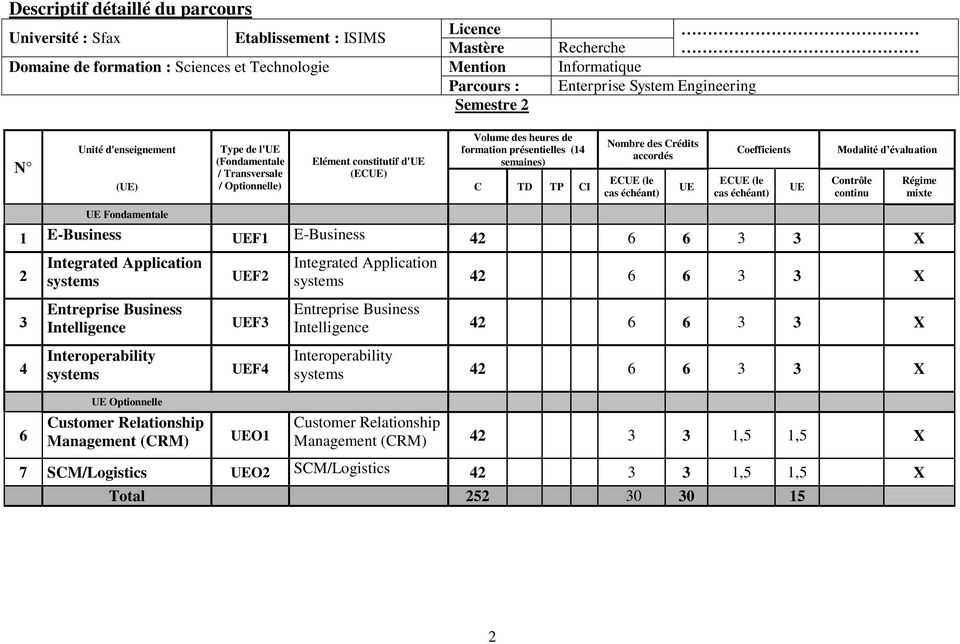
2 Descriptif détaillé du parcours Université : Sfax Etablissement : ISIMS Licence Mastère Recherche Domaine de formation : Sciences et Technologie Mention Informatique Parcours : Enterprise System Engineering Semestre 2 N Unité d'enseignement Type de l'ue Volume des heures de formation présentielles (14 (Fondamentale / Transversale Elément constitutif d'ue (ECUE) semaines) (UE) / Optionnelle) C TD TP CI Nombre des Crédits accordés ECUE (le cas échéant) UE Coefficients ECUE (le cas échéant) UE Modalité d évaluation Contrôle continu Régime mixte UE Fondamentale 1 E-Business UEF1 E-Business X Integrated Application systems Entreprise Business Intelligence Interoperability systems UEF2 UEF3 UEF4 Integrated Application systems X Entreprise Business Intelligence X Interoperability systems X 6 UE Optionnelle Customer Relationship Management (CRM) UEO1 Customer Relationship Management (CRM) ,5 1,5 X 7 SCM/Logistics UEO2 SCM/Logistics ,5 1,5 X Total
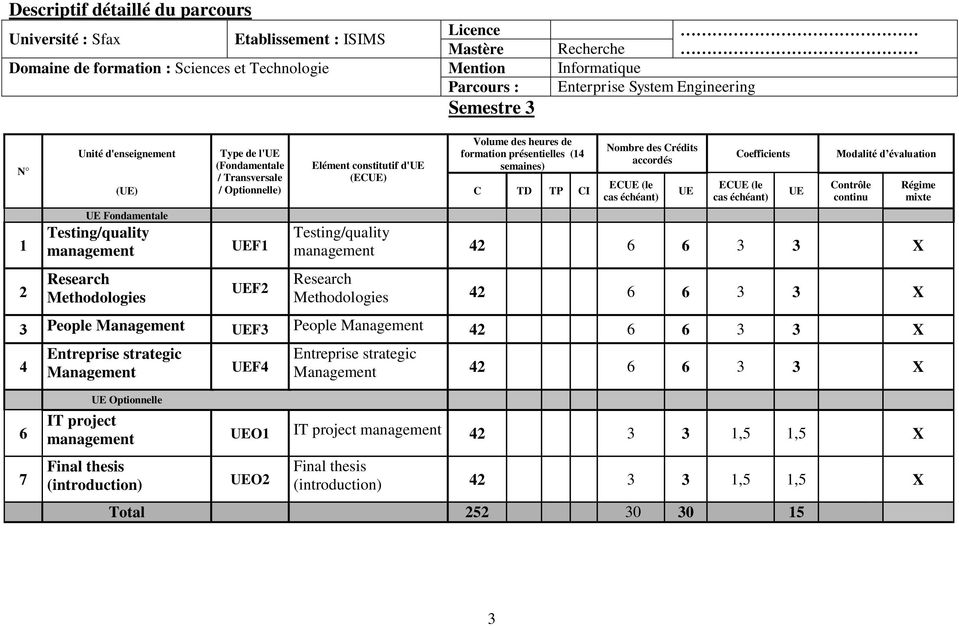
3 Descriptif détaillé du parcours Université : Sfax Etablissement : ISIMS Licence Mastère Recherche Domaine de formation : Sciences et Technologie Mention Informatique Parcours : Enterprise System Engineering Semestre 3 N 1 2 Unité d'enseignement Type de l'ue Volume des heures de formation présentielles (14 (Fondamentale / Transversale Elément constitutif d'ue (ECUE) semaines) (UE) / Optionnelle) C TD TP CI UE Fondamentale Testing/quality management Research Methodologies UEF1 UEF2 Nombre des Crédits accordés ECUE (le cas échéant) UE Coefficients ECUE (le cas échéant) UE Modalité d évaluation Contrôle continu Testing/quality management X Research Methodologies X Régime mixte 3 People Management UEF3 People Management X 4 Entreprise strategic Management UEF4 Entreprise strategic Management X 6 7 UE Optionnelle IT project management UEO1 IT project management ,5 1,5 X Final thesis (introduction) UEO2 Final thesis (introduction) ,5 1,5 X Total
4 Semestre 4 Stage et Mémoire de fin d études (30 crédits) At the end of the third semester, students will be asked to work on a master project. This project will be held in a research center, private firmes, research laboratory and will be for 6 mounths. Each master's thesis must be approved by a committee composed of a regular member of the graduate faculty under whose direction it was written and two other members of the graduate faculty nominated by the department chairperson or graduate program coordinator and appointed by the dean of the Graduate School. The master thesis credits is : 30 ECTS. 4

5 Fiche descriptive d une unité d enseignement (UE) et de ses éléments constitutifs (ECUE) Intitulé de l UE Enterprise Systems Architecture Nombre des crédits :6 Code UE : UEF1 Université : Sfax Domaine de formation : Science et Technologie Diplôme Mastère : Recherche Etablissement : ISIM de Sfax Mention : Informatique Parcours : Enterprise System Engineering Semestre S1 (M1) 1- Objectifs de l UE (Savoir, aptitude et compétences) This module intends to frame the student with the actual situation of Enterprise information systems development and integration. From nowadays and future context emerge the need to develop solutions efficiently integrated with existent ones (legacy) and competitive against new business paradigm rules: flexibility to multimodal support, agility to easily adapt and react to continuous requirements changes and interoperable with different solutions. 2- Pré-requis (définir les UE et les compétences indispensables pour suivre l UE concernée) Students must be prepared with: Information System analysis skills Computer/Web Programming skills Students must be provided with: Learning materials guides Access to integration frameworks Learning hand-outs and relevant literature 3- Eléments constitutifs de l UE (ECUE) 3.1- Enseignements Eléments constitutifs Volume horaire semestriel (1 semestre= 14 semaines Crédits Cours TD TP Autres Enterprise Systems Architecture 42 6 Total Activités pratiques (Projets, stages, mémoires ) Activités pratiques Durée Crédits 5

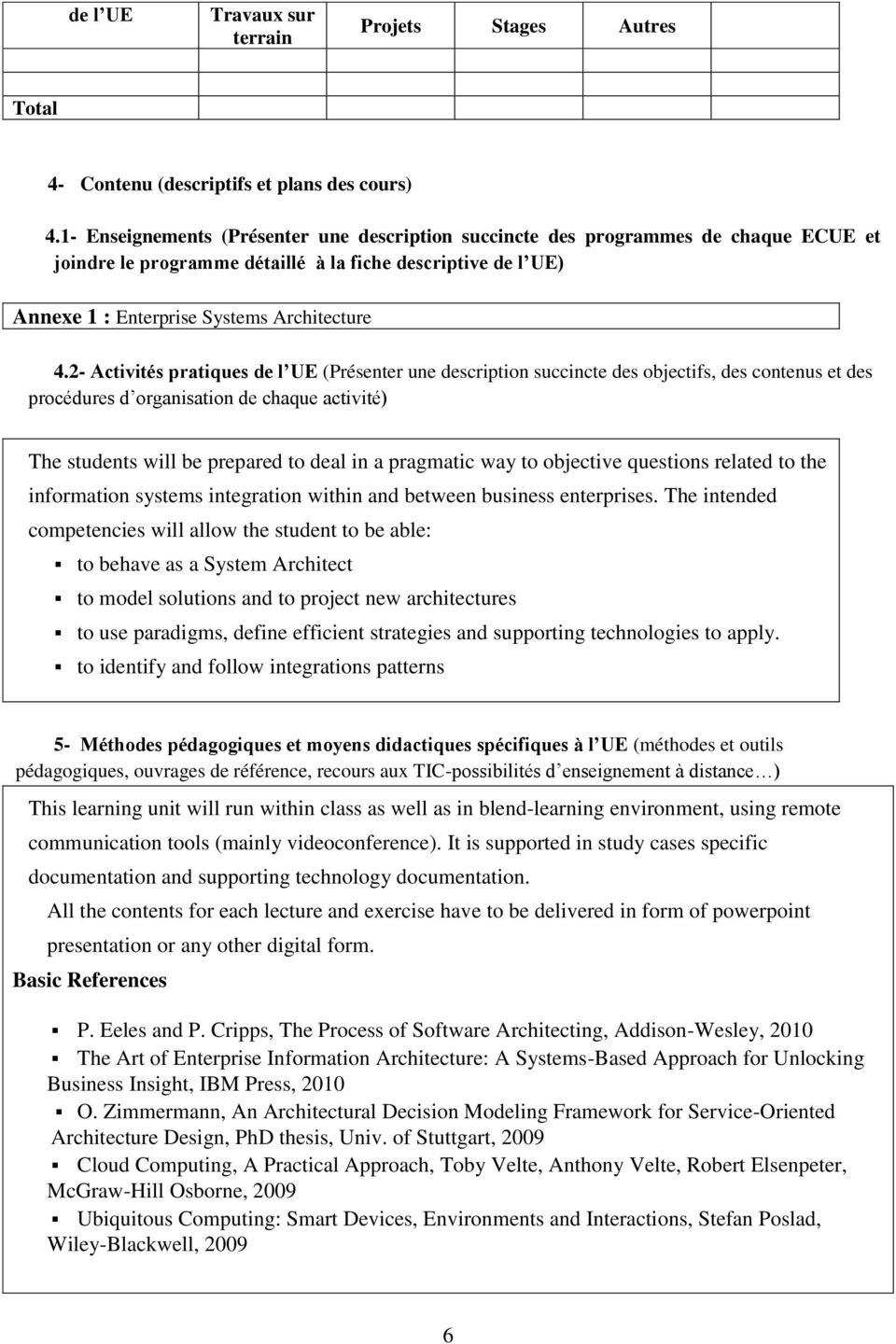
6 de l UE Travaux sur terrain Projets Stages Autres Total 4- Contenu (descriptifs et plans des cours) 4.1- Enseignements (Présenter une description succincte des programmes de chaque ECUE et joindre le programme détaillé à la fiche descriptive de l UE) Annexe 1 : Enterprise Systems Architecture 4.2- Activités pratiques de l UE (Présenter une description succincte des objectifs, des contenus et des procédures d organisation de chaque activité) The students will be prepared to deal in a pragmatic way to objective questions related to the information systems integration within and between business enterprises. The intended competencies will allow the student to be able: to behave as a System Architect to model solutions and to project new architectures to use paradigms, define efficient strategies and supporting technologies to apply. to identify and follow integrations patterns 5- Méthodes pédagogiques et moyens didactiques spécifiques à l UE (méthodes et outils pédagogiques, ouvrages de référence, recours aux TIC-possibilités d enseignement à distance ) This learning unit will run within class as well as in blend-learning environment, using remote communication tools (mainly videoconference). It is supported in study cases specific documentation and supporting technology documentation. All the contents for each lecture and exercise have to be delivered in form of powerpoint presentation or any other digital form. Basic References P. Eeles and P. Cripps, The Process of Software Architecting, Addison-Wesley, 2010 The Art of Enterprise Information Architecture: A Systems-Based Approach for Unlocking Business Insight, IBM Press, 2010 O. Zimmermann, An Architectural Decision Modeling Framework for Service-Oriented Architecture Design, PhD thesis, Univ. of Stuttgart, 2009 Cloud Computing, A Practical Approach, Toby Velte, Anthony Velte, Robert Elsenpeter, McGraw-Hill Osborne, 2009 Ubiquitous Computing: Smart Devices, Environments and Interactions, Stefan Poslad, Wiley-Blackwell,
7 6-Examens et évaluation des connaissances 6.1- Méthodes d évaluation et régimes d examens (Préciser le régime d évaluation préconisé : contrôle continu uniquement ou, régime mixte c à d contrôle continue et examens finaux) Régime mixte 6.2- Validation de l UE (présenter les poids des épreuves d examens pour le calcul de la moyenne de l ECUE, les coefficients des ECUE et le coefficient de l UE au sein du parcours). ECUE Enterprise Systems Architecture Ecrit Epreuves Oral Contrôle TP et Autres Pondération Epreuves Examen final Ecrit Oral TP et Autres Pondération Coef.de l ECUE Coef.de l UE au sein du parcours X 30 % X 70% Validation des stages et des projets 7

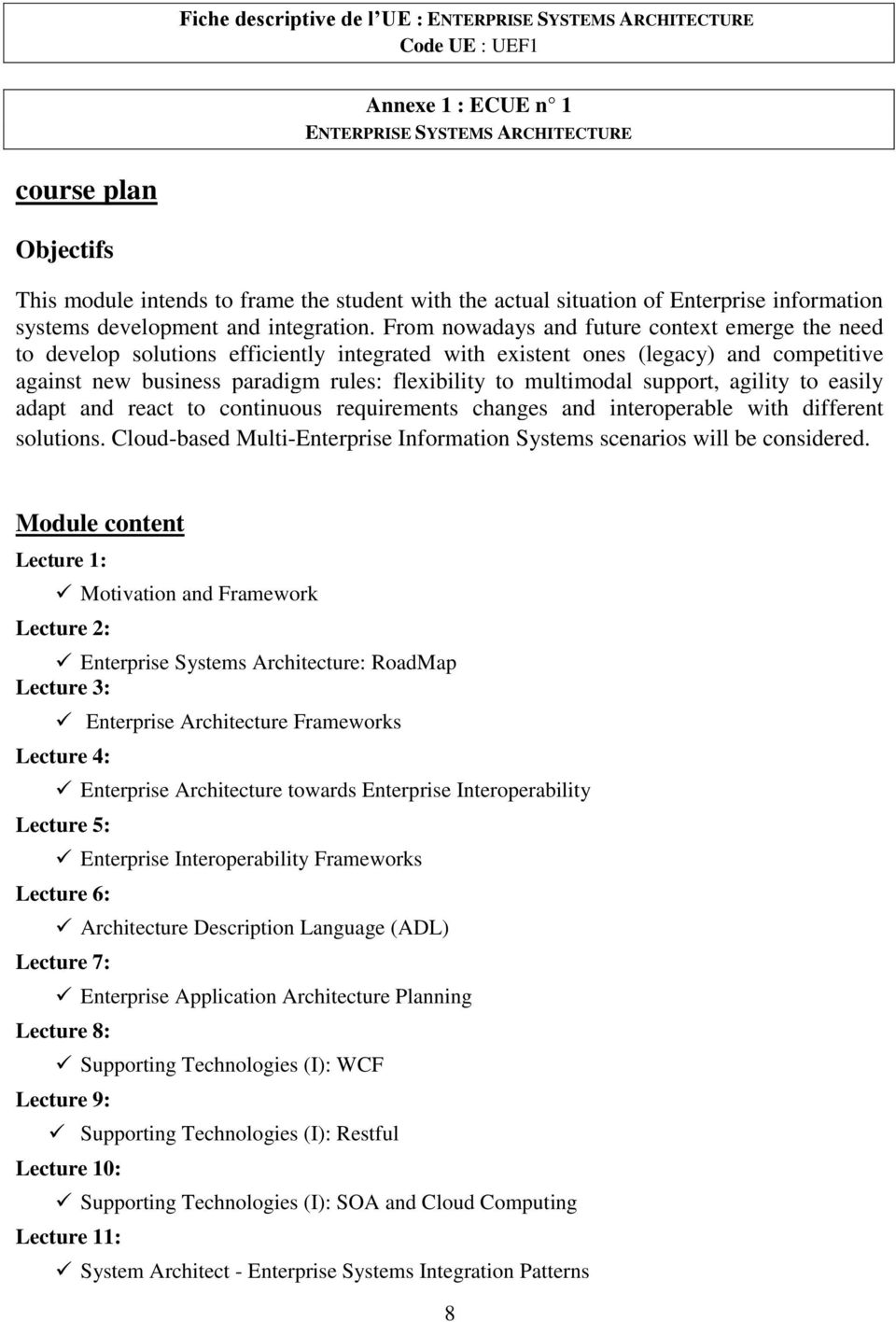
8 Fiche descriptive de l UE : ENTERPRISE SYSTEMS ARCHITECTURE Code UE : UEF1 Annexe 1 : ECUE n 1 ENTERPRISE SYSTEMS ARCHITECTURE course plan Objectifs This module intends to frame the student with the actual situation of Enterprise information systems development and integration. From nowadays and future context emerge the need to develop solutions efficiently integrated with existent ones (legacy) and competitive against new business paradigm rules: flexibility to multimodal support, agility to easily adapt and react to continuous requirements changes and interoperable with different solutions. Cloud-based Multi-Enterprise Information Systems scenarios will be considered. Module content Lecture 1: Motivation and Framework Lecture 2: Enterprise Systems Architecture: RoadMap Lecture 3: Enterprise Architecture Frameworks Lecture 4: Enterprise Architecture towards Enterprise Interoperability Lecture 5: Enterprise Interoperability Frameworks Lecture 6: Architecture Description Language (ADL) Lecture 7: Enterprise Application Architecture Planning Lecture 8: Supporting Technologies (I): WCF Lecture 9: Supporting Technologies (I): Restful Lecture 10: Supporting Technologies (I): SOA and Cloud Computing Lecture 11: System Architect - Enterprise Systems Integration Patterns 8
9 Fiche descriptive d une unité d enseignement (UE) et de ses éléments constitutifs (ECUE) Intitulé de l UE Cloud Computing and Big Data Nombre des crédits :6 Code UE : UEF2 Université : Sfax Domaine de formation : Science et Technologie Diplôme Mastère : Recherche Etablissement : ISIM de Sfax Mention : Informatique Parcours (spécialité) : Enterprise System Engineering Semestre S1 (M1) 1- Objectifs de l UE (Savoir, aptitude et compétences) This module will provide hands on study of cloud computing and big data. The first part of the class will introduce the benefits of cloud computing as well as the challenges associated with it. The course will introduce different models of services that are common in cloud computing, namely: Infrastructure as a service (IaaS), platform as a service (PaaS), and Software as a service (SaaS). The class will discuss the types of clouds and benefits of each one as well as its cost model. Finally, the class will study current commercial offerings from major providers of cloud computing solutions like Amazon, Google, Microsoft and others. The second part of the class Big Data will explain the challenges with analyzing the huge amounts of data being generated by worldwide social media and web applications. The course will adopt a map reduce framework (ex: Hadoop) to demonstrate the analysis of big data. 2- Pré-requis (définir les UE et les compétences indispensables pour suivre l UE concernée) Students must be prepared with: Data analysis skills. Computer/web programming skills. Students must be provided with: Learning materials guides. Access to cluster computing lab. Learning hand-outs and relevant literature. 9

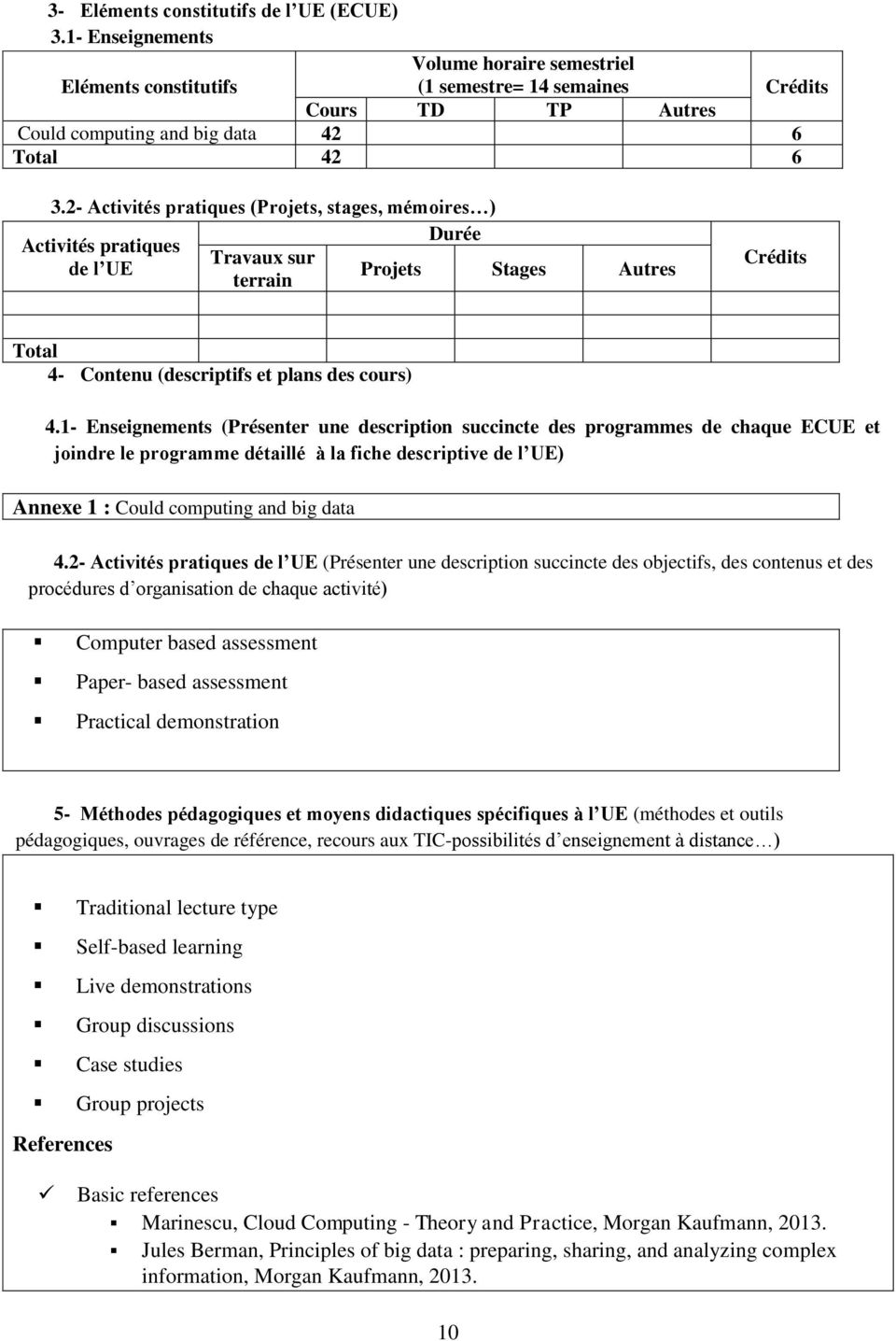
10 3- Eléments constitutifs de l UE (ECUE) 3.1- Enseignements Eléments constitutifs Volume horaire semestriel (1 semestre= 14 semaines Crédits Cours TD TP Autres Could computing and big data 42 6 Total Activités pratiques (Projets, stages, mémoires ) Durée Activités pratiques Travaux sur de l UE Projets Stages Autres terrain Crédits Total 4- Contenu (descriptifs et plans des cours) 4.1- Enseignements (Présenter une description succincte des programmes de chaque ECUE et joindre le programme détaillé à la fiche descriptive de l UE) Annexe 1 : Could computing and big data 4.2- Activités pratiques de l UE (Présenter une description succincte des objectifs, des contenus et des procédures d organisation de chaque activité) Computer based assessment Paper- based assessment Practical demonstration 5- Méthodes pédagogiques et moyens didactiques spécifiques à l UE (méthodes et outils pédagogiques, ouvrages de référence, recours aux TIC-possibilités d enseignement à distance ) Traditional lecture type Self-based learning Live demonstrations Group discussions Case studies Group projects References Basic references Marinescu, Cloud Computing - Theory and Practice, Morgan Kaufmann, Jules Berman, Principles of big data : preparing, sharing, and analyzing complex information, Morgan Kaufmann,
11 Miner and Shook, MapReduce Design Patterns: Building Effective Algorithms and Analytics for Hadoop and Other Systems,Oreilly Media, Supplementary References Buyya and Vecchiola and Selvi, Mastering Cloud Computing, Foundations and Applications Programming, Morgan Kaufmann, May Kenneth P. Birman, Guide to Reliable Distributed Systems Building High-Assurance Applications and Cloud-Hosted Services, Springer, Examens et évaluation des connaissances 6.1- Méthodes d évaluation et régimes d examens (Préciser le régime d évaluation préconisé : contrôle continu uniquement ou, régime mixte c à d contrôle continue et examens finaux) Régime mixte 6.2- Validation de l UE (présenter les poids des épreuves d examens pour le calcul de la moyenne de l ECUE, les coefficients des ECUE et le coefficient de l UE au sein du parcours). ECUE Could computing and big data Ecrit Epreuves Oral Contrôle TP et Autres Pondération Epreuves Examen final Ecrit Oral TP et Autres Pondération Coef.de l ECUE Coef.de l UE au sein du parcours X 30 % X 70% Validation des stages et des projets 11

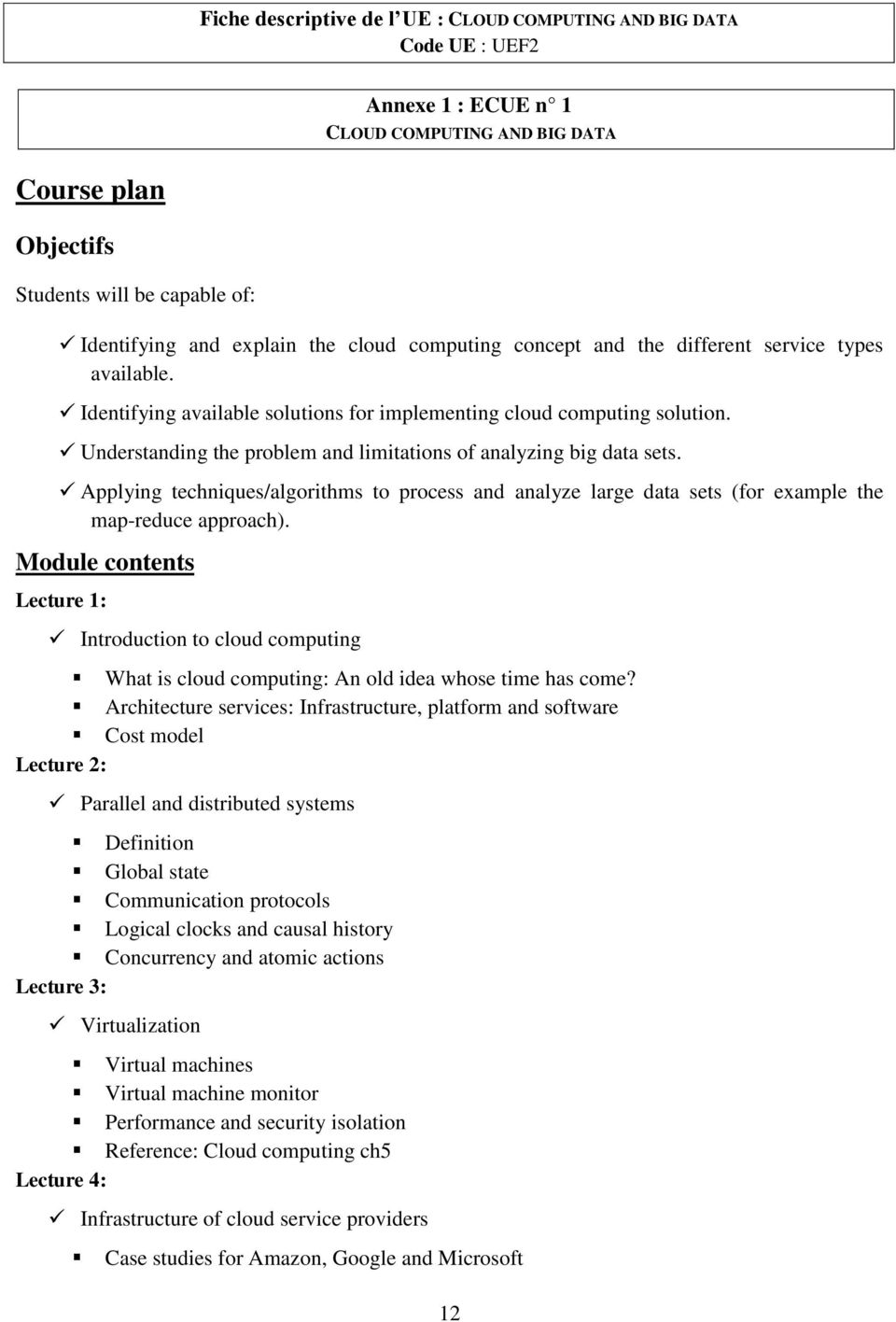
12 Fiche descriptive de l UE : CLOUD COMPUTING AND BIG DATA Code UE : UEF2 Annexe 1 : ECUE n 1 CLOUD COMPUTING AND BIG DATA Course plan Objectifs Students will be capable of: Identifying and explain the cloud computing concept and the different service types available. Identifying available solutions for implementing cloud computing solution. Understanding the problem and limitations of analyzing big data sets. Applying techniques/algorithms to process and analyze large data sets (for example the map-reduce approach). Module contents Lecture 1: Introduction to cloud computing What is cloud computing: An old idea whose time has come? Architecture services: Infrastructure, platform and software Cost model Lecture 2: Parallel and distributed systems Definition Global state Communication protocols Logical clocks and causal history Concurrency and atomic actions Lecture 3: Virtualization Virtual machines Virtual machine monitor Performance and security isolation Reference: Cloud computing ch5 Lecture 4: Infrastructure of cloud service providers Case studies for Amazon, Google and Microsoft 12
13 Reference: Cloud computing ch3 Lecture 5: Cloud application deployment Available solutions for Amazon web services, Google apps Reference: Cloud computing ch11, Google apps receipts Lecture 6: Big data Definition: Big data vs. small data Data identification and immutability Ontologies Data processing with map-reduce frameworks (Hadoop) (Ch. 4.6) Storage systems: Hadoop, gfs, nosql (Ch. 8) References: Cloud computing Ch. 4.6 and 8; principles of big data 13

14 Fiche descriptive d une unité d enseignement (UE) et de ses éléments constitutifs (ECUE) Intitulé de l UE Human Computer Interactions / Social Media Nombre des crédits :6 Code UE : UEF3 Université : Sfax Domaine de formation : Science et Technologie Diplôme Mastère : Recherche Etablissement : ISIM de Sfax Mention : Informatique Parcours (spécialité) : Enterprise System Engineering Semestre S1 (M1) 1- Objectifs de l UE (Savoir, aptitude et compétences) The term Human factors relates to both how people interact with technology, and the ways in which technology can affect people s performance. This course provides an introduction to human factors related to the design of information systems. The emphasis is on the human component of human-computer interaction (HCI), and the process of usercentered design and evaluation. In general, lectures will be interactive, combining in-class discussions with small group problem-solving exercises. In this course students develop knowledge, skills and learn a set of techniques that, if used appropriately, enable the design of enhanced human-computer interfaces and usercomputer interaction designs that can be achieved using just personal judgments. The objectives of this course are to: Understand the role of human factors in the design of information systems. Develop an understanding of basic human factors concepts such as affordances, mental models, mappings, feedback and visibility. Be able to apply those basic concepts to the design of physical objects and computer systems. Be familiar with the constraints on perception, attention and memory that are critical to a usable design. Know how to evaluate a device or system using a usability engineering approach. Understand the human factors involved in current HCI areas including computersupported collaborative work (CSCW). 14

15 2- Pré-requis (définir les UE et les compétences indispensables pour suivre l UE concernée) Prerequisites for courses has to be specified (such as inter-dependencies between courses) General conditions to pass the course: Student should attend at least 80% of the lectures Students should attend at least 10 exercise sessions Student should submit all the exercise assignments on time Final exam will cover the contents of the lectures, reading assignments, and the exercises sessions If a student does not show-up in the exam, her/his course note will be not present Students must have a minimum grade of 60% in the final exam to pass the course. 3- Eléments constitutifs de l UE (ECUE) 3.1- Enseignements Eléments constitutifs Volume horaire semestriel (1 semestre= 14 semaines Crédits Cours TD TP Autres Human Computer Interactions 42 6 / Social Media Total Activités pratiques (Projets, stages, mémoires ) Durée Activités pratiques Travaux sur de l UE Projets Stages Autres terrain Crédits Total 4- Contenu (descriptifs et plans des cours) 4.1- Enseignements (Présenter une description succincte des programmes de chaque ECUE et joindre le programme détaillé à la fiche descriptive de l UE) Annexe 1 : Human Computer Interactions / Social Media 4.2- Activités pratiques de l UE (Présenter une description succincte des objectifs, des contenus et des procédures d organisation de chaque activité) Apply modern tools, techniques and technology Analyze, design, implement and maintain Information Systems (IS). Coordinate with IS user community requirements analysis/design activities. 15

16 Able to work in team environment and learn group dynamics. Apply theory to practice through industry-based learning. Apply Ethical, privacy and societal issues in IS. 5- Méthodes pédagogiques et moyens didactiques spécifiques à l UE (méthodes et outils pédagogiques, ouvrages de référence, recours aux TIC-possibilités d enseignement à distance ) It is strongly recommended that students follow the work plan section. The workload is divided into 3 types of activities: those developed in class (plenary and seminar sessions), directed work (assignments), and final exam. Class Sessions Plenary lessons: sessions where the teacher introduces and explains the predefined course contents. These sessions include definitions, introduction to the most relevant methodologies with examples. Seminar Sessions In the seminar sessions, several activities will be undertaken according to the schedule of activities. Correction of lists of exercises Session of invited business representatives and key persons Exercises Sessions In the exercises sessions, several activities will be undertaken according to the schedule of activities. Discussion if the results and explanation Demonstrating the use of the tool and practicing it Practice doing exercises (unannounced re-take of exercise lists) Directed and Autonomous Compulsory readings to prepare for each plenary class Compulsory exercises (exercise lists) to be handed-in Reading the material provided (slides) and working on comprehension of the topics developed Working on the complementary exercises (those not to hand in) and revising solutions with those provided Internet search and visits to recommended websites 16

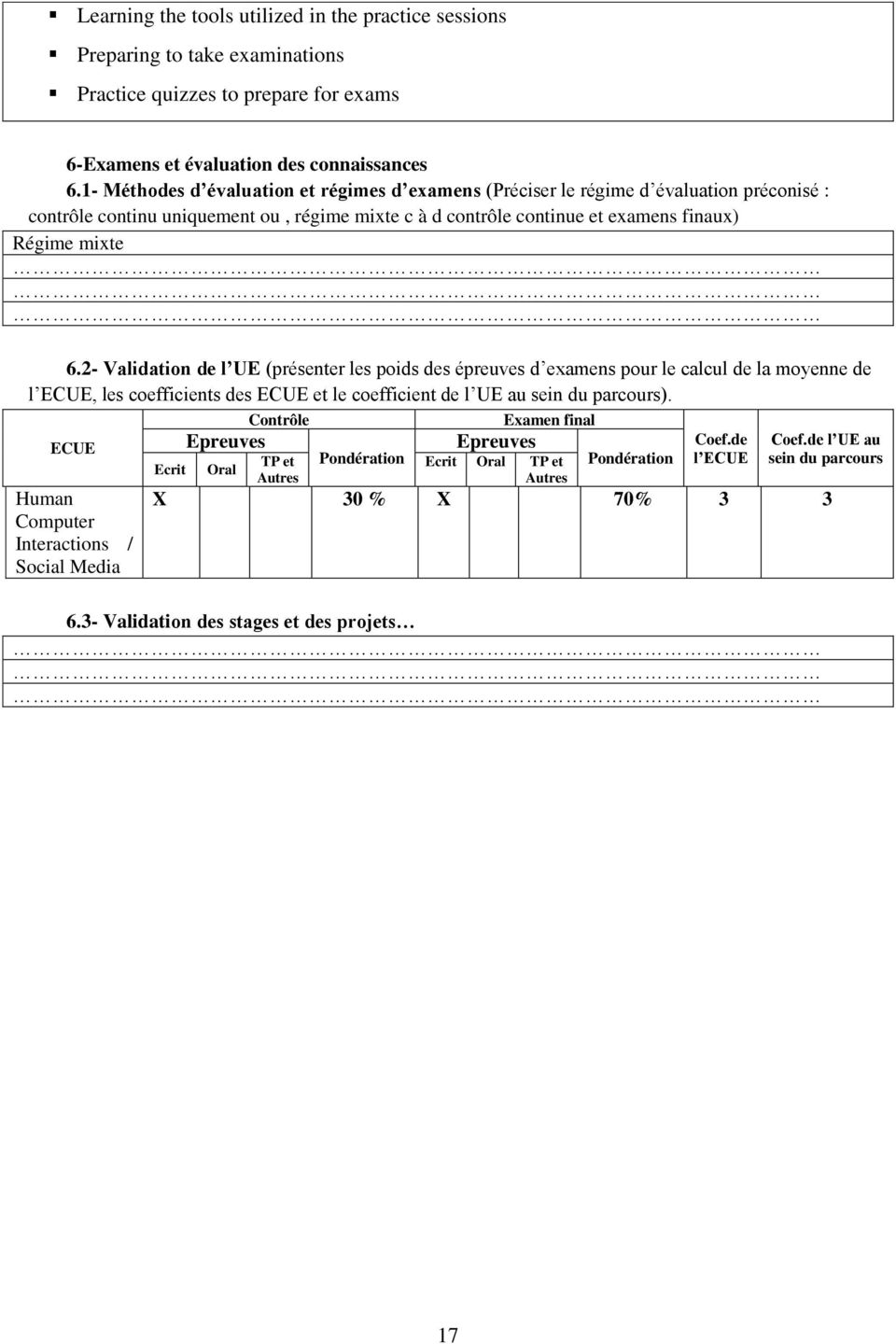
17 Learning the tools utilized in the practice sessions Preparing to take examinations Practice quizzes to prepare for exams 6-Examens et évaluation des connaissances 6.1- Méthodes d évaluation et régimes d examens (Préciser le régime d évaluation préconisé : contrôle continu uniquement ou, régime mixte c à d contrôle continue et examens finaux) Régime mixte 6.2- Validation de l UE (présenter les poids des épreuves d examens pour le calcul de la moyenne de l ECUE, les coefficients des ECUE et le coefficient de l UE au sein du parcours). ECUE Human Computer Interactions / Social Media Ecrit Epreuves Oral Contrôle TP et Autres Pondération Epreuves Examen final Ecrit Oral TP et Autres Pondération Coef.de l ECUE Coef.de l UE au sein du parcours X 30 % X 70% Validation des stages et des projets 17
18 Fiche descriptive de l UE : HUMAN COMPUTER INTERACTIONS / SOCIAL MEDIA Code UE : UEF3 Course plan Objectifs Annexe 1 : ECUE n 1 HUMAN COMPUTER INTERACTIONS / SOCIAL MEDIA HCI basic and advanced concepts are identified and clearly explained. Applications, technologies and competitive strategies in the context of HCI are identified. Practical projects using the identified technologies to illustrate the concepts are designed and implemented. Module contents Lecture 1 : Introduction to HCI and Syllabus Lecture 2: Why Good Design Matters, Overview of Systems Design Lecture 3: The Design of Everyday Things & Mental Models Lecture 4: The Design of Everyday Things & Mental Models Lecture 5: Understanding the Needs of Users Lecture 6: Establishing Requirements through Data Gathering Lecture 7: Establishing Requirements through Data Gathering Lecture 8: Design Methodologies & Design Principles Lecture 9: Prototyping and Construction, Universal Usability, Assignment 3 Description Lecture 10: Evaluation Techniques Lecture 12: Non-Visual Interfaces Lecture 13: Internationalization of Interfaces Lecture 14: Emotional Design Lecture 15: Direct Manipulation & Virtual Environments Lecture 16 : Menus and Form Filling Lecture 17 : Interaction Devices Lecture 18 : Collaboration Lecture 19: Quality of Service and User Frustration, User Support and Help Lecture 20 Information Search and Visualization 18

19 Fiche descriptive d une unité d enseignement (UE) et de ses éléments constitutifs (ECUE) Intitulé de l UE Advanced Applied Mathematics Nombre des crédits :6 Code UE : UEF4 Université : Sfax Domaine de formation : Science et Technologie Diplôme Mastère : Recherche Etablissement : ISIM de Sfax Mention : Informatique Parcours (spécialité) : Enterprise System Engineering Semestre S1 (M1) 1- Objectifs de l UE (Savoir, aptitude et compétences) The advances in technology and business are achieved by applying technical knowledge from statistics, computing science, finance, economics, management and mathematics. The advanced applied mathematical curriculum deals with computer and computational methods that play an important role in all of these areas. It prepares students to deal with mathematical problems that arise in science, engineering, or management. The curriculum will emphasize on the construction, analysis, evaluation of mathematical models of real-world problems and the mathematical methods used to solve them. These models are analyzed to form better decisions in areas such as management, engineering, and the social sciences. In mathematical programming, a problem is modeled as an objective function then the resulting model is optimized. The models are solved using computer programs. 2- Pré-requis (définir les UE et les compétences indispensables pour suivre l UE concernée) Students must be provided with: Learning material guides Access to E-Learning facilities Relevant literature 3- Eléments constitutifs de l UE (ECUE) 3.1- Enseignements Eléments constitutifs Volume horaire semestriel (1 semestre= 14 semaines Crédits Cours TD TP Autres Advanced Applied Mathematics 42 6 Total Activités pratiques (Projets, stages, mémoires ) Activités pratiques Durée de l UE Travaux sur Projets Stages Autres Crédits 19

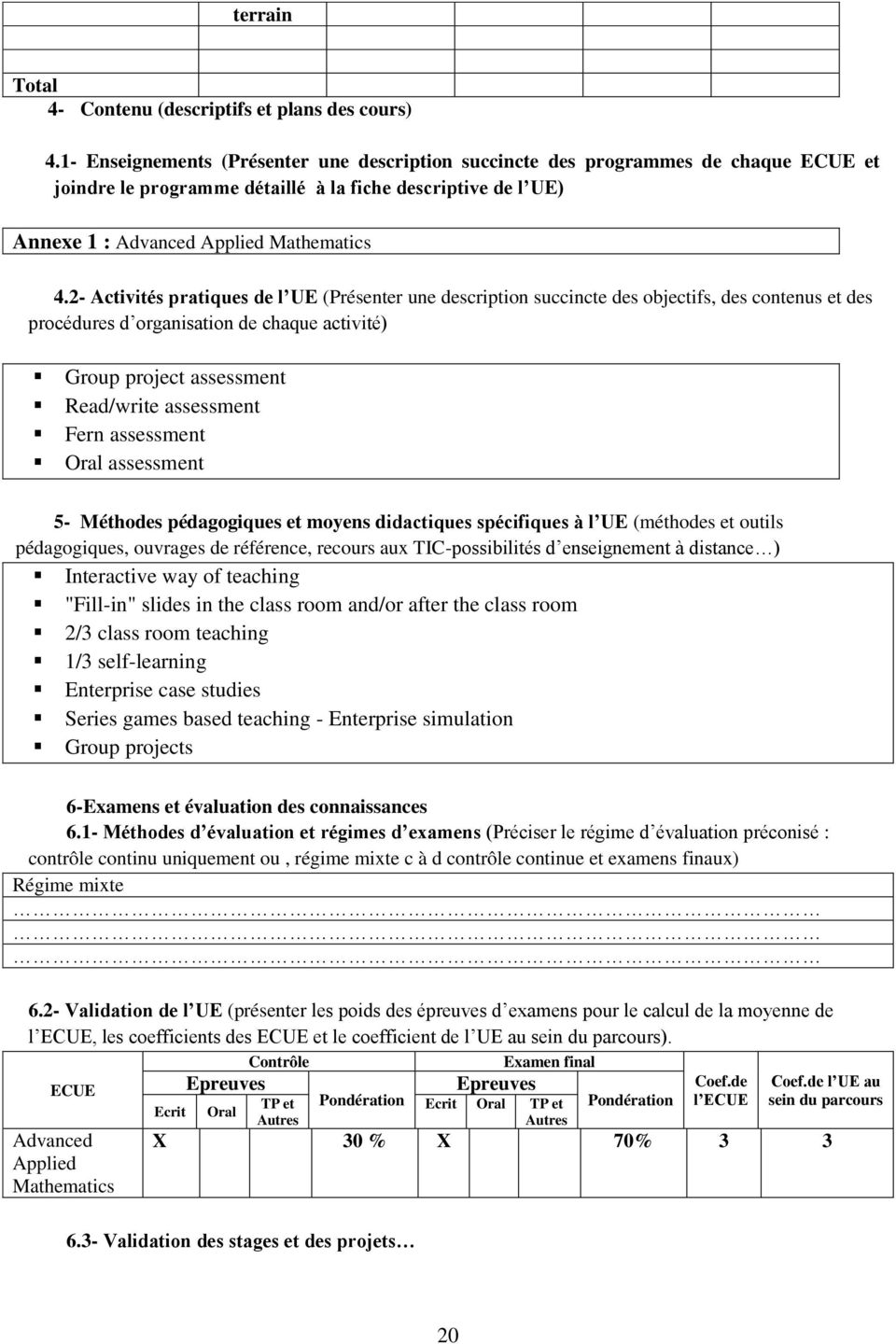
20 terrain Total 4- Contenu (descriptifs et plans des cours) 4.1- Enseignements (Présenter une description succincte des programmes de chaque ECUE et joindre le programme détaillé à la fiche descriptive de l UE) Annexe 1 : Advanced Applied Mathematics 4.2- Activités pratiques de l UE (Présenter une description succincte des objectifs, des contenus et des procédures d organisation de chaque activité) Group project assessment Read/write assessment Fern assessment Oral assessment 5- Méthodes pédagogiques et moyens didactiques spécifiques à l UE (méthodes et outils pédagogiques, ouvrages de référence, recours aux TIC-possibilités d enseignement à distance ) Interactive way of teaching "Fill-in" slides in the class room and/or after the class room 2/3 class room teaching 1/3 self-learning Enterprise case studies Series games based teaching - Enterprise simulation Group projects 6-Examens et évaluation des connaissances 6.1- Méthodes d évaluation et régimes d examens (Préciser le régime d évaluation préconisé : contrôle continu uniquement ou, régime mixte c à d contrôle continue et examens finaux) Régime mixte 6.2- Validation de l UE (présenter les poids des épreuves d examens pour le calcul de la moyenne de l ECUE, les coefficients des ECUE et le coefficient de l UE au sein du parcours). ECUE Advanced Applied Mathematics Ecrit Epreuves Oral Contrôle TP et Autres Pondération Epreuves Examen final Ecrit Oral TP et Autres Pondération Coef.de l ECUE Coef.de l UE au sein du parcours X 30 % X 70% Validation des stages et des projets 20
21 Fiche descriptive de l UE : ADVANCED APPLIED MATHEMATICS Code UE : UEF4 Annexe 1 : ECUE n 1 ADVANCED APPLIED MATHEMATICS Course plan Objectifs Algorithms Development Skills Modeling Skills Data Analysis Skills Complexity Analysis Module contents Lecture 1: Introduction to modeling process Problem identification Goal determination Making assumptions Define variables Model analyzing and simulation Model testing and validation Model application and prediction Model calibration and extension Lecture 2: Discrete time models Age setting time steps Initial conditions Choosing the model Model solution and discussing equilibrium Graphical approach Linear stability analysis Lecture 3: Optimization of discrete models Selecting the decision variables Defining the objective function Setting the constraint functions Graphical optimization Lecture 4: Continuous time models Derivation of continuous model 21
22 Differential equation models Separation of variables Linear equations Lecture 5: Optimization of continuous models Selecting the decision variables Defining the objective function Setting the constraint functions Lagrange multiplier Lecture 6: Sensitivity analysis The effect of varying the input on output Parameter perturbation Normalized forward sensitivity index Lecture 7: Systems of difference equations Two dimensional discrete time systems Linear stability analysis Characteristic equation and eigenvalues Lecture 8: Systems of differential equations Qualitative analysis of two dimensional systems Equilibrium points Stability of equilibrium points Analysis of higher order dimensional systems Lecture 9: Bifurcation analysis Saddle node bifurcation Transcritical bifurcation Generic saddle node bifurcation Hopf bifurcation Lecture 10: Matlab programming Introduction to Matlab Simulation using Matlab Lecture 11: Data fitting Least square method 22
23 Fiche descriptive d une unité d enseignement (UE) et de ses éléments constitutifs (ECUE) Intitulé de l UE Computer Networks Nombre des crédits :3 Code UE : UEO1 Université : Sfax Domaine de formation : Science et Technologie Diplôme Mastère : Recherche Etablissement : ISIM de Sfax Mention : Informatique Parcours (spécialité) : Enterprise System Engineering Semestre S1 (M1) 1- Objectifs de l UE (Savoir, aptitude et compétences) This module covers the computer networking basis and components. It introduces the design strategies used to solve computer networking problems and it explains how the networks work. Such a course will be supported by practical activities. 2- Pré-requis (définir les UE et les compétences indispensables pour suivre l UE concernée) In order to follow the course computer network in the best conditions, it is recommended to have some knowledge of computer architecture 3- Eléments constitutifs de l UE (ECUE) 3.1- Enseignements Volume horaire semestriel Eléments constitutifs (1 semestre= 14 semaines Crédits Cours TD TP Autres Computer Networks 42 3 Total Activités pratiques (Projets, stages, mémoires ) Durée Activités pratiques Travaux sur de l UE Projets Stages Autres terrain Crédits Total 4- Contenu (descriptifs et plans des cours) 4.1- Enseignements (Présenter une description succincte des programmes de chaque ECUE et joindre le programme détaillé à la fiche descriptive de l UE) Annexe 1 : Computer Networks 23
24 4.2- Activités pratiques de l UE (Présenter une description succincte des objectifs, des contenus et des procédures d organisation de chaque activité) The specific learning goals for this module are: Acquisition of elementary knowledge about computer networks. Ability to configure and support a range of network devices. Strong general knowledge background in routing protocols. Development of the student skills in wireless networking. Dealing with emerging computer network trends. 5- Méthodes pédagogiques et moyens didactiques spécifiques à l UE (méthodes et outils pédagogiques, ouvrages de référence, recours aux TIC-possibilités d enseignement à distance ) Interaction-based learning Group working Class labs References CISCO networking academy, ciscopress, 2013 S. Fdida, G. Pujolle: Modèles de systèmes et de réseaux, (tome 1 et 2), Performance, Eyrolles, avril G. Pujolle, M. Schwartz: Les réseaux locaux informatiques, Eyrolles, T. S. Rappaport, Wireless Communications: Principles and Practice, Prentice Hall. M. Gast, Wireless Networks: The Definitive Guide Creating and Administering Wireless Networks, 2002 J. Schiller, Mobile Communications, Addison-Wesley, Examens et évaluation des connaissances 6.1- Méthodes d évaluation et régimes d examens (Préciser le régime d évaluation préconisé : contrôle continu uniquement ou, régime mixte c à d contrôle continue et examens finaux) Régime mixte 6.2- Validation de l UE (présenter les poids des épreuves d examens pour le calcul de la moyenne de l ECUE, les coefficients des ECUE et le coefficient de l UE au sein du parcours). ECUE Computer Networks Ecrit Epreuves Oral Contrôle TP et Autres Pondération Epreuves Examen final Ecrit Oral TP et Autres Pondération Coef.de l ECUE Coef.de l UE au sein du parcours X 30 % X 70% 1,5 1, Validation des stages et des projets 24
25 Fiche descriptive de l UE : COMPUTER NETWORKS Code UE : UEO1 Annexe 1 : ECUE n 1 COMPUTER NETWORKS Course plan Objectifs The specific learning goals for this module are: Acquisition of elementary knowledge about computer networks. Ability to configure and support a range of network devices. Strong general knowledge background in routing protocols. Development of the student skills in wireless networking. Dealing with emerging computer network trends. Module contents Lecture 1: Introduction to computer networking Definition, role, network classification Network key components and challenges Networks characteristics Lecture 2: Network communication Objectives Network structure Network protocols Lecture 3: Network protocols: TCP/IP model and OSI model- part I TCP/IP model Application and operation of TCP mechanisms Managing TCP sessions UDP protocol FTP, HTTP, DHCP, Telnet, DNS, etc. Lecture 4: Network protocols: TCP/IP model and OSI model- part II OSI model: functionalities and services Physical layer Data link layer Network layer 25
26 Transport layer Session layer Presentation layer Application layer Lecture 5: Ethernet technology Original version of Ethernet Evolution of Ethernet: Fast Ethernet, Giga Ethernet Medium access control method: CSMA/CD Encapsulation / decapsulation and CRC (mechanism of errors detection) Lecture 6: Network cabling and configuration Basic network media required to make a LAN connection Design a cabling plan Types of connections in a LAN Design an addressing scheme for an inter-network Importance of network designs Lecture 7: Routing protocols and notions General concepts Static routing Dynamic routing Internal routing protocols Distance-based vector Link- based state External routing protocols: BGP Lecture 8: Design of new LAN architecture part I Basic functionalities of switch 2 and 3 levels VLAN Lecture 9: Design of new LAN architecture part II VTP and STP protocols Inter-VLAN routing Lecture 10: Wireless networking Introduction to wireless network Wireless networking classification (WLAN, WMAN, WWAN, etc.) LAN Lecture 11: Next generation networks 26
27 Definition of NGN and their principles NGN architecture NGN classification (class4, class 5 and multimedia, etc.) 27
28 Fiche descriptive d une unité d enseignement (UE) et de ses éléments constitutifs (ECUE) Intitulé de l UE E-Business Nombre des crédits :6 Code UE : UEF1 Université : Sfax Domaine de formation : Science et Technologie Diplôme Mastère : Recherche Etablissement : ISIM de Sfax Mention : Informatique Parcours (spécialité) : Enterprise System Engineering Semestre S2 (M1) 1- Objectifs de l UE (Savoir, aptitude et compétences) E-Business is radically changing the ways in which business organizations operate and compete in the global market. This course introduces students to various aspects and models for e-business. It provides an overview of e-business from architectural and managerial perspectives. This includes fundamental concepts and frameworks for exploring e-business opportunities by comparing and contrasting e-business models. The course will also examine E-Business strategies and implementation issues faced by new Internet ventures as well as established firms. Current issues surrounding E-Business practices such as electronic commerce infrastructure, designing on-line storefronts, payment acceptance and security issues, and the legal and ethical challenges of e-business will also be discussed. 2- Pré-requis (définir les UE et les compétences indispensables pour suivre l UE concernée) Introduction to Computer Science Course Programming Languages Course Database System Course 3- Eléments constitutifs de l UE (ECUE) 3.1- Enseignements Volume horaire semestriel Eléments constitutifs (1 semestre= 14 semaines Crédits Cours TD TP Autres E-Business 42 6 Total Activités pratiques (Projets, stages, mémoires ) Durée Activités pratiques Travaux sur de l UE Projets Stages Autres terrain Crédits 28
29 Total 4- Contenu (descriptifs et plans des cours) 4.1- Enseignements (Présenter une description succincte des programmes de chaque ECUE et joindre le programme détaillé à la fiche descriptive de l UE) Annexe 1 : E-Business 4.2- Activités pratiques de l UE (Présenter une description succincte des objectifs, des contenus et des procédures d organisation de chaque activité) By completing this course, students will be able to: Understand the current state of E-Business and follow its new development; Identify E-Business opportunities and develop business models for such opportunities; Recognize e-commerce business models types, including B2B, B2C, B2G, C2C, C2G. Appreciate and realize E-commerce issues, including shopping carts, human computer interface designs, interactions with payment processing mechanisms, relationships to information technology development and support. Appreciate and understand e-business topics such as supply chain management, customer relationship management change management, E-procurement, and e- marketing. Articulate the pros and cons of business strategies of implementing E-Business initiatives; Recognize the key management issues associated with implementing E-Business strategies; and Appreciate the importance of the security, legal, ethical and privacy issues and understand how they may impact a firm s E-Business strategy. 5- Méthodes pédagogiques et moyens didactiques spécifiques à l UE (méthodes et outils pédagogiques, ouvrages de référence, recours aux TIC-possibilités d enseignement à distance ) Traditional Lecture Type Self-based learning Live demonstrations Group discussions Case studies 29
30 Group Projects References Basic References: Turban, E., King, D., Lee, J., Liang, T., & Turban, D. (2012). Electronic commerce: A managerial and social networks perspective Upper Saddle River, NJ: Pearson/Prentice Hall. Supplementary References: Laudon, K. C., & Traver, C. G. (2012). E-Commerce: Business, technology, society (8th ed.). Upper Saddle River, NJ: Pearson/Prentice Hall. ISBN: or Examens et évaluation des connaissances 6.1- Méthodes d évaluation et régimes d examens (Préciser le régime d évaluation préconisé : contrôle continu uniquement ou, régime mixte c à d contrôle continue et examens finaux) Régime mixte 6.2- Validation de l UE (présenter les poids des épreuves d examens pour le calcul de la moyenne de l ECUE, les coefficients des ECUE et le coefficient de l UE au sein du parcours). ECUE Ecrit Epreuves Oral Contrôle TP et Autres Pondération Epreuves Examen final Ecrit Oral TP et Autres Pondération Coef.de l ECUE Coef.de l UE au sein du parcours E-business X 30 % X 70% Validation des stages et des projets 30
31 Fiche descriptive de l UE : E-BUSINESS Code UE : UEF1 Annexe 1 : ECUE n 1 E-BUSINESS Course plan Objectifs E-Business is radically changing the ways in which business organizations operate and compete in the global market. This course introduces students to various aspects and models for e-business. It provides an overview of e-business from architectural and managerial perspectives. This includes fundamental concepts and frameworks for exploring e-business opportunities by comparing and contrasting e-business models. The course will also examine E-Business strategies and implementation issues faced by new Internet ventures as well as established firms. Current issues surrounding E-Business practices such as electronic commerce infrastructure, designing on-line storefronts, payment acceptance and security issues, and the legal and ethical challenges of e- business will also be discussed. Module contents Lecture 1: Overview of e-business Concepts, Histories, and Characterizations' Agenda History and Scope E-Business and E-Commerce Concepts Types of e-business The E-Commerce Framework E-Commerce Business Models Constructing the E-Business Architecture References Lecture 2: Retailing and EC Applications and models Agenda E-commerce Business Models Case Study: Online Grocers - Finding and Executing the Right Model E-commerce Business Models categories: (B2C Business Models, B2B Business Models) Private Industrial Networks Business Models in Emerging E-commerce Areas E-commerce Enablers: The Gold Rush Model How the Internet and the Web Change Business 31
32 Industry Value Chains Business Strategy Lecture 3: E-Commerce Applications building and Infrastructure Agenda Major E-Commerce Applications and Their Functionalities Steps to Developing an E-Commerce Web Site Development Options for E-Commerce Applications Criteria for Selecting a Development Approach E-Commerce Software Packages and Suites Connecting to Databases and Other Enterprise Systems Vendor and Software Selection Lecture 4: E-commerce Marketing Concepts part1 Agenda Internet Audience and Consumer Behavior Type of Internet Connection: Broadband Impacts Consumer Behavior Models Case study: NetFlix Develops and Defends Its Brand Trust, Utility, and OpporSfaxm in Online Markets Lecture 5: E-commerce Marketing Concepts part 2 Agenda Intentional Acts: How Shoppers Find Vendors Online Basic Marketing Concepts The Revolution in Internet Marketing Technologies Databases and Data Warehouses Customer Relationship Management (CRM) Systems Net Pricing Strategies Case Study: Zoomerang Lecture 6: Online Security and Payment Systems Agenda The E-commerce Security Environment What Is Good E-commerce Security? Most Common Security Threats in the E-commerce Environment Case study: Cyberwar Becomes a Reality Technology Solutions 32
33 Management Policies, Business Procedures, and Public Laws Types of Payment Systems E-commerce Payment Systems Electronic Billing Presentment and Payment (EBPP) Lecture 7: Order Fulfillment along the Supply Chain Agenda Order Fulfillment and Logistics: An Overview Problems in Order Fulfillment Along Supply Chains Solutions to Order Fulfillment Problems along Supply Chains RFID and CPFR as Key Enablers in Supply Chain Management Other E-Commerce Support Services Managerial Issues Case Study: How Amazon.com Fulfills Orders Lecture 8: EC System Implementation Agenda Why Justify E-Commerce Investments? How Can They Be Justified? Difficulties in Measuring and Justifying E-Commerce Investments Methods and Tools for Evaluating and Justifying E-Commerce Investments Examples of E-Commerce Metrics and Project Justification The Economics of E-Commerce A Five-Step Approach to Developing an E-Commerce System Development Strategies for E-Commerce Projects Organizational Impacts of E-Commerce Opportunities for Success in E-Commerce and Avoiding Failure Managerial Issues Lecture 9: E-Commerce: Regulatory, Ethical, and Social Environments Agenda Ethical Challenges and Guidelines Intellectual Property Law Privacy Rights, Protection, and Free Speech Other EC Legal Issues Consumer and Seller Protection from Online Fraud Public Policy and Political Environments 33
34 Intitulé de l UE Integrated Application Systems Nombre des crédits :6 Code UE : UEF2 Université : Sfax Domaine de formation : Science et Technologie Diplôme Mastère : Recherche Etablissement : ISIM de Sfax Mention : Informatique Parcours (spécialité) : Enterprise System Engineering Semestre S2 (M1) 1- Objectifs de l UE (Savoir, aptitude et compétences) Based on the following of value chain of industrial enterprises business processes over all its R&D, sales, procurement, production, logistics and service departments, an introduction and overview of standard enterprise activities supported by information systems will be given. It will be shown which functions of the processes are supported by which information systems and by which methods. An Enterprise Resource Planning system (ERP) plays here a significant role to integrate and support business process activities. The main key elements and structure of an ERP system will be described and explained. 2- Pré-requis (définir les UE et les compétences indispensables pour suivre l UE concernée) Database 1 and Operating System 1 3- Eléments constitutifs de l UE (ECUE) 3.1- Enseignements Volume horaire semestriel Eléments constitutifs (1 semestre= 14 semaines Crédits Cours TD TP Autres Integrated 42 6 Application System Total Activités pratiques (Projets, stages, mémoires ) Durée Activités pratiques Travaux sur de l UE Projets Stages Autres terrain Crédits Total 34
35 4- Contenu (descriptifs et plans des cours) 4.1- Enseignements (Présenter une description succincte des programmes de chaque ECUE et joindre le programme détaillé à la fiche descriptive de l UE) Annexe 1 : Integrated Application System 4.2- Activités pratiques de l UE (Présenter une description succincte des objectifs, des contenus et des procédures d organisation de chaque activité) 5- Méthodes pédagogiques et moyens didactiques spécifiques à l UE (méthodes et outils pédagogiques, ouvrages de référence, recours aux TIC-possibilités d enseignement à distance ) Traditional Lecture Type Self-based learning Live demonstrations Group discussions Case studies Group Projects 6-Examens et évaluation des connaissances 6.1- Méthodes d évaluation et régimes d examens (Préciser le régime d évaluation préconisé : contrôle continu uniquement ou, régime mixte c à d contrôle continue et examens finaux) Régime mixte 6.2- Validation de l UE (présenter les poids des épreuves d examens pour le calcul de la moyenne de l ECUE, les coefficients des ECUE et le coefficient de l UE au sein du parcours). ECUE Integrated Application System Ecrit Epreuves Oral Contrôle TP et Autres Pondération Epreuves Examen final Ecrit Oral TP et Autres Pondération Coef.de l ECUE Coef.de l UE au sein du parcours X 30 % X 70% Validation des stages et des projets 35
36 Fiche descriptive de l UE : INTEGRATED APPLICATION SYSTEM Code UE : UEF2 Annexe 1 : ECUE n 1 INTEGRATED APPLICATION SYSTEM Course plan Objectifs Access and understanding advanced integrated software technology Understand the general functionalities and key elements of modern integrated system Development of practical skills for the administration of complex ERP systems Learning techniques and methods for the development and reconstruction of complex architectures of real-world business information systems using the example of component SAP Enterprise Service Architecture (ESA) Introduction of SAP programming language ABAP Module contents Lecture 1 Functions and Processes in industry: R&D, Overview and Applications Lecture 2: Sales and customer contact Lecture 3: Material Managements Lecture 4: Production Planning Lecture 5: Introduction to the ERP Basis Technologies Lecture 6: ERP Change and Transport Management and 'ERP Interfacing Lecture 7: ERP Buffer and Memory Management and Analysis Lecture 8: DBMS and ERP System Lecture 9: Backup Strategies an techniques under ERP Systems Lecture 10: Restore and Recovery Lecture 11: Very large database under ERP 36
37 Fiche descriptive d une unité d enseignement (UE) et de ses éléments constitutifs (ECUE) Intitulé de l UE Enterprise Business Intelligence Nombre des crédits :6 Code UE : UEF3 Université : Sfax Domaine de formation : Science et Technologie Diplôme Mastère : Recherche Etablissement : ISIM de Sfax Mention : Informatique Parcours (spécialité) : Enterprise System Engineering Semestre S2 (M1) 1- Objectifs de l UE (Savoir, aptitude et compétences) Helping the enterprises managers in answering the following questions while using Business Intelligence concepts and tools: What is the current BI situation? What is the BI process? What is the Data - information - knowledge triangle? What is Business Intelligence? In which business areas BI can be utilized? What is the Data Warehouse concept? What are the differences between transaction-oriented systems and analysis-orientied systems? What are the Logical and Physical Models? 2- Pré-requis (définir les UE et les compétences indispensables pour suivre l UE concernée) Students must be provided with: 1- Learning materials guides 2- CDs and access to VLBA lab 3- Learning hand-outs and relevant literature 3- Eléments constitutifs de l UE (ECUE) 3.1- Enseignements Volume horaire semestriel Eléments constitutifs (1 semestre= 14 semaines Crédits Cours TD TP Autres Enterprise Business
38 Intelligence Total Activités pratiques (Projets, stages, mémoires ) Durée Activités pratiques Travaux sur de l UE Projets Stages Autres terrain Crédits Total 4- Contenu (descriptifs et plans des cours) 4.1- Enseignements (Présenter une description succincte des programmes de chaque ECUE et joindre le programme détaillé à la fiche descriptive de l UE) Annexe 1 : Enterprise Business Intelligence 4.2- Activités pratiques de l UE (Présenter une description succincte des objectifs, des contenus et des procédures d organisation de chaque activité) 5- Méthodes pédagogiques et moyens didactiques spécifiques à l UE (méthodes et outils pédagogiques, ouvrages de référence, recours aux TIC-possibilités d enseignement à distance ) Traditional Lecture Type Self-based learning Live demonstrations Group discussions Case studies Group Projects 6-Examens et évaluation des connaissances 6.1- Méthodes d évaluation et régimes d examens (Préciser le régime d évaluation préconisé : contrôle continu uniquement ou, régime mixte c à d contrôle continue et examens finaux) Régime mixte 6.2- Validation de l UE (présenter les poids des épreuves d examens pour le calcul de la moyenne de l ECUE, les coefficients des ECUE et le coefficient de l UE au sein du parcours). ECUE Enterprise Business Intelligence Ecrit Epreuves Oral Contrôle TP et Autres Pondération 38 Epreuves Examen final Ecrit Oral TP et Autres Pondération Coef.de l ECUE Coef.de l UE au sein du parcours X 30 % X 70% 3 3
39 Fiche descriptive de l UE : ENTERPRISE BUSINESS INTELLIGENCE Code UE : UEF3 Course plan Annexe 1 : ECUE n 1 ENTERPRISE BUSINESS INTELLIGENCE Objectifs This module gives an introduction to the electronic business. Graduates will be familiar with the basic and current technologies together with advanced concepts, applications, and competitive strategies in the context of enterprise business intelligence supported by practical examples Module contents Lecture 1: Motivation Lecture 2: Software, Benefits and Business Areas Lecture 3: Data Warehouse and ETL Lecture 4: Life Cycle, Reporting and OLAP Lecture 5: Semantic Modeling Part I Lecture 6: Semantic Modeling Part II Lecture 7: Logical Modeling Lecture 8: Physical Modeling and Adaptive BI Lecture 9: Open Source Business Intelligence and SAP Netweaver Lecture 10: SAP HANA Lecture 11: Customer Relationship Management Part I Lecture 12: Customer Relationship Management Part II 39
40 Fiche descriptive d une unité d enseignement (UE) et de ses éléments constitutifs (ECUE) Intitulé de l UE Interoperability Systems Nombre des crédits :6 Code UE : UEF4 Université : Sfax Domaine de formation : Science et Technologie Diplôme Mastère : Recherche Etablissement : ISIM de Sfax Mention : Informatique Parcours (spécialité) : Enterprise System Engineering Semestre S2 (M1) 1- Objectifs de l UE (Savoir, aptitude et compétences) System Interoperability course covers the ability of diverse systems and organizations to work together (inter-operate). It set a broad framework on the services which allows for information exchange with heterogeneous systems takes into account social, political, and organizational factors that impact system to system performance. 2- Pré-requis (définir les UE et les compétences indispensables pour suivre l UE concernée) System Analysis Course Programming Languages Course Database System Course Software Engineering Course 3- Eléments constitutifs de l UE (ECUE) 3.1- Enseignements Eléments constitutifs Volume horaire semestriel (1 semestre= 14 semaines Crédits Cours TD TP Autres Interoperability Systems 42 6 Total Activités pratiques (Projets, stages, mémoires ) Durée Activités pratiques Travaux sur de l UE Projets Stages Autres terrain Crédits Total 40
41 4- Contenu (descriptifs et plans des cours) 4.1- Enseignements (Présenter une description succincte des programmes de chaque ECUE et joindre le programme détaillé à la fiche descriptive de l UE) Annexe 1 : Interoperability Systems 4.2- Activités pratiques de l UE (Présenter une description succincte des objectifs, des contenus et des procédures d organisation de chaque activité) The student shall be able to explain the need for interoperability between enterprises.. The student shall be able to explain the different levels of interoperability as well as different kinds of Interoperability. The student shall be able to analyze, evaluate and select appropriate methods, technologies and tools from current state of the art research to support interoperability. The student shall be able to differentiate between syntax and semantic interoperability system need and usage. The student shall be able to handle several Interop cases in various fields such as medical, public safety, etc. The student shall be able to describe how systems, units, or forces will provide services to and accept services from other systemsthe student shall be able to describe single query for several Interop systems The student shall be able to introduce the capability of different programs to exchange data via a common set of exchange formats The student shall be able to define ability of diverse business processes to work together. 5- Méthodes pédagogiques et moyens didactiques spécifiques à l UE (méthodes et outils pédagogiques, ouvrages de référence, recours aux TIC-possibilités d enseignement à distance ) Traditional Lecture Type Self-based learning Live demonstrations Group discussions Case studies Group Projects 6-Examens et évaluation des connaissances 6.1- Méthodes d évaluation et régimes d examens (Préciser le régime d évaluation préconisé : contrôle continu uniquement ou, régime mixte c à d contrôle continue et examens finaux) Régime mixte 41
42 6.2- Validation de l UE (présenter les poids des épreuves d examens pour le calcul de la moyenne de l ECUE, les coefficients des ECUE et le coefficient de l UE au sein du parcours). ECUE Enterprise Systems Architecture Ecrit Epreuves Oral Contrôle TP et Autres Pondération Epreuves Examen final Ecrit Oral TP et Autres Pondération Coef.de l ECUE Coef.de l UE au sein du parcours X 30 % X 70% Validation des stages et des projets 42
43 Fiche descriptive de l UE : INTEROPERABILITY SYSTEMS Code UE : UEF4 Annexe 1 : ECUE n 1 INTEROPERABILITY SYSTEMS Course plan Objectifs System Interoperability course covers the ability of diverse systems and organizations to work together (inter-operate). It set a broad frame work on the services which allow for information exchange with heterogeneous systems takes into account social, political, and organizational factors that impact system to system performance.. Module contents Lecture 1: Introduction to System Interoperability Levels of Conceptual Interoperability Model Enterprise Interoperability Architecture of Interoperable Information Systems Model Driven Interoperability Lecture 2: Syntax Interoperability Data formats communication protocols XML or SQL standards Lecture 3: Semantic interoperability Interpret the information exchanged Common information exchange reference model Lecture 4: Interoperability and open standards Define open standard difference between open standard and interoperability Post-facto interoperability Lecture 5: Interop System communication Describe how systems, units, or forces services from other systems different programs to exchange data via a common set of exchange formats file formats, protocols, OSLC Lecture 6: Interop System Search 43
44 Two or more information collections of Interop systems to be searched by a single query Federated Search technology Lecture 7: Business Process Interoperability Define Business Process Interoperability (BPI) Enterprise software systems in which functions designed to work together Lecture 8: Interoperability in Medical industry, E-government and Public safety Medical E-Government Public safety 44
45 Fiche descriptive d une unité d enseignement (UE) et de ses éléments constitutifs (ECUE) Intitulé de l UE Customer Relationship Management (CRM) Nombre des crédits :3 Code UE : UEO1 Université : Sfax Domaine de formation : Science et Technologie Diplôme Mastère : Recherche Etablissement : ISIM de Sfax Mention : Informatique Parcours (spécialité) : Enterprise System Engineering Semestre S2 (M1) 1- Objectifs de l UE (Savoir, aptitude et compétences) Students will become familiar with the importance of customer relationship servicing in companies, and they will learn what functions and what tools in customer relationship management are necessary. Students will learn and work on recommendation engines as a tool to design a mutually profitable interaction between companies and customers, and become familiar with their functions, requirements and process evaluation mechanisms of recommendation systems. 2- Pré-requis (définir les UE et les compétences indispensables pour suivre l UE concernée) General conditions to pass the course: Student should attend at least 80% of the lectures Students should attend at least 10 exercise sessions Student should submit all the exercise assignments on time Final exam will cover the contents of the lectures, reading assignments, and the exercises sessions If a student does not show-up in the exam, her/his course note will be not present Students must have a minimum grade of 60% in the final exam to pass the course. 3- Eléments constitutifs de l UE (ECUE) 3.1- Enseignements Eléments constitutifs Volume horaire semestriel (1 semestre= 14 semaines Crédits Cours TD TP Autres Customer Relationship 42 3 Management (CRM) Total
46 3.2- Activités pratiques (Projets, stages, mémoires ) Durée Activités pratiques Travaux sur de l UE Projets Stages Autres terrain Crédits Total 4- Contenu (descriptifs et plans des cours) 4.1- Enseignements (Présenter une description succincte des programmes de chaque ECUE et joindre le programme détaillé à la fiche descriptive de l UE) Annexe 1 : Customer Relationship Management (CRM) 4.2- Activités pratiques de l UE (Présenter une description succincte des objectifs, des contenus et des procédures d organisation de chaque activité) Acquisition of basic knowledge about CRM Acquisition of basic knowledge on the use and de-sign of recommendation engines Development of skills for the analysis of customer data with data mining methods Acquisition of basic skills for data analysis and evaluation within recommendation engines Dealing with recommendation systems in practice Understanding of the central role of customers in the enterprise, and the role of IT for the analysis and enhancement of customer relationships 5- Méthodes pédagogiques et moyens didactiques spécifiques à l UE (méthodes et outils pédagogiques, ouvrages de référence, recours aux TIC-possibilités d enseignement à distance ) It is strongly recommended that students follow the work plan section. The workload is divided into 3 types of activities: those developed in class (plenary and seminar sessions), directed work (assignments), and final exam. Class Sessions Plenary lessons: sessions where the teacher introduces and explains the predefined course contents. These sessions include definitions, introduction to the most relevant methodologies with examples. Seminar Sessions In the seminar sessions, several activities will be undertaken according to the schedule of activities. Correction of lists of exercises Session of invited business representatives and key persons 46
47 Exercises Session In the exercises sessions, several activities will be undertaken according to the schedule of activities. Discussion if the results and explanation Demonstrating the use of the tool and practicing it Practice doing exercises (unannounced re-take of exercise lists) Directed and Autonomous Compulsory readings to prepare for each plenary class Compulsory exercises (exercise lists) to be handed-in Reading the material provided (slides) and working on comprehension of the topics developed Working on the complementary exercises (those not to hand in) and revising solutions with those provided Internet search and visits to recommended websites Learning the tools utilized in the practice sessions Preparing to take examinations Practice quizzes to prepare for exams 6-Examens et évaluation des connaissances 6.1- Méthodes d évaluation et régimes d examens (Préciser le régime d évaluation préconisé : contrôle continu uniquement ou, régime mixte c à d contrôle continue et examens finaux) Régime mixte 6.2- Validation de l UE (présenter les poids des épreuves d examens pour le calcul de la moyenne de l ECUE, les coefficients des ECUE et le coefficient de l UE au sein du parcours). ECUE Customer Relationship Management (CRM) Ecrit Epreuves Oral Contrôle TP et Autres Pondération Epreuves Examen final Ecrit Oral TP et Autres Pondération Coef.de l ECUE Coef.de l UE au sein du parcours X 30 % X 70% 1,5 1, Validation des stages et des projets 47
48 Fiche descriptive de l UE : CUSTOMER RELATIONSHIP MANAGEMENT (CRM) Code UE : UEO1 Course plan Objectifs Annexe 1 : ECUE n 1 CUSTOMER RELATIONSHIP MANAGEMENT (CRM) CRM basic and advanced concepts are identified and clearly explained. Applications, technologies and competitive strategies in the context of CRM are identified. Practical projects using the identified technologies to illustrate the concepts are designed and implemented. Module contents Lecture 1: Introduction to CRM Lecture 2: Strategic CRM part I Lecture 3: Strategic CRM part II Lecture 4: Operational CRM Lecture 5: Introduction to Analytical CRM association Rules Lecture 6: Analytical CRM part I Lecture 7: Analytical CRM Classification Lecture 8: Analytical CRM Clustering Lecture 9: Analytical CRM Part II Lecture 10: ETL Process (Additional Material) Lecture 11: Case studies and practical studies with SAP CRM 48
49 Fiche descriptive d une unité d enseignement (UE) et de ses éléments constitutifs (ECUE) Intitulé de l UE SCM / Logistics Nombre des crédits :3 Code UE : UEO2 Université : Sfax Domaine de formation : Science et Technologie Diplôme Mastère : Recherche Etablissement : ISIM de Sfax Mention : Informatique Parcours (spécialité) : Enterprise System Engineering Semestre S2 (M1) 1- Objectifs de l UE (Savoir, aptitude et compétences) Students will become familiar with logistics and supply chain which include all the activities required to move product and information to, from, and between members of a supply chain. The supply chain provides the framework for businesses and their suppliers to jointly deliver goods, services and information efficiently, effectively, relevantly and in a sustainable manner to customer. Supply Chain Management presents the mission, business processes, and strategies needed to achieves integrated logistical management. 2- Pré-requis (définir les UE et les compétences indispensables pour suivre l UE concernée) No prerequisites are needed to attend this course General conditions to pass the course: Student should attend at least 80% of the lectures Students should attend at least 10 exercise sessions Student should submit all the exercise assignments on time Students will have to present a final assignment in a group of two or three to define a supply chain strategy for a new business or to analyze a supply chain strategy for an established current company Final exam will cover the contents of the lectures, reading assignments, and the exercises sessions If a student does not show-up in the exam, her/his course note will be not present Students must have a minimum grade of 50% in the final exam to pass the course. 3- peléments constitutifs de l UE (ECUE) 3.1- Enseignements Eléments constitutifs Volume horaire semestriel (1 semestre= 14 semaines Crédits 49
50 Cours TD TP Autres SCM / Logistics 42 3 Total Activités pratiques (Projets, stages, mémoires ) Durée Activités pratiques Travaux sur de l UE Projets Stages Autres terrain Crédits Total 4- Contenu (descriptifs et plans des cours) 4.1- Enseignements (Présenter une description succincte des programmes de chaque ECUE et joindre le programme détaillé à la fiche descriptive de l UE) Annexe 1 : SCM / Logistics 4.2- Activités pratiques de l UE (Présenter une description succincte des objectifs, des contenus et des procédures d organisation de chaque activité) Understanding the global supply chain as a process of integration, coordination and collaboration among multiple stakeholders. Analyzing current systems of organization and management of the international supply chain. Strategically analyze the design of the international supply chain in different sectors, companies and competitive contexts. Designing new systems and working methods to improve the management of relationships between suppliers, companies, logistics operators and end customers. Make decisions and effectively and efficiently manage key aspects of international logistics and international transportation, inventory and asset tracking. 5- Méthodes pédagogiques et moyens didactiques spécifiques à l UE (méthodes et outils pédagogiques, ouvrages de référence, recours aux TIC-possibilités d enseignement à distance ) It is strongly recommended that students follow the work plan section. The workload is divided into 3 types of activities: those developed in class (plenary and seminar sessions), directed work (assignments), and final exam. Class Sessions Plenary lessons: sessions where the teacher introduces and explains the predefined course contents. These sessions include definitions, introduction to the most relevant methodologies with examples. Seminar Sessions: 50
51 In the seminar sessions, several activities will be undertaken according to the schedule of activities. Group discussion of selected business cases Global class discussion of selected business cases Group Supply Chain simulations with software programs Correction of exercises Session of invited business representatives and key persons Directed and Autonomous: Compulsory readings to prepare for each plenary class Compulsory business cases Compulsory exercises (exercise lists) to be handed-in Reading the material provided (slides) and working on comprehension of the topics developed Internet search and visits to recommended websites Learning the tools utilized in the practice sessions Preparing to take examinations 6-Examens et évaluation des connaissances 6.1- Méthodes d évaluation et régimes d examens (Préciser le régime d évaluation préconisé : contrôle continu uniquement ou, régime mixte c à d contrôle continue et examens finaux) Régime mixte 6.2- Validation de l UE (présenter les poids des épreuves d examens pour le calcul de la moyenne de l ECUE, les coefficients des ECUE et le coefficient de l UE au sein du parcours). ECUE SCM / Logistics Ecrit Epreuves Oral Contrôle TP et Autres Pondération Epreuves Examen final Ecrit Oral TP et Autres Pondération Coef.de l ECUE Coef.de l UE au sein du parcours X 30 % X 70% 1,5 1, Validation des stages et des projets 51
52 Fiche descriptive de l UE : SCM / LOGISTICS Code UE : UEO2 Annexe 1 : ECUE n 1 SCM / LOGISTICS Course plan Objectifs Global supply chain basic and advanced concepts are identified and clearly explained. Applications and competitive strategies in the context of Global supply chain are identified and linked with the general strategy of the company. Identify clearly the strategies to add value to the relation with the suppliers, logistics operators and end consumers. Define clearly the most appropriate strategy to each of the key operational aspects of the SCM: transportation, inventory and asset tracking. Practical projects using the identified strategies to illustrate how to design and implement concepts learned. Module contents Lecture 1: Introduction to International Logistics Class presentation about supply chain basic concepts Topics: Review the basic concepts of logistics and its evolution Understand the difference between SCM and logistics Understand challenges of today logistics Seminar 1: Introduction to International Logistics Class video about IKEA company Assignment 1 Topics: Understand how supply chain affects IKEA business and the other way around Lecture 2: Logistics network configuration Class presentation about defining and simulating supply chain networks Topics: Challenges in designing logistics networks Center of gravity models Distance-based approach models 52
53 Seminar 2: Logistics network configuration Group simulation of logistics networks with MS-Excel Assignment 2 Topics: Center of gravity model simulations Distance-based approach model simulations Discussion of the different methods Lecture 3: Logistics network configuration (ii) Class presentation about configuration and strategies of supply chain Topics: Strategies and integration in the SC Structural configurations Seminar 3: Logistics network configuration (ii) Group discussion of selected business case Class discussion of selected business case Assignment 3 Topics: Understand advantages and disadvantages of different logistics network configurations Analyze how logistics affects to business and profits Business case reference: Amazon s European Distribution Strategy HBS Lecture 4: Customer value and SCM Class presentation about how supply chain affects customer value and how it can be used to give competitive advantage Topics: Logistics costs and performance Customer value parameters International trends Seminar 4: Customer value and SCM Group discussion of selected business case Class discussion of selected business case Assignment 4 Topics: 53
54 Understand how logistics decisions affect to customer value Analyze how logistics can give more customer value being a driver of competitive advantage Business case reference: Business case: Supply Chain Management at World Co. Ltd. HBS-1603S07-E Lecture 5: Stocks management Class presentation about basic and main parameters of stocks management Topics: Stocks management Warehouses configuration Best practices Seminar 5: Stocks management Group simulation about stocks management Class discussion of group results Assignment 5 Topics: Understand how stocks management affects all supply chain Analyze bullwhip effect Simulation internet reference: Lecture 6: The value of information Class presentation about how information can improve supply chain efficiency Topics: Effective forecasts Information for the coordination of systems Locating desired products Lead-time reduction SC Trade-offs Seminar 6: The value of information Group discussion of selected business case Class discussion of selected business case Assignment 6 Topics: Understand how information helps in supply chain Analyze effects of IT systems in supply chain 54
55 Business case reference: Business case: Zara: IT for Fast Fashion HBS-1605S17-E Lecture 7: Offshoring and Outsourcing Class presentation about criteria and methodology to offshore and outsource parts of the supply chain Topics: Relocation factors Relocation decisions Project relocation Seminar 7: Offshoring and Outsourcing Group discussion of selected business case Class discussion of selected business case Assignment 7 Topics: Understand how outsourcing parts of supply chain can improve business results Analyze how these decision affects to competitive advantage Business case reference: Business case: Dell Computers (A) HBS Lecture 8: Strategic alliances Class presentation about how to establish strategic alliances with supply chain agents Topics: Strategic alliances definition Reasons to establish strategic alliances in supply chain Criteria to develop and maintain successful strategic alliances Seminar 8: Strategic alliances Group discussion of selected business case Class discussion of selected business case Topics: Understand benefits of an alliance in logistics Analyze risks and opportunities for both sides of the alliance Business case reference: Laura Ashley and Federal Express Strategic Alliance HBS Lecture 9: International transportation and logistics 55
56 Class presentation about international transportation main characteristics Topics: Key factors in transportation General characteristics Maritime transportation Airplane transportation Selecting a transportation partner Seminar 9: International transportation and logistics Group discussion of selected business case Class discussion of selected business case Assignment 9 Topics: Analysis of transportation options Business case reference: DR Corporation HBS E Lecture 10 and Seminar 10: Presentation of supply chain group business analysis 56
57 Fiche descriptive d une unité d enseignement (UE) et de ses éléments constitutifs (ECUE) Intitulé de l UE Testing / Quality Management Nombre des crédits :6 Code UE : UEF1 Université : Sfax Domaine de formation : Science et Technologie Diplôme Mastère : Recherche Etablissement : ISIM de Sfax Mention : Informatique Parcours (spécialité) : Enterprise System Engineering Semestre S3 (M2) 1- Objectifs de l UE (Savoir, aptitude et compétences) This is an IT development course. Students will be familiar with the roles of both testing and quality management for ESE. Students will be equipped with necessary knowledge, tools and techniques for developing effective sound tests, analyzing test results and assessments of both correctness and quality of ESE products.. TBD 2- Pré-requis (définir les UE et les compétences indispensables pour suivre l UE concernée) 3-Eléments constitutifs de l UE (ECUE) 3.1- Enseignements Eléments constitutifs Volume horaire semestriel (1 semestre= 14 semaines Crédits Cours TD TP Autres Testing / Quality Management 42 6 Total Activités pratiques (Projets, stages, mémoires ) Durée Activités pratiques Travaux sur de l UE Projets Stages Autres terrain Crédits Total 4-Contenu (descriptifs et plans des cours) 4.1- Enseignements (Présenter une description succincte des programmes de chaque ECUE et joindre le programme détaillé à la fiche descriptive de l UE) Annexe 1 : Testing / Quality Management 57
58 4.2- Activités pratiques de l UE (Présenter une description succincte des objectifs, des contenus et des procédures d organisation de chaque activité) Participants are expected to be able to: Develop an in-depth knowledge of essential testing/quality requirements and standards as well as its critical role. Enhance personal awareness of the key role of testing and quality. Apply tools and techniques necessary for effective sound testing/quality assessment. Demonstrate proficiency in analytical problem solving. Develop the capability to lead testing/quality team. Be able to effectively and formally specify testing/quality requirements. 5- Méthodes pédagogiques et moyens didactiques spécifiques à l UE (méthodes et outils pédagogiques, ouvrages de référence, recours aux TIC-possibilités d enseignement à distance ) Adopting hands on experience method of learning: Lecture and class discussion. Case study report. Student s real life problems. The workload of the course amounts to 180 hours. It is strongly recommended that students follow the work plan section. The workload is divided into 3 types of activities: those developed in class (plenary and seminar sessions), directed work (assignments), and final exam. Class Sessions Plenary Lessons : Sessions where the teacher introduces and explains the predefined course contents. These sessions include definitions, introduction to the most relevant methodologies with examples. Seminar Sessions : In the seminar sessions, several activities will be undertaken according to the schedule of activities. Correction of lists of exercises Session of invited business representatives and key persons Exercises Sessions : In the exercises sessions, several activities will be undertaken according to the schedule of activities. Discussion if the results and explanation Demonstrating the use of the tool and practicing it Practice doing exercises (unannounced re-take of exercise lists) 58
59 Directed and Autonomous : Compulsory readings to prepare for each plenary class Compulsory exercises (exercise lists) to be handed-in Reading the material provided (slides) and working on comprehension of the topics developed Working on the complementary exercises (those not to hand in) and revising solutions with those provided Internet search and visits to recommended websites Learning the tools utilized in the practice sessions Preparing to take examinations Practice quizzes to prepare for exams 6-Examens et évaluation des connaissances 6.1- Méthodes d évaluation et régimes d examens (Préciser le régime d évaluation préconisé : contrôle continu uniquement ou, régime mixte c à d contrôle continue et examens finaux) Régime mixte 6.2- Validation de l UE (présenter les poids des épreuves d examens pour le calcul de la moyenne de l ECUE, les coefficients des ECUE et le coefficient de l UE au sein du parcours). ECUE Testing / Quality Management Ecrit Epreuves Oral Contrôle TP et Autres Pondération Epreuves Examen final Ecrit Oral TP et Autres Pondération Coef.de l ECUE Coef.de l UE au sein du parcours X 30 % X 70% Validation des stages et des projets 59
60 Fiche descriptive de l UE : TESTING / QUALITY MANAGEMENT Code UE : UEF1 Annexe 1 : ECUE n 1 TESTING / QUALITY MANAGEMENT Course plan Objectifs Each student is expected to be able to derive testing/quality requirements from formal descriptions Each student is expected to apply at least two techniques/tools used in any of the testing/quality being delivered while meeting the following: Understanding and reflecting the principles of these techniques. Using a technique appropriate to the context and situation within the classroom at that time. Adequately evaluate the effectiveness of his/her actions, consequences of it, recognizing any ways of improving. Module contents Lecture 1: Testability and testability specification Lecture 2: Testability requirements and cycle Lecture 3: Formal description techniques Lecture 4: Formal test derivation techniques Lecture 5: ESE special requirements and LOTOS (ISO/IEC 8807, Information processing Systems - Open Systems Interconnection - LOTOS - A Formal Description Technique Based on Temporal Ordering of Observational Behaviour ) Lecture 6: Automated derivation of sound test suites and analysis of test results Lecture 7: Quality assurance, elements and assessments 60
61 Fiche descriptive d une unité d enseignement (UE) et de ses éléments constitutifs (ECUE) Intitulé de l UE Research Methodologies Nombre des crédits :6 Code UE : UEF2 Université : Sfax Domaine de formation : Science et Technologie Diplôme Mastère : Recherche Etablissement : ISIM de Sfax Mention : Informatique Parcours (spécialité) : Enterprise System Engineering Semestre S3 (M2) 1- Objectifs de l UE (Savoir, aptitude et compétences) This course aims to introduce students to a number of research methods useful for academic and professional investigations of information practices, texts and technologies. It provides an understanding of the different decisions and steps involved in executing a research methodology. Students, after this course, will be able to: Understanding the research terminology. Understanding the ethical and research principals, challenges and processes. Learning, understanding and using the quantitative/qualitative and hybrid methods approaches to research. Knowing the literature review process and the evaluation methods. Analyzing and evaluating others published research. Reporting a project's results. 2- Pré-requis (définir les UE et les compétences indispensables pour suivre l UE concernée) This course has no prerequisites 3- Eléments constitutifs de l UE (ECUE) 3.1- Enseignements Eléments constitutifs Volume horaire semestriel (1 semestre= 14 semaines Crédits Cours TD TP Autres Research Methodologies 42 6 Total Activités pratiques (Projets, stages, mémoires ) Durée Activités pratiques Travaux sur de l UE Projets Stages Autres terrain Crédits 61
62 Total 4- Contenu (descriptifs et plans des cours) 4.1- Enseignements (Présenter une description succincte des programmes de chaque ECUE et joindre le programme détaillé à la fiche descriptive de l UE) Annexe 1 : Research Methodologies 4.2- Activités pratiques de l UE (Présenter une description succincte des objectifs, des contenus et des procédures d organisation de chaque activité) Group project assessment Read/write assessment Fern assessment Oral assessment 5- Méthodes pédagogiques et moyens didactiques spécifiques à l UE (méthodes et outils pédagogiques, ouvrages de référence, recours aux TIC-possibilités d enseignement à distance ) It is strongly recommended that students follow the work plan section. The workload is divided into 3 types of activities: Developed in class (plenary and seminar sessions), Directed work (assignments) Final exam. 6-Examens et évaluation des connaissances 6.1- Méthodes d évaluation et régimes d examens (Préciser le régime d évaluation préconisé : contrôle continu uniquement ou, régime mixte c à d contrôle continue et examens finaux) Régime mixte 6.2- Validation de l UE (présenter les poids des épreuves d examens pour le calcul de la moyenne de l ECUE, les coefficients des ECUE et le coefficient de l UE au sein du parcours). ECUE Research Methodologies Ecrit Epreuves Oral Contrôle TP et Autres Pondération Epreuves Examen final Ecrit Oral TP et Autres Pondération Coef.de l ECUE Coef.de l UE au sein du parcours X 30 % X 70% Validation des stages et des projets 62
63 63
64 Fiche descriptive de l UE : RESEARCH METHODOLOGIES Code UE : UEF2 Annexe 1 : ECUE n 1 RESEARCH METHODOLOGIES Course plan Objectifs The course offers an overview of the different methods, considerations and challenges involved in social research. Those methods are generally based on core human research methods such as interviews, ethnographies, surveys and experiments. We will explore methods used in critical analysis of technologies with an emphasis on the digital (e.g. virtual worlds, edutainment, and online ethnographies). We will also discuss mixed method approaches, case studies, participatory and user-centered research. Module contents Lecture 1: Introduction to research What is research? Research concepts Research ethics Lecture 2: Quantitative research methods Principals of quantitative research methods Survey of the toolkits for the quantitative research methods Quantitative research articles based on data analysis Lecture 3: Qualitative research methods Principals of the scientific method Survey on the QRM QRM Wrap up Lecture 4: Hybrid research methods (HRM) Introduction HRM survey HRM evaluation 64
65 Fiche descriptive d une unité d enseignement (UE) et de ses éléments constitutifs (ECUE) Intitulé de l UE People Management Nombre des crédits 6 Code UE : UEF3 Université : Sfax Domaine de formation : Science et Technologie Diplôme Mastère : Recherche Etablissement : ISIM de Sfax Mention : Informatique Parcours (spécialité) : Enterprise System Engineering Semestre S3 (M2) 1- Objectifs de l UE (Savoir, aptitude et compétences) This is a skill development course designed to equip participants with necessary knowledge, tools and techniques for leading people towards organizational and individual success. The novelty in this course is considering positive psychology a cornerstone towards development of people leadership skills. The course revolves around three main skill sets which are personal skills, interpersonal skills and group skills. Each group of skills include specific skills that proved to be most required in the current labor market such as the ability to solve problems analytically and creatively, communication skills, motivating others, building high performing teams and teamwork and leading positive change. Moreover, the course is designed to help in filling in main leadership skills gap discovered by different surveys conducted and funded by Tempus. These surveys have been submitted to different sizes and types of enterprises in Egypt, Sfax and Jordan. The main focus is on promoting effective people management practices and addressing current management challenge. This will be achieved pragmatically rather than theoretically. Therefore, active learning is the fundamental mechanism through which this course is delivered. Participants are expected to be engaged in activities and higher order thinking (analysis, synthesis and evaluation) since more emphasis is placed on skill development rather than information transmission. 2- Pré-requis (définir les UE et les compétences indispensables pour suivre l UE concernée) This course has no prerequisites 3- Eléments constitutifs de l UE (ECUE) 3.1- Enseignements Eléments constitutifs Volume horaire semestriel (1 semestre= 14 semaines Crédits Cours TD TP Autres People Management 42 6 Total Activités pratiques (Projets, stages, mémoires ) 65
66 Activités pratiques de l UE Travaux sur terrain Durée Projets Stages Autres Crédits Total 4- Contenu (descriptifs et plans des cours) 4.1- Enseignements (Présenter une description succincte des programmes de chaque ECUE et joindre le programme détaillé à la fiche descriptive de l UE) Annexe 1 : People Management 4.2- Activités pratiques de l UE (Présenter une description succincte des objectifs, des contenus et des procédures d organisation de chaque activité) Group project assessment Read/write assessment Fern assessment Oral assessment 5- Méthodes pédagogiques et moyens didactiques spécifiques à l UE (méthodes et outils pédagogiques, ouvrages de référence, recours aux TIC-possibilités d enseignement à distance ) Interactive way of teaching "Fill-in" slides in the class room and/or after the class room 2/3 Class room teaching 1/3 Self-learning Enterprise case studies "Series games" based teaching - enterprise simulation Group projects 6-Examens et évaluation des connaissances 6.1- Méthodes d évaluation et régimes d examens (Préciser le régime d évaluation préconisé : contrôle continu uniquement ou, régime mixte c à d contrôle continue et examens finaux) Régime mixte 66
67 6.2- Validation de l UE (présenter les poids des épreuves d examens pour le calcul de la moyenne de l ECUE, les coefficients des ECUE et le coefficient de l UE au sein du parcours). ECUE People Management Ecrit Epreuves Oral Contrôle TP et Autres Pondération Epreuves Examen final Ecrit Oral TP et Autres Pondération Coef.de l ECUE Coef.de l UE au sein du parcours X 30 % X 70% Validation des stages et des projets 67
68 Fiche descriptive de l UE : PEOPLE MANAGEMENT Code UE : UEF3 Annexe 1 : ECUE n 1 PEOPLE MANAGEMENT Course plan Objectifs Leadership skills Positive psychology principles Communication skills Teamwork skills Goal settings and assessment Stress management Module contents Lecture 1: Leadership What is leadership? Importance of leadership Difference between leaders and managers Lecture 2: Leadership and positive psychology What is positive psychology approach? Why is positive psychology approach? Key principles of psychological skills training (PST) Positive psychology model for PST Lecture 3: Three levels of positive psychology Positive subjective states Positive individual traits Positive community level Sharpen your psychological skills Lecture 4: Successful leader Different ways of leadership Successful leader characteristics Lecture 5: Evaluation of communication skills Importance of communication skills 68
69 Communication concept Communication model Evaluate your communication skills Lecture 6: Communication skills development - part I Confidence and appreciation Behave positively Giving instructions The discipline of team Lecture 7: Communication skills development - part II Stability of your behavior Be a good listener Body language effect Managing your boss Lecture 8: How to deal with difficult people? Who are difficult people? Dealing with difficult people is a special skill Tips for leading difficult people Lecture 9: Motivation Importance of motivation Motivation functionality Main sources of motivation Satisfaction and positive addiction Enjoyment and the flow state Lecture 10: Achievement and excellence motivation Achievement motivation concept Characteristics of highly achievement motivated people Factors influence achievement motivation Desire for success or fear of failure Achievement aim (outcomes goals or performance goals) Lecture 11: Goal setting and assessment S.M.A.R.T goals Different kinds of goals Reward the behavior Kinds of rewards Timing of rewards Repeatability of rewards 69
70 Behavior reformation through rewards Constructive punishment Lecture 12: Stress management Kinds of stress Sources of stress Stress symptoms Burnout Facing stress 70
71 Fiche descriptive d une unité d enseignement (UE) et de ses éléments constitutifs (ECUE) Intitulé de l UE Enterprise Strategic Management Nombre des crédits :6 Code UE : UEF4 Université : Sfax Domaine de formation : Science et Technologie Diplôme Mastère : Recherche Etablissement : ISIM de Sfax Mention : Informatique Parcours (spécialité) : Enterprise System Engineering Semestre S3 (M2) 1- Objectifs de l UE (Savoir, aptitude et compétences) The course prepares students to become familiar with strategic vision, strategic planning, strategic diagnosis, strategic choices strategy implementation, creating value for the enterprise stakeholders. It includes an understanding of technology innovation, power relationships and key factors of enterprise competitiveness and performance in each functions especially financial function. 2- Pré-requis (définir les UE et les compétences indispensables pour suivre l UE concernée) Minimum level of: personal skills group skills 3- Eléments constitutifs de l UE (ECUE) 3.1- Enseignements Eléments constitutifs Volume horaire semestriel (1 semestre= 14 semaines Crédits Cours TD TP Autres Enterprise Strategic Management 42 6 Total Activités pratiques (Projets, stages, mémoires ) Durée Activités pratiques Travaux sur de l UE Projets Stages Autres terrain Crédits Total 4- Contenu (descriptifs et plans des cours) 4.1- Enseignements (Présenter une description succincte des programmes de chaque ECUE et joindre le programme détaillé à la fiche descriptive de l UE) 71
72 Annexe 1 : Enterprise Strategic Management 4.2- Activités pratiques de l UE (Présenter une description succincte des objectifs, des contenus et des procédures d organisation de chaque activité) Computer based assessment Paper- based assessment Practical demonstration 5- Méthodes pédagogiques et moyens didactiques spécifiques à l UE (méthodes et outils pédagogiques, ouvrages de référence, recours aux TIC-possibilités d enseignement à distance ) Traditional lecture type Self-based learning Live demonstrations Group discussions Case studies Group projects 6-Examens et évaluation des connaissances 6.1- Méthodes d évaluation et régimes d examens (Préciser le régime d évaluation préconisé : contrôle continu uniquement ou, régime mixte c à d contrôle continue et examens finaux) Régime mixte 6.2- Validation de l UE (présenter les poids des épreuves d examens pour le calcul de la moyenne de l ECUE, les coefficients des ECUE et le coefficient de l UE au sein du parcours). ECUE Enterprise Strategic Management Ecrit Epreuves Oral Contrôle TP et Autres Pondération Epreuves Examen final Ecrit Oral TP et Autres Pondération Coef.de l ECUE Coef.de l UE au sein du parcours X 30 % X 70% Validation des stages et des projets 72
73 Fiche descriptive de l UE: ENTERPRISE STRATEGIC MANAGEMENT Code UE: UEF4 Annexe 1 : ECUE n 1 ENTERPRISE STRATEGIC MANAGEMENT Course plan Objectifs Students are expected to be able to: Deal with strategic diagnosis Elaborate strategic planning Make strategic choices Understand strategy implementation Module contents Lecture 1: Core concepts Strategy and organization, what is strategic management Lecture 2: Strategic diagnosis - part I Understanding the influence of the environment (opportunities and threats), understanding the strengths and weakness of the firm (assets, capabilities and competence, knowledge, learning and innovation, financial performance Lecture 3: Strategic diagnosis - part II Case study Lecture 4: Strategic diagnosis - part III Student project groups presentation Lecture 5: From strategic diagnosis to strategic formulation - part I Corporate strategies Lecture 6: From strategic diagnosis to strategic formulation - part II Business strategies, operating strategies Lecture 7: Strategic planning 73
74 Lecture 8: Strategic formulation and strategic planning Case study Lecture 9: Strategic formulation and strategic planning Student project groups' presentation Lecture 10: Strategy implementation - part I Enterprise structure and culture Organizational change Lecture 11: Strategy implementation -part II Case study 74
75 Fiche descriptive d une unité d enseignement (UE) et de ses éléments constitutifs (ECUE) Intitulé de l UE IT Project Management Nombre des crédits :3 Code UE : UEO1 Université : Sfax Domaine de formation : Science et Technologie Diplôme Mastère : Recherche Etablissement : ISIM de Sfax Mention : Informatique Parcours (spécialité) : Enterprise System Engineering Semestre S3 (M2) 1- Objectifs de l UE (Savoir, aptitude et compétences) The advances in technology and business are achieved by applying technical knowledge from statistics, computing science, finance, economics, management and mathematics. The advanced applied mathematical curriculum deals with computer and computational methods that play an important role in all of these areas. It prepares students to deal with mathematical problems that arise in science, engineering, or management. The curriculum will emphasize on the construction, analysis, evaluation of mathematical models of real-world problems and the mathematical methods used to solve them. These models are analyzed to form better decisions in areas such as management, engineering, and the social sciences. In mathematical programming, a problem is modeled as an objective function then the resulting model is optimized. The models are solved using computer programs. 2- Pré-requis (définir les UE et les compétences indispensables pour suivre l UE concernée) It can be different from school to school but usually better for the students who are done more than 60% of their studies 3- Eléments constitutifs de l UE (ECUE) 3.1- Enseignements Eléments constitutifs Volume horaire semestriel (1 semestre= 14 semaines Crédits Cours TD TP Autres IT Project Management 42 3 Total Activités pratiques (Projets, stages, mémoires ) Durée Activités pratiques Travaux sur de l UE Projets Stages Autres terrain Crédits Total 4- Contenu (descriptifs et plans des cours) 75
76 4.1- Enseignements (Présenter une description succincte des programmes de chaque ECUE et joindre le programme détaillé à la fiche descriptive de l UE) Annexe 1 : IT Project Management 4.2- Activités pratiques de l UE (Présenter une description succincte des objectifs, des contenus et des procédures d organisation de chaque activité) Group project assessment Read/write assessment Fern assessment Oral assessment 5- Méthodes pédagogiques et moyens didactiques spécifiques à l UE (méthodes et outils pédagogiques, ouvrages de référence, recours aux TIC-possibilités d enseignement à distance ) Lecture Online activities Homework In-class exercises Group discussion Presentations Exams Team projects 6-Examens et évaluation des connaissances 6.1- Méthodes d évaluation et régimes d examens (Préciser le régime d évaluation préconisé : contrôle continu uniquement ou, régime mixte c à d contrôle continue et examens finaux) Régime mixte 6.2- Validation de l UE (présenter les poids des épreuves d examens pour le calcul de la moyenne de l ECUE, les coefficients des ECUE et le coefficient de l UE au sein du parcours). ECUE IT Project Management Ecrit Epreuves Oral Contrôle TP et Autres Pondération Epreuves Examen final Ecrit Oral TP et Autres Pondération Coef.de l ECUE Coef.de l UE au sein du parcours X 30 % X 70% 1,5 1,5 76
77 Fiche descriptive de l UE : IT PROJECT MANAGEMENT Code UE : UE01 Annexe 1 : ECUE n 1 IT PROJECT MANAGEMENT Course plan Objectifs Understand Project management from a theoretical, methodological and practical perspective, including Methodologies and Mechanics Understand the new demands, specific needs and practical problems when introducing ICT in the areas of health, government and education (e-health, e-learning and e-government) Understand and operationalize a holistic and customer oriented approach to project management Understand the peculiarities of academic projects in computing and information sciences and be able to work with different types of them. Understand and discuss the differences and similarities between project management in developed and developing countries Module contents Topics divided over weeks, W1: Course introduction, Introduction to Project, Project Management, program, and Portfolio Management Class 2: Continue W 1 Plan presentations, discuss HW 1,2 ideas W2: UML-x Class 2: Discuss UML, then project proposals, begin forming teams W3, Project Integration Management Continue forming teams Class 2 Project Scope Management W4: Project Time Management Class 2: Project Time Management (cont.) W5: Project Cost Management Class2: Project Risk Management W6: Project Scope Management Class 2: Project Quality Management Exam: week
78 W7: Project Organisation Structure, Stake Holder & HR ResourcesManagement Project Communication Class2: Project Organisation Structure, Stake Holder & HR ResourcesManagement Project Communication (cont.) W8: Project Risk Management Class 2: Project Risk Management (cont) W9: Project Procurement Management Class2: Discuss/ Work on team projects W10: Discuss/ Work on team projects Exam: week 5-9 W11: Last day to present / Guest speaker/ Work on team deliverables Class 2:Team final presentations Class3:Team final presentations W12:Class - Last day of Homeworks 78
Programming Server-Side Web Applications with Object-Oriented PHP. 420-060-NC Group 1638. Syllabus. Duration: 75 hours 1-2-2
 Programming Server-Side Web Applications with Object-Oriented PHP 420-060-NC Group 1638 Syllabus Duration: 75 hours 1-2-2 Lecturer: Mathieu Viau [email protected] COLLÈGE DE MAISONNEUVE 3800, rue
Forthcoming Database
 DISS.ETH NO. 15802 Forthcoming Database A Framework Approach for Data Visualization Applications A dissertation submitted to the SWISS FEDERAL INSTITUTE OF TECHNOLOGY ZURICH for the degree of Doctor of
Quatre axes au service de la performance et des mutations Four lines serve the performance and changes
 Le Centre d Innovation des Technologies sans Contact-EuraRFID (CITC EuraRFID) est un acteur clé en matière de l Internet des Objets et de l Intelligence Ambiante. C est un centre de ressources, d expérimentations
POSITION DESCRIPTION DESCRIPTION DE TRAVAIL
 Supervisor Titre du poste de la superviseure ou du superviseur : Coordinator, Communications & Political Action & Campaigns Coordonnatrice ou coordonnateur de la Section des communications et de l action
Deadline(s): Assignment: in week 8 of block C Exam: in week 7 (oral exam) and in the exam week (written exam) of block D
 ICM STUDENT MANUAL French 2 JIC-FRE2.2V-12 Module Change Management and Media Research Study Year 2 1. Course overview Books: Français.com, niveau intermédiaire, livre d élève+ dvd- rom, 2ième édition,
NIMBUS TRAINING. Administration de Citrix NetScaler 10. Déscription : Objectifs. Publics. Durée. Pré-requis. Programme de cette formation
 Administration de Citrix NetScaler 10 Déscription : Cette formation aux concepts de base et avancés sur NetScaler 10 permet la mise en oeuvre, la configuration, la sécurisation, le contrôle, l optimisation
Formation. Mastère Spécialisé en Sécurité des Systèmes Intégrés & Applications. Post-master s degree in Security of Integrated Systems & Applications
 Formation Mastère Spécialisé en Sécurité des Systèmes Intégrés & Applications Post-master s degree in Security of Integrated Systems & Applications Développer ses talents Ce mastère prépare à un emploi
SHAREPOINT PORTAL SERVER 2013
 Powered by TCPDF (www.tcpdf.org) SHAREPOINT PORTAL SERVER 2013 Sharepoint portal server 2013 DEVELOPING MICROSOFT SHAREPOINT SERVER 2013 CORE SOLUTIONS Réf: MS20488 Durée : 5 jours (7 heures) OBJECTIFS
Tier 1 / Tier 2 relations: Are the roles changing?
 Tier 1 / Tier 2 relations: Are the roles changing? Alexandre Loire A.L.F.A Project Manager July, 5th 2007 1. Changes to roles in customer/supplier relations a - Distribution Channels Activities End customer
Quick Start Guide This guide is intended to get you started with Rational ClearCase or Rational ClearCase MultiSite.
 Rational ClearCase or ClearCase MultiSite Version 7.0.1 Quick Start Guide This guide is intended to get you started with Rational ClearCase or Rational ClearCase MultiSite. Product Overview IBM Rational
Editing and managing Systems engineering processes at Snecma
 Editing and managing Systems engineering processes at Snecma Atego workshop 2014-04-03 Ce document et les informations qu il contient sont la propriété de Ils ne doivent pas être copiés ni communiqués
Language requirement: Bilingual non-mandatory - Level 222/222. Chosen candidate will be required to undertake second language training.
 This Category II position is open to all interested parties. Toutes les personnes intéressées peuvent postuler ce poste de catégorie II. Senior Manager, Network and Systems Services Non-Public Funds Information
COUNCIL OF THE EUROPEAN UNION. Brussels, 18 September 2008 (19.09) (OR. fr) 13156/08 LIMITE PI 53
 COUNCIL OF THE EUROPEAN UNION Brussels, 18 September 2008 (19.09) (OR. fr) 13156/08 LIMITE PI 53 WORKING DOCUMENT from : Presidency to : delegations No prev. doc.: 12621/08 PI 44 Subject : Revised draft
Application Form/ Formulaire de demande
 Application Form/ Formulaire de demande Ecosystem Approaches to Health: Summer Workshop and Field school Approches écosystémiques de la santé: Atelier intensif et stage d été Please submit your application
SAP Runs SAP Reporting Opérationnel & BI avec HANA et SAP Analytics. Pierre Combe, Enterprise Analytics Juin, 2015
 SAP Runs SAP Reporting Opérationnel & BI avec HANA et SAP Analytics Pierre Combe, Enterprise Analytics Juin, 2015 Agenda SAP Enterprise Analytics qui sommes-nous? Acteur clé de l innovation à SAP Présentation
iqtool - Outil e-learning innovateur pour enseigner la Gestion de Qualité au niveau BAC+2
 iqtool - Outil e-learning innovateur pour enseigner la Gestion de Qualité au niveau BAC+2 134712-LLP-2007-HU-LEONARDO-LMP 1 Information sur le projet iqtool - Outil e-learning innovateur pour enseigner
Provide supervision and mentorship, on an ongoing basis, to staff and student interns.
 Manager, McGill Office of Sustainability, MR7256 Position Summary: McGill University seeks a Sustainability Manager to lead the McGill Office of Sustainability (MOOS). The Sustainability Manager will play
Mon Service Public - Case study and Mapping to SAML/Liberty specifications. Gaël Gourmelen - France Telecom 23/04/2007
 Mon Service Public - Case study and Mapping to SAML/Liberty specifications Gaël Gourmelen - France Telecom 23/04/2007 Agenda Brief presentation of the "Mon Service Public" project (main features) Detailed
affichage en français Nom de l'employeur *: Lions Village of Greater Edmonton Society
 LIONS VILLAGE of Greater Edmonton Society affichage en français Informations sur l'employeur Nom de l'employeur *: Lions Village of Greater Edmonton Society Secteur d'activité de l'employeur *: Développement
Préconisations pour une gouvernance efficace de la Manche. Pathways for effective governance of the English Channel
 Préconisations pour une gouvernance efficace de la Manche Pathways for effective governance of the English Channel Prochaines étapes vers une gouvernance efficace de la Manche Next steps for effective
An Ontology-Based Approach for Closed-Loop Product Lifecycle Management
 An Ontology-Based Approach for Closed-Loop Product Lifecycle Management THÈSE N O 4823 (2010) PRÉSENTÉE LE 15 OCTOBRE 2010 À LA FACULTÉ SCIENCES ET TECHNIQUES DE L'INGÉNIEUR LABORATOIRE DES OUTILS INFORMATIQUES
Manager, Construction and Engineering Procurement. Please apply through AECL website:
 Position: Location: How to Apply: Manager, Construction and Engineering Procurement Chalk River, Ontario Please apply through AECL website: http://www.recruitingsite.com/csbsites/aecl/en/jobdescription.asp?jobnumber=709148
AUDIT COMMITTEE: TERMS OF REFERENCE
 AUDIT COMMITTEE: TERMS OF REFERENCE PURPOSE The Audit Committee (the Committee), assists the Board of Trustees to fulfill its oversight responsibilities to the Crown, as shareholder, for the following
setting the scene: 11dec 14 perspectives on global data and computing e-infrastructure challenges mark asch MENESR/DGRI/SSRI - France
 setting the scene: perspectives on global data and computing e-infrastructure challenges 11dec 14 mark asch MENESR/DGRI/SSRI - France 1 questions The volume, variety and complexity of research data require
Relions les hommes à l entreprise Linking people to companies
 Relions les hommes à l entreprise Linking people to companies Concevoir et commercialiser des logiciels d infrastructure Designing and selling infrastructure software CORPORATE «La capacité de MediaContact
REMOTE DATA ACQUISITION OF EMBEDDED SYSTEMS USING INTERNET TECHNOLOGIES: A ROLE-BASED GENERIC SYSTEM SPECIFICATION
 REMOTE DATA ACQUISITION OF EMBEDDED SYSTEMS USING INTERNET TECHNOLOGIES: A ROLE-BASED GENERIC SYSTEM SPECIFICATION THÈSE N O 2388 (2001) PRÉSENTÉE AU DÉPARTEMENT D'INFORMATIQUE ÉCOLE POLYTECHNIQUE FÉDÉRALE
Institut d Acclimatation et de Management interculturels Institute of Intercultural Management and Acclimatisation
 Institut d Acclimatation et de Management interculturels Institute of Intercultural Management and Acclimatisation www.terresneuves.com Institut d Acclimatation et de Management interculturels Dans un
La solution idéale de personnalisation interactive sur internet
 FACTORY121 Product Configurator (summary) La solution idéale de personnalisation interactive sur internet FACTORY121 cité comme référence en «Mass Customization» au MIT et sur «mass-customization.de» Specifications
THÈSE. présentée à TÉLÉCOM PARISTECH. pour obtenir le grade de. DOCTEUR de TÉLÉCOM PARISTECH. Mention Informatique et Réseaux. par.
 École Doctorale d Informatique, Télécommunications et Électronique de Paris THÈSE présentée à TÉLÉCOM PARISTECH pour obtenir le grade de DOCTEUR de TÉLÉCOM PARISTECH Mention Informatique et Réseaux par
Les marchés Security La méthode The markets The approach
 Security Le Pôle italien de la sécurité Elsag Datamat, une société du Groupe Finmeccanica, représente le centre d excellence national pour la sécurité physique, logique et des réseaux de télécommunication.
EN UNE PAGE PLAN STRATÉGIQUE
 EN UNE PAGE PLAN STRATÉGIQUE PLAN STRATÉGIQUE EN UNE PAGE Nom de l entreprise Votre nom Date VALEUR PRINCIPALES/CROYANCES (Devrait/Devrait pas) RAISON (Pourquoi) OBJECTIFS (- AN) (Où) BUT ( AN) (Quoi)
AGILE. Implémenter la pratique Scrum dans votre équipe?
 FORMATIONS AGILE AGILE Implémenter la pratique Scrum dans votre équipe? Scrum est un processus de gestion de projet qui propose de construire un logiciel de façon incrémentale, itérative et adaptative
Exemple PLS avec SAS
 Exemple PLS avec SAS This example, from Umetrics (1995), demonstrates different ways to examine a PLS model. The data come from the field of drug discovery. New drugs are developed from chemicals that
CEPF FINAL PROJECT COMPLETION REPORT
 CEPF FINAL PROJECT COMPLETION REPORT I. BASIC DATA Organization Legal Name: Conservation International Madagascar Project Title (as stated in the grant agreement): Knowledge Management: Information & Monitoring.
BNP Paribas Personal Finance
 BNP Paribas Personal Finance Financially fragile loan holder prevention program CUSTOMERS IN DIFFICULTY: QUICKER IDENTIFICATION MEANS BETTER SUPPORT Brussels, December 12th 2014 Why BNPP PF has developed
Plan. Department of Informatics
 Plan 1. Application Servers 2. Servlets, JSP, JDBC 3. J2EE: Vue d ensemble 4. Distributed Programming 5. Enterprise JavaBeans 6. Enterprise JavaBeans: Special Topics 7. Prise de recul critique Enterprise
The UNITECH Advantage. Copyright UNITECH International Society 2011. All rights reserved. Page 1
 The UNITECH Advantage Copyright UNITECH International Society 2011. All rights reserved. Page 1 Two key aspects of UNITECH Distinctive by being selective Standing out while fitting in The Wide and Varied
PLM 2.0 : Mise à niveau et introduction à l'offre version 6 de Dassault systèmes
 IBM Software Group 2008 IBM Corporation and Dassault Systèmes PLM 2.0 : Mise à niveau et introduction à l'offre version 6 de Dassault systèmes 2009 2007 IBM Corporation 2 PLM : de l historique 2D-3D à
RISK-BASED TRANSPORTATION PLANNING PRACTICE: OVERALL METIIODOLOGY AND A CASE EXAMPLE"' RESUME
 RISK-BASED TRANSPORTATION PLANNING PRACTICE: OVERALL METIIODOLOGY AND A CASE EXAMPLE"' ERTUGRULALP BOVAR-CONCORD Etwiromnental, 2 Tippet Rd. Downsviel+) ON M3H 2V2 ABSTRACT We are faced with various types
L offre IBM Software autour de la valeur métier
 IBM Frame Mai 2011 L offre IBM Software autour de la valeur métier Hervé Rolland - Vice Président, Software Group France Milestones that Matter: IBM Software Acquisitions Milestones that Matter: IBM Software
A GLOBAL VISION OF INFORMATION SYSTEM
 A GLOBAL VISION OF INFORMATION SYSTEM Camille ROSENTHAL-SABROUX Professor University Paris Dauphine Tél. : 01 44 05 47 24 Fax : 01 44 05 40 91 [email protected] http://www.lamsade.dauphine.fr
«Rénovation des curricula de l enseignement supérieur - Kazakhstan»
 ESHA «Création de 4 Ecoles Supérieures Hôtelières d'application» R323_esha_FT_FF_sup_kaza_fr R323 : Fiche technique «formation des enseignants du supérieur» «Rénovation des curricula de l enseignement
Lean approach on production lines Oct 9, 2014
 Oct 9, 2014 Dassault Mérignac 1 Emmanuel Théret Since sept. 2013 : Falcon 5X FAL production engineer 2011-2013 : chief project of 1st lean integration in Merignac plant 2010 : Falcon 7X FAL production
en SCÈNE RATIONAL Rational Démonstration SDP : automatisation de la chaîne de développement Samira BATAOUCHE [email protected]
 Rational Démonstration SDP : automatisation de la chaîne de développement Samira BATAOUCHE [email protected] Fabrice GRELIER [email protected] RATIONAL en SCÈNE 2007 IBM Corporation Objectif
Instructions Mozilla Thunderbird Page 1
 Instructions Mozilla Thunderbird Page 1 Instructions Mozilla Thunderbird Ce manuel est écrit pour les utilisateurs qui font déjà configurer un compte de courrier électronique dans Mozilla Thunderbird et
Cedric Dumoulin (C) The Java EE 7 Tutorial http://docs.oracle.com/javaee/7/tutorial/doc/
 Cedric Dumoulin (C) The Java EE 7 Tutorial http://docs.oracle.com/javaee/7/tutorial/doc/ Webographie The Java EE 7 Tutorial http://docs.oracle.com/javaee/7/tutorial/doc/ Les slides de cette présentation
Le MDM (Master Data Management) Pierre angulaire d'une bonne stratégie de management de l'information
 Darren Cooper Information Management Consultant, IBM Software Group 1st December, 2011 Le MDM (Master Data Management) Pierre angulaire d'une bonne stratégie de management de l'information Information
REVITALIZING THE RAILWAYS IN AFRICA
 REVITALIZING THE RAILWAYS IN AFRICA Contents 1 2 3 4 GENERAL FRAMEWORK THE AFRICAN CONTINENT: SOME LANDMARKS AFRICAN NETWORKS: STATE OF PLAY STRATEGY: DESTINATION 2040 Contents 1 2 3 4 GENERAL FRAMEWORK
Natixis Asset Management Response to the European Commission Green Paper on shadow banking
 European Commission DG MARKT Unit 02 Rue de Spa, 2 1049 Brussels Belgium [email protected] 14 th June 2012 Natixis Asset Management Response to the European Commission Green
PROFESSOR. Masters in Development (MDEV)
 Masters in Development (MDEV) Academic year 2014-2015 Strategic Project Management: Preparation, Actor Analysis and Implementation for development projects/gestion stratégique de projets de développement:
RÉSUMÉ DE THÈSE. L implantation des systèmes d'information (SI) organisationnels demeure une tâche difficile
 RÉSUMÉ DE THÈSE L implantation des systèmes d'information (SI) organisationnels demeure une tâche difficile avec des estimations de deux projets sur trois peinent à donner un résultat satisfaisant (Nelson,
Bourses d excellence pour les masters orientés vers la recherche
 Masters de Mathématiques à l'université Lille 1 Mathématiques Ingénierie Mathématique Mathématiques et Finances Bourses d excellence pour les masters orientés vers la recherche Mathématiques appliquées
G R O U P E E S C T O U L O U S E CATALOGUE DE COURS COURSE CATALOGUE
 G R O U P E E S C T O U L O U S E CATALOGUE DE COURS COURSE CATALOGUE FORMATION APPROFONDIE Semestres 3 et 4 FORMATION PROFESSIONNALISANTE Semestres 5 et 6 2011 / 2012 FORMATION APPROFONDIE SEMESTRE 3
Université de XY University of XY. Faculté XY Faculty of XY
 Université de XY University of XY Faculté XY Faculty of XY Le présent supplément au diplôme suit le modèle élaboré par la Commission européenne, le Conseil d'europe et l'unesco/cepes. Le supplément vise
Innovative BI with SAP Jean-Michel JURBERT D. de Marché BI, HANA, BIG DATA _ SAP France
 Innovative BI with SAP Jean-Michel JURBERT D. de Marché BI, HANA, BIG DATA _ SAP France 2013 SAP AG. All rights reserved. Customer 1 Rôles et Attentes Instantanéité BIG DATA Users IT Real Time SAP HANA
INSTRUCTIONS. Comment compléter le formulaire. How to complete this form. Instructions
 Instructions INSTRUCTIONS Objet du formulaire Ce formulaire vise à documenter l équivalence de stage d un candidat au permis de géologue par l obtention de diplômes de cycle supérieur. Une déclaration
MSO MASTER SCIENCES DES ORGANISATIONS GRADUATE SCHOOL OF PARIS- DAUPHINE. Département Master Sciences des Organisations de l'université Paris-Dauphine
 MSO MASTER SCIENCES DES ORGANISATIONS GRADUATE SCHOOL OF PARIS- DAUPHINE Département Master Sciences des Organisations de l'université Paris-Dauphine Mot du directeur Le département «Master Sciences des
L offre décisionnel IBM. Patrick COOLS Spécialiste Business Intelligence
 L offre décisionnel IBM Patrick COOLS Spécialiste Business Intelligence Le marché du Business Intelligence L enjeux actuel des entreprises : devenir plus «agiles» Elargir les marchés tout en maintenant
1. Formation F5 - Local Traffic Manager Configuring (LTM)
 Description F5 F5 Networks, Inc. (NASDAQ: FFIV) est une entreprise informatique américaine fondée en 1996 établie à Seattle qui commercialise des équipements réseau. Dans les années 1990, la société a
Syllabus Dossiers d études
 Syllabus Dossiers d études General Course Details: Course No.: IBU 4090 Title: Dossiers d études Language: French Credits: ECTS 5 (1,5 weekly contact hours) Level: Advanced (Bachelor 6 th semester) Sessions:
SMALL CITY COMMERCE (EL PEQUEÑO COMERCIO DE LAS PEQUEÑAS CIUDADES)
 CIUDADES) ES/08/LLP-LdV/TOI/149019 1 Project Information Title: Project Number: SMALL CITY COMMERCE (EL PEQUEÑO COMERCIO DE LAS PEQUEÑAS CIUDADES) ES/08/LLP-LdV/TOI/149019 Year: 2008 Project Type: Status:
GEIDE MSS /IGSS. The electronic document management system shared by the Luxembourg
 GEIDE MSS /IGSS The electronic document management system shared by the Luxembourg Social Security Ministry and IGSS Introduction: The administrative context IGSS missions Legal and international affairs
MANAGEMENT SOFTWARE FOR STEEL CONSTRUCTION
 Ficep Group Company MANAGEMENT SOFTWARE FOR STEEL CONSTRUCTION KEEP ADVANCING " Reach your expectations " ABOUT US For 25 years, Steel Projects has developed software for the steel fabrication industry.
http://www.international.umontreal.ca/echange/cap-udem/guide.html#finaliser
 Requisitos de conocimiento de idioma* CANADÁ Université de Montréal http://www.international.umontreal.ca/echange/cap-udem/guide.html#finaliser Une attestation de votre connaissance du français, si ce
Stratégie DataCenters Société Générale Enjeux, objectifs et rôle d un partenaire comme Data4
 Stratégie DataCenters Société Générale Enjeux, objectifs et rôle d un partenaire comme Data4 Stéphane MARCHINI Responsable Global des services DataCenters Espace Grande Arche Paris La Défense SG figures
Macroscope et l'analyse d'affaires. Dave Couture Architecte principal Solutions Macroscope
 Macroscope et l'analyse d'affaires Dave Couture Architecte principal Solutions Macroscope Avis Avis d intention Ce document a pour but de partager des éléments de vision et d intentions de Fujitsu quant
Discours du Ministre Tassarajen Pillay Chedumbrum. Ministre des Technologies de l'information et de la Communication (TIC) Worshop on Dot.
 Discours du Ministre Tassarajen Pillay Chedumbrum Ministre des Technologies de l'information et de la Communication (TIC) Worshop on Dot.Mu Date: Jeudi 12 Avril 2012 L heure: 9h15 Venue: Conference Room,
TABLE DES MATIERES A OBJET PROCEDURE DE CONNEXION
 1 12 rue Denis Papin 37300 JOUE LES TOURS Tel: 02.47.68.34.00 Fax: 02.47.68.35.48 www.herve consultants.net contacts@herve consultants.net TABLE DES MATIERES A Objet...1 B Les équipements et pré-requis...2
Mise en place d un système de cabotage maritime au sud ouest de l Ocean Indien. 10 Septembre 2012
 Mise en place d un système de cabotage maritime au sud ouest de l Ocean Indien 10 Septembre 2012 Les défis de la chaine de la logistique du transport maritime Danielle T.Y WONG Director Logistics Performance
Jean-Philippe VIOLET Solutions Architect
 Jean-Philippe VIOLET Solutions Architect IBM Cognos: L' Expertise de la Gestion de la Performance Acquis par IBM en Janvier 08 Rattaché au Brand Information Management Couverture Globale 23,000 clients
RAPID 3.34 - Prenez le contrôle sur vos données
 RAPID 3.34 - Prenez le contrôle sur vos données Parmi les fonctions les plus demandées par nos utilisateurs, la navigation au clavier et la possibilité de disposer de champs supplémentaires arrivent aux
Public and European Business Law - Droit public et européen des affaires. Master I Law Level
 Public and European Business Law - Droit public et européen des affaires Stéphane de La Rosa Master I Law Level Delivered Lectures Jean Monnet Chair «Droit de l Union Européenne et Mutations de l intégration
CALENDRIER DES FORMATIONS
 N Enregistrement TFP 12/207/04 Microsoft Gold Certified Partner for Learning Solutions CALENDRIER DES FORMATIONS 1er Semestre 2013 RESEAUX ET SYSTEMES M10224 Installation et configuration du client Windows
IPv6: from experimentation to services
 IPv6: from experimentation to services - Dominique Delisle France Telecom R&D Le présent document contient des informations qui sont la propriété de France Télécom. L'acceptation de ce document par son
Paxton. ins-20605. Net2 desktop reader USB
 Paxton ins-20605 Net2 desktop reader USB 1 3 2 4 1 2 Desktop Reader The desktop reader is designed to sit next to the PC. It is used for adding tokens to a Net2 system and also for identifying lost cards.
ADHEFILM : tronçonnage. ADHEFILM : cutting off. ADHECAL : fabrication. ADHECAL : manufacturing.
 LA MAÎTRISE D UN MÉTIER Depuis plus de 20 ans, ADHETEC construit sa réputation sur la qualité de ses films adhésifs. Par la maîtrise de notre métier, nous apportons à vos applications la force d une offre
physicien diplômé EPFZ originaire de France présentée acceptée sur proposition Thèse no. 7178
 Thèse no. 7178 PROBLEMES D'OPTIMISATION DANS LES SYSTEMES DE CHAUFFAGE A DISTANCE présentée à l'ecole POLYTECHNIQUE FEDERALE DE ZURICH pour l'obtention du titre de Docteur es sciences naturelles par Alain
WEB page builder and server for SCADA applications usable from a WEB navigator
 Générateur de pages WEB et serveur pour supervision accessible à partir d un navigateur WEB WEB page builder and server for SCADA applications usable from a WEB navigator opyright 2007 IRAI Manual Manuel
ERA-Net Call Smart Cities. CREM, Martigny, 4 décembre 2014 Andreas Eckmanns, Responsable de la recherche, Office Fédéral de l énergie OFEN
 ERA-Net Call Smart Cities CREM, Martigny, 4 décembre 2014 Andreas Eckmanns, Responsable de la recherche, Office Fédéral de l énergie OFEN Une Smart City, c est quoi? «Une Smart City offre à ses habitants
For the attention of all Delegations/ A l attention de toutes les Délégations
 Postal address Adresse postale F-67075 Strasbourg Cedex France With the compliments of the Human Resources Directorate 17 September 2013 Avec les compliments de la Direction des Ressources Humaines DRH(2013)529
Cité du design - Concours d entrée Sadrine Binoux
 Partageant le constat du besoin de préparation des étudiants internationaux aux concours d entrée des écoles d art et design en France, l Université de Saint-Etienne et l Ecole Supérieure d art et design
Consultants en coûts - Cost Consultants
 Respecter l échéancier et le budget est-ce possible? On time, on budget is it possible? May, 2010 Consultants en coûts - Cost Consultants Boulletin/Newsletter Volume 8 Mai ( May),2010 1 866 694 6494 [email protected]
How to Login to Career Page
 How to Login to Career Page BASF Canada July 2013 To view this instruction manual in French, please scroll down to page 16 1 Job Postings How to Login/Create your Profile/Sign Up for Job Posting Notifications
Frequently Asked Questions
 GS1 Canada-1WorldSync Partnership Frequently Asked Questions 1. What is the nature of the GS1 Canada-1WorldSync partnership? GS1 Canada has entered into a partnership agreement with 1WorldSync for the
Gouvernance IT : par où commencer? Hubert Lalanne DE, Chief Architect for Industries IBM Software France
 Conférence IDC Gouvernance IT - Paris 6 Avril 2011 Gouvernance IT : par où commencer? Hubert Lalanne DE, Chief Architect for Industries IBM Software France 2011 IBM Corporation Quels sont les ingrédients
Administration de Citrix NetScaler 10 CNS-205-1I
 Administration de Citrix NScaler 10 CNS-205-1I MIEL Centre Agréé : N 11 91 03 54 591 Pour contacter le service formation : 01 60 19 16 27 Pour consulter le planning des formations : www.miel.fr/formation
SCHOLARSHIP ANSTO FRENCH EMBASSY (SAFE) PROGRAM 2015-2 APPLICATION FORM
 SCHOLARSHIP ANSTO FRENCH EMBASSY (SAFE) PROGRAM 2015-2 APPLICATION FORM APPLICATION FORM / FORMULAIRE DE CANDIDATURE Note: If there is insufficient space to answer a question, please attach additional
ESC Programme CORE COURSES (Master level) 2011/2012
 CORE COURSES (Master level) 2011/2012 Language (F : French - E : English) Semester (1 : Fall - 2 : Spring) M-ESC-4-06-99-10-E M-ESC-4-06-99-10-F M-ESC-4-05-99-05-F M-ESC-4-05-99-05-E M-ESC-4-02-99-03-E
Ingénierie et gestion des connaissances
 Master Web Intelligence ICM Option Informatique Ingénierie et gestion des connaissances Philippe BEAUNE [email protected] 18 novembre 2008 Passer en revue quelques idées fondatrices de l ingénierie
Syllabus (English Version see page 4) PROFESSOR. Interdisicplinary Programme (MDEV and MIA)
 Interdisicplinary Programme (MDEV and MIA) Academic year 2014-2015 Strategic Project Management: Monitoring and Evaluation/Gestion stratégique de projets de développement: Suivi et évaluation MINT011 -
EU- Luxemburg- WHO Universal Health Coverage Partnership:
 EU- Luxemburg- WHO Universal Health Coverage Partnership: Supporting policy dialogue on national health policies, strategies and plans and universal coverage Year 2 Report Jan. 2013 - - Dec. 2013 [Version
UN PEU DE VOTRE CŒUR EST TOUJOURS À LYON... A PIECE OF YOUR HEART IS FOREVER IN LYON...
 UN PEU DE VOTRE CŒUR EST TOUJOURS À LYON... A PIECE OF YOUR HEART IS FOREVER IN LYON... Diplômé(e)s et futur(e)s diplômé(e)s, les moments passés sur le campus d EMLYON ne s oublient pas... Etre membre
APPENDIX 6 BONUS RING FORMAT
 #4 EN FRANÇAIS CI-DESSOUS Preamble and Justification This motion is being presented to the membership as an alternative format for clubs to use to encourage increased entries, both in areas where the exhibitor
Institut français des sciences et technologies des transports, de l aménagement
 Institut français des sciences et technologies des transports, de l aménagement et des réseaux Session 3 Big Data and IT in Transport: Applications, Implications, Limitations Jacques Ehrlich/IFSTTAR h/ifsttar
PIB : Définition : mesure de l activité économique réalisée à l échelle d une nation sur une période donnée.
 PIB : Définition : mesure de l activité économique réalisée à l échelle d une nation sur une période donnée. Il y a trois approches possibles du produit intérieur brut : Optique de la production Optique
ISO/IEC 27002. Comparatif entre la version 2013 et la version 2005
 ISO/IEC 27002 Comparatif entre la version 2013 et la version 2005 Évolutions du document Version Date Nature des modifications Auteur 1.0 22/07/2014 Version initiale ANSI Critère de diffusion Public Interne
Scénarios économiques en assurance
 Motivation et plan du cours Galea & Associés ISFA - Université Lyon 1 [email protected] [email protected] 18 octobre 2013 Motivation Les nouveaux référentiels prudentiel et d'information nancière
Gouvernance et nouvelles règles d organisation
 Gouvernance et nouvelles règles d organisation Didier Camous Strategy & Technology HP Software EMEA Copyright 2012 Hewlett-Packard Development Company, L.P. The information contained herein is subject
IPSAS 32 «Service concession arrangements» (SCA) Marie-Pierre Cordier Baudouin Griton, IPSAS Board
 IPSAS 32 «Service concession arrangements» (SCA) Marie-Pierre Cordier Baudouin Griton, IPSAS Board 1 L élaboration de la norme IPSAS 32 Objectif : traitement comptable des «service concession arrangements»