
Application à l'orthèse Lordactiv
|
|
|
- Aurore Francine Bertrand
- il y a 10 ans
- Total affichages :
Transcription
1 Université Jean Monnet Saint-Étienne Laboratoire de Physiologie de l Exercice (EA 4338) École Doctorale Sciences, Ingénierie, Santé (ED SIS 488) THESE Pour l obtention du grade de docteur de l Université de Saint-Étienne Discipline : Sciences et Techniques des Activités Physiques et Sportives Présentée et soutenue publiquement le 11 avril 2013 Fabien MUNOZ Évaluation biomécanique des orthèses lombaires Application à l'orthèse Lordactiv MEMBRES DU JURY: Philippe THOUMIE, PU-PH, Université Pierre et Marie Curie Serge LE BOZEC, PU, Université Paris-Sud 11 Dominic PERENNOU, PU-PH, CHU Grenoble Stéphane AVRIL, PU, École des Mines de Saint-Étienne Paul CALMELS, PH-HDR, CHU Saint-Étienne Patrice ROUGIER, PU, Université de Savoie Rapporteur Rapporteur Membre du jury Membre du jury Membre du jury Directeur de thèse
2 CE TRVAIL A ÉTÉ RÉALISÉ EN COLLABORATION AVEC LES ORGANISMES SUIVANTS : ÉTABLISSEMENTS D'ENSEIGNEMENT SUPÉRIEUR LABORATOIRES DE RECHERCHE ÉTABLISSEMENT CLINIQUE ENTREPRISE 2

3 TABLE DES MATIÈRES PRÉFACE 6 I. REVUE DE LITTÉRATURE ET CADRE THÉORIQUE 7 1. Introduction : les lombalgies et le traitement conservateur par orthèse lombaire Définitions Troubles de la statique rachidienne Le traitement conservateur par orthèse lombaire Revue de littérature : les lombalgies et le traitement conservateur par orthèse lombaire Aspect mécanique Augmentation/réduction de l'activité musculaire posturale Modification de la répartition de la charge et des forces de cisaillement Aspect contrôle postural Atteintes du système afférent Atteintes des centres d'intégration Atteintes du système efférent Répercussion sur l'équilibre postural des patients lombalgiques Objectifs de recherche Problématiques et axes de recherche Pression intradiscale et statique rachidienne Contrôle postural Dispositif médical étudié : l'orthèse lombaire Lordactiv 32 II. RECUEIL D'ARTICLES 34 Article 1: Intradiscal pressure assessment from a finite element model and radiographs Abstract 1. Introduction Methods Measurement procedures Lumbar orthosis Radiographic measurement Patient- specific FE model Materials Boundary and loading conditions Data collected Results Discussion IDP changes in a curvilinear fashion during spine extension Limits Conclusion 44 Article 2 : Lombalgies chroniques : l utilisation d une ceinture lombaire lordosante améliore- t- elle l équilibre postural debout? 46 Résumé Introduction Matériel et méthodes Patients
4 2.2. Orthèse lombaire Protocole Traitement des données Traitement statistique Résultats Position moyenne du CP Surface des déplacements du CP Analyse mbf Discussion Conclusion 54 Article 3 : The balance control effects on sitting posture induced by lumbosacral orthosis wear vary depending on the level of stability Abstract 1. Introduction Material and methods Subjects Protocol Material Data processing Results Discussion Bracing during CINF condition Bracing during the C35 condition Bracing during the C55 condition Single inverted (SIP) or multi- link inverted pendulum (MLIP) strategies Ergonomic benefits Conclusions 69 Article 4 : Estimation of centre of gravity movements in sitting posture: application to trunk backward tilt Abstract 1. Introduction Methods General Method Calculation of inertia Measured parameters Protocol Results Discussion Calculation of inertia Clinical application Conclusions 81 Article 5 : Effects of lumbar orthosis on postural control strategies during unstable sitting conditions in patients with subacute low back pain Abstract 1. Introduction Methods Subjects Material Protocol Data processing Parameters measured Statistical analysis Results Low back pain effect Bracing effect Discussion

5 4.1. Low back pain effect Bracing effect Conclusions 93 III. DISCUSSION GÉNÉRALE Aspect mécanique Apports sur la pathologie Apports sur les OL Aspect postural Apports sur la pathologie Apports sur les OL 99 IV. CONCLUSION GÉNÉRALE ET PERSPECTIVES 100 V. BIBLIOGRAPHIE 101 VI. ANNEXES 1 : DESCRIPTIF DE L'ORTHESE LORDACTIV 111 VII. ANNEXES 2 : MODÉLISATION EN MOUVEMENT BROWNIEN FRACTIONNAIRE 114 VIII. ANNEXES 3 : VALORISATION INDUSTRIELLE 117 IX. LISTE DES PUBLICATIONS 119 RÉSUMÉ 120 5

6 PRÉFACE L objet de ce travail doctoral concerne l'évaluation biomécanique d'une nouvelle orthèse lombaire (OL) commercialisée sous l'appellation Lordactiv par le groupe ALTEOR (Saint-Georges de Reneins, France). Ce dispositif médical novateur a pour principale caractéristique de modifier la courbure vertébrale lombaire afin d'obtenir un effet postural antalgique. Bien que la modification de la statique rachidienne soit couramment employée depuis de nombreuses années dans le traitement conservateur des lombalgies, les effets mécaniques et posturaux restent, à notre connaissance, partiellement inexplorés. Des obstacles d'ordre méthodologique en sont la principale cause avec, en premier lieu, la difficulté d'évaluer les effets d'une OL à l'intérieur du tronc sans être invasif et sans nécessiter un équipement coûteux difficilement utilisable lors de la pratique médicale courante. La levée de ces verrous a guidé l'ensemble du travail doctoral pour permettre au groupe ALTEOR, à travers une Convention Industrielle de Formation par la Recherche, (1) d'enrichir ses connaissances sur les effets biomécaniques de la nouvelle OL Lordactiv, et (2) de garantir le maintien du marquage CE et l'inscription sur la Liste des Produits et Prestations Remboursables anticipant le renforcement de la législation. Le développement d'une méthodologie spécifique à l'évaluation biomécanique des OL doit permettre, à terme, de mieux cerner les caractéristiques du produit les plus à même d'engendrer une amélioration clinique du patient (adéquation patient/produit). Ce manuscrit est divisé en trois grandes parties avec (1) une revue de la littérature portant sur l'évaluation des OL et aboutissant à la mise en évidence des principaux axes de recherches, (2) un recueil d'articles scientifiques présentant de nouvelles méthodes d'évaluation mécanique et posturale des OL, et (3) une discussion générale de l'ensemble des investigations effectuées, ses limites et perspectives. 6

7 I. REVUE DE LITTÉRATURE ET CADRE THÉORIQUE 1. Introduction : les lombalgies et le traitement conservateur par orthèse lombaire Les douleurs lombaires représentent un véritable problème de santé publique affectant 60 à 90% des personnes au cours de leur vie avec des retentissements médicaux économiques (absentéisme et consultation) et psychosociaux (baisse de la qualité de vie) importants Définitions Le Groupement d'étude de la Lombalgie (G.E.L) définit la lombalgie comme "une douleur lombo-sacrée à la hauteur des crêtes iliaques ou plus bas, médiane ou latéralisée, d'irradiation ne dépassant pas le genou, mais avec prédominance de la douleur lombaire". Cette définition générale et descriptive est le plus souvent complétée par une première distinction relative à l'étiologie. Ainsi, on distingue : les lombalgies symptomatiques révélatrices de maladies inflammatoires, tumorales ou infectieuses. les lombalgies communes d'ordre mécanique ou dégénératif et représentant 90% des patients. Une seconde distinction est opérée par la durée des symptômes : Les lombalgies aigües d'apparition soudaine et régressive en moins de 4 semaines. Les lombalgies subaiguës comprises entre 4 semaines et 3 mois. Les lombalgies chroniques lorsque les symptômes se poursuivent au-delà de 3 mois, de façon quotidienne et sans tendance à l'amélioration.

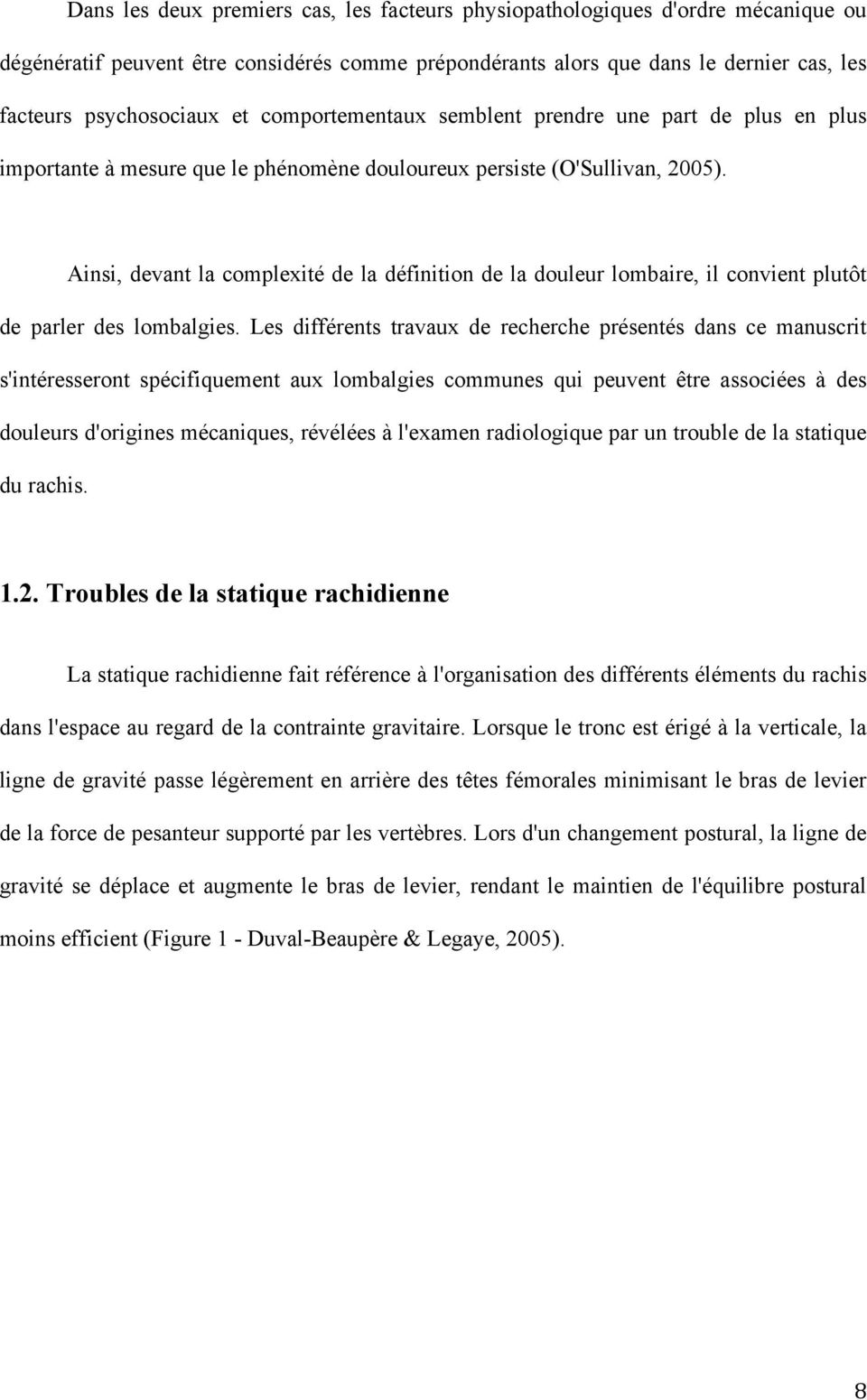
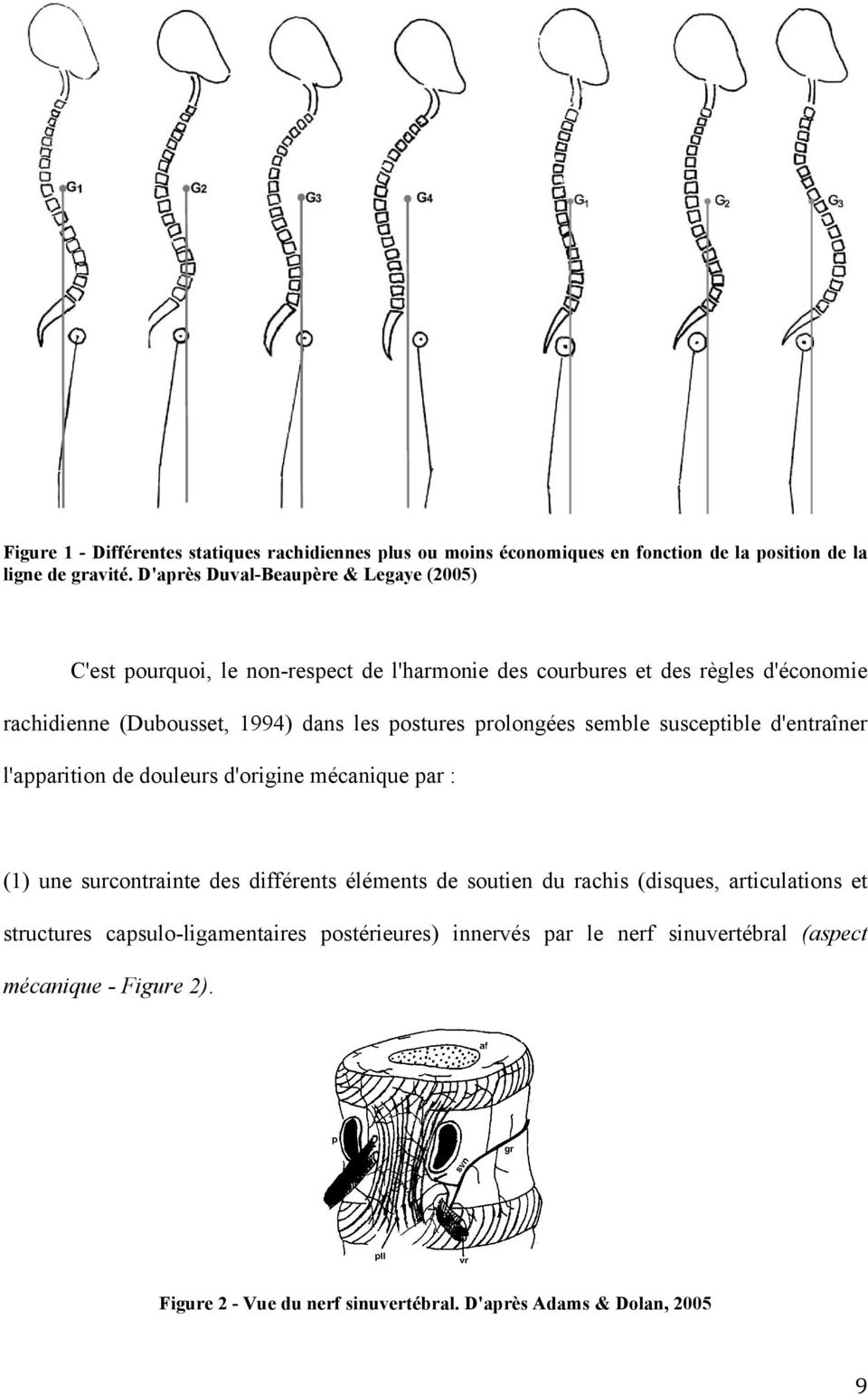
8 Dans les deux premiers cas, les facteurs physiopathologiques d'ordre mécanique ou dégénératif peuvent être considérés comme prépondérants alors que dans le dernier cas, les facteurs psychosociaux et comportementaux semblent prendre une part de plus en plus importante à mesure que le phénomène douloureux persiste (O'Sullivan, 2005). Ainsi, devant la complexité de la définition de la douleur lombaire, il convient plutôt de parler des lombalgies. Les différents travaux de recherche présentés dans ce manuscrit s'intéresseront spécifiquement aux lombalgies communes qui peuvent être associées à des douleurs d'origines mécaniques, révélées à l'examen radiologique par un trouble de la statique du rachis Troubles de la statique rachidienne La statique rachidienne fait référence à l'organisation des différents éléments du rachis dans l'espace au regard de la contrainte gravitaire. Lorsque le tronc est érigé à la verticale, la ligne de gravité passe légèrement en arrière des têtes fémorales minimisant le bras de levier de la force de pesanteur supporté par les vertèbres. Lors d'un changement postural, la ligne de gravité se déplace et augmente le bras de levier, rendant le maintien de l'équilibre postural moins efficient (Figure 1 - Duval-Beaupère & Legaye, 2005). 8
9 G. Duval-Beaupère, J. Legaye / Revue du Rhumatisme 71 (2004) Fig. 15. Chez un sujet porteur d une incidence de 54 : causes de détérioration d une 1 - situation Différentes primitivestatiques économique rachidiennes : plus ou moins économiques en fonction de la position de la Figure Fig. 16. Chez un sujet porteur d une incidence de 30, les difficultés pour ligne G1. Situation de gravité. économique D'après : les Duval-Beaupère paramètres pelviens & et Legaye rachidiens (2005) sont maintenir une situation économique. correctement coordonnés. Pente sacrée 41, lordose 61, cyphose 45. La G1. Pour cette valeur d incidence, le plateau sacré se place au-dessus, voir ligne de gravité est relativement proche en avant du rachis thoracique et ne en avant du centre des têtes fémorales, version pelvienne et porte à faux sont demande qu un effort modéré des spinaux ; elle passe derrière le rachis obligatoirement négatifs. Bien que les paramètres pelviens et rachidiens lombaire, à ce niveau, l équilibre est assuré par la pression abdominale ; la soient bien coordonnés, pente sacrée 35, lordose 59, la gravité est favorablecourbures pour rachiset lombaire gravité passe C'est enfinpourquoi, derrière les têtes le fémorales non-respect où l équilibre de est l'harmonie assuré par le des des règles puisque d'économie postérieure, mais défavorable pour ligament de Bertin. ARTICLE IN PRESS G2. Situation moins économique car le sujet a aggravé sa cyphose qui atteint 60, les autres (Sambrook paramètres et al., 1999) as well sont as much restés of theinchangés. resulting L effort demandé aux spinaux thoraciques pain (MacGregor augmente et al., 2004), en raison and psychosocial de l avancée relative de la gravité, characteristics dominate all aspects of back pain au niveau lombaire la situation est moins favorable, au niveau fémoral enfin la gravité tend and that à excessive passermechanical en avant loading duremains centreonedes of têtes fémorales ce qui peut the most important and preventable causes of spinal nécessiter le degeneration recours andà pain. une activité musculaire des extenseurs de hanche. G3. Tentative de correction par rétroversion pelvienne : la pente sacrée passe à 29, le porte 2. Current à faux trends augmente, in spine research la lordose diminue 47. La gravité a bien été ramenée au-dessus du centre des têtes fémorales, ce qui est plus favorable à ce niveau, enmost revanche, spinal tissues laare diminution anatomically capable de la of giving lordose crée une avancée relative du rachis thoracique rise to pain, but avec it has déplacement long been suspectedcorrespondant that severe de la gravité locale, et de ce fait la situation devient défavorable au niveau lombaire. L équilibration locale nécessite l activité des spinaux lombaires, ce qui accroît les forces de compression discales et articulaires. G4. Le sujet fléchit les genoux cela entraîne une rétroversion supplémentaire behaviour (Waddell, 1998). However, the evidence l'apparition summarised de below douleurs suggests that thisd'origine an over-reaction, mécanique par : 2.1. Back pain is associated with spinal degeneration that a full symptomatic pain response can often be (1) une surcontrainte des différents éléments de soutien du rachis (disques, articulations et structures capsulo-ligamentaires postérieures) innervés par le nerf sinuvertébral (aspect mécanique - Figure 2). rachidienne largely determines (Dubousset, intervertebral disc1994) degenerationdans and chronic les backpostures pain often arises fromprolongées the interverteb- semble susceptible d'entraîner ral discs (Fig. 1). The posterior longitudinal ligament and peripheral annulus fibrosus contain nerve endings from the sinuvertebral nerve (Bogduk, 1997; Groen et al., 1990) (Fig. 2). In severely degenerated and painful discs, nerves and accompanying capillaries can grow right into the centre of the nucleus pulposus (Coppes et al., 1997; Freemont et al., 1997), possibly because such discs have lost the high hydrostatic pressure which normally characterises their central regions (Adams et al., 1996b). The sinuvertebral nerve contains both somatic and sympathetic fibres, and any tissue innervated by it could theoretically be a direct source of pain. Pain-provocation studies on sedated patients confirm reproduced by relatively gentle probing of the posterior annulus (Kuslich et al., 1991). Similar techniques have avec les conséquences évoquée ci-dessus. La pente sacrée passe à 15, le porte à faux augmente encore ce qui assure l économie de l équilibre du tronc sur les fémurs, mais cela se fait au prix d une situation très défavorable au niveau rachidien. En effet la lordose est passée à 32 ce qui propulse en avant le rachis thoracique et la position relative de la gravité ce qui impose des efforts d équilibration de la musculature spinale, source de fatigue, de douleur et de compression discale et articulaire. Note : ce sujet pouvait tenter d augmenter sa lordose en accentuant l antéversion pelvienne. La diminution du porte à faux qui en serait la conséquence engendrerait une situation analogue à celle décrite pour l étape G2 de l observation de la Fig. 16. l équilibre du tronc sur les fémurs, puisque antérieure au centre des têtes fémorales. L équilibre est très instable et favorise la constitution d une rétraction des muscles fléchisseurs de hanche qui ne peut qu aggraver la situation, c est la phase G2. G2. L antéversion a augmenté : la pente sacrée atteint 45, la lordose s accentue en conséquence 70, la situation reste favorable au niveau lombaire mais de plus en plus défavorable au niveau fémoral. La rétraction des fléchisseur ne fait que s accentuer. G3. Pente sacrée et lordose augmentent encore, respectivement 55 et 75, la courbure lordotique envahit le rachis thoracique, la cyphose diminue, la gravité recule par rapport au rachis. Au niveau lombaire l équilibre est dépendant de la qualité des abdominaux, les forces de compression et de cisaillement augmentent au niveau des articulaires. Le rachis devient douloureux et l équilibre au niveau fémoral de plus en plus mauvais, périlleux et fatigant. G2 bis. Autre alternative : la flexion des genoux. Celle-ci induit une rétroversion pelvienne, version pelvienne et porte à faux deviennent nuls, voire positifs. La lordose et pente sacrée diminuent de paire, ici respectivement 37 et 20. La gravité reste très proche du rachis et postérieure aux têtes fémorales. Le sujet trouve cette situation moins fatigante. même type, dans la perspective d une meilleure connaissance des pathologies que cette position contribue à engendrer lorsqu elle est maintenue de façon prolongée. jacents. On peut en attendre la confirmation de chaînes de Références relations qui contribuent, dans l équilibre et dans la marche, à modeler Fig. notre 1. Intervertebral squelette discs are pads of etcartilage à en whichdisposer distribute Fig. les 2. Posterior différents view of the lumbarseg- ments [51]. tough concentric La lamellae position Figure spine, with the neural arch [1] Staffel F. Die Menschlichen Haltungstypen und ihre Beziehungen zu compressive loading evenly on the vertebral bodies (vb). The soft removed at the pedicles (p). The sinuvertebral nerve (svn) contains central region of a disc, the nucleus pulposus (np) constrained by the fibres from the grey rami communicantes (gr) of the sympathetic of the annulus fibrosus assise 2 -(af). Vue Thejustifierait fluid nature du nerf nervoussinuvertébral. une system andapproche from the ventral rami (vr) de D'après of the somatic nervous Adams den Rückgratsver- & Dolan, 2005 krümmungen. Wiesbaden of the nucleus ensures that compressive loading applied to a disc generates a tensile hoop stress (T) in the annulus. Discs are protected from bending and shear by the apophyseal joints (aj). M.A. Adams, P. Dolan / Journal of Biomechanics 38 (2005) system. The svn forms a plexus within the posterior longitudinal ligament (pll) from which it enters the posterior annulus fibrosus (af) of the intervertebral disc. (Adapted from Bogduk (1994).) 9
10 liser la configuration géométrique du rachis suivant une orientation crânio-caudale en plus des classiques clichés frontal et latéral. L ensemble de ces intuitions incitent Dubousset [1994] à introduire le concept du cône d économie, en représentant l ensemble du corps humain à l intérieur d un cône inversé dont la pointe est située sur la projection du centre de gravité du corps sur le (2) sol (Figure une augmentation 1.11). Plus des sollicitations le diamètre de articulaires base duet cône musculaires (situé auqui niveau tendent la à maintenir tête) est important, plus les muscles doivent exercer d effort pour maintenir le corps en position l'équilibre érigée. postural rachidien (aspect postural - Figure 3). pastel , version 1-7 Dec 2011 Figure 1.11 Illustration du concept de cône d économie [Dubousset, 1994]. Figure 3 - Illustration du concept de cône d économie (Dubousset, 1994). Plus le diamètre de la base du cône (situé au niveau de la tête) est important, plus les muscles doivent exercer un effort pour maintenir le corps en position érigée. En particulier, les déformations rachidiennes sont des pathologies dans lesquelles la correction du déséquilibre postural peut être l objectif d un traitement chirurgical [Glassman et coll., 2005a]. On distingue classiquement les scolioses (déformations tridimensionnelles) L'examen des radiographique déséquilibres de purement différents sagittaux. profils Cependant, rachidiens d autres asymptomatiques pathologies et prises en charge quotidiennement dans les services d orthopédie rachidienne pourraient symptomatiques semble confirmer le rôle prédisposant chez certains patients (63%) d'un être mieux comprises à l aide des outils de l analyse posturale globale. trouble de la statique et notamment d'un faible angle de lordose lombaire et d'incidence Déformations tridimensionnelles pelvienne (Barrey et al., 2007; Chaléat-Valayer et al., 2011). Le terme de scoliose recouvre l ensemble des déformations tridimensionnelles de la colonne vertébrale, quelle qu en soit l étiologie. Ces déformations sont usuellement diagnostiquées sur les radiographies frontales puisqu elles affectent de fait le plan coronal 1.3. bienle quetraitement l intérêt d unconservateur diagnostic en trois par dimension orthèse lombaire ait été souligné par certains auteurs [Graf et coll., 1983]. Les orthèses lombaires (OL) font partie du large éventail d'options thérapeutiques proposées dans le traitement conservateur des lombalgies avec OL prescrites chaque année en France. Intégrées aux dispositifs médicaux de classe II, les OL (corsets ou ceintures) peuvent être classées selon leur rigidité (souple, semi-rigide et rigide) et selon leurs modes de fabrication (de série ou sur mesure). Une ceinture lombaire désigne généralement une orthèse souple de série alors qu'un corset désigne une orthèse rigide sur mesure. En pratique, plus la 10
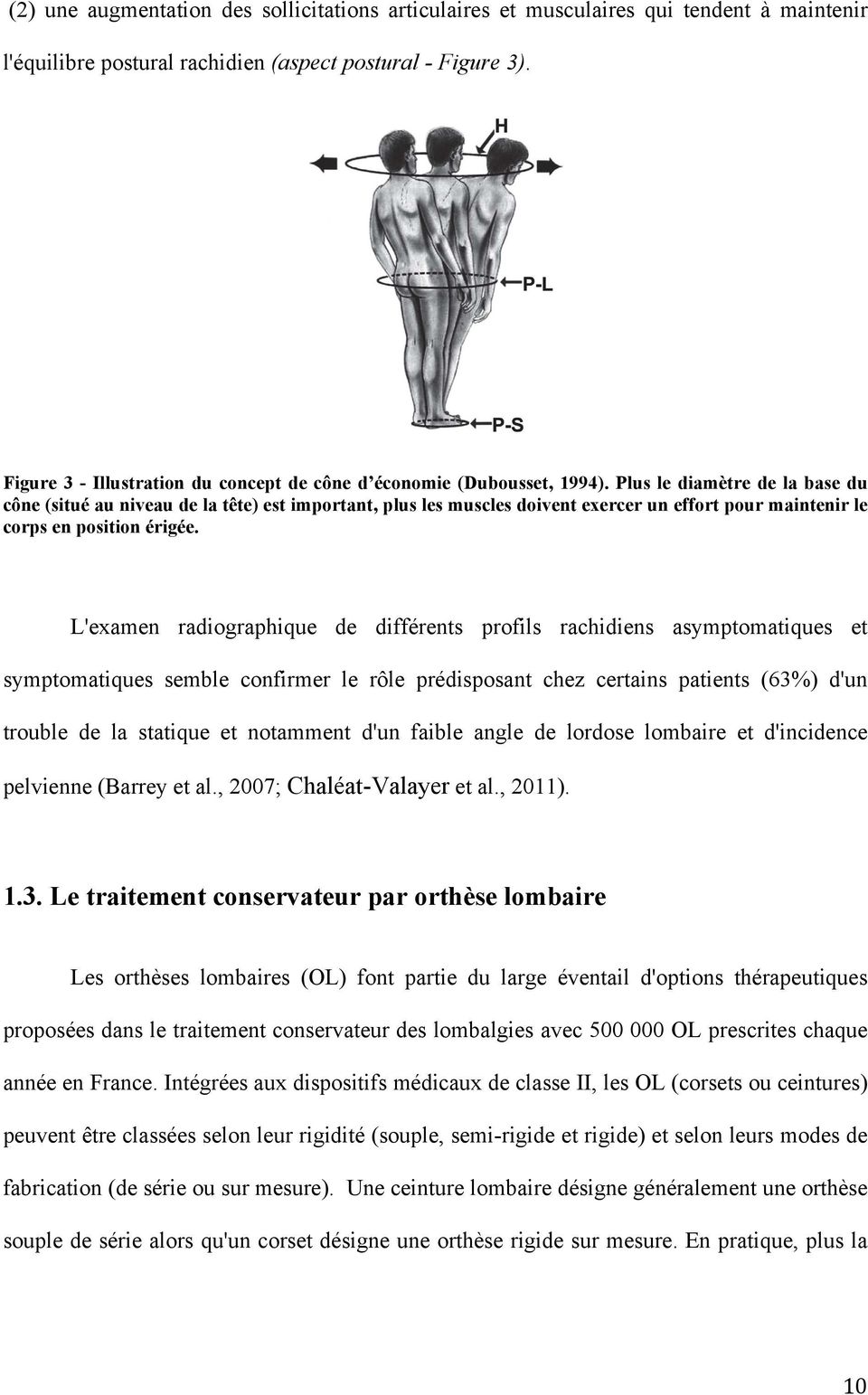
11 liser la configuration géométrique du rachis suivant une orientation crânio-caudale en plus des classiques clichés frontal et latéral. L ensemble de ces intuitions incitent Dubousset [1994] à introduire le concept du cône d économie, en représentant l ensemble du corps humain à l intérieur d un cône inversé dont la pointe est située sur la projection du centre de gravité du corps sur le (2) sol (Figure une augmentation 1.11). Plus des sollicitations le diamètre de articulaires base duet cône musculaires (situé auqui niveau tendent la à maintenir tête) est important, plus les muscles doivent exercer d effort pour maintenir le corps en position l'équilibre érigée. postural rachidien (aspect postural - Figure 3). pastel , version 1-7 Dec 2011 Figure 1.11 Illustration du concept de cône d économie [Dubousset, 1994]. Figure 3 - Illustration du concept de cône d économie (Dubousset, 1994). Plus le diamètre de la base du cône (situé au niveau de la tête) est important, plus les muscles doivent exercer un effort pour maintenir le corps en position érigée. En particulier, les déformations rachidiennes sont des pathologies dans lesquelles la correction du déséquilibre postural peut être l objectif d un traitement chirurgical [Glassman et coll., 2005a]. On distingue classiquement les scolioses (déformations tridimensionnelles) L'examen des radiographique déséquilibres de purement différents sagittaux. profils Cependant, rachidiens d autres asymptomatiques pathologies et prises en charge quotidiennement dans les services d orthopédie rachidienne pourraient symptomatiques semble confirmer le rôle prédisposant chez certains patients (63%) d'un être mieux comprises à l aide des outils de l analyse posturale globale. trouble de la statique et notamment d'un faible angle de lordose lombaire et d'incidence Déformations tridimensionnelles pelvienne (Barrey et al., 2007; Chaléat-Valayer et al., 2011). Le terme de scoliose recouvre l ensemble des déformations tridimensionnelles de la colonne vertébrale, quelle qu en soit l étiologie. Ces déformations sont usuellement diagnostiquées sur les radiographies frontales puisqu elles affectent de fait le plan coronal 1.3. bienle quetraitement l intérêt d unconservateur diagnostic en trois par dimension orthèse lombaire ait été souligné par certains auteurs [Graf et coll., 1983]. Les orthèses lombaires (OL) font partie -14-du large éventail d'options thérapeutiques proposées dans le traitement conservateur des lombalgies avec OL prescrites chaque année en France. Intégrées aux dispositifs médicaux de classe II, les OL (corsets ou ceintures) peuvent être classées selon leur rigidité (souple, semi-rigide et rigide) et selon leurs modes de fabrication (de série ou sur mesure). Une ceinture lombaire désigne généralement une orthèse souple de série alors qu'un corset désigne une orthèse rigide sur mesure. En pratique, plus la $@

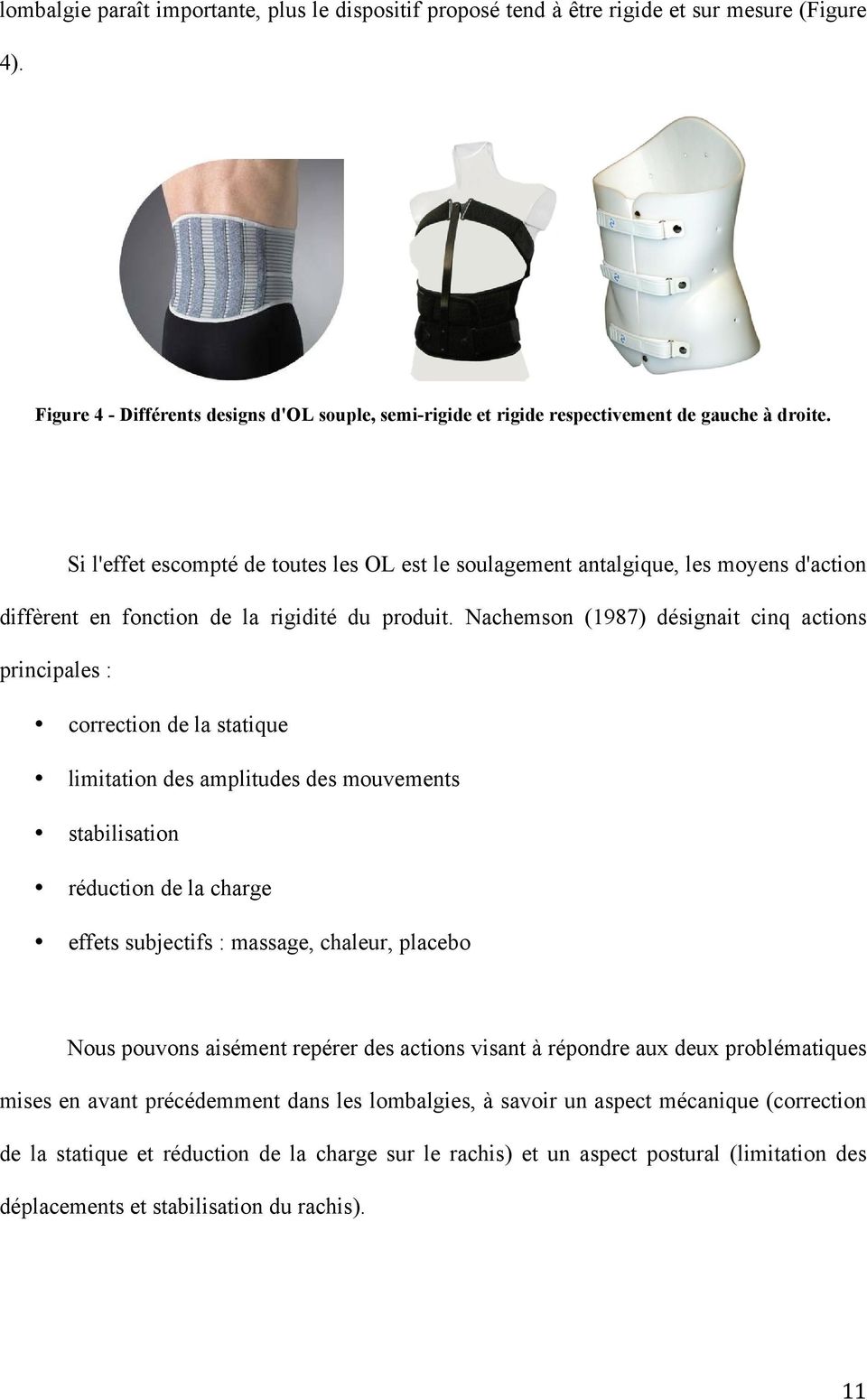
12 lombalgie paraît importante, plus le dispositif proposé tend à être rigide et sur mesure (Figure 4). Figure 4 - Différents designs d'ol souple, semi-rigide et rigide respectivement de gauche à droite. Si l'effet escompté de toutes les OL est le soulagement antalgique, les moyens d'action diffèrent en fonction de la rigidité du produit. Nachemson (1987) désignait cinq actions principales : correction de la statique limitation des amplitudes des mouvements stabilisation réduction de la charge effets subjectifs : massage, chaleur, placebo Nous pouvons aisément repérer des actions visant à répondre aux deux problématiques mises en avant précédemment dans les lombalgies, à savoir un aspect mécanique (correction de la statique et réduction de la charge sur le rachis) et un aspect postural (limitation des déplacements et stabilisation du rachis). 11
13 2. Revue de littérature : les lombalgies et le traitement conservateur par orthèse lombaire Dans sa dernière revue de littérature, la Cochrane (2008) a mis en évidence des résultats contradictoires sur l'efficacité des orthèses lombaires en comparaison à d'autres traitements pour les lombalgies aigües, subaigües et chroniques. Le faible nombre d'études de haut niveau méthodologique (randomisation, groupe contrôle et contrôle de la durée du port), et la grande disparité des OL, rendent difficile l'évaluation objective de l'efficacité clinique. Néanmoins, même si une réduction de l'algie reste incertaine au regard de la littérature, une amélioration de l'état fonctionnel des patients semble plus établie (Tableau 1). OL vs aucun traitement ü Les OL ne semblent pas plus efficaces que l'absence d'intervention pour la réduction de la douleur à court terme (1170 patients) mais efficaces pour l'amélioration de l'état fonctionnel (410 patients). OL vs autres traitements ü Les OL ne sont pas plus efficaces que d'autres traitements pour la réduction de la douleur et l'état fonctionnel (164 patients). Coxhead 1981; Doran 1975; Hsieh 1992; Valle-Jones 1992; Dalichau 2000 OL comme traitement complémentaire ü Les OL, comme complément à un programme de renforcement musculaire, sont plus efficaces à court et long terme sur la réduction de la douleur et l'amélioration de l'état fonctionnel (63 patients). Tableau 1 - Conclusion de la revue de littérature de la Cochrane (2008) 12

14 Plus récemment, une nouvelle étude clinique, plus rigoureuse sur le plan méthodologique (en ouvert, multicentrique et randomisée sur une large population de 197 patients), a montré un effet bénéfique d'une OL souple en traitement complémentaire de la lombalgie subaiguë après 90 jours de port (Calmels et al., 2009). Dans cette étude, les patients lombalgiques portant l'ol se caractérisaient par une amélioration de l'état fonctionnel, une réduction de la douleur et une consommation moindre de médicaments par rapport au groupe contrôle ne portant pas d'ol. S'il paraît essentiel d'établir l'efficacité clinique du traitement par OL, l'évaluation des causes mécaniques et posturales pouvant en être à l'origine est tout aussi nécessaire. Il est actuellement difficile d'établir des distinctions entre les différents modèles d'ol. Une meilleure connaissance dans ce domaine permettrait de définir l'efficacité mécanique et 1078 ALF NACHEMSON AN) J. M. MORRIS posturale des différents dispositifs dans le but d'adapter le produit à la spécificité des patients, améliorant en retour le résultat clinique Aspect mécanique L'aspect mécanique de la lombalgie et l'effet possible d'une OL restent très peu étudiés et restreints à un nombre réduit de patients à cause de difficultés d'ordre méthodologique. En effet, il n'existe actuellement aucune méthode non invasive de mesure des contraintes discales (Figure 5). FIG. 2 Discometry needle being inserted into (usc. Note snlall surveyor s level on mecilanoelectrical transducer for checking of horizontal l)osition of the transducer ALF NACHEMSON AN) J. M. MORRIS FIG. 2 Note FIG. 3 Discometry needle being inserted into (usc. snlall surveyor s level on mecilanoelectrical transducer checking of horizontal l)osition of the transducer. for Figure 5 - Méthode invasive nécessitant l'insertion d'un capteur. D'après Nachemson et al. (1964). Position of discometrv needle in the Ilucleus pull)osus, as ( olifirmed by anteroposterior and lateral roentgenogranls. 110W the caii be influeiiced ; the Ineasuremeilt of inti adiscal pi essures in i u o is therefore of special intei est. Methods and Materials 13 FIG. 3 pull)osus, Position of discometrv needle in the Ilucleus as ( olifirmed by anteroposterior and lateral roentgenogranls. rue iii rico intradiscal pressures or sti csses were meastired by a specially collstrtict.e(1 Ileedic w ith a pressure-sensitive polyetllyleile Inemi)i aile at its tip. Tile

15 Néanmoins, les rares études in vivo réalisées ont offert un nouvel éclairage sur la part mécanique des lombalgies. McNally et al., (1996) ont mis en évidence une corrélation entre une contrainte excessive continue de la partie postérieure du disque intervertébral innervé par le nerf sinuovertébral et l'apparition de la douleur. Dans cette étude in vivo, une aiguille miniaturisée munie de capteurs sensibles à la pression hydrostatique a été insérée le long de chaque disque lombaire (Figure 5). Les disques ont été ensuite soumis à une injection intradiscale d'un fluide de manière à augmenter la pression. Les résultats ont montré que les disques douloureux possédaient une contrainte mécanique significativement supérieure de 38% (p<0.023) et de 63% (p<0.017) respectivement pour les parties postérieures de l'annulus et du nucleus. Ainsi, l'apparition de douleurs mécaniques pourrait s'expliquer par deux phénomènes participant à augmenter les contraintes axiales et de cisaillement : l'augmentation de l'activité musculaire posturale et/ou une modification de la répartition de la charge Augmentation/réduction de l'activité musculaire posturale Pathologie De nombreuses études ont mis en évidence chez le lombalgique une stratégie posturale visant à augmenter la raideur du tronc par une augmentation de 50% en position érigée (Figure 6) des cocontractions en comparaison aux sujets sains (Cholewicki et al., 1997; Hodges et al., 2006). Dès lors, ce régime en cocontraction a été suspecté d'engendrer une augmentation de la charge sur le rachis et une douleur mécanique. Cependant, Granata et al. (2000) ont établi, à l'aide d'un modèle mathématique contrôlé par des mesures EMG, que cette suractivité musculaire ne représentait seulement qu'une augmentation de 4% de la compression axiale, bien en deçà des valeurs de 38% et 63% retrouvées par McNally et al. (1996) pour engendrer l'apparition de douleurs d'origine discale. 14

16 Figure 6 - Cocontractions des muscles du tronc lors d'une flexion extension chez des sujets sains et lombalgiques. D'après Cholewicki et al., (1997). Contention À l'aide de la même méthode invasive, Nachemson et al. (1983) et Cholewicki et al (2010) n ont retrouvé aucun effet significatif au niveau L4/L5 avec différentes OL malgré une augmentation significative de la raideur et une diminution significative de l'activité musculaire. Ainsi, une modification de l'activité musculaire posturale induite par la pathologie ou la contention n'apparait pas susceptible d'engendrer un changement significatif de la charge axiale s'appliquant sur le rachis. 15

17 Pathologie Modification de la répartition de la charge et des forces de cisaillement shown that the apophyseal joints (Schwarzer et al., 1994) and sacroiliac joints (Schwarzer et al., 1995) are also frequent sites of severe back pain. Radiating buttock and leg pain arise primarily from lumbar nerve roots (Kuslich et al., 1991). Medical imaging studies demonstrate highly significant but variable links between back pain and spinal degeneration. We suggest that the word degeneration implies structural as well as cell-mediated changes in tissues, and that it represents some mechanical or nutritional insult superimposed on the normal ageing process. Ageing causes inevitable changes in the appearance and composition of spinal tissues, but these En revanche, un arechangement largely unrelated de la tostatique pain (Boden rachidienne et al., 1990). pourrait On the avoir un impact bien other hand, structural degenerative changes such as Schmorl s nodes, internal disruption of intervertebral discs, and disc prolapse are closely associated with pain (Hamanishi et al., 1994; Siivola et al., 2002; Videman et al., 2003). Even so, structural degenerative changes can be found in asymptomatic spines, suggesting that pain plus important sur la répartition et le niveau de contrainte des différents éléments supportant le rachis. En position neutre, la charge se répartit pour 92% sur le disque intervertébral et pour 8% sur les articulaires perception postérieures requires(adams additional and cell-mediated Dolan, 2005). changeslors d'une extension (augmentation de la lordose), la contrainte sur le disque intervertébral se décharge progressivement sur les articulaires postérieures (jusqu'à 40%) alors que lors d'une flexion Injuries can occur when normal f abnormally weak tissues, or whe degeneration (Sambrook et al., 199 known to be involved affect the bi tion and strength of skeletal tissues for collagen Type IX (Paassilta et a conceivably affect strength by infl spinal structures, or the mechanis control the balance between anab tissue) and catabolism (breaking it d changes in ageing cartilage include increased cross-linking between fibr increases tissue stiffness. Non-enzym ( pain-sensitisation ) in the disturbed tissues (Olmarker forces are applied to normal tiss et al., 2003). Another factor contributing to variable studies report a very wide variation links between spinal degeneration and pain is stressshielding: for example, the compressive strengt by definition, damaged tissues resist loading segments varies between 2 and 14 less, and so tend to be protected by adjacent healthy 2002). Much of this variability tissue. A good example of this is the large shift in load- attributed to genes, because epidem identical twins have shown that following disc injury or degeneration (Fig. 3). explains 70% of the variance in cans (Kawaguchi et al., 1999), and lism (Videman et al., 2001). O Ageing also weakens spinal ti and loss of proteoglycans (Bayliss reduces the tissue s water-bindin cially the collagens (Duance et cross-linking between collagens and Figure 7 - Répartition de la charge sur le rachis lors d'une extension (diminution de la lordose) bearing le disque from the récupère intervertebral 100% disc de la tocharge the neural (Figure arch7). Dans ce contexte, the vertebral la body. pression However, intradiscale severe degeneration devrait (right) diminuer causes linéairement avec l'extension du rachis. Or, force est de constater que les mesures in vivo (Nachemson, 1963; Anderson, 1974; Wilke et al., 1999) invalident cette hypothèse en mettant en évidence une évolution de la pression intradiscale selon une courbe en U (Figure 8). Psychosocial factors such as dep are strong predictors of all asp behaviour, including the decision time off work, and to respond (or (Waddell, 1998). However, there evidence that psychosocial factors the first place. Indeed, prospective they predict only 1 3% of future fi and that they tend to predict trivial pain (Mannion et al., 1996). A leadin pain has commented: The bala research has perhaps swung too psychosocial issues, to the neglect Hopefully, the pendulum will swi 1998) Genetic inheritance, ageing, and make spinal tissues vulnerable to inju Fig. 3. Load sharing in the lumbar spine is affected by intervertebral disc degeneration. When the disc is normal (left), the neural arch resists only 8% of the applied compressive force, and the remainder is distributed fairly evenly between the anterior and posterior halves of the neural arch to resist 40% of the applied compressive force, whereas the anterior vertebral body resists only 19%. Data from cadaveric lumbar motion segments loaded at 2 kn in the simulated erect standing posture following a period of compressive creep loading (Pollintine et al., 2004a). reduces energy to fracture, leaving c more susceptible to injury (DeG Biochemical deterioration of cartila by an age-related fall in cell density, being less responsive to their mech In intervertebral discs, these cha attributable to problems of metabol the avascular matrix (Horner a Impaired cell function would ma 16
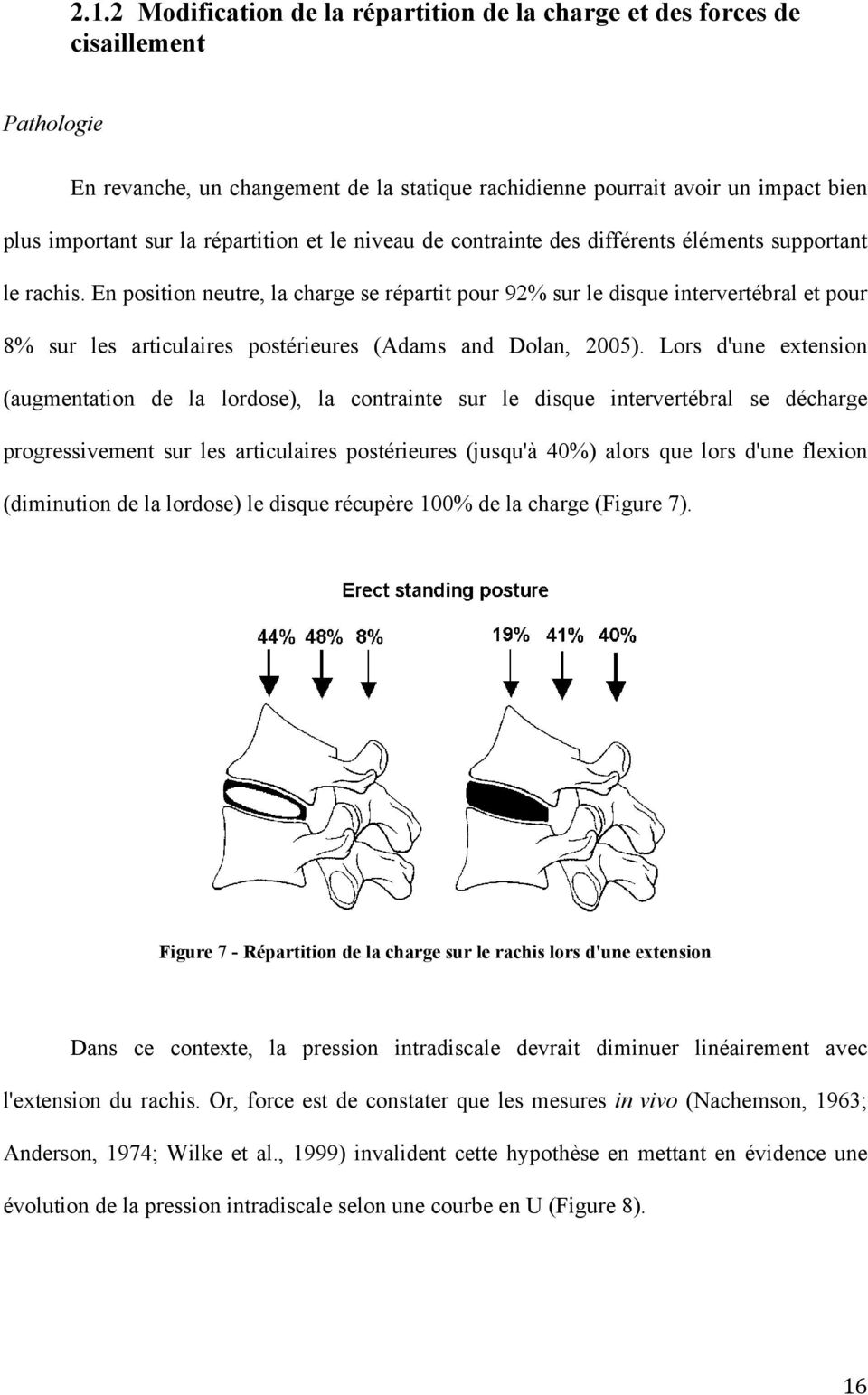
18 THE LUMBAR INTRADISCAL PRESSCRE 199 Increase in \I/ - intradiscal pressure kp/cm' t i2 / + 5" 0-5" (forward (backward) Angle of tilt Fig. 9. Figure 8 - En haut, graphique représentant l'évolution de la pression lors d'une flexion-extension du rachis. Notons l'augmentation de la charge lors de l'extension (à droite) malgré la décharge sur les articulaires postérieures. D'après Nachemson, and forward tilt. C - increase noted by about 8" backward tilt. Relation between tilt and increase in intradiscal pressure. 0 = non-tilted isolated disc-specimen. A - zero position in situ. B and F = increase noted by 5" backward Thus it Ce can phénomène be expected s'explique that par a la non-linéarité tilt of more entre than l'expansion 5" may latérale lead du disque to an appreciably larger increase in intradiscal pressure, a fact which is also intervertébral et la diminution de la distance verticale liée à la compression lors d'une forte supported by results obtained with the specimens shown in Table 6, where extension there (Figure has 9 been - Nachemson, a backward 1963). tilt of about 8". The surfaces of the cut vertebrae in these specimens were already in the unloaded position at a 3" forward angle to each other. With the brass plate in the 5" backward tilt position this means a backward tilt of about 8" in these cases. According to these results the increase following from 8" backward tilt will be 1.5 kpjcm.2. The increase from 5" to 8" of backward tilting will thus raise the change in intradiscal pressure more than 100%. When tilting 5' forward from the "in situ" position (Table 6. Forward tilt), no change in intradiscal pressure was seen. The explanation for this follows immediately when looking at Fig. 9. In this case the movement starts at the point A and Fig. stops 7. in the middle between 0 and F. Figure 9 - Coupes sagittales du rachis. Lors de l'extension, la compression axiale n'est pas intégralement compensée par l'expansion latérale (B1 + B2 < A1 + A2), ce qui entraîne une augmentation de la pression intradiscale. D'après Nachemson, lt (If 5" It in has a vertically earlier been loaded shown isolated that the tliw vertical specimen stress will in the result annulus in a is tendene ening comparatively of 'the hpacc small occupied on vertical loading, owing to the relatively high hy the nucleus pulposus and thus to an increas pressure in the nucleus pulposus. The tangential stress, however, is thc intradiscal pressure. rather high and it has been calculated to exceed the total load per unit of area 3-5 times at least in the dorsal part of the annulus (Nachemson 1960). Tw h n ical corn m en t 17 The increase in intradiscal pressure resulting from tilt will thus the Fig. increase 7 the this area B1 tangential is 10 stress 5'~ larger even more. than The the relationship area A,. whc.reas between the the area I3

19 Ces aspects mécaniques impliquent qu'une modification de l'orientation relative des vertèbres a un impact significatif sur les variations de la pression intradiscale avec des valeurs pouvant aller jusqu'à 150% à mesure que l'on s'éloigne de la statique rachidienne optimale. Ce stress continu est to susceptible differ (Cilart à III). lui seul In Case d'engendrer 5, the fusion des seemed douleurs to et relieve d'altérer proportionately à long terme c la structure discale (Adams & Dolan, 2005). Contention À cause du côté particulièrement invasif de la mesure, une seule étude a été réalisée lors du port d'une orthèse (Figure 10) mettant en évidence, chez quatre patients au ;. niveau L3/L4, une réduction de 25% de la pression _ T-,Sttllhies of Partially Fused Spines intradiscale (Nachemson et al., 1963). Cependant, comme la FIG. 5 statique rachidienne Fig. n'a 5: Position pas été in contrôlée, which pressures il est wereimpossible measured inflatable ( orset measured. d'attribuer avec certitude cette diminution à un changement de posture. Néanmoins, la consigne donnée aux patients de gonfler l'ol à la limite du supportable le laisse supposer. MEASUREMENTS OF INTIIAI)ISCAL I RESSURE 1087 Measurememits were made in tile llol Iflal fourth lumbar discs of two sui)jects who had previously had posterior fusions extending from the fourth lumi)ar vertebi a to tile saci um. Results are given in riables II and III and Charts I, II, and III. In i)otil sui)jects the total load on tile disc was less than the calculated load for a subject w-itil tile same is-eight and w-ithout fusion (Chart II). Wilell au additional load was applied to these subjects in the sitting position, the reactions wei e found stress at increasing loads. In Case 1 1, increase of the ]oad caused a disproportionate increase ill pressure and total load OIl the disc. rfhe difference bet.w-een these two subjects was that in Case 5 tile postel iol fusion had healed successfully, as verified both by bending roentgenograms aild at reoperation (although the patient still had pails), whereas ill Case 1 1 tile roentgenograms showed definite pseuclai throsis between the fourth aild fifth lumbar vertebrae. with the patient reclining. Note backward tilt. Fig. 6: Position an(l means by which the effect of the Synthèse aspect mécanique discogl aphically normal. Au regard de la littérature, il apparaît que la contention ne semble pas à même de réduire significativement la pression intradiscale. En revanche, les OL pourraient réduire la charge sur le rachis lors d'un changement de posture adéquat. Cette hypothèse, bien que répandue VOL. 46-A, NO. 5, JIJI.Y 1964 dans la pratique du traitement conservateur, n'a jusqu'à présent jamais été démontrée, principalement pour des raisons d'ordre méthodologique (évaluation invasive).,. III Figure 10 - Orthèse lombaire gonflable utilisée par Nachemson MeasurenlelIts were also made in Case 5 with the subject in the reclining et al., 1963). posit ion (Table V), and in Case 1 1 at operation (anterior disc fusion, Table II). Discussion To determniiie the validity of the method used, possible soui ces of eri or wei e subjected to analysis. In earlier studies on autopsy specimens it was found that the total erm or of the method is approximately 3 per cent. An added source of error ill the present study was warming of the needle. This was estimated to add allother 3 per cent of error. Thus it can be said that the measuremellts show- a fairly high rate of accuracy. The subjects 011 w-hom measurements w-ere made had all experienced i)ack pain to some degree. Tile discs examined, however, w-ere all roentgenographically and It. has been demonstrated that pressure in a normal disc, with tile subject in a sitting position, seems to be dependent on the surface area of tile disc and tile part of the body weight above the actual level of the disc being examined. An appm oximate mathematical formula pertinent to this was evolved (Equation 5) 18

20 2.2. Aspect contrôle postural En complément de considérations purement mécaniques sur la statique rachidienne, les lombalgies nécessitent aussi d'être abordées du point de vue du contrôle postural, c'est à dire de la capacité à minimiser les déplacements du rachis au cours des différentes postures quotidiennes (stations assise et debout). Parce que l homme évolue dans un environnement gravitaire, il subit une force verticale dirigée du haut vers le bas sur le centre de gravité (CG), autrement dit sur le barycentre des centres de masse des différents segments qui le composent. Sa capacité à demeurer en position érigée s explique par l opposition à cette accélération gravitaire obtenue par la production de forces de réaction au niveau des appuis, résultant d activités neuromusculaires (Figure 11). Figure 11 - Déplacements du centre des pressions (en bleu) et du centre de gravité (en rouge). D après Rougier et al. (2001). 19

21 Généralement, il est commode de considérer l ensemble de ces forces de réaction au travers d une force résultante dont le point d application est nommé Centre des Pressions (CP). Dans ce contexte, le contrôle postural du tronc joue un rôle primordial en maintenant l'alignement segmentaire de l'ensemble du corps permettant d'assimiler le maintien de l'équilibre en station debout et assise à un simple pendule inversé oscillant respectivement autour de l'articulation de la cheville et la hanche. Ne pouvant maintenir un équilibre parfait du fait de l'inconstance de la force contractile et des perturbations liées à l'activité cardiorespiratoire, l être humain est amené à développer des stratégies de contrôle permanentes consistant : à détecter le plus précisément possible les mouvements du corps par l intermédiaire des systèmes sensoriels (visuel, vestibulaire, tactile et proprioceptif). à intégrer ces informations à développer des stratégies motrices de grande précision pour contrôler les mouvements du CG. Plusieurs facteurs associés à la lombalgie sont susceptibles d'interférer avec les mécanismes du contrôle postural du tronc (afférent, efférent et d'intégration) nécessitant en retour une modification des stratégies du contrôle postural de l'ensemble du corps. La contention et la raideur apportées par les OL pourraient résorber une partie de ces déficits Atteintes du système afférent Pathologie En premier lieu, les lombalgiques se caractérisent par une dégradation de la perception de leur tronc dans l'espace (proprioception) comme l'ont constaté Brumagne et al. (2000) lors de tâches de repositionnements du tronc les yeux fermés. Cette imprécision serait 20
22 principalement due à la douleur qui perturberait les messages afférents issus des fuseaux neuromusculaires des muscles spinaux (Figure 12). Ces informations imprécises et/ou contradictoires rendraient plus complexe l'intégration de l'information et nécessiteraient en retour un temps de correction plus important (Radebold et al., 2001). Figure 12 - Illustration muscles spinaux Contention La contention réalisée à l'aide d'un tissu semble compenser ce déficit en apportant une information tactile supplémentaire sur le positionnement du tronc dans l'espace. Newcomer et al. (2001) et Cholewicki et al (2010) ont retrouvé, respectivement chez 20 patients lombalgiques et 40 sujets sains, une amélioration immédiate et significative du repositionnement du tronc de l'ordre de 1,5 à 2 dans le plan sagittal lors du port d'une OL souple Atteintes des centres d'intégration Pathologie Tsao et al. (2008) ont mis en évidence à l'aide de la stimulation magnétique transcranienne et de l'analyse EMG que les patients lombalgiques chroniques se 21
23 with kyphoti crease of the in this study ration and exp verified by an caractérisaient lors de tâches posturales par une plus faible excitabilité corticale suite à une capacity and a réorganisation Figure 6: de Average la représentation pain as measured des muscles bydu Miltner s tronc. Cependant, rating scale plus 5 inqu'une 28 subjects cause, cette piratory volum of group A (solid line), wearing the orthosis between months 0 and 12, the risk for p réorganisation serait la conséquence d'une moindre sollicitation de cette partie du corps. compared with 31 subjects of group B (dashed line), wearing the orthosis mortality in t D'ailleurs, between dans months l'étude de 6 and Brumagne 12. Groups et al., (2008), are significantly les patients different lombalgiques at month possédaient 6 (P The over une 0.01), whereas no statistical difference was seen at month 12. study particip proprioception accrue du membre inférieur en comparaison aux sujets sains pour compenser 62 study subje mos of inter le déficit constaté au niveau lombaire. Dans une moindre mesure, ces changements corticaux other 28 sub 12-mo period sont semblables à ceux retrouvés chez des patients amputés. in part by ou the orthosis w proved quality Contention decreased pain living and with Au niveau du port d'une OL, ces éléments soulignent l'importance d'un temps Thoracolu find a balance d'adaptation nécessaire à l'intégration de nouvelles informations proprioceptives. Ainsi, dans ing requirem l'étude de Cholewicki et al. (2010), les patients ont obtenu des résultats significatifs avec une metics, and a clude that th Figure 7: Limitations of daily living determined according to Leidig-Bruckner et OL uniquement à partir de 3 semaines de port. Chez des patientes ayant subi une fracture study incre al. 6 in 28 subjects of group A (solid line), with subjects wearing the orthosis strength and vertébrale, between l'effet months de la contention 0 and 12, semble in comparison s'accentuer with jusqu'à group 6 mois B (dashed avant de line), stagner with au-delà subjects (n 31) wearing the orthosis between months 6 and 12. Groups and body heig (Figure were 13 significantly - Pfeifer et al., different 2004). at month 6 (P 0.01), whereas no statistically tebral fractur significant difference was seen at month 12. In addition, a achieved by pa limitations of mented well-b sis used in t close to an id weightless, an function. Give orthoses in var urgent need fo als to further applications of Figure 8: Figure Body 12 - sway Effet du asport measured d'ol sur according les déplacements to Lord du CP et au al. cours 23 indu 28temps. subjects of group A (solid line), wearingd'après the orthosis Pfeifer between al. (2004). months 0 and 12, compared with 31 subjects of group B (dashed line), wearing the orthosis between months 6 and 12. Significant group differences were observed at month 6 (P 0.01), whereas differences at month 12 were not significant. ACKNOWL We thank itor-in-chief o ( DEWEZET, for his help in Pfeifer et al. Am. J. Phys. Med. R
24 2.2.3 Atteintes du système efférent Pathologie L'existence chez les lombalgiques d'un délai de la réponse réflexe suite à une perturbation du tronc a mis en évidence une perturbation de l'activité musculaire indépendamment des autres systèmes (efférent et d'intégration). Cette latence s'expliquerait par une augmentation de 30% à 50% de l'activité musculaire du tronc en cocontraction. Cette stratégie posturale aurait pour but de compenser l'instabilité du tronc potentiellement douloureuse par une augmentation de sa raideur (Figure 14). Figure 13 - Effet de la raideur du tronc avec et sans OL. Adapté d'après Cholewicki et al., 2004). Cholewicki et al. (2010) ont mis en avant le retentissement important à long terme que cette stratégie pouvait avoir en termes de fatigue musculaire et de la douleur associée. En effet, les patients lombalgiques se trouveraient dans cette situation proche de 5% de leur force maximale volontaire (Figure 15) qui définit le seuil à partir duquel un régime isométrique ne peut pas être maintenu sans entraîner de fatigue et de variabilité de la force produite 23
25 (Björksten and Jonsson, 1977). Ainsi, la stratégie de cocontraction, bien qu'efficace à court terme, pourrait, à plus long terme, entraîner les patients dans un cercle vicieux favorable au passage à la chronicité (Hodges and Tucker, 2011). Figure 14 - Illustration de la capacité à maintenir un pourcentage de la force musculaire en fonction du temps sans apparition de phénomène de fatigue (ligne en pointillée rouge). Contention Dans ce contexte, une OL permettrait d'augmenter passivement la raideur du tronc de 40% (McGill et al., 1994; Cholewicki et al., 1999; Cholewicki et al., 2010) et de diminuer le régime en cocontraction de 14%. Cet effet mécanique permettrait de ne plus recourir à cette stratégie et de rester en deçà du seuil des 5% Répercussion sur l'équilibre postural des patients lombalgiques Ainsi, les lombalgies sont susceptibles d'engendrer des perturbations sur l'ensemble du système neuromusculaire du tronc aggravant l'état physiopathologique du patient. Pour 24
26 entrevoir les répercussions fonctionnelles, de nombreuses études ont eu recours à la posturographie, méthode qui permet, à l'aide d'une plateforme de force, de mesurer les déplacements du CP en station assise et debout. À ce stade, il convient de distinguer ces deux postures qui offrent des informations complémentaires : La station assise permet de cibler précisément les déplacements de la partie lombaire douloureuse indépendamment des régulations effectuées par les membres inférieurs. Elle permet une analyse fine de l'instabilité du tronc. La station debout non perturbée permet une évaluation des répercussions des lombalgies dans une posture quotidienne dont les éléments de la tâche sont comparables et même plus contraignants que lors de tâches plus dynamiques telles que l initiation du pas ou la locomotion (maintenir l équilibre en bicyclette en roulant est sensiblement moins difficile qu à l arrêt). L'efficience dans cette posture se rapporte donc directement à la qualité de vie des patients et rend compte de leur capacité à compenser le déficit lombaire par des stratégies de chevilles ou de hanches. Pathologie Les nombreuses études réalisées chez les patients lombalgiques dans ces deux postures ont mis en avant des résultats contradictoires. Si la majorité des résultats laissent entrevoir une augmentation des déplacements du CP en comparaison des sujets sains, de nombreux autres ne retrouvent aucune différence, voire des déplacements moindres chez ces patients (Tableau 2). 25
27 Études Lombalgie commune Oscillations posturales Kuczynski and Paluch (1999) Continue > 3 mois + Hamaoui et al. (2002) Continue > 3 mois + Brumagne et al. (2004) Continue > 6 mois + Della Volpe et al. (2006) Continue > 6 mois = Brumagne et al. (2008) Continue > 6 mois = Mok et al. (2004) Épisodique > 18 mois - Salvati et al (2009) Épisodique > 12 mois - Van diëen et al. (2010) Épisodique > 12 mois - Tableau 2 - Synthèse des différentes études posturales De manière générale, il semble que la fréquence d'apparition de la douleur (continue ou épisodique) détermine respectivement de plus grandes ou de plus faibles oscillations posturales dans le plan frontal en comparaison à des sujets sains. Stratégies posturales et lombalgies Mazaheri et al. (2012) ont récemment proposé une approche globale basée sur la typologie des lombalgies et les stratégies de contrôle de la posture qu'elles impliquent, apportant un nouvel éclairage sur les différences posturales retrouvées dans la littérature. (1) La lombalgie chronique se caractérise par une douleur diffuse continue perturbant les messages efférents et incitant les patients à augmenter la raideur du tronc pour tenter de minimiser les déplacements, c'est-à-dire une augmentation de la douleur (stratégie d'évitement). Cependant, en l'absence de système proprioceptif efficient, ces patients ne parviendraient pas à contrecarrer la variabilité de la force produite par l'augmentation des cocontractions, ce qui entraînerait une dégradation supplémentaire de l'équilibre postural. (2) Les lombalgies aigües et subaigües se caractérisent par l'apparition de douleurs soudaines et régressives. Les patients en l'absence de douleur ou en phase de rémission conservent la 26
28 crainte d'une réapparition soudaine de la douleur les incitant à augmenter la raideur du tronc pour tenter de minimiser les déplacements (stratégie de crainte). Cet effet a été mis en évidence lors d'étude posturale en station debout élevée ou encore lors d'un visionnage d'images anxiogènes (Carpenter et al., 1999; Stins and Beek, 2007). L'élévation des sujets ou le visionnage d'images a entraîné un contrôle plus efficient par une sensibilité accrue du fuseau neuromusculaire. En l'absence de déficit proprioceptif dû à une douleur continue, ces patients minimiseraient efficacement les oscillations posturales. Cependant, cette stratégie pourrait être, à plus long terme, à l'origine de douleurs en raison de la fatigue musculaire qu'elle entraîne (Cholewicki et al., 2004). Contention Bien que la littérature soit abondante en ce qui concerne les stratégies de contrôle postural des patients souffrants de lombalgies communes, aucune étude n'a été réalisée à ce jour lors du port d'une OL sur cette population. Seules deux études se sont intéressées à l'effet postural d'une ceinture lombaire sur d'autres populations. Cholewicki et al. (2007) n'ont retrouvé lors d'une station assise instable aucune diminution de la vitesse de déplacement du CP chez 23 sujets sains. Pfeifer et al. (2004) ont retrouvé lors d'une étude suivie et contrôlée sur 12 mois une diminution de 25% des déplacements du CP en station debout chez 60 patientes souffrant d'une fracture vertébrale par rapport à un groupe contrôle ne portant pas d'ol. 27
29 Synthèse aspect postural Une raideur excessive du tronc déterminée par des cocontractions semble être au coeur de la problématique du contrôle postural des patients lombalgiques. La conservation d'un système proprioceptif efficient en fonction du phénomène douloureux (épisodique ou continu) semble déterminer la nature de l'effet sur les déplacements du CP. Les OL pourraient en suppléant ce besoin de raideur du tronc permettre aux lombalgiques de préserver un contrôle postural efficient. 28
30 3. Objectifs de recherche De manière générale, cette revue de littérature a fait état du peu d'études portant sur l'évaluation biomécanique des OL. Ce manque de données rend difficile la détermination des causes mécaniques et/ou posturales pouvant être à l'origine d'une réduction de la douleur et d'une amélioration fonctionnelle mesurées cliniquement. Bien que partiellement inexplorées, la modification de la statique rachidienne et l'augmentation de la stabilité du tronc semblent être des facteurs essentiels de l'efficacité biomécanique des OL. Une meilleure connaissance dans ce domaine permettrait de proposer des dispositifs médicaux répondant, au mieux, à la spécificité de chaque patient, optimisant en retour leurs efficacités cliniques. Cette nécessité de connaissances approfondies s'est récemment transformée en une exigence institutionnelle. Depuis mars 2010, les évolutions réglementaires relatives aux dispositifs médicaux (décret du 28 avril n ) obligent l industriel désirant obtenir un remboursement de son produit, à apporter "les informations relatives aux performances obtenues dans le cadre de son utilisation". Dans ce contexte, le développement d'outils d'évaluation de l'efficacité mécanique (modification de la statique) et posturale (instabilité du tronc) des OL a constitué l'objectif principal de cette thèse, réalisée en Convention Industrielle de Formation par la REcherche (CIFRE) avec le groupe ALTEOR (Saint-Georges de Reneins, France). 29
31 4. Problématiques et axes de recherche 4.1. Pression intradiscale et statique rachidienne Les mesures in vivo invasives ont laissé entrevoir une relation en U entre la pression intradiscale et l'angle intervertébral. Ainsi, connaître cette relation pour chaque disque de chaque patient permettrait de définir : les disques ayant des contraintes excessives les angles optimaux permettant de minimiser ces contraintes l'efficacité d'une OL modifiant, en conséquence, la statique rachidienne La principale difficulté consiste à s'affranchir des méthodes de mesure invasive actuellement utilisées. Nous verrons dans l'étude 1 que la modélisation par éléments finis contrôlée par radiographie en simulant virtuellement le comportement mécanique du disque intervertébral permet de répondre à cette exigence. Cette approche offre un nouvel éclairage sur les facteurs mécaniques de la lombalgie et sur le bénéfice d'une correction de la statique rachidienne apportée par une OL Contrôle postural Bien qu'inexplorées, les OL pourraient, par l'intermédiaire d'une augmentation de la raideur du tronc, améliorer le contrôle postural en station assise et debout. Nous verrons que la nature cyclique de cette tâche «statique» permet, à partir des déplacements du CP, l application d algorithmes particulièrement intéressants susceptibles de donner des informations telles que:: 30
32 les limites spatio-temporelles des mécanismes de contrôle mis en jeu le degré de contrôle des trajectoires le niveau de raideur articulaire. Il s'agira dans un premier temps d'étudier l'effet d'une OL en station debout chez des patients lombalgiques à l'aide d'algorithmes développés à l'origine pour cette posture (étude 2). La principale difficulté consistera dans un second temps à définir la tâche assise la plus à même d'évaluer l'efficacité des OL (étude 3) et à adapter les algorithmes utilisés en station debout à la station assise (étude 4). À partir de ces développements, l'effet d'une OL en station assise chez des patients lombalgiques sera étudié (étude 5). 31
33 5. Dispositif médical étudié : l'orthèse lombaire Lordactiv De nombreuses OL existent sur le marché avec des systèmes de contraintes différents pouvant avoir un impact plus ou moins important sur la statique rachidienne et l'équilibre postural. Si la plupart de ces OL assurent une compression de l abdomen en prenant appui sur le segment rigide lombaire, les différents modèles proposés par les fabricants et orthoprothésistes offrent la possibilité : (1) de varier le niveau de maintien, abdominal, latéral ou antérieur, lombaire, au niveau du bassin (crêtes iliaques) ou au niveau thoracique et selon certains renforts ; (2) d assurer une modification des courbures vertébrales selon les contraintes mécaniques induites dans la lombalgie, en cyphose, en lordose ou en position intermédiaire. L'OL semi-rigide Lordactiv étudiée au cours de cette thèse (Annexe 1) assure une compression et un maintien du tronc à l'aide respectivement d'une partie en tissu élastique et de deux parties rigides : un mât métallique et une coque plastique à l'arrière (Figure 16). Figure 15 - Illustrations des différents composants de l'orthèse Lordactiv 32
34 La modification des courbures vertébrales est assurée par deux rangées de trois pelotes viscoélastiques amovibles (Figure 16c). Ainsi, l'ol Lordactiv permet deux actions complémentaires, à savoir : Une correction de la statique rachidienne susceptible de modifier la répartition des contraintes sur le rachis. Types 1 Type 2 Type 3 Type 4 Une immobilisation de la partie lombaire susceptible d'améliorer le contrôle postural L'ajout ou la suppression des pelotes permet de s'intéresser particulièrement à chacune de ces actions. 33
35 II. RECUEIL D'ARTICLES SYNTHESE DE LA DEMARCHE DE RECHERCHE ASPECT MECANIQUE ARTICLE 1 : INTRADISCAL PRESSURE ASSESSMENT FROM A FINITE ELEMENT MODEL AND RADIOGRAPHS 35 DÉVELLOPEMENT D'UNE METHODE DE MESURE NON INVASIVE DE LA PRESSION INTRADISCALE ET EVALUATION DE L'EFFET MECANIQUE DE L'OL LORDACTIV ASPECT POSTURAL ARTICLE 2 : LOMBALGIES CHRONIQUES : L UTILISATION D UNE CEINTURE LOMBAIRE LORDOSANTE AMÉLIORE- T- ELLE L ÉQUILIBRE POSTURAL DEBOUT? 46 EVALUATION DE L'EFFET POSTURAL DE L'OL LORDACTIV EN STATION DEBOUT (MESURE INDIRECTE) ARTICLE 3 : THE BALANCE CONTROL EFFECTS ON SITTING POSTURE INDUCED BY LUMBOSACRAL ORTHOSIS WEAR VARY DEPENDING ON THE LEVEL OF STABILITY 55 DÉVELLOPEMENT D'UNE METHODE DE MESURE SPECIFIQUE EN STATION ASSISE INSTABLE ARTICLE 4 : ESTIMATION OF CENTRE OF GRAVITY MOVEMENTS IN SITTING POSTURE: APPLICATION TO TRUNK BACKWARD TILT 70 ADAPTATION DE L'ALGORYTHME PERMETTANT LE CALCUL DE CG ET CP- CG EN STATION ASSISE ARTICLE 5 : EFFECTS OF LUMBAR ORTHOSIS ON POSTURAL CONTROL STRATEGIES DURING UNSTABLE SITTING CONDITIONS IN PATIENTS WITH SUBACUTE LOW BACK PAIN 82 EVALUATION DE L'EFFET POSTURAL DE L'OL LORDACTIV EN STATION ASSISE
36 Article 1: Intradiscal pressure assessment from a finite element model and radiographs Journal of Biomechanical Engienering. Soumis en février F. Munoz ab, P.R. Rougier a, J.F. Salmochi c, P. Badel b, J. Molimard b, S. Avril b a Laboratory of Exercise Physiology, EA4338, Domaine scientifique de Savoie-Technolac, Université de Savoie, Le-Bourget-du-Lac, France b Center for Health Engineering - CNRS UMR5146, École Nationale Supérieure des Mines de Saint Etienne 158 cours Fauriel, 42023, Saint-Etienne Cedex 2, France c Department of Physical Medicine and Rehabilitation, Clinique du Parc, 6, boulevard des Belges, Lyon, France. Abstract Sagittal imbalance of the spine is often associated with the occurrence of low back pain (LBP). Finite element (FE) modeling can contribute additional insights for noninvasive assessment of the mechanical response of the spine to these postural changes. However, simulations involving individuals features are difficult to achieve because of the geometry reconstruction, the boundary conditions and the material parameters. To address these limitations, patient-specific FE models based on radiographs were elaborated in this study to assess intradiscal pressure (IDP) distribution. The method was applied (1) to determine the optimal posture, i.e., inferring the lowest mean IDP, and (2) to quantify, in two severe clinical cases with opposite forms of sagittal imbalance, the effects resulting from postural changes induced by a lumbar lordotic orthosis (LLO). Interestingly, significant benefits were observed in both cases. For the patient presenting a flat lordosis, wearing the LLO induced an increase of the lumbar Cobb angle (from 36 to 51 ) in turn allowing a 22% decrease of the mean IDP. For the patient presenting an exaggerated lordosis, wearing the LLO induced a decrease of the lumbar Cobb angle (from 75 to 67 ), producing a 15% decrease of the mean IDP. This method, based on conventional clinical data (radiographs), may help clinicians better understand the mechanical factors associated with LPB and therefore improve preventive methods and adequate treatments. Over the longer term, because of its rapid implementation, this method could be easily applied to a larger sample. 35
37 1. Introduction Sagittal imbalance of the spine is often associated with the occurrence of low back pain (LBP) (Barrey et al., 2007), as it is prone to be exposed to a continuous stress along the different lumbar components (McNally and Adams, 1992). Lordosis change may lighten pathological zones, hence reducing pain and improving tissue healing. Only a few in vivo studies have been undertaken to investigate the biomechanical effects resulting from changes in lumbar curvature. Using pressure sensors inserted in the disc, Sato et al., 1999 and Wilke et al., 1999 evidenced a U-shaped relationship between the spinal load and the disc angulation. In this context, an excessive decrease or increase of lordosis, around an optimal position (i.e. minimizing the stress along the spine), might cause a significant effect in intradiscal pressure (IDP). Unfortunately, because of the invasiveness of the method, our knowledge in this field is restricted to a few patients. To address these limitations, Finite Element (FE) modeling might be useful for simulating the mechanical response of the spine to postural changes. Its principle consists in discretizing the equations of solid mechanics across a meshed geometry. As a result, the stress distribution across each vertebral disc (annulus and nucleus) can be computed based on the knowledge of its geometry, its mechanical properties and the loading conditions of the structure. Based on a generic geometry obtained through a transversal computing tomography scan or anthropometric data, FE models have already been developed and applied to spinal flexion/extension (Schmidt et al, 2006; Rohlmann et al., 2006), providing new insights into the spine s mechanical behavior. However, none of these models allow a rapid implementation of a patient-specific assessment because of the complexity of the geometry reconstruction, the boundary conditions and the material parameters. 36
38 The present study addresses these issues by combining a simplified patient-specific FE model based on conventional clinical data of the spine (radiographs). The initial geometry of the FE model was segmented and meshed from a sagittal radiograph. The FE model was used to assess the current IDP distribution and its modification inferred by lumbar Cobb angle changes. We assume that small Cobb angle changes may lead to substantial and clinically relevant changes in IDP. 2. Methods 2.1. Measurement procedures Two patients (a male, 27 years old, 74 kg, 1.83 m, and a female, 15 years old, 58 kg, 1.60 m) suffering from LPB disorders underwent two sagittal radiographs of the spine between the base of the skull and the femoral heads (EOS Imaging, Paris, France) in two conditions: initial (I) and while wearing a lumbar lordotic orthosis (LLO), in order to change the lumbar lordosis. The scanned patients were asked to remain motionless, with the arms folded at 45, and to hold their breath Lumbar orthosis The present study was conducted using the Lordactiv LLO model (ALTEOR, Saint- Georges de Reneins, France) (Fig. 16). This LLO is thought to maintain physiological lordosis (around 60 ) as a result of a frontal Figure 16 - Photograph of the Lordactiv LLO (left). A rigid shell at the back and the frontal vertical panel provide proper maintenance of physiologic lumbar lordosis. Two rows of rubber pads, leaving space for the spinous processes, are added to enhance and maintain lumbar lordosis. 37
39 vertical panel and a curved rigid shell at the back Radiographic measurement The five vertebrae and the sacrum were segmented manually using spline functions from a radiograph in DICOM format ( pixels) on a 21.5-in. screen using Matlab software (MathWorks, Natick, MA, USA). This procedure was repeated three times to provide an averaged final contour. The corners were automatically detected as the furthest four points from the center of the vertebra. Figure 17 - Measurement of angle (θ) and disc height (DH= h1 + h2). Angles between adjacent vertebral endplates of each disc before (θ I ) and after lordosis change (while wearing the LLO) (θ LLO ) were calculated (using the Cobb method) by drawing the straight lines connecting the corners (1-2 and 3-4) of the adjacent endplates (Fig. 17) with an accuracy of 0.65 (Vialle et al., 2005). The height of the intervertebral disc (DH) was measured from an adaptation of the Distortion Compensated Roentgen Analysis (DCRA) extensively presented and validated by Frobin et al. (1997). Briefly, the planes of the cranial and caudal endplates and their bisecting planes were geometrically constructed (i.e., by dotted straight lines, Fig. 18). DH was defined as the sum of the distances (h1 and h2) between the endplates and the bisecting plane. This distance corresponds to the height of the discs in the standing position with the actions of gravity and muscular activity, representing a pressure of 0.5 MPa, as reported by in vivo measurements (Nachemson et al., 1970; Sato et al., 1999; Wilke et al., 1999). In order to derive the relation 38
40 between unloaded DH (DH U ) and loaded DH required in the FE model, a 0.5-MPa pressure was applied for different DH U, ranging from 6 mm to 15 mm. Then a linear regression was used to retrieve DH U from each DH: DH U = DH (1) To compensate for radiographic magnification and to work with dimensionless values, DH U was divided by the mean vertebral depth (MVD) corresponding to the mean distance of the two adjacent endplates. Thus, the size of each disk was defined by a dimensionless ratio: R D = DH U /MVD. Frobin et al. (1997) highlighting a mean relative error of 4.15% in R D Patient-specific FE model A nonlinear three-dimensional FE model of a lumbar disc was elaborated with the ABAQUS TM software from the dimensionless ratio (R D ) for each patient disc (Fig. 19). The model's shape was built, in the horizontal plane, using the Mizrahi's equation proposed by Langrana et al. (2006) with a 1.5-mm concavity in the vertical plane. The annulus and nucleus zones were defined in the sagittal plane by their Figure 18 - FE model of the disc, including the eight collagen fiber layers embedded in the matrix ground substance. respective percentage of the total width (18%, 27% and 55% for the posterior and anterior part of the annulus and the nucleus, respectively; Lavaste et al. 1992). The annulus was assumed to be a homogeneous ground substance reinforced by collagen fibers as described by Schmidt et al. (2006). Eight crisscross fiber layers were modeled using rebar elements, all oriented along the orthoradial direction. Fiber angulations with respect to the horizontal plane varied from ±24 to ±46 at the dorsal and ventral parts, respectively (Eberlein et al., 2001). 39
41 The fibers volume fraction was assumed to change from 23% at the outer layer to 5% at the inner fiber layer (Lu et al., 1996) Materials In order to account for finite deformation during the FE analysis, the nonlinear geometry option (NLGEOM) in Abaqus software was chosen. The nucleus pulposus and annulus ground substance were assumed to be nearly incompressible and hyperelastic with a Mooney- Rivlin strain energy function (Table 3). The tensile stress-strain behavior of the fibers was described with nonlinear curves (Shirazi-Adl et al., 1986). The outermost fiber layers were stiffer than the innermost layers, in accordance with Schmidt et al. (2006) (outermost layers 1-2: 1.0, layers 3-4: 0.9, layers 5-6: 0.75, innermost layers 7-8: 0.65). Implementing the "no compression" option restricted the annulus fibers to only positive stresses. Material Elastic+properties Poisson's+ratio References Cortical)bone E)=)10)000)MPa 0.3 Agroubi)et)al.)(1996) Annulus)ground)substance c1)=)0.56,)c2)=) Goel)et)al.)(1995) Annulus)fibers StressEstrain)curve ShiraziEAdl)et)al.)(1986) Nucleus)pulposus c1)=)0.12,)c2)=) Smit)(1996) Tableau 3 - Material properties assigned to various components used in the FE model Boundary and loading conditions The linear regression proposed by Shrirazi-Adl and Drouin (1987) was considered for distributing the initial load of 0.5 MPa between the disc and the apophyseal joints during extension: load(θ) = θ (2) 40
42 Half of the vertical displacement ((DH U -DH)/2), representing the load(θ) in MPa and vertebral rotations before (θ I /2) and after lordosis change (θ LLO /2) were applied at the top and bottom of each disc, allowing the estimation of the pressure distribution for both conditions Data collected The average pressure in the disc was derived from the predicted distributions of IDPs (IDP I and IDP LLO ). The angle (θ OPT ), providing the lowest IDP average (IDP OPT ), was deduced by plotting the curves of IDP for angles ranging from 0 to Results To assess the potentiality of this new method, the spines of two patients suffering from different sagittal imbalances were modeled. - Patient 1 presented a flattened lordosis (36 ) (Fig. 21, left) along with a mean θ I 6.3 lower than the mean θ OPT, inducing a 37% increase in the mean IDP I compared to the mean IDP OPT. While wearing the LLO, a greater lordosis (51 ) appeared along with a mean θ I 3.9 larger than the mean θ LLO, inducing a 22% decrease in the mean IDP LLO compared to the mean IDP I. - Patient 2 presented substantial lordosis (75 ) (Fig. 21, right), mainly due to a θ I L5/S1 9.8 larger than θ OPT L5/S1, inducing an IDP I L5/S1 higher than 85% in comparison to the IDP OPT L5/S1. While wearing the LLO, lordosis was reduced (67 ), mainly due to a θ LLO L5/S1 4.8 lower than θ I L5/S1, inducing a 74% decrease of the IDP LLO L5/S1 compared to the IDP I L5/S1. 41
43 θ$( )$ LL"36 " SS"19 " PI"53 " LL"51 " SS"30 " PI"53 " 15" 30" 10" 20" 5" 10" 0" L1/L2" L2/L3" L3/L4" L4/L5" L5/S1" 0,4" IDP$(MPa)$ LL"75 " SS"37 " PI"42 " LL"67 " SS"36 " PI"42 " OPT$ 0" L1/L2" L2/L3" L3/L4" L4/L5" L5/S1" I$ 3" 0,3" 2" 0,2" LLO$ 1" 0,1" 0" 0" L1/L2" L2/L3" L3/L4" L4/L5" L5/S1" L1/L2" L2/L3" L3/L4" L4/L5" L5/S1" Figure 19 - Results of the two patients with flattened (left column) and exaggerated (right column) lordosis. Radiographs and lumbopelvic measures are presented in the upper part (LL: lumbar lordosis; SS: sacral slope; PI: pelvic incidence). Bar charts represent the mean and standard deviation of disc angle (θ) (middle) and the intradiscal pressure (IDP) (bottom) in optimal (OPT), initial (I) and lumbar lordotic orthosis (LLO) conditions. 4. Discussion The method presented in this study provides a noninvasive estimation of the IDP through FE modeling controlled by radiographs. This FE model allows measurement of the stress along each disc according to the spine alignment. Indeed, the sagittal curvature of the lumbar spine determines the angle between adjacent vertebrae and thus the stress transfer to each other, 42
44 resulting in modified internal disc stresses. As expected, as the space between adjacent vertebrae is small compared to their length and 1% 0,8% AP% width, small changes of the lordosis angle led to large changes in the stress distribution (Dolan and Adams, 2001). Interestingly, these effects depend on the disc height and therefore are patient-specific. Pressure&(MPa)& 0,6% 0,4% 0,2% 0% N% IDP% 0% 5% 10% 15% 20% 4.1. IDP changes in a curvilinear fashion during spine extension In agreement with previous in vivo (Anderson, 1974; Sato et al., 1999; Wilke et al., 1999), in 0,2% 0,4% 0,6% AA% Segmental&extension&( )& vitro (McNally and Adams, 1992) and FE (Rohlmann et al., 2006) studies, a U-shaped IDP relationship was predicted with an extended spine (Fig. 22). This behavior could be explained by the trade-off between two successively dominant mechanisms. In the first step, the IDP may decrease because of a Figure 22 - Graph showing an example of the changes in the mean IDP during extension, the inflection point and the IDP of different parts of the disc (nucleus (N); anterior part of the annulus (AA); posterior part of the annulus (AA)). Two sagittal cuts of a lumbar disc in neutral position or moderate extension (left) and exaggerated extension (right) showing the change in mechanical behavior. Note that the axial stress due to compression is transmitted through a shear stress (dotted arrow) from the nucleus to the annulus in neutral position and from the annulus to the nucleus in exaggerated extension. transmission of the compressive stress onto the apophyseal joints, making a moderate extension suitable (Adams and Hutton, 1980) (as in the patient presenting a flattened lordosis in the LLO condition). In the second step, the posterior annulus fibrosus (AF), located on the side of the applied bending, may exhibit a large increase in axial and radial strains transferred to the opposite side through the pressurized nucleus (O'Connell et al., 2011). Opposite bending, the anterior AF exhibits tensile axial strains, 43
45 which resist the bulge radially outwards imposed by the nucleus (Fig. 22). In this context, the decrease in vertical distance is not compensated for by the increase in lateral expansion (Nachemson, 1963). Since the nucleus exhibits a very low compressibility, the pressure increases, making hyperextension unsuitable (as the patient presenting an exaggerated lordosis in condition I). Interestingly, the optimal trade-off between these two mechanisms gives an optimal angle (θ OPT ) aimed at minimizing compressive stresses (IDP OPT ) through the disc. In our FE model, θ OPT varies, depending on the disc height, ranging from 6 to 12 for the higher and lower segments, respectively, which is consistent with the angle range observed in an asymptomatic population (Been et al., 2010) Limits The material s constitutive equations and the structure of the modeled disc have been validated by Schmidt et al. (2007), who reported a satisfactory agreement compared to in vitro data. The main limitation of this study concerns the oversimplification of the load shared to the apophyseal joints, invisible on radiographs. As the material parameters used for the disc do not feature severely degenerated discs, this category of patients must be currently excluded. In future, we plan to use MRI analysis to provide in vivo direct estimation of material characteristics. 5. Conclusion The ability to measure IDP using a noninvasive method and conventional clinical data (radiographs) may be helpful for clinicians to better understand the mechanical factors of LPB and may help them improve preventive methods and treatments. The clinical impact of this additional information must also be demonstrated in future studies, in particular longitudinal 44
46 studies or those aimed at monitoring conservative therapies. Over the longer term, a larger sample could be easily studied. 45
47 Article 2 : Lombalgies chroniques : l utilisation d une ceinture lombaire lordosante améliore-t-elle l équilibre postural debout? Revue de chirurgie orthopédique et traumatologique (2010) 96, F. Munoz a, J.-F. Salmochi b, P. Faouën c, P.R. Rougier a a Laboratory of Exercise Physiology, EA4338, Domaine scientifique de Savoie-Technolac, Université de Savoie, Le-Bourget-du-Lac, France b Department of Physical Medicine and Rehabilitation, Clinique du Parc, 6, boulevard des Belges, Lyon, France. c Prodergo, 449, chemin Wette-Fa ÿs, Caluire-et-Cuire, France Résumé Introduction : Dans le traitement de la lombalgie chronique, la mise en lordose par orthèse lombaire (OL) peut constituer un objectif et un outil de rééducation. L'OL lordosante remplit cette fonction en contraignant le patient à adopter une courbure lombaire physiologique à l aide d un mât à l avant sur la poitrine et d une coque arrondie à l arrière du dos. La contention et la modification de l équilibre sagittal vertébral apportées par cette OL pourraient améliorer le contrôle postural du lombalgique. L analyse des déplacements du centre des pressions résultant (CP) nécessaires au maintien de la station debout permet de mesurer les retentissements sur l équilibre postural de ce type d appareillage. Matériel et méthodes : Onze patients lombalgiques souffrant de lombalgie chronique (sept femmes et quatre hommes) ont été testés, les yeux fermés sur une plateforme de force dans deux conditions (sans et avec l'ol lordosante). Résultats : Sur l axe antéropostérieur, l'ol lordosante a déterminé un recul de la position moyenne du CP de 6 mm et une réduction de 51 % de la distance moyenne parcourue avant la mise en jeu des mécanismes de correction posturale. Discussion : Les contraintes appliquées par l'ol lordosante (par contention et/ou modification de l équilibre sagittal vertébral) semblent améliorer la qualité de correction posturale des patients. La posturographie se révèle être un outil pertinent pour évaluer in situ les bénéfices posturaux apportés par un appareillage du tronc sur le patient lombalgique.
48 1. Introduction Près de orthèses lombaires (OL) sont vendues chaque année en France pour traiter la lombalgie (Fayolle-Minon & Calmels, 2008). Actuellement, la recherche clinique et industrielle utilise préférentiellement des échelles ou des questionnaires pour quantifier les conséquences algiques et fonctionnelles de cette pathologie sur des patients (Calmels et al., 1999; Calmels et al., 2005). Ces outils permettent de démontrer l efficacité d une OL par une diminution de la douleur après quelques semaines de port (Hamonet et al., 2007; Hamonet et al., 2008; Calmels et al., 2009). Cependant, ils ne permettent pas d entrevoir par quels mécanismes biomécaniques et neuromusculaires la douleur diminue avec une OL. Or ces connaissances permettraient d optimiser l effet clinique induit par ce type d appareillage. La proprioception participe au maintien de la station debout dans la régulation permanente des déplacements du centre des pressions (CP) nécessaire au maintien de la projection orthogonale du centre de gravité à l intérieur de la surface d appui. Le lombalgique se caractérise par un déficit proprioceptif du tronc selon l axe antéropostérieur (AP) (Thoumie et al., 1998; McNair & Heine, 1999; Newcomer et al., 2001; Cholewicki et al., 2006) se répercutant sur l équilibre postural debout (Radebold et al., 2001; Brumagne et al., 2004; Leitner et al., 2009; Arashanapalli et al., 2008). C est pourquoi on retrouve chez ces patients sans OL et uniquement sur l axe AP, un accroissement des mouvements du CP (della Volpe et al., 2006; Hamaoui, 2004) ainsi qu un délai d initiation de la correction plus important en réponse à une perturbation (Henry et al., 2006; Luoto et al., 1996). Malgré ces résultats significatifs sur le lombalgique sans OL, on constate que la posturographie appliquée au traitement orthopédique du tronc reste inexplorée. Même si chez le sujet sain avec OL debout (Munoz et al., 2008) et assis (Cholewicki et al., 2007; Reeves et al., 2006) aucune modification significative de l équilibre postural n a été établie, cet outil a déjà permis de mesurer les effets d une OL dans diverses pathologies comme la scoliose (Sales De Gauzy et 47
49 al., 2002; Chow et al., 2007) ou l ostéoporose (Pfeifer et al., 2004). De nombreuses OL existent sur le marché avec des systèmes différents pouvant avoir un effet plus ou moins important sur l équilibre postural. Ainsi, si la plupart des OL ont un effet cyphosant ou neutre (Thoumie et al., 1998), certaines (Jewett brace, Voigt-Bähler brace et Lordactiv ) imposent des contraintes mécaniques (coque arrondie rigide postérieure) favorables au rétablissement d une lordose lombaire physiologique. Au possible effet de contention s ajoute celui lié à la modification de la statique rachidienne. C est pourquoi l objectif de cette étude était de mesurer in situ les effets induits par une OL lordosante sur les paramètres posturaux affectés par la lombalgie ; à savoir la variabilité des déplacements du CP et le délai d initiation de la correction selon l axe AP. Nous pouvons faire l hypothèse que la contention et la modification de la statique sagittale rachidienne apportées par une OL lordosante puissent améliorer le contrôle postural du lombalgique selon l axe AP. 2. Matériel et méthodes 2.1. Patients Onze patients lombalgiques ont participé à cette expérimentation : sept femmes et quatre hommes (44,3±8,9ans; poids: 67,3±13,2kg; taille: 1,70±0,1m; moyenne ± écart-type). Tous ces adultes volontaires présentaient une lombalgie chronique (>3 mois) Orthèse lombaire Cette étude a été réalisée à l aide de la OL Lordactiv (ALTEOR, Saint-Georges de Reneins, France) (Fig. 22) qui permet de maintenir une lordose physiologique à l aide d un mât à l avant et d une partie rigide arrondie à l arrière (Salmochi et al., 2008). La partie textile était 48
50 composée de polyamide, mousse, coton, élasthanne et élastodienne. La partie rigide et le mât étaient composés de polyéthylène, aluminium, acier et inox Protocole Author's personal co L utilisation d une ceinture lombaire lordosante améliore-t-elle l équilibre pos Le test posturographique s est déroulé avec deux conditions randomisées : sans OL (contrôle) et avec l'ol Lordactiv. Les patients avaient pour consigne de se tenir debout sur une plateforme de force (Equi +, PF02) les bras le long du corps et les yeux fermés en tentant de minimiser les déplacements de leur corps. Les pieds étaient maintenus parallèles et écartés de telle façon que les bords internes des malléoles soient distants l un de l autre de 35 mm. Quatre essais successifs de 64secondes (échantillonnage de 64Hz) ont été réalisés avec un temps de récupération de 64 latéralisée secondes duentre CP). chaque essai Traitement des données Figure 1 Photos de la ceinture lombaire Lordactiv TM. Une coque Figure rigide20 à- l arrière Photos (1) de et la un ceinture mât à l avant lombaire (2) Lordactiv permettent. de Une maintenir coque une rigide lordose à l arrière lombaire (1) physiologique. et un mât à l avant (2) permettent de maintenir une lordose lombaire physiologique. Traitement des données Les déplacements horizontaux du CP ont été analysés en termes de surface (ellipse avec un intervalle de confiance de 90 %) et en termes de position moyenne selon l axe médiolatéral (ML) et l axe AP (position plus ou moins avancée et L analyse en mouvement Brownien fractionnaire (mbf) a été utilisée afin de préciser le degré de contrôle des mouvements du CP (méthode de calculs et schémas en Annexe). Par cette approche, il a été possible de mettre en évidence l existence de deux mécanismes distincts intervenant successivement pour contrôler les déplacements du CP. Dans un premier temps, lors d intervalles de temps courts, cette Les déplacements horizontaux du CP ont été analysés en termes de surface (ellipse avec un intervalle de confiance de 90 %) et en termes de position moyenne selon l axe médio-latéral trajectoire avait tendance à s éloigner de la position précédente, on parle de mécanisme persistant (objectivé par des coefficients d échelle de courte latence H cl ). Dans un deuxième temps, lors d intervalles de temps plus longs, cette trajectoire a tendance à revenir vers la position pré- (ML) et l axe AP (position plus ou cédente, moins on parle avancée de mécanisme et latéralisée antipersistant (objectivé du CP). L analyse en mouvement Brownien fractionnaire (mbf) a été utilisée afin de préciser le degré par des coefficients d échelle de longue latence H ll ). Le temps moyen ( t) et la distance quadratique moyenne (< x 2 >) s écoulant jusqu au point de transition entre ces deux phases permettaient de préciser les seuils spatio- de contrôle des mouvements du CP (méthode temporels de calculs à partir et desquels schémas lesen mécanismes Annexe de 2). correction Par cette commencent à se mettre en place. approche, il a été possible de mettre en évidence l existence de deux mécanismes distincts Traitement statistique intervenant successivement pour contrôler les déplacements du CP. Dans un premier temps, D après le test de Kolmogorov-Smirnov (p < 0,05), certaines données ne se distribuaient pas selon la loi normale. C est pourquoi le test non paramétrique de Wilcoxon a été utilisé pour tester d éventuelles différences significatives entre ces deux conditions (p < 0,05) pour l ensemble des paramètres retenus. 49 Figure 2 Dia différentes cond ture lordosante (moyenne de l é temporelle (par basse). Le degr grammes (* p < 0 Résultats L ensemble de diagrammes à Position moy Avec la ceintur l axe AP a recu tion contrôle (W selon l axe ML. Surface des d La surface des ment réduite. N à la diminution
51 lors d intervalles de temps courts, cette trajectoire avait tendance à s éloigner de la position précédente, on parle de mécanisme persistant (objectivé par des coefficients d échelle de courte latence Hcl). Dans un deuxième temps, lors d intervalles de temps plus longs, cette Author's personal copy trajectoire a tendance à revenir vers la position précédente, on parle de mécanisme antipersistant (objectivé par des coefficients d échelle de longue latence Hll). Le temps L utilisation d une ceinture lombaire lordosante améliore-t-elle l équilibre postural? 431 moyen (Δt) et la distance quadratique moyenne (<Δx 2 >) s écoulant jusqu au point de transition entre ces deux phases permettaient de préciser les seuils spatio-temporels à partir desquels les mécanismes de correction commencent à se mettre en place Traitement statistique D après Photos le test de de la Kolmogorov-Smirnov ceinture lombaire Lordactiv TM (p. < Une 0,05), Figure 1 coque rigide à l arrière (1) et un mât à l avant (2) permettent de maintenir une lordose lombaire physiologique. certaines données ne se distribuaient pas selon la loi normale. C est pourquoi le test non paramétrique de Traitement des données Wilcoxon a été utilisé pour tester d éventuelles Les déplacements horizontaux du CP ont été analysés en termes de surface (ellipse avec un intervalle de confiance de 90 %) et en termes de position moyenne selon l axe médiolatéral (ML) et l axe AP (position plus ou moins avancée et latéralisée du CP). L analyse en mouvement Brownien fractionnaire (mbf) a été utilisée afin de préciser le degré de contrôle des mouvements du CP (méthode de calculs et schémas en Annexe). Par cette approche, il a été possible de mettre en évidence l existence 3. Résultats de deux mécanismes distincts intervenant successivement pour contrôler les déplacements du CP. Dans un premier temps, lors d intervalles de temps courts, cette trajectoire avait tendance à s éloigner de la position précédente, on parle de mécanisme persistant (objectivé par des coefficients d échelle de courte latence H cl ). Dans un deuxième temps, lors d intervalles de temps plus longs, cette trajectoire a tendance à revenir vers la position précédente, on parle de mécanisme antipersistant (objectivé forme de diagrammes bandes sur la Fig. 23. par des coefficients d échelle de longue latence H ll ). Le temps moyen ( t) et la distance quadratique moyenne (< x 2 >) s écoulant jusqu au point de transition entre ces deux phases permettaient de préciser les seuils spatiotemporels à partir desquels les mécanismes de correction commencent à se mettre en place. différences significatives entre ces deux conditions (P < 0,05) pour l ensemble des paramètres retenus. L ensemble des résultats a été représenté sous Traitement statistique D après le test de Kolmogorov-Smirnov (p < 0,05), certaines Figure 2 Diagrammes à bandes représentants pour les différentes Figure conditions 21 expérimentales - Diagrammes (référence à [REF] bandes et ceinture lordosante représentants [CL]) etpour l ensemble les différentes des paramètres conditions mesurés (moyenneexpérimentales de l échantillon (référence et son écart-type) [REF] grâce et ceinture à l analyse temporelle lordosante (partie haute) [OL]) et à la et modélisation l ensemble mbf des (partie basse). Le paramètres degré de signification mesurés est représenté (moyenne sur les de diagrammes (* p < 0,05). l échantillon et son écart-type) grâce à l analyse temporelle (partie haute) et à la modélisation en mbf (partie basse). Le Résultats degré de signification est représenté sur les diagrammes (* p < 0,05). L ensemble des résultats a été représenté sous forme de diagrammes à bandes sur la Fig. 2. Position moyenne du CP Avec la ceinture lordosante, la position moyenne du CP sur l axe AP a reculé de 6 mm environ par rapport50 à la condition contrôle (W = 52 ; p < 0,05). Aucun effet n a été retrouvé selon l axe ML.
52 3.1. Position moyenne du CP Avec l'ol lordosante, la position moyenne du CP sur l axe AP a reculé de 6mm environ par rapport à la condition contrôle (W = 52 ; p < 0,05). Aucun effet n a été retrouvé selon l axe ML Surface des déplacements du CP La surface des déplacements du CP n a pas été significativement réduite. Néanmoins, nous avons pu noter une tendance à la diminution de 37 % avec le port de l'ol lordosante par rapport à la condition contrôle (321 mm 2 sans CL contre 229 mm 2 avec OL) Analyse mbf La valeur du Δt a permis de connaître le temps moyen s écoulant entre le moment où le CP s éloigne de la position de référence et celui où le retour correctif est initié. Le port de l'ol lordosante a diminué significativement de 15 % ce temps de correction selon l axe AP par rapport à la condition contrôle (W = 54 ; p < 0,05). La valeur <Δx 2 > correspondait à la distance quadratique moyenne parcourue par le CP au moment où la correction s initie. Le port de l'ol lordosante a réduit significativement de 51% cette distance quadratique sur l axe AP par rapport à la condition contrôle (W=60; p < 0,01). Le coefficient d échelle de longue latence (Hll), représentant le degré d antipersistance de la trajectoire du CP, était significativement augmenté de 6 % par rapport à la condition contrôle (W=54; p<0,05). Par ailleurs, aucune différence significative n a été trouvée pour le coefficient d échelle de courte latence (Hcl) représentant le degré de persistance de la 51
53 trajectoire du CP. Enfin, aucun résultat statistiquement significatif n a été trouvé pour l ensemble de ces données selon l axe ML. 4. Discussion L objectif de cette étude était de mesurer les effets induits par une OL lordosante sur les paramètres posturaux affectés par la lombalgie. Les résultats ont montré que la position moyenne des trajectoires du CP des sujets est légèrement plus en arrière avec la ceinture lordosante. Cette donnée permettrait a priori d expliquer la tendance à la diminution de la surface des déplacements dans la mesure où des effets liés à une inclinaison du corps ont montré des incidences fortes sur les capacités d équilibration de sujets en bonne santé (Rougier, 2001). Cependant, et même si les résultats sont statistiquement significatifs, l amplitude du déplacement semble trop modeste pour expliquer les effets observés. Il semble par conséquent plus pertinent d aller chercher ailleurs la cause des effets observés. La modification des mécanismes de contrôle, avec la réduction des temps moyens (Δt) et des distances quadratiques moyennes parcourues (Δx 2 ) des points de transition, semble être une piste plus intéressante. Cela signifierait que les patients lombalgiques, avec la ceinture lordosante, corrigeraient plus rapidement leurs pertes d équilibre. Cette stratégie aurait pour principal avantage de limiter les déplacements du CP et donc d en réduire la surface. Le principal inconvénient serait qu en corrigeant plus vite, le mécanisme correctif serait moins performant (comme le montre l augmentation significative de Hll). Il existe en effet un compromis vitesse-précision dans les mécanismes de correction (Rougier & Garin, 2006) : plus la distance à parcourir est importante, meilleur est le contrôle et inversement. Comme un moins bon contrôle se traduit par une part plus importante des mécanismes aléatoires dans les déplacements et donc un territoire couvert plus important, cela expliquerait le peu d effet de ces meilleures capacités correctives sur les valeurs de surface des déplacements du CP. De 52
54 plus, l effet ne se retrouvant exclusivement que sur l axe AP (et non sur ML), la répercussion sur un paramètre global comme l est la surface qui allie l ensemble des déplacements horizontaux, ne peut être que réduite. En position debout statique, le corps peut être assimilé sur l axe AP à un pendule inversé régulant la position du centre de gravité (CG) grâce à l activité musculaire postérieure des jambes. Une altération de l action des muscles soléaires perturbe donc nécessairement la régulation de la station debout selon cet axe (Vuillerme et al., 2002; Kavounoudias et al., 2004). Cependant, ce type de contrôle requiert le blocage de l ensemble des parties mobiles du corps de manière à former un seul segment rigide. L activité sensorimotrice de muscles de nombreuses parties du corps est alors requise. L altération d un chaînon engendre une perturbation se répercutant à l ensemble de la chaîne posturale (Pyykkö et al., 1989; Ivanenko et al., 2008). C est pourquoi des changements structurels ou fonctionnels de la région lombaire même très éloignée de l articulation de la cheville engendreraient des modifications posturales (Brumagne et al. 2004; Hamaoui, 2004; Davidson et al., 2004). Pour les OL lordosantes (Jewett brace, Voigt-Bähler brace et Lordactiv ), la contention associée à une modification des courbures vertébrales expliqueraient les changements posturaux observés. La contention, en effet, apporte un supplément d informations sensorielles compensant en partie, lors de tâches de repositionnement, le déficit proprioceptif lombaire (McNair & Heine 1999; Newcomer et al., 2001). Elle permet aussi de diminuer l activité des muscles du tronc (Cholewicki et al., 2007). Or, chez le lombalgique, une augmentation de la tension active musculaire serait en partie responsable de l instabilité posturale du tronc selon l axe AP (Hamaoui, 2004) car elle diminuerait la capacité de détection du mouvement (Hamaoui et al., 2007) et rendrait plus difficile l activité motrice corrective (Reeves et al., 2006). Par ailleurs, un changement de la statique rachidienne pourrait également influer sur la proprioception du tronc. En effet, il a pu être montré qu une diminution de la lordose lombaire lors du port d un 53
55 sac à dos s accompagnait d une diminution de la proprioception du tronc (Chow et al., 2007). De plus, il est avéré que le maintien d une position lombaire cyphosante prolongée altère les capacités de repositionnement du buste (Dolan & Green, 2006) et constituerait un facteur de risque de lombalgie (Adams et al., 2007). Comme les patients souffrant de lombalgie se caractérisent par une diminution de la lordose lombaire (Barey et al., 2007), la restauration de cette courbure avec une OL lordosante est susceptible d en améliorer le contrôle. En corrigeant plus rapidement, le patient avec une OL lordosante réduit les perturbations occasionnées par de trop grands déplacements du centre de gravité, minimisant en retour l activité régulatrice exercée par les déplacements du CP. Cette efficience pourrait constituer un des éléments expliquant la diminution de la douleur du lombalgique avec OL entrevue dans la littérature (Hamonet et al., 2007; Hamonet et al., 2008; Calmels et al., 2009). 5. Conclusion En conclusion, les données recueillies in situ à l aide d une plateforme de force permettent de caractériser l effet postural d une OL lordosante sur le patient souffrant de lombalgie chronique. En corrélant différents réglages d une OL et profils sagittaux vertébraux, l évaluation posturographique pourrait aider à l avenir le clinicien et l industriel en démontrant un effet bénéfique lié à l adéquation entre les contraintes d une OL et la spécificité du patient. 54
56 Article 3 : The balance control effects on sitting posture induced by lumbosacral orthosis wear vary depending on the level of stability Applied Ergonomics (2012), doi.org/ /j.apergo F. Munoz a, A.I. Rouboa b, P.R. Rougier a a Laboratory of Exercise Physiology, EA4338, Domaine scientifique de Savoie-Technolac, Université de Savoie, Le-Bourget-du-Lac, France b CITAB/University of Trás-os-Montes and Alto Douro (UTAD), Vila Real, Portugal Abstract This study aimed to assess the differential impacts of lumbosacral orthosis (LO) wear in different sitting conditions through posturographic measurements. Twelve healthy subjects sat on a force platform with three variable stability levels (stable and on seesaws with a long and short radius, inferring slightly and highly unstable sitting, respectively) and three orthosis conditions (no LO, neutral LO, lordotic LO). Using fractional Brownian motion modelling of the centre-of-pressure (CoP) displacements, it appears that a stable sitting position did not highlight any particular differences between the LO models. With the lordotic LO, a slightly unstable sitting position decreased the mean time by 72% (p<0.002) before postural corrective mechanisms took over. In contrast, in highly unstable sitting conditions, the lordotic LO induced larger CoP displacements (increasing variance by 162%, p<0.038). Thus, depending on the amount of perturbation and the device design, wearing an LO may have a neutral, positive or negative impact on postural control in the sitting position. 55
57 1. Introduction To reduce trunk movements, different models of lumbosacral orthosis (LO) (elastic and rigid) have been developed with specific mechanical effects: kyphosis, neutral, lordosis. According to the perturbations applied to the trunk during daily life (standing, sitting, walking and running), the orthosis models could be more or less efficient. Each product has an optimal operating range depending on its rigidity, which minimises postural disturbances without causing painful compensations. The capacity to compare the biomechanical effectiveness of different models is essential for selecting the appropriate LO. Regarding this objective, an ergonomic approach, consisting in measuring, in experimental conditions, the effects of the physical characteristics of the product on the subjects behaviours can be useful. Since trunk movements relative to the pelvis contribute, with the legs, to upright standing stability (Genthon and Rougier, 2006), it may be relevant to use the upright balance control paradigm to assess the effects induced by various kinds of LOs (Munoz et al., 2010). To maintain the vertical projection of the centre of gravity (CoG) within the base of support, a constant displacement of the centre of pressure (CoP) is required. To better assess the mechanisms involved in this regulation, the use of fractional Brownian motion (fbm) modelling, which highlights the relative contribution of the successive mechanisms called into play for postural control (Collins and de Luca, 1993; Riley et al., 1997; Genthon and Rougier, 2006), can be helpful. With this model, it can be seen that in the first phase, called "exploratory", the CoP moves away from the CoG, providing information on its location, followed by a second phase, called "corrective", during which the CoP changes the direction of the CoG (Rougier and Caron, 2000). The transition point, which defines the mean spatio-temporal boundaries between these two successive phases, can be useful for assessing a reduced latency in the balance correction in standing posture induced by a lordotic LO (Munoz et al., 2010). Nonetheless, to assess the trunk displacements with an LO, balance control evaluations in 56
58 sitting posture may appear more appropriate. Compared to standing posture, sitting posture could indeed isolate the balance control of the trunk by eliminating the postural adjustments involving the lower limbs (Bouisset and Duchêne, 1994). However, since the pelvic movements during quiet sitting are rather limited, a more dynamic paradigm, soliciting this part of the body in greater proportions might be worth using to assess the stabilising contribution of the LO. A fair solution might consist in the insertion of a seesaw or an unstable seat below the sitting subjects. Compared to a flat support, a rounded support decreases the contact surface with the ground and makes postural control more difficult. Assuming the trunk behaves as an inverted pendulum pivoting about the hip joint (Winter, 1995) and that balance control is primarily regulated through the closest joints regarding the center of rotation (Nashner and McCollum, 1985), an unstable sitting posture with fixed arms is thought to emphasise the postural activity of the hip and lumbar joints, the movements of the cervical and thoracic areas being negligible. Differing levels of the trunk disturbance can be achieved either by using different hemisphere diameters ranging from 50 cm (Cholewicki et al., 2000) to 19.5 cm (van Dieën et al., 2010) and/or by modifying the height of the seat (Silfies et al., 2003). This task, by inducing larger trunk movements, is assumed to be closer to real life. To our knowledge, the level of instability for sitting postures has never been validated for the assessment of LO. Interestingly, changing the level of perturbations could affect not only the amplitudes of the CoP displacements (Cholewicki et al., 2000), but could also significantly alter the balance control strategies and therefore change the interpretation of the results. Actually, on one hand, one can assume that insufficient instability will not cause large CoP displacements and thus will not be relevant to assessing the control of the trunk position during daily activity. On the other hand, one can assume that excessive trunk displacements induced by an unstable seat will cause increased CoP displacements due to a reduced number 57
59 of degrees of freedom in the postural chain, inducing a lessened capacity to compensate for the external perturbations. The balance control effect while wearing an LO might therefore be changed by modifying the stability of the contact surface and/or the characteristics of the LO. The precise relation between these two parameters is largely unknown. Therefore, the main objective of this study was to determine from different imposed levels of postural destabilisations (low, moderate and high), the validity of an optimum operating range for inducing balance control effects while wearing a LO. This method could highlight product specificities such as rigidity and induced lordosis. Improving our knowledge of this new standardised paradigm could help designers working on medical products relative to the trunk (i.e. LOs, backpacks, dynamic seats) to test these materials in relation to the subjects needs. 2. Material and methods 2.1. Subjects Twelve healthy volunteers (six females and six males, 23.3 ± 1.9 years; weight: 65.3 ± 6.2 kg; height: 1.75 ± 0.1 m; mean ± standard deviation) participated in the study. None of the subjects had a history of neurological disorders, trauma or chronic or occasional back or leg pain Protocol The subjects were seated on the force platform in a standardised position, with the contact area corresponding to the full surface area of the buttocks and three-quarters of the thigh surface area. The legs and feet were unsupported, while the arms were held folded in front of the chest. The subjects were instructed to close their eyes and move as little as possible, while maintaining normal breathing. Three levels of seat instability were achieved using variable 58
60 radii of the seesaws: infinite (flat surface, CINF), 55 (C55), and 35 cm (C35). Three bracing conditions were proposed in addition for each level of instability: no LO (REF), a flat neutral LO (LO) and a lordotic LO (LLO, see details below), giving a protocol comprising nine conditions performed in random order. Subjects were barefoot and wore a nonstandardised t- shirt and trousers for each condition. As recommended by Cholewicki et al. (2000) and van Dieën et al. (2010), CoP data were collected over 30 s or even 60 s with several trials averaged. Therefore, two 64-s trials were performed, with 30 s of rest between trials (since no real fatigue was expected to interfere during the measurement procedures). The two trials belonging to the same condition were recorded in succession to allow the same LO adjustment. Subjects had 5 min of rest between each condition, allowing the LO to be installed or dismantled. Data collection lasted about 50 min Material The present study was in part conducted using the Lordactiv LO model (ALTEOR, Saint- Georges de Reneins, France) (Fig. 24). This LO maintains physiological lordosis with a frontal vertical panel and a curved rigid shell at the back. The textile part of the corset is made of polyamide, polyethylene foam, cotton, elastane and elastodiene. The rigid back part as well as the front frame are made Figure 22 - Photograph of the Lordactiv TM lumbar belt (left side). The rigid shell at the back (1) and the frontal vertical panel (2) provide proper maintenance of physiologic lumbar lordosis. The position of the pads (right side): two rows of rubber pads leaving space for the spinous processes are added to enhance and maintain lumbar lordosis (LLO condition) or the pads are removed (LO condition). of polyethylene, aluminium, steel and stainless steel. The LOs were always adjusted by the same investigator to fit the subjects anthropometry, in order to optimise the reproducible tightening of the straps and the positioning of the front rod. The elastic pads were arranged so 59
61 as to obtain maximum lordosis in the LLO condition and removed to obtain flat lordosis in the LO condition (Fig. 24). The seesaw (Satel, Blagnac, France), made of a square plate (40 cm long on each side) mounted 5 cm or 8 cm above two circular ridges with 55 cm or 35 cm radii, respectively (Fig. 25), was designed to produce translational-rotational movement (pitching) along the anteroposterior (AP) axis and was laid on a double rectangular force platform (PF02, Equi+, Aix-les-Bains, France). Its movements were assumed to be without friction with the force platform. The signals from eight dynamometric sensors (placed under each of the platform s summits) were amplified and digitised (12 bits) prior to recording on a microcomputer at a sampling frequency of 64 Hz with no filtering Data processing To assess postural stability, the CoP horizontal displacements along the AP axis were analysed Figure 23 - A subject sitting on the unstable seat C55. A force plate recorded the movements of the center of pressure (CoP). through the variances of the successive positions. A further analysis was performed consisting in fbm modelling, to determine the degree of control and the spatio-temporal linkage in terms of control mechanisms successively involved in maintaining the sitting position (Collins and de Luca, 1993; Genthon and Rougier, 2006). As demonstrated by the relation < x²> = t2h, the analysis principle consists in the relationship between the mean CoP square displacements (< x²>) and the increasing time intervals ( t) (up to 10 s). The graphical representation, from which this type of relationship can be expressed, is called a variogram (Fig. 26). 60
62 unoz et al. / Applied Ergonomics xxx (2012) 1e6 3 Fig. 3. Figure Example 24 of - Example a variogram of a representing variogram representing the mean centre the mean of pressure centre trajectory of pressure displacements trajectory asdisplacements a function of increasing a function timeof intervals. increasing The time dashed intervals. horizontal The dashed and vertical horizontal straight lines and correspond vertical tostraight the meanlines square correspond displacement to and the Dtmean coordinates square of thedisplacement different transitions and Δt co-ordinates between successive of the different regimes transitions involved inbetween maintaining successive the sittingregimes position. involved in maintaining the sitting position. (exploratory and corrective) mechanisms called into play. Since postural stability and postural control mechanisms measured by Generally, variance two distinct and fbm, mechanisms respectively, are successively provided sufficient involved data in this for control, a char-aacterisation of the postural balance, other variables were not pre- in upright standing sented. (Genthon The and data Rougier, were2006). examined During statistically the shortest time through intervals, a two-way the CoP tends to be (level of instability and bracing condition) ANOVA with repeated displaced measures. far from the To previous isolate position, which group(s) indicating differed a persistent from mechanism the others, corresponding to a multiple comparison procedure (the Bonferroni test) was used. For an exploratory process (assessed through scaling coefficients of short latency, H S >0.5). In all tests, the first level of significance was set at p < contrast, during the longest time intervals, this displacement tends to move closer to the 3. Results previous position, indicating an anti-persistent mechanism corresponding to a corrective For all measures, no significant bracing effect appeared in the ecorded the move- process stable (assessed (CINF) through condition scaling coefficients (Table 1). of long latency, H L <0.5). A median value of 0.5 Only the two unstable conditions (C55 and C35) were able to for H indicates producea different lack of correlation, significant suggesting lordotic effects that the when trajectory subjects behaves wore an like a random LLO compared to the no bracing condition (REF). ed consistingwalk. in On the other hand, if H differs from 0.5, positive (H>0.5) or negative (H<0.5) Low instability (C55) with an LLO induced a 72% (p < 0.001) and the spatios successively correlations can be inferred, indicating an increase of the proportion of determinism in the decrease in the mean delay before the onset of the corrective mechanisms (Dt; Fig. 4(b)) without impairing the quality of the s and de Luca, ed by the relahe relationship control. correction The mean (Htime L ; Fig. intervals 4(e)) and( t) theand amplitude the mean (variance; square Fig. displacements 4(a)) of (< x²>) the CoP displacements. Dx 2 >) and the corresponding On the to the contrary, slope inflexion high instability the variograms, (C35) with an depicted LLO induced through 125% a bi-logarithmic (p < 0.001) and 138% (p < 0.001) increases in mean time intervals hical represene expressed, is (Dt; Fig. 4(b)) and mean distances covered before the onset of the corrective mechanisms (<Dx 61 echanisms are 2 >; Fig. 4(c)), respectively, without improving the quality of the correction (H right standing L ; Fig. 4(e)). As a result, the variance (Fig. 4(a)) of the CoP displacements strongly increased e intervals, the
63 scale, are thought to express the transition point between the two successive (exploratory and corrective) mechanisms called into play. Since postural stability and postural control mechanisms measured by variance and fbm, respectively, provided sufficient data for a characterisation of the postural balance, other variables were not presented. The data were examined statistically through a two-way (level of instability and bracing condition) ANOVA with repeated measures. To isolate which group(s) differed from the others, a multiple comparison procedure (the Bonferroni test) was used. For all tests, the first level of significance was set at P< Results For all measures, no significant bracing effect appeared in the stable (CINF) condition (Table 4). Only the two unstable conditions (C55 and C35) were able to produce different significant lordotic effects when subjects wore an LLO compared to the no bracing condition (REF). Low instability (C55) with an LLO induced a 72% (P<0.001) decrease in the mean delay before the onset of the corrective mechanisms ( t; Fig. 27(b)) without impairing the quality of the correction (H L ; Fig. 27(e)) and the amplitude (variance; Fig. 27(a)) of the CoP displacements. On the contrary, high instability (C35) with an LLO induced 125% (P<0.001) and 138% (P<0.001) increases in mean time intervals ( t; Fig. 27(b)) and mean distances covered before the onset of the corrective mechanisms (< x²>; (Fig. 27(c)), respectively, without improving the quality of the correction (H L ; Fig. 27(e)). As a result, the variance (Fig. 27(a)) of the CoP displacements strongly increased by 162% (P<0.001). 62
64 Figure 25 - Bar charts representing for the various experimental conditions (reference (REF), lumbar orthosis (LO) and lordotic lumbar orthosis (LLO)) and during different sitting positions (stable (0), low (55) and highly unstable (35)) all the parameters measured (mean and standard deviation of the sample) using temporal analysis (a) and fbm modelling: temporal (b) and spatial (c) correction parameters and short (d) and long (e) quality corrective process parameters. The significance level is represented on the diagrams (* P < 0.05). 63
65 Variance t < x²> H S H L Comparisons for factor: bracing REF vs LO REF vs LLO LO vs LLO Comparisons for factor: instability CINF vs C55 1 <0.001 < CINF vs C35 <0.001 <0.001 < C55 vs C35 < Comparisons for factor: instability within REF CINF vs C55 1 < CINF vs C <0.001 < C55 vs C <0.001 < Comparisons for factor: instability within LO CINF vs C <0.001 < CINF vs C < C55 vs C35 < < Comparisons for factor: instability within LLO CINF vs C55 1 < CINF vs C35 <0.001 <0.001 < C55 vs C35 <0.001 <0.001 < Comparisons for factor: bracing within CINF REF vs LO REF vs LLO LO vs LLO Comparisons for factor: bracing within C55 REF vs LO REF vs LLO LO vs LLO Comparisons for factor: bracing within C35 REF vs LO REF vs LLO LO vs LLO Tableau 4 - Exact P-values of the multiple comparison procedure (Bonferroni t-test). 4. Discussion The purpose of this study was to determine the most relevant way out of the three perturbation paradigms in the sitting posture (CINF, C55 and C35) to assess the postural balance effects induced by two different LO concepts. It was suggested that the balance control while wearing a LO might be changed by modifying the level of instability and the bracing characteristics. 64
66 4.1. Bracing during CINF condition Our data show that the trunk stabilising capacities induced by LO were negligible in a very stable condition such as CINF. Compared to upright standing, sitting is characterised by a 200% increase of the base of support and a decreased number of joints for controlling a lower positioned CoG. As a result, in the sitting position, trunk external perturbations are greatly reduced compared to upright standing (Genthon and Rougier, 2006). One of the main results of the study is that wearing an LO during stable sitting is unable to induce significant postural control effects Bracing during the C35 condition A common way to amplify trunk displacements is to use a seesaw or an unstable seat below the sitting subjects for releasing the hip joints. Up to now, for postural sitting assessment without LO, more unstable seats, i.e. with shorter radii than those involved in this study, have been used (Cholewicki et al., 2000; van Daele et al., 2007; van Dieen et al., 2010). As shown by our data, a considerable negative bracing effect was observed with the LLO. It is worth noting that this effect is mainly seen in this C35 condition. A more acute analysis indicates that the LLO increased both spatial < x²> and temporal ( t) coordinates of the transition points, revealing that more time and longer distances covered are needed before the onset of the corrective mechanisms. Nevertheless, the quality of the correction (H L ) is not really improved, explaining the increased CoP displacements (variance). This change in the closedloop control strategy is similar to the one adopted by subjects without an LLO with a higher instability (Cholewicki et al., 2000). In constrast, as reported by Cholewicki et al. (2007), a neutral LO does not increase the CoP displacements significantly compared to the reference condition (CINF). A LLO appears to be, in that case, a limiting factor. However, these results 65
67 can be explained by posture. Indeed, sitting on a broad ischiofemoral contact during high disturbance reduces the hip motions (Kantor et al., 2001), inducing more difficult control of the trunk than in standing posture, even more when LO locks the remaining lumbar mobility. It must be kept in mind from that condition that wearing an LLO during substantial disturbances degrades postural control while an LO has no significant effect Bracing during the C55 condition To compensate for the reduction in degrees of freedom of the postural chain provided by the LO, a less unstable seating surface can be used (C55). According to Cholewicki et al. (2007) and Munoz et al. (2010), a neutral LO (LO) is a priori not able to improve the balance performance. On the contrary, wearing a lordotic LO (LLO) modifies the postural control strategy by reducing the mean time before the onset of the corrective mechanisms ( t), but the postural performance since the CoP displacements remains unchanged (variance). This feature, already observed in the standing posture on a stable support base (Munoz et al., 2010), could be explained by a speed accuracy conflict. Indeed, faster correction ( t) generally impairs the quality of the correction (H L ) (Berger et al., 2005). A lordotic support could thus bring a sensory rather than a mechanical benefit such as the increase of stiffness. A similar result can be found in studies aimed at testing backpacks. Their carriage causes an immediate decrease in the lumbar lordosis and appears to have a direct effect on the delay in onset of a closed-loop control strategy (Chow et al., 2010). Wearing an LO during moderate perturbations (C55) provides a beneficial effect on postural control, but interestingly only if the lordosis is facilitated. 66
68 4.4. Single inverted (SIP) or multi-link inverted pendulum (MLIP) strategies Contrary to the assessment without LO, the choice of an unstable seating surface plays a key role on the bracing effect. According to Grüneberg et al. (2004), these results could be simply explained by single inverted (SIP) or multi-link inverted pendulum (MLIP) models for trunk movements. The concept of SIP or MLIP behaviours has been extensively studied for upright stance for the movements intervening along the AP axis. According to Nashner and McCollum (1985), Kuo (1995) and Henry et al. (1998), upright postural control is primarily regulated through distal joints (SIP strategy). When instability increases, more proximal joints are gradually used to restore balance (MLIP strategy), suggesting a continuum of the available postural control strategies. According to Kuo (1995), adopting a MLIP strategy might favour a faster acceleration of the CoG and, when the disturbance increases, reduce muscular activity. An easy way to highlight the ability to change the postural control strategy according to the constraints applied to the trunk is wearing an orthosis (Grüneberg et al., 2004). In the sitting posture, mobility is principally ensured by the hip joints (distal segment), and by a progressive recruitment of the lumbar joints (the most mobile proximal joints available). The capacity to change postural control strategies, as described above, can therefore be extended to the sitting posture. Interestingly, low (C55) and high (C35) unstable surfaces could force the subjects, while wearing an LO, to change from a SIP to a MLIP strategy. These changes would explain the different behaviours observed depending on the type of LO and the unstable seating surface. In the lower unstable condition, a SIP strategy may be used for all LOs. A LLO, by stiffening the lumbar area, would provide an enhancement of the SIP strategy. In contrast, in more unstable conditions, a MLIP strategy might be preferentially used. However, a MLIP strategy is not observed when excessive external trunk perturbations are associated with reduced lumbar joint mobility resulting from LLO wear. In this case, 67
69 postural control may be fully regulated by the hip joints (SIP strategy), a less efficient strategy. On the contrary, an LO, which does not change the stiffness of the lumbar part compared to the reference condition, does not interfere with the postural strategy changes observed for the two unstable conditions. Even though the overall results might be largely explained, in our mind, by the ability of the trunk to behave as a SIP or MLIP, further studies, based specifically on sitting postural control strategies and kinematic data, would be needed to further explain this interdependency Ergonomic benefits Based on our results, two important points should be kept in mind for the design of LOs. Firstly, even though prescribing an LO is clinically relevant to prevent lumbar mobility and its analgesic effect (Calmels et al., 2009), the impairment of the compensatory postural activity during high disturbances such as walking, due to the hip joint constraints, should be taken into account, particularly for elderly subjects, because it could predispose to falls (Grüneberg et al., 2004). Secondly, facilitating lordosis with a rigid support to prevent the flattening of this curve can be beneficial (Chow et al., 2010). This recommendation is especially important in sitting where lordosis is already strongly reduced. In general, balance assessment through different unstable sitting postures could help designers to determine the best level of trunk disturbance for which the product is able to improve balance control. From this knowledge, the rigidity could be modified to be fitted with the perturbations encountered during the activity performed with the product (low, moderate or high). For example, this method could help to determine whether, when wearing a backpack, postural control could be enhanced by an LO and if the trunk mobility were sufficient to compensate for higher disturbances such as walking. Similarly and complementary to the 68
70 measurements proposed by Ellegast et al. (2012) and Kingma and van Dieën (2009), it would be possible to determine the optimal external perturbations induced by a dynamic office chair or an exercise ball in order to stimulate postural control. 5. Conclusions This study has highlighted the difficulties designing a postural task that would most likely reveal the effects induced by an LO for healthy subjects. Significantly, this study shows that the level of seat instability required for highlighting the behaviour induced by these products varies according to their specificity. For instance, wearing an LO has a neutral, positive or negative impact on postural control depending on the external perturbations and the device design. Posturographic measurements with different destabilising devices could thus help the designers in determining the best product characteristics for each context. More rigid orthoses, such as corsets, may necessitate less destabilising devices. Even though they are assumed to largely interact with postural control strategies, parameters such as age, gender and physical condition were not considered in this study. Further studies could examine these parameters by especially involving low back pain patients who are known to present reduced lumbar mobility. 69
71 Article 4 : Estimation of centre of gravity movements in sitting posture: application to trunk backward tilt Journal of biomechanics (2011) 44, F. Munoz a, P.R. Rougier a a Laboratory of Exercise Physiology, EA4338, Domaine scientifique de Savoie-Technolac, Université de Savoie, Le-Bourget-du-Lac, France Abstract The aim of this study was to highlight, in sitting posture, the value of distinguishing between the movements of the vertical projection of the centre of gravity (CG v ) and its difference from the centre of pressure (CP CG v ). A protocol for healthy, young, trained adults, consisting in tilting their trunk backward or keeping it vertical was used. A frequency analysis shows that statistically significant effects were only seen on CP CG v movements: the RMS increased by 37% (P = 0.004), while the MPF decreased by 5% (P = 0.016), suggesting an increased muscular activity in these tilting postures. In contrast, no statistically significant effects on CP and CG v were reported. These data highlight the advantage, in sitting posture, of splitting overall CP displacements into basic components (i.e. CG v and CP CG v ), each of them having a biomechanical significance. Author's personal copy 1772 F. Munoz, P.R. Rougier / Journal of Biomechanics 44 (2011) Nomenclature O angular velocity (2pf rad s 1 ) A i amplitude of each class AP anteroposterior CG centre of gravity of whole body CG v vertical projection of the centre of gravity COM centre of mass of segment CP centre of pressure C pi proximal distance from CG/segment length CP CG v difference between CP and CG v d i distance between CG and centre of mass of the segment (m) f natural or eigen body frequency (Hz) as defined by Breniere (1996) h height of CG relative to the supporting surface (m) i many segments I G body inertia (kg m 2 ) k i radius of gyration (kg m 2 ) M body weight mass (kg) m i mass of segment (kg) ML mediolateral MPF mean power frequency (Hz) RMS root mean square (mm) S i centre frequency of each class x di, y di and z di positions of the distal joint on x, y and z axis/ segment length x pi, y pi and z pi positions of the proximal joint on x, y and z axis/ segment length platform is necessary. Compared to other tools (e.g. markers) it is an inexpensive and easy way to estimate the CG v movements. The only prerequisite is the calculation of the moment of inertia for the adopted posture. As for upright standing, our main hypothesis is that an increase in muscular activity level (CP CG v ) would be expected during backward tilting whilst the other parameters (CP and CG v ) would remain unchanged. 2. Methods sitting tilting position with crossed arms. The limbs centres of mass relative to the segment length were calculated from proximal coefficient (C pi) (Dempster, 1955) ƒ OG i ¼ 0 1 x pi þc pi ðx di x pi Þ B y pi þc pi ðy di y pi Þ A z pi þc pi ðz di z pi Þ 70 The position of the CG relative to the height of the subject was calculated using the following general formula: P ƒ n OG ¼ i ¼ 1 m ƒ i OG i P n
72 1. Introduction Postural tests in sitting position are commonly used to assess the trunk movements of healthy individuals (Bouisset and Duchene, 1994) or of patients with low back pain (Cholewicki et al., 2000; Radebold et al., 2001; Silfies et al., 2003; Reeves et al., 2006; Reeves et al., 2009; van Daele et al., 2009, 2010; van Dieën et al., 2010). Compared to standing posture, these tests can more precisely target the balance control of the trunk by eliminating the regulation of the lower limbs. In most cases, they consist of in measuring the displacement of the resultant CP on a stable or unstable platform while the subjects maintained CG v within the support surface. This permanent postural regulation by the CP is imposed by the impossibility of maintaining a constant level of postural muscle contraction over time (de Luca et al., 1982). The distance between the CG and the rotation axis causes an inertia for the movements of the CG v whereas the CP, located in the support surface, has no inertia to counteract for being displaced. These differences in the physical characteristics of the two movements infer horizontal accelerations communicated to the CG and therefore its displacements (Brenieère et al., 1987). In addition, previous studies (e.g. Winter et al., 1998; Rougier et al., 2001) in upright standing have stressed the relation between the amplitudes of these CP CG v movements and the level of muscular activity at the lower limb level. As a result, maintaining an upright forward tilt increases displacements from CP CG v more than CG v (Rougier et al., 2001). This result demonstrates the importance of taking into account separately these two basic movements during a postural task. Indeed, focusing only on the CP displacements (the controlling variable in the equilibrium maintenance) does not measure its effectiveness on the CG v movements (the controlled variable according to Massion (1992)). Three methods have been identified for estimating CG v displacements (Lafond et al., 2004): (1) kinematic; (2) zero-point-to-zero double integration; (3) CP low-pass filter. The third 71
73 method, easy to implement with posturographic data, was used in the current study. Although the body motions only mobilise the lowest joints, hence allowing it to be modelled as an inverted pendulum, the moment of inertia is assumed to remain constant all along the trials durations. In this case, the CG v movements can be considered as low-pass filtered displacements of the CP (Benda et al., 1994). Moreover, the additional insights provided by these CP CG v movements can plainly be relevant for patients with low back pain and scoliosis by expressing the horizontal acceleration communicated to the CG, i.e. the muscular activity level of the system. Although this approach has been used in standing posture for many years (Caron et al., 1997; Corriveau et al., 2000; Rougier et al., 2001; Rougier, 2003; Masani et al., 2007), it remains unexplored to our knowledge in the sitting posture. However, in this posture the amplitude relationship between the CG v and the CP, through which the CG v movements can easily be estimated if the position of the arms and head remain fixed regarding the trunk. In the sitting posture, the value of splitting the global CP into two basic components, i.e. CG v and CP CG v displacements, could be highlighted by using a postural task in which the trunk is tilted backwards or not tilted. With this method, only a force platform is necessary. Compared to other tools (e.g. markers) it is an inexpensive and easy way to estimate the CG v movements. The only prerequisite is the calculation of the moment of inertia for the adopted posture. As for upright standing, our main hypothesis is that an increase in muscular activity level (CP CG v ) would be expected during backward tilting whilst the other parameters (CP and CG v ) would remain unchanged. 72
74 2. Methods 2.1. General Method The CG v /CP amplitude relationship in the frequency domain was proposed by Brenière (1996) and extended to quiet stance control by Caron et al. (1997): (1) and then with (2) and Ω = angular velocity (2πf rad.s -1 ). The amplitudes of the CG v (left part) correspond to the amplitudes of the CP multiplied by a filter characterizing the inertial oscillation of the system around its axis of rotation (right part). This ratio, which appears to depend on the frequency of the CP displacements, is computed from the angular momentum equation applied to the whole body with respect to the CG v using the inverse dynamic approach. Once the CG v has been Figure 26 - Axis of rotation location, the limbs COM locations and the CG of the whole body locations for each condition. 73
75 estimated, it is possible to breakdown the CP trajectories into two basic components: the CG v displacements, which can be used to quantify the body motions and therefore the postural performance; and the difference between CP and CG v (CP CG v ), whose amplitude is proportional to the horizontal acceleration communicated to the CG (Brenière et al., 1987). The same approach can be adapted for the sitting position to assess the postural control of the trunk. The only variable of the filter (Eq. (1)) with respect to standing is the natural frequency of oscillation of the body (Ω o ) which depends on the inertia IG (Eq. (2)). As the locations of different segments in a sitting position is not the same as in the standing position (Fig. 28), a new calculation of inertia applied to the CG v for a sitting subject is required Calculation of inertia Sixteen segments (i) were considered: head and neck; upper, middle and lower part of the trunk; arms; forearms; hands; thighs; legs; feet. The joint coordinates (x pi, y pi and z pi ) relative to the height of the subjects were estimated from data reported by Drills et al. (1966) for a sitting upright position and a sitting tilting position with crossed arms. The limbs centres of mass relative to the segment length were calculated from proximal coefficient (C pi ) (Dempster, 1955): The position of the CG relative to the height of the subject was calculated using the following general formula: For movements intervening through the sagittal plane, thus around the ML axis (hip), the whole body moment of inertia calculated at the CG was estimated from anthropometric data (Drills and Contini, 1966; de Leva, 1996) 74
76 Because of a different segment positioning, due to changes in the hip angle, body inertia calculated at the CG around the ML axis (hip) were different in reference (REF) and tilting (TILT) conditions: ICG ML REF= mh 2.kg.m 2 and ICG ML TILT= mh 2.kg.m 2, respectively. These data were integrated into the general formula linking CP and CG (1) to create a new CG v /CP relationship for each sitting posture. It is relevant to point out that the moments of inertia around the ML axis are lower than for the standing posture ( mh 2.kg.m 2 ). Therefore, as seen in Fig. 29, these new filters differ particularly between 0.5 and 1.5 Hz with higher amplitudes in this bandwidth. This filter is then multiplied by the frequency spectrum of the CP trajectory obtained through a fast Fourier transform. Figure 29 - Comparison of the amplitude ratios for the different postures studied (sitting, tilting sitting position and standing). Note the slight differences between each condition. An inverse Fourier transform is used to estimate the CG v trajectory of the whole body in the temporal domain (Fig. 30). 75
77 To study to what extent the observed postural behaviours were related to the body segments positioning, and therefore to the specificity of the low-pass filter used, CG and CP CG v movements in the TILT condition were also computed with the filter aimed at characterizing the REF condition. Figure 27 - In order to obtain, for instance along the AP axis, the CG v, and consequently the CP-CG v difference, a mathematical low-pass filter expressing an amplitude ratio between CG v and CP as a function of the movement frequency can be used. In this case, the CP displacements are processed through a fast Fourier transform (FFT) in order to obtain the amplitude distribution as a function of the frequency. Once this CP spectrum is obtained, multiplying with the aforementioned filter will give the CG v spectrum and subtracting will give the CP-CG v spectrum. Through an inverse FFT (ifft), it is possible to return to the temporal domain and obtain CG v and consequently CP-CG v displacements (adapted from Rougier et al., 2001) Measured parameters Subsequent frequency analysis relies on RMS and MPF parameters, which characterise mean spectral decompositions on specific bandwidths (0 0.5 Hz for CG v and 0 3 Hz for CP and CP CG v ) with the following formula: 76
78 2.4. Protocol Twelve healthy subjects (six females, six males; age 21.3 ±3 years; weight 67.6 ±13.1 kg; height ±8.9 cm) sat on a double force platform (EquiþPF- 02, Aix-Les-Bains) in a standardised sitting position, with the contact area corresponding to the full surface area of the buttocks and three-quarters of the thigh surface area. The legs and feet were unsupported and the arms were held folded in front of the chest. The subjects were instructed to close their eyes and move as little as possible, while maintaining normal breathing during three 32 s trials (sampling frequency of 64 Hz) in two conditions performed randomly: with or without a backward tilt of the trunk to 45 from the vertical. The angle was set using a wooden template and lines drawn in rear wall. Once the subject adopted the required position, its maintenance was visually checked by the examiner during the data collection. A paired t-test was used to compare these two experimental conditions through RMS and MPF indices with a first level of statistical significance at P< Results There are no statistically significant effects on CP and CG v displacements when comparing REF and TILT conditions (Fig. 31). To be more precise, for CP and CG v movements, the RMS tends to increase (P>0.05), whereas the MPF tends to decrease (P>0.05) during the backward tilt. In contrast, statistically significant effects are obtained for the CP CG v movements since backward tilt induces 37% (P =0.004) increase of the RMS and 5% (P =0.016) decrease of the MPF. Interestingly, if 77
79 CP CG v movements are computed in the TILT condition by using the reference filter (TRF), the RMS values present statistically significant differences with the two other conditions (REF: P =0.032 and TILT: P <0.001) (Fig. 32). Figure 28 - Left part : bar charts showing group means and standard deviations for frequential parameters (RMS and MPF) for the two experimental conditions. The significant effects are displayed as follows (*: p<0.05 and **: p<0.01). Right part : frequency spectra along the AP axis characterising the whole sample population (mean in continuous lines ± SD in thinnest dashed lines) for CP, CG v and CP- CG v movements and for the two experimental conditions. 78
80 4. Discussion 4.1. Calculation of inertia As shown by the results depicted in Fig. 32, it appears necessary to differentiate the low-pass filters used to estimate CG v movements depending on the position. Processing the data of the TILT condition with the filter used for the reference condition (TRF) creates indeed a significant overestimation of the postural effect, in particular for the CP CG v movements. Importantly, these results demonstrate that the reported postural control strategy used for maintaining the tilted sitting position, compared to the vertical sitting position, infers real changes in the control mechanisms (i.e. CP displacements) and Figure 29 - Bar charts showing group means and standard deviations for RMS of the estimated CP CGv movements for upright sitting (REF), tilting sitting (TILT) and tilting sitting with the filter used for the reference condition (TRF). Significant effects are displayed as follows (*: po0.05 and **: po0.01). cannot be viewed as being only the result of using different filters for estimating the CG v movements. The inertia calculated at CG with an axis of rotation at the hip is greater for a backward tilt with respect to a sitting vertical position ( vs kg m2). This difference is explained by the remoteness of the upper body s centres of mass during the backward tilt (Fig. 29) and ranges from a sitting and a standing upright position (Fig. 30). The inertia data were computed from a morphometric study (de Leva et al., 1996) with individuals characterised by normal body mass indices (BMI). Under- or overestimates may therefore appear in thin and obese subjects (Damavandi et al., 2009). 79
81 4.2. Balance control In a standing still posture, breaking down of the resultant CP displacements into two basic components (CG v and CP CG v ) dissociates the postural performance and the means called into play, respectively, in the balance capacities. This functional breakdown can be assessed by modifying the vertical tilt of the body, which infers increases only for the CP CG v movements (Rougier et al., 2001). A comparable trend was observed in the present study during a backward tilt of the trunk while sitting. In this position, a lever arm between the CG of the upper body segments and the axis of rotation (hip) appears quite unlike compared to the vertical sitting posture. This increase in RMS likely highlights a higher overall level of muscle activity necessary to maintain the CG v in this more constraining situation. The decrease in MPF can be explained by the involvement of muscle groups with different contractile properties between the two positions. In vertical sitting, the maintenance is mainly achieved by the posterior muscles of the trunk (the CG falls before the tuberosity of the ischium), while in a tilted position, the anterior muscles of the trunk make the larger contribution (the CG falls behind the tuberosity of the ischium, Zedka et al. (1998)). In both cases, the horizontal accelerations communicated to the CG (CP CG v ) are sufficient to control the CG movements, whose amplitudes remained unchanged compared to the REF condition Clinical application In the sitting posture, splitting the CP displacements into two basic components offers new perspectives for further analyses of balance strategies for patients with pathology of the trunk (low back pain and scoliosis) and for testing orthotic devices. In this field, sitting postural strategies were generally only studied through the overall CP displacements. However, 80
82 depending on the respective effects upon the CGv and CP CG v components, a given increase in the CP can be the result of three different balance strategies: (1) a simultaneous increase in CP CG v and CG v movements, resulting in a failure to reduce postural instability despite the increased muscular activity; (2) an increase in CGv only, showing an inability to use the required muscle activity for reducing postural instability; and (3) an increase in CP CG v only, which reflects a rise in muscular activity. It is worth noting that in the latter case these increased CP CG v movements, by inferring larger horizontal accelerations communicated to the CG complexify further its control. 5. Conclusions This study has highlighted, for sitting postures, the advantage of breaking down the CP trajectories into two basic components. By doing so, additional information on the movements of the controlled variable (CG v ) and muscular activity required for its control (CP CG v ) can be provided. Indeed, these three movements can evolve independently depending on the subjects and/ or the experimental task. These results might have potential applications in both fundamental (the effect of the level of expertise, the difficulty of the task and low back pain pathologies) and applied objectives (for testing orthotic devices such as lumbar belts). 81
83 Article 5 : Effects of lumbar orthosis on postural control strategies during unstable sitting conditions in patients with subacute low back pain European Spine Journal. Soumis en février F. Munoz a, J.-F. Salmochi b, P. Faouën c, P.R. Rougier a a Laboratory of Exercise Physiology, EA4338, Domaine scientifique de Savoie-Technolac, Université de Savoie, Le-Bourget-du-Lac, France b Department of Physical Medicine and Rehabilitation, Clinique du Parc, 6, boulevard des Belges, Lyon, France. Abstract Background: Low back pain (LBP) patients generally demonstrate a rigid postural control strategy induced by a persistent excessive muscular co-activation. By increasing the passive stiffness of the trunk, lumbosacral orthoses (LO) could restore efficient postural control and prevent, in the early months, a possible recurrence. The aim of this study was to validate a method for comparing the efficiency of different LO designs. Methods: Twelve healthy subjects under a no-bracing condition and 11 subacute LBP patients under three bracing conditions (no LO, a flat LO and a lordotic LO) were seated on two seesaws, presenting different radii (55 and 35 cm), positioned above a force platform. Postural control was assessed through a decomposition of the complex centre of pressure (CP) movements into two basic components: the vertical projection of the centre of gravity (CG v ) and its difference from the centre of pressure (CP CG v ). Findings: Compared to healthy subjects, LPB patients exhibited a rigid strategy as demonstrated by 41% (p<0.001) and 30% (p<0.001) decreases in the root mean square of CG v and CP CG v movements, respectively, and a 41% (p<0.001) increase in the mean power frequency of the CP CG v movements in both sitting conditions. Their postural control changed drastically, particularly when a lordotic LO (more congruent) was worn, and was close to the postural control observed in healthy subjects. Interpretation: In the future, this assessment could help target the most appropriate LO allowing patients to recover efficient postural control strategies. 82
84 1. Introduction Lumbar orthoses (LOs) are commonly prescribed as a means to relieve low back pain (LBP). Among various LO designs, there is some evidence that non-extensible LOs, presenting the best trade-off between material rigidity and shape congruence with patient s trunk, are the most effective (Cholewicki et al., 2010a; Munoz et al., 2010, 2012). It has been suggested that due to increased passive trunk stiffness, LOs could reduce muscular activity (Gardner-Morse et al., 1998; Cholewicki et al., 1999; Reeves et al., 2006; Cholewicki et al., 2010b) and therefore improve postural control (Hamaoui et al., 2007). This effect could be particularly advantageous for LBP patients in the subacute phase who generally demonstrate a rigid postural control strategy suspected of inducing pain recurrence due to persistent and excessive muscular co-activation (Hodges et al., 2009). This postural effect stemming from LO wear could explain, in large part, the significant improvements during subacute LBP in terms of functional status, pain level and pharmacologic consumption with these devices (Calmels et al., 2009). Therefore, in order to improve the clinical result, it appears crucial to prescribe, among the different LOs available, the most efficient LO to control trunk movements. Along these lines, a posturographic assessment in an unstable sitting position appears to be a convenient tool (Cholewicki et al., 2000). A common way is to record the displacements of the resultant centre-of-pressure (CP) while the subjects maintain the vertical projection of their centre of gravity (CG v ) within the support surface. However, the constancy of the moment of inertia permits the use of biomechanical tools for estimating CG v movements (Brenière et al., 1996) and breaks down the complex CP movements into two basic components: CG v and CP CG v. This method differentiates the postural performance (CG v ) from the overall active trunk stiffness (CP CG v ) (Winter et al., 1998; Munoz and Rougier, 2011). These two essential components are indeed suspected to change while wearing an LO and may interact with the 83
85 clinical status of LBP patients. This approach, to our knowledge, has not yet been implemented for LPB patients. The aim of this study was therefore to assess the immediate effect induced by an LO on postural control strategies in subacute LPB patients. In particular, the use of different unstable seats, creating various levels of task difficulty, were combined with two different LO designs to highlight the adaptive postural capacities and the roles of material rigidity and shape congruence. We suggest that, while wearing an LO with a congruent lumbar shape, LBP patients decrease active trunk stiffness, harmful over the long term. In the future, this easy-toimplement assessment could be helpful to more accurately target the appropriate LO for a given patient. 2. Methods 2.1. Subjects Twelve healthy subjects (six females and six males; mean age, 24.3 (1.9) years; weight, 66.7 (4.2) kg; height, 1.71 (0.1) m; mean (SD)) and 11 subacute LBP patients (six females and five males; mean age, 32.3 (5.9) years; weight, 63.9 (7.6) kg; height, 1.69 (0.1) m) participated in the study, which was approved by the local Ethics Committee. All patients were treated for an initial or recurring nonspecific LBP lasting 1 3 months without acute pain (VAS<2) for 1 week, a period during which the protocol was tested. The exclusion criteria include past neurological disorders, trauma or chronic back or leg pain Material The present study was in part conducted using the Lordactiv LO model (ALTEOR, Saint- Georges de Reneins, France) (Fig. 33). This LO maintains physiological lordosis with a frontal 84
86 vertical panel and a curved rigid shell at the back. The textile part of the device was made of polyamide, polyethylene foam, cotton, elastane and elastodiene. The rigid back as well as the front frame were made of polyethylene, aluminium, steel and stainless steel. Depending on the conditions, the elastic pads were arranged so as to obtain a congruence with the lordosis angle or removed. The LOs were always adjusted by the same investigator to fit the subjects anthropometry, in order to optimise the reproducible tightening of the straps and the positioning of the front rod using benchmarks. Figure 30 - Photograph of the Lordactiv lumbar orthosis (left). The rigid shell at the back (1) and the frontal vertical panel (2) provide proper maintenance of physiologic lumbar lordosis. The position of the pads (right side): two rows of rubber pads allowing space for the spinous processes are added to enhance and maintain the lumbar lordosis (LLO condition) or, on the contrary, flatten the back by removing the pads (LO condition). The seesaws (Satel, Blagnac, France) were made of square plates (40 cm long on each side) mounted 5 cm or 8 cm above two circular ridges with 55 cm or 35 cm radii, respectively (Fig. 34), designed to produce translational rotational movement along the anteroposterior (AP) axis (pitching) and was laid on a force platform (PF02, Equi+, Aix-les-Bains, France). The signals from the dynamometric sensors were amplified and digitised (12 bits) prior to recording on a microcomputer at a sampling frequency of 64 Hz without any filtering. 85
87 2.3. Protocol The barefoot subjects were seated on a seesaw positioned above the force platform in a standardized position, with the contact area corresponding to the full surface area of the buttocks and threequarters of the thigh surface area. The legs and feet were unsupported, while the arms were held folded in front of the chest. The subjects were instructed to close their eyes and move as little as possible, while maintaining normal breathing. Two levels of seat instability were achieved using different radii for the seesaws: 55 (C55) and 35 cm (C35). For each level of instability, the control group comprised healthy subjects (no-lbp) tested in a no-bracing condition (REF), whereas LPB patients were studied in three bracing Figure 31 - A subject sitting on the unstable C55 seat. A force plate records the CP movements. conditions: no LO (REF), an LO with a flat back support (LO) and a lordotic LO with a curved back support (LLO). Two successive 64-s trials were performed, with 30 s of rest between trials (since no real fatigue was expected to interfere during the measurement procedures). Subjects had 5 min of rest between each condition, performed in random order, allowing the LO to be installed or dismantled. Data collection lasted about 50 min Data processing CG v and CP CG v movements were determined from the CP movements along the anteroposterior axis through the CG v /CP amplitude relationship in the frequency domain proposed by Brenière (1996) and extended to sitting posture by Munoz and Rougier (2011): Ωo 2 CGv = CP Ωo 2 + Ω 2 86
88 where Ω = 2πf is the pulsation in rad s 1 and Ω 0 = [mgh/(i G + mh 2 )] 1/2 is the "natural body frequency" in hertz relative to the subject s anthropometry (m, g, h, I G : mass of the subject, gravity acceleration, distance from CG to the ground, and moment of body inertia around the mediolateral [ML] axis). These moments of inertia are given for each sitting condition by the following equation using anthropometric data (Drills and Contini, 1966; de Leva, 1996): I CG = n i= d mi ki i I G C55 =0.0315; I G C35 = Figure 35 displays the different steps used to compute the estimated CG v displacements and thereby those of the CP CG v difference. Figure 32 - In order to obtain CG v and consequently the CP CG v difference along the AP axis, a mathematical low-pass filter expressing an amplitude ratio between CG v and CP movements as a function of the frequency can be used. Once the frequency distribution of the CP movements is obtained through a fast Fourier transform (FFT), multiplying it by the aforementioned filter will give the CG v and, by subtraction, CP CG v spectra. Using an inverse FFT (ifft), it is possible to return to the temporal domain and obtain CG v and consequently CP CG v displacements (adapted from Rougier et al., 2001). 87
89 2.5. Parameters measured The subsequent frequency analysis is based on the root mean square (RMS) and mean power frequency (MPF) parameters, which characterise mean spectral decompositions on specific bandwidths (0 0.5 Hz for CG v and 0 3 Hz for CP and CP CG v ). The former quantifies the range of movements independently of the frequency while the latter represents its mean frequency, i.e. the mean times for these motions to return to an identical position. The MPF of CP CG v was proposed to represent the natural pulsation of the inverted pendulum ( Ω n=(k 0 /I) 1/2 where K 0 is the torsional stiffness and I the pendulum's moment of inertia; Winter et al., 1998). Consequently, an increase in active trunk stiffness determines an increased MPF for CP CG v movements (Munoz and Rougier, 2011), involving a rigid postural control strategy Statistical analysis According to the Kolmogorov-Smirnov tests, all data were normally distributed (P<0.05). The data were examined statistically for each condition (level of instability and bracing condition) through separate one-way ANOVAs with repeated measures only for between LPB data. To isolate which groups differed from the others, a multiple comparison procedure (the Bonferroni t-test) was used. For all tests, the first level of significance was set at P< Results 3.1. Low back pain effect This section considers no-lbp vs LBP conditions, i.e. without an LO. Compared to no-lbp patients, the RMS of the frequency spectra characterising CP, CG v and 88
90 CP CG v movements was decreased in LPB patients by 61% (P=0.005), 54% (P=0.009) and 64% (P<0.001) in C55 and 73% (P<0.001), 64% (P<0.001) and 77% (P<0.001) in C35, respectively. In parallel, an increase of 44% (P<0.001) and 41% (P<0.001) was observed in C55 and C35, respectively, for the MPF of the CP CG v movements (Table 5; Fig. 36). It is worth mentioning that compared to no-lbp patients the RMS of the CP, CG v and CP CG v movements of the LBP patients did not change significantly from C55 to C35 conditions Bracing effect This section considers LBP vs LBP-LO and LBP-LLO conditions, i.e. while wearing two different brace designs. When LLO was worn by LPB patients, their postural control changed drastically and was close to that of healthy subjects (P>0.05), except for the C35 condition where the RMS and the MPF for the CP CG v movements remained 37% (P=0.01) lower and 14% (P=0.018) higher, respectively, than no-lbp. With LO, LPB patients postural control remained significantly different from the no-lbp condition except for the MPF of CP CG v movements in the C35 condition. There were significant differences between LO and LLO braces in both unstable conditions. Compared to LLO bracing, while wearing the LO the RMS of CG v movements remained 48% (P=0.023) higher only in the C55 condition, whereas the CP CG v remained 34% (P<0.001) and 38% (P=0.007) in both conditions, respectively. 89
91 RMS (mm) MPF (Hz) CP-CGv CGv CP C55 C35 C55 C35 no-lbp LBP LBPLO LBPLLO Figure 33 - Bar charts representing means and standard deviations for the various lordotic conditions (REF, LO and LLO) and during different sitting positions (C55 and C35) for the whole set of parameters using frequency analysis (MPF and RMS) for CP, CG v and CP CG v movements. Solid lines represent significant results (P < 0.05) between the two conditions. 90
92 RMS MPF CP CGv CP-CGv CP CGv CP-CGv Comparisons for factor: samples within C55 no-lbp vs LPB 0,005 0,009 <0,001 <0,001 0,559 <0,001 no-lbp vs LPBLO 0,038 0,601 0,003 0,601 0,601 0,183 no-lbp vs LPBLLO 0,522 0,340 0,829 0,362 0,644 0,820 LPB vs LPBLO 0,210 0,043 0,005 <0,001 0,283 <0,001 LPB vs LPBLLO <0,001 0,007 <0,001 <0,001 0,061 <0,001 LPBLO vs LPBLLO 0,003 0,023 <0,001 0,033 0,019 0,021 Comparisons for factor: samples within C35 no-lbp vs LPB <0,001 <0,001 <0,001 <0,001 0,340 <0,001 no-lbp vs LPBLO <0,001 0,066 <0,001 0,003 0,518 <0,001 no-lbp vs LPBLLO 0,101 0,166 0,010 0,200 0,829 0,018 LPB vs LPBLO 0,002 0,008 <0,001 <0,001 0,216 <0,001 LPB vs LPBLLO 0,007 0,012 0,007 <0,001 0,032 <0,001 LPBLO vs LPBLLO 0,022 0,410 0,007 0,094 0,259 0,043 Comparisons for factor: instability within no-lbp C55 vs C35 0,009 0,141 <0,001 0, ,015 Comparisons for factor: instability within LBP C55 vs C35 0,529 0,761 0,339 0,583 0,307 0,630 Comparisons for factor: instability within LBPLO C55 vs C35 0,931 0,867 0,926 0,892 0,831 0,872 Comparisons for factor: instability within LBPLLO C55 vs C35 0,913 0,409 0,441 0,695 0,885 0,364 Tableau 5 - Exact P-values for the multiple comparison procedure (Bonferroni t-tests). Statistically significant results appear in bold. 4. Discussion 4.1. Low back pain effect Compared to no-lbp, and in agreement with the literature (Mok et al., 2004; Salvati et al., 2009), the CP movements of the LPB group were reduced and accompanied by an increased MPF (van Dieën et al., 2010). Even though the amplitude of CG v and CP CG v movements was also decreased in LPB patients, opposite trends were found for the frequency distribution since significant decreases were only found for the latter. From the smaller amplitudes of the CP CG v movements, it can be hypothesised that the LBP group would be characterised by lower horizontal accelerations (forces) communicated to the CG v (Brenière et al., 1987), which in turn might facilitate the control of the CG v movements. In parallel, the increased MPF measured for the CP CG v 91
93 movements suggests stiffening strategies, close to those found when one stands on elevated surface heights (Carpenter et al., 1999) or staring at affective pictures (Azevedo et al., 2005). Therefore, the nature of the change in the postural control strategy developed by the LBP group appears consistent with a protective response to stiffen the spine by trunk cocontractions (Moseley et al., 2004). For evidence, the LPB group adopted a frozen postural strategy for controlling their trunk (as deduced from the RMS and MPF of both basic CG v and CP CG v movements), whatever the difficulty of the task. We assume that this strategy during acute pain has the advantage of shifting postural control from a reliance on sensory inputs disturbed by pain to a co-activation involving antagonistic and agonistic muscles mediated by a single descending command. Although a transient increase in trunk stiffness may aid in protecting spinal structures, its persistence, in a remission period, may have long-term consequences for LBP recurrence (van Dieën et al., 2003; Hodges et al., 2009) and spinal health by compromising the postural recovery following unexpected perturbation (Mok et al., 2011). Moreover, it is assumed that this rigid strategy could explain, over the long term, progressive loss of proprioceptive capacity (Brumagne et al., 2008) and discrete control capacity (Tsao et al., 2011) of the back muscles in recurrent LBP. Given this difficult spontaneous recovery of trunk stiffness after the remission of painful symptoms (Hides et al., 1996), the passive stiffness of an LO could help LBP patients shift from a fear-avoidance strategy to a more flexible and less energetically costly postural control Bracing effect The results show that the LBP subjects, when wearing the LLO, immediately control their sitting stance, as do no-lbp patients without a device. As expected, and in accordance with previous studies showing reduced muscle co-activation with this medical device (Gardner- Morse et al., 1998; Cholewicki et al., 1999; Reeves et al., 2006; Cholewicki et al., 2010b), 92
94 wearing a lumbar orthosis decreased the MPF of the CP CG v movements, i.e. the active trunk stiffness. One may note that CP movements (and concomitantly CG v and CP CG v movements) were greater with than without the LLO, suggesting a disuse of the rigid postural control strategy, i.e. an acceptance of trunk mobility. It can be thus assumed that the LBP group perceived the added passive stiffness of the LLO and therefore modulated trunk control. However, and contrary to the no-lbp condition (Munoz et al., 2012), it should be noted that the stiffness for controlling their trunk reported for this LPB group was rather constant (as deduced from the MPF of the CP CG v movements), whatever the difficulty of the task. Thus, the LBP group, even with a lumbar orthosis, was still primarily focused on the trunk stiffness before considering the change in the instability of the seat. This can be evidenced by using a less stiffened device (as in the LO condition), which infers an increase in the MPF of CP CG v movements. In this context, the design of the LO does have a significant effect in sitting posture (Cholewicki et al., 2010a; Munoz et al., 2012), since the congruence with the lordosis angle increased the contact area, i.e. rigidity. This feature might also explain the beneficial change observed while wearing the LLO model (as compared to the LO model) in undisturbed upright stance control (Munoz et al. 2010). 5. Conclusions Our results suggest that the fear-avoidance strategy, which occurs after an acute pain episode, results in excessive trunk stiffness. Since the maintenance of these freezing postural control strategies over several months could promote the transition from subacute to chronic patient status, wearing a rigid and congruent LO during the first stage may serve to compensate for the demand of increased stiffness. In addition, wearing the LO might restore efficient postural control and prevent the occurrence of the fear-avoidance strategy. This in situ, easy-toimplement assessment through unstable sitting could be helpful in identifying patients with a 93
95 persistent and excessive rigid postural control strategy and in determining whether wearing a given model of LO could infer effective changes in postural control strategies. 94
96 III. DISCUSSION GÉNÉRALE Le développement d'outils d'évaluation de l'efficacité mécanique (modification de la statique) et posturale (instabilité du tronc) des OL a constitué l'objectif principal de cette thèse. Une meilleure connaissance dans ce domaine permettrait de proposer des dispositifs médicaux répondant, au mieux, à la spécificité de chaque patient, optimisant en retour leurs efficacités cliniques. 1. Aspect mécanique La nouvelle méthode développée à l'aide d'une modélisation par éléments finis a permis de s'affranchir des mesures de pressions invasives qui limitaient l'apport de nouvelles connaissances dans ce domaine. Il est dorénavant possible de définir pour chaque patient : (1) les disques ayant des contraintes excessives, (2) les angles optimaux permettant de minimiser ces contraintes, (3) l'efficacité d'une OL modifiant, en conséquence, la statique rachidienne. Ces éléments offrent un nouvel éclairage sur la pathologie et son traitement Apports sur la pathologie Les premiers résultats présentés dans ce manuscrit mettent en avant l'impact non négligeable d'une modification de la statique rachidienne sur la contrainte discale. Un changement de quelques degrés de l'espace intervertébral est susceptible d'engendrer une pression intradiscale continue dépassant le seuil de l'apparition de l'algie (30%). Ainsi, certaines lombalgies pourraient avoir comme origine une surcontrainte discale due à un 95
97 trouble de la statique rachidienne. La possibilité de détecter de manière précoce les segments surcontraints pourrait être cliniquement pertinente pour limiter, à long terme, la faillite structurelle de cet élément essentiel du rachis. L'apport novateur de cette méthode réside dans sa rapidité (5min) et sa simplicité (examen radiographique) de mise en œuvre ne nécessitant aucun acte supplémentaire à la pratique médicale courante. Il devient possible d'établir un diagnostic spécifique à chaque patient et d'étudier, à travers une étude longitudinale sur une large population, l'existence d'une corrélation entre la douleur ressentie et les contraintes segmentaires (rationnel clinique). Enfin, l'usage d'une méthode de mesure sans dimension basée sur le rapport hauteur/largeur du disque rend possible une évaluation rétrospective de différents clichés radiographiques Apports sur les OL La définition de la posture la plus à même de réduire l'algie est souvent sujet à débat entre les partisans d'une réduction ou d'une augmentation de la lordose lombaire. Cette nouvelle méthode apporte un critère objectif permettant d'optimiser le traitement par OL en définissant l'angle optimal minimisant les contraintes intradiscales le long du disque. Il est intéressant de noter que cet angle est défini en fonction du rapport entre hauteur/largeur de chaque disque. Ainsi plus le rapport est élevé, plus l'angle optimal sera important et inversement. Ceci implique qu'un même angle de lordose entre différents patients pourra être considéré comme optimal ou non optimal en fonction de la dimension de chaque disque. Ce constat apporte un éclairage nouveau sur la perte progressive de la lordose au cours du vieillissement du rachis qui pourrait être une adaptation à la diminution de la hauteur du disque intervertébral permettant de minimiser les contraintes. Cette nouvelle méthode permet, à l'aide d'une radiographie supplémentaire, d'évaluer l'effet d'une modification de la courbure lombaire sur les contraintes intradiscales induite par une 96
98 OL. Les premiers résultats démontrent qu'une OL peut diminuer la pression intradiscale pour les patients atteints d'un trouble de la statique rachidienne (hypolordose ou hyperlordose). La principale limite du traitement par OL réside dans l'existence de tissus mous entre le dispositif médical et le rachis. Plus ces derniers sont épais plus la modification de la statique s'avère difficile. En corrélant sur une large population la modification de la statique rachidienne en fonction de l'épaisseur des tissus mous, il sera possible, à l'avenir, d'adapter la forme et la raideur de l'ol de manière à obtenir l'effet escompté pour chaque morphologie de patient (analyse prédictive). Cette méthodologie ouvre la voie à la création de produit sur mesure réalisée à partir d'un examen radiographique et non sur la seule forme externe du rachis. 2. Aspect postural Les différents travaux sur l'équilibre postural visaient à définir une méthodologie d'analyse de la posture adaptée à l'évaluation des OL. La première étude réalisée en station debout chez des patients lombalgiques chroniques a mis en évidence une réduction du délai et des déplacements avant la mise en jeu des corrections posturales lors du port de l'ol Lordactiv. Une meilleure proprioception et/ou plus grande raideur du tronc pourrait en être la cause. Toutefois, malgré une tendance à la diminution aucun effet significatif sur les déplacements du CP n'a pu être observé. Comme la station debout est principalement régulée par les membres inférieurs, l'effet apporté par l'ol sur le tronc n'a pu être mesuré qu'indirectement rendant l'interprétation des résultats délicate. La position assise est dès lors apparue comme la posture la plus appropriée en permettant de mesurer directement les déplacements du tronc. Toutefois, des adaptations méthodologiques se sont avérées nécessaires. 97
99 En premier lieu, la grande stabilité de cette posture a nécessité l'ajout d'un support oscillant (balancelle) permettant d'amplifier les déplacements du bassin et du tronc et par suite du CP. L'étude réalisée sur des sujets sains avec deux niveaux d'instabilité (avec des rayons de balancelle de 55 et 35 cm) a mis en évidence des stratégies posturales différentes (simple pendule inversé ou multipendules) interférant avec l'effet de l'ol. Il s'avère alors nécessaire d'évaluer les patients sur différentes balancelles instables pour une interprétation rigoureuse des résultats. En second lieu, le filtre passe-bas permettant d'estimer les déplacements du CG v à partir de ceux du CP a dû être calculé en tenant compte de la différence du moment d'inertie entre la station assise et celui initialement défini pour la station debout. Au-delà de la mesure des déplacements du CG, l'originalité de cette nouvelle méthode réside dans l'estimation du niveau de raideur musculaire du tronc réalisée à partir de l'analyse fréquentielle de la différence CP-CG v (accélération horizontale communiquée au CG). Ces développements ont ensuite été appliqués chez des patients souffrant de lombalgie subaigüe Apports sur la pathologie Les premiers résultats ont mis en évidence une forte augmentation de la raideur du tronc en comparaison aux sujets sains, détectée à l'aide d'une augmentation de fréquence de CP-CG v. Cette stratégie posturale résulterait d'une crainte d'une résurgence de la douleur suite à des déplacements trop importants du tronc. Il est intéressant de noter que ces patients ne ressentaient aucune douleur la semaine précédant le passage du protocole. Ainsi, il s'agit d'une stratégie de crainte et non d'évitement de la douleur qui pourrait favoriser, à moyen terme, le passage à la chronicité. Pour confirmer cette hypothèse, une étude clinique longitudinale, réalisée à l'aide du même protocole sur une large population, s'avère dans le futur nécessaire. Si l'existence d'une forte corrélation entre la persistance de la raideur du tronc et l'aggravation 98
100 clinique se confirmait, l'analyse posturale en station assise permettrait de détecter à partir d'un critère objectif les patients les plus susceptibles de développer une lombalgie chronique et d'adapter le traitement en conséquence (OL et/ou rééducation fonctionnelle) Apports sur les OL Le port d'une OL a déterminé chez ces patients un changement immédiat de stratégie posturale avec une diminution de la raideur musculaire du tronc et une augmentation des déplacements du CG v. L'équilibre postural est alors redevenu comparable aux sujets sains. Ce résultat apporte, pour la première fois, une explication biomécanique à l'amélioration clinique retrouvée chez ce même type de patient lors du port d'une OL (Calmels et al., 2009). Dans ce contexte, le design (forme et rigidité) de l'ol joue un rôle primordial. Il apparaît que les OL possédant une forme épousant au mieux la courbure lombaire et suffisamment rigides sont les plus à même d'induire des effets posturaux significatifs. La posturographie pourrait permettre à terme de définir simplement et rapidement le niveau de raideur musculaire du tronc des patients lombalgiques et de proposer le type d'ol le plus approprié pour induire un changement de stratégie posturale. 99
101 IV. CONCLUSION GÉNÉRALE ET PERSPECTIVES La méthodologie développée a permis d'apporter de meilleures connaissances sur les effets biomécaniques (mécanique et posturale) des OL. Une attention particulière a été portée sur l'élaboration d'évaluations faciles à mettre en œuvre (coût et temps) lors d'une pratique médicale courante. Cette exigence rend possible, dans le futur, le diagnostic de chaque patient (profil de pression et niveau de raideur) dans le but de proposer le traitement sur mesure le plus adapté. La suite de ces travaux s oriente naturellement vers la détermination du sens clinique des indicateurs biomécanique proposés (pressions intradiscales et raideur musculaire du tronc) à travers l'élaboration d'études multicentriques randomisées et contrôlées. D'un point de vue industriel, ces travaux ont donné lieu à l'amélioration de l'ol de série Lordactiv avec un profil arrière plus ergonomique (1/4 d'ellipse entre 55 et 60 ) induisant une correction de la statique plus efficace et confortable pour la population concernée (Annexe 3). 100
102 V. BIBLIOGRAPHIE Adams, M.A., Dolan, P., Spine biomechanics. Journal of Biomechanics Adams, M.A., Mannion, A.F., Dolan, P., Personal risk factors for first- time low back pain. Spine 24(23), Adams, M.A., Hutton, W.C., The effect of posture on the role of the apophysial joints in resisting intervertebral compressive forces. J Bone Joint Surg 62, Andersson, G.B.J., Ortengren, R., Lumbar disc pressure and myoelectric back muscle activity during sitting. Scand J Rehabil Med 3, Arashanapalli, M., Wilson, S.E., Paraspinal muscle vibration alters dynamic motion of the trunk. J. Biomech. Eng. 130(2), Argoubi, M., Shirazi Adl., A.,1996. Poroelastic creep response analysis of a lumbar motion segment in compression. J. Biomech. 29, Azevedo, T.M., Volchan, E., Imbiriba, L.A., Rodrigues, EC., Oliveira, J.M., Oliveira, L.F., A freezing-like posture to pictures of mutilation. Psychophysiology 42(3), Barrey, C., Jund, J., Noseda, O., Sagittal balance of the pelvis-spine complex and lumbar degenerative diseases. A com- parative study about 85 cases. Eur Spine J 16, Been, E., Barash, A., Marom, A., Kramer, P.A., Vertebral Bodies or Discs: Which Contributes More to Human-like Lumbar Lordosis? Clin Orthop Relat Res. 468(7), Benda B.J., Riley P.O., Krebs D.E, Biomechanical relationship between the center of gravity and center of pressure during standing, IEEE Transaction on Rehabilitation Engineering 2, Berger, L., Chuzel, M., Buisson, G., Rougier, P., Undisturbed upright stance control in the elderly : Part II: Postural control impairment of elderly fallers. J. Mot. Behav. 37(5), Björksten, M. and Jonsson, B., Endurance limit of force in long-term intermittent static contraction. Stand J Work Environ Health 3, Bouisset, S., Duchêne, J.L., Is body balance more perturbed by respiration in seating than in standing posture. Neuroreport 5, Brenière Y., Why we walk the way we do? Journal of Motor Behavior 28, Brenière Y, Do M.C., Bouisset S., Are dynamic phenomena prior to stepping essential to walking? Journal of Motor Behavior 19,
103 Brumagne, S., Janssens, L., Janssens, E., Goddyn, L., Altered postural control in anticipation of postural instability in persons with recurrent low back pain. Gait and Posture 28(4), Brumagne, S., Janssens, L., Knapen, S., Claeys, K., Suuden-Johanson, E., Persons with recurrent low back pain exhibit a rigid postural control strategy. Eur. Spine J. 17, Brumagne, S., Cordo, P., Verschueren, S., Proprioceptive weighting changes in persons with low back pain and elderly persons during upright standing. Neurosci. Lett. 366, Calmels, P., Queneau, P., Hamonet, C., Le Pen, C., Maurel, F., Lerouvreur, C., Effectiveness of a lumbar belt in subacute low back pain: an open, multicentric, and randomized clinical study. Spine 34(3), Calmels, P., Béthoux, F., Condemine, A., Fayolle-Minon, I., Low back pain disability assessment tools. Ann. Readapt. Med. Phys. 48, Calmels, P., Galtier, B., Carzon, J.C., Poinsignon, J.P., Vautravers, P., Delarque, A., Étude de l effet antalgique et fonctionnel du port d une orthèse lombaire souple dans la lombalgie aiguë. Ann. Readapt. Med. Phys. 42, Caron O., Faure B., Brenière Y., Estimating the centre of gravity of the body on the basis of the centre of pressure in standing posture. Journal of Biomechanics 30, Carpenter, M.G., Frank, J.S., Silcher, C.P., Surface height effects on postural control: a hypothesis for a stiffness strategy for stance. J. Vestib. Res. 9, Chaléat-Valayer, E., Mac-Thiong, J.M., Paquet, J., Berthonnaud, E., Siani, F., Roussouly, P., Sagittal spino-pelvic alignment in chronic low back pain. Eur Spine J 20(5), S634 S640. Cholewicki, J., Lee A.S., Reeves, P.N., Morrisette, D.C., 2010a. Comparison of trunk stiffness provided by different design characteristics of lumbosacral orthoses. Clin. Biomech. 25(2), Cholewicki, J., McGill, K.C., Shah, K.R., Lee, A.S., 2010b. The effects of a three-week use of lumbosacral orthoses on trunk muscle activity and on the muscular response to trunk perturbations. BMC Musculoskelet. Disord., 11:154. Cholewicki, J., Reeves, N.P., Everding, V.Q., Morrisette, D.C., Lumbosacral orthoses reduce trunk muscle activity in a postural control task. J. Biomech. 40, Cholewicki, J., Shah, K.R., McGill, K.C., The effects of a 3-week use of lumbosacral orthoses on proprioception in the lumbar spine. J. Orthop. Sports Phys. Ther. 36(4), Cholewicki, J., The effects of lumbosacral orthoses on spine stability: what changes in EMG can be expected? J Orthop Res. 22, Cholewicki J., Polzhofer G.K., Radebold A., Postural control of trunk during unstable 102
104 sitting. Journal of Biomechanics 33, Cholewicki, J., Juluru, K., Radebold, A., Panjabi, M.M., McGill, S.M., Lumbar spine stability can be augmented with an abdominal belt and/or increased intra-abdominal pressure. Eur. Spine J. 8, Cholewicki, J., Panjabi, M.M., Khachatryan, A., Stabilizing function of trunk flexor extensor muscles around a neutral spine posture. Spine 22(19), Chow, D.H.K, Ou, Z.Y., Wang, X.G., Lai, A., Short-term effects of backpack load placement on spine deformation and repositioning error in schoolchildren. Ergonomics, 53(1), Chow, D.H.K., Leung, D.S.S., Holmes, A.D., The effects of load carriage and bracing on the balance of schoolgirls with adolescent idiopathic scoliosis. Eur. Spine. J. 16: Chow, D.H.K., Leung, K.T.Y., Holmes, A.D., Changes in spinal curvature and proprioception of schoolboys carrying different weights of backpack. Ergonomics 50(12), Collins, J.J., de Luca, C.J., Open-loop and closed-loop control of posture: a randomwalk analysis of center of pressure trajectory. Exp. Brain. Res. 95, Corriveau H., Hebert R., Prince F., Raiche M., Intrasession reliability of the «center of pressure minus center of mass» variable of postural control in the healthy elderly. Archives of Physical Medicine and Rehabilitation 81, Coxhead, C.E., Inskip, H., Meade, T.W., Multicentre trial of physiotherapy in the management of sciatic symptoms. Lancet Dalichau, S., Scheele, K., Auswirkungen elastischer lumbalstutzgurte auf den effect eines muskeltrainingsprogrammes fur patienten mit chronischen ruckenschmerzen. Z Orthop 138:8 16. Damavandi M., Barbier F., Leboucher J., Farahpour N., Allard P., Effect of the calculation methods on body moment of inertia estimations in individuals of different morphology. Medical Engineering and Physics 31, Davidson, B.S., Madigan, M.L., Nussbaum, M.A., Effects of lumbar extensor fatigue and fatigue rate on postural sway. Eur. J. Appl. Physiol. 93: de Leva P., Adjustments to Zatsiorsky-Seluyanov's segment inertia parameters. Journal of Biomechanics 9, de Luca C.J., LeFever R.S., McCue M.P., Xenakis A.P., Control scheme governing concurrently active human motor units during voluntary contractions. Journal of Physiology 328, della Volpe, R., Popa, T., Ginanneschi, F., Spidalieri, R., Mazzocchio, R., Rossi, A.,
105 Changes in coordination of postural control during dynamic stance in chronic low back pain patients. Gait Posture 24, Dempster, W.T., Space requirements of the seated operator. Technical Report USAF, WADC TR Dolan, K.J., Green, A., Lumbar spine reposition sense: the effect of a slouched posture. Manual. Ther. 11, Dolan, P., Adams, M.A., Recent advantages in lumbar spinal mechanics and their significance for modelling. Clin. Biomech. 16 (1), S8 S16. Doran, D.M., Newell, D.J., Manipulation in treatment of low back pain: a multicentre study. Br Med J. 2: Drills, R., Contini, R., Body segment parameters. Technical Report , New York University, School of Engineering and Science, New York. Dubousset, J., The Pediatric Spine : Principles and Practice, chapitre Three dimensionnal Analysis of the Scoliotic Deformity. Raven Press, Ltd. Duval-Beaupère, G. and Legaye, J., Composante sagittale de la statique rachidienne. Revue du Rhumatisme 71, Eberlein, R., Holzapfel, G.A., Schulze-Bauer, C.A.J., An anisotropic model for annulus tissue and enhanced finite element analyses of intact lumbar disc bodies. Comput Methods Biomech Biomed Engin 4(3), Ellegast, R.P., Kraft, K., Groenesteijn, L., Krause, F., Berger, H., Vink, P., Comparison of four specific dynamic office chairs with a conventional office chair: impact upon muscle activation, physical activity and posture. Appl Ergon 43(2), Fayolle-Minon I., Calmels P., Effets du port d une orthèse lombaire sur les muscles du tronc. Étude de la force musculaire après 21jours de contention lombaire chez des sujets sains. Rev. Rhum. 75, Frobin, W., Brinckmann, P., Biggemann, M., Tillotson, M., Burton, K., Precision measurement of disc height, vertebral height and sagittal plane displacement from lateral radiographic views of the lumbar spine. Clin Biomech 12(1), S1 S63. Gardner-Morse, M.G., Stokes, I.A., The effects of abdominal muscle coactivation on lumbar spine stability, Spine 23(1), Genthon, N., Rougier, P., Does the capacity to appropriately stabilize trunk movements facilitate the control of upright standing? Motor Control 10, Goel, V.K., Monroe, B.T., Gilbertson, L.G., Brinckmann, P., Interlaminar shear stresses and laminae separation in a disc. Finite element analysis of the L3-L4 motion segment subjected to axial compressive loads. Spine 20,
106 Grüneberg, C., Bloem, B.R., Honegger, F., Allum, J.H.J., The influence of artificially increased hip and trunk stiffness on balance control in man. Exp. Brain. Res. 157, Hamaoui, A., Le Bozec, S., Poupard, L., Bouisset, S., Does postural chain muscular stiffness reduce postural steadiness in a sitting posture? Gait Posture 25(2), Hamaoui, A., Rôle de la mobilité du rachis dans le maintien de l équilibre postural : sujets sains et sujets lombalgiques. Thèse de doctorat, université Paris XI. Hamaoui, A., Do, M., Poupard, L., Bouisset, S., Does respiration perturb body balance more in chronic low back pain subjects than in healthy subjects? Clinical Biomechanics 17(7), Hamonet, C., Calmels, P., Thoumie, P., Avouac, B., Le Pen C., Maurel F., La ceinture lombaire (Lombacross activity) plus efficace que le médicament. Résultats d une étude randomisée multicentrique avec suivi sur trois mois. J. Readapt. Med. 28(2), Hamonet, C., Deye, M., Staub, H., Mal de dos et ceinture lombo abdominopelvienne : résultats d une enquête auprès de 108 personnes. J. Readapt. Med. 27, Henry, S.M., Hitt, J.R., Jones, S.L., Bunn, J.Y., Decreased limits of stability in response to postural perturbations in subjects with low back pain. Clin. Biomech. 21, Henry, S., Fung, J., Horak, F., Control of stance during lateral and A/P surface translations. IEEE Transact. Rehab. Eng. 6, Hides, J., Richardson, C., Jull, G., Multifidus recovery is not automatic following resolution of acute first episode of low back pain. Spine 21, Hodges, P.W., Tucker, K., Moving differently in pain: A new theory to explain the adaptation to pain. Pain 152 S90 S98. Hodges, P., van den Hoorn, W., Dawson, A., Cholewicki, J., Changes in the mechanical properties of the trunk in low back pain may be associated with recurrence. J. Biomech. 42, Hsieh, C., Phillips, R., Adams, A., Functional outcomes of low back pain: comparison of four treatment groups in a randomised controlled trial. J Manipulative Physiol Ther 15:4 9. Ivanenko, Y.P., Talis, V.L., Kazennikov, O.V., Support stability influences postural responses to muscle vibration in humans. Eur. J. Neurosci. 11(2), Kantor, E., Poupard, L., Le Bozec, S., Bouisset, S., Does body stability depend on postural chain mobility or stability area? Neurosci. Lett. 308, Kavounoudias, A., Roll, R., Roll, J.P., Foot sole and ankle muscle inputs contribute jointly to human erect posture regulation. J. Physiol. 532(3), Kingma, I., van Dieën, J.H., Static and dynamic postural loadings during computer work in females: Sitting on an office chair versus sitting on an exercise ball. App Ergon 40(2), 105
107 Kuczynski, M., Paluch, P., Postural stability in patients with back pain. Acta Bioengineering and Biomechanics 1(2), Kuo, A., An optimal control model for analyzing human postural balance. IEEE Trans. Biomed. Eng. 42, Lafond D., Duarte M., Prince F., Comparison of three methods to estimate the center of mass during balance assessment. Journal of Biomechanics. 37, Langrana, N.A., Kale, S.P., Edwards, W.T., Lee, CK., Kopacz, K.J., Measurement and analyses of the effects of adjacent end plate curvatures on vertebral stresses. Spine J 6, Lavaste, F., Skalli, W., Robin, S., Roy-Camille, R., Mazel, C., Three- dimensional geometrical and mechanical modelling of the lumbar spine. J. Biomech. 25(10), Leitner, C., Mair, P., Paul, B., Wick, F., Mittermaier, C., Sycha, T., Reliability of posturographic measurements in the assessment of impaired sensorimotor function in chronic low back pain. J. Electromyogr. Kinesiol. 19(3), Lu, Y.M., Hutton, W.C., Gharpuray, V.M., 1996b. Do bending, twisting, and diurnal fluid changes in the disc affect the propensity to prolapse? A viscoelastic finite element model. Spine 21(22), Luoto, S., Taimela, S., Hurri, H., Aalto, H., Pyyokkö, I., Alaranta, H., Psychomotor speed and postural control in chronic low back pain patients. Spine 21, Masani K., Vette A.H., Kouzaki M., Kanehisa H., Fukunaga T., Popovic M. R., Larger center of pressure minus center of gravity in the elderly induces larger body acceleration during quiet standing. Neuroscience Letters 422, Massion J., Mouvement, posture and equilibrium: interaction and coordination. Progress in Neurobiology 38, McNair, P.J., Heine, P.J., Trunk proprioception: enhancement through lumbar bracing. Arch. Phys. Med. Rehabil. 80, McNally, D.S., Shackleford, I.M., Goodship, A.E., Mullholland, R.C., In vitro stress measurements can predict pain on discography. Spine 21, McNally, D.S., Adams, M.A., Internal intervertebral disc mechanics as revealed by stress profilometry. Spine 17, Mok N.W., Brauer, S.G., Hodges, P.W., Postural recovery following voluntary arm movement is impaired in people with chronic low back pain. Gait Posture 34(1), Mok, N., Brauer, S., Hodges, P., Hip strategy for balance control in quiet standing is reduced in people with low back pain. Spine 29(6), E
108 Munoz, F., Rouboa, A.I., Rougier, P., The balance control effects on sitting posture induced by lumbosacral orthosis wear vary depending on the level of stability. Appl. Ergon. (In Press). Munoz, F., Rougier, P.R., Estimation of centre of gravity movements in sitting posture : application to trunk backward tilt. J. Biomech., 44, Munoz, F., Salmochi, J.F., Faouën, P., Rougier, P., Low back pain sufferers: Is standing postural balance facilitated by a lordotic lumbar brace? Orthop. Traumatol. Surg. Res. 96, Munoz, F., Gourhand, F., Cantoro, L., Rougier, P., Effets posturaux liés au port d une ceinture lombaire lordosante : analyse préliminaire sur des sujets jeunes en bonne santé. Neurophysiol. Clin. 38, 486. Nachemson, A., Elfstrom, G., Intravital dynamic pressure measurements inlumbar discs: a study of common movements, maneuvers and exercises. Scand J Rehabil Med 1(1), Nachemson A., The influence of spinal movements on the lumbar intradiscal pressure and on the tensile stresses in the annulus fibrosus. Acta Orthop Scand 33, Nashner, L., McCollum, G., The organization of human postural movements: a formal basis and experimental synthesis. Behav. Brain. Sci. 8, Newcomer, K., Laskowski, E.R., Yu, B., Johnson, J.C., An, K.N., The effects of a lumbar support on repositioning error in subjects with low back pain. Arch. Phys. Med. Rehabil. 82, O Connell, G.D.,, Vresilovic, E.J., Elliott, D.M., Human intervertebral disc internal strain in compression: The effect of disc region, loading position, and degenera- tion. J Orthop Res29, O Sullivan, P., Diagnosis and classification of chronic low back pain disorders: Maladaptive movement and motor control impairments as underlying mechanism. Manual Therapy 10, Pfeifer, M., Begerow, B., Minne, H.W., Effects of a new spinal ortho- sis on posture, trunk strength, and quality of life in women with postmenopausal osteoporosis: a randomized trial. Am. J. Phys. Med. Rehabil. 83(3): Pyykkö, I., Aalto, H., Seidel, H., Starck, J., Hierarchy of different muscles in postural control. Acta Otolaryngol. 468, Radebold A. Cholewicki J. Polzhofer G.K., Greene H.S., Impaired postural control of the lumbar spine is associated with delayed muscle response times in patients with chronic idiopathic low back pain. Spine 26, Reeves N.P., Cholewicki J., Lee A.S., Mysliwiec L.W., The effects of stochastic resonance stimulation on spine proprioception and postural control in chronic low back pain 107
109 patients. Spine 34, Reeves N.P., Vanessa Q.E., Cholewicki J., David C.M., The effects of trunk stiffness on postural control during unstable seated balance. Experimental Brain Research 174, Reeves, N.P., Everding, V.Q., Cholewicki, J., Morrisette, D.C., The effects of trunk stiffness on postural control during unstable seated balance. Exp. Brain. Res. 174, Riley, M.A., Wong, S., Mitra, S., Turvey M.T., Common effects of touch and vision on postural parameters. Exp. Brain. Res. 117, Rohlmann, A., Bauer, L., Zander, T., Bergmann, G., Wilke, H.J., Determination of trunk muscle forces for flexion and extension by using a validated finite element model of the lumbar spine and measured in vivo data. J. Biomech. 39, Rougier, P., Garin, M., La réalisation de mouvements de saccades oculaires affecte les stratégies de maintien de l équilibre. Neurophysiol. Clin. 36, Rougier P., Visual feedback induces opposite effects on elementary centre of gravity and centre of pressure minus centre of gravity motions in undisturbed upright stance. Clinical Biomechanics 18, Rougier P., Burdet C., Farenc I., Berger L., Backward and forward leaning postures modelled by an fbm framework. Neuroscience Research 41, Rougier, P., Le maintien d une posture d inclinaison vers l avant modifie davantage les amplitudes des déplacements du centre des pressions que celles du centre de gravité. Ann Readapt. Med. Phys. 44, Rougier, P., Farenc, I., Berger, L., Effets sur le contrôle de la station debout de l échelle de représentation de la trajectoire du centre des pressions sur l écran d un moniteur. Kinésithérapie Scientifique 410, Rougier, P., Caron, O., Center of gravity motions and ankle joint stiffness control in upright undisturbed stance modeled through a fractional Brownian motion framework. J. Mot. Behav. 32(4), Salavati, M., Mazaheri, M., Negahban, H., Ebrahimi, I., Jafari, A., Kazemnejad, A., Effect of dual-tasking on postural control in subjects with nonspecific low back pain. Spine 34(13), Sales De Gauzy, J., Domenech, P., Dupui, P., Montoya, R., Cahuzac, J.P., Effect of bracing on postural balance in idiopathic scoliosis. Health Technol Inform 88, Salmochi, J.F., de Mauroy, J.C., Vallese, P., Faouen, P., Principes d une nouvelle orthèse rachidienne: le système lordosant GP2S (Global Postural Spine System). Ann. Readapt. Med. Phys. 51, Sato, K., Kikuchi, S., Yonezawa, T., In vivo intradiscal pressure measurement in 108
110 healthy individuals and in patients with ongoing back problems. Spine 24, Schmidt, H., Heuer, F., Drumm, J., Klezl, Z., Claes, L., Wilke, H.J., Application of a calibration method provides more realistic results for a finite element model of a lumbar spinal segment. Clin Biomech 22(4), Schmidt, H., Heuer, F., Simon, U., Application of a new calibration method for a threedimensional finite element model of a human lumbar annulus fibrosus. Clin Biomech 21, Shirazi-Adl, A., and Drouin, G., Load-bearing role of facets in a lumbar segment under sagittal plane loading. J. Biomech., 20, Shirazi-Adl, A., Ahmed, A.M., Shrivastava, S.C., Mechanical response of a lumbar motion segment in axial torque alone and combined with compression. Spine 11(9), Silfes, S.P., Cholewicki, J., Radebold, A., The effects of visual input on postural control of the lumbar spine in unstable sitting. Hum. Mov. Sci. 22, Smit, T.H., The Mechanical Significance of the Trabecular Bone Architecture in a Human Vertebra [Ingenieur]. Technische Universität Hamburg-Harburg, Hamburg-Harburg, pp Stins, J.F., Beek, P.J., Effects of affective picture viewing on postural control. BMC Neuroscience 8:83. Thoumie, P., Drape, J.L., Aymard, C., Bedoiseaul, M., Effect of a lumbar support on spine posture and motion assessed by electrogoniometer and continuous recording. Clin. Biomech. 13, Tsao, H., Danneels, L.A., Hodges, P.W., ISSLS prize winner: smudging the motor brain in young adults with recurrent low back pain. Spine 36: Valle-Jones, J.C., Walsh, H., O Hara, J., O Hara, H., Davey, N.B., Hopkin-Richards, H., Controlled trial of a back support in patients with non-specific low back pain. Curr Med Res Opin 12: van Daele U., Hagman F., Truijen S., Vorlat P., Van Gheluwe B., Vaes P., Decrease in postural sway and trunk stiffness during cognitive dual-task in nonspecific chronic low back pain patients, performance compared to healthy control subjects. Spine 35, van Daele U., Hagman F., Truijen, S., Vorlat P., Van Gheluwe B., Vaes P., Differences in balance strategies between nonspecific chronic low back pain patients and healthy control subjects during unstable sitting. Spine 34, van Daele, U., Huyvaert, S., Hagman, F., Duquet, W., van Gheluwe, B., Vaes, P., Reproducibility of postural control measurement during unstable sitting in low back pain patients. BMC Musculoskelet Disord. 8, 44. van Dieën J.H., Koppes L.L.J., Twisk J.W.R., Low back pain history and postural sway 109
111 in unstable sitting. Spine 35, van Dieën, J.H., Koppes, L.L.J., Twisk, J.W.R., Postural sway parameters in seated balancing; their reliability and relationship with balancing performance. Gait Posture 31, van Dieen, J., Cholewicki, J., Trunk muscles recruitment patterns in low back pain patients enhances the stability of the lumbar spine. Spine 28, Vialle, R., Levassor, N., Rillardon, L., Radiographic analysis of the sagittal alignment and balance of the spine in asymptomatic subjects. J Bone Joint Surg 87: Vuillerme, N., Danion, F., Forestier, N., Nougier, V., Postural sway under muscle vibration and muscle fatigue in humans. Neurosci. Lett. 333, Wilke, H.J., Neef, P., Caimi, M., New in vivo measurements of pressures in the intervertebral disc in daily life. Spine 24, Winter D.A., Patla A.E., Prince F., Ishac M., Gielo-Perczak K., Stiffness control of balance in quiet standing. Journal of Neurophysiology 80, Winter, D.A., Human balance and posture control during standing and walking. Gait Posture 3, / Zedka M., Kumar S., Narayan Y., Electromyographic response of the trunk muscles to postural perturbation in sitting subjects. Journal of Electromyography and Kinesiology 8,
112 VI. ANNEXES 1 : DESCRIPTIF DE L'ORTHESE LORDACTIV 111
113
114
115 VII. ANNEXES 2 : MODÉLISATION EN MOUVEMENT BROWNIEN FRACTIONNAIRE 114
116 Si le mouvement Brownien ordinaire caractérise des processus totalement aléatoires, le concept mathématique du mbf, issu des travaux de Mandelbrot et Van Ness (1968), en constitue une généralisation. Son intérêt réside principalement dans la mise en évidence de la part relative des mécanismes déterministes et stochastiques (relevant partiellement du hasard) impliqués dans un processus. En d autres termes, on peut, par le biais de cette modélisation, apprécier le degré de contrôle des trajectoires du CP. Comme le montre l égalité suivante <Δx 2 > Δt 2H, le principe d analyse consiste à s intéresser à la relation existant entre les distances moyennes parcourues par le CP (<Δx 2 >) et les intervalles de temps croissants (Δt). La représentation graphique qui permet d apprécier la nature de cette relation porte le nom de variogramme (Fig. 1). Collins et De Luca (1993) ont été les premiers à avoir saisi l intérêt de cet outil dans le domaine de l analyse des trajectoires du CP. Les variogrammes, dans ce cas, présentent la particularité d être constitués de deux portions de droite successives (Fig. 1). Ces auteurs en ont déduit que deux mécanismes de contrôle distincts interviendraient successivement au cours du maintien de la posture: le premier, de nature persistante ou exploratoire, opérerait en boucle ouverte (c est-à-dire sans utilisation de feedback) pour les Δt les plus courts, alors que le second, de nature antipersistante ou corrective, fonctionnerait en boucle fermée (par rétroaction) pendant les Δt les plus longs. Le point de transition entre ces deux phases représente alors les coordonnées spatiotemporelles (<Δx 2 > et Δt) du début des corrections posturales. Les coefficients d échelle ou coefficients de Hurst (H) sont représentatifs du coefficient directeur de chaque demi-pente du nuage de point. Ce coefficient H permet de rendre compte de la nature des processus contrôlant les déplacements considérés. Ainsi, si sa valeur médiane (soit 0.5) traduit un processus totalement aléatoire, plus les valeurs s éloignent de cette valeur seuil de 0.5 et plus le degré de contrôle sera important. Ces processus seront par ailleurs qualifiés de persistants lorsque H est supérieur à 0.5 (le point 115
117 rel F, et al. La [9] Newcomer K, L effects of a lum with low back p [10] Cholewicki J, Sh of lumbosacral o [11] Radebold A, Cho postural control muscle response back pain. Spine [12] Brumagne S, Co ting changes in p during upright s [13] Leitner C, Mair P Reliability of po of impaired sens Electromyogr Ki [14] Arashanapalli M de nature persistante ou exploratoire, opérerait en boucle efficace que le ouverte (c est-à-dire sans utilisation de feedback) pour les sée multicentriq t les plus courts, alors que le second, de nature antipersistante 2008;28(2):48 5 ou corrective, fonctionnerait en boucle fermée (par [6] Calmels P, Quen considéré aura rétroaction) respectivement pendant tendance les t les à plus s éloigner longs. de Le point son point de transition entre ces deux phases représente alors les coordonnées vreur C, et al. d équilibre) ou low back pain: a d antipersistants spatiotemporelles lorsque H est inférieur (< x 2 study. Spine 200 > à et 0.5 t) (dans duce début cas, la des plus corrections grande tendance sera de [7] Thoumie P, Dra posturales. Les coefficients d échelle ou coefficients de a lumbar suppo rebrousser). Hurst Ainsi à (H) l aide sont de cette représentatifs modélisation, du il est coefficient possible de directeur déterminer de précisément le electrogoniomet chaque demi pente du nuage de point. Ce coefficient H permet de rendre compte de la nature des processus contrôlant [8] McNair PJ, Hei 1998;13: délai moyen (Δt) et la part plus ou moins aléatoire de la correction posturale (Hll). through lumbar J Orthop Sports Figure 3 Exemple de variogramme représentant les distancesde dynamic motion moyennes Figure 1 - Exemple variogramme couvertes représentant par les ladistances trajectoire moyennes du CP couvertes en fonction par la trajectoire [15] du della Volpe R, P CP en fonction d intervalle de de temps croissant. croissant. R, Rossi A. Chan 116
118 VIII. ANNEXES 3 : VALORISATION INDUSTRIELLE 117
119 SIMULATION DE L'EFFET MECANIQUE D'UNE ORTHESE LOMBAIRE DÉFINITION DE LA FORME LA PLUS ADAPTÉE À UNE ORTHÈSE DE SÉRIE Printed using Abaqus/CAE on: Wed Oct 03 15:26:28 Paris, Madrid (heure d'été) de lordose 118
120 Publications Internationales (5) IX. LISTE DES PUBLICATIONS - Munoz, F., Salmochi, J.F., Faouën, P., Rougier, P., Low back pain sufferers: is standing postural balance facilitated by a lordotic lumbar brace? Orthop. Traumatol. Surg. Res. 96, Munoz, F., & Rougier, P.R., Estimation of centre of gravity movements in sitting posture : application to trunk backward tilt. Journal of Biomechanics, 44, Munoz, F., Rouboa A.I., Rougier, P., The balance control effects on sitting posture induced by lumbosacral orthosis wear vary depending on the level of stability. Applied Ergonomics. - Munoz, F., Rougier, P., Salmochi, J.F., Badel, P., Molimard, J., Avril S., Intradiscal pressure assessment from a finite element model and radiographs. Journal of Biomechanical Engineering (Soumis en février) - Munoz, F., Salmochi, J.F., Rougier, P., Effects of lumbar orthosis on postural control strategies in patients with subacute low back pain. European Spine Journal (Soumis en février) Publication Nationale (1) - Munoz, F., & Rougier, P.R., La pratique régulière d activités physiques et sportives améliore-t-elle la stabilisation du tronc? Science & Motricité. DOI: /sm/ Communication orale lors de congrès Internationaux (1) - Munoz, F., Rougier, P., Salmochi, J.F. Effect of different unstable sitting postures on lordotic lumbar brace testing. Proceedings of the first internationnal congress of Scientific Testing of Orthotic Devices (STOD), Aix-Les-Bains (France), 23 th - 26 th March 2011, pp. 28. Communications orales lors de congrès Nationaux (4) - Munoz, F., Rougier, P., Salmochi, J.F. L étude des stratégies d équilibration permet d objectiver chez des patients lombalgiques l effet proprioceptif d une ceinture lombaire lordosante. Congrès de la SOFMER, Lyon, Munoz, F. & Rougier, P. Une posture assise instable peut-elle mieux différencier les effets induits par le port d une ceinture lombaire? Congrès de la SOFMER, Marseille, Munoz, F., Rougier, P., Calmels, P., Salmochi, J.F., Badel, P., Molimard J., Avril, S., Modification de la pression intradiscale induite par une orthèse lombaire. Congrès de la SOFMER, Toulouse, Munoz, F., Rougier, P., Calmels, P., Salmochi, J.F., Badel, P., Molimard J., Avril, S., Nouvelle méthode non invasive et personnalisée de mesure des changements de pression intradiscale induits par un traitement conservateur ou chirurgical lombaire. Congrès de la SOFMER, Toulouse,
121 RÉSUMÉ / SUMMARY Titre : Évaluation biomécanique des orthèses lombaires application à l'orthèse Lordactiv Bien que les orthèses lombaires (OL) soient couramment employées depuis de nombreuses années dans le traitement conservateur des lombalgies, leurs effets mécaniques et posturaux restent, à notre connaissance, partiellement inexplorés. Des obstacles d'ordre méthodologique en sont la principale cause avec en premier lieu la difficulté d'évaluer les effets des OL à l'intérieur du tronc sans être invasif et sans nécessiter un équipement coûteux difficilement utilisable lors de la pratique médicale courante. La levée de ces verrous scientifiques a guidé l'ensemble de ce travail doctoral à travers le développement d'une méthodologie spécifique. L'effet mécanique a été étudié à partir d'une nouvelle méthode non-invasive de mesure de la pression intradiscale réalisée à partir d'une modélisation par éléments finis contrôlée par radiogr aphie. Les premiers résultats ont démontré la possibilité de diminuer de 15 à 22% en moyenne la pression intradiscale lors du port d'une OL modifiant la statique rachidienne. Les différents travaux sur l'équilibre postural ont permis de définir une méthodologie d'analyse de la posture en station debout puis assise adaptée à l'évaluation des OL. Les premiers résultats chez des patients lombalgiques subaiguës ont mis en évidence un contrôle postural plus efficient (réduction de la raideur active du tronc) lors du port de l'ol la plus rigide. A terme, cette méthodologie facile à mettre en oeuvre permettra d'adapter les caractéristiques du produit (raideur passive/forme) aux caractéristiques des patients (raideur active/courbure lombaire) dans le but d'optimiser l'efficacité clinique. Mots-clés : Orthèse lombaire, contrôle postural, pression intradiscale, lordose lombaire, statique rachidienne Title: Biomechanical assessment of lumbar orthoses application to the Lordactiv orthosis Although lumbar orthoses (LO) are commonly used for many years in the conservative treatment of low back pain, postural and mechanical effects are, to our knowledge, partly unexplored. Methodological difficulties are the main cause with, in the first place, the difficulty to assess the LO effects inside the trunk with a non-invasive and not expensive method adapted for current medical practice. This Ph.D work attempts to address these difficulties through the development of a specific methodology. The mechanical effect was studied by a non-invasive estimation of the intradiscal pressure through a finite element modeling controlled by radiographs. The first results showed the possibility of a mean reduction from 15 to 22% of the intradiscal pressure while wearing an LO which is able to change the spinal posture. The different works on postural balance allowed us to define a methodology for a suitable LO assessment in standing and then sitting postures. The first results in patients with subacute low back pain showed a more efficient postural control (reduction of active stiffness of the trunk) while wearing the most stiffer LO. In the future, this easy-to-implement assessment could be helpful to more accurately target the appropriate LO for a given patient in order to improve his/her clinical status. Keywords: Lumbar orthosis, postural control, intradiscal pressure, lumbar lordosis, spine alignment 120
122 lombalgie paraît importante, plus le dispositif proposé tend à être rigide et sur mesure (Figure 4). Figure 4 - Différents designs d'ol souple, semi-rigide et rigide respectivement de gauche à droite. Si l'effet escompté de toutes les OL est le soulagement antalgique, les moyens d'action diffèrent en fonction de la rigidité du produit. Nachemson (1987) désignait cinq actions principales : correction de la statique limitation des amplitudes des mouvements stabilisation réduction de la charge effets subjectifs : massage, chaleur, placebo Nous pouvons aisément repérer des actions visant à répondre aux deux problématiques mises en avant précédemment dans les lombalgies, à savoir un aspect mécanique (correction de la statique et réduction de la charge sur le rachis) et un aspect postural (limitation des déplacements et stabilisation du rachis). $$
123 Figure 6 - Cocontractions des muscles du tronc lors d'une flexion extension chez des sujets sains et lombalgiques. D'après Cholewicki et al., (1997). Contention À l'aide de la même méthode invasive, Nachemson et al. (1983) et Cholewicki et al (2010) n ont retrouvé aucun effet significatif au niveau L4/L5 avec différentes OL malgré une augmentation significative de la raideur et une diminution significative de l'activité musculaire. Ainsi, une modification de l'activité musculaire posturale induite par la pathologie ou la contention n'apparait pas susceptible d'engendrer un changement significatif de la charge axiale s'appliquant sur le rachis. $N
124 Ces aspects mécaniques impliquent qu'une modification de l'orientation relative des vertèbres a un impact significatif sur les variations de la pression intradiscale avec des valeurs pouvant aller jusqu'à 150% à mesure que l'on s'éloigne de la statique rachidienne optimale. Ce stress continu est susceptible à lui seul d'engendrer des douleurs et d'altérer à long terme la structure discale (Adams & Dolan, 2005). Contention À cause du côté particulièrement invasif de la mesure, une seule étude a été réalisée lors du port d'une orthèse (Figure 10) mettant en évidence, chez quatre patients au niveau L3/L4, une réduction de 25% de la pression intradiscale (Nachemson et al., 1963). Cependant, comme la statique rachidienne n'a pas été contrôlée, il est impossible d'attribuer avec certitude cette diminution à un changement de posture. Néanmoins, la consigne donnée aux patients de gonfler l'ol à la limite du supportable le laisse supposer. Figure 10 - Orthèse lombaire gonflable utilisée par Nachemson et al., 1963). Synthèse aspect mécanique Au regard de la littérature, il apparaît que la contention ne semble pas à même de réduire significativement la pression intradiscale. En revanche, les OL pourraient réduire la charge sur le rachis lors d'un changement de posture adéquat. Cette hypothèse, bien que répandue dans la pratique du traitement conservateur, n'a jusqu'à présent jamais été démontrée, principalement pour des raisons d'ordre méthodologique (évaluation invasive). $:
125 principalement due à la douleur qui perturberait les messages afférents issus des fuseaux neuromusculaires des muscles spinaux (Figure 12). Ces informations imprécises et/ou contradictoires rendraient plus complexe l'intégration de l'information et nécessiteraient en retour un temps de correction plus important (Radebold et al., 2001). Figure 12 - Illustration muscles spinaux Contention La contention réalisée à l'aide d'un tissu semble compenser ce déficit en apportant une information tactile supplémentaire sur le positionnement du tronc dans l'espace. Newcomer et al. (2001) et Cholewicki et al (2010) ont retrouvé, respectivement chez 20 patients lombalgiques et 40 sujets sains, une amélioration immédiate et significative du repositionnement du tronc de l'ordre de 1,5 à 2 dans le plan sagittal lors du port d'une OL souple Atteintes des centres d'intégration Pathologie Tsao et al. (2008) ont mis en évidence à l'aide de la stimulation magnétique transcranienne et de l'analyse EMG que les patients lombalgiques chroniques se "$
126 2.2.3 Atteintes du système efférent Pathologie L'existence chez les lombalgiques d'un délai de la réponse réflexe suite à une perturbation du tronc a mis en évidence une perturbation de l'activité musculaire indépendamment des autres systèmes (efférent et d'intégration). Cette latence s'expliquerait par une augmentation de 30% à 50% de l'activité musculaire du tronc en cocontraction. Cette stratégie posturale aurait pour but de compenser l'instabilité du tronc potentiellement douloureuse par une augmentation de sa raideur (Figure 14). Figure 13 - Effet de la raideur du tronc avec et sans OL. Adapté d'après Cholewicki et al., 2004). Cholewicki et al. (2010) ont mis en avant le retentissement important à long terme que cette stratégie pouvait avoir en termes de fatigue musculaire et de la douleur associée. En effet, les patients lombalgiques se trouveraient dans cette situation proche de 5% de leur force maximale volontaire (Figure 15) qui définit le seuil à partir duquel un régime isométrique ne peut pas être maintenu sans entraîner de fatigue et de variabilité de la force produite "#
127 (Björksten and Jonsson, 1977). Ainsi, la stratégie de cocontraction, bien qu'efficace à court terme, pourrait, à plus long terme, entraîner les patients dans un cercle vicieux favorable au passage à la chronicité (Hodges and Tucker, 2011). Figure 14 - Illustration de la capacité à maintenir un pourcentage de la force musculaire en fonction du temps sans apparition de phénomène de fatigue (ligne en pointillée rouge). Contention Dans ce contexte, une OL permettrait d'augmenter passivement la raideur du tronc de 40% (McGill et al., 1994; Cholewicki et al., 1999; Cholewicki et al., 2010) et de diminuer le régime en cocontraction de 14%. Cet effet mécanique permettrait de ne plus recourir à cette stratégie et de rester en deçà du seuil des 5% Répercussion sur l'équilibre postural des patients lombalgiques Ainsi, les lombalgies sont susceptibles d'engendrer des perturbations sur l'ensemble du système neuromusculaire du tronc aggravant l'état physiopathologique du patient. Pour "E
128 La modification des courbures vertébrales est assurée par deux rangées de trois pelotes viscoélastiques amovibles (Figure 16c). Ainsi, l'ol Lordactiv permet deux actions complémentaires, à savoir : Une correction de la statique rachidienne susceptible de modifier la répartition des contraintes sur le rachis. Types 1 Type 2 Type 3 Type 4 Une immobilisation de la partie lombaire susceptible d'améliorer le contrôle postural L'ajout ou la suppression des pelotes permet de s'intéresser particulièrement à chacune de ces actions. ##
129 II. RECUEIL D'ARTICLES V^X/_RVR&R;A&RFAKM_R&RKRM_RKM_R %6'&0(C'&%9*3-'& "#$%&'()(*($+#",$-%&(."'--/"'(--'--0'+#(1"20((1$+$#'('&'0'+#(02,'&(+,( ",$23".4-( 56,78'&&2.'0'+#(,9/+'(0'#42,'(,'(0'-/"'(+2+($+8-$8'(,'(&(."'--$2+($+#",$-%&'('#( '8&/#$2+(,'(&9'11'#(0'%+$:/'(,'(&92&(&2",%#$8 ( %6'&0(260-"%/( "#$%&'(;(*(&20<&3$'-(%4"2+$:/'-(*(&=/#$&$-#$2+(,=/+'(%'$+#/"'(&20<$"'( '8&/#$2+(,'(&9'11'#(.2-#/"&(,'(&92&(&2",%#$8 ('+(-##$2+(,'<2/#(B0'-/"'($+,$"'%#'C(( "#$%&'(5(*(#4'(<&+%'(%2+#"2&('11'%#-(2+(-$##$+3(.2-#/"'($+,/%',(<D( &/0<2-%"&(2"#42-$-(E'"(8"D(,'.'+,$+3(2+(#4'(&'8'&(21(-#<$&$#D( 66,78'&&2.'0'+#(,9/+'(0'#42,'(,'(0'-/"'(-.'%$1$:/'('+(-##$2+(--$-'($+-#<&'( "#$%&'(@(*('-#$0#$2+(21(%'+#"'(21(3"8$#D(028'0'+#-($+(-$##$+3(.2-#/"'*(..&$%#$2+(#2(#"/+F(<%FE",(#$&#( GH,.##$2+(,'(&9&32"D#40'(.'"0'##+#(&'(%&%/&(,'(%3('#(%.>%3('+(-##$2+(--$-'( "#$%&'(6(*('11'%#-(21(&/0<"(2"#42-$-(2+(.2-#/"&(%2+#"2&(-#"#'3$'-(,/"$+3( /+-#<&'(-$##$+3(%2+,$#$2+-($+(.#$'+#-(E$#4(-/<%/#'(&2E(<%F(.$+( I; ( '8&/#$2+(,'(&9'11'#(.2-#/"&(,'(&92&(&2",%#$8 ('+(-##$2+(--$-'((
130 The present study addresses these issues by combining a simplified patient-specific FE model based on conventional clinical data of the spine (radiographs). The initial geometry of the FE model was segmented and meshed from a sagittal radiograph. The FE model was used to assess the current IDP distribution and its modification inferred by lumbar Cobb angle changes. We assume that small Cobb angle changes may lead to substantial and clinically relevant changes in IDP. 2. Methods 2.1. Measurement procedures Two patients (a male, 27 years old, 74 kg, 1.83 m, and a female, 15 years old, 58 kg, 1.60 m) suffering from LPB disorders underwent two sagittal radiographs of the spine between the base of the skull and the femoral heads (EOS Imaging, Paris, France) in two conditions: initial (I) and while wearing a lumbar lordotic orthosis (LLO), in order to change the lumbar lordosis. The scanned patients were asked to remain motionless, with the arms folded at 45, and to hold their breath Lumbar orthosis The present study was conducted using the Lordactiv LLO model (ALTEOR, Saint- Georges de Reneins, France) (Fig. 16). This LLO is thought to maintain physiological lordosis (around 60 ) as a result of a frontal Figure 16 - Photograph of the Lordactiv LLO (left). A rigid shell at the back and the frontal vertical panel provide proper maintenance of physiologic lumbar lordosis. Two rows of rubber pads, leaving space for the spinous processes, are added to enhance and maintain lumbar lordosis. #.
131 vertical panel and a curved rigid shell at the back Radiographic measurement The five vertebrae and the sacrum were segmented manually using spline functions from a radiograph in DICOM format ( pixels) on a 21.5-in. screen using Matlab software (MathWorks, Natick, MA, USA). This procedure was repeated three times to provide an averaged final contour. The corners were automatically detected as the furthest four points from the center of the vertebra. Figure 17 - Measurement of angle () and disc height (DH= h1 + h2). Angles between adjacent vertebral endplates of each disc before (" I ) and after lordosis change (while wearing the LLO) (" LLO ) were calculated (using the Cobb method) by drawing the straight lines connecting the corners (1-2 and 3-4) of the adjacent endplates (Fig. 17) with an accuracy of 0.65 (Vialle et al., 2005). The height of the intervertebral disc (DH) was measured from an adaptation of the Distortion Compensated Roentgen Analysis (DCRA) extensively presented and validated by Frobin et al. (1997). Briefly, the planes of the cranial and caudal endplates and their bisecting planes were geometrically constructed (i.e., by dotted straight lines, Fig. 18). DH was defined as the sum of the distances (h1 and h2) between the endplates and the bisecting plane. This distance corresponds to the height of the discs in the standing position with the actions of gravity and muscular activity, representing a pressure of 0.5 MPa, as reported by in vivo measurements (Nachemson et al., 1970; Sato et al., 1999; Wilke et al., 1999). In order to derive the relation #:
132 between unloaded DH (DH U ) and loaded DH required in the FE model, a 0.5-MPa pressure was applied for different DH U, ranging from 6 mm to 15 mm. Then a linear regression was used to retrieve DH U from each DH: DH U = DH # (1) To compensate for radiographic magnification and to work with dimensionless values, DH U was divided by the mean vertebral depth (MVD) corresponding to the mean distance of the two adjacent endplates. Thus, the size of each disk was defined by a dimensionless ratio: R D = DH U /MVD. Frobin et al. (1997) highlighting a mean relative error of 4.15% in R D Patient-specific FE model A nonlinear three-dimensional FE model of a lumbar disc was elaborated with the ABAQUS TM software from the dimensionless ratio (R D ) for each patient disc (Fig. 19). The model's shape was built, in the horizontal plane, using the Mizrahi's equation proposed by Langrana et al. (2006) with a 1.5-mm concavity in the vertical plane. The annulus and nucleus zones were defined in the sagittal plane by their Figure 18 - FE model of the disc, including the eight collagen fiber layers embedded in the matrix ground substance. respective percentage of the total width (18%, 27% and 55% for the posterior and anterior part of the annulus and the nucleus, respectively; Lavaste et al. 1992). The annulus was assumed to be a homogeneous ground substance reinforced by collagen fibers as described by Schmidt et al. (2006). Eight crisscross fiber layers were modeled using rebar elements, all oriented along the orthoradial direction. Fiber angulations with respect to the horizontal plane varied from ±24 to ±46 at the dorsal and ventral parts, respectively (Eberlein et al., 2001). #I
133 ,$(-+$ &&"%,-" **"#.-" /0")%-" &&")#-" **"%-" /0")%-" #)" %" #" $" )" #" " &#'&$" &$'&%" &%'&(" &('&)" &)'*#" +(" %'"$()"*+$ &&"1)-" **"%1-" /0"($-" "#$ &#'&$" &$'&%" &%'&(" &('&)" &)'*#" %" +%" $" +$" %$ &&$ #" +#" " " &&",1-" **"%,-" /0"($-" &#'&$" &$'&%" &%'&(" &('&)" &)'*#" " &#'&$" &$'&%" &%'&(" &('&)" &)'*#" Figure 19 - Results of the two patients with flattened (left column) and exaggerated (right column) lordosis. Radiographs and lumbopelvic measures are presented in the upper part (LL: lumbar lordosis; SS: sacral slope; PI: pelvic incidence). Bar charts represent the mean and standard deviation of disc angle () (middle) and the intradiscal pressure (IDP) (bottom) in optimal (OPT), initial (I) and lumbar lordotic orthosis (LLO) conditions. 4. Discussion The method presented in this study provides a noninvasive estimation of the IDP through FE modeling controlled by radiographs. This FE model allows measurement of the stress along each disc according to the spine alignment. Indeed, the sagittal curvature of the lumbar spine determines the angle between adjacent vertebrae and thus the stress transfer to each other, E"
134 resulting in modified internal disc stresses. As expected, as the space between adjacent vertebrae is small compared to their length and )% "#(% +,% width, small changes of the lordosis angle led to large changes in the stress distribution (Dolan and Adams, 2001). Interestingly, these effects depend on the disc height and therefore are patient-specific. "#$$%"#&'()*& "#$% "#&% "#'% "% -%./,% "% *% )"% )*% '"% 4.1. IDP changes in a curvilinear fashion during spine extension In agreement with previous in vivo (Anderson, 1974; Sato et al., 1999; Wilke et al., 1999), in "#'% "#&% "#$% ++% +#,-#./)0/#.$23.&'4*& vitro (McNally and Adams, 1992) and FE (Rohlmann et al., 2006) studies, a U-shaped IDP relationship was predicted with an extended spine (Fig. 22). This behavior could be explained by the trade-off between two successively dominant mechanisms. In the first step, the IDP may decrease because of a Figure 22 - Graph showing an example of the changes in the mean IDP during extension, the inflection point and the IDP of different parts of the disc (nucleus (N); anterior part of the annulus (AA); posterior part of the annulus (AA)). Two sagittal cuts of a lumbar disc in neutral position or moderate extension (left) and exaggerated extension (right) showing the change in mechanical behavior. Note that the axial stress due to compression is transmitted through a shear stress (dotted arrow) from the nucleus to the annulus in neutral position and from the annulus to the nucleus in exaggerated extension. transmission of the compressive stress onto the apophyseal joints, making a moderate extension suitable (Adams and Hutton, 1980) (as in the patient presenting a flattened lordosis in the LLO condition). In the second step, the posterior annulus fibrosus (AF), located on the side of the applied bending, may exhibit a large increase in axial and radial strains transferred to the opposite side through the pressurized nucleus (O'Connell et al., 2011). Opposite bending, the anterior AF exhibits tensile axial strains, E#
135 composée de polyamide, mousse, coton, élasthanne et élastodienne. La partie rigide et le mât étaient composés de polyéthylène, aluminium, acier et inox Protocole Author's personal co L utilisation d une ceinture lombaire lordosante améliore-t-elle l équilibre pos Le test posturographique s est déroulé avec deux conditions randomisées : sans OL (contrôle) et avec l'ol Lordactiv. Les patients avaient pour consigne de se tenir debout sur une plateforme de force (Equi +, PF02) les bras le long du corps et les yeux fermés en tentant de minimiser les déplacements de leur corps. Les pieds étaient maintenus parallèles et écartés de telle façon que les bords internes des malléoles soient distants l un de l autre de 35 mm. Quatre essais successifs de 64secondes (échantillonnage de 64Hz) ont été réalisés avec un temps de récupération de 64 latéralisée secondes duentre CP). chaque essai Traitement des données Figure 1 Photos de la ceinture lombaire Lordactiv TM. Une coque Figure rigide20 à- l arrière Photos (1) de et la un ceinture mât à l avant lombaire (2) Lordactiv permettent. de Une maintenir coque une rigide lordose à l arrière lombaire (1) physiologique. et un mât à l avant (2) permettent de maintenir une lordose lombaire physiologique. Traitement des données Les déplacements horizontaux du CP ont été analysés en termes de surface (ellipse avec un intervalle de confiance de 90 %) et en termes de position moyenne selon l axe médiolatéral (ML) et l axe AP (position plus ou moins avancée et L analyse en mouvement Brownien fractionnaire (mbf) a été utilisée afin de préciser le degré de contrôle des mouvements du CP (méthode de calculs et schémas en Annexe). Par cette approche, il a été possible de mettre en évidence l existence de deux mécanismes distincts intervenant successivement pour contrôler les déplacements du CP. Dans un premier temps, lors d intervalles de temps courts, cette Les déplacements horizontaux du CP ont été analysés en termes de surface (ellipse avec un intervalle de confiance de 90 %) et en termes de position moyenne selon l axe médio-latéral trajectoire avait tendance à s éloigner de la position précédente, on parle de mécanisme persistant (objectivé par des coefficients d échelle de courte latence H cl ). Dans un deuxième temps, lors d intervalles de temps plus longs, cette trajectoire a tendance à revenir vers la position pré- (ML) et l axe AP (position plus cédente, ou moins on parle avancée de mécanisme et latéralisée antipersistant (objectivé du CP). L analyse en mouvement Brownien fractionnaire (mbf) a été utilisée afin de préciser le degré par des coefficients d échelle de longue latence H ll ). Le temps moyen ( t) et la distance quadratique moyenne (< x 2 >) s écoulant jusqu au point de transition entre ces deux phases permettaient de préciser les seuils spatio- de contrôle des mouvements du CP (méthode temporels de calculs à partir et desquels schémas lesen mécanismes Annexe de 2). correction Par cette commencent à se mettre en place. approche, il a été possible de mettre en évidence l existence de deux mécanismes distincts Traitement statistique intervenant successivement pour contrôler les déplacements du CP. Dans un premier temps, D après le test de Kolmogorov-Smirnov (p < 0,05), certaines données ne se distribuaient pas selon la loi normale. C est pourquoi le test non paramétrique de Wilcoxon a été utilisé pour tester d éventuelles différences significatives entre ces deux conditions (p < 0,05) pour l ensemble des paramètres retenus. EI Figure 2 Dia différentes cond ture lordosante (moyenne de l é temporelle (par basse). Le degr grammes (* p < 0 Résultats L ensemble de diagrammes à Position moy Avec la ceintur l axe AP a recu tion contrôle (W selon l axe ML. Surface des d La surface des ment réduite. N à la diminution
136 lors d intervalles de temps courts, cette trajectoire avait tendance à s éloigner de la position précédente, on parle de mécanisme persistant (objectivé par des coefficients d échelle de courte latence Hcl). Dans un deuxième temps, lors d intervalles de temps plus longs, cette trajectoire a tendance à revenir vers la position précédente, on parle de mécanisme antipersistant (objectivé par des coefficients d échelle de longue latence Hll). Le temps moyen ($t) et la distance quadratique moyenne (<$x 2 >) s écoulant jusqu au point de transition entre ces deux phases permettaient de préciser les seuils spatio-temporels à partir desquels les mécanismes de correction commencent à se mettre en place. Author's personal copy L utilisation d une ceinture lombaire lordosante améliore-t-elle l équilibre postural? Traitement statistique D après Photos le test de de la Kolmogorov-Smirnov ceinture lombaire Lordactiv TM (p. < Une 0,05), Figure 1 coque rigide à l arrière (1) et un mât à l avant (2) permettent de maintenir une lordose lombaire physiologique. certaines données ne se distribuaient pas selon la loi normale. C est pourquoi le test non paramétrique de Traitement des données Wilcoxon a été utilisé pour tester d éventuelles Les déplacements horizontaux du CP ont été analysés en termes de surface (ellipse avec un intervalle de confiance de 90 %) et en termes de position moyenne selon l axe médiolatéral (ML) et l axe AP (position plus ou moins avancée et latéralisée du CP). L analyse en mouvement Brownien fractionnaire (mbf) a été utilisée afin de préciser le degré de contrôle des mouvements du CP (méthode de calculs et schémas en Annexe). Par cette approche, il a été possible de mettre en évidence l existence 3. Résultats de deux mécanismes distincts intervenant successivement pour contrôler les déplacements du CP. Dans un premier temps, lors d intervalles de temps courts, cette trajectoire avait tendance à s éloigner de la position précédente, on parle de mécanisme persistant (objectivé par des coefficients d échelle de courte latence H cl ). Dans un deuxième temps, lors d intervalles de temps plus longs, cette trajectoire a tendance à revenir vers la position précédente, on parle de mécanisme antipersistant (objectivé forme de diagrammes bandes sur la Fig. 23. par des coefficients d échelle de longue latence H ll ). Le temps moyen ( t) et la distance quadratique moyenne (< x 2 >) s écoulant jusqu au point de transition entre ces deux phases permettaient de préciser les seuils spatiotemporels à partir desquels les mécanismes de correction commencent à se mettre en place. différences significatives entre ces deux conditions (P < 0,05) pour l ensemble des paramètres retenus. L ensemble des résultats a été représenté sous N@ Traitement statistique D après le test de Kolmogorov-Smirnov (p < 0,05), certaines Figure 2 Diagrammes à bandes représentants pour les différentes Figure conditions 21 expérimentales - Diagrammes (référence à [REF] bandes et ceinture lordosante représentants [CL]) etpour l ensemble les différentes des paramètres conditions mesurés (moyenneexpérimentales de l échantillon (référence et son écart-type) [REF] grâce et ceinture à l analyse temporelle lordosante (partie haute) [OL]) et à la et modélisation l ensemble mbf des (partie basse). Le paramètres degré de signification mesurés est représenté (moyenne sur les de diagrammes (* p < 0,05). l échantillon et son écart-type) grâce à l analyse temporelle (partie haute) et à la modélisation en mbf (partie basse). Le Résultats degré de signification est représenté sur les diagrammes (* p < 0,05). L ensemble des résultats a été représenté sous forme de diagrammes à bandes sur la Fig. 2. Position moyenne du CP Avec la ceinture lordosante, la position moyenne du CP sur l axe AP a reculé de 6 mm environ par rapport à la condition contrôle (W = 52 ; p < 0,05). Aucun effet n a été retrouvé selon l axe ML.
137 radii of the seesaws: in%nite (&at surface, CINF), 55 (C55), and 35 cm (C35). Three bracing conditions were proposed in addition for each level of instability: no LO (REF), a flat neutral LO (LO) and a lordotic LO (LLO, see details below), giving a protocol comprising nine conditions performed in random order. Subjects were barefoot and wore a nonstandardised t- shirt and trousers for each condition. As recommended by Cholewicki et al. (2000) and van Dieën et al. (2010), CoP data were collected over 30 s or even 60 s with several trials averaged. Therefore, two 64-s trials were performed, with 30 s of rest between trials (since no real fatigue was expected to interfere during the measurement procedures). The two trials belonging to the same condition were recorded in succession to allow the same LO adjustment. Subjects had 5 min of rest between each condition, allowing the LO to be installed or dismantled. Data collection lasted about 50 min Material The present study was in part conducted using the Lordactiv LO model (ALTEOR, Saint- Georges de Reneins, France) (Fig. 24). This LO maintains physiological lordosis with a frontal vertical panel and a curved rigid shell at the back. The textile part of the corset is made of polyamide, polyethylene foam, cotton, elastane and elastodiene. The rigid back part as well as the front frame are made Figure 22 - Photograph of the Lordactiv TM lumbar belt (left side). The rigid shell at the back (1) and the frontal vertical panel (2) provide proper maintenance of physiologic lumbar lordosis. The position of the pads (right side): two rows of rubber pads leaving space for the spinous processes are added to enhance and maintain lumbar lordosis (LLO condition) or the pads are removed (LO condition). of polyethylene, aluminium, steel and stainless steel. The LOs were always adjusted by the same investigator to %t the subjects anthropometry, in order to optimise the reproducible tightening of the straps and the positioning of the front rod. The elastic pads were arranged so NI
138 as to obtain maximum lordosis in the LLO condition and removed to obtain flat lordosis in the LO condition (Fig. 24). The seesaw (Satel, Blagnac, France), made of a square plate (40 cm long on each side) mounted 5 cm or 8 cm above two circular ridges with 55 cm or 35 cm radii, respectively (Fig. 25), was designed to produce translational-rotational movement (pitching) along the anteroposterior (AP) axis and was laid on a double rectangular force platform (PF02, Equi+, Aix-les-Bains, France). Its movements were assumed to be without friction with the force platform. The signals from eight dynamometric sensors (placed under each of the platform s summits) were ampli%ed and digitised (12 bits) prior to recording on a microcomputer at a sampling frequency of 64 Hz with no filtering Data processing To assess postural stability, the CoP horizontal displacements along the AP axis were analysed through the variances of the successive positions. A further analysis was performed consisting in fbm modelling, to determine the degree of control & Figure 23 - A subject sitting on the unstable seat C55. A force plate recorded the movements of the center of pressure (CoP). and the spatio-temporal linkage in terms of control mechanisms successively involved in maintaining the sitting position (Collins and de Luca, 1993; Genthon and Rougier, 2006). As demonstrated by the relation <'x(> = 't 2H, the analysis principle consists in the relationship between the mean CoP square displacements (<'x(>) and the increasing time intervals ('t) (up to 10 s). The graphical representation, from which this type of relationship can be expressed, is called a variogram (Fig. 26). G@
139 2. Methods 2.1. General Method The CG v /CP amplitude relationship in the frequency domain was proposed by Brenière (1996) and extended to quiet stance control by Caron et al. (1997): Y$Z and then with Y"Z and ) = angular velocity (2*f rad.s -1 ). The amplitudes of the CG v (left part) correspond to the amplitudes of the CP multiplied by a filter characterizing the inertial oscillation of the system around its axis of rotation (right part). This ratio, which appears to depend on the frequency of the CP displacements, is computed from the angular momentum equation applied to the whole body with respect to the CG v using the inverse dynamic approach. Once the CG v has been Figure 26 - Axis of rotation location, the limbs COM locations and the CG of the whole body locations for each condition..#
140 estimated, it is possible to breakdown the CP trajectories into two basic components: the CG v displacements, which can be used to quantify the body motions and therefore the postural performance; and the difference between CP and CG v (CP#CG v ), whose amplitude is proportional to the horizontal acceleration communicated to the CG (Brenière et al., 1987). The same approach can be adapted for the sitting position to assess the postural control of the trunk. The only variable of the filter (Eq. (1)) with respect to standing is the natural frequency of oscillation of the body () o ) which depends on the inertia IG (Eq. (2)). As the locations of different segments in a sitting position is not the same as in the standing position (Fig. 28), a new calculation of inertia applied to the CG v for a sitting subject is required Calculation of inertia Sixteen segments (i) were considered: head and neck; upper, middle and lower part of the trunk; arms; forearms; hands; thighs; legs; feet. The joint coordinates (x pi, y pi and z pi ) relative to the height of the subjects were estimated from data reported by Drills et al. (1966) for a sitting upright position and a sitting tilting position with crossed arms. The limbs centres of mass relative to the segment length were calculated from proximal coefficient (C pi ) (Dempster, 1955): The position of the CG relative to the height of the subject was calculated using the following general formula: For movements intervening through the sagittal plane, thus around the ML axis (hip), the whole body moment of inertia calculated at the CG was estimated from anthropometric data (Drills and Contini, 1966; de Leva, 1996).E
141 Because of a different segment positioning, due to changes in the hip angle, body inertia calculated at the CG around the ML axis (hip) were different in reference (REF) and tilting (TILT) conditions: ICG ML REF= mh 2.kg.m 2 and ICG ML TILT= mh 2.kg.m 2, respectively. These data were integrated into the general formula linking CP and CG (1) to create a new CG v /CP relationship for each sitting posture. It is relevant to point out that the moments of inertia around the ML axis are lower than for the standing posture ( mh 2.kg.m 2 ). Therefore, as seen in Fig. 29, these new filters differ particularly between 0.5 and 1.5 Hz with higher amplitudes in this bandwidth. This filter is then multiplied by the frequency spectrum of the CP trajectory obtained through a fast Fourier transform. Figure 29 - Comparison of the amplitude ratios for the different postures studied (sitting, tilting sitting position and standing). Note the slight differences between each condition. An inverse Fourier transform is used to estimate the CG v trajectory of the whole body in the temporal domain (Fig. 30)..N
142 2.4. Protocol Twelve healthy subjects (six females, six males; age 21.3 ±3 years; weight 67.6 ±13.1 kg; height ±8.9 cm) sat on a double force platform (Equi+PF- 02, Aix-Les-Bains) in a standardised sitting position, with the contact area corresponding to the full surface area of the buttocks and three-quarters of the thigh surface area. The legs and feet were unsupported and the arms were held folded in front of the chest. The subjects were instructed to close their eyes and move as little as possible, while maintaining normal breathing during three 32 s trials (sampling frequency of 64 Hz) in two conditions performed randomly: with or without a backward tilt of the trunk to 45 from the vertical. The angle was set using a wooden template and lines drawn in rear wall. Once the subject adopted the required position, its maintenance was visually checked by the examiner during the data collection. A paired t-test was used to compare these two experimental conditions through RMS and MPF indices with a first level of statistical significance at P< Results There are no statistically significant effects on CP and CG v displacements when comparing REF and TILT conditions (Fig. 31). To be more precise, for CP and CG v movements, the RMS tends to increase (P>0.05), whereas the MPF tends to decrease (P>0.05) during the backward tilt. In contrast, statistically significant effects are obtained for the CP CG v movements since backward tilt induces 37% (P =0.004) increase of the RMS and 5% (P =0.016) decrease of the MPF. Interestingly, if..
143 4. Discussion 4.1. Calculation of inertia As shown by the results depicted in Fig. 32, it appears necessary to differentiate the low-pass filters used to estimate CG v movements depending on the position. Processing the data of the TILT condition with the filter used for the reference condition (TRF) creates indeed a significant overestimation of the postural effect, in particular for the CP CG v movements. Importantly, these results demonstrate that the reported postural control strategy used for maintaining the tilted sitting position, compared to the vertical sitting position, infers real changes in the control mechanisms (i.e. CP displacements) and Figure 29 - Bar charts showing group means and standard deviations for RMS of the estimated CP CGv movements for upright sitting (REF), tilting sitting (TILT) and tilting sitting with the filter used for the reference condition (TRF). Significant effects are displayed as follows (*: po0.05 and **: po0.01). cannot be viewed as being only the result of using different filters for estimating the CG v movements. The inertia calculated at CG with an axis of rotation at the hip is greater for a backward tilt with respect to a sitting vertical position ( vs kg m2). This difference is explained by the remoteness of the upper body s centres of mass during the backward tilt (Fig. 29) and ranges from a sitting and a standing upright position (Fig. 30). The inertia data were computed from a morphometric study (de Leva et al., 1996) with individuals characterised by normal body mass indices (BMI). Under- or overestimates may therefore appear in thin and obese subjects (Damavandi et al., 2009)..I
144 2.3. Protocol The barefoot subjects were seated on a seesaw positioned above the force platform in a standardized position, with the contact area corresponding to the full surface area of the buttocks and threequarters of the thigh surface area. The legs and feet were unsupported, while the arms were held folded in front of the chest. The subjects were instructed to close their eyes and move as little as possible, while maintaining normal breathing. Two levels of seat instability were achieved using different radii for the seesaws: 55 (C55) and 35 cm (C35). For each level of instability, the control group comprised healthy subjects (no-lbp) tested in a no-bracing condition (REF), whereas LPB patients were studied in three bracing Figure 31 - A subject sitting on the unstable C55 seat. A force plate records the CP movements. conditions: no LO (REF), an LO with a flat back support (LO) and a lordotic LO with a curved back support (LLO). Two successive 64-s trials were performed, with 30 s of rest between trials (since no real fatigue was expected to interfere during the measurement procedures). Subjects had 5 min of rest between each condition, performed in random order, allowing the LO to be installed or dismantled. Data collection lasted about 50 min Data processing CG v and CP#CG v movements were determined from the CP movements along the anteroposterior axis through the CG v /CP amplitude relationship in the frequency domain proposed by Brenière (1996) and extended to sitting posture by Munoz and Rougier (2011): o 2 CGv = CP " o :G
145 RMS (mm) MPF (Hz) CP-CGv CGv CP C55 C35 C55 C35 no-lbp LBP LBPLO LBPLLO Figure 33 - Bar charts representing means and standard deviations for the various lordotic conditions (REF, LO and LLO) and during different sitting positions (C55 and C35) for the whole set of parameters using frequency analysis (MPF and RMS) for CP, CG v and CP$CG v movements. Solid lines represent significant results (P < 0.05) between the two conditions. I@
146 SIMULATION DE L'EFFET MECANIQUE D'UNE ORTHESE LOMBAIRE DÉFINITION DE LA FORME LA PLUS ADAPTÉE À UNE ORTHÈSE DE SÉRIE Printed using Abaqus/CAE on: Wed Oct 03 15:26:28 Paris, Madrid (heure d'été) 2012 $$:
Ceinture Home Dépôt. Orthèse lombaire et abdominale. Mother-to-be (Medicus)
 Orthèse lombaire et abdominale Mother-to-be (Medicus) Prévention Soutient courbe lombaire Supporte poids du ventre Ajustable Soulage les maux de dos en position debout (Beaty et al. 1999) Ceinture Home
LE RACHIS : UNE ENTITE COMPLEXE IMPORTANTE A PRESERVER
 LE RACHIS : UNE ENTITE COMPLEXE IMPORTANTE A PRESERVER I : INTRODUCTION Dans le cadre de la Semaine Européenne de la Construction il est utile de se remémorer ou de prendre simplement conscience que notre
PLAN RÉÉDUCATION POUR LES UTILISATEURS DE L'ARTICULATION. Contrôle de la phase pendulaire. Par Jos DECKERS
 PLAN de RÉÉDUCATION POUR LES UTILISATEURS DE L'ARTICULATION Contrôle de la phase pendulaire Par Jos DECKERS 02 Sommaire LA RÉÉDUCATION Objectifs : Pour que le patient puisse utiliser correctement l articulation,
Athénée Royal d Evere
 Athénée Royal d Evere Prévention des hernies discales en milieu scolaire et dans la vie de tous les jours Présenté par Didier Vanlancker LEVAGE DE CHARGES POSITION INITIALE Levage de charges Jambes légèrement
LES TROUBLES MUSCULOSQUELETTIQUES. Le 2 décembre 2008
 LES TROUBLES MUSCULOSQUELETTIQUES Le 2 décembre 2008 DEROULEMENT DE LA RENCONTRE 1ère partie : les localisations des TMS, les facteurs d'apparition, la prise en charge thérapeutique 2ème partie : les chiffres
Exemple PLS avec SAS
 Exemple PLS avec SAS This example, from Umetrics (1995), demonstrates different ways to examine a PLS model. The data come from the field of drug discovery. New drugs are developed from chemicals that
w w w. m e d i c u s. c a
 www.medicus.ca En appelant la colonne vertébrale «arbre de vie» ou «fleuve sacré qui irrigue tout le corps», les Anciens voyaient juste. De tout temps considéré comme fragile, cet axe du corps se révèle
Apport de l AQM, en pratique clinique, dans les indications d appareillage chez l enfant Paralysé Cérébral (PC)
 Apport de l AQM, en pratique clinique, dans les indications d appareillage chez l enfant Paralysé Cérébral (PC) Principes de l AQM Paramètres Spatio-Temporaux Left Right Cadence 116 ± 4.63 steps/min 116
Marche normale et marche pathologique
 Marche normale et marche pathologique Pr. JM Viton, Dr. L. Bensoussan, Dr. V. de Bovis Milhe, Dr. H. Collado, Pr. A. Delarque Faculté de Médecine, Université de la Méditerranée, Fédération de Médecine
LES DOULEURS LOMBAIRES D R D U F A U R E T - L O M B A R D C A R I N E S E R V I C E R H U M A T O L O G I E, C H U L I M O G E S
 LES DOULEURS LOMBAIRES D R D U F A U R E T - L O M B A R D C A R I N E S E R V I C E R H U M A T O L O G I E, C H U L I M O G E S INTRODUCTION La lombalgie est un symptôme fréquent avec une prévalence
ÉTUDE DE L EFFICACITÉ DE GÉOGRILLES POUR PRÉVENIR L EFFONDREMENT LOCAL D UNE CHAUSSÉE
 ÉTUDE DE L EFFICACITÉ DE GÉOGRILLES POUR PRÉVENIR L EFFONDREMENT LOCAL D UNE CHAUSSÉE ANALYSIS OF THE EFFICIENCY OF GEOGRIDS TO PREVENT A LOCAL COLLAPSE OF A ROAD Céline BOURDEAU et Daniel BILLAUX Itasca
ANALYSE DU MOUVEMENT EXEMPLE : LE SQUAT
 PACOUIL Christophe1 Option culturisme 2012-2013 ANALYSE DU MOUVEMENT 1. Nous étudions les articulations concernées 2. Nous analysons la mécanique 3. Nous cherchons les muscles sollicités au plan moteur,
LA LOMBALGIE CHRONIQUE : Facteurs de risque, diagnostic, prise en charge thérapeutique
 LA LOMBALGIE CHRONIQUE : Facteurs de risque, diagnostic, prise en charge thérapeutique Caroline Karras-Guillibert Rhumatologue, Hôpital Saint Joseph, Marseille La lombalgie chronique : le «mal du siècle»?
Table des matières. Remerciements...v. Préface... vii. Avant-propos... xi. Mode d utilisation du manuel et du DVD... xv
 Remerciements...v Préface... vii Avant-propos... xi Mode d utilisation du manuel et du DVD... xv Nomenclature française traditionnelle et terminologie anatomique officielle...xvii Table des matières...
L arthrose, ses maux si on en parlait!
 REF 27912016 INFORMER UPSA BROCH ARTHROSE V2 08-12.indd 2 30/08/12 11:48 Qu est-ce que l arthrose? L arthrose est une maladie courante des articulations dont la fréquence augmente avec l âge. C est une
L. Obert, T. Lascar, A. Adam
 Améliorer la consolidation des tubérosités grâce au système OMS (Offset Modular System) et l autogreffe Improving tuberosity consolidation using the OMS system (Offset Modular System) L. Obert, T. Lascar,
La mécanique sous le capot
 La mécanique sous le capot L ergonomie Comment éviter et diminuer les TMS aux membres supérieurs Pourquoi vos articulations vous font-elles souffrir? De nombreux travailleurs souffrent de troubles musculo-squelettiques
Qu avez-vous appris pendant cet exposé?
 Qu avez-vous appris pendant cet exposé? Karl VINCENT, DC IFEC 2010 Diplôme Universitaire de Méthodes en Recherche Clinique Institut de Santé Publique d Epidémiologie et de développement ISPED Bordeaux
Claude Karger Anne Sophie Kesseler
 Claude Karger Anne Sophie Kesseler Docteur, j ai mal au dos!! Faites de la natation, ça va passer Mythe ou réalité? Les poissons souffrent-ils du dos? A priori, non. Pourquoi? Ne sont pas soumis à la pesanteur!!
Revision of hen1317-5: Technical improvements
 Revision of hen1317-5: Technical improvements Luca Felappi Franz M. Müller Project Leader Road Safety Consultant AC&CS-CRM Group GDTech S.A., Liège Science Park, rue des Chasseurs-Ardennais, 7, B-4031
APPENDIX 6 BONUS RING FORMAT
 #4 EN FRANÇAIS CI-DESSOUS Preamble and Justification This motion is being presented to the membership as an alternative format for clubs to use to encourage increased entries, both in areas where the exhibitor
Natixis Asset Management Response to the European Commission Green Paper on shadow banking
 European Commission DG MARKT Unit 02 Rue de Spa, 2 1049 Brussels Belgium [email protected] 14 th June 2012 Natixis Asset Management Response to the European Commission Green
LES COURBURES DE LA COLONNE VERTEBRALE
 LES COURBURES DE LA COLONNE VERTEBRALE La colonne vertébrale présente des courbures normales (physiologiques) : lordoses et cyphoses qu'il convient de différencier de courbures pathologiques (cyphose accentuée,
LES ORTHESES DE COMPRESSION CONTENTION
 LES ORTHESES DE COMPRESSION CONTENTION Parfois sous estimées, les orthèses de compression contention augmentent le niveau de vigilance par leur mécanisme de «rappel à l ordre», préviennent les récidives
Programme «DoSanté Lycée» Présentation et évaluation
 Programme «DoSanté Lycée» Présentation et évaluation 1 1 Contexte - Public ciblé 1/3 des accidents du travail sont dus à des manutentions. Coût annuel : 1,5 milliards d euros. Les lombalgies représentent
I. EXERCICES POUR LA CERVICALGIE CHRONIQUE. Exercice 1 : Posture
 148 l e x a m e n m u s c u l o s q u e l e t t i q u e I. EXERCICES POUR LA CERVICALGIE CHRONIQUE Faites les exercices suivants au moins 2 fois par jour, tous les jours. Faites l effort de maintenir une
Risques liés à l'activité physique au travail Hyper sollicitation articulaire
 Risques liés à l'activité physique au travail Hyper sollicitation articulaire Mireille Loizeau Cours DIUST Paris Descartes-20 janvier 2015 1 Définition et facteurs de risque 2 Définition Contraintes bio-mécaniques,
9e Colloque SST Sherbrooke, 14 mai 2014. ASFETM Ergonomie - TMS - Prévention des maux de dos
 9e Colloque SST Sherbrooke, 14 mai 2014 ASFETM Ergonomie - TMS - Prévention des maux de dos par Charbel Mawad, M.Sc. Hygiéniste industriel / Ergonome ASFETM Association sectorielle - Fabrication d équipement
Appareil Thérapeutique pour le Soin du Dos
 Appareil Thérapeutique pour le Soin du Dos des instruments ayant une très faible efficacité. Le Nubax Trio est maintenant soutenu par de nombreux brevets et distributeurs à travers le monde. Cet appareil
Improving the breakdown of the Central Credit Register data by category of enterprises
 Improving the breakdown of the Central Credit Register data by category of enterprises Workshop on Integrated management of micro-databases Deepening business intelligence within central banks statistical
Manutentions manuelles Statistique nationale / Ile de France 1992
 Unité d Ergonomie Faculté de Médecine Pitié-Salpêtrière 91, bd de l Hôpital 75 634 Paris cedex 13 www.ergonomie.chups.jussieu.fr DIPLÔME D ERGONOMIE ET DE PHYSIOLOGIE DU TRAVAIL option1 Ergonomie du travail
LES TROUBLES MUSCULO- SQUELETTIQUES
 LES TROUBLES MUSCULO- SQUELETTIQUES DE L EPAULE CHEZ DES TECHNICIENNES DE LABORATOIRE L. MERIGOT, F. MARTIN, Avec la participation des Drs G. DALIVOUST, G. GAZAZIAN 26 Janvier 2010 1 SOMMAIRE 1. Introduction
This is a preview - click here to buy the full publication NORME INTERNATIONALE INTERNATIONAL STAN DARD. Telecontrol equipment and systems
 NORME INTERNATIONALE INTERNATIONAL STAN DARD CEI IEC 870-3 Première édition First edition 1989-03 Matériels et systèmes de téléconduite Troisième partie: Interfaces (caractéristiques électriques) Telecontrol
ERGONOMIE au bureau lutter contre les TMS
 Qu est ce que l ergonomie d un poste de travail? ERGONOMIE au bureau lutter contre les TMS Un poste de travail ergonomique est un poste qui offre un environnement et des équipements permettant de créer
MOUVEMENTS DE BASE (global) EN MUSCULATION. bphiver2013 Hamrouni Samy 1
 MOUVEMENTS DE BASE (global) EN. bphiver2013 Hamrouni Samy 1 Squat Développé Couché Traction Traction bphiver2013 Hamrouni Samy 2 Un travail de ces mouvements sur appareils guidés est plus sécurisant mais
Préfaces... 6. Introduction... 8
 Préfaces... 6 Introduction... 8 Comment aborder une problématique musculosquelettique chronique?... 10 Termes importants... 12 La douleur... 14 Repérage anatomique... 24 Les principaux syndromes musculosquelettiques...
that the child(ren) was/were in need of protection under Part III of the Child and Family Services Act, and the court made an order on
 ONTARIO Court File Number at (Name of court) Court office address Applicant(s) (In most cases, the applicant will be a children s aid society.) Full legal name & address for service street & number, municipality,
Le mal de dos est décrit par de nombreux auteurs
 Carrière et mal de dos, la nécessaire prévention Les professionnels des métiers de la petite enfance sont particulièrement confrontés au fléau social qu est le mal de dos. Touchant près de 80 % de la population
Respiration abdominale d effort encore appelée respiration abdominale inversée
 Respiration abdominale d effort encore appelée respiration abdominale inversée Intérêt dans la prévention et le traitement des LOMBALGIES, SCIATIQUES et RACHIALGIES et dans les MANUTENTIONS DE CHARGES
APPUIS-COUDES MOBILES POUR RÉDUIRE LE TRAVAIL STATIQUE DE LA CEINTURE SCAPULAIRE DU PERSONNEL DENTAIRE
 APPUIS-COUDES MOBILES POUR RÉDUIRE LE TRAVAIL STATIQUE DE LA CEINTURE SCAPULAIRE DU PERSONNEL DENTAIRE PROTEAU ROSE-ANGE Association pour la santé et la sécurité au travail, secteur affaires sociales (ASSTSAS),
La musculation en période hivernaleeeee
 Centre de formation CR4C Roanne Flash performance n 2 (entraînement, biomécanique, nutrition, récupération ) Réalisé par Raphaël LECA & Jean-Charles ROMAGNY www.culturestaps.com La musculation en période
Instructions Mozilla Thunderbird Page 1
 Instructions Mozilla Thunderbird Page 1 Instructions Mozilla Thunderbird Ce manuel est écrit pour les utilisateurs qui font déjà configurer un compte de courrier électronique dans Mozilla Thunderbird et
en s entraînant avec le Stability Trainer Votre guide professionnel d entrainement journalier
 En forme, en s entraînant avec le Stability Trainer Votre guide professionnel d entrainement journalier DEMANDEZ L O R I G I N A L www.thera-band.de Contenance Introduction...2 Le Stability-Trainer...3
Manuel de l ergonomie au bureau
 Manuel de l ergonomie au bureau 1 Manuel préparé par le Service environnement, santé et sécurité de l Université Concordia. Pour tout complément d information sur l ergonomie, les étirements et les autres
Once the installation is complete, you can delete the temporary Zip files..
 Sommaire Installation... 2 After the download... 2 From a CD... 2 Access codes... 2 DirectX Compatibility... 2 Using the program... 2 Structure... 4 Lier une structure à une autre... 4 Personnaliser une
NORME INTERNATIONALE INTERNATIONAL STANDARD. Dispositifs à semiconducteurs Dispositifs discrets. Semiconductor devices Discrete devices
 NORME INTERNATIONALE INTERNATIONAL STANDARD CEI IEC 747-6-3 QC 750113 Première édition First edition 1993-11 Dispositifs à semiconducteurs Dispositifs discrets Partie 6: Thyristors Section trois Spécification
Interest Rate for Customs Purposes Regulations. Règlement sur le taux d intérêt aux fins des douanes CONSOLIDATION CODIFICATION
 CANADA CONSOLIDATION CODIFICATION Interest Rate for Customs Purposes Regulations Règlement sur le taux d intérêt aux fins des douanes SOR/86-1121 DORS/86-1121 Current to August 4, 2015 À jour au 4 août
Transplantation pulmonaire et mucoviscidose. Optimiser la prise en charge médicale
 Transplantation pulmonaire et mucoviscidose Optimiser la prise en charge médicale Dr Isabelle Danner-Boucher CRCM adulte de Nantes Unité de Transplantation Thoracique 11èmes Journées Scientifiques de la
Calculation of Interest Regulations. Règlement sur le calcul des intérêts CONSOLIDATION CODIFICATION. Current to August 4, 2015 À jour au 4 août 2015
 CANADA CONSOLIDATION CODIFICATION Calculation of Interest Regulations Règlement sur le calcul des intérêts SOR/87-631 DORS/87-631 Current to August 4, 2015 À jour au 4 août 2015 Published by the Minister
Nouveautés printemps 2013
 » English Se désinscrire de la liste Nouveautés printemps 2013 19 mars 2013 Dans ce Flash Info, vous trouverez une description des nouveautés et mises à jour des produits La Capitale pour le printemps
The new consumables catalogue from Medisoft is now updated. Please discover this full overview of all our consumables available to you.
 General information 120426_CCD_EN_FR Dear Partner, The new consumables catalogue from Medisoft is now updated. Please discover this full overview of all our consumables available to you. To assist navigation
MON DOS AU QUOTIDIEN COMPRENDRE, ÉVITER ET SOULAGER LE MAL DE DOS
 MON DOS AU QUOTIDIEN COMPRENDRE, ÉVITER ET SOULAGER LE MAL DE DOS COMPRENDRE, ÉVITER ET SOULAGER LE MAL DE DOS Le mal de dos? Nous sommes pratiquement tous concernés! En effet, plus de 80% de la population
RULE 5 - SERVICE OF DOCUMENTS RÈGLE 5 SIGNIFICATION DE DOCUMENTS. Rule 5 / Règle 5
 RULE 5 - SERVICE OF DOCUMENTS General Rules for Manner of Service Notices of Application and Other Documents 5.01 (1) A notice of application or other document may be served personally, or by an alternative
o Anxiété o Dépression o Trouble de stress post-traumatique (TSPT) o Autre
 Page 1 Garantie Responsabilité civile - Lésions corporelles de l assurance automobile - Étude des dossiers de demande d indemnisation fermés en Ontario Descriptions des blessures Élaborées à partir des
Tex: The book of which I'm the author is an historical novel.
 page: pror3 1. dont, où, lequel 2. ce dont, ce + preposition + quoi A relative pronoun introduces a clause that explains or describes a previously mentioned noun. In instances where the relative pronoun
AMENDMENT TO BILL 32 AMENDEMENT AU PROJET DE LOI 32
 THAT the proposed clause 6(1), as set out in Clause 6(1) of the Bill, be replaced with the following: Trustee to respond promptly 6(1) A trustee shall respond to a request as promptly as required in the
First Nations Assessment Inspection Regulations. Règlement sur l inspection aux fins d évaluation foncière des premières nations CONSOLIDATION
 CANADA CONSOLIDATION CODIFICATION First Nations Assessment Inspection Regulations Règlement sur l inspection aux fins d évaluation foncière des premières nations SOR/2007-242 DORS/2007-242 Current to September
Neurologiques gq Centrales EMPR LE NORMANDY GRANVILLE
 La Marche dans les Affections Neurologiques gq Centrales S Injeyan JL Isambert Y Bebin S Le Doze M Cano P Fages W Loisel La Marche Fonction complexe Organisée hiérarchiquement au niveau spinal Contrôlée
dos La qualité au service de votre santé Avenue Vinet 30 1004 Lausanne - Suisse p r e n d r e s o i n d e s o n
 dos p r e n d r e s o i n d e s o n Avenue Vinet 30 1004 Lausanne - Suisse La qualité au service de votre santé Cette information, éditée par l Institut de physiothérapie de la Clinique de La Source, vous
OSSIFICATION DU LIGAMENT VERTEBRAL COMMUN POSTERIEUR ET DU LIGT JAUNE: MYELOPATHIE CERVICALE SUBAIGUE
 OSSIFICATION DU LIGAMENT VERTEBRAL COMMUN POSTERIEUR ET DU LIGT JAUNE: MYELOPATHIE CERVICALE SUBAIGUE Jurgita Bruzaite,, Monique Boukobza,, Guillaume Lot* Services de Neuroradiologie et de Neurochirurgie
1.The pronouns me, te, nous, and vous are object pronouns.
 1.The pronouns me, te, nous, and vous are object pronouns.! Marie t invite au théâtre?!! Oui, elle m invite au théâtre.! Elle te parle au téléphone?!! Oui, elle me parle au téléphone.! Le prof vous regarde?!!!
iqtool - Outil e-learning innovateur pour enseigner la Gestion de Qualité au niveau BAC+2
 iqtool - Outil e-learning innovateur pour enseigner la Gestion de Qualité au niveau BAC+2 134712-LLP-2007-HU-LEONARDO-LMP 1 Information sur le projet iqtool - Outil e-learning innovateur pour enseigner
Prenez soin de votre dos. Informations et astuces contre les douleurs lombaires
 Prenez soin de votre dos Informations et astuces contre les douleurs lombaires Prenez soin de votre dos 1 2 3 4 Des causes diverses, souvent liées au travail Plaintes et lésions Prévention: mieux vaut
RÉSUMÉ DE THÈSE. L implantation des systèmes d'information (SI) organisationnels demeure une tâche difficile
 RÉSUMÉ DE THÈSE L implantation des systèmes d'information (SI) organisationnels demeure une tâche difficile avec des estimations de deux projets sur trois peinent à donner un résultat satisfaisant (Nelson,
Exemple 1: Entorse cheville. ÉVALUATION INITIALE: entorse cheville
 DPPS 4.0 RAPPORT EXEMPLES Les rapports que vous trouvez ci-joints ont étés élaborés en utilisant certains protocoles d exemple que vous trouvez dans le dossier C:\Delos\User\Trials\Dossier Général. On
Rééducation Posturale Globale
 Rééducation Posturale Globale R.P.G. Créateur de la méthode : Philippe E. SOUCHARD France Petit guide à l attention de nos patients La Rééducation Posturale Globale est apparue en 1980 à la suite de plus
sur le réseau de distribution
 EDF-R&D Département MIRE et Département EFESE 1, avenue du Général de Gaulle 92141 Clamart Impact qualité du site photovoltaïque "Association Soleil Marguerite" sur le réseau de distribution Responsable
Face Recognition Performance: Man vs. Machine
 1 Face Recognition Performance: Man vs. Machine Andy Adler Systems and Computer Engineering Carleton University, Ottawa, Canada Are these the same person? 2 3 Same person? Yes I have just demonstrated
Mesure de l'impact de la marque de provenance Aliments du Québec sur la valeur des produits
 UNIVERSITE DE SHERBROOKE Faculté d'administration Mesure de l'impact de la marque de provenance Aliments du Québec sur la valeur des produits Francine Rodier Cette thèse a été évaluée par un jury composé
Small Businesses support Senator Ringuette s bill to limit credit card acceptance fees
 For Immediate Release October 10, 2014 Small Businesses support Senator Ringuette s bill to limit credit card acceptance fees The Senate Standing Committee on Banking, Trade, and Commerce resumed hearings
Archived Content. Contenu archivé
 ARCHIVED - Archiving Content ARCHIVÉE - Contenu archivé Archived Content Contenu archivé Information identified as archived is provided for reference, research or recordkeeping purposes. It is not subject
Kinésithérapie et réadaptation pour les patients PSH Retour d'expérience 2006-2012. Alaitz AMEZQUETA kinésithérapeute + Équipe de rééducation
 Kinésithérapie et réadaptation pour les patients PSH Retour d'expérience 2006-2012 Alaitz AMEZQUETA kinésithérapeute + Équipe de rééducation Anniversaire ASL Paris 26 mai 2012 Présentation de l'équipe
RAPID 3.34 - Prenez le contrôle sur vos données
 RAPID 3.34 - Prenez le contrôle sur vos données Parmi les fonctions les plus demandées par nos utilisateurs, la navigation au clavier et la possibilité de disposer de champs supplémentaires arrivent aux
Spécial Catégorie 6 Patch Cords
 Spécial Catégorie 6 Patch Cords Patent Pending Sommaire 1 - Préliminaires... 2 2 Qu est ce qu apporte la catégorie 6... 3 3 Qu est ce que l interopérabilité...3 4 Ce que PatchSee annonçait en septembre
VTP. LAN Switching and Wireless Chapitre 4
 VTP LAN Switching and Wireless Chapitre 4 ITE I Chapter 6 2006 Cisco Systems, Inc. All rights reserved. Cisco Public 1 Pourquoi VTP? Le défi de la gestion VLAN La complexité de gestion des VLANs et des
CALCUL DE LA CONTRIBUTION - FONDS VERT Budget 2008/2009
 Société en commandite Gaz Métro CALCUL DE LA CONTRIBUTION - FONDS VERT Budget 2008/2009 Taux de la contribution au Fonds vert au 1 er janvier 2009 Description Volume Coûts Taux 10³m³ 000 $ /m³ (1) (2)
Bourses d excellence pour les masters orientés vers la recherche
 Masters de Mathématiques à l'université Lille 1 Mathématiques Ingénierie Mathématique Mathématiques et Finances Bourses d excellence pour les masters orientés vers la recherche Mathématiques appliquées
Photoactivatable Probes for Protein Labeling
 Photoactivatable Probes for Protein Labeling THÈSE N O 4660 (2010) PRÉSENTÉE LE 26 MARS 2010 À LA FACULTÉ SCIENCES DE BASE LABORATOIRE D'INGÉNIERIE DES PROTÉINES PROGRAMME DOCTORAL EN CHIMIE ET GÉNIE CHIMIQUE
Application Form/ Formulaire de demande
 Application Form/ Formulaire de demande Ecosystem Approaches to Health: Summer Workshop and Field school Approches écosystémiques de la santé: Atelier intensif et stage d été Please submit your application
THÈSE. présentée à TÉLÉCOM PARISTECH. pour obtenir le grade de. DOCTEUR de TÉLÉCOM PARISTECH. Mention Informatique et Réseaux. par.
 École Doctorale d Informatique, Télécommunications et Électronique de Paris THÈSE présentée à TÉLÉCOM PARISTECH pour obtenir le grade de DOCTEUR de TÉLÉCOM PARISTECH Mention Informatique et Réseaux par
Nouveaux enjeux de recherche en sécurité routière liés à l'automatisation des véhicules : conséquences sur l'activité de conduite
 Institut français des sciences et technologies des transports, de l aménagement et des réseaux Nouveaux enjeux de recherche en sécurité routière liés à l'automatisation des véhicules : conséquences sur
Protocole pour l évaluation des patients inclus dans l'étude
 LA SCOLIOSE DANS LE SYNDROME D ANGELMAN DIAGNOSTIC, TRAITEMENT ET SUIVI GUIDE PRATIQUE Ecrit par: Dr Anita Nogarol (Médecine de rééducation fonctionnelle); Michela Santin (Kinésithérapeute); Dr Giovanna
COUNCIL OF THE EUROPEAN UNION. Brussels, 18 September 2008 (19.09) (OR. fr) 13156/08 LIMITE PI 53
 COUNCIL OF THE EUROPEAN UNION Brussels, 18 September 2008 (19.09) (OR. fr) 13156/08 LIMITE PI 53 WORKING DOCUMENT from : Presidency to : delegations No prev. doc.: 12621/08 PI 44 Subject : Revised draft
Règlement sur le télémarketing et les centres d'appel. Call Centres Telemarketing Sales Regulation
 THE CONSUMER PROTECTION ACT (C.C.S.M. c. C200) Call Centres Telemarketing Sales Regulation LOI SUR LA PROTECTION DU CONSOMMATEUR (c. C200 de la C.P.L.M.) Règlement sur le télémarketing et les centres d'appel
Contents Windows 8.1... 2
 Workaround: Installation of IRIS Devices on Windows 8 Contents Windows 8.1... 2 English Français Windows 8... 13 English Français Windows 8.1 1. English Before installing an I.R.I.S. Device, we need to
Deadline(s): Assignment: in week 8 of block C Exam: in week 7 (oral exam) and in the exam week (written exam) of block D
 ICM STUDENT MANUAL French 2 JIC-FRE2.2V-12 Module Change Management and Media Research Study Year 2 1. Course overview Books: Français.com, niveau intermédiaire, livre d élève+ dvd- rom, 2ième édition,
Les postures, l appareillage Point de vue du médecin MPR. Dr. P. LUBLIN MOREL CMPR de COUBERT 2011
 Les postures, l appareillage Point de vue du médecin MPR Dr. P. LUBLIN MOREL CMPR de COUBERT 2011 Introduction Le rôle du médecin MPR : poser les indications Réflexion pluridisciplinaire Définir les objectifs
POLICY: FREE MILK PROGRAM CODE: CS-4
 POLICY: FREE MILK PROGRAM CODE: CS-4 Origin: Authority: Reference(s): Community Services Department Cafeteria Services and Nutrition Education Division Resolution #86-02-26-15B.1 POLICY STATEMENT All elementary
Cheque Holding Policy Disclosure (Banks) Regulations. Règlement sur la communication de la politique de retenue de chèques (banques) CONSOLIDATION
 CANADA CONSOLIDATION CODIFICATION Cheque Holding Policy Disclosure (Banks) Regulations Règlement sur la communication de la politique de retenue de chèques (banques) SOR/2002-39 DORS/2002-39 Current to
CEST POUR MIEUX PLACER MES PDF
 CEST POUR MIEUX PLACER MES PDF ==> Download: CEST POUR MIEUX PLACER MES PDF CEST POUR MIEUX PLACER MES PDF - Are you searching for Cest Pour Mieux Placer Mes Books? Now, you will be happy that at this
GAME CONTENTS CONTENU DU JEU OBJECT OF THE GAME BUT DU JEU
 GAME CONTENTS 3 wooden animals: an elephant, a Polar bear and an African lion 1 Playing Board with two tree stumps, one red and one blue 1 Command Board double sided for two game levels (Green for normal
RISK-BASED TRANSPORTATION PLANNING PRACTICE: OVERALL METIIODOLOGY AND A CASE EXAMPLE"' RESUME
 RISK-BASED TRANSPORTATION PLANNING PRACTICE: OVERALL METIIODOLOGY AND A CASE EXAMPLE"' ERTUGRULALP BOVAR-CONCORD Etwiromnental, 2 Tippet Rd. Downsviel+) ON M3H 2V2 ABSTRACT We are faced with various types
Comprendre l impact de l utilisation des réseaux sociaux en entreprise SYNTHESE DES RESULTATS : EUROPE ET FRANCE
 Comprendre l impact de l utilisation des réseaux sociaux en entreprise SYNTHESE DES RESULTATS : EUROPE ET FRANCE 1 Objectifs de l étude Comprendre l impact des réseaux sociaux externes ( Facebook, LinkedIn,
Dans ce chapitre : Sommaire 93
 Dans ce chapitre : Les différents types de contractions musculaires 78 Contraction statique 78 Contraction dynamique 80 Contraction isométrique 80 Contraction auxotonique 80 Contraction isotonique 82 Contraction
PIB : Définition : mesure de l activité économique réalisée à l échelle d une nation sur une période donnée.
 PIB : Définition : mesure de l activité économique réalisée à l échelle d une nation sur une période donnée. Il y a trois approches possibles du produit intérieur brut : Optique de la production Optique
Le No.1 de l économie d énergie pour patinoires.
 Le No.1 de l économie d énergie pour patinoires. Partner of REALice system Economie d énergie et une meilleure qualité de glace La 2ème génération améliorée du système REALice bien connu, est livré en
«La gestion des douleurs», l après TMS
 Journée territoriale de la prévention des risques professionnels CDG82 MONTAUBAN (82) «La gestion des douleurs», l après TMS Christiane.Daban Octobre 2012 Kinésithérapie & Prévention -> Ce qui fait la
INVESTMENT REGULATIONS R-090-2001 In force October 1, 2001. RÈGLEMENT SUR LES INVESTISSEMENTS R-090-2001 En vigueur le 1 er octobre 2001
 FINANCIAL ADMINISTRATION ACT INVESTMENT REGULATIONS R-090-2001 In force October 1, 2001 LOI SUR LA GESTION DES FINANCES PUBLIQUES RÈGLEMENT SUR LES INVESTISSEMENTS R-090-2001 En vigueur le 1 er octobre