
OPERATING INSTRUCTIONS MOC3SA. Speed Monitor
|
|
|
- Didier Bruneau
- il y a 10 ans
- Total affichages :
Transcription
1 OPERATING INSTRUCTIONS Speed Monitor de en fr

2 Inhalt/Contents Operating instructions This document is protected by the law of copyright, The rights established in this way reside with the SICK AG. Reproduction of this document or parts of this document is only permissible within the limits of the legal determination of Copyright Law. Alteration or abridgement of the document is not permitted without the explicit written approval of the company SICK AG. Inhalt/Contents de Seite 3 74 en Pages fr Pages SICK AG Industrial Safety Systems Germany All rights reserved /YA35/ Subject to change without notice
3 de Betriebsanleitung Inhalt Inhalt 1 Zu diesem Dokument Funktion dieses Dokuments Zielgruppe Informationstiefe Geltungsbereich Verwendete Abkürzungen Verwendete Symbole Zur Sicherheit Befähigte Personen Verwendungsbereiche des Gerätes Bestimmungsgemäße Verwendung Sicherheitshinweise zu den angeschlossenen Sensoren Allgemeine Sicherheitshinweise und Schutzmaßnahmen Umweltgerechtes Verhalten Entsorgung Werkstofftrennung Produktbeschreibung Allgemeine Beschreibung Bedien- und Anzeigeelemente Klemmenbelegung Betriebsarten Betriebsarten allgemein Betriebsartengruppe A Betriebsartengruppe B Betriebsartengruppe C Betriebsartengruppe D Einstellung der Drehzahlgrenze f Limit Ausgänge Sicherheitsausgänge (Q1 bis Q4) Meldeausgänge (X1, X2) Eingänge Geräteverhalten und Rücksetzen Automatisches Rücksetzen und Zustimmung Manuelles Rücksetzen und Zustimmung Schützkontrolle (EDM) Grenzfrequenz f max Hysterese Bereitschaftszeit Vibration bei Stillstand Kabelbrucherkennung Montage/Demontage Montage des Speed Monitors Demontage des Speed Monitors Austauschen des Speed Monitors /YA35/ SICK AG Industrial Safety Systems Deutschland Alle Rechte vorbehalten 3 Irrtümer und Änderungen vorbehalten
4 de Inhalt Betriebsanleitung 5 Elektroinstallation Prüfhinweise Prüfungen vor der Erstinbetriebnahme Erstinbetriebnahme Regelmäßige Prüfung der Schutzeinrichtung durch befähigte Personen Zyklische Testung Konfiguration Systemkonfiguration übernehmen Diagnose Verhalten im Fehlerfall Sicherer Zustand im Fehlerfall SICK-Support Fehleranzeigen und Diagnose Anwendungsbeispiele Beispiele Speed Monitor mit Sicherheitsrelais Schutztürentriegelung mit Stillstandserkennung Wartungsbetrieb mit reduzierter Geschwindigkeit Überwachung von drei Achsen mit reduzierter Geschwindigkeit Stillstandserkennung bei drei Achsen und Türfreigabe Beispiele Speed Monitor mit UE410-MU Schutztürentriegelung mit Stillstandserkennung Zugangsüberwachung mit Lichtvorhang bei Stillstandserkennung Abschaltung von Antrieben Projektierung Berechnen der Auflösung Z und der Drehzahlgrenze f Limit Ermitteln der Auflösung und der Drehzahlgrenze f Limit anhand einer Wertetabelle Ermitteln der Auflösung Z und der Drehzahlgrenze f Limit anhand eines Diagramms Technische Daten Datenblatt Maßbilder Bestelldaten Bestelldaten des Speed Monitors Zubehör des Speed Monitors Anhang EU-Konformitätserklärung Checkliste für den Hersteller Tabellenverzeichnis Abbildungsverzeichnis SICK AG Industrial Safety Systems Deutschland Alle Rechte vorbehalten /YA35/ Irrtümer und Änderungen vorbehalten
5 de Betriebsanleitung Kapitel 1 Zu diesem Dokument 1 Zu diesem Dokument Bitte lesen Sie dieses Kapitel sorgfältig, bevor Sie mit der Dokumentation und dem Speed Monitor arbeiten. 1.1 Funktion dieses Dokuments Diese Betriebsanleitung leitet das technische Personal des Maschinenherstellers bzw. Maschinenbetreibers zur sicheren Montage, Konfiguration, Elektroinstallation, Inbetriebnahme sowie zum Betrieb und zur regelmäßigen Prüfung des Speed Monitors an. Diese Betriebsanleitung leitet nicht zur Bedienung der Maschine an, in die der Speed Monitor integriert ist oder wird. Informationen hierzu enthält die Betriebsanleitung der Maschine. 1.2 Zielgruppe Diese Betriebsanleitung richtet sich an die Planer, Entwickler und Betreiber von Anlagen, welche durch einen Speed Monitor abgesichert werden sollen. Sie richtet sich auch an Personen, die den Speed Monitor in eine Maschine integrieren, erstmals in Betrieb nehmen oder regelmäßig prüfen. 1.3 Informationstiefe Diese Betriebsanleitung enthält Informationen über den Speed Monitor zu folgenden Themen: Montage Fehlerdiagnose und Fehlerbehebung Elektroinstallation Bestelldaten Konfiguration und Inbetriebnahme Konformitätserklärung Darüber hinaus sind bei Planung und Einsatz von SICK-Schutzeinrichtungen technische Fachkenntnisse notwendig, die nicht in diesem Dokument vermittelt werden. Grundsätzlich sind die behördlichen und gesetzlichen Vorschriften beim Betrieb des Speed Monitors einzuhalten. 1.4 Geltungsbereich Hinweis Diese Betriebsanleitung ist eine Original-Betriebsanleitung. Sie ist gültig für den Speed Monitor mit folgendem Eintrag auf dem Typenschild im Feld Operating instructions: /YA35/ SICK AG Industrial Safety Systems Deutschland Alle Rechte vorbehalten 5 Irrtümer und Änderungen vorbehalten
6 de Kapitel 1 Zu diesem Dokument Betriebsanleitung 1.5 Verwendete Abkürzungen EDM f f Limit f max f min HTL OSSD SIL SILCL SPS External Device Monitoring = Schützkontrolle Sensorfrequenz der Gefahr bringenden Bewegung Eingestellte Drehzahlgrenze = die als sicher definierte Sensorfrequenzgrenze Grenzfrequenz des Kleinste Frequenz, die als Bewegung erkannt werden kann. Kleinere Frequenzen werden als Stillstand erkannt. High Treshold Logic = 24-V-Logik-Eingang Output signal switching device = Signalausgang, der den Sicherheitsstromkreis ansteuert Safety Integrity Level = Sicherheits-Integritätslevel (Sicherheitsklasse) Safety Integrity Level Claim Limit = SIL-Anspruchsgrenze Speicherprogrammierbare Steuerung 1.6 Verwendete Symbole Empfehlung Hinweis,, Handeln Sie ACHTUNG Empfehlungen geben Ihnen Entscheidungshilfe hinsichtlich der Anwendung einer Funktion oder technischen Maßnahme. Hinweise informieren Sie über Besonderheiten des Gerätes. Die LED-Symbole beschreiben den Zustand einer LED wie folgt: Die LED leuchtet konstant. Die LED blinkt. Die LED ist aus. Handlungsanweisungen sind durch einen Pfeil gekennzeichnet. Lesen und befolgen Sie Handlungsanweisungen sorgfältig. Warnhinweis! Ein Warnhinweis weist Sie auf konkrete oder potenzielle Gefahren hin. Dies soll Sie vor Unfällen bewahren. Lesen und befolgen Sie Warnhinweise sorgfältig! 6 SICK AG Industrial Safety Systems Deutschland Alle Rechte vorbehalten /YA35/ Irrtümer und Änderungen vorbehalten
7 de Betriebsanleitung Kapitel 2 Zur Sicherheit 2 Zur Sicherheit Dieses Kapitel dient Ihrer Sicherheit und der Sicherheit der Anlagenbenutzer. Bitte lesen Sie dieses Kapitel sorgfältig, bevor Sie mit dem Speed Monitor oder mit einer durch den Speed Monitor geschützten Maschine arbeiten. 2.1 Befähigte Personen Der Speed Monitor darf nur von dazu befähigten Personen montiert, angeschlossen, in Betrieb genommen und gewartet werden. Befähigt ist, wer aufgrund seiner fachlichen Ausbildung und Erfahrung ausreichende Kenntnisse auf dem Gebiet des zu überprüfenden Drehzahlwächters hat und vom Maschinenbauer oder Maschinenbetreiber in der Bedienung und den gültigen Sicherheitsrichtlinien unterwiesen wurde und mit den einschlägigen staatlichen Arbeitsschutzvorschriften, Unfallverhütungsvorschriften, Richtlinien und allgemein anerkannten Regeln der Technik (z.b. DIN-Normen, VDE-Bestimmungen, technischen Regeln anderer EG-Mitgliedstaaten) so weit vertraut ist, dass er den arbeitssicheren Zustand des beurteilen kann und Zugriff auf diese Betriebsanleitung des hat, diese gelesen und zur Kenntnis genommen hat. 2.2 Verwendungsbereiche des Gerätes Der Speed Monitor ist ein Sicherheitsmodul zur Überwachung einer einstellbaren Frequenzgrenze (z.b. Sensorfrequenzen, die eine Motordrehzahl überwachen). Die Grenzfrequenz liegt bei 2 khz. Das Gerät gewährleistet Personensicherheit (z.b. bei einem Zugang zu drehenden Achsen und bei Wartungs- und Einrichtarbeiten an drehenden Achsen). Der ist einsetzbar gemäß folgender Normen: EN ISO :2008 bis Kategorie 4/PL e EN bis SIL3 EN bis SILCL3 Das tatsächlich erreichte Sicherheitsniveau hängt von der Wahl der Betriebsart und der Außenbeschaltung, der Ausführung der Verdrahtung, der Parametrierung, der Konfiguration, der Wahl der Befehlsgeber sowie deren Anordnung an der Maschine ab. 2.3 Bestimmungsgemäße Verwendung Der Speed Monitor darf nur im Sinne von Abschnitt 2.2 Verwendungsbereiche des Gerätes verwendet werden. Er darf nur an der Maschine verwendet werden, an der er gemäß dieser Betriebsanleitung von einer befähigten Person montiert und erstmals in Betrieb genommen wurde /YA35/ SICK AG Industrial Safety Systems Deutschland Alle Rechte vorbehalten 7 Irrtümer und Änderungen vorbehalten
8 de Kapitel 2 Zur Sicherheit Betriebsanleitung Bei jeder anderen Verwendung sowie bei Veränderungen am Gerät auch im Rahmen von Montage und Installation verfällt jeglicher Gewährleistungsanspruch gegenüber der SICK AG. 2.4 Sicherheitshinweise zu den angeschlossenen Sensoren Die Sensoren müssen mindestens das Sicherheitsniveau haben, der dazu dient, das Sicherheitsniveau Ihrer Applikation zu erreichen. Die Detektionsfläche der Sensoren muss der zu detektierenden Fläche entsprechen. Die Sensoren müssen nach dem mechanischen Befestigen zusätzlich gesichert werden (z.b. durch Sicherungslack). ACHTUNG 2.5 Allgemeine Sicherheitshinweise und Schutzmaßnahmen Beachten Sie die Sicherheitshinweise und Schutzmaßnahmen! Beachten Sie die nachfolgenden Punkte, um die bestimmungsgemäße Verwendung des Speed Monitors zu gewährleisten. ACHTUNG Beachten Sie bei Montage, Installation und Anwendung des die in Ihrem Land gültigen Normen und Richtlinien. Für Einbau und Verwendung des sowie für die Inbetriebnahme und wiederkehrende technische Überprüfung gelten die nationalen/internationalen Rechtsvorschriften, insbesondere die Maschinenrichtlinie 2006/42/EG, die EMV-Richtlinie 2004/108/EG, die Arbeitsmittelbenutzungsrichtlinie 2009/104/EG und die Unfallverhütungsvorschriften/Sicherheitsregeln. Hersteller und Betreiber von Maschinen, an denen ein verwendet wird, müssen alle geltenden Sicherheitsvorschriften/-regeln in eigener Verantwortung mit der für sie zuständigen Behörde abstimmen und einhalten. Die Hinweise, insbesondere die Prüfhinweise (siehe Kapitel 6 Prüfhinweise auf Seite 38) dieser Betriebsanleitung (wie z.b. zum Einsatz, zur Montage, Installation oder Einbindung in die Maschinensteuerung) sind unbedingt zu beachten. Die Prüfungen sind von befähigten Personen bzw. von eigens hierzu befugten und beauftragten Personen durchzuführen und in jederzeit von Dritten nachvollziehbarer Weise zu dokumentieren. Diese Betriebsanleitung ist dem Bediener der Maschine, an der ein Speed Monitor verwendet wird, zur Verfügung zu stellen. Der Maschinenbediener ist durch befähigte Personen einzuweisen und zum Lesen dieser Betriebsanleitung anzuhalten. Der Speed Monitor erfüllt gemäß EN Störaussendung die Voraussetzung der Klasse A (Industrieanwendungen). Der ist nur für den Einsatz im industriellen Umfeld geeignet. 8 SICK AG Industrial Safety Systems Deutschland Alle Rechte vorbehalten /YA35/ Irrtümer und Änderungen vorbehalten

9 de Betriebsanleitung Kapitel 2 Zur Sicherheit 2.6 Umweltgerechtes Verhalten Der Speed Monitor ist so konstruiert, dass er die Umwelt so wenig wie möglich belastet. Er verbraucht nur ein Minimum an Energie und Ressourcen. Handeln Sie auch am Arbeitsplatz immer mit Rücksicht auf die Umwelt Entsorgung Hinweis Die Entsorgung unbrauchbarer oder irreparabler Geräte sollte immer gemäß den jeweils gültigen landesspezifischen Abfallbeseitigungsvorschriften (z.b. Europäischer Abfallschlüssel ) erfolgen. Gerne sind wir Ihnen bei der Entsorgung dieser Geräte behilflich. Sprechen Sie uns an Werkstofftrennung Tab. 1: Übersicht der Entsorgung nach Bestandteilen ACHTUNG Die Werkstofftrennung darf nur von befähigten Personen ausgeführt werden! Bei der Demontage der Geräte ist Vorsicht geboten. Es besteht die Möglichkeit von Verletzungen. Bevor Sie die Geräte dem umweltgerechten Recyclingprozess zuführen können, ist es notwendig, die verschiedenen Werkstoffe des voneinander zu trennen. Trennen Sie das Gehäuse von den restlichen Bestandteilen (insbesondere von den Leiterplatten). Führen Sie die getrennten Bestandteile dem entsprechenden Recycling zu (siehe Tab. 1). Bestandteile Produkt Gehäuse Leiterplatten, Stecker und elektrische Verbindungsstücke Verpackung Karton, Papier Entsorgung Kunststoff-Recycling Elektronik-Recycling Papier-/Kartonage-Recycling /YA35/ SICK AG Industrial Safety Systems Deutschland Alle Rechte vorbehalten 9 Irrtümer und Änderungen vorbehalten

10 de Kapitel 3 Produktbeschreibung Betriebsanleitung 3 Produktbeschreibung Dieses Kapitel informiert Sie über die besonderen Eigenschaften des Speed Monitors. Es beschreibt den Aufbau sowie die Arbeitsweise und Anzeigeelemente des Gerätes. 3.1 Allgemeine Beschreibung ACHTUNG Der Speed Monitor ist ein Sicherheitsmodul zur Überwachung einer einstellbaren Frequenzgrenze. Die Frequenz wird durch Sensoren ermittelt. Diese Sensoren werden an den Eingängen I1 bis I4 angeschlossen. An die Eingänge können HTL-Inkremental-Encoder sowie PNP-Näherungssensoren angeschlossen werden. Die Grenzfrequenz (maximal erlaubte Eingangsfrequenz) beträgt 2 khz. Die maximal erlaubte Frequenzänderung beträgt 21 khz/s. Der hat neun Betriebsarten. In diesen Betriebsarten werden unterschiedliche Sensorsignale verarbeitet. Die Eingangsfrequenz wird mit der konfigurierten Frequenzgrenze f Limit verglichen. Beim Unterschreiten von f Limit werden nach Ablauf des Rücksetzen- Zyklus die Sicherheitsausgänge Q1/Q2 auf HIGH und Q3/Q4 auf LOW geschaltet. Ist die Frequenzgrenze f Limit überschritten, schaltet das Modul die Sicherheitsausgänge Q1/Q2 auf LOW und Q3/Q4 auf HIGH. Das Modul ist ein Sicherheitsmodul zur Gewährleistung der Personensicherheit. Es ermöglicht Anwendern den sicheren Zugang zu Maschinen- bzw. Anlageteilen, in denen Gefahr bringende Bewegungen vorliegen können und deren Einsatz ein maximal erreichbares Sicherheitsniveau bis zu SIL3, PL e oder Kategorie 4 erfordern. Das erreichbare Sicherheitsniveau ist abhängig von der Wahl der Betriebsart und Außenbeschaltung, der Ausführung der Verdrahtung, der Wahl der Befehlsgeber und deren örtlicher Anordnung an der Maschine. Bei schweren Fehlern am Gerät oder Ausfall der Spannungsversorgung schalten ALLE sicherheitsgerichteten Ausgänge Q1 bis Q4 ab (LOW-Pegel an den Klemmen). Dieses muss bei der Betrachtung der Sicherheitsfunktion an einer Maschine oder Anlage unbedingt beachtet werden. ACHTUNG Der verfügt über zwei nicht sichere Meldeausgänge. Der Meldeausgang X1 zeigt die Fehlerzustände an. Der Meldeausgang X2 zeigt den internen Zustand der Funktion Rücksetzen an (siehe Abschnitt Meldeausgänge (X1, X2) auf Seite 26). Bei den Betriebsarten A-1, A-2 (alle Firmwareversionen) und B-2 (nur Firmware < V14.11) wechselt der nach Stillstandszeiten von t > 8 h in den Zustand Bereitschaftszeit abgelaufen. Die Ausgänge Q1 und Q2 gehen auf LOW und die Ausgänge Q3 und Q4 wechseln zu HIGH (siehe Abschnitt Bereitschaftszeit auf Seite 32). Um sicherzustellen, dass nach einem Wiedereinschalten (Power-Up) des alle externen Sensorfehler erkannt werden, muss f Limit innerhalb der Bereitschaftszeit einmal überschritten werden (siehe Abschnitt 11.1 Datenblatt auf Seite 62). Wurde ein Fehler detektiert, schalten nach Zustandsübergang f < f Limit die Ausgänge Q1/Q2 nicht mehr auf HIGH (siehe Abschnitt 8.4 Fehleranzeigen und Diagnose auf Seite 42). 10 SICK AG Industrial Safety Systems Deutschland Alle Rechte vorbehalten /YA35/ Irrtümer und Änderungen vorbehalten

11 de Betriebsanleitung Kapitel 3 Produktbeschreibung Abb. 1: Übersicht Lieferbare Varianten für unterschiedliche Drehzahl-/Frequenzbereiche: -A mit einstellbarer Drehzahlgrenze von 0,1 Hz bis 9,9 Hz -B mit einstellbarer Drehzahlgrenze von 0,5 Hz bis 99 Hz An den lassen sich folgende Geräte anschließen: Nicht sicherheitsgerichtete Sensoren HTL-Inkremental-Encoder Steuerungen (sichere, nicht sichere) Elektromechanische Sicherheitsschalter Aktoren /YA35/ SICK AG Industrial Safety Systems Deutschland Alle Rechte vorbehalten 11 Irrtümer und Änderungen vorbehalten

12 de Kapitel 3 Produktbeschreibung Betriebsanleitung Abb. 2: Bedien- und Anzeigeelemente 3.2 Bedien- und Anzeigeelemente Anschlussklemmen Drehschalter X (Frequenzeinstellung) ENTER-Taste Drehschalter Y (Frequenzeinstellung) LEDs I1 bis I4 (Eingangssignale der Sensoren bzw. Wahl der Betriebsarten) ERR-LED (Error) LED Q1/Q2 (OSSD-Ausgang) LED Q3/Q4 (OSSD-Ausgang) PWR-LED (Power) LEDs I5, I6, S1, S2 (Steuerkreise) Tab. 2: Anzeigeelemente Die LED leuchtet konstant. Die LED blinkt. Die LED ist aus. Anzeige PWR ( Grün) Bedeutung Firmware < V14.11 Firmware K V14.11 Versorgungsspannung liegt an. PWR ( Grün) Konfigurationsfehler (siehe 8.4 auf Seite 42) Q1/Q2 () Q1/Q2 ( Grün) Q3/Q4 () Q3/Q4 ( Grün) ERR () LOW-Signal an Q1/Q2 HIGH-Signal an Q1/Q2 LOW-Signal an Q3/Q4 HIGH-Signal an Q3/Q4 Kein Fehler ERR (, Rot) Schwerer Fehler (siehe 8.4 auf Seite 42) S1 (), ( Grün) Konfiguration Betriebsart Rücksetztaste gedrückt S2 (), ( Grün) (siehe Tab. 4 auf Seite 14) Bereitschaftszeit S2 ( Grün) Konfigurationsfehler I1 I4 () Sensor/HTL-Inkremental-Encoder liefert LOW-Signal am Eingang. I1 I4 ( Grün) Sensor/HTL-Inkremental-Encoder liefert HIGH-Signal am Eingang. I1 I4 ( Grün) Kabelbruch an I1, I2, I3 bzw. I4 I5 () Signal Rücksetzen/EDM ist LOW. I5 ( Grün) Signal Rücksetzen/EDM ist HIGH. I6 () Signal Zustimmung ist LOW. I6 ( Grün) Signal Zustimmung ist HIGH. Andere Anzeigen Gerätefehler (siehe 8.4 auf Seite 42) 12 SICK AG Industrial Safety Systems Deutschland Alle Rechte vorbehalten /YA35/ Irrtümer und Änderungen vorbehalten

13 de Betriebsanleitung Kapitel 3 Produktbeschreibung Tab. 3: Klemmenbelegung 3.3 Klemmenbelegung Signal Verwendung Firmware < V14.11 Firmware K V14.11 I1 Sensoreingang (siehe Tab. 4 auf Seite 14) I2 I3 I4 I5 I6 S1 S2 Q1/Q2 Q3/Q4 X1 X2 A1 A2 Sensoreingang/Konfigurationseingang (siehe Tab. 4 auf Seite 14) Anschluss Wiederanlauftaste, Rücksetzen/EDM Zustimmung Konfigurationseingang (siehe Eingang Rücksetztaste Tab. 4 auf Seite 14) Bereitschaftszeit Sicherer Ausgang Freigabe Sicherer Ausgang (= Q1/Q2 invertiert) Meldeausgang zur Fehleranzeige Meldeausgang für Zustände: Rücksetzen, f Limit Anschluss Versorgungsspannung U V +24 V DC Anschluss Masse (GND) /YA35/ SICK AG Industrial Safety Systems Deutschland Alle Rechte vorbehalten 13 Irrtümer und Änderungen vorbehalten

14 de Kapitel 3 Produktbeschreibung Betriebsanleitung Abb. 3: Generelles Verhalten der Schaltausgänge Q1 bis Q4 3.4 Betriebsarten Betriebsarten allgemein Der Speed Monitor überwacht eine einstellbare Frequenzgrenze. f Limit Geschwindigkeit Tab. 4: Betriebsarten Bedeutung: 0 Kein Anschluss oder GND anschließen 1 Betriebsspannung anschließen A/B Ausgang eines Sensors anschließen 2/B Invertierten Ausgang eines Sensors anschließen SPS Steuerung mit dynamischem Ausgangssignal anschließen SW Steuerung oder Schalter (statisches Signal) anschließen TI Pulsdauer TP Pulspause Betriebsart Sensorsignale I1 I2 I3 I4 S1 S2 Kabelbrucherkennung Stuck- at-high- Erkennung Querschlusserkennung Maximal erreichbares Sicherheitsniveau der Applikation A-1 A B U B 0 0 Ja Ja Ja SIL3 PL e Kat. 4 A-2 A B U B 0 0 Ja Ja Ja SIL3 PL e Kat. 4 B-1 A U Ja Ja Ja SIL1 PL c Kat. 1 B-2 A B Ja Ja Nein SIL2 PL d Kat. 3 B-3 A Nein Nein Nein SIL1 PL c Kat. 1 C-1 A SPS U Ja Ja + Ablauffehler Ja SIL2 PL d Kat. 3 C-2 A SPS Ablauffehler Ablauffehler Nein SIL2 PL d Kat. 3 D-1 A SW U Ja Ja + Ablauffehler Ja SIL2 PL c Kat. 2 D-2 A SW Ablauffehler Ablauffehler Nein SIL1 PL c Kat SICK AG Industrial Safety Systems Deutschland Alle Rechte vorbehalten /YA35/ Irrtümer und Änderungen vorbehalten

15 de Betriebsanleitung Kapitel 3 Produktbeschreibung Eine Betriebsart wird durch die Verdrahtung der Eingänge S1, S2 und I1, I2, I3, I4 bestimmt. ACHTUNG Die in Tab. 4 genannten erreichbaren Sicherheitsniveaus sind Anhaltspunkte für Anwender und hängen maßgeblich von der Außenbeschaltung, der Ausführung der Verdrahtung, der Wahl der Sensoren und Befehlsgeber sowie deren örtlicher Anordnung an der Maschine ab. Hinweis ACHTUNG Weitere Informationen über die einzelnen Betriebsartengruppen A bis D finden Sie in den folgenden Kapiteln. Generell wird zur Vermeidung von Querschlüssen empfohlen, zwischen zwei unabhängigen Kanälen getrennte Leitungen zu verlegen. Bei den Betriebsarten AL1, AL2 (alle Firmwareversionen) und BL2 (nur Firmware < V14.11) wechselt der nach Stillstandszeiten von t > 8 h in den Zustand Bereitschaftszeit abgelaufen. Die Ausgänge Q1 und Q2 gehen auf LOW und die Ausgänge Q3 und Q4 wechseln zu HIGH (siehe Abschnitt Bereitschaftszeit auf Seite 32) /YA35/ SICK AG Industrial Safety Systems Deutschland Alle Rechte vorbehalten 15 Irrtümer und Änderungen vorbehalten
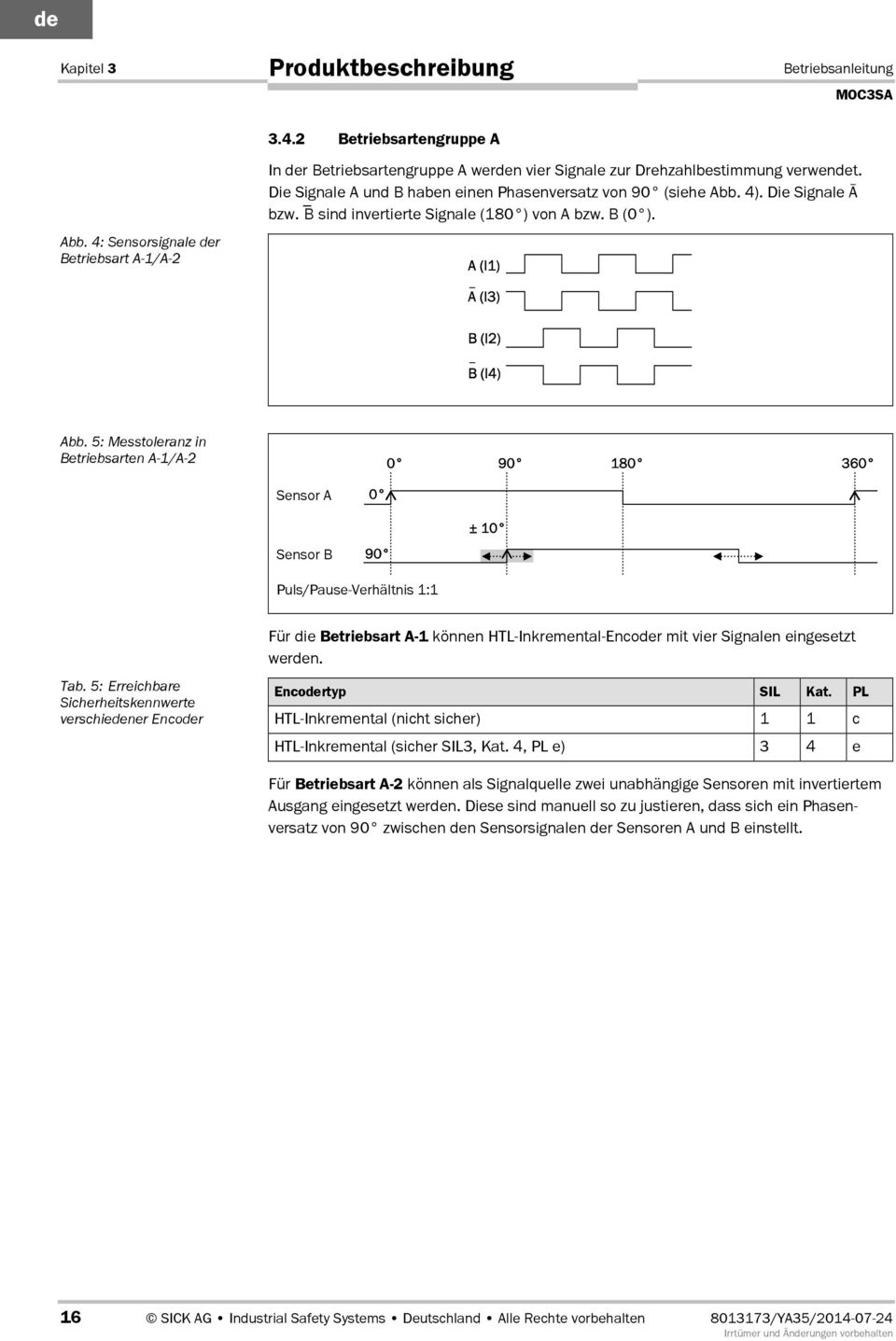
16 de Kapitel 3 Produktbeschreibung Betriebsanleitung Betriebsartengruppe A Abb. 4: Sensorsignale der Betriebsart A-1/A-2 In der Betriebsartengruppe A werden vier Signale zur Drehzahlbestimmung verwendet. Die Signale A und B haben einen Phasenversatz von 90 (siehe Abb. 4). Die Signale U bzw. B sind invertierte Signale (180 ) von A bzw. B (0 ). Abb. 5: Messtoleranz in Betriebsarten A;1/A;2 Sensor A Sensor B Puls/Pause-Verhältnis 1:1 Tab. 5: Erreichbare Sicherheitskennwerte verschiedener Encoder Für die Betriebsart A-1 können HTL-Inkremental-Encoder mit vier Signalen eingesetzt werden. Encodertyp SIL Kat. PL HTL-Inkremental (nicht sicher) 1 1 c HTL-Inkremental (sicher SIL3, Kat. 4, PL e) 3 4 e Für Betriebsart A-2 können als Signalquelle zwei unabhängige Sensoren mit invertiertem Ausgang eingesetzt werden. Diese sind manuell so zu justieren, dass sich ein Phasenversatz von 90 zwischen den Sensorsignalen der Sensoren A und B einstellt. 16 SICK AG Industrial Safety Systems Deutschland Alle Rechte vorbehalten /YA35/ Irrtümer und Änderungen vorbehalten
17 de Betriebsanleitung Kapitel 3 Produktbeschreibung Betriebsartengruppe B Abb. 6: Sensorsignale der Betriebsart B-1 Die Betriebsartengruppe B arbeitet mit ein bzw. zwei Sensorsignalen. Bei der Betriebsart B-1 wird mit einem Sensorsignal (A) an Eingang I1 und dessen invertiertem Sensorsignal (U) am Eingang I2 zur Erfassung der Eingangsfrequenz gearbeitet. Das Puls/Pause-Verhältnis der Sensorsignale von 1:3 darf nicht unterschritten werden. Abb. 7: Messtoleranz in Betriebsart B-2 Bei der Betriebsart B-2 werden zwei Sensoren eingesetzt. Die Sensoren sind so zu justieren, dass sich zwischen den Signalen ein Phasenversatz von 180 mit einem Puls/Pause- Verhältnis von 3:2 ergibt. Sensor A Sensor B ACHTUNG Folgende Bedingungen gelten für die Sensorsignale: Das Puls/Pause-Verhältnis der Sensorsignale hat folgende Grenzen: 1:1 < t on :t off < 3:2 und die Phasenverschiebung Z der Sensorsignale hat folgende Grenzen: 144 < Z < 216 und die Signale von Sensor A/Sensor B dürfen nicht gleichzeitig LOW sein. Bei der Betriebsart B-2 muss ein Fehlerausschluss für den Fehler Querschluss zwischen den Eingängen I1 und I2 vorgenommen werden, um die angegebenen Sicherheitsniveaus zu erreichen. Dies kann z.b. durch geschützte Leitungsverlegung erreicht werden (EN ISO 13849L2, Tabelle D.4; EN 60204L1). Bei der Betriebsart B-3 wird nur ein Sensorsignal an Eingang I1 verwendet. Dieses Signal kann sowohl von einem Sensor als auch von einem Spursignal oder einem Nullpulssignal eines HTL-Inkremental-Encoders generiert werden /YA35/ SICK AG Industrial Safety Systems Deutschland Alle Rechte vorbehalten 17 Irrtümer und Änderungen vorbehalten

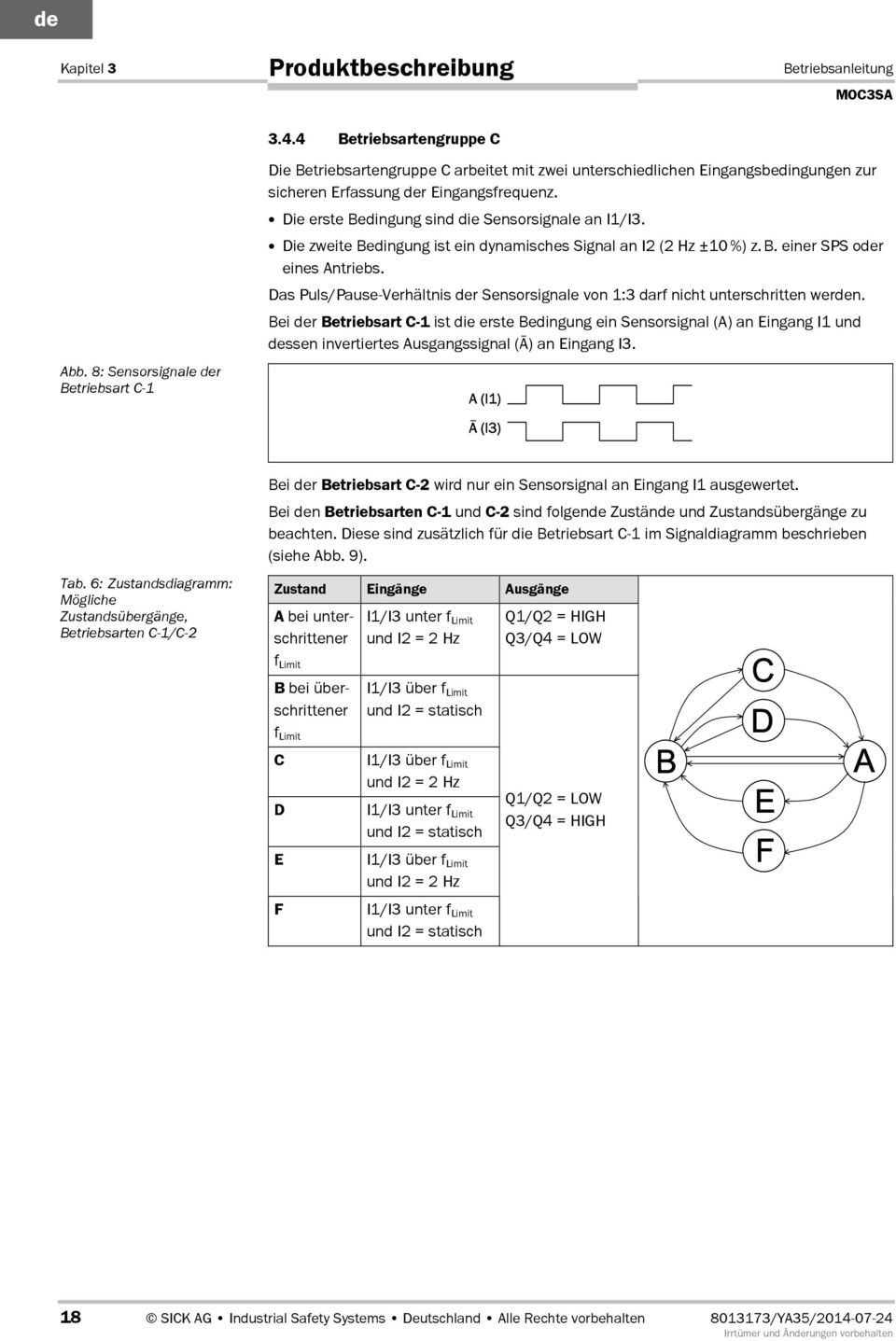
18 de Kapitel 3 Produktbeschreibung Betriebsanleitung Betriebsartengruppe C Abb. 8: Sensorsignale der Betriebsart C-1 Die Betriebsartengruppe C arbeitet mit zwei unterschiedlichen Eingangsbedingungen zur sicheren Erfassung der Eingangsfrequenz. Die erste Bedingung sind die Sensorsignale an I1/I3. Die zweite Bedingung ist ein dynamisches Signal an I2 (2 Hz ±10%) z.b. einer SPS oder eines Antriebs. Das Puls/Pause-Verhältnis der Sensorsignale von 1:3 darf nicht unterschritten werden. Bei der Betriebsart C-1 ist die erste Bedingung ein Sensorsignal (A) an Eingang I1 und dessen invertiertes Ausgangssignal (U) an Eingang I3. Tab. 6: Zustandsdiagramm: Mögliche Zustandsübergänge, Betriebsarten C;1/C;2 Bei der Betriebsart C-2 wird nur ein Sensorsignal an Eingang I1 ausgewertet. Bei den Betriebsarten C-1 und C-2 sind folgende Zustände und Zustandsübergänge zu beachten. Diese sind zusätzlich für die Betriebsart C-1 im Signaldiagramm beschrieben (siehe Abb. 9). Zustand Eingänge Ausgänge A bei unterschrittener f Limit B bei überschrittener f Limit C D E F I1/I3 unter f Limit und I2 = 2 Hz I1/I3 über f Limit und I2 = statisch I1/I3 über f Limit und I2 = 2 Hz I1/I3 unter f Limit und I2 = statisch I1/I3 über f Limit und I2 = 2 Hz I1/I3 unter f Limit und I2 = statisch Q1/Q2 = HIGH Q3/Q4 = LOW Q1/Q2 = LOW Q3/Q4 = HIGH 18 SICK AG Industrial Safety Systems Deutschland Alle Rechte vorbehalten /YA35/ Irrtümer und Änderungen vorbehalten
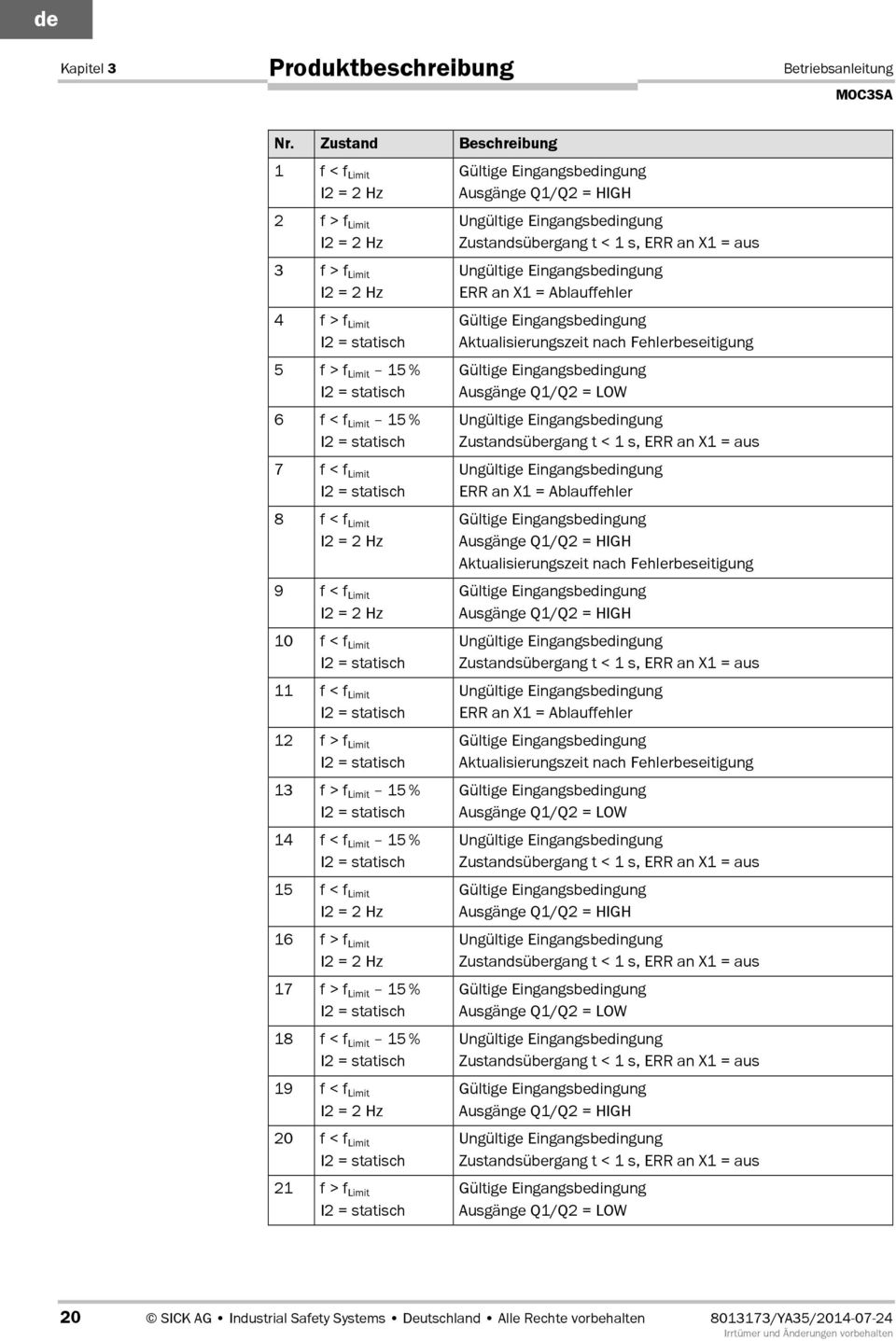
19 de Betriebsanleitung Kapitel 3 Produktbeschreibung Abb. 9: Signaldiagramm für Zustandsübergänge, Betriebsarten C-1/C-2 Für Zustandsübergänge gelten folgende Bedingungen: Es sind nur Zustandsübergänge entsprechend dem Zustandsdiagramm (Tab. 6) erlaubt. Nur Firmware ] V14.11: Bis t < 1 s sind auch vom Zustandsdiagramm abweichende Zustandsübergänge erlaubt. Werden diese Zustandsübergänge verletzt, dann muss in den Zustand B gewechselt werden, um wieder in den Zustand A wechseln zu können. Eingänge beschreiben die Bedingungen, um in den jeweiligen Zustand zu kommen und darin zu verbleiben. In den Zuständen C, D, E und F wird über X1 ein Ablauffehler gemeldet. Dieser Fehler ist nur eine Warnmeldung 1), die den Anwender auf diese Zustände hinweist. Nach dem Einschalten sind alle Zustände außer den Zuständen C und D möglich. 1) Siehe Abschnitt 8.4 Fehleranzeigen und Diagnose auf Seite /YA35/ SICK AG Industrial Safety Systems Deutschland Alle Rechte vorbehalten 19 Irrtümer und Änderungen vorbehalten
![Nur Firmware ] V14.11: Bis t < 1 s sind auch vom Zustandsdiagramm abweichende Zustandsübergänge erlaubt.](/docs-images/43/2605486/images/page_19.jpg "Werden diese Zustandsübergänge verletzt, dann muss in den Zustand B gewechselt werden, um wieder in den Zustand A wechseln zu können.")
20 de Kapitel 3 Produktbeschreibung Betriebsanleitung Nr. Zustand Beschreibung 1 f < f Limit I2 = 2 Hz 2 f > f Limit I2 = 2 Hz 3 f > f Limit I2 = 2 Hz 4 f > f Limit I2 = statisch 5 f > f Limit 15% I2 = statisch 6 f < f Limit 15% I2 = statisch 7 f < f Limit I2 = statisch 8 f < f Limit I2 = 2 Hz 9 f < f Limit I2 = 2 Hz 10 f < f Limit I2 = statisch 11 f < f Limit I2 = statisch 12 f > f Limit I2 = statisch 13 f > f Limit 15% I2 = statisch 14 f < f Limit 15% I2 = statisch 15 f < f Limit I2 = 2 Hz 16 f > f Limit I2 = 2 Hz 17 f > f Limit 15% I2 = statisch 18 f < f Limit 15% I2 = statisch 19 f < f Limit I2 = 2 Hz 20 f < f Limit I2 = statisch 21 f > f Limit I2 = statisch Gültige Eingangsbedingung Ausgänge Q1/Q2 = HIGH Ungültige Eingangsbedingung Zustandsübergang t < 1 s, ERR an X1 = aus Ungültige Eingangsbedingung ERR an X1 = Ablauffehler Gültige Eingangsbedingung Aktualisierungszeit nach Fehlerbeseitigung Gültige Eingangsbedingung Ausgänge Q1/Q2 = LOW Ungültige Eingangsbedingung Zustandsübergang t < 1 s, ERR an X1 = aus Ungültige Eingangsbedingung ERR an X1 = Ablauffehler Gültige Eingangsbedingung Ausgänge Q1/Q2 = HIGH Aktualisierungszeit nach Fehlerbeseitigung Gültige Eingangsbedingung Ausgänge Q1/Q2 = HIGH Ungültige Eingangsbedingung Zustandsübergang t < 1 s, ERR an X1 = aus Ungültige Eingangsbedingung ERR an X1 = Ablauffehler Gültige Eingangsbedingung Aktualisierungszeit nach Fehlerbeseitigung Gültige Eingangsbedingung Ausgänge Q1/Q2 = LOW Ungültige Eingangsbedingung Zustandsübergang t < 1 s, ERR an X1 = aus Gültige Eingangsbedingung Ausgänge Q1/Q2 = HIGH Ungültige Eingangsbedingung Zustandsübergang t < 1 s, ERR an X1 = aus Gültige Eingangsbedingung Ausgänge Q1/Q2 = LOW Ungültige Eingangsbedingung Zustandsübergang t < 1 s, ERR an X1 = aus Gültige Eingangsbedingung Ausgänge Q1/Q2 = HIGH Ungültige Eingangsbedingung Zustandsübergang t < 1 s, ERR an X1 = aus Gültige Eingangsbedingung Ausgänge Q1/Q2 = LOW 20 SICK AG Industrial Safety Systems Deutschland Alle Rechte vorbehalten /YA35/ Irrtümer und Änderungen vorbehalten
21 de Betriebsanleitung Kapitel 3 Produktbeschreibung Betriebsartengruppe D ACHTUNG Abb. 10: Sensorsignale der Betriebsart D-1 Die Betriebsartengruppe D arbeitet mit zwei unterschiedlichen Eingangsbedingungen zur sicheren Erfassung der Drehzahl. Die erste Bedingung sind die Sensorsignale an I1/I3. Die zweite Bedingung ist ein statisches HIGH-Signal an I2, wie z.b. das eines Zustimmschalters. Das Puls/Pause-Verhältnis der Sensorsignale von 1:3 darf nicht unterschritten werden. In der Betriebsartengruppe D ist der Bediener des Zustimmschalters für die Bewertung des Gefahr bringenden Zustands verantwortlich. Bei der Betriebsart D-1 ist die erste Bedingung ein Sensorsignal (A) an Eingang I1 und dessen invertierendes Ausgangssignal (U) an Eingang I3. Tab. 7: Zustandsdiagramm: Mögliche Zustandsübergänge, Betriebsarten D;1/D;2 Bei der Betriebsart D-2 wird nur ein Sensorsignal an Eingang I1 ausgewertet. Bei den Betriebsarten D-1 und D-2 sind folgende Zustände und Zustandsübergänge zu beachten. Diese sind zusätzlich für die Betriebsart D-1 in dem Signaldiagramm beschrieben (siehe Abb. 11). Zustand Eingänge Ausgänge A bei unterschrittener f Limit B bei überschrittener f Limit C D E F I1/I3 unter f Limit und I2 = HIGH I1/I3 über f Limit und I2 = LOW I1/I3 über f Limit und I2 = HIGH I1/I3 unter f Limit und I2 = LOW I1/I3 über f Limit und I2 = HIGH I1/I3 unter f Limit und I2 = LOW Q1/Q2 = HIGH Q3/Q4 = LOW Q1/Q2 = LOW Q3/Q4 = HIGH /YA35/ SICK AG Industrial Safety Systems Deutschland Alle Rechte vorbehalten 21 Irrtümer und Änderungen vorbehalten
22 de Kapitel 3 Produktbeschreibung Betriebsanleitung Für Zustandsübergänge gelten folgende Bedingungen: Es sind nur Zustandsübergänge entsprechend dem Zustandsdiagramm (Tab. 7) erlaubt. Nur Firmware ] V14.11: Bis t < 1 s sind auch vom Zustandsdiagramm abweichende Zustandsübergänge erlaubt. Werden diese Zustandsübergänge verletzt, dann muss in den Zustand B gewechselt werden, um wieder in den Zustand A wechseln zu können. Eingänge beschreiben die Bedingungen, um in den jeweiligen Zustand zu kommen und darin zu verbleiben. In den Zuständen C, D, E und F wird über X1 ein Ablauffehler gemeldet. Dieser Fehler ist nur eine Warnmeldung 2), die den Anwender auf diese Zustände hinweist. Nach dem Einschalten sind alle Zustände außer den Zuständen C und D möglich. Abb. 11: Signaldiagramm für Zustandsübergänge, Betriebsarten D-1/D-2 2) Siehe Abschnitt 8.4 Fehleranzeigen und Diagnose auf Seite SICK AG Industrial Safety Systems Deutschland Alle Rechte vorbehalten /YA35/ Irrtümer und Änderungen vorbehalten
23 de Betriebsanleitung Kapitel 3 Produktbeschreibung Nr. Zustand Beschreibung 1 f < f Limit I2 = HIGH 2 f > f Limit I2 = HIGH 3 f > f Limit I2 = HIGH 4 f > f Limit I2 = LOW 5 f > f Limit 15% I2 = LOW 6 f < f Limit 15% I2 = LOW 7 f < f Limit I2 = LOW 8 f < f Limit I2 = HIGH 9 f < f Limit I2 = HIGH 10 f < f Limit I2 = LOW 11 f < f Limit I2 = LOW 12 f > f Limit I2 = LOW 13 f > f Limit 15% I2 = LOW 14 f < f Limit 15% I2 = LOW 15 f < f Limit I2 = HIGH 16 f > f Limit I2 = HIGH 17 f > f Limit 15% I2 = LOW 18 f < f Limit 15% I2 = LOW 19 f < f Limit I2 = HIGH 20 f < f Limit I2 = LOW 21 f > f Limit I2 = LOW Gültige Eingangsbedingung Ausgänge Q1/Q2 = HIGH Ungültige Eingangsbedingung Zustandsübergang t < 1 s, ERR an X1 = aus Ungültige Eingangsbedingung ERR an X1 = Ablauffehler Gültige Eingangsbedingungen Aktualisierungszeit nach Fehlerbeseitigung Gültige Eingangsbedingung Ausgänge Q1/Q2 = LOW Ungültige Eingangsbedingung Zustandsübergang t < 1 s, ERR an X1 = aus Ungültige Eingangsbedingung ERR an X1 = Ablauffehler Gültige Eingangsbedingung Aktualisierungszeit nach Fehlerbeseitigung Ausgänge Q1/Q2 = HIGH Gültige Eingangsbedingung Ausgänge Q1/Q2 = HIGH Ungültige Eingangsbedingung Zustandsübergang t < 1 s, ERR an X1 = aus Ungültige Eingangsbedingung ERR an X1 = Ablauffehler Gültige Eingangsbedingungen Aktualisierungszeit nach Fehlerbeseitigung Gültige Eingangsbedingung Ausgänge Q1/Q2 = LOW Ungültige Eingangsbedingung Zustandsübergang t < 1 s, ERR an X1 = aus Gültige Eingangsbedingung Ausgänge Q1/Q2 = HIGH Ungültige Eingangsbedingung Zustandsübergang t < 1 s, ERR an X1 = aus Gültige Eingangsbedingung Ausgänge Q1/Q2 = LOW Ungültige Eingangsbedingung Zustandsübergang t < 1 s, ERR an X1 = aus Gültige Eingangsbedingung Ausgänge Q1/Q2 = HIGH Ungültige Eingangsbedingung Zustandsübergang t < 1 s, ERR an X1 = aus Gültige Eingangsbedingung Ausgänge Q1/Q2 = LOW /YA35/ SICK AG Industrial Safety Systems Deutschland Alle Rechte vorbehalten 23 Irrtümer und Änderungen vorbehalten
24 de Kapitel 3 Produktbeschreibung Betriebsanleitung Tab. 8: Einstellung der Drehzahlgrenze f Limit Beispiel Hinweis 3.5 Einstellung der Drehzahlgrenze f Limit Mit den Drehschaltern X und Y wird die Eingangsfrequenz eingestellt und mit dem Gerätefaktor multipliziert. -A -B Gerätefaktor 0,1 1 Minimale Drehzahlgrenze f Limit 0,1 Hz 0,5 Hz (Drehschalter X und Y in Stellung 0 ) Gewünschte Drehzahlgrenze 6,3 Hz 63 Hz Drehschalter X (10 X) 6 6 Drehschalter Y (1 Y) 3 3 Eingestellte Drehzahlgrenze f Limit 63 0,1 = 6,3 Hz 63 1 = 63 Hz Beachten Sie die Messgenauigkeit der Frequenzmessung (siehe Kapitel 11 Technische Daten auf Seite 62). 24 SICK AG Industrial Safety Systems Deutschland Alle Rechte vorbehalten /YA35/ Irrtümer und Änderungen vorbehalten
25 de Betriebsanleitung Kapitel 3 Produktbeschreibung 3.6 Ausgänge Sicherheitsausgänge (Q1 bis Q4) Der Speed Monitor verfügt über vier sichere Halbleiterausgänge, organisiert zu je zwei Ausgangspaaren (Q1/Q2, Q3/Q4). Das Ausgangspaar Q1/Q2 ist nach Unterschreiten der konfigurierten f Limit /Drehzahlgrenze und Freigabe (Rücksetzen) auf HIGH-Pegel, das invertierte Ausgangspaar Q3/Q4 auf LOW- Pegel. Beim Überschreiten der konfigurierten f Limit ändert sich der Status der Ausgänge ohne Freigabe (Rücksetzen). Das Ausgangspaar Q1/Q2 wechselt von HIGH auf LOW und das invertierte Ausgangspaar Q3/Q4 wechselt von LOW auf HIGH. Q1- und Q2-Ausgang, sicherheitsgerichtet Q3- und Q4-Ausgang, invertiert zu Q1/Q2 In typischen Applikationen werden nur die Ausgänge Q1/Q2 verwendet. Die Ausgänge Q3/Q4 sind in Sicherheitsapplikationen nur dann zulässig, wenn zusätzliche Sicherheitsbetrachtungen durchgeführt wurden. ACHTUNG Beim Auftreten eines schweren Fehlers am Gerät oder bei Ausfall der Spannungsversorgung schalten alle sicherheitsgerichteten Ausgänge Q1 bis Q4 ab (LOW-Pegel an den Klemmen). Dies muss bei der Betrachtung der Sicherheitsfunktion an einer Maschine oder Anlage unbedingt beachtet werden. Eine Funktionsunterbrechung von Sicherheitsausgängen führt zum Verlust der Sicherheitsfunktionen, so dass das Risiko einer schweren Verletzung besteht. Schließen Sie keine Lasten an, die die Nennwerte der Sicherheitsausgänge überschreiten. Schließen Sie die GND-Leitungen der Stromversorgung an A2 an, damit die Geräte nicht einschalten, wenn im Fehlerfall die Sicherheitsausgangsleitung auf Massepotenzial liegt. Aktoren an den Ausgängen können einkanalig verdrahtet werden. Zur Aufrechterhaltung des jeweiligen Sicherheitsniveaus müssen die Leitungen so verlegt werden, dass Querschlüsse zu anderen spannungsführenden Signalen ausgeschlossen werden können, z.b. durch Verlegung innerhalb geschützter Bereiche wie in einem Schaltschrank oder in separaten Mantelleitungen (siehe Kapitel 5 Elektroinstallation auf Seite 36). Zum Erreichen von SIL3 bzw. PL e stehen in Applikationen folgende Möglichkeiten zur Verfügung: Zweikanaliger Anschluss der Ausgänge, z.b. Q1/Q2 an Aktoren oder Einkanaliger Anschluss nur bei Verlegung innerhalb geschützter Bereiche wie in einem Schaltschrank, z.b. Q1 an Aktor /YA35/ SICK AG Industrial Safety Systems Deutschland Alle Rechte vorbehalten 25 Irrtümer und Änderungen vorbehalten
26 de Kapitel 3 Produktbeschreibung Betriebsanleitung Abb. 12: Signale, Meldeausgang X1 Blinkpuls/Pause = 250 ms; Pause zwischen den Blinkcodes = 750 ms Meldeausgänge (X1, X2) Meldeausgang X1 Der nicht sichere Halbleiterausgang X1 signalisiert Fehlerzustände. Ist kein Fehler vorhanden, gibt der Ausgang ein LOW-Signal aus. Liegt ein Fehler vor, so wird ein Blinkcode ausgegeben. Beispiel 1 Blinken 3 Blinken Nach dem Löschen des Fehlers, benötigt der Speed Monitor eine bestimmte Aktualisierungszeit nach Fehlerbeseitigung (siehe Kapitel 11 Technische Daten auf Seite 62). Detaillierte Informationen zur Fehlerdiagnose sind in Abschnitt 8.4 Fehleranzeigen und Diagnose auf Seite 42 beschrieben. Tab. 9:Zustände Meldeausgang X2 Meldeausgang X2 Der nicht sichere Halbleiterausgang X2 signalisiert den Zustand der Funktion Rücksetzen. Zustand LOW Toggelt mit 1 Hz HIGH Beschreibung f Limit ist überschritten. Warten auf Rücksetzen, d.h. f Limit ist unterschritten, Rücksetzen wurde noch nicht durchgeführt. Rücksetzen erfolgt, d.h. f Limit ist unterschritten. Die Ausgänge Q1 bis Q4 haben ihren Zustand geändert. 26 SICK AG Industrial Safety Systems Deutschland Alle Rechte vorbehalten /YA35/ Irrtümer und Änderungen vorbehalten
27 de Betriebsanleitung Kapitel 3 Produktbeschreibung 3.7 Eingänge Der verfügt insgesamt über 8 Eingänge. An die Eingänge I1 bis I4 werden die drehzahlüberwachenden Sensoren (z.b. PNP- Näherungssensoren, HTL-Inkremental-Encoder) angeschlossen. Die Konfiguration der unterschiedlichen Betriebsarten wird über Belegung der Eingänge S1, S2 und je nach Betriebsart mit freien Eingängen I2 bis I4 vorgenommen (siehe Abschnitt 3.4 Betriebsarten auf Seite 14). Die Eingänge I5 und I6 sind für die Betriebsarten Automatisches Rücksetzen / Manuelles Rücksetzen, mit und ohne Schützkontrolle (EDM) (siehe Abschnitt Schützkontrolle (EDM) auf Seite 30) und für den Zustimmschalter vorgesehen. Hinweis Grundsätzlich gilt für alle Eingänge des : Bei Einsatz unterschiedlicher Spannungsversorgungen von Sensor und ist es notwendig, die GND-Anschlüsse niederohmig zu verbinden. Es ist zu beachten, dass die Dauer des angelegten Signals (HIGH-Puls) größer als 200 `s sein muss. Anforderungen an die Sensoren: Die angeschlossenen Sensoren bzw. signalerzeugenden Einrichtungen sollten durch PNP-Näherungssensoren oder HTL-Inkremental-Encoder erfolgen, die den einschlägigen Fachnormen entsprechen. Dies sind z.b. für Näherungssensoren die EN oder EN und für speicherprogrammierbare Steuerungen die IEC /YA35/ SICK AG Industrial Safety Systems Deutschland Alle Rechte vorbehalten 27 Irrtümer und Änderungen vorbehalten
28 de Kapitel 3 Produktbeschreibung Betriebsanleitung 3.8 Geräteverhalten und Rücksetzen Automatisches Rücksetzen und Zustimmung Abb. 13: Signaldiagramm bei automatischem Rücksetzen Beim automatischen Rücksetzen sind die Eingangssignale I5 (Rücksetzen) und I6 (Zustimmung) miteinander verknüpft, d.h. das Schalten der Ausgänge Q1 bis Q4 erfolgt beim Unterschreiten von f Limit nur dann, wenn an den Eingängen I5 und I6 ein HIGH-Signal anliegt. Die Ausgänge haben dann den Zustand Q1/Q2 = HIGH, Q3/Q4 = LOW. Nach dem Schalten muss nur an I6 kontinuierlich ein HIGH-Signal anliegen, an I5 darf auch ein LOW-Signal anliegen (offener EDM). Die Eingänge sind Pegel -gesteuert. Ist f Limit überschritten, werden die Eingänge I5 und I6 nicht berücksichtigt, die Ausgänge Q1 bis Q4 werden automatisch geschaltet. Hinweise Mit dem Eingang I6 (Zustimmung) kann ein Signal in die Ansteuerung der Ausgänge Q1 bis Q4 eingreifen und damit einer übergeordneten Steuerung einzugreifen ermöglichen. Für automatisches Rücksetzen wird die Schützkontrolle (EDM) an Eingang I5 (Rücksetzen) angeschlossen. Wenn kein EDM vorgesehen ist, dann ist ein HIGH-Signal an I5 anzulegen. Der Eingang I6 kann zur Kaskadierung mehrerer Speed Monitore eingesetzt werden. Vor der Übernahme der Konfiguration muss an I5 ein HIGH-Signal anliegen (siehe Kapitel 7 Konfiguration auf Seite 40). Anwendungsbeispiel Einrichtbetrieb Eine Anlage soll im Einrichtbetrieb mit reduzierter Geschwindigkeit gefahren werden. Das Signal I6 wird als Zustimmsignal eingebunden. 28 SICK AG Industrial Safety Systems Deutschland Alle Rechte vorbehalten /YA35/ Irrtümer und Änderungen vorbehalten
29 de Betriebsanleitung Kapitel 3 Produktbeschreibung Manuelles Rücksetzen und Zustimmung Abb. 14: Signaldiagramm bei manuellem Rücksetzen Beim manuellen Rücksetzen werden die Ausgänge Q1 bis Q4 beim Unterschreiten von f Limit durch eine fallende Flanke am Eingang I5 geschaltet. Danach haben die Ausgänge folgende Signalzustände: Q1/Q2 = HIGH, Q3/Q4 = LOW. Mit einer fallenden Flanke am Eingang I6 können die Ausgänge Q1 bis Q4 erneut geschaltet werden und haben danach folgende Signalzustände: Q1/Q2 = LOW, Q3/Q4 = HIGH. Die Eingänge sind Flanken -gesteuert. Die Signaldauer an I5 muss in einem Bereich von 100 ms bis 5 s liegen (siehe Kapitel 11 Technische Daten auf Seite 62). Ist die konfigurierte f Limit überschritten, dann werden die Eingänge I5 und I6 nicht berücksichtigt und die Ausgänge haben den Zustand Q1/Q2 = LOW, Q3/Q4 = HIGH. Hinweise Mit dem Eingang I6 (Zustimmung) kann ein Signal die Ausgänge Q1 bis Q4 unabhängig f Limit ausschalten (Q1/Q2 = LOW, Q3/Q4 = HIGH). Beim manuellen Rücksetzen wird die Schützkontrolle (EDM) in Reihe mit der Rücksetztaste am Eingang I5 angeschlossen. Vor der Übernahme der Konfiguration muss an I5 ein LOW-Signal (Klemme offen) anliegen (siehe Kapitel 7 Konfiguration auf Seite 40). Anwendungsbeispiel Schutztürverriegelung Eine Schutztür soll sofort nach dem Einschalten der Anlage und bevor der Antrieb die konfigurierte f Limit erreicht verriegelt werden. Diese Funktion kann mit dem Eingang I6 eingerichtet werden. Das Signal für die Zustimmung kann z.b. durch folgende Komponenten geliefert werden: SPS Taster Startbefehl der Maschine (Triggersignal) /YA35/ SICK AG Industrial Safety Systems Deutschland Alle Rechte vorbehalten 29 Irrtümer und Änderungen vorbehalten
30 de Kapitel 3 Produktbeschreibung Betriebsanleitung Schützkontrolle (EDM) Die statische Schützkontrolle (EDM) überwacht beim Rücksetzen, ob die angesteuerten, zwangsgeführten Schütze abgefallen sind. Für automatisches Rücksetzen wird die Schützkontrolle (EDM) an Eingang I5 angeschlossen. Für manuelles Rücksetzen wird die Schützkontrolle (EDM) in Reihe zu Rücksetztaste und Eingang I5 angeschlossen Grenzfrequenz f max ACHTUNG Die Grenzfrequenz f max für die Sensoreingänge I1 bis I4 liegt bei 2 khz. Das Überschreiten dieser Frequenz wird erkannt und die Ausgänge werden in einen sicheren Zustand abgeschaltet. Der meldet den Fehler Schwerer Fehler (siehe Abschnitt 8.4 Fehleranzeigen und Diagnose auf Seite 42). Q1/Q2 = LOW Q3/Q4 = LOW ERR-LED blinkt. Eine Frequenzänderung der angeschlossenen Sensoren darf nicht größer sein als 21 khz/s. Größere Frequenzänderungen werden nicht erkannt. 30 SICK AG Industrial Safety Systems Deutschland Alle Rechte vorbehalten /YA35/ Irrtümer und Änderungen vorbehalten
31 de Betriebsanleitung Kapitel 3 Produktbeschreibung Hysterese Abb. 15: Auswirkung der Hysterese auf die sicheren Ausgänge Die Funktion Hysterese verhindert, dass ein ständiger Zustandsübergang der Eingänge um die konfigurierte f Limit einen ständigen Zustandsübergang der Ausgänge verursacht. Die Hysterese liegt in einem Frequenzbereich von f Limit bis f Limit 15% (siehe Abb. 15). Innerhalb dieser Hysterese wird kein Zustandsübergang der Ausgänge ausgeführt. Um ein sicheres Schalten zu gewährleisten, muss die Hysterese über- bzw. unterschritten werden. f (Sensorfrequenz) f Limit f Limit 15% ACHTUNG Die Hysterese ist abhängig von der Messgenauigkeit der Frequenzmessung und von der konfigurierten Drehzahlgrenze (f Limit ) (siehe Abschnitt 3.5 Einstellung der Drehzahlgrenze f Limit auf Seite 24). Messgenauigkeit der Frequenzmessung 1% (< 1 Hz) 6% (< 50 Hz) 12% (a 99 Hz) Beispiel Bei einer konfigurierten Drehzahlgrenze von 40 Hz ergeben sich Schaltpunkte bei: Oberer Schaltpunkt: 50 Hz + (6% von f Limit ) = 50 Hz + 3 Hz = 53 Hz Unterer Schaltpunkt: 50 Hz (6% von f Limit ) = 42,5 Hz 3 Hz = 39,5 Hz /YA35/ SICK AG Industrial Safety Systems Deutschland Alle Rechte vorbehalten 31 Irrtümer und Änderungen vorbehalten
32 de Kapitel 3 Produktbeschreibung Betriebsanleitung Bereitschaftszeit ACHTUNG Um Sensorfehler detektieren zu können, müssen immer wieder dynamische Signale an den Eingängen I1 bis I4 anliegen. Ein dynamisches Signal ist ein Signal, das an allen entsprechenden Signaleingängen gleichzeitig eine Frequenz mit f > f min hat (siehe Abschnitt 11.1 Datenblatt auf Seite 62). Dies ist der aktive Zustand. Liegt kein dynamisches Signal an, dann wird dieses nur für die Bereitschaftszeit akzeptiert (siehe Abschnitt 11.1 Datenblatt auf Seite 62). Nach Ablauf der Bereitschaftszeit wechselt der in den Zustand Leichter Fehler: Bereitschaftszeit abgelaufen (siehe Abschnitt 8.4 Fehleranzeigen und Diagnose auf Seite 42). Die Ausgänge Q1/Q2 schalten auf LOW und Q3/Q4 auf HIGH. Wenn an den entsprechenden Signaleingängen wieder ein dynamisches Signal erkannt wird, dann wechselt der wieder in den aktiven Zustand. Um sicherzustellen, dass nach einem Wiedereinschalten (Power-Up) des alle externen Sensorfehler erkannt werden, muss f Limit einmal innerhalb der Bereitschaftszeit überschritten werden. Wurde ein Fehler detektiert, so schalten die Ausgänge Q1/Q2 nach dem Zustandsübergang f < f Limit nicht mehr auf HIGH. Nur Firmware ] V14.11: Der Zustand Bereitschaftszeit abgelaufen kann auch durch Betätigen einer Rücksetztaste an S1 verlassen werden. Wenn diese Rücksetztaste betätigt wird, dann werden die Ausgänge Q1/Q2 für t < 30 min auf HIGH gesetzt. Wird innerhalb dieser Zeit keine f > f min an den Senoreingängen erkannnt, dann wechselt der wieder in den Zustand Bereitschaftszeit abgelaufen. ACHTUNG Das Rücksetzen erfordert Ihre besondere Aufmerksamkeit: Prüfen Sie vor der Betätigung der Rücksetztaste an S1, ob der Gefahrbereich gesichert ist. Prüfen Sie unmittelbar nach dem Rücksetzen die Sicherheitsfunktion des, indem Sie das Sensorsignal an den entsprechenden Eingängen über f Limit erhöhen. 32 SICK AG Industrial Safety Systems Deutschland Alle Rechte vorbehalten /YA35/ Irrtümer und Änderungen vorbehalten
33 de Betriebsanleitung Kapitel 3 Produktbeschreibung Vibration bei Stillstand Im Stillstand kann es vorkommen, dass ein Sensor exakt auf der Flanke eines Impulsgebers steht. Durch Vibration in der Anlage kann ein Sensor eine Frequenz erzeugen, während die anderen Sensorsignale statisch (HIGH/LOW) bleiben. Der Zustand Vibration bei Stillstand ist abhängig von der Firmwareversion: Tab. 10: Zustand Vibration bei Stillstand Zustand verfügbar in Betriebsarten Bedingung für den Wechsel in den Zustand Firmware < V14.11 Firmware K V14.11 A-1, A-2, B-2 Diagnose Bei t > 1/(2 f min ) > 29 s: X1 Es liegen nur Signale an einem der beiden Sensoren vor. Ausgänge Bei f > f Limit : Q1/Q2 = LOW Q3/Q4 = HIGH Bedingung für das Innerhalb von 8 h wird an Verlassen des Zustands beiden Signaleingängen f min a f < f Limit erkannt. Andernfalls wechselt das Gerät in den Zustand Bereitschaftszeit abgelaufen. Betriebsart nach Verlassen des Zustands Bereitschaftszeit Bei t > 1/(2 f min ) > 29 s: X1 LEDs I1 bis I4 (siehe Abschnitt 8.4 Fehleranzeigen und Diagnose auf Seite 42) A-1, A-2: Innerhalb von 8 h wird an beiden Signaleingängen f min a f < f Limit erkannt. B-2: An beiden Signaleingängen wird f min a f < f Limit erkannt. A-1, A-2: Bereitschaftszeit B-2: Normalbetrieb Kabelbrucherkennung Hinweis ACHTUNG Prinzipbedingt muss immer mindestens ein Sensoreingang eines Signalpaares I1/I3 bzw. I2/I4 den Zustand HIGH aufweisen. Wird diese Bedingung verletzt, dann wird ein Kabelbruch erkannt. Der Kabelbruch wird an der ERR-LED sowie am Meldeausgang X1 durch einen Fehlercode angezeigt. Die Kabelbrucherkennung des ist nur oberhalb der konfigurierten f Limit aktiv. Daher können im regulären Betrieb nicht alle Fehlerursachen erkannt werden. Beachten Sie die Einschränkungen der Kabelbrucherkennung! Die Kabelbrucherkennung ist nur in den in Tab. 4 auf Seite 14 angegebenen Betriebsarten aktiv /YA35/ SICK AG Industrial Safety Systems Deutschland Alle Rechte vorbehalten 33 Irrtümer und Änderungen vorbehalten
34 de Kapitel 4 Montage/Demontage Betriebsanleitung 4 Montage/Demontage Dieses Kapitel beschreibt die Montage des Speed Monitors. Im Anschluss an die Montage sind folgende Schritte notwendig: Herstellen der elektrischen Anschlüsse (siehe Kapitel 5 Elektroinstallation auf Seite 36) Konfiguration (siehe Kapitel 7 Konfiguration auf Seite 40) Prüfen der Installation (siehe Kapitel 6 Prüfhinweise auf Seite 38) 4.1 Montage des Speed Monitors Abb. 16: Modul auf Hutschiene hängen ACHTUNG Der ist nur für die Montage in einen Schaltschrank mit mindestens der Schutzart IP 54 geeignet. Montage gemäß EN Das Modul ist in einem 22,5 mm breiten Aufbaugehäuse für 35-mm-Hutschienen nach EN untergebracht. Hängen Sie das Gerät auf die Hutschiene (). Achten Sie dabei auf den korrekten Sitz der Erdungsfeder (). Die Erdungsfeder des Moduls muss sicher und elektrisch gut leitend auf der Hutschiene aufliegen. Rasten Sie das Modul mit leichtem Druck in Pfeilrichtung auf der Hutschiene ein ( ). 34 SICK AG Industrial Safety Systems Deutschland Alle Rechte vorbehalten /YA35/ Irrtümer und Änderungen vorbehalten
35 de Betriebsanleitung Kapitel 4 Montage/Demontage Abb. 17: Steckblockklemmen entfernen 4.2 Demontage des Speed Monitors Abb. 18: Modul von der Hutschiene nehmen Entfernen Sie die Steckblockklemmen mit Verdrahtung und, wenn vorhanden, die Endklammern. Drücken Sie das Modul hinten herunter () und nehmen Sie es im heruntergedrückten Zustand in Pfeilrichtung von der Hutschiene (). 4.3 Austauschen des Speed Monitors Notieren Sie sich die aktuelle Konfiguration des auszutauschenden. Demontieren Sie den, wie in Abschnitt 4.2 beschrieben. Montieren Sie den neuen, wie in Abschnitt 4.1 beschrieben. Stellen Sie die notierten Konfigurationen ein, wie in Kapitel 7 beschrieben /YA35/ SICK AG Industrial Safety Systems Deutschland Alle Rechte vorbehalten 35 Irrtümer und Änderungen vorbehalten
36 de Kapitel 5 Elektroinstallation Betriebsanleitung 5 Elektroinstallation ACHTUNG Anlage spannungsfrei schalten! Während Sie die Geräte anschließen, könnte die Anlage unbeabsichtigterweise starten. Ein Kurzschluss der Leitungen der Eingangskreise gegen U V kann zur fehlerhaften Erzeugung sicherheitsgerichteter Ausgangssignale führen (siehe Tab. 4 auf Seite 14). Sichern Sie die Leitungen der Eingangskreise gegen Kurzschluss. Schließen Sie OSSD1 und OSSD2 getrennt voneinander an! Sie dürfen OSSD1 und OSSD2 nicht miteinander verbinden, sonst ist die Signalsicherheit nicht gewährleistet. Stellen Sie sicher, dass die Maschinensteuerung beide Signale getrennt voneinander verarbeitet. Nachgeschaltete Schütze müssen zwangsgeführt sein und überwacht werden. Schließen Sie jeweils nur ein nachgeschaltetes Schaltelement an einem OSSD an! Jeder Schaltausgang (OSSD) darf nur mit einem Schaltelement (z.b. einem Relais oder Schütz) verbunden sein. Werden mehrere Schaltelemente benötigt, müssen Sie eine geeignete Kontaktvervielfältigung auswählen. Hinweis Der Speed Monitor erfüllt die EMV-Bestimmungen gemäß der Fachgrundnorm EN für den industriellen Bereich. Folgende Bedingungen gelten für den Einbau des : Um EMV-Sicherheit zu gewährleisten, muss die Hutschiene mit Funktionserde (Erdung) verbunden werden. Der entspricht Klasse A, Gruppe 1, gemäß EN Die Gruppe 1 umfasst alle ISM-Geräte, in denen absichtlich erzeugte und/oder benutzte leitergebundene HFbEnergie, die für die innere Funktion des Gerätes selbst erforderlich ist, vorkommt. Um Rückwirkungsfreiheit zu gewährleisten und das Einkoppeln von Störaussendungen des Motors bzw. Antriebsumrichters auf die Sensorleitung zu vermeiden, ist auf die getrennte Verlegung von Motorleitung und Sensorleitung zu achten. Die vom Antriebs- bzw. Motorhersteller empfohlenen Maßnahmen, wie geschirmte Leitungen, Drosseln und Filter zur Verminderung der Störaussendung, sind umzusetzen. Sie müssen den an dieselbe Spannungsversorgung anschließen wie die angeschlossenen Schutzeinrichtungen. Die Spannungsversorgung der Geräte muss gemäß EN 60204b1 u.a. einen kurzzeitigen Netzausfall von 20 ms überbrücken. 36 SICK AG Industrial Safety Systems Deutschland Alle Rechte vorbehalten /YA35/ Irrtümer und Änderungen vorbehalten
37 de Betriebsanleitung Kapitel 5 Elektroinstallation Der Versorgungsstrom muss durch das externe Netzteil oder durch externe Sicherung auf 4 A begrenzt werden. Die Spannungsversorgung sowie alle angeschlossenen Signale müssen den Vorschriften für Kleinspannungen mit sicherer Trennung (SELV, PELV) gemäß EN und EN (Ausrüstung von Starkstromanlagen mit elektronischen Betriebsmitteln) entsprechen oder sie muss NEC Class 2 gemäß UL 1310 entsprechen. Alle angeschlossenen Befehlsgeber und nachfolgenden Steuerungen sowie Verdrahtung und Verlegung müssen der geforderten Kategorie gemäß EN ISO :2008 und dem SILCL gemäß EN entsprechen (z.b. geschützte Verlegung, Einzelmantelleitung mit Schirm etc.). Der Schaltschrank bzw. das Montagegehäuse für den muss mindestens die Schutzart IP 54 erfüllen. Montage gemäß EN Die Leitungen eines angeschlossenen Zustimmschalters (Firmware < V14.11) bzw. einer angeschlossenen Rücksetztaste (Firmware ] V14.11) müssen in separaten Mantelleitungen verlegt werden. Montieren Sie das Befehlsgerät für Rücksetzen außerhalb des Gefahrbereichs so, dass es nicht von einer Person betätigt werden kann, die sich im Gefahrbereich befindet. Außerdem muss der Bediener den Gefahrbereich beim Betätigen des Befehlsgerätes vollständig überblicken können. Um die Sicherheitsausgänge zu schützen und die Lebensdauer zu erhöhen, müssen die externen Lasten mit z.b. Varistoren oder RC-Gliedern ausgerüstet werden. Hierbei ist zu beachten, dass sich die Ansprechzeiten je nach Art der Schutzbeschaltung verlängern. Einkanalige Sicherheitsausgänge und die Schützkontrolle (EDM) müssen innerhalb des Schaltschranks verdrahtet werden. Folgende Bedingungen gelten für den Einbau der Sensoren Sensoren müssen nach dem mechanischen Befestigen zusätzlich gesichert werden (z.b. durch Sicherungslack). Die Detektionsfläche der Sensoren muss der zu detektierenden Fläche entsprechen /YA35/ SICK AG Industrial Safety Systems Deutschland Alle Rechte vorbehalten 37 Irrtümer und Änderungen vorbehalten
38 de Kapitel 6 Prüfhinweise Betriebsanleitung 6 Prüfhinweise 6.1 Prüfungen vor der Erstinbetriebnahme Die Prüfungen vor der Erstinbetriebnahme dienen dazu, die in den nationalen/internationalen Vorschriften, insbesondere der Maschinen- oder Arbeitsmittelbenutzungsrichtlinie geforderten Sicherheitsanforderungen zu bestätigen. Prüfen Sie die Wirksamkeit der Schutzeinrichtung an der Maschine in allen an der Maschine einstellbaren Betriebsarten und Funktionen. Stellen Sie sicher, dass das Bedienpersonal vor Aufnahme der Arbeit von befähigten Personen des Maschinenbetreibers eingewiesen wird. Die Unterweisung obliegt der Verantwortung des Maschinenbetreibers. 6.2 Erstinbetriebnahme ACHTUNG Keine Inbetriebnahme ohne Prüfung durch eine befähigte Person! Bevor Sie die Anlage erstmals in Betrieb nehmen, muss diese durch eine befähigte Person überprüft und dokumentiert freigegeben werden. ACHTUNG Kontrollieren Sie den Gefahrbereich! Vor der Inbetriebnahme muss sichergestellt werden, dass sich niemand im Gefahrbereich aufhält. Kontrollieren Sie den Gefahrbereich und sichern Sie ihn gegen das Betreten von Personen ab (z.b. Aufstellen von Warnschildern, Anbringen von Absperrungen o. Ä.). Beachten Sie die entsprechenden Gesetze und lokalen Vorschriften! Sie dürfen die Anlage nur in Betrieb nehmen, wenn die Gesamtabnahme erfolgreich war. Die Gesamtabnahme darf nur durch entsprechend geschultes Fachpersonal erfolgen. Die Gesamtabnahme umfasst folgende Prüfpunkte: Prüfen Sie, ob die Anschaltung der Komponenten an den Anschlüssen der geforderten Kategorie entspricht. Überprüfen Sie die an den angeschlossenen Geräte entsprechend den Prüfhinweisen aus der zugehörigen Betriebsanleitung. Kennzeichnen Sie eindeutig alle Anschlussleitungen und Steckverbinder am. Führen Sie eine vollständige Verifikation der Sicherheitsfunktionen (z.b. Fehlersimulation) durch. Beachten Sie dabei die Ansprechzeiten! 38 SICK AG Industrial Safety Systems Deutschland Alle Rechte vorbehalten /YA35/ Irrtümer und Änderungen vorbehalten
39 de Betriebsanleitung Kapitel 6 Prüfhinweise 6.3 Regelmäßige Prüfung der Schutzeinrichtung durch befähigte Personen Prüfen Sie die Anlage entsprechend den national gültigen Vorschriften innerhalb der darin geforderten Fristen. Dies dient der Aufdeckung von Veränderungen an der Maschine oder von Manipulationen an der Schutzeinrichtung nach der Erstinbetriebnahme. Jede Sicherheitsapplikation muss in einem von Ihnen festgelegten Zeitintervall überprüft werden. Die Wirksamkeit der Schutzeinrichtungen muss durch befugte und beauftragte Personen geprüft werden. Wenn Änderungen an der Maschine oder Schutzeinrichtung durchgeführt wurden oder der umgerüstet oder instand gesetzt wurde, dann prüfen Sie die Anlage erneut gemäß der Checkliste in Abschnitt 13.2 im Anhang. 6.4 Zyklische Testung Der muss zyklisch getestet werden. ACHTUNG Beachten Sie die folgenden Prüfhinweise! Wenn der zur Notabschaltung bei Drehzahlüberschreitung eingesetzt wird, dann liegt der Betriebsbereich des Antriebs immer unterhalb der konfigurierbaren f Limit des. Die Kabelbrucherkennung des ist nur oberhalb der konfigurierten f Limit aktiv. Daher können im regulären Betrieb nicht alle Fehlerursachen erkannt werden. Es muss folgendes Proof-Test-Intervall mindestens alle 365 Tage durchgeführt werden, um die sicherheitstechnischen Kenngrößen SIL3 nach IEC (siehe Kapitel 11 Technische Daten auf Seite 62) zu erfüllen: Der zu überwachende Antrieb muss mit einer Drehzahl betrieben werden, die über der am konfigurierten f Limit liegt. Es ist zu prüfen, ob in diesem Zustand die Ausgänge Q1/Q2 auf LOW-Signal und die Ausgänge Q3/Q4 auf HIGH-Signal schalten. Es ist zu prüfen, ob die in Tab. 4 Betriebsarten beschriebenen Fehlerbilder vom Gerät erkannt werden /YA35/ SICK AG Industrial Safety Systems Deutschland Alle Rechte vorbehalten 39 Irrtümer und Änderungen vorbehalten
40 de Kapitel 7 Konfiguration Betriebsanleitung 7 Konfiguration ACHTUNG Überprüfen Sie die Konfiguration für die Schutzeinrichtung nach jeder Änderung! Wenn Sie die Konfiguration ändern, dann müssen Sie die Schutzeinrichtung auf ihre Wirksamkeit prüfen. Beachten Sie dazu die Prüfhinweise in der Betriebsanleitung der angeschlossenen Schutzeinrichtung. Für die Konfiguration des Speed Monitors benötigen Sie einen Schraubendreher. Hinweise ACHTUNG Hinweis 7.1 Systemkonfiguration übernehmen Schalten Sie die Spannungsversorgung (Klemmen A1, A2) aus. Stellen Sie mit einem Schraubendreher die gewünschte Frequenz an den Drehschaltern ein. Stellen Sie durch Außenbeschaltung der Klemmen S1, S2 und I1 bis I6 die gewünschte Funktion ein (siehe Abschnitt 3.4 Betriebsarten auf Seite 14 und Abschnitt 3.7 Eingänge auf Seite 27). Schalten Sie bei gedrückter ENTER-Taste des die Spannungsversorgung an. Wenn die ERR-LED anfängt zu blinken, lassen Sie die ENTER-Taste innerhalb von drei Sekunden wieder los. Nach erfolgreicher Konfiguration erlischt die ERR-LED. Die gewählte Betriebsart ist nullspannungssicher gespeichert und aktiv. Wird die ENTER-Taste bei blinkender ERR-LED länger als drei Sekunden gedrückt, wechselt das Gesamtsystem in den Fehlerzustand. Eine Beschreibung finden Sie in Abschnitt 8.4 Fehleranzeigen und Diagnose. Alle nachträglichen Änderungen an der Beschaltung an S1, S2 und I1 bis I6 führen zu einem schweren Fehler (ERR Rot, siehe 8.4 auf Seite 42). Es ist sicherzustellen, dass die Konfiguration nicht manipuliert werden kann. Die Betätigung der ENTER-Taste während des Betriebes wird ignoriert. 40 SICK AG Industrial Safety Systems Deutschland Alle Rechte vorbehalten /YA35/ Irrtümer und Änderungen vorbehalten
41 de Betriebsanleitung Kapitel 8 Diagnose 8 Diagnose 8.1 Verhalten im Fehlerfall ACHTUNG Kein Betrieb bei unklarem Fehlerverhalten! Setzen Sie die Maschine außer Betrieb, wenn Sie den Fehler nicht eindeutig zuordnen und nicht sicher beheben können. Vollständiger Funktionstest nach Fehlerbeseitigung! Führen Sie nach der Beseitigung eines Fehlers einen vollständigen Funktionstest durch. Ausgangssignal im Zustand Leichter Fehler! Leichte Fehler, die durch Bedienung oder nicht korrekten Ablauf entstehen, führen zum Abschalten der Ausgänge (Q1/Q2 = LOW, Q3/Q4 = HIGH). Zu ihrer Diagnose muss der Fehlercode an X1 ausgelesen werden. Keine Ausgangssignale im Zustand Schwerer Fehler! Bei schweren Fehlern werden die Ausgänge Q1 bis Q4 auf LOW geschaltet. Werden diese schweren Fehler durch externe Fehler (z.b. Sensoren) verursacht, blinkt die ERR-LED. Bei internen schweren Fehlern leuchtet die ERR-LED konstant. Nach Beseitigen der Fehlerursache und entsprechenden Prüfungen (siehe Kapitel 6 Prüfhinweise auf Seite 38) muss die Spannungsversorgung am aus- und wieder eingeschaltet werden. 8.2 Sicherer Zustand im Fehlerfall Beim Auftreten eines schweren Fehlers, der zum Verlust der Sicherheitsfunktion führt, nimmt der einen definierten, sicheren Zustand ein. Es werden alle Sicherheitsausgänge (Q1/Q2 = LOW, Q3/Q4 = LOW) abgeschaltet und die ERR-LED blinkt. In diesem Zustand verbleibt der, bis der Fehler bzw. die Ursache des Fehlers behoben ist und anschließend ein Power-Up durchgeführt wird. Fehler, die zum Verlust der Sicherheitsfunktion führen, können z.b. sein: Sicherheitsrelevante, interne Fehler Ungültige Einschaltkonfiguration Sensorfehler Verlust der Versorgungsspannung Die vollständige Liste finden Sie in Abschnitt 8.4 Fehleranzeigen und Diagnose auf Seite SICK-Support Hinweis Wenn Sie einen Fehler nicht mithilfe der Informationen in diesem Kapitel beheben können, dann setzen Sie sich bitte unverzüglich mit Ihrer zuständigen SICK-Niederlassung in Verbindung. Wenn Sie ein Gerät zur Reparatur einschicken, erhalten Sie dieses im Auslieferungszustand zurück. Schreiben Sie sich deswegen die Konfiguration Ihres Gerätes auf /YA35/ SICK AG Industrial Safety Systems Deutschland Alle Rechte vorbehalten 41 Irrtümer und Änderungen vorbehalten
42 de Kapitel 8 Diagnose Betriebsanleitung ACHTUNG 8.4 Fehleranzeigen und Diagnose Dieser Abschnitt beschreibt die Bedeutung der Fehleranzeigen der ERR-LED und gibt Hinweise auf die Fehlerbehebung. Bei schweren Fehlern werden die Ausgänge Q1 bis Q4 auf LOW geschaltet. Ein Kurzschluss der Leitungen der Eingangskreise gegen U V kann zur fehlerhaften Erzeugung sicherheitsgerichteter Ausgangssignale führen (siehe Tab. 4 auf Seite 14). Tab. 11: Fehleranzeigen und Diagnose Die Erkennung von Fehlern innerhalb des Gerätes oder in dessen Ansteuerung führt zur Abschaltung der sicherheitsgerichteten Ausgänge Q1 bis Q4 (LOW-Pegel). Die ERR-LED blinkt im 2-Sekunden-Takt. Diese Abschaltung lässt sich ggf. anwenderseitig durch Beseitigung eines Fehlers (z.b. in der Ansteuerung) und durch Aus- und Wiedereinschalten der Versorgungsspannung aufheben. Gerätezustand Fehler Impulscode und Anzeigen X1 ERR LED 3) Nicht behebbarer Fehler Gerät aus-/einschalten. Fehler bleibt. Gerät defekt. Interner Systemfehler HIGH Ein Ausgänge Q1, Q2, Q3, Q4 LOW Schwere Fehler Fehler beseitigen. Gerät aus-/einschalten. OK Grenzfrequenz 14 Blinkt Ausgänge Q1, Q2, Q3, Q4 LOW Versorgungsspannung 13 Blinkt Ausgänge Q1, Q2, Q3, Q4 LOW Einschaltkonfiguration 12 Blinkt PWR/S2 Ausgänge Q1, Q2, Q3, Q4 LOW Konfigurationsfehler Drehschalter 12 Blinkt PWR Ausgänge Q1, Q2, Q3, Q4 LOW Konfigurationsfehler Betriebsart 12 Blinkt S2 Ausgänge Q1, Q2, Q3, Q4 LOW Diskrepanzfehler 11 Blinkt S1 Ausgänge Q1, Q2, Q3, Q4 LOW Sensorfehler I1/I2/I3/I4 10 Blinkt I1/I2/I3/I4 Ausgänge Q1, Q2, Q3, Q4 LOW Leichte Fehler Fehler korrigieren. OK Ablauffehler Betriebsartengruppe 1 Aus Keine Auswirkung C oder D Ablauffehler Rücksetzen (I5) bzw. 2 Aus Keine Auswirkung EDM-Fehler oder Dauersignal an S1 Ablauffehler Zustimmung 3 Aus Keine Auswirkung Vibration Abhängig von Firmwareversion Firmware < V Aus Keine Auswirkung Firmware f < f Limit 4 Aus Keine Auswirkung ] V14.11 f > f Limit 4 Aus I1/I2 + I3/I4 Ausgänge Q1, Q2 LOW Ausgänge Q3, Q4 HIGH paarweise blinkend Bereitschaftszeit abgelaufen 5 Aus I1/I2/I3/I4 Ausgänge Q1, Q2 LOW Ausgänge Q3, Q4 HIGH 3) Zusätzlich blinken die angegebenen LEDs. 42 SICK AG Industrial Safety Systems Deutschland Alle Rechte vorbehalten /YA35/ Irrtümer und Änderungen vorbehalten
43 de Betriebsanleitung Kapitel 8 Diagnose Tab. 12: Fehler und Fehlerursachen Fehler Möglichen Ursachen Fehlerbehebung Interner Systemfehler Geräteinterner Fehler Spannung aus- und wieder einschalten, ggf. Gerätetausch. Grenzfrequenz Die obere Grenzfrequenz des Gerätes wurde überschritten. Drehzahl des Antriebs anpassen. Signalquelle (HTL-Inkremental- Encoder, Stirnrad, usw.) mit anderer Auflösung wählen. Versorgungsspannung Einschaltkonfiguration Konfigurationsfehler Drehschalter Konfigurationsfehler Betriebsart Diskrepanzfehler Sensorfehler I1/I2/I3/I4 Ablauffehler Betriebsartengruppe C oder D Ablauffehler Rücksetzen (I5) bzw. EDM-Fehler oder Dauersignal an S1 Ablauffehler Zustimmung Vibration Bereitschaftszeit abgelaufen Die Versorgungsspannungsgrenzen werden nicht eingehalten. Ein Konfigurationselement wurde im ausgeschalteten Zustand verändert. Die an den beiden Drehschaltern konfigurierte Stillstandsdrehzahl wurde verändert. Die an S1, S2 bzw. I1 bis I6 konfigurierte Betriebsart wurde verändert. Die Eingangsfrequenz an I1/I3 war gegenüber der Eingangsfrequenz I2/I4 länger als 30 s unterschiedlich. Das Sensorsignal an den Eingängen I1 bis I4 fehlt bzw. ist fehlerhaft. In der Betriebsartengruppe C oder D ist ein Signal (z.b. SPS) ausgefallen. Das Signal für manuelles Rücksetzen an I5 bzw. S1 war zu lang oder zu kurz. Das Signal für Zustimmung an I6 war zu lang oder zu kurz. Es treten wechselnde Signale an den Sensoreingängen I1 bis I4 auf, ausgelöst durch z.b Vibrationen an der Maschine. Es konnte innerhalb der Bereitschaftszeit keine Frequenz ermittelt werden. Sensorsignale fehlen. Sensoren dejustiert. Prüfen der Anschlüsse A1 und A2. Messen der anliegenden Spannung. Wiederherstellen der ursprünglichen Konfiguration. Prüfen der Signale an S1, S2 und I1 bis I6. Prüfen der Drehschalterstellung X und Y. Prüfen der Drehschalterstellung X und Y. Prüfen der Signale an S1, S2 und I1 bis I6. Prüfen der Signale an I1 bis I4. Montage der Signalquelle (HTLbInkremental-Encoder, Stirnrad, usw.) überprüfen. Prüfen der Signale an I1 bis I4. Signal an I2 überprüfen. Ablauf prüfen. Spezifizierten Signalverlauf (100 ms 5 s) einhalten. Spezifizierten Signalverlauf (100 ms 5 s) einhalten. Applikation optimieren, vorhandene Vibration mindern. Eingangssignal (f > f min ) anlegen. Prüfen Sie die Montage der Signalquellen und deren Justage. Spannung aus- und wieder einschalten. Nur Firmware ] V14.11: Rücksetztaste an S1 betätigen und wieder loslassen.[rp/pr102] /YA35/ SICK AG Industrial Safety Systems Deutschland Alle Rechte vorbehalten 43 Irrtümer und Änderungen vorbehalten
44 de Kapitel 9 Anwendungsbeispiele Betriebsanleitung 9 Anwendungsbeispiele 9.1 Beispiele Speed Monitor mit Sicherheitsrelais Abb. 19: Schutztürentriegelung mit Stillstandserkennung und Antriebssperre Schutztürentriegelung mit Stillstandserkennung * = Siehe Abschnitt 9.3 Abschaltung von Antrieben auf Seite 50 Hinweise Schaltungsbeschreibung i10p und i10 Lock sind zur Überwachung an der gleichen Tür montiert. Der Not-Halt-Taster S3 muss auf alle Achsen wirken, die eine Gefährdung herbeiführen können, d.h. SL1 und SL2 müssen ebenfalls auf alle Achsen wirken. Das erreichbare Sicherheitsniveau hängt von dem Anschluss der Messsensorik (Sensorund Encoderanschaltung) und der Abschaltungsumsetzung des Antriebs ab (siehe Abschnitt 9.3 Abschaltung von Antrieben auf Seite 50). Bei geschlossener Schutztür und nicht betätigtem Not-Halt-Taster S3 wird die UE43b2MF durch das Betätigen der Rücksetztaste S1 angesteuert und die Kontakte 13/14 und 23/24 werden geschlossen. Mit dem Schließen dieser Kontakte erfolgt die Freigabe des Antriebs. Das Betätigen von S1 führt über den dazu, dass die Tür bereits während des Stillstands verriegelt wird. Die Betätigung des Not-Halt-Tasters S3 führt sofort zur Abschaltung des Antriebs. Sobald der Antrieb stillsteht, kann die Schutztür über den Taster S2 entriegelt werden. Das bedeutet, dass die Sicherheitszuhaltung i10 Lock über den angesteuert wird. Der muss für diese Anwendung mit manuellem Rücksetzen konfiguriert werden (siehe Abschnitt Manuelles Rücksetzen und Zustimmung auf Seite 29). 44 SICK AG Industrial Safety Systems Deutschland Alle Rechte vorbehalten /YA35/ Irrtümer und Änderungen vorbehalten
45 de Betriebsanleitung Kapitel 9 Anwendungsbeispiele Abb. 20: Überwachung sicher reduzierter Geschwindigkeit für Einrichtbetrieb Wartungsbetrieb mit reduzierter Geschwindigkeit * = Siehe Abschnitt 9.3 Abschaltung von Antrieben auf Seite 50 Hinweise Schaltungsbeschreibung Beide i10p sind zur Überwachung an der gleichen Tür montiert. Der Not-Halt-Taster S3 muss auf alle Achsen wirken, die eine Gefährdung herbeiführen können, d.h. SL1 und SL2 müssen ebenfalls auf alle Achsen wirken. Das erreichbare Sicherheitsniveau hängt von dem Anschluss der Messsensorik (Sensorund Encoderanschaltung) und der Abschaltungsumsetzung des Antriebs ab (siehe Abschnitt 9.3 Abschaltung von Antrieben auf Seite 50). Die Schutztür und damit der Zugang zur Maschine wird über die Sicherheitspositionsschalter i10p und die UE43-2MF überwacht. Nur bei geschlossener Schutztür kann über die Rücksetztaste S1 und die UE43-2MF das Einschalten des Antriebs erfolgen. Das Betätigen des Not-Halt-Tasters S3 trennt den UE43-2MF, womit sich die Kontakte 13/14 und 23/24 öffnen und der Antrieb über SL1 und SL2 abgeschaltet wird. Zur Durchführung von Wartungs- und Einrichtungsarbeiten kann der Antrieb bei geöffneter Schutztür mit reduzierter Geschwindigkeit betrieben werden. Der Wartungs- und Einrichtbetrieb wird über den Schlüsselschalter S2 eingeschaltet. Über die Relais K1 und K2 werden dann die Sicherheitspositionsschalter i10p überbrückt. Über die Rücksetztaste S1 und die UE43-2MF kann das Einschalten des Antriebs erfolgen. In dieser Anwendung muss der mit automatischem Rücksetzen konfiguriert werden (siehe Abschnitt Automatisches Rücksetzen und Zustimmung auf Seite 28) /YA35/ SICK AG Industrial Safety Systems Deutschland Alle Rechte vorbehalten 45 Irrtümer und Änderungen vorbehalten
46 de Kapitel 9 Anwendungsbeispiele Betriebsanleitung Abb. 21: Überwachung sicher reduzierter Geschwindigkeit für Einrichtbetrieb mehrerer kaskadierter Achsen Überwachung von drei Achsen mit reduzierter Geschwindigkeit * = Siehe Abschnitt 9.3 Abschaltung von Antrieben auf Seite 50 Hinweise Schaltungsbeschreibung Beide i10p sind zur Überwachung an der gleichen Tür montiert. Die Kaskadierung der Achsen über den Ausgang Q1 und den Eingang I6 am muss geschützt verlegt werden, z.b. im gleichen Schaltschrank. Der Not-Halt-Taster S3 muss auf alle drei Achsen wirken, die eine Gefährdung herbeiführen können, d.h. SL1 und SL2 müssen ebenfalls auf alle drei Achsen wirken. Das erreichbare Sicherheitsniveau hängt von dem Anschluss der Messsensorik (Sensorund Encoderanschaltung) und der Abschaltungsumsetzung des Antriebs ab (siehe Abschnitt 9.3 Abschaltung von Antrieben auf Seite 50). Die Schutztür und damit der Zugang zur Maschine wird über die Sicherheitspositionsschalter i10p, die an UE43-2MF angeschlossen sind, überwacht. Nur bei geschlossener Schutztür kann über die Wiederanlauftaste S1 der UE43-2MF das Einschalten der drei Antriebe erfolgen. Die Betätigung des Not-Halt-Tasters S3 trennt den Sicherheitskreis der UE43-2MF2D2, womit sich die Kontakte 13/14 und 23/24 öffnen und der Antrieb über SL1 und SL2 abgeschaltet wird. Zur Durchführung von Wartungs- und Einrichtungsarbeiten kann der Antrieb bei geöffneter Schutztür mit reduzierter Geschwindigkeit betrieben werden. Der Wartungs- und Einrichtbetrieb wird über den Schlüsselschalter S2 eingeschaltet. Über die Relais K1 und K2 werden dann die Sicherheitspositionsschalter i10p überbrückt. Über die Wiederanlauftaste S1 der UE43-2MF kann das Einschalten des Antriebs erfolgen. Die Kaskadierung erfolgt von einem über Q1 zum nächsten, Eingang I6. In dieser Anwendung muss der mit automatischem Rücksetzen konfiguriert werden (siehe Abschnitt Automatisches Rücksetzen und Zustimmung auf Seite 28) 46 SICK AG Industrial Safety Systems Deutschland Alle Rechte vorbehalten /YA35/ Irrtümer und Änderungen vorbehalten
47 de Betriebsanleitung Kapitel 9 Anwendungsbeispiele Abb. 22: Stillstandserkennung und Türfreigabe bei mehreren kaskadierten Achsen mit Antriebssperre Stillstandserkennung bei drei Achsen und Türfreigabe * = Siehe Abschnitt 9.3 Abschaltung von Antrieben auf Seite 50 Hinweise Schaltungsbeschreibung Bitte beachten Sie, dass die Wiederanlauftaste S1 ein zweikanaliger Schalter ist! i10p und i10 Lock sind zur Überwachung an der gleichen Tür montiert. Die Kaskadierung der Achsen über den Ausgang Q1 und den Eingang I6 am muss geschützt verlegt werden, z.b. im gleichen Schaltschrank. Der Not-Halt-Taster S3 muss auf alle drei Achsen wirken, die eine Gefährdung herbeiführen können, d.h. SL1 und SL2 müssen ebenfalls auf alle drei Achsen wirken. Das erreichbare Sicherheitsniveau hängt von dem Anschluss der Messsensorik (Sensorund Encoderanschaltung) und der Abschaltungsumsetzung des Antriebs ab (siehe Abschnitt 9.3 Abschaltung von Antrieben auf Seite 50). Bei geschlossener Schutztür und nicht betätigtem Not-Halt-Taster S3 wird durch Betätigen der Wiederanlauftaste S1 die UE43-2MF angesteuert und die Kontakte 13/14 und 23/24 werden geschlossen. Mit dem Schließen dieser Kontakte erfolgt die Freigabe über SL1/SL2 des Antriebs. Das Betätigen der Wiederanlauftaste S1 über den führt dazu, dass die Tür bereits während des Stillstands verriegelt wird. Die Betätigung des Not-Halt-Tasters S3 führt sofort zur Abschaltung des Antriebs. Sobald der Antrieb stillsteht, kann die Schutztür über den Schalter S2 entriegelt werden, d.h. über den wird die Sicherheitszuhaltung i10 Lock angesteuert. Somit kann der Zugang zur Maschine erfolgen. Die einzelnen Achsen, die von dem überwacht werden, sind kaskadiert und werden alle mit automatischem Rücksetzen betrieben, bis auf die Achse, die mit der Wiederanlauftaste S1 verbunden ist. Die Kaskadierung erfolgt von einem über Q1 zum nächsten, Eingang I /YA35/ SICK AG Industrial Safety Systems Deutschland Alle Rechte vorbehalten 47 Irrtümer und Änderungen vorbehalten
48 de Kapitel 9 Anwendungsbeispiele Betriebsanleitung Die Meldeleuchte H1 wird über K1 und den Ausgang X1 des letzten der Kaskade angesteuert. Bei Überschreiten der Drehzahlgrenze bleibt die Meldeleuchte aus. Beim Unterschreiten blinkt sie so lange, bis die Tür über den Schalter S2 entriegelt wird. Danach leuchtet die Meldeleuchte dauerhaft bis zum Neustart der Maschine. 9.2 Beispiele Speed Monitor mit UE410-MU Abb. 23: Überwachung sicher reduzierter Geschwindigkeit für Einrichtbetrieb mit Schutztür und UE410-MU, Programm Schutztürentriegelung mit Stillstandserkennung * = Siehe Abschnitt 9.3 Abschaltung von Antrieben auf Seite 50 Schaltungsbeschreibung ACHTUNG Hinweise Der Hintertretschutz ist sicherzustellen. Das bedeutet, dass das Schließen der Schutztür (kleine Öffnung, Fenster usw.) nicht möglich sein darf, solange sich eine Person im Gefahrbereich befindet. Beide i10p sind zur Überwachung an der gleichen Tür montiert. Das erreichbare Sicherheitsniveau hängt von dem Anschluss der Messsensorik (Sensorund Encoderanschaltung) und der Abschaltungsumsetzung des Antriebs ab (siehe Abschnitt 9.3 Abschaltung von Antrieben auf Seite 50). Die Schutztür und damit der Zugang zur Maschine wird über die Sicherheitspositionsschalter i10p und die Sicherheits-Steuerung Flexi Classic UE410-MU überwacht. Zur Durchführung von Wartungs- und Einrichtungsarbeiten kann der Antrieb bei geöffneter Schutztür mit reduzierter Geschwindigkeit betrieben werden. Die UE410-MU ist auf Programm 2 zu konfigurieren. Die UE410-MU und der sind auf automatisches Rücksetzen zu konfigurieren. Bei Gefahr bringender Geschwindigkeit (f > f Limit ) wird beim Öffnen der Schutztür sofort ein Not-Halt ausgelöst, die Maschine wird abgeschaltet. Bei reduzierter Geschwindigkeit (f < f Limit ) kann die Schutztür geöffnet und die Maschine weiter betrieben werden. Ist die Schutztür geöffnet und nimmt die Geschwindigkeit zu und überschreitet dabei f Limit, dann schalten die Sicherheitsausgänge Q1/Q2 von der UE410-MU auf LOW. Die Maschine wird über SL1 und SL2 abgeschaltet. Die am Ausgang Q1 des angeschlossene Lampe zeigt durch Aufleuchten an, dass der Antrieb mit reduzierter Geschwindigkeit betrieben wird. 48 SICK AG Industrial Safety Systems Deutschland Alle Rechte vorbehalten /YA35/ Irrtümer und Änderungen vorbehalten
49 de Betriebsanleitung Kapitel 9 Anwendungsbeispiele Abb. 24: Überwachung sicher reduzierter Geschwindigkeit für Einrichtbetrieb mit Lichtvorhang und UE410-MU, Programm Zugangsüberwachung mit Lichtvorhang bei Stillstandserkennung * = Siehe Abschnitt 9.3 Abschaltung von Antrieben auf Seite 50 ACHTUNG Schaltungsbeschreibung Der Hintertretschutz ist sicherzustellen. Das bedeutet, dass es nicht möglich sein darf, dass sich eine Person im Gefahrbereich aufhält, ohne dass der Lichtvorhang unterbrochen wird (kleine Öffnung, Fenster, usw.). Das erreichbare Sicherheitsniveau hängt von dem Anschluss der Messsensorik (Sensorund Encoderanschaltung) und der Abschaltungsumsetzung des Antriebs ab (siehe Abschnitt 9.3 Abschaltung von Antrieben auf Seite 50). Der Zugang zur Maschine wird über den Lichtvorhang C4000 und die Sicherheits-Steuerung Flexi Classic UE410-MU überwacht. Zur Durchführung von Wartungs- und Einrichtungsarbeiten kann der Antrieb bei unterbrochenem Lichtvorhang mit reduzierter Geschwindigkeit betrieben werden. Die UE410-MU ist auf Programm 3 zu konfigurieren. Die UE410-MU und der sind auf automatisches Rücksetzen konfiguriert. Bei Gefahr bringender Geschwindigkeit (f > f Limit ) wird beim Verletzen des Schutzfeldes des C4000 sofort ein Not-Halt ausgelöst, die Maschine wird abgeschaltet. Bei reduzierter Geschwindigkeit (f < f Limit ) kann das Schutzfeld des C4000 verletzt werden und die Maschine kann weiter betrieben werden. Ist das Schutzfeld des C4000 verletzt und nimmt die Geschwindigkeit zu und überschreitet dabei f Limit, schalten die Sicherheitsausgänge Q1/Q2 von der UE410-MU auf LOW. Die Maschine wird über SL1 und SL2 abgeschaltet. Die am Ausgang Q3 der Flexi Classic UE410-MU angeschlossene Lampe zeigt durch Blinken an, dass der Antrieb mit reduzierter Geschwindigkeit betrieben wird /YA35/ SICK AG Industrial Safety Systems Deutschland Alle Rechte vorbehalten 49 Irrtümer und Änderungen vorbehalten
50 de Kapitel 9 Anwendungsbeispiele Betriebsanleitung 9.3 Abschaltung von Antrieben Dieser Abschnitt stellt die unterschiedlichen Möglichkeiten dar, wie Antriebe abgeschaltet werden können und welche Sicherheitskategorie bzw. welcher Performace Level erreicht werden kann. Abb. 25: Abschalten eines ungeregelten Antriebs durch Abschaltung der Spannungsversorgung des Antriebs Bedeutung der Bezeichnungserweiterung SL1, SL2: Ansteuerung der Ausgangsschaltung aus den jeweiligen Schaltungsbeispielen (Abschnitt 9.1 und 9.2) bzw. anderer möglicher Ansteuerungen EDM1, EDM2: Rückführung der Schützkontrolle (EDM) in die jeweiligen Schaltungsbeispiele Motor Schaltungsbeschreibung Maximal erreichbares Sicherheitsniveau nach EN ISO :2008: Kat. 4, PL e Ein Fehler führt nicht zum Ausfall der Sicherheitsfunktion. Ein Fehler kann erkannt werden, wenn die zwangsgeführten Hilfskontakte der Schütze in den EDM-Kreis eingebunden werden. Ab ca. 4 kw zu schaltender Motorleistung empfiehlt sich der Einsatz von Schützen mit Spiegelkontakten. 50 SICK AG Industrial Safety Systems Deutschland Alle Rechte vorbehalten /YA35/ Irrtümer und Änderungen vorbehalten
51 de Betriebsanleitung Kapitel 9 Anwendungsbeispiele Abb. 26: Abschalten eines geregelten Antriebs durch Abschaltung der Spannungsversorgung des Antriebs Motor Schaltungsbeschreibung Maximal erreichbare Sicherheitskennwerte nach EN ISO :2008: Kat. 4, PL e Ein Fehler führt nicht zum Ausfall der Sicherheitsfunktion. Ein Fehler kann erkannt werden, wenn die zwangsgeführten Hilfskontakte der Schütze in den EDM-Kreis eingebunden werden. Ab ca. 4 kw zu schaltender Motorleistung empfiehlt sich der Einsatz von Schützen mit Spiegelkontakten. Durch die internen Energiespeicher im Regler bzw. Frequenzumrichter wird die Abschaltzeit verlängert /YA35/ SICK AG Industrial Safety Systems Deutschland Alle Rechte vorbehalten 51 Irrtümer und Änderungen vorbehalten
52 de Kapitel 9 Anwendungsbeispiele Betriebsanleitung Abb. 27: Abschalten eines geregelten Antriebs durch Abschaltung der Spannungsversorgung des Antriebs und Abschalten der Reglersperre/Freigabe des Antriebs Motor Schaltungsbeschreibung Maximal erreichbare Sicherheitskennwerte nach EN ISO :2008: Kat. 2, PL c Ein Fehler führt nicht zum Ausfall der Sicherheitsfunktion. Ein Fehler kann an SL1 erkannt werden, wenn der zwangsgeführte Hilfskontakt des Schützes in den EDM-Kreis eingebunden wird. Ab ca. 4 kw zu schaltender Motorleistung empfiehlt sich der Einsatz von Schützen mit Spiegelkontakten. Durch die internen Energiespeicher im Regler bzw. Frequenzumrichter wird die Abschaltzeit verlängert. 52 SICK AG Industrial Safety Systems Deutschland Alle Rechte vorbehalten /YA35/ Irrtümer und Änderungen vorbehalten
53 de Betriebsanleitung Kapitel 9 Anwendungsbeispiele Abb. 28: Abschalten eines geregelten Antriebs durch Abschaltung der Reglersperre/Freigabe des Antriebs und Schalten der Pulssperre des Reglers/Frequenzumrichters Motor Schaltungsbeschreibung Maximal erreichbare Sicherheitskennwerte nach EN ISO :2008: Kat. 3, PL d Ein Fehler führt nicht zum Ausfall der Sicherheitsfunktion. Ein Fehler an SL1 kann durch Geschwindigkeitsvergleich oder EDM-Signal festgestellt werden. Ein Fehler an SL2 kann nur dann festgestellt werden, wenn der Antrieb ein Signal für EDM ausgibt /YA35/ SICK AG Industrial Safety Systems Deutschland Alle Rechte vorbehalten 53 Irrtümer und Änderungen vorbehalten
54 de Kapitel 9 Anwendungsbeispiele Betriebsanleitung Abb. 29: Abschalten eines geregelten Antriebs durch Abschaltung der Energieversorgung über ein Motorschütz und Abschalten der Pulssperre des Antriebs Motor Schaltungsbeschreibung Maximal erreichbare Sicherheitskennwerte nach EN ISO :2008: Kat. 4, PL e Ein Fehler führt nicht zum Ausfall der Sicherheitsfunktion. Ein Fehler kann an SL1 erkannt werden, wenn der zwangsgeführte Hilfskontakt des Schützes in den EDM-Kreis eingebunden wird. Ab ca. 4 kw zu schaltender Motorleistung empfiehlt sich der Einsatz von Schützen mit Spiegelkontakten. Ein Fehler an SL2 kann nur dann festgestellt werden, wenn der Antrieb ein Signal für EDM ausgibt. Durch interne Energiespeicher im Regler bzw. Frequenzumrichter kann die Abschaltzeit verlängert werden. 54 SICK AG Industrial Safety Systems Deutschland Alle Rechte vorbehalten /YA35/ Irrtümer und Änderungen vorbehalten
55 de Betriebsanleitung Kapitel 10 Projektierung 10 Projektierung Die nachfolgend beschriebene Projektierung soll Hilfestellung bei der Auswahl und Einstellung der Sensoren leisten. Ziel des Vorgehens ist es, dass maximale Drehzahl der Applikation gefahren kann, ohne dass die Grenzfrequenz des erreicht wird. Es gibt drei Möglichkeiten, die erforderliche Auflösung/Anzahl von Inkrementen sowie die zu konfigurierende Drehzahlgrenze f Limit zu ermitteln: Berechnen der Auflösung Z und der Drehzahlgrenze f Limit Ermitteln der Auflösung und der Drehzahlgrenze f Limit anhand einer Wertetabelle Ermitteln der Auflösung Z und der Drehzahlgrenze f Limit anhand eines Diagramms 10.1 Berechnen der Auflösung Z und der Drehzahlgrenze f Limit Berechnen der Auflösung Z in Inkrementen f Z = max s 60 min n max Z: Auflösung in Inkrementen n max : Maximale Drehzahl des Antriebs f max : Grenzfrequenz des (2 khz) Hinweis Mit geringeren Auflösungen Z können höhere Drehzahlgrenzen überwacht werden. Hierbei wird die Drehzahl n max wie folgt berechnet: Bei Drehbewegungen n = n i i max App Bei geradliniger Bewegung VApp s nmax = ig iv 60 * D min G V i G : Übersetzung Getriebe i V : Übersetzung Vorgelege n App : Drehzahl der Anwendung V App : Geschwindigkeit der Anwendung D: Durchmesser des Antriebsrades Berechnen der zu konfigurierenden Drehzahlgrenze f Limit Die zu konfigurierende Drehzahlgrenze f Limit wird wie folgt ermittelt: f Limit Z n = s 60 min Limit Z: Auflösung in Inkrementen n Limit : Zu überwachende Drehzahl des Antriebs f Limit : Zu konfigurierende Drehzahlgrenze Hinweis Sollte der gewünschte Wert für die Drehzahlgrenze größer sein als die Grenzfrequenz von 2 khz, dann muss auf eine geringere Auflösung Z ausgewichen werden. Bei der Verwendung eines HTL-Inkremental-Encoders sind keine weiteren Schritte zur Auslegung der Sensoren erforderlich. Bei Verwendung von Initiatoren muss des Weiteren auch der Montageabstand zwischen Pulsquelle (z.b. Stirnrad) und Initiator eingestellt werden, damit sich das erwartete Puls/Pause-Verhältnis einstellt /YA35/ SICK AG Industrial Safety Systems Deutschland Alle Rechte vorbehalten 55 Irrtümer und Änderungen vorbehalten
56 de Kapitel 10 Projektierung Betriebsanleitung Hinweis Hinweis 10.2 Ermitteln der Auflösung und der Drehzahlgrenze f Limit anhand einer Wertetabelle Die folgende Tabelle stellt eine Alternative zur Berechnung des Encoders bzw. der Sensoren und deren Signalquelle dar und ist nach folgender Beschreibung anzuwenden. Suchen Sie in der ersten Spalte die maximale Drehzahl, die Ihr Antrieb in allen Betriebsfällen abgeben kann. Lesen Sie in der zweiten Spalte der entsprechenden Zeile die erforderliche maximale Auflösung ab. Dies entspricht der Anzahl Inkremente pro Motorumdrehung. Mit geringeren Auflösungen können höhere Drehzahlgrenzen überwacht werden. Suchen Sie in der entsprechenden Zeile die Drehzahlgrenze der Anwendung bzw. der Maschine, die Sie mit dem überwachen wollen. Lesen Sie in der entsprechenden Spalte unten die am Gerät einzustellende Drehzahlgrenze ab. Sollte der gewünschte Wert für die Drehzahlgrenze größer sein als der Maximalwert, der in der Zeile zur Verfügung steht, muss auf eine geringere Auflösung ausgewichen werden. 56 SICK AG Industrial Safety Systems Deutschland Alle Rechte vorbehalten /YA35/ Irrtümer und Änderungen vorbehalten
57 de Betriebsanleitung Kapitel 10 Projektierung Tab. 13: Wertetabelle zur Ermittlung von Auflösung und Drehzahlgrenze Max. Drehzahl [U/min] Auflösung in Inkrementen [Z] Zu überwachende Drehzahlgrenze [U/min] , , , ,00 600,00 300,00 30, , , , ,00 300,00 150,00 15, , , , ,00 200,00 100,00 10, , , ,00 750,00 150,00 75,00 7, , , ,00 600,00 120,00 60,00 6, , ,00 900,00 500,00 100,00 50,00 5, , ,57 771,43 428,57 85,71 42,86 4, , ,50 675,00 375,00 75,00 37,50 3, , ,00 600,00 333,33 66,67 33,33 3, , ,00 540,00 300,00 60,00 30,00 3, , ,00 270,00 150,00 30,00 15,00 1, , ,00 180,00 100,00 20,00 10,00 1,00 Ablesebeispiel Gegeben: Maximale Antriebsdrehzahl: 3000 U/min Drehzahlgrenze: 15 U/min Ergebnis: Auflösung: 40 Inkremente pro Umdrehung Spalte 15 U/min Einzustellende Drehzahlgrenze: 10 Hz 3.000, ,50 135,00 75,00 15,00 7,50 0, , ,80 108,00 60,00 12,00 6,00 0, , ,00 90,00 50,00 10,00 5,00 0, , ,86 77,14 42,86 8,57 4,29 0, , ,25 67,50 37,50 7,50 3,75 0, , ,00 60,00 33,33 6,67 3,33 0, , ,40 54,00 30,00 6,00 3,00 0,30 600, ,70 27,00 15,00 3,00 1,50 0,15 400, ,80 18,00 10,00 2,00 1,00 0,10 300, ,85 13,50 7,50 1,50 0,75 0,08 240, ,88 10,80 6,00 1,20 0,60 0,06 200, ,90 9,00 5,00 1,00 0,50 0,05 171, ,49 7,71 4,29 0,86 0,43 0,04 150, ,43 6,75 3,75 0,75 0,38 0,04 133, ,60 6,00 3,33 0,67 0,33 0,03 120, ,94 5,40 3,00 0,60 0,30 0, ,5 Am Gerät einzustellende Drehzahlgrenze [Hz] /YA35/ SICK AG Industrial Safety Systems Deutschland Alle Rechte vorbehalten 57 Irrtümer und Änderungen vorbehalten
58 de Kapitel 10 Projektierung Betriebsanleitung 10.3 Ermitteln der Auflösung Z und der Drehzahlgrenze f Limit anhand eines Diagramms Die folgenden Diagramme sind eine weitere Alternative zur Ermittlung des erforderlichen Encoders oder Sensors. Markieren Sie auf der Achse Überwachungsdrehzahl auf Höhe der Drehzahlgrenze der Anwendung bzw. der Maschine die Schnittpunkte mit der Geradenschar. Lesen Sie am rechten Rand die Auflösung für die geschnittene Gerade ab. Dies entspricht der Anzahl Inkremente pro Motorumdrehung. Lesen Sie senkrecht unter dem Schnittpunkt die am Gerät einzustellende Drehzahlgrenze ab. Prüfen Sie anhand der folgenden Gleichung, ob mit der gewählten Auflösung die maximale Antriebsdrehzahl der Anwendung bzw. der Maschine erreichbar ist: n max f = max s 60 min Z n max : Maximale Drehzahl des Antriebs f max : Grenzfrequenz des (2 khz) Z: Auflösung in Inkrementen Hinweis Wenn die maximale Antriebsdrehzahl der Anwendung bzw. der Maschine nicht erreichbar ist, dann muss auf eine höhere Auflösung ausgewichen werden. 58 SICK AG Industrial Safety Systems Deutschland Alle Rechte vorbehalten /YA35/ Irrtümer und Änderungen vorbehalten
59 de Betriebsanleitung Kapitel 10 Projektierung Abb. 30: Diagramm zur Ermittlung der einzustellenden Drehzahlgrenze (Auflösung 1 bis 10 Inkremente) /YA35/ SICK AG Industrial Safety Systems Deutschland Alle Rechte vorbehalten 59 Irrtümer und Änderungen vorbehalten
60 de Kapitel 10 Projektierung Betriebsanleitung Abb. 31: Diagramm zur Ermittlung der einzustellenden Drehzahlgrenze (Auflösung 20 bis 100 Inkremente) 60 SICK AG Industrial Safety Systems Deutschland Alle Rechte vorbehalten /YA35/ Irrtümer und Änderungen vorbehalten
61 de Betriebsanleitung Kapitel 10 Projektierung Abb. 32: Diagramm zur Ermittlung der einzustellenden Drehzahlgrenze (Auflösung 200 bis 1000 Inkremente) /YA35/ SICK AG Industrial Safety Systems Deutschland Alle Rechte vorbehalten 61 Irrtümer und Änderungen vorbehalten
62 de Kapitel 11 Technische Daten Betriebsanleitung 11 Technische Daten Tab. 14: Datenblatt 11.1 Datenblatt Versorgungskreis (A1, A2) Minimal Typisch Maximal Versorgungsspannung 24 V DC 19,2 V DC 24 V DC 30 V DC Art der Versorgungsspannung PELV oder SELV Der Strom des Netzteils, das das Hauptmodul versorgt, muss extern auf max. 4 A limitiert werden entweder durch das Netzteil selbst oder durch eine Sicherung. Restwelligkeit U SS 3 V Leistungsaufnahme 3 W Einschaltzeit nach Anlegen von U V 6 s + 2,5/f Limit Kurzschlussschutz 4 A gg Auslösecharakteristik B oder C Eingangskreis (I5, I6, S1, S2) Anzahl Eingänge 4 Eingangsspannung (HIGH) 13 V DC 30 V DC Eingangsspannung (LOW) 5 V DC +5 V DC Eingangsstrom (HIGH) 2,4 ma 3,8 ma Eingangsstrom (LOW) 2,5 ma +2,1 ma Eingangskapazität 9 nf 10 nf 11 nf Eingangswiderstand 7,2 kg Mindesteinschaltzeit (I5, I6) 100 ms Betätigungsdauer der Rücksetztaste 100 ms 5 s (I5, nur bei manuellem Rücksetzen ) Nur Firmware ] V14.11: 100 ms 5 s Betätigungsdauer der Rücksetztaste Bereitschaftszeit abgelaufen (S1) Einschaltzeit/Ausschaltzeit (I5, I6) 70 ms Maximale Unterbrechungszeit des 4 ms Eingangssignals ohne Schalten der Ausgänge (Q1 bis Q4) Wiederholrate der maximalen 192 ms Unterbrechungszeit Einlernzeit ENTER-Taste (während Power-Up-Phase) 3 s 62 SICK AG Industrial Safety Systems Deutschland Alle Rechte vorbehalten /YA35/ Irrtümer und Änderungen vorbehalten
63 de Betriebsanleitung Kapitel 11 Technische Daten Eingangskreis (I1, I2, I3, I4) Minimal Typisch Maximal Anzahl der Eingänge 4 Eingangsspannung (HIGH) 13 V DC 30 V DC Eingangsspannung (LOW) 5 V DC +5 V DC Eingangsstrom (HIGH) 2,4 ma 3 ma 3,8 ma Eingangsstrom (LOW) 2,5 ma +2,1 ma Eingangskapazität 9 nf 10 nf 11 nf Eingangswiderstand Grenzfrequenz (Puls/Pause-Verhältnis 3:2) Frequenzänderung f min (kleinste detektierbare Frequenz) Einschaltzeit 0,07 Hz 7,2 kg 2 khz 21 khz/s Firmware < V ms 12 ms + 1,8/f Limit Firmware ] V ms 12 ms + 3,6/f Limit Bereitschaftszeit Erkennungszeit bis Vibration bei Stillstand erkannt wird Firmware < V /(2 f min ) Firmware ] V s 30 s + 1/(2 f min ) Messgenauigkeit der Frequenzmessung 1% (< 1 Hz) 6% (< 50 Hz) 8 h 12% (a 99 Hz) Fehlererkennungszeit (I1, I2, I3, I4) Sensoren mit invertierten Ausgängen, 52 ms 116 ms Kurzschluss nach GND Sensoren in Betriebsart B-2, 52 ms 3/f 30 s Kurzschluss nach GND Kurzschluss nach U V 576 ms Fehler in Versorgungsspannung U V 576 ms Nur Firmware ] V14.11: Ablauffehler Betriebsartengruppe C/D 1 s 1 s + 4/f Limit /YA35/ SICK AG Industrial Safety Systems Deutschland Alle Rechte vorbehalten 63 Irrtümer und Änderungen vorbehalten
64 de Kapitel 11 Technische Daten Betriebsanleitung Minimal Typisch Maximal Steuerausgänge (X1, X2) Anzahl der Ausgänge 2 Ausgangsart PNP-Halbleiter, kurzschlussfest Ausgangsspannung 18,4 V DC 30 V DC Ausgangsstrom Bereitschaftszeit nach Anlegen von U V Lastkapazität Leitungswiderstand Leitungslänge X1 4 s 120 ma nf 100 g 100 m Blinkpuls/Pause 234 ms 250 ms 266 ms Blinkcodes Pause 734 ms 750 ms 766 ms Aktualisierungszeit nach Fehlerbeseitigung Ausgangskreis (Q1, Q2, Q3, Q4) 3,8 ms + Blinkpuls + Blinkcodes Pause Anzahl der Ausgänge 4 Ausgangsart PNP-Halbleiter, kurzschlussfest, querschlussüberwacht Ausgangsspannung HIGH 18,4 V DC 30 V DC Ausgangsspannung LOW 5 V DC Schaltstrom I Qn, T U a 45 C 2,0 A I Qn, T U a 55 C 1,6 A Summenstrom I sum ii Qn, T U a 45 C ii Qn, T U a 55 C Leckstrom LOW im Normalbetrieb im Fehlerfall 4) 4 A 3,2 A 0,1 ma 2,0 ma 4) Im Fehlerfall (Unterbrechung der 0-V-Leitung) bei einem Lastwiderstand von mindestens 2,5 kj fließt maximal der Leckstrom am Sicherheitsausgang. Bei Lastwiderständen < 2,5 kj kann der Leckstrom größer sein; in diesem Fall ist jedoch die Ausgangsspannung < 5 V. Ein nachgeschaltetes Gerät wie z.b. ein Relais oder eine SPS (speicherprogrammierbare Steuerung) muss diesen Zustand als LOW erkennen. 64 SICK AG Industrial Safety Systems Deutschland Alle Rechte vorbehalten /YA35/ Irrtümer und Änderungen vorbehalten
65 de Betriebsanleitung Kapitel 11 Technische Daten Minimal Typisch Maximal Lastdiagramm für die Ausgänge Q1 bis Q4 i I Qn [A] Summenstrom über Temperatur T U [ C] T U max Testimpulsbreite 500 `s 640 `s 700 `s Testpulsfrequenz 12,5 Hz 32 Hz Induktive Abschaltenergie E = 0,5 L I 2 Lastkapazität Leitungslänge (einfach, Ø 1,5 mm²) 370 mj 500 nf 100 m Ansprechzeit über Sensoreingänge 12 ms + 1,8/f Limit Ansprechzeit Betriebsart C-1, C ms über I2 Ansprechzeit Betriebsart D-1, D-2 13 ms über I /YA35/ SICK AG Industrial Safety Systems Deutschland Alle Rechte vorbehalten 65 Irrtümer und Änderungen vorbehalten
66 de Kapitel 11 Technische Daten Betriebsanleitung Minimal Typisch Maximal Allgemeine Systemdaten Gewicht (ohne Verpackung) Elektrische Sicherheit Elektromagnetische Verträglichkeit Betriebsdaten Betriebsumgebungstemperatur (UL/CSA: surrounding air temperature) Klasse III 0,18 kg EN 61000b6b2; EN 55011, Klasse A 25 C +55 C Lagertemperatur 25 C +70 C Luftfeuchtigkeit Klimatische Bedingungen Betriebshöhe Mechanische Festigkeit Schwingen Schwingfestigkeit Klemmen- und Anschlussdaten Eindrähtig oder feindrähtig Eindrähtig mit Aderendhülse nach EN Abisolierlänge Maximales Anzugsdrehmoment Für UL-508- und CSA-Anwendungen -XXXX3XX 10% bis 95%, nicht kondensierend EN 61131b2 EN 61131b Hz/5 grms (EN 60068b2b64) 1 0,14 mm² bis 2,5 mm² oder 2 0,14 mm² bis 0,75 mm² 1 0,25 mm² bis 2,5 mm² oder 2 0,25 mm² bis 0,5 mm² 2000 m über N. N. (80 kpa) 8 mm 0,6 Nm Anschlussquerschnitt AWG (nur 60/75 C-Kupferlitzen verwenden) Anzugsdrehmoment 5 7 lbnin -XXXX4XX Anschlussquerschnitt AWG (nur 60/75 C-Kupferlitzen verwenden) 66 SICK AG Industrial Safety Systems Deutschland Alle Rechte vorbehalten /YA35/ Irrtümer und Änderungen vorbehalten
67 de Betriebsanleitung Kapitel 11 Technische Daten Sicherheitstechnische Kenngrößen Minimal Typisch Maximal Diese Angaben beziehen sich auf eine Umgebungstemperatur von +40 C. Sicherheits-Integritätslevel 5) SIL3 (IEC 61508) SIL-Anspruchslevel 5) SILCL3 (EN 62061) Performance Level 5) PFDd PFHd h 1 SFF 98% DC 96% T M (Gebrauchsdauer) Sicherer Zustand im Fehlerfall (siehe 8 auf Seite 41) PL e (EN ISO b1:2008) 20 Jahre (EN ISO 13849b1:2008) Q1/Q2 = LOW, Q3/Q4 = LOW 5) Für detaillierte Informationen zur Sicherheitsauslegung Ihrer Maschine/Anlage setzen Sie sich bitte mit Ihrer zuständigen SICK-Niederlassung in Verbindung /YA35/ SICK AG Industrial Safety Systems Deutschland Alle Rechte vorbehalten 67 Irrtümer und Änderungen vorbehalten
68 de Kapitel 11 Technische Daten Betriebsanleitung Abb. 33: Maßbild Variante mit Schraubklemmen (mm) 11.2 Maßbilder Abb. 34: Maßbild Variante mit Federklemmen (mm) 68 SICK AG Industrial Safety Systems Deutschland Alle Rechte vorbehalten /YA35/ Irrtümer und Änderungen vorbehalten
69 de Betriebsanleitung Kapitel 12 Bestelldaten 12 Bestelldaten 12.1 Bestelldaten des Speed Monitors Tab. 15: Bestelldaten für Typ Frequenzbereich Beschreibung Artikelnummer 0,1 9,9 Hz Steckblockklemme ,1 9,9 Hz Federklemme ,5 99 Hz Steckblockklemme ,5 99 Hz Federklemme AAB43D31 - AAB44D31 - BAB43D31 - BAB44D Zubehör des Speed Monitors Tab. 16: Zubehör für Typ Beschreibung Artikelnummer IM12-02BP0-ZW1 Induktiver Näherungssensor, DC 3-Leiter (Standardreihe, bündig) IM12-04NPS-ZW1 Induktiver Näherungssensor, DC 3-Leiter (Standardreihe, nicht bündig) WT9-2P130 Reflexions-Lichttaster mit Hintergrundausblendung WL9L-330 Reflexions-Lichttaster Laser mit Hintergrundausblendung IQ10-03BPS-KW1 Induktiver Näherungssensor, DC 3-Leiter DFS60 HTL-Inkremental-Encoder Bestellinformationen DRS60 HTL-Inkremental-Encoder siehe Produktkatalog ACHTUNG Die Eignung der Sensoren hängt vom Aufbau der Messeinrichtung ab. Des Weiteren ist zu beachten, dass die maximale Ausgangsfrequenz der Sensoren nicht überschritten wird, da sie sonst ein statisches Signal am Ausgang liefern /YA35/ SICK AG Industrial Safety Systems Deutschland Alle Rechte vorbehalten 69 Irrtümer und Änderungen vorbehalten
70 de Kapitel 13 Anhang Betriebsanleitung 13 Anhang Abb. 35: EU-Konformitätserklärung (Seite 1) 13.1 EU-Konformitätserklärung 70 SICK AG Industrial Safety Systems Deutschland Alle Rechte vorbehalten /YA35/ Irrtümer und Änderungen vorbehalten
71 de Betriebsanleitung Kapitel 13 Anhang Abb. 36: EU-Konformitätserklärung (Seite 2) /YA35/ SICK AG Industrial Safety Systems Deutschland Alle Rechte vorbehalten 71 Irrtümer und Änderungen vorbehalten
72 de Kapitel 13 Anhang Betriebsanleitung 13.2 Checkliste für den Hersteller Checkliste für den Hersteller/Ausrüster zur Installation des Speed Monitors Die Angaben zu den nachfolgend aufgelisteten Punkten müssen mindestens bei der erstmaligen Inbetriebnahme vorhanden sein, jedoch abhängig von der Applikation, deren Anforderung der Hersteller/Ausrüster zu überprüfen hat. Diese Checkliste sollte aufbewahrt werden bzw. bei den Maschinenunterlagen hinterlegt sein, damit sie bei wiederkehrenden Prüfungen als Referenz dienen kann. 1. Wurden die Sicherheitsvorschriften entsprechend den für die Maschine gültigen Richtlinien/Normen zugrunde gelegt? Ja Nein 2. Sind die angewendeten Richtlinien und Normen in der Konformitätserklärung aufgelistet? Ja Nein 3. Entspricht die Schutzeinrichtung der geforderten Kategorie? Ja Nein 4. Sind die erforderlichen Schutzmaßnahmen gegen elektrischen Schlag wirksam (Schutzklasse)? Ja Nein 5. Ist die Schutzfunktion gemäß den Prüfhinweisen dieser Dokumentation überprüft? Insbesondere: Funktionsprüfung der angeschlossenen Befehlsgeräte, Sensoren und Aktoren Prüfung aller Abschaltpfade 6. Ist sichergestellt, dass nach jeglicher Konfigurationsänderung des Speed Monitors eine vollständige Prüfung der Sicherheitsfunktionen erfolgt? Diese Checkliste ersetzt nicht die erstmalige Inbetriebnahme sowie regelmäßige Prüfung durch eine befähigte Person. Ja Ja Nein Nein 72 SICK AG Industrial Safety Systems Deutschland Alle Rechte vorbehalten /YA35/ Irrtümer und Änderungen vorbehalten
73 de Betriebsanleitung Kapitel 13 Anhang 13.3 Tabellenverzeichnis Tab. 1: Übersicht der Entsorgung nach Bestandteilen...9 Tab. 2: Anzeigeelemente...12 Tab. 3: Klemmenbelegung...13 Tab. 4: Betriebsarten...14 Tab. 5: Erreichbare Sicherheitskennwerte verschiedener Encoder...16 Tab. 6: Zustandsdiagramm: Mögliche Zustandsübergänge, Betriebsarten Cb1/Cb Tab. 7: Zustandsdiagramm: Mögliche Zustandsübergänge, Betriebsarten Db1/Db Tab. 8: Einstellung der Drehzahlgrenze f Limit...24 Tab. 9: Zustände Meldeausgang X Tab. 10: Zustand Vibration bei Stillstand...33 Tab. 11: Fehleranzeigen und Diagnose...42 Tab. 12: Fehler und Fehlerursachen...43 Tab. 13: Wertetabelle zur Ermittlung von Auflösung und Drehzahlgrenze...57 Tab. 14: Datenblatt...62 Tab. 15: Bestelldaten für...69 Tab. 16: Zubehör für Abbildungsverzeichnis Abb. 1: Übersicht...11 Abb. 2: Bedien- und Anzeigeelemente...12 Abb. 3: Generelles Verhalten der Schaltausgänge Q1 bis Q Abb. 4: Sensorsignale der Betriebsart A-1/A Abb. 5: Messtoleranz in Betriebsarten Ab1/Ab Abb. 6: Sensorsignale der Betriebsart B Abb. 7: Messtoleranz in Betriebsart B Abb. 8: Sensorsignale der Betriebsart C Abb. 9: Signaldiagramm für Zustandsübergänge, Betriebsarten C-1/C Abb. 10: Sensorsignale der Betriebsart D Abb. 11: Signaldiagramm für Zustandsübergänge, Betriebsarten D-1/D Abb. 12: Signale, Meldeausgang X Abb. 13: Signaldiagramm bei automatischem Rücksetzen...28 Abb. 14: Signaldiagramm bei manuellem Rücksetzen...29 Abb. 15: Auswirkung der Hysterese auf die sicheren Ausgänge...31 Abb. 16: Modul auf Hutschiene hängen...34 Abb. 17: Steckblockklemmen entfernen...35 Abb. 18: Modul von der Hutschiene nehmen...35 Abb. 19: Schutztürentriegelung mit Stillstandserkennung und Antriebssperre...44 Abb. 20: Überwachung sicher reduzierter Geschwindigkeit für Einrichtbetrieb...45 Abb. 21: Überwachung sicher reduzierter Geschwindigkeit für Einrichtbetrieb mehrerer kaskadierter Achsen /YA35/ SICK AG Industrial Safety Systems Deutschland Alle Rechte vorbehalten 73 Irrtümer und Änderungen vorbehalten
74 de Kapitel 13 Anhang Betriebsanleitung Abb. 22: Stillstandserkennung und Türfreigabe bei mehreren kaskadierten Achsen mit Antriebssperre...47 Abb. 23: Überwachung sicher reduzierter Geschwindigkeit für Einrichtbetrieb mit Schutztür und UE410-MU, Programm Abb. 24: Überwachung sicher reduzierter Geschwindigkeit für Einrichtbetrieb mit Lichtvorhang und UE410-MU, Programm Abb. 25: Abschalten eines ungeregelten Antriebs durch Abschaltung der Spannungsversorgung des Antriebs...50 Abb. 26: Abschalten eines geregelten Antriebs durch Abschaltung der Spannungsversorgung des Antriebs...51 Abb. 27: Abschalten eines geregelten Antriebs durch Abschaltung der Spannungsversorgung des Antriebs und Abschalten der Reglersperre/Freigabe des Antriebs...52 Abb. 28: Abschalten eines geregelten Antriebs durch Abschaltung der Reglersperre/Freigabe des Antriebs und Schalten der Pulssperre des Reglers/Frequenzumrichters...53 Abb. 29: Abschalten eines geregelten Antriebs durch Abschaltung der Energieversorgung über ein Motorschütz und Abschalten der Pulssperre des Antriebs...54 Abb. 30: Diagramm zur Ermittlung der einzustellenden Drehzahlgrenze (Auflösung 1 bis 10 Inkremente)...59 Abb. 31: Diagramm zur Ermittlung der einzustellenden Drehzahlgrenze (Auflösung 20 bis 100 Inkremente)...60 Abb. 32: Diagramm zur Ermittlung der einzustellenden Drehzahlgrenze (Auflösung 200 bis 1000 Inkremente)...61 Abb. 33: Maßbild Variante mit Schraubklemmen (mm)...68 Abb. 34: Maßbild Variante mit Federklemmen (mm)...68 Abb. 35: EU-Konformitätserklärung (Seite 1)...70 Abb. 36: EU-Konformitätserklärung (Seite 2) SICK AG Industrial Safety Systems Deutschland Alle Rechte vorbehalten /YA35/ Irrtümer und Änderungen vorbehalten
75 en Operating instructions Contents Contents 1 About this document Function of this document Target group Depth of information Scope Abbreviations Symbols used On safety Qualified safety personnel Applications of the device Correct use Safety notes on the sensors connected General safety notes and protective measures Environmental protection Disposal Separation of materials Product description General description Controls and status indicators Terminal assignment Operating modes Operating modes, general Operating mode group A Operating mode group B Operating mode group C Operating mode group D Setting the speed limit f Limit Outputs Safety outputs (Q1 to Q4) Application diagnostic outputs (X1, X2) Inputs Device behaviour and Reset Automatic reset and Enable Manual reset and Enable External device monitoring (EDM) Limit frequency f max Hysteresis Readiness time Vibration at standstill Cable break detection Mounting/dismantling Mounting of the Speed Monitor Dismantling the Speed Monitor Replacement of the Speed Monitor /YA35/ SICK AG Industrial Safety Systems Germany All rights reserved 75 Subject to change without notice
76 en Contents Operating instructions 5 Electrical installation Test notes Tests before the initial commissioning Initial commissioning Regular inspection of the protective device by qualified safety personnel Regular testing Configuration Accepting the system configuration Diagnostics In the event of faults or errors Safe state in case of an error SICK support Error indications and diagnostics Application examples Examples Speed Monitor with safety relay Guard unlocking with standstill detection Maintenance operation with reduced speed Monitoring of three axes with reduced speed Standstill detection with three axes and door enable Examples Speed Monitor with UE410-MU Guard unlocking with standstill detection Access monitoring using light curtain with standstill detection Shutdown of drives Planning Calculating the resolution Z and the speed limit f Limit Determining the resolution and the speed limit f Limit based on a table of values Determine the resolution Z and the speed limit f Limit based on a diagram Technical specifications Data sheet Dimensional drawings Ordering information Ordering information for the Speed Monitor Accessories for the Speed Monitor Annex EU declaration of conformity Checklist for the manufacturer List of tables List of illustrations SICK AG Industrial Safety Systems Germany All rights reserved /YA35/ Subject to change without notice
77 en Operating instructions Chapter 1 About this document 1 About this document Please read this chapter carefully before working with this documentation and the Speed Monitor. 1.1 Function of this document These operating instructions are designed to address the technical personnel of the machine manufacturer or the machine operator in regards to safe mounting, configuration, electrical installation, initial commissioning, operation and regular testing of the Speed Monitor. These operating instructions do not provide instructions for operating machines on which the Speed Monitor is, or will be, integrated. Information on this is to be found in the operating instructions of the machine. 1.2 Target group These operating instructions are addressed to planning engineers, machine designers and operators of plants and systems which are to be protected by the Speed Monitor. They also address people who integrate the Speed Monitor into a machine, initialise its use, or who are in charge of regularly testing the device. 1.3 Depth of information These operating instructions contain information on the Speed Monitor on the following subjects: mounting fault diagnosis and troubleshooting electrical installation ordering information configuration and commissioning declaration of conformity Planning and using SICK protective devices also require specific technical skills which are not detailed in this documentation. When operating the Speed Monitor, the national, local and statutory rules and regulations must be observed. Note 1.4 Scope These operating instructions are original operating instructions. They are valid for the Speed Monitor with the following entry on the type label in the field Operating instructions: /YA35/ SICK AG Industrial Safety Systems Germany All rights reserved 77 Subject to change without notice
78 en Chapter 1 About this document Operating instructions 1.5 Abbreviations EDM f f Limit f max f min HTL OSSD PLC SIL SILCL External Device Monitoring Sensor frequency for the dangerous movement Speed limit set = the sensor frequency limit defined as safe Limit frequency of the Lowest frequency that can be detected as movement. Lower frequencies are detected as standstill. High Treshold Logic = 24 V logic input Output Signal Switching Device = signal output that drives the safety circuit Programmable Logic Controller Safety Integrity Level Safety Integrity Level Claim Limit 1.6 Symbols used Recommendation Note,, Take action WARNING Recommendations are designed to give you some assistance in your decision-making process with respect to a certain function or a technical measure. Refer to notes for special features of the device. LED symbols describe the status of an LED as follows: The LED is illuminated constantly. The LED is flashing. The LED is off. Instructions for taking action are shown by an arrow. Read carefully and follow the instructions for action. Warning! A warning indicates an actual or potential risk or health hazard. They are designed to help you to prevent accidents. Read carefully and follow the warning notices! 78 SICK AG Industrial Safety Systems Germany All rights reserved /YA35/ Subject to change without notice
79 en Operating instructions Chapter 2 On safety 2 On safety This chapter deals with your own safety and the safety of the equipment operators. Please read this chapter carefully before working with the Speed Monitor or with a machine protected by the Speed Monitor. 2.1 Qualified safety personnel The Speed Monitor must be installed, connected, commissioned and serviced only by qualified safety personnel. Qualified safety personnel are defined as persons who due to their specialist training and experience have adequate knowledge of the speed monitor to be checked and have been instructed by the machine manufacturer or machine owner in the operation of the machine and the current valid safety guidelines and are sufficiently familiar with the applicable official health and work safety regulations, directives and generally recognized engineering practice (e.g. DIN standards, VDE stipulations, engineering regulations from other EC member states) that they can assess the work safety aspects of the and have access to the operating instructions of the and have read and familiarized themselves with them. 2.2 Applications of the device The Speed Monitor is a safety module for monitoring a configurable frequency limit (e.g. sensor frequencies that monitor a motor speed). The limit frequency is at 2 khz. The device provides protection for personnel (e.g. on access to rotating axes and during maintenance and set-up work on rotating axes). The can be used as per the following standards: EN ISO :2008 up to Category 4/PL e EN up to SIL3 EN up to SILCL3 The safety level actually attained depends on the chosen operating mode and the external circuit, the design of the wiring, the parameterization, the configuration, the selection of the control switches and their placement on the machine. 2.3 Correct use The Speed Monitor must be used only as defined in section 2.2 Applications of the device. It must be used only on the machine where it has been installed and initialised by qualified safety personnel in accordance with these operating instructions. If the device is used for any other purposes or modified in any way also during mounting and installation any warranty claim against SICK AG shall become void /YA35/ SICK AG Industrial Safety Systems Germany All rights reserved 79 Subject to change without notice
80 en Chapter 2 On safety Operating instructions 2.4 Safety notes on the sensors connected The sensors must have, as a minimum, the necessary safety level to achieve the safety level for your application. The detection area of the sensors must correspond to the area to be detected. The sensors must be additionally secured after mechanical mounting (e.g. locking lacquer). 2.5 General safety notes and protective measures WARNING Observe the safety notes and protective measures! Please observe the following items in order to ensure the correct use of the Speed Monitor. WARNING During the mounting, installation and usage of the, observe the standards and directives applicable in your country. The national/international rules and regulations apply to the installation, use and periodic technical inspection of the, in particular the Machinery Directive 2006/42/EC, the EMC directive 2004/108/EC, the Work Equipment Directive 2009/104/EC and the work safety regulations/safety rules. Manufacturers and owners of machines on which a is used are responsible for obtaining and observing all applicable safety regulations and rules. The notes, in particular the test notes (see chapter 6 Test notes on page 108) in these operating instructions (e.g. on use, mounting, installation or integration into the machine control) must be observed. The tests must be carried out by qualified safety personnel or specially qualified and authorized personnel and must be recorded and documented to ensure that the tests can be reproduced and retraced at any time by third parties. These operating instructions must be made available to the operator of the machine where a Speed Monitor is used. The machine operator is to be instructed in the use of the device by qualified safety personnel and must be instructed to read the operating instructions. The Speed Monitor complies, as per EN Radiated emissions, with the requirements of class A (industrial applications). The is only suitable for use in an industrial environment. 80 SICK AG Industrial Safety Systems Germany All rights reserved /YA35/ Subject to change without notice
81 en Operating instructions Chapter 2 On safety 2.6 Environmental protection The Speed Monitor has been designed to minimise environmental impact. It uses only a minimum of power and natural resources. At work, always act in an environmentally responsible manner Disposal Note Unusable or irreparable devices should always be disposed as per the applicable national regulations on waste disposal (e.g. European waste code ). We would be pleased to be of assistance to you on the disposal of these devices. Contact us Separation of materials WARNING Tab. 1: Overview on disposal by components Only qualified safety personnel are allowed to separate materials! Caution is required when dismantling devices. There is a risk of injuries. Before you send the devices for appropriate recycling, it is necessary to separate the different materials in the. Separate the housing from the rest of the parts (in particular the circuit boards). Send the separated parts for recycling as appropriate (see Tab. 1). Components Product Housing Circuit boards, connectors and electrical connecting pieces Packaging Cardboard, paper Disposal Plastic recycling Electronic recycling Paper/cardboard recycling /YA35/ SICK AG Industrial Safety Systems Germany All rights reserved 81 Subject to change without notice
82 en Chapter 3 Product description Operating instructions 3 Product description This chapter provides information on the special features and properties of the Speed Monitor. It describes the construction as well as the operating principle and the status indicators of the device. 3.1 General description WARNING The Speed Monitor is a safety module for monitoring a configurable frequency limit. The frequency is determined using sensors. These sensors are connected to inputs I1 to I4. HTL incremental encoders as well as PNP proximity sensors can be connected to the inputs. The limit frequency (maximum allowed input frequency) is at 2 khz. The maximum allowed frequency change is 21 khz/s. The has nine operating modes. Different sensor signals are processed in these operating modes. The input frequency is compared with the configured frequency limit f Limit. If the frequency drops below the f Limit, the safety outputs Q1/Q2 are switched HIGH and Q3/Q4 switched LOW after the reset cycle has elapsed. If the frequency exceeds the f Limit, the module switches the safety outputs Q1/Q2 LOW and Q3/Q4 HIGH. The module is a safety module that provides protection for personnel. It makes it possible for users to safely access parts of the machine or system where there may be dangerous movements and that require a maximum achievable safety level of up to SIL3, PL e or category 4. The safety level that can be achieved is dependent on the selection of the operating mode and the design of the external circuit, the implementation of the wiring, the selection of the control switch and its physical location at the machine. On serious errors in the device or the failure of the voltage supply, ALL safety-related outputs Q1 to Q4 switch off (LOW level at the terminals). It is imperative this situation is taken into account on assessing the safety functions on a machine or system. WARNING The has two non-safe application diagnostic outputs. The application diagnostic output X1 indicates the error states. The application diagnostic output X2 indicates the internal state of the reset function (see section Application diagnostic outputs (X1, X2) on page 96). In the case of the operating modes A-1, A-2 (all firmware versions) and B-2 (only firmware < V14.11) and standstill times t > 8 h, the changes to the readiness time elapsed state. The outputs Q1 and Q2 go LOW and the outputs Q3 and Q4 change to HIGH (see section Readiness time on page 102). To ensure that all external sensor errors are detected after switching back on (powering up) the, f Limit must be exceeded once within the readiness time (see section 11.1 Data sheet on page 132). If an error is detected, the outputs Q1/Q2 no longer switch to HIGH after a state transition f < f Limit (see section 8.4 Error indications and diagnostics on page 112). 82 SICK AG Industrial Safety Systems Germany All rights reserved /YA35/ Subject to change without notice
83 en Operating instructions Chapter 3 Product description Fig. 1: Overview Available variants for different rotational speed/frequency ranges: -A with configurable speed limit from 0.1 Hz to 9.9 Hz -B with configurable speed limit from 0.5 Hz to 99 Hz The following devices can be connected to the : non-safety-related sensors HTL incremental encoders controllers (safe, non-safe) electro-mechanical safety switches actuators /YA35/ SICK AG Industrial Safety Systems Germany All rights reserved 83 Subject to change without notice
84 en Chapter 3 Product description Operating instructions Fig. 2: Controls and status indicators 3.2 Controls and status indicators Terminals Rotary switch X (frequency setting) ENTER button Rotary switch Y (frequency setting) LEDs I1 to I4 (sensor input signals or operating mode selection) ERR LED (Error) LED Q1/Q2 (OSSD output) LED Q3/Q4 (OSSD output) PWR LED (Power) LEDs I5, I6, S1, S2 (control circuits) Tab. 2: Status indicators The LED is illuminated constantly. The LED is flashing. The LED is off. Indication Meaning Firmware < V14.11 Firmware E V14.11 PWR ( Green) Supply voltage is present. PWR ( Green) Configuration error (see 8.4 on page 112) Q1/Q2 () LOW signal at Q1/Q2 Q1/Q2 ( Green) HIGH signal at Q1/Q2 Q3/Q4 () LOW signal at Q3/Q4 Q3/Q4 ( Green) HIGH signal at Q3/Q4 ERR () No error ERR (, Red) Serious error (see 8.4 on page 112) S1 (), ( Green) Configuration of the operating Reset button pressed S2 (), ( Green) mode (see Tab. 4 on page 86) Readiness time S2 ( Green) Configuration error I1 I4 () Sensor/HTL incremental encoder supplies LOW signal at the input. I1 I4 ( Green) Sensor/HTL incremental encoder supplies HIGH signal at the input. I1 I4 ( Green) Cable break at I1, I2, I3 or I4 I5 () Reset/EDM signal is LOW. I5 ( Green) Reset/EDM signal is HIGH. I6 () Enable signal is LOW. I6 ( Green) Enable signal is HIGH. Other displays Device error (see 8.4 on page 112) 84 SICK AG Industrial Safety Systems Germany All rights reserved /YA35/ Subject to change without notice
85 en Operating instructions Chapter 3 Product description Tab. 3: Terminal assignment 3.3 Terminal assignment Signal name Signal usage Firmware < V14.11 Firmware E V14.11 I1 Sensor input (see Tab. 4 on page 86) I2 I3 I4 I5 I6 S1 S2 Q1/Q2 Q3/Q4 X1 X2 A1 A2 Sensor input/configuration input (see Tab. 4 on page 86) Connection restart button, reset/edm Enable Configuration input Reset button input (see Tab. 4 on page 86) Readiness time Safe output enable Safe output (= Q1/Q2 inverted) Application diagnostic output for error indication Application diagnostic output for states: Reset, f Limit Connection supply voltage V S +24 V DC Ground connection (GND) /YA35/ SICK AG Industrial Safety Systems Germany All rights reserved 85 Subject to change without notice
86 en Chapter 3 Product description Operating instructions Fig. 3: General behaviour of the switching outputs Q1 to Q4 3.4 Operating modes Operating modes, general The Speed Monitor monitors a configurable frequency limit. f Limit Speed Tab. 4: Operating modes Meaning: 0 No connection or connect GND 1 Connect operating voltage A/B Connect output of a sensor -/B Connect inverted output of a sensor PLC Connect control system with dynamic output signal SW Connect control system or switch (static signal) TI TP Pulse duration Space between pulses Operating mode Sensor signals I1 I2 I3 I4 S1 S2 Cable break detection Stuckat-high detection Crosscircuit detection Maximum safety level the application can achieve A-1 A B P B 0 0 Yes Yes Yes SIL3 PL e Cat. 4 A-2 A B P B 0 0 Yes Yes Yes SIL3 PL e Cat. 4 B-1 A P Yes Yes Yes SIL1 PL c Cat. 1 B-2 A B Yes Yes No SIL2 PL d Cat. 3 B-3 A No No No SIL1 PL c Cat. 1 C-1 A PLC P Yes Yes + process error Yes SIL2 PL d Cat. 3 C-2 A PLC Process error Process error No SIL2 PL d Cat. 3 D-1 A SW P Yes Yes + process error Yes SIL2 PL c Cat. 2 D-2 A SW Process error Process error No SIL1 PL c Cat SICK AG Industrial Safety Systems Germany All rights reserved /YA35/ Subject to change without notice
87 en Operating instructions Chapter 3 Product description An operating mode is defined by the wiring of the inputs S1, S2 and I1, I2, I3, I4. WARNING The achievable safety levels stated in Tab. 4 are general indications for users and depend specifically on the external circuit, the implementation of the wiring, the selection of the sensors and control switches, as well as their physical location at the machine. Note WARNING You will find further information on the individual operating mode groups A to D in the following chapters. Generally speaking, shielding or separate multicore cabling is recommended to avoid the short-circuiting of two wires/safety signals. In the case of the operating modes A-1, A-2 (all firmware versions) and B-2 (only firmware < V14.11) and standstill times t > 8 h, the changes to the readiness time elapsed state. The outputs Q1 and Q2 go LOW and the outputs Q3 and Q4 change to HIGH (see section Readiness time on page 102) Operating mode group A Fig. 4: Sensor signals in operating mode A-1/A-2 Four signals are used to determine the speed in operating mode group A. Signals A and B have a phase offset of 90 (see Fig. 4). The signals P or B are inverted (180 ) A or B signals (0 ). Fig. 5: Measuring tolerance in operating modes A-1/A-2 Sensor A Sensor B Mark-space ratio 1:1 Tab. 5: Safety figures that can be achieved with different encoders HTL incremental encoders with four signals can be used for the operating mode A-1. Encoder type SIL Cat. PL HTL incremental (non-safe) 1 1 c HTL incremental (safe SIL3, Cat. 4, PL e) 3 4 e Two independent sensors with inverted output can be used for operating mode A-2. These sensors are to be manually adjusted such that there is a phase offset of 90 between the sensor signals from sensors A and B /YA35/ SICK AG Industrial Safety Systems Germany All rights reserved 87 Subject to change without notice
88 en Chapter 3 Product description Operating instructions Operating mode group B Fig. 6: Sensor signals in operating mode B-1 The operating mode group B uses one or two sensor signals. In operating mode B-1 one sensor signal (A) on input I1 and its inverted sensor signal (P) on input I2 are used to acquire the input frequency. The mark-space ratio of the sensor signals is not allowed to drop below 1:3. Fig. 7: Measuring tolerance in operating mode B-2 Two sensors are used in operating mode B-2. The sensors are to be adjusted such that there is a phase offset between the signals of 180 with a mark-space ratio of 3:2. Sensor A Sensor B WARNING The following criteria apply for the sensor signals: The mark-space ratio on the sensor signals has the following limits: 1:1 < t on :t off < 3:2 and the phase offset T on the sensor signals has the following limits: 144 < T < 216 and the signals from sensor A/sensor B may not be LOW at the same time. In operating mode B-2, a cross-circuit between I1 and I2 must be excluded (fault exclusion) to reach the stated safety levels. This can be achieved, e.g. by protected cable laying (EN ISO , Table D.4; EN ). Only one sensor signal on input I1 is used for operating mode B-3. This signal can be generated from either a sensor, or a track signal or a zero pulse signal from an HTL incremental encoder. 88 SICK AG Industrial Safety Systems Germany All rights reserved /YA35/ Subject to change without notice
89 en Operating instructions Chapter 3 Product description Operating mode group C Fig. 8: Sensor signals in operating mode C-1 The operating mode group C uses two different input conditions for the safe acquisition of the input frequency. The first condition is the sensor signals on I1/I3. The second condition is a dynamic signal on I2 (2 Hz ±10%) e.g. from a PLC or a drive. The mark-space ratio of the sensor signals is not allowed to drop below 1:3. For the operating mode C-1 the first condition is a sensor signal (A) on input I1 and its inverted output signal (P) on input I3. Tab. 6: State diagram: possible state transitions, operating modes C-1/C-2 For the operating mode C-2 only one sensor signal on input I1 is evaluated. For the operating modes C-1 and C-2 the following states and state transitions are to be observed. These are also described for the operating mode C-1 in the signal diagram (see Fig. 9). Status Inputs Outputs A on dropping below f Limit B on exceeding f Limit C D E F I1/I3 below f Limit and I2 = 2 Hz I1/I3 above f Limit and I2 = static I1/I3 above f Limit and I2 = 2 Hz I1/I3 below f Limit and I2 = static I1/I3 above f Limit and I2 = 2 Hz I1/I3 below f Limit and I2 = static Q1/Q2 = HIGH Q3/Q4 = LOW Q1/Q2 = LOW Q3/Q4 = HIGH /YA35/ SICK AG Industrial Safety Systems Germany All rights reserved 89 Subject to change without notice
90 en Chapter 3 Product description Operating instructions Fig. 9: Signal diagram for state transitions, operating modes C-1/C-2 The following conditions apply for state transitions: Only state transitions as per the state diagram (Tab. 6) are allowed. Only firmware W V14.11: Up to t < 1 s state transitions different to the state diagram are also allowed. If these state transitions are infringed, it is necessary to change to the state B to be able to change to the state A again. Inputs describe the conditions to enter the related state and to remain in it. In the states C, D, E and F a process error is signaled via X1. This error is only a warning 1) that informs the user of these states. After switching on all states except the states C and D are possible. 1) See section 8.4 Error indications and diagnostics on page SICK AG Industrial Safety Systems Germany All rights reserved /YA35/ Subject to change without notice
91 en Operating instructions Chapter 3 Product description No. Status Description 1 f < f Limit I2 = 2 Hz 2 f > f Limit I2 = 2 Hz 3 f > f Limit I2 = 2 Hz 4 f > f Limit I2 = static 5 f > f Limit 15% I2 = static 6 f < f Limit 15% I2 = static 7 f < f Limit I2 = static 8 f < f Limit I2 = 2 Hz 9 f < f Limit I2 = 2 Hz 10 f < f Limit I2 = static 11 f < f Limit I2 = static 12 f > f Limit I2 = static 13 f > f Limit 15% I2 = static 14 f < f Limit 15% I2 = static 15 f < f Limit I2 = 2 Hz 16 f > f Limit I2 = 2 Hz 17 f > f Limit 15% I2 = static 18 f < f Limit 15% I2 = static 19 f < f Limit I2 = 2 Hz 20 f < f Limit I2 = static 21 f > f Limit I2 = static Valid input condition Outputs Q1/Q2 = HIGH Invalid input condition State transition t < 1 s, ERR on X1 = off Invalid input condition ERR on X1 = process error Valid input condition Refresh time after error rectification Valid input condition Outputs Q1/Q2 = LOW Invalid input condition State transition t < 1 s, ERR on X1 = off Invalid input condition ERR on X1 = process error Valid input condition Outputs Q1/Q2 = HIGH Refresh time after error rectification Valid input condition Outputs Q1/Q2 = HIGH Invalid input condition State transition t < 1 s, ERR on X1 = off Invalid input condition ERR on X1 = process error Valid input condition Refresh time after error rectification Valid input condition Outputs Q1/Q2 = LOW Invalid input condition State transition t < 1 s, ERR on X1 = off Valid input condition Outputs Q1/Q2 = HIGH Invalid input condition State transition t < 1 s, ERR on X1 = off Valid input condition Outputs Q1/Q2 = LOW Invalid input condition State transition t < 1 s, ERR on X1 = off Valid input condition Outputs Q1/Q2 = HIGH Invalid input condition State transition t < 1 s, ERR on X1 = off Valid input condition Outputs Q1/Q2 = LOW /YA35/ SICK AG Industrial Safety Systems Germany All rights reserved 91 Subject to change without notice
92 en Chapter 3 Product description Operating instructions Operating mode group D WARNING Fig. 10: Sensor signals in operating mode D-1 The operating mode group D operates with two different input conditions for the safe acquisition of the speed. The first condition is the sensor signals on I1/I3. The second condition is a static HIGH signal on I2, e.g. the signal from an enabling switch. The mark-space ratio of the sensor signals is not allowed to drop below 1:3. In operating mode group D the operator is responsible for the evaluation of the dangerous state with the enabling switch. For the operating mode D-1 the first condition is a sensor signal (A) on input I1 and its inverted output signal (P) on input I3. Tab. 7: State diagram: possible state transitions, operating modes D-1/D-2 In operating mode D-2 only one sensor signal on input I1 is evaluated. For the operating modes D-1 and D-2 the following states and state transitions are to be noted. These are also described for the operating mode D-1 in the signal diagram (see Fig. 11). Status Inputs Outputs A on dropping below f Limit B on exceeding f Limit C D E F I1/I3 below f Limit and I2 = HIGH I1/I3 above f Limit and I2 = LOW I1/I3 above f Limit and I2 = HIGH I1/I3 below f Limit and I2 = LOW I1/I3 above f Limit and I2 = HIGH I1/I3 below f Limit and I2 = LOW Q1/Q2 = HIGH Q3/Q4 = LOW Q1/Q2 = LOW Q3/Q4 = HIGH 92 SICK AG Industrial Safety Systems Germany All rights reserved /YA35/ Subject to change without notice
93 en Operating instructions Chapter 3 Product description Fig. 11: Signal diagram for state transitions, operating modes D-1/D-2 The following conditions apply for state transitions: Only state transitions as per the state diagram (Tab. 7) are allowed. Only firmware W V14.11: Up to t < 1 s state transitions different to the state diagram are also allowed. If these state transitions are infringed, it is necessary to change to the state B to be able to change to the state A again. Inputs describe the conditions to enter the related state and to remain in it. In the states C, D, E and F a process error is signaled via X1. This error is only a warning 2) that informs the user of these states. After switching on all states except the states C and D are possible. 2) See section 8.4 Error indications and diagnostics on page /YA35/ SICK AG Industrial Safety Systems Germany All rights reserved 93 Subject to change without notice
94 en Chapter 3 Product description Operating instructions No. Status Description 1 f < f Limit I2 = HIGH 2 f > f Limit I2 = HIGH 3 f > f Limit I2 = HIGH 4 f > f Limit I2 = LOW 5 f > f Limit 15% I2 = LOW 6 f < f Limit 15% I2 = LOW 7 f < f Limit I2 = LOW 8 f < f Limit I2 = HIGH 9 f < f Limit I2 = HIGH 10 f < f Limit I2 = LOW 11 f < f Limit I2 = LOW 12 f > f Limit I2 = LOW 13 f > f Limit 15% I2 = LOW 14 f < f Limit 15% I2 = LOW 15 f < f Limit I2 = HIGH 16 f > f Limit I2 = HIGH 17 f > f Limit 15% I2 = LOW 18 f < f Limit 15% I2 = LOW 19 f < f Limit I2 = HIGH 20 f < f Limit I2 = LOW 21 f > f Limit I2 = LOW Valid input condition Outputs Q1/Q2 = HIGH Invalid input condition State transition t < 1 s, ERR on X1 = off Invalid input condition ERR on X1 = process error Valid input conditions Refresh time after error rectification Valid input condition Outputs Q1/Q2 = LOW Invalid input condition State transition t < 1 s, ERR on X1 = off Invalid input condition ERR on X1 = process error Valid input condition Refresh time after error rectification Outputs Q1/Q2 = HIGH Valid input condition Outputs Q1/Q2 = HIGH Invalid input condition State transition t < 1 s, ERR on X1 = off Invalid input condition ERR on X1 = process error Valid input conditions Refresh time after error rectification Valid input condition Outputs Q1/Q2 = LOW Invalid input condition State transition t < 1 s, ERR on X1 = off Valid input condition Outputs Q1/Q2 = HIGH Invalid input condition State transition t < 1 s, ERR on X1 = off Valid input condition Outputs Q1/Q2 = LOW Invalid input condition State transition t < 1 s, ERR on X1 = off Valid input condition Outputs Q1/Q2 = HIGH Invalid input condition State transition t < 1 s, ERR on X1 = off Valid input condition Outputs Q1/Q2 = LOW 94 SICK AG Industrial Safety Systems Germany All rights reserved /YA35/ Subject to change without notice
95 en Operating instructions Chapter 3 Product description Tab. 8: Setting the speed limit f Limit Example Note 3.5 Setting the speed limit f Limit The input frequency is set using the rotary switches X and Y and multiplied by the device factor. -A -B Device factor Minimum speed limit f Limit 0.1 Hz 0.5 Hz (rotary switch X and Y in position 0 ) Desired speed limit 6.3 Hz 63 Hz Rotary switch X (10 X) 6 6 Rotary switch Y (1 Y) 3 3 Speed limit set f Limit = 6.3 Hz 63 1 = 63 Hz Please observe the measuring accuracy for the frequency measurement (see chapter 11 Technical specifications on page 132). 3.6 Outputs Safety outputs (Q1 to Q4) The Speed Monitor has four safe semiconductor outputs, organised into two output pairs (Q1/Q2, Q3/Q4). After dropping below the configured f Limit /speed limit and enable (reset), the output pair Q1/Q2 has a HIGH level, the inverted output pair Q3/Q4 has a LOW level. If the configured f Limit is exceeded, the status of the outputs changes without enable (reset). The output pair Q1/Q2 changes from HIGH to LOW and the inverted output pair Q3/Q4 changes from LOW to HIGH. output Q1 and Q2, safety-related output Q3 and Q4, inverted to Q1/Q2 In typical applications, only the outputs Q1/Q2 are used. The outputs Q3/Q4 are only to be used in safety applications if additional safety assessments are made. WARNING On the occurrence of a serious error in the device or the failure of the voltage supply, all safety-related outputs Q1 to Q4 switch off (LOW level at the terminals). It is imperative this situation is taken into account on assessing the safety functions on a machine or system. Serious injury may occur due to breakdown of safety outputs or loss of required safety functions. Do not connect loads that exceed the rated value of the safety outputs. Connect the GND wires from the power supply to A2 so that the devices do not switch on if the safety output wire is at ground potential in case of an error. Actuators on the outputs can be single-channel wired. To maintain the related safety level the cables must be laid such that cross-circuits to other electrical signals can be excluded, e.g. by laying in protected areas such as in a control cabinet or in separate plastic-sheathed cables (see chapter 5 Electrical installation on page 106) /YA35/ SICK AG Industrial Safety Systems Germany All rights reserved 95 Subject to change without notice
96 en Chapter 3 Product description Operating instructions To obtain SIL3 or PL e, the following options are available in applications: dual channel connection of the outputs, e.g. Q1/Q2 to actuators or single-channel connection only on laying inside protected areas such as in a control cabinet, e.g. Q1 on actuator Application diagnostic outputs (X1, X2) Application diagnostic output X1 The non-safe semiconductor output X1 signals error states. If there is no error, the output is LOW. If there is an error, a pulse code is output. Fig. 12: Signals application diagnostic output X1 Flashing pulse/pause = 250 ms; Pause between flashing codes = 750 ms Example 1 flashing 3 flashing Tab. 9: States application diagnostic output X2 After the error is cleared, the Speed Monitor requires a certain Refresh time after error rectification (see chapter 11 Technical specifications on page 132). Detailed information on error diagnostics can be found in section 8.4 Error indications and diagnostics on page 112. Application diagnostic output X2 The non-safe semiconductor output X2 signals the state of the reset function. Status LOW Toggles at 1 Hz HIGH Description f Limit is exceeded. Waiting for RESET, i.e., below f Limit, reset has not yet been performed. Reset performed, i.e., below f Limit. The outputs Q1 to Q4 have changed their state. 96 SICK AG Industrial Safety Systems Germany All rights reserved /YA35/ Subject to change without notice
97 en Operating instructions Chapter 3 Product description 3.7 Inputs The has a total of eight inputs. The speed monitoring sensors (e.g. PNP proximity sensors, HTL incremental encoders) are connected to inputs I1 to I4. The different operating modes are configured via the assignment of the inputs S1, S2 and, depending on the operating mode, using the spare inputs I2 to I4 (see section 3.4 Operating modes on page 86). The inputs I5 and I6 are intended to be used for the operating modes automatic reset/ manual reset, with and without external device monitoring (EDM) (see section External device monitoring (EDM) on page 100) and for the enabling switch. Note In principle the following applies to all inputs on the : On the usage of different voltage supplies for sensor and it is necessary to connect the GND connections using a low impedance connection. It is to be noted that the duration of the signal applied (HIGH pulse) must be greater than 200 Zs. Requirements on the sensors: The sensors or the signal producing devices connected should be PNP proximity sensors or HTL incremental encoders that comply with the applicable standards. These standards are, e.g. for proximity sensors EN 60947[5[2 or EN 60947[5[3 and for programmable logic controllers IEC /YA35/ SICK AG Industrial Safety Systems Germany All rights reserved 97 Subject to change without notice
98 en Chapter 3 Product description Operating instructions 3.8 Device behaviour and Reset Automatic reset and Enable Fig. 13: Signal diagram for automatic reset For the automatic reset mode the input signals I5 (reset) and I6 (enable) are linked, i.e. outputs Q1 to Q4 are switched below f Limit only if there is a HIGH signal on the inputs I5 and I6. The outputs then have the state Q1/Q2 = HIGH, Q3/Q4 = LOW. After switching there must be a continuous HIGH signal on I6; I5 can also be LOW (open EDM). The inputs are level -controlled. If f Limit is exceeded, the inputs I5 and I6 are not taken into account, the outputs Q1 to Q4 are switched automatically. Notes Using input I6 (enable) a signal can intervene in the operation of the outputs Q1 to Q4 and in this way make it possible for a higher level control system to intervene. For the automatic reset mode the external device monitoring (EDM) is connected to input I5 (reset). If EDM is not used, a HIGH signal is to be applied to I5. The input I6 can be used for cascading several Speed Monitors. Before the configuration is applied a HIGH signal must be present on I5 (see chapter 7 Configuration on page 110). Application example for operation during set-up A system is to be moved at reduced speed during set-up. The signal I6 is incorporated as the enable signal. 98 SICK AG Industrial Safety Systems Germany All rights reserved /YA35/ Subject to change without notice
99 en Operating instructions Chapter 3 Product description Manual reset and Enable Fig. 14: Signal diagram for manual reset For the manual reset mode the outputs Q1 to Q4 are switched by a falling edge on input I5 if below f Limit. Then the outputs have the following signal states: Q1/Q2 = HIGH, Q3/Q4 = LOW. The outputs Q1 to Q4 can be switched again with a falling edge on input I6 and then have the following signal states: Q1/Q2 = LOW, Q3/Q4 = HIGH. The inputs are edge -controlled. The signal on I5 must have a duration in the range from 100 ms to 5 s (see chapter 11 Technical specifications on page 132). If the configured f Limit is exceeded, the inputs I5 and I6 are not taken into account and the outputs have the state Q1/Q2 = LOW, Q3/Q4 = HIGH. Notes Using the input I6 (enable) a signal can switch off the outputs Q1 to Q4 independent of f Limit (Q1/Q2 = LOW, Q3/Q4 = HIGH). For the manual reset mode the external device monitoring (EDM) is connected in series with the reset button and to input I5. Before the configuration is applied a LOW signal must be present on I5 (terminal open), (see chapter 7 Configuration on page 110). Application example for guard locking A guard is to be locked immediately after switching on the system and before the drive reaches the configured f Limit. This function can be set up using input I6. The signal for enable can be supplied, e.g., by the following components: PLC push-buttons start command for the machine (trigger signal) /YA35/ SICK AG Industrial Safety Systems Germany All rights reserved 99 Subject to change without notice
100 en Chapter 3 Product description Operating instructions External device monitoring (EDM) The static external device monitoring (EDM) monitors, during reset, whether the positively guided contactors operated have dropped out. For the automatic reset mode the external device monitoring (EDM) is connected to input I5. For the manual reset mode the external device monitoring (EDM) is connected in series with the reset button and to input I Limit frequency f max WARNING The limit frequency f max for the sensor inputs I1 to I4 is at 2 khz. The device detects if this frequency is exceeded and the outputs are switched to a safe state. The signals a serious error (see section 8.4 Error indications and diagnostics on page 112). Q1/Q2 = LOW Q3/Q4 = LOW ERR LED flashing. Any change in frequency on the sensors connected must not be greater than 21 khz/s. Larger frequency changes will not be detected. 100 SICK AG Industrial Safety Systems Germany All rights reserved /YA35/ Subject to change without notice
101 en Operating instructions Chapter 3 Product description Hysteresis Fig. 15: Effect of the hysteresis on the safe outputs The hysteresis function prevents a continuous state transition on the inputs around the f Limit configured resulting in a continuous state transition on the outputs. The hysteresis lies in a frequency range from f Limit to f Limit 15% (see Fig. 15). Within this hysteresis there is no state transition on the outputs. To ensure safe switching, the frequency must increase to above or drop below the hysteresis. f (sensor frequency) f Limit f Limit 15% WARNING The hysteresis is dependent on the measurement accuracy of the frequency measurement and on the speed limit configured (f Limit ) (see section 3.5 Setting the speed limit f Limit on page 95). Measuring accuracy for the frequency measurement 1% (< 1 Hz) 6% (< 50 Hz) 12% (] 99 Hz) Example With a configured speed limit of 40 Hz, the switching points are at: upper switching point: 50 Hz + (6% of f Limit ) = 50 Hz + 3 Hz = 53 Hz lower switching point: 50 Hz (6% of f Limit ) = 42.5 Hz 3 Hz = 39.5 Hz /YA35/ SICK AG Industrial Safety Systems Germany All rights reserved 101 Subject to change without notice
102 en Chapter 3 Product description Operating instructions Readiness time WARNING To be able to detect sensor errors, dynamic signals must be repeatedly present on the inputs I1 to I4. A dynamic signal is a signal that has a frequency with f > f min simultaneously on all corresponding signal inputs (see section 11.1 Data sheet on page 132). This is the active state. If a dynamic signal is not present, this situation is only accepted for the readiness time (see section 11.1 Data sheet on page 132). After the readiness time has elapsed, the changes to the error mode Minor error: readiness time elapsed (see section 8.4 Error indications and diagnostics on page 112). The outputs Q1/Q2 switch to LOW and Q3/Q4 to HIGH. Once a dynamic signal is detected again on the corresponding signal inputs, the changes to the active state again. To ensure that all external sensor errors are detected after switching back on (powering up) the, f Limit must be exceeded once within the readiness time. If an error is detected, the outputs Q1/Q2 no longer switch to HIGH after a state transition f < f Limit. Only firmware W V14.11: The status Readiness time elapsed can also be left by actuating a reset button on S1. If this reset button is actuated, the outputs Q1/Q2 are set to HIGH for t < 30 min are set to HIGH. If, within this time, f > f min is not detected on the sensor inputs, the changes back to the status Readiness time elapsed. WARNING Resetting requires particular attention: Prior to the actuation of the reset button on S1, check whether the hazardous area is secure. Immediately after resetting check the safety function of the by increasing the sensor signal on the related inputs to above f Limit. 102 SICK AG Industrial Safety Systems Germany All rights reserved /YA35/ Subject to change without notice
103 en Operating instructions Chapter 3 Product description Vibration at standstill At standstill it may occur that one sensor is exactly at the encoder edge. Due to vibration in the system one sensor can generate a frequency while the other sensor signals remain static (HIGH/LOW). The status Vibration at standstill is dependent on the firmware version: Tab. 10: Vibration at standstill state Status available in operating modes Condition for the change to the status Firmware < V14.11 Firmware E V14.11 A-1, A-2, B-2 There are only signals on one of the two sensors. Diagnostics At t > 1/(2 f min ) > 29 s: X1 Outputs At f > f Limit : Q1/Q2 = LOW Q3/Q4 = HIGH Condition for leaving the f min ] f < f Limit is detected status on both sensor signals within 8 h. Otherwise the device changes to the status Readiness time elapsed. Operating mode after Readiness time leaving the status At t > 1/(2 f min ) > 29 s: X1 LEDs I1 to I4 (see section 8.4 Error indications and diagnostics on page 112) A-1, A-2: f min ] f < f Limit is detected on both sensor signals within 8 h. B-2: f min ] f < f Limit is detected on both sensor signals. A-1, A-2: Readiness time B-2: Normal operation Cable break detection Note WARNING Due to the principle of operation, one sensor signal in a signal pair I1/I3 or I2/I4 must always have the status HIGH. If this condition is infringed, a cable break is detected. A cable break is indicated on the ERR LED as well as on the application diagnostic output X1 by means of an error code. The cable break detection on the is active above the f Limit configured. For this reason it is not possible to detect all causes of errors in normal operation. Pay attention to the limitations on the cable break detection! The cable break detection is only active in the operating modes given in Tab. 4 on page /YA35/ SICK AG Industrial Safety Systems Germany All rights reserved 103 Subject to change without notice
104 en Chapter 4 Mounting/dismantling Operating instructions 4 Mounting/dismantling This chapter describes the mounting of the Speed Monitor. The following steps are necessary after mounting: completing the electrical connections (see chapter 5 Electrical installation on page 106) configuration (see chapter 7 Configuration on page 110) checking the installation (see chapter 6 Test notes on page 108) 4.1 Mounting of the Speed Monitor WARNING Fig. 16: Hanging the module onto the mounting rail The is only suitable for mounting in a control cabinet with an enclosure rating of at least IP 54. Mounting according to EN The module is located in a 22.5 mm wide modular housing for 35 mm mounting rails according to EN Hang the device onto the mounting rail (). Ensure that the earthing spring contact is positioned correctly (). The earthing spring contact on the module must contact the mounting rail securely and electrically conductively. Latch the module onto the mounting rail by pressing it lightly in the direction of the arrow ( ). 104 SICK AG Industrial Safety Systems Germany All rights reserved /YA35/ Subject to change without notice
105 en Operating instructions Chapter 4 Mounting/dismantling Fig. 17: Removing the removable terminals 4.2 Dismantling the Speed Monitor Fig. 18: Removing the module from the mounting rail Remove the removable terminals with the wiring and any end clips. Press the module downwards at the rear () and remove it from the mounting rail in the direction of the arrow while keeping it pressed down (). 4.3 Replacement of the Speed Monitor Make a note of the current configuration of the to be replaced. Remove the as described in section 4.2. Mount the new as described in section 4.1. Set the configuration noted down as described in chapter /YA35/ SICK AG Industrial Safety Systems Germany All rights reserved 105 Subject to change without notice
106 en Chapter 5 Electrical installation Operating instructions 5 Electrical installation WARNING Switch the entire machine/system off line! The machine/system could unintentionally start up while you are connecting the devices. A short-circuit on the cables for the input circuits to V S can result in the erroneous generation of safety-related output signals (see Tab. 4 on page 86). Protect the cables for the input circuits against short-circuit. Connect OSSD1 and OSSD2 separately! You are not allowed to connect OSSD1 and OSSD2 together, otherwise signal safety will not be ensured. Ensure that the machine controller processes the two signals separately. Downstream contactors must be positively guided and monitored. Only ever connect one downstream switching element to an OSSD! Each output signal switching device (OSSD) is only allowed to be connected to one switching element (e.g. relay or contactor). If several switching elements are required, you must choose a suitable form of contact duplication. Note The Speed Monitor fulfils the EMC requirements in accordance with the basic specification EN 61000[6[2 for industrial use. The following conditions apply for the installation of the : In order to ensure EMC safety, the mounting rail must be connected to functional earth (FE). The complies with Class A, Group 1 according to EN Group 1 encompasses all ISM devices in which intentionally generated and/or used conductor-bound RF energy that is required for the inner function of the device itself occurs. To ensure freedom from interaction and to avoid the coupling of radiated emissions from the motor or drive inverter onto the sensor cable, attention is to be paid to laying the motor cable and sensor cable separately. The measures recommended by the drive manufacturer or motor manufacturer to avoid radiated emissions, such as screened cables, chokes and filters, are to be implemented. You must connect the to the same voltage supply as the connected protective devices. The voltage supply of the devices must be capable, among others, of buffering brief mains voltage failures of 20 ms as specified in EN 60204[1. The supply current must be limited by the external power supply unit or by an external fuse to 4 A. 106 SICK AG Industrial Safety Systems Germany All rights reserved /YA35/ Subject to change without notice
107 en Operating instructions Chapter 5 Electrical installation The voltage supply as well as all signals connected have to fulfil the regulations for extralow voltages with safe separation (SELV, PELV) in accordance with EN and EN (equipment of electrical power installation with electronic devices) or NEC Class 2 according to UL All connected sensors and downstream controllers and wiring/installation must correspond to the required category according to EN ISO 13849[1:2008 and to the SILCL according to EN (e.g. protected installation, single plastic-sheathed cable with shielding etc.). The control cabinet or mounting housing of the must at least comply with enclosure rating IP 54. Mounting according to EN The cables from an enabling switch connected (firmware < V14.11) or a reset button connected (firmware W V14.11) must be laid in separate plastic-sheathed cables. Mount the reset device so that it cannot be actuated by a person located in the hazardous area. When operating the control switch, the operator must have full visual command of the hazardous area. In order to protect the safety outputs and to increase the service time of the module, all external loads must be equipped with e.g. varistors or RC circuits. Please also note that the selection of the arc suppression can increase the total response time of the safety function. Single channel safety outputs and the external device monitoring (EDM) must be performed inside the control cabinet. The following conditions apply for the installation of the sensors Sensors must be additionally secured after mechanical mounting (e.g. locking lacquer). The detection area of the sensors must correspond to the area to be detected /YA35/ SICK AG Industrial Safety Systems Germany All rights reserved 107 Subject to change without notice
108 en Chapter 6 Test notes Operating instructions 6 Test notes 6.1 Tests before the initial commissioning The purpose of the tests before the first commissioning is to confirm the safety requirements specified in the national/international rules and regulations, especially in the Machine and Work Equipment Directive. Check the effectiveness of the protective device mounted to the machine, using all selectable operating modes and functions. Ensure that the operating personnel are correctly instructed by qualified safety personnel before being allowed to operate the machine. Instructing the operating personnel is the responsibility of the machine owner. 6.2 Initial commissioning WARNING Commissioning requires a thorough check by qualified safety personnel! Before the initial commissioning of the system, make sure that the system is first checked and released documented by qualified safety personnel. WARNING Check the hazardous area! You must ensure that no one is located in the hazardous area before commissioning. Check the hazardous area and secure it against being entered by people (e.g. set up warning signs, attach blocking ropes or similar). Observe the relevant laws and local regulations! You may only start operating the system when the general acceptance was successful. Only qualified personnel with the appropriate training are to carry out the general acceptance procedure. The general acceptance comprises the following test points: Check whether the connection of the components complies with the required safety category. Check the devices connected to the in accordance with the test notes from the corresponding operating instructions. Mark all connecting cables and connection plugs on the unambiguously to avoid confusion. Undertake a complete verification of the safety functions (e.g. error simulation). During this process please observe the response times! 108 SICK AG Industrial Safety Systems Germany All rights reserved /YA35/ Subject to change without notice
109 en Operating instructions Chapter 6 Test notes 6.3 Regular inspection of the protective device by qualified safety personnel Check the system following the inspection intervals specified in the national rules and regulations. This procedure ensures that any changes on the machine or manipulations of the protective device after the initial commissioning are detected. Each safety application must be checked at an interval specified by you. The effectiveness of the protective devices must be checked daily by a specialist or by authorized personnel. If any modifications have been made to the machine or the protective device, or if the has been changed or repaired, the system must be checked again as specified in the checklist in section 13.2, in the annex. WARNING 6.4 Regular testing The must be tested regularly. Please observe the following test notes! If the is used for emergency shut down in case of overspeed, then the operating range of the drive is always below the f Limit that can be configured on the. The cable break detection on the is active above the f Limit configured. For this reason it is not possible to detect all causes of errors in normal operation. The following proof test must be carried out as a minimum at an interval of every 365 days to meet the safety-related parameters for SIL3 in accordance with IEC (see chapter 11 Technical specifications on page 132): The drive to be monitored must be operated at a speed that is above the f Limit configured on the. It is to be checked whether in this state the outputs Q1/Q2 switch to a LOW signal and the outputs Q3/Q4 switch to a HIGH signal. It is to be ensured that the error situations described in Tab. 4 Operating modes are detected by the device /YA35/ SICK AG Industrial Safety Systems Germany All rights reserved 109 Subject to change without notice
110 en Chapter 7 Configuration Operating instructions 7 Configuration WARNING Check the configuration for the protective device after every change! If you change the configuration, you must check the effectiveness of the protective device. Please observe the test notes in the operating instructions of the connected protective device. To configure the Speed Monitor you will need a screwdriver. Notes WARNING Note 7.1 Accepting the system configuration Switch off the voltage supply (terminals A1, A2). Using a screwdriver set the required frequency on the rotary switches. Set the required function using the external circuit for terminals S1, S2 and I1 to I6 (see section 3.4 Operating modes on page 86 and section 3.7 Inputs on page 97). Switch on the voltage supply while keeping the ENTER button of the pressed. When the ERR LED begins to flash, release the ENTER button within three seconds. On successful configuration the ERR LED goes out. The selected operating mode is stored in non-volatile memory and is active. If the ENTER button is pressed for more than three seconds while the ERR LED is blinking, the entire system switches to the error state. Please refer to section 8.4 Error indications and diagnostics for a description. All later changes at the connection of S1, S2 and I1 to I6 cause a serious error (ERR Red, see 8.4 on page 112). It is to be ensured that it is not possible to tamper with the configuration. The actuation of the ENTER button during operation is ignored. 110 SICK AG Industrial Safety Systems Germany All rights reserved /YA35/ Subject to change without notice
111 en Operating instructions Chapter 8 Diagnostics 8 Diagnostics 8.1 In the event of faults or errors WARNING Cease operation if the cause of the malfunction has not been clearly identified! Stop the machine if you cannot clearly identify or allocate the error and if you cannot safely rectify the malfunction. Complete function test after rectification of fault! After rectifying a fault, perform a complete function test. Output signal for error type minor error! Minor errors that result from operation or an incorrect sequence will result in the shutdown on the outputs (Q1/Q2 = LOW, Q3/Q4 = HIGH). To diagnose the error, the error code must be read on X1. No output signals in case of errors of error type serious error! In case of errors of error type serious error the outputs Q1 to Q4 are switched to LOW. If these serious errors are caused by external errors (e.g. sensors), the ERR LED flashes. In case of internal serious errors the ERR LED is constantly illuminated. After rectification of the cause of the error and corresponding thorough checks (see chapter 6 Test notes on page 108), the voltage supply for the must be switched off and on again. 8.2 Safe state in case of an error On the occurrence of a serious error that results in the loss of the safety function, the adopts a defined, safe state. All safety outputs (Q1/Q2 = LOW, Q3/Q4 = LOW) are switched off and the ERR LED flashes. The remains in this state until the error or the cause of the error has been rectified and then a power up has been undertaken. Errors that can result in the loss of the safety function, can be e.g.: safety-related internal errors invalid start-up configuration sensor error supply voltage loss You will find the complete list in section 8.4 Error indications and diagnostics on page SICK support Note If you cannot rectify an error with the help of the information provided in this chapter, please contact your local SICK subsidiary. If you send in a device for repair, you will receive it back in the delivery state. For this reason make a note of the configuration of your device /YA35/ SICK AG Industrial Safety Systems Germany All rights reserved 111 Subject to change without notice
112 en Chapter 8 Diagnostics Operating instructions WARNING 8.4 Error indications and diagnostics This section describes the significance of the error indications on the ERR LED and provides information on troubleshooting. In case of errors of error type serious error the outputs Q1 to Q4 are switched to LOW. A short-circuit on the cables for the input circuits to V S can result in the erroneous generation of safety-related output signals (see Tab. 4 on page 86). Tab. 11: Error indications and diagnostics The detection of errors inside the device or in its operation will result in the shutdown of the safety-related outputs Q1 to Q4 (LOW level). The ERR LED flashes every 2 seconds. This shutdown can be rectified, if necessary, by the user by correcting the error (e. g. in operation) and by switching off and on the supply voltage. Device status Error type Pulse codes and indications X1 ERR LED 3) Not recoverable error Switch off/on device. Error remains. Device faulty. Internal system error HIGH On Outputs Q1, Q2, Q3, Q4 LOW Serious errors Rectify error. Switch off/on device. OK Limit frequency 14 Flashing Outputs Q1, Q2, Q3, Q4 LOW Supply voltage 13 Flashing Outputs Q1, Q2, Q3, Q4 LOW Start-up configuration 12 Flashing PWR/S2 Outputs Q1, Q2, Q3, Q4 LOW Rotary switch configuration error 12 Flashing PWR Outputs Q1, Q2, Q3, Q4 LOW Operating mode configuration error 12 Flashing S2 Outputs Q1, Q2, Q3, Q4 LOW Discrepancy error 11 Flashing S1 Outputs Q1, Q2, Q3, Q4 LOW Sensor error I1/I2/I3/I4 10 Flashing I1/I2/I3/I4 Outputs Q1, Q2, Q3, Q4 LOW Minor errors Rectify error. OK Operating mode group C or D 1 Off No effect process error Reset process error (I5) or EDM 2 Off No effect error or continuous signal on S1 Enable process error 3 Off No effect Vibration Depending on firmware version Firmware < V Off No effect Firmware f < f Limit 4 Off No effect W V14.11 f > f Limit 4 Off I1/I2 + I3/I4 Outputs Q1, Q2 LOW Outputs Q3, Q4 HIGH flashing in pairs Readiness time elapsed 5 Off I1/I2/I3/I4 Outputs Q1, Q2 LOW Outputs Q3, Q4 HIGH 3) Additional flashing of the LEDs given. 112 SICK AG Industrial Safety Systems Germany All rights reserved /YA35/ Subject to change without notice
113 en Operating instructions Chapter 8 Diagnostics Tab. 12: Error types and error causes Error Possible causes Troubleshooting Internal system error Internal device error Switch off and on again supply, replace device if necessary. Limit frequency The upper limit frequency for the device has been exceeded. Adjust speed of the drive. Select signal source (HTL incremental encoders, spur gear, etc.) with a different resolution. Supply voltage The supply voltage limits are not met. Check connections A1 and A2. Measure the voltage applied. Start-up configuration Rotary switch configuration error Operating mode configuration error Discrepancy error Sensor error I1/I2/I3/I4 Operating mode group C or D process error Reset process error (I5) or EDM error or continuous signal on S1 Enable process error Vibration Readiness time elapsed A configuration element has been changed in the switched off state. The standstill speed configured on the two rotary switches has been changed. The operating mode configured on S1, S2 or I1 to I6 has been changed. The input frequency on I1/I3 was different to that on I2/I4 for more than 30 s. The sensor signal on the inputs I1 to I4 is missing or incorrect. A signal has failed in the operating mode group C or D (e.g. PLC). The signal for manual reset on I5 or S1 was too long or too short. The signal for enable on I6 was too long or too short. There are changing signals on the sensor inputs I1 to I4, triggered by e.g. vibration on the machine. It was not possible to detect a frequency within the readiness time. No sensor signals Sensors misaligned. Re-establish the original configuration. Check signals at S1, S2 and I1 to I6. Check the setting of rotary switches X and Y. Check the setting of rotary switches X and Y. Check signals at S1, S2 and I1 to I6. Check signals at I1 to I4. Check mounting of the signal source (HTL incremental encoder, spur gear, etc.). Check signals at I1 to I4. Check signal at I2. Check the process. Comply with signal sequence specified (100 ms 5 s). Comply with signal sequence specified (100 ms 5 s). Optimise application, reduce vibration present. Apply input signal (f > f min ). Check the mounting of the signal sources and their adjustment. Switch the voltage off and back on again. Only firmware W V14.11: Actuate reset button on S1 and release again /YA35/ SICK AG Industrial Safety Systems Germany All rights reserved 113 Subject to change without notice
114 en Chapter 9 Application examples Operating instructions 9 Application examples 9.1 Examples Speed Monitor with safety relay Fig. 19: Guard unlocking with standstill detection and drive inhibit Guard unlocking with standstill detection * = see section 9.3 Shutdown of drives on page 120 Notes Circuit description i10p and i10 Lock are mounted on the same door for monitoring. The emergency stop pushbutton S3 must act on all axes that can contribute to a hazard, i.e.: SL1 and SL2 must also act on all axes. The safety level that can be achieved depends on the connection of the measuring sensors (sensor and encoder circuit) and the implementation of the shutdown of the drive (see section 9.3 Shutdown of drives on page 120). With the guard closed and the emergency stop pushbutton S3 not actuated, the UE43[2MF is operated by actuating the reset button S1 and the contacts 13/14 and 23/24 are closed. The drive is enabled when these contacts are closed. The actuation of S1 results, via the, in the locking of the door even at standstill. The actuation of the emergency stop pushbutton S3 results in the immediate shutdown of the drive. As soon as the drive is stationary, the guard can be unlocked using the pushbutton S2. This means that the safety locking device i10 Lock is operated via the. For this application the must be configured in the manual reset mode (see section Manual reset and Enable on page 99). 114 SICK AG Industrial Safety Systems Germany All rights reserved /YA35/ Subject to change without notice
115 en Operating instructions Chapter 9 Application examples Fig. 20: Monitoring of safely reduced speed for operation during set-up Maintenance operation with reduced speed * = see section 9.3 Shutdown of drives on page 120 Notes Circuit description Both i10p are mounted on the same door for monitoring. The emergency stop pushbutton S3 must act on all axes that can contribute to a hazard, i.e.: SL1 and SL2 must also act on all axes. The safety level that can be achieved depends on the connection of the measuring sensors (sensor and encoder circuit) and the implementation of the shutdown of the drive (see section 9.3 Shutdown of drives on page 120). The guard and therefore the access to the machine is monitored via the safety position switches i10p and the UE43-2MF. The drive can only be switched on via the reset button S1 and the UE43-2MF with the guard closed. The actuation of the emergency stop pushbutton S3 isolates the UE43-2MF, as a result contacts 13/14 and 23/24 open and the drive is shutdown via SL1 and SL2. The drive can be operated at reduced speed with the guard open for undertaking maintenance and set-up work. Maintenance and set-up operation is switched on via the keyoperated switch S2. The safety position switches i10p are bypassed via the relays K1 and K2. The drive can be switched on via the reset button S1 and the UE43-2MF. In this application the must be configured in the automatic reset mode (see section Automatic reset and Enable on page 98) /YA35/ SICK AG Industrial Safety Systems Germany All rights reserved 115 Subject to change without notice
116 en Chapter 9 Application examples Operating instructions Fig. 21: Monitoring of safely reduced speed for setting up several cascaded axes * = see section 9.3 Shutdown of drives on page Monitoring of three axes with reduced speed Notes Circuit description Both i10p are mounted on the same door for monitoring. The cascading of the axes via output Q1 and input I6 on the must be laid with protection, e.g. in the same control cabinet. The emergency stop pushbutton S3 must act on all three axes that can contribute to a hazard, i.e.: SL1 and SL2 must also act on all three axes. The safety level that can be achieved depends on the connection of the measuring sensors (sensor and encoder circuit) and the implementation of the shutdown of the drive (see section 9.3 Shutdown of drives on page 120). The guard and therefore the access to the machine is monitored via the safety position switches i10p that are connected to the UE43-2MF. The three drives can only be switched on via the restart button S1 and the UE43-2MF with the guard closed. The actuation of the emergency stop pushbutton S3 isolates the UE43-2MF2D2 safety relay safety circuit, as a result the contacts 13/14 and 23/24 are opened and the drive is shutdown via SL1 and SL2. The drive can be operated at reduced speed with the guard open for undertaking maintenance and set-up work. Maintenance and set-up operation is switched on via the keyoperated switch S2. The safety position switches i10p are bypassed via the relays K1 and K2. The drive can be switched on via the restart button S1 of the UE43-2MF. The cascading is undertaken by connecting the output Q1 to the next, input I6. In this application the must be configured in the automatic reset mode (see section Automatic reset and Enable on page 98) 116 SICK AG Industrial Safety Systems Germany All rights reserved /YA35/ Subject to change without notice
117 en Operating instructions Chapter 9 Application examples Fig. 22: Standstill detection and door enable with several cascaded axes with drive inhibit Standstill detection with three axes and door enable * = see section 9.3 Shutdown of drives on page 120 Notes Circuit description Please note that the restart button S1 is a dual-channel switch! i10p and i10 Lock are mounted on the same door for monitoring. The cascading of the axes via output Q1 and input I6 on the must be laid with protection, e.g. in the same control cabinet. The emergency stop pushbutton S3 must act on all three axes that can contribute to a hazard, i.e.: SL1 and SL2 must also act on all three axes. The safety level that can be achieved depends on the connection of the measuring sensors (sensor and encoder circuit) and the implementation of the shutdown of the drive (see section 9.3 Shutdown of drives on page 120). With the guard closed and the emergency stop pushbutton S3 not actuated, the UE43[2MF is operated by actuating the restart button S1 and the contacts 13/14 and 23/24 are closed. The drive is enabled via SL1/SL2 when these contacts close. The actuation of the restart button S1 results, via the, in the locking of the door even at standstill. The actuation of the emergency stop pushbutton S3 results in the immediate shutdown of the drive. As soon as the drive is at standstill, the guard can be unlocked via the switch S2, i.e. the safety locking device i10 Lock is operated via the. It is then possible to access the machine. The individual axes that are monitored by the are cascaded and are all operated in the automatic reset mode except the axis that is connected to the restart button S1. The cascading is undertaken by connecting the output Q1 to the next, input I6. The signal lamp H1 is operated via K1 and the output X1 on the last in the cascade. If the speed limit is exceeded, the signal lamp remains off. If the speed is below the limit, the signal lamp flashes until the door is unlocked via the switch S2. Then the signal lamp is continuously illuminated until the machine is re-started /YA35/ SICK AG Industrial Safety Systems Germany All rights reserved 117 Subject to change without notice
118 en Chapter 9 Application examples Operating instructions 9.2 Examples Speed Monitor with UE410-MU Fig. 23: Monitoring of safely reduced speed for setting up using guard and UE410-MU program Guard unlocking with standstill detection * = see section 9.3 Shutdown of drives on page 120 WARNING Notes Circuit description Presence detection is to be ensured. This means it is not allowed to be possible to close the guard (small opening, window etc.) as long as there is a person in the hazardous area. Both i10p are mounted on the same door for monitoring. The safety level that can be achieved depends on the connection of the measuring sensors (sensor and encoder circuit) and the implementation of the shutdown of the drive (see section 9.3 Shutdown of drives on page 120). The guard and therefore the access to the machine is monitored via the safety position switches i10p and the Flexi Classic safety controller UE410-MU. The drive can be operated at reduced speed with the guard open for undertaking maintenance and set-up work. The UE410-MU is to be configured on program 2. The UE410-MU and the are to be configured in the automatic reset mode. In case of a hazardous speed (f > f Limit ), on opening the guard an immediate emergency stop is triggered; the machine is shut down. At reduced speed (f < f Limit ) the guard can be opened and the machine can continue to be operated. If the guard is open and the speed increases and exceeds f Limit, safety outputs Q1/Q2 on the UE410-MU switch to LOW. The machine is shut down via SL1 and SL2. The lamp connected to output Q1 on the indicates by illuminating that the drive is operated with reduced speed. 118 SICK AG Industrial Safety Systems Germany All rights reserved /YA35/ Subject to change without notice
119 en Operating instructions Chapter 9 Application examples Fig. 24: Monitoring of safely reduced speed for setting up using light curtain and UE410-MU program Access monitoring using light curtain with standstill detection * = see section 9.3 Shutdown of drives on page 120 Circuit description WARNING Presence detection is to be ensured. This means it must not be possible for a person to remain in the hazardous area without interrupting the light curtain (small opening, window, etc.). The safety level that can be achieved depends on the connection of the measuring sensors (sensor and encoder circuit) and the implementation of the shutdown of the drive (see section 9.3 Shutdown of drives on page 120). The access to the machine is monitored via the light curtain C4000 and the safety controller Flexi Classic UE410-MU. The drive can be operated at reduced speed with the light curtain interrupted for undertaking maintenance and set-up work. The UE410-MU is to be configured on program 3. The UE410-MU and the are configured in the automatic reset mode. In case of a hazardous speed (f > f Limit ), an immediate emergency stop is triggered on infringement of the protective field on the C4000; the machine is shut down. At reduced speed (f < f Limit ) the protective field of the C4000 can be infringed and the machine can continue to be operated. If the protective field of the C4000 is infringed and the speed increases and exceeds f Limit, safety outputs Q1/Q2 on the UE410-MU switch to LOW. The machine is shut down via SL1 and SL2. The lamp connected to output Q3 on the Flexi Classic UE410-MU indicates by flashing that the drive is being operated at reduced speed /YA35/ SICK AG Industrial Safety Systems Germany All rights reserved 119 Subject to change without notice
120 en Chapter 9 Application examples Operating instructions 9.3 Shutdown of drives This section describes the various possible ways the drives can be shut down and which safety category or Performance Level can be achieved. Fig. 25: Shutdown of an unregulated drive by shutting down the voltage supply for the drive Meaning of the additional identifiers SL1, SL2: Operation of the output circuit from the related example circuits (section 9.1 and 9.2) or other possible methods of operation EDM1, EDM2: Feedback of the external device monitoring (EDM) in the related example circuits Motor Circuit description Maximum achievable safety level according to EN ISO [1:2008: Cat. 4, PL e A fault does not result in the loss of the safety function. A fault can be detected if the positively guided auxiliary contacts on the contactor are integrated into the EDM circuit. From approx. 4 kw switched motor power, it is recommended to use contactors with mirror contacts. 120 SICK AG Industrial Safety Systems Germany All rights reserved /YA35/ Subject to change without notice
121 en Operating instructions Chapter 9 Application examples Fig. 26: Shutdown of a regulated drive by shutting down the voltage supply for the drive Motor Circuit description Maximum safety figures that can be achieved in accordance with EN ISO [1:2008: Cat. 4, PL e A fault does not result in the loss of the safety function. A fault can be detected if the positively guided auxiliary contacts on the contactor are integrated into the EDM circuit. From approx. 4 kw switched motor power, it is recommended to use contactors with mirror contacts. The shutdown time is lengthened by the internal energy store in the regulator or frequency inverter /YA35/ SICK AG Industrial Safety Systems Germany All rights reserved 121 Subject to change without notice
122 en Chapter 9 Application examples Operating instructions Fig. 27: Shutdown of a regulated drive by shutting down the voltage supply for the drive and shutting down the regulator inhibit/enable for the drive Motor Circuit description Maximum safety figures that can be achieved in accordance with EN ISO [1:2008: Cat. 2, PL c A fault does not result in the loss of the safety function. A fault can be detected at SL1 if the positively guided auxiliary contacts on the contactor are integrated into the EDM circuit. From approx. 4 kw switched motor power, it is recommended to use contactors with mirror contacts. The shutdown time is lengthened by the internal energy store in the regulator or frequency inverter. 122 SICK AG Industrial Safety Systems Germany All rights reserved /YA35/ Subject to change without notice
123 en Operating instructions Chapter 9 Application examples Fig. 28: Shutdown of a regulated drive by shutting down the regulator inhibit/ enable for the drive and switching the pulse inhibit for the regulator/frequency inverter Motor Circuit description Maximum safety figures that can be achieved in accordance with EN ISO [1:2008: Cat. 3, PL d A fault does not result in the loss of the safety function. A fault on SL1 can be detected by means of a speed comparison or EDM signal. A fault on SL2 can then only be detected if the drive outputs a signal for EDM /YA35/ SICK AG Industrial Safety Systems Germany All rights reserved 123 Subject to change without notice
124 en Chapter 9 Application examples Operating instructions Fig. 29: Shutdown of a regulated drive by shutting down the energy supply via a motor contactor and shutting down the pulse inhibit for the drive Motor Circuit description Maximum safety figures that can be achieved in accordance with EN ISO [1:2008: Cat. 4, PL e A fault does not result in the loss of the safety function. A fault can be detected at SL1 if the positively guided auxiliary contacts on the contactor are integrated into the EDM circuit. From approx. 4 kw switched motor power, it is recommended to use contactors with mirror contacts. A fault on SL2 can then only be detected if the drive outputs a signal for EDM. The shutdown time may be lengthened by the internal energy store in the regulator or frequency inverter. 124 SICK AG Industrial Safety Systems Germany All rights reserved /YA35/ Subject to change without notice
125 en Operating instructions Chapter 10 Planning 10 Planning The planning described in the following is intended to aid in the selection and adjustment of the sensors. The objective of the exercise is to be able to operate at the maximum speed for the application without reaching the limit frequency of the. There are three possible ways to determine the required resolution/number of increments as well as the speed limit f Limit to be configured: Calculating the resolution Z and the speed limit f Limit Determining the resolution and the speed limit f Limit based on a table of values Determine the resolution Z and the speed limit f Limit based on a diagram 10.1 Calculating the resolution Z and the speed limit f Limit Calculating the resolution Z in increments f Z = max s 60 min n max Z: Resolution in increments n max : Maximum speed of the drive f max : Limit frequency of the (2 khz) Note With lower resolutions Z higher speed limits can be monitored. Here the speed n max is calculated as follows: With rotary movements n = n i i max App G With movement in a straight line VApp s nmax = ig iv 60 * D min V i G : Gear ratio i V : Reduction gear ratio n App : Speed of the application V App : Speed of the application D: Diameter of the drive wheel Calculating the speed limit to be configured f Limit The speed limit f Limit to be configured is determined as follows: f Limit Z n = s 60 min Limit Z: Resolution in increments n Limit : Speed of the drive to be monitored f Limit : Speed limit to be configured Note If the required value for the speed limit is greater than the limit frequency of 2 khz, it is necessary to change to a lower resolution Z. On the usage of an HTL incremental encoder, no further steps are necessary for the design of the sensors. On the usage of proximity switches, in addition the mounting distance between pulse source (e.g. spur gear) and proximity switch must be adjusted such that the expected mark-space ratio is set /YA35/ SICK AG Industrial Safety Systems Germany All rights reserved 125 Subject to change without notice
126 en Chapter 10 Planning Operating instructions Note Note 10.2 Determining the resolution and the speed limit f Limit based on a table of values The following table represents an alternative for the calculation of the encoder or the sensors and their signal source and is to be applied as described below. In the first column find the maximum speed your drive can provide in all operating cases. In the related row read the required maximum resolution in the second column. This figure corresponds to the number of increments per motor revolution. Higher speed limits can be monitored with lower resolutions. Find in the related row the speed limit for the application or the machine you want to monitor with the. Read at the bottom of the related column the speed limit to be set on the device. If the required value for the speed limit is greater than the maximum value available in the row, it is necessary to change to a lower resolution. 126 SICK AG Industrial Safety Systems Germany All rights reserved /YA35/ Subject to change without notice
127 en Operating instructions Chapter 10 Planning Tab. 13: Table of values for determining the resolution and speed limit Max. speed [rpm] Resolution in increments [Z] Speed limit to be monitored [rpm] 120, , , , , , , , , , , , , , , , , , , , , , , , , Example usage Given: Maximum drive speed: 3000 rpm Speed limit: 15 rpm Result: Resolution: 40 increments per revolution Column 15 rpm Speed limit to be set: 10 Hz 3, , , , , , , Speed limit to be set on the device [Hz] /YA35/ SICK AG Industrial Safety Systems Germany All rights reserved 127 Subject to change without notice
128 en Chapter 10 Planning Operating instructions 10.3 Determine the resolution Z and the speed limit f Limit based on a diagram The following diagrams are a further alternative for determining the encoder or sensor required. At the height on the Monitoring speed axis that corresponds to the speed limit for the application or the machine, mark the intersections with the set of straight lines. Read on the right the resolution for the straight line intersected. This figure corresponds to the number of increments per motor revolution. Read the speed limit to be set on the device vertically below the intersection. Check based on the following equation whether the maximum drive speed of the application or the machine can be achieved with the selected resolution: n max f = max s 60 min Z n max : Maximum speed of the drive f max : Limit frequency of the (2 khz) Z: Resolution in increments Note If the maximum drive speed of the application or machine cannot be reached, it is necessary to change to a higher resolution. 128 SICK AG Industrial Safety Systems Germany All rights reserved /YA35/ Subject to change without notice
129 en Operating instructions Chapter 10 Planning Fig. 30: Diagram for determining the speed limit to be set (resolution 1 to 10 increments) /YA35/ SICK AG Industrial Safety Systems Germany All rights reserved 129 Subject to change without notice
130 en Chapter 10 Planning Operating instructions Fig. 31: Diagram for determining the speed limit to be set (resolution 20 to 100 increments) 130 SICK AG Industrial Safety Systems Germany All rights reserved /YA35/ Subject to change without notice
131 en Operating instructions Chapter 10 Planning Fig. 32: Diagram for determining the speed limit to be set (resolution 200 to 1000 increments) /YA35/ SICK AG Industrial Safety Systems Germany All rights reserved 131 Subject to change without notice
132 en Chapter 11 Technical specifications Operating instructions 11 Technical specifications Tab. 14: Data sheet 11.1 Data sheet Supply circuit (A1, A2) Minimum Typical Maximum Supply voltage 24 V DC 19.2 V DC 24 V DC 30 V DC Type of supply voltage PELV or SELV The current from the power supply that supplies the main unit must be limited externally to max. 4 A either by the power supply itself or by a fuse. Residual ripple V SS 3 V Power consumption 3 W Power-up delay after application of V S 6 s + 2.5/f Limit Short-circuit protection 4 A gg tripping characteristic B or C Input circuit (I5, I6, S1, S2) Number of inputs 4 Input voltage (HIGH) 13 V DC 30 V DC Input voltage (LOW) 5 V DC +5 V DC Input current (HIGH) 2.4 ma 3.8 ma Input current (LOW) 2.5 ma +2.1 ma Input capacitance 9 nf 10 nf 11 nf Input resistance 7.2 k_ Minimum power-up delay (I5, I6) 100 ms Duration of actuation of the reset 100 ms 5 s button (I5, only for manual reset) Only firmware W V14.11: 100 ms 5 s Duration of actuation of the readiness time elapsed reset button (S1) Power-up delay/switch off time (I5, I6) 70 ms Maximum break time of the input 4 ms signal without switching of the outputs (Q1 to Q4) Repetition rate for the maximum 192 ms break time Teach-in time of ENTER button (during power-up) 3 s 132 SICK AG Industrial Safety Systems Germany All rights reserved /YA35/ Subject to change without notice
133 en Operating instructions Chapter 11 Technical specifications Input circuit (I1, I2, I3, I4) Minimum Typical Maximum Number of inputs 4 Input voltage (HIGH) 13 V DC 30 V DC Input voltage (LOW) 5 V DC +5 V DC Input current (HIGH) 2.4 ma 3 ma 3.8 ma Input current (LOW) 2.5 ma +2.1 ma Input capacitance 9 nf 10 nf 11 nf Input resistance Limit frequency (mark-space ratio 3:2) Frequency change f min (lowest detectable frequency) Power-up delay 0.07 Hz 7.2 k_ 2 khz 21 khz/s Firmware < V ms 12 ms + 1.8/f Limit Firmware W V ms 12 ms + 3.6/f Limit Readiness time Detection time until Vibration at standstill is detected Firmware < V /(2 f min ) Firmware W V s 30 s + 1/(2 f min ) Measuring accuracy for the frequency measurement Error detection time (I1, I2, I3, I4) Sensors with inverted outputs, short[circuit to GND Sensors in operating mode B-2, short[circuit to GND Short-circuit to V S Error in supply voltage V S Only firmware W V14.11: Operating mode group C/D process error 1% (< 1 Hz) 6% (< 50 Hz) 8 h 12% (] 99 Hz) 52 ms 116 ms 52 ms 3/f 30 s 576 ms 576 ms 1 s 1 s + 4/f Limit /YA35/ SICK AG Industrial Safety Systems Germany All rights reserved 133 Subject to change without notice
134 en Chapter 11 Technical specifications Operating instructions Minimum Typical Maximum Control outputs (X1, X2) Number of outputs 2 Type of output PNP semiconductors, short-circuit protected Output voltage 18.4 V DC 30 V DC Output current Readiness time after application of V S Load capacity Cable resistance Cable length X1 4 s 120 ma 1,000 nf 100 _ 100 m Flashing pulse/pause 234 ms 250 ms 266 ms Flashing code pause 734 ms 750 ms 766 ms Refresh time after error rectification 3.8 ms + flashing pulse + flashing code pause Output circuit (Q1, Q2, Q3, Q4) Number of outputs 4 Type of output PNP semiconductors, short-circuit protected, cross-circuit monitored Output voltage HIGH 18.4 V DC 30 V DC Output voltage LOW 5 V DC Switching current I Qn, T U ] 45 C 2.0 A I Qn, T U ] 55 C 1.6 A Total current I sum `I Qn, T U ] 45 C `I Qn, T U ] 55 C Leakage current LOW in normal operation in case of an error 4) 4 A 3.2 A 0.1 ma 2.0 ma 4) In case of an error (interruption of the 0 V cable) with a load resistance of at least 2.5 ka as a maximum the leakage current flows on the safety output. At load resistances < 2.5 ka the leakage current may be higher; however in this case the output voltage is < 5 V. A downstream device, e.g. a relay or an PLC (programmable logic controller) must detect this state as LOW. 134 SICK AG Industrial Safety Systems Germany All rights reserved /YA35/ Subject to change without notice
135 en Operating instructions Chapter 11 Technical specifications Minimum Typical Maximum Load diagram for the outputs Q1 to Q4 ` I Qn [A] Total current per temperature T U [ C] T U max Test pulse width 500 Zs 640 Zs 700 Zs Test pulse frequency 12.5 Hz 32 Hz Inductive switch-off energy E = 0.5 L I 2 Load capacity Cable length (simple, 1.5 mm²) 370 mj 500 nf 100 m Response time via sensor inputs 12 ms + 1.8/f Limit Response time operating mode C-1, 568 ms C[2 via I2 Response time operating mode D-1, 13 ms D-2 via I /YA35/ SICK AG Industrial Safety Systems Germany All rights reserved 135 Subject to change without notice
136 en Chapter 11 Technical specifications Operating instructions Minimum Typical Maximum General system data Weight (without packaging) Electrical safety Electromagnetic compatibility Operating data Ambient operating temperature (UL/CSA: surrounding air temperature) Class III 0.18 kg EN 61000[6[2; EN 55011, class A 25 C +55 C Storage temperature 25 C +70 C Air humidity Climatic conditions EN 61131[2 Operating altitude 10% to 95%, non-condensing Mechanical strength Vibration EN 61131[2 Vibration resistance Hz/5 grms (EN 60068[2[64) Terminal and connection data Single or fine stranded wire Single wire with terminal crimps to EN Insulation stripping length Maximum tightening torque For UL 508 and CSA applications -XXXX3XX mm² to 2.5 mm² or mm² to 0.75 mm² mm² to 2.5 mm² or mm² to 0.5 mm² 2000 m above sea level (80 kpa) 8 mm 0.6 Nm Connection cross-section AWG (only use 60/75 C copper flexible wire) Tightening torque 5 7 lbfin -XXXX4XX Connection cross-section AWG (only use 60/75 C copper flexible wire) 136 SICK AG Industrial Safety Systems Germany All rights reserved /YA35/ Subject to change without notice
137 en Operating instructions Chapter 11 Technical specifications Safety-related parameters All these data are based on an ambient temperature of +40 C. Safety Integrity Level 5) SIL3 (IEC 61508) SIL claim limit 5) SILCL3 (EN 62061) Performance Level 5) PFDd PFHd h 1 SFF 98% DC 96% T M (mission time) Safe state in case of an error (see chapter 8 on page 111) Minimum Typical Maximum PL e (EN ISO [1:2008) 20 years (EN ISO [1:2008) Q1/Q2 = LOW, Q3/Q4 = LOW 5) For detailed information on the safety design of your machine/system, please contact your local SICK subsidiary /YA35/ SICK AG Industrial Safety Systems Germany All rights reserved 137 Subject to change without notice
138 en Chapter 11 Technical specifications Operating instructions Fig. 33: Dimensional drawing variant with screw type terminals (mm) 11.2 Dimensional drawings Fig. 34: Dimensional drawing variant with spring terminals (mm) 138 SICK AG Industrial Safety Systems Germany All rights reserved /YA35/ Subject to change without notice
139 en Operating instructions Chapter 12 Ordering information 12 Ordering information Tab. 15: Ordering information for 12.1 Ordering information for the Speed Monitor Type Frequency range Description Part number - AAB43D31 - AAB44D31 - BAB43D31 - BAB44D Hz Removable terminal Hz Spring terminal Hz Removable terminal Hz Spring terminal Tab. 16: Accessories for 12.2 Accessories for the Speed Monitor Type Description Part number IM12-02BP0-ZW1 Inductive proximity sensor, DC 3-wire (standard series, flush) IM12-04NPS-ZW1 Inductive proximity sensor, DC 3-wire (standard series, non-flush) WT9-2P130 Photoelectric proximity switch with background suppression WL9L-330 Photoelectric laser proximity switch with background suppression IQ10-03BPS-KW1 Inductive proximity sensor, DC 3-wire DFS60 HTL incremental encoders For ordering information please refer to the DRS60 HTL incremental encoders product catalogue WARNING The suitability of the sensors depends on the layout of the measuring feature. In addition, it must be ensured that the maximum output frequency of the sensors is not exceeded, as otherwise they will supply a static signal at the output /YA35/ SICK AG Industrial Safety Systems Germany All rights reserved 139 Subject to change without notice
140 en Chapter 13 Annex Operating instructions 13 Annex Fig. 35: EU declaration of conformity (page 1) 13.1 EU declaration of conformity 140 SICK AG Industrial Safety Systems Germany All rights reserved /YA35/ Subject to change without notice
141 en Operating instructions Chapter 13 Annex Fig. 36: EU declaration of conformity (page 2) /YA35/ SICK AG Industrial Safety Systems Germany All rights reserved 141 Subject to change without notice
142 en Chapter 13 Annex Operating instructions 13.2 Checklist for the manufacturer Checklist for the manufacturer/installer for installation of the Speed Monitor Details about the points listed below must be present at least during initial commissioning they are, however, dependent on the respective application, the specifications of which are to be controlled by the manufacturer/installer. This checklist should be retained and kept with the machine documentation to serve as reference during recurring tests. 1. Have the safety rules and regulations been observed in compliance with the directives/standards applicable to the machine? Yes 2. Are the applied directives and standards listed in the declaration of conformity? Yes No 3. Does the protective device comply with the required category? Yes No 4. Are the required protective measures against electric shock in effect (protection class)? Yes No 5. Has the protective function been checked in compliance with the test notes of this documentation? In particular: Function test of the connected control switches, sensors and actuators Test of all cut-off paths 6. Is it ensured that after every configuration change to the Speed Monitor a complete test of the safety functions is performed? Yes Yes This checklist does not replace the initial commissioning, nor the regular inspection by qualified safety personnel. No No No 142 SICK AG Industrial Safety Systems Germany All rights reserved /YA35/ Subject to change without notice
143 en Operating instructions Chapter 13 Annex 13.3 List of tables Tab. 1: Overview on disposal by components...81 Tab. 2: Status indicators...84 Tab. 3: Terminal assignment...85 Tab. 4: Operating modes...86 Tab. 5: Safety figures that can be achieved with different encoders...87 Tab. 6: State diagram: possible state transitions, operating modes C-1/C Tab. 7: State diagram: possible state transitions, operating modes D-1/D Tab. 8: Setting the speed limit f Limit...95 Tab. 9: States application diagnostic output X Tab. 10: Vibration at standstill state Tab. 11: Error indications and diagnostics Tab. 12: Error types and error causes Tab. 13: Table of values for determining the resolution and speed limit Tab. 14: Data sheet Tab. 15: Ordering information for Tab. 16: Accessories for List of illustrations Fig. 1: Overview...83 Fig. 2: Controls and status indicators...84 Fig. 3: General behaviour of the switching outputs Q1 to Q Fig. 4: Sensor signals in operating mode A-1/A Fig. 5: Measuring tolerance in operating modes A-1/A Fig. 6: Sensor signals in operating mode B Fig. 7: Measuring tolerance in operating mode B Fig. 8: Sensor signals in operating mode C Fig. 9: Signal diagram for state transitions, operating modes C-1/C Fig. 10: Sensor signals in operating mode D Fig. 11: Signal diagram for state transitions, operating modes D-1/D Fig. 12: Signals application diagnostic output X Fig. 13: Signal diagram for automatic reset...98 Fig. 14: Signal diagram for manual reset...99 Fig. 15: Effect of the hysteresis on the safe outputs Fig. 16: Hanging the module onto the mounting rail Fig. 17: Removing the removable terminals Fig. 18: Removing the module from the mounting rail Fig. 19: Guard unlocking with standstill detection and drive inhibit Fig. 20: Monitoring of safely reduced speed for operation during set-up Fig. 21: Monitoring of safely reduced speed for setting up several cascaded axes Fig. 22: Standstill detection and door enable with several cascaded axes with drive inhibit /YA35/ SICK AG Industrial Safety Systems Germany All rights reserved 143 Subject to change without notice
144 en Chapter 13 Annex Operating instructions Fig. 23: Fig. 24: Fig. 25: Fig. 26: Fig. 27: Monitoring of safely reduced speed for setting up using guard and UE410- MU program Monitoring of safely reduced speed for setting up using light curtain and UE410-MU program Shutdown of an unregulated drive by shutting down the voltage supply for the drive Shutdown of a regulated drive by shutting down the voltage supply for the drive Shutdown of a regulated drive by shutting down the voltage supply for the drive and shutting down the regulator inhibit/enable for the drive Fig. 28: Shutdown of a regulated drive by shutting down the regulator inhibit/ enable for the drive and switching the pulse inhibit for the regulator/frequency inverter Fig. 29: Shutdown of a regulated drive by shutting down the energy supply via a motor contactor and shutting down the pulse inhibit for the drive Fig. 30: Diagram for determining the speed limit to be set (resolution 1 to 10 increments) Fig. 31: Diagram for determining the speed limit to be set (resolution 20 to 100 increments) Fig. 32: Diagram for determining the speed limit to be set (resolution 200 to 1000 increments) Fig. 33: Dimensional drawing variant with screw type terminals (mm) Fig. 34: Dimensional drawing variant with spring terminals (mm) Fig. 35: EU declaration of conformity (page 1) Fig. 36: EU declaration of conformity (page 2) SICK AG Industrial Safety Systems Germany All rights reserved /YA35/ Subject to change without notice
145 fr Notice d instructions Sommaire Sommaire 1 A propos de ce manuel But de ce manuel À qui cette notice s adresse-t-elle? Étendue des informations fournies Disponibilité des fonctions Abréviations/sigles utilisés Notation et symboles utilisés dans ce document La sécurité Personnel qualifié Domaine d utilisation de l appareil Conformité d utilisation Consignes de sécurité concernant les capteurs raccordés Consignes de sécurité et mesures de protection d ordre général Pour le respect de l environnement Élimination Tri des matériaux Description du produit Description générale Touches de commande et affichage Affectation des bornes Modes de fonctionnement Modes de fonctionnement généralités Groupe A de modes de fonctionnement Groupe B de modes de fonctionnement Groupe C de modes de fonctionnement Groupe D de modes de fonctionnement Réglage de la limite de régime de rotation f Limit Sorties Sorties de sécurité (Q1 à Q4) Sorties d état (X1, X2) Entrées Comportement de l appareil et réarmement Réarmement automatique et Validation Réarmement manuel et Validation Contrôle des contacteurs commandés (EDM) Fréquence limite f max Hystérésis Temps de mise à disposition Vibration à l arrêt Détection de rupture de câble Montage/démontage Montage du Speed Monitor Démontage du Speed Monitor Échange du Speed Monitor /YA35/ SICK AG Industrial Safety Systems Allemagne Tous droits réservés 145 Sujet à modification sans préavis
146 fr Sommaire Notice d instructions 5 Installation électrique Consignes de test Tests et essais préalables à la première mise en service Première mise en service Un personnel qualifié doit effectuer un test régulier de l équipement de protection Contrôle périodique Configuration Préliminaires à la configuration du système Diagnostic Comportement en cas de défaillance État de sécurité en cas de défaillance Support de SICK Signalisation des défauts et diagnostic Exemples d application Exemples Speed Monitor avec relais de sécurité Déverrouillage de la porte de protection avec détection d arrêt Mode entretien avec vitesse réduite Surveillance de trois arbres à vitesse réduite Détection de l arrêt pour trois arbres et libération de la porte Exemples Speed Monitor avec UE410-MU Déverrouillage de la porte de protection avec détection d arrêt Surveillance d accès avec barrage immatériel de sécurité à la détection de l arrêt Coupure d entraînements Planification Calcul de la résolution Z et de la limite de régime de rotation f Limit Détermination de la résolution et du régime de rotation limite f Limit à partir d un tableau de valeurs Détermination de la résolution Z et du régime de rotation limite f Limit à partir d un diagramme Caractéristiques techniques Fiche technique Schémas cotés Références Références du Speed Monitor Accessoires du Speed Monitor Annexe Déclaration UE de conformité Liste de vérifications à l attention du fabricant Répertoire des tableaux Répertoire des figures SICK AG Industrial Safety Systems Allemagne Tous droits réservés /YA35/ Sujet à modification sans préavis
147 fr Notice d instructions Chapitre 1 A propos de ce manuel 1 A propos de ce manuel Lire ce chapitre avec attention avant de commencer de consulter la documentation et de mettre en œuvre le Speed Monitor. 1.1 But de ce manuel Cette notice d instructions guide en toute sécurité le technicien du fabricant ou, le cas échéant de l exploitant de la machine tout au long du montage, de la configuration, de l installation électrique, de la mise en service, de l exploitation et du contrôle périodique du Speed Monitor. Cette notice d instructions n est pas un guide d utilisation de la machine dans laquelle Speed Monitor est ou doit être intégré. C est la notice d instructions de la machine qui s y applique. 1.2 À qui cette notice s adresse-t-elle? Cette notice d instructions est destinée aux concepteurs, développeurs et exploitants d installations dont la sécurité doit être assurée par un Speed Monitor. Elle s adresse également aux personnes qui intègrent le Speed Monitor dans une machine ou qui effectuent une première mise en service ou un contrôle regulier. 1.3 Étendue des informations fournies Cette notice d instructions concerne le Speed Monitor et aborde les sujets suivants : le montage le diagnostic et la suppression des l installation électrique défauts la configuration et mise en service les références la déclaration UE de conformité Pour mener à bien la maquette d implantation et l utilisation d équipements de protection SICK, il est nécessaire de posséder des connaissances de base spécifiques qui ne sont pas l objet de ce document. Pour utiliser le Speed Monitor, l exploitant doit également se conformer aux prescriptions réglementaires et légales. Remarque 1.4 Disponibilité des fonctions Cette notice d instructions est une notice d instructions d origine. Elle est valable pour le Speed Monitor portant la mention ci-dessous sur la plaque signalétique dans le champ Operating Instructions : /YA35/ SICK AG Industrial Safety Systems Allemagne Tous droits réservés 147 Sujet à modification sans préavis
148 fr Chapitre 1 A propos de ce manuel Notice d instructions 1.5 Abréviations/sigles utilisés API EDM f f Limit f max f min HTL OSSD SIL SILCL Automate Programmable Industriel External Device Monitoring = contrôle des contacteurs commandés Fréquence du capteur du mouvement dangereux Limite de régime de rotation configurée = fréquence limite du capteur définie comme encore sûre Fréquence limite du Plus faible fréquence pouvant être interprétée comme un mouvement. Les fréquences plus faibles sont traitées comme une absence de mouvement (arrêt). High Treshold Logic = entrée logique en 24 V Output Signal Switching Device = sortie de signal qui commande le circuit de sécurité Safety Integrity Level = niveau d intégrité de la sécurité (classe de sécurité) Safety Integrity Level Claim Limit = limite d exigence SIL 1.6 Notation et symboles utilisés dans ce document Recommandation Remarque,, Mode opératoire ATTENTION Une recommandation oriente la décision concernant l utilisation d une fonction ou la mise en œuvre d une mesure technique. Une remarque informe sur des particularités de l appareil. Les symboles des LED décrivent l état d une LED comme suit : La LED est constamment allumée. La LED clignote. La LED est éteinte. Les conseils de manipulation sont repérés par une flèche. Les conseils de manipulation mis en évidence de cette manière doivent être lus et suivis scrupuleusement. Attention! Les avertissements servent à signaler un risque potentiel ou existant. Un avertissement est destiné à la prévention des accidents. Ils doivent être lus et suivis scrupuleusement! 148 SICK AG Industrial Safety Systems Allemagne Tous droits réservés /YA35/ Sujet à modification sans préavis
149 fr Notice d instructions Chapitre 2 La sécurité 2 La sécurité Ce chapitre est essentiel pour la sécurité tant des installateurs que des utilisateurs de l installation. Veuillez lire ce chapitre avec grand soin avant de travailler avec le Speed Monitor ou avec la machine protégée par le Speed Monitor. 2.1 Personnel qualifié Le Speed Monitor ne doit être monté, installé, mis en service et entretenu que par du personnel qualifié. Sont qualifiées les personnes qui en raison de leur formation ou de leur expérience possèdent suffisamment de connaissances dans le domaine du Speed Monitor à tester et ont été formées par le constructeur ou par l exploitant de la machine à l utilisation de l équipement et aux directives de sécurité en vigueur applicables et ont une compréhension approfondie de la législation et des prescriptions en matière de sécurité et de prévention des accidents, et des directives concernant les techniques mises en œuvre. Il peut s agir des normes DIN, des recommandations AFNOR, des règles de l art, des réglementations en vigueur dans d autres états membres de la CE (par ex. recommandations VDE). La compétence nécessaire inclut la capacité à déterminer le degré de sécurité du et ont accès à la notice d instructions du et l ont lue et assimilée. 2.2 Domaine d utilisation de l appareil Le Speed Monitor est un module de sécurité de surveillance du franchissement d une limite de fréquence réglable (par ex. fréquence des signaux de capteurs de surveillance d un régime de rotation). La fréquence limite est de 2 khz. L appareil garantit la sécurité des personnes (par ex. pour l accès aux arbres tournants et, lors de la maintenance ou des changements d outil près d arbres tournants). Le est utilisable selon les normes suivantes : EN ISO :2008 jusqu à Catégorie 4/PL e EN jusqu à SIL3 EN jusqu à SILCL3 Le niveau de sécurité effectivement atteint dépend du choix du mode de fonctionnement et du schéma externe, de l exécution du câblage, de la paramétrage, de la configuration, du choix des organes de commande et de leur raccordement sur place à la machine /YA35/ SICK AG Industrial Safety Systems Allemagne Tous droits réservés 149 Sujet à modification sans préavis
150 fr Chapitre 2 La sécurité Notice d instructions 2.3 Conformité d utilisation Le Speed Monitor ne peut être utilisé que dans les domaines décrits à la section 2.2 «Domaine d utilisation de l appareil». Il ne peut en particulier être mis en œuvre que sur la machine sur laquelle il a été installé et mis en service initialement par une personne qualifiée selon les prescriptions de cette notice d instructions. Pour toute autre utilisation, aussi bien que pour les modifications y compris concernant le montage et l installation la responsabilité de la société SICK AG ne saurait être invoquée. 2.4 Consignes de sécurité concernant les capteurs raccordés Le niveau de sécurité des capteurs doit au minimum correspondre à celui qui est exigé pour la sécurité de votre application. La surface de détection des capteurs doit être compatible avec la surface à détecter. Une fois les capteurs mécaniquement fixés, il faut s assurer qu ils ne peuvent se desserrer (par ex. vernis de blocage). 2.5 Consignes de sécurité et mesures de protection d ordre général ATTENTION Respecter les consignes de sécurité et les mesures de protection! Pour garantir la conformité d utilisation du Speed monitor il faut observer les points suivants. Il faut s assurer que le montage, l installation et l utilisation du sont conformes aux normes et à la réglementation du pays d exploitation. Pour le montage et l utilisation du ainsi que pour son mise en service et les tests réguliers il faut impérativement appliquer les prescriptions légales nationales et internationales et en particulier la directive machine 2006/42/CE ; la directive Compatibilité Électromagnétique dite «CEM» 2004/108/CE ; la directive d utilisation des installations 2009/104/CE et les prescriptions de prévention des accidents et les règlements de sécurité. Les fabricants et les exploitants des machines sur lesquelles un doit être utilisé sont responsables vis-à-vis des autorités de l application stricte de toutes les prescriptions et règles de sécurité en vigueur. C est la raison pour laquelle il faut connaître et mettre en œuvre les conseils, en particulier concernant les vérifications et tests (voir le chapitre 6 «Consignes de test», page 180) de cette notice d instructions (par ex. l emploi, l implantation, l installation, l insertion dans la commande de la machine). Les tests doivent être exécutés par un personnel qualifié et/ou des personnes spécialement autorisées/mandatées ; ils doivent être documentés et cette documentation doit être disponible à tout moment. 150 SICK AG Industrial Safety Systems Allemagne Tous droits réservés /YA35/ Sujet à modification sans préavis
151 fr Notice d instructions Chapitre 2 La sécurité Cette notice d instructions doit être mise à disposition de l opérateur de la machine sur laquelle le Speed Monitor est mis en œuvre. L opérateur de la machine doit être formé par un personnel qualifié et prendre connaissance de cette notice d instructions. ATTENTION Le Speed Monitor répond aux exigences de classe A de la norme EN 61000;6;4 (norme générique sur l émission pour les environnements industriels). Le n est prévu que pour un usage en milieu industriel. 2.6 Pour le respect de l environnement Le Speed Monitor est construit de manière à présenter un minimum de risque pour l environnement. Il n émet ni ne contient de substances toxiques pour l environnement et consomme aussi peu d énergie que possible. Nous recommandons de l utiliser également dans le respect de l environnement Élimination Remarque L élimination des appareils mis au rebut ou irréparables doit toujours être effectuée dans le respect des prescriptions concernant l élimination des déchets (par ex. Code européen des déchets ). Nous sommes à votre disposition pour vous informer sur la mise au rebut de ce produit. Contactez nous Tri des matériaux ATTENTION Tab. 1 : Tableau récapitulatif de l élimination des différentes pièces Le tri des matériaux ne peut être effectué que par un personnel qualifié! Le démontage de l appareil nécessite des précautions. Le risque de blessure ne peut être écarté. Il est nécessaire d effectuer préalablement le tri des différents matériaux constituant le pour pouvoir l intégrer à un processus de recyclage respectueux de l environnement. Commencer par séparer le boîtier des autres parties (en particulier des cartes électroniques). Envoyer les différentes pièces aux établissements de recyclage correspondants (voir Tab. 1). Pièces Produit Boîtier Cartes électroniques, connecteurs et prises électriques Emballage Carton, papier Élimination Filière de recyclage des matières plastiques Filière déchets électroniques Filière de recyclage des papiers et cartons /YA35/ SICK AG Industrial Safety Systems Allemagne Tous droits réservés 151 Sujet à modification sans préavis
152 fr Chapitre 3 Description du produit Notice d instructions 3 Description du produit Ce chapitre informe sur les caractéristiques du Speed Monitor. Il décrit l architecture ainsi que le principe de fonctionnement et les indicateurs de l appareil. ATTENTION 3.1 Description générale Le Speed Monitor est un module de sécurité de surveillance du franchissement d une limite de fréquence réglable. La fréquence est restituée par des capteurs. Ces capteurs sont raccordés sur les entrées I1 à I4. Sur ses entrées, il est possible de connecter des codeurs incrémentaux HTL ainsi que des capteurs de proximité de type PNP. La fréquence limite (fréquence d entrée maximale permise) est de 2 khz. La vitesse maximale permise de changement de fréquence est de 21 khz/s. Le dispose de neuf modes de fonctionnement. Dans ces modes de fonctionnement, les signaux de différents capteurs sont traités. La fréquence d entrée est comparée avec f Limit, la limite de fréquence configurée. Si f Limit est franchie par défaut, les sorties de sécurité Q1/Q2 commutent à l état haut et Q3/Q4 à l état bas après l écoulement du cycle de réarmement. Si la limite de fréquence f Limit est franchie par excès, le module commute les sorties de sécurité Q1/Q2 à l état bas et Q3/Q4 à l état haut. Ce module est un module de sécurité destiné à garantir la sécurité des personnes. Il permet aux utilisateurs d accéder en toute sécurité aux machines ou aux parties de l installation présentant des mouvements potentiellement dangereux et dont l utilisation nécessite de pouvoir atteindre un niveau de sécurité classé jusque SIL3, PL e ou catégorie 4. Le niveau de sécurité qui peut être atteint dépend du choix du mode de fonctionnement et du schéma externe, de l exécution du câblage, du choix des organes de commande et de leur raccordement sur place à la machine. En cas de défauts majeurs de l appareil ou bien de perte de la tension d alimentation, TOUTES les sorties relatives à la sécurité Q1 à Q4 sont coupées (niveau bas (LOW) sur les bornes). Lors de l examen de la fonction de sécurité sur une machine ou une installation, ce comportement doit être obligatoirement observé. Le dispose de deux sorties d état non sûres. La sortie d état X1 signale l état défaillant (présence d un défaut). La sortie d état X2 reflète l état interne de la fonction de réarmement (voir la section «Sorties d état (X1, X2)», page 168). ATTENTION Dans les modes de fonctionnement A-1, A-2 (toutes les versions de firmware) et B-2 (seulement firmware < V14.11) et pendant les périodes d arrêt t > 8 h, le passe à l état «Temps de mise à disposition écoulé». Les sorties Q1 et Q2 passent à l état bas (LOW) et les sorties Q3 et Q4 passent à l état haut (HIGH) (voir la section «Temps de mise à disposition», page 174). Afin de s assurer que toutes les défauts des capteurs externes puissent être détectées lors de la mise sous tension suivante (Power Up) du, il faut que f Limit soit franchie au moins une fois pendant l écoulement du temps de mise à disposition (voir la section 11.1 «Fiche technique», page 204). Si un défaut a été détecté, après la transition d état f < f Limit, les sorties Q1/Q2 ne peuvent plus passer à l état haut (HIGH) (voir la section 8.4 «Signalisation des défauts et diagnostic», page 184). 152 SICK AG Industrial Safety Systems Allemagne Tous droits réservés /YA35/ Sujet à modification sans préavis
153 fr Notice d instructions Chapitre 3 Description du produit Fig. 1 :Vue d ensemble Variantes disponibles pour différentes plages de régime/fréquence : -A avec limite de régime de rotation réglable de 0,1 Hz à 9,9 Hz -B avec limite de régime de rotation réglable de 0,5 Hz à 99 Hz Il est possible de raccorder les appareils suivants sur le : capteurs ordinaires ; codeur incrémental HTL ; commandes (sûres, non sûres) ; interrupteurs de sécurité électromécaniques ; actionneurs /YA35/ SICK AG Industrial Safety Systems Allemagne Tous droits réservés 153 Sujet à modification sans préavis
154 fr Chapitre 3 Description du produit Notice d instructions Fig. 2 : Touches de commande et affichage 3.2 Touches de commande et affichage Bornes Commutateur rotatif X (réglage de la fréquence) Touche ENTER Commutateur rotatif Y (réglage de la fréquence) LED I1 à I4 (capteurs des signaux d entrée ou sélection du mode de fonctionnement) LED ERR (défaut) LED Q1/Q2 (sortie OSSD) LED Q3/Q4 (sortie OSSD) LED PWR (Power) LED I5, I6, S1, S2 (circuits de commande) Tab. 2 : Indicateurs La LED est constamment allumée. La LED clignote. La LED est éteinte. Indication Interprétation Firmware < V14.11 Firmware N V14.11 PWR ( Vert) La tension d alimentation est présente. PWR ( Vert) Erreur de configuration (voir 8.4, page 184) Q1/Q2 () Signal à l état bas sur Q1/Q2 Q1/Q2 ( Vert) Signal à l état haut sur Q1/Q2 Q3/Q4 () Signal à l état bas sur Q3/Q4 Q3/Q4 ( Vert) Signal à l état haut sur Q3/Q4 ERR () Aucun défaut ERR (, Rouge) Défaut majeur (voir 8.4, page 184) S1 (), ( Vert) Configuration du mode de fonctionnement (voir Tab. 4, Poussoir de réarmement actionné S2 (), ( Vert) page 156) Temps de mise à disposition S2 ( Vert) Erreur de configuration I1 I4 () Entrée capteur/codeur incrémental HTL à l état bas. I1 I4 ( Vert) Entrée capteur/codeur incrémental HTL à l état haut. I1 I4 ( Vert) Rupture de câble sur I1, I2, I3 ou I4 I5 () Signal de réarmement/edm est à l état bas (LOW). I5 ( Vert) Signal de réarmement/edm est à l état haut (HIGH). I6 () Signal de validation est à l état bas (LOW). I6 ( Vert) Signal de validation est à l état haut (HIGH). Autres affichages Défaut d appareil (voir 8.4, page 184) 154 SICK AG Industrial Safety Systems Allemagne Tous droits réservés /YA35/ Sujet à modification sans préavis
155 fr Notice d instructions Chapitre 3 Description du produit Tab. 3 : Affectation des bornes 3.3 Affectation des bornes Signal Utilisation Firmware < V14.11 Firmware N V14.11 I1 Entrée de capteur (voir Tab. 4, page 156) I2 I3 I4 I5 I6 S1 S2 Q1/Q2 Q3/Q4 X1 X2 A1 A2 Entrée de capteur/entrée de configuration (voir Tab. 4, page 156) Raccordement poussoir de redémarrage, réarmement/edm Validation Entrée de configuration (voir Tab. 4, page 156) Entrée poussoir de réarmement Temps de mise à disposition Activation de la sortie de sécurité Sortie sûre (= Q1/Q2 inversé) Sortie d état pour la signalisation des défauts Sortie d état pour signaler les états : Réarmement, f Limit Raccordement de la tension d alimentation U A +24 V CC Raccordement masse (GND) /YA35/ SICK AG Industrial Safety Systems Allemagne Tous droits réservés 155 Sujet à modification sans préavis
156 fr Chapitre 3 Description du produit Notice d instructions 3.4 Modes de fonctionnement Modes de fonctionnement généralités Fig. 3 : Comportement des sorties de commutation Q1 à Q4 Le Speed Monitor surveille le franchissement d une limite de fréquence réglable. f Limit Vitesse Tab. 4 : Modes de fonctionnement Interprétation : 0 Ne pas raccorder ou raccorder à la masse 1 Raccorder à la tension d alimentation A/B Raccorder à la sortie d un capteur 3/B Raccorder à la sortie inverseuse d un capteur API Raccorder à une commande à signal de sortie dynamique SW Raccorder à une commande ou un interrupteur (signal statique) TI Durée d impulsion TP Pause d impulsion Mode de fonctionnement Signaux des capteurs I1 I2 I3 I4 S1 S2 Détection de rupture de câble Détection d un blocage à l état haut (Stuck at HIGH) Détection des courtscircuits transversaux Niveau de sécurité maximal que l application peut atteindre A-1 A B ] B 0 0 Oui Oui Oui SIL3 PL e Cat. 4 A-2 A B ] B 0 0 Oui Oui Oui SIL3 PL e Cat. 4 B-1 A ] Oui Oui Oui SIL1 PL c Cat. 1 B-2 A B Oui Oui Non SIL2 PL d Cat. 3 B-3 A Non Non Non SIL1 PL c Cat. 1 C-1 A API ] Oui Oui + erreur d exécution Oui SIL2 PL d Cat. 3 C-2 A API Erreur d exécution Erreur d exécution Non SIL2 PL d Cat SICK AG Industrial Safety Systems Allemagne Tous droits réservés /YA35/ Sujet à modification sans préavis
157 fr Notice d instructions Chapitre 3 Description du produit Mode de fonctionnement Signaux des capteurs I1 I2 I3 I4 S1 S2 Détection de rupture de câble Détection d un blocage à l état haut (Stuck at HIGH) D-1 A SW ] Oui Oui + erreur d exécution Détection des courtscircuits transversaux Oui Niveau de sécurité maximal que l application peut atteindre SIL2 PL c Cat. 2 D-2 A SW Erreur d exécution Erreur d exécution Non SIL1 PL c Cat. 2 ATTENTION Un mode de fonctionnement se définit au moyen du câblage des entrées S1, S2 et I1, I2, I3, I4. Les niveaux de sécurité nominaux que le Tab. 4 peut atteindre sont des points de repère pour les utilisateurs et sont déterminés par le schéma externe, de l exécution du câblage, le choix des capteurs et des dispositifs de commande ainsi que de leur raccordement sur place à la machine. Remarque ATTENTION Les chapitres suivants donnent des informations sur chacun des groupes A à D de modes de fonctionnement. Il est généralement conseillé pour éviter les courts-circuits transversaux de poser des câbles isolés entre deux canaux indépendants. Dans les modes de fonctionnement A-1, A-2 (toutes les versions de firmware) et B-2 (seulement firmware < V14.11) et pendant les périodes d arrêt t > 8 h, le passe à l état «Temps de mise à disposition écoulé». Les sorties Q1 et Q2 passent à l état bas (LOW) et les sorties Q3 et Q4 passent à l état haut (HIGH) (voir la section «Temps de mise à disposition», page 174) /YA35/ SICK AG Industrial Safety Systems Allemagne Tous droits réservés 157 Sujet à modification sans préavis
158 fr Chapitre 3 Description du produit Notice d instructions Groupe A de modes de fonctionnement Fig. 4 : Signaux des capteurs des modes de fonctionnement A-1/A-2 Dans le groupe A de modes de fonctionnement, quatre signaux sont utilisés pour déterminer le régime de rotation. Les signaux A et B sont déphasés de 90 (voir Fig. 4). Les signaux ], respectivement B sont les signaux inverses (180 ) de A, respectivement B (0 ). Fig. 5 : Tolérance de mesure pour les modes de fonctionnement A-1/A-2 Capteur A Capteur B Rapport impulsion/pause de 1:1 Tab. 5 : Caractéristiques de sécurité réalisables avec les différents codeurs Pour le mode de fonctionnement A-1, on peut utiliser des codeurs incrémentaux HTL à quatre signaux. Type de codeur SIL Cat. PL Incrémental HTL (non sûr) 1 1 c Incrémental HTL (sûr SIL3, Cat. 4, PL e) 3 4 e Pour le mode de fonctionnement A-2, on peut utiliser deux capteurs indépendants à sorties inverses comme capteurs de signaux. Ces derniers doivent être réglés manuellement pour obtenir un déphasage de 90 entre les signaux des capteurs A et B. 158 SICK AG Industrial Safety Systems Allemagne Tous droits réservés /YA35/ Sujet à modification sans préavis
159 fr Notice d instructions Chapitre 3 Description du produit Groupe B de modes de fonctionnement Fig. 6 : Signaux des capteurs du mode de fonctionnement B-1 Le groupe B de modes de fonctionnement utilise un ou deux signaux de capteurs. Pour le mode de fonctionnement B-1, la détection de la fréquence d entrée s effectue avec le signal d un capteur (A) relié à l entrée I1 et le signal inversé (]) de ce même capteur relié à l entrée I2. Le rapport impulsion/pause de 1:3 des signaux des capteurs ne doit pas être franchi par défaut. Fig. 7 : Tolérance de mesure pour le mode de fonctionnement B-2 Pour le mode de fonctionnement B-2, deux capteurs sont exploités. Les capteurs doivent être réglés de sorte que les signaux soient déphasés de 180 avec un rapport impulsion/pause de 3:2. Capteur A Capteur B ATTENTION Pour les signaux des capteurs, les conditions ci-après sont applicables : Le rapport impulsion/pause des signaux des capteurs présente les limites suivantes : 1:1 < t on :t off < 3:2 et le décalage de phase a des signaux des capteurs se situe dans les limites suivantes : 144 < a < 216 et les signaux des capteurs A/B ne doivent pas passer en même temps à l état bas (LOW). Le mode de fonctionnement B-2 impose d exclure tout risque de court-circuit transversal entre les entrées I1 et I2 pour atteindre le niveau de sécurité maximal annoncé. Pour cela, il est par exemple possible de poser des câbles protégés (EN ISO 13849;2, tableau D.4 ; EN 60204;1). Pour le mode de fonctionnement B-3, on utilise un seul signal de capteur relié à l entrée I1. Ce signal peut aussi bien être produit à partir d un capteur, d un signal d asservissement ou d un codeur incrémental HTL (signal d impulsion de zéro) /YA35/ SICK AG Industrial Safety Systems Allemagne Tous droits réservés 159 Sujet à modification sans préavis
160 fr Chapitre 3 Description du produit Notice d instructions Groupe C de modes de fonctionnement Fig. 8 : Signaux des capteurs du mode de fonctionnement C-1 Le groupe C de modes de fonctionnement est basé sur deux modalités d entrée différentes afin d assurer la sécurité de l acquisition de la fréquence d entrée. La première modalité est représentée par les signaux de capteurs sur I1/I3. La seconde modalité est un signal dynamique sur I2 (2 Hz ±10%), par ex. provenant d un API ou d un entraînement. Le rapport impulsion/pause de 1:3 des signaux des capteurs ne doit pas être franchi par défaut. Pour le mode de fonctionnement C-1, la première modalité est la présence du signal (A) d un capteur sur l entrée I1 et son signal de sortie inverse (]) sur l entrée I3. Tab. 6 : Diagramme d état : transitions d état possibles, modes de fonctionnement C@1/C-2 Pour le mode de fonctionnement C-2, on utilise un seul capteur de signal sur l entrée I1. Pour les modes de fonctionnement C-1 et C-2, il faut respecter les transitions d état cidessous. Pour le mode de fonctionnement C-1 ces derniers sont en outre décrits par le diagramme des signaux (voir Fig. 9). État Entrées Sorties A en cas de franchissement par défaut de f Limit B en cas de franchissement par excès de f Limit C D E F I1/I3 au-dessous de f Limit et I2 = 2 Hz I1/I3 au-dessus de f Limit et I2 = statique I1/I3 au-dessus de f Limit et I2 = 2 Hz I1/I3 au-dessous de f Limit et I2 = statique I1/I3 au-dessus de f Limit et I2 = 2 Hz I1/I3 au-dessous de f Limit et I2 = statique Q1/Q2 = à l état haut (HIGH) Q3/Q4 = à l état bas (LOW) Q1/Q2 = à l état bas (LOW) Q3/Q4 = à l état haut (HIGH) 160 SICK AG Industrial Safety Systems Allemagne Tous droits réservés /YA35/ Sujet à modification sans préavis
161 fr Notice d instructions Chapitre 3 Description du produit Fig. 9 : Diagramme des signaux pour transitions d état, modes de fonctionnement C-1/C-2 Pour les transitions d état, les conditions ci-après sont applicables : Seules sont permises les transitions d état qui correspondent au diagramme des états (Tab. 6). Seulement firmware d V14.11 : Jusqu à t < 1 s, les transitions d état qui divergent du diagramme d état sont également autorisées. Si ces transitions d état ne sont pas respectées, il est nécessaire de repasser par l état B pour revenir à l état A. La colonne Entrées décrit les conditions pour parvenir à chacun des états et y rester. Dans les états C, D, E et F une erreur d exécution est reportée via X1. Ce défaut n est qu un message d avertissement 1), qui prévient l utilisateur de ces états. Après mise sous tension, tous les états sont possibles à l exception des états C et D. 1) Voir la section 8.4 «Signalisation des défauts et diagnostic», page /YA35/ SICK AG Industrial Safety Systems Allemagne Tous droits réservés 161 Sujet à modification sans préavis
162 fr Chapitre 3 Description du produit Notice d instructions N État Description 1 f < f Limit I2 = 2 Hz 2 f > f Limit I2 = 2 Hz 3 f > f Limit I2 = 2 Hz 4 f > f Limit I2 = statique 5 f > f Limit 15% I2 = statique 6 f < f Limit 15% I2 = statique 7 f < f Limit I2 = statique 8 f < f Limit I2 = 2 Hz 9 f < f Limit I2 = 2 Hz 10 f < f Limit I2 = statique 11 f < f Limit I2 = statique 12 f > f Limit I2 = statique 13 f > f Limit 15% I2 = statique 14 f < f Limit 15% I2 = statique 15 f < f Limit I2 = 2 Hz 16 f > f Limit I2 = 2 Hz 17 f > f Limit 15% I2 = statique 18 f < f Limit 15% I2 = statique 19 f < f Limit I2 = 2 Hz 20 f < f Limit I2 = statique 21 f > f Limit I2 = statique Condition d entrée valable Sorties Q1/Q2 = à l état haut (HIGH) Condition d entrée non valable Transition d état t < 1 s, ERR sur X1 = désactivé Condition d entrée non valable ERR sur X1 = erreur d exécution Condition d entrée valable Temps d actualisation après élimination de défaut Condition d entrée valable Sorties Q1/Q2 à l état bas (LOW) Condition d entrée non valable Transition d état t < 1 s, ERR sur X1 = désactivé Condition d entrée non valable ERR sur X1 = erreur d exécution Condition d entrée valable Sorties Q1/Q2 = à l état haut (HIGH) Temps d actualisation après élimination de défaut Condition d entrée valable Sorties Q1/Q2 = à l état haut (HIGH) Condition d entrée non valable Transition d état t < 1 s, ERR sur X1 = désactivé Condition d entrée non valable ERR sur X1 = erreur d exécution Condition d entrée valable Temps d actualisation après élimination de défaut Condition d entrée valable Sorties Q1/Q2 à l état bas (LOW) Condition d entrée non valable Transition d état t < 1 s, ERR sur X1 = désactivé Condition d entrée valable Sorties Q1/Q2 = à l état haut (HIGH) Condition d entrée non valable Transition d état t < 1 s, ERR sur X1 = désactivé Condition d entrée valable Sorties Q1/Q2 à l état bas (LOW) Condition d entrée non valable Transition d état t < 1 s, ERR sur X1 = désactivé Condition d entrée valable Sorties Q1/Q2 = à l état haut (HIGH) Condition d entrée non valable Transition d état t < 1 s, ERR sur X1 = désactivé Condition d entrée valable Sorties Q1/Q2 à l état bas (LOW) 162 SICK AG Industrial Safety Systems Allemagne Tous droits réservés /YA35/ Sujet à modification sans préavis
163 fr Notice d instructions Chapitre 3 Description du produit Groupe D de modes de fonctionnement Fig. 10 : Signaux des capteurs du mode de fonctionnement D-1 ATTENTION Le groupe D de modes de fonctionnement est basé sur deux modalités d entrée différentes afin d assurer la sécurité de l acquisition du régime de rotation. La première modalité est représentée par les signaux de capteurs sur I1/I3. La seconde modalité est un signal statique à l état haut sur I2, par ex. provenant d un dispositif de validation. Le rapport impulsion/pause de 1:3 des signaux des capteurs ne doit pas être franchi par défaut. Dans le mode de fonctionnement D, l opérateur actionnant le dispositif de validation est responsable de l évaluation de la situation dangereuse. Pour le mode de fonctionnement D-1, la première modalité est la présence du signal (A) d un capteur sur l entrée I1 et son signal de sortie inverse(]) sur l entrée I3. Tab. 7 : Diagramme d état : transitions d état possibles, modes de fonctionnement D@1/D-2 Pour le mode de fonctionnement D-2, on utilise un seul capteur de signal sur l entrée I1. Pour les modes de fonctionnement D-1 et D-2, il faut respecter les transitions d état cidessous. Pour le mode de fonctionnement D-1 ces derniers sont en outre décrits par le diagramme des signaux (voir Fig. 11). État Entrées Sorties A en cas de franchissement par défaut de f Limit B en cas de franchissement par excès de f Limit C D E F I1/I3 au-dessous de f Limit et I2 = à l état haut (HIGH) I1/I3 au-dessus de f Limit et I2 = à l état bas (LOW) I1/I3 au-dessus de f Limit et I2 = à l état haut (HIGH) I1/I3 au-dessous de f Limit et I2 = à l état bas (LOW) I1/I3 au-dessus de f Limit et I2 = à l état haut (HIGH) I1/I3 au-dessous de f Limit et I2 = à l état bas (LOW) Q1/Q2 = à l état haut (HIGH) Q3/Q4 = à l état bas (LOW) Q1/Q2 = à l état bas (LOW) Q3/Q4 = à l état haut (HIGH) /YA35/ SICK AG Industrial Safety Systems Allemagne Tous droits réservés 163 Sujet à modification sans préavis
164 fr Chapitre 3 Description du produit Notice d instructions Fig. 11 : Diagramme des signaux pour transitions d état, modes de fonctionnement D-1/D-2 Pour les transitions d état, les conditions ci-après sont applicables : Seules sont permises les transitions d état qui correspondent au diagramme des états (Tab. 7). Seulement firmware d V14.11 : Jusqu à t < 1 s, les transitions d état qui divergent du diagramme d état sont également autorisées. Si ces transitions d état ne sont pas respectées, il est nécessaire de repasser par l état B pour revenir à l état A. La colonne Entrées décrit les conditions pour parvenir à chacun des états et y rester. Dans les états C, D, E et F une erreur d exécution est reportée via X1. Ce défaut n est qu un message d avertissement 2), qui prévient l utilisateur de ces états. Après mise sous tension, tous les états sont possibles à l exception des états C et D. 2) Voir la section 8.4 «Signalisation des défauts et diagnostic», page SICK AG Industrial Safety Systems Allemagne Tous droits réservés /YA35/ Sujet à modification sans préavis
165 fr Notice d instructions Chapitre 3 Description du produit N État Description 1 f < f Limit I2 = à l état haut 2 f > f Limit I2 = à l état haut 3 f > f Limit I2 = à l état haut 4 f > f Limit I2 = à l état bas 5 f > f Limit 15% I2 = à l état bas 6 f < f Limit 15% I2 = à l état bas 7 f < f Limit I2 = à l état bas 8 f < f Limit I2 = à l état haut 9 f < f Limit I2 = à l état haut 10 f < f Limit I2 = à l état bas 11 f < f Limit I2 = à l état bas 12 f > f Limit I2 = à l état bas 13 f > f Limit 15% I2 = à l état bas 14 f < f Limit 15% I2 = à l état bas 15 f < f Limit I2 = à l état haut 16 f > f Limit I2 = à l état haut 17 f > f Limit 15% I2 = à l état bas 18 f < f Limit 15% I2 = à l état bas 19 f < f Limit I2 = à l état haut 20 f < f Limit I2 = à l état bas 21 f > f Limit I2 = à l état bas Condition d entrée valable Sorties Q1/Q2 = à l état haut (HIGH) Condition d entrée non valable Transition d état t < 1 s, ERR sur X1 = désactivé Condition d entrée non valable ERR sur X1 = erreur d exécution Conditions d entrée valables Temps d actualisation après élimination de défaut Condition d entrée valable Sorties Q1/Q2 à l état bas (LOW) Condition d entrée non valable Transition d état t < 1 s, ERR sur X1 = désactivé Condition d entrée non valable ERR sur X1 = erreur d exécution Condition d entrée valable Temps d actualisation après élimination de défaut Sorties Q1/Q2 = à l état haut (HIGH) Condition d entrée valable Sorties Q1/Q2 = à l état haut (HIGH) Condition d entrée non valable Transition d état t < 1 s, ERR sur X1 = désactivé Condition d entrée non valable ERR sur X1 = erreur d exécution Conditions d entrée valables Temps d actualisation après élimination de défaut Condition d entrée valable Sorties Q1/Q2 à l état bas (LOW) Condition d entrée non valable Transition d état t < 1 s, ERR sur X1 = désactivé Condition d entrée valable Sorties Q1/Q2 = à l état haut (HIGH) Condition d entrée non valable Transition d état t < 1 s, ERR sur X1 = désactivé Condition d entrée valable Sorties Q1/Q2 à l état bas (LOW) Condition d entrée non valable Transition d état t < 1 s, ERR sur X1 = désactivé Condition d entrée valable Sorties Q1/Q2 = à l état haut (HIGH) Condition d entrée non valable Transition d état t < 1 s, ERR sur X1 = désactivé Condition d entrée valable Sorties Q1/Q2 à l état bas (LOW) /YA35/ SICK AG Industrial Safety Systems Allemagne Tous droits réservés 165 Sujet à modification sans préavis
166 fr Chapitre 3 Description du produit Notice d instructions Tab. 8 : Réglage de la limite de régime de rotation f Limit Exemple Remarque 3.5 Réglage de la limite de régime de rotation f Limit Les commutateurs rotatifs X et Y permettent de régler la fréquence d entrée et de la multiplier par le facteur particulier de l appareil. -A -B Facteur de l appareil 0,1 1 Limite de régime de rotation minimale f Limit 0,1 Hz 0,5 Hz (commutateurs rotatifs X et Y en position «0») Limite souhaitée de régime de rotation 6,3 Hz 63 Hz Commutateur rotatif X (10 X) 6 6 Commutateur rotatif Y (1 Y) 3 3 Limite de régime de rotation configurée f Limit 63 0,1 = 6,3 Hz 63 1 = 63 Hz Respectez la exactitude de mesure de la fréquence (voir le chapitre 11 «Caractéristiques techniques», page 204). 166 SICK AG Industrial Safety Systems Allemagne Tous droits réservés /YA35/ Sujet à modification sans préavis
167 fr Notice d instructions Chapitre 3 Description du produit 3.6 Sorties Sorties de sécurité (Q1 à Q4) Le Speed Monitor dispose de quatre sorties statiques à semi-conducteurs de sécurité, regroupées en deux paires de sortie (Q1/Q2 et Q3/Q4). Après un franchissement par défaut de f Limit (ou de la limite de régime de rotation) et autorisation (réarmement), la paire de sortie Q1/Q2 est à l état haut et la paire de sortie inverse Q3/Q4 à l état bas. En cas de franchissement par excès de la valeur configurée pour f Limit, l état des sorties change sans autorisation (réarmement). La paire de sortie Q1/Q2 passe de l état haut à l état bas et la paire de sortie inverse Q3/Q4 passe de l état bas à l état haut. sorties relatives à la sécurité Q1 et Q2 sorties Q3 et Q4 inverses de Q1/Q2 Dans les applications typiques, seules les sorties Q1/Q2 sont utilisées. Les sorties Q3/Q4 ne sont admises dans les applications de sécurité que si des observations de sécurité supplémentaires ont été mises à exécution. ATTENTION En cas de défaut majeur de l appareil ou bien de perte de la tension d alimentation, toutes les sorties relatives à la sécurité Q1 à Q4 sont coupées (niveau bas (LOW) sur les bornes). Lors de l examen de la fonction de sécurité sur une machine ou une installation, ce comportement doit être obligatoirement observé. Une interruption du fonctionnement des sorties de sécurité entraîne la perte des fonctions de sécurité, de sorte qu il apparaît un risque de blessures graves. Ne pas connecter de charge dont les caractéristiques sont hors de la plage nominale des sorties de sécurité. Relier les conducteurs de masse (GND) de l alimentation à A2 afin que les appareils ne se mettent pas en marche lorsque la ligne de la sortie de sécurité se trouve au potentiel de la masse en cas de défaillance. Les actionneurs reliés aux sorties peuvent être câblés en monovoie. Pour préserver le niveau de sécurité, les câbles doivent être disposés de sorte que les courts-circuits avec d autres signaux véhiculant une tension soient exclus, par ex. en faisant passer les câbles dans des zones protégées (comme dans une armoire éléctrique) ou dans des gaines séparées (voir le chapitre 5 «Installation électrique», page 178). Pour atteindre SIL3 ou PL e, les possibilités suivantes sont disponibles dans les applications : raccordement bivoie des sorties, par ex. Q1/Q2 aux actionneurs ou raccordement monovoie uniquement pour un câblage à l intérieur du zone protégée comme une armoire électrique, par ex. raccordement de Q1 à un actionneur /YA35/ SICK AG Industrial Safety Systems Allemagne Tous droits réservés 167 Sujet à modification sans préavis
168 fr Chapitre 3 Description du produit Notice d instructions Sorties d état (X1, X2) Sortie d état X1 La sortie à semi-conducteurs non sûre X1 signale l apparition de défauts. Si aucun défaut n est présent, la sortie est à l état bas. Si un défaut est présent, un code de clignotement est émis. Fig. 12 : Signaux sortie d état X1 Impulsion de clignotement/pause = 250 ms ; Pause entre les codes de clignotement = 750 ms Exemple 1 Clignoter 3 Clignoter Après suppression de l erreur, le Speed Monitor nécessite un certain «Temps d actualisation après élimination de défaut» (voir le chapitre 11 «Caractéristiques techniques», page 204). La section 8.4 «Signalisation des défauts et diagnostic», page 184 donne des informations détaillées sur le diagnostic des défauts. Tab. 9 : États sortie d état X2 Sortie d état X2 La sortie à semi-conducteurs non sûre X2 signale l état de la fonction de réarmement. État À l état bas (LOW) Alterne à 1 Hz À l état haut (HIGH) Description f Limit est franchie par excès. Attente de réarmement, c.-à-d. franchissement par défaut de f Limit effectué, mais le réarmement n est pas encore exécuté. Le réarmement a été effectué, c.-à-d. f Limit franchie par défaut. Les sorties Q1 à Q4 ont changé d état. 168 SICK AG Industrial Safety Systems Allemagne Tous droits réservés /YA35/ Sujet à modification sans préavis
169 fr Notice d instructions Chapitre 3 Description du produit 3.7 Entrées Le dispose de huit entrées en tout. Sur ses entrées I1 à I4, sont destinées au raccordement des capteurs de surveillance du régime de rotation (par ex. capteurs de proximité de type PNP, codeurs incrémentaux HTL). La configuration des différents modes de fonctionnement s effectue au moyen du câblage des entrées S1, S2 et selon le mode de fonctionnement choisi pour les entrées I2 à I4 (voir la section 3.4 «Modes de fonctionnement», page 156). Les entrées I5 et I6 sont destinées aux modes de fonctionnement avec «Réarmement automatique/réarmement manuel», avec ou sans contrôle des contacteurs commandés (EDM) (voir la section «Contrôle des contacteurs commandés (EDM)», page 172) et au dispositif de validation. Remarque Considérations valables pour toutes les entrées du : Pour l utilisation d alimentations en tension séparées pour les capteurs et le, il est nécessaire d effectuer le raccordement des masses (GND) avec une faible impédance. Il faut s assurer que la durée du signal raccordé (impulsions au niveau haut) dure plus que 200 hs. Exigences concernant les capteurs : Les capteurs raccordés ou et les équipements produisant les signaux doivent être à base de capteurs de proximité de type PNP ou de codeurs incrémentaux HTL conformes aux normes industrielles applicables. Ces normes sont par ex. EN 60947i5i2 ou EN 60947i5i3 pour les capteurs de proximité et CEI pour les automates programmables industriels /YA35/ SICK AG Industrial Safety Systems Allemagne Tous droits réservés 169 Sujet à modification sans préavis
170 fr Chapitre 3 Description du produit Notice d instructions 3.8 Comportement de l appareil et réarmement Réarmement automatique et Validation Fig. 13 : Diagramme des signaux pour le mode réarmement automatique Pour le mode Réarmement automatique, les signaux d entrée I5 (réarmement) et I6 (validation) sont liés, c.-à-d. que la commutation des sorties Q1 à Q4 se produit lors du franchissement de f Limit par défaut seulement si un signal à l état haut est présent sur I5 et I6. Les sorties sont alors respectivement à l état haut pour Q1/Q2 et à l état bas pour Q3/Q4. Après la commutation, un signal constamment à l état haut doit être présent sur I6, I5 peut recevoir un signal à l état bas (EDM ouvert). Les entrées sont commandées par le «niveau des signaux». Si f Limit est franchie par excès, les entrées I5 et I6 n entrent plus de compte, les sorties Q1 à Q4 sont automatiquement commutées. Remarques Avec l entrée I6 (validation) un signal peut être envoyé à la commande des sorties Q1 à Q4 et ainsi offrir la possibilité de piloter une commande située en amont. Avec le réarmement automatique, le contrôle des contacteurs commandés (EDM) est relié à l entrée I5 (réarmement). Si le contrôle des contacteurs commandés (EDM) n est pas prévu, il faut présenter un état haut sur l entrée I5. L entrée I6 peut être utilisée pour la mise en cascade de plusieurs Speed Monitor. La prise en compte de la configuration intervient seulement après la présentation d un état haut sur l entrée I5 (voir le chapitre 7 «Configuration», page 182). Exemple d utilisation, mode changement d outil Pour le changement d outil, une installation doit être conduite à vitesse réduite. Le signal I6 est connecté comme signal de validation. 170 SICK AG Industrial Safety Systems Allemagne Tous droits réservés /YA35/ Sujet à modification sans préavis
171 fr Notice d instructions Chapitre 3 Description du produit Réarmement manuel et Validation Fig. 14 : Diagramme des signaux pour le mode réarmement manuel Pour le mode réarmement manuel, lors du franchissement par défaut de f Limit, les sorties Q1 à Q4 commutent en présence d un front descendant sur l entrée I5. Les sorties prennent ensuite l état suivant : Q1/Q2 = à l état haut, Q3/Q4 = à l état bas. Avec un front descendant sur l entrée I6, les sorties Q1 à Q4 peuvent de nouveau commuter et prennent alors l état suivant : Q1/Q2 = à l état bas, Q3/Q4 = à l état haut. Les entrées sont commandées par les «fronts». La durée du signal sur I5 doit être compris entre 100 ms et 5 s (voir le chapitre 11 «Caractéristiques techniques», page 204). Si la f Limit configurée est franchie par excès, les entrées I5 et I6 ne sont plus prises en compte. Les sorties Q1/Q2 sont à l état bas et Q3/Q4 à l état haut. Remarques Au moyen de l entrée I6 (validation), un signal peut désactiver les sorties Q1 à Q4 indépendamment de f Limit (Q1/Q2 = à l état bas, Q3/Q4 = à l état haut). Avec le réarmement manuel, le contrôle des contacteurs commandés (EDM) est relié en série avec le poussoir de réarmement puis relié à l entrée I5. La prise en compte de la configuration intervient seulement après la présentation d un état bas (borne ouverte) sur l entrée I5 (voir le chapitre 7 «Configuration», page 182). Exemple d application : verrouillage d une porte de protection Une porte de protection doit être verrouillée immédiatement après la mise sous tension de l installation et avant que l entraînement n atteigne la f Limit configurée. Cette fonction peut être réalisée avec l entrée I6. Le signal pour la validation peut par ex. être élaboré avec les composants suivants : API ; détecteur ; commande de démarrage de la machine (signal de déclenchement) /YA35/ SICK AG Industrial Safety Systems Allemagne Tous droits réservés 171 Sujet à modification sans préavis
172 fr Chapitre 3 Description du produit Notice d instructions Contrôle des contacteurs commandés (EDM) Le contrôle statique des contacteurs commandés (EDM) vérifie qu au moment du réarmement les contacteurs commandés à contacts guidés sont désactivés. Avec le réarmement automatique, le contrôle des contacteurs commandés (EDM) est relié à l entrée I5. Avec le réarmement manuel, le contrôle des contacteurs commandés (EDM) est relié en série avec le poussoir de réarmement puis relié à l entrée I Fréquence limite f max ATTENTION La fréquence limite f max pour les entrées de capteurs I1 à I4 est de 2 khz. Le franchissement par excès de cette fréquence est détecté et les sorties sont immédiatement commutées dans un état de sécurité. Le transmet un «Défaut majeur» (voir la section 8.4 «Signalisation des défauts et diagnostic», page 184). Q1/Q2 = à l état bas (LOW) Q3/Q4 = à l état bas (LOW) La LED ERR clignote. La vitesse de changement de fréquence des capteurs connectés ne doit pas dépasser 21 khz/s. Les vitesses de changement supérieures ne sont pas détectées. 172 SICK AG Industrial Safety Systems Allemagne Tous droits réservés /YA35/ Sujet à modification sans préavis
173 fr Notice d instructions Chapitre 3 Description du produit Hystérésis Fig. 15 : Actions de l hystérésis sur les sorties de sécurité En cas de transition permanente d état des entrées autour de la valeur f Limit configurée, la fonction «Hystérésis» empêche une transition permanente d état des sorties. L hystérésis est dans une plage de fréquence de f Limit à f Limit 15% (voir Fig. 15). Dans cette plage d hystérésis, on n exécute aucune commande de transition d état des sorties. Pour garantir une commutation sûre, il faut franchir la plage d hystérésis par excès ou par défaut. f (fréquence du capteur) f Limit f Limit 15% ATTENTION L hystérésis dépend de l exactitude de mesure de fréquence et de la limite de régime de rotation configurée (f Limit ) (voir la section 3.5 «Réglage de la limite de régime de rotation f Limit», page 166). Exactitude de mesure de la fréquence 1% (< 1 Hz) 6% (< 50 Hz) 12% (j 99 Hz) Exemple Pour un régime de rotation limite configuré de 40 Hz, les points de commutation sont donc de : point de commutation haut : 50 Hz + (6% de f Limit ) = 50 Hz + 3 Hz = 53 Hz point de commutation bas : 50 Hz (6% de f Limit ) = 42,5 Hz 3 Hz = 39,5 Hz /YA35/ SICK AG Industrial Safety Systems Allemagne Tous droits réservés 173 Sujet à modification sans préavis
174 fr Chapitre 3 Description du produit Notice d instructions Temps de mise à disposition ATTENTION Pour pouvoir détecter les défauts des capteurs, il faut toujours appliquer cycliquement des signaux dynamiques sur les entrées I1 à I4. Un signal dynamique est un signal ayant une fréquence telle que f > f min simultanément sur toutes les entrées de signal concernées (voir la section 11.1 «Fiche technique», page 204). C est l état activé. Une absence du signal dynamique n est permise que pendant le temps de mise à disposition (voir la section 11.1 «Fiche technique», page 204). Après expiration du temps de mise à disposition, le passe à l état «Défaut mineur : temps de mise à disposition écoulé» (voir la section 8.4 «Signalisation des défauts et diagnostic», page 184). Les sorties Q1/Q2 passent à l état bas (LOW) et Q3/Q4 à l état haut (HIGH). Si les entrées de signal concernées détectent à nouveau la présence d un signal dynamique, le repasse à l état activé. Afin de s assurer que toutes les défauts des capteurs externes puissent être détectées lors de la mise sous tension suivante (Power Up) du, il faut que f Limit soit franchie au moins une fois pendant l écoulement du temps de mise à disposition. Si un défaut a été détecté, après la transition d état f < f Limit, les sorties Q1/Q2 ne peuvent plus passer à l état haut (HIGH). Seulement firmware d V14.11 : Il est également possible d actionner un poussoir de réarmement sur S1 pour quitter l état «Temps de mise à disposition écoulé». L actionnement de ce poussoir de réarmement met les sorties Q1/Q2 sur HIGH pour t < 30 min. Si aucune f > f min n est détectée pendant ce temps sur les entrées du capteur, le revient alors à l état «Temps de mise à disposition écoulé». ATTENTION Le réarmement nécessite une attention particulière : Avant d actionner le poussoir de réarmement sur S1, s assurer que la zone dangereuse soit bien sécurisée. Immédiatement après le réarmement, vérifier la fonction de sécurité du en augmentant le signal du capteur sur les entrées correspondantes au-dessus de f Limit. 174 SICK AG Industrial Safety Systems Allemagne Tous droits réservés /YA35/ Sujet à modification sans préavis
175 fr Notice d instructions Chapitre 3 Description du produit Vibration à l arrêt À l arrêt, il peut se produire que le capteur soit exactement sur l arête d un déclencheur d impulsion. En raison des vibrations de l installation, le capteur peut alors produire un signal alternatif (fréquentiel) tandis que les signaux des autres capteurs restent statiques (états haut/bas (HIGH/LOW) fixes). L état «Vibration à l arrêt» dépend de la version du firmware : Tab. 10 : État «Vibration à l arrêt» Firmware < V14.11 Firmware N V14.11 État disponible dans les A-1, A-2, B-2 modes de fonctionnement Condition de passage à Des signaux ne sont présents que sur une des deux entrées. l état Diagnostic Avec t > 1/(2 f min ) > 29 s : X1 Avec t > 1/(2 f min ) > 29 s : X1 LED I1 à I4 (voir la section 8.4 «Signalisation des défauts et diagnostic», page 184) Sorties Avec f > f Limit : Q1/Q2 = à l état bas (LOW) Q3/Q4 = à l état haut (HIGH) Condition de sortie de l état Mode de fonctionnement après sortie de l état f min j f < f Limit est détecté sur les deux entrées de signal dans un laps de temps de 8 h. Le cas contraire, l appareil passe à l état «Temps de mise à disposition écoulé». Temps de mise à disposition A-1, A-2 : f min j f < f Limit est détecté sur les deux entrées de signal dans un laps de temps de 8 h. B-2 : f min j f < f Limit est détecté sur les deux entrées de signal. A-1, A-2 : temps de mise à disposition B-2 : fonctionnement normal Détection de rupture de câble Remarque ATTENTION Par principe, au moins une entrée de signal d une paire I1/I3 ou I2/I4 doit être à l état «HIGH». Si cette condition n est pas respectée, une rupture de câble est détectée. La rupture de câble est signalée par la LED ERR ainsi que par la sortie d état X1 via un code d erreur. La détection de rupture de câble du n est active qu au-dessus de la f Limit configurée. C est pourquoi en fonctionnement normal, toutes les causes de défaut ne peuvent pas être détectées. Observer les limitations de la détection de rupture de câble! La détection de rupture de câble n est activée que dans les modes de fonctionnement indiqué au Tab. 4, page /YA35/ SICK AG Industrial Safety Systems Allemagne Tous droits réservés 175 Sujet à modification sans préavis
176 fr Chapitre 4 Montage/démontage Notice d instructions 4 Montage/démontage Ce chapitre décrit le montage du Speed Monitor. Après le montage, procédez selon les étapes suivantes : réalisation des connexions électriques (voir le chapitre 5 «Installation électrique», page 178) configuration (voir le chapitre 7 «Configuration», page 182) test de l installation (voir le chapitre 6 «Consignes de test», page 180) 4.1 Montage du Speed Monitor Fig. 16 : Suspendre le module sur le rail DIN ATTENTION Le est uniquement conçu pour être intégré dans une armoire de commande de classe de protection IP 54 au minimum. Montage selon EN Le module est intégré dans un boîtier de 22,5 mm de large avec fixation sur rail DIN de 35 mm selon EN Suspendre le module sur le rail DIN (). Il faut s assurer que le ressort de mise à la terre est correctement positionné (). Le ressort de mise à la terre du module doit bien appuyer sur le rail DIN pour assurer une bonne continuité électrique. Verrouiller le module sur le rail DIN en appuyant légèrement dans le sens de la flèche ( ). 176 SICK AG Industrial Safety Systems Allemagne Tous droits réservés /YA35/ Sujet à modification sans préavis
177 fr Notice d instructions Chapitre 4 Montage/démontage Fig. 17 : Dépose des borniers à vis enfichable 4.2 Démontage du Speed Monitor Fig. 18 : Dégager le module du rail DIN Déposer les borniers à vis enfichable avec le câblage et, le cas échéant, les clips d extrémité. Appuyer sur le module vers l arrière et le bas () et tout en maintenant cet effort, le dégager du rail DIN comme indiqué par la flèche (). 4.3 Échange du Speed Monitor Noter la configuration effective du à échanger. Démonter le comme indiqué à la section 4.2. Mettre le neuf en place comme indiqué à la section 4.1. Reproduire la configuration notée comme indiqué au chapitre /YA35/ SICK AG Industrial Safety Systems Allemagne Tous droits réservés 177 Sujet à modification sans préavis
178 fr Chapitre 5 Installation électrique Notice d instructions 5 Installation électrique ATTENTION Mettre l installation hors tension! Pendant le raccordement électrique des appareils, l installation pourrait se mettre inopinément en fonctionnement. Un court-circuit au niveau des câbles des circuits d entrée vers U A peut être à l origine de l apparition de signaux de sortie relatifs à la sécurité défaillants (voir Tab. 4, page 156). Protéger les câbles des circuits d entrée contre les courts-circuits. Brancher les sorties OSSD1 et OSSD2 séparément! Il est interdit de relier les sorties OSSD1 et OSSD2 ensemble car cela compromettrait la sécurité de la transmission. S assurer que la machine traite indépendamment ces deux signaux. Les contacteurs commandés en aval doivent être à contacts guidés et surveillés. Ne raccorder qu un seul élément de commutation sur une sortie OSSD! Chaque sortie de commutation (OSSD) ne peut commander qu un seul élément de commutation (par ex. un relais ou un contacteur). Si plusieurs éléments sont nécessaires, il faut interposer un élément multiplicateur approprié. Remarque Le Speed Monitor est conforme aux stipulations CEM de la norme de base EN 61000i6i2 applicable en milieu industriel. Les modalités de montage du sont décrites ci-dessous : Afin de pouvoir atteindre les spécifications CEM, il faut relier le rail DIN à la terre fonctionnelle (masse). Le est conforme à la classe A, groupe 1 selon EN Le groupe 1 comprend tous les appareils ISM dans lesquels on trouve des conducteurs transportant de l énergie HF produite à dessein et/ou consommée pour les fonctions internes indispensables de l appareil. Pour garantir l absence de rétroaction et éviter le couplage des émissions parasites du moteur ou du variateur d entraînement avec les lignes des capteurs, il faut prévoir des câblages distincts pour le circuit moteur et le circuit des capteurs. Pour réduire les émissions parasites, il faut mettre en œuvre les mesures recommandées par le fabricant de l entraînement ou du moteur ; il peut s agir de câbles blindés, de bobines de choc ou de filtres. Il faut relier le à la même alimentation en tension que les équipements de protection qui lui sont raccordés. 178 SICK AG Industrial Safety Systems Allemagne Tous droits réservés /YA35/ Sujet à modification sans préavis
179 fr Notice d instructions Chapitre 5 Installation électrique L alimentation de l appareil doit être conforme à la norme EN 60204i1 et par conséquent supporter entre autres une coupure secteur de 20 ms. Le courant d alimentation doit être limité à 4 A par l alimentation ou par un fusible externe. L alimentation en tension ainsi que tous les signaux raccordés doivent répondre à la réglementation basse tension avec isolement de protection (TBTS, TBTP) selon EN et EN (équipement électronique des installations à courant fort) ou bien correspondre à la classe 2 NEC selon UL Tous les équipements raccordés (poussoirs de validation, commandes) ainsi que le câblage et les chemins de câble doivent être conformes à la catégorie selon EN ISO i1:2008 et à l indice SILCL selon EN (par ex. chemins de câble protégés, conducteurs en gaine individuelle avec blindage, etc.). L armoire électrique ou le boîtier de montage pour le doit satisfaire au minimum à l indice de protection IP 54. Montage selon EN Les câbles d un dispositif de validation raccordé (firmware < V14.11) ou d un poussoir de réarmement raccordé (firmware d V14.11) doivent être posés dans des gaines séparées. L organe de commande de réarmement doit être placé hors de la zone dangereuse de sorte qu il soit hors d atteinte d une personne présente dans la zone dangereuse. En outre, la zone dangereuse doit être entièrement visible par l opérateur qui actionne le dispositif de commande manuel. Afin de protéger les sorties de sécurité et d augmenter leur durée de vie, les charges externes raccordées doivent être antiparasitées par ex. par des varistors ou des cellules RC. Observer que ces équipements selon leur nature augmentent plus ou moins le temps de réponse. Les sorties de sécurité monovoies et le contrôle des contacteurs commandés (EDM) doivent être câblés à l intérieur même de l armoire. Les modalités suivantes sont applicables au montage des capteurs Une fois les capteurs mécaniquement fixés, il faut s assurer qu ils ne peuvent se desserrer (par ex. vernis de blocage). La surface de détection des capteurs doit être compatible avec la surface à détecter /YA35/ SICK AG Industrial Safety Systems Allemagne Tous droits réservés 179 Sujet à modification sans préavis
180 fr Chapitre 6 Consignes de test Notice d instructions 6 Consignes de test 6.1 Tests et essais préalables à la première mise en service Les tests effectués préalablement à la première mise en service servent à s assurer de la conformité aux prescriptions de sécurité nationales et internationales et en particulier à la directive machine et la directive d utilisation des installations. Il faut vérifier le fonctionnement de l équipement de protection de la machine dans tous les modes de fonctionnement et fonctions configurables sur la machine. Avant qu ils ne prennent leur service, il faut s assurer que les opérateurs sont formés par des techniciens dûment qualifiés de l exploitant. La responsabilité de la formation échoit à l exploitant de la machine. 6.2 Première mise en service ATTENTION Il est obligatoire qu une personne qualifiée effectue un test de validation, à défaut l installation n est pas mise en service! Avant sa première mise en service, un personnel qualifié doit valider l installation protégée après l avoir contrôlée et documentée. ATTENTION Contrôler la zone dangereuse! Avant la mise en service, il faut s assurer que personne ne se trouve dans la zone de danger. Contrôler la zone dangereuse et s assurer que personne ne puisse y pénétrer (par ex. mise en place d une signalisation du danger, de barrières physiques ou éq.). Respectez la législation correspondante et les prescriptions locales! L installation ne peut être mise en service que si la réception globale est 100% terminée. La réception globale ne peut être prononcée que par une personne spécifiquement formée et qualifiée. La réception globale comprend les contrôles suivants : Vérifier que le câblage des composants reliés aux connexions correspond bien à la catégorie exigée. Contrôler les appareils connectés sur le selon les consignes de test données dans leur notice d instructions respective. Identifier et étiqueter sans ambiguïté tous les câbles de raccordement et connecteurs du. Effectuer une vérification complète des fonctions de sécurité de l installation (par ex. simulation de défauts). À cet effet, respecter impérativement les temps de réponse! 180 SICK AG Industrial Safety Systems Allemagne Tous droits réservés /YA35/ Sujet à modification sans préavis
181 fr Notice d instructions Chapitre 6 Consignes de test 6.3 Un personnel qualifié doit effectuer un test régulier de l équipement de protection Il faut effectuer des tests en temps voulu en conformité avec les prescriptions nationales en vigueur. Ces tests servent à détecter des modifications ou des manipulations de l équipement de protection intervenues postérieurement à la mise en service. Chaque application de sécurité doit être contrôlée à intervalle régulier fixé par l exploitant. L efficacité des équipements de protection doit être contrôlée par des personnes qualifiées mandatées à cet effet. Les tests, selon la liste de vérifications, section 13.2 dans l annex, doivent aussi être effectués à chaque modification de la machine ou de l équipement de protection ainsi qu après un échange ou une remise en état du. ATTENTION 6.4 Contrôle périodique Le doit faire l objet d un contrôle périodique. Respecter les consignes de test suivantes! Si le est exploité avec déclenchement d arrêt d urgence sur franchissement par excès du régime de rotation, la plage de fonctionnement de l entraînement est toujours située au-dessous de la f Limit configurable du. La détection de rupture de câble du n est active qu au-dessus de la f Limit configurée. C est pourquoi en fonctionnement normal, toutes les causes de défaut ne peuvent pas être détectées. Pour être conforme aux caractéristiques techniques de sécurité SIL3 selon la norme CEI (voir le chapitre 11 «Caractéristiques techniques», page 204), il faut effectuer un essai de contrôle au moins tous les 365 jours : L entraînement à surveiller doit être essayé en dépassant le régime de rotation f Limit configurée sur le. Il faut contrôler si dans cet état, les sorties Q1/Q2 passent à l état bas et les sorties Q3/Q4 passent à l état haut. Il faut s assurer que les cas de défaillance décrits au Tab. 4 «Modes de fonctionnement» sont détectés par l appareil /YA35/ SICK AG Industrial Safety Systems Allemagne Tous droits réservés 181 Sujet à modification sans préavis
182 fr Chapitre 7 Configuration Notice d instructions 7 Configuration ATTENTION Il faut contrôler la configuration des équipements de protection après chaque modification! Si la configuration est modifiée, il faut contrôler le bon fonctionnement de l équipement de protection. À cet effet, observer les consignes de test dans la notice d instructions de l équipement de protection raccordé. Pour configurer le Speed Monitor il faut avoir à disposition d un tournevis. Remarques ATTENTION Remarque 7.1 Préliminaires à la configuration du système Coupez l alimentation (bornes A1, A2). À l aide d un tournevis, régler la fréquence souhaitée sur les commutateurs rotatifs. Par un câblage externe des bornes S1, S2 et I1 à I6, réaliser les fonctions souhaitées (voir la section 3.4 «Modes de fonctionnement», page 156 et la section 3.7 «Entrées», page 169). Mettre le sous tension en appuyant sur la touche ENTER. Si la LED ERR commence à clignoter, relâcher la touche ENTER dans les trois secondes. Après la réussite de la configuration, la LED ERR s éteint. Le mode de fonctionnement choisi est alors sauvegardé (même en cas de coupure de courant) et activé. Si la LED ERR clignote et que l on appuie pendant plus de trois secondes sur la touche ENTER, l ensemble du système se met en défaut. Une description se trouve section 8.4 «Signalisation des défauts et diagnostic». Toute modification ultérieure du câblage de S1, S2 et I1 à I6 entraîne un défaut majeur (ERR Rouge, voir 8.4, page 184). Il faut s assurer que la configuration ne peut pas être modifiée frauduleusement. Une action sur la touche ENTER pendant le fonctionnement est ignorée. 182 SICK AG Industrial Safety Systems Allemagne Tous droits réservés /YA35/ Sujet à modification sans préavis
183 fr Notice d instructions Chapitre 8 Diagnostic 8 Diagnostic 8.1 Comportement en cas de défaillance ATTENTION Ne jamais travailler avec un système dont la sécurité pourrait être mise en doute! Mettre la machine hors service si la défaillance ne peut pas être identifiée ni éliminée avec certitude. Effectuer un test complet après l élimination d un défaut! Après élimination d un défaut, il faut effectuer un test fonctionnel complet. Signal de sortie pour le type «défaut mineur»! Les défauts mineurs résultant de l utilisateur ou d une déroulement incorrect du cycle entraînent la coupure des sorties (Q1/Q2 = état bas, Q3/Q4 = état haut). Pour effectuer le diagnostic, il faut lire le code d erreur sur X1. Il n y a pas de signaux de sortie pour le type «défaut majeur»! En cas de défauts majeurs les sorties Q1 à Q4 commutent à l état bas (LOW). Si le «défaut majeur» résulte d une défaillance externe (par ex. des capteurs), la LED ERR clignote. Si le «défaut majeur» est interne, la LED ERR reste allumée en permanence. Après élimination de la cause de la panne et effectuer les contrôles correspondants (voir le chapitre 6 «Consignes de test», page 180), il faut couper puis rétablir l alimentation du. 8.2 État de sécurité en cas de défaillance Si un défaut majeur conduisant à la perte de la fonction de sécurité survient, le passe dans un état de sécurité bien défini. Toutes les sorties de sécurité sont coupées (Q1/Q2 à l état bas (LOW), Q3/Q4 à l état bas (LOW)) et la LED ERR clignote. Le reste dans cet état jusqu à la disparition du défaut ou de sa cause et il exécute ensuite un «Power Up». Les défauts conduisant à la perte de la fonction de sécurité peuvent par ex. être : défaillance interne d un organe de sécurité ; configuration de mise sous tension non valable ; défaut capteur ; perte de la tension d alimentation. La liste complète est énumérée à la section 8.4 «Signalisation des défauts et diagnostic», page Support de SICK Remarque Si vous n arrivez pas à éliminer un défaut à l aide des informations données dans ce chapitre, prenez contact avec votre filiale SICK. Lorsqu un appareil est envoyé en dépannage, il faut le remettre en configuration usine. C est pourquoi il faut noter la configuration de l appareil /YA35/ SICK AG Industrial Safety Systems Allemagne Tous droits réservés 183 Sujet à modification sans préavis
184 fr Chapitre 8 Diagnostic Notice d instructions ATTENTION 8.4 Signalisation des défauts et diagnostic Cette section indique comment interpréter la signalisation des défauts par la LED ERR et donne des indications sur la suppression de ceux-ci. En cas de défauts majeurs les sorties Q1 à Q4 commutent à l état bas (LOW). Un court-circuit au niveau des câbles des circuits d entrée vers U A peut être à l origine de l apparition de signaux de sortie relatifs à la sécurité défaillants (voir Tab. 4, page 156). Tab. 11 : Signalisation des défauts et diagnostic La détection de défauts internes à l appareil ou dans les signaux de commande conduit à la coupure des sorties relatives à la sécurité Q1 à Q4 (état bas). La LED ERR clignote 2 fois par seconde. Cette coupure peut le cas échéant être corrigée par l utilisateur en éliminant la cause du défaut (par ex. dans la commande) et en coupant puis rétablissant l alimentation. Défaut Code d impulsion et Etat d appareil signalisation X1 ERR LED 3) Défaut non corrigible Mettre l appareil hors/sous tension. Le défaut persiste. Appareil défectueux. Défaut système interne À l état haut Activé Sorties Q1, Q2, Q3, Q4 à l état bas (LOW) (HIGH) Défauts majeurs Éliminer la cause du défaut. Mettre l appareil hors/sous tension. OK Fréquence limite 14 Clignote Sorties Q1, Q2, Q3, Q4 à l état bas (LOW) Tension d alimentation 13 Clignote Sorties Q1, Q2, Q3, Q4 à l état bas (LOW) Configuration de mise sous tension 12 Clignote PWR/S2 Sorties Q1, Q2, Q3, Q4 à l état bas (LOW) Erreur de configuration du commutateur rotatif 12 Clignote PWR Sorties Q1, Q2, Q3, Q4 à l état bas (LOW) Erreur de configuration du mode de fonctionnement 12 Clignote S2 Sorties Q1, Q2, Q3, Q4 à l état bas (LOW) Erreur de discordance 11 Clignote S1 Sorties Q1, Q2, Q3, Q4 à l état bas (LOW) Défaut de capteur I1/I2/I3/I4 10 Clignote I1/I2/I3/I4 Sorties Q1, Q2, Q3, Q4 à l état bas (LOW) Défauts mineurs Corriger le défaut. OK Erreur d exécution du groupes C ou 1 Off Aucun effet D de modes de fonctionnement Erreur d exécution réarmement (I5) 2 Off Aucun effet ou erreur EDM ou signal continu sur S1 Erreur d exécution de la validation 3 Off Aucun effet Vibration Dépend de la version du firmware Firmware < V Off Aucun effet Firmware f < f Limit 4 Off Aucun effet d V14.11 f > f Limit 4 Off I1/I2 + I3/I4 clignotent par paire Sorties Q1, Q2 à l état bas (LOW) Sorties Q3, Q4 à l état haut (HIGH) Temps de mise à disposition écoulé 5 Off I1/I2/I3/I4 Sorties Q1, Q2 à l état bas (LOW) Sorties Q3, Q4 à l état haut (HIGH) 3) En outre, les LED indiquées clignotent. 184 SICK AG Industrial Safety Systems Allemagne Tous droits réservés /YA35/ Sujet à modification sans préavis
185 fr Notice d instructions Chapitre 8 Diagnostic Tab. 12 : Défauts et diagnostics des défauts Défaut Causes possibles Suppression des défauts Défaut système interne Défaut interne de l appareil Couper puis rétablir la tension d alimentation, le cas échéant échanger l appareil. Fréquence limite Tension d alimentation Configuration de mise sous tension Erreur de configuration du commutateur rotatif Erreur de configuration du mode de fonctionnement Erreur de discordance Défaut de capteur I1/I2/I3/I4 Erreur d exécution du groupes C ou D de modes de fonctionnement Erreur d exécution réarmement (I5) ou erreur EDM ou signal continu sur S1 Erreur d exécution de la validation Vibration Temps de mise à disposition écoulé La fréquence limite supérieure de l appareil a été franchie par excès. Les limites de tension de l alimentation ne sont pas respectées. Un élément de configuration à été modifié pendant la mise hors tension. Le régime de rotation d arrêt configuré à l aide des deux commutateurs rotatifs a été modifié. Le mode de fonctionnement configuré par S1, S2 ou I1 à I6 a été modifié. La fréquence d entrée sur I1/I3 a été différente de la fréquence d entrée sur I2/I4 pendant plus de 30 s. Le signal du capteur sur les entrées I1 à I4 est absent ou défectueux. Dans le groupe C ou D de modes de fonctionnement, un défaut de signal est présent (par ex. API). Détection d un signal de réarmement manuel sur I5 ou S1 trop long ou trop court. Détection d un signal de validation sur I6 trop long ou trop court. Des signaux alternatifs déclenchés par ex. par des vibrations sur la machine arrivent sur les entrées de capteurs I1 à I4. Aucune fréquence n a été détectée pendant le temps de mise à disposition. Signaux des capteurs absents. Capteurs mal réglés. Adapter le régime de rotation de l entraînement. Choisir une source de signal (codeur incrémental HTL, pignon, etc.) de résolution différente. Contrôler les raccordements sur A1 et A2. Contrôler les tensions présentes. Revenir à l état précédent de la configuration. Contrôler les signaux I1 à S1, S2 et I1 à I6. Contrôler le réglage des commutateurs X et Y. Contrôler le réglage des commutateurs X et Y. Contrôler les signaux I1 à S1, S2 et I1 à I6. Contrôler les signaux I1 à I4. Contrôler le montage de la source de signal (codeur incrémental HTL, pignon, etc.). Contrôler les signaux I1 à I4. Contrôler le signal sur I2. Contrôler l exécution. Respecter les spécifications de durée des signaux (100 ms à 5 s). Respecter les spécifications de durée des signaux (100 ms à 5 s). Optimiser l application, amortir les vibrations présentes. Appliquer un signal d entrée (f > f min ). Vérifier le montage des sources des signaux ainsi que leur réglage. Couper puis rétablir la tension. Seulement firmware d V14.11 : Actionner le poussoir de réarmement sur S1 et le relâcher /YA35/ SICK AG Industrial Safety Systems Allemagne Tous droits réservés 185 Sujet à modification sans préavis
186 fr Chapitre 9 Exemples d application Notice d instructions 9 Exemples d application 9.1 Exemples Speed Monitor avec relais de sécurité Fig. 19 : Déverrouillage de la porte de protection avec détection d arrêt et blocage de l entraînement Déverrouillage de la porte de protection avec détection d arrêt * = voir la section 9.3 «Coupure d entraînements», page 192 Remarques Description du schéma Pour la surveillance, deux interrupteurs i10p et i10 Lock sont montés sur la même porte. L interrupteur d arrêt d urgence S3 doit agir sur tous les arbres moteurs susceptibles de conduire à une mise en danger, c.-à-d. : SL1 et SL2 doivent également agir sur tous les arbres moteurs. Le niveau de sécurité accessible dépend du raccordement des capteurs de mesure (câblage des capteurs et codeurs) et du rapport de conversion de la commutation de l entraînement (voir la section 9.3 «Coupure d entraînements», page 192). Avec la porte de protection fermée et l interrupteur d arrêt d urgence S3 non actionné, une action sur le poussoir de réarmement S1 active l UE43-2MF et les contacts 13/14 et 23/24 se referment. La fermeture de ces contacts entraîne l autorisation de l entraînement. L actionnement de S1 conduit via le à faire que la porte est verrouillée déjà pendant l arrêt. L actionnement de l interrupteur d arrêt d urgence S3 conduit à l arrêt immédiat de l entraînement. Dès que l entraînement s immobilise, il est possible de déverrouiller la porte de protection au moyen de l interrupteur S2. Cela signifie que l interverrouillage de securité i10 Lock est commandé par le. Pour cette application, le doit être configuré dans le mode réarmement manuel (voir la section «Réarmement manuel et Validation», page 171). 186 SICK AG Industrial Safety Systems Allemagne Tous droits réservés /YA35/ Sujet à modification sans préavis
187 fr Notice d instructions Chapitre 9 Exemples d application Fig. 20 : Surveillance de sécurité de la vitesse réduite pour le changement d outil Mode entretien avec vitesse réduite * = voir la section 9.3 «Coupure d entraînements», page 192 Remarques Description du schéma Pour la surveillance, les deux i10p sont montés sur la même porte. L interrupteur d arrêt d urgence S3 doit agir sur tous les arbres moteurs susceptibles de conduire à une mise en danger, c.-à-d. : SL1 et SL2 doivent également agir sur tous les arbres moteurs. Le niveau de sécurité accessible dépend du raccordement des capteurs de mesure (câblage des capteurs et codeurs) et du rapport de conversion de la commutation de l entraînement (voir la section 9.3 «Coupure d entraînements», page 192). La porte de protection et par conséquent l accès à la machine sont surveillés par les interrupteurs de position de securité i10p et le module UE43-2MF. Le poussoir de réarmement S1 et le module UE43-2MF ne peuvent autoriser la mise sous tension de l entraînement que si la porte de protection fermée. L actionnement de l interrupteur d arrêt d urgence S3 isole le module UE43-2MF, dans lequel les contacts 13/14 et 23/24 s ouvrent et l entraînement est coupé par SL1 et SL2. Pour l exécution de la maintenance et pour les changements d outil, il est possible de faire fonctionner l entraînement à vitesse réduite avec la porte de protection ouverte. Le commutateur à clé S2 active le mode maintenance/changement d outil. Les relais K1 et K2 neutralisent alors l interrupteur de position de sécurité i10p. Le poussoir de réarmement S1 et le module UE43-2MF autorisent la mise sous tension de l entraînement. Pour cette application, le doit être configuré dans le mode réarmement automatique (voir la section «Réarmement automatique et Validation», page 170) /YA35/ SICK AG Industrial Safety Systems Allemagne Tous droits réservés 187 Sujet à modification sans préavis
188 fr Chapitre 9 Exemples d application Notice d instructions Fig. 21 : Surveillance de sécurité de la vitesse réduite pour le changement d outil pour plusieurs arbres en cascade * = voir la section 9.3 «Coupure d entraînements», page Surveillance de trois arbres à vitesse réduite Remarques Description du schéma Pour la surveillance, les deux i10p sont montés sur la même porte. Le câblage de la mise en cascade des arbres via la sortie Q1 et l entrée I6 sur le doit être protégé, par ex. en l intégrant dans la même armoire. L interrupteur d arrêt d urgence S3 doit agir sur tous les trois arbres moteurs susceptibles de conduire à une mise en danger, c.-à-d. : SL1 et SL2 doivent également agir sur tous les trois arbres moteurs. Le niveau de sécurité accessible dépend du raccordement des capteurs de mesure (câblage des capteurs et codeurs) et du rapport de conversion de la commutation de l entraînement (voir la section 9.3 «Coupure d entraînements», page 192). La porte de protection et par conséquent l accès à la machine sont surveillés par les interrupteurs de position de securité i10p raccordé au module UE43-2MF. Le poussoir de redémarrage S1 et le module UE43-2MF ne peuvent autoriser la mise sous tension des trois entraînements que si la porte de protection fermée. L actionnement de l interrupteur d arrêt d urgence S3 isole le circuit de sécurité du UE43i2MF2D2, dans lequel les contacts 13/14 et 23/24 s ouvrent et l entraînement est coupé par SL1 et SL2. Pour l exécution de la maintenance et pour les changements d outil, il est possible de faire fonctionner l entraînement à vitesse réduite avec la porte de protection ouverte. Le commutateur à clé S2 active le mode maintenance/changement d outil. Les relais K1 et K2 neutralisent alors l interrupteur de position de sécurité i10p. Le poussoir de redémarrage S1 du module UE43-2MF autorise la mise sous tension de l entraînement. La mise en cascade s effectue depuis un via Q1 relié à l entrée I6 du suivant. Pour cette application, le doit être configuré dans le mode réarmement automatique (voir la section «Réarmement automatique et Validation», page 170) 188 SICK AG Industrial Safety Systems Allemagne Tous droits réservés /YA35/ Sujet à modification sans préavis
189 fr Notice d instructions Chapitre 9 Exemples d application Fig. 22 : Détection de l arrêt et libération de la porte pour plusieurs arbres en cascade avec blocage de l entraînement Détection de l arrêt pour trois arbres et libération de la porte * = voir la section 9.3 «Coupure d entraînements», page 192 Remarques Description du schéma Remarquer que le poussoir de redémarrage S1 est un commutateur bivoie! Pour la surveillance, deux interrupteurs i10p et i10 Lock sont montés sur la même porte. Le câblage de la mise en cascade des arbres via la sortie Q1 et l entrée I6 sur le doit être protégé, par ex. en l intégrant dans la même armoire. L interrupteur d arrêt d urgence S3 doit agir sur tous les trois arbres moteurs susceptibles de conduire à une mise en danger, c.-à-d. : SL1 et SL2 doivent également agir sur tous les trois arbres moteurs. Le niveau de sécurité accessible dépend du raccordement des capteurs de mesure (câblage des capteurs et codeurs) et du rapport de conversion de la commutation de l entraînement (voir la section 9.3 «Coupure d entraînements», page 192). Avec la porte de protection fermée et l interrupteur d arrêt d urgence S3 non actionné, une action sur le poussoir de redémarrage S1 active l UE43-2MF et les contacts 13/14 et 23/24 se referment. La fermeture de ces contacts entraîne l autorisation d entraînement via SL1/SL2 de l entraînement. L actionnement du poussoir de redémarrage S1 conduit via le à faire que la porte est verrouillée déjà pendant l arrêt. L actionnement de l interrupteur d arrêt d urgence S3 conduit à l arrêt immédiat de l entraînement. Dès que l entraînement s immobilise, il est possible de déverrouiller la porte de protection au moyen de l interrupteur S2, ce qui signifie que l interverrouillage de sécurité i10 Lock est commandé par le. Cela permet d accéder à la machine. Les différents arbres surveillés par le sont en cascade et fonctionnent tous avec le réarmement automatique à l exception de l arbre connecté au poussoir de redémarrage S1. La mise en cascade s effectue depuis un via Q1 relié à l entrée I6 du suivant /YA35/ SICK AG Industrial Safety Systems Allemagne Tous droits réservés 189 Sujet à modification sans préavis
190 fr Chapitre 9 Exemples d application Notice d instructions Le témoin de signalisation H1 est piloté par K1 et la sortie X1 du dernier de la cascade. En cas de franchissement par excès du régime de rotation limite le témoin de signalisation reste éteint. En cas de franchissement par défaut le témoin clignote jusqu à ce que la porte soit déverrouillée par l interrupteur S2. Ensuite, le témoin de signalisation reste allumé en permanence jusqu au redémarrage de la machine. 9.2 Exemples Speed Monitor avec UE410-MU Fig. 23 : Surveillance de sécurité de la vitesse réduite pour le changement d outil avec porte de protection et UE410-MU programme Déverrouillage de la porte de protection avec détection d arrêt * = voir la section 9.3 «Coupure d entraînements», page 192 Description du schéma ATTENTION Remarques Il faut garantir la prévention du contournement. Cela signifie que la fermeture de la porte de protection (aucune ouverture ni fenêtre, etc.) ne doit pas être possible tant qu une personne se trouve dans la zone dangereuse. Pour la surveillance, les deux i10p sont montés sur la même porte. Le niveau de sécurité accessible dépend du raccordement des capteurs de mesure (câblage des capteurs et codeurs) et du rapport de conversion de la commutation de l entraînement (voir la section 9.3 «Coupure d entraînements», page 192). La porte de protection et par conséquent l accès à la machine sont surveillés par les interrupteurs de position de securité i10p et le contrôleur de sécurité UE410-MU Flexi Classic. Pour l exécution de la maintenance et pour les changements d outil, il est possible de faire fonctionner l entraînement à vitesse réduite avec la porte de protection ouverte. L UE410-MU doit être configuré en Programme 2. L UE410-MU et le doivent être configurés en mode réarmement automatique. Si une vitesse dangereuse est atteinte (f > f Limit ), à l ouverture de la porte de protection, un arrêt d urgence est immédiatement effectué et la machine s arrête. Avec la vitesse réduite (f < f Limit ), la porte de protection peut être ouverte et on peut continuer à piloter la machine. Si la porte de protection est ouverte et que la vitesse augmente et franchit f Limit, les sorties de sécurité Q1/Q2 de l UE410-MU commutent à l état bas. La machine est mise hors tension via SL1 et SL SICK AG Industrial Safety Systems Allemagne Tous droits réservés /YA35/ Sujet à modification sans préavis
191 fr Notice d instructions Chapitre 9 Exemples d application La lampe raccordée à la sortie Q1 du indique en s allumant que l entraînement est en mode vitesse réduite. Fig. 24 : Surveillance de sécurité de la vitesse réduite pour le changement d outil avec barrage immatériel de sécurité et UE410-MU programme Surveillance d accès avec barrage immatériel de sécurité à la détection de l arrêt * = voir la section 9.3 «Coupure d entraînements», page 192 Description du schéma ATTENTION Il faut garantir la prévention du contournement. Cela signifie qu il ne doit pas être possible qu une personne séjourne dans la zone dangereuse sans que le barrage immatériel soit occulté (petite ouverture, fenêtre, etc.). Le niveau de sécurité accessible dépend du raccordement des capteurs de mesure (câblage des capteurs et codeurs) et du rapport de conversion de la commutation de l entraînement (voir la section 9.3 «Coupure d entraînements», page 192). L accès à la machine est surveillé par le barrage immatériel C4000 et par lecontrôleur de sécurité UE410-MU Flexi Classic. Pour l exécution de la maintenance et pour les changements d outil, il est possible de faire fonctionner l entraînement à vitesse réduite avec le faisceau du barrage occulté. L UE410-MU doit être configuré en Programme 3. L UE410-MU et le sont configurés en mode réarmement automatique. Si une vitesse dangereuse est atteinte (f > f Limit ) tandis que le champ de protection du barrage C4000 est occulté, un arrêt d urgence est immédiatement effectué et la machine s arrête. Avec la vitesse réduite (f < f Limit ), le champ de protection du C4000 peut être occulté et on peut continuer à piloter la machine. Si le champ de protection du C4000 est occulté et que la vitesse augmente et franchit f Limit, les sorties de sécurité Q1/Q2 de l UE410-MU commutent à l état bas. La machine est mise hors tension via SL1 et SL2. La lampe raccordée à la sortie Q3 du UE410-MU Flexi Classic indique en clignotant que l entraînement fonctionne à vitesse réduite /YA35/ SICK AG Industrial Safety Systems Allemagne Tous droits réservés 191 Sujet à modification sans préavis
192 fr Chapitre 9 Exemples d application Notice d instructions 9.3 Coupure d entraînements Cette section présente les différentes possibilités de coupure des entraînements ainsi que les catégories de sécurité et les niveaux (Performance Level) qui peuvent être atteints. Fig. 25 : Coupure d un entraînement non régulé par coupure de la tension d alimentation de l entraînement Interprétation de la description étendue SL1, SL2 : commande de la commutation des sorties dans les différents exemples de schémas (sections 9.1 et 9.2) ou autres possibilités de commande EDM1, EDM2 : rétroaction des contacteurs commandés (EDM) dans les différents exemples de schémas Moteur Description du schéma Niveau de sécurité maximal pouvant être atteint selon EN ISO i1:2008 : Cat. 4, PL e Un défaut ne conduit pas à un défaut de la fonction de sécurité. Un défaut peut être détecté si les contacts auxiliaires guidés des contacteurs commandés (EDM) sont reliés au circuit EDM. Pour les moteurs d un puissance supérieure ou égale à 4 kw, il est conseillé d utiliser des contacteurs équipés de contacts miroirs. 192 SICK AG Industrial Safety Systems Allemagne Tous droits réservés /YA35/ Sujet à modification sans préavis
193 fr Notice d instructions Chapitre 9 Exemples d application Fig. 26 : Coupure d un entraînement régulé par coupure de la tension d alimentation de l entraînement Moteur Description du schéma Caractéristiques maximales de sécurité réalisables selon EN ISO i1:2008 : Cat. 4, PL e Un défaut ne conduit pas à un défaut de la fonction de sécurité. Un défaut peut être détecté si les contacts auxiliaires guidés des contacteurs commandés (EDM) sont reliés au circuit EDM. Pour les moteurs d un puissance supérieure ou égale à 4 kw, il est conseillé d utiliser des contacteurs équipés de contacts miroirs. Les accumulateurs d énergie internes du régulateur ou du variateur ont pour effet d allonger le temps nécessaire pour l arrêt /YA35/ SICK AG Industrial Safety Systems Allemagne Tous droits réservés 193 Sujet à modification sans préavis
194 fr Chapitre 9 Exemples d application Notice d instructions Fig. 27 : Coupure d un entraînement régulé par coupure de la tension d alimentation de l entraînement et coupure du blocage du régulateur/autorisation de l entraînement Moteur Description du schéma Caractéristiques maximales de sécurité réalisables selon EN ISO i1:2008 : Cat. 2, PL c Un défaut ne conduit pas à un défaut de la fonction de sécurité. Un défaut sur SL1 peut être détecté si les contacts auxiliaires guidés des contacteurs commandés (EDM) sont reliés au circuit EDM. Pour les moteurs d un puissance supérieure ou égale à 4 kw, il est conseillé d utiliser des contacteurs équipés de contacts miroirs. Les accumulateurs d énergie internes du régulateur ou du variateur ont pour effet d allonger le temps nécessaire pour l arrêt. 194 SICK AG Industrial Safety Systems Allemagne Tous droits réservés /YA35/ Sujet à modification sans préavis
195 fr Notice d instructions Chapitre 9 Exemples d application Fig. 28 : Coupure d un entraînement régulé par coupure du blocage du régulateur/autorisation de l entraînement et activation du blocage des impulsions du régulateur/variateur Moteur Description du schéma Caractéristiques maximales de sécurité réalisables selon EN ISO i1:2008 : Cat. 3, PL d Un défaut ne conduit pas à un défaut de la fonction de sécurité. Un défaut sur SL1 peut être mis en évidence par comparaison des vitesses ou par le signal EDM. Un défaut sur SL2 ne peut être détecté que si l entraînement envoie un signal pour l EDM /YA35/ SICK AG Industrial Safety Systems Allemagne Tous droits réservés 195 Sujet à modification sans préavis
196 fr Chapitre 9 Exemples d application Notice d instructions Fig. 29 : Coupure d un entraînement régulé par coupure de la source d énergie via un contacteur et coupure du blocage du régulateur de l entraînement Moteur Description du schéma Caractéristiques maximales de sécurité réalisables selon EN ISO i1:2008 : Cat. 4, PL e Un défaut ne conduit pas à un défaut de la fonction de sécurité. Un défaut sur SL1 peut être détecté si les contacts auxiliaires guidés des contacteurs commandés (EDM) sont reliés au circuit EDM. Pour les moteurs d un puissance supérieure ou égale à 4 kw, il est conseillé d utiliser des contacteurs équipés de contacts miroirs. Un défaut sur SL2 ne peut être détecté que si l entraînement envoie un signal pour l EDM. Les accumulateurs d énergie internes du régulateur ou du variateur peuvent avoir pour effet d allonger le temps nécessaire pour l arrêt. 196 SICK AG Industrial Safety Systems Allemagne Tous droits réservés /YA35/ Sujet à modification sans préavis
197 fr Notice d instructions Chapitre 10 Planification 10 Planification Le projet décrit ci-après est une aide au choix et au réglage des capteurs. L objectif de cette opération est de pouvoir atteindre le régime de rotation maximal de l application sans atteindre la fréquence limite du. Il existe trois possibilités pour déterminer la résolution/le nombre d incréments requis ainsi que le régime de rotation limite f Limit à configurer : Calcul de la résolution Z et de la limite de régime de rotation f Limit Détermination de la résolution et du régime de rotation limite f Limit à partir d un tableau de valeurs Détermination de la résolution Z et du régime de rotation limite f Limit à partir d un diagramme 10.1 Calcul de la résolution Z et de la limite de régime de rotation f Limit Calcul de la résolution Z en incréments f Z = max s 60 min n max Z : Résolution en incréments n max :Régime de rotation maximale de l entraînement f max : Fréquence limite du (2 khz) Remarque Avec une résolution Z plus faible, on peut surveiller une limite de régime de rotation plus élevée. Le régime de rotation n max est ici calculé comme suit : Pour les mouvements de rotation i G : Rapport de vitesse de l entraînement n max = napp ig iv i V : Rapport de vitesse de la transmission Pour les mouvements linéaires intermédiaire VApp s n App : Régime de rotation de l application nmax = ig iv 60 * D min V App : Vitesse de l utilisation D : Diamètre de la roue d entraînement Calcul de la limite de régime de rotation à configurer f Limit La limite de régime de rotation à configurer f Limit est déterminé comme suit : Z : Résolution en incréments Z nlimit flimit = n s Limit : Régime de rotation de l entraînement à 60 surveiller min f Limit : Limite du régime de rotation à configurer Remarque Si la valeur souhaitée pour la limite de régime de rotation devait être plus haute que la fréquence limite de 2 khz, il faut prendre une résolution Z plus faible. Pour l utilisation d un codeur incrémental HTL, aucune autre étape n est nécessaire pour le dimensionnement des capteurs. Pour l utilisation de capteurs de proximité il faut en outre que la distance du montage entre la source des impulsions (par ex. un pignon) et le capteur soit telle que l on obtienne le rapport impulsion/pause attendu pour les impulsions /YA35/ SICK AG Industrial Safety Systems Allemagne Tous droits réservés 197 Sujet à modification sans préavis
198 fr Chapitre 10 Planification Notice d instructions Remarque Remarque 10.2 Détermination de la résolution et du régime de rotation limite f Limit à partir d un tableau de valeurs Le tableau suivant présente une alternative pour le calcul du codeur ou des capteurs et de leur source de signal. Il doit être utilisé selon la description ci-dessous. Rechercher dans la première colonne le régime maximal que peut fournir l entraînement utilisé dans tous les cas de figure. Consulter la deuxième colonne de la ligne correspondante pour connaître la résolution maximale requise. Elle correspond au nombre d incréments par tour de moteur. Avec une résolution plus faible, on peut surveiller une limite de régime de rotation plus élevée. Dans la ligne correspondante, rechercher le régime de rotation limite de l application ou de la machine à surveiller avec le. Consulter en bas de la colonne correspondante le régime de rotation limite à configurer sur l appareil. Si la valeur souhaitée pour la limite de régime de rotation devait être plus haute que la valeur maximale figurant sur la ligne, il faut prendre une résolution plus faible. 198 SICK AG Industrial Safety Systems Allemagne Tous droits réservés /YA35/ Sujet à modification sans préavis
199 fr Notice d instructions Chapitre 10 Planification Tab. 13 : Tableau de valeurs pour détermination de la résolution et du régime de rotation limite Régime max. [tr/min] Résolution en incréments [Z] Limite du régime de rotation à surveiller [tr/min] , , , ,00 600,00 300,00 30, , , , ,00 300,00 150,00 15, , , , ,00 200,00 100,00 10, , , ,00 750,00 150,00 75,00 7, , , ,00 600,00 120,00 60,00 6, , ,00 900,00 500,00 100,00 50,00 5, , ,57 771,43 428,57 85,71 42,86 4, , ,50 675,00 375,00 75,00 37,50 3, , ,00 600,00 333,33 66,67 33,33 3, , ,00 540,00 300,00 60,00 30,00 3, , ,00 270,00 150,00 30,00 15,00 1, , ,00 180,00 100,00 20,00 10,00 1,00 Exemple de consultation Sachant que : Régime de rotation maximale de l entraînement : 3000 tr/min Limite de régime de rotation : 15 tr/min Résultat : Résolution : 40 incréments par tour Colonne 15 tr/min Limite du régime de rotation à régler : 10 Hz 3.000, ,50 135,00 75,00 15,00 7,50 0, , ,80 108,00 60,00 12,00 6,00 0, , ,00 90,00 50,00 10,00 5,00 0, , ,86 77,14 42,86 8,57 4,29 0, , ,25 67,50 37,50 7,50 3,75 0, , ,00 60,00 33,33 6,67 3,33 0, , ,40 54,00 30,00 6,00 3,00 0,30 600, ,70 27,00 15,00 3,00 1,50 0,15 400, ,80 18,00 10,00 2,00 1,00 0,10 300, ,85 13,50 7,50 1,50 0,75 0,08 240, ,88 10,80 6,00 1,20 0,60 0,06 200, ,90 9,00 5,00 1,00 0,50 0,05 171, ,49 7,71 4,29 0,86 0,43 0,04 150, ,43 6,75 3,75 0,75 0,38 0,04 133, ,60 6,00 3,33 0,67 0,33 0,03 120, ,94 5,40 3,00 0,60 0,30 0, ,5 Limite du régime de rotation à régler sur l appareil [Hz] /YA35/ SICK AG Industrial Safety Systems Allemagne Tous droits réservés 199 Sujet à modification sans préavis
200 fr Chapitre 10 Planification Notice d instructions 10.3 Détermination de la résolution Z et du régime de rotation limite f Limit à partir d un diagramme Les diagrammes suivants sont une alternative pour la détermination du codeur ou du capteur nécessaires. Sur l axe «Régime de rotation à surveiller», marquer les points d intersection avec le groupe de lignes droites à la hauteur du régime de rotation limite de l application ou de la machine. Sur le côté droit, déterminer la résolution pour la ligne droite intersectée. Elle correspond au nombre d incréments par tour de moteur. À la verticale du point d intersection, consulter la valeur limite du régime de rotation à régler sur l appareil. À l aide de l équation suivante, vérifier que la résolution maximale choisie permette d atteindre le régime de rotation maximal d entraînement de l application ou de la machine : n max f = max s 60 min Z n max : Régime de rotation maximale de l entraînement f max : Fréquence limite du (2 khz) Z : Résolution en incréments Remarque Si le régime maximal de l application ou de la machine ne peut pas être atteint, choisir une résolution plus élevée. 200 SICK AG Industrial Safety Systems Allemagne Tous droits réservés /YA35/ Sujet à modification sans préavis
201 fr Notice d instructions Chapitre 10 Planification Fig. 30 : Diagramme de détermination du régime de rotation limite à régler (résolution 1 à 10 incréments) /YA35/ SICK AG Industrial Safety Systems Allemagne Tous droits réservés 201 Sujet à modification sans préavis
202 fr Chapitre 10 Planification Notice d instructions Fig. 31 : Diagramme de détermination du régime de rotation limite à régler (résolution 20 à 100 incréments) 202 SICK AG Industrial Safety Systems Allemagne Tous droits réservés /YA35/ Sujet à modification sans préavis
203 fr Notice d instructions Chapitre 10 Planification Fig. 32 : Diagramme de détermination du régime de rotation limite à régler (résolution 200 à 1000 incréments) /YA35/ SICK AG Industrial Safety Systems Allemagne Tous droits réservés 203 Sujet à modification sans préavis
204 fr Chapitre 11 Caractéristiques techniques Notice d instructions 11 Caractéristiques techniques Tab. 14 : Fiche technique 11.1 Fiche technique Circuit d alimentation (A1, A2) Minimum Typique Maximum Tension d alimentation 24 V CC 19,2 V CC 24 V CC 30 V CC Type de la tension d alimentation TBTP ou TBTS Le courant de l alimentation qui fournit le module principal doit être limité à l extérieur à 4 A max., soit par l alimentation elle-même, soit par un fusible. Ondulation résiduelle U SS 3 V Puissance consommée 3 W Retard à la mise sous tension après 6 s + 2,5/f Limit application de U A Protection contre les courts-circuits 4 A gg caractéristiques de déclenchement B ou C Circuit d entrée (I5, I6, S1, S2) Nombre d entrées 4 Tension d entrée à l état haut (HIGH) 13 V CC 30 V CC Tension d entrée à l état bas (LOW) 5 V CC +5 V CC Courant d entrée à l état haut (HIGH) 2,4 ma 3,8 ma Courant d entrée à l état bas (LOW) 2,5 ma +2,1 ma Capacité d entrée 9 nf 10 nf 11 nf Impédance d entrée 7,2 km Retard minimal à la mise sous tension 100 ms (I5, I6) Durée d actionnement du poussoir de 100 ms 5 s réarmement (I5, seulement avec «réarmement manuel») Seulement firmware d V14.11 : 100 ms 5 s Durée d actionnement du poussoir de réarmement «temps de mise à disposition écoulé» (S1) Retard à la mise sous tension/hors 70 ms tension (I5, I6) Durée max. d interruption d un signal 4 ms d entrée n entraînant pas de commutation des sorties (Q1 à Q4) Fréquence de répétition du temps 192 ms d interruption max. Temps de mémorisation par la touche ENTER (pendant la phase de mise sous tension) 3 s 204 SICK AG Industrial Safety Systems Allemagne Tous droits réservés /YA35/ Sujet à modification sans préavis
205 fr Notice d instructions Chapitre 11 Caractéristiques techniques Circuit d entrée (I1, I2, I3, I4) Minimum Typique Maximum Nombre d entrées 4 Tension d entrée à l état haut (HIGH) 13 V CC 30 V CC Tension d entrée à l état bas (LOW) 5 V CC +5 V CC Courant d entrée à l état haut (HIGH) 2,4 ma 3 ma 3,8 ma Courant d entrée à l état bas (LOW) 2,5 ma +2,1 ma Capacité d entrée 9 nf 10 nf 11 nf Impédance d entrée Fréquence limite (rapport impulsion/pause de 3:2) Vitesse de changement de la fréquence f min (plus faible fréquence détectable) Retard à la mise sous tension 0,07 Hz 7,2 km 2 khz 21 khz/s Firmware < V ms 12 ms + 1,8/f Limit Firmware d V ms 12 ms + 3,6/f Limit Temps de mise à disposition Temps de détection jusqu à la détection de «Vibration à l arrêt» Firmware < V /(2 f min ) Firmware d V s 30 s + 1/(2 f min ) Exactitude de mesure de la fréquence 1% (< 1 Hz) 6% (< 50 Hz) 8 h 12% (j 99 Hz) Temps de détection des défauts (I1, I2, I3, I4) Capteurs avec sorties inverses, courtcircuit vers la masse (GND) Capteurs en mode B-2, court-circuit vers la masse (GND) Court-circuit vers U A Défaut de la tension d alimentation U A Seulement firmware d V14.11 : Erreur d exécution du groupes C/D de modes de fonctionnement 52 ms 116 ms 52 ms 3/f 30 s 576 ms 576 ms 1 s 1 s + 4/f Limit /YA35/ SICK AG Industrial Safety Systems Allemagne Tous droits réservés 205 Sujet à modification sans préavis
206 fr Chapitre 11 Caractéristiques techniques Notice d instructions Sorties de commande (X1, X2) Minimum Typique Maximum Nombre de sorties 2 Type de sortie PNP à semi-conducteurs, protégées contre les courts-circuits Tension de sortie 18,4 V CC 30 V CC Courant de sortie 120 ma Temps de mise en marche après 4 s application de U A Charge capacitive nf Résistance du câble de liaison 100 m Longueur de câble 100 m X1 Impulsion de clignotement/pause 234 ms 250 ms 266 ms Pause code de clignotement 734 ms 750 ms 766 ms Temps d actualisation après élimination de défaut Circuit de sortie (Q1, Q2, Q3, Q4) 3,8 ms + impulsion de clignotement + pause code de clignotement Nombre de sorties 4 Type de sortie PNP à semi-conducteurs, protégées contre les courts-circuits, avec surveillance des courtscircuits transversaux Tension de sortie à l état haut (HIGH) 18,4 V CC 30 V CC Tension de sortie à l état bas (LOW) 5 V CC Courant de commutation I Qn, T U j 45 C 2,0 A I Qn, T U j 55 C 1,6 A Courant total I sum ni Qn, T U j 45 C ni Qn, T U j 55 C Courant de fuite bas (LOW) en fonctionnement normal en cas de défaut 4) 4 A 3,2 A 0,1 ma 2,0 ma 4) En cas de défaut (interruption de la ligne 0 V) au niveau d une résistance de charge d au moins 2,5 ko un courant égal au maximum au courant de fuite passe par la sortie de sécurité. Avec une résistance de charge < 2,5 ko le courant de fuite peut être plus grand ; dans ce cas, la tension de sortie est cependant < 5 V. Le dispositif connecté, par ex. relais ou API (automate programmable industriel) doit détecter cet état comme un signal de niveau bas. 206 SICK AG Industrial Safety Systems Allemagne Tous droits réservés /YA35/ Sujet à modification sans préavis
207 fr Notice d instructions Chapitre 11 Caractéristiques techniques Minimum Typique Maximum Diagramme de charge pour les sorties Q1 à Q4 n I Qn [A] Courant total en fonction de la température T U [ C] T U max Largeur des impulsions de test 500 hs 640 hs 700 hs Fréquence d impulsions de test 12,5 Hz 32 Hz Énergie inductive de coupure E = 0,5 L I 2 Charge capacitive Longueur des câbles (simple, 1,5 mm²) Temps de réponse via les entrées capteur Temps de réponse mode de fonctionnement C-1, C-2 via I2 Temps de réponse mode de fonctionnement D-1, D-2 via I2 370 mj 500 nf 100 m 12 ms + 1,8/f Limit 568 ms 13 ms /YA35/ SICK AG Industrial Safety Systems Allemagne Tous droits réservés 207 Sujet à modification sans préavis
208 fr Chapitre 11 Caractéristiques techniques Notice d instructions Caractéristiques générales Poids (sans emballage) Sécurité électrique Compatibilité électromagnétique Caractéristiques de fonctionnement Température ambiante de fonctionnement (UL/CSA : surrounding air temperature) Minimum Typique Maximum Classe III 0,18 kg EN 61000i6i2 ; EN classe A 25 C +55 C Température de stockage 25 C +70 C Humidité ambiante Conditions ambiantes Hauteur de fonctionnement Résistance mécanique Vibrations Immunité aux vibrations Caractéristiques des bornes et connecteurs Monobrin ou multibrin Monobrin avec manchons selon EN Longueur de dénudage Couple de serrage maximal Pour les applications UL 508 et CSA -XXXX3XX De 10% à 95%, non saturante EN 61131i2 EN 61131i Hz/5 grms (EN 60068i2i64) 1 0,14 mm² à 2,5 mm² ou 2 0,14 mm² à 0,75 mm² 1 0,25 mm² à 2,5 mm² ou 2 0,25 mm² à 0,5 mm² 2000 m auidessus de N. N. (80 kpa) 8 mm 0,6 Nm Section des fils de raccordement AWG (utiliser uniquement du fil de Litz (conducteur multibrins) résistant à 60/75 C) Couple de serrage 5 7 lbsin -XXXX4XX Section des fils de raccordement AWG (utiliser uniquement du fil de Litz (conducteur multibrins) résistant à 60/75 C) 208 SICK AG Industrial Safety Systems Allemagne Tous droits réservés /YA35/ Sujet à modification sans préavis
209 fr Notice d instructions Chapitre 11 Caractéristiques techniques Grandeurs caractéristiques de sécurité Minimum Typique Maximum Ces indications se rapportent à une température ambiante de +40 C. Niveau d intégrité de la sécurité 5) SIL3 (CEI 61508) Limite d exigence SIL 5) SILCL3 (EN 62061) Niveau de performance 5) PFDd PFHd h 1 SFF 98% DC 96% T M (durée d utilisation) État de sécurité en cas de défaillance (voir le chapitre 8, page 183) PL e (EN ISO i1:2008) 20 ans (EN ISO 13849i1:2008) Q1/Q2 = à l état bas (LOW) Q3/Q4 = à l état bas (LOW) 5) Pour obtenir des informations détaillées sur la conception de sécurité de la machine/installation, prendre contact avec l agence SICK la plus proche /YA35/ SICK AG Industrial Safety Systems Allemagne Tous droits réservés 209 Sujet à modification sans préavis
210 fr Chapitre 11 Caractéristiques techniques Notice d instructions Fig. 33 : Schéma coté variante avec borniers à vis (mm) 11.2 Schémas cotés Fig. 34 : Schéma coté variante avec bornes à ressorts (mm) 210 SICK AG Industrial Safety Systems Allemagne Tous droits réservés /YA35/ Sujet à modification sans préavis
211 fr Notice d instructions Chapitre 12 Références 12 Références 12.1 Références du Speed Monitor Tab. 15 : Références pour Type - AAB43D31 - AAB44D31 - BAB43D31 - BAB44D31 Plage de fréquence Description Référence 0,1 9,9 Hz Borniers à vis enfichable ,1 9,9 Hz Bornes à ressorts ,5 99 Hz Borniers à vis enfichable ,5 99 Hz Bornes à ressorts Accessoires du Speed Monitor Tab. 16 : Accessoires pour Type Description Référence IM12-02BP0-ZW1 Capteur inductif de proximité, CC 3 fils (série standard, encastré) IM12-04NPS-ZW1 Capteur inductif de proximité, CC 3 fils (série standard, non encastré) WT9-2P130 Détecteur à réflexion directe à élimination d arrière-plan WL9L-330 Détecteur à réflexion directe laser à élimination d arrière-plan IQ10-03BPS-KW1 Capteur inductif de proximité, CC 3 fils DFS60 Codeur incrémental HTL Pour les référence de DRS60 Codeur incrémental HTL commande, cf. catalogue des produits ATTENTION L adéquation des capteurs dépend de la construction de l équipement de mesure. Il faut également tenir compte que la fréquence maximale de sortie des capteurs ne doit pas être dépassée car ils délivreraient un signal statique de sortie /YA35/ SICK AG Industrial Safety Systems Allemagne Tous droits réservés 211 Sujet à modification sans préavis
212 fr Chapitre 13 Annexe Notice d instructions 13 Annexe Fig. 35 : Déclaration UE de conformité (page 1) 13.1 Déclaration UE de conformité 212 SICK AG Industrial Safety Systems Allemagne Tous droits réservés /YA35/ Sujet à modification sans préavis
213 fr Notice d instructions Chapitre 13 Annexe Fig. 36 : Déclaration UE de conformité (page 2) /YA35/ SICK AG Industrial Safety Systems Allemagne Tous droits réservés 213 Sujet à modification sans préavis
214 fr Chapitre 13 Annexe Notice d instructions 13.2 Liste de vérifications à l attention du fabricant Liste de vérifications à l intention du fabricant/intégrateur en vue de l installation du Speed Monitor Les réponses à ce questionnaire doivent être au plus tard connues lors de la première mise en service. Cependant, ce questionnaire ne saurait être limitatif et dépend de l application. Le fabricant/intégrateur peut donc avoir d autres vérifications à effectuer. Cette liste de vérifications devrait être conservée en lieu sûr ou avec la documentation de la machine afin qu elle puisse servir de référence pour les vérifications ultérieurement nécessaires. 1. Les prescriptions de sécurité correspondant aux directives/normes en vigueur ont-elles été établies? Oui Non 2. Les directives et normes utilisées sont-elles citées dans la déclaration de conformité? Oui Non 3. L équipement de protection correspond-il à la catégorie requise? Oui Non 4. Les mesures de protection obligatoires de prévention des risques électriques sont-elles prises (classe de protection)? 5. La fonction de protection a-t-elle été contrôlée selon les consignes de test de cette documentation? En particulier : vérification du fonctionnement des organes de commande, capteurs et actionneurs contrôle de tous les circuits de désactivation 6. Est-il établi que toute modification de la configuration du Speed Monitor est automatiquement suivie d une vérification complète des fonctions de sécurité? Oui Oui Oui Cette liste de vérifications ne dispense en aucune façon de la première mise en service ni de la vérification régulière par un personnel qualifié. Non Non Non 214 SICK AG Industrial Safety Systems Allemagne Tous droits réservés /YA35/ Sujet à modification sans préavis
215 fr Notice d instructions Chapitre 13 Annexe 13.3 Répertoire des tableaux Tab. 1 : Tableau récapitulatif de l élimination des différentes pièces Tab. 2 : Indicateurs Tab. 3 : Affectation des bornes Tab. 4 : Modes de fonctionnement Tab. 5 : Caractéristiques de sécurité réalisables avec les différents codeurs Tab. 6 : Diagramme d état : transitions d état possibles, modes de fonctionnement Ci1/C Tab. 7 : Diagramme d état : transitions d état possibles, modes de fonctionnement Di1/D Tab. 8 : Réglage de la limite de régime de rotation f Limit Tab. 9 : États sortie d état X Tab. 10 : État «Vibration à l arrêt» Tab. 11 : Signalisation des défauts et diagnostic Tab. 12 : Défauts et diagnostics des défauts Tab. 13 : Tableau de valeurs pour détermination de la résolution et du régime de rotation limite Tab. 14 : Fiche technique Tab. 15 : Références pour Tab. 16 : Accessoires pour Répertoire des figures Fig. 1 : Vue d ensemble Fig. 2 : Touches de commande et affichage Fig. 3 : Comportement des sorties de commutation Q1 à Q Fig. 4 : Signaux des capteurs des modes de fonctionnement A-1/A Fig. 5 : Tolérance de mesure pour les modes de fonctionnement A-1/A Fig. 6 : Signaux des capteurs du mode de fonctionnement B Fig. 7 : Tolérance de mesure pour le mode de fonctionnement B Fig. 8 : Signaux des capteurs du mode de fonctionnement C Fig. 9 : Diagramme des signaux pour transitions d état, modes de fonctionnement C-1/C Fig. 10 : Signaux des capteurs du mode de fonctionnement D Fig. 11 : Diagramme des signaux pour transitions d état, modes de fonctionnement D-1/D Fig. 12 : Signaux sortie d état X Fig. 13 : Diagramme des signaux pour le mode réarmement automatique Fig. 14 : Diagramme des signaux pour le mode réarmement manuel Fig. 15 : Actions de l hystérésis sur les sorties de sécurité Fig. 16 : Suspendre le module sur le rail DIN Fig. 17 : Dépose des borniers à vis enfichable Fig. 18 : Dégager le module du rail DIN /YA35/ SICK AG Industrial Safety Systems Allemagne Tous droits réservés 215 Sujet à modification sans préavis
216 fr Chapitre 13 Annexe Notice d instructions Fig. 19 : Déverrouillage de la porte de protection avec détection d arrêt et blocage de l entraînement Fig. 20 : Surveillance de sécurité de la vitesse réduite pour le changement d outil Fig. 21 : Surveillance de sécurité de la vitesse réduite pour le changement d outil pour plusieurs arbres en cascade Fig. 22 : Détection de l arrêt et libération de la porte pour plusieurs arbres en cascade avec blocage de l entraînement Fig. 23 : Surveillance de sécurité de la vitesse réduite pour le changement d outil avec porte de protection et UE410-MU programme Fig. 24 : Surveillance de sécurité de la vitesse réduite pour le changement d outil avec barrage immatériel de sécurité et UE410-MU programme Fig. 25 : Coupure d un entraînement non régulé par coupure de la tension d alimentation de l entraînement Fig. 26 : Coupure d un entraînement régulé par coupure de la tension d alimentation de l entraînement Fig. 27 : Coupure d un entraînement régulé par coupure de la tension d alimentation de l entraînement et coupure du blocage du régulateur/autorisation de l entraînement Fig. 28 : Coupure d un entraînement régulé par coupure du blocage du régulateur/autorisation de l entraînement et activation du blocage des impulsions du régulateur/variateur Fig. 29 : Coupure d un entraînement régulé par coupure de la source d énergie via un contacteur et coupure du blocage du régulateur de l entraînement Fig. 30 : Diagramme de détermination du régime de rotation limite à régler (résolution 1 à 10 incréments) Fig. 31 : Diagramme de détermination du régime de rotation limite à régler (résolution 20 à 100 incréments) Fig. 32 : Diagramme de détermination du régime de rotation limite à régler (résolution 200 à 1000 incréments) Fig. 33 : Schéma coté variante avec borniers à vis (mm) Fig. 34 : Schéma coté variante avec bornes à ressorts (mm) Fig. 35 : Déclaration UE de conformité (page 1) Fig. 36 : Déclaration UE de conformité (page 2) SICK AG Industrial Safety Systems Allemagne Tous droits réservés /YA35/ Sujet à modification sans préavis
217 en Operating instructions Chapter 13 Annex /YA35/ SICK AG Industrial Safety Systems Germany All rights reserved 217 Subject to change without notice
218 en Chapter 13 Annex Operating instructions 218 SICK AG Industrial Safety Systems Germany All rights reserved /YA35/ Subject to change without notice
219 en Operating instructions Chapter 13 Annex /YA35/ SICK AG Industrial Safety Systems Germany All rights reserved 219 Subject to change without notice
220 /YA35/ RV/XX ( ) A4 sw int43 Australia Phone tollfree [email protected] Belgium/Luxembourg Phone +32 (0) [email protected] Brasil Phone [email protected] Canada Phone [email protected] Česká republika Phone [email protected] China Phone [email protected] Phone [email protected] Danmark Phone [email protected] Deutschland Phone [email protected] España Phone [email protected] France Phone [email protected] Great Britain Phone +44 (0) [email protected] India Phone [email protected] Israel Phone [email protected] Italia Phone [email protected] Japan Phone +81 (0) [email protected] Magyarország Phone [email protected] Nederland Phone +31 (0) [email protected] Norge Phone [email protected] Österreich Phone +43 (0) [email protected] Polska Phone [email protected] România Phone [email protected] Russia Phone [email protected] Schweiz Phone [email protected] Singapore Phone [email protected] Slovenija Phone +386 (0) [email protected] South Africa Phone [email protected] South Korea Phone /4 [email protected] Suomi Phone [email protected] Sverige Phone [email protected] Taiwan Phone [email protected] Türkiye Phone +90 (216) [email protected] United Arab Emirates Phone +971 (0) [email protected] USA/México Phone +1(952) tollfree [email protected] More representatives and agencies at SICK AG Waldkirch Germany
Réserve Personnelle. Persönliche Reserve. Emprunter et épargner en fonction de vos besoins. Leihen und sparen je nach Bedarf
 crédit épargne Réserve Personnelle Emprunter et épargner en fonction de vos besoins Persönliche Reserve Leihen und sparen je nach Bedarf Réserve Personnelle Vous voulez disposer à tout moment des moyens
Wie können meine Abschlüsse in Frankreich anerkannt werden?
 Wie können meine Abschlüsse in Frankreich anerkannt werden? Trotz der mittlerweile in Kraft getretenen europäischen Regelungen der beruflichen Anerkennung von Ausbildungen und Hochschuldiplomen, liegt
Installationsanleitung und Kurz-Bedienungsanleitung Installation Guide and Short User s Guide Notice d'installation et notice d'utilisation succincte
 CMC III Analoger Differenzdrucksensor CMC III Analogue Differential Pressure Sensor Détecteur de pression différentielle analogique CMC III DK 7030.150 Installationsanleitung und Kurz-Bedienungsanleitung
printed by www.klv.ch
 Zentralkommission für die Lehrabschlussprüfungen des Verkaufspersonals im Detailhandel Lehrabschlussprüfungen für Detailhandelsangestellte 2006 Französisch Leseverständnis und gelenkte Sprachproduktion
Installationsanleitung und Kurz-Bedienungsanleitung Installation Guide and Short User s Guide Notice d'installation et notice d'utilisation succincte
 CMC III Temperatur-/ Feuchtesensor CMC III Temperature/ Humidity Sensor Sonde de température/ détecteur d humidité CMC III DK 7030.111 Installationsanleitung und Kurz-Bedienungsanleitung Installation Guide
Feuille de données du système BASWAphon Base. Edition 2012 / 2
 Feuille de données du système BASWAphon Be Edition 2012 / 2 Sommaire 1 Application 2 Caractéristiques du système 3 Structure de montage du système 4 Epaisseurs du système 5 Poids du système 6 Valeurs d
Betriebsanleitung Programmierkabel PRKAB 560 Mode d emploi Câble de programmation PRKAB 560 Operating Instructions Programming cable PRKAB 560
 Betriebsanleitung Programmierkabel Câble de programmation Operating Instructions Programming cable B d-f-e 146 599-02 03.06 Camille Bauer AG Aargauerstrasse 7 CH-5610 Wohlen/Switzerland Telefon +41 56
VKF Brandschutzanwendung Nr. 11109
 Vereinigung Kantonaler Feuerversicherungen Auskunft über die Anwendbarkeit gemäss den erischen Brandschutzvorschriften VKF Brandschutzanwendung Nr. 11109 Gruppe 302 Gesuchsteller Raumheizer für feste Brennstoffe
Ä.?0ùä EPZ. Montageanleitung Mounting Instructions Instructions de montage EPZ 10202
 EDK10202EZ3.?0ù Ä.?0ùä EPZ Montageanleitung Mounting Instructions Instructions de montage EPZ 10202 Extension Board II für Drive PLC Extension Board II for Drive PLC Carte d extension II pour Drive PLC
VDE Prüf- und Zertifizierungsinstitut Zeichengenehmigung
 VDE Prüf- und Zertifizierungsinstitut Ausweis-Nr. / Certificate No. 40033326 Blatt / page 2 Name und Sitz des Genehmigungs-Inhabers / Name and registered seat of the Certificate holder Enphase Energy,
1. Raison de la modification
 T Service Documentation Technicocommerciale Information Technique Rubrique F Les régulations Nouvelle version de programme de la carte SU : F1.4 P5253 JS F 67580 Mertzwiller N ITOE0117 26/09/2011 FR 1.
Medienmitteilung zur Konferenz Opendata.ch 2015 am 1. Juli an der Universität Bern
 Opendata.ch [email protected] 8000 Zürich 7. Juni 2015 Medienmitteilung zur Konferenz Opendata.ch 2015 am 1. Juli an der Universität Bern Communiqué de presse à propos de la conférence Opendata.ch/2015
Parcage. Bases légales. Office des ponts et chaussées du canton de Berne. Tiefbauamt des Kantons Bern. Bau-, Verkehrsund Energiedirektion
 Tiefbauamt des Kantons Bern Bau-, Verkehrsund Energiedirektion Office des ponts et chaussées du canton de Berne Direction des travaux publics, des transports et de l'énergie Tâches spéciales Technique
Informatique pour Scientifiques I
 Informatique pour Scientifiques I Cours 6. - Introduction à la programmation - Elements de programmation dans Mathematica 28-11-06 Dr. Jean Hennebert 1 Plan Objectifs de ce cours: 1. Qu est-ce que la programmation?
Manuel d installation et de maintenance (serrures LR128 E)
 Manuel d installation et de maintenance (serrures LR128 E) Manuel comprenant : Installation de la gâche GV et GVR :............................................ page 2 Position et réglage du shunt - Cales
SWISS MASTER SERIES D YVERDON-LES BAINS les 30 avril, 1er et 2 mai 2010. Exclusivement par Internet sur le site de Swiss Badminton
 -2- SWISS MASTER SERIES D YVERDON-LES BAINS les 30 avril, 1er et 2 mai 2010 Organisateur Directeur du tournoi Badminton Club Yverdon-les-Bains, www.badmintonyverdon.ch Rosalba Dumartheray, 078 711 66 92,
Trittschallelemente. Lw*=16 db. Schall-Isostep HT-V: Allgemeines/Elément insonorisant Isostep HT-V, Généralités
 Schall-Isostep HT-V: Allgemeines/Elément insonorisant Isostep HT-V, Généralités Schallschutzelement für Treppenläufe/Elément insonorisant pour volées d escaliers Hohe Trittschallminderung Résistance élevée
Vorschlag für den Studienverlauf im Doppelmaster ICBS-LEA Programme d Etudes pour le double Master LEA-ICBS
 Vorschlag für den Studienverlauf im Doppelmaster ICBS-LEA Programme d Etudes pour le double Master LEA-ICBS 1. Semester = Wintersemester in Passau Semestre 1 = Semestre d Hiver/Semestre impair à Passau
CMS. SMS Relay. CMS SMS Relay. CMS SMS Relay. CMS SMS Relay
 SMS Relay CMS CMS SMS Relay CMS SMS Relay CMS SMS Relay Gewährleistete Alarmierung bei Spannungsausfall vor Ort Freie Definition der Nachrichtentexte Zustandsabfrage aller Ein- und Ausgänge Benachrichtigung
Commutateur clavier-écran-souris 2/4 ports DKVM-2/4. Guide d utilisation. Rév. 1.3
 Commutateur clavier-écran-souris 2/4 ports DKVM-2/4 Guide d utilisation Rév. 1.3 Table des matières Introduction...1 Fonctionnalités...2 Contenu de l emballage...2 Installation du matériel...3 Face avant...
On y va! A1. Hinweis für Testende. Einstufungstest. Testaufgaben 1 bis 18: 26 Punkte oder mehr u On y va! A1, Leçon 4
 On y va! A1 Einstufungstest Hinweis für Testende Dieser Test hilft Ihnen, neue Kursteilnehmer/innen mit Vorkenntnissen in Ihr Kurssystem einzustufen. Er besteht aus den Aufgabenblättern, einem gesonderten
Products Solutions Services. W@M Enterprise Installationsanleitung Installation Guide Guide d installation
 Products Solutions Services W@M Enterprise Installationsanleitung Installation Guide Guide d installation 2 Endress+Hauser 1. Systemanforderungen 1.1. W@M Enterprise Server W@M Enterprise wird auf einem
Base de données du radon en Suisse
 Base de données du radon en Suisse 1 Stratégie du programme radon Locaux d habitation et de séjour Secteurs de travail Valeurs légales: Bâtiments existants: 1000 Bq/m 3 (valeur limite) Bâtiments neufs
Anmeldung / Inscription
 BERNEXPO AG Telefon +41 31 340 11 11 Suisse Public Fax +41 31 340 11 44 Mingerstrasse 6 E-Mail [email protected] Postfach Internet www.suissepublic.ch 3000 Bern 22 Anmeldung / Inscription Anmeldefrist
Wandluftdurchlass WAVE-ARC Typ WA Diffuseur mural WAVE-ARC type WA
 Int. Modellschutz angem. / Prot. int. des mod. dép. Trox Hesco (Schweiz) AG Anwendung Der rechteckige Wandluftdurchlass WAVE-ARC, der mit dem Anschlusskasten eine Einheit bildet, kommt vorwiegend über
IAN 100683 KFZ-LADEGERÄT MIT STARTHILFEFUNKTION ULG 12 A1
 KFZ-LADEGERÄT MIT STARTHILFEFUNKTION ULG 12 A1 KFZ-LADEGERÄT MIT STARTHILFEFUNKTION Bedienungs- und Sicherheitshinweise Originalbetriebsanleitung CHARGEUR DE BATTERIE POUR VOITURE AVEC FONCTION D AIDE
Alarmsystem XMD-280 mit Funkanbindung
 DE FR Alarmsystem XMD-280 mit Funkanbindung Système d'alarme sans fil XMD-280 Bedienungsanleitung / Mode d emploi PX-3835-675 DE INHALTSVERZEICHNIS Ihr neues Alarmsystem XMD-280 mit Funkanbindung...4 Lieferumfang...4
VKF Brandschutzanwendung Nr. 20465
 Vereinigung Kantonaler Feuerversicherungen Auskunft über die Anwendbarkeit gemäss den Schweizerischen Brandschutzvorschriften VKF Brandschutzanwendung Nr. 20465 Gruppe 443 Gesuchsteller Abgasanlagen aus
AUFZIEHSERVICE SERVICE DE LAMINAGE
 SEVICE DE LAMINAGE Gratis-Fax 0800 300 444 Telefon 071 913 94 94 Online bestellen www.wilerrahmen.ch 2015 359 SEVICE DE LAMINAGE 360 2015 Fax gratuit 0800 300 444 Téléphone 071 913 94 94 Commande en ligne
DÉPÔT À TAUX FIXE FESTGELDKONTO MIT FESTEM ZINSSATZ FIXED RATE DEPOSIT
 DÉPÔT À TAUX FIXE FESTGELDKONTO MIT FESTEM ZINSSATZ FIXED RATE DEPOSIT UN PLACEMENT SÛR À RENDEMENT GARANTI! Le Dépôt à taux fixe est un placement à durée déterminée sans risque, qui n est pas soumis à
Your Pirelli VDSL router has been preconfigured with the following settings:
 Important Information & Installation Instructions VDSL (Analog) Dear Netstream customer Your Pirelli VDSL router has been preconfigured with the following settings: LAN IP Adress of the Pirelli router:
Behandlung von in- und ausländischem Falschgeld (in Kurs stehende Banknoten und Münzen)
 März 2007 Behandlung von Falschgeld und falschen Edelmetall-Münzen und -Barren Traitement de la fausse monnaie, des fausses pièces de monnaie et des faux lingots en métal précieux Behandlung von in- und
Bedienungsanleitung Digitaler Kartenmesser ONLINE 1.
 Bedienungsanleitung Digitaler Kartenmesser ONLINE 1. Funktionen : Digitaler Entfernungsmesser für Landkarten Masstäbe von 1:100 bis 1:99.999.999 Taschenrechner Uhrzeitanzeige / Count Down Timer Thermometer
Französisch. Hören (B1) HUM 8. Mai 2015. Korrekturheft. Standardisierte kompetenzorientierte schriftliche Reifeprüfung / Reife- und Diplomprüfung
 Standardisierte kompetenzorientierte schriftliche Reifeprüfung / Reife- und Diplomprüfung HUM 8. Mai 01 Französisch Hören (B1) Korrekturheft Hinweise zur Korrektur Bei der Korrektur werden ausschließlich
OPERATING INSTRUCTIONS AR60. Laser Alignment Aid D F GB
 OPERATING INSTRUCTIONS Laser Alignment Aid D F GB Betriebsanleitung Dieses Werk ist urheberrechtlich geschützt. Die dadurch begründeten Rechte bleiben bei der Firma SICK AG. Eine Vervielfältigung des Werkes
Mediacast Setup. Mediacasting from UPnP compatible devices
 Models: dgimd13 Mediacast Setup Mediacasting from UPnP compatible devices Please read these instructions carefully prior to installation Important Note: This procedure was written in conjunction with an
ASSEMBLYcomponents H 10. Grundplatte. Base plate. Plaque de base BEM 3 BEW 3. FP 3 Base plate 30001121 1,1kg BEM 6 BEM 6D BEW 6
 S ASSEMBLYcomponents Base plate FP H 10 Die Grundplatten sind aus Stahl 700 N/mm 2 hergestellt. Sie sind brüniert und beidseitig geschliffen. Die Passfedern werden mitgeliefert. Die SUHNER-Bearbeitungseinheiten
(51) Int Cl.: G06K 19/07 (2006.01) G06K 19/073 (2006.01)
 (19) TEPZZ 4Z_7Z6B_T (11) EP 2 401 706 B1 (12) FASCICULE DE BREVET EUROPEEN (4) Date de publication et mention de la délivrance du brevet: 22.04.201 Bulletin 201/17 (21) Numéro de dépôt: 711430.8 (22)
Serveur de Communications Modulaire
 Serveur de Communications Modulaire NewPhone GmbH Birrfeldstrasse 21 CH-5507 Mellingen Switzerland Phone +41 56 481 70 00 Fax +41 56 481 70 07 email [email protected] Web www.newphone.ch Sirio est... modulaire
INTRANET: outil de Knowledge management au sein de l entreprise
 ARIEL RICHARD-ARLAUD INTRANET: outil de Knowledge management au sein de l entreprise Ariel Richard-Arlaud I. Le Knowledge management L avènement de la technologie INTERNET bouleverse les habitudes et mentalités:
SR131and 231 SCIENTIFIC TECHNOLOGIES INC. Operating Instructions for SR131 and SR231 Safety Monitoring Relays
 SCIENTIFIC TECHNOLOGIES INC. S131and 231 Safety module for a total of 2 magnetic switches with a normally open and a normally closed contact each according to EN 60947-5-3 Module de sécurité pour au total
Et pour vous? Sorties. Le menu 1 Lesen Sie die Speisekarte und finden Sie die Fehler. Schreiben Sie die Speisekarte noch einmal richtig auf.
 Dossier 3 Leçon 9 Sorties Et pour vous? I Comprendre Le menu 1 Lesen Sie die Speisekarte und finden Sie die Fehler. Schreiben Sie die Speisekarte noch einmal richtig auf. Entrées Salade italienne SteakChez
Rainshower System. Rainshower System
 27 032 27 418 27 174 Rainshower System Rainshower System D...1...1 I...5...5 N...9...9 GR...13 TR...17 BG...21 RO...25 GB...2...2 NL...6...6 FIN...10 CZ...14 SK...18 EST...22 CN...26 F...3...3 S...7...7
Application Guide ZyXEL ZyWALL SSL 10
 Application Guide ZyXEL 10 2009 Copyright by Studerus AG, 8603 Schwerzenbach Vers. 2.0/0905 Änderungen und Irrtümer vorbehalten. Sous réserve de modifi cations et d erreurs. Einsatzszenarien 10 (Seite
PX-3724-675 PSTN-ALARMANLAGE MIT FUNK & FESTNETZ-ANBINDUNG XMD-110 SYSTÈME D ALARME DOMESTIQUE RTC POUR CAPTEUR FILAIRE ET SANS FIL XMD-110
 PX-3724-675 PSTN-ALARMANLAGE MIT FUNK & FESTNETZ-ANBINDUNG XMD-110 SYSTÈME D ALARME DOMESTIQUE RTC POUR CAPTEUR FILAIRE ET SANS FIL XMD-110 PSTN-ALARMANLAGE MIT FUNK & FESTNETZ-ANBINDUNG XMD-110 SYSTÈME
Einstellbares Labornetzgerät BEDIENUNGSANLEITUNG Seite 4-24
 Einstellbares Labornetzgerät BEDIENUNGSANLEITUNG Seite 4-24 Programmable Laboratory Power Unit OPERATING INSTRUCTIONS Page 25-45 Alimentation de laboratoire programmable NOTICE D EMPLOI Page 46-66 Instelbaar
pour faciliter vos opérations de transferts internationaux zur Erleichterung Ihrer Auslandsüberweisungen
 IBAN I C & IBAN & BIC, pour faciliter vos opérations de transferts internationaux zur Erleichterung Ihrer Auslandsüberweisungen POUR FACILITER VOS OPÉRATIONS DE TRANSFERTS INTERNATIONAUX La Commission
Schnellverschlusskupplungen in Messing Accouplements rapides en laiton
 Schnellverschlusskupplungen in Messing Accouplements rapides en laiton Typ 02 M3, Schlauch 2-3 mm NW 1,5 Kv 0,053 181 Type 02 M3, tuyaux 2-3 mm DN 1,5 Kv 0.053 Typ 20 M5 1 /8, Schlauch 3 6 mm NW 2,7 Kv
Die Fotografie als Lebensgefühl, mit all ihren Facetten und Ausdrucksmöglichkeiten,
 PORTFOLIO Claus Rose Photography as a way of living, with all its aspects and opportunities for expression, became my passion at an early stage. In particular the magic of nude photography, which lends
Français - Système électronique de mise à niveau Manuel de montage
 Français - Système électronique de mise à niveau Manuel de montage 51 Table Des Matières Contenu de l emballage Page 52 Avant-propos Page 53 Le montage en 10 étapes 1 Montage des vérins Page 54 2 Montage
Coin-System. Bedienungsanleitung Mode d emploi. Instruktions-Nr N d instruction 537 324.AA No. d istruzione
 Coin-System Bedienungsanleitung Mode d emploi Gerät erst nach dem Lesen dieser Anleitung in Betrieb nehmen! Ne mettre en marche l appareil qu une fois après avoir lu ce mode d emploi! Mettere in funzione
CONRAD IM INTERNET http://www.conrad.com
 CONRAD IM INTERNET http://www.conrad.com 100 % Recycling- Papier. Chlorfrei gebleicht. 100 % recycling paper. Bleached without chlorine. 100% papier recyclé. Blanchi sans chlore. 100 % Recyclingpapier.
Le vote électronique E -Voting. Kanton Luzern. www.lu.ch
 Le vote électronique E -Voting Kanton Luzern www.lu.ch 2 E-Voting Le projet innovant du canton de Lucerne À l automne 2000, la Confédération avait lancé un projet pilote de vote en ligne. Les essais réalisés
ACTUATORLINE - TH Serie
 ACTUATORLINE - T Serie www.rollon.com WICTISTE MERKMALE - CARACTÉRISTIQUES PRINCIPALES Extrem kompakte Abmessungen Dimensions extrêmement compactes ohe Positioniergenauigkeit rande précision de positionnement
TEPZZ_9 94 5B_T EP 1 929 425 B1 (19) (11) EP 1 929 425 B1 (12) FASCICULE DE BREVET EUROPEEN
 (19) TEPZZ_9 94 B_T (11) EP 1 929 42 B1 (12) FASCICULE DE BREVET EUROPEEN (4) Date de publication et mention de la délivrance du brevet: 0.11.14 Bulletin 14/4 (21) Numéro de dépôt: 0679781.1 (22) Date
Réponses aux questions
 Concours de projets d aménagement urbain Place des Augustins à Genève Prix Evariste Mertens 2014 Réponses aux questions Les questions sont retranscrites ici telles qu elles ont été posées, c est à dire
Fiche de Renseignements
 Centre Brill Bruch Lallange Jean Jaurès nenwisen Année scolaire 2012/2013 Année scolaire 2013/2014 Année scolaire 2014/2015 Coordonnées de l enfant / Persönliche Daten des Kindes No Client : Nom : Date
Lösungen Französisch (AHS) Lesen (B1)
 Lösungen Französisch (AHS) Lesen (B1) 8. Mai 2014 Hinweise zur Korrektur Bei der Korrektur werden ausschließlich die Antworten auf dem Antwortblatt berücksichtigt. Korrektur der Aufgaben Bitte kreuzen
Videoüberwachung Surveillance vidéo
 René Koch AG Videoüberwachung Surveillance vidéo Video begleitet uns überall und wird kaum noch als Überwachung wahrgenommen. Freie Zufahrten, prompte Bedienung, effiziente Abläufe, bessere Produktequalität
Klon-Festplatten-Dock USB 3.0. Double station d accueil USB 3.0
 Klon-Festplatten-Dock USB 3.0 für 2,5"- & 3,5"-SATA-HDDs Double station d accueil USB 3.0 pour disques durs SATA 2,5" & 3,5" D / F Bedienungsanleitung / Mode d emploi PX-4827-675 Klon-Festplatten-Dock
2-Zonen Alarmanlage. 2-Zone Alarm Device. 2-zone alarminstallatie
 BEDIENUNGSANLEITUNG NOTICE D EMLPOI OPERATING INSTRUCTIONS GEBRUIKSAANWIJZING Version 03/11 2-Zonen Alarmanlage 2-Zone Alarm Device Seite 3-21 Page 22-39 Système d alarme à 2 zones Page 40-58 2-zone alarminstallatie
ist illegal. die ohne geregelten Aufenthalt in der Schweiz leben. Aucune Une campagne concernant toute la Suisse
 Keine Eine gesamtschweizerische Kampagne Hausarbeiterin für die Rechte von Hausarbeiterinnen, ist illegal. die ohne geregelten Aufenthalt in der Schweiz leben. Aucune Une campagne concernant toute la Suisse
AEMC MODEL 6555 C.A 655X FIRMWARE UPGRADE UTILITY UTILITAIRE DE MISE A NIVEAU DU MICROLOGICIEL DIENSTPROGRAMM FÜR FIRMWARE-AKTUALISIERUNG
 AEMC MODEL 6555 C.A 655X FIRMWARE UPGRADE UTILITY UTILITAIRE DE MISE A NIVEAU DU MICROLOGICIEL DIENSTPROGRAMM FÜR FIRMWARE-AKTUALISIERUNG English... page 2 Français... page 17 Deutsch...Seite 32 Loader
SERVICES EN LIGNE D'ADOBE CONTRAT
 SERVICES EN LIGNE D'ADOBE CONTRAT IMPORTANT VEUILLEZ LIRE ATTENTIVEMENT CE DOCUMENT AVANT D UTILISER LES APPLICATIONS HERBERGEES PAR ADOBE. EN CLIQUANT POUR ACCEPTER CE CONTRAT, VOUS ACCEPTEZ D'ETRE LIE
Inhaltsverzeichnis. Inhaltsverzeichnis 3
 DE Inhaltsverzeichnis NL Inhaltsverzeichnis... 3 Sicherheitshinweise... 5 Bestimmungsgemäßer Gebrauch... 5 Vorbereitung... 9 Gerät auspacken... 9 Batterie in die Fernbedienung einlegen... 9 Anschlüsse...
VER- UND ENTSORGUNGSPRODUKTE PRODUITS D'APPROVISIONNEMENT ET D'ÉLIMINATION
 6 VER- UND ENTSORGUNGSPRODUKTE PRODUKTÜBERSICHT SOMMAIRE DES PRODUITS Seite Page Hakenwagen 8 Chariots à crochets Hakenwagen-Medidul 9 Chariots à crochets Médidul Wandhakenschiene 9 Glissières à crochets
CR3103 CAN. GSM Triband-Modem zur Übertragung von SMS-Meldungen und Datenpaketen. CAN-Gateway mit CANopen-Schnittstelle. Betriebsspannung 10...
 Steuerungssysteme CR0,6 8, GSM Triband-Modem zur Übertragung von SMS-Meldungen und Datenpaketen -Gateway mit open-schnittstelle Betriebsspannung 0...0 V DC 8,6 ) FME-Antennenstecker ) open Schnittstelle
Pressure transmitter Model A-10. Druckmessumformer Typ A-10. Transmetteur de Pression Type A-10. Transmisor de presión Modelo A-10
 Operating Instructions Betriebsanleitung Mode d'emploi Manual de Instrucciones Pressure transmitter Model A-10 Druckmessumformer Typ A-10 Transmetteur de Pression Type A-10 Transmisor de presión Modelo
Démarreur intelligent de magnétoscope Page 35-50 Leerbare videostarter Pagina 51-66
 BEDIENUNGSANLEITUNG OPERATING INSTRUCTIONS NOTICE D EMLPOI GEBRUIKSAANWIJZING Version 03/05 Lernfähiger Video-Starter Seite 3-18 Adaptive Video Starter Page 19-34 Démarreur intelligent de magnétoscope
RGB-LED-Steuergerät Seite 2-20. RGB-LED controller Page 21-39. Unité de commande pour DEL RVB Page 40-58. RGB-LED controller Pagina 59-77
 BEDIENUNGSANLEITUNG NOTICE D EMPLOI OPERATING INSTRUCTIONS GEBRUIKSAANWIJZING Version 09/11 RGB-LED-Steuergerät Seite 2-20 RGB-LED controller Page 21-39 Unité de commande pour DEL RVB Page 40-58 RGB-LED
Produktinformation. Monitor MOM 711-0 und MOM 711-1. Monitor MOM 711-0 and MOM 711-1. Moniteur MOM 711-0
 MOM711_0_01_021843 20.09.2002 8:00 Uhr Seite 1 Produktinformation Monitor MOM 711-0 und MOM 711-1 Monitor MOM 711-0 and MOM 711-1 Moniteur MOM 711-0 MOM711_0_01_021843 20.09.2002 8:00 Uhr Seite 4 English
VOLTCRAFT. Kabeltester CT-5. Cable tester CT-5 OPERATING INSTRUCTIONS Seite 16-26. Testeur de câbles CT-5 NOTICE D EMLPOI Seite 27-38
 VOLTCRAFT Kabeltester CT-5 BEDIENUNGSANLEITUNG Seite 4-15 Cable tester CT-5 OPERATING INSTRUCTIONS Seite 16-26 Testeur de câbles CT-5 NOTICE D EMLPOI Seite 27-38 Best.-Nr. / Item-No. / N 0 de commande
Bedienungsanleitung Instruction manual Mode d emploi
 testo 512 Digital-Manometer Bedienungsanleitung Instruction manual Mode d emploi de en fr Inhalt Allgemeine Hinweise...2 1. Sicherheitshinweise...3 2. Bestimmungsgemäße Verwendung...4 3. Produktbeschreibung...5
a) + Oui, une baguette et un beaujolais. b) + Des camemberts de Normandie? c) + C est un parfum? d) + S il vous plaît. Block 1
 Willkommen bei Couleurs de France. Damit Sie sich in den richtigen Kurs einstufen, bitten wir Sie, folgende Fragen genau durchzulesen und jeweils eine Antwort anzukreuzen. Beachten Sie dabei Folgendes:
Operating instructions Betriebsanleitung Mode d emploi Manual de instrucciones
 Current terms and conditions apply. Details are available on... Es gelten unsere aktuellen Verkaufsund Lieferbedingungen siehe unter... Toute commande est assujettie à nos conditions de ventes et de fournitures
8717/27/37 GAS DENSITY MONITOR
 ANWENDUNG APPLICATION APPLICATION Hochspannungstechnologie Techn. de haute tension High voltage technology Mittelspannungstechnologie Techn. de moyenne tension Medium voltage technology HAUPTMERKMALE CARACTÈRES
Guide D installation de l adaptateur téléphonique analogique HandyTone
 Guide D installation de l adaptateur téléphonique analogique HandyTone Numéro de pièce: 418-02010-10 Version du document: 1.0 Handytone 502 & HandyTone 503 HandyTone 286 & HandyTone 486 Dernière mise à
AMBUS Port 20 M-Bus-Pegelwandler für 20 Zähler M-Bus Signal Converter for up to 20 Meters Convertisseur de niveaux M-Bus pour jusqu à 20 compteurs
 Montageanleitung Instructions de montage Instruzioni di montaggio AMBUS Port 20 M-Bus-Pegelwandler für 20 Zähler M-Bus Signal Converter for up to 20 Meters Convertisseur de niveaux M-Bus pour jusqu à 20
Le réseau NEBIS. Nos prestations vos avantages. NEBIS-Verbund Unsere Dienstleistungen Ihr Mehrwert
 Le réseau NEBIS Nos prestations vos avantages NEBIS-Verbund Unsere Dienstleistungen Ihr Mehrwert NEBIS Netzwerk von Bibliotheken und Informationsstellen in der Schweiz Inhalt NEBIS 3 Prestations 5 Le système
Mobiles Radio und mp3-player mit RGB-Lichteffekten
 Mobiles Radio und mp3-player mit RGB-Lichteffekten Lecteur MP3 & radio portable avec effets lumineux RVB Bedienungsanleitung / Mode d emploi DE FR ZX-1511-675 DE INHALTSVERZEICHNIS Ihr neues Mobiles Radio
TABLE OF CONTENTS: ENGLISH DEUTSCH FRANÇAIS
 TABLE OF CONTENTS: ENGLISH Introduction Features 3 Technical Specifications 4 Connectors Description & Illustration 5 Installation of Power Supply 6 Troubleshooting / Warranty and RMA 7 DEUTSCH Einleitung
Lösungen Lesen Französisch (6j/B2) (AHS) HT 2012/13, 8. Mai 2013
 Lösungen Lesen Französisch (6j/B2) (AHS) HT 2012/13, 8. Mai 2013 Hinweise zur Korrektur Bei der Korrektur werden ausschließlich die Antworten auf dem Antwortblatt berücksichtigt. Korrektur der Aufgaben
Motorleistungssteigerung / Tuning moteurs
 Motorleistungssteigerung / Tuning s ugmentation de puissance Leistung BT entspr. ca. Puissance BT TV 8,0 % incluse Caddy, Caddy 4-Motion (Typ 2K) 1VD 246 1.9 TDI BJB 3VD 382 1VD5 02 1VD5 17 3VD7 25 a 3VD7
SIMATIC. SIMATIC STEP 7 PID Professional V12. Welcome Tour. Totally Integrated Automation www.siemens.com/tia-portal-welcometour PORTAL
 SIMATIC STEP 7 PID Professional V12 Welcome Tour Totally Integrated Automation www.siemens.com/tia-portal-welcometour Totally Integrated Automation PORTAL www.siemens.com/tia-portal SIMATIC Siemens Aktiengesellschaft
Android Quad Core TV Box. Android Quad Core TV Box. Mini PC Quad Core Android. Android Quad Core TV Box. Bedienungsanleitung
 Bedienungsanleitung Android Quad Core TV Box Best.-Nr. 1272033 Seite 2-30 Operating Instructions Android Quad Core TV Box Item No. 1272033 Page 31-59 Notice d emploi Mini PC Quad Core Android N de commande
1-Kanal-Digitalrecorder. 1 Channel Digital Recorder. Enregistreur numérique à 1 canal. 1-kanaals digitale recorder
 CONRAD IM INTERNET http://www.conrad.com 100% Recycling- Papier. Chlorfrei gebleicht. 100% recycling paper. Bleached without chlorine. 100% papier recyclé. Blanchi sans chlore. Impressum Diese Bedienungsanleitung
LiPo-/LiFe-BALANCER-LADEGERÄT e4. LiPo/LiFe BALANCE CHARGER e4. CHARGEUR-ÉQUILIBREUR pour LiPo/LiFe «e4» LiPo-/LiFe-BALANCER-OPLADER e4
 LiPo-/LiFe-BALANCER-LADEGERÄT e4! BEDIENUNGSANLEITUNG SEITE 2-21 LiPo/LiFe BALANCE CHARGER e4 ( OPERATING INSTRUCTIONS PAGE 22-41 CHARGEUR-ÉQUILIBREUR pour LiPo/LiFe «e4» # NOTICE D EMPLOI PAGE 42-61 LiPo-/LiFe-BALANCER-OPLADER
WIFI À BORD WIFI aan BOORD WLan an BORD WIFI On BOaRD
 WIFI À BORD WiFi aan boord WLAN an Bord WIFI on Board Avec Thalys, surfez sans frontières FR Première étape de la métamorphose de Thalys, le WiFi à bord vous permet de rester connecté, selon vos besoins
Dossier de presse. Présentation de la Soler S.A. et du projet «Wandpark Bënzelt» a SEO and Enovos jointventure. Jeudi 16 février 2012
 Dossier de presse Présentation de la Soler S.A. et du projet «Wandpark Bënzelt» Jeudi 16 février 2012 Cinq éoliennes seront construites à Binsfeld pour renforcer la production d énergie renouvelable SEO
PRESS RELEASE 2015-04-21
 PRESS RELEASE 2015-04-21 PEGAS: Launch of Physical Futures contracts for PSV market area on 17 June 2015 Leipzig, Paris, 21 April 2015 PEGAS, the pan-european gas trading platform operated by Powernext,
LANCOM Installation Guide
 LANCOM Installation Guide 2012 LANCOM Systems GmbH, Würselen (Germany). Alle Rechte vorbehalten. Alle Angaben in dieser Dokumentation sind nach sorgfältiger Prüfung zusammengestellt worden, gelten jedoch
Precautions. Keep this manual After reading this manual, please keep it for later reference.
 2 Precautions Location Using the unit in the following locations can result in a malfunction. In direct sunlight Locations of extreme temperature or humidity Excessively dusty or dirty locations Locations
(51) Int Cl.: B60H 1/34 (2006.01)
 (19) Europäisches Patentamt European Patent Office Office européen des brevets (11) EP 1 30 648 B1 (12) FASCICULE DE BREVET EUROPEEN (4) Date de publication et mention de la délivrance du brevet: 22.11.2006
Loi fédérale sur l assurance suisse contre les risques à l exportation (LASRE) Procédure de consultation
 Monsieur le Président de la Confédération Joseph Deiss Département fédéral de l économie Palais fédéral est 3003 Berne Zurich, le 31 mars 2004 Loi fédérale sur l assurance suisse contre les risques à l
Mini limit switch, model LSO.02 Kleingrenzschalter, Typ LSO.02 Contacteur de niveau limite, type LSO.02 Interruptor de nivel, modelo LSO.
 Operating instructions Betriebsanleitung Mode d'emploi Manual de instrucciones Mini limit switch, model LSO.02 Kleingrenzschalter, Typ LSO.02 Contacteur de niveau limite, type LSO.02 Interruptor de nivel,
CONTRAT D ABONNEMENT DUO/TRIO
 CONTRAT D ABONNEMENT DUO/TRIO CONTACT COMMERCIAL tous les prix sont ttc INFO CLIENT M. MME LANGUE PRÉFÉRÉE: LU DE EN FR PT NOM, PRÉNOM MATRICULE SOCIAL RUE ET NUMÉRO CODE POSTAL VILLE ÉTAGE/APPART. I N
Le vote électronique e-voting
 Le vote électronique e-voting 2 E-Voting Le projet innovant du canton de Lucerne Dès le 28 novembre 2010, les Suisses et Suissesses de l étranger pourront voter par Internet dans le canton de Lucerne.
BEDIENUNGSANLEITUNG OWNER S MANUAL MODE D EMPLOI AM 12 360 W HIGH EFFICIENCY 2 WAY ACTIVE CABINET
 BEDIENUNGSANLEITUNG OWNER S MANUAL MODE D EMPLOI AM 12 360 W HIGH EFFICIENCY 2 WAY ACTIVE CABINET WICHTIGE SICHERHEITSHINWEISE Das Blitzsymbol innerhalb eines gleichseitigen Dreiecks soll den Anwender
TVAC16000A. Bedienungsanleitung Notice d utilisation Gebruikershandleiding Istruzioni per l'uso
 TVAC16000A D F I Bedienungsanleitung Notice d utilisation Gebruikershandleiding Istruzioni per l'uso Wichtige Hinweise und FAQs zu diesem Produkt und weiteren Produkten finden Sie auf der Internetseite