
Simulations des dislocations : de l'échelle atomique à la microstructure
|
|
|
- Flavie Turgeon
- il y a 10 ans
- Total affichages :
Transcription
1 Mémoire d'habilitation à Diriger des Recherches Université de Paris 13 Date de soutenance : 5 juillet 2010 Simulations des dislocations : de l'échelle atomique à la microstructure Ghiath Monnet EDF-R&D, MMC Le jury est composé : 1) Yves Bréchet, SIMAP, INPG : examinateur 2) Patrick Cordier, Unité Matér. Trans., Université Lille1 : rapporteur 3) Guy Dirras, LPMTM, Université Paris 13 : examinateur 4) Samuel Forest, Centre des Matériaux, Mines Paris : examinateur 5) Patrick Franciosi, LPMTM, Université Paris 13 : examinateur 6) Ladislas Kubin, LEM, CNRS-ONERA :examinateur 7) François Louchet, LGGE, Université de Grenoble I : rapporteur 8) Laurent Pizzagalli, PhyMat, Université de Poitiers, rapporteur
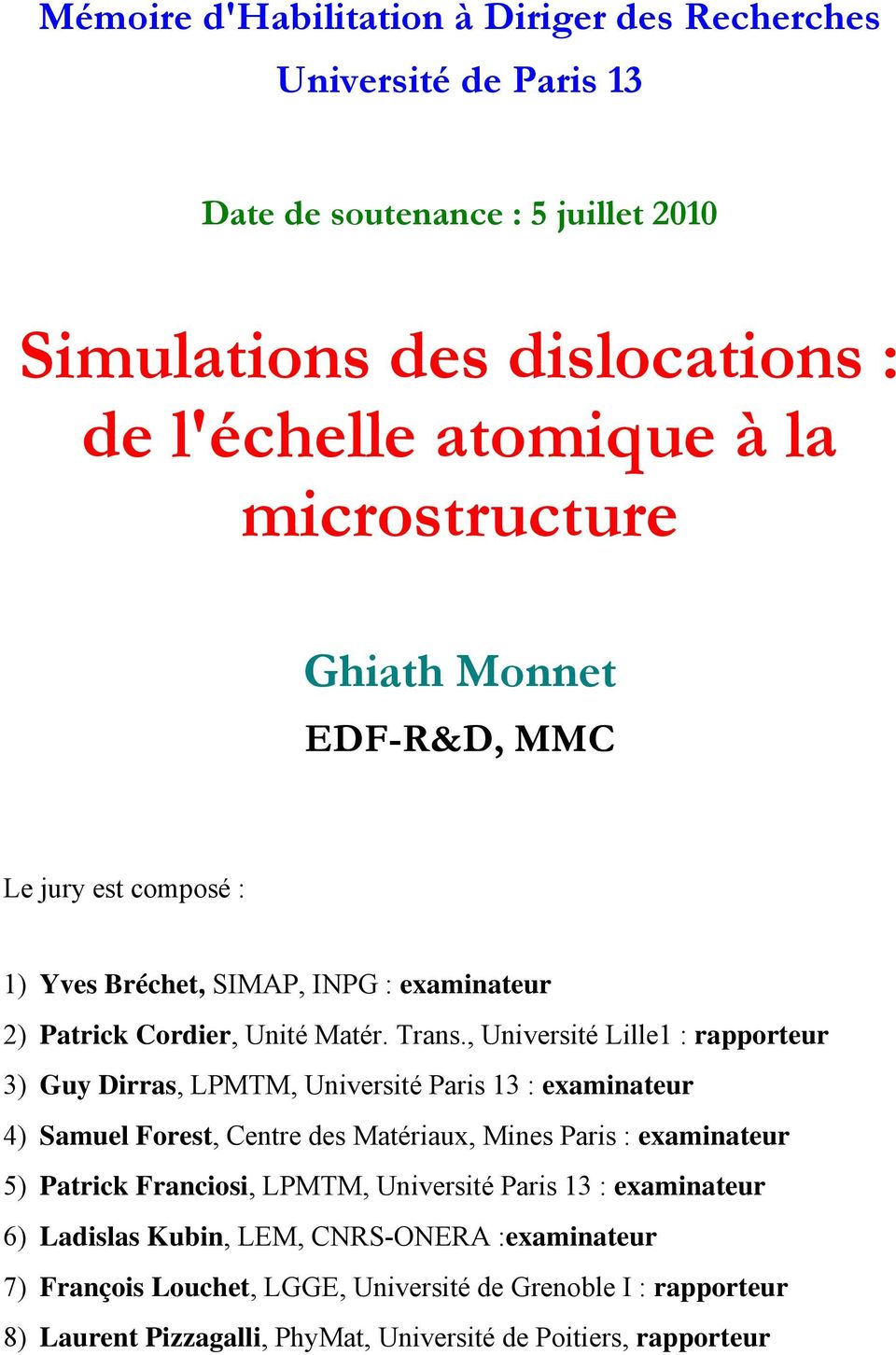
2 2
3 à Jaber ISMAIL 3

4 4
5 Avant-propos Dans ce mémoire, je présente une vision synthétique de résultats récents obtenus dans le cadre des simulations multi-échelles du comportement mécanique couvrant différents aspects. Par souci de cohérence thématique, je me contenterai de présenter les études réalisées pour la compréhension des mécanismes de plasticité dans le fer et les aciers des cuves des centrales nucléaires de type Réacteurs à Eau Pressurisée (REP). Ainsi, l'activité de recherche associée à ma thèse et au poste d'ater ne sera pas ici considérée. Elle a porté sur la caractérisation de la microstructure de dislocations par analyses d'élargissement [1] et d'asymétrie [2,3] de profils de diffraction et sur l'étude de l'effet de l'énergie stockée sur les mécanismes de la recristallisation statique [4]. Ma recherche post-doctorale a quant à elle concerné l'étude des mécanismes de la plasticité dans le zirconium [5] par simulations de dynamique des dislocations et au durcissement provoqué par les précipités de niobium dans les alliages Zr- 1% Nb [6]. Enfin, j'ai préféré ne pas intégrer dans ce mémoire mes travaux en cours sur la germination des dislocations aux surfaces libres, le comportement des alliages austénitiques Fe-Ni, l'effet du carbone interstitiel sur la mobilité des dislocations et l étude expérimentale du comportement mécanique des monocristaux de fer. Mes activités ont lieu à EDF R&D au Département de Matériaux et Mécanique des Composants (MMC) sur le site des Renardières à Moret sur Loing dans la région parisienne. Elles se sont déroulées, pour la plupart, dans le cadre de projets intégrés européens (SIRENA, PERFECT, PERFOMR 60), dédiés aux simulations multi-échelles du dommage d'irradiation. Par ailleurs, les résultats obtenus sont souvent le fruit de nombreuses collaborations avec plusieurs collègues que je tiens ici à remercier chaleureusement pour leurs implication : Christophe Domain (EDF-R&D), Benoit Devincre, (LEM, CNRS-ONERA), Dmitry Terentyev, (SCK-CEN, Belgique), David Bacon (University of Liverpool), Yuri Osetsky (ORNL, Etats-Unis), Patrick Franciosi (LMPTM, Université Paris 13), Sylvain Queyreau et Sanae Naamane (doctorants). Par conséquent, j emploierai la première personne du pluriel tout au long de ce texte afin de souligner le caractère collectif de nos travaux. Enfin, dans le respect de l'exercice ici réalisé, j'ai évité de submerger le lecteur de détails d'ordre technique lorsque ceux-ci n'étaient pas indispensables à la compréhension générale. Tous ces détails se retrouvent cependant dans les publications citées. L'idée est avant tout de se concentrer sur la discussion scientifique autour des résultats afin de stimuler les débats. 5
6 6

7 Remerciements Au-delà des contraintes personnelles et professionnelles, le diplôme d'habilitation à diriger des recherches représente un aboutissement, la confirmation d'une vocation. Outre un goût prononcé pour la recherche et une attitude quasi obsessionnelle face aux interrogations scientifiques, le chercheur doit pouvoir bénéficier d'un ensemble de conditions lui permettant de s'épanouir dans sa quête de connaissances, de stabiliser son parcours et de rendre crédible ses perspectives de recherche à long terme. En milieu industriel, un tel parcours académique est plutôt rare et doit être solidement soutenu par la hiérarchie, ce qui s'avère particulièrement atypique compte tenu des objectifs avant tout concrets. Une telle configuration existe justement au sein de la section Recherche & Développement d'edf, dans le but ultime de prédire la durée de vie des centrales nucléaires de deuxième génération, qui représentent la majeure partie du parc nucléaire français. Tout au long de mon travail à EDF-R&D, j'ai eu la chance d'avoir des responsables dont la totale confiance m'a permis de définir librement mes objectifs de recherche, d'évaluer mes besoins et de m'accorder le temps nécessaire. Ce "climat" de liberté scientifique, je le dois beaucoup à Jean-Michel Frund et Jean-Paul Massoud, ancien et actuel chefs du groupe Métallurgie du Département Matériaux et Mécanique des Composants (MMC). L'ambiance chaleureuse et amicale qu'ils ont su installer dans notre groupe, la confiance et la solidarité qu'ils ont établies, ont transformé mon travail en un véritable plaisir quotidien. Bien évidemment, il y a surtout le collègue de bureau, celui qu'on salut tous les matins et qui partage nos soucis, déboires et gloires. J'ai eu beaucoup de chance que ce collègue soit Christophe Domain. D'abord parce que je n'ai pas réussi (encore) à l'agacer ou à l'irriter, malgré mon tempérament franc et entier. Ensuite, Christophe possède une grande curiosité et une compétence technique et scientifique remarquable, faisant de lui le collègue de travail idéal. Il se trouve qu'il est également le chef de notre laboratoire de Simulations des Matériaux. Malgré une épuisante charge de travail, Christophe a toujours fait preuve d'une rare disponibilité et amabilité pour résoudre les problèmes du quotidien. Je voudrais également remercier Benoît Devincre du Laboratoire d'etudes des Microstructures (CNRS-ONERA), le collègue universitaire qui m'a accompagné dans l'encadrement des doctorants. Il a toujours su apporter, quand il fallait, le grain de sérénité nécessaire au déroulement de ces thèses. Plus encore, je le remercie pour l'ensemble de notre longue et solide collaboration. Malgré le formidable écart entre nos domaines de travail, mon amie Magali Watteaux s'est désignée volontaire pour la relecture de ce mémoire. Je la remercie infiniment d'avoir eu le courage de se plonger dans ce texte ardu, dénué de toute poésie et si éloigné de ses spatiotemporalités archéogéographiques. 7

8 8

9 Table des matières 1. Introduction Simulations des dislocations à l échelle atomique Simulations ab initio Considérations sur les conditions des simulations SM et DM Structure de cœur des dislocations Énergie des dislocations Mesures de la friction de réseau Méthodes de transition d'échelles Le bilan énergétique d'une simulation SM Une nouvelle définition de dureté d'obstacle Méthode d'analyses de l'activation thermique Application au mécanisme de Peierls Énergie d'activation pour le désancrage des cavités Simulations de dynamique des dislocations Bref historique de la dynamique des dislocations Anisotropie et simulations DD Lois de mobilité Durcissement de la forêt dans le régime athermique Durcissement d'orowan dans le régime athermique Durcissement d'orowan dans le régime thermique Durcissement par les cavités Discussion et conclusions Friction du réseau dans le fer Interaction avec les cavités Mécanisme d'orowan à basse température Pour résumer Beaucoup de choses restent à faire Perspectives de recherches Références 85 Articles associés au mémoire 9

10 10

11 1. Introduction Il n'est pas nécessaire d'appréhender les mécanismes de la plasticité pour procéder à l'élaboration d'alliages en métallurgie. Les anciennes civilisations n'ont pas attendu les scientifiques pour élaborer et utiliser le bronze ou le fer. La démarche empirique est suffisante et a prouvé son efficacité à travers les siècles. En revanche, lorsqu'il s'agit de prédire le comportement mécanique dans des conditions inhabituelles, la compréhension de ces mécanismes devient obligatoire. C'est précisément le cas pour les aciers des cuves des centrales nucléaires, soumis à une forte dose d'irradiation [7]. Leur tenue mécanique constitue une des conditions de sûreté les plus contraignantes. Ils sont de structure Cubique-Centrée (CC), se caractérisent par une microstructure bainitique complexe [8], sont non texturés et constitués de différentes composantes : carbures intergranulaires, intra- et inter-lattes, paquets de lattes dans les anciens grains austénitiques. En outre, l'irradiation conduit à la formation d'une large densité de défauts cristallins (ponctuels, boucles de dislocations, précipités, tétraèdres de faute d'empilement, cavités, etc.) ancrant fortement les dislocations. L'irradiation conduit au durcissement et à la fragilisation. La question primordiale qui se pose à nous est donc celle-ci : comment construire une chaîne de connaissances permettant d'appréhender les différentes facettes du comportement mécanique de ces matériaux? Longtemps, toutes les tentatives pour expliquer les effets d'irradiation étaient fondées exclusivement sur les observations expérimentales. Ces observations comportent beaucoup de lacunes en raison des limites de fonctionnement des instruments. Par exemple, la taille minimale des défauts visibles en Microscopie Électronique à Transmission (MET) est de l'ordre de 1-2 nm, ce qui laisse croire que beaucoup de défauts d'irradiation restent invisibles expérimentalement. Par ailleurs, de nombreuses techniques d'observation sont indirectes et nécessitent parfois une interprétation discutable des résultats, comme dans la diffraction à petits angles ou l'annihilation de positons, etc. Si nous ajoutons à cela les difficultés intrinsèques à l'étude des matériaux irradiés (difficulté de manipulation et de transport, outils spécifiques dédiés, réglementations de protection, etc.), nous comprenons pourquoi notre compréhension des effets d'irradiation a progressé avec difficulté. Heureusement, l'essor extraordinaire des moyens de calcul numérique, depuis plus d'une dizaine d'année, a poussé la frontière du possible jusqu'à des horizons inattendus : de la prédiction de l'évolution de la microstructure à l'étude de la plasticité sous irradiation. Désormais, grâce à la technique des simulations de Dynamique Moléculaire (DM), il est possible de simuler à l'échelle des atomes les dislocations de différents caractères et leurs interactions avec les autres défauts [9]. La Dynamique des dislocations (DD) permet de simuler l'évolution d'une microstructure de dislocations et de prédire leur comportement collectif [10], afin de constituer une loi cristalline directement utilisable dans les simulations aux échelles supérieures [11,12] (Éléments finis et techniques d'homogénéisation). Les simulations numériques ont conduit à une avancée majeure dans l'étude des matériaux de structure cristallographique CC. Par commodité, l'abréviation CC sera utilisée comme adjectif dans la suite du texte. Non seulement le comportement des matériaux CC est complexe, mais l'élaboration de monocristaux reste une tâche difficile, comparée au cas des matériaux de structure Cubique-à-Faces-Centrées (CFC). En effet, outre les spécificités géométriques propres à la structure CC, la plasticité de ces matériaux se distingue par deux caractéristiques importantes : une forte Énergie de Faute d'empilement (EFE) sans faute stable et une petite 11

12 taille de sites interstitiels (octaédrique et tétraédrique). Ces deux effets confèrent aux dislocations un comportement atypique vis-à-vis des dislocations dans la structure CFC. D'abord, les dislocations CC ont un cœur compact [13,14], ce qui génère une forte friction de réseau [15] et facilite largement le glissement dévié [16]. D'un autre côté, compte tenu de l'importante distorsion du réseau provoquée par les atomes interstitiels [17], les dislocations réagissent fortement avec les impuretés ou les éléments d'alliage en solution solide interstitielle, comme le carbone [18] ; leur solubilité est en effet très limitée. Par ailleurs, la structure CC offre d'autres complications. Contrairement à la structure CFC, et bien que les directions denses soient bien identifiées, les plans de glissement n'appartiennent pas à une famille unique. En plus des plans classiques de type {110}, l'activation des plans {112} ne fait plus de doute [16]. Ceci génère un foisonnement d'interactions entre dislocations appartenant aux 24 systèmes disponibles [19]. L'approche en facteur de Schmid n'est plus valable puisqu'il faut distinguer au moins un facteur par type de système de glissement, voire deux facteurs pour les plans {112} dans le sens du maclage et antimaclage. Le comportement individuel et collectif des dislocations dans les matériaux CC est donc plus complexe que dans les matériaux CFC. Ceci n'a, bien évidemment, pas empêché l'utilisation intensive des matériaux CC dans l'industrie, même si cela n'a pas facilité la tâche des chercheurs. Pour toutes ces raisons, les simulations numériques ont été d'une grande utilité pour l'étude de la plasticité des matériaux CC. Au départ, ces simulations ont été utilisées comme moyen de compréhension et de description purement qualitative en raison de la faible capacité de calcul et de l'immaturité méthodologique (voir par exemple le problème des potentiels empiriques utilisés par Yamaguchi et Vitek [20]). Ainsi, les résultats n'étaient pas d'une grande précision. Par ailleurs, pour une raison intrinsèque aux simulations numériques, l'échelle du temps simulé reste étroitement liée à la finesse de la description spatiale. Si nous voulons rendre compte explicitement de la totalité du spectre de vibration atomique, il est illusoire de croire pouvoir simuler des événements rares comme la diffusion. Cette dualité espace-temps est universelle et règne aussi dans le domaine expérimental, même si les intervalles de compatibilité ne sont pas les mêmes. Par exemple, il n'est pas possible d'observer en MET une dislocation se déplaçant à une vitesse de quelque m/s. Afin de faire face à ces difficultés, une démarche multi-échelles a été mise en place. Même si la signification de cette expression reste encore floue et que son utilisation suit un phénomène de mode, nous nous restreignerons ici à la définition suivante : (i) d'abord, à chaque fenêtre de l'espace-temps correspond une technique de simulation et, (ii) les données d'entrée de chaque simulation doivent provenir de l'expérience ou des simulations aux échelles inférieures. Le label "multi-échelle" traduit pour nous une condition nécessaire : l'absence totale de tout paramètre ajustable. Le non respect de cette condition retire à cette démarche toute son originalité et sa spécificité. Parallèlement à la naissance de la démarche multi-échelles, les limitations respectives dans l'espace-temps de chacune des techniques de simulation ont conduit à une impasse : les résultats des simulations à une échelle donnée ne peuvent pas être directement exploités aux échelles supérieures. Par exemple, la sensibilité à la température, caractérisée par les simulations DM ne peut pas être utilisée dans la DD ou comparée aux expériences [13]. D'où la nécessité d'établir une série de méthodes de transition permettant, en intégrant les conditions de simulations, d'interpréter les résultats à une échelle supérieure. Dans ce mémoire, nous présenterons les résultats obtenus concernant le comportement des dislocations dans le fer et les aciers de cuves. Le premier chapitre sera dédié aux simulations à l'échelle atomique, suivi par un chapitre introduisant les différentes méthodes de transition 12
![D'un autre côté, compte tenu de l'importante distorsion du réseau provoquée par les atomes interstitiels [17], les dislocations réagissent fortement avec les impuretés ou les éléments d'alliage en](/docs-images/41/3623084/images/page_12.jpg "solution solide interstitielle, comme le carbone [18] ; leur solubilité est en effet très limitée. Par ailleurs, la structure CC offre d'autres complications.")
13 que nous avons mises en place. Nous comparons les résultats de ces méthodes, lorsque c'est possible, à ceux issus de l'expérience. Ensuite, dans un troisième chapitre, nous présenterons les résultats des simulations DD, incluant la validation de la démarche multi-échelle et des méthodes de transition. Enfin, nous clôturerons ce mémoire par une discussion, une conclusion générale et une réflexion sur les travaux à venir. A la fin de ce mémoire, nous pouvons trouver une copie des articles connectés aux sujets abordés et nécessaires pour la précision des détails techniques des simulations. Voici la liste de ces articles : 1) Simulation of screw dislocation motion in iron by molecular dynamics simulations, Domain C., Monnet G, Phys. Rev. Letters, 95 (2005) /1-4 2) Structure and mobility of 1/2<111>{112} edge dislocation in iron, Monnet G, Tarentyev D. Acta Mater. 57 ( 2009) ) Mechanical and energetical analysis of molecular dynamics simulations of dislocationdefect interactions, Monnet G, Acta Mater., 55 (2007) ) Mesoscale thermodynamic analysis of atomic-scale dislocation-obstacle interactions simulated by molecular dynamics, Monnet G, Osetsky Y, Bacon D., Phil. Mag., 90 (2010) ) Solute friction and forest interaction, Monnet G, Devincre B, Phil. Mag., 86 (2006) ) Investigation of precipitation hardening by dislocation dynamics simulations, Monnet G, Phil. Mag., 86 (2006) ) Atomic and dislocation dynamics simulations of plastic deformation in Reactor Pressure Vessel Steel, Monnet G, Domain C, Devincre B, Queyreau S, J. Nucl. Mat. 394 (2009) ) Slip systems interactions in -iron determined by dislocation dynamics simulations, Queyreau S, Monnet G, Devincre B, Inter. J. Plasticity, 25 (2009) ) Low temperature deformation in iron studied with dislocation dynamics simulations, Naamane S, Monnet G, Devincre B, Inter. J. Plasticity, 26 (2010)

14 14
15 2. Simulations des dislocations à l échelle atomique A l échelle atomique, trois techniques de simulation de dislocations sont disponibles [21] : les simulations ab initio, la Statique Moléculaire (SM) et la Dynamique Moléculaire (DM). Les deux dernières sont fondées sur la résolution de la deuxième loi de Newton, la force étant déduite du potentiel empirique interatomique, alors que la méthode ab initio résulte de la résolution approchée de l équation de Schrödinger. Comme précisé dans l'introduction de ce mémoire, je ne rentrerai pas dans les détails de chaque technique. Je me contenterai ici de signaler les résultats et les aspects critiques ou limites de l utilisation de chaque technique appliquée aux études des dislocations Simulations ab initio Cette technique est conçue pour résoudre l équation de Schrödinger (avec un certain nombre d hypothèses et d approximations) pour un ensemble d atomes, dont les positions des noyaux sont prédéfinies. Pour une revue, on peut consulter [22] pour une présentation générale et [23,24] pour différentes applications matériaux. La solution de cette équation consiste à trouver la densité électronique locale. Tout écart à la solution d équilibre induit des forces sur les noyaux. Le calcul itératif avec changements de positions de noyaux dans la direction des forces conduit à la prédiction de cet état d équilibre. Les calculs sont donc essentiellement réalisés à T = 0 K. Cette technique est gourmande en temps de calcul, de telle sorte que le nombre d atomes qu'on peut actuellement simuler est de l'ordre de quelques centaines. Ceci implique de sérieuses limitations lorsque les objets simulés sont des dislocations. D abord, les Conditions Périodiques (CP) dans la direction parallèle à la dislocation sont quasiment obligatoires. Deuxièmement, du fait de la longue portée du champ de distorsion de la dislocation, les conditions aux limites dans les deux autres directions posent toujours un problème dans la mesure où ils ont une influence significative sur les grandeurs mesurées. Plusieurs choix sont alors possibles : les surfaces libres [13], les surfaces colmatées par des atomes légers [25], les surfaces fixes [26,27] et les CP [28]. Dans le dernier cas, la boîte de simulation doit contenir un vecteur de Burgers total nul, ce qui implique l'introduction d au moins un dipôle de dislocations. Concernant le choix de ces conditions, les avis divergent ; aucun consensus n'existe actuellement. Sans rentrer dans la polémique qui ne saurait être tranchée dans le cadre de ce mémoire, nous pouvons dire que la seule propriété de dislocations, dont la validité est reconnue, est la prédiction de la structure de cœur dans le cas où sa taille n'excède pas quelques vecteurs de Burgers. Il s'agit d une condition impossible à atteindre dans les matériaux à faible Énergie de Faute d Empilement (EFE) où le cœur est tellement étalé qu une faute d empilement peut être distinguée à l intérieur même du cœur. C est essentiellement le cas des alliages et des éléments métalliques de structure CFC. Mais dans le cas des éléments CC et, dans une moindre mesure, dans le cas de la structure Hexagonale-Compacte (HC), surtout le zirconium et le titane, il est tout à fait possible de caractériser la structure du cœur des dislocations. Ceci est plus aisé pour la dislocation vis, dont le cœur est moins étalé, que pour une dislocation d'autre caractère. Ainsi, compte tenu de toutes ces limitations, très peu d informations 15
16 «quantitatives» sur les dislocations peuvent être fournies par ab initio. L'intérêt fondamental de cette technique pour l étude des dislocations réside plus dans la validation des simulations de Statique Moléculaire (SM) plus précisément le potentiel interatomique que dans l obtention de grandeurs «utiles» aux échelles supérieures. Prenons l'exemple de la dislocation vis dans le fer. Pendant longtemps, nous avons admis qu'elle possédait un cœur asymétrique étalé en trois branches ou plis (threefold en anglais), en raison des prédictions des potentiels atomiques antérieures à 2003, comme celle d'ackland et al. [29]. Mais les récents résultats ab initio [13] ont démontré que cette structure n'est pas la plus stable (voir Fig. 1), et ont révélé une structure symétrique à 6 plis (sixfold). Ceci a remis en question nombre de résultats [30,31]. L'arrivée d'une deuxième classe de potentiels atomiques [32,33] prédisant la même structure de cœur qu'en ab initio, a constitué une révolution dans les simulations DM du fer. D'abord, les résultats DM avec ces potentiels sont très différents des résultats avec les anciens potentiels [34] ; deuxièmement, le comportement de la dislocation s'est révélé "normal" [13], c'est-à-dire en conformité avec les observations expérimentales : glissement planaire dans les plans {110}, niveaux de contrainte réaliste, etc. Ackland [1997] ab initio Mendelev [2003] Fig. 1: structure de cœur symbolisée par les flèches de Vitek de la dislocation vis ½ [111] selon le potentiel empirique d'ackland et al [29], ab initio et avec le potentiel de Mendelev et al. [13]. Ces différences ne concernent pas seulement la dislocation vis, mais également la dislocation coin, la contrainte de Peierls, la mobilité et la forte friction du réseau sur la dislocation mixte d'orientation <110> [35]. Les simulations ab initio ont joué un rôle similaire dans la remise en question des structures de cœurs stables dans le silicium, ce qui a permis récemment de découvrir un cœur de transition pour la dislocation mixte dans le silicium [25] Considérations sur les conditions des simulations SM et DM La seule et unique donnée nécessaire pour ces simulations est le potentiel empirique interatomique : une fonction dont les variables sont les positions des atomes voisins 16

17 (premiers, seconds, voire troisièmes proches voisins). Le gradient de cette fonction fournit tout simplement la force résultante sur l atome en question. Il y a donc un rayon de coupure au delà duquel les atomes du cristal n exercent aucune influence sur l atome considéré. Il ne faut pas en déduire que cette technique s applique seulement aux phénomènes de courte portée, car l information se propage à travers les proches voisins. La présence du rayon d écrantage implique simplement l absence de corrélations d ordre supérieur au-delà de ce rayon. La SM se distingue de la DM par l absence de vibrations atomiques. Il s'agit d'un algorithme de recherche du minimum d'énergie, c'est-à-dire la recherche d'un équilibre statique à 0 K. Ceci entraîne des simplifications considérables dans l'analyse des résultats et dans les conditions de simulation. Un système statique est caractérisé par un seul état d'équilibre micro et macroscopique pour chaque ensemble de conditions externes. Il n'y a donc pas d énergie cinétique ni d'entropie associée. La seule grandeur d'état du système est l'énergie potentielle E pot qui correspond à la totalité de l'énergie interne du système U. Bien évidemment, les mécanismes dissipatifs injectent de l énergie cinétique dans le système. L'originalité de la SM est l extraction permanente de cette énergie, de telle sorte que le système reste toujours en condition quasi-statique. La dissipation traduit par conséquent la diminution de l énergie totale et rend inutilisable le principe de conservation d énergie. Le bilan énergétique de ce type de simulations a été dressé dans [36]. A chaque itération, selon le premier principe de la thermodynamique, l énergie interne du système varie : de = δw + δq, (2.1) où δw et δq symbolisent les différentiels inexacts des échanges de travail et de chaleur avec le milieu externe. Dès lors, il faut distinguer deux catégories de simulations SM : les simulations des transformations réversibles (sans dissipation) et toutes les autres impliquant des évolutions irréversibles du système. Dans le premier cas, il s agit des études des systèmes à l équilibre quasi-statique en permanence (δq = 0). Notons que cela ne signifie pas forcément l absence de sollicitation mécanique. Cette catégorie de simulations comprend, par exemple, le cas du chargement élastique. La seule condition à respecter est l absence d irréversibilité tout au long de la simulation. C est typiquement le cas des simulations dédiées à l étude des cœurs des dislocations et de leur énergie [18]. Dans la catégorie comportant des évolutions irréversibles du système, on peut citer les simulations du mouvement des dislocations [13,37] et leurs interactions avec les défauts cristallins [38,39]. Nous exposerons plus tard nos résultats les plus récents dans ce domaine. Quant à la DM, elle est actuellement la seule technique de simulation à rendre compte explicitement des vibrations atomiques, c'est-à-dire de la température. En reproduisant le spectre des vibrations, elle est en mesure de prédire toutes les fluctuations énergétiques et, ainsi, de reproduire l'activation thermique. Cependant, nous avons montré [13] qu'en raison des conditions de simulation, la DM est loin des conditions expérimentales et que l'activation thermique produite par la DM est de faible intensité. Dans la suite de ce chapitre, nous rappellerons quelques caractéristiques des mécanismes stochastiques et la manière dont les paramètres d'activation peuvent être estimés à partir des simulations DM. Le chargement en DM peut être effectué selon deux méthodes. Sur les couches atomiques fixes, on peut soit contrôler le déplacement des atomes, soit modifier artificiellement une force résultante sur eux. Cela aboutit aux conditions à déformation imposée [13,37] ou à contrainte imposée [34,30]. En effet, compte tenu de la faible taille du cristal simulé en DM, 17
18 si la déformation est imposée, la contrainte calculée fluctue et vice versa. Les avis divergent sur la grandeur à contrôler au niveau de la boîte de simulation. Nous faisons ici le choix de la déformation imposée afin de simuler les essais mécaniques, généralement réalisés à vitesse de déformation constante. La contrainte calculée à chaque itération est, ensuite, moyennée sur un grand nombre de pas, comparé au nombre de pas nécessaires pour échantillonner une vibration atomique proche de la fréquence de Debye Structure de cœur des dislocations Des propriétés importantes de la dislocation, comme la friction du réseau, découlent de sa structure de cœur. Dans la structure CC, où le cœur est compact, la caractérisation de cette structure est, comme nous venons de le voir, cruciale pour la validation du potentiel atomique empirique.. Le modèle le plus populaire et parmi les plus élégants intellectuellement est celui de Peierls [40], revu et corrigé par Nabarro [41]. A peine six ans après la découverte des dislocations en 1934 par Orowan [42], Polani [43] et Taylor [44], la maturité scientifique de ce modèle est tout à fait surprenante. Peierls fut le premier à comprendre que la taille du cœur est le résultat d'un compromis entre la répulsion élastique dans le cœur, tendant à étaler le cœur à l infini, et la résistance au misfit (mot anglais sans équivalent français) des plans atomiques, conduisant à la constriction du cœur vers la dislocation de Volterra à cœur de taille zéro. La deuxième découverte de Peierls est que la contrainte critique (appelée aujourd'hui la contrainte de Peierls) est la conséquence de l aspect discret du cœur. La première amélioration significative du modèle a été proposée 28 ans plus tard par Christian et Vitek [45], qui ont utilisé, à la place du potentiel du misfit sinusoïdal, la dérivée de l EFE généralisée. Bulatov et al. [46] furent les premiers à calculer la structure de cœur et son évolution sous chargement en fonction de l'efe généralisée à trois dimensions dans le Si. Ainsi, ils ont démontré que la valeur calculée de la contrainte de Peierls pour la dislocation vis passe de 1650 à 12,5 GPa, alors que la simulation directe de SM renvoie une valeur de 3.4 GPa. L origine du facteur 4 entre ce modèle et le résultat direct de la SM n est toujours pas élucidée. Vraisemblablement, le modèle de Peierls, tel qu il a été établi initialement, a été développé pour une dislocation dont le plan de glissement était bien identifié. Ce n est certainement pas le cas des dislocations vis dans les matériaux à haute EFE. L'activation des plans de glissement {112} est maintenant acceptée par la communauté scientifique. Dans un récent travail [47], nous avons décrit la structure du cœur de la dislocation coin dans les plans {112}. La structure de cœur des dislocations vis et coin dans le plan {110} a déjà été décrite dans la littérature [13,37]. Bien entendu, le vecteur de Burgers est de type ½<111> dans tous les cas. Le choix de l étude de cette dislocation est motivé par l absence d information quantitative sur cette dislocation, alors qu elle caractérise, dans une certaine mesure, l activation des plans {112} prouvée expérimentalement [15]. Par ailleurs, ce choix comporte un intérêt heuristique en raison de l absence de symétrie par rapport aux plans {111}, comme montré dans la Fig. 2(a). Ceci est certainement à l origine des différences de comportement selon le sens de sollicitation : sens du Maclage (M) et AntiMaclage (AM) dans ces plans. 18

19 (a) 0.08 EFE (ev/a 2 ) (112) (b) 0.06 maclage (110) Z [112] X [111] x(b) Fig. 2 : (a) projection sur un plan {111} des positions atomiques dans la structure CC. Les carrées et les cercles désignent les positions atomiques dans deux plans {111} successifs ; (b) profil de l énergie de faute d'empilement généralisée dans la direction du vecteur de Burgers dans les plans {110} et {112}. Par rapport aux plans {110}, le profil de l EFE généralisée simulé par ab initio [48] dans le plan {112} est donc asymétrique (voir Fig. 2b). Ceci implique également une asymétrie dans la structure de cœur, comme l'ont suggéré Yamaguchi et Vitek [49,50]. Notre analyse personnelle du déplacement nous a appris que, contrairement à l'hypothèse initiale du modèle de Peierls, les déplacements atomiques en-dessous et au-dessus du plan de glissement ne sont pas égaux en valeur absolue. Le champ de déformation de la dislocation n est donc pas accommodé de la même manière de part et d autre du plan (voir Fig. 3(a) u n+1 (b) (a) u n (b) x(b) ΔΦ (b) (b) relaxée 0.04 maclage antimaclage x(b) Fig. 3 : (a) profils de déplacement de part et d autre du plan de glissement; (b) évolution de la structure de cœur (misfit) sous chargement de 600 MPa dans les deux sens. Deuxièmement, lors de l application d un chargement, ici de 600 MPa, le déplacement du cœur n est pas uniforme ni dans un sens ni dans l autre, comme on le voit dans la Fig. 3(b). Or ces deux points sont au fondement même du modèle de Peierls. Par ailleurs, par rapport à la structure relaxée, le chargement dans le sens M à 600 MPa provoque indéniablement une augmentation de l'étalement du cœur, alors que, dans le sens AM, le chargement ne semble pas avoir d'effet sur la taille du cœur(voir Fig. 3-b). Il est 19
![les plans {110} et {112}. Par rapport aux plans {110}, le profil de l EFE généralisée simulé par ab initio [48] dans le plan {112} est donc asymétrique (voir Fig. 2b).](/docs-images/41/3623084/images/page_19.jpg "Ceci implique également une asymétrie dans la structure de cœur, comme l'ont suggéré Yamaguchi et Vitek [49,50].")
20 intéressant de signaler que dans le modèle initial, le cœur ne doit pas changer de taille sous chargement. Dans le cas où le profil de l EFE généralisée n est pas symétrique, aucune des hypothèses de base du modèle ne semble alors se vérifier Énergie des dislocations Une fois la structure de cœur déterminée, nous pouvons explorer les propriétés à longue portée, notamment, l énergie élastique par unité de longueur de la dislocation dans un cylindre de rayon R, axé sur sa ligne. Cette énergie est montrée dans la Fig. 4 (a) et comparée à celle de la dislocation coin {110} et vis dans la Fig. 4 (b) E (ev/nm) (a) 10 E (ev/nm) coin {110} coin {112} vis (b) 10 R c 5 E c Ln (R /b ) Ln (R /b ) Fig. 4 : l énergie élastique par nm contenue dans un cylindre de rayon R : (a) dislocation coin dans le plan {112}, (b) comparaison avec les dislocations vis et coin dans le plan {110}. Nous pouvons facilement constater deux écarts à la linéarité dans l échelle logarithmique : pour les rayons faibles R < R c et les rayons élevés lorsque R devient du même ordre de grandeur que la taille du cristal périodique. Le premier écart est connu et lié aux fortes déformations associées généralement au cœur de la dislocation (d où l indice «c» dans R c ), ce qui délimite la description élastique de la dislocation de Volterra. Quant au deuxième écart, il est difficile à quantifier proprement. D une part, lorsque la taille du cylindre s approche de la taille du cristal, l addition des champs élastiques des images périodiques de la dislocation amplifie significativement l énergie calculée et, d autre part, la restriction du mouvement des atomes dans les couches fixes [47] ne permet pas une relaxation totale, contribuant ainsi à une augmentation supplémentaire de l énergie. L énergie associée au cylindre de rayon R c correspond naturellement à l énergie du cœur E c, qui s élève à environ 6 ev/nm pour la dislocation coin dans le plan {112}. Pour des valeurs de R > R c, l énergie de la dislocation E dans un milieu élastique isotrope s obtient en ajoutant l énergie élastique et celle du cœur : E = E c 2 µb + ln 4π (1 v) R R c (2.2) Notons que si l on veut, par souci de simplicité, exprimer E sans la constante E c, nous devons remplacer R c dans l équation (2.2) par r o : 20
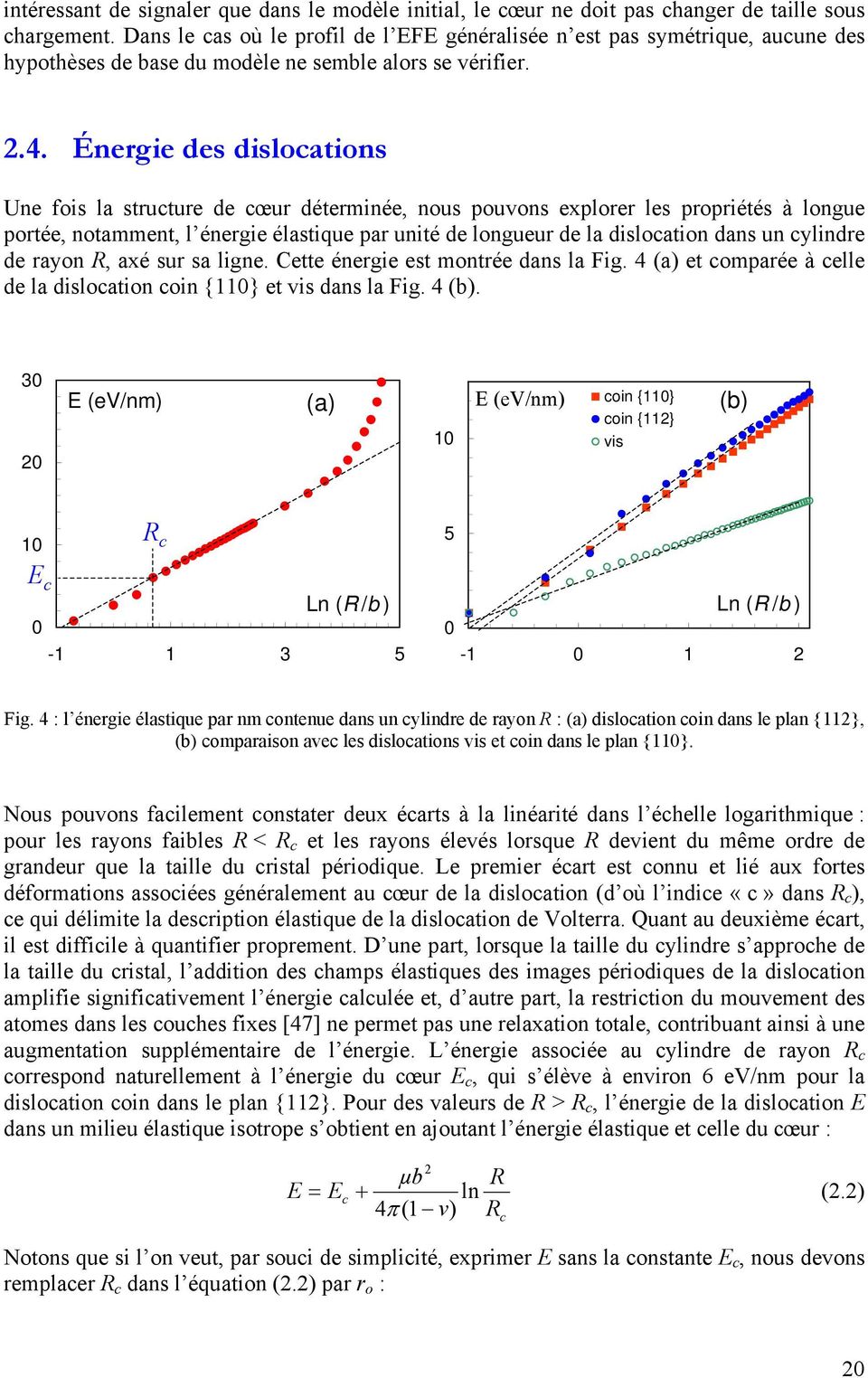
21 Ec ro = Ro exp 4π (1 v), (2.3) 2 µb r o est appelé le rayon de coupure inférieure ; il n a pas de signification physique. Il permet uniquement de simplifier l expression de l énergie, à ne pas confondre, donc, avec le rayon de cœur R c. Dans l'équation 2.3, l évaluation par excès du point (R c, E c ) sur la courbe dans la Fig. 4(b) n entraîne pas d erreur dans l évaluation de r o. L inverse n est pas correct. La détermination de r o, n est possible que grâce aux simulations atomiques. Nous observons ici une des contributions fondamentales de ces simulations atomiques : lorsque l élasticité n est plus valable, seules les simulations atomiques peuvent fournir une réponse directe, dans la limite de validité du potentiel interatomique. La Fig. 4 (b) nous renseigne sur un autre aspect : l énergie de la dislocation coin dans le plan {112} est supérieure à celle contenue dans le plan {110} d environ 6 %. Cette différence provient essentiellement de l écart des énergies de cœur des deux dislocations, donc indétectable par l'élasticité. Bien que cela ne puisse pas nous renseigner directement sur l activité des systèmes de glissement associés, nous pouvons quand même prédire que la courbure d une dislocation coin dans un plan {112} est plus difficile que dans un plan {110}. Puisque le franchissement des obstacles entraîne toujours une courbure de la dislocation, plus au moins marquée, nous pouvons conclure qu un même obstacle sera plus "dur" dans un plan {112} que dans un plan {110}. Serait-ce l origine des hypothèses attribuant l inhibition du glissement sur les systèmes {112} à la présence de carbone [51] ou de silicium [52]? Le fer se caractérise quant à lui par un facteur d anisotropie assez élevé : a = Cela pose la question du choix du module de cisaillement µ et du coefficient de Poisson ν, fréquemment utilisés dans les modèles ainsi que dans les simulations numériques de type dynamique de dislocations (nous reverrons ce point plus loin dans ce mémoire). En utilisant le tenseur des coefficients élastiques C ijkl, une réponse à cette question a déjà été fournie dans les travaux de Scattergood et Bacon [53,54], qui ont astucieusement remarqué qu il est toujours possible de définir ces deux modules tout en respectant l anisotropie du matériau. En adoptant une approche similaire [47], nous pouvons donc identifier des valeurs de µ et ν qui, cette fois, découlent directement des courbes de la Fig. 4(b). Leurs valeurs ont été calculées et sont proches de µ= 62 GPa et ν = Deux remarques peuvent être formulées concernant ces deux valeurs. Premièrement, la valeur de µ est différente du module de cisaillement dans le repère [111](110). Ce dernier est égal à ⅓ (C 11 C 12 + C 44 ) ce qui donne pour les valeurs de C 11 = 243.4, C 12 = 145 et C 44 = 116 GPa délivrées par le potentiel [32], une valeur de µ de 71.5 GPa. Deuxièmement, la valeur de ν est très proche de la valeur maximale théorique de 0.5 assurant la stabilité de la dislocation coin. En effet, en élasticité isotrope, la tension de ligne, au sens de De Wit [55], est proportionnelle au facteur (1 2ν), ce qui rend une dislocation coin instable dans un matériau dont le coefficient de Poisson dépasse 0.5. Nous touchons ici la limite de la description isotrope des champs de distorsion de la dislocation Mesures de la friction de réseau Dans les matériaux CFC, la dislocation est dissociée en partielles et la contrainte de friction est très faible [56,57], alors que, dans les matériaux CC caractérisés par une forte EFE, la friction de réseau est significative et se trouve à l origine de la forte sensibilité à la 21
22 température, observée expérimentalement [15,58]. Des résultats très récents [59] laissent à penser que le cas du Zr et Ti, de structure HCP, est intermédiaire. Rappelons ici qu'il existe deux modes de mouvement pour une dislocation. En l'absence d activation thermique à 0 K, la dislocation doit instantanément franchir la vallée de Peierls sur toute sa ligne ; le chargement mécanique étant la seule force motrice. Ce type de mouvement, appelé mouvement rigide, n a qu'un intérêt heuristique dans la mesure où, dans toutes les conditions expérimentales, ce n'est pas ce mode qui contrôle le mouvement. En effet, dans les années 1950 déjà, les travaux théoriques [60,61] avaient prédit que le glissement de la dislocation s effectue grâce à la germination et à la propagation des doubledécrochements. Avec l'augmentation de la température, la propagation et l annihilation des décrochements commencent à jouer aussi un rôle important [62,63]. Nous restreignons ici notre étude au cas des basses températures. Sous une contrainte appliquée donnée τ inférieure à la contrainte critique à 0 K, la fluctuation thermique permet à un segment de dislocation de longueur l c de franchir la vallée de Peierls tout en formant deux décrochements. Ce mécanisme a été imaginé il y a 47 ans par Seeger [60] dans le but d'interpréter les expériences de friction interne. Comme nous l'avons vu, le potentiel empirique interatomique de Mendelev et al [32] pour le fer a permis, pour la première fois, de reproduire la structure isotrope du cœur de la dislocation vis prédite par ab initio. Ceci nous assure donc de la fiabilité du potentiel dans la simulation des dislocations dans le fer. Nous avons entrepris une vaste étude du mouvement de la dislocation vis et de la dislocation coin dans les plans {112}. Nous présentons ici quelques effets marquants de ces simulations. Le traitement quantitatif de ces résultats se trouve dans le chapitre suivant. Concernant la dislocation vis, nous avons été les premiers [13] à observer par DM le déplacement de cette dislocation via la germination et la propagation de doubledécrochement, exactement comme l'avait suggéré Seeger [60] longtemps avant. Nos simulations ont montré que, après un certain temps d'incubation et de tentatives avortées de germination, un double-décrochement se forme d'une manière stable, suivi d'une étape de propagation (voir la Fig. 5). Nous avons ainsi pu vérifier l'hypothèse de base du modèle théorique, à savoir la prépondérance du temps d'incubation devant celui de propagation. Ce que nous avons appris de nos simulations est que le premier double-décrochement conduit rapidement à un deuxième double-décrochement afin de permettre à la dislocation de se positionner de nouveau dans un triangle stable [64]. Ainsi, chaque événement de germination conduit à deux double-décrochement. Nous reviendrons sur les simulations DM de la dislocation vis dans le chapitre suivant. Voyons maintenant l'évolution des courbes de chargement pour la dislocation coin. La Fig. 2 montre les courbes obtenues à différentes températures pour un chargement dans les sens de maclage et d'antimaclage. Ce qui est surprenant est la rapidité avec laquelle la contrainte d'écoulement baisse avec la température. Bien que la contrainte de Peierls soit très élevée pour une dislocation coin 640 MPa dans le sens de maclage et 700 MPa dans le sens d'antimaclage la contrainte critique devient insignifiante à 200 K. Cela témoigne de la faible hauteur de la barrière énergétique de Peierls. 22
23 (1) (2) (3) Fig. 5 : succession d'images de la simulation DM montrant le mécanisme de mouvement de la dislocation vis dans un plan de glissement de type {110} à 200 K τ (MPa) (a) T = 20 K T = 50K T = 77K T = 100K T = 200K τ (MPa) (b) T = 20 K T = 50 K T = 77 K T = 100 K T = 200 K γ (%) γ (%) 2.0 Fig. 6 : courbes de déformation pour une dislocation coin dans le plan {112} dans le sens de maclage (a) et antimaclage (b). Quelle que soit la température, la contrainte en moyenne reste inférieure dans le sens du maclage. Ceci va dans le sens des observations expérimentales à ce sujet [16,93], sans pour autant les confirmer puisque l'activité de ces systèmes est contrôlée par la mobilité des dislocations vis. Il est important de noter qu'à partir de telles courbes, on ne peut retirer que des informations d'ordre qualitatif. Une vraie analyse mésoscopique est nécessaire pour réaliser une interprétation quantitative. Dans le chapitre suivant, nous exposons les méthodes de transition mises en place dans le cadre de notre démarche multi-échelle. 23
24 24
25 3. Méthodes de transition d'échelles A priori, tous les résultats des simulations DM et SM doivent être traités avant d'être utilisés à l'échelle supérieure. Les méthodes présentées ici ne s'appliquent qu'aux cas des simulations à déformation imposée. A notre connaissance, aucun traitement n'a été rapporté dans la littérature concernant les simulations à contrainte imposée. En l'absence d'activation thermique, nous présentons deux aspects, l'un relié au bilan énergétique lors de l'interaction avec un obstacle local et l'autre permettant de définir la force de l'obstacle. Pour les simulations DM, après un bref rappel théorique de la probabilité d'activation en milieu stochastique, nous expliquons comment les paramètres d'activation peuvent être déduits des simulations DM pour la dislocation vis, la dislocation coin dans les plans {112} et l'interaction entre une dislocation coin et une cavité Le bilan énergétique d'une simulation SM Dans cette section, nous nous focalisons sur les simulations statiques de l'interaction avec les défauts. Le traitement entier peut être trouvé dans [36]. Nous soulignons ici les points principaux de cette analyse. Le chargement mécanique de la boîte de simulation contenant une dislocation ancrée, conduit à la courbure de celle-ci. Pour les simulations SM on dispose de: l énergie potentielle E pot ; la contrainte calculée sur les couches fixes τ ; la déformation totale γ (par l'intermédiaire du déplacement imposé). Dans les articles publiés sur la SM, les auteurs se contentent de présenter ces informations bien qu'aucune ne puisse être transférée à l échelle supérieure, dans la mesure où elles sont toutes dépendantes des conditions de simulation. La première analyse mécanique et énergétique a été proposée dans [36], dans laquelle nous avons montré que le travail total par unité de volume dw tot appliqué pendant une itération de la simulation peut être décomposé en trois quantités : le travail associé à l accommodation élastique dw el, le travail contre la friction du réseau dw f et le travail contre la tension de ligne dw tl, nécessaire à la courbure de la dislocation : dw tot = dw el + dw f + dw tl = τ (dτ/μ) + τ f (dγ dτ/μ) + (τ τ f ) (dγ dτ/μ), (3.1) où dγ est l incrément de cisaillement appliqué. La composante élastique et celle de la tension de ligne contribuent à l augmentation de l énergie interne et sont réversibles. Quant à la composante dw f, elle est irréversible et se transforme en chaleur évacuée du système. Nous avons appliqué notre analyse à l'interaction avec une cavité de 2 nm [36] et 1 nm [65]. Grâce à cette décomposition, nous avons prouvé, pour les faibles courbures et pour la première fois par simulations atomiques, la validité du modèle de Tension de Ligne (TL) dans la prédiction de l énergie nécessaire à la courbure de la dislocation. L'énergie constante associée à cette TL est de l ordre de grandeur de l énergie de cœur de la dislocation, i.e. d environ 7 ev/nm. En d autres termes, la courbure de la dislocation n'entraîne pas un changement significatif de l énergie élastique de cette dislocation. Ceci semble s'appliquer dans les deux simulations avec les différentes cavités. Néanmoins, nous ignorons pour le 25
26 moment si ce résultat est général ou, tout simplement, la conséquence directe de la faible taille de la boîte de simulations. Comme nous l avons vu dans la section précédente, l énergie totale de la dislocation n est pas donnée par l équation 2.2 (voir Fig. 4-a). Probablement, la valeur de 7 ev/nm ne correspond à l énergie de cœur que par «coïncidence». Cette question importante de la théorie des dislocations ne pourra être résolue qu avec d autres simulations impliquant différentes tailles du cristal et différentes conditions aux limites. Parallèlement à cette analyse en termes de composantes du travail appliqué, nous pouvons effectuer une analyse similaire de l'énergie potentielle du système, également donnée par les simulations SM. Comme cette énergie, le travail élastique et la friction du réseau sont connus, et le bilan énergétique nous permet de déduire l énergie d interaction au cours de la phase réversible du chargement [36] : E int = E pot - E el - E curv (3.2) L équation 3.2 se déduit en supprimant l énergie dissipée du bilan, puisque le principe des simulations SM revient à évacuer l énergie cinétique des atomes. Les différentes composantes sont montrées dans la Fig. 7 pour les deux cavités. Energie (ev) (a) 100 (b) U pot 80 γ r E el 60 γ r 40 E curv 20 E 0 int E int ,000 0,004 0,008 0,012 γ (%) U pot E el E curv γ (%) Fig. 7 : évolution des différentes composantes du travail et de l énergie du système pour une cavité de (a) 1nm et (b) 2 nm. Ce qui résulte de ces analyses est que l énergie d interaction au cours du chargement est relativement constante et ceci malgré la grande variation de l énergie potentielle et de la cission. En comparaison, l'énergie d'interaction avec la cavité de 2 nm est presque deux fois supérieure à celle de la cavité de 1 nm. Bien que les deux simulations aient été réalisées avec différentes conditions de simulation, l'énergie d'interaction semble donc être une véritable caractéristique de l interaction, indépendante des conditions de simulation. Par ailleurs, nous avons montré que cette énergie correspond environ à l énergie de la dislocation contenue dans la cavité et qui a été évacuée du système pour maintenir la température à 0 K. En revanche, l origine de la faible, mais mesurable (voir Fig. 7), variation de l énergie d interaction reste encore inconnue. Le bilan énergétique confirme que l augmentation finale de l énergie potentielle correspond seulement à l énergie des deux marches de surface générées par le passage de la dislocation. Ceci indique que l absorption 26
27 des lacunes de la cavité par le cœur de la dislocation ne conduit pas à un changement significatif de l énergie du système. Nous avons donc ici un exemple de traitements des résultats des simulations atomiques permettant de déduire des paramètres intrinsèques de l interaction, indépendants des conditions de simulations Une nouvelle définition de dureté d'obstacle Récemment [65], nous avons montré que les simulations SM peuvent être utilisées pour fournir une description alternative de la force d'obstacle. Dans la Fig. 8(a), nous présentons le schéma à l'origine de la définition classique de la force d'obstacle F. Elle a été conçue pour décrire l'interaction avec un obstacle ponctuel et résulte de la courbure de la dislocation autour de cet obstacle. Cette description souffre de plusieurs inconvénients : (i) la courbure de la dislocation au voisinage de l'obstacle n'est pas constante, (ii) tous les obstacles ont une taille finie, même s'ils sont de nature atomique, (iii) la tension de ligne dépend fortement du caractère local du segment ce qui est, en pratique, difficile à prendre en compte. Même si cette dépendance est bien considérée, en plus de l'énergie E et de son second dérivatif E", il faut aussi intégrer le premier dérivatif E' qui génère un couple de torsion sur le segment [66,67]. La force nette n'est donc pas parallèle en général à la dislocation. Enfin, la description en matière de force n'est pas appropriée dans la démarche multi-échelle, dans la mesure où il est difficile de l'incorporer dans les simulations DD. Γ F r Γ ϕ (a) (b) τ eff w l Fig. 8: (a) définition classique de la force d'obstacle ; (b) définition alternative fondée sur le concept d'une contrainte maximale. Face à ces difficultés, comment pouvons-nous utiliser la SM pour définir une force intrinsèque de l'obstacle, c'est-à-dire indépendante des conditions de simulation? Nous avons tenté de répondre à cette question dans un récent travail [65] par une description alternative schématisée par la Fig. 8(b). En effet, l'utilisation des conditions périodiques induit une périodicité le long de la ligne. Si la taille de l'obstacle est de w et l'espacement l, quel que soit l'état de chargement en équilibre, l'obstacle doit supporter une force nette de bl(τ τ f ), ou τ f est la friction du réseau. En plus de cette force, la contrainte appliquée génère directement une force sur l'obstacle de bwτ. Le désancrage intervient lorsque la somme de ces deux forces (avec τ = τ max ) dépasse la résistance de l'obstacle bwτ c. Nous avons donc : 27
28 l l τ c = 1 + τ max τ f. (3.3) w w Notons que, dans la plupart des cas, l >> w, ce qui permet de simplifier l'équation précédente : l τ c = ( τ max τ f ). (3.4) w Dans l'établissement de l'équation 3.3, la friction du réseau est considérée identique pour tous les caractères le long de la dislocation courbée. Si cette condition n'est pas vérifiée, l'équilibre mécanique ne peut plus être décrit par l'équation 3.3. Ainsi, ce type de raisonnement ne s'applique pas dans le cas des dislocations initialement de caractère vis, ou lorsque la courbure de la dislocation, initialement coin, conduit à la formation d'un segment vis. La valeur de τ c peut être utilisée comme un critère empirique de désancrage dans les simulations DD [6]. Mais τ c peut avoir une véritable signification physique si elle représente une propriété intrinsèque de l'interaction. Autrement dit, si elle est indépendante de la taille de l'obstacle. Elle doit aussi être indépendante des conditions de simulation, comme la longueur de la dislocation ou les dimensions de la boîte de simulation SM. Dans la Fig. 9 nous avons tracé (τ max - τ f ) en fonction du facteur w/l. pour deux natures d'obstacle différentes : les cavités (en symboles pleins) et les précipités de cuivre (en rectangles vides) τ max - τ f (MPa) Fig. 9: évaluation de la contrainte critique des cavités (symboles pleins) et précipités de cuivre (symboles vides). Les cercles et rectangles renvoient à différentes conditions de simulations SM. w/l Comme nous pouvons le constater sur cette figure, les points s'alignent sur deux droites distinctes en fonction de la nature de l'obstacle. La pente de chaque droite fournit la valeur de la contrainte critique de chaque type d'obstacle. Cet alignement prouve que la contrainte critique est la même pour les différentes tailles d'obstacle et de dislocation. Les deux valeurs associées sont : 4.2 GPa pour les cavités et 2.3 GPa pour les précipités de cuivre. Ainsi, pour une taille identique, une cavité est presque deux fois plus "dure" qu'un précipité de cuivre CC dans le fer. 28
29 L'origine physique de cette résistance réside dans le résultat de l'interaction. D'une part, une marche de surface est formée lors de la "sortie" du segment de la dislocation de la cavité, tandis que, dans le cas des précipités, il suffit pour la dislocation de surmonter la résistance de cisaillement du cuivre CC. Dans les deux cas, l'interaction est de nature purement atomique, difficile à "deviner" par les approches classiques de l'élasticité. Nous approchons ici un des avantages clés des simulations atomiques dans la description directe et complète des interactions complexes. Toute la question est de savoir comment en extraire les quantités caractéristiques, utilisables à une échelle supérieure. La détermination de τ c, telle qu'elle est présentée ici, en est un exemple Méthode d'analyses de l'activation thermique Contrainte effective dans les simulations atomiques Dans le cas où la dislocation réagit avec un obstacle local, le chargement conduisant au désancrage force la dislocation à se courber. Dans ce cas, la courbure conduit à la concentration sur le segment en contact avec l'obstacle de la somme de toutes les forces appliquées sur la dislocation. La contrainte locale, appelée contrainte effective, est par conséquent beaucoup plus élevée que la contrainte appliquée. Cette contrainte joue le rôle de force motrice dans le désancrage. Par ailleurs, la présence d'une surface libre dans les simulations induit une force d'attraction sur la dislocation [68]. Afin de déterminer τ eff, il faut bien évidemment évaluer cette force image. Nous pouvons naturellement appliquer le modèle de dislocation avec toutes les approximations nécessaires. Ce calcul est très lourd et la précision n'est pas très élevée. Dans notre étude de la dislocation vis [13], nous avons proposé une méthode simple et sans approximation, fondée sur ces mêmes simulations. En effet, il suffit de mesurer l'énergie de la dislocation en fonction de la distance qui la sépare de la surface E(x), pour déterminer la contrainte associée à la surface τ s. La dérivée de cette énergie E( x) x est simplement égale à ( τ s b l), où l est la longueur de la dislocation. τ s peut être ajouté tout simplement à la contrainte appliquée lorsque la dislocation est rectiligne. En revanche, si la dislocation est courbée, il est très difficile de rendre compte de l'attraction de la surface. C'est la contrainte effective qui représente la variable thermodynamique appropriée, comme cela a été discuté par Schoeck [69] et Hirth et Nix [70]. Si elle confondue avec la contrainte appliquée, l'estimation du volume d'activation devient, en fait, erronée. La raison est que la contrainte intervenant dans l'énergie d'activation ΔG(τ eff ) n'est pas la contrainte appliquée mais la contrainte effective, puisque c'est celle qui agit sur l'obstacle. Si l'on considère la contrainte appliquée, le volume d'activation obtenu est un volume apparent V *, à ne pas confondre avec le véritable volume d'activation qui caractérise l'obstacle V * : V * G = τ eff w G = l τ app w = V l *. (3.5) Comme nous pouvions nous y attendre, le volume apparent est beaucoup plus élevé que le "vrai" volume. En effet, dans l'approche classique, au lieu de considérer la résistance locale de l'obstacle, on "distribue" sa résistance sur toute la ligne de la dislocation. Même si le volume 29
30 apparent est erroné, il faut signaler que les deux approches conduisent au même travail de la * * contrainte appliquée puisque V τ eff = V τ app. La sensibilité à la contrainte appliquée est donc préservée dans les deux cas. Il est intéressant de noter que, dans le cas d'obstacles localisés, le volume d'activation mesuré expérimentalement coïncide avec le volume apparent. C'est pourquoi la confusion entre les deux volumes, physique et apparent, est très répandue dans la littérature (voir par exemple [71,72]), sans pour autant induire d'erreur de calcul, comme précisé ci-dessus. Néanmoins, sans la mise à l'échelle de ce volume, comme indiqué dans l'équation 3.5, le volume apparent ne correspond pas à une quantité caractéristique des obstacles ni de la microstructure. La correction nécessite la connaissance de la taille des obstacles et de leur espacement moyen. Par souci de simplicité, quel que soit le cas, nous désignerons par τ la résultante de toutes les contraintes agissant sur le segment ancré par l'obstacle Probabilité de survie L'activation thermique entraînant le désancrage de la dislocation fait partie des processus stochastiques bien connus en physique [73,74]. Il est donc nécessaire d'établir une base mathématique pour la description du comportement probabiliste. Cela passe par le calcul de la probabilité de survie du système. Considérons d'abord un intervalle d'observation : t I = [0 ; θ] et une variable aléatoire s désignant le nombre d'événements activés thermiquement pouvant se produire dans cette intervalle. Nous pouvons alors définir la densité de probabilité p s (t 1,... t s ) traduisant la probabilité d'observer ces événements dans un voisinage dt autour des temps t 1,... t s. Quant aux probabilités sur l'intervalle I, elles sont notés P s (θ). Il est important de préciser ici que nous devons exclure la probabilité d'avoir plus d'un seul événement pendant l'intervalle dt. La condition de normalisation s'obtient évidemment sur la somme de toutes les P s (θ). Lorsque les événements sont indiscernables, nous pouvons déduire : θ 1 Ps ( θ ) = ps( t1, L, ts) dt1ldts s!. (3.6) 0 La description du comportement stochastique s'associe très souvent à la fonction ω(t) traduisant la fréquence d'activation par unité de temps à un temps donné t. Cette fonction est appelée en anglais rate function, sans véritable correspondance en français. Nous allons l'appeler dans la suite du texte "taux d'activation". Cette fonction suit généralement la loi d'arrhenius : ΔG( τ eff ) ω( t) = ν exp, (3.7) kt où v est un facteur à dimension de fréquence, k la constante de Boltzmann, ΔG l'énergie d'activation et τ eff la contrainte effective. Une différence subtile distingue ω(t) de la densité de probabilité à un seul événement p 1 (t). En effet, contrairement aux densités de probabilité en général, ω(t) n'accepte pas de normalisation et est indépendante de l'historique du processus. La relation entre cette fonction et les densités de probabilité est donnée par [74] : 30
31 ω( t) = p θ 1 1 ( t) + ps ( t, t1, L, ts 1) s = 2 ( s 1)! 0 dt Ldt 1 s 1 (3.8) De l'équation 3.8, nous pouvons facilement déduire la propriété importante suivante: n = θ θ 1 s s s s s 1 1 = ) = 1 ( 1)! 0 0 p ( t, L, t ) dt Ldt ω( t dt (3.9) Concentrons nous sur un cas simple où un seul événement d'activation est possible dans l'intervalle I. La probabilité d'avoir l'activation dans l'intervalle sera désignée par P(θ) et la probabilité de survie par P o (θ). Nous avons donc P(θ) + P o (θ) = 1. Pour déduire la probabilité de survie, il suffit de retenir le raisonnement suivant. Après un temps écoulé de t sans activation, l'équation maîtresse stipule que la probabilité dp(t) d'avoir l'activation entre t à (t + dt) est proportionnelle à la probabilité de survie jusqu'à t, c'est-à-dire P o (t), et au taux d'activation dans dt : ω(t)dt. Cette probabilité infinitésimale est également égale à la diminution de la probabilité de survie. Par conséquent, nous avons dp o (t) = P o (t)ω(t)dt, dont l'intégration donne : = θ P 0 ( θ ) exp ω( t) dt (3.10) 0 La densité de probabilité p(θ) pour que l'activation intervienne entre θ et θ + dθ s'obtient en dérivant P(θ) par rapport à θ : = θ p ( θ ) ω( t)exp ω( t) dt (3.11) 0 Ceci nous permet de déduire finalement le temps moyen d'activation, appelé temps d'incubation ou temps de survie : θ θ θ ω( θ ) exp ω( t) dt dθ (3.12) s = 0 0 Ce que nous pouvons mesurer en DM est la contrainte τ(t) et la déformation γ (t) en fonction du temps. Le temps de survie peut être aussi facilement déterminé grâce à la chute de la contrainte. La question qui s'est posée pendant plusieurs année et qui a empêché l'exploitation des résultats de la DM aux échelles supérieures est la suivante : en connaissant seulement τ(t), γ (t) et θ s, comment arriver à déduire l'énergie d'activation ΔG(τ) ou ω(τ)? A l'exception des comparaisons et des descriptions qualitatives, il est en effet difficile d'obtenir des grandeurs bien déterminées. La difficulté principale est que la probabilité de survie (équation 3.10) fait intervenir l'intégrale de ω(t), qui est la grandeur recherchée. Nous avons proposé la première tentative d'analyse en 2005 [13] pour expliquer l'origine de l'écart de niveau de contrainte entre l'expérience et les simulations du mouvement de la dislocation vis à basse température. Ensuite, nous avons proposé [65] une méthode générale pour la détermination de l'énergie d'activation en fonction de la contrainte critique. Récemment, un article [75] a tenté d'expliquer la base du traitement stochastique de la méthode et la différence par rapport aux méthodes proposées dans la littérature, fondées sur la 31
32 théorie de transition [76,77] ou sur d'autres théories [78]. D'autres méthodes ont été proposées pour analyser les résultats expérimentaux [79]. Nous présentons ici rapidement cette méthode. Nous allons voir que, lorsque la contrainte est constante tout au long de la simulation, le taux d'activation correspondant peut être facilement déterminé. L'idée est donc d'assimiler la simulation réelle (à contrainte variable) à une simulation à contrainte constante. Le défi est d'être en mesure d'évaluer la valeur de cette contrainte et de prouver que les deux simulations sont équivalentes en termes probabilistes Cas de contrainte constante Supposons d'abord que la simulation aurait été réalisée à contrainte constante τ = τ c, ce qui rend le taux d'activation aussi constant ω(t) = ω c. Dans ce cas simple, la probabilité de survie se transforme en une fonction exponentielle P o (θ) = exp( ω c θ) ; l'activation devient aléatoire et suit la distribution de Poisson. Mais la conséquence la plus importante est que le temps d'incubation moyen est maintenant donné par : θ s = θ ωc exp 0 ( ω θ ) c 1 = ω c (3.13) Dans le cas d'une contrainte constante, il est donc possible de calculer le taux d'activation à partir de la mesure du temps moyen d'incubation. Étant donné la loi d'arrhenius, l'énergie d'activation peut être calculée selon la relation ΔG(τ) = kt ln(ν <θ s >). Ici nous devons souligner une difficulté intrinsèque à la théorie de transition [80,81] : la détermination de la valeur précise de la fréquence d'attaque ν pose un sérieux problème. Il est en effet difficile d'imaginer une façon simple d'évaluer ou de calculer les modes de fréquence propres au système à l'état de col (saddle point), puisque, par définition, cet état est instable. Dans la mesure où seul l'ordre de grandeur est ici nécessaire, la tendance actuelle est d'en donner une estimation approximative [82,83], même si plusieurs barrières activées thermiquement sont présentes [84]. Comme indiqué récemment [75], selon la nature de l'obstacle, il convient de distinguer entre le cas de l'obstacle local et le cas d'une barrière énergétique uniforme comme la vallée de Peierls. Dans le cas d'un obstacle local de taille w, l'approximation adéquate est ν = ν D b/w, ce qui donne la formule suivante pour l'évaluation de l'énergie d'activation : b ΔG( τ c ) = kt ln < θ s > ν D (3.14) w En revanche, lorsque la résistance au mouvement de la dislocation est uniforme, l'expérience [85] montre qu'il faut intégrer le nombre de sites de germination en concurrence. En plus du ralentissement de la fréquence avec l'augmentation de la taille critique w, prise en compte dans l'équation 3.14, il faut maintenant ajouter l'augmentation de la probabilité de germination avec l'augmentation du nombre de sites de germination (voir la discussion dans Tang et al. [86]). Dans ce cas, l'énergie d'activation est donc donnée par : bl G( τ c ) = kt ln < θ s > ν D (3.15) w Δ 2 32
33 Nous notons ici qu'une des caractéristiques des équations 3.14 et 3.15 est que la proportionnalité entre l'énergie d'activation et la température, observée si souvent expérimentalement, n'est pas tout à fait exacte. Elle résulte de la stabilité du terme logarithmique. Il est en effet peu probable que ce facteur change dramatiquement avec la température. Le facteur susceptible de changer le plus est le temps d'incubation moyen. Or comme montré dans la Fig. 15, ce temps diminue mais pas suffisamment pour entraîner un changement significatif du logarithme. Nous reviendrons sur ce point dans la section suivante Énergie d'activation à vitesse de déformation imposée Nous avons vu dans la section précédente qu'il est possible, lorsque la contrainte est constante, d'évaluer l'énergie d'activation. Mais comme nous l'avons vu, dans les simulations à vitesse de déformation imposée la contrainte fluctue fortement. La question qui se pose alors est la suivante : peut-on imaginer une simulation à contrainte constante τ = τ c, qui serait équivalente, du point de vue stochastique, à la simulation réelle avec τ = τ(t)? Le terme "équivalent" nécessite ici d'être clarifié. L'équivalence en termes probabilistes dans un milieu stochastique revient naturellement à imposer le même temps de survis θ s dans les deux cas. Il convient donc de prendre τ c telle que la probabilité de survie après θ s soit la même. Cette contrainte constante, ainsi déterminée, est appelée contrainte critique, pour une raison qui deviendra claire dans la suite de ce chapitre. Grâce à l' équation 3.10, l'égalité des probabilités de survie revient à : La solution de l'équation 3.16 est donnée par : θ ( ) = s exp ωcθ s exp ω( t) dt (3.16) 0 s 1 ωc = ω( t) dt = ω( t) θ (3.17) s θ 0 Pour avoir la même probabilité de survie après θ s avec une contrainte constante, il suffit donc d'imposer que la valeur du taux d'activation ω c soit égale à la moyenne du taux d'activation dans la simulation. En considérant un développement limité de l'énergie d'activation : ΔG(τ) = A V * τ, nous aboutissons à la formule donnant la valeur de τ c : * kt V τ τ c = ln exp. (3.18) * V kt Par ailleurs, nous avons montré dans le cas du mécanisme du double-décrochement [75] que l'hypothèse du volume constant n'est pas très forte ; la valeur de τ c est très peu sensible à la valeur choisie du volume. En effet, dans l'équation 3.18, la valeur de τ c dépend surtout du profile τ(t) et de la température. A cette étape de la démarche, nous avons démontré que le taux d'activation constant, résultant d'une contrainte effective constante donnée par l'équation 3.18, fournit la même probabilité de survie à la fin du temps d'incubation θ s, obtenue dans la simulation MD. Cependant, n'oublions pas qu'il s'agit d'un processus stochastique. Il faut donc plusieurs simulations indépendantes, à la même température et vitesse de déformation, pour pouvoir 33
34 rendre compte de la fluctuation de τ c et de θ s. Lorsque n simulations indépendantes sont réalisées, nous disposons alors de n estimations de τ c et de θ s, notées τ c,n et θ s,n. L'étape suivante est donc de déduire la valeur de la contrainte effective τ c qui serait équivalente, du point de vue probabiliste, à τ(t) pour toutes ces simulations. Cette condition impose que la somme des probabilités de survie sur les intervalles θ s,n soit la même que celle obtenue avec une contrainte constante τ c. En langage mathématique, ceci se traduit par: θ s, n exp( () t dt) = ωc θs, n) n 0 n ω exp(. (3.19) Comme nous avons montré que, pour chaque événement, la valeur de τ c,n reproduisait la même probabilité de survie que τ(t) à t = θ s,n, l'équation 3.19 peut être simplifiée ainsi : ( ω θ ) = exp( ω θ ) exp, (3.20) c n n A notre connaissance, il n'existe pas de solution analytique en ω c de l'équation Même simplifiée, elle ne peut être résolue que numériquement. Dans la plupart des cas voir plus loin dans ce chapitre nous pouvons prendre τ c égale à la moyenne arithmétique de τ c,n. Une fois la contrainte effective équivalente τ c déterminée, nous pouvons facilement déterminer l'énergie d'activation associée grâce aux équations 3.14 ou Nous allons maintenant présenter deux exemples de détermination de l'énergie d'activation. c n 3.4. Application au mécanisme de Peierls Cas de la dislocation vis Le mouvement de la dislocation dans la vallée de Peierls a fait l'objet de nombreux travaux théoriques [60,68,87,88] et simulations atomiques [13,30,76,89](voir la discussion dans [90,91]). L'objectif est toujours d'expliquer la forte dépendance de la contrainte d'écoulement en fonction de la température. Le problème des modèles théoriques est la nécessité d'extrapoler la théorie élastique seul cadre théorique disponible aux phénomènes d'échelle atomique. Quant aux simulations atomiques, la difficulté a résidé pendant longtemps dans l'extraction de données physiques du processus de double-décrochement. Nous verrons dans ce chapitre comment notre méthode de transition permet de déduire les paramètres d'activation de ce mécanisme. Comme nous l'avons vu dans la Fig. 6, la courbe de déformation se décompose en plusieurs phases. Chacune d'elle est caractérisée par une période où la contrainte augmente puis chute rapidement, associée à la formation et à la propagation d'un ou plusieurs doubledécrochements. Nous savons [47] qu'une avalanche peut survenir dans les phases de chute, provoquée par l'annihilation des décrochements, en raison des conditions périodiques. Ceci produit une forte augmentation locale de la température, provoquant la germination d'un autre doubledécrochement. Pendant une telle avalanche, les germinations ne se produisent pas à la température moyenne du cristal. Notre méthode d'analyse ne s'applique pas. Nous ne pouvons 34
35 donc appliquer notre analyse stochastique que durant les périodes où la contrainte croît. Par conséquent, chaque courbe de déformation peut être modélisée par une succession d'événements d'activation thermique. Chacune correspond à une réalisation donnée ou à un chemin d'activation différent. Nous avons donc à notre disposition l'équivalent d'un ensemble de simulations indépendantes nous permettant de calculer les moyennes nécessaires. Afin de clarifier la méthode, nous allons utiliser les données expérimentales [90], permettant de fournir l'énergie d'activation en fonction de la contrainte effective, pour calculer les probabilités puis nous comparerons ces probabilités à celles déterminées par notre méthode d'analyse des simulations DM [13]. Dans la Fig. 10, nous montrons la forme d'une courbe de déformation à 300 K, ainsi que l'évolution des probabilités d'activation P n (t) pour chaque événement, calculées à partir des données expérimentales. Bien évidemment, les périodes de chute en sont exclues. Les probabilités à la fin de chaque période varient d'un événement à l'autre, avec une valeur moyenne de (a) 1 τ (MPa) Probabilité P γ (%) Fig. 10: évolution de la contrainte et de la probabilité d'activation de double décrochement (évaluée à partir des résultats expérimentaux) en fonction de la déformation pour une dislocation vis à 300K 0 Ici, nous pouvons rappeler que la moyenne des probabilités d'activation ne doit pas forcément être à 0,5, à moins que la valeur médiane de la distribution soit égale à la valeur moyenne. Avec une valeur du volume d'activation de 20b 3 [90], nous pouvons évaluer les contraintes critiques associées à chaque événement n et, ensuite, calculer les probabilités P n (t) correspondantes. Les résultats sont tracés dans la Fig. 11 ci-dessous. La courbe de déformation a été ajoutée pour faciliter la comparaison. La valeur de chaque contrainte critique τ c,n est affichée comme ligne horizontale pendant les périodes de chargement. Nous constatons tout d'abord qu'à la fin de chaque période de chargement, la valeur de P n dans la Fig. 11 est identique à celle de la Fig. 10, calculée à partir de la courbe réelle de la contrainte. Cette égalité n'est pas surprenante dans la mesure où les valeurs de τ c,n sont conçues pour conserver les probabilités de survie. Ceci confirme que l'effet de la contrainte 35
36 τ(t) calculée au cours de la simulation est équivalente à une contrainte constante égale à la contrainte critique. Dans la Fig. 11, la ligne horizontale pointée indique le niveau de la contrainte critique globale τ c évaluée à partir de l'équation La moyenne des probabilités calculées à la fin des phases de chargement est égale à 0.51, c'est-à-dire la même que la moyenne des probabilités de la Fig (b) 1 τ (MPa) Probabilité P n γ (%) Fig. 11: évolution de la probabilité de saut pour chaque événement, calculée à contrainte constante. Les valeurs de la contrainte critique pour chaque événement sont indiquées par les segments horizontaux. La droite pointillée marque le niveau de la contrainte effective associée à toute la simulation, calculée par l'équation Pour résumer, nous pouvons donc assigner une valeur de contrainte unique constante τ c équivalente, du point de vue stochastique, à la fonction τ(γ) exposée dans la Fig. 10. Nous somme alors capables de déterminer l'énergie d'activation associée. Cette contrainte possède la même signification que la contrainte critique dans les essais mécaniques de tractions sur les monocristaux [92,93,94]. Compte tenu de la nature de l'obstacle, nous choisissons la formule dans l'équation 3.15 pour déterminer l'énergie d'activation. Dans le cas précis de la Fig. 10, nous trouvons une valeur de 0.13 ev pour une contrainte critique de MPa. Pour la même contrainte, l'énergie d'activation lissée aux valeurs expérimentales [91] est très proche de cette valeur. Cette excellente corrélation avec les résultats expérimentaux confirme la validité des analyses effectuées. Parallèlement à la procédure d'évaluation de l'énergie d'activation, notre approche nous a permis de réaliser une comparaison directe entre l'évolution de la contrainte critique mesurée en simulation τ sim (T) et celle donnée par l'expérience τ exp (T) en fonction de la température. Comme nous l'avons signalé plus haut, la contrainte critique τ sim (T) définie dans l'équation 3.20 est la contrainte constante équivalente, en termes probabilistes, à la courbe de chargement effective de la simulation. De même, τ exp (T) est la contrainte critique 36
37 caractéristique des conditions expérimentales. Il est donc tout à fait normal de pouvoir comparer les deux profils. Comme montré initialement dans [13], la contrainte critique ne dépend pas seulement de la température et de la vitesse de déformation. Elle dépend aussi de la longueur moyenne des dislocations. Compte tenu de la différence entre les conditions expérimentales et simulées, à la même température, on observe un écart entre l'énergie d'activation mesurée en expérience ΔG exp et celle obtenue en simulation ΔG sim : v L sim exp Δ Gexp( T ) = ΔGsim( T ) + kt ln (3.21) vexplsim La différence entre les deux énergies n'est pas du tout négligeable ; elle est de l'ordre de 21 kt, alors que l'énergie d'activation mesurée expérimentalement est donnée par ΔG exp = C exp kt = 25 kt. Utilisant l'équation 3.21, nous pouvons déduire que dans les simulations DM nous avons ΔG sim = C sim kt = 4 kt. La différence entre les conditions de mouvement de la dislocation vis dans les simulations et au laboratoire explique donc la faible sensibilité à la température dans les simulations [13]. Comme l'énergie d'activation est fonction de la seule contrainte critique, nous pouvons traduire le terme logarithmique de l'équation 3.21 en différence de température. Ainsi, ΔG sim à une température donnée T serait égale à ΔG exp mesurée non pas à T mais à une fraction de T déduite de l'équation suivante : ΔG sim v L T 4 ln exp (3.22) vexplsim Cexp 25 sim exp ( T ) = ΔG C = ΔG T exp exp Autrement, l'équation 3.22 stipule que le niveau de la contrainte atteint en simulation DM à une température donnée doit être mesuré expérimentalement à 0,16 T DM (conditions DM) τ c (MPa) DM (conditions exp.) expérience T (K) Fig. 12: évolution de la contrainte critique obtenue en simulation DM et en expérience, ainsi que la contrainte critique déduite des simulations dans les conditions expérimentales. Il est facile de constater dans la Fig. 12 que lorsque nous ajoutons la quantité d'énergie manquante, c'est-à-dire le terme 21 kt, nous retrouvons la même sensibilité expérimentale à la 37
38 température. Ainsi, dans les rares cas où l'énergie d'activation a pu être mesurée expérimentalement, les résultats des simulations DM se révèlent en excellant accord avec l'expérience. Les principales critiques contre les simulations DM (grande vitesse de déformation, petite taille du cristal simulé, problèmes des conditions aux limites) sont dans ce cas précis sans fondement. Dans les conditions typiques de simulation, l'énergie d'activation disponible en DM est donc faible et de l'ordre de seulement 4 kt. Nous pouvons en tirer la conclusion suivante : lorsque la hauteur de la barrière est élevée, il devient impossible de simuler en DM l'activation à contrainte zéro. La hauteur de la vallée de Peierls pour les dislocations vis est d'environ 0.84 ev. En expérience, où ΔG exp = 25 kt, la température T a correspondant au début du plateau athermique est donc de l'ordre de 400 K (cette valeur n'est qu'un ordre de grandeur en raison de la viscosité à haute température). Ce qui est important est de constater que ce plateau ne sera jamais atteint en DM. Cette température serait environ de 2440 K. Autrement dit, dans les conditions actuelles, nous ne pourrons pas étudier en DM le comportement des dislocations dans le régime athermique Dislocation coin dans les plans {112} Contrairement à la dislocation vis (voir section précédente), nous disposons de très peu de données expérimentales concernant la dislocation coin dans les plans {112}. L'interprétation des résultats DM est donc plus délicate. Or nous avons vu qu'une valeur approximative du volume d'activation est nécessaire pour déduire la contrainte critique. C'est pourquoi nous avons réalisé des simulations à différentes vitesses de déformation mais à une température constante de 77 K (voir Fig. 13). Dans cette figure, nous indiquons l'évolution de la contrainte moyenne de saut en fonction de la vitesse de déformation. Nous supposons que la variation relative de la contrainte moyenne de saut est la même que la variation de la contrainte critique en fonction de la vitesse. Considérons une vitesse de déformation activé thermiquement & γ = & γ exp( β ) o ΔG, où β est le paramètre de température (kt) -1. Si nous développons ΔG = A Vτ, la contrainte varie en fonction de la vitesse selon l'équation : A kt ln & γ kt τ = o + ln & γ (3.23) V V A température constante, si la contrainte varie d'une façon logarithmique, cela signifie que le volume reste relativement constant. La Fig. 13 montre le meilleur lissage logarithmique de la contrainte. L'accord avec le profil logarithmique est remarquable, ce qui nous conforte dans l'hypothèse d'une relative stabilité du volume. Le volume utilisé pour lisser la courbe dans la figure est de 4.8 b 3. Comparé au volume associé au cas de la dislocation vis (près de 20 b 3 ), le volume trouvé est donc faible. Ceci est compatible avec nos observations de la forme du double-décrochement critique [47] et, compte tenu de la faible hauteur de la barrière énergétique, il est plus ou moins prévisible. Une fois le volume déterminé, nous pouvons utiliser les équations 3.18 et 3.20 pour calculer la contrainte critique en fonction de la température. Les résultats sont exposés dans la Fig. 14. La différence entre les contraintes critiques dans le sens de maclage et antimaclage s'estompe 38
39 rapidement. Même dans les conditions DM, la contrainte critique devient insignifiante à200 K. En suivant la même stratégie adoptée dans le cas de la dislocation vis, nous pouvons opérer une transition d'échelle à partir des conditions de DM vers les conditions du laboratoire. Mais, dans le cas présent, nous n'avons aucune information sur l'énergie d'activation dans les conditions expérimentales. 120 τ moy (MPa) γ& (10 s 6 1 ) Fig. 13: les cercles indiquent l'évolution de la contrainte moyenne de saut en fonction de la vitesse de déformation pour une dislocation coin dans le plan {112} à 77 K. La ligne continue représente le meilleur lissage logarithmique. Pour progresser dans notre raisonnement, nous considérons que, pour un matériau donné, les fluctuations thermiques, disponibles à une température T, ne dépendent que de cette température. Par conséquent, la constante C dans l'expression ΔG = CkT, est une caractéristique du matériau. Selon cette logique, afin de franchir un obstacle, la contrainte effective doit s'ajuster pour fournir la partie manquante de l'énergie mécanique nécessaire, d'où la sensibilité à la température de la contrainte critique. Si nous observons maintenant que l'écart entre les conditions expérimentales et en DM est sensiblement le même que dans le cas de la dislocation vis, nous pouvons déduire que le facteur de correction doit être également proche de 21 kt. Par conséquent, la relation entre les contraintes critiques dans les deux types de conditions doit être aussi décrite par l'équation Cette correction nous amène à la courbe continue de la Fig. 14. La diminution de τ c en fonction de la température dans les conditions de laboratoire est fortement marquée. Le régime d'activation thermique pour les dislocations coin {112} prend fin à 30 K environ. 39
40 Sens antimaclage Sens maclage τ c (MPa) MD (conditions expérimentales) T (K) Fig. 14: évolution de la contrainte critique (symboles pleins) obtenue en simulation DM pour la dislocation coin {112}, ainsi que la contrainte critique déduite des simulations dans les conditions expérimentales (ligne continue et symboles ouverts). Cela nous indique que, dans les conditions habituelles de déformation, la dislocation coin dans les plans {112} ne fournit presque plus de résistance à la déformation plastique. Elle a une mobilité équivalente à celle de la dislocation coin dans les plans de glissement principaux {110} (voir [35,37]) Énergie d'activation pour le désancrage des cavités Nous reprenons ici l'exemple de la dislocation coin dans le plan {110} réagissant avec une cavité de 1 nm de taille. Un exemple de l'évolution des courbes de déformation en fonction de la température est donné dans la Fig. 15 ci-dessous. Nous constatons, en général, que l'augmentation de la température conduit à : (i) la diminution rapide de la friction du réseau ; (ii) la diminution du temps et de la contrainte maximale de désancrage ; (iii) l'accentuation du caractère stochastique de l'interaction. Notre analyse est fondée sur l'emploi de la notion de la contrainte effective, c'est-à-dire la résultante locale de la contrainte au niveau de l'obstacle τ eff. Lorsque nous parlons de la contrainte critique τ c, ou de la contrainte maximale τ max, celles-ci seront déduites de la contrainte effective établie à partir de l'équation 3.3 et non de la contrainte appliquée. L'effet de la température sur l'interaction montré dans la Fig. 15 est typique [9]. D'abord la contrainte critique équivalente est évaluée à chaque température, utilisant l'équation Ici, l'ordre de grandeur du volume d'activation est donné par wb 2, où w désigne la taille de l'obstacle. Une comparaison entre les contraintes effectives maximales et critiques est montrée dans la Fig. 16 ci-après. Nous observons que τ c tend vers τ max, lorsque la température tend vers zéro. 40
41 τ (MPa) γ (%) Fig. 15: effet de la température sur la courbe de chargement pour une interaction entre une dislocation coin de longueur 21 nm avec une cavité de 1 nm. En revanche, à haute température, l'écart entre τ c et τ max, tend à se stabiliser. Afin de "sentir" la relation entre ces deux grandeurs, nous proposons de simplifier l équation En effet, comme la contrainte évolue pratiquement d'une façon linéaire avec le temps, cette équation peut s'écrire [65] : kt V max τ c = τ max ln τ (3.24) V kt Dans l'équation 3.24, la variation de T est largement prépondérante devant la variation de V. Pour cette raison, la valeur de τ c est plus sensible à la température qu'à la valeur de V. Par ailleurs, le deuxième terme de cette équation représente, en quelque sorte, "l'efficacité" de l'activation thermique, puisqu'il représente l'historique du chargement. L'écart relatif entre τ c et τ max augmente d'une façon monotone pour arriver à 27 % à 600 K. Nous avons montré que τ c est bien la grandeur qui intègre l'aspect stochastique et permet de conserver la probabilité de survie. L'évaluation de l'énergie d'activation peut être réalisée en utilisant la formule de l'équation 3.14 où seule la taille de l'obstacle intervient dans la fréquence d'attaque. Pour appliquer cette formule, nous avons réalisé à chaque température au moins quatre simulations indépendantes permettant d'obtenir une bonne estimation de la moyenne du temps d'incubation <θ s >, définie par l'équation La variation de l'énergie d'activation en fonction de la température est tracée dans la Fig
42 5 τ (GPa) 4 τ max 3 τ c T (K) Fig. 16: évolution de la contrainte effective maximale et critique en fonction de la température. La tendance qui se dégage immédiatement de cette figure est la proportionnalité avec la température, une proportionnalité retrouvée dans toutes les mesures expérimentales de l'énergie d'activation [93,95,96]. 0.5 ΔG (ev) C = 8.1 C = T (K) Fig. 17: évolution de l'énergie d'activation en fonction de la température. Les deux lignes pointillées indiquent les simulations effectuées à 10 6 s -1 (C = 8.1) et s -1 (C = 6.6). Cette dépendance est donc reproduite par les simulations DM sans aucune variable ajustée ou hypothèse supplémentaire. Sur la figure, nous remarquons un point non aligné sur la ligne ΔG = 8.1 kt. Ce qui le distingue des autres points est que les simulations ont été réalisées à une vitesse de déformation de s -1, alors que les autres simulations l'ont été à 10 6 s -1. Compte tenu de l'équation 3.14, la constante de proportionnalité C est donnée par : 42
43 b C = ln < θ s > ν D (3.25) w Or le temps d'incubation moyen n'est pas véritablement constant, comme nous pouvons le constater facilement sur la Fig. 15. Mais cette variation incluse dans le logarithme est largement négligeable au regard de la variation de la température. En revanche, lorsque ce temps varie d'un facteur 5 par exemple le point "anormal" de la Fig. 17, la variation ne peut plus être négligée. Pour avoir une idée de l'ordre de grandeur, si la fréquence d'attaque est de l'ordre de Hz, une diminution du temps d'incubation de 5 à 1 ns, fait baisser la constante C de 8.5 à 6.9, ce qui explique la variation observée dans la Fig. 17. Ainsi, grâce à l'équation 3.25, nous possédons aussi une explication de l'écart entre les valeurs de C mesurées en expérience et en simulation. En effet, le temps disponible pour l'interaction en DM est de l'ordre de la nanoseconde, alors que dans le laboratoire celui-ci est de l'ordre de la fraction de seconde. Il est intéressant de signaler que cette transition de temps conduit à l'augmentation de C de la valeur de 8.1 (trouvée en simulation DM) à environ 25, ce qui est la valeur trouvée expérimentalement [96] ΔG (ev) τ c (GPa) Fig. 18: évolution de l'énergie d'activation en fonction de la contrainte critique effective. Une fois les deux fonctions ΔG(T) et τ c (T) identifiées, nous pouvons construire la fonction ΔG(τ c ). Cette fonction est tracée dans la Fig. 18. Nous observons que ΔG diminue rapidement avec la contrainte à un rythme constant jusqu'à 3.6 GPa, avant de diminuer beaucoup plus lentement à très haute contrainte. Dans la première partie, le volume d'activation est relativement constant et proche de 3.9 b 3, c'est-à-dire du même ordre de grandeur que la valeur choisie pour le calcul de la contrainte critique. Il faut noter ici que le volume trouvé à partir de la figure 18 est complètement "indépendant" de notre choix initial pour le calcul de la contrainte critique, puisque ΔG dépend de la température et du temps moyen d'incubation. Aussi, nous remarquons que le volume d'activation tend vers zéro à très haute contrainte. Cela confirme encore une fois que la valeur 43
44 du volume choisie pour le calcul de la contrainte critique n'influence pas le comportement de ΔG(τ). En observant cette figure, nous constatons la même limitation de ΔG déjà observée dans le cas de la dislocation vis. Même avec une vitesse de déformation relativement faible comparé aux vitesses employées habituellement en DM les simulations ne permettent pas d'accéder à des niveaux d'énergie d'activation supérieurs à 0,42 ev. La reste de la courbe à basses contraintes dans la Fig. 18 reste, dans les capacités actuelles de calcul, inexplorable en DM. 44
45 4. Simulations de dynamique des dislocations Définissons d abord ce qu'on entend par "échelle mésoscopique" dans ce mémoire : il s'agit de l échelle à laquelle les dislocations sont présentes explicitement comme défauts purement linéaires plongés dans un continuum élastique. C'est l échelle d observation typique en Microscopie Électronique à Transmission (MET), mais également de l'échelle typique de l espace de simulation conventionnel de Dynamique des Dislocations (DD). Bien évidemment, la richesse de la description atomique n'y figure plus, mais le volume exploré peut être représentatif de la microstructure. Le but des simulations DD est donc de reproduire et de prédire le comportement collectif des dislocations. Ce comportement est responsable de l'écoulement plastique intragranulaire, c'est-à-dire au sein du grain. Du point de vue théorique, la contrainte résolue (cission) critique à l'échelle du grain τ c sur un système donné est une forme de superposition de différentes composantes : τ c = f (τ f, τ ss, τ p, τ foret ), où f est une loi de mélange (superposition). Les différentes composantes sont les suivantes : - τ f est la friction du réseau, résultant de l'aspect atomique et discret du cœur de la dislocation dans le métal pur ; - τ ss la friction d'alliage provoquée par l'interaction entre la dislocation et les atomes en solution solide ; - τ p le durcissement induit par la présence de défauts locaux comme les particules ou précipités. La distinction avec τ ss s'impose en raison de la différence de nature des mécanismes d'interaction associés ; - τ foret le durcissement résultant de la présence d'autres dislocations. Ces dernières réagissent fortement avec le système actif et augmentent sa cission critique. Notons ici deux aspects importants. D'abord, les différentes composantes ne sont pas forcément indépendantes. Ainsi, nous avons montré [97] qu'une contrainte de friction trop élevée conduit à la diminution des forces effectives des jonctions. Ce point sera discuté plus loin dans ce chapitre. En outre, il est parfois difficile de distinguer entre τ f et τ ss, en raison d'une profonde modification de la résistance du réseau en présence d'éléments étrangers, notamment en position interstitielle, comme le carbone dans le fer [18,98] ou l'oxygène dans le zirconium ou le titane [99,100]. D'autres fois, la présence d'éléments d'alliage n'est pas accompagnée par un durcissement mais par un adoucissement à basse température [101,102]. Par ailleurs, lorsqu'on explore la limite d'élasticité irréversible d'un matériau, nous utilisons le terme "durcissement" (strengthening en anglais), puisqu'il s'agit de l'augmentation de cette limite, ce qui rend le matériau plus "dur". Quant au terme "écrouissage" (hardening), il est réservé à l'augmentation dynamique de la contrainte d'écoulement au cours de la déformation. Bien que similaires sur plusieurs points, ces deux aspects du comportement mécanique ne doivent pas être confondus. 45
46 Dans les sections suivantes, nous faisons un bref rappel de la technique de simulation DD ainsi que des principes de fonctionnement de ces simulations. Ensuite, nous présentons les différents résultats obtenus concernant les différentes composantes citées ci-dessus Bref historique de la dynamique des dislocations Il aura fallu près de trente ans depuis la découverte des dislocations [42,43,44] pour exprimer, dans le cadre de l'élasticité isotrope, la contrainte induite par une dislocation de forme quelconque [103,104,105]. Pour une synthèse de ces travaux, nous renvoyons vers l'ouvrage de Hirth et Loth [68] qui constitue une excellente référence. Les premières applications des formules, relativement complexes et nécessitant une grande capacité de calcul, ont été consacrées à l'étude du fonctionnement des sources de Frank-Read (FR) [106,107] et du mécanisme d'orowan [108]. Dans ces travaux pionniers, les dislocations sont discrétisées en petits segments rectilignes connectés afin de reproduire la forme de la dislocation courbée. A chaque itération, la contrainte est incrémentée et la forme d'équilibre de la dislocation est mise à jour. Ces approches sont donc quasi-statiques. Elles ont permis d'établir et/ou de confirmer des éléments importants dans la théorie élastique des dislocations, comme l'importance du facteur logarithmique dans la contrainte de fonctionnement des sources FR et dans la variation de la tension de ligne de la dislocation, impliquée dans le mécanisme d'orowan. La prise en compte de l'anisotropie est apparue un peu plus tard [109,110]. Les calculs de DD à proprement parler n'ont fait leur apparition qu'au début des années 1990 [111]. L'idée ici est de simuler l'évolution dynamique des formes de dislocations sous chargement. Ces calculs nécessitent probablement une des plus grandes puissances de calcul en physique, ce qui explique leur apparition tardive. Il ne suffit plus dorénavant de calculer la forme d'équilibre ; il convient d'établir une prévision réaliste de la vitesse du segment en fonction de la contrainte effective. La loi de mobilité est donc cruciale en DD, sauf dans quelques cas où la vitesse de dislocation n'a pas d'impact significatif sur la propriété étudiée comme, par exemple, pour les coefficients d'interaction ou le durcissement d'orowan Anisotropie et simulations DD La plupart des codes de simulation DD actuels fonctionnent selon le principe de l'élasticité isotrope. Dans le fer, les constantes élastiques sont : C 11 = 242 GPa, C 12 = 146 GPa, C 44 = 112 GPa [112]. Le coefficient d'anisotropie est assez élevé : A = 2 C 44 /(C 11 C 12 ) = 2,3. Nous somme donc amenés dans nos simulations DD à réduire le nombre des constantes élastiques pour utiliser seulement le module de cisaillement µ et le coefficient de Poisson ν. La question qui se pose alors est de savoir quelles valeurs choisir? Cette interrogation est souvent esquivée dans les discussions. Rappelons à ce propos que lorsque nous étudions une dislocation dans un plan donné, le choix peut être fait sans ambiguïté en conservant l'énergie de la dislocation vis et de la dislocation coin. Pour le fer, comme nous l'avons montré dans 2.4, ces valeur sont : µ = 62 GPa et ν = 0,49, dans les plans {110} ainsi que le plan {112}. Mais lorsqu une distribution tridimensionnelle de dislocations est à l'origine de la contrainte locale (cas général en DD), la situation s'avère alors plus complexe. Le débat se situe entre la moyenne de Voigt (à déformation homogène), selon laquelle: µ = C 44 H/5, où H = 2C 44 + C 12 C 11 et la moyenne de Reuss (à contrainte homogène) selon laquelle: µ -1 = S /5 J, où J = S 11 S 12 ½ S 44 [68]. L'hypothèse de Voigt conduit à µ = 86 GPa et ν = 0.29, alors que 46
47 celle de Reuss donne µ = 73 GPa et ν = 0,42. La différence n'est pas négligeable lorsqu'on sait que la tension de ligne et l'énergie de dislocation sont proportionnelles à ces modules. Hirth et Loth [68] proposent d'adopter l'hypothèse de déformation constante près des dislocations. Mais les résultats récents de Han et al. [113] montrent que, concernant le champs d'une boucle, l'interaction dipolaire et la formation de jonction, les modules effectifs de Bacon et al. [54,109], suivis de près par les modules de Reuss, sont ceux qui reproduisent le mieux les résultats DD obtenus dans le cadre de l'élasticité anisotrope. Dans ce travail, les premiers calculs DD ont été effectués avec les modules effectifs de Voigt : µ = 86 GPa et ν = Par la suite, nous avons retenus les modules effectifs de Bacon et a. : µ = 63 GPa et ν = Lois de mobilité Nous pouvons distinguer deux formes de lois de mobilité, généralement utilisées en DD Mobilité visqueuse dans le régime athermique Comme le montrent les Fig. 12 et Fig. 14, la friction du réseau sur les dislocations coin et vis devient négligeable à une température supérieure, respectivement à 100 K et 300 K. A température ambiante et au-delà, la dislocation se déplace presque librement dans le fer quel que soit son caractère. Nous parlons alors d'un régime athermique. Dans un tel régime, l'expérience [114] et la théorie [115] prédisent une proportionnalité entre la vitesse de la dislocation et la cission effective. Osetsky et al. [37] ont vérifié cela en DM pour différentes températures et différentes longueurs de la dislocation coin {110} (voir Fig. 19). Fig. 19: vitesse de la dislocation à 77 et 300 K en fonction de la cission appliquée (reproduite à partir de [37]) En effet, tant que la vitesse v n'est pas proche de la vitesse du son, la viscosité est valide. Dans la Fig. 19, on constate facilement que la proportionnalité est valable jusqu'à plusieurs 47
48 centaines de m/s. de la figure ; nous en déduisons v = 10 5 τ. Le coefficient de frottement B étant définit par l'équation. : b v = τ, (4.1) B nous obtenons la valeur de B = Pa.s, ce qui est très proche des valeurs constatées dans les matériaux CFC [116]. Par ailleurs, nous avons évalué par DM [47] le coefficient B à Pa.s pour le mouvement d'un décrochement le long d'une dislocation coin {112}. Ce décrochement n'a pas la faible mobilité des dislocations vis. Nous en déduisons qu'un décrochement sur une dislocation coin n'est pas de caractère vis et que la loi de viscosité s'applique également sur les décrochements Mobilité activée thermiquement Nous avons vu que, dans le régime thermique, la loi d'arrhenius s'applique pleinement en simulation DM du mouvement de la dislocation vis. A une température donnée T, si le segment i était isolé, sa vitesse v i dépendrait uniquement de sa longueur l i et de la contrainte effective τ. L expression de v i est alors simplement : v i 2 b ΔG ΔG = 2 exp sinh τ o o i ν D li l = c kt kt τ o l η i i (4.2) où l c est la longueur critique du double-décrochement, prise égale à 10b. Si, pour simplifier, nous considérons la constante H = ν D (b/l c ) 2, celle-ci correspond à une fréquence d'attaque effective de l'ordre de ν D / s -1 dans le fer. Notons que nous avons modifié la forme initiale de la loi d'arrhenius en cosinus hyperbolique afin de tenir compte de la probabilité de saut inverse [117]. Afin de séparer la dépendance en longueur et en température, nous avons défini dans l'équation 4.2, la vitesse par unité de longueur η i. La question qui se pose à nous maintenant est de savoir, compte tenu de la discrétisation en segments, comment traduire cette loi en DD? L'équation 4.2 n'est pas conservative : la vitesse effective d'une section de dislocation vis discrétisée en plusieurs segments serait proportionnelle à l'inverse du nombre de ces segments, ce qui est numériquement inacceptable. La procédure que nous avons adoptée consiste tout d abord à déterminer le caractère de tous les segments voisins d un segment vis afin d'identifier la longueur physique de la même section de caractère vis. Dans le cas où le segment i fait partie d'une section vis de n segments, la vitesse du segment i dépend de la longueur totale de la section. Si tous les segments sont soumis à la même contrainte effective, la vitesse effective v eff,i du segment i sera : v n n eff, i = vi + v j = η i li (4.3) j= 1 j= 1 La formulation dans l'équation 4.3 reproduit donc la proportionnalité à la longueur. Mais, dans la plupart des cas, la contrainte effective varie le long de la ligne. Dans ce cas, les segments soumis à une forte contrainte doivent se déplacer plus vite que la moyenne, tout en intégrant la probabilité de saut sur les autres segments. Il s'agit d'un problème complexe, dont 48
49 l'issue n'est pas certaine du point de vue théorique. En effet la loi d'arrhenius modifiée dans l'équation 4.2 n'est pas valable lorsque la contrainte varie le long de l i. Afin de résoudre ce problème, nous avons adopté un traitement simplifié qui donne une bonne approximation de v eff,i. D abord, pour chaque segment i, nous calculons sa vitesse v i en fonction de sa longueur et de sa contrainte effective. Puis, nous ajoutons à chaque v i une contribution moyenne associée à l'ensemble des segments de la section vis. Cette contribution additionnelle est définie comme la somme des vitesses, pondérée par le facteur n/(n+1). Ainsi, la vitesse effective v eff,i s'exprime comme suit : n+1 n v eff, i = vi + 1 v j n+ (4.4) j= 1 On vérifie aisément qu'une telle formulation conduit à la proportionnalité à la longueur lorsque la contrainte est homogène et que la vitesse effective de la section vis est indépendante du nombre de segments la formant Comment rendre compte des différentes mobilités? A température inférieure à l'ambiante, la mobilité des dislocations vis est activée thermiquement, alors que celle des autres caractères ne l'est pas. Comment gérer cette différence dans un code DD? En effet, à la contrainte critique, nécessaire pour le déplacement des dislocations vis à la vitesse imposée, les autres dislocations se déplacent très rapidement. Probablement, à une vitesse au-delà de la limite de validé de la mobilité visqueuse. Il est très difficile de gérer numériquement des vitesses de l'ordre de 1000 m/s pour les dislocations non-vis en même temps que des vitesses de l'ordre de µm/s pour les dislocations vis, dans les conditions habituelles de déformation. Cependant, si nous nous rappelons que, dans ces conditions, la plasticité est contrôlée par la mobilité des dislocations vis et que les autres dislocations doivent se déplacer beaucoup plus rapidement, nous pouvons faire l'approximation suivante. Pour commencer, il suffit de considérer que la vitesse des dislocations non-vis est donnée par la même loi précisée dans l'équation 4.2 amplifiée par un facteur K >> 1. Tout l'enjeu est de vérifier si la valeur de K influence les résultats. Les multiples études de sensibilité réalisées dans la thèse de Naamane [118] confirment qu'à exception de quelques cas particuliers, la limite d'écoulement ne dépend pas fortement de la valeur du coefficient K Durcissement de la forêt dans le régime athermique En dehors des études de cartographie de jonctions [119,120], dont l'intérêt est surtout "académique", la représentation fiable, du point de vue statistique, de l'interaction entre les systèmes de glissement reste l'identification des coefficients d'interaction. Une présentation complète de ces coefficients avec une discussion approfondie se trouvent dans la thèse de Madec [121]. Lorsque toutes les dislocations se déplacent selon une loi visqueuse classique, l'identification de ces coefficients est relativement simple, grâce aux simulations de l'écrouissage latent. Celles-ci consistent à prendre au hasard un système de glissement, considéré comme le système actif ou mobile, et à étudier son interaction avec chacun des autres systèmes non chargés mécaniquement. Ce type de simulations est naturellement quasi- 49
50 statique, c'est-à-dire consiste à rechercher systématiquement des états d'équilibre de l'ensemble des dislocations sous contrainte Les systèmes de glissement dans le fer Dans la matrice CC, nous avons douze systèmes de glissement de type ½ <111>{110} et 12 systèmes de glissement de type ½ <111>{112}. Une zone d'axe [111] est constituée donc de trois plans de types {110} et trois plans de type {112}. La dislocation vis dispose d'une multitude de choix pour dévier. Compte tenu du débat actuel sur l'activité des plans {112} et le manque de données les concernant, seuls les plans {110} ont été considérés dans nos simulations DD. L'idée était de caractériser d'abord les systèmes principaux avec les plans {110}. Le Tableau 1 indique les indices utilisés dans ce mémoire pour désigner ces systèmes de glissement. Indice Plan b r Indice Plan b r 1 (110) [111] 7 (110) [111] 2 (101) [111] 8 (101) [111] 3 (011) [111] 9 (011) [111] 4 (011) [111] 10 (110) [111] 5 (101) [111] 11 (101) [111] 6 (110) [111] 12 (011) [111] Tableau 1: indices des systèmes de glissement de plans {110}. Compte tenu de la symétrie CC, nous observons seulement six interactions différentes (voir le Tableau 2). L'interaction entre le système et lui-même est qualifiée de dipolaire en raison de la formation fréquente de dipôles dont la nature de l'interaction est purement élastique. Interaction coefficient Systèmes l r j b r j θ 1 θ f φ Dipolaire α dip 1 Colinéaire α col 2, 3 [ 111] 0 r J. mixte symétrique α sym 4, 11 [ 111] [ 010] 70,5 70,5 54,7 J. mixte asymétrique α asym 5, 8, 9 et 12 [ 111] [ 010] 0 70,5 54,7 J. coin α coin 6, 10 [ 001] [ 010] 54,7 54,7 90 Coplanaire α cop 7 Tableau 2: caractéristiques géométriques des interactions entre le système n 1 et les autres. De gauche à droite : nom de l'interaction, nom des coefficients, les systèmes impliqués, direction et vecteur de Burgers de la jonction, l'angle entre la direction de la jonction et le vecteur de Burgers du système de référence 1 (θ 1 ), angle entre la direction de la jonction et le vecteur de Burgers du système de la forêt (θ f ) et φ l'angle entre la direction de la jonction et son vecteur de Burgers (caractère). 50
51 Un seul système coplanaire est couplé à chaque système mobile. L'interaction est également de nature élastique. L'interaction colinéaire désigne celle entre les systèmes partageant le même vecteur de Burgers. Le résultat de cette réaction est l'annihilation mutuelle. Avec les autres systèmes, trois types de jonctions sont possibles. Nous remarquons qu'il existe deux jonctions (mixte symétrique et asymétrique) fournissant la même nature de jonction (direction [010] et vecteur de Burgers [111]). Pourtant, leur coefficients d'interaction ne sont, a priori, pas égaux en raison de la différence d'orientation entre le système mobile et la direction de jonction Théorie de l'interaction entre systèmes de glissement Selon la théorie classique de stabilité de jonction [71,122], pour qu'une dislocation ancrée par deux jonctions puisse se libérer, il faut que la courbure de la dislocation atteigne un seuil critique. (a) r T r r ( l ) 1 1, b1 (b) r T j r r ( l, b ) j j θ 1 θ2 l r T r r ( l ) 2 2, b2 Fig. 20: (a) équilibre sur un nœud triple et (b) dislocation ancrée sous contrainte. En effet, la règle d'équilibre autour des jonctions revient à imposer les conditions d'équilibre des nœuds triples, schématisée dans la Fig. 20(a). Cette condition fait intervenir les tensions de lignes T i des deux dislocations (1 et 2) et de la jonction (j), mettant en jeu leurs directions et Vecteurs de ligne respectifs. L'équilibre s'exprime alors simplement par la relation : r r r r r r r r r r r r Tj ( l j, bj ) = T1 ( l1, b1 ) + T2 ( l2, b2 ) avec la condition de conservation b j = b 1 + b2. Puisque nous considérons des dislocations rectilignes au voisinage du nœud, la deuxième dérivée de l'énergie par rapport au caractère, ne doit pas être incluse dans la formulation des tensions de ligne. En revanche, cette simplification conduit à négliger la première dérivée [66,67], c'est-àdire le moment appliqué sur chaque segment tendant à le tourner vers la direction vis. L'équation d'équilibre se simplifie alors pour donner : A b R A b R A b 2 J j j ln = 1 1 ln cosθ ln cosθ2, (4.5) rj r1 r2 où A i est un facteur dépendant du caractère de la dislocation i : A i = (1 ν cos 2 β i )/[4π(1-ν)], où β i est le caractère de la dislocation, c'est-à-dire l'angle entre les vecteurs ligne et de Burgers. R i et r i sont les rayons de coupure extérieurs et intérieurs. La règle connue de la stabilité de jonction : b j < b1 + b2, n'est donc qu'une approximation intuitive. Ce que nous devons retenir de l'équation 4.5 est que lorsque la dislocation 1 se courbe, θ 1 varie, ce qui entraîne une variation de θ 2, pour maintenir l'égalité dans l'équation 4.5. La jonction R 51
52 commence à se défaire lorsque la courbure atteinte ne peut plus être accommodée afin de maintenir cette égalité. L'équation 4.5 montre toute la complexité du traitement de jonctions dans le cas général. Même si nous considérons que pour toutes les dislocations les rayons extérieurs et intérieurs sont les mêmes (même R i et même r i ), nous n'avons aucune possibilité de suivre analytiquement la variation de θ 2 en fonction de θ 1. Si, en outre, nous considérons le cas de plusieurs jonctions différentes, le problème devient impossible à résoudre (d'où la nécessité de faire des simulations DD). Mais, avant de montrer les résultats de la DD, nous allons essayer de "deviner" les paramètres importants du problème. Si nous fixons la distance moyenne l entre les jonctions et si nous négligeons la variation de θ 2, alors θ 1 devient une simple fonction de la courbure de la dislocation, schématisée dans la Fig. 20(b). L'équilibre de forces nous indique que lorsque τ bl est supérieure à une valeur donnée, la jonction est défaite. Nous pouvons exprimer cela par : µb R τ foret = f ( bi,cosθ 1, A1,cosθ2, A2 ) ln (4.6) l r Dans une vraie microstructure, il existe de nombreuses jonctions avec différentes configurations géométriques. La fonction f(..) rend compte des moyennes des paramètres géométriques de l'équation 2.5. La mesure de τ forêt devient principalement dépendante de b j et de l (associée à la densité des dislocations forêt ρ forêt ). Une deuxième remarque a été faite par Schoeck et al. [123], qui stipule que le rayon d'écrantage R doit également être une fonction de la densité des dislocations forêts ρ forêt, puisque la courbure de la dislocation entraîne un écrantage efficace de son propre champ. En d'autres termes, la flexibilité des lignes de dislocations doit augmenter dans un environnement dense de dislocations. Le résultat des différentes approximations et moyennes s'écrit : τ foret 1 = β µb ρ forêt ln, (4.7) β b ρ forêt d'où le coefficient d'interaction β, qui ne doit être fonction que des deux systèmes en interaction, ce qui fixe la nature et la force de la jonction. La présence de β dans le terme logarithmique est nécessaire afin de tenir compte de la force de la jonction dans la courbure de la dislocation. Il est nécessaire ici de dissiper quelques malentendus. Remplacer l dans l'équation 4.6 par 1/ ρ forêt dans l'équation 4.7 ne signifie pas une égalité mais une simple proportionnalité. En aucun cas, β ne doit être confondu avec le cosinus d'un angle critique quelconque. Il s'agit d'une simple moyenne de la fonction f(..) dans l'équation (25). Dans certaines applications où la densité de forêt ne varie pas beaucoup, le terme logarithmique reste relativement constant et peut être incorporé dans la constante β. Le résultat est la formulation classique de la résistance de la forêt : τ forêt = αµb ρ forêt. (4.8) Naturellement, les valeurs numériques des deux coefficients α et β diffèrent fortement. Lorsque Basinski et al. [124] et Hansen et al. [125] entreprirent de rassembler les données expérimentales reliant la contrainte d'écoulement à la densité des dislocations, ils ont clairement montré une évolution proche de la racine carré de la densité. Néanmoins, une 52
53 petite déviation est visible à haute densité. Madec et al. [126] furent les premiers à souligner cet aspect et à insister sur l'importance du terme logarithmique dans l'équation Coefficients d'interaction dans le fer Comme nous l'avons montré ci-dessus, le coefficient d'interaction entre deux systèmes de glissement est une moyenne complexe de plusieurs paramètres géométriques, comme l'orientation des lignes ou l'espacement entre jonctions, etc. Impossible à établir analytiquement, cette moyenne doit être réalisée numériquement au moyen de simulations DD. Les résultats de telles simulations sont a priori fonction de la microstructure simulée, ce qui conduit à une interrogation légitime concernant la validité de ces résultats. Si, par exemple, nous introduisons une forêt à fort caractère coin, nous introduisons un biais dans le calcul par rapport à une microstructure aléatoire. De même, si nous voulons estimer la résistance des parois de dislocations, connues pour être formées essentiellement de dislocations coin, les dislocations de la forêt ne doivent pas être distribuées aléatoirement, puisque les parois sont des structures à faible énergie. Les valeurs obtenues sont donc à prendre avec précaution en fonction du problème considéré. Les coefficients d'interaction calculés le plus couramment sont ceux associés à une microstructure de référence d'un matériau faiblement écroui. Dans ces conditions, la restauration reste limitée et le caractère des dislocations est relativement aléatoire. Dans le régime athermique, la mobilité des dislocations du système actif est très peu sensible au caractère et peut être décrite par une loi visqueuse. Dans ces conditions, faciles à reproduire en simulations DD, nous pouvons entreprendre des simulations de l'écrouissage latent pour déterminer les coefficients. Mais, même en fixant ces conditions, le coefficient α ou β sont fonction de θ 2, c'est-à-dire de la flexibilité des dislocations de la forêt. En effet, si cette dislocation est très courte, la courbure nécessaire pour la formation de la jonction devient difficile, ce qui diminue, en moyenne, la force des jonctions et, par conséquent, le coefficient. Par ailleurs, si nous augmentons fortement la vitesse de déformation, c'est-à-dire la vitesse moyenne des dislocations, le temps d'immobilisation et de courbure de la dislocation en contact avec les jonctions doit diminuer, ce qui conduit également à l'affaiblissement des jonctions. Afin de mettre en place des simulations pour déterminer les coefficients, il convient donc de faire une étude de sensibilité du coefficient mesuré à ces paramètres. Dans la thèse de Queyreau [10], nous avons entrepris une campagne de simulations pour caractériser complètement la sensibilité des coefficients à tous les paramètres influents sur les valeurs des coefficients. Nous montrons dans la Fig. 21 deux cas emblématiques des conditions de simulations pour la détermination du coefficient de la jonction symétrique : la longueur des arbres de la forêt et la vitesse de déformation. Deux conclusions peuvent en être tirées. La force de la jonction reste relativement stable jusqu'à une longueur des dislocations forêt de l'ordre de 4 fois l'espacement moyen de ces dislocations. En deçà de cette limite, la stabilité des jonctions diminue en raison de la rigidité des dislocations de la forêt. Par exemple, à m -2 de densité forêt, cette limite est de 0,4 µm. Par ailleurs, l'influence de la vitesse de déformation se montre très faible, voire inexistante. Il faut signaler que les simulations ont été réalisées avec une densité mobile de m -2. La relation d'orowan nous donne une vitesse moyenne des dislocations de l'ordre de 0,4 m/s. La Fig. 21 nous confirme qu'entre 0,2 et 4 m/s de vitesse moyenne, la valeur obtenue du coefficient est insensible à la vitesse. Nous avons ici un aperçu des précautions habituelles 53
54 à prendre pour réaliser des simulations DD. En effet, la multitude des paramètres de simulation et de la microstructure initiale rend cette technique "délicate" à manipuler pour le néophyte α sym (a) α sym (b) l f ρ f ε& ( s 1 ) Fig. 21: (a) effet de la longueur des dislocations forêt normalisée par leur espacement moyen. Afin d'incorporer le terme logarithmique de l'équation 4.7 dans l'expression de la résistance de la forêt τ forêt, tout en gardant l'ordre de grandeur des coefficients de l'équation 4.8, nous pouvons redéfinir le coefficient β de la manière suivante : τ foêt ( b βρ forêt ) βρ forêt ( b βρ ) ln = μb, (4.9) ln où ρ ref désigne la densité de dislocations forêt à laquelle les simulations de l'écrouissage latent ont été réalisées. Ainsi, si la densité de dislocations est du même ordre de grandeur que celle de ρ ref, nous pouvons écrire simplement : ref τ forêt = μb βρ forêt. (4.10) Cette forme est équivalente à celle de l'équation 4.8 et permet d'isoler, lorsque la densité de dislocations ne varie pas fortement, toute l'information reliée à la résistance de la forêt dans le terme α où β. Les valeurs trouvées dans nos simulations sont listées ci-après dans le Tableau 3. Réaction Dipolaire et coplanaire J. mixte symétrique J. mixte asymétrique J. coin Colinéaire Coefficient β 0,007 0,063 0,036 0,039 0,53 Coefficient α 0,08 0,25 0,2 0,2 0,73 Tableau 3: valeurs des coefficients pour les différentes interactions entre systèmes de glissement. La densité de dislocations de référence est de m
55 Comme montré dans la thèse de Queyreau [10], ces coefficients ont été obtenus suivant une procédure qui permet d'isoler l'interaction dipolaire des autres interactions [127]. En effet, lors de l'interaction avec une forêt, les dislocations mobiles réagissent entre elles. Cette réaction n'est pas toujours négligeable. Par rapport à la résistance classique d'orowan τ max = µb/l, les dislocations constituent des obstacles relativement forts pour les autres dislocations. A l'exception des précipités, α est plutôt de l'ordre de quelques pourcents. C'est le cas, par exemple, de l'interaction avec des atomes en solution substitutionnelle (nickel dans l'aluminium) [128] et même interstitielle (carbone dans le fer) [98]. Plusieurs remarques peuvent être formulées concernant les coefficients du Tableau 3 : (i) les résistances dipolaires et coplanaires ont presque la même force. Les dislocations glissant dans des plans parallèles ne peuvent interagir qu'à longue distance. Sans contact possible, ces réactions ne sont a priori pas bien décrites par l'équation 4.9. Mais la force d'attraction/répulsion diminue en 1/r, avec r la distance par rapport à la dislocation. Par conséquent, nous pouvons continuer à utiliser l'équation 4.9 même si il ne s'agit pas à proprement parler de dislocations de forêt. (ii) Les trois types de jonctions ont une résistance assez proche, mais qui reste, à l'exception de la jonction de Hirth, inférieure à celle des jonctions dans la structure CFC. Ceci va dans le sens des observations expérimentales sur l'écrouissage des monocristaux, plus faible dans la structure CC [129]. (iii) Comme dans le cas de la structure CFC, l'interaction colinéaire reste largement supérieure à toutes les autres [130]. En effet, l'annihilation colinéaire conduit à un fort ancrage des dislocations. La résistance correspondante doit être proche, voire plus élevée, qu'un précipité infranchissable d'orowan Effet de la friction alliage sur les coefficients Dans le cas où la solution solide se traduit par un seuil uniforme de contrainte τ f en-dessous de laquelle le glissement est impossible, nous pouvons nous interroger sur l'effet de τ f sur les coefficients d'interaction. Cet aspect est resté sous silence pendant longtemps, en raison d'une idée fausse : puisque la résistance est uniforme, la contrainte critique due au franchissement de la forêt doit être décalée tout simplement par τ f, ce qui ne doit pas se traduire par une modification de la résistance intrinsèque de la forêt. Dans [97], nous avons expliqué que ce n'est pas tout à fait correct. La façon dont τ f influence α est, en effet, subtile. Afin d'illustrer cet effet, nous montrons dans la Fig. 22 un schéma de l'interaction colinéaire sous forte friction et chargement nul. Le choix de cette interaction se justifie par la simplicité de l'interaction conduisant à un vecteur de Burgers nul (annihilation). Les deux dislocations droites se croisent au départ au point I, situé sur l'axe d'intersection des deux plans de glissement. En l'absence de friction, si les deux dislocations sont attractives, la relaxation finale s'étend jusqu'aux points E et F, de telle sorte que les deux dislocations minimisent totalement la somme de leurs longueurs tout en restant attachées l'une à l'autre le long de l'axe d'intersection. 55
56 C dis. 2 dis. 1 A F b r Q I β P R E X B dis. 1 dis. 2 D Fig. 22: schéma de l'interaction colinéaire en présence d'une forte friction d'alliage sans chargement. Rien n'oblige les dislocations à rester proches du point initial I. Cette large relaxation est à l'origine de la forte résistance colinéaire. Maintenant, supposons que les dislocations subissent une forte friction d'alliage τ f. Deux conséquences sont prévisibles : (i) (ii) loin de l'intersection I, nous pouvons penser que la force motrice de la réaction n'est pas suffisante pour vaincre la friction ; la dislocation doit rester rectiligne. (ii) au point de contact, en revanche, l'équilibre des lignes de dislocations nécessite que chacune fasse un angle droit avec l'axe d'intersection aux points P et Q (voir l'équilibre du point triple dans la Fig. 20). Par conséquent, comme le montre la Fig. 22, il existe une zone intermédiaire où la dislocation doit se courber pour satisfaire (i) et (ii). Au-delà de cette description mécanique et phénoménologique, la physique peut nous aider à quantifier cette courbure. Afin d'avoir une idée de l'ordre de grandeur du rayon de courbure, nous pouvons suivre le raisonnement suivant. Supposons une dislocation ancrée de courbure uniforme. En l'absence de friction et de chargement, la dislocation se relaxe en faisant disparaître sa courbure pour s'aligner entre les deux points d'ancrage. Si maintenant la dislocation est sous un chargement τ, la dislocation ne peut pas revenir complètement à cet état. Elle gardera une courbure d'équilibre R, donnée par T/(bτ), où T est la tension de ligne. En toute rigueur, nous devons considérer dans cette tension de ligne la deuxième dérivée de l'énergie par rapport au caractère [55]. Mais, comme nous sommes seulement intéressés par l'ordre de grandeur de R, nous considérons une simple tension de ligne ½ µb 2. Après simplification, nous obtenons R = µb/τ. Le résultat serait exactement le même si, à la place du chargement τ, nous avions une friction de même amplitude τ f = τ. Par conséquent, le rayon de courbure dans la Fig. 22, serait donnée par R f = µb/τ f. Il est maintenant facile d'évaluer la longueur de relaxation x (voir Fig. 22) [97] : 2 tan x = (( π 2β ) / 4) 4ν tan( β ) 1 ν τ f µb. (4.11) La longueur de relaxation est proportionnelle au rayon de courbure, c'est-à-dire à l'inverse de la friction τ f. La prévision de l'équation 4.11 s'accorde bien avec les résultats DD [97], 56
57 confirmant la validité de notre approche. Le traitement de jonction conduit à la même proportionnalité. En présence du chargement, le traitement devient beaucoup plus complexe, en raison du double rôle de la contrainte sur la relaxation. En effet, la contrainte tend à accentuer la relaxation sur un bras et à la diminuer sur l'autre bras. En outre, en fonction du rapport des facteurs de Schmid sur les deux systèmes, l'évolution de l'interaction peut être complètement différente, comme le montre la Fig. 23. (a) (1) (2) (b) (1) (2) (c) (1) (2) (1) (d) (2) Fig. 23: évolution de la jonction mixte sous chargement τ = τ f en fonction des facteurs de Schmid (m i ) sur les systèmes (1) et (2). (a) m 1 = 0, m 2 = 0 ; (b) m 1 = 0,5, m 2 = 0 ; (c) m 1 = 0,5, m 2 = 0,5 ; (d) m 1 = 0,5, m 2 = 0,5. Même dans le cas simple où un seul système est sollicité, la résolution de l'équation d'équilibre des nœuds triples ne peut être faite analytiquement. 57
58 Comme tendance générale, nous avons montré [97] que l'effet de la friction sur la force de la jonction diminue lorsque la longueur des bras de dislocations baisse, c'est-à-dire avec l'augmentation de la densité des dislocations forêt. Au cours de la déformation, l'effet de τ f ne peut donc que diminuer. Si, à friction d'alliage nulle, le désancrage survient à la contrainte critique τ forêt,0 = α oµb ρ forêt = µb / Rc, cela induit alors une courbure critique C c = 1/R c, où R c est le rayon de courbure critique. La contrainte critique est donnée par τ forêt,0 = µbc c. La question se pose alors de savoir comment déduire C (à friction non nulle) de C c? Compte tenu des nombreux paramètres intervenant dans le rôle de τ f, nous considérons l'approche approximative suivante. Si la friction d'alliage est non nulle et le chargement nul, seules les sections proches des nœuds triples acquièrent une courbure C f = 1/R f = τ f /µb, les autres sections restant droites, comme indiqué dans la Fig. 22. Si maintenant, nous chargeons le système avec τ > τ f, les segments éloignés des jonctions commencent à acquérir une courbure C app = (τ -τ f )/(µb), induisant dans le même temps une rotation des sections déjà courbées au voisinage des nœuds triples d'un angle approximativement proportionnel à C app. Le désancrage survient lorsque la courbure totale aux nœuds triple, c'est-à-dire C app + C f, devient égale à la courbure critique C c. Ceci se traduit par : Nous avons donc : τ = τ + τ = τ + αµb ρ (4.12) c f forêt c R f f forêt 1 A = 1 + R R, (4.13) où A est une constante exprimant la proportionnalité entre l'accroissement de la courbure locale au nœud triple dû à la courbure provoquée par la friction d'alliage τ f. En remplaçant les rayons de courbure par leurs valeurs, nous obtenons : τ foret,0 µb τ = µb foret τ f + A, (4.14) µb En se rappelant des définitions de α et α o, nous avons donc : A α = α o τ f (4.15) µb ρ A microstructure égale, notre modèle très simple prédit une diminution du coefficient d'interaction proportionnelle à la friction d'alliage. Dans la Fig. 24, nous montrons l'évolution du coefficient d'interaction de la jonction Lomer en fonction de la friction d'alliage. La figure montre clairement que la variation du coefficient est linéaire, proche de nos prévisions de l'équation Pour les faibles valeurs de la friction, la correspondance est très bonne avec l'équation 4.15 (voir Fig. 24). Pour les valeurs élevées, l'évolution de α s'écarte de la tendance linéaire. L'explication réside certainement dans l'invalidité de l'approximation liant la courbure à l'angle de rotation. forêt 58
59 Coefficient d'interaction Lomer Interaction coefficient ρ f = m τ F (MPa) Fig. 24 : évolution du coefficient d'interaction (cercles) de la jonction de Lomer dans la structure CFC en fonction de la contrainte de friction. La droite pointillée représente le lissage linéaire de l'équation 4.15 pour les faibles valeurs de la friction. L'effet de la friction sur la force des jonctions est très fort et ne peut être négligé que lorsque la densité de dislocations est très élevée [97] Durcissement d'orowan dans le régime athermique Aperçu théorique Lorsqu'une dislocation mobile rencontre un précipité incohérent, c'est-à-dire n'offrant pas de continuité cristallographique du plan de glissement, ou un précipité cohérent dont la taille dépasse un seuil critique, la dislocation contourne cet obstacle selon le mécanisme d'orowan. Depuis la découverte de celui-ci en 1948 [131], de nombreuses tentatives ont été réalisées afin de prendre en compte deux aspects, absents du traitement initial d'orowan : la taille des particules [108,109,132] et l'effet de la distribution [71,133,134]. En effet, selon Orowan [131], le durcissement correspondant est de l'ordre de : µb τ o =, (4.16) l où l est l'espacement moyen des précipités. L'établissement de l'équation 4.16 nécessite implicitement deux hypothèses fortes. D'abord, la tension de ligne doit être de la forme ½µb 2 ; ensuite, l'espacement des obstacles ancrant la dislocation est égal à l'espacement moyen surfacique des obstacles. Dans cette deuxième hypothèse, la distribution dans les matériaux réels, presque toujours plus au moins aléatoire, est entièrement négligée. Bacon, Kocks et Scattergood (appelés dans la suite BKS) [108], ont été les premiers à souligner un aspect supplémentaire : l'influence de la taille des obstacles sur la tension de ligne de la dislocation. 59
60 j i k D l Fig. 25: configuration critique d'une dislocation réagissant avec une rangée périodique de particules. Dans le cas d'une rangée périodique de particules de taille D et espacées de l (voir Fig. 25), le durcissement selon BKS [108] est : 2 1 ν cos θ µb D τ BKS = ln + B, (4.17) 2π (1 ν ) l b où θ est l'angle caractère du segment de type i dans la Fig. 25, D est la moyenne harmonique de l et de D, c'est-à-dire (Dl)/(D+l), et B est une constante égale à 0,7. Etonnamment, la présence de la constante B n'a pas été commentée par les auteurs, alors qu'elle correspond à (ln 2). Ceci revient à considérer, tout simplement, que le rayon d'écrantage inférieur r o dans leurs simulations n'est pas de b mais de b/2. Cette valeur s'accorde très bien avec les résultats de simulations atomiques (voir Fig. 4), mais la raison de son apparition dans ce type de simulations mésoscopiques nous reste encore inconnue. Par ailleurs, si nous intégrons cette correction dans l'équation 4.17, nous pouvons déduire l'expression de la tension de ligne T l du segment i. En effet, l'énergie supplémentaire correspondant à une élongation dx du segment i et par conséquent du segment k doit être égale au travail de la contrainte appliquée, ce qui permet d'écrire (τ BKS b l) = 2T l. Avec l'équation 4.17, nous avons : D T = 1 2 ν cos θ 2 l µb 2 ln. (4.18) 4π (1 ν ) b Cette tension de ligne correspond à l'énergie par unité de longueur d'une dislocation appartenant à un dipôle. Ainsi, puisque le travail consiste à une pure élongation, la deuxième dérivée de l'énergie par rapport au caractère n'intervient pas ici. Dans cette équation, la portée du champ de la dislocation est réduite à D, c'est-à-dire à environ la taille de la particule. Même dans un terme logarithmique, cette réduction n'est pas négligeable. L'attraction dipolaire entre les segments i et j est donc à l'origine de la diminution de la force des particules. Selon BKS [108], la taille de la particule induit une forte modification de la tension de ligne de la dislocation. En comparaison, il en résulte que le durcissement classique d'orowan de τ o pour une rangée périodique ne correspond au durcissement de l'équation 4.17 que lorsque D est de l'ordre de 75 b. Dans la plupart des cas, l >> D, ce qui indique que le durcissement de τ o est valable pour des particules de diamètres proches de 20 nm. Pour les particules de dimensions inférieures, comme les défauts d'irradiation, le durcissement d'orowan est largement inférieur à τ o. Il est étonnant de constater que la tension de ligne d'orowan (½ µb 2 ), prédite il y a 60 ans, correspond à une moyenne réaliste de tailles de précipités en métallurgie (pour une revue voir [135]). 60
61 Bien entendu, cette conclusion ne porte que sur le cas d'une rangé périodique, équivalente à une distribution "carrée" des particules. La distribution réelle est toujours plus ou moins aléatoire ce qui conduit à une deuxième baisse du durcissement. Mais cette baisse est plus difficile à cerner que celle due à la taille des particules. Les différents modèles statistiques ne permettent pas de prendre en compte les résultats des simulations DD [6]. Là aussi, BKS [108] ont proposé une approche originale. En remarquant que le durcissement prévu dans l'équation 4.17 est généralement inférieur à τ o, ils ont conclu, à juste titre, que pour une tension de ligne classique le durcissement de l'équation 4.17 serait faible. Les particules peuvent alors être assimilées à des obstacles ponctuels franchissables, caractérisées par une force α et un angle critique θ donné par α = cos θ = τ p / τ o. BKS [108] déduisent que les statistiques de Friedel [71] s'appliquent, conduisant à exprimer finalement le durcissement d'orowan pour une distribution aléatoire ainsi : ln D µb ln D τ p = (4.19) lnl l 2π Comme nous pouvons le remarquer, l'influence de l'attraction dipolaire et de l'aspect aléatoire de la distribution sur le mécanisme d'orowan se traduit par une diminution de la force effective des particules α de 1 à la valeur : 3 1 (ln D) α = (4.20) 2π lnl Ainsi, la dureté effective des particules dans le mécanisme d'orowan augmente avec la taille des particules et diminue avec leur espacement. Rappelons que ces résultats ne sont valables que lorsque D < 75 b, afin de garantir que les particules sont assez faibles pour l'application des statistiques de Friedel Résultats des simulations DD Tout d'abord, les résultats de la thèse de Queyreau [10] ont confirmé la validité de l'équation 4.17, dont la prédiction est tracée en ligne continue dans la Fig. 26. Que ce soit pour la dislocation vis ou coin, les résultats des simulations DD s'accordent parfaitement avec le modèle sur au moins deux ordres de grandeur en D. Dans le cas d'une distribution aléatoire de particules, nous avons été surpris de constater que, malgré les hypothèses et simplifications du modèle de BKS, l'équation 4.19 fournit une très bonne estimation du durcissement obtenu en DD. Dans le cas des alliages Zr 1% Nb, l'équation 4.19 a été vérifiée pour deux familles de précipités de Nb [6], complètement différentes du point de vue des caractéristiques géométriques (taille et espacement).cette équation a également été vérifiée dans le cas des carbures présents dans l'acier des cuves [10]. D'autres travaux de la littérature [132,136] ont confirmé la validité de cette équation. 61
62 2 1,5 τ p ( μb l) Vis 1 Coin 0,5 0 ( b) D Fig. 26: comparaison entre les résultats DD (cercles) et la prédiction de l'équation En revanche, le modèle de BKS ne fournit aucune indication sur l'extension du modèle aux cas des particules de différentes tailles Durcissement d'orowan dans le régime thermique Dans la section précédente, nous avons supposé que la friction du réseau et d'alliage est uniforme sur les dislocations indépendamment de leurs caractères. C'est précisément le cadre théorique habituel des études sur le mécanisme d'orowan. Lorsque la friction est plus élevée sur l'un des caractères, toutes les conclusions de la section précédente doivent être remises en cause. Le cas le plus emblématique est bien sûr celui de la structure CC à basse température, où la dislocation vis subit une friction du réseau beaucoup plus forte que celle concernant les autres caractères. Comme mentionné auparavant, la vitesse de la dislocation vis est donnée par l'équation 4.2 ; la vitesse de la dislocation coin est proportionnelle à celle de la dislocation vis avec un facteur de proportionnalité K >> 1 : v ΔG o ΔGo τ 2 K v o exp sinh kt, (4.21) kt τ = o où v o est une constante proche de 10 5 m/s. Les valeurs adoptées de K sont les suivantes: T (K) K Tableau 4: valeurs de la constante K prises dans les simulations DD. 62
63 Nous désignons par τ p le durcissement d'orowan, qui, dans notre cas, correspond à τ c τ ini, où τ c est le maximum de la contrainte atteint pendant le franchissement et τ ini la contrainte stationnaire en l'absence d'obstacle. Contrairement à l'écoulement visqueux à haute température, où la contrainte effective reste très faible, ici la contrainte d'écoulement varie fortement afin de "forcer" les dislocations à se déplacer à la vitesse moyenne nécessaire pour accommoder la vitesse de déformation imposée. Dans toutes nos simulations, la vitesse moyenne des dislocations a été fixée à 1 µm/s L'exemple du mécanisme d'orowan présenté ici est le cas de précipités de taille 100 nm, cas similaire à celui des carbures présents dans l'acier des cuves. Nous avons réalisé en DD des simulations d'interaction des dislocations vis et coin avec la rangée périodique afin de révéler l'effet de la friction. Ensuite, nous avons étendu notre analyse à la distribution aléatoire Réaction entre une dislocation coin et une rangée périodique A priori, nous pouvions nous attendre à ce que la réaction de cette dislocation soit conforme à celle du régime athermique. Mais, durant l'interaction, un dipôle vis doit se former, ce qui peut induire un écart à l'équation Nous avons vérifié par simulations DD cet aspect. La Fig. 27(a) montre la forme critique de la dislocation coin pour deux températures et espacements différents. Comme nous pouvons le constater, il n'y a pas de différence significative en fonction de la température. La dislocation se désancre lorsqu'un dipôle vis est formé. (a) 50 K l = 0,1 µm l = 2 µm (b) 250 K l = 0,1 µm l = 2 µm τ p (MPa) (c) 50 K 250 K BKS 250K l (µm) Fig. 27: (a) et (b) configurations critiques de la dislocation coin pour deux différents espacements à différentes températures et (c) l'évolution du durcissement en fonction de l'espacement à 50 et 250 K, comparée à la prédiction du modèle de BKS [108]. L'évolution du durcissement pour la rangée est tracée dans la Fig. 27(c) à 50 et 250 K. La comparaison avec la prédiction du modèle de BKS s'avère très concordante. La mobilité du dipôle vis ne joue aucun rôle. La raison en apparaîtra clairement dans la suite de la discussion. 63
64 Réaction entre une dislocation vis et une rangée périodique Contrairement à la dislocation coin, la forme de la dislocation vis enregistrée à la contrainte critique dépend fortement de l'espacement des particules (voir Fig. 28-a et b). En outre, comme montré sur la Fig. 28(c), le durcissement dépend fortement de la température, qui est différent de la prédiction du modèle BKS [108]. (a) (b) 200 (c) 50 K l = 0,1 µm 250 K l = 0,1 µm τ p (MPa) K 250 K BKS 250K l = 2 µm l = 2 µm l (µm) Fig. 28: (a) et (b) configurations critiques de la dislocation vis pour deux différents espacements à différentes températures et (c) l'évolution du durcissement en fonction de l'espacement à 50 et 250 K, comparée à la prédiction du modèle de BKS [108]. Le durcissement à basse température est donc toujours inférieur à celui à haute température. Ce résultat n'était pas attendu. Comment expliquer ces observations? Dans la section suivante, nous allons voir que l'origine de ce comportement n'est autre que l'écart de mobilité entre la dislocation vis et les autres caractères Analyse des résultats Avant d'analyser les résultats, soulignons un effet important qui agit sur tous les mécanismes dans le domaine thermique ; une conséquence directe de l'écart de mobilité entre dislocations vis et non-vis. La contrainte nécessaire au déplacement de la dislocation vis τ vis à une vitesse donnée est plus élevée que celle nécessaire pour faire déplacer une autre dislocation, comme la dislocation coin τ coin, à la même vitesse. Étant donné les formes des lois de mobilité considérées à basse température, nous pouvons évaluer [91] cette différence de contrainte due à la mobilité (désignée par Δτ m dans la suite) par : Δτ m = τ o kt ΔG o 2 Kυ o kt υ ln 2 + ln, (4.22) Hl ΔGo HlυoK Δτ m est perçue comme une "surcontrainte" disponible pour les dislocations non-vis lorsque la contrainte appliquée est égale τ vis. La variation de Δτ m n'est pas monotone. Nous avons tracé cette évolution en fonction de la température pour les valeurs typiques de différents paramètres (voir Fig. 29). A chaque température, la valeur de Δτ m dépend fortement du 64
65 rapport de vitesse K. Alors que Δτ s a tendance à baisser avec la température pour s'annuler à T = 300K, elle augmente avec la température pour les températures inférieures à 100 K Δτ m (MPa) T (K) Fig. 29: évolution de la différence de contrainte effective (surcontrainte) sur les dislocations vis et non-vis se déplaçant à la même vitesse. Ce comportement est tout à fait attendu en raison de la nature des lois de mobilité des dislocations vis et non-vis. Les résultats obtenus sur la dislocation coin sont relativement simples à interpréter. Si la dislocation se déplace librement à τ coin et qu'elle rencontre la rangée de particules, la contrainte doit croître afin de lui permettre de se courber entre les particules. La courbure nécessite le même travail contre la tension de ligne. En revanche, pour encercler l'obstacle, nous pouvons suspecter la mobilité des segments vis de retarder la formation de la boucle. En effet, l'attraction dipolaire, de l'ordre de µb/(2πd) 30 MPa, aide les segments vis à se déplacer. A cette attraction, on peut ajouter le durcissement τ p. La somme de ces deux composantes µb/(2πd) + τ p est supérieure à l'incrément de contrainte manquant pour permettre le mouvement des segments vis, c'est-à-dire Δτ. Ainsi, la faible mobilité des segments vis est compensée par le durcissement et l'attraction dipolaire. C'est pourquoi le durcissement prédit par la DD est conforme à la théorie de BKS. (a) R Vis l l - 2R Non-vis (b) (a) R l (c) (b) R l l 2 Fig. 30: (a) forme critique de la dislocation vis à grand l ; (b) forme intermédiaire à faible l ; (c) forme critique à faible l. 65
66 Le cas de la dislocation vis est plus complexe. En effet, nous observons sur la Fig. 28 une forte sensibilité de τ p à l lorsque ce dernier est faible. En revanche, aux grands espacements, la variation de τ p est très faible. En effet, nous devons distinguer deux régimes en fonction de l'espacement (voir Fig. 30). A grand l, un segment rectiligne de caractère vis subsiste, alors qu'à faible espacement, nous ne pouvons plus distinguer la présence d'un segment vis (voir Fig. 30-c). Ceci a une conséquence importante sur le durcissement. Régime des grands espacements entre les particules La loi de mobilité de la dislocation vis implique une dépendance vis-à-vis de la longueur de cette dislocation. Or, la présence périodique de particules coupe la ligne de la dislocation en successions de segments de taille égale à l'espacement des particules l. Pour contrebalancer la diminution de la longueur, la contrainte doit donc augmenter. Cette source de durcissement est désignée dans la suite par Δτ l. L'avancement du segment vis conduit inévitablement à la courbure de la dislocation au voisinage de la particule, formant ainsi une section de dislocation non-vis, connectée d'un côté à la section vis et, de l'autre, à la particule. Puisqu'elle dispose d'une surcontrainte (voir discussion ci-dessus), une courbure de rayon R m est possible sans que cela nécessite une augmentation de contrainte autre que Δτ l. Il est important de noter qu'étant donné la force motrice de la courbure Δτ m, ce rayon de courbure R m est approximativement égal à µb/δτ m. Pour quantifier Δτ l, rappelons que longueur du segment vis diminue de l o (longueur initiale) à (l 2R) ce qui nous donne un durcissement égal à : 2 kt l o kt υ τ l = τ o ln 2 + ln, (4.23) ΔGo l 2Rm ΔGo lo ( l 2Rm ) H Δ 2 Comme le terme entre parenthèses ne varie pas beaucoup, Δτ l peut être considéré proportionnel à ln l. Cette composante de durcissement varie lentement avec l, ce qui explique le faible durcissement aux grands espacements dans la Fig. 28. Dans la suite, nous appelons cette source de durcissement effet longueur. Régime des petits espacements entre les particules Il est facile de constater que lorsque l < 2R, une autre source de durcissement doit exister en plus de l'effet longueur. En effet, la courbure de la dislocation vis de part et d'autre des particules réduit sa longueur jusqu'à un état intermédiaire (Fig. 30-b), où la section vis disparaît complètement. La contrainte doit augmenter pour vaincre la tension de ligne de la dislocation entièrement courbée afin d'atteindre la courbure critique d'orowan, c'est-à-dire avec un rayon de courbure de l/2. Nous appelons cette source de durcissement effet tension de ligne Δτ tl. Afin d'évaluer ce durcissement, nous posons deux postulats/conditions permettant de borner ce durcissement : (i) Δτ tl doit correspondre à celui prévu par BKS Δτ BKS (équation 4.17) si la courbure initiale était nulle ; (ii) lorsque l = 2R m, Δτ tl doit être nulle, puisque la courbure de l'état intermédiaire correspond à la courbure critique. Par conséquent, lorsque l < 2R m, la courbure intermédiaire de rayon R m, doit être soustraite de la courbure critique dans la formulation de Δτ BKS. Δτ tl doit correspondre à l'effort nécessaire à la diminution du rayon de courbure de R m à l/2 : 66
67 µb 1 Δ m 2D Δ τ τ tl = ln 2π ( 1 υ) l µb b (4.24) Il est important de noter que ce durcissement est proportionnel à l'inverse de l'espacement des particules. Ceci explique la forte sensibilité de τ p à l observée à faibles espacements dans la Fig. 30(c). Comparaison avec les résultats des simulations Pour résumer, lorsque l 2R, seul l'effet longueur intervient comme source de durcissement. Le mécanisme d'orowan se traduit par τ p = Δτ l. Mais, pour l < 2R, nous devons ajouter la résistance de la tension de ligne, avec un durcissement total de τ p = Δτ l + Δτ tl. Afin de valider ce modèle, nous montrons dans la Fig. 31 la prédiction du modèle en comparaison avec les résultats DD. Dans les deux températures (50 et 250 K) notre modèle sans variable ajustée décrit correctement le durcissement de la rangée périodique. Au même espacement, le durcissement augmente avec la température pour s'approcher du durcissement athermique [10]. La présence de la frontière l = 2R m est bien marquée, à basse température, par la nette accélération du durcissement à faibles espacements. Dans le cas particulier ou l = 2R, la section vis disparaît en même temps que se produit le désancrage. Dans ce cas et dans les autres cas où l < 2R, l'évaluation de Δτ l pose un problème lorsque l 2R tend vers zéro dans l'équation Il convient alors de prendre un rayon de coupure l min dans l'équation. Ce rayon n'est pas "complètement" un artefact des simulations DD. Afin de distinguer le caractère vis d'un segment de dislocation, celui-ci doit avoir une taille physique minimale dans la direction du vecteur de Burgers Régime l < 2R Régime l > 2R 50 K Régime l < 2R Régime l > 2R 250 K τ p (MPa) Modèle BKS Modèle BKS l (µm) l (µm) Fig. 31: comparaison entre les résultats des simulations DD (cercles) et la prédiction du modèle exposé dans le texte (lignes continues bleue et rouge). La prédiction du modèle de BKS est ajoutée pour comparaison. Lorsque la dislocation est très courbée, il est impossible de distinguer la structure de cœur particulière de la dislocation vis (voir la discussion faite dans la thèse de Naamane [91]). Afin de résumer les résultats obtenus dans les régimes de petits et grands espacements, nous proposons le schéma montré dans la 67
68 Côté vis Côté coin Côté vis Côté coin τ app (a) (b) Δτ Δτ tl Δτ tl τ app Δτ Δτ l Δτ = µb m R Δτ l,max Δτ = m µb R τ vis ( l o ) τ vis ( l o ) τ coin τ coin Fig. 32 : schéma montrant les différentes composantes de la contrainte appliquée, vues par les segments vis et non-vis à grand (a) et petit (b) espacements. Notons que Δτ l,max représente le plafond de l'effet de longueur, c'est-à-dire du durcissement induit par la diminution de la longueur du segment vis. Ce plafond est atteint lorsque l'espacement entre les précipités est égal ou inférieur au double du rayon de courbure des segments non-vis R. Par ailleurs, la composante Δτ tl est la même sur les deux types des segments en raison de la courbure totale de la dislocation. Dans cette condition, il devient difficile de distinguer les différents caractères de la dislocation Durcissement dû à une distribution aléatoire Bien évidemment, la distribution en rangées périodiques est loin de représenter une microstructure réaliste. Afin d'étudier l'influence d'une distribution aléatoire sur le durcissement, nous avons effectué des simulations DD dans une boîte de µm 3, contenant une densité de dislocations de m -2, formée essentiellement de dislocation vis [91], représentative de la microstructure déformée. Les particules sont d'une taille de 100 nm, avec une densité de m -3, ce qui revient à un espacement planaire de 0,55 µm. Les simulations montrent que la microstructure sous chargement est bien différente lorsque la température varie (voir Fig. 33). A basse température, même avec la présence des carbures, la microstructure reste largement marquée par la forte densité des dislocations vis. A 250 K, la microstructure ressemble à celle obtenue dans le régime athermique [10]. Les courbes de chargement associées à ces observations sont tracées dans la Fig. 34(a). Malgré la fluctuation de la contrainte, l'effet durcissant des carbures reste significatif, même s'il diminue lorsque la température baisse. La différence entre les moyennes des contraintes, avec et sans carbures, nous renseigne sur le durcissement à l'échelle mésoscopique des carbures (voir Fig. 34-b). On peut remarquer une nette diminution du durcissement lorsque la 68
69 température décroît. Ceci va dans le sens des observations obtenues avec la rangée périodique présentée dans? la dernière section. Compte tenu de la prédominance de la population vis, nous avons répété ces simulations en remplaçant la microstructure initiale des dislocations par une dislocation vis périodique infinie. Ensuite, nous avons calculé le durcissement correspondant et nous l'avons comparé au durcissement des simulations massives (voir Fig. 34-b). Les résultats montrent clairement que le durcissement dans les simulations massives est le même que celui obtenu avec la dislocation infinie. Nous avons donc la confirmation que les dislocations vis contrôlent le durcissement d'orowan à basses températures. 50 K [112] 250 K 1 µm [111] 1 µm Fig. 33: microstructure de dislocations réagissant avec les carbures à différentes températures. La question qui se pose maintenant est : comment rendre compte de l'aspect aléatoire de la distribution sur la mobilité de la dislocation vis? Y-a-t-il un effet de tension de ligne ou s'agit-il seulement de l'effet de longueur? k Simulations massives Simulations de la dislocation vis τ (MPa) k (a) τ p (MPa) (b) ε p (%) Température (K) Fig. 34: (a) courbes de chargement à 50 et 250 K avec (ligne en gras) et sans (ligne fine) carbures ; (b) évolution du durcissement d'orowan en fonction de la température dans les simulations massives et avec une dislocation vis périodique. Nous avons vu dans la section précédente que le paramètre clef dans le durcissement est l'espacement moyen l comparé à 2R m. Intuitivement, nous avons commencé par évaluer 69
70 l'espacement moyen effective l eff des carbures sur la dislocation vis infinie. Nous savons que l eff est plus faible que l mais cela n'est pas suffisant compte tenu des ordres de grandeur de R m. Nous suivons donc le raisonnement suivant. Nous avons vu que lorsque la dislocation vis se courbe, la composante non-vis acquiert une courbure R m = µb/δτ m. Comme schématisé dans la Fig. 35, l'aire balayée par la particule correspond à A = (R + D/2) (l eff + D). Or, l'aire par particule peut être reliée directement à la densité surfacique des particules. Pour simplifier les calculs, R m est pris égal à 150 nm, ce qui correspond à une moyenne à basse température. L'application numérique donne une valeur de l eff proche de 1,5 µm, largement supérieure à 2R m. Par conséquent, nous suspectons le durcissement d'être dû à l'effet de longueur. D l eff R A Fig. 35: schéma du calcul de la longueur effective des segments vis. L'utilisation de l'équation 43 avec la longueur effective donne une estimation du durcissement que nous pouvons comparer aux résultats des simulations massives de la Fig. 36. La concordance qu'on observe avec les résultats obtenus obtenu à basse température est excellente. Ce modèle, simple et sans paramètre ajusté, suffit donc à expliquer le durcissement à basse température de cette distribution de carbures Resultats des simulations massives... Modèle appliqué à l eff = 1,5 µm τ p (MPa) Température (K) Fig. 36: comparaison entre le durcissement obtenu dans les simulations massives et le durcissement lié à l'effet de longueur. Nous observons cependant que ce modèle s'écarte significativement des résultats DD à 250 K. Ceci confirme, sans surprise, que notre modèle de dislocation vis droite n'est plus adéquat en régime transitoire, comme nous pouvons le remarquer également sur la Fig
71 4.7. Durcissement par les cavités Dans le deuxième chapitre de ce mémoire, nous avons montré qu'il était possible d'interpréter à l'échelle mésoscopique les résultats de la DM sur l'interaction entre la dislocation et la cavité. L'analyse de ces résultats alimente la DD par une grandeur fondamentale : ΔG(τ), traduisant l'énergie mécanique manquante au franchissement et nécessitant une activation pendant un temps d'incubation. τ représente ici la contrainte effective. La question qui se pose maintenant est de savoir comment utiliser ces données dans les simulations mésoscopiques de type DD? A l'échelle continue, il est difficile de rendre compte de l'existence d'une cavité et de sa surface. Le seul travail publié, à notre connaissance, est celui de Scattergood et al. [109] dans lequel la cavité est représentée par une surface sphérique exerçant une force sur le segment débouchant sur cette surface. Cette force ponctuelle de surface a été déduite de l'énergie nécessaire à la création d'une marche de hauteur b sur la surface. Avec cette approche, il n'est pas possible de rendre compte de l'activation thermique. Au début des années 1980, cette forte approximation était incontournable pour simuler la résistance au cisaillement de la surface. En revanche, grâce aux résultats de la DM discutés dans le deuxième chapitre de ce mémoire, il n'est plus besoin de telles approximations. La démarche multi-échelle peut nous fournir les données dont nous avons besoin à l'échelle de la DD. Nous avons démontré par ailleurs que la notion de contrainte effective joue le rôle de force motrice mécanique pour le franchissement. Cette contrainte est facilement calculée en DD. Afin de simuler l'activation thermique, il suffit d'attribuer à une sphère dans l'espace de simulation représentant la cavité, une résistance au passage de la dislocation, correspondant à la contrainte critique à 0 K, calculée en DM. Lorsque la contrainte effective est inférieure à la contrainte critique, nous calculons une probabilité de franchissement et nous la comparons à un tirage aléatoire. Concrètement, lorsqu'un segment se retrouve à l'intérieur de cette sphère, nous évaluons sa contrainte effective et nous calculons l'énergie d'activation correspondante (voir Fig. 18). Utilisant l'équation 3.7, nous pouvons évaluer la probabilité d'activation ΔP pendant l'intervalle de temps Δt correspondant à une itération : ΔP = ω(τ) Δt, ce qui nous donne : b ΔG( τ ) ΔP = ν D exp Δt, (4.25) w kt où w est la taille de la cavité. Si le résultat d'un tirage aléatoire vaut x, le franchissement est alors autorisé lorsque x est inférieur à ΔP. La probabilité de survie P o, résultante sur un intervalle de temps θ, suit la distribution binomiale [137] : P o = θ ( ω ( τ ) Δt) Δt 1. (4.26) Nous pouvons facilement vérifier que l'équation 4.26 conduit à la probabilité de survie de la distribution de Poisson (donnée dans l'équation 3.10) lorsque Δt tend vers zéro. Notre procédure de discrétisation temporaire conserve donc les propriétés stochastiques de l'activation thermique. 71
72 Validation de la démarche multi-échelle Avant de procéder à une étude extensive du durcissement provoqué par les cavités, il faut bien évidemment valider la démarche et la méthode numérique employées dans la DD. Pour cela, nous avons réalisé des simulations DD dont les conditions sont identiques à celles utilisées dans les simulations DM [65]. Ceci inclut les dimensions de la boîte, la construction d'une dislocation infinie, la température, la vitesse de déformation, la taille des cavités, etc. D'abord, sans l'activation thermique, la contrainte critique doit être indépendante de l'incrément de temps dans les simulations DD, ce qui a été vérifié. Comme montré dans la Fig. 37, les contraintes critiques appliquées obtenues sont 240 MPa en DM et 245 MPa en DD. L'écart relatif ne dépassant pas 3 %, nous pouvons considérer que notre démarche est tout à fait valable à 0 K. Néanmoins, nous devons ici signaler que la contrainte critique fluctue légèrement dans les simulations DD lors des différents passages de la dislocation. En l'absence d'activation numérique, cette fluctuation est d'origine purement numérique, reliée à la topologie discrète des segments. Elle traduit le changement de configuration des segments, piégés à l'intérieur de la cavité, d'une interaction à l'autre. Cette variation, si elle était de large amplitude, remettrait en cause la totalité du processus de traitement de l'interaction avec les cavités en DD. Heureusement, nous avons vérifié que la contrainte critique varie dans une fourchette de 5% autour d'une contrainte moyenne, très proche de celle obtenue en DM. Un autre aspect important doit être souligné. En plus de la contrainte critique, la forme de la dislocation doit être relativement bien reproduite en DD. Dans le cas inverse, si la surface balayée en DD est très différente de celle obtenue en DM, la DD risque de ne pas prédire correctement le durcissement d'une distribution aléatoire des cavités, puisque les statistiques d'interaction seront altérées. Mais, comme nous pouvons le constater sur la Fig. 37, les deux surfaces sont très proches l'une de l'autre. τ c = 240 MPa DM τ c = 245 MPa DD Fig. 37: configuration critique de la dislocation coin à 0 K obtenue en dynamique moléculaire et en dynamique des dislocations. 72
73 En observant la Fig. 37, il apparaît important de s interroger sur l'écart entre la forme de la dislocation dans les deux types de simulations. A priori, puisque nous avons considéré les modules élastiques (µ et ν) permettant de reproduire exactement l'écart d'énergie entre la dislocation vis et coin donné par les simulations DM, nous devrions avoir la même forme de la dislocation. Or, ceci n'est exact pour deux raisons. Premièrement, à plusieurs reprises, les simulations DM ont montré une faible mobilité de la dislocation mixte à 19,5 de la direction coin, c'est-à-dire la dislocation mixte parallèle à la 2 ème direction dense <111> du plan de glissement, la première direction dense étant le vecteur de Burgers. Surtout avec les potentiels récents du fer [32,33], la contrainte de Peierls pour cette dislocation mixte se révèle beaucoup plus élevée que celle de la dislocation coin [38,138]. Des cas similaires ont été rapportés dans d'autres structures, comme dans la structure CFC [139] et la structure diamant [25]. Or, cette différence de mobilité n'a pas été prise en compte dans nos simulations DD en raison de l'absence de donnée concernant cette dislocation. Deuxièmement, dans nos calculs DD, la cavité est assimilée à une sphère à l'intérieur de laquelle nous associons une probabilité d'activation binomiale. Nous ne prenons pas en compte, par exemple, la relaxation de la surface de la cavité et la modification du cœur de la dislocation en contact avec la surface. Même si les deux formes ne sont pas identiques, nous considérons que le but visé dans la démarche multi-échelle est quand même atteint, pour les deux raisons présentées ci-dessus : la contrainte critique et la surface balayée sont très proches en DM et en DD Effet de la température Nous avons réalisé des simulations DD à différentes températures sur l'interaction entre une dislocation coin et une rangée de cavités de 1 nm de diamètre, espacées de 20 nm. La comparaison avec les résultats de la DM [65] en termes de contraintes critiques appliquées est effectuée dans la Fig. 38. Nous constatons aisément que la concordance est très bonne, même si les contraintes prédites par la DD restent souvent légèrement inférieures à celles de la DM. Comme nous l'avons déjà signalé, la fluctuation de la contrainte dans la DD n'est pas seulement d'origine stochastique, liée au caractère probabiliste du désancrage, mais elle est également une conséquence de la modification de la configuration critique des segments à l'intérieur de la cavité. Ce facteur peut induire une fluctuation significatives comme on peut le constater sur la Fig. 38. Il s'agit donc d'un des problèmes à résoudre dans le futur, afin d'optimiser et de rationalise la réponse du code de dynamique des dislocations. En dépit de cette indétermination et compte tenu de l'aspect statistique de l'interaction avec une population de cavités, c'est-à-dire distribuée aléatoirement, nous estimons qu'il est peu probable que cette fluctuation puisse entraîner une erreur importante dans l'évaluation du durcissement. Pour résumer, grâce à notre démarche multi-échelle mise en place dans cette étude, la DD permet de reproduire les résultats de la DM, au moins dans le domaine des températures exploré par la DM. 73
74 250 DD τ p (MPa) DM T (K) Fig. 38: durcissements sur une dislocation coin provoqués par une rangée de cavités de 1 nm, espacées de 20 nm. Les carrés désignent les résultats de la DD et les cercles pleins ceux de la DM Durcissement d'une distribution aléatoire de cavités Dans la section précédente, nous avons vu que la prise en compte de l'activation thermique à l'échelle continue est tout à fait possible grâce à la méthode de transition proposée dans ce mémoire. Nous avons également démontré que la DD était en mesure de reproduire quantitativement les résultats de la DM à différentes températures pour différentes tailles de cavités [10]. Notre démarche multi-échelle ainsi confirmée, nous pouvons maintenant nous atteler à la véritable mission de la DD : prédire le durcissement associé à une microstructure réaliste de cavités. Cet objectif peut être atteint lorsque la cellule de simulations DD contient une population de cavités représentative d'une véritable distribution en termes de nombre et de distribution. La contrainte d'écoulement mésoscopique doit refléter la statistique de plusieurs centaines d'interactions avec les dislocations [6]. Prenons l'exemple de la distribution de cavités discuté dans la thèse de Queyreau [10]. Nous avons choisi le volume de notre cellule de telle sorte qu'elle puisse contenir près de cavités. Quant à la microstructure initiale des dislocations, la dislocation infinie (périodique) semble fournir les conditions aux limites les plus "neutres" vis-à-vis de la contrainte d'activation. En effet, une dislocation ancrée, comme la source de Frank-Read, nécessiterait un seuil donné d'activation, même en l'absence d'obstacle. Or, un tel seuil serait difficile à déconvoluer de la résistance des cavités. Un autre aspect important des simulations DD est la vitesse de déformation imposée. En fonction de cette vitesse, la contrainte sera ajustée afin d'imposer une vitesse moyenne de la dislocation. Afin de simuler une déformation réaliste, nous avons choisi une vitesse de 74
75 déformation impliquant une vitesse moyenne de la dislocation de 5 m/s. La Fig. 2 montre les courbes de déformation pour deux températures : 0 et 600 K K τ (MPa) K γ pl (%) Fig. 39 : cission en fonction du cisaillement plastique pour une dislocation infinie réagissant avec une distribution aléatoire de cavités à 0 et 600 K. Les droites pointillées indiquent le niveau du durcissement de la rangée périodique avec le même espacement. En pointillé dans cette figure, nous indiquons pour les deux températures le niveau de durcissement correspondant à la rangée périodique, dont l'espacement est égal à l'espacement moyen de la distribution aléatoire. D'une part, comme prévu, l'activation thermique à 600 K abaisse sensiblement la contrainte d'écoulement (près de 25%) et, d'autre part, à chaque température, le durcissement résultant de la distribution aléatoire est significativement inférieur à celui de la rangée. 75
76 76
77 5. Discussion et conclusions Les différents thèmes abordés constituent les briques indispensables à la construction des simulations multi-échelles du comportement mécanique des aciers des cuves. Beaucoup de briques manquent encore, surtout celles traduisant la microstructure complexe de ces matériaux. Nous allons maintenant discuter cet aspect multi-échelle en invoquant les trois mécanismes de plasticité discutés dans ce mémoire : la friction du réseau, l'interaction avec les cavités et les obstacles d'orowan Friction du réseau dans le fer Nous avons vu dans le deuxième chapitre comment la DM a permis de reproduire et de caractériser le mécanisme du double-décrochement, responsable du mouvement des dislocations à basse température. Quel a été l'apport de la démarche multi-échelle sur ce point? Nous pouvons situer l'originalité de cette démarche à plusieurs niveaux. Premièrement, les simulations ab initio ont permis de valider, pour la première fois, la structure de cœur de la dislocation vis prédite par les récents potentiels empiriques [32,33]. Ceci a remis en question une grande quantité de spéculations théoriques inspirées de la structure à trois plis, comme le glissement turbulent non conservateur et non planaire de la dislocation vis [30] ou les double-décrochements polarisés [31]. Ces résultats ne révèlent donc pas un comportement anormal de la nature, mais, tout simplement, les prévisions erronées des anciens potentiels. Deuxièmement, la méthode de transition proposée dans ce mémoire conduit à l'identification directe, à partir des simulations DM, des paramètres d'activation τ c (T) et ΔG(T). Le seul paramètre nécessaire à cette identification est une valeur approximative du volume d'activation, impliquant une connaissance minimale du processus en question. Les simulations à vitesse de déformation constante rendent possible la comparaison avec les essais de traction sur les monocristaux, toujours réalisés à vitesse de déformation constante. Nous avons montré que l'écart entre les conditions de simulation (terme logarithmique de l'équation 3.21) et les conditions des essais mécaniques peut très bien expliquer l'écart entre les contraintes critiques en simulation et en expérience. Nous pouvons donc faire confiance aux valeurs trouvées pour l'énergie d'activation en fonction de la contrainte effective. Troisièmement, nous retrouvons toute la puissance et l'originalité de la démarche multiéchelle dans la "suffisance" des simulations elles-mêmes. La mise en place de la méthode de transition permet de contourner les modèles théoriques du double-décrochement, tous fondés sur des concepts mésoscopiques comme la tension de ligne ou la masse de la dislocation. Compte tenu des dimensions atomiques du double-décrochement, nous pouvons nous interroger, par exemple, sur la validité de l'approximation de la tension de ligne de De Witt [55] dans la description de la courbure d'un décrochement, ou sur la notion de flexibilité de la ligne de la dislocation entre deux rangées atomiques. Prenons l'exemple de l'approximation de la corde élastique d'une dislocation allongée dans la direction x, pouvant se déplacer dans la direction y : 77
78 T l 2 2 y y + K( y) + bτ = γ, (4.27) 2 2 x t où T l est la tension de ligne de De Wit, K(y) est le potentiel de Peierls et γ la masse de la dislocation. Cette équation a été fréquemment utilisée dans les années 1960 [83,88] et même récemment [140] pour déterminer la configuration de l'état de col et les modes propres de vibrations dans cet état. Nous constatons tout de suite l'impasse dans lequel l'équation 4.27 nous mène : (i) (ii) pour calculer les modes propres, il faut connaître le potentiel de Peierls. Or, précisément, le potentiel de Peierls est l'inconnue principale du processus ; (ii) un autre problème sérieux résulte du fait que, même si le potentiel de Peierls est connu, l'équation 4.27 stipule que le potentiel en question ne dépend pas du caractère de la dislocation, c'est-à-dire que K(y) est fonction de y seulement. Or, nous savons qu'il est illusoire de parler de potentiel de Peierls sans préciser le caractère de la dislocation. K(y) doit donc être, également, une fonction de y/ x. Mais, dans ce cas, l'équation 4.27 devient très difficile à résoudre. Par ailleurs, le calcul des modes propres dans la configuration de col fait resurgir la principale critique de la théorie de transition : peut-on considérer l'état de col comme un véritable état d'équilibre statistique, où les modes propres ainsi calculés ont le temps de "s'exprimer"? N'oublions pas que cet état n'est autre qu'un état instable du système. Citons à ce propos une démarche originale et difficile à mettre en œuvre, élaborée par Pizzagali et al. [89]. Elle consiste à déterminer la forme exacte de la dislocation à l'état de col, dont la configuration a été prédite par la Nudged Elastic Band (NEB). L'idée est de suivre le déplacement du centre du misfit par rangée atomique afin de déterminer la position locale du centre de la ligne. On peut regretter que les auteurs n'aient pas discuté davantage la forme critique de la ligne en fonction de la contrainte. Cela aurait permis de statuer sur la validité de l'approximation de la corde. Cependant, même avec la détermination de la forme critique, reste encore le problème théorique de la détermination du volume d'activation ou, d'une façon plus générale, le travail appliqué. La coordonnée de la réaction permettant d'évaluer le travail de la contrainte appliquée reste peu adéquate dans le cas d'activations en deux dimensions. En effet, les approches quasistatiques de type NEB ne prennent pas en compte la masse inertielle de la dislocation : lorsque la dislocation saute sur une longueur l d'une amplitude e, cela ne nous renseigne en rien sur le volume d'activation. L'approche classique assimilant ce volume avec la grandeur (e b l) n'est en réalité qu'une approximation. Le travail de la contrainte appliquée est à relier à la perturbation des positions atomiques due au saut de la dislocation. Compte tenu de la grande vitesse à laquelle la dislocation se positionne en état de col, les positions atomiques éloignées de la dislocation ne se modifient pas instantanément, la vitesse de propagation de "l'information" étant limitée à la vitesse du son. Le calcul du volume de l'activation doit donc faire intervenir la vitesse de propagation de l'onde élastique créée par le saut. En raison de ces difficultés, il est appréciable que la démarche multi-échelle ne nécessite pas l'utilisation de modèles théoriques fondés sur la théorie élastique des dislocations. 78
79 5.2. Interaction avec les cavités L'exemple de l'interaction entre la dislocation coin et les cavités dans le fer, discuté dans ce mémoire, représente la première démarche entièrement multi-échelle jamais mise en œuvre, du moins à notre connaissance. Le durcissement provoqué par une distribution réaliste de cavités a été exclusivement déterminé grâce aux simulations, de l'échelle atomique jusqu'à l'échelle continue. Ce durcissement est la donnée la plus importante utilisée dans les modèles d'homogénéisation ou dans les simulations d'éléments-finis. Bien sûr, la validité des résultats est cautionnée par la précision des données microstructurales, à savoir : l'histogramme des tailles des cavités et leurs distributions. Ces dernières sont obtenues à partir d'un autre type de simulations multi-échelles, cette fois entièrement dédiées à la prédiction de l'évolution de la microstructure sous irradiation. Ces simulations sont de nature physico-chimique (diffusion, thermodynamique des phases, etc.) et indépendantes de la réponse mécanique associée. Malheureusement, parce que cette chimie est complexe et que les différents processus influençant l'évolution de la microstructure sont couplés, ces simulations multi-échelles sont moins abouties que les celles portant sur le comportement mécanique. N'oublions pas que les informations et les données obtenues sont valables pour un type d'interaction "coin", c'est-à-dire formant une marche de la surface de la cavité. L'interaction avec les dislocations vis n'a pas encore été caractérisée en DM. Il est probable, au moins à basse température, que le résultat de l'interaction puisse varier en fonction du caractère de la dislocation. Ainsi, la formation d'une hélice induite par la montée de la dislocation vis conduirait à un ancrage dont la dureté est proche de celle du mécanisme d'orowan et, en outre, sans possibilité d'activation thermique. Si cela se confirmait, il faudrait changer le traitement mésoscopique proposé dans ce mémoire afin de prendre en compte le caractère local de la dislocation Mécanisme d'orowan à basse température Les résultats obtenus grâce à nos simulations DD sont les premiers rapportés dans la littérature concernant le mécanisme d'orowan à basse température. Nous avons montré que l'écart de mobilité entre les dislocations de différents caractères ne peut qu'abaisser le durcissement. Cependant, les valeurs obtenues pour le durcissement sont fonction du rapport de vitesse K entre les dislocations coin et vis. En effet, en fonction du matériau et de la température, ce coefficient est amené à changer, modifiant ainsi le durcissement. Il est donc intéressant de trouver les bornes du durcissement dans les deux limites suivantes. Lorsque K tend vers le type 1, la mobilité des dislocations devient isotrope, c'est-à-dire indépendante du caractère. Quelle que soit la température, le durcissement d'orowan correspondrait bien évidemment à celui du durcissement athermique, bien commenté dans la littérature [135]. En revanche, lorsque K tend vers l'infini, nous pouvons considérer que les frictions du réseau et d'alliage sur les dislocations non-vis s'annulent. Pour simplifier, nous considérons que la mobilité des dislocations non-vis est athermique et que les dislocations vis contrôlent toujours l'écoulement plastique. Si, à la vitesse de déformation imposée, la contrainte d'écoulement, sans particules, est τ c, alors nous cherchons le durcissement τ p provoqué par une distribution aléatoire de particules de taille D et de densité C. Dans ces conditions, le rayon R m devient simplement égal à µb/τ c et l'espacement effectif à [DC ( R m + ½ D)] -1. Pour une distribution 79
80 typique de carbures dans l'acier de cuve, seul l'effet de longueur subsiste. L'approximation adéquate de l'équation 4.23 donne la formule suivante du durcissement : = 2 kt µb τ ln + D p τ o lod C (4.28) ΔGo τ c 2 Ainsi, le durcissement d'orowan à basse température varie d'une façon logarithmique avec la concentration et avec la taille des particules. De manière surprenante, à température constante, le durcissement diminue logarithmiquement en fonction de la contrainte critique. Lorsque la température diminue, le durcissement diminue également, en raison de la diminution du terme pré-logarithmique ainsi que l'augmentation de la contrainte critique. Les deux effets s'ajoutent pour faire disparaître le durcissement d'orowan à très basse température. En conclusion : le durcissement d'orowan tend vers zéro lorsque la température s'approche du zéro absolu Pour résumer Nous avons présenté dans ce mémoire un aperçu de notre démarche multi-échelle concernant le comportement mécanique des aciers des cuves et du fer. Bien que beaucoup de choses restent encore à faire, notamment la prise en compte des détails de la microstructure, nous constatons que cet aperçu commence à dessiner une image cohérente, aux contours bien définis. Nous avons montré que de nombreuses propriétés, comme la mobilité des dislocations ou l'interaction avec les cavités, doivent être caractérisées au moyen des simulations atomiques, étant donné l'influence prépondérante du caractère atomique de l'interaction. Nous avons également mis en évidence que les simulations de DM, à condition de disposer d'un potentiel interatomique approprié, peuvent simuler les phénomènes physiques avec une grande précision. La concordance entre les résultats des simulations et de l'expérience concernant le taux d'activation du mécanisme de double-décrochement témoigne de la maturité actuelle des simulations et de la validité des méthodes de transition mises en œuvre. Cet accord autorise à faire confiance aux résultats de ces méthodes dans les cas où les données expérimentales font défaut, comme la mobilité de la dislocation coin dans les plans {112} ou l'énergie d'activation pour le désancrage des cavités. Dans les rares cas où la contribution des simulations atomiques n'est pas indispensable, comme pour le mécanisme d'orowan, les simulations DD montrent leur efficacité dans la prédiction du durcissement. Ce type d'information se révèle indispensable aux échelles supérieures. En effet, les simulations DD sont les seules à pouvoir rendre compte de la microstructure réelle et à pouvoir reproduire plusieurs de ses degrés de liberté. Tous ces résultats ont été obtenus sans variable ou paramètre ajusté. La démarche des simulations multi-échelles proposée permet, en outre, de contourner la nécessité d'utiliser des modèles théoriques trop simplistes ou trop sophistiqués pour les phénomènes étudiés. En focalisant nos efforts sur la démarche multi-échelle, nous avons pu concevoir des simulations et analyser les résultats à une échelle donnée afin d'alimenter les simulations à l'échelle supérieure. Sans cette démarche, la plupart des résultats, surtout ceux réalisés à l'échelle atomique, restent prisonniers d'une description qualitative difficile à exploiter. 80
81 5.5. Beaucoup de choses restent à faire Notre tâche consistant à faire dialoguer les échelles n'est pas une affaire simple, avec des outils bien rodés. Pionnier parmi quelques autres sur cette piste, nous avons encore beaucoup de modifications et d'améliorations à apporter, à plus ou moins long terme. Plusieurs domaines à investir ou approfondir peuvent être cités : Etudier l'interaction avec les obstacles cisaillables Dans la méthode proposée dans ce mémoire, nous avons souligné que la contrainte critique d'interaction fluctue en fonction de la configuration des segments à l'intérieur du précipité ou dans la cavité. Il n'est pas facile de rapprocher cette configuration de la forme de la dislocation en DM étant donné la forte modification de la structure du cœur de la dislocation. Nous devons donc résoudre ce problème afin de rationaliser l'interaction en termes de contraintes effectives ainsi qu'en termes de tension de ligne locale. Reproduire le résultat des interactions en DD En DM, l'interaction conduit à une modification structurale de l'obstacle, comme le cisaillement, modification de structure cristallographique des précipités de Cu dans le fer, diminution de la taille de la cavité en raison de l'absorption de lacunes par la dislocation. Si l'on s'intéresse uniquement à la première interaction pour simuler la limite d'élasticité, la prise en compte de ces modifications dans la DD n'est pas nécessaire. En revanche, si nous visons la modélisation de la localisation de la déformation, la modification des formes des obstacles doit être fidèlement reproduite en simulation DD. Ceci reste une tâche difficile à mettre en œuvre compte tenu du caractère atomique de ces modifications. Explorer l'activation thermique à basses contraintes Comme nous l'avons expliqué dans le chapitre dédié aux méthodes de transition, comparées à l'expérience, les conditions de simulation en DM conduisent à une perte nette d'énergie d'activation thermique. Typiquement, nous avons vu que ΔG est égale à kt dans l'expérience alors que, dans les simulations DM, ΔG est de l'ordre de 8 à 9 kt. Lorsque le niveau d'énergie mis en jeu est faible, comme la barrière de Peierls de la dislocation coin ou l'interaction avec les atomes de solutés, il suffit d'augmenter la température pour couvrir l'intervalle de variation de ΔG. En revanche, pour les obstacles très durs, il est très difficile d'explorer le régime à basses contraintes. Comme nous l'avons précisé dans le cas de la dislocation vis avec une barrière de 0.85 ev, l'augmentation de la température ne suffit plus à réduire fortement la contrainte effective. Il s'agit donc d'un des défis majeurs des simulations DM du futur. Prendre en compte les interactions élastiques dans les méthodes de transition A ce stade du développement des méthodes de transition, seules les interactions de contact ont été considérées dans nos analyses. Il existe des cas où les interactions élastiques sont importantes, comme pour le carbone interstitiel dans le fer. Le traitement multi-échelle doit désormais rendre compte du caractère non-local de l'interaction, ce qui est une tâche relativement complexe. Elle n'a pas encore été abordée dans la littérature en raison du manque 81
82 de données. Cependant, ces mêmes données peuvent être facilement produites par les simulations actuelles de DM. L'enjeu est donc de déterminer l'énergie activation en fonction de la contrainte effective (locale) et, ensuite, d'étendre l'étude en DD afin de comprendre l'évolution de la contrainte effective en fonction de la température. Ce traitement devra naturellement déboucher sur la notion de seuil athermique de l'interaction en fonction de la vitesse de chargement Perspectives de recherches Au-delà des améliorations discutées ci-dessus, de nouveaux objectifs se précisent, à plus au moins long terme, en fonction de l'état actuel de nos travaux. Prédire le durcissement induit par les boucles de dislocations Les boucles de dislocations formées sous irradiation, qu elles soient prismatiques ou glissiles, constituent des obstacles forts au mouvement des dislocations. La nature de l interaction fait intervenir, d une part, les propriétés élastiques des dislocations et, d autre part, le comportement du cœur, de nature purement atomique. Ce dernier implique parfois des phénomènes diffusifs non conservateurs (rotation du vecteur de Burgers, montée des dislocations), difficiles à coupler à l état mécanique du chargement. Aucun modèle théorique ne permet actuellement de prédire ni le résultat ni la force de telles interactions. En outre, en raison de l'implication de ces processus diffusifs, et contrairement aux jonctions entre les lignes de dislocations, la nature et la force de ces interactions varient fortement avec la température. Ceci nécessite la prise en charge de l activation thermique dans la modélisation. Dans ces conditions, nous ne pouvons pas nous fonder sur la simple approche locale d Arrhenius. Par ailleurs, contrairement aux autres types de défauts de nature statique, les boucles de dislocations se caractérisent par une mobilité relativement élevée, qui dépend des éléments d alliage en solution solide ou en amas. Or, cette mobilité modifie la concentration effective des boucles sur le plan de glissement. Ce facteur, bien que déterminant, n a pas été étudié jusqu à nos jours. Approche multi-échelle pour l'étude de la Loi de Hall-Petch Il s'agit de déterminer la composante intergranulaire de la contrainte d écoulement des matériaux polycristallins. La base physique de la loi de Hall-Petch, bien que la loi soit connue depuis de nombreuses décennies, n est pas encore bien établie. Or, il s agit d un mécanisme important aux frontières de toutes les approches : dynamique des dislocations (échelle mésoscopique), éléments finis (calcul d agrégats), méthodes d homogénéisation, etc. La difficulté principale réside dans la complexité de l interaction dislocations-joints de grains, du fait du nombre élevé de degrés de liberté de l'interaction et de la grande variété des structures atomiques des joints. Le caractère impénétrable de l interface a, en effet, montré ses limites. Entre absorption, attraction et répulsion, il est difficile de construire un critère explicite traduisant le seuil de transmission intergranulaire du glissement cristallographique. Cette étude est indispensable à la prédiction du durcissement intergranulaire sous irradiation, compte tenu des phénomènes de ségrégations chimiques induites ou accélérées par irradiation. 82
83 Comportement des dislocations en alliages concentrés La forte concentration d éléments d alliage, comme dans le cas des aciers austénitiques, conduit parfois à une transformation allotropique. La caractérisation du comportement des dislocations dans ces matériaux est complexe en raison de l'effet de la fluctuation locale de la concentration de la matrice. Ce projet vise à modéliser et simuler à l échelle atomique le comportement des dislocations dans le fer de structure CFC. La présence du nickel et la forte baisse de l énergie de faute d empilement provoquent une modification radicale des propriétés mécaniques locales. Les travaux prévus dans les années à venir concernent l'identification des caractéristiques de ces alliages par rapport aux éléments purs de structure CFC, comme le cuivre ou le nickel. Par exemple : les conditions conduisant à l extension des fautes d empilement observée dans ces alliages et le critère d activation du maclage, au détriment du mouvement visqueux des dislocations parfaites. Couplage dynamique des dislocations diffusion atomique Concernant les mécanismes du fluage et du vieillissement statique et dynamique, le comportement des dislocations est fortement affecté par la diffusion des atomes ou des lacunes. Or, actuellement, les approches dédiées à ces mécanismes sont complètement séparées. Il s'agit certainement d'un défi majeur dans la modélisation du comportement mécanique à base de simulations multi-échelles. La difficulté réside dans l'écart conséquent entre échelles de l'espace-temps associées. L'interaction avec les éléments en solution solide fait intervenir les propriétés de cœur des dislocations. Si la DM se révèle la plus appropriée pour prédire le comportement du cœur, elle reste, actuellement, incapable de s'attaquer à la diffusion, même celle aussi rapide du carbone dans le fer. Par ailleurs, la DD, à condition d'intégrer correctement les résultats des simulations atomiques, pourrait rendre compte simultanément de la montée et du glissement des dislocations. Des problèmes numériques apparaîtront probablement en raison de l'écart important de mobilité dans les deux cas. 83
84 84
85 6. Références [1] Mohamed G, Bacroix B, Ungar T, Raphanel JL., Mat. Sci. Eng. A (1997) 940 [2] Monnet G, Bacroix B, Lebrun JL, Ungar T, Metal. Mat. Trans., 33A (2002) 591 [3] Groma I, Monnet G, Journal of Appl. Cryst. 35 (2002) 589 [4] Mohamed G, Bacroix B, Acta Mat. 48 (2000) 3295 [5] Monnet G, Devincre B, Kubin LP, Acta Mat., 52 (2004)4317 [6] Monnet G, Phil. Mag., 86 (2006) 5927 [7] Odette G R, T. Yamamoto a, H.J. Rathbun a, M.Y. He a, M.L. Hribernik a, J.W. Rensman, J. Nucl. Mat. 323 (2003) [8] Bhadeshia H, Bainite in Steels, IOM Communications, London, 2001 [9] Bacon DJ, Osetsky Y, Rodney D, in Dislocations in Solids, Vol. 15, J.P. Hirth and L. Kubin eds., Elsevier, Amsterdam, 2009 [10] Queyreau S., Thèse de Paris 6, Février, 2008 [11] Kocks UF, Mecking H, Prog. Mat. Sci. 48 (2003) 171 [12] Devincre B, Hoc T, Kubin L, Science, 320 (2008) 1745 [13] Domain C, Monnet G, Phys. Rev. Lett. 95 (2005) [14] Gröger R, Bailey AG, Vitek V, Acta Mat. 56 (2008) 5401 [15] Kubin LP, Reviews on the Deformation Behavior of Materials 1 (1976) 243. [16] Jaoul B, Gonzalez D, J. Mech. Phys. Solids 9 (1960) 16 [17] Weller M, Mater Sci Forum, 95 (2001) [18] Clouet E, Garruchet S, Nguyen H, Perez M, Becquart C, Acta Mat. 56 (2008) 3450 [19] Madec R, Kubin L P, Solid mechanics and its applications, 115 (2005) [20] Yamaguchi M, Vitek V. J Phys F Metall Phys, 5 (1975)11 [21] Bulatov VV, Cai W. Computer simulations of dislocations. Oxford: University press; 2006 [22] Parr RG, Yang W, Density Functional Theory of Atoms and Molecules, Oxford Univeristy Press, (1989), [23] Ghoniem NM, Phil. Mag. 83 (2003) 3475 [24] Moriarty J A, Belak J F, Rudd R E, Söderlind P, Streitz F H, Yang L H, J. Phys. Condens. Matter 14 (2002) 2825 [25] Pizzagalli L, Godet J, Brochard S, PRL 103 (2009) [26] Woodward C and Rao S. I., Philos. Mag. A 81 (2001) 1305 [27] Woodward C and Rao S. I., Phys. Rev. Lett. 88 (2002) [28] Ventelon L, Willaime F, J Computer-Aided Mater Des, 14 (2007) [29] Ackland GJ, Bacon DJ, Calder AF, Harry T. Phil Mag A 75 (1997) 713 [30] Marian J, Cai W, Bulatov V V, Nat. Mater. 3 (2004) 158 [31] Ngan A H W, Wen M., Computational Materials Science 23 (2002) 139 [32] Mendelev M I, Han S W, Srolovitz D J, Ackland G J, Sun D Y, Asta M, Philos. Mag. 83 (2003) 3977 [33] Ackland GJ, Mendelev MI, Srolovitz DJ, Han D and Barashev AV, J. Phys. Condens. Matter 16 (2004) 1 [34] Chaussidon J, Fivel M, Rodney D, Acta Materialia 54 (2006) 3407 [35] Terentyev D, Bacon DJ, Osetsky Yu N. J Phys Condens Matter, 20 (2008) [36] Monnet G., Acta Mat. 55 ( 2007) [37] Osetsky Yu N, Bacon D, J. Model Simul Mater Sci Eng 11 (2003)
86 [38] Terentyev D, Bonny G, Malerba L, Acta Mat. 56 (2008) 3229 [39] Hu S, Schmauder S, Chen L, Phys. Stat. Sol. (b) 220 (2000) 845 [40] Peierls RE, Proc. Phys. Soc. 52 (1940) 23 [41] Nabarro FRN, Proc. Phys. Soc. 59 (1947) 256 [42] Orowan E, Z. Phys., 89: 605(1934) 634 [43] Polanyi M, Z. Phys., 89 (1934) 660 [44] Taylor GI, Proc. Roy. Soc, A145 (1934) 362 [45] Christian JW, Vitek V, Rep. Prog. Phys. 33 (1970) 307 [46] Bulatov VV, Kaxiras E. Phys Rev Lett 78 (1997) 4221 [47] Monnet G., Tarentyev D., Acta Materiala 57 ( 2009) 1416 [48] Domain C, communication privée. [49] Yamaguchi M, Vitek V, J. Phys. F: Met. Phys. 5 (1975) 1 [50] Yamaguchi M, Vitek V, J. Phys. F: Met. Phys. 5 (1975) 11 [51] Franciosi P., Berveiller M., Zaoui A., Acta Met. 28 (1980) [52] Taoka T., Takeuchi S, Furubayashi E, J. Phys. Soc Japan 19 (1964) 701 [53] Scattergood RO, Bacon DJ, Phys. Stat. Sol. a 25 (1974) 395 [54] Bacon DJ. in Fundamentals of Deformation and Fracture. eds Bilby B A, Miller K J and Willis J R. C.U.P. (1985) 401 [55] De Wit G, Koehler JS. Phys Rev 116 (1959) 1113 [56] Nabarro FRN. In: McQueen HJ et al., editors. Strength of metals and alloys, Vol. 3 Oxford: Pergamon Press; p [57] Mitchell TE. Prog Appl Mater Res 6 (1964) 117 [58] Christian J.W., Metall. Trans. A 14A (1983) 1237 [59] Khater H, Twin Boundaries and Other Defects in HCP Metals Studied by Computer Simulation, PhD of the University of Liverpool, December 2008 [60] Seeger A. Philos Mag 1 (1956) 651 [61] Seeger A. and P. Schiller, Acta Metall. 10 (1962) 348 [62] Lothe J, Phys. Rev. 15 (1959) 543 [63] Seeger A, Dislocations 1984; Aussois; France; 8-17 Mar [64] Monnet G, Domain C, Queyreau S, Naamane S, Devincre B, J. Nucl. Mater. 394 (2009) 174 [65] Monnet G., Y. Osetsky, D.J Bacon, Phil. Mag. 2009, Phil. Mag. DOI: / [66] Hazzledine PM, Karnthaler HP, Korner A. Phys Status Solidi a 81 (1984) 473 [67] Dupuy L, Fivel MC, Acta Materialia 50 (2002) [68] Hirth JP, Lothe J. Theory of dislocations. New York: Wiley; 1982 [69] Schoeck G, Phys. Stat. Sol. 8 (1965) 499 [70] Hirth J P, Nix W D, Phys. Stat. Sol. 35 (1969)177 [71] Friedel J, Dislocations (Pergamon Press, London, 1964), p. 31 [72] Cagnon M, dans Dislocation et Déformation Plastique, Ecole d'été Yravals 1979, Les Editions de la Physique [73] Kinney J J, in Probability - an Introduction with Statistical Applications, John Wiley & Sons, inc, 1997 [74] Van Kampen N, Stochastic Processes in Physics and Chemistry, North-Holland, Amsterdam, 1992 [75] Monnet G, soumis à Acta Materiala [76] Rodney D, Phys. Rev. B 76 (2007) [77] Zhu T, Li J, Samanta A, Leach A, Gall K, Phys. Rev. Lett 100, (2008) [78] Ngan A H W, Zuo L, Wo P C, Proc. R. Soc. A 462 (2006 )
87 [79] Mason J K, Lund A C, Schuh C A, Phys. Rev. B, 73, (2006) [80] Vineyard G, J. Phys. Chem. Solids 3 (1957) 121 [81] Glyde H R, Rev. Modern Phys. 39 (1967) 373 [82] Frank W, Z. Naturforschg. 22a (1967) 365 [83] Celli V, Kabler M, Ninomiya T, Thomson R, Phys. Rev. 131 (1963) 58 [84] Frank W, Phys. Stat. Sol. 26 (1968) 197 [85] Louchet, F., Kubin, L. P. and Vesely, D., Phil. Mag. A, 39 (1979) 433 [86] Tang, M., Kubin, L.P., Canova, G.R., Acta Mat. 46 (1998.) 3221 [87] Dorn J E, Rajnak S, Trans. Metall. Soc. AIME 230, (1964) 1052 [88] Granato A V, Lucke K, Schlipf J, Teutonico L J, J. Appl. Phys. 35 (1964) 2732 [89] Pizzagalli L, Pedersen A, Arnaldsson A, Jónsson H, Beauchamp P, Phys. Rev. B 77 (2008) [90] Naamane S, Monnet G, Devincre B, Int. J. of Plasticity 26 (2010) [91] Naamane S, thèse de Doctorat de l'université Paris 6, Juillet 2008 [92] Takeuchi T, Trans. Iron Steel Inst. Jpn. 8 (1968) 251 [93] Spitzig W A, Keh A S, Acta Metall. 18 (1970) 611 [94] Solomon H D, McMahon C J, Jr., Acta Metall. 19 (1971) 291 [95] Spitzig W A, Mater. Sci. Eng. 12 (1973) 191 [96] Cagnon M, Philos. Mag. 24 (1971) 1465 [97] Monnet G., Devincre B. Philosophical Magazine, 86 (2006) 1555 [98] Tapasa K, Osetsky Yu N, Bacon D J, Acta Materialia 55 (2007) 93 [99] Mills D, Craig GB. Trans Metal Soc AIME 242 (1968) 1881 [100] Naka S, Lasalmonie A, Costa P, Kubin LP. Phil Mag A 57 (1988) 717 [101] Kubin L P, Louchet F, Acta Met. Acta Met. 27 (1979) 337 [102] Kubin L P, Louchet F, Peyrade J P, Groh P, Cottu J P, Acta Met. 27 (1979) 343 [103] Brown L M, Phil. Mag. 10 (1964) 441 [104] de Wit R, Physica status solidi 20 (1967) 567 [105] de Wit R, Physica status solidi 20 (1967) 575 [106] Bacon D J, Physica status solidi 23 (1967) 527 [107] Foreman A J E, Phil. Mag. 15 (1967) 1011 [108] Bacon D J, Kocks U F, Scattergood R O, Philos. Mag. 28 (1973) 1241 [109] Scattergood RO, Bacon DJ, Phil. Mag., 31 (1975) 179 [110] Scattergood RO, Bacon DJ, Acta Metall 30 (1982)1665 [111] Devincre B, Condat M, Acta metall, mater.,40 (1992) 2629 [112] Mason W P, Piezoelectric Crystals and Their Applications to Ultrasonics, Van Nostrand, New York, 1950 [113] Han X, Ghoniem NM, Wang Z, Phil. Mag. 83 (2003) 3705 [114] Urabe N, Weertman J, Mat. Sci. Eng. 18 (1975) 41 [115] Lothe J, J. Aapl. Phys. 33 (1962)2116 [116] Fusenig K D, Nembach E, Acta Met. Mat 41 (1993) 3181 [117] Nabarro FRN, Phil. Mag. 83 (2003) 3047 [118] Naamane S, thèse de doctorat de l'université Paris 6, Juillet 2008 [119] Wickham LK, Schwarz K, Stölken JS, Phys. Rev. Lett. 83 (1999) 4574 [120] Kubin LP, Madec R, Devincre B, Mat. Res. Soc. Symp. Proc. 779 (2003) W1.6.1 [121] Madec R, Thèse de doctorat de l'université Paris XI, décembre 2001 [122] Saada G, Acta Metall. 8 (1960) 841 [123] Schoeck G, Frydman R, Phys. Stat. Sol. (b) 53 (1972) 661 [124] Basinski SJ, Basinski ZJ, Dislocations in Solids, ed. FRN Nabarro, North Holland, 4 (1979)
88 [125] Hansen N, Huang X, Acta Mater. 46, (1998) 1827 [126] Madec R, Devincre B, Kubin L P, Phys. Rev. Lett. 89, (2002) [127] Queyreau S, Monnet G, Devincre B, Int. J. Plasticity, 25 ( 2009) 361 [128] Proville L, Rodney D, Brechet Y, Martin G, Phil. Mag. 86 (2006) 3893 [129] Jaoul B et Crussard C, dans Etude de la plasticité et application aux métaux, Ecole des Mines de Paris 2008 [130] Madec R, Devincre B, Kubin LP, Hoc T, Rodney D, Sceince 301 (2003) 1879 [131] Orowan E, Symposium on Internal Stresses in Metals and Alloys, The Institute of Metals, London, (1948) 451 [132] Mohles V, Ronnpagel DR, Nembach E, Comp. Mater. Science 16 (1999) 144 [133] Foreman AJE, Makin MJ, Phil. Mag. 13 (1966) 911 [134] Kocks UF, Can. J. Phys. 45 (1967) 737 [135] Nembach E, Particle Strengthening of Metals and Alloys, Wiley, New York, 1996 [136] Mohles V, Nembach E, Acta Mat. 49 (2001) 2405 [137] Fichthorn K, Weinberg WH, J. Chem. Phys. 95 (1991) 1090 [138] Terentyev D, Malerba L, Bacon D J, Osetsky Yu N, J. Phys. Condens. Matter 19 (2007) [139] Bacon D J, Osetsky Yu N, Mat. Sci. Eng. A (2005) 353 [140] Gröger R, Vitek V, Acta Mat. 56 (2008)
89 Articles associés au mémoire 1) Simulation of screw dislocation motion in iron by molecular dynamics simulations, Domain C., Monnet G, Phys. Rev. Letters, 95 (2005) /1-4 2) Structure and mobility of 1/2<111>{112} edge dislocation in iron, Monnet G, Tarentyev D. Acta Mater. 57 ( 2009) ) Mechanical and energetical analysis of molecular dynamics simulations of dislocation-defect interactions, Monnet G, Acta Mater., 55 (2007) ) Mesoscale thermodynamic analysis of atomic-scale dislocation-obstacle interactions simulated by molecular dynamics, Monnet G, Osetsky Y, Bacon D., Phil. Mag., 90 (2010) ) Solute friction and forest interaction, Monnet G, Devincre B, Phil. Mag., 86 (2006) ) Investigation of precipitation hardening by dislocation dynamics simulations, Monnet G, Phil. Mag., 86 (2006) ) Atomic and dislocation dynamics simulations of plastic deformation in Reactor Pressure Vessel Steel, Monnet G, Domain C, Devincre B, Queyreau S, Naamane S, J Nucl. Mat. 394 (2009) ) Slip systems interactions in α-iron determined by dislocation dynamics simulations, Queyreau S, Monnet G, Devincre B, Inter. J. Plasticity, 25 (2009) ) Low temperature deformation in iron studied with dislocation dynamics simulations, Naamane S, Monnet G, Devincre B, Inter. J. Plasticity, 26 (2010) 84 92
90 PRL 95, (2005) P H Y S I C A L R E V I E W L E T T E R S week ending 18 NOVEMBER 2005 Simulation of Screw Dislocation Motion in Iron by Molecular Dynamics Simulations Christophe Domain and Ghiath Monnet Electricité de France, Research and Development, Department MMC, Les Renardières, F Moret sur Loing, France (Received 3 August 2005; published 17 November 2005) Molecular dynamics (MD) simulations are used to investigate the response of a=2h111i screw dislocation in iron submitted to pure shear strain. The dislocation glides and remains in a (110) plane; the motion occurs exclusively through the nucleation and propagation of double kinks. The critical stress is calculated as a function of the temperature. A new method is developed and used to determine the activation energy of the double kink mechanism from MD simulations. It is shown that the differences between experimental and simulation conditions lead to a significant difference in activation energy. These differences are explained, and the method developed provides the link between MD and mesoscopic simulations. DOI: /PhysRevLett PACS numbers: Lk, Bb, Bg Low temperature deformation of body centered cubic metals is known to be thermally activated and to be controlled by the behavior of the a=2h111i screw dislocations; for a review, see [1,2]. Dislocations of other characters move quickly at lower stresses, generating long screw dislocations. This explains the predominant screw character in the microstructure observed at low temperature [3]. The motion of screw dislocations is historically associated with the double kink (DK) mechanism [4,5], but the details about the activation process are still a debated question. There is a large discrepancy in experimental results on the evolution of the critical resolved shear stress (CRSS) as a function of temperature. Several reasons can be invoked: the large sensitivity to solid-solution content [6], the non- Schmid law behavior [7], and the large extent of stage 0 at low temperature [8]. The case of iron is even more problematic, because it is extremely sensitive to the carbon content. In this context, molecular dynamics (MD) simulations are a powerful and alternative tool to explore specific microscopic phenomena. However, the crucial point in MD simulations is still the empirical atomic potential used to describe atomic interactions. The embedded atom method (EAM) potential developed by Ackland et al. [9] for iron has been used for a long time to investigate dislocation related properties [10 13]. This potential leads to a core structure with a threefold symmetry for the screw dislocation which is in disagreement with ab initio results [14], for which the core is compact with no preferential spreading, as well as obtained in Ta, W, or Mo [15]. Marian et al. [13] have simulated the dynamical behavior of such a screw dislocation, but neither the temperature dependence of the CRSS has been discussed explicitly nor a quantitative description of the dislocation motion was given. However, the main discrepancy is still the very large Peierls stress obtained by MD [10,13] which is very far from experimental values. In this Letter, we use the recent EAM potential derived by Mendelev et al. [16] to characterize the exact response of a a=2h111i screw dislocation in iron submitted to a pure shear load at different temperatures. A specific method is developed to determine, under dynamic conditions, the critical stress associated to the DK mechanism. We present in this work the first discussion of the stress values obtained in MD and the exact link to experimental results. The first advantage of the Mendelev EAM potential for iron [16], which was partially fitted on ab initio results, is that it predicts for the first time the compact relaxed core structure of the screw dislocation in agreement with the structure obtained by ab initio; see Fig. 1. The dislocation line is placed at the center of the simulation box, periodic boundary conditions are applied along the line, and surfaces are present in the two other directions. The dislocation is constructed by applying to all the atoms the isotropic elastic solution of the displacement field. The core structure given by the EAM potential is obtained by quenching the atomic positions, while, by ab initio, the conjugate gradient algorithm was used except for the outer atomic shell, which was fixed. Our ab initio calculations were performed using the VASP code [17], with a 75 atom supercell. The projector augmented wave pseudopotential [18] from the VASP library was used within the spin polarized generalized gradient approximation. The core structure obtained (Fig. 1) is similar to the one of Frederiksen and Jacobsen s ab initio calculations [14], which were FIG. 1 (color online). (a) Relaxed core structure by ab initio, (b) relaxed core structure with Mendelev et al. potential [16], and (c) MD simulation box and boundary conditions =05=95(21)=215506(4)$ The American Physical Society
91 PRL 95, (2005) P H Y S I C A L R E V I E W L E T T E R S week ending 18 NOVEMBER 2005 done with a network of screw dislocation dipoles and periodic boundary conditions. For the study of the dislocation motion at a given temperature, MD simulations are performed at constant strain rate using the DYMOKA code. The screw dislocation is initially created at the center of the box. Periodic boundary conditions are applied in the 111 direction, free surfaces in the 11 2] direction, and four adjacent atomic planes are fixed in the upper and lower 110 surfaces. The system size is 9.9 nm along the 111 direction, 7.3 nm along 110, and 14.1 nm along 11 2 ; see Fig. 1. The fixed block of atoms is then translated in the 111 direction, corresponding to a deformation rate close to 1: s 1. Before starting the deformation, the mobile atoms are thermalized at the chosen temperature. The shear stress is calculated from the component of the force on the fixed atoms parallel to the Burgers vector b. All MD simulations show that the screw dislocation glides in the 110 plane at all investigated temperatures. The motion of the screw dislocation occurs through the nucleation and the propagation of a DK along the dislocation line, as shown in Fig. 2. The arrow method developed by Vitek, Perrin, and Bowen [19] was used to localize the dislocation core. Only pairs of atoms for which the relative displacement in the 111 direction is equal or larger than b=3 are represented in Fig. 2. A DK corresponds to a jump of a dislocation segment to an adjacent triangle in the 111 projection. Systematically, every DK is followed by another DK putting the dislocation in a second adjacent triangle, exactly as predicted 30 years ago [1]. The reason is that a single DK moves the dislocation from a soft position, with a low core energy, to a hard position, which is unstable in dynamic conditions. A second DK is then rapidly nucleated, putting back the dislocation in the soft configuration. The velocity of the kink propagation is found close to the sound velocity, confirming that the controlling process is the nucleation of the DK. In Fig. 3 we show a typical shear-stress ( ) shear-strain ( ) curve at constant strain rate. It starts by an elastic response corresponding to 73 GPa for the shear modulus, followed by a region of fluctuating stress with several local maxima. Simulations being carried out at constant strain rate, the stress decreases after the nucleation of one or more DKs. The fluctuation of the values of the stress maxima is certainly due to the probabilistic feature of collective jumps of atoms. One can also note a tendency of the stress to decrease in the plastic stage. These features reveal the difficulty to estimate from MD simulations an unambiguous value of the critical stress. The following procedure is proposed and developed in the present work. First, when it moves from the center of the simulation box, the dislocation is submitted to the attraction of the free surface in front of it. This is equivalent to adding an extra stress component s, which leads to the decrease of the elastic energy of the dislocation. MD simulation can be used to evaluate this energy by determining the potential energy E, as a function of the position x, of the dislocation under zero applied stress. Then the real or effective stress eff seen by the dislocation can be written as follows: eff s ; (1) where L is the length of the dislocation. This correction was found to be necessary to compensate the decrease of the applied stress when the dislocation approaches the free surface of the simulation box; see Fig. 3. Second, because of the stress fluctuation, a special approach to determine the critical effective stress (CES) value c is derived. This value is one of the most important results of MD simulations, called MD-CES in the following. It can and should be compared to the thermal component of the CRSS obtained experimentally, called also critical effective stress, exp-ces in the following. The frequency of the collective jump increases with stress, but, during the incubation time, the probability depends on the stress history. Now all theoretical models [5,20 22] assume that the probability of DK nucleation is proportional to the number of nucleation sites along the dislocation line, i.e., proportional to the length of the screw dislocation segment L. These models also assume that the most important role of stress is to FIG. 2 (color online). Nucleation and propagation of a DK at 75 K from the soft to the hard position from right to left. FIG. 3 (color online). Typical - curve. Simulation made at 300 K and 1: s 1 strain rate
92 PRL 95, (2005) P H Y S I C A L R E V I E W L E T T E R S week ending 18 NOVEMBER 2005 decrease the activation energy G. If the latter is expanded in a Taylor s series about an appropriate value, we have G B V eff, where B is constant and V is the activation volume. Applied to our MD simulations, these models provide the following formula relating the average velocity v to c : v ALexp B V c kt AL exp B V eff kt ; (2) where A is constant almost independent of stress, k is the Boltzmann constant, T is the absolute temperature, and h::i denotes the mean value. L is assumed to be constant, since no more than one DK is generated simultaneously in our MD simulations. In the first approximation, V can be considered as constant in the plastic regime, e.g., for between 0.3 and 1.2 in Fig. 3, because of the small stress fluctuation. Consequently, the critical stress value can be given by: c kt exp V ln V eff : (3) kt From experimental investigations on single crystals [23,24], V was found close to 20 b 3 for the typical stress values of our simulations; see Fig. 3. Therefore, Eq. (3) can be used to provide a good estimation of the CES from MD simulations carried out under the fixed strain rate. In order to investigate the role of thermal activation on the DK mechanism, MD simulations were carried out at six different temperatures. The evolution of the critical stress obtained by Eqs. (2) and (3) is shown in Fig. 4. The figure reveals a strong dependency of the critical effective stress on temperature. Two deviations from experimental results can be noted. The dependency on temperature is less marked in MD simulations than experimentally, and the values of MD-CES are significantly larger than those of exp-ces, especially at high temperature. In addition, for temperatures larger than 300 K, exp-ces is independent of temperature. An athermal plateau is believed to exist for T>300 K, which is not reproduced by MD simulations. In the following, we will see that, from a physical point of view, these discrepancies are only apparent. The deviation is due to the dynamic and probabilistic features of the DK mechanism. From Eq. (2), we can see that, at a given temperature, among c, L, and v, there are only two independent variables. In MD simulations and in experiments, L and v are fixed, and c is measured. The length and velocity of the screw dislocation have to be evaluated in order to make a quantitative link between MD and experiments. The activation free Gibbs energy is composed of an activation enthalpy H and an entropy S. The later was evaluated [25] using the Schoeck s correction [26] and its contribution found to be less than 5% of the activation energy; it is thus neglected. However, the relation between the CES and H is not explicit, since the force-distance curve and the saddle configuration during the jump cannot be obtained directly from experiment. This is why we consider first the dependency of H on L and v and, then, correlate MD and experimental values of the CES. The Orowan equation, expressing the strain rate _, as a function of the velocity and density of mobile dislocations, _ bv, allows one to evaluate the experimental velocity v exp. At the end of deformation stage 0 [3], the dislocation microstructure is essentially formed of screw dislocations and the corresponding density is close to m 2. Since experiments were carried out at 10 4 s 1 shear rate [7,23,27], v exp is of the order of 0:4 m=s. As for the segment length, L exp is close to the average dislocation spacing of almost 1 m.in MD simulations, L sim is equal to 9.9 nm and the average velocity v sim is found close to 4m=s. Consequently, because of the length and the velocity of the screw dislocation in MD simulations, the corresponding activation enthalpy is different from that measured in tensile tests. By applying Eq. (2), for both experiment and simulations, one gets: H sim H exp kt ln v expl sim v sim L exp : (4) FIG. 4 (color online). Evolution of the effective critical stress on the (110) plane as a function of the temperature at fixed strain rate. Squares denote the experimental values (exp-ces) [7,23,27] and circles denote MD simulation results (MD-CES). Description of solid lines is given in the text. The value of the logarithm in the right-hand side of Eq. (4) is always negative. This means that carrying out MD simulations with the conditions mentioned above deprives the process of a certain amount of thermal energy close to 21kT. This loss in activation energy implies obviously a large increase of the shear stress. This is why the values of critical stresses found in MD simulations are large compared to experiment; see Fig. 4. The difference can be even more quantified if we consider the following reasoning. The activation enthalpy was experimentally found to be proportional to the temperature [24,28]
93 PRL 95, (2005) P H Y S I C A L R E V I E W L E T T E R S week ending 18 NOVEMBER 2005 H exp CkT. In experimental investigation [7], C was found close to 25. Equation (4) then allows us to deduce the activation enthalpy in MD simulations, H sim 4kT. This energy is relatively small. It explains the less pronounced decrease of MD-CES as a function of temperature; see Fig. 4. Furthermore, the temperature T c, at which the athermal plateau should start in MD simulations, can be given by H 0 = 4k 2419 K, where H 0 is the total energy barrier, estimated experimentally [25] to 0.84 ev. In other terms, no athermal plateau can be detected in MD simulations, because of the specificity of the MD simulation conditions. Using Eq. (4), it is possible to establish the relation between MD-CES and exp-ces. Equation (4) indicates that the difference between H exp and H sim is proportional to the temperature. When an MD simulation is performed at a given temperature T, the activation enthalpy equals 4kT. This quantity is the same as the activation energy measured experimentally at 4kT=25k 0:16T. Similarly, the CES measured experimentally at a given temperature T should be close to that obtained by MD at a temperature equals 1=0:16T 6:25T. In order to check out this correlation, two solid lines were added to Fig. 4. The first one, f T, is simply the best fit of experimental results, and the second one is the function f 0:16T. It can be clearly seen that the curve f 0:16T describes quite well the MD results. It is possible to explain and predict to a very good approximation the MD results by considering the thermal activation nature of the DK mechanism. Vice versa, the theory of the DK mechanism expressed in Eq. (2) is thus confirmed by MD simulations. As shown in our discussion, it is possible to connect easily atomic level description to the mesoscopic picture of the motion of the a=2h111i screw dislocation. In conclusion, using the Mendelev potential as the only input data, MD simulations are found to reproduce in good agreement experimental observations: The motion of the screw dislocation occurs by DK in the (110) plane, and the evolution of the obtained critical stress can easily be linked to the CES measured experimentally. This agreement is the first one reported in the literature and represents a mutual validation of theories and MD simulations of the double kink mechanism. This work is funded by the European PERFECT project (No. FI6O-CT ). [1] L. P. Kubin, Reviews on the Deformation Behavior of Materials 1, 243 (1976). [2] J. W. Christian, Metall. Trans. A 14A, 1237 (1983). [3] F. Louchet and L. P. Kubin, Acta Metall. 23, 17 (1975). [4] A. Seeger and P. Schiller, Acta Metall. 10, 348 (1962). [5] J. E. Dorn and S. Rajnak, Trans. Metall. Soc. AIME 230, 1052 (1964). [6] T. Takeuchi, Trans. Iron Steel Inst. Jpn. 8, 251 (1968). [7] W. A. Spitzig and A. S. Keh, Acta Metall. 18, 611 (1970). [8] H. D. Solomon and C. J. McMahon, Jr., Acta Metall. 19, 291 (1971). [9] G. J. Ackland, D. J. Bacon, A. F. Calder, and T. Harry, Philos. Mag. A 75, 713 (1997). [10] M. Wen and A. H. W. Ngan, Acta Mater. 48, 4255 (2000). [11] T. Harry and D. J. Bacon, Acta Mater. 50, 195 (2002). [12] Y. N. Osetsky and D. J. Bacon, J. Nucl. Mater. 323, 268 (2003). [13] J. Marian, W. Cai, and V. V. Bulatov, Nat. Mater. 3, 158 (2004). [14] S. L. Frederiksen and K. W. Jacobsen, Philos. Mag. A 83, 365 (2003). [15] S. Ismail-Beigi and T. A. Arias, Phys. Rev. Lett. 84, 1499 (2000); C. Woodward and S. I. Rao, Phys. Rev. Lett. 88, (2002). [16] M. I. Mendelev, S. W. Han, D. J. Srolovitz, G. J. Ackland, D. Y. Sun, and M. Asta, Philos. Mag. 83, 3977 (2003). [17] G. Kresse and J. Hafner, Phys. Rev. B 47, R558 (1993); 49, (1994); G. Kresse and J. Furthmüller, Phys. Rev. B 54, (1996); Comput. Mater. Sci. 6, 15 (1996). [18] G. Kresse and D. Joubert, Phys. Rev. B 59, 1758 (1999); P. E. Blöchl, Phys. Rev. B 50, (1994). [19] V. Vitek, R. C. Perrin, and D. K. Bowen, Philos. Mag. 21, 1049 (1970). [20] F. A. Smidt, Acta Metall. 17, 381 (1969). [21] F. Louchet and L. P. Kubin, Phys. Status Solidi A 56, 169 (1979). [22] M. Tang, L. P. Kubin, and G. R. Canova, Acta Mater. 46, 3221 (1998). [23] E. Kuramoto, Y. Aono, and K. Kitajima, Scr. Metall. 13, 1039 (1979). [24] W. A. Spitzig, Mater. Sci. Eng. 12, 191 (1973). [25] W. A. Spitzig and A. S. Keh, Acta Metall. 18, 1021 (1970). [26] G. Schoeck, Phys. Status Solidi 8, 499 (1965). [27] D. F. Stien, J. R. Low, and A. U. Seybolt, Acta Metall. 11, 1253 (1963). [28] M. Cagnon, Philos. Mag. 24, 1465 (1971)
94 Available online at Acta Materialia 57 (2009) Structure and mobility of the 1 < 111 > f112g edge dislocation in BCC 2 iron studied by molecular dynamics G. Monnet a, *, D. Terentyev b a EDF-R&D, MMC, Aveneue des Renardières, Moret-sur Loing, France b SCK-CEN, Nuclear Material Science Institute, Boeretang 200, B-2400 Mol, Belgium Received 13 August 2008; received in revised form 12 November 2008; accepted 13 November 2008 Available online 10 January 2009 Abstract In this paper, we carried out atomistic calculations to investigate in detail the core structure and motion mechanism of the 1 < 11 1 > f112g edge dislocation in a-iron. First, molecular statics simulations are used to characterise the dislocation-core structure 2 in the framework of the Peierls Nabarro model. It is shown that the accommodation of the distortion due to the insertion of the extra half-planes is not equivalent in the planes above and below the dislocation slip plane and that the relative atomic-displacement profile in the dislocation-core region is asymmetrical. Then, molecular dynamics simulations are used to study the mechanism of the dislocation motion at different temperatures. At low temperature, the dislocation is found to move by nucleation and propagation of kink-pairs along its line. Independently of temperature, when loading is performed in the twinning direction, the critical stress is found to be lower than the one corresponding to the antitwinning loading direction. Ó 2008 Acta Materialia Inc. Published by Elsevier Ltd. All rights reserved. Keywords: Iron; Edge dislocation; Kink pair; Molecular dynamics 1. Introduction The activity of slip systems, and specially the 1 < 11 1 > f112g type, is a thorny question on plastic 2 deformation of Body-Centred Cubic (BCC) materials [1,2]. In BCC materials, the {1 12} planes are often associated with the {110} planes to accommodate plastic deformation [3,4], in contrast to Faced-Centred Cubic (FCC) alloys that exhibit massive slip on only one crystallographic slip system. This concurrent activation of slip systems of different crystallographic nature leads to a number of consequences. (i) The respective Peierls stresses are a priori different. (ii) The thermal activation does not proceed with the same intensity in both systems. The spread of activation domains therefore depends on temperature. (iii) Impurities, especially interstitial atoms, may generate different pinning forces on dislocations belonging to different slip systems. * Corresponding author. Tel.: ; fax: address: [email protected] (G. Monnet). (iv) Beyond the question of activation, the determination of the cross slip parameters between the two slip systems is a significant challenge in the understanding of deformation mechanisms. (v) The possible activation of the family of the 1 2 < 11 1 > f112g slip systems increases the number of slip systems to 24, which is twice the number of slip systems in the FCC lattice. This rises the question of the selection of active slip systems at a given loading state. All these features make the determination of the orientation domains for the activation of each slip system complex and difficult to address in experiment, especially when the critical stress depends on the orientation of load. In addition, the unavoidable presence of impurities is expected to modify or even to prevent completely the activation of some slip systems. Furthermore, the lattice friction in the 1 2 < 11 1 > f112g slip system is known to be dependent on the loading direction. When the stress provokes shear of the dislocation core in the Twining Direction (TD), the critical stress is always found to be less than the critical stress in the Antitwining Direction (AD) [5,6]. The origin /$34.00 Ó 2008 Acta Materialia Inc. Published by Elsevier Ltd. All rights reserved. doi: /j.actamat
95 G. Monnet, D. Terentyev / Acta Materialia 57 (2009) of this asymmetry has been implicitly ascribed to the asymmetry of the staking fault energy along the ½11 1Š direction in the (112) plane, see for example [7]. Taking into account difficulties in experimental testing of BCC single crystals, one may see the reason behind the numerous uncertainties concerning the mechanical behaviour of BCC materials. Nowadays, a variety of widely accepted computer simulation methods exist to tackle physical problems related to phenomena occurring at a space- and time-scales that are not available for experimental assessment. The so-called multi-scale modelling approach begins with the description of fine atomic structures of defects and their properties at the nano scale and continues with plasticity and fracture mechanics treatment at the mesoscopic scale. The latter methods, called dislocation dynamics (DD), deal with the dislocation arrays and require a precise knowledge about mobility of dislocations and mechanisms involved in their interactions. In particular, it is necessary to have information about the mobility of all dislocation characters in different slip systems. Investigations of the 1 2 < 11 1 > f011g slip system have already been reported [12,8]. Effort should now be put to characterize the 1 2 < 11 1 > f112g slip system. So, we dedicate this work to the study of the 1 2 < 11 1 > f112g edge dislocation, whereas a forthcoming paper will be devoted to the study of the screw dislocation mobility in the {112} plane. Here, we apply atomistic simulations, in particular molecular dynamics, to characterize the dislocation motion mechanisms and evaluate the corresponding dislocation mobility. From the point of view of atomic-scale modelling, only a few investigations were devoted to study the properties of the 1 2 < 11 1 > f112g slip system [7,9,10], where the asymmetry of the edge dislocation-core structure and the asymmetric effect of the applied stress on this structure were revealed. However, results reported in [9,7] were obtained using molecular static (MS) technique employing pair potentials for BCC materials, not specifically designed for iron. The results were found to depend strongly on the type (or version) of the potential used in those simulations, thereby questioning the reliability of the values for the Peierls stress reported in that pioneering work. Recently, a new empirical many body interatomic potential for bcc Fe, fitted to a number of properties obtained from ab initio calculations, has been produced [11]. This potential was also found to reproduce the compact core structure of the ½<111> screw dislocation in BCC iron as observed in first principle simulations [12]. Therefore we rely on the accuracy and credibility of this potential, which we apply here to describe the properties of the ½<111 > {112} edge dislocation in a-iron. First, we describe the core structure of the edge dislocations in the (112) and (110) slip planes and compare them in the framework of the Peierls Nabarro model. In the subsequent section, the stress strain curves for the loading in the TD and AD at 0 K and at finite temperatures are presented. Then, the kink-pair mechanism controlling the motion of the dislocation at low temperature and the related thermal activation process are analysed and discussed. Finally, we draw some conclusions about the activation of the 1 2 < 11 1 > f112g slip system in a-iron. 2. Atomic model of the edge dislocation The simulation model developed by Osetsky and Bacon [8] to study the edge dislocation in the (011) slip plane was modified to create the edge dislocation in the (112) plane. In what follows, we shall call the former (110) dislocation and the latter (1 1 2) dislocation, skipping the ½<1 1 1> specification. Both dislocations are created with a Burgers vector b ¼ 1 2 ½11 1Š. In the case of the (112) dislocation, the principal axes x, y and z of the simulated BCC crystal were oriented along the ½11 1Š; ½ 110Š and ½112Š directions, respectively, as shown in Fig. 1. Periodic boundary conditions were applied along x and y directions [8]. The box was divided into three parts along the z-axis. The upper and lower parts consisted of several atomic planes in which atoms were rigidly fixed in their original positions (block F) or displaced according to the applied loading conditions (block D), see Fig. 1. Atoms in the inner region were free to move (block M). A glide force on the dislocation was generated by the displacement of the block D in the x direction (AD) or in the x direction (TD), which corresponds to simple shear strain c. The corresponding resolved shear stress induced by the applied deformation was calculated as s = F x /A xy, where F x is the total force projected in the x direction and computed from all atoms in block D and A xy is the xy cross-section area of the box. As explained in the original work where the currently applied model was suggested [8], the dislocation interacts with its image via imposed periodic boundaries along the direction of the Burgers vector. Hence a periodic array of dislocations, whose density is determined by the size of the crystal, is treated in the present simulations. In this array, each dislocation interacts with its two images (located in the two opposite sides of the crystal) and the net force due to this interaction is zero. It is, however, to be noted that the core structure of the dislocation and/or Peierls stress can be affected by the self-interaction of the a M D z = [112] F x = [111] b [001] Twining z = [112] x = [111] Antitwining Fig. 1. (a) MD simulation box consisting of M: freely mobile atoms, F: fixed atoms and D: atoms subject to imposed displacement; (b) a sketch of atomic positions viewed in the y direction. Squares and circles denote atoms belonging to the two neighbouring ð 110Þ planes. Two different loading conditions are shown: twinning and antitwinning directions.
96 1418 G. Monnet, D. Terentyev / Acta Materialia 57 (2009) dislocation with its image if the dislocation density is too high. Thus, we have performed a set of test calculations to study the sensitivity of the Peierls stress and equilibrium (i.e. unloaded at 0 K) core structure to the size of the crystal. It has been found that they both become essentially size-independent if the crystal size along x and z direction exceeds 12 nm. Static simulations were performed in order to compute the structure, elastic energy and Peierls barrier of the (1 1 2) edge dislocation. The relaxation of the atomic motion was achieved using a combination of the conjugate gradient algorithm followed by quasi-dynamic relaxation (quenching). The strain increment was 10 6, which provides sufficient accuracy for the estimation of the stress [8]. The size of the crystallite used for static simulations was 140 p 3/2 60 p 2 24 p 6 (lattice units), i.e nm 3. This corresponds to the dislocation density of m 2. The total number of freely mobile atoms was 1.2 million. MD simulations were performed to obtain stress strain curves corresponding to the shear deformation under constant strain rate applied in the two opposite ½11 1Š directions (see Fig. 1) at a finite temperature varied from 10 up to 200 K. The size of the crystallite used in MD simulations was the same as in the above-described MS simulations along y and z axes and 12.4 nm along x direction, which results in the density of mobile dislocations equal to m 2. The amount of freely mobile atoms was 450,000. The process of dislocation motion was then studied in detail using visualisation tools. The dislocation line was identified using atomic disregistry analysis, i.e. by analysing the interatomic distance in the ½11 1Š direction of atoms laying in the (110) plane to define the core atoms. The maximum relative displacement along the ½11 1Š direction corresponds to the position of the dislocation line. In addition, high potential energy atoms and atoms with a low coordination number were recorded as well. The interatomic potential for bcc Fe developed by Ackland et al. [11] was used. The integration of Newton s equations was performed using a constant time step equal to 5 and 1 fs for simulations at low (1 50 K) and high (above 50 K) temperatures, respectively. All calculations were done in the microcanonical NVE ensemble, where particle number, system volume and total energy are conserved if the work of external forces is taken into account. No additional temperature control was applied; the maximum increase of the temperature over the whole period of the simulation was approximately 1.5 K, observed at 10 K for an accumulated strain of 2%. Temperature, T, and applied strain rate, e, were varied from 10 to 200 K and 10 7 to 10 8 s 1, respectively. 3. Static calculations 3.1. Elastic response of the model crystal Before investigating the dislocation-core structure, it is of interest to evaluate the shear modulus corresponding to the spreading plane, i.e. the slip plane of the edge dislocation. In order to do so, dynamic simulations have been used to apply < 11 1 > f112g deformation to a perfect crystal at 1 and 400 K temperatures and the corresponding stress strain response was measured, as shown in Fig. 2. The shear modulus is estimated to be 71 and 63 GPa for the two temperatures, respectively. According to the anisotropic-elasticity theory (see for example [13]) the lattice resistance to shear in the ½11 1Š direction in the ð112þ and ð1 10Þ plane is identical and corresponds to the shear modulus determined as 1/3 (C 11 C 12 + C 44 ). At 0 K, the values of C 11, C 12, C 44 are equal to 243, 145, and 116 GPa, respectively [11]. The value of the shear modulus expected from the theory is therefore 71.3 GPa, which agrees well with the results of our and other MD simulations [8]. The model crystal thus reproduces correctly the anisotropic properties of the system. However, the decrease of the shear modulus at 400 K amounts to 11% in MD simulations, while in polycrystal iron this decrease was experimentally estimated to be 7.4% [14]. Other experimental investigations [15] provided values of elastic constants at 400 K that allows us to calculate the shear modulus at this temperature to be 68.3 GPa. Both direct estimations and experimental measurements of elastic constants in polycrystals suggest that the value of the shear modulus is underestimated in MD simulations. This discrepancy most likely should be attributed to the inaccurate reproduction of the temperature dependence of the lattice parameter by the employed here potential [11] Dislocation-core structure and the Peierls model Inspired from the Peierls Nabarro (PN) model [16,17], modified in [18] and later on generalized in [19], a convenient way to represent the core structure of the edge dislocation is to build the distribution of displacements in the atomic planes on both sides of the slip plane. However, in the case of the (112) dislocation, the BCC lattice implies the addition of three (111) half-planes on the one side of the slip plane in order to create the edge dislocation, see Fig Stress (MPa) 1 K 400 K shear(%) Fig. 2. Elastic response on <111 > {112} shear applied on the perfect crystallite (at e =10 6 s 1 ), estimated using MD simulations at 1 and 400 K.
97 G. Monnet, D. Terentyev / Acta Materialia 57 (2009) The ð11 1Þ plane is not a mirror plane in the BCC lattice, which suggests that the (112) dislocation has an asymmetrical core structure. This aspect has already been addressed in literature [10] and will be recalled in the following. In the original treatment of the PN model, one assumes that the absolute value of the displacement u(x) in the upper (112) plane (u u (x)) is equal to that in the lower (112) plane (u l (x)) adjacent to the dislocation slip plane. This is why the two displacement components are not distinguished in the literature, for a review see [20]. In general, only the differential displacement across the slip plane, i.e. the value of the function u u (x) u l (x) is reported [8,10]. This function increases inevitably from 0 to b. Following the construction of the Peierls dislocation, the disregistry U(x), i.e. the shift of atomic ð11 1Þ planes across the slip plane, is given by the function U(x) =½b 2 u(x). However, as will be seen in the following, our results show that the absolute values of u u (x) and u l (x) are not equal. In order to characterise completely the core structure of this dislocation, we report here the method to be used to estimate the two displacement functions from MS simulations. The method used to create the edge dislocation [8] leads to the atomic configuration depicted in Fig. 3b. The periodic boundary condition in the x direction implies expansion of the upper halfcrystal and compression of the lower-half-crystal by b/2. This condition imposes the values for displacements in the upper and lower planes: u l (0) = u u (0) = 1=4 b, and u u (L b ) = u l (L b ) = 1=4 b, where L b denotes the simulation box dimension in the x direction. In this way, every atomic layer accommodates one half of the total displacement magnitude b. This condition is necessary to deduce the reference atomic positions, needed to apply the Peierls model, see Fig. 3a. The difference between these positions and a b/2 b b/3 L b Periodic boundary [112] [111] Fig. 3. (a) The original Peierls unrelaxed edge dislocation constituted of two half-crystals with different number of atomic planes and (b) the unrelaxed configuration of the model crystal used to create the edge dislocation [8]. The dashed lines indicate the disregistry of atomic layers across the slip plane in the x direction. those in the relaxed dislocation structure obtained in MS simulations provides the two displacement functions. Fig. 4a shows the evolution of these displacement functions. Contrary to the one-atom lattice, considered in the PN model, the absolute values of the displacements at a given x are not equal. In the upper layer the variation of displacement is abrupt while it is smooth in the lower layer. This leads to an ambiguity in the determination of the dislocation-core width. Furthermore, the relative displacements, obtained by subtracting the displacement of atom i from that of atom i + 1, are asymmetrical, as shown in Fig. 4b. In addition, in the upper layer, the differential displacement profile exhibits a local minimum at the centre of the dislocation. This aspect cannot be explained in the concept of the PN model, and it indicates strong anisotropy in atomic forces in the twining and antitwinning directions. The difference in the absolute value of the displacements is in fact in contradiction with the PN model. The distributions of infinitesimal dislocations in both layers are different, meaning that the local equilibrium equation of the PN model cannot be applied for the (112) dislocation. On the other hand, the atomic displacements, which are responsible for the stress s xy in the upper and lower planes, are expected to be balanced by forces generated by the atomic misfit across the slip plane, resulting from the local disregistry or misfit U(x). The latter should then be evaluated by the equation U(x) =½ b + u u (x) u l (x). In the relaxed atomic structure, U(x) varies from U(0) = 0 to U(L b )=b and the periodicity of the crystal along x direction is recovered. One of the major modifications to the PN model [21 23] consists in the use of the Generalised Staking Fault Energy (GSFE), c, measured in the direction of the Burgers vector in the slip plane to replace linear elasticity. According to this approach, the local misfit stress s mis in the x y plane is given by: s mis ; ð1þ t¼uðxþ where t is the magnitude of the staking fault in the ½11 1Š direction of the (112) plane. The GSFE is responsible for the decrease of the dislocation-core size [23] and can be accurately computed using ab initio (first-principles) calculations. The comparison between the GSFE computed on the ð 110Þ and the (112) planes is presented in Fig. 5a. The comparison shows that, for the asymmetrical GSFE, the dislocation-core structure is asymmetrical too. In fact, the atomic arrangement or the lattice discreteness is accounted for through the GSFE. This is why the compression in the upper layer or tension in the lower layer cannot balance the asymmetrical resistance to shear represented by the derivative of the GSFE, see Eq. (1). The last feature of the dislocation-core structure investigated in this work is the evolution of the differential misfit DU(x) when an external stress is applied. According to the initial PN model and other subsequent developments [16 18,21], the application of an external stress provokes a dis-
98 1420 G. Monnet, D. Terentyev / Acta Materialia 57 (2009) a 0.30 b (x) u l u u (x) 0.15 Δu u (x) x(b) (x) Δu l x(b) Fig. 4. Displacement functions (in units of b) of atomic layers immediately above (upper layer) and below (lower layer) the slip plane. (a) absolute value and (b) relative displacements. a γ (ev/a 2 ) (112) b ΔΦ(b) (110) (112) 0.02 (110) 0.1 x(b) x(b) Fig. 5. Effect of the asymmetry of GSFE on the dislocation-core structure. (a) Energy of the staking fault in the ð 110Þ and ð112þ planes and (b) the differential misfit in the ð 110Þ and ð112þ dislocation-core structures. placement of all atoms constituting the dislocation core. The magnitude of displacement is independent of the atomic position and represents a rigid translation of the whole core. In other terms, the misfit profile is assumed to be independent of the applied stress. Only its centreof-mass is translated. To the best knowledge of the authors, no experimental or theoretical evidence so far have been provided to confirm or disprove this assumption. By using atomistic simulations, Bulatov et al. [20,23] have shown that the latter assumption leads to an overestimation of the Peierls stress. However, they did not provide any evidence on the modification of the disregistry profile with the applied stress. In addition, in our case, it is of interest to follow the evolution of the asymmetry of the core structure of the (112) edge dislocation when the loading proceeds in the Twinning (TD) and Antitwinning (AD) Directions. As will be shown later in this paper, the Peierls stress measured using MS technique amounts to 640 and 700 MPa in the TD and AD, respectively. In order to reveal the effect of the stress on the differential misfit shown in Fig. 5b, two static simulations corresponding to 600 MPa loading in the TD and AD were carried out. The results depicted in Fig. 6a show clearly that, not only does the centre-of-mass of the (112) dislocation move with the stress, but also its displacement profile and distribution. In Fig. 6b, we plot the difference between the atomic positions before and after loading, d i (x), in the two directions. The atomic translation is not uniform in a ΔΦ (b) b δ i (b) Twinning load unloaded TD loaded AD-loaded x(b) Antitwinning load x(b) Fig. 6. (a) Evolution of the differential misfit under 600 MPa shear stress applied in the twinning and antitwinning directions; (b) modification of atomic positions due to load in the two directions in comparison with their initial positions in the unloaded relaxed state.
99 G. Monnet, D. Terentyev / Acta Materialia 57 (2009) either case. A strong asymmetry can be clearly seen in the figure. Consequently, the stress effect on the core structure of the dislocation is not limited to a simple translation of its centre-of-mass. On the other hand, the magnitudes of the displacement of the centre-of-mass of the (112) dislocation in the TD and AD are not equal, even though the stress applied is the same. Thus, the absolute value of the displacement of the centre of the dislocation and modification of the core structure depend not only on the absolute value of the stress, but also on the loading direction. For the applied stress of 600 MPa, the centre-of-mass of the dislocation moved by 0.42b in the TD, while it was displaced only by 0.17b in the AD. As a conclusion of this section, we can confirm that the different physical features of the dislocation-core structure, i.e. the displacements in the upper and lower layers, the local mechanical equilibrium condition and the GSFE cannot be connected through the PN model in the case of the (112) edge dislocation. A forthcoming paper is proposing a set of equations enabling the prediction of the two unknown displacement functions u u (x) and u l (x) Dislocation energy The energy stored in the cylinder with the dislocation along its axis has been calculated as a difference between the potential energy of atoms in the relaxed crystal with and without a dislocation. We thus avoid the delicate problem of determining the atomic-level stress and strain tensors. The additional energy corresponds therefore only to the elastic strain energy, E, generated by the dislocation. This energy was estimated for the ð 110Þ and (112) edge dislocations as well as for the ½<111> screw dislocation. Fig. 7a displays the distortion energy as a function of the cylinder radius R in the logarithmic scale. It can be seen that above a certain radius, R c, and below a certain radius R l, the curve exhibits a linear tendency with ln(r), as expected from the elastic theory. By definition, the dislocation-core radius is R c and can be evaluated from the figure. Its value is slightly above 2b. Below this radius, the atomiclevel deformation is so high that the elastic theory cannot be applied anymore, nor can the line tension approximation. The pre-logarithmic factor is a complex function of elastic moduli. In the isotropic-elasticity picture, the edge dislocation energy is given by: lb 2 E ¼ 4pð1 mþ ln R ; ð2þ r o where l is the shear modulus, m is Poisson s ratio and r o is the inner cut-off radius. From Fig. 7a, we can estimate r o by extrapolating the logarithmic part of the curve down to zero energy. For the (1 1 2) dislocation its value is 0.4b while it is close to 0.5b for the (110) dislocation. Both edge dislocations exhibit the same slope of the logarithmic part, see Fig. 7b. The energy of the (112) edge dislocation is then higher than that of the (110) dislocation. The value of r o for the ð 110Þ dislocation is the same as that obtained in [24] by analysing data from [8], where a different interatomic potential (from [25]) was used. Here, we note that this value of r o for the (112) and ð 110Þ edge dislocations holds also for the screw dislocation. This is unexpected, since the core structure of the ½<111> screw dislocation is known to be compact in iron [12] unlike that of the edge dislocation shown in Fig. 5b. It is of interest to evaluate the elastic moduli entering Eq. (2), because this would allow a realistic elastically-isotropic picture of dislocation to be used and thus to be benefited from advances of dislocation theory developed for isotropic materials [26,27]. Since two moduli (the shear modulus and the Poisson s ratio) intervene in Eq. (2), we need some additional information. This is why we have computed the elastic strain energy stored around the screw dislocation, shown in Fig. 7b, using the same method as for the edge dislocation. The linear part of the strain energy enables us to deduce directly the shear modulus, which is found to be close to 62 GPa. As expected, the latter is not equal to the value of l obtained by the ½11 1Šð112Þ shear shown in Fig. 2. This difference is due to the fact that the estimation of the dislocation strain energy requires the integration of the energy density around the dislocation line, involving several elastic moduli, while a [111] (112) shearing involves only the C 44 modulus. Considering that the value of the shear modulus for the edge and screw dislocations are the same, the ratio between the elastic energy of the screw and edge dislocations is equal to (1 m). The a 30 E (ev/nm) (a) b 15 E (ev/nm) {110} edge {112} edge screw 10 5 Ln (R /b ) Ln (R /b ) Fig. 7. Elastic energy stored in a cylinder around the dislocation line. (a) the case of (112) dislocation in the periodical crystal and (b) comparison between the strain energies of the two edge dislocations and the screw dislocation.
100 1422 G. Monnet, D. Terentyev / Acta Materialia 57 (2009) corresponding value of Poisson s ratio was hereby found to be The latter is quite large and close to the theoretical limit of stability of the edge dislocation (1 2m =0) [28], established in isotropic media. However, the values of l and m are in very good agreement with those obtained using the approach proposed by Bacon et al. [27] giving an effective isotropic picture of dislocations in anisotropic medium. The effective isotropic picture is thus consistent with the atomic-level predictions for the dislocation strain energies. The distortion energy stored in a cylinder of radius larger than 30b, is larger than the prediction of Eq. (2) as can be seen from Fig. 7a. This feature was first underlined by Osetsky et al. [8] and it is the result of the boundary conditions applied to create the edge dislocation. Eq. (2) represents the energy of the dislocation within an infinite elastic medium. The dislocation model applied here, employing periodic boundary conditions in the x direction, is expected to reproduce an edge dislocation repeated infinitely in the image boxes (periodic array of dislocations). The interaction energy (of the dislocation with its image) is not zero especially at large distances from the dislocation core. In particular, in the periodic region far from the dislocation core, the atoms experience the strain field of the dislocation in the adjacent image box. On the other hand, the fixed atomic layers in the y direction do not accommodate the strain field of the edge dislocation. This generates repulsive forces between the fixed atomic layers and the dislocation, leading to an additional increase of the crystal energy. These two features are therefore responsible for the deviation of the strain energy of the dislocation shown in Fig. 7a. In the constructed crystal the total dislocation energy is 30 ev per nanometer, which is equivalent to the energy of a single dislocation introduced in a crystal that is 10 times larger. However, a recent investigation [24] has shown that during the bowing of the pinned dislocation, the associated additional energy does not depend on the simulation box size but simply equals to the additional core energy 7 8 ev/nm. We therefore believe that the size of the MD crystal used here is large enough to simulate the motion of the dislocation in both static and dynamics conditions. 4. Motion of the edge (112) dislocation 4.1. Dislocation motion at 0 K The MS technique was used to simulate the motion of the (112) edge dislocation at 0 K, from which the corresponding stress strain curves were obtained (see Fig. 8). After a large applied strain, the dislocation experienced a rigid motion in the TD over the Peierls valley when the resolved stress reached 640 MPa. When load was applied in the AD, the dislocation started to move only at the resolved stress of 700 MPa. At 0 K, the lattice resistance is therefore larger in the AD than in the TD. This is the direct consequence of the asymmetry in the core structure Stress (MPa) Antitwinning Twinning shear(%) Fig. 8. Stress strain loading curves at T = 0 K. The loading is performed in the twining and antitwinning directions. of the (112) dislocation. In the absence of thermal activation, the rigid motion in both loading directions requires a large quantity of mechanical work. The two estimated Peierls stresses are much lower than that for the ½ <111> screw dislocation [29] and, at the same time, much higher than that of the (110) edge dislocation [8]. Although the Peierls stress in the AD is about 700 MPa, the displacement of the centre-of-mass of the dislocation calculated at 600 MPa, see Fig. 6, amounts only to 0.17b. Thus, even at level of stress representing 87% of the Peierls stress (in the AD), the centre-of-mass of the dislocation experiences only a small shift in its potential valley. This is direct evidence from MS simulations of the asymmetry of the motion of the edge dislocation in the {112} slip system, in line with experimental observations [5,6]. The difference in the Peierls stress only amounts to 9% and decreases further at finite temperature, as will be shown in the following Effect of temperature on the stress strain curves MD simulations of plastic shear in the TD and AD were performed at different temperatures at a fixed strain rate, 10 7 s 1, using the same crystal as in MS simulations (50 p 3/2 60 p 6 24 p 2 a 0 3 ) and adjusting the equilibrium lattice unit and integration time step depending on the considered temperature. The applied simulation conditions (i.e. strain rate and dislocation density) are equivalent to impose a fixed average velocity of the dislocation close to 8.4 m/s. Although the fixed value of the strain rate is fairly high, which is unavoidable feature of MD simulations, the resulting average velocity is reasonable due to relatively large dislocation density ( m 2 ). The latter represents the important physical parameter of the simulations. Stress strain curves extracted from the simulations are presented in Fig. 9 for the two loading directions. The critical stress needed for the dislocation motion decreases drastically with temperature. In fact, it reaches one third of the Peierls stress already at 20 K. At 200 K, the maximum stress measured over the whole simulation period does not exceed 15 MPa, independently of the direction of load, as shown in Fig. 9. At low T, e.g. 20 K, there is a remarkable difference in the stress strain curves obtained for TD and AD loads. In particular, applying
101 G. Monnet, D. Terentyev / Acta Materialia 57 (2009) stress (MPa) (a) twinning 400 stress (MPa) (b) Antitwinning K K 50 K K 100 K 200 K shear 2.0 (%) K K 100 K 200 K shear 2.0 (%) 2.5 Fig. 9. Loading curves of the (112) dislocation in (a) the twinning and (b) antitwinning directions as a function of temperature. AD deformation, the critical stress is clearly higher and the frequency of drops on the stress strain curve is lower, than in the case of TD load. The larger drops, seen in the stress strain curve for AD deformation, suggest that the number of successive jumps of the dislocation between the neighbouring Peierls valleys is larger than that of the dislocation moving in the TD. The reason for this will be revealed in the following section Mechanism of motion Using visualisation tools we have followed the motion of the dislocation core in detail. The procedure used to identify the dislocation-core atoms was described in Section 2. Following the motion of the dislocation core, it has been revealed that the dislocation may move via different mechanisms, depending on temperature. At 0 K, the (112) edge dislocation experiences a rigid motion by displacement of the entire dislocation line over the Peierls valley. At finite temperature, the dislocation is found to move via nucleation of kink-pairs and expansion of kinks along the dislocation line, in exactly the same manner as the ½<111> screw dislocation moves at low temperature in BCC Fe [12]. InFig. 10, we show the loading curve for the AD deformation at 20 K on the left-hand side and the dislocation line shape during the jumps, starting at almost 0.5% of elastic shear strain, on the right-hand side. Every stress-drop corresponds to several kink-pair nucleation events. Although the stress decreases during the drop, successive events of kink-pair nucleation, following one another, occur after the recombination of the first kinkpair. The origin of this chain-like motion will be discussed and clarified later on. The configuration of atoms associated with the dislocation core at equally spaced time increments (2.5 ps) and starting from the shape of the dislocation at c = 0.5% are depicted in Fig. 10b. The stress-drop marked by a dashed rectangular in Fig. 10a corresponds to the displacement of the dislocation for a distance equal to four Peierls valleys. The passage of the dislocation from one to another valley proceeds via nucleation of kink-pairs, within a relatively small spacing, followed by the expansion of the kinks in opposite directions along the dislocation line. The visualisation of the positions of the kinks at different moments (see example in Fig. 10b) makes it possible to evaluate the velocity of the kinks as a function of the applied stress. The latter is assumed to decrease linearly with time (during the drop), so that regarding Fig. 10a, the stress decreases from 260 down to 160 MPa at a constant rate of 5.5 MPa per 2.5 ps. The computed velocities are shown in Fig. 11 and are found to increase with stress, as expected. The stress dependence of the velocity of the left and right kinks seems to be the same within the calculation error. Assuming a linear dependence of the velocity on the stress, i.e. v = b(s s o )/B, where s o is a threshold stress, one may deduce the viscous coefficient B. The best linear fit applied to the data presented in Fig. 11 provides the following values: 94 MPa for s o and Pa s for B. The latter is the same as was deduced from MD simulations used to model the (110) edge dislocation [8]. For more details see Fig. 15 in [8] where the viscous coefficient can be easily estimated using the linear part of the curve. The obtained coincidence can be explained taking into account that kinks are of mixed character [30,31] rather than pure screw type. On the other hand, at high enough temperature, the nucleation of kink-pairs is no longer the controlling mechanism [32]. Then, the dislocation mobility is controlled by the stress necessary to induce a collective motion of kinks. Therefore, at high temperature, the velocity of the whole dislocation, as well as the velocity of separated kinks, should be of the same order. Since the motion of the (112) edge dislocation at low temperature is controlled by the nucleation of the kinkpairs, one expects the dislocation jump rate to follow the same law as that for the screw dislocation, so that the dislocation velocity is proportional to the dislocation length and to the Boltzmann s factor. One can thus apply the same treatment as proposed by Domain et al. [12], in which the following equation was derived to deduce the value of the critical stress from the stress strain curve obtained from MD simulations: s c ¼ kt V ln exp V s kt ; ð3þ where V is the activation volume and, k Boltzmann s constant. Here, we note that the value of s c does not depend
102 1424 G. Monnet, D. Terentyev / Acta Materialia 57 (2009) a stress (MPa) Position (a o ) b Fig. 10. (a) Stress strain curve and dislocation position at T = 20 K and (b) configuration of atoms ascribes to the dislocation line at 2.5 ps time intervals Kink velocity (m/s) τ (MPa) Fig. 11. Velocity of kinks as a function of the applied shear stress at T = 20 K. Circles and squares refer to the left and right kinks. Maximum stress (MPa) strain rate(10 6 s -1 ) Fig. 12. Evolution of the maximum stress as a function of the strain rate at T =77K. significantly on the activation volume. An approximate value of V is therefore enough to obtain a good estimate of the critical stress. In order to do so, we performed MD simulations at an intermediate temperature, T = 77 K, using different strain rates. Fig. 12 shows the evolution of the maximum stress as a function of the strain rate. Using the results of these simulations, the activation volume can be calculated using the following equation: V ¼ kt lnðe 2 =e 1 Þ ð4þ s 2 s 1 From Fig. 12, we can see that the evolution of the stress is a logarithmic-like function, which suggests that the activation volume is not strongly altered in the range of stresses corresponding to the motion of the (1 1 2) edge dislocation in the chosen simulation conditions. Eq. (4) provides a value of the activation volume close to 4b3 when evaluated using e1 = 107 and e2 = 108 s 1. This value is small compared to the one measured experimentally at low temperature in iron [6,33]], where the flow stress is known to be controlled by the nucleation of the kink-pairs on screw dislocations. The difference between the two activation volumes arises from the difference in lattice friction for the screw and edge dislocation. At the same temperature and stress, the area swept by the dislocation with the higher Peierls stress is correspondingly higher. Assuming that the value V = 4b3 does not vary strongly with temperature, Eq. (3) can be used to evaluate the critical stress as a function of temperature. The results are shown in Fig. 13. The value of the critical stress at 0 K is equal to the Peierls stress computed from MS simulations presented above. From Fig. 13, one sees that the critical stress decreases strongly with temperature. Lattice friction is higher in the AD at low temperature. Above 50 K, the lattice friction is identical in the TD and AD. At 200 K, the edge dislocation can achieve measurable motion at very low stresses, independently of the direction of load Discussion The investigation of atomic positions and displacements in a crystal containing the (112) edge dislocation shows that the core structure is fundamentally different from that of other edge dislocations, for instance the (110) edge dislocation and the 1 2 < 1 10 > f111g edge dislocation of the FCC lattice. The core of the (112) dislocation was found to have asymmetrical structure, see Fig. 4, in the upper layer as well as in the lower layer. At this, the amplitude of atomic displacements in the upper layer is not equal to that in the lower layer. In addition to the translation of the centre-of-mass of the dislocation, the application of an external stress (below the Peierls stress) leads to a strong modification of the core structure. The Peierls Nabarro model cannot provide an accurate description of the ½<1 1 1> edge dislocation in the (1 1 2) slip plane. The
103 G. Monnet, D. Terentyev / Acta Materialia 57 (2009) τ c (MPa) Antitwinning direction Twinning direction Τ (Κ) Fig. 13. Evolution of the critical stress as a function of the temperature for both loading directions: twinning and antitwinning. The critical stress is obtained at a fixed velocity. asymmetry is the natural consequence of the asymmetry of the generalised staking fault energy in this plane along the <1 11> direction. It is also expected to be the origin of the direction-dependent friction stress (see Fig. 8), widely accepted in the literature. All features shown in this work indicate that the glide of the (110) edge dislocation is easier than that of the (112) edge dislocations. On the one hand, the Peierls stress in the (112) plane is higher in the AD than in the TD. At finite temperature, the motion of the (112) edge dislocation in both directions occurs through the nucleation and propagation of kink-pairs, as in the case of screw dislocations [12]. However, the velocity of kinks on the screw dislocation was found to be close to the sound velocity, whereas it was lower in the case of the (112) edge dislocation (see Fig. 11), which is an important observation. The reason for this could be the level of the stress applied, which is much higher in the case of the screw dislocation. Unlike the case of the screw dislocation [12], the sequential nucleation of kink-pairs found in the present study is correlated to the annihilation of the two kinks, generated by the previous kink-pair nucleation event. In other words, the first kink-pair requires a large level of stress to nucleate (see Fig. 10). When one of the propagating kinks crosses the periodic boundary, imposed in MD simulations, it moves towards the other kink. The subsequent annihilation results in the energy release (heat), close to the double formation energy of a separated kink. If one neglects the interaction energy and formation entropy, this energy corresponds to the energy of a dislocation segment of a length b, which can be easily deduced from Fig. 7 by taking an average of the energy of the screw and edge dislocation. It was calculated to be about 0.5 ev per kink, meaning that the energy released due to the annihilation is close to 1 ev. One half of this energy dissipates into heat resulting in a local increase of the atomic kinetic energy, and one half goes to the potential energy of the crystal. If the corresponding kinetic energy is distributed over a small volume of about 100 atoms, DT is close to 50 K. The influence of this local heating on the events of kink-pair nucleation depends on two factors: the ratio of DT/T; and the activation energy of the process, entering Boltzmann s factor. At high temperature, the ratio DT/T is low so that the influence of the annihilation event of the two kinks on the nucleation probability is small and the nucleation of the two successive kink-pairs can be considered as uncorrelated processes. At low temperature, say 20 K, the nucleation probability is tremendously increased. Hence, the probability for the nucleation of the subsequent kink-pair increases in the region where the two pre-existing kinks annihilated. This explains why at low temperature a sequence of kinkpair nucleation-correlated events was observed, even though the stress continued to decrease during the drop (see Fig. 10). This chain process, however, stops when the local increase in temperature no longer compensates the rise of the activation energy provoked by the decrease of the applied stress. When the kink-pair nucleation stops, the continuous shearing of the model crystal makes the stress increase again, until the next kink-pair (this time not correlated to the previous kinks) will be nucleated. According to the above discussion, only the loading part coming before the nucleation of the first kink-pair (uncorrelated) is representative of the lattice friction of the material. As a simple consequence of this finding, in experimental conditions, where the stress is a smooth function, the motion of edge dislocations at low temperature is expected to occur by succession of avalanches. When the dislocation is pinned at its extremities, the edge dislocation finishes its avalanches by acquiring a significant curvature, resulting from accumulation of signed kinks on each extremity. From Fig. 7, we can see that the total energy of the (112) dislocation (i.e. the sum of the core and elastic energies) is larger than the one of the (1 1 0) dislocation. Although the difference amounts only to 5%, associated with the core contribution, the bowing of the edge dislocation in the (112) plane requires larger stress than in the (1 1 0) plane. Since the dislocation bowing process was found to be controlled by the core energy [24], as a first approximation, the stress necessary to bow out the (112) edge dislocation should be larger by 5% than that necessary to bow the (110) dislocation. Thus, one may expect that the critical stress to overcome obstacles pinning the dislocations moving in the (112) plane would be higher than that for the (110) plane, since the unpinning from obstacles always requires some curvature of dislocations. The temperature dependence of the friction stress, presented in Figs. 9 and 13, in the TD and AD, indicates that the activation of the 1 2 f112g < 11 1 > slip system is unlikely to occur at very low temperature. The lattice resistance was, however, found to decrease rapidly with temperature. The decrease should be even larger in experimental conditions, where the strain rates are lower than those in MD simulations by a few orders of magnitude [12]. Therefore, at high enough temperature, say larger than 100 K, the activity of edge dislocations in the {112} and the {110} planes is expected to be comparable. This conclusion holds for both loading conditions, i.e. in the twinning and antitwinning directions. The characterisation of the slip activity
104 1426 G. Monnet, D. Terentyev / Acta Materialia 57 (2009) in the 1 2 < 11 1 > f112g systems is thus suspended until the complete description of the mobility of the screw dislocation in the {112} plane is assessed. Prior to the conclusions, we would like to give a comment about the sensitivity of the obtained results to the interatomic potential. Over the last ten years the most common cohesive model used to simulate bcc Fe has been the potential developed by Ackland et al. [26]. The newer version employed here predicts principally different core structure of the ½<1 1 1> screw dislocation, while giving a better description of the properties of self interstitials in comparison with the potential from Ref. [26]. In addition, it has been recently shown that the Peierls stress of the ½<1 1 1 > {1 1 0} edge dislocation is about 80 MPa with the potential employed here [34], that is about three times higher than for the model from Ref. [26]. No essential difference in the core structure of the ½<1 1 1 > {1 1 0} edge dislocation was revealed when comparing these two potentials [34] and the difference in the Peierls stress was unexplained. We have carried out a set of static calculations using the older interatomic potential to find out a possible influence on the already presented results. It turned out that the main statements, i.e. the asymmetry of the core structure and non-equivalence of the twinning and antitwinning loads, remain unchanged. The obtained Peierls stress, however, was found to be systematically lower (by about 100 MPa) with the potential from Ref. [26]. The relative difference of about 60 MPa between the Peierls stresses for the two opposite loading directions also remained unchanged. We therefore see that the two potentials give slightly different estimations of the Peierls stress for the (1 1 2) edge dislocation. One can, however, ensure that the difference becomes insignificant in simulations performed at a finite temperature, as has been found in the case of the (1 1 0) edge dislocation [34]. 5. Conclusions The following conclusions are drawn based on the results obtained in this work. 1. The ½<111 > (112) edge dislocation exhibits asymmetrical core structure. External applied stress is found to modify the displacement profile within the dislocation core, therefore, the standard Peierls Nabarro model cannot be applied directly. 2. The origin of the asymmetry in the core structure is directly related to the asymmetry of the general stacking fault energy of the {1 12} plane in the <1 11> direction. As a consequence, the Peierls stress for the (112) edge dislocation depends on the particular direction of load. The Peierls stress in the twining direction is lower than in antitwinning direction. 3. The motion of the (112) edge dislocation was observed to occur via nucleation and propagation of kink-pairs, similar to the mechanism of motion of the screw dislocation, if the temperature does not exceed 100 K. The velocity of kinks on the line of the (112) edge dislocation was calculated and found roughly proportional to the applied stress. At higher temperature, the motion is controlled by the drift of thermal kinks, found in large concentration along the dislocation line. 4. The Peierls stress for the (112) edge dislocation exceeds significantly that of the (1 1 0) edge dislocation, whereas it is about twice as low as the Peierls stress for the screw dislocation. By increasing temperature, the critical stress needed to move the (1 1 2) edge dislocation decreases drastically and above 100 K it is of the same order as that of the (110) edge dislocation. The difference in the critical stresses in the AD and TD also becomes negligible. References [1] Christian JW. Metall Trans A 1983;14:1237. [2] Taylor G. Prog Mater Sci 1992;36:29. [3] Jaoul B, Gonzalez DJ. Mech Phys Solids 1961;9:16. [4] Vogel FL, Brick RM. Trans AIME 1953;197:700. [5] Spitzig WA, Keh AS. Acta Metall 1970;18:611. [6] Kuramoto E, Aono A, Kitajima K. Scripta Metall 1979;13:1039. [7] Yamaguchi M, Vitek V. J Phys F Metall Phys 1975;5:11. [8] Osetsky Yu N, Bacon DJ. Model Simul Mater Sci Eng 2003;11:427. [9] Yamaguchi M, Vitek V. J Phys F Metall Phys 1975;5:1. [10] Masuda K, Kobayashi K, Sato A, Mori T. Phil Mag 1981;43:19. [11] Ackland GJ, Mendelev MI, Srolovitz DJ, Han S, Barashev AV. J Phys Condens Matter 2004;16:1. [12] Domain C, Monnet G. Phys Rev Lett 2005;95: [13] Martin HS. Elasticity. Burlington (USA): Elsevier Academic Press; [14] Ghosh G, Olsson GB. Acta Mater 2002;50:2655. [15] Dever DJ. J Appl Phys 1972;43:3293. [16] Peierls RE. Proc Phys Soc 1940;52:23. [17] Nabarro FRN. Proc Phys Soc 1947;59:256. [18] Wang JN. Acta Mater 1996;44:1541. [19] Ngan AHW. J Mech Phys Solids 1997;45:903. [20] Bulatov VV, Cai W. Computer simulations of dislocations. Oxford: University press; [21] Christian JW, Vitek V. Rep Prog Phys 1970;33:307. [22] Joos B, Duesbery MS. Phys Rev Lett 1997;78:566. [23] Bulatov VV, Kaxiras E. Phys Rev Lett 1997;78:4221. [24] Monnet G. Acta Mater 2007;55:5081. [25] Ackland GJ, Bacon DJ, Calder AF, Harry T. Phil Mag A 1997;75:713. [26] Bacon DJ, Barnett DM, Scattergood RO. Prog Mater Sci 1978;23:51. [27] Bacon DJ. In: Bilby BA, Miller KJ, Willis JR, editors. Fundamentals of deformation and fracture. C.U.P; p [28] De Wit G, Koehler JS. Phys Rev 1959;116:1113. [29] Chaussidon J, Fivel M, Rodney D. Acta Mater 2006;54:3407. [30] Duesbery MS, Xu W. Scripta Mater 1998;39:283. [31] Dorn JE, Rajnak S. Trans Metall Soc AIME 1964;230:1052. [32] Hirth JP, Lothe J. Theory of dislocations. 2nd ed. New York: Wiley; p [33] Spitzig WA. Mater Sci Eng 1973;12:191. [34] Terentyev D, Bacon DJ, Osetsky Yu N. J Phys Condens Matter 2008;20:
105 Acta Materialia 55 (2007) Mechanical and energetical analysis of molecular dynamics simulations of dislocation defect interactions Ghiath Monnet * EDF R&D, MMC, Avenue des Renardières, Moret sur Loing, France Received 28 February 2007; received in revised form 4 May 2007; accepted 18 May 2007 Available online 26 July 2007 Abstract In this paper, we present a method of analysis on the continuum scale of molecular dynamics simulations of dislocation defect interactions. It is shown how the applied work can be decomposed into its elementary components: the elastic strain energy, the dissipated work against the Peierls stress and the curvature energy needed to enable the dislocation, pinned by the defect, to bow out. While the dissipated work is entirely extracted from the system in molecular statics, the elastic and curvature energies contribute to a large increase in the internal energy. The curvature energy is evaluated and compared with predictions of the line tension model. This analysis allows the calculation of the dislocation defect interaction energy and the determination of the predominant features in the unpinning process. Ó 2007 Acta Materialia Inc. Published by Elsevier Ltd. All rights reserved. Keywords: Dislocations; Molecular dynamics simulations; Molecular statics simulations; Radiation effects; Thermodynamics 1. Introduction * Tel.: address: [email protected] In the last years, a large number of molecular dynamics (MD) simulations have been dedicated to the investigation of dislocation motion and interactions with defects. Different methods were used in order to bypass the problem of the small size of the MD simulation box [1]. The principal difficulty is that the dislocation-induced elastic distortion is long-ranged. The boundary conditions are found to play an important role. An extensive discussion of this problem has been reported recently by Bulatov and Cai [2]. Several approaches have been used in the literature: fixed boundaries [3,4], flexible boundaries [5] and periodic boundaries [6]. However, a recent method was proposed by Osetsky and Bacon [7] for modeling the dynamics of a straight edge dislocation under fixed strain rate conditions. This method was found to enable quantitative investigations of the dislocation motion and interaction with defects. It permits the computation of the loading curve, the estimation of the critical stress associated to a critical shape of the dislocation and the provision of the potential energy of the system. But most of these data are difficult to analyze owing to three features: (i) the output data depends on the size of the simulation box; (ii) it is difficult to account for thermal activation in MD simulations; and (iii) different components are present in the applied work, which leads to a complex connection between the applied stress and the change in the potential energy. The quantities of interest are those that enable a good description of the intrinsic interaction with the defect, i.e. quantities independent of the simulation box size, such as the interaction energy, the local critical stress for the shearing of the defect and the stress necessary to expand stacking or antiphase faults. In this paper, we present a new thermodynamical analysis that can be used to interpret a wide range of dislocation defect interactions, generally studied using atomic simulations. In dynamical conditions, the interpretation of MD results is complicated since simulations cannot be considered as quasi-static. An additional variable has to be taken into account: the time dependency of the interaction, induced by thermal activation. A recent investigation /$30.00 Ó 2007 Acta Materialia Inc. Published by Elsevier Ltd. All rights reserved. doi: /j.actamat
106 5082 G. Monnet / Acta Materialia 55 (2007) [8] has shown that the thermal activation of the double kink mechanism observed in MD simulations is strongly dependent on the simulation box size and on the fixed strain rate. The activation energy found in MD simulations is equivalent to that which is measured in experiments but performed at a temperature 6.15 times lower than the simulation temperature. This shift should apply qualitatively to all MD results involving dislocation interactions, such as interactions with interstitial carbon atoms [9] or with crystal defects [10]. A forthcoming paper will be dedicated to the determination of the thermal activation parameters involved in MD simulations. The analysis presented in this paper is applied to a simple case, the interaction between an edge dislocation and a small void [7]. First, we present a mechanical description of the loading curve, which is necessary to identify the different reaction regimes and to point out the different components of the applied work. Then the connection between the potential energy and the applied work is explained in a separate section. A discussion of the results and a comparison with theory is given in the last section. 2. Simulation method The data used in this paper were courteously provided by Dr. Y. Osetsky and Prof. D. Bacon and correspond to molecular statics (MS) results reported earlier [7]. We present in the following a brief description of the MS simulation method, in order to help the reader to follow the reasoning of the present work. For more details on the simulation method, the reader is invited to consult the original paper. The results of the MS simulations used for the present analysis were obtained using the empirical atomic potential developed by Ackland et al. [11] and designed for body-centered cubic iron. In Fig. 1, we show a scheme of the MS simulation box [7]. A dislocation is introduced parallel to the z-axis in the box composed of approximately 2 million atoms. The deformation is simulated through displacement of a fixed layer, formed of a given number of atomic planes. In order to simulate a bulk crystal, the atoms within the fixed layer are not allowed to relax in the y-direction. Displacing the surface S by a quantity dx leads to a shear strain equal to dc =dx/h, where h is the size of the simulation box in the y-direction. The box dimensions in this simulation were 10.4 nm in the x-direction, parallel to the Burgers vector [111], 6.9 nm parallel to the y-direction, perpendicular to the slip plane ð1 10Þ, and 41.4 nm in the z-direction, parallel to the dislocation line. The void of 2 nm size is introduced in the slip plane, in the center of the simulation box. Since periodic boundary conditions are applied in the x and z directions, the simulation is assumed to represent the interaction between an infinite edge dislocation and a periodic row of voids [7]. The shear stress, called stress for the sake of brevity, is estimated by dividing the sum of forces computed on the fixed atoms by the area of the fixed atomic layer. The shear strain increment dc can always be decomposed into two components: an elastic shear dc e =ds/l, where l is the shear modulus and s the shear stress, and a plastic component dc p, given by the difference dc p =dc dc e. Integration of dc e and dc p provides the total elastic and plastic deformation at any deformation state. In the case of small deformations, which is almost the case in MD simulations involving one dislocation, the strain tensor at a given macroscopic shear strain, c, is given by e yx 0 B C E e xy 0 0A ¼ 1 0 s 0 l B s 0 0 l A þ 1 0 c s 0 l B c s 0 0 l A ð1þ Eq. (1) shows the decomposition of the total shear strain tensor E into the elastic and the plastic components. Bacon [12] pointed out that it is possible to describe a moderately anisotropic material by a proper average of the shear modulus and Poisson s ratio. In the stress tensor, only two components then prevail: s xy = s yx = s, where s is the applied shear stress, computed from MS simulations. The total work provided by the applied stress can be given by Z Z W app ¼ V r ij de ij ¼ V sdc ð2þ h y = n [1 10] S τ where r ij is the stress tensor, de ij is the incremental deformation tensor and V is the simulation box volume. The incremental work reduces then to dw app = Vs dc. The integration of this work during the whole simulation time provides the total applied work W app. We will see in the following how this work can be separated into three different components. z = l [112] x = b [111] Fig. 1. A scheme of the MS simulation box. The displacement of the fixed surface layer, S, is performed in the x-direction. 3. Deformation regimes The evolution of the stress and the potential energy as a function of deformation is shown in Fig. 2. The interaction between the dislocation and the void passes through six
107 G. Monnet / Acta Materialia 55 (2007) τ p 0-50 R a b c d e τ (MPa) Epot (ev) γ Fig. 2. Results of the MS simulation of the interaction between an edge dislocation and a 2 nm void performed under controlled displacement. The scale represents the stress, in MPa, and the potential energy E pot in ev [7]. The interaction regimes are defined in relation to the loading curve. phenomenological interaction regimes, which are separated by double lines in the figure. We will see that the definition of these regimes is helpful in understanding and analyzing the different states of interaction. These different regimes are closely related to the modification of the shape of the dislocation, as shown in Fig. 3. Regime (a): The stress is lower than the Peierls stress. The dislocation does not move to the next Peierls valley. The strain is purely elastic and the corresponding elastic energy is stored in the system. Regime (b): The dislocation starts moving when s reaches the Peierls stress s p, considered to be 25 MPa [7]. The applied stress fluctuates because of the relaxation provoked by the motion of the dislocation. The maximum stress is almost constant and equal to s p. The applied stress is the only driving force for deformation and does both the elastic and the plastic work. Regime (c): The dislocation penetrates the attraction region of the void. We note that the dislocation is no longer a straight line parallel to the ½11 2Š direction (see Fig. 3) but is curved under the effect of the void. This curvature is (a) and (b) (c) and (d) R (e) (f) Fig. 3. Evolution of the shape of the dislocation in the different interaction regimes denoted by letters and defined in the text and in Fig. 2. The arrow indicates the sense of motion of the dislocation and R refers to the reference state. f associated to an additional energy, henceforth called E curv. It is restored to the system when the deformation proceeds while the dislocation recovers its straight-line shape. This means that the system is doing work when the dislocation continues moving forward. E curv is therefore the only driving force for the deformation in this regime. We will see that this energy is a crucial factor in this analysis. At the beginning of the regime, the curvature is strong and the driving force is large. This causes the applied stress to decrease strongly and even to become negative, i.e. it does work against the applied displacement and against the dislocation motion. However, owing to the nature of elastic deformation, the applied stress does a positive elastic work. Although at the end of regime (c) the dislocation is still curved, the system is found in a stable equilibrium because of the lattice friction. Regime (d): The internal driving force, i.e. the stored energy E curv, is no longer enough to ensure deformation. The remaining part is provided by the applied stress, which again reaches positive values. The curvature of the dislocation continues to decrease and vanishes when the stress reaches the Peierls stress again, i.e. at state R. Regime (e): The dislocation starts to bow out under the effect of the applied stress because it is pinned by the void (see Fig. 3). With increasing stress, the curvature increases. In this regime, the applied stress contributes to three kinds of work: the work necessary to elastically load the system, the dissipated work against the Peierls friction and the work necessary for the bowing of the dislocation. Regime (f): The dislocation unpins from the void and the curvature vanishes. The stress decreases to the Peierls stress and a large part of the elastic energy is recovered. This description of the different regimes enables us to analyze the applied work, as we will see in the following section. 4. Analysis of the applied work As pointed out before, we can first extract from the total applied work the component dw el associated to the elastic accommodation of part of the total deformation dw app ¼ V sðds=lþþv sðdc s=lþ ¼dW el þ dw non-el ð3þ The elastic work can be easily computed. Hooke s law implies the proportionality between the applied stress and the elastic strain. This yields the following relation: Z s W el ¼ V s ds 0 l ¼ V s 2 ð4þ 2 l The nature of the remaining component W non-el depends on the interaction regimes. For example, in regime (e) it is composed of two fundamentally different components: an irreversible part, completely dissipated, depending only on the value of the Peierls stress, and a reversible part providing the additional energy needed to curve the dislocation. These two parts have to be separated because they do not play the same role either in the deformation process
108 5084 G. Monnet / Acta Materialia 55 (2007) or in the evolution of the internal energy, for reasons that will become clear in the following sections. In order to evaluate the dissipated part, we consider the following reasoning: if any infinitesimal segment of dislocation moves forward, the effective stress should be equal to the Peierls stress. Indeed, if it is lower, the dislocation cannot overcome the Peierls barrier, and if it is larger, the segment will experience acceleration, which is not allowed to occur in quasi-static conditions. However, in our reference MS simulation, two discontinuities are encountered during the mechanical loading: one occurs in the transition between regimes (b) and (c) and the other between the regimes (e) and (f). In these transitions there is no quasi-static path that can be identified and our postulate is not reliable, since the system is out of equilibrium. This is why the integration path of the different quantities should not bridge these transitions. Furthermore, the applied stress is not always responsible for the dissipated work: in regime (c), it does a work against plastic deformation and in regime (d), it provides only a part of the dissipated work. The applied stress component, dw p, of the total dissipated work can thus be written as follows: dw p ¼ V s eff dc ds s eff ¼ s p s P s p s eff ¼ s 0 < s < s p ð5þ l s eff ¼ 0 s < Work (ev) R γ In principal, once W p is known, we can estimate the work done to enable the dislocation to bow out, W curv. For reasons that become clear in the following discussion, we select an origin for the interaction coordinate, R, corresponding to the transition between regimes (d) and (e) (see Figs. 2 and 3), where s = s p and the dislocation is no longer curved. For the sake of simplicity, we first determine W curv in regime (e) and then in regimes (c) and (d). Combining Eqs. (3) (5), we can deduce the curvature work Z b W curv ¼ V ðs s p Þ dc ds ð6þ R l where b refers to a state of the system in regime (e). W curv as defined in this equation provides the quantity of work/ energy needed to force the dislocation to achieve the given curvature in state b, following a quasi-static process. Eqs. (4) (6) allow, therefore, the decomposition of the total applied work into its elementary components. The corresponding curves are shown in Fig. 4. The total applied work computed using Eq. (2) is added for comparison. From Fig. 4, it can be seen that the curvature component is quite significant. At the end of regime (e), it is even the largest component (57%), while the elastic energy constitutes only 30% of the applied work. The dissipated work in this regime is rather small because the dislocation is strongly pinned. Determination of W curv in regimes (c) and (d) is more complex. The reason is that the applied stress is not the only driving force for deformation. In regime (c), the curvature of the dislocation is maintained due to the negative applied stress. In other words, it is the additional dislocation line energy that guarantees the dissipated work s p dc p, against of the applied stress. Therefore, at each step, the work done by the system equals (s p s)dc p. In order to evaluate the energy of curvature in these two regimes, we must start integrating from the state where the dislocation is not curved, i.e. from our reference coordinate R. Consequently, Eq. (6) holds also for the curvature energy when the state b is situated in regimes (d) and (c). It holds on both sides of the reference coordinate R, provided that the lower integration limit is always the state R. An important point has to be underlined here. Eq. (6) associates the increase of the stress to the increase on the dislocation curvature. It applies, as explained above, only when the lattice friction on all dislocation segments is the same and equal to s p. This implies implicitly that no screw dislocation segments were formed during the interaction, since screw dislocations are submitted to much larger lattice friction (for a review see Ref. [13]). In the case of voids of sizes larger than 2 nm, an additional regime is observed between regimes (e) and (f) and corresponds to an additional work/ energy necessary to elongate the screw dipole [14]. 5. Analysis of the potential energy W app W curv Fig. 4. Computation of the different components of the applied work: elastic, plastic and curvature work in regime (e). Let us first define our thermodynamic system. Owing to periodic boundary conditions, the simulation box shown in Fig. 1 is extended by infinite repetition in the x and z directions. However, since the images are identical, if we restrict our thermodynamic system to the simulation box, we guarantee that no net heat or work exchanges between the system and its periodic images can occur. From the point of view of heat and work balances, the simulation box can thus be considered as isolated. On the other hand, the system size in the y-direction is kept constant, which prevents any work on the x z surfaces. W el W p
109 G. Monnet / Acta Materialia 55 (2007) The potential energy, E pot, and kinetic energy, E kin, forming the internal energy, U, can be directly computed from simulations. At 0 K, the kinetic energy is zero and the internal energy is purely of a potential nature. Following the first thermodynamic principle, the change in the internal energy is given as a function of the inexact differential heat dq and work dw du ¼ dq þ dw ð7þ A first statement can here be formulated: in all regimes, the sum of the diagonal terms of the strain tensor (see Eq. (1)), is zero; the system does not experience any change of volume. dw does not contain any term related to the work done against the applied pressure. Its sign depends on the position of the dislocation with respect to the defect. We consider in the following the state of the system at the beginning of the simulation as the reference state for the energy scale, i.e. the value of U(a) will define the change of the internal energy between a state a and the reference state. We also identify the exchanged heat and work in the different regimes. In regime (a), the system is elastically loaded. Owing to the large dimension of the system h, we can neglect the deformation resulting from the movement of the dislocation inside its initial Peierls valley. The strain and the energy are purely elastic, excluding any heat dissipation. Combining Eqs. (4) and (7), we can express the change in the internal energy of the system at a state a in this regime UðaÞ ¼ V s 2 ðaþ ð8þ 2 l In regime (b), the dislocation moves at almost constant applied stress, s = s p = 25 MPa. The system is still storing the energy related to the elastic deformation, given in Eq. (8). The dissipated work, given by the equation dw ¼ V s p ðdc ds=lþ ð9þ is transformed into kinetic energy. In MD, this energy has only one effect, and that is to increase the temperature in the simulation box, which may affect thermally activated mechanisms. This complex situation is not taken into account in this paper. In MS simulations, the system is continuously quenched [7], which is equivalent to extracting a quantity of heat corresponding to the dissipated work. In thermodynamical terms, the situation is similar to that where the system is in contact with a heat reservoir at 0 K. Therefore, in this and all subsequent regimes, the system loses a quantity of heat equal to the dissipated work done on the system: dw + dq = 0. By virtue of Eq. (7), the corresponding change in internal energy in regime (b) is zero. The internal energy, in MS conditions, is thus not affected by the work done during the motion of the dislocation against the Peierls barriers. In this regime also, the value of the internal energy is given by Eq. (8). At the transition between regimes (b) and (c) a part of the dislocation line is annihilated inside the void, which leads to a large decrease of the internal energy of the system, liberated in the form of kinetic energy. The corresponding heat is extracted from the system in the same manner as the dissipated work. This is the origin of the discontinuity in the potential energy observed at the end of regime (b) (see Fig. 2). In regimes (c) and (d), in addition to the elastic energy, the system stores the energy of the additional dislocation length due to the curvature. The value of the internal energy U(a) can no longer be predicted from the evolution of the loading curve. Owing to the dislocation void interaction, a second degree of freedom is offered to the thermodynamic system. In the following section, we will see how the change in the potential energy, computed from the MS simulation, can be used to evaluate the interaction energy. In regime (e), as explained in the previous section, the applied stress is responsible for all the work, i.e. the elastic, plastic and curvature work. 6. Discussion As explained in the previous two sections, the kinetic energy generated by the dissipative work is continuously extracted from the system. The potential energy change computed from the simulation is equal to the internal energy change, du =de pot. Let us first list all sources of change in the internal energy. In addition to the interaction energy E int, we have the energy stored by the elastic deformation E el, the energy E curv associated with the additional length of the dislocation line resulting from the curvature and the energy related to the absorption of vacancies by the dislocation leading to its climb E climb du ¼ de int þ de curv þ de el þ de climb ð10þ E climb is difficult to estimate and corresponds to the difference between the energy of the vacancies in the void and the energy of these vacancies in the dislocation core [15]. At the end of this section, we will see that these two energies balance each other and that the value of E climb can be neglected comparing to other components in Eq. (10). de int is the unknown term in Eq. (10). It represents the component related to changes in the system structure during the interaction, such as the annihilation of a part of the dislocation and the creation of a new surface step. No general statement can be formulated regarding the relation between de int and (dq, dw); the relation depends on the nature of the deformation regimes. We recall here that our aim is to evaluate, from the information at our disposal on the atomic level, quantities useful on larger scales and related only to the nature of the defect and its interaction with the dislocation Curvature energy The curvature energy E curv is evaluated using Eq. (6) in regimes (c), (d) and (e). In other regimes the dislocation is straight and the corresponding energy is zero. For
110 5086 G. Monnet / Acta Materialia 55 (2007) theoretical interest, it is important to compare this energy with the expectation of the line tension model (see Fig. 5). In order to do so, we consider a dislocation segment of 41.4 nm length pinned at its ends and bowing under the effect of stress. Since elastic deformation does not interfere with the bowing out, we consider only plastic deformation. The latter is taken equal to c R + Sb/V, where S is the surface scanned by the bowing segment, V is the simulation box volume and c R is the value of plastic deformation at state R, added to enable comparison with the deformation induced by the bowing out of the dislocation. Our first approximation is to describe the dislocation curvature by a circular arc, which allows us to relate the increase in the segment length, DL, with the swept area S. According to the isotropic line tension model [16,17], the change in the dislocation energy is proportional to the change in its length: DE dis = E u DL, where E u is the dislocation energy per unit length. In Fig. 5, the solid line represents the evolution of DE dis drawn with a fitted value of E u equal to 7eVnm 1. As can be seen, the evolution of DE dis is very close to the behavior of the curvature energy computed from our analysis according to Eq. (6). However, from a theoretical point of view, the value of E u is relatively small. As a first tentative explanation we can recall here that (i) the curvature of an edge dislocation decreases its energy per unit length [18] through the generation of other characters of lower energy and (ii) the presence of the void decreases the range of the dislocation strain field. Surprisingly, the value of 7 ev is exactly the same as the core energy computed by Osetsky and Bacon [7] for the edge dislocation. This means that the elastic distortion at large distances from the dislocation is not affected by the dislocation curvature. It is generally accepted that the outer cut-off radius for the dislocation strain field is of the order of the average dislocation spacing (see the discussion in Refs. [19,20]). The application of this argument to MS simulations, however, is not straightforward. Owing to the MS E curv (ev) L S L+ ΔL R line tension approximation MD simulation Fig. 5. Comparison between the curvature energy E curv, computed from Eq. (6), and the prediction of the isotropic line tension model as a function of plastic deformation. The scheme represents the bowing circular segment used in the line tension approximation. γ p simulation conditions, the elastic picture of the dislocation energy is altered because of the fixed boundary condition in the y-direction, which should screen the dislocation elastic field, and the periodic boundary in the x-direction, which should amplify the dislocation strain field because of the periodic image dislocations. The computed strain energy diverges from the elastic solution when the outer integration limit of the strain energy approaches the simulation box boundaries [7]. With these boundary conditions, our results show that only the core energy is associated to the increase of the dislocation length, which contributes to the increase of the dislocation energy with curvature. An interesting result can also be drawn from Fig. 5. The anisotropic line tension model [18,21,22] that was found necessary to predict the dislocation critical shapes does not seem to be necessary to compute the increase of the dislocation energy due to curvature. The evolution of the dislocation character during bowing out does not seem to play a significant role here. In Fig. 5, we observe a deviation of the line tension prediction at high curvature. This is expected since the curvature can no longer be approximated as a circular shape. Also, the dipolar interaction of dislocation arms of screw character [23] decreases the line tension. We also expect the curvature energy to be symmetrical on both sides of the reference state R. The reason is that the system should store the same quantity of energy whatever the direction of the bow out and whether the applied stress is responsible for the curvature or not. This can be readily checked in Fig Interaction energy As a consequence of Eq. (10), the interaction energy can be deduced as E int ¼ E pot E el E curv ð11þ Since E el and E curv are always positive, the interaction energy is less than the potential energy in all interaction regimes. Moreover, by subtracting E el and E curv, one suppresses all size-dependent components from the potential energy. In Fig. 6, we show the evolution of these quantities as a function of the total applied shear strain. As expected, the interaction energy is always negative. Contrary to the potential energy, it varies slightly during the interaction, which confirms its independence on the curvature and elastic energy. The maximum of its absolute value is 20 ev at the beginning of interaction, i.e. when the dislocation is trapped by the void. However, it is not an easy task to discuss the value of E int when the dislocation is curved. E int results not only from the annihilation of the dislocation segment inside the void and the energy of the surface step, but also from the interaction between the dislocation strain field and the strain field generated by the atomic relaxation in the vicinity of the void [24]. The interaction between dislocations and voids or bobbles has received much attention in the literature. Most
111 G. Monnet / Acta Materialia 55 (2007) Energy (ev) R Elastic Interaction Potential Curvature Fig. 6. Evolution of the potential, elastic, curvature and interaction energies as a function of shear strain. of the reported models have treated the long-range interaction of an infinite straight dislocation in an elastically isotropic medium using the result of Eshelby [25], e.g. Ref. [26]. However, little has been reported on the dislocation core interaction with void. Only an approximate solution has been proposed for a void sitting symmetrically on a screw dislocation [27]. These theoretical results can hardly be compared with our results owing to two factors [28]: (i) the case of edge dislocations should be significantly different from that of screw dislocations and (ii) the void cannot lie symmetrically on the dislocation line. Because of the surface energy, the incidence of the dislocation line on the void surface is always oblique. This point has been discussed in detail by Scattergood and Bacon [28] and confirmed through MD simulations [15]. When the dislocation is almost straight, the value of E int found in Fig. 6 is approximately 17.4 ev. The energy corresponding to the annihilation of a segment of the dislocation inside the void, E an, can be estimated by considering it at least equal to the strain energy stored in the volume of the void. It is approximately equal to the strain energy stored in a cylinder of 2 nm length and 1 nm radius around the dislocation [29]. Fitting data provided by Osetsky and Bacon (see Fig. 6 in Ref. [7]), we obtain for the strain energy of an edge dislocation 4.3 ln(2r c /b) inevnm 1, where R c is the diameter of a cylinder around the dislocation corresponding to the integration volume. The inner cut-off radius in this model is thus 1=2 b and not b as generally considered [15]. The formula gives a value for the annihilation energy E an close to 18 ev. On the other hand, the energy of the entry surface, E sur, was estimated to be close to ev [7] and found by Domain [30], who used MS, to be 1.6 ev for the empirical potential [11] used in the simulation analyzed in this work. The latter value can be taken for the value of E sur. The change of the internal energy due to these two components is E sur E an, which γ equals 16.4 ev. This value is close to the value of 17.4 ev found from Fig. 6. The difference between these tow values is within 6% and can be associated to two factors: (i) the annihilation of the dislocation segment inside the void should decrease the dislocation strain energy beyond the void surface and (ii) the dislocation core structure is expected to be modified in the vicinity and on the surface of the void. The important conclusion of this section is that the minimum of the interaction energy is not 17 ev, which corresponds to the energy associated to state R, but 20 ev, corresponding to the energy at the beginning and at the end of interaction. After unpinning from the void, the potential energy U of the system is increased by 4.3 ev. The dislocation is no longer interacting with the defect. The only remaining structure changes that can be responsible for the increase of U are: (i) the creation of additional free surfaces after the shearing of the void, (ii) the creation of additional dislocation length after the absorption of some vacancies and (iii) the decrease of the number of vacancies forming the voids. The last two contributions are related to the same mechanism the migration of 12 vacancies [15] from the void to the dislocation core and they lead to contributions to U of opposite signs. The area of the steps created on the void surface is larger than the area of the two flat steps formed on the slip plane. In fact, owing to the dislocation climb by absorption of 12 vacancies, two additional vertical steps are formed p on the void surface. The length of these steps is almost 2 ffiffi 2 times the lattice parameter, i.e. close to half of the entry surface step. The energy of these vertical steps is then approximately half of the energy of the entry surface step, i.e. approximately 0.8 ev [30]. Consequently, the total surface energy generated by the shearing of the void is close to 4 ev, which is almost the same as the change of internal energy at the end of simulation (4.3 ev). This means that the surface energy plays the predominant role in the unpinning process. This feature was pointed out early by Scattergood and Bacon [28] using a continuum approach and the self-stress of dislocations. Their results demonstrated a large effect of the surface energy on the computed critical stress. Furthermore, since the increase of the internal energy corresponds approximately to the energy of the new surface steps, the other contributions should balance each other. In particular, the energy of the additional dislocation length, induced by the climb, should balance the decrease of energy associated to the decrease of the void size. This is why E climb, defined in Eq. (10), was neglected in Eq. (11). This conclusion is not expected to apply in the case of voids of other sizes. It necessitates further investigation, since the mechanisms involved are strongly correlated. A surprising feature can be seen in Fig. 6. The depth of E int increases with the bowing out of the dislocation pinned by the void. The reason for this is not clear, but is probably due to the complex atomic relaxation in the vicinity of the void. The volume change provoked by this relaxation was found to be approximately 1.8% [30] and the corresponding
112 5088 G. Monnet / Acta Materialia 55 (2007) change in the void size is 0.6%. In addition to the image force, this relaxation creates an elastic strain field that interacts with the dislocation. Direct evidence of this is the strong attraction between the void and the edge dislocation at a distance of 2 nm. When the dislocation is curved, it loses its edge character in the vicinity of the void and the interaction is thus modified. Also, by shearing the void, the dislocation absorbs vacancies and climbs as explained before. These three features are coupled and their resulting contribution to the change in the internal energy is not easy to estimate. However, our results suggest that the interaction energy between an edge dislocation and a void increases with the bowing out of the dislocation. 7. Conclusions We report in this paper a method for connecting atomic simulation results to the continuum level. It shows that the applied work, computed from MD simulation, can be decomposed into three different components: one is related to the elastic accommodation of part of the applied displacement, the second is a dissipated work associated to the lattice friction and the third is the work needed to induce the dislocation curvature. The latter is in full agreement with the line tension model. The energy of the additional line length is found to be equal to the dislocation core energy and independent of the simulation box size. We show that it is possible to determine the interaction energy by subtracting from the potential energy the elastic and curvature components of the applied work. The depth of the obtained energy is found to vary slowly and to increase with the curvature of the dislocation. The shearing of the void by the dislocation leads to an increase of the internal energy equal to the formation energy of the steps created on the void surface. Our results suggest that no significant energy is associated with the absorption by the dislocation of vacancies from the void. The dislocation climb does not seem to play an important role in the dislocation void interaction. Acknowledgements The author is indebted to Dr. C. Domain, Dr. S. Bugat and Dr. A. Ambard (EDF) for valuable discussions. The author would like to address a special acknowledgment to Dr. Y. Osetsky (Oak Ridge National Laboratory) and Dr. D. Bacon (University of Liverpool) for fruitful discussions and for providing their simulation data for the analysis presented in this paper. This work was partially supported by the European project PERFECT (FI60-CT ). References [1] Rao S, Hernandez C, Simmons JP, Parthasarathy TA, Woodward C. Phil Mag A 1998;77:231. [2] Bulatov VV, Cai W. In: Computer simulations of dislocations. Oxford: Oxford University Press; [3] Chang R, Graham LJ. Phys Status Solidi 1966;18:99. [4] Schiffgens JO, Garrison KEJ. Appl Phys 1972;43:3240. [5] Golubov SI, Liu X, Huang H, Woo CH. Comput Phys Commun 2001;137:312. [6] Daw MS, Foiles SM, Baskes MI. Mater Sci Rep 1992;9:251. [7] Osetsky YuN, Bacon DJ. Model Simul Mater Sci Eng 2003;11:427. [8] Domain C, Monnet G. Phys Rev Lett 2005;95: [9] Tapasa K, Osetsky YuN, Bacon DJ. Acta Mater 2007;55:93. [10] Voskoboinikov RE, Osetsky YuN, Bacon DJ. Mat Sci Eng A 2005; :49. [11] Ackland GJ, Bacon DJ, Calder AF, Harry T. Phil Mag A 1997;75: 713. [12] Bacon DJ. In: Bilby BA, Miller KJ, Willis JR, editors. Fundamentals of deformation and fracture. Cambridge: Cambridge University Press; p [13] Kubin LP. Rev Deform Behav Mater 1976;1:243. [14] Osetsky YuN, Bacon DJ. J Nucl Mater 2003;323:268. [15] Osetsky YuN, Bacon DJ, Mohles V. Phil Mag 2003;83:3623. [16] Orowan E. Symposium on internal stresses in metals and alloys. London: The Institute of Metals; p [17] Friedel J. In: Dislocations. Oxford: Pergamon; p. 31. [18] De Wit G, Koehler JS. Phys Rev 1959;116:1113. [19] Schoeck G, Frydman R. Phys Status Solidi B 1972;53:661. [20] Brown LM. Phil Mag 1964;10:441. [21] Foreman JE. Phil Mag 1967;15:1011. [22] Dupuy L, Fivel MC. Acta Mater 2002;50:4873. [23] Bacon DJ, Kocks UF, Scattergood RO. Phil Mag 1973;28:1241. [24] Phillips R. In: Crystal, defects and microstructures. Cambridge: Cambridge University Press; p [25] Eshelby JD. Proc R Soc 1957;A241:376. [26] Bullough R, Newman RC. Phil Mag 1962;7:529. [27] Weeks RW, Pati SR, Ashby MF, Barrand. Acta Metall 1969;17:1403. [28] Scattergood RO, Bacon DJ. Acta Metall 1982;30:1665. [29] Cahn JW. Acta Metall 1957;5:169. [30] Domain C. Private communication.
113 Philosophical Magazine Vol. 90, Nos. 7 8, 7 14 March 2010, Mesoscale thermodynamic analysis of atomic-scale dislocation obstacle interactions simulated by molecular dynamics G. Monnet a *, Yu.N. Osetsky b and D.J. Bacon c a Department MMC, EDF R&D, Moret-sur-Loing, France; b Materials Science and Technology Division, Oak Ridge National Laboratory, Oak Ridge, TN, USA; c Department of Engineering, The University of Liverpool, Liverpool, UK (Received 11 April 2009; final version received 15 June 2009) Downloaded By: [Monnet, Ghiath] At: 20:17 30 March 2010 Given the time and length scales in molecular dynamics (MD) simulations of dislocation defect interactions, quantitative MD results cannot be used directly in larger scale simulations or compared directly with experiment. A method to extract fundamental quantities from MD simulations is proposed here. The first quantity is a critical stress defined to characterise the obstacle resistance. This mesoscopic parameter, rather than the obstacle strength designed for a point obstacle, is to be used for an obstacle of finite size. At finite temperature, our analyses of MD simulations allow the activation energy to be determined as a function of temperature. The results confirm the proportionality between activation energy and temperature that is frequently observed by experiment. By coupling the data for the activation energy and the critical stress as functions of temperature, we show how the activation energy can be deduced at a given value of the critical stress. Keywords: atomistic simulation; dislocation dynamics; dislocation interactions; dislocation theory; irradiation effects; thermal activation of deformation 1. Introduction In a recent work [1], data on the mechanics of dislocation defect interaction at 0 K obtained by molecular statics (MS) simulations in [2] were analysed in a mesoscopic framework. It was shown that the change in potential energy as a dislocation encounters and finally cuts through a periodic row of voids can always be expressed as the sum of three different components: (i) the energy of elastic deformation, (ii) the energy associated with the elongation of the dislocation as it bows out between obstacles and (iii) the interaction energy between the dislocation and an individual void. At finite temperature, the response of the system under mechanical load is no longer deterministic, for the local features of the interaction between *Corresponding author. [email protected] ISSN print/issn online ß 2010 Taylor & Francis DOI: /
114 1002 G. Monnet et al. Downloaded By: [Monnet, Ghiath] At: 20:17 30 March 2010 a dislocation and obstacle introduce local energy fluctuations, even in isolated systems [3,4]. These fluctuations assist dislocations to unpin, thereby inducing an irreversible evolution of the whole system. This explains the general decrease of the obstacle strength with increasing temperature. Although a large number of studies by molecular dynamics (MD) simulations of dislocation obstacle effects have been reported in the literature, see for example [5 7], little has been done to analyse the nature of the localised thermal activation process. For example, recent investigations [8,9], although applied to the Peierls barrier rather than the localised obstacle case, provided two different treatments. Thus, analysis of the motion of a screw dislocation in iron in [8], based on a timeindependent rate equation, showed that the stress dependence on temperature can be correlated with the time-independent integration of the jump probability. This method provides a self-consistent definition of the critical stress that accounts for its dependency on strain rate and temperature. The properties deduced from this integration provided an explanation of the shift between the critical stress measured in MD simulation and experiment. In the MD simulation of the motion of the Lomer dislocation in aluminium in [9], another approximation is used to deduce the critical stress. The incompatibility of these two approaches is the subject of a forthcoming paper. In a completely different approach, Jarzynsky [10,11] and Crooks [12] proposed a connection between equilibrium statistical mechanics and systems driven far from equilibrium within conditions of microscopic reversibility. The established theory, however, cannot be usefully applied in the case of thermal barriers. It should also be noted that interpretation of the critical stress reached in MD simulations is not straightforward. For example, the connection with theory via the line tension approximation is not successful [13] owing to the absence of an appropriate definition of the interaction strength in the case of finite size obstacles. The classical picture of strength defined by a critical cusp angle on the dislocation line, see for example [14], cannot be used even if the local dislocation character is taken into account (see below) [13]. In this paper, we propose a new approach to analyse dislocation obstacle interactions at finite temperature. We illustrate it for the case of edge dislocation void interaction, as in [13]. The paper is organised as follows. First, we describe briefly in Section 2 the features of the atomic-scale simulations used here. Then, the analysis reported in [1] is applied and extended in Section 3 to interpret the results of MD simulations. In this section, we provide a new definition of the absolute strength of finite-size obstacles that is appropriate for mesoscopic treatment. The MD results of the dislocation void interaction are presented and the effect of the temperature is discussed in Section 4. The thermodynamic treatment of the interaction process is presented in Section MS and MD methods for simulating dislocation obstacle interactions The source of the mesoscale analysis introduced in this paper is data from atom-scale modelling of a gliding edge dislocation in -iron that interacts with an obstacle in the form of a spherical void centred on the glide plane. The edge dislocation with the
115 Philosophical Magazine 1003 Downloaded By: [Monnet, Ghiath] At: 20:17 30 March 2010 Burgers vector b ¼ ½½111Š parallel to the x-axis is initially aligned along the ½11 2Š direction of the y-axis and glides on the ð1 10Þ plane. We have used the two simulation techniques MS and MD with the interatomic potential developed by Ackland et al. [15], for which the empirical parameters were fitted for bcc iron. The atomic model contained 877,590 lattice sites and its x, y and z dimensions were approximately 25 (100b), 21 and 20 nm, respectively. The void consisted of 59 vacancies and had diameter, D, equal to 1 nm. Details of techniques to create the dislocation, visualise its core atoms, induce its motion and calculate stress and strain are presented in [2]. Here, we just mention a few details. In the MS simulations, the dislocation moved due to resolved shear strain,, applied in increments D. The potential energy of the model was minimised by atomic relaxation after each increment, and the potential energy and the applied shear stress,, corresponding to the strain were then calculated for that set of atomic coordinates. The atomic positions obtained in this way represent the equilibrium configuration of the dislocation interacting with the void at each value of and, and are therefore the atomic-level equivalent to the dislocation line shape calculated by linear elasticity theory. To check the effect of the magnitude of D, simulations were performed with D equal to either 10 4 or Before proceeding, we recall the energy contributions analysed in the original paper [1]. In MS simulations, the incremental applied work W app and the change in potential energy du pot are coupled through the equation W app ¼ DU pot þ Q, where Q is the heat extracted from the system to keep it at temperature T ¼ 0K. It accounts for all irreversible processes in the simulation [12], namely work against the lattice friction W pl and the annihilation of a dislocation segment inside the void. The interaction energy (E int ) can be deduced from the relation E int ¼ U pot E curv E el, where E curv is the energy necessary to bend the dislocation before it unpins from the void and E el is the energy of the elastic deformation of the model due to the applied shear stress. MD simulations were carried out for the temperature range K at values of the applied strain rate, _, equal to s 1. Additional simulations for 600 K were also carried out for _ ¼ s 1. At these strain rates, the steady-state dislocation velocity is 2.0 and 10.0 ms 1 for the model size used. The total simulation time varied from 1.6 to 16 ns. During this time, the temperature of the model, calculated from the average kinetic energy of all the atoms, rose by less than 1 K. This increase consists of two contributions. One is due to friction in dislocation motion and depends on the dislocation velocity. The dislocation accelerates quickly when attracted into the void and when leaving it at the maximum stress. The other contribution arises from the decrease in potential energy when the dislocation enters the void, losing part of its length, and leaves it, releasing the accumulated elastic energy. The latter is the biggest contribution in the cases considered but occurs after release of the dislocation and does not affect the dislocation void interaction analysis. The local temperature increase due to potential energy change is an unavoidable yet realistic phenomenon. This thermal energy diffuses over the surrounding atoms but does not homogenise completely within the simulation time. There was practically no change in the temperature near the crystallite boundaries in these simulations and it was unnecessary to apply a thermostat.
116 1004 G. Monnet et al. For statistical treatment of the results, some simulation conditions were repeated up to five times but with different initial atomic velocity distributions. The principal outputs of the MD simulation for a given temperature are the dependence of applied stress, potential energy and kinetic energy on applied strain and/or time. Downloaded By: [Monnet, Ghiath] At: 20:17 30 March Results of MS simulations 3.1. Dependence of stress and energy on applied strain Some results of an MS simulation (T ¼ 0 K) are seen in Figure 1, where versus is plotted in 1a and the potential and other energy changes are plotted against in 1b. The shear strain r denotes the reference state in which the dislocation is straight and penetrates the void through its centre. It corresponds to equal to the friction stress, f, for the edge dislocation, which is close to 23 MPa. At this stress level, the potential energy is not minimum, for although the curvature energy is zero, the elastic energy is V 2 f =2, where V is the volume of the simulation box and m the shear modulus. At r, E int, is equal to 7.5 ev, compared to the value 17.4 ev found in the data for a 2-nm void [1]. The former value is approximately half of the latter, demonstrating that the interaction energy, deduced from the analysis in [1], is a characteristic of the dislocation obstacle interaction and independent of the simulations conditions. This interaction energy is basically needed to form the two steps on the void surface created when the dislocation enters and shears the void. However, the difference between 7.5 and half of 17.4 is due to the fact that the energy of the surface step on the 1-nm void is not simply half that of the step on the 2-nm void Critical strength of obstacles of finite size It is clear that during pinning of the dislocation by the void, mechanical equilibrium prevails around the obstacle. Unpinning occurs when the obstacle experiences an effective force due to the dislocation curvature that is larger than it can sustain. The conventional picture of this equilibrium is that of point obstacles [14,16], depicted in Figure 2a. The line tension (LT), G, on each side of the obstacle generates a resultant force F ¼ 2Gcos( /2), where cusp angle reflects the obstacle strength. With an increasing line curvature, decreases and F increases. When the force exceeds the resistance of the obstacle, F max, the dislocation unpins from the obstacle. This scheme has been used in theories of alloy strengthening, for a review see [17]. It was also used for the treatment of the Orowan mechanism [18] by employing a line tension that accounts properly for the dipole interaction between dislocation arms around the particle. However, the line tension approximation suffers from three principal limitations: (i) It is not easy to extend it to obstacles of finite size. The critical stress it gives with the actual for a void is not in good agreement with MD results [13]; (ii) The method implies G can be defined in the vicinity of the obstacle, but this is uncertain because the LT in the vicinity of the obstacle depends on the orientation of the line [19] and is not the same as that due to line curvature [20]; (iii) The force balance on a dislocation segment is not necessarily parallel to the segment direction [20]. A different method can be used to resolve these issues [21].
117 Philosophical Magazine 1005 (a) t (MPa) 100 γ r 0 Downloaded By: [Monnet, Ghiath] At: 20:17 30 March 2010 (b) Energy (ev) g (%) U pot γ r E el E curv E int g (%) Figure 1. Data from an MS simulation. (a) Shear stress versus the shear strain. (b) Change in the potential, elastic, curvature and interaction energies versus. In the case of an obstacle in a periodic row, as shown in Figure 2b, imagine the obstacle to be equivalent to a dislocation segment of length w, which experiences a stress preventing its motion. The obstacle experiences a force composed of two components: (a) the force bw resulting from the applied stress, where w the shortest distance between dislocation arms touching the obstacle, as defined in Figure 2b, and (b) the force resulting from the curvature of the dislocation when the applied stress exceeds the friction stress, f, resulting from the lattice friction on the
118 1006 G. Monnet et al. (a) F G ϕ G (b) t eff Downloaded By: [Monnet, Ghiath] At: 20:17 30 March 2010 w Figure 2. (a) Conventional view of mechanical equilibrium for a point obstacle in the line tension approximation. (b) Equilibrium around a finite size obstacle. edge dislocation. The second component is given by lb( f ), where l is the spacing between obstacles shown in Figure 2b. The following equation is imposed by the condition of force balance: eff ¼ 1 þ l l w w f, ð1þ where eff is the effective stress experienced by the obstacle when the applied stress is. Mechanical equilibrium prevails as long as the obstacle counterbalances eff with an equal resistance in the opposite direction. At T ¼ 0 K, unpinning proceeds when eff exceeds the maximum obstacle resistance, c o, which can be deduced from Equation (1) when the applied stress reaches its maximum max. In most cases, l is much larger than w and this leads to the following approximation: l o c ¼ l w ð max f Þ: ð2þ It should be noted that Equation (2) is valid as long as the friction stress is independent of the dislocation character. Therefore, this method cannot be applied when a screw dislocation segment is formed during the interaction, which is the case for large void size [5], due to the large Peierls stress known to exist for the screw dislocation in iron at room temperature and below [8]. The idea of connecting unpinning to a critical effective stress rather than a critical force was already used successfully in dislocation dynamics simulations to predict strengthening by different mechanisms [22,23]. Here, we extend the method with the help of MD simulations to characterise void strength.
119 Philosophical Magazine t max (MPa) t f w/l Downloaded By: [Monnet, Ghiath] At: 20:17 30 March 2010 Figure 3. Maximum applied stress as a function of the ratio w/l for voids (see text for more detail). The dashed line is the best linear fit. In the case of voids, the effective stress is associated with the stress felt by atoms on the void surface on both sides of the slip plane tending to create the missing dislocation segment of length w that has been annihilated inside the void. The other term, c o, can be interpreted as the maximum resistance of the lattice to the creation of an edge dislocation at a curved free surface. c o should then be a characteristic material property and must be independent of the void size and simulation conditions. This point can be checked using Equation (2) if the critical shape of the dislocation is known for different void sizes and dislocation lengths. An MS study for different void sizes was reported in [5]. To check the validity of our method, we select the cases of relatively weak obstacles, i.e. D ¼ 0.9, 1, 1.5 and 2 nm, for which unpinning is controlled by dislocation curvature. Data for larger voids cannot be used because MS simulations show that straight screw dipoles are generated at the obstacle before unpinning, which connects the unpinning process to the mobility of screw segments. ffiffiffi For ffiffi the different ffiffi sizes considered, the values of w are p p p taken to be equal to 4a 6 =3, 5a 6 =3 and 6a 6 =3, where a is the lattice parameter. These values correspond to the integer number of interplanar spacings along ½112Š that are closest to the observed critical width. According to Equation (2), a plot of max versus w/l should give a straight line with intercept f (approx. 23 MPa) on the max axis. This is tested in Figure 3, where MS results for max obtained in [5] with simulation boxes with length along the y-axis equal to either 42 or 83 nm are plotted as circles or rectangles, respectively. The error bar for w/l is estimated from the uncertainty in determining w due to width of the dislocation core in visualisation of core atoms. The dashed line represents the best linear fit passing through the point (0, f ). It is seen that the MS data are well aligned with the dashed line. The maximum obstacle resistance, c o, given by the gradient of the line is constant (4230 MPa) and, therefore, characteristic of the strength of voids, independent of D and L. It will be seen that the value c o ¼ 4230 MPa is important for our treatment.
120 1008 G. Monnet et al. Downloaded By: [Monnet, Ghiath] At: 20:17 30 March MD simulations results Thermodynamic analysis at finite temperature is complex since thermal activation introduces a time-dependence into the interaction process and quasi-static treatment is no longer valid. However, the first law of thermodynamics for energy conservation is still valid, but with the difference that the heat generated is not extracted from the system. This leads to an increase in temperature, DT, of the system. The major contribution to this heat is dissipated work due to lattice friction [1]. It increases with decreasing temperature. The maximum value corresponds to the heat extracted from the system in MS simulation. The corresponding change in DT would be given by DT ¼ 1 Z t V d DU pot, ð3þ C v 0 where C v is a heat capacity at constant volume, d the increment of applied strain, t the total shear strain and DU pot the difference in the potential energy between the beginning and end of the simulation. The term in brackets in Equation (3) is the difference between the total mechanical energy provided to the system and the change in the potential energy, which corresponds exactly to the extracted heat. This heat amounts to 7.8 ev, which corresponds to DT51 K at the end of the simulation. Since this heat is extracted, the transformation is isothermal at 0 K. In MD simulations, the computed friction stress is so low (see observation (i) below) that it is difficult to assign a finite value to it. Even if the dissipated heat remains in the vicinity of the moving dislocation, the change in temperature in this region would be small. It is clear that this change can be neglected and the MD simulations, although irreversible, can be considered to be carried out at constant temperature and pressure, as a consequence of the relatively small friction stress on the edge dislocation. To illustrate the effect of temperature, Figure 4a shows plots of stress versus strain for six different temperatures at the same applied strain rate, and Figure 4b shows the four independent simulations at 300 K and the same strain rate. Several effects can be distinguished: (i) f, which is 23 MPa at T ¼ 0 K, decreases rapidly with increasing T, thereby confirming that the dissipated heat can be completely neglected. (ii) max decreases with increasing T, which is the signature of thermal activation. (iii) The pinning time decreases with increasing T. (iv) The behaviour of the system is markedly stochastic, since the response is not identical in the independent simulations carried out at the same temperature. Thus, unpinning occurs at different stress levels and different loading times. The latter is a specific feature of thermal activation. The amount of mechanical work necessary for unpinning is not the same in the different simulations and so a rigorous analysis should account for this. It will be seen in the following that the temperature effect and thermal activation can be analysed only on the mesoscopic scale. By mesoscopic we mean the scale on which the atomic nature of the material is smoothed and replaced by other contiunuum models such as elasticity,
121 Philosophical Magazine 1009 Downloaded By: [Monnet, Ghiath] At: 20:17 30 March 2010 Figure 4. Stress strain plots for (a) six temperatures and (b) four simulations for T ¼ 300 K. _ ¼ 10 6 s 1 in all cases. elasto-plasticity, etc. For example, it is typically the scale used in dislocation dynamics simulations. 5. Thermodynamic analyses 5.1. Free energy and the reaction coordinate At the mesoscopic scale, the atomic-level parameters should be replaced by homogenous variables. As the applied stress increases during straining from the reference strain ¼ r, effective stress given by Equation (1) increases. This leads to relative displacement of atoms above and below the slip plane at the void surface, generating a local shear. A convenient way to describe the progress of the interaction is to introduce a scalar variable,, representing the interaction coordinate (Figure 5). However, it is difficult to assign a precise physical meaning to in our case since atomic displacements are not restricted to the atomic rows belonging to the void surface. Following the discussion above, the transformation can be considered isothermal at constant pressure. The system potential is thus the Gibbs free energy, G, [24] and
122 1010 G. Monnet et al. t o c t lattice ΔG (t eff =0) Energy/stress (arbitrary units) t eff I A ΔG S ΔG max B ΔG (t eff ) ξ Downloaded By: [Monnet, Ghiath] At: 20:17 30 March 2010 Figure 5. Schematic plots of interaction profiles as a function of the interaction coordinate,. They represent the change in system energy at zero effective stress, the system energy at a given effective stress and the effective stress needed to push the interaction to a given. We simplified the plots by considering the friction stress to be zero. not the enthalpy. Figure 5 is a scheme of the interaction giving the evolution of the change DG( eff ¼ 0) in G as a function of in the absence of stress. Initially, the system is in its ground state labelled I. To overcome the whole barrier, the free energy DG max should be provided to bring the system reversibly to its saddle state B. The derivative of the free Gibbs energy with respect to gives the resistance stress lattice, eff ¼ 0)/@ ¼ bw lattice. A schematic representation of lattice is depicted in Figure 5. Under the effect of an applied effective stress eff, the system potential DG( eff ) evolves due to the work done by the effective stress (Figure 5), and is now characterised by a new ground state labelled A at, where lattice ¼ eff. Also, the saddle state becomes S and the energy barrier decreases to DG( eff ) due to the work done by eff during the transition from state A to state S. The system would stay at state A forever at 0 K. The unpinning of the dislocation occurs only when the effective stress is increased to its critical maximum value c o. At a temperature greater than 0 K, there is a non-zero probability for the missing free energy DG( eff )tobe supplied by the rest of the crystal, leading to the release of the dislocation. It is important to note that the free energy profile and the corresponding reasoning are valid for quasi-static progress of the reaction. This, of course, is not the case during the thermal activation event, when the transition occurs in a time interval of the same order of magnitude as the period of atomic vibration [25]. The reaction coordinate has to be reconsidered correspondingly as a function of the inertial effects, which, to our knowledge, is not covered by any theoretical or simulation investigation reported in the literature. This is the main problem of all approaches tending to estimate the activation energy directly from the Gibbs free energy profile [9,26,27]. The approach proposed in this paper for determination of the activation energy allows this difficulty to be avoided.
123 Philosophical Magazine Connection with statistical dynamics Let us restrict our system to a small volume of atoms surrounding the void. This volume is in thermal equilibrium with the rest of the crystal at temperature T. Each MD simulation can be considered as a sample path from an initial state I at time t ¼ 0 to the saddle state S at t ¼ Dt (Figure 5). An appropriate choice of these states facilitates the theoretical treatment. In our case, the natural choice for the initial and final states corresponds to the reference state r and the saddle state, respectively. The latter corresponds to the state of the maximum Gibbs free energy. Within every such path, work W is done by the effective stress on the volume. According to Jarzynsky [10,11] and Crooks [12], under the condition of microscopic reversibility, the increase of the system potential can be obtained by averaging the work done on the system over all sample paths: DG max ¼ G S G I ¼ 1 ln exp W ð Þ, ð4þ Downloaded By: [Monnet, Ghiath] At: 20:17 30 March 2010 where is the temperature parameter (kt) 1 and k is the Boltzmann constant. The brackets hi in Equation (4) denote the average over all paths. The average change in the system potential is, in general, less than the entire work done on the system, because of dissipation. Nevertheless, Equation (4) stipulates that the modification of the system potential is a simple function of the average over all possible paths of the work done on the system. In our special case, all paths are characterised by the same initial and final states. The difference between G S and G I is, therefore, exactly equal to the height of the energy barrier DG max (Figure 5). Among the different paths in Equation (4), some of the statistical systems acquire the additional quantity of energy corresponding to the missing energy, DG ¼ DG max W, due to thermal fluctuations and therefore reach the saddle state. Once a system acquires DG from the surrounding crystal, it undergoes an irreversible transformation beyond the saddle state B. This is why all paths that can be computed through MD simulations are restricted to only paths in which the system has acquired the activation energy. In contrast, the average in Equation (4) covers all possible paths and not only paths selected in MD simulations. This is the reason behind the difference between the expected change in energy DG W and the acquired value DG max. Following the dynamical approach and equilibrium statistics [28], the probability of acquiring an additional energy DG is proportional to the Boltzmann factor exp( DG). The exact jump rate! [4] can then be given by! ¼ exp[ DG], where is a frequency parameter to be discussed later. This rate equation stipulates that the probability of unpinning depends only on the instantaneous chance to receive DG from the rest of the crystal. During a time increment dt, the infinitesimal probability of acquiring DG is dp ¼ v expð DGÞ dt: ð5þ The probability p, increasing with time, reflects the chance that every one of the statistical systems passes through the activated stress.
124 1012 G. Monnet et al. Downloaded By: [Monnet, Ghiath] At: 20:17 30 March Activation energy under constant stress conditions We investigate here the unpinning process in the simple condition of constant effective stress, eff ¼ c. Since c is lower than c o, the system is in a stable equilibrium state called the ground state A in Figure 5. The system is in thermal equilibrium with the rest of the crystal at finite temperature T. We assume that at t ¼ 0 the volume is in its ground state A, characterised by a given value of the thermodynamic potential. The dislocation unpins when thermal fluctuations provide the missing mechanical energy DG. Here, we should note that (i) the energy barrier is assumed to be solely a function of stress, and (ii) DG is a function of the effective stress defined in Equation (1), and not of the applied stress. This point is important since most treatments reported in the literature assume a dependency on the applied stress (for a review see [25,29]). Considering DG to have a dependency on the applied stress is not exact in the case of localised obstacles. It leads to unrealistic values for the activation volume, as will be seen later. Since eff is constant, there is no reason for the Boltzmann factor not to be uniformly distributed over time. According to the transition state theory and dynamical theory [25,28], the average survival time, or the average time for the system to stay in the half space containing the ground state A, is simply the inverse,! 1, of the reaction rate. This survival time can be considered as the average incubation time of the unpinning process: hdti ¼ v 1 exp½dgð c ÞŠ: ð6þ Values of Dt could be measured from MD simulations performed at constant applied stress and the Boltzmann factor, exp[ DG( c )], then deduced from the average hdti using Equation (6). However, the simulations in the present work used constant applied strain rate loading and required the following treatment Definition of the critical stress in MD simulation performed at constant strain rate For simulations performed under conditions of fixed applied strain rate, a definition has to be assigned to the critical stress c since the applied stress, and consequently the effective stress, varies with time. When eff is not constant, Equation (5) is only valid during an infinitesimal time increment dt. Here, we have to distinguish between the maximum of the effective stress, max, related to the maximum of the applied stress through Equation (2), and the critical stress c, characteristic of the unpinning process. This issue was first addressed in [8], where a definition of c was provided. In MS simulations, the critical stress is equal to the maximum stress because the process is quasi-static; but, at finite temperature, the thermally activated unpinning depends on time, which precludes the critical stress from being considered equal to the maximum stress. During loading from r in MD simulations, the effective stress increases with time, which leads to a rapid increase in the accumulated jump probability. The unpinning occurs after an incubation time Dt. The critical stress is by definition the constant effective stress that would have provided the same jump
125 Philosophical Magazine 1013 probability during the same incubation time Dt. This leads to the following expression: Downloaded By: [Monnet, Ghiath] At: 20:17 30 March 2010 Dt exp½ DGð c ÞŠ ¼ Z Dt 0 expð DGð eff ÞÞ dt, in which eff tends to max when t tends to Dt. Since the Boltzmann factor is a monotonic increasing function of eff, it turns out from Equation (7) that c is always less than max. The difference between the two quantities depends on the temperature and activation volume, which accounts for stress sensitivity of activation energy. To make progress in estimating the critical stress, we have to postulate a functional form of the activation energy. As a first approximation, we can develop DG in the vicinity of max by DG ¼ C V eff, where C is constant (not to be confused with the value of DG at zero stress) and V* the activation volume. It is important to underline here that our concept of the activation volume does not correspond to the apparent activation volume measured in experiment, V app. The connection with our definition would be V* ¼ V app (w/l). Equation (7) allows us to deduce the critical stress: c ¼ 1 V ln exp ð V eff Þ Dt, ð8þ where the integral in Equation (7) is replaced by its average value over the incubation time. The variation of V* in Equation (8) is relatively weak compared to the variation of eff. This allows us to deduce c using a rough estimate of V*. In our case, it can be set equal to wb 2, which accounts for the interaction range of the process. To illustrate the difference between max and c, consider the case where the effective stress increases linearly with time from 0 to max. The average in Equation (8) can then be derived analytically: expð V 1 eff Þ ¼ max V ½ expðv max Þ 1Š: ð9þ It is easy to check that for typical values of, V* and max, the exponential term in Equation (9) is dominant. The critical stress is then given by c ¼ max kt V ln V max kt : ð10þ Equation (10) confirms that c is less then max and shows clearly that the difference between them increases with temperature. On the other hand, when the temperature tends to zero, c tends to max. This asymptotic behaviour is expected since, in the absence of thermal activation, the unpinning proceeds only when the effective stress reaches the maximum stress. Here, we have to underline another difficulty in estimating the critical stress. In Equation (8), c provided by an MD simulation is only an estimate of the statistically representative critical stress. By repeating the MD simulation at the same strain rate and temperature, we obtain different estimates of c. However, averaging should be carried out in the probability space and not in the stress space because the ð7þ
126 1014 G. Monnet et al. 5 Stress (GPa) 4 3 t c t max T (K) Downloaded By: [Monnet, Ghiath] At: 20:17 30 March 2010 Figure 6. Dependence of the maximum stress, max, and the critical effective stress, c, on temperature for all MD simulations. The values of c were calculated from Equation (9). stochastic feature of the activation has its origin in the probability of occupying a given state in the phase space. This probability is proportional to the Boltzmann factor, imposing an exponential dependency on the stress. The arithmetic (linear) average in the stress space is, therefore, not justified [9]. As a result, the value of c at a given strain rate and given temperature can be calculated from c ¼ 1 D V ln E expðv eff Þ Dt, ð11þ n where the inner average is to be carried out over time during every MD simulation, while the outer average is to be taken over the number n of repeated MD simulations. The validity of this approach is conditioned by the fact that the repeated MD simulations are independent. The formula in Equation (11) is the same as that developed in [8]. The validity of the treatment in the latter work is thus established under an implicit condition: there is no correlation between the successive kink-pair nucleation events. The treatment above has been used to calculate the effective stress in our simulations. The results are shown in Figure 6, where it is seen how the maximum and the critical effective stress vary with temperature. However, in order to show the spread of values of c, we have used Equation (8) rather than Equation (11) and the different values obtained at each temperature are shown in the figure. It can be seen that the spread of values of c at a given temperature is quite small, so the convergence of the different estimates of c is sufficiently fast for our system. As expected, the difference between the stresses max and c tends to zero as T tends to 0 K. The difference increases rapidly with increasing T at low temperature, reaching an almost constant value of 0.7 GPa in the range K. There are two reasons explaining this constant shift at high temperature. As can be seen in Equation (11), the efficiency of the thermal activation is proportional to ln( max ).
127 Philosophical Magazine 1015 Also the slope of the function (kt)ln(kt) decreases strongly with kt. It is, thus, easy to understand why the difference between max and c should saturate with increasing temperature. This difference, however, amounts to 20 25% of c. Consequently, it cannot be neglected and c should not be confused with max [9]. In other words, the unpinning process is not only determined by the maximum stress, but depends also on the time spent to reach this stress. Downloaded By: [Monnet, Ghiath] At: 20:17 30 March Calculation of the activation energy The aim of this section is to provide a method for estimating the activation energy a function of the critical stress. The unpinning process depends on three factors, namely the effective stress, the temperature and the deformation rate (through the incubation time), but only two are independent. Equation (6) shows how these parameters are connected. Since in MD simulations the temperature is almost conserved and hdti can be estimated from different independent simulations, it is possible, in principle, to evaluate the activation energy using Equation (6), provided that the frequency parameter is known. This question has been addressed several times in the literature, for a review see [4,25]. The effect of the kinetic energy on the activation rate can be considered through the change in the vibrational free energy of the atomic row between state A and S [30]. The determination of for localised obstacles is complex and involves different characteristics [30]: strength, size, spread, etc. It also involves the vibrational spectrum of the bulk material. Large difference in the estimations of can be found in the investigations reported in the literature. However, since the frequency parameter appears as a pre-exponential in Equation (6), only an order of magnitude estimate for its value is needed for the determination of the reaction rate. The commonly accepted way of doing this is to scale the Debye frequency, D, by the length of the vibrating atomic row [31]. The frequency can be represented as the frequency of the transverse wave of length equal to that of the effective obstacle, which, in our case, is clearly equal to w, the smallest distance at which the dislocation is kept pinned (Figure 2). Since the result of activation is formation of the missing dislocation segment, the vibration frequency of an atomic row of length w should be close to that of a dislocation segment of length w. By this procedure, we have D b/w. However, the vibrating atomic row belongs to the void surface, where the frequency spectrum is lower than that in the bulk [32], and the frequency should be corrected accordingly. As a first approximation, the slowing of atoms in the neighbourhood of the surface can be accounted for by assuming only half of the bulk frequency. For the situation where the stress is constant, Equation (6) can then be rewritten to estimate the activation energy: DGð c Þ¼ 1 ln hdti Db : ð12þ 2w However, for simulations at constant strain rate, the stress varies from f to max during loading. This is why the concept of the critical stress was needed in Section 5.4 to provide the same jump probability as that measured during constant stress simulations. Equation (12) should thus be coupled to Equation (11). In other words,
128 1016 G. Monnet et al C = 8.1 ΔG (ev) C = T (K) Downloaded By: [Monnet, Ghiath] At: 20:17 30 March 2010 Figure 7. Variation of G with T obtained using Equation (13). for every set of simulations performed at a given temperature, we have to independently evaluate the critical stress using Equation (11) and the activation energy using Equation (12). We then construct the two functions c (T) and DG(T) in order to deduce the desired function DG( c ). The variation of DG with T obtained using Equation (12) is shown in Figure 7. The linear proportionality frequently observed in experiments on bcc and hcp metals, such as iron [33,34], zirconium [35] and titanium [36], is clearly confirmed in our results. This provides evidence for the validity of the two hypotheses that (i) the effect of stress and temperature on the attempt frequency is negligible and (ii) the profile of the energy barrier, i.e. the mechanical work necessary to overcome the barrier without the help of thermal activation, is independent of temperature. The linearity can be described by the relation DG ¼ CkT, where C is a constant close to 8.1. It is also clear that, as with the critical stress, there is no dispersion in the values of the activation energy computed from the independent MD simulations performed for the same temperature. However, two sets of points are clearly distinguishable for T ¼ 600 K. One is consistent with the other temperatures, i.e. C ¼ 8.1, the other is 19% lower with C ¼ 6.6. This stems from the fact that the two sets of simulations were performed with different strain rates. The values C ¼ 8.1 and 6.6 correspond to _ ¼ 10 6 and s 1, respectively. The change in activation energy confirms our assumptions. Increasing the strain rate decreases DG because a faster increase of the applied stress leads to a decrease in the incubation time. Combining data from Figure 6 for c with that for DG( c ) from Figure 7 enables us to determine the dependence of the activation energy on the critical stress, as shown in Figure 8. Over most of the range, the dependence is almost linear and consistent with a constant value of the activation volume via the relation DG( c )/ V* c, which was used to deduce Equation (6). The data give V* ¼ 3.6b 3, which is close to our estimate for the evaluation of the critical stress. This ensures
129 Philosophical Magazine ΔG (ev) t c (GPa) Downloaded By: [Monnet, Ghiath] At: 20:17 30 March 2010 Figure 8. Variation in the activation energy as a function of the critical stress, c, obtained from Figures 6 and 7. that the procedure for the estimation of the critical stress is compatible with that used for the evaluation of the activation energy. Beyond the linear region of the plot in Figure 8, DG( c ) tends to zero when c approaches the value found for T ¼ 0K. The values of the activation energy presented above were measured for critical stresses larger than 2.5 GPa. The activation volume does not appear to increase as rapidly as expected when the critical stress falls below this value and tends to zero. Creation of the missing dislocation segment at the void surface should be accompanied, in principle, by a long-range perturbation of the lattice. Although the corresponding mechanical work would still be finite, the activation energy should increase rapidly for low stress [4]. To investigate the low stress regime, MD simulations should be carried out at higher temperature and/or much lower strain rates. Unfortunately, this is not feasible with current computer resources. 6. Conclusions It has been shown that a criterion for the obstacle strength of voids, expressed in terms of a critical local effective stress, can be derived from molecular statics calculations carried out to simulate a crystal at temperature T ¼ 0 K. The critical effective stress was found to be independent of the void size, the dislocation length and other simulation parameters. The efficiency of thermal activation in decreasing the critical effective stress is found to be a function of the strain rate and the temperature via the dislocation void interaction time and the Boltzmann factor, respectively. At a given temperature and strain rate, the activation energy is a function of the effective stress alone. Determination of this activation energy is only possible when the critical stress is defined in the sense that it provides the same unpinning probability during the interaction time as the probability integrated over the measured stress strain curve.
130 1018 G. Monnet et al. Acknowledgements This work was partially supported by the Division of Materials Sciences and Engineering and the Office of Basic Energy Sciences, US Department of Energy, under contract with UT-Battelle, LLC. It was also supported by the European project PERFECT (FI60-CT and by grant GR/S81162/01 from the UK Engineering and Physical Sciences Research Council. References Downloaded By: [Monnet, Ghiath] At: 20:17 30 March 2010 [1] G. Monnet, Acta Mater. 55 (2007) p [2] Yu.N. Osetsky and D.J. Bacon, Model. Simul. Mater. Sci. Eng. 11 (2003) p.427. [3] F. Reif, Fundamentals of Statistical and Thermal Physics, Waveland Press, Prospects Heights, IL, [4] U.F. Kocks, A.S. Argon and M.F. Ashby, Prog. Mater. Sci. 19 (1975) p.303. [5] D.J. Bacon, Yu.N. Osetsky and D. Rodney, in Dislocations in Solids, Vol. 15, J.P. Hirth and L. Kubin, eds., Elsevier, Amsterdam, 2009, in press. [6] J. Marian, W. Cai and V. Bulatov, Nature Mater. 3 (2004) p.158. [7] K. Tapasa, Yu.N. Osetsky and D.J. Bacon, Acta Mater. 55 (2007) p.93. [8] C. Domain and G. Monnet, Phys. Rev. Lett. 95 (2005) p [9] D. Rodney, Phys. Rev. B 76 (2007) p [10] C. Jarzynski, Phys. Rev. Lett. 78 (1997) p [11] C. Jarzynski, Phys. Rev. E 56 (1997) p [12] G.E. Crooks, J. Stat. Phys. 90 (1998) p [13] Yu.N. Osetsky, D.J. Bacon and V. Mohles, Phil. Mag. 83 (2003) p [14] J. Friedel, Dislocations, Pergamon Press, London, 1964, p.31. [15] G.J. Ackland, D.J. Bacon, A.F. Calder and T. Harry, Phil. Mag. A 75 (1997) p.713. [16] J.P. Hirth and J. Lothe, Theory of Dislocations, Krieger Publishing, Melbourne, FL, [17] E. Nembach, Particle Strengthening of Metals and Alloys, Wiley, New York, [18] D.J. Bacon, U.F. Kocks and R.O. Scattergood, Phil. Mag. 28 (1973) p [19] G. De Wit and J.S. Koehler, Phys. Rev. 116 (1959) p [20] P.M. Hazzledine, H.P. Karnthaler and A. Korner, Phys. Status Solidi A 81 (1984) p.473. [21] G. Monnet, Phil. Mag. 86 (2006) p [22] V. Mohles, D. Ronnpagel and E. Nembach, Comput. Mater. Sci. 16 (1999) p.144. [23] V. Mohles, Mat. Sci. Eng. A 319/321 (2001) p.201. [24] G. Schoeck, Phys. Status Solidi 8 (1965) p.499. [25] G. Schoeck, Dislocation in Solids, Vol. 3, North-Holland, Amsterdam, [26] A. Seeger and P. Schiller, Acta Metall. 10 (1962) p.348. [27] J.E. Dorn and S. Rajnak, Metall. Soc. AIME 230 (1964) p [28] G.H. Vineyard, J. Phys. Chem. Solid. 3 (1957) p.121. [29] G. Taylor, Prog. Mater. Sci. 36 (1992) p.29. [30] A.V. Granato, K. Lucke, J. Schlipf and L.J. Teutonico, J. Appl. Phys. 35 (1964) p [31] M. Tang, L.P. Kubin and G.R. Canova, Acta Mater. 46 (1998) p [32] P. Mu ller and S. Andrieu, Les Surfaces Solides: Concepts et Me thodes, EDP Sciences/ CNRS Editions, Paris, [33] W.A. Spitzig, Mater. Sci. Eng. 12 (1973) p.191. [34] F.A. Smidt, Acta Metall. 17 (1969) p.381. [35] D. Mills and G.B. Craig, Trans. Metal. Soc. AIME 242 (1968) p [36] S. Naka, A. Lasalmonie, P. Costa and L.P. Kubin, Phil. Mag. A 57 (1988) p.717.
131 Philosophical Magazine, Vol. 86, No. 11, 11 April 2006, Solute friction and forest interaction G. MONNET*y and B. DEVINCREz yelectricite de France - MMC, av. des Renardie` res, F Moret-sur-Loing, France zlaboratoire d Etude des Microstructures, CNRS-ONERA, 29 av. de la division Leclerc, BP 72, F Chatillon Cedex, France (Received 4 August 2005; in final form 3 October 2005) Solute friction is known to prevail in crystals where a solution of point defects results in a diffuse resistance to dislocation motion. This property is often used to strengthen materials. In this paper we show that it also affects dislocation dislocation interactions. Dislocation dynamics simulations are used to investigate and quantify this property. The solute friction results in a shielding of elastic interactions leading to a significant decrease of the intrinsic strengths of junction and annihilation reactions. Simulations in static and dynamic conditions show that the interaction stability decreases with the friction stress. A model is proposed to account for the modification of the interaction coefficient predicted by massive simulations in latent hardening conditions. Results suggest that the observed softening is mainly due to the decrease of the line tension of dislocations involved in the dislocation dislocation interactions. 1. Introduction Solid solution friction on dislocations is a property common to many alloys [1]. In materials such as bcc and hcp crystals, solid solution hardening may reduce dislocation mobility and therefore can tremendously increase the material flow stress. At low temperatures, alloy friction is a complex phenomenon that can hardly be distinguished from lattice friction since both mechanisms restrict screw dislocation mobility resulting in a complex thermally activated behaviour. At higher temperatures, when lattice friction is almost completely overcome by thermal activation, an athermal friction stress, F, remains. For well-annealed samples this friction stress is constant and contributes to a large part of the critical resolved shear stress (CRSS) [2, 3]. In the presence of alloy friction, forest hardening is assumed to take place and the strength of dislocation dislocation interactions is generally assumed to be those observed in the pure material. The critical stress for plastic flow, c, is conventionally defined as: p c ¼ F þ b ffiffiffiffi f ð1þ *Corresponding author. [email protected] Philosophical Magazine ISSN print/issn online ß 2006 Taylor & Francis DOI: /
132 1556 G. Monnet and B. Devincre where is the shear modulus, b is the Burgers vector and f is the forest dislocation density, close to the total density in many instances. The forest interaction coefficient,, is temperature independent and is a measure of the mean strength of dislocation dislocation interactions during plastic deformation [4, 5]. In this paper, it is shown that under a large alloys friction F, the stability of forest reactions is decreased and this is manifested macroscopically by a decrease of. In order to explain this phenomenon, the stability of forest reactions between isolated dislocations is first of all investigated. Then, the influence of F on the CRSS is measured with the help of dislocation dynamics (DD) simulations. 2. Elementary dislocation reactions under high alloy friction To illustrate the effect of a constant friction stress on dislocation dislocation reactions, we first consider the case of an isolated junction of finite size between two dislocations under zero applied stress. b i and l i define the dislocation Burgers vector and the line direction, respectively. Contact reaction occurs along the axis, l j, at the intersection of the two glide planes. Depending on the relation between b 1 and b 2, elastic interactions can lead to several types of configurations [6]. To simplify the mathematics, we present the case of a symmetrical junction between two initially edge dislocations, belonging to two different slip planes, of same type of Burgers vector and making the same angle with respect to l j. This configuration is schematically illustrated on figure 1. In this figure, dislocation 1 (bold black line) and its Burgers vector do not belong to the same plane as dislocation 2 (thin gray line). The configuration is of course 3D, but one of the planes was rotated to match the second one in order to draw the 2D scheme of the figure. However, the conclusion is quite general and independent of the initial configuration. When F is small or equals zero, the zipping of junctions and the equilibrium shape is mostly controlled by line tension [6, 7]. Therefore, the dislocations connected at the junction triple nodes never exhibit a significant curvature and the relaxed state Junction direction β ρ 2γ l 1 b ϕ θ R Junction arms X 1 Triple node Initial directions of reacting dislocations Figure 1. Initial (dashed lines) and final (continuous line) shapes of the dislocation arms involved in symmetrical junction between two initially edge dislocations with a strong friction stress.
133 can be predicted by means of simple formulations [8 10]. Conversely under a large F, different expressions are needed to account for the significant modifications observed in the relaxed states. Initially the two dislocations each make an angle with the junction direction. In the relaxed state, every dislocation arm makes an angle with its Burgers vectors ( ¼ /2 before reaction). Assuming a junction is formed, the configuration when relaxed must fulfil two conditions: (i) Far from the triple node, the dislocation remains in its initial straight direction. This is because in this region, dislocation dislocation interactions are weak and the gliding forces cannot overcome F. (ii) At the junction triple node, the balance of line tensions imposes the angle between the junction direction and the connected dislocation lines. As a consequence, junction zipping induces a bow out in the intermediate region. The radius of curvature, R, increases during the zipping up to the equilibrium value roughly equals b/ F. Indeed, during the zipping of the junction, the lengths of the curved part of the dislocation arm increase, which increases the friction on this part. The equilibrium shape is then reached when the driving force for the zipping of the junction, i.e. the decrease of energy induced by the junction formation, is balanced by the stress necessary to acquire such curvature under a given friction stress, i.e. b/ F. To calculate precisely the junction length, X ¼ 2X 1, it is necessary to account for the character dependence of the line tension in the vicinity of the junction triple nodes [8 10]. For the sake of simplicity, the expression character angle is used to designate the angle between the direction of the dislocation line and the direction of its Burgers vector. The condition of equilibrium at triple nodes is: b 2 j Solute friction and forest interaction cos 2 j ¼ 2 cos b 2 1 cos 2 where b j is the modulus of the junction Burgers vector, j the character angle of the junction, is the Poisson s ratio and the character angle of the junction arms, i.e. the two dislocation lines connected at the triple node. According to figure 1, ¼ /2 þ, where is a given angle between the junction direction and the direction of the initial dislocation line. The latter equation combined with equation (2) allows us to calculate and. Alternatively, from figure 1 and using elementary mathematics, we can derive the following equation for the junction length: X ¼ 2 sinð Þ tan b sinðþ 2 F From equation (3), it appears that the junction length should scale with b/ F, i.e. with the dislocation radius of curvature close to triple nodes. To validate this result, DD simulations were used to precisely calculate the variation of X with different values of F. Readers interested in a description of the DD simulation are invited to consult Devincre et al. [11] and Monnet et al. [12]. In order to account for the friction stress in DD simulations, a simple linear form of dislocations mobility law, i.e. V ¼ B( eff F ), is used for all investigated systems. eff is the effective stress on the dislocation segment and B a viscous coefficient ð2þ ð3þ
134 1558 G. Monnet and B. Devincre 0.8 Junction length (mm) µb/t F (µm) Figure 2. Evolution of relaxed length of the junctions formed at the intersection between two edge dislocations in bcc iron as a function of b/ F. Intersecting dislocations are respectively ~l 1 ¼½112Š, b1 ~ ¼ 1=2½11 1Š and l ~ 2 ¼½211Š, b2 ~ ¼ 1=2½111Š, they cross at their middle and are 4 mm long. For this simulation we considered ¼ 74 GPa, ¼ 0.3 and b ¼ nm. Squares denote DD results and the solid line refers to the solution of equation (3). accounting for phonon drag in the solid. By definition, when eff < F, V equals zero. It is worth noting that alternative calculations using more realistic dislocation mobility forms [12, 13] do not change the conclusions of the present work. As summarized in figure 2, the agreement between the results of DD simulations and the predictions of equation (3) is very good. Some discrepancy is observed only for large values of b/ F when the dislocation portions exhibiting curvature reach the pinned end of the dislocations. To estimate the stress, ¼ ( c F ), necessary for the breakaway of a mobile dislocation intersecting a forest obstacle, it is interesting to consider the equilibrium shapes of dislocation dislocation interactions when the applied stress app equals F. For simplicity, we focus on the case of collinear annihilations to clearly illustrate the alloy friction effect. This reaction is also affected by the friction stress and it exhibits the same tendency expressed in equation (3). Above all, it is by far the strongest reaction that takes place during plastic deformation [14]. Depending on loading conditions, an applied stress modifies the relaxed configurations under multiple combinations, depending on the Schmid factor on the involved systems. In all cases though, the applied stress induces an asymmetry in the dislocation configurations since it has opposite effects on each side of the reaction by-products. In the following, the dislocation shapes are obtained when the Schmid factor is zero on one of the two intersecting slip planes. This case is referred to as a latent configuration. This is a simple situation to analyse and it is also the most frequent. It corresponds to the general situation when a mobile dislocation intersects an immobile forest obstacle with eff 0. One example of a latent collinear annihilation configuration drawn from the DD simulation is reproduced in figure 3. The angle, initially defined in figure 1, is now different on each side of the reaction. The stress applied on dislocation (1) tends to
135 Solute friction and forest interaction 1559 (2) L o (1) t app R 2 R 1 q 2 b q 1 R 2 (1) t app X 2 X 1 (2) Figure 3. Reproduction of the equilibrium configuration calculated by DD simulation for the case of a symmetrical collinear annihilation, but in crossing glide planes. The Schmid factor is set to zero on system (2) and the applied shear stress on system (1) equals F. increase the annihilation distance on the right side and to decrease it on the left side. Additionally, the displacement of dislocation (1) on the right side is possible with no curvature since app is added to the annihilation driving force. Therefore, it opposes and annihilates the friction effect against the annihilation reaction. On the left side, app opposes to the annihilation reaction that is added to the friction resistance. This is why the radius of curvature R 1 of the left arm of dislocation (1) decreases to reach the value of b/( F þ app ) ¼ b/(2 F ). The configuration of the two arms of dislocation (2) is also asymmetric, since they are connected to the arms of dislocation (1), although the same radius of curvature R 2 is found on each side of the reaction. Just like in figure 1, dislocation (2) is not submitted to the applied stress; R 2 is about b/ F. From figure 3 one can find out that X 1 is geometrically related to 1 according to F Arc cos 1 X 1 b sin L o sin ¼ Arc tan ð4þ L o cosðþ X 1 where L o is half the initial dislocations length. This last equation is the condition of line tension equilibrium at the intersection of slip planes of dislocations (1) and (2). On the left side, the equilibrium condition can be written only if we pay attention to a simple trick. The radius of curvature, R 2, is still equal to b/ F since dislocation (2) is unloaded. But R 1 on the loaded dislocation becomes close to b/(2 F ), because, now, two resistances oppose to the proceeding of the annihilation: the alloy friction F and the applied stress app, which pushes dislocation (1) towards the initial intersection point, i.e. against the annihilation reaction. These two resistances are equal since the applied stress app is taken equal to F. By writing equilibrium conditions, the balance of line tensions between the two glide planes gives: X 2 ¼ sinð þ 2Þ cotan 2 þ b ¼ sinð 2 Þ tan 2 b ð5þ sinðþ 2 2 F sinðþ 2 F This equation shows that 2 is independent of F and it can be simplified to obtain 3cos 2 cos þ sin 2 sin ¼ 1, which enables the calculation of 2. From equations (4) (5), it is possible to verify numerically that, when F is large enough, the total annihilation length, X ¼ X 1 þ X 2, becomes proportional to b/ F.
136 1560 G. Monnet and B. Devincre The difference, with respect to the solution obtained in the unloaded cases expressed in equation (3), comes from the fact that this time the reaction extent, i.e. the annihilation distance and the junction length, depends on the dislocation initial length 2L o. This is important since it suggests that the influence of F will decrease when the forest dislocation spacing decreases. In other terms, since the dislocation density increases during plastic deformation, the effect of alloy friction on dislocation interactions decreases with plastic strain. 3. Mesoscopic dislocation dynamics simulations In the previous sections, it was demonstrated with elementary configurations that junction lengths and annihilation distances are modified by solute friction and this effect is almost proportional to the screening distance, R ¼ b/ F. In this second part, we explore how this effect can change forest hardening and to what extent the interaction coefficient,, appearing in equation (1) can be modified. The complete study of this problem is complex and must account statistically for the many possible types of reactions in a given material, as well as for all the possible configurations induced by different kinds of loading conditions. Clearly, a systematic study is not possible and prototype DD computer experiments are needed. In fcc crystals, Lomer junctions are commonly considered as the most potent forest reaction in multislip conditions. This is justified for instance by the fact that the amplitude of the coefficient of interaction measured in latent hardening tests involving only Lomer junctions is close to the measured coefficient in [001] tensile tests. This result has been verified experimentally [15] as well as with DD simulations [14]. The two microstructures reproduced in figure 4 are instantaneous pictures taken from DD simulations of latent hardening tests using Cu as model material ( ¼ 42 GPa, ¼ 0.3 and b ¼ nm). The simulation conditions are the following. Long dislocation lines of a reference slip system are stressed and glide through a relaxed microstructure. The latter is made of a random distribution of forest dislocations constructed under periodic boundary conditions. The Burgers vectors of the forest dislocations are those permitting the formation of Lomer junctions. Both images represent the same thin foil extracted from a larger simulation cell of (15 mm) 3. The initial segment configuration and the loading conditions in both calculations are identical. The results are compared at the same level of plastic deformation. Hence, the differences between figures 4a and 4b can only result from the different values of F used (i.e. 1 and 30 MPa, respectively). In agreement with the predictions of the previous section, extensive DD simulations involving hundreds of Lomer junctions in the reference volume report a systematic decrease of the junction lengths when the magnitude of F is increased. This effect is clearly shown on the two microstructures reproduced in figure 4, where the Lomer junctions formed at the intersection of dislocation glide planes are highlighted as bold lines. It is important to note that the number of formed junctions also decreases with increasing F, resulting in larger spacing between junctions. A strong decrease of the interaction coefficient is therefore expected. It is also useful to analyze how L depends on F. The quantity p L ¼ð c F Þ=ðb ffiffiffi Þ can be directly determined from the feedback achieved on
137 Solute friction and forest interaction 1561 Figure 4. Thin foils of 0.2 mm thick taken from DD simulations of latent hardening tests. Simulations are using periodic boundary conditions in a reference volume about (15 mm) 3. Gray lines are dislocation of the primary slip system 1=2½011Šð111Þ cutting a forest density made exclusively of 1=2½101Šð111Þ and 1=2½110Šð111Þ dislocations ( f m 2 ). Bold segments are Lomer junctions. (A) DD simulation with F ¼ 1 MPa and (B) with F ¼ 30 MPa. 0.4 a mb t F (mm) Figure 5. Variations of the forest coefficient L calculated in latent hardening test involving only Lomer junction as a function of friction stress in reduced unit b/ F. app during the simulation in order to impose a constant plastic strain rate of 1 s 1. Figure 5 shows the evolution of L when the friction stress is increased from 0.1 to 50 MPa for a forest density ¼ m 2. Two asymptotic behaviours can be recognized from this figure: at small values of F, L is constant, when at large values of F, L decreases proportionally to ln(b/ F ).
138 1562 G. Monnet and B. Devincre This clearly confirms that a large friction stress screens elastic interactions at a cut-off distance about b/ F. 4. Discussion The general relation between and F is complex and involves collective behaviour which we have been able to reproduce by dislocation dynamics where, for instance, dislocations are commonly observed to glide throughout the forest by bursts corresponding to the cooperative unzipping of several junctions. The present discussion is based mainly on the results of latent hardening simulations shown in figure 5, but the reasoning is quite general and it can be extended to all types of dislocation reactions and all crystallographic structures. There are essentially two fundamental features affected by alloy friction: (i) The decrease of the junction length (cf. last section) causes the junction arms to remain close to each other. These arms are attractive and the corresponding interaction energy should, therefore, be subtracted from the energetic gain generated by the junction formation. Consequently, the driving force, as well as the intrinsic strength, of junctions and annihilation reactions is expected to decrease. The distance between attractive arms is roughly proportional to the screening factor R ¼ b/ F. This attraction decreases the line tension of curved dislocation arms in a manner similar to that described by Bacon et al. [16] for the Orowan mechanism. Under a line tension approach of forest hardening, such an effect is taken into account by a reduction of the outer cut-off radius, D, in the logarithmic term of the dislocation line energy. According to Bacon et al. [16], D can be defined as a harmonic average: D ¼ Rl ðr þ lþ, ð6þ where l is the average spacing between pinning junctions. Usually, l is considered to be dependent only on forest density (l / 1=2 f ). In the present work, the forest density is constant, but the strength of forest interaction decreases with F. Hence, as suggested by Friedel [17], the number of simultaneous pinning junctions along mobile dislocations decreases when F increases (cf. figure 4) resulting in noticeable variations of the average junction spacing, l. The variations of l were measured in DD simulations and compared with theoretical predictions. As the stability of forest junctions decreases with increasing values of F, we hypothesize that the simulation results can be interpreted with the statistical model of Friedel [17] in the case of weak obstacles, which stipulates that l varies proportionally to F 1/2, where F is the obstacle strength or equivalently a critical pinning force. Since, in the present study, the variation of the junction strength is related to R, the mean junction strength is expected to vary with ln(d/b). The evolution of the average junction spacing, l, measured by DD simulation and normalized by the average distance of forest dislocation 1/2, as function of ln(d/b) 1/2 is shown in figure 6. The linear tendency is conspicuous, in agreement with the Friedel model.
139 Solute friction and forest interaction l r 5 3 D ln b Figure 6. Variation of the normalized average dislocation length between junctions, obtained from DD simulations, as a function of the junction strength, according to the Friedel model [17]. In addition, figure 6 reveals a strong dependence of l upon F. The latter quantity increases from 1.5 1/2 to 6 1/2 when F is varied from 1 to 50 MPa. This relative variation of l is of the same order as the variation of, which implies that increasing F affects, essentially, the average spacing between junctions. Another point related to the harmonic average quantity D is suggested by figure 5 and confirmed in figure 6. Two domains should be separated depending on the ratio between R, the screening distance, and the average p ffiffiffi spacing of forest dislocations, l o ¼ 1/. When R > lo, D is almost equal to l o and the alloy friction does not play any role; the interaction coefficient is almost the same as o, measured in the pure material. When l o > R, D approaches R ¼ b/ F. In this case the forest model does not apply and varies strongly with F. These two domains are clearly emphasized in the two asymptotic behaviours revealed in figure 5. (ii) The second important feature suggested by simulations is related to the dislocation curvature between junctions. In a conventional manner, one would assume curvature to be close to the average junction spacing, l, weighted by the intrinsic junction strength o [8]. By combining features (i) and (ii), one can identify from a line tension approach the evolution of the critical stress as: p c F ¼ b ffiffiffi ¼ o A b ln l l o b, ð7þ where A is a geometrical constant accounting for the mean character of dislocations. From equation (7) and the evolution of l reported in figure 6, a simple relation between and o can be derived: A ¼ o pffiffiffi ln l l o b : ð8þ
140 1564 G. Monnet and B. Devincre a a o l 1 r ln l a o b Figure 7. Relative variation of the interaction coefficient as a function of the modification of the line tension variation. The validity of this relation is tested in figure 7 in the high friction regime (l > R). Clearly, the variations of are consistent with the above formula, which mathematically accounts for the stress necessary to bow out a dislocation between obstacles with a given radius of curvature. Analysis of simulation results with a regression line provide the value of A ¼ 0.22, which is close to 1/[2(1 )]. This last value is consistent with the fact that the hardest direction of dislocation propagation in the forest density is the screw direction. One can thus express the variation of the interaction coefficient without any adjustable parameter: o ¼ pffiffiffi ln l 2ð1 Þl o b : ð9þ Equation (9) allows us to describe the evolution of the interaction coefficient with friction stress. 5. Conclusion Alloy friction can reduce the range of effective elastic interactions between dislocations. In the present paper we show that it restricts the driving forces involved during forest reactions in a region scaling with R ¼ b/ F. The main consequence is a strong decrease of the number of stable junctions leading to a large spacing between pinning forest dislocations. A model is proposed to relate, without adjustable parameters, the decrease of the interaction coefficient to the modification of the line tension induced by increasing friction stress. In all cases, during plastic deformation, the increase in dislocation density progressively eliminates the contribution of alloy friction to strain hardening.
141 Solute friction and forest interaction 1565 Acknowledgements The authors are grateful to Dr. Ladislas Kubin and Dr. Patrick Veyssie` re for valuable discussions. This work was partly supported by the European project PERFECT (FI60-CT References [1] N.F. Mott and F.R.N. Nabarro, Proc. R. Soc (1940). [2] P. Haasen, Physical Metallurgy (Cambridge University Press, Cambridge, 1996). [3] G. Gottstein, Physical Foundations of Materials Science (Springer, Berlin, 2004). [4] G. Saada and P. Veyssie` re, Dislocations in Solids, Vol. 11 (Elsevier Science B.V., Amsterdam, 2002). [5] R. Madec, B. Devincre and L.P. Kubin, Phys. Rev. Lett (2002). [6] G. Saada, Acta metall (1960). [7] G. Schoeck and R. Frydman, Phys. Stat. Sol. (b) (1972). [8] L.K. Wickham, K.W. Schwarz and J.S. Sto lken, Phys. Rev. Lett (1999). [9] R. Madec, B. Devincre and L.P.Kubin, Comput. Mater. Sci (2002). [10] L. Dupuy and M.C. Fivel, Acta mater (2002). [11] B. Devincre, L.P. Kubin, C. Lemarchand, et al., Mater. Sci. Engng A (2001). [12] G. Monnet, B. Devincre and L.P. Kubin, Acta mater (2004). [13] M. Tang, L.P. Kubin and G. Canova, Acta mater (1998). [14] R. Madec, B. Devincre, L.P. Kubin, et al., Science (2003). [15] P. Franciosi, M. Berveiller and A. Zaoui, Acta metall (1980). [16] D. Bacon, U. Kocks and R. Scattergood, Phil. Mag (1973). [17] J. Friedel, Dislocations (Pergamon Press, Oxford, 1964).
142 New XML Template (2006) [ :57am] [ ] F:/T&F UK/TPHM/TPHM_I_86_36/TPHM_A_ d (TPHM) [Invalid folder] Philosophical Magazine, Vol. 86, No. 36, 21 December 2006, Investigation of precipitation hardening by dislocation dynamics simulations G. MONNET* Electricite de France MMC, av. des Renardie` res, F Moret sur Loing, France (Received 5 April 2006; in final form 2 June 2006) Dislocation dynamics (DD) simulations are used to investigate precipitationinduced strengthening in a Zr 1% Nb alloy. A method is proposed to carry out simulations under dynamical conditions in connection with the microstructure of the investigated alloy. First, a sensitivity study of simulation parameters, suspected of altering simulation results, is presented. It allows setting up simulation conditions ensuring statistical representativeness. The effect of the strain rate is then investigated and analyzed in connection with the random distribution adopted to describe precipitation distribution. The strengthening induced by two different families of Nb precipitates is estimated from simulations whose simulation box is reduced to the volume of a single grain. It is shown that the obtained strengthening values are smaller than those predicted by most published models. Determination of total strengthening shows that usual superposition rules do not apply. A mixture law, fitting DD results well, is proposed in this paper. 1. Introduction Precipitation hardening is one of the oldest problems in physical metallurgy [1]. Several models have been developed to explain the main physical features of the dislocation mechanisms involved (for a review, see [2]). This paper focuses on the case of precipitates of infinite strength causing dislocations to bypass them. The process is widely known as the Orowan mechanism. Analytical and empirical solutions have been proposed to predict the critical stress in simple cases, such as uniform and periodic distribution, point obstacles, etc. Even in these cases, models diverge by a factor of 2 3, as will be seen later. The critical stress can be put into the general form: c ¼ A l ln D ð1þ where A is the pre-logarithmic term of the dislocation free energy, l the effective spacing of particles pinning the dislocation line, D the dislocation s outer cut-off * [email protected] Philosophical Magazine ISSN print/issn online ß 2006 Taylor & Francis DOI: /
143 New XML Template (2006) [ :57am] [ ] F:/T&F UK/TPHM/TPHM_I_86_36/TPHM_A_ d (TPHM) [Invalid folder] 5928 G. Monnet radius normalized by b, the norm of the Burgers vector, taken as an estimation of the dislocation s inner cut-off radius. In the case of a random distribution of impenetrable obstacles, averaging procedures are required for the estimation of A, l and D. The pre-logarithmic factor A depends on the dislocation character and does not vary significantly compared to l and D [2]. These two fundamental features depend on spatial and size distributions [2], and are still difficult to account for. During the Orowan process, as pointed out by Bacon et al. [3], dislocations exhibit two curvatures, one around the precipitate and the second between precipitates. Consequently, D is reduced to the harmonic mean between precipitate size d and the spacing between precipitates l. D is, therefore, equal to ld/[b(l þ d)]. It is worth noting that the approximation leading to the well-known formula for Orowan stress s ¼ b/l, where is the shear modulus, is obtained by assuming the simple expression of the line tension: T s ¼ ½ b 2. The subscripted s in s and T s refers to square [4], since s and T s were initially developed for a square array of particles, i.e. a uniform and periodic arrangement. The exact line tension formula, given by Bacon et al. [3], converges to T s when the value of D approaches 100. Consequently, when D is different from 100, s does not correspond anymore to the critical stress, even for a square distribution. The model developed by Bacon et al. [3] can hardly be extended to more than one precipitate family. On the other hand, the particle distribution strongly affects the Orowan process [4]. Any deviation from the square array distribution causes the Orowan stress to decrease. From a theoretical point of view, the random distribution is of interest since it offers a simple and well defined [5] alternative to the square distribution. As pointed out by Friedel [6], the average spacing is not equal to the effective spacing of precipitates pinning the dislocation on its line. Friedel [6] reported an original method to estimate the effective spacing, which, however, applies only to weak obstacles. To summarize, theoretical descriptions of the Orowan process are still unsatisfactory and numerical simulations are needed to assess some fundamental issues of the mechanism. The work achieved by Mohles and co-authors [7, 8] on precipitation hardening in different ageing states and using a sophisticated size-distribution function [9, 10] provides a detailed description of the Orowan mechanism. The method used to generate the microstructure is useful, especially for volume fractions larger than 1% when a complete experimental characterization of the microstructure is available. The method permits precipitates to avoid overlapping and decrease distribution randomness. However, these investigations [7, 8] were carried out in 2-D using periodic boundary conditions. Their results, therefore, overestimate the critical stress compared to that obtained in the case of the pure random distribution. In addition, the stress fluctuations during the dislocation glide were not reported. Therefore, it is not possible to confirm that, during these simulations, the system reached a steady state represented by the measured critical stress. This work presents the first 3-D investigation of precipitation hardening under dynamical conditions. Two different precipitate families, randomly distributed in a model material, are considered. Investigations are carried out using dislocation dynamics (DD) simulations designed for the hexagonal close-packed (hcp) structure. First, we present the model material and a study of the sensitivity to simulation parameters and statistical features ensuring the representativeness
144 New XML Template (2006) [ :57am] [ ] F:/T&F UK/TPHM/TPHM_I_86_36/TPHM_A_ d (TPHM) [Invalid folder] Precipitation hardening by DD simulations 5929 of DD simulations. Then, we report and discuss simulation results in association with theory. 2. Model material: Zr 1% Nb alloy Zr 1% Nb alloy is used as cladding material in nuclear power plants [11]. The reference material is characterized by the composition detailed in table 1. Before irradiation, the alloy contains spherical precipitates of Nb with mean size d p ¼ 40 nm. The matrix is known to be an over-saturated substitutional solid solution of Nb. During irradiation, the flux of point defects accelerates Nb diffusion, inducing precipitation of small needle-like precipitates of 2 nm thickness and almost 6 nm in length (for a review, see [12]). Needles were found to lie roughly in the basal plane. Experimental investigation [11] allowed the determination of the volume densities: Q p ¼ m 3 and Q n ¼ m 3, where indices n and p refer to needles and particles, respectively. It is worth noting that the large spherical precipitates are not affected by irradiation, neither in size nor in density. Irradiation also generates large densities of prismatic dislocation loops, which are suspected to induce large strengthening. They are not considered in this work and only the precipitation-strengthening component is investigated. In the following, for the sake of brevity, the spherical Nb precipitates are referred to as particles and the thin Nb needles appearing under irradiation are simply called needles. The term precipitates is used as a generic term in the discussion to designate both families. We assume that the intrinsic mechanical behaviour of the matrix is similar to that of single crystals [13, 14] with the same oxygen content. Other alloying elements in solid solution (see table 1), do not strengthen the matrix, especially at high temperature, owing to their small content. Tensile tests performed on single crystals of Zr 1200 wt ppm oxygen [15] allowed determination of the critical resolved shear stress (CRSS) as a function of temperature. An athermal plateau [16] is observed for T4580 K, corresponding to a CRSS of almost 20 MPa. It may be assumed then that the alloy friction stress, F, characteristic of this alloy is 20 MPa. All simulations were performed at 600 K, where the behaviour is athermal, i.e. the lattice friction is completely overcome by thermal activation. The main idea in this work is to quantify, first, precipitation strengthening due to the particles in order to estimate p, the critical stress before irradiation, and then, to evaluate r, the critical stress after irradiation. Since the state of the initial spherical precipitates is not altered by irradiation, r, therefore, accounts for the presence of both precipitate families: particles and needles. Table 1. Chemical composition in wt ppm of Zr 1% Nb alloy. O Nb S Fe Cr Sn V
145 New XML Template (2006) [ :57am] [ ] F:/T&F UK/TPHM/TPHM_I_86_36/TPHM_A_ d (TPHM) [Invalid folder] 5930 G. Monnet Although the precipitation of needles occurs in the presence of particles, it is interesting, from a theoretical point of view, to evaluate precipitation strengthening resulting from the presence of needles only. The associated critical stress is denoted, n. All precipitates are assumed to have a bcc structure [11], while the matrix is of hcp structure. Dislocations are, thus, assumed to bypass both particles and needles, in accordance with the Orowan process. This process is not thermally activated due to the large associated activation volumes (100 b 3 ). The strengthening is, thus, temperature-independent. 3. Method and simulation technique For a description of the DD simulations and numerical method, see [17]. For more details about the method used to account for the hexagonal symmetry and slip system activity of the hcp structure, see [18]. Here, only numerical choices made to account for the special physical features related to the Orowan mechanism are presented. When cross-slip and dislocation climb are negligible, the quasi-static component of precipitation hardening is a pure two-dimensional phenomena. This is why most treatments reported in the literature on the Orowan process were 2D approaches. In this work, dynamics are introduced, by applying a fixed strain rate through 3D simulations. 3.1 Representation of precipitates in the simulation space Precipitates are represented by spherical volumes in the simulation space. To every spherical volume, a friction stress, shear, is attributed to account for the resistance of the precipitate to dislocation penetration. shear always opposes the dislocation movement, in the same manner as the alloy friction introduced above. This representation is appropriate for DD simulations because shear can readily be compared to effective stress computed on the segment attempting to enter the precipitate. Therefore, it allows avoiding the concepts of pinning force and critical angle, which imply the use of an isotropic line tension model. Of course, if any comparison with the line tension model is needed, the link with the classical pinning force, F c, can be readily given: F c ¼ bd shear, where d is the precipitate size. Only a precipitate cutting the slip plane of a dislocation constitutes an obstacle. Thus, the number of precipitates introduced in the 3D simulation box can be reduced to the number of precipitates cutting planes where dislocations were introduced. This leads to a consideration of surface density C in the DD simulations. The association with volume density, Q, can be given by C ¼ dq. In practice, the parameter used to deduce the number of precipitates is the average spacing between precipitates, l, which is also the fundamental parameter in theoretical models. l can be deduced directly from the volume density. It is roughly equal to: l ¼ (dq) 0.5 ¼ C 0.5.
146 New XML Template (2006) [ :57am] [ ] F:/T&F UK/TPHM/TPHM_I_86_36/TPHM_A_ d (TPHM) [Invalid folder] Precipitation hardening by DD simulations Dislocation mobility law In the athermal plateau, i.e. T4580 K, the lattice friction is completely overcome by thermal activation [18]. It is assumed, then, that a unique mobility law can describe the mobility of dislocations of all types of characters: ( v ¼ 0 j effj5 F Bð eff signð eff Þ F Þ j eff j F where v is the dislocation velocity, eff the effective stress computed in DD simulations and B a viscous drag coefficient. When any portion of a segment is located inside the interaction volume of a precipitate, F is replaced by shear in the mobility law. By definition, in the Orowan process, the penetration of the dislocation is impossible, fixing the value of shear to infinity. This causes the dislocation to bypass the interaction area leaving a dislocation loop around it. ð2þ 4. Sensitivity to simulation parameters Two simulation parameters are suspected to affect the critical stress computed in DD simulations: (i) the initial dislocation length, i.e. the size of the Frank Read (FR) source, which roughly determines the total number of pinning events on dislocations, and (ii) the initial dislocation character, known to strongly affect the bypassing process [3]. 4.1 Statistics and initial dislocation length A rough estimate of the number, N, of precipitates simultaneously pinning the dislocation can be obtained by N ¼ L/l, where L is the total length of mobile dislocations. From a statistical point of view, N is the most important parameter of the process. First, simulations are dedicated to estimate a realistic value of N, ensuring a good representativeness of DD simulations. Two separate simulations differing only in length of the Frank Read source, 4 and 40 mm, are performed. The simulation box size is 60 mm 3 and contains the same number of precipitates. The precipitate distribution used for this test is that of particles: d p ¼ 40 nm and l p ¼ 0.45 mm. An important aspect has to be considered here. If one wants to conserve the same dynamic conditions of the Orowan mechanisms in both simulations, one has to impose the same average velocity, v, of the dislocation. Since v is related to the strain rate, _, by the Orowan relation, _ ¼ bv, where is the mobile dislocation density, the strain rate should be adjusted dynamically and proportionally to the dislocation density. The initial strain rates were fixed to 0.01 and s 1 in simulations with L ¼ 40 and 4 mm, respectively. The corresponding stress strain curves are shown in figure 1.
147 New XML Template (2006) [ :57am] [ ] F:/T&F UK/TPHM/TPHM_I_86_36/TPHM_A_ d (TPHM) [Invalid folder] 5932 G. Monnet 60 Shear stress (MPa) µm µm 20 Shear strain ( 10 7 ) Figure 1. Effect of initial length of the Frank Read source on the stress strain curves under a dynamically adjusted strain rate. It can be shown that a simulation with L ¼ 40 mm leads to an almost monotonous loading. The shear stress stabilizes when it reaches a value of 32 MPa, while the stress fluctuates strongly in the simulation with L ¼ 4 mm. A large yield point is observed at the beginning of the plastic deformation followed by a large decrease in stress. Furthermore, the fluctuations tend to slow down and their magnitude decreases with increasing strain. Both simulations lead, however, to the same saturation stress value of 32 MPa. This convergence can be readily explained. On the one hand, plastic deformation is proportional to the swept area by the dislocation, whilst on the other hand, the dislocation length is roughly proportional to the square root of the swept area. Consequently, to achieve the same deformation, dislocation density in both simulations must converge to the same value. The number of obstacles interacting simultaneously with dislocations, N, can be roughly estimated. When the shear strain reaches , the surface scanned by the dislocation is the same in both simulations and the dislocation total length becomes roughly the same. Therefore, for large shear strains, the dislocation densities and the flow stresses are almost the same. In this steady state, the lower limit of N can be evaluated. The swept area by the dislocation at a given is equal to V/b, where V denotes the simulation box volume. For an initially small FR source and a large swept area, the generated dislocation loop edging the swept area can be assimilated to a square of an equivalent area. If the total length of this loop is divided by the average spacing of particle, we get a rough estimation of the lower limit of N: N 4 rffiffiffiffiffiffi V : ð3þ l b Application of equation (3) results in a value of N close to 200. Consequently, a criterion can be established ensuring the statistical representativeness of our simulation: the total length of dislocations interacting with precipitates should be at least equal to 200 times the average spacing of precipitates.
148 New XML Template (2006) [ :57am] [ ] F:/T&F UK/TPHM/TPHM_I_86_36/TPHM_A_ d (TPHM) [Invalid folder] Precipitation hardening by DD simulations Effect of the initial dislocation character In Zr, where the Poisson s ratio ¼ 0.3 [19], the line tension of screw dislocation is almost four times larger than that of edge dislocations [20]. One may suspect, then, that the initial character of the FR source plays an important role. Therefore, three simulations were carried out with screw, edge and 58.5 mixed dislocation characters, and the corresponding stress strain curves are shown in figure 2. The same particle distribution is used in this study. The initial length of FR sources is 6 mm. The strain rate is fixed to 10 4 s 1 in all simulations, which explains the high frequency of stress fluctuations. Although the criterion established in the last section is not fulfilled, note that in all simulations the stress in figure 2 fluctuates about the same average value with almost the same fluctuation amplitude. This indicates the presence of local events causing stress fluctuations, which are independent of the initial dislocation character. Observing dislocation behaviour in DD simulations allows correlation of these events to bursts corresponding to the bypassing of several precipitates. The dislocation, thus, selects paths in the slip plane where the bypassing process is possible under the present mechanical loading. The character effect is, therefore, closely associated with the local precipitate distribution. When the dislocation is sufficiently long, the presence of these paths dilutes the effect of the initial character of the FR source. To illustrate this, figure 3 shows the dislocation configuration corresponding to the 40-mm dislocation simulation. The directions of favoured paths, indicated by arrows, are independent of the initial dislocation character. In most cases, dislocation segments participating in the bypassing bursts are of mixed character even when the initial character is screw (figure 3). This is why the initial character rapidly looses its effect on the critical stress when the dislocation interacts with a large number of precipitates. Note that Hirsch and Humphreys [21] could predict this propriety. On the other hand, other massive DD simulations (performed in 2D) [7] have shown significant differences 50 Shear stress (MPa) screw edge mixed Shear strain (10 8 ) Figure 2. Effect of dislocation character on the critical stress of the Orowan mechanism with a large number of precipitates.
149 New XML Template (2006) [ :57am] [ ] F:/T&F UK/TPHM/TPHM_I_86_36/TPHM_A_ d (TPHM) [Invalid folder] 5934 G. Monnet [1120] [0001] 5 µm Figure 3. Typical shape of dislocation during the Orowan process. The initial Frank Read source is of screw character. Arrows indicate local paths taken by the dislocation along different directions from the initial direction of the dislocation line. between critical stresses computed with screw and edge dislocations. However, this is not considered as a discrepancy by the author, because periodic boundary conditions were used in the 2D simulations while we alternately prefer to use Frank Read sources. 5. DD simulation results The previous section allows the setting-up of DD simulation conditions for the determination of precipitation hardening before and after irradiation. The study of sensitivity to simulation parameters shows that the initial length of the Frank Read source must be at least 200 times larger than the average spacing of precipitates and that, under this condition, the initial character of the FR sources does not affect the critical stress. 5.1 Effect of strain rate on the Orowan process The general treatment in quasi-static simulations [4, 7] consists in increasing the stress as long as the dislocation is not able to bypass most of the precipitates in the simulation box. In dynamical simulations, the stress increment is dynamically adjusted as a function of the fixed strain rate. When the strain rate computed in DD simulation is less than the imposed one, the stress is increased. Otherwise, the stress is decreased. Therefore, in dynamical conditions, the stress fluctuates depending on the temporary state of the system. Hard configurations cause the stress to increase until reaching local maxima. To investigate this property, two simulations were carried out in identical conditions except for the strain rates (figure 4). The initial length of the Frank Read source is 40 mm with a random distribution of particles.
150 New XML Template (2006) [ :57am] [ ] F:/T&F UK/TPHM/TPHM_I_86_36/TPHM_A_ d (TPHM) [Invalid folder] Precipitation hardening by DD simulations 5935 The two different strain rates are 1 and 0.1 s 1. It will be seen in the following sections that only the relative value of the strain rate is significant here. Two remarks can be made concerning figure 4: the flow stress increases and the amplitude of stress fluctuation decreases with increasing strain rate. This tendency can be explained as follows. For small strain rates, when a favourable path is reached (see figure 3), the dislocation becomes locally unstable the measured strain rate exceeds the imposed one, leading to a decrease of the stress. This is the origin of stress fluctuations on the stress strain curve in dynamical simulations. An increase in strain rate causes the stress to increase, to allow the dislocation to take a larger number of favoured paths. However, an increase in the number of active paths reduces stress fluctuations and smoothes the stress strain curve. Consequently, the critical stress in the quasi-static response represents the lowest limit for the critical stress of the Orowan mechanism. Precipitation strengthening predicted in DD simulations should, in principle, be larger than that yielded by quasi-static simulations [3, 4]. However, this is not the case, as will be discussed next. 5.2 Determination of precipitation strengthening in Zr Nb alloys As discussed in the last section, the measured Orowan stress in a large crystal under dynamical conditions depends on the applied strain rate. This dependency results from the distribution randomness. Restriction of this randomness decreases the sensitivity to the strain rate. In real materials, the random distribution is naturally restricted by several factors, such as grain boundaries and cooling rate, which reduces the diffusion distance of solute atoms. In a Zr 1% Nb alloy, the grain size is close to 4 mm. It is, thus, realistic to consider that the random distribution is restricted to a volume of 4 mm 3. The following simulations are for precipitation hardening in an individual grain of the alloy with and without needles. Considering that dislocation density on the active slip system is close to m 2, the initial 40 Shear stress (MPa) 1s s 1 10 Shear strain ( 10 7 ) Figure Influence of strain rate on the stress strain curve in the case of particles.
151 New XML Template (2006) [ :57am] [ ] F:/T&F UK/TPHM/TPHM_I_86_36/TPHM_A_ d (TPHM) [Invalid folder] 5936 G. Monnet length of dislocations is, thus, close to 16 mm, distributed on 10 slip planes. The total length of Frank Read sources in DD simulation was set to 16 mm. The strain rate is fixed at 0.3 s 1. We were not able to perform massive DD simulations at lower strain rates owing to prohibitive simulation times. Precipitates are distributed only on populated slip planes, which fix the number of particles in the simulation box to In simulation with needles, the number of needles is, thus, Figure 5 shows the corresponding shear stress shear strain curves for the two simulations, performed under the same conditions. The thin line represents the simulated loading curve of the alloy without needles, i.e. when the simulation box contains only the 1085 spherical particles. The alloy friction stress is fixed to 20 MPa [15] (see section 2). Therefore, particle strengthening corresponds to almost 12 MPa. To simulate the precipitation hardening with needles (thick line), the population of needles is added to the particle family in the simulation box. The total precipitation strengthening, i.e. after subtracting the solid solution threshold, corresponds to 20 MPa. In figure 5, it can also be seen that the loading curve corresponds to a fictive material, containing only the needle population. This last simulation is performed for comparison with theory and is of theoretical interest, as will be discussed in the following section. 6. Discussion As a basis of discussion, table 2 compares the results given in figure 5 with predictions of some analytical models available in the literature by Orowan [22], Kocks [23], Foreman et al. [4] and Bacon et al. [3]. c / s denotes the ratio between the predicted stress and the square array stress s ¼ b/l. is an angle parameter designed in the model developed by Bacon et al. [3], called the BKS model in what follows. The absolute value of is important since it accounts for the precipitate size Shear stress (MPa) Precipitates + needles Needles Precipitates 20 Solid-solution 10 Plastic shear ( 10 7 ) Figure 5. Shear stress shear strain curves at a strain rate of 0.5 s 1 for three precipitation states: particles (thin line), needles (intermediate line) and both families (thick line).
152 New XML Template (2006) [ :57am] [ ] F:/T&F UK/TPHM/TPHM_I_86_36/TPHM_A_ d (TPHM) [Invalid folder] Precipitation hardening by DD simulations 5937 Table 2. Prediction of theoretical models of precipitation strengthening compared to DD results. Critical stress is given in MPa. The shear modulus of this alloy used in DD simulations is 24.5 GPa. Model c / s c (particles) c (needles) c (all) Orowan [20] Kocks [21] Foreman et al. [4] Bacon et al. [3] Not proportional 13 ( ¼ 83 ) 20 ( ¼ 117 ) DD simulations Not available effect and allows the authors to use Friedel statistics [6]. This approach applies only for weak obstacles, i.e. when is large enough, say 480. Note here that, since the predictions of the first three models scale as s, the relevant information is, therefore, the ratio c / s given in table 2. Also given are the predictions for precipitation hardening in the case of particles, needles and, when possible, both precipitate families. More details can be found in the above-mentioned references. As shown in table 2, s, given by the Orowan model [22], represents an upper limit of all estimates. All other models yield smaller values by accounting for either the randomness of the distribution or the decrease in line tension due to the dipolar interaction. Nevertheless, compared to DD simulation, all models overestimate the critical stress. These predictions, all of quasi-static type, are still larger than those given in DD simulations under a relatively large applied strain rate (0.5 s 1 ). Furthermore, this difference between simulations and theory should, in principle, increase if the strain rate in our simulation is decreased to 10 4 s 1, which is the usual value used in experiments. Hence, these models substantially overestimate the critical stress of the Orowan process. On the other hand, the difference between DD and theory is larger in the case of needles. The explanation is in the specific value of D, which equals 114 and 12 in the case of particles and needles, respectively. For needles, this value is too far below the reference value of 100 necessary to derive s (see section 1). This is why the predictions made in [4, 22, 23] for particles are better, relatively, than those for the needle family. However, even when the value of D is very close to 100, the deviation will persist due to the randomness of the distribution, which is only partially accounted for in theory. In table 2, note that the BKS model provides a good description for both families. Bacon et al. [3] were the first to point out that precipitate size modifies the logarithmic term of the line tension owing to the variation in the outer cut-off radius of the elastic field of bowing dislocations. In this model, one can also find a subtle approach using Friedel statistics [6]. However, the BKS model is developed for a constant size of precipitates and does not apply directly to a structure involving two precipitate families. In the latter, one may try a simple extension of the BKS model. The harmonic mean D can be taken equal to the average of harmonic means for particles and needles, weighted by their respective density. On the other hand, the average spacing l can be calculated from the sum of the densities of particles and needles. This leads to D ¼ 21, l ¼ 0.13 mm, ¼ 117 and,
153 New XML Template (2006) [ :57am] [ ] F:/T&F UK/TPHM/TPHM_I_86_36/TPHM_A_ d (TPHM) [Invalid folder] 5938 G. Monnet finally, c ¼ 27 MPa for the BKS model. This value does not fit the present DD results. This simple generalization is not appropriate, at least when the characteristic D values are very different. Now let us look for a simple mixture law, which fits DD results well. Before doing so, it is necessary to account for the difference between s and c calculated by DD simulations for each and every precipitate family taken alone. In all cases, one can write a general formula for precipitation strengthening, i, related to the precipitate family i : i ¼ i b l i ð4þ where i is a variable usually associated with the strength of the precipitate family i, since it accounts for the deviation from the square array stress s,i ¼ b/l i. As pointed out in the BKS model, i decreases with decreasing D i, the harmonic mean associated with the family i. Since s,i is always substantially smaller than the critical stresses, i is always less than unity and the Orowan process can be pictured as if the precipitates were of finite strength and could be sheared by the dislocation. Using this concept, i can be simply estimated from the ratio between the critical stress and s,i. Here, note that i can be determined from DD simulations or by application of the BKS model. The question is how different strengthening ( i ) should be superimposed; in other words, how the total strengthening c is related to ( i, l i ). In the literature, several rules were proposed in different cases [24, 25], which are all based on expressions of the from: c k ¼ P i k, and differ by the value of the power k. Two laws were proposed for two simple cases: (i) all precipitates are characterized by the same strength parameter i [26]. In this case, precipitate densities are added and the quadratic average is found: k ¼ 2. (ii) When the density of all precipitate families is the same, i.e. same l i, Labusch [27] proposed another superposition rule in which the average is taken with k ¼ 3/2. Neither of these approaches can be used in the present case, since both densities and strengths are significantly different. Another mixture law is proposed, of the form: c ¼ b l ð5þ where and l are variables to be determined appropriately as functions of i and l i. It is proposed to deduce from the average of the i values weighted by their respective surface densities: ¼ P 1 X P ði =l i Þ p C i ¼ Ci b P ð1=l 2 i Þ ð6þ assuming that C ¼ l 2 for each family. On the other hand, the average spacing l can be simply calculated by adding all surface densities C i to restore the total
154 New XML Template (2006) [ :57am] [ ] F:/T&F UK/TPHM/TPHM_I_86_36/TPHM_A_ d (TPHM) [Invalid folder] Precipitation hardening by DD simulations 5939 surface density C. Coupled to equation (6), this provides the following expression for the mixture law: P P pffiffiffiffiffi ði =l i Þ i C i c ¼ pffiffiffiffiffiffiffiffiffiffiffiffiffiffiffiffiffi P ¼ p ffiffiffiffi : ð7þ ð1=l 2 i Þ C Equation (7) gives the critical stress as a function of the average spacing or surface densities of different precipitate families and their respective strengths. In the case of two precipitate families, equation (7) reduces to: c ¼ pl n þ n l p qffiffiffiffiffiffiffiffiffiffiffiffiffi l 2 n þ l2 p ð8þ where the subscripts p and n stand for particles and needles. With l p ¼ 0.45 mm, l n ¼ 0.14 mm, p ¼ 12 MPa and n ¼ 18 MPa, equation (8) yields c ¼ 20.5 MPa, which is almost the same value as that computed from DD simulations (table 2). Equation (8) represents a mixture formula, obtained without altering the concentrations of the different precipitate families. The mixture law in equation (7) is, thus, conservative. Equation (8) is equivalent to the law of mixtures proposed by Brown and Ham [28]. It reduces to the quadratic average [26] when all precipitates families are characterized by the same value of. In this qcase, ffiffiffiffiffiffiffiffiffiffiffiffiffiffi the common strength parameter vanishes and equation (8) reduces to c ¼ n 2 þ 2 p: On the other hand, when the precipitate p families have the same concentration C i, equation (8) simplifies to c ¼ 1= ffiffi 2 n þ p, which is close to the linear superposition rule [29], but in disagreement with Labush s superposition rule [27]. Further DD simulations should be carried out to investigate these asymptotic configurations. 7. Conclusions DD simulations are a powerful tool to investigate Orowan stress. Without any adjustable parameter, this method provides precise estimates for the critical stress under satisfactory statistical conditions. Applying a fixed strain rate allowed monitoring of stress stability and correlation of stress fluctuations to the statistical features of the dislocation precipitate interactions. These simulations led to the following main results:. When the total dislocation length in the active slip systems is much larger than the average spacing of precipitates, the initial dislocation character does not affect the Orowan stress.. In the case of a low volume fraction of precipitates, the bypassing procedure is controlled by the presence of favourable paths related to local density fluctuations.. In dynamical loading conditions, the magnitude of the stress fluctuation depends on the value of the imposed strain rate coupled to the size of the simulated volume. An increase in the strain rate smoothes the stress curve and increases the critical Orowan stress.
155 New XML Template (2006) [ :57am] [ ] F:/T&F UK/TPHM/TPHM_I_86_36/TPHM_A_ d (TPHM) [Invalid folder] 5940 G. Monnet. The strengthening by Nb precipitates in Zr 1% Nb alloy has been determined and compared to existing models. DD simulations show that the radiation-induced hardening related to the precipitation of Nb needles is close to 25%. This result clearly indicates that radiation-induced precipitation is not responsible for the large hardening of irradiated Zr 1% Nb alloys.. DD simulation results show that all models, except the BKS model [3], overestimate the Orowan stress, even with respect to DD simulation carried out at large strain rates.. A general superposition rule is proposed to account for the strengthening induced by different precipitate families characterized by different densities and strengths. Acknowledgment This work was partly supported by the European project SIRENA (SIR1-CT ). References [1] N.F. Mott and F.R.N. Nabarro, Proc. Phys. Soc (1940). [2] E. Nembach, Particle Strengthening of Metals and Alloys (Wiley, New York, 1997). [3] D.J. Bacon, U.F. Kocks and R.O. Scattergood, Phil. Mag (1973). [4] A.J.E. Foreman and M.J. Makin, Phil. Mag (1966). [5] A. Tewari and A.M. Gokhale, Mater. Sci. Eng. A (2004). [6] J. Friedel, Dislocations (Pergamon Press, London, 1964), p. 31. [7] V. Mohles, D. Ro nnpagel and E. Nembach, Comp. Mater. Sci (1999). [8] V. Mohles and E. Nembach, Acta Mater (2001). [9] C. Wagner, Z. Electrochem (1961). [10] I.M. Lifshits and V.V. Slyozov, J. Phys. Chem. Solids (1961). [11] S. Doriot, D. Jilbon, J.L. Bechade, et al., J. Test. Eval. (2006) in press. [12] M. Griffiths, J. Nucl. Mater (1988). [13] E.J. Rapperport and C.S. Hartley, Trans. Metall. Soc. AIME (1960). [14] A. Akhtar, Metall. Trans. A (1975). [15] D. Mills and G.B. Craig, Trans. Metall. Soc. AIME (1968). [16] M. Tang, L.P. Kubin and G.R. Canova, Acta Mater (1998). [17] B. Devincre, L.P. Kubin, C. Lemarchand, et al., Mater. Sci. Eng. A 309/310, 211 (2001). [18] G. Monnet, B. Devincre and L.P. Kubin, Acta Mater (2004). [19] G. Simmons and H. Wang, Single Crystal Elastic Constants and Calculated Aggregate Properties: A Handbook (MIT, Cambridge, MA, 1971). [20] G. De Wit and J.S. Koehler, Phys. Rev (1959). [21] P.B. Hirsch and F.J. Humphreys, in Physics of Strength and Plasticity, edited by A.S. Argon (MIT Press, Cambridge, MA, 1969), p [22] E. Orowan, Symposium on Internal Stresses in Metals and Alloys (The Institute of Metals, London, 1948), p. 451.
156 New XML Template (2006) [ :57am] [ ] F:/T&F UK/TPHM/TPHM_I_86_36/TPHM_A_ d (TPHM) [Invalid folder] Precipitation hardening by DD simulations 5941 [23] U.F. Kocks, Can. J. Phys (1967). [24] U.F. Kocks, A.S. Argon and M.F. Ashby, Prog. Mater. Sci (1975). [25] U. Lagerpusch, V. Mohles and E. Nembach, Mater. Sci. Eng. A 319/ (2001). [26] T.J. Koppenaal and D. Kuhlmann-Wilsdorf, Appl. Phys. Lett (1964). [27] R. Labusch, Phys. Status Solidi (1970). [28] L.M. Brown and R.K. Ham, in Strengthening Methods in Crystals, edited by A. Kelly and R.B. Nicholson (Applied Science Publishers, London, 1971), p. 9. [29] R. Ebeling and M.F. Ashby, Phil. Mag (1966).
157 Journal of Nuclear Materials 394 (2009) Contents lists available at ScienceDirect Journal of Nuclear Materials journal homepage: Atomic and dislocation dynamics simulations of plastic deformation in reactor pressure vessel steel Ghiath Monnet a, *, Christophe Domain a, Sylvain Queyreau a, Sanae Naamane a, Benoit Devincre b a EDF-R&D, MMC, Avenue des Renardières, Moret sur Loing, France b LEM, CNRS-ONERA, 29 av. de la division Leclerc, Chatillon, France abstract The collective behavior of dislocations in reactor pressure vessel (RPV) steel involves dislocation properties on different phenomenological scales. In the multiscale approach, adopted in this work, we use atomic simulations to provide input data for larger scale simulations. We show in this paper how firstprinciples calculations can be used to describe the Peierls potential of screw dislocations, allowing for the validation of the empirical interatomic potential used in molecular dynamics simulations. The latter are used to compute the velocity of dislocations as a function of the applied stress and the temperature. The mobility laws obtained in this way are employed in dislocation dynamics simulations in order to predict properties of plastic flow, namely dislocation dislocation interactions and dislocation interactions with carbides at low and high temperature. Ó 2009 Elsevier B.V. All rights reserved. 1. Introduction In this paper we report on the dislocation behavior in the reactor pressure vessel (RPV) steel. Results are obtained using a multiscale modeling approach and were obtained in the framework of the European project PERFECT (FI60-CT ). Dislocation properties and interactions are investigated on two phenomenological scales, the atomic and the continuum (mesoscopic) levels. Atomic simulations using first principles and molecular dynamics (MD) techniques are used for a direct investigation of dislocations, taking into account the dislocation core structure in iron and its related thermally activated processes. We explain how atomic simulation results can be used to provide a continuous description that allows for the identification of mesoscopic quantities. Dislocation dynamics (DD) simulations are then used to study dislocation properties including mobility, dislocation dislocation interactions and modeling of the Orowan process at low and high temperature. 2. Atomic simulation study of the screw dislocation properties at low temperature In iron and at low temperature, the flow stress is strongly temperature dependent. The dislocation microstructure of strained specimens is basically formed of long and straight screw segments [1]. This dislocation microstructure is a direct consequence of the * Corresponding author. Tel.: ; fax: address: [email protected] (G. Monnet). anisotropy of the dislocation mobility. Screw dislocations move much slower than non-screw dislocations [2 4]. The mobility of screw segments is therefore expected to control plastic flow in iron. The motion of screw dislocations occurs through the nucleation and the propagation of kink-pairs (KPs) along their lines. The KP mechanism is a thermally activated process, which explains the strong temperature dependency of the flow stress in iron. In this context, first-principles (ab initio) calculations, molecular statics (MS) and molecular dynamics (MD) simulations are of first interest to study the dynamical response of screw dislocations in iron submitted to a pure shear load at 0 K and at finite temperature). Parts of the results reported in this section have already been published elsewhere. Here we recall some of these results and show more recent results obtained with ab initio calculations Simulation techniques Ab initio simulations are carried out using the conjugate gradient algorithm except for the outer atomic shell, which was fixed. These calculations were performed using the VASP code [5,6] and a 75 atom supercell. The projector augmented wave pseudopotential [7] taken from the VASP library was used within the spin polarized generalized gradient approximation. For the study of the dislocation motion at 0 K and finite temperature, MS and MD simulations were also used. The latter calculations were performed at constant strain rate. A screw dislocation is initially introduced at the center of the box. Periodic boundary conditions are applied in the direction parallel to the dislocation line. Four adjacent atomic planes are fixed in the upper and lower planes parallel to the /$ - see front matter Ó 2009 Elsevier B.V. All rights reserved. doi: /j.jnucmat
158 G. Monnet et al. / Journal of Nuclear Materials 394 (2009) ( 110) surfaces. The shear stress is calculated on the fixed atoms from the force component parallel to the Burgers vector b Ab initio and MS simulation results A crucial point for the atomic calculations is the empirical atomic potential used. The embedded atom method (EAM) potential developed by Ackland et al. [8] was found to predict a core structure with a threefold symmetry for the screw dislocation in disagreement with ab initio results [9]. In our case, we use the recent potential developed by Mendelev et al. [10]. In ab initio, the core is compact with no preferential spreading, as well as in Ta, Wor Mo [11,12]. The Mendelev potential was the first one that leads to almost the same core structure as predicted from ab initio calculations, see Fig. 1. We use the [1 1 1] projection of the atomic positions to display the core structure. In this projection, the positions form a succession of triangles. The center of gravity of the dislocation may belong to one of these triangles. Applying a shear on the ( 110) surface parallel to the dislocation line in ab initio and in MD simulation boxes generates a mechanical force on the screw dislocation and leads to a translation of the whole dislocation line. During the load, the core is deformed and moves in the [1 1 1] projection of the simulation cell (see Fig. 2) from one triangle to the other. In Fig. 2, we show the evolution under load of the core structure obtained by both ab initio and MS simulation using the Mendelev potential. From this figure, it is easy to see that the structure of the dislocation core is modified depending on the nature of the triangle (soft or hard). But the main point here is that the configuration in the hard triangle (Fig. 2b) is found to be a metastable position for the dislocation. The reason is that when the dislocation reaches this position, it remains until an additional shear of the simulation box is applied. This means that the corresponding core structure is the stable configuration of the core in the hard triangle. In order to push the dislocation out of this position, a significant stress is needed. In other words, this position corresponds to a local minimum of the system energy during the dislocation displacement. This result was obtained using both first principle (VASP) calculations and MS simulation using the Mendelev potential. All the calculations reproduce the same displacement of the dislocation core and reveal the same metastable position. This result disagrees with the calculations made by Ventelon and Villaime [13], where no metastable position was found. The origin of this disagreement is not clear for the authors. We expect the difference in boundary conditions to be the reason. In addition, dislocation core displacement is found to occur completely on the ( 110) plane in agreement with experiment [14,15] and with the preferred slip plane for the formation of KPs found in MD simulations MD simulation results In all MD simulations, motion of the screw dislocation occurs through the nucleation and the propagation of KPs along the dislocation line, as shown in the scheme of Fig. 3. A KP nucleation corresponds to a jump of the dislocation to an adjacent triangle (in the [1 1 1] projection). Our results show that every KP process is systematically and quickly followed by another KP nucleation. Hence, the dislocation passes to a second adjacent triangle. The reason is that a single KP moves the dislocation from a soft triangle, with low core energy, to hard triangle, with higher core energy. The latter position is metastable; thermal activation allows the dislocation to pass rapidly to the next stable position and recover its core configuration in the soft triangle. The critical stress (T c ) for dislocation displacements in our MD simulations is found to be a function of two independent parameters: the applied velocity v and the absolute T. T c is found substantially larger than the critical stress found in experiment. However, it was shown that it is possible to explain such difference by comparing the different parameters involved in the thermal activation process, i.e. the dislocation length and the effective velocity. The dislocation length and velocity are, respectively, in the order of magnitude of 1 lm and 1 lm/s in experiment, while they are close to 10 nm and 4 m/s in MD simulations. 3. Dislocation collective behavior in the RPV steel Ultimately, a crystalline plasticity law designed for bainite should account for three characteristic features of the RPV steel microstructure: (i) a large initial dislocation density, (ii) a large friction stress and (iii) the existence of a carbide distribution. To each one of these features, special DD calculations were dedicated. In this section we summarize the corresponding results and effects on the flow stress. It must be noted that the three different features under investigation are not independent. For example, the presence of carbide may, in principle, decrease the slip systems interaction coefficients [16]. The contribution of the bainitic morphology to the mechanical response cannot be taken into account for instance owing to the specific characteristics of the grain boundaries. It is obviously necessary to validate a crystalline plasticity law first through prediction of the mechanical behavior of single crystals. ab initio MD (Mendelev) Fig. 1. The [1 1 1] projection of the crystal showing the core structure of the screw dislocation obtained by first principle calculations (ab initio) and molecular static (MS) using the Mendelev potential.
159 176 G. Monnet et al. / Journal of Nuclear Materials 394 (2009) (a) (b) (c) [112] [110] Fig. 2. Ab initio simulations of the rigid displacement (from (a) to (c)) of the dislocation core under a shear strain applied in the [1 1 1] direction, perpendicular to the figure. Fig. 3. A scheme showing the mechanism of motion of the screw dislocation. S and M denotes the stable and metastable dislocation positions in the soft and hard triangles. Only when this validation is achieved can the role of a boundary be investigated Mobility laws of dislocations The nature of the dislocation mobility law in bcc materials depends on the temperature and dislocation character. At room and high temperature, the mobility of all dislocations of all characters looks like the one observed in fcc crystals, hence can be described with a simple viscous law. But at low temperature, the screw dislocation mobility decreases drastically and therefore the above approximation is not correct. At low temperature the mobility law, that allows the velocity of a screw segment v screw to be deduced as a function of the effective stress s*, was fitted to experimental results using a formula proposed by Kocks et al. [17]. Results of such fitting, in agreement with MD simulations, provides the following equation: rffiffiffiffiffi v screw ¼ HL exp DH 0 kt 2 sin h DH 0 kt s s 0 ; ð1þ where H and s 0 are constant, L the screw segment length and DH 0 the total activation energy close to 0.84 ev. The value of is s 0 is 363 MPa and should not be confused with the critical stress at 0 K, but the result of a fitting process. Concerning edge dislocations, very little experimental information about their mobility at low temperature is available. Characterization using MD simulation was only performed in pure iron and the corresponding viscous drag coefficient is not appropriate in the case of RPV steel. This is why, an assumption is made that the mobility of edge dislocation is only proportional to that of screw dislocations with a factor K much larger than unity. Explicitly, the velocity of edge segment is given by v edge ¼ v 0 K exp DH 0 kt 2 sin h DH 0 kt rffiffiffiffiffi ; ð2þ where v 0 is constant and taken equal to 10 5 lm/s. The factor K is a strongly decreasing function of temperature. The values of K taken in our simulations are: 10 6,10 4,10 3, 200, and 50 at the investigated temperatures: 50, 100, 150, 200, 250 K. This simple phenomenological solution ensures that the difference in mobility between screw and non-screw segments decreases with temperature in agreement with experience Dislocation microstructure in RPV steel Few observations were reported in the literature concerning dislocation distribution in RPV steels. However, two investigations were performed recently to describe the microstructure of non-deformed and plastically deformed RPV steel [18,19]. The results indicate that RPV steel is characterized by a large dislocation density, close to m 2. Since interaction coefficients measured according to the Franciosi model [20,21] depend on the dislocation density [22,23], they were evaluated again, on the basis of the following formula [24] and using a large density of forest dislocations, fixed to m 2 per slip system. vffiffiffiffiffiffiffiffiffiffiffiffiffiffiffiffiffiffiffiffiffiffiffiffiffiffiffiffiffiffiffiffiffiffiffiffiffiffiffiffiffiffiffiffiffiffiffiffiffiffiffi 2 p s p c ¼ lb X ln 1=b ffiffiffiffiffiffiffiffiffiffiffi 3 u b ps q s t 4 p s ln 1=b ffiffiffiffiffiffiffiffiffiffiffiffiffiffi 5b ps q s þ s F ; ð3þ b ps q ref s s 0
160 G. Monnet et al. / Journal of Nuclear Materials 394 (2009) (a) β 2 1 ε ( s ) where s p c is the critical stress on system p, q s the density of dislocations belonging to system s, q ref the reference density used to evaluate the interaction coefficient, typically of the order of m 2. b ps denotes here the interaction coefficient between system s and p, and s F the friction stress corresponding to the solid solution strengthening (see next section). The interaction coefficients are calculated with the help of DD simulations of latent hardening. Although, several parameters needed in DD simulations may affect results, their influence was not reported in [25]. Studies of sensitivity to these parameters were therefore carried out within physically accepted ranges. Here we present results of two studies: the strain rate effect and the role of the length of the Frank-Read sources used to introduce forest dislocations (Fig. 4). It is shown that the computed value of b does not depend on the strain rate when the latter varies between 1000 and 8000 s 1. Although, these values seem large compared with experiment (in the order of 10 4 s 1 ), the associated dislocation velocities are quite reasonable. The reason is that the strain rate is proportional to the mobile dislocation density when the velocity of dislocations is kept constant. Since the dislocation density was chosen relatively large in the simulation in order to reproduce the RPV microstructure, on can perform DD simulations with large fixed strain rate. The average dislocation velocity in our simulations is found in the order of some m/s. On the other hand, the dependency of the interaction coefficients on the size of the forest segment length is pronounced if the latter is less than four times the average spacing between dislocations. Beyond this value, the interaction coefficient becomes insensitive to the length of the forest segments, see Fig. 4. The results of the latent strengthening simulations are summarized in Table 1. Such interaction coefficient values are an important ingredient of a crystalline plasticity law for bainite. In this table, we can clearly see that the collinear interaction is by far the strongest interaction, followed by the interaction leading to the formation of the mixed-symmetrical junction. Other junctions do not induce strong interactions Effect of the friction stress A recent investigation reports the important role of alloy friction on the formation and the stability of dislocation junctions. It is thus important to estimate the alloy friction stress in bainite. In the case of RPV steel, interstitial carbon atoms are expected to provide the most important contribution to the solid solution strengthening. Unfortunately, carbon strengthening is difficult to estimate from experience. In Fig. 5a compilation of all available results reported in the literature on strengthening of carbon in iron solid solution is reproduced. In [26] we can find examples of tensile testes on pure iron single crystals. From this compilation and since the carbon content in RPV steel is close to 100 ppm wt. [27], we set the alloy friction value to 30 MPa in DD simulations [24]. DD simulations of latent strengthening were then repeated again using 30 MPa for the alloy friction and a second set of interaction coefficients was computed. The results, listed in Table 2, show no significant effect of the alloy friction, except, however, for the collinear interaction, which is still selected as the strongest interaction. The reason for such small sensitivity of the interaction coefficient on alloy friction is related to the large density of dislocations in RPV steel. As pointed by Monnet and Devincre, the contribution of alloy friction to the interaction coefficients is significant only when the average dislocation spacing is larger than R = lb/s F. In the case of the RPV steel, the average dislocation spacing is close to 100 nm Table 1 Interaction coefficients determined by DD simulations. Interaction nature b i (s F = 0 MPa) 1. Collinear interaction ± Mixed-symmetrical junction ± Mixed-asymmetrical junction ± Edge junction ± (b) β CRSS (MPa) f 1 2 L f Fig. 4. Effect of (a) the strain rate and (b) the length of forest dislocations sources on the interaction coefficients, computed from DD simulations. ρ 10 [C] (wt ppm) Fig. 5. Strengthening effect of carbon in solid solution of iron.
161 178 G. Monnet et al. / Journal of Nuclear Materials 394 (2009) Table 2 Interaction coefficient computed with two different values of the alloy friction. Interaction nature b i (s F = 30 MPa) b i (s F = 0 MPa) 1. Collinear interaction ± ± Mixed-symmetrical junction ± ± Mixed-asymmetrical junction ± ± Edge junction ± ± while the value of R is close to 600 nm. This is why alloy friction is expected to decrease the interaction coefficients only if s F > 200 MPa. One can then conclude that alloy friction can hardly affect forest hardening, unless irradiation modifies strongly the solid solution composition. 4. Carbide strengthening In RPV bainite, both inter-lath and intra-lath carbides were observed. These second phase precipitates are expected to strengthen the material owing to their size and distribution Carbide size and distribution The major difficulty encountered here is precisely the determination of carbide size and spatial distribution. Indeed, RPV steel is a heterogeneous material. Experimental observations depend thus on the depth and/or size of the investigated volume. Few observations were reported in the literature [28], and most of them were dedicated to fracture investigation, where only large precipitates were characterized. If we consider only existing estimations one finds that the density of carbides is less than m 3 and therefore the strengthening induced by carbides must be negligible compared to forest hardening in RPV steel. To clarify this point, new investigations using a high resolution scanning microscope were made. Result of this characterization gave new insight of the carbide size and distribution, see Fig. 6. Corresponding observations show an average size of carbides of approximately 100 nm and a number density close to m 3. Hence, the corresponding average carbide spacing is in the same order of magnitude as the average dislocation spacing. For that reason, a strong carbide strengthening cannot be excluded and additional investigation was needed Accounting for the Orowan mechanism in DD simulation Calculation of the carbide phase strengthening was performed using DD simulations following a method previously used for the investigation of irradiation-induced precipitation in zirconium alloys [29]. However, the initial computational method was modified. Every carbide was represented by a sphere of randomly distributed positions. The carbide shear resistance was modeled by a high friction stress to impose a penalty to dislocation dynamics inside the carbides. Since carbides are of large sizes and of incoherent structure, their shear resistance was set to infinity in a first step to simulate the Orowan mechanism Carbide strengthening at room and high temperature In Fig. 7, we show the loading curve of a DD simulation box containing a dislocation density made of sources belonging to the primary slip system, with and without carbide distribution. Carbide strengthening effect is quite significant and this confirms that carbide strengthening is a competing process with forest strengthening. Moreover, simulations including carbides show a larger hardening rate when compared with the precipitate-free material. This result comes from the strong elastic interaction existing between mobile dislocations and the Orowan loops left around precipitates during plastic deformation. This structural hardening can easily be compared to theoretical predictions made on the basis of an increase in the dislocation density with deformation. For this reason, the dislocation density was computed in DD simulations with and without carbides. In Fig. 8, we show evolution of the dislocation density as a function of plastic strain. From this figure it is clear that the Orowan mechanism increases dislocation storage rate by a factor of 50%. Lastly, we can estimate from Fig. 7 the strengthening induced by carbide in RPV steel. It is of the order of 25 MPa. A forthcoming paper will be dedicated to the question of forest and carbide strengthening superposition DD simulations of carbide strengthening at low temperature All models and theories on precipitation strengthening in the literature are based on the assumption that the dislocation mobility is independent of the segment character. Even the well-established model (called in the following the BKS model) proposed by Bacon et al. [30] cannot predict precipitation strengthening in non quasi-static conditions. The mobility laws presented in Section 3.1 were checked to provide a good description of dislocation behavior at low temperature [31] and for that reason they were used in DD simulations to investigate carbide strengthening at low temperatures. Given the complexity of the process, we started our investigation by studying the interaction of one infinite dislocation with an infinite periodic row of carbides. This allows us to determine Fig. 6. Microstructure of RPV investigated using a high resolution scanning electron microscope τ (MPa) with particles without particles 10 γ (%) Fig. 7. Loading curve of the primary system with and without carbide distribution.
162 G. Monnet et al. / Journal of Nuclear Materials 394 (2009) ρ (10 m 13 2 ) with particles without particles 1 γ (%) Fig. 8. Evolution of the dislocation density with and without carbide distribution. (a) L = 0.1 µm Infinite edge dislocation interacting with periodic row of carbides Although the edge dislocation mobility is temperature dependent, the length of dislocation segments does not affect their velocity, unlike in the case of a screw dislocation (see Section 3.1). For that reason precipitation hardening in the edge case is expected to be slightly dependent on temperature. In Fig. 9a we show that the critical shape of a dislocation bypassing a row of carbides is similar to that achieved with isotropic dislocation mobility and this result is independent of the carbide spacing. In addition we show in Fig. 9b that the associated strengthening is almost independent of temperature and close to that predicted by the BSK model [30]. The case of non-screw dislocations is then easy to predict and similar to the interaction measured in the athermal regime. This is due to the fact that the screw dipole generated during the bypassing process is of low mobility in comparison with non-screw dislocations. A stress increment is therefore needed to generate the screw dipole bordering the carbides and the elongation of this dipole does not involve a large increase in the stress. When the screw dipole is long enough the mobility of screw dislocation increases sufficiently to enable bypassing of carbides. (a) L = 0.1 µm L = 2 µm L = 2 µm (b) 200 Δτ p (MPa) K 250 K BKS 250K (b) K 250 K BKS 250K 40 Δτ p (MPa) L (µm) Fig. 9. (a) Critical shape of the edge dislocation at 50 K with different carbide spacing and (b) the Orowan strengthening as a function of carbide spacing for 50 and 250 K. The line recalls the prediction of the BKS model at 250 K. the temperature and strain rate effects on the interaction. Then, in a second step, we studied the influence of more realistic carbide distribution on plastic flow L (µm) Fig. 10. Critical shape of the screw dislocation at 50 K with different carbide spacing and (b) the Orowan strengthening as a function of carbide spacing for 50 and 250 K. The line recalls the prediction of the BKS model at 250 K.
163 180 G. Monnet et al. / Journal of Nuclear Materials 394 (2009) b T = 50 K Δτ c (MPa) Athermal strengthening µm 15 T = 250 K 10 b 5 0 T (K) Fig. 12. Carbide induced strengthening in RPV in the athermal regime. 0.5 µm Fig. 11. Comparison between the dislocation microstructure obtained at 50 and 250 K Infinite screw dislocation interacting with periodic row of carbides Unlike the edge segment, the screw segment mobility is strongly dependent on stress and temperature and is affected by the dislocation segment length. DD results clearly show that by decreasing the temperature the strengthening decreases also. It appears that strengthening follows two regimes: (i) at large precipitate spacing, the strengthening is small and slightly dependent of the spacing and (ii) at small spacing, the strengthening decreases strongly with spacing, as shown in Fig. 10. When the temperature rises, the strengthening approaches that given in the BSK model but remains below it Case of dislocations of random character An infinite dislocation of random character behaves as a mixture of a screw and edge dislocation. However, the corresponding interaction is rather complicated and not introduced here for the sake of brevity. The behavior of dislocation with random character was investigated in the following study when considering their interaction with a random distribution of carbides. Carbides are introduced in the simulated volume following the same procedure used to characterize the carbide strengthening in the athermal regime. Here we recall only that the dislocation mobility is highly anisotropic which alters the behavior of the dislocation microstructure. The effect of temperature on the evolution of the microstructure is depicted in Fig. 11. The difference in dislocation shape suggests large differences in the mechanical response of the system. Here we can state some remarks from a qualitative point of view. On the one hand, at high temperature the anisotropy in dislocation mobility is small and the dislocation-line shape looks like that obtained in the athermal regime. The corresponding strengthening is therefore expected to be the same at room temperature. On the other hand, since screw dislocations are almost not curved at low temperature, we suspect the microstructure is not affected by the presence of carbide. In order to have a more precise prediction of carbide effect on the mechanical response, four similar DD simulations were carried out at different temperatures, as seen in Fig. 12. The athermal strengthening is added for comparison. From such comparison we can see that carbide strengthening decreases strongly at low temperature. It tends to a threshold of almost 10 MPa at very low temperature. When the temperature increases to 300 K, the mobility of edge dislocations approaches that of screw dislocations. The strengthening reaches therefore the athermal strengthening. An additional increase in temperature is not expected to modify this strengthening. 5. Conclusions Results obtained in the present study allow us to draw the following remarks and conclusions: Two screw dislocation core structures were observed in this work depending on the position of the center of the dislocation core, i.e. whether it is in a soft or hard triangle. The Peierls potential of screw dislocations is characterized by two stable positions associated with the soft and hard configurations. The dislocation mobility laws developed for the DD simulations in bainite account correctly for the effect of the temperature and strain rate. DD simulations are found to reproduce the dislocation microstructure observed in experiment. The values of the slip system interaction coefficients shown in this paper are found to be almost independent of the alloy friction stress of the RPV steel. Carbide strengthening determined by DD simulations in the athermal regime is well described by the BKS model. It is of the same order of magnitude as the forest strengthening. Carbide strengthening is found to decrease with decreasing temperature. Given the large value of the lattice friction, the effect of carbides on the mechanical properties can be neglected in RPV steel at low temperature. Acknowledgement This work was partially funded by the European project PER- FECT (No. FI6O-CT ).
164 G. Monnet et al. / Journal of Nuclear Materials 394 (2009) References [1] H.D. Solomon, C.J. McMahon Jr., Acta Metall. 19 (1971) 291. [2] Yu. Osetsky, D.J. Bacon, Model Simul. Mater. Sci. Eng. 11 (2003) 427. [3] C. Domain, G. Monnet, Phys. Rev. Lett. 95 (2005) [4] G. Monnet, D. Terentyev, Acta Mater. 57 (2009) [5] G. Kresse, J. Hafner, Phys. Rev. B 49 (1994) [6] G. Kresse, J. Furthmüller, Phys. Rev. B 54 (1996) [7] G. Kresse, D. Joubert, Phys. Rev. B 59 (1999) [8] G.J. Ackland, D.J. Bacon, A.F. Calder, T. Harry, Philos. Mag. A 75 (1997) 713. [9] S.L. Frederiksen, K.W. Jacobsen, Philos. Mag. A 83 (2003) 365. [10] M.I. Mendelev, S.W. Han, D.J. Srolovitz, G.J. Ackland, D.Y. Sun, M. Asta, Philos. Mag. 83 (2003) [11] S. Ismail-Beigi, T.A. Arias, Phys. Rev. Lett. 84 (2000) [12] C. Woodward, S.I. Rao, Phys. Rev. Lett. 88 (2002) [13] L. Ventelon, F. Villaime, J. Comput. Aided Mater. Des. 14 (2007) 85. [14] T. Takeuchi, Trans. Iron Steel Inst. Jpn. 8 (1968) 251. [15] W.A. Spitzig, A.S. Keh, Acta Metall. 18 (1970) 611. [16] G. Monnet, B. Devincre, Philos. Mag. 86 (2006) [17] U.F. Kocks, A.S. Argon, M.F. Ashby, Prog. Mater. Sci. 19 (1975) 1. [18] M. Karlik, I. Nedbal, J. Siegl, Mater. Sci. Eng. A 357 (2003) 423. [19] K. Obrtlik, C. Robertson, B. Marini, J. Nucl. Mater. 342 (2005) 35. [20] P. Franciosi, M. Berveiller, A. Zaoui, Acta Metall. 28 (1980) 273. [21] P. Franciosi, Acta Metall. 31 (1983) [22] G. Schoeck, R. Frydman, Phys. Status Solidi 53 (1972) 661. [23] R. Madec, B. Devincre, L.P. Kubin, Phys. Rev. Lett. 89 (2002) [24] S. Queyreau, G. Monnet, B. Devincre, Int. J. Plasticity 25 (2009) 361. [25] R. Madec, L.P. Kubin, CIMTEC Proc. (2004) 671. [26] W.A. Spitzig, A.S. Keh, Acta Metall. 18 (1970) [27] Ph. Pareige, Ph.D. Thesis, Université de Rouen, [28] S.R. Ortner, J. Duff, D.W. Beardsmore, Rapport SERCO Assurance SA/EIG/15234/ R003, [29] G. Monnet, Philos. Mag. 86 (2006) [30] D.J. Bacon, U.F. Kocks, R.O. Scattergood, Philos. Mag. 28 (1973) [31] S. Naamane, G. Monnet, B. Devincre, Int. J. Plasticity, in press, doi: / j.ijplas
165 Available online at International Journal of Plasticity 25 (2009) Slip systems interactions in a-iron determined by dislocation dynamics simulations Sylvain Queyreau a, *, Ghiath Monnet a, Benoît Devincre b a EDF-R&D, MMC, Avenue des Renardières, Moret sur Loing, France b LEM, CNRS-ONERA, 29 av. de la division Leclerc, Châtillon, France Received 3 September 2007; received in final revised form 22 December 2007 Available online 26 January 2008 Abstract Dislocation dislocation interactions are investigated in a-iron using dislocation dynamics (DD) simulations. Special attention is paid to the simulation conditions and parameters to reveal the domain of validity of the calculations. Interaction coefficients between the f1 10gh111i slip systems are computed and analyzed in connection with the dislocation microstructures developed during simulations. The so obtained crystalline law is used to predict the flow stress in a massive DD simulation of a tensile test in duplex slip condition. Ó 2008 Elsevier Ltd. All rights reserved. Keywords: Plastic deformation; Strain hardening; Dislocation dynamics simulations; Dislocation interaction; Interaction coefficients 1. Introduction The purpose of this paper is to determine, in a physically justified manner, constitutive parameters for a crystalline plasticity model dedicated to the low carbon steels used in reactor pressure vessels. These bainitic materials exhibit a specific morphology made of lathes of ferrite with second phase particles at the interfaces and in the lathes. This complex problem is in a first step simplified by considering single crystals of a-iron deformed in * Corresponding author. Tel.: addresses: [email protected] (S. Queyreau), [email protected] (G. Monnet), [email protected] (B. Devincre) /$ - see front matter Ó 2008 Elsevier Ltd. All rights reserved. doi: /j.ijplas
166 362 S. Queyreau et al. / International Journal of Plasticity 25 (2009) the reactor pressure vessel conditions (T > 300 K). The main physical features to be taken into account are (i) the presence in the initial state of a large density of dislocations (about m 2 ) and, (ii) the existence of a high friction associated to solid solution elements. In conformity with the forest model analysis in pure materials with low lattice friction (Saada, 1960; Kocks and Mecking, 2003), the flow stress s and the dislocation density q p are related by the Taylor relation, s ¼ alb ffiffiffi q, where l is the shear modulus and b the magnitude of the Burgers vector. In this formula, a is a well-known coefficient in the range , which defines the average strength of distribution of dislocations. The predictive ability of the Taylor relation is, however, limited since it lumps all densities into a single variable. Hence, this solution proscribes accounting for differences in the strength of dislocation microstructure that arise from differences in the slip system activities. For this reason, Franciosi et al. (1980) proposed a more sophisticated equation considering the contribution of individual slip system. The critical shear stress, s p c, needed to activate a slip system p is then defined as rffiffiffiffiffiffiffiffiffiffiffiffiffiffiffiffiffi s p c ¼ lb X a ps q s ð1þ s where the summation is carried out over all the existing slip systems s (including system p ). In Eq. (1), q s is the dislocation density of individual slip systems and each coefficient of the interaction matrix a ps define the average strength of the interactions between pairs of slip systems. The aim of the present work is the determination of such a ps coefficients in the special case described above. Eq. (1) is nowadays a standard ingredient for crystalline plasticity models. It was successfully used in finite-elements simulations for the plasticity of single crystals (Teodosiu et al., 1993; Tabourot et al., 1997; Hoc et al., 2004) or the description of grain deformation in polycrystals (Hoc et al., 2001; Evers et al., 2002). A precise evaluation of the a ps matrix is a key parameter of such modeling. For instance, it was found that in the case of f.c.c. single crystals, the orientation dependence of the stage I observed on the stress strain curves of single crystals is strongly dependent on the amplitude of the a ps coefficients (Hoc et al., 2004). Moreover, the exceptional value of one coefficient attached to the interactions between slip systems sharing the same Burgers vector (the collinear reaction), has provided an explanation to the long standing question of slip systems selection or exclusion in multi-slip conditions (Madec et al., 2003a,b; Devincre et al., 2005). Attempts have been made to directly correlate individual dislocation dislocation reactions to the interaction strength between slip systems at a larger scale. Following the seminal work of Saada (1960), Schoeck and Frydman (1972) calculated the stability of several elementary configurations based on line tension approximation. From this work, conclusion is made that the macroscopic response of a large density of dislocations cannot be precisely integrated starting from the analysis of individual forest reaction. Latter, such a conclusion was even consolidated by the work of Wickham et al. (1999) who reported the existence of a new forest reaction: the crossed-state. In recent years, the domain of occurrence of crossed-states as well as all the other elementary forest reactions in f.c.c. and. b.c.c. crystals has been systematically studied with dislocation dynamics (DD) simulations (Wickham et al., 1999; Kubin et al., 2003; Madec and Kubin, 2004; Shenoy et al., 2000). These simulations and analytical calculations based on line tension approximation (Dupuy and Fivel, 2002) have evidenced one additional problem. The length and the strength of forest junctions are strongly stress dependent. This is why, one can conclude
167 that the determination of the interaction matrix is a problem, which can be assessed only in large representative volume elements. Interaction coefficients can hardly be obtained from experiments. In b.c.c. crystals, only estimations based on latent hardening tests exist (Takeuchi and Mano, 1972; Franciosi, 1983). The main limitation of these tests is a strong imprecision in the dislocation density measurement. Fortunately, today mesoscopic DD simulations have the capacity to examine this problem. For this purpose, Madec et al. (2003a,b) proposed a numerical methodology mimicking ideal latent hardening tests. With this method, the coefficients of the interaction matrix are individually identified by measuring the critical stress, s p c, needed to activate one slip system p through a forest density made of one selected interaction type. Then, Eq. (1) reduces to s p c ¼ lb p ffiffiffiffiffiffiffi aq f ð2þ where a is one particular coefficient of the a ps matrix. This numerical approach has several advantages. Both long-range and short-range elastic interactions are incorporated. The geometry of forest junctions is not imposed, but results from dislocations dynamics. Collective effects, like the plastic bursts connected to several consecutive unzipping of junctions are statistically taken into account. This methodology was recently given evidence and was applied to different materials with, f.c.c., b.c.c. and hexagonal symmetry (Madec et al., 2003a,b; Madec and Kubin, 2005; Monnet et al., 2004). For comparison with the present work, the calculations made by Madec and Kubin (2005) are of particular interest. They investigated the case of f1 10gh111i slip systems in b.c.c. crystals deformed in the athermal regime, with a relatively low dislocation density (10 12 m 2 ) and in the absence of lattice friction. 2. Slip systems interactions The Taylor relation and its matrix form counterpart (Eq. (1)) make use of a simplified expression for the line tension of a dislocation, T ¼ 1 2 lb2. This expression is indeed neglecting the variation of the logarithmic term, with an inner core radius (b) and an outer cutoff radius R associated to the elastic energy integration (Hirth and Lothe, 1982). As mentioned in early studies (Schoeck and Frydman, 1972; Basinski and Basinski, 1979), this simplification explains why, the coefficient a or the coefficients of the interaction matrix a ps are not material constants. Experiments and simulations have proved that these quantities decrease when dislocation density is increased (Basinski and Basinski, 1979; Madec et al., 2002; Devincre et al., 2006). To solve this problem, Devincre et al. (2006) proposed an alternative form to Eq. (2).In this formula, the external cut-off radius R appearing in line tension is explicitly taken into account and set proportional to the p ffiffiffiffiffiffiffi average radius of curvature of dislocations bowed out between forest obstacles: R 1= bq f. Then s p c S. Queyreau et al. / International Journal of Plasticity 25 (2009) pffiffiffiffiffiffiffi ln 1=b bq f p ¼ lb pffiffiffiffiffiffiffiffiffiffi ln 1=b bq ref ffiffiffiffiffiffiffi bq f with q ref a reference dislocation density and b a constant, element of a new interaction matrix b ps (Devincre et al., 2006). Assuming Eqs. (2) and (3) equality, the relation between the coefficients a and b is simply ð3þ
168 364 S. Queyreau et al. / International Journal of Plasticity 25 (2009) " a ¼ ln 1=b pffiffiffiffiffiffiffi # 2 bq pffiffiffiffiffiffiffiffiffiffi f b ð4þ ln 1=b bq ref and the a ps and b ps matrix equal at the reference dislocation density. It must be emphasized that the logarithmic correction appearing in Eq. (3) is essential in crystalline plasticity models since dislocation density is significantly increased during strain hardening. For example, considering a weak interaction coefficient, say b = 0.05 identified at the reference slip density m 2, its corresponding coefficient a overestimates the strength of forest interaction by 22% at q =10 13 m 2 and 41% at q =10 14 m 2. With stronger interaction coefficients these errors are even larger. This is why, use is made of the interaction matrix b ps. In this work, focus is made on the interaction between the 12 f1 10gh111i slip systems of a-iron since they are the most active slip systems observed in low carbon steel at room temperature. As such slip systems are geometrically equivalent, the identification of the b ps matrix is, for reasons of symmetry, reduced to the calculation of six independent coefficients. Following the analysis made by Madec and Kubin (2004) for b.c.c. crystals, these coefficients can be classified according to the type of elementary interactions involved at the elementary scale. This classification is summarized in Table 1. The two weakest interaction coefficients, corresponding to dipolar interactions and interactions between coplanar slip systems with different Burgers vectors, are respectively denoted b dipo and b copla. The three coefficients associated to the formation of (i) junctions of symmetrical mixed character; (ii) junctions of asymmetrical mixed character and (iii) junctions of edge character are respectively noted, b sim, b asym and b edge. With this notation, a junction is called symmetrical, if the angles between the Burgers vectors of the two intersecting dislocations and the junction direction are the same (Madec and Kubin, 2004). The collinear coefficient, b colli, is the strongest one, resulting from the annihilation between non-coplanar slip systems with the same Burgers vectors (Madec et al., 2003a,b; Devincre et al., 2005). The discussion in what follows will be restricted to the strongest interaction coefficients, namely b sym, b asym, b edge and b colli since they are the coefficients controlling forest hardening. Values for b dipo and b copla are only listed in Table 2 for comparison. Table 1 The definition of the six independent coefficients of the interaction matrix for b.c.c. crystals deformed with f1 10gh111i slip systems Systems Interaction nature Coefficient ð110þ½1 11Š Dipolar b dipo ð110þ½ 111Š Coplanar b copla ð0 11Þ½111Š; ð101þ½11 1Š Mixed-symmetrical junction b sim ð10 1Þ½111Š; ð101þ½ 111Š Mixed-asymmetrical junction b asym ð01 1Þ½ 111Š; ð011þ½11 1Š ð1 10Þ½111Š; ð 110Þ½11 1Š Edge junction b edge ð 101Þ½1 11Š; ð011þ½1 11Š Collinear annihilation b coli The reference slip system used to sort the different types of elementary interactions is f1 10gh111i.
169 3. Dislocation dynamics simulations The three-dimensional DD simulation model, mm, used in the present study is described in the literature (Devincre et al., 2001; Monnet et al., 2004). Thus, only the specific conditions used in the present work are described in this section Mobility law S. Queyreau et al. / International Journal of Plasticity 25 (2009) In materials such as a-iron, it is well known that impurity elements in solid solution reduce dislocations mobility and therefore increase the material flow stress. At large temperatures (in the athermal regime), lattice friction is almost completely overcome by thermal activation and therefore only solid solution hardening remains. This last contribution can be phenomenologically accounted for in DD simulations by adding a threshold friction stress, s F, needed to move dislocations (Monnet and Devincre, 2006). The dislocation velocity, v, can then be expressed as follows: v ¼ 0 js effj < s F js eff j P s F ðs eff s F signðs eff ÞÞb B where B is a constant viscous-friction term accounting for phonon-drag dissipation. In the present study, B is set to 10 4 Pa s in agreement with iron single crystal measurements (Urabe and Weertman, 1975). The value of s F is crucial, because the mobility law controls many features on dislocation dynamics. We justify our selection in the following discussion. s F can be estimated only indirectly from the values of the critical resolved shear stress (CRSS) reported in the literature (Stein et al., 1963; Taoka et al., 1964; Stein, 1966; Spitzig and Keh, 1970; Solomon and McMahon, 1971; Quesnel et al., 1975; Kuramoto et al., 1979; Franciosi, 1983). We can decompose the latter into two components: CRSS = s F + s c (Rickman et al., 2003; Picu, 2004; Monnet and Devincre, 2006), where s c is the component related to the forest strengthening, and s F is assumed to depend, in iron, only on the carbon content. By collecting all experimentally determined values of the CRSS in single crystals with different chemical composition, we can deduce the evolution of CRSS with the carbon content. In Fig. 1, we can distinguish a tendency of increase of the CRSS as a function of the carbon content. However, a large dispersion of experimental results can be observed in the figure. We fit experimental data by the solid line shown in the figure. Although approximate, this curve shows that at very low carbon content, the CRSS tends to a significantly high value close to 10 MPa. This athermal threshold is large compared to the CRSS values in pure f.c.c. single crystals at room temperature (see, for example, Mitchell, 1964). It is certainly related to the large density of dislocations stored in the iron single crystals. Therefore, it expresses the value of the component s c of the CRSS. The large density is related to the fabrication of iron single crystals, which cannot be prepared from liquid iron because of the allotropic transformation. Fabrication of iron single crystals, through the critical hardening method seems to lead to a larger dislocation density than the Bridgman directional solidification technique, which explains the large value of s c in iron. By increasing the carbon content, the CRSS increases following approximately a square root dependency as depicted in Fig. 1. At 100 ppm wt, which is the carbon concentration in our reference steel (Pareige, 1994), the CRSS is estimated close to 40 MPa. By subtract- ð5þ
170 366 S. Queyreau et al. / International Journal of Plasticity 25 (2009) CRSS (MPa) [C] (wt ppm) Fig. 1. Evolution of the CRSS as a function of the carbon content (in wt ppm). Data collected from reported experimental investigation on iron single crystals (Stein et al., 1963; Solomon and McMahon, 1971; Spitzig and Keh, 1970; Stein, 1966; Taoka et al., 1964; Kuramoto et al., 1979; Quesnel et al., 1975). ing the value of s c = 10 MPa, we obtain the value of 30 MPa for s F, considered as the alloy friction stress in bainitic steels. This large value of s F is related to a strong solid-solution hardening provided by small amount of carbon atoms in interstitial sites in the b.c.c. lattice, which leads to a strong distortion of the crystal (Cochardt et al., 1955; Tapasa et al., 2007). As predicted very early in dislocation theory (Mott and Nabarro, 1940), a significant component of this distortion remains at high temperature Initial segment configuration A primary slip system p, f1 10gh111i, is defined for all the computations. Dislocations of system p glide through a forest density q f made of dislocations belonging to different slip systems. The initial state is made of segments of variable length L f, pinned at both ends and with random character. The density of primary dislocations equals m 2 and the forest density is two times higher. The simulation cell has an orthorhombic shape and dimensions of about 2 lm per side, which is larger than 10 times the average spacing between forest obstacles. This ratio is expected to ensure a good statistical description of dislocation interactions in the simulation box (Madec et al., 2002). For each simulation, a tensile loading axis is taken to force zero Schmid factor on the forest slip system. This is to maintain the latter density constant. Periodic-boundary conditions (PBC) are applied to the simulation cell. This type of boundary conditions initially proposed for DD simulations by Bulatov et al. (1999) ensures the balance of the dislocation fluxes and avoids size effects associated to image forces. PBC main interest is the possibility to mimic large crystals with relatively small simulation cell. Nevertheless, it was stated rather early (Madec et al., 2003a,b) that PBC could lead to artifacts. The most serious one is the self-annihilation after boundary crossings of dislocation sections along the same line. The frequency of such self-annihilation problem
171 depends in a complex manner on the slip geometry and the dimensions of the simulation cell. Solutions have been proposed to evaluate the critical paths before self-annihilation (Madec et al., 2003a,b; Monnet et al., 2004). In the present work, use is made of a protocol proposed by Madec et al. (2003a,b). The smallest distance before self-annihilation in the periodic crystal, d c, is calculated assuming the isotropic expansion of one dislocation loop. Then, a special monitoring is used during each computations to control that the dislocations trajectory is in average smaller than, d c. Constant plastic strain rate is applied. The evolution of the microstructure is illustrated in Fig. 2. In a first step (between Fig. 2a and b), the number of junctions and their length is rapidly increasing. Then, their number per unit length of primary dislocations, as well as the junction mean length become constant. At the end of the simulation (Fig. 2c), q p is about m 2 and the simulation cell contains about 200 junctions. This steadystate regime manifests itself with a plateau on the stress strain curves (see Section 4.2). This important property is used to calculate the coefficients of the interaction matrix. In the following, all reported calculations are based on average measures of the flow stress in the last 0.4% of plastic strain in the steady-state regime. 4. Simulation results S. Queyreau et al. / International Journal of Plasticity 25 (2009) This section is organized in two parts. We first present a short study on the sensitivity of the simulation results to two important parameters: the imposed plastic strain rate and the initial dislocation configuration. This preliminary work was needed to set up the simulation protocol used to determine the matrix b ps Sensitivity to strain rate and initial dislocation configuration In the athermal regime of b.c.c. materials, dislocation glide is easy and a small fraction of the dislocation density can accommodate large plastic strain rate. This is why, no strain Fig. 2. Evolution of the dislocation configuration during DD simulations of latent hardening involving the formation of the symmetrical junction (b sym coefficient). The sheet plane corresponds to the primary plane (110). Forest dislocations are in gray, primary dislocations are in darker gray and junctions in black. (a) The initial microstructure, (b) dislocation configuration at c p = 0.3% and (c) c p = 0.8%.
172 368 S. Queyreau et al. / International Journal of Plasticity 25 (2009) rate sensitivity is observed experimentally (Keh and Nakada, 1968; Jaoul and Gonzales, 1960). To check this point in our DD simulations, the calculation dedicated to coefficient b sym was repeated with increasing strain rates. The corresponding results are plotted in Fig. 3. The computed value of the CRSS is found independent of the imposed strain rate, over the investigated strain rate interval. The average velocity during dislocation free flights is about 10 m/s. In view of the existing experimental data (Urabe and Weertman, 1975) and the large dislocation density used in this study, such velocity seems reasonable and explains why strain rate amplitudes much larger than the experimental solution can be applied in the simulations. As expected, one can see from Fig. 3 that the calculation of the interaction coefficient b sym is relatively independent of the applied strain rate. Small discrepancies are found only at the beginning of stress strain curves. Indeed, with strain rates larger than 2000 s 1, the density of primary dislocations at the beginning of the simulation is too low and a multiplication peak is observed. For this reason, the applied strain rate in the following is fixed at 2000 s 1 and the outputs of the simulation are considered for calculations only at plastic strain larger than 0.4%. We now present results regarding the influence of the forest dislocation length, L f, in the initial configuration. As discussed in the literature (Devincre et al., 2006), this parameter does not influence the number of junctions formed during simulations, but may change junction length and then, the value of the interaction coefficients. In brief, decreasing the initial length of the forest segments at constant density is equivalent to incorporating in the initial configuration more pinning points. Such pinning points can artificially restrict junction zipping and therefore decrease the value of the interaction coefficients. Reversely, long forest segments can promote the existence of artificially long junctions at small plastic strain. Such long junctions can generate a peak of stress polluting the simulation start. In Figs. 4 and 5, the coefficient b sym is again used as a bench test and the amplitude of L f is increased from q 1=2 f to 20q 1=2 f. 0.4 β sym ε ( s Fig. 3. Evolution of the interaction coefficients, b sym, as a function of applied strain rate. 1 )
173 S. Queyreau et al. / International Journal of Plasticity 25 (2009) L j ρ f L f ρ f Fig. 4. Evolution of the average mixed-symmetrical junction length hl j i as a function of L f, the initial segment length in the forest density. Fig. 4 presents the evolution of the mean junction length hl j i as a function of L f. In this figure two domains can be identified. At large values of L f, the mean junction length calculated with the simulation is found to be constant. Alternatively, at small values of L f, hl j i is found to decrease linearly when the initial forest length is decreasing. The boundary between these two domains is located at L f 4q 1=2 f. It must be noted that the critical length changes when considering different slip systems interactions β sym L f ρ f Fig. 5. Evolution of the interaction coefficient b sym with L f, the initial length of forest segments.
174 370 S. Queyreau et al. / International Journal of Plasticity 25 (2009) The influence of L f on the interaction coefficients is presented in Fig. 5. The coefficient b sym is found to be constant for all the simulations made with long forest segments, whereas its value decreases rapidly when L f is smaller than 4q 1=2 f. From this figure it is shown that errors as large as 25% can be made in the determination of interaction coefficients when particular attention is not paid to the initial configurations. As a consequence, in this study, the length of forest segments was fixed at L f ¼ 1 lm 5q 1=2 f. This value is consistent with the above analysis, with experimental observations made in bainite (Hausild et al., 2001) and reduces as much as possible the plastic deformation that must be reproduced to obtain a junction steady-state regime in the simulation. A similar study has been performed for the initial length, L p, of source segments in the primary dislocation density. Stress strain curves calculated with two different values of L p are shown in Fig. 6. In the case of short primary sources, the simulated curve exhibits a large yield point followed by a continuous decrease of the flow stress. This peak is clearly related to the critical stress needed for the primary sources activation. To avoid this problem, long primary segments must be preferred in the initial configuration. As illustrated in Fig. 6, the solution L p ¼ 10q 1=2 f, considered in the present study is reasonable Determination of coefficients b Direct comparison between dislocation configurations gives a simple evaluation on the strength of slip systems interactions. Indeed, the number and the length of junctions, as well as the curvature of dislocations, provide interesting information. Therefore, thin foils were taken at constant plastic deformation from different latent hardening simulations and are reproduced in Fig. 7. It is clear from Fig. 7a that the dislocation structure involving collinear annihilation is specific and strongly differs from the configurations formed when slip systems interactions is controlled by junctions properties. In the former case, the primary density is made of τ (MPa) L p = 10 ρ f L p = 2 ρ f γ (%) Fig. 6. Shear stress shear strain curves obtained for two different lengths L p of primary segments.
175 S. Queyreau et al. / International Journal of Plasticity 25 (2009) Fig. 7. Thin foils of thickness 0.15 lm extracted from simulations at 0.4% plastic shear strain. (a), (b), (c), and (d) correspond respectively to collinear interaction, mixed-symmetrical, mixed-asymmetrical and edge junctions. Forest dislocations are in gray, primary ones are in darker gray and junctions are straight segments in black. short dislocations, which are strongly bowed out between collinear forest segments. Hence, the applied stress must be large to force primary slip. Reversely, in all other configurations, primary dislocation segments are much longer and therefore the stress needed to unzip junctions is certainly lower. After a second observation, the configuration associated to mixed-symmetrical junctions (Fig. 7b) is quite different from the two other types of configurations associated to junction formation. In this case, the density of junctions is bigger and the mean length of junctions is quite large. More precisely, mixed-symmetrical, which is about two times the length of mixedasymmetrical and edge junctions seen in Fig. 7c and d. In addition, the radii of curvature on primary dislocations when mixed-asymmetrical or edge junctions are formed are large and the distributions of dislocations more heterogeneous in the simulation cells. junctions have a mean length of 0:45q 1=2 f
176 372 S. Queyreau et al. / International Journal of Plasticity 25 (2009) Table 2 b are interaction coefficients determined with latent hardening simulations using Eq. (6) with q f = m 2 and s F = 30 MPa, a interaction coefficients calculated from the b coefficients using Eq. (4) at q f =10 12 m 2 and those determined in Madec and Kubin (2004) Interaction nature Coefficients b a (This work) a (From Madec and Kubin, 2004) Collinear 0.53 ± Symmetrical junction ± Asymmetrical junction ± Edge junction ± Dipolar and coplanar interactions ± Dynamical sequences also show variation between the different types of slip systems interactions. Concerning the case of mixed-symmetrical junctions, primary dislocations move by bursts. The dislocations are pinned by strong junctions until they locally reach the curvature needed to unzip one junction. This breaking event then leads to a succession of other destructions along the primary line. Whereas regarding the two weak cases, the primary dislocations are found to glide more regularly as they are pinned by fewer junctions. Starting from those observations, a first classification can be established. The slip systems interaction associated with collinear annihilation is the strongest, followed by interaction leading to a mixed-symmetrical junction. The mixed-asymmetrical and the edge junction cases are most likely the weakest. To quantify the coefficients b, the simulated shear stress shear strain curves obtained from different combinations of slip interaction are illustrated in Fig. 8. As explained in Section 2, the interaction coefficients are calculated from the steady-state flow stress, the density of forest dislocations and Eq. (3). Results of these calculations are summarized τ (MPa) Collinear 60 Sym J. 30 edge J. asym J. γ (%) Fig. 8. Shear stress shear strain curves obtained from the different simulations of latent hardening test. The numbers from 1 to 4 correspond respectively to collinear interaction, and reaction leading to mixed-symmetrical, mixed-asymmetrical and edge junctions. See Table 1 for the corresponding slip system indexing.
177 in Table 2. As anticipated from the above microstructural analysis: b colli is the strongest coefficient. It is at least eight times larger than the other coefficients. Then, b sym is confirmed as the largest coefficient for slip systems interactions leading to the formation of junctions. Lastly, b asym and b edge are of the same strength and relatively weak. 5. Discussion S. Queyreau et al. / International Journal of Plasticity 25 (2009) In a recent study (Monnet and Devincre, 2006), it was shown that large friction stress can substantially reduce slip systems interactions. This conclusion was also confirmed through experiment on the substitutional solution of manganese in copper (Neuhaus and Schwink, 1992). Indeed, the existence of a constant friction stress in a crystalline solid is theoretically equivalent to shielding the elastic fields of dislocations at a characteristic distance about lb/s F. Hence, dislocation line tension is decreased and junction stability can be weakened (Monnet and Devincre, 2006). For the present problem, the shielding distance expected with 100 ppm of carbon in a-iron (s F = 30 MPa) is about 0.7 lm. It is ¼ 0:2 lmþ and little effect is expected on forest hardening from the solid solution elements present in low carbon steel. We confirmed this prediction by repeating the simulations of latent hardening and using a much lower alloy friction (s F = 5 MPa). As expected, it is found that the strength of slip systems interactions is weakly increased for b edge and b colli,and does not affects the other calculations. Hence, a friction stress of 30 MPa does not notably affect dislocation dynamics, provided the density of dislocations is larger than m 2. Besides, it is interesting to point out that with a density of m 2, like those used in most DD simulation studies, a friction stress of 30 MPa would lead to a marked decrease of the slip systems interactions (Monnet and Devincre, 2006). The effect of alloy friction on slip systems interactions is negligible in our material and it is now justified to compare the present work with that reported by Madec and Kubin (2005). To do so, use is made of Eq. (4) to reformulate the b coefficients listed in Table 2 in a form similar to Madec and Kubin (2005) and to account for the difference in the initial dislocation densities. Result of that comparison is shown in Table 2. At first sight, the two sets of coefficients present the same classification of the interaction strength. However, the value of the coefficients obtained in Madec and Kubin (2005) is systematically smaller by about 25%. A simple explanation for such a disparity is the following: in the therefore much larger than the mean distance between forest obstacles ðq 1=2 f, whereas in the reference (Madec and Kubin, 2005) much shorter segments were used, namely 1 or 2q 1=2 f.as discussed in Section 4.1, the latter initial conditions are inappropriate and this explains most of the discrepancy found between the two studies. To validate the interaction coefficients calculated with the latent hardening simulations, a last DD simulation in multi-slip conditions is finally reported. This computation is considered as an independent test needed to quantitatively control the b coefficients and to verify the validity of Eq. (1). For the benefit of the demonstration, this last simulation was executed with parametric conditions different from those used in the latent hardening simulations. A [113] tensile axis, on the [001] [111] boundary of the standard triangle, is selected. Analysis of the Schmid factors for that direction shows that two f1 10gh111i slip systems must be activated simultaneously. This prediction of duplex slip was experimentally confirmed in pure Fe single crystals (Keh, 1965). The initial configuration is made of many sources with length 6q 1/2. The dislocation density amounts to m 2 present study, the length of the initial forest segments is fixed to 5q 1=2 f
178 374 S. Queyreau et al. / International Journal of Plasticity 25 (2009) a τ (MPa) DD simulation prediction b ρ (10 m 12 2 ) system 12 system th system contribution 10 other systems γ (%) γ (%) Fig. 9. DD simulation of duplex slip in a-iron crystal with [113] tensile test. The initial dislocation density is m 2 and is equally distributed between the f1 10gh111i slip systems. The simulated shear stress shear strain curve is in bold. From the monitoring of the dislocation density (b), coefficients of the interaction matrix and Eq. (6), the critical flow stress on the slip system number 12 with the highest Schmid factors is plotted in gray line. For comparison, the prediction of Eq. (6) when considering only the contribution of system number 5 (the duplex slip system) is plotted in dotted gray. and is equally distributed between all f1 10gh111i slip systems. Periodic boundary conditions are used with a reference cell of 1 lm per side, equivalent to 10q 1/2. As explained in Section 2, Eq. (1) cannot take into account important variations in the slip system densities since the domain of validity of the a ps interaction matrix is restricted. This problem is solved when the b ps interaction matrix is used and when density corrections are applied separately on each slip system. This transformation ends up with vffiffiffiffiffiffiffiffiffiffiffiffiffiffiffiffiffiffiffiffiffiffiffiffiffiffiffiffiffiffiffiffiffiffiffiffiffiffiffiffiffiffiffiffiffiffiffiffiffiffiffiffiffiffiffiffiffiffiffiffiffi pffiffiffiffiffiffiffiffiffiffi 2 3 s p c ¼ lb X ln 1=b b ps q s 2 u t 4 pffiffiffiffiffiffiffiffiffiffiffiffiffi5 b ps q s þ s F ð6þ s ln 1=b b ps q ref where the contribution of the friction stress is now explicitly noted. The shear stress shear strain curve obtained during the [1 1 3] tensile simulation is reproduced in Fig. 9. This curve is compared with the prediction of Eq. (6) for one of the slip systems with the maximum Schmid factor. From this figure, we observe that the prediction of Eq. (6) is in very good agreement with the simulated flow stress. In addition, we observe that the pair interaction between the two active slip systems (systems number 5 and 12) is contributing to only half of the flow stress. Hence, the values of all the coefficients appearing in the b ps interaction matrix are important in the present validation test. This last result demonstrates the robustness of the simulation measures. 6. Concluding remark Dislocation dynamics simulations of latent hardening tests have been worked out to determine the strength of slip systems interactions in low carbon bainitic steel. The following conclusions have been reached:
179 S. Queyreau et al. / International Journal of Plasticity 25 (2009) ppm of carbon in solid solution is not altering forest hardening. For the benefit of crystalline plasticity models, coefficients of a slip system interaction matrix can be successfully determined from DD simulations. A new solution is proposed to precisely determine interaction coefficients. A modified Taylor equation, which is explicitly accounting for the variation of slip system interaction with dislocation density, has a strong predictive capacity in b.c.c. materials deformed in the athermal regime. Acknowledgement This work was partially funded by the European PERFECT project (No. FI6O-CT ). References Basinski, S.J., Basinski, Z.S., Plastic deformation and work hardening. In: Nabarro, F. (Ed.), Dislocations in Solids, vol. 4. North Holland, Amsterdam, p Bulatov, V.V., Rhee, M., Cai, W., Periodic boundary conditions for dislocation dynamics simulations in three dimensions. In: Kubin, L.P., Selinger, R., Bassani, J.L., Cho, K. (Eds.), Multiscale Modeling of Materials Symposium Proceedings, vol Materials Research Society, Warrendale, PA, pp. z1 3. Cochardt, A.W., Schoek, G., Wiedersich, H., Interaction between dislocations and interstitial atoms in BCC metals. Acta Metall. 3, Devincre, B., Kubin, L., Hoc, T., Physical analysis of crystal plasticity by DD simulations. Scripta Mater. 54, Devincre, B., Kubin, L., Lemarchand, C., Madec, R., Mesoscopic simulations of plastic deformation. Mater. Sci. Eng. A 309, Devincre, B., Hoc, T., Kubin, L., Collinear interactions of dislocations and slip systems. Mater. Sci. Eng. A , Dupuy, L., Fivel, M.C., A study of dislocation junctions in FCC metals by an orientation dependent line tension model. Acta Mater. 50, Evers, L., Parks, D., Brekelmans, W., Geers., M., Crystal plasticity model with enhanced hardening by geometrically necessary dislocation accumulation. J. Mech. Phys. Solids 50, Franciosi, P., Glide mechanisms in bcc crystals: an investigation of the case of a-iron through multislip and latent hardening tests. Acta Metall. 31, Franciosi, P., Berveiller, M., Zaoui, A., Latent hardening in copper and aluminium single crystals. Acta Metall. 28, Hausild, P., Bompard, P., Berdin, C., Prioul, C., Karlik, M., Influence of ductile tearing on cleavage triggering in ductile-to-brittles transition of A 508 steel. From Charpy to Present Impact Testing. In: Pineau, A., Francois, D. (Eds.), Proceedings of CCC Elsevier, Amsterdam, pp Hirth, J.P., Lothe, J., Theory of Dislocations. MacGraw-Hill, New York. Hoc, T., Devincre, B., Kubin, L., Deformation stage of FCC crystals: constitutive modeling. In: Gundlach, C. (Ed.), Evolution of Deformation Microstructures in 3D. Risø National Laboratory, Denmark, pp Hoc, T., Rey, C., Raphanel, J., Experimental and numerical analysis of localization during sequential test for an IF-Ti steel. Acta Mater. 49, Jaoul, B., Gonzales, D., Deformation plastique de monocristaux de fer. J. Mech. Phys. Solids 9, Keh, A.S., Work hardening and deformation sub-structure in iron single crystals deformed in tension at 298 K. Phil. Mag. 12, Keh, A.S., Nakada, Y., Yielding, plastic flow, and dislocation substructures in iron single crystals. Trans. JIM 9, Kocks, U.F., Mecking, H., Physics and phenomenology of strain hardening: the FCC case. Prog. Mater. Sci. 48,
180 376 S. Queyreau et al. / International Journal of Plasticity 25 (2009) Kubin, L., Madec, R., Devincre, B., Dislocation Intersections and reactions in FCC and BCC crystals. In: Zbib, H., Lassila, D., Levine, L., Hemker, K. (Eds.), Multiscale Phenomena in Materials Experiments and Modeling Related to Mechanical Behavior MRS, Warrendale, PA, Mat. Res. Soc. Symp. Proc. vol. 779, p. W1.6. Kuramoto, E., Aono, Y., Kitajima, K., Thermally activated slip deformation of high purity iron single crystals between 4.2 K and 300 K. Scripta Metall. 13, Madec, R., Devincre, B., Kubin, L., Hoc, T., Rodney, D., 2003a. The role of collinear interaction in dislocationinduced hardening. Science 301, Madec, R., Devincre, B., Kubin, L.P., From dislocation junctions to forest hardening. Phys. Rev. Lett. 89, , 1 4. Madec, R., Devincre, B., Kubin, L., 2003b. On the use of periodic boundary conditions in dislocation dynamics simulation. In: Shibutani, Y., Kitagawa, H. (Eds.), Mesoscopic Dynamics in Fracture Process and Strength of Materials. Kluwer, Dordrecht. Madec, R., Kubin, L.P., Dislocation interactions and symmetries in BCC crystals. In: Kitagawa, H., Shibutani, Y. (Eds.), IUTAM Symposium on Mesoscopic Dynamics of Fracture Process and Materials Strength. Kluwer Academic Publishers, Dordrecht, The Netherlands, pp Madec, R., Kubin, L., Dislocation dynamics in BCC metals: interaction strengths in the athermal regime. In: Vincenzini, P., Lami, A. (Eds.), Third International Conference Computational Modeling and Simulation of Materials Part A. Techna Group Srl, pp Monnet, G., Devincre, B., Solute friction and forest interaction. Phil. Mag. 86, Monnet, G., Devincre, B., Kubin, L., Dislocation study of primary slip systems and their interactions in hexagonal close packed metals: application to zirconium. Acta Mater. 52, Mott, N.F., Nabarro, F.R.N., An attempt to estimate the degree of precipitation hardening, with a simple model. Proc. Phys. Soc. 52, Neuhaus, R., Schwink, Ch., On the flow stress of [100] and [111] oriented Cu Mn single crystals: a transmission electron microscopy study. Phil. Mag. A 65, Pareige, P., Etude a la sonde atomique de l evolution microstructurale sous irradiation d alliages ferritiques FeCu et d aciers de cuve de reacteurs nucleaires. PhD of Universite de Rouen. Picu, R.C., A mechanism for the negative strain-rate sensitivity of dilute solid solutions. Acta Mater. 52, Quesnel, D.J., Sato, A., Meshii, M., Solution softening and hardening in the iron carbon system. Mat. Sci. Eng. 18, Rickman, J.M., LeSar, R., Srolovitz, D.J., Solute effects on dislocation glide in metals. Acta Mater. 51, Saada, G., Sur le durcissement du a la recombinaison des dislocations. Acta Metall. 8, Schoeck, G., Frydman, R., Contribution of the dislocation forest to the flow stress. Phys. Stat. Sol. 53, Shenoy, V.B., Kukta, R.V., Phillips, R., Mesoscopic analysis of structure and strength of dislocation junctions in fcc metals. Phys. Rev. Lett. 84, Solomon, H.D., McMahon Jr., C.J., Solute effect in micro and macroyielding of iron at low temperature. Acta Metall. 19, Spitzig, W.A., Keh, A.S., Effect of orientation and temperature on the plastic flow properties of iron single crystals. Acta Metall. 18, Stein, D.F., The effect of carbon on the strain-rate sensitivity of iron single crystals. Acta Metall. 14, Stein, D.F., Low, J.R., Seybolt, A.U., The mechanical properties of iron single crystals containing less than ppm carbon. Acta Metall. 11, Mitchell, T.E., Dislocations and plasticity in single crystals of face centered cubic metals and alloys. Prog. Appl. Mater. Res. 6, Tabourot, L., Fivel, M., Rauch, E., Generalized constitutive laws for f.c.c. single crystals. Mater. Sci. Eng. A 234, Takeuchi, T., Mano, J., Latent hardening in Fe single-crystals with 110 extension axis. Acta Metall. 20, Taoka, T., Takeuchi, S., Furubayashi, E., Slip systems and their critical shear stress in 3% silicon iron. J. Phys. Soc. Jpn. 19, Tapasa, K., Osetsky, Y.N., Bacon, D.J., Computer simulation of interaction of an edge dislocation with carbon interstitial in a-iron. Acta Mater. 55,
181 S. Queyreau et al. / International Journal of Plasticity 25 (2009) Teodosiu, C., Raphanel, J., Tabourot, L., Finite implementation of the large elastoplastic deformation of multicrystals. In: Large Plastic Deformations. Taylor & Francis, London. Urabe, N., Weertman, J., Dislocation mobility in K and Fe single crystals. Mater. Sci. Eng. 18, Wickham, L.K., Schwarz, K.W., Stolken, J.S., Rules for forest interactions between dislocations. Phys. Rev. Lett. 83,
182 International Journal of Plasticity 26 (2010) Contents lists available at ScienceDirect International Journal of Plasticity journal homepage: Low temperature deformation in iron studied with dislocation dynamics simulations S. Naamane a, G. Monnet a, *, B. Devincre b a EDF-R&D, MMC, Avenue des Renardières, Moret sur Loing, France b LEM, CNRS-ONERA, 29 av. de la Division Leclerc, Châtillon, France article info abstract Article history: Received 12 December 2008 Received in final revised form 7 May 2009 Available online 18 May 2009 Keywords: Dislocations Dislocation dynamics simulations Iron Low temperature Thermal activation Tensile tests of iron single crystals reported in the literature were analyzed to deduce the effective stress associated to the double-kinks mechanism in order to establish a mobility law for screw dislocations. This mobility law is used to carry out the first dislocation dynamics simulations of low temperature deformation in iron. The sensitivity of the flow stress on temperature and strain rate is investigated and compared to experiment. First simulation results give an insight into the effect of temperature on the microstructure evolution and on the dislocation dislocation interactions. Ó 2009 Published by Elsevier Ltd. 1. Introduction In iron at low temperature, the flow stress is strongly temperature dependent (Kossowsky and Brown, 1966; Kubin, 1976; Smidt, 1969; Spitzig and Keh, 1970a; Stein et al., 1963). The microstructure of strained specimens is essentially formed of long and straight screw segments (Solomon and McMahon, 1966). This anisotropy of the dislocation microstructure directly reflects the anisotropy of the dislocation mobility. The screw dislocations move slower than dislocations of other characters. The mobility of screw dislocations is therefore expected to control the plastic flow in iron. The motion of screw dislocations occurs through the nucleation and the propagation of double kinks (DK) along their lines. The double-kinks mechanism is a thermally activated process, which explains the strong temperature dependency of the flow stress in iron. Several investigations were dedicated to the modelling of the DK mechanism (Domain and Monnet, 2005; Louchet and Kubin, 1979; Wen and Ngan, 2000; Yang and Moriarty, 2001). The main objective was to deduce the activation energy of the formation of the DK as a function of the effective stress. In order to compare with experiment, the effective stress was estimated from the Critical Resolved Shear Stress (CRSS) considered equal to the yield stress obtained from the stress strain curves of tensile-deformed iron single crystals. However, as pointed out first by Solomon and McMahon (1966) and Brown and Ekvall (1962), the CRSS corresponding to the movement of screw dislocations may differ from the conventional yield stress. We expect this point to be at the origin of the disparity in experimental results found in the literature. The objective of the present work is to establish and validate thermally activated dislocations mobility laws that can be used in mass dislocation dynamics (DD) simulations. The ultimate goal of the present work is to undertake investigations on the mechanical properties of iron at low temperature. A new method for the determination of the CRSS and the associated activation energy are given, respectively, in Sections 2 and 3. In the subsequent section, we show how the mobility law of * Corresponding author. Tel.: +33 (0) ; fax: +33 (0) addresses: [email protected], [email protected] (G. Monnet) /$ - see front matter Ó 2009 Published by Elsevier Ltd. doi: /j.ijplas
183 S. Naamane et al. / International Journal of Plasticity 26 (2010) screw dislocations is deduced following a method already applied in the case of tantalum (Tang et al., 1998) and zirconium (Monnet et al., 2004). DD results are analyzed and compared with experiment in Section 5. In the last section, we show as a first application, the effect of temperature on dislocation dislocation interactions. 2. Determination of the CRSS Solomon and McMahon (1966) and Brown and Ekvall (1962) drew attention to the large extent of stage 0 in iron at low temperature. Their results demonstrate that the deviation from the elastic loading of single crystals corresponds to the threshold of movement of non-screw dislocations. Stage 0 extent is a function of the initial density of non-screw dislocations. The deformation accommodated in this stage is anelastic, i.e., of a dissipative nature but reversible from a mechanical point of view. The threshold of this stage, called microyield stress, was unfortunately confused with the yield point estimated according to the conventional method (i.e., R 0.2% ). Therefore, the values of the CRSS provided in the literature do not correspond to the real yield point associated to the irreversible character of plastic deformation. Furthermore, the exhaustion of the mobile non-screw dislocations is assumed to be responsible for the large stress increase rate observed in stage 0. Consequently, this increase cannot be interpreted as a strain hardening, since it does not involve the dislocation dislocation interactions controlling the latter stages of plastic strain. The flow stress to be identified as the CRSS, should then be taken at the end of stage 0. In order to do this, we gathered all available experimental stress strain curves of iron single crystals tested at a wide temperature range. Only samples with orientations close to the center of the standard triangle are selected in this treatment in order to ensure that only the {1 1 0}h1 1 1i slip systems are activated. All these orientations had a Schmid factor about 0.5 and the tensile tests were almost performed at a strain rate close to 10 4 s 1. In Fig. 1, we show the evolution of the CRSS, defined at the end of Stage 0, and the microyield stress values obtained for iron single crystals with different carbon content: <2 at. ppm (Quesnel et al., 1975; Spitzig, 1973), 6 at. ppm (Kuramoto et al., 1979), 10 at. ppm (Spitzig and Keh, 1970b) and 37 at. ppm which also contains about 0.16 wt.% of Ti (Spitzig and Keh, 1970b). In this figure, we can see that the values of the CRSS are substantially larger than the values of the microyield stress. The CRSS becomes constant beyond a given temperature, named T a in the following. This temperature belongs to the interval K. In addition, in the investigated carbon content range, the CRSS is found to be less sensitive to carbon content than the microyield stress. 3. Experimental determination of the activation energy The DK mechanism consists of the nucleation and the propagation of a pair of kinks along a dislocation line. At low temperature, this process is controlled by the nucleation step (Seeger and Schiller, 1962). The rate is assumed to follow an Arrhenius-type equation in which the activation energy corresponds to the free Gibbs energy required to displace a segment of dislocation to the next Peierls valley. This energy can be considered equal to the activation enthalpy only when the activation entropy is negligible (Schoeck, 1965). The main contribution to the latter is related to the temperature dependency of the shear modulus (Schoeck, 1965; Conrad and Wiedersich, 1960). In the case of iron, Spitzig and Keh, 1970a,b found that the free enthalpy is proportional to the temperature and that the activation entropy is within 5% of the total activation energy. It follows that, for iron, the Gibbs free energy associated with the DK nucleation can be approximated by the corresponding activation enthalpy. CRSS (MPa) (a) < 2 at. ppm C 6 at. ppm C 10 at. ppm C 37 at. ppm C -Ti Microyield stress R 0.2% (MPa) (b) < 2 at. ppm C 6 at. ppm C 10 at. ppm C 37 at. ppm C -Ti Temperature (K) Temperature (K) Fig. 1. Effect of temperature on the CRSS (a) and the microyield stress (R 0.2% ) (b) in iron with different carbon content (experimental values).
184 86 S. Naamane et al. / International Journal of Plasticity 26 (2010) The activation enthalpy can be obtained from mechanical tests (Spitzig and Keh, 1970a,b; Tang et al., 1998). It was experimentally found to be proportional to the temperature (Spitzig, 1973; Schoeck and Nabarro, 1980), DH = CkT, where C is a constant and k the Boltzmann s constant. It decreases strongly with the effective stress, s *. We should note here that the effective stress is deduced from the CRSS by subtracting the internal stress s l, which is a component independent of the lattice friction, i.e., forest or precipitates obstacles, that can be overcome owing to the dislocation curvature. The corresponding stress, s l, is then athermal and should be proportional to the shear modulus, which varies slightly with temperature (Ghosh and Olson, 2002). In the following, a simple formula is used to compute the shear modulus as a function of temperature: l = T (in GPa and T in absolute temperature). From experimental results (Spitzig and Keh, 1970b), we could estimate s l to be close to 8 MPa at 300 K. Use is made of the phenomenological formula of Kocks et al. (1975) to express the dependency of the activation enthalpy on the effective stress: p q DH ¼ DH 0 1 s ð1þ s o where s o is a parameter corresponding to the extrapolation of s * at the absolute zero temperature, DH 0 is the total activation enthalpy necessary to overcome the lattice resistance without the help of external forces. p and q are two fitting parameters. This expression was previously used in the case of tantalum (Tang et al., 1998) and zirconium (Monnet et al., 2004), which experience a similar thermally activated motion of screw dislocations. The results of the fitting procedure yields DH 0 = 0.84 ev, s o = 363 MPa, p 0.5 and q 1. The activation enthalpy can then be simply written as follows: rffiffiffiffiffi s DH ¼ DH 0 1 ð2þ s o This fitting result is drawn in Fig. 2, where Eq. (2) is compared to experimental values of the activation enthalpy. We see that Eq. (2) describes well the whole range of the effective stress. The value of the total activation energy, DH 0, is in agreement with other estimations (Spitzig and Keh, 1970a,b). However, in this paper the authors consider the value of s o as a simple fitting parameter. It should not be regarded as the effective stress at zero absolute temperature. At very low temperature, say of the order of few absolute degrees, it is less probable that the DK mechanism is activated in real deformation conditions. On the one hand, in most cases, the observed deformation mechanism is twining and, on the other hand, MD simulations (Chaussidon et al., 2006) using different empirical potentials (Ackland et al., 1997; Mendelev et al., 2003) indicate that the critical stress at zero temperature is much larger than all measured values in experiment. A value s o = 363 MPa, although in the good experimental range, is not commented further. Eq. (2) is in good agreement with the experimental measurements made by Smidt (1969), where DH is found proportional to the temperature and the ratio Ds/DT varies linearly with temperature. Hereafter, we note that the square root dependency of the activation energy on the effective stress has a solid theoretical foundation. The critical assumption considered in these theoretical approaches is the shape of the dislocation line during the collective jump of atoms. All predictions of critical shapes of the dislocation line involve the Peierls potential which is, precisely the unknown of the problem, see for example, Dorn and Rajnak (1964). Especially, this potential depends strongly on the inclination of the kink, i.e., on the dislocation shape. A method was proposed to overcome this difficulty by assuming the formation energy of the kink-pair to be independent of stress. This is the corner idea of the models developed, separately, by Hirth and Lothe (1982) and by Schoeck and Activation enthalpy (ev) < 2 at. ppm C 6 at. ppm C 10 at. ppm C 37 at. ppm C - Ti fitted curve Effective stress (MPa) Fig. 2. Evolution of the activation enthalpy as function of the effective stress for iron with different carbon content. The solid lines represent Eq. (2).
185 S. Naamane et al. / International Journal of Plasticity 26 (2010) Nabarro (1980). Two implicit conditions are behind this assumption: the spacing between the two kinks should be at least larger than twice the width of the kink and the dislocation jump should not exceed one Peierls valley. This regime is expected to prevail at low stresses. In such a configuration, the activation energy is obtained by subtracting the work of the applied stress from the total formation energy of a DK. The latter is considered to be the sum of twice the kink energy and the interaction energy between the two kinks of opposite sign. The model predicts the activation energy associated to the critical separation of the two kinks. The resulting expression involves the square root of the effective stress, in agreement with Eq. (2). It is thus, a priori, surprising to see that Eq. (2) is still valid at large stresses. In a recent investigation, Domain and Monnet (2005) have studied the screw dislocation motion in iron using molecular dynamics (MD) simulations. They show that the stable configuration of DK for both high stresses and low temperature (down to 12 K) is always characterized by a well-separated kink pair. In addition, they could observe only jumps of one Peierls valley at each thermally activated process. Eq. (2) and so far the models (Schoeck and Nabarro, 1980; Hirth and Lothe, 1982) are thus expected to apply even at low temperature, down to 12 K. 4. Dislocation mobility law at the mesoscopic scale At the mesoscopic scale, the atomic character of the DK mechanism can hardly be accounted for, since we are interested in the properties of a large number of dislocations at much larger time scale than that characteristic of atomic vibration. The two scales can be bridged (Domain and Monnet, 2005) using an Arrhenius-type rate equation, giving the average dislocation mobility as a function of stress and temperature (Tang et al., 1998; Monnet et al., 2004). More exactly, backward jump frequency being no longer negligible at low stresses, a more appropriate hyperbolic sine function should be employed, see for example (Nabarro, 2003; Zbib et al., 2000). Using the fitted activation energy found in Section 3, the velocity law of screw dislocations can be written as following: vðs ; TÞ ¼HL exp DH 0 kt sinh DH 0 kt rffiffiffiffiffi s s 0 where, v is the velocity of a screw dislocation segment of length L, H is a constant frequency that can be calculated as explained by Tang et al. (1998) and equals s 1 in iron. We can note here that Eq. (3) delivers a zero velocity for a zero effective stress, which is not the case for an Arrhenius-type rate equation (Tang et al., 1998; Monnet et al., 2004). This expression is expected to well represent the mobility of screw dislocations in the low temperature regime (up to 300 K). It should be complemented with a second mobility law for non-screw dislocations. However, the latter can hardly be measured owing to the large velocity of non-screw dislocations and to the fact that their motion is not known to control any mechanical propriety at low temperature. Moreover, the mobility of edge dislocations is expected to depend on the carbon content. Hence, non-screw dislocation mobility is difficult to express and one can only assume that their velocity is much higher than that of screw dislocations. On the other hand, it is worth noticing that Monnet et al. (2004) tested several types of stress vs. velocity laws for non-screw dislocations in zirconium that exhibits mainly the same behavior as iron at low temperature. They found that the simulated flow stress is not affected as long as the mobility of non-screw dislocations is considerably larger than the mobility of screw dislocations. Therefore, for the sake of simplicity, we assume that the velocity of non-screw dislocations is proportional to that of a screw dislocation segment of 1 lm length, with a factor of proportionality (Monnet et al., 2004), K 1. The only condition to be fulfilled is that the value of the factor K should decrease with temperature since the difference between the mobility of screw and non-screw dislocations decreases. At the beginning of the athermal plateau, i.e., when T = T a, the difference should vanishes (K = 1) in order to confer to dislocations of all characters the same mobility. The main difficulty with this solution is the setting of a reference K value at the lowest simulated temperature. In the case of zirconium, several values of K, were tested and simulation results were found independent of this parameter (Monnet et al., 2004). In this work, we also performed simulations with different values of K and the flow stress was found poorly affected. The initial configuration of the simulations contains a random distribution of dipolar dislocation loops, i.e., formed of only edge dislocations belonging to the 12 {1 1 0}h111i slip systems. The idea behind such initial microstructure is to avoid artificial stress singularity at the ending points of Frank Read sources and to make the initial dislocation microstructure as close as possible to a Frank 3D network. The initial densities of the primary system and forest systems are, respectively, m 2 and m 2. Imposing a small dislocation density on the primary slip system allows us (i) to generate a microstructure at the yield point close to that observed experimentally, i.e., made basically of screw dislocations and (ii) to reach at the CRSS a dislocation density on the primary slip system about m 2, which is the density of reference used to fit Eq. (3) on experimental data. To avoid strong self-dislocation interactions caused by the application of periodic boundary conditions, we adopt the procedure used by Queyreau et al. (2009) allowing to rotate the crystal axes from the orthogonal axes of the simulation box. This simulation box is of an orthorhombic shape ( lm 3 ) that ensures, thanks to periodic boundary conditions, a mean free-path before dislocation self-annihilation of a few tens of micrometers (33 lm) (Monnet et al., 2004). Loading conditions were selected in order to simulate a tensile test at a fixed strain rate, 10 4 s 1.InFig. 3, we show the loading curves for two simulations performed at 50 K for two different K values, 1000 and 10,000. As it can be seen, the simulated flow stress is only weakly affected when changing the value of K with a factor of ten. Additional important parameters used in the DD simulations are the Poisson s ratio m = 0.33 and the Burgers vector b = nm. ð3þ
186 88 S. Naamane et al. / International Journal of Plasticity 26 (2010) K= 1000 Shear stress (MPa) K= Shear plastic strain (%) Fig. 3. The simulated stress strain curves with two different values of K. Simulations were performed at 50 K and considering a fixed strain rate (10 4 s 1 ). In the following, we present some applications of the DD simulations compared with experiment that can be considered as a validation of our mobility law. The details of the technique used in the DD simulations can be found elsewhere (Devincre, 1996; Devincre et al., 2001). We just need to recall that in these simulations, the treatment of junctions and other dislocation dislocation interactions is based on the principle of superposition of the elastic theory. In the case of iron, no modification in these rules is required when compared to those employed for FCC crystals, since junction zipping and unzipping is basically controlled by the variation of elastic energy (Devincre et al., 2001; Queyreau et al., 2009). 5. DD simulations: effect of temperature on the critical stress Fitting Eq. (3) on experimental data, is based on implicit assumptions: (i) the athermal component of the CRSS is only proportional to the shear modulus, i.e., interaction with carbon atoms and forest interactions are poorly temperature dependent; (ii) the edge dislocation mobility does not affect the CRSS and (iii) the mobility of screw dislocation is controlled by the nucleation process rather than the propagation of kink-pairs. A validation of these assumptions can be performed using DD simulations. If massive DD simulations using Eq. (3) and accounting for all these elementary features can reproduce the experimentally observed evolution of the CRSS as a function of temperature, one proves that only the nucleation process of kink-pairs on screw dislocations controls the CRSS. In order to do so, we design a given initial microstructure, close to the known experimental microstructure and, then, we perform mass DD simulations of tensile mechanical tests in the conditions identical to experiment. The initial microstructure is identical to the one used for the tests reported in the previous section. The tensile axis is chosen in the center of the standard triangle of the stereographic projection; hence single slip is imposed and the Schmid factor of the primary slip system is 0.5. All the simulations are performed at a fixed strain rate, 10 4 s 1. The factor K was selected using the following analysis. At the temperature of 300 K, K is taken equal to unity and at T = 50 K, it is taken equal to Then, a simple linear interpolation is considered to deduce the value of K at intermediate temperatures. Such solution was chosen for reason of simplicity but it is not based on a physical basis since no information about the mobility of non-screw dislocations is at our disposal. In Fig. 4, we show the simulated stress strain curves at different temperatures. These curves show a small multiplication yield point as a result of the relatively low density of mobile dislocations we introduced in the initial simulation configuration. At larger strains, the flow stress is constant since the dislocation density in the non-active slip systems remains constant. The value of this constant flow stress is defined as the CRSS of our simulations. In Fig. 5, we plot the computed CRSS in comparison with experimental values. We see that DD simulations reproduce well the sensitivity of the CRSS to temperature in the temperature range [50, 250 K]. Beyond this interval of temperature we believe that the mobility of screw dislocations is controlled not only by the nucleation of DK, but also by the drift velocity of these kinks. The nucleation frequency is too large and the screw dislocation line acquires some curvature under the effect of the applied stress (Tang et al., 1998). The mobility law should therefore account for two rate-controlling processes: the nucleation and propagation of DK. This results in a viscous mobility, leading to a proportionality between the velocity and the stress. Since we are interested in the low temperature regime, we did not implement such mobility law in our simulation. Fig. 5 is considered as a good validation of our DD simulations and mobility laws. In parallel, we investigate the effect of the strain rate on the flow stress. Simulation conditions are the same as mentioned
187 S. Naamane et al. / International Journal of Plasticity 26 (2010) K Shear stress (MPa) K 150 K 200 K 250 K Shear plastic strain (%) Fig. 4. The simulated stress strain curves performed in the temperature range K. The strain rate considered is 10 4 s Experimental values Simulation results 250 CRSS (MPa) Temperature (K) Fig. 5. Temperature dependence of the CRSS under a constant imposed strain rate of 10 4 s 1. The DD simulation results are compared to the experimental data obtained for iron with different carbon content. before, but pre-deformation is first applied to increase the dislocation density. During these tests, the strain rate was increased from 10 4 to 10 3 s 1.InFig. 6, we show the stress strain curves of two simulations performed at 100 K. The evolution of the microstructure is found similar in both cases. This is why we can estimate the activation volume from these two curves. Measuring the response in stress to this change in strain rate and using the expression of the activation volume: V ¼ ktd lnð_cþ=dsj T¼100 K one finds V =17 b 3. This value is in good agreement with the input value deduced from Eq. (2) where V T¼100K ¼ 17b 3. Spitzig and Keh (1970a) found about the same value from experiments on single crystals and Quesnel et al. (1975) deduced a near value of 22 b 3. Finally, Figs. 5 and 6, indicate that our DD simulations well reproduce the sensitivity of the flow stress to temperature and strain rate. This result shows that the thermally activated properties adopted in our simulations capture properly the main features of dislocations behavior at low temperature in iron. ð4þ
188 90 S. Naamane et al. / International Journal of Plasticity 26 (2010) Shear stress (MPa) s s Shear plastic strain (%) Fig. 6. Simulated stress strain curves at T = 100 K with two different imposed strain rates (10 4 and 10 4 s 1 ). Reader must notice that no multiplication yield is reproduced during these two tests since the dislocation microstructure used as initial configuration was predeformed. 6. DD simulations: effect of temperature on dislocation interactions In this section, we use the same simulation conditions as before. Here, we focus on the simulated microstructure obtained in two different calculations performed at 50 and 250 K. In Fig. 7, the respective dislocation microstructures are shown in a (a) 50 K b 1 µm (b) 250 K b 1 µm Fig. 7. Simulated dislocation microstructure after a tensile test with a constant imposed strain rate of 10 4 s 1 at 50 K for (a) and 250 K for (b). The foil of thickness 1 lm cut from the simulation cell along the (1 1 0) slip plane. The bold lines represent junctions formed between the primary (black lines) and forest dislocations (gray lines).
189 S. Naamane et al. / International Journal of Plasticity 26 (2010) Number of junctions Number of junctions Average length of junctions Average length of junctions (µm) Temperature (K) Fig. 8. Number and average length of stable junctions formed in the performed simulations as function of temperature. All calculations are taken from microstructures formed at 0.07% of plastic shear strain. thin foil of 1 lm thickness parallel to the primary slip system. This figure shows that, at the same plastic strain level, temperature strongly affects the microstructure. On the one hand, screw dislocations exhibit marked curvature at 250 K and the density of non-screw dislocations is large compared to the lower temperature deformation. On the other hand both the number of junctions and the average junction length are found to increase with temperature. This evolution is illustrated in Fig. 8 that presents the variation of the number and the average length of junctions as function of temperature at the same plastic strain. These results suggest that the strength of forest interactions decreases significantly when temperature decreases. Of course, the flow stress increases at low temperature, but lattice friction is only responsible for this behavior. To summarise: when the temperature decreases, the difference between the mobility of screw and non-screw dislocations increases, which leads on the microstructure level to two tendencies: (i) the microstructure becomes formed of long and straight screw dislocations and (ii) the junctions are less numerous and less extended. However, the associated mechanisms are complex and inter-correlated. In order to quantify the temperature effect, the forest strength should be expressed not only as a function of the interaction nature, but also as a function of temperature and strain rate. This task is under investigation and will be the subject of a forthcoming paper. 7. Conclusions This paper presents the first dislocation dynamics simulations of low temperature deformation in iron. The crucial task behind this work is the construction of mobility laws for screw and non-screw dislocations. A new analysis of the experimental stress strain curves of tensile-deformed iron single crystals confirms that the activation energy of the double-kinks mechanism is a square root function of the effective stress, in agreement with most of theoretical models. Using these mobility laws, DD simulations were found to correctly reproduce the dependency of the flow stress on temperature and strain rate. Primary mass DD simulations suggest that, while the effective stress increases strongly with decreasing temperature, the athermal stress component decreases slowly owing to the difficulty to zip junctions. References Ackland, G.J., Bacon, D.J., Calder, A.F., Harry, T., Computer simulation of point defect properties in dilute Fe Cu alloy using a many-body interatomic potential. Philos. Mag. A 75, Brown, N., Ekvall, R.A., Temperature dependence of the yield points in iron. Acta Metall. 10, Chaussidon, J., Fivel, M., Rodney, D., The glide of screw dislocations in bcc Fe: molecular statics and dynamics simulations. Acta Mater. 54, Conrad, H., Wiedersich, H., Activation energy for deformation of metals at low temperatures. Acta Metall. 8, Devincre, B., Computer simulation in materials science. In: Kirchner, H.O., Pontikis, V., Kubin, L.P. (Eds.), Computer Simulation in Materials Science. NATO ASI Series, Series E, vol. 308, p Devincre, B., Kubin, L.P., Lemarchand, C., Madec, R., Mesoscopic simulations of plastic deformation. Mater. Sci. Eng. A 309, Domain, C., Monnet, G., Simulation of screw dislocation motion in iron by molecular dynamics simulations. Phys. Rev. Lett. 95, Dorn, J.E., Rajnak, S., Nucleation of kink pairs and the Peierls mechanism of plastic deformation. Trans. Metall. Soc. AIME 230, Ghosh, G., Olson, G.B., The isotropic shear modulus of multicomponent Fe-base solid solutions. Acta Mater. 50, Hirth, J.P., Lothe, L., Theory of Dislocations, second ed. Wiley Inter-Science, New York. Kocks, U.F., Argon, A.S., Ashby, M.F., Thermodynamics and kinetics of slip. Prog. Mater. Sci Kossowsky, R., Brown, N., Microyielding in iron at low temperatures. Acta Metall. 14,
190 92 S. Naamane et al. / International Journal of Plasticity 26 (2010) Kubin, L.P., The low temperature plastic deformation of bcc metals. Rev. Deform. Behav. Mater. 1, Kuramoto, E., Aono, Y., Kitaj ima, K., Thermally activated slip deformation of high purity iron single crystals between 4.2 K and 300 K. Scr. Metall. 13, Louchet, F., Kubin, L.P., Dislocation processes in bcc metals. Phys. Stat. Sol. A 56, Mendelev, M.I., Han, S.W., Srolovitz, D.J., Ackland, G.J., Sun, D.Y., Asta, M., Development of new interatomic potentials appropriate for crystalline and liquid iron. Philos. Mag. 83, Monnet, G., Devincre, B., Kubin, L.P., Dislocation study of prismatic slip systems and their interactions in hexagonal close packed metals: application to zirconium. Acta Mater. 52, Nabarro, F.R.N., One-dimensional models of thermal activation under shear stress. Philos. Mag. 83, Queyreau, S., Monnet, G., Devincre, B., Slip systems interactions in a iron determined by dislocation dynamics simulations. Int. J. Plasticity 25, Quesnel, D.J., Sato, A., Meshii, M., Solution softening and hardening in the iron-carbon system. Mater. Sci. Eng. 18, Schoeck, G., The activation energy of dislocation movement. Phys. Stat. Sol. 8, Schoeck, G., Nabarro, F.R.N., Thermodynamics and Thermal Activation of Dislocations. Dislocations in Solids, vol. 2. Amsterdam, North Holland, p. 67. Seeger, A., Schiller, P., The formation and diffusion of kinks as the fundamental process of dislocation movement in internal friction measurements. Acta Metall. 10, Solomon, H.D., McMahon, C.J., Exhaustion hardening of iron. In: Work hardening Metallurgical Society Conference, vol. 46. Gordon & Beach, New York, pp Smidt, F.A., An analysis of thermally activated flow in a iron based on T s * considerations. Acta Metall. 17, Spitzig, W.A., Keh, A.S., 1970a. Orientation dependence of the train-rate sensitivity and thermally activated flow in iron single crystals. Acta Metall. 18, Spitzig, W.A., Keh, A.S., 1970b. The effect of orientation and temperature on the plastic flow properties of iron single crystals. Acta Metall. 18, Spitzig, W.A., The effects of orientation, temperature and strain rate on deformation of Fe 0.16 wt.%ti single crystals. Mater. Sci. Eng. 12, Stein, D.F., Low, J.R., Seybolt, A.U., The mechanical properties of iron single crystals containing less than ppm carbon. Acta Metall. 11, Tang, M., Kubin, L.P., Canova, G.R., Dislocation mobility and the mechanical response of bcc single crystals: a mesoscopic approach. Acta Mater. 46, Wen, M., Ngan, A.H.W., Atomistic simulation of kink-pairs of screw dislocations in body-centered cubic iron. Acta Mater. 48, Yang, L.H., Moriarty, J.A., Kink-pair mechanisms for a/2 h111i screw dislocation motion in bcc tantalum. Mater. Sci. Eng. A, Zbib, H.M., De la Rubia, T.D., Rhee, M., Hirth, J.P., D dislocation dynamics: stress strain behavior and hardening mechanics in fcc and bcc metals. J. Nucl. Mater. 276,
Chapitre XIV BASES PHYSIQUES QUANTITATIVES DES LOIS DE COMPORTEMENT MÉCANIQUE. par S. CANTOURNET 1 ELASTICITÉ
 Chapitre XIV BASES PHYSIQUES QUANTITATIVES DES LOIS DE COMPORTEMENT MÉCANIQUE par S. CANTOURNET 1 ELASTICITÉ Les propriétés mécaniques des métaux et alliages sont d un grand intérêt puisqu elles conditionnent
Sujet proposé par Yves M. LEROY. Cet examen se compose d un exercice et de deux problèmes. Ces trois parties sont indépendantes.
 Promotion X 004 COURS D ANALYSE DES STRUCTURES MÉCANIQUES PAR LA MÉTHODE DES ELEMENTS FINIS (MEC 568) contrôle non classant (7 mars 007, heures) Documents autorisés : polycopié ; documents et notes de
DYNAMIQUE DE FORMATION DES ÉTOILES
 A 99 PHYS. II ÉCOLE NATIONALE DES PONTS ET CHAUSSÉES, ÉCOLES NATIONALES SUPÉRIEURES DE L'AÉRONAUTIQUE ET DE L'ESPACE, DE TECHNIQUES AVANCÉES, DES TÉLÉCOMMUNICATIONS, DES MINES DE PARIS, DES MINES DE SAINT-ÉTIENNE,
SOCLE COMMUN - La Compétence 3 Les principaux éléments de mathématiques et la culture scientifique et technologique
 SOCLE COMMUN - La Compétence 3 Les principaux éléments de mathématiques et la culture scientifique et technologique DOMAINE P3.C3.D1. Pratiquer une démarche scientifique et technologique, résoudre des
FUSION PAR CONFINEMENT MAGNÉTIQUE
 FUSION PAR CONFINEMENT MAGNÉTIQUE Séminaire de Xavier GARBET pour le FIP 06/01/2009 Anthony Perret Michel Woné «La production d'énergie par fusion thermonucléaire contrôlée est un des grands défis scientifiques
CHAPITRE VIII : Les circuits avec résistances ohmiques
 CHAPITRE VIII : Les circuits avec résistances ohmiques VIII. 1 Ce chapitre porte sur les courants et les différences de potentiel dans les circuits. VIII.1 : Les résistances en série et en parallèle On
MESURE DE LA TEMPERATURE
 145 T2 MESURE DE LA TEMPERATURE I. INTRODUCTION Dans la majorité des phénomènes physiques, la température joue un rôle prépondérant. Pour la mesurer, les moyens les plus couramment utilisés sont : les
La physique nucléaire et ses applications
 La physique nucléaire et ses applications I. Rappels et compléments sur les noyaux. Sa constitution La représentation symbolique d'un noyau est, dans laquelle : o X est le symbole du noyau et par extension
Introduction. I Étude rapide du réseau - Apprentissage. II Application à la reconnaissance des notes.
 Introduction L'objectif de mon TIPE est la reconnaissance de sons ou de notes de musique à l'aide d'un réseau de neurones. Ce réseau doit être capable d'apprendre à distinguer les exemples présentés puis
PHYSIQUE Discipline fondamentale
 Examen suisse de maturité Directives 2003-2006 DS.11 Physique DF PHYSIQUE Discipline fondamentale Par l'étude de la physique en discipline fondamentale, le candidat comprend des phénomènes naturels et
Chapitre 1 Régime transitoire dans les systèmes physiques
 Chapitre 1 Régime transitoire dans les systèmes physiques Savoir-faire théoriques (T) : Écrire l équation différentielle associée à un système physique ; Faire apparaître la constante de temps ; Tracer
Une réponse (très) partielle à la deuxième question : Calcul des exposants critiques en champ moyen
 Une réponse (très) partielle à la deuxième question : Calcul des exposants critiques en champ moyen Manière heuristique d'introduire l'approximation de champ moyen : on néglige les termes de fluctuations
La conversion de données : Convertisseur Analogique Numérique (CAN) Convertisseur Numérique Analogique (CNA)
 La conversion de données : Convertisseur Analogique Numérique (CAN) Convertisseur Numérique Analogique (CNA) I. L'intérêt de la conversion de données, problèmes et définitions associés. I.1. Définitions:
Perrothon Sandrine UV Visible. Spectrophotométrie d'absorption moléculaire Étude et dosage de la vitamine B 6
 Spectrophotométrie d'absorption moléculaire Étude et dosage de la vitamine B 6 1 1.But et théorie: Le but de cette expérience est de comprendre l'intérêt de la spectrophotométrie d'absorption moléculaire
On peut être «lourd» et agile!
 éditorial Traitements & Matériaux 412 Octobre - Novembre 2011 3 On peut être «lourd» et agile! La métallurgie est considérée comme une industrie «lourde», les traitements thermiques comme de «vieux» procédés,
CAPTEURS - CHAINES DE MESURES
 CAPTEURS - CHAINES DE MESURES Pierre BONNET Pierre Bonnet Master GSI - Capteurs Chaînes de Mesures 1 Plan du Cours Propriétés générales des capteurs Notion de mesure Notion de capteur: principes, classes,
INFLUENCE de la TEMPERATURE. Transition ductile/fragile Choc Thermique Fluage
 INFLUENCE de la TEMPERATURE Transition ductile/fragile Choc Thermique Fluage Transition ductile/fragile Henry Bessemer (UK)! 1856 : production d'acier à grande échelle Pont des Trois-Rivières 31 janvier
Capacité Métal-Isolant-Semiconducteur (MIS)
 apacité Métal-solant-Semiconducteur (MS) 1-onstitution Une structure Métal-solant-Semiconducteur (MS) est constituée d'un empilement de trois couches : un substrat semiconducteur sur lequel on a déposé
Résonance Magnétique Nucléaire : RMN
 21 Résonance Magnétique Nucléaire : RMN Salle de TP de Génie Analytique Ce document résume les principaux aspects de la RMN nécessaires à la réalisation des TP de Génie Analytique de 2ème année d IUT de
Fonctions de plusieurs variables
 Module : Analyse 03 Chapitre 00 : Fonctions de plusieurs variables Généralités et Rappels des notions topologiques dans : Qu est- ce que?: Mathématiquement, n étant un entier non nul, on définit comme
Arithmétique binaire. Chapitre. 5.1 Notions. 5.1.1 Bit. 5.1.2 Mot
 Chapitre 5 Arithmétique binaire L es codes sont manipulés au quotidien sans qu on s en rende compte, et leur compréhension est quasi instinctive. Le seul fait de lire fait appel au codage alphabétique,
DÉVERSEMENT ÉLASTIQUE D UNE POUTRE À SECTION BI-SYMÉTRIQUE SOUMISE À DES MOMENTS D EXTRÉMITÉ ET UNE CHARGE RÉPARTIE OU CONCENTRÉE
 Revue Construction étallique Référence DÉVERSEENT ÉLASTIQUE D UNE POUTRE À SECTION BI-SYÉTRIQUE SOUISE À DES OENTS D EXTRÉITÉ ET UNE CHARGE RÉPARTIE OU CONCENTRÉE par Y. GALÉA 1 1. INTRODUCTION Que ce
OPTIMISATION À UNE VARIABLE
 OPTIMISATION À UNE VARIABLE Sommaire 1. Optimum locaux d'une fonction... 1 1.1. Maximum local... 1 1.2. Minimum local... 1 1.3. Points stationnaires et points critiques... 2 1.4. Recherche d'un optimum
Mesure de la pression différentielle et différentielle bidirectionnelle expliquée à l'aide du capteur
 Dans la technique de mesure de pression, on distingue les méthodes de mesure en fonction des tâches à réaliser. Au rang de ces méthodes figurent la mesure de la pression absolue, la mesure de la pression
LES LOIS PHYSIQUES APPLIQUÉES AUX DEUX-ROUES : 1. LA FORCE DE GUIDAGE
 LES LOIS PHYSIQUES APPLIQUÉES AUX DEUX-ROUES : 1. LA FORCE DE GUIDAGE 2. L EFFET GYROSCOPIQUE Les lois physiques qui régissent le mouvement des véhicules terrestres sont des lois universelles qui s appliquent
Synthèse «Le Plus Grand Produit»
 Introduction et Objectifs Synthèse «Le Plus Grand Produit» Le document suivant est extrait d un ensemble de ressources plus vastes construites par un groupe de recherche INRP-IREM-IUFM-LEPS. La problématique
Nombres, mesures et incertitudes en sciences physiques et chimiques. Groupe des Sciences physiques et chimiques de l IGEN
 Nombres, mesures et incertitudes en sciences physiques et chimiques. Groupe des Sciences physiques et chimiques de l IGEN Table des matières. Introduction....3 Mesures et incertitudes en sciences physiques
I - Quelques propriétés des étoiles à neutrons
 Formation Interuniversitaire de Physique Option de L3 Ecole Normale Supérieure de Paris Astrophysique Patrick Hennebelle François Levrier Sixième TD 14 avril 2015 Les étoiles dont la masse initiale est
Rupture et plasticité
 Rupture et plasticité Département de Mécanique, Ecole Polytechnique, 2009 2010 Département de Mécanique, Ecole Polytechnique, 2009 2010 25 novembre 2009 1 / 44 Rupture et plasticité : plan du cours Comportements
Chapitre 3. Les distributions à deux variables
 Chapitre 3. Les distributions à deux variables Jean-François Coeurjolly http://www-ljk.imag.fr/membres/jean-francois.coeurjolly/ Laboratoire Jean Kuntzmann (LJK), Grenoble University 1 Distributions conditionnelles
Projet de traitement d'image - SI 381 reconstitution 3D d'intérieur à partir de photographies
 Projet de traitement d'image - SI 381 reconstitution 3D d'intérieur à partir de photographies Régis Boulet Charlie Demené Alexis Guyot Balthazar Neveu Guillaume Tartavel Sommaire Sommaire... 1 Structure
Chapitre 1 : Introduction aux bases de données
 Chapitre 1 : Introduction aux bases de données Les Bases de Données occupent aujourd'hui une place de plus en plus importante dans les systèmes informatiques. Les Systèmes de Gestion de Bases de Données
Compte rendu de LA37 B, TP numéro 1. Evolution de la température et du degrée d'hydratation
 4 6 8 2 4 8 22 26 3 34 38 42 46 5 54 58 62 66 7 74 78 83 89 96 8 44 Bertin Morgan Compte rendu de LA37 B, TP numéro. Les essais effectués par le laboratoire des ponts et chaussés nous ont fournis la température
1 ère partie : tous CAP sauf hôtellerie et alimentation CHIMIE ETRE CAPABLE DE. PROGRAMME - Atomes : structure, étude de quelques exemples.
 Référentiel CAP Sciences Physiques Page 1/9 SCIENCES PHYSIQUES CERTIFICATS D APTITUDES PROFESSIONNELLES Le référentiel de sciences donne pour les différentes parties du programme de formation la liste
modélisation solide et dessin technique
 CHAPITRE 1 modélisation solide et dessin technique Les sciences graphiques regroupent un ensemble de techniques graphiques utilisées quotidiennement par les ingénieurs pour exprimer des idées, concevoir
Rapport du projet CFD 2010
 ISAE-ENSICA Rapport du projet CFD 2010 Notice explicative des différents calculs effectués sous Fluent, Xfoil et Javafoil Tanguy Kervern 19/02/2010 Comparaison des performances de différents logiciels
MESURE ET PRECISION. Il est clair que si le voltmètre mesure bien la tension U aux bornes de R, l ampèremètre, lui, mesure. R mes. mes. .
 MESURE ET PRECISIO La détermination de la valeur d une grandeur G à partir des mesures expérimentales de grandeurs a et b dont elle dépend n a vraiment de sens que si elle est accompagnée de la précision
DIFFRACTion des ondes
 DIFFRACTion des ondes I DIFFRACTION DES ONDES PAR LA CUVE À ONDES Lorsqu'une onde plane traverse un trou, elle se transforme en onde circulaire. On dit que l'onde plane est diffractée par le trou. Ce phénomène
Cours 9. Régimes du transistor MOS
 Cours 9. Régimes du transistor MOS Par Dimitri galayko Unité d enseignement Élec-info pour master ACSI à l UPMC Octobre-décembre 005 Dans ce document le transistor MOS est traité comme un composant électronique.
Chapitre 02. La lumière des étoiles. Exercices :
 Chapitre 02 La lumière des étoiles. I- Lumière monochromatique et lumière polychromatique. )- Expérience de Newton (642 727). 2)- Expérience avec la lumière émise par un Laser. 3)- Radiation et longueur
LE ROLE DES INCITATIONS MONETAIRES DANS LA DEMANDE DE SOINS : UNE EVALUATION EMPIRIQUE.
 LE ROLE DES INCITATIONS MONETAIRES DANS LA DEMANDE DE SOINS : UNE EVALUATION EMPIRIQUE. Synthèse des travaux réalisés 1. Problématique La question D7 du plan d exécution du Programme National de Recherches
Par : Abdel YEZZA, Ph.D. Date : avril 2011 / mise à jour oct. 2012 (ajout de la section 3 et augmentation de la section 1)
 1 Que signifient AON et AOA? Par : Abdel YEZZA, Ph.D. Date : avril 2011 / mise à jour oct. 2012 (ajout de la section 3 et augmentation de la section 1) Sommaire 1. Concepts... 2 2. Méthode PCM appliquée
ANNEXE J POTEAUX TESTÉS SELON UN CHARGEMENT STATIQUE ET TESTÉS SELON UN CHARGEMENT CYCLIQUE ET STATIQUE
 562 ANNEXE J POTEAUX TESTÉS SELON UN CHARGEMENT STATIQUE ET TESTÉS SELON UN CHARGEMENT CYCLIQUE ET STATIQUE 563 TABLE DES MATIÈRES ANNEXE J... 562 POTEAUX TESTÉS SELON UN CHARGEMENT STATIQUE ET TESTÉS
Thermodynamique (Échange thermique)
 Thermodynamique (Échange thermique) Introduction : Cette activité est mise en ligne sur le site du CNRMAO avec l autorisation de la société ERM Automatismes Industriels, détentrice des droits de publication
SIMULATION DU PROCÉDÉ DE FABRICATION DIRECTE DE PIÈCES THERMOPLASTIQUES PAR FUSION LASER DE POUDRE
 SIMULATION DU PROCÉDÉ DE FABRICATION DIRECTE DE PIÈCES THERMOPLASTIQUES PAR FUSION LASER DE POUDRE Denis DEFAUCHY Gilles REGNIER Patrice PEYRE Amine AMMAR Pièces FALCON - Dassault Aviation 1 Présentation
Les rayons X. Olivier Ernst
 Les rayons X Olivier Ernst Lille La physique pour les nuls 1 Une onde est caractérisée par : Sa fréquence F en Hertz (Hz) : nombre de cycle par seconde Sa longueur λ : distance entre 2 maximum Sa vitesse
Cours IV Mise en orbite
 Introduction au vol spatial Cours IV Mise en orbite If you don t know where you re going, you ll probably end up somewhere else. Yogi Berra, NY Yankees catcher v1.2.8 by-sa Olivier Cleynen Introduction
DÉRIVÉES. I Nombre dérivé - Tangente. Exercice 01 (voir réponses et correction) ( voir animation )
 DÉRIVÉES I Nombre dérivé - Tangente Eercice 0 ( voir animation ) On considère la fonction f définie par f() = - 2 + 6 pour [-4 ; 4]. ) Tracer la représentation graphique (C) de f dans un repère d'unité
Chapitre 7. Circuits Magnétiques et Inductance. 7.1 Introduction. 7.1.1 Production d un champ magnétique
 Chapitre 7 Circuits Magnétiques et Inductance 7.1 Introduction 7.1.1 Production d un champ magnétique Si on considère un conducteur cylindrique droit dans lequel circule un courant I (figure 7.1). Ce courant
A retenir : A Z m n. m noyau MASSE ET ÉNERGIE RÉACTIONS NUCLÉAIRES I) EQUIVALENCE MASSE-ÉNERGIE
 CP7 MASSE ET ÉNERGIE RÉACTIONS NUCLÉAIRES I) EQUIVALENCE MASSE-ÉNERGIE 1 ) Relation d'équivalence entre la masse et l'énergie -énergie de liaison 2 ) Une unité d énergie mieux adaptée 3 ) application 4
DESCRIPTIF DU DOCUMENT. Déploiement Nouveau système de rémunération au 01.01.2009-13 ème salaire
 13 EME SALAIRE 13 EME SALAIRE - ETAT DE GENEVE Confidentiel Etat de Genève 23/01/2009 DESCRIPTIF DU DOCUMENT Phase du projet Domaine État du document Version actuelle Déploiement Nouveau système de rémunération
G.P. DNS02 Septembre 2012. Réfraction...1 I.Préliminaires...1 II.Première partie...1 III.Deuxième partie...3. Réfraction
 DNS Sujet Réfraction...1 I.Préliminaires...1 II.Première partie...1 III.Deuxième partie...3 Réfraction I. Préliminaires 1. Rappeler la valeur et l'unité de la perméabilité magnétique du vide µ 0. Donner
SSNV143 - Traction biaxiale avec la loi de comportement BETON_DOUBLE_DP
 Titre : SSNV14 - Traction biaxiale avec la loi e comport[...] Date : 17/02/2011 Page : 1/14 Manuel e Valiation Fascicule V6.04 : Statique non linéaire es structures volumiques Document V6.04.14 SSNV14
Production des Services d Assurance non-vie selon le SCN 2008
 REPUBLIQUE DU CAMEROUN Paix - Travail Patrie ---------- INSTITUT NATIONAL DE LA STATISTIQUE ---------- REPUBLIC OF CAMEROON Peace - Work Fatherland ---------- NATIONAL INSTITUTE OF STATISTICS ----------
SDLV120 - Absorption d'une onde de compression dans un barreau élastique
 Titre : SDLV120 - Absorption d'une onde de compression dan[...] Date : 09/11/2011 Page : 1/9 SDLV120 - Absorption d'une onde de compression dans un barreau élastique Résumé On teste les éléments paraxiaux
Chapitre 1: Facteurs d'échelle
 Chapitre 1: Facteurs d'échelle Des considérations générales sur la taille des objets ou des êtres vivants et leur influence sur différents paramètres, permettent d'établir simplement quelques lois ou tendances,
NOTIONS DE PROBABILITÉS
 NOTIONS DE PROBABILITÉS Sommaire 1. Expérience aléatoire... 1 2. Espace échantillonnal... 2 3. Événement... 2 4. Calcul des probabilités... 3 4.1. Ensemble fondamental... 3 4.2. Calcul de la probabilité...
Stockage de chaleur solaire par sorption : Analyse et contrôle du système à partir de sa simulation dynamique
 Stockage de chaleur solaire par sorption : Analyse et contrôle du système à partir de sa simulation dynamique Kokouvi Edem N TSOUKPOE 1, Nolwenn LE PIERRÈS 1*, Lingai LUO 1 1 LOCIE, CNRS FRE3220-Université
POLY-PREPAS Centre de Préparation aux Concours Paramédicaux. - Section Orthoptiste / stage i-prépa intensif -
 POLY-PREPAS Centre de Préparation aux Concours Paramédicaux - Section Orthoptiste / stage i-prépa intensif - 1 Suite énoncé des exos du Chapitre 14 : Noyaux-masse-énergie I. Fission nucléaire induite (provoquée)
Cours de Mécanique du point matériel
 Cours de Mécanique du point matériel SMPC1 Module 1 : Mécanique 1 Session : Automne 2014 Prof. M. EL BAZ Cours de Mécanique du Point matériel Chapitre 1 : Complément Mathématique SMPC1 Chapitre 1: Rappels
2. RAPPEL DES TECHNIQUES DE CALCUL DANS R
 2. RAPPEL DES TECHNIQUES DE CALCUL DANS R Dans la mesure où les résultats de ce chapitre devraient normalement être bien connus, il n'est rappelé que les formules les plus intéressantes; les justications
Voyez la réponse à cette question dans ce chapitre. www.hometownroofingcontractors.com/blog/9-reasons-diy-rednecks-should-never-fix-their-own-roof
 Une échelle est appuyée sur un mur. S il n y a que la friction statique avec le sol, quel est l angle minimum possible entre le sol et l échelle pour que l échelle ne glisse pas et tombe au sol? www.hometownroofingcontractors.com/blog/9-reasons-diy-rednecks-should-never-fix-their-own-roof
Premier principe de la thermodynamique - conservation de l énergie
 Chapitre 5 Premier principe de la thermodynamique - conservation de l énergie 5.1 Bilan d énergie 5.1.1 Énergie totale d un système fermé L énergie totale E T d un système thermodynamique fermé de masse
ACOUSTIQUE 3 : ACOUSTIQUE MUSICALE ET PHYSIQUE DES SONS
 Matériel : Logiciel winoscillo Logiciel synchronie Microphone Amplificateur Alimentation -15 +15 V (1) (2) (3) (4) (5) (6) ACOUSTIQUE 3 : ACOUSTIQUE MUSICALE ET PHYSIQUE DES SONS Connaissances et savoir-faire
Chapitre 0 Introduction à la cinématique
 Chapitre 0 Introduction à la cinématique Plan Vitesse, accélération Coordonnées polaires Exercices corrigés Vitesse, Accélération La cinématique est l étude du mouvement Elle suppose donc l existence à
La fonction exponentielle
 DERNIÈRE IMPRESSION LE 2 novembre 204 à :07 La fonction exponentielle Table des matières La fonction exponentielle 2. Définition et théorèmes.......................... 2.2 Approche graphique de la fonction
Les correcteurs accorderont une importance particulière à la rigueur des raisonnements et aux représentations graphiques demandées.
 Les correcteurs accorderont une importance particulière à la rigueur des raisonnements et aux représentations graphiques demandées. 1 Ce sujet aborde le phénomène d instabilité dans des systèmes dynamiques
La polarisation des transistors
 La polarisation des transistors Droite de charge en continu, en courant continu, statique ou en régime statique (voir : le transistor) On peut tracer la droite de charge sur les caractéristiques de collecteur
Premier principe : bilans d énergie
 MPSI - Thermodynamique - Premier principe : bilans d énergie page 1/5 Premier principe : bilans d énergie Table des matières 1 De la mécanique à la thermodynamique : formes d énergie et échanges d énergie
Utilisation des médicaments au niveau des soins primaires dans les pays en développement et en transition
 09-0749 1 WHO/EMP/MAR/2009.3 Utilisation des médicaments au niveau des soins primaires dans les pays en développement et en transition Synthèse des résultats des études publiées entre 1990 et 2006 Organisation
Dossier table tactile - 11/04/2010
 Dossier table tactile - 11/04/2010 Intro Je vais brièvement exposer dans ce document: Ce que j'ai fait, comment je l'ai fait, combien ça m'a couté, et combien de temps j'ai mis à fabriquer, dans le cadre
INTRODUCTION. A- Modélisation et paramétrage : CHAPITRE I : MODÉLISATION. I. Paramétrage de la position d un solide : (S1) O O1 X
 INTRODUCTION La conception d'un mécanisme en vue de sa réalisation industrielle comporte plusieurs étapes. Avant d'aboutir à la maquette numérique du produit définitif, il est nécessaire d'effectuer une
Introduction au maillage pour le calcul scientifique
 Introduction au maillage pour le calcul scientifique CEA DAM Île-de-France, Bruyères-le-Châtel [email protected] Présentation adaptée du tutorial de Steve Owen, Sandia National Laboratories, Albuquerque,
Evaluation de la variabilité d'un système de mesure
 Evaluation de la variabilité d'un système de mesure Exemple 1: Diamètres des injecteurs de carburant Problème Un fabricant d'injecteurs de carburant installe un nouveau système de mesure numérique. Les
TP 7 : oscillateur de torsion
 TP 7 : oscillateur de torsion Objectif : étude des oscillations libres et forcées d un pendule de torsion 1 Principe général 1.1 Définition Un pendule de torsion est constitué par un fil large (métallique)
Mesures et incertitudes
 En physique et en chimie, toute grandeur, mesurée ou calculée, est entachée d erreur, ce qui ne l empêche pas d être exploitée pour prendre des décisions. Aujourd hui, la notion d erreur a son vocabulaire
Photons, expériences de pensée et chat de Schrödinger: une promenade quantique
 Photons, expériences de pensée et chat de Schrödinger: une promenade quantique J.M. Raimond Université Pierre et Marie Curie Institut Universitaire de France Laboratoire Kastler Brossel Département de
TSTI 2D CH X : Exemples de lois à densité 1
 TSTI 2D CH X : Exemples de lois à densité I Loi uniforme sur ab ; ) Introduction Dans cette activité, on s intéresse à la modélisation du tirage au hasard d un nombre réel de l intervalle [0 ;], chacun
La crise n'a pas entamé la générosité des belges
 INSTITUT POUR UN DÉVELOPPEMENT DURABLE Institut pour un Développement Durable Chaussée de Chastre, 113 B-5140 Sombreffe Tél : 0484.109.764 E-mail : [email protected] La crise n'a pas entamé la générosité des
ÉJECTEURS. CanmetÉNERGIE Juillet 2009
 ÉJECTEURS CanmetÉNERGIE Juillet 2009 ÉJECTEURS 1 ÉJECTEURS INTRODUCTION Les éjecteurs sont activés par la chaleur perdue ou la chaleur provenant de sources renouvelables. Ils sont actionnés directement
Plan du chapitre «Milieux diélectriques»
 Plan du chapitre «Milieux diélectriques» 1. Sources microscopiques de la polarisation en régime statique 2. Etude macroscopique de la polarisation en régime statique 3. Susceptibilité diélectrique 4. Polarisation
Relation entre deux variables : estimation de la corrélation linéaire
 CHAPITRE 3 Relation entre deux variables : estimation de la corrélation linéaire Parmi les analyses statistiques descriptives, l une d entre elles est particulièrement utilisée pour mettre en évidence
SOMMAIRE Thématique : Matériaux
 SOMMAIRE Thématique : Matériaux Rubrique : Connaissances - Conception... 2 Rubrique : Essais... 7 Rubrique : Matériaux...11 1 SOMMAIRE Rubrique : Connaissances - Conception Connaître les matières plastiques...
Précision d un résultat et calculs d incertitudes
 Précision d un résultat et calculs d incertitudes PSI* 2012-2013 Lycée Chaptal 3 Table des matières Table des matières 1. Présentation d un résultat numérique................................ 4 1.1 Notations.........................................................
Vision industrielle et télédétection - Détection d ellipses. Guillaume Martinez 17 décembre 2007
 Vision industrielle et télédétection - Détection d ellipses Guillaume Martinez 17 décembre 2007 1 Table des matières 1 Le projet 3 1.1 Objectif................................ 3 1.2 Les choix techniques.........................
Raisonnement par récurrence Suites numériques
 Chapitre 1 Raisonnement par récurrence Suites numériques Terminale S Ce que dit le programme : CONTENUS CAPACITÉS ATTENDUES COMMENTAIRES Raisonnement par récurrence. Limite finie ou infinie d une suite.
LE PROBLÈME DE RECHERCHE ET LA PROBLÉMATIQUE
 LE PROBLÈME DE RECHERCHE ET LA PROBLÉMATIQUE Un problème de recherche est l écart qui existe entre ce que nous savons et ce que nous voudrions savoir à propos d un phénomène donné. Tout problème de recherche
L analyse d images regroupe plusieurs disciplines que l on classe en deux catégories :
 La vision nous permet de percevoir et d interpreter le monde qui nous entoure. La vision artificielle a pour but de reproduire certaines fonctionnalités de la vision humaine au travers de l analyse d images.
TP 03 B : Mesure d une vitesse par effet Doppler
 TP 03 B : Mesure d une vitesse par effet Doppler Compétences exigibles : - Mettre en œuvre une démarche expérimentale pour mesurer une vitesse en utilisant l effet Doppler. - Exploiter l expression du
D'UN THÉORÈME NOUVEAU
 DÉMONSTRATION D'UN THÉORÈME NOUVEAU CONCERNANT LES NOMBRES PREMIERS 1. (Nouveaux Mémoires de l'académie royale des Sciences et Belles-Lettres de Berlin, année 1771.) 1. Je viens de trouver, dans un excellent
Convertisseurs statiques d'énergie électrique
 Convertisseurs statiques d'énergie électrique I. Pourquoi des convertisseurs d'énergie électrique? L'énergie électrique utilisée dans l'industrie et chez les particuliers provient principalement du réseau
*EP001039352A1* EP 1 039 352 A1 (19) (11) EP 1 039 352 A1 (12) DEMANDE DE BREVET EUROPEEN. (43) Date de publication: 27.09.2000 Bulletin 2000/39
 (19) Europäisches Patentamt European Patent Office Office européen des brevets *EP001039352A1* (11) EP 1 039 352 A1 (12) DEMANDE DE BREVET EUROPEEN (43) Date de publication: 27.09.2000 Bulletin 2000/39
ANALYSE SPECTRALE. monochromateur
 ht ANALYSE SPECTRALE Une espèce chimique est susceptible d interagir avec un rayonnement électromagnétique. L étude de l intensité du rayonnement (absorbé ou réémis) en fonction des longueurs d ode s appelle
Introduction à la relativité générale
 Introduction à la relativité générale Bartolomé Coll Systèmes de référence relativistes SYRTE - CNRS Observatoire de Paris Introduction à la Relativité Générale Préliminaires Caractère théorique (formation)
Chapitre 7: Dynamique des fluides
 Chapitre 7: Dynamique des fluides But du chapitre: comprendre les principes qui permettent de décrire la circulation sanguine. Ceci revient à étudier la manière dont les fluides circulent dans les tuyaux.
FONCTIONNEMENT DE GROUPE ET D'EQUIPE AU TRAVAIL
 FONCTIONNEMENT DE GROUPE ET D'EQUIPE AU TRAVAIL Intro... 1 I. Caractéristiques des différents types de groupe... 1 A. Définitions... 1 B. Définition selon Anzieu et Martin... 2 C. Définition de Fisher...
Chapitre 9 : Applications des lois de Newton et Kepler à l'étude du mouvement des planètes et des satellites
 I- Les trois lois de Kepler : Chapitre 9 : Applications des lois de Newton et Kepler à l'étude du mouvement des planètes et des satellites Les lois de Kepler s'applique aussi bien pour une planète en mouvement
Texte Agrégation limitée par diffusion interne
 Page n 1. Texte Agrégation limitée par diffusion interne 1 Le phénomène observé Un fût de déchets radioactifs est enterré secrètement dans le Cantal. Au bout de quelques années, il devient poreux et laisse