
STOCHASTIC CONTROL METHODS FOR OPTIMAL PORTFOLIO INVESTMENT
|
|
|
- Lucienne Ruel
- il y a 10 ans
- Total affichages :
Transcription
1 THÈSE DE DOCTORAT DE L ÉCOLE POLYTECHNIQUE Spécialié : MATHÉMATIQUES APPLIQUÉES Présenée par Gilles-Edouard ESPINOSA pour obenir le grade de DOCTEUR DE l ÉCOLE POLYTECHNIQUE Suje : MÉTHODES DE CONTRÔLE STOCHASTIQUE POUR LA GESTION OPTIMALE DE PORTEFEUILLE STOCHASTIC CONTROL METHODS FOR OPTIMAL PORTFOLIO INVESTMENT Souenue le 9 juin 21 devan le jury composé de : Nicole EL KAROUI David HOBSON Damien LAMBERTON Jérôme LEBUCHOUX Huyên PHAM Agnès SULEM Nizar TOUZI Présidene du jury Rapporeur Examinaeur Examinaeur Rapporeur Examinarice Direceur de hèse
2

3 Remerciemens Je iens ou d abord à remercier chaleureusemen mon direceur de hèse, Nizar Touzi, pour la qualié excepionnelle de son encadremen. Il m a en effe guidé pendan oues ces années, se rendan oujours disponible e relançan ma moivaion lorsque celle-ci diminuai. Il a fai preuve à la fois d énormémen de pédagogie e de psychologie pour me faire avancer ou en me poussan peu à peu vers une plus grande auonomie. E ce oujours dans la bonne humeur. Je voudrais ensuie remercier Jérôme Lebuchoux, pour les innombrables discussions, scienifiques ou non, que nous avons eues, pour oues les bonnes idées qu il a eues e pour ous les conseils avisés qu il m a donnés, au sein des locaux de Reech-AIM, depuis le milieu de ma première année de hèse. Je suis rès heureux qu il ai accepé de faire parir de mon jury. J aimerais égalemen exprimer oue ma reconnaissance à David Hobson e Huyên Pham qui on accepé d êre mes rapporeurs. J en suis rès flaé. Je suis aussi rès heureux que Nicole El Karoui, Damien Lamberon e Agnès Sulem m aien fai l honneur de compléer mon jury. Je voudrais de plus remercier oues les aures personnes qui on conribué au bon déroulemen de ma hèse e à mon épanouissemen. Je pense noammen à Jean-Michel Lasry, Bruno Bouchard, René Aïd, Imen Ben Tahar ou Romuald Elie pour les échanges que nous avons eus. Je pense égalemen à Gonçalo dos Reis e Chrisoph Frei avec qui j ai pu avoir des discussions inéressanes e qui m on de plus signalé quelques erreurs. Je pense aussi à l ensemble du CMAP, e en pariculier Harry, Emilie, Lauren e Isabelle. Je voudrais égalemen dire un grand merci au Corps des Mines e plus précisémen à Marie-Solange Tissier de m avoir permis de faire une hèse dans les meilleures condiions. Pour finir, je remercie les personnes qui m on le plus souenu au quoidien : mes amis, mon frère Fabrice e sa compagne Aurélie, mes parens e ma Séphanie.

4 Résumé Cee hèse présene rois sujes de recherche indépendans, le dernier éan décliné sous la forme de deux problèmes discincs. Ces différens sujes on en commun d appliquer des méhodes de conrôle sochasique à des problèmes de gesion opimale de porefeuille. Dans une première parie, nous nous inéressons à un modèle de gesion d acifs prenan en compe des axes sur les plus-values. Pour une foncion d uilié générale, nous obenons un développemen au premier ordre de la foncion valeur du problème d opimisaion associé, lorsque le aux de axaion e le aux d inérê enden vers zéro. Dans une seconde parie, nous éudions un problème de déecion du maximum d un processus de reour à la moyenne. Nous cherchons le emps d arrê qui minimise, en espérance, l écar quadraique enre la valeur maximale que le processus aeindra enre l insan iniial e le premier insan de reour à sa valeur moyenne e la valeur du processus au emps d arrê. Nous parvenons à résoudre expliciemen ce problème sous forme d un problème à fronière libre. De façon inaendue, la fronière que nous obenons es, en général, consiuée de deux morceaux, l un croissan e l aure décroissan. Dans les roisième e quarième paries, nous regardons un problème d invesissemen opimal lorsque les agens se regarden les uns les aures. Un invesisseur cherche à maximiser l espérance de l uilié non pas de sa richesse comme dans le cas classique, mais de l uilié d une combinaison convexe enre sa richesse (absolue) e l écar enre sa richesse e la richesse moyenne de ses pairs. Ajouan de possibles conraines sur les porefeuilles des invesisseurs, nous monrons, pour une dynamique de prix de ype avec drif e volailié déerminises e des uiliés exponenielles, l exisence d un équilibre de Nash ainsi qu une caracérisaion des équilibres de Nash possibles. Une conséquence économique noable es que plus les agens s observen, plus le risque du marché augmene. Enfin dans une cinquième parie, nous éudions une variane de cee problémaique, en remplaçan la conraine sur les porefeuilles par un erme de pénalisaion dans le crière d opimisaion. Pour une ceraine classe de foncions de pénalisaion engloban de nombreux exemples inéressans, nous obenons l exisence e l unicié d un équilibre de Nash, encore une fois pour des foncions d uilié exponenielles, mais pour des dynamiques de prix générales.
5 Absrac This PhD disseraion presens hree independan research opics, he hird one being divided ino wo disinc problems. Those opics all use sochasic conrol mehods in order o solve opimal invesmen problems. In a firs par, we consider a financial model which includes capial gains axes. For general uiliy funcions, we obain a firs order expansion of he value funcion of he opimizaion problem, when he ax rae and he ineres rae go o zero. In a second par, we sudy a problem in which we wan o deec he maximum of a meanrevering process. We look for he sopping ime ha minimizes he expecaion of he quadraic error beween he maximum ha will be reached by he process beween he iniial ime and he firs ime when he process his zero and he value of he process a he sopping ime. We manage o solve explicily his problem as a free boundary problem. Surprisingly, he boundary is, in general, made of wo pieces, one increasing and one decreasing. In he hird and fourh pars, we consider an opimal invesmen problem in which he agens ake a look a heir peers. In he classical case, an invesor ries o maximize he expeced uiliy of his wealh, bu here he ries o maximize a convex combinaion beween his (absolue) wealh and he difference beween his wealh and he average wealh of his peers. Adding some possible consrains of he porfolios of he invesors, we show, for a dynamics of he price process wih deerminisic drif and volailiy and for exponenial uiliies, he exisence of a Nash equilibrium as well as a characerizaion of Nash equilibria. An imporan economical consequence is ha he more agens look a each ohers, he riskier he marke is. Finally in a fifh par, we sudy a variaion of he previous problem, where we replace he consrains on he porfolios by a penalizaion componen in he opimizaion crierion. For a cerain class of penalizaion funcions which includes many ineresing examples, we show he exisence and uniqueness of a Nash equilibrium, again for exponenial uiliy funcions, bu for general dynamics of he price process.
6

7 Conens 1 Inroducion Invesissemen e consommaion opimaux avec axes: développemen du premier ordre pour des foncions d uilié générales Principaux ravaux sur les axes e aricle source Nouveaux résulas Perspecives Déecion du maximum d un processus scalaire de reour à la moyenne Moivaion Aperçu de cerains ravaux connexes Nouveaux résulas Perspecives Invesissemen opimal avec des considéraions de performance relaive Moivaion Aperçu de sujes connexes Principaux résulas sur les EDSR Nouveaux résulas Perspecives Invesissemen opimal avec des considéraions de performance relaive e une pénalisaion locale du risque Moivaion Nouveaux résulas Perspecives Opimal invesmen-consumpion wih axes: firs order expansion for general uiliy funcions Inroducion Model and problem formulaion Asses
8 2 CONTENTS Taxaion rule Sraegies The consumpion-invesmen problem Firs properies of he value funcion Bounds using Meron s problem Review of Meron s problem Upper and lower bounds Firs order expansion Regulariy of G and X wih respec o r and α Regulariy of V Deecing he maximum of a mean-revering scalar process Inroducion Problem formulaion Preliminary properies The se Γ + for a quadraic loss funcion The sopping boundary in he quadraic case The increasing par The decreasing par Definiion of v and verificaion resul Examples Brownian moion Brownian moion wih negaive drif CIR Ornsein-Uhlenbeck process Exension o general loss funcions Opimal invesmen under relaive performance concerns Inroducion Problem formulaion The complee marke siuaion Single agen opimizaion Parial Nash equilibrium The exponenial uiliy case: impac of λ General equilibrium The general case wih exponenial uiliy Equilibrium Limi as N goes o infiniy

9 CONTENTS Risk of he marke index and influence of λ General ses of consrains Closed convex ses Non convex closed ses Examples for he opimal invesmen under relaive performance concerns Inroducion A simple example The complee marke case Specific and independen invesmens A case of specific and correlaed invesmens Groups of managers invesing in independen secors Invesmen wih respec o hyperplanes Simple examples wih more general convex ses Common invesmen Specific independen invesmens Opimal invesmen under relaive performance concerns wih local risk penalizaion Inroducion Problem formulaion Opimal invesmen wih a risk penalizaion Relaive performance concerns Nash equilibrium Deerminisic θ and limi as N goes o infiniy Examples A volailiy penalizaion Penalizaion in one direcion Penalizaion on he leverage Nearly consrained invesors

10 4 CONTENTS

11 Chaper 1 Inroducion Un problème classique en mahémaiques financières es celui d un agen économique pouvan invesir son argen dans un marché financier, choisissan enre un acif non risqué, communémen appelé compe en banque, e un acif risqué, el qu une acion. Ean donné un horizon d invesissemen T fini, l agen cherche à maximiser l espérance de l uilié de sa richesse à la dae T. Paran d une richesse iniiale x, on noe π le porefeuille de l invesisseur, parfois appelé sraégie d invesissemen, e qui représene la richesse invesie dans l acif risqué. Quie à considérer les grandeurs acualisées, supposons le aux d inérê égal à zéro e noons S l acif risqué. Alors la richesse (ou valeur du porefeuille) de l agen à l insan s écri: X x,π = x + π u ds u S u. Selon les cas, il peu êre plus praique de considérer un porefeuille défini en nombre d acifs e non en richesse comme nous l avons fai. Suivan l approche classique inroduie par Von Neumann e Morgensern, on suppose que les préférences de l invesisseur peuven êre représenées par une foncion d uilié U e une mesure de probabilié P. U es supposée sricemen croissane e sricemen concave. Ainsi, l invesisseur préfère oujours avoir plus d argen, mais plus il en a e plus la saisfacion d avoir un euro supplémenaire es faible. Le problème que l agen cherche à résoudre es alors le problème de conrôle sochasique suivan: V (x) := sup EU(X x,π T ), π A où A es l ensemble des porefeuilles admissibles. On appelle ce problème d opimisaion le problème d invesissemen opimal. Une variane, appelée problème d invesissemen e consommaion opimaux, ajoue la pos- 5
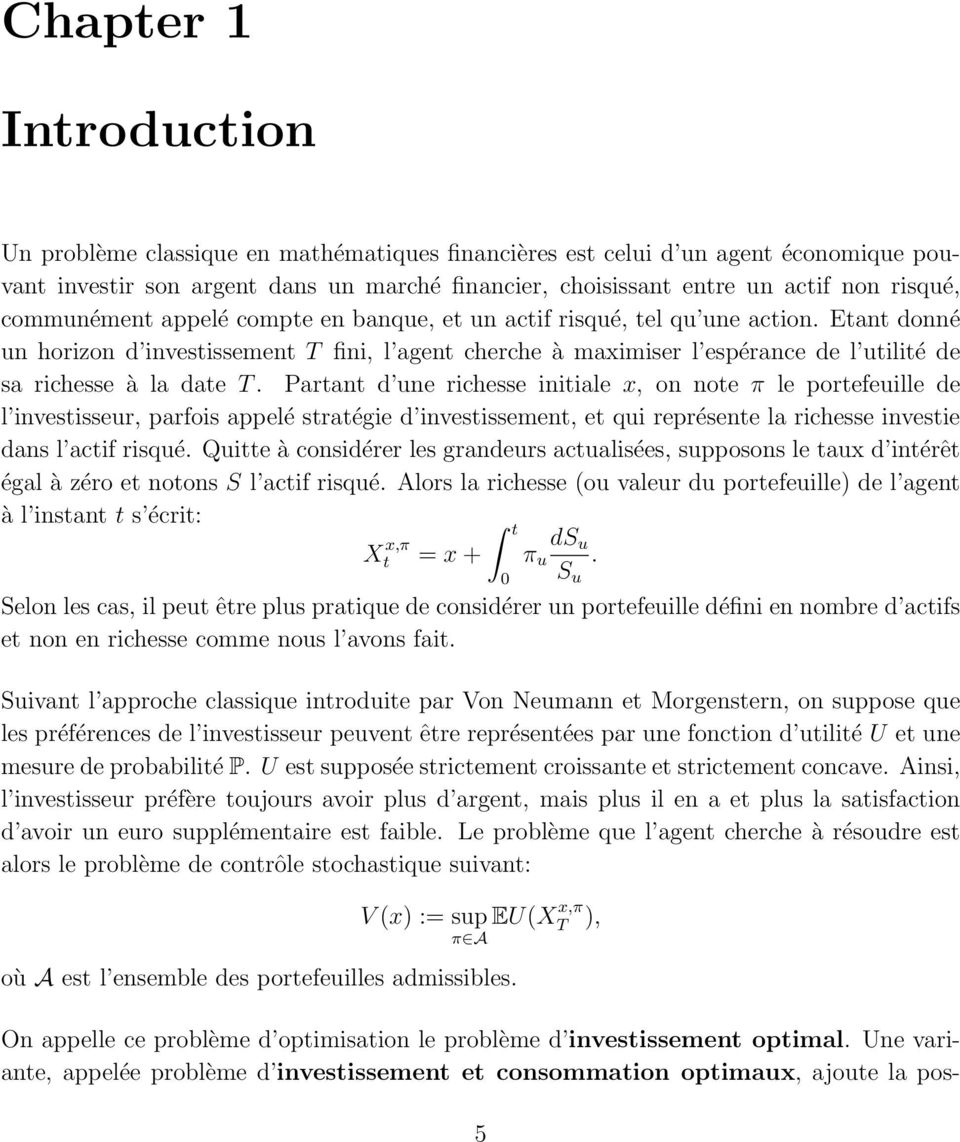
12 6 CHAPTER 1. INTRODUCTION sibilié pour l invesisseur de consommer une par de sa richesse avan l horizon T. D un poin de vue financier, on peu égalemen voir cee consommaion comme une rene versée par un manager de fond à ses cliens. Noons C le aux de consommaion à l insan, c es-à-dire que sur la période [, + d], l agen consomme C d. La richesse de l agen es alors donnée par: X x,c,π = x + π u ds u S u C u du. On se donne encore une foncion d uilié U ainsi qu un évenuel aux d escompe psychologique β qui radui la préférence pour le présen. Le problème d invesissemenconsommaion opimaux es alors: T V C (x) := sup E e β U(C )d, (C,π) B où B es l ensemble des sraégies admissibles. En réalié, e β U(c) peu êre remplacée par une foncion d uilié dépendan du emps plus générale. Alors que cela n avai pas de sens pour le problème d invesissemen opimal, ici l horizon de emps T peu aussi êre pris infini: T = +, à condiion de faire quelques hypohèses d inégrabilié supplémenaires. Enfin pour T fini, le problème mixe peu aussi êre considéré (encore appelé problème d invesissemen-consommaion opimaux): [ T ] Ṽ C (x) := sup (C,π) B E e β U 1 (C )d + U 2 (X T ), U 1 e U 2 éan deux foncions d uilié. Signalons enfin qu il es possible de prendre en compe plusieurs acifs risqués, ce qui, dans la plupar des cas, ne change pas grand chose au problème. Meron [58, 59] fu le premier à inroduire ces problémaiques dans les années 6, e parvin à les résoudre dans un cas pariculier en appliquan des echniques classiques de conôle. Ainsi, supposan que l acif risqué suivai une dynamique de Black-Scholes, e donc en pariculier que le marché éai comple, e en supposan de plus que la foncion d uilié éai une foncion puissance: U(x) = xp, pour x avec p (, 1), p il a résolu l équaion de Bellman ou Hamilon-Jacobi-Bellman associée au problème. Mais il n y es pas parvenu dans un cadre plus général. Ce n es qu au milieu des années 8 que le problème a éé résolu pour des foncions d uilié générales mais oujours en marché comple grâce à des echniques probabilises, par Pliska [67] pour le problème d invesissemen
![Noons C le aux de consommaion à l insan, c es-à-dire que sur la période [, + d], l agen consomme C d. La richesse de l agen es alors donnée par: X x,c,π = x + π u ds u S u C u du.](/docs-images/45/5362499/images/page_12.jpg "On se donne encore une foncion d uilié U ainsi qu un évenuel aux d escompe psychologique β qui radui la préférence pour le présen.")
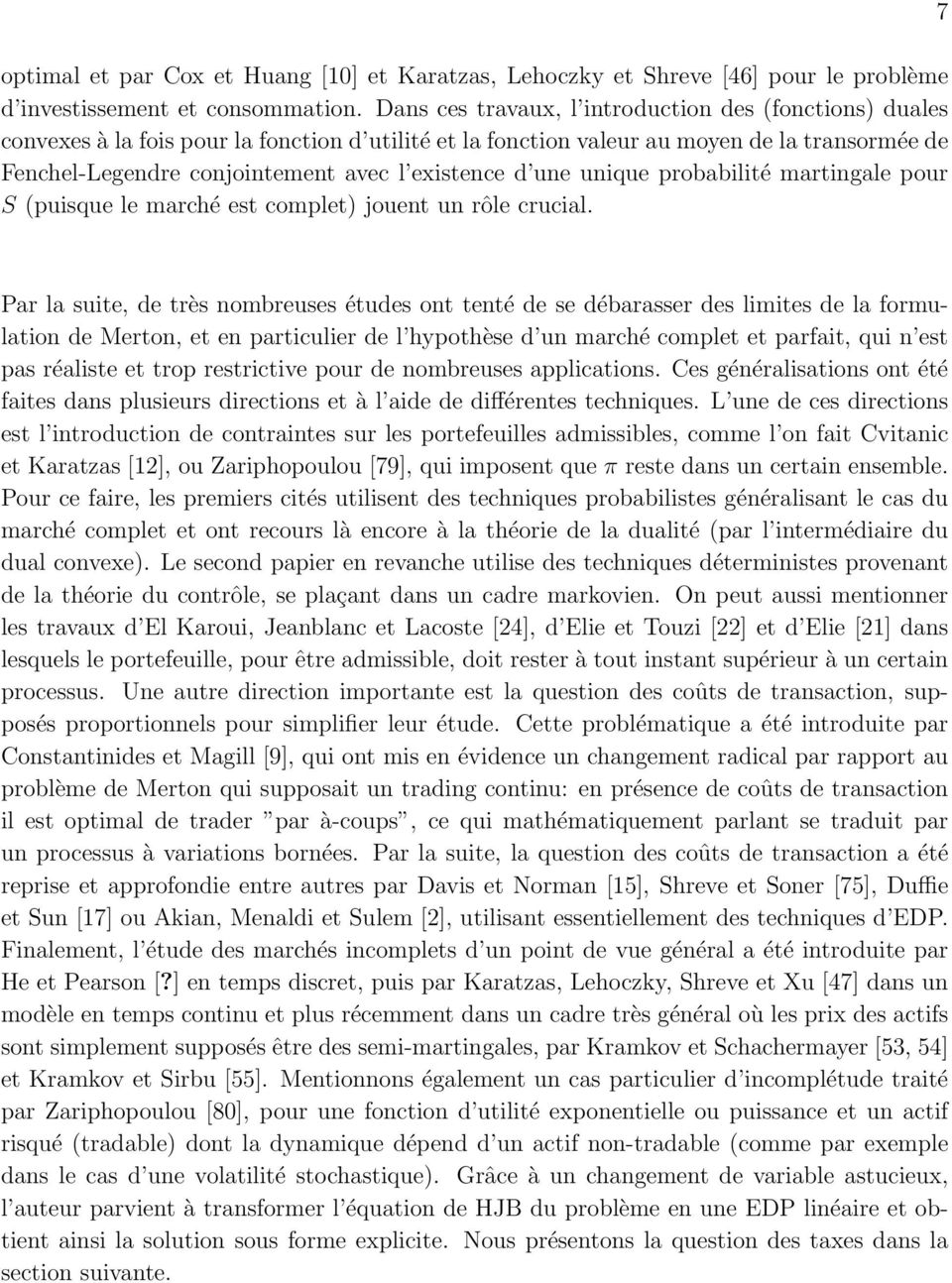
13 opimal e par Cox e Huang [1] e Karazas, Lehoczky e Shreve [46] pour le problème d invesissemen e consommaion. Dans ces ravaux, l inroducion des (foncions) duales convexes à la fois pour la foncion d uilié e la foncion valeur au moyen de la ransormée de Fenchel-Legendre conjoinemen avec l exisence d une unique probabilié maringale pour S (puisque le marché es comple) jouen un rôle crucial. 7 Par la suie, de rès nombreuses éudes on ené de se débarasser des limies de la formulaion de Meron, e en pariculier de l hypohèse d un marché comple e parfai, qui n es pas réalise e rop resricive pour de nombreuses applicaions. Ces généralisaions on éé faies dans plusieurs direcions e à l aide de différenes echniques. L une de ces direcions es l inroducion de conraines sur les porefeuilles admissibles, comme l on fai Cvianic e Karazas [12], ou Zariphopoulou [79], qui imposen que π rese dans un cerain ensemble. Pour ce faire, les premiers ciés uilisen des echniques probabilises généralisan le cas du marché comple e on recours là encore à la héorie de la dualié (par l inermédiaire du dual convexe). Le second papier en revanche uilise des echniques déerminises provenan de la héorie du conrôle, se plaçan dans un cadre markovien. On peu aussi menionner les ravaux d El Karoui, Jeanblanc e Lacose [24], d Elie e Touzi [22] e d Elie [21] dans lesquels le porefeuille, pour êre admissible, doi reser à ou insan supérieur à un cerain processus. Une aure direcion imporane es la quesion des coûs de ransacion, supposés proporionnels pour simplifier leur éude. Cee problémaique a éé inroduie par Consaninides e Magill [9], qui on mis en évidence un changemen radical par rappor au problème de Meron qui supposai un rading coninu: en présence de coûs de ransacion il es opimal de rader par à-coups, ce qui mahémaiquemen parlan se radui par un processus à variaions bornées. Par la suie, la quesion des coûs de ransacion a éé reprise e approfondie enre aures par Davis e Norman [15], Shreve e Soner [75], Duffie e Sun [17] ou Akian, Menaldi e Sulem [2], uilisan esseniellemen des echniques d EDP. Finalemen, l éude des marchés incomples d un poin de vue général a éé inroduie par He e Pearson [?] en emps discre, puis par Karazas, Lehoczky, Shreve e Xu [47] dans un modèle en emps coninu e plus récemmen dans un cadre rès général où les prix des acifs son simplemen supposés êre des semi-maringales, par Kramkov e Schachermayer [53, 54] e Kramkov e Sirbu [55]. Menionnons égalemen un cas pariculier d incompléude raié par Zariphopoulou [8], pour une foncion d uilié exponenielle ou puissance e un acif risqué (radable) don la dynamique dépend d un acif non-radable (comme par exemple dans le cas d une volailié sochasique). Grâce à un changemen de variable asucieux, l aueur parvien à ransformer l équaion de HJB du problème en une EDP linéaire e obien ainsi la soluion sous forme explicie. Nous présenons la quesion des axes dans la secion suivane.
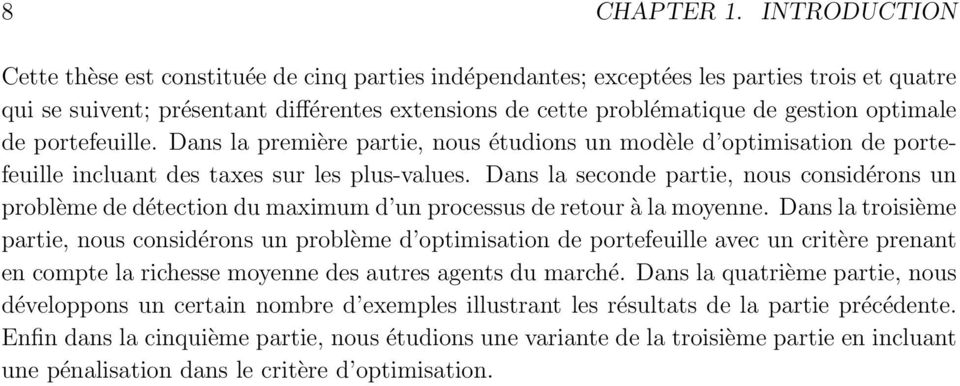
14 8 CHAPTER 1. INTRODUCTION Cee hèse es consiuée de cinq paries indépendanes; excepées les paries rois e quare qui se suiven; présenan différenes exensions de cee problémaique de gesion opimale de porefeuille. Dans la première parie, nous éudions un modèle d opimisaion de porefeuille incluan des axes sur les plus-values. Dans la seconde parie, nous considérons un problème de déecion du maximum d un processus de reour à la moyenne. Dans la roisième parie, nous considérons un problème d opimisaion de porefeuille avec un crière prenan en compe la richesse moyenne des aures agens du marché. Dans la quarième parie, nous développons un cerain nombre d exemples illusran les résulas de la parie précédene. Enfin dans la cinquième parie, nous éudions une variane de la roisième parie en incluan une pénalisaion dans le crière d opimisaion.
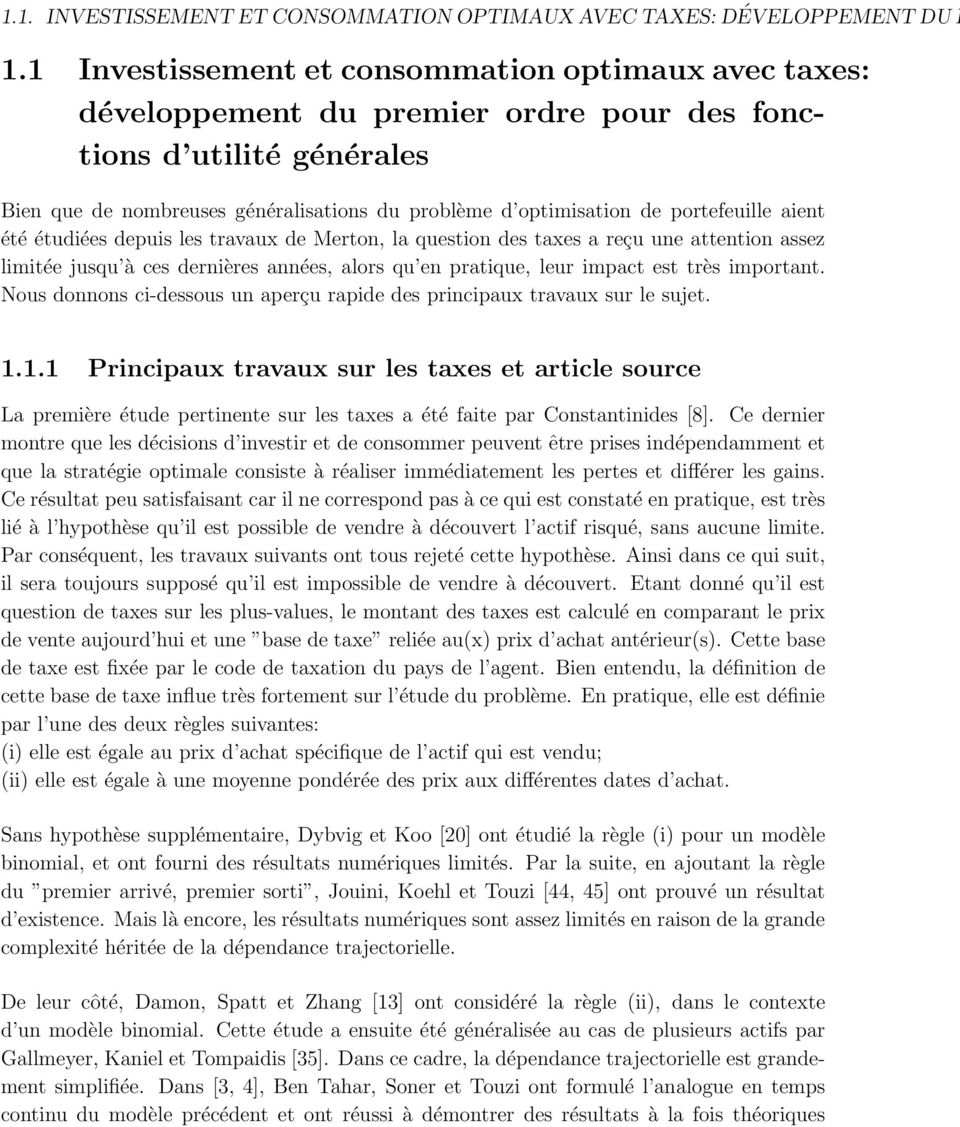
15 1.1. INVESTISSEMENT ET CONSOMMATION OPTIMAUX AVEC TAXES: DÉVELOPPEMENT DU P 1.1 Invesissemen e consommaion opimaux avec axes: développemen du premier ordre pour des foncions d uilié générales Bien que de nombreuses généralisaions du problème d opimisaion de porefeuille aien éé éudiées depuis les ravaux de Meron, la quesion des axes a reçu une aenion assez limiée jusqu à ces dernières années, alors qu en praique, leur impac es rès imporan. Nous donnons ci-dessous un aperçu rapide des principaux ravaux sur le suje Principaux ravaux sur les axes e aricle source La première éude perinene sur les axes a éé faie par Consaninides [8]. Ce dernier monre que les décisions d invesir e de consommer peuven êre prises indépendammen e que la sraégie opimale consise à réaliser immédiaemen les peres e différer les gains. Ce résula peu saisfaisan car il ne correspond pas à ce qui es consaé en praique, es rès lié à l hypohèse qu il es possible de vendre à découver l acif risqué, sans aucune limie. Par conséquen, les ravaux suivans on ous rejeé cee hypohèse. Ainsi dans ce qui sui, il sera oujours supposé qu il es impossible de vendre à découver. Ean donné qu il es quesion de axes sur les plus-values, le monan des axes es calculé en comparan le prix de vene aujourd hui e une base de axe reliée au(x) prix d acha anérieur(s). Cee base de axe es fixée par le code de axaion du pays de l agen. Bien enendu, la définiion de cee base de axe influe rès foremen sur l éude du problème. En praique, elle es définie par l une des deux règles suivanes: (i) elle es égale au prix d acha spécifique de l acif qui es vendu; (ii) elle es égale à une moyenne pondérée des prix aux différenes daes d acha. Sans hypohèse supplémenaire, Dybvig e Koo [2] on éudié la règle (i) pour un modèle binomial, e on fourni des résulas numériques limiés. Par la suie, en ajouan la règle du premier arrivé, premier sori, Jouini, Koehl e Touzi [44, 45] on prouvé un résula d exisence. Mais là encore, les résulas numériques son assez limiés en raison de la grande complexié hériée de la dépendance rajecorielle. De leur côé, Damon, Spa e Zhang [13] on considéré la règle (ii), dans le conexe d un modèle binomial. Cee éude a ensuie éé généralisée au cas de plusieurs acifs par Gallmeyer, Kaniel e Tompaidis [35]. Dans ce cadre, la dépendance rajecorielle es grandemen simplifiée. Dans [3, 4], Ben Tahar, Soner e Touzi on formulé l analogue en emps coninu du modèle précéden e on réussi à démonrer des résulas à la fois héoriques
16 1 CHAPTER 1. INTRODUCTION e numériques. Nore ravail éan une généralisaion d une parie de leurs résulas, nous fournissons ci-dessous une revue plus déaillée de leurs papiers. Le marché es consiué d un acif sans risque ayan pour aux d inérê r e d un acif risqué P qui sui une dynamique de Black-Scholes: dp = P [(r + θσ)d + σdw ], où W es un mouvemen brownien, θ e σ > son des consanes, appelées respecivemen la prime de risque e la volailié. Les venes de l acion (l acif risqué) son soumises à des axes sur les plus-values. En d aures ermes, le monan de axes à payer pour la vene d une acion à l insan es calculé en comparan le prix couran P à l indice B que l on a appelé plus hau la base de axes. En quelques mos, l index es défini comme moyenne des prix d acha de l acion aux daes anérieures à, pondérée par la quanié acheée. Si le prix P es supérieur à l index B, alors l invesisseur réalise un gain en vendan ses acions, alors que dans la siuaion inverse il réalise une pere. La règle de axaion es supposée linéaire, c es-à-dire qu il exise une consane α (, 1) elle que pour chaque unié d acion vendue, le monan (algébrique) de axes à payer es: α(p B ). Un monan négaif correspond dans la réalié à un crédi de axes, comme c es le cas dans cerains pays, le Canada noammen. L horizon d invesissemen es supposé infini e le problem de consommaion-invesissemen es formulé comme sui: V (s) = sup E ν A(s) e β U(C )d, où la donnée iniiale s prend en compe la richesse iniiale déenue dans le compe en banque, la richesse iniiale déenue dans l acif risqué e la valeur iniiale de l index B. C es la consommaion de l agen e A(s) l ensemble des sraégies admissibles qui paren de s. Enfin U es une foncion d uilié puissance, auremen di il exise p (, 1) el que: U(c) = cp p. Après avoir monré des propriéés élémenaires de la foncion valeur V, les aueurs fournissen des bornes de V à l aide de problèmes de Meron pour lesquels la soluion es explicie. Grâce à ces bornes explicies, il es alors possible d obenir un développemen au
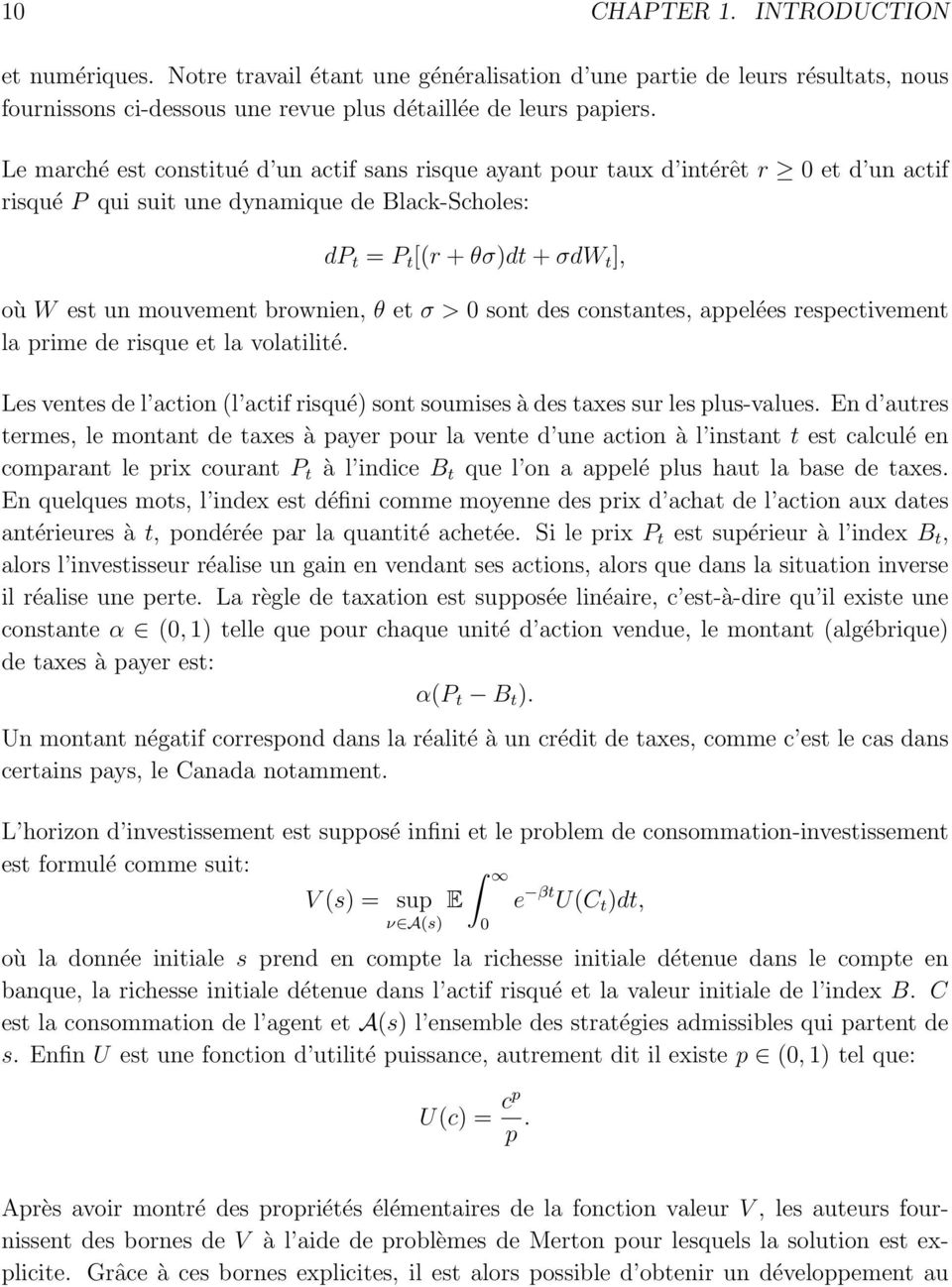
17 1.1. INVESTISSEMENT OPTIMAL AVEC TAXES 11 premier ordre de V lorsque le aux d inérê r e le aux de axe α enden vers simulanémen. Nous généralisons ce résula dans nore éude. Un aure résula imporan de [3, 4] es la caracérisaion de la soluion V à l aide des soluions de viscosié. Nous renvoyons à l aricle de Crandall, Ishii e Lions [11] pour plus de déails sur les soluions de viscosié. Dans les ravaux de Ben Tahar, Soner e Touzi, un résula de comparaison for qui permerai de monrer l unicié e la coninuié de la foncion valeur n es pas démonré car une irrégularié de la condiion au bord sur une parie du bord complique la siuaion. Afin de surmoner cee difficulé, ils définissen des problèmes approchés plus réguliers. Chacun de ces problèmes es alors l unique soluion de viscosié de l équaion de HJB approchée, e ils monren ensuie un résula de convergence uniforme sur les compacs de ces soluions approchées Nouveaux résulas Dans nore éude, nous considérons un marché financier comple consiué d un acif sans risque évoluan avec un aux d inérê r e n acifs risqués don la dynamique es donnée par: dp = diag(p )[b(p )d + σ(p )dw ], éendan ainsi le cadre précéden à un processus markovien muli-dimensionnel assez général. Ensuie, nous prenons la même règle de axaion que dans [3, 4], mais en revanche, e c es là la principale différence, nous considérons une foncion d uilié générale U qui es supposée vérifier des condiions classiques, esseniellemen qu elle es sricemen croissane, sricemen concave e suffisammen régulière. La plupar des propriéés élémenaires son encore vérifiées dans ce cadre plus général e les preuves peuven êre adapées presque immédiaemen. La plus imporane de ces propriéés es l opimalié des wash sales. Sous ceraines hypohèses supplémenaires, cela perme là encore de borner la foncion valeur à l aide de deux problèmes de Meron bien choisis. La principale difficulé vien de l éude de la régularié de ces bornes e de leurs développemens au premier ordre. Tandis que pour une dynamique de Black-Scholes e une foncion d uilié puissance cee quesion es immédiae car la foncion valeur du problème de Meron es explicie, dans nore cadre une éude de ces foncions valeurs simplifiées es nécessaire. Si l on noe I(y) := (U ) 1 (y), en uilisan des résulas classiques, nous savons que V es donnée par: V = G Y,
![Nous renvoyons à l aricle de Crandall, Ishii e Lions [11] pour plus de déails sur les soluions de viscosié.](/docs-images/45/5362499/images/page_17.jpg "Dans les ravaux de Ben Tahar, Soner e Touzi, un résula de comparaison for qui permerai de monrer l unicié e la coninuié de la foncion valeur n es pas démonré car une irrégularié de la condiion au")
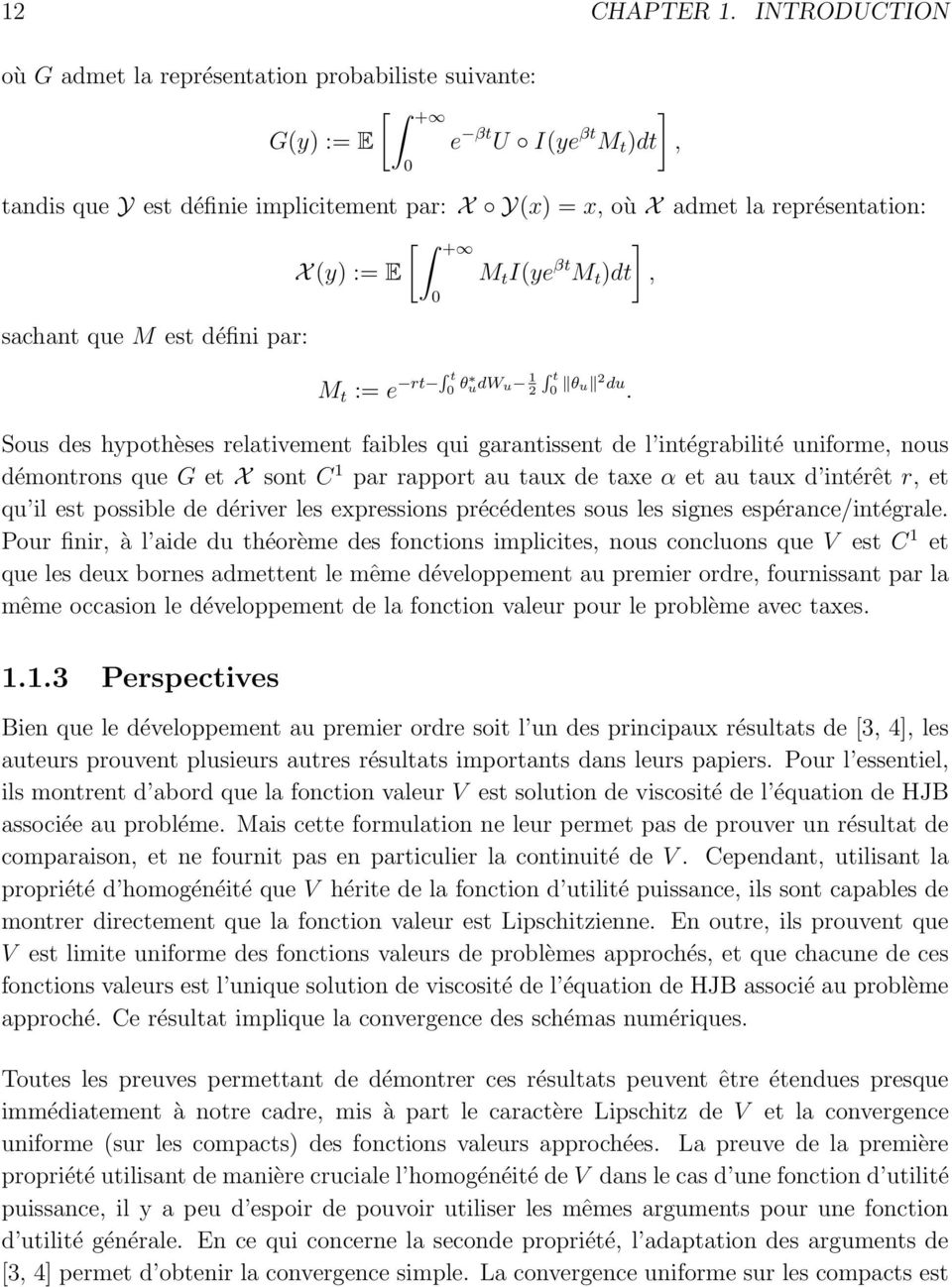
18 12 CHAPTER 1. INTRODUCTION où G adme la représenaion probabilise suivane: [ + ] G(y) := E e β U I(ye β M )d, andis que Y es définie impliciemen par: X Y(x) = x, où X adme la représenaion: [ + ] X (y) := E M I(ye β M )d, sachan que M es défini par: M := e r R θ udw u 1 R 2 θu 2du. Sous des hypohèses relaivemen faibles qui garanissen de l inégrabilié uniforme, nous démonrons que G e X son C 1 par rappor au aux de axe α e au aux d inérê r, e qu il es possible de dériver les expressions précédenes sous les signes espérance/inégrale. Pour finir, à l aide du héorème des foncions implicies, nous concluons que V es C 1 e que les deux bornes admeen le même développemen au premier ordre, fournissan par la même occasion le développemen de la foncion valeur pour le problème avec axes Perspecives Bien que le développemen au premier ordre soi l un des principaux résulas de [3, 4], les aueurs prouven plusieurs aures résulas imporans dans leurs papiers. Pour l esseniel, ils monren d abord que la foncion valeur V es soluion de viscosié de l équaion de HJB associée au probléme. Mais cee formulaion ne leur perme pas de prouver un résula de comparaison, e ne fourni pas en pariculier la coninuié de V. Cependan, uilisan la propriéé d homogénéié que V hérie de la foncion d uilié puissance, ils son capables de monrer direcemen que la foncion valeur es Lipschizienne. En oure, ils prouven que V es limie uniforme des foncions valeurs de problèmes approchés, e que chacune de ces foncions valeurs es l unique soluion de viscosié de l équaion de HJB associé au problème approché. Ce résula implique la convergence des schémas numériques. Toues les preuves permean de démonrer ces résulas peuven êre éendues presque immédiaemen à nore cadre, mis à par le caracère Lipschiz de V e la convergence uniforme (sur les compacs) des foncions valeurs approchées. La preuve de la première propriéé uilisan de manière cruciale l homogénéié de V dans le cas d une foncion d uilié puissance, il y a peu d espoir de pouvoir uiliser les mêmes argumens pour une foncion d uilié générale. En ce qui concerne la seconde propriéé, l adapaion des argumens de [3, 4] perme d obenir la convergence simple. La convergence uniforme sur les compacs es
19 1.1. INVESTISSEMENT OPTIMAL AVEC TAXES 13 alors une conséquence du héorème de Dini grâce à la coninuié de V. Il es donc esseniel de pouvoir monrer la coninuié de V dans un cadre général pour pouvoir éendre leur preuve.

20 14 CHAPTER 1. INTRODUCTION 1.2 Déecion du maximum d un processus scalaire de reour à la moyenne Cee parie ne s inscri pas exacemen dans le cadre de la gesion opimale de porefeuille elle que nous l avons définie précédemmen. Néanmoins elle considère un problème d arrê opimal don la soluion peu êre appliquée pour mere en place une sraégie de gesion de porefeuille par un rader ou un manager de fond d invesissemen. En ce sens elle consiue bien un problème de conrôle sochasique appliqué à de la gesion opimale de porefeuille Moivaion Dans les années 6, Shiryaev [71] a considéré ce que l on appelle le problème d écar. Supposons qu un processus soi la somme d un mouvemen brownien e d une consane a, e qu il soi possible qu à un momen donné, la valeur de cee consane passe de a à b. Shiryaev a cherché à rouver commen déecer ce changemen de régime. Bien que les problèmes d arrê opimal e les problèmes à fronière libre, égalemen appelés problèmes de Sefan, on éé éudiés en déail, voir noammen Shiryaev [72], Peskir e Shiryaev [66] ou Karazas e Shreve, appendice D [49], e que leur uilié pour des problèmes financiers els que les opions américaines, voir par exemple Myneni [61], ou les opions russes, voir [69, 7], a éé mise en évidence, rès peu de ravaux se son inéressés à des quesions de déecion jusqu au débu des années 2. Pouran, au-delà de l inérê héorique, cee famille de problèmes peu s avérer inéressane pour un manager de fond ou pour un rader, e peu en pariculier servir de jusificaion héorique a ce que les praiciens appellen l analyse echnique. Dans la héorie de la réplicaion, le gesionnaire annule le risque de son porefeuille en le répliquan parfaiemen à l aide des acifs échangeables présens sur le marché, e es de fai, au moins sur le plan héorique, indifféren à l évoluion du marché. Bien sûr en praique cela présuppose que le marché se compore comme le modèle e de plus que le marché soi comple. Cependan dans le cas d un marché incomple, la surréplicaion ou encore la gesion opimale de porefeuille dans le cadre inrodui par Meron prolongen cee idée. Mais ce poin de vue ne représene qu une parie de l acivié de gesion e laisse de côé la prise de posiion. Dans cee opique, le gesionnaire ene de prédire l évoluion du marché pour en profier. C es exacemen le bu de l analyse echnique. Ainsi les problèmes de déecion permeen de développer des ouils mahémaiques donnan aux gesionnaires l opporunié de définir la meilleure réponse pour s adaper aux évoluions du marché e prendre de façon raionnelle une posiion.
21 1.2. DETECTION DU MAXIMUM 15 En pariculier, nous considérons dans ce chapire un processus qui oscille auour de zéro (un processus de reour à la moyenne) e paran d une valeur iniiale sricemen posiive. Supposons que l on soi capable de déecer l insan où ce processus aein son maximum avan de devenir négaif, e symériquemen de déecer le momen où il aein son minimum avan de redevenir posiif, e ainsi de suie. Du poin de vue d un rader cela peu êre considéré comme une sraégie opimale puisqu il peu ainsi réaliser un gain maximal. Si l on écri ce problème en ermes de problème d opimisaion, nore formulaion ressemble à celle inroduie par Graversen, Peskir e Shiryaev [37], que nous présenons brièvemen dans la secion suivane, mais en réalié ces deux poins de vue diffèren profondémen. Conrairemen à ce qui es fai ici, ces derniers considèren en effe le maximum sur une période de emps fixe, ce qui présene plusieurs inconvéniens pour un gesionnaire: - ils dériven leur résula uniquemen pour un mouvemen brownien e la soluion explicie de ce problème es rès difficile à éendre, andis que la sraégie qui nous inéresse es inéressane esseniellemen pour un processus de reour à la moyenne; - un invesisseur qui prend une posiion n a inérê à sorir de sa posiion que s il a réalisé un gain minimum, ne serai-ce que pour couvrir ses coûs de ransacion. Or, pour un mouvemen brownien paran de, pour ou ε >, l espérance du premier emps de passage en ε es infinie, ce qui signifie que pour réaliser un gain minimum de ε, après avoir acheé ou vendu un acif qui es supposé êre un mouvemen brownien, le rader devra en moyenne garder sa posiion pendan un emps infini; - il n y a pas de raison héorique de choisir une maurié pariculière; - même si l on adme que la maurié puisse êre choisie de manière saisfaisane, elle doi l êre a priori, c es à dire au débu de la période. Sur des réalisaions, le processus peu se comporer de façon rès différene. Parfois il oscillera rès vie, andis que d aures il oscillera rès lenemen. En fixan a priori la fin de la période, l invesisseur ne ien pas compe de ce phénomène e invesira régulièremen soi rop souven, soi rop peu souven. Ces problèmes son résolus par nore formulaion qui considère une maurié aléaoire définie comme le premier emps de passage en zéro e s inéresse à des processus de reour à la moyenne els que le processus de Ornsein-Uhlenbeck. Nous donnons dans la secion suivane un aperçu des principaux ravaux liés au nôre Aperçu de cerains ravaux connexes Comme nous l avons brièvemen évoqué, Graversen, Peskir and Shiryaev [37] considèren un problème qui a inspiré le nôre: ils cherchen à déecer le maximum d un mouvemen
22 16 CHAPTER 1. INTRODUCTION brownien sur une période de emps fixe, disons [, 1]. Noons X un mouvemen brownien sandard, e, pour un maximum hérié z, Z le processus de maximum couran associé: Z = sup X s z. s Alors, pour une foncion de pere l, ils considèren le problème d opimisaion suivan: V (x) = inf E[l(Z 1 X τ ) X = Z = x] = V (), τ 1 où la minimisaion es sur l ensemble des emps d arrê τ. Essayer d uiliser des echniques sandard d arrê opimal afin de ener de résoudre l équaion d Hamilon-Jacobi-Bellman associée au problème abouirai à un problème à fronière libre de dimension rois (le emps e deux variables d espace x e z) qu il semble impossible de résoudre expliciemen. Cependan, en uilisan des propriéés du mouvemen brownien e de son maximum, les aueurs parviennen asucieusemen à simplifier considérablemen la siuaion e dériven en fin de compe un problème à fronière libre en dimension un. En d aures ermes, ils obiennen une équaion différenielle ordinaire don la fronière es inconnue, qu ils parviennen à résoudre expliciemen. Plus précisémen, pour des foncins de pere puissance l(x) = x p, avec p > e p 1, ils monren qu il exise un réel z p >, défini comme unique soluion d une ceraine équaion, el que le emps d arrê: τ p = inf{ 1, Z X z p 1 } es opimal. De plus, la valeur du problème d opimisaion es égalemen explicie, e es foncion de z p. Bien que cela soi sans grande imporance, noons cependan que la foncion valeur n es pas connue pour z x. La preuve peu êre décomposée en deux éapes principales. Dans un premier emps, grâce à l indépendance des accroissemens de X, ils réécriven le problème en foncion de Z τ X τ uniquemen. Ensuie, uilisan le fai que pour un mouvemen brownien, si x = z, alors Z X e X on même loi, ils réduisen le nombre de variables spaiales de deux à une. Puis, à l aide du changemen de emps: s = 1 ln(1 ), 2 ils ransformen le problème en un problème saionnaire e du même coup se débarassen de la variable.
23 1.2. DETECTION DU MAXIMUM 17 Ensuie, la seconde éape es classique: ils dériven l équaion de HJB associée au problème simplifié, la reformule en erme de problème à fronière libre qu il résolve expliciemen e finalemen uilise un argumen de vérificaion. Ces ravaux on éé quelque peu généralisés par Pedersen [64] puis éendus au cas d un mouvemen brownien avec drif, pour une foncion de pere quadraique l(x) = x 2, par Du Toi e Peskir [18]. Là encore la preuve uilise des propriéés spécifiques du mouvemen brownien drifé, mais elle es plus complexe. De plus, la forme de la soluion n es pas classique, puisqu ils monren que deux fronières son mises en jeu, le emps d arrê opimal qu ils explicien éan de la forme: τ = inf{ 1, b 1 () Z X b 2 ()}. Ainsi, pour un drif négaif, paran de x = z >, comme dans [37], si X redescend rop après avoir aein un niveau Z, il es opimal de s arrêer, car l écar devenan rop grand, il es improbable de remoner avan le emps = 1 jusqu au niveau Z, mais désormais à cause du drif négaif, si Z X es pei e suffisammen proche de 1, il es égalemen improbable d aeindre un niveau supérieur à Z ou même supérieur à la valeur présene. Une variaion sur le suje es le problème d opimisaion suivan, inrodui par Shiryaev [73]: inf E θ τ, τ 1 sur l ensemble des emps d arrê τ e où θ es le premier ou dernier insan où le maximum d un mouvemen brownien es aein avan = 1. Il es inéressan de noer qu Urusov [77] a monré que pour un mouvemen brownien ce problème es équivalen au précéden. En effe l aueur a démonré l idenié suivane pour ou emps d arrê τ: E(X θ X τ ) 2 = E θ τ (1.1) Il es à noer que θ n es pas un emps d arrê car il dépend en réalié de ou le processus jusqu à l insan 1, par conséquen le héorème d arrê de Doob ne s applique pas. C es d ailleurs pour cee raison que la consane 1 apparaî. Cee fois encore, cee éude 2 a éé généralisée pour des mouvemens browniens avec drif par Du Toi e Peskir [19], qui son parvenus à caracériser un emps d arrê opimal comme premier emps d aeine d une ceraine barrière. Noons cependan que (1.1) n es pas vrai dans ce cas plus général, andis que leurs argumens s éenden en grande parie aux processus de Lévy. Menionnons égalemen le papier de Shiryaev, Xu e Zhou [74] dans lequel es éudié, pour
24 18 CHAPTER 1. INTRODUCTION X un mouvemen brownien géomérique, la variane suivane: ( ) inf E Z1 X τ. τ 1 Z 1 Un aure problème inéressan; qui n es ceres pas un problème de déecion mais malgré ou un problème d arrê opimal relié au maximum d un processus; présene ceraines similiudes dans sa résoluion avec le nôre. Peskir [65] a inrodui le problème d opimisaion suivan: ( τ ) sup E Z τ c(x )d, τ où X es une diffusion saionnaire, Z son maximum, e c peu êre vue comme une foncion de coû (e en pariculier es posiive). Le principal résula es une condiion nécessaire e suffisane pour que la foncion valeur soi finie e qu un emps d arrê opimal exise. Cee condiion es appelée principe de maximalié par l aueur car elle es saisfaie si e seulemen si le flo d une ceraine équaion différenielle ordinaire adme une soluion maximale en un cerain sens lorsque l on fai varier sa condiion iniiale. Il es amusan de consaer que dans nore éude égalemen nous devons considérer la soluion maximale d une ceraine équaion différenielle ordinaire dans un sens rès proche de celui inrodui par Peskir. Ces ravaux on par la suie éé éendus à des processus X e des foncions c plus généraux par Obloj [62], andis qu Hobson [41] considère le problème opposé: inf τ ( τ ) E Z τ c(x )d. Bien qu uilisan des echniques différenes, la soluion de ce dernier problème es plus ou moins de même naure que celle de [65]. Nous aimerions signaler que pour ces différens problèmes, un changemen d échelle grâce à la foncion d échelle, voir Karlin e Taylor [5], perme de réduire le cas d une diffusion saionnaire au cas du mouvemen brownien, ce qui simplifie l analyse. Dans nore éude, un el changemen es possible, mais il n appore pas de simplificaion significaive. De nombreux aures problèmes son plus ou moins liés à ce suje. Menionnons pour finir le problème de swiching opimal (commuaion opimale) inrodui pour des processus d Ornsein-Uhlenbeck par Zhang e Zhang [81] qui radui une problémaique naurelle pour un rader. Bien que naurel, leur crière ne prend en compe que l espérance du rendemen mais aucune forme de risque.
25 1.2. DETECTION DU MAXIMUM Nouveaux résulas Considérons un processus don la dynamique es donnée par l EDS saionnaire suivane: dx = µ(x )d + σ(x )dw,, ainsi qu une valeur iniiale X >. W es un mouvemen brownien andis que µ e σ saisfon des hypohèses assez générales (elles son lipschiziennes en pariculier). On dira que X es un processus de reour à la moyenne si: µ(x) pour ou x, Cela signifie en effe que le processus X es ramené vers l origine lorsque X >. Inroduisons ensuie le premier emps d aeine de la barrière : T := inf { > : X = }, e le maximum couran: X := max s X s. T désignan l ensemble des emps d arrê inférieurs à T, on considère le problème d opimisaion suivan: V := inf θ T E [ l ( X T X θ )], où l es appelée foncion de pere e saisfai des condiions assez faibles. En pariculier, elle es supposée croissane, convexe e suffisammen régulière. Afin de se placer dans le cadre de la programmaion dynamique, définissons (Z a éé inrodui plus hau): V (x, z) := inf θ T E x,z [l (Z T X θ )], où E x,z es l espérance condiionnelle sachan X = x and Z = z. Définissons égalemen la récompense en cas d arrê: g(x, z) := E x,z [l (Z T x)], x z, qui correspondrai à la foncion valeur s il éai opimal d arrêer immédiaemen. A l aide de la foncion d échelle, voir par exemple Karlin e Taylor [5], on peu déerminer expliciemen la loi de Z T en réinerpréan Z T en ermes de emps d aeine de barrière. Cela perme ensuie d obenir une formule explicie pour la foncion g e de déduire des condiions suffisanes pour que V soi finie. Nous dérivons ensuie l équaion de HJB associée au problème. Si on inrodui la foncion α := 2µ σ 2 qui se révèle êre le seul paramère lié à
26 2 CHAPTER 1. INTRODUCTION la diffusion X qui soi perinen pour nore problème e l operaeur infiniésimal L associé à X: Lv(x) = v (x) α(x)v (x), l équaion de HJB es l inégalié variaionnelle suivane: min {Lv, g v} = v(, z) = l(z) v z (z, z) =. Malheureusemen, une elle inégalié variaionnelle es difficile à résoudre en général, mais de même que pour les opions américaines ou de nombreux aures problèmes d arrê opimal, nous pensons que la soluion doi résoudre un problème à fronière libre associé. Après avoir résolu ce problème plus simple, nous devrons vérifier que la soluion rouvée es égale à la foncion valeur du problème iniial. Ainsi nous cherchons une fronière libre γ(x) elle qu il soi opimal d arrêer dans la région {z γ(x)} alors qu il es opimal de coninuer dans la région {z < γ(x)}. On cherche donc à résoudre: Lv(x, z) = for < z < γ(x) v(x, z) = g(x, z) and Lg(x, z) for z γ(x) v(, z) = l(z) v z (z, z) =. Ean donné que dans l expression de L seules les dérivées par rappor à x inerviennen, l espoir de résoudre cee équaion expliciemen es permis. Afin de pouvoir appliquer la formule d Iô, imposons égalemen des condiions de coninuié e de smooh-fi sur la fronière: v(x, γ(x)) = g(x, γ(x)) v x (x, γ(x)) = g x (x, γ(x)). Nous resreignons dans un premier emps nore éude à une foncion de pere quadraique: l(x) = x2 2. Une des difficués pour déerminer γ vien du fai que celle-ci es faie en général de deux paries régies par des équaions disinces, e n es pas monoone. Ainsi il exise ζ el
27 1.2. DETECTION DU MAXIMUM 21 que γ es décroissane sur [, ζ] e croissane sur [ζ, + ). L équaion de la parie croissane es donnée par l équaion différenielle ordinaire suivane: γ = Lg(x, γ), 1 S(x) S(γ) sans condiion iniiale a priori. Nous obenons de fai une famille de candidas poeniels e devons choisir la bonne équaion, puisqu une seule nous permera de rouver la soluion du problème. La bonne équaion se révèle êre celle fournissan la plus grande foncion γ qui croise la diagonale {(x, z); x = z}. Nous devons ensuie déerminer la parie décroissane. Pour ce faire nous devons résoudre à z fixé l équaion ayan x pour inconnue: f(x, z) = g(x, z) g x (x, z) S(x) S (x) z2 2, qui correspond à l équaion saisfaie par l inverse de γ sur sa parie décroissane. Cee fois il n y a pas de problème d indéerminaion e nous monrons que les deux paries s inersecen. Puis nous obenons une expression explicie pour nore candida e monrons un héorème de vérificaion. Nous monrons par la même occasion l exisence d un emps d arrê opimal θ donné par: θ := inf{ ; Z γ(x )}. Nous donnons par la suie quelques exemples de processus qui enren dans le cadre de nore éude, els que les processus d Ornsein-Ulhenbeck, de Cox-Ingersoll-Ross ou le mouvemen brownien avec un drif sricemen négaif. En revanche, conrairemen au cadre de [37], pour le mouvemen brownien sandard la foncion valeur es infinie. Nous expliquons égalemen commen généraliser ces résulas à des foncions de pere plus générales. Bien que l idée de réduire l équaion de HJB à un problème à fronière libre soi classique, la résoluion de ce dernier problème dans nore cadre es inhabiuelle. D une par, nous sommes confronés à une famille d équaions possibles parmi lesquelles nous devons choisir la bonne. Comme nous l avons évoqué plus hau, c es égalemen le cas dans [65]. D aure par, la fronière es divisée en deux paries discinces, l une décroissane, l aure croissane, e en pariculier, si l on cherche à définir la fronière γ comme foncion de z, alors elle n es pas bien d éfinie. Remarquons cependan qu en praique si l on par de x = z, alors la parie décroissane de γ ne sera jamais aeine.
28 22 CHAPTER 1. INTRODUCTION Finalemen, nous avons appliqué ce résula à une sraégie de rading, pour laquelle nous avons calibré un processus d Ornsein-Uhlenbeck sur des données de marché. La sraégie consise à vendre au maximum déecé par nore éude, fermer la posiion quand X =, e symériquemen, acheer au minimum déecé puis fermer la posiion à X = Perspecives Tou d abord, pour une foncion de pere générale l, nous n avons pas pu définir des condiions suffisanes oalemen saisfaisanes sous lesquelles le résula es vrai. Nous supposons ainsi qu une foncion que nous noons Γ e don le graphe représene plus ou moins l ensemble {(x, z); Lg(x, z) = }, doi avoir une ceraine forme. Bien que cela soi relaivemen facile à vérifier sur des cas concres, il serai plus saisfaisan d avoir une condiion poran direcemen sur α e l. Une aure quesion inéressane es celle de la dépendance de la foncion valeur V e de la fronière γ vis-à-vis des paramères du modèle. Impliciemen, V e γ dépenden du processus X au ravers de la foncion α. Dans des cas simples els que le processus d Ornsein- Uhlenbeck ou le mouvemen brownien avec un drif négaif, cee dépendance se résume à un seul paramère α R. Si on considère une suie (α n ) convergean vers α, on peu s inerroger sur l exisence d une limie à (γ n ) e (V n ). Ensuie dans le cas général, si on se donne une suie de foncions (α n ) qui converge pour une ceraine opologie, qu en es-il? Enfin, une généralisaion inéressane es le cas inhomogène, c es-à-dire avec des coefficiens µ e σ qui dépenden égalemen du emps. Sur le plan praique, cela permerai de considérer un drif e une volailié qui dépenden du emps. Mais le plus imporan n es pas là. En réalié, l hypohèse la plus conraignane dans le cas saionnaire es le fai que la moyenne auour de laquelle oscille le processus es supposée consane, e cela peu remere en cause la viabilié de la sraégie de rading que nous avons considérée. En effe, supposons que X oscille auour d une moyenne b(). Pour pouvoir appliquer les résulas précédens, il faudrai considérer le processus Y := X b() qui n es pas forcémen radable. Le problème c es que, paran de Y >, si l on noe T le premier insan où Y revien en zéro, on aura Y θ Y T, mais il n y a aucune raison pour que X θ X T. En revanche, l éude du problème avec coefficiens inhomogènes résoudrai ce problème. Noons cependan que dans ce cadre, il semble difficile d obenir plus qu une caracérisaion de la foncion valeur comme unique soluion de viscosié de l équaion de HJB associée au problème (voir [11] pour plus de déails sur les soluions de viscosié).
29 1.3. INVESTISSEMENT OPTIMAL AVEC DES CONSIDÉRATIONS DE PERFORMANCE RELATIVE2 1.3 Invesissemen opimal avec des considéraions de performance relaive Moivaion Comme nous l avons déjà vu, depuis les aricles de Meron, le problème d invesissemen opimal a éé généralisé dans bien des direcions, mais dans aucun de ces ravaux l invesisseur ne ien compe de ses semblables dans sa prise de décision. Auremen di, l agen n es pas influencé par le comporemen des aures. Or cee hypohèse n es pas réalise, e ce pour différenes raisons. En premier lieu bien sûr, posséder cen euros en France n es pas équivalen à posséder la même somme en Afrique. Mais ceci ne consiue pas un réel problème puisqu il es oujours possible par un changemen de variable d en enir compe (en considéran U( x ) pour un faceur d échelle K). Mais ce qui en revanche es beaucoup K plus problémaique es qu une performance n a pas de sens dans l absolu, mais selon le conexe ou encore ce que fon les concurrens, en pariculier dans le monde des banques e des hedgefunds. Ainsi, en période de crise, un rader qui se conene de ne pas perdre d argen es perçu comme brillan, alors que pendan la bulle inerne, il aurai éé considéré comme médiocre. E puis il semble indéniable qu il es dans la naure humaine de se comparer à ses voisins, ses amis ou encore ses collègues. Pour ce qui es du monde financier, on peu même aller plus loin. Si l on s inéresse au markeing des produis dérivés ou de manière équivalene au discours des hedgefunds à leurs cliens, ceres la performance absolue es menionnée, mais elle es presque oujours comparée à un benchmark. Ce phénomène inervien égalemen dans les rémunéraions des raders, qui n es pas uniquemen indexée sur leur performance absolue. Les raders qui performen neemen mieux que les aures recevron oujours un bonus conséquen, même les mauvaises années, andis que ceux qui performen neemen moins bien risquen même en plein essor de recevoir un bonus qui n es que symbolique ou d êre renvoyés au profi de quelqu un de plus performan. Il es inéressan de menionner que dans la liéraure économique mais aussi sociologique, des considéraions de performance ou richesse relaive on déjà éé éudiées. Ainsi l impac sur les comporemens a éé mis en évidence depuis le débu du vingième siècle, noammen dans les ravaux de l économise e sociologue Veblen [78], qui parle de consommaion osenaoire, qui ne provien pas d un besoin de posséder un bien, mais de la voloné de monrer que l on peu se permere de l acheer. Le premier à avoir regardé les implicaions financières de considéraions de performance relaive es Abel [1] qui éudie leur influence sur le prix d un acif. Plusieurs aricles on par la suie uilisé plus ou moins le même
30 24 CHAPTER 1. INTRODUCTION cadre, noammen ceux de Gali [34] e Gomez, Priesley e Zapaero [36]. Dans ous ces papiers, les considéraions relaives son de naure exogène, au sens où les préférences des agens prennen direcemen en compe la richesse moyenne des aures invesisseurs. Nous adopons le même poin de vue. Par conre DeMarzo, Kaniel e Kremer [16] on monré que la source de considéraions relaives peu aussi êre endogène, c es-à-dire qu elles peuven provenir des ineracions enre invesisseurs sans pour auan êre modélisées direcemen. Bien que rès inéressans, ous ces ravaux considèren des modèles rès simples, saiques ou en emps discre. L idée es donc d essayer de développer une héorie d opimisaion de porefeuille qui prenne en compe ces considéraions de performance relaive Aperçu de sujes connexes D un poin de vue mahémaique, les considéraions relaives impliquen des ineracions enre invesisseurs e son de fai reliées à la héorie des jeux. Cependan dans nore cadre, le seul concep de héorie des jeux que nous uilisons es celui d équilibre de Nash, par conséquen nous ne nous éendrons pas sur le suje. Rappelons simplemen qu un équilibre de Nash dans un jeu à n joueurs es un n-uple consiué d une sraégie pour chaque joueur el que, pour chaque individu, cee sraégie correspond au meilleur choix possible sachan les sraégies des aures joueurs. Dans nore cadre, l éude des équilibres de Nash n es pas riviale. Ainsi, suivan les idées de Lasry e Lions [56] sur les jeux à champ moyen, il es naurel de se demander si les choses se simplifien lorsque le nombre de joueurs end vers l infini. En pariculier, on peu ener d explicier le sysème d équaions progressive-rérograde (forward-backward), appelé équaions de Kolmogorov-HJB. Malheureusemen nore modèle n enre pas dans le cadre développé dans [56], e nous ne savons pas écrire les équaions de Kolmogorov-HJB. En effe deux hypohèses essenielles énoncées dans [56] ne son pas vérifiées ici. D abord, les aueurs requièren de la symérie enre les agens (voir secion 2.2 de ce aricle), ce qui reviendrai dans nore problème à avoir pour ou i, U i = U, A i = A e λ i = λ, ce qui rese ou de même un cas pariculier inéressan. Mais surou, les mouvemens browniens inervenan dans la dynamique de la richesse de deux agens différens doiven êre indépendans, ce qui correspond au cas pariculier d agens invesissan chacun dans un acif indépendan des aures. Le cas d un brownien commun peu aussi êre raié, même s il ne figure pas dans [56], mais en revanche le cas général rese un problème ouver. Néanmoins, nous serons en mesure de calculer expliciemen la limie dans un cerain sens, e nous pourrons consaer que le passage à la limie simplifie les expressions.
31 1.3. PERFORMANCE RELATIVE 25 Dans la prochaine secion, nous rappelons les principaux résulas concernan les équaions différenielles sochasiques rérogrades (EDSR) puisque nous aurons besoin de cerains de ces résulas, mais auparavan, passons en revue quelques ravaux de la liéraure économique sur les considéraions relaives. En simplifian quelque peu, Abel [1] considère un modèle en emps discre, avec un horizon infini e une foncion d uilié puissance dépendan de la consommaion propre de l invesisseur à l insan (c ) e de la consommaion moyenne à l insan 1 (C 1 ): ( c ) α. U(c, C 1 ) := 1 α C 1 Les équilibres de Nash ne son pas éudiés, mais à la place l aueur explique que si ous les agens son ideniques, à l équilibre chaque invesisseur doi avoir la même consommaion, ce qui perme de rouver le prix d équilibre. Gali [34], quan à lui, considère un cadre voisin du précéden, mais au lieu de comparer sa consommaion à la dae avec la consommaion moyenne de la dae 1, ici l invesisseur compare ces deux quaniés à l insan, ce qui aboui à un cerain nombre de différences qualiaives. Enfin, dans l aricle de DeMarzo, Kaniel e Kremer [16], les aueurs considèren un modèle dans lequel les considéraions son d origine endogène, alors que dans les aricles ciés cidessus l origine es exogène. Plus précisémen, ils modélisen les préférences de chaque invesisseur de manière classique, c es-à-dire uniquemen à ravers sa richesse absolue. Puis ils considèren un bien en quanié limiée, don le prix d équilibre augmene avec la richesse moyenne. Dès lors, l invesisseur qui ne peu suivre l augmenaion de la richesse moyenne risque de se rerouver exclus, ce qu il cherche à évier. C es ainsi que se fai l ineracion. Les aueurs monren, dans le cadre d un modèle à deux périodes, commen ce phénomène peu favoriser l appariion de bulles financières e accroi le risque global du marché Principaux résulas sur les EDSR Le dernier champ imporan don nous avons besoin dans cee parie es la héorie des équaions différenielles sochasiques rérogrades (EDSR). Conrairemen au monde déerminise, le fai d avoir une condiion finale n es pas équivalen à avoir une condiion iniiale. En effe, il n es pas possible d inverser le emps car cela changerai la filraion vis-à-vis de laquelle la soluion doi êre adapée. Uilisons la noaion suivane: ξ es la condiion finale, f es
32 26 CHAPTER 1. INTRODUCTION le driver, e (Y, Z) la soluion de l EDSR: avec Y R n, Z R n d. dy = f (, Y, Z )d + Z dw Y T = ξ, Les EDSR furen d abord inroduies e résolues pour un driver f linéaire dans les années 7 par Bismu [6], mais c es seulemen au débu des années 9 que Pardoux e Peng [63] on éabli le premier résula général d exisence e d unicié pour un driver lispchizien e une condiion finale dans L 2. Par la suie les EDSR on fai l obje de nombreux ravaux parce que leurs applicaions, noammen en finance, son à la fois naurelles e muliples. Nous renvoyons en pariculier à l aricle d El Karoui, Peng e Quenez [26] pour une revue déaillée des EDSR dans le cas lipschizien e un aperçu de nombreuses applicaions à la finance. L idée principale pour monrer l exisence es de démonrer ou d abord des esimaions a priori sur Y e Z, après avoir appliqué la formule d Iô à Y 2, avan d uiliser le héorème du poin fixe de Picard. En oure, pour n = 1, un résula de comparaison peu êre démonré, éablissan que si f 1 f 2 e ξ 1 ξ 2, alors Y 1 Y 2 Dans le papier d Hamadene [38], les hypohèses de Lipschiz coninuié du driver son affaiblies à localemen Lipschiz avec croissance sricemen sous-quadraique par rappor à Z. Néanmoins ce résula n es valable que pour la dimension 1 (n = 1). Puis Kobylanski [52] a démonré l exisence d une soluion pour un driver coninu à croissance quadraique en Z, à condiion que la condiion finale ξ soi bornée. Elle a égalemen prouvé un résula de comparaison sous des hypohèses un peu plus resricives. Malheureusemen, ces résulas ne son valables qu en dimension un (n = 1 avec les noaions précédenes). Les principales éapes de la preuve son les suivanes. Dans un premier emps, à l aide d un changemen de variable exponeniel, l aueur parvien à éablir des esimaions a priori de Y e Z, c es-à-dire que ces variables son conrôlées. Puis elle approche le problème quadraique à l aide d une suie de problèmes lipschiziens, e grâce au héorème de comparaison valable dans le cadre lipschizien, monre que la suie (Y n ) es monoone. A l aide des esimaions éablies précédemmen, il es alors possible d obenir la convergence des suies (Y n ) e (Z n ) en un sens suffisammen for pour pouvoir passer à la limie dans les EDSR. Ceci garani l exisence. La preuve de l unicié es moins inéressane e sera par la suie grandemen simplifiée par l uilisaion du caracère BMO de Z, voir [51] sur la propriéé BMO e par example [6] pour des résulas généraux pour les EDSR quadraiques. Nous insisons sur le fai que dans ce qui précède, à la fois les esimaions a priori e l uilisaion d un héorème de comparaison ne son valables que dans le cas unidimensionnel.
33 1.3. PERFORMANCE RELATIVE 27 Une aure preuve inéressane e rès différene de celle de Kobylanski es due à Tevzadze [76], qui uilise un argumen de poin fixe pour une condiion erminale suffisammen peie, coupe son EDSR en morceaux renran dans ce cadre e réussi ensuie à recoller les différens morceaux pour résoudre l EDSR iniiale. Malheureusemen là encore la démonsraion ne s applique qu à la dimension un. Malgré cee resricion, ce résula sur les EDSR quadraiques a de nombreuses applicaions. En pariculier, l une d enre elles a inspiré la méhode que nous appliquons pour rechercher les équilibres de Nash dans nore modèle: il s agi du problème de maximisaion d uilié quand le porefeuille de l invesisseur es soumis à des conraines, inrodui par El Karoui e Rouge [27] puis compléé par la suie par Hu, Imkeller e Müller [42]. Bien qu uilisan en grande parie les mêmes idées que dans [27], Hu, Imkeller e Müller son les premiers à avoir remarqué que la parie maringale de la soluion d une EDSR quadraique (Z avec les noaions précédenes) es en fai une maringale BMO, propriéé plus fore que celle énoncée iniialemen dans [52]. Cee propriéé de BMO garani de l uniforme inégrabilié e par conséquen le héorème de Girsanov peu êre appliqué à l exponenielle de Doléans-Dade de Z. Enfin, assez récemmen, Briand e Hu [7] on éendu ces résulas au cas de condiions finales non bornées. Plus exacemen, ils demanden uniquemen à ξ d avoir des momens exponeniels d un cerain ordre (dépendan des paramères de l EDSR e de l horizon emporel T ). Une fois encore, l idée es de monrer des esimaions a priori grâce au même changemen de variable exponeniel, d approcher l EDSR iniiale par des EDSR avec condiion finale bornée, puis de monrer qu il es possible de passer à la limie grâce aux esimaions précédenes. Ils on égalemen monré un héorème de comparaison, mais sous des hypohèses beaucoup plus fores, noammen une hypohèse de convexié du driver f par rappor à Z Nouveaux résulas Considérons un marché financier consiué d un acif sans risque, de aux d inérê égal à zéro e d acifs risqués don la dynamique es donnée par: ds = diag(s )σ (θ d + dw ), où W es un mouvemen brownien sous une probabilié P. Considérons égalemen N agens pariculiers qui se regarden les uns les aures. Plus précisémen, de même que dans la héorie classique d opimisaion de porefeuille, les préférences de l agen i son caracérisées par une foncion d uilié U i, qui es supposée saisfaire des
34 28 CHAPTER 1. INTRODUCTION hypohèses classiques, à savoir esseniellemen qu elle es sricemen croissane, sricemen concave e C 1. Mais au lieu de ne prendre en compe que sa richesse absolue, chaque invesisseur uilise comme crière une combinaison convexe enre sa richesse absolue e l écar enre sa richesse e la richesse moyenne de ses sembables. Si π i es le porefeuille de l agen i, inroduisons pour chaque i la richesse des aures invesisseurs: X i = 1 N 1 j i X πj, alors l agen i cherche à résoudre le problème d opimisaion suivan: ( V i := sup EU i (1 λ i )XT πi + λ i (XT πi X ) T i ) π i A i ( ) = sup EU i XT πi λ i Xi T, π i A i en considéran que les sraégies π j des aures agens son connues e fixées. Auremen di, on suppose l informaion parfaie. A i désigne l ensemble des porefeuilles admissibles pour l invesisseur i. En plus d hypohèses echniques relaivemen faibles, nous supposons que les porefeuilles son soumis à des conraines. Ean donné un ensemble A i, on impose: π i A i,, P-p.s. Le paramère λ i es la sensibilié à l égard de la performance relaive de l agen, e es supposé êre dans [, 1]. Le bu principal de ce chapire es de monrer l exisence d un équilibre de Nash ainsi qu une caracérisaion des équilibres de Nash possibles pour le problème à N invesisseurs, dès lors que les λ i e les A i vérifien une condiion assez générale. En l absence de conraines sur les porefeuilles, ce qui correspond à A i = R d pour ou i, on peu monrer en uilisan des echniques classiques pour l opimisaion de porefeuille en marché comple que si: N λ i < 1, i=1 alors l exisence e l unicié de l équilibre de Nash es garanie. En revanche, en présence de conraines, il semble difficile de dire quoi que ce soi pour des foncions d uilié générales. C es pourquoi nous supposons que les foncions d uiliés des agens son de ype exponeniel: U i (x) = e 1 η i x, où 1 η i es appelé aversion au risque ou sensibilié au risque de l agen i.
35 1.3. PERFORMANCE RELATIVE 29 Suivan les idées développées dans [27] ou [42], nous cherchons dans une première éape à caracériser au moyen d EDSR les porefeuilles opimaux e à donner une expression de la foncion valeur du problème d opimisaion simple de l agen i (les aures porefeuilles éan fixes). Si cela éai possible, dans une seconde éape, le bu serai de combiner ces équaions pour obenir une caracérisaion des équilibres de Nash. Malheureusemen, les ravaux ciés précédemmen ne prennen en compe que des condiions finales bornées, ce qui n es pas le cas dans nore modèle. En oure, pour mener à bien la seconde éape, il faudrai pouvoir résoudre une EDSR quadraique mulidimensionnelle, ce qui es à l heure acuelle une quesion ouvere. Nous n avons pu prouver aucun de ces résulas, par conséquen, afin de surmoner ces difficulés nous supposons que θ e σ son des foncions déerminises de, ce qui perme de raier noammen le modèle de Black-Scholes, mais pas des diffusions markoviennes générales. Noons néanmoins que même dans ce cadre, la démonsraion es loin d êre riviale, en pariculier pour la caracérisaion d un équilibre de Nash. En praique, nous monrons que pour un équilibre de Nash, une ceraine paire de processus (Y, Z) doi êre soluion de la même EDSR que celle obenue avec le raisonnemen précéden, sauf que dans ce cadre, il es possible d exhiber une soluion de cee N-EDSR. Au final, nous obenons le résula suivan, dans le cas où pour chaque i A i es un espace vecoriel: Théorème: Supposons que θ e σ son déerminises e que: N λ i < 1 ou i=1 N A i = {}. Alors il exise un équilibre de Nash e le porefeuille d équilibre pour l agen i es: i=1 ˆπ i = ˆπ i,n := σ() 1 P i M i θ() avec: [ M i := I j i λ j N λ j N 1 P j ( I + λ ) ] 1 [ i N 1 P i 1 I + 1 η i N 1 j i λ i η j λ j η i 1 + λ j N 1 P j ]. De plus, la foncion valeur pour l agen i à l équilibre es donnée par: V i = V N i = e 1 η i (x i λ i x i Y i ) avec Y i = η T i θ() 2 d + 1 T Q i 2 2η M i θ() 2 d, i
36 3 CHAPTER 1. INTRODUCTION e P i, Q i son des projeceurs orhogonaux. De plus pour ou équilibre de Nash ( π 1,..., π N ) on a: [ π i = σ() 1 P i ψ ( Z ] i ) e V i = e 1 ηi (xi λ i x i Ỹ i) où (Ỹ, Z) es soluion d une ceraine EDSR quadraique N-dimensionnelle e ψ un cerain opéraeur. Nous donnons égalemen une généralisaion de ce résula au cas où les A i son simplemen des convexes fermés. Suivan les idées provenan de l éude des jeux à champ moyen, pour lesquels quand le nombre de joueurs end vers l infini les expressions se simplifien considérablemen, nous éudions la limie du porefeuille d équilibre quand N end vers l infini. Une quesion naurelle qui surgi alors es de savoir si le nombre d acifs rese borné ou s il end lui aussi vers l infini. Le second cas soulève la quesion de la définiion des EDS en dimension infinie ainsi que celui de l exisence de la projecion sur un sous-espace qui n es pas forcémen fermé en dimension infinie. De fai, nous ne considérons que le premier cas qui revien à prendre d fixe. On monre alors l exisence d un porefeuille d équilibre limie : ˆπ i, [ := σ() 1 P i ηi I + λ i η(i λu ] ) 1 U θ(), 1 N avec U := lim P i dans L(R d ), andis que N N λ e η son les moyennes des λ i e des η i i=1 respecivemen. Enfin, parce que les opéraeurs manipulés son linéaires quand les A i son des espaces vecoriels, nous sommes en mesure de monrer que, dans cerains cas, la volailié de la richesse de l agen i es croissane vis-à-vis de n impore quel λ j. En oure, si l on défini le porefeuille d indice de marché comme éan la moyenne des porefeuilles: π := 1 N N π i, i=1 alors, en oue généralié, si l on prend la limie quand N end vers l infini, on peu monrer que la volailié e le drif de la richesse limie son ous deux croissans en λ, andis que la quanié espérance des rendemens variance des rendemens
37 1.3. PERFORMANCE RELATIVE 31 es décroissane en λ. En d aures ermes, d un poin de vue de ce crière de risque, quand le nombre d agen end vers l infini, il es globalemen inefficace pour le marché que les agens se regarden les uns les aures (même si cela peu êre efficace pour cerains agens pariculiers) Perspecives De nombreuses quesions inéressanes resen en suspens. Nous en menionnons un cerain nombre ci-après. Tou d abord, comme nous l avons évoqué, la résoluion de la quesion d exisence e d unicié d EDSR mulidimensionnelles, pas forcémen dans un cadre général mais engloban ou de même celles qui inerviennen dans nore problème, permerai d envisager des coefficiens θ e σ non déerminises. L aure ingrédien nécessaire serai alors de prouver une généralisaion du problème de maximisaion d uilié en marché incomple, comme énoncé dans [27], pour une condiion finale non bornée. Pour des coefficiens déerminises, nous avons pu nous en passer, mais la méhode ne semble pas pouvoir s appliquer au cas général. Ensuie, dans cee parie nous monrons que même si l on impose que les ensembles de conraines A i soien des espaces vecoriels, l influence des λ i pour N fixé n es pas claire en oue généralié. Par conre, à la limie N end vers l infini, les choses se simplifien. Si les A i son supposés êre des convexes fermés, peu-on au moins dans ce second cas mere en évidence une influence des λ i? On peu aussi éudier de plus près le cas d ensembles non convexes. Nous donnons des conre-exemples pour lesquels le résula énoncé précédemmen es faux. Cela ne signifie pas pour auan qu il n exise pas d équilibre de Nash. E de plus, peu-êre exise--il des hypohèses plus faibles que la convexié sous lesquelles le héorème es encore vérifié. Un aure domaine d invesigaion es la quesion de la limie N. En premier lieu, quand le nombre d acifs d end vers l infini avec le nombre d agens N, es-il possible de définir un porefeuille limie? La quesion des EDS de dimension infinie a éé éudiée par Da Prao e Zabczyk [14], mais nous l avons laissée de côé. De plus, que d soi fixe ou non, si l on défini un jeu limie dans un cerain sens, la limie du porefeuille d équilibre serai-elle un équilibre de Nash, e si oui, ce équilibre sera--il unique? De surcroî, si l on voi ce problème limie comme un jeu à champ moyen, peu-on parvenir à écrire les équaions de Kolmogorov-HJB associées comme c es le cas dans [56]? Enfin, on peu s inéresser à deux exensions du modèle de dépar. La première concerne la foncion d uilié. Nous avons considéré des foncions exponenielles car cela perme souven
38 32 CHAPTER 1. INTRODUCTION des simplificaions. Mais il es probable qu il en soi de même avec des foncions puissances, en prenan le crière suivan: ( ) XT i βi ( ) λi. Xi T Une seconde exension du modèle, bien plus délicae, serai d inclure de la consommaion.
39 1.4. INVESTISSEMENT OPTIMAL AVEC DES CONSIDÉRATIONS DE PERFORMANCE RELATIVE 1.4 Invesissemen opimal avec des considéraions de performance relaive e une pénalisaion locale du risque Moivaion Paran de la même idée que pour la parie précédene, ce chapire, bien qu indépendan, peu êre vu comme le prolongemen naurel du précéden. En effe, une manière naurelle de généraliser le cadre de la parie précédene es de remplacer les conraines srices de la forme π A par des conraines relâchées en sousrayan dans le problème d opimisaion de l invesisseur un erme de pénalisaion g(π) andis que l on auorise π à décrire R d. Plus précisémen, nous remplaçons l argumen XT πi λ X i T i de la foncion d uilié par: X πi T λ i Xi T T g i (σ u π i u)du. Puisque nous cherchons un supremum, il es clair qu en prenan g égale à + sur le complémenaire de l ensemble A, nous forçons le conrôle opimal ou une suie maximisane de conrôles à évier A. De plus, sur le plan financier, il semble naurel de considérer ce ype de conraines faibles. Ainsi la foncion d uilié peu êre considérée comme une ranscripion mahémaique des préférences de l agen, andis que les conraines peuven êre vues comme des faceurs exogènes de différenes naures qui affecen l agen. On peu penser par exemple à des resricions légales, comme par exemple l inerdicion de vendre à découver, ou l inerdicion d invesir dans un acif pariculier pour des problèmes de confidenialié. Dans ces cas, une conraine srice semble appropriée en général, mais pas nécessairemen ou le emps, car les services de régulaion n on pas sysémaiquemen des règles srices. Mais on peu aussi penser à des raisons commerciales, par exemple pour un hedgefund qui garani un cerain ype de profil de risque à ses cliens, ou pour des raisons managériales, quand le chef d une équipe de rading ou d un fond ne veu pas que ses raders prennen rop de risques ou leveragen rop leurs porefeuilles. Pour ous ces ypes de conraines, cee nouvelle formulaion plus faible semble plus réalise. Touefois, puisque nous n avons pas pu résoudre le problème précéden auremen que lorsque les coefficiens inervenan dans la dynamique des acifs éaien déerminises, nous serons confronés au même problème ici. Rappelons que le principal problème éai lié au fai que l exisence e l unicié d une soluion pour des EDSR quadraiques mulidimensionnelles son des quesions ouveres. Mais en choisissan de façon appropriée la foncion de pénalisaion
40 34 CHAPTER 1. INTRODUCTION g, nous pouvons avoir affaire à des EDSR lipschiziennes, e ainsi nous pouvons énoncer des résulas pour des acifs ayan une dynamique générale, pouvan même ne pas êre markovienne Nouveaux résulas Comme dans la parie précédene, nous considérons un marché financier consiué d un acif sans risque ayan un aux d inérê égal à zéro e d acifs risqués de dynamique: ds = diag(s )σ (θ d + dw ), où W es un mouvemen brownien sous une probabilié P, e l on considère N agens pariculiers qui se regarden les uns les aures. Mais le crière d opimisaion es différen. Là encore, au lieu de ne prendre en compe que sa richesse propre, chaque agen uilise une combinaison convexe de sa richesse e de la différence enre sa richesse e la richesse moyenne des aures, mais de plus il sousrai une pénalisaion sur le porefeuille. Cee pénalisaion remplace les conraines de la parie précédene. Plus précisémen, chaque agen es caracérisé par sa foncion d uilié U i, qui résume ses préférences, e par sa foncion de pénalisaion g i : R R {+ }, qui peu êre vue comme représenaive des faceurs exérieurs qui incien l invesisseur à préférer cerains ypes de porefeuilles, comme nous l avons expliqué auparavan. Dans ce cadre, mis à par pour g i =, les argumens usuels du marché comple ne s appliquen pas, c es pourquoi nous considérons encore des foncions d uilié exponenielles: U i (x) = e 1 η i x. Le problème d opimisaion de l agen i es alors formulé de la manière suivane: V i := sup Ee 1 (1 λ η i )X i T πi+λ i(xt πi X T i ) R T gi (σ uπu i )du π i A i = sup Ee 1 X η i T πi λ i X T i R T gi (σ uπu)du i π i A i en considéran que les sraégies π j des aures agens son connues e fixées. Ainsi nous supposons que l informaion es parfaie. A i es l ensemble des porefeuilles admissibles pour l agen i, qui doiven saisfaire des condiions echniques raisonnables. Le paramère λ i es là encore la sensibilié à l égard de la performance relaive, e apparien à [, 1]. Comme nous l avons di, il s agi a priori d une généralisaion du ravail de la parie précédene, mais pour évier les difficulés echniques que nous avions renconrées alors (à savoir des EDSR quadraiques mulidimensionnelles), e êre en mesure d éablir des,
41 1.4. PERFORMANCE RELATIVE ET PENALISATION 35 résulas pour des dynamiques d acifs assez générales, nous ne considérons ici qu une classe pariculière de foncions de pénalisaion. En pariculier, nous supposerons g i lipschizienne. Le bu principal de ce chapire es de monrer l exisence e l unicié d un équilibre de Nash pour le problème à N invesisseurs avec pénalisaion, dès lors que les λ i vérifien des condiions assez faibles. Si g i es à valeurs dans R, l agen peu invesir dans le marché ou enier, mais la présence du erme de pénalisaion ne perme pas de considérer ce modèle comme du marché comple. En réalié, la pénalisaion joue le même rôle qu une imperfecion de ype coû de ransacion. Par conséquen, nous commençons par ransposer à nore cadre les résulas sur la maximisaion d uilié en marché incomple présens dans [27] e [42]. Nous considérons ainsi le problème d opimisaion suivan: V = sup E e η(x 1 T π R T g(σuπu)du F), π A où F es un acif coningen que nous souhaions imier ( racker ). Ce acif es simplemen supposé êre F T -mesurable e avoir des momens exponeniels de ous ordres, ce qui signifie: δ >, Ee δ F <. En pariculier, nous ne supposons pas que F es borné. Suivan les idées inroduies dans [27], nous relions cee opimisaion à un problème d EDSR. Sous ceraines hypohèses echniques sur g, garanissan esseniellemen que le driver de l EDSR es lipschizien, nous caracérisons la soluion du problème d opimisaion e l unique porefeuille opimal par: V (x) = e 1 η (x Y ), où (Y, Z) es la soluion unique de l EDSR lipschizienne suivane: dy = f (Z )d + Z.dW Y T = F e l unique porefeuille opimal es donné par: où f e Γ ne dépenden que de g e θ. ˆπ = σ 1 Γ (Z ), Ce résula nous perme alors de prouver, avec quelques hypohèses echniques supplémenaires, qu il exise un unique équilibre de Nash au problème iniial à N agens, dès lors que les λ i
42 36 CHAPTER 1. INTRODUCTION ne son pas rop proches de 1. Plus précisémen, il exise λ N m (1 2N ), 1 el que pour ou i: λ i < λn m B, où B es la consane de Lipschiz commune à des foncions Γ i, définies comme Γ ci-dessus. De même que dans la parie précédene, nous obenons une caracérisaion de la foncion valeur de l agen i sous la forme: V i = e 1 η i (x i λ i x i Y i ), mais cee fois (Y, Z) es l unique soluion de l EDSR N-dimensionnelle lipschizienne suivane: dy i = [f i ψ i (Z ) + ψ i (Z ).θ ]d + Z i.db Y i T =. De plus, le porefeuille d équilibre es donné par: avec: ˆπ i,n [ ψ(z) i = I 1 N 1 j i [ Z i + 1 N 1 = σ 1 Γ i ψ i (Z ), Γ j ( [ ( ) I + λ N j Γ j 1 λ j I + λ )] ] 1 i N 1 Γi ] Γ j ( I + λ N j Γ) j 1 (λi Z j λ j Z i ) j i Nous nous inéressons de nouveau à la quesion d une évenuelle limie au porefeuille d équilibre quand N end vers l infini. Malheureusemen, pour un θ général, cela implique de résoudre une EDSR de dimension infinie, même dans le cas où le nombre d acifs d es fixe. Ceres de elles EDSR on déjà éé éudiées, noammen par Fuhrman e Hu [33], mais cela dépasse le champ de nore éude. De fai, nous nous resreignons au cas d une prime de risque θ supposée êre une foncion déerminise du emps. Dans ce cas, on peu résoudre expliciemen la N-EDSR, ce qui fourni une formule explicie pour le porefeuille d équilibre ˆπ i = ˆπ i,n. Dès lors, sous des hypohèses assez faibles, nous prouvons un résula de convergence de σ ˆπ i,n vers: σ ˆπ i, := Γ i (I χ ) 1 χ (),. si l on suppose que 1 N N Γ j λ j I converge uniformémen sur les compacs vers χ. j=1
43 1.4. PERFORMANCE RELATIVE ET PENALISATION Perspecives Si on oublie les resricions sur les foncions de pénalisaion permean d obenir des EDSR lipschiziennes, alors oues les exensions que nous avons évoquées pour la parie précédene s appliquen à cee parie. Mais il y en a au moins deux qui son spécifiques à cee éude. D abord, comme nous l avons expliqué ci-dessus, lorsque la prime de risque θ es déermninise, puisque le porefeuille d équilibre es explicie, il n y a pas de problème d ordre héorique lorsque l on regarde la limie N end vers l infini (au moins pour d fixe). Par conre, dans le cas général, le porefeuille d équilibre es défini comme foncion de la soluion d une EDSR de dimension N, e par conséquen il fau pouvoir êre capable de définir propremen des EDSR de dimension infinie. Dans le cas Lipschiz, de elles EDSR on éé éudiées par Fuhrman e Hu [33] par exemple, e peu-êre leurs ravaux s appliquen-ils à nore cadre de ravail. Une seconde quesion inéressane concerne le dernier exemple que nous considérons dans cee parie. Plus précisémen, nous prenons une suie d approximaions g i n des conraines srices π A i uilisées dans le chapire précéden, pour des ensembles convexes fermés A i e elles que (g i n) converge simplemen vers 1 Ai. Quand n end vers l infini, peu-on rouver une limie à la suie des porefeuilles d équilibre? Peu-on rouver une limie à la suie des soluions des EDSR approchées (Y n, Z n ), e si oui cee limie es-elle soluion de l EDSR quadraique?
44 38 CHAPTER 1. INTRODUCTION
45 Chaper 2 Opimal invesmen-consumpion wih axes: firs order expansion for general uiliy funcions 2.1 Inroducion Since he seminal papers of Meron [58, 59], he problem of opimal invesmen has been exensively sudied in order o generalize he original framework. Those generalizaions have been made in differen direcions and using differen echniques. Pliska [67], Cox and Huang [1] and Karazas, Lehoczky and Shreve [46] have exended he sudy o general uiliy funcions in a complee marke. The nex sep was o deal wih incompleeness. Cvianic and Karazas [12] or Zariphopoulou [79] have sudied incompleeness due o consrains on he porfolio, as hey impose ha he porfolio mus remain in a cerain se. Consaninides and Magill [9] inroduced he problem wih proporional ransacion coss. See also Davis and Norman [15], Shreve and Soner [75], Duffie and Sun [17] or Akian, Menaldi and Sulem [2] on he subjec. Anoher imporan direcion is he incomplee marke case from a general poin of view, see He and Pearson [39, 4] in discree ime, and Karazas, Lehoczky, Shreve and Xu [47], Kramkov and Schachermayer [53, 54] or Kramkov and Sirbu [55] for he coninuous-ime case. However, he quesion of axes has received limied aenion whereas i has an imporan economical impac. The firs relevan work on he subjec was done by Consaninides [8], bu he assumpion of no limi on shor sales gave a rivial and non realisic soluion. Therefore, laer sudies have always rejeced he possibiliy of shor sales. Dybvig and Koo [2] considered, in a binomial model, a axaion rule wih a very complex pah dependancy: 39
46 4 CHAPTER 2. OPTIMAL INVESTMENT WITH TAXES when selling he asse, he ax basis of a uni of he asse was equal o he purchase price of his specific uni. They only provided limied numerical resuls. Jouini, Koehl and Touzi [44, 45] hen proved an exisence resul in he coninuous-ime framework, bu again he complexiy of his rule allowed hem o provide only limied numerical and heoreical resuls. Damon, Spa and Zhang [13] inroduced, in a binomial model, anoher axaion rule wih a simplified pah dependancy. Indeed, when selling he asse, he ax basis is compued as he average of pas purchase prices, weighed by he proporion of asse purchased a ha price. Gallmeyer, Kaniel and Tompaidis [35] generalized his sudy o muli-asses. Then Ben Tahar, Soner and Touzi [3, 4] inroduced he coninuous-ime version of he previous model, wih a power uiliy funcion and a single risky asse following a Black-Scholes dynamics. They provided boh heoreical and numerical resuls. In his chaper, we generalize some of he resuls saed in [3, 4], for a general uiliy funcion saisfying mild condiions and for a muli-dimensional risky asse following a more general Markov diffusion. Afer checking ha some basic properies of he value funcion sill hold in our framework, we show how we can here again derive upper and lower bounds o he value funcion using ax-free problems wih differen parameers. Alhough no explici in general, he value funcions of hose ax-free (or Meron s) problems can be expressed by means of probabilisic represenaions. This allows us o show ha, as he ineres rae r and he ax rae α simulaneously go o zero, he value funcion of he problem wih axes admis a firs order expansion around he value of he ax-free problem. 2.2 Model and problem formulaion Asses Le n 1 be an ineger, W = {W, } be an n-dimensional Brownian moion on he complee probabiliy space (Ω, F, P) and denoe by F = {F, } he corresponding compleed canonical filraion. We also consider an infinie ime horizon T = +. We hen consider a (complee) financial marke consising of: - one non-risky asse (a bank accoun), evolving wih he ineres rae r, which will be assumed o be consan, in order o simplify noaions; an easy generalizaion could be done for a deerminisic ineres rae;
47 2.2. MODEL AND PROBLEM FORMULATION 41 - n risky asses wih dynamics ha are given by: dp = diag(p )[b(p )d + σ(p )dw ] (2.1) where P : Ω R n, b : R + R n R n and σ : R + R n M n (R). For a vecor x, diag(x) sands for he diagonal marix wih i-h erm on he diagonal equal o x i. We assume ha b and σ are Lipschiz coninuous and bounded, which guaranees ha he previous SDE has a srong soluion wih coninuous pahs. We also assume ha σ is regular, σ 1 is bounded and we define he risk premium by: θ := σ 1 [b r1 n ], wih 1 n = 1. R n. 1 We focus here on he infinie horizon case, bu he resuls can be exended almos wihou any change o he finie horizon case. In fac noaions are a bi more complex for he finie case (funcions depend also on ime ), bu hings work simpler as we will no have o assume inegraibiliy hypoheses unlike in he infinie horizon framework. We will make a few remarks abou ha along his work. Anoher easy exension would be o consider he ineres rae r o be a deerminisic coninuous and bounded funcion Taxaion rule As in [3], he aim of his work is o sudy a problem of opimal consumpion and invesmen, when he capial gains are subjec o axes. We use he same axaion model as heirs, which is he coninuous version of he one inroduced firs by Damon, Spa and Zhang [13]. We assume ha he sales of socks are subjec o axes on capial gains. The amoun of ax for a sale a ime of he i-h risky asse is compued by comparing he curren price P i o he curren i-h index value B, i defined as he weighed average price of shares purchased by he invesor up o ime. If P i < B, i he invesor realizes a capial gain, while if P i > B i he realizes a capial loss. When he invesor sells a cerain number of shares, he proporions of shares are kep consan in order o compue he ax basis, which means ha i will no change he ax basis (bu i will change he number of shares used o compue i). For example, if he agen buys x 1 shares of he i-h risky asse a ime 1 a he price P 1 and x 2 shares of he same asse a ime 2 a he price P 2, he ax basis a ime will be B i = x 1P 1 +x 2 P 2 x 1 +x 2 (if nohing else occurs). If he hen sells a ime 3 z shares, we consider ha he sill owns x 1 (1 z x 1 +x 2 ) of he 1 shares and x 2 (1 z x 1 +x 2 ) of he 2 shares. Thus B + = B 3. 3
48 42 CHAPTER 2. OPTIMAL INVESTMENT WITH TAXES Then he sale of one uni share of he i-h asse a ime will breed he (algebraic) paymen of an amoun denoed by l(p i B i ) which we assume o be linear: l(p i B i ) = α(p i B i ) (2.2) where α [, 1) is consan and is called he ax rae coefficien. Remark 2.1 As claimed before, axes can be negaive. I is almos rue in cerain markes. Indeed, in some counries, if P is lower han B, he invesor will have a ax deducion for he following year. A linear model is no of course perfecly realisic, bu no absoluely inconsisen. Remark 2.2 As i is poined ou in [3], such a axaion rule migh a priori allow beer porfolios han he opimal one of he ax-free model, which would no be economically accepable. Hopefully, in our framework oo he upper bound resul will show ha his will never happen Sraegies We assume ha he agen allocaes his wealh beween he bank accoun (non-risky asse) and he risky asses. The amoun of money he owns in he bank accoun is denoed by (X ), he amoun in he risky asses by (Y ) which akes values in R n. We also denoe by (C ) he consumpion (rae) of he agen. In oher words, C d represens he amoun consumed wihin [, + d]. Recall ha essenially for noaional purposes, we have aken an infinie ime horizon T = +. We hen inroduce he posiion in he risky asses evaluaed a he basis prices: K i = B i Y i P i. (2.3) Comparing P o B is equivalen o comparing Y o K. Noice ha B i is no defined if Y i =. We assume ha in ha case B i = Y i, bu such a choice has no influence on he value of K. i Moreover we make he following assumpions: (X ), (Y ) and (C ) are progressively measurable wih respec o F; C, P a.s, ; S C d < +, P a.s, for all S [, + ).
49 2.2. MODEL AND PROBLEM FORMULATION 43 Remark 2.3 As we will see, X and Y are boh càdlàg by definiion, herefore assuming ha hey are F-adaped is equivalen o assuming ha hey are progressively measurable. We will denoe (Z ) he oal wealh of he invesor afer liquidaion of he risky asse posiions: Z = X + n i=1 [(1 α)y i + αk i ]. (2.4) Transfers on he financial marke are described by means of he ransfers beween he bank accoun owards he risky asses and in he opposie direcion. Because of axes, considering only he sum of algebraic ransacions does no make sense. Therefore, we denoe by (L ) R n he absolue ransfer from X o Y, and by (M ) R n he relaive ransfer from Y o X (M i is he proporion of Y i ransfered, Y i dm i is he amoun). We assume ha M and L are F-adaped, righ-coninuous and non-decreasing processes. We also assume ha M = L =. Finally, we assume ha shor-sales are no allowed, so ha we resric he jumps of M by: M i 1, i,, P-a.s. (2.5) We assume ha he dynamics of Y is given for each componen i by: dy i = Y i dp i P i + dl i Y i dm i (2.6) as he variaion of he wealh in he i-h risky asse is due o hree facors: he relaive variaion of he sock dp i P i muliplied by he amoun held Y i, he absolue ransfers from he bank accoun o he risky asse dl i and he relaive ransfers from he risky asse o he bank accoun dm i muliplied by he amoun held jus before he ransfer (as jumps are allowed) Y i. The dynamics of K is assumed o be given, for each i by: dk i = dl i K i dm i (2.7) as he variaion of K i is only due o he ransfers in one direcion or he oher. Then he dynamics of X under he self-financing condiion is: dx = (rx C )d + n i=1 [ dl i + {(1 α)y i + αki }dm i ] (2.8)
50 44 CHAPTER 2. OPTIMAL INVESTMENT WITH TAXES as he variaion of he wealh in he bank accoun is due o five facors. The non-risky rae brings he rx d erm. The consumpion brings he C d erm. The absolue ransfers from he bank accoun o he risky asses bring he erms dl i, while he ranfers from he risky asses o he bank accoun bring he erm Y dm i i o which we mus subsrac he axes, explaining he expression α(y i K )dm i i. And his implies: dz = (rz C )d + n [(1 α)y i ( dp i i=1 P i rd) rαk i d]. (2.9) Noice ha L and M do no appear in he dynamics of Z. Denoing x.y he scalar produc of x and y, we will use he following noaions: (i) For any m N, if x, x R m, we will denoe x x (respecively x > x ) if and only if x x (R + ) m (respecively x x (R +) m ). (ii) Le S = { (x, y, k) R R n R n ; x + [(1 α)y + αk].1 n >, i, y i >, k i > }. (2.1) Then S is he closure of S, and z S = { (x, y, k) S, z = x + [(1 α)y + αk].1 n = } he boundary corresponding o a zero iniial wealh afer liquidaion of he risky posiions. Definiion 2.4 (i) A (consumpion-invesmen) sraegy is a riple (C, L, M) saisfying he previous hypoheses. (ii) Given an iniial condiion s S, and a sraegy ν, we noe S s,ν = (X s,ν, Y s,ν, K s,ν ) he unique srong soluion of he dynamics above such ha S = s. (iii) Le s S, a sraegy ν is s-admissible if S s,ν saisfies he no-bankrupcy condiion: Z, P-a.s,. (2.11) We denoe by A(s) he se of all s-admissible sraegies. A sraegy ν is said o be admissible if here exiss s S such ha ν is s-admissible The consumpion-invesmen problem Now we are able o define he agen s opimizaion problem. We assume ha he invesor s preferences are described by a uiliy funcion U : R + R, C 1, (sricly) increasing, sricly concave, and saisfying he Inada condiions: lim U (x) = + and x lim U (x) =. x +
51 2.3. FIRST PROPERTIES OF THE VALUE FUNCTION 45 Moreover, we assume ha U() =. Then, given he discoun parameer β >, for any iniial daa s S and sraegy ν := (C, L, M) A(s), he associaed uiliy for he agen is defined by: [ ] J (s, ν) = E e β U(C )d. (2.12) Finally, he value funcion associaed o he consumpion-invesmen problem is: V (s) = sup J (s, ν). (2.13) ν A(s) Remark 2.5 The power uiliy funcion U(x) = xp, p (, 1) used in [3] is a paricular p case of our framework, bu he logarihmic or exponenial uiliy funcions do no fi in our framework. 2.3 Firs properies of he value funcion Alhough he proofs of [3] were wrien assuming a one-dimensional Black-Scholes dynamics and a power uiliy funcion, he proofs of his secion are very similar, and are herefore omied here. For compleeness, we rewrie hem in our framework in he appendix. Firs, as one could expec, we have he following monooniciy resul. Proposiion 2.6 V is nondecreasing wih respec o each of he variables x, y i and k i (for any 1 i n). Then i is quie inuiive ha saring from a zero wealh breeds a value funcion equal o, as i is impossible in his case o guaranee he admissible condiion Z afer borrowing some money. Proposiion 2.7 Le s = (x, y, k) z S (which means z = ), hen we have V (s) =. Remark 2.8 Recall ha we have assumed U() =. In general, we would have V (s) = U(). The nex resul is quie sriking. Indeed i shows ha he zero ineres rae case (r = ) can be seen as a ax-free problem, or in oher words can be reduced o he Meron s problem. As we will use i again: V denoes he value funcion of Meron s problem.
52 46 CHAPTER 2. OPTIMAL INVESTMENT WITH TAXES Proposiion 2.9 Assume r =. Le s = (x, y, k) S( R R n R n ), hen we have: V (s) = V (x + [(1 α)y + αk].1 n ). Finally we end his secion wih a phenomenon ha can be seen in he real world: wash sales can be opimal. A wash sale (of he i-h risky asse) is he acion of selling every asse i and buying (a he same ime) he same amoun. In oher words, i is a way o reiniialize he ax basis. We will see ha in our framework, if K i > Y i hen i is beer o perform a wash sale. (or in oher words B i > P i ), Definiion 2.1 We will call non-infinie sopping ime a sopping ime τ such ha: P{τ < + } >. Proposiion 2.11 (Opimaliy of wash sales ) Le s S, ν = (C, L, M) A(s). Assume ha here exiss a non-infinie sopping ime τ and an index i such ha: K (s,ν)i τ > Y (s,ν)i, P -a.s. Then here exiss an admissible sraegy ν = ( C, L, M) A(s) saisfying: τ Y s, ν = Y s,ν, M i M i = (1 M i )1 {} (τ) and J (s, ν) > J (s, ν). Remark 2.12 This phenomenon is highly dependen on he ax model used. In a nonnegaive ax model (for example of he form α(p B ) + ), i would probably no occur. Moreover, i is also due o he absence of ransacion coss. 2.4 Bounds using Meron s problem In conras wih a fricionless model (Meron s problem), even in simple cases as in [3] (Black- Scholes dynamics for P, power uiliy funcion), we have very few knowledge of he value funcion as soon as α >. And in our more general framework, we know even less. Bu using bounds hanks o he Meron s problem, we will be able o derive a firs order expansion of he value funcion as he ax rae α and he ineres rae r go o zero. Therefore we firs make a quick review of Meron s problem before showing ha considering wo Meron s problems wih slighly differen parameers, we obain upper and lower bounds.
53 2.4. BOUNDS USING MERTON S PROBLEM Review of Meron s problem We firs recall classical resuls abou Meron s problem wihou proofs. We refer he reader o Karazas and Shreve [49], chaper 3, for he proofs or any furher deail. In his secion, we denoe by V α he value funcion for Meron s problem wih modified parameers (θ α, σ α ). Moreover we call he wo problems associaed wih V and V α respecively sandard Meron s problem and modified Meron s problem. Meron s problem is he same as he previous problem, bu wihou axes. Consequenly, we only consider he dynamics of Z (X and Y bring no useful informaion for he opimizaion problem), and he sraegies ake he form (C, Π ) R + R n, where Π i is he posiion in he i-h risky asse, so ha i corresponds o he Y i of he model wih axes. We wrie Z he porfolio value for his problem, and is dynamics is given by: d Z = (r Z C )d + Π.σ (θ d + dw ). (2.14) The se of admissible sraegies is bigger han he one defined before. In fac, we do no limi ourselves o ransfers wih bounded variaions, whereas i was he case for L and M previously. The classical approach consiss in considering he opimizaion dual problem. Firs, le us define he dual problem using Legendre-Fenchel ransform: As V is concave, we have: Ṽ (ζ) := sup { V (z) zζ}, ζ R z R V (z) = inf {Ṽ (ζ) + zζ}, z R ζ R We define in he same way he dual uiliy funcion, denoed by Ũ. We denoe by P he maringale measure, defined by is Radon-Nikodym densiy: dp dp = e R θ udw u 1 R 2 θu 2du, (2.15) F where we have wrien θ u insead of θ(p u ) for noaional purposes. We denoe by E he expecaion under P, while E sands for he expecaion under P. We also define W by:
54 48 CHAPTER 2. OPTIMAL INVESTMENT WITH TAXES W = W + θ u du, and using Girsanov s Theorem W is a Brownian moion under P. Finally, we inroduce he following process: H := e r R θ u dwu 1 R 2 θu 2 du r dp = e dp. F (2.16) The assumpions on U ensure ha U has an inverse which we denoe by I and we define for y > : [ + ] X (ζ) := E H I(ζe β H )d (2.17) [ + ] = E e r I(ζe β H )d. We assume ha: X (ζ) <, ζ >. (2.18) Then, X inheris he decrease of I, lim X = + and lim X =. Moreover we know ha X + + is C 2 (, + ) and admis an inverse funcion Y which is decreasing and C 2 : Then we inroduce for ζ (, ): G(ζ) := E We also know ha G is C 2 (, + ). [ + X Y(z) = z. ] e β U I(ζe β H )d. (2.19) Remark 2.13 If T < +, we define similar quaniies. See [49] for more deails. We summarize here he imporan properies for us: Theorem 2.14 For z >, V (z) = G Y(z), and in paricular V is C 2 on (, T ). Moreover here exiss an opimal conrol (Ĉ, ˆΠ), given by: Ĉ = I(e β Y(z)H ) ˆΠ = (σ ) [Ẑ 1 θ + ψ ], H
55 2.4. BOUNDS USING MERTON S PROBLEM 49 where Ẑ is he associaed opimal wealh saisfying: Ẑ = 1 [ ] E H u Ĉ u du F, H and ψ in he (unique) adaped and L 2 inegrand in he maringale represenaion of: [ ] E H u Ĉ u du F. And we have: V (ζ) = Y(z), Ṽ (ζ) = G(ζ) ζx (ζ), Ṽ (ζ) = X (ζ). [ ] Remark 2.15 Noice ha assumpion (2.18) implies ha E H u Ĉ u du <. Remark 2.16 We also know ha, in his Markov framework, V saisfies an HJB equaion, bu we will no use i. Remark 2.17 Again, his heorem can be saed for T < Upper and lower bounds Now we derive upper and lower bounds from wo Meron s problems, wih differen parameers. Again he proofs of he resuls of his secion are very close o he ones given in [3], excep for he end of he proof of Proposiion 2.2 below. The proofs are given in he appendix, saed in our framework and wih he addiional argumens for Proposiion 2.2. Firs we give he upper bound. Proposiion 2.18 Le s = (x, y, k) S, we have he following upper bound: V (s) V (x + [(1 α)y + αk].1 n ) Then we inroduce a modified Meron s problem. More precisely, we consider Meron s problem bu wih parameers (θ α, σ α ) defined by: θ α = θ rα 1 α σ 1 1 n (2.2) σ α = (1 α)σ. (2.21) We wrie V and V α respecively he value funcions of Meron s problem wih parameers (θ, σ) and (θ α, σ α ) respecively.
56 5 CHAPTER 2. OPTIMAL INVESTMENT WITH TAXES [ ] Recall ha we noe J(s, ν) = E e β U(C )d where (C ) is associaed o he (admissible) sraegy ν. For Meron s problem, we will noe as well J(z, γ). For Meron s problem, we define he relaive consumpion and porofolio: c := C Z π := Π Z, if Z. We denoe ĉ and ˆπ (resp. ĉ α and ˆπ α ) he opimal relaive consumpion and porfolio associaed o Meron s problem (resp. Meron s modified problem). Togeher wih assumpion (2.18), we make he following hypoheses for he opimal conrol of any Meron s modified problem (any α ): for any α and any T >, ĉ α and ˆπ α are bounded on [, T ]; (2.22) for any α, here exiss a version of ˆπ α ha has coninuous pahs; (2.23) for any α, ˆπ α is a diffusion wih uniformly bounded drif and volailiy. (2.24) As H has coninuous pahs, and I is coninuous, i is immediae ha for any α, ĉ α has coninuous pahs. Remark 2.19 When θ and σ are consan (resp. deerminisic) and T = + (resp. T < + ), he feedback form given by Corollary in [49] (resp ) implies ha ˆπ α has coninuous pahs, as i is a coninuous funcion of he opimal wealh. Moreover, he opimal erminal wealh is a coninuous funcion of H, so ha he dynamics of ˆπ α is explici. Finally we give a lower bound using his modified problem. Proposiion 2.2 Le s = (x, y, k) such ha z = x + [(1 α)y + αk].1 n. Then: V α (z) V (s). Here, he proof is a bi differen from he one given in [3]. More precisely, he main idea is he same, bu in he end, as we are dealing wih a general uiliy funcion, i is a lile harder o conclude. This addiional par corresponds o he par from Lemma 2.36 unil he end of he appendix. Remark 2.21 We could have aken a specific ax rae for each risky asse: α = (α i ) R n. Everyhing would work exacly he same way, we would jus need o define σ α and θ α he following way: σ α = (I diag(α))σ, ( which ) means ha he i-h line is muliplied by (1 α i ), 1 and we will have (σ α ) 1 = diag σ 1. Then we would also have θ α = θ r(σ α ) 1 α. 1 α i i
57 2.5. FIRST ORDER EXPANSION Firs order expansion As a consequence of he previous resuls, we have: V α (x + [(1 α)y + αk].1 n ) V (x, y, k) V (x + [(1 α)y + αk].1 n ), where he lef and he righ erms are associaed o Meron s problems, which are wellknown. Implicily, all he erms depend on r and α. If we are able, as in [3] o show ha he lef and righ erms have he same firs order expansion when r and α converge o, hen we will have an expansion for he problem wih axes as well. We now sudy possible firs order expansions as r and α go o for he sandard and modified Meron s problems, and ry o compare hem Regulariy of G and X wih respec o r and α Since σ 1 and b are bounded, by consans ha we wrie respecively Σ and Υ, θ is bounded as well, by: Θ = Θ(r) := Σ(Υ + nr) >. Recall ha: θ α = θ rα 1 α σ 1 1 n, so ha θ α is also bounded, by: ( Θ α = Θ α (r, α) := Σ Υ + n r ) >. 1 α Noice ha Θ α Θ = Θ. We make he following addiional assumpions: U is C 2 ; (2.25) K >, δ > 1, I(ζ) + I (ζ) Kζ δ ; (2.26) R >, Λ (, 1), βδ > R (δ 1) + (δ 1)(δ 1 2 )Θ2 Λ ; (2.27) r {, R }, α {, Λ }, β(δ 1) > r(δ 2) + (δ 3 2 )(δ 2)Θ2 α. (2.28) We will abusively use he noaion θ insead of θ(p ). We do he same for σ and b. For any α [, Λ ], Θ Λ Θ α Θ. As δ > 1, (2.27) and (2.28) imply ha for any (r, α) [, R ] [, Λ ], βδ > r(δ 1) + (δ 1)(δ 1 2 )Θ2 α βδ > r(δ 2) + (δ 3 2 )(δ 2)Θ2 α.
58 52 CHAPTER 2. OPTIMAL INVESTMENT WITH TAXES Remark 2.22 Le δ > 1, Θ, R > and Λ > be given. Then for any α [, Λ ], Θ Θ α Θ Λ < +, and i is possible o choose β > such ha for any (r, α) [, R] [, Λ], (2.27) and (2.28) are saisfied. In oher words, hey only mean ha β canno be oo small. We will see ha hose assumpions are needed for inegrabiliy reasons. In he case T < +, hey can be removed. Remark 2.23 Noice ha for power funcions U(x) = xp, wih p (, 1), hose assumpions are saisfied, as well as for he logarihm U(x) = ln x, bu no for for exponenial p funcions U(x) = e ηx because in ha case we would have δ = 1, bu his funcion does no saisfy U () = + eiher. Recall he definiion of H : H = e r R θ u dwu 1 R 2 θu 2du. We will denoe H α, G α, X α and Y α he processes defined as H, G, X and Y respecively when replacing θ and σ by θ α and σ α. Lemma 2.24 H and H α [, 1) and we have: H α r H α α = Hα = Hα [ [ + r α 1 α 1 n ( ) n 1 α are differeniable (in fac C ) wih respec o r and α, for α H r = H ; H α = ; (σu 1 ) (θ u du + dw u ) r Proof. This follows from direc compuaion, as: H α = H e r α 1 α 1 n ( α ) 2 1 α (σ 1 u ) (θ u du + dw u ) r 2 α (1 α) 3 R (σ 1 u ) (θ udu+dw u) 1 2 r2 ( α R 1 α )2 σ 1 u 1 n 2du. σu 1 1 n 2 du σu 1 1 n 2 du ] ] ;. Recall he expressions of G and X : [ + ] G(ζ) = E e β U I(ζe β H )d [ + ] and X (ζ) = E H I(ζe β H )d. Proposiion 2.25 Under assumpions (2.26)-(2.28), G and X are C 1 wih respec o r and α, and we have he following expressions: [ G ] r = E I (ζe β H )ζh d ;
59 2.5. FIRST ORDER EXPANSION 53 [ X ] r = E ( ) H I(ζe β H ) + I (ζe β H )ζe β H d ; G α = X α = ; [ G ζ = E I (ζe β H )H d ] and G ζ = E [ ] e β H 2 I (ζe β H )d. Proof. Le us begin wih he parial derivaive of G w.r. r. We use Fubini s heorem o wrie: E I (ζe β H )ζh d = E I (ζe β H )H d. We will show ha, for any fixed and R (, R ], he family {I (ζe β H )H ; (r, α) [, R] R + } is uniformly inegrable (wih respec o (r, α) [, R] R + ), by proving ha i is bounded in L 2. From assumpion (2.26), we ge: I (ζe β H )H 2 K 2 ζ 2δ e 2δβ H 2(1 δ). Le a and le us compue: E[(H ) a ] = E[e ra R aθ udw u 1 R 2 a θu 2du ]. We define: Z a = e R aθ udw u 1 R 2 a2 θ u 2du (> ). We have EZ a = 1, so ha we can define he probabiliy Q a, equivalen o P, by is Radon- Nikodym derivaive: dqa dp = Za. We hen have: As θ Θ, we deduce ha: [ ] E[H a (H ) a [ ] = E Qa = e ra E Qa e 1 2 E[(H ) a ] Z a { e ra if a [, 1] e ra+ 1 2 (a2 a)θ 2 oherwise. R (a2 a) θ u 2 du]. Applying he previous compuaion for a = 2(1 δ), we see ha E[(I (ζe β H )H ) 2 ] is bounded independenly from r and α, on any se of he form [, R] R +, which guaranees he claimed uniform inegrabiliy. As a consequence, we can apply Lebesgue s heorem o ge ha E[I (ζe β H )ζh ] is he derivaive of E[e β U I(ζe β H )] wih respec o r (recall ha U I(x) = x) and moreover we ge he following bound, as δ > 1: [EI (ζe β H )H ] 2 2 E(I (ζe β H )H ) 2 2 e 2(βδ R(δ 1) (δ 1)(δ 1 2 )Θ2 ),
60 54 CHAPTER 2. OPTIMAL INVESTMENT WITH TAXES which is inegrable on R + because of assumpion (2.27). Therefore, we can apply Lebesgue s heorem o he inegral wih respec o in order o conclude. We proceed similarly for he parial derivaive of X w.r. r. Firs we have: ( ) H I(ζe β H ) + I (ζe β H )ζe β H 2 2K 2 ζ 2δ e 2βδ H 2(1 δ) [ 1 + ζ 2 e 2β (H ) 2] [ ] A e 2βδ H 2(1 δ) + e 2β(δ 1) H 2(2 δ), where A > is a consan independen from. The firs erm is he same as before. Using he compuaion of E[(H ) a ] made before, wih a = 2(2 δ), we deal wih he second erm and ge exacly as previously ha he derivaive ( ) of EH I(ζe β H ) is EH I(ζe β H ) + I (ζe β H )ζe β H, wih he following bounds: if δ [ 3, 2] hen: 2 2 Ee 2β(δ 1) H 2(2 δ) 2 e 2(β(δ 1)+R(2 δ)), if δ < 3 2 hen: while if δ > 2 hen: 2 Ee 2β(δ 1) H 2(2 δ) 2 e 2(β(δ 1) R(δ 2) (δ 3 2 )(δ 2)Θ2 ), 2 Ee 2β(δ 1) H 2(2 δ) 2 e 2(β(δ 1) (δ 3 2 )(δ 2)Θ2 ), In any case, hanks o assumpion (2.28), he bound is inegrable on R +, so ha we can apply Lebesgue s heorem and conclude. The derivaives wih respec o ζ are deal wih exacly in he same way, and finally, as H =, he resuls for he derivaives wih respec o α are immediae. α Proposiion 2.26 Under assumpions (2.26)-(2.28), G α and X α are C 1 wih respec o r, α and ζ, and he expressions of heir derivaives are obained by differeniaing under he expecaion and inegral signs.
61 2.5. FIRST ORDER EXPANSION 55 Proof. The proof is close o he previous one, bu a lile more echnical. We firs prove ha, for any, R (, R ) and Λ (, Λ ), he family: { ( I (ζe β H α )H α + α 1 α 1 n r is bounded in L p for a cerain p > 1. Le us denoe: B := + α 1 α 1 n and le p (1, 2). We compue: (σ 1 u (σ 1 u ) (θ u du + dw u ) ( α 1 α ) 2 σu 1 1 n 2 du ) ( ) 2 α ) (θ u du + dw u ) r 1 α A := ( I (ζe β H α )H α B ) p K p ζ p e pβδ (H α ) p(1 δ) B p. ; (r, α) [, R] [, Λ] σu 1 1 n 2 du, We define q by 1 q + p = 1. As q > 1, pq > p > 1. We can apply Holder s inequaliy, so ha 2 here exiss a consan C (independen from ) such ha: EA Ce pβδ [ E(H α ) 2(1 δ)] p 2 [E B pq ] 1 q. We show ha E ( B pq α ) is bounded by a sum of power funcions in, r and 1 α, wih (sricly) posiive powers. Indeed by convexiy of x x pq : [ E B pq 4 pq 1 E pq + α pq 1 α 1 n (σu 1 ) θ u du + α pq 1 α 1 n (σu 1 ) dw u ( ) 2 α pq] + r σu 1 1 n 2 du. 1 α As θ and σ 1 are bounded, he only erm ha needs some more deails is he sochasic inegral. Bu using Burkholder-Davis-Gundy s inequaliy, we ge for a cerain consan D > (depending only on pq): pq ( ) pq E (σ 1 1 n ) dw u DE (σ 1 )1 n 2 2 du, so here is a consan F > such ha: ( ( ) pq α E B pq F pq α ( ) pq ( ) ) α 2 2pq + r pq α. (2.29) 1 α 1 α },
62 56 CHAPTER 2. OPTIMAL INVESTMENT WITH TAXES Now exacly as in he previous proof, we ge he expression: E (H α ) a { e ra if a [, 1] e ra+ 1 2 (a2 a)θ 2 α oherwise, Therefore, we have uniform inegrabiliy and we can differeniae inside he expecaion. Then he previous compuaions also give us he following bound, for any (r, α) [, R] [, Λ]: EA Ce p(βδ R(δ 1) (δ 1)(δ 1 2 )Θ2 Λ ) ( pq + D), for some consans C > and D > (independan from r, α and ). Condiion (2.27) allows us o apply Lebesgue s heorem o he inegral wih respec o. The derivaive of X wih respec o r can be reaed in he same way. Then he derivaives wih respec o α and ζ can be reaed exacly in he same way. Corollary 2.27 Wriing G = G(ζ, r, α) and X = X (ζ, r, α), we have, for all ζ >, a he poin (ζ,, ): G r = G α r ; G α = G α α = and G ζ = G α ζ. The same holds for X. Proof. If α =, hen H = H α and H r = Hα r, d dp-a.e, while if r =, H α = H α =. Therefore, using Proposiions 2.25 and 2.26, we ge he resul. α Regulariy of V Recall now ha V (z) = G Y(z) and ha Y is implicily defined by he equaion: X Y(z) = z. We can rewrie his las expression as follows X (Y(z, r, α), r, α) = z. Proposiion 2.28 Y and Y α are C 1 wih respec o r, α and z and we have for any z >, a he poin (z,, ): Y r = Y α r ; Y α = Y α α = and Y z = Y α z. Proof. Le z be fixed, and consider he funcion (ζ, r, α) X (ζ, r, α) z, which, as we have seen before, is C 1. The same claim is rue for X α. As X and X α are decreasing in ζ (because of he definiion of X and he hypoheses on I), we can apply he implici funcions
63 2.5. FIRST ORDER EXPANSION 57 heorem and deduce ha, for any z, Y(z,.,.) is C 1 wih respec o (r, α). Therefore, in a neighborhood of (r, α) = (, ): Y r = X r Y X ζ Y and Yα r = X α r Y α X α ζ Yα. As X = X α for α =, we also have Y = Y α. Therefore hanks o he previous resuls we ge ha Y r = Y α r a any poin (ζ,, ). The same holds for he derivaive wih respec o α, and as X α =, Y α = as well. Finally, he derivaive wih respec o z is immediae: Y z = 1 X ζ Y and Yα z = 1 X α ζ Yα, and he expressions are equal for any (z,, ). Proposiion 2.29 V and V α are C 1 wih respec o (z, r, α) and we have: V r = V α r ; V α = V α α = and V z = V α z. Proof. By definiion, V (z) = G Y(z) and V α (z) = G α Y α (z), so ha hey are boh C 1 wih respec o (z, r, α) and we have: V r (z) = G r Y(z) + G ζ Y(z)Y r (z) V α r (z) = G α r Y α (z) + G α ζ Y α (z)y α r (z). So he previous proposiions ells us ha for r = α =, V r (z) = V α r (z). The same holds for he oher derivaives. Moreover, G α = Y α = implies V α =. Theorem 2.3 We have he following bounds: V α (x + [(1 α)y + αk].1 n ) V (x, y, k) V (x + [(1 α)y + αk].1 n ). The righ and lef erms are C 1 w.r. (ζ, r, α) and heir derivaives are equal if (r, α) = (, ). We noe z = x + y.1 n. V is herefore differeniable wih respec o r and α in (r, α) = (, ) and admis he following expansion when (r, α) converge o (, ): V (x, y, k) = { V (z) + α(k y).1 n V z (z) + rv r (z) } (r,α)=(,) + o(r + α).
64 58 CHAPTER 2. OPTIMAL INVESTMENT WITH TAXES Proof. We denoe V (z, r, α) insead of V (z ) o emphasize he dependence w.r. r and α. V (z,, ) = V α (z,, ) for any z is immediae from he preceeding compuaions. We fix x and y and make an expansion in r and α, which affecs z = x + [(1 α)y + αk].1 n. Using Taylor-Young s formula, we ge: V (z, r, α) = V (z,, ) + (z z)v z (z,, ) + rv r (z,, ) + αv α (z,, ) + o(r + α) V α (z, r, α) = V α (z,, ) + (z z)v α z (z,, ) + rv α r (z,, ) + αv α α(z,, ) + o(r + α). Moreover we have z z = α(k y).1 n, so using Proposiion 2.29, we ge: V (z, r, α) = V (z,, ) + α(k y).1 n V z (z,, ) + rv r (z,, ) + o(r + α) = V α (z, r, α) + o(r + α). Therefore, for any (x, y, k), V is differeniable w.r. r and α a he poin (r, α) = (, ), and we have he expansion claimed. Appendix For he sake of compleeness, we give here he missing proofs of par 2 and 3. They are direc generalizaions of he ones given in [3], excep for Proposiion 2.2. Proof of Proposiion 2.6 Le s = (x, y, k) S and s = (x, y, k ) such ha s s. We have s S and we will prove ha A(s) A(s ). Le ν = (C, L, M) A(s), we have: Z s,ν Z s,ν = X s,ν X s,ν + i [ (1 α)(y (s,ν)i ] Y (s,ν)i ) + α(k (s,ν)i K (s,ν)i ). Therefore, if we show ha X s,ν X s,ν, Y (s,ν)i Y (s,ν)i and K (s,ν)i for all i, we will have wha we wan. Bu using Iô s formula we have P-a.s: Y (s,ν)i Y (s,ν)i = (y i y i )e R (b i(p u) σ i (Pu)2 )du+ R 2 σ i(p u)dw u M i,c u K (s,ν)i (1 M i u), where σ i sands for he i-h line of σ and M i,c sands for he coninuous par of M i, K (s,ν)i K (s,ν)i = (k i k i i,c M )e (1 Mu) i P-a.s, u
65 2.5. FIRST ORDER EXPANSION 59 and e r (X s,ν And we have he resul. X s,ν ) = x x + i P-as. +α(k (s,ν)i u [ e ru (1 α)(y (s,ν)i u Y u (s,ν)i ) ] K u (s,ν)i ) dmu i Proof of Proposiion 2.7 Le s = (x, y, k) z S and ν A(s). As z =, using Iô s formula, we have: [ e r Z s,ν = e ru C u + rα ] K u (s,ν)i du i + e ru (1 α) i Y (s,ν)i u σ i (θdu + dw u ). We know ha C and he L i s are nondecreasing, so as ν is admissible, he K i s and Z are nonnegaive, and we have: e r Z s,ν e ru (1 α) i Y (s,ν)i u σ i (θdu + dw u ) Recall ha P is he probabiliy equivalen o P under which θdu+w is a (n-dimensional) brownian moion (given by Girsanov s heorem). The righ erm in he previous expression is a P -local maringale which is nonnegaive, so (using Faou s lemma) i is a P - supermaringale. Therefore we have: E[Z s,ν ] = for all, and hen as Z s,ν, Z s,ν =, P-as. By aking he expecaion of he above expression of Z, we see ha C =, K (s,ν)i = and L i = L i = (for all, P-as). Thus we have V (s) = because U() =. Proof of Proposiion 2.9 Le s S, and ν A(s). We define X ν = X ν + i αk ν,i, Ỹ ν = (1 α)y ν and L = (1 α)l. We have: d X ν = C d i d L i + Ỹ ν,i dm i dỹ ν,i = Ỹ ν,i dp i P i + d L i Ỹ ν,i dm i.
66 6 CHAPTER 2. OPTIMAL INVESTMENT WITH TAXES Bu we also have Z ν = X ν + i Ỹ ν,i. As K is no involved in he dynamics of X, Y or Z, i leads us o a ax-free problem, wih he sraegy (C, (1 α)l + M). In Meron s problem, he allocaions in risky asses are no assumed o have bounded variaions like i is he case here, bu i is well-known ha, for his problem, resricing he se of admissible sraegies in his way leads o he same value funcion. Proof of Proposiion 2.11 We will use he following lemma: Lemma 2.31 Using he noaions of he previous proposiion, we define (L, M ) by: (L i, M i ) = (L i, M i ) + (1 M i τ )1 τ (Y (s,ν)i τ, 1). For oher indices i i, L i = L i e M i = M i. Then ν = (C, L, M ) A(s) we have: For he indices i i, K (s,ν )i = K (s,ν)i. Y s,ν = Y s,ν, Z s,ν Z s,ν, K s,ν K s,ν a.s and Z s,ν > Z s,ν a.s on { > τ}. Proof. (lemma) Le us noe i insead of i. For he oher indices, our ransformaion obviously changes nohing. Le s and ν be given as in he previous proposiion and ν defined in he lemma. ν and ν are differen only because of he jump a τ and L i τ = Yτ i M τ i, so = Y (s,ν)i. We also have Z s,ν Because of he dynamics of Z, we can claim ha Z s,ν i gives: Y (s,ν )i Zτ s,ν = Zτ s,ν. Then if τ (using Iô): K (s,ν )i K (s,ν)i = (K (s,ν )i τ Bu as M τ = 1 R n, we have K s,ν τ K (s,ν )i K (s,ν)i = (Y (s,ν)i τ = Z s,ν and K (s,ν )i K τ (s,ν)i )e = Y s,ν τ K τ (s,ν)i )e M i,c and Z s,ν i,c M +Mτ i,c τ<u = K (s,ν)i for < τ (P-as). have coninuous pahs. So (1 M i u) = Yτ s,ν, which leads o: +Mτ i,c (1 Mu) i pour τ. τ<u As M is righ coninuous, here exiss (a sopping ime) η : Ω R + such as u [τ, τ +η], i, Mu i < 1. Therefore, if τ τ + η, hen: K s,ν K s,ν < because Y τ (s,ν)i K τ (s,ν)i < (hypohesis).
67 2.5. FIRST ORDER EXPANSION 61 Finally, aking again a look a he dynamic of Z, for > τ we have (using Iô sformula and Zτ s,ν = Zτ s,ν ): e r (Z s,ν Z s,ν ) = rα [ (τ+η) τ + e ru (K (s,ν )i (τ+η) τ+η e ru (K (s,ν )i K (s,ν)i )du K (s,ν)i )du ]. The firs erm is posiive and he second nonnegaive. So ν A(s) and Z s,ν on { > τ}. > Z s,ν P-as Proof. (proposiion) Le ν = (C, L, M ) be given by he previous lemma. Le us define Z s, ν by he same dynamics as Z s,ν, bu wih C being replaced by C + ξ(z s, ν Z s,ν )1 τ for a cerain ξ >. This guaranees ha Z s, ν is well defined. We hen define C = C + ξ(z s, ν (Y s,ν, K s,ν ) and Z s, ν e r( τ) = rα = Z s,ν τ = Z s,ν Z s,ν )1 τ and ν = ( C, L, M ). We have (Y s, ν, K s, ν ) = pour τ. So K s, ν K s,ν. Using Iô s formula: e r(u τ) (K (s, ν)i u K (s,ν)i )du + ξ ξ τ u e r(u τ) (Z s, ν u τ Zu s,ν )du. e r(u τ) (Z s, ν u Zu s,ν )du Finally, hanks o Gronwall s lemma we ge Z s, ν > Z s,ν on { > τ} and hen C > C on { > τ}. As a consequence, ν is admissible (because C > and Z s, ν > ) and a.s { > τ} has a posiive dx dp measure (because τ is non-infinie). Therefore, we ge J (s, ν) > J (s, ν). Remark 2.32 If we have Kτ i > Yτ i for several indices i, a possible sraegy for wash sales is he one ha modifies as described above simulaneously for all he concerned indices (because i affecs only he index associaed o i ). Proof of Proposiion 2.18 Le s = (x, y, k) S and ν = (C, L, M) A(s). We define ν = (C, (1 α)l + M) and denoe by ( X, Ỹ ) he processes associaed o he ax-free problem, wih iniial condiions x + (1 α)y i + αk i. Taking a look a he dynamics of Y and Ỹ, we see ha Ỹ = i (1 α)y s,ν, P-as. Bu we have Z = Z s,ν herefore using Iô s formula: e r ( Z Z s,ν ) = e ru rαku s,ν du P-a.s.
68 62 CHAPTER 2. OPTIMAL INVESTMENT WITH TAXES So J (s, ν) V upper bound. ( x + n (1 α)y i + αk i ), and we ge he requesed resul by aking he i=1 Proof of Proposiion 2.2 As in [3], we fix T <, and we will in he end ake he limi T. ĉ α = ĉ α,t and ˆπ α = ˆπ α,t denoe respecively he opimal consumpion and porfolio for Meron s modified problem. Recall ha we have assumed ha hey were boh coninuous and bounded. For n fixed, we define a sequence of consumpion-invesmen sraegies ( ν T,n,m) he m N following way. In order o alleviae noaions, we do no wrie he dependance owards T and n below, unil N is no fixed anymore. 1. C = ĉ α Z for [, T ]. The invesmen sraegies L, M for he problem wih axes are piecewise consan and defined by: dl = dm = for all {τ j, j N}, where he sopping imes τ j are defined in sep 3 below. 2. L = ˆπ α z and M = 1, so ha: K = Y ; π = ˆπ α ; Z = z. 3. The sequence of sopping imes (τ j ) j is defined he following way: τ = and τ j = T τj π τj B, for j 1, where: τj π = inf{ τ j 1 ; π ˆπ α > 1 n }, τj B = inf{ τ j 1 ; 1 K > 1 n }. Y 4. A each = τ j, for j 1 we se: L = ˆπ α Z and M = 1, so ha if {τ j ; j 1}: π = ˆπ α and B = P.
69 2.5. FIRST ORDER EXPANSION 63 The problem is ha we do no know if such a sraegy (C, L, M) is well defined as we could have an accumulaion poin prevening from having τ j T a.s. Therefore we define he sequence (ν m ) m = (ν T,n,m ) m as follows: ν m = (C m, L m, M m ) such ha C m = C for any [, T ] and (L m, M m ) is equal o (L, M) for < τ m. Then, for = τ m, we se: L m = and M m = 1, and for > τ m, dl m = dm m =, so ha for τ m T : Y m = K m = and X m = Z m τ m e r(t τm). As he number of jumps here is finie, hese sraegies are by consrucion well-defined. Lemma 2.33 Le n 1 be fixed. Then lim m τ m = T, P-a.s. Proof. Le n 1. For n sufficienly large, (τ π m) m is equivalenly defined by: τ π m+1 = inf{ τ m ; π m ˆπ α > 1 n }, and π m has coninuous pahs afer τ m and is a diffusion wih bounded drif and volailiy. By assumpion, he same is rue for ˆπ α, and πτ m m = ˆπ τ α m. Therefore we can compue, using Bienaymé-Tchebychef s inequaliy: [ P τm+1 π τ m + 1 ] [ ] = P sup π m ˆπ α > 1 m τ m τ m+ 1 n m [ ] n 3 E sup π m ˆπ α 3. τ m τ m+ 1 m Now: E [ sup τ m τ m+ 1 m ] ( 1 π m ˆπ α 3 4 m 3 f ) g 3 m 3, 2 where f is he drif in he dynamics of π m ˆπ α, while g is is volailiy and we used Burkholder-Davis-Gundy s inequaliy. [ The same reasoning brings also P τm+1 π τ m + 1 ] ( 1 A m m + 1 ), so ha: 3 m 3 2 [ P τ m+1 τ m + 1 ] <. m m N Then Borel-Canelli s lemma implies ha lim m τ m = T.
70 64 CHAPTER 2. OPTIMAL INVESTMENT WITH TAXES Lemma 2.34 For each n N, ν T,n,m A(s). Proof. We have: dz m = Z m [(r ĉ α )d + π m σ α (θ α d + dw ) + rαπ m (1 B m ) d]. ( We also have < 1 1 ) ( ˆπ α π m ) ˆπ α, so ha π m is bounded, as well as ĉ α, n n σ α and θ α. Therefore he above dynamics implies ha Z m is posiive and Y m = π m Z m >, P-a.s, so ha ν T,n,m A(s). Lemma 2.35 There exiss a consan A depending only on T such ha: [ ] ( ) E Z m Z α 2 1 n + E[T τ m 2 m ] Ae AT. sup [,T ] Proof. We decompose he difference D := Z m Z α ino: where: F := G := H := αr D = F + G + H, ( ( ) D [(r ĉ α u)du + πu m σuθ α udu α + αr 1 Km u du + σ αudw )] Yu m u Z u α σu α (πu m ˆπ u) α (θu α + dw u ) ( ) 1 Km u du. Yu m π m Z u u α For any process V, we shall denoe by V := sup u [,] V u. As π m is bounded by 2ˆπ α, we have, by convexiy of x x 2 and using Cauchy-Schwarz inequaliy: ( ) F 2 6 Du 2 du ((r ĉ αu) ( 2 + π mu 2 σuθ α u α 2 + ( αr ) )) 2 ( ) 2 +2 D u πu m σ α n udw u. Using Burkholder-Davis-Gundy s inequaliy, we ge for a cerain consan A depending on T (and he bounds for ĉ α, ˆπ α, σu α and θu): α E F 2 A E D u 2 du. Similarly, here exis wo consans B and C such ha: ( ) 1 E G 2 B n + E[T τ m 2 m ] and E H 2 C ( ) 1 n + E[T τ m 2 m ].
71 2.5. FIRST ORDER EXPANSION 65 Finally, we ge for a consan ha we again wrie A, depending on T : ( E D 2 A E Du 2 du + 1 ) n + E[T τ m 2 m ], and he resul follows by use of Gronwall s lemma. Lemma 2.36 For any z, we have: lim V T (z) = V (z). T Proof. If z =, i is immediae. Le z > be given. Firs, if γ T is admissible for he problem wih horizon T, we can define γ equal o γ T on [, T ], hen for > T : C = Π =. Then we immediaely have γ is admissible for he infinie horizon and J T (z, γ T ) = J (z, γ), so ha V T (z) V (z) for any T, which gives: lim sup V T V. T Then recall ha for any y > and T R + {+ }: [ T ] X T (y) = E M I(ye β M )d, so ha X T is nondecreasing w.r. T and, using he monoone convergence heorem, converges poinwise o X. Then he same holds for Y T. Using he definiion of ĈT given in Theorem 2.14, as I is nonincreasing, Ĉ T is nonincreasing w.r. T (in he sense ha, for any, P-a.s, Ĉ T 1 ĈT 2 if T 1 T 2 ) and converges, for any almos surely, o Ĉ. Therefore, as U is increasing, we have for any T < : T E e β U(Ĉ T )d E e β U(ĈT )d. As E e β U(Ĉ )d <, for any ε >, for T large enough we have: T V (z) ε E e β U(Ĉ )d V T (z), so ha lim inf T V T V. Back o he proof of Proposiion 2.2.
72 66 CHAPTER 2. OPTIMAL INVESTMENT WITH TAXES Le s be given. As U is C 1 on [, + ), and concave, i is Lipschiz coninuous on [η, + ), for any η >. We denoe by K η he associaed Lipschiz consan. Then, as U is increasing, we have for any x and y: U(x) U(y) K η x y + U(η) U(). Indeed, if x, y η, he Lipschiz propery holds, whereas if x, y < η, he increase of U gives he resul. Finally, if for example y < η x we have: U(x) U(y) U(x) U(η) + U(η) U() K η x η + U(η) U() K η x y + U(η) U(). Therefore we compue: T E J T (s, ν T,n,m ) e β U(ĉ α,t Z α,t T ( )d = E e β U(ĉ α,t K η T ĉ α,t E sup [,T ] ) Z T,n,m ) U(ĉ α,t Z α,t ) Z T,n,m d α,t Z + T U(η) U(). Now if ε >, we can choose η > so ha T U(η) U() < ε and hen, using Lemmas and 2.35, we can choose n and m such ha K η T ĉ α,t E sup Z T,n,m α,t Z < ε [,T ] 2. As a consequence: T lim J T (s, ν T,n,m ) = e β U(ĉ α,t n,m Z α,t )d = V T α (z). As V (s) J T (s, ν T,n,m ) for any T, aking he limi T and using Lemma 2.36, we ge he resul. Remark 2.37 We see here why we rejeced he possibiliy for a logarihm uiliy funcion, as we would no conrol U(x) U(y) by conrolling x y.
73 Chaper 3 Deecing he maximum of a mean-revering scalar process 3.1 Inroducion Shiryaev [71] inroduced in he 6 s a problem of earlies deecion called he discrepancy problem. Considering a Brownian moion X and wo consans a and b, he issue was o deec a swich from he sae a + X o he sae b + X. Alhough of many ineres from a financial poin of view, very few works have been ineresed in earlies deecion unil recenly. Graversen, Peskir and Shiryaev [37] considered he problem of deecing he maximum of a Brownian moion beween ime zero and a fixed mauriy. The problem was formulaed as an opimal sopping problem where he aim is o minimize he error a he power p > beween he value of he maximum over he period and he value of he Brownian moion a a sopping ime. This work was generalized by Pedersen [64] and especially exended o a Brownian moion wih drif by Du Toi and Peskir [18]. A differen crierion was also inroduced by Shiryaev [73] and he soluion of his problem was very similar o he soluion of he previous one. Urusov [77] proved an ideniy explaining he link beween hose wo problems. Then Du Toi and Peskir [19] sudied he same quesion for a Brownian moion wih drif, and in ha case, his formulaion is no equivalen o he previous one. Le us also menion he work of Shiryaev, Xu and Zhou [74] where hey consider ye anoher crierion. In his chaper, we consider anoher poin of view. For a process X which mean revers owards zero, and saring from a posiive iniial daa, we define a random mauriy T as he firs hiing ime of zero. Then we sudy he deecion of he maximum of X in he 67
74 68 CHAPTER 3. DETECTION OF THE MAXIMUM sense of [37] bu on he random period [, T ] insead of he fixed period [, T ]. We solve explicily his problem as a free boundary problem. However, he form of he soluion is no classical. Indeed, he boundary is made of wo differen pars and is no monoonic in general. The inerpreaion of his propery is quie unusual. Indeed, if we consider for example an Ornsein-Uhlenbeck process ha we wrie X and is maximum ha we wrie Z, if Z becomes big enough, and hen Z X becomes big enough, i is opimal o sop as here is no hope o reach Z again because of he mean reversion. This is quie inuiive. Bu if we sar from x < z, for cerain values of z no oo big and no oo small, and wih x close o zero, as he mean-reversion is negligible in comparison wih he maringale par for small values of an OU process, i is no opimal o sop immediaely. We did no expec his second behavior. However, if we sar from x = z, his second phenomenon will never be encounered, and he boundary will appear as an increasing boundary. I is also ineresing o noice ha he resoluion of his problem has some similariies wih a problem inroduced by Peskir [65], see also Obloj [62] and Hobson [41]. 3.2 Problem formulaion Le W be a scalar Brownian moion on he complee probabiliy space (Ω, F, P), and denoe by F = {F, } he corresponding compleed canonical filraion. Given wo Lipschiz funcions µ, σ : R R, we consider he scalar diffusion defined by he sochasic differenial equaion dx = µ(x )d + σ(x )dw, ogeher wih some iniial daa X >. We assume hroughou ha µ(x) for every x, (3.1) meaning ha he process X is revered owards he origin. For he purpose of his paper, he following sronger resricions on he coefficiens µ and σ are needed: he funcion α := 2µ σ 2 : (, ) R is C 2, posiive and concave. (3.2) We inroduce he so-called scale funcion S: S(x) := x e R u α(r)dr du (3.3)
75 3.2. PROBLEM FORMULATION 69 Since α is non-negaive and non-decreasing i follows ha u α(r)dr <. Noice ha he mean reversion condiion (3.1) is equivalen o he convexiy of S, and implies ha lim S(x) = (3.4) x Remark 3.1 For laer use, we observe ha he resricion (3.2) has he following useful consequences: ( ) 1 (i) α is a nondecreasing funcion and (x) as x, α (ii) 2S αs 2 is a non-negaive increasing funcion. We denoe by T y := inf { > : X = y} he firs hiing ime of he barrier y. We recall ha, for a homogeneous scalar diffusion, we have P x [T y < T ] = S(x) S(y) for x < y, (3.5) Our main objecive is o solve he opimizaion problem V := inf θ T E [ l ( X T X θ )], (3.6) where X := max s X s, is he running maximum process of X, l : R + R + is a non-decreasing convex funcion, and T is he collecion of all F sopping imes θ wih θ T a.s. We shall approach his problem by he dynamic programming echnique. We hen inroduce he dynamic version: V (x, z) := inf θ T E x,z [l (Z T X θ )], (3.7) where E x,z denoes he expecaion operaor condiional on X = x and an inheried maximum z, and Defining he reward from sopping Z := z X,. g(x, z) := E x,z [l (Z T x)], x z, (3.8)
76 7 CHAPTER 3. DETECTION OF THE MAXIMUM we may re-wrie his problem in he sandard form of an opimal sopping problem: Using (3.5), we immediaely calculae ha so ha V (x, z) := inf θ T E x,z [g (X θ, Z θ )]. (3.9) P x,z [Z T u] = P x [T u T ]1 u z = ( g(x, z) = l(z x) 1 S(x) ) + S(x) S(z) = l(z x) + S(x) z ( 1 S(x) ) 1 u z, S(u) z l(u x) S (u) du (3.1) S(u) 2 l (u x) du, < x z, (3.11) S(u) where l is he generalized derivaive of l, and he laer expression is obained by inegraion by pars ogeher wih he observaion ha l(u) S (u) S(u) du < iff l (u) du <. (3.12) 2 S(u) Indeed, since we clearly have A z l(u) S (u) l(z) du = S(u) 2 l(u) S (u) du = implies S(u) 2 S(z) l(a) S(A) + A z l (u) du (3.13) S(u) l (u) du =. Conversely, if S(u), hen, since lim S(A) =, i follows from (3.13) ha A and herefore l(z)s(z) 1 shows ha (3.12) holds rue. 1 z l(u) S (u) S(u) 2 du < l(u) S (u) S(u) 2 du l(z)s(z) 1, l(u) S (u) du for z 1 by (3.4). Combined wih (3.13), his S(u) 2 We now provide necessary and sufficien condiions on he loss funcion l which ensure ha V is finie on R +. Recall ha V (, z) = g(, z) = l(z) is always finie. Proposiion 3.2 Assume ha α and sup u z l(u) l(u x) Then, he following saemens are equivalen: (i) V (x, z) < for every x z, < for every z x. (3.14)
77 3.2. PROBLEM FORMULATION 71 (i ) V (x, z ) < for some < x z, (ii) g(x, z) < for every x z, (ii ) g(x, z ) < for some < x z, (iii) eiher one of he equivalen condiions of (3.12) holds rue. Proof. For θ T, se J(θ, x, z) := E x,z l(z T X θ ). The implicaions (ii) (ii ) (iii) follow immediaely from he definiion of g in (3.1) ogeher wih Condiion (3.14). Also he implicaions (i) = (i ) and (ii) = (i) are immediae as V g. We conclude he proof by showing ha (i ) = (iii). Le (i ) hold rue and assume o he conrary ha l (u) S(u) du =. For abrirary < x z and θ T, we have: Le A := {θ T }. Then, eiher P(A) >, and: E[l(Z T X θ ) X θ ] = g(x θ, Z θ ) = { + if Xθ > l(z θ ) if X θ = J(θ, x, z) = E x,z l(z T X θ ) = E x,z E[l(Z T X θ ) X θ ] E x,z 1 A E[l(Z T X θ ) X θ ] = +, or P(A) =, i.e. θ = T a.s. and J(θ, x, z) = J(T, x, z) = l(z) + S(x) l (u) du = + z S(u) By arbirariness of < x z and θ T, his shows ha V = + everywhere. Noice ha if (3.12) holds, hen he expression (3.1) is also rue for x = (z > ) or x = z =. Remark 3.3 Wihou assuming (3.14), we see from he previous proof ha (3.12) is sill a sufficien condiion for (i) or (ii) o hold rue. Bu in general, i is no a necessary condiion. Indeed consider for example a process wih scale funcion S(x) = e x2, and he loss funcion x l (u) l(x) = e u2 du. Then du = + while for x >, z S(u) ha (i) and (ii) are saisfied. z l (u x) S(u) +2xz du = ex2 2x, so Remark 3.4 Condiion (3.14) is saisfied by power and exponenial loss funcions l(x) = x p for some p 1, or e ηx for some η >. Wihou Condiion (3.14), one can no hope o prove ha (i ) = (i) or (ii ) = (ii). Consider for insance he process wih scale funcion S(x) = e x2 and, for ε >, he loss funcion l(x) = z l (u x) du =, while if x > ε, S(u) z l (u x) S(u) x e (u+ε)2 du. Then if x ε, +2(x ε)z du = e(x ε)2. So g(x, z) < if 2(x ε)
78 72 CHAPTER 3. DETECTION OF THE MAXIMUM and only if x > ε or x =. In oher words (ii ) is rue while (ii) is false. Adaping he proof of (i )= (iii) by replacing he se A by {X θ (, ε)}, which has a nonzero probabiliy if x (, ε) and θ is no almos surely equal o T, we see ha we also have (i ) bu no (i) (so ha V (x, z) < if and only if x ε or x = ). Remark 3.5 From he previous proof, we also observe ha we have g = + everywhere excep for x = implies V = + everywhere excep for x =. This saemen does no require Condiion (3.14). We conclude his secion by considering he linear case, which urns ou o be degenerae. Proposiion 3.6 Assume ha α and le l(x) = x. Then V = g. Proof. If l(x) = x, he problem can be rewrien as: where: V (x, z) = inf θ E x,z(z T X θ ) = E x,z Z T W (x) W (x) = sup θ T E x X θ Now as α, X T is a local supermaringale, bounded from below. By Faou s lemma, his implies ha E x X θ x for θ T. 3.3 Preliminary properies Our general approach o solve he opimal deecion problem is o exhibi a candidae soluion for he dynamic programming equaion corresponding o he opimal sopping problem (3.9) which is: where L is he second order differenial operaor min {Lv, g v} = (3.15) v(, z) = l(z) (3.16) v z (z, z) =, (3.17) Lv(x) = v (x) α(x)v (x), (3.18) and α is defined in (3.3). Noice ha LS =. We do no inend o prove direcly ha V saisfies his differenial equaion. Insead, we shall guess a candidae soluion v of (3.15), and show ha v indeed coincides wih he value funcion V by a verificaion argumen.
79 3.3. PRELIMINARY PROPERTIES 73 From now on, we will assume ha one of he equivalen relaions of (3.12) is saisfied, so ha g and V are finie everywhere. In order o exhibi a soluion of (3.15), we guess ha here should exis a free boundary γ(x) so ha sopping is opimal in he region {z γ(x)}, while coninuaion is opimal in he remaining region {z < γ(x)}. If such a sopping boundary exiss, hen he above dynamic programming equaion reduces o: Lv(x, z) = for < z < γ(x) (3.19) v(x, z) = g(x, z) and Lg(x, z) for z γ(x) (3.2) v(, z) = l(z) (3.21) v z (z, z) =. (3.22) The verificaion sep requires ha he value funcion be C 1 and piecewise C 2 in order o allow for he applicaion of Iô s formula. We hen complemen he above sysem by he coninuiy and he smoohfi condiions v(x, γ(x)) = g(x, γ(x)) (3.23) v x (x, γ(x)) = g x (x, γ(x)) (3.24) Our objecive is o find a candidae v which saisfies (3.19) o (3.24) and an opimal sopping boundary γ so as o apply he following verificaion resul: Theorem 3.7 Le γ be coninuous and le v be a classical soluion of (3.19) o (3.24), bounded from below, saisfying lim v(z, z) g(z, z) =, such ha v g on {(x, z); z x z} and v < g on he coninuaion region {(x, z); < x z and z < γ(x)}. Then v = V and θ = inf{ ; Z γ(x )} is an opimal sopping ime. Moreover if τ is anoher opimal sopping ime, hen θ τ a.s. Proof. V v: Le θ T and for n N, define θ n = n θ inf{ ; Z n}. Then as v is sufficienly regular we have (Iô): v(x, z) = v(x θn, Z θn ) θn Lv(X, Z )d θn v x (X, Z )σ(x )dw θn v z (X, Z )dz Taking expecaions and using he fac ha v z (X, Z )dz = v z (Z, Z )dz =, Lv and v g: v(x, z) E x,z v(x θn, Z θn ) E x,z g(x θn, Z θn ) = E x,z [E Xθn,Z θn l(z T X θn )] = E x,z l(z T X θn )
80 74 CHAPTER 3. DETECTION OF THE MAXIMUM Clearly θ n θ a.s. Now ( )l(z T X θn ) l(z T ), which is in L 1 in our framework. n Now (E[l(Z T ) X θn, Z θn ]) n is uniformly inegrable so (E Xθn,Z θn l(z T X θn )) n is also UI and so i gives: E x,z l(z T X θn ) E x,z l(z T X θ ) n So ha: v(x, z) V (x, z). V v: If z γ(x), hen v = g V. Assume now ha z < γ(x). Le θ = inf{ ; Z γ(x )}. Thanks o he regulariy of v, we have Lv(X, Z ) = if [, θ ). As before define θ n = n θ inf{ ; Z n}, hen as previously we ge for any n: v(x, z) = E x,z v(x θn, Z θn ) As v is bounded from below and v g, we have v c+g for a consan c, so (E Xθn,Z θn v(x θn, Z θn )) n is UI oo. So we can claim he following: v(x, z) = E x,z v(x θ, Z θ ) = E x,z v(x θ, γ(x θ )) = E x,z g(x θ, γ(x θ )) And herefore v = V and θ is opimal. = E x,z l(z T X θ ) V (x, z). Finally we show he minimaliy of θ. Assume o he conrary ha here exiss τ saisfying P(τ < θ ) > and E x,z l(z T X τ ) = inf E x,zl(z T X θ ) = V (x, z). θ Bu on {τ < θ }, we have by assumpion V (X τ, Z τ ) < g(x τ, Z τ ), while we always have V (X τ, Z τ ) g(x τ, Z τ ). Therefore: V (x, z) = E x,z l(z T X τ ) = E x,z g(x τ, Z τ ) > E x,z V (X τ, Z τ ) V (x, z), where he las inequaliy comes immediaely from he definiion of V, and so we have a conradicion which guaranees he minimaliy of θ. In he res of his paper, our objecive is o exhibi funcions γ and v saisfying he assumpions of he previous heorem. In view of (3.2), he sopping region saisfies {(x, z) : z γ(x)} Γ + := {(x, z) : Lg(x, z) }. (3.25)
81 3.3. PRELIMINARY PROPERTIES 75 We herefore need o sudy he srucure of he se Γ +. Now we give some asympoic resuls ha will be useful laer on. As we will focus firs on he case of a quadraic loss funcion, we firs give he useful resuls for his case. Proposiion 3.8 We have he following asympoic behaviors, as z : (i) S(z) S (z) α(z) ; du (ii) z S(u) 1 u ; S (z) z S(u) du z u z and S (z) z S(u) 1 α(z)s (z). ( ) 1 Proof. Recall ha a infiniy. All he limis and equivalens are when z +. α (i): As S(z) +, S(z) = And as z 1 ( ) 1 z, α 1 e R u α(v)dv = z [e R u e R z u α(v)dv e R u α(v)dv. Inegraing by pars, we ge: 1 ] z α(v)dv α(u) 1 z 1 ( ) 1 (u)e R u α(v)dv du. α ( ) ( 1 (u)e R z u α(v)dv du = o e R u ), α(v)dv so ha S(z) S (z) α. α(z) 1 (ii): Using (i) and inegraing by pars, we ge: z du S(u) z z α(u) S (u) du = udu S(u) uα(u) z S (u) du = Bu uα(u) as u, so ha ( 1 S (u) du = o and herefore: z Finally inegraing by pars wice, we ge: z u z S(u) du = z z z z udu S(u) (u z)α(u) du = S (u) α(u)e R u α(v)dv du = 1 S (z) ; z z S (z) + z ) uα(u) S (u) du, z S (z). z 1 S (u) du α(u) α(u)s (u) du = 1 α(z)s (z) + z 1 S (u) du. ( ) 1 1 (u) α S (u) du.
82 76 CHAPTER 3. DETECTION OF THE MAXIMUM As ( ) 1 (u) as u, we ge he resul. α If l is no he quadraic loss funcion, we will make he following assumpions on he loss funcion: or l is C 3, l >, l >, l (3) and l, l, l saisfy (3.12) (3.26) l (3) (y) K 1 := sup y l (y) K 2 := sup y l (y) l (y) < and lim x α(x) > K 1 (3.27) < and lim x α(x) > K 2. (3.28) Noice ha hose assumpions are saisfied for exponenial loss funcions l(x) = λe x wih λ > or for power loss funcions of he form λ(x + ε) p wih ε > and p 2. Proposiion 3.9 Assume (3.26)-(3.28). Le ϕ be a measurable funcion such ha ϕ(z) z for all z (big enough). We hen have he following asympoic behaviors, as z : (i) here exiss a bounded funcion δ (depending on ϕ) saisfying δ(z) 1, for z big enough, and such ha: z l (u ϕ(z)) S(u) du δ(z) l (z ϕ(z)) ; S (z) (ii) here exiss a bounded funcion ν saisfying ν(z) 1, for z big enough, and such ha: z l (u ϕ(z)) S(u) du ν(z) l (z ϕ(z)). S (z) Moreover if lim x α(x) =, hen for any ϕ, δ and ν are consan and equal o 1. Proof. (i): The proof is close o he proof of Proposiion 3.8-(ii). Firs as ϕ is measurable and saisfies ϕ(z) z, he expressions make sense and he inegrals exis. Then, hanks o (i) and inegraing by pars, we have: z l (u ϕ(z)) du S(u) z α(u)l (u ϕ(z)) du = S (u) = l (z ϕ(z)) S (z) + z z l (3) (u ϕ(z)) du. S (u) α(u)e R u α(v)dv l (u ϕ(z))du According o assumpion (3.26), all he erms above are non-negaive. (3.27) we ge: while z z l (3) (u ϕ(z)) l (u ϕ(z)) du K S 1 du (u) z S (u) α(u)l (u ϕ(z)) du α(z) S (u) z l (u ϕ(z)) du (> ), S (u) Moreover, using
83 3.4. THE SET Γ + FOR A QUADRATIC LOSS FUNCTION 77 so ha A := lim sup z exiss a cerain k(z) z l (3) (u ϕ(z)) z S (u) α(u)l (u ϕ(z)) z S (u) [, 1 + A 2 l (3) (u ϕ(z)) du = k(z) S (u) z du < 1, which means ha, for z large enough, here du ) such ha ( α(u)l (u ϕ(z)) du + o S (u) z As ϕ(z) < z if z >, l (z ϕ(z)) >, and his implies ha (1 k(z)) z α(u)l (u ϕ(z)) S (u) du l (z ϕ(z)). S (z) ) α(u)l (u ϕ(z)) du. S (u) [ ] 1 Seing δ(z) = 1 k(z) 2 1,, we have he resul. We also see ha if α(x) as 1 A x, hen k(z) =, so δ(z) = 1. If l(x) = λx 2, hen l (3) (x) =, so we also have δ(z) = 1. (ii): Follows he lines of Proposiion 3.8-(ii) above, replacing l by l, we conclude similarly hanks o assumpion (3.28). In he subsequen paragraphs we shall firs focus on quadraic loss funcions. For general loss funcions, we shall provide some condiions which guaranee ha he srucure of he soluion agrees wih ha of he quadraic case. 3.4 The se Γ + for a quadraic loss funcion Recall ha he definiion of Γ + was given by (3.25). Throughou his secion, we consider he quadraic loss funcion l(x) := 1 2 x2 for x. In order o sudy he se Γ +, we compue ha: Lg(x, z) = 1 + α(x)(z x) (2S (x) α(x)s(x)) z du, x z, (3.29) S(u) which akes values in R { }. Since α and 2S αs 2 by Remark 3.1, i follows ha for every fixed x, he funcion z Lg(x, z) is sricly increasing on [x, ). Now du as when z, we see ha lim Lg(x, z) > for any x. This shows z S(u) z ha Γ + and ha Γ + = Epi(Γ) := {(x, z); z Γ(x)} where Γ(x) := inf {z x : Lg(x, z) }, (3.3)
84 78 CHAPTER 3. DETECTION OF THE MAXIMUM Moreover, Γ + \ graph(γ) = In(Γ + ) {(x, z); Lg(x, z) > } and Γ is coninuous. We also direcly compue ha for x > : 2 x Lg(x, z) = 2 2α (x) + α (x)(z x) (α 2 (x)s (x) α du (x)s(x)) z S(u) < by he concaviy, he non-decrease, and he posiiviy of α on (, ). This implies ha he funcion Γ is U-shaped in he sense of (i) of he Proposiion 3.1 below. We also prove ha he diagonal {x = z} is an asympoe for Γ when x goes owards infiniy. Consider he following addiional assumpion on α: eiher K, for x K, α (x) =, or, as x, α (x) = o ( [α 2 ] (x) ) (3.31) We already know ha α (x) = o(α 2 (x)), so his assumpion is no ha srong. Proposiion 3.1 (i) Γ() > and here is a consan ζ such ha Γ is decreasing on [, ζ] and increasing on [ζ, + ). (ii) lim Γ(x) x = x + (iii) Assume (3.31). Then here exiss Γ max > such ha eiher for any x Γ max, Γ(x) > x or for any x Γ max, Γ(x) = x. Moreover, if lim α =, hen Γ <. Proof. (i): We firs show ha for x 1 < x 3, λ (, 1) and x 2 = λx 1 + (1 λ)x 3, we have Γ(x 2 ) < max(γ(x 1 ), Γ(x 3 )). Indeed, assuming o he conrary ha Γ(x 2 ) max(γ(x 1 ), Γ(x 3 )), i follows from he sric concaviy of Lg w.r. x and is non-decrease w.r. z ha: Lg(x 2, Γ(x 2 )) > λlg(x 1, Γ(x 2 )) + (1 λ)lg(x 3, Γ(x 2 )) λlg(x 1, Γ(x 1 )) + (1 λ)lg(x 3, Γ(x 3 )) By coninuiy of Lg, Lg(x 2, Γ(x 2 )) > implies ha Γ(x 2 ) = x 2, which is in conradicion wih Γ(x 2 ) Γ(x 3 ) x 3 > x 2. Therefore Γ is eiher increasing, eiher decreasing, or firs decreasing and hen increasing. Bu as Γ(x) x, he second one is impossible, so we have he resul (where ζ = corresponds o he increasing case). Finally, we show ha Γ() >. du We have S(x) x as x, which implies ha =, and so for z small, S(u) Lg(x, z) < for any x z. In paricular for z > and small enough Lg(, z) <, so ha
85 3.4. THE SET Γ + FOR A QUADRATIC LOSS FUNCTION 79 Γ() > and by coninuiy of Lg, Lg(, Γ()) =. (ii): Le a >, hen i follows from Proposiion 3.8 ha: Lg(z a, z) = 1 + aα(z a) S (z a) + o(1) S (z) = 1 + aα(z a) e R z z a α(u)du + o(1) where o(1) as z. If lim α(x) = +, hen S (z a) (as z ). x S (z) If lim α(x) = M > hen S (z a) e am < 1. x S (z) In boh cases, Lg(z a, z) > for z large enough, and so ( )Γ(z) z < a. (iii): We compue Lg(x, x) = 1 [2S (x) α(x)s(x)] we can see ha lim Lg(x, x) =, bu i is no enough. x + x du. Using Proposiion 3.8, S(u) Using assumpion (3.31) and he fac ha l(x) = x2, we will refine he asympoic 2 expansions of Proposiion 3.8. Recall ha we have for x 1: S(x) = S(1) + S (x) α(x) S (1) x ( ) 1 α(1) (u)s (u)du. 1 α ( ) Case 1: 1 (u)s (u)du α <. Then here is A R such ha S(x) = A + S (x) α(x). 1 du Subcase 1.1: A =. Then we compue x S(u) = x 1, Lg(x, x) =, which means ha Γ(x) = x for x 1. Subcase 1.2: A. We compue: Now inegraing by par: x 2 du S(u) = x x du A + S (u) = 1 S (x) A = 1 S (x) A α(u) x x x α 2 (u) [S (u)] 2 du α(u)du S (u) α 2 (u)e 2 R u α(v)dv du α 2 (u) α(x) du = [S (u)] 2 [S (x)] + α (u) 2 x [S (u)] du 2 = 1. So ha for S (x)
86 8 CHAPTER 3. DETECTION OF THE MAXIMUM As α (u) = o(α 2 (u)), we ge: So ha: x du S(u) = 1 [ 1 Aα(x) ( )] α(x) S (x) 2S (x) + o S (x) Lg(x, x) = 1 [2S du (x) α(x)s(x)] x S(u) ( 1 Aα(x) + o α(x) = 1 (S 2S (x) Aα(x)) (x) S (x) S (x) ) = 3Aα(x) 2S (x) + o ( α(x) S (x) Which means ha for x large enough ALg(x, x) >. If A >, Γ(x) = x for x large enough, while if A <, Γ(x) > x for x large enough. ( ) Case 2: 1 (u)s (u)du 1 α =. Then we have necessarily: for all x, α (x) >. We compue: x 1 ( ) 1 (u)s (u)du = α Bu hanks o assumpion (3.31): [ 1 1 α α [( 1 α Therefore we have: x ( ) 1 (u)s (u)du = α which implies: and: x 1 S(x) = S (x) α(x) du S(u) = 1 S (x) + x ) ] x (u) S (u) α(u) 1 ( ) ] 1 = αα (α ) 2 α α 5 [ 1 α(u) S (u) x ( ) 1 (x) S (x) α α(x) + o ( ) 1 (x) + o α 1 [ 1 α ( ) α = o. α 2 (( 1 α ) ( ) ] 1 (u) S (u) α α(u) du. (( ) 1 (x))], α ( ) ( 1 (u)du + o α x ) ) (x) S (x), α(x) α(u) S (u) ( ) 1 (u)du). α
87 3.4. THE SET Γ + FOR A QUADRATIC LOSS FUNCTION 81 Since Again inegraing by par and using assumpion (3.31): So finally: x α(u) S (u) ( ) 1 (u)du = α ( ) 1 (x) α ( ) 1 = (x) α Lg(x, x) = 1 [2S du (x) α(x)s(x)] x S(u) [ ( ) (( 1 1 = (x) + o α α ( ) (( ) 1 1 = 2 (x) + (x)). α α 1 S (x) + 1 S (x) + o ) (x))] [ 1 + x ( ) 1 (u) du α S (u) ) 1 (x) S (x) (( 1 α ( ) 1 (x) + o α ). (( ) 1 (x))] α ( ) 1 <, his implies ha for x large enough, Lg(x, x) > and herefore Γ(x) = x. α We now show ha if Γ =, hen α is bounded. Indeed, he previous compuaions show ha, if Γ = hen: 1 ( ) 1 (u)s (u)du α <. Assume o he conrary ha α is no bounded, which means ha lim x α(x) =. Le x 1. As α is non-decreasing S (x) = e R x α(u)du e α(x 1). Since α is non-increasing and non-negaive, α is bounded, herefore here exiss K >, such ha α(x) α(x 1) K, and herefore S (x) e α(x) K (for x 1). On he oher hand, lim α(x) = implies ha α(x) 2 = o(e α(x) K ), which means ha x S (x), and finally we ge, as x : α(x) 2 ( ( ) 1 α (x) = o (x)s (x)). α As he righ-hand side is inegrable a infiniy, he lef-hand side is inegrable as well, which means ha α is bounded, which brings he required conradicion.
88 82 CHAPTER 3. DETECTION OF THE MAXIMUM Remark 3.11 The wo possibiliies saed in poin (iii) of he previous proposiion can be encounered. Indeed, for a brownian moion wih negaive drif, we have Lg(z, z) < for all z, while for an Ornsein-Uhlenbeck process, here exiss K > such ha for any z K, Lg(z, z) >. See he examples secion below for more deails. Le us inroduce a few noaions. We wrie: 1. Γ = Γ() 2. Γ = sup{x >, Lg(x, x) < } (, + ] 3. Γ = Γ [,ζ], he resricion of Γ o he inerval [, ζ] and Γ = Γ [ζ, ), he resricion of Γ o he inerval [ζ, ), where ζ is given by Proposiion 3.1. We have he following resul: Lemma 3.12 < Γ < Γ. Proof. The firs propery follows from Proposiion 3.1. For he second one, we show ha Lg(Γ, Γ ) <. Using Remark 3.1 (ii) and he fac ha Lg(, Γ ) =, we compue: Lg(Γ, Γ ) = 1 (2S αs)(γ ) < 1 2 Γ du S(u) = Lg(, Γ ) α()γ = α()γ. Γ du S(u) Now by coninuiy of Lg, his implies ha Γ > Γ. Remark 3.13 This shows ha, in he quadraic case, Γ will never be reduced o a subse of he diagonal, or in oher words ha Γ(ζ) > ζ. The figures below exhibi he wo possible shapes of he funcion Γ and he locaion of Γ +. Noice ha in boh cases Γ can be finie or no. We refer he reader o he examples secion for examples of boh cases. 3.5 The sopping boundary in he quadraic case We now urn o he characerizaion of he sopping boundary γ.

89 3.5. THE STOPPING BOUNDARY IN THE QUADRATIC CASE 83 (a) ζ > (for example Ornsein-Uhlenbeck process) The increasing par (b) ζ = (for example Brownian moion wih negaive drif) Figure 3.1: The wo possible shapes of Γ Le Γ := {(x, z) : Lg(x, z) }. From he previous secion, we know ha Γ is below he graph of Γ (and above he diagonal {x = z}) and Γ + Γ is he graph of Γ. Recall ha, as saed in Remark 3.13, he graph of Γ is no reduced o he diagonal and herefore D + := {x > ; Γ(x) > x}. Moreover, we know ha Γ >. Therefore we can wrie D + = [, a) D wih a R + {+ }, [, a) D = and a > ζ. We are looking here o find v ha will saisfy (3.19) o (3.24) in he area ha lies beween he graph of γ and he diagonal {x = z}, so we mus ake ino accoun he Neumann condiion (3.22). From a heurisic poin of view, Lv = brings a funcion v of he form: v(x, z) = A(z) + B(z)S(x). Then, assuming ha γ is bijecive, he coninuiy and smoohfi condiions (3.23) and (3.24) imply ha v(x, z) = g(γ 1 (z), z)+ g x(γ 1 (z), z) S (γ 1 (z)) [S(x) S(γ 1 (z))]. Puing i ogeher wih (3.22), we finally ge ha γ should solve he following ODE: γ = Lg(x, γ) 1 S(x) S(γ) (3.32) In fac we ake his ODE as a saring poin and we will consruc γ. Noice ha here is no a priori iniial condiion here. We will have o find he good one. If < x i < z i, hen
90 84 CHAPTER 3. DETECTION OF THE MAXIMUM he Cauchy problem wih iniial condiion γ(x i ) = z i is well defined, and Cauchy-Lipschiz heorem can be applied. We give here he main resul of his secion: Proposiion 3.14 There exiss γ coninuous and defined on R + such ha: (i) γ saisfies ODE (3.32) on (, Γ ) (and herefore γ(x) > x on ha se) (ii) if x ζ hen (x, γ(x)) Γ + and γ is increasing on (ζ, + ) (iii) lim x γ(x) x = Before we can prove his resul, we mus show some addiional properies. Le x i (ζ, a) be given. By definiion, Lg(x i, x i ) <. If z i > x i, we wrie γ z i he maximal soluion of he Cauchy problem wih iniial condiion γ(x i ) = z i and we denoe (ξ z i, ξ z i 1 ) he associaed (open) inerval. Noice ha as he righhand side of he ODE is locally lipschiz on he se {(x, γ), < x < γ}, he maximal soluion will be defined as long as < x < γ. Moreover, he flow of γ is a bijecion ono he half-space E = {(x, z), < x < z}. Remark 3.15 We do no prove ha he here exiss a unique γ saisfying he properies of Proposiion However, we explain in Remark (3.18) why he funcion ha we consruc does no depend on he choice of x i. We firs sae a few properies concerning γ z i and (ξ z i, ξ z i 1 ) in he following lemma, ha will allow us o consruc he requesed boundary: Lemma 3.16 We have: (i) ξ z i = ; (ii) δ >, z i (x i, x i + δ), ξ z i 1 < a; (iii) D >, z i D, ξ z i 1 = +. Proof. (i): The righ-hand side of (3.32) is locally Lipschiz as long as < x < γ(x). Now γ is non-increasing if (x, γ(x)) Γ. So as x i < a while Γ(x) > x for any x < a, he minimaliy of ξ z i implies ha ξ z i =. (ii): We know ha (x i, x i ) In(Γ ), and x i > ζ, so ha Γ is non-decreasing on [x i, + ). Therefore, as γ is non-increasing as long as (x, γ(x)) Γ, if z i (x i, Γ(x i )), γ z i is non-increasing on [x i, ξ z i 1 ). Therefore ξ z i 1 z i. Now if we ake δ min(γ(x i ) x i, a x i ), we have he resul. (iii): Le ε > be given. From Proposiion 3.8-(ii), we ge as x : Lg(x, (1 + ε)x) = 1 + εxα(x) S (x) S ((1 + ε)x) + o(1)
91 3.5. THE STOPPING BOUNDARY IN THE QUADRATIC CASE 85 Now S (x) S ((1 + ε)x) = R x+εx e x α(v)dv as x, and εxα(x) +, so ha: A, x A, Lg(x, (1 + ε)x) 1 + 2ε. In paricular, (A, (1 + ε)a) InΓ +. Then, as γ is non-decreasing as long as (x, γ(x)) Γ +, if z max((1 + ε)a, Γ ) =: D, he shape of Γ implies ha γ z will be defined and non-decreasing on an open inerval conaining [x i, A] (and herefore ξ1 z > A) and ha γ z (A) > (1 + ε)a. Now we show ha for z D, for any x A, γ z (x) (1 + ε)x. Assume o he conrary ha x > A, such ha γ z (x ) (1 + ε)x. Le us define: x 1 := inf{x > A; γ z (x) = (1 + ε)x)}. As γ z is coninuous, we have A < x 1 x, and in paricular, Lg(x 1, (1 + ε)x 1 ) 1 + 2ε. As Lg is also coninuous, here is a neighborhood W of (x 1, (1 + ε)x 1 ) such ha for (x, z) W, Lg(x, z) ε, and so here exiss η > such ha for any x [x 1 η, x 1 + η]: γ (x) Lg(x, γ(x)) ε. Now so if x (x 1 η, x 1 ) and x > A, we have: and so: γ(x 1 ) γ(x) = x1 x γ (u)du ( ε)(x 1 x), γ(x) (1 + ε)x 1 ( ε)x 1 + ( ε)x (1 + ε)x + ε 2 (x x 1) < (1 + ε)x. Bu as γ(a) > (1 + ε)a, i conradics he minimaliy of x. So finally we ge ha if z i D, ξ z i 1 = +. We hen provide resuls on he locaion of γ z i wih respec o Γ. f and g being wo coninuous funcions, we say ha f crosses g a x if here exiss ε > such ha f g has a unique zero a x on [x ε, x + ε]. Lemma 3.17 If (x, γ z i (x)) In(Γ + ), hen γ z i cross Γ a y x. canno cross Γ a y x and i canno
92 86 CHAPTER 3. DETECTION OF THE MAXIMUM If (x, γ z i (x)) In(Γ ), hen γ z i canno cross Γ a y x and i canno cross Γ a y x. As a consequence, γ z i can cross a mos once Γ and a mos once Γ, lim γ z i (x) = ξ z i x ξ z 1 and i 1 lim x γz i (x) > (and in paricular i exiss). Proof. If γ crosses Γ a x, we necessarily have for some ε >, [x ε, x] Γ + and [x, x + ε] Γ, because Γ is increasing, and γ nondecreasing (resp. non-increasing) if (x, γ(x)) Γ + (resp. (x, γ(x)) Γ ). Therefore i canno happen more han once. Similarly, if γ crosses Γ a x, we necessarily have for some ε >, [x ε, x] Γ and [x, x + ε] Γ +. Then γ z i is monoonic afer he possible crossing. So he limi exiss. Now ξ z i 1 < + means exacly ha γ(x) x canno be bounded from below by a posiive consan when x ξ z i 1, and if ξ z i 1 = +, as γ(x) > x, he conclusion is immediae. The same kind of argumen sands for he limi a ξ z i. Now we can prove Proposiion 3.14: Proof. (Proposiion 3.14) Recall ha x i (ζ, a). We define A := {z > x i ; γ z crosses Γ }. We claim ha A. Indeed, consider he Cauchy problem for z i = Γ(x i ). Assume ha z i A. We canno have γ z i = Γ locally, because i would imply ha Γ (x) = locally which is impossible (Γ (x) > for x > ζ). Therefore if γ z i does no cross Γ, we have eiher γ z i (x) > Γ(x) for x x i close enough or γ z i (x) < Γ(x) for x x i close enough. Assume for example ha γ z i (x) > Γ(x) for x x i close enough. As he flow describes he enire half-space E and is one-o-one, i means ha here exiss z < z i and x < x i such ha γ z (x ) > Γ(x ) while γ z (x i ) = z < z i = Γ(x i ). Which means ha z A. The case γ z i (x) < Γ(x) is done using similar argumens. Now according o Lemma 3.16-(iii), A is bounded, so we can define z := sup A. We wrie γ (respecively ξ 1 ) insead of γ z (resp. ξ z 1 ). We know ha ξ =, hanks o Lemma 3.16-(i). Thanks o Lemma 3.17, lim γ(x) = ξ 1 (possibly infinie) and lim γ(x) exiss. We x ξ1 x wrie i γ()(> ). Now we show ha ξ 1 = Γ. If Γ = +, he properies of he flow bring immediaely ha ξ 1 = + as well. So assume ha ξ 1 <. By coninuiy of he flow and of Γ, here exiss ε >, such ha (z ε, z ) A. Therefore, according o Lemma 3.17, if z (z ε, z ), γ z says in Γ for x x i, so ha γ z is non-increasing on [x i, ξ1), z so ha for any z (z ε, z ), and any x (, ξ1), z if we wrie x z c he poin where γ crosses Γ we have: γ z (x) sup [ξ z,ξz 1 ] γ = γ(x z c) = Γ(x z c) < Γ
93 3.5. THE STOPPING BOUNDARY IN THE QUADRATIC CASE 87 In paricular, i means ha ξ z 1 < Γ. Assume ha ξ 1 (= ξ z 1 ) > Γ, hen we also have γ(γ ) > Γ, so ha if z (Γ, γ(γ )), (Γ, z) will no be aained by he flow, which is impossible. Assume hen ha ξ 1 < Γ, here exiss x (ξ 1, Γ ) and z > x such ha (x, z) In(Γ ), so ha i canno be aained by he flow, which again is impossible. So we have ξ 1 = Γ. Then we show ha on [x i, Γ ), γ does no cross Γ. Indeed if i was he case, as said before, γ would be non-increasing afer he crossing, so ha we would no have lim γ(x) = x Γ Γ. Therefore (x, γ(x)) Γ + on [x i, Γ ). If Γ <, hen we define for x Γ, γ(x) = x. By consrucion and wih wha we have jus shown we have: - γ is defined on R + and is coninuous - if x ζ, (x, γ(x)) Γ + and herefore γ is nondecreasing on (ζ, Γ ) - on (, Γ ), γ saisfies ODE (3.32) - on (Γ, + ), γ(x) = x. So we need o prove ha γ is increasing on (ζ, Γ ) and sudy he limi a infiniy of γ(x) x. We canno have locally γ = Γ, because hen γ would cross Γ. Therefore he se {x < Γ ; γ(x) = Γ(x))} has an empy inerior and as a consequence, γ is increasing on (ζ, ). Finally we sudy lim x γ(x) x. If Γ <, hen γ(x) = x for x > Γ so i is immediae. Assume ha Γ =. Le a >, we prove ha for x large enough, γ(x) x + a. Using Proposiion 3.8, we compue: Lg(x, x + a) = 1 + aα(x) e R x+a x α(u)du + o(1) - If lim α(x) =, hen, for ε >, we ge ha Lg(x, x + a) > 1 + ε for x large enough. x Lg(x, x + a) - If lim α(x) = M >, hen x Lg(x, x + a) 1 S(x) S(x+a) = 1 e am + am 1 e am + o(1), so ha for ε > small enough, we ge ha > 1 + ε for x large enough. 1 S(x) S(x+a) Now assume o he conrary ha here exiss x as large as needed and such ha γ(x ) > x +a. Then as γ(x) > x on [x i, + ) (because ξ 1 = ), by coninuiy of he flow wih respec o he iniial daa, we can find z < z such ha γ z (x) > x on [x i, x ] and γ z (x ) > x + a.
94 88 CHAPTER 3. DETECTION OF THE MAXIMUM Bu because of he previous calculaion, we have for x [x, + ): x γ z (x) γ z (x ) = (γ z ) (u)du (1 + ε)(x x ) x and so γ z (x) > (1 + ε)(x x ) + x + a x + a, so ha ξ1 z = + and herefore γ z does no cross Γ, and neiher does γ y for y [z, z ], which conradics he definiion of z as sup A. In conclusion, lim γ(x) x = and we have he resul. x Remark 3.18 I is quie ineresing o wonder if for anoher saring poin x i such ha Γ(x i) > x i, he funcion γ defined in he previous proof would have been he same or no. We can show ha i is he case. If x i (ζ, a) his is quie obvious. Bu i is also rue if x i > a as long as Γ(x i) > x i. Le us wrie γ and γ he associaed boundaries consruced as in he previous proof. As ξ 1 = Γ, hen he definiion of z implies ha γ is above γ. Similarly if ξ =, hen γ is above γ because of he definiion of z. Assume ha γ is sricly above γ. Then by coninuiy of he flow, here exiss z < z, such ha (we wrie γ z he soluion of ODE (3.32) wih iniial condiion γ z (x i ) = z) γ z is sricly beween γ and γ and is defined on [x i, x i]. Bu hen ξ z = for he same reason as ξ =, while γ z does no cross Γ afer x i as i is above γ. Therefore γ z is defined on (, Γ + ε) for some ε >, so ha i canno cross Γ, which conradics he definiion of z. Finally we see ha γ = γ The decreasing par The problem now is ha here is no reason for he funcion γ consruced in he previous paragraph o be enirely in Γ + as i can cross graph(γ ). Indeed for an OU process i will no be he case. See he examples secion for more deails. In fac, he boundary is in general made of wo pars as shown on he following plo. Therefore we need o consider he area ha lies beween he axis {x = } and graph(γ). While he righ par of γ is characerized by he ODE above because of he Neumann condiion, here we mus ake ino accoun he Dirichle condiion (3.21). Therefore, we consider he following problem, for a fixed z > : g(x(z), z) g x (x(z), z) S(x(z)) S (x(z)) z2 2 = (3.33) We wrie f(x, z) = g(x, z) g x (x, z) S(x) S (x) z2 2.
95 3.5. THE STOPPING BOUNDARY IN THE QUADRATIC CASE 89 Figure 3.2: On he lef par, he graph of γ is inside In(Γ ) and γ is decreasing. We will see ha his problem has a unique posiive soluion for z in a cerain inerval, and i will allow us o define he second par of our boundary. Firs noice ha x(z) = is always soluion of (3.33). Proposiion 3.19 Assume ha Γ is no degenerae (ie ζ > ). Then here exiss x > and a funcion γ defined on [, x ], which is decreasing, C on [, x ], C 1 on (, x ) and such ha: (i) x [, x ], f(x, γ (x)) = (ii) x [, x ], (x, γ (x)) Γ + (iii) γ () = Γ (iv) (x, γ (x )) graph(γ ) We firs prove he following lemma, which will be also used laer. Lemma 3.2 x ( ) gx (x, z) = S (x) Lg(x, z) S (x)
96 9 CHAPTER 3. DETECTION OF THE MAXIMUM Proof. (lemma) Direc calculaion as LS =. Proof. (proposiion) By definiion of g and S, for any z, f(, z) =. Then: Lg(x, z) Lg(x, z) f x (x, z) = g x (x, z) S(x) g S x (x, z) = S(x) (x) S (x) Therefore, f x (x, Γ ) < for any x ], Γ 1 (Γ )], hus f(x, Γ ) < if x ], Γ 1 (Γ )]. On he conrary, if z < Γ, hen f(x, z) > for x in a cerain ], ε(z)] (wih ε(z) > ). Now by coninuiy of f, here exiss ε > and x > such ha for any z ]Γ ε, Γ ], f(x, z) <. Therefore here exiss x ]Γ 1 (z), Γ 1 (z)] saisfying f(x, z) =. Le z i be in such a neighborhood and wrie x i ]Γ 1 (z i), Γ 1 (z i)] saisfying f(x i, z i ) =. By definiion, (x i, z i ) In(Γ + ). We consider now he following Cauchy problem: γ (x) = Lg(x, γ (x))s(x) S(x) xs (x) (S(x))2 S(γ ) Wih iniial condiion γ (x i ) = z i. This ODE is obained by a formal derivaion of he equaion f(x, γ(x)) =. Indeed, assuming γ is C 1, i brings: We compue: So we ge: f x (x, γ(x)) + γ (x)f z (x, γ(x)) = f z (x, z) = g z (x, z) g xz (x, z) S(x) S (x) z = z x S(x) S(x) (z x) + S(z) S (x) (1 + S (x)(z x) S(x) S(z) S(z) ) z = x + S(x) S (x) (S(x))2 S (x)s(z) γ [ xs (x) + S(x) (S(x))2 ] = S(x)Lg(x, γ) S(γ) As long as x >, S(x) xs (x) (S(x))2 S(γ S(x) xs (x) <, so he Cauchy problem is ) well defined ( < x i z i ). The maximal soluion will be defined on an inerval (x, x + ), wih x i (x, x + ). We also have γ < as long as (x, γ (x)) In(Γ + ) and (x i, z i ) In(Γ + ), so we have graph(γ ) Γ. Now if (x Γ, z Γ ) graph(γ ) Γ, hen γ (x Γ) =, so (x Γ, z Γ ) can only be on graph(γ ). This implies ha x = and we can define x = inf{x x i, (x, γ (x)) Γ}. γ is defined on (, x + ε) for a cerain ε >.
97 3.6. DEFINITION OF V AND VERIFICATION RESULT 91 Now by consrucion f(x, γ (x)) = consan = f(x i, z i ) =, (x, γ (x)) Γ + and (x, γ (x )) graph(γ ). Finally, as γ is decreasing i has a limi a. The fac ha (x, γ (x)) Γ + implies ha γ () Γ, and if we had γ () > Γ, hen by coninuiy of γ, here will be x (, Γ 1 (Γ )], such ha f(x, Γ ) =, which is impossible. So we have he resul. γ defined in he previous proposiion will be he second par of our boundary. Now we have o wonder if hose wo pars will have an inersecion. This is provided in he following proposiion. We wrie γ he boundary consruced in he previous paragraph. Proposiion 3.21 We have eiher γ is increasing on [, + ), or graph(γ ) graph(γ ) = 1. In he firs case we wrie x = and z = γ (). In he second case, we wrie ( x, z) = graph(γ ) graph(γ ). In boh cases we have ( x, z) Γ +. Proof. γ is increasing as long as Lg(x, γ (x)) >. If we do no have γ increasing on [, + ), i means ha here exiss x such as Lg(x, γ (x )) = while γ is increasing on (x, + ). This implies ha γ (x ) = so ha necessarily (x, γ (x )) Γ and (x, γ (x)) is in In(Γ ) in a lef neighborhood of x. Bu if γ crosses Γ a x, hen (x, γ (x)) is in In(Γ + ) in a righ neighborhood of x, so γ does no cross Γ on (, x ). Finally we have γ is decreasing, coninuous, sars from (, Γ ) and ends on Γ while γ is increasing, coninuous, crosses once Γ and is defined unil +. Therefore we have graph(γ ) graph(γ ) = 1 and his inersecion is in Γ +. Now if γ is increasing on [, + ), hen (x, γ (x)) Γ + for all x >, so by coninuiy of γ and as Γ + is a closed se, i is sill rue for x =. From now on, we wrie γ he concaenaion of γ and γ, which is coninuous, and even piecewise C 1 : { γ (x) if x < x γ(x) = γ (x) if x x We also inroduce φ = γ 1 and φ = γ 1. Noice ha if γ is degenerae, hen γ = γ. 3.6 Definiion of v and verificaion resul Now we are able o define our candidae funcion v and we will hen prove ha i is indeed he waned value funcion V.
98 92 CHAPTER 3. DETECTION OF THE MAXIMUM Le us firs define four differen pars of he half-space E. We define: A 1 = {(x, z), x [, x[ and z z < γ(x)} A 2 = {(x, z), x x and z z < γ(x)} A 3 = {(x, z), x z < z} A 4 = {(x, z), x and z γ(x)}. (A 1, A 2, A 3, A 4 ) is a pariion of E. Noice ha if (x, z) A 2, hen x Γ, and recall ha x < z. The firs erm corresponds o he area 1 in he plo below, which is on he lef of he boundary, he second erm (area 2) is on he righ of he boundary, he hird erm (area 3) is below areas 1 and 2 and finally he fourh erm (area 4) is above he boundary. Figure 3.3: The differen areas Recall ha x and z have been defined in Proposiion 3.21 and φ, φ have been defined jus
99 3.6. DEFINITION OF V AND VERIFICATION RESULT 93 afer i. Le K = z u S(u) du g x( x, z), we define v in he following way: S ( x) v(x, z) = z2 2 + g S(x) x(φ 1 (z), z) S (φ 1 (z)) if (x, z) A 1 (3.34) v(x, z) = g(φ 2 (z), z) + g x (φ 2 (z), z) S(x) S(φ 2(z)) if (x, z) A S 2 (3.35) (φ 2 (z)) v(x, z) = z2 2 + S(x)[ u S(u) du K] if (x, z) A 3 (3.36) z v(x, z) = g(x, z) if (x, z) A 4. (3.37) Firs we need o prove ha v is sufficienly regular, in order o be able o apply Iô s formula. We denoe by Ā he closure of a se A. Lemma 3.22 v is C w.r. (x, z), C 1 w.r. x and piecewise C 2,1 w.r.. (x, z). More precisely, excep on i j (Āi Āj), i is C 2,1. Proof. From he definiion of v, i is immediae ha v can be exended as a C 2,1 funcion on any Āi. Le us wrie v i he expression of v on Āi. As φ saisfies (3.33), i is immediae o see ha v is C in (x, z) and C 1 in x on he boundary (v 1 wih v 4 and v 2 wih v 4 ). On z = z, i is easy o check ha he expressions of v 2 and v 3 coincide. I is also rue for v 1 and v 3 as φ saisfies (3.33) and x = φ ( z). I is sraighforward ha i is also C 1 and even C 2 w.r. x. We now show ha v saisfies he limi condiions. Lemma 3.23 z, v(, z) = z2 2 and v z(z, z) =. Proof. v(, z) = z2 is immediae. Then for (z, z) In(A 2 4), as g z (z, z) =, we have v z (z, z) = and for (z, z) In(A 3 ) i is immediae ha v z (z, z) =. For (z, z) In(A 2 ), as γ 2 saisfies he ODE (3.32), hen φ (z)lg(φ (z), z) = 1 S(φ (z)). And we compue S(z) v z (z, z) = g z (φ (z), z) + g xz S(z) S(φ (z)) S (φ (z)) = (1 S(φ (z)) ) S(z) S(φ (z)) S(z) S (φ (z)) = + φ (z)lg(φ (z), z) S(z) S(φ (z)) S (φ (z)) + (1 S(φ (z)) ) S(z) S(φ (z)) S(z) S (φ (z))
100 94 CHAPTER 3. DETECTION OF THE MAXIMUM The only remaining poins are ( z, z) and, if Γ <, (Γ, Γ ). Bu he previous compuaion and he definiions of v on A 3 and A 4 show ha a hose poins, v z has righ and lef limis ha are equal o, so we have he resul. Then we prove a resul ha is non rivial in he case Γ =. Proposiion 3.24 Assume ha eiher α is bounded or (3.31) is saisfied. Then v is bounded from below and lim z v(z, z) g(z, z) = Proof. If Γ <, i is obvious since in his case v = g ouside a compac se, v is coninuous and g is non-negaive. So le s assume Γ =. If (3.31) is saisfied, Proposiion 3.1-(iii), we know ha α is bounded. We wrie α M. A 1 is bounded because of he definiion of γ, and A 3 is bounded oo. As v = g on A 4 and g, we only need o check ha v is bounded from below on A 2. Now v = g on he se {(x, γ (x)); x [ x, )} and for (x, z) A 2 we have: v(x, z) = g(φ (z), z) + g x (φ (z), z) S(x) S(φ (z)). S (φ (z)) In paricular, we see ha v is monoonic w.r. x on A 2. Therefore i is sufficien o check ha v is bounded from below on he diagonal {(z, z); z [ x, )}. From Proposiion 3.14 we know ha lim (γ (x) x) =, so ha lim (z φ (z)) =, x z herefore we ge as z : g x (φ (z), z) = (z φ (z)) + S (φ (z)) And using Proposiion 3.8 and he fac ha φ (z) < z as Γ = : So ha g x (φ (z), z) = O(1). We also have, as α M: z z u φ (z) du du S(φ (z)) S(u) z S(u). S u φ (z) (φ (z)) du S (φ (z)) z φ (z) = O(1) z S(u) S (z) du S(φ (z)) S(u) S (φ (z)) α(φ (z))s (z) = O(1) S(z) S(φ (z)) = z φ (z) S (u)du (z φ (z))s (z)) (z φ (z))s (φ (z))e M(z φ (z))
101 3.6. DEFINITION OF V AND VERIFICATION RESULT 95 So ha: S(z) S(φ (z)) (z φ S (z))e M(z φ (z)) = o(1). (φ (z)) And so, as v is coninuous and g, v i is bounded from below and v(z, z) g(φ (z), z). Finally, we show ha g(z, z) g(φ (z), z). Indeed: g(z, z) g(φ (z), z) = (z φ (z)) 2 + (S(z) S(φ (z))) 2 Using Proposiion 3.8, we ge: z u z S(u) du 1, so ha α(z)s (z) u z (S(z) S(φ (z))) z S(u) du S(z) S(φ (z)) α(z)s (z) S(z) S(φ (z)) = o(1) α(z)s (φ (z)) as we have seen before. Using again Proposiion 3.8, we finally ge: S(φ (z)) and in consequence: z z φ (z) S(u) Therefore lim z v(z, z) g(z, z) =. z u z S(u) du S(φ (z)) z S (φ (z)) du (z φ (z)) α(φ (z))s (z) = o(1), g(z, z) g(φ (z), z) = o(1). Then he fourh imporan propery of v ha is required is he following one. Proposiion 3.25 v g on {(x, z); x z} and v < g on he coniuaion region {(x, z); < x z and z < γ(x)}. Proof. On A 1 : Here for z z < Γ and x φ (z): v(x, z) g(x, z) = z2 2 + g S(x) x(φ (z), z) g(x, z) S (φ (z)) S (x) v x (x, z) g x (x, z) = g x (φ (z), z) S (φ (z)) g x(x, z) φ (z) = S Lg(u, z) (x) x S (u) du z φ (z) du. S(u)
102 96 CHAPTER 3. DETECTION OF THE MAXIMUM For z z < Γ, (, z) Γ while (φ (z), z) Γ +, so we can a priori have hree behaviors for v(., z) g(., z): - i is increasing on [, φ (z)] - or i is decreasing on [, φ (z)] - or i is decreasing on [, δ) and increasing on (δ, φ (z)], for a cerain δ (, φ (z)). Bu we know ha v(, z) = g(, z) and v(φ (z), z) = g(φ (z), z), so v g in he area and in fac only he las behavior can occur and v < g excep if x = φ (z) or x =. On A 2 : Here for x φ (z): So similarly: v(x, z) g(x, z) = g(φ (z), z) + g x (φ (z), z) S(x) S(φ (z)) S (φ (z)) x v x (x, z) g x (x, z) = S Lg(u, z) (x) φ (z) S (u) du g(x, z) Here again only hree behaviors are a priori possible, for (v g)(., z), increasing on [φ (z), z], decreasing on [φ (z), z] or decreasing on [φ (z), δ) and increasing on (ζ, z]. As v(φ (z), z) = g(φ (z), z), we need only o prove ha v(z, z) g(z, z). We wrie n(z) = v(z, z) g(z, z). Now as v z (z, z) = g z (z, z) = : z (v(z, z) g(z, z)) = n (z) = v x (z, z) g x (z, z) = S (z) z φ (z) Lg(u, z) S (u) du We find he same expression as before, wih x = z. So if n Lg(u, z) (z) <, we have φ (z) S (u) du > x Lg(u, z) which implies ha for any x (φ (z), z], du >. Therefore (v g)(., z) is φ (z) S (u) decreasing on [φ (z), z], and as (v g)(φ (z), z) =, we ge n(z). Now assume ha here exiss z such ha n(z) >. In regard of wha we have jus seen, i means ha n (z). Therefore as n is coninuous i implies ha n is nondecreasing on [z, Γ ). If Γ < his is impossible as v(γ, Γ ) = g(γ, Γ ), and if Γ =, Proposiion 3.24 gives lim n(z) =, so again his is impossible. Finally, n(z) and herefore z v g on A 2 and v < g excep if x = φ (z). On A 3 : z
103 3.7. EXAMPLES 97 There we have for x z z: v(x, z) g(x, z) = z2 2 KS(x) + (z x)2 2 so v z (x, z) g z (x, z) = x(1 S(x) S(z) ) > + du + xs(x) z S(u) Now as v is C, he resul for areas 1 and 2 ells us v(., z) g(., z) so v g and i is sric if x. Finally, v and γ saisfy he assumpions of Theorem 3.7, herefore v = V and θ := inf{ ; Z γ(x )} is an opimal sopping ime. Moreover, if τ is anoher opimal sopping ime, hen θ τ a.s. In he nex secion, we will provide a few examples. 3.7 Examples Brownian moion In his case, α(x) = and S(x) = x. As (3.12) will never be saisfied for a nondecreasing and convex funcion l, proposiion (3.2) ells us ha V and g will be infinie if l saisfies (3.14). Bu moreover we have he following resul. Proposiion 3.26 For any < x z and any convex and nondecreasing l, we have: (i) E x,z T = + (ii) E x,z Z T = E x,z (Z T ) 2 = + (iii) V and g are infinie everywhere excep for x =. Proof. (i) We can compue i direcly using he law of T : So ha E x,z θ = P x [θ ] = P x [inf [,] X u > ] = P [X > x] = 2P [X > x]. xe x2 2σ 2 d 2π 3 2 σ x 2 2σ 2 2e = + as 2πσ 2 when +. πσ2
104 98 CHAPTER 3. DETECTION OF THE MAXIMUM (ii) We have of course E x,z Z T = + E x,z (Z T ) 2 = +. As we saw in he general case, we have he law of Z T, wih S(x) = x here. So: E x,z Z T = (1 S(x) S(z) )z + = (z x) + z z y S(x)S (y) dy S 2 (y) x dy = +. y (iii) as l is nondecreasing and convex, C >, D R, l(x) Cx + D. Therefore (ii) implies ha g is infinie everywhere excep for x =. Now as in he proof of Proposiion (3.2), i implies ha V is infinie everywhere (excep if x = ). Here we see a huge difference beween our framework and he framework used in boh [Shiryaev] and [Peskir and du Toi] where everyhing was done for a sandard Brownian moion and a Brownian moion wih drif respecively Brownian moion wih negaive drif Now we consider he following diffusion, for µ < and σ > consan: dx = µd + σdw. Therefore α(x) = 2µ σ = α >, S(x) = eαx 1, S (x) = e αx. 2 α We have an ineresing homogeneiy resul for his process, as long as l is a power funcion, which allows us o assume ha α(x) = 1. Proposiion 3.27 For a Brownian moion wih negaive drif, and l(x) = x p (p 1), if α >, hen: ( z ) γ α = γ 1(z) α α. Proof. Le X be a brownian moion wih parameer α X = α, and define X = αx. The dynamics of X is d X = αdx = αµd + ασdw. So ha α X = 2µα = 1. We wrie Z he maximum process associaed wih X, saring σ 2 α 2 from αz. Then Z = αz, T (X) = T ( X) = T and for any θ: E kx,kz ( Z T X θ ) p = α p E x,z (Z T X θ ) p.
105 3.7. EXAMPLES 99 This equaliy implies ha if τ is opimal for one problem, i is also opimal for he oher one. Togeher wih he minimaliy of θ, i means ha: Z = γ α (X ) Z = γ 1 ( X ) αz = γ 1 (kx ) And so we ge he resul. In he quadraic case l(x) = x2 2, we have Lg(x, z) = 1 + α(z x) + (1 + eαx ) ln(1 e αz ). We can see ha Lg <, so ha Γ is increasing (ie ζ = ). Moreover, for any x >, x ln(1 x) < x, so ha for z >, Lg(z, z) < e αz <, so ha Γ = +. The plo below is a numerical compuaion of γ for l(x) = x2. As Γ is increasing, γ is 2 necessarily increasing oo (γ is degenerae). Figure 3.4: γ for a Brownian moion wih negaive drif and l(x) = x2 2
106 1 CHAPTER 3. DETECTION OF THE MAXIMUM CIR Le b, µ < and σ >, hen he dynamics of X is: dx = µx d + σ b + X dw. Here, α(x) = α x wih α >. If b =, hen i is exacly he same as for he Brownian x+b wih negaive drif. Bu if b >, hen i is slighly differen. In paricular, for l(x) = x2, 2 proceeding as in he proof of Proposiion 3.1-(iii), we can see ha Γ <, unlike in he case b =. Moreover, as x, α(x) αx, b α (x) α, so ha we can see ha for any z >, Lg > b x for x small enough, which means ha Γ is no degenerae, or equivalenly ha ζ > Ornsein-Uhlenbeck process Finally we end his examples secion wih he mos classical mean-revering process: he Ornsein-Uhlenbeck process. The dynamics of X is given by: dx = µx d + σdw. This case and he Brownian moion wih negaive drif case can be seen as he exreme cases of our framework. Indeed here α(x) = αx is he mos increasing concave funcion, while α(x) = α is he leas nondecreasing funcion. As for he Brownian moion wih negaive drif, we have an homogeneiy resul for his process, as long as l is a power funcion, which allows us o assume ha α(x) = x. Proposiion 3.28 For OU processes, and l(x) = x p, le α >, hen ( ) z γ α = γ 1(z) α α Proof. We follow he proof in he case of a brownian moion wih negaive drif. Le X be an OU of parameer α X = α, and define X = kx where k = α. Then α X = α = 1. We k 2 wrie Z he maximum process associaed wih X. Then Z = kz, T (X) = T ( X) = T and for any θ: So ha using he minimaliy of θ we have: E kx,kz ( Z T X θ ) p = k p E x,z (Z T X θ ) p X = γ α (Z ) X = γ α k 2 ( Z ) kx = γ α k 2 (kz )
107 3.8. EXTENSION TO GENERAL LOSS FUNCTIONS 11 And so we ge he resul. Then, focusing on he case l(x) = x2, we show ha Γ is decreasing in a neighborhood of 2 (so ha ζ > ), and ha Γ < +. Proposiion 3.29 For an OU process, Lg(x, Γ ) > for x > in a neighborhood of (so ha Γ is no degenerae) and Lg(z, z) > in a neighborhood of + (so ha Γ < + ). Proof. If x is small, we have he S(x) x, S (x) = 1 + S ()x + o(x) = 1 + o(x) and by definiion of Γ du, S(u) = 1. So as x, we can wrie: 2 Γ Lg(x, Γ ) = 1 + αxγ 1 + o(x) So as α >, Lg(x, Γ ) > for x > and small enough. Then as α(x) as x, Proposiion 3.1-(iii) implies ha Γ <. Finally, he plo below is a numerical compuaion of he boundary γ for l(x) = x2 2. While we do no prove i, we can see ha γ is in his case decreasing firs and hen increasing. 3.8 Exension o general loss funcions The previous analysis only considered he case of he quadraic loss funcion l(x) = x2 2. Of course all hese resuls can be generalized for any quadraic funcion l(x) = λx 2. In fac, as he reader has probably noiced, he quadraic loss funcion plays a special role here, as we hen have l (3) (x) =, which simplifies a lo he sudy of he se Γ +, as well as he asympoic behavior of Lg. Some crucial properies ha we esabished in he quadraic case seem very hard o derive in he general case saed in he firs 2 secions. Neverheless, if we make a few addiional assumpions, our resuls sill hold rue in a more general framework. We explain here how o do so. Recall he assumpions (3.26)-(3.28). Le us compue: Lg(x, z) =l (z x) + α(x)l (z x) (2S (x) α(x)s(x)) + S(x) z l (3) (u x) du S(u) z l (u x) du S(u)
108 12 CHAPTER 3. DETECTION OF THE MAXIMUM Figure 3.5: γ for an OU process wih l(x) = x2 2 As l (x) > for x > and l (3), for any x, z Lg(x, z) is increasing. Moreover, z we have l (x) as x, so ha for any x, lim Lg(x, z) >. As a consequence, z Γ +, he definiion of Γ (3.3) can be exended, as well as he following remarks. Bu Lg is no longer concave wih respec o x, and i seems hard o show ha Γ is U- shaped. In fac Proposiion 3.1 (i) and (iii) are crucial bu are very hard o prove in general. Therefore we make he following addiional assumpions: ζ, such ha Γ is decreasing on [, ζ] and increasing on [ζ, + ) (3.38) if lim x α(x) =, hen Γ <. (3.39) The oher saemens in Proposiion 3.1 are no needed. Lemma 3.12 is no rue in general, bu his is no imporan. I jus means ha we have a new possibiliy for he shape of γ: γ (x) = x for every x x, as we will explain laer.
109 3.8. EXTENSION TO GENERAL LOSS FUNCTIONS 13 In order o deermine he increasing par of γ, ODE (3.32) is replaced by: γ = Lg(x, γ) ( ) (3.4) l (γ x) 1 S(x) S(γ) As l >, he Cauchy problem is well defined for any x i > and γ(x i ) > x i, and he maximal soluion is defined as long as γ(x) > x. Lemma 3.16 sill holds rue. The only poin o be checked is (iv). If ε >, from Proposiion 3.9 (i), here is a bounded funcion δ such ha, as x, we ge: [ ] Lg(x, (1 + ε)x) l S (x) (εx) 1 δ((1 + ε)x) + α(x)l (εx) + o(1) S ((1 + ε)x) S (x) Now S ((1 + ε)x) as x, while α(x)l (εx), so ha Lg(x, (1 + ε)x) 1 + 2ε for x large enough, and he proof can be achieved as before. Then Lemma 3.17 sill hold. Finally we make a las assumpion: eiher α(x) as x, or in Proposiion 3.9 (ii), for any a >, and ϕ(z) = z a, δ (3.41) 1. Thanks o his, he proof of Proposiion 3.14 is sill valid. Indeed for a >, we compue: Lg(x, x + a) =l (a) + α(x)l (a) S (x) + S(x) x+a x+a l (3) (u x) du + o(1) S(u) l (u x) du S(u) l (a) + α(x)l (a) ηl S (x) (a) S (x a) + o(1) If α(x) as x, hen he previous expression goes owards infiniy as well. α M wih M >, hen our assumpion guaranees ha η = 1, so ha: Lg(x, x + a) ( ) = l (a)(1 e am ) + Ml (a) l (a) 1 S(x) l (a)(1 e am ) S(x+a) = 1 + Ml (a) l (a)(1 e am ) + o(1) + o(1) Ml (a) As >, as in he proof of Proposiion 3.14, we have in boh cases α bounded l (a)(1 e am ) or no, for ε > small enough, we have as x : Lg(x, x + a) ( ) > 1 + ε. l (a) 1 S(x) S(x+a) If
110 14 CHAPTER 3. DETECTION OF THE MAXIMUM And hen we can conclude as in he proof of he proposiion. Alhough we do no need i, his also implies Proposiion 3.1 (ii). Then we look a he decreasing par of γ. There equaion (3.33) is replaced by: g(x(z), z) g x (x(z), z) S(x(z)) l(z) = (3.42) S (x(z)) Now in he proof of Proposiion 3.19, he new ODE for he Cauchy problem is: γ (x) = Lg(x, γ)s(x) ( ) (l (γ x) l (γ))s (x) + l (γ x)s(x) 1 S(x) S(γ) Now for any x and γ, here exiss y (γ x, γ) such ha: ( (l (γ x) l (γ))s (x) + l (γ x)s(x) 1 S(x) ) ( = xl (y)s (x) + l (γ x)s(x) 1 S(x) ) S(γ) S(γ) xl (y) + l (γ x)s(x) l (γ x)(s(x) xs (x)) The las inequaliy coming from he fac ha l (3). So as l (x) > for x >, we can proceed as in he proof of Proposiion And finally Proposiion 3.21 is replaced by he following: Proposiion 3.3 We have of he following cases: - γ is increasing on [, + ), and his implies Γ < Γ ; - γ (x ) = x and x Γ, which implies Γ > Γ ; - graph(γ ) graph(γ ) = 1. In he firs case we wrie x = and z = γ (). In he second case we wrie x = z = x. In he hird case, we wrie ( x, z) = graph(γ ) graph(γ ). In all hree cases we have ( x, z) Γ +. Remark 3.31 In he second case of he previous proposiion, he condiion x Γ is no a priori a consequence of γ (x ) = x, as here is no reason in general for he se InΓ o be conneced. Finally, all he resuls of secion 5 can be proved in he same way in general, using he asympoic expansions of Proposiion 3.9.
111 3.8. EXTENSION TO GENERAL LOSS FUNCTIONS 15 We define v by: where K = S(x) v(x, z) = l(z) + g x (φ 1 (z), z) S (φ 1 (z)) if (x, z) A 1 (3.43) v(x, z) = g(φ 2 (z), z) + g x (φ 2 (z), z) S(x) S(φ 2(z)) if (x, z) A S 2 (3.44) (φ 2 (z)) l (u) v(x, z) = l(z) + S(x)[ S(u) du K] if (x, z) A 3 (3.45) z v(x, z) = g(x, z) if (x, z) A 4, (3.46) z l (u) S(u) du g x( x, z) S ( x). The proof of Lemmas 3.22 and 3.23 sill work in his case, wih he new definiion of v, and he new equaions for γ. In he proof of Proposiion 3.24, he assumpions made allow us o use he asympoic expansions of Proposiion 3.9 in order o ge g x (φ (z), z) = O(1), v(z, z) g(φ (z), z) = o(1). and v(z, z) g(φ (z), z) = o(1). Bu in boh cases we ge as in h quadraic case ha v(z, z) g(φ (z), z) = o(1), and he resul. Finally, he proof of Proposiion 3.25 sill holds, so ha we can apply Theorem 3.7. Appendix: applicaion o a hedging sraegy We have applied his resul wih he following sraegy. Assume ha X is an OU process wih parameer α. We compue γ for l(x) = x2. Assume a =, X 2 >, hen he firs ime [, T ] such ha X γ(z ), we sell 1 sock of X. A = T, we close he posiion. Then we reiniialize everyhing and do he same wih he minimum (of course we buy insead of sell in his case). We compare i o a family of sraegies ha we call fixed barriers. We fix an a priori barrier level b >, and if X >, we sell 1 sock he firs ime X b, hen close he posiion a = T, and do he symmeric if X b. We have esed hose sraegies in wo cases. Firs a heoreical example, where we simulae he OU process X and use he righ parameer α, hen a marke daa example, where we ook a process X compued from marke daa, assumed i behaved as an OU process and ried o esimae he parameer. More precisely in his second case, we ook wo socks A and B, and compued: X = A B MA( A B ) 1 where MA(Y ) is he moving average of Y (on a 3-monh period).
112 16 CHAPTER 3. DETECTION OF THE MAXIMUM We presen hereafer he annualized Sharpe raios obained. Wha we call a poseriori bes barrier is he bes resul we obained wih a fixed barrier b while b described R +, so here is no way o know how o fix i. In fac, in every simulaion ha we made, his a poseriori bes barrier b was close o Γ, which is no very surprising as he plo of γ for an OU process is quie fla. We emphasize on he fac ha for a random barrier b, he Sharpe raio is mos of he ime very small and can even be. Daa Deecion mehod Sharpe raio Theoreical daa opimal sopping 2,1 a poseriori bes barrier 2 Marke daa opimal sopping 1,8 a poseriori bes barrier 1,6 Appendix: some commens on he compuaion of γ The numerical compuaions of he boundaries γ were made using Visual C++. We made hem only for a quadraic loss funcion l(x) = x2, bu he mehod used could be generalized 2 o oher funcions. In order o compue γ, i is necessary o solve ODE (3.32) and equaion (3.33), and herefore o compue S, S, and he following inegral: z du S (u). For a Brownian moion wih drif boh he expressions of S and S are classical funcions, for an OU process, S is only defined as he inegral of classical. For any inegral of he form: I(z) = z f(u)du, where f is non-decreasing, we derived an easily compuable equivalen J(z) as z ogeher wih an esimaion of he error in order o deermine a consan M > such ha he approximaion: I(z) J(z) was saisfying for z M. Then for z M, we bounded from below and above he inegral using series by means of he classical relaion: n 1 f(iδ) + (z nδ)f(nδ) I(z) i= n f(iδ) + (z nδ)f(z), wih δ > was chosen small enough so ha he difference beween he previous righ and lef hand sides was small enough, and n := E( z δ ). i=1
113 3.8. EXTENSION TO GENERAL LOSS FUNCTIONS 17 For an inegral of he form: I(z) = z f(u)du, where f is non-increasing, we derive again an equivalen J and a consan M > such ha for z large enough we can make he approximaion I(z) J(z), hen we approximae: M z f(u)du using series as before (bu invering he lef and righ hand sides as f is non-increasing his ime). Then, for a given iniial condiion, ODE (3.32) was solved using a finie differences scheme, and hen he value of he good iniial condiion approximaely found by dychoomy.
114 18 CHAPTER 3. DETECTION OF THE MAXIMUM
115 Chaper 4 Opimal invesmen under relaive performance concerns 4.1 Inroducion Since he seminal papers of Meron [58, 59], he problem of opimal invesmen has been exensively sudied in order o generalize he original framework. Those generalizaions have been made in differen direcions and using differen echniques. We refer o [67], [1] or [46] for he complee marke siuaion, o [12] or [79] for consrained porfolios, o [9], [15], [75], [17] or [2] for ransacions coss, o [8], [44, 45], [13], [3, 4] or he firs chaper for axes, and o [43], [53, 54] or [55] for general incomplee markes. Bu in all hose works, no ineracion beween agens is aken ino accoun, whereas economical and sociological sudies have emphasized he imporance of relaive concerns in human behaviors, see Veblen [78], Abel [1], Gali [34], Gomez, Priesley and Zapaero [36] or DeMarzo, Kaniel and Kremer [16]. Indeed, a performance makes sense in a specific conex and in comparison o compeiors or a benchmark. A reurn of 5% during a crisis is no equivalen o he same reurn during a financial bubble. Moreover, human beings end o compare hemselves o heir peers. In his chaper, we sudy he opimal invesmen problem when including relaive performance concerns. More precisely, here are N specific invesors ha compare hemselves o each oher. Insead of considering only his absolue wealh, each agen akes ino accoun a convex combinaion of his wealh (wih weigh 1 λ, λ [, 1]) and he difference beween his wealh and he average wealh of he oher invesors (wih weigh λ). This creaes ineracions beween agens and herefore can be seen as a differenial game wih N players. 19
116 11 CHAPTER 4. RELATIVE PERFORMANCE CONCERNS We also consider ha each agen s porfolio mus say in a se of consrains. In an exponenial uiliy framework, assuming mainly ha hose ses of consrains are vecor spaces and ha he drif and volailiy of he risky asses are deerminisic, we show he exisence of a Nash equilibrium as well as a characerizaion of any Nash equilibrium, using BSDE echniques inspired by El Karoui and Rouge [27] or Hu, Imkeller and Müller [42]. Then we sudy he limi when he number of players N goes o infiniy. In he spiri of mean field games, see Lasry and Lions [56], he siuaion becomes simpler a he limi. Finally, we sudy he influence of he parameer λ, which represens he weigh of relaive concerns. We show ha under some addiional assumpions which are saisfied in many examples, he local volailiy of he wealh of each agen is nondecreasing wih respec o λ. In oher words, he more invesors look a each oher (λ big), he more risky is he porfolio of each invesor. However in some cases, his can fail o hold. Bu in he limi N goes o infiniy, he same phenomenon holds for he average porfolio of he marke. Roughly speaking, his means ha, in general, he global risk of he marke increases wih λ, alhough i can fail for he porfolio of some specific agens. 4.2 Problem formulaion Le W be a d-dimensional Brownian moion on he complee probabiliy space (Ω, F, P), and denoe by F = {F, } he corresponding compleed canonical filraion. Le T > be he horizon of invesmen, so ha [, T ]. Given a coninuous funcion θ defined on [, T ] and aking values in R d, ogeher wih an F-predicable process σ aking values in M d (R) and saisfying: T σ 2 d < + a.s, we consider a marke wih a non risky asse wih ineres rae r = and a d-dimensional risky asse S = (S 1,..., S d ) given by he following dynamics: ds = diag(s )σ (θ()d + dw ), (4.1) where for a vecor X R d, diag(x) is he diagonal marix wih i-h diagonal erm equal o X i. We assume ha σ is inverible and, as we can always reduce o his case, we also assume ha σ is symmeric definie posiive.
117 4.2. PROBLEM FORMULATION 111 A porfolio is an F-predicable process {π, [, T ]} aking values in R d. Here π i is he amoun invesed in he i-h risky asse a ime. The associaed wealh X π follows he following dynamics: d dx π ds j =. j=1 Le N N be given, we consider a se of N agens ha will inerac wih each oher. We will always assume ha N 2. We assume ha each agen is small in he sense ha his acions do no impac he marke prices S. For each 1 i N, agen i wans o maximize his expeced uiliy aking ino accoun wo crieria: his absolue wealh on he one hand, and his wealh compared o he average wealh of oher agens. More precisely, we assume ha each agen has a uiliy funcion U i : R R, which we will assume o be C 1, increasing, sricly concave and saisfying Inada condiions: π j S j U i( ) = +, U i(+ ) =. (4.2) We also assume ha agen i has a relaive wealh sensiiviy λ i [, 1]. We wrie: X i,π = 1 N 1 he average wealh of agens oher han i, where he π j are given. We will assume ha he porfolio of agen i is subjec o consrains. More precisely, here is A i, subse of R d such ha for all [, T ], π i A i. Given π j for j i, hen his opimizaion problem is: j i X πj ( V i = V i (π j, j i) = sup EU i (1 λ i )XT πi + λ i (XT πi π i A i ) ( = sup EU i XT πi π i A i λ i Xi,π T X i,π T ) ) (4.3) (4.4) where he se of admissible porfolios A i is he se of predicable processes π and will be defined laer. Roughly speaking, we impose inegrabiliy condiions as well as he consrains π i A i. Our main objecive is o find if he agens can simulaneously solve heir opimizaion problems, and hen see wha happens when he number of agens N goes o infiniy. We herefore inroduce he definiion of Nash equilibrium in our framework: Definiion 4.1 (Nash equilibrium) A Nash equilibrium for our problem is an N-uple (ˆπ 1,..., ˆπ N ) of elemens of A 1... A N such ha, for each 1 i N: V i (ˆπ j, j i) = EU i (X ˆπi T λ i Xi,ˆπ j,j i T ). (4.5)
118 112 CHAPTER 4. RELATIVE PERFORMANCE CONCERNS In order o simplify noaions, from now on, we will wrie X i and X i. In he firs secion of his paper, we shall consider he complee marke siuaion in which he porfolios will be free of consrains (in oher words, A i = R d for each i). This will be solved for general uiliy funcions. In he nex secions, we will derive resuls for more general ypes of consrains, bu we will focus on he case of exponenial uiliy funcions: U i (x) = e x η i. We will firs consider he A i o be (vecor) subspaces of R d, and hen we shall exend our resuls o general closed convex ses. 4.3 The complee marke siuaion In his secion, we consider he case: A i = R d, for all i = 1,..., N. In conras wih he general resuls in he subsequen secions, he complee marke siuaion can be solved for general uiliy funcions. In his case, he se of admissible sraegies A = A i is he se of predicable processes π such ha: E T σ π 2 d <. (4.6) Remark 4.2 The admissible se defined by (4.6) is classical, and his assumpion guaranees he absence of arbirage. Indeed i implies ha, for any admissible π, X π is a maringale under he maringale measure Q defined by: dq dp = R T e θ(u).dwu 1 R T 2 θ(u) 2du. Then, saring from an iniial wealh x, if an admissible sraegy π guaranees XT π x P-a.s, as P and Q are equivalen, his is rue Q-a.s as well. Bu we have E Q XT π = x, so ha Xπ T x is a non-negaive random variable wih null expecaion, so XT π = x Q-a.s or P-a.s. As a consequence, P(X π > x) =, which means ha here is no arbirage. Remark 4.3 As i is ofen done, we could have aken he following admissibiliy condiions: T σ π 2 d < (4.7) C R, X π C,, P-a.s. (4.8) This would sill guaranee he absence of arbirage. Indeed he firs one implies ha, for any admissible π, X π is a local maringale under Q, while he second one, hanks o Faou s lemma, implies ha X π is in fac a supermaringale. And he argumens of he previous remark sill apply for supermaringales. However, he admissibiliy condiions in he general case will be an exension of assumpion (4.6) and no he oher condiions.
119 4.3. THE COMPLETE MARKET SITUATION 113 To simplify he noaions and presenaion in his inroducory example, we also assume ha: λ i = λ [, 1), for all i = 1,..., N. (4.9) In oher words all agens have he same relaive wealh sensiiviy λ, and in order o guaranee he uniqueness of an equilibrium we need o assume ha λ < 1. The case of specific relaive sensiiviies in he exponenial uiliy framework will be a consequence of he general case described in he subsequen secions. We also observe ha he assumpion λ < 1 can be weakened in our general analysis (depending on he A i s). However, we allow he invesors o have differen uiliy funcions U i and differen iniial endowmen x i R. We denoe: x i = 1 x j. N Single agen opimizaion The firs sep is o find he opimal porfolio and wealh (if hey exis) of each agen, he oher agens sraegies being given. In oher words, we ry o find he bes response of agen i o he sraegies of ohers. We will do his using classical echniques of opimal invesmen in complee markes. We recall he definiion of he convex dual of U( x): j i Ũ(y) = sup{u(x) xy}, x R which is convex. Since U is sricly concave and C 1, we can define: which is a bijecion from R + ono R. Then: I = (U ) 1 Ũ(y) = U I(y) yi(y). Finally, as he marke is complee, we denoe by Q he (unique) maringale measure. Lemma 4.4 Given he oher sraegies π j A j for j i, here exiss an opimal porfolio for he opimizaion problem (6.4) of agen i and he opimal wealh is given by: ( XT i = I i y i dq ) + λ dp X T i where X T i = 1 X j T (4.1) N 1 ( and y i is he unique soluion of E Q I i y i dq ) = x i λ x i dp j i
120 114 CHAPTER 4. RELATIVE PERFORMANCE CONCERNS Proof. We repor he proof of his sandard resul for compleeness. For ease of presenaion, we omi he indices i for X i, Xi, x i and x i. For y >, π A and X := X π, we have a.s: As dq dp U i (X T λ X T ) y dq dp (X T λ X T ) Ũi ( y dq ) ( = U i I i y dq ) y dq ( dp dp dp I i y dq ). dp > a.s, he previous expressions are well defined. So by aking expecaions under P we ge, for any y > and any π A: ( E P U i (X T λ X T ) E P U i I i y dq ) ( + ye Q (X T λ dp X T ) ye Q I i y dq ) dp ( E P U i I i y dq ) ( + y [(x λ x) E Q I i y dq )]. dp dp Now as I i is a bijecion from R + ono R, here exiss a unique y i > such ha: ( E Q I i y i dq ) = x λ x. (4.11) dp Indeed, f : y E Q I i (y dq dp And so we have for any porfolio π: ) is decreasing, and lim f(y) = + while lim y U i (X T λ X T ) E P U i I i ( y i dq dp ). f(y) =. y + So ha V (x i ) E P U i I i (y i dq ). Bu now as he marke is complee, i follows from (4.11) dp ha here exiss π such ha a.s XT π = I i (y i dq ) + λ X dp T. Thus π is an opimal porfolio and he associaed wealh saisfies XT = I i(y i dq ) + λ X i dp T Parial Nash equilibrium The second sep is now o find if here is a Nash equilibrium beween he N agens. Le X N = (XT i ) 1 i N be he vecor of opimal final wealh of he invesors, from he previous lemma we have: 1 λ A N X N = J N, where A N = λ 1 N 1 A 1 N = N 1 M N (R); J N = ( (I i y i dq )). dp 1 i N Since λ 1 by (4.9), i follows ha A N is inverible and we can compue explicily ha: λ λ (1 λ)(n+λ 1) (1 λ)(n+λ 1), λ λ (1 λ)(n+λ 1) (1 λ)(n+λ 1)
121 4.3. THE COMPLETE MARKET SITUATION 115 hus providing a unique Nash equilibrium: Theorem 4.5 There exiss a unique Nash equilibrium, wih opimal final wealh for each i = 1,..., N given by: ( ) ( XT i λ 2 = 1 + I i y i dq ) λ ( + I j y j dq ).(4.12) (1 λ)(n + λ 1) dp (1 λ)(n + λ 1) dp The exponenial uiliy case: impac of λ In order o push furher he analysis of he complee marke siuaion, we now consider he special exponenial uiliy case: U i (x) = e x η i, η i >. Recall ha he risk premium θ is a deerminisic funcion of. Then I i (y) = η i ln(η i y). So ha he opimal wealh process is: where a i = x i + η i 1 λ EQ ln dq dp porfolio is enirely described by X i T = a i is a consan. η i dq ln 1 λ dp. η i dq ln 1 λ dp j i Thus he exposure o he marke of his In paricular for λ =, we find he same wealh as in he classical case, which is η i ln dq dp. We can compue explicily he opimal porfolio. We wrie ˆπ N,λ he opimal porfolio in order o emphasize he dependence wih respec o boh N and λ, and we inroduce he average of he η i s: η N = 1 N N η j. (4.13) j=1 Proposiion 4.6 The opimal porfolio for agen i is given by: ˆπ i,n,λ = 1 [( ) ] λn λn η N λ N + λ 1 N + λ 1 η i ˆπ,i, where ˆπ,i := η i σ 1 θ() is he opimal porfolio for he classical problem (λ = ). Moreover as N, if η N η > hen: sup T ˆπ i,n,λ ˆπ i,,λ, where ˆπ i,,λ := 1 1 λ [(1 λ) + λ ηηi ] ˆπ,i.
122 116 CHAPTER 4. RELATIVE PERFORMANCE CONCERNS ( ) dq T Proof. We can compue: ln = θ(s).db s + 1 T θ(s) 2 ds where B is a Brownian moion under Q. Therefore we have (recall ha θ is dp 2 deerminisic): I i (y i dq dp ) = xi λ x i + η i E Q ln dq dp η i ln dq dp T = x i λ x i + η i θ(s).db s. Now using Theorem 4.5, we compue he opimal porfolio for N and λ: ( X N,i T = 1 + ) λ 2 (x i λ x i ) + (1 λ)(n + λ 1) λ 2 [ ( (1 λ)(n + λ 1) [ N 1 = x i + N + λ 1 η i + [ N 1 = x i + N + λ 1 η i + = x i + T ˆπ N,i.diag(S s ) 1 ds s. ) η i + λn (1 λ)(n + λ 1) ηn λn (1 λ)(n + λ 1) ηn λ (1 λ)(n + λ 1) (x j λ x j ) j i ] λ T η j θ(s).db s (1 λ)(n + λ 1) j i ] T θ(s).db s ] T σs 1 θ(s).diag(s s ) 1 ds s Finally he convergence is immediae. Corollary 4.7 Suppose ha all agens have he same risk aversion coefficien η i = η >. Then for all i: ˆπ i,n,λ = ˆπ λ := 1 1 λ ˆπ. Remark 4.8 If λ = 1, we can see from he previous compuaions, ha here exis eiher an infiniy of Nash equilibria or no Nash equilibrium, depending on he iniial wealh of he invesors x i s. Indeed, using he noaions of he explanaions before Theorem 4.5, A N is of rank equal o N 2. Therefore if J N belongs o he image of A N, hen here is an affine space of dimension one of Nash equilibria, while if J N is no in he image of A N, hen here is no Nash equilibrium. In he general case, developped in he following secions, we canno conclude anyhing on he behavior of every agen, herefore we inroduce he following definiion:
123 4.3. THE COMPLETE MARKET SITUATION 117 Definiion 4.9 (Marke index and porfolio) The marke index is he average wealh of he marke: X = 1 N X i N. The marke porfolio is he porfolio associaed o he marke index, or equivalenly he average porfolio of he marke: π = 1 N π i N. For Europe, one can hink of he marke index as he Dow Jones Euro Soxx 5. Recall ha he Sharpe raio SR is defined by: i=1 i=1 SR = expeced excess reurn, (4.14) volailiy bu we hink ha a beer risk raio is a mean-variance one. Therefore we inroduce he V RR (variance risk raio) by: V RR := expeced excess reurn. (4.15) variance When considering a ime period of size kl insead of L, SR is muliplied by k, whereas V RR remains he same. On he oher hand, when considering a porfolio kx insead of X, SR remains he same, whereas V RR is muliplied by 1. Alhough his las propery could k seem o be an advanage of he Sharpe raio, his is no rue, as in realiy a bigger porfolio should be considered as more risky han a smaller one. The following resuls are sraighforward: Proposiion 4.1 The dynamics of he marke index under P is given by: d X = ηn 1 λ θ().[θ()d + dw ]. Thus he drif and volailiy of he marke index are boh increasing w.r. λ. Is Sharpe raio is θ(), independen from λ while is V RR is 1 λ, which is decreasing w.r. λ. ηn The marke porfolio is: π = ηn 1 λ σ 1 θ(). Therefore for any linear form ϕ, ϕ( π ) is increasing w.r. λ.
124 118 CHAPTER 4. RELATIVE PERFORMANCE CONCERNS Proof. We compue: d X = 1 N = 1 N N i=1 dx i [ N 1 N + λ 1 ] N λn 2 η i + (1 λ)(n + λ 1) ηn σ 1 θ().σ [θ()d + dw ] i=1 = ηn 1 λ θ().[θ()d + dw ]. Remark 4.11 If all he η i s are equal, hen i is obvious ha he same conclusions hold rue for each ˆπ i and ˆX i. Proposiion 4.1 means ha he more invesors look a each oher, he more risk hey will ake globally. Moreover, on each direcion of invesmen, he global posiion of agens, described by ϕ( π ), will increase wih λ and in he limi λ 1, we even have a limi of infinie posiions ϕ( π ) a.s. The perverse aspec is ha ogeher wih he volailiy, he drif of he marke index will also increase wih λ, encouraging he emergence of financial bubbles. Noice ha he Sharpe raio is independen of λ, which means ha i does no capure his phenomenon. On he conrary, he V RR is decreasing w.r. λ, herefore we see ha, considering his risk raio, his kind of behavior is in fac inefficien General equilibrium Anoher ineresing quesion is he exisence of a general equilibrium on he financial marke. Indeed one could hink ha he previous influence of λ is due o he fac ha we have aken he prices S o be given, and ha i would be differen in he case where he ineracions of he N agens define he price processes. The idea is he following. Assume ha he whole marke consiss of our N agens, and ha N is large enough for each agen o be considered as an aom. Now assume ha each agen opimizes is wealh given S and he oher sraegies, as done before, and ha i leads o a Nash equilibrium. Can we find a dynamics for he asses S coheren wih he previous Nash equilibrium? If so we call i an equilibrium marke or general equilibrium. We refer for example o Karazas and Shreve [49] for furher deails on he subjec. As noed by he auhors, such an equilibrium is no unique in general.
125 4.3. THE COMPLETE MARKET SITUATION 119 We wan o find S such ha: for each 1 j d and all, N i=1 π i,j = K j S j (4.16) N X i π. i 1. = (4.17) 1 i=1 where K j is a consan such ha K j S j is he marke capializaion of he firm j. In order o simplify noaions, we se K j = N. Indeed, seing K j = 1 would no be consisen if N is varying (and especially if N ). The firs equaion means ha he oal amoun invesed in he socks of he firm j is equal o he marke capializaion of his firm. The second one means ha he oal amoun of money in he non-risky asse is equal o. In fac (4.17) is implied by (4.16) ogeher wih: N x i = i=1 d K j S, j (4.18) j=1 which means ha a ime =, he global marke capializaions of he differen firms are equal o he global wealh. Indeed, assuming (4.16) and (4.18), we have: N X i = i=1 = = ( N x i + i=1 N x i + i=1 d j=1 π i,j ds j S j ) d K j (S j S) j = j=1 N π. i i=1 = N x i + i=1 d K j S j = j=1 d j=1 d j=1 K j ds j N i=1 π i,j We have he following resul: Proposiion 4.12 Assume (4.16) and (4.18). Then for any deerminisic (coninuous) funcion θ, here exiss an equilibrium marke whose risk premium is θ. In such a marke, he dynamics of he marke index is given by: d X = ηn 1 λ θ().[θ()d + dw ]
126 12 CHAPTER 4. RELATIVE PERFORMANCE CONCERNS Proof. Necessary condiions: Using (4.16) we mus have: [ S = 1 N 1 N N + λ 1 ( N 1 = N + λ λ σ 1 θ() = ηn ] N λn 2 η i + (1 λ)(n + λ 1) ηn i=1 ) λn η N σ 1 θ() (1 λ)(n + λ 1) σ 1 θ() Noice ha as soon as d > 1, he previous equaion does no define σ uniquely. Sufficien condiions: Now le a coninuous funcion θ be given, hen we can choose σ = σ(, S ) diagonal such ha (a.s): η N σ ii (, S ) = θ i (); (1 λ)s i σ ij (, S ) =, if i j. Then we compue: η N 1 λ θ1 () diag(s )σ(, S ) = η N 1 λ θd (). Therefore σ saisfies he condiions for S o be a srong soluion of (4.1). Then, hanks o Proposiion 4.6 we have: d X = 1 N = 1 N N dx i = 1 N i=1 N ˆπ.diag(S i ) 1 ds i=1 [ N 1 N + λ 1 ] N λn 2 η i + (1 λ)(n + λ 1) ηn σ 1 θ().σ [θ()d + dw ] i=1 = ηn 1 λ θ().[θ()d + dw ] We can wonder wha is he influence of λ on he drif and he volailiy of he marke index. As here are several equilibria, here are several ways o compare i bu hey all lead o similar conclusions. Le us for example assume ha he risk premium is independen of λ.
127 4.4. THE GENERAL CASE WITH EXPONENTIAL UTILITY 121 Then he drif of he marke index is η θ() 2 η θ() and he volailiy is, hus boh are 1 λ 1 λ increasing w.r. λ, and wih he same order. This can be seen as a financial bubble, where he reurn is higher han in he classical case, bu so is he volailiy. Anoher poin of view is he one of a fund manager. For he same reurn, looking a he marke brings a higher volailiy han in he classical case. (1 λ) Noice ha he V RR defined by (4.15) is, hus decreasing in λ. A he limi λ 1, η i ends o. Therefore such behavior can be seen as inefficien. Remark 4.13 We could relax he hypohesis r = and ry o find S and he non-risky asse S. By replacing θ() by θ() σ 1 r() 1., his would bring he same resuls as 1 before. Remark 4.14 In he paricular case where all agens are similar, ie i, η i = η and λ i = λ, we can see he resul very easily. Indeed in ha case, by symmery, a he equilibrium, all he X i will be equal, so ha X i = X i and so he opimizaion problem becomes: sup π This is he classical case wih η replaced by as claimed before. ˆπ = Ee 1 λ η Xi T η, so ha he opimal porfolio is: 1 λ η 1 λ σ 1 θ() 4.4 The general case wih exponenial uiliy Now we consider a more general case, wih he assumpions saed in he firs paragraph, bu wih exponenial uiliy funcions: U i (x) = e x η i. We assume ha for each i, he se of consrains A i is a vecor subspace of R d, and we will assume ha θ and σ are deerminisic funcions of he ime.
128 122 CHAPTER 4. RELATIVE PERFORMANCE CONCERNS We denoe by P i he orhogonal projecion on σ()a i, and by Q i = I P i he orhogonal projecion on (σ()a i ). We define he se of admissible sraegies A i o be he se of predicable processes π saisfying: E T σ π 2 d < (4.19) π (ω) A i d dp-a.e (4.2) for any p > 1, {e 1 η i (X π τ X π ν ) ; ν, τ sopping imes on [, T ] wih ν τ a.s} is uniformly bounded in L p (P). (4.21) Remark 4.15 As we will need o derive a dynamic principle, as in Lim and Quenez [57], in (4.21) we need o have uniform boundedness in any L p for p > 1. Alhough we have no formulaed his condiion in he same way as in [57], he wo condiions are essenially he same. Remark 4.16 Assumpion (4.19) guaranees he absence of arbirage. Indeed under his assumpion, for any admissible π, X π is a maringale under he maringale measure Q so we can make he same reasonning as in Remark 4.2. Moreover, because of he concaviy of U i, i also guaranees ha EU i (X πi T λ i X i,π T ) < + for any π j A j, 1 j N Remark 4.17 In comparison wih he admissibiliy condiions of secion 4.3, (4.19) is he same, (4.2) is always saisfied for A i = R d bu we have added assumpion (4.21). Finally we make he following assumpion: N λ i < 1 or i=1 N A i = {}. (4.22) i= Equilibrium As his quaniy will be used many imes, we inroduce he following noaion: λ N i := λ i N 1. (4.23) We inroduce he following linear operaor on R d (which is well-defined hanks o Lemma 4.27 below): M i := [ I j i λ N j 1 + λ N j P j ( ) ] 1 [ I + λ N i P i η i I + j i λ N i η j λ N j η i P j 1 + λ N j ]. (4.24)
129 4.4. THE GENERAL CASE WITH EXPONENTIAL UTILITY 123 We also inroduce a linear operaor on M N,d (R), ϕ, such ha for any m M N,d (R): for each 1 k N, ϕ (m) k := m k λ N k P j (m j ). Again because of Lemma 4.27 below, ϕ is inverible and we denoe is inverse: j k ψ := ϕ 1. (4.25) The main resul of his secion is he exisence of a Nash equilibrium ogeher wih a characerizaion of Nash equilibria. Theorem 4.18 Assume ha σ and θ are deerminisic. Then here exiss a Nash equilibrium and he equilibrium porfolio for agen i is: ˆπ i = ˆπ i,n = σ() 1 P i M i θ() where M i is defined by (4.24). The value funcion for agen i a equilibrium is given by: V i = V N i = e 1 η i (x i λ i x i Y i ) where Y i = η T i θ() 2 d + 1 T Q i 2 2η M i θ() 2 d. i Moreover, for any Nash equilibrium ( π 1,..., π N ) we have: [ π i = σ() 1 P i ψ ( Z ] i ) and V i = e 1 ηi (xi λ i x i Ỹ i), where ψ is given by (4.25) and (Ỹ, Z) is a soluion of he following N-dimensional BSDE: dỹ i = 1 [ 2η i Qi ψ ( Z ] i 2 ) d + Z.dB i, ỸT i = η i ln dq dp, which has a unique soluion such ha Z is deerminisic. Remark 4.19 As expeced, if λ i =, we find he classical opimal porfolio (wih consrains): η i σ() 1 P i θ(). Remark 4.2 We do no have uniqueness of he Nash equilibrium in general, because we do no know have a uniqueness resul for he N-dimensional BSDE. However in he complee marke case, he drif of his BSDE is equal o zero and herefore we have uniqueness hanks o he uniqueness in he maringale represenaion heorem.
130 124 CHAPTER 4. RELATIVE PERFORMANCE CONCERNS Corollary 4.21 (Similar agens wih differen invesmen consrains) Assume ha σ and θ are deerminisic. Assume also ha here exis λ and η such ha, j, λ j = λ and η j = η. Then here exiss a Nash equilibrium and he opimal porfolio for agen i is: ˆπ i,n = ησ() 1 P i [ λn I 1 + λ N ( j i P j ) (I ) ] 1 + λ N P i θ(). Proof. (Theorem) The main idea of his proof is o derive he necessary condiions of individual opimaliy using he BSDE approach as in [27] or [42]. We hen show he exisence of Nash equilibrium. Noice ha we have one major difference wih hose papers in ha he final daa for each agen s opimizaion problem is no bounded. In order o adap heir argumen o our conex, we need o define accordingly he se of admissible sraegies. We denoe by B = W + Necessary condiions: θ(u)du, he Brownian moion under Q. Firs we will characerize Nash equilibria. I will give us a candidae equilibrium and a he same ime give he characerizaion. Assume ha ( π 1,..., π N ) is a Nash equilibrium for our problem. Le T be he se of all sopping imes wih values in [, T ], we define he following family of random variables: W i (τ) = ess sup E ( e 1 ηi ( R ) T τ σ(u)πu.dbu λ i( X T i xi )) Fτ for any τ T, π A i where we wroe X i T insead of Xi, π T. Sep 1: we exhibi a family of processes indexed by he π s such ha hey all are supermaringales and for π i i is a maringale. Noice ha: W i () = e 1 η i (x i λ i x i) V i. Using Lemma 4.25 below, he family {W i (τ); τ T } saisfies a supermaringale propery. Indeed, wriing β i,π = e 1 η i R σ(u)πu.dbu, for any π A i, we have for τ θ: βτ i,π Wτ i E(β i,π θ W θ F i τ ). Therefore, we can exrac a process (W i ) which is càdlàg and consisen wih he family defined previously in he sense ha W i τ = W i (τ) a.s (see Karazas and Shreve [48],
131 4.4. THE GENERAL CASE WITH EXPONENTIAL UTILITY 125 Proposiion I.3.14 p.16, for more deails). Moreover, his process also saisfies he dynamic programming principle saed in Lemma 4.25, so ha for any π A i, (β i,π W i ) is a supermaringale (under P). We will show ha for π = π i, i is in fac a maringale. Indeed, he definiion of a Nash equilibrium implies ha π i is opimal for agen i, in oher words: W i = sup E e 1 [X η i T π xi λ i ( X T i xi )] π A i = E e 1 η i [X πi T xi λ i ( X i T xi )]. By definiion of W i : ( ) β i, πi W i E e 1 [X η πi i T xi λ i ( X T i xi )] F a.s. Now using he supermaringale propery of β i, πi W i, aking expecaions of he previous inequaliy and using he opimaliy of π i, we ge: W i Eβ i, πi W i E e 1 [X η π i i T xi λ i ( X T i xi )] = W. i So ha here mus be equaliy almos surely: ( ) β i, πi W i = E e 1 [X η πi i T xi λ i ( X T i xi )] F a.s and herefore (β i, πi W i ) is a maringale (as he condiional expecaion of a L 1 variable). random Sep 2: we define he candidae Y i and show ha i is a diffusion process. Le us now define an adaped and coninuous process (Y i ) by: Y i := X πi x i + η i ln( β πi W i ). This is indeed possible as W i < almos surely, and by consrucion, Y i is adaped and coninuous. Noice ha we have: β πi W i = e 1 (X η π i i x i Y i ) and Y i T = λ i ( X i T x i ). Now we define for each π A i, he process M π := e 1 (X η π i xi Y i). In paricular, M πi = β πi W i is a maringale, and is in L 2 because of he admissibiliy condiion (4.19). We show hereafer ha for any π, M π is a supermaringale.
132 126 CHAPTER 4. RELATIVE PERFORMANCE CONCERNS Assume o he conrary ha here exiss π A i, s and A F s, wih P(A) > and such ha: ) E ( e 1 (X ηi π xi Y i) F s > e 1 (X η s π xi Ys i) i on A, we will proceed owards a conradicion. We define: { πu (ω) if u [s, ] and ω A ˆπ u (ω) = π u (ω) oherwise As A F s, we can apply Lemma 4.26, so ha ˆπ A i and we have: W i E e 1 (X η ˆπ i T xi YT i ) [ )] = E E ( e 1 (X ηi T ˆπ xi YT i ) F = E e 1 (X η ˆπ i xi Y i) as ˆπ = π on [, T ] [ )] = E E ( e 1 (X ηi ˆπ xi Y i) F s > E e 1 η i (X ˆπ s x i Y i s ) as P(A) > = e 1 η i Y i = W i which provides he required conradicion. Now we can compue he dynamics of Y i. As: Y i = X i, πi ( x i + η i ln M πi wih M πi <, for all, a.s, and M πi is a L 2 maringale, he maringale represenaion heorem ells us ha M πi is a diffusion process, so ha Y i is also a diffusion process. Therefore, we wrie is dynamics as follows: dy i = b i d + Z i.dw. Moreover, Y i is adaped and coninuous, while Z i is predicable. Sep 3: we derive he BSDE saisfied by (Y i, Z i ). Afer using Iô s formula in order o compue he drif of M π, he previous supermaringale and maringale properies can be rewrien as: for any π A i, b i 1 2η i σ()π (Z i + η i θ()) 2 η i 2 θ() 2 Z i.θ() ), b i = 1 2η i σ() π i (Z i + η i θ()) 2 η i 2 θ() 2 Z i.θ().
133 4.4. THE GENERAL CASE WITH EXPONENTIAL UTILITY 127 Wriing d(x, E) he disance of a vecor x o a se E: his implies ha: d(x, E) := inf x z, z E ( π i = σ() 1 P i Z i + η i θ() ) ; b i = f i (, Z) i = 1 d(z i + η i θ(), σ()a i ) 2 η i 2η i 2 θ() 2 Z.θ(). i Finally, (Y i, Z i ) is a soluion of he following BSDE: dy i = [Z i.θ() + η i θ() 2 2 Y i T = λ i ( X i T x i ) = λ N i Q i 2η (Z i + η i θ()) ] 2 d + Z.dW i i 1 j i T Recalling ha db = dw + θ()d, we can wrie i: π j u.σ(u)(dw u + θ(u)du). [ dy i ηi θ 2 = 1 Q i 2 2η (Z i + η i θ ) ] 2 d + Z.dB i i Y i T = λ i ( X i T x i ) = λ N i And he porfolio π i is necessarily given by: j i T ( σ() π i = P i Z i + η i θ() ). π j u.σ(u)db u. Sep 4: we pu he N BSDEs ogeher. As ( π 1,..., π N ) is a Nash equilibrium, his is simulaneously he case for all agens, and so replacing he value of π j in he expression of Y i and wriing Γ i := Z i + η i θ, we see ha (Y i, Γ i ) mus saisfy for each [, T ]: Y i = λ N i j i T P j u(γ j u).db u η i 2 T θ(u) 2 du + 1 2η i T Q i u(γ i u) 2 du T T + η i θ(u).db u, Γ i u.db u
134 128 CHAPTER 4. RELATIVE PERFORMANCE CONCERNS so ha if we wrie γ i := Y i η i 2 θ(u) 2 du + η i 2 is (F )-adaped, coninuous and (γ i, Γ i ) mus saisfy: θ(u).db u λ N i γ i = η i ln dq dp + 1 T [ T Q i 2η u(γ i u) 2 du Γ i u λ N i i Moreover, i is immediae ha Γ i is predicable. Now wriing ϕ such ha: ζ i = ϕ (Z) i = Z i λ N i j i P j (Z j ), j i ] Pu(Γ j j u).db u. j i P j u(γ j u).db u, (γ i ) under hypohesis (4.22), using Lemma 4.27 below, we know ha ϕ is inverible, wih inverse ψ which is coninuous (in ). So ha we ge ha (γ, ζ) mus be a soluion of he following sysem of BSDEs: γ i = η i ln dq dp + 1 T T Q i 2η ([ψ (ζ )] i ) 2 d ζ.db i. i Moreover, for each i, he opimal invesmen a equilibrium is given by: [ σ() π i = P i ψ (ζ) i]. Finally, we ge he characerizaion claimed. Moreover from he uniqueness par of Lemma 4.28 below, we see ha here exiss a mos one Nash equilibrium such ha Z is deerminisic, which is he one given in he saemen of he Theorem. As Y i = γ, i we also ge he expression of V i. Sufficien condiions: Now we need o show ha he candidae is indeed a Nash equilibrium. The idea is o show ha we can make he previous compuaions in he reverse sense. Recall ha M i is defined by: M i := [ I j i λ N j 1 + λ N j P j ( ) ] 1 [ I + λ N i P i η i I + j i λ N i η j λ N j η i P j 1 + λ N j and le us consider he adaped and coninuous process γ and he predicable process ζ ]
135 4.4. THE GENERAL CASE WITH EXPONENTIAL UTILITY 129 defined by: ζ i := η i θ() γ i := η i θ(u).db u η i 2 = η i θ(u).db u η i 2 T T θ(u) 2 du + 1 2η i θ(u) 2 du + 1 2η i T T And le define he following porfolios for he N agens by: [ ˆπ i = σ() 1 P i I λ N j ( ) ] 1 [ P j 1 + λ N I + λ N i P i η i I + j i j j i Q i u[ψ u (ζ u ) i ] 2 du Q i um i uθ(u) 2 du. λ N i η j λ N j η i P j 1 + λ N j We inroduce he equivalen measure Q i, defined by is Radon-Nikodym densiy: R i = dqi R 1 η = e M u i I θ(u).dw u 1 R i 2 1 ηi M u i I θ(u) 2 du. (4.26) dp F By consrucion, ˆπ i A i for each i. Indeed ˆπ i A i for all is immediae. The fac ha T σ()ˆπi 2 d < a.s is also immediae as σ and ˆπ i are deerminisic and coninuous on [, T ]. Finally, as ˆπ i is deerminisic, i is immediae ha he family {e 1 X η ˆπi τ i ; τ T } is uniformly bounded in L p (P) for any p > 1. Because of Lemma 4.29, his implies he uniform inegrabiliy of he family {e 1 η i X ˆπi τ ; τ T } under Q i. From Lemma 4.28 below, we know ha (γ, ζ) saifies he following N-dimensional BSDE: If we se: Y i = γ i + η i 2 dγ i := 1 2η i Q i [ψ (ζ ) i ] 2 d + ζ i db γ i T = η i ln dq dp. θ(u) 2 du η i θ(u).db u + λ N i Z i = ψ (ζ ) i η i θ() = ( M i η i I ) θ(), j i ] P j u(ψ u (ζ u ) j ).db u he previous compuaions in he reverse sense, show ha for each i, (Y i, Z i ) is a soluion of he 1-dimensional BSDE: dy i = [Z i.θ() + η i θ() 2 1 Q i 2 2η (Z i + η i θ()) ] 2 d + Z.dW i i Y i T = λ N i j i T ˆπ j u.σ(u)(dw u + θ(u)du). θ().
136 13 CHAPTER 4. RELATIVE PERFORMANCE CONCERNS We define for each π A i : M π = e 1 η (X i,π i x i Y i ). Again as in he previous compuaions, using Iô s formula, we see ha M π is a local supermaringale for each π and a local maringale for ˆπ i, under P, so ha here exiss a sequence of sopping imes (τ n ) in T, such ha τ n T a.s and for each n and any s : E[M π τ n F s ] M π s τ n E[M ˆπi τ n F s ] = M ˆπi s τ n. Then using he definiion of ϕ and ψ we can rewrie Y i as: Y i = η i 2 = η i 2 = η i 2 θ(u) 2 du + 1 T Q i 2η umuθ(u) i 2 du + λ N i i θ(u) 2 du + 1 T 2η i θ(u) 2 du + 1 2η i T Q i um i uθ(u) 2 du + Q i um i uθ(u) 2 du + j i Z i u.db u P j u[ψ u (ζ u )] j.db u ( M i u η i I ) θ(u).db u. From Lemma 4.29, if π A i, hen he family {e 1 X η ˆπi τ i ; τ T } is uniformly inegrable under Q i. We wrie E he expecaion under P and E i he expecaion under Q i. As θ is a deerminisic and coninuous funcion on [, T ], he definiion of M i guaranees ha η i θ(u) 2 du+ 2 1 T Q i 2η umuθ(u) i 2 du is bounded (under eiher one of he equivalen measures P or Q i ). i
137 4.4. THE GENERAL CASE WITH EXPONENTIAL UTILITY 131 Thus, for any sopping ime τ n and, we have: EM τ π n = E e 1 η (X π i τn xi Y τn) i = E [ e 1 η i (X π τn xi ) 1 2 R τn θ(u) 2 du+ 1 R T 2η i 2 τn Qi u M u i θ(u) 2 du R ] τn 1 ηi u I M i θ(u).(dw u+θ(u)du) e [ = E R τ i n e 1 (X η π i τn xi ) 1 R τn 2 θ(u) 2 du+ 1 R T 2η i 2 τn Qi u M u i θ(u) 2 du+ R τn 1 ηi M u i I θ(u).θ(u)du ] = 1 [ E i Rs i e 1 2 R τn 1 η M i i u I θ(u) 2du e 1 η i (X π τn xi ) 1 2 e 1 2 R τn 1 ηi M u i I θ(u) 2du R τn θ(u) 2 du+ 1 R T 2η i 2 τn Qi umuθ(u) i 2 du+ R τn 1 ηi u I M i θ(u).θ(u)du ]. Now all he erms are bounded, so ha hanks o he admissibiliy condiion 4.21, we have uniform inegrabiliy under Q i, so ha: lim EM τ π n n = 1 [ E i Rs i e 1 η i (X π xi ) 1 2 e 1 R 2 1 ηi M u i I θ(u) 2du R θ(u) 2 du+ 1 R T 2η i 2 [ = E Re i 1 (X η π i xi ) 1 R 2 θ(u) 2 du+ 1 R T 2η i 2 ] = EM π. e 1 2 Therefore we conclude ha: R 1 η M i i u I θ(u) 2du ] for each π A i, E e 1 η (X π i xi Y i 1 ) Y e η i i Muliplying by e 1 η i (x i λ i x i), we finally ge for each i: E e 1 η (X π i xi Y i 1 ) Y = e η i i V i = e 1 η i (x i λ i x i Y i ) Q i u M u i θ(u) 2 du+ R 1 ηi M u i I θ(u).θ(u)du Q i u M u i θ(u) 2 du+ R 1 ηi M u i I θ(u).θ(u)du and ˆπ i is opimal for agen i. Hence (ˆπ 1,..., ˆπ N ) is a Nash equilibrium.
138 132 CHAPTER 4. RELATIVE PERFORMANCE CONCERNS Remark 4.22 As noiced by Ramon van Handel, he exisence par of Theorem 4.18 is sill rue if one assumes ha θ and σ are deerminisic bu such ha he filraion generaed by θ and σ is independen from (F ), and he problem remains Markovian, which would for example be he case of sochasic volailiies driven by independen Brownian moions. Indeed, wriing (F S ) he filraion generaed by W and (F θ,σ ), if one enlarges he se of admissible processes o be (F S F θ,σ T )-predicable, hen, as we are in a Markov framework, he problem condiioned by F θ,σ T is equivalen o he deerminisic one. So he previous formula would hold. Now as he previous formula gives in fac an (F S F θ,σ )-predicable process ˆπ i and (F S F θ,σ ) (F S F θ,σ T ), he opimaliy in he se of (F S F θ,σ )-predicable processes is also guaraneed. Unforunaely, we do no know abou he uniqueness of his Nash equilibrium. Remark 4.23 In he previous proof, we see ha he driver of he N-dimensional BSDE is quadraic (in Z), and unforunaely, here is no resuls of exisence nor uniqueness of such muli-dimensional quadraic BSDEs, even for bounded erminal condiions (which is no even he case here). We refer o Frei and dos Reis [32] for furher discussions on he subjec. If we had such resuls, he previous proof would almos work for general non-deerminisic θ and σ, bu he jusificaion of he maringale/supermaringale propery of he M π would sill be an issue. Indeed, in he proof of Hu-Imkeller-Müller, hey srongly use he fac ha for bounded erminal condiions, he maringale par of he BSDE Z is BMO. In our proof above, he fac ha Z is deerminisic is crucial. Bu wih non-deerminisic θ and σ, here is no reason for Z o be BMO, even if he exisence was guaraneed, see Briand and Hu [7]. Neverheless, we can provide he following necessary condiion for exisence of a Nash equilibrium. In he following proposiion, we allow θ and σ o be general F-predicable processes saisfying T σ 2 d < + a.s, and T θ 2 d < + a.s, in order o guaranee ha equaion (4.1) admis a unique srong soluion. Proposiion 4.24 If a Nash equilibrium (ˆπ 1,..., ˆπ N ) exiss for our problem, hen here exis a leas one soluion (Y, Z) o he following BSDE: dy i := 1 2η i Q i [ψ (Z ) i ] 2 d + Z i db Y i T = η i ln dq dp. and moreover we have ˆπ i = σ 1 P i (ψ (Z ) i ) for a cerain soluion (Y, Z).
139 4.4. THE GENERAL CASE WITH EXPONENTIAL UTILITY 133 Proof. The necessary condiions in he previous proof does no use he fac ha θ and σ were deerminisic, so we have he resul. We provide hereafer he differen lemmas used in he proof of Theorem Firs we give a dynamic programming principle, see El Karoui [23], or El Karoui, Jeanblanc and Nguyen [25] for general resuls. Lemma 4.25 (Dynamic Programming) Define for any sopping ime τ on [, T ]: Wτ i = ess sup E ( e 1 ηi ( R ) T τ σ(u)πu.dbu λ i( X T i xi )) Fτ. π A i Then for any sopping imes τ θ, we have: Proof. Le τ θ T a.s. Wτ i = ess sup E(e R 1 θ η i τ σ(u)πu.dbu Wθ F i τ ) π A i : Wτ i = ess sup E ( e 1 ηi ( R ) T τ σ(u)πu.dbu λ i( X T i xi )) Fτ π A i = ess sup π A i E = ess sup π A i E [ E ( e 1 ηi ( R T θ σ(u)πu.dbu λ i( X T i xi )) e 1 R θ ) ] η i τ σ(u)πu.dbu F θ F τ [ E ( e 1 ηi ( R ) T θ σ(u)πu.dbu λ i( X T i xi )) Fθ e 1 R θ ] η i τ σ(u)πu.dbu F τ ess sup E(e R 1 θ η i τ σ(u)πu.dbu Wθ F i τ ) π A i : Le π A i. Define: J π θ := E [ e 1 ηi ( R T θ σ(u)πn u.dbu λ i( X i T xi )) Fθ ]. Recall he definiion of he sochasic inerval, θ :, θ = {(, ω); θ(ω)}. We firs prove ha here exiss a sequence (ˆπ n ) saisfying: n, ˆπ n = π on, θ (4.27) (J ˆπn θ ) is nondecreasing and converges o W i θ. (4.28)
140 134 CHAPTER 4. RELATIVE PERFORMANCE CONCERNS We wrie A i (θ) := {π A i ; π = π on, θ, d dp-a.e}. For any π, Jθ π only hrough is values on θ, T, herefore we have he ideniy: depends on π Wθ i = ess sup Jθ π. π A i (θ) We show ha he family {Jθ π, π A i(θ)} is closed under pairwise maximizaion. Le π 1, π 2 in A i (θ), hen define A := {ω Ω; J π 1 θ (ω) J π 2 θ (ω)}, and π := 1 Aπ Ω\A π 2. As A F θ, using Lemma 4.26 below, π A i (θ) and Jθ π = max(j π 1 θ, J π 2 θ ). We can herefore apply Theorem A.3, p.324 in Karazas and Shreve [49], providing a sequence (ˆπ n ) saisfying (4.27) and (4.28). Then we have: Wτ i E ( e 1 ηi ( R ) T τ σ(u)ˆπn u.dbu λ i( X T i )) xi Fτ [ E E ( e 1 ηi ( R ) T θ σ(u)πn u.db u λ i ( X T i xi )) Fθ e 1 R θ ] η i τ σ(u)πu.dbu F τ [ R θ ] τ E σ(u)πu.dbu F τ. J ˆπn 1 θ e η i Now J ˆπn 1 R θ θ e η i τ σ(u)πu.dbu converges almos surely o e 1 R θ η i τ σ(u)πu.dbu Wθ i and is nondecreasing, so ha we can apply he monoone convergence heorem o conclude ha: W i τ E(e 1 η i R θ τ σ(u)πu.dbu W i θ F τ ). As π was chosen arbirarily, we have he resul. Lemma 4.26 Le π 1 and π 2 be wo sraegies in A i, and θ T. We define: { π 1 π 3 := if θ oherwise. Then π 3 A i. π 2 Proof. We need only o check ha he family {e 1 X η π3 τ i ; τ T } is uniformly bounded in any L p, p > 1. Le p > 1 and τ T, we wrie ν := τ θ, and we have using Cauchy-Schwarz inequaliy: Ee p X η τ π3 i = Ee p η i ( R ν σ()π1.db+r τ.db) ν σ()π2 (Ee 2p R ν ) 1 ( η i σ()π1.db 2 Ee 2p R τ ) 1 η i ν σ()π2.db 2 <.
141 4.4. THE GENERAL CASE WITH EXPONENTIAL UTILITY 135 Lemma 4.27 Le Σ L(R d ) be inverible, and for each i, P i be he orhogonal projecion on ΣA i. Define ϕ : M N,d (R) M N,d (R) by: i [1, N], ϕ i (z) = z i λ N i P j z j. Then ϕ is inverible if and only if assumpion (4.22) is saisfied and hen is inverse ψ is given by: ψ i (ζ) = [ I ( j i λ N j 1 + λ N j P j ) (I + λ N i P i)] 1 ( Proof. We wrie, for any 1 i N, ζ i = z i λ N i If we define ξ = So for any i, j: N P j z j, we ge: j=1 j i ζ i + 1 N 1 j i λ N j P j (λ i ζ j λ j ζ i ) P j z j. We wan o invere his sysem. j i ζ i = z i + λ N i P i z i λ N i ξ. (4.29) λ j ζ i λ i ζ j = λ j z i λ i z j + λ iλ j N 1 (P i z i P j z j ) so λ i ( I + λ N j P j) z j = λ j ( I + λ N i P i) z i + λ i ζ j λ j ζ i. Now for any j, as λ j, I + λ N j P j is (symmeric) definie posiive so i is inverible. Therefore we ge: ξ = N P j z j j=1 = P i z i + 1 P ( j I + λ N j P j) 1 ( ( λj I + λ N λ i P i) z i + λ i ζ j λ j ζ i). i j i We nex observe ha: P ( j I + λ N j P j) 1 1 = P j. Indeed, if (e 1 + λ N 1,..., e k ) is a basis of j KerP j, while (e k+1,..., e d ) is a basis of ImP j, i is easy o check ha: P ( j I + λ N j P j) 1 if 1 i k ei = 1 e i if k + 1 i d. 1+λ N j ).
142 136 CHAPTER 4. RELATIVE PERFORMANCE CONCERNS Anoher way o see his, for N 3 or λ j < 1, is o compue ( I + λ N j P j) 1 = I + ( ) λ N k j P j, as (P j ) 2 = P j. k 1 Thus: And: ξ = P i z i λ i 1 + λ N j j i P j [ λ j ( I + λ N i P i) z i + λ i ζ j λ j ζ i]. ζ i = z i + λ N i (P i z i ξ) = z i 1 1 N λ N j j i P j [ λ j ( I + λ N i P i) z i + λ i ζ j λ j ζ i]. So ha we can wrie (4.29) equivalenly ino: ( I j i λ N j 1 + λ N j P ( j I + λ N i P i)) z i = ζ i + 1 N 1 j i λ N j P j ( λ i ζ j λ j ζ i). Now as he ζ j s describe R d, he righ-hand side describes R d. Indeed, le ζ i R d, if we ake for any j i, ζ j = λ j ζ i, he righ-hand side is equal o ζ i. So i is necessary and λ i ( sufficien for ϕ o be inverible ha I P ( j I + λ N 1 + λ N i P i)) be inverible for any j i j i. Now we will show ha his is rue if and only if assumpion 4.22 is saisfied, ie if and N N only if: λ j < 1 or A j = {}. Le us wrie U i = λ N j P ( j I + λ N 1 + λ N i P i). j=1 j=1 j i j Necessary condiion: N N Assume ha j, λ j = 1 and A j {}. Then le x such as x A j. We have for any j, P j x = x and so: j=1 U i x = 1 ( 1 N P j I + 1 ) N 1 P i x = x. j i N 1 Then x Ker(I U i ) and I U i is no inverible. Sufficien condiion: λ N j j=1
143 4.4. THE GENERAL CASE WITH EXPONENTIAL UTILITY 137 Case 1: assume ha j, λ j < 1, hen we have: λ N j 1 + λ N j < 1 N , while for any i, k: N 1 so ha if i j, U i x < x if x. λ N k 1 N N λ N k P k (I + λ N i P i )x ( N 1 Case 2: on he conrary, assume ha j, λ j = 1, bu we have: 1 x = U i x = N 1 j i 1 x = x N 1 j i ) x, N A j = {}. Le x Ker(I U i ), j=1 ( P j I + 1 ) N 1 P i N 1 Bu if he inequaliy is an equaliy, i implies ha: P i x = x and P j x = x, which implies N ha P j x = x. So x A j, which means x =. j=1 We wrie L 2 (R m ) he space of adaped processes (X ) such ha for each, X is in L 2 (R m ), and we wrie De 2 (R m ) he space of deerminisic processes (X ) wih values in R m, such ha T X 2 d <. Lemma 4.28 Le B a d-dimensional Brownian moion and A : [, T ] L(M N,d (R)) a coninuous funcion. Then he following sysem of N BSDEs: i 1,..., N, Y i ( T = η i θ(u).db u 1 2 T has a unique soluion (Y, Z) L 2 (R N ) De 2 (M N,d (R)) given by: Z i = η i θ() Y i ( = η i θ(u).db u 1 2 T x ) T T θ(u) 2 du + [A(u)(Z u )] i 2 du Zu.dB i u ) T θ(u) 2 du + [A(u)(Z u )] i 2 du
144 138 CHAPTER 4. RELATIVE PERFORMANCE CONCERNS Proof. Le (Y, Z) L 2 (R N ) De 2 (M N,d (R)) be a soluion of he previous BSDE. Then for each i: ( T Y i = η i θ(u).db u 1 T ) T T θ(u) 2 du + [A(u)(Z u )] i 2 du Z 2 u.db i u. As θ is a coninuous deerminisic funcion, and as Z i De 2 (R d ), Z i u.db u are Q-maringales, while T condiional expecaions under Q, we ge: Y i ( = η i θ(u).db u 1 2 T Now using Iô s formula, we also compue: Y i = Y i θ(u).db u and [A(u)(Z u )] i 2 du is deerminisic, so ha aking ) T θ(u) 2 du + [A(u)(Z u )] i 2 du. [A(u)(Z u )] i 2 du + Z i u.db u, So ha by uniqueness in he semi-maringale decomposiion i implies: Z i u.db u = θ(u).db u. Now because θ and Z i boh belong o De 2 (R d ), he uniqueness in he maringale represenaion heorem implies ha: Z i = η i θ() a.s. And herefore Y i is necessarily he one in he saemen of he lemma, which gives he uniqueness par. Now as θ is deerminisic, i is obvious ha his is a soluion saisfying (Y, Z) L 2 (R N ) De 2 (M N,d (R)). Finally, we show here ha condiion (4.21) is sronger han he needed condiion. Recall he definiion of he equivalen probabiliy Q i given by is Radon-nikodym densiy: R i = dqi R 1 η dp = e M u i I θ(u).dw u 1 R i 2 1 ηi M u i I θ(u) 2 du, F where M i was defined by (4.24). I is immediae ha R i L p (P) for any p > 1. Lemma 4.29 Assume ha π A i. Then {e 1 η i X i,π τ ; τ T } is uniformly inegrable under Q i.
145 4.4. THE GENERAL CASE WITH EXPONENTIAL UTILITY 139 Proof. Le p > 1 such ha {e 1 X η τ i,π i ; τ T } is uniformly bounded in L p (P). Le τ T, we wrie: Y τ := e 1 X η τ i,π i. Then, for r = 1 + p (1, p), q such ha 1 2 q + 1 = 1 and c >, we compue using Holder s r inequaliy: E Qi [Y τ 1 Yτ c] = E [ ] RT i Y τ 1 Yτ c ( E ( ) RT i q ) 1 ( q E [ ]) Yτ r 1 1 Y r τ c r r Bu as p > r, he las erm uniformly goes o as c, so ha we have he uniform inegrabiliy of {Y τ ; τ T } under Q i Limi as N goes o infiniy We see ha we have a general resul of exisence and uniqueness of a Nash equilibrium ogeher wih an explici formula for he equilibrium porfolios. Unforunaely, excep in some simple cases, hose expressions are quie complicaed. Following he ideas of he heory of Mean-Field Games, an ineresing quesion is o see if we can find a limi porfolio when he number of agens N goes o infiniy, and if he expression ges simpler and helps us o derive some behavioral implicaions. As he number of agens goes o infiniy, a naural quesion is: wha happens o he asses? In wha follows we will only consider he case of a fixed number of asses d. However in he examples developped in he nex chaper, we will see ha we can also ge some convergence resuls when d goes o infiniy. Recall ha we denoe by L(R d ) he space of linear mappings on R d. Le. be he canonical euclidean norm on R d, we hen inroduce he classical norm. on L(R d ) defined for any U L(R d ) by: U = sup U(x). x =1 Remark 4.3 Considering ha d goes o infiniy wih N raises several problems, in paricular he definiion of an infinie dimensional limi marke and he exisence of orhogonal projecions in infinie dimensional spaces. Proposiion 4.31 (N, d fixed) Le d be fixed and assume ha (η i ) i is bounded in R. (i) Assume ha for each [, T ] as N : 1 N N i=1 λ i P i U λ in L(R d ) wih U λ < 1 and 1 N N i=1 η i P i U η in L(R d ).
146 14 CHAPTER 4. RELATIVE PERFORMANCE CONCERNS Then for each [, T ]: ˆπ i,n ˆπ i, := σ() 1 P i (I U λ ) [ ] 1 η i (I U λ ) + λ i U η θ(). (ii) Assume ha, as N : 1 N sup λ i P i U λ N wih, U λ 1 < 1 and sup N [,T ] i=1 [,T ] N i=1 η i P i U η. Then: sup ˆπ i,n ˆπ i,. [,T ] Proof. Le [, T ]. Using he expression of ˆπ i,n in Theorem 4.18, we have: ˆπ i,n = σ() 1 P i A i B i θ() where: A i := B i := [ [ I j i η i I + j i λ N j 1 + λ N j P j λ N i η j λ N j η i P j 1 + λ N j ( ) ] 1 I + λ N i P i ; ]. As P j 1, we also have: 1 λ j N λ N j j i P j 1 N N λ j P j 1 λ j P j N λ N λ j P j j=1 j i j 1 + λ j P j 1 N λ j P j N 1 N j i j=1 1 λ 2 j P j (N 1) λ N j + 1 N λ ip i 1 + λ j P j N(N 1) 3 N, j i and similarly, wriing C such ha j, η j C: 1 η j P j N λ N 1 j N j i N j=1 η j P j 3C N. j i
147 4.4. THE GENERAL CASE WITH EXPONENTIAL UTILITY 141 Therefore as N, we have he following convergences in L(R d ), which are uniform in in (ii): I + λ N i P i I; 1 λ j N λ N j i j 1 η j N λ N j j i P j U λ ; P j U η. So ha A i (I U λ ) 1 and B i η i I + λ i U η η i U λ, uniformly in in (ii), and we ge he resul. Anoher way o see his is o adop a probabilisic poin of view. Indeed, we can assume ha here is a coninuum of players, and ha each player is a realizaion of he random agen, independen from he ohers. Therefore we assume here ha we have a probabiliy space (, D, µ) which describes he players, and which is independen from he space used o describe he marke. Then we have wo random variables λ, η and a process P = (P ) aking values respecively in [, 1], (, + ) and L(R d ). If we assume independence beween hem, we can reformulae he previous proposiion in he following way: Corollary 4.32 Le d be fixed, and assume ha λ, η and for any [, T ] P are independen random variables on he probabiliy space (, D, µ) in L 1 (µ). We wrie: λ = E µ λ; η = E µ η; U = E µ P. Also assume ha for all, λu < 1, hen for each we have: where ˆπ i, ˆπ i,n = σ() 1 P i ˆπ i, [ ηi I + λ i η(i λu ] ) 1 U θ(). Remark 4.33 The condiion λu < 1 means ha eiher λ < 1 or U < 1, which can be seen as he exension of assumpion Noice hough ha i canno be forgoen as i is N no a consequence of assumpion Firs we can have λ i < 1 for any N while λ = 1, and hen N A i = {} for any N bu U = 1, even in simple cases. To see ha, consider i=1 for example d = 2 and he P j s given by P j = P Re1 if j = n 2, for any n N, and P j = P Re2 on he conrary (where (e 1, e 2 ) is he canonical basis of R 2 ). Then if n 2 N < (n + 1) 2, 1 N P j e 2 n2 n N (n + 1) 1, so ha Ue 2 = 1. 2 j=1 i=1
148 142 CHAPTER 4. RELATIVE PERFORMANCE CONCERNS If he agens share he same sensiiviies, we obain he following simpler formulaion: Corollary 4.34 (Similar agens) Le d be fixed. Assume ha here exis λ and η such ha for all j, λ j = λ and η j = η. Assume moreover ha: for each (resp. uniformly in ), 1 N N i=1 P i U in L(R d ) wih λu < 1. Then ˆπ i,n ˆπ i, for all (resp. uniformly in ) where: ˆπ i, = ησ() 1 P i (I λu ) 1 θ(). We give a final paricular case where hings ge simpler. I corresponds o a finie number of differen agens. Corollary 4.35 Le d be fixed, and assume ha here is only a finie number of possible A i s. We reindex he A i s, 1 i p, and we wrie ki N he number of agens ha can inves along A i. Assume ha: ki N for all 1 i p, N κ i [, 1] eiher λ < 1 or A i = {}. i,κ i Then sup [,T ] ˆπ i,n ˆπ i,, where: ˆπ i, = ησ() 1 P i ( I λ p j=1 κ j P j ) 1 θ(). Proof. j,κ j I his case, A j = {}, λ λ N N j=1 P j λ p j=1 κ j P j, uniformly in [, T ], and if λ < 1 or p κ j P j < 1, so we have he resul hanks o Corollary j=1 Remark 4.36 We obviously have i κ i = 1.
149 4.4. THE GENERAL CASE WITH EXPONENTIAL UTILITY Risk of he marke index and influence of λ We now sudy he influence of he sensiiviies on he opimal porfolios and in paricular he influence of he λ i s. Unforunaely, we canno say a lo in general for he porfolio of any agen, his is why we inroduced he conceps of marke index and marke porfolio. Recall heir definiions: X N = 1 N π N = 1 N N X; i i=1 N πn. i i=1 When N is fixed, we will wrie X (resp. π) insead of X N (resp. π N ). We have he following relaion beween hem: d X N = σ() π N.[dW + θ()d], so ha σ() π N is he volailiy of he marke index. On he conrary, we will see in he examples in he nex chaper ha in some specific cases we can say a lo more han he general resuls below. As in he proof of Proposiion 4.31, we inroduce he following linear mappings: A i := B i := [ [ I j i η i I + j i λ N j 1 + λ N j P j λ N i η j λ N j η i P j 1 + λ N j ( ) ] 1 I + λ N i P i ; Recall ha we also denoed: M i = A i B i. From Theorem 4.18, we have: ˆπ i,n = σ() 1 P i θ(), and d ˆX i = σ() π i,n.[dw + θ()d]. Implicily, A i depends on all he λ j, 1 j N, and B i depends on all he λ j and η j, 1 j N. We firs give a resul for each agen bu under a quie resricive hypohesis, bu which sill covers many examples. Moreover, in his case he influence of he λ i s is very srong. Proposiion 4.37 Le N be given and assume ha for each [, T ], he P i s pairwise commue. Then, for any i and any, σ()ˆπ i is nondecreasing w.r. λ j and η j for any 1 j N. ].
150 144 CHAPTER 4. RELATIVE PERFORMANCE CONCERNS An immediae consequence of Proposiion 4.37 is ha if here exis λ and η such ha for all j, λ j = λ and η j = η, hen σ()ˆπ i is nondecreasing w.r. λ and η. Remark 4.38 The assumpion ha he P i s pairwise commue is equivalen o he assumpion ha here are all diagonalizable in he same orhonormal basis. Proof. (proposiion) Le i be fixed. As he P j s pairwise commue, i means ha he P j s are joinly diagonalizable in he same orhonormal basis ha we wrie (u j ). And A i, B i, M i are also diagonalizable in he same basis. Every eigenvalue of P i M i is in [, 1], bu we show moreover ha here are nondecreasing w.r. any λ j and any η j. Now le j be also fixed (possibly equal o i). Firs he dependence w.r. η j is easy o esablish. Indeed here exis (ε 1,..., ε N ) aking values in {, 1} such ha: B i u k = ( = b k u k. η i + m i ) λ N i η m λ N mη i ε 1 + λ N m u k m We see ha b k is nondecreasing w.r. η j for any j and b k (noice ha 1 ). 1 + λ N m i m Then P i A i B i u k = a k b k u k where a k is non-negaive and independen of η j, so ha we have he resul. If j = i, hen he dependence w.r. λ i is also obvious because in he previous expression boh a k and b k are nondecreasing w.r. λ i and non-negaive. For j i, i is no ha immediae as b k is nonincreasing while a k is nondecreasing. λ N m Le j i and k be given. If P j u k =, hen boh a k and b k are independen of λ j. If P j u k = u k, hen using he previous noaions we have P i M i u k = a k b k u k wih: [ a k = ε i 1 λ N ( ) ] 1 m ε 1 + λ N m 1 + λ N i ε i ; m i m b k = η i + m i λ N i η m λ N mη i ε 1 + λ N m. m
151 4.4. THE GENERAL CASE WITH EXPONENTIAL UTILITY 145 If ε i, hen ε i = 1 and we compue: [( 1 a k b k 1 = a 2 k λ j (N 1) ( ) 1 + λ N 2 η i + ) λ N i η m λ N mη i (1 ) ε 1 + λ N m + λ N i j m i m ( η i 1 λ N ( ) )] m ε 1 + λ N m 1 + λ N i m i m [ 1 = (N 1) ( λ i η i ) 1 + λ N 2 N 1 + η m ( ) ] λn i ε 1 + λ N m 1 + λ N i j m >. Therefore we have he nondecrease wih respec o λ j. Then as (u k ) is orhonormal and he eigenvalues are all nonnegaive, we have he resul for σ()ˆπ. i Remark 4.39 We canno say more in general, when he P i s do no commue. Indeed we provide here a very simple example for which mos of he previous properies fail. Take N = d = 2, A 1 = Re 1, A 2 = R(e 1 + e 2 ) and σ = I. Then if we wrie he marices in (e 1, e 2 ), we have: P 1 = ( 1 ) ; P 2 = ( 1 2 [ I λ λ 2 P 2 (I + λ 1 P 1 ) 1 2 P 1 [ I λ λ 2 P 2 (I + λ 1 P 1 ) ) ; m i ] 1 ( ) λ2 λ = 2 ; 2 λ 1 λ 2 (1 + λ 1 )λ 2 1 λ 1 λ 2 ] 1 ( η 1 I + λ ) 1η 2 λ 2 η 1 1 P 2 = 1 + λ 2 2 λ 1 λ 2 ( ) 2η1 + λ 1 η 2 λ 1 η 2. So ha ˆπ 1 1 = (2η 1 + λ 1 η 2 ) θ 1 + λ 1 η 2 θ 2. 2 λ 1 λ 2 If θ 1 > bu (2η 1 + λ 1 η 2 ) θ 1 + λ 1 η 2 θ 2 <, hen ˆπ 1 is locally decreasing w.r. η 1. If λ 1 >, θ 1 + θ 2 > bu (2η 1 + λ 1 η 2 ) θ 1 + λ 1 η 2 θ 2 <, hen ˆπ 1 is locally decreasing w.r. η 2. Finally, for any θ 1 >, λ 1 and λ 2, we can choose θ 2 such ha: ( ) ( ) η1 2η1 < + 1 θ 1 < θ 2 < + 1 θ 1, η 2 λ 1 η 2 λ 1 so ha locally: ˆπ 1 λ 1 = 2λ 2 η 1 θ 1 + λ 1 λ 2 η 2 (θ 1 + θ 2 ) + (2 λ 1 λ 2 )(θ 1 + θ 2 )η 2 2λ 2 [θ 1 η 1 + λ 1 η 2 (θ 1 + θ 2 )] <. Therefore ˆπ 1 is locally decreasing w.r. λ 1 (bu i is nondecreasing w.r. λ 2 ).
152 146 CHAPTER 4. RELATIVE PERFORMANCE CONCERNS On he oher hand, when we consider he limi N, hings ge simpler. We use he noaions of Corollary Proposiion 4.4 Under he assumpions of Corollary 4.32, we can define a limi marke porfolio π and a limi marke index X. π is given by: π = ησ() 1 U (I λu ) 1 θ(), and for any, σ() π is nondecreasing w.r. λ and η. The dynamics of X is given by: d X = ηu (I λu ) 1 θ().[db + θ()d]. In paricular is drif is always nonnegaive. Moreover, for any, U is symmeric and independen of λ and η. We wrie 1 λ > µ 1 ()... µ d () is eigenvalues (wih he convenion 1 = + ), (u 1,,..., u d, ) an orhonormal basis of associaed eigenvecors, and we d wrie θ() = θ i ()u i,. Then he volailiy and he drif of he marke index are given for any by: i=1 σ() = σ() π b() = η N i=1 = η N µ i () ( 1 λµ i () )2 θ i () 2 i=1 µ i () 1 λµ i () θ i() 2 In paricular, hey are boh nondecreasing w.r. λ and η, while he V RR = is nonincreasing w.r. λ and η. Proof. By definiion, we have in L(R d ): 1 λu = lim N N 1 ηu = lim N N N λ i P i i=1 N η i P i i=1 b σ 2 Noicing ha λu(i λu) 1 = (I λu) 1 I and ha U and (I λu) 1 commuae, we ge (in L(R d )): 1 N lim σ 1 P i [η i I + λ N i η(i N λu) 1 U] = ηu + λ ηu(i λu) 1 U i=1 = η(i λu) 1 1 U = ηu(i λu)
153 4.4. THE GENERAL CASE WITH EXPONENTIAL UTILITY 147 So we have he expressions of π and X. For all, as he P i s are all symmeric and posiive, U is also symmeric and posiive. So i is diagonalizable in an orhonormal basis ha we wrie (u 1,..., u d ), wih associaed eigenvalues µ 1... µ d. As U is posiive, µ d, and as λu < 1, we also have µ 1 < 1 λ wih he convenion 1 = +. Moreover U only depends on he A i, no on he λ i or he η i. As P i 1, we also have µ 1 1. Bu (I λu) 1 is also diagonalizable in he same basis (u 1,..., u d ), wih associaed eigenvalues λµ λµ > so ha U(I λu) 1 is diagonalizable in (u 1,..., u d ) d µ 1 µ d wih eigenvalues 1 1 λµ λµ. And we ge he claimed formulas for d σ() = σ() π and b(). Finally if we define: S( λ, η) = b σ 2 = i is immediae ha S is nonincreasing w.r. η and η S λ = ( ) 2 µ i 1 λµ i θ 2 i ( ) 2 µ i 1 λµ i θ 2 i Bu using Cauchy-Scharwz inequaliy, we ge: ( ( µi 1 λµ i ) 2 θ 2 i µi 1 λµ i θi 2 η ( ) 2, µ i 1 λµ i θ 2 i µi 1 λµ i θi 2 ( ( ) 2 µ i 1 λµ i θ 2 i ( µ i 1 λµ i ) 3 θ 2 i ) ) 2 2. µ i 1 λµ i θ 2 i ( µ i 1 λµ i ) 3 θ 2 i, so ha S λ. From a financial poin of view, he las senence of he previous proposiion means ha he bigger λ is, he bigger he drif will be, bu a he same ime he bigger he volailiy will be oo. So for example if an agen uses a crierion such as E mv, and wans o choose beween a marke where invesors do no look a each oher and a marke where invesors look a each oher, he second marke could arificially seem more aracive han he firs
154 148 CHAPTER 4. RELATIVE PERFORMANCE CONCERNS one jus because of his phenomenon, while his second marke is a lo more risky. Wih a crierion such as E m V, or as he Sharpe raio defined by (4.14), he second marke will seem even more aracive. On he conrary, he V RR is nonincreasing wih respec o λ, herefore a manager who uses i o evaluae is sraegies will consider ha a bigger λ is inefficien. In fac, Proposiion 4.4 gives a lo of informaion on he way λ influences σ and b. We see ha he more µ i is close o 1, he bigger influence i has for he i-h componen of θ, wrien in he basis (u j ), while when µ i =, here is no influence a all on he i-h componen. µ i represens he accessibiliy of (he associaed par of) he marke. µ i = 1 means ha, excep maybe for a negligible par of he populaion, everyone can inves on his par of he marke, while on he conrary, µ i = means ha, excep for a negligible par, no-one can inves on his par. More generally, he dispersion of he µ i is a measure of he heerogeneiy of he marke. 4.5 General ses of consrains In his secion we generalize he resuls esablished before for more general A i. We will be able o show some exisence resuls, bu unforunaely i is very hard o compue he opimal porfolio Closed convex ses If he ses of consrains fail o be vecor spaces, bu are sill closed convex ses, hen he exisence of a unique projecion ha minimizes he disance allows us o derive some general resuls. We sill denoe by P i he projecion on σ()a i, bu i is no linear anymore. We inroduce he following assumpion ha plays he role of assumpion (4.22): λ i < 1 (4.3) 1 i N Le us define for each [, T ], f i : R d R d by: [ f i (X) : = I 1 P j ( I + λ N j P j N 1 j i [ η i X + 1 N 1 j i ) 1 [ ( )] ] 1 λj I + λ N i P i P j ( ) I + λ N j P j 1 [(λi η j λ j η i )X] ]. (4.31)
155 4.5. GENERAL SETS OF CONSTRAINTS 149 Theorem 4.41 Assume ha σ and θ are deerminisic. Assume also ha assumpion (4.3) holds. Then here exiss a Nash equilibrium and he equilibrium porfolio for agen i is given by: ˆπ i,n = σ() 1 P i f i (θ()), where f i : is defined by (4.31), and he value funcion for agen i a equilibrium is given by: V i = Vi N = e 1 (x η i λ i x i Y i i ) where Y i = η T i θ() 2 d + 1 T 2 2η i Moreover, for any Nash equilibrium ( π 1,..., π N ) we have: π i = σ() 1 P i [ ψ ( Z ) (I P i ) f i (θ()) 2 d. ] i and V i = e 1 ηi (xi λ i x i Ỹ i where ψ is given in Lemma 4.42 below and (Ỹ, Z) is a soluion of he following N-dimensional BSDE: dỹ i = 1 [ 2η i (I P i ) ψ ( Z ] i 2 ) d + Z.dB i, ỸT i = η i ln dq dp, which has a unique soluion such ha Z is deerminisic. Proof. If A i is a closed convex se, so is σ()a i and hen he exisence and uniqueness of he projecion on σ()a i is guaraneed, and P i has he same properies as for a vecor space excep ha i is no longer a linear mapping. In paricular we can no longer wrie I P i = Q i, he projecion on (σ()a i ), bu i is only a noaional issue for our problem. The imporan poin is ha P i is sill a conracion. Therefore he proof of Theorem 4.18 sill holds here, excep for Lemma 4.27 ha we replace below by Lemma 4.42, and we ge he expressions for ˆπ i and V i. Lemma 4.42 For each i, le B i be a convex closed se and P i be he orhogonal projecion on B i. Define ϕ : M N,d (R) M N,d (R) by: i [1, N], ϕ i (z) = z i λ N i P j z j. If assumpion (4.3) is saisfied, hen ϕ is a bijecion from M N,d (R) ono iself and is inverse ψ is given by: [ ψ i (ζ) = I 1 P j ( ) I + λ N j P j 1 [ ( )] ] 1 λj I + λ N N 1 i P i j i [ ζ i + 1 P j ( ] ) I + λ N j P j 1 (λi ζ j λ j ζ i ). N 1 j i j i ),
156 15 CHAPTER 4. RELATIVE PERFORMANCE CONCERNS Moreover, ψ is Lipschiz coninuous wih a consan depending only on N and he λ i s. Proof. Following he seps of Lemma 4.27, we compue: λ i [ I + λ N j P j] (z j ) = λ j ( I + λ N i P i) (z i ) + λ i ζ j λ j ζ i. 1) Le us prove ha I + λ N j P j is a bijecion of R d and is inverse is a conracion. As B j is a closed convex se, P j is a conracion of R d and we have for any x, y, (x y).(p j (x) P j (y)) P j (x) P j (y) 2. Le y R d, we se f y (x) = y λ N j P j (x). As P j is a conracion, we compue: f y (x) f y (x ) = λ N j P j (x) P j (x ) λ N j x x. If N 3, hen hanks o assumpion (4.3), λ N j < 1, which means ha f y is a sric conracion of R d, and so i has a unique fixed poin x. This means ha f(x) = y λ N j P j (x) = x has a unique soluion x, for any y, so ha I + λ N j P j is a bijecion of R d. Now we prove ha is inverse is a conracion. Indeed if x y, we have: x y + λ N j (P j (x) P j (y)) 2 = x y 2 + ( ) λ N 2 j P j (x) P j (y) 2 + 2λ N j (x y).(p j (x) P j (y)) x y 2 >. So we ge he conracion propery of he inverse funcion. If N = 2, f y is no longer a sric conracion if λ j = 1. Bu he previous compuaion sill holds, which implies ha I + P j is one-o-one. Using Lemma 4.43 below, we ge he bijecion propery of I + P j and he conracion propery of he inverse funcion is obained as before. 2) Therefore we can compue: ξ := N P j z j j=1 = P i z i + 1 N 1 P ( j I + λ N j P j) 1 ( ( λj I + λ N i P i) (z i ) + λ i ζ j λ j ζ i). j i
157 4.5. GENERAL SETS OF CONSTRAINTS 151 And: ζ i :=ϕ i (z) = z i + λ N i (P i z i ξ) =z i 1 P ( j I + λ N j P j) 1 [ ( λj I + λ N N 1 i P i) (z i ) + λ i ζ j λ j ζ i]. j i So ha finally: [ I 1 P ( j I + λ N j P j) 1 [ ( λj I + λ N N 1 i P i)]] (z i ) j i = ζ i + 1 P ( j I + λ N j P j) 1 (λi ζ j λ j ζ i ). N 1 3) Now se: g(x) = [ I 1 N 1 j i P ( j I + λ N j P j) 1 [ ( λj I + λ N i P i)]] (x). j i ha under assumpion (4.3), g is a bijecion of R d. Firs we compue: ( I + λ N i P i) (x) ( I + λ N i P i) (y) x y + λ N i P i (x) P i (y) ( ) 1 + λ N i x y, which gives he Lipschiz consan for I + λ N i P i Then we show ha P j (I + λ N j P j ) 1 1 is -Lipschiz. 1 + λ N j ( I + λ N j P j) (x) ( I + λ N j P j) (y) 2 = x y 2 + 2λ j ) 2 P j (x) P j (y) 2 + ( λ N j ( 1 + 2λ j N 1 (x y).(p j (x) P j (y)) N 1 + ( λ N j ( ) 1 + λ N 2 j P j (x) P j (y) 2. ) 2 ) P j (x) P j (y) 2 We show Therefore we ge ha P j ( I + λ N j P j) 1 [ λj ( I + λ N i P i)] is λ j 1 + λ N j (1 + λ N i )-Lipschiz. Finally, le y R d, we define: h y (x) = 1 N 1 P ( j I + λ N j P j) 1 [ ( λj I + λ N i P i)] (x) + y. j i
158 152 CHAPTER 4. RELATIVE PERFORMANCE CONCERNS h y (x) h y (x ) 1 N 1 P ( j I + λ N j P j) 1 [ ( λj I + λ N i P i)] (x) j i 1 N 1 j i P ( j I + λ N j P j) 1 [ ( λj I + λ N i P i)] (x ) λ j 1 + λ N j ( 1 + λ N i ) x x. λ j ( ) Now 1 + λ N 1 + λ N i max(λi, λ j ), wih equaliy if and only if λ i = λ j, so ha hanks o j assumpion (4.3), K := 1 λ j ( ) 1 + λ N N λ N i < 1. As a consequence, hy is a sric j i j conracion on R d. Therefore i admis a unique fixed poin, x, which means ha x is he unique soluion of g(x) = y. Moreover, he previous compuaion shows ha g 1 is 1 -Lipschiz, which ends he proof. 1 K We used he following lemma: Lemma 4.43 Le A be a closed convex se of R d. We wrie B = 2A := {y R d ; x A, y = 2x}, and P A (resp. P B ) he projecion on A (resp. B). Le y R d, we define x = 1 2 P B(y) and z = y 2x, hen we have: P A (x + z) = x. In paricular, he image of R d by I + P is R d. Proof. Le y R d, we define x and z as in he saemen of he lemma. Then P B (y) is he only poin saisfying: b B, (y P B (y)).(b P B (y)). In oher words, we have for all b B, z.(b 2x), or by definiion of B, for any a A, z.(2a 2x), so ha: a A, (x + z x).(a x), which means ha x = P A (x + z). Now (I + P A )(x + z) = x + z + x = y, which complees he proof.
159 4.5. GENERAL SETS OF CONSTRAINTS 153 Remark 4.44 Noice ha, in conras wih he case of vecor subspaces, even if for all j s, λ j = λ and η j = η, we canno provide a simpler expression in general. We jus have: ˆπ i,n = σ 1 P i [ I 1 N 1 P j (I + λ N P j ) 1 [λ(i + λ N P i )] j i ( ] ηθ + 1 P j (I + λ N P j ) 1 (). N 1 j i Once again, we are ineresed in he limi as N. We formulae i only in he case of similar agens, and we do no give he proof as i is a paricular case of Proposiion 6.2 in he las chaper. Proposiion 4.45 Assume ha for all j, λ j = λ and η j = η and ha λ < 1. 1 N (i) If for all, here exiss a funcion f such ha, as N, P i converges uniformly N i=1 on any compac se owards f, hen: ] 1 ˆπ i,n ˆπ i, := σ() 1 P i (I f (λi)) 1 (η i θ() + f ()). (ii) If here exiss a funcion f such ha for any compac se K, as N : 1 N P i (x) f (x), hen: N sup (,x) [,T ] K i=1 sup ˆπ i,n ˆπ i,. [,T ] Unforunaely, in his case of non-linear operaors, we are no able o analyze he influence of λ Non convex closed ses If he assumpion of convexiy fails, we do no know if he resuls can be exended. There is no definiion of a projecion in general. We sill can define hings using he disance o he se A i, and, assuming he axiom of choice, choose simulaneously a paricular vecor in all he ses of minimizers. Therefore we can define a represenaion ha we wrie P i. Proceeding as in he proof of Theorem 4.18, an opimal porfolio should be represened using his P j s. Bu even wih his, here is no reason ha ϕ is one-o-one nor surjecive ono
160 154 CHAPTER 4. RELATIVE PERFORMANCE CONCERNS M N,d (R). Moreover, P j is no coninuous, which could be a problem. The lack of one-o-one propery is no he bigges problem. I would jus mean ha here could exis more han one Nash equilibrium. Bu he fac ha i could no map ono M N,d (R) is a real problem, as i would lead o a consrained (N-dimensional) BSDE. Bu wih no addiional nondecreasing erm, here is no soluion o such BSDEs in general. And so here is no Nash equilibrium in general. We derive here a very simple example in which he one-o-one propery is saisfied, bu no he surjeciviy ono R d. Consider N = 2, σ = I d and for each i, λ i = λ and A i = A := {x R d ; x 1 1}, where x 1 is he firs componen of x. The projecion is uniquely deermined for x 1, and we can ake for example he following: x, if x A P (x) = (1, x 2,..., x d ), if x 1 [, 1) ( 1, x 2,..., x d ), if x 1 ( 1, ). If ϕ was surjecive ono M d (R), hen subsracing he expressions of ϕ 1 and ϕ 2 we see ha I + λp would be surjecive ono R d. Le y R d, we wan o find x such ha x + λp (x) = y. - If x 1 1, hen (1 + λ)x 1 = y 1, so ha y λ; - if x 1 [, 1), hen x 1 + λ = y 1, so ha y 1 [λ, 1 + λ); - if x 1 ( 1, ), hen x 1 λ = y 1, so ha y 1 ( 1 λ, λ); - if x 1 1, hen (1 + λ)x 1 = y 1, so ha y 1 1 λ. Therefore {x R d ; x 1 [ λ, λ)} is no aained by I + λp, so ha as soon as λ >, ϕ is no surjecive. Moreover, he inerior of he complemenary of is image is non empy. We can give anoher simple example, where he projecion is well defined on R d \{}, and ye he image of ϕ is no R d. Consider his ime ha for each i, A i = B := {x R d ; x 1}, he complemenary of he uni (open) ball. The projecion is uniquely deermined for x, on we can for example ake: x, if x B 1 P (x) = x, if x (, 1) x 1 d, if x =. As before, in order o have ϕ surjecive, we need I + λp surjecive ono R d. If y R d, and x + λp (x) = y, we compue: - If x 1, hen (1 + λ)x = y, so ha y 1 + λ;
161 4.5. GENERAL SETS OF CONSTRAINTS if x (, 1), hen ( 1 + λ x ) x = y, so ha y (λ, 1 + λ); - if x =, hen y = λ1 d. Therefore {x R d ; x < λ} is no aained by I + λp, so again as soon as λ >, ϕ is no surjecive. Moreover he inerior of he complemenary of is image is non empy.
162 156 CHAPTER 4. RELATIVE PERFORMANCE CONCERNS
163 Chaper 5 Examples for he opimal invesmen under relaive performance concerns 5.1 Inroducion In his chaper, we consider several examples ha illusrae he heoreical sudy of opimal invesmen under relaive performance concerns made in he previous chaper. In he previous sudy, for exponenial uiliy funcions and deerminisic coefficiens in he dynamics of he risky asses, we proved he exisence and uniqueness of a Nash equilibrium. We also proved a convergence resul of he equilibrium porfolio of an agen when he number of asses d is fixed while he number of agens N goes o infiniy. Moreover if he ses of consrains are vecor spaces, we showed wo resuls on he influence of he parameer λ. Firs, under some addiional assumpions, we showed ha for N fixed he risk of he wealh of any agen was nondecreasing wih respec o λ. Then, in general, we proved ha in he limi N goes o infiniy, he global risk of he marke was nondecreasing wih respec o λ. We hereafer develop several examples for which we can apply all or a par of he previous resuls. We will also see ha in specific cases we can say more han he general resuls formulaed before. These examples allow us o derive some ineresing economical consequences. 5.2 A simple example Firs le us consider a very simple example wih N = d = 3. Le e = (e 1, e 2, e 3 ) be he canonical basis of R 3. Assume ha A 1 = Re 1 +Re 2, A 2 = Re 2 +Re 3 and A 3 = Re 3. Assume 157
164 158 CHAPTER 5. EXAMPLES OF RELATIVE PERFORMANCE also ha σ = σi 3. We see ha agen 1 and 3 inves in separae asses ha are independen. Wihou agen 2, hey would inves as in he classical case (see independen invesmens below), for any λ i, in oher words, hey will have no influence on each oher. In order o simplify, we ake i, λ i = λ and η i = η. Noice ha A 1 A 2 A 3 = {}. Using Corollary 4.21, for any λ [, 1] we have he following equilibrium porfolio: λ ( ˆπ i = ηp [I i 2 P j I + λ ) ] λ 2 P i θ(). 2 j i We denoe by Ma e (U) he marix of he operaor U, expressed in he basis e. We ge: λ 2 Ma e (I P (I j + λ ) ) λ 2 P 1 = 1 λ 2 2 j 1 1 λ 1+ λ 2 λ ( Ma e P [I 1 2 P j I + λ ) ] λ 2 P 1 1 = 1 λ 2 2 j 1 λ ( Ma e P [I 2 2 P j I + λ ) ] λ 2 P 2 1 = 1 λ 2 2 j λ 2 λ ( Ma e P [I 3 2 P j I + λ ) ] λ 2 P 3 =, 2 1 j 3 1 λ 2 leading o he equilibrium porfolios: ˆπ 1 = ηθ 1 ()e 1 + ηθ2 () e 1 λ 2 ; 2 ˆπ 2 = ηθ2 () 1 λ 2 e 2 + ηθ3 () e 1 λ 3 ; 2 ˆπ 3 = ηθ3 () e 1 λ 3. 2 In order o emphasize he influence of oher agens, recall ha he classical case would correspond o he following equilibrium porfolios: ˆπ 1 = η ( θ 1 ()e 1 + θ 2 ()e 2 ) ; ˆπ 2 = η ( θ 2 ()e 2 + θ 3 ()e 3 ) ; ˆπ 3 = ηθ 3 ()e 3. We see ha he componen wih respec o he e 1 is no affeced as here is only one invesor ha has access o i. However he wo oher direcions e 2 and e 3 are boh muliplied by a 1 facor [1, 2] as wo invesors have access o each of hem. 1 λ 2
165 5.3. THE COMPLETE MARKET CASE 159 We can also compare i o he siuaion where here are only agens 1 and 2 (N = 2, d = 3 in ha case). This ime A 1 A 2 {}, so we need λ < 1. Then, we have: ( [ Ma e P 1 I λ ] ) λ P 2 (I + λp 1 1 ) = 1 λ ( [ Ma e P 2 I λ ] ) λ P 1 (I + λp 2 1 ) = 1 λ, 1 so ha: ˆπ 1 = ηθ 1 ()e 1 + ηθ2 () 1 λ e 2; ˆπ 2 = ηθ2 () 1 λ e 2 + ηθ 3 ()e 3. The componen wih respec o e 1 or e 3 is he same as in he classical case, and in paricular for agen 2, he componen wih respec o e 3 is smaller in absolue value han in he hree agens world. The componen wih respec o e 2 is he classical one muliplied by a facor 1 [1, + ), which is greaer han he one of he hree agens world whereas in boh 1 λ cases, wo invesors have access o i. Remark 5.1 Taking specific λ i s (bu he same η), we would ge he following equilibrium porfolios: ˆπ 1 = ηθ 1 ()e 1 + η(2 + λ 1) 2 λ 1λ 2 2 ˆπ 3 = η(2 + λ 3) 2 λ 2λ 3 θ 3 ()e 3, 2 θ 2 ()e 2 ; ˆπ 2 = η(2 + λ 2) 2 λ 1λ 2 2 θ 2 ()e 2 + η(2 + λ 2) 2 λ 2λ 3 θ 3 ()e 3 ; 2 which is more or less he same as before, bu we see ha wo agens invesing on he same area, will no have exacly he same componen on ha area because he λ i s are no all he same. 5.3 The complee marke case We derive here again he complee marke case in order o check he resuls of secion 4.3. We also consider new siuaions, as we can ake specific λ i s as well as specific η i s. From a financial poin of view, his example corresponds o a unique complee marke, wih no resricions a all.
166 16 CHAPTER 5. EXAMPLES OF RELATIVE PERFORMANCE In his case, A i = R d, and we need o have he following equilibrium porfolio: N λ i < 1, so ha using Theorem 4.18, we ge i=1 ˆπ i,n = [ 1 j i λ N j 1 + λ N j ( 1 + λ N i ) ] 1 ( η i + j i λ N i η j λ N j η i 1 + λ N j ) σ() 1 θ(). One can check ha for he same λ i s i is he same as in secion 4.3. Recall ha he classical opimal porfolio is η i σ 1 θ (ie all λ j s equal o ). We can apply Proposiion 4.37, bu in his case, we can say more abou he influence of he λ j s, as he equilibrium porfolio is a simple dilaion (homohey) of he classical porfolio. No only σ()ˆπ i,n is increasing w.r. any λ j and nondecreasing w.r. any η j bu we can see (exacly as in he proof of Proposiion 4.37) ha in absolue value, any componen of his equilibrium porfolio has he same behavior. Then, using Proposiion 4.31, we ge he limi porfolio as N, while d remains consan: ( ˆπ i, = η i + η λ i 1 λ ) σ() 1 θ() where λ < 1 and η are respecively he average λ and η of he marke. Again he absolue value of each componen is increasing w.r. λ i, increasing w.r. η i, nondecreasing w.r. η, and i is also nondecreasing w.r. λ. We also see ha if λ i >, when λ goes o 1, even if λ i < 1, any componen of π i goes a.s owards (in absolue value). In oher words, i means ha even if agen i is reasonable in he sense ha he does no only ake care abou relaive performance, if he res of he marke mainly akes only care abou relaive performance, hen agen i s behavior will be conaminaed by he supidiy of he marke and will have o ake infinie risk. For N fixed, several paricular cases are ineresing o sudy. There was of course he case wih a common λ, already discussed in secion 4.3. Then, in he spiri of he previous remark when N, here is he case where agen i has a λ i (, 1) while oher agens have λ j = 1. There is also he case where λ i > while oher agens have λ j =. If λ i (, 1) while λ j = 1, j i and 1 j N. Then, wriing η N,i = 1 N 1 η j, we j i
167 5.4. SPECIFIC AND INDEPENDENT INVESTMENTS 161 compue for agen i: ˆπ i,n = ( 1 N 1 ( ) ) ( λ N N 1 N i η i η i N + λ i N = 1 1 λ i [ ηi + λ i η N,i (N 1) ] σ 1 θ. ) η j σ 1 θ So ha, as N, if η N,i η, hen each componen of he porfolio goes a.s owards (in absolue value), which gives he same resul as before when we ook firs he limi over N and hen he limi λ 1. Finally, if we ake λ i >, and λ j =, j i and 1 j N, we ge: ˆπ i,n = ( η i + λ i η N,i) σ 1 θ. So, as N, if η N,i η, hen we ge ˆπ i, = (η i + λ i η) σ 1 θ So we see ha for agen i, he number of agens in he marke does no affec his behavior. Bu as for oher agens, for any N, π j,n = η j σ 1 θ, he limi marke index will be he same as in he classical case (no addiional risk). Those differen cases also bring he following inuiive conclusion: if invesors mosly behave cauiously, hen he limi N will hide he few black sheep, so ha he marke will behave as in he classical case, while if invesors mosly behave riskily, hen he limi will hide he few good invesors, so ha he marke will go crazy (infinie posiions). j i 5.4 Specific and independen invesmens Now le us ake a look a he case where agen i invess in he sock S i only, where S i and S j are assumed o be independen. In oher words, d = N and we have σ = σi N (σ > ), A i = Re i, where (e i ) is he canonical (orhonormal) basis of R N. More generally, we could assume ha (e i ) is a basis of R N and (σ e i ) is an orhogonal basis of R N for any. As N A i = {}, we do no need an addiional assumpion on he λ i s. From a financial poin i=1 of view, we can see i as each agen invesing in his own marke (for example is counry) or in a specific secor of aciviies, and ha hose markes or secors are independen. Of course i is no realisic o consider ha only one agen invess in a given secor or counry, bu we will see laer a generalizaion of his hypohesis. The problem of no correlaion is also deal wih in he nex secion.
168 162 CHAPTER 5. EXAMPLES OF RELATIVE PERFORMANCE As P i P j = for i j, and And finally: [ so P i [ I j i I j i λ N j 1 + λ N j N P j = I we ge: j=1 λ N j 1 + λ N j P j ( I + λ N i P i)] 1 = P i + j i P j ( I + λ N i P i)] 1 = P i. ˆπ i,n = η i σ 1 P i θ = η i σ 1 θ i e i ( 1 λn j 1 + λ N j ) 1 P j which is he opimal porfolio in he classical case, and in paricular is independen from λ i and of N. In oher words, if every person invess in asses ha are independen from he asses available for ohers, hen λ has no influence on heir behavior. 5.5 A case of specific and correlaed invesmens Le us generalize a bi he previous case, as i is more realisic o consider ha differen markes or secors are correlaed. Indeed, we wan o see wha happens if we pu some correlaion beween he asses, bu in order o be able o make compuaions, we consider a very symmeric siuaion. So here again d = N, A i = Re i, bu now σ 2 = σ 2 N 1 ρ 2... ρ 2 1 for a cerain ρ ( 1, 1) and σ N >. σ N indeed depends on N for normalizaion reasons, because on he conrary, for ρ, he overall volailiy would explode as N. We wan o have he same volailiy as in he case ρ = : σ 2 = σ1 2 = Nσ, 2 we will ake σ σ N =. 1 + (N 1)ρ 2 Here he compuaion of he equilibrium porfolio is no sraighforward. We provide i in he paricular case where λ j = λ, η j = η and θ = θ N 1 N, 1 N being he vecor of ones of R N, and θ N is a normalizaion facor. In fac, we wan P i θ o be equal o is value in he case 1 ρ =, so we ake θ N =. In fac he mehod applied hereafer also works 1 + (N 1)ρ2
169 5.5. A CASE OF SPECIFIC AND CORRELATED INVESTMENTS 163 for he general case, bu he expressions are really complicaed, so we hough i would be more convenien o make his assumpion in order o derive ineresing conclusions. We also consider he limi as N, which is no a consequence of Proposiion 4.31 as d = N is no fixed. Proposiion 5.2 For N fixed, we ge he following equilibrium porfolio: [ ˆπ i,n = 1 + ηθ σ (1 + ρ 2 (N 1)) where γ = γ N = λ N and δ = δ N = As N, ˆπ i,n converges o: γ 1 + γ. ρ 2 (N 1)(1 + γρ 2 ) (1 δ[1 + ρ 2 (N 2) + γρ 4 (N 1)]) ˆπ i, = ηθ σ 1 1 λρ 2 e i. Proof. As σ is assumed o be symmeric posiive definie, we have: σ = σ N ] e i, a N... b N wih a = 2 + ρ 1 (N 1)b 2 and b = 2 (N 2) ρ 2 (N 2) ρ 4 (N 1). In 4(N 1) + (N 2) 2 paricular for ρ =, we have a = 1 and b =, as in he previous secion. values. And we also have: σ 1 = 1 σ N c N d N... d N c N b N a N, for some c N and d N. We do no need heir Bu noicing ha σ1 N 2 = 1 N.σ 2 1 N and similarly σ 1 1 N 2 = 1 N. (σ 2 ) 1 1 N, brings he following ideniies: 1 σ N We wrie u i = σe i = σ N ( ( a N + (N 1)b N = 1 + (N 1)ρ 2 c N + (N 1)d N = (N 1)ρ 2. a N e i + b N e j ). We symmerically have e i = σ 1 e i = j i ) N c N e i + d N e j. Thus if θ = θ N e i = j i j=1 N θ i u i, we ge for all i: j=1 θ i = θ N σ N (c N + (N 1)d N ) = θ σ (1 + (N 1)ρ 2 ).
170 164 CHAPTER 5. EXAMPLES OF RELATIVE PERFORMANCE We compue u i.u j = σn 2 (2a Nb N +(N 2)b N ) = σn 2 ρ2 and u 2 i = σn 2 (a2 N +(N 1)b2 N ) = σ2 N N. Therefore, if x = x j u j, we compue: j=1 P i (x) = ( x i + ρ 2 x j )u i, j i ( and if i j, P j P i (x) = ρ 2 x i + ρ ) 2 x j u j. We see here why we had o ake θ N = j i θ σ (1 + (N 1)ρ 2 ) in order o guaranee ha P i (1 N ) is independen of ρ. In order o simplify noaions, we wrie γ := λ N and δ := wan o solve: [ I j i λ N j 1 + λ N j P ( 1 ( N ) j I + λ N i P i)] u j = Y. j=1 γ. Le i be given. We 1 + γ Lemma 4.27 ells us ha Y exiss and is unique. We look for Y of he form: Y = y i u i + y j i u j. And we ge: y i = 1 for j i, y δ(n 1) [ (1 + ρ 2 (N 2))y + ρ 2 y i + γρ 2 (y i + (N 1)ρ 2 y ) ] = 1. Therefore, as δ(1 + γ) = γ: and we compue: y = σˆπ = ηθ 1 + ρ 2 (N 1)y σ 1 + ρ 2 (N 1) u i = ηθ σ (1 + ρ 2 (N 1)) 1 + γρ 2 1 δ[1 + ρ 2 (N 2) + γρ 4 (N 1)], [ 1 + ] ρ 2 (N 1)(1 + γρ 2 ) u (1 δ[1 + ρ 2 (N 2) + γρ 4 i. (N 1)]) And as N, we ge he convergence o ˆπ i,. Noice ha here he P i s do no commue excep for ρ =, so Proposiion 4.37 canno be applied, bu from he previous proposiion we see ha ˆπ i,n and ˆπ i, are nondecreasing w.r. λ, he relevan variable being more or less λρ 2. In he case N, i is clearer: he
171 5.6. GROUPS OF MANAGERS INVESTING IN INDEPENDENT SECTORS opimal porfolio is he classical one, dilaaed by he facor. So we see ha here 1 λρ2 are wo facors ha increase he risk: - he more you look a oher agens (impac of λ) - he more correlaed he asses are (impac of ρ 2 ) In paricular for λ = we find he resuls of he previous example. I is sriking o noice ha as N, if one akes he limi ρ ±1, we find he same Nash equilibrium as in he complee marke case (which is no rue for fixed N), whereas here is no reason for i o be rue, as we have assumed everywhere ha (u i ) was a basis of R N. 5.6 Groups of managers invesing in independen secors Anoher ineresing example would be o consider a mix beween he previous cases. More precisely, le us assume ha here are differen groups of invesors, such ha in he same group, everyone can inves on he same asse (or he same asses), while he asses accessible for invesors from differen groups are independen. This is a more realisic exension of he case where each agen can only inves in his own marke. I means ha we have differen markes and/or secors of aciviies, and he agens can inves in one of hose. Noice also ha he common invesmen and he specific invesmen are paricular (bu ineresing) cases of his example. We will assume ha here are d groups, wih k i (1 i m) agens in each group and d d asses as well, saisfying N = k i. For an agen j in he group i, we have A j = Re i. In i=1 order o simplify, we ake σ = σ I d and assume ha inside he same group, agens share he same λ and η. We use again he noaions γ j = λ N j and δ j = γ j 1 + γ j. So we index by he number of he group. For an agen in group i we have: [ I 1 [ k j δ j P j (I + λ i P i ) (k i 1)δ i P i (I + γ i P )] i = I ] 1 k j δ j P j (k i 1)γ i P i j i j i 1 = P i + 1 P j ; 1 (k i 1)γ i 1 k j δ j j i [ P i I 1 k j δ j P j (I + λ i P i ) (k i 1)δ i P i (I + γ i P )] i 1 = P i. 1 (k i 1)γ i j i
172 166 CHAPTER 5. EXAMPLES OF RELATIVE PERFORMANCE So ha finally for group i: ˆπ i,n = η i 1 σ 1 λ i(k i 1) In paricular if d = 1, we find he same resul as in he complee marke case, and for k i = 1, he same as in he specific independen invesmen case. In general, we see ha an agen is affeced by he people of his own group, bu wih a facor λ k i 1 insead of λ in he N 1 complee marke case. In oher words, he bigger is he group you belong o, he more risk you will ake. Once again we can ake he limi as N, assuming kn i N α i( [, 1]), which gives: ˆπ i, = η i 1 θ i e i. σ 1 λ i α i Noice ha if α i =, which means ha a he limi N, he group i is no represenaive (or he proporion of his group in he populaion ends o ), hen ˆπ i is he classical opimal porfolio: here is no influence of λ i for agens inside his group. Remark 5.3 Even if we did no do i in order o simplify noaions, his could be done exacly in he same way for λ and η no consan inside a group, and i would mainly lead o he same conclusions. In paricular, he las remark for α i = sill holds. N 1 θ i e i. 5.7 Invesmen wih respec o hyperplanes Anoher ineresing example is he one where each A i is an hyperplane of R d, and such ha he (σa i ) s generae an orhogonal basis. In order o simplify, we consider σ = σ I N (σ > ), and A i = (Re i ), even hough wha follows can be done as long as (σa i ) is an orhogonal basis of R d. From a financial poin of view, i can be seen as he following: a bank or a hedgefund can inves in he whole marke excep for is own sock or he socks of firms on which i has access o non public informaion (for example if you manage he money of a firm i will be he case). As before, we define γ i = λ N i. We compue easily ha: ( ˆπ i,n = η i σ j i 1 k i,j γ k 1 + γ k (1 + γ i ) In paricular if λ j = λ and η j = η for all j, we ge: ) 1 ( η i + k i,j ˆπ i,n = η 1 θ σ 1 λ + λ N j e j. j i γ i η j γ j η i 1 + γ j ) θ j e j.
173 5.8. SIMPLE EXAMPLES WITH MORE GENERAL CONVEX SETS 167 As in he complee marke siuaion, he equilibrium porfolio is a dilaaion of wha would 1 be obained in he classical case (λ = ), bu wih a facor 1 λ + λ, insead of 1 N 1 λ, which means ha he more invesors here are, he bigger his facor is. As N, as long as θ j e j is well-defined, we ge: j i ˆπ i, = η σ 1 1 λ θ j e j, which is he same as in he complee make case. This is no surprising, because when d = N, invesing in he whole marke excep one asse is almos he same as invesing in he whole marke. j i 5.8 Simple examples wih more general convex ses Alhough i is harder o compue explicily he opimal porfolio, we can sill do i in simple cases when he ses of consrains are convex ses insead of vecor spaces. We briefly develop very simple examples. In paricular, we always assume ha σ = I, λ j = λ and η j = η for all j s Common invesmen Firs assume ha all agens share he same se A j = B(x, r) for a cerain x R d, where B(x, r) is he closed ball of cener x and radius r >, for he canonical euclidean norm of R d. Then we find he following opimal porfolio: ˆπ i = P ( ) η 1 λ θ() = η 1 λ x + θ() if η 1 λ θ() B(x, r) [ r η η θ() x 1 λ 1 λ θ() x] oherwise. Noice in paricular ha, as one could expec, ˆπ i η x is colinear o θ() x and ha 1 λ η as soon as 1 λ θ() B(x, r), hen ˆπ i is in he boundary of B(x, r). One can prove ha ˆπ is nondecreasing w.r. λ and η.
174 168 CHAPTER 5. EXAMPLES OF RELATIVE PERFORMANCE Specific independen invesmens Now assume ha A i = [a i, b i ]e i wih a i b i for each i, (e j ) being he canonical basis of R d. Then we have he following opimal porfolio for agen i: ηθ i () if ηθ i () [a i, b i ] ˆπ i = P i (ηθ()) = a i if ηθ i () < a i b i oherwise.
175 Chaper 6 Opimal invesmen under relaive performance concerns wih local risk penalizaion 6.1 Inroducion Since he seminal papers of Meron [58, 59], he problem of opimal invesmen has been exensively sudied in order o generalize he original framework. Those generalizaions have been made in differen direcions and using differen echniques. We refer o [67], [1] or [46] for he complee marke siuaion, o [12] or [79] for consrained porfolios, o [9], [15], [75], [17] or [2] for ransacions coss, o [8], [44, 45], [13], [3, 4] or he firs chaper for axes, and o [43], [53, 54] or [55] for general incomplee markes. Bu in all hose works, no ineracion beween agens is aken ino accoun, whereas economical and sociological sudies have emphasized he imporance of relaive concerns in human behaviors, see Veblen [78], Abel [1], Gali [34], Gomez, Priesley and Zapaero [36] or DeMarzo, Kaniel and Kremer [16]. Indeed, a performance makes sense in a specific conex and in comparison o compeiors or a benchmark. A reurn of 5% during a crisis is no equivalen o he same reurn during a financial bubble. Moreover, human beings end o compare hemselves o heir peers. In he wo previous chapers, we sudied he opimal invesmen problem including relaive performance concerns and possible consrains on he porfolios. In his chaper, we consider a varian of his previous problem by including a local risk penalizaion in he invesor s opimizaion crierion. More precisely, here are N specific invesors ha compare hemselves 169
176 17 CHAPTER 6. RELATIVE PERFORMANCE WITH PENALIZATION o each oher. As before, each agen akes ino accoun a convex combinaion of his wealh (wih weigh 1 λ, λ [, 1]) and he difference beween his wealh and he average wealh of he oher invesors (wih weigh λ), bu he also subsracs a penalizaion erm which is equal o he inegral of a funcion of he volailiy of he wealh. On he oher hand, here are no consrains anymore on he porfolio of an agen. Again, his crierion generaes ineracions beween agens and leads o a differenial game beween N players. This could be seen as a generalizaion of he previous chaper, bu we resric our work o a cerain class of penalizaion funcions ha guaranee ha we will have o deal wih Lipschiz BSDEs. We firs solve he problem of uiliy maximizaion wih a risk penalizaion for an exponenial uiliy funcion, in he spiri of El Karoui and Rouge [27] or Hu, Imkeller and Müller [42]. Then, for exponenial uiliy funcions and under mild condiions, we use i o show ha here exiss a unique Nash equilibrium for a general dynamics of he asses. Finally, we also show ha for a deerminisic risk premium, we can ake he limi when he number of invesors N goes o infiniy. 6.2 Problem formulaion Le W be a d-dimensional Brownian moion on he complee probabiliy space (Ω, F, P), and denoe by F = {F, } he corresponding compleed canonical filraion. Le T > be he horizon of invesmen. Given wo F-predicable processes θ and σ aking values respecively in R d and M d (R), and saisfying: θ is bounded a.s, (6.1) T σ 2 d < + a.s, (6.2) we consider a marke wih a non risky asse wih ineres rae r = and a d-dimensional risky asse S = (S 1,..., S d ) given by he following dynamics: ds = diag(s )σ (θ d + dw ). (6.3) We assume ha σ is symmeric definie posiive, so in paricular inverible. A porfolio is an F-predicable process {π, [, T ]} aking values in R d. Here π i is he amoun invesed in he i-h risky asse a ime. The associaed wealh X π follows he following dynamics: d dx π ds j =. j=1 π j S j
177 6.2. PROBLEM FORMULATION 171 Then, le N N be given, we consider a se of N agens ha will inerac wih each oher. We will always assume ha N 2. We sill assume ha each agen is small in he sense ha his acions do no impac he marke prices S. For each 1 i N, agen i wans o maximize his expeced uiliy aking ino accoun wo crieria: his absolue wealh on he one hand, and his wealh compared o he average wealh of oher agens. More precisely, we assume ha each agen has an exponenial uiliy funcion wih risk aversion η i > : U i (x) = e 1 η i x. We also assume ha agen i has a relaive wealh sensiiviy λ i [, 1]. We wrie: X i,π = 1 N 1 he average wealh of agens oher han i, where he π j are given. We also consider a penalizaion funcion g i : R R {+ }, which is assumed o be Lipschiz coninuous. Given π j for j i, hen his opimizaion problem is: j i X πj V i = V i (π j, j i) = sup Ee 1 (1 λ η i )X i T πi+λ i(xt πi X T i ) R T gi (σ uπu i )du π i A i = sup Ee 1 X η i T πi λ i X T i R T gi (σ uπu i )du π i A i where he se of admissible porfolio A i is he se of predicable processes π such ha: T (6.4) (6.5) σ π 2 d < a.s (6.6) {e 1 η (Xτ i,π R τ i gi (σ uπu i )du) ; τ sopping ime on [, T ]} is uniformly (6.7) bounded in L p (P), for a cerain p > 1. In (6.7), p may depend on i and π, so ha he assumpion is quie weak. Noice hough ha i is slighly sronger han assuming ha he family is uniformly inegrable. Remark 6.1 A financial inerpreaion of he penalizaion funcion could be he following one: while he agen is allowed o inves in he whole marke, he is rewarded by his managemen no only wih regard o his absolue and relaive performances, bu also o he local risk generaed by his invesmen sraegy. Our main objecive is o find if he agens can simulaneously solve heir opimizaion problem, and hen see wha happens when he number of agens N goes o infiniy. We herefore inroduce he definiion of Nash equilibrium in our framework:
178 172 CHAPTER 6. RELATIVE PERFORMANCE WITH PENALIZATION Definiion 6.2 (Nash equilibrium) A Nash equilibrium for our problem is an N-uple (ˆπ 1,..., ˆπ N ) of elemens of A 1... A N such ha, for each 1 i N: V i (ˆπ j, j i) = Ee 1 η i X ˆπi T λ i i,ˆπ X T R T gi (σ uˆπ u)du i. (6.8) In order o simplify noaions, from now on we will wrie X i and X i. We say ha a random variable has exponenial momens of any order if: and we inroduce he se: δ >, Ee δ X <, (6.9) E := {(Y ); (F )-predicable and δ >, Ee δ sup [,T ] Y < }. (6.1) Remark 6.3 Noice ha, wihou furher assumpions, he framework of he previous chaper is a paricular case of his one. Indeed i corresponds o he funcions: { if x g i Ai (x) = + if x A i. Bu in fac we will make sronger assumpions laer which will exclude his seing. In he firs secion of his paper, we shall characerize he value funcion of a problem of opimal invesmen wih a penalizaion funcion. Then we will apply his resul o our problem of opimal invesmen under relaive performance concerns and in paricular show he exisence and uniqueness of a Nash equilibrium for general dynamics of he asses. Then we will ake a closer look a he case of deerminisic θ and σ. Finally we will derive a few examples. 6.3 Opimal invesmen wih a risk penalizaion In his secion, we consider a single agen who wans o rack a coningen claim F, which is assumed o be F T -measurable and o have exponenial momens of any order (recall he definiion given by (6.9)). Given η > and a Lipschiz penalizaion funcion g : R R {+ }, we consider he following problem: V = sup E e η(x 1 T π R T g(σuπu)du F) (6.11) π A where A in he se of admissible processes, which are processes saisfying assumpions (6.6)- (6.7) wih η i replaced by η.
179 6.3. OPTIMAL INVESTMENT WITH A RISK PENALIZATION 173 Le us inroduce he following funcion f : R d R d R: f(θ, z) := inf p R d m(θ, z, p) := inf p R d {g(p) + 1 2η p z 2 p.θ} (6.12) Inroducing he convex dual of h(p) := g(p) + 1 2η p 2 by means of he Fenchel-Legendre ransform (which is convex): we noice ha f can be rewrien as: x R d, h(x) = sup p R d {p.x h(p)}, (6.13) f(θ, z) = 1 2η z 2 h( 1 z + θ), (6.14) η and f is coninuous w.r. (θ, z). In fac, as h is convex, for any θ R d, he gradien of f(θ,.) is defined for almos very z R d and f is locally Lipschiz w.r. z, uniformly on compac ses w.r. θ, which means ha for all compac se K R d : L K >, (θ, z, z ) R d R d R d, f(θ, z) f(θ, z ) L K z z. Moreover, as g is Lipschiz, for any fixed (θ, z) R d R d, m(θ, z, p) as p so ha he infimum in he definiion of f is aained, which implies ha for any θ R d and z R d, here exiss p R d saisfying f(θ, z) = m(θ, z, p ). We inroduce: I(θ, z) := arg min p R d m(θ, z, p). Assuming he axiom of choice, we can simulaneously choose a represenan in each I(θ, z) and herefore define a funcion p : R d R d R d such ha f(θ, z) = m(θ, z, p (θ, z)). We hereafer call such a funcion a represenaion of I. In order o simplify noaions, we wrie f (z) := f(θ, z), m (z) := m(θ, z), I (z) := I(θ, z). Consider he following assumpions: f is Lipschiz w.r. z, uniformly in, ω; (H 1 ) f is locally Lipschiz w.r. z, uniformly in, ω and has linear growh w.r. z, uniformly in, ω; (H 1) for any represenaion p of I, here exiss C >, z,, ω, p (θ, z) z C a.s; (H 2 ) for any (, ω, z) R + Ω R d, I (z) is a singleon. (H 3 )
180 174 CHAPTER 6. RELATIVE PERFORMANCE WITH PENALIZATION In (H 1), by uniform linear growh we mean ha: L 1, L 2 >,, ω, z, f (z) L 1 + L 2 z. We derive here a few sufficien condiions for assumpions (H 1 ) o (H 3 ) o hold. Proposiion 6.4 (i) If here exiss a compac K such ha g is C 1 on R d \ K and g is bounded on R d \ K, hen (H 1) and (H 2 ) are saisfied; (ii) If moreover p g(p) + 1 η p is one-o-one on Rd \ K, and is inverse is Lipschiz on is domaine, hen (H 1 ) and (H 2 ) are saisfied; (iii) If h(p) = g(p) + 1 2η p 2 is sricly convex, hen (H 3 ) is saisfied. Remark 6.5 In paricular, if g(x) = x is he canonical euclidean norm, assumpions (H 1 ) o (H 3 ) are saisfied. If g(x) =, hen we are in he same seing as in complee marke siuaion of he previous chaper, see secion 4.3. Proof. (i): As g is Lipschiz, for any (, ω, z) R + Ω R d, he minimum is aained. Therefore i is eiher aained for a cerain p K or for a p saisfying he firs order condiion: g(p ) = θ + 1 η (z p ). Le us show ha for z large enough p canno be in K. Indeed by convexiy we have 2 p z 2 z 2 2 p 2 so ha: inf {g(p) + 1 p K 2η p z 2 p.θ } inf {g(p) 1 p K 2η p 2 θ p } + 1 4η z 2 A + 1 4η z 2, for a cerain consan A, independan from z, while for p = z, B being he Lipschiz consan for g: g(z) z.θ g() + (B + θ ) z. Therefore: inf {g(p) + 1 p K 2η p z 2 p.θ } inf {g(p) + 1 p R d 2η p z 2 p.θ } A g() + 1 4η z 2 (B + θ ) z as z,
181 6.3. OPTIMAL INVESTMENT WITH A RISK PENALIZATION 175 which implies ha here exiss a compac K of R d such ha for z K, any minimizer of f is no in K. And so for z K, le [, T ] and p = p (z) such ha f (z) = m (z, p ), hen we mus have: g(p ) = θ + 1 η (z p ). so ha as g is bounded by a cerain C >, for all, z K and p (z), we ge ha: p (z) z η (C + θ ). Finally, if z K, we show as before ha p canno be oo large. Indeed g(z) z.θ is bounded for z K, while: g(p) + 1 2η p z 2 p.θ (C + θ ) p 1 2η z η p 2, as p, uniformly in z K. Then we already know ha f is uniformly locally Lipschiz, so we only need o check ha i has uniform linear growh. We know ha p (z) z is uniformly bounded by C and g is B-Lipschiz, so we have: so we have he resul. f (z) = g (p (z)) + 1 2η p (z) z 2 p (z).θ g() + [B + θ ] p (z) + 1 2η C2 g() + 1 2η C2 + [B + θ ] (C + z ), (ii): Now if p g(p) + 1 η p is one-o-one ouside K, i is a bijecion from Rd \ K ino a cerain D and we wrie is inverse ϕ : D R d \ K. As we have seen before, here exiss a compac C such ha (R d \ C) D. Moreover, I (z) is a singleon for z large enough, uniformly in (, ω). Now if ϕ is Lipschiz, hen z p (z) is Lipschiz oo for z large enough, uniformly in (, ω), and as (H 2 ) is saisfied, z p (z) z 2 is also uniformly Lipschiz, so ha f is uniformly Lipschiz for z large enough. Now because of (i), we know ha f is also uniformly locally Lipschiz so i is uniformly globally Lipschiz on R d. (iii): Using he expression (6.14) for f, i is immediae ha he minimum is aained only a one poin if h is sricly convex.
182 176 CHAPTER 6. RELATIVE PERFORMANCE WITH PENALIZATION For any m N, we denoe by H 2 (R m ) and S 2 (R m ) he following spaces of processes: T H 2 (R m ) := {(Y ); R m -valued, predicable process wih E Y 2 d < }, (6.15) [ ] S 2 (R m ) := {(Y ); R m -valued, coninuous and adaped process wih E Y 2 < }, sup [,T ] (6.16) and by P he σ-field of predicable ses of [, T ] Ω. Finally le T be he family of sopping imes less or equal o T. Then we have he following resul: Theorem 6.6 Assume ha g saisfies (H 1 ) and (H 2 ) and F has exponenial momens of any order. Then he value of he opimizaion problem (6.11) is given by: V (x) = e 1 η (x Y ), where (Y, Z) is he unique soluion in S 2 (R) H 2 (R d ) of he following BSDE: dy = f (Z )d + Z.dW Y T = F wih f defined by (6.12). Moreover Y E and here exiss an opimal porfolio ˆπ A such ha for each [, T ]: ˆπ σ 1 I (Z ), P-a.s. Assume also ha (H 3 ) is saisfied, hen he opimal porfolio is unique. Proof. From he definiion of f, we immediaely see ha f is P B(R d )-measurable, ha f. () S 2 (R) and hanks o assumpion (H 1 ), f is uniformly Lipschiz. F L 2 is clear oo. Therefore he exisence and uniqueness of (Y, Z) S 2 (R) H 2 (R d ) are a well-known resul (see Pardoux and Peng [63] or El Karoui, Peng and Quenez [26]). Moreover, as F has exponenial momens of any order, we can apply Corollary 4 of Briand and Hu [7], which guaranees ha Y E (again i is sraighforward ha heir assumpions are saisfied in our case). Then we define for π A: M π := e 1 η (Xπ R g(σuπu)du Y),
183 6.3. OPTIMAL INVESTMENT WITH A RISK PENALIZATION 177 and we will show ha M π is a P-supermaringale for any π A, and a P-maringale for a cerain ˆπ, which will hen be an opimal conrol. We wrie p = σ π and we compue: dm π = 1 { (p M π.θ g(p ) + f (Z ) 1 } η 2η p Z 2 )d + (p Z ).dw. By definiion of f, 1 ( p.θ g(p ) + f (Z ) 1 ) η 2η p Z 2 >, while M π <, so ha M π is a local supermaringale for any π A. If ˆπ = σ 1 p, where p is he process consruced in Lemma 6.9, hen M ˆπ is a local maringale. Moreover, if (H 3 ) is saisfied, hen M π is a sric local supermaringale for any π ˆπ. In oher words here exiss a sequence (τ n = τ π n ) of sopping imes such ha τ n a.s and for any n and s T : E[M τ π n F s ] Ms τ π n for any π A E[M τ ˆπ n F s ] = Ms τ ˆπ n. Now if π A, because of condiion (6.7), here exiss p > 1 such ha {e 1 η Xπ τ ; τ T } is uniformly bounded in L p by a consan C while Y E. Le r (1, p), hen p > 1, so we r define he conjugae of p r > 1 by q such ha r p + 1 q ge for any τ T : = 1. Then using Holder s inequaliy we Ee r η(x π τ R τ g(σuπu)du Yτ) (Ee η(x p τ π R τ g(σuπu)du)) r ( ) p Ee rq 1 η Yτ q C r p (Ee rq η sup [,T ] Y ) 1 q. As rqη >, {e r η(x π τ R τ g(σuπu)du Yτ) ; τ T } is uniformly bounded in L r (r > 1) and herefore is uniformly inegrable. As a consequence we can apply Lebesgue s heorem while we send n o infiniy and we have: E[M π F s ] = lim n E[M π τ n F s ] lim n M π s τ n = M π s. Finally le us show ha ˆπ A. Then as previously we could apply Lebesgue s heorem which would guaranee he maringale propery of M ˆπ, and so he opimaliy of ˆπ. By definiion, f (Z ) = m (Z, ˆπ ) so ha we have for any τ T and r > 1: e r η(x ˆπ τ R τ g(σuˆπu)du Yτ) = e r η (x Y ) e r η( R τ [σuˆπu.θu g(σuˆπu)+f(σuˆπu)]du+r τ (σuˆπu Zu).dWu) = e r η (x Y ) e r η( R τ η 2 σuˆπu Zu 2 du+ R τ (σuˆπu Zu).dWu).
184 178 CHAPTER 6. RELATIVE PERFORMANCE WITH PENALIZATION Thanks o assumpion (H 2 ), we know ha σ ˆπ Z C. As θ is bounded, i implies R R r2 (σuˆπu Zu).dWu 2η 2 ha (e r η equivalen measure Q η by is Radon-Nikodym densiy: Then we have: dq η dp = e 1 2η σuˆπu Zu 2 du ) is a P-maringale and ha we can define he R r T R r2 η (σuˆπu Zu).dWu T 2η 2 1 2η σuˆπu Zu 2 du. Ee η(x r τ ˆπ R τ g(σuˆπu)du Yτ) = e r η (x Y) E Qη e r(r 1) R τ 2η 2 σuˆπu Zu 2 du e r η (x Y ) e r(r 1) 2η 2 T C2. Le p (1, r), and q defined by p + 1 r q fac ha Y E, we ge: = 1, applying Holder s inequaliy and using he Ee η(x p τ ˆπ R τ g(σuˆπu)du) (Ee η(x r τ ˆπ R τ g(σuˆπu)du Yτ)) p ( ) r Ee pq 1 η Yτ q where A is a consan independen of τ, so ha ˆπ A. A, Finally, if (H 3 ) is saisfied, we see ha ˆπ is he unique opimal porfolio as for any oher π A, M π is a sric supermaringale. Remark 6.7 From he previous proof, we can see ha in fac for any p > 1, he family: is uniformly bounded in L p (P). {e 1 η (Xτ i,ˆπ R τ i gi (σ uˆπ u i )du) ; τ T } Remark 6.8 In fac his resul is also rue if assumpion (H 1 ) is replaced by (H 1), as Hamadene [38] showed ha under his weaker assumpion, he exisence and uniqueness of a BSDE sill hold rue. Bu as his is rue only in dimension 1, we will no be able o use his resul in he nex secion, and herefore we saed our resul in he Lipschiz case. We show here ha we can indeed selec in a predicable way he process p in he previous proof. Lemma 6.9 Le (Z ) be a predicable process. Then here exiss a predicable process (p ) saisfying for all [, T ], p I (Z ), P-a.s.
185 6.3. OPTIMAL INVESTMENT WITH A RISK PENALIZATION 179 Proof. We will show ha here exiss a B(R d ) B(R d )-B(R d ) measurable mapping ψ such ha ψ(θ, z) I(θ, z). Recall ha: m(θ, z, p) = g(p) + 1 2η p z 2 p.θ. Moreover, m is coninuous w.r. (θ, z, p) and, as g is Lipschiz, for any n N, here exiss Y n compac of R d such ha, for any p Y n and (θ, z) B(, n), we have: m(θ, z, p) > m(θ, z, ), where B(, n) is he closed ball of radius equal o n in R 2d. Therefore, for any (θ, z) B(, n), we have: f(θ, z) = inf m(θ, z, p) = inf m(θ, z, p). p R d p Y n Le us define he following sequence of funcions (f n ): f n (θ, z) := inf p Y n m(θ, z, p). We herefore have f n = f on B(, n), and in paricular (f n ) converges poinwise o f. As Y n is compac, we can use Proposiion 7.33, p.153 of Bersekas and Shreve [5], which ells us ha, for each n, here exiss a B(R d ) B(R d )-B(R d ) measurable funcion ϕ n : X Y n, such ha m (θ, z, ϕ n (θ, z)) = f n (θ, z) for any (θ, z) R 2d. Moreover, as f n = f on B(, n) B(, n + 1), f n = f n+1 on B(, n). Therefore if we define ψ = ϕ and for n : { ψn on ψ n+1 = B(, n) ϕ n+1 oherwise, hen ψ n is B(R d ) B(R d )-B(R d ) measurable as well, and m (θ, z, ψ n (θ, z)) = f n (θ, z). Finally, as n N B(, n) = R 2d while ψ n+1 = ψ n on B(, n), (ψ n ) convergences poinwise o a funcion ψ which is B(R d ) B(R d )-B(R d ) measurable and such ha ψ(θ, z) I(θ, z) for any θ, and z. As (θ ) and (Z ) are predicable processes, p = ψ(θ, Z ) saisfies he required condiions. We nex inroduce he dynamic value funcion: V (τ, X τ ) = ess sup E [ e η(x 1 τ + R T τ π A σuπu.(dwu+θudu) R T τ g(σuπu)du F) F τ ] The following resul shows ha ˆπ is opimal is a sronger way. (6.17)
186 18 CHAPTER 6. RELATIVE PERFORMANCE WITH PENALIZATION Proposiion 6.1 (Dynamic programming) For any sopping ime τ T, we have: V (τ, X τ ) = e 1 η (Xτ Yτ ), where Y is he soluion of he BSDE given in Theorem 6.6. Moreover an opimal porfolio for he problem saring a τ is he one given in Theorem 6.6. Proof. Using Doob s opional sampling heorem, we can do exacly he same as in he proof of Theorem 6.6, bu saring from τ insead of. 6.4 Relaive performance concerns Now we urn back o he problem of porfolio opimizaion under relaive performance concerns in a financial marke wih N ineracing agens Nash equilibrium We give here he main resul of his work, namely he exisence and uniqueness, under quie general condiions, of a Nash equilibrium for problem (6.4). If (H 3 ) holds rue, hen we define Γ i (z) by: and we consider hree new assumpions: I i (z) = {Γ i (z)}, (6.18) (H 3 ) holds rue, and Γ i is Lipschiz, uniformly in (, ω) (H 4 ) Γ i is uniformly ellipic in he sense ha here exis ε i, for any z, z, (Γ i (z) Γ i (z )).(z z ) ε i z z 2. (H 5 ) If in (H 5 ) we have ε i =, hen we can rewrie i in he simpler following way: and we say ha Γ i is nondecreasing. for any z, z, (Γ i (z) Γ i (z )).(z z ), Remark 6.11 Noice ha (H 2 ), (H 3 ) and (H 4 ) imply (H 1 ). Indeed, we hen have: f i (z) = g i Γ i (z) + 1 2η i Γ i (z) z 2 Γ i (z).θ.
187 6.4. RELATIVE PERFORMANCE CONCERNS 181 Assumpion (H 2 ) implies ha Γ i (z) z C, so ha for any z and z : Γ i (z) z 2 Γ i (z ) z 2 = Γ i (z) z Γ i (z ) z ( Γ i (z) z + Γ i (z ) z ) 2C Γ i (z) z Γ i (z ) z 2C (Γ i (z) z) (Γ i (z ) z ). Because of (H 4 ), g i and Γ i are Lipschiz, uniformly in (, ω), and so he same holds for f i. As we will see, assumpion (H 5 ) is no required, i jus allows us o relax a lile bi some assumpions. Bu (H 4 ) is crucial. However, even in very simple cases, his las propery can fail o hold. We give here an example of funcion g where (H 3 ) is saisfied, bu no (H 4 ), alhough g is C 1, wih a bounded gradien. Indeed le: { p 3 3 g(p) = 1 2η p 2, if p 1 η 1, oherwise. 6η 3 Then g is Lipschiz, and h(p) = g(p) + 1 2η p 2 is given by: h(p) = { p 3, if p 1 3 η 1 2η p 2 1, oherwise. 6η 3 which is sricly convex, so ha (H 3 ) is saisfied and he minimizer is unique. As g is C 1 wih gradien: { ( p 1 η g(p) = )p, if p 1 η, oherwise. We see ha g is bounded, so ha (H 1) and (H 2 ) are also saisfied and for z and θ, he minimizer Γ (z) is:, if z + ηθ = Γ (z) = 1 (z + ηθ η(z+ηθ) ), if < z + ηθ 1 η z + ηθ, if z + ηθ > 1. η In paricular, Γ (z) = z + ηθ η if z + ηθ 1, which is no Lipschiz in any neighbor- η hood of z = ηθ, so ha (H 4 ) canno be rue. However, we can provide sufficien condiions under which i is saisfied.
188 182 CHAPTER 6. RELATIVE PERFORMANCE WITH PENALIZATION Lemma 6.12 Assume ha (H 3 ) holds, g i is C 1, g i is bounded, p g i (p) + 1 η i p is one-o-one and is inverse is Lipschiz. Then (H 4 ) holds rue. Proof. very close o he proof of Proposiion 6.4-(ii). We define: N 2 λ m = λ N + 4(N 1) N m :=. (6.19) 2 Noice ha λ m (, 1), is increasing in N and as N, λ N m = 1 1 ( ) 1 N + o. Noice N also ha λ N m 1 2 N. As his quaniy will be used many imes, we inroduce he following noaion: λ N i := λ i N 1. (6.2) We also inroduce he following mapping ψ : [, T ] M N,d (R) M N,d (R) such ha for each [, T ], is i-h line is defined by: [ ψ(z) i = I 1 Γ j ( I + λ N j Γ j 1 [ ( )] N 1 ) ] 1 λj I + λ N i Γ i j i [ Z i + 1 Γ j ( ] I + λ N j Γ j 1 N 1 ) (λi Z j λ j Z i ). (6.21) j i Now we are able o sae he following resul: Theorem 6.13 Assume ha for each i, g i saisfies assumpions (H 1 ) o (H 4 ). We wrie B i he Lipschiz consan for Γ i and B := max 1 i N B i. Assume also ha: sup λ i < λn m 1 i N B. (6.22) Then problem (6.4) admis a unique Nash equilibrium (ˆπ 1,..., ˆπ N ) defined by: V i = V N i = e 1 η i (x i λ i x i Y i ) and ˆπ i,n = σ 1 Γ i ψ i (Z ),
189 6.4. RELATIVE PERFORMANCE CONCERNS 183 where (Y, Z) is he unique soluion in S 2 (R d ) H 2 (M N,d (R)) of he N-dimensional BSDE: Y i = T [f i u ψ i u(z u ) + ψ i u(z u ).θ u ]du T Z i u.db u. (6.23) In he case where (H 5 ) is also saisfied for each i, hen he same is rue when replacing (6.22) by he weaker assumpion ha: ( ) λ N m,ε sup λ i < max 1 i N B, N 1, (6.24) B where ε := min 1 i N ε i [, B], and λ m,ε = λ N m,ε is he unique posiive soluion of: xb ( 1 + xb ) = N ε B Finally, λ m,ε is increasing w.r. ε and λ m < λ m, < λ m,b = 1 B. ( ) 2 xb xb N 1 +. (6.25) N 1 Remark 6.14 If B < 1, hen we see ha for ε in a (lef) neighborhood of B, λ m,ε > 1, so ha we really need he maximum of he wo erms as saed in assumpion (6.24). Remark 6.15 If (H 3 ) fails for one or several i s, bu (H 4 ) for he same i s are replaced by he uniform Lipschiz propery of he represenaion of he I i s coming from Theorem 6.13, hen we sill have he exisence par of he previous Theorem. Bu he uniqueness fails. Proof. (heorem) We wrie: Ee 1 η i X i,πi T λ i Xi T R «T gi (σ uπu i )du = e 1 (x η i λ i x i ) i Ee 1 η i ( R T σuπi u.(dwu+θudu) λn i R T Pj i σuπj u.(dw u+θ udu) R T gi (σ uπ i u )du), which allows us o forge abou he iniial condiions and recall ha B = θ udu + W is a Brownian moion under Q. Necessary condiions: Le ( π 1,..., π N ) be a Nash equilibrium. Then for each i i means ha π i is opimal for he problem of agen i, given he oher agens sraegies. As (H 1 ) o (H 3 ) are saisfied, he uniqueness in Theorem 6.6 implies ha: σ π i = Γ i (Z i ),
190 184 CHAPTER 6. RELATIVE PERFORMANCE WITH PENALIZATION where (Y i, Z i ) is he unique soluion of he following BSDE: dy i = f i (Z)d i + ZdW i λ T i σ u π j N 1 u.(dw u + θ u du). Y i T = j i As his is rue for each i, puing everyhing ogeher i implies ha, wriing Y he vecor of R N which i-h componen is Y i and Z he marix of M N,d (R) which i-h line is Z i, we ge ha (Y, Z) mus saisfy: T Y i = λ N i Γ j u(zu)du.db j u + T f i u(z i u)du T Z i u.db u + j i T Z i u.θ u du. Le us define: γ i := Y i λ N i Γ j u(zu)du.db j u. We see ha γ is adaped, coninuous and as for all j, Γ j is Lipschiz and θ bounded, γ S 2 (R d ), and (γ, Z) saisfies he following BSDE, which is no in a classical form: [ ] dγ i = [f i (Z) i + Z.θ i ]d + Z i λ N i Γ j (Z j ).db γ i T =. j i j i Le us define ϕ : M N,d (R) M N,d (R) by: for all 1 i N, ϕ i (Z ) := Z i λ N i Γ j (Z j ), j i and we se ζ := ϕ (Z ). By consrucion and because of assumpion (H 4 ), ϕ is Lipschiz, uniformly in, so ha ζ H 2 (M N,d (R)). Using Lemma 6.16 below, ψ = ϕ 1 exiss, so ha (γ, ζ) saisfies he BSDE in canonical form (6.23): dγ i = [f i ψ i (ζ ) + ψ i (ζ ).θ ]d + ζ i.db γ i T =. Moreover, by Lemma 6.16, ψ is uniformly Lipschiz as he consan given by he lemma only depends on B, ε and N. Therefore f i and ψ are Lipschiz uniformly in (, ω) and using expression (6.14), f i () = h(θ ) is a coninuous funcion w.r. θ which is bounded, so ha f i () S 2 (R). Therefore, he previous N-dimensional BSDE saisfies classical assumpions for Lipschiz BSDEs (see [63] or [26]), so ha (γ, ζ) exiss and is unique. The
191 6.4. RELATIVE PERFORMANCE CONCERNS 185 relaions π i = σ 1 Γ i ψ(ζ i ) for each i show ha he unique possible candidae for a Nash equilibrium is he one claimed, and uniqueness is proved. Sufficien condiions: Now le us make he previous compuaions in he reverse sense. Le (γ, ζ) be he unique soluion in S 2 (R d ) H 2 (M N,d (R)) of BSDE (6.23) and for each i, ˆπ i := σ 1 Γ i ψ(ζ i ). We hen define Z i := ψ(ζ) i and: Y i := γ i + λ N i Γ j u(zu)du.db j u. We easily check ha Y is coninuous and adaped, Z is predicable, (Y, Z) belongs o S 2 (R d ) H 2 (M N,d (R)), and for any i, (Y i, Z i ) solves he BSDE: dy i j i = f i (Z)d i + ZdW i T σ uˆπ u.(dw j u + θ u du). Y i = λi N 1 j i Using Theorem 6.6, we see ha for any i, ˆπ i is opimal for agen i, given he oher ˆπ j s, which means ha (ˆπ 1,..., ˆπ N ) is a Nash equilibrium. Finally as Y i = γ i, we ge he expression of V i. The end of he saemen, concerning λ m,ε is proved in Lemma 6.17 below. We show here ha he bijecion propery of ϕ as well as he Lipschiz propery of is inverse funcion. Lemma 6.16 For each i, le Γ i be a Lipschiz funcion wih Lipschiz consan B >, independen from i. Define ϕ : M N,d (R) M N,d (R) by: i [, N], ϕ i (z) = z i λ N i Γ j (z j ). Under he assumpions of Theorem 6.13, ϕ is a bijecion from M N,d (R) ono iself and is inverse ψ is given by: [ ψ i (ζ) = I 1 Γ j ( 1 I + λ N j Γ j) 1 [ ( λj I + λ N N 1 i Γ i)]] j i [ ζ i + 1 Γ j ( ] I + λ N j Γ j) 1 (λi ζ j λ j ζ i ). N 1 j i j i
192 186 CHAPTER 6. RELATIVE PERFORMANCE WITH PENALIZATION Moreover, wriing Λ := max λ i and Λ N := Λ, ψ is Lipschiz coninuous wih Lipschiz 1 i N N 1 consan: ( 1 + 2ΛB ) 1 1 Λ N B 1 K wih K equal o: ΛB ( 1 + Λ N B ), in general; 1 Λ N B ΛB ( 1 + Λ N B ) if (H 5 ) holds for every i Λ N ε + (Λ N B) 2 Proof. Le We compue: ζ i := ϕ i (z) = z i λ N i Γ j (z j ). j i λ i [ I + λ N j Γ j] (z j ) = [ λ j ( I + λ N i Γ i) (z i ) + λ i ζ j λ j ζ i]. 1) Le us prove ha I + λ N j Γ j is a bijecion of R d. Indeed le y R d, we define f y (x) = y λ N j Γ j (x). As Γ j is B-Lipschiz, we compue: f y (x) f y (x ) = λ N j Γ j (x) Γ j (x ) λ N j B x x. As we eiher have (6.22) or (6.24), λ N j B < 1, which means ha f y is a sric conracion of R d, and so i has a fixed poin ha we wrie x y. In oher words, x y is he only soluion of f(x y ) = y λ N j Γ j (x y ) = x y, so ha as his is he case for any y R d, I + λ N j Γ j is a bijecion of R d. 2) Therefore we compue: ξ := N Γ j (z j ) j=1 =Γ i (z i ) + 1 N 1 Γ j ( I + λ N j Γ j) 1 [ ( λj I + λ N i Γ i) (z i ) + λ i ζ j λ j ζ i]. j i
193 6.4. RELATIVE PERFORMANCE CONCERNS 187 And: ζ i = z i + λ N i (Γ i (z i ) ξ) = z i 1 Γ j ( I + λ N j Γ j) 1 [ ( λj I + λ N N 1 i Γ i) (z i ) + λ i ζ j λ j ζ i]. j i So ha finally: [ I 1 Γ j ( I + λ N j Γ j) 1 [ ( λj I + λ N N 1 i Γ i)]] (z i ) j i = ζ i + 1 Γ j ( I + λ N j Γ j) 1 (λi ζ j λ j ζ i ). N 1 3) Le us now define: [ ] F (x) = I 1 Γ j (I + λ N j Γ j ) 1 [λ j (I + λ N i Γ i )] (x). (6.26) N 1 j i We show ha F is a bijecion of R d, ha is inverse is Lipschiz and compue he associaed Lipschiz consan. Again he idea is o use Picard s fixed poin heorem. We will see ha if assumpion (H 5 ) is saisfied, he Lipschiz consan is smaller. We compue: ( I + λ N i Γ i) (x) ( I + λ N i Γ i) (y) x y + λ N i Γ i (x) Γ i (y) j i ( 1 + λ N i B ) x y, so ha I + λ N i Γ i is ( 1 + λ N i B ) -Lipschiz. Then we ake a look a Γ j (I + λ N j Γ j ) 1. In he general case, we have: ( I + λ N j Γ j) (x) ( I + λ N j Γ j) (y) x y λ N j Γ j (x) Γ j (y) Again we know ha 1 B λn j ( 1 B λn j >, so ha Γ j (I + λ N j Γ j ) 1 is ) Γ j (x) Γ j (y). 1 1 B λn j -Lipschiz. If assumpion (H 5 ) holds rue, hen we can say more: ( I + λ N j Γ j) (x) (I+ λ N j Γ j) (y) 2 = x y 2 + 2λ N j (x y).(γ j (x) Γ j (y)) ( 1 B + 2ελN j 2 B 2 + ( ) λ N 2 j Γ j (x) Γ j (y) 2 + ( ) ) λ N 2 j Γ j (x) Γ j (y) 2.
194 188 CHAPTER 6. RELATIVE PERFORMANCE WITH PENALIZATION Therefore under (H 5 ), Γ j (I + λ N j Γ j ) 1 is sricly smaller han he previous one as ε ) ελN j B 2 B 2 + ( λ N j ) 2 -Lipschiz (he consan is So we ge ha Γ j (I + λ N j Γ j ) 1 [λ j (I + λ N i Γ i )] is Lipschiz wih consan: λ j B ( 1 + λ N 1 λ N j B i B ) in general; λ j B ( 1 + λ N i B ) 1 + 2λ Nj ε + ( if (H 5) holds. λ Nj B) 2 Noice ha boh expressions are increasing w.r. λ i and λ j. For he firs one, his is immediae. The second one is also clearly increasing w.r. λ i and is derivaive w.r. λ j has he same sign as: 1 + 2ελ j + (λ j B) 2 ελ j (λ j B) 2 = 1 + ελ j >, so we have he resul. As a consequence, if we wrie Λ := max 1 j N λ j, for any i, j, Γ j (I + λ N j Γ j ) 1 [λ j (I + λ N i Γ i )] is Lipschiz wih he same consan given by he previous expressions, replacing boh λ i and λ j by Λ. 4) For any y R d, le us now define: G y (x) = 1 N 1 Γ j ( I + λ N j Γ j) 1 [ ( λj I + λ N i Γ i)] (x) + y j i = (I F )(x) + y, where he definiion of F is given by (6.26). From he previous compuaions, we see ha G y is Lipschiz wih consan K independen of y, wih K equal o: ΛB ( 1 + Λ N B ), in general; (6.27) 1 Λ N B ΛB ( 1 + Λ N B ) if (H 5 ) holds. (6.28) 1 + 2Λ N ε + (Λ N B) 2 Using now Lemma 6.17 below, under assumpion (6.22) in he general case or (6.24) if (H 5 ) holds, hen G y is a sric conracion of R d, hus admis a unique fixed poin, ha we wrie x y. Therefore for any y R d, x y is he unique soluion of x y G y = = F (x y ) y, which means ha F is a bijecion, and herefore ϕ is a bijecion as well wih inverse funcion ψ given in he saemen of he Lemma.
195 6.4. RELATIVE PERFORMANCE CONCERNS 189 Moreover, as K < 1 (he Lipschiz consan for G y ) and noicing ha: we see ha F 1 is F (x) F (x ) = (I G y )(x) (I G y )(x ) (1 K) x x, 1 -Lipschiz, and he expression of K is given by (6.27). 1 K Finally using again he previous compuaions, we easily derive ha ζ ζ i + 1 Γ j ( I + λ N j Γ j) 1 (λi ζ j λ j ζ i ) N 1 j i is Lipschiz wih Lipschiz consan equal o 1 + The following lemma was used in he previous proof. Lemma 6.17 (i) If assumpion (6.22) is saisfied, hen ΛB ( 1 + Λ N B ) < 1. 1 Λ N B 2ΛB. So we have he resul. 1 Λ N B (ii) For any ε [, B], he following equaion (in x): ( xb 1 + xb ) = ε ( ) 2 xb xb N 1 B N 1 + N 1 has a unique posiive soluion ha we wrie λ m,ε, which is increasing w.r. ε and saisfies: If assumpion (6.24) is saisfied, hen λ m < λ m, < λ m,b = 1 B. ΛB ( 1 + Λ N B ) 1 + 2Λ N ε + (Λ N B) 2 < 1. Proof. (i): If we wrie x = Λ N B, his is equivalen o showing ha x(1+x) < 1 N 1 (1 x), ie: ( x ) x 1 N 1 N 1 <, ( ) N 2 + 4(N 1) + N N 2 + 4(N 1) N which is equivalen o x,, so ha if Λ [, λm B 2(N 1) ), hen ΛB ( 1 + Λ N B ) < 1. 1 Λ N B 2(N 1)
196 19 CHAPTER 6. RELATIVE PERFORMANCE WITH PENALIZATION (ii): If we wrie y := xb if and only if y is a posiive soluion of: xb, hen x is a posiive soluion of: N 1 ( 1 + xb ) = ε ( ) 2 xb xb N 1 B N 1 + N 1 y(1 + y) = ε N 1 B y + y2, and his is equivalen o y is a posiive soluion of: Wriing: y 4 + 2y 3 + y 2 = ( 1 f(y) := y 4 + 2y 3 + y 2 N 1 ( we compue f (y) = 12y y ( ) 2 1 (1 + 2 εb ) N 1 y + y2. 1 (N 1) 2 ) 2 (1 + 2 εb y + y2 ), ), which has wo non-posiive soluion, is herefore posiive on (, + ). Thus f is increasing on R +. As f ε () = 2 B(N 1) 2 while lim f = +, f has a unique posiive zero, say α, so ha f is decreasing on [, α] + 1 and increasing on [α, + ]. Finally as f() = < while lim f = +, we ge he (N 1) 2 + exisence and uniqueness of he soluion of he required equaion, so ha λ m,ε is well-defined. Then, as f = f ε is decreasing w.r. ε, so ha if ε < ε, we have f ε (λ m,ε ) > f ε(λ m,ε ) =. Then, he previous analysis implies ha λ m,ε > λ m,ε. The fac ha λ m < λ m, is hen immediae as λ m = λ m, B, and if ε = B, hen λ m,bb is he posiive soluion of: N 1 so ha λ m,b = 1 B. Finally, if Λ x(1 + x) = 1 (1 + x), N 1 [, λ ) m,ε, as f(x) < on [, λ m,ε ), we have he resul. B
197 6.4. RELATIVE PERFORMANCE CONCERNS Deerminisic θ and limi as N goes o infiniy In his secion, we analyze he asympoics as N, when he risk premium process θ is deerminisic. In oher words, we assume ha θ : [, T ] R d is a coninuous funcion. We firs resae Theorem 6.13 in his seing. Corollary 6.18 In addiion o he assumpions of Theorem 6.13, assume ha θ is a deerminisic funcion of. Then Y i is given by: Y i = T and he equilibrium porfolio for agen i is: (f i u ψ i u() + ψ i u().θ(u))du, ˆπ i = σ 1 Γ i ψ i (). Proof. The definiion of f i implies ha if θ is deerminisic, so is f i for each i. Then Γ i is deerminisic oo, and herefore ψ as well. As a consequence, if Y i is given as in he saemen of he corollary, hen (Y, ) is he soluion of BSDE (6.23). So we have he expression of Y i and he expression of ˆπ i. Remark 6.19 Noice ha under he assumpion ha θ is a deerminisic funcion of, for any i, Γ i is also a deerminisic funcion of. As a consequence, σ ˆπ i is deerminisic oo. Then we have he following resul: Proposiion 6.2 Assume ha θ is here exiss B > such ha for all j N, Γ j B-Lipschiz, uniformly in, and ha: is Λ = max 1 j N λ j < 1 B. (i) If for [, T ], here exiss a funcion χ such ha, as N : 1 N N j=1 Γ j λ j I χ uniformly on any compac of R d and if sup Γ j () <, hen: j N σ ˆπ i,n σ ˆπ i, := Γ i (I χ ) 1 χ ().
198 192 CHAPTER 6. RELATIVE PERFORMANCE WITH PENALIZATION (ii) If for all [, T ], here exiss a funcion χ, such ha for any compac K of R d, as N : 1 N sup Γ j (,x) [,T ] K N (λ j x) χ (x), and sup Γ j () <, (,j) [,T ] N j=1 hen: sup σ ˆπ i,n σ ˆπ i,. [,T ] Proof. Firs Γ j λ j I is ΛB-Lipschiz, so ha χ also, and as ΛB < 1, i implies ha I χ is a bijecion and moreover is inverse is Lipschiz. We wrie Γ, := sup Γ j (). j N From Corollary 6.18, we have: σ ˆπ i,n = Γ i ψ N,i (), which is a deerminisic funcion of as θ is deerminisic. Recall he expression of ψ N (): [ ψ N,i () = I 1 Γ j ( I + λ N j Γ) j 1 [ ( )] ] 1 λj I + λ N i Γ i N 1 j i [ 1 N 1 j i Γ j ( ] ) I + λ N j Γ j 1 (). Le 1 j N. We have: ( I + λ N j Γ) j (x) x Λ N B( x + Γ, ), so ha: ( I + λ N j Γ) j 1 ( (x) x Λ N ( ) B I + λ N j Γ j 1 ) (x) + Γ, as we compue ha: ΛB N 1 ΛB ( x + Γ,), ( I + λ N j Γ j ) (x) ( 1 Λ N B ) x Λ N B Γ j (). This also implies ha: ( I + λ N j Γ) j 1 [ ( λj I + λ N i Γ)] i (x) x ΛB [ N 1 ΛB ΛB N 1 ΛB ( ( ) ) ( ) I + λ N i Γ i (x) + Γ, + I + λ N i Γ i (x) x ( 1 + Λ N B ) ] + Λ N B ( x + Γ, )
199 6.4. RELATIVE PERFORMANCE CONCERNS 193 Therefore we have: Γ j ( I + λ N j Γ) j 1 (λj x) Γ j (λ j x) j i ΛB 2 N 1 ΛB (Λ x + Γ,), so ha: 1 Γ j ( ) I + λ N j Γ j 1 (λj x) 1 Γ j N 1 N 1 (λ j x) ΛB 2 N 1 ΛB (Λ x + Γ,). In oher words, 1 N 1 j i Γ j ( I + λ N j Γ) j 1 λj I converges uniformly on compac ses o j i χ, and similarly f N := 1 N 1 Γ j ( I + λ N j Γ) j 1 [ ( λj I + λ N i Γ)] i converges uniformly j i on compac ses o χ as well. In case (ii), his convergence is uniform in [, T ]. Moreover, we know from Theorem 6.13 ha he f N s are uniformly Lipschiz wih a consan D < 1. Therefore, using Lemma 6.21 below, for any compac K, in case (i) (resp. (ii)), we ge he uniform convergence on K (resp. on [, T ] K) of: [ I 1 Γ j ( I + λ N j Γ j 1 [ ( )] N 1 ) ] 1 λj I + λ N i Γ i j i [ 1 Γ j ( ] I + λ N j Γ j 1 N 1 ) λj I, which brings he required resul. j i Lemma 6.21 (i) Le (f n ) be a sequence of uniformly Lipschiz funcions, wih consan D (, 1), and assume ha (f n ) converges uniformly on compac ses (resp. poinwise converges) o a funcion f. Then ((I f n ) 1 ) converges uniformly on compac ses (resp. poinwise converges) o (I f) 1. (ii) Le (f n ) and (g n ) be sequences which converge uniformly on compac ses respecively owards f and g. Assume ha (g n ) is uniformly Lipschiz wih consan D, and ha f is coninuous. Then (g n f n ) converges uniformly on compac ses owards g f. 1 Proof. (i): As f n is a sric conracion, I f n is a bijecion and is inverse is 1 D - Lipschiz. We wrie g n = I f n. As he sequence shares he same Lipschiz consan, he same holds for f. We also wrie g = I f. Le x R d, we wrie y = g 1 (x), hen we have: gn 1 (x) g 1 (x) = gn 1 g(y) y = g 1 n g(y) g 1 n g n (y) 1 1 D f(y) f n(y).
200 194 CHAPTER 6. RELATIVE PERFORMANCE WITH PENALIZATION So we have he poinwise convergence, and as g 1 is Lipschiz, he uniform convergence on compac ses of f n implies he uniform convergence on compac ses of ((I f n ) 1 ) owards ((I f) 1 ). (ii): We compue: g n f n (x) g f(x) g n f n (x) g n f(x) + g n f(x) g f(x) D f n (x) f(x) + g n f(x) g f(x). Now as f is coninuous, for any compac se K, f(k) is also compac, so ha we have he resul. 6.5 Examples In his secion, we provide some examples of penalizaion funcions g, so ha assumpions (H 1 ) o (H 4 ) are saisfied. We also show ha some of hese assumpions fail in some cases A volailiy penalizaion Le us firs consider he following penalizaion funcion: g i (p) = α i p, (6.29) where α i R and. is he canonical euclidean norm of R d. Recall ha he (global) volailiy T of he wealh associaed o a porfolio π is equal o σ π d = 1 T g(σ π )d. So ha α i his penalizaion funcion is a way o penalize porfolios ha have a large volailiy. g i is Lipschiz. We show hereafer ha g i saisfies (H 1 ) o (H 3 ) if α i and we compue explicily f i and he minimizing funcion Γ i. g i is C 1 on R, and is gradien is given by: g i (p) = α i p, p, p which is bounded on R, so ha (H 2 ) is saisfied. Then h i (p) = α i p + 1 2η i p 2 is sricly convex, so ha (H 3 ) is also saisfied. Finally, g + 1 η I is one-o-one on R and he inverse of is resricion o R \ [ ε, ε] is Lipschiz, for every ε >, so ha (H 1 ) is saisfied as well. Moreover, we can compue f i and I i explicily, and we will see ha if α i <, hen (H 4 ) does no hold rue.
201 6.5. EXAMPLES 195 Lemma 6.22 Le g i be given by (6.29). Then: { 1 f i 2η (z) = i z 2 if z + η i θ < α i η i α i z + η i θ z.θ η i ( θ αi 2 ) oherwise; if z + η Γ i i θ < α i η (z) = ( ) i 1 α iη i (z + η i θ ) oherwise. z+η i θ Proof. If we wrie p a poin where he minimum is aained, hen if p, he firs order condiion mus be saisfied, or in oher words: ( 1 + α ) iη i p = z + η p i θ. Bu his equaion has a soluion if and only if z + η i θ α i η i, which is always he case if α i. And if his condiion holds, hen we have a unique soluion for his equaion which is: ( p = 1 α ) iη i (z + η i θ ). z + η i θ We mus also consider he possibiliy p =. Then m (z, ) = 1 2η i z 2. While if z + η i θ α i η i for he previous expression: Noicing ha m (z, p ) = α i z + η i θ z.θ η i 2 ( θ 2 + α 2 i ). 1 z + η i θ 2 = 1 z 2 + η i 2η i 2η i 2 θ 2 + z.θ, we have: 1 2η i z 2 α i z + η i θ z.θ η i 2 ( θ 2 + α 2 i ), wih equaliy if and only if z + η i θ = α i η i, in which case p =, so we have he resul. Then we wan o apply Theorem 6.13 in his case. In fac if α i, i is easy o check ha Γ i is Lipschiz, uniformly in (, ω), bu if α i <, hen Γ i is no even locally Lipschiz. Indeed, if α i <, consider (z n ) a sequence in R d \ {} such ha z n, hen we have: Γ i (z n η i θ ) Γ i ( z n η i θ ) = 2 (1 α ) iη i z n, z n ( and 1 α ) iη i as n, so i canno be Lipschiz in any neighborhood of η i θ. z n
202 196 CHAPTER 6. RELATIVE PERFORMANCE WITH PENALIZATION Penalizaion in one direcion If one chooses α i R d, and g i (p) = α i.p, hen i means ha we only penalize he componen in he direcion of α i. Then g i is C 1, is gradien is consan g i (p) = α i, and h i (p) = g i (p) + 1 2η i p 2 is sricly convex, so ha Proposiion 6.4 ells us ha (H 1 ) o (H 3 ) hold. Moreover we have he following explici expressions for f i and I i : And we can apply Theorem f i (z) = η i 2 θ α i 2 (θ α i ).z Γ i (z) = z + η i (θ α i ) Penalizaion on he leverage Anoher ineresing example is he 1-norm on R d : d g i (p) = α i p j, wih α i R, and p j he j-h componen in he canonical euclidean base of R d. From a financial poin of view, he global amoun invesed in risky asses is called he leverage. I would correspond o g i (π ), bu as we use g i (σ π ), his can be seen as he leverage rescaled by he volailiy. To compue f i, le us noice ha: { N min p R d j=1 α i p j + 1 2η i (p j z j ) 2 p j θ j } = j=1 N min{α i p j + 1 (p j z j ) 2 p j θ j p j }, R 2η i so ha he soluion can be deduced from he volailiy penalizaion wih d = 1 (secion 6.5.1). In paricular, assumpions (H 1 ) o (H 3 ) are saisfied Nearly consrained invesors In his example, we consider an approximaion of he case deal wih in he previous chaper. More precisely, if A i is a closed convex subse of R d, we approximae he case of resricive consrains π i A i which would correspond o funcions: { if p g i Ai (p) = + if p A i j=1
203 6.5. EXAMPLES 197 by he following funcions g i n, n N: g i n(p) = nd(p, A i ). For any n, g i n is Lipschiz, which guaranees he exisence of a minimizer for f i. Moreover h(p) = g(p) + 1 2η i p 2 is sricly convex, so using Proposiion 6.4, (H 3 ) holds. For he oher assumpions required, i is no easy o see i immediaely, bu we can compue explicily he expressions for f i and Γ i. As A i is a closed convex se, he orhogonal projecion on A i exiss. Proposiion 6.23 We wrie P i he orhogonal projecion on A i and ζ i (z) := z+η i θ. Then: f i,n (z) = Γ i,n (z) = { 1 2η i d 2 (ζ i (z), A i ) z.θ η i 2 θ 2, if d(ζ i (z), A i ) nη i nd(ζ i (z), A i ) n2 η i 2 z.θ η i 2 θ 2, if d(ζ i (z), A i ) > nη i ; P i (ζ i ( (z)), 1 nη i d(ζ i (z),a i) if d(ζ(z), i A i ) nη ) i ζ(z) i + nη i P i (ζ i d(ζ i(z),a i) (z)), if d(ζ(z), i A i ) > nη i. As a consequence, assumpions (H 1 ) o (H 4 ) are saisfied. Remark 6.24 Noice ha for any z R d and [, T ], as n, we have Γ i (z) P i (z + η i θ ) a.s. Proof. Le and z be given. As gn i is Lipschiz, he minimum of f i (z) is aained. So we are looking for: min nd(p, A i ) + 1 p z 2 p.θ. p R d 2η i Noicing ha: we are in fac looking for: 1 p z 2 p.θ = 1 p (z + η i θ ) 2 η i 2η i 2η i 2 θ 2 z.θ, min nd(p, A i ) + 1 p (z + η i θ ) 2 z.θ η i p R d 2η i 2 θ 2, and we see ha if d (z + η i θ, A i ) =, hen he previous expression will always be minimum for p = z + η i θ and only for his poin.
204 198 CHAPTER 6. RELATIVE PERFORMANCE WITH PENALIZATION Le us from now on wrie ζ := z + η i θ. Assume now ha d(ζ, A i ) >. Then P i (ζ) ζ. Le d(p, A i ) = ρ be fixed, le us prove ha min nd(p, A i) + 1 p ζ 2 p, d(p,a i )=ρ 2η i is aained a a unique poin which is he unique inersecion beween C i (ρ) := {x R d, d(x, A i ) = ρ} and he half-line L i (ζ) := {x R d ; α, x = αζ + (1 α)p i (ζ)}. Indeed, if we wrie x α := αζ + (1 α)p i (ζ) le us prove ha P i (x α ) = P i (ζ). We know ha P i (x α ) is he only poin ha saisfies: bu as α, we compue for y A i : for all y A i, (x α P i (x α )).(y P i (x α )), (x α P i (ζ)).(y P i (ζ)) = α(ζ P i (ζ)).(y P i (ζ)), so we have he equaliy needed. Therefore we can compue d(x α, A i ) = x(α) P i (ζ) = αd(ζ, A i ), and so he exisence and uniqueness of he inersecion is proved. Now le us wrie x ρ his unique iersecion and le p C i (ρ). As P i (ζ) = P i (x ρ ), we compue, if ρ d(ζ, A i ): ζ P i (p) ζ p + p P i (p) = ζ p + ρ ζ P i (ζ) = x ρ P i (ζ) + ζ x ρ = ρ + ζ x ρ. If P i (p) P i (ζ), hen ζ P i (ζ) < ζ P i (p), so ha ζ p > ζ x ρ. If P i (p) = P i (ζ), bu p x ρ, hen ζ P i (p) < ζ p + p P i (p) = ζ p +ρ, and again ζ P i (ζ) < ζ P i (p). If ρ d(ζ, A i ): p P i (ζ) p ζ + ζ P i (ζ) ζ P i (ζ) = x ρ P i (ζ) ζ x ρ = ρ ζ x ρ. And as before if p x ρ, we eiher have p P i (ζ) > ρ or p P i (ζ) < p ζ + ζ P i (ζ), so ha ζ p > ζ x ρ. As a conclusion, recalling ha d(x α, A i ) = x α P i (ζ) = αd(ζ, A i ), we have reduced he minimizaion problem o: inf α nαd(ζ, A i) + 1 2η i (α 1) 2 d 2 (ζ, A i ).
205 6.5. EXAMPLES 199 If d(ζ, A i ) > nη i, hen he minimum is aained a α = 1 ( ) 1 nη i d(ζ,a i ζ + ) hen Γ i (z) = P i (ζ) and again he claimed expression of f i (z). nη i d(ζ,a i ), which brings Γi (z) = nη i d(ζ,a i ) P i (ζ) and he claimed expression of f i (z), while if d(ζ, A i ) nη i, Finally, i is easy o check ha assumpions (H 1 ) o (H 4 ) are saisfied. Then we can apply Theorem 6.13 guaraneeing he exisence and uniqueness of a Nash equilibrium. An open quesion is wha happens when n goes o infiniy. For any i, he sequence of funcions (g i,n ) n is nondecreasing, herefore he same holds for (f i,n ) n. Unforunaely, as here is no general comparison resul for coupled mulidimensional BSDEs (see Hu and Peng [43]), we do no know how o do i.
206 2 CHAPTER 6. RELATIVE PERFORMANCE WITH PENALIZATION
207 Bibliography [1] A.B. Abel (199). Asse prices under habi formaion and caching up wih he Joneses. American Economic Review 8, [2] M. Akian, J.-L. Menaldi, A. Sulem (1995). Muli-asse porfolio selecion problem wih ransacion coss. Probabiliés numériques (Paris, 1992), Mahemaics and Compuers in Simulaion 38, [3] I. Ben Tahar, H.M. Soner and N. Touzi (28). Modelling coninuous-ime financial markes wih capial gains axes. Preprin. [4] I. Ben Tahar, H.M. Soner and N. Touzi (28). The dynamic programming equaion for he problem of opimal invesmen under capial gains axes. SIAM J. on Conrol and Opimizaion 46, [5] D.P. Bersekas and S.E Shreve (1978). Sochasic Opimal Conrol: he Discree Time Case. Academic Press. [6] J.-M. Bismu (1973). Conjugae convex funcions in opimal sochasic conrol. J. Mah. Ann. Appl. 44, [7] P. Briand and Y. Hu (28). Quadraic BSDEs wih convex generaors and unbounded erminal value. Probab. Theory Rela. Fields 141, [8] G.M. Consaninides (1983). Capial marke equilibrium wih personal axes. Economerica 51, [9] G.M. Consaninides and M.J.P. Magill (1976). Porfolio selecion wih ransacion coss. J. Econ. Theory 13, [1] J. Cox and C.F. Huang (1989). Opimal consumpion and porfolio policies when asse prices follow a diffusion process. J. Econ. Theory 49,
208 22 BIBLIOGRAPHY [11] M.G. Crandall, H. Ishii and P.-L. Lions (1992). User s guide o viscosiy soluions of second order parial differenial equaions. Bull. Amer. Mah. Soc. 27 (1), [12] J. Cvianic and I. Karazas (1992). Convex dualiy in consrained porfolio opimizaion. Ann. Appl. Porbab. 2, [13] R.M. Damon, C.S. Spa and H.H. Zhang (21). Opimal consumpion and invesmen wih capial gains axes. The Review of Financial Sudies 14, [14] G. Da Prao and J. Zabczyk (1992). Sochasic Equaions in Infinie Dimensions. Cambridge Universiy Press. [15] M.H.A. Davis and A.R. Norman (199). Porfolio selecion wih ransacion coss. Mah. of Operaions Research 15 (4), [16] P. DeMarzo, R. Kaniel and I. Kremer (27). Relaive wealh concerns and financial bubbles. Rev. Financ. Sud. [17] D. Duffie and T. Sun (199). Transacion coss and porfolio choice in a discreeconinuous-ime seing. Journal of Economic Dynamics and Conrol 14, [18] J. Du Toi and G. Peskir (27). The rap of complacency in predicing he maximum. Ann. Probab. 35, [19] J. Du Toi and G. Peskir (28). Predicing he ime of he ulimae maximum for Brownian moion wih drif. Proc. Mah. Conrol Theory Finance (Lisbon 27), , Springer Berlin. [2] P. Dybvig and H. Koo (1996). Invesmen wih axes. Working paper, Washingon Universiy, Sain Louis, MO. [21] R. Elie (28). Finie ime sraegy under drawdown consrain: a viscosiy approach. Appl. Mahemaics and Opimizaion, 58 (3), [22] R. Elie and N. Touzi (28). Opimal lifeime consumpion-invesmen sraegy under drawdown consrain, Finance and Sochasics, 12 (3), [23] N. El Karoui (1981). Les aspecs probabilises du conrôle sochasique. Ecole d Eé de Probabiliés de Sain-Flour 1979, Lecures noes in Mah. 876, , Springer. [24] N. El Karoui, M. Jeanblanc and V. Lacose (25). Opimal porfolio managemen wih American capial guaranee. J. Econ. Dyn. Conrol 29 (3),
209 BIBLIOGRAPHY 23 [25] N. El Karoui, D. Hu Nguyen and M. Jeanblanc-Piqué (1987). Compacificaion mehods in he conrol of degenerae diffusions: exisence of an opimal conrol. Sochasics 2, [26] N. El Karoui, S. Peng and M.-C. Quenez (1997). Backward sochasic differenial equaions in finance. Mah. Finance 7 (1), [27] N. El Karoui and R. Rouge (2). Pricing via uiliy maximizaion and enropy. Mah. Finance 1, [28] G.-E. Espinosa (21). Opimal invesmen-consumpion wih axes: firs order expansion for general uiliy funcions. Preprin. [29] G.-E. Espinosa (21). Opimal invesmen under relaive performance concerns wih local risk penalizaion. Preprin. [3] G.-E. Espinosa and N. Touzi (21). Deecing he maximum of a mean-revering scalar process. Preprin. [31] G.-E. Espinosa and N. Touzi (21). Opimal invesmen under relaive performance concerns. Preprin. [32] C. Frei and G. dos Reis (21). Exisence issues for mulidimensional BSDEs and heir relaion o finance. In progress. [33] M. Fuhrman and Y. Hu (27). Backward sochasic differenial equaions in infinie dimensions wih coninuous driver and applicaions. Appl. Mah. Opim. 56 (2), [34] J. Gali (1994). Keeping up wih he Joneses: consumpion exernaliies, porfolio choice and asse prices. Journal of Money Credi and Banking 26, 1-8. [35] M. Gallmeyer, R. Kaniel and S. Tompaidis (26). Tax managemen sraegies wih muliple risky asses. Journal of Financial Economics 8, [36] J.P. Gomez, R. Priesley and F. Zapaero (27). The impac of keeping up wih he Joneses behavior on asse prices and porfolio choice. Fin. Res. Le. 4 (2), [37] S.E. Graversen, G. Peskir and A.N. Shiryaev (21). Sopping Brownian moion wihou anicipaion as close as possible o is ulimae maximum. Theory Probab. Appl. 45 ( ).
210 24 BIBLIOGRAPHY [38] S. Hamadene (1996). Equaions sochasiques rérogrades: le cas localemen lipschizien. Annales de l IHP, Probabiliés e Saisiques 32 (5), [39] H. He and N.D. Pearson (1991). Consumpion and porfolio policies wih incomplee markes and shor-sale consrains: he finie-dimensional case. Mah. Finance 1, 1-1. [4] H. He and N.D. Pearson (1991). Consumpion and porfolio policies wih incomplee markes and shor-sale consrains: he infinie-dimensional case. J. Econom. Theory 54, [41] D. Hobson (27). Opimal sopping of he maximum process: a converse o he resuls of Peskir. Sochasics 79 (1), [42] Y. Hu, P. Imkeller and M. Müller (25). Uiliy maximizaion in incomplee markes. Ann. Appl. Probab. 15 (3), [43] Y. Hu and S. Peng (26). On he comparison heorem for mulidimensional BSDEs. Compes-Rendus Mahémaiques 343 (2), [44] E. Jouini, P.-F. Koehl and N. Touzi (1997). Opimal invesmen wih axes: an opimal conrol problem wih endogeneous delay. Nonlinear Analysis: Theory, Mehods and Applicaions 37, [45] E. Jouini, P.-F. Koehl and N. Touzi (1999). Opimal invesmen wih axes: an exisence resul. Journal of Mahemaical Economics 33, [46] I. Karazas, J.P. Lehoczky and S.E. Shreve (1987). Opimal porfolio and consumpion decisions for a small invesor on a finie horizon. SIAM J. Conrol and Opimizaion 25, [47] I. Karazas, J.P. Lehoczky, S.E. Shreve and G. Xu (1991). Maringale and dualiy mehods for uiliy maximizaion in an incomplee marke. SIAM J. Conrol and Opimizaion 29, [48] I. Karazas and S.E. Shreve (1991). Brownian Moion and Sochasic Calculus. Springer. [49] I. Karazas and S.E. Shreve (1998). Mehods of Mahemaical Finance. Springer. [5] S. Karlin and H.M. Taylor (1981). A Second Course in Sochasic Processes. Academic Press. [51] N. Kazamaki (1994). Coninuous Exponenial Maringales and BMO. Lecure noes in Mah., Springer.
211 BIBLIOGRAPHY 25 [52] M. Kobylanski (2). Backward sochasic differenial equaions and parial differenial equaions wih quadraic growh. Ann. Probab. 28 (2), [53] D. Kramkov and W. Schachermayer (1999). The condiion on he asympoic elasiciy of uiliy funcions and opimal invesmen in incomplee markes. Ann. Appl. Probab. 9, [54] D. Kramkov and W. Schachermayer (23). Necessary and sufficien condiions in he problem of opimal invesmen in incomplee markes. Ann. Appl. Probab. 13 (4), [55] D. Kramkov and M. Sirbu (26). On he wo-imes differeniabiliy of he value funcions in he problem of opimal invesmen in incomplee markes. Ann. Appl. Probab. 16 (3), [56] J.-M. Lasry and P.-L. Lions (27). Mean field games. Japanese Journal of Mahemaics 2, [57] T. Lim and M.-C. Quenez (29). Uiliy maximizaion in incomplee markes wih defaul. Preprin. [58] R.C. Meron (1969). Lifeime porfolio selecion under uncerainy: he coninuous-ime model. Rev. Econ. Sais. 51, [59] R.C. Meron (1971). Opimum consumpion and porfolio rules in a coninuous-ime model. J. Econ. Theory 3, [6] M.-A. Morlais (29). Quadraic BSDEs driven by a coninuous maringale and applicaion o uiliy maximizaion. Finance and Sochasics 13 (1), [61] R. Myneni (1992). The pricing of American opion. Ann. Appl. Probab. Vol. 2, No. 1 (1-23). [62] J. Obloj (27). The maximaliy principle revisied: on cerain opimal sopping problems. Séminaire de Probabiliés XL, Lec. Noes in Mah. 1899, [63] E. Pardoux and S. Peng (199). Adaped soluion of a backward sochasic differenial equaion. Sys. Conrol Le. 14(1), [64] J.L. Pedersen (23). Opimal predicion of he ulimae maximum of Brownian moion. Soch. Soch. Rep. 75 (25-219).
212 26 BIBLIOGRAPHY [65] G. Peskir (1998). Opimal sopping of he maximum process: he maximaliy principle. Ann. Probab. Vol. 26, No. 4 ( ). [66] G. Peskir and A.N. Shiryaev (26). Opimal Sopping and Free-Boundary Problems. Lecures in Mahemaics, ETH Zurich, Birkhauser. [67] S.R. Pliska (1986). A sochasic calculus model of coninuous rading: opimal porfolios. Mah. Operaions Research 11, [68] R.T. Rockafellar (1996). Convex Analysis. Princeon Universiy Press. [69] L.A. Shepp and A.N. Shiryaev (1993). The Russian opion: reduced regre. Ann. Appl. Probab. 3 (631-64). [7] L.A. Shepp and A.N. Shiryaev (1994). A new look a he Russian opion. Theory Probab. Appl. 39 (13-119). [71] A.N. Shiryaev (1967). Two problems of sequenial analysis. Cyberneics 3, No.2 (79-86). [72] A.N. Shiryaev (1978). Opimal Sopping Rules. Springer-Verlag, Berlin-New York. [73] A.N. Shiryaev (22). Quickes deecion problems in he echnical analysis of he financial daa. Proc. Mah. Finance Bachelier Congress (Paris, 2), Springer ( ). [74] A.N. Shiryaev, Z. Xu and X. Zhou (28). Thou shal buy and hold. Quaniaive Finance 8, [75] S.E. Shreve and H.M. Soner (1994). Opimal invesmen and consumpion wih ransacion coss. Ann. Appl. Probab. 4, [76] R. Tevzadze (28). Solvabiliy of backward sochasic differenial equaions wih quadraic growh. Soch. Proc. Appl. 118 (3), [77] M.A. Urusov (25). On a propery of he momen a which Brownian moion aains is maximum and some opimal sopping problems. Theory Probab. Appl. 49 ( ). [78] T.B. Veblen (1899). The Theory of he Leisure Class: an Economic Sudy of Insiuions. New York, Penguin. [79] T. Zariphopoulou (1994). Consumpion-invesmen models wih consrains. SIAM J. Conrol and Opimizaion 32 (1),
213 BIBLIOGRAPHY 27 [8] T. Zariphopoulou (21). A soluion approach o valuaion wih unhedgeable risks. Finance and Sochasics 5, [81] H. Zhang and Q. Zhang (28). Trading a mean-revering asse: buy low and sell high. Auomaica 44 ( ).
2. Quelle est la valeur de la prime de l option américaine correspondante? Utilisez pour cela la technique dite de remontée de l arbre.
 1 Examen. 1.1 Prime d une opion sur un fuure On considère une opion à 85 jours sur un fuure de nominal 18 francs, e don le prix d exercice es 175 francs. Le aux d inérê (coninu) du marché monéaire es 6%
Texte Ruine d une compagnie d assurance
 Page n 1. Texe Ruine d une compagnie d assurance Une nouvelle compagnie d assurance veu enrer sur le marché. Elle souhaie évaluer sa probabilié de faillie en foncion du capial iniial invesi. On suppose
TD/TP : Taux d un emprunt (méthode de Newton)
 TD/TP : Taux d un emprun (méhode de Newon) 1 On s inéresse à des calculs relaifs à des remboursemens d empruns 1. On noera C 0 la somme emprunée, M la somme remboursée chaque mois (mensualié), le aux mensuel
Finance 1 Université d Evry Val d Essonne. Séance 2. Philippe PRIAULET
 Finance 1 Universié d Evry Val d Essonne éance 2 Philippe PRIAULET Plan du cours Les opions Définiion e Caracérisiques Terminologie, convenion e coaion Les différens payoffs Le levier implicie Exemple
La rentabilité des investissements
 La renabilié des invesissemens Inroducion Difficulé d évaluer des invesissemens TI : problème de l idenificaion des bénéfices, des coûs (absence de saisiques empiriques) problème des bénéfices Inangibles
Les circuits électriques en régime transitoire
 Les circuis élecriques en régime ransioire 1 Inroducion 1.1 Définiions 1.1.1 égime saionnaire Un régime saionnaire es caracérisé par des grandeurs indépendanes du emps. Un circui en couran coninu es donc
Le mode de fonctionnement des régimes en annuités. Secrétariat général du Conseil d orientation des retraites
 CONSEIL D ORIENTATION DES RETRAITES Séance plénière du 28 janvier 2009 9 h 30 «Les différens modes d acquisiion des drois à la reraie en répariion : descripion e analyse comparaive des echniques uilisées»
Chapitre 2 L investissement. . Les principales caractéristiques de l investissement
 Chapire 2 L invesissemen. Les principales caracérisiques de l invesissemen.. Définiion de l invesissemen Définiion générale : ensemble des B&S acheés par les agens économiques au cours d une période donnée
MATHEMATIQUES FINANCIERES
 MATHEMATIQUES FINANCIERES LES ANNUITES INTRODUCTION : Exemple 1 : Une personne veu acquérir une maison pour 60000000 DH, pour cela, elle place annuellemen au CIH une de 5000000 DH. Bu : Consiuer un capial
Mathématiques financières. Peter Tankov
 Mahémaiques financières Peer ankov Maser ISIFAR Ediion 13-14 Preface Objecifs du cours L obje de ce cours es la modélisaion financière en emps coninu. L objecif es d un coé de comprendre les bases de
VA(1+r) = C 1. VA = C 1 v 1
 Universié Libre de Bruxelles Solvay Business School La valeur acuelle André Farber Novembre 2005. Inroducion Supposons d abord que le emps soi limié à une période e que les cash flows fuurs (les flux monéaires)
F 2 = - T p K 0. ... F T = - T p K 0 - K 0
 Correcion de l exercice 2 de l assisana pré-quiz final du cours Gesion financière : «chéancier e aux de renabilié inerne d empruns à long erme» Quesion : rappeler la formule donnan les flux à chaque échéance
Exemples de résolutions d équations différentielles
 Exemples de résoluions d équaions différenielles Table des maières 1 Définiions 1 Sans second membre 1.1 Exemple.................................................. 1 3 Avec second membre 3.1 Exemple..................................................
CHAPITRE I : Cinématique du point matériel
 I. 1 CHAPITRE I : Cinémaique du poin maériel I.1 : Inroducion La plupar des objes éudiés par les physiciens son en mouvemen : depuis les paricules élémenaires elles que les élecrons, les proons e les neurons
THÈSE. Pour l obtention du grade de Docteur de l Université de Paris I Panthéon-Sorbonne Discipline : Sciences Économiques
 Universié de Paris I Panhéon Sorbonne U.F.R. de Sciences Économiques Année 2011 Numéro aribué par la bibliohèque 2 0 1 1 P A 0 1 0 0 5 7 THÈSE Pour l obenion du grade de Doceur de l Universié de Paris
Risque associé au contrat d assurance-vie pour la compagnie d assurance. par Christophe BERTHELOT, Mireille BOSSY et Nathalie PISTRE
 Ce aricle es disponible en ligne à l adresse : hp://www.cairn.info/aricle.php?id_revue=ecop&id_numpublie=ecop_149&id_article=ecop_149_0073 Risque associé au conra d assurance-vie pour la compagnie d assurance
Calcul Stochastique 2 Annie Millet
 M - Mahémaiques Appliquées à l Économie e à la Finance Universié Paris 1 Spécialié : Modélisaion e Méhodes Mahémaiques en Économie e Finance Calcul Sochasique Annie Mille 15 14 13 1 11 1 9 8 7 6 5 4 3
Caractéristiques des signaux électriques
 Sie Inerne : www.gecif.ne Discipline : Génie Elecrique Caracérisiques des signaux élecriques Sommaire I Définiion d un signal analogique page 1 II Caracérisiques d un signal analogique page 2 II 1 Forme
Le mécanisme du multiplicateur (dit "multiplicateur keynésien") revisité
 Le mécanisme du muliplicaeur (di "muliplicaeur kenésien") revisié Gabriel Galand (Ocobre 202) Résumé Le muliplicaeur kenésien remone à Kenes lui-même mais il es encore uilisé de nos jours, au moins par
Ecole des HEC Université de Lausanne FINANCE EMPIRIQUE. Eric Jondeau
 Ecole des HEC Universié de Lausanne FINANCE EMPIRIQUE Eric Jondeau FINANCE EMPIRIQUE La prévisibilié des rendemens Eric Jondeau L hypohèse d efficience des marchés Moivaion L idée de base de l hypohèse
Article. «Les effets à long terme des fonds de pension» Pascal Belan, Philippe Michel et Bertrand Wigniolle
 Aricle «Les effes à long erme des fonds de pension» Pascal Belan, Philippe Michel e Berrand Wigniolle L'Acualié économique, vol 79, n 4, 003, p 457-480 Pour cier ce aricle, uiliser l'informaion suivane
2009-01 EFFICIENCE INFORMATIONNELLE DES 1948-2008 UNE VERIFICATION ECONOMETRIQUE MARCHES DE L OR A PARIS ET A LONDRES, DE LA FORME FAIBLE
 009-01 EFFICIENCE INFORMATIONNELLE DES MARCHES DE L OR A PARIS ET A LONDRES, 1948-008 UNE VERIFICATION ECONOMETRIQUE DE LA FORME FAIBLE Thi Hong Van HOANG Efficience informaionnelle des marchés de l or
Oscillations forcées en régime sinusoïdal.
 Conrôle des prérequis : Oscillaions forcées en régime sinusoïdal. - a- Rappeler l expression de la période en foncion de la pulsaion b- Donner l expression de la période propre d un circui RLC série -
Impact du vieillissement démographique sur l impôt prélevé sur les retraits des régimes privés de retraite
 DOCUMENT DE TRAVAIL 2003-12 Impac du vieillissemen démographique sur l impô prélevé sur les rerais des régimes privés de reraie Séphane Girard Direcion de l analyse e du suivi des finances publiques Ce
Ned s Expat L assurance des Néerlandais en France
 [ LA MOBILITÉ ] PARTICULIERS Ned s Expa L assurance des Néerlandais en France 2015 Découvrez en vidéo pourquoi les expariés en France choisissen APRIL Inernaional pour leur assurance sané : Suivez-nous
CARACTERISTIQUES STATIQUES D'UN SYSTEME
 CARACTERISTIQUES STATIQUES D'UN SYSTEE 1 SYSTEE STABLE, SYSTEE INSTABLE 1.1 Exemple 1: Soi un sysème composé d une cuve pour laquelle l écoulemen (perurbaion) es naurel au ravers d une vanne d ouverure
Sélection de portefeuilles et prédictibilité des rendements via la durée de l avantage concurrentiel 1
 ASAC 008 Halifax, Nouvelle-Écosse Jacques Sain-Pierre (Professeur Tiulaire) Chawki Mouelhi (Éudian au Ph.D.) Faculé des sciences de l adminisraion Universié Laval Sélecion de porefeuilles e prédicibilié
TB 352 TB 352. Entrée 1. Entrée 2
 enrées série TB logiciel d applicaion 2 enrées à émission périodique famille : Inpu ype : Binary inpu, 2-fold TB 352 Environnemen Bouon-poussoir TB 352 Enrée 1 sories 230 V Inerrupeur Enrée 2 Câblage sur
Rappels théoriques. -TP- Modulations digitales ASK - FSK. Première partie 1 INTRODUCTION
 2 IUT Blois Déparemen GTR J.M. Giraul, O. Bou Maar, D. Ceron M. Richard, P. Sevesre e M. Leberre. -TP- Modulaions digiales ASK - FSK IUT Blois Déparemen du Génie des Télécommunicaions e des Réseaux. Le
Annuités. I Définition : II Capitalisation : ( Valeur acquise par une suite d annuités constantes ) V n = a t
 Annuiés I Définiion : On appelle annuiés des sommes payables à inervalles de emps déerminés e fixes. Les annuiés peuven servir à : - consiuer un capial ( annuiés de placemen ) - rembourser une dee ( annuiés
Cours d électrocinétique :
 Universié de Franche-Comé UFR des Sciences e Techniques STARTER 005-006 Cours d élecrocinéique : Régimes coninu e ransioire Elecrocinéique en régimes coninu e ransioire 1. INTRODUCTION 5 1.1. DÉFINITIONS
Evaluation des Options avec Prime de Risque Variable
 Evaluaion des Opions avec Prime de Risque Variable Lahouel NOUREDDINE Correspondance : LEGI-Ecole Polyechnique de Tunisie, BP : 743,078 La Marsa, Tunisie, Insiu Supérieur de Finance e de Fiscalié de Sousse.
Recueil d'exercices de logique séquentielle
 Recueil d'exercices de logique séquenielle Les bascules: / : Bascule JK Bascule D. Expliquez commen on peu modifier une bascule JK pour obenir une bascule D. 2/ Eude d un circui D Q Q Sorie A l aide d
Estimation des matrices de trafics
 Cédric Foruny 1/5 Esimaion des marices de rafics Cedric FORTUNY Direceur(s) de hèse : Jean Marie GARCIA e Olivier BRUN Laboraoire d accueil : LAAS & QoSDesign 7, av du Colonel Roche 31077 TOULOUSE Cedex
COURS GESTION FINANCIERE A COURT TERME SEANCE 3 PLANS DE TRESORERIE. François LONGIN www.longin.fr
 COURS GESTION FINANCIERE A COURT TERME SEANCE 3 PLANS DE TRESORERIE SEANCE 3 PLANS DE TRESORERIE Obje de la séance 3 : dans la séance 2, nous avons monré commen le besoin de financemen éai couver par des
CHAPITRE 13. EXERCICES 13.2 1.a) 20,32 ± 0,055 b) 97,75 ± 0,4535 c) 1953,125 ± 23,4375. 2.±0,36π cm 3
 Chapire Eercices de snhèse 6 CHAPITRE EXERCICES..a), ±,55 b) 97,75 ±,455 c) 95,5 ±,475.±,6π cm.a) 44,, erreur absolue de,5 e erreur relaive de, % b) 5,56, erreur absolue de,5 e erreur relaive de,9 % 4.a)
Fonction dont la variable est borne d intégration
 [hp://mp.cpgedpydelome.fr] édié le 1 jille 14 Enoncés 1 Foncion don la variable es borne d inégraion Eercice 1 [ 1987 ] [correcion] Soi f : R R ne foncion conine. Jsifier qe les foncions g : R R sivanes
Relation entre la Volatilité Implicite et la Volatilité Réalisée.
 Relaion enre la Volailié Implicie e la Volailié Réalisée. Le cas des séries avec la coinégraion fracionnaire. Rappor de Recherche Présené par : Mario Vázquez Velasco Direceur de Recherche : Benoî Perron
Documentation Technique de Référence Chapitre 8 Trames types Article 8.14-1
 Documenaion Technique de Référence Chapire 8 Trames ypes Aricle 8.14-1 Trame de Rappor de conrôle de conformié des performances d une insallaion de producion Documen valide pour la période du 18 novembre
Copules et dépendances : application pratique à la détermination du besoin en fonds propres d un assureur non vie
 Copules e dépendances : applicaion praique à la déerminaion du besoin en fonds propres d un assureur non vie David Cadoux Insiu des Acuaires (IA) GE Insurance Soluions 07 rue Sain-Lazare, 75009 Paris FRANCE
Files d attente (1) F. Sur - ENSMN. Introduction. 1 Introduction. Vocabulaire Caractéristiques Notations de Kendall Loi de Little.
 Cours de Tronc Commun Scienifique Recherche Opéraionnelle Les files d aene () Les files d aene () Frédéric Sur École des Mines de Nancy www.loria.fr/ sur/enseignemen/ro/ 5 /8 /8 Exemples de files d aene
Sommaire de la séquence 12
 Sommaire de la séquence 12 Séance 1........................................................................................................ Je prends un bon dépar.......................................................................................
Sciences Industrielles pour l Ingénieur
 Sciences Indusrielles pour l Ingénieur Cenre d Inérê 6 : CONVERTIR l'énergie Compéences : MODELISER, RESOUDRE CONVERSION ELECTROMECANIQUE - Machine à couran coninu en régime dynamique Procédés de piloage
No 1996 13 Décembre. La coordination interne et externe des politiques économiques : une analyse dynamique. Fabrice Capoën Pierre Villa
 No 996 3 Décembre La coordinaion inerne e exerne des poliiques économiques : une analyse dynamique Fabrice Capoën Pierre Villa CEPII, documen de ravail n 96-3 SOMMAIRE Résumé...5 Summary...7. La problémaique...9
Filtrage optimal. par Mohamed NAJIM Professeur à l École nationale supérieure d électronique et de radioélectricité de Bordeaux (ENSERB)
 Filrage opimal par Mohamed NAJIM Professeur à l École naionale supérieure d élecronique e de radioélecricié de Bordeaux (ENSERB) Filre adapé Définiions Filre adapé dans le cas de brui blanc 3 3 Cas d un
Programmation, organisation et optimisation de son processus Achat (Ref : M64) Découvrez le programme
 Programmaion, organisaion e opimisaion de son processus Acha (Ref : M64) OBJECTIFS LES PLUS DE LA FORMATION Appréhender la foncion achas e son environnemen Opimiser son processus achas Développer un acha
3 POLITIQUE D'ÉPARGNE
 3 POLITIQUE D'ÉPARGNE 3. L épargne exogène e l'inefficience dynamique 3. Le modèle de Ramsey 3.3 L épargne opimale dans le modèle AK L'épargne des sociéés dépend largemen des goûs des agens, de faceurs
DESSd ingéniérie mathématique Université d Evry Val d Essone Evaluations des produits nanciers
 DESSd ingéniérie mahémaique Universié d Evry Val d Essone Evaluaions des produis nanciers Véronique Berger Cours Janvier-Mars 2003 version du 27 mars 2003 Conens I Présenaion du plan de cours 3 II Insrumens
Séminaire d Économie Publique
 Séminaire d Économie Publique Les niveaux de dépenses d'infrasrucure son-ils opimaux dans les pays en développemen? Sonia Bassi, LAEP Discuan : Evans Salies, MATISSE & ADIS, U. Paris 11 Mardi 8 février
Un modèle de projection pour des contrats de retraite dans le cadre de l ORSA
 Un modèle de proecion pour des conras de reraie dans le cadre de l ORSA - François Bonnin (Hiram Finance) - Floren Combes (MNRA) - Frédéric lanche (Universié Lyon 1, Laboraoire SAF) - Monassar Tammar (rim
Les deux déficits, budgétaire et du compte courant, sont-ils jumeaux? Une étude empirique dans le cas d une petite économie en développement
 Les deux déficis, budgéaire e du compe couran, sonils jumeaux? Une éude empirique dans le cas d une peie économie en développemen (Version préliminaire) Aueur: Wissem AJILI Docorane CREFED Universié Paris
N d ordre Année 2008 THESE. présentée. devant l UNIVERSITE CLAUDE BERNARD - LYON 1. pour l obtention. du DIPLOME DE DOCTORAT. (arrêté du 7 août 2006)
 N d ordre Année 28 HESE présenée devan l UNIVERSIE CLAUDE BERNARD - LYON pour l obenion du DILOME DE DOCORA (arrêé du 7 aoû 26) présenée e souenue publiquemen le par M. Mohamed HOUKARI IRE : Mesure du
PARTIAL DIFFERENTIAL EQUATIONS. On global discontinuous solutions of Hamilton-Jacobi equations.
 EQUATIONS AUX DERIVEES PARTIELLES. Sur des soluions globales disconinues des équaions d Hamilon-Jacobi, par Gui-Qiang Chen e Bo Su Résumé. On éabli l unicié des soluions de viscosié semiconinues classiques
SYSTÈME HYBRIDE SOLAIRE THERMODYNAMIQUE POUR L EAU CHAUDE SANITAIRE
 SYSTÈME HYBRIDE SOLAIRE THERMODYNAMIQUE POUR L EAU CHAUDE SANITAIRE Le seul ballon hybride solaire-hermodynamique cerifié NF Elecricié Performance Ballon hermodynamique 223 lires inox 316L Plaque évaporarice
Document de travail FRANCE ET ALLEMAGNE : UNE HISTOIRE DU DÉSAJUSTEMENT EUROPEEN. Mathilde Le Moigne OFCE et ENS ULM
 Documen de ravail 2015 17 FRANCE ET ALLEMAGNE : UNE HISTOIRE DU DÉSAJUSTEMENT EUROPEEN Mahilde Le Moigne OFCE e ENS ULM Xavier Rago Présiden OFCE e chercheur CNRS Juin 2015 France e Allemagne : Une hisoire
Surface de Volatilité et Introduction au Risque de Crédit
 Modèles de Taux, Surface de Volailié e Inroducion au Risque de Crédi Alexis Fauh Universié Lille I Maser 2 Mahémaiques e Finance Spécialiés Mahémaiques du Risque & Finance Compuaionelle 214/215 spread
GUIDE DES INDICES BOURSIERS
 GUIDE DES INDICES BOURSIERS SOMMAIRE LA GAMME D INDICES.2 LA GESTION DES INDICES : LE COMITE DES INDICES BOURSIERS.4 METHODOLOGIE ET CALCUL DE L INDICE TUNINDEX ET DES INDICES SECTORIELS..5 I. COMPOSITION
GESTION DU RÉSULTAT : MESURE ET DÉMESURE 1 2 ème version révisée, août 2003
 GESTION DU RÉSULTAT : MESURE ET DÉMESURE 1 2 ème version révisée, aoû 2003 Thomas JEANJEAN 2 Cahier de recherche du CEREG n 2003-13 Résumé : Depuis une vingaine d années, la noion d accruals discréionnaires
Chapitre 9. Contrôle des risques immobiliers et marchés financiers
 Capire 9 Conrôle des risques immobiliers e marcés financiers Les indices de prix immobiliers ne son pas uniquemen des indicaeurs consruis dans un bu descripif, mais peuven servir de référence pour le conrôle
UNIVERSITÉ D ORLÉANS. THÈSE présentée par :
 UNIVERSITÉ D ORLÉANS ÉCOLE DOCTORALE SCIENCES DE L HOMME ET DE LA SOCIETÉ LABORATOIRE D ECONOMIE D ORLEANS THÈSE présenée par : Issiaka SOMBIÉ souenue le : 5 décembre 2013 à 14h00 pour obenir le grade
DE L'ÉVALUATION DU RISQUE DE CRÉDIT
 DE L'ÉALUAION DU RISQUE DE CRÉDI François-Éric Racico * Déparemen des sciences adminisraives Universié du Québec, Ouaouais Raymond héore Déparemen Sraégie des Affaires Universié du Québec, Monréal RePAd
Séquence 2. Pourcentages. Sommaire
 Séquence 2 Pourcenages Sommaire Pré-requis Évoluions e pourcenages Évoluions successives, évoluion réciproque Complémen sur calcularices e ableur Synhèse du cours Exercices d approfondissemen 1 1 Pré-requis
Pouvoir de marché et transmission asymétrique des prix sur les marchés de produits vivriers au Bénin
 C N R S U N I V E R S I T E D A U V E R G N E F A C U L T E D E S S C I E N C E S E C O N O M I Q U E S E T D E G E S T I O N CENTRE D ETUDES ET DE RECHERCHES SUR LE DEVELOPPEMENT INTER NATIONAL Pouvoir
Intégration de Net2 avec un système d alarme intrusion
 Ne2 AN35-F Inégraion de Ne2 avec un sysème d alarme inrusion Vue d'ensemble En uilisan l'inégraion d'alarme Ne2, Ne2 surveillera si l'alarme inrusion es armée ou désarmée. Si l'alarme es armée, Ne2 permera
Thème : Electricité Fiche 5 : Dipôle RC et dipôle RL
 Fiche ors Thème : Elecricié Fiche 5 : Dipôle e dipôle Plan de la fiche Définiions ègles 3 Méhodologie I - Définiions oran élecriqe : déplacemen de charges élecriqes q a mesre d débi de charges donne l
EVALUATION DE LA FPL PAR LES APPRENANTS: CAS DU MASTER IDS
 EVALUATION DE LA FPL PAR LES APPRENANTS: CAS DU MASTER IDS CEDRIC TAPSOBA Diplômé IDS Inern/ CARE Regional Program Coordinaor and Gender Specialiy Service from USAID zzz WA-WASH Program Tel: 70 77 73 03/
Les solutions solides et les diagrammes d équilibre binaires. sssp1. sssp1 ssss1 ssss2 ssss3 sssp2
 Les soluions solides e les diagrammes d équilibre binaires 1. Les soluions solides a. Descripion On peu mélanger des liquides par exemple l eau e l alcool en oue proporion, on peu solubiliser un solide
Coaching - accompagnement personnalisé (Ref : MEF29) Accompagner les agents et les cadres dans le développement de leur potentiel OBJECTIFS
 Coaching - accompagnemen personnalisé (Ref : MEF29) Accompagner les agens e les cadres dans le développemen de leur poeniel OBJECTIFS LES PLUS DE LA FORMATION Le coaching es une démarche s'inscrivan dans
Mémoire présenté et soutenu en vue de l obtention
 République du Cameroun Paix - Travail - Parie Universié de Yaoundé I Faculé des sciences Déparemen de Mahémaiques Maser de saisique Appliquée Republic of Cameroon Peace Wor Faherland The Universiy of Yaoundé
CONTRIBUTION A L ANALYSE DE LA GESTION DU RESULTAT DES SOCIETES COTEES
 CONTRIBUTION A L ANALYSE DE LA GESTION DU RESULTAT DES SOCIETES COTEES Thomas Jeanjean To cie his version: Thomas Jeanjean. CONTRIBUTION A L ANALYSE DE LA GESTION DU RESULTAT DES SOCIETES COTEES. 22ÈME
Impact des futures normes IFRS sur la tarification et le provisionnement des contrats d assurance vie : mise en oeuvre de méthodes par simulation
 Impac des fuures normes IFRS sur la arificaion e le provisionnemen des conras d assurance vie : mise en oeuvre de méhodes par simulaion Pierre-Emmanuel Thérond To cie his version: Pierre-Emmanuel Thérond.
CHAPITRE 4 RÉPONSES AUX CHOCS D INFLATION : LES PAYS DU G7 DIFFÈRENT-ILS LES UNS DES AUTRES?
 CHAPITRE RÉPONSES AUX CHOCS D INFLATION : LES PAYS DU G7 DIFFÈRENT-ILS LES UNS DES AUTRES? Les réponses de la poliique monéaire aux chocs d inflaion mondiaux on varié d un pays à l aure Le degré d exposiion
AMPLIFICATEUR OPERATIONNEL EN REGIME NON LINEAIRE
 AMPLIFICATEUR OPERATIONNEL EN REGIME NON LINEAIRE Dans e hapire l'amplifiaeur différeniel inégré sera oujours onsidéré omme parfai, mais la ension de sorie ne pourra prendre que deux valeurs : V sa e V
SURVOL DE LA LITTÉRATURE SUR LES MODÈLES DE TAUX DE CHANGE D ÉQUILIBRE: ASPECTS THÉORIQUES ET DISCUSSIONS COMPARATIVES
 Ankara Üniversiesi SBF Dergisi, Cil 66, No. 4, 2011, s. 125-152 SURVOL DE LA LITTÉRATURE SUR LES MODÈLES DE TAUX DE CHANGE D ÉQUILIBRE: ASPECTS THÉORIQUES ET DISCUSSIONS COMPARATIVES Dr. Akın Usupbeyli
PREMIÈRE PARTIE LIQUIDITÉ ET MICROSTRUCTURE. La Liquidité - De la Microstructure à la Gestion du Risque de Liquidité
 PREMIÈRE PARTIE LIQUIDITÉ ET MICROSTRUCTURE Erwan Le Saou - Novembre 2000. 13 La microsrucure des marchés financiers ne serai cerainemen pas au cenre d une liéraure abondane si le concep de liquidié n
OBJECTIFS LES PLUS DE LA FORMATION
 Formaion assurance-vie e récupéraion: Quand e Commen récupérer? (Ref : 3087) La maîrise de la récupéraion des conras d'assurances-vie requalifiés en donaion OBJECTIFS Appréhender la naure d un conra d
Université Technique de Sofia, Filière Francophone d Informatique Notes de cours de Réseaux Informatiques, G. Naydenov Maitre de conférence, PhD
 LA COUCHE PHYSIQUE 1 FONCTIONS GENERALES Cee couche es chargée de la conversion enre bis informaiques e signaux physiques Foncions principales de la couche physique : définiion des caracérisiques de la
Le passage des retraites de la répartition à la capitalisation obligatoire : des simulations à l'aide d'une maquette
 No 2000 02 Janvier Le passage des reraies de la répariion à la capialisaion obligaoire : des simulaions à l'aide d'une maquee Pierre Villa CEPII, documen de ravail n 2000-02 TABLE DES MATIÈRES Résumé...
L impact de l activisme des fonds de pension américains : l exemple du Conseil des Investisseurs Institutionnels.
 L impac de l acivisme des fonds de pension américains : l exemple du Conseil des Invesisseurs Insiuionnels. Fabrice HERVE * Docoran * Je iens à remercier ou pariculièremen Anne Lavigne e Consanin Mellios
TRAVAUX PRATIQUES N 5 INSTALLATION ELECTRIQUE DE LA CAGE D'ESCALIER DU BATIMENT A
 UIMBERTEAU UIMBERTEAU TRAVAUX PRATIQUES 5 ISTALLATIO ELECTRIQUE DE LA CAE D'ESCALIER DU BATIMET A ELECTROTECHIQUE Seconde B.E.P. méiers de l'elecroechnique ELECTROTECHIQUE HABITAT Ver.. UIMBERTEAU TRAVAUX
EPARGNE RETRAITE ET REDISTRIBUTION *
 EPARGNE RETRAITE ET REDISTRIBUTION * Alexis Direr (1) Version février 2008 Docweb no 0804 Alexis Direr (1) : Universié de Grenoble e LEA (INRA, PSE). Adresse : LEA, 48 bd Jourdan 75014 Paris. Téléphone
Essai surlefficience informationnelle du march boursier marocain
 Global Journal of Managemen and Business Research : c Finance Volume 14 Issue 1 Version 1.0 Year 2014 Type: Double Blind Peer Reviewed Inernaional Research Journal Publisher: Global Journals Inc. (USA)
Groupe International Fiduciaire. pour l Expertise comptable et le Commissariat aux comptes
 Groupe Inernaional Fiduciaire pour l Experise compable e le Commissaria aux compes L imporan es de ne jamais arrêer de se poser des quesions Alber EINSTEIN QUI SOMMES-NOUS? DES HOMMES > Une ÉQUIPE solidaire
Une union pour les employeurs de l' conomie sociale. - grande Conférence sociale - les positionnements et propositions de l usgeres
 Une union pour les employeurs de l' conomie sociale - grande Conférence sociale - les posiionnemens e proposiions de l usgeres Juille 212 1 «développer l emploi e en priorié l emploi des jeunes» le posiionnemen
Pour 2014, le rythme de la reprise économique qui semble s annoncer,
 En France, l invesissemen des enreprises reparira--il en 2014? Jean-François Eudeline Yaëlle Gorin Gabriel Sklénard Adrien Zakharchouk Déparemen de la conjoncure Pour 2014, le ryhme de la reprise économique
MODÈLE BAYÉSIEN DE TARIFICATION DE L ASSURANCE DES FLOTTES DE VÉHICULES
 Cahier de recherche 03-06 Sepembre 003 MODÈLE BAYÉSEN DE TARFCATON DE L ASSURANCE DES FLOTTES DE VÉHCULES Jean-François Angers, Universié de Monréal Denise Desardins, Universié de Monréal Georges Dionne,
Institut Supérieur de Gestion
 UNIVERSITE DE TUNIS Insiu Supérieur de Gesion 4 EME ANNEE SCIENCES COMPTABLES COURS MARCHES FINANCIER ET EVALUATION DES ACTIFS NOTES DE COURS : MOUNIR BEN SASSI YOUSSEF ZEKRI CHAPITRE 1 : LE MARCHE FINANCIER
TRANSMISSION DE LA POLITIQUE MONETAIRE AU SECTEUR REEL AU SENEGAL
 REPUBLIQUE DU SENEGAL ------------------ MINISTERE DE L ECONOMIE ET DES FINANCES ------------------ AGENCE NATIONALE DE LA STATISTIQUE ET DE LA DEMOGRAPHIE Direcion des Saisiques Economiques e de la Compabilié
NUMERISATION ET TRANSMISSION DE L INFORMATION
 , Chapire rminale S NUMERISATION ET TRANSMISSION DE L INFORMATION I TRANSMISSION DE L'INFORMATION ) Signal e informaion ) Chaîne de ransmission de l informaion La chaîne de ransmission d informaions es
S euls les flux de fonds (dépenses et recettes) définis s ent l investissement.
 Choix d ives i s s eme e cer iude 1 Chapire 1 Choix d ivesissemes e ceriude. Défiiio L es décisios d ivesissemes fo parie des décisios sraégiques de l erepris e. Le choix ere différes projes d ivesisseme
Cahier technique n 114
 Collecion Technique... Cahier echnique n 114 Les proecions différenielles en basse ension J. Schonek Building a ew Elecric World * Les Cahiers Techniques consiuen une collecion d une cenaine de ires édiés
Froid industriel : production et application (Ref : 3494) Procédés thermodynamiques, systèmes et applications OBJECTIFS LES PLUS DE LA FORMATION
 Froid indusriel : producion e applicaion (Ref : 3494) Procédés hermodynamiques, sysèmes e applicaions SUPPORT PÉDAGOGIQUE INCLUS. OBJECTIFS Appréhender les différens procédés hermodynamiques de producion
CANAUX DE TRANSMISSION BRUITES
 Canaux de ransmissions bruiés Ocobre 03 CUX DE TRSISSIO RUITES CORRECTIO TRVUX DIRIGES. oyer Canaux de ransmissions bruiés Ocobre 03. RUIT DE FOD Calculer le niveau absolu de brui hermique obenu pour une
Thème : Essai de Modélisation du comportement du taux de change du dinar algérien 1999-2007 par la méthode ARFIMA
 République Algérienne Démocraique e Populaire Minisère de l enseignemen Supérieur e de la Recherche Scienifique Universié Abou-Bakr BELKAID Tlemcen- Faculé des Sciences Economique, de Gesion e des Sciences
Non-résonance entre les deux premières valeurs propres d un problème quasi-linéaire
 Non-résonance enre les deux premières valeurs propres d un problème quasi-linéaire AREl Amrouss MMoussaoui Absrac We consider he quasilinear Dirichle boundary value problem (φ p (u )) = f(u)+h(x),u(a)=u(b)=0,
La fonction de production dans l analyse néo-classique
 La oncion de producion dans l analyse néo-classique Jean-Marie Harribey La oncion de producion es une relaion mahémaique éablie enre la quanié produie e le ou les aceurs de producion uilisés, ou encore
Vous vous installez en france? Société Générale vous accompagne (1)
 Parenaria Sociéé Générale Execuive relocaions Vous vous insallez en france? Sociéé Générale vous accompagne (1) offre valable jusqu au 29/02/2012 offre valable jusqu au 29/02/2012 offre valable jusqu au
MIDI F-35. Canal MIDI 1 Mélodie Canal MIDI 2 Basse Canal MIDI 10 Batterie MIDI IN. Réception du canal MIDI = 1 Reproduit la mélodie.
 / VARIATION/ ACCOMP PLAY/PAUSE REW TUNE/MIDI 3- LESSON 1 2 3 MIDI Qu es-ce que MIDI? MIDI es l acronyme de Musical Insrumen Digial Inerface, une norme inernaionale pour l échange de données musicales enre
LE PARADOXE DES DEUX TRAINS
 LE PARADOXE DES DEUX TRAINS Énoné du paradoxe Déaillons ou d abord le problème dans les ermes où il es souen présené On dispose de deux oies de hemins de fer parallèles e infinimen longues Enre les deux
CAHIER 13-2000 ANALYSE DES CHOCS D'OFFRE ET DE DEMANDE DANS LA ZONE CFA : UNE MÉTHODE STRUCTURELLE D'AUTORÉGRESSION VECTORIELLE
 CAHIER 13- ANALYSE DES CHOCS D'OFFRE ET DE DEMANDE DANS LA ZONE CFA : UNE MÉTHODE STRUCTURELLE D'AUTORÉGRESSION VECTORIELLE Jean-Michel BOSCO N'GOMA CAHIER 13- ANALYSE DES CHOCS D'OFFRE ET DE DEMANDE DANS